EP3874716B1 - Detecting and responding to attempts to gain unauthorized access to user accounts in an online system - Google Patents
Detecting and responding to attempts to gain unauthorized access to user accounts in an online system Download PDFInfo
- Publication number
- EP3874716B1 EP3874716B1 EP19899473.3A EP19899473A EP3874716B1 EP 3874716 B1 EP3874716 B1 EP 3874716B1 EP 19899473 A EP19899473 A EP 19899473A EP 3874716 B1 EP3874716 B1 EP 3874716B1
- Authority
- EP
- European Patent Office
- Prior art keywords
- user
- credential
- requests
- login
- account
- Prior art date
- Legal status (The legal status is an assumption and is not a legal conclusion. Google has not performed a legal analysis and makes no representation as to the accuracy of the status listed.)
- Active
Links
Images


Classifications
-
- G—PHYSICS
- G06—COMPUTING OR CALCULATING; COUNTING
- G06F—ELECTRIC DIGITAL DATA PROCESSING
- G06F21/00—Security arrangements for protecting computers, components thereof, programs or data against unauthorised activity
- G06F21/30—Authentication, i.e. establishing the identity or authorisation of security principals
- G06F21/31—User authentication
-
- G—PHYSICS
- G06—COMPUTING OR CALCULATING; COUNTING
- G06F—ELECTRIC DIGITAL DATA PROCESSING
- G06F21/00—Security arrangements for protecting computers, components thereof, programs or data against unauthorised activity
- G06F21/30—Authentication, i.e. establishing the identity or authorisation of security principals
- G06F21/45—Structures or tools for the administration of authentication
- G06F21/46—Structures or tools for the administration of authentication by designing passwords or checking the strength of passwords
-
- G—PHYSICS
- G06—COMPUTING OR CALCULATING; COUNTING
- G06F—ELECTRIC DIGITAL DATA PROCESSING
- G06F21/00—Security arrangements for protecting computers, components thereof, programs or data against unauthorised activity
- G06F21/50—Monitoring users, programs or devices to maintain the integrity of platforms, e.g. of processors, firmware or operating systems
- G06F21/55—Detecting local intrusion or implementing counter-measures
- G06F21/554—Detecting local intrusion or implementing counter-measures involving event detection and direct action
-
- H—ELECTRICITY
- H04—ELECTRIC COMMUNICATION TECHNIQUE
- H04L—TRANSMISSION OF DIGITAL INFORMATION, e.g. TELEGRAPHIC COMMUNICATION
- H04L63/00—Network architectures or network communication protocols for network security
- H04L63/10—Network architectures or network communication protocols for network security for controlling access to devices or network resources
- H04L63/102—Entity profiles
-
- H—ELECTRICITY
- H04—ELECTRIC COMMUNICATION TECHNIQUE
- H04L—TRANSMISSION OF DIGITAL INFORMATION, e.g. TELEGRAPHIC COMMUNICATION
- H04L63/00—Network architectures or network communication protocols for network security
- H04L63/14—Network architectures or network communication protocols for network security for detecting or protecting against malicious traffic
- H04L63/1408—Network architectures or network communication protocols for network security for detecting or protecting against malicious traffic by monitoring network traffic
- H04L63/1425—Traffic logging, e.g. anomaly detection
-
- H—ELECTRICITY
- H04—ELECTRIC COMMUNICATION TECHNIQUE
- H04L—TRANSMISSION OF DIGITAL INFORMATION, e.g. TELEGRAPHIC COMMUNICATION
- H04L63/00—Network architectures or network communication protocols for network security
- H04L63/14—Network architectures or network communication protocols for network security for detecting or protecting against malicious traffic
- H04L63/1441—Countermeasures against malicious traffic
-
- H—ELECTRICITY
- H04—ELECTRIC COMMUNICATION TECHNIQUE
- H04L—TRANSMISSION OF DIGITAL INFORMATION, e.g. TELEGRAPHIC COMMUNICATION
- H04L63/00—Network architectures or network communication protocols for network security
- H04L63/20—Network architectures or network communication protocols for network security for managing network security; network security policies in general
-
- H—ELECTRICITY
- H04—ELECTRIC COMMUNICATION TECHNIQUE
- H04L—TRANSMISSION OF DIGITAL INFORMATION, e.g. TELEGRAPHIC COMMUNICATION
- H04L9/00—Cryptographic mechanisms or cryptographic arrangements for secret or secure communications; Network security protocols
- H04L9/32—Cryptographic mechanisms or cryptographic arrangements for secret or secure communications; Network security protocols including means for verifying the identity or authority of a user of the system or for message authentication, e.g. authorization, entity authentication, data integrity or data verification, non-repudiation, key authentication or verification of credentials
- H04L9/3226—Cryptographic mechanisms or cryptographic arrangements for secret or secure communications; Network security protocols including means for verifying the identity or authority of a user of the system or for message authentication, e.g. authorization, entity authentication, data integrity or data verification, non-repudiation, key authentication or verification of credentials using a predetermined code, e.g. password, passphrase or PIN
-
- H—ELECTRICITY
- H04—ELECTRIC COMMUNICATION TECHNIQUE
- H04L—TRANSMISSION OF DIGITAL INFORMATION, e.g. TELEGRAPHIC COMMUNICATION
- H04L9/00—Cryptographic mechanisms or cryptographic arrangements for secret or secure communications; Network security protocols
- H04L9/32—Cryptographic mechanisms or cryptographic arrangements for secret or secure communications; Network security protocols including means for verifying the identity or authority of a user of the system or for message authentication, e.g. authorization, entity authentication, data integrity or data verification, non-repudiation, key authentication or verification of credentials
- H04L9/3226—Cryptographic mechanisms or cryptographic arrangements for secret or secure communications; Network security protocols including means for verifying the identity or authority of a user of the system or for message authentication, e.g. authorization, entity authentication, data integrity or data verification, non-repudiation, key authentication or verification of credentials using a predetermined code, e.g. password, passphrase or PIN
- H04L9/3228—One-time or temporary data, i.e. information which is sent for every authentication or authorization, e.g. one-time-password, one-time-token or one-time-key
-
- H—ELECTRICITY
- H04—ELECTRIC COMMUNICATION TECHNIQUE
- H04W—WIRELESS COMMUNICATION NETWORKS
- H04W12/00—Security arrangements; Authentication; Protecting privacy or anonymity
- H04W12/06—Authentication
-
- G—PHYSICS
- G06—COMPUTING OR CALCULATING; COUNTING
- G06N—COMPUTING ARRANGEMENTS BASED ON SPECIFIC COMPUTATIONAL MODELS
- G06N20/00—Machine learning
-
- H—ELECTRICITY
- H04—ELECTRIC COMMUNICATION TECHNIQUE
- H04L—TRANSMISSION OF DIGITAL INFORMATION, e.g. TELEGRAPHIC COMMUNICATION
- H04L2463/00—Additional details relating to network architectures or network communication protocols for network security covered by H04L63/00
- H04L2463/082—Additional details relating to network architectures or network communication protocols for network security covered by H04L63/00 applying multi-factor authentication
-
- H—ELECTRICITY
- H04—ELECTRIC COMMUNICATION TECHNIQUE
- H04L—TRANSMISSION OF DIGITAL INFORMATION, e.g. TELEGRAPHIC COMMUNICATION
- H04L63/00—Network architectures or network communication protocols for network security
- H04L63/08—Network architectures or network communication protocols for network security for authentication of entities
-
- H—ELECTRICITY
- H04—ELECTRIC COMMUNICATION TECHNIQUE
- H04L—TRANSMISSION OF DIGITAL INFORMATION, e.g. TELEGRAPHIC COMMUNICATION
- H04L63/00—Network architectures or network communication protocols for network security
- H04L63/08—Network architectures or network communication protocols for network security for authentication of entities
- H04L63/083—Network architectures or network communication protocols for network security for authentication of entities using passwords
-
- H—ELECTRICITY
- H04—ELECTRIC COMMUNICATION TECHNIQUE
- H04L—TRANSMISSION OF DIGITAL INFORMATION, e.g. TELEGRAPHIC COMMUNICATION
- H04L63/00—Network architectures or network communication protocols for network security
- H04L63/08—Network architectures or network communication protocols for network security for authentication of entities
- H04L63/083—Network architectures or network communication protocols for network security for authentication of entities using passwords
- H04L63/0838—Network architectures or network communication protocols for network security for authentication of entities using passwords using one-time-passwords
-
- H—ELECTRICITY
- H04—ELECTRIC COMMUNICATION TECHNIQUE
- H04L—TRANSMISSION OF DIGITAL INFORMATION, e.g. TELEGRAPHIC COMMUNICATION
- H04L63/00—Network architectures or network communication protocols for network security
- H04L63/08—Network architectures or network communication protocols for network security for authentication of entities
- H04L63/083—Network architectures or network communication protocols for network security for authentication of entities using passwords
- H04L63/0846—Network architectures or network communication protocols for network security for authentication of entities using passwords using time-dependent-passwords, e.g. periodically changing passwords
-
- H—ELECTRICITY
- H04—ELECTRIC COMMUNICATION TECHNIQUE
- H04L—TRANSMISSION OF DIGITAL INFORMATION, e.g. TELEGRAPHIC COMMUNICATION
- H04L63/00—Network architectures or network communication protocols for network security
- H04L63/14—Network architectures or network communication protocols for network security for detecting or protecting against malicious traffic
- H04L63/1408—Network architectures or network communication protocols for network security for detecting or protecting against malicious traffic by monitoring network traffic
-
- H—ELECTRICITY
- H04—ELECTRIC COMMUNICATION TECHNIQUE
- H04L—TRANSMISSION OF DIGITAL INFORMATION, e.g. TELEGRAPHIC COMMUNICATION
- H04L63/00—Network architectures or network communication protocols for network security
- H04L63/14—Network architectures or network communication protocols for network security for detecting or protecting against malicious traffic
- H04L63/1441—Countermeasures against malicious traffic
- H04L63/1483—Countermeasures against malicious traffic service impersonation, e.g. phishing, pharming or web spoofing
-
- H—ELECTRICITY
- H04—ELECTRIC COMMUNICATION TECHNIQUE
- H04L—TRANSMISSION OF DIGITAL INFORMATION, e.g. TELEGRAPHIC COMMUNICATION
- H04L9/00—Cryptographic mechanisms or cryptographic arrangements for secret or secure communications; Network security protocols
- H04L9/002—Countermeasures against attacks on cryptographic mechanisms
-
- H—ELECTRICITY
- H04—ELECTRIC COMMUNICATION TECHNIQUE
- H04W—WIRELESS COMMUNICATION NETWORKS
- H04W12/00—Security arrangements; Authentication; Protecting privacy or anonymity
- H04W12/06—Authentication
- H04W12/068—Authentication using credential vaults, e.g. password manager applications or one time password [OTP] applications
-
- H—ELECTRICITY
- H04—ELECTRIC COMMUNICATION TECHNIQUE
- H04W—WIRELESS COMMUNICATION NETWORKS
- H04W12/00—Security arrangements; Authentication; Protecting privacy or anonymity
- H04W12/12—Detection or prevention of fraud
- H04W12/121—Wireless intrusion detection systems [WIDS]; Wireless intrusion prevention systems [WIPS]
- H04W12/122—Counter-measures against attacks; Protection against rogue devices
Definitions
- the present disclosure generally relates to the field of software applications, and more specifically, to detecting and responding to attempts to gain unauthorized access to user accounts on an online system.
- Malicious third parties may wish to gain unauthorized access to user accounts on a computer system, e.g., to steal user information. This is a particular risk in the case of online systems, in which the accounts may be accessed by users (including unauthorized users) from essentially any location over a computer network, either manually using a graphical user interface, in an automated manner by scripting interactions with a graphical user interface, or in an automated manner using an application programming interface (API).
- API application programming interface
- European patent application EP 3310017 A1 describes a server for two factor identification which is configured to receive an one time code and an identifier of an electronic device from an application server, identify a public key associated with the received identifier of electronic device, encrypt the received one time code with the identified public key, send the encrypted one time code the electronic device through a telecommunication network providing an ultra-narrow band radio connection, and the electronic device is configured to receive the encrypted one time code through the ultra-narrow band radio connection, decrypt the received one time code with a private key associated with the electronic device, display the decrypted one time code on a screen of the electronic device.
- United States patent application US 2017/126733 A1 describes techniques for protecting a user from denial of service (DOS) to access his/her a user account that has been locked.
- An access management system can provide features that enable an owner of an account to prevent the account from becoming locked. Specifically, the techniques disclosed herein enable an account holder to circumvent procedures of the access management system that lock an account after several unsuccessful attempts to access the account.
- the access management system may operate according to a configuration for managing access to account.
- the access management system can manage access to an account by presenting a user with an interface to received access information (e.g., account information and credential information) for the account to determine whether to unlock the account.
- the access management system can deny access to an account upon determining that the credential information is not correct for the account.
- United States patent application US 2009/150971 A1 describes techniques for dynamic generation and management of password dictionaries. Passwords are parsed for recognizable terms. The terms are housed in dictionaries or databases. Statistics associated with the terms are maintained and managed. The statistics are used to provide strength values to the passwords and determine when passwords are acceptable and unacceptable.
- United States patent application US 2016/173485 A1 describes systems and methods in which a first identity claim and a first attempt to prove password possession are received. As a result of determining that the first attempt to prove password possession is a match to a password in a set of passwords, but that the first identity claim is a mismatch to an identity that corresponds to the password, an authentication process that includes incrementing a counter associated with the password is performed. A second identity claim and a second attempt to prove password possession is received. As a result of determining that the second attempt to prove password possession is a match to the password, an authentication process that includes incrementing the counter associated with the password only if the second identity claim is a mismatch to the first identity claim is performed.
- the invention provides a computer-implemented method according to claim 1, a non-transitory computer-readable storage medium according to claim 7 and an online system according to claim 12. Preferred embodiments are defined in the dependent claims.
- FIG. 1 illustrates one embodiment of a computing environment in which users use their client devices to log in to an online system to gain access to its functionality.
- the online system 100 could be the system of a company providing a web-based application or service (e.g., SALESFORCE TM , GOOGLE APPS TM , or the like), of a company providing users of a separate organization with single-sign on access to multiple such applications, or the like.
- a web-based application or service e.g., SALESFORCE TM , GOOGLE APPS TM , or the like
- the online system 100 supports multiple users, providing those users with access to its functionality once the users have authorized themselves by providing their credentials.
- Different online systems 100 may support different types of credentials, such as usernames and passwords, biometric data such as fingerprint or iris scan data, values generated by a hardware security token, or multifactor authentication using two or more credential types.
- Information about the users and their credentials is stored in the user accounts database 102.
- the user accounts database 102 might store a list of all the usernames of users of the systems, and for each username, a corresponding set of credential information (e.g., an (encrypted) password, a biometric fingerprint, a phone number for sending an SMS code, or a seed for generating token values), as well as any other information about the user tracked by the system.
- credential information e.g., an (encrypted) password, a biometric fingerprint, a phone number for sending an SMS code, or a seed for generating token values
- the online system 100 uses a security module 104, which is described in more detail with respect to FIG. 2 , below.
- the network 140 may be any suitable communications network for data transmission.
- the network 140 uses standard communications technologies and/or protocols and can include the Internet.
- the entities use custom and/or dedicated data communications technologies.
- FIG. 1 illustrates exactly one user client device 110 and one attacker client device 120, there may be any number of each.
- FIG. 2 is a high-level block diagram illustrating a detailed view of the security module 104 of the online system 100, according to an embodiment of the invention.
- the security module 104 includes an attack detection module 205 that determines whether an attack on user accounts is taking place (that is, whether an unauthorized user is attempting to gain access to accounts of legitimate users).
- An attack detection module 205 determines whether an attack on user accounts is taking place (that is, whether an unauthorized user is attempting to gain access to accounts of legitimate users).
- One common type of attack is "password spraying," in which an unauthorized user attempts to login to different user accounts with the same set of common passwords, hoping that at least one of the users will have used one of the common passwords. For example, an unauthorized user might attempt to log in to a set of users accounts, each using the same common password (e.g., "123456,” "opensesame,” or the like).
- Some attacks may generate usernames, or use common usernames (e.g., "jsmith"), or rely on knowledge of names of members of the organization(s) in question (e.g., the known member "John Smith” being presumed to have the username “jsmith” or “john.smith” or the like), rather than first determining actual usernames of the online system 100.
- the attack detection module 205 determines that an attack is taking place by applying a specific algorithm, such as determining whether the same IP address is the source of at least some predetermined threshold number of login attempts, spread out over at least some predetermined threshold number of usernames, over some predetermined threshold period of time.
- the attack detection module 205 applies an attack detection model (not illustrated in FIG. 2 ) that is trained using a supervised machine learning algorithm.
- the training set of login requests considered to constitute attacks consists of login requests satisfying criteria indicating extremely high likelihood of attack (e.g., over 500 prior attempts at login by the same IP address within the past minute).
- the features of a login request used in the training include, in various embodiments: IP address of the login request, HTTP user-agent (browser) of the login request, day of the login request, time of day of the login request, and/or whether the login request was made via an API or a graphical user interface).
- the attack detection module 205 extracts the same features from new login requests, and applies the model to those features, obtaining as output a confidence score indicating the probability that the login request is an attack. Confidence scores meeting a given threshold value may be considered to constitute an attack.
- the attack detection module 205 determines whether an attack is occurring based on analyzing the IP address of the current login request (e.g., whether that IP address has been frequently attempting and failing login in the recent past). In other embodiments, the attack detection module 205 analyzes the HTTP user-agent in combination with other information identifying the user. In other embodiments, where the online system 100 is a multi-tenant system (e.g., a single-sign on (SSO) system) that acts on behalf of multiple tenants (e.g., different companies and their associated users constituting different tenants), the attack detection module 205 analyzes the tenant for which login is being requested (e.g., for a user belonging to a particular tenant). The determination of whether an attack is occurring may be specific to the particular action to be taken. For example, analyzing the entire tenant may be appropriate when determining whether to employ reordering of multifactor authentication (described below), but not for other types of actions.
- SSO single-sign on
- the security module 104 includes an attack response policy 210 that specifies what actions to take in response to a login request determined to constitute an attack.
- the attack response policy 210 may be specified by a system administrator or other employee of the online system 100, and may specify that the actions are conditional upon other variables, such as whether multifactor authentication (MFA) is being employed, the probability of attack as determined by an attack detection model, or the like.
- MFA multifactor authentication
- the attack response policy 210 specifies that MFA reordering should be employed in response to an attack. This technique is appropriate when MFA security is being employed for the user to whose account access is being requested. The technique is employed when the attack detection module 205 determines that a particular login request is likely, but not certainly, an attack. For example, the attack detection module 205 may determine that the probability that the login request is at least a first threshold, but less than a second threshold (e.g., at least 70% likely, but less than 95% likely), that at least N, but fewer than M, consecutive failed login attempts have originated at the same IP address (for N ⁇ M), or the like.
- a first threshold e.g., at least 70% likely, but less than 95% likely
- N may be randomly selected from some range (e.g., from 50 to 150 attempts), so as to make it more difficult for attackers to determine that their attack has been detected.
- the online system 100 switches from requesting, from a user attempting login, a first type of credential (e.g., a password) to requesting a second type of credential (e.g., a code sent to a secondary device using a time-based one-time password (TOTP)).
- a first type of credential e.g., a password
- a second type of credential e.g., a code sent to a secondary device using a time-based one-time password (TOTP)
- TOTP time-based one-time password
- the online system 100 switches to requesting that the user enter a code sent via TOTP.
- the second type of credential is more difficult for an unauthorized user to provide than the first type of credential (e.g., TOTP being more difficult to guess than a password).
- Switching to requesting a second type of credential has the benefit of typically making it more difficult for an attacker to provide the correct credential values (assuming that the attacker has a good strategy for attacking the first type of credential, but not the second type of credential), without the burden of forcing the requesting user (who possibly is not an attacker) to provide all the types of credentials on every login attempt. This results in a more pleasant user experience, while still providing strong security.
- Another benefit is that an "innocent" user mistakenly determined by the attack detection module 205 to likely be attempting unauthorized access is still capable of logging in, although they are required to provide all the configured credential types.
- the switching of credential type order also prevents an attacker from correctly determining the value for the (more easily-determined) first type of credential.
- Determination of the correct value for the first type of credential can be detrimental to the true user, even though to access the online system 100 will require an attacker to guess values of additional types of credentials, because even partial information can be leveraged later.
- the true user's password on the online system 100 once guessed, may be used to gain access to accounts of the user on other systems, in cases where the true user re-uses his or her passwords.
- Another possible type of response specified by the attack response policy 210 is switching to a login mode in which login requests are still accepted, but in which login will not be permitted for the requesting user (at least within a given timeframe), regardless of whether the requesting user provides the correct credentials.
- This provides a number of benefits: First, it prevents an attacking user from eventually gaining access to user accounts through sheer number of attempts. Second, it prevents the attacking user from realizing that the attack has been detected, which in turn prevents the attacker from switching to a different type of attack, or ceasing to provide credential values to the security module 104. Third, it allows the security module 104 to collect information about the login requests (which are presumed to constitute attacks) and store it in an attack information store 220.
- Still another type of response specified by the attack response policy 210 is collecting and logging information about the (presumably unauthorized) login request.
- the collected information is used to train the attack detection model discussed above.
- the collected information includes the IP address from which the login request originated, the day of the login request, the time of the login request, the frequency of login requests (e.g., number of prior login requests over some prior time period) by the same IP address, the values of the credentials submitted (e.g., the particular username and password), or the like.
- the attack information store 220 stores a hash of the submitted credential values, rather than the values themselves, thereby increasing user privacy.
- Fuzzy matching may be useful in systems which have only small sets of known common credentials, but it becomes less useful for larger sets of known common credentials, such as result from capturing attempted credentials in the attack information store 220.
- the credential value hash may be associated with a count of the times that the credential value was used (e.g., a count of the unique user identifies for which the credential value was used).
- a credential value e.g., a password
- the online system 100 rejects requests of its users to use credential values in the common credentials store (e.g., reject requests of users to make their accounts accessible via common passwords), so as to make their accounts more difficult to attack.
- the online system disallows it and requires the user to select another credential value.
- the online system 100 may issue a warning to those of its users to whose accounts access was requested using the commonly-attempted credentials.
- the attack response policy 210 indicates that in addition to logging information about the presumably unauthorized login requests, properties defining a user group being attacked should be determined. Specifically, users are identified to whose accounts login was requested by the apparent attacks, and one or more properties defining a user group including those attacked users is determined. For example, based on the specific users being attacked, it might be determined that executives of a particular organization are being targeted (where the property defining the user group is that job title of the users, with a value indicating executive status).
- a defensive policy measure is then implemented to some or all of the accounts of the users of the user group defined by the determined properties (e.g., all executives of an organization), e.g., so as to reduce the risk of unauthorized access to those accounts, or to make use of the accounts more usable despite the attack.
- user accounts under attack can be set to be locked after some number of password attempts.
- a time of automatic unlocking for accounts of the user group being attacked can be reduced (e.g., from 2 hours to 5 minutes). This makes it easier to regain access to maliciously locked accounts, while still making it difficult to gain unauthorized access to the accounts through brute force attempts.
- FIG. 3 illustrates example interactions between client devices and the online system 100 as a result of system login attempts, according to an embodiment of the invention.
- a legitimate user of the online system 100 uses a client device 110 to login 305 to the online system by correctly specifying the user's credentials (e.g., username and password). Since the credentials were correct, the online system 100 grants the user with access to the user's account on the online system and its associated functionality, and the user proceeds to use 310 that functionality.
- the user's credentials e.g., username and password.
- an attacker uses the attacker's client device 120 to attempt login 315 to accounts of one or more users. Since the attacker does not know the users' credential values, but rather is merely attempting common credential values, the online system eventually detects 320 that the attempted logins constitute an attack on user accounts, as discussed above with respect to the attack detection module 205. In response to detecting that the attempted logins constitute an attack on user accounts, the online system 100 applies 325 its attack response policy, as discussed above with respect to the attack response policy 210 and the attack response module 215. For example, the online system can reorder the requested MFA credential types, switch to a mode in which successful login is not permitted to the attacker, and/or log information about the attack.
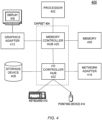
- FIG. 4 is a high-level block diagram illustrating physical components of a computer 400 used as part or all of the online system 100 or the client devices 110, 120, according to one embodiment. Illustrated are at least one processor 402 coupled to a chipset 404. Also coupled to the chipset 404 are a memory 406, a storage device 408, a graphics adapter 412, and a network adapter 416. A display 418 is coupled to the graphics adapter 412. In one embodiment, the functionality of the chipset 404 is provided by a memory controller hub 420 and an I/O controller hub 422. In another embodiment, the memory 406 is coupled directly to the processor 402 instead of the chipset 404.
- the storage device 408 is any non-transitory computer-readable storage medium, such as a hard drive, compact disk read-only memory (CD-ROM), DVD, or a solid-state memory device.
- the memory 406 holds instructions and data used by the processor 402.
- the graphics adapter 412 displays images and other information on the display 418.
- the network adapter 416 couples the computer 400 to a local or wide area network.
- a computer 400 can have different and/or other components than those shown in FIG. 4 .
- the computer 400 can lack certain illustrated components.
- a computer 400 acting as a server may lack a graphics adapter 412, and/or display 418, as well as a keyboard 410 or pointing device 414.
- the storage device 408 can be local and/or remote from the computer 400 (such as embodied within a storage area network (SAN)).
- SAN storage area network
- the computer 400 is adapted to execute computer program modules for providing functionality described herein.
- module refers to computer program logic utilized to provide the specified functionality.
- a module can be implemented in hardware, firmware, and/or software.
- program modules are stored on the storage device 408, loaded into the memory 406, and executed by the processor 402.
- Embodiments of the entities described herein can include other and/or different modules than the ones described here.
- the functionality attributed to the modules can be performed by other or different modules in other embodiments.
- this description occasionally omits the term "module" for purposes of clarity and convenience.
- Certain aspects of the present invention include process steps and instructions described herein in the form of an algorithm. It should be noted that the process steps and instructions of the present invention could be embodied in software, firmware or hardware, and when embodied in software, could be downloaded to reside on and be operated from different platforms used by real time network operating systems.
- the present invention also relates to an apparatus for performing the operations herein.
- This apparatus may be specially constructed for the required purposes, or it may comprise a general-purpose computer selectively activated or reconfigured by a computer program stored on a computer readable medium that can be accessed by the computer.
- a computer program may be stored in a non-transitory computer readable storage medium, such as, but is not limited to, any type of disk including floppy disks, optical disks, CD-ROMs, magnetic-optical disks, read-only memories (ROMs), random access memories (RAMs), EPROMs, EEPROMs, magnetic or optical cards, application specific integrated circuits (ASICs), or any type of computer-readable storage medium suitable for storing electronic instructions, and each coupled to a computer system bus.
- the computers referred to in the specification may include a single processor or may be architectures employing multiple processor designs for increased computing capability.
- the present invention is well suited to a wide variety of computer network systems over numerous topologies.
- the configuration and management of large networks comprise storage devices and computers that are communicatively coupled to dissimilar computers and storage devices over a network, such as the Internet.
Landscapes
- Engineering & Computer Science (AREA)
- Computer Security & Cryptography (AREA)
- Computer Networks & Wireless Communication (AREA)
- Signal Processing (AREA)
- Computer Hardware Design (AREA)
- General Engineering & Computer Science (AREA)
- Computing Systems (AREA)
- Theoretical Computer Science (AREA)
- Software Systems (AREA)
- General Physics & Mathematics (AREA)
- Physics & Mathematics (AREA)
- Computer And Data Communications (AREA)
- Storage Device Security (AREA)
Description
- The present disclosure generally relates to the field of software applications, and more specifically, to detecting and responding to attempts to gain unauthorized access to user accounts on an online system.
- Malicious third parties may wish to gain unauthorized access to user accounts on a computer system, e.g., to steal user information. This is a particular risk in the case of online systems, in which the accounts may be accessed by users (including unauthorized users) from essentially any location over a computer network, either manually using a graphical user interface, in an automated manner by scripting interactions with a graphical user interface, or in an automated manner using an application programming interface (API).
- It would be valuable for the online systems to be able to detect attempts to gain unauthorized access, and- once detected- to be able to prevent the present access and also to gain greater ability to prevent future unauthorized accesses.
- European patent application
EP 3310017 A1 describes a server for two factor identification which is configured to receive an one time code and an identifier of an electronic device from an application server, identify a public key associated with the received identifier of electronic device, encrypt the received one time code with the identified public key, send the encrypted one time code the electronic device through a telecommunication network providing an ultra-narrow band radio connection, and the electronic device is configured to receive the encrypted one time code through the ultra-narrow band radio connection, decrypt the received one time code with a private key associated with the electronic device, display the decrypted one time code on a screen of the electronic device. - United States patent application
US 2017/126733 A1 describes techniques for protecting a user from denial of service (DOS) to access his/her a user account that has been locked. An access management system can provide features that enable an owner of an account to prevent the account from becoming locked. Specifically, the techniques disclosed herein enable an account holder to circumvent procedures of the access management system that lock an account after several unsuccessful attempts to access the account. The access management system may operate according to a configuration for managing access to account. The access management system can manage access to an account by presenting a user with an interface to received access information (e.g., account information and credential information) for the account to determine whether to unlock the account. The access management system can deny access to an account upon determining that the credential information is not correct for the account. - United States patent application
US 2009/150971 A1 describes techniques for dynamic generation and management of password dictionaries. Passwords are parsed for recognizable terms. The terms are housed in dictionaries or databases. Statistics associated with the terms are maintained and managed. The statistics are used to provide strength values to the passwords and determine when passwords are acceptable and unacceptable. - United States patent application
US 2016/173485 A1 describes systems and methods in which a first identity claim and a first attempt to prove password possession are received. As a result of determining that the first attempt to prove password possession is a match to a password in a set of passwords, but that the first identity claim is a mismatch to an identity that corresponds to the password, an authentication process that includes incrementing a counter associated with the password is performed. A second identity claim and a second attempt to prove password possession is received. As a result of determining that the second attempt to prove password possession is a match to the password, an authentication process that includes incrementing the counter associated with the password only if the second identity claim is a mismatch to the first identity claim is performed. - The invention provides a computer-implemented method according to claim 1, a non-transitory computer-readable storage medium according to claim 7 and an online system according to claim 12. Preferred embodiments are defined in the dependent claims.
-
-
FIG. 1 illustrates one embodiment of a computing environment in which users use their client devices to log in to an online system to gain access to its functionality. -
FIG. 2 is a high-level block diagram illustrating a detailed view of the security module of the online system ofFIG. 1 , according to an embodiment of the invention. -
FIG. 3 illustrates example interactions between client devices and the online system ofFIG. 1 as a result of system login attempts, according to an embodiment of the invention. -
FIG. 4 is a high-level block diagram illustrating physical components of a computer used as part or all of the online system or the client devices ofFIG. 1 , according to one embodiment. - The figures depict embodiments of the present invention for purposes of illustration only. One skilled in the art will readily recognize from the following description that alternative embodiments of the structures and methods illustrated herein may be employed without departing from the invention as defined by the claims.
-
FIG. 1 illustrates one embodiment of a computing environment in which users use their client devices to log in to an online system to gain access to its functionality. - Users use their client devices 110 (e.g., desktops, laptops, tablet computers, smartphones, or the like) to gain access to an
online system 100 and use its functionality. For example, theonline system 100 could be the system of a company providing a web-based application or service (e.g., SALESFORCE™, GOOGLE APPS™, or the like), of a company providing users of a separate organization with single-sign on access to multiple such applications, or the like. - The
online system 100 supports multiple users, providing those users with access to its functionality once the users have authorized themselves by providing their credentials. Differentonline systems 100 may support different types of credentials, such as usernames and passwords, biometric data such as fingerprint or iris scan data, values generated by a hardware security token, or multifactor authentication using two or more credential types. Information about the users and their credentials is stored in the user accounts database 102. For example, for someonline systems 100 the user accounts database 102 might store a list of all the usernames of users of the systems, and for each username, a corresponding set of credential information (e.g., an (encrypted) password, a biometric fingerprint, a phone number for sending an SMS code, or a seed for generating token values), as well as any other information about the user tracked by the system. - Since login is available to users over the network, there may also be attackers who user their
own client devices 120 to attempt to gain unauthorized access to accounts of legitimated authorized users of theonline system 100, e.g., by attempting to guess user passwords using common password values. - To address such attackers, the
online system 100 uses asecurity module 104, which is described in more detail with respect toFIG. 2 , below. - The
network 140 may be any suitable communications network for data transmission. In an embodiment such as that illustrated inFIG. 1 , thenetwork 140 uses standard communications technologies and/or protocols and can include the Internet. In another embodiment, the entities use custom and/or dedicated data communications technologies. - Although for simplicity
FIG. 1 illustrates exactly oneuser client device 110 and oneattacker client device 120, there may be any number of each. -
FIG. 2 is a high-level block diagram illustrating a detailed view of thesecurity module 104 of theonline system 100, according to an embodiment of the invention. - In some embodiments, the
security module 104 includes anattack detection module 205 that determines whether an attack on user accounts is taking place (that is, whether an unauthorized user is attempting to gain access to accounts of legitimate users). One common type of attack is "password spraying," in which an unauthorized user attempts to login to different user accounts with the same set of common passwords, hoping that at least one of the users will have used one of the common passwords. For example, an unauthorized user might attempt to log in to a set of users accounts, each using the same common password (e.g., "123456," "opensesame," or the like). Some attacks may generate usernames, or use common usernames (e.g., "jsmith"), or rely on knowledge of names of members of the organization(s) in question (e.g., the known member "John Smith" being presumed to have the username "jsmith" or "john.smith" or the like), rather than first determining actual usernames of theonline system 100. - In some embodiments, the
attack detection module 205 determines that an attack is taking place by applying a specific algorithm, such as determining whether the same IP address is the source of at least some predetermined threshold number of login attempts, spread out over at least some predetermined threshold number of usernames, over some predetermined threshold period of time. In other embodiments, theattack detection module 205 applies an attack detection model (not illustrated inFIG. 2 ) that is trained using a supervised machine learning algorithm. In such embodiments, the training set of login requests considered to constitute attacks consists of login requests satisfying criteria indicating extremely high likelihood of attack (e.g., over 500 prior attempts at login by the same IP address within the past minute). The features of a login request used in the training include, in various embodiments: IP address of the login request, HTTP user-agent (browser) of the login request, day of the login request, time of day of the login request, and/or whether the login request was made via an API or a graphical user interface). After the training of the attack detection model, theattack detection module 205 then extracts the same features from new login requests, and applies the model to those features, obtaining as output a confidence score indicating the probability that the login request is an attack. Confidence scores meeting a given threshold value may be considered to constitute an attack. - In some embodiments, the
attack detection module 205 determines whether an attack is occurring based on analyzing the IP address of the current login request (e.g., whether that IP address has been frequently attempting and failing login in the recent past).
In other embodiments, theattack detection module 205 analyzes the HTTP user-agent in combination with other information identifying the user. In other embodiments, where theonline system 100 is a multi-tenant system (e.g., a single-sign on (SSO) system) that acts on behalf of multiple tenants (e.g., different companies and their associated users constituting different tenants), theattack detection module 205 analyzes the tenant for which login is being requested (e.g., for a user belonging to a particular tenant). The determination of whether an attack is occurring may be specific to the particular action to be taken. For example, analyzing the entire tenant may be appropriate when determining whether to employ reordering of multifactor authentication (described below), but not for other types of actions. - The
security module 104 includes anattack response policy 210 that specifies what actions to take in response to a login request determined to constitute an attack. Theattack response policy 210 may be specified by a system administrator or other employee of theonline system 100, and may specify that the actions are conditional upon other variables, such as whether multifactor authentication (MFA) is being employed, the probability of attack as determined by an attack detection model, or the like. - According to the invention, the
attack response policy 210 specifies that MFA reordering should be employed in response to an attack. This technique is appropriate when MFA security is being employed for the user to whose account access is being requested. The technique is employed when theattack detection module 205 determines that a particular login request is likely, but not certainly, an attack. For example, theattack detection module 205 may determine that the probability that the login request is at least a first threshold, but less than a second threshold (e.g., at least 70% likely, but less than 95% likely), that at least N, but fewer than M, consecutive failed login attempts have originated at the same IP address (for N < M), or the like. For instance, MFA reordering might be employed after N = 100 failed login requests from the same IP address (at which point it is considered likely that the IP address constitutes an attacker), but before M = 500 failed login attempts (at which point it is considered essentially certain that the IP address constitutes an attacker). In some embodiments, N may be randomly selected from some range (e.g., from 50 to 150 attempts), so as to make it more difficult for attackers to determine that their attack has been detected. - When MFA reordering is employed, the
online system 100 switches from requesting, from a user attempting login, a first type of credential (e.g., a password) to requesting a second type of credential (e.g., a code sent to a secondary device using a time-based one-time password (TOTP)). As one specific example, rather than continuing to request a password (or a <username, password> pair) from the user after 100 failed attempts at entering the password, theonline system 100 switches to requesting that the user enter a code sent via TOTP. In some cases, the second type of credential is more difficult for an unauthorized user to provide than the first type of credential (e.g., TOTP being more difficult to guess than a password). Switching to requesting a second type of credential has the benefit of typically making it more difficult for an attacker to provide the correct credential values (assuming that the attacker has a good strategy for attacking the first type of credential, but not the second type of credential), without the burden of forcing the requesting user (who possibly is not an attacker) to provide all the types of credentials on every login attempt. This results in a more pleasant user experience, while still providing strong security. Another benefit is that an "innocent" user mistakenly determined by theattack detection module 205 to likely be attempting unauthorized access is still capable of logging in, although they are required to provide all the configured credential types. The switching of credential type order also prevents an attacker from correctly determining the value for the (more easily-determined) first type of credential. Determination of the correct value for the first type of credential can be detrimental to the true user, even though to access theonline system 100 will require an attacker to guess values of additional types of credentials, because even partial information can be leveraged later. For example, the true user's password on theonline system 100, once guessed, may be used to gain access to accounts of the user on other systems, in cases where the true user re-uses his or her passwords. - Another possible type of response specified by the
attack response policy 210 is switching to a login mode in which login requests are still accepted, but in which login will not be permitted for the requesting user (at least within a given timeframe), regardless of whether the requesting user provides the correct credentials. This provides a number of benefits: First, it prevents an attacking user from eventually gaining access to user accounts through sheer number of attempts. Second, it prevents the attacking user from realizing that the attack has been detected, which in turn prevents the attacker from switching to a different type of attack, or ceasing to provide credential values to thesecurity module 104. Third, it allows thesecurity module 104 to collect information about the login requests (which are presumed to constitute attacks) and store it in anattack information store 220. - Still another type of response specified by the
attack response policy 210 is collecting and logging information about the (presumably unauthorized) login request. In some embodiments, the collected information is used to train the attack detection model discussed above. In some embodiments, the collected information includes the IP address from which the login request originated, the day of the login request, the time of the login request, the frequency of login requests (e.g., number of prior login requests over some prior time period) by the same IP address, the values of the credentials submitted (e.g., the particular username and password), or the like. - In some embodiments in which the
security module 104 does not employ fuzzy matching to generate variants of known common credentials, theattack information store 220 stores a hash of the submitted credential values, rather than the values themselves, thereby increasing user privacy. (Fuzzy matching may be useful in systems which have only small sets of known common credentials, but it becomes less useful for larger sets of known common credentials, such as result from capturing attempted credentials in theattack information store 220.) The credential value hash may be associated with a count of the times that the credential value was used (e.g., a count of the unique user identifies for which the credential value was used). - According to the invention, once a credential value (e.g., a password) has been submitted a given amount (e.g., for N different users, such as N >= 50), it is considered a commonly-attempted credential value and placed in a common credentials store (not illustrated in
FIG. 2 ). Theonline system 100 then rejects requests of its users to use credential values in the common credentials store (e.g., reject requests of users to make their accounts accessible via common passwords), so as to make their accounts more difficult to attack. Thus, when a user of theonline system 100 attempts to set a credential of the user's account to one of the credential values in the common credentials store, the online system disallows it and requires the user to select another credential value. Additionally, theonline system 100 may issue a warning to those of its users to whose accounts access was requested using the commonly-attempted credentials. - In some embodiments, the
attack response policy 210 indicates that in addition to logging information about the presumably unauthorized login requests, properties defining a user group being attacked should be determined. Specifically, users are identified to whose accounts login was requested by the apparent attacks, and one or more properties defining a user group including those attacked users is determined. For example, based on the specific users being attacked, it might be determined that executives of a particular organization are being targeted (where the property defining the user group is that job title of the users, with a value indicating executive status). A defensive policy measure is then implemented to some or all of the accounts of the users of the user group defined by the determined properties (e.g., all executives of an organization), e.g., so as to reduce the risk of unauthorized access to those accounts, or to make use of the accounts more usable despite the attack. For example, user accounts under attack can be set to be locked after some number of password attempts. As another example, for cases where locking of users accounts after failed logins already occurs, and where malicious locking of user accounts through intentional failed logins is the intent of the attack, a time of automatic unlocking for accounts of the user group being attacked can be reduced (e.g., from 2 hours to 5 minutes). This makes it easier to regain access to maliciously locked accounts, while still making it difficult to gain unauthorized access to the accounts through brute force attempts. - The
security module 104 includes anattack response module 215 that applies theattack response policy 210 to take an action appropriate for the current context. As one example, theattack response module 215 may apply multifactor reordering if MFA is being used for the user to whose login is being requested, and if theattack detection module 205 determined that the probability that the login request is an attack is significant but not certain; otherwise, theattack response module 215 switches to a mode that allows login attempts but does not permit successful login, and collects and logs information about the login request. -
FIG. 3 illustrates example interactions between client devices and theonline system 100 as a result of system login attempts, according to an embodiment of the invention. - A legitimate user of the
online system 100 uses aclient device 110 to login 305 to the online system by correctly specifying the user's credentials (e.g., username and password). Since the credentials were correct, theonline system 100 grants the user with access to the user's account on the online system and its associated functionality, and the user proceeds to use 310 that functionality. - Separately, an attacker uses the attacker's
client device 120 to attempt login 315 to accounts of one or more users. Since the attacker does not know the users' credential values, but rather is merely attempting common credential values, the online system eventually detects 320 that the attempted logins constitute an attack on user accounts, as discussed above with respect to theattack detection module 205. In response to detecting that the attempted logins constitute an attack on user accounts, theonline system 100 applies 325 its attack response policy, as discussed above with respect to theattack response policy 210 and theattack response module 215. For example, the online system can reorder the requested MFA credential types, switch to a mode in which successful login is not permitted to the attacker, and/or log information about the attack. -
FIG. 4 is a high-level block diagram illustrating physical components of acomputer 400 used as part or all of theonline system 100 or theclient devices processor 402 coupled to achipset 404. Also coupled to thechipset 404 are amemory 406, astorage device 408, agraphics adapter 412, and anetwork adapter 416. Adisplay 418 is coupled to thegraphics adapter 412. In one embodiment, the functionality of thechipset 404 is provided by amemory controller hub 420 and an I/O controller hub 422. In another embodiment, thememory 406 is coupled directly to theprocessor 402 instead of thechipset 404. - The
storage device 408 is any non-transitory computer-readable storage medium, such as a hard drive, compact disk read-only memory (CD-ROM), DVD, or a solid-state memory device. Thememory 406 holds instructions and data used by theprocessor 402. Thegraphics adapter 412 displays images and other information on thedisplay 418. Thenetwork adapter 416 couples thecomputer 400 to a local or wide area network. - As is known in the art, a
computer 400 can have different and/or other components than those shown inFIG. 4 . In addition, thecomputer 400 can lack certain illustrated components. In one embodiment, acomputer 400 acting as a server may lack agraphics adapter 412, and/ordisplay 418, as well as akeyboard 410 orpointing device 414. Moreover, thestorage device 408 can be local and/or remote from the computer 400 (such as embodied within a storage area network (SAN)). - As is known in the art, the
computer 400 is adapted to execute computer program modules for providing functionality described herein. As used herein, the term "module" refers to computer program logic utilized to provide the specified functionality. Thus, a module can be implemented in hardware, firmware, and/or software. In one embodiment, program modules are stored on thestorage device 408, loaded into thememory 406, and executed by theprocessor 402. - Embodiments of the entities described herein can include other and/or different modules than the ones described here. In addition, the functionality attributed to the modules can be performed by other or different modules in other embodiments. Moreover, this description occasionally omits the term "module" for purposes of clarity and convenience.
- The present invention has been described in particular detail with respect to one possible embodiment. Those of skill in the art will appreciate that the invention may be practiced in other embodiments. First, the particular naming of the components and variables, capitalization of terms, the attributes, data structures, or any other programming or structural aspect is not mandatory or significant, and the mechanisms that implement the invention or its features may have different names, formats, or protocols. Also, the particular division of functionality between the various system components described herein is merely for purposes of example, and is not mandatory; functions performed by a single system component may instead be performed by multiple components, and functions performed by multiple components may instead performed by a single component.
- Some portions of the above description present the features of the present invention in terms of algorithms and symbolic representations of operations on information. These algorithmic descriptions and representations are the means used by those skilled in the data processing arts to most effectively convey the substance of their work to others skilled in the art. These operations, while described functionally or logically, are understood to be implemented by computer programs. Furthermore, it has also proven convenient at times, to refer to these arrangements of operations as modules or by functional names, without loss of generality.
- Unless specifically stated otherwise as apparent from the above discussion, it is appreciated that throughout the description, discussions utilizing terms such as "determining" or "displaying" or the like, refer to the action and processes of a computer system, or similar electronic computing device, that manipulates and transforms data represented as physical (electronic) quantities within the computer system memories or registers or other such information storage, transmission or display devices.
- Certain aspects of the present invention include process steps and instructions described herein in the form of an algorithm. It should be noted that the process steps and instructions of the present invention could be embodied in software, firmware or hardware, and when embodied in software, could be downloaded to reside on and be operated from different platforms used by real time network operating systems.
- The present invention also relates to an apparatus for performing the operations herein. This apparatus may be specially constructed for the required purposes, or it may comprise a general-purpose computer selectively activated or reconfigured by a computer program stored on a computer readable medium that can be accessed by the computer. Such a computer program may be stored in a non-transitory computer readable storage medium, such as, but is not limited to, any type of disk including floppy disks, optical disks, CD-ROMs, magnetic-optical disks, read-only memories (ROMs), random access memories (RAMs), EPROMs, EEPROMs, magnetic or optical cards, application specific integrated circuits (ASICs), or any type of computer-readable storage medium suitable for storing electronic instructions, and each coupled to a computer system bus. Furthermore, the computers referred to in the specification may include a single processor or may be architectures employing multiple processor designs for increased computing capability.
- The algorithms and operations presented herein are not inherently related to any particular computer or other apparatus. Various general-purpose systems may also be used with programs in accordance with the teachings herein, or it may prove convenient to construct more specialized apparatus to perform the required method steps. The required structure for a variety of these systems will be apparent to those of skill in the art, along with equivalent variations. In addition, the present invention is not described with reference to any particular programming language. It is appreciated that a variety of programming languages may be used to implement the teachings of the present invention as described herein, and any references to specific languages are provided for invention of enablement and best mode of the present invention.
- The present invention is well suited to a wide variety of computer network systems over numerous topologies. Within this field, the configuration and management of large networks comprise storage devices and computers that are communicatively coupled to dissimilar computers and storage devices over a network, such as the Internet.
- Finally, it should be noted that the language used in the specification has been principally selected for readability and instructional purposes, and may not have been selected to delineate or circumscribe the inventive subject matter. Accordingly, the disclosure of the present invention is intended to be illustrative, but not limiting, of the scope of the invention, which is set forth in the claims.
Claims (12)
- A computer-implemented method performed by an online system, comprising:determining, for an account of a user of the online system, that the user must provide a first credential type before a second credential type in order to obtain access to the account;receiving, from an accessing user, a request to login to the account, the request including a value of the first credential type;and characterised in that:based at least in part on the value, determining that the request is likely unauthorized; andresponsive to determining that the request is likely unauthorized:
determining that the accessing user must provide the second credential type before the first credential type in order to obtain access to the account;determining that requests from a second accessing user to login to an account of a second user of the online system are likely unauthorized; andresponsive to determining that the requests are likely unauthorized:
logging information about the requests to login, the information comprising credential values submitted along with the requests from the second accessing user;identifying, as common credential values, ones of the credential values submitted with at least a threshold frequency;receiving a request from a user to change a credential value of the user to one of the identified common credential values; and
rejecting the request of the user to change the credential value of the user to the one of the identified common credential values. - The computer-implemented method of claim 1, further comprising: requesting the second credential type from the accessing user;responsive to receiving the second credential type from the accessing user, requesting the first credential type from the accessing user; andresponsive to the first credential type and the second credential type being correct, allowing access to the account
- The computer-implemented method of claim 1, further comprising:
responsive to determining that the requests are likely unauthorized:
continuing to accept requests to login from the second accessing user, such that login to the account of the second is denied regardless of whether values of credentials provided in the requests are correct. - The computer-implemented method of claim 1, wherein the information comprises one or more of IP addresses of the requests, time of the requests, frequency of the requests, and whether the request was submitted via an API or a graphical user interface, the computer-implemented method further comprising:
training a model by providing the information as feature input to a supervised
machine learning algorithm, the model when applied to feature input of login requests indicating whether the login requests are likely unauthorized. - The computer-implemented method of claim 1, further comprising:identifying users to whose accounts login was requested using one of the identified common credential values;determining, based on the identified users, properties defining a user group being attacked; andimplementing a defensive policy measure to accounts of users of the user group.
- The computer-implemented method of claim 5, wherein the defensive policy measure comprises altering, for the accounts, at least one of: a number of failed login requests permitted before account locking, and a time of automatic unlocking after account locking.
- A non-transitory computer-readable storage medium storing instructions that when executed by a computer processor of an online system perform actions comprising:determining, for an account of a user of an online system, that the user must provide a first credential type before a second credential type in order to obtain access to the account;receiving, from an accessing user, a request to login to the account, the request including a value of the first credential type;and characterised in that:based at least in part on the value, determining that the request is likely unauthorized;responsive to determining that the request is likely unauthorized:
determining that the accessing user must provide the second credential type before the first credential type in order to obtain access to the account;determining that requests from a second accessing user to login to an account of a second user of the online system are likely unauthorized; andresponsive to determining that the requests are likely unauthorized:
logging information about the requests to login, the information comprising credential values submitted along with the requests from the second accessing user;identifying, as common credential values, ones of the credential values submitted with at least a threshold frequency;receiving a request from a user to change a credential value of the user to one of the identified common credential values; and
rejecting the request of the user to change the credential value of the user to the one of the identified common credential values. - The non-transitory computer-readable storage medium of claim 7, the instructions further comprising:
responsive to determining that the requests are likely unauthorized:
continuing to accept requests to login from the second accessing user, such that login to the account of the second is denied regardless of whether values of credentials provided in the requests are correct. - The non-transitory computer-readable storage medium of claim 7, wherein the information comprises one or more of IP addresses of the requests, time of the requests, frequency of the requests, and whether the request was submitted via an API or a graphical user interface, the computer-implemented method further comprising:
training a model by providing the information as feature input to a supervised machine learning algorithm, the model when applied to feature input of login requests indicating whether the login requests are likely unauthorized. - The non-transitory computer-readable storage medium of claim 7, the instructions further comprising:identifying users to whose accounts login was requested using one of the identified common credential values;determining, based on the identified users, properties defining a user group being attacked; andimplementing a defensive policy measure to accounts of users of the user group.
- The non-transitory computer-readable storage medium of claim 10, wherein the defensive policy measure comprises altering, for the accounts, at least one of: a number of failed login requests permitted before account locking, and a time of automatic unlocking after account locking.
- An online system comprising:a computer processor; anda non-transitory computer-readable storage medium storing instructions that when executed by the computer processor perform actions comprising:determining, for an account of a user of the online system, that the user must provide a first credential type before a second credential type in order to obtain access to the account;receiving, from an accessing user, a request to login to the account, the request including a value of the first credential type;and characterised in that:based at least in part on the value, determining that the request is likely unauthorized; andresponsive to determining that the request is likely unauthorized:
determining that the accessing user must provide the second credential type before the first credential type in order to obtain access to the account;determining that requests from a second accessing user to login to an account of a second user of the online system are likely unauthorized;responsive to determining that the requests are likely unauthorized:
logging information about the requests to login, the information comprising credential values submitted along with the requests from the second accessing user;identifying, as common credential values, ones of the credential values submitted with at least a threshold frequency;receiving a request from a user to change a credential value of the user to one of the identified common credential values; and
rejecting the request of the user to change the credential value of the user to the one of the identified common credential values.
Applications Claiming Priority (2)
| Application Number | Priority Date | Filing Date | Title |
|---|---|---|---|
| US16/175,748 US11012468B2 (en) | 2018-10-30 | 2018-10-30 | Detecting and responding to attempts to gain unauthorized access to user accounts in an online system |
| PCT/US2019/058381 WO2020131220A2 (en) | 2018-10-30 | 2019-10-28 | Detecting and responding to attempts to gain unauthorized access to user accounts in an online system |
Publications (3)
| Publication Number | Publication Date |
|---|---|
| EP3874716A2 EP3874716A2 (en) | 2021-09-08 |
| EP3874716A4 EP3874716A4 (en) | 2022-06-08 |
| EP3874716B1 true EP3874716B1 (en) | 2024-09-11 |
Family
ID=70325893
Family Applications (1)
| Application Number | Title | Priority Date | Filing Date |
|---|---|---|---|
| EP19899473.3A Active EP3874716B1 (en) | 2018-10-30 | 2019-10-28 | Detecting and responding to attempts to gain unauthorized access to user accounts in an online system |
Country Status (5)
| Country | Link |
|---|---|
| US (1) | US11012468B2 (en) |
| EP (1) | EP3874716B1 (en) |
| AU (1) | AU2019401240B2 (en) |
| NZ (1) | NZ776613A (en) |
| WO (1) | WO2020131220A2 (en) |
Families Citing this family (10)
| Publication number | Priority date | Publication date | Assignee | Title |
|---|---|---|---|---|
| US10298563B2 (en) * | 2015-04-29 | 2019-05-21 | Hewlett Packard Enterprise Development Lp | Multi-factor authorization for IEEE 802.1x-enabled networks |
| US10972498B2 (en) * | 2018-10-08 | 2021-04-06 | International Business Machines Corporation | Dynamic protection from detected to brute force attack |
| US10389708B1 (en) | 2019-01-03 | 2019-08-20 | Capital One Services, Llc | Secure authentication of a user associated with communication with a service representative |
| US11921830B2 (en) * | 2019-07-25 | 2024-03-05 | Seaton Gras | System and method for verifying unique user identification |
| JP7395938B2 (en) * | 2019-10-09 | 2023-12-12 | 富士フイルムビジネスイノベーション株式会社 | Information processing device, information processing system and program |
| US11303637B2 (en) * | 2020-02-04 | 2022-04-12 | Visa International Service Association | System, method, and computer program product for controlling access to online actions |
| CN111914248B (en) * | 2020-08-18 | 2023-10-27 | 科大讯飞股份有限公司 | Password input methods, devices, equipment and storage media |
| CN116910742B (en) * | 2023-07-05 | 2026-04-14 | 中国电信股份有限公司技术创新中心 | Terminal equipment unlocking method and device |
| US12505448B2 (en) | 2023-08-09 | 2025-12-23 | Capital One Services, Llc | Systems and methods for fraud prevention in mobile application verification device enrollment process |
| CN117914606B (en) * | 2024-01-24 | 2026-05-26 | 中国联合网络通信集团有限公司 | Methods, devices, equipment, and storage media for handling abnormal accounts |
Family Cites Families (18)
| Publication number | Priority date | Publication date | Assignee | Title |
|---|---|---|---|---|
| US20070136573A1 (en) * | 2005-12-05 | 2007-06-14 | Joseph Steinberg | System and method of using two or more multi-factor authentication mechanisms to authenticate online parties |
| US20070136792A1 (en) * | 2005-12-05 | 2007-06-14 | Ting David M | Accelerating biometric login procedures |
| US8201231B2 (en) | 2007-02-21 | 2012-06-12 | Microsoft Corporation | Authenticated credential-based multi-tenant access to a service |
| US8286000B2 (en) * | 2007-12-07 | 2012-10-09 | Novell, Inc. | Techniques for dynamic generation and management of password dictionaries |
| US8584221B2 (en) | 2009-10-23 | 2013-11-12 | Microsoft Corporation | Authenticating using cloud authentication |
| US20110225648A1 (en) * | 2010-03-15 | 2011-09-15 | Intuit Inc. | Method and apparatus for reducing the use of insecure passwords |
| US8601602B1 (en) * | 2010-08-31 | 2013-12-03 | Google Inc. | Enhanced multi-factor authentication |
| US8490162B1 (en) * | 2011-09-29 | 2013-07-16 | Amazon Technologies, Inc. | System and method for recognizing malicious credential guessing attacks |
| US8904506B1 (en) * | 2011-11-23 | 2014-12-02 | Amazon Technologies, Inc. | Dynamic account throttling |
| US10713374B2 (en) * | 2015-03-31 | 2020-07-14 | Pure Storage, Inc. | Resolving detected access anomalies in a dispersed storage network |
| US10063557B2 (en) | 2015-06-07 | 2018-08-28 | Apple Inc. | Account access recovery system, method and apparatus |
| US10225283B2 (en) * | 2015-10-22 | 2019-03-05 | Oracle International Corporation | Protection against end user account locking denial of service (DOS) |
| US9984217B2 (en) * | 2016-02-19 | 2018-05-29 | Paypal, Inc. | Electronic authentication of an account in an unsecure environment |
| US10257201B2 (en) | 2016-07-28 | 2019-04-09 | Red Hat, Inc. | Management of service accounts |
| US10558797B2 (en) | 2016-08-12 | 2020-02-11 | Duo Security, Inc. | Methods for identifying compromised credentials and controlling account access |
| US10547646B2 (en) * | 2016-09-16 | 2020-01-28 | Oracle International Corporation | Dynamic policy injection and access visualization for threat detection |
| EP3310017A1 (en) | 2016-10-14 | 2018-04-18 | Alcatel Lucent | Electronic device for two factor authentication |
| EP3635600A1 (en) * | 2017-06-04 | 2020-04-15 | Apple Inc. | Authentication techniques in response to attempts to access sensitive information |
-
2018
- 2018-10-30 US US16/175,748 patent/US11012468B2/en active Active
-
2019
- 2019-10-28 WO PCT/US2019/058381 patent/WO2020131220A2/en not_active Ceased
- 2019-10-28 NZ NZ776613A patent/NZ776613A/en unknown
- 2019-10-28 EP EP19899473.3A patent/EP3874716B1/en active Active
- 2019-10-28 AU AU2019401240A patent/AU2019401240B2/en active Active
Also Published As
| Publication number | Publication date |
|---|---|
| AU2019401240A1 (en) | 2021-06-17 |
| US20200137066A1 (en) | 2020-04-30 |
| NZ776613A (en) | 2022-07-01 |
| EP3874716A2 (en) | 2021-09-08 |
| WO2020131220A3 (en) | 2020-09-24 |
| WO2020131220A2 (en) | 2020-06-25 |
| EP3874716A4 (en) | 2022-06-08 |
| AU2019401240B2 (en) | 2022-02-10 |
| US11012468B2 (en) | 2021-05-18 |
Similar Documents
| Publication | Publication Date | Title |
|---|---|---|
| AU2019401240B2 (en) | Detecting and responding to attempts to gain unauthorized access to user accounts in an online system | |
| US11888868B2 (en) | Identifying security risks and fraud attacks using authentication from a network of websites | |
| US9866567B2 (en) | Systems and methods for detecting and reacting to malicious activity in computer networks | |
| US10057282B2 (en) | Detecting and reacting to malicious activity in decrypted application data | |
| US8856892B2 (en) | Interactive authentication | |
| US11425166B2 (en) | Identifier-based application security | |
| US9942220B2 (en) | Preventing unauthorized account access using compromised login credentials | |
| US10320848B2 (en) | Smart lockout | |
| US10630676B2 (en) | Protecting against malicious discovery of account existence | |
| US9092599B1 (en) | Managing knowledge-based authentication systems | |
| US8452980B1 (en) | Defeating real-time trojan login attack with delayed interaction with fraudster | |
| US20160182491A1 (en) | Methods, systems and apparatus to manage an authentication sequence | |
| WO2019095856A1 (en) | Network identity authentication method and system, and user agent device used thereby | |
| US20240195797A1 (en) | Systems and Methods to Ensure Proximity of a Multi-Factor Authentication Device | |
| US20180054429A1 (en) | Systems and methods for the detection and control of account credential exploitation | |
| EP3877877B1 (en) | Methods and systems for detecting unauthorized access | |
| EP3903468B1 (en) | Credential loss prevention |
Legal Events
| Date | Code | Title | Description |
|---|---|---|---|
| STAA | Information on the status of an ep patent application or granted ep patent |
Free format text: STATUS: THE INTERNATIONAL PUBLICATION HAS BEEN MADE |
|
| PUAI | Public reference made under article 153(3) epc to a published international application that has entered the european phase |
Free format text: ORIGINAL CODE: 0009012 |
|
| STAA | Information on the status of an ep patent application or granted ep patent |
Free format text: STATUS: REQUEST FOR EXAMINATION WAS MADE |
|
| 17P | Request for examination filed |
Effective date: 20210528 |
|
| AK | Designated contracting states |
Kind code of ref document: A2 Designated state(s): AL AT BE BG CH CY CZ DE DK EE ES FI FR GB GR HR HU IE IS IT LI LT LU LV MC MK MT NL NO PL PT RO RS SE SI SK SM TR |
|
| RIC1 | Information provided on ipc code assigned before grant |
Ipc: G06F 21/31 20130101ALI20211220BHEP Ipc: G06F 21/55 20130101ALI20211220BHEP Ipc: H04L 29/06 20060101AFI20211220BHEP |
|
| DAV | Request for validation of the european patent (deleted) | ||
| DAX | Request for extension of the european patent (deleted) | ||
| REG | Reference to a national code |
Ref legal event code: R079 Ipc: G06F0021550000 Ref country code: DE Ref document number: 602019058922 Country of ref document: DE Free format text: PREVIOUS MAIN CLASS: H04L0029060000 |
|
| A4 | Supplementary search report drawn up and despatched |
Effective date: 20220509 |
|
| RIC1 | Information provided on ipc code assigned before grant |
Ipc: H04L 9/40 20220101ALI20220502BHEP Ipc: G06F 21/46 20130101ALI20220502BHEP Ipc: G06F 21/31 20130101ALI20220502BHEP Ipc: G06F 21/55 20130101AFI20220502BHEP |
|
| GRAP | Despatch of communication of intention to grant a patent |
Free format text: ORIGINAL CODE: EPIDOSNIGR1 |
|
| STAA | Information on the status of an ep patent application or granted ep patent |
Free format text: STATUS: GRANT OF PATENT IS INTENDED |
|
| INTG | Intention to grant announced |
Effective date: 20231018 |
|
| GRAJ | Information related to disapproval of communication of intention to grant by the applicant or resumption of examination proceedings by the epo deleted |
Free format text: ORIGINAL CODE: EPIDOSDIGR1 |
|
| STAA | Information on the status of an ep patent application or granted ep patent |
Free format text: STATUS: REQUEST FOR EXAMINATION WAS MADE |
|
| INTC | Intention to grant announced (deleted) | ||
| GRAP | Despatch of communication of intention to grant a patent |
Free format text: ORIGINAL CODE: EPIDOSNIGR1 |
|
| STAA | Information on the status of an ep patent application or granted ep patent |
Free format text: STATUS: GRANT OF PATENT IS INTENDED |
|
| INTG | Intention to grant announced |
Effective date: 20240405 |
|
| GRAS | Grant fee paid |
Free format text: ORIGINAL CODE: EPIDOSNIGR3 |
|
| GRAA | (expected) grant |
Free format text: ORIGINAL CODE: 0009210 |
|
| STAA | Information on the status of an ep patent application or granted ep patent |
Free format text: STATUS: THE PATENT HAS BEEN GRANTED |
|
| AK | Designated contracting states |
Kind code of ref document: B1 Designated state(s): AL AT BE BG CH CY CZ DE DK EE ES FI FR GB GR HR HU IE IS IT LI LT LU LV MC MK MT NL NO PL PT RO RS SE SI SK SM TR |
|
| REG | Reference to a national code |
Ref country code: GB Ref legal event code: FG4D |
|
| REG | Reference to a national code |
Ref country code: CH Ref legal event code: EP |
|
| REG | Reference to a national code |
Ref country code: DE Ref legal event code: R096 Ref document number: 602019058922 Country of ref document: DE |
|
| REG | Reference to a national code |
Ref country code: IE Ref legal event code: FG4D |
|
| REG | Reference to a national code |
Ref country code: LT Ref legal event code: MG9D |
|
| PG25 | Lapsed in a contracting state [announced via postgrant information from national office to epo] |
Ref country code: NO Free format text: LAPSE BECAUSE OF FAILURE TO SUBMIT A TRANSLATION OF THE DESCRIPTION OR TO PAY THE FEE WITHIN THE PRESCRIBED TIME-LIMIT Effective date: 20241211 |
|
| REG | Reference to a national code |
Ref country code: NL Ref legal event code: MP Effective date: 20240911 |
|
| PG25 | Lapsed in a contracting state [announced via postgrant information from national office to epo] |
Ref country code: GR Free format text: LAPSE BECAUSE OF FAILURE TO SUBMIT A TRANSLATION OF THE DESCRIPTION OR TO PAY THE FEE WITHIN THE PRESCRIBED TIME-LIMIT Effective date: 20241212 Ref country code: FI Free format text: LAPSE BECAUSE OF FAILURE TO SUBMIT A TRANSLATION OF THE DESCRIPTION OR TO PAY THE FEE WITHIN THE PRESCRIBED TIME-LIMIT Effective date: 20240911 |
|
| PG25 | Lapsed in a contracting state [announced via postgrant information from national office to epo] |
Ref country code: BG Free format text: LAPSE BECAUSE OF FAILURE TO SUBMIT A TRANSLATION OF THE DESCRIPTION OR TO PAY THE FEE WITHIN THE PRESCRIBED TIME-LIMIT Effective date: 20240911 |
|
| PG25 | Lapsed in a contracting state [announced via postgrant information from national office to epo] |
Ref country code: LV Free format text: LAPSE BECAUSE OF FAILURE TO SUBMIT A TRANSLATION OF THE DESCRIPTION OR TO PAY THE FEE WITHIN THE PRESCRIBED TIME-LIMIT Effective date: 20240911 |
|
| PG25 | Lapsed in a contracting state [announced via postgrant information from national office to epo] |
Ref country code: HR Free format text: LAPSE BECAUSE OF FAILURE TO SUBMIT A TRANSLATION OF THE DESCRIPTION OR TO PAY THE FEE WITHIN THE PRESCRIBED TIME-LIMIT Effective date: 20240911 |
|
| PG25 | Lapsed in a contracting state [announced via postgrant information from national office to epo] |
Ref country code: RS Free format text: LAPSE BECAUSE OF FAILURE TO SUBMIT A TRANSLATION OF THE DESCRIPTION OR TO PAY THE FEE WITHIN THE PRESCRIBED TIME-LIMIT Effective date: 20241211 Ref country code: ES Free format text: LAPSE BECAUSE OF FAILURE TO SUBMIT A TRANSLATION OF THE DESCRIPTION OR TO PAY THE FEE WITHIN THE PRESCRIBED TIME-LIMIT Effective date: 20240911 |
|
| PG25 | Lapsed in a contracting state [announced via postgrant information from national office to epo] |
Ref country code: RS Free format text: LAPSE BECAUSE OF FAILURE TO SUBMIT A TRANSLATION OF THE DESCRIPTION OR TO PAY THE FEE WITHIN THE PRESCRIBED TIME-LIMIT Effective date: 20241211 Ref country code: NO Free format text: LAPSE BECAUSE OF FAILURE TO SUBMIT A TRANSLATION OF THE DESCRIPTION OR TO PAY THE FEE WITHIN THE PRESCRIBED TIME-LIMIT Effective date: 20241211 Ref country code: LV Free format text: LAPSE BECAUSE OF FAILURE TO SUBMIT A TRANSLATION OF THE DESCRIPTION OR TO PAY THE FEE WITHIN THE PRESCRIBED TIME-LIMIT Effective date: 20240911 Ref country code: HR Free format text: LAPSE BECAUSE OF FAILURE TO SUBMIT A TRANSLATION OF THE DESCRIPTION OR TO PAY THE FEE WITHIN THE PRESCRIBED TIME-LIMIT Effective date: 20240911 Ref country code: GR Free format text: LAPSE BECAUSE OF FAILURE TO SUBMIT A TRANSLATION OF THE DESCRIPTION OR TO PAY THE FEE WITHIN THE PRESCRIBED TIME-LIMIT Effective date: 20241212 Ref country code: FI Free format text: LAPSE BECAUSE OF FAILURE TO SUBMIT A TRANSLATION OF THE DESCRIPTION OR TO PAY THE FEE WITHIN THE PRESCRIBED TIME-LIMIT Effective date: 20240911 Ref country code: ES Free format text: LAPSE BECAUSE OF FAILURE TO SUBMIT A TRANSLATION OF THE DESCRIPTION OR TO PAY THE FEE WITHIN THE PRESCRIBED TIME-LIMIT Effective date: 20240911 Ref country code: BG Free format text: LAPSE BECAUSE OF FAILURE TO SUBMIT A TRANSLATION OF THE DESCRIPTION OR TO PAY THE FEE WITHIN THE PRESCRIBED TIME-LIMIT Effective date: 20240911 |
|
| REG | Reference to a national code |
Ref country code: AT Ref legal event code: MK05 Ref document number: 1723321 Country of ref document: AT Kind code of ref document: T Effective date: 20240911 |
|
| PG25 | Lapsed in a contracting state [announced via postgrant information from national office to epo] |
Ref country code: NL Free format text: LAPSE BECAUSE OF FAILURE TO SUBMIT A TRANSLATION OF THE DESCRIPTION OR TO PAY THE FEE WITHIN THE PRESCRIBED TIME-LIMIT Effective date: 20240911 |
|
| PG25 | Lapsed in a contracting state [announced via postgrant information from national office to epo] |
Ref country code: PT Free format text: LAPSE BECAUSE OF FAILURE TO SUBMIT A TRANSLATION OF THE DESCRIPTION OR TO PAY THE FEE WITHIN THE PRESCRIBED TIME-LIMIT Effective date: 20250113 Ref country code: IS Free format text: LAPSE BECAUSE OF FAILURE TO SUBMIT A TRANSLATION OF THE DESCRIPTION OR TO PAY THE FEE WITHIN THE PRESCRIBED TIME-LIMIT Effective date: 20250111 |
|
| PG25 | Lapsed in a contracting state [announced via postgrant information from national office to epo] |
Ref country code: SM Free format text: LAPSE BECAUSE OF FAILURE TO SUBMIT A TRANSLATION OF THE DESCRIPTION OR TO PAY THE FEE WITHIN THE PRESCRIBED TIME-LIMIT Effective date: 20240911 Ref country code: RO Free format text: LAPSE BECAUSE OF FAILURE TO SUBMIT A TRANSLATION OF THE DESCRIPTION OR TO PAY THE FEE WITHIN THE PRESCRIBED TIME-LIMIT Effective date: 20240911 |
|
| PG25 | Lapsed in a contracting state [announced via postgrant information from national office to epo] |
Ref country code: EE Free format text: LAPSE BECAUSE OF FAILURE TO SUBMIT A TRANSLATION OF THE DESCRIPTION OR TO PAY THE FEE WITHIN THE PRESCRIBED TIME-LIMIT Effective date: 20240911 Ref country code: AT Free format text: LAPSE BECAUSE OF FAILURE TO SUBMIT A TRANSLATION OF THE DESCRIPTION OR TO PAY THE FEE WITHIN THE PRESCRIBED TIME-LIMIT Effective date: 20240911 |
|
| PG25 | Lapsed in a contracting state [announced via postgrant information from national office to epo] |
Ref country code: PL Free format text: LAPSE BECAUSE OF FAILURE TO SUBMIT A TRANSLATION OF THE DESCRIPTION OR TO PAY THE FEE WITHIN THE PRESCRIBED TIME-LIMIT Effective date: 20240911 Ref country code: CZ Free format text: LAPSE BECAUSE OF FAILURE TO SUBMIT A TRANSLATION OF THE DESCRIPTION OR TO PAY THE FEE WITHIN THE PRESCRIBED TIME-LIMIT Effective date: 20240911 |
|
| PG25 | Lapsed in a contracting state [announced via postgrant information from national office to epo] |
Ref country code: IT Free format text: LAPSE BECAUSE OF FAILURE TO SUBMIT A TRANSLATION OF THE DESCRIPTION OR TO PAY THE FEE WITHIN THE PRESCRIBED TIME-LIMIT Effective date: 20240911 Ref country code: SK Free format text: LAPSE BECAUSE OF FAILURE TO SUBMIT A TRANSLATION OF THE DESCRIPTION OR TO PAY THE FEE WITHIN THE PRESCRIBED TIME-LIMIT Effective date: 20240911 |
|
| REG | Reference to a national code |
Ref country code: CH Ref legal event code: PL |
|
| REG | Reference to a national code |
Ref country code: DE Ref legal event code: R097 Ref document number: 602019058922 Country of ref document: DE |
|
| PG25 | Lapsed in a contracting state [announced via postgrant information from national office to epo] |
Ref country code: MC Free format text: LAPSE BECAUSE OF FAILURE TO SUBMIT A TRANSLATION OF THE DESCRIPTION OR TO PAY THE FEE WITHIN THE PRESCRIBED TIME-LIMIT Effective date: 20240911 |
|
| PG25 | Lapsed in a contracting state [announced via postgrant information from national office to epo] |
Ref country code: DK Free format text: LAPSE BECAUSE OF FAILURE TO SUBMIT A TRANSLATION OF THE DESCRIPTION OR TO PAY THE FEE WITHIN THE PRESCRIBED TIME-LIMIT Effective date: 20240911 |
|
| PG25 | Lapsed in a contracting state [announced via postgrant information from national office to epo] |
Ref country code: LU Free format text: LAPSE BECAUSE OF NON-PAYMENT OF DUE FEES Effective date: 20241028 Ref country code: BE Free format text: LAPSE BECAUSE OF NON-PAYMENT OF DUE FEES Effective date: 20241031 |
|
| PLBE | No opposition filed within time limit |
Free format text: ORIGINAL CODE: 0009261 |
|
| STAA | Information on the status of an ep patent application or granted ep patent |
Free format text: STATUS: NO OPPOSITION FILED WITHIN TIME LIMIT |
|
| PG25 | Lapsed in a contracting state [announced via postgrant information from national office to epo] |
Ref country code: CH Free format text: LAPSE BECAUSE OF NON-PAYMENT OF DUE FEES Effective date: 20241031 |
|
| REG | Reference to a national code |
Ref country code: BE Ref legal event code: MM Effective date: 20241031 |
|
| 26N | No opposition filed |
Effective date: 20250612 |
|
| PG25 | Lapsed in a contracting state [announced via postgrant information from national office to epo] |
Ref country code: SE Free format text: LAPSE BECAUSE OF FAILURE TO SUBMIT A TRANSLATION OF THE DESCRIPTION OR TO PAY THE FEE WITHIN THE PRESCRIBED TIME-LIMIT Effective date: 20240911 |
|
| PG25 | Lapsed in a contracting state [announced via postgrant information from national office to epo] |
Ref country code: IE Free format text: LAPSE BECAUSE OF NON-PAYMENT OF DUE FEES Effective date: 20241028 |
|
| PGFP | Annual fee paid to national office [announced via postgrant information from national office to epo] |
Ref country code: DE Payment date: 20250919 Year of fee payment: 7 |
|
| PGFP | Annual fee paid to national office [announced via postgrant information from national office to epo] |
Ref country code: GB Payment date: 20251024 Year of fee payment: 7 |
|
| PGFP | Annual fee paid to national office [announced via postgrant information from national office to epo] |
Ref country code: FR Payment date: 20251023 Year of fee payment: 7 |
|
| REG | Reference to a national code |
Ref country code: CH Ref legal event code: K11 Free format text: ST27 STATUS EVENT CODE: U-0-0-K10-K11 (AS PROVIDED BY THE NATIONAL OFFICE) Effective date: 20260204 |
|
| REG | Reference to a national code |
Ref country code: CH Ref legal event code: R17 Free format text: ST27 STATUS EVENT CODE: U-0-0-R10-R17 (AS PROVIDED BY THE NATIONAL OFFICE) Effective date: 20260206 |
|
| PG25 | Lapsed in a contracting state [announced via postgrant information from national office to epo] |
Ref country code: HU Free format text: LAPSE BECAUSE OF FAILURE TO SUBMIT A TRANSLATION OF THE DESCRIPTION OR TO PAY THE FEE WITHIN THE PRESCRIBED TIME-LIMIT; INVALID AB INITIO Effective date: 20191028 |
|
| PG25 | Lapsed in a contracting state [announced via postgrant information from national office to epo] |
Ref country code: CY Free format text: LAPSE BECAUSE OF FAILURE TO SUBMIT A TRANSLATION OF THE DESCRIPTION OR TO PAY THE FEE WITHIN THE PRESCRIBED TIME-LIMIT; INVALID AB INITIO Effective date: 20191028 |
|
| PG25 | Lapsed in a contracting state [announced via postgrant information from national office to epo] |
Ref country code: TR Free format text: LAPSE BECAUSE OF FAILURE TO SUBMIT A TRANSLATION OF THE DESCRIPTION OR TO PAY THE FEE WITHIN THE PRESCRIBED TIME-LIMIT Effective date: 20240911 |
|
| PG25 | Lapsed in a contracting state [announced via postgrant information from national office to epo] |
Ref country code: SI Free format text: LAPSE BECAUSE OF FAILURE TO SUBMIT A TRANSLATION OF THE DESCRIPTION OR TO PAY THE FEE WITHIN THE PRESCRIBED TIME-LIMIT Effective date: 20240911 |
|
| PG25 | Lapsed in a contracting state [announced via postgrant information from national office to epo] |
Ref country code: LT Free format text: LAPSE BECAUSE OF FAILURE TO SUBMIT A TRANSLATION OF THE DESCRIPTION OR TO PAY THE FEE WITHIN THE PRESCRIBED TIME-LIMIT Effective date: 20240911 |