EP3872221A1 - Cvi matrix densification process - Google Patents
Cvi matrix densification process Download PDFInfo
- Publication number
- EP3872221A1 EP3872221A1 EP21157998.2A EP21157998A EP3872221A1 EP 3872221 A1 EP3872221 A1 EP 3872221A1 EP 21157998 A EP21157998 A EP 21157998A EP 3872221 A1 EP3872221 A1 EP 3872221A1
- Authority
- EP
- European Patent Office
- Prior art keywords
- pressure
- torr
- infiltration
- preform
- gas
- Prior art date
- Legal status (The legal status is an assumption and is not a legal conclusion. Google has not performed a legal analysis and makes no representation as to the accuracy of the status listed.)
- Granted
Links
Images
Classifications
-
- C—CHEMISTRY; METALLURGY
- C04—CEMENTS; CONCRETE; ARTIFICIAL STONE; CERAMICS; REFRACTORIES
- C04B—LIME, MAGNESIA; SLAG; CEMENTS; COMPOSITIONS THEREOF, e.g. MORTARS, CONCRETE OR LIKE BUILDING MATERIALS; ARTIFICIAL STONE; CERAMICS; REFRACTORIES; TREATMENT OF NATURAL STONE
- C04B35/00—Shaped ceramic products characterised by their composition; Ceramics compositions; Processing powders of inorganic compounds preparatory to the manufacturing of ceramic products
- C04B35/515—Shaped ceramic products characterised by their composition; Ceramics compositions; Processing powders of inorganic compounds preparatory to the manufacturing of ceramic products based on non-oxide ceramics
- C04B35/56—Shaped ceramic products characterised by their composition; Ceramics compositions; Processing powders of inorganic compounds preparatory to the manufacturing of ceramic products based on non-oxide ceramics based on carbides or oxycarbides
- C04B35/565—Shaped ceramic products characterised by their composition; Ceramics compositions; Processing powders of inorganic compounds preparatory to the manufacturing of ceramic products based on non-oxide ceramics based on carbides or oxycarbides based on silicon carbide
-
- C—CHEMISTRY; METALLURGY
- C04—CEMENTS; CONCRETE; ARTIFICIAL STONE; CERAMICS; REFRACTORIES
- C04B—LIME, MAGNESIA; SLAG; CEMENTS; COMPOSITIONS THEREOF, e.g. MORTARS, CONCRETE OR LIKE BUILDING MATERIALS; ARTIFICIAL STONE; CERAMICS; REFRACTORIES; TREATMENT OF NATURAL STONE
- C04B35/00—Shaped ceramic products characterised by their composition; Ceramics compositions; Processing powders of inorganic compounds preparatory to the manufacturing of ceramic products
- C04B35/515—Shaped ceramic products characterised by their composition; Ceramics compositions; Processing powders of inorganic compounds preparatory to the manufacturing of ceramic products based on non-oxide ceramics
- C04B35/56—Shaped ceramic products characterised by their composition; Ceramics compositions; Processing powders of inorganic compounds preparatory to the manufacturing of ceramic products based on non-oxide ceramics based on carbides or oxycarbides
- C04B35/565—Shaped ceramic products characterised by their composition; Ceramics compositions; Processing powders of inorganic compounds preparatory to the manufacturing of ceramic products based on non-oxide ceramics based on carbides or oxycarbides based on silicon carbide
- C04B35/571—Shaped ceramic products characterised by their composition; Ceramics compositions; Processing powders of inorganic compounds preparatory to the manufacturing of ceramic products based on non-oxide ceramics based on carbides or oxycarbides based on silicon carbide obtained from Si-containing polymer precursors or organosilicon monomers
-
- C—CHEMISTRY; METALLURGY
- C04—CEMENTS; CONCRETE; ARTIFICIAL STONE; CERAMICS; REFRACTORIES
- C04B—LIME, MAGNESIA; SLAG; CEMENTS; COMPOSITIONS THEREOF, e.g. MORTARS, CONCRETE OR LIKE BUILDING MATERIALS; ARTIFICIAL STONE; CERAMICS; REFRACTORIES; TREATMENT OF NATURAL STONE
- C04B35/00—Shaped ceramic products characterised by their composition; Ceramics compositions; Processing powders of inorganic compounds preparatory to the manufacturing of ceramic products
- C04B35/515—Shaped ceramic products characterised by their composition; Ceramics compositions; Processing powders of inorganic compounds preparatory to the manufacturing of ceramic products based on non-oxide ceramics
- C04B35/58—Shaped ceramic products characterised by their composition; Ceramics compositions; Processing powders of inorganic compounds preparatory to the manufacturing of ceramic products based on non-oxide ceramics based on borides, nitrides, i.e. nitrides, oxynitrides, carbonitrides or oxycarbonitrides or silicides
- C04B35/581—Shaped ceramic products characterised by their composition; Ceramics compositions; Processing powders of inorganic compounds preparatory to the manufacturing of ceramic products based on non-oxide ceramics based on borides, nitrides, i.e. nitrides, oxynitrides, carbonitrides or oxycarbonitrides or silicides based on aluminium nitride
-
- C—CHEMISTRY; METALLURGY
- C04—CEMENTS; CONCRETE; ARTIFICIAL STONE; CERAMICS; REFRACTORIES
- C04B—LIME, MAGNESIA; SLAG; CEMENTS; COMPOSITIONS THEREOF, e.g. MORTARS, CONCRETE OR LIKE BUILDING MATERIALS; ARTIFICIAL STONE; CERAMICS; REFRACTORIES; TREATMENT OF NATURAL STONE
- C04B35/00—Shaped ceramic products characterised by their composition; Ceramics compositions; Processing powders of inorganic compounds preparatory to the manufacturing of ceramic products
- C04B35/515—Shaped ceramic products characterised by their composition; Ceramics compositions; Processing powders of inorganic compounds preparatory to the manufacturing of ceramic products based on non-oxide ceramics
- C04B35/58—Shaped ceramic products characterised by their composition; Ceramics compositions; Processing powders of inorganic compounds preparatory to the manufacturing of ceramic products based on non-oxide ceramics based on borides, nitrides, i.e. nitrides, oxynitrides, carbonitrides or oxycarbonitrides or silicides
- C04B35/584—Shaped ceramic products characterised by their composition; Ceramics compositions; Processing powders of inorganic compounds preparatory to the manufacturing of ceramic products based on non-oxide ceramics based on borides, nitrides, i.e. nitrides, oxynitrides, carbonitrides or oxycarbonitrides or silicides based on silicon nitride
- C04B35/589—Shaped ceramic products characterised by their composition; Ceramics compositions; Processing powders of inorganic compounds preparatory to the manufacturing of ceramic products based on non-oxide ceramics based on borides, nitrides, i.e. nitrides, oxynitrides, carbonitrides or oxycarbonitrides or silicides based on silicon nitride obtained from Si-containing polymer precursors or organosilicon monomers
-
- C—CHEMISTRY; METALLURGY
- C04—CEMENTS; CONCRETE; ARTIFICIAL STONE; CERAMICS; REFRACTORIES
- C04B—LIME, MAGNESIA; SLAG; CEMENTS; COMPOSITIONS THEREOF, e.g. MORTARS, CONCRETE OR LIKE BUILDING MATERIALS; ARTIFICIAL STONE; CERAMICS; REFRACTORIES; TREATMENT OF NATURAL STONE
- C04B35/00—Shaped ceramic products characterised by their composition; Ceramics compositions; Processing powders of inorganic compounds preparatory to the manufacturing of ceramic products
- C04B35/622—Forming processes; Processing powders of inorganic compounds preparatory to the manufacturing of ceramic products
- C04B35/626—Preparing or treating the powders individually or as batches ; preparing or treating macroscopic reinforcing agents for ceramic products, e.g. fibres; mechanical aspects section B
- C04B35/628—Coating the powders or the macroscopic reinforcing agents
- C04B35/62844—Coating fibres
- C04B35/62857—Coating fibres with non-oxide ceramics
- C04B35/6286—Carbides
- C04B35/62863—Silicon carbide
-
- C—CHEMISTRY; METALLURGY
- C04—CEMENTS; CONCRETE; ARTIFICIAL STONE; CERAMICS; REFRACTORIES
- C04B—LIME, MAGNESIA; SLAG; CEMENTS; COMPOSITIONS THEREOF, e.g. MORTARS, CONCRETE OR LIKE BUILDING MATERIALS; ARTIFICIAL STONE; CERAMICS; REFRACTORIES; TREATMENT OF NATURAL STONE
- C04B35/00—Shaped ceramic products characterised by their composition; Ceramics compositions; Processing powders of inorganic compounds preparatory to the manufacturing of ceramic products
- C04B35/622—Forming processes; Processing powders of inorganic compounds preparatory to the manufacturing of ceramic products
- C04B35/626—Preparing or treating the powders individually or as batches ; preparing or treating macroscopic reinforcing agents for ceramic products, e.g. fibres; mechanical aspects section B
- C04B35/628—Coating the powders or the macroscopic reinforcing agents
- C04B35/62884—Coating the powders or the macroscopic reinforcing agents by gas phase techniques
-
- C—CHEMISTRY; METALLURGY
- C04—CEMENTS; CONCRETE; ARTIFICIAL STONE; CERAMICS; REFRACTORIES
- C04B—LIME, MAGNESIA; SLAG; CEMENTS; COMPOSITIONS THEREOF, e.g. MORTARS, CONCRETE OR LIKE BUILDING MATERIALS; ARTIFICIAL STONE; CERAMICS; REFRACTORIES; TREATMENT OF NATURAL STONE
- C04B35/00—Shaped ceramic products characterised by their composition; Ceramics compositions; Processing powders of inorganic compounds preparatory to the manufacturing of ceramic products
- C04B35/71—Ceramic products containing macroscopic reinforcing agents
- C04B35/78—Ceramic products containing macroscopic reinforcing agents containing non-metallic materials
- C04B35/80—Fibres, filaments, whiskers, platelets, or the like
-
- C—CHEMISTRY; METALLURGY
- C23—COATING METALLIC MATERIAL; COATING MATERIAL WITH METALLIC MATERIAL; CHEMICAL SURFACE TREATMENT; DIFFUSION TREATMENT OF METALLIC MATERIAL; COATING BY VACUUM EVAPORATION, BY SPUTTERING, BY ION IMPLANTATION OR BY CHEMICAL VAPOUR DEPOSITION, IN GENERAL; INHIBITING CORROSION OF METALLIC MATERIAL OR INCRUSTATION IN GENERAL
- C23C—COATING METALLIC MATERIAL; COATING MATERIAL WITH METALLIC MATERIAL; SURFACE TREATMENT OF METALLIC MATERIAL BY DIFFUSION INTO THE SURFACE, BY CHEMICAL CONVERSION OR SUBSTITUTION; COATING BY VACUUM EVAPORATION, BY SPUTTERING, BY ION IMPLANTATION OR BY CHEMICAL VAPOUR DEPOSITION, IN GENERAL
- C23C16/00—Chemical coating by decomposition of gaseous compounds, without leaving reaction products of surface material in the coating, i.e. chemical vapour deposition [CVD] processes
- C23C16/04—Coating on selected surface areas, e.g. using masks
- C23C16/045—Coating cavities or hollow spaces, e.g. interior of tubes; Infiltration of porous substrates
-
- C—CHEMISTRY; METALLURGY
- C23—COATING METALLIC MATERIAL; COATING MATERIAL WITH METALLIC MATERIAL; CHEMICAL SURFACE TREATMENT; DIFFUSION TREATMENT OF METALLIC MATERIAL; COATING BY VACUUM EVAPORATION, BY SPUTTERING, BY ION IMPLANTATION OR BY CHEMICAL VAPOUR DEPOSITION, IN GENERAL; INHIBITING CORROSION OF METALLIC MATERIAL OR INCRUSTATION IN GENERAL
- C23C—COATING METALLIC MATERIAL; COATING MATERIAL WITH METALLIC MATERIAL; SURFACE TREATMENT OF METALLIC MATERIAL BY DIFFUSION INTO THE SURFACE, BY CHEMICAL CONVERSION OR SUBSTITUTION; COATING BY VACUUM EVAPORATION, BY SPUTTERING, BY ION IMPLANTATION OR BY CHEMICAL VAPOUR DEPOSITION, IN GENERAL
- C23C16/00—Chemical coating by decomposition of gaseous compounds, without leaving reaction products of surface material in the coating, i.e. chemical vapour deposition [CVD] processes
- C23C16/44—Chemical coating by decomposition of gaseous compounds, without leaving reaction products of surface material in the coating, i.e. chemical vapour deposition [CVD] processes characterised by the method of coating
- C23C16/455—Chemical coating by decomposition of gaseous compounds, without leaving reaction products of surface material in the coating, i.e. chemical vapour deposition [CVD] processes characterised by the method of coating characterised by the method used for introducing gases into reaction chamber or for modifying gas flows in reaction chamber
- C23C16/45557—Pulsed pressure or control pressure
-
- C—CHEMISTRY; METALLURGY
- C04—CEMENTS; CONCRETE; ARTIFICIAL STONE; CERAMICS; REFRACTORIES
- C04B—LIME, MAGNESIA; SLAG; CEMENTS; COMPOSITIONS THEREOF, e.g. MORTARS, CONCRETE OR LIKE BUILDING MATERIALS; ARTIFICIAL STONE; CERAMICS; REFRACTORIES; TREATMENT OF NATURAL STONE
- C04B2235/00—Aspects relating to ceramic starting mixtures or sintered ceramic products
- C04B2235/02—Composition of constituents of the starting material or of secondary phases of the final product
- C04B2235/30—Constituents and secondary phases not being of a fibrous nature
- C04B2235/38—Non-oxide ceramic constituents or additives
- C04B2235/3817—Carbides
- C04B2235/3826—Silicon carbides
-
- C—CHEMISTRY; METALLURGY
- C04—CEMENTS; CONCRETE; ARTIFICIAL STONE; CERAMICS; REFRACTORIES
- C04B—LIME, MAGNESIA; SLAG; CEMENTS; COMPOSITIONS THEREOF, e.g. MORTARS, CONCRETE OR LIKE BUILDING MATERIALS; ARTIFICIAL STONE; CERAMICS; REFRACTORIES; TREATMENT OF NATURAL STONE
- C04B2235/00—Aspects relating to ceramic starting mixtures or sintered ceramic products
- C04B2235/02—Composition of constituents of the starting material or of secondary phases of the final product
- C04B2235/50—Constituents or additives of the starting mixture chosen for their shape or used because of their shape or their physical appearance
- C04B2235/52—Constituents or additives characterised by their shapes
- C04B2235/5208—Fibers
- C04B2235/5216—Inorganic
- C04B2235/522—Oxidic
-
- C—CHEMISTRY; METALLURGY
- C04—CEMENTS; CONCRETE; ARTIFICIAL STONE; CERAMICS; REFRACTORIES
- C04B—LIME, MAGNESIA; SLAG; CEMENTS; COMPOSITIONS THEREOF, e.g. MORTARS, CONCRETE OR LIKE BUILDING MATERIALS; ARTIFICIAL STONE; CERAMICS; REFRACTORIES; TREATMENT OF NATURAL STONE
- C04B2235/00—Aspects relating to ceramic starting mixtures or sintered ceramic products
- C04B2235/02—Composition of constituents of the starting material or of secondary phases of the final product
- C04B2235/50—Constituents or additives of the starting mixture chosen for their shape or used because of their shape or their physical appearance
- C04B2235/52—Constituents or additives characterised by their shapes
- C04B2235/5208—Fibers
- C04B2235/5216—Inorganic
- C04B2235/522—Oxidic
- C04B2235/5224—Alumina or aluminates
-
- C—CHEMISTRY; METALLURGY
- C04—CEMENTS; CONCRETE; ARTIFICIAL STONE; CERAMICS; REFRACTORIES
- C04B—LIME, MAGNESIA; SLAG; CEMENTS; COMPOSITIONS THEREOF, e.g. MORTARS, CONCRETE OR LIKE BUILDING MATERIALS; ARTIFICIAL STONE; CERAMICS; REFRACTORIES; TREATMENT OF NATURAL STONE
- C04B2235/00—Aspects relating to ceramic starting mixtures or sintered ceramic products
- C04B2235/02—Composition of constituents of the starting material or of secondary phases of the final product
- C04B2235/50—Constituents or additives of the starting mixture chosen for their shape or used because of their shape or their physical appearance
- C04B2235/52—Constituents or additives characterised by their shapes
- C04B2235/5208—Fibers
- C04B2235/5216—Inorganic
- C04B2235/522—Oxidic
- C04B2235/5228—Silica and alumina, including aluminosilicates, e.g. mullite
-
- C—CHEMISTRY; METALLURGY
- C04—CEMENTS; CONCRETE; ARTIFICIAL STONE; CERAMICS; REFRACTORIES
- C04B—LIME, MAGNESIA; SLAG; CEMENTS; COMPOSITIONS THEREOF, e.g. MORTARS, CONCRETE OR LIKE BUILDING MATERIALS; ARTIFICIAL STONE; CERAMICS; REFRACTORIES; TREATMENT OF NATURAL STONE
- C04B2235/00—Aspects relating to ceramic starting mixtures or sintered ceramic products
- C04B2235/02—Composition of constituents of the starting material or of secondary phases of the final product
- C04B2235/50—Constituents or additives of the starting mixture chosen for their shape or used because of their shape or their physical appearance
- C04B2235/52—Constituents or additives characterised by their shapes
- C04B2235/5208—Fibers
- C04B2235/5216—Inorganic
- C04B2235/522—Oxidic
- C04B2235/5232—Silica or silicates other than aluminosilicates, e.g. quartz
-
- C—CHEMISTRY; METALLURGY
- C04—CEMENTS; CONCRETE; ARTIFICIAL STONE; CERAMICS; REFRACTORIES
- C04B—LIME, MAGNESIA; SLAG; CEMENTS; COMPOSITIONS THEREOF, e.g. MORTARS, CONCRETE OR LIKE BUILDING MATERIALS; ARTIFICIAL STONE; CERAMICS; REFRACTORIES; TREATMENT OF NATURAL STONE
- C04B2235/00—Aspects relating to ceramic starting mixtures or sintered ceramic products
- C04B2235/02—Composition of constituents of the starting material or of secondary phases of the final product
- C04B2235/50—Constituents or additives of the starting mixture chosen for their shape or used because of their shape or their physical appearance
- C04B2235/52—Constituents or additives characterised by their shapes
- C04B2235/5208—Fibers
- C04B2235/5216—Inorganic
- C04B2235/524—Non-oxidic, e.g. borides, carbides, silicides or nitrides
-
- C—CHEMISTRY; METALLURGY
- C04—CEMENTS; CONCRETE; ARTIFICIAL STONE; CERAMICS; REFRACTORIES
- C04B—LIME, MAGNESIA; SLAG; CEMENTS; COMPOSITIONS THEREOF, e.g. MORTARS, CONCRETE OR LIKE BUILDING MATERIALS; ARTIFICIAL STONE; CERAMICS; REFRACTORIES; TREATMENT OF NATURAL STONE
- C04B2235/00—Aspects relating to ceramic starting mixtures or sintered ceramic products
- C04B2235/02—Composition of constituents of the starting material or of secondary phases of the final product
- C04B2235/50—Constituents or additives of the starting mixture chosen for their shape or used because of their shape or their physical appearance
- C04B2235/52—Constituents or additives characterised by their shapes
- C04B2235/5208—Fibers
- C04B2235/5216—Inorganic
- C04B2235/524—Non-oxidic, e.g. borides, carbides, silicides or nitrides
- C04B2235/5244—Silicon carbide
-
- C—CHEMISTRY; METALLURGY
- C04—CEMENTS; CONCRETE; ARTIFICIAL STONE; CERAMICS; REFRACTORIES
- C04B—LIME, MAGNESIA; SLAG; CEMENTS; COMPOSITIONS THEREOF, e.g. MORTARS, CONCRETE OR LIKE BUILDING MATERIALS; ARTIFICIAL STONE; CERAMICS; REFRACTORIES; TREATMENT OF NATURAL STONE
- C04B2235/00—Aspects relating to ceramic starting mixtures or sintered ceramic products
- C04B2235/02—Composition of constituents of the starting material or of secondary phases of the final product
- C04B2235/50—Constituents or additives of the starting mixture chosen for their shape or used because of their shape or their physical appearance
- C04B2235/52—Constituents or additives characterised by their shapes
- C04B2235/5208—Fibers
- C04B2235/5216—Inorganic
- C04B2235/524—Non-oxidic, e.g. borides, carbides, silicides or nitrides
- C04B2235/5248—Carbon, e.g. graphite
-
- C—CHEMISTRY; METALLURGY
- C04—CEMENTS; CONCRETE; ARTIFICIAL STONE; CERAMICS; REFRACTORIES
- C04B—LIME, MAGNESIA; SLAG; CEMENTS; COMPOSITIONS THEREOF, e.g. MORTARS, CONCRETE OR LIKE BUILDING MATERIALS; ARTIFICIAL STONE; CERAMICS; REFRACTORIES; TREATMENT OF NATURAL STONE
- C04B2235/00—Aspects relating to ceramic starting mixtures or sintered ceramic products
- C04B2235/02—Composition of constituents of the starting material or of secondary phases of the final product
- C04B2235/50—Constituents or additives of the starting mixture chosen for their shape or used because of their shape or their physical appearance
- C04B2235/52—Constituents or additives characterised by their shapes
- C04B2235/5208—Fibers
- C04B2235/5252—Fibers having a specific pre-form
-
- C—CHEMISTRY; METALLURGY
- C04—CEMENTS; CONCRETE; ARTIFICIAL STONE; CERAMICS; REFRACTORIES
- C04B—LIME, MAGNESIA; SLAG; CEMENTS; COMPOSITIONS THEREOF, e.g. MORTARS, CONCRETE OR LIKE BUILDING MATERIALS; ARTIFICIAL STONE; CERAMICS; REFRACTORIES; TREATMENT OF NATURAL STONE
- C04B2235/00—Aspects relating to ceramic starting mixtures or sintered ceramic products
- C04B2235/60—Aspects relating to the preparation, properties or mechanical treatment of green bodies or pre-forms
- C04B2235/614—Gas infiltration of green bodies or pre-forms
Definitions
- Exemplary embodiments pertain to the art of chemical vapor infiltration.
- Chemical vapor deposition CVD
- CVI chemical vapor infiltration
- the volatile or gaseous precursors In chemical vapor infiltration, the volatile or gaseous precursors must be transported into the depths of the pores before conversion to the solid matrix. If decomposition of the volatile or gaseous precursors, and formation of the solid phase, occurs in the gas phase and on the surface of the porous structure in or near the entrances of the pores, the pores can become clogged. The interior pores are then not filled, resulting in a composite with uneven density. Improved methods to address this issue are desired.
- One aspect of the present disclosure involves a chemical vapor infiltration method comprising flowing ceramic precursors through a preform and depositing a matrix material on the preform at a first gas infiltration pressure, increasing the gas infiltration pressure to a second gas infiltration pressure, and lowering the gas infiltration pressure to a third gas infiltration pressure which is intermediate to the first and second gas infiltration pressures.
- the first pressure may be less than or equal to 1 torr.
- the first pressure may be 0.01 torr to 1 torr.
- the second pressure may be greater than 1 torr.
- the second pressure may be 1 torr to 100 torr.
- the first pressure may be 1 to 20% of the second pressure.
- the third pressure may be 25 to 75% of the second pressure.
- the method may further comprise a fourth pressure intermediate to the first and third pressures.
- the third pressure may maintain matrix deposition under reaction control.
- the second pressure may be maintained until the infiltration gas diffusion rate controls the matrix densification rate.
- the preform may comprise Al 2 O 3 -SiO 2 , SiC, silicon dioxide (SiO 2 ), aluminum silicate, aluminum oxide (Al 2 O 3 ), titanium oxide (TiO 2 ), zirconium silicate, silicon nitride, boron nitride (BN), carbon (C), or any combination thereof.
- the matrix may comprise metal oxides, borides, carbides, nitrides, silicides, or any mixture or combination thereof.
- the matrix may comprise silicon carbide (SiC), silicon oxide (SiO 2 ), boron nitride (BN), boron carbide (B 4 C), aluminum oxide (Al 2 O 3 ), zirconium oxide (ZrO 2 ), zirconium boride (ZrB 2 ), zinc oxide (ZnO 2 ), molybdenum disulfide (MoS 2 ), silicon nitride (Si 3 N 4 ), or any combination thereof.
- the method may further comprise modifying the temperature, precursor flow rate or both.
- the ceramic precursors may be SiC ceramic precursors
- the preform may be a SiC preform
- the matrix material may be a SiC matrix material
- a chemical vapor infiltration method comprising flowing SiC ceramic precursors through a SiC preform and depositing a SiC matrix on the preform at a first gas infiltration pressure, increasing the gas filtration pressure to a second gas infiltration pressure, and lowering the gas infiltration pressure to a third gas infiltration pressure which is intermediate to the first and second gas infiltration pressures.
- the first pressure may be 0.01 torr to 1 torr.
- the second pressure may be 1 torr to 100 torr.
- the first pressure may be 1 to 20% of the second pressure.
- the third pressure may be 25 to 75 % of the second pressure.
- the method may further comprise a fourth pressure intermediate to the first and third pressures.
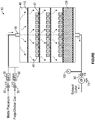
- the figure is a schematic of a CVI apparatus.
- the Figure shows a schematic of CVI apparatus 10.
- the CVI reactor 40 has several levels, and each level is loaded with porous preforms 45 separated by porous spacers 47.
- the process starts by introducing an inert purge or dilution gas (for example, N 2 ) from the inlet 90 on the top of the reactor 40 by opening valves 50 and 80, but valve 20 remains closed while the reactor is being heated to a desirable temperature and pumped down to a set vacuum level. Once the temperature and pressure are achieved, the matrix precursor gas mixture can flow in the furnace at a flow rate by opening valve 20 and closing valve 50 to start densifying porous preforms.
- the apparatus also includes mass flow controllers 30 and 60, vacuum pump 70, pressure transducer 100, gas distributor 110 and depletion bed 120.
- low pressures in particular, low partial pressures of reactant gases
- the pressures realized under the conditions of industrially applied chemical vapor infiltration are at least one to two orders of magnitude below normal pressure.
- Starting compounds are partially mixed with inert gases so that their partial pressures, and with it their deposition rates, can be further lowered. Due to the low partial pressures, extremely long infiltration times of up to several weeks are required and uneven densification may still occur.
- a CVI method including flowing ceramic precursors through a preform at a first gas infiltration pressure, increasing the pressure to a second gas infiltration pressure, and lowering the pressure to a third gas infiltration pressure which is intermediate to the first and second gas infiltration pressures.
- the gas infiltration pressure during the chemical vapor infiltration is initially set at a very low pressure (a first pressure), typically less than or equal to 1 torr, or, more specifically, 0.01 torr to 1 torr, to facilitate an even and uniform initial deposition of the matrix on the preform for a short period of time.
- a first pressure typically less than or equal to 1 torr, or, more specifically, 0.01 torr to 1 torr
- the gas infiltration pressure is then raised to a pressure greater than or equal to 1 torr, more specifically 1 to 100 torr (a second pressure).
- the second pressure is greater than the first pressure.
- the second pressure is maintained until a time at which infiltration gas diffusion rate rather than deposition rate begins to control the matrix densification rate.
- the gas infiltration pressure is reduced to a third pressure to maintain the matrix densification under reaction control rather than diffusion control.
- the third pressure is intermediate to the first and second pressures.
- the first pressure may be 1 to 20% of the second pressure.
- the third pressure may be 25 to 75% of the second pressure.
- the third pressure is greater than the first pressure. It is further contemplated that a fourth pressure may be useful.
- the fourth pressure would be intermediate to the first pressure and the third pressure. The relationship between the pressures can be shown as: first pressure ⁇ fourth pressure ⁇ third pressure ⁇ second pressure.
- the time at which the gas infiltration pressure is changed can be determined by modeling, or empirically.
- the change in gas infiltration pressure can be based on the reduction of pore size at the surface, based on the decrease in overall porosity, in response to a decrease in the rate of weight increase, or a combination of two or more of the foregoing.
- the increase in gas infiltration pressure from the first pressure to the second pressure can be based on a reduction in pore size while the decrease in pressure from the second pressure to the third pressure can be based on a decrease in the rate of weight increase.
- the preform includes reinforcing fibers.
- Exemplary reinforcing fibers include Al 2 O 3 -SiO 2 , SiC, silicon dioxide (SiO 2 ), aluminum silicate, aluminum oxide (Al 2 O 3 ), titanium oxide (TiO 2 ), zirconium silicate, silicon nitride, boron nitride (BN), carbon (C), and combinations thereof.
- the fibers may include an interphase coating.
- the preform may be in any of a number of forms, shapes or sizes depending largely on the matrix material, the geometry of the composite product, and the desired properties sought for the end product, and most typically are in the form of whiskers and fibers.
- the fibers can be discontinuous (in chopped form as staple) or in the form of a single continuous filament or as continuous multifilament tows. They also can be in the form of two- or three-dimensional materials such as a uniaxial fiber layup, a 2D woven fabric layup, 3D weave or a combination thereof.
- Exemplary ceramic matrix materials include metal oxides, borides, carbides, nitrides, silicides, and mixtures and combinations thereof. More specifically, ceramic matrix materials include silicon carbide (SiC), silicon oxide (SiO 2 ), boron nitride (BN), boron carbide (B 4 C), aluminum oxide (Al 2 O 3 ), zirconium oxide (ZrO 2 ), zirconium boride (ZrB 2 ), zinc oxide (ZnO 2 ), molybdenum disulfide (MoS 2 ), silicon nitride (Si 3 N 4 ), and combinations thereof.
- SiC silicon carbide
- SiO 2 silicon oxide
- BN boron nitride
- B 4 C boron carbide
- Al 2 O 3 aluminum oxide
- zirconium oxide ZrO 2
- zirconium boride ZrB 2
- zinc oxide ZnO 2
- MoS 2 molybdenum disulfide
- the ceramic matrix material comprises silicon carbide, boron nitride or silicon doped boron nitride.
- the 2 nd and 3 rd pressures are chosen to keep the matrix densification under kinetic control, and thereby to have a desirable infiltration process during the entire densification process. These pressures depend primarily on kinetics of precursors, preform geometry, etc. To achieve that, other process parameters such as temperature and precursor flow rates can also be altered along with the 2 nd and 3 rd pressures.
- Precursors to these ceramic matrix materials are known and can be determined by one of skill in the art. For example, carbosilanes (sometimes referred to as silanes) and halocarbosilanes are useful precursors for silicon carbide and silazanes, and halosilazanes are useful precursors for silicon nitride.
Landscapes
- Chemical & Material Sciences (AREA)
- Engineering & Computer Science (AREA)
- Ceramic Engineering (AREA)
- Organic Chemistry (AREA)
- Materials Engineering (AREA)
- Manufacturing & Machinery (AREA)
- Structural Engineering (AREA)
- Chemical Kinetics & Catalysis (AREA)
- General Chemical & Material Sciences (AREA)
- Mechanical Engineering (AREA)
- Metallurgy (AREA)
- Inorganic Chemistry (AREA)
- Chemical Vapour Deposition (AREA)
- Ceramic Products (AREA)
Abstract
Description
- Exemplary embodiments pertain to the art of chemical vapor infiltration.
- Deposition of solid phases on substrates by decomposition of volatile or gaseous compounds which contain the solid phase elements is generally referred to as chemical vapor deposition. If this deposition takes place in the open pores of a porous substrate or in the cavities of a porous structure, then it is often referred to as chemical vapor infiltration. Chemical vapor deposition (CVD) and chemical vapor infiltration (CVI) allow a densification of structure or, when the porous structure consists of fibers, an introduction of a matrix and, with this, the production of composite material. Both chemical vapor deposition as well as chemical vapor infiltration are extremely complex processes.
- In chemical vapor infiltration, the volatile or gaseous precursors must be transported into the depths of the pores before conversion to the solid matrix. If decomposition of the volatile or gaseous precursors, and formation of the solid phase, occurs in the gas phase and on the surface of the porous structure in or near the entrances of the pores, the pores can become clogged. The interior pores are then not filled, resulting in a composite with uneven density. Improved methods to address this issue are desired.
- One aspect of the present disclosure involves a chemical vapor infiltration method comprising flowing ceramic precursors through a preform and depositing a matrix material on the preform at a first gas infiltration pressure, increasing the gas infiltration pressure to a second gas infiltration pressure, and lowering the gas infiltration pressure to a third gas infiltration pressure which is intermediate to the first and second gas infiltration pressures.
- In addition to the features described above, the first pressure may be less than or equal to 1 torr. The first pressure may be 0.01 torr to 1 torr.
- In addition to one or more of the features described above, or as an alternative to any of the foregoing embodiments, the second pressure may be greater than 1 torr. The second pressure may be 1 torr to 100 torr.
- In addition to one or more of the features described above, or as an alternative to any of the foregoing embodiments, the first pressure may be 1 to 20% of the second pressure.
- In addition to one or more of the features described above, or as an alternative to any of the foregoing embodiments, the third pressure may be 25 to 75% of the second pressure.
- In addition to one or more of the features described above, or as an alternative to any of the foregoing embodiments, the method may further comprise a fourth pressure intermediate to the first and third pressures.
- In addition to one or more of the features described above, or as an alternative to any of the foregoing embodiments, the third pressure may maintain matrix deposition under reaction control.
- In addition to one or more of the features described above, or as an alternative to any of the foregoing embodiments, the second pressure may be maintained until the infiltration gas diffusion rate controls the matrix densification rate.
- In addition to one or more of the features described above, or as an alternative to any of the foregoing embodiments, the preform may comprise Al2O3-SiO2, SiC, silicon dioxide (SiO2), aluminum silicate, aluminum oxide (Al2O3), titanium oxide (TiO2), zirconium silicate, silicon nitride, boron nitride (BN), carbon (C), or any combination thereof.
- In addition to one or more of the features described above, or as an alternative to any of the foregoing embodiments, the matrix may comprise metal oxides, borides, carbides, nitrides, silicides, or any mixture or combination thereof.
- In addition to one or more of the features described above, or as an alternative to any of the foregoing embodiments, the matrix may comprise silicon carbide (SiC), silicon oxide (SiO2), boron nitride (BN), boron carbide (B4C), aluminum oxide (Al2O3), zirconium oxide (ZrO2), zirconium boride (ZrB2), zinc oxide (ZnO2), molybdenum disulfide (MoS2), silicon nitride (Si3N4), or any combination thereof.
- In addition to one or more of the features described above, or as an alternative to any of the foregoing embodiments, the method may further comprise modifying the temperature, precursor flow rate or both.
- In addition to one or more of the features described above, or as an alternative to any of the foregoing embodiments, the ceramic precursors may be SiC ceramic precursors, the preform may be a SiC preform, and the matrix material may be a SiC matrix material.
- Also disclosed is a chemical vapor infiltration method comprising flowing SiC ceramic precursors through a SiC preform and depositing a SiC matrix on the preform at a first gas infiltration pressure, increasing the gas filtration pressure to a second gas infiltration pressure, and lowering the gas infiltration pressure to a third gas infiltration pressure which is intermediate to the first and second gas infiltration pressures.
- In addition to one or more of the features described above, or as an alternative to any of the foregoing embodiments, the first pressure may be 0.01 torr to 1 torr.
- In addition to one or more of the features described above, or as an alternative to any of the foregoing embodiments, the second pressure may be 1 torr to 100 torr.
- In addition to one or more of the features described above, or as an alternative to any of the foregoing embodiments, the first pressure may be 1 to 20% of the second pressure.
- In addition to one or more of the features described above, or as an alternative to any of the foregoing embodiments, the third pressure may be 25 to 75 % of the second pressure.
- In addition to one or more of the features described above, or as an alternative to any of the foregoing embodiments, the method may further comprise a fourth pressure intermediate to the first and third pressures.
- The following descriptions should not be considered limiting in any way. With reference to the accompanying drawings, like elements are numbered alike:
- The figure is a schematic of a CVI apparatus.
- A detailed description of one or more embodiments of the disclosed apparatus and method are presented herein by way of exemplification and not limitation with reference to the Figure.
- Various conventional methods for CVI processing are known. Procedurally, the simplest methods to perform are isobaric and isothermic chemical vapor infiltrations. In these conventional methods, the entire process space exists at constant temperature and pressure. Here, however, only very low pressures or partial pressures of reactant gases can be used, when necessary with addition of inert or dilution gases, so that extremely long infiltration times are required. Optimal or maximal pore filling is generally thought to be possible only at extremely slow deposition rates with high infiltration.
- The Figure shows a schematic of
CVI apparatus 10. TheCVI reactor 40 has several levels, and each level is loaded withporous preforms 45 separated byporous spacers 47. The process starts by introducing an inert purge or dilution gas (for example, N2) from theinlet 90 on the top of thereactor 40 byopening valves valve 20 remains closed while the reactor is being heated to a desirable temperature and pumped down to a set vacuum level. Once the temperature and pressure are achieved, the matrix precursor gas mixture can flow in the furnace at a flow rate by openingvalve 20 andclosing valve 50 to start densifying porous preforms. The apparatus also includesmass flow controllers vacuum pump 70,pressure transducer 100,gas distributor 110 anddepletion bed 120. - In order to successfully bring about infiltration, low pressures, in particular, low partial pressures of reactant gases, have been used. The pressures realized under the conditions of industrially applied chemical vapor infiltration are at least one to two orders of magnitude below normal pressure. Starting compounds are partially mixed with inert gases so that their partial pressures, and with it their deposition rates, can be further lowered. Due to the low partial pressures, extremely long infiltration times of up to several weeks are required and uneven densification may still occur.
- Disclosed herein is a CVI method including flowing ceramic precursors through a preform at a first gas infiltration pressure, increasing the pressure to a second gas infiltration pressure, and lowering the pressure to a third gas infiltration pressure which is intermediate to the first and second gas infiltration pressures.
- The gas infiltration pressure during the chemical vapor infiltration is initially set at a very low pressure (a first pressure), typically less than or equal to 1 torr, or, more specifically, 0.01 torr to 1 torr, to facilitate an even and uniform initial deposition of the matrix on the preform for a short period of time. For example, the pressure may remain at the first pressure for 1 minute to 60 minutes. This initial deposition may help reduce stacking faults in the subsequent matrix densification process. The gas infiltration pressure is then raised to a pressure greater than or equal to 1 torr, more specifically 1 to 100 torr (a second pressure). The second pressure is greater than the first pressure. The second pressure is maintained until a time at which infiltration gas diffusion rate rather than deposition rate begins to control the matrix densification rate. At this point the gas infiltration pressure is reduced to a third pressure to maintain the matrix densification under reaction control rather than diffusion control. The third pressure is intermediate to the first and second pressures. By employing a third pressure which is less than the second pressure the diffusion rate is increased - facilitating the deposition in interior spaces, limiting the potential for clogging the surface pores, and facilitating more even matrix deposition.
- The first pressure may be 1 to 20% of the second pressure. The third pressure may be 25 to 75% of the second pressure. The third pressure is greater than the first pressure. It is further contemplated that a fourth pressure may be useful. The fourth pressure would be intermediate to the first pressure and the third pressure. The relationship between the pressures can be shown as: first pressure < fourth pressure < third pressure < second pressure.
- The time at which the gas infiltration pressure is changed can be determined by modeling, or empirically. In some embodiments the change in gas infiltration pressure can be based on the reduction of pore size at the surface, based on the decrease in overall porosity, in response to a decrease in the rate of weight increase, or a combination of two or more of the foregoing. For example, the increase in gas infiltration pressure from the first pressure to the second pressure can be based on a reduction in pore size while the decrease in pressure from the second pressure to the third pressure can be based on a decrease in the rate of weight increase.
- The preform includes reinforcing fibers. Exemplary reinforcing fibers include Al2O3-SiO2, SiC, silicon dioxide (SiO2), aluminum silicate, aluminum oxide (Al2O3), titanium oxide (TiO2), zirconium silicate, silicon nitride, boron nitride (BN), carbon (C), and combinations thereof. The fibers may include an interphase coating. The preform may be in any of a number of forms, shapes or sizes depending largely on the matrix material, the geometry of the composite product, and the desired properties sought for the end product, and most typically are in the form of whiskers and fibers. The fibers can be discontinuous (in chopped form as staple) or in the form of a single continuous filament or as continuous multifilament tows. They also can be in the form of two- or three-dimensional materials such as a uniaxial fiber layup, a 2D woven fabric layup, 3D weave or a combination thereof.
- Exemplary ceramic matrix materials include metal oxides, borides, carbides, nitrides, silicides, and mixtures and combinations thereof. More specifically, ceramic matrix materials include silicon carbide (SiC), silicon oxide (SiO2), boron nitride (BN), boron carbide (B4C), aluminum oxide (Al2O3), zirconium oxide (ZrO2), zirconium boride (ZrB2), zinc oxide (ZnO2), molybdenum disulfide (MoS2), silicon nitride (Si3N4), and combinations thereof. In some embodiments the ceramic matrix material comprises silicon carbide, boron nitride or silicon doped boron nitride. Overall, the 2nd and 3rd pressures are chosen to keep the matrix densification under kinetic control, and thereby to have a desirable infiltration process during the entire densification process. These pressures depend primarily on kinetics of precursors, preform geometry, etc. To achieve that, other process parameters such as temperature and precursor flow rates can also be altered along with the 2nd and 3rd pressures. Precursors to these ceramic matrix materials are known and can be determined by one of skill in the art. For example, carbosilanes (sometimes referred to as silanes) and halocarbosilanes are useful precursors for silicon carbide and silazanes, and halosilazanes are useful precursors for silicon nitride.
- The terminology used herein is for the purpose of describing particular embodiments only and is not intended to be limiting of the present disclosure. As used herein, the singular forms "a", "an" and "the" are intended to include the plural forms as well, unless the context clearly indicates otherwise. It will be further understood that the terms "comprises" and/or "comprising," when used in this specification, specify the presence of stated features, integers, steps, operations, elements, and/or components, but do not preclude the presence or addition of one or more other features, integers, steps, operations, element components, and/or groups thereof.
- While the present disclosure has been described with reference to an exemplary embodiment or embodiments, it will be understood by those skilled in the art that various changes may be made and equivalents may be substituted for elements thereof without departing from the scope of the present disclosure. In addition, many modifications may be made to adapt a particular situation or material to the teachings of the present disclosure without departing from the essential scope thereof. Therefore, it is intended that the present disclosure not be limited to the particular embodiment disclosed as the best mode contemplated for carrying out this present disclosure, but that the present disclosure will include all embodiments falling within the scope of the claims.
- Certain embodiments of the present disclosure are as follows:
- 1. A chemical vapor infiltration method comprising flowing ceramic precursors through a preform and depositing a matrix material on the preform at a first gas infiltration pressure, increasing the gas filtration pressure to a second gas infiltration pressure, and lowering the gas infiltration pressure to a third gas infiltration pressure which is intermediate to the first and second gas infiltration pressures.
- 2. The method of embodiment 1, wherein the first pressure is less than or equal to 1 torr.
- 3. The method of embodiment 1, wherein the first pressure is 0.01 torr to 1 torr.
- 4. The method of embodiment 1, wherein the second pressure is greater than 1 torr.
- 5. The method of embodiment 1, wherein the second pressure is 1 torr to 100 torr.
- 6. The method of embodiment 1, wherein the first pressure is 1 to 20% of the second pressure.
- 7. The method of embodiment 1, wherein the third pressure is 25 to 75 % of the second pressure.
- 8. The method of embodiment 1, further comprising a fourth pressure intermediate to the first and third pressures.
- 9. The method of embodiment 1, wherein the third pressure maintains matrix deposition under reaction control.
- 10. The method of embodiment 1, wherein the second pressure is maintained until infiltration gas diffusion rate controls matrix densification rate.
- 11. The method of embodiment 1, wherein the preform comprises Al2O3-SiO2, SiC, silicon dioxide (SiO2), aluminum silicate, aluminum oxide (Al2O3), titanium oxide (TiO2), zirconium silicate, silicon nitride, boron nitride (BN). carbon (C), and combinations thereof.
- 12. The method of embodiment 1, wherein the matrix comprises metal oxides, borides, carbides, nitrides, silicides, and mixtures and combinations thereof.
- 13. The method of embodiment 12, wherein the matrix comprises silicon carbide (SiC), silicon oxide (SiO2), boron nitride (BN), boron carbide (B4C), aluminum oxide (Al2O3), zirconium oxide (ZrO2), zirconium boride (ZrB2), zinc oxide (ZnO2) molybdenum disulfide (MoS2), silicon nitride (Si3N4), and combinations thereof.
- 14. The method of embodiment 1, further comprising modifying the temperature, precursor flow rate or both.
- 15. A chemical vapor infiltration method comprising flowing SiC ceramic precursors through a SiC preform and depositing a SiC matrix material on the preform at a first gas infiltration pressure, increasing the gas filtration pressure to a second gas infiltration pressure, and lowering the gas infiltration pressure to a third gas infiltration pressure which is intermediate to the first and second gas infiltration pressures.
- 16. The method of embodiment 15, wherein the first pressure is 0.01 torr to 1 torr.
- 17. The method of embodiment 15, wherein the second pressure is 1 torr to 100 torr.
- 18. The method of embodiment 15, wherein the first pressure is 1 to 20% of the second pressure.
- 19. The method of embodiment 15, wherein the third pressure is 25 to 75 % of the second pressure.
- 20. The method of embodiment 15, further comprising a fourth pressure intermediate to the first and third pressures.
Claims (15)
- A chemical vapor infiltration method comprising flowing ceramic precursors through a preform and depositing a matrix material on the preform at a first gas infiltration pressure, increasing the gas infiltration pressure to a second gas infiltration pressure, and lowering the gas infiltration pressure to a third gas infiltration pressure which is intermediate to the first and second gas infiltration pressures.
- The method of claim 1, wherein the first pressure is less than or equal to 1 torr.
- The method of claim 1 or claim 2, wherein the first pressure is 0.01 torr to 1 torr.
- The method of any one of the preceding claims, wherein the second pressure is greater than 1 torr.
- The method of any one of the preceding claims, wherein the second pressure is 1 torr to 100 torr.
- The method of any one of the preceding claims, wherein the first pressure is 1 to 20% of the second pressure.
- The method of any one of the preceding claims, wherein the third pressure is 25 to 75% of the second pressure.
- The method of any one of the preceding claims, further comprising a fourth pressure intermediate to the first and third pressures.
- The method of any one of the preceding claims, wherein the third pressure maintains matrix deposition under reaction control.
- The method of any one of the preceding claims, wherein the second pressure is maintained until the infiltration gas diffusion rate controls the matrix densification rate.
- The method of any one of the preceding claims, wherein the preform comprises Al2O3-SiO2, SiC, silicon dioxide (SiO2), aluminum silicate, aluminum oxide (Al2O3), titanium oxide (TiO2), zirconium silicate, silicon nitride, boron nitride (BN), carbon (C), or any combination thereof.
- The method of any one of the preceding claims, wherein the matrix comprises metal oxides, borides, carbides, nitrides, silicides, or any mixture or combination thereof.
- The method of any one of the preceding claims, wherein the matrix comprises silicon carbide (SiC), silicon oxide (SiO2), boron nitride (BN), boron carbide (B4C), aluminum oxide (Al2O3), zirconium oxide (ZrO2), zirconium boride (ZrB2), zinc oxide (ZnO2), molybdenum disulfide (MoS2), silicon nitride (Si3N4), or any combination thereof.
- The method of any one of the preceding claims, further comprising modifying the temperature, precursor flow rate or both.
- The method of any one of the preceding claims, wherein the ceramic precursors are SiC ceramic precursors, the preform is a SiC preform, and the matrix material is a SiC matrix material.
Applications Claiming Priority (1)
| Application Number | Priority Date | Filing Date | Title |
|---|---|---|---|
| US16/798,016 US11691924B2 (en) | 2020-02-21 | 2020-02-21 | CVI matrix densification process |
Publications (2)
| Publication Number | Publication Date |
|---|---|
| EP3872221A1 true EP3872221A1 (en) | 2021-09-01 |
| EP3872221B1 EP3872221B1 (en) | 2024-06-05 |
Family
ID=74668783
Family Applications (1)
| Application Number | Title | Priority Date | Filing Date |
|---|---|---|---|
| EP21157998.2A Active EP3872221B1 (en) | 2020-02-21 | 2021-02-18 | Cvi matrix densification process |
Country Status (2)
| Country | Link |
|---|---|
| US (3) | US11691924B2 (en) |
| EP (1) | EP3872221B1 (en) |
Families Citing this family (2)
| Publication number | Priority date | Publication date | Assignee | Title |
|---|---|---|---|---|
| US11691924B2 (en) | 2020-02-21 | 2023-07-04 | Raytheon Technologies Corporation | CVI matrix densification process |
| US20240141479A1 (en) * | 2022-10-31 | 2024-05-02 | Rtx Corporation | Acoustic wave assisted chemical vapor iinfiltration |
Citations (4)
| Publication number | Priority date | Publication date | Assignee | Title |
|---|---|---|---|---|
| US6001419A (en) * | 1995-04-07 | 1999-12-14 | Societe Nationale D'etude Et De Construction De Moteurs D'aviation | Chemical vapor infiltration method with variable infiltration parameters |
| US7892646B1 (en) * | 2007-04-04 | 2011-02-22 | Goodrich Corporation | Pressure gradient CVI/CVD process |
| US8956683B2 (en) * | 2011-06-16 | 2015-02-17 | Zimmer, Inc. | Chemical vapor infiltration apparatus and process |
| FR3016361A1 (en) * | 2014-01-10 | 2015-07-17 | Herakles | COMBINING MACROPORES OF A FIBROUS SUBSTRATE WITH PYROCARBON |
Family Cites Families (10)
| Publication number | Priority date | Publication date | Assignee | Title |
|---|---|---|---|---|
| FR2643898B1 (en) | 1989-03-02 | 1993-05-07 | Europ Propulsion | PROCESS FOR THE MANUFACTURE OF A COMPOSITE MATERIAL WITH A CERAMIC MATRIX WITH IMPROVED TENACITY |
| US5480678A (en) | 1994-11-16 | 1996-01-02 | The B. F. Goodrich Company | Apparatus for use with CVI/CVD processes |
| US7335397B2 (en) | 2004-02-16 | 2008-02-26 | Goodrich Corporation | Pressure gradient CVI/CVD apparatus and method |
| US7959973B2 (en) | 2006-11-29 | 2011-06-14 | Honeywell International Inc. | Pressure swing CVI/CVD |
| US10443124B1 (en) | 2010-09-09 | 2019-10-15 | Goodrich Corporation | Process and apparatus for making composite structures |
| US9963779B2 (en) | 2016-02-29 | 2018-05-08 | Goodrich Corporation | Methods for modifying pressure differential in a chemical vapor process |
| US10364491B2 (en) | 2016-11-02 | 2019-07-30 | Georgia Tech Research Corporation | Process to chemically modify polymeric materials by static, low-pressure infiltration of reactive gaseous molecules |
| WO2019022882A1 (en) * | 2017-07-28 | 2019-01-31 | Rohm And Haas Company | A method for production of methyl methacrylate by oxidative esterification using a heterogeneous catalyst |
| US10450236B2 (en) | 2017-09-25 | 2019-10-22 | Goodrich Corporation | Carbon/carbon composites and methods of making carbon/carbon composites having increased fiber volume and ceramic compounds |
| US11691924B2 (en) | 2020-02-21 | 2023-07-04 | Raytheon Technologies Corporation | CVI matrix densification process |
-
2020
- 2020-02-21 US US16/798,016 patent/US11691924B2/en active Active
-
2021
- 2021-02-18 EP EP21157998.2A patent/EP3872221B1/en active Active
-
2023
- 2023-06-30 US US18/345,518 patent/US12454493B2/en active Active
-
2025
- 2025-05-19 US US19/212,025 patent/US20250388515A1/en active Pending
Patent Citations (4)
| Publication number | Priority date | Publication date | Assignee | Title |
|---|---|---|---|---|
| US6001419A (en) * | 1995-04-07 | 1999-12-14 | Societe Nationale D'etude Et De Construction De Moteurs D'aviation | Chemical vapor infiltration method with variable infiltration parameters |
| US7892646B1 (en) * | 2007-04-04 | 2011-02-22 | Goodrich Corporation | Pressure gradient CVI/CVD process |
| US8956683B2 (en) * | 2011-06-16 | 2015-02-17 | Zimmer, Inc. | Chemical vapor infiltration apparatus and process |
| FR3016361A1 (en) * | 2014-01-10 | 2015-07-17 | Herakles | COMBINING MACROPORES OF A FIBROUS SUBSTRATE WITH PYROCARBON |
Also Published As
| Publication number | Publication date |
|---|---|
| EP3872221B1 (en) | 2024-06-05 |
| US20250388515A1 (en) | 2025-12-25 |
| US11691924B2 (en) | 2023-07-04 |
| US20210261469A1 (en) | 2021-08-26 |
| US20230348334A1 (en) | 2023-11-02 |
| US12454493B2 (en) | 2025-10-28 |
Similar Documents
| Publication | Publication Date | Title |
|---|---|---|
| US20250388515A1 (en) | Cvi matrix densification process | |
| US12054432B2 (en) | Ceramic matrix composite structures with controlled microstructures fabricated using chemical vapor infiltration (CVI) | |
| US9493873B2 (en) | Method for preparing a coating for protecting a part against oxidation | |
| Naslain et al. | The CVI-processing of ceramic matrix composites | |
| EP3693350B1 (en) | Doped silicon carbide ceramic matrix composite | |
| JP6170160B2 (en) | CMC parts manufacturing method | |
| JP4627808B2 (en) | Chemical vapor infiltration method with various infiltration parameters | |
| US20160060752A1 (en) | Method for producing a composite material with a carbide matrix | |
| EP2308811A1 (en) | Hybred polymer CVI composites | |
| EP3252278A1 (en) | High temperature composites with enhanced matrix | |
| JPH0351668B2 (en) | ||
| CN115515914B (en) | Method for manufacturing ceramic matrix composite material containing specific interface phase | |
| US20230219858A1 (en) | Method for fabricating ceramic matrix composite components | |
| US6261509B1 (en) | Process to produce silicon carbide fibers using a controlled concentration of boron oxide vapor | |
| Oh et al. | Fabrication of carbon/silicon carbide composites by isothermal chemical vapor infiltration, using the in situ whisker‐growing and matrix‐filling process | |
| US10723658B2 (en) | Method of fabricating a ceramic from a chemical reaction | |
| Cholet et al. | Chemical vapor infiltration of boron nitride interphase in ceramic fiber preforms: discussion of some aspects of the fundamentals of the isothermal chemical vapor infiltration process | |
| KR102153918B1 (en) | Method for preparing high density silicon carbide composite by uniform growth of sic nanowire using chemical vapor deposition and silicon carbide composite prepared by the same | |
| Fedou et al. | A Model for the Isothermal Isobaric Chemical Vapor Infiltration(CVI) in a Straight Cylindrical Pore. Application to the CVI of SiC | |
| CN115745643A (en) | Carbon nanotube modified composite material and preparation method thereof | |
| EP3415484B1 (en) | Method of forming a moisture-tolerant coating on a silicon carbide fiber | |
| Park et al. | Characterization of the SiCf/SiC composite fabricated by the whisker growing assisted CVI process | |
| CN121651963A (en) | 1500 ℃ Resistant ceramic matrix composite and preparation method thereof |
Legal Events
| Date | Code | Title | Description |
|---|---|---|---|
| PUAI | Public reference made under article 153(3) epc to a published international application that has entered the european phase |
Free format text: ORIGINAL CODE: 0009012 |
|
| STAA | Information on the status of an ep patent application or granted ep patent |
Free format text: STATUS: THE APPLICATION HAS BEEN PUBLISHED |
|
| AK | Designated contracting states |
Kind code of ref document: A1 Designated state(s): AL AT BE BG CH CY CZ DE DK EE ES FI FR GB GR HR HU IE IS IT LI LT LU LV MC MK MT NL NO PL PT RO RS SE SI SK SM TR |
|
| STAA | Information on the status of an ep patent application or granted ep patent |
Free format text: STATUS: REQUEST FOR EXAMINATION WAS MADE |
|
| 17P | Request for examination filed |
Effective date: 20220301 |
|
| RBV | Designated contracting states (corrected) |
Designated state(s): AL AT BE BG CH CY CZ DE DK EE ES FI FR GB GR HR HU IE IS IT LI LT LU LV MC MK MT NL NO PL PT RO RS SE SI SK SM TR |
|
| STAA | Information on the status of an ep patent application or granted ep patent |
Free format text: STATUS: EXAMINATION IS IN PROGRESS |
|
| 17Q | First examination report despatched |
Effective date: 20230321 |
|
| RAP3 | Party data changed (applicant data changed or rights of an application transferred) |
Owner name: RTX CORPORATION |
|
| GRAP | Despatch of communication of intention to grant a patent |
Free format text: ORIGINAL CODE: EPIDOSNIGR1 |
|
| STAA | Information on the status of an ep patent application or granted ep patent |
Free format text: STATUS: GRANT OF PATENT IS INTENDED |
|
| RIC1 | Information provided on ipc code assigned before grant |
Ipc: C04B 35/589 20060101ALI20231211BHEP Ipc: C04B 35/581 20060101ALI20231211BHEP Ipc: C04B 35/571 20060101ALI20231211BHEP Ipc: C04B 35/565 20060101ALI20231211BHEP Ipc: C04B 35/80 20060101ALI20231211BHEP Ipc: C23C 16/455 20060101ALI20231211BHEP Ipc: C23C 16/04 20060101AFI20231211BHEP |
|
| INTG | Intention to grant announced |
Effective date: 20240103 |
|
| GRAS | Grant fee paid |
Free format text: ORIGINAL CODE: EPIDOSNIGR3 |
|
| GRAA | (expected) grant |
Free format text: ORIGINAL CODE: 0009210 |
|
| STAA | Information on the status of an ep patent application or granted ep patent |
Free format text: STATUS: THE PATENT HAS BEEN GRANTED |
|
| AK | Designated contracting states |
Kind code of ref document: B1 Designated state(s): AL AT BE BG CH CY CZ DE DK EE ES FI FR GB GR HR HU IE IS IT LI LT LU LV MC MK MT NL NO PL PT RO RS SE SI SK SM TR |
|
| REG | Reference to a national code |
Ref country code: CH Ref legal event code: EP |
|
| REG | Reference to a national code |
Ref country code: DE Ref legal event code: R096 Ref document number: 602021013960 Country of ref document: DE |
|
| REG | Reference to a national code |
Ref country code: IE Ref legal event code: FG4D |
|
| REG | Reference to a national code |
Ref country code: LT Ref legal event code: MG9D |
|
| PG25 | Lapsed in a contracting state [announced via postgrant information from national office to epo] |
Ref country code: BG Free format text: LAPSE BECAUSE OF FAILURE TO SUBMIT A TRANSLATION OF THE DESCRIPTION OR TO PAY THE FEE WITHIN THE PRESCRIBED TIME-LIMIT Effective date: 20240605 |
|
| REG | Reference to a national code |
Ref country code: NL Ref legal event code: MP Effective date: 20240605 |
|
| PG25 | Lapsed in a contracting state [announced via postgrant information from national office to epo] |
Ref country code: HR Free format text: LAPSE BECAUSE OF FAILURE TO SUBMIT A TRANSLATION OF THE DESCRIPTION OR TO PAY THE FEE WITHIN THE PRESCRIBED TIME-LIMIT Effective date: 20240605 Ref country code: FI Free format text: LAPSE BECAUSE OF FAILURE TO SUBMIT A TRANSLATION OF THE DESCRIPTION OR TO PAY THE FEE WITHIN THE PRESCRIBED TIME-LIMIT Effective date: 20240605 |
|
| PG25 | Lapsed in a contracting state [announced via postgrant information from national office to epo] |
Ref country code: GR Free format text: LAPSE BECAUSE OF FAILURE TO SUBMIT A TRANSLATION OF THE DESCRIPTION OR TO PAY THE FEE WITHIN THE PRESCRIBED TIME-LIMIT Effective date: 20240906 |
|
| PG25 | Lapsed in a contracting state [announced via postgrant information from national office to epo] |
Ref country code: ES Free format text: LAPSE BECAUSE OF FAILURE TO SUBMIT A TRANSLATION OF THE DESCRIPTION OR TO PAY THE FEE WITHIN THE PRESCRIBED TIME-LIMIT Effective date: 20240605 |
|
| PG25 | Lapsed in a contracting state [announced via postgrant information from national office to epo] |
Ref country code: LV Free format text: LAPSE BECAUSE OF FAILURE TO SUBMIT A TRANSLATION OF THE DESCRIPTION OR TO PAY THE FEE WITHIN THE PRESCRIBED TIME-LIMIT Effective date: 20240605 |
|
| PG25 | Lapsed in a contracting state [announced via postgrant information from national office to epo] |
Ref country code: NO Free format text: LAPSE BECAUSE OF FAILURE TO SUBMIT A TRANSLATION OF THE DESCRIPTION OR TO PAY THE FEE WITHIN THE PRESCRIBED TIME-LIMIT Effective date: 20240905 Ref country code: LV Free format text: LAPSE BECAUSE OF FAILURE TO SUBMIT A TRANSLATION OF THE DESCRIPTION OR TO PAY THE FEE WITHIN THE PRESCRIBED TIME-LIMIT Effective date: 20240605 Ref country code: HR Free format text: LAPSE BECAUSE OF FAILURE TO SUBMIT A TRANSLATION OF THE DESCRIPTION OR TO PAY THE FEE WITHIN THE PRESCRIBED TIME-LIMIT Effective date: 20240605 Ref country code: GR Free format text: LAPSE BECAUSE OF FAILURE TO SUBMIT A TRANSLATION OF THE DESCRIPTION OR TO PAY THE FEE WITHIN THE PRESCRIBED TIME-LIMIT Effective date: 20240906 Ref country code: FI Free format text: LAPSE BECAUSE OF FAILURE TO SUBMIT A TRANSLATION OF THE DESCRIPTION OR TO PAY THE FEE WITHIN THE PRESCRIBED TIME-LIMIT Effective date: 20240605 Ref country code: ES Free format text: LAPSE BECAUSE OF FAILURE TO SUBMIT A TRANSLATION OF THE DESCRIPTION OR TO PAY THE FEE WITHIN THE PRESCRIBED TIME-LIMIT Effective date: 20240605 Ref country code: BG Free format text: LAPSE BECAUSE OF FAILURE TO SUBMIT A TRANSLATION OF THE DESCRIPTION OR TO PAY THE FEE WITHIN THE PRESCRIBED TIME-LIMIT Effective date: 20240605 Ref country code: RS Free format text: LAPSE BECAUSE OF FAILURE TO SUBMIT A TRANSLATION OF THE DESCRIPTION OR TO PAY THE FEE WITHIN THE PRESCRIBED TIME-LIMIT Effective date: 20240905 |
|
| PG25 | Lapsed in a contracting state [announced via postgrant information from national office to epo] |
Ref country code: NL Free format text: LAPSE BECAUSE OF FAILURE TO SUBMIT A TRANSLATION OF THE DESCRIPTION OR TO PAY THE FEE WITHIN THE PRESCRIBED TIME-LIMIT Effective date: 20240605 |
|
| REG | Reference to a national code |
Ref country code: AT Ref legal event code: MK05 Ref document number: 1692506 Country of ref document: AT Kind code of ref document: T Effective date: 20240605 |
|
| PG25 | Lapsed in a contracting state [announced via postgrant information from national office to epo] |
Ref country code: NL Free format text: LAPSE BECAUSE OF FAILURE TO SUBMIT A TRANSLATION OF THE DESCRIPTION OR TO PAY THE FEE WITHIN THE PRESCRIBED TIME-LIMIT Effective date: 20240605 |
|
| PG25 | Lapsed in a contracting state [announced via postgrant information from national office to epo] |
Ref country code: PT Free format text: LAPSE BECAUSE OF FAILURE TO SUBMIT A TRANSLATION OF THE DESCRIPTION OR TO PAY THE FEE WITHIN THE PRESCRIBED TIME-LIMIT Effective date: 20241007 |
|
| PG25 | Lapsed in a contracting state [announced via postgrant information from national office to epo] |
Ref country code: PT Free format text: LAPSE BECAUSE OF FAILURE TO SUBMIT A TRANSLATION OF THE DESCRIPTION OR TO PAY THE FEE WITHIN THE PRESCRIBED TIME-LIMIT Effective date: 20241007 |
|
| PG25 | Lapsed in a contracting state [announced via postgrant information from national office to epo] |
Ref country code: PL Free format text: LAPSE BECAUSE OF FAILURE TO SUBMIT A TRANSLATION OF THE DESCRIPTION OR TO PAY THE FEE WITHIN THE PRESCRIBED TIME-LIMIT Effective date: 20240605 |
|
| PG25 | Lapsed in a contracting state [announced via postgrant information from national office to epo] |
Ref country code: EE Free format text: LAPSE BECAUSE OF FAILURE TO SUBMIT A TRANSLATION OF THE DESCRIPTION OR TO PAY THE FEE WITHIN THE PRESCRIBED TIME-LIMIT Effective date: 20240605 |
|
| PG25 | Lapsed in a contracting state [announced via postgrant information from national office to epo] |
Ref country code: AT Free format text: LAPSE BECAUSE OF FAILURE TO SUBMIT A TRANSLATION OF THE DESCRIPTION OR TO PAY THE FEE WITHIN THE PRESCRIBED TIME-LIMIT Effective date: 20240605 Ref country code: IS Free format text: LAPSE BECAUSE OF FAILURE TO SUBMIT A TRANSLATION OF THE DESCRIPTION OR TO PAY THE FEE WITHIN THE PRESCRIBED TIME-LIMIT Effective date: 20241005 |
|
| PG25 | Lapsed in a contracting state [announced via postgrant information from national office to epo] |
Ref country code: CZ Free format text: LAPSE BECAUSE OF FAILURE TO SUBMIT A TRANSLATION OF THE DESCRIPTION OR TO PAY THE FEE WITHIN THE PRESCRIBED TIME-LIMIT Effective date: 20240605 |
|
| PG25 | Lapsed in a contracting state [announced via postgrant information from national office to epo] |
Ref country code: SK Free format text: LAPSE BECAUSE OF FAILURE TO SUBMIT A TRANSLATION OF THE DESCRIPTION OR TO PAY THE FEE WITHIN THE PRESCRIBED TIME-LIMIT Effective date: 20240605 Ref country code: RO Free format text: LAPSE BECAUSE OF FAILURE TO SUBMIT A TRANSLATION OF THE DESCRIPTION OR TO PAY THE FEE WITHIN THE PRESCRIBED TIME-LIMIT Effective date: 20240605 |
|
| PG25 | Lapsed in a contracting state [announced via postgrant information from national office to epo] |
Ref country code: SM Free format text: LAPSE BECAUSE OF FAILURE TO SUBMIT A TRANSLATION OF THE DESCRIPTION OR TO PAY THE FEE WITHIN THE PRESCRIBED TIME-LIMIT Effective date: 20240605 |
|
| PG25 | Lapsed in a contracting state [announced via postgrant information from national office to epo] |
Ref country code: SM Free format text: LAPSE BECAUSE OF FAILURE TO SUBMIT A TRANSLATION OF THE DESCRIPTION OR TO PAY THE FEE WITHIN THE PRESCRIBED TIME-LIMIT Effective date: 20240605 Ref country code: SK Free format text: LAPSE BECAUSE OF FAILURE TO SUBMIT A TRANSLATION OF THE DESCRIPTION OR TO PAY THE FEE WITHIN THE PRESCRIBED TIME-LIMIT Effective date: 20240605 Ref country code: RO Free format text: LAPSE BECAUSE OF FAILURE TO SUBMIT A TRANSLATION OF THE DESCRIPTION OR TO PAY THE FEE WITHIN THE PRESCRIBED TIME-LIMIT Effective date: 20240605 Ref country code: PL Free format text: LAPSE BECAUSE OF FAILURE TO SUBMIT A TRANSLATION OF THE DESCRIPTION OR TO PAY THE FEE WITHIN THE PRESCRIBED TIME-LIMIT Effective date: 20240605 Ref country code: IS Free format text: LAPSE BECAUSE OF FAILURE TO SUBMIT A TRANSLATION OF THE DESCRIPTION OR TO PAY THE FEE WITHIN THE PRESCRIBED TIME-LIMIT Effective date: 20241005 Ref country code: EE Free format text: LAPSE BECAUSE OF FAILURE TO SUBMIT A TRANSLATION OF THE DESCRIPTION OR TO PAY THE FEE WITHIN THE PRESCRIBED TIME-LIMIT Effective date: 20240605 Ref country code: CZ Free format text: LAPSE BECAUSE OF FAILURE TO SUBMIT A TRANSLATION OF THE DESCRIPTION OR TO PAY THE FEE WITHIN THE PRESCRIBED TIME-LIMIT Effective date: 20240605 Ref country code: AT Free format text: LAPSE BECAUSE OF FAILURE TO SUBMIT A TRANSLATION OF THE DESCRIPTION OR TO PAY THE FEE WITHIN THE PRESCRIBED TIME-LIMIT Effective date: 20240605 |
|
| PG25 | Lapsed in a contracting state [announced via postgrant information from national office to epo] |
Ref country code: IT Free format text: LAPSE BECAUSE OF FAILURE TO SUBMIT A TRANSLATION OF THE DESCRIPTION OR TO PAY THE FEE WITHIN THE PRESCRIBED TIME-LIMIT Effective date: 20240605 |
|
| REG | Reference to a national code |
Ref country code: DE Ref legal event code: R097 Ref document number: 602021013960 Country of ref document: DE |
|
| PLBE | No opposition filed within time limit |
Free format text: ORIGINAL CODE: 0009261 |
|
| STAA | Information on the status of an ep patent application or granted ep patent |
Free format text: STATUS: NO OPPOSITION FILED WITHIN TIME LIMIT |
|
| PG25 | Lapsed in a contracting state [announced via postgrant information from national office to epo] |
Ref country code: DK Free format text: LAPSE BECAUSE OF FAILURE TO SUBMIT A TRANSLATION OF THE DESCRIPTION OR TO PAY THE FEE WITHIN THE PRESCRIBED TIME-LIMIT Effective date: 20240605 |
|
| 26N | No opposition filed |
Effective date: 20250306 |
|
| PG25 | Lapsed in a contracting state [announced via postgrant information from national office to epo] |
Ref country code: SE Free format text: LAPSE BECAUSE OF FAILURE TO SUBMIT A TRANSLATION OF THE DESCRIPTION OR TO PAY THE FEE WITHIN THE PRESCRIBED TIME-LIMIT Effective date: 20240605 |
|
| PG25 | Lapsed in a contracting state [announced via postgrant information from national office to epo] |
Ref country code: MC Free format text: LAPSE BECAUSE OF FAILURE TO SUBMIT A TRANSLATION OF THE DESCRIPTION OR TO PAY THE FEE WITHIN THE PRESCRIBED TIME-LIMIT Effective date: 20240605 |
|
| REG | Reference to a national code |
Ref country code: CH Ref legal event code: PL |
|
| PG25 | Lapsed in a contracting state [announced via postgrant information from national office to epo] |
Ref country code: LU Free format text: LAPSE BECAUSE OF NON-PAYMENT OF DUE FEES Effective date: 20250218 |
|
| PG25 | Lapsed in a contracting state [announced via postgrant information from national office to epo] |
Ref country code: CH Free format text: LAPSE BECAUSE OF NON-PAYMENT OF DUE FEES Effective date: 20250228 |
|
| REG | Reference to a national code |
Ref country code: BE Ref legal event code: MM Effective date: 20250228 |
|
| PG25 | Lapsed in a contracting state [announced via postgrant information from national office to epo] |
Ref country code: BE Free format text: LAPSE BECAUSE OF NON-PAYMENT OF DUE FEES Effective date: 20250228 |
|
| PG25 | Lapsed in a contracting state [announced via postgrant information from national office to epo] |
Ref country code: IE Free format text: LAPSE BECAUSE OF NON-PAYMENT OF DUE FEES Effective date: 20250218 |
|
| PGFP | Annual fee paid to national office [announced via postgrant information from national office to epo] |
Ref country code: GB Payment date: 20260122 Year of fee payment: 6 |
|
| PGFP | Annual fee paid to national office [announced via postgrant information from national office to epo] |
Ref country code: DE Payment date: 20260121 Year of fee payment: 6 |
|
| PGFP | Annual fee paid to national office [announced via postgrant information from national office to epo] |
Ref country code: FR Payment date: 20260121 Year of fee payment: 6 |