EP3872136A2 - 1k high hardness, high impact resistance coating - Google Patents
1k high hardness, high impact resistance coating Download PDFInfo
- Publication number
- EP3872136A2 EP3872136A2 EP18075018.4A EP18075018A EP3872136A2 EP 3872136 A2 EP3872136 A2 EP 3872136A2 EP 18075018 A EP18075018 A EP 18075018A EP 3872136 A2 EP3872136 A2 EP 3872136A2
- Authority
- EP
- European Patent Office
- Prior art keywords
- coating composition
- carbon atoms
- alkyl
- compound
- different
- Prior art date
- Legal status (The legal status is an assumption and is not a legal conclusion. Google has not performed a legal analysis and makes no representation as to the accuracy of the status listed.)
- Pending
Links
- 238000000576 coating method Methods 0.000 title claims abstract description 23
- 239000011248 coating agent Substances 0.000 title claims abstract description 21
- 239000008199 coating composition Substances 0.000 claims abstract description 103
- 150000001875 compounds Chemical class 0.000 claims abstract description 73
- 125000004432 carbon atom Chemical group C* 0.000 claims abstract description 51
- 238000000034 method Methods 0.000 claims abstract description 49
- 125000001931 aliphatic group Chemical group 0.000 claims abstract description 45
- 239000012948 isocyanate Substances 0.000 claims abstract description 44
- 150000002513 isocyanates Chemical class 0.000 claims abstract description 41
- 239000003153 chemical reaction reagent Substances 0.000 claims abstract description 40
- 239000000178 monomer Substances 0.000 claims abstract description 28
- XLYOFNOQVPJJNP-UHFFFAOYSA-N water Substances O XLYOFNOQVPJJNP-UHFFFAOYSA-N 0.000 claims abstract description 16
- IQPQWNKOIGAROB-UHFFFAOYSA-N isocyanate group Chemical group [N-]=C=O IQPQWNKOIGAROB-UHFFFAOYSA-N 0.000 claims abstract description 6
- 239000000758 substrate Substances 0.000 claims abstract description 6
- 125000004178 (C1-C4) alkyl group Chemical group 0.000 claims description 40
- 239000000203 mixture Substances 0.000 claims description 38
- RTZKZFJDLAIYFH-UHFFFAOYSA-N Diethyl ether Chemical compound CCOCC RTZKZFJDLAIYFH-UHFFFAOYSA-N 0.000 claims description 30
- 229910052739 hydrogen Inorganic materials 0.000 claims description 24
- 239000000049 pigment Substances 0.000 claims description 24
- -1 glycidyl aliphatic ester Chemical class 0.000 claims description 23
- 239000001257 hydrogen Substances 0.000 claims description 23
- UFHFLCQGNIYNRP-UHFFFAOYSA-N Hydrogen Chemical compound [H][H] UFHFLCQGNIYNRP-UHFFFAOYSA-N 0.000 claims description 20
- 125000005647 linker group Chemical group 0.000 claims description 18
- 238000006243 chemical reaction Methods 0.000 claims description 16
- GWEVSGVZZGPLCZ-UHFFFAOYSA-N Titan oxide Chemical compound O=[Ti]=O GWEVSGVZZGPLCZ-UHFFFAOYSA-N 0.000 claims description 14
- JQVDAXLFBXTEQA-UHFFFAOYSA-N dibutylamine Chemical compound CCCCNCCCC JQVDAXLFBXTEQA-UHFFFAOYSA-N 0.000 claims description 12
- 125000002915 carbonyl group Chemical group [*:2]C([*:1])=O 0.000 claims description 11
- 230000003197 catalytic effect Effects 0.000 claims description 10
- 125000003545 alkoxy group Chemical group 0.000 claims description 9
- 125000003055 glycidyl group Chemical group C(C1CO1)* 0.000 claims description 8
- 150000003973 alkyl amines Chemical class 0.000 claims description 7
- 125000002619 bicyclic group Chemical group 0.000 claims description 7
- 125000004122 cyclic group Chemical group 0.000 claims description 7
- 239000004408 titanium dioxide Substances 0.000 claims description 7
- OKTJSMMVPCPJKN-UHFFFAOYSA-N Carbon Chemical compound [C] OKTJSMMVPCPJKN-UHFFFAOYSA-N 0.000 claims description 5
- 229910052799 carbon Inorganic materials 0.000 claims description 5
- UKLDJPRMSDWDSL-UHFFFAOYSA-L [dibutyl(dodecanoyloxy)stannyl] dodecanoate Chemical compound CCCCCCCCCCCC(=O)O[Sn](CCCC)(CCCC)OC(=O)CCCCCCCCCCC UKLDJPRMSDWDSL-UHFFFAOYSA-L 0.000 claims description 4
- 238000004519 manufacturing process Methods 0.000 claims description 4
- 239000012975 dibutyltin dilaurate Substances 0.000 claims description 3
- 150000002431 hydrogen Chemical class 0.000 claims description 3
- 150000002118 epoxides Chemical class 0.000 abstract description 4
- 0 **(*C=C)*N[C@](*)O Chemical compound **(*C=C)*N[C@](*)O 0.000 description 12
- 239000004593 Epoxy Substances 0.000 description 12
- 239000012855 volatile organic compound Substances 0.000 description 9
- 239000002270 dispersing agent Substances 0.000 description 7
- 239000000047 product Substances 0.000 description 7
- 239000003054 catalyst Substances 0.000 description 6
- 229910052751 metal Inorganic materials 0.000 description 6
- 239000002184 metal Substances 0.000 description 6
- 239000000080 wetting agent Substances 0.000 description 6
- 239000000463 material Substances 0.000 description 4
- 239000002987 primer (paints) Substances 0.000 description 4
- UHOVQNZJYSORNB-UHFFFAOYSA-N Benzene Chemical compound C1=CC=CC=C1 UHOVQNZJYSORNB-UHFFFAOYSA-N 0.000 description 3
- LFQSCWFLJHTTHZ-UHFFFAOYSA-N Ethanol Chemical compound CCO LFQSCWFLJHTTHZ-UHFFFAOYSA-N 0.000 description 3
- LYCAIKOWRPUZTN-UHFFFAOYSA-N Ethylene glycol Chemical compound OCCO LYCAIKOWRPUZTN-UHFFFAOYSA-N 0.000 description 3
- ZMANZCXQSJIPKH-UHFFFAOYSA-N Triethylamine Chemical compound CCN(CC)CC ZMANZCXQSJIPKH-UHFFFAOYSA-N 0.000 description 3
- 239000004568 cement Substances 0.000 description 3
- 239000002131 composite material Substances 0.000 description 3
- 229940125782 compound 2 Drugs 0.000 description 3
- 238000004132 cross linking Methods 0.000 description 3
- UAOMVDZJSHZZME-UHFFFAOYSA-N diisopropylamine Chemical compound CC(C)NC(C)C UAOMVDZJSHZZME-UHFFFAOYSA-N 0.000 description 3
- 238000006460 hydrolysis reaction Methods 0.000 description 3
- 150000002739 metals Chemical class 0.000 description 3
- 239000011505 plaster Substances 0.000 description 3
- 239000011253 protective coating Substances 0.000 description 3
- 125000005372 silanol group Chemical group 0.000 description 3
- 239000002904 solvent Substances 0.000 description 3
- 239000002023 wood Substances 0.000 description 3
- VTYYLEPIZMXCLO-UHFFFAOYSA-L Calcium carbonate Chemical compound [Ca+2].[O-]C([O-])=O VTYYLEPIZMXCLO-UHFFFAOYSA-L 0.000 description 2
- RYGMFSIKBFXOCR-UHFFFAOYSA-N Copper Chemical compound [Cu] RYGMFSIKBFXOCR-UHFFFAOYSA-N 0.000 description 2
- QCOGKXLOEWLIDC-UHFFFAOYSA-N N-methylbutylamine Chemical compound CCCCNC QCOGKXLOEWLIDC-UHFFFAOYSA-N 0.000 description 2
- XSQUKJJJFZCRTK-UHFFFAOYSA-N Urea Chemical compound NC(N)=O XSQUKJJJFZCRTK-UHFFFAOYSA-N 0.000 description 2
- XLOMVQKBTHCTTD-UHFFFAOYSA-N Zinc monoxide Chemical compound [Zn]=O XLOMVQKBTHCTTD-UHFFFAOYSA-N 0.000 description 2
- 125000000129 anionic group Chemical group 0.000 description 2
- TZCXTZWJZNENPQ-UHFFFAOYSA-L barium sulfate Chemical compound [Ba+2].[O-]S([O-])(=O)=O TZCXTZWJZNENPQ-UHFFFAOYSA-L 0.000 description 2
- 239000004202 carbamide Substances 0.000 description 2
- 229940072282 cardura Drugs 0.000 description 2
- 125000002091 cationic group Chemical group 0.000 description 2
- 239000003086 colorant Substances 0.000 description 2
- 229910052802 copper Inorganic materials 0.000 description 2
- 239000010949 copper Substances 0.000 description 2
- RUZYUOTYCVRMRZ-UHFFFAOYSA-N doxazosin Chemical compound C1OC2=CC=CC=C2OC1C(=O)N(CC1)CCN1C1=NC(N)=C(C=C(C(OC)=C2)OC)C2=N1 RUZYUOTYCVRMRZ-UHFFFAOYSA-N 0.000 description 2
- 238000009472 formulation Methods 0.000 description 2
- 239000013067 intermediate product Substances 0.000 description 2
- UQSXHKLRYXJYBZ-UHFFFAOYSA-N iron oxide Inorganic materials [Fe]=O UQSXHKLRYXJYBZ-UHFFFAOYSA-N 0.000 description 2
- 235000013980 iron oxide Nutrition 0.000 description 2
- VBMVTYDPPZVILR-UHFFFAOYSA-N iron(2+);oxygen(2-) Chemical class [O-2].[Fe+2] VBMVTYDPPZVILR-UHFFFAOYSA-N 0.000 description 2
- GVWISOJSERXQBM-UHFFFAOYSA-N n-methylpropan-1-amine Chemical compound CCCNC GVWISOJSERXQBM-UHFFFAOYSA-N 0.000 description 2
- 239000003960 organic solvent Substances 0.000 description 2
- AICOOMRHRUFYCM-ZRRPKQBOSA-N oxazine, 1 Chemical compound C([C@@H]1[C@H](C(C[C@]2(C)[C@@H]([C@H](C)N(C)C)[C@H](O)C[C@]21C)=O)CC1=CC2)C[C@H]1[C@@]1(C)[C@H]2N=C(C(C)C)OC1 AICOOMRHRUFYCM-ZRRPKQBOSA-N 0.000 description 2
- 239000003973 paint Substances 0.000 description 2
- 239000006254 rheological additive Substances 0.000 description 2
- DBGVGMSCBYYSLD-UHFFFAOYSA-N tributylstannane Chemical class CCCC[SnH](CCCC)CCCC DBGVGMSCBYYSLD-UHFFFAOYSA-N 0.000 description 2
- RNVJQUPAEIQUTC-UHFFFAOYSA-N tricyclohexyltin Chemical class C1CCCCC1[Sn](C1CCCCC1)C1CCCCC1 RNVJQUPAEIQUTC-UHFFFAOYSA-N 0.000 description 2
- GETQZCLCWQTVFV-UHFFFAOYSA-N trimethylamine Chemical compound CN(C)C GETQZCLCWQTVFV-UHFFFAOYSA-N 0.000 description 2
- UKHQRARQNZOXRL-UHFFFAOYSA-N trimethyltin Chemical class C[SnH](C)C UKHQRARQNZOXRL-UHFFFAOYSA-N 0.000 description 2
- NSPWVJAKNXJHEP-UHFFFAOYSA-N tripropyltin Chemical class CCC[Sn](CCC)CCC NSPWVJAKNXJHEP-UHFFFAOYSA-N 0.000 description 2
- NAWXUBYGYWOOIX-SFHVURJKSA-N (2s)-2-[[4-[2-(2,4-diaminoquinazolin-6-yl)ethyl]benzoyl]amino]-4-methylidenepentanedioic acid Chemical compound C1=CC2=NC(N)=NC(N)=C2C=C1CCC1=CC=C(C(=O)N[C@@H](CC(=C)C(O)=O)C(O)=O)C=C1 NAWXUBYGYWOOIX-SFHVURJKSA-N 0.000 description 1
- NJBCRXCAPCODGX-UHFFFAOYSA-N 2-methyl-n-(2-methylpropyl)propan-1-amine Chemical compound CC(C)CNCC(C)C NJBCRXCAPCODGX-UHFFFAOYSA-N 0.000 description 1
- SJECZPVISLOESU-UHFFFAOYSA-N 3-trimethoxysilylpropan-1-amine Chemical compound CO[Si](OC)(OC)CCCN SJECZPVISLOESU-UHFFFAOYSA-N 0.000 description 1
- 229910002012 Aerosil® Inorganic materials 0.000 description 1
- QPLDLSVMHZLSFG-UHFFFAOYSA-N Copper oxide Chemical class [Cu]=O QPLDLSVMHZLSFG-UHFFFAOYSA-N 0.000 description 1
- 239000005752 Copper oxychloride Substances 0.000 description 1
- ROSDSFDQCJNGOL-UHFFFAOYSA-N Dimethylamine Chemical compound CNC ROSDSFDQCJNGOL-UHFFFAOYSA-N 0.000 description 1
- 241000408710 Hansa Species 0.000 description 1
- NRCMAYZCPIVABH-UHFFFAOYSA-N Quinacridone Chemical compound N1C2=CC=CC=C2C(=O)C2=C1C=C1C(=O)C3=CC=CC=C3NC1=C2 NRCMAYZCPIVABH-UHFFFAOYSA-N 0.000 description 1
- 235000012544 Viola sororia Nutrition 0.000 description 1
- 241001106476 Violaceae Species 0.000 description 1
- FGPCETMNRYMFJR-UHFFFAOYSA-L [7,7-dimethyloctanoyloxy(dimethyl)stannyl] 7,7-dimethyloctanoate Chemical compound CC(C)(C)CCCCCC(=O)O[Sn](C)(C)OC(=O)CCCCCC(C)(C)C FGPCETMNRYMFJR-UHFFFAOYSA-L 0.000 description 1
- YKTSYUJCYHOUJP-UHFFFAOYSA-N [O--].[Al+3].[Al+3].[O-][Si]([O-])([O-])[O-] Chemical compound [O--].[Al+3].[Al+3].[O-][Si]([O-])([O-])[O-] YKTSYUJCYHOUJP-UHFFFAOYSA-N 0.000 description 1
- GPDWNEFHGANACG-UHFFFAOYSA-L [dibutyl(2-ethylhexanoyloxy)stannyl] 2-ethylhexanoate Chemical compound CCCCC(CC)C(=O)O[Sn](CCCC)(CCCC)OC(=O)C(CC)CCCC GPDWNEFHGANACG-UHFFFAOYSA-L 0.000 description 1
- 125000005370 alkoxysilyl group Chemical group 0.000 description 1
- 229910052782 aluminium Inorganic materials 0.000 description 1
- XAGFODPZIPBFFR-UHFFFAOYSA-N aluminium Chemical compound [Al] XAGFODPZIPBFFR-UHFFFAOYSA-N 0.000 description 1
- SXQXMCWCWVCFPC-UHFFFAOYSA-N aluminum;potassium;dioxido(oxo)silane Chemical compound [Al+3].[K+].[O-][Si]([O-])=O.[O-][Si]([O-])=O SXQXMCWCWVCFPC-UHFFFAOYSA-N 0.000 description 1
- 125000003277 amino group Chemical group 0.000 description 1
- PYKYMHQGRFAEBM-UHFFFAOYSA-N anthraquinone Natural products CCC(=O)c1c(O)c2C(=O)C3C(C=CC=C3O)C(=O)c2cc1CC(=O)OC PYKYMHQGRFAEBM-UHFFFAOYSA-N 0.000 description 1
- 150000004056 anthraquinones Chemical class 0.000 description 1
- 229910000410 antimony oxide Inorganic materials 0.000 description 1
- IRERQBUNZFJFGC-UHFFFAOYSA-L azure blue Chemical compound [Na+].[Na+].[Na+].[Na+].[Na+].[Na+].[Na+].[Na+].[Al+3].[Al+3].[Al+3].[Al+3].[Al+3].[Al+3].[S-]S[S-].[O-][Si]([O-])([O-])[O-].[O-][Si]([O-])([O-])[O-].[O-][Si]([O-])([O-])[O-].[O-][Si]([O-])([O-])[O-].[O-][Si]([O-])([O-])[O-].[O-][Si]([O-])([O-])[O-] IRERQBUNZFJFGC-UHFFFAOYSA-L 0.000 description 1
- QBLDFAIABQKINO-UHFFFAOYSA-N barium borate Chemical compound [Ba+2].[O-]B=O.[O-]B=O QBLDFAIABQKINO-UHFFFAOYSA-N 0.000 description 1
- 229910000019 calcium carbonate Inorganic materials 0.000 description 1
- 235000012241 calcium silicate Nutrition 0.000 description 1
- 229910052918 calcium silicate Inorganic materials 0.000 description 1
- OYACROKNLOSFPA-UHFFFAOYSA-N calcium;dioxido(oxo)silane Chemical compound [Ca+2].[O-][Si]([O-])=O OYACROKNLOSFPA-UHFFFAOYSA-N 0.000 description 1
- ILOKQJWLMPPMQU-UHFFFAOYSA-N calcium;oxido(oxo)borane Chemical compound [Ca+2].[O-]B=O.[O-]B=O ILOKQJWLMPPMQU-UHFFFAOYSA-N 0.000 description 1
- 239000006229 carbon black Substances 0.000 description 1
- HKMOPYJWSFRURD-UHFFFAOYSA-N chloro hypochlorite;copper Chemical compound [Cu].ClOCl HKMOPYJWSFRURD-UHFFFAOYSA-N 0.000 description 1
- UOUJSJZBMCDAEU-UHFFFAOYSA-N chromium(3+);oxygen(2-) Chemical class [O-2].[O-2].[O-2].[Cr+3].[Cr+3] UOUJSJZBMCDAEU-UHFFFAOYSA-N 0.000 description 1
- 239000004927 clay Substances 0.000 description 1
- 229940125904 compound 1 Drugs 0.000 description 1
- 238000005336 cracking Methods 0.000 description 1
- 230000003247 decreasing effect Effects 0.000 description 1
- 238000010511 deprotection reaction Methods 0.000 description 1
- 230000006866 deterioration Effects 0.000 description 1
- AYOHIQLKSOJJQH-UHFFFAOYSA-N dibutyltin Chemical class CCCC[Sn]CCCC AYOHIQLKSOJJQH-UHFFFAOYSA-N 0.000 description 1
- HPNMFZURTQLUMO-UHFFFAOYSA-N diethylamine Chemical compound CCNCC HPNMFZURTQLUMO-UHFFFAOYSA-N 0.000 description 1
- 229940043279 diisopropylamine Drugs 0.000 description 1
- PWEVMPIIOJUPRI-UHFFFAOYSA-N dimethyltin Chemical class C[Sn]C PWEVMPIIOJUPRI-UHFFFAOYSA-N 0.000 description 1
- PPSZHCXTGRHULJ-UHFFFAOYSA-N dioxazine Chemical compound O1ON=CC=C1 PPSZHCXTGRHULJ-UHFFFAOYSA-N 0.000 description 1
- WEHWNAOGRSTTBQ-UHFFFAOYSA-N dipropylamine Chemical compound CCCNCCC WEHWNAOGRSTTBQ-UHFFFAOYSA-N 0.000 description 1
- KPUWHANPEXNPJT-UHFFFAOYSA-N disiloxane Chemical class [SiH3]O[SiH3] KPUWHANPEXNPJT-UHFFFAOYSA-N 0.000 description 1
- 230000000694 effects Effects 0.000 description 1
- LIWAQLJGPBVORC-UHFFFAOYSA-N ethylmethylamine Chemical compound CCNC LIWAQLJGPBVORC-UHFFFAOYSA-N 0.000 description 1
- 239000010433 feldspar Substances 0.000 description 1
- 229940083124 ganglion-blocking antiadrenergic secondary and tertiary amines Drugs 0.000 description 1
- 230000002209 hydrophobic effect Effects 0.000 description 1
- 239000004615 ingredient Substances 0.000 description 1
- GWVMLCQWXVFZCN-UHFFFAOYSA-N isoindoline Chemical compound C1=CC=C2CNCC2=C1 GWVMLCQWXVFZCN-UHFFFAOYSA-N 0.000 description 1
- NLYAJNPCOHFWQQ-UHFFFAOYSA-N kaolin Chemical compound O.O.O=[Al]O[Si](=O)O[Si](=O)O[Al]=O NLYAJNPCOHFWQQ-UHFFFAOYSA-N 0.000 description 1
- 229910052622 kaolinite Inorganic materials 0.000 description 1
- 230000007774 longterm Effects 0.000 description 1
- 239000000391 magnesium silicate Substances 0.000 description 1
- 235000012243 magnesium silicates Nutrition 0.000 description 1
- WSFSSNUMVMOOMR-NJFSPNSNSA-N methanone Chemical compound O=[14CH2] WSFSSNUMVMOOMR-NJFSPNSNSA-N 0.000 description 1
- 239000010445 mica Substances 0.000 description 1
- 229910052618 mica group Inorganic materials 0.000 description 1
- 238000012986 modification Methods 0.000 description 1
- 230000004048 modification Effects 0.000 description 1
- QKYWADPCTHTJHQ-UHFFFAOYSA-N n,2-dimethylpropan-1-amine Chemical compound CNCC(C)C QKYWADPCTHTJHQ-UHFFFAOYSA-N 0.000 description 1
- DIAIBWNEUYXDNL-UHFFFAOYSA-N n,n-dihexylhexan-1-amine Chemical compound CCCCCCN(CCCCCC)CCCCCC DIAIBWNEUYXDNL-UHFFFAOYSA-N 0.000 description 1
- OOHAUGDGCWURIT-UHFFFAOYSA-N n,n-dipentylpentan-1-amine Chemical compound CCCCCN(CCCCC)CCCCC OOHAUGDGCWURIT-UHFFFAOYSA-N 0.000 description 1
- UYZWCDKHEOBGLW-UHFFFAOYSA-N n-butylhexan-1-amine Chemical compound CCCCCCNCCCC UYZWCDKHEOBGLW-UHFFFAOYSA-N 0.000 description 1
- AMJIVVJFADZSNZ-UHFFFAOYSA-N n-butylpentan-1-amine Chemical compound CCCCCNCCCC AMJIVVJFADZSNZ-UHFFFAOYSA-N 0.000 description 1
- FNLUJDLKYOWMMF-UHFFFAOYSA-N n-ethyl-2-methylpropan-1-amine Chemical compound CCNCC(C)C FNLUJDLKYOWMMF-UHFFFAOYSA-N 0.000 description 1
- QHCCDDQKNUYGNC-UHFFFAOYSA-N n-ethylbutan-1-amine Chemical compound CCCCNCC QHCCDDQKNUYGNC-UHFFFAOYSA-N 0.000 description 1
- ICVFPLUSMYSIFO-UHFFFAOYSA-N n-ethylpentan-1-amine Chemical compound CCCCCNCC ICVFPLUSMYSIFO-UHFFFAOYSA-N 0.000 description 1
- XCVNDBIXFPGMIW-UHFFFAOYSA-N n-ethylpropan-1-amine Chemical compound CCCNCC XCVNDBIXFPGMIW-UHFFFAOYSA-N 0.000 description 1
- XHFGWHUWQXTGAT-UHFFFAOYSA-N n-methylpropan-2-amine Chemical compound CNC(C)C XHFGWHUWQXTGAT-UHFFFAOYSA-N 0.000 description 1
- VOVMMMQEDMGRSI-UHFFFAOYSA-N n-pentylhexan-1-amine Chemical compound CCCCCCNCCCCC VOVMMMQEDMGRSI-UHFFFAOYSA-N 0.000 description 1
- CWYZDPHNAGSFQB-UHFFFAOYSA-N n-propylbutan-1-amine Chemical compound CCCCNCCC CWYZDPHNAGSFQB-UHFFFAOYSA-N 0.000 description 1
- GFAQQAUTKWCQHA-UHFFFAOYSA-N n-propylpentan-1-amine Chemical compound CCCCCNCCC GFAQQAUTKWCQHA-UHFFFAOYSA-N 0.000 description 1
- 239000010434 nepheline Substances 0.000 description 1
- 229910052664 nepheline Inorganic materials 0.000 description 1
- 125000000018 nitroso group Chemical group N(=O)* 0.000 description 1
- 230000003287 optical effect Effects 0.000 description 1
- VTRUBDSFZJNXHI-UHFFFAOYSA-N oxoantimony Chemical compound [Sb]=O VTRUBDSFZJNXHI-UHFFFAOYSA-N 0.000 description 1
- 238000010422 painting Methods 0.000 description 1
- 239000002245 particle Substances 0.000 description 1
- 230000037361 pathway Effects 0.000 description 1
- DGBWPZSGHAXYGK-UHFFFAOYSA-N perinone Chemical compound C12=NC3=CC=CC=C3N2C(=O)C2=CC=C3C4=C2C1=CC=C4C(=O)N1C2=CC=CC=C2N=C13 DGBWPZSGHAXYGK-UHFFFAOYSA-N 0.000 description 1
- 125000002080 perylenyl group Chemical group C1(=CC=C2C=CC=C3C4=CC=CC5=CC=CC(C1=C23)=C45)* 0.000 description 1
- CSHWQDPOILHKBI-UHFFFAOYSA-N peryrene Natural products C1=CC(C2=CC=CC=3C2=C2C=CC=3)=C3C2=CC=CC3=C1 CSHWQDPOILHKBI-UHFFFAOYSA-N 0.000 description 1
- 125000003367 polycyclic group Chemical group 0.000 description 1
- 230000002028 premature Effects 0.000 description 1
- IZMJMCDDWKSTTK-UHFFFAOYSA-N quinoline yellow Chemical compound C1=CC=CC2=NC(C3C(C4=CC=CC=C4C3=O)=O)=CC=C21 IZMJMCDDWKSTTK-UHFFFAOYSA-N 0.000 description 1
- 239000000376 reactant Substances 0.000 description 1
- 150000004760 silicates Chemical class 0.000 description 1
- 125000005373 siloxane group Chemical group [SiH2](O*)* 0.000 description 1
- 239000007787 solid Substances 0.000 description 1
- 239000007921 spray Substances 0.000 description 1
- 238000003860 storage Methods 0.000 description 1
- 239000004094 surface-active agent Substances 0.000 description 1
- 239000010435 syenite Substances 0.000 description 1
- 239000000454 talc Substances 0.000 description 1
- 229910052623 talc Inorganic materials 0.000 description 1
- 229920001187 thermosetting polymer Polymers 0.000 description 1
- 150000003568 thioethers Chemical class 0.000 description 1
- IMFACGCPASFAPR-UHFFFAOYSA-N tributylamine Chemical compound CCCCN(CCCC)CCCC IMFACGCPASFAPR-UHFFFAOYSA-N 0.000 description 1
- 229940086542 triethylamine Drugs 0.000 description 1
- YFTHZRPMJXBUME-UHFFFAOYSA-N tripropylamine Chemical compound CCCN(CCC)CCC YFTHZRPMJXBUME-UHFFFAOYSA-N 0.000 description 1
- 239000000326 ultraviolet stabilizing agent Substances 0.000 description 1
- 239000011787 zinc oxide Substances 0.000 description 1
- LRXTYHSAJDENHV-UHFFFAOYSA-H zinc phosphate Chemical compound [Zn+2].[Zn+2].[Zn+2].[O-]P([O-])([O-])=O.[O-]P([O-])([O-])=O LRXTYHSAJDENHV-UHFFFAOYSA-H 0.000 description 1
- 229910000165 zinc phosphate Inorganic materials 0.000 description 1
- NDKWCCLKSWNDBG-UHFFFAOYSA-N zinc;dioxido(dioxo)chromium Chemical compound [Zn+2].[O-][Cr]([O-])(=O)=O NDKWCCLKSWNDBG-UHFFFAOYSA-N 0.000 description 1
Classifications
-
- C—CHEMISTRY; METALLURGY
- C09—DYES; PAINTS; POLISHES; NATURAL RESINS; ADHESIVES; COMPOSITIONS NOT OTHERWISE PROVIDED FOR; APPLICATIONS OF MATERIALS NOT OTHERWISE PROVIDED FOR
- C09D—COATING COMPOSITIONS, e.g. PAINTS, VARNISHES OR LACQUERS; FILLING PASTES; CHEMICAL PAINT OR INK REMOVERS; INKS; CORRECTING FLUIDS; WOODSTAINS; PASTES OR SOLIDS FOR COLOURING OR PRINTING; USE OF MATERIALS THEREFOR
- C09D175/00—Coating compositions based on polyureas or polyurethanes; Coating compositions based on derivatives of such polymers
- C09D175/02—Polyureas
-
- C—CHEMISTRY; METALLURGY
- C08—ORGANIC MACROMOLECULAR COMPOUNDS; THEIR PREPARATION OR CHEMICAL WORKING-UP; COMPOSITIONS BASED THEREON
- C08G—MACROMOLECULAR COMPOUNDS OBTAINED OTHERWISE THAN BY REACTIONS ONLY INVOLVING UNSATURATED CARBON-TO-CARBON BONDS
- C08G18/00—Polymeric products of isocyanates or isothiocyanates
- C08G18/06—Polymeric products of isocyanates or isothiocyanates with compounds having active hydrogen
- C08G18/08—Processes
- C08G18/10—Prepolymer processes involving reaction of isocyanates or isothiocyanates with compounds having active hydrogen in a first reaction step
- C08G18/12—Prepolymer processes involving reaction of isocyanates or isothiocyanates with compounds having active hydrogen in a first reaction step using two or more compounds having active hydrogen in the first polymerisation step
-
- C—CHEMISTRY; METALLURGY
- C08—ORGANIC MACROMOLECULAR COMPOUNDS; THEIR PREPARATION OR CHEMICAL WORKING-UP; COMPOSITIONS BASED THEREON
- C08G—MACROMOLECULAR COMPOUNDS OBTAINED OTHERWISE THAN BY REACTIONS ONLY INVOLVING UNSATURATED CARBON-TO-CARBON BONDS
- C08G18/00—Polymeric products of isocyanates or isothiocyanates
- C08G18/06—Polymeric products of isocyanates or isothiocyanates with compounds having active hydrogen
- C08G18/08—Processes
- C08G18/16—Catalysts
- C08G18/161—Catalysts containing two or more components to be covered by at least two of the groups C08G18/166, C08G18/18 or C08G18/22
- C08G18/163—Catalysts containing two or more components to be covered by at least two of the groups C08G18/166, C08G18/18 or C08G18/22 covered by C08G18/18 and C08G18/22
-
- C—CHEMISTRY; METALLURGY
- C08—ORGANIC MACROMOLECULAR COMPOUNDS; THEIR PREPARATION OR CHEMICAL WORKING-UP; COMPOSITIONS BASED THEREON
- C08G—MACROMOLECULAR COMPOUNDS OBTAINED OTHERWISE THAN BY REACTIONS ONLY INVOLVING UNSATURATED CARBON-TO-CARBON BONDS
- C08G18/00—Polymeric products of isocyanates or isothiocyanates
- C08G18/06—Polymeric products of isocyanates or isothiocyanates with compounds having active hydrogen
- C08G18/08—Processes
- C08G18/16—Catalysts
- C08G18/18—Catalysts containing secondary or tertiary amines or salts thereof
-
- C—CHEMISTRY; METALLURGY
- C08—ORGANIC MACROMOLECULAR COMPOUNDS; THEIR PREPARATION OR CHEMICAL WORKING-UP; COMPOSITIONS BASED THEREON
- C08G—MACROMOLECULAR COMPOUNDS OBTAINED OTHERWISE THAN BY REACTIONS ONLY INVOLVING UNSATURATED CARBON-TO-CARBON BONDS
- C08G18/00—Polymeric products of isocyanates or isothiocyanates
- C08G18/06—Polymeric products of isocyanates or isothiocyanates with compounds having active hydrogen
- C08G18/08—Processes
- C08G18/16—Catalysts
- C08G18/18—Catalysts containing secondary or tertiary amines or salts thereof
- C08G18/1883—Catalysts containing secondary or tertiary amines or salts thereof having heteroatoms other than oxygen and nitrogen
-
- C—CHEMISTRY; METALLURGY
- C08—ORGANIC MACROMOLECULAR COMPOUNDS; THEIR PREPARATION OR CHEMICAL WORKING-UP; COMPOSITIONS BASED THEREON
- C08G—MACROMOLECULAR COMPOUNDS OBTAINED OTHERWISE THAN BY REACTIONS ONLY INVOLVING UNSATURATED CARBON-TO-CARBON BONDS
- C08G18/00—Polymeric products of isocyanates or isothiocyanates
- C08G18/06—Polymeric products of isocyanates or isothiocyanates with compounds having active hydrogen
- C08G18/08—Processes
- C08G18/16—Catalysts
- C08G18/22—Catalysts containing metal compounds
- C08G18/24—Catalysts containing metal compounds of tin
- C08G18/242—Catalysts containing metal compounds of tin organometallic compounds containing tin-carbon bonds
-
- C—CHEMISTRY; METALLURGY
- C08—ORGANIC MACROMOLECULAR COMPOUNDS; THEIR PREPARATION OR CHEMICAL WORKING-UP; COMPOSITIONS BASED THEREON
- C08G—MACROMOLECULAR COMPOUNDS OBTAINED OTHERWISE THAN BY REACTIONS ONLY INVOLVING UNSATURATED CARBON-TO-CARBON BONDS
- C08G18/00—Polymeric products of isocyanates or isothiocyanates
- C08G18/06—Polymeric products of isocyanates or isothiocyanates with compounds having active hydrogen
- C08G18/28—Polymeric products of isocyanates or isothiocyanates with compounds having active hydrogen characterised by the compounds used containing active hydrogen
- C08G18/2805—Compounds having only one group containing active hydrogen
- C08G18/2815—Monohydroxy compounds
- C08G18/283—Compounds containing ether groups, e.g. oxyalkylated monohydroxy compounds
-
- C—CHEMISTRY; METALLURGY
- C08—ORGANIC MACROMOLECULAR COMPOUNDS; THEIR PREPARATION OR CHEMICAL WORKING-UP; COMPOSITIONS BASED THEREON
- C08G—MACROMOLECULAR COMPOUNDS OBTAINED OTHERWISE THAN BY REACTIONS ONLY INVOLVING UNSATURATED CARBON-TO-CARBON BONDS
- C08G18/00—Polymeric products of isocyanates or isothiocyanates
- C08G18/06—Polymeric products of isocyanates or isothiocyanates with compounds having active hydrogen
- C08G18/28—Polymeric products of isocyanates or isothiocyanates with compounds having active hydrogen characterised by the compounds used containing active hydrogen
- C08G18/2805—Compounds having only one group containing active hydrogen
- C08G18/2815—Monohydroxy compounds
- C08G18/284—Compounds containing ester groups, e.g. oxyalkylated monocarboxylic acids
-
- C—CHEMISTRY; METALLURGY
- C08—ORGANIC MACROMOLECULAR COMPOUNDS; THEIR PREPARATION OR CHEMICAL WORKING-UP; COMPOSITIONS BASED THEREON
- C08G—MACROMOLECULAR COMPOUNDS OBTAINED OTHERWISE THAN BY REACTIONS ONLY INVOLVING UNSATURATED CARBON-TO-CARBON BONDS
- C08G18/00—Polymeric products of isocyanates or isothiocyanates
- C08G18/06—Polymeric products of isocyanates or isothiocyanates with compounds having active hydrogen
- C08G18/28—Polymeric products of isocyanates or isothiocyanates with compounds having active hydrogen characterised by the compounds used containing active hydrogen
- C08G18/2805—Compounds having only one group containing active hydrogen
- C08G18/288—Compounds containing at least one heteroatom other than oxygen or nitrogen
- C08G18/289—Compounds containing at least one heteroatom other than oxygen or nitrogen containing silicon
-
- C—CHEMISTRY; METALLURGY
- C08—ORGANIC MACROMOLECULAR COMPOUNDS; THEIR PREPARATION OR CHEMICAL WORKING-UP; COMPOSITIONS BASED THEREON
- C08G—MACROMOLECULAR COMPOUNDS OBTAINED OTHERWISE THAN BY REACTIONS ONLY INVOLVING UNSATURATED CARBON-TO-CARBON BONDS
- C08G18/00—Polymeric products of isocyanates or isothiocyanates
- C08G18/06—Polymeric products of isocyanates or isothiocyanates with compounds having active hydrogen
- C08G18/28—Polymeric products of isocyanates or isothiocyanates with compounds having active hydrogen characterised by the compounds used containing active hydrogen
- C08G18/30—Low-molecular-weight compounds
- C08G18/38—Low-molecular-weight compounds having heteroatoms other than oxygen
- C08G18/3893—Low-molecular-weight compounds having heteroatoms other than oxygen containing silicon
-
- C—CHEMISTRY; METALLURGY
- C08—ORGANIC MACROMOLECULAR COMPOUNDS; THEIR PREPARATION OR CHEMICAL WORKING-UP; COMPOSITIONS BASED THEREON
- C08G—MACROMOLECULAR COMPOUNDS OBTAINED OTHERWISE THAN BY REACTIONS ONLY INVOLVING UNSATURATED CARBON-TO-CARBON BONDS
- C08G18/00—Polymeric products of isocyanates or isothiocyanates
- C08G18/06—Polymeric products of isocyanates or isothiocyanates with compounds having active hydrogen
- C08G18/70—Polymeric products of isocyanates or isothiocyanates with compounds having active hydrogen characterised by the isocyanates or isothiocyanates used
- C08G18/72—Polyisocyanates or polyisothiocyanates
- C08G18/74—Polyisocyanates or polyisothiocyanates cyclic
- C08G18/75—Polyisocyanates or polyisothiocyanates cyclic cycloaliphatic
- C08G18/758—Polyisocyanates or polyisothiocyanates cyclic cycloaliphatic containing two or more cycloaliphatic rings
-
- C—CHEMISTRY; METALLURGY
- C08—ORGANIC MACROMOLECULAR COMPOUNDS; THEIR PREPARATION OR CHEMICAL WORKING-UP; COMPOSITIONS BASED THEREON
- C08G—MACROMOLECULAR COMPOUNDS OBTAINED OTHERWISE THAN BY REACTIONS ONLY INVOLVING UNSATURATED CARBON-TO-CARBON BONDS
- C08G18/00—Polymeric products of isocyanates or isothiocyanates
- C08G18/06—Polymeric products of isocyanates or isothiocyanates with compounds having active hydrogen
- C08G18/70—Polymeric products of isocyanates or isothiocyanates with compounds having active hydrogen characterised by the isocyanates or isothiocyanates used
- C08G18/72—Polyisocyanates or polyisothiocyanates
- C08G18/77—Polyisocyanates or polyisothiocyanates having heteroatoms in addition to the isocyanate or isothiocyanate nitrogen and oxygen or sulfur
- C08G18/78—Nitrogen
- C08G18/7875—Nitrogen containing heterocyclic rings having at least one nitrogen atom in the ring
- C08G18/7887—Nitrogen containing heterocyclic rings having at least one nitrogen atom in the ring having two nitrogen atoms in the ring
-
- C—CHEMISTRY; METALLURGY
- C08—ORGANIC MACROMOLECULAR COMPOUNDS; THEIR PREPARATION OR CHEMICAL WORKING-UP; COMPOSITIONS BASED THEREON
- C08G—MACROMOLECULAR COMPOUNDS OBTAINED OTHERWISE THAN BY REACTIONS ONLY INVOLVING UNSATURATED CARBON-TO-CARBON BONDS
- C08G18/00—Polymeric products of isocyanates or isothiocyanates
- C08G18/06—Polymeric products of isocyanates or isothiocyanates with compounds having active hydrogen
- C08G18/70—Polymeric products of isocyanates or isothiocyanates with compounds having active hydrogen characterised by the isocyanates or isothiocyanates used
- C08G18/72—Polyisocyanates or polyisothiocyanates
- C08G18/77—Polyisocyanates or polyisothiocyanates having heteroatoms in addition to the isocyanate or isothiocyanate nitrogen and oxygen or sulfur
- C08G18/78—Nitrogen
- C08G18/79—Nitrogen characterised by the polyisocyanates used, these having groups formed by oligomerisation of isocyanates or isothiocyanates
- C08G18/791—Nitrogen characterised by the polyisocyanates used, these having groups formed by oligomerisation of isocyanates or isothiocyanates containing isocyanurate groups
-
- C—CHEMISTRY; METALLURGY
- C08—ORGANIC MACROMOLECULAR COMPOUNDS; THEIR PREPARATION OR CHEMICAL WORKING-UP; COMPOSITIONS BASED THEREON
- C08G—MACROMOLECULAR COMPOUNDS OBTAINED OTHERWISE THAN BY REACTIONS ONLY INVOLVING UNSATURATED CARBON-TO-CARBON BONDS
- C08G18/00—Polymeric products of isocyanates or isothiocyanates
- C08G18/06—Polymeric products of isocyanates or isothiocyanates with compounds having active hydrogen
- C08G18/70—Polymeric products of isocyanates or isothiocyanates with compounds having active hydrogen characterised by the isocyanates or isothiocyanates used
- C08G18/72—Polyisocyanates or polyisothiocyanates
- C08G18/77—Polyisocyanates or polyisothiocyanates having heteroatoms in addition to the isocyanate or isothiocyanate nitrogen and oxygen or sulfur
- C08G18/78—Nitrogen
- C08G18/79—Nitrogen characterised by the polyisocyanates used, these having groups formed by oligomerisation of isocyanates or isothiocyanates
- C08G18/791—Nitrogen characterised by the polyisocyanates used, these having groups formed by oligomerisation of isocyanates or isothiocyanates containing isocyanurate groups
- C08G18/792—Nitrogen characterised by the polyisocyanates used, these having groups formed by oligomerisation of isocyanates or isothiocyanates containing isocyanurate groups formed by oligomerisation of aliphatic and/or cycloaliphatic isocyanates or isothiocyanates
-
- C—CHEMISTRY; METALLURGY
- C09—DYES; PAINTS; POLISHES; NATURAL RESINS; ADHESIVES; COMPOSITIONS NOT OTHERWISE PROVIDED FOR; APPLICATIONS OF MATERIALS NOT OTHERWISE PROVIDED FOR
- C09D—COATING COMPOSITIONS, e.g. PAINTS, VARNISHES OR LACQUERS; FILLING PASTES; CHEMICAL PAINT OR INK REMOVERS; INKS; CORRECTING FLUIDS; WOODSTAINS; PASTES OR SOLIDS FOR COLOURING OR PRINTING; USE OF MATERIALS THEREFOR
- C09D175/00—Coating compositions based on polyureas or polyurethanes; Coating compositions based on derivatives of such polymers
- C09D175/04—Polyurethanes
-
- C—CHEMISTRY; METALLURGY
- C09—DYES; PAINTS; POLISHES; NATURAL RESINS; ADHESIVES; COMPOSITIONS NOT OTHERWISE PROVIDED FOR; APPLICATIONS OF MATERIALS NOT OTHERWISE PROVIDED FOR
- C09D—COATING COMPOSITIONS, e.g. PAINTS, VARNISHES OR LACQUERS; FILLING PASTES; CHEMICAL PAINT OR INK REMOVERS; INKS; CORRECTING FLUIDS; WOODSTAINS; PASTES OR SOLIDS FOR COLOURING OR PRINTING; USE OF MATERIALS THEREFOR
- C09D5/00—Coating compositions, e.g. paints, varnishes or lacquers, characterised by their physical nature or the effects produced; Filling pastes
-
- C—CHEMISTRY; METALLURGY
- C09—DYES; PAINTS; POLISHES; NATURAL RESINS; ADHESIVES; COMPOSITIONS NOT OTHERWISE PROVIDED FOR; APPLICATIONS OF MATERIALS NOT OTHERWISE PROVIDED FOR
- C09D—COATING COMPOSITIONS, e.g. PAINTS, VARNISHES OR LACQUERS; FILLING PASTES; CHEMICAL PAINT OR INK REMOVERS; INKS; CORRECTING FLUIDS; WOODSTAINS; PASTES OR SOLIDS FOR COLOURING OR PRINTING; USE OF MATERIALS THEREFOR
- C09D7/00—Features of coating compositions, not provided for in group C09D5/00; Processes for incorporating ingredients in coating compositions
- C09D7/40—Additives
- C09D7/60—Additives non-macromolecular
- C09D7/61—Additives non-macromolecular inorganic
-
- C—CHEMISTRY; METALLURGY
- C09—DYES; PAINTS; POLISHES; NATURAL RESINS; ADHESIVES; COMPOSITIONS NOT OTHERWISE PROVIDED FOR; APPLICATIONS OF MATERIALS NOT OTHERWISE PROVIDED FOR
- C09D—COATING COMPOSITIONS, e.g. PAINTS, VARNISHES OR LACQUERS; FILLING PASTES; CHEMICAL PAINT OR INK REMOVERS; INKS; CORRECTING FLUIDS; WOODSTAINS; PASTES OR SOLIDS FOR COLOURING OR PRINTING; USE OF MATERIALS THEREFOR
- C09D7/00—Features of coating compositions, not provided for in group C09D5/00; Processes for incorporating ingredients in coating compositions
- C09D7/40—Additives
- C09D7/60—Additives non-macromolecular
- C09D7/63—Additives non-macromolecular organic
-
- C—CHEMISTRY; METALLURGY
- C08—ORGANIC MACROMOLECULAR COMPOUNDS; THEIR PREPARATION OR CHEMICAL WORKING-UP; COMPOSITIONS BASED THEREON
- C08K—Use of inorganic or non-macromolecular organic substances as compounding ingredients
- C08K3/00—Use of inorganic substances as compounding ingredients
- C08K3/18—Oxygen-containing compounds, e.g. metal carbonyls
- C08K3/20—Oxides; Hydroxides
- C08K3/22—Oxides; Hydroxides of metals
- C08K2003/2237—Oxides; Hydroxides of metals of titanium
- C08K2003/2241—Titanium dioxide
-
- C—CHEMISTRY; METALLURGY
- C08—ORGANIC MACROMOLECULAR COMPOUNDS; THEIR PREPARATION OR CHEMICAL WORKING-UP; COMPOSITIONS BASED THEREON
- C08K—Use of inorganic or non-macromolecular organic substances as compounding ingredients
- C08K3/00—Use of inorganic substances as compounding ingredients
- C08K3/18—Oxygen-containing compounds, e.g. metal carbonyls
- C08K3/20—Oxides; Hydroxides
- C08K3/22—Oxides; Hydroxides of metals
Definitions
- the disclosure relates generally to a coating composition having high hardness and high impact resistance.
- the disclosed coating composition is suitable for a variety of uses including application to interior or exterior surfaces such as wood, drywall, cement, metal, and plaster, or over a primer coating, and application to metals, composites, and other materials as a protective coating.
- Coating compositions are often used in applications to cover interior or exterior surfaces of buildings.
- a user applies a coating composition that cures with exposure to the ambient environment to form a coating.
- Coatings desirably have a high hardness to inhibit damage. Some materials used to impart hardness can cause deterioration of flexibility, which may lead to premature cracking and failure of the coating.
- Known coatings compositions may be solvent-based or may be aqueous. It is desirable to avoid organic solvents, which impart a high level of volatile organic compounds (“VOCs”), such as ethylene glycol, formaldehyde, or benzene.
- VOCs volatile organic compounds
- a coating composition that is a single-component (or "1K") composition not requiring pre-mixing by the consumer, and that cures to form a cured coating that has both high hardness and high impact resistance. It would be particularly desirable to produce a coating composition having a low VOC concentration (less than 100 grams/liter). It would also be desirable for the coating composition to be suitable for application to interior or exterior surfaces such as wood, drywall, cement, metal, and plaster, or over a primer coating, and suitable for application to metals, composites, and other materials as a protective coating. The coating composition should cure at ambient temperature and without ancillary equipment such as ultraviolet lights.
- the present application provides a coating composition, a method of making a coating composition, a method of applying a coating composition, and a cured coating.
- a coating composition may be made by providing an aminoalkoxysilane and, in the substantial absence of water, reacting at least a portion of the aminoalkoxysilane with at least one epoxide-containing compound including an aliphatic group to yield at least one alkoxysilylamine; and reacting the alkoxysilylamine with at least one isocyanate reagent containing at least two isocyanate groups to yield a monomer, the monomer being a urea prepolymer with moisture reactive siloxane functional groups.
- These plural alkoxysilane groups enable crosslinking of the composition when exposed to ambient water.
- the composition preferably includes a catalytic deprotectant, such as an alkylamine or an organotin, in an amount effective to deprotect alkoxy groups in the monomer to facilitate such crosslinking.
- a catalytic deprotectant such as an alkylamine or an organotin
- the reactants may be combined in any suitable ratio relative to one another, it has been found that, when 0.5 to 1.5 parts of the aminoalkoxysilane are blended with 0.25 to 1.5 parts of the epoxy compound to form the alkoxysilylamine, and when the alkoxysilylamine product is blended with 0.05 to 0.75 parts of the isocyanate reagent, the resulting coating composition has both satisfactory hardness and desirable flexibility.
- the coating composition may be formulated to have a viscosity that allows easy handling, storage, and application of the composition, and to yield a cured coating that can have both high hardness and high impact resistance.
- an aminoalkoxysilane is reacted in the substantial absence of water with an epoxy compound having a branched aliphatic group to form an alkoxysilylamine, this alkoxysilylamine then being reacted with an isocyanate reagent containing at least two isocyanate groups to yield a monomer having plural alkoxysilane groups.
- an epoxy compound having a branched aliphatic group to form an alkoxysilylamine
- an isocyanate reagent containing at least two isocyanate groups to yield a monomer having plural alkoxysilane groups.
- 0.5 to 1.5 parts of the aminoalkoxysilane can be blended and reacted with 0.25 to 1.5 parts of the epoxy compound, and the product of this reaction can be blended and reacted with 0.05 to 0.75 parts of the isocyanate reagent.
- a portion of an aminoalkoxysilane is reacted in the substantial absence of water with a first epoxy compound having a branched aliphatic group and a second epoxy compound having a linear aliphatic group to form a mixture of alkoxysilylamines, this mixture then being reacted with an isocyanate reagent containing at least two isocyanate groups to yield a monomer having plural alkoxysilane groups, these alkoxysilane groups again being capable of curing upon deprotection to form a cured coating.
- the components may be reacted with one another in any suitable amounts, but it has been found that when 0.5 to 1.5 parts of the aminoalkoxysilane are blended and reacted with 0.25 to 1.5 parts of the first epoxy compound and 0.25 to 1.5 parts of the second epoxy compound, and when the resulting product is blended with 0.05 to 0.75 parts of the isocyanate reagent, the cured coating can exhibit both high hardness and high impact resistance.
- the coating compositions described herein can be formulated to have certain properties that are desirable in a coating composition. For example, it is desirable that the coating composition should be a 1K coating composition and that the coating composition has a low VOC content.
- the coating compositions described herein can be formulated as 1K compositions and can be formulated to have a low VOC content. In exemplary coating compositions, the VOC content is less than 150 grams/liter, less than 125 grams/liter, less than 100 grams/liter, less than 75 grams/liter, less than 50 grams/liter, less than 25 grams/liter, or essentially zero VOC content (less than 5 grams/liter).
- the composition can be a 100% solids composition, which is contemplated that the composition is free or essentially free of solvents. It is contemplated that solvents may be used if desired in a coating composition as provided herein.
- Additional desirable properties include hardness and impact resistance, which are properties that can be mutually difficult to achieve in a coating composition.
- Exemplary coating compositions prepared in accordance with the present disclosure can yield a cured coating having a pencil hardness of at least H, at least 2H, at least 3H, at least 4H, at least 5H, or at least 6H, as determined by ASTM D5363 (2016).
- Such coating compositions also can yield a cured coating having an impact hardness of at least 140, at least 150, at least 160, at least 170, and at least 180, as determined by ASTM D2794 (2016).
- the coating compositions additionally can be formulated to have a viscosity of 2 to 5 Stokes, for example, 2.5 to 4.5 Stokes, 3 to 4 Stokes, or 3.2 to 3.8 Stokes, at 25°C, the viscosity being determined using a conventional bubble viscometer.
- the reaction paths summarized above begin with an aminoalkoxysilane, by which is contemplated any suitable compound having alkoxysilyl and amino groups.
- the aminoalkoxysilane may have a structure represented by the following formula (1): where A 9 , A 10 , and An are the same or different and comprise hydrogen or C 1 -C 4 alkyl, with the proviso that at least one of A 9 , A 10 , and A 11 comprises C 1 -C 4 alkyl, where B 1 and B 2 are the same or different and comprise hydrogen or C 1 -C 4 alkyl, with the proviso that at least one of B 1 and B 2 is hydrogen, and where R 3 is C 1 -C 4 alkyl.
- a 1 , A 2 , and A 3 each comprises C 1 -C 4 alkyl.
- the aminoalkoxysilane may comprise an aminopropyl trialkoxysilane, such as aminopropyl trimethoxysilane sold under the trademark DYNASYLAN® AMMO by Evonik Industries:
- DYNASYLAN® AMMO aminopropyl trimethoxysilane sold under the trademark DYNASYLAN® AMMO by Evonik Industries:
- DYNASYLAN® AMMO by Evonik Industries
- a single type of aminoalkoxysilane is used, and in other embodiments two or more aminoalkoxysilane forming a mixture of aminoalkoxysilanes may be employed.
- the epoxide-containing compound of formula (2) is a glycidyl aliphatic ester.
- the glycidyl aliphatic ester may, for example, have the following formula (3): wherein R 1 comprises a branched aliphatic group having at least six carbon atoms.
- An example of a suitable glycidyl aliphatic ester has the following formula (4):
- the glycidyl aliphatic ester of formula (4) is available as CARDURATM E10-P from Hexion, Inc. Without intending to be bound by any particular theory, it is generally believed that just impact the impact resistance of a cured coating formed from the coating composition can be increased by including in the coating composition the residue of the glycidyl aliphatic ester of formula (4).
- another portion of the aminoalkoxysilane is reacted with an epoxy compound of the following formula (5): wherein A 5 - A 7 are the same or different and comprise hydrogen or a carbon-containing group with one to three carbon atoms, A 8 comprises an ether-containing linking group, and R 2 comprises a linear aliphatic group having at least two carbon atoms.
- the compound of formula (5) is a glycidyl aliphatic ether.
- the glycidyl aliphatic ether may, for example, have the following formula (6): wherein R 2 comprises a linear aliphatic group having at least two carbon atoms.
- An example a glycidyl aliphatic ether has the following formula (7):
- the glycidyl aliphatic ether of formula (7) is available as ERISYS® GE-5 from CVC Thermoset Specialties. Without intending to be bound by any particular theory, it is generally believed that the viscosity of a coating composition can be decreased by including therein a residue of the glycidyl aliphatic ether of formula (7).
- an isocyanate reagent upon reaction of an aminoalkoxysilane with an epoxy compound, the resulting product or product blend is reacted with an isocyanate reagent.
- Any suitable isocyanate reagent may be employed.
- an isocyanate reagent including a single type of isocyanate compound is used.
- an isocyanate reagent includes a mixture of isocyanate compounds.
- an isocyanate reagent useful for making a coating composition includes a compound having the following formula (8): wherein R 4 - R 6 are the same or different and comprise two to eight carbon atoms.
- isocyanate reagent comprises a compound of formula (9), available as DESMODUR® N-3300, available from Covestro and having the following formula:
- an isocyanate reagent useful for making a coating composition includes a compound having the following formula (10): wherein R 7 - R 9 are the same or different and comprise two to eight carbon atoms.
- a specific example of such isocyanate reagent comprises a compound of formula (11), available as DESMODUR® 3900:
- a coating composition is made using an isocyanate reagent including at least one of (8) and (10), or combinations of (8) and (10).
- a coating composition comprises a monomer having plural alkoxysilane groups, the monomer including at least one of (12) and (13): wherein A 9 , A 10 , and A 11 are the same or different and comprise hydrogen or C 1 -C 4 alkyl, with the proviso that at least one of A 9 , A 10 , and An comprises C 1 -C 4 alkyl, R 3 is C 1 -C 4 alkyl, R 4 - R 6 are the same or different and comprise two to eight carbon atoms, R 7 - R 9 are the same or different and comprise two to eight carbon atoms, X 1 - X 3 are the same or different and comprise one the following groups (a) and (b), and X 4 - X 6 are the same or different and comprise one of groups (a) and (b),: wherein A 4 includes a carbonyl-containing linking group, R 1 comprises a branched alis, R 1 comprises a branched alipha, R 4 - R 6 are the same or different
- Exemplary such monomers include (14) and (15): wherein A 4 includes a carbonyl-containing linking group, A 9 , A 10 , and A 11 are the same or different and comprise hydrogen or C 1 -C 4 alkyl, with the proviso that at least one of A 9 , A 10 , and A 11 comprises C 1 -C 4 alkyl, R 1 comprises a branched aliphatic group having at least six carbon atoms, R 3 is C 1 -C 4 alkyl, R 4 - R 6 are the same or different and comprise two to eight carbon atoms, and R 7 - R 9 are the same or different and comprise two to eight carbon atoms. Specific examples include (16) and (17):
- the isocyanate in many embodiments should be used in less than a stoichiometric amount than needed for complete reaction with the intermediate product formed by reaction of the aminoalkoxysilane with the epoxy compound.
- the viscosity of the resulting urea prepolymer will otherwise be too high in many cases.
- exemplary methods including a reaction between aminoalkoxysilane and a compound of formula (2), 0.5 to 1.5 parts, 0.75 to 1.25 parts, or 0.85 to 1.15 parts of an aminoalkoxysilane is blended for reaction with 0.25 to 1.5 parts, 0.3 to 1.0 parts, or 0.4 to 0.75 parts of a compound of formula (2).
- the alkoxysilylamine can be reacted with 0.05 to 0.75, 0.2 to 0.6 parts, or 0.3 to 0.5 parts of an isocyanate reagent.
- 0.5 to 1.5 parts, 0.75 to 1.25 parts, or 0.85 to 1.15 parts of an aminoalkoxysilane is blended for reaction with 0.25 to 1.5 parts, 0.3 to 1.0 parts, or 0.4 to 0.75 parts of a compound of formula (2) and 0.25 to 1.5 parts, 0.3 to 1.0 parts, or 0.4 to 0.75 parts of a compound of formula (5).
- the mixture of alkoxysilylamines can then be reacted with 0.05 to 0.75, 0.2 to 0.6 parts, or 0.3 to 0.5 parts of an isocyanate reagent.
- a portion of an aminoalkoxysilane is reacted with a compound of formula (4) and another portion of the aminoalkoxysilane is reacted with a compound of formula (7) to yield a mixture alkoxysilylamines; and the mixture alkoxysilylamines is reacted with an isocyanate reagent comprising at least one of (9) and (11) to yield at least one of a group including formulas (16), (17), and the following formulas (18)-(19):
- An embodiment of a coating composition comprises at least one of (16), (17), (18-27).
- a portion of aminoalkoxysilane is reacted with a compound of formula (2) and another portion of the aminoalkoxysilane is reacted with a compound of formula (5) to yield a mixture of alkoxysilylamines.
- the aminoalkoxysilane is reacted with a blend of compounds of formula (4) and formula (7) to form an intermediate product mixture.
- the compounds of formulas (4) and (7) may be used in any amounts relative to one another. In some embodiments, equal amounts of (4) and (7) are employed.
- an isocyanate reagent useful for making a coating composition includes a compound having the following formula (28): wherein R 10 comprises a linear, branched, cyclic, or bicyclic aliphatic group having at least seven carbon atoms.
- An example of a suitable isocyanate reagent comprises a compound of formula (29): The isocyanate compound according to formula (29) is available as DESMODUR® W.
- a portion of an aminoalkoxysilane is reacted with a compound of formula (2) and another portion of the aminoalkoxysilane is reacted with a compound of formula (5) to yield a mixture of alkoxysilylamines; and the mixture alkoxysilylamines is reacted with an isocyanate reagent comprising a compound of formula (28) to yield a monomer having plural alkoxysilane groups, the monomer comprising at least one compound according to formula (30): wherein A 9 , A 10 , and A 11 are the same or different and comprise hydrogen or C 1 -C 4 alkyl, with the proviso that at least one of A 9 , A 10 , and A 11 comprises C 1 -C 4 alkyl, R 3 is C 1 -C 4 alkyl, R 10 comprises a linear, branched, cyclic, or bicyclic aliphatic group having at least seven carbon atoms, and X 7 and X 8 are the same or different and comprise
- a portion of an aminoalkoxysilane is reacted with a compound of formula (4) and another portion of the aminoalkoxysilane is reacted with a compound of formula (7) to yield a mixture alkoxysilylamines; and the mixture alkoxysilylamines is reacted with an isocyanate reagent comprising the compound of formula (29) to yield at least one selected from (31), (32), and (33):
- An embodiment of a coating composition comprises at least one of (31), (32), and (33).
- At least a portion of an aminoalkoxysilane is reacted with a compound of formula (2) to yield an alkoxysilylamine, and the alkoxysilylamine is reacted with an isocyanate reagent comprising at least one of (8), (10), and (28) to yield at least one of the following formula (34) and formulas (14) and (15): wherein A 4 includes a carbonyl-containing linking group, A 9 , A 10 , and A 11 are the same or different and comprise hydrogen or C 1 -C 4 alkyl, with the proviso that at least one of A 9 , A 10 , and An comprises C 1 -C 4 alkyl, R 1 comprises a branched aliphatic group having at least six carbon atoms, R 3 is C 1 -C 4 alkyl, and R 10 comprises a linear, branched, cyclic, or bicyclic aliphatic group having at least seven carbon atoms.
- An embodiment of a coating composition comprises at least one of (14
- At least a portion of an aminoalkoxysilane is reacted with a compound of formula (4) to yield an alkoxysilylamine, and the alkoxysilylamine is reacted with an isocyanate reagent comprising at least one of (9), (11), and (29) to yield at least one of (16), (17), and (31).
- An embodiment of a coating composition comprises at least one of (16), (17), and (31).
- a portion of an aminoalkoxysilane is reacted with a compound of formula (2) and another portion of the aminoalkoxysilane is reacted with a compound of formula (5) to yield a mixture alkoxysilylamines; and the mixture alkoxysilylamines is reacted with an isocyanate reagent comprising at least one compound selected from formulas (8), (10), and (28) to yield at least one (12), (13), and (30).
- An embodiment of a coating composition comprises at least one of (12), (13), and (30).
- a portion of an aminoalkoxysilane is reacted with a compound of formula (4) and another portion of the aminoalkoxysilane is reacted with a compound of formula (7) to yield a mixture alkoxysilylamines; and the mixture alkoxysilylamines is reacted with an isocyanate reagent comprising at least one compound selected from formulas (9), (11), and (29) to yield at least one of (16)-(27) and (31)-(33).
- At least a portion of an aminoalkoxysilane is reacted with a compound of formula (5) to yield an alkoxysilylamine, and the alkoxysilylamine is reacted with an isocyanate reagent comprising at least one of (8), (10), and (28) to yield at least one compound of (35), (36), and (37): wherein A 8 comprises an ether-containing linking group, A 9 , A 10 , and A 11 are the same or different and comprise hydrogen or C 1 -C 4 alkyl, with the proviso that at least one of A 9 , A 10 , and An comprises C 1 -C 4 alkyl, R 2 comprises a linear aliphatic group having at least two carbon atoms, R 3 is C 1 -C 4 alkyl, R 4 - R 6 are the same or different and comprise two to eight carbon atoms, R 7 - R 9 are the same or different and comprise two to eight carbon atoms, and R 10 comprises a linear, branched,
- At least a portion of an aminoalkoxysilane is reacted with a compound of formula (7) to yield an alkoxysilylamine, and the alkoxysilylamine is reacted with an isocyanate reagent comprising at least one compound selected from formulas (9), (11), and (29) to yield at least one compound selected from formulas (20), (24), and (33).
- An embodiment of a coating composition comprises at least one compound selected from formulas (20), (24), and (33).
- the coating composition has long-term shelf stability and is capable of forming siloxane bonds effectively. It is generally believed that, during a process of curing the coating composition, the alkoxy groups at least partially hydrolyze when exposed to water in air. As these hydrolysis reactions occur, the alkoxy groups convert to silanol groups. It is also believed that at least a portion of the silanol groups cross-link together to form siloxane linkages.
- the hydrolysis reactions may also produce water and one or more types of alcohol, which may evaporate from the coating composition. While alcohol may be considered VOC, it is generally believed that the amount of alcohol produced during the curing process is substantially lower than the amounts of VOCs that are produced during curing of an organic solvent-based coating composition.
- the monomers may, in some instances, include hydrophobic structures that slow the progress of a hydrolysis reaction between water and the alkoxy groups.
- a catalytic deprotectant may be provided in a coating composition in an amount that is catalytically effective to deprotect alkoxy groups of the heretofore described when the monomer is exposed to ambient water.
- exemplary catalytic deprotectants include at least one of alkylamines or organotins.
- catalytic deprotectants can accelerate the production of the silanol groups during curing of the coating composition.
- an alkylamine such as dibutylamine
- any suitable alkylamine may be provided in the coating composition.
- Exemplary secondary and tertiary amines include di- and trimethyl amine, di and triethyl amine, di- and tripropyl amine, di- and tributyl amine, di- and tripentyl amine, di- and trihexyl amine, n-ethylmethylamine, n-ethylpropylamine, n-ethylbutylamine, n-ethylpentylamine, n-methylpropylamine, n-propylbutylamine, n-pentylpropylamine, n-butylmethylamine, n-butylpentylamine, n-butylhexylamine, n-pentylhexylamine, n-isopropylmethylamine, n-methylisobutylamine, ethylisobutylamine, diisobutyl
- organotins include tributyltin compounds such as tributyltin hydride, trimethyltin compounds such as trimethyltin hydride, tricyclohexyltin compounds such as tricyclohexyltin hydride, tripropyltin compounds such as tripropyltin hydride, dibutyltin compounds such as dibutyltin laurate and dibutyltin bis(2-ethylhexanoate), and dimethyltin compounds such as dimethyltin dineodecanoate.
- tributyltin compounds such as tributyltin hydride
- trimethyltin compounds such as trimethyltin hydride
- tricyclohexyltin compounds such as tricyclohexyltin hydride
- tripropyltin compounds such as tripropyltin hydride
- dibutyltin compounds such as dibutyltin laurate and dibutylt
- a deprotecting catalyst may be included in a coating composition in any amount that is catalytically effective to deprotect alkoxy groups of the monomer when the monomer is exposed to ambient water.
- a deprotecting catalyst can be included in an amount of 0.1 to 1.7 wt%, 0.3 to 1.5 wt%, 0.5 to 1.3 wt%, or 0.7 to 1.1 wt%, based on the total amount of the coating composition.
- the coating composition may include other functional ingredients in amounts intended for their effective purposes.
- the coating composition may contain a colorant, such as a pigment such as titanium dioxide.
- the colorant may be present in any amount suitable to impart color and covering effect to the finished coating; for example, when the pigment is titanium dioxide, it may be present in an amount ranging from 5 to 30% by weight of the composition.
- suitable pigments include any suitable pigment particles, such as azo pigments, anazurite, aluminum silicate, aluminum potassium silicate, aluminum paste, anthraquinone pigments, antimony oxide, barium metaborate, barium sulfate, calcium carbonate, calcium metaborate, calcium metasilicate, carbon black, chromium oxides, clay, copper oxides, copper oxychloride, dioxazine pigments, feldspar, hansa yellows, iron oxides such as yellow and red iron oxides, isoindoline pigments, kaolinite, lithopone, magnesium silicates, metallic flakes, mica, napthol pigments such as napthol reds, nitroso pigments, nepheline syenite, perinone pigments, perylene pigments, polycyclic pigments, pyrropyrrol pigments, pthalocyanines such as copper pthalocyanine blue and copper pthalocyanine green, quinacridones such as qui
- the coating composition also may include any one or more of dispersants, surfactants, wetting agents, synergists, and rheology modifiers.
- Any suitable dispersant such as any one or more of anionic dispersants, cationic dispersants, amphoteric dispersants, or nonionic dispersants may be used in conjunction with a pigment vehicle.
- Other known dispersants believed to be suitable include NUOSPERSE® 657 and NUOSPERSE® FA 196 available from Elementis Specialties, DISPERBYK 108 available from Altana AG, and SOLSPERSETM M387 available from Lubrizol Corporation.
- any suitable wetting agents such as any one or more of anionic wetting agents, cationic wetting agents, amphoteric wetting agents, or nonionic wetting agents may be used.
- An exemplary synergist is SOLSPERSETM 5000 available from Lubrizol Corporation.
- Exemplary rheology modifiers include SUSPENO 201-MS available from Poly-Resyn, Inc. and AEROSIL® available from Evonik Industries.
- the coating composition may be applied immediately to a substrate, but the coating composition also may be dispensed into a suitable container, such as a paint can, and sealed. It is believed that the coating composition will have a shelf life of at least several months.
- a method of applying a coating composition can comprise applying the coating composition to a substrate, and allowing the coating composition to cure. Once applied to the substrate, the coating composition will cure as the composition crosslinks. The curing process does not require additional equipment (e.g., a UV source), but rather, it is believed that the curing occurs when the coating composition is exposed to air containing water.
- additional equipment e.g., a UV source
- the coating composition may be employed for any suitable purpose.
- the coating composition may be applied to interior or exterior surfaces such as wood, drywall, cement, metal, and plaster, or over a primer coating.
- the coating composition may be applied to metals, composites, and other materials as a protective coating.
- the coating composition may be applied to a surface in order to impart dry-erase characteristics.
- the surface may be a wall, which may have paint or a primer already applied to the surface of the wall, over which the coating can be applied to form a dry-erase surface.
- the coating composition may be applied with brush, roller, sponge, or spray gun, or other conventional painting tool.
- the cured coating may have any suitable thickness, such as a thickness ranging from 0.05 - 2 mm with preferred thickness around 0.1 mm.
- An alkoxysilylamine was produced by reacting 36.1 g of DYNASYLAN® AMMO and 50.6 g of CARDURATM E10-P in a flask, and mixing and reacting the contents of the flask for 3 hr at 65 °C to form Compound 1.
- Example 1 was prepared by adding 6.8 g of DESMODUR® 3300 to 30 g of Compound 1. The molar ratio of these components was 1:1:0.5 (AMMO:CARDURA:DESMODUR).
- Example 1 was repeated, except that DESMODUR® 3900 was used in place of DESMODUR® 3300. A small quantity comprising of 0.02 g of dibutyltin dilaurate was added as a deprotectant catalyst.
- Example 2 was repeated, except that 7.4 g of DESMODUR® 3900 was added to 50.5 g of Compound 1 for a molar ratio of 1:1:0.33.
- An alkoxysilylamine was produced by reacting 50.0g of DYNASYLAN® AMMO and 42.9g of ERISYS® GE-5 in a flask, and mixing and reacting the contents of the flask for 2 hr at 65 °C to form Compound 2.
- Example 4 was prepared by adding 18.5g of DESMODUR® 3900 to 69.0 g of Compound 2. The molar ratio was 1:1:0.5 (AMMO:ERISYS:DESMODUR). A quantity of 0.1g of dibutyl amine was added as a deprotectant catalyst.
- Example 4 was repeated, except that 6.8 g of DESMODUR® 3900 was added to 63.4 g of Compound 2 for a molar ratio of 1:1:0.2, A quantity of 0.1 g of dibutyl amine was added as a deprotectant catalyst.
- An alkoxysilylamine was produced by reacting 736.0g of DYNASYLAN® AMMO, 509.6 g of CARDURATM E10-P, and 318.4 g of ERISYS® GE-5 in a flask, and mixing and reacting the contents of the flask for 3 hr at 65 °C. The mixture was cooled to room temperature and 107.4 g of DESMODUR® W was added to yield a monomer having plural alkoxysilane groups. The molar ratio was 1:0.5:0.5:0.2 (AMMO:CARDURA:ERISYS:DESMODUR). A quantity of 16.7 g of dibutyl amine was added as a deprotectant catalyst.
- Example 6 had acceptable viscosity and provided a cured coating having a balance of hardness and flexibility to due to the relative amounts of DYNASYLAN® AMMO, CARDURATM E10-P, and ERISYS® GE-5, and DESMODUR® W used to make the coating composition.
Landscapes
- Chemical & Material Sciences (AREA)
- Organic Chemistry (AREA)
- Polymers & Plastics (AREA)
- Health & Medical Sciences (AREA)
- Chemical Kinetics & Catalysis (AREA)
- Medicinal Chemistry (AREA)
- Materials Engineering (AREA)
- Wood Science & Technology (AREA)
- Engineering & Computer Science (AREA)
- Life Sciences & Earth Sciences (AREA)
- Inorganic Chemistry (AREA)
- Paints Or Removers (AREA)
- Polyurethanes Or Polyureas (AREA)
- Silicon Polymers (AREA)
Abstract
Description
- This application claims the benefit of
U.S. provisional application number 62/560,234 filed on September 19, 2017 - The disclosure relates generally to a coating composition having high hardness and high impact resistance. The disclosed coating composition is suitable for a variety of uses including application to interior or exterior surfaces such as wood, drywall, cement, metal, and plaster, or over a primer coating, and application to metals, composites, and other materials as a protective coating.
- Coating compositions are often used in applications to cover interior or exterior surfaces of buildings. Typically, a user applies a coating composition that cures with exposure to the ambient environment to form a coating. Coatings desirably have a high hardness to inhibit damage. Some materials used to impart hardness can cause deterioration of flexibility, which may lead to premature cracking and failure of the coating. Known coatings compositions may be solvent-based or may be aqueous. It is desirable to avoid organic solvents, which impart a high level of volatile organic compounds ("VOCs"), such as ethylene glycol, formaldehyde, or benzene.
- It would be desirable to produce a coating composition that is a single-component (or "1K") composition not requiring pre-mixing by the consumer, and that cures to form a cured coating that has both high hardness and high impact resistance. It would be particularly desirable to produce a coating composition having a low VOC concentration (less than 100 grams/liter). It would also be desirable for the coating composition to be suitable for application to interior or exterior surfaces such as wood, drywall, cement, metal, and plaster, or over a primer coating, and suitable for application to metals, composites, and other materials as a protective coating. The coating composition should cure at ambient temperature and without ancillary equipment such as ultraviolet lights.
- In various nonexclusive embodiments, the present application provides a coating composition, a method of making a coating composition, a method of applying a coating composition, and a cured coating.
- A coating composition may be made by providing an aminoalkoxysilane and, in the substantial absence of water, reacting at least a portion of the aminoalkoxysilane with at least one epoxide-containing compound including an aliphatic group to yield at least one alkoxysilylamine; and reacting the alkoxysilylamine with at least one isocyanate reagent containing at least two isocyanate groups to yield a monomer, the monomer being a urea prepolymer with moisture reactive siloxane functional groups. These plural alkoxysilane groups enable crosslinking of the composition when exposed to ambient water. The composition preferably includes a catalytic deprotectant, such as an alkylamine or an organotin, in an amount effective to deprotect alkoxy groups in the monomer to facilitate such crosslinking. Although the reactants may be combined in any suitable ratio relative to one another, it has been found that, when 0.5 to 1.5 parts of the aminoalkoxysilane are blended with 0.25 to 1.5 parts of the epoxy compound to form the alkoxysilylamine, and when the alkoxysilylamine product is blended with 0.05 to 0.75 parts of the isocyanate reagent, the resulting coating composition has both satisfactory hardness and desirable flexibility. Upon application of the coating composition and exposure of the monomer to ambient water, the siloxane groups on the monomer become capable of cross-linking and the coating cures. The coating composition may be formulated to have a viscosity that allows easy handling, storage, and application of the composition, and to yield a cured coating that can have both high hardness and high impact resistance.
- In an embodiment, at least a portion of an aminoalkoxysilane is reacted in the substantial absence of water with an epoxy compound having a branched aliphatic group to form an alkoxysilylamine, this alkoxysilylamine then being reacted with an isocyanate reagent containing at least two isocyanate groups to yield a monomer having plural alkoxysilane groups. For example, 0.5 to 1.5 parts of the aminoalkoxysilane can be blended and reacted with 0.25 to 1.5 parts of the epoxy compound, and the product of this reaction can be blended and reacted with 0.05 to 0.75 parts of the isocyanate reagent.
- In another embodiment, a portion of an aminoalkoxysilane is reacted in the substantial absence of water with a first epoxy compound having a branched aliphatic group and a second epoxy compound having a linear aliphatic group to form a mixture of alkoxysilylamines, this mixture then being reacted with an isocyanate reagent containing at least two isocyanate groups to yield a monomer having plural alkoxysilane groups, these alkoxysilane groups again being capable of curing upon deprotection to form a cured coating. The components may be reacted with one another in any suitable amounts, but it has been found that when 0.5 to 1.5 parts of the aminoalkoxysilane are blended and reacted with 0.25 to 1.5 parts of the first epoxy compound and 0.25 to 1.5 parts of the second epoxy compound, and when the resulting product is blended with 0.05 to 0.75 parts of the isocyanate reagent, the cured coating can exhibit both high hardness and high impact resistance.
- The coating compositions described herein can be formulated to have certain properties that are desirable in a coating composition. For example, it is desirable that the coating composition should be a 1K coating composition and that the coating composition has a low VOC content. The coating compositions described herein can be formulated as 1K compositions and can be formulated to have a low VOC content. In exemplary coating compositions, the VOC content is less than 150 grams/liter, less than 125 grams/liter, less than 100 grams/liter, less than 75 grams/liter, less than 50 grams/liter, less than 25 grams/liter, or essentially zero VOC content (less than 5 grams/liter). The composition can be a 100% solids composition, which is contemplated that the composition is free or essentially free of solvents. It is contemplated that solvents may be used if desired in a coating composition as provided herein.
- Additional desirable properties include hardness and impact resistance, which are properties that can be mutually difficult to achieve in a coating composition. Exemplary coating compositions prepared in accordance with the present disclosure can yield a cured coating having a pencil hardness of at least H, at least 2H, at least 3H, at least 4H, at least 5H, or at least 6H, as determined by ASTM D5363 (2016). Such coating compositions also can yield a cured coating having an impact hardness of at least 140, at least 150, at least 160, at least 170, and at least 180, as determined by ASTM D2794 (2016). The coating compositions additionally can be formulated to have a viscosity of 2 to 5 Stokes, for example, 2.5 to 4.5 Stokes, 3 to 4 Stokes, or 3.2 to 3.8 Stokes, at 25°C, the viscosity being determined using a conventional bubble viscometer.
- The reaction paths summarized above begin with an aminoalkoxysilane, by which is contemplated any suitable compound having alkoxysilyl and amino groups. The aminoalkoxysilane may have a structure represented by the following formula (1):


- In a first approach at least a portion of the aminoalkoxysilane is reacted with an epoxy compound (epoxide-containing compound) of the following formula (2):


- The glycidyl aliphatic ester of formula (4) is available as CARDURA™ E10-P from Hexion, Inc. Without intending to be bound by any particular theory, it is generally believed that just impact the impact resistance of a cured coating formed from the coating composition can be increased by including in the coating composition the residue of the glycidyl aliphatic ester of formula (4).
- In some aspects of the first approach, another portion of the aminoalkoxysilane is reacted with an epoxy compound of the following formula (5):


- The glycidyl aliphatic ether of formula (7) is available as ERISYS® GE-5 from CVC Thermoset Specialties. Without intending to be bound by any particular theory, it is generally believed that the viscosity of a coating composition can be decreased by including therein a residue of the glycidyl aliphatic ether of formula (7).
- Generally, upon reaction of an aminoalkoxysilane with an epoxy compound, the resulting product or product blend is reacted with an isocyanate reagent. Any suitable isocyanate reagent may be employed. In some embodiments, an isocyanate reagent including a single type of isocyanate compound is used. In other embodiments, an isocyanate reagent includes a mixture of isocyanate compounds. Without intending to be bound by any particular theory, it is generally believed that it is possible to increase the hardness of a cured coating by forming the coating from a coating composition comprising a residue of an isocyanate reagent. In theory, it is also believed that the viscosity of a coating composition will increase by including therein a residue of an isocyanate reagent.
- In some embodiments, an isocyanate reagent useful for making a coating composition includes a compound having the following formula (8):

- A specific example such isocyanate reagent comprises a compound of formula (9), available as DESMODUR® N-3300, available from Covestro and having the following formula:

- In some embodiments, an isocyanate reagent useful for making a coating composition includes a compound having the following formula (10):


- Without intending to be bound by any particular theory, it is generally believed that the asymmetrical ring structure of the compound of formula (11) causes a decrease in viscosity of the resulting coating composition.
- In some embodiments, a coating composition is made using an isocyanate reagent including at least one of (8) and (10), or combinations of (8) and (10).
- The resulting reaction will form a monomer that is suitable for use as a coating composition. In some embodiments, a coating composition comprises a monomer having plural alkoxysilane groups, the monomer including at least one of (12) and (13):


- It is contemplated that the isocyanate in many embodiments should be used in less than a stoichiometric amount than needed for complete reaction with the intermediate product formed by reaction of the aminoalkoxysilane with the epoxy compound. The viscosity of the resulting urea prepolymer will otherwise be too high in many cases. In exemplary methods including a reaction between aminoalkoxysilane and a compound of formula (2), 0.5 to 1.5 parts, 0.75 to 1.25 parts, or 0.85 to 1.15 parts of an aminoalkoxysilane is blended for reaction with 0.25 to 1.5 parts, 0.3 to 1.0 parts, or 0.4 to 0.75 parts of a compound of formula (2). The alkoxysilylamine can be reacted with 0.05 to 0.75, 0.2 to 0.6 parts, or 0.3 to 0.5 parts of an isocyanate reagent.
- In exemplary methods including reactions between an aminoalkoxysilane and compounds of formulas (2) and (5), 0.5 to 1.5 parts, 0.75 to 1.25 parts, or 0.85 to 1.15 parts of an aminoalkoxysilane is blended for reaction with 0.25 to 1.5 parts, 0.3 to 1.0 parts, or 0.4 to 0.75 parts of a compound of formula (2) and 0.25 to 1.5 parts, 0.3 to 1.0 parts, or 0.4 to 0.75 parts of a compound of formula (5). The mixture of alkoxysilylamines can then be reacted with 0.05 to 0.75, 0.2 to 0.6 parts, or 0.3 to 0.5 parts of an isocyanate reagent.
- In an exemplary embodiment, a portion of an aminoalkoxysilane is reacted with a compound of formula (4) and another portion of the aminoalkoxysilane is reacted with a compound of formula (7) to yield a mixture alkoxysilylamines; and the mixture alkoxysilylamines is reacted with an isocyanate reagent comprising at least one of (9) and (11) to yield at least one of a group including formulas (16), (17), and the following formulas (18)-(19):


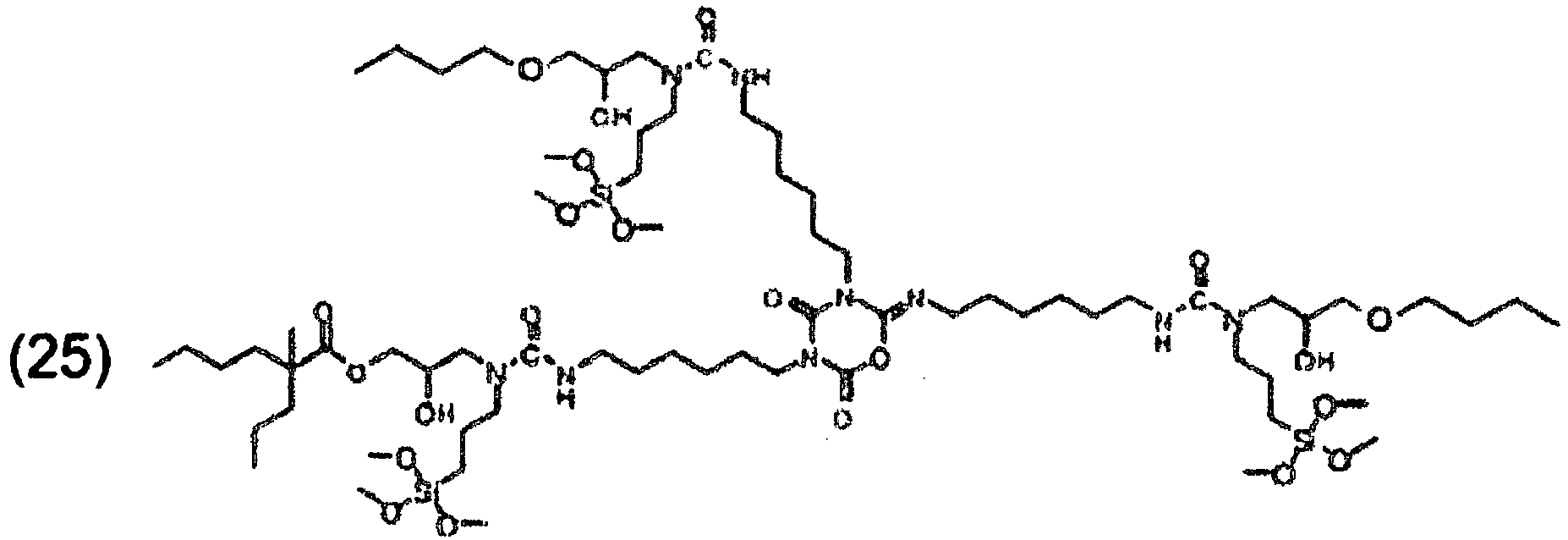


- An embodiment of a coating composition comprises at least one of (16), (17), (18-27).
- In a second reaction pathway, a portion of aminoalkoxysilane is reacted with a compound of formula (2) and another portion of the aminoalkoxysilane is reacted with a compound of formula (5) to yield a mixture of alkoxysilylamines.
- In some embodiments, the aminoalkoxysilane is reacted with a blend of compounds of formula (4) and formula (7) to form an intermediate product mixture. The compounds of formulas (4) and (7) may be used in any amounts relative to one another. In some embodiments, equal amounts of (4) and (7) are employed.
- Upon reaction of the aminoalkoxysilane with the epoxy compounds, the resulting mixture of alkoxysilylamines is blended with an isocyanate reagent. In some embodiments, an isocyanate reagent useful for making a coating composition includes a compound having the following formula (28):


- In an aspect, a portion of an aminoalkoxysilane is reacted with a compound of formula (2) and another portion of the aminoalkoxysilane is reacted with a compound of formula (5) to yield a mixture of alkoxysilylamines; and the mixture alkoxysilylamines is reacted with an isocyanate reagent comprising a compound of formula (28) to yield a monomer having plural alkoxysilane groups, the monomer comprising at least one compound according to formula (30):
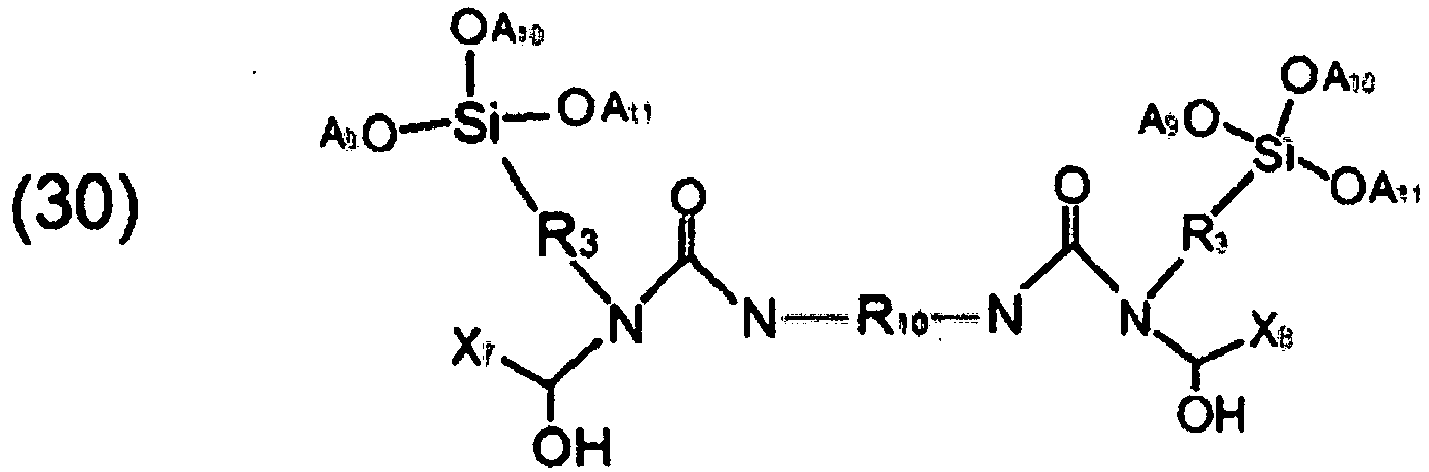


- In an embodiment, a portion of an aminoalkoxysilane is reacted with a compound of formula (4) and another portion of the aminoalkoxysilane is reacted with a compound of formula (7) to yield a mixture alkoxysilylamines; and the mixture alkoxysilylamines is reacted with an isocyanate reagent comprising the compound of formula (29) to yield at least one selected from (31), (32), and (33):


- An embodiment of a coating composition comprises at least one of (31), (32), and (33).
- In an aspect, at least a portion of an aminoalkoxysilane is reacted with a compound of formula (2) to yield an alkoxysilylamine, and the alkoxysilylamine is reacted with an isocyanate reagent comprising at least one of (8), (10), and (28) to yield at least one of the following formula (34) and formulas (14) and (15):

- In an embodiment, at least a portion of an aminoalkoxysilane is reacted with a compound of formula (4) to yield an alkoxysilylamine, and the alkoxysilylamine is reacted with an isocyanate reagent comprising at least one of (9), (11), and (29) to yield at least one of (16), (17), and (31).
- An embodiment of a coating composition comprises at least one of (16), (17), and (31).
- In an aspect, a portion of an aminoalkoxysilane is reacted with a compound of formula (2) and another portion of the aminoalkoxysilane is reacted with a compound of formula (5) to yield a mixture alkoxysilylamines; and the mixture alkoxysilylamines is reacted with an isocyanate reagent comprising at least one compound selected from formulas (8), (10), and (28) to yield at least one (12), (13), and (30). An embodiment of a coating composition comprises at least one of (12), (13), and (30).
- In an embodiment, a portion of an aminoalkoxysilane is reacted with a compound of formula (4) and another portion of the aminoalkoxysilane is reacted with a compound of formula (7) to yield a mixture alkoxysilylamines; and the mixture alkoxysilylamines is reacted with an isocyanate reagent comprising at least one compound selected from formulas (9), (11), and (29) to yield at least one of (16)-(27) and (31)-(33).
- In an aspect, at least a portion of an aminoalkoxysilane is reacted with a compound of formula (5) to yield an alkoxysilylamine, and the alkoxysilylamine is reacted with an isocyanate reagent comprising at least one of (8), (10), and (28) to yield at least one compound of (35), (36), and (37):
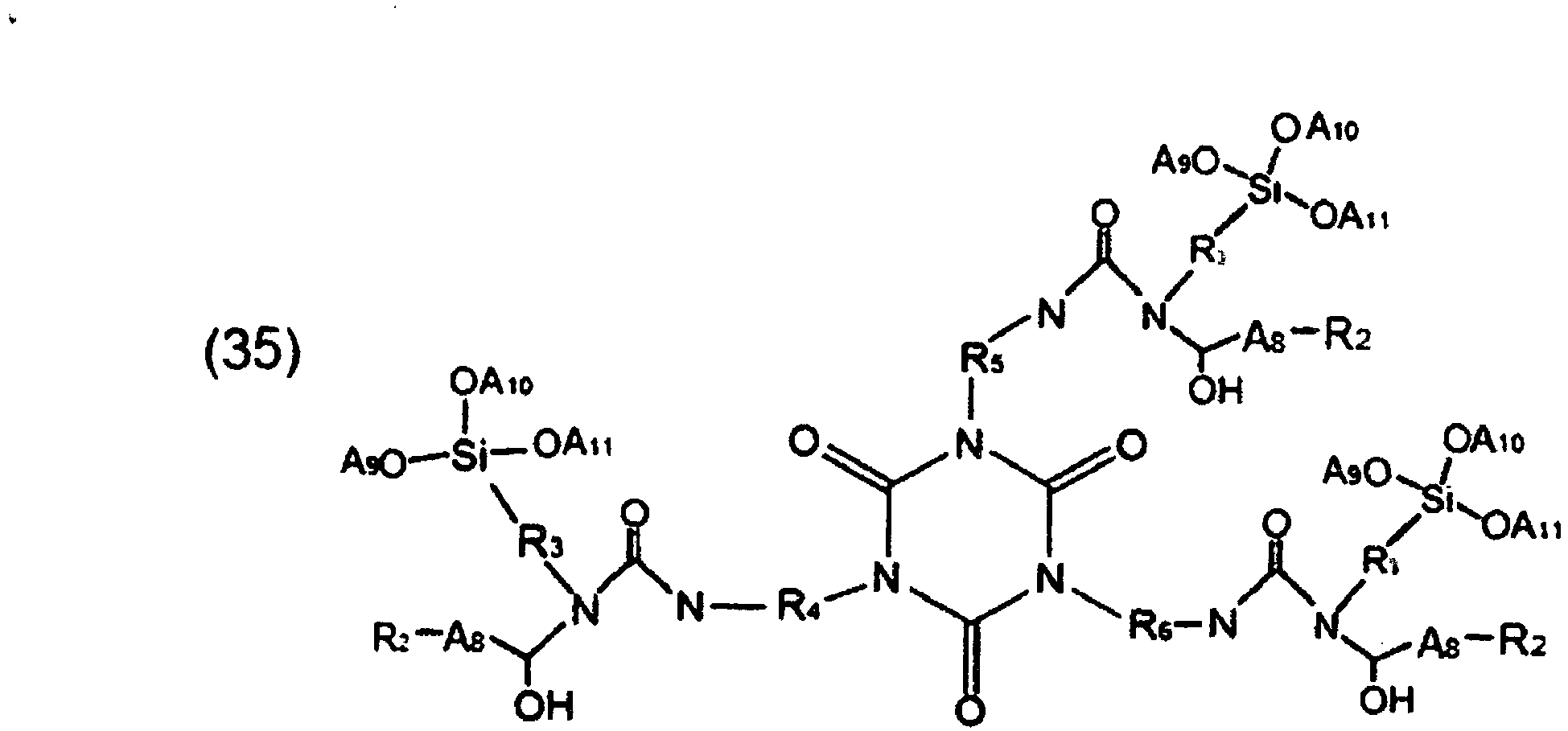


- In an embodiment, at least a portion of an aminoalkoxysilane is reacted with a compound of formula (7) to yield an alkoxysilylamine, and the alkoxysilylamine is reacted with an isocyanate reagent comprising at least one compound selected from formulas (9), (11), and (29) to yield at least one compound selected from formulas (20), (24), and (33). An embodiment of a coating composition comprises at least one compound selected from formulas (20), (24), and (33).
- Insofar as the present application discloses aspects other than the method for preparing the coating composition, it should be noted that the above reactions are not limiting, however, because there are other ways to create the above-described monomers.
- The coating composition has long-term shelf stability and is capable of forming siloxane bonds effectively. It is generally believed that, during a process of curing the coating composition, the alkoxy groups at least partially hydrolyze when exposed to water in air. As these hydrolysis reactions occur, the alkoxy groups convert to silanol groups. It is also believed that at least a portion of the silanol groups cross-link together to form siloxane linkages. The hydrolysis reactions may also produce water and one or more types of alcohol, which may evaporate from the coating composition. While alcohol may be considered VOC, it is generally believed that the amount of alcohol produced during the curing process is substantially lower than the amounts of VOCs that are produced during curing of an organic solvent-based coating composition.
- It is generally believed that the monomers may, in some instances, include hydrophobic structures that slow the progress of a hydrolysis reaction between water and the alkoxy groups. To speed curing of the composition, a catalytic deprotectant may be provided in a coating composition in an amount that is catalytically effective to deprotect alkoxy groups of the heretofore described when the monomer is exposed to ambient water. Exemplary catalytic deprotectants include at least one of alkylamines or organotins. In some embodiments, catalytic deprotectants can accelerate the production of the silanol groups during curing of the coating composition.
- For example, without intending to be bound by any particular theory, it is believed that an alkylamine, such as dibutylamine, may catalytically deprotect the alkoxy groups according to the following reaction:

- Any suitable alkylamine may be provided in the coating composition. Exemplary secondary and tertiary amines include di- and trimethyl amine, di and triethyl amine, di- and tripropyl amine, di- and tributyl amine, di- and tripentyl amine, di- and trihexyl amine, n-ethylmethylamine, n-ethylpropylamine, n-ethylbutylamine, n-ethylpentylamine, n-methylpropylamine, n-propylbutylamine, n-pentylpropylamine, n-butylmethylamine, n-butylpentylamine, n-butylhexylamine, n-pentylhexylamine, n-isopropylmethylamine, n-methylisobutylamine, ethylisobutylamine, diisobutyl amine, and diisopropyl amine. In exemplary coating compositions, the alkylamine can be included in an amount of 0.15 wt% based on the total amount of the coating composition.
- Any suitable organotin may be provided in the coating composition. Exemplary organotins include tributyltin compounds such as tributyltin hydride, trimethyltin compounds such as trimethyltin hydride, tricyclohexyltin compounds such as tricyclohexyltin hydride, tripropyltin compounds such as tripropyltin hydride, dibutyltin compounds such as dibutyltin laurate and dibutyltin bis(2-ethylhexanoate), and dimethyltin compounds such as dimethyltin dineodecanoate.
- A deprotecting catalyst may be included in a coating composition in any amount that is catalytically effective to deprotect alkoxy groups of the monomer when the monomer is exposed to ambient water. In exemplary coating compositions, a deprotecting catalyst can be included in an amount of 0.1 to 1.7 wt%, 0.3 to 1.5 wt%, 0.5 to 1.3 wt%, or 0.7 to 1.1 wt%, based on the total amount of the coating composition.
- The coating composition may include other functional ingredients in amounts intended for their effective purposes. For example, the coating composition may contain a colorant, such as a pigment such as titanium dioxide. The colorant may be present in any amount suitable to impart color and covering effect to the finished coating; for example, when the pigment is titanium dioxide, it may be present in an amount ranging from 5 to 30% by weight of the composition. Other suitable pigments include any suitable pigment particles, such as azo pigments, anazurite, aluminum silicate, aluminum potassium silicate, aluminum paste, anthraquinone pigments, antimony oxide, barium metaborate, barium sulfate, calcium carbonate, calcium metaborate, calcium metasilicate, carbon black, chromium oxides, clay, copper oxides, copper oxychloride, dioxazine pigments, feldspar, hansa yellows, iron oxides such as yellow and red iron oxides, isoindoline pigments, kaolinite, lithopone, magnesium silicates, metallic flakes, mica, napthol pigments such as napthol reds, nitroso pigments, nepheline syenite, perinone pigments, perylene pigments, polycyclic pigments, pyrropyrrol pigments, pthalocyanines such as copper pthalocyanine blue and copper pthalocyanine green, quinacridones such as quinacridone violets, quinophthalone pigments, silicates, sulfides, talc, titanium dioxide, ultramarine, zinc chromate, zinc oxide, and zinc phosphate. In addition, pearlescents, optical brighteners, ultraviolet stabilizers, and the like may be employed.
- The coating composition also may include any one or more of dispersants, surfactants, wetting agents, synergists, and rheology modifiers. Any suitable dispersant, such as any one or more of anionic dispersants, cationic dispersants, amphoteric dispersants, or nonionic dispersants may be used in conjunction with a pigment vehicle. Other known dispersants believed to be suitable include NUOSPERSE® 657 and NUOSPERSE® FA 196 available from Elementis Specialties, DISPERBYK 108 available from Altana AG, and SOLSPERSE™ M387 available from Lubrizol Corporation. Similarly, any suitable wetting agents such as any one or more of anionic wetting agents, cationic wetting agents, amphoteric wetting agents, or nonionic wetting agents may be used. An exemplary synergist is SOLSPERSE™ 5000 available from Lubrizol Corporation. Exemplary rheology modifiers include SUSPENO 201-MS available from Poly-Resyn, Inc. and AEROSIL® available from Evonik Industries.
- Once formed, the coating composition may be applied immediately to a substrate, but the coating composition also may be dispensed into a suitable container, such as a paint can, and sealed. It is believed that the coating composition will have a shelf life of at least several months.
- A method of applying a coating composition can comprise applying the coating composition to a substrate, and allowing the coating composition to cure. Once applied to the substrate, the coating composition will cure as the composition crosslinks. The curing process does not require additional equipment (e.g., a UV source), but rather, it is believed that the curing occurs when the coating composition is exposed to air containing water.
- The coating composition may be employed for any suitable purpose. In some embodiments, the coating composition may be applied to interior or exterior surfaces such as wood, drywall, cement, metal, and plaster, or over a primer coating. In certain embodiments, the coating composition may be applied to metals, composites, and other materials as a protective coating. In other embodiments, the coating composition may be applied to a surface in order to impart dry-erase characteristics. For example, the surface may be a wall, which may have paint or a primer already applied to the surface of the wall, over which the coating can be applied to form a dry-erase surface. The coating composition may be applied with brush, roller, sponge, or spray gun, or other conventional painting tool. The cured coating may have any suitable thickness, such as a thickness ranging from 0.05 - 2 mm with preferred thickness around 0.1 mm.
- An alkoxysilylamine was produced by reacting 36.1 g of DYNASYLAN® AMMO and 50.6 g of CARDURA™ E10-P in a flask, and mixing and reacting the contents of the flask for 3 hr at 65 °C to form Compound 1.
- Example 1 was prepared by adding 6.8 g of DESMODUR® 3300 to 30 g of Compound 1. The molar ratio of these components was 1:1:0.5 (AMMO:CARDURA:DESMODUR).
- Example 1 was repeated, except that DESMODUR® 3900 was used in place of DESMODUR® 3300. A small quantity comprising of 0.02 g of dibutyltin dilaurate was added as a deprotectant catalyst.
- Example 2 was repeated, except that 7.4 g of DESMODUR® 3900 was added to 50.5 g of Compound 1 for a molar ratio of 1:1:0.33.
- An alkoxysilylamine was produced by reacting 50.0g of DYNASYLAN® AMMO and 42.9g of ERISYS® GE-5 in a flask, and mixing and reacting the contents of the flask for 2 hr at 65 °C to form Compound 2.
- Example 4 was prepared by adding 18.5g of DESMODUR® 3900 to 69.0 g of Compound 2. The molar ratio was 1:1:0.5 (AMMO:ERISYS:DESMODUR). A quantity of 0.1g of dibutyl amine was added as a deprotectant catalyst.
- Example 4 was repeated, except that 6.8 g of DESMODUR® 3900 was added to 63.4 g of Compound 2 for a molar ratio of 1:1:0.2, A quantity of 0.1 g of dibutyl amine was added as a deprotectant catalyst.
- An alkoxysilylamine was produced by reacting 736.0g of DYNASYLAN® AMMO, 509.6 g of CARDURA™ E10-P, and 318.4 g of ERISYS® GE-5 in a flask, and mixing and reacting the contents of the flask for 3 hr at 65 °C. The mixture was cooled to room temperature and 107.4 g of DESMODUR® W was added to yield a monomer having plural alkoxysilane groups. The molar ratio was 1:0.5:0.5:0.2 (AMMO:CARDURA:ERISYS:DESMODUR). A quantity of 16.7 g of dibutyl amine was added as a deprotectant catalyst.
- These formulations were evaluated for viscosity (rating from A=thin to Z=thick). Subsequently, these formulations were coated onto 2 mil Bond-Rite panels and tested for pencil hardness (ASTM D5363 (2016)) and impact hardness (ASTM D2794 (2016)). The following results were obtained.

- Without intending to be bound by any particular theory, it is generally believed that the coating composition of Example 6 had acceptable viscosity and provided a cured coating having a balance of hardness and flexibility to due to the relative amounts of DYNASYLAN® AMMO, CARDURA™ E10-P, and ERISYS® GE-5, and DESMODUR® W used to make the coating composition.
- All methods described herein can be performed in any suitable order unless otherwise indicated herein or otherwise clearly contradicted by context. The use of any and all examples, or language describing an example (e.g., "such as") provided herein, is intended to illuminate the invention and does not pose a limitation on the scope of the invention. Any statement herein as to the nature or benefits of the invention or of the preferred embodiments is not intended to be limiting. This invention includes all modifications and equivalents of the subject matter recited herein as permitted by applicable law. Moreover, any combination of the above-described elements in all possible variations thereof is encompassed by the invention unless otherwise indicated herein or otherwise clearly contradicted by context. The description herein of any reference or patent, even if identified as "prior," is not intended to constitute a concession that such reference or patent is available as prior art against the present invention. No unclaimed language should be deemed to limit the invention in scope. Any statements or suggestions herein that certain features constitute a component of the claimed invention are not intended to be limiting unless reflected in the appended claims. Neither the marking of the patent number on any product nor the identification of the patent number in connection with any service should be deemed a representation that all embodiments described herein are incorporated into such product or service.
Claims (47)
- A method of making a coating composition, the method comprising:providing an aminoalkoxysilane;in the substantial absence of water, reacting at least a portion of said aminoalkoxysilane with a compound of the following formula (2):
 wherein A1 - A3 are the same or different and comprise hydrogen or a carbon-containing group with one to three carbon atoms, A4 comprises a carbonyl-containing linking group, and R1 comprises a branched aliphatic group having at least six carbon atoms, the reaction yielding an alkoxysilylamine; andreacting said alkoxysilylamine with an isocyanate reagent containing at least two isocyanate groups to yield a monomer having plural alkoxysilane groups and at least two branched aliphatic groups having at least six carbon atoms.
 - The method according to claim 1, 0.5 to 1.5 parts of said aminoalkoxysilane being blended with 0.25 to 1.5 parts of said compound of formula (2).
- The method of claim 2, said alkoxysilylamine being reacted with 0.05 to 0.75 parts of said isocyanate reagent.
- The method according to claim 1, further comprising providing a catalytic deprotectant in an amount catalytically effective to deprotect alkoxy groups when said monomer is exposed to ambient water, said catalytic deprotectant comprising at least one of an alkylamine and an organotin compound.
- The method according to claim 4, said catalytic deprotectant comprising at least one of dibutylamine and dibutyltin dilaurate.
- The method according to claim 1, said aminoalkoxysilane having a structure represented by the following formula (1):

- The method according to claim 1, said compound of formula (2) being a glycidyl aliphatic ester.
- The method according to claim 7, said glycidyl aliphatic ester having the following formula (3):

- The method according to claim 8, said glycidyl aliphatic ester having the following formula (4):

- The method according to claim 1, said isocyanate reagent comprising at least one of (8) and (10):


- The method according to claim 10, said isocyanate reagent comprising at least one of (9) and (11):


- The method according to claim 1, said monomer comprising at least one of (14) and (15):


- The method according to claim 12, said monomer comprising at least one of (16) and (17):


- The method according to claim 1, further including adding a pigment.
- The method according to claim 14, the pigment including titanium dioxide.
- A coating composition prepared by the method according to claim 1.
- A coating composition comprising at least one of (14) and (15):
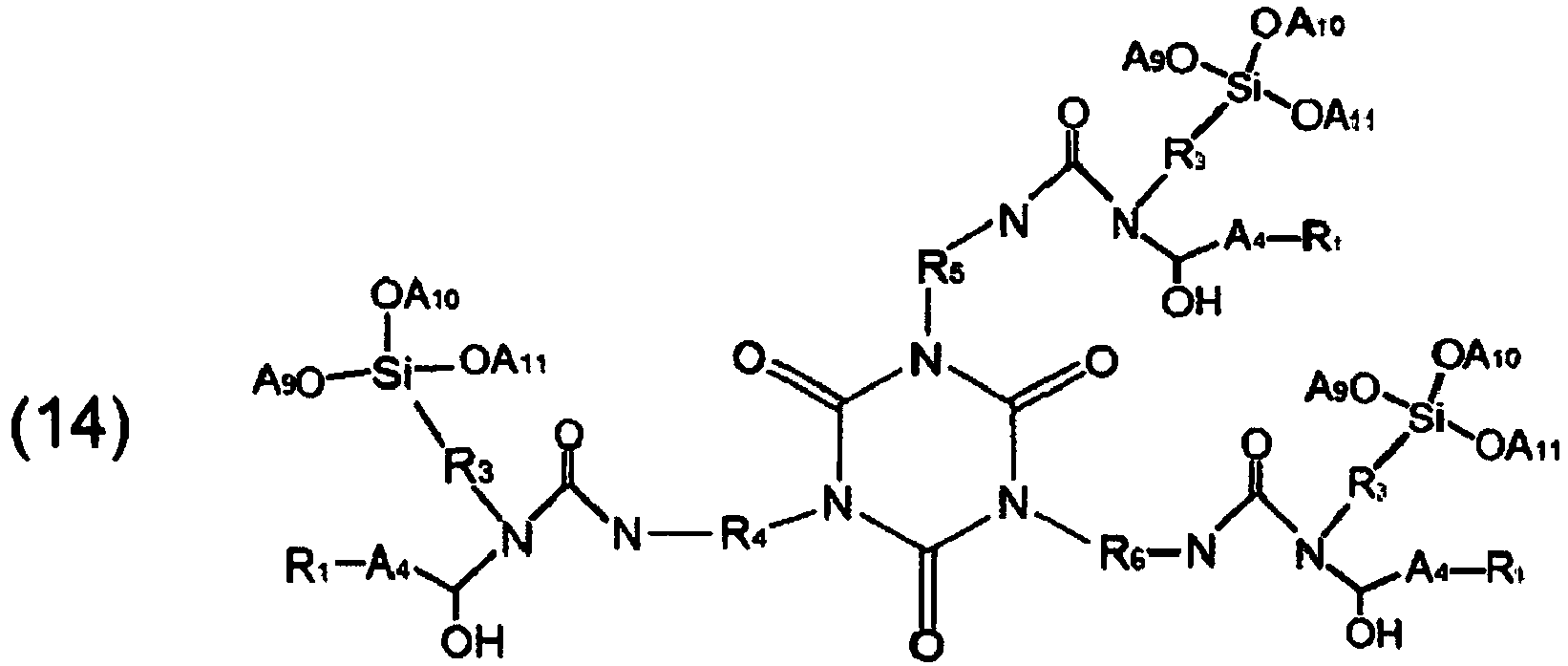

- The coating composition according to claim 17, comprising at least one of (16) and (17):


- The coating composition according to claim 17, further comprising a pigment.
- The coating composition according to claim 19, the pigment including titanium dioxide.
- A method of applying a coating composition, the method comprising applying the coating composition according to claim 17 to a substrate, and allowing the coating composition to cure.
- A cured coating comprising a cross-linked product of the coating composition according to claim 17.
- A method of making a coating composition, the method comprising:providing an aminoalkoxysilane;in the substantial absence of water, reacting a portion of said aminoalkoxysilane with a compound of the following formula (2) and reacting another portion of said aminoalkoxysilane with a compound of the following formula (5):

 wherein A5 - A7 are the same or different and comprise hydrogen or a carbon-containing group with one to three carbon atoms, A8 comprises an ether-containing linking group, and R2 comprises a linear aliphatic group having at least two carbon atoms, the reactions between said aminoalkoxysilane and said compounds of formulas (2) and (5) yielding a mixture of alkoxysilylamines; andreacting said mixture of alkoxysilylamines with an isocyanate reagent containing at least two isocyanate groups to yield a monomer having plural alkoxysilane groups.
 - The method according to claim 23, 0.5 to 1.5 parts of said aminoalkoxysilane being blended with 0.25 to 1.5 parts of said compound of formula (2) and 0.25 to 1.5 parts of said compound of formula (5).
- The method of claim 24, said mixture of alkoxysilylamines being reacted with 0.05 to 0.75 parts of said isocyanate reagent.
- The method according to claim 23, further comprising providing a catalytic deprotectant in an amount catalytically effective to deprotect alkoxy groups when said monomer is exposed to ambient water, said catalytic deprotectant comprising at least one of an alkylamine and an organotin.
- The method according to claim 26, said catalytic deprotectant comprising at least one of dibutylamine and dibutyltin dilaurate.
- The method according to claim 23, said aminoalkoxysilane having a structure represented by the following formula (1):

- The method according to claim 23, said compound of formula (2) being a glycidyl aliphatic ester.
- The method according to claim 29, said glycidyl aliphatic ester having the following formula (3):

- The method according to claim 30, said glycidyl aliphatic ester having the following formula (4):

- The method according to claim 23, said compound of formula (5) being a glycidyl aliphatic ether.
- The method according to claim 32, said glycidyl aliphatic ether having the following formula (6):

- The method according to claim 33, said glycidyl aliphatic ether having the following formula (7):

- The method according to claim 23, said isocyanate reagent comprising a compound according to formula (28):
(28) OCN6-R10-NCO
wherein R10 comprises a linear, branched, cyclic, or bicyclic aliphatic group having at least seven carbon atoms. - The method according to claim 35, said isocyanate reagent comprising a compound of formula (29):

- The method according to claim 23, said monomer comprising at least one compound according to formula (30):


- The method according to claim 37, said monomer comprising at least one of (31), (32), and (33):


- The method according to claim 23, further including adding a pigment.
- The method according to claim 39, the pigment including titanium dioxide.
- A coating composition prepared by the method according to claim 23.
- A coating composition comprising at least one compound according to formula (30):


- The coating composition according to claim 42, comprising at least one of (31), (32), and (33):


- The coating composition according to claim 42, further comprising a pigment.
- The coating composition according to claim 44, the pigment including titanium dioxide.
- A method of applying a coating composition, the method comprising applying the coating composition according to claim 42 to a substrate, and allowing the coating composition to cure.
- A cured coating comprising a cross-linked product of the coating composition according to claim 42.
Applications Claiming Priority (1)
| Application Number | Priority Date | Filing Date | Title |
|---|---|---|---|
| US201762560234P | 2017-09-19 | 2017-09-19 |
Publications (2)
| Publication Number | Publication Date |
|---|---|
| EP3872136A2 true EP3872136A2 (en) | 2021-09-01 |
| EP3872136A3 EP3872136A3 (en) | 2021-12-29 |
Family
ID=65719146
Family Applications (1)
| Application Number | Title | Priority Date | Filing Date |
|---|---|---|---|
| EP18075018.4A Pending EP3872136A3 (en) | 2017-09-19 | 2018-09-19 | 1k high hardness, high impact resistance coating |
Country Status (3)
| Country | Link |
|---|---|
| US (1) | US10752803B2 (en) |
| EP (1) | EP3872136A3 (en) |
| DE (1) | DE202018006246U1 (en) |
Families Citing this family (1)
| Publication number | Priority date | Publication date | Assignee | Title |
|---|---|---|---|---|
| KR20230025883A (en) | 2020-07-01 | 2023-02-23 | 피피지 인더스트리즈 오하이오 인코포레이티드 | Manufacturing method of coated substrate and non-aqueous, curable film-forming composition used therein |
Family Cites Families (7)
| Publication number | Priority date | Publication date | Assignee | Title |
|---|---|---|---|---|
| US6790903B1 (en) * | 1998-12-11 | 2004-09-14 | Henkel Kommanditgesellschaft Auf Aktien (Henkel Kgaa) | Dispersions of silyl-terminated polymers with a high solids content, their production and their use |
| US6506921B1 (en) * | 2001-06-29 | 2003-01-14 | Virginia Tech Intellectual Properties, Inc. | Amine compounds and curable compositions derived therefrom |
| US8097741B2 (en) * | 2007-03-30 | 2012-01-17 | Ndsu Research Foundation | Hybrid coatings prepared from glycidyl carbamate resins |
| US8088245B2 (en) * | 2007-04-11 | 2012-01-03 | Dow Global Technologies Llc | Structural epoxy resins containing core-shell rubbers |
| US8193293B2 (en) * | 2008-03-17 | 2012-06-05 | Ppg Industries Ohio, Inc. | Low temperature curable coating compositions and related methods |
| US9873759B2 (en) * | 2015-04-27 | 2018-01-23 | King Fahd University Of Petroleum And Minerals | Epoxy composite resins and sol-gel compositions thereof |
| US10125281B2 (en) * | 2016-05-27 | 2018-11-13 | The Sherwin-Williams Company | 1K waterborne dry-erase coating composition |
-
2018
- 2018-09-19 EP EP18075018.4A patent/EP3872136A3/en active Pending
- 2018-09-19 DE DE202018006246.4U patent/DE202018006246U1/en active Active
- 2018-09-19 US US16/135,252 patent/US10752803B2/en active Active
Also Published As
| Publication number | Publication date |
|---|---|
| EP3872136A3 (en) | 2021-12-29 |
| US20190085202A1 (en) | 2019-03-21 |
| DE202018006246U1 (en) | 2019-10-30 |
| US10752803B2 (en) | 2020-08-25 |
Similar Documents
| Publication | Publication Date | Title |
|---|---|---|
| RU2442801C2 (en) | Coating composition containing silicone resin and the padding with applied composition | |
| EP3464480B1 (en) | 1k 100% solids dry-erase coating composition | |
| CA2866375C (en) | Epoxy siloxane coating compositions | |
| PL191008B1 (en) | Epoxy-polysiloxane polymer composition | |
| HK1211312A1 (en) | Epoxy siloxane coating compositions | |
| JP2024527059A (en) | Composition | |
| US8987378B2 (en) | Coating compositions comprising cyclic carbonate amine resins | |
| JPWO2018151271A1 (en) | Coating composition and surface protective film forming method | |
| US10752803B2 (en) | 1K high hardness, high impact resistance coating | |
| EP1585795B1 (en) | Coating composition | |
| US12595375B2 (en) | Polysiloxane-based coating composition | |
| US10767080B2 (en) | 1K waterborne dry-erase coating composition | |
| JP2021050285A (en) | Coating material | |
| WO2022169744A1 (en) | Composition comprising organic functional alkoxysilanes and coating compositions comprising the same | |
| HK1138031B (en) | Silicone resin containing coating compositions, related coated substrates and methods | |
| JP2009287207A (en) | Building material |
Legal Events
| Date | Code | Title | Description |
|---|---|---|---|
| PUAI | Public reference made under article 153(3) epc to a published international application that has entered the european phase |
Free format text: ORIGINAL CODE: 0009012 |
|
| STAA | Information on the status of an ep patent application or granted ep patent |
Free format text: STATUS: THE APPLICATION HAS BEEN PUBLISHED |
|
| AK | Designated contracting states |
Kind code of ref document: A2 Designated state(s): AL AT BE BG CH CY CZ DE DK EE ES FI FR GB GR HR HU IE IS IT LI LT LU LV MC MK MT NL NO PL PT RO RS SE SI SK SM TR |
|
| XX | Miscellaneous (additional remarks) |
Free format text: EURO-PCT APPLICATION 18882277.9 (PCT/IB2018/001158, NOT PUBLISHED) CONTINUES NOW AS EUROPEAN APPLICATION EP18075018.4. |
|
| PUAL | Search report despatched |
Free format text: ORIGINAL CODE: 0009013 |
|
| AK | Designated contracting states |
Kind code of ref document: A3 Designated state(s): AL AT BE BG CH CY CZ DE DK EE ES FI FR GB GR HR HU IE IS IT LI LT LU LV MC MK MT NL NO PL PT RO RS SE SI SK SM TR Free format text: EURO-PCT APPLICATION 18882277.9 (PCT/IB2018/001158, NOT PUBLISHED) CONTINUES NOW AS EUROPEAN APPLICATION EP18075018.4. |
|
| RIC1 | Information provided on ipc code assigned before grant |
Ipc: C08G 18/79 20060101ALI20211122BHEP Ipc: C08G 18/78 20060101ALI20211122BHEP Ipc: C08G 18/38 20060101ALI20211122BHEP Ipc: C09D 175/02 20060101ALI20211122BHEP Ipc: C09D 7/63 20180101ALI20211122BHEP Ipc: C09D 7/61 20180101ALI20211122BHEP Ipc: C09D 5/00 20060101AFI20211122BHEP |
|
| STAA | Information on the status of an ep patent application or granted ep patent |
Free format text: STATUS: REQUEST FOR EXAMINATION WAS MADE |
|
| 17P | Request for examination filed |
Effective date: 20220627 |
|
| RBV | Designated contracting states (corrected) |
Designated state(s): AL AT BE BG CH CY CZ DE DK EE ES FI FR GB GR HR HU IE IS IT LI LT LU LV MC MK MT NL NO PL PT RO RS SE SI SK SM TR |
|
| STAA | Information on the status of an ep patent application or granted ep patent |
Free format text: STATUS: EXAMINATION IS IN PROGRESS |
|
| 17Q | First examination report despatched |
Effective date: 20250327 |