EP3869657A1 - Energy management system, independent system, and independent system operation method - Google Patents
Energy management system, independent system, and independent system operation method Download PDFInfo
- Publication number
- EP3869657A1 EP3869657A1 EP19874134.0A EP19874134A EP3869657A1 EP 3869657 A1 EP3869657 A1 EP 3869657A1 EP 19874134 A EP19874134 A EP 19874134A EP 3869657 A1 EP3869657 A1 EP 3869657A1
- Authority
- EP
- European Patent Office
- Prior art keywords
- power
- load
- power supply
- storage battery
- supply system
- Prior art date
- Legal status (The legal status is an assumption and is not a legal conclusion. Google has not performed a legal analysis and makes no representation as to the accuracy of the status listed.)
- Withdrawn
Links
Images

Classifications
-
- H—ELECTRICITY
- H01—ELECTRIC ELEMENTS
- H01M—PROCESSES OR MEANS, e.g. BATTERIES, FOR THE DIRECT CONVERSION OF CHEMICAL ENERGY INTO ELECTRICAL ENERGY
- H01M10/00—Secondary cells; Manufacture thereof
- H01M10/42—Methods or arrangements for servicing or maintenance of secondary cells or secondary half-cells
- H01M10/44—Methods for charging or discharging
- H01M10/441—Methods for charging or discharging for several batteries or cells simultaneously or sequentially
-
- H—ELECTRICITY
- H02—GENERATION; CONVERSION OR DISTRIBUTION OF ELECTRIC POWER
- H02J—ELECTRIC POWER NETWORKS; CIRCUIT ARRANGEMENTS OR SYSTEMS FOR SUPPLYING OR DISTRIBUTING ELECTRIC POWER; SYSTEMS FOR STORING ELECTRIC ENERGY
- H02J3/00—Circuit arrangements for AC mains or AC distribution networks
- H02J3/38—Arrangements for feeding a single network from two or more generators or sources in parallel; Arrangements for feeding already energised networks from additional generators or sources in parallel
- H02J3/46—Controlling the sharing of generated power between the generators, sources or networks
-
- H—ELECTRICITY
- H01—ELECTRIC ELEMENTS
- H01M—PROCESSES OR MEANS, e.g. BATTERIES, FOR THE DIRECT CONVERSION OF CHEMICAL ENERGY INTO ELECTRICAL ENERGY
- H01M10/00—Secondary cells; Manufacture thereof
- H01M10/42—Methods or arrangements for servicing or maintenance of secondary cells or secondary half-cells
- H01M10/44—Methods for charging or discharging
-
- H—ELECTRICITY
- H01—ELECTRIC ELEMENTS
- H01M—PROCESSES OR MEANS, e.g. BATTERIES, FOR THE DIRECT CONVERSION OF CHEMICAL ENERGY INTO ELECTRICAL ENERGY
- H01M10/00—Secondary cells; Manufacture thereof
- H01M10/42—Methods or arrangements for servicing or maintenance of secondary cells or secondary half-cells
- H01M10/44—Methods for charging or discharging
- H01M10/443—Methods for charging or discharging in response to temperature
-
- H—ELECTRICITY
- H01—ELECTRIC ELEMENTS
- H01M—PROCESSES OR MEANS, e.g. BATTERIES, FOR THE DIRECT CONVERSION OF CHEMICAL ENERGY INTO ELECTRICAL ENERGY
- H01M10/00—Secondary cells; Manufacture thereof
- H01M10/42—Methods or arrangements for servicing or maintenance of secondary cells or secondary half-cells
- H01M10/46—Accumulators structurally combined with charging apparatus
- H01M10/465—Accumulators structurally combined with charging apparatus with solar battery as charging system
-
- H—ELECTRICITY
- H01—ELECTRIC ELEMENTS
- H01M—PROCESSES OR MEANS, e.g. BATTERIES, FOR THE DIRECT CONVERSION OF CHEMICAL ENERGY INTO ELECTRICAL ENERGY
- H01M10/00—Secondary cells; Manufacture thereof
- H01M10/42—Methods or arrangements for servicing or maintenance of secondary cells or secondary half-cells
- H01M10/48—Accumulators combined with arrangements for measuring, testing or indicating the condition of cells, e.g. the level or density of the electrolyte
-
- H—ELECTRICITY
- H02—GENERATION; CONVERSION OR DISTRIBUTION OF ELECTRIC POWER
- H02J—ELECTRIC POWER NETWORKS; CIRCUIT ARRANGEMENTS OR SYSTEMS FOR SUPPLYING OR DISTRIBUTING ELECTRIC POWER; SYSTEMS FOR STORING ELECTRIC ENERGY
- H02J3/00—Circuit arrangements for AC mains or AC distribution networks
- H02J3/12—Arrangements for adjusting voltage in AC networks by changing a characteristic of the network load
- H02J3/14—Arrangements for adjusting voltage in AC networks by changing a characteristic of the network load by switching loads on to, or off from, the networks, e.g. progressively balanced loading
-
- H—ELECTRICITY
- H02—GENERATION; CONVERSION OR DISTRIBUTION OF ELECTRIC POWER
- H02J—ELECTRIC POWER NETWORKS; CIRCUIT ARRANGEMENTS OR SYSTEMS FOR SUPPLYING OR DISTRIBUTING ELECTRIC POWER; SYSTEMS FOR STORING ELECTRIC ENERGY
- H02J3/00—Circuit arrangements for AC mains or AC distribution networks
- H02J3/28—Arrangements for balancing of the load in networks by storage of energy
- H02J3/32—Arrangements for balancing of the load in networks by storage of energy using batteries or super capacitors with converting means
-
- H—ELECTRICITY
- H02—GENERATION; CONVERSION OR DISTRIBUTION OF ELECTRIC POWER
- H02J—ELECTRIC POWER NETWORKS; CIRCUIT ARRANGEMENTS OR SYSTEMS FOR SUPPLYING OR DISTRIBUTING ELECTRIC POWER; SYSTEMS FOR STORING ELECTRIC ENERGY
- H02J3/00—Circuit arrangements for AC mains or AC distribution networks
- H02J3/38—Arrangements for feeding a single network from two or more generators or sources in parallel; Arrangements for feeding already energised networks from additional generators or sources in parallel
- H02J3/381—Dispersed generators
-
- H—ELECTRICITY
- H02—GENERATION; CONVERSION OR DISTRIBUTION OF ELECTRIC POWER
- H02J—ELECTRIC POWER NETWORKS; CIRCUIT ARRANGEMENTS OR SYSTEMS FOR SUPPLYING OR DISTRIBUTING ELECTRIC POWER; SYSTEMS FOR STORING ELECTRIC ENERGY
- H02J3/00—Circuit arrangements for AC mains or AC distribution networks
- H02J3/38—Arrangements for feeding a single network from two or more generators or sources in parallel; Arrangements for feeding already energised networks from additional generators or sources in parallel
- H02J3/46—Controlling the sharing of generated power between the generators, sources or networks
- H02J3/466—Scheduling or selectively controlling the operation of the generators or sources, e.g. connecting or disconnecting generators to meet a demand
-
- H—ELECTRICITY
- H02—GENERATION; CONVERSION OR DISTRIBUTION OF ELECTRIC POWER
- H02J—ELECTRIC POWER NETWORKS; CIRCUIT ARRANGEMENTS OR SYSTEMS FOR SUPPLYING OR DISTRIBUTING ELECTRIC POWER; SYSTEMS FOR STORING ELECTRIC ENERGY
- H02J3/00—Circuit arrangements for AC mains or AC distribution networks
- H02J3/38—Arrangements for feeding a single network from two or more generators or sources in parallel; Arrangements for feeding already energised networks from additional generators or sources in parallel
- H02J3/46—Controlling the sharing of generated power between the generators, sources or networks
- H02J3/48—Controlling the sharing of active power
-
- H—ELECTRICITY
- H02—GENERATION; CONVERSION OR DISTRIBUTION OF ELECTRIC POWER
- H02J—ELECTRIC POWER NETWORKS; CIRCUIT ARRANGEMENTS OR SYSTEMS FOR SUPPLYING OR DISTRIBUTING ELECTRIC POWER; SYSTEMS FOR STORING ELECTRIC ENERGY
- H02J7/00—Circuit arrangements for charging or discharging batteries or for supplying loads from batteries
- H02J7/34—Parallel operation in networks using both storage and other DC sources, e.g. providing buffering
- H02J7/35—Parallel operation in networks using both storage and other DC sources, e.g. providing buffering with light sensitive cells
-
- H—ELECTRICITY
- H02—GENERATION; CONVERSION OR DISTRIBUTION OF ELECTRIC POWER
- H02J—ELECTRIC POWER NETWORKS; CIRCUIT ARRANGEMENTS OR SYSTEMS FOR SUPPLYING OR DISTRIBUTING ELECTRIC POWER; SYSTEMS FOR STORING ELECTRIC ENERGY
- H02J7/00—Circuit arrangements for charging or discharging batteries or for supplying loads from batteries
- H02J7/865—Battery or charger load switching, e.g. concurrent charging and load supply
-
- H—ELECTRICITY
- H01—ELECTRIC ELEMENTS
- H01M—PROCESSES OR MEANS, e.g. BATTERIES, FOR THE DIRECT CONVERSION OF CHEMICAL ENERGY INTO ELECTRICAL ENERGY
- H01M2220/00—Batteries for particular applications
- H01M2220/10—Batteries in stationary systems, e.g. emergency power source in plant
-
- H—ELECTRICITY
- H02—GENERATION; CONVERSION OR DISTRIBUTION OF ELECTRIC POWER
- H02J—ELECTRIC POWER NETWORKS; CIRCUIT ARRANGEMENTS OR SYSTEMS FOR SUPPLYING OR DISTRIBUTING ELECTRIC POWER; SYSTEMS FOR STORING ELECTRIC ENERGY
- H02J2101/00—Supply or distribution of decentralised, dispersed or local electric power generation
- H02J2101/20—Dispersed power generation using renewable energy sources
-
- H—ELECTRICITY
- H02—GENERATION; CONVERSION OR DISTRIBUTION OF ELECTRIC POWER
- H02J—ELECTRIC POWER NETWORKS; CIRCUIT ARRANGEMENTS OR SYSTEMS FOR SUPPLYING OR DISTRIBUTING ELECTRIC POWER; SYSTEMS FOR STORING ELECTRIC ENERGY
- H02J2101/00—Supply or distribution of decentralised, dispersed or local electric power generation
- H02J2101/20—Dispersed power generation using renewable energy sources
- H02J2101/22—Solar energy
- H02J2101/24—Photovoltaics
-
- H—ELECTRICITY
- H02—GENERATION; CONVERSION OR DISTRIBUTION OF ELECTRIC POWER
- H02J—ELECTRIC POWER NETWORKS; CIRCUIT ARRANGEMENTS OR SYSTEMS FOR SUPPLYING OR DISTRIBUTING ELECTRIC POWER; SYSTEMS FOR STORING ELECTRIC ENERGY
- H02J2101/00—Supply or distribution of decentralised, dispersed or local electric power generation
- H02J2101/20—Dispersed power generation using renewable energy sources
- H02J2101/28—Wind energy
-
- H—ELECTRICITY
- H02—GENERATION; CONVERSION OR DISTRIBUTION OF ELECTRIC POWER
- H02J—ELECTRIC POWER NETWORKS; CIRCUIT ARRANGEMENTS OR SYSTEMS FOR SUPPLYING OR DISTRIBUTING ELECTRIC POWER; SYSTEMS FOR STORING ELECTRIC ENERGY
- H02J2105/00—Networks for supplying or distributing electric power characterised by their spatial reach or by the load
- H02J2105/50—Networks for supplying or distributing electric power characterised by their spatial reach or by the load for selectively controlling the operation of the loads
- H02J2105/52—Networks for supplying or distributing electric power characterised by their spatial reach or by the load for selectively controlling the operation of the loads for limitation of the power consumption in the networks or in one section of the networks, e.g. load shedding or peak shaving
-
- H—ELECTRICITY
- H02—GENERATION; CONVERSION OR DISTRIBUTION OF ELECTRIC POWER
- H02J—ELECTRIC POWER NETWORKS; CIRCUIT ARRANGEMENTS OR SYSTEMS FOR SUPPLYING OR DISTRIBUTING ELECTRIC POWER; SYSTEMS FOR STORING ELECTRIC ENERGY
- H02J2105/00—Networks for supplying or distributing electric power characterised by their spatial reach or by the load
- H02J2105/50—Networks for supplying or distributing electric power characterised by their spatial reach or by the load for selectively controlling the operation of the loads
- H02J2105/59—Networks for supplying or distributing electric power characterised by their spatial reach or by the load for selectively controlling the operation of the loads one of the loads acting as leader and the other or others acting as followers
-
- Y—GENERAL TAGGING OF NEW TECHNOLOGICAL DEVELOPMENTS; GENERAL TAGGING OF CROSS-SECTIONAL TECHNOLOGIES SPANNING OVER SEVERAL SECTIONS OF THE IPC; TECHNICAL SUBJECTS COVERED BY FORMER USPC CROSS-REFERENCE ART COLLECTIONS [XRACs] AND DIGESTS
- Y02—TECHNOLOGIES OR APPLICATIONS FOR MITIGATION OR ADAPTATION AGAINST CLIMATE CHANGE
- Y02E—REDUCTION OF GREENHOUSE GAS [GHG] EMISSIONS, RELATED TO ENERGY GENERATION, TRANSMISSION OR DISTRIBUTION
- Y02E60/00—Enabling technologies; Technologies with a potential or indirect contribution to GHG emissions mitigation
- Y02E60/10—Energy storage using batteries
Definitions
- the present invention relates to an energy management system, an independent system, and a method for operating the independent system.
- a system constructed in an isolated island, a remote location where power networks are under construction or the like is an independent system that is not interconnected to the other systems.
- the system is a non-independent system that is interconnected to the other systems in normal times, it turns into an independent system in a time of emergency, for example, during a power outage in the other systems.
- the independent system and the system that turns into an independent system in a time of emergency will be referred to as the independent system without distinction.
- the independent system is vulnerable. Thus, a power outage sometimes occurs in the independent systems for a long time.
- a solar power generation device and a power storage device are connected to a power line (paragraph 0013).
- the independent power supply system does not include a power generator for adjusting output of a rotary machine system with inertia, such as a Diesel-engine power generator (paragraph 0013).
- the power storage device operates for maintaining the voltage and the frequency (paragraph 0013).
- power generated by the solar power generation device is reduced (paragraph 0049).
- the power consumption of a load for adjustment is reduced (paragraph 0049).
- the amount of electricity generated by the natural energy generating apparatuses depends on the nature, is uncertain, and greatly fluctuates.
- Patent Document 2 describes that decrease in temperature of a sodium-sulfur battery without a supply of power to a heater causes increase in time to resume operations, and increases the probability of a failure in an electric cell (paragraph 0012).
- a time period required until a person skilled at the operation of the power supply system arrives at the isolated island, and the remote location or the like where the independent system is constructed and performs the operations of restarting the power supply system tends to be long, and accordingly,.
- a time period required for resuming the operation of the power supply system tends to be long. Therefore, continuing to supply power to the power supply system included in the independent system is strongly sought.
- the power generator is main regulated power supply, and the storage battery system is operated in an auxiliary manner to support maintaining frequencies of the power supply system.
- the present invention has been conceived in view of this problem.
- the problem to be solved by the present invention is to reduce a risk of not powering a load in an independent system for which a continued supply of power is strongly sought and to stably operate the independent system.
- the present invention is directed to an energy management system, an independent system, and a method for operating the independent system.
- An independent system includes a power supply system, a natural energy generating apparatus, a storage battery system, a power generator, a first load, and a second load.
- Information indicating states of the natural energy generating apparatus, the storage battery system, the power generator, the first load, and the second load is obtained when: the natural energy generating apparatus, the storage battery system, the power generator, and the first load are connected to the power supply system; the natural energy generating apparatus supplies generated power to the power supply system; the storage battery system is a regulated power supply; and the power generator performs a constant power operation.
- Operations of the natural energy generating apparatus and the power generator, connection of the second load to the power supply system, and paralleling off the second load from the power supply system are controlled based on the information so that a demand-supply balance of power in the independent system is maintained in the independent system, with the first load maintained to be connected to the power supply system.
- power can be continuously supplied to the first load even when the power cannot be continuously supplied to both of the first load and the second load. This can reduce the risk of not powering the load in the independent system for which the continued supply of power is strongly sought. This can stably operate the independent system.
- FIG. 1 schematically illustrates an independent system according to the first embodiment.
- An independent system 100 includes a power supply system 110, L natural energy generating apparatuses 1201, ..., 120L, a storage battery system 121, M power generators 1221, ..., 122M, an important load 123, N general loads 1241, ..., 124N, L circuit breakers 1301, ..., 130L, a circuit breaker 131, M circuit breakers 1321, ..., 132M, a circuit breaker 133, N circuit breakers 1341, ..., 134N, and an energy management system (EMS) 140.
- Each of the numbers L, M, and N may be 1 or an integer larger than or equal to 2.
- the independent system 100 may include two or more storage battery systems.
- the independent system 100 may include switches instead of or in addition to the circuit breakers.
- the independent system 100 may include constituent elements other than these.
- Loads 150 are classified into the important load 123 and general loads 124.
- the general loads 124 are divided into the N general loads 1241, ..., 124N.
- the power supply system 110 is electrically connected to an upper system 161 through a circuit breaker 160.
- the following description is made, assuming that the circuit breaker 160 is open and the power supply system 110 is not interconnected to the upper system 161. In some cases, an interconnecting means that interconnects the independent system 100 to the upper system 161 is not provided.
- the natural energy generating apparatuses 1201, ..., 120L are electrically connected to the power supply system 110 through the circuit breakers 1301, ..., 130L, respectively.
- Each of the natural energy generating apparatuses 1201, ..., 120L is any of a solar power generation device, a wind turbine generator, a hydroelectric generator, a geothermal power generator, a solar thermal power generator, a biomass power generator and the like.
- the natural energy generating apparatuses 1201, ..., 120L are also referred to as renewable energy power generating equipment.
- the storage battery system 121 is electrically connected to the power supply system 110 through the circuit breaker 131.
- the storage battery system 121 includes a storage battery.
- the storage battery is any of a sodium-sulfur battery, a redox flow battery, a lithium ion battery, a lead-acid battery, a nickel hydrogen battery and the like, and is preferably the sodium-sulfur battery.
- the storage battery system 121 can operate in an autonomous operation mode. While the storage battery system 121 operates in the autonomous operation mode, an operation of externally supplying the power discharged from the storage battery and an operation of charging the storage battery with the power externally supplied can be switched without interruption.
- the storage battery system 121 can be used as a regulated power supply to keep the voltage, the frequency and the like of the power supply system 110 constant.
- the independent system 100 includes two or more storage battery systems, an operation of externally supplying the power discharged from storage batteries in a whole of the two or more storage battery systems and an operation of charging the storage batteries with the power externally supplied can be switched without interruption.
- the power generators 1221, ..., 122M are electrically connected to the power supply system 110 through the circuit breakers 1321, ..., 132M, respectively.
- the power generators 1221, ..., 122M are not natural energy generating apparatuses but power generators requiring fuel, and include a Diesel-engine power generator, a gasoline engine power generator, and a gas power generator.
- the power generators 1221, ..., 122M may be ordinarily-used power generators or emergency power generators.
- the total capacity of the power generators 1221, ..., 122M is more than the demand for power in the important load 123 and less than the peak demand for power in the independent system 100.
- the important load 123 is electrically connected to the power supply system 110 through the circuit breaker 133.
- the important load 123 is a first load requiring a continued supply of power.
- the important load 123 exemplarily includes a load that causes a failure in a device included in the independent system 100 when not powered, and a load that prolongs the time necessary for resuming an operation of the device included in the independent system 100 when not powered.
- the important load 123 includes, for example, accessory machines of the natural energy generating apparatuses 1201, ..., 120L and the storage battery system 121.
- the accessory machines include a control device.
- the storage battery included in the storage battery system 121 is a high-temperature operating storage battery such as a sodium-sulfur battery
- the accessory machines of the storage battery system 121 include a heater that heats the high-temperature operating storage battery.
- the important load 123 may include a load that gives, when not powered, an undesirable influence over the isolated islands, the remote locations and the like where the independent system 100 is constructed.
- the important load 123 may include a load to be installed in, for example, a police facility, a fire protection facility, a military facility, a hospital, or a life-line facility.
- the general loads 1241, ..., 124N are electrically connected to the power supply system 110 through the circuit breakers 1341, ..., 134N, respectively.
- the general loads 1241, ..., 124N are second loads different from the important load 123.
- the EMS 140 obtains information 170 indicating states of the power supply system 110, the natural energy generating apparatuses 1201, ..., 120L, the storage battery system 121, the power generators 1221, ..., 122M, the important load 123, the general loads 1241, ..., 124N, the circuit breakers 1301, ..., 130L, the circuit breaker 131, the circuit breakers 1321, ..., 132M, the circuit breaker 133, and the circuit breakers 1341, ..., 134N.
- the EMS 140 issues a control command 171 for integrated control of the natural energy generating apparatuses 1201, ..., 120L, the storage battery system 121, the power generators 1221, ..., 122M, the important load 123, the general loads 1241, ..., 124N, the circuit breakers 1301, ..., 130L, the circuit breaker 131, the circuit breakers 1321, ..., 132M, the circuit breaker 133, and the circuit breakers 1341, ..., 134N.
- the circuit breakers 1301, ..., 130L, the circuit breaker 131, the circuit breakers 1321, ..., 132M, and the circuit breaker 133 are closed.
- the natural energy generating apparatuses 1201, ..., 120L, the storage battery system 121, the power generators 1221, ..., 122M, and the important load 123 are connected (paralleled) to the power supply system 110. Consequently, the natural energy generating apparatuses 1201, ..., 120L can supply the generated power to the power supply system 110.
- the storage battery system 121 can supply the power discharged from the storage battery to the power supply system 110, and charge the storage battery with the power supplied from the power supply system 110.
- the power generators 1221, ..., 122M can supply the generated power to the power supply system 110.
- the power supply system 110 supplies the power to the important load 123.
- the EMS 140 controls the closing and opening of the circuit breakers 1341, ..., 134N in the independent system 100.
- the circuit breakers 1341, .., 134N are closed, the general loads 1241, ..., 124N, respectively, are connected in the power supply system 110.
- the circuit breakers 1341, ..., 134N are opened, the general loads 1241, ..., 124N, respectively, are paralleled off from the power supply system 110.
- the storage battery system 121 While the natural energy generating apparatuses 1201, ..., 120L supply the generated power to the power supply system 110, the storage battery system 121 operates in the autonomous operation mode. When some of the voltage, the frequency and the like of the power supply system 110 decrease, the storage battery system 121 supplies power to the power supply system 110. When some of the voltage, the frequency and the like of the power supply system 110 increase, the power supply system 110 supplies power to the storage battery system 121. Thus, the storage battery system 121 acts as a regulated power supply to keep the voltage, the frequency and the like of the power supply system 110 constant.
- the power generators 1221, ..., 122M While the natural energy generating apparatuses 1201, ..., 120L supply the generated power to the power supply system 110, the power generators 1221, ..., 122M operate in an interconnecting operation mode. Thus, the power generators 1221, ..., 122M perform constant power operations, and supply constant power to the power supply system 110. Consequently, the power generators 1221, ..., 122M do not act as regulated power supplies.
- the EMS 140 sets the power generators 1221, ..., 122M in a constant power operation mode using the control command 171, so that the power generators 1221, .., 122M operate in the interconnecting operation mode.
- the power generators 1221, ..., 122M set in the constant power operation mode generate the constant power.
- the power generators 1221, ..., 122M can continue to operate near the rated power. This can enhance the efficiency of generating power by the power generators 1221, ..., 122M, and reduce fuel consumption per amount of power generated by the power generators 1221, ..., 122M. Furthermore, a failure frequency in the power generators 1221, ..., 122M can be reduced.
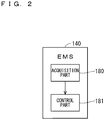
- FIG. 2 is a block diagram illustrating the EMS included in the independent system according to the first embodiment.
- the EMS 140 includes an acquisition part 180 and a control part 181.
- the acquisition part 180 and the control part 181 are configured by causing a computer to execute a program.
- a part of or all the functions implemented by the acquisition part 180 and the control part 181 may be implemented by hardware that does not execute the program.
- the acquisition part 180 acquires the information 170 indicating the states of the natural energy generating apparatuses 1201, ..., 120L, the storage battery system 121, the power generators 1221, ..., 122M, the important load 123, and the general loads 1241, .., 124N when the natural energy generating apparatuses 1201, ..., 120L supply the generated power to the power supply system 110.
- the states indicated by the acquired information 170 are last-minute states thereof.
- the control part 181 controls, based on the acquired information, operations of the natural energy generating apparatuses 1201, ..., 120L and the power generators 1221, .., 122M, connection of the general loads 1241, ..., 124N to the power supply system 110, and paralleling off the general loads 1241, ..., 124N from the power supply system 110 so that the demand-supply balance of the power in the independent system 100 is maintained.
- the storage battery system 121 eliminates a slight gap between the demand and the supply of power. While this control is performed, the connection of the important load 123 to the power supply system 110 is maintained. Furthermore, the balance to be considered in performing this control is a short-term balance.
- the power can be continuously supplied to the important load 123 even when the power cannot be continuously supplied to both of the important load 123 and the general loads 124. This can reduce the risk of not powering the important load 123 in the independent system 100 for which the continued supply of power is strongly sought. This renders stable operations of the independent system 100.
- the control part 181 preferably predicts future states of at least one of the natural energy generating apparatuses 1201, ..., 120L, the storage battery system 121, the power generators 1221, ..., 122M, the important load 123, and the general loads 1241, ..., 124N.
- control part 181 controls, based on the predicted future state, the operations of the natural energy generating apparatuses 1201, ..., 120L and the power generators 1221, ..., 122M, the connection of the general loads 1241, ..., 124N to the power supply system 110, and the paralleling off the general loads 1241, ..., 124N from the power supply system 110 so that the remaining capacity of the storage battery system 121 does not reach a charging or discharging end point within a specified period.
- the control part 181 performs the control so that the remaining capacity of the storage battery system 121 falls within a set range until after five hours from the current time.
- the balance to be considered in performing this control is a medium- and long-term balance.
- the control part 181 preferably predicts the above described future states by performing an integrated simulation based on the past histories of the states of the natural energy generating apparatuses 1201, ..., 120L, the storage battery system 121, the power generators 1221, ..., 122M, the important load 123, and the general loads 1241, ..., 124N, weather conditions, and the like.
- a part of or all elements of the above described future states may be acquired from a sub-system that predicts the elements.
- the control part 181 preferably includes a mechanism for allowing a person to correct the predicted future states.
- the correction may be performed regularly or irregularly.
- the control part 181 When the general loads 124 includes the plurality of general loads 1241, ..., 124N, the control part 181 preferably holds a plurality of priorities PI, .., PN respectively assigned to the plurality of general loads 1241, ..., 124N. Furthermore, the control part 181 controls the connection of the general loads 1241, ..., 124N to the power supply system 110 and the paralleling off the general loads 1241, ..., 124N from the power supply system 110 so that a general load to which a higher priority is assigned is preferentially connected to the power supply system 110 and a general load to which a lower priority is assigned is preferentially paralleled off from the power supply system 110.
- the control part 181 preferably includes a mechanism for changing the priorities PI, ..., PN according to a time period, a season, and the like.
- the control part 181 When determining that the supply of power in the independent system 100 is more than the demand for power in the independent system 100, the control part 181 performs at least one of: control for reducing the power generated by the natural energy generating apparatuses 1201, ..., 120L; control for reducing the power generated by the power generators 1221, ..., 122M; and control for connecting, to the power supply system 110, general loads that are included in the general loads 1241, ..., 124N and have not been connected to the power supply system 110 yet.
- the power generated by the natural energy generating apparatuses 1201, ..., 120L is reduced by, for example, reducing the number of the natural energy generating apparatuses that generate power, applying a limiter to the power generated by each of the natural energy generating apparatuses 1201, ..., 120L, or lowering a limit value of the limiter applied to the power generated by each of the natural energy generating apparatuses 1201, ..., 120L.
- the power generated by the power generators 1221, ..., 122M is reduced by, for example, changing a power generator that generates power, reducing the number of generators that generate power, or reducing the power generated by each of the power generators 1221, ..., 122M.
- the control part 181 When determining that the supply of power in the independent system 100 is less than the demand for power in the independent system 100, the control part 181 performs at least one of: control for increasing the power generated by the natural energy generating apparatuses 1201, ..., 120L; control for increasing the power generated by the power generators 1221, ..., 122M; and control for paralleling off, from the power supply system 110, general loads that are included in the general loads 1241, ..., 124N and have already been connected to the power supply system 110.
- the power generated by the natural energy generating apparatuses 1201, ..., 120L is increased by, for example, increasing the number of the natural energy generating apparatuses that generate power, removing the limiter applied to the power generated by each of the natural energy generating apparatuses 1201, ..., 120L, or increasing the limit value of the limiter applied to the power generated by each of the natural energy generating apparatuses 1201, ..., 120L.
- the power generated by the power generators 1221, ..., 122M is increased by, for example, changing a power generator that generates power, increasing the number of generators that generate power, or increasing the power generated by each of the power generators 1221, ..., 122M.
- control for avoiding fuel shortages in consideration of the amount of remaining fuel may be performed.
- the natural energy generating apparatuses 1201, ..., 120L hardly generate power in a certain time period.
- the natural energy generating apparatuses 1201, ..., 120L are solar power generation devices or solar thermal power generators
- the natural energy generating apparatuses 1201, ..., 120L hardly generate power at nighttime.
- the power generators 1221, ..., 122M may be used as regulated power supplies by temporarily stopping the storage battery system 121 in the time period and switching the mode of the power generators 1221, ..., 122M from the interconnecting operation mode to the autonomous operation mode.
- the control part 181 preferably adjusts the response characteristics of the storage battery system 121.
- the response characteristics correspond to droop characteristics of a governor in a rotary electric power generator.
- the control part 181 performs at least one of: adjustment of the response characteristics of the storage battery system 121 based on the remaining capacity of the plurality of units; adjustment of the response characteristics of the storage battery system 121 based on temperatures of the plurality of units; adjustment of the response characteristics of the storage battery system 121 based on deterioration characteristics of the plurality of units; and adjustment of the response characteristics of the storage battery system 121 based on deteriorating states of the plurality of units.
- the adjustment of the response characteristics of the storage battery system 121 based on the remaining capacity of the plurality of units includes adjusting the response characteristics of the storage battery system 121 so that a unit with a larger remaining capacity is preferentially discharged, and adjusting the response characteristics of the storage battery system 121 so that a unit with a smaller remaining capacity is preferentially charged.
- the adjustment of the response characteristics of the storage battery system 121 based on the temperatures of the plurality of units includes adjusting the response characteristics of the storage battery system 121 so that the maximum discharge power of a unit at a temperature higher than or equal to a first preset temperature T1 is reduced, and adjusting the response characteristics of the storage battery system 121 so that the maximum charge power of a unit at a temperature higher than or equal to a second preset temperature T2 is reduced.
- each of the units includes a sodium-sulfur battery where an exothermic reaction occurs during discharge and an endothermic reaction occurs during charge
- the response characteristics of the storage battery system 121 are adjusted so that the maximum discharge power of the unit at a temperature higher than or equal to the first preset temperature T1 is reduced, and are not adjusted so that the maximum charge power of the unit at a temperature higher than or equal to the second preset temperature T2 is reduced, for example.
- the response characteristics of the storage battery system 121 are adjusted so that the maximum charge power of the unit at a temperature higher than or equal to the second preset temperature T2 is reduced, for example.
- the adjustment of the response characteristics of the storage battery system 121 based on the deterioration characteristics of the plurality of units includes adjusting the response characteristics of the storage battery system 121 so that a unit at a lower deterioration rate is preferentially charged and discharged.
- the plurality of units include a unit with a sodium-sulfur battery and a unit with a lithium ion battery
- the unit with the sodium-sulfur battery is preferentially charged and discharged. This is because a deterioration rate of the unit with the sodium-sulfur battery is lower than that with the lithium ion battery.
- the adjustment of the response characteristics of the storage battery system 121 based on the deterioration states of the plurality of units includes adjusting the response characteristics of the storage battery system 121 so that a less deteriorated unit is preferentially charged and discharged.
Landscapes
- Engineering & Computer Science (AREA)
- Power Engineering (AREA)
- Manufacturing & Machinery (AREA)
- Chemical & Material Sciences (AREA)
- Chemical Kinetics & Catalysis (AREA)
- Electrochemistry (AREA)
- General Chemical & Material Sciences (AREA)
- Life Sciences & Earth Sciences (AREA)
- Sustainable Development (AREA)
- Sustainable Energy (AREA)
- Supply And Distribution Of Alternating Current (AREA)
- Charge And Discharge Circuits For Batteries Or The Like (AREA)
- Secondary Cells (AREA)
- Remote Monitoring And Control Of Power-Distribution Networks (AREA)
Abstract
Description
- The present invention relates to an energy management system, an independent system, and a method for operating the independent system.
- A system constructed in an isolated island, a remote location where power networks are under construction or the like is an independent system that is not interconnected to the other systems. Alternatively, even in the case that the system is a non-independent system that is interconnected to the other systems in normal times, it turns into an independent system in a time of emergency, for example, during a power outage in the other systems. Hereinafter, the independent system and the system that turns into an independent system in a time of emergency will be referred to as the independent system without distinction.
- The independent system is vulnerable. Thus, a power outage sometimes occurs in the independent systems for a long time.
- Installing many natural energy generating apparatuses together with storage battery systems in the independent system has been studied so that power can be supplied in the independent system.
- For example, in an independent power supply system described in Patent Document 1, a solar power generation device and a power storage device are connected to a power line (paragraph 0013). The independent power supply system does not include a power generator for adjusting output of a rotary machine system with inertia, such as a Diesel-engine power generator (paragraph 0013). Thus, the power storage device operates for maintaining the voltage and the frequency (paragraph 0013). When it is predicted that a storage battery will be charged beyond the maximum charge power of the storage battery, power generated by the solar power generation device is reduced (paragraph 0049). Furthermore, when it is predicted that the power will be discharged from the storage battery beyond the maximum discharge power of the storage battery, the power consumption of a load for adjustment is reduced (paragraph 0049).
- The amount of electricity generated by the natural energy generating apparatuses depends on the nature, is uncertain, and greatly fluctuates.
- When the power generated by the natural energy generating apparatuses and the remaining capacity of the storage battery system are scarce in the independent system and the supply of power to an accessory machine of the storage battery system included in the independent system is thus stopped, devices in the storage battery system sometimes suffer a failure or deteriorate. For example, Patent Document 2 describes that decrease in temperature of a sodium-sulfur battery without a supply of power to a heater causes increase in time to resume operations, and increases the probability of a failure in an electric cell (paragraph 0012).
- When the power generated by the natural energy generating apparatuses and the remaining capacity of the storage battery system are scarce in the independent system and the supply of power to a power supply system included in the independent system is thus stopped, the operation of the power supply system cannot be resumed unless the operation of restarting the power supply system is performed. However, the operation of restarting the power supply system can be performed only by a skilled person at the operation of the power supply system. Meanwhile, in many cases, a person skilled at the operation of the power supply system is not permanently stationed in the isolated island, and the remote location or the like where the independent system is constructed. A time period required until a person skilled at the operation of the power supply system arrives at the isolated island, and the remote location or the like where the independent system is constructed and performs the operations of restarting the power supply system tends to be long, and accordingly,. a time period required for resuming the operation of the power supply system tends to be long. Therefore, continuing to supply power to the power supply system included in the independent system is strongly sought.
- When many natural energy generating apparatuses are installed in the independent systems, these risks are considered. In many cases, minimal power generators including power supplies that supply power to the accessory machines of the storage battery systems are installed together. The power generators installed together are sometimes ordinarily-used power generators, or sometimes emergency power generators. The number of the power generators installed together is sometimes only one, or sometimes two or more.
- In the independent system including the natural energy generating apparatus, the storage battery system, and the power generator, the power generator is main regulated power supply, and the storage battery system is operated in an auxiliary manner to support maintaining frequencies of the power supply system.
-
- [Patent Document 1]
Japanese Patent Application Laid-Open No. 2013-176234 - [Patent Document 2]
Japanese Patent Application Laid-Open No. 2010-51074 - In the case that the power generator is installed together in the independent system, installing together the power generator having enough capacity to supply power to meet the peak demand of the power in the independent system is unreasonable in view of economy. Thus, in many cases, the power generator installed together in the independent system cannot supply power to meet the peak demand of the power in the independent system.
- However, when the power generator cannot supply power to meet the peak demand of the power in the independent system, it is not easy to continue to supply power to loads for a long period, while the interruption of the storage battery system at a charging or discharging end point is avoided with the amount of power supplied from the natural energy generating apparatus and the amount of electric power demand in the loads or the like being predicted. This increases a risk of not powering the load in the independent system for which a continued supply of power is strongly sought.
- The present invention has been conceived in view of this problem. The problem to be solved by the present invention is to reduce a risk of not powering a load in an independent system for which a continued supply of power is strongly sought and to stably operate the independent system.
- The present invention is directed to an energy management system, an independent system, and a method for operating the independent system.
- An independent system includes a power supply system, a natural energy generating apparatus, a storage battery system, a power generator, a first load, and a second load.
- Information indicating states of the natural energy generating apparatus, the storage battery system, the power generator, the first load, and the second load is obtained when: the natural energy generating apparatus, the storage battery system, the power generator, and the first load are connected to the power supply system; the natural energy generating apparatus supplies generated power to the power supply system; the storage battery system is a regulated power supply; and the power generator performs a constant power operation.
- Operations of the natural energy generating apparatus and the power generator, connection of the second load to the power supply system, and paralleling off the second load from the power supply system are controlled based on the information so that a demand-supply balance of power in the independent system is maintained in the independent system, with the first load maintained to be connected to the power supply system.
- According to the present invention, power can be continuously supplied to the first load even when the power cannot be continuously supplied to both of the first load and the second load. This can reduce the risk of not powering the load in the independent system for which the continued supply of power is strongly sought. This can stably operate the independent system.
- The objects, features, aspects and advantages of this invention will become more apparent from the following detailed description and the accompanying drawings.
-
-
FIG. 1 schematically illustrates an independent system according to a first embodiment. -
FIG. 2 is a block diagram illustrating an energy management system (EMS) included in the independent system according to the first embodiment. -
FIG. 1 schematically illustrates an independent system according to the first embodiment. - An
independent system 100 according to the first embodiment illustrated inFIG. 1 includes apower supply system 110, L naturalenergy generating apparatuses 1201, ..., 120L, astorage battery system 121,M power generators 1221, ..., 122M, animportant load 123, Ngeneral loads 1241, ..., 124N,L circuit breakers 1301, ..., 130L, acircuit breaker 131,M circuit breakers 1321, ..., 132M, acircuit breaker 133,N circuit breakers 1341, ..., 134N, and an energy management system (EMS) 140. Each of the numbers L, M, and N may be 1 or an integer larger than or equal to 2. Theindependent system 100 may include two or more storage battery systems. Theindependent system 100 may include switches instead of or in addition to the circuit breakers. Theindependent system 100 may include constituent elements other than these. -
Loads 150 are classified into theimportant load 123 andgeneral loads 124. Thegeneral loads 124 are divided into the Ngeneral loads 1241, ..., 124N. - The
power supply system 110 is electrically connected to anupper system 161 through acircuit breaker 160. The following description is made, assuming that thecircuit breaker 160 is open and thepower supply system 110 is not interconnected to theupper system 161. In some cases, an interconnecting means that interconnects theindependent system 100 to theupper system 161 is not provided. - The natural energy generating
apparatuses 1201, ..., 120L are electrically connected to thepower supply system 110 through thecircuit breakers 1301, ..., 130L, respectively. Each of the natural energy generatingapparatuses 1201, ..., 120L is any of a solar power generation device, a wind turbine generator, a hydroelectric generator, a geothermal power generator, a solar thermal power generator, a biomass power generator and the like. The natural energy generatingapparatuses 1201, ..., 120L are also referred to as renewable energy power generating equipment. - The
storage battery system 121 is electrically connected to thepower supply system 110 through thecircuit breaker 131. Thestorage battery system 121 includes a storage battery. The storage battery is any of a sodium-sulfur battery, a redox flow battery, a lithium ion battery, a lead-acid battery, a nickel hydrogen battery and the like, and is preferably the sodium-sulfur battery. Thestorage battery system 121 can operate in an autonomous operation mode. While thestorage battery system 121 operates in the autonomous operation mode, an operation of externally supplying the power discharged from the storage battery and an operation of charging the storage battery with the power externally supplied can be switched without interruption. Thus, thestorage battery system 121 can be used as a regulated power supply to keep the voltage, the frequency and the like of thepower supply system 110 constant. When theindependent system 100 includes two or more storage battery systems, an operation of externally supplying the power discharged from storage batteries in a whole of the two or more storage battery systems and an operation of charging the storage batteries with the power externally supplied can be switched without interruption. - The
power generators 1221, ..., 122M are electrically connected to thepower supply system 110 through thecircuit breakers 1321, ..., 132M, respectively. Thepower generators 1221, ..., 122M are not natural energy generating apparatuses but power generators requiring fuel, and include a Diesel-engine power generator, a gasoline engine power generator, and a gas power generator. Thepower generators 1221, ..., 122M may be ordinarily-used power generators or emergency power generators. The total capacity of thepower generators 1221, ..., 122M is more than the demand for power in theimportant load 123 and less than the peak demand for power in theindependent system 100. - The
important load 123 is electrically connected to thepower supply system 110 through thecircuit breaker 133. Theimportant load 123 is a first load requiring a continued supply of power. - The
important load 123 exemplarily includes a load that causes a failure in a device included in theindependent system 100 when not powered, and a load that prolongs the time necessary for resuming an operation of the device included in theindependent system 100 when not powered. Theimportant load 123 includes, for example, accessory machines of the naturalenergy generating apparatuses 1201, ..., 120L and thestorage battery system 121. The accessory machines include a control device. When the storage battery included in thestorage battery system 121 is a high-temperature operating storage battery such as a sodium-sulfur battery, the accessory machines of thestorage battery system 121 include a heater that heats the high-temperature operating storage battery. - The
important load 123 may include a load that gives, when not powered, an undesirable influence over the isolated islands, the remote locations and the like where theindependent system 100 is constructed. Theimportant load 123 may include a load to be installed in, for example, a police facility, a fire protection facility, a military facility, a hospital, or a life-line facility. - The
general loads 1241, ..., 124N are electrically connected to thepower supply system 110 through thecircuit breakers 1341, ..., 134N, respectively. Thegeneral loads 1241, ..., 124N are second loads different from theimportant load 123. - The
EMS 140 obtainsinformation 170 indicating states of thepower supply system 110, the naturalenergy generating apparatuses 1201, ..., 120L, thestorage battery system 121, thepower generators 1221, ..., 122M, theimportant load 123, thegeneral loads 1241, ..., 124N, thecircuit breakers 1301, ..., 130L, thecircuit breaker 131, thecircuit breakers 1321, ..., 132M, thecircuit breaker 133, and thecircuit breakers 1341, ..., 134N. Also, theEMS 140 issues acontrol command 171 for integrated control of the naturalenergy generating apparatuses 1201, ..., 120L, thestorage battery system 121, thepower generators 1221, ..., 122M, theimportant load 123, thegeneral loads 1241, ..., 124N, thecircuit breakers 1301, ..., 130L, thecircuit breaker 131, thecircuit breakers 1321, ..., 132M, thecircuit breaker 133, and thecircuit breakers 1341, ..., 134N. - In the
independent system 100, thecircuit breakers 1301, ..., 130L, thecircuit breaker 131, thecircuit breakers 1321, ..., 132M, and thecircuit breaker 133 are closed. Thus, the naturalenergy generating apparatuses 1201, ..., 120L, thestorage battery system 121, thepower generators 1221, ..., 122M, and theimportant load 123 are connected (paralleled) to thepower supply system 110. Consequently, the naturalenergy generating apparatuses 1201, ..., 120L can supply the generated power to thepower supply system 110. Furthermore, thestorage battery system 121 can supply the power discharged from the storage battery to thepower supply system 110, and charge the storage battery with the power supplied from thepower supply system 110. Furthermore, thepower generators 1221, ..., 122M can supply the generated power to thepower supply system 110. Furthermore, thepower supply system 110 supplies the power to theimportant load 123. - Furthermore, the
EMS 140 controls the closing and opening of thecircuit breakers 1341, ..., 134N in theindependent system 100. When thecircuit breakers 1341, .., 134N are closed, thegeneral loads 1241, ..., 124N, respectively, are connected in thepower supply system 110. When thecircuit breakers 1341, ..., 134N are opened, thegeneral loads 1241, ..., 124N, respectively, are paralleled off from thepower supply system 110. - While the natural
energy generating apparatuses 1201, ..., 120L supply the generated power to thepower supply system 110, thestorage battery system 121 operates in the autonomous operation mode. When some of the voltage, the frequency and the like of thepower supply system 110 decrease, thestorage battery system 121 supplies power to thepower supply system 110. When some of the voltage, the frequency and the like of thepower supply system 110 increase, thepower supply system 110 supplies power to thestorage battery system 121. Thus, thestorage battery system 121 acts as a regulated power supply to keep the voltage, the frequency and the like of thepower supply system 110 constant. - While the natural
energy generating apparatuses 1201, ..., 120L supply the generated power to thepower supply system 110, thepower generators 1221, ..., 122M operate in an interconnecting operation mode. Thus, thepower generators 1221, ..., 122M perform constant power operations, and supply constant power to thepower supply system 110. Consequently, thepower generators 1221, ..., 122M do not act as regulated power supplies. TheEMS 140 sets thepower generators 1221, ..., 122M in a constant power operation mode using thecontrol command 171, so that thepower generators 1221, .., 122M operate in the interconnecting operation mode. - The
power generators 1221, ..., 122M set in the constant power operation mode generate the constant power. Thus, thepower generators 1221, ..., 122M can continue to operate near the rated power. This can enhance the efficiency of generating power by thepower generators 1221, ..., 122M, and reduce fuel consumption per amount of power generated by thepower generators 1221, ..., 122M. Furthermore, a failure frequency in thepower generators 1221, ..., 122M can be reduced. -
FIG. 2 is a block diagram illustrating the EMS included in the independent system according to the first embodiment. - As illustrated in
FIG. 2 , theEMS 140 includes anacquisition part 180 and acontrol part 181. Theacquisition part 180 and thecontrol part 181 are configured by causing a computer to execute a program. A part of or all the functions implemented by theacquisition part 180 and thecontrol part 181 may be implemented by hardware that does not execute the program. - The
acquisition part 180 acquires theinformation 170 indicating the states of the naturalenergy generating apparatuses 1201, ..., 120L, thestorage battery system 121, thepower generators 1221, ..., 122M, theimportant load 123, and thegeneral loads 1241, .., 124N when the naturalenergy generating apparatuses 1201, ..., 120L supply the generated power to thepower supply system 110. The states indicated by the acquiredinformation 170 are last-minute states thereof. - The
control part 181 controls, based on the acquired information, operations of the naturalenergy generating apparatuses 1201, ..., 120L and thepower generators 1221, .., 122M, connection of thegeneral loads 1241, ..., 124N to thepower supply system 110, and paralleling off thegeneral loads 1241, ..., 124N from thepower supply system 110 so that the demand-supply balance of the power in theindependent system 100 is maintained. This approximately matches the supply of power from the naturalenergy generating apparatuses 1201, ..., 120L and thepower generators 1221, ..., 122M with the demand for power in theimportant load 123 and general loads included in thegeneral loads 1241, ..., 124N and connected to thepower supply system 110. Thestorage battery system 121 eliminates a slight gap between the demand and the supply of power. While this control is performed, the connection of theimportant load 123 to thepower supply system 110 is maintained. Furthermore, the balance to be considered in performing this control is a short-term balance. - Under this control, the power can be continuously supplied to the
important load 123 even when the power cannot be continuously supplied to both of theimportant load 123 and the general loads 124. This can reduce the risk of not powering theimportant load 123 in theindependent system 100 for which the continued supply of power is strongly sought. This renders stable operations of theindependent system 100. - The
control part 181 preferably predicts future states of at least one of the naturalenergy generating apparatuses 1201, ..., 120L, thestorage battery system 121, thepower generators 1221, ..., 122M, theimportant load 123, and thegeneral loads 1241, ..., 124N. Furthermore, thecontrol part 181 controls, based on the predicted future state, the operations of the naturalenergy generating apparatuses 1201, ..., 120L and thepower generators 1221, ..., 122M, the connection of thegeneral loads 1241, ..., 124N to thepower supply system 110, and the paralleling off thegeneral loads 1241, ..., 124N from thepower supply system 110 so that the remaining capacity of thestorage battery system 121 does not reach a charging or discharging end point within a specified period. For example, thecontrol part 181 performs the control so that the remaining capacity of thestorage battery system 121 falls within a set range until after five hours from the current time. The balance to be considered in performing this control is a medium- and long-term balance. - The
control part 181 preferably predicts the above described future states by performing an integrated simulation based on the past histories of the states of the naturalenergy generating apparatuses 1201, ..., 120L, thestorage battery system 121, thepower generators 1221, ..., 122M, theimportant load 123, and thegeneral loads 1241, ..., 124N, weather conditions, and the like. A part of or all elements of the above described future states may be acquired from a sub-system that predicts the elements. - The
control part 181 preferably includes a mechanism for allowing a person to correct the predicted future states. The correction may be performed regularly or irregularly. - When the
general loads 124 includes the plurality ofgeneral loads 1241, ..., 124N, thecontrol part 181 preferably holds a plurality of priorities PI, .., PN respectively assigned to the plurality ofgeneral loads 1241, ..., 124N. Furthermore, thecontrol part 181 controls the connection of thegeneral loads 1241, ..., 124N to thepower supply system 110 and the paralleling off thegeneral loads 1241, ..., 124N from thepower supply system 110 so that a general load to which a higher priority is assigned is preferentially connected to thepower supply system 110 and a general load to which a lower priority is assigned is preferentially paralleled off from thepower supply system 110. - The
control part 181 preferably includes a mechanism for changing the priorities PI, ..., PN according to a time period, a season, and the like. - 6 Change in control according to relationship between demand and supply of power
- When determining that the supply of power in the
independent system 100 is more than the demand for power in theindependent system 100, thecontrol part 181 performs at least one of: control for reducing the power generated by the naturalenergy generating apparatuses 1201, ..., 120L; control for reducing the power generated by thepower generators 1221, ..., 122M; and control for connecting, to thepower supply system 110, general loads that are included in thegeneral loads 1241, ..., 124N and have not been connected to thepower supply system 110 yet. - The power generated by the natural
energy generating apparatuses 1201, ..., 120L is reduced by, for example, reducing the number of the natural energy generating apparatuses that generate power, applying a limiter to the power generated by each of the naturalenergy generating apparatuses 1201, ..., 120L, or lowering a limit value of the limiter applied to the power generated by each of the naturalenergy generating apparatuses 1201, ..., 120L. - The power generated by the
power generators 1221, ..., 122M is reduced by, for example, changing a power generator that generates power, reducing the number of generators that generate power, or reducing the power generated by each of thepower generators 1221, ..., 122M. - When determining that the supply of power in the
independent system 100 is less than the demand for power in theindependent system 100, thecontrol part 181 performs at least one of: control for increasing the power generated by the naturalenergy generating apparatuses 1201, ..., 120L; control for increasing the power generated by thepower generators 1221, ..., 122M; and control for paralleling off, from thepower supply system 110, general loads that are included in thegeneral loads 1241, ..., 124N and have already been connected to thepower supply system 110. - The power generated by the natural
energy generating apparatuses 1201, ..., 120L is increased by, for example, increasing the number of the natural energy generating apparatuses that generate power, removing the limiter applied to the power generated by each of the naturalenergy generating apparatuses 1201, ..., 120L, or increasing the limit value of the limiter applied to the power generated by each of the naturalenergy generating apparatuses 1201, ..., 120L. - The power generated by the
power generators 1221, ..., 122M is increased by, for example, changing a power generator that generates power, increasing the number of generators that generate power, or increasing the power generated by each of thepower generators 1221, ..., 122M. - When it is difficult to refuel the
power generators 1221, ..., 122M, control for avoiding fuel shortages in consideration of the amount of remaining fuel may be performed. - In some cases, the natural
energy generating apparatuses 1201, ..., 120L hardly generate power in a certain time period. For example, when the naturalenergy generating apparatuses 1201, ..., 120L are solar power generation devices or solar thermal power generators, the naturalenergy generating apparatuses 1201, ..., 120L hardly generate power at nighttime. In this case, thepower generators 1221, ..., 122M may be used as regulated power supplies by temporarily stopping thestorage battery system 121 in the time period and switching the mode of thepower generators 1221, ..., 122M from the interconnecting operation mode to the autonomous operation mode. - In the case that the
storage battery system 121 includes a plurality of units each of which can be independently charged and discharged, thecontrol part 181 preferably adjusts the response characteristics of thestorage battery system 121. The response characteristics correspond to droop characteristics of a governor in a rotary electric power generator. - The
control part 181 performs at least one of: adjustment of the response characteristics of thestorage battery system 121 based on the remaining capacity of the plurality of units; adjustment of the response characteristics of thestorage battery system 121 based on temperatures of the plurality of units; adjustment of the response characteristics of thestorage battery system 121 based on deterioration characteristics of the plurality of units; and adjustment of the response characteristics of thestorage battery system 121 based on deteriorating states of the plurality of units. - The adjustment of the response characteristics of the
storage battery system 121 based on the remaining capacity of the plurality of units includes adjusting the response characteristics of thestorage battery system 121 so that a unit with a larger remaining capacity is preferentially discharged, and adjusting the response characteristics of thestorage battery system 121 so that a unit with a smaller remaining capacity is preferentially charged. - The adjustment of the response characteristics of the
storage battery system 121 based on the temperatures of the plurality of units includes adjusting the response characteristics of thestorage battery system 121 so that the maximum discharge power of a unit at a temperature higher than or equal to a first preset temperature T1 is reduced, and adjusting the response characteristics of thestorage battery system 121 so that the maximum charge power of a unit at a temperature higher than or equal to a second preset temperature T2 is reduced. In the case that each of the units includes a sodium-sulfur battery where an exothermic reaction occurs during discharge and an endothermic reaction occurs during charge, the response characteristics of thestorage battery system 121 are adjusted so that the maximum discharge power of the unit at a temperature higher than or equal to the first preset temperature T1 is reduced, and are not adjusted so that the maximum charge power of the unit at a temperature higher than or equal to the second preset temperature T2 is reduced, for example. In the case that each of the units includes a lithium ion battery where the exothermic reaction occurs during charge, the response characteristics of thestorage battery system 121 are adjusted so that the maximum charge power of the unit at a temperature higher than or equal to the second preset temperature T2 is reduced, for example. However, whether a storage battery discharges heat depends on not only whether the exothermic reaction occurs but also the magnitude of the Joule heat generated by an internal resistance. Thus, there are some cases that the adjustment of the response characteristics of thestorage battery system 121 different from the exemplified adjustments of the response characteristics of thestorage battery system 121 is performed. - The adjustment of the response characteristics of the
storage battery system 121 based on the deterioration characteristics of the plurality of units includes adjusting the response characteristics of thestorage battery system 121 so that a unit at a lower deterioration rate is preferentially charged and discharged. For example, when the plurality of units include a unit with a sodium-sulfur battery and a unit with a lithium ion battery, the unit with the sodium-sulfur battery is preferentially charged and discharged. This is because a deterioration rate of the unit with the sodium-sulfur battery is lower than that with the lithium ion battery. - The adjustment of the response characteristics of the
storage battery system 121 based on the deterioration states of the plurality of units includes adjusting the response characteristics of thestorage battery system 121 so that a less deteriorated unit is preferentially charged and discharged. - Although the present invention is described in detail, the foregoing description is in all aspects illustrative and does not restrict the invention. Therefore, numerous modifications and variations that have yet been exemplified will be devised without departing from the scope of this invention.
-
- 100
- independent system
- 110
- power supply system
- 1201, 120L
- natural energy generating apparatus
- 121
- storage battery system
- 1221, 122M
- power generator
- 123
- important load
- 124, 1241, 124N
- general load
- 140
- energy management system (EMS)
- 180
- acquisition part
- 181
- control part
Claims (7)
- An energy management system, comprising:an acquisition part acquiring information indicating states of a natural energy generating apparatus, a storage battery system, a power generator, a first load, and a second load when: an independent system includes a power supply system, the natural energy generating apparatus, the storage battery system, the power generator, the first load, and the second load; the natural energy generating apparatus, the storage battery system, the power generator, and the first load are connected to the power supply system; the natural energy generating apparatus supplies generated power to the power supply system; the storage battery system is a regulated power supply; and the power generator performs a constant power operation; anda control part controlling, based on the information, operations of the natural energy generating apparatus and the power generator, connection of the second load to the power supply system, and paralleling off the second load from the power supply system so that a demand-supply balance of power in the independent system is maintained, with the first load maintained to be connected to the power supply system.
- The energy management system according to claim 1,
wherein the control part controls the operations of the natural energy generating apparatus and the power generator, the connection of the second load to the power supply system, and the paralleling off the second load from the power supply system based on a predicted future state of at least one of the natural energy generating apparatus, the storage battery system, the power generator, the first load, and the second load so that a remaining capacity of the storage battery system does not reach a charging or discharging end point within a specified period. - The energy management system according to claim 1 or 2,wherein the second load includes a plurality of loads, andthe control part holds a plurality of priorities assigned to the plurality of loads, and controls connection of the plurality of loads to the power supply system and paralleling off the plurality of loads from the power supply system so that a load to which a higher priority is assigned is preferentially connected to the power supply system and a load to which a lower priority is assigned is preferentially paralleled off from the power supply system.
- The energy management system according to one of claims 1 to 3,wherein the control part performs at least one of: control for reducing the power generated by the natural energy generating apparatus; control for reducing power generated by the power generator; and control for connecting, to the power supply system, a load that is included in the second load and has not been connected to the power supply system yet, when determining that supply of the power in the independent system is more than demand for the power in the independent system, andthe control part performs at least one of: control for increasing the power generated by the natural energy generating apparatus; control for increasing the power generated by the power generator; and control for paralleling off, from the power supply system, a load that is included in the second load and has already been connected to the power supply system, when determining that the supply of the power in the independent system is less than the demand for the power in the independent system.
- The energy management system according to one of claims 1 to 4,wherein the storage battery system includes a plurality of units each of which can be independently charged and discharged, andthe control part performs at least one of:adjustment of response characteristics of the storage battery system so that a unit with a larger remaining capacity is preferentially discharged;adjustment of the response characteristics of the storage battery system so that a unit with a smaller remaining capacity is preferentially charged;adjustment of the response characteristics of the storage battery system so that a maximum discharge power of a unit at a temperature higher than or equal to a first preset temperature is reduced;adjustment of the response characteristics of the storage battery system so that a maximum charge power of a unit at a temperature higher than or equal to a second preset temperature is reduced;adjustment of the response characteristics of the storage battery system so that a unit at a lower deterioration rate is preferentially charged and discharged; andadjustment of the response characteristics of the storage battery system so that a less deteriorated unit is preferentially charged and discharged.
- An independent system, comprising:a power supply system;a natural energy generating apparatus;a storage battery system;a power generator;a first load;a second load; andthe energy management system according to one of claims 1 to 5.
- A method for operating an independent system, the method comprising the steps of:acquiring information indicating states of a natural energy generating apparatus, a storage battery system, a power generator, a first load, and a second load when: an independent system includes a power supply system, the natural energy generating apparatus, the storage battery system, the power generator, the first load, and the second load; the natural energy generating apparatus, the storage battery system, the power generator, and the first load are connected to the power supply system; the natural energy generating apparatus supplies generated power to the power supply system; the storage battery system is a regulated power supply; and the power generator performs a constant power operation; andcontrolling, based on the information, operations of the natural energy generating apparatus and the power generator, connection of the second load to the power supply system, and paralleling off the second load from the power supply system so that a demand-supply balance of power in the independent system is maintained, with the first load maintained to be connected to the power supply system.
Applications Claiming Priority (2)
| Application Number | Priority Date | Filing Date | Title |
|---|---|---|---|
| JP2018196368 | 2018-10-18 | ||
| PCT/JP2019/026060 WO2020079891A1 (en) | 2018-10-18 | 2019-07-01 | Energy management system, independent system, and independent system operation method |
Publications (2)
| Publication Number | Publication Date |
|---|---|
| EP3869657A1 true EP3869657A1 (en) | 2021-08-25 |
| EP3869657A4 EP3869657A4 (en) | 2022-07-13 |
Family
ID=70284506
Family Applications (1)
| Application Number | Title | Priority Date | Filing Date |
|---|---|---|---|
| EP19874134.0A Withdrawn EP3869657A4 (en) | 2018-10-18 | 2019-07-01 | ENERGY MANAGEMENT SYSTEM, INDEPENDENT SYSTEM AND INDEPENDENT SYSTEM OPERATION METHOD |
Country Status (4)
| Country | Link |
|---|---|
| US (1) | US11451064B2 (en) |
| EP (1) | EP3869657A4 (en) |
| JP (1) | JPWO2020079891A1 (en) |
| WO (1) | WO2020079891A1 (en) |
Families Citing this family (1)
| Publication number | Priority date | Publication date | Assignee | Title |
|---|---|---|---|---|
| JP7494729B2 (en) * | 2020-12-23 | 2024-06-04 | トヨタ自動車株式会社 | Power Systems and Servers |
Family Cites Families (17)
| Publication number | Priority date | Publication date | Assignee | Title |
|---|---|---|---|---|
| JP2000102196A (en) * | 1998-09-29 | 2000-04-07 | Toshiba Corp | Uninterruptible power system |
| JP2001211570A (en) * | 2000-01-26 | 2001-08-03 | Osaka Gas Co Ltd | Power-feeding method for important load |
| JP2010051074A (en) | 2008-08-20 | 2010-03-04 | Ngk Insulators Ltd | Heater power supply method of sodium-sulfur battery |
| CN102170134B (en) * | 2011-05-05 | 2013-03-06 | 许继集团有限公司 | Microgrid synchronization and off-grid control method and seamless switching method |
| JP2012257436A (en) * | 2011-06-10 | 2012-12-27 | Hitachi Automotive Systems Ltd | Method and system for controlling charging of electric vehicle |
| WO2013080308A1 (en) * | 2011-11-29 | 2013-06-06 | 株式会社日立製作所 | Consumer energy management system and consumer energy management method |
| JP5939780B2 (en) | 2011-12-08 | 2016-06-22 | キヤノン株式会社 | Electronics |
| JP5625005B2 (en) | 2012-02-27 | 2014-11-12 | 株式会社日立製作所 | Stand-alone power supply system |
| US20140229031A1 (en) * | 2013-02-14 | 2014-08-14 | Petra Solar, Inc. | Micro-Inverter Based AC-Coupled Photovoltaic Microgrid System with Wireless Smart-Grid Controls |
| JP6091337B2 (en) * | 2013-05-29 | 2017-03-08 | 三菱電機株式会社 | Energy management system and operation plan creation method |
| JP6275020B2 (en) * | 2014-01-14 | 2018-02-07 | 三菱電機株式会社 | Energy management system |
| JP6277859B2 (en) * | 2014-05-20 | 2018-02-14 | トヨタ自動車株式会社 | Power control device |
| JP2016039685A (en) * | 2014-08-07 | 2016-03-22 | 三菱重工業株式会社 | Controller, power storage system comprising the same, and control method and control program for the same |
| JP6400484B2 (en) * | 2015-01-07 | 2018-10-03 | 株式会社東芝 | Power storage system, power storage control method, and power storage control program |
| KR101724893B1 (en) * | 2015-09-08 | 2017-04-07 | 한국전력공사 | System and methods for autonomous control of isolated microgrid |
| US10454277B2 (en) * | 2016-06-08 | 2019-10-22 | Faith Technologies, Inc. | Method and apparatus for controlling power flow in a hybrid power system |
| CN108347067B (en) * | 2018-05-07 | 2024-01-05 | 江苏林洋能源股份有限公司 | A microgrid architecture and control method containing battery energy storage and generators |
-
2019
- 2019-07-01 EP EP19874134.0A patent/EP3869657A4/en not_active Withdrawn
- 2019-07-01 JP JP2020552515A patent/JPWO2020079891A1/en active Pending
- 2019-07-01 WO PCT/JP2019/026060 patent/WO2020079891A1/en not_active Ceased
-
2021
- 2021-04-07 US US17/224,204 patent/US11451064B2/en active Active
Also Published As
| Publication number | Publication date |
|---|---|
| US20210226454A1 (en) | 2021-07-22 |
| US11451064B2 (en) | 2022-09-20 |
| EP3869657A4 (en) | 2022-07-13 |
| WO2020079891A1 (en) | 2020-04-23 |
| JPWO2020079891A1 (en) | 2021-09-16 |
Similar Documents
| Publication | Publication Date | Title |
|---|---|---|
| EP1993184B2 (en) | Method of start up at least a part of a wind power plant, wind power plant and use of the wind power plant | |
| US8941263B2 (en) | Energy storage system and method of controlling the same | |
| US20150229131A1 (en) | Grid tie solar inverter system with storage | |
| EP2463981A1 (en) | Energy system | |
| CN114096751B (en) | Full DC voltage power backup system for wind turbines | |
| EP2858200A1 (en) | Power supply system | |
| WO2013015256A1 (en) | Power management system and management method | |
| US20190036345A1 (en) | Method and arrangement for providing electrical balancing power for stabilizing an alternating-current grid | |
| JPH08140285A (en) | Power storage system | |
| CN101473507A (en) | Power compensator and method for providing black start through the same | |
| JP5539094B2 (en) | Emergency power supply | |
| CN104283227A (en) | System and method for managing energy of micro-grid | |
| US12519313B2 (en) | Dispatchable datacentre energy system and a method of operation | |
| US11451064B2 (en) | Energy management system, independent system, and method for operating independent system | |
| JP2001136681A (en) | Power generation facility | |
| US20230198266A1 (en) | Installation and Method For Supplying Power To A Subordinate Network Area | |
| KR101982123B1 (en) | System and Method for Complementary Power Control in Bipolar DC distribution system | |
| Neves et al. | Advantages of grid-tied DC microgrid | |
| JP7331562B2 (en) | Power supply and demand control system, power supply and demand control device, and power supply and demand control method | |
| JPH09312935A (en) | Power storage type power supply system and power storage method | |
| EP3869607A1 (en) | Power storage battery control device and power storage battery control method | |
| WO2013179345A1 (en) | Control apparatus | |
| JP7775070B2 (en) | Power System | |
| JP7492296B1 (en) | Grid storage system | |
| CN120377465B (en) | Power distribution shelter control method, system, intelligent terminal and storage medium |
Legal Events
| Date | Code | Title | Description |
|---|---|---|---|
| STAA | Information on the status of an ep patent application or granted ep patent |
Free format text: STATUS: THE INTERNATIONAL PUBLICATION HAS BEEN MADE |
|
| PUAI | Public reference made under article 153(3) epc to a published international application that has entered the european phase |
Free format text: ORIGINAL CODE: 0009012 |
|
| STAA | Information on the status of an ep patent application or granted ep patent |
Free format text: STATUS: REQUEST FOR EXAMINATION WAS MADE |
|
| 17P | Request for examination filed |
Effective date: 20210416 |
|
| AK | Designated contracting states |
Kind code of ref document: A1 Designated state(s): AL AT BE BG CH CY CZ DE DK EE ES FI FR GB GR HR HU IE IS IT LI LT LU LV MC MK MT NL NO PL PT RO RS SE SI SK SM TR |
|
| DAV | Request for validation of the european patent (deleted) | ||
| DAX | Request for extension of the european patent (deleted) | ||
| A4 | Supplementary search report drawn up and despatched |
Effective date: 20220613 |
|
| RIC1 | Information provided on ipc code assigned before grant |
Ipc: H02J 3/48 20060101ALI20220608BHEP Ipc: H02J 3/32 20060101ALI20220608BHEP Ipc: H02J 13/00 20060101ALI20220608BHEP Ipc: H02J 7/35 20060101ALI20220608BHEP Ipc: H02J 7/34 20060101ALI20220608BHEP Ipc: H02J 7/00 20060101ALI20220608BHEP Ipc: H02J 3/38 20060101ALI20220608BHEP Ipc: H02J 3/34 20060101ALI20220608BHEP Ipc: H02J 3/14 20060101ALI20220608BHEP Ipc: H01M 10/48 20060101ALI20220608BHEP Ipc: H01M 10/44 20060101ALI20220608BHEP Ipc: H02J 3/46 20060101AFI20220608BHEP |
|
| STAA | Information on the status of an ep patent application or granted ep patent |
Free format text: STATUS: THE APPLICATION HAS BEEN WITHDRAWN |
|
| 18W | Application withdrawn |
Effective date: 20221118 |