EP3869513A1 - De novo generation of molecules using manifold traversal - Google Patents
De novo generation of molecules using manifold traversal Download PDFInfo
- Publication number
- EP3869513A1 EP3869513A1 EP21150774.4A EP21150774A EP3869513A1 EP 3869513 A1 EP3869513 A1 EP 3869513A1 EP 21150774 A EP21150774 A EP 21150774A EP 3869513 A1 EP3869513 A1 EP 3869513A1
- Authority
- EP
- European Patent Office
- Prior art keywords
- drug
- data
- query
- grammar
- latent space
- Prior art date
- Legal status (The legal status is an assumption and is not a legal conclusion. Google has not performed a legal analysis and makes no representation as to the accuracy of the status listed.)
- Granted
Links
Images



Classifications
-
- G—PHYSICS
- G16—INFORMATION AND COMMUNICATION TECHNOLOGY [ICT] SPECIALLY ADAPTED FOR SPECIFIC APPLICATION FIELDS
- G16C—COMPUTATIONAL CHEMISTRY; CHEMOINFORMATICS; COMPUTATIONAL MATERIALS SCIENCE
- G16C20/00—Chemoinformatics, i.e. ICT specially adapted for the handling of physicochemical or structural data of chemical particles, elements, compounds or mixtures
- G16C20/50—Molecular design, e.g. of drugs
-
- G—PHYSICS
- G06—COMPUTING OR CALCULATING; COUNTING
- G06F—ELECTRIC DIGITAL DATA PROCESSING
- G06F40/00—Handling natural language data
- G06F40/20—Natural language analysis
- G06F40/253—Grammatical analysis; Style critique
-
- G—PHYSICS
- G06—COMPUTING OR CALCULATING; COUNTING
- G06F—ELECTRIC DIGITAL DATA PROCESSING
- G06F16/00—Information retrieval; Database structures therefor; File system structures therefor
- G06F16/20—Information retrieval; Database structures therefor; File system structures therefor of structured data, e.g. relational data
- G06F16/22—Indexing; Data structures therefor; Storage structures
- G06F16/2228—Indexing structures
- G06F16/2246—Trees, e.g. B+trees
-
- G—PHYSICS
- G06—COMPUTING OR CALCULATING; COUNTING
- G06F—ELECTRIC DIGITAL DATA PROCESSING
- G06F40/00—Handling natural language data
- G06F40/30—Semantic analysis
-
- G—PHYSICS
- G06—COMPUTING OR CALCULATING; COUNTING
- G06N—COMPUTING ARRANGEMENTS BASED ON SPECIFIC COMPUTATIONAL MODELS
- G06N3/00—Computing arrangements based on biological models
- G06N3/02—Neural networks
- G06N3/04—Architecture, e.g. interconnection topology
- G06N3/042—Knowledge-based neural networks; Logical representations of neural networks
-
- G—PHYSICS
- G06—COMPUTING OR CALCULATING; COUNTING
- G06N—COMPUTING ARRANGEMENTS BASED ON SPECIFIC COMPUTATIONAL MODELS
- G06N3/00—Computing arrangements based on biological models
- G06N3/02—Neural networks
- G06N3/04—Architecture, e.g. interconnection topology
- G06N3/044—Recurrent networks, e.g. Hopfield networks
- G06N3/0442—Recurrent networks, e.g. Hopfield networks characterised by memory or gating, e.g. long short-term memory [LSTM] or gated recurrent units [GRU]
-
- G—PHYSICS
- G06—COMPUTING OR CALCULATING; COUNTING
- G06N—COMPUTING ARRANGEMENTS BASED ON SPECIFIC COMPUTATIONAL MODELS
- G06N3/00—Computing arrangements based on biological models
- G06N3/02—Neural networks
- G06N3/04—Architecture, e.g. interconnection topology
- G06N3/045—Combinations of networks
-
- G—PHYSICS
- G06—COMPUTING OR CALCULATING; COUNTING
- G06N—COMPUTING ARRANGEMENTS BASED ON SPECIFIC COMPUTATIONAL MODELS
- G06N3/00—Computing arrangements based on biological models
- G06N3/02—Neural networks
- G06N3/04—Architecture, e.g. interconnection topology
- G06N3/045—Combinations of networks
- G06N3/0455—Auto-encoder networks; Encoder-decoder networks
-
- G—PHYSICS
- G06—COMPUTING OR CALCULATING; COUNTING
- G06N—COMPUTING ARRANGEMENTS BASED ON SPECIFIC COMPUTATIONAL MODELS
- G06N3/00—Computing arrangements based on biological models
- G06N3/02—Neural networks
- G06N3/04—Architecture, e.g. interconnection topology
- G06N3/0464—Convolutional networks [CNN, ConvNet]
-
- G—PHYSICS
- G06—COMPUTING OR CALCULATING; COUNTING
- G06N—COMPUTING ARRANGEMENTS BASED ON SPECIFIC COMPUTATIONAL MODELS
- G06N3/00—Computing arrangements based on biological models
- G06N3/02—Neural networks
- G06N3/04—Architecture, e.g. interconnection topology
- G06N3/047—Probabilistic or stochastic networks
-
- G—PHYSICS
- G06—COMPUTING OR CALCULATING; COUNTING
- G06N—COMPUTING ARRANGEMENTS BASED ON SPECIFIC COMPUTATIONAL MODELS
- G06N3/00—Computing arrangements based on biological models
- G06N3/02—Neural networks
- G06N3/04—Architecture, e.g. interconnection topology
- G06N3/0475—Generative networks
-
- G—PHYSICS
- G06—COMPUTING OR CALCULATING; COUNTING
- G06N—COMPUTING ARRANGEMENTS BASED ON SPECIFIC COMPUTATIONAL MODELS
- G06N3/00—Computing arrangements based on biological models
- G06N3/02—Neural networks
- G06N3/08—Learning methods
- G06N3/088—Non-supervised learning, e.g. competitive learning
-
- G—PHYSICS
- G06—COMPUTING OR CALCULATING; COUNTING
- G06N—COMPUTING ARRANGEMENTS BASED ON SPECIFIC COMPUTATIONAL MODELS
- G06N3/00—Computing arrangements based on biological models
- G06N3/02—Neural networks
- G06N3/08—Learning methods
- G06N3/09—Supervised learning
-
- G—PHYSICS
- G06—COMPUTING OR CALCULATING; COUNTING
- G06N—COMPUTING ARRANGEMENTS BASED ON SPECIFIC COMPUTATIONAL MODELS
- G06N3/00—Computing arrangements based on biological models
- G06N3/02—Neural networks
- G06N3/08—Learning methods
- G06N3/096—Transfer learning
-
- G—PHYSICS
- G06—COMPUTING OR CALCULATING; COUNTING
- G06N—COMPUTING ARRANGEMENTS BASED ON SPECIFIC COMPUTATIONAL MODELS
- G06N5/00—Computing arrangements using knowledge-based models
- G06N5/01—Dynamic search techniques; Heuristics; Dynamic trees; Branch-and-bound
-
- G—PHYSICS
- G06—COMPUTING OR CALCULATING; COUNTING
- G06N—COMPUTING ARRANGEMENTS BASED ON SPECIFIC COMPUTATIONAL MODELS
- G06N3/00—Computing arrangements based on biological models
- G06N3/02—Neural networks
- G06N3/04—Architecture, e.g. interconnection topology
- G06N3/044—Recurrent networks, e.g. Hopfield networks
-
- G—PHYSICS
- G06—COMPUTING OR CALCULATING; COUNTING
- G06N—COMPUTING ARRANGEMENTS BASED ON SPECIFIC COMPUTATIONAL MODELS
- G06N3/00—Computing arrangements based on biological models
- G06N3/02—Neural networks
- G06N3/08—Learning methods
-
- G—PHYSICS
- G06—COMPUTING OR CALCULATING; COUNTING
- G06N—COMPUTING ARRANGEMENTS BASED ON SPECIFIC COMPUTATIONAL MODELS
- G06N5/00—Computing arrangements using knowledge-based models
- G06N5/02—Knowledge representation; Symbolic representation
- G06N5/022—Knowledge engineering; Knowledge acquisition
- G06N5/025—Extracting rules from data
-
- G—PHYSICS
- G16—INFORMATION AND COMMUNICATION TECHNOLOGY [ICT] SPECIALLY ADAPTED FOR SPECIFIC APPLICATION FIELDS
- G16C—COMPUTATIONAL CHEMISTRY; CHEMOINFORMATICS; COMPUTATIONAL MATERIALS SCIENCE
- G16C20/00—Chemoinformatics, i.e. ICT specially adapted for the handling of physicochemical or structural data of chemical particles, elements, compounds or mixtures
- G16C20/70—Machine learning, data mining or chemometrics
Definitions
- This disclosure relates in general to the fields of bioinformatics, computational chemistry and drug discovery using latent space exploration.
- the present disclosure describes a system including a non-transitory memory storing instructions executable to identify at least one candidate molecule; and a processor in communication with the non-transitory memory.
- the processor executes the instructions to cause the system to receive drug data; convert the drug data into at least one point in a latent space using a grammar variational auto-encoder (VAE) model; receive a query for the at least one candidate molecule; select one or more points in the latent space based on the query for the at least one candidate molecule; and create a k-dimensional tree graph based on the query for the at least one candidate molecule and based on the selected one or more points.
- VAE grammar variational auto-encoder
- the processor executes the instructions to further cause the system to determine a plurality of paths in the latent space according to an interpolation technique; receive preference data; determine an optimum path from the plurality of paths based on the preference data; determine at least one candidate point on the optimum path; and determine a drug molecular structure for each of the at least one candidate point using an inverse of the grammar VAE model.
- the present disclosure describes a method includes receiving, by a device, drug data.
- the device includes a memory storing instructions for use in identifying at least one candidate molecule and a processor in communication with the memory.
- the method includes converting, by the device, the drug data into at least one point in a latent space using a grammar variational auto-encoder (VAE) model; receiving, by the device, a query for the at least one candidate molecule; selecting, by the device, one or more points in the latent space based on the query for the at least one candidate molecule.
- VAE grammar variational auto-encoder
- the method further includes creating, by the device, a k-dimensional tree graph based on the query for the at least one candidate molecule and based on the selected one or more points; determining, by the device, a plurality of paths in the latent space according to an interpolation technique; receiving, by the device, preference data; determining, by the device, an optimum path from the plurality of paths based on the preference data; determining, by the device, at least one candidate point on the optimum path; and determining, by the device, a drug molecular structure for each of the at least one candidate point using an inverse of the grammar VAE model.
- the present disclosure describes a product including machine-readable media other than a transitory signal; and instructions stored on the machine-readable media for identify at least one candidate molecule.
- the product is configured to cause the processor to receive drug data; convert the drug data into at least one point in a latent space using a grammar variational auto-encoder (VAE) model; receive a query for the at least one candidate molecule; and select one or more points in the latent space based on the query for the at least one candidate molecule.
- VAE grammar variational auto-encoder
- the product is configured to cause the processor to create a k-dimensional tree graph based on the query for the at least one candidate molecule and based on the selected one or more points; determine a plurality of paths in the latent space according to an interpolation technique; receive preference data; determine an optimum path from the plurality of paths based on the preference data; determine at least one candidate point on the optimum path; and determine a drug molecular structure for each of the at least one candidate point using an inverse of the grammar VAE model.
- terms, such as “a”, “an”, or “the”, again, may be understood to convey a singular usage or to convey a plural usage, depending at least in part upon context.
- the term “based on” or “determined by” may be understood as not necessarily intended to convey an exclusive set of factors and may, instead, allow for existence of additional factors not necessarily expressly described, again, depending at least in part on context.
- the present disclosure describes varies embodiments of methods, apparatus, and products of identifying at least one candidate molecule, including DeNovo generation of molecules using manifold traversal, to address at least one of the challenges and problems discussed above.
- the embodiments in the present disclosure may be used to discover new chemical molecules that may be used as drugs for diseases.
- the present disclosure describes embodiments of a manifold traversal with heuristic search to explore the latent chemical space using different heuristics and scores.
- the latent chemical space may be generated by various models with one of them being Grammar variational auto-encoder (VAE).
- VAE Grammar variational auto-encoder
- an addition of an attention layer in a recurrent neural network (RNN) decoder layer of grammar VAE may significantly improves the semantic validity of generated molecules.
- path distance may be weighted by more than one expert-defined heuristic, for example, a quantitative estimate of drug-likeness (QED), synthetic accessibility, molecular similarity, etc.
- QED quantitative estimate of drug-likeness
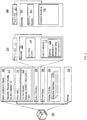
- FIG. 1 shows an exemplary electronic communication environment 100 in which one or more embodiments of identifying at least one molecules may be implemented.
- the electronic communication environment 100 may include one or more servers (102 and 104) implementing the embodiment of DeNovo generation of molecules using manifold traversal, one or more user devices (112, 114, and 116) associated with users (120, 122, and 124), and one or more databases 118, in communication with each other via public or private communication networks 101.
- the server 102 may be implemented as a central server or a plurality of servers distributed in the communication networks. While the server 102 shown in FIG. 1 is implemented as a single server, the server 102 may be implemented as a group of distributed servers, or may be distributed on the server 104.
- the user devices 112, 114, and 116 may be any form of mobile or fixed electronic devices including but not limited to desktop personal computer, laptop computers, tablets, mobile phones, personal digital assistants, and the like.
- the user devices 112, 114, and 116 may be installed with a user interface for accessing the embodiment of DeNovo generation of molecules using manifold traversal.
- the one or more database 118 of FIG. 1 may be hosted in a central database server, a plurality of distributed database servers, or in cloud-based database hosts.
- the database 118 may be organized and implemented in any form, including but not limited to relational database containing data tables, graphic database containing nodes and relationships, and the like.
- the database 118 may be configured to store the intermediate data and/or final results for implementing the embodiment of DeNovo generation of molecules using manifold traversal.
- FIG. 2 shows an exemplary system, which is a computer system 200 for implementing the server 102, or the user devices 112, 114, and 116.
- the computer system 200 may include communication interfaces 202, system circuitry 204, input/output (I/O) interfaces 206, storage 209, and display circuitry 208 that generates machine interfaces 210 locally or for remote display, e.g., in a web browser running on a local or remote machine.
- the machine interfaces 210 and the I/O interfaces 206 may include GUIs, touch sensitive displays, voice or facial recognition inputs, buttons, switches, speakers and other user interface elements.
- I/O interfaces 206 include microphones, video and still image cameras, headset and microphone input/output jacks, Universal Serial Bus (USB) connectors, memory card slots, and other types of inputs.
- the I/O interfaces 206 may further include magnetic or optical media interfaces (e.g., a CDROM or DVD drive), serial and parallel bus interfaces, and keyboard and mouse interfaces.
- the communication interfaces 202 may include wireless transmitters and receivers ("transceivers") 212 and any antennas 214 used by the transmitting and receiving circuitry of the transceivers 212.
- the transceivers 212 and antennas 214 may support Wi-Fi network communications, for instance, under any version of IEEE 802.11, e.g., 802.11n or 802.11ac.
- the communication interfaces 202 may also include wireline transceivers 216.
- the wireline transceivers 116 may provide physical layer interfaces for any of a wide range of communication protocols, such as any type of Ethernet, data over cable service interface specification (DOCSIS), digital subscriber line (DSL), Synchronous Optical Network (SONET), or other protocol.
- DOCSIS data over cable service interface specification
- DSL digital subscriber line
- SONET Synchronous Optical Network
- the storage 209 may be used to store various initial, intermediate, or final data or model for implementing the embodiment of DeNovo generation of molecules using manifold traversal. These data corpus may alternatively be stored in the database 118 of FIG. 1 . In one implementation, the storage 209 of the computer system 200 may be integral with the database 118 of FIG. 1 . The storage 209 may be centralized or distributed, and may be local or remote to the computer system 200. For example, the storage 209 may be hosted remotely by a cloud computing service provider.
- the system circuitry 204 may include hardware, software, firmware, or other circuitry in any combination.
- the system circuitry 204 may be implemented, for example, with one or more systems on a chip (SoC), application specific integrated circuits (ASIC), microprocessors, discrete analog and digital circuits, and other circuitry.
- SoC systems on a chip
- ASIC application specific integrated circuits
- microprocessors discrete analog and digital circuits, and other circuitry.
- the system circuitry 204 may be implemented as processing circuitry 220 for the server 102 in FIG. 1 .
- the processing circuitry 220 may include one or more processors 221 and memories 222.
- the memories 222 stores, for example, control instructions 226 and an operating system 224.
- the control instructions 226, for example may include instructions for implementing the components 228 of the embodiment of DeNovo generation of molecules using manifold traversal.
- the instruction processors 221 execute the control instructions 226 and the operating system 224 to carry out any desired functionality related to the embodiment of DeNovo generation of molecules using manifold traversal.
- the system circuitry 204 may be implemented as client circuitry 240 for the user devices 112, 114, and 116 of FIG. 1 .
- the client circuitry 240 of the user devices may include one or more instruction processors 241 and memories 242.
- the memories 242 stores, for example, control instructions 246 and an operating system 244.
- the instruction processors 241 execute the control instructions 246 and the operating system 244 to carry out any desired functionality related to the user devices.
- the present disclosure describes a system for identifying one or more candidate molecules efficiently, addressing at least some of the drawbacks as discussed above. Identifying molecular structures with desired chemical properties may be used to design a more potent, effective, and targeted chemical entity.
- the present disclosure describes a manifold traversal with heuristic search to explore the latent chemical space. Different heuristics and scores, for example but not limited to, Tanimoto coefficient, synthetic accessibility, binding activity, or quantitative estimate of drug-likeness (QED), may be incorporated to increase the validity and proximity for desired molecular properties of the generated molecules.
- the present disclosure describes embodiments of producing latent chemical spaces via various generative models.
- the generative models may include a grammar variational autoencoder (VAE) with self-attention that enforces chemical context and deals with the randomized generation and validity of simplified molecular-input line-entry system (SMILES).
- VAE grammar variational autoencoder
- SILES simplified molecular-input line-entry system
- recurrent neural networks with long-short-term memory (LSTM) units may be used to generate SMILES representations of new compounds.
- SMILES may be used as input strings and text generation models may be given the task of encoding and de-coding the SMILES string directly.
- VAEs may be used to generate molecules.
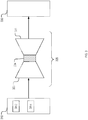
- FIG. 3 shows a schematic diagram of an embodiment of a system for identifying at least one candidate molecule.
- the system 300 may include a VAE 320, an input 310, and an output 330.
- the VAE 320 may be a neural network including an encoder 322 that transforms a compound's representation into a compressed latent space 324, and a decoder 326 that generates compounds from the latent space.
- the VAE 320 may include a conditional variational autoencoders (CVAE) which facilitates generation of new molecules with desired molecular properties by incorporating the molecular properties of a compound into the encoder layer and helping in the generation of more drug-like molecules.
- Generative adversarial networks (GANs) may be implemented in the similar manner and may be combined with reinforcement learning and graph representation of molecules to optimize the generation of molecules with specified molecular properties.
- the encoder 322 may include a convolutional neural network (CNN).
- the decoder 326 may include a recurrent layer (for example, a Long-short-term memory (LSTM) or a gated recurrent unit (GRU)) with attention.
- LSTM Long-short-term memory
- GRU gated
- the VAE 320 may include a grammar VAE.
- the grammar VAE 320 may perform as a generative model for producing the latent space 324, and a manifold traversal method for interpolation of this latent space to design novel and optimized molecules. This combination of generation and exploration of latent space may design novel molecules and explore regions of chemical space where more potent chemical compounds may exist.
- the input 310 may include a set of grammars 312 and a dataset of molecules 314.
- the set of grammars 312 may include a set of SMILES grammar specification.
- the output 330 may receive molecules decoded to one-hot encoding according to production rules and visualize the molecules and/or the molecular structures on a user interface.
- a set of grammars may be called as a grammar including one or more grammatical rules.
- molecules may be represented using a simplified molecular-input line-entry system (SMILES) string.
- SMILES molecular-input line-entry system
- Aspirin Alcohol
- SMILES has a grammar that defines syntactically valid strings, and semantic structure may be defined elsewhere.
- the grammar may specify how ring bonds are written, but does not ensure that they always come in pairs.
- open SMILES grammars may include one or more the following:
- the VAE 320 may include a class of generative models that produces a latent space whose encoded distribution may be traversed, such that generating a new sample that is close to the latent encoding of a known sample may be similar to the known sample.
- a grammar VAE may be used to generate samples with a discrete structure, e.g. molecules, arithmetic expressions, etc. Samples generated like this may be syntactically valid with respect to the specified grammar used in training the generator.
- Various methods such as nearest neighbor and different manifold search strategies may be used to generate samples from a latent space with specific properties.
- a manifold traversal method may be applied based on points in the generated latent space to generate molecules from the latent space with desired properties.
- Linear and spherical interpolation may be used as common approaches. These common approaches may assume that the latent space is Euclidean and flattened out, which may provide a distorted view.
- the manifold traversal may provide choices of path exploration on various conditions, addressing some of the drawbacks discussed above.
- a source point and a destination point may be selected in the latent space.
- the source point and the destination point may correspond to single molecules encoded in the latent space.
- the source point and the target point may be centroids/medoids of a cluster of molecules labeled with a desired property. For example, a cluster of molecules used in treating a specific illness condition, including, asthma, diabetes, or the like.
- Interpolation may be implemented by calculating Jacobian matrix corresponding to first order derivative of change for all points of interest, and building a k-d tree over the resulting distances.
- the method may receive user preference data including domain-specific heuristics such as fingerprint similarity, synthetic accessibility, absolute difference of drug-likeliness, or the like.
- the method may further determine an optimum path from the source to destination points on the k-dimensional (k-d) tree based on the preference data.
- the present disclosure describe various embodiments of a method 400 of DeNovo generation of molecules using manifold traversal.
- the method 400 may include a portion or all of the following steps.
- the method 400 may include obtaining input data, the input data including a set of grammar rules and historical drug data.
- the historical drug data may include historical drug molecular structure data in a simplified molecular-input line-entry system (SMILES) data format.
- the set of grammar rules may include a set of SMILES grammar specifications.
- the step 410 may further include a portion or all of the following steps: step 412, converting the set of grammar rules into a one-hot encoding format; and step 414, converting the historical drug data into the one-hot encoding format.
- the method 400 may include converting the set of grammar rules into a one-hot encoding format.
- the method may including converting the set of grammar including a set of SMILES grammar 610 to a set of production rules 620, which is converted to a set of one-hot encoding 630.
- Each of the one-hot encoding may correspond to each of the production rule in the SMILES grammar.
- FIG. 6B shows an example of converting the set of grammar 640 to one-hot encoding 660 of each production rule 650 in the grammar.
- the method 400 may include converting the historical drug data into the one-hot encoding format.
- the method may including converting molecular structure data in SMILES data format 710 to a parse tree based on the set of production rules corresponding to SMILES grammar; converting the parse tree 720 to a corresponding production rules 730; and converting the corresponding production rules 730 to the one-hot encoding format 740 for the molecular structure data.
- FIG. 7B shows an example of converting molecular structure data in SMILES data format 750 into the one-hot encoding format 780 via corresponding parse tree 760 and corresponding production rules 770.
- the method 400 may include training a grammar VAE artificial intelligence (Al) model based on the input data.
- the grammar VAE model may include the VAE model in FIG. 3 .
- the method may further include training the grammar VAE model based on the set of grammar rules in the one-hot encoding format and the historical drug molecular structure data in the one-hot encoding format.
- the method 400 may further include adding one or more attention layers in the RNN decoder in grammar VAE AI model, which may significantly improve semantic validity of decoded molecules.
- the one or more attention layers improve semantic validity of decoded molecules by allowing the model to pay attention to the entire sequence of inputs, rather than using just the final hidden state of an LSTM or GRU encoder.
- the SMILES is a context free grammar, and an internal memory state may be required to remember rule branches for closure, traditionally achieved by using a push-down automata which uses a stack data-structure to 'remember' - analogously, using attention allows the network to remember which rules are on the stack. This significantly may improve results for cases where the decoder may forget which rule is being decoded, most notably when matching ringbond pairs.
- the method 400 may include receiving drug data.
- the drug data may include drug molecular structure data in a SMILES data format.
- the drug data may be drug data including drug molecular structure data in the SMILES data format.
- the method 400 may include converting the drug data into at least one point in a latent space using the grammar VAE model.
- the method may further include annotating known compounds in a latent space with target labels (i.e. disease target, property, etc.)
- the method 400 may include receiving a query for the at least one candidate molecule.
- the query for the candidate molecule may include at least one query of a drug molecular structure query, and/or a drug treatment query, and/or a drug effect query.
- the method 400 may include selecting one or more points in the latent space based on the query for the at least one candidate molecule.
- one selected point in the latent space may be a centroid/medoid of a first target label cluster
- another selected point in the latent space may be a centroid/medoid of a second target label cluster.
- a first target label cluster may be a cluster of molecules for treating asthma
- a second target label cluster may be a cluster of molecules for treating diabetes.
- the method 400 may include creating a k-dimensional (k-d) tree graph based on the query for the at least one candidate molecule and based on the selected one or more points.
- the method 400 may include determining a plurality of paths in the latent space according to a Riemannian interpolation technique. In one implementation, upon picking centroid/medoid of target label clusters, n points close to the cluster centroid/medoid may be selected. In another implementation, n equidistant points at radius r from centroid/medoid may be selected. The k-d tree graph may be created based on the corresponding n points.
- the k-d tree may be constructed based path distance J ij between two points i and j.
- the path distance may be obtained by Riemannian interpolation.
- the path distance may be calculated by the following steps.
- the path distance may be calculated by the following steps.
- the method 400 may include receiving preference data.
- preference data may include one or more expert-defined heuristics, e.g. synthetic accessibility, molecular similarity, quantitative estimate of drug-likeness (QED), etc.
- the Path distances may be weighted by the one or more expert-defined heuristics in the preference data.
- the method 400 may include determine an optimum path from the plurality of paths based on the preference data.
- a path finding algorithm e.g. A* search, Yen's algorithm [Yen, 1971] Jin Y Yen. Finding the k shortest loopless paths in a network. management Science, 17(11):712-716, 1971 ) may be used to traverse the k-d tree to determine the optimum path.
- the method 400 may include determining at least one candidate point on the optimum path.
- n points along the optimum path may be obtained.
- the N points may be evenly distributed along the optimum path as equidistant points.
- the method 400 may include determine a drug molecular structure for each of the at least one candidate point using an inverse of the grammar VAE model. For each of the at least one candidate point on the optimum path, a corresponding molecule may be decoded based on its latent space representation.
- the method 400 may further include step 810: receiving a set of semantic rules; and step 820: selecting one or more candidate molecules from at least one candidate drug molecular structures based on the semantic rules.
- the present disclosure describes one exemplary embodiment for identifying at least one candidate molecule.
- the exemplary embodiment uses 250,000 molecules from the publicly available ZINC database and 100,000 drawn from the publicly available ChEMBL database, both of which include commercially available drug molecules.
- Each molecule is represented as a SMILES string, and is further processed into either a one-hot character encoding or a set of context free grammar (CFG) rules.
- CFG context free grammar
- Grammar rules are obtained from the OpenSMILES specification, which denotes how the SMILES representation was formed based on the rules.
- OpenSMILES CFG consists of 76 rules, to which an additional 7 are added, and 9 modified in order to represent the more complex ChEMBL dataset.
- the exemplary embodiment implements three models: a first model includes a VAE, a second model includes a grammar VAE, and a third model includes a grammar VAE with self-attention.
- the exemplary embodiment may be modular, extensible and efficient, in which any other encoder-decoder architecture model may be implemented to generate a latent space.
- the ChEMBL dataset may be less standardized and contains more complex molecules, so transfer learning is performed by initially training each model on the ZINC dataset for 50 epochs with the Adam optimizer.
- a learning rate scheduler is instantiated after 15 epochs with a factor of 0.1 (initialized at 0.001) and then is trained on the ChEMBL dataset for 50 epochs, producing a 56-dimensional latent space.
- the encoder is comprised of 3 convolutional 1D layers of size 9, 10, 11 filter respectively, while the decoder is comprised 3 gated recurrent units (GRU) of 501 units.
- GRU gated recurrent units
- the exemplary embodiment demonstrates the manifold traversal may have a much higher rate of valid decoded molecules. For example, when considering the centroids of molecules treating diabetes and lung cancer, linear interpolation with 100 equidistant points decoded along the path generated just 3 compounds with valid structures. Yen's algorithm and manifold traversal method, with perturbing the source and destination points, produce 4 different paths generated 44, 1, 68 and 43 valid compounds respectively.
- the exemplary embodiment may visualize the different paths on the user interface, using a test set of 282 diabetes (149) and lung cancer (133) compounds.
- the user interface may show a k-d tree generated by algorithm 1. By hovering over a node, the user interface may show the molecular structure and corresponding fingerprint similarity.
- the user interface may show different paths generated by the algorithm, including the new and valid molecules discovered while exploring each path.
- the user interface may also show the corresponding histograms for synthetic accessibility and activity scores to compare different paths.
- the user interface may expand key information about each newly discovered compound on the path, such as molecular weight, total number of rings, atoms etc.
- the present disclosure describes embodiments of a model-agnostic platform for performing manifold traversal of generated latent spaces with user specified heuristics.
- the present disclosure may capture more context on which model has been learnt. Methods for exploration of latent spaces generated from millions of molecules provide an extremely valuable tool for virtual drug screening and its ability to facilitate rapid drug discovery.
- the present disclosure may also be used for implementation of additional models to produce latent-spaces with varied characteristics, latent-space evaluation metrics, and more sophisticated methods for curve fitting in high dimensional spaces such as Bezier curves and Gaussian regression.
- circuitry that includes an instruction processor, such as a Central Processing Unit (CPU), microcontroller, or a microprocessor; an Application Specific Integrated Circuit (ASIC), Programmable Logic Device (PLD), or Field Programmable Gate Array (FPGA); or circuitry that includes discrete logic or other circuit components, including analog circuit components, digital circuit components or both; or any combination thereof.
- the circuitry may include discrete interconnected hardware components and/or may be combined on a single integrated circuit die, distributed among multiple integrated circuit dies, or implemented in a Multiple Chip Module (MCM) of multiple integrated circuit dies in a common package, as examples.
- MCM Multiple Chip Module
- the circuitry may further include or access instructions for execution by the circuitry.
- the instructions may be stored in a tangible storage medium that is other than a transitory signal, such as a flash memory, a Random Access Memory (RAM), a Read Only Memory (ROM), an Erasable Programmable Read Only Memory (EPROM); or on a magnetic or optical disc, such as a Compact Disc Read Only Memory (CDROM), Hard Disk Drive (HDD), or other magnetic or optical disk; or in or on another machine-readable medium.
- a product such as a computer program product, may include a storage medium and instructions stored in or on the medium, and the instructions when executed by the circuitry in a device may cause the device to implement any of the processing described above or illustrated in the drawings.
- the implementations may be distributed as circuitry among multiple system components, such as among multiple processors and memories, optionally including multiple distributed processing systems.
- Parameters, databases, and other data structures may be separately stored and managed, may be incorporated into a single memory or database, may be logically and physically organized in many different ways, and may be implemented in many different ways, including as data structures such as linked lists, hash tables, arrays, records, objects, or implicit storage mechanisms.
- Programs may be parts (e.g., subroutines) of a single program, separate programs, distributed across several memories and processors, or implemented in many different ways, such as in a library, such as a shared library (e.g., a Dynamic Link Library (DLL)).
- the DLL may store instructions that perform any of the processing described above or illustrated in the drawings, when executed by the circuitry.
Landscapes
- Engineering & Computer Science (AREA)
- Theoretical Computer Science (AREA)
- Physics & Mathematics (AREA)
- General Engineering & Computer Science (AREA)
- General Physics & Mathematics (AREA)
- Artificial Intelligence (AREA)
- Computational Linguistics (AREA)
- General Health & Medical Sciences (AREA)
- Health & Medical Sciences (AREA)
- Data Mining & Analysis (AREA)
- Software Systems (AREA)
- Computing Systems (AREA)
- Mathematical Physics (AREA)
- Life Sciences & Earth Sciences (AREA)
- Evolutionary Computation (AREA)
- Biomedical Technology (AREA)
- Molecular Biology (AREA)
- Biophysics (AREA)
- Audiology, Speech & Language Pathology (AREA)
- Chemical & Material Sciences (AREA)
- Bioinformatics & Cheminformatics (AREA)
- Databases & Information Systems (AREA)
- Probability & Statistics with Applications (AREA)
- Medicinal Chemistry (AREA)
- Pharmacology & Pharmacy (AREA)
- Spectroscopy & Molecular Physics (AREA)
- Crystallography & Structural Chemistry (AREA)
- Bioinformatics & Computational Biology (AREA)
- Machine Translation (AREA)
- Medical Treatment And Welfare Office Work (AREA)
Abstract
Description
- This application claims benefit to
U.S. Provisional Patent Application No. 62/979,713 filed on February 21, 2020 U.S. Non-Provisional Patent Application No. 16/884,174 filed on 27 May 2020 - This disclosure relates in general to the fields of bioinformatics, computational chemistry and drug discovery using latent space exploration.
- Basic techniques and equipment for ranking drug compounds, scoring gene expressions and enrichment pathways, and selecting predictive biomarkers are known in the art. Both drug data and biological data have features that can be described as discrete values using variational auto-encoders to generate latent spaces for modeling the probability metrics distributions of latent variables that may be explored using interpolation methods and quantitative structure-activity relationship models. While various technologies have used either drug data or biological data independently to generate latent space, a multi-modal latent space based on the combination of drug molecular-structure data and biological-treatment data is desired to more efficiently identify optimal and/or new drug compounds for the treatment of diseases.
- The present disclosure describes a system including a non-transitory memory storing instructions executable to identify at least one candidate molecule; and a processor in communication with the non-transitory memory. The processor executes the instructions to cause the system to receive drug data; convert the drug data into at least one point in a latent space using a grammar variational auto-encoder (VAE) model; receive a query for the at least one candidate molecule; select one or more points in the latent space based on the query for the at least one candidate molecule; and create a k-dimensional tree graph based on the query for the at least one candidate molecule and based on the selected one or more points. The processor executes the instructions to further cause the system to determine a plurality of paths in the latent space according to an interpolation technique; receive preference data; determine an optimum path from the plurality of paths based on the preference data; determine at least one candidate point on the optimum path; and determine a drug molecular structure for each of the at least one candidate point using an inverse of the grammar VAE model.
- The present disclosure describes a method includes receiving, by a device, drug data. The device includes a memory storing instructions for use in identifying at least one candidate molecule and a processor in communication with the memory. The method includes converting, by the device, the drug data into at least one point in a latent space using a grammar variational auto-encoder (VAE) model; receiving, by the device, a query for the at least one candidate molecule; selecting, by the device, one or more points in the latent space based on the query for the at least one candidate molecule. The method further includes creating, by the device, a k-dimensional tree graph based on the query for the at least one candidate molecule and based on the selected one or more points; determining, by the device, a plurality of paths in the latent space according to an interpolation technique; receiving, by the device, preference data; determining, by the device, an optimum path from the plurality of paths based on the preference data; determining, by the device, at least one candidate point on the optimum path; and determining, by the device, a drug molecular structure for each of the at least one candidate point using an inverse of the grammar VAE model.
- The present disclosure describes a product including machine-readable media other than a transitory signal; and instructions stored on the machine-readable media for identify at least one candidate molecule. When a processor executes the instructions, the product is configured to cause the processor to receive drug data; convert the drug data into at least one point in a latent space using a grammar variational auto-encoder (VAE) model; receive a query for the at least one candidate molecule; and select one or more points in the latent space based on the query for the at least one candidate molecule. When the processor executes the instructions, the product is configured to cause the processor to create a k-dimensional tree graph based on the query for the at least one candidate molecule and based on the selected one or more points; determine a plurality of paths in the latent space according to an interpolation technique; receive preference data; determine an optimum path from the plurality of paths based on the preference data; determine at least one candidate point on the optimum path; and determine a drug molecular structure for each of the at least one candidate point using an inverse of the grammar VAE model.
-
-
FIG. 1 shows an exemplary electronic communication environment for identifying at least one candidate molecule. -
FIG. 2 shows computer systems that may be used to implement various components of the electronic communication environment ofFIG. 1 . -
FIG. 3 shows a schematic diagram for some embodiment of identifying at least one candidate molecule. -
FIG. 4 shows a flow diagram of an embodiment of a method for identifying at least one candidate molecule. -
FIG. 5 shows a flow diagram of an embodiment of a step in the method inFIG. 4 . -
FIG. 6A shows a schematic diagram for some embodiments of converting a set of grammar rules into a one-hot encoding format. -
FIG. 6B shows a schematic diagram for an exemplary embodiment of converting a set of grammar rules into a one-hot encoding format. -
FIG. 7A shows a schematic diagram for some embodiments of converting molecules in simplified molecular-input line-entry system (SMILES) data format into the one-hot encoding format. -
FIG. 7B shows a schematic diagram for an exemplary embodiment of converting molecules in SMILES data format into the one-hot encoding format. -
FIG. 8 shows a flow diagram of an embodiment of a method for identifying at least one candidate molecule. - The disclosure will now be described in detail hereinafter with reference to the accompanied drawings, which form a part of the present disclosure, and which show, by way of illustration, specific examples of embodiments. Please note that the disclosure may, however, be embodied in a variety of different forms and, therefore, the covered or claimed subject matter is intended to be construed as not being limited to any of the embodiments to be set forth below. Please also note that the disclosure may be embodied as methods, devices, components, or systems. Accordingly, embodiments of the disclosure may, for example, take the form of hardware, software, firmware or any combination thereof.
- Throughout the specification and claims, terms may have nuanced meanings suggested or implied in context beyond an explicitly stated meaning. Likewise, the phrase "in one embodiment" or "in one implementation" as used herein does not necessarily refer to the same embodiment or implementation and the phrase "in another embodiment" or "in another implementation" as used herein does not necessarily refer to a different embodiment or implementation. It is intended, for example, that claimed subject matter includes combinations of exemplary embodiments or implementations in whole or in part.
- In general, terminology may be understood at least in part from usage in context. For example, terms, such as "and", "or", or "and/or," as used herein may include a variety of meanings that may depend at least in part upon the context in which such terms are used. Typically, "or" if used to associate a list, such as A, B or C, is intended to mean A, B, and C, here used in the inclusive sense, as well as A, B or C, here used in the exclusive sense. In addition, the term "one or more" or "at least one" as used herein, depending at least in part upon context, may be used to describe any feature, structure, or characteristic in a singular sense or may be used to describe combinations of features, structures or characteristics in a plural sense. Similarly, terms, such as "a", "an", or "the", again, may be understood to convey a singular usage or to convey a plural usage, depending at least in part upon context. In addition, the term "based on" or "determined by" may be understood as not necessarily intended to convey an exclusive set of factors and may, instead, allow for existence of additional factors not necessarily expressly described, again, depending at least in part on context.
- In order to design a more potent, effective, and targeted chemical entity, it may be important to identify molecular structures with the desired chemical properties. Recent advances in generative models using neural networks and machine learning have been widely used in this domain to design virtual libraries of drug-like compounds. These models may help to rapidly produce novel molecular structures. Various challenges and problems may exist with these models in intelligent exploration of the latent spaces of generative models, thereby reducing the randomness in the generative procedure.
- The present disclosure describes varies embodiments of methods, apparatus, and products of identifying at least one candidate molecule, including DeNovo generation of molecules using manifold traversal, to address at least one of the challenges and problems discussed above. The embodiments in the present disclosure may be used to discover new chemical molecules that may be used as drugs for diseases.
- The present disclosure describes embodiments of a manifold traversal with heuristic search to explore the latent chemical space using different heuristics and scores. The latent chemical space may be generated by various models with one of them being Grammar variational auto-encoder (VAE). In some embodiments, an addition of an attention layer in a recurrent neural network (RNN) decoder layer of grammar VAE may significantly improves the semantic validity of generated molecules. In some embodiments, in a path finding algorithm, path distance may be weighted by more than one expert-defined heuristic, for example, a quantitative estimate of drug-likeness (QED), synthetic accessibility, molecular similarity, etc.
-
FIG. 1 shows an exemplaryelectronic communication environment 100 in which one or more embodiments of identifying at least one molecules may be implemented. Theelectronic communication environment 100 may include one or more servers (102 and 104) implementing the embodiment of DeNovo generation of molecules using manifold traversal, one or more user devices (112, 114, and 116) associated with users (120, 122, and 124), and one ormore databases 118, in communication with each other via public orprivate communication networks 101. - The
server 102 may be implemented as a central server or a plurality of servers distributed in the communication networks. While theserver 102 shown inFIG. 1 is implemented as a single server, theserver 102 may be implemented as a group of distributed servers, or may be distributed on theserver 104. - The
user devices 112, 114, and 116 may be any form of mobile or fixed electronic devices including but not limited to desktop personal computer, laptop computers, tablets, mobile phones, personal digital assistants, and the like. Theuser devices 112, 114, and 116 may be installed with a user interface for accessing the embodiment of DeNovo generation of molecules using manifold traversal. The one ormore database 118 ofFIG. 1 may be hosted in a central database server, a plurality of distributed database servers, or in cloud-based database hosts. Thedatabase 118 may be organized and implemented in any form, including but not limited to relational database containing data tables, graphic database containing nodes and relationships, and the like. Thedatabase 118 may be configured to store the intermediate data and/or final results for implementing the embodiment of DeNovo generation of molecules using manifold traversal. -
FIG. 2 shows an exemplary system, which is acomputer system 200 for implementing theserver 102, or theuser devices 112, 114, and 116. Thecomputer system 200 may includecommunication interfaces 202,system circuitry 204, input/output (I/O) interfaces 206,storage 209, anddisplay circuitry 208 that generates machine interfaces 210 locally or for remote display, e.g., in a web browser running on a local or remote machine. The machine interfaces 210 and the I/O interfaces 206 may include GUIs, touch sensitive displays, voice or facial recognition inputs, buttons, switches, speakers and other user interface elements. Additional examples of the I/O interfaces 206 include microphones, video and still image cameras, headset and microphone input/output jacks, Universal Serial Bus (USB) connectors, memory card slots, and other types of inputs. The I/O interfaces 206 may further include magnetic or optical media interfaces (e.g., a CDROM or DVD drive), serial and parallel bus interfaces, and keyboard and mouse interfaces. - The communication interfaces 202 may include wireless transmitters and receivers ("transceivers") 212 and any
antennas 214 used by the transmitting and receiving circuitry of thetransceivers 212. Thetransceivers 212 andantennas 214 may support Wi-Fi network communications, for instance, under any version of IEEE 802.11, e.g., 802.11n or 802.11ac. The communication interfaces 202 may also includewireline transceivers 216. The wireline transceivers 116 may provide physical layer interfaces for any of a wide range of communication protocols, such as any type of Ethernet, data over cable service interface specification (DOCSIS), digital subscriber line (DSL), Synchronous Optical Network (SONET), or other protocol. - The
storage 209 may be used to store various initial, intermediate, or final data or model for implementing the embodiment of DeNovo generation of molecules using manifold traversal. These data corpus may alternatively be stored in thedatabase 118 ofFIG. 1 . In one implementation, thestorage 209 of thecomputer system 200 may be integral with thedatabase 118 ofFIG. 1 . Thestorage 209 may be centralized or distributed, and may be local or remote to thecomputer system 200. For example, thestorage 209 may be hosted remotely by a cloud computing service provider. - The
system circuitry 204 may include hardware, software, firmware, or other circuitry in any combination. Thesystem circuitry 204 may be implemented, for example, with one or more systems on a chip (SoC), application specific integrated circuits (ASIC), microprocessors, discrete analog and digital circuits, and other circuitry. - For example, at least some of the
system circuitry 204 may be implemented asprocessing circuitry 220 for theserver 102 inFIG. 1 . Theprocessing circuitry 220 may include one ormore processors 221 andmemories 222. Thememories 222 stores, for example, controlinstructions 226 and anoperating system 224. Thecontrol instructions 226, for example may include instructions for implementing thecomponents 228 of the embodiment of DeNovo generation of molecules using manifold traversal. In one implementation, theinstruction processors 221 execute thecontrol instructions 226 and theoperating system 224 to carry out any desired functionality related to the embodiment of DeNovo generation of molecules using manifold traversal. - Alternatively, or in addition, at least some of the
system circuitry 204 may be implemented asclient circuitry 240 for theuser devices 112, 114, and 116 ofFIG. 1 . Theclient circuitry 240 of the user devices may include one ormore instruction processors 241 andmemories 242. Thememories 242 stores, for example, controlinstructions 246 and anoperating system 244. In one implementation, theinstruction processors 241 execute thecontrol instructions 246 and theoperating system 244 to carry out any desired functionality related to the user devices. - Designing a new effective chemical entity is a time consuming and error prone task. For example, pharmaceutical companies spend billions of dollars into screening vast libraries of chemical compounds for hit and lead identification. Neural networks and machine learning may be used to design virtual libraries of drug-like compounds. These computational models may have the ability to optimize the chemical properties of compounds in vector space and generate novel chemical structures. There are some problems and issues with some computational models, for example, challenges in the intelligent exploration of the latent spaces of generative models reducing randomness in the generative procedure.
- The present disclosure describes a system for identifying one or more candidate molecules efficiently, addressing at least some of the drawbacks as discussed above. Identifying molecular structures with desired chemical properties may be used to design a more potent, effective, and targeted chemical entity. The present disclosure describes a manifold traversal with heuristic search to explore the latent chemical space. Different heuristics and scores, for example but not limited to, Tanimoto coefficient, synthetic accessibility, binding activity, or quantitative estimate of drug-likeness (QED), may be incorporated to increase the validity and proximity for desired molecular properties of the generated molecules. The present disclosure describes embodiments of producing latent chemical spaces via various generative models. The generative models may include a grammar variational autoencoder (VAE) with self-attention that enforces chemical context and deals with the randomized generation and validity of simplified molecular-input line-entry system (SMILES).
- To generate molecules, recurrent neural networks (RNN) with long-short-term memory (LSTM) units may be used to generate SMILES representations of new compounds. SMILES may be used as input strings and text generation models may be given the task of encoding and de-coding the SMILES string directly. Various VAEs may be used to generate molecules.
-
FIG. 3 shows a schematic diagram of an embodiment of a system for identifying at least one candidate molecule. The system 300 may include aVAE 320, aninput 310, and anoutput 330. - The
VAE 320 may be a neural network including anencoder 322 that transforms a compound's representation into a compressedlatent space 324, and adecoder 326 that generates compounds from the latent space. TheVAE 320 may include a conditional variational autoencoders (CVAE) which facilitates generation of new molecules with desired molecular properties by incorporating the molecular properties of a compound into the encoder layer and helping in the generation of more drug-like molecules. Generative adversarial networks (GANs) may be implemented in the similar manner and may be combined with reinforcement learning and graph representation of molecules to optimize the generation of molecules with specified molecular properties. In one implementation, theencoder 322 may include a convolutional neural network (CNN). In another implementation, thedecoder 326 may include a recurrent layer (for example, a Long-short-term memory (LSTM) or a gated recurrent unit (GRU)) with attention. - In various embodiments, the
VAE 320 may include a grammar VAE. Thegrammar VAE 320 may perform as a generative model for producing thelatent space 324, and a manifold traversal method for interpolation of this latent space to design novel and optimized molecules. This combination of generation and exploration of latent space may design novel molecules and explore regions of chemical space where more potent chemical compounds may exist. - The
input 310 may include a set ofgrammars 312 and a dataset ofmolecules 314. In one implementation, the set ofgrammars 312 may include a set of SMILES grammar specification. Theoutput 330 may receive molecules decoded to one-hot encoding according to production rules and visualize the molecules and/or the molecular structures on a user interface. A set of grammars may be called as a grammar including one or more grammatical rules. - In various embodiments, molecules may be represented using a simplified molecular-input line-entry system (SMILES) string. For example, Aspirin (Acetylsalicylic Acid) may be represented by a SMILES string of CC(=O)OC1=CC=CC=C1C(=O)O. SMILES has a grammar that defines syntactically valid strings, and semantic structure may be defined elsewhere. In some implementations, the grammar may specify how ring bonds are written, but does not ensure that they always come in pairs.
- For example, open SMILES grammars may include one or more the following:
- Smiles := chain;
- Chain := branched_atom\chain branched_atom\chain bond branched_atom\chain dot branched_atom;
- Branched-atom := atom ringbond* branch*; and
- Ring bond := bond? Digit\bond? %DIGIT DIGIT.
- In various embodiments, the
VAE 320 may include a class of generative models that produces a latent space whose encoded distribution may be traversed, such that generating a new sample that is close to the latent encoding of a known sample may be similar to the known sample. In some implementation, a grammar VAE may be used to generate samples with a discrete structure, e.g. molecules, arithmetic expressions, etc. Samples generated like this may be syntactically valid with respect to the specified grammar used in training the generator. Various methods such as nearest neighbor and different manifold search strategies may be used to generate samples from a latent space with specific properties. - In various embodiments, a manifold traversal method may be applied based on points in the generated latent space to generate molecules from the latent space with desired properties. Linear and spherical interpolation may be used as common approaches. These common approaches may assume that the latent space is Euclidean and flattened out, which may provide a distorted view. The manifold traversal may provide choices of path exploration on various conditions, addressing some of the drawbacks discussed above.
- In the manifold traversal method, a source point and a destination point may be selected in the latent space. In one implementation, the source point and the destination point may correspond to single molecules encoded in the latent space. In another implementation, the source point and the target point may be centroids/medoids of a cluster of molecules labeled with a desired property. For example, a cluster of molecules used in treating a specific illness condition, including, asthma, diabetes, or the like.
- Interpolation may be implemented by calculating Jacobian matrix corresponding to first order derivative of change for all points of interest, and building a k-d tree over the resulting distances. The method may receive user preference data including domain-specific heuristics such as fingerprint similarity, synthetic accessibility, absolute difference of drug-likeliness, or the like. The method may further determine an optimum path from the source to destination points on the k-dimensional (k-d) tree based on the preference data.
- Referring to
FIG. 4 , the present disclosure describe various embodiments of amethod 400 of DeNovo generation of molecules using manifold traversal. Themethod 400 may include a portion or all of the following steps. - Referring to step 410, the
method 400 may include obtaining input data, the input data including a set of grammar rules and historical drug data. The historical drug data may include historical drug molecular structure data in a simplified molecular-input line-entry system (SMILES) data format. The set of grammar rules may include a set of SMILES grammar specifications. - Referring to
FIG. 5 , in various implementations, thestep 410 may further include a portion or all of the following steps:step 412, converting the set of grammar rules into a one-hot encoding format; and step 414, converting the historical drug data into the one-hot encoding format. - Referring to step 412, the
method 400 may include converting the set of grammar rules into a one-hot encoding format. Referring toFIG. 6A , the method may including converting the set of grammar including a set ofSMILES grammar 610 to a set ofproduction rules 620, which is converted to a set of one-hot encoding 630. Each of the one-hot encoding may correspond to each of the production rule in the SMILES grammar.FIG. 6B shows an example of converting the set ofgrammar 640 to one-hot encoding 660 of eachproduction rule 650 in the grammar. - Referring to step 414, the
method 400 may include converting the historical drug data into the one-hot encoding format. Referring toFIG. 7A , the method may including converting molecular structure data in SMILES data format 710 to a parse tree based on the set of production rules corresponding to SMILES grammar; converting the parsetree 720 to acorresponding production rules 730; and converting thecorresponding production rules 730 to the one-hot encoding format 740 for the molecular structure data.FIG. 7B shows an example of converting molecular structure data in SMILES data format 750 into the one-hot encoding format 780 via corresponding parsetree 760 and corresponding production rules 770. - Referring to step 420 in
FIG. 4 , themethod 400 may include training a grammar VAE artificial intelligence (Al) model based on the input data. In one implementation, the grammar VAE model may include the VAE model inFIG. 3 . In another implementation, the method may further include training the grammar VAE model based on the set of grammar rules in the one-hot encoding format and the historical drug molecular structure data in the one-hot encoding format. In some implementations, themethod 400 may further include adding one or more attention layers in the RNN decoder in grammar VAE AI model, which may significantly improve semantic validity of decoded molecules. The one or more attention layers improve semantic validity of decoded molecules by allowing the model to pay attention to the entire sequence of inputs, rather than using just the final hidden state of an LSTM or GRU encoder. The SMILES is a context free grammar, and an internal memory state may be required to remember rule branches for closure, traditionally achieved by using a push-down automata which uses a stack data-structure to 'remember' - analogously, using attention allows the network to remember which rules are on the stack. This significantly may improve results for cases where the decoder may forget which rule is being decoded, most notably when matching ringbond pairs. - Referring to step 430, the
method 400 may include receiving drug data. The drug data may include drug molecular structure data in a SMILES data format. In one implementation, the drug data may be drug data including drug molecular structure data in the SMILES data format. - Referring to step 440, the
method 400 may include converting the drug data into at least one point in a latent space using the grammar VAE model. In various implementation, the method may further include annotating known compounds in a latent space with target labels (i.e. disease target, property, etc.) - Referring to step 450 in
FIG. 4 , themethod 400 may include receiving a query for the at least one candidate molecule. In various implementations, the query for the candidate molecule may include at least one query of a drug molecular structure query, and/or a drug treatment query, and/or a drug effect query. - Referring to step 460, the
method 400 may include selecting one or more points in the latent space based on the query for the at least one candidate molecule. In one implementation, one selected point in the latent space may be a centroid/medoid of a first target label cluster, and another selected point in the latent space may be a centroid/medoid of a second target label cluster. For example, a first target label cluster may be a cluster of molecules for treating asthma; and a second target label cluster may be a cluster of molecules for treating diabetes. - Referring to step 470, the
method 400 may include creating a k-dimensional (k-d) tree graph based on the query for the at least one candidate molecule and based on the selected one or more points. Referring to step 480, themethod 400 may include determining a plurality of paths in the latent space according to a Riemannian interpolation technique. In one implementation, upon picking centroid/medoid of target label clusters, n points close to the cluster centroid/medoid may be selected. In another implementation, n equidistant points at radius r from centroid/medoid may be selected. The k-d tree graph may be created based on the corresponding n points. - In various implementations, the k-d tree may be constructed based path distance Jij between two points i and j. The path distance may be obtained by Riemannian interpolation.
- In one implementation, the path distance may be calculated by the following steps.
- 1. For a starting cluster (for example, a cluster of molecules for treating asthma) and an ending cluster (for example, a cluster of molecules for treating diabetes), C1 represents a centroid of the starting cluster, and C2 represents a centroid of the end cluster. Initially, let i = C1.
- 2. For each starting point i, creating k-d tree based on the starting point and find the k nearest points in the neighborhood → Ni.
- 3. Constructing a linear function between i and all points j ∈ Ni.
- 4. Calculating Jacobian matrix. Each element Jij of the Jacobian matrix may be represented by:

- 5. Finding the Jij that minimizes

- 6. Repeating step 2 for each point added to the candidate set, until all labeled points are mapped.
- Optionally and alternatively, in another implementation, the path distance may be calculated by the following steps.
- 1. For a source point s and a destination point d in latent space L, selecting, initially, i = s.
- 2. For each point i, creating k-d tree and finding n nearest neighbors of i → Ni.
- 3. Calculating Jacobian matrix element of decoder output with respect to the latent space by:

- 4. Obtaining k heuristic distances

- 5. Determining path weight Pij based on
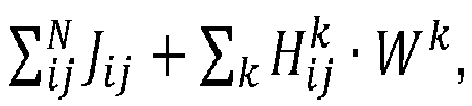
- 6. Repeating step 2 for each point added to the candidate set, until all labeled points are mapped.
- Referring to step 490, the
method 400 may include receiving preference data. In one implementation, preference data may include one or more expert-defined heuristics, e.g. synthetic accessibility, molecular similarity, quantitative estimate of drug-likeness (QED), etc. The Path distances may be weighted by the one or more expert-defined heuristics in the preference data. - Referring to step 492, the
method 400 may include determine an optimum path from the plurality of paths based on the preference data. In various implementation, a path finding algorithm (e.g. A* search, Yen's algorithm [Yen, 1971] Jin Y Yen. Finding the k shortest loopless paths in a network. management Science, 17(11):712-716, 1971) may be used to traverse the k-d tree to determine the optimum path. - Referring to step 494, the
method 400 may include determining at least one candidate point on the optimum path. In one implementation, n points along the optimum path may be obtained. The N points may be evenly distributed along the optimum path as equidistant points. - Referring to step 496, the
method 400 may include determine a drug molecular structure for each of the at least one candidate point using an inverse of the grammar VAE model. For each of the at least one candidate point on the optimum path, a corresponding molecule may be decoded based on its latent space representation. - Referring to
FIG. 8 , themethod 400 may further include step 810: receiving a set of semantic rules; and step 820: selecting one or more candidate molecules from at least one candidate drug molecular structures based on the semantic rules. - The present disclosure describes one exemplary embodiment for identifying at least one candidate molecule. The exemplary embodiment uses 250,000 molecules from the publicly available ZINC database and 100,000 drawn from the publicly available ChEMBL database, both of which include commercially available drug molecules. Each molecule is represented as a SMILES string, and is further processed into either a one-hot character encoding or a set of context free grammar (CFG) rules. Grammar rules are obtained from the OpenSMILES specification, which denotes how the SMILES representation was formed based on the rules. OpenSMILES CFG consists of 76 rules, to which an additional 7 are added, and 9 modified in order to represent the more complex ChEMBL dataset.
- The exemplary embodiment implements three models: a first model includes a VAE, a second model includes a grammar VAE, and a third model includes a grammar VAE with self-attention. The exemplary embodiment may be modular, extensible and efficient, in which any other encoder-decoder architecture model may be implemented to generate a latent space.
- The ChEMBL dataset may be less standardized and contains more complex molecules, so transfer learning is performed by initially training each model on the ZINC dataset for 50 epochs with the Adam optimizer. A learning rate scheduler is instantiated after 15 epochs with a factor of 0.1 (initialized at 0.001) and then is trained on the ChEMBL dataset for 50 epochs, producing a 56-dimensional latent space. The encoder is comprised of 3 convolutional 1D layers of
size 9, 10, 11 filter respectively, while the decoder is comprised 3 gated recurrent units (GRU) of 501 units. - The exemplary embodiment demonstrates the manifold traversal may have a much higher rate of valid decoded molecules. For example, when considering the centroids of molecules treating diabetes and lung cancer, linear interpolation with 100 equidistant points decoded along the path generated just 3 compounds with valid structures. Yen's algorithm and manifold traversal method, with perturbing the source and destination points, produce 4 different paths generated 44, 1, 68 and 43 valid compounds respectively.
- The exemplary embodiment may visualize the different paths on the user interface, using a test set of 282 diabetes (149) and lung cancer (133) compounds. The user interface may show a k-d tree generated by
algorithm 1. By hovering over a node, the user interface may show the molecular structure and corresponding fingerprint similarity. The user interface may show different paths generated by the algorithm, including the new and valid molecules discovered while exploring each path. The user interface may also show the corresponding histograms for synthetic accessibility and activity scores to compare different paths. Upon clicking by an operator, the user interface may expand key information about each newly discovered compound on the path, such as molecular weight, total number of rings, atoms etc. - The present disclosure describes embodiments of a model-agnostic platform for performing manifold traversal of generated latent spaces with user specified heuristics. The present disclosure may capture more context on which model has been learnt. Methods for exploration of latent spaces generated from millions of molecules provide an extremely valuable tool for virtual drug screening and its ability to facilitate rapid drug discovery. The present disclosure may also be used for implementation of additional models to produce latent-spaces with varied characteristics, latent-space evaluation metrics, and more sophisticated methods for curve fitting in high dimensional spaces such as Bezier curves and Gaussian regression.
- The methods, devices, processing, and logic described above may be implemented in many different ways and in many different combinations of hardware and software. For example, all or parts of the implementations may be circuitry that includes an instruction processor, such as a Central Processing Unit (CPU), microcontroller, or a microprocessor; an Application Specific Integrated Circuit (ASIC), Programmable Logic Device (PLD), or Field Programmable Gate Array (FPGA); or circuitry that includes discrete logic or other circuit components, including analog circuit components, digital circuit components or both; or any combination thereof. The circuitry may include discrete interconnected hardware components and/or may be combined on a single integrated circuit die, distributed among multiple integrated circuit dies, or implemented in a Multiple Chip Module (MCM) of multiple integrated circuit dies in a common package, as examples.
- The circuitry may further include or access instructions for execution by the circuitry. The instructions may be stored in a tangible storage medium that is other than a transitory signal, such as a flash memory, a Random Access Memory (RAM), a Read Only Memory (ROM), an Erasable Programmable Read Only Memory (EPROM); or on a magnetic or optical disc, such as a Compact Disc Read Only Memory (CDROM), Hard Disk Drive (HDD), or other magnetic or optical disk; or in or on another machine-readable medium. A product, such as a computer program product, may include a storage medium and instructions stored in or on the medium, and the instructions when executed by the circuitry in a device may cause the device to implement any of the processing described above or illustrated in the drawings.
- The implementations may be distributed as circuitry among multiple system components, such as among multiple processors and memories, optionally including multiple distributed processing systems. Parameters, databases, and other data structures may be separately stored and managed, may be incorporated into a single memory or database, may be logically and physically organized in many different ways, and may be implemented in many different ways, including as data structures such as linked lists, hash tables, arrays, records, objects, or implicit storage mechanisms. Programs may be parts (e.g., subroutines) of a single program, separate programs, distributed across several memories and processors, or implemented in many different ways, such as in a library, such as a shared library (e.g., a Dynamic Link Library (DLL)). The DLL, for example, may store instructions that perform any of the processing described above or illustrated in the drawings, when executed by the circuitry.
- While the particular disclosure has been described with reference to illustrative embodiments, this description is not meant to be limiting. Various modifications of the illustrative embodiments and additional embodiments of the disclosure will be apparent to one of ordinary skill in the art from this description. Those skilled in the art will readily recognize that these and various other modifications can be made to the exemplary embodiments, illustrated and described herein, without departing from the spirit and scope of the present disclosure. It is therefore contemplated that the appended claims will cover any such modifications and alternate embodiments. Certain proportions within the illustrations may be exaggerated, while other proportions may be minimized. Accordingly, the disclosure and the figures are to be regarded as illustrative rather than restrictive.
Claims (15)
- A system comprising:a non-transitory memory storing instructions executable to identify at least one candidate molecule; anda processor in communication with the non-transitory memory, wherein, the processor executes the instructions to cause the system to:receive drug data;convert the drug data into at least one point in a latent space using a grammar variational auto-encoder (VAE) model;receive a query for the at least one candidate molecule;select one or more points in the latent space based on the query for the at least one candidate molecule;create a k-dimensional tree graph based on the query for the at least one candidate molecule and based on the selected one or more points;determine a plurality of paths in the latent space according to an interpolation technique;receive preference data;determine an optimum path from the plurality of paths based on the preference data;determine at least one candidate point on the optimum path; anddetermine a drug molecular structure for each of the at least one candidate point using an inverse of the grammar VAE model.
- The system according to claim 1, wherein the processor executes the instructions to further cause the system to:obtain input data, the input data comprising a set of grammar rules and historical drug data; andtrain the grammar VAE model based on the input data.
- The system according to claim 2, wherein:the historical drug data comprises historical drug molecular structure data in a simplified molecular-input line-entry system (SMILES) data format;the processor executes the instructions to further cause the system to:convert the set of grammar rules into a one-hot encoding format, andconvert the historical drug data into the one-hot encoding format; andwhen the processor executes the instructions to cause the system to train the grammar VAE model based on the input data, the processor executes the instructions to cause the system to:
train the grammar VAE model based on the set of grammar rules in the one-hot encoding format and the historical drug molecular structure data in the one-hot encoding format. - The system according to any one of the preceding claims, wherein:the drug data comprises drug molecular structure data in a SMILES data format; andthe preference data comprises at least one expert-defined heuristics to be used to weight at least one path distance in the k-dimensional tree graph.
- The system according to any one of the preceding claims, wherein:
the query for the candidate molecule comprises a drug molecular structure query, and/or a drug treatment query, and/or a drug effect query. - The system according to claim 5, wherein, when the processor executes the instructions to cause the system to select the one or more points in the latent space based on the query for the candidate molecule, the processor executes the instructions to cause the system to:select a first point in the latent space based on the drug treatment query according to a centroid algorithm;select a second point in the latent space based on the drug molecular structure query according to a centroid algorithm; anddetermine a plurality of paths between the first point and the second point in the latent space according to a Riemannian interpolation technique.
- The system according to any one of the preceding claims, wherein the processor executes the instructions to further cause the system to:receive a set of semantic rules; andselect one or more candidate molecules from at least one candidate drug molecular structure based on the semantic rules.
- A method comprising:receiving, by a device comprising a memory storing instructions for use in identifying at least one candidate molecule and a processor in communication with the memory, drug data;converting, by the device, the drug data into at least one point in a latent space using a grammar variational auto-encoder (VAE) model;receiving, by the device, a query for the at least one candidate molecule;selecting, by the device, one or more points in the latent space based on the query for the at least one candidate molecule;creating, by the device, a k-dimensional tree graph based on the query for the at least one candidate molecule and based on the selected one or more points;determining, by the device, a plurality of paths in the latent space according to an interpolation technique;receiving, by the device, preference data;determining, by the device, an optimum path from the plurality of paths based on the preference data;determining, by the device, at least one candidate point on the optimum path; anddetermining, by the device, a drug molecular structure for each of the at least one candidate point using an inverse of the grammar VAE model.
- The method according to claim 8, further comprising:obtaining, by the device, input data, the input data comprising a set of grammar rules and historical drug data; andtraining, by the device, the grammar VAE model based on the input data.
- The method according to claim 9, wherein:the historical drug data comprises historical drug molecular structure data in a simplified molecular-input line-entry system (SMILES) data format;the method further comprises:converting, by the device, the set of grammar rules into a one-hot encoding format, andconverting, by the device, the historical drug data into the one-hot encoding format; andtraining the grammar VAE model based on the input data comprises:
training, by the device, the grammar VAE model based on the set of grammar rules in the one-hot encoding format and the historical drug molecular structure data in the one-hot encoding format. - The method according to any one of claims 8 to 10, wherein:the drug data comprises drug molecular structure data in a SMILES data format; andthe preference data comprises at least one expert-defined heuristics to be used to weight at least one path distance in the k-dimensional tree graph.
- The method according to any one of claims 8 to 11, wherein:
the query for the candidate molecule comprises a drug molecular structure query, and/or a drug treatment query, and/or a drug effect query. - The method according to claim 12, wherein selecting the one or more points in the latent space based on the query for the candidate molecule comprises:selecting, by the device, a first point in the latent space based on the drug treatment query according to a centroid algorithm;selecting, by the device, a second point in the latent space based on the drug molecular structure query according to a centroid algorithm; anddetermining, by the device, a plurality of paths between the first point and the second point in the latent space according to a Riemannian interpolation technique.
- The method according to any one of claims 8 to 13, further comprising:receiving, by the device, a set of semantic rules; andselecting, by the device, one or more candidate molecules from at least one candidate drug molecular structure based on the semantic rules.
- A computer program which, when executed by one or more processors, causes the one or more processors to carry out the method according to any one of claims 8 to 14.
Applications Claiming Priority (2)
| Application Number | Priority Date | Filing Date | Title |
|---|---|---|---|
| US202062979713P | 2020-02-21 | 2020-02-21 | |
| US16/884,174 US11481549B2 (en) | 2020-02-21 | 2020-05-27 | Denovo generation of molecules using manifold traversal |
Publications (2)
| Publication Number | Publication Date |
|---|---|
| EP3869513A1 true EP3869513A1 (en) | 2021-08-25 |
| EP3869513B1 EP3869513B1 (en) | 2026-01-28 |
Family
ID=74125117
Family Applications (1)
| Application Number | Title | Priority Date | Filing Date |
|---|---|---|---|
| EP21150774.4A Active EP3869513B1 (en) | 2020-02-21 | 2021-01-08 | De novo generation of molecules using manifold traversal |
Country Status (2)
| Country | Link |
|---|---|
| US (1) | US11481549B2 (en) |
| EP (1) | EP3869513B1 (en) |
Cited By (1)
| Publication number | Priority date | Publication date | Assignee | Title |
|---|---|---|---|---|
| EP3723095B1 (en) * | 2019-04-11 | 2024-02-28 | Accenture Global Solutions Limited | Latent space exploration using linear-spherical interpolation region method |
Families Citing this family (8)
| Publication number | Priority date | Publication date | Assignee | Title |
|---|---|---|---|---|
| US20200392178A1 (en) * | 2019-05-15 | 2020-12-17 | International Business Machines Corporation | Protein-targeted drug compound identification |
| US12159227B2 (en) * | 2020-03-13 | 2024-12-03 | Korea University Research And Business Foundation | System for predicting optical properties of molecules based on machine learning and method thereof |
| US20260044544A1 (en) * | 2022-07-26 | 2026-02-12 | Lg Electronics Inc. | Artificial intelligence apparatus and chemical material search method thereof |
| CN116992748A (en) * | 2022-09-23 | 2023-11-03 | 腾讯科技(深圳)有限公司 | Molecular processing methods, devices, electronic equipment, storage media and program products |
| US12587274B2 (en) | 2023-03-28 | 2026-03-24 | Quantum Generative Materials Llc | Satellite optimization management system based on natural language input and artificial intelligence |
| US12368503B2 (en) | 2023-12-27 | 2025-07-22 | Quantum Generative Materials Llc | Intent-based satellite transmit management based on preexisting historical location and machine learning |
| US12627372B2 (en) | 2023-12-27 | 2026-05-12 | Quantum Generative Materials Llc | Advanced mission control predictive systems for low earth orbit semi-autonomous satellites |
| US12603701B2 (en) | 2023-12-27 | 2026-04-14 | Quantum Generative Materials Llc | Distributed satellite constellation management and control system |
Family Cites Families (3)
| Publication number | Priority date | Publication date | Assignee | Title |
|---|---|---|---|---|
| US8284788B2 (en) * | 2008-08-29 | 2012-10-09 | Ntt Docomo, Inc. | Method for scalable routing with greedy embedding |
| US11593660B2 (en) * | 2018-09-18 | 2023-02-28 | Insilico Medicine Ip Limited | Subset conditioning using variational autoencoder with a learnable tensor train induced prior |
| US20200327963A1 (en) * | 2019-04-11 | 2020-10-15 | Accenture Global Solutions Limited | Latent Space Exploration Using Linear-Spherical Interpolation Region Method |
-
2020
- 2020-05-27 US US16/884,174 patent/US11481549B2/en active Active
-
2021
- 2021-01-08 EP EP21150774.4A patent/EP3869513B1/en active Active
Non-Patent Citations (3)
| Title |
|---|
| HARSHDEEP SINGH ET AL: "ChemoVerse: Manifold traversal of latent spaces for novel molecule discovery", ARXIV.ORG, CORNELL UNIVERSITY LIBRARY, 201 OLIN LIBRARY CORNELL UNIVERSITY ITHACA, NY 14853, 29 September 2020 (2020-09-29), XP081773729 * |
| JIN Y YEN: "Finding the k shortest loopless paths in a network", MANAGEMENT SCIENCE, vol. 17, no. 11, 1971, pages 712 - 716, XP055461052 |
| RAFAEL G�MEZ-BOMBARELLI ET AL: "Automatic Chemical Design Using a Data-Driven Continuous Representation of Molecules", ACS CENTRAL SCIENCE, vol. 4, no. 2, 28 February 2018 (2018-02-28), pages 268 - 276, XP055471225, ISSN: 2374-7943, DOI: 10.1021/acscentsci.7b00572 * |
Cited By (1)
| Publication number | Priority date | Publication date | Assignee | Title |
|---|---|---|---|---|
| EP3723095B1 (en) * | 2019-04-11 | 2024-02-28 | Accenture Global Solutions Limited | Latent space exploration using linear-spherical interpolation region method |
Also Published As
| Publication number | Publication date |
|---|---|
| EP3869513B1 (en) | 2026-01-28 |
| US11481549B2 (en) | 2022-10-25 |
| US20210264110A1 (en) | 2021-08-26 |
Similar Documents
| Publication | Publication Date | Title |
|---|---|---|
| EP3869513B1 (en) | De novo generation of molecules using manifold traversal | |
| US11848076B2 (en) | Generating enhanced graphical user interfaces for presentation of anti-infective design spaces for selecting drug candidates | |
| US20210174906A1 (en) | Systems And Methods For Prioritizing The Selection Of Targeted Genes Associated With Diseases For Drug Discovery Based On Human Data | |
| US20210174217A1 (en) | Systems and methods driven by link-specific numeric information for predicting associations based on predicate types | |
| US8229881B2 (en) | System and method for creating and searching medical ontologies | |
| US12444503B2 (en) | Methods and systems for estimating causal effects from knowledge graphs | |
| US12326869B1 (en) | System and methods for delivering contextual responses through dynamic integrations of digital information repositories with inquiries | |
| CN118467793B (en) | A graph matching method, device and medium for heterogeneous graphs | |
| US20250124059A1 (en) | Generating improved technical reports using machine-learning models and large generative models | |
| Zhen et al. | Frequent words and syntactic context integrated biomedical discontinuous named entity recognition method: Y. Zhen et al. | |
| Sullivan | Introduction to data mining for the life sciences | |
| CN115132372A (en) | Term processing method, apparatus, electronic device, storage medium, and program product | |
| Yang et al. | POPDx: an automated framework for patient phenotyping across 392 246 individuals in the UK Biobank study | |
| EP4705884A1 (en) | Apparatus and method for task allocation | |
| Yang et al. | Adaptive factorization rank selection-based NMF and its application in tumor recognition | |
| CN113987084B (en) | Software ecological community discovery method and system based on semantic embedding | |
| Li | An efficient mining algorithm for maximal frequent patterns in uncertain graph database | |
| Sakhanenko et al. | Markov logic networks in the analysis of genetic data | |
| US12314325B1 (en) | Appartus and method of generating a data structure for operational inefficiency | |
| CN119479840B (en) | Drug molecular property prediction method and related device | |
| US12468748B1 (en) | Apparatus and method for training a machine learning model to generate a match score using profile data and reference data | |
| US20250328504A1 (en) | Apparatus and method for generating a medical database query | |
| CN120196746B (en) | Method and device for training entity link model in medical entity link | |
| US12530411B1 (en) | System and method for determining an expression of an object | |
| US12561588B2 (en) | Methods and systems for generating example-based explanations of link prediction models in knowledge graphs |
Legal Events
| Date | Code | Title | Description |
|---|---|---|---|
| PUAI | Public reference made under article 153(3) epc to a published international application that has entered the european phase |
Free format text: ORIGINAL CODE: 0009012 |
|
| STAA | Information on the status of an ep patent application or granted ep patent |
Free format text: STATUS: THE APPLICATION HAS BEEN PUBLISHED |
|
| AK | Designated contracting states |
Kind code of ref document: A1 Designated state(s): AL AT BE BG CH CY CZ DE DK EE ES FI FR GB GR HR HU IE IS IT LI LT LU LV MC MK MT NL NO PL PT RO RS SE SI SK SM TR |
|
| STAA | Information on the status of an ep patent application or granted ep patent |
Free format text: STATUS: REQUEST FOR EXAMINATION WAS MADE |
|
| 17P | Request for examination filed |
Effective date: 20220202 |
|
| RBV | Designated contracting states (corrected) |
Designated state(s): AL AT BE BG CH CY CZ DE DK EE ES FI FR GB GR HR HU IE IS IT LI LT LU LV MC MK MT NL NO PL PT RO RS SE SI SK SM TR |
|
| STAA | Information on the status of an ep patent application or granted ep patent |
Free format text: STATUS: EXAMINATION IS IN PROGRESS |
|
| 17Q | First examination report despatched |
Effective date: 20240222 |
|
| GRAP | Despatch of communication of intention to grant a patent |
Free format text: ORIGINAL CODE: EPIDOSNIGR1 |
|
| STAA | Information on the status of an ep patent application or granted ep patent |
Free format text: STATUS: GRANT OF PATENT IS INTENDED |
|
| INTG | Intention to grant announced |
Effective date: 20251008 |
|
| GRAS | Grant fee paid |
Free format text: ORIGINAL CODE: EPIDOSNIGR3 |
|
| GRAA | (expected) grant |
Free format text: ORIGINAL CODE: 0009210 |
|
| STAA | Information on the status of an ep patent application or granted ep patent |
Free format text: STATUS: THE PATENT HAS BEEN GRANTED |
|
| P01 | Opt-out of the competence of the unified patent court (upc) registered |
Free format text: CASE NUMBER: UPC_APP_0016554_3869513/2025 Effective date: 20251210 |
|
| AK | Designated contracting states |
Kind code of ref document: B1 Designated state(s): AL AT BE BG CH CY CZ DE DK EE ES FI FR GB GR HR HU IE IS IT LI LT LU LV MC MK MT NL NO PL PT RO RS SE SI SK SM TR |
|
| REG | Reference to a national code |
Ref country code: CH Ref legal event code: F10 Free format text: ST27 STATUS EVENT CODE: U-0-0-F10-F00 (AS PROVIDED BY THE NATIONAL OFFICE) Effective date: 20260128 Ref country code: GB Ref legal event code: FG4D |
|
| REG | Reference to a national code |
Ref country code: DE Ref legal event code: R096 Ref document number: 602021046582 Country of ref document: DE |
|
| REG | Reference to a national code |
Ref country code: IE Ref legal event code: FG4D |