EP3869499B1 - Acoustic liner with non-uniform volumetric distribution - Google Patents
Acoustic liner with non-uniform volumetric distribution Download PDFInfo
- Publication number
- EP3869499B1 EP3869499B1 EP21158078.2A EP21158078A EP3869499B1 EP 3869499 B1 EP3869499 B1 EP 3869499B1 EP 21158078 A EP21158078 A EP 21158078A EP 3869499 B1 EP3869499 B1 EP 3869499B1
- Authority
- EP
- European Patent Office
- Prior art keywords
- walls
- resonator chamber
- interstitial
- shell
- angled
- Prior art date
- Legal status (The legal status is an assumption and is not a legal conclusion. Google has not performed a legal analysis and makes no representation as to the accuracy of the status listed.)
- Active
Links
Images


Classifications
-
- G—PHYSICS
- G10—MUSICAL INSTRUMENTS; ACOUSTICS
- G10K—SOUND-PRODUCING DEVICES; METHODS OR DEVICES FOR PROTECTING AGAINST, OR FOR DAMPING, NOISE OR OTHER ACOUSTIC WAVES IN GENERAL; ACOUSTICS NOT OTHERWISE PROVIDED FOR
- G10K11/00—Methods or devices for transmitting, conducting or directing sound in general; Methods or devices for protecting against, or for damping, noise or other acoustic waves in general
- G10K11/16—Methods or devices for protecting against, or for damping, noise or other acoustic waves in general
- G10K11/172—Methods or devices for protecting against, or for damping, noise or other acoustic waves in general using resonance effects
-
- F—MECHANICAL ENGINEERING; LIGHTING; HEATING; WEAPONS; BLASTING
- F02—COMBUSTION ENGINES; HOT-GAS OR COMBUSTION-PRODUCT ENGINE PLANTS
- F02C—GAS-TURBINE PLANTS; AIR INTAKES FOR JET-PROPULSION PLANTS; CONTROLLING FUEL SUPPLY IN AIR-BREATHING JET-PROPULSION PLANTS
- F02C7/00—Features, components parts, details or accessories, not provided for in, or of interest apart form groups F02C1/00 - F02C6/00; Air intakes for jet-propulsion plants
- F02C7/24—Heat or noise insulation
-
- F—MECHANICAL ENGINEERING; LIGHTING; HEATING; WEAPONS; BLASTING
- F02—COMBUSTION ENGINES; HOT-GAS OR COMBUSTION-PRODUCT ENGINE PLANTS
- F02C—GAS-TURBINE PLANTS; AIR INTAKES FOR JET-PROPULSION PLANTS; CONTROLLING FUEL SUPPLY IN AIR-BREATHING JET-PROPULSION PLANTS
- F02C7/00—Features, components parts, details or accessories, not provided for in, or of interest apart form groups F02C1/00 - F02C6/00; Air intakes for jet-propulsion plants
- F02C7/04—Air intakes for gas-turbine plants or jet-propulsion plants
- F02C7/045—Air intakes for gas-turbine plants or jet-propulsion plants having provisions for noise suppression
-
- F—MECHANICAL ENGINEERING; LIGHTING; HEATING; WEAPONS; BLASTING
- F02—COMBUSTION ENGINES; HOT-GAS OR COMBUSTION-PRODUCT ENGINE PLANTS
- F02K—JET-PROPULSION PLANTS
- F02K1/00—Plants characterised by the form or arrangement of the jet pipe or nozzle; Jet pipes or nozzles peculiar thereto
- F02K1/78—Other construction of jet pipes
- F02K1/82—Jet pipe walls, e.g. liners
- F02K1/827—Sound absorbing structures or liners
-
- F—MECHANICAL ENGINEERING; LIGHTING; HEATING; WEAPONS; BLASTING
- F04—POSITIVE - DISPLACEMENT MACHINES FOR LIQUIDS; PUMPS FOR LIQUIDS OR ELASTIC FLUIDS
- F04D—NON-POSITIVE-DISPLACEMENT PUMPS
- F04D29/00—Details, component parts, or accessories
- F04D29/66—Combating cavitation, whirls, noise, vibration or the like; Balancing
- F04D29/661—Combating cavitation, whirls, noise, vibration or the like; Balancing especially adapted for elastic fluid pumps
- F04D29/663—Sound attenuation
- F04D29/665—Sound attenuation by means of resonance chambers or interference
-
- F—MECHANICAL ENGINEERING; LIGHTING; HEATING; WEAPONS; BLASTING
- F05—INDEXING SCHEMES RELATING TO ENGINES OR PUMPS IN VARIOUS SUBCLASSES OF CLASSES F01-F04
- F05D—INDEXING SCHEME FOR ASPECTS RELATING TO NON-POSITIVE-DISPLACEMENT MACHINES OR ENGINES, GAS-TURBINES OR JET-PROPULSION PLANTS
- F05D2220/00—Application
- F05D2220/30—Application in turbines
- F05D2220/32—Application in turbines in gas turbines
-
- F—MECHANICAL ENGINEERING; LIGHTING; HEATING; WEAPONS; BLASTING
- F05—INDEXING SCHEMES RELATING TO ENGINES OR PUMPS IN VARIOUS SUBCLASSES OF CLASSES F01-F04
- F05D—INDEXING SCHEME FOR ASPECTS RELATING TO NON-POSITIVE-DISPLACEMENT MACHINES OR ENGINES, GAS-TURBINES OR JET-PROPULSION PLANTS
- F05D2230/00—Manufacture
- F05D2230/60—Assembly methods
-
- F—MECHANICAL ENGINEERING; LIGHTING; HEATING; WEAPONS; BLASTING
- F05—INDEXING SCHEMES RELATING TO ENGINES OR PUMPS IN VARIOUS SUBCLASSES OF CLASSES F01-F04
- F05D—INDEXING SCHEME FOR ASPECTS RELATING TO NON-POSITIVE-DISPLACEMENT MACHINES OR ENGINES, GAS-TURBINES OR JET-PROPULSION PLANTS
- F05D2260/00—Function
- F05D2260/96—Preventing, counteracting or reducing vibration or noise
-
- F—MECHANICAL ENGINEERING; LIGHTING; HEATING; WEAPONS; BLASTING
- F05—INDEXING SCHEMES RELATING TO ENGINES OR PUMPS IN VARIOUS SUBCLASSES OF CLASSES F01-F04
- F05D—INDEXING SCHEME FOR ASPECTS RELATING TO NON-POSITIVE-DISPLACEMENT MACHINES OR ENGINES, GAS-TURBINES OR JET-PROPULSION PLANTS
- F05D2260/00—Function
- F05D2260/96—Preventing, counteracting or reducing vibration or noise
- F05D2260/963—Preventing, counteracting or reducing vibration or noise by Helmholtz resonators
Definitions
- Exemplary embodiments of the present disclosure pertain to the art of an acoustic liner for a gas turbine engine and more specifically to an acoustic liner with a nonuniform volumetric distribution.
- Aircraft engine fan forward and fan aft noise may be a limiting feature to engine designs as noise regulations become more stringent. Noise is important to control at multiple engine operating conditions, including take-off and descent phases of flight.
- Single degree of freedom (SDOF) and multi-degree of freedom (MDOF) liners may treat specific tonal and broadband noise spectra within the noise content generated by an aircraft engine, reducing noise by a given level. Such liners may be more effective at attenuating noise at one or more of the engine operating conditions, and may be sub-optimal otherwise due to their geometric design and capability. In view stringent noise regulations, either additional acoustic liners or quieter fan designs may be required, which may be sub-optimal for engine performance, fuel burn efficiency, and/or weight.
- CA 2170609 discloses an acoustic liner for attenuating noise in aero engines comprising a plurality of cells, each cell comprising a septum element dividing the cell into two sub-cells.
- US 2019/304428 A1 discloses a Helmholtz resonator for attenuating noise in an aircraft comprising an array of resonator chambers, the array comprising pluralities of resonant chambers having different volumes from one another.
- EP 3537429 A1 discloses an acoustic liner for a turbine engine comprising an array of oblique polyhedral cellular structures.
- the invention provides an acoustic liner for attenuating noise in a gas turbine engine as described in claim 1.
- the acoustic liner via the first and second subset of resonator chamber cavities, may be configured to target both individual tonal frequencies as well as broadband frequency content over a range of frequencies, wherein the acoustic liner is formed of a pattern of different liner holes comprised of different individual geometries.
- the acoustic liner may include a face sheet, wherein the aggregate set of resonator chamber cavities may be distributed against a same side of the face sheet, and wherein at each of the first and second subsets of resonator chamber cavities, the face sheet may define a plurality of through holes.
- the invention provides a gas turbine engine in accordance with claim 4.
- the acoustic liner via the first and second subsets of resonator chamber cavities, may be configured to target both individual tonal frequencies as well as broadband frequency content over a range of frequencies, wherein the acoustic liner may be formed of a pattern of different liner holes comprised of different individual geometries.
- the gas turbine engine may further include a face sheet, wherein the aggregate set of resonator chamber cavities may be distributed against a same side of the face sheet, and wherein at each of the first and second subsets of resonator chamber cavities, the face sheet may define a plurality of through holes.
- the gas turbine engine may further include a fan section that includes: an outer case that may extend along an engine center axis to define a case forward end and a case aft end; a hub that may extend along the engine center axis to define a hub forward end and a hub aft end; and a fan exit guide vane that may extend between the hub and the fan outer case, wherein the acoustic liner may be installed onto one or more of the fan outer case, the hub and the fan exit guide vane.
- the acoustic liner may be installed onto the fan outer case, and may be configured as one or more of an ice liner that is forward of the fan exit guide vane, an intrastage liner that is forward of the fan exit guide vane, and a tip passage liner at the fan exit guide vane.
- the acoustic liner may be installed onto the hub, and may be configured as one or more of a hub passage liner at the fan exit guide vane or an inner aft liner that is aft of the fan exit guide vane.
- the acoustic liner may be installed on a pressure and/or suction side of the fan exit guide vane.
- the gas turbine engine may further include a fan, wherein the acoustic liner may be installed onto the fan outer case, forward of the fan, and may be configured as a forward fan case liner.
- the invention provides is a method of manufacturing an acoustic liner for attenuating noise in a gas turbine engine in accordance with claim 9.
- the acoustic liner is configured, via the first and second subsets of resonator chamber cavities, to target both individual tonal frequencies as well as broadband frequency content over a range of frequencies, wherein the acoustic liner may be formed of a pattern of different liner holes comprised of different individual geometries.
- the method may include additively manufacturing the first and second subsets of resonator chamber cavities, including face and back boundaries.
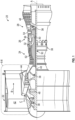
- FIG. 1 schematically illustrates a gas turbine engine 20.
- the gas turbine engine 20 is disclosed herein as a two-spool turbofan that generally incorporates a fan section 22, a compressor section 24, a combustor section 26 and a turbine section 28.
- Alternative engines might include other systems or features.
- the fan section 22 drives air along a bypass flow path B in a bypass duct, while the compressor section 24 drives air along a core flow path C for compression and communication into the combustor section 26 then expansion through the turbine section 28.
- the exemplary engine 20 generally includes a low speed spool 30 and a high speed spool 32 mounted for rotation about an engine central longitudinal axis A relative to an engine static structure 36 via several bearing systems 38. It should be understood that various bearing systems 38 at various locations may alternatively or additionally be provided, and the location of bearing systems 38 may be varied as appropriate to the application.
- the low speed spool 30 generally includes an inner shaft 40 that interconnects a fan 42, a low pressure compressor 44 and a low pressure turbine 46.
- the inner shaft 40 is connected to the fan 42 through a speed change mechanism, which in exemplary gas turbine engine 20 is illustrated as a geared architecture 48 to drive the fan 42 at a lower speed than the low speed spool 30.
- the high speed spool 32 includes an outer shaft 50 that interconnects a high pressure compressor 52 and high pressure turbine 54.
- a combustor 56 is arranged in exemplary gas turbine 20 between the high pressure compressor 52 and the high pressure turbine 54.
- An engine static structure 36 is arranged generally between the high pressure turbine 54 and the low pressure turbine 46.
- the engine static structure 36 further supports bearing systems 38 in the turbine section 28.
- the inner shaft 40 and the outer shaft 50 are concentric and rotate via bearing systems 38 about the engine central longitudinal axis A which is collinear with their longitudinal axes.
- each of the positions of the fan section 22, compressor section 24, combustor section 26, turbine section 28, and fan drive gear system 48 may be varied.
- gear system 48 may be located aft of combustor section 26 or even aft of turbine section 28, and fan section 22 may be positioned forward or aft of the location of gear system 48.
- the engine 20 in one example is a high-bypass geared aircraft engine.
- the engine 20 bypass ratio is greater than about six (6), with an example embodiment being greater than about ten (10)
- the geared architecture 48 is an epicyclic gear train, such as a planetary gear system or other gear system, with a gear reduction ratio of greater than about 2.3 and the low pressure turbine 46 has a pressure ratio that is greater than about five.
- the engine 20 bypass ratio is greater than about ten (10:1)
- the fan diameter is significantly larger than that of the low pressure compressor 44
- the low pressure turbine 46 has a pressure ratio that is greater than about five (5:1).
- Low pressure turbine 46 pressure ratio is pressure measured prior to inlet of low pressure turbine 46 as related to the pressure at the outlet of the low pressure turbine 46 prior to an exhaust nozzle.
- the geared architecture 48 may be an epicyclic gear train, such as a planetary gear system or other gear system, with a gear reduction ratio of greater than about 2.3:1. It should be understood, however, that the above parameters are only exemplary of one embodiment of a geared architecture engine and that the present disclosure is applicable to other gas turbine engines including direct drive turbofans.
- the fan section 22 of the engine 20 is designed for a particular flight condition--typically cruise at about 0.8 Mach and about 35,000 feet (10,668 meters).
- TSFC Thrust Specific Fuel Consumption
- Low fan pressure ratio is the pressure ratio across the fan blade alone, without a Fan Exit Guide Vane (“FEGV”) system.
- the low fan pressure ratio as disclosed herein according to one non-limiting embodiment is less than about 1.45.
- Low corrected fan tip speed is the actual fan tip speed in ft/sec divided by an industry standard temperature correction of [(Tram °R)/(518.7 °R)]0.5.
- the "Low corrected fan tip speed” as disclosed herein according to one non-limiting embodiment is less than about 1150 ft/second (350.5 m/sec).
- Known acoustic liners are designed to attenuate a range of frequencies, known as broadband, while targeting a peak frequency or tone.
- a liner can provide attenuation at multiple frequencies and frequency ranges by being designed with a variety of geometries within the underlying honeycomb.
- Known liners can be identified, depending upon the design of the honeycomb, as single layer liners, double layer liners, triple layer liners, etc. Each layer can provide attenuation at a targeted peak frequency and range of broadband frequencies.
- known acoustic liners may be more effective at attenuating noise at one or more of the engine operating conditions, and may be sub-optimal otherwise due to their fixed geometric design and capability.
- the disclosed embodiments provide an acoustic liner that is more capable, than known configurations, in attenuating different noise frequencies that may occur at various stages of flight.
- the acoustic liner 100 for attenuating noise in the gas turbine engine 20.
- the acoustic liner 100 includes a face sheet 110 (otherwise referred to as a face boundary; shown in FIG. 3 ).
- An aggregate set of resonator chamber cavities 105 e.g. all resonator chamber cavities of the acoustic liner 100
- a first subset e.g., plurality
- resonator chamber cavities (or cells) 120 inter-disbursed (e.g., distributed non-uniformly) against a same side (e.g., an inner facing side with respect to the acoustic liner 100) of the face sheet 110.
- the first subset of resonator chamber cavities 120 defines a first aggregated volume that is configured to target noise attenuation at a first frequency.
- the first subset of resonator chamber cavities 120 include first and second resonator chamber cavities 130, 140.
- the first and second resonator chamber cavities 130, 140 have different configurations with respect to each other.
- a second subset of resonator chamber cavities 150 of the aggregate set 105 are inter-disbursed (e.g., distributed non-uniformly) against the same side the face sheet 110 as the first subset. It is to be appreciated that by being on the same side of the face sheet 110, the first and second subsets of resonator chamber cavities 120, 150 are physically level or almost level with each other, e.g., height-wise, within the acoustic liner 100.
- the first and second subsets of resonator chamber cavities 120, 150 are inter-disbursed among each other within the aggregate set 105.
- the second subset of resonator chamber cavities define a second aggregated volume that differs from the first aggregated volume such that it is configured to target noise attenuation at a second frequency.
- the second subset of resonator chamber cavities 150 include third and fourth resonator chamber cavities 160, 170.
- the third and fourth resonator chamber cavities 160, 170 have different configurations with respect to each other. It is to be appreciated that a number, orientation (e.g., linear) and placement (e.g., at a front-corner end 100A of the acoustic liner 100) of resonator chamber cavities in each of the first and second subsets of resonator chamber cavities 120, 150 is selected as shown for simplicity.
- the illustrated embodiment is not intended on limiting a number, orientation or placement of resonator chamber cavities in the acoustic liner 100.
- the acoustic liner 100 via the first and second subset of resonator chamber cavities 120, 150, is configured to target both individual tonal frequencies as well as broadband frequency content over a range of frequencies.
- the acoustic liner 100 is formed of a pattern of different liner holes comprised of different individual geometries.
- the first resonator chamber cavity 130 a first cavity shell 180 formed by a first plurality of shell walls (or cell walls) 190 (one shell wall 190A is labeled), which are shown in the non-limiting example as a honeycomb or hexagonal shape.
- a first interstitial structure 200 is formed within the first cavity shell 180 and arranged in a first interstitial structure configuration.
- the first interstitial structure 200 is formed by a first arcuate surface 202 that extends from the first plurality of shell walls 190 toward a center of the first cavity shell 180 to terminate at an inner arcuate edge 204 that defines an elliptical center opening.
- the first interstitial structure 200 includes a second arcuate surface 206 that has a same shape as the first arcuate surface 202 and is height-wise spaced from the first arcuate surface 202 in the first cavity shell 180. With this configuration the first interstitial structure 200 defines a dual-conic shape.
- the second resonator chamber cavity 140 includes a second cavity shell 210 formed by a second plurality of shell walls 220 (one shell wall 220A is labeled).
- a second interstitial structure 230 within the second cavity shell 210 is arranged in a second interstitial structure configuration.
- the second interstitial structure 230 is formed by a third arcuate surface 230A that has a same shape as the first arcuate surface 202. With this configuration the second interstitial structure 230 defines a single-conic shape.
- the third resonator chamber cavity 160 includes a third interstitial structure 240 arranged in a third interstitial structure configuration.
- the third interstitial structure 240 forms a first elongated angled (e.g. slanted) interstitial wall, which extends across the third resonator chamber cavity 160.
- the fourth resonator chamber cavity 170 includes a fourth interstitial structure 255 that is arranged in a fourth interstitial structure configuration.
- the fourth interstitial structure 255 is a defined as a second elongated angled interstitial wall 250 that extends across the fourth resonator chamber cavity 160.
- the second elongated angled interstitial wall 250 defines an elliptical cutout 240A at its center.
- a fifth resonator chamber cavity 260 in the first subset of resonator chamber cavities 120 includes a fifth interstitial structure arranged in a fifth interstitial structure configuration.
- the fifth interstitial structure is defined by a pair of laterally extending walls 270A, 270B that are height-wise spaced from each other.
- a sixth resonator chamber cavity 280 in the second subset of resonator chamber cavities 150 includes a sixth interstitial structure 290 arranged in a sixth interstitial structure configuration.
- the sixth interstitial structure 290 is defined by a single laterally extending wall.
- Another resonator chamber cavity 300 in the acoustic liner 100 is a single degree of freedom cavity, i.e., without an interstitial structure.
- FIGS. 4-5 a set of resonator chamber cavities 400 (labeled as 400A-400D) is shown. Any one of the set of resonator chamber cavities 400 may be utilized in place of any one of the above disclosed resonator cavities in the acoustic liner 100.
- the set of resonator chamber cavities 400 each have one of four interstitial structures 410 (labeled as 410A-410D) and are formed with one of four cavity shells 420 (labeled as 420A-420D), which are shown in the non-limiting example as having a rectangular or square shape.
- the seventh interstitial structure 410A is arranged in a seventh interstitial structure configuration.
- the seventh interstitial structure 410A is formed by a plurality of angled interstitial walls (three angled interstitial walls 410A1-410A3 are labeled, which are triangular walls) respectively extending from different shell walls of the seventh cavity shell 420A toward the center of the seventh cavity shell 420A.
- the plurality of angled interstitial walls 410A1-410A3 have different lengths with respect to each other and connect with each other at an apex 410A4 at the center of the seventh cavity shell 420A.
- the eighth interstitial structure 410B is arranged in an eighth interstitial structure configuration.
- the eighth interstitial structure 410B is formed by angled interstitial walls 410B 1, 410B2 respectively extending from different shell walls of the eighth cavity shell 420B toward the center of the eighth cavity shell 420B.
- the lengths are such that the angled interstitial walls 410B1, 410B2 overlap each other at the center of the eighth cavity shell 420B.
- the angled interstitial walls 410B1, 410B2 are height-wise spaced from one another.
- the ninth interstitial structure 410C is arranged in a ninth interstitial structure configuration.
- the ninth interstitial structure 410C is formed by angled interstitial walls 410C1, 410C2 respectively extending from different shell walls of the ninth cavity shell 420C toward the center of the ninth cavity shell 420C.
- the lengths are such that the angled interstitial walls 410C1, 410C2 are non-overlapping.
- the angled interstitial walls 410C1, 410C2 may be height-wise spaced or aligned.
- the tenth interstitial structure 410D is arranged in a tenth interstitial structure configuration.
- the tenth interstitial structure is defined by a polygonal surface, which is formed by a plurality of angled interstitial walls 410D1-410D4 that extend from the shell walls toward the center of the tenth cavity shell 420D to terminate at a respective plurality of inner edges 410D5-410D8.
- the plurality of inner edges 410D5-410D8 define a polygonal center opening having a same shape as the tenth cavity shell 420D (e.g., a rectangular or square shape).
- the face sheet 110 defines a plurality of through holes (a first set of the through holes 460 is labeled).
- the face sheet 110 is disposed against a face-sheet-side 470 of the acoustic liner 100.
- the acoustic liner 100 includes a back sheet 480 (otherwise referred to as a back boundary; illustrated schematically) disposed against a back-sheet-side 490 of the acoustic liner 100.
- FIG. 6 is a schematic illustration of section 6-6 from FIG. 1 , showing the fan section 22, that includes the fan 42, a fan outer case 510 that extends along the engine center axis A to define a case forward end 530 and a case aft end 540.
- a hub 550 extends along the engine center axis A to define a hub forward end 560 and a hub aft end 570.
- a fan exit guide vane 580 extends between the hub 550 and the fan outer case 510.
- the fan 42 is operationally connected to the hub 550.
- the acoustic liner 100 is installed onto one or more of the fan outer case 510, the hub 550 and the fan exit guide vane 580.
- the acoustic liner 100 is installed onto the fan outer case 510 and is configured as an ice liner 590 that is forward of the fan exit guide vane 580. In one embodiment the acoustic liner 100 is configured as an intrastage liner 600 that is forward of the fan exit guide vane 580. In one embodiment, the acoustic liner 100 is configured as a tip passage liner 610 at the fan exit guide vane 580.
- the acoustic liner 100 is installed within the fan section 22 onto the hub 550 and is configured as one or more of a splitter liner 615 that is forward of the fan exit guide vane, a hub passage liner 620 at the fan exit guide vane 580 and an inner aft liner 630 that is aft of the fan exit guide vane 580.
- the acoustic liner 100 is installed onto a pressure and/or suction side 640 of the fan exit guide vane 580.
- the acoustic liner 100 is installed within the fan section 22 onto the fan outer case 510, forward of the fan 42, and is configured as a forward fan case liner 650.
- FIG. 7 is a flowchart showing a method of manufacturing the acoustic liner 100 for attenuating noise in the gas turbine engine 20.
- the method includes inter-disbursing, among the aggregate set of resonator chamber cavities 105, the first subset of resonator chamber cavities 120.
- the first subset of resonator chamber cavities 120 are formed to define a first aggregated volume that is configured to target noise attenuation at a first frequency.
- the first subset of resonator chamber cavities 120 are formed to include the first and second resonator chamber cavities 130, 140. Further, the first and second resonator chamber cavities 130, 140 are formed to have different configurations with respect to each other.
- the method includes inter-disbursing, among the aggregate set of resonator chamber cavities 105, the second subset of resonator chamber cavities 150.
- the second subset of resonator chamber cavities 150 are formed to define the second aggregated volume that differs from the first aggregated volume and that is configured to target noise attenuation at a second frequency.
- the second subset of resonator chamber cavities 150 are formed to include the third and fourth resonator chamber cavities 160, 170. Further, the third and fourth resonator chamber cavities 160, 170, have different configurations with respect to each other.
- distributing the first subset of resonator chamber cavities further includes forming the first cavity shell 180 having a first plurality of shell walls 190 and forming a first interstitial structure 200 within the first cavity shell 180.
- This also includes forming the second cavity shell 210 having a second plurality of shell walls 220 and forming the second interstitial structure 230 within the second cavity shell.
- the first and second interstitial structures have different configurations with respect to each other.
- one of the first and second resonator chamber cavities 130, 140 may be arranged according to one of the ten interstitial configurations identified above and the other of the first and second resonator chamber cavities 130, 140 may be arranged according to another of the ten interstitial configurations identified above.
- the method includes additively manufacturing the first and second subsets of resonator chamber cavities 120, 150, including face and back boundaries 110, 480, e.g., as a unitary liner.
Landscapes
- Engineering & Computer Science (AREA)
- Chemical & Material Sciences (AREA)
- Combustion & Propulsion (AREA)
- Mechanical Engineering (AREA)
- General Engineering & Computer Science (AREA)
- Physics & Mathematics (AREA)
- Acoustics & Sound (AREA)
- Multimedia (AREA)
- Soundproofing, Sound Blocking, And Sound Damping (AREA)
Description
- Exemplary embodiments of the present disclosure pertain to the art of an acoustic liner for a gas turbine engine and more specifically to an acoustic liner with a nonuniform volumetric distribution.
- Aircraft engine fan forward and fan aft noise may be a limiting feature to engine designs as noise regulations become more stringent. Noise is important to control at multiple engine operating conditions, including take-off and descent phases of flight. Single degree of freedom (SDOF) and multi-degree of freedom (MDOF) liners may treat specific tonal and broadband noise spectra within the noise content generated by an aircraft engine, reducing noise by a given level. Such liners may be more effective at attenuating noise at one or more of the engine operating conditions, and may be sub-optimal otherwise due to their geometric design and capability. In view stringent noise regulations, either additional acoustic liners or quieter fan designs may be required, which may be sub-optimal for engine performance, fuel burn efficiency, and/or weight.
-
CA 2170609 discloses an acoustic liner for attenuating noise in aero engines comprising a plurality of cells, each cell comprising a septum element dividing the cell into two sub-cells. -
US 2019/304428 A1 discloses a Helmholtz resonator for attenuating noise in an aircraft comprising an array of resonator chambers, the array comprising pluralities of resonant chambers having different volumes from one another. -
EP 3537429 A1 discloses an acoustic liner for a turbine engine comprising an array of oblique polyhedral cellular structures. - According to a first aspect, the invention provides an acoustic liner for attenuating noise in a gas turbine engine as described in claim 1.
- The acoustic liner, via the first and second subset of resonator chamber cavities, may be configured to target both individual tonal frequencies as well as broadband frequency content over a range of frequencies, wherein the acoustic liner is formed of a pattern of different liner holes comprised of different individual geometries.
- The acoustic liner may include a face sheet, wherein the aggregate set of resonator chamber cavities may be distributed against a same side of the face sheet, and wherein at each of the first and second subsets of resonator chamber cavities, the face sheet may define a plurality of through holes.
- According to a second aspect, the invention provides a gas turbine engine in accordance with claim 4.
- The acoustic liner, via the first and second subsets of resonator chamber cavities, may be configured to target both individual tonal frequencies as well as broadband frequency content over a range of frequencies, wherein the acoustic liner may be formed of a pattern of different liner holes comprised of different individual geometries.
- The gas turbine engine may further include a face sheet, wherein the aggregate set of resonator chamber cavities may be distributed against a same side of the face sheet, and wherein at each of the first and second subsets of resonator chamber cavities, the face sheet may define a plurality of through holes.
- The gas turbine engine may further include a fan section that includes: an outer case that may extend along an engine center axis to define a case forward end and a case aft end; a hub that may extend along the engine center axis to define a hub forward end and a hub aft end; and a fan exit guide vane that may extend between the hub and the fan outer case, wherein the acoustic liner may be installed onto one or more of the fan outer case, the hub and the fan exit guide vane.
- The acoustic liner may be installed onto the fan outer case, and may be configured as one or more of an ice liner that is forward of the fan exit guide vane, an intrastage liner that is forward of the fan exit guide vane, and a tip passage liner at the fan exit guide vane.
- The acoustic liner may be installed onto the hub, and may be configured as one or more of a hub passage liner at the fan exit guide vane or an inner aft liner that is aft of the fan exit guide vane.
- The acoustic liner may be installed on a pressure and/or suction side of the fan exit guide vane.
- The gas turbine engine may further include a fan, wherein the acoustic liner may be installed onto the fan outer case, forward of the fan, and may be configured as a forward fan case liner.
- According to a third aspect, the invention provides is a method of manufacturing an acoustic liner for attenuating noise in a gas turbine engine in accordance with claim 9.
- The acoustic liner is configured, via the first and second subsets of resonator chamber cavities, to target both individual tonal frequencies as well as broadband frequency content over a range of frequencies, wherein the acoustic liner may be formed of a pattern of different liner holes comprised of different individual geometries.
- The method may include additively manufacturing the first and second subsets of resonator chamber cavities, including face and back boundaries.
- The following descriptions should not be considered limiting in any way. With reference to the accompanying drawings, like elements are numbered alike:
-
FIG. 1 is a partial cross-sectional view of a gas turbine engine; -
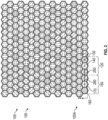
FIG. 2 is a top view of an acoustic liner according to an embodiment; -
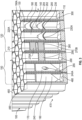
FIG. 3 is a sectional view of the acoustic liner according shown inFIG. 2 along section lines 3-3; -
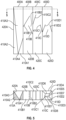
FIG. 4 is a partial cross-sectional view of a set of resonant chamber cavities for an acoustic liner according to an embodiment; -
FIG. 5 is a sectional view of the set of resonant chamber cavities shown inFIG. 4 along line 5-5; -
FIG. 6 is a sectional view of the fan section of the gas turbine engine taken illustrated inFIG. 1 , within section 6-6; and -
FIG. 7 is a flowchart showing a method of manufacturing an acoustic liner according to an embodiment. - A detailed description of one or more embodiments of the disclosed apparatus and method are presented herein by way of exemplification and not limitation with reference to the Figures.
-
FIG. 1 schematically illustrates agas turbine engine 20. Thegas turbine engine 20 is disclosed herein as a two-spool turbofan that generally incorporates afan section 22, acompressor section 24, acombustor section 26 and aturbine section 28. Alternative engines might include other systems or features. Thefan section 22 drives air along a bypass flow path B in a bypass duct, while thecompressor section 24 drives air along a core flow path C for compression and communication into thecombustor section 26 then expansion through theturbine section 28. Although depicted as a two-spool turbofan gas turbine engine in the disclosed non-limiting embodiment, it should be understood that the concepts described herein are not limited to use with two-spool turbofans as the teachings may be applied to other types of turbine engines including three-spool architectures and geared fan architectures. - The
exemplary engine 20 generally includes alow speed spool 30 and ahigh speed spool 32 mounted for rotation about an engine central longitudinal axis A relative to an enginestatic structure 36 viaseveral bearing systems 38. It should be understood thatvarious bearing systems 38 at various locations may alternatively or additionally be provided, and the location ofbearing systems 38 may be varied as appropriate to the application. - The
low speed spool 30 generally includes aninner shaft 40 that interconnects afan 42, alow pressure compressor 44 and alow pressure turbine 46. Theinner shaft 40 is connected to thefan 42 through a speed change mechanism, which in exemplarygas turbine engine 20 is illustrated as a gearedarchitecture 48 to drive thefan 42 at a lower speed than thelow speed spool 30. Thehigh speed spool 32 includes anouter shaft 50 that interconnects ahigh pressure compressor 52 andhigh pressure turbine 54. Acombustor 56 is arranged inexemplary gas turbine 20 between thehigh pressure compressor 52 and thehigh pressure turbine 54. An enginestatic structure 36 is arranged generally between thehigh pressure turbine 54 and thelow pressure turbine 46. The enginestatic structure 36 further supports bearingsystems 38 in theturbine section 28. Theinner shaft 40 and theouter shaft 50 are concentric and rotate viabearing systems 38 about the engine central longitudinal axis A which is collinear with their longitudinal axes. - The core airflow is compressed by the
low pressure compressor 44 then thehigh pressure compressor 52, mixed and burned with fuel in thecombustor 56, then expanded over thehigh pressure turbine 54 andlow pressure turbine 46. The low andhigh pressure turbines low speed spool 30 andhigh speed spool 32 in response to the expansion. It will be appreciated that each of the positions of thefan section 22,compressor section 24,combustor section 26,turbine section 28, and fandrive gear system 48 may be varied. For example,gear system 48 may be located aft ofcombustor section 26 or even aft ofturbine section 28, andfan section 22 may be positioned forward or aft of the location ofgear system 48. - The
engine 20 in one example is a high-bypass geared aircraft engine. In a further example, theengine 20 bypass ratio is greater than about six (6), with an example embodiment being greater than about ten (10), the gearedarchitecture 48 is an epicyclic gear train, such as a planetary gear system or other gear system, with a gear reduction ratio of greater than about 2.3 and thelow pressure turbine 46 has a pressure ratio that is greater than about five. In one disclosed embodiment, theengine 20 bypass ratio is greater than about ten (10:1), the fan diameter is significantly larger than that of thelow pressure compressor 44, and thelow pressure turbine 46 has a pressure ratio that is greater than about five (5:1).Low pressure turbine 46 pressure ratio is pressure measured prior to inlet oflow pressure turbine 46 as related to the pressure at the outlet of thelow pressure turbine 46 prior to an exhaust nozzle. The gearedarchitecture 48 may be an epicyclic gear train, such as a planetary gear system or other gear system, with a gear reduction ratio of greater than about 2.3:1. It should be understood, however, that the above parameters are only exemplary of one embodiment of a geared architecture engine and that the present disclosure is applicable to other gas turbine engines including direct drive turbofans. - A significant amount of thrust is provided by the bypass flow B due to the high bypass ratio. The
fan section 22 of theengine 20 is designed for a particular flight condition--typically cruise at about 0.8 Mach and about 35,000 feet (10,668 meters). The flight condition of 0.8 Mach and 35,000 ft (10,668 meters), with the engine at its best fuel consumption--also known as "bucket cruise Thrust Specific Fuel Consumption ("TSFC")"--is the industry standard parameter of lbm of fuel being burned divided by lbf of thrust the engine produces at that minimum point. "Low fan pressure ratio" is the pressure ratio across the fan blade alone, without a Fan Exit Guide Vane ("FEGV") system. The low fan pressure ratio as disclosed herein according to one non-limiting embodiment is less than about 1.45. "Low corrected fan tip speed" is the actual fan tip speed in ft/sec divided by an industry standard temperature correction of [(Tram °R)/(518.7 °R)]0.5. The "Low corrected fan tip speed" as disclosed herein according to one non-limiting embodiment is less than about 1150 ft/second (350.5 m/sec). - Known acoustic liners are designed to attenuate a range of frequencies, known as broadband, while targeting a peak frequency or tone. A liner can provide attenuation at multiple frequencies and frequency ranges by being designed with a variety of geometries within the underlying honeycomb. Known liners can be identified, depending upon the design of the honeycomb, as single layer liners, double layer liners, triple layer liners, etc. Each layer can provide attenuation at a targeted peak frequency and range of broadband frequencies. However as indicated, known acoustic liners may be more effective at attenuating noise at one or more of the engine operating conditions, and may be sub-optimal otherwise due to their fixed geometric design and capability. In view of this, the disclosed embodiments provide an acoustic liner that is more capable, than known configurations, in attenuating different noise frequencies that may occur at various stages of flight.
- Turning to
FIGS. 2-3 , disclosed is anacoustic liner 100 for attenuating noise in thegas turbine engine 20. Theacoustic liner 100 includes a face sheet 110 (otherwise referred to as a face boundary; shown inFIG. 3 ). An aggregate set of resonator chamber cavities 105 (e.g. all resonator chamber cavities of the acoustic liner 100) that includes at least a first subset (e.g., plurality) of resonator chamber cavities (or cells) 120 inter-disbursed (e.g., distributed non-uniformly) against a same side (e.g., an inner facing side with respect to the acoustic liner 100) of theface sheet 110. The first subset ofresonator chamber cavities 120 defines a first aggregated volume that is configured to target noise attenuation at a first frequency. The first subset ofresonator chamber cavities 120 include first and secondresonator chamber cavities resonator chamber cavities - A second subset of
resonator chamber cavities 150 of the aggregate set 105 are inter-disbursed (e.g., distributed non-uniformly) against the same side theface sheet 110 as the first subset. It is to be appreciated that by being on the same side of theface sheet 110, the first and second subsets ofresonator chamber cavities acoustic liner 100. - In one embodiment, the first and second subsets of
resonator chamber cavities aggregate set 105. - The second subset of resonator chamber cavities define a second aggregated volume that differs from the first aggregated volume such that it is configured to target noise attenuation at a second frequency. The second subset of
resonator chamber cavities 150 include third and fourthresonator chamber cavities resonator chamber cavities corner end 100A of the acoustic liner 100) of resonator chamber cavities in each of the first and second subsets ofresonator chamber cavities acoustic liner 100. Theacoustic liner 100, via the first and second subset ofresonator chamber cavities acoustic liner 100 is formed of a pattern of different liner holes comprised of different individual geometries. - As illustrated in
FIG. 3 , the first resonator chamber cavity 130 afirst cavity shell 180 formed by a first plurality of shell walls (or cell walls) 190 (oneshell wall 190A is labeled), which are shown in the non-limiting example as a honeycomb or hexagonal shape. A firstinterstitial structure 200 is formed within thefirst cavity shell 180 and arranged in a first interstitial structure configuration. The firstinterstitial structure 200 is formed by a firstarcuate surface 202 that extends from the first plurality of shell walls 190 toward a center of thefirst cavity shell 180 to terminate at an innerarcuate edge 204 that defines an elliptical center opening. The firstinterstitial structure 200 includes a secondarcuate surface 206 that has a same shape as the firstarcuate surface 202 and is height-wise spaced from the firstarcuate surface 202 in thefirst cavity shell 180. With this configuration the firstinterstitial structure 200 defines a dual-conic shape. - The second
resonator chamber cavity 140 includes asecond cavity shell 210 formed by a second plurality of shell walls 220 (oneshell wall 220A is labeled). A secondinterstitial structure 230 within thesecond cavity shell 210 is arranged in a second interstitial structure configuration. The secondinterstitial structure 230 is formed by a thirdarcuate surface 230A that has a same shape as the firstarcuate surface 202. With this configuration the secondinterstitial structure 230 defines a single-conic shape. - The third
resonator chamber cavity 160 includes a thirdinterstitial structure 240 arranged in a third interstitial structure configuration. The thirdinterstitial structure 240 forms a first elongated angled (e.g. slanted) interstitial wall, which extends across the thirdresonator chamber cavity 160. The fourthresonator chamber cavity 170 includes a fourthinterstitial structure 255 that is arranged in a fourth interstitial structure configuration. The fourthinterstitial structure 255 is a defined as a second elongated angledinterstitial wall 250 that extends across the fourthresonator chamber cavity 160. The second elongated angledinterstitial wall 250 defines anelliptical cutout 240A at its center. - A fifth
resonator chamber cavity 260 in the first subset ofresonator chamber cavities 120 includes a fifth interstitial structure arranged in a fifth interstitial structure configuration. The fifth interstitial structure is defined by a pair of laterally extendingwalls - A sixth
resonator chamber cavity 280 in the second subset ofresonator chamber cavities 150 includes a sixthinterstitial structure 290 arranged in a sixth interstitial structure configuration. The sixthinterstitial structure 290 is defined by a single laterally extending wall. Anotherresonator chamber cavity 300 in theacoustic liner 100 is a single degree of freedom cavity, i.e., without an interstitial structure. - Turning to
FIGS. 4-5 a set of resonator chamber cavities 400 (labeled as 400A-400D) is shown. Any one of the set of resonator chamber cavities 400 may be utilized in place of any one of the above disclosed resonator cavities in theacoustic liner 100. The set of resonator chamber cavities 400 each have one of four interstitial structures 410 (labeled as 410A-410D) and are formed with one of four cavity shells 420 (labeled as 420A-420D), which are shown in the non-limiting example as having a rectangular or square shape. - In a
seventh resonator chamber 400A, the seventhinterstitial structure 410A is arranged in a seventh interstitial structure configuration. The seventhinterstitial structure 410A is formed by a plurality of angled interstitial walls (three angled interstitial walls 410A1-410A3 are labeled, which are triangular walls) respectively extending from different shell walls of theseventh cavity shell 420A toward the center of theseventh cavity shell 420A. The plurality of angled interstitial walls 410A1-410A3 have different lengths with respect to each other and connect with each other at an apex 410A4 at the center of theseventh cavity shell 420A. - In an
eighth resonator chamber 400B, the eighthinterstitial structure 410B is arranged in an eighth interstitial structure configuration. The eighthinterstitial structure 410B is formed by angledinterstitial walls 410B 1, 410B2 respectively extending from different shell walls of theeighth cavity shell 420B toward the center of theeighth cavity shell 420B. The lengths are such that the angled interstitial walls 410B1, 410B2 overlap each other at the center of theeighth cavity shell 420B. The angled interstitial walls 410B1, 410B2 are height-wise spaced from one another. - In
ninth resonator chamber 400C, the ninthinterstitial structure 410C is arranged in a ninth interstitial structure configuration. The ninthinterstitial structure 410C is formed by angled interstitial walls 410C1, 410C2 respectively extending from different shell walls of theninth cavity shell 420C toward the center of theninth cavity shell 420C. The lengths are such that the angled interstitial walls 410C1, 410C2 are non-overlapping. The angled interstitial walls 410C1, 410C2 may be height-wise spaced or aligned. - In a
tenth resonator chamber 400D, the tenthinterstitial structure 410D is arranged in a tenth interstitial structure configuration. The tenth interstitial structure is defined by a polygonal surface, which is formed by a plurality of angled interstitial walls 410D1-410D4 that extend from the shell walls toward the center of thetenth cavity shell 420D to terminate at a respective plurality of inner edges 410D5-410D8. The plurality of inner edges 410D5-410D8 define a polygonal center opening having a same shape as thetenth cavity shell 420D (e.g., a rectangular or square shape). - There are limitations to additive manufacturing that may require the shapes shown in the above identified figures (depending on a build direction) in order to "print" without needing additional support structure. The additional support structure equates to additional cost in materials along with the added process of removing the support structure. Though the support structure could be left in, it would add additional weight and thereby be less than optimum (and it may or may not affect the targeted attenuation frequency). For instance, all of the configurations shown in the above identified figures have angles greater than substantially 45° relative to the build direction.
- Turning back to
FIG. 3 , at each of the first and second subsets ofresonator chamber cavities face sheet 110 defines a plurality of through holes (a first set of the throughholes 460 is labeled). Theface sheet 110 is disposed against a face-sheet-side 470 of theacoustic liner 100. Theacoustic liner 100 includes a back sheet 480 (otherwise referred to as a back boundary; illustrated schematically) disposed against a back-sheet-side 490 of theacoustic liner 100. -
FIG. 6 is a schematic illustration of section 6-6 fromFIG. 1 , showing thefan section 22, that includes thefan 42, a fanouter case 510 that extends along the engine center axis A to define a caseforward end 530 and a caseaft end 540. Ahub 550 extends along the engine center axis A to define a hubforward end 560 and a hub aftend 570. A fanexit guide vane 580 extends between thehub 550 and the fanouter case 510. Thefan 42 is operationally connected to thehub 550. As shown, theacoustic liner 100 is installed onto one or more of the fanouter case 510, thehub 550 and the fanexit guide vane 580. - In one embodiment, the
acoustic liner 100 is installed onto the fanouter case 510 and is configured as anice liner 590 that is forward of the fanexit guide vane 580. In one embodiment theacoustic liner 100 is configured as anintrastage liner 600 that is forward of the fanexit guide vane 580. In one embodiment, theacoustic liner 100 is configured as a tip passage liner 610 at the fanexit guide vane 580. - In one embodiment the
acoustic liner 100 is installed within thefan section 22 onto thehub 550 and is configured as one or more of asplitter liner 615 that is forward of the fan exit guide vane, ahub passage liner 620 at the fanexit guide vane 580 and aninner aft liner 630 that is aft of the fanexit guide vane 580. In one embodiment theacoustic liner 100 is installed onto a pressure and/orsuction side 640 of the fanexit guide vane 580. In one embodiment theacoustic liner 100 is installed within thefan section 22 onto the fanouter case 510, forward of thefan 42, and is configured as a forwardfan case liner 650. -
FIG. 7 is a flowchart showing a method of manufacturing theacoustic liner 100 for attenuating noise in thegas turbine engine 20. As shown inblock 720, the method includes inter-disbursing, among the aggregate set ofresonator chamber cavities 105, the first subset ofresonator chamber cavities 120. As indicated, the first subset ofresonator chamber cavities 120 are formed to define a first aggregated volume that is configured to target noise attenuation at a first frequency. Additionally, the first subset ofresonator chamber cavities 120 are formed to include the first and secondresonator chamber cavities resonator chamber cavities - As shown in
block 730, the method includes inter-disbursing, among the aggregate set ofresonator chamber cavities 105, the second subset ofresonator chamber cavities 150. As indicated, the second subset ofresonator chamber cavities 150 are formed to define the second aggregated volume that differs from the first aggregated volume and that is configured to target noise attenuation at a second frequency. Additionally, the second subset ofresonator chamber cavities 150 are formed to include the third and fourthresonator chamber cavities resonator chamber cavities - As shown in
block 720A, distributing the first subset of resonator chamber cavities (block 720) further includes forming thefirst cavity shell 180 having a first plurality of shell walls 190 and forming a firstinterstitial structure 200 within thefirst cavity shell 180. This also includes forming thesecond cavity shell 210 having a second plurality of shell walls 220 and forming the secondinterstitial structure 230 within the second cavity shell. As indicated, the first and second interstitial structures have different configurations with respect to each other. For example, one of the first and secondresonator chamber cavities resonator chamber cavities - As indicated, in one embodiment the method includes additively manufacturing the first and second subsets of
resonator chamber cavities back boundaries - The terminology used herein is for the purpose of describing particular embodiments only and is not intended to be limiting of the present disclosure. As used herein, the singular forms "a", "an" and "the" are intended to include the plural forms as well, unless the context clearly indicates otherwise. It will be further understood that the terms "comprises" and/or "comprising," when used in this specification, specify the presence of stated features, integers, steps, operations, elements, and/or components, but do not preclude the presence or addition of one or more other features, integers, steps, operations, element components, and/or groups thereof.
- While the present invention has been described with reference to an exemplary embodiment or embodiments, it will be understood by those skilled in the art that various changes may be made and equivalents may be substituted for elements thereof without departing from the scope of the present invention that is defined by the appended set of claims.
Claims (11)
- An acoustic liner (100) for attenuating noise in a gas turbine engine (20), comprising
an aggregate set of resonator chamber cavities (105), including:a first subset of resonator chamber cavities (120), inter-disbursed within the aggregate set, the first subset of resonator chamber cavities defining a first aggregated volume that is configured to target noise attenuation at a first frequency, the first subset of resonator chamber cavities include first and second resonator chamber cavities (130, 140), the first and second resonator chamber cavities having different configurations with respect to each other; anda second subset of resonator chamber cavities (150), inter-disbursed within the aggregate set, the second subset of resonator chamber cavities define a second aggregated volume that differs from the first aggregated volume and that is configured to target noise attenuation at a second frequency, the second subset of resonator chamber cavities include third and fourth resonator chamber cavities (160, 170), the third and fourth resonator chamber cavities having different configurations with respect to each other,wherein the first resonator chamber cavity (130) includes a first cavity shell (180; 420A; 420B; 420C; 420D) formed by a first plurality of shell walls (190), and a first interstitial structure (200) within the first cavity shell; andthe second resonator chamber cavity (140) includes a second cavity shell (210) formed by a second plurality of shell walls (220), and a second interstitial structure (230) within the second cavity shell,wherein the first and second interstitial structures have different configurations with respect to each other;characterized in that the first interstitial structure is defined by one of:(i) a dual-conic shape comprising a first arcuate surface (202) and a second arcuate surface (206), each of the first and second arcuate surfaces extending from the first plurality of shell walls (190) toward a center of the first cavity shell (180) to terminate at an inner arcuate edge (204) that defines an elliptical center opening, and wherein the second arcuate surface (206) is height-wise spaced from the first arcuate surface (202) in the first cavity shell (180); or(ii) a pair of laterally extending walls (270A, 270B), wherein the pair of laterally extending walls are height-wise spaced from each other; or(iii) a first plurality of angled interstitial walls (410A1-410A3) that respectively extend from different shell walls of the first cavity shell (420A) toward a center of the first cavity shell, wherein each of the first plurality of angled interstitial walls have different lengths with respect to each other and connect with each other at an apex (410A4) at the center of the first cavity shell; or(iv) a second plurality of angled interstitial walls (410B1, 410B2) that respectively extend from different shell walls of the first cavity shell (420B) toward a center of the first cavity shell (420B), wherein each of the second plurality of angled interstitial walls have lengths such that the angled interstitial walls overlap each other at the center of the first cavity shell, and wherein each of the second plurality of angled interstitial walls are height-wise spaced from one another; or(v) a third plurality of angled interstitial walls (410C1, 410C2) that respectively extend from different shell walls of the first cavity shell (420C) toward a center of the first cavity shell, wherein each of the third plurality of angled interstitial walls have lengths such that the third plurality of angled interstitial walls are non-overlapping, and wherein the third plurality of angled interstitial walls are height-wise spaced or aligned with one another; or(vi) a fourth plurality of angled interstitial walls (410D1-410D4) that respectively extend from the shell walls toward a center of the first cavity shell (420D) to terminate at a respective plurality of inner edges (410D5-410D8), wherein the plurality of inner edges defines a polygonal center opening having a same shape as the first cavity shell. - The acoustic liner (100) of claim 1, wherein:
the acoustic liner, via the first and second subsets of resonator chamber cavities (120, 150), is configured to target both individual tonal frequencies as well as broadband frequency content over a range of frequencies, wherein the acoustic liner is formed of a pattern of different liner holes comprised of different individual geometries. - The acoustic liner (100) of claim 1 or 2, further comprising:a face sheet (110), wherein the aggregate set of resonator chamber cavities (105) are distributed against a same side of the face sheet, andwherein at each of the first and second subsets of resonator chamber cavities (120, 150), the face sheet defines a plurality of through holes.
- A gas turbine engine (20) comprising:
the acoustic liner (100) of any preceding claim. - The gas turbine engine (20) of claim 4, further comprising:
a fan section that includes:an outer case that extends along an engine center axis to define a case forward end and a case aft end;a hub that extends along the engine center axis to define a hub forward end and a hub aft end; anda fan exit guide vane that extends between the hub and the fan outer case,wherein the acoustic liner (100) is installed onto one or more of the fan outer case, the hub and the fan exit guide vane. - The gas turbine engine (20) of claim 5, wherein the acoustic liner (100) is installed onto the fan outer case, and is configured as one or more of an ice liner that is forward of the fan exit guide vane, an intrastage liner that is forward of the fan exit guide vane, and a tip passage liner at the fan exit guide vane.
- The gas turbine engine (20) of claim 5, wherein the acoustic liner (100) is installed onto the hub, and is configured as one or more of a hub passage liner at the fan exit guide vane or an inner aft liner that is aft of the fan exit guide vane, or wherein the acoustic liner (100) is installed on a pressure and/or suction side of the fan exit guide vane.
- The gas turbine engine (20) of claim 5, further including:a fan,wherein the acoustic liner (100) is installed onto the fan outer case, forward of the fan, and is configured as a forward fan case liner.
- A method of manufacturing an acoustic liner (100) for attenuating noise in a gas turbine engine (20), comprising:inter-disbursing, among an aggregate set of resonator chamber cavities (105), a first subset of resonator chamber cavities (120), the first subset of resonator chamber cavities being formed to define a first aggregated volume that is configured to target noise attenuation at a first frequency, the first subset of resonator chamber cavities being formed to include first and second resonator chamber cavities (130, 140), the first and second resonator chamber cavities are formed to have different configurations with respect to each other; andinter-disbursing, among the aggregate set of resonator chamber cavities, a second subset of resonator chamber cavities (150), the second subset of resonator chamber cavities being formed to define a second aggregated volume that differs from the first aggregated volume and that is configured to target noise attenuation at a second frequency, the second subset of resonator chamber cavities being formed to include third and fourth resonator chamber cavities (160, 170) fluidly coupled to each other, the third and fourth resonator chamber cavities having different configurations with respect to each other,
wherein inter-disbursing the first subset of resonator chamber cavities (120) among the aggregate set includes:forming the first resonator chamber cavity (130) with a first cavity shell (180) having a first plurality of shell walls (190) and forming a first interstitial structure (200) within the first cavity shell; andforming the second resonator chamber cavity (140) with a second cavity shell (210) having a second plurality of shell walls (220) and forming a second interstitial structure (230) within the second cavity shell,wherein the first and second interstitial structures have different configurations with respect to each other;characterized by forming the first interstitial structure to define one of:(i) a dual-conic shape comprising a first arcuate surface (202) and a second arcuate surface (206), each of the first and second arcuate surfaces extending from the first plurality of shell walls (190) toward a center of the first cavity shell (180) to terminate at an inner arcuate edge (204) that defines an elliptical center opening, and wherein the second arcuate surface (206) is height-wise spaced from the first arcuate surface (202) in the first cavity shell (180); or(ii) a pair of laterally extending walls (270A, 270B), wherein the pair of laterally extending walls are height-wise spaced from each other; or(iii) a first plurality of angled interstitial walls (410A1-410A3) that respectively extend from different shell walls of the first cavity shell (420A) toward a center of the first cavity shell, wherein each of the first plurality of angled interstitial walls have different lengths with respect to each other and connect with each other at an apex (410A4) at the center of the first cavity shell; or(iv) a second plurality of angled interstitial walls (410B 1, 410B2) that respectively extend from different shell walls of the first cavity shell (420B) toward a center of the first cavity shell (420B), wherein each of the second plurality of angled interstitial walls have lengths such that the angled interstitial walls overlap each other at the center of the first cavity shell, and wherein each of the second plurality of angled interstitial walls are height-wise spaced from one another; or(v) a third plurality of angled interstitial walls (410C1, 410C2) that respectively extend from different shell walls of the first cavity shell (420C) toward a center of the first cavity shell, wherein each of the third plurality of angled interstitial walls have lengths such that the third plurality of angled interstitial walls are non-overlapping, and wherein the third plurality of angled interstitial walls are height-wise spaced or aligned with one another; or(vi) a fourth plurality of angled interstitial walls (410D1-410D4) that respectively extend from the shell walls toward a center of the first cavity shell (420D) to terminate at a respective plurality of inner edges (410D5-410D8), wherein the plurality of inner edges defines a polygonal center opening having a same shape as the first cavity shell. - The method of claim 9, wherein:
the acoustic liner (100) is configured, via the first and second subsets of resonator chamber cavities (120, 150), to target both individual tonal frequencies as well as broadband frequency content over a range of frequencies, wherein the acoustic liner is formed of a pattern of different liner holes comprised of different individual geometries. - The method of claim 9 or 10, comprising additively manufacturing the first and second subsets of resonator chamber cavities (120, 150), including face and back boundaries.
Priority Applications (1)
| Application Number | Priority Date | Filing Date | Title |
|---|---|---|---|
| EP24206267.7A EP4495930A1 (en) | 2020-02-21 | 2021-02-19 | Acoustic liner with non-uniform volumetric distribution |
Applications Claiming Priority (2)
| Application Number | Priority Date | Filing Date | Title |
|---|---|---|---|
| US202062979662P | 2020-02-21 | 2020-02-21 | |
| US16/863,218 US11339720B2 (en) | 2020-02-21 | 2020-04-30 | Acoustic liner with non-uniform volumetric distribution |
Related Child Applications (2)
| Application Number | Title | Priority Date | Filing Date |
|---|---|---|---|
| EP24206267.7A Division-Into EP4495930A1 (en) | 2020-02-21 | 2021-02-19 | Acoustic liner with non-uniform volumetric distribution |
| EP24206267.7A Division EP4495930A1 (en) | 2020-02-21 | 2021-02-19 | Acoustic liner with non-uniform volumetric distribution |
Publications (2)
| Publication Number | Publication Date |
|---|---|
| EP3869499A1 EP3869499A1 (en) | 2021-08-25 |
| EP3869499B1 true EP3869499B1 (en) | 2024-11-20 |
Family
ID=74672118
Family Applications (2)
| Application Number | Title | Priority Date | Filing Date |
|---|---|---|---|
| EP21158078.2A Active EP3869499B1 (en) | 2020-02-21 | 2021-02-19 | Acoustic liner with non-uniform volumetric distribution |
| EP24206267.7A Pending EP4495930A1 (en) | 2020-02-21 | 2021-02-19 | Acoustic liner with non-uniform volumetric distribution |
Family Applications After (1)
| Application Number | Title | Priority Date | Filing Date |
|---|---|---|---|
| EP24206267.7A Pending EP4495930A1 (en) | 2020-02-21 | 2021-02-19 | Acoustic liner with non-uniform volumetric distribution |
Country Status (2)
| Country | Link |
|---|---|
| US (1) | US11339720B2 (en) |
| EP (2) | EP3869499B1 (en) |
Families Citing this family (17)
| Publication number | Priority date | Publication date | Assignee | Title |
|---|---|---|---|---|
| US11047304B2 (en) * | 2018-08-08 | 2021-06-29 | General Electric Company | Acoustic cores with sound-attenuating protuberances |
| FR3088905A1 (en) * | 2018-11-28 | 2020-05-29 | Airbus Operations (S.A.S.) | Sound absorption structure comprising a liquid drainage system and propellant assembly comprising such a sound absorption structure |
| FR3107856B1 (en) * | 2020-03-04 | 2022-02-04 | Safran Nacelles | Process for manufacturing a honeycomb core structure for a turbojet engine nacelle |
| US11566564B2 (en) * | 2020-07-08 | 2023-01-31 | Raytheon Technologies Corporation | Acoustically treated panels |
| US11828234B2 (en) * | 2020-11-06 | 2023-11-28 | General Electric Company | Acoustic liner for a heat engine |
| US11804206B2 (en) | 2021-05-12 | 2023-10-31 | Goodrich Corporation | Acoustic panel for noise attenuation |
| US12104536B2 (en) | 2021-05-12 | 2024-10-01 | Rohr, Inc. | Nacelle liner comprising unit cell resonator networks |
| US12118971B2 (en) | 2021-05-12 | 2024-10-15 | B/E Aerospace, Inc. | Aircraft acoustic panel |
| US11970992B2 (en) | 2021-06-03 | 2024-04-30 | General Electric Company | Acoustic cores and tools and methods for forming the same |
| FR3125911B1 (en) * | 2021-07-29 | 2024-02-23 | Safran Nacelles | Acoustic shutter element |
| US11830467B2 (en) | 2021-10-16 | 2023-11-28 | Rtx Coroporation | Unit cell resonator networks for turbomachinery bypass flow structures |
| US11781485B2 (en) * | 2021-11-24 | 2023-10-10 | Rtx Corporation | Unit cell resonator networks for gas turbine combustor tone damping |
| US11994036B2 (en) | 2022-01-26 | 2024-05-28 | Rohr, Inc. | Unit cell resonator networks for acoustic and vibration damping |
| US11867139B1 (en) | 2022-06-17 | 2024-01-09 | Blue Origin, Llc | Multi-volume acoustic resonator for rocket engine |
| EP4411725A1 (en) * | 2023-01-31 | 2024-08-07 | Airbus SAS | Honeycomb structure of an acoustic attenuation panel comprising at least one insert and configured to vibrate at a desired frequency, method for producing said honeycomb structure |
| CN119532247B (en) * | 2023-08-31 | 2026-01-16 | 中国航发商用航空发动机有限责任公司 | Outlet guide vane, power propulsion system and noise reduction method thereof |
| CN119712316A (en) * | 2023-09-27 | 2025-03-28 | 中国航发商用航空发动机有限责任公司 | Noise reduction mechanism and aeroengine |
Citations (1)
| Publication number | Priority date | Publication date | Assignee | Title |
|---|---|---|---|---|
| CA2170609C (en) * | 1994-06-30 | 2006-07-18 | Robert Samuel Wilson | Structural cellular component |
Family Cites Families (18)
| Publication number | Priority date | Publication date | Assignee | Title |
|---|---|---|---|---|
| US3734234A (en) * | 1971-11-08 | 1973-05-22 | Lockheed Aircraft Corp | Sound absorption structure |
| US3819009A (en) * | 1973-02-01 | 1974-06-25 | Gen Electric | Duct wall acoustic treatment |
| US3913702A (en) * | 1973-06-04 | 1975-10-21 | Lockheed Aircraft Corp | Cellular sound absorptive structure |
| US9514734B1 (en) * | 2011-06-30 | 2016-12-06 | The United States Of America As Represented By The Administrator Of National Aeronautics And Space Administration | Acoustic liners for turbine engines |
| EP4019754B1 (en) | 2013-03-15 | 2026-03-11 | RTX Corporation | Acoustic liner with varied properties |
| US9068345B2 (en) * | 2013-08-12 | 2015-06-30 | Hexcel Corporation | Multi-sectional acoustic septum |
| US9592918B2 (en) * | 2014-06-23 | 2017-03-14 | Rohr, Inc. | Acoustic liner |
| US10113559B2 (en) | 2014-10-14 | 2018-10-30 | United Technologies Corporation | Gas turbine engine impact liner |
| US9708930B2 (en) | 2015-12-09 | 2017-07-18 | Rohr, Inc. | Multi-degree of freedom acoustic panel |
| US10460714B1 (en) | 2016-02-05 | 2019-10-29 | United States Of America As Represented By The Administrator Of National Aeronautics And Space Administration | Broadband acoustic absorbers |
| US9620102B1 (en) * | 2016-05-02 | 2017-04-11 | Hexcel Corporation | Stepped acoustic structures with multiple degrees of freedom |
| US10332501B2 (en) | 2017-02-01 | 2019-06-25 | General Electric Company | Continuous degree of freedom acoustic cores |
| US10851713B2 (en) * | 2017-08-29 | 2020-12-01 | Mra Systems, Llc. | Acoustic liner having internal structure |
| US10815894B2 (en) * | 2017-10-19 | 2020-10-27 | General Electric Company | Modular acoustic blocks and acoustic liners constructed therefrom |
| US11059559B2 (en) | 2018-03-05 | 2021-07-13 | General Electric Company | Acoustic liners with oblique cellular structures |
| US11092077B2 (en) | 2018-03-28 | 2021-08-17 | Pratt & Whitney Canada Corp. | Aircraft component and method of manufacture |
| WO2019195189A1 (en) | 2018-04-02 | 2019-10-10 | Itt Manufacturing Enterprises Llc | Multi-frequency helmholtz resonator system |
| FR3088057A1 (en) * | 2018-11-07 | 2020-05-08 | Airbus Operations Sas | ASSEMBLY CONSTITUTING AN ACOUSTIC INSULATOR |
-
2020
- 2020-04-30 US US16/863,218 patent/US11339720B2/en active Active
-
2021
- 2021-02-19 EP EP21158078.2A patent/EP3869499B1/en active Active
- 2021-02-19 EP EP24206267.7A patent/EP4495930A1/en active Pending
Patent Citations (1)
| Publication number | Priority date | Publication date | Assignee | Title |
|---|---|---|---|---|
| CA2170609C (en) * | 1994-06-30 | 2006-07-18 | Robert Samuel Wilson | Structural cellular component |
Also Published As
| Publication number | Publication date |
|---|---|
| US20210277829A1 (en) | 2021-09-09 |
| EP4495930A1 (en) | 2025-01-22 |
| US11339720B2 (en) | 2022-05-24 |
| EP3869499A1 (en) | 2021-08-25 |
Similar Documents
| Publication | Publication Date | Title |
|---|---|---|
| EP3869499B1 (en) | Acoustic liner with non-uniform volumetric distribution | |
| US10066548B2 (en) | Acoustic liner with varied properties | |
| EP2888461B1 (en) | Nacelle | |
| US9121287B2 (en) | Hollow fan blade with honeycomb filler | |
| EP3372817B1 (en) | Flutter inhibiting intake for gas turbine propulsion system | |
| US10415506B2 (en) | Multi degree of freedom flutter damper | |
| EP3372816B1 (en) | Flutter inhibiting intake for gas turbine propulsion system | |
| EP3372807B1 (en) | Flutter dampening acoustic liner for a turbofan engine | |
| US10371173B2 (en) | Liner for a gas turbine engine | |
| EP3372815B1 (en) | Fan flutter suppression system | |
| EP3372813B1 (en) | Multi degree of freedom flutter damper | |
| EP3372814B1 (en) | Asymmetric multi degree of freedom flutter damper | |
| US12590559B2 (en) | Nacelle inlet duct for a ducted fan engine | |
| US10428765B2 (en) | Asymmetric multi degree of freedom flutter damper | |
| EP2961958A1 (en) | Gas turbine engine noise reducing nose cone | |
| EP3553283B1 (en) | Gas turbine engine component for acoustic attenuation | |
| US12378888B1 (en) | Airfoil-mounted acoustic resonator array for gas turbine engine component | |
| US10731661B2 (en) | Gas turbine engine with short inlet and blade removal feature |
Legal Events
| Date | Code | Title | Description |
|---|---|---|---|
| PUAI | Public reference made under article 153(3) epc to a published international application that has entered the european phase |
Free format text: ORIGINAL CODE: 0009012 |
|
| STAA | Information on the status of an ep patent application or granted ep patent |
Free format text: STATUS: THE APPLICATION HAS BEEN PUBLISHED |
|
| AK | Designated contracting states |
Kind code of ref document: A1 Designated state(s): AL AT BE BG CH CY CZ DE DK EE ES FI FR GB GR HR HU IE IS IT LI LT LU LV MC MK MT NL NO PL PT RO RS SE SI SK SM TR |
|
| STAA | Information on the status of an ep patent application or granted ep patent |
Free format text: STATUS: REQUEST FOR EXAMINATION WAS MADE |
|
| 17P | Request for examination filed |
Effective date: 20220225 |
|
| RBV | Designated contracting states (corrected) |
Designated state(s): AL AT BE BG CH CY CZ DE DK EE ES FI FR GB GR HR HU IE IS IT LI LT LU LV MC MK MT NL NO PL PT RO RS SE SI SK SM TR |
|
| STAA | Information on the status of an ep patent application or granted ep patent |
Free format text: STATUS: EXAMINATION IS IN PROGRESS |
|
| 17Q | First examination report despatched |
Effective date: 20221223 |
|
| GRAP | Despatch of communication of intention to grant a patent |
Free format text: ORIGINAL CODE: EPIDOSNIGR1 |
|
| STAA | Information on the status of an ep patent application or granted ep patent |
Free format text: STATUS: GRANT OF PATENT IS INTENDED |
|
| RAP3 | Party data changed (applicant data changed or rights of an application transferred) |
Owner name: RTX CORPORATION |
|
| INTG | Intention to grant announced |
Effective date: 20231018 |
|
| GRAJ | Information related to disapproval of communication of intention to grant by the applicant or resumption of examination proceedings by the epo deleted |
Free format text: ORIGINAL CODE: EPIDOSDIGR1 |
|
| STAA | Information on the status of an ep patent application or granted ep patent |
Free format text: STATUS: EXAMINATION IS IN PROGRESS |
|
| GRAP | Despatch of communication of intention to grant a patent |
Free format text: ORIGINAL CODE: EPIDOSNIGR1 |
|
| STAA | Information on the status of an ep patent application or granted ep patent |
Free format text: STATUS: GRANT OF PATENT IS INTENDED |
|
| INTC | Intention to grant announced (deleted) | ||
| INTG | Intention to grant announced |
Effective date: 20240202 |
|
| GRAJ | Information related to disapproval of communication of intention to grant by the applicant or resumption of examination proceedings by the epo deleted |
Free format text: ORIGINAL CODE: EPIDOSDIGR1 |
|
| STAA | Information on the status of an ep patent application or granted ep patent |
Free format text: STATUS: EXAMINATION IS IN PROGRESS |
|
| GRAP | Despatch of communication of intention to grant a patent |
Free format text: ORIGINAL CODE: EPIDOSNIGR1 |
|
| STAA | Information on the status of an ep patent application or granted ep patent |
Free format text: STATUS: GRANT OF PATENT IS INTENDED |
|
| INTC | Intention to grant announced (deleted) | ||
| INTG | Intention to grant announced |
Effective date: 20240610 |
|
| GRAS | Grant fee paid |
Free format text: ORIGINAL CODE: EPIDOSNIGR3 |
|
| GRAA | (expected) grant |
Free format text: ORIGINAL CODE: 0009210 |
|
| STAA | Information on the status of an ep patent application or granted ep patent |
Free format text: STATUS: THE PATENT HAS BEEN GRANTED |
|
| AK | Designated contracting states |
Kind code of ref document: B1 Designated state(s): AL AT BE BG CH CY CZ DE DK EE ES FI FR GB GR HR HU IE IS IT LI LT LU LV MC MK MT NL NO PL PT RO RS SE SI SK SM TR |
|
| REG | Reference to a national code |
Ref country code: GB Ref legal event code: FG4D |
|
| REG | Reference to a national code |
Ref country code: CH Ref legal event code: EP |
|
| REG | Reference to a national code |
Ref country code: DE Ref legal event code: R096 Ref document number: 602021021951 Country of ref document: DE |
|
| REG | Reference to a national code |
Ref country code: IE Ref legal event code: FG4D |
|
| REG | Reference to a national code |
Ref country code: LT Ref legal event code: MG9D |
|
| REG | Reference to a national code |
Ref country code: NL Ref legal event code: MP Effective date: 20241120 |
|
| PG25 | Lapsed in a contracting state [announced via postgrant information from national office to epo] |
Ref country code: PT Free format text: LAPSE BECAUSE OF FAILURE TO SUBMIT A TRANSLATION OF THE DESCRIPTION OR TO PAY THE FEE WITHIN THE PRESCRIBED TIME-LIMIT Effective date: 20250320 Ref country code: HR Free format text: LAPSE BECAUSE OF FAILURE TO SUBMIT A TRANSLATION OF THE DESCRIPTION OR TO PAY THE FEE WITHIN THE PRESCRIBED TIME-LIMIT Effective date: 20241120 Ref country code: IS Free format text: LAPSE BECAUSE OF FAILURE TO SUBMIT A TRANSLATION OF THE DESCRIPTION OR TO PAY THE FEE WITHIN THE PRESCRIBED TIME-LIMIT Effective date: 20250320 |
|
| PG25 | Lapsed in a contracting state [announced via postgrant information from national office to epo] |
Ref country code: NL Free format text: LAPSE BECAUSE OF FAILURE TO SUBMIT A TRANSLATION OF THE DESCRIPTION OR TO PAY THE FEE WITHIN THE PRESCRIBED TIME-LIMIT Effective date: 20241120 Ref country code: FI Free format text: LAPSE BECAUSE OF FAILURE TO SUBMIT A TRANSLATION OF THE DESCRIPTION OR TO PAY THE FEE WITHIN THE PRESCRIBED TIME-LIMIT Effective date: 20241120 |
|
| REG | Reference to a national code |
Ref country code: AT Ref legal event code: MK05 Ref document number: 1744332 Country of ref document: AT Kind code of ref document: T Effective date: 20241120 |
|
| PG25 | Lapsed in a contracting state [announced via postgrant information from national office to epo] |
Ref country code: BG Free format text: LAPSE BECAUSE OF FAILURE TO SUBMIT A TRANSLATION OF THE DESCRIPTION OR TO PAY THE FEE WITHIN THE PRESCRIBED TIME-LIMIT Effective date: 20241120 |
|
| PG25 | Lapsed in a contracting state [announced via postgrant information from national office to epo] |
Ref country code: ES Free format text: LAPSE BECAUSE OF FAILURE TO SUBMIT A TRANSLATION OF THE DESCRIPTION OR TO PAY THE FEE WITHIN THE PRESCRIBED TIME-LIMIT Effective date: 20241120 |
|
| PG25 | Lapsed in a contracting state [announced via postgrant information from national office to epo] |
Ref country code: NO Free format text: LAPSE BECAUSE OF FAILURE TO SUBMIT A TRANSLATION OF THE DESCRIPTION OR TO PAY THE FEE WITHIN THE PRESCRIBED TIME-LIMIT Effective date: 20250220 |
|
| PG25 | Lapsed in a contracting state [announced via postgrant information from national office to epo] |
Ref country code: LV Free format text: LAPSE BECAUSE OF FAILURE TO SUBMIT A TRANSLATION OF THE DESCRIPTION OR TO PAY THE FEE WITHIN THE PRESCRIBED TIME-LIMIT Effective date: 20241120 Ref country code: GR Free format text: LAPSE BECAUSE OF FAILURE TO SUBMIT A TRANSLATION OF THE DESCRIPTION OR TO PAY THE FEE WITHIN THE PRESCRIBED TIME-LIMIT Effective date: 20250221 Ref country code: AT Free format text: LAPSE BECAUSE OF FAILURE TO SUBMIT A TRANSLATION OF THE DESCRIPTION OR TO PAY THE FEE WITHIN THE PRESCRIBED TIME-LIMIT Effective date: 20241120 |
|
| PG25 | Lapsed in a contracting state [announced via postgrant information from national office to epo] |
Ref country code: PL Free format text: LAPSE BECAUSE OF FAILURE TO SUBMIT A TRANSLATION OF THE DESCRIPTION OR TO PAY THE FEE WITHIN THE PRESCRIBED TIME-LIMIT Effective date: 20241120 |
|
| PG25 | Lapsed in a contracting state [announced via postgrant information from national office to epo] |
Ref country code: RS Free format text: LAPSE BECAUSE OF FAILURE TO SUBMIT A TRANSLATION OF THE DESCRIPTION OR TO PAY THE FEE WITHIN THE PRESCRIBED TIME-LIMIT Effective date: 20250220 |
|
| PG25 | Lapsed in a contracting state [announced via postgrant information from national office to epo] |
Ref country code: SM Free format text: LAPSE BECAUSE OF FAILURE TO SUBMIT A TRANSLATION OF THE DESCRIPTION OR TO PAY THE FEE WITHIN THE PRESCRIBED TIME-LIMIT Effective date: 20241120 |
|
| PG25 | Lapsed in a contracting state [announced via postgrant information from national office to epo] |
Ref country code: DK Free format text: LAPSE BECAUSE OF FAILURE TO SUBMIT A TRANSLATION OF THE DESCRIPTION OR TO PAY THE FEE WITHIN THE PRESCRIBED TIME-LIMIT Effective date: 20241120 |
|
| PG25 | Lapsed in a contracting state [announced via postgrant information from national office to epo] |
Ref country code: EE Free format text: LAPSE BECAUSE OF FAILURE TO SUBMIT A TRANSLATION OF THE DESCRIPTION OR TO PAY THE FEE WITHIN THE PRESCRIBED TIME-LIMIT Effective date: 20241120 |
|
| PG25 | Lapsed in a contracting state [announced via postgrant information from national office to epo] |
Ref country code: RO Free format text: LAPSE BECAUSE OF FAILURE TO SUBMIT A TRANSLATION OF THE DESCRIPTION OR TO PAY THE FEE WITHIN THE PRESCRIBED TIME-LIMIT Effective date: 20241120 |
|
| PG25 | Lapsed in a contracting state [announced via postgrant information from national office to epo] |
Ref country code: SK Free format text: LAPSE BECAUSE OF FAILURE TO SUBMIT A TRANSLATION OF THE DESCRIPTION OR TO PAY THE FEE WITHIN THE PRESCRIBED TIME-LIMIT Effective date: 20241120 |
|
| PG25 | Lapsed in a contracting state [announced via postgrant information from national office to epo] |
Ref country code: CZ Free format text: LAPSE BECAUSE OF FAILURE TO SUBMIT A TRANSLATION OF THE DESCRIPTION OR TO PAY THE FEE WITHIN THE PRESCRIBED TIME-LIMIT Effective date: 20241120 |
|
| PG25 | Lapsed in a contracting state [announced via postgrant information from national office to epo] |
Ref country code: IT Free format text: LAPSE BECAUSE OF FAILURE TO SUBMIT A TRANSLATION OF THE DESCRIPTION OR TO PAY THE FEE WITHIN THE PRESCRIBED TIME-LIMIT Effective date: 20241120 |
|
| REG | Reference to a national code |
Ref country code: DE Ref legal event code: R097 Ref document number: 602021021951 Country of ref document: DE |
|
| PG25 | Lapsed in a contracting state [announced via postgrant information from national office to epo] |
Ref country code: SE Free format text: LAPSE BECAUSE OF FAILURE TO SUBMIT A TRANSLATION OF THE DESCRIPTION OR TO PAY THE FEE WITHIN THE PRESCRIBED TIME-LIMIT Effective date: 20241120 |
|
| PG25 | Lapsed in a contracting state [announced via postgrant information from national office to epo] |
Ref country code: MC Free format text: LAPSE BECAUSE OF FAILURE TO SUBMIT A TRANSLATION OF THE DESCRIPTION OR TO PAY THE FEE WITHIN THE PRESCRIBED TIME-LIMIT Effective date: 20241120 |
|
| PLBE | No opposition filed within time limit |
Free format text: ORIGINAL CODE: 0009261 |
|
| STAA | Information on the status of an ep patent application or granted ep patent |
Free format text: STATUS: NO OPPOSITION FILED WITHIN TIME LIMIT |
|
| REG | Reference to a national code |
Ref country code: CH Ref legal event code: PL |
|
| PG25 | Lapsed in a contracting state [announced via postgrant information from national office to epo] |
Ref country code: LU Free format text: LAPSE BECAUSE OF NON-PAYMENT OF DUE FEES Effective date: 20250219 |
|
| PG25 | Lapsed in a contracting state [announced via postgrant information from national office to epo] |
Ref country code: CH Free format text: LAPSE BECAUSE OF NON-PAYMENT OF DUE FEES Effective date: 20250228 |
|
| 26N | No opposition filed |
Effective date: 20250821 |
|
| REG | Reference to a national code |
Ref country code: BE Ref legal event code: MM Effective date: 20250228 |
|
| PG25 | Lapsed in a contracting state [announced via postgrant information from national office to epo] |
Ref country code: BE Free format text: LAPSE BECAUSE OF NON-PAYMENT OF DUE FEES Effective date: 20250228 |
|
| PG25 | Lapsed in a contracting state [announced via postgrant information from national office to epo] |
Ref country code: IE Free format text: LAPSE BECAUSE OF NON-PAYMENT OF DUE FEES Effective date: 20250219 |
|
| PGFP | Annual fee paid to national office [announced via postgrant information from national office to epo] |
Ref country code: GB Payment date: 20260121 Year of fee payment: 6 |
|
| PGFP | Annual fee paid to national office [announced via postgrant information from national office to epo] |
Ref country code: DE Payment date: 20260121 Year of fee payment: 6 |
|
| PGFP | Annual fee paid to national office [announced via postgrant information from national office to epo] |
Ref country code: FR Payment date: 20260121 Year of fee payment: 6 |