EP3868587B1 - Hybrid power drive system and vehicle - Google Patents
Hybrid power drive system and vehicle Download PDFInfo
- Publication number
- EP3868587B1 EP3868587B1 EP19876934.1A EP19876934A EP3868587B1 EP 3868587 B1 EP3868587 B1 EP 3868587B1 EP 19876934 A EP19876934 A EP 19876934A EP 3868587 B1 EP3868587 B1 EP 3868587B1
- Authority
- EP
- European Patent Office
- Prior art keywords
- gear
- motor
- shaft
- power
- driven
- Prior art date
- Legal status (The legal status is an assumption and is not a legal conclusion. Google has not performed a legal analysis and makes no representation as to the accuracy of the status listed.)
- Active
Links
Images







Classifications
-
- B—PERFORMING OPERATIONS; TRANSPORTING
- B60—VEHICLES IN GENERAL
- B60K—ARRANGEMENT OR MOUNTING OF PROPULSION UNITS OR OF TRANSMISSIONS IN VEHICLES; ARRANGEMENT OR MOUNTING OF PLURAL DIVERSE PRIME-MOVERS IN VEHICLES; AUXILIARY DRIVES FOR VEHICLES; INSTRUMENTATION OR DASHBOARDS FOR VEHICLES; ARRANGEMENTS IN CONNECTION WITH COOLING, AIR INTAKE, GAS EXHAUST OR FUEL SUPPLY OF PROPULSION UNITS IN VEHICLES
- B60K6/00—Arrangement or mounting of plural diverse prime-movers for mutual or common propulsion, e.g. hybrid propulsion systems comprising electric motors and internal combustion engines
- B60K6/20—Arrangement or mounting of plural diverse prime-movers for mutual or common propulsion, e.g. hybrid propulsion systems comprising electric motors and internal combustion engines the prime-movers consisting of electric motors and internal combustion engines, e.g. HEVs
- B60K6/22—Arrangement or mounting of plural diverse prime-movers for mutual or common propulsion, e.g. hybrid propulsion systems comprising electric motors and internal combustion engines the prime-movers consisting of electric motors and internal combustion engines, e.g. HEVs characterised by apparatus, components or means specially adapted for HEVs
- B60K6/40—Arrangement or mounting of plural diverse prime-movers for mutual or common propulsion, e.g. hybrid propulsion systems comprising electric motors and internal combustion engines the prime-movers consisting of electric motors and internal combustion engines, e.g. HEVs characterised by apparatus, components or means specially adapted for HEVs characterised by the assembly or relative disposition of components
-
- B—PERFORMING OPERATIONS; TRANSPORTING
- B60—VEHICLES IN GENERAL
- B60K—ARRANGEMENT OR MOUNTING OF PROPULSION UNITS OR OF TRANSMISSIONS IN VEHICLES; ARRANGEMENT OR MOUNTING OF PLURAL DIVERSE PRIME-MOVERS IN VEHICLES; AUXILIARY DRIVES FOR VEHICLES; INSTRUMENTATION OR DASHBOARDS FOR VEHICLES; ARRANGEMENTS IN CONNECTION WITH COOLING, AIR INTAKE, GAS EXHAUST OR FUEL SUPPLY OF PROPULSION UNITS IN VEHICLES
- B60K6/00—Arrangement or mounting of plural diverse prime-movers for mutual or common propulsion, e.g. hybrid propulsion systems comprising electric motors and internal combustion engines
- B60K6/20—Arrangement or mounting of plural diverse prime-movers for mutual or common propulsion, e.g. hybrid propulsion systems comprising electric motors and internal combustion engines the prime-movers consisting of electric motors and internal combustion engines, e.g. HEVs
- B60K6/22—Arrangement or mounting of plural diverse prime-movers for mutual or common propulsion, e.g. hybrid propulsion systems comprising electric motors and internal combustion engines the prime-movers consisting of electric motors and internal combustion engines, e.g. HEVs characterised by apparatus, components or means specially adapted for HEVs
- B60K6/36—Arrangement or mounting of plural diverse prime-movers for mutual or common propulsion, e.g. hybrid propulsion systems comprising electric motors and internal combustion engines the prime-movers consisting of electric motors and internal combustion engines, e.g. HEVs characterised by apparatus, components or means specially adapted for HEVs characterised by the transmission gearings
-
- B—PERFORMING OPERATIONS; TRANSPORTING
- B60—VEHICLES IN GENERAL
- B60K—ARRANGEMENT OR MOUNTING OF PROPULSION UNITS OR OF TRANSMISSIONS IN VEHICLES; ARRANGEMENT OR MOUNTING OF PLURAL DIVERSE PRIME-MOVERS IN VEHICLES; AUXILIARY DRIVES FOR VEHICLES; INSTRUMENTATION OR DASHBOARDS FOR VEHICLES; ARRANGEMENTS IN CONNECTION WITH COOLING, AIR INTAKE, GAS EXHAUST OR FUEL SUPPLY OF PROPULSION UNITS IN VEHICLES
- B60K6/00—Arrangement or mounting of plural diverse prime-movers for mutual or common propulsion, e.g. hybrid propulsion systems comprising electric motors and internal combustion engines
- B60K6/20—Arrangement or mounting of plural diverse prime-movers for mutual or common propulsion, e.g. hybrid propulsion systems comprising electric motors and internal combustion engines the prime-movers consisting of electric motors and internal combustion engines, e.g. HEVs
- B60K6/22—Arrangement or mounting of plural diverse prime-movers for mutual or common propulsion, e.g. hybrid propulsion systems comprising electric motors and internal combustion engines the prime-movers consisting of electric motors and internal combustion engines, e.g. HEVs characterised by apparatus, components or means specially adapted for HEVs
- B60K6/38—Arrangement or mounting of plural diverse prime-movers for mutual or common propulsion, e.g. hybrid propulsion systems comprising electric motors and internal combustion engines the prime-movers consisting of electric motors and internal combustion engines, e.g. HEVs characterised by apparatus, components or means specially adapted for HEVs characterised by the driveline clutches
-
- B—PERFORMING OPERATIONS; TRANSPORTING
- B60—VEHICLES IN GENERAL
- B60K—ARRANGEMENT OR MOUNTING OF PROPULSION UNITS OR OF TRANSMISSIONS IN VEHICLES; ARRANGEMENT OR MOUNTING OF PLURAL DIVERSE PRIME-MOVERS IN VEHICLES; AUXILIARY DRIVES FOR VEHICLES; INSTRUMENTATION OR DASHBOARDS FOR VEHICLES; ARRANGEMENTS IN CONNECTION WITH COOLING, AIR INTAKE, GAS EXHAUST OR FUEL SUPPLY OF PROPULSION UNITS IN VEHICLES
- B60K6/00—Arrangement or mounting of plural diverse prime-movers for mutual or common propulsion, e.g. hybrid propulsion systems comprising electric motors and internal combustion engines
- B60K6/20—Arrangement or mounting of plural diverse prime-movers for mutual or common propulsion, e.g. hybrid propulsion systems comprising electric motors and internal combustion engines the prime-movers consisting of electric motors and internal combustion engines, e.g. HEVs
- B60K6/22—Arrangement or mounting of plural diverse prime-movers for mutual or common propulsion, e.g. hybrid propulsion systems comprising electric motors and internal combustion engines the prime-movers consisting of electric motors and internal combustion engines, e.g. HEVs characterised by apparatus, components or means specially adapted for HEVs
- B60K6/38—Arrangement or mounting of plural diverse prime-movers for mutual or common propulsion, e.g. hybrid propulsion systems comprising electric motors and internal combustion engines the prime-movers consisting of electric motors and internal combustion engines, e.g. HEVs characterised by apparatus, components or means specially adapted for HEVs characterised by the driveline clutches
- B60K6/387—Actuated clutches, i.e. clutches engaged or disengaged by electric, hydraulic or mechanical actuating means
-
- B—PERFORMING OPERATIONS; TRANSPORTING
- B60—VEHICLES IN GENERAL
- B60K—ARRANGEMENT OR MOUNTING OF PROPULSION UNITS OR OF TRANSMISSIONS IN VEHICLES; ARRANGEMENT OR MOUNTING OF PLURAL DIVERSE PRIME-MOVERS IN VEHICLES; AUXILIARY DRIVES FOR VEHICLES; INSTRUMENTATION OR DASHBOARDS FOR VEHICLES; ARRANGEMENTS IN CONNECTION WITH COOLING, AIR INTAKE, GAS EXHAUST OR FUEL SUPPLY OF PROPULSION UNITS IN VEHICLES
- B60K6/00—Arrangement or mounting of plural diverse prime-movers for mutual or common propulsion, e.g. hybrid propulsion systems comprising electric motors and internal combustion engines
- B60K6/20—Arrangement or mounting of plural diverse prime-movers for mutual or common propulsion, e.g. hybrid propulsion systems comprising electric motors and internal combustion engines the prime-movers consisting of electric motors and internal combustion engines, e.g. HEVs
- B60K6/42—Arrangement or mounting of plural diverse prime-movers for mutual or common propulsion, e.g. hybrid propulsion systems comprising electric motors and internal combustion engines the prime-movers consisting of electric motors and internal combustion engines, e.g. HEVs characterised by the architecture of the hybrid electric vehicle
- B60K6/48—Parallel type
-
- B—PERFORMING OPERATIONS; TRANSPORTING
- B60—VEHICLES IN GENERAL
- B60K—ARRANGEMENT OR MOUNTING OF PROPULSION UNITS OR OF TRANSMISSIONS IN VEHICLES; ARRANGEMENT OR MOUNTING OF PLURAL DIVERSE PRIME-MOVERS IN VEHICLES; AUXILIARY DRIVES FOR VEHICLES; INSTRUMENTATION OR DASHBOARDS FOR VEHICLES; ARRANGEMENTS IN CONNECTION WITH COOLING, AIR INTAKE, GAS EXHAUST OR FUEL SUPPLY OF PROPULSION UNITS IN VEHICLES
- B60K6/00—Arrangement or mounting of plural diverse prime-movers for mutual or common propulsion, e.g. hybrid propulsion systems comprising electric motors and internal combustion engines
- B60K6/20—Arrangement or mounting of plural diverse prime-movers for mutual or common propulsion, e.g. hybrid propulsion systems comprising electric motors and internal combustion engines the prime-movers consisting of electric motors and internal combustion engines, e.g. HEVs
- B60K6/50—Architecture of the driveline characterised by arrangement or kind of transmission units
- B60K6/54—Transmission for changing ratio
- B60K6/547—Transmission for changing ratio the transmission being a stepped gearing
-
- B—PERFORMING OPERATIONS; TRANSPORTING
- B60—VEHICLES IN GENERAL
- B60K—ARRANGEMENT OR MOUNTING OF PROPULSION UNITS OR OF TRANSMISSIONS IN VEHICLES; ARRANGEMENT OR MOUNTING OF PLURAL DIVERSE PRIME-MOVERS IN VEHICLES; AUXILIARY DRIVES FOR VEHICLES; INSTRUMENTATION OR DASHBOARDS FOR VEHICLES; ARRANGEMENTS IN CONNECTION WITH COOLING, AIR INTAKE, GAS EXHAUST OR FUEL SUPPLY OF PROPULSION UNITS IN VEHICLES
- B60K6/00—Arrangement or mounting of plural diverse prime-movers for mutual or common propulsion, e.g. hybrid propulsion systems comprising electric motors and internal combustion engines
- B60K6/20—Arrangement or mounting of plural diverse prime-movers for mutual or common propulsion, e.g. hybrid propulsion systems comprising electric motors and internal combustion engines the prime-movers consisting of electric motors and internal combustion engines, e.g. HEVs
- B60K6/42—Arrangement or mounting of plural diverse prime-movers for mutual or common propulsion, e.g. hybrid propulsion systems comprising electric motors and internal combustion engines the prime-movers consisting of electric motors and internal combustion engines, e.g. HEVs characterised by the architecture of the hybrid electric vehicle
- B60K6/48—Parallel type
- B60K2006/4808—Electric machine connected or connectable to gearbox output shaft
-
- B—PERFORMING OPERATIONS; TRANSPORTING
- B60—VEHICLES IN GENERAL
- B60K—ARRANGEMENT OR MOUNTING OF PROPULSION UNITS OR OF TRANSMISSIONS IN VEHICLES; ARRANGEMENT OR MOUNTING OF PLURAL DIVERSE PRIME-MOVERS IN VEHICLES; AUXILIARY DRIVES FOR VEHICLES; INSTRUMENTATION OR DASHBOARDS FOR VEHICLES; ARRANGEMENTS IN CONNECTION WITH COOLING, AIR INTAKE, GAS EXHAUST OR FUEL SUPPLY OF PROPULSION UNITS IN VEHICLES
- B60K6/00—Arrangement or mounting of plural diverse prime-movers for mutual or common propulsion, e.g. hybrid propulsion systems comprising electric motors and internal combustion engines
- B60K6/20—Arrangement or mounting of plural diverse prime-movers for mutual or common propulsion, e.g. hybrid propulsion systems comprising electric motors and internal combustion engines the prime-movers consisting of electric motors and internal combustion engines, e.g. HEVs
- B60K6/42—Arrangement or mounting of plural diverse prime-movers for mutual or common propulsion, e.g. hybrid propulsion systems comprising electric motors and internal combustion engines the prime-movers consisting of electric motors and internal combustion engines, e.g. HEVs characterised by the architecture of the hybrid electric vehicle
- B60K6/48—Parallel type
- B60K2006/4816—Electric machine connected or connectable to gearbox internal shaft
-
- B—PERFORMING OPERATIONS; TRANSPORTING
- B60—VEHICLES IN GENERAL
- B60K—ARRANGEMENT OR MOUNTING OF PROPULSION UNITS OR OF TRANSMISSIONS IN VEHICLES; ARRANGEMENT OR MOUNTING OF PLURAL DIVERSE PRIME-MOVERS IN VEHICLES; AUXILIARY DRIVES FOR VEHICLES; INSTRUMENTATION OR DASHBOARDS FOR VEHICLES; ARRANGEMENTS IN CONNECTION WITH COOLING, AIR INTAKE, GAS EXHAUST OR FUEL SUPPLY OF PROPULSION UNITS IN VEHICLES
- B60K6/00—Arrangement or mounting of plural diverse prime-movers for mutual or common propulsion, e.g. hybrid propulsion systems comprising electric motors and internal combustion engines
- B60K6/20—Arrangement or mounting of plural diverse prime-movers for mutual or common propulsion, e.g. hybrid propulsion systems comprising electric motors and internal combustion engines the prime-movers consisting of electric motors and internal combustion engines, e.g. HEVs
- B60K6/42—Arrangement or mounting of plural diverse prime-movers for mutual or common propulsion, e.g. hybrid propulsion systems comprising electric motors and internal combustion engines the prime-movers consisting of electric motors and internal combustion engines, e.g. HEVs characterised by the architecture of the hybrid electric vehicle
- B60K6/48—Parallel type
- B60K2006/4825—Electric machine connected or connectable to gearbox input shaft
-
- B—PERFORMING OPERATIONS; TRANSPORTING
- B60—VEHICLES IN GENERAL
- B60K—ARRANGEMENT OR MOUNTING OF PROPULSION UNITS OR OF TRANSMISSIONS IN VEHICLES; ARRANGEMENT OR MOUNTING OF PLURAL DIVERSE PRIME-MOVERS IN VEHICLES; AUXILIARY DRIVES FOR VEHICLES; INSTRUMENTATION OR DASHBOARDS FOR VEHICLES; ARRANGEMENTS IN CONNECTION WITH COOLING, AIR INTAKE, GAS EXHAUST OR FUEL SUPPLY OF PROPULSION UNITS IN VEHICLES
- B60K6/00—Arrangement or mounting of plural diverse prime-movers for mutual or common propulsion, e.g. hybrid propulsion systems comprising electric motors and internal combustion engines
- B60K6/20—Arrangement or mounting of plural diverse prime-movers for mutual or common propulsion, e.g. hybrid propulsion systems comprising electric motors and internal combustion engines the prime-movers consisting of electric motors and internal combustion engines, e.g. HEVs
- B60K6/42—Arrangement or mounting of plural diverse prime-movers for mutual or common propulsion, e.g. hybrid propulsion systems comprising electric motors and internal combustion engines the prime-movers consisting of electric motors and internal combustion engines, e.g. HEVs characterised by the architecture of the hybrid electric vehicle
- B60K6/48—Parallel type
- B60K2006/4833—Step up or reduction gearing driving generator, e.g. to operate generator in most efficient speed range
-
- B—PERFORMING OPERATIONS; TRANSPORTING
- B60—VEHICLES IN GENERAL
- B60K—ARRANGEMENT OR MOUNTING OF PROPULSION UNITS OR OF TRANSMISSIONS IN VEHICLES; ARRANGEMENT OR MOUNTING OF PLURAL DIVERSE PRIME-MOVERS IN VEHICLES; AUXILIARY DRIVES FOR VEHICLES; INSTRUMENTATION OR DASHBOARDS FOR VEHICLES; ARRANGEMENTS IN CONNECTION WITH COOLING, AIR INTAKE, GAS EXHAUST OR FUEL SUPPLY OF PROPULSION UNITS IN VEHICLES
- B60K6/00—Arrangement or mounting of plural diverse prime-movers for mutual or common propulsion, e.g. hybrid propulsion systems comprising electric motors and internal combustion engines
- B60K6/20—Arrangement or mounting of plural diverse prime-movers for mutual or common propulsion, e.g. hybrid propulsion systems comprising electric motors and internal combustion engines the prime-movers consisting of electric motors and internal combustion engines, e.g. HEVs
- B60K6/42—Arrangement or mounting of plural diverse prime-movers for mutual or common propulsion, e.g. hybrid propulsion systems comprising electric motors and internal combustion engines the prime-movers consisting of electric motors and internal combustion engines, e.g. HEVs characterised by the architecture of the hybrid electric vehicle
- B60K6/48—Parallel type
- B60K2006/4833—Step up or reduction gearing driving generator, e.g. to operate generator in most efficient speed range
- B60K2006/4841—Step up or reduction gearing driving generator, e.g. to operate generator in most efficient speed range the gear provides shifting between multiple ratios
-
- Y—GENERAL TAGGING OF NEW TECHNOLOGICAL DEVELOPMENTS; GENERAL TAGGING OF CROSS-SECTIONAL TECHNOLOGIES SPANNING OVER SEVERAL SECTIONS OF THE IPC; TECHNICAL SUBJECTS COVERED BY FORMER USPC CROSS-REFERENCE ART COLLECTIONS [XRACs] AND DIGESTS
- Y02—TECHNOLOGIES OR APPLICATIONS FOR MITIGATION OR ADAPTATION AGAINST CLIMATE CHANGE
- Y02T—CLIMATE CHANGE MITIGATION TECHNOLOGIES RELATED TO TRANSPORTATION
- Y02T10/00—Road transport of goods or passengers
- Y02T10/60—Other road transportation technologies with climate change mitigation effect
- Y02T10/62—Hybrid vehicles
Definitions
- This invention relates to the field of hybrid power technologies, and specifically, to a hybrid power-driven system and a vehicle.
- hybrid vehicles driven by engines and/or motors have multiple modes and can improve transmission efficiency and the fuel economy.
- the spatial arrangement becomes a design point of the hybrid electric vehicle. That is, how to resolve the contradiction between transmission efficiency and spatial arrangement becomes a problem that urgently needs to be resolved in the design of the hybrid electric vehicle.
- CN 105459790 B refers to a power transmission system and a vehicle having the same.
- WO 2016/112654 A1 relates to a transmission unit which includes: input shafts; output shafts configured to transmit with a corresponding input shaft via gears; a reverse output gear fitted over one output shaft; a reverse synchronizer; a reverse shaft configured to rotate together with a input shaft and a reverse output gear; a motor power shaft; a first and a second motor gears fitted over the motor power shaft; the second motor gear configured to rotate together with a shift driven gear; and a motor synchronizer.
- a technical problem to be resolved by this invention is to provide a hybrid power-driven system and a vehicle, to resolve the contradiction between transmission efficiency and spatial arrangement.
- the invention provides a hybrid power-driven system including the features of claim 1.
- the invention further provides a vehicle including the foregoing hybrid power-driven system.
- the hybrid power-driven system includes an engine, a transmission, and a motor power apparatus, the transmission and the motor power apparatus being two independent modules, the motor power apparatus including a motor and a power distribution mechanism, where the power distribution mechanism includes a power distribution shaft, a mode selection apparatus, a first transmission apparatus, and a second transmission apparatus, the power distribution shaft is disposed independently from a transmission mechanism, the power distribution shaft is disposed independently from the motor, and the hybrid power-driven system is selectively switched between a first mode and a second mode by using the mode selection apparatus; a motor driven gear configured to receive power of the motor is disposed on the power distribution shaft; the first transmission apparatus includes a first gear, the first gear is disposed on the power distribution shaft, and the first gear is directly meshed with one gear position driving gear on an input shaft of the transmission; the second transmission apparatus includes a second gear, the second gear is disposed on the power distribution shaft, the first gear and the second gear are coaxially disposed, and the second gear is directly meshed with a main reducer driven gear of the transmission;
- a mode selection apparatus selectively connects a motor and an input shaft of a transmission mechanism or a motor and a main reducer, to enable the motor of the hybrid power-driven system to be switched between two modes.
- a power distribution shaft is disposed independently from the transmission mechanism, and the power distribution shaft is disposed independently from the motor.
- the independently disposed power distribution shaft appropriately utilizes a radial space of the system. It is not necessary to make a significant change to a transmission mechanism of an original engine.
- a power distribution mechanism may independently transmit power of the motor to a wheel end (the main reducer) without passing through a transmission path of the transmission mechanism (that is, it is not necessary to depend on the input shaft and an output shaft of the transmission mechanism).
- Transmission paths of a motor end transmission part and a conventional transmission mechanism part have a relatively low degree of overlap (or do not overlap), thereby shortening transmission paths during driving and power generation of the motor. In this way, the control of the system is simpler and more efficient, and efficient transmission of the motor is ensured, thereby resolving the contradiction between transmission efficiency and spatial arrangement to a particular degree.
- Both the transmission between the power distribution mechanism and the input shaft of the transmission mechanism and the transmission between the power distribution mechanism and a main reducer driven gear of the main reducer are direct transmission, so that while the hybrid power-driven system implements switching between two modes, a transmission path is minimized, thereby greatly improving the transmission efficiency of the system.
- the hybrid power-driven system may be applied to hybrid electric technologies such as dual-clutch and AMT.
- the hybrid power-driven system and the vehicle further have the following advantages:
- a motor driven gear configured to receive power of the motor is disposed on a power distribution shaft, so that the problem of controlling and mounting the motor is resolved, high efficiency of transmission is further ensured, and in addition an axial space for an input shaft or an output shaft of a transmission mechanism is further reduced.
- the power distribution shaft shares a power torque of a second mode of the system, to implement power split of an engine and a motor.
- the power distribution shaft is used to directly split the power of the motor into an input shaft and a main reducer driven gear on a differential.
- a strength requirement for example, a shaft diameter
- a strength requirement for example, the diameter and thickness of a gear
- the power distribution shaft is used to share the power torque of the second mode, so that the system has advantages such as low costs, a small volume, a light weight, a long service life, and adequate overall vehicle performance.
- the power distribution shaft may be relatively short, so that a compact arrangement of the power distribution shaft and the motor can be implemented, and the power distribution shaft can further be flexibly arranged according to different vehicle body platforms and different spaces.
- a first mode is that power of a motor is inputted to an input end of a transmission
- a second mode is that the power of the motor is inputted to an output end of the transmission
- a motor is disposed between a clutch and a transmission.
- an axial size is increased, making the spatial arrangement of an assembly more difficult.
- the clutch and the motor are integrated. In this way, the problem of an excessively large axial size can be resolved.
- a relatively high requirement is imposed on an integration process, leading to increased technical difficulty and higher processing costs.
- the motor In the hybrid power-driven system, the motor is disposed on an output shaft of the transmission, wheels may be driven by using an independent pure electric path, and power of the motor does not pass through the clutch and is not limited by the input torque of the clutch.
- the power of the motor When power for driving a gear shift engine is disconnected, it may be implemented that the power of the motor is used to compensate for the power of the engine lost during gear shifting to continue to drive wheels, to keep smooth driving of the vehicle.
- a motor is connected to the transmission by an idler gear mechanism.
- the system is selectively switched between two operation modes, namely, a first mode and a second mode, so that different operation modes may be selected according to different requirement objectives, to provide the system with the characteristics of both the first mode and the second mode.
- a motor driving gear is coupled to a fifth gear driving gear by an idler gear.
- a first mode synchronizer is disposed on a first shaft
- a second mode synchronizer is disposed on a second shaft, to enable a vehicle to implement switching between the first mode and the second mode.
- the motor driving gear is coupled to the fifth gear driving gear by the idler gear.
- a transmission path from the motor to a wheel end is relatively long. As a result, the transmission efficiency is relatively low during the driving of the motor.
- the motor driving gear is coupled to the fifth gear driving gear by the idler gear.
- the transmission path and an engine share speed ratios of a gear position gear, leading to difficulty in the speed ratio matching and gear design of gears of the motor end in the first mode, the second mode, and a power generation mode.
- the motor performs power transfer by using a fifth-gear gear of the transmission and the output shaft of the transmission.
- the payload on the fifth-gear gear and the output shaft is greatly increased. As a result, higher requirements are imposed on the strength and service life of the fifth-gear gear and the output shaft, and processing costs are increased.
- the motor driving gear is coupled to the fifth gear driving gear by the idler gear, the motor end and the engine end share the same output shaft and output gear, the first mode synchronizer is disposed on the first shaft, and the second mode synchronizer is disposed on the second shaft, resulting in a relatively high degree of overlap between transmission paths of a motor end transmission part and a conventional transmission part.
- the two transmission parts cannot be independent of each other and affect each other. For example, when a user selects the second mode for hybrid power acceleration, during switching from the hybrid power fourth gear to a hybrid power fifth gear, the user cannot switch to the hybrid power fifth gear of the second mode. Instead, the user first needs to choose to switch to the first mode, to implement the hybrid power fifth gear.
- the motor end and the engine end share the same output shaft and output gear.
- the power torque of the output shaft has a high load, the output shaft needs to have higher strength, the service life of the output shaft is affected, the shaft diameter of the output shaft needs to be larger, the diameter and thickness of an output gear need to be larger, system costs are relatively high, the volume is relatively large, the weight is relatively heavy, and the overall vehicle performance is affected.
- a hybrid power-driven system 100 includes an engine 2, a transmission, and a motor power apparatus.
- the transmission includes a transmission mechanism 4 and a main reducer 5.
- the motor power apparatus includes a motor 1 and a power distribution mechanism 3.
- the transmission mechanism 4 includes a clutch apparatus 401, at least one input shaft 402, and at least one output shaft 403. At least one driving gear for forward gears is disposed on the input shaft 402. At least one driven gear for forward gears correspondingly meshed with the driving gear for forward gears is disposed on the output shaft 403. An input end of the clutch apparatus 401 is connected to a crankshaft of the engine 2. An output end of the clutch apparatus 401 is connected to the input shaft 402. The clutch apparatus 401 is selectively joined or disconnected to control power transmission and interruption between the engine 2 and the transmission mechanism 4. The output shaft 403 is connected to the main reducer to transmit power.
- the power distribution mechanism 3 receives power of the motor 1 and selectively performs direct transmission with the input shaft 402 of the transmission mechanism 4 or performs direct transmission with a main reducer driven gear 502 of the main reducer 5.
- the clutch apparatus 401 is a single clutch, a dual clutch or another appropriate clutch, for example, a dry clutch or a wet clutch.
- a part such as a single-mass flywheel, a dual-mass flywheel or a torsional absorber may be disposed between the clutch apparatus 401 and the crankshaft of the engine 2.
- the main reducer 5 includes a main reducer driving gear 501 and a main reducer driven gear 502 that are meshed with each other.
- the main reducer driving gear 501 is fixed on the output shaft 403.
- the main reducer driven gear 502 is integrated on a housing of a differential 6.
- the "direct transmission” means that the power distribution mechanism 3 is directly coupled to the input shaft 402 or the main reducer driven gear 502 of the main reducer 5 to perform transmission without passing through any middle transmission part such as an idler gear apparatus, a middle shaft, or a middle gear.
- the advantage of direct transmission lies in that the middle transmission part is omitted, thereby reducing the loss of energy during transmission.
- a manner of direct transmission between the power distribution mechanism 3 and the input shaft 402 of the transmission mechanism 4 includes a direct transmission manner such as a gear pair, a belt or a chain without using another middle transmission part. If the gear pair is used to perform direct transmission, one gear of the gear pair is located on the power distribution mechanism 3, and the other gear (an input gear 304 hereinafter) is located on the input shaft 402.
- a gear on the input shaft 402 may be an independently disposed gear or may be a gear position driving gear or a reverse gear driving gear on the input shaft 402. If a belt is used for direct transmission, one belt pulley is located on the power distribution mechanism 3, and the other belt pulley is located on the input shaft 402. If a chain is used for direct transmission, one sprocket is located on the power distribution mechanism 3, and the other sprocket is located on the input shaft 402.
- a manner of direct transmission between the power distribution mechanism 3 and the main reducer is a gear pair direct transmission manner without passing through another middle transmission part.
- One gear of the gear pair is located on the power distribution mechanism 3, and the other gear (the main reducer driven gear 502) is disposed on the main reducer 5.
- the power distribution mechanism 3 includes a power distribution shaft 301, a mode selection apparatus, a first transmission apparatus, and a second transmission apparatus.
- the power distribution shaft 301 is disposed independently from the transmission mechanism 4, and the power distribution shaft 301 is disposed independently from the motor 1.
- a motor driven gear 311 configured to receive the power of the motor 1 is disposed on the power distribution shaft 301.
- the first transmission apparatus includes a first gear 303 and an input gear 304.
- the first gear 303 is disposed on the power distribution shaft 301.
- the input gear 304 is disposed on the input shaft 402 of the transmission mechanism 4.
- the input gear 304 is directly meshed with the first gear 303.
- the second transmission apparatus includes a second gear 305.
- the second gear 305 is disposed on the power distribution shaft 301.
- the first gear 303 and the second gear 305 are coaxially disposed.
- the second gear 305 and the main reducer driven gear 502 of the main reducer 5 are directly meshed.
- the mode selection apparatus selectively connects the motor 1 and the input shaft 402 of the transmission mechanism 4 or the motor 1 and the main reducer 5. In this way, the hybrid power-driven system is selectively switched between the first mode and the second mode by using the mode selection apparatus.
- the power distribution mechanism receives power of the motor and directly transfers the power of the motor to the input shaft of the transmission mechanism by using the first gear and the input gear.
- the power distribution mechanism receives the power of the motor and directly transfers the power of the motor to the main reducer driven gear by using the power distribution shaft and the second gear.
- FIG. 3 is a perspective view of a three-dimensional model in FIG. 2 . It may be learned that the power distribution shaft 301 is relatively short, so that a compact arrangement of the power distribution shaft 301 and the motor 1 can be implemented, and the power distribution shaft can further be flexibly arranged according to different vehicle body platforms and different spaces.
- one of the gear driving gears on the input shaft of the transmission mechanism is multiplexed as the input gear. In this way, the axial space of the transmission mechanism can be shortened, to reduce the quantity of gears, to indirectly reduce the weight and reduce costs.
- the input gear is independently disposed on the input shaft of the transmission mechanism. Compared with that one gear driving gear on the input shaft of the transmission mechanism is multiplexed as the input gear, the control strategy is simpler, the service life and strength of the gear position gear needs to be lower, and processing costs are reduced.
- the mode selection apparatus is independently disposed at a position between the first gear and the second gear on the power distribution shaft, and the input gear is fixedly disposed on the input shaft of the transmission mechanism. In this way, the system costs can be reduced, and the process of manufacturing a mode selection apparatus is simplified.
- the mode selection apparatus includes two parts, a first part is disposed on the power distribution shaft, a second part is independently disposed on an input gear of the input shaft of the transmission mechanism, and the input gear is freely sleeved on the input shaft of the transmission mechanism. In this way, the axial space of the power distribution shaft can be shortened, to reserve the space for arranging the motor.
- the mode selection apparatus includes two parts, a first part is disposed on the power distribution shaft, a second part and a gear position synchronizer of the transmission mechanism are the same part, and the input gear is freely sleeved on the input shaft of the transmission mechanism.
- the second part and the gear position synchronizer of the transmission mechanism are the same part, so that the axial space of the input shaft can be shortened, and one gear position synchronizer is omitted.
- the motor driven gear and the first gear are respectively independently disposed. In this way, it is easier to implement speed ratio matching between an engine and a motor.
- the motor driven gear and the first gear are the same gear. As shown in FIG. 5 , the motor driven gear and the first gear are the same gear, so that the length of the power distribution shaft can be reduced, and the axial space of the power distribution shaft is saved, to reserve the space for arranging the motor.
- hybrid power-driven system and the vehicle in the embodiments of this invention further have the following advantages:
- a hybrid power-driven system 100 includes an engine 2, a transmission, and a motor power apparatus.
- the transmission includes a transmission mechanism 4 and a main reducer 5.
- the motor power apparatus includes a motor 1 and a power distribution mechanism 3.
- the main reducer 5 includes a main reducer driving gear 501 and a main reducer driven gear 502 that are meshed with each other.
- the main reducer driving gear 501 is fixed on the output shaft 403.
- the main reducer driven gear 502 is integrated on a housing of a differential 6.
- the transmission mechanism 4 is a transmission mechanism of an AMT type.
- the transmission mechanism 4 includes a clutch apparatus 401, an input shaft 402, and an output shaft 403.
- Five driving gears for forward gears that is, a first gear driving gear 409, a second gear driving gear 410, a third gear driving gear 411, a fourth gear driving gear 412, and a fifth gear driving gear 413, are disposed on the input shaft 402.
- Five driven gears for forward gears that is, a first gear driven gear 414, a second gear driven gear 415, a third gear driven gear 416, a fourth gear driven gear 417, and a fifth gear driven gear 418, that are correspondingly meshed with the driving gear for forward gears, are disposed on the output shaft 403.
- An input end of the clutch apparatus 401 is connected to a crankshaft of the engine 2.
- An output end of the clutch apparatus 401 is connected to the input shaft 402.
- the clutch apparatus 401 is selectively joined or disconnected to control power transmission and interruption between the engine 2 and the transmission mechanism 4.
- the output shaft 403 is connected to the main reducer 5 to transmit power.
- the power distribution mechanism 3 includes a power distribution shaft 301, a mode selection apparatus, a first transmission apparatus, and a second transmission apparatus.
- the power distribution shaft 301 is disposed independently from the transmission mechanism 4.
- the power distribution shaft 301 is disposed independently from the motor 1.
- a motor driven gear configured to receive the power of the motor 1 is disposed on the power distribution shaft 301.
- the first transmission apparatus is connected between the power distribution shaft 301 and the input shaft 402 of the transmission mechanism, and is configured to perform power transmission between the power distribution shaft 301 and the input shaft 402 of the transmission mechanism.
- the first transmission apparatus includes a first gear 303 and an input gear 304.
- the first gear 303 is freely sleeved on the power distribution shaft 301.
- the input gear 304 is freely sleeved on the input shaft 402 of the transmission mechanism 4.
- the input gear 304 is directly meshed with the first gear 303.
- the second transmission apparatus is connected between the main reducer driven gear 502 and the power distribution shaft 301, and is configured to perform power transmission between the main reducer driven gear 502 and the power distribution shaft 301.
- the second transmission apparatus includes a second gear 305.
- the second gear 305 is fixed on the power distribution shaft 301.
- the first gear 303 and the second gear 305 are coaxially disposed.
- the second gear 305 and the main reducer driven gear 502 of the main reducer 5 are directly meshed.
- the motor driven gear and the first gear 303 are the same gear. That is, the first gear 303 in FIG. 4 is at the same time used as a motor driven gear.
- the power distribution mechanism 3 further includes a motor driving gear 302 fixed on the output shaft 101 of the motor 1.
- the first gear 303 is directly meshed with the motor driving gear 302.
- the mode selection apparatus selectively connects the motor 1 and the input shaft 402 of the transmission mechanism 4 or the motor 1 and the main reducer 5.
- the mode selection apparatus includes a first mode synchronizer 306 disposed on the input shaft 402 of the transmission mechanism 4 and a second mode synchronizer 307 disposed on the power distribution shaft 301.
- the first mode synchronizer 306 is selectively joined to or disconnected from the input gear 304.
- the second mode synchronizer 307 is selectively joined to or disconnected from the first gear 303.
- the first mode synchronizer 306 is independently disposed.
- the hybrid power-driven system 100 is switched to the first mode.
- the hybrid power-driven system 100 is switched to a second mode.
- the transmission mechanism 4 further includes a reverse gear shaft 404, a reverse gear driving gear 405, a reverse gear driven gear 406, a reverse gear middle gear 407, and an output shaft middle gear 408.
- the reverse gear driving gear 405 is freely sleeved on the input shaft 402.
- the output shaft middle gear 408 is disposed on the output shaft 403.
- the reverse gear driven gear 406 and the reverse gear middle gear 407 are fixed on the reverse gear shaft 404.
- the reverse gear driving gear 405 is meshed with the reverse gear driven gear 406.
- the reverse gear middle gear 407 is meshed with the output shaft middle gear 408.
- the reverse gear driving gear 405 and the fifth gear driving gear 413 are freely sleeved on the input shaft 402.
- the first gear driving gear 409, the second gear driving gear 410, the third gear driving gear 411, and the fourth gear driving gear 412 are fixed on the input shaft 402.
- the first gear driven gear 414, the second gear driven gear 415, the third gear driven gear 416, and the fourth gear driven gear 417 are freely sleeved on the output shaft 403.
- the fifth gear driven gear 418 is fixed on the output shaft 403.
- the output shaft middle gear 408 is fixed on the output shaft 403.
- the first gear driving gear 409 is meshed with the first gear driven gear 414.
- the second gear driving gear 410 is meshed with the second gear driven gear 415.
- the third gear driving gear 411 is meshed with the third gear driven gear 416.
- the fourth gear driving gear 412 is meshed with the fourth gear driven gear 417.
- the fifth gear driving gear 413 is meshed with the fifth gear driven
- a 5/R gear synchronizer 419 located between the fifth gear driving gear 413 and the reverse gear driving gear 405 is disposed on the input shaft 402.
- the 5/R gear synchronizer 419 is selectively joined to or disconnected from the fifth gear driving gear 413 and the reverse gear driving gear 405.
- a 1/3 gear synchronizer 420 located between the first gear driven gear 414 and the third gear driven gear 416 and a 2/4 gear synchronizer 421 located between the second gear driven gear 415 and the fourth gear driven gear 417 are disposed on the output shaft 403.
- the 1/3 gear synchronizer 420 is selectively joined to or disconnected from the first gear driven gear 414 and the third gear driven gear 416.
- the 2/4 gear synchronizer 421 is selectively joined to or disconnected from the second gear driven gear 415 and the fourth gear driven gear 417.
- the input gear 304, the second gear driving gear 410, the fourth gear driving gear 412, the third gear driving gear 411, the first gear driving gear 409, the fifth gear driving gear 413, and the reverse gear driving gear 405 are sequentially arranged along an axis of the input shaft 402 in a direction away from the engine 2.
- the main reducer driving gear 501, the second gear driven gear 415, the fourth gear driven gear 417, the third gear driven gear 416, the first gear driven gear 414, the fifth gear driven gear 418, and the output shaft middle gear 408 are sequentially arranged along an axis of the output shaft 403 in a direction away from the engine 2.
- the engine 2 and the input shaft 402 are coaxially arranged.
- FIG. 5 is a perspective view of a three-dimensional model in FIG. 4 . It may be learned that the power distribution shaft 301 is relatively short, so that a compact arrangement of the power distribution shaft 301 and the motor 1 can be implemented, and the power distribution shaft can further be flexibly arranged according to different vehicle body platforms and different spaces.
- the output shaft 101 of the motor 1, the power distribution shaft 301, and an axis of the main reducer 5 are spatially arranged in a triangle. That is, the output shaft 101 of the motor 1, the power distribution shaft 301, and the radial center of the main reducer 5 are arranged at a particular angle, but are not distributed on the same straight line, which is beneficial to reduce the height of the system, to further reduce the size of the system, making the system more spatially compact.
- the reverse gear shaft 404, the reverse gear driving gear 405, and the reverse gear middle gear 407 are placed at a tail end away from the transmission mechanism 4 of the engine 2.
- the reverse gear shaft is arranged in parallel at an interval from the input shaft 402 and the output shaft 403.
- the reverse gear shaft and the output shaft 101 of the motor 1 are located on two sides of a plane formed by the axis of the input shaft 402 and the axis of the output shaft 403.
- the reverse gear driving gear 405 and the reverse gear middle gear 407 may be made into a double-gear block to minimize the reverse gear shaft.
- the motor 1 may be placed between the reverse gear shaft 404 and the power distribution mechanism 3, to make the system more spatially compact.
- the first example it is selected to distribute the reverse gear shaft 404 and the output shaft 101 of the motor 1 on two sides of the plane formed by the axis of the input shaft 402 and the axis of the output shaft 403, to prevent the motor 1 from interfering with gears on the reverse gear shaft 404 and the reverse gear shaft 404.
- the problem of the spatial arrangement of the motor 1 can be resolved without adding an idler gear, thereby improving the transmission efficiency of a motor end.
- an electrohydraulic module usually further needs to be arranged on a side of the reverse gear shaft 404. If the reverse gear shaft 404 is located at the middle position of the transmission mechanism 4, the electrohydraulic module cannot be arranged.
- the electrohydraulic module it is selected to shorten the reverse gear shaft 404, two gears on the reverse gear shaft 404 are made into a double-gear block to minimize the reverse gear shaft, and the reverse gear shaft 404, the reverse gear driving gear 405, and the reverse gear middle gear 407 are disposed at a tail end away from the transmission mechanism 4 of the engine 2. In this way, a sufficient space may be reserved between the reverse gear shaft 404 and the engine 2 to arrange the electrohydraulic module, thereby utilizing the efficient space of the transmission mechanism 4 to the greatest extent, to make the system more spatially compact in the axial direction.
- the transmission mechanism 4 and the power distribution mechanism 3 are independent of each other. That is, the power distribution shaft 301 is disposed independently from the transmission mechanism 4, and the power distribution shaft 301 is disposed independently from the motor 1. No significant change is made to the transmission mechanism 4 of the original engine 2.
- the power distribution mechanism 3 may independently transmit the power of the motor 1 to a wheel end (a main reducer) without passing through a transmission path of the transmission mechanism 4. Transmission paths of a motor end transmission part and a part of the conventional transmission mechanism 4 have a relatively low degree of overlap (or do not overlap), thereby shortening transmission paths of the motor 1 during driving and power generation. In this way, the control of the system is simpler and more efficient.
- the power of the motor 1 is transferred to the power distribution shaft 301 through the motor driving gear 302 and the first gear 303, and is then transferred to the main reducer 5 through the second gear 305 and the main reducer driven gear 502, to implement the output of the motor 1 in the second mode.
- the power distribution mechanism 3 and the main reducer driven gear 502 perform direct transmission, a transmission path at the end of the motor 1 in the second mode is very short, thereby greatly improving the transmission efficiency of the system.
- the motor 1 works in the second mode.
- the motor 1 may compensate for power lost due to gear shifting of the engine 2, to resolve the problem of gear shifting stumbles during gear shifting of a conventional transmission, to make the gear shifting process smoother and improve driving experience.
- the engine 2 does not work, the clutch apparatus 401 is disconnected, the gear position synchronizer (the 1/3 gear synchronizer 420, the 2/4 gear synchronizer 421, and the 5/R gear synchronizer) of the transmission mechanism 4 performs a corresponding action, the motor 1 is used as the drive motor 1, the power of the motor 1 is outputted to the main reducer 5 through a first path (the motor driving gear 302-the first gear 303-the input gear 304) of the power distribution mechanism 3 and the gear position gears of the transmission mechanism 4, to implement a full-gear position pure electric output of the first mode.
- the motor 1 may implement full-gear position driving in place of the engine 2, the selection requirement of the motor 1 is also reduced.
- the engine 2 works, the clutch apparatus 401 is joined, the gear position synchronizer of the transmission mechanism 4 performs a corresponding action, the motor 1 is used as the drive motor 1, and the power of the motor 1 is coupled to the power of the engine 2 at the input shaft 402 through the first path of the power distribution mechanism 3.
- the power of the motor 1 is outputted to the main reducer 5 through the first path (the motor driving gear 302-the first gear 303-the input gear 304) of the power distribution mechanism 3 and the gear position gears of the transmission mechanism 4, to implement a full-gear position hybrid electric output of the first mode.
- the power of the motor 1 is coupled to the power of the engine 2, so that the driving force of the system can be increased, thereby improving the dynamic performance.
- the engine 2 works, the clutch apparatus 401 is joined, the gear position synchronizer does not act, the motor 1 is used as a power generator, and the power of the engine 2 may be transferred to the end of the motor 1 through the input gear 304, the first gear 303, and the motor driving gear 302, to implement a stationary power generation function.
- Gear transmission is used to implement stationary power generation with a speed increasing ratio, to further improve the efficiency of power generation.
- gear shifting torque compensation strategy is specially added.
- the gear shifting torque compensation strategy is that in the case of simultaneous driving of the engine 2 and the motor 1, the torque of the motor 1 is limited.
- the torque of the motor 1 is not limited, to compensate for the torque required for driving, to implement smoother gear shifting.
- the motor 1 When the motor 1 produces a hybrid electric output in the first mode, the motor 1 may produce a power output by using by using all mechanical gear positions of the transmission mechanism 4.
- the motor 1 uses the joint of the first mode synchronizer 306 to enable the mechanical gear positions to participate in driving.
- gear shifting the motor 1 needs to unload and load torque. After the gear position is joined, because the torque of the engine 2 rises relatively slowly, the motor 1 performs torque compensation.
- gear shifting through fast gear shifting and beforehand output of the motor 1, the perception of power decrease can be reduced.
- the vehicle may have excessively low power but external charging is not available.
- the first mode synchronizer 306 is joined and the clutch apparatus 401 is joined to enable the engine 2 to drive the motor 1 to keep the motor 1 in a power generation state, so as to charge the power battery.
- the target rotation speed of the engine and the net torque of the engine are determined according to an overall vehicle power requirement and an NVH state.
- Hybrid power output During the driving of the engine 2, the motor 1 is started, so that the power of the motor 1 can be engaged, to implement outputs of various gear position gears of hybrid power.
- the actions of the gear position synchronizers are shown in the following Table 2: Table 2 Gear position Second mode synchronizer 2/4 gear synchronizer 1/3 gear synchronizer 5/R gear synchronizer Left Right Left Right Left Right Left Right First gear ⁇ ⁇ Second gear ⁇ ⁇ Third gear ⁇ ⁇ Fourth gear ⁇ ⁇ Fifth gear ⁇ ⁇ R gear ⁇ ⁇
- Mobile power generation In a driving process, the second mode synchronizer 307 is joined to the first gear 303, the motor 1 is used as a power generator, and while the power of the engine 2 is outputted through wheels, a part of the power is transferred to the motor 1 through the power distribution mechanism 3, to implement mobile power generation.
- Deceleration/Braking energy recovery During deceleration or braking, the second mode synchronizer 307 is joined to the first gear 303, and energy is transferred from the wheels to the motor 1 through the power distribution mechanism 3, to implement kinetic energy recovery.
- Hybrid power output During the output of the engine 2, the motor 1 is started, so that the power of the motor 1 can be engaged, to implement outputs of various gear position gears of hybrid power.
- the actions of the synchronizers are shown in the following Table 4: Table 4 Gear position First mode synchronizer 2/4 gear synchronizer 1/3 gear synchronizer 5/R gear synchronizer Left Right Left Right Left Right Left Right First gear ⁇ ⁇ Second gear ⁇ ⁇ Third gear ⁇ ⁇ Fourth gear ⁇ ⁇ Fifth gear ⁇ ⁇ R gear ⁇ ⁇
- Mobile power generation In a driving process, the first mode synchronizer 306 is joined to the input gear 304, the motor 1 is used as a power generator, and while the power of the engine 2 is inputted through the input shaft 402, a part of the power is transferred to the motor 1 through the power distribution mechanism 3, to implement mobile power generation.
- Deceleration/Braking energy recovery During deceleration or braking, the first mode synchronizer 306 is joined to the input gear 304, and energy is transferred back to the motor 1, to implement kinetic energy recovery.
- FIG. 7 shows a hybrid power-driven system 100 according to a second example.
- the first transmission apparatus includes a first gear 303 and an input gear 304.
- An idler gear 308 and an idler gear shaft 309 are added between the motor driving gear 302 and the first gear 303.
- the idler gear 308 is fixed on the idler gear shaft 309.
- the first gear 303 is freely sleeved on the power distribution shaft 301.
- the input gear 304 is freely sleeved on the input shaft 402.
- the first gear 303 is meshed with both the idler gear 308 and the input gear 304.
- the motor driving gear 302 is meshed with the idler gear 308. That is, the first gear 303 is meshed with the motor driving gear 302 by the idler gear 308.
- a mechanism of the idler gear 308 (the idler gear 308 and the idler gear shaft 309) is added between the first gear 303 and the motor driving gear 302 in the power distribution mechanism 3, to resolve the problem of the spatial arrangement of the large-size motor 1.
- FIG. 8 shows a hybrid power-driven system 100 according to a third example.
- a difference from the first example mainly lies in the gear arrangement of the transmission mechanism 4.
- the reverse gear shaft 404 is not a double-gear block but is instead two independent gears (the reverse gear driven gear 406 and the reverse gear middle gear 407) fixedly connected to the reverse gear shaft 404.
- the reverse gear driving gear is reused as the input gear 304. This solution can reduce the quantity of gears and shorten the axial space.
- the first gear driving gear 409, the second gear driving gear 410, the third gear driving gear 411, the fourth gear driving gear 412, and the fifth gear driving gear 413 are fixed on the input shaft 402, and the first gear driven gear 414, the second gear driven gear 415, the third gear driven gear 416, the fourth gear driven gear 417, and the fifth gear driven gear 418 are freely sleeved on the output shaft 403.
- a 1/3 gear synchronizer 420 located between the first gear driven gear 414 and the third gear driven gear 416, a 2/4 gear synchronizer 421 located between the second gear driven gear 415 and the fourth gear driven gear 417, and a 5/R gear synchronizer 419 located between the fifth gear driven gear 418 and the output shaft middle gear 408 are disposed on the output shaft 403.
- the 1/3 gear synchronizer 420 is selectively joined to or disconnected from the first gear driven gear 414 and the third gear driven gear 416.
- the 2/4 gear synchronizer 421 is selectively joined to or disconnected from the second gear driven gear 415 and the fourth gear driven gear 417.
- the 5/R gear synchronizer 419 is selectively joined to or disconnected from the fifth gear driven gear 418 and the output shaft middle gear 408.
- the input gear 304, the fifth gear driving gear 413, the second gear driving gear 410, the fourth gear driving gear 412, the third gear driving gear 411, and the first gear driving gear 409 are sequentially arranged along an axis of the input shaft 402 in a direction away from the engine 2.
- the main reducer driving gear 501, the output shaft middle gear 408, the fifth gear driven gear 418, the second gear driven gear 415, the fourth gear driven gear 417, the third gear driven gear 416, and the first gear driven gear 414 are sequentially arranged along an axis of the output shaft 403 in a direction away from the engine 2.
- FIG. 9 shows a hybrid power-driven system 100 according to a fourth example.
- a difference between the fourth example and the first example mainly lies in that the transmission mechanism 4 has another gear arrangement form.
- the reverse gear shaft 404, the reverse gear driven gear 406, and the reverse gear middle gear 407 are located at a distal end of the transmission mechanism 4 as a whole.
- the reverse gear driving gear 405 and the first gear driving gear 409 are the same gear.
- An independent synchronizer namely, an R gear synchronizer 423, is used for the reverse gear.
- the R gear synchronizer 423 is located on an axial side of the output shaft middle gear 408.
- the R gear synchronizer 423 is selectively joined to or disconnected from the output shaft middle gear 408.
- the fifth gear driving gear 413 and the input gear 304 share one synchronizer.
- the first mode synchronizer 306 and a fifth gear synchronizer of the transmission mechanism are the same synchronizer.
- the first mode synchronizer 306 is disposed between the input gear 304 and the fifth gear driving gear 413.
- the first mode synchronizer 306 is selectively joined to or disconnected from the input gear 304 and the fifth gear driving gear 413. This solution can reduce the quantity of synchronizers and shorten the axial space of the system.
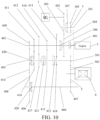
- FIG. 10 shows a hybrid power-driven system 100 according to a fifth example.
- a difference between the fifth example and the third example mainly lies in that the transmission mechanism 4 has another gear arrangement form.
- the transmission mechanism 4 further includes a reverse gear shaft 404, a reverse gear driven gear 406, a reverse gear middle gear 407, and a reverse gear shaft synchronizer 426.
- the reverse gear driven gear 406 is freely sleeved on the reverse gear shaft 404.
- the reverse gear middle gear 407 is fixed on the reverse gear shaft 404.
- the reverse gear middle gear 407 is meshed with the main reducer driven gear 502 of the main reducer 5.
- the reverse gear shaft synchronizer 426 is selectively joined to or disconnected from the reverse gear driven gear 406.
- One driven gear for forward gears is meshed with the reverse gear driven gear 406. That is, the first gear driven gear 414 is meshed with the reverse gear driven gear 406.
- a fifth gear synchronizer 422 is separately used for the fifth-gear gear. That is, a 1/3 gear synchronizer 420 located between the first gear driven gear 414 and the third gear driven gear 416, a 2/4 gear synchronizer 421 located between the second gear driven gear 415 and the fourth gear driven gear 417, and a fifth gear synchronizer 422 located on an axial side of the fifth gear driven gear 418 are disposed on the output shaft 403.
- the fifth gear synchronizer 422 is selectively joined to or disconnected from the fifth gear driven gear 418.
- the 1/3 gear synchronizer 420 is selectively joined to or disconnected from the first gear driven gear 414 and the third gear driven gear 416.
- the 2/4 gear synchronizer 421 is selectively joined to or disconnected from the second gear driven gear 415 and the fourth gear driven gear 417.
- the first gear driven gear is meshed with the reverse gear driven gear 406.
- the reverse gear middle gear 407 is meshed with the main reducer driven gear 502. This solution can reduce the quantity of gears and shorten the axial space.
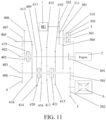
- FIG. 11 shows a hybrid power-driven system 100 according to a first embodiment of this invention.
- a difference between the first embodiment and the first example mainly lies in that the power distribution mechanism 3 of the motor 1 has another form.
- the motor driven gear 311 and the first gear 303 are respectively independently disposed.
- the first transmission apparatus includes a first gear 303 and an input gear 304.
- the motor driving gear 302 is fixed on the output shaft 101 of the motor 1.
- the motor driven gear 311 is fixed on the power distribution shaft 301.
- the first gear 303 and the second gear 305 are freely sleeved on the power distribution shaft 301.
- the input gear 304 is fixed on the input shaft 402.
- the first gear 303 is meshed with the input gear 304.
- the second transmission apparatus includes a second gear 305.
- the second gear 305 is freely sleeved on the power distribution shaft 301.
- the second gear 305 is meshed with the main reducer driven gear 502.
- the mode selection apparatus includes a first/second mode synchronizer 310 disposed on the power distribution shaft 301.
- the first/second mode synchronizer 310 is located between the first gear 303 and the second gear 305.
- the first/second mode synchronizer 310 is selectively joined to or disconnected from the first gear 303 and the second gear 305.
- the hybrid power-driven system 100 is switched to the first mode.
- the hybrid power-driven system 100 is switched to a second mode.
- the first mode synchronizer 306 and the second mode synchronizer 307 are combined into one synchronizer, to reduce the use of synchronizers, thereby reducing the system costs and control difficulty.
- FIG. 12 to FIG. 14 show a hybrid power-driven system 100 according to a sixth example.
- a difference between the sixth example and the first example mainly lies in that the transmission mechanism 4 has another gear arrangement form.
- the hybrid power-driven system 100 includes an engine 2, a transmission, and a motor power apparatus.
- the transmission includes a transmission mechanism 4 and a main reducer 5.
- the motor power apparatus includes a motor 1 and a power distribution mechanism 3.
- the main reducer 5 includes a main reducer driving gear 501 and a main reducer driven gear 502 that are meshed with each other.
- the main reducer driving gear 501 is fixed on the output shaft 403.
- the main reducer driven gear 502 is integrated on a housing of a differential 6.
- the transmission mechanism 4 includes a clutch apparatus 401, an input shaft 402, an output shaft 403, a reverse gear shaft 404, a reverse gear driven gear 406, a first middle gear 425, a reverse gear shaft synchronizer 426, and a second middle gear 427.
- the first middle gear 425 is meshed with one driving gear for forward gears.
- the reverse gear driven gear 406 is meshed with another driving gear for forward gears.
- the second middle gear 427 is meshed with one driven gear for forward gears.
- the reverse gear shaft synchronizer 426 is disposed on the reverse gear shaft 404 and is located between the first middle gear 425 and the second middle gear 427.
- the reverse gear shaft synchronizer 426 is selectively joined to or disconnected from the first middle gear 425 and the second middle gear 427.
- An input end of the clutch apparatus 401 is connected to a crankshaft of the engine 2.
- An output end of the clutch apparatus 401 is connected to the input shaft 402.
- the clutch apparatus 401 is selectively joined or disconnected to control power transmission and interruption between the engine 2 and the transmission mechanism 4.
- the output shaft 403 is connected to the main reducer 5 to transmit power.
- Five driving gears for forward gears and four driven gears for forward gears that is, a first gear driving gear 409, a second gear driving gear 410, a third gear driving gear 411, a fourth gear driving gear 412, a fifth gear driving gear 413, a second gear driven gear 415, a third gear driven gear 416, a fourth gear driven gear 417, and a fifth gear driven gear 418, are disposed on the transmission mechanism 4.
- the first gear driving gear 409 is fixed on the input shaft 402.
- the second gear driving gear 410, the third gear driving gear 411, the fourth gear driving gear 412, and the fifth gear driving gear 413 are freely sleeved on the input shaft 402.
- the second gear driven gear 415, the third gear driven gear 416, the fourth gear driven gear 417, and the fifth gear driven gear 418 are fixed on the output shaft 403.
- the second gear driving gear 410 is meshed with the second gear driven gear 415.
- the third gear driving gear 411 is meshed with the third gear driven gear 416.
- the fourth gear driving gear 412 is meshed with the fourth gear driven gear 417.
- the fifth gear driving gear 413 is meshed with the fifth gear driven gear 418.
- the first middle gear 425 is meshed with the fifth gear driving gear 413.
- the second middle gear 427 is meshed with the second gear driven gear 415.
- the reverse gear driven gear 406 is meshed with the first gear driving gear 409.
- a 3/5 gear synchronizer 429 located between the third gear driving gear 411 and the fifth gear driving gear 413 and a 2/4 gear synchronizer 421 located between the second gear driving gear 410 and the fourth gear driving gear 412 are disposed on the input shaft 402.
- the 3/5 gear synchronizer 429 is selectively joined to or disconnected from the third gear driving gear 411 and the fifth gear driving gear 413.
- the 2/4 gear synchronizer 421 is selectively joined to or disconnected from the second gear driving gear 410 and the fourth gear driving gear 412.
- the power distribution mechanism 3 includes a power distribution shaft 301, a mode selection apparatus, a first transmission apparatus, and a second transmission apparatus.
- the power distribution shaft 301 is disposed independently from the transmission mechanism 4.
- the power distribution shaft 301 is disposed independently from the motor 1.
- a motor driven gear configured to receive the power of the motor 1 is disposed on the power distribution shaft 301.
- the first transmission apparatus is connected between the power distribution shaft 301 and the input shaft 402 of the transmission mechanism, and is configured to perform power transmission between the power distribution shaft 301 and the input shaft 402 of the transmission mechanism.
- the first transmission apparatus includes a first gear 303 and an input gear 304.
- the first gear 303 is freely sleeved on the power distribution shaft 301.
- the input gear 304 is freely sleeved on the input shaft 402 of the transmission mechanism 4.
- the input gear 304 is directly meshed with the first gear 303.
- the second transmission apparatus is connected between the main reducer driven gear 502 and the power distribution shaft 301, and is configured to perform power transmission between the main reducer driven gear 502 and the power distribution shaft 301.
- the second transmission apparatus includes a second gear 305.
- the second gear 305 is fixed on the power distribution shaft 301.
- the first gear 303 and the second gear 305 are coaxially disposed.
- the second gear 305 and the main reducer driven gear 502 of the main reducer 5 are directly meshed.
- the motor driven gear and the first gear 303 are the same gear. That is, the first gear 303 is at the same time used as a motor driven gear.
- the power distribution mechanism 3 further includes a motor driving gear 302 fixed on the output shaft 101 of the motor 1.
- the first gear 303 is directly meshed with the motor driving gear 302.
- the mode selection apparatus selectively connects the motor 1 and the input shaft 402 of the transmission mechanism 4 or the motor 1 and the main reducer 5.
- the mode selection apparatus includes a first mode synchronizer 306 disposed on the input shaft 402 of the transmission mechanism 4 and a second mode synchronizer 307 disposed on the power distribution shaft 301.
- the first mode synchronizer 306 is selectively joined to or disconnected from the input gear 304.
- the second mode synchronizer 307 is selectively joined to or disconnected from the first gear 303.
- the first mode synchronizer 306 is independently disposed.
- the hybrid power-driven system 100 is switched to the first mode.
- the hybrid power-driven system 100 is switched to a second mode.
- the first gear driving gear 409, the input gear 304, the second gear driving gear 410, the fourth gear driving gear 412, the third gear driving gear 411, and the fifth gear driving gear 413 are sequentially arranged along an axis of the input shaft 402 in a direction away from the engine 2.
- the main reducer driving gear 501, the second gear driven gear 415, the fourth gear driven gear 417, the third gear driven gear 416, and the fifth gear driven gear 418 are sequentially arranged along an axis of the input shaft 402 in a direction away from the engine 2.
- the reverse gear driven gear 406, the second middle gear 427, and the first middle gear 425 are sequentially arranged along an axis of the reverse gear shaft 404 in a direction of away from the engine 2.
- a power transfer path of the first gear is: the input shaft 402, the first gear driving gear 409, the reverse gear driven gear 406, the reverse gear shaft 404, the first middle gear 425, the fifth gear driving gear 413, the fifth gear driven gear 418, the output shaft 403, the main reducer driving gear 501, and the main reducer driven gear 502.
- a power transfer path of the reverse gear is: the input shaft 402, the first gear driving gear 409, the reverse gear driven gear 406, the reverse gear shaft 404, the second middle gear 427, the second gear driven gear 415, the output shaft 403, the main reducer driving gear 501, and the main reducer driven gear 502.
- the reverse gear driving gear 405 and the first gear driven gear 414 are omitted.
- the reverse gear shaft 404 is designed to implement the first gear function and the reverse gear function, so that the axial length of the transmission mechanism 4 can be shortened, thereby reducing the spatial size of the system, to better facilitate the spatial arrangement of the entire vehicle.
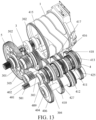
- FIG. 13 is a perspective view of a three-dimensional model in FIG. 12 . It may be learned that the power distribution shaft 301 is relatively short, so that a compact arrangement of the power distribution shaft 301 and the motor 1 can be implemented, and the power distribution shaft can further be flexibly arranged according to different vehicle body platforms and different spaces.
- the reverse gear shaft 404 and the output shaft 101 of the motor 1 are located on two sides of the plane formed by the axis of the input shaft 102 and the axis of the output shaft 403. In this way, the motor 1 does not interfere with gears on the reverse gear shaft 404 and the reverse gear shaft 404.
- the output shaft 101 of the motor 1 and the power distribution shaft 301 are located on the same side of the plane formed by the axis of the input shaft 102 and the axis of the output shaft 403.
- the crankshaft of the engine 2 and the input shaft 402 are coaxially arranged. As shown in FIG.
- the output shaft 101 of the motor 1, the power distribution shaft 301, and an axis of the main reducer 5 are spatially arranged in a triangle. That is, the output shaft 101 of the motor 1, the power distribution shaft 301, and the radial center of the main reducer 5 are arranged at a particular angle, but are not distributed on the same straight line, which is beneficial to reduce the height of the system, to further reduce the size of the system, making the system more spatially compact.
- FIG. 15 shows a hybrid power-driven system 100 according to an seventh example.
- a difference between the seventh example and the first example mainly lies in that the transmission mechanism 4 has another gear arrangement form.
- the hybrid power-driven system 100 includes an engine 2, a transmission, and a motor power apparatus.
- the transmission includes a transmission mechanism 4 and a main reducer 5.
- the motor power apparatus includes a motor 1 and a power distribution mechanism 3.
- the main reducer 5 includes a main reducer driving gear 501 and a main reducer driven gear 502 that are meshed with each other.
- the main reducer driving gear 501 is fixed on the output shaft 403.
- the main reducer driven gear 502 is integrated on a housing of a differential 6.
- the transmission mechanism 4 includes a clutch apparatus 401, an input shaft 402, and an output shaft 403.
- Five driving gears for forward gears that is, a first gear driving gear 409, a second gear driving gear 410, a third gear driving gear 411, a fourth gear driving gear 412, and a fifth gear driving gear 413, are disposed on the input shaft 402.
- Five driven gears for forward gears that is, a first gear driven gear 414, a second gear driven gear 415, a third gear driven gear 416, a fourth gear driven gear 417, and a fifth gear driven gear 418, that are correspondingly meshed with the driving gears for forward gears, are disposed on the output shaft 403.
- An input end of the clutch apparatus 401 is connected to a crankshaft of the engine 2.
- An output end of the clutch apparatus 401 is connected to the input shaft 402.
- the clutch apparatus 401 is selectively joined or disconnected to control power transmission and interruption between the engine 2 and the transmission mechanism 4.
- the output shaft 403 is connected to the main reducer 5 to transmit power.
- the power distribution mechanism 3 includes a power distribution shaft 301, a mode selection apparatus, a first transmission apparatus, and a second transmission apparatus.
- the power distribution shaft 301 is disposed independently from the transmission mechanism 4.
- the power distribution shaft 301 is disposed independently from the motor 1.
- a motor driven gear configured to receive the power of the motor 1 is disposed on the power distribution shaft 301.
- the first transmission apparatus is connected between the power distribution shaft 301 and the input shaft 402 of the transmission mechanism, and is configured to perform power transmission between the power distribution shaft 301 and the input shaft 402 of the transmission mechanism.
- the first transmission apparatus includes a first gear 303 and an input gear 304.
- the first gear 303 is freely sleeved on the power distribution shaft 301.
- the input gear 304 is freely sleeved on the input shaft 402 of the transmission mechanism 4.
- the input gear 304 is directly meshed with the first gear 303.
- the second transmission apparatus is connected between the main reducer driven gear 502 and the power distribution shaft 301, and is configured to perform power transmission between the main reducer driven gear 502 and the power distribution shaft 301.
- the second transmission apparatus includes a second gear 305.
- the second gear 305 is fixed on the power distribution shaft 301.
- the first gear 303 and the second gear 305 are coaxially disposed.
- the second gear 305 and the main reducer driven gear 502 of the main reducer 5 are directly meshed.
- the motor driven gear and the first gear 303 are the same gear. That is, the first gear 303 is at the same time used as a motor driven gear.
- the power distribution mechanism 3 further includes a motor driving gear 302 fixed on the output shaft 101 of the motor 1.
- the first gear 303 is directly meshed with the motor driving gear 302.
- the mode selection apparatus selectively connects the motor 1 and the input shaft 402 of the transmission mechanism 4 or the motor 1 and the main reducer 5.
- the mode selection apparatus includes a first mode synchronizer 306 disposed on the input shaft 402 of the transmission mechanism 4 and a second mode synchronizer 307 disposed on the power distribution shaft 301.
- the first mode synchronizer 306 and the gear position synchronizer (a fifth gear synchronizer) of the transmission mechanism are the same synchronizer.
- the first mode synchronizer 306 is disposed between the input gear 304 and the fifth gear driving gear 413.
- the first mode synchronizer 306 is selectively joined to or disconnected from the fifth gear driving gear 413 and the input gear 304.
- the second mode synchronizer 307 is selectively joined to or disconnected from the first gear 303.
- the axial size of the power distribution shaft 301 is shortened, to better facilitate the spatial arrangement of the motor 1, and also further simplify the structure and control method of the power distribution mechanism 3, thereby reducing the quantity of gears and further reducing the manufacturing costs of the system.
- the hybrid power-driven system 100 is switched to the first mode.
- the hybrid power-driven system 100 is switched to a second mode.
- the transmission mechanism 4 further includes a reverse gear shaft 404, a reverse gear driven gear 406, a reverse gear middle gear 407, and an output shaft middle gear 408.
- the output shaft middle gear 408 is freely sleeved on the output shaft 403.
- the reverse gear driven gear 406 and the reverse gear middle gear 407 are fixed on the reverse gear shaft 404.
- the input gear 304 is meshed with the reverse gear driven gear 406.
- the reverse gear middle gear 407 is meshed with the output shaft middle gear 408.
- the fifth gear driving gear 413 are freely sleeved on the input shaft 402.
- the first gear driving gear 409, the second gear driving gear 410, the third gear driving gear 411, and the fourth gear driving gear 412 are fixed on the input shaft 402.
- the first gear driven gear 414, the second gear driven gear 415, the third gear driven gear 416, and the fourth gear driven gear 417 are freely sleeved on the output shaft 403.
- the fifth gear driven gear 418 is fixed on the output shaft 403.
- the output shaft middle gear 408 is fixed on the output shaft 403.
- the first gear driving gear 409 is meshed with the first gear driven gear 414.
- the second gear driving gear 410 is meshed with the second gear driven gear 415.
- the third gear driving gear 411 is meshed with the third gear driven gear 416.
- the fourth gear driving gear 412 is meshed with the fourth gear driven gear 417.
- the fifth gear driving gear 413 is meshed with the fifth gear driven gear 418.
- a 1/3 gear synchronizer 420 located between the first gear driven gear 414 and the third gear driven gear 416, a 2/4 gear synchronizer 421 located between the second gear driven gear 415 and the fourth gear driven gear 417, and an R gear synchronizer 423 located on an axial side of the output shaft middle gear 408 are disposed on the output shaft 403.
- the R gear synchronizer 423 is selectively joined to or disconnected from the output shaft middle gear 408.
- the 1/3 gear synchronizer 420 is selectively joined to or disconnected from the first gear driven gear 414 and the third gear driven gear 416.
- the 2/4 gear synchronizer 421 is selectively joined to or disconnected from the second gear driven gear 415 and the fourth gear driven gear 417.
- the input gear 304, the fifth gear driving gear 413, the second gear driving gear 410, the fourth gear driving gear 412, the third gear driving gear 411, and the first gear driving gear 409 are sequentially arranged along an axis of the input shaft 402 in a direction away from the engine 2.
- the main reducer driving gear 501, the output shaft middle gear 408, the fifth gear driven gear 418, the second gear driven gear 415, the fourth gear driven gear 417, the third gear driven gear 416, and the first gear driven gear 414 are sequentially arranged along an axis of the output shaft 403 in a direction away from the engine 2.
- the axial length of the transmission mechanism 4 can be shortened, to better facilitate the spatial arrangement of the entire vehicle.
- FIG. 16 to FIG. 18 show a hybrid power-driven system 100 according to a eighth example.
- a difference between the eighth example and the seventh example mainly lies in that the transmission mechanism 4 has another gear arrangement form.
- the transmission mechanism further includes a reverse gear shaft 404, a reverse gear driven gear 406, a reverse gear middle gear 407, a reverse gear shaft synchronizer 426, and an output shaft middle gear 408.
- the output shaft middle gear 408 is disposed on the output shaft 403.
- the reverse gear driven gear 406 is freely sleeved on the reverse gear shaft 404.
- the reverse gear middle gear 407 is fixed on the reverse gear shaft 404.
- the input gear 304 is meshed with the reverse gear driven gear 406.
- the reverse gear middle gear 407 is meshed with the output shaft middle gear 408.
- the reverse gear shaft synchronizer 426 is selectively joined to or disconnected from the reverse gear driven gear 406.
- Another difference between the eighth example and the seventh example is that the positions of the fifth-gear gear set and the fourth-gear gear set are interchanged.
- the fourth gear driving gear 412 is freely sleeved on the input shaft 402.
- the first gear driving gear 409, the second gear driving gear 410, the third gear driving gear 411, and the fifth gear driving gear 413 are fixed on the input shaft 402.
- the first gear driven gear 414, the second gear driven gear 415, the third gear driven gear 416, and the fifth gear driven gear 418 are freely sleeved on the output shaft 403.
- the fourth gear driven gear 417 is fixed on the output shaft 403.
- the output shaft middle gear 408 is fixed on the output shaft 403.
- the first mode synchronizer 306 is disposed between the input gear 304 and the fourth gear driving gear 412.
- the first mode synchronizer 306 is selectively joined to or disconnected from the fourth gear driving gear 412 and the input gear 304.
- a 1/3 gear synchronizer 420 located between the first gear driven gear 409 and the third gear driven gear 416 and a 2/5 gear synchronizer 428 located between the second gear driven gear 415 and the fifth gear driven gear 418 are disposed on the output shaft 403.
- the 1/3 gear synchronizer is selectively joined to or disconnected from the first gear driven gear 409 and the third gear driven gear 416.
- the 2/5 gear synchronizer 428 is selectively joined to or disconnected from the second gear driven gear 415 and the fifth gear driven gear 418.
- FIG. 17 is a perspective view of a three-dimensional model in FIG. 16 . It may be learned that the power distribution shaft 301 is relatively short, so that a compact arrangement of the power distribution shaft 301 and the motor 1 can be implemented, and the power distribution shaft can further be flexibly arranged according to different vehicle body platforms and different spaces.
- the output shaft 101 of the motor 1, the power distribution shaft 301, and an axis of the main reducer 5 are spatially arranged in a triangle. That is, the output shaft 101 of the motor 1, the power distribution shaft 301, and the radial center of the main reducer 5 are arranged at a particular angle, but are not distributed on the same straight line, which is beneficial to reduce the height of the system, to further reduce the size of the system, making the system more spatially compact.
- the fifth gear driving gear 413 is disposed at a position that is not correlated to the first mode synchronizer 306.
- the axial length of the transmission mechanism 4 can be shortened, to better facilitate the spatial arrangement of the entire vehicle.
- FIG. 19 shows a hybrid power-driven system 100 according to a ninth example.
- a difference between the ninth example and the fifth example in FIG. 10 lies in that the fifth gear driving gear on the input shaft 402 of the transmission mechanism 4 is reused as the input gear 304. That is, the fifth gear driving gear and the input gear 304 are the same gear.
- a plurality of driving gears for forward gears include a first gear driving gear 409, a second gear driving gear 410, a third gear driving gear 411, and a fourth gear driving gear 412.
- a plurality of driven gears for forward gears include a first gear driven gear 414, a second gear driven gear 415, a third gear driven gear 416, a fourth gear driven gear 417, and a fifth gear driven gear 418.
- the first gear driving gear 409, the second gear driving gear 410, the third gear driving gear 411, and the fourth gear driving gear 412 are fixed on the input shaft 402.
- the first gear driven gear 414, the second gear driven gear 415, the third gear driven gear 416, the fourth gear driven gear 417, and the fifth gear driven gear 418 are freely sleeved on the output shaft 403.
- the first gear driving gear 409 is meshed with the first gear driven gear 414.
- the second gear driving gear 410 is meshed with the second gear driven gear 415.
- the third gear driving gear 411 is meshed with the third gear driven gear 416.
- the fourth gear driving gear 412 is meshed with the fourth gear driven gear 417.
- the input gear 304 is meshed with the fifth gear driven gear 418.
- the reverse gear driven gear 406 is meshed with the first gear driven gear 414.
- a 1/3 gear synchronizer 420 located between the first gear driven gear 414 and the third gear driven gear 416, a 2/4 gear synchronizer 421 located between the second gear driven gear 415 and the fourth gear driven gear 417, and a fifth gear synchronizer 422 located on an axial side of the fifth gear driven gear 418 are disposed on the output shaft 403.
- the fifth gear synchronizer 422 is selectively joined to or disconnected from the fifth gear driven gear 418.
- the 1/3 gear synchronizer 420 is selectively joined to or disconnected from the first gear driven gear 414 and the third gear driven gear 416.
- the 2/4 gear synchronizer 421 is selectively joined to or disconnected from the second gear driven gear 415 and the fourth gear driven gear 417.
- FIG. 20 shows a hybrid power-driven system 100 according to a tenth example.
- a difference between the tenth example and the eighth example in FIG. 16 lies in that the first gear 303 is fixed on the power distribution shaft 301, the second gear 305 is freely sleeved on the power distribution shaft 301, and the input gear 304 is freely sleeved on the input shaft 402 of the transmission mechanism.
- the first gear 303 and the motor driven gear are the same gear, and the same gear is disposed on the power distribution shaft 301.
- the first mode synchronizer 306 is selectively joined to or disconnected from the input gear 304.
- the second mode synchronizer 307 is selectively joined to or disconnected from the second gear 305.
- the hybrid power-driven system 100 is switched to the first mode.
- the hybrid power-driven system 100 is switched to a second mode.
- the hybrid power-driven system provided in the eleventh example includes an engine, a transmission, and a motor power apparatus.
- the transmission and the motor power apparatus are two independent modules.
- the motor power apparatus includes a motor and a power distribution mechanism.
- the power distribution mechanism includes a power distribution shaft, a mode selection apparatus, a first transmission apparatus, and a second transmission apparatus.
- the power distribution shaft is disposed independently from a transmission mechanism.
- the power distribution shaft is disposed independently from the motor.
- the hybrid power-driven system is selectively switched between a first mode and a second mode by using the mode selection apparatus.
- a motor driven gear configured to receive power of the motor is disposed on the power distribution shaft.
- the first transmission apparatus includes a first gear.
- the first gear is disposed on the power distribution shaft.
- the first gear is directly meshed with one gear position driving gear on the input shaft of the transmission.
- the second transmission apparatus includes a second gear.
- the second gear is disposed on the power distribution shaft.
- the first gear and the second gear are coaxially disposed.
- the second gear is directly meshed with a main reducer driven gear of the transmission.
- the mode selection apparatus selectively connects the motor and the input shaft of the transmission or the motor and a main reducer of the transmission.
- the transmission and the motor power apparatus are two independent modules, and the first gear is directly meshed with one gear position driving gear on the input shaft of the transmission.
- a motor power apparatus a motor and a power distribution mechanism
- the hybrid power-driven system is selectively switched between the first mode and the second mode by using the mode selection apparatus to implement a multi-mode output, so that the design costs are lower, the design cycle is shorter, and the reliability is higher.
- the engine and the motor are separately controlled, so that the control logic is simpler and clearer, and the compatibility is higher (compatible with transmissions of different models).
- the power of the motor 1 has a relatively high requirement, and the motor 1 that needs to be chosen has a relatively large size. Therefore, the motor 1 is connected to the power distribution shaft 301 by one-stage gear transmission (a motor driving gear and a motor driven gear).
- a small-scale motor is chosen, and an output shaft of the motor may be directly connected to the power distribution shaft. In this case, the first gear or the motor driven gear are not required.
- gear positions In the selection of gear positions, the applicant performs simulation analysis in aspects such as economy and dynamic performance on cases in which four gears, five gears, and six gears are used in the system.
- five gears are more economical than four gears by 2%
- six gears are more economical than four gears by 2%
- five gears are more economical than six gears by 0.1%.
- five gears are faster than four gears by 4.4%
- six gears are faster than four gears by 10.2%
- six gears are faster than five gears by 6.1%.
- HEV mode five gears are faster than four gears by 0.4%
- six gears are faster than four gears by 1.7%
- six gears are faster than five gears by 1.2%.
- the transmission mechanism 4 has five forward gears. That is, five gears are used for the transmission mechanism 4.
- Embodiments of this invention further provide a vehicle, including the hybrid power-driven system in the foregoing embodiments.
- a technical problem to be resolved by this invention is to provide a hybrid power-driven system and a vehicle, to resolve the contradiction between transmission efficiency and spatial arrangement.
- embodiments of this invention provide a hybrid power-driven system, including an engine, a transmission, and a motor power apparatus, the transmission including a transmission mechanism and a main reducer, the motor power apparatus including a motor and a power distribution mechanism, where
- the hybrid power-driven system is selectively switched between a first mode and a second mode by using the mode selection apparatus; and the mode selection apparatus is independently disposed at a position between the first gear and the second gear on the power distribution shaft, and the input gear is fixedly disposed on the input shaft of the transmission mechanism.
- the motor driven gear and the first gear are respectively independently disposed, or, the motor driven gear and the first gear are the same gear.
- the power distribution mechanism further includes a motor driving gear fixed on an output shaft of the motor, the motor driving gear is meshed with the motor driven gear, the motor driven gear is fixed on the power distribution shaft, the first gear and the second gear are freely sleeved on the power distribution shaft, and the input gear is fixed on the input shaft;
- the mode selection apparatus includes a first/second mode synchronizer disposed on the power distribution shaft, and the first/second mode synchronizer is selectively joined to or disconnected from the first gear and the second gear; when the first/second mode synchronizer is joined to the first gear, the hybrid power-driven system is switched to the first mode; and when the first/second mode synchronizer is joined to the second gear, the hybrid power-driven system is switched to a second mode.
- hybrid power-driven system and the vehicle in the embodiments of this invention further have the following advantages:
Landscapes
- Engineering & Computer Science (AREA)
- Chemical & Material Sciences (AREA)
- Combustion & Propulsion (AREA)
- Transportation (AREA)
- Mechanical Engineering (AREA)
- Structure Of Transmissions (AREA)
- Hybrid Electric Vehicles (AREA)
- Arrangement Of Transmissions (AREA)
Description
- This invention relates to the field of hybrid power technologies, and specifically, to a hybrid power-driven system and a vehicle.
- With constant consumption of energy, the development and utilization of new energy vehicles have gradually become a trend. As one of the new energy vehicles, hybrid vehicles driven by engines and/or motors have multiple modes and can improve transmission efficiency and the fuel economy.
- In addition, because a hybrid electric vehicle is provided with both an engine and a motor, the spatial arrangement becomes a design point of the hybrid electric vehicle. That is, how to resolve the contradiction between transmission efficiency and spatial arrangement becomes a problem that urgently needs to be resolved in the design of the hybrid electric vehicle.
-
CN 105459790 B refers to a power transmission system and a vehicle having the same.
WO 2016/112654 A1 relates to a transmission unit which includes: input shafts; output shafts configured to transmit with a corresponding input shaft via gears; a reverse output gear fitted over one output shaft; a reverse synchronizer; a reverse shaft configured to rotate together with a input shaft and a reverse output gear; a motor power shaft; a first and a second motor gears fitted over the motor power shaft; the second motor gear configured to rotate together with a shift driven gear; and a motor synchronizer. - A technical problem to be resolved by this invention is to provide a hybrid power-driven system and a vehicle, to resolve the contradiction between transmission efficiency and spatial arrangement.
- To resolve the foregoing technical problem, the invention provides a hybrid power-driven system including the features of
claim 1. In another aspect, the invention further provides a vehicle including the foregoing hybrid power-driven system. - The hybrid power-driven system includes an engine, a transmission, and a motor power apparatus, the transmission and the motor power apparatus being two independent modules, the motor power apparatus including a motor and a power distribution mechanism, where the power distribution mechanism includes a power distribution shaft, a mode selection apparatus, a first transmission apparatus, and a second transmission apparatus, the power distribution shaft is disposed independently from a transmission mechanism, the power distribution shaft is disposed independently from the motor, and the hybrid power-driven system is selectively switched between a first mode and a second mode by using the mode selection apparatus; a motor driven gear configured to receive power of the motor is disposed on the power distribution shaft; the first transmission apparatus includes a first gear, the first gear is disposed on the power distribution shaft, and the first gear is directly meshed with one gear position driving gear on an input shaft of the transmission; the second transmission apparatus includes a second gear, the second gear is disposed on the power distribution shaft, the first gear and the second gear are coaxially disposed, and the second gear is directly meshed with a main reducer driven gear of the transmission; and the mode selection apparatus selectively connects the motor and the input shaft of the transmission or the motor and a main reducer of the transmission.
- For the hybrid power-driven system and the vehicle, a mode selection apparatus selectively connects a motor and an input shaft of a transmission mechanism or a motor and a main reducer, to enable the motor of the hybrid power-driven system to be switched between two modes. A power distribution shaft is disposed independently from the transmission mechanism, and the power distribution shaft is disposed independently from the motor. The independently disposed power distribution shaft appropriately utilizes a radial space of the system. It is not necessary to make a significant change to a transmission mechanism of an original engine. A power distribution mechanism may independently transmit power of the motor to a wheel end (the main reducer) without passing through a transmission path of the transmission mechanism (that is, it is not necessary to depend on the input shaft and an output shaft of the transmission mechanism). Transmission paths of a motor end transmission part and a conventional transmission mechanism part have a relatively low degree of overlap (or do not overlap), thereby shortening transmission paths during driving and power generation of the motor. In this way, the control of the system is simpler and more efficient, and efficient transmission of the motor is ensured, thereby resolving the contradiction between transmission efficiency and spatial arrangement to a particular degree. Both the transmission between the power distribution mechanism and the input shaft of the transmission mechanism and the transmission between the power distribution mechanism and a main reducer driven gear of the main reducer are direct transmission, so that while the hybrid power-driven system implements switching between two modes, a transmission path is minimized, thereby greatly improving the transmission efficiency of the system. The hybrid power-driven system may be applied to hybrid electric technologies such as dual-clutch and AMT.
- In addition, the hybrid power-driven system and the vehicle further have the following advantages:
- (1) For a motor size under a conventional power requirement condition in the industry, a motor and an input gear cannot be directly meshed, an idler gear needs to be added to reserve a mounting space for the motor. In this hybrid power-driven system, a motor driven gear configured to receive power of the motor is disposed on a power distribution shaft, so that the problem of controlling and mounting the motor is resolved, high efficiency of transmission is further ensured, and in addition an axial space for an input shaft or an output shaft of a transmission mechanism is further reduced.
- (2) The power distribution shaft shares a power torque of a second mode of the system, to implement power split of an engine and a motor. The power distribution shaft is used to directly split the power of the motor into an input shaft and a main reducer driven gear on a differential. Compared with a solution of outputting power from an output shaft, a strength requirement (for example, a shaft diameter) of an output shaft is reduced, and in addition a strength requirement (for example, the diameter and thickness of a gear) of a main reducer driving gear is reduced. The power distribution shaft is used to share the power torque of the second mode, so that the system has advantages such as low costs, a small volume, a light weight, a long service life, and adequate overall vehicle performance.
- (3) The power distribution shaft may be relatively short, so that a compact arrangement of the power distribution shaft and the motor can be implemented, and the power distribution shaft can further be flexibly arranged according to different vehicle body platforms and different spaces.
- (4) The independently disposed power distribution shaft appropriately utilizes a radial space of the system, switching between two modes can be implemented without using an input shaft or an output shaft, and in addition efficient transmission of the motor is ensured. Aspects and advantages of this invention will be given in the following description, some of which will become apparent from the following description or may be learned from practices of this invention.
- The foregoing and/or additional aspects and advantages of this invention will become apparent and comprehensible in the description made with reference to the following accompanying drawings, where:
-
FIG. 1 is an architectural diagram of a hybrid power-driven system according to an example, which is not part of this invention; -
FIG. 2 is a brief structural diagram of a hybrid power-driven system according to an example, which is not part of this invention; -
FIG. 3 is a perspective view of a three-dimensional model inFIG. 2 ; -
FIG. 4 is a brief structural diagram of a hybrid power-driven system according to a first example, which is not part of this invention; -
FIG. 5 is a perspective view of a three-dimensional model of the hybrid power-driven system according to the first example; -
FIG. 6 is a side view of a three-dimensional model of the hybrid power-driven system according to the first example; -
FIG. 7 is a brief structural diagram of a hybrid power-driven system according to a second example, which is not part of this invention; -
FIG. 8 is a brief structural diagram of a hybrid power-driven system according to a third example, which is not part of this invention; -
FIG. 9 is a brief structural diagram of a hybrid power-driven system according to a fourth example, which is not part of this invention; -
FIG. 10 is a brief structural diagram of a hybrid power-driven system according to a fifth example, which is not part of this invention; -
FIG. 11 is a brief structural diagram of a hybrid power-driven system according to an embodiment of this invention; -
FIG. 12 is a brief structural diagram of a hybrid power-driven system according to a sixth example, which is not part of this invention; -
FIG. 13 is a perspective view of a three-dimensional model of the hybrid power-driven system according to the sixth example, which is not part of this invention; -
FIG. 14 is a side view of a three-dimensional model of the hybrid power-driven system according to the sixth example; -
FIG. 15 is a brief structural diagram of a hybrid power-driven system according to a seventh example, which is not part of this invention; -
FIG. 16 is a brief structural diagram of a hybrid power-driven system according to a eighth example, which is not part of this invention; -
FIG. 17 is a perspective view of a three-dimensional model of the hybrid power-driven system according to the eighth example; -
FIG. 18 is a side view of a three-dimensional model of the hybrid power-driven system according to the eighth example; -
FIG. 19 is a brief structural diagram of a hybrid power-driven system according to ninth example, which is not part of this invention; -
FIG. 20 is a brief structural diagram of a hybrid power-driven system according to a tenth example, which is not part of this invention; and -
FIG. 21 is an architectural diagram of a vehicle according to further example. -
- 1000, vehicle;
- 100, hybrid power-driven system;
- 1, motor; 101, output shaft of the motor;
- 2, engine;
- 3, power distribution mechanism; 301, power distribution shaft; 302, motor driving gear; 303, first gear; 304, input gear; 305, second gear; 306, first mode synchronizer; 307, second mode synchronizer; 308, idler gear; 309, idler gear shaft; 310, first/second mode synchronizer; 311, motor driven gear;
- 4, transmission mechanism; 401, clutch apparatus; 402, input shaft; 403, output shaft; 404, reverse gear shaft; 405, reverse gear driving gear; 406, reverse gear driven gear; 407, reverse gear middle gear; 408, output shaft middle gear; 409, first gear driving gear; 410, second gear driving gear; 411, third gear driving gear; 412, fourth gear driving gear; 413, fifth gear driving gear; 414, first gear driven gear; 415, second gear driven gear; 416, third gear driven gear; 417, fourth gear driven gear; 418, fifth gear driven gear; 419, 5/R gear synchronizer; 420, 1/3 gear synchronizer; 421, 2/4 gear synchronizer; 422, fifth gear synchronizer; 423, R gear synchronizer; 425, first middle gear; 426, reverse gear shaft synchronizer; 427, second middle gear; 428, 2/5 gear synchronizer; 429, 3/5 gear synchronizer;
- 5, main reducer; 501, main reducer driving gear; 502, main reducer driven gear; and
- 6, differential.
- In this invention, a first mode is that power of a motor is inputted to an input end of a transmission, and a second mode is that the power of the motor is inputted to an output end of the transmission.
- In a hybrid power-driven system, in one manner, a motor is disposed between a clutch and a transmission. In this way, an axial size is increased, making the spatial arrangement of an assembly more difficult. In another manner, the clutch and the motor are integrated. In this way, the problem of an excessively large axial size can be resolved. However, in this case, a relatively high requirement is imposed on an integration process, leading to increased technical difficulty and higher processing costs.
- In addition, power of the motor and an engine is transferred and outputted through the clutch, and the use load of the clutch is inevitably increased. In addition, during hybrid drive, restricted by the maximum input torque limitation of the clutch, the coupling torque between the engine and the motor needs to be limited, resulting in reduced power performance of a vehicle.
- In the hybrid power-driven system, the motor is disposed on an output shaft of the transmission, wheels may be driven by using an independent pure electric path, and power of the motor does not pass through the clutch and is not limited by the input torque of the clutch. When power for driving a gear shift engine is disconnected, it may be implemented that the power of the motor is used to compensate for the power of the engine lost during gear shifting to continue to drive wheels, to keep smooth driving of the vehicle. However, due to the impact of spatial factors, to avoid parts such as a reverse gear shaft and the output shaft of the transmission, it is usually designed in a hybrid power transmission that a motor is connected to the transmission by an idler gear mechanism. In this way, with the presence of an idler gear, the transmission occupies a larger space, which adversely affects the spatial arrangement and lightweight of the entire vehicle. In addition, a transfer path from a motor end to a wheel end becomes longer, and as a result the transfer efficiency is reduced. In addition, power decoupling cannot be implemented between the motor and a main reducer. When the vehicle is stationary, the motor cannot operate. The vehicle cannot generate power during stop and wait, resulting in reduced and unbalanced battery power.
- Therefore, the system is selectively switched between two operation modes, namely, a first mode and a second mode, so that different operation modes may be selected according to different requirement objectives, to provide the system with the characteristics of both the first mode and the second mode.
- For example, in a hybrid power-driven system, a motor driving gear is coupled to a fifth gear driving gear by an idler gear. A first mode synchronizer is disposed on a first shaft, and a second mode synchronizer is disposed on a second shaft, to enable a vehicle to implement switching between the first mode and the second mode. However, the motor driving gear is coupled to the fifth gear driving gear by the idler gear. During operation in both the first mode and the second mode, a transmission path from the motor to a wheel end is relatively long. As a result, the transmission efficiency is relatively low during the driving of the motor. The motor driving gear is coupled to the fifth gear driving gear by the idler gear. During the output of the motor, the transmission path and an engine share speed ratios of a gear position gear, leading to difficulty in the speed ratio matching and gear design of gears of the motor end in the first mode, the second mode, and a power generation mode. Further, for driving in both the first mode and the second mode, the motor performs power transfer by using a fifth-gear gear of the transmission and the output shaft of the transmission. In consideration of the fifth-gear gear of an engine end and the utilization of the output shaft, the payload on the fifth-gear gear and the output shaft is greatly increased. As a result, higher requirements are imposed on the strength and service life of the fifth-gear gear and the output shaft, and processing costs are increased. In addition, the motor driving gear is coupled to the fifth gear driving gear by the idler gear, the motor end and the engine end share the same output shaft and output gear, the first mode synchronizer is disposed on the first shaft, and the second mode synchronizer is disposed on the second shaft, resulting in a relatively high degree of overlap between transmission paths of a motor end transmission part and a conventional transmission part. The two transmission parts cannot be independent of each other and affect each other. For example, when a user selects the second mode for hybrid power acceleration, during switching from the hybrid power fourth gear to a hybrid power fifth gear, the user cannot switch to the hybrid power fifth gear of the second mode. Instead, the user first needs to choose to switch to the first mode, to implement the hybrid power fifth gear. Further, when the battery power is slightly low for EV high-speed driving in the second mode and the user intends to switch to the hybrid electric fifth gear, the user also needs to first switch to the first mode, to implement switching to the hybrid power fifth gear for output. As a result, the control strategy of the system becomes complex and more difficult.
- In addition, in the hybrid power-driven system, the motor end and the engine end share the same output shaft and output gear. The power torque of the output shaft has a high load, the output shaft needs to have higher strength, the service life of the output shaft is affected, the shaft diameter of the output shaft needs to be larger, the diameter and thickness of an output gear need to be larger, system costs are relatively high, the volume is relatively large, the weight is relatively heavy, and the overall vehicle performance is affected.
- As shown in
FIG. 1 andFIG. 2 , a hybrid power-drivensystem 100 according to an example includes anengine 2, a transmission, and a motor power apparatus. The transmission includes atransmission mechanism 4 and amain reducer 5. The motor power apparatus includes amotor 1 and apower distribution mechanism 3. - The
transmission mechanism 4 includes aclutch apparatus 401, at least oneinput shaft 402, and at least oneoutput shaft 403. At least one driving gear for forward gears is disposed on theinput shaft 402. At least one driven gear for forward gears correspondingly meshed with the driving gear for forward gears is disposed on theoutput shaft 403. An input end of theclutch apparatus 401 is connected to a crankshaft of theengine 2. An output end of theclutch apparatus 401 is connected to theinput shaft 402. Theclutch apparatus 401 is selectively joined or disconnected to control power transmission and interruption between theengine 2 and thetransmission mechanism 4. Theoutput shaft 403 is connected to the main reducer to transmit power. Thepower distribution mechanism 3 receives power of themotor 1 and selectively performs direct transmission with theinput shaft 402 of thetransmission mechanism 4 or performs direct transmission with a main reducer drivengear 502 of themain reducer 5. - The
clutch apparatus 401 is a single clutch, a dual clutch or another appropriate clutch, for example, a dry clutch or a wet clutch. A part such as a single-mass flywheel, a dual-mass flywheel or a torsional absorber may be disposed between theclutch apparatus 401 and the crankshaft of theengine 2. - The
main reducer 5 includes a mainreducer driving gear 501 and a main reducer drivengear 502 that are meshed with each other. The mainreducer driving gear 501 is fixed on theoutput shaft 403. The main reducer drivengear 502 is integrated on a housing of a differential 6. - Herein, the "direct transmission" means that the
power distribution mechanism 3 is directly coupled to theinput shaft 402 or the main reducer drivengear 502 of themain reducer 5 to perform transmission without passing through any middle transmission part such as an idler gear apparatus, a middle shaft, or a middle gear. The advantage of direct transmission lies in that the middle transmission part is omitted, thereby reducing the loss of energy during transmission. - A manner of direct transmission between the
power distribution mechanism 3 and theinput shaft 402 of thetransmission mechanism 4 includes a direct transmission manner such as a gear pair, a belt or a chain without using another middle transmission part. If the gear pair is used to perform direct transmission, one gear of the gear pair is located on thepower distribution mechanism 3, and the other gear (aninput gear 304 hereinafter) is located on theinput shaft 402. A gear on theinput shaft 402 may be an independently disposed gear or may be a gear position driving gear or a reverse gear driving gear on theinput shaft 402. If a belt is used for direct transmission, one belt pulley is located on thepower distribution mechanism 3, and the other belt pulley is located on theinput shaft 402. If a chain is used for direct transmission, one sprocket is located on thepower distribution mechanism 3, and the other sprocket is located on theinput shaft 402. - Similarly, a manner of direct transmission between the
power distribution mechanism 3 and the main reducer is a gear pair direct transmission manner without passing through another middle transmission part. One gear of the gear pair is located on thepower distribution mechanism 3, and the other gear (the main reducer driven gear 502) is disposed on themain reducer 5. - As shown in
FIG. 2 , thepower distribution mechanism 3 includes apower distribution shaft 301, a mode selection apparatus, a first transmission apparatus, and a second transmission apparatus. Thepower distribution shaft 301 is disposed independently from thetransmission mechanism 4, and thepower distribution shaft 301 is disposed independently from themotor 1. A motor drivengear 311 configured to receive the power of themotor 1 is disposed on thepower distribution shaft 301. The first transmission apparatus includes afirst gear 303 and aninput gear 304. Thefirst gear 303 is disposed on thepower distribution shaft 301. Theinput gear 304 is disposed on theinput shaft 402 of thetransmission mechanism 4. Theinput gear 304 is directly meshed with thefirst gear 303. The second transmission apparatus includes asecond gear 305. Thesecond gear 305 is disposed on thepower distribution shaft 301. Thefirst gear 303 and thesecond gear 305 are coaxially disposed. Thesecond gear 305 and the main reducer drivengear 502 of themain reducer 5 are directly meshed. - The mode selection apparatus selectively connects the
motor 1 and theinput shaft 402 of thetransmission mechanism 4 or themotor 1 and themain reducer 5. In this way, the hybrid power-driven system is selectively switched between the first mode and the second mode by using the mode selection apparatus. - When the hybrid power-driven system is switched to the first mode by using the mode selection apparatus, the power distribution mechanism receives power of the motor and directly transfers the power of the motor to the input shaft of the transmission mechanism by using the first gear and the input gear. When the hybrid power-driven system is switched to the second mode by using the mode selection apparatus, the power distribution mechanism receives the power of the motor and directly transfers the power of the motor to the main reducer driven gear by using the power distribution shaft and the second gear.
-
FIG. 3 is a perspective view of a three-dimensional model inFIG. 2 . It may be learned that thepower distribution shaft 301 is relatively short, so that a compact arrangement of thepower distribution shaft 301 and themotor 1 can be implemented, and the power distribution shaft can further be flexibly arranged according to different vehicle body platforms and different spaces. - In some embodiments, one of the gear driving gears on the input shaft of the transmission mechanism is multiplexed as the input gear. In this way, the axial space of the transmission mechanism can be shortened, to reduce the quantity of gears, to indirectly reduce the weight and reduce costs.
- In some embodiments, the input gear is independently disposed on the input shaft of the transmission mechanism. Compared with that one gear driving gear on the input shaft of the transmission mechanism is multiplexed as the input gear, the control strategy is simpler, the service life and strength of the gear position gear needs to be lower, and processing costs are reduced.
- In some embodiments, the mode selection apparatus is independently disposed at a position between the first gear and the second gear on the power distribution shaft, and the input gear is fixedly disposed on the input shaft of the transmission mechanism. In this way, the system costs can be reduced, and the process of manufacturing a mode selection apparatus is simplified.
- In some embodiments, the mode selection apparatus includes two parts, a first part is disposed on the power distribution shaft, a second part is independently disposed on an input gear of the input shaft of the transmission mechanism, and the input gear is freely sleeved on the input shaft of the transmission mechanism. In this way, the axial space of the power distribution shaft can be shortened, to reserve the space for arranging the motor.
- In some embodiments, the mode selection apparatus includes two parts, a first part is disposed on the power distribution shaft, a second part and a gear position synchronizer of the transmission mechanism are the same part, and the input gear is freely sleeved on the input shaft of the transmission mechanism. The second part and the gear position synchronizer of the transmission mechanism are the same part, so that the axial space of the input shaft can be shortened, and one gear position synchronizer is omitted.
- In some embodiments, the motor driven gear and the first gear are respectively independently disposed. In this way, it is easier to implement speed ratio matching between an engine and a motor.
- In some embodiments, the motor driven gear and the first gear are the same gear. As shown in
FIG. 5 , the motor driven gear and the first gear are the same gear, so that the length of the power distribution shaft can be reduced, and the axial space of the power distribution shaft is saved, to reserve the space for arranging the motor. - In addition, the hybrid power-driven system and the vehicle in the embodiments of this invention further have the following advantages:
- (1) For a motor size under a conventional power requirement condition in the industry, a motor and an input gear cannot be directly meshed, an idler gear needs to be added to reserve a mounting space for the motor. In this invention, a motor driven gear configured to receive power of the motor is disposed on a power distribution shaft, so that the problem of controlling and mounting the motor is resolved, high efficiency of transmission is further ensured, and in addition an axial space for an input shaft or an output shaft of a transmission mechanism is further reduced.
- (2) The power distribution shaft shares a power torque of a second mode of the system, to implement power split of an engine and a motor. The power distribution shaft is used to directly split the power of the motor into an input shaft and a main reducer driven gear on a differential. Compared with a solution of outputting power from an output shaft, a strength requirement (for example, a shaft diameter) of an output shaft is reduced, and in addition a strength requirement (for example, the diameter and thickness of a gear) of a main reducer driving gear is reduced. The power distribution shaft is used to share the power torque of the second mode, so that the system has advantages such as low costs, a small volume, a light weight, a long service life, and adequate overall vehicle performance.
- (3) The power distribution shaft may be relatively short, so that a compact arrangement of the power distribution shaft and the motor can be implemented, and the power distribution shaft can further be flexibly arranged according to different vehicle body platforms and different spaces.
- (4) The independently disposed power distribution shaft appropriately utilizes a radial space of the system, switching between two modes can be implemented without using an input shaft or an output shaft, and in addition efficient transmission of the motor is ensured.
- As shown in
FIG. 4 to FIG. 6 , a hybrid power-drivensystem 100 according to a first example includes anengine 2, a transmission, and a motor power apparatus. The transmission includes atransmission mechanism 4 and amain reducer 5. The motor power apparatus includes amotor 1 and apower distribution mechanism 3. - The
main reducer 5 includes a mainreducer driving gear 501 and a main reducer drivengear 502 that are meshed with each other. The mainreducer driving gear 501 is fixed on theoutput shaft 403. The main reducer drivengear 502 is integrated on a housing of a differential 6. - In the first example, the
transmission mechanism 4 is a transmission mechanism of an AMT type. - The
transmission mechanism 4 includes aclutch apparatus 401, aninput shaft 402, and anoutput shaft 403. Five driving gears for forward gears, that is, a firstgear driving gear 409, a secondgear driving gear 410, a thirdgear driving gear 411, a fourthgear driving gear 412, and a fifthgear driving gear 413, are disposed on theinput shaft 402. Five driven gears for forward gears, that is, a first gear drivengear 414, a second gear drivengear 415, a third gear drivengear 416, a fourth gear drivengear 417, and a fifth gear drivengear 418, that are correspondingly meshed with the driving gear for forward gears, are disposed on theoutput shaft 403. An input end of theclutch apparatus 401 is connected to a crankshaft of theengine 2. An output end of theclutch apparatus 401 is connected to theinput shaft 402. Theclutch apparatus 401 is selectively joined or disconnected to control power transmission and interruption between theengine 2 and thetransmission mechanism 4. Theoutput shaft 403 is connected to themain reducer 5 to transmit power. - The
power distribution mechanism 3 includes apower distribution shaft 301, a mode selection apparatus, a first transmission apparatus, and a second transmission apparatus. Thepower distribution shaft 301 is disposed independently from thetransmission mechanism 4. Thepower distribution shaft 301 is disposed independently from themotor 1. A motor driven gear configured to receive the power of themotor 1 is disposed on thepower distribution shaft 301. - The first transmission apparatus is connected between the
power distribution shaft 301 and theinput shaft 402 of the transmission mechanism, and is configured to perform power transmission between thepower distribution shaft 301 and theinput shaft 402 of the transmission mechanism. The first transmission apparatus includes afirst gear 303 and aninput gear 304. Thefirst gear 303 is freely sleeved on thepower distribution shaft 301. Theinput gear 304 is freely sleeved on theinput shaft 402 of thetransmission mechanism 4. Theinput gear 304 is directly meshed with thefirst gear 303. - The second transmission apparatus is connected between the main reducer driven
gear 502 and thepower distribution shaft 301, and is configured to perform power transmission between the main reducer drivengear 502 and thepower distribution shaft 301. The second transmission apparatus includes asecond gear 305. Thesecond gear 305 is fixed on thepower distribution shaft 301. Thefirst gear 303 and thesecond gear 305 are coaxially disposed. Thesecond gear 305 and the main reducer drivengear 502 of themain reducer 5 are directly meshed. - In the first example, the motor driven gear and the
first gear 303 are the same gear. That is, thefirst gear 303 inFIG. 4 is at the same time used as a motor driven gear. - The
power distribution mechanism 3 further includes amotor driving gear 302 fixed on theoutput shaft 101 of themotor 1. Thefirst gear 303 is directly meshed with themotor driving gear 302. - The mode selection apparatus selectively connects the
motor 1 and theinput shaft 402 of thetransmission mechanism 4 or themotor 1 and themain reducer 5. - The mode selection apparatus includes a
first mode synchronizer 306 disposed on theinput shaft 402 of thetransmission mechanism 4 and asecond mode synchronizer 307 disposed on thepower distribution shaft 301. Thefirst mode synchronizer 306 is selectively joined to or disconnected from theinput gear 304. Thesecond mode synchronizer 307 is selectively joined to or disconnected from thefirst gear 303. Thefirst mode synchronizer 306 is independently disposed. By means of this solution, the axial size of thepower distribution shaft 301 is shortened, to better facilitate the spatial arrangement of themotor 1, and also further simplify the structure and control method of thepower distribution mechanism 3, thereby reducing the quantity of gears and further reducing the manufacturing costs of the system. - When the
first mode synchronizer 306 is joined to theinput gear 304 and thesecond mode synchronizer 307 is disconnected from thefirst gear 303, the hybrid power-drivensystem 100 is switched to the first mode. When thefirst mode synchronizer 306 is disconnected from theinput gear 304 and thesecond mode synchronizer 307 is joined to thefirst gear 303, the hybrid power-drivensystem 100 is switched to a second mode. - The
transmission mechanism 4 further includes areverse gear shaft 404, a reversegear driving gear 405, a reverse gear drivengear 406, a reverse gearmiddle gear 407, and an output shaftmiddle gear 408. The reversegear driving gear 405 is freely sleeved on theinput shaft 402. The output shaftmiddle gear 408 is disposed on theoutput shaft 403. The reverse gear drivengear 406 and the reverse gearmiddle gear 407 are fixed on thereverse gear shaft 404. The reversegear driving gear 405 is meshed with the reverse gear drivengear 406. The reverse gearmiddle gear 407 is meshed with the output shaftmiddle gear 408. - The reverse
gear driving gear 405 and the fifthgear driving gear 413 are freely sleeved on theinput shaft 402. The firstgear driving gear 409, the secondgear driving gear 410, the thirdgear driving gear 411, and the fourthgear driving gear 412 are fixed on theinput shaft 402. The first gear drivengear 414, the second gear drivengear 415, the third gear drivengear 416, and the fourth gear drivengear 417 are freely sleeved on theoutput shaft 403. The fifth gear drivengear 418 is fixed on theoutput shaft 403. The output shaftmiddle gear 408 is fixed on theoutput shaft 403. The firstgear driving gear 409 is meshed with the first gear drivengear 414. The secondgear driving gear 410 is meshed with the second gear drivengear 415. The thirdgear driving gear 411 is meshed with the third gear drivengear 416. The fourthgear driving gear 412 is meshed with the fourth gear drivengear 417. The fifthgear driving gear 413 is meshed with the fifth gear drivengear 418. - A 5/
R gear synchronizer 419 located between the fifthgear driving gear 413 and the reversegear driving gear 405 is disposed on theinput shaft 402. The 5/R gear synchronizer 419 is selectively joined to or disconnected from the fifthgear driving gear 413 and the reversegear driving gear 405. - A 1/3
gear synchronizer 420 located between the first gear drivengear 414 and the third gear drivengear 416 and a 2/4gear synchronizer 421 located between the second gear drivengear 415 and the fourth gear drivengear 417 are disposed on theoutput shaft 403. The 1/3gear synchronizer 420 is selectively joined to or disconnected from the first gear drivengear 414 and the third gear drivengear 416. The 2/4gear synchronizer 421 is selectively joined to or disconnected from the second gear drivengear 415 and the fourth gear drivengear 417. - Preferably, the
input gear 304, the secondgear driving gear 410, the fourthgear driving gear 412, the thirdgear driving gear 411, the firstgear driving gear 409, the fifthgear driving gear 413, and the reversegear driving gear 405 are sequentially arranged along an axis of theinput shaft 402 in a direction away from theengine 2. The mainreducer driving gear 501, the second gear drivengear 415, the fourth gear drivengear 417, the third gear drivengear 416, the first gear drivengear 414, the fifth gear drivengear 418, and the output shaftmiddle gear 408 are sequentially arranged along an axis of theoutput shaft 403 in a direction away from theengine 2. - The
engine 2 and theinput shaft 402 are coaxially arranged. -
FIG. 5 is a perspective view of a three-dimensional model inFIG. 4 . It may be learned that thepower distribution shaft 301 is relatively short, so that a compact arrangement of thepower distribution shaft 301 and themotor 1 can be implemented, and the power distribution shaft can further be flexibly arranged according to different vehicle body platforms and different spaces. - As shown in
FIG. 6 , theoutput shaft 101 of themotor 1, thepower distribution shaft 301, and an axis of themain reducer 5 are spatially arranged in a triangle. That is, theoutput shaft 101 of themotor 1, thepower distribution shaft 301, and the radial center of themain reducer 5 are arranged at a particular angle, but are not distributed on the same straight line, which is beneficial to reduce the height of the system, to further reduce the size of the system, making the system more spatially compact. - The
reverse gear shaft 404, the reversegear driving gear 405, and the reverse gearmiddle gear 407 are placed at a tail end away from thetransmission mechanism 4 of theengine 2. The reverse gear shaft is arranged in parallel at an interval from theinput shaft 402 and theoutput shaft 403. The reverse gear shaft and theoutput shaft 101 of themotor 1 are located on two sides of a plane formed by the axis of theinput shaft 402 and the axis of theoutput shaft 403. In addition, the reversegear driving gear 405 and the reverse gearmiddle gear 407 may be made into a double-gear block to minimize the reverse gear shaft. In addition, themotor 1 may be placed between thereverse gear shaft 404 and thepower distribution mechanism 3, to make the system more spatially compact. - In the first example, it is selected to distribute the
reverse gear shaft 404 and theoutput shaft 101 of themotor 1 on two sides of the plane formed by the axis of theinput shaft 402 and the axis of theoutput shaft 403, to prevent themotor 1 from interfering with gears on thereverse gear shaft 404 and thereverse gear shaft 404. In this way, in the hybrid power-drivensystem 100 in the first example, the problem of the spatial arrangement of themotor 1 can be resolved without adding an idler gear, thereby improving the transmission efficiency of a motor end. In addition, an electrohydraulic module usually further needs to be arranged on a side of thereverse gear shaft 404. If thereverse gear shaft 404 is located at the middle position of thetransmission mechanism 4, the electrohydraulic module cannot be arranged. Therefore, to avoid the electrohydraulic module, it is selected to shorten thereverse gear shaft 404, two gears on thereverse gear shaft 404 are made into a double-gear block to minimize the reverse gear shaft, and thereverse gear shaft 404, the reversegear driving gear 405, and the reverse gearmiddle gear 407 are disposed at a tail end away from thetransmission mechanism 4 of theengine 2. In this way, a sufficient space may be reserved between thereverse gear shaft 404 and theengine 2 to arrange the electrohydraulic module, thereby utilizing the efficient space of thetransmission mechanism 4 to the greatest extent, to make the system more spatially compact in the axial direction. - The
transmission mechanism 4 and thepower distribution mechanism 3 are independent of each other. That is, thepower distribution shaft 301 is disposed independently from thetransmission mechanism 4, and thepower distribution shaft 301 is disposed independently from themotor 1. No significant change is made to thetransmission mechanism 4 of theoriginal engine 2. Thepower distribution mechanism 3 may independently transmit the power of themotor 1 to a wheel end (a main reducer) without passing through a transmission path of thetransmission mechanism 4. Transmission paths of a motor end transmission part and a part of theconventional transmission mechanism 4 have a relatively low degree of overlap (or do not overlap), thereby shortening transmission paths of themotor 1 during driving and power generation. In this way, the control of the system is simpler and more efficient. - In the first example, when the
second mode synchronizer 307 is joined to thefirst gear 303 and disconnected from thefirst mode synchronizer 306, the power of themotor 1 is transferred to thepower distribution shaft 301 through themotor driving gear 302 and thefirst gear 303, and is then transferred to themain reducer 5 through thesecond gear 305 and the main reducer drivengear 502, to implement the output of themotor 1 in the second mode. Because thepower distribution mechanism 3 and the main reducer drivengear 502 perform direct transmission, a transmission path at the end of themotor 1 in the second mode is very short, thereby greatly improving the transmission efficiency of the system. In the hybrid electric mode, themotor 1 works in the second mode. When power loss occurs during gear shifting of theengine 2 to cause stumbles in gear shifting, themotor 1 may compensate for power lost due to gear shifting of theengine 2, to resolve the problem of gear shifting stumbles during gear shifting of a conventional transmission, to make the gear shifting process smoother and improve driving experience. - In the first example, when the
second mode synchronizer 307 is disconnected and thefirst mode synchronizer 306 is joined to theinput gear 304, there are several cases as follows: - (1) The
engine 2 does not work, theclutch apparatus 401 is disconnected, the gear position synchronizer (the 1/3gear synchronizer 420, the 2/4gear synchronizer 421, and the 5/R gear synchronizer) of thetransmission mechanism 4 performs a corresponding action, themotor 1 is used as thedrive motor 1, the power of themotor 1 is outputted to themain reducer 5 through a first path (the motor driving gear 302-the first gear 303-the input gear 304) of thepower distribution mechanism 3 and the gear position gears of thetransmission mechanism 4, to implement a full-gear position pure electric output of the first mode. When the system is in the first mode, themotor 1 may implement full-gear position driving in place of theengine 2, the selection requirement of themotor 1 is also reduced. - (2) The
engine 2 works, theclutch apparatus 401 is joined, the gear position synchronizer of thetransmission mechanism 4 performs a corresponding action, themotor 1 is used as thedrive motor 1, and the power of themotor 1 is coupled to the power of theengine 2 at theinput shaft 402 through the first path of thepower distribution mechanism 3. The power of themotor 1 is outputted to themain reducer 5 through the first path (the motor driving gear 302-the first gear 303-the input gear 304) of thepower distribution mechanism 3 and the gear position gears of thetransmission mechanism 4, to implement a full-gear position hybrid electric output of the first mode. The power of themotor 1 is coupled to the power of theengine 2, so that the driving force of the system can be increased, thereby improving the dynamic performance. - (3) The
engine 2 works, theclutch apparatus 401 is joined, the gear position synchronizer does not act, themotor 1 is used as a power generator, and the power of theengine 2 may be transferred to the end of themotor 1 through theinput gear 304, thefirst gear 303, and themotor driving gear 302, to implement a stationary power generation function. Gear transmission is used to implement stationary power generation with a speed increasing ratio, to further improve the efficiency of power generation. Through the selection of the mode selection apparatus of thepower distribution mechanism 3, switching between the first mode and the second mode of the hybrid power system can be implemented, and different operation modes may be selected according to different requirement objectives of the overall vehicle, to implement "multiple modes in one vehicle", to provide more varied functionalities of the vehicle. - When the
motor 1 is in the second mode, because theclutch apparatus 401 is disconnected during gear shifting, the power of theengine 2 is lost to cause a change in the acceleration of the vehicle, resulting in gear shift stumbles. It is necessary to compensate for the power of theengine 2 lost during gear shifting to remedy the problem, gear shifting torque compensation strategy is specially added. The gear shifting torque compensation strategy is that in the case of simultaneous driving of theengine 2 and themotor 1, the torque of themotor 1 is limited. However, in the case that theclutch apparatus 401 is disconnected, the torque of themotor 1 is not limited, to compensate for the torque required for driving, to implement smoother gear shifting. - When the
motor 1 produces a hybrid electric output in the first mode, themotor 1 may produce a power output by using by using all mechanical gear positions of thetransmission mechanism 4. Themotor 1 uses the joint of thefirst mode synchronizer 306 to enable the mechanical gear positions to participate in driving. During gear shifting, themotor 1 needs to unload and load torque. After the gear position is joined, because the torque of theengine 2 rises relatively slowly, themotor 1 performs torque compensation. During gear shifting, through fast gear shifting and beforehand output of themotor 1, the perception of power decrease can be reduced. - Due to the limitation of conditions, sometimes the vehicle may have excessively low power but external charging is not available. To resolve the power problem, in the HEV mode, during power shortage, the
first mode synchronizer 306 is joined and theclutch apparatus 401 is joined to enable theengine 2 to drive themotor 1 to keep themotor 1 in a power generation state, so as to charge the power battery. During power generation, the target rotation speed of the engine and the net torque of the engine are determined according to an overall vehicle power requirement and an NVH state. - For the hybrid power-driven
system 100 in the first example, through selective joint of theclutch apparatus 401 and synchronizers (thefirst mode synchronizer 306, thesecond mode synchronizer 307, and various gear position synchronizers), so that the following output modes can be implemented: - To implement the power output of five gear positions of a pure fuel mode, left-right movement relationships of shifting yokes of various gear position synchronizers of the transmission mechanism at various gear positions are shown in the following Table 1 (the left-right herein is only the left-right direction in the figure, and does not limit the positions during actual work. This is the same hereinafter):
Table 1 Gear position 2/4 gear synchronizer 1/3 gear synchronizer 5/R gear synchronizer Left Right Left Right Left Right First gear ● Second gear ● Third gear ● Fourth gear ● Fifth gear ● R gear ● - When the
second mode synchronizer 307 is joined to thefirst gear 303 and disconnected from thefirst mode synchronizer 306, themotor 1 is in the second mode. There are several working conditions as follows: - 1. Pure electric output: The
engine 2 does not work, theclutch apparatus 401 is disconnected, themotor 1 is started as thedrive motor 1 to transfer power to thepower distribution shaft 301 through themotor driving gear 302 and thefirst gear 303, and then transfers the power to themain reducer 5 through thesecond gear 305 and the main reducer drivengear 502, to implement the pure electric output of themotor 1. - 2. Hybrid power output: During the driving of the
engine 2, themotor 1 is started, so that the power of themotor 1 can be engaged, to implement outputs of various gear position gears of hybrid power. The actions of the gear position synchronizers are shown in the following Table 2:Table 2 Gear position Second mode synchronizer 2/4 gear synchronizer 1/3 gear synchronizer 5/R gear synchronizer Left Right Left Right Left Right Left Right First gear ● ● Second gear ● ● Third gear ● ● Fourth gear ● ● Fifth gear ● ● R gear ● ● - 3. Mobile power generation: In a driving process, the
second mode synchronizer 307 is joined to thefirst gear 303, themotor 1 is used as a power generator, and while the power of theengine 2 is outputted through wheels, a part of the power is transferred to themotor 1 through thepower distribution mechanism 3, to implement mobile power generation. - 4. Deceleration/Braking energy recovery: During deceleration or braking, the
second mode synchronizer 307 is joined to thefirst gear 303, and energy is transferred from the wheels to themotor 1 through thepower distribution mechanism 3, to implement kinetic energy recovery. - 5. Stationary power generation: When the
second mode synchronizer 307 is disconnected and thefirst mode synchronizer 306 is joined to theinput gear 304, theengine 2 works, theclutch apparatus 401 is joined, the gear position synchronizers do not act, themotor 1 is used as a power generator, and the power of theengine 2 may be transferred to the end of themotor 1 through theinput gear 304, thefirst gear 303, and themotor driving gear 302, to implement a stationary power generation function. - When the
first mode synchronizer 306 is joined to theinput gear 304 and thesecond mode synchronizer 307 is disconnected, themotor 1 produces an output in the first mode. There are several working conditions as follows: - 1. Pure electric working condition: The
engine 2 does not work, theclutch apparatus 401 is disconnected, the gear position synchronizers perform corresponding actions, themotor 1 is used as a drive motor, and the power of themotor 1 is outputted to a main reducer by using the first path of thepower distribution mechanism 3 and the gear position gears, to implement a full-gear position pure electric output of the first mode. The actions of the synchronizers are shown in the following Table 3 :Table 3 Gear position First mode synchronizer 2/4 gear synchronizer 1/3 gear synchronizer 5/R gear synchronizer Left Right Left Right Left Right Left Right First gear ● ● Second gear ● ● Third gear ● ● Fourth gear ● ● Fifth gear ● ● R gear ● ● - 2. Hybrid power output: During the output of the
engine 2, themotor 1 is started, so that the power of themotor 1 can be engaged, to implement outputs of various gear position gears of hybrid power. The actions of the synchronizers are shown in the following Table 4:Table 4 Gear position First mode synchronizer 2/4 gear synchronizer 1/3 gear synchronizer 5/R gear synchronizer Left Right Left Right Left Right Left Right First gear ● ● Second gear ● ● Third gear ● ● Fourth gear ● ● Fifth gear ● ● R gear ● ● - 3. Mobile power generation: In a driving process, the
first mode synchronizer 306 is joined to theinput gear 304, themotor 1 is used as a power generator, and while the power of theengine 2 is inputted through theinput shaft 402, a part of the power is transferred to themotor 1 through thepower distribution mechanism 3, to implement mobile power generation. - 4. Deceleration/Braking energy recovery: During deceleration or braking, the
first mode synchronizer 306 is joined to theinput gear 304, and energy is transferred back to themotor 1, to implement kinetic energy recovery. - 5. Stationary power generation: When the
second mode synchronizer 307 is disconnected and thefirst mode synchronizer 306 is joined to theinput gear 304, theengine 2 works, theclutch apparatus 401 is joined, the gear position synchronizers do not act, themotor 1 is used as a power generator, and the power of theengine 2 may be transferred to the end of themotor 1 through theinput gear 304, thefirst gear 303, and themotor driving gear 302, to implement a stationary power generation function. -
FIG. 7 shows a hybrid power-drivensystem 100 according to a second example. A difference from the first example lies in that the structure of the first transmission apparatus is different. In the second example, the first transmission apparatus includes afirst gear 303 and aninput gear 304. Anidler gear 308 and anidler gear shaft 309 are added between themotor driving gear 302 and thefirst gear 303. Theidler gear 308 is fixed on theidler gear shaft 309. Thefirst gear 303 is freely sleeved on thepower distribution shaft 301. Theinput gear 304 is freely sleeved on theinput shaft 402. Thefirst gear 303 is meshed with both theidler gear 308 and theinput gear 304. Themotor driving gear 302 is meshed with theidler gear 308. That is, thefirst gear 303 is meshed with themotor driving gear 302 by theidler gear 308. - Compared with the first example, a mechanism of the idler gear 308 (the
idler gear 308 and the idler gear shaft 309) is added between thefirst gear 303 and themotor driving gear 302 in thepower distribution mechanism 3, to resolve the problem of the spatial arrangement of the large-size motor 1. -
FIG. 8 shows a hybrid power-drivensystem 100 according to a third example. A difference from the first example mainly lies in the gear arrangement of thetransmission mechanism 4. - The
reverse gear shaft 404 is not a double-gear block but is instead two independent gears (the reverse gear drivengear 406 and the reverse gear middle gear 407) fixedly connected to thereverse gear shaft 404. - In addition, the reverse gear driving gear is reused as the
input gear 304. This solution can reduce the quantity of gears and shorten the axial space. - In addition, in the third example, the first
gear driving gear 409, the secondgear driving gear 410, the thirdgear driving gear 411, the fourthgear driving gear 412, and the fifthgear driving gear 413 are fixed on theinput shaft 402, and the first gear drivengear 414, the second gear drivengear 415, the third gear drivengear 416, the fourth gear drivengear 417, and the fifth gear drivengear 418 are freely sleeved on theoutput shaft 403. - A 1/3
gear synchronizer 420 located between the first gear drivengear 414 and the third gear drivengear 416, a 2/4gear synchronizer 421 located between the second gear drivengear 415 and the fourth gear drivengear 417, and a 5/R gear synchronizer 419 located between the fifth gear drivengear 418 and the output shaftmiddle gear 408 are disposed on theoutput shaft 403. The 1/3gear synchronizer 420 is selectively joined to or disconnected from the first gear drivengear 414 and the third gear drivengear 416. The 2/4gear synchronizer 421 is selectively joined to or disconnected from the second gear drivengear 415 and the fourth gear drivengear 417. The 5/R gear synchronizer 419 is selectively joined to or disconnected from the fifth gear drivengear 418 and the output shaftmiddle gear 408. - The
input gear 304, the fifthgear driving gear 413, the secondgear driving gear 410, the fourthgear driving gear 412, the thirdgear driving gear 411, and the firstgear driving gear 409 are sequentially arranged along an axis of theinput shaft 402 in a direction away from theengine 2. The mainreducer driving gear 501, the output shaftmiddle gear 408, the fifth gear drivengear 418, the second gear drivengear 415, the fourth gear drivengear 417, the third gear drivengear 416, and the first gear drivengear 414 are sequentially arranged along an axis of theoutput shaft 403 in a direction away from theengine 2. -
FIG. 9 shows a hybrid power-drivensystem 100 according to a fourth example. A difference between the fourth example and the first example mainly lies in that thetransmission mechanism 4 has another gear arrangement form. - The
reverse gear shaft 404, the reverse gear drivengear 406, and the reverse gearmiddle gear 407 are located at a distal end of thetransmission mechanism 4 as a whole. The reversegear driving gear 405 and the firstgear driving gear 409 are the same gear. An independent synchronizer, namely, anR gear synchronizer 423, is used for the reverse gear. TheR gear synchronizer 423 is located on an axial side of the output shaftmiddle gear 408. TheR gear synchronizer 423 is selectively joined to or disconnected from the output shaftmiddle gear 408. - The fifth
gear driving gear 413 and theinput gear 304 share one synchronizer. Thefirst mode synchronizer 306 and a fifth gear synchronizer of the transmission mechanism are the same synchronizer. Thefirst mode synchronizer 306 is disposed between theinput gear 304 and the fifthgear driving gear 413. Thefirst mode synchronizer 306 is selectively joined to or disconnected from theinput gear 304 and the fifthgear driving gear 413. This solution can reduce the quantity of synchronizers and shorten the axial space of the system. -
FIG. 10 shows a hybrid power-drivensystem 100 according to a fifth example. A difference between the fifth example and the third example mainly lies in that thetransmission mechanism 4 has another gear arrangement form. - The
transmission mechanism 4 further includes areverse gear shaft 404, a reverse gear drivengear 406, a reverse gearmiddle gear 407, and a reversegear shaft synchronizer 426. The reverse gear drivengear 406 is freely sleeved on thereverse gear shaft 404. The reverse gearmiddle gear 407 is fixed on thereverse gear shaft 404. The reverse gearmiddle gear 407 is meshed with the main reducer drivengear 502 of themain reducer 5. The reversegear shaft synchronizer 426 is selectively joined to or disconnected from the reverse gear drivengear 406. One driven gear for forward gears is meshed with the reverse gear drivengear 406. That is, the first gear drivengear 414 is meshed with the reverse gear drivengear 406. - Another difference lies in that one synchronizer (a fifth gear synchronizer 422) is separately used for the fifth-gear gear. That is, a 1/3
gear synchronizer 420 located between the first gear drivengear 414 and the third gear drivengear 416, a 2/4gear synchronizer 421 located between the second gear drivengear 415 and the fourth gear drivengear 417, and afifth gear synchronizer 422 located on an axial side of the fifth gear drivengear 418 are disposed on theoutput shaft 403. Thefifth gear synchronizer 422 is selectively joined to or disconnected from the fifth gear drivengear 418. The 1/3gear synchronizer 420 is selectively joined to or disconnected from the first gear drivengear 414 and the third gear drivengear 416. The 2/4gear synchronizer 421 is selectively joined to or disconnected from the second gear drivengear 415 and the fourth gear drivengear 417. - The first gear driven gear is meshed with the reverse gear driven
gear 406. The reverse gearmiddle gear 407 is meshed with the main reducer drivengear 502. This solution can reduce the quantity of gears and shorten the axial space. -
FIG. 11 shows a hybrid power-drivensystem 100 according to a first embodiment of this invention. A difference between the first embodiment and the first example mainly lies in that thepower distribution mechanism 3 of themotor 1 has another form. - That is, the motor driven
gear 311 and thefirst gear 303 are respectively independently disposed. The first transmission apparatus includes afirst gear 303 and aninput gear 304. Themotor driving gear 302 is fixed on theoutput shaft 101 of themotor 1. The motor drivengear 311 is fixed on thepower distribution shaft 301. Thefirst gear 303 and thesecond gear 305 are freely sleeved on thepower distribution shaft 301. Theinput gear 304 is fixed on theinput shaft 402. Thefirst gear 303 is meshed with theinput gear 304. The second transmission apparatus includes asecond gear 305. Thesecond gear 305 is freely sleeved on thepower distribution shaft 301. Thesecond gear 305 is meshed with the main reducer drivengear 502. - The mode selection apparatus includes a first/
second mode synchronizer 310 disposed on thepower distribution shaft 301. The first/second mode synchronizer 310 is located between thefirst gear 303 and thesecond gear 305. The first/second mode synchronizer 310 is selectively joined to or disconnected from thefirst gear 303 and thesecond gear 305. - When the first/
second mode synchronizer 310 is joined to thefirst gear 303, the hybrid power-drivensystem 100 is switched to the first mode. When the first/second mode synchronizer 310 is joined to thesecond gear 305, the hybrid power-drivensystem 100 is switched to a second mode. - Compared with the first example, the
first mode synchronizer 306 and thesecond mode synchronizer 307 are combined into one synchronizer, to reduce the use of synchronizers, thereby reducing the system costs and control difficulty. -
FIG. 12 to FIG. 14 show a hybrid power-drivensystem 100 according to a sixth example. A difference between the sixth example and the first example mainly lies in that thetransmission mechanism 4 has another gear arrangement form. - The hybrid power-driven
system 100 according to the sixth example includes anengine 2, a transmission, and a motor power apparatus. The transmission includes atransmission mechanism 4 and amain reducer 5. The motor power apparatus includes amotor 1 and apower distribution mechanism 3. - The
main reducer 5 includes a mainreducer driving gear 501 and a main reducer drivengear 502 that are meshed with each other. The mainreducer driving gear 501 is fixed on theoutput shaft 403. The main reducer drivengear 502 is integrated on a housing of a differential 6. - The
transmission mechanism 4 includes aclutch apparatus 401, aninput shaft 402, anoutput shaft 403, areverse gear shaft 404, a reverse gear drivengear 406, a firstmiddle gear 425, a reversegear shaft synchronizer 426, and a secondmiddle gear 427. - The first
middle gear 425 is meshed with one driving gear for forward gears. The reverse gear drivengear 406 is meshed with another driving gear for forward gears. The secondmiddle gear 427 is meshed with one driven gear for forward gears. - The reverse
gear shaft synchronizer 426 is disposed on thereverse gear shaft 404 and is located between the firstmiddle gear 425 and the secondmiddle gear 427. The reversegear shaft synchronizer 426 is selectively joined to or disconnected from the firstmiddle gear 425 and the secondmiddle gear 427. An input end of theclutch apparatus 401 is connected to a crankshaft of theengine 2. An output end of theclutch apparatus 401 is connected to theinput shaft 402. Theclutch apparatus 401 is selectively joined or disconnected to control power transmission and interruption between theengine 2 and thetransmission mechanism 4. Theoutput shaft 403 is connected to themain reducer 5 to transmit power. - Five driving gears for forward gears and four driven gears for forward gears, that is, a first
gear driving gear 409, a secondgear driving gear 410, a thirdgear driving gear 411, a fourthgear driving gear 412, a fifthgear driving gear 413, a second gear drivengear 415, a third gear drivengear 416, a fourth gear drivengear 417, and a fifth gear drivengear 418, are disposed on thetransmission mechanism 4. - The first
gear driving gear 409 is fixed on theinput shaft 402. The secondgear driving gear 410, the thirdgear driving gear 411, the fourthgear driving gear 412, and the fifthgear driving gear 413 are freely sleeved on theinput shaft 402. The second gear drivengear 415, the third gear drivengear 416, the fourth gear drivengear 417, and the fifth gear drivengear 418 are fixed on theoutput shaft 403. - The second
gear driving gear 410 is meshed with the second gear drivengear 415. The thirdgear driving gear 411 is meshed with the third gear drivengear 416. The fourthgear driving gear 412 is meshed with the fourth gear drivengear 417. The fifthgear driving gear 413 is meshed with the fifth gear drivengear 418. - The first
middle gear 425 is meshed with the fifthgear driving gear 413. The secondmiddle gear 427 is meshed with the second gear drivengear 415. The reverse gear drivengear 406 is meshed with the firstgear driving gear 409. - A 3/5
gear synchronizer 429 located between the thirdgear driving gear 411 and the fifthgear driving gear 413 and a 2/4gear synchronizer 421 located between the secondgear driving gear 410 and the fourthgear driving gear 412 are disposed on theinput shaft 402. The 3/5gear synchronizer 429 is selectively joined to or disconnected from the thirdgear driving gear 411 and the fifthgear driving gear 413. The 2/4gear synchronizer 421 is selectively joined to or disconnected from the secondgear driving gear 410 and the fourthgear driving gear 412. - The
power distribution mechanism 3 includes apower distribution shaft 301, a mode selection apparatus, a first transmission apparatus, and a second transmission apparatus. Thepower distribution shaft 301 is disposed independently from thetransmission mechanism 4. Thepower distribution shaft 301 is disposed independently from themotor 1. A motor driven gear configured to receive the power of themotor 1 is disposed on thepower distribution shaft 301. - The first transmission apparatus is connected between the
power distribution shaft 301 and theinput shaft 402 of the transmission mechanism, and is configured to perform power transmission between thepower distribution shaft 301 and theinput shaft 402 of the transmission mechanism. The first transmission apparatus includes afirst gear 303 and aninput gear 304. Thefirst gear 303 is freely sleeved on thepower distribution shaft 301. Theinput gear 304 is freely sleeved on theinput shaft 402 of thetransmission mechanism 4. Theinput gear 304 is directly meshed with thefirst gear 303. - The second transmission apparatus is connected between the main reducer driven
gear 502 and thepower distribution shaft 301, and is configured to perform power transmission between the main reducer drivengear 502 and thepower distribution shaft 301. The second transmission apparatus includes asecond gear 305. Thesecond gear 305 is fixed on thepower distribution shaft 301. Thefirst gear 303 and thesecond gear 305 are coaxially disposed. Thesecond gear 305 and the main reducer drivengear 502 of themain reducer 5 are directly meshed. - In the sixth example, the motor driven gear and the
first gear 303 are the same gear. That is, thefirst gear 303 is at the same time used as a motor driven gear. - The
power distribution mechanism 3 further includes amotor driving gear 302 fixed on theoutput shaft 101 of themotor 1. Thefirst gear 303 is directly meshed with themotor driving gear 302. - The mode selection apparatus selectively connects the
motor 1 and theinput shaft 402 of thetransmission mechanism 4 or themotor 1 and themain reducer 5. - The mode selection apparatus includes a
first mode synchronizer 306 disposed on theinput shaft 402 of thetransmission mechanism 4 and asecond mode synchronizer 307 disposed on thepower distribution shaft 301. Thefirst mode synchronizer 306 is selectively joined to or disconnected from theinput gear 304. Thesecond mode synchronizer 307 is selectively joined to or disconnected from thefirst gear 303. Thefirst mode synchronizer 306 is independently disposed. By means of this solution, the axial size of thepower distribution shaft 301 is shortened, to better facilitate the spatial arrangement of themotor 1, and also further simplify the structure and control method of thepower distribution mechanism 3, thereby reducing the quantity of gears and further reducing the manufacturing costs of the system. - When the
first mode synchronizer 306 is joined to theinput gear 304 and thesecond mode synchronizer 307 is disconnected from thefirst gear 303, the hybrid power-drivensystem 100 is switched to the first mode. When thefirst mode synchronizer 306 is disconnected from theinput gear 304 and thesecond mode synchronizer 307 is joined to thefirst gear 303, the hybrid power-drivensystem 100 is switched to a second mode. - Preferably, the first
gear driving gear 409, theinput gear 304, the secondgear driving gear 410, the fourthgear driving gear 412, the thirdgear driving gear 411, and the fifthgear driving gear 413 are sequentially arranged along an axis of theinput shaft 402 in a direction away from theengine 2. The mainreducer driving gear 501, the second gear drivengear 415, the fourth gear drivengear 417, the third gear drivengear 416, and the fifth gear drivengear 418 are sequentially arranged along an axis of theinput shaft 402 in a direction away from theengine 2. The reverse gear drivengear 406, the secondmiddle gear 427, and the firstmiddle gear 425 are sequentially arranged along an axis of thereverse gear shaft 404 in a direction of away from theengine 2. - In the
transmission mechanism 4 in the sixth example, a power transfer path of the first gear is: theinput shaft 402, the firstgear driving gear 409, the reverse gear drivengear 406, thereverse gear shaft 404, the firstmiddle gear 425, the fifthgear driving gear 413, the fifth gear drivengear 418, theoutput shaft 403, the mainreducer driving gear 501, and the main reducer drivengear 502. A power transfer path of the reverse gear is: theinput shaft 402, the firstgear driving gear 409, the reverse gear drivengear 406, thereverse gear shaft 404, the secondmiddle gear 427, the second gear drivengear 415, theoutput shaft 403, the mainreducer driving gear 501, and the main reducer drivengear 502. - In the sixth example, the reverse
gear driving gear 405 and the first gear drivengear 414 are omitted. Thereverse gear shaft 404 is designed to implement the first gear function and the reverse gear function, so that the axial length of thetransmission mechanism 4 can be shortened, thereby reducing the spatial size of the system, to better facilitate the spatial arrangement of the entire vehicle. -
FIG. 13 is a perspective view of a three-dimensional model inFIG. 12 . It may be learned that thepower distribution shaft 301 is relatively short, so that a compact arrangement of thepower distribution shaft 301 and themotor 1 can be implemented, and the power distribution shaft can further be flexibly arranged according to different vehicle body platforms and different spaces. - As shown in
FIG. 13 andFIG. 14 , in the sixth example, thereverse gear shaft 404 and theoutput shaft 101 of themotor 1 are located on two sides of the plane formed by the axis of the input shaft 102 and the axis of theoutput shaft 403. In this way, themotor 1 does not interfere with gears on thereverse gear shaft 404 and thereverse gear shaft 404. Theoutput shaft 101 of themotor 1 and thepower distribution shaft 301 are located on the same side of the plane formed by the axis of the input shaft 102 and the axis of theoutput shaft 403. The crankshaft of theengine 2 and theinput shaft 402 are coaxially arranged. As shown inFIG. 14 , theoutput shaft 101 of themotor 1, thepower distribution shaft 301, and an axis of themain reducer 5 are spatially arranged in a triangle. That is, theoutput shaft 101 of themotor 1, thepower distribution shaft 301, and the radial center of themain reducer 5 are arranged at a particular angle, but are not distributed on the same straight line, which is beneficial to reduce the height of the system, to further reduce the size of the system, making the system more spatially compact. -
FIG. 15 shows a hybrid power-drivensystem 100 according to an seventh example. A difference between the seventh example and the first example mainly lies in that thetransmission mechanism 4 has another gear arrangement form. - The hybrid power-driven
system 100 according to the seventh example includes anengine 2, a transmission, and a motor power apparatus. The transmission includes atransmission mechanism 4 and amain reducer 5. The motor power apparatus includes amotor 1 and apower distribution mechanism 3. - The
main reducer 5 includes a mainreducer driving gear 501 and a main reducer drivengear 502 that are meshed with each other. The mainreducer driving gear 501 is fixed on theoutput shaft 403. The main reducer drivengear 502 is integrated on a housing of a differential 6. - The
transmission mechanism 4 includes aclutch apparatus 401, aninput shaft 402, and anoutput shaft 403. Five driving gears for forward gears, that is, a firstgear driving gear 409, a secondgear driving gear 410, a thirdgear driving gear 411, a fourthgear driving gear 412, and a fifthgear driving gear 413, are disposed on theinput shaft 402. Five driven gears for forward gears, that is, a first gear drivengear 414, a second gear drivengear 415, a third gear drivengear 416, a fourth gear drivengear 417, and a fifth gear drivengear 418, that are correspondingly meshed with the driving gears for forward gears, are disposed on theoutput shaft 403. An input end of theclutch apparatus 401 is connected to a crankshaft of theengine 2. An output end of theclutch apparatus 401 is connected to theinput shaft 402. Theclutch apparatus 401 is selectively joined or disconnected to control power transmission and interruption between theengine 2 and thetransmission mechanism 4. Theoutput shaft 403 is connected to themain reducer 5 to transmit power. - The
power distribution mechanism 3 includes apower distribution shaft 301, a mode selection apparatus, a first transmission apparatus, and a second transmission apparatus. Thepower distribution shaft 301 is disposed independently from thetransmission mechanism 4. Thepower distribution shaft 301 is disposed independently from themotor 1. A motor driven gear configured to receive the power of themotor 1 is disposed on thepower distribution shaft 301. - The first transmission apparatus is connected between the
power distribution shaft 301 and theinput shaft 402 of the transmission mechanism, and is configured to perform power transmission between thepower distribution shaft 301 and theinput shaft 402 of the transmission mechanism. The first transmission apparatus includes afirst gear 303 and aninput gear 304. Thefirst gear 303 is freely sleeved on thepower distribution shaft 301. Theinput gear 304 is freely sleeved on theinput shaft 402 of thetransmission mechanism 4. Theinput gear 304 is directly meshed with thefirst gear 303. - The second transmission apparatus is connected between the main reducer driven
gear 502 and thepower distribution shaft 301, and is configured to perform power transmission between the main reducer drivengear 502 and thepower distribution shaft 301. The second transmission apparatus includes asecond gear 305. Thesecond gear 305 is fixed on thepower distribution shaft 301. Thefirst gear 303 and thesecond gear 305 are coaxially disposed. Thesecond gear 305 and the main reducer drivengear 502 of themain reducer 5 are directly meshed. - In the seventh example, the motor driven gear and the
first gear 303 are the same gear. That is, thefirst gear 303 is at the same time used as a motor driven gear. - The
power distribution mechanism 3 further includes amotor driving gear 302 fixed on theoutput shaft 101 of themotor 1. Thefirst gear 303 is directly meshed with themotor driving gear 302. - The mode selection apparatus selectively connects the
motor 1 and theinput shaft 402 of thetransmission mechanism 4 or themotor 1 and themain reducer 5. - The mode selection apparatus includes a
first mode synchronizer 306 disposed on theinput shaft 402 of thetransmission mechanism 4 and asecond mode synchronizer 307 disposed on thepower distribution shaft 301. Thefirst mode synchronizer 306 and the gear position synchronizer (a fifth gear synchronizer) of the transmission mechanism are the same synchronizer. Thefirst mode synchronizer 306 is disposed between theinput gear 304 and the fifthgear driving gear 413. Thefirst mode synchronizer 306 is selectively joined to or disconnected from the fifthgear driving gear 413 and theinput gear 304. Thesecond mode synchronizer 307 is selectively joined to or disconnected from thefirst gear 303. By means of this solution, the axial size of thepower distribution shaft 301 is shortened, to better facilitate the spatial arrangement of themotor 1, and also further simplify the structure and control method of thepower distribution mechanism 3, thereby reducing the quantity of gears and further reducing the manufacturing costs of the system. - When the
first mode synchronizer 306 is joined to theinput gear 304 and thesecond mode synchronizer 307 is disconnected from thefirst gear 303, the hybrid power-drivensystem 100 is switched to the first mode. When thefirst mode synchronizer 306 is disconnected from theinput gear 304 and thesecond mode synchronizer 307 is joined to thefirst gear 303, the hybrid power-drivensystem 100 is switched to a second mode. - The
transmission mechanism 4 further includes areverse gear shaft 404, a reverse gear drivengear 406, a reverse gearmiddle gear 407, and an output shaftmiddle gear 408. The output shaftmiddle gear 408 is freely sleeved on theoutput shaft 403. The reverse gear drivengear 406 and the reverse gearmiddle gear 407 are fixed on thereverse gear shaft 404. Theinput gear 304 is meshed with the reverse gear drivengear 406. The reverse gearmiddle gear 407 is meshed with the output shaftmiddle gear 408. - The fifth
gear driving gear 413 are freely sleeved on theinput shaft 402. The firstgear driving gear 409, the secondgear driving gear 410, the thirdgear driving gear 411, and the fourthgear driving gear 412 are fixed on theinput shaft 402. The first gear drivengear 414, the second gear drivengear 415, the third gear drivengear 416, and the fourth gear drivengear 417 are freely sleeved on theoutput shaft 403. The fifth gear drivengear 418 is fixed on theoutput shaft 403. The output shaftmiddle gear 408 is fixed on theoutput shaft 403. The firstgear driving gear 409 is meshed with the first gear drivengear 414. The secondgear driving gear 410 is meshed with the second gear drivengear 415. The thirdgear driving gear 411 is meshed with the third gear drivengear 416. The fourthgear driving gear 412 is meshed with the fourth gear drivengear 417. The fifthgear driving gear 413 is meshed with the fifth gear drivengear 418. - A 1/3
gear synchronizer 420 located between the first gear drivengear 414 and the third gear drivengear 416, a 2/4gear synchronizer 421 located between the second gear drivengear 415 and the fourth gear drivengear 417, and anR gear synchronizer 423 located on an axial side of the output shaftmiddle gear 408 are disposed on theoutput shaft 403. TheR gear synchronizer 423 is selectively joined to or disconnected from the output shaftmiddle gear 408. The 1/3gear synchronizer 420 is selectively joined to or disconnected from the first gear drivengear 414 and the third gear drivengear 416. The 2/4gear synchronizer 421 is selectively joined to or disconnected from the second gear drivengear 415 and the fourth gear drivengear 417. - Preferably, the
input gear 304, the fifthgear driving gear 413, the secondgear driving gear 410, the fourthgear driving gear 412, the thirdgear driving gear 411, and the firstgear driving gear 409 are sequentially arranged along an axis of theinput shaft 402 in a direction away from theengine 2. The mainreducer driving gear 501, the output shaftmiddle gear 408, the fifth gear drivengear 418, the second gear drivengear 415, the fourth gear drivengear 417, the third gear drivengear 416, and the first gear drivengear 414 are sequentially arranged along an axis of theoutput shaft 403 in a direction away from theengine 2. - In the seventh example, the axial length of the
transmission mechanism 4 can be shortened, to better facilitate the spatial arrangement of the entire vehicle. -
FIG. 16 to FIG. 18 show a hybrid power-drivensystem 100 according to a eighth example. A difference between the eighth example and the seventh example mainly lies in that thetransmission mechanism 4 has another gear arrangement form. - The difference between the eighth example and the seventh example lies in that the transmission mechanism further includes a
reverse gear shaft 404, a reverse gear drivengear 406, a reverse gearmiddle gear 407, a reversegear shaft synchronizer 426, and an output shaftmiddle gear 408. The output shaftmiddle gear 408 is disposed on theoutput shaft 403. The reverse gear drivengear 406 is freely sleeved on thereverse gear shaft 404. The reverse gearmiddle gear 407 is fixed on thereverse gear shaft 404. Theinput gear 304 is meshed with the reverse gear drivengear 406. The reverse gearmiddle gear 407 is meshed with the output shaftmiddle gear 408. The reversegear shaft synchronizer 426 is selectively joined to or disconnected from the reverse gear drivengear 406. - Another difference between the eighth example and the seventh example is that the positions of the fifth-gear gear set and the fourth-gear gear set are interchanged.
- The fourth
gear driving gear 412 is freely sleeved on theinput shaft 402. The firstgear driving gear 409, the secondgear driving gear 410, the thirdgear driving gear 411, and the fifthgear driving gear 413 are fixed on theinput shaft 402. The first gear drivengear 414, the second gear drivengear 415, the third gear drivengear 416, and the fifth gear drivengear 418 are freely sleeved on theoutput shaft 403. The fourth gear drivengear 417 is fixed on theoutput shaft 403. The output shaftmiddle gear 408 is fixed on theoutput shaft 403. - The
first mode synchronizer 306 is disposed between theinput gear 304 and the fourthgear driving gear 412. Thefirst mode synchronizer 306 is selectively joined to or disconnected from the fourthgear driving gear 412 and theinput gear 304. - A 1/3
gear synchronizer 420 located between the first gear drivengear 409 and the third gear drivengear 416 and a 2/5gear synchronizer 428 located between the second gear drivengear 415 and the fifth gear drivengear 418 are disposed on theoutput shaft 403. The 1/3 gear synchronizer is selectively joined to or disconnected from the first gear drivengear 409 and the third gear drivengear 416. The 2/5gear synchronizer 428 is selectively joined to or disconnected from the second gear drivengear 415 and the fifth gear drivengear 418. -
FIG. 17 is a perspective view of a three-dimensional model inFIG. 16 . It may be learned that thepower distribution shaft 301 is relatively short, so that a compact arrangement of thepower distribution shaft 301 and themotor 1 can be implemented, and the power distribution shaft can further be flexibly arranged according to different vehicle body platforms and different spaces. - As shown in
FIG. 18 , theoutput shaft 101 of themotor 1, thepower distribution shaft 301, and an axis of themain reducer 5 are spatially arranged in a triangle. That is, theoutput shaft 101 of themotor 1, thepower distribution shaft 301, and the radial center of themain reducer 5 are arranged at a particular angle, but are not distributed on the same straight line, which is beneficial to reduce the height of the system, to further reduce the size of the system, making the system more spatially compact. - In the eighth example, to implement mobile power generation during high-speed driving, the fifth
gear driving gear 413 is disposed at a position that is not correlated to thefirst mode synchronizer 306. - In the eighth example, the axial length of the
transmission mechanism 4 can be shortened, to better facilitate the spatial arrangement of the entire vehicle. -
FIG. 19 shows a hybrid power-drivensystem 100 according to a ninth example. A difference between the ninth example and the fifth example inFIG. 10 lies in that the fifth gear driving gear on theinput shaft 402 of thetransmission mechanism 4 is reused as theinput gear 304. That is, the fifth gear driving gear and theinput gear 304 are the same gear. - That is, a plurality of driving gears for forward gears include a first
gear driving gear 409, a secondgear driving gear 410, a thirdgear driving gear 411, and a fourthgear driving gear 412. A plurality of driven gears for forward gears include a first gear drivengear 414, a second gear drivengear 415, a third gear drivengear 416, a fourth gear drivengear 417, and a fifth gear drivengear 418. - The first
gear driving gear 409, the secondgear driving gear 410, the thirdgear driving gear 411, and the fourthgear driving gear 412 are fixed on theinput shaft 402. The first gear drivengear 414, the second gear drivengear 415, the third gear drivengear 416, the fourth gear drivengear 417, and the fifth gear drivengear 418 are freely sleeved on theoutput shaft 403. The firstgear driving gear 409 is meshed with the first gear drivengear 414. The secondgear driving gear 410 is meshed with the second gear drivengear 415. The thirdgear driving gear 411 is meshed with the third gear drivengear 416. The fourthgear driving gear 412 is meshed with the fourth gear drivengear 417. Theinput gear 304 is meshed with the fifth gear drivengear 418. The reverse gear drivengear 406 is meshed with the first gear drivengear 414. - A 1/3
gear synchronizer 420 located between the first gear drivengear 414 and the third gear drivengear 416, a 2/4gear synchronizer 421 located between the second gear drivengear 415 and the fourth gear drivengear 417, and afifth gear synchronizer 422 located on an axial side of the fifth gear drivengear 418 are disposed on theoutput shaft 403. Thefifth gear synchronizer 422 is selectively joined to or disconnected from the fifth gear drivengear 418. The 1/3gear synchronizer 420 is selectively joined to or disconnected from the first gear drivengear 414 and the third gear drivengear 416. The 2/4gear synchronizer 421 is selectively joined to or disconnected from the second gear drivengear 415 and the fourth gear drivengear 417. -
FIG. 20 shows a hybrid power-drivensystem 100 according to a tenth example. A difference between the tenth example and the eighth example inFIG. 16 lies in that thefirst gear 303 is fixed on thepower distribution shaft 301, thesecond gear 305 is freely sleeved on thepower distribution shaft 301, and theinput gear 304 is freely sleeved on theinput shaft 402 of the transmission mechanism. Thefirst gear 303 and the motor driven gear are the same gear, and the same gear is disposed on thepower distribution shaft 301. - The
first mode synchronizer 306 is selectively joined to or disconnected from theinput gear 304. Thesecond mode synchronizer 307 is selectively joined to or disconnected from thesecond gear 305. - When the
first mode synchronizer 306 is joined to theinput gear 304 and thesecond mode synchronizer 307 is disconnected from thesecond gear 305, the hybrid power-drivensystem 100 is switched to the first mode. When thefirst mode synchronizer 306 is disconnected from theinput gear 304 and thesecond mode synchronizer 307 is joined to thesecond gear 305, the hybrid power-drivensystem 100 is switched to a second mode. - The hybrid power-driven system provided in the eleventh example includes an engine, a transmission, and a motor power apparatus. The transmission and the motor power apparatus are two independent modules. The motor power apparatus includes a motor and a power distribution mechanism.
- The power distribution mechanism includes a power distribution shaft, a mode selection apparatus, a first transmission apparatus, and a second transmission apparatus. The power distribution shaft is disposed independently from a transmission mechanism. The power distribution shaft is disposed independently from the motor. The hybrid power-driven system is selectively switched between a first mode and a second mode by using the mode selection apparatus. A motor driven gear configured to receive power of the motor is disposed on the power distribution shaft.
- The first transmission apparatus includes a first gear. The first gear is disposed on the power distribution shaft. The first gear is directly meshed with one gear position driving gear on the input shaft of the transmission. The second transmission apparatus includes a second gear. The second gear is disposed on the power distribution shaft. The first gear and the second gear are coaxially disposed. The second gear is directly meshed with a main reducer driven gear of the transmission. The mode selection apparatus selectively connects the motor and the input shaft of the transmission or the motor and a main reducer of the transmission.
- In the eleventh example, the transmission and the motor power apparatus are two independent modules, and the first gear is directly meshed with one gear position driving gear on the input shaft of the transmission. In this way, the design of a conventional transmission is not changed, and only a motor power apparatus (a motor and a power distribution mechanism) is added based on the conventional transmission, so that the hybrid power can be implemented. The hybrid power-driven system is selectively switched between the first mode and the second mode by using the mode selection apparatus to implement a multi-mode output, so that the design costs are lower, the design cycle is shorter, and the reliability is higher. The engine and the motor are separately controlled, so that the control logic is simpler and clearer, and the compatibility is higher (compatible with transmissions of different models).
- When the hybrid power system in the foregoing embodiment is applied to a plug-type hybrid power system, the power of the
motor 1 has a relatively high requirement, and themotor 1 that needs to be chosen has a relatively large size. Therefore, themotor 1 is connected to thepower distribution shaft 301 by one-stage gear transmission (a motor driving gear and a motor driven gear). - However, in other embodiments, if the motor in the system has a relatively low power requirement, a small-scale motor is chosen, and an output shaft of the motor may be directly connected to the power distribution shaft. In this case, the first gear or the motor driven gear are not required.
- In the selection of gear positions, the applicant performs simulation analysis in aspects such as economy and dynamic performance on cases in which four gears, five gears, and six gears are used in the system. In the aspect of economy, five gears are more economical than four gears by 2%, six gears are more economical than four gears by 2%, and five gears are more economical than six gears by 0.1%. In the aspect of dynamic performance, in a pure engine mode, five gears are faster than four gears by 4.4%, six gears are faster than four gears by 10.2%, and six gears are faster than five gears by 6.1%. In the HEV mode, five gears are faster than four gears by 0.4%, six gears are faster than four gears by 1.7%, and six gears are faster than five gears by 1.2%. In comprehensive consideration of the dynamic performance, economy, and energy consumption indicators of a hybrid power system, it is selected that an optimal design solution is five gears, so that the system structure tends to be simplified, and there are also advantages in aspects such as dynamic performance and economy.
- Therefore, in the foregoing embodiments, the
transmission mechanism 4 has five forward gears. That is, five gears are used for thetransmission mechanism 4. - However, in other embodiments, there may be alternatively one to four or six to twelve forward gears. That is, one to four gears or six to twelve gears are also used for the
transmission mechanism 4. - Embodiments of this invention further provide a vehicle, including the hybrid power-driven system in the foregoing embodiments.
- A technical problem to be resolved by this invention is to provide a hybrid power-driven system and a vehicle, to resolve the contradiction between transmission efficiency and spatial arrangement.
- To resolve the foregoing technical problem, in an aspect, embodiments of this invention provide a hybrid power-driven system, including an engine, a transmission, and a motor power apparatus, the transmission including a transmission mechanism and a main reducer, the motor power apparatus including a motor and a power distribution mechanism, where
- the transmission mechanism includes a clutch apparatus, at least one input shaft, and at least one output shaft, at least one driving gear for forward gears is disposed on the input shaft, at least one driven gear for forward gears correspondingly meshed with the driving gear for forward gears is disposed on the output shaft, an input end of the clutch apparatus is connected to the engine, and the output shaft is connected to the main reducer to transmit power;
- the power distribution mechanism includes a power distribution shaft, a mode selection apparatus, a first transmission apparatus, and a second transmission apparatus, the power distribution shaft is disposed independently from the transmission mechanism, and the power distribution shaft is disposed independently from the motor; and a motor driven gear configured to receive power of the motor is disposed on the power distribution shaft; and
- the first transmission apparatus includes a first gear and an input gear, the first gear is disposed on the power distribution shaft, the input gear is disposed on the input shaft of the transmission mechanism, and the input gear is directly meshed with the first gear; the second transmission apparatus includes a second gear, the second gear is disposed on the power distribution shaft, the first gear and the second gear are coaxially disposed, and the second gear is directly meshed with a main reducer driven gear of the main reducer; and the mode selection apparatus selectively connects the motor and the input shaft of the transmission mechanism or the motor and the main reducer.
- In an embodiment of this invention, the hybrid power-driven system is selectively switched between a first mode and a second mode by using the mode selection apparatus; and the mode selection apparatus is independently disposed at a position between the first gear and the second gear on the power distribution shaft, and the input gear is fixedly disposed on the input shaft of the transmission mechanism.
- In an embodiment of this invention, the motor driven gear and the first gear are respectively independently disposed, or, the motor driven gear and the first gear are the same gear.
- According to the invention, the power distribution mechanism further includes a motor driving gear fixed on an output shaft of the motor, the motor driving gear is meshed with the motor driven gear, the motor driven gear is fixed on the power distribution shaft, the first gear and the second gear are freely sleeved on the power distribution shaft, and the input gear is fixed on the input shaft; the mode selection apparatus includes a first/second mode synchronizer disposed on the power distribution shaft, and the first/second mode synchronizer is selectively joined to or disconnected from the first gear and the second gear; when the first/second mode synchronizer is joined to the first gear, the hybrid power-driven system is switched to the first mode; and when the first/second mode synchronizer is joined to the second gear, the hybrid power-driven system is switched to a second mode.
- In addition, the hybrid power-driven system and the vehicle in the embodiments of this invention further have the following advantages:
- (1) For a motor size under a conventional power requirement condition in the industry, a motor and an input gear cannot be directly meshed, an idler gear needs to be added to reserve a mounting space for the motor. In this invention, a motor driven gear configured to receive power of the motor is disposed on a power distribution shaft, so that the problem of controlling and mounting the motor is resolved, high efficiency of transmission is further ensured, and in addition an axial space for an input shaft or an output shaft of a transmission mechanism is further reduced.
- (2) The power distribution shaft shares a power torque of a second mode of the system, to implement power split of an engine and a motor. The power distribution shaft is used to directly split the power of the motor into an input shaft and a main reducer driven gear on a differential. Compared with a solution of outputting power from an output shaft, a strength requirement (for example, a shaft diameter) of an output shaft is reduced, and in addition a strength requirement (for example, the diameter and thickness of a gear) of a main reducer driving gear is reduced. The power distribution shaft is used to share the power torque of the second mode, so that the system has advantages such as low costs, a small volume, a light weight, a long service life, and adequate overall vehicle performance.
- (3) The power distribution shaft may be relatively short, so that a compact arrangement of the power distribution shaft and the motor can be implemented, and the power distribution shaft can further be flexibly arranged according to different vehicle body platforms and different spaces.
- (4) The independently disposed power distribution shaft appropriately utilizes a radial space of the system, switching between two modes can be implemented without using an input shaft or an output shaft, and in addition efficient transmission of the motor is ensured.
Claims (4)
- A hybrid power-driven system (100), comprising an engine (2), a transmission, and a motor power apparatus, the transmission comprising a transmission mechanism (4) and a main reducer (5), the motor power apparatus comprising a motor (1) and a power distribution mechanism (3), whereinthe transmission mechanism (4) comprises a clutch apparatus (401), at least one input shaft (402), and at least one output shaft (403), at least one driving gear for forward gears is disposed on the input shaft (402), at least one driven gear for forward gears correspondingly meshed with the driving gear for forward gears is disposed on the output shaft (403), an input end of the clutch apparatus (401) is connected to the engine (2), and the output shaft (403) is connected to the main reducer (5) to transmit power;the power distribution mechanism (3) comprises a power distribution shaft (301), a mode selection apparatus, a first transmission apparatus, and a second transmission apparatus, the power distribution shaft (301) is disposed independently from the transmission mechanism (4), and a motor driven gear configured to receive power of the motor (1) is disposed on the power distribution shaft (301); andthe first transmission apparatus comprises a first gear (303) and an input gear (304), the first gear (303) is disposed on the power distribution shaft (301), the input gear (304) is disposed on the input shaft (402) of the transmission mechanism (4), and the input gear (304) is directly meshed with the first gear (303); the second transmission apparatus comprises a second gear (305), the second gear (305) is disposed on the power distribution shaft (301), the first gear (303) and the second gear (305) are coaxially disposed, and the second gear (305) is directly meshed with a main reducer driven gear (502) of the main reducer (5); and when the mode selection apparatus is connected with the first transmission apparatus, the mode selection apparatus is configured to connect the motor (1) and the input shaft (402) of the transmission mechanism (4), and when the mode selection apparatus is connected with the second transmission apparatus, the mode selection apparatus is configured to connect the motor (1) and the main reducer (5),characterized in thatthe power distribution shaft (301) is disposed independently from the motor (1), andwherein the power distribution mechanism (3) further comprises a motor driving gear fixed on an output shaft of the motor (1), the motor driving gear is meshed with the motor driven gear, the motor driven gear is fixed on the power distribution shaft (301), the first gear (303) and the second gear (305) are freely sleeved on the power distribution shaft (301), and the input gear is fixed on the input shaft;the mode selection apparatus comprises a first/second mode synchronizer (310) disposed on the power distribution shaft (301), and the first/second mode synchronizer (310) is selectively joined to or disconnected from the first gear (303) and the second gear (305); andwhen the first/second mode synchronizer (310) is joined to the first gear (303), the hybrid power-driven system (100) is switched to a first mode; and when the first/second mode synchronizer (310) is joined to the second gear (305), the hybrid power-driven system (100) is switched to a second mode.
- The hybrid power-driven system (100) according to claim 1, wherein the hybrid power-driven system is selectively switched between a first mode and a second mode by using the mode selection apparatus; and the mode selection apparatus is independently disposed at a position between the first gear (303) and the second gear (305) on the power distribution shaft (301), and the input gear is fixedly disposed on the input shaft of the transmission mechanism.
- The hybrid power-driven system (100) according to claim 1, wherein the motor driven gear and the first gear (303) are respectively independently disposed, or, the motor driven gear and the first gear (303) are the same gear.
- A vehicle (1000), comprising the hybrid power-driven system (100) according to claim 1.
Priority Applications (2)
| Application Number | Priority Date | Filing Date | Title |
|---|---|---|---|
| EP25198297.1A EP4635768A1 (en) | 2018-10-26 | 2019-10-25 | Hybrid power-driven system and vehicle |
| EP24193741.6A EP4442481B1 (en) | 2018-10-26 | 2019-10-25 | Hybrid power-driven system and vehicle |
Applications Claiming Priority (2)
| Application Number | Priority Date | Filing Date | Title |
|---|---|---|---|
| CN201811259862.0A CN111098693B (en) | 2018-10-26 | 2018-10-26 | Hybrid drive systems and vehicles |
| PCT/CN2019/113242 WO2020083366A1 (en) | 2018-10-26 | 2019-10-25 | Hybrid power drive system and vehicle |
Related Child Applications (3)
| Application Number | Title | Priority Date | Filing Date |
|---|---|---|---|
| EP24193741.6A Division-Into EP4442481B1 (en) | 2018-10-26 | 2019-10-25 | Hybrid power-driven system and vehicle |
| EP24193741.6A Division EP4442481B1 (en) | 2018-10-26 | 2019-10-25 | Hybrid power-driven system and vehicle |
| EP25198297.1A Division EP4635768A1 (en) | 2018-10-26 | 2019-10-25 | Hybrid power-driven system and vehicle |
Publications (3)
| Publication Number | Publication Date |
|---|---|
| EP3868587A1 EP3868587A1 (en) | 2021-08-25 |
| EP3868587A4 EP3868587A4 (en) | 2021-12-01 |
| EP3868587B1 true EP3868587B1 (en) | 2024-12-04 |
Family
ID=70330286
Family Applications (3)
| Application Number | Title | Priority Date | Filing Date |
|---|---|---|---|
| EP19876934.1A Active EP3868587B1 (en) | 2018-10-26 | 2019-10-25 | Hybrid power drive system and vehicle |
| EP25198297.1A Pending EP4635768A1 (en) | 2018-10-26 | 2019-10-25 | Hybrid power-driven system and vehicle |
| EP24193741.6A Active EP4442481B1 (en) | 2018-10-26 | 2019-10-25 | Hybrid power-driven system and vehicle |
Family Applications After (2)
| Application Number | Title | Priority Date | Filing Date |
|---|---|---|---|
| EP25198297.1A Pending EP4635768A1 (en) | 2018-10-26 | 2019-10-25 | Hybrid power-driven system and vehicle |
| EP24193741.6A Active EP4442481B1 (en) | 2018-10-26 | 2019-10-25 | Hybrid power-driven system and vehicle |
Country Status (6)
| Country | Link |
|---|---|
| US (1) | US11685250B2 (en) |
| EP (3) | EP3868587B1 (en) |
| CN (1) | CN111098693B (en) |
| ES (1) | ES3052672T3 (en) |
| PL (1) | PL4442481T3 (en) |
| WO (1) | WO2020083366A1 (en) |
Families Citing this family (6)
| Publication number | Priority date | Publication date | Assignee | Title |
|---|---|---|---|---|
| CN119705035A (en) * | 2021-04-06 | 2025-03-28 | 海博瑞德(北京)汽车技术有限公司 | Electric control coupling box and automobile power system |
| EP4079551A1 (en) * | 2021-04-23 | 2022-10-26 | Volvo Truck Corporation | An electric powertrain for a vehicle |
| CN113602073B (en) * | 2021-09-10 | 2024-07-26 | 中国第一汽车股份有限公司 | Dual-motor hybrid power system and control method thereof |
| CN114475208A (en) * | 2021-12-20 | 2022-05-13 | 广西汽车集团有限公司 | Coaxial multi-gear front-drive hybrid power system |
| CN114771232B (en) * | 2022-06-01 | 2023-03-17 | 北京北内创意电控发动机有限责任公司 | New forms of energy hybrid drive arrangement |
| CN118810405B (en) * | 2024-08-05 | 2025-02-18 | 浙江中马传动股份有限公司 | Single-motor multi-gear multi-mode hybrid power speed change system |
Family Cites Families (29)
| Publication number | Priority date | Publication date | Assignee | Title |
|---|---|---|---|---|
| JP3556893B2 (en) | 2000-10-11 | 2004-08-25 | 本田技研工業株式会社 | Power transmission mechanism |
| KR100482582B1 (en) * | 2002-11-06 | 2005-04-14 | 현대자동차주식회사 | Power train in an automatic transmission for vehicles |
| DE112007001971A5 (en) * | 2006-09-15 | 2009-05-28 | Luk Lamellen Und Kupplungsbau Beteiligungs Kg | A method of operating a hybrid powertrain for a motor vehicle |
| WO2011000345A1 (en) * | 2009-07-02 | 2011-01-06 | Schaeffler Technologies Gmbh & Co. Kg | Hybrid drive train |
| CN102259583B (en) * | 2010-05-31 | 2014-03-19 | 比亚迪股份有限公司 | Hybrid power-driven system and vehicle provided with same |
| GB201111868D0 (en) * | 2011-07-11 | 2011-08-24 | Xtrac Ltd | 4-shaft gearbox for hybrid vehicle |
| CN102490588B (en) * | 2011-12-02 | 2013-12-11 | 吉林大学 | Plug-in hybrid driving device based on mechanical automatic transmission |
| DE102013004874A1 (en) * | 2013-03-21 | 2014-09-25 | Getrag Getriebe- Und Zahnradfabrik Hermann Hagenmeyer Gmbh & Cie Kg | Automotive powertrain |
| KR20150125089A (en) * | 2014-04-29 | 2015-11-09 | 현대자동차주식회사 | Hybrid transmission for vehicle |
| KR101611056B1 (en) * | 2014-07-02 | 2016-04-21 | 현대자동차주식회사 | Automatic Manual Transmission |
| CN105459790B (en) * | 2014-09-10 | 2018-05-08 | 比亚迪股份有限公司 | Power drive system for vehicle and the vehicle with the power drive system |
| CN105398322B (en) * | 2014-09-10 | 2018-03-27 | 比亚迪股份有限公司 | Speed changer, power drive system and vehicle |
| CN104773063B (en) * | 2015-01-16 | 2015-12-02 | 比亚迪股份有限公司 | Change-speed box, Power Train are unified vehicle |
| CN105299216B (en) * | 2015-06-12 | 2017-08-22 | 宁波上中下自动变速器有限公司 | a hybrid transmission |
| KR101755794B1 (en) * | 2015-06-17 | 2017-07-10 | 현대자동차주식회사 | Hybrid transmission for vehicle |
| CN104976329B (en) * | 2015-07-07 | 2017-10-24 | 安徽纽恩卡自控科技有限公司 | A kind of single electric machine mixed power automatic transmission |
| JP2017114305A (en) * | 2015-12-24 | 2017-06-29 | アイシン精機株式会社 | Hybrid vehicle drive device |
| CN107539098A (en) * | 2016-06-29 | 2018-01-05 | 比亚迪股份有限公司 | Power-driven system and vehicle |
| CN107539097A (en) * | 2016-06-29 | 2018-01-05 | 比亚迪股份有限公司 | Power-driven system and vehicle |
| CN206086336U (en) * | 2016-06-29 | 2017-04-12 | 比亚迪股份有限公司 | Power drive system and vehicle |
| CN106183774B (en) * | 2016-07-15 | 2018-10-16 | 上汽通用汽车有限公司 | Hybrid power speed change system and the automobile for installing it |
| CN108001183B (en) * | 2016-10-31 | 2020-02-21 | 比亚迪股份有限公司 | Powertrain and vehicle having the same |
| CN107554280B (en) * | 2017-08-21 | 2020-04-07 | 东风汽车公司 | Multi-mode power transmission system of hybrid electric vehicle |
| CN107795645B (en) * | 2017-10-13 | 2024-06-07 | 上海汽车变速器有限公司 | Manual transmission assembly for hybrid electric vehicle and control method thereof |
| CN108045216A (en) | 2017-11-15 | 2018-05-18 | 上海依相动力系统有限公司 | A kind of motor is from one axis coupling input hybrid power system of gearbox |
| CN108162741B (en) * | 2017-12-22 | 2023-08-04 | 蓝黛科技集团股份有限公司 | Speed change structure of hybrid power vehicle |
| CN108162743B (en) * | 2017-12-22 | 2023-08-04 | 蓝黛科技集团股份有限公司 | Speed variator for hybrid power vehicle |
| CN207809033U (en) * | 2017-12-29 | 2018-09-04 | 比亚迪股份有限公司 | Hybrid electric drive system and vehicle |
| CN108412996A (en) * | 2018-04-25 | 2018-08-17 | 重庆青山工业有限责任公司 | Double drive new-energy automobile speed changer |
-
2018
- 2018-10-26 CN CN201811259862.0A patent/CN111098693B/en active Active
-
2019
- 2019-10-25 EP EP19876934.1A patent/EP3868587B1/en active Active
- 2019-10-25 WO PCT/CN2019/113242 patent/WO2020083366A1/en not_active Ceased
- 2019-10-25 EP EP25198297.1A patent/EP4635768A1/en active Pending
- 2019-10-25 PL PL24193741.6T patent/PL4442481T3/en unknown
- 2019-10-25 ES ES24193741T patent/ES3052672T3/en active Active
- 2019-10-25 EP EP24193741.6A patent/EP4442481B1/en active Active
- 2019-10-25 US US17/287,068 patent/US11685250B2/en active Active
Also Published As
| Publication number | Publication date |
|---|---|
| EP4442481A2 (en) | 2024-10-09 |
| CN111098693A (en) | 2020-05-05 |
| EP3868587A1 (en) | 2021-08-25 |
| EP4442481B1 (en) | 2025-10-01 |
| US20210354543A1 (en) | 2021-11-18 |
| US11685250B2 (en) | 2023-06-27 |
| ES3052672T3 (en) | 2026-01-12 |
| CN111098693B (en) | 2021-06-18 |
| WO2020083366A1 (en) | 2020-04-30 |
| EP3868587A4 (en) | 2021-12-01 |
| EP4442481A3 (en) | 2025-01-15 |
| PL4442481T3 (en) | 2026-03-23 |
| EP4635768A1 (en) | 2025-10-22 |
Similar Documents
| Publication | Publication Date | Title |
|---|---|---|
| EP3868587B1 (en) | Hybrid power drive system and vehicle | |
| CN111016616B (en) | Dual-motor multi-mode hybrid transmission and vehicle | |
| US9403428B2 (en) | Traction supported multi group transmission | |
| US11738639B2 (en) | Electric vehicle propulsion system | |
| KR101807153B1 (en) | Power transmission system of hybrid electric vehicle | |
| KR20120085733A (en) | Power system of hybrid electric vehicle | |
| CN113942382B (en) | Power transmission system for vehicle and vehicle | |
| JP6403471B2 (en) | Power transmission device for hybrid vehicle | |
| CN104279280A (en) | Power transmission system of hybrid electric vehicle | |
| CN103223855A (en) | Hybrid drive train for a motor vehicle | |
| CN104279279A (en) | Power transmission system of hybrid electric vehicle | |
| EP3476637A1 (en) | Power drive system and vehicle | |
| EP3533677B1 (en) | Power train and vehicle having same | |
| KR20200124947A (en) | Power transmission system of hybrid electric vehicle | |
| CN217022174U (en) | Power transmission system for vehicle and vehicle | |
| US20190315220A1 (en) | Power drive system and vehicle | |
| WO2023000144A1 (en) | Electric vehicle drive system and electric vehicle | |
| EP3476635A1 (en) | Power drive system and vehicle | |
| CN111251870B (en) | Hybrid drive systems and vehicles | |
| CN210454446U (en) | Hybrid power transmission device | |
| CN110816250B (en) | Hybrid drive systems and hybrid vehicles | |
| JP7591168B2 (en) | Hybrid drive system and vehicle | |
| CN107187310A (en) | A kind of mixed dynamic coupling device based on mechanical automatic gearbox | |
| CN219487173U (en) | Power drive system | |
| CN221954257U (en) | Hybrid powertrain and vehicle |
Legal Events
| Date | Code | Title | Description |
|---|---|---|---|
| STAA | Information on the status of an ep patent application or granted ep patent |
Free format text: STATUS: THE INTERNATIONAL PUBLICATION HAS BEEN MADE |
|
| PUAI | Public reference made under article 153(3) epc to a published international application that has entered the european phase |
Free format text: ORIGINAL CODE: 0009012 |
|
| STAA | Information on the status of an ep patent application or granted ep patent |
Free format text: STATUS: REQUEST FOR EXAMINATION WAS MADE |
|
| 17P | Request for examination filed |
Effective date: 20210517 |
|
| AK | Designated contracting states |
Kind code of ref document: A1 Designated state(s): AL AT BE BG CH CY CZ DE DK EE ES FI FR GB GR HR HU IE IS IT LI LT LU LV MC MK MT NL NO PL PT RO RS SE SI SK SM TR |
|
| A4 | Supplementary search report drawn up and despatched |
Effective date: 20211029 |
|
| RIC1 | Information provided on ipc code assigned before grant |
Ipc: B60K 6/38 20071001ALI20211025BHEP Ipc: B60K 6/547 20071001ALI20211025BHEP Ipc: B60K 6/36 20071001AFI20211025BHEP |
|
| DAV | Request for validation of the european patent (deleted) | ||
| DAX | Request for extension of the european patent (deleted) | ||
| STAA | Information on the status of an ep patent application or granted ep patent |
Free format text: STATUS: EXAMINATION IS IN PROGRESS |
|
| 17Q | First examination report despatched |
Effective date: 20220719 |
|
| GRAP | Despatch of communication of intention to grant a patent |
Free format text: ORIGINAL CODE: EPIDOSNIGR1 |
|
| STAA | Information on the status of an ep patent application or granted ep patent |
Free format text: STATUS: GRANT OF PATENT IS INTENDED |
|
| INTG | Intention to grant announced |
Effective date: 20240620 |
|
| GRAS | Grant fee paid |
Free format text: ORIGINAL CODE: EPIDOSNIGR3 |
|
| GRAA | (expected) grant |
Free format text: ORIGINAL CODE: 0009210 |
|
| STAA | Information on the status of an ep patent application or granted ep patent |
Free format text: STATUS: THE PATENT HAS BEEN GRANTED |
|
| AK | Designated contracting states |
Kind code of ref document: B1 Designated state(s): AL AT BE BG CH CY CZ DE DK EE ES FI FR GB GR HR HU IE IS IT LI LT LU LV MC MK MT NL NO PL PT RO RS SE SI SK SM TR |
|
| REG | Reference to a national code |
Ref country code: CH Ref legal event code: EP |
|
| REG | Reference to a national code |
Ref country code: DE Ref legal event code: R096 Ref document number: 602019063172 Country of ref document: DE |
|
| REG | Reference to a national code |
Ref country code: IE Ref legal event code: FG4D |
|
| P01 | Opt-out of the competence of the unified patent court (upc) registered |
Free format text: CASE NUMBER: APP_64202/2024 Effective date: 20241204 |
|
| REG | Reference to a national code |
Ref country code: LT Ref legal event code: MG9D |
|
| REG | Reference to a national code |
Ref country code: NL Ref legal event code: MP Effective date: 20241204 |
|
| PG25 | Lapsed in a contracting state [announced via postgrant information from national office to epo] |
Ref country code: HR Free format text: LAPSE BECAUSE OF FAILURE TO SUBMIT A TRANSLATION OF THE DESCRIPTION OR TO PAY THE FEE WITHIN THE PRESCRIBED TIME-LIMIT Effective date: 20241204 |
|
| PG25 | Lapsed in a contracting state [announced via postgrant information from national office to epo] |
Ref country code: FI Free format text: LAPSE BECAUSE OF FAILURE TO SUBMIT A TRANSLATION OF THE DESCRIPTION OR TO PAY THE FEE WITHIN THE PRESCRIBED TIME-LIMIT Effective date: 20241204 |
|
| PG25 | Lapsed in a contracting state [announced via postgrant information from national office to epo] |
Ref country code: BG Free format text: LAPSE BECAUSE OF FAILURE TO SUBMIT A TRANSLATION OF THE DESCRIPTION OR TO PAY THE FEE WITHIN THE PRESCRIBED TIME-LIMIT Effective date: 20241204 |
|
| PG25 | Lapsed in a contracting state [announced via postgrant information from national office to epo] |
Ref country code: ES Free format text: LAPSE BECAUSE OF FAILURE TO SUBMIT A TRANSLATION OF THE DESCRIPTION OR TO PAY THE FEE WITHIN THE PRESCRIBED TIME-LIMIT Effective date: 20241204 |
|
| PG25 | Lapsed in a contracting state [announced via postgrant information from national office to epo] |
Ref country code: NO Free format text: LAPSE BECAUSE OF FAILURE TO SUBMIT A TRANSLATION OF THE DESCRIPTION OR TO PAY THE FEE WITHIN THE PRESCRIBED TIME-LIMIT Effective date: 20250304 |
|
| PG25 | Lapsed in a contracting state [announced via postgrant information from national office to epo] |
Ref country code: LV Free format text: LAPSE BECAUSE OF FAILURE TO SUBMIT A TRANSLATION OF THE DESCRIPTION OR TO PAY THE FEE WITHIN THE PRESCRIBED TIME-LIMIT Effective date: 20241204 Ref country code: GR Free format text: LAPSE BECAUSE OF FAILURE TO SUBMIT A TRANSLATION OF THE DESCRIPTION OR TO PAY THE FEE WITHIN THE PRESCRIBED TIME-LIMIT Effective date: 20250305 |
|
| PG25 | Lapsed in a contracting state [announced via postgrant information from national office to epo] |
Ref country code: RS Free format text: LAPSE BECAUSE OF FAILURE TO SUBMIT A TRANSLATION OF THE DESCRIPTION OR TO PAY THE FEE WITHIN THE PRESCRIBED TIME-LIMIT Effective date: 20250304 |
|
| PG25 | Lapsed in a contracting state [announced via postgrant information from national office to epo] |
Ref country code: NL Free format text: LAPSE BECAUSE OF FAILURE TO SUBMIT A TRANSLATION OF THE DESCRIPTION OR TO PAY THE FEE WITHIN THE PRESCRIBED TIME-LIMIT Effective date: 20241204 |
|
| REG | Reference to a national code |
Ref country code: AT Ref legal event code: MK05 Ref document number: 1747823 Country of ref document: AT Kind code of ref document: T Effective date: 20241204 |
|
| PG25 | Lapsed in a contracting state [announced via postgrant information from national office to epo] |
Ref country code: SM Free format text: LAPSE BECAUSE OF FAILURE TO SUBMIT A TRANSLATION OF THE DESCRIPTION OR TO PAY THE FEE WITHIN THE PRESCRIBED TIME-LIMIT Effective date: 20241204 |
|
| PG25 | Lapsed in a contracting state [announced via postgrant information from national office to epo] |
Ref country code: PL Free format text: LAPSE BECAUSE OF FAILURE TO SUBMIT A TRANSLATION OF THE DESCRIPTION OR TO PAY THE FEE WITHIN THE PRESCRIBED TIME-LIMIT Effective date: 20241204 |
|
| PG25 | Lapsed in a contracting state [announced via postgrant information from national office to epo] |
Ref country code: IS Free format text: LAPSE BECAUSE OF FAILURE TO SUBMIT A TRANSLATION OF THE DESCRIPTION OR TO PAY THE FEE WITHIN THE PRESCRIBED TIME-LIMIT Effective date: 20250404 |
|
| PG25 | Lapsed in a contracting state [announced via postgrant information from national office to epo] |
Ref country code: PT Free format text: LAPSE BECAUSE OF FAILURE TO SUBMIT A TRANSLATION OF THE DESCRIPTION OR TO PAY THE FEE WITHIN THE PRESCRIBED TIME-LIMIT Effective date: 20250404 |
|
| PG25 | Lapsed in a contracting state [announced via postgrant information from national office to epo] |
Ref country code: EE Free format text: LAPSE BECAUSE OF FAILURE TO SUBMIT A TRANSLATION OF THE DESCRIPTION OR TO PAY THE FEE WITHIN THE PRESCRIBED TIME-LIMIT Effective date: 20241204 |
|
| PG25 | Lapsed in a contracting state [announced via postgrant information from national office to epo] |
Ref country code: RO Free format text: LAPSE BECAUSE OF FAILURE TO SUBMIT A TRANSLATION OF THE DESCRIPTION OR TO PAY THE FEE WITHIN THE PRESCRIBED TIME-LIMIT Effective date: 20241204 Ref country code: AT Free format text: LAPSE BECAUSE OF FAILURE TO SUBMIT A TRANSLATION OF THE DESCRIPTION OR TO PAY THE FEE WITHIN THE PRESCRIBED TIME-LIMIT Effective date: 20241204 |
|
| PG25 | Lapsed in a contracting state [announced via postgrant information from national office to epo] |
Ref country code: SK Free format text: LAPSE BECAUSE OF FAILURE TO SUBMIT A TRANSLATION OF THE DESCRIPTION OR TO PAY THE FEE WITHIN THE PRESCRIBED TIME-LIMIT Effective date: 20241204 |
|
| PG25 | Lapsed in a contracting state [announced via postgrant information from national office to epo] |
Ref country code: CZ Free format text: LAPSE BECAUSE OF FAILURE TO SUBMIT A TRANSLATION OF THE DESCRIPTION OR TO PAY THE FEE WITHIN THE PRESCRIBED TIME-LIMIT Effective date: 20241204 |
|
| PG25 | Lapsed in a contracting state [announced via postgrant information from national office to epo] |
Ref country code: IT Free format text: LAPSE BECAUSE OF FAILURE TO SUBMIT A TRANSLATION OF THE DESCRIPTION OR TO PAY THE FEE WITHIN THE PRESCRIBED TIME-LIMIT Effective date: 20241204 |
|
| REG | Reference to a national code |
Ref country code: DE Ref legal event code: R097 Ref document number: 602019063172 Country of ref document: DE |
|
| PG25 | Lapsed in a contracting state [announced via postgrant information from national office to epo] |
Ref country code: SE Free format text: LAPSE BECAUSE OF FAILURE TO SUBMIT A TRANSLATION OF THE DESCRIPTION OR TO PAY THE FEE WITHIN THE PRESCRIBED TIME-LIMIT Effective date: 20241204 |
|
| PG25 | Lapsed in a contracting state [announced via postgrant information from national office to epo] |
Ref country code: DK Free format text: LAPSE BECAUSE OF FAILURE TO SUBMIT A TRANSLATION OF THE DESCRIPTION OR TO PAY THE FEE WITHIN THE PRESCRIBED TIME-LIMIT Effective date: 20241204 |
|
| PLBE | No opposition filed within time limit |
Free format text: ORIGINAL CODE: 0009261 |
|
| STAA | Information on the status of an ep patent application or granted ep patent |
Free format text: STATUS: NO OPPOSITION FILED WITHIN TIME LIMIT |
|
| 26N | No opposition filed |
Effective date: 20250905 |
|
| PGFP | Annual fee paid to national office [announced via postgrant information from national office to epo] |
Ref country code: DE Payment date: 20251020 Year of fee payment: 7 |
|
| PGFP | Annual fee paid to national office [announced via postgrant information from national office to epo] |
Ref country code: GB Payment date: 20251024 Year of fee payment: 7 |
|
| PGFP | Annual fee paid to national office [announced via postgrant information from national office to epo] |
Ref country code: FR Payment date: 20251029 Year of fee payment: 7 |