EP3868409B1 - Thiophenol-maleimide and brom-maleimide derivatives as linker for antibody-drug conjugates (adc) for treating tumors - Google Patents
Thiophenol-maleimide and brom-maleimide derivatives as linker for antibody-drug conjugates (adc) for treating tumors Download PDFInfo
- Publication number
- EP3868409B1 EP3868409B1 EP19900942.4A EP19900942A EP3868409B1 EP 3868409 B1 EP3868409 B1 EP 3868409B1 EP 19900942 A EP19900942 A EP 19900942A EP 3868409 B1 EP3868409 B1 EP 3868409B1
- Authority
- EP
- European Patent Office
- Prior art keywords
- antibody
- drug
- compound
- drug conjugate
- linker
- Prior art date
- Legal status (The legal status is an assumption and is not a legal conclusion. Google has not performed a legal analysis and makes no representation as to the accuracy of the status listed.)
- Active
Links
Images


Classifications
-
- C—CHEMISTRY; METALLURGY
- C07—ORGANIC CHEMISTRY
- C07D—HETEROCYCLIC COMPOUNDS
- C07D403/00—Heterocyclic compounds containing two or more hetero rings, having nitrogen atoms as the only ring hetero atoms, not provided for by group C07D401/00
- C07D403/02—Heterocyclic compounds containing two or more hetero rings, having nitrogen atoms as the only ring hetero atoms, not provided for by group C07D401/00 containing two hetero rings
- C07D403/10—Heterocyclic compounds containing two or more hetero rings, having nitrogen atoms as the only ring hetero atoms, not provided for by group C07D401/00 containing two hetero rings linked by a carbon chain containing aromatic rings
-
- C—CHEMISTRY; METALLURGY
- C07—ORGANIC CHEMISTRY
- C07K—PEPTIDES
- C07K16/00—Immunoglobulins [IG], e.g. monoclonal or polyclonal antibodies
- C07K16/18—Immunoglobulins [IG], e.g. monoclonal or polyclonal antibodies against material from animals or humans
- C07K16/32—Immunoglobulins [IG], e.g. monoclonal or polyclonal antibodies against material from animals or humans against translation products of oncogenes
-
- A—HUMAN NECESSITIES
- A61—MEDICAL OR VETERINARY SCIENCE; HYGIENE
- A61K—PREPARATIONS FOR MEDICAL, DENTAL OR TOILETRY PURPOSES
- A61K47/00—Medicinal preparations characterised by the non-active ingredients used, e.g. carriers or inert additives; Targeting or modifying agents chemically bound to the active ingredient
- A61K47/50—Medicinal preparations characterised by the non-active ingredients used, e.g. carriers or inert additives; Targeting or modifying agents chemically bound to the active ingredient the non-active ingredient being chemically bound to the active ingredient, e.g. polymer-drug conjugates
- A61K47/51—Medicinal preparations characterised by the non-active ingredients used, e.g. carriers or inert additives; Targeting or modifying agents chemically bound to the active ingredient the non-active ingredient being chemically bound to the active ingredient, e.g. polymer-drug conjugates the non-active ingredient being a modifying agent
- A61K47/68—Medicinal preparations characterised by the non-active ingredients used, e.g. carriers or inert additives; Targeting or modifying agents chemically bound to the active ingredient the non-active ingredient being chemically bound to the active ingredient, e.g. polymer-drug conjugates the non-active ingredient being a modifying agent the modifying agent being an antibody, an immunoglobulin or a fragment thereof, e.g. an Fc-fragment
- A61K47/6801—Drug-antibody or immunoglobulin conjugates defined by the pharmacologically or therapeutically active agent
- A61K47/6803—Drugs conjugated to an antibody or immunoglobulin, e.g. cisplatin-antibody conjugates
- A61K47/6811—Drugs conjugated to an antibody or immunoglobulin, e.g. cisplatin-antibody conjugates the drug being a protein or peptide, e.g. transferrin or bleomycin
-
- A—HUMAN NECESSITIES
- A61—MEDICAL OR VETERINARY SCIENCE; HYGIENE
- A61K—PREPARATIONS FOR MEDICAL, DENTAL OR TOILETRY PURPOSES
- A61K38/00—Medicinal preparations containing peptides
- A61K38/04—Peptides having up to 20 amino acids in a fully defined sequence; Derivatives thereof
- A61K38/07—Tetrapeptides
-
- A—HUMAN NECESSITIES
- A61—MEDICAL OR VETERINARY SCIENCE; HYGIENE
- A61K—PREPARATIONS FOR MEDICAL, DENTAL OR TOILETRY PURPOSES
- A61K45/00—Medicinal preparations containing active ingredients not provided for in groups A61K31/00 - A61K41/00
-
- A—HUMAN NECESSITIES
- A61—MEDICAL OR VETERINARY SCIENCE; HYGIENE
- A61K—PREPARATIONS FOR MEDICAL, DENTAL OR TOILETRY PURPOSES
- A61K45/00—Medicinal preparations containing active ingredients not provided for in groups A61K31/00 - A61K41/00
- A61K45/06—Mixtures of active ingredients without chemical characterisation, e.g. antiphlogistics and cardiaca
-
- A—HUMAN NECESSITIES
- A61—MEDICAL OR VETERINARY SCIENCE; HYGIENE
- A61K—PREPARATIONS FOR MEDICAL, DENTAL OR TOILETRY PURPOSES
- A61K47/00—Medicinal preparations characterised by the non-active ingredients used, e.g. carriers or inert additives; Targeting or modifying agents chemically bound to the active ingredient
- A61K47/50—Medicinal preparations characterised by the non-active ingredients used, e.g. carriers or inert additives; Targeting or modifying agents chemically bound to the active ingredient the non-active ingredient being chemically bound to the active ingredient, e.g. polymer-drug conjugates
- A61K47/51—Medicinal preparations characterised by the non-active ingredients used, e.g. carriers or inert additives; Targeting or modifying agents chemically bound to the active ingredient the non-active ingredient being chemically bound to the active ingredient, e.g. polymer-drug conjugates the non-active ingredient being a modifying agent
- A61K47/54—Medicinal preparations characterised by the non-active ingredients used, e.g. carriers or inert additives; Targeting or modifying agents chemically bound to the active ingredient the non-active ingredient being chemically bound to the active ingredient, e.g. polymer-drug conjugates the non-active ingredient being a modifying agent the modifying agent being an organic compound
- A61K47/545—Heterocyclic compounds
-
- A—HUMAN NECESSITIES
- A61—MEDICAL OR VETERINARY SCIENCE; HYGIENE
- A61K—PREPARATIONS FOR MEDICAL, DENTAL OR TOILETRY PURPOSES
- A61K47/00—Medicinal preparations characterised by the non-active ingredients used, e.g. carriers or inert additives; Targeting or modifying agents chemically bound to the active ingredient
- A61K47/50—Medicinal preparations characterised by the non-active ingredients used, e.g. carriers or inert additives; Targeting or modifying agents chemically bound to the active ingredient the non-active ingredient being chemically bound to the active ingredient, e.g. polymer-drug conjugates
- A61K47/51—Medicinal preparations characterised by the non-active ingredients used, e.g. carriers or inert additives; Targeting or modifying agents chemically bound to the active ingredient the non-active ingredient being chemically bound to the active ingredient, e.g. polymer-drug conjugates the non-active ingredient being a modifying agent
- A61K47/62—Medicinal preparations characterised by the non-active ingredients used, e.g. carriers or inert additives; Targeting or modifying agents chemically bound to the active ingredient the non-active ingredient being chemically bound to the active ingredient, e.g. polymer-drug conjugates the non-active ingredient being a modifying agent the modifying agent being a protein, peptide or polyamino acid
- A61K47/65—Peptidic linkers, binders or spacers, e.g. peptidic enzyme-labile linkers
-
- A—HUMAN NECESSITIES
- A61—MEDICAL OR VETERINARY SCIENCE; HYGIENE
- A61K—PREPARATIONS FOR MEDICAL, DENTAL OR TOILETRY PURPOSES
- A61K47/00—Medicinal preparations characterised by the non-active ingredients used, e.g. carriers or inert additives; Targeting or modifying agents chemically bound to the active ingredient
- A61K47/50—Medicinal preparations characterised by the non-active ingredients used, e.g. carriers or inert additives; Targeting or modifying agents chemically bound to the active ingredient the non-active ingredient being chemically bound to the active ingredient, e.g. polymer-drug conjugates
- A61K47/51—Medicinal preparations characterised by the non-active ingredients used, e.g. carriers or inert additives; Targeting or modifying agents chemically bound to the active ingredient the non-active ingredient being chemically bound to the active ingredient, e.g. polymer-drug conjugates the non-active ingredient being a modifying agent
- A61K47/68—Medicinal preparations characterised by the non-active ingredients used, e.g. carriers or inert additives; Targeting or modifying agents chemically bound to the active ingredient the non-active ingredient being chemically bound to the active ingredient, e.g. polymer-drug conjugates the non-active ingredient being a modifying agent the modifying agent being an antibody, an immunoglobulin or a fragment thereof, e.g. an Fc-fragment
- A61K47/6801—Drug-antibody or immunoglobulin conjugates defined by the pharmacologically or therapeutically active agent
- A61K47/6803—Drugs conjugated to an antibody or immunoglobulin, e.g. cisplatin-antibody conjugates
-
- A—HUMAN NECESSITIES
- A61—MEDICAL OR VETERINARY SCIENCE; HYGIENE
- A61K—PREPARATIONS FOR MEDICAL, DENTAL OR TOILETRY PURPOSES
- A61K47/00—Medicinal preparations characterised by the non-active ingredients used, e.g. carriers or inert additives; Targeting or modifying agents chemically bound to the active ingredient
- A61K47/50—Medicinal preparations characterised by the non-active ingredients used, e.g. carriers or inert additives; Targeting or modifying agents chemically bound to the active ingredient the non-active ingredient being chemically bound to the active ingredient, e.g. polymer-drug conjugates
- A61K47/51—Medicinal preparations characterised by the non-active ingredients used, e.g. carriers or inert additives; Targeting or modifying agents chemically bound to the active ingredient the non-active ingredient being chemically bound to the active ingredient, e.g. polymer-drug conjugates the non-active ingredient being a modifying agent
- A61K47/68—Medicinal preparations characterised by the non-active ingredients used, e.g. carriers or inert additives; Targeting or modifying agents chemically bound to the active ingredient the non-active ingredient being chemically bound to the active ingredient, e.g. polymer-drug conjugates the non-active ingredient being a modifying agent the modifying agent being an antibody, an immunoglobulin or a fragment thereof, e.g. an Fc-fragment
- A61K47/6801—Drug-antibody or immunoglobulin conjugates defined by the pharmacologically or therapeutically active agent
- A61K47/6803—Drugs conjugated to an antibody or immunoglobulin, e.g. cisplatin-antibody conjugates
- A61K47/68031—Drugs conjugated to an antibody or immunoglobulin, e.g. cisplatin-antibody conjugates the drug being an auristatin
-
- A—HUMAN NECESSITIES
- A61—MEDICAL OR VETERINARY SCIENCE; HYGIENE
- A61K—PREPARATIONS FOR MEDICAL, DENTAL OR TOILETRY PURPOSES
- A61K47/00—Medicinal preparations characterised by the non-active ingredients used, e.g. carriers or inert additives; Targeting or modifying agents chemically bound to the active ingredient
- A61K47/50—Medicinal preparations characterised by the non-active ingredients used, e.g. carriers or inert additives; Targeting or modifying agents chemically bound to the active ingredient the non-active ingredient being chemically bound to the active ingredient, e.g. polymer-drug conjugates
- A61K47/51—Medicinal preparations characterised by the non-active ingredients used, e.g. carriers or inert additives; Targeting or modifying agents chemically bound to the active ingredient the non-active ingredient being chemically bound to the active ingredient, e.g. polymer-drug conjugates the non-active ingredient being a modifying agent
- A61K47/68—Medicinal preparations characterised by the non-active ingredients used, e.g. carriers or inert additives; Targeting or modifying agents chemically bound to the active ingredient the non-active ingredient being chemically bound to the active ingredient, e.g. polymer-drug conjugates the non-active ingredient being a modifying agent the modifying agent being an antibody, an immunoglobulin or a fragment thereof, e.g. an Fc-fragment
- A61K47/6801—Drug-antibody or immunoglobulin conjugates defined by the pharmacologically or therapeutically active agent
- A61K47/6803—Drugs conjugated to an antibody or immunoglobulin, e.g. cisplatin-antibody conjugates
- A61K47/68033—Drugs conjugated to an antibody or immunoglobulin, e.g. cisplatin-antibody conjugates the drug being a maytansine
-
- A—HUMAN NECESSITIES
- A61—MEDICAL OR VETERINARY SCIENCE; HYGIENE
- A61K—PREPARATIONS FOR MEDICAL, DENTAL OR TOILETRY PURPOSES
- A61K47/00—Medicinal preparations characterised by the non-active ingredients used, e.g. carriers or inert additives; Targeting or modifying agents chemically bound to the active ingredient
- A61K47/50—Medicinal preparations characterised by the non-active ingredients used, e.g. carriers or inert additives; Targeting or modifying agents chemically bound to the active ingredient the non-active ingredient being chemically bound to the active ingredient, e.g. polymer-drug conjugates
- A61K47/51—Medicinal preparations characterised by the non-active ingredients used, e.g. carriers or inert additives; Targeting or modifying agents chemically bound to the active ingredient the non-active ingredient being chemically bound to the active ingredient, e.g. polymer-drug conjugates the non-active ingredient being a modifying agent
- A61K47/68—Medicinal preparations characterised by the non-active ingredients used, e.g. carriers or inert additives; Targeting or modifying agents chemically bound to the active ingredient the non-active ingredient being chemically bound to the active ingredient, e.g. polymer-drug conjugates the non-active ingredient being a modifying agent the modifying agent being an antibody, an immunoglobulin or a fragment thereof, e.g. an Fc-fragment
- A61K47/6835—Medicinal preparations characterised by the non-active ingredients used, e.g. carriers or inert additives; Targeting or modifying agents chemically bound to the active ingredient the non-active ingredient being chemically bound to the active ingredient, e.g. polymer-drug conjugates the non-active ingredient being a modifying agent the modifying agent being an antibody, an immunoglobulin or a fragment thereof, e.g. an Fc-fragment the modifying agent being an antibody or an immunoglobulin bearing at least one antigen-binding site
- A61K47/6849—Medicinal preparations characterised by the non-active ingredients used, e.g. carriers or inert additives; Targeting or modifying agents chemically bound to the active ingredient the non-active ingredient being chemically bound to the active ingredient, e.g. polymer-drug conjugates the non-active ingredient being a modifying agent the modifying agent being an antibody, an immunoglobulin or a fragment thereof, e.g. an Fc-fragment the modifying agent being an antibody or an immunoglobulin bearing at least one antigen-binding site the antibody targeting a receptor, a cell surface antigen or a cell surface determinant
-
- A—HUMAN NECESSITIES
- A61—MEDICAL OR VETERINARY SCIENCE; HYGIENE
- A61K—PREPARATIONS FOR MEDICAL, DENTAL OR TOILETRY PURPOSES
- A61K47/00—Medicinal preparations characterised by the non-active ingredients used, e.g. carriers or inert additives; Targeting or modifying agents chemically bound to the active ingredient
- A61K47/50—Medicinal preparations characterised by the non-active ingredients used, e.g. carriers or inert additives; Targeting or modifying agents chemically bound to the active ingredient the non-active ingredient being chemically bound to the active ingredient, e.g. polymer-drug conjugates
- A61K47/51—Medicinal preparations characterised by the non-active ingredients used, e.g. carriers or inert additives; Targeting or modifying agents chemically bound to the active ingredient the non-active ingredient being chemically bound to the active ingredient, e.g. polymer-drug conjugates the non-active ingredient being a modifying agent
- A61K47/68—Medicinal preparations characterised by the non-active ingredients used, e.g. carriers or inert additives; Targeting or modifying agents chemically bound to the active ingredient the non-active ingredient being chemically bound to the active ingredient, e.g. polymer-drug conjugates the non-active ingredient being a modifying agent the modifying agent being an antibody, an immunoglobulin or a fragment thereof, e.g. an Fc-fragment
- A61K47/6835—Medicinal preparations characterised by the non-active ingredients used, e.g. carriers or inert additives; Targeting or modifying agents chemically bound to the active ingredient the non-active ingredient being chemically bound to the active ingredient, e.g. polymer-drug conjugates the non-active ingredient being a modifying agent the modifying agent being an antibody, an immunoglobulin or a fragment thereof, e.g. an Fc-fragment the modifying agent being an antibody or an immunoglobulin bearing at least one antigen-binding site
- A61K47/6851—Medicinal preparations characterised by the non-active ingredients used, e.g. carriers or inert additives; Targeting or modifying agents chemically bound to the active ingredient the non-active ingredient being chemically bound to the active ingredient, e.g. polymer-drug conjugates the non-active ingredient being a modifying agent the modifying agent being an antibody, an immunoglobulin or a fragment thereof, e.g. an Fc-fragment the modifying agent being an antibody or an immunoglobulin bearing at least one antigen-binding site the antibody targeting a determinant of a tumour cell
-
- A—HUMAN NECESSITIES
- A61—MEDICAL OR VETERINARY SCIENCE; HYGIENE
- A61K—PREPARATIONS FOR MEDICAL, DENTAL OR TOILETRY PURPOSES
- A61K47/00—Medicinal preparations characterised by the non-active ingredients used, e.g. carriers or inert additives; Targeting or modifying agents chemically bound to the active ingredient
- A61K47/50—Medicinal preparations characterised by the non-active ingredients used, e.g. carriers or inert additives; Targeting or modifying agents chemically bound to the active ingredient the non-active ingredient being chemically bound to the active ingredient, e.g. polymer-drug conjugates
- A61K47/51—Medicinal preparations characterised by the non-active ingredients used, e.g. carriers or inert additives; Targeting or modifying agents chemically bound to the active ingredient the non-active ingredient being chemically bound to the active ingredient, e.g. polymer-drug conjugates the non-active ingredient being a modifying agent
- A61K47/68—Medicinal preparations characterised by the non-active ingredients used, e.g. carriers or inert additives; Targeting or modifying agents chemically bound to the active ingredient the non-active ingredient being chemically bound to the active ingredient, e.g. polymer-drug conjugates the non-active ingredient being a modifying agent the modifying agent being an antibody, an immunoglobulin or a fragment thereof, e.g. an Fc-fragment
- A61K47/6889—Conjugates wherein the antibody being the modifying agent and wherein the linker, binder or spacer confers particular properties to the conjugates, e.g. peptidic enzyme-labile linkers or acid-labile linkers, providing for an acid-labile immuno conjugate wherein the drug may be released from its antibody conjugated part in an acidic, e.g. tumoural or environment
-
- A—HUMAN NECESSITIES
- A61—MEDICAL OR VETERINARY SCIENCE; HYGIENE
- A61P—SPECIFIC THERAPEUTIC ACTIVITY OF CHEMICAL COMPOUNDS OR MEDICINAL PREPARATIONS
- A61P29/00—Non-central analgesic, antipyretic or antiinflammatory agents, e.g. antirheumatic agents; Non-steroidal antiinflammatory drugs [NSAID]
-
- A—HUMAN NECESSITIES
- A61—MEDICAL OR VETERINARY SCIENCE; HYGIENE
- A61P—SPECIFIC THERAPEUTIC ACTIVITY OF CHEMICAL COMPOUNDS OR MEDICINAL PREPARATIONS
- A61P31/00—Antiinfectives, i.e. antibiotics, antiseptics, chemotherapeutics
-
- A—HUMAN NECESSITIES
- A61—MEDICAL OR VETERINARY SCIENCE; HYGIENE
- A61P—SPECIFIC THERAPEUTIC ACTIVITY OF CHEMICAL COMPOUNDS OR MEDICINAL PREPARATIONS
- A61P35/00—Antineoplastic agents
-
- A—HUMAN NECESSITIES
- A61—MEDICAL OR VETERINARY SCIENCE; HYGIENE
- A61P—SPECIFIC THERAPEUTIC ACTIVITY OF CHEMICAL COMPOUNDS OR MEDICINAL PREPARATIONS
- A61P37/00—Drugs for immunological or allergic disorders
-
- A—HUMAN NECESSITIES
- A61—MEDICAL OR VETERINARY SCIENCE; HYGIENE
- A61P—SPECIFIC THERAPEUTIC ACTIVITY OF CHEMICAL COMPOUNDS OR MEDICINAL PREPARATIONS
- A61P37/00—Drugs for immunological or allergic disorders
- A61P37/02—Immunomodulators
-
- C—CHEMISTRY; METALLURGY
- C07—ORGANIC CHEMISTRY
- C07D—HETEROCYCLIC COMPOUNDS
- C07D207/00—Heterocyclic compounds containing five-membered rings not condensed with other rings, with one nitrogen atom as the only ring hetero atom
- C07D207/02—Heterocyclic compounds containing five-membered rings not condensed with other rings, with one nitrogen atom as the only ring hetero atom with only hydrogen or carbon atoms directly attached to the ring nitrogen atom
- C07D207/44—Heterocyclic compounds containing five-membered rings not condensed with other rings, with one nitrogen atom as the only ring hetero atom with only hydrogen or carbon atoms directly attached to the ring nitrogen atom having three double bonds between ring members or between ring members and non-ring members
- C07D207/444—Heterocyclic compounds containing five-membered rings not condensed with other rings, with one nitrogen atom as the only ring hetero atom with only hydrogen or carbon atoms directly attached to the ring nitrogen atom having three double bonds between ring members or between ring members and non-ring members having two doubly-bound oxygen atoms directly attached in positions 2 and 5
- C07D207/448—Heterocyclic compounds containing five-membered rings not condensed with other rings, with one nitrogen atom as the only ring hetero atom with only hydrogen or carbon atoms directly attached to the ring nitrogen atom having three double bonds between ring members or between ring members and non-ring members having two doubly-bound oxygen atoms directly attached in positions 2 and 5 with only hydrogen atoms or radicals containing only hydrogen and carbon atoms directly attached to other ring carbon atoms, e.g. maleimide
-
- C—CHEMISTRY; METALLURGY
- C07—ORGANIC CHEMISTRY
- C07D—HETEROCYCLIC COMPOUNDS
- C07D207/00—Heterocyclic compounds containing five-membered rings not condensed with other rings, with one nitrogen atom as the only ring hetero atom
- C07D207/02—Heterocyclic compounds containing five-membered rings not condensed with other rings, with one nitrogen atom as the only ring hetero atom with only hydrogen or carbon atoms directly attached to the ring nitrogen atom
- C07D207/44—Heterocyclic compounds containing five-membered rings not condensed with other rings, with one nitrogen atom as the only ring hetero atom with only hydrogen or carbon atoms directly attached to the ring nitrogen atom having three double bonds between ring members or between ring members and non-ring members
- C07D207/444—Heterocyclic compounds containing five-membered rings not condensed with other rings, with one nitrogen atom as the only ring hetero atom with only hydrogen or carbon atoms directly attached to the ring nitrogen atom having three double bonds between ring members or between ring members and non-ring members having two doubly-bound oxygen atoms directly attached in positions 2 and 5
- C07D207/448—Heterocyclic compounds containing five-membered rings not condensed with other rings, with one nitrogen atom as the only ring hetero atom with only hydrogen or carbon atoms directly attached to the ring nitrogen atom having three double bonds between ring members or between ring members and non-ring members having two doubly-bound oxygen atoms directly attached in positions 2 and 5 with only hydrogen atoms or radicals containing only hydrogen and carbon atoms directly attached to other ring carbon atoms, e.g. maleimide
- C07D207/452—Heterocyclic compounds containing five-membered rings not condensed with other rings, with one nitrogen atom as the only ring hetero atom with only hydrogen or carbon atoms directly attached to the ring nitrogen atom having three double bonds between ring members or between ring members and non-ring members having two doubly-bound oxygen atoms directly attached in positions 2 and 5 with only hydrogen atoms or radicals containing only hydrogen and carbon atoms directly attached to other ring carbon atoms, e.g. maleimide with hydrocarbon radicals, substituted by hetero atoms, directly attached to the ring nitrogen atom
-
- C—CHEMISTRY; METALLURGY
- C07—ORGANIC CHEMISTRY
- C07D—HETEROCYCLIC COMPOUNDS
- C07D207/00—Heterocyclic compounds containing five-membered rings not condensed with other rings, with one nitrogen atom as the only ring hetero atom
- C07D207/02—Heterocyclic compounds containing five-membered rings not condensed with other rings, with one nitrogen atom as the only ring hetero atom with only hydrogen or carbon atoms directly attached to the ring nitrogen atom
- C07D207/44—Heterocyclic compounds containing five-membered rings not condensed with other rings, with one nitrogen atom as the only ring hetero atom with only hydrogen or carbon atoms directly attached to the ring nitrogen atom having three double bonds between ring members or between ring members and non-ring members
- C07D207/444—Heterocyclic compounds containing five-membered rings not condensed with other rings, with one nitrogen atom as the only ring hetero atom with only hydrogen or carbon atoms directly attached to the ring nitrogen atom having three double bonds between ring members or between ring members and non-ring members having two doubly-bound oxygen atoms directly attached in positions 2 and 5
- C07D207/456—Heterocyclic compounds containing five-membered rings not condensed with other rings, with one nitrogen atom as the only ring hetero atom with only hydrogen or carbon atoms directly attached to the ring nitrogen atom having three double bonds between ring members or between ring members and non-ring members having two doubly-bound oxygen atoms directly attached in positions 2 and 5 with hetero atoms or with carbon atoms having three bonds to hetero atoms with at the most one bond to halogen, e.g. ester or nitrile radicals, directly attached to other ring carbon atoms
-
- C—CHEMISTRY; METALLURGY
- C07—ORGANIC CHEMISTRY
- C07D—HETEROCYCLIC COMPOUNDS
- C07D401/00—Heterocyclic compounds containing two or more hetero rings, having nitrogen atoms as the only ring hetero atoms, at least one ring being a six-membered ring with only one nitrogen atom
- C07D401/02—Heterocyclic compounds containing two or more hetero rings, having nitrogen atoms as the only ring hetero atoms, at least one ring being a six-membered ring with only one nitrogen atom containing two hetero rings
- C07D401/04—Heterocyclic compounds containing two or more hetero rings, having nitrogen atoms as the only ring hetero atoms, at least one ring being a six-membered ring with only one nitrogen atom containing two hetero rings directly linked by a ring-member-to-ring-member bond
-
- C—CHEMISTRY; METALLURGY
- C07—ORGANIC CHEMISTRY
- C07D—HETEROCYCLIC COMPOUNDS
- C07D401/00—Heterocyclic compounds containing two or more hetero rings, having nitrogen atoms as the only ring hetero atoms, at least one ring being a six-membered ring with only one nitrogen atom
- C07D401/02—Heterocyclic compounds containing two or more hetero rings, having nitrogen atoms as the only ring hetero atoms, at least one ring being a six-membered ring with only one nitrogen atom containing two hetero rings
- C07D401/10—Heterocyclic compounds containing two or more hetero rings, having nitrogen atoms as the only ring hetero atoms, at least one ring being a six-membered ring with only one nitrogen atom containing two hetero rings linked by a carbon chain containing aromatic rings
-
- C—CHEMISTRY; METALLURGY
- C07—ORGANIC CHEMISTRY
- C07D—HETEROCYCLIC COMPOUNDS
- C07D401/00—Heterocyclic compounds containing two or more hetero rings, having nitrogen atoms as the only ring hetero atoms, at least one ring being a six-membered ring with only one nitrogen atom
- C07D401/14—Heterocyclic compounds containing two or more hetero rings, having nitrogen atoms as the only ring hetero atoms, at least one ring being a six-membered ring with only one nitrogen atom containing three or more hetero rings
-
- C—CHEMISTRY; METALLURGY
- C07—ORGANIC CHEMISTRY
- C07D—HETEROCYCLIC COMPOUNDS
- C07D403/00—Heterocyclic compounds containing two or more hetero rings, having nitrogen atoms as the only ring hetero atoms, not provided for by group C07D401/00
- C07D403/02—Heterocyclic compounds containing two or more hetero rings, having nitrogen atoms as the only ring hetero atoms, not provided for by group C07D401/00 containing two hetero rings
- C07D403/04—Heterocyclic compounds containing two or more hetero rings, having nitrogen atoms as the only ring hetero atoms, not provided for by group C07D401/00 containing two hetero rings directly linked by a ring-member-to-ring-member bond
-
- C—CHEMISTRY; METALLURGY
- C07—ORGANIC CHEMISTRY
- C07D—HETEROCYCLIC COMPOUNDS
- C07D403/00—Heterocyclic compounds containing two or more hetero rings, having nitrogen atoms as the only ring hetero atoms, not provided for by group C07D401/00
- C07D403/02—Heterocyclic compounds containing two or more hetero rings, having nitrogen atoms as the only ring hetero atoms, not provided for by group C07D401/00 containing two hetero rings
- C07D403/06—Heterocyclic compounds containing two or more hetero rings, having nitrogen atoms as the only ring hetero atoms, not provided for by group C07D401/00 containing two hetero rings linked by a carbon chain containing only aliphatic carbon atoms
-
- C—CHEMISTRY; METALLURGY
- C07—ORGANIC CHEMISTRY
- C07D—HETEROCYCLIC COMPOUNDS
- C07D403/00—Heterocyclic compounds containing two or more hetero rings, having nitrogen atoms as the only ring hetero atoms, not provided for by group C07D401/00
- C07D403/02—Heterocyclic compounds containing two or more hetero rings, having nitrogen atoms as the only ring hetero atoms, not provided for by group C07D401/00 containing two hetero rings
- C07D403/12—Heterocyclic compounds containing two or more hetero rings, having nitrogen atoms as the only ring hetero atoms, not provided for by group C07D401/00 containing two hetero rings linked by a chain containing hetero atoms as chain links
-
- C—CHEMISTRY; METALLURGY
- C07—ORGANIC CHEMISTRY
- C07K—PEPTIDES
- C07K2317/00—Immunoglobulins specific features
- C07K2317/90—Immunoglobulins specific features characterized by (pharmaco)kinetic aspects or by stability of the immunoglobulin
- C07K2317/92—Affinity (KD), association rate (Ka), dissociation rate (Kd) or EC50 value
-
- Y—GENERAL TAGGING OF NEW TECHNOLOGICAL DEVELOPMENTS; GENERAL TAGGING OF CROSS-SECTIONAL TECHNOLOGIES SPANNING OVER SEVERAL SECTIONS OF THE IPC; TECHNICAL SUBJECTS COVERED BY FORMER USPC CROSS-REFERENCE ART COLLECTIONS [XRACs] AND DIGESTS
- Y02—TECHNOLOGIES OR APPLICATIONS FOR MITIGATION OR ADAPTATION AGAINST CLIMATE CHANGE
- Y02P—CLIMATE CHANGE MITIGATION TECHNOLOGIES IN THE PRODUCTION OR PROCESSING OF GOODS
- Y02P20/00—Technologies relating to chemical industry
- Y02P20/50—Improvements relating to the production of bulk chemicals
- Y02P20/55—Design of synthesis routes, e.g. reducing the use of auxiliary or protecting groups
Definitions
- the present invention relates to a linker for antibody-drug conjugates and antibody-drug conjugates prepred by the linker, as well as the antibody-drug conjugates for use in treating tumor and other diseases.
- ADCs Antibody-drug conjugates
- ADCs are a class of targeted therapeutic drugs, which are mainly used for treating cancer, autoimmune diseases and the like. Their structures usually consist of three moieties: antibody or antibody-like ligand, drug moiety, and linker that couples the antibody or antibody-like ligand and the drug.
- ADC drug is obtained by coupling a drug to lysine residue of antibody or cysteine residue produced by the reduction of interchain disulfide bond of antibody through a linker.
- lysine residue is used as the coupling site, since an antibody contains about 40 or more lysine residues, and the coupling reaction is non-selective, the coupling number and site have great uncertainty, and the product uniformity is very poor.
- WO2014/114207A1 discloses a tridentate connexon and use thereof.
- the tridentate connexon can be used to prepare an antibody-drug conjugate as represented by formula I, wherein L is an antibody, antibody segment or protein; T is a tridentate connexon part; A is a cleavable connexon combination or an un-cleavable connexon part; D is a drug part; and n is an integer in the range from 0 to 8.
- the structure of the tridentate connexon part is as represented by formula II, wherein W is a substituted aryl, heteroaryl, chain alkyl, cycloalkyl, heterocyclic alkyl, or any combination thereof.
- CN107921030A provides novel and advantageous compositions having a linker capable of covalently coupling one or more free thiols of an antibody.
- a linker capable of covalently coupling one or more free thiols of an antibody.
- ADC antibody-drug conjugate
- CN106267225A discloses a tri-maleimide type connector and application thereof.
- the tri-maleimide type connector can be applied in an antibody-based drug conjugate as shown in a formula I: L-(T-A-D)n I, wherein L is an antibody, an antibody fragment or protein; T is the tri-maleimide type connector part; A is other connector parts; D is a drug part; n is an integer ranged from 1 to 8.
- CN107652219A relates to tetramaleimide connexin and application thereof.
- the invention relates to a compound shown as a formula I and application of the compound serving as connexin inpreparing antibody drug conjugate.
- the antibody drug conjugate prepared through the connexin has high uniformity and stability and can be effectively used for treating various diseases like tumor. Definitions of groups in the formula I are identical with that in the description.
- CN107400072A provides a divinyl sulfamide linker as well as preparation and an application thereof.
- the divinyl sulfamide linker has the structural formula shown in the formula I or the formula II.
- One end of the novel divinyl sulfamide linker can be coupled with a polypeptide or protein, and the other end can be connected with an affinity tag or a tracing fluorescent substance or an active drug.
- CN105592859A concerns novel antibody-drug conjugates and the use of same in therapy, in particular in anti-cancer or anti-inflammatory therapy.
- the present invention also concerns useful synthesis products as linkers, consisting of a linker head and a linker body.
- the present invention also concerns a method for preparing the linkers and antibody-drug conjugates.
- WO2017/046658A1 discloses derivatives of Amernita toxins of Formula (I), wherein, formula (a) R 1 , R 2 , R 3 , R 4 , R 5 , R 6 , R 7 , R 8 , R 9 , R 10 , X, L, m, n and Q are defined herein.
- the preparation of the derivatives The therapeutic use of the derivatives in the targeted treatment of cancers, autoimmune disorders, and infectious diseases.
- WO2016004048A2 discloses nanoparticles and microparticles, and pharmaceutical formulations thereof, containing conjugates of an active agent such as a therapeutic, prophylactic, or diagnostic agent attached to a targeting moiety, such as a somatostatin receptor binding moiety, via a linker have been designed. Such nanoparticles and microparticles can provide improved temporospatial delivery of the active agent and/or improved biodistribution. Methods of making the conjugates, the particles, and the formulations thereof are provided. Methods of administering the formulations to a subject in need thereof are provided, for example, to treat or prevent cancer or infectious diseases.
- WO2015/151081A2 relates to novel linkers containing hydrazine used for the specific conjugation of compounds/cytotoxic agents to a cell-binding molecule, through bridge linking a pair of thiols on the cell-binding molecule.
- the invention also relates to methods of making such linkers, and of using such linkers in making homogeneous conjugates, as well as of application of the conjugates in treatment of cancers, infections and autoimmune disorders.
- WO2008/034124A2 provides single chain antibody-directed polymeric prodrugs containing multifunctional linkers. Methods of making the polymeric delivery systems and methods of treating mammals using the same are also disclosed.
- WO2013/085925A1 provides antibody-cytotoxin antibody-drug conjugates and related compounds, such as linker- cytotoxin conjugates and the linkers used to make them, tubulysin analogs, and intermediates synthesis; compositions; and methods, including methods of treating cancers.
- WO2013/121175A1 relates to a linker for forming conjugates of a protein or peptide with a therapeutically active agent and which comprise a thiomaleamic acid moiety that is susceptible to cleavage under the pH conditions prevalent in the lysosome.
- WO2018/185131A2 is in the field of protein conjugates. More specifically the invention relates to oligomer extended insulins with covalently attached Fc monomer polypeptides, for use in the treatment of a metabolic disorder or condition, and to methods of producing such oligomer extended insulin-Fc conjugates. The invention also relates to novel Fc fragments, to intermediate products, and to the use of such intermediate products in processes for the synthesis of the oligomer extended insulin-Fc conjugates of the invention. Finally the invention provides pharmaceutical compositions comprising the oligomer extended insulin-Fc conjugates of the invention, and relates to the use of such compositions for the treatment or prevention of medical conditions relating to metabolic disorders or conditions.
- the present invention provides a linker for preparing antibody-drug conjugates and antibody-drug conjugates prepared by the linker, as well as use of the antibody-drug conjugates in a medicament for treating tumor.
- the linker is capable of coupling simultaneously with the thiol group(s) or amino group(s) on the antibody or functional fragment of the antibody, especially it is capable of coupling with 2, 3 or 4 thiol groups on the antibody or functional fragment of the antibody.
- a coupled product is uniform and structurally stable.
- X, Y, R 1 , L 1 , L 2 , L 3 ', Q may be:
- X, Y, R 1 , L 1 , L 2 , L 3 ', Q may be:
- linker has the structure represented by formula: or or or
- the present invention provides a compound having the structure:
- the present invention also provides use of the above-mentioned compound as a linker in the preparation of antibody-drug conjugates.
- the present invention provides an antibody-drug conjugate, the antibody-drug conjugate having the structure represented by Formula II: Ab- (A-L-D) n (II) wherein, Ab is any antibody or functional fragment of the antibody.
- the antibody includes a derivative or an analog of the antibody; "functional" fragment represents an antibody, a fragment, a derivative or an analog thereof that is capable of recognizing the same antigen, and is capable of recognizing fragments, derivatives or analogs derived from the antigen, which includes, for example, but not limited to: F (ab') 2, Fab, Fab', Fv fragments and heavy and light chain dimers of antibodies, or any of their smallest fragments such as Fvs or single-chain antibody (single-chain antibody fragment/ single-chain variable fragment, scFv).
- the antibody can be a fusion protein of the antibody.
- the antibody can also include modified or unmodified (that is, covalent linkage through any molecule) analogs and derivatives, as long as such covalent linkage allows the antibody to retain its antigen-binding immunologic specificity. It includes, for example, but not limited to: analogs and derivatives of antibody, including further modifications, such as: glycosylation, acetylation, PEGylation, phosphorylation, amidation, derivatization through known protecting/blocking groups, protease cleavage, connection to cell antibody units or other proteins and the like.
- analogs or derivatives may include one or more unnatural amino acids.
- antibodies may have modifications (e.g. substitution, deletion, or addition) in the amino acid residues that interact with Fc receptor. Still furthermore, the antibody is selected from murine antibodies, mammalian antibodies, chimeric antibodies, humanized antibodies, human antibody, multispecific antibodies.
- the linker moiety includes a first linker moiety A and a second linker moiety L; the first linker moiety A includes a group covalently linked to the thiol group or amino group in the Ab.
- the drug moiety D is the drug moiety, the drug including, but not limited to, cytotoxic drugs, cell differentiation factors, stem cell nutritional factors, steroid drugs, drugs for the treatment of autoimmune diseases, anti-inflammatory drugs or drugs for the treatment of infectious diseases.
- the drug moiety D includes, but not limited to, tubulin inhibitors or DNA damaging agents.
- the tubulin inhibitors include, but are not limited to, dolastatin, auristatins, maytansines;
- the DNA damaging agents include, but not limited to, calicheamicins, duocarmycins, anthramycin derivative PBD (pyrrolobenzodiazepine), camptothecin derivative SN-38, topoisomerase I inhibitors.
- the auristatin drugs include, but not limited to, monomethyl auristatin E (MMAE), monomethyl auristatin F (MMAF), and auristatin F (AF) or their derivatives.
- the maytansine drugs include, but not limited to, DM1, DM3, DM4 or their derivatives ( Research Progress on Warhead Molecules of antibody-drug conjugate, Hu Xinyue et al., Chinese Medicinal Biotechnology, Dec., 2017, Vol. 12, No. 6 ) ( Research advance of maytansinoid class antibody drug conjugates, Zhou Lei et al., Chinese Journal of New Drugs, 2016, Vol. 25, No. 22, pages 2521-2530 ).
- the drug moiety D can also be amanitins, anthracyclines, baccatins, camptothecins, cemadotins, colchicines, colcimids, combretastatins, cryptophycins, discodermolides, docetaxel, doxorubicin, echinomycins, eleutherobins, epothilones, estramustines, lexitropsins, maytansines, methotrexate, netropsins, puromycins, rhizoxins, taxanes, tubulysins, or vinca alkaloids.
- the drug moiety D may also be vitamin A precursor, folic acid and the like.
- the drug moiety D is not limited to the above categories, but also includes all drugs that can be used for ADC.
- n 1, 2, 3 or 4; Still furthermore, the antibody or functional fragment of the antibody specifically binds to cell surface receptors or tumor-related antigens.
- first linker moiety A may have the structure:
- the second linker moiety L may be:
- the drug moiety is selected from cytotoxic drugs, cell differentiation factors, stem cell nutritional factors, steroid drugs, drugs for the treatment of autoimmune diseases, anti-inflammatory drugs or drugs for the treatment of infectious diseases.
- the drug moiety includes, but not limited to, tubulin inhibitors or DNA damaging agents.
- tubulin inhibitor includes, but not limited to, dolastatins, auristatins, maytansines;
- the DNA damaging agent includes, but not limited to, calicheamicins, duocarmycins, anthramycin derivatives PBD, camptothecin derivatives (preferably camptothecin derivative SN-38), topoisomerase I inhibitors (i.e., Dxd).
- the drug moiety includes, but not limited to, amanitins, anthracyclines, baccatins, camptothecins, cemadotins, colchicines, colcimids, combretastatins, cryptophycins, discodermolides, docetaxel, doxorubicin, echinomycins, eleutherobins, epothilones, estramustines, lexitropsins, maytansines, methotrexate, netropsins, puromycins, rhizoxins, taxanes, tubulysins, or vinca alkaloids, vitamin A precursor, folic acid, camptothecin derivatives SN-38, topoisomerase I inhibitors (i.e., Dxd).
- amanitins anthracyclines
- baccatins camptothecins
- cemadotins cemadotins
- the drug moiety D may be:
- the antibody-drug conjugatesADC1, ADC2, ADC10, ADC11, ADC17, ADC18, ADC26, ADC27, ADC33, ADC34, ADC39, ADC42 and ADC43 are according to the invention, the rest of the antibody-drug conjugates disclosed below are not according to the invention, the antibody-drug conjugate has the structure: wherein:
- the antibody-drug conjugate has the structure: , wherein:
- the antibody-drug conjugate has the structure: wherein:
- the present invention also provides a pharmaceutical composition, which comprises any antibody-drug conjugate as described in the present invention and a pharmaceutically acceptable carrier.
- the present invention also provides use of any compound as described in the present invention in the preparation of antibody-drug conjugate.
- the present invention also provides an antibody-drug conjugate as described in the present invention, or any pharmaceutical composition as described in the present invention, for use in treating cancer, autoimmune diseases, inflammatory diseases or infectious diseases.
- antibody in the present invention is used in the broadest sense, and covers various antibody structures, including, but not limited to, monoclonal antibody, polyclonal antibody, multispecific antibody (such as bispecific antibody), and antibody fragments.
- antibody used herein refers to a protein containing at least two heavy (H) chains and two light (L) chains interconnected by disulfide bonds.
- Each heavy chain includes a heavy chain variable region (abbreviated as VH) and a heavy chain constant region.
- the heavy chain constant region includes three domains, CH1, CH2 and CH3.
- Each light chain includes a light chain variable region (abbreviated as VL) and a light chain constant region.
- the light chain constant region includes one domain, CL.
- VH and VL regions can be further subdivided into multiple regions with high variability, called complementarity determining regions (CDR), interspersed with more conservative regions called framework regions (FR).
- CDR complementarity determining regions
- FR framework regions
- Each of VH and VL consists of three CDRs and four FRs, arranged in the following order from amino terminal to carboxy terminal: FR1, CDR1, FR2, CDR2, FR3, CDR3, FR4.
- These variable regions of the heavy chain and light chain contain binding domains that interact with antigens.
- the constant region of an antibody can mediate the binding of immunoglobulins to host tissues or factors, including various cells (such as effector cells) of the immune system and the first component (Clq) of the classical complement system.
- Chimeric or humanized antibodies are also included in the antibodies according to the present invention.
- humanized antibody refers to an antibody that contains CDR region derived from a non-human antibody, and the other moiety of the antibody molecule is derived from one (or several) human antibodies. Moreover, for retaining binding affinity, it is possible to modify some residues of the framework regions (called FR) ( Jones et al., Nature, 321: 522-525, 1986 ; Verhoeyen et al., Science, 239: 1534-1536, 1988 ; Riechmann et al., Nature, 332: 323-327, 1988 ).
- FR framework regions
- the humanized antibody or fragments thereof according to the present invention can be prepared by techniques known to those skilled in the art (e.g., those described in the documents Singer et al., J. Immun.
- chimeric antibody refers to an antibody in which the variable region sequence is from one species and the constant region sequence is from another species.
- the variable region sequence is from a mouse antibody and the constant region sequence is from a human antibody.
- the chimeric antibody or fragments thereof according to the present invention can be prepared by using genetic recombination technology.
- the chimeric antibody can be produced by cloning recombinant DNA, and the recombinant DNA comprises a promoter and a sequence encoding the variable regions of a non-human, especially murine, monoclonal antibody according to the present invention, and a sequence encoding the constant regions of a human antibody.
- the chimeric antibody of the present invention encoded by this recombinant gene will be, for example, a mouse-human chimera.
- the specificity of this antibody is determined by the variable region derived from murine DNA, and its isotype is determined by the constant region derived from human DNA.
- the method of preparing a chimeric antibody please refer to the document Verhoeyn et al. (BioEssays, 8: 74, 1988 ).
- monoclonal antibody refers to a prepared products of antibody molecules with a single molecular composition.
- a monoclonal antibody composition shows a single binding specificity and affinity for a specific epitope.
- the term "functional fragment" in the present invention means that the antibody fragment is composed of, or comprises, partial sequence of the heavy or light variable chain of the antibody from which it is derived, and the partial sequence is sufficient to retain the same binding specificity as the antibody from which it is derived and sufficient affinity, preferably at least equal to 1/100 of the affinity of the antibody from which it is derived, and more preferably at least equal to 1/10.
- This functional fragment will contain a minimum of 5 amino acids, preferably 10, 15, 25, 50 and 100 consecutive amino acids of the antibody sequence from which it is derived.
- DAR drug to antibody ratio
- a high DAR value may affect the safety of ADC, and its treatment window is narrow.
- a low DAR value may lead to a decrease in efficacy of ADC, but its safety is strong and its treatment window is wide.
- the best average DAR value range is 2-4.
- linker in the present invention refers to a compound that can act as a "bridge” to respectively react with antibody/functional fragment of the antibody and drug, and connect the two.
- the "linker” involved in the present invention includes a first linker moiety and a second linker moiety.
- first linker moiety in the present invention includes two linking groups that are the same or different.
- the linking groups are capable of simultaneously covalently linked to the interchain thiol group(s) or amino group(s) of the antibody/functional fragment of the antibody, and the linking groups are any functional groups capable of covalently linked to thiol group(s) or amino group(s).
- second linker moiety in the present invention is used for coupling with a drug, and it is any cleavable or non-cleavable linker.
- the cleavable linker releases toxins depending on intracellular processes, such as intracytoplasmic reduction process, exposure to acidic conditions in lysosome or cleavage by intracellular specific protease.
- Non-cleavable linker can release the drug only after the protein of the ADC antibody moiety is degraded.
- drug in the present invention generally refers to any compound that has the desired biological activity and has a reactive functional group to prepare the conjugate of the present invention.
- the desired biological activity includes diagnosis, cure, alleviation, treatment, prevention of human or other animal diseases.
- these new drugs should also be included in the drugs of the present invention.
- the drugs include, but not limited to, cytotoxic drugs, cell differentiation factors, stem cell nutritional factors, steroid drugs, drugs for the treatment of autoimmune diseases, anti-inflammatory drugs or drugs for the treatment of infectious diseases. More specifically, the drugs include, but not limited to, tubulin inhibitors or DNA, RNA damaging agents.
- the drug is selected from: maytansine compounds, V-ATPase inhibitors, pro-apoptotic agents, Be 12 inhibitors, McL1 inhibitors, HSP90 inhibitors, IAP inhibitor, mTOr inhibitors, microtubule stabilizers, microtubule destabilizers, auristatin, dolastatin, MetAP (methionine aminopeptidase), nuclear export inhibitors of protein CRM1, DPPIV inhibitors, proteasome inhibitors, inhibitors of phosphoryl transfer reaction in mitochondria, protein synthesis inhibitors, kinase inhibitors, CDK2 inhibitors, CDK9 inhibitors, kinesin inhibitors, HDAC inhibitors, DNA damaging agents, DNA alkylating agents, DNA intercalators, DNA minor groove binder, DHFR inhibitors, as well as dolastatin peptide, vitamin A precursors, folic acid, camptothecin derivatives.
- maytansine compounds V-ATPase inhibitors, pro-apoptotic agents
- Be 12 inhibitors Mc
- the drug is a cytotoxic drug (such as antimetabolites, antitumor antibiotics, alkaloids), immunopotentiator or radioisotope.
- the drug can be selected from amanitins, anthracyclines, baccatins, camptothecins, cemadotins, colchicines, colcimids, combretastatins, cryptophycins, discodermolides, docetaxel, doxorubicin, echinomycins, eleutherobins, epothilones, estramustines, lexitropsins, maytansines, methotrexate, netropsins, puromycins, rhizoxins, taxanes, tubulysins, or vinca alkaloids.
- the "drug" is selected from MMAD (Monomethyl auristatin D) and its derivatives, MMAE (Monomethyl auristatin E) and its derivatives, MMAF (Monomethyl auristatin F) and its derivatives, maytansine derivatives DM1 (Mertansine derivative M1), maytansine derivatives DM4 (Mertansine derivative M4), Duocarmycine and its derivatives, Calicheamicin and its derivatives, PBDA(Pyrrolobenzodiazepines), Doxorubicin, Vinca Alkaloids, Metrotrexate, Vinblastine, Daunorubicin and its derivatives, tubulysins and its derivatives, camptothecin derivatives SN-38, topoisomerase I inhibitors (i.e., Dxd).
- the "drug” may be the following substances and their derivatives:
- antibody-drug conjugate in the present invention refers to a compound obtained by linking an antibody/a functional fragment of the antibody, a linker (a first linker moiety, a second linker moiety), and a drug moiety together through chemical reaction.
- linker a first linker moiety, a second linker moiety
- drug moiety together through chemical reaction.
- the antibody-drug conjugate involved in the present invention is still a mixture, compared with the conjugate obtained in the traditional way, its DAR distribution range is very narrow, and the best antibody-drug conjugate has an average DAR value range of 2-4.
- the conjugate (A-L-D) of the first linker moiety (A) and the second linker moiety-drug conjugate (L-D) when the conjugate (A-L-D) of the first linker moiety (A) and the second linker moiety-drug conjugate (L-D) is coupled with an antibody (such as claudin18.2 antibody provided in the example), it can hydrolyze under easy hydrolysis conditions, and the hydrolysis site is in the maleimide moiety of the first linker.
- an antibody such as claudin18.2 antibody provided in the example
- the term "pharmaceutical composition” in the present invention refers to a combination of at least one drug and optionally a pharmaceutically acceptable carrier or excipient that are combined to achieve a specific purpose.
- the pharmaceutical composition includes a combination of ingredients that are separated in time and/or space, as long as they can work together to achieve the purpose of the present invention.
- the ingredients contained in the pharmaceutical composition can be administered to a subject as a whole, or separately.
- the ingredients contained in the pharmaceutical composition are separately administered to a subject, the ingredients can be simultaneously or sequentially administered to the subject.
- the pharmaceutically acceptable carrier is water, buffered aqueous solution, isotonic salt solution such as PBS (phosphate buffer), glucose, mannitol, dextroglucose, lactose, starch, magnesium stearate, cellulose, magnesium carbonate, 0.3% glycerol, hyaluronic acid, ethanol or polyalkylene glycol such as polypropylene glycol, triglycerides and the like.
- the type of the pharmaceutically acceptable carrier used particularly depends on whether the composition according to the present invention is formulated for oral, nasal, intradermal, subcutaneous, intramuscular or intravenous administration.
- the composition according to the present invention can contain wetting agents, emulsifiers or buffer substances as additives.
- compositions, vaccine or pharmaceutical preparation according to the present invention can be administered by any suitable route, such as oral, nasal, intradermal, subcutaneous, intramuscular or intravenous administration.
- alkyl in the present invention refers to a linear or branched saturated hydrocarbon (i.e., free of double bonds or triple bonds).
- Alkyl group can have 1 to 9 carbon atoms (when appearing in the present invention, the numerical range of "1 to 9” refers to any integer in this range, for example, "1 to 9 carbon atoms” means that the alkyl group can contain 1 carbon atom, 2 carbon atoms, 3 carbon atoms, ..., up to 9 carbon atoms.
- the definition of alkyl also includes alkyl groups with no specified chain length).
- the alkyl group can be a medium-sized alkyl group containing 1 to 9 carbon atoms.
- a typical alkyl group includes, but not limited to: methyl, ethyl, propyl, isopropyl, butyl, isobutyl, tert-butyl, pentyl, hexy and the like.
- alkenyl in the present invention refers to a linear or branched hydrocarbon containing one or multiple double bonds.
- Alkenyl group can have 2 to 9 carbon atoms, and also includes alkenyl groups with no specified chain length.
- the alkenyl group can be a medium-sized alkenyl group containing 2 to 9 carbon atoms.
- the alkenyl group can also be a small-sized alkenyl group containing 2 to 4 carbon atoms.
- the alkenyl group can be designed as "C2-4 alkenyl" or similar designs.
- C2-4 alkenyl means that there are 2-4 carbon atoms in the alkenyl chain, that is, the alkenyl chain can be selected from: ethenyl, propen-1-yl, propen-2-yl, propen-3-yl, buten-1-yl, buten-2-yl, buten-3-yl, buten-4-yl, 1-methyl-propen-1-yl, 2-methyl-propen-1-yl, 1-ethyl-ethen-1-yl, 2-methyl-propen-3-yl, buta-1,3-dienyl, buta-1,2-dienyl, buta-1,2-dien-4-yl.
- Typical alkenyl includes, but not limited to: ethenyl, propenyl, butenyl, pentenyl, hexenyl and the like.
- alkynyl in the present invention refers to a linear or branched hydrocarbon containing one or multiple triple bonds.
- Alkynyl group can have 2 to 9 carbon atoms, and also includes alkynyl groups with no specified chain length.
- the alkynyl group can be a medium-sized alkynyl group containing 2 to 9 carbon atoms.
- the alkynyl group can also be a lower alkynyl group containing 2 to 4 carbon atoms.
- the alkynyl group can be designed as "C2-4 alkynyl" or similar designs.
- C2-4 alkynyl means that there are 2-4 carbon atoms in the alkynyl chain, that is, the alkynyl chain can be selected from: ethynyl, propyn-1-yl, propyn-2-yl, butyn-1-yl, butyn-2-yl, butyn-3-yl and 2-butynyl.
- Typical alkynyl includes, but not limited to: ethynyl, propynyl, butynyl, pentynyl, hexynyl and the like.
- aryl in the present invention refers to a ring or ring system with conjugated ⁇ -electron system, and includes carbocyclic aryl (such as phenyl) and heterocyclic aryl (such as pyridine).
- carbocyclic aryl such as phenyl
- heterocyclic aryl such as pyridine
- the term includes groups with a single ring or multiple fused rings (i.e., rings that share a pair of adjacent atoms), and the whole ring system is aromatic.
- heteroaryl in the present invention refers to an aromatic ring or ring system (i.e., two or multiple fused rings that share two adjacent atoms) containing one or multiple heteroatoms. That is, in addition to carbon, the ring skeleton includes, but not limited to, nitrogen, oxygen, sulfur and other elements. When heteroaryl is a ring system, each ring in the system is aromatic. Heteroaryl can have 5-18 ring members (i.e., the number of atoms constituting the ring skeleton, including the number of carbon atoms and heteroatoms). The current definition also includes heteroaryl groups with no specified ring size.
- heteroaryl examples include, but not limited to, furyl, thienyl, phthalazinyl, pyrrolyl, oxazolyl, thiazolyl, imidazolyl, pyrazolyl, isoxazolyl, isothiazolyl, triazolyl, thiadiazolyl, pyridyl, pyridazinyl, pyrimidinyl, pyrazinyl, triazinyl, quinolinyl, isoquinolinyl, benzimidazolyl, benzoxazolyl, benzothiazolyl, indolyl, isoindolyl, benzothienyl.
- cycloalkyl in the present invention refers to a fully saturated carbocyclic or ring system. Examples include, but not limited to, cyclopropyl, cyclobutyl, cyclopentyl, cyclohexyl.
- heterocyclyl alkyl in the present invention refers to heterocyclyl as a substituent connected to other groups through alkylene. Examples include, but not limited to, imidazolinyl methyl and indolinyl ethyl.
- heterocyclyl refers to a non-aromatic ring or ring system containing at least one heteroatom in its skeleton. Heterocyclyl can be connected in the form of fused rings, bridged rings or spiro rings. At least one ring in the heterocyclyl ring system is non-aromatic, and it can have any degree of saturation. The heteroatom can be located on the non-aromatic or aromatic ring of the ring system.
- the heterocyclyl can have 3 to 20 ring atoms (i.e., the number of atoms constituting the ring skeleton, including the number of carbon atoms and heteroatoms).
- the current definition also includes heterocyclyl groups with no specified range of ring numbers.
- the heterocyclyl group can be a medium-sized heterocyclyl group containing 3 to 10 ring atoms.
- the heterocyclyl group can also be a small-sized heterocyclyl group containing 3 to 6 ring atoms.
- heterocyclyl examples include, but not limited to: azepinyl, acridinyl, carbazolyl, cinnolinyl, dioxolanyl, imidazolinyl, imidazolidinyl, morpholinyl, oxiranyl, oxepanyl, thietanyl, piperidinyl, piperazinyl, pyrazolinyl, pyrazolidinyl, 1,3-dioxinyl, 1,3-dioxanyl, 1,4-dioxinyl, 1,4-dioxanyl, 1,3-oxathianyl, 1,4-oxathianyl, 1,4-oxathianyl , 2H-1,3-dioxolanyl, 1,3-dithiolanyl, 1,3-dithiolanyl, isoxazolinyl, isoxazolidinyl, oxazolinyl,
- Bromomaleimide linker (1.0 eq) was dissolved in anhydrous DMF (1 mmol/5 mL), to which was added pyridine (3.0 eq), followed by stirring at room temperature for 5-10 min.
- Sodium thiophenolate (2.1 eq) was dissolved in anhydrous DMF (1 mmol/1 mL), and added dropwise to the reaction solution. Thereafter, stirring was continued at room temperature for 0.5-5 h. After the reaction was completed, 5 times volume of distilled water was added, to precipitate out solids, followed by filtering, washing, drying and concentrating to get a crude product.
- the crude product was purified by normal phase column chromatography or reversed phase preparative liquid chromatography to obtain the target product.
- reaction solution was cooled to room temperature, diluted with 250 mL of ethyl acetate, to which was added slowly an ice-water mixture until no large amount of bubbles were formed, and then liquid separation was performed.
- the aqueous phase was extracted with ethyl acetate, and the organic phases were combined, washed, dried and concentrated.
- the linker (i.e., first linker moiety A) provided by the present invention was mainly used for coupling with antibody in the antibody-drug conjugate.
- the linker synthesized in the above examples was coupled separately with antibody.
- the coupling method used was as follows:
- the coupling result of antibody-linker conjugate was analyzed by SDS-PAGE electrophoresis.
- the method used was as follows: for SDS-PAGE detection, a gel plate of NUPAGE 4-12% was used, 1.5 ⁇ L of a sample was put in a 1.5 mL EP tube, 2.5 ⁇ L of buffer was added, then 1.5 ⁇ L of reducing agent was added, and water was added to make the volume to 10 ⁇ L. The mixture was mixed on an oscillator, and heated in a microwave oven for 1 min. After the sample was loaded, gel electrophoresis was performed.
- the gel was taken out and put in a fresh-keeping box, to which was added 50 mL of a quick stain, heated in a microwave oven for 5 min, and then dyed on a shaker for 5 min. After the staining solution was poured out, 100 mL of purified water was added, heated in an induction cooker for 5 min, and decolored on a shaker for 1 h. This operation was repeated three times.
- Her2 monoclonal antibody (as for the sequence information of the antibody, please refer to paragraphs 41,42, 43 of the specification in Chinese Patent Publication No. CN105008398B ), and the linkers were:
- 25KD represented the molecular weight of one light chain of the antibody
- 50KD represented the molecular weight of one heavy chain
- 75KD represented the molecular weight of one light chain and one heavy chain (i.e., one linker was covalently linked to the thio group between one heavy chain and one light chain)
- 100KD represented the molecular weight of two heavy chains (i.e., one linker was covalently linked to the thio group between two heavy chains)
- 125KD represented the molecular weight of one light chain and two heavy chains (i.e., one linker was covalently linked to the thio groups among two heavy chains and one light chain)
- 150KD represented the molecular weight of two heavy chains and two light chains (i.e., one linker was covalently linked to the thio groups among two heavy chains and two light chains).
- A'-7, A'-8, A'-10, A'-11, A'-28 were selected for the preparation of antibody-drug conjugates.
- the antibody used was Her2 monoclonal antibody (the same as above), and the drugs used were MMAE, MMAF, MMAD, CBI, DM1, DM4.
- the preparation of the antibody-drug conjugate involved in the present invention was generally divided into three steps: the first step was to prepare a conjugate L-D of second linker L and drug D; the second step was to prepare a conjugate A-L-D of first linker A and L-D; and the third step was to prepare a conjugate of antibody Ab and A-L-D, i.e., an antibody-drug conjugate Ab-A-L-D.
- the preparation of the antibody-drug conjugate involved in the present invention was generally divided into two steps: the first step was to prepare a conjugate A-D of first linker A and drug D; and the second step was to prepare a conjugate of antibody Ab and A-D, i.e., an antibody-drug conjugate Ab-A-D.
- Val-Cit-PAB-MMAE was prepared by the general method described above, and the synthetic route was shown below:
- Compound 53 i.e., Fomc-Val-Cit-PAB-PNP, 995.4 mg, 1.3 mmol
- HOBt 67.6 mg, 0.65 mmol
- Compound 54 i.e., MMAE, 717 mg, 1 mmol
- first linker moiety, EDCI, HOBt in suitable amounts were dissolved in a suitable amount of anhydrous DMF, and stirred at room temperature for 2 h.
- a suitable amount of self-made L-D was dissolved in a suitable amount of anhydrous DMF, and slowly added dropwise to the reaction solution, followed by stirring at room temperature for 4 h.
- the reaction solution was diluted with acetonitrile, and then separated by preparative liquid chromatography. The eluent was lyophilized to obtain a conjugate of first linker moiety (A) and second linker moiety-drug conjugate (L-D).
- conjugates of first linker moiety and L-D compound were synthesized by using the above general method, such as A'-8-Val-Cit-PAB-MMAE, A'-10-Val-Cit-PAB-MMAE, A'-11-Val-Cit-PAB-MMAE, A'-11-Val-Cit-PAB-MMAD, A'-28-Val-Cit-PAB-MMAE and the like.
- the synthesis method was the same as that of A'-7-MMAF.
- A'-8 (22.0 mg, 0.047 mmol, 1.0 eq) and compound 59 (i.e., CBI, 14.0 mg, 0.020 mmol, 0.7 eq) were added, to obtain 6.0 mg of a white solid A'-8-CBI, in a yield of 21%.
- LC-MS (ESI + ) 868.0 [M+H] + .
- A'-8 (150.0 mg, 0.33 mmol, 1.0 eq) was dissolved in 5 mL of DMF, and cooled down to -15°C under Ar atmosphere, to which was added a solution of TEA (98.0 mg, 0.99 mmol, 3.0 eq) in 1 mL of DMF, followed by stirring for 5 min, and then added a solution of T3P (154.0 mg, 0.48 mmol, 1.5 eq) in 1 mL of DMF, followed by stirring for 1.5 h.
- a solution of compound 63 (46.0 mg, 0.29 mmol, 0.9 eq) in 1 mL of DMF was added dropwise to the reaction solution, followed by stirring overnight.
- reaction solution was diluted with 2 mL of acetonitrile, and purified by preparative liquid chromatography, to obtain 9 mg of the product A'-8-DM1, in a yield of 20 %.
- A'-7-DM4 The synthesis method of A'-7-DM4 was the same as that of A'-8-DM1. 52 mg of A'-7 and 54.6 mg of compound 71 were added, to obtain 15 mg of A'-8-DM1, as a white solid, in a yield of 19%.
- the coupling result of the antibody-drug conjugate was analyzed by SDS-PAGE electrophoresis and HIC-HPLC. The method used was shown as follows:
- a gel plate of NUPAGE 4-12% was used, 1.5 ⁇ L of a sample was put in a 1.5 mL EP tube, 2.5 ⁇ L of buffer was added, then 1.5 ⁇ L of reducing agent was added, and water was added to make the volume to 10 ⁇ L, followed by mixing on an oscillator, and heating in a microwave oven for 1 min.
- gel electrophoresis was performed. After the gel electrophoresis was completed, the gel was taken out and put in a fresh-keeping box, to which was added 50 mL of a quick stain, and heated in a microwave oven for 5 min, and then dyed on a shaker for 5 min. After the staining solution was poured out, 100 mL of purified water was added, heated in an induction cooker for 5 min, and decolored on a shaker for 1 h. This operation was repeated three times.
- HIC-HPLC Tosoh TSK Gel Butyl, 4.6 mm ⁇ 3.5 cm, 10 mm; buffer A: 20 mM sodium phosphate, 1.5 M ammonium sulfate, pH 7.0; buffer B: 20 mM sodium phosphate, 25% (v/v) isopronal, pH 7.0; flow rate: 1 ml/min; gradient: 10% buffer B to 100% buffer B in 15 minutes; 10 ⁇ L of sample.
- the following 4 antibody-drug conjugates were prepared using the above method: Her2-A'-7-Val-Cit-PAB-MMAE, Her2-A'-11-Val-Cit-PAB-MMAE, Her2-A'-10-Val-Cit-PAB-MMAE, Her2-575DZ-Val-Cit-PAB-MMAE, wherein the antibody is Her2 monoclonal antibody (the same as above).
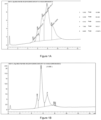
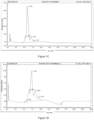
- the coupling results of the above 4 antibody-drug conjugates were analyzed by HIC-HPLC and SDS-PAGE electrophoresis, which were shown in Table 1, Figure 1A, Figure 1B , Figure 1C, Figure 1D and Figure 2A, Figure 2B .
- D0% represented a proportion of antibody-drug conjugates with 0 drug coupled to one antibody via linker, i.e., a proportion of naked antibody
- D1% represented a proportion of antibody-drug conjugates with 1 drug coupled to one antibody via linker
- D2% represented a proportion of antibody-drug conjugates with 2 drugs coupled to one antibody via linker
- D3% represented a proportion of antibody-drug conjugates with 3 drugs coupled to one antibody via linker
- D4% represented a proportion of antibody-drug conjugates with 4 drugs coupled to one antibody via linker
- D5% represented a proportion of antibody-drug conjugates with 5 drugs coupled to one antibody via linker.
- Figure 2A, Figure 2B showed the SDS-PAGE electrophoresis patterns of the above antibody-drug conjugates, wherein Figure 2A showed the SDS-PAGE electrophoresis patterns of Her2-A'-11-Val-Cit-PAB-MMAE (coupling buffers respectively had pH of 8.5, 9.0, 7.4), Her2-A'-7-Val-Cit-PAB-MMAE (coupling buffers respectively had pH of 8.5, 9.0, 7.4), Her2-A'-10-Val-Cit-PAB-MMAE (coupling buffers respectively had pH of 8.5, 9.0, 7.4), and Figure 2B showed the SDS-PAGE electrophoresis patterns from left to right of Her2-A'-7-Val-Cit-PAB-MMAE, Her2-575DZ-Val-Cit-PAB-MMAE, Her2-A'-10-Val-Cit-PAB-MMAE (coupling buffer had pH of 9.0).
- 25KD represented the molecular weight of one light chain of the antibody
- 50KD represented the molecular weight of one heavy chain
- 75KD represented the molecular weight of one light chain and one heavy chain (i.e., one linker was covalently linked to the thio group between one heavy chain and one light chain)
- 100KD represented the molecular weight of two heavy chains (i.e., one linker was covalently linked to the thio group between two heavy chains)
- 125KD represented the molecular weight of one light chain and two heavy chains (i.e., one linker was covalently linked to the thio groups among two heavy chains and one light chain)
- 150KD represented the molecular weight of two heavy chains and two light chains (i.e., one linker was covalently linked to the thio groups among two heavy chains and two light chains).
- Figure 2A showed that the antibody-drug conjugates (Her2-A'-7-Val-Cit-PAB-MMAE, Her2-A'-10-Val-Cit-PAB-MMAE, Her2-A'-11-Val-Cit-PAB-MMAE) provided in the present examples each had linkers that were simultaneously covalently linked to the thio groups respectively between one heavy chain and one light chain (75KD), between two heavy chains (100KD), among two heavy chains and one light chain (125KD), or among two heavy chains and two light chains (150KD), which proved that the 4 pairs of disulfide bonds in the antibody were fully or partially bridged, and the bridge coupling effect was better.
- Figure 2B showed the parallel contrast SDS-PAGE electrophoresis patterns of Her2-A'-7-Val-Cit-PAB-MMAE, Her2-575DZ-Val-Cit-PAB-MMAE, Her2-A'-10-Val-Cit-PAB-MMAE (coupling buffer had pH of 9.0). From the Figure, it could be seen that the ratio of 150KD and 125KD bands in the conjugates Her2-A'-7-Val-Cit-PAB-MMAE and Her2-A'-10-Val-Cit-PAB-MMAE was significantly higher than the ratio of the corresponding bands in the conjugate Her2-575DZ-Val-Cit-PAB-MMAE. At the same time, the ratio of 50KD and 25KD bands was also significantly reduced, which proved that the first linker moiety of the present invention had better coupling efficiency and could result in an antibody-drug conjugate with a higher bridging ratio.
- the hydrolysis result of the antibody-drug conjugate (claudin18.2-A'-7-VC-PAB-MMAE) was characterized by molecular weight analysis and protein isoelectric point analysis.
- Test conditions instrument model: Thermo Q Exactive Plus; mobile phase: 25 mM ammonium acetate solution; flow rate: 0.3 mL/min; injection volume: 1 mg/mL, 20 ⁇ L, i.e., 20 ⁇ g; detection range: 5000-8000 Da; output range: 140000-160000 Da.
- Instrument Information Imaging Capillary Isoelectric Focusing Electrophoresis Instrument, model: iCE 3.
- Naked antibody (claudin18.2 antibody): amphoteric electrolyte carrier: 1% Pharmalyte 5-8, 3% Pharmalyte 8-10.5; low isoelectric point marker: 8.18; high electric point marker: 9.77; protein concentration: 0.25 mg/mL; tray temperature: 15°C.
- claudin18.2-A'-7-VC-PAB-MMAE amphoteric electrolyte carrier: 3% Servalyt 5-9, 1% Servalyt 9-11; low isoelectric point marker: 5.85; high electric point marker: 9.46; protein concentration: 0.50 mg/mL; tray temperature: 15°C.
- Figure 6A showed the molecular weight result of naked antibody
- Figure 6B showed the molecular weight result of claudin18.2-A'-7-VC-PAB-MMAE. From the Figures, it could be seen that the molecular weight of naked antibody was 145144Da, and the molecular weights of claudin18.2-A'-7-VC-PAB-MMAE (when the ratio of A'-7-VC-PAB-MMAE to antibody was 4:1) were 152078 Da, 152119 Da, 152147 Da. When one antibody was coupled with 4 A'-7-VC-PAB-MMAE without hydrolysis, its theoretical molecular weight was 151999 Da.
- the actual determined molecular weights were 152078 Da, 152119 Da, 152147 Da, which had a big deviation from the theoretical molecular weight, exceeding the deviation range (20 Da) of the instrument.
- conjugate claudin18.2-A'-7-VC-PAB-MMAE underwent hydrolysis in which 4, 7, 8 maleimides were hydrolyzed, its theoretical molecular weights were 152071 Da, 152125 Da, 152143 Da. Compared with these theoretical values, the relative deviation of the actual determined values was within the deviation range of the instrument. It was speculated that antibody-A'-7-VC-PAB-MMAE was partially hydrolyzed.
- Figure 7A showed the isoelectric point distribution result of naked antibody
- Figure 7B showed the isoelectric point distribution result of claudin18.2-A'-7-VC-PAB-MMAE.
- Figure 7A it could be seen that the main peak of isoelectric point of naked antibody was 8.91, and the ratio of acidic peak (isoelectric point ⁇ 8.91) and alkaline peak (isoelectric point >8.91) was relatively low.
- Figure 7B it could be seen that the isoelectric point of antibody-A'-7-VC-PAB-MMAE was distributed between 7.86-8.70.
- the isoelectric point of antibody-A'-7-VC-PAB-MMAE was significantly decreased, indicating that there were more acidic groups, such as carboxyl groups, on its surface.
- the position of hydrolysis was in the maleimide moiety of antibody-A'-7-VC-PAB-MMAE, and, by controlling the synthesis and hydrolysis environment of the antibody-drug conjugate, it was possible to control the degree of hydrolysis of maleimide in the linker of the antibody-drug conjugate, for example, to achieve full hydrolysis or no hydrolysis.
- purification means could also be employed to separate products, which were hydrolysed at the same degree, from the synthesized products.
- antigen was diluted with a coating buffer to the required concentration (such as 500 ng/ml, 250 ng/ml, 100 ng/ml, or arranged by oneself according to experimental needs) at 100 ⁇ l/well, and set aside at 4°C overnight; plate washing: a plate was washed 3 times with a PBST washing solution at 350 ⁇ l/well, and pat dried; blocking: the plate was blocked with 3% BSA blocking solution at 200 ⁇ l/well, and set aside at 4°C overnight; plate washing: the plate was washed twice with PBST at 300 ⁇ l/well, and the solution in the well was blotted; loading of sample: a sample was diluted with a diluent 1%BSA-PBST solution, then the diluted sample was added to the blocked cell culture plate at 100 ⁇ l/well, with three replicates, and the diluent as a blank control, and incubated in a incubator at 37°C for 2 h (the dilution scheme could
- Table 2 showed the EC 50 values of the antibody-drug conjugates (Her2-A'-7-Val-Cit-PAB-MMAE, Her2-A'-10-Val-Cit-PAB-MMAE) against Her2 antigen, wherein Her2 was naked antibody, with Her2-Mc-vc-PAB-MMAE as the control ADC.
- the results showed that Her2-A'-10-Val-Cit-PAB-MMAE and Her2-A'-7-Val-Cit-PAB-MMAE both had better affinity to the antigen, and the data results showed that the linking method used did not change the original affinity of the antibody.
- a culture dish containing human breast cancer SK-BR-3 cells and culture medium was placed in a 37°C, 5% CO 2 incubator for incubation.
- the cells in good growth condition were taken and the original culture medium was discarded, then the obtained Solutions were suspended with the culture medium and counted separately.
- the cell suspension was added to a 96-well plate (5000 cells per well), and incubated in a 37°C, 5% CO 2 incubator overnight. Then a drug which had been diluted was added to the cell suspension for incubation. After incubation for 72 h, Cell Counting Kit-8 (abbreviated as CCK-8 kit) was used for active color development, and the 96-well plate after color development was detected by a microplate reader to obtain OD value at 450 nm.
- CCK-8 kit Cell Counting Kit-8
- IC 50 value was calculated through the OD value by Prism software.
- a four parameter curve fitting was performed by using the software with the inhibition rate as y value, and the drug concentration as x value, and the drug concentration value (which was defaulted to be the IC 50 value by the software) corresponding to the inhibition rate value between the maximum inhibition rate and the minimum inhibition rate was recorded.
- the fitted curve was "S curve" and R 2 ⁇ 0.95, the IC 50 value was valid.
- the IC 50 values of the antibody-drug conjugates Her2-A'-8-Val-Cit-PAB-MMAE, Her2-A'-7-Val-Cit-PAB-MMAE, Her2-A'-11-Val-Cit-PAB-MMAE, Her2-A'-10-Val-Cit-PAB-MMAE against human breast cancer SK-BR-3 cells were shown in Table 3, and the inhibition rate curves were shown in Figure 4A and Figure 4B .
- Table 3 showed the IC 50 inhibition rates of the antibody-drug conjugates (Her2-A'-8-Val-Cit-PAB-MMAE, Her2-A'-7-Val-Cit-PAB-MMAE, Her2-A'-11-Val-Cit-PAB-MMAE, Her2-A'-10-Val-Cit-PAB-MMAE) against human breast cancer SK-BR-3 cells.
Landscapes
- Health & Medical Sciences (AREA)
- Chemical & Material Sciences (AREA)
- Organic Chemistry (AREA)
- Engineering & Computer Science (AREA)
- Bioinformatics & Cheminformatics (AREA)
- Life Sciences & Earth Sciences (AREA)
- Medicinal Chemistry (AREA)
- General Health & Medical Sciences (AREA)
- Pharmacology & Pharmacy (AREA)
- Animal Behavior & Ethology (AREA)
- Public Health (AREA)
- Veterinary Medicine (AREA)
- Immunology (AREA)
- Epidemiology (AREA)
- Nuclear Medicine, Radiotherapy & Molecular Imaging (AREA)
- General Chemical & Material Sciences (AREA)
- Chemical Kinetics & Catalysis (AREA)
- Cell Biology (AREA)
- Proteomics, Peptides & Aminoacids (AREA)
- Oncology (AREA)
- Molecular Biology (AREA)
- Genetics & Genomics (AREA)
- Biophysics (AREA)
- Biochemistry (AREA)
- Communicable Diseases (AREA)
- Pain & Pain Management (AREA)
- Rheumatology (AREA)
- Gastroenterology & Hepatology (AREA)
- Medicinal Preparation (AREA)
- Peptides Or Proteins (AREA)
- Medicines Containing Antibodies Or Antigens For Use As Internal Diagnostic Agents (AREA)
- Pharmaceuticals Containing Other Organic And Inorganic Compounds (AREA)
- Plural Heterocyclic Compounds (AREA)
- Pyrrole Compounds (AREA)
- Medicines That Contain Protein Lipid Enzymes And Other Medicines (AREA)
- Acyclic And Carbocyclic Compounds In Medicinal Compositions (AREA)
Description
- The present invention relates to a linker for antibody-drug conjugates and antibody-drug conjugates prepred by the linker, as well as the antibody-drug conjugates for use in treating tumor and other diseases.
- Antibody-drug conjugates (ADCs) are a class of targeted therapeutic drugs, which are mainly used for treating cancer, autoimmune diseases and the like. Their structures usually consist of three moieties: antibody or antibody-like ligand, drug moiety, and linker that couples the antibody or antibody-like ligand and the drug.
- Traditional ADC drug is obtained by coupling a drug to lysine residue of antibody or cysteine residue produced by the reduction of interchain disulfide bond of antibody through a linker. When lysine residue is used as the coupling site, since an antibody contains about 40 or more lysine residues, and the coupling reaction is non-selective, the coupling number and site have great uncertainty, and the product uniformity is very poor. When cysteine residue is used as the coupling site, although the antibody (lgG1) has only 4 pairs of interchain disulfide bonds, and the DAR (drug to antibody ratio) value of the ADC drug formed by the cysteine residue produced by the reduction of interchain disulfide bond is relatively uniform, this coupling method destroys the disulfide bond of the antibody, affecting the stability of the antibody. And, due to poor selectivity of the existing reducing agents (DTT, TCEP) for interchain disulfide bonds, the uniformity of the final product is also poor. In view of therapeutic effect and drug supervision, the uniformity of product is very important. Therefore, it is necessary to prepare ADC drugs with well-controlled drug to antibody ratio.
- In recent years, some researchers have used genetic engineering technology to modify antibodies to achieve targeted coupling of antibodies and drugs, and the ADCs obtained also have very uniform DAR values. However, because genetic recombination technology requires a lot of work and design to look for a suitable site for drug coupling or polyethylene glycol modification, it is very time-consuming and extremely expensive in development.
-
WO2014/114207A1 discloses a tridentate connexon and use thereof. The tridentate connexon can be used to prepare an antibody-drug conjugate as represented by formula I, wherein L is an antibody, antibody segment or protein; T is a tridentate connexon part; A is a cleavable connexon combination or an un-cleavable connexon part; D is a drug part; and n is an integer in the range from 0 to 8. The structure of the tridentate connexon part is as represented by formula II, wherein W is a substituted aryl, heteroaryl, chain alkyl, cycloalkyl, heterocyclic alkyl, or any combination thereof. -
CN107921030A provides novel and advantageous compositions having a linker capable of covalently coupling one or more free thiols of an antibody. Specifically, provided herein are the molecular structures, synthetic pathways, coupling mechanisms, and applications thereof as used in an antibody-drug conjugate (ADC). -
CN106267225A discloses a tri-maleimide type connector and application thereof. The tri-maleimide type connector can be applied in an antibody-based drug conjugate as shown in a formula I: L-(T-A-D)n I, wherein L is an antibody, an antibody fragment or protein; T is the tri-maleimide type connector part; A is other connector parts; D is a drug part; n is an integer ranged from 1 to 8. -
CN107652219A relates to tetramaleimide connexin and application thereof. Particularly, the invention relates to a compound shown as a formula I and application of the compound serving as connexin inpreparing antibody drug conjugate. The antibody drug conjugate prepared through the connexin has high uniformity and stability and can be effectively used for treating various diseases like tumor. Definitions of groups in the formula I are identical with that in the description. -
CN107400072A provides a divinyl sulfamide linker as well as preparation and an application thereof. The divinyl sulfamide linker has the structural formula shown in the formula I or the formula II. One end of the novel divinyl sulfamide linker can be coupled with a polypeptide or protein, and the other end can be connected with an affinity tag or a tracing fluorescent substance or an active drug. -
CN105592859A concerns novel antibody-drug conjugates and the use of same in therapy, in particular in anti-cancer or anti-inflammatory therapy. The present invention also concerns useful synthesis products as linkers, consisting of a linker head and a linker body. The present invention also concerns a method for preparing the linkers and antibody-drug conjugates. -
WO2017/046658A1 discloses derivatives of Amernita toxins of Formula (I), wherein, formula (a) R 1, R 2, R 3, R 4, R 5, R 6, R 7, R 8, R 9, R 10, X, L, m, n and Q are defined herein. The preparation of the derivatives. The therapeutic use of the derivatives in the targeted treatment of cancers, autoimmune disorders, and infectious diseases. -
WO2016004048A2 discloses nanoparticles and microparticles, and pharmaceutical formulations thereof, containing conjugates of an active agent such as a therapeutic, prophylactic, or diagnostic agent attached to a targeting moiety, such as a somatostatin receptor binding moiety, via a linker have been designed. Such nanoparticles and microparticles can provide improved temporospatial delivery of the active agent and/or improved biodistribution. Methods of making the conjugates, the particles, and the formulations thereof are provided. Methods of administering the formulations to a subject in need thereof are provided, for example, to treat or prevent cancer or infectious diseases. -
WO2015/151081A2 relates to novel linkers containing hydrazine used for the specific conjugation of compounds/cytotoxic agents to a cell-binding molecule, through bridge linking a pair of thiols on the cell-binding molecule. The invention also relates to methods of making such linkers, and of using such linkers in making homogeneous conjugates, as well as of application of the conjugates in treatment of cancers, infections and autoimmune disorders. -
WO2008/034124A2 provides single chain antibody-directed polymeric prodrugs containing multifunctional linkers. Methods of making the polymeric delivery systems and methods of treating mammals using the same are also disclosed. -
WO2013/085925A1 provides antibody-cytotoxin antibody-drug conjugates and related compounds, such as linker- cytotoxin conjugates and the linkers used to make them, tubulysin analogs, and intermediates synthesis; compositions; and methods, including methods of treating cancers. -
WO2013/121175A1 relates to a linker for forming conjugates of a protein or peptide with a therapeutically active agent and which comprise a thiomaleamic acid moiety that is susceptible to cleavage under the pH conditions prevalent in the lysosome. -
WO2018/185131A2 is in the field of protein conjugates. More specifically the invention relates to oligomer extended insulins with covalently attached Fc monomer polypeptides, for use in the treatment of a metabolic disorder or condition, and to methods of producing such oligomer extended insulin-Fc conjugates. The invention also relates to novel Fc fragments, to intermediate products, and to the use of such intermediate products in processes for the synthesis of the oligomer extended insulin-Fc conjugates of the invention. Finally the invention provides pharmaceutical compositions comprising the oligomer extended insulin-Fc conjugates of the invention, and relates to the use of such compositions for the treatment or prevention of medical conditions relating to metabolic disorders or conditions. - Considering the above-mentioned defects in the preparation of antibody-drug conjugates in the prior art, there is an urgent need in the art to develop a new linker to achieve targeted coupling of toxic drugs to antibodies, so as to obtain ADC drugs with higher product uniformity and stronger stability.
- In order to solve the above-mentioned problems, the present invention provides a linker for preparing antibody-drug conjugates and antibody-drug conjugates prepared by the linker, as well as use of the antibody-drug conjugates in a medicament for treating tumor. The linker is capable of coupling simultaneously with the thiol group(s) or amino group(s) on the antibody or functional fragment of the antibody, especially it is capable of coupling with 2, 3 or 4 thiol groups on the antibody or functional fragment of the antibody. A coupled product is uniform and structurally stable.
- The present disclosure describes a compound not according to the invention, which has a structure of Formula I:

- M1', M2' each are independently selected from


- X, Y, R1, L1, L2, L3', Q are each an arbitrary group.
- Furthermore, the above-mentioned X, Y, R1, L1, L2, L3', Q may be:
- L1, L2 each are independently selected from C1-C9 alkyl, C2-C9 alkenyl, C2-C9 alkynyl, aryl, heteroaryl, C3-C9 cycloalkyl, C3-C9 heterocyclyl, polyethylene glycol, O, S,


- Q is selected from

- L3' is selected from


- X is selected from F, Cl, Br, I;
- Y is

- Z is selected from C, N;
- R1, R2, R3, R4, R5, R8, R10, R11, R12, R13, R14, R15 each are independently selected from H, C1-C6 alkyl, C2-C6 alkenyl, C2-C6 alkynyl, aryl, heteroaryl, C3-C9 cycloalkyl, C3-C9 heterocyclyl.
- Still furthermore, the above-mentioned X, Y, R1, L1, L2, L3', Q may be:
- L1, L2 each are independently selected from C1-C4 alkyl, C6-C8 aryl, C6-C8 heteroaryl, C5-C6 cycloalkyl, C5-C6 heterocyclyl, C2-C12 polyethylene glycol, O, S,


- Q is selected from

- L3' is selected from


- X is Br;
- Y is

- R1, R2, R3, R4, R5, R8, R10, R11, R15 each are independently selected from H, C1-C4 alkyl, C6-C8 aryl, C6-C8 heteroaryl, C5-C6 cycloalkyl, C5-C6 heterocyclyl.
- Furthermore, the linker has the structure represented by formula:


- In the first aspect, the present invention providesa compound having the structure:


- The present invention also provides use of the above-mentioned compound as a linker in the preparation of antibody-drug conjugates.
- In another aspect, the present invention provides an antibody-drug conjugate, the antibody-drug conjugate having the structure represented by Formula II:
Ab- (A-L-D) n (II)
wherein,
Ab is any antibody or functional fragment of the antibody. Furthermore, the antibody includes a derivative or an analog of the antibody; "functional" fragment represents an antibody, a fragment, a derivative or an analog thereof that is capable of recognizing the same antigen, and is capable of recognizing fragments, derivatives or analogs derived from the antigen, which includes, for example, but not limited to: F (ab') 2, Fab, Fab', Fv fragments and heavy and light chain dimers of antibodies, or any of their smallest fragments such as Fvs or single-chain antibody (single-chain antibody fragment/ single-chain variable fragment, scFv). In addition, the antibody can be a fusion protein of the antibody. The antibody can also include modified or unmodified (that is, covalent linkage through any molecule) analogs and derivatives, as long as such covalent linkage allows the antibody to retain its antigen-binding immunologic specificity. It includes, for example, but not limited to: analogs and derivatives of antibody, including further modifications, such as: glycosylation, acetylation, PEGylation, phosphorylation, amidation, derivatization through known protecting/blocking groups, protease cleavage, connection to cell antibody units or other proteins and the like. Any large number of chemical modifications can be achieved using known techniques, including, but not limited to, specific chemical cleavage, acetylation, formylation, metabolic synthesis in the presence of tunicamycin and the like. In addition, analogs or derivatives may include one or more unnatural amino acids. In some examples, antibodies may have modifications (e.g. substitution, deletion, or addition) in the amino acid residues that interact with Fc receptor. Still furthermore, the antibody is selected from murine antibodies, mammalian antibodies, chimeric antibodies, humanized antibodies, human antibody, multispecific antibodies. - The linker moiety includes a first linker moiety A and a second linker moiety L; the first linker moiety A includes a group covalently linked to the thiol group or amino group in the Ab.
- D is the drug moiety, the drug including, but not limited to, cytotoxic drugs, cell differentiation factors, stem cell nutritional factors, steroid drugs, drugs for the treatment of autoimmune diseases, anti-inflammatory drugs or drugs for the treatment of infectious diseases. Furthermore, the drug moiety D includes, but not limited to, tubulin inhibitors or DNA damaging agents. The tubulin inhibitors include, but are not limited to, dolastatin, auristatins, maytansines; the DNA damaging agents include, but not limited to, calicheamicins, duocarmycins, anthramycin derivative PBD (pyrrolobenzodiazepine), camptothecin derivative SN-38, topoisomerase I inhibitors. The auristatin drugs include, but not limited to, monomethyl auristatin E (MMAE), monomethyl auristatin F (MMAF), and auristatin F (AF) or their derivatives. The maytansine drugs include, but not limited to, DM1, DM3, DM4 or their derivatives (Research Progress on Warhead Molecules of antibody-drug conjugate, Hu Xinyue et al., Chinese Medicinal Biotechnology, Dec., 2017, Vol. 12, No. 6) (Research advance of maytansinoid class antibody drug conjugates, Zhou Lei et al., Chinese Journal of New Drugs, 2016, Vol. 25, No. 22, pages 2521-2530). The drug moiety D can also be amanitins, anthracyclines, baccatins, camptothecins, cemadotins, colchicines, colcimids, combretastatins, cryptophycins, discodermolides, docetaxel, doxorubicin, echinomycins, eleutherobins, epothilones, estramustines, lexitropsins, maytansines, methotrexate, netropsins, puromycins, rhizoxins, taxanes, tubulysins, or vinca alkaloids. The drug moiety D may also be vitamin A precursor, folic acid and the like. The drug moiety D is not limited to the above categories, but also includes all drugs that can be used for ADC.
- n is 1, 2, 3 or 4;
Still furthermore, the antibody or functional fragment of the antibody specifically binds to cell surface receptors or tumor-related antigens. - Still furthermore, the first linker moiety A may have the structure:
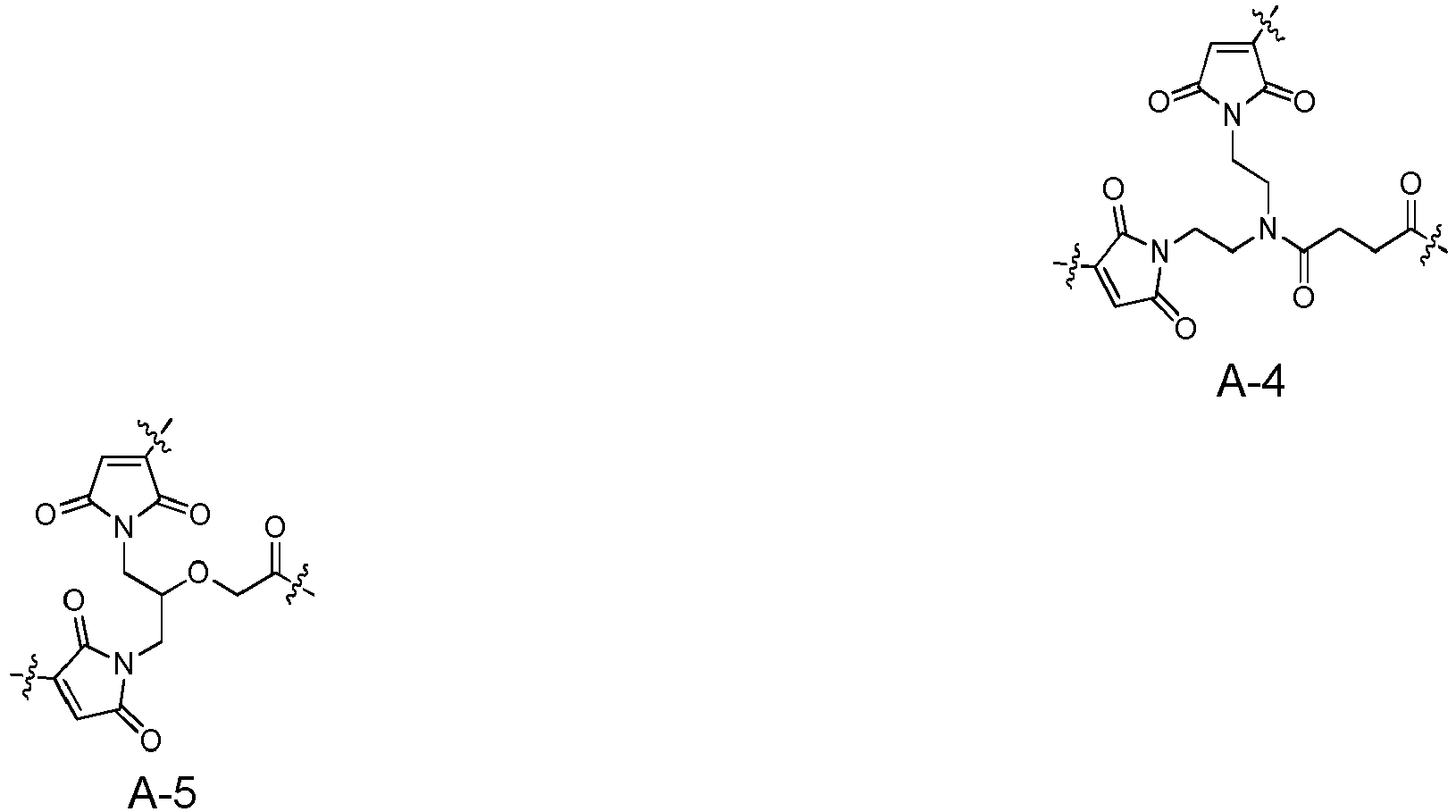


- Preferably, the second linker moiety L may be:



- Still furthermore, the drug moiety is selected from cytotoxic drugs, cell differentiation factors, stem cell nutritional factors, steroid drugs, drugs for the treatment of autoimmune diseases, anti-inflammatory drugs or drugs for the treatment of infectious diseases.
- Still furthermore, the drug moiety includes, but not limited to, tubulin inhibitors or DNA damaging agents.
- Still furthermore, the tubulin inhibitor includes, but not limited to, dolastatins, auristatins, maytansines; the DNA damaging agent includes, but not limited to, calicheamicins, duocarmycins, anthramycin derivatives PBD, camptothecin derivatives (preferably camptothecin derivative SN-38), topoisomerase I inhibitors (i.e., Dxd).
- Still furthermore, the drug moiety includes, but not limited to, amanitins, anthracyclines, baccatins, camptothecins, cemadotins, colchicines, colcimids, combretastatins, cryptophycins, discodermolides, docetaxel, doxorubicin, echinomycins, eleutherobins, epothilones, estramustines, lexitropsins, maytansines, methotrexate, netropsins, puromycins, rhizoxins, taxanes, tubulysins, or vinca alkaloids, vitamin A precursor, folic acid, camptothecin derivatives SN-38, topoisomerase I inhibitors (i.e., Dxd).
- Preferably, the drug moiety D may be:


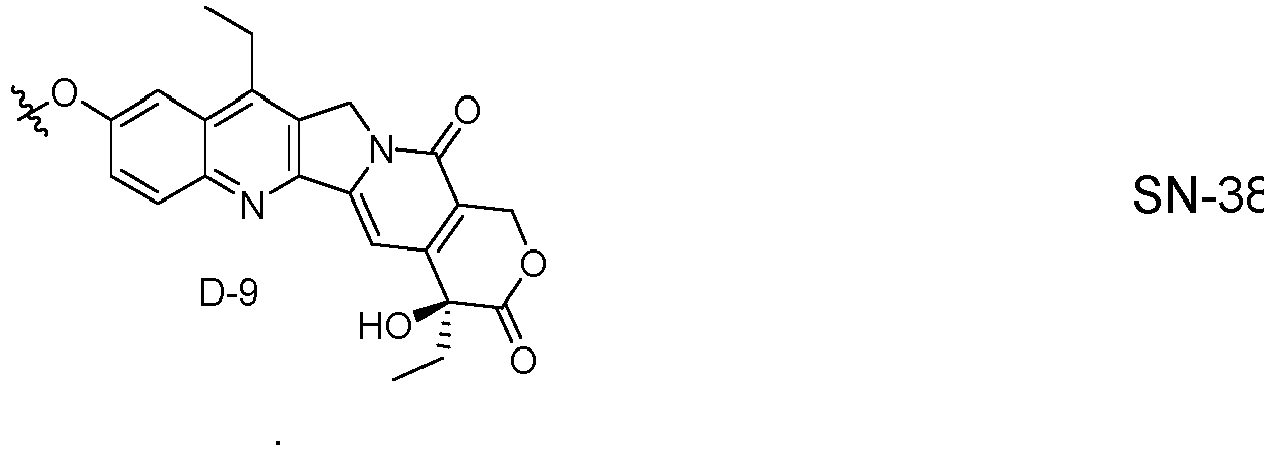
- The antibody-drug conjugatesADC1, ADC2, ADC10, ADC11, ADC17, ADC18, ADC26, ADC27, ADC33, ADC34, ADC39, ADC42 and ADC43 are according to the invention, the rest of the antibody-drug conjugates disclosed below are not according to the invention, the antibody-drug conjugate has the structure:


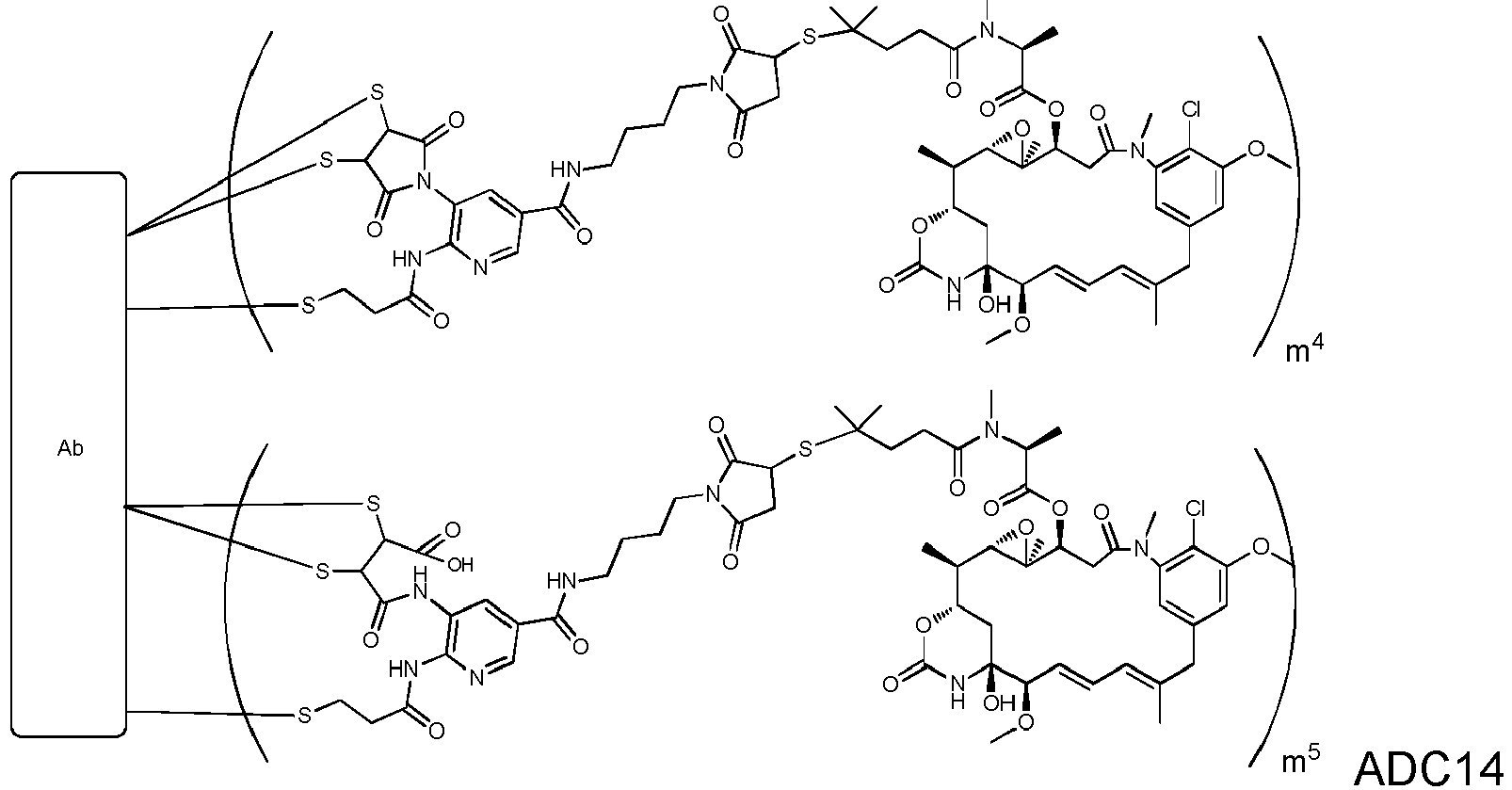


- the antibody or functional fragment of the antibody, Ab, is an antibody against cell surface receptors and tumor-related antigens;
- n1, n2, n3 each are independently selected from 0, 1, 2, 3, 4; n1, n2, n3 are not 0 at the same time, and n1+n2+n3≤4;
- m1, m2, m3 each are independently selected from 0, 1, 2; at least one of m1, m2, m3 is 0, but m1, m2, m3 are not 0 at the same time, and m1+m2+m3≤2;
- Furthermore, the antibody-drug conjugate has the structure:


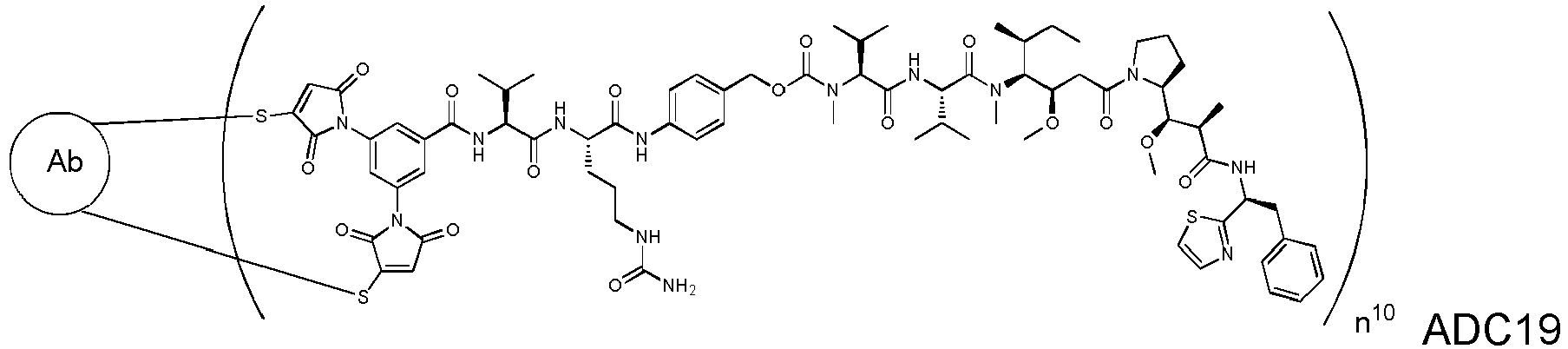


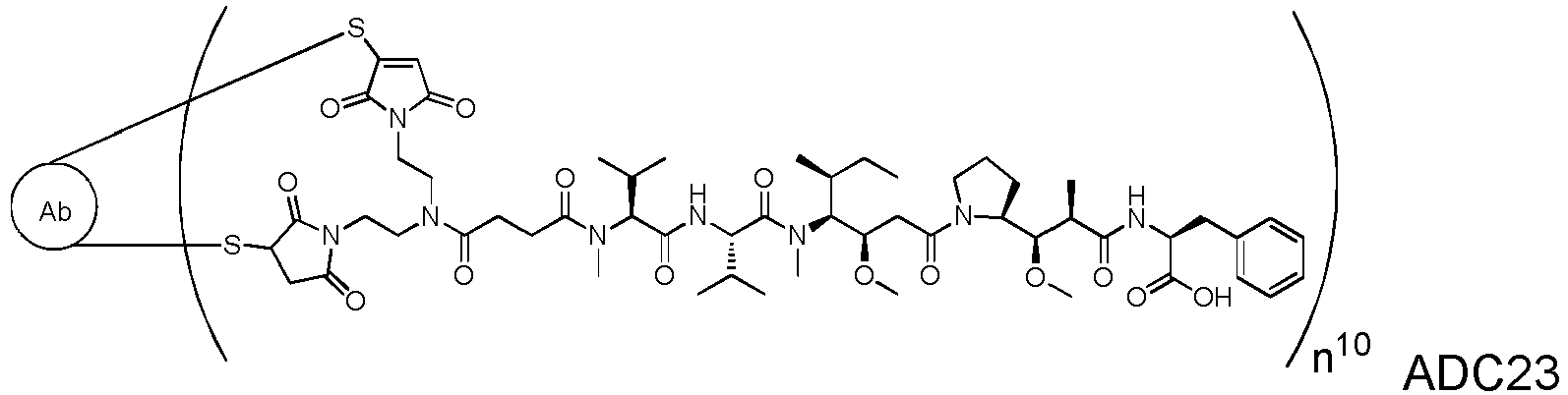




- the Ab is an antibody against cell surface receptors and tumor-related antigens;
- n10 is 0, 1, 2, 3 or 4;
- m6 is 0, 1 or 2.
- Furthermore, the antibody-drug conjugate has the structure:


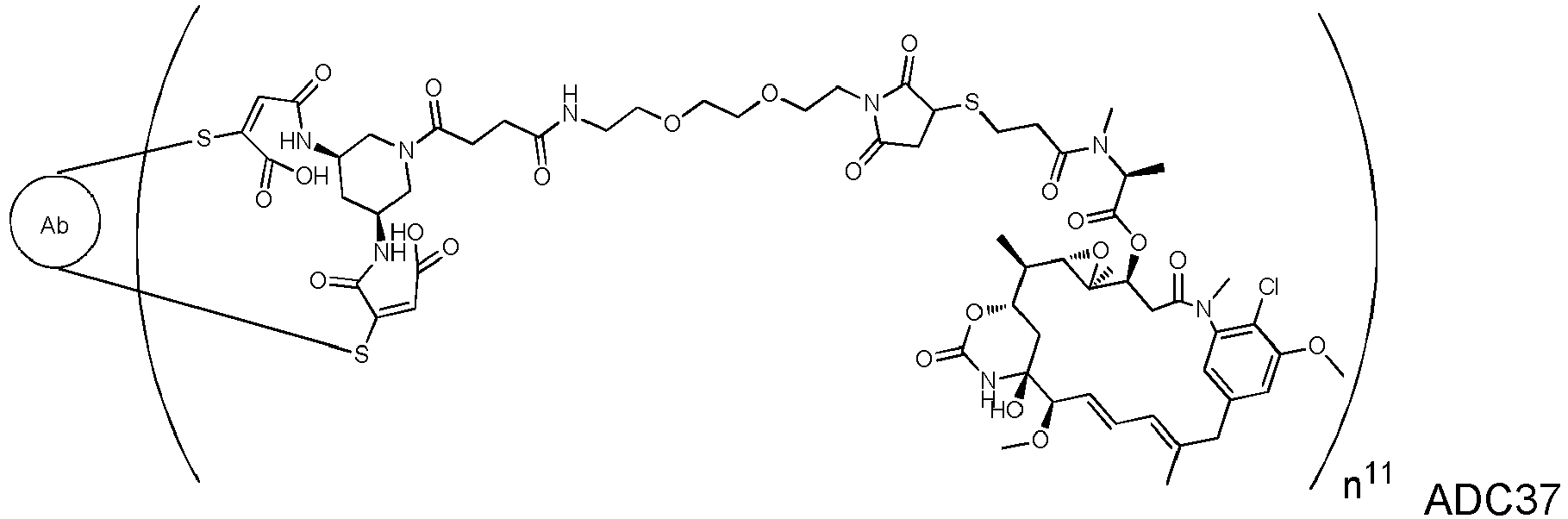


- the Ab is an antibody against cell surface receptors and tumor-related antigens;
- n11 is 0, 1, 2, 3 or 4;
- m7 is 0, 1 or 2.
- The present invention also provides a pharmaceutical composition, which comprises any antibody-drug conjugate as described in the present invention and a pharmaceutically acceptable carrier.
- The present invention also provides use of any compound as described in the present invention in the preparation of antibody-drug conjugate.
- The present invention also provides an antibody-drug conjugate as described in the present invention, or any pharmaceutical composition as described in the present invention, for use in treating cancer, autoimmune diseases, inflammatory diseases or infectious diseases.
-
-
Figure 1A shows an HIC-HPLC chromatogram of the antibody-drug conjugate Her2-A'-7-Val-Cit-PAB-MMAE (the molar ratio of drug to thiol group of antibody added during coupling is 5:1). -
Figure 1B shows an HIC-HPLC chromatogram of the antibody-drug conjugate Her2-A'-11-Val-Cit-PAB-MMAE (the molar ratio of drug to thiol group of antibody added during coupling is 5:1). -
Figure 1C shows an HIC-HPLC chromatogram of the antibody-drug conjugate Her2-A'-10-Val-Cit-PAB-MMAE (the molar ratio of drug to thiol group of antibody added during coupling is 5:1). -
Figure 1D shows an HIC-HPLC chromatogram of the antibody-drug conjugate Her2-575DZ-Val-Cit-PAB-MMAE (the molar ratio of drug to thiol group of antibody added during coupling is 5:1). -
Figure 2A shows SDS-PAGE electrophoresis patterns of Her2-A'-11-Val-Cit-PAB-MMAE (coupling buffers respectively have pH of 8.5, 9.0, 7.4), Her2-A'-7-Val-Cit-PAB-MMAE (coupling buffers respectively have pH of 8.5, 9.0, 7.4), - Her2-A'-10-Val-Cit-PAB-MMAE (coupling buffers respectively have pH of 8.5, 9.0, 7.4) (coupling buffer has pH of 9.0).
-
Figure 2B shows SDS-PAGE electrophoresis patterns of Her2-A'-7-Val-Cit-PAB-MMAE, Her2-575DZ-Val-Cit-PAB-MMAE, Her2-A'-10-Val-Cit-PAB-MMAE (coupling buffer has pH of 9.0). -
Figure 3 shows affinity curves to antigen of antibody-drug conjugates (the antibody-drug conjugates being Her2-A'-7-Val-Cit-PAB-MMAE and Her2-A'-10-Val-Cit-PAB-MMAE; Her2 antibody and Her2-Mc-Val-Cit-PAB-MMAE being negative and positive controls) as determined by ELISA method, wherein the abscissa is concentration, and the ordinate is optical density absorption. -
Figure 4A shows proliferation inhibition rate curves against human breast cancer SK-BR-3 cells of antibody-drug conjugates (Her2-A'-11-Val-Cit-PAB-MMAE, Her2-A'-10-Val-Cit-PAB-MMAE). -
Figure 4B shows proliferation inhibition rate curves against human breast cancer SK-BR-3 cells of antibody-drug conjugate (Her2-A'-8-Val-Cit-PAB-MMAE, Her2-A'-7-Val-Cit-PAB-MMAE). -
Figure 5 shows coupling results of conjugates (Ab-A) of antibody (Ab) and first linker moiety (A), wherein Nos. 1, 2, 3 are Her2-A'-7, coupling buffers respectively have pH of 8.5, 9.0, 7.4; Nos. 4, 5, 6 are Her2-A'-8, coupling buffers respectively have pH of 8.5, 7.4, 9.0; Nos. 7, 8, 9 are Her2-A'-10, coupling buffers respectively have pH of 8.5, 9.0, 7.4; Nos. 10, 11, 12 are Her2-A'-11, coupling buffers respectively have pH of 9.0, 7.4, 9.5; Nos. 13, 14, 15 are Her2-A'-12, coupling buffers respectively have pH of 7.4, 9.0, 8.5; Nos. 16, 17, 18 are Her2-A'-20, coupling buffers respectively have pH of 8.5, 9.0, 7.4; Nos. 19, 20, 21 are Her2-A'-28, coupling buffers respectively have pH of 9.0, 8.5, 7.4; Nos. 22, 23, 24 are Her2-A'-31, coupling buffers respectively have pH of 7.4, 8.5, 9.0. -
Figure 6A shows an LC-MS spectrum of naked antibody (claudine 18.2 antibody). -
Figure 6B shows an LC-MS spectrum of claudine 18.2-A'-7-VC-PAB-MMAE. -
Figure 7A shows an isoelectric point distribution map of naked antibody (claudine 18.2 antibody). -
Figure 7B shows an isoelectric point distribution map of claudine 18.2-A'-7-VC-PAB-MMAE. - The embodiments of the present invention are described in detail below by way of specific examples, but in any case they cannot be construed as limiting the present invention.
- Unless otherwise defined, all scientific and technological terms used herein have the same meanings as understood by those skilled in the art.
- Although the numerical ranges and parameter approximate values are shown in the broad scope of the present invention, the numerical values shown in the specific examples are recorded as accurately as possible. However, any numerical value inherently inevitably contains a certain error, which is caused by the standard deviation in measurement. In addition, all ranges disclosed herein should be understood as covering any and all sub-ranges contained therein. For example, the range of "1 to 10" recorded should be understood as covering any and all sub-ranges contained between the
minimum value 1 and the maximum value 10 (including endpoints), that is, all sub-ranges starting with theminimum value 1 or greater, for example, 1 to 6.1, and all sub-ranges ending with themaximum value 10 or less, for example, 5.5 to 10. - The symbol "" used in the present invention refers to that the group containing "
 " is linked here to other groups through chemical bond.
- The term "antibody" in the present invention is used in the broadest sense, and covers various antibody structures, including, but not limited to, monoclonal antibody, polyclonal antibody, multispecific antibody (such as bispecific antibody), and antibody fragments. In particular, "antibody" used herein refers to a protein containing at least two heavy (H) chains and two light (L) chains interconnected by disulfide bonds. Each heavy chain includes a heavy chain variable region (abbreviated as VH) and a heavy chain constant region. The heavy chain constant region includes three domains, CH1, CH2 and CH3. Each light chain includes a light chain variable region (abbreviated as VL) and a light chain constant region. The light chain constant region includes one domain, CL. VH and VL regions can be further subdivided into multiple regions with high variability, called complementarity determining regions (CDR), interspersed with more conservative regions called framework regions (FR). Each of VH and VL consists of three CDRs and four FRs, arranged in the following order from amino terminal to carboxy terminal: FR1, CDR1, FR2, CDR2, FR3, CDR3, FR4. These variable regions of the heavy chain and light chain contain binding domains that interact with antigens. The constant region of an antibody can mediate the binding of immunoglobulins to host tissues or factors, including various cells (such as effector cells) of the immune system and the first component (Clq) of the classical complement system. Chimeric or humanized antibodies are also included in the antibodies according to the present invention.
- The term "humanized antibody" refers to an antibody that contains CDR region derived from a non-human antibody, and the other moiety of the antibody molecule is derived from one (or several) human antibodies. Moreover, for retaining binding affinity, it is possible to modify some residues of the framework regions (called FR) (Jones et al., Nature, 321: 522-525, 1986; Verhoeyen et al., Science, 239: 1534-1536, 1988; Riechmann et al., Nature, 332: 323-327, 1988). The humanized antibody or fragments thereof according to the present invention can be prepared by techniques known to those skilled in the art (e.g., those described in the documents Singer et al., J. Immun. 150: 2844-2857, 1992; Mountain et al., Biotechnol. Genet. Eng. Rev., 10: 1-142, 1992; or Bebbington et al., Bio/Technology, 10: 169-175, 1992).
- The term "chimeric antibody" refers to an antibody in which the variable region sequence is from one species and the constant region sequence is from another species. For example, the variable region sequence is from a mouse antibody and the constant region sequence is from a human antibody. The chimeric antibody or fragments thereof according to the present invention can be prepared by using genetic recombination technology. For example, the chimeric antibody can be produced by cloning recombinant DNA, and the recombinant DNA comprises a promoter and a sequence encoding the variable regions of a non-human, especially murine, monoclonal antibody according to the present invention, and a sequence encoding the constant regions of a human antibody. The chimeric antibody of the present invention encoded by this recombinant gene will be, for example, a mouse-human chimera. The specificity of this antibody is determined by the variable region derived from murine DNA, and its isotype is determined by the constant region derived from human DNA. As to the method of preparing a chimeric antibody, for example, please refer to the document Verhoeyn et al. (BioEssays, 8: 74, 1988).
- The term "monoclonal antibody" refers to a prepared products of antibody molecules with a single molecular composition. A monoclonal antibody composition shows a single binding specificity and affinity for a specific epitope.
- The term "functional fragment" in the present invention means that the antibody fragment is composed of, or comprises, partial sequence of the heavy or light variable chain of the antibody from which it is derived, and the partial sequence is sufficient to retain the same binding specificity as the antibody from which it is derived and sufficient affinity, preferably at least equal to 1/100 of the affinity of the antibody from which it is derived, and more preferably at least equal to 1/10. This functional fragment will contain a minimum of 5 amino acids, preferably 10, 15, 25, 50 and 100 consecutive amino acids of the antibody sequence from which it is derived.
- The term "DAR", also called drug to antibody ratio, in the present invention is a unique quality attribute of antibody-drug conjugate. A high DAR value may affect the safety of ADC, and its treatment window is narrow. A low DAR value may lead to a decrease in efficacy of ADC, but its safety is strong and its treatment window is wide. The best average DAR value range is 2-4.
- The term "linker" in the present invention refers to a compound that can act as a "bridge" to respectively react with antibody/functional fragment of the antibody and drug, and connect the two. The "linker" involved in the present invention includes a first linker moiety and a second linker moiety. The term "first linker moiety" in the present invention includes two linking groups that are the same or different. The linking groups are capable of simultaneously covalently linked to the interchain thiol group(s) or amino group(s) of the antibody/functional fragment of the antibody, and the linking groups are any functional groups capable of covalently linked to thiol group(s) or amino group(s). The term "second linker moiety" in the present invention is used for coupling with a drug, and it is any cleavable or non-cleavable linker. The cleavable linker releases toxins depending on intracellular processes, such as intracytoplasmic reduction process, exposure to acidic conditions in lysosome or cleavage by intracellular specific protease. Non-cleavable linker can release the drug only after the protein of the ADC antibody moiety is degraded.
- The term "drug" in the present invention generally refers to any compound that has the desired biological activity and has a reactive functional group to prepare the conjugate of the present invention. The desired biological activity includes diagnosis, cure, alleviation, treatment, prevention of human or other animal diseases. With the continuous discovery and development of new drugs, these new drugs should also be included in the drugs of the present invention. Specifically, the drugs include, but not limited to, cytotoxic drugs, cell differentiation factors, stem cell nutritional factors, steroid drugs, drugs for the treatment of autoimmune diseases, anti-inflammatory drugs or drugs for the treatment of infectious diseases. More specifically, the drugs include, but not limited to, tubulin inhibitors or DNA, RNA damaging agents.
- In some embodiments of the present invention, the drug is selected from: maytansine compounds, V-ATPase inhibitors, pro-apoptotic agents, Be 12 inhibitors, McL1 inhibitors, HSP90 inhibitors, IAP inhibitor, mTOr inhibitors, microtubule stabilizers, microtubule destabilizers, auristatin, dolastatin, MetAP (methionine aminopeptidase), nuclear export inhibitors of protein CRM1, DPPIV inhibitors, proteasome inhibitors, inhibitors of phosphoryl transfer reaction in mitochondria, protein synthesis inhibitors, kinase inhibitors, CDK2 inhibitors, CDK9 inhibitors, kinesin inhibitors, HDAC inhibitors, DNA damaging agents, DNA alkylating agents, DNA intercalators, DNA minor groove binder, DHFR inhibitors, as well as dolastatin peptide, vitamin A precursors, folic acid, camptothecin derivatives.
- In some preferred embodiments of the present invention, the drug is a cytotoxic drug (such as antimetabolites, antitumor antibiotics, alkaloids), immunopotentiator or radioisotope. Preferably, the drug can be selected from amanitins, anthracyclines, baccatins, camptothecins, cemadotins, colchicines, colcimids, combretastatins, cryptophycins, discodermolides, docetaxel, doxorubicin, echinomycins, eleutherobins, epothilones, estramustines, lexitropsins, maytansines, methotrexate, netropsins, puromycins, rhizoxins, taxanes, tubulysins, or vinca alkaloids. More preferably, the "drug " is selected from MMAD (Monomethyl auristatin D) and its derivatives, MMAE (Monomethyl auristatin E) and its derivatives, MMAF (Monomethyl auristatin F) and its derivatives, maytansine derivatives DM1 (Mertansine derivative M1), maytansine derivatives DM4 (Mertansine derivative M4), Duocarmycine and its derivatives, Calicheamicin and its derivatives, PBDA(Pyrrolobenzodiazepines), Doxorubicin, Vinca Alkaloids, Metrotrexate, Vinblastine, Daunorubicin and its derivatives, tubulysins and its derivatives, camptothecin derivatives SN-38, topoisomerase I inhibitors (i.e., Dxd).
- In some specific embodiments, the "drug" may be the following substances and their derivatives:
- Maytansine:

- Maytansinoid derivatives:

- Ansamitocin derivatives:

- Alaninyl maytansinol:

- MMAE:

- MMAD:

- MMAF:

- Tubulysin D:

- Calicheamicin:

- Doxorubicin:

- Pyrrolobenzodiazepine derivatives:

- Vitamin A precursor:
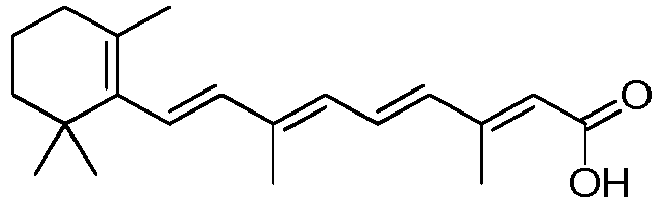
- Folic acid:

- Topoisomerase I inhibitor (i.e., Dxd):

- The term "antibody-drug conjugate" in the present invention refers to a compound obtained by linking an antibody/a functional fragment of the antibody, a linker (a first linker moiety, a second linker moiety), and a drug moiety together through chemical reaction. Although the antibody-drug conjugate involved in the present invention is still a mixture, compared with the conjugate obtained in the traditional way, its DAR distribution range is very narrow, and the best antibody-drug conjugate has an average DAR value range of 2-4. Regarding the preparation of the antibody-drug conjugate according to the present invention, when the conjugate (A-L-D) of the first linker moiety (A) and the second linker moiety-drug conjugate (L-D) is coupled with an antibody (such as claudin18.2 antibody provided in the example), it can hydrolyze under easy hydrolysis conditions, and the hydrolysis site is in the maleimide moiety of the first linker. Taking Ab-A'-7-VC-PAB-MMAE (and in the case where one antibody is coupled with 4 drugs) as an example, when the Ab-A'-7-VC-PAB-MMAE conjugate undergoes 4 hydrolysis, the structure diagram is:


- When the Ab-A'-7-VC-PAB-MMAE conjugate undergoes 7 hydrolysis, the structure diagram is:

- When the Ab-A'-7-VC-PAB-MMAE conjugate undergoes 8 hydrolysis, the structure diagram is:

- The term "pharmaceutical composition" in the present invention refers to a combination of at least one drug and optionally a pharmaceutically acceptable carrier or excipient that are combined to achieve a specific purpose. In some embodiments, the pharmaceutical composition includes a combination of ingredients that are separated in time and/or space, as long as they can work together to achieve the purpose of the present invention. For example, the ingredients contained in the pharmaceutical composition can be administered to a subject as a whole, or separately. When the ingredients contained in the pharmaceutical composition are separately administered to a subject, the ingredients can be simultaneously or sequentially administered to the subject. Preferably, the pharmaceutically acceptable carrier is water, buffered aqueous solution, isotonic salt solution such as PBS (phosphate buffer), glucose, mannitol, dextroglucose, lactose, starch, magnesium stearate, cellulose, magnesium carbonate, 0.3% glycerol, hyaluronic acid, ethanol or polyalkylene glycol such as polypropylene glycol, triglycerides and the like. The type of the pharmaceutically acceptable carrier used particularly depends on whether the composition according to the present invention is formulated for oral, nasal, intradermal, subcutaneous, intramuscular or intravenous administration. The composition according to the present invention can contain wetting agents, emulsifiers or buffer substances as additives.
- The pharmaceutical composition, vaccine or pharmaceutical preparation according to the present invention can be administered by any suitable route, such as oral, nasal, intradermal, subcutaneous, intramuscular or intravenous administration.
- The term "alkyl" in the present invention refers to a linear or branched saturated hydrocarbon (i.e., free of double bonds or triple bonds). Alkyl group can have 1 to 9 carbon atoms (when appearing in the present invention, the numerical range of "1 to 9" refers to any integer in this range, for example, "1 to 9 carbon atoms" means that the alkyl group can contain 1 carbon atom, 2 carbon atoms, 3 carbon atoms, ..., up to 9 carbon atoms. At the same time, the definition of alkyl also includes alkyl groups with no specified chain length). The alkyl group can be a medium-sized alkyl group containing 1 to 9 carbon atoms. A typical alkyl group includes, but not limited to: methyl, ethyl, propyl, isopropyl, butyl, isobutyl, tert-butyl, pentyl, hexy and the like.
- The term "alkenyl" in the present invention refers to a linear or branched hydrocarbon containing one or multiple double bonds. Alkenyl group can have 2 to 9 carbon atoms, and also includes alkenyl groups with no specified chain length. The alkenyl group can be a medium-sized alkenyl group containing 2 to 9 carbon atoms. The alkenyl group can also be a small-sized alkenyl group containing 2 to 4 carbon atoms. The alkenyl group can be designed as "C2-4 alkenyl" or similar designs. For example, "C2-4 alkenyl" means that there are 2-4 carbon atoms in the alkenyl chain, that is, the alkenyl chain can be selected from: ethenyl, propen-1-yl, propen-2-yl, propen-3-yl, buten-1-yl, buten-2-yl, buten-3-yl, buten-4-yl, 1-methyl-propen-1-yl, 2-methyl-propen-1-yl, 1-ethyl-ethen-1-yl, 2-methyl-propen-3-yl, buta-1,3-dienyl, buta-1,2-dienyl, buta-1,2-dien-4-yl. Typical alkenyl includes, but not limited to: ethenyl, propenyl, butenyl, pentenyl, hexenyl and the like.
- The term "alkynyl" in the present invention refers to a linear or branched hydrocarbon containing one or multiple triple bonds. Alkynyl group can have 2 to 9 carbon atoms, and also includes alkynyl groups with no specified chain length. The alkynyl group can be a medium-sized alkynyl group containing 2 to 9 carbon atoms. The alkynyl group can also be a lower alkynyl group containing 2 to 4 carbon atoms. The alkynyl group can be designed as "C2-4 alkynyl" or similar designs. For example, "C2-4 alkynyl" means that there are 2-4 carbon atoms in the alkynyl chain, that is, the alkynyl chain can be selected from: ethynyl, propyn-1-yl, propyn-2-yl, butyn-1-yl, butyn-2-yl, butyn-3-yl and 2-butynyl. Typical alkynyl includes, but not limited to: ethynyl, propynyl, butynyl, pentynyl, hexynyl and the like.
- The term "aryl" in the present invention refers to a ring or ring system with conjugated π-electron system, and includes carbocyclic aryl (such as phenyl) and heterocyclic aryl (such as pyridine). The term includes groups with a single ring or multiple fused rings (i.e., rings that share a pair of adjacent atoms), and the whole ring system is aromatic.
- The term "heteroaryl" in the present invention refers to an aromatic ring or ring system (i.e., two or multiple fused rings that share two adjacent atoms) containing one or multiple heteroatoms. That is, in addition to carbon, the ring skeleton includes, but not limited to, nitrogen, oxygen, sulfur and other elements. When heteroaryl is a ring system, each ring in the system is aromatic. Heteroaryl can have 5-18 ring members (i.e., the number of atoms constituting the ring skeleton, including the number of carbon atoms and heteroatoms). The current definition also includes heteroaryl groups with no specified ring size. Examples of heteroaryl include, but not limited to, furyl, thienyl, phthalazinyl, pyrrolyl, oxazolyl, thiazolyl, imidazolyl, pyrazolyl, isoxazolyl, isothiazolyl, triazolyl, thiadiazolyl, pyridyl, pyridazinyl, pyrimidinyl, pyrazinyl, triazinyl, quinolinyl, isoquinolinyl, benzimidazolyl, benzoxazolyl, benzothiazolyl, indolyl, isoindolyl, benzothienyl.
- The term "cycloalkyl" in the present invention refers to a fully saturated carbocyclic or ring system. Examples include, but not limited to, cyclopropyl, cyclobutyl, cyclopentyl, cyclohexyl.
- The term "(heterocyclyl) alkyl" in the present invention refers to heterocyclyl as a substituent connected to other groups through alkylene. Examples include, but not limited to, imidazolinyl methyl and indolinyl ethyl. The term "heterocyclyl" refers to a non-aromatic ring or ring system containing at least one heteroatom in its skeleton. Heterocyclyl can be connected in the form of fused rings, bridged rings or spiro rings. At least one ring in the heterocyclyl ring system is non-aromatic, and it can have any degree of saturation. The heteroatom can be located on the non-aromatic or aromatic ring of the ring system. The heterocyclyl can have 3 to 20 ring atoms (i.e., the number of atoms constituting the ring skeleton, including the number of carbon atoms and heteroatoms). The current definition also includes heterocyclyl groups with no specified range of ring numbers. The heterocyclyl group can be a medium-sized heterocyclyl group containing 3 to 10 ring atoms. The heterocyclyl group can also be a small-sized heterocyclyl group containing 3 to 6 ring atoms. Examples of heterocyclyl include, but not limited to: azepinyl, acridinyl, carbazolyl, cinnolinyl, dioxolanyl, imidazolinyl, imidazolidinyl, morpholinyl, oxiranyl, oxepanyl, thietanyl, piperidinyl, piperazinyl, pyrazolinyl, pyrazolidinyl, 1,3-dioxinyl, 1,3-dioxanyl, 1,4-dioxinyl, 1,4-dioxanyl, 1,3-oxathianyl, 1,4-oxathianyl, 1,4-oxathianyl , 2H-1,3-dioxolanyl, 1,3-dithiolanyl, 1,3-dithiolanyl, isoxazolinyl, isoxazolidinyl, oxazolinyl, oxazolidinyl, oxazolidinone, oxazolidinone, thiazolidinyl, 1,3-oxathiolyl, indolinyl, isoindolinyl, tetrahydrofuranyl, tetrahydropyranyl, tetrahydrothienyl, tetrahydrothiopyranyl, tetrahydro-1,4-thiazinyl, thiomorpholinyl, dihydrobenzofuranyl, benzimidazolidinyl and tetrahydroquinolinyl.
- General procedure A: general synthesis method of bromomaleimide linker

- Amines and their salts or Boc protected derivative (1 eq) and anhydrous sodium acetate (2.5 eq) were dissolved in acetic acid (1 mmol/2 mL), and heated up to 50-100°C, followed by rapid addition of bromomaleic anhydride (2.5 eq), and reacted at 50-100 °C overnight. The reaction solution was cooled to 45 °C, concentrated under reduced pressure, and ethyl acetate was added to the residue, followed by washing, drying and concentrating to get a crude product. The crude product was purified by normal phase column chromatography or reversed phase preparative liquid chromatography to obtain the target product.
-

- Bromomaleimide linker (1.0 eq) was dissolved in anhydrous DMF (1 mmol/5 mL), to which was added pyridine (3.0 eq), followed by stirring at room temperature for 5-10 min. Sodium thiophenolate (2.1 eq) was dissolved in anhydrous DMF (1 mmol/1 mL), and added dropwise to the reaction solution. Thereafter, stirring was continued at room temperature for 0.5-5 h. After the reaction was completed, 5 times volume of distilled water was added, to precipitate out solids, followed by filtering, washing, drying and concentrating to get a crude product. The crude product was purified by normal phase column chromatography or reversed phase preparative liquid chromatography to obtain the target product.
-
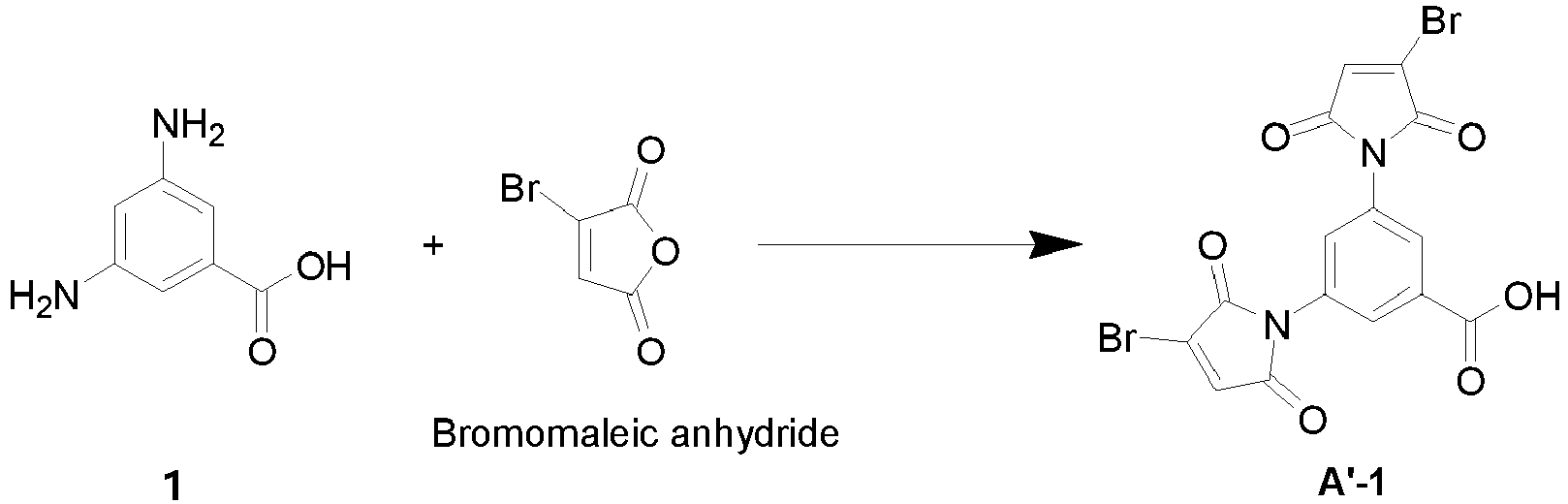
- According to General procedure A, 300 mg of compound 1 (i.e., 3, 5-diaminobenzoic acid) was added, while other materials being added in molar ratios. The reaction was carried out at 70°Covernight. The reaction solution was purified by preparative liquid chromatography, to obtain the target compound A'-1. LC-MS (ESI+) 468.9 [M+H]+.
-

- According to General procedure B, 100 mg of compound A'-1 was added, while other materials being added in molar ratios. The reaction solution was purified by preparative liquid chromatography, to obtain the target compound A'-4. LC-MS (ESI+) 529.0 [M+H]+.
-
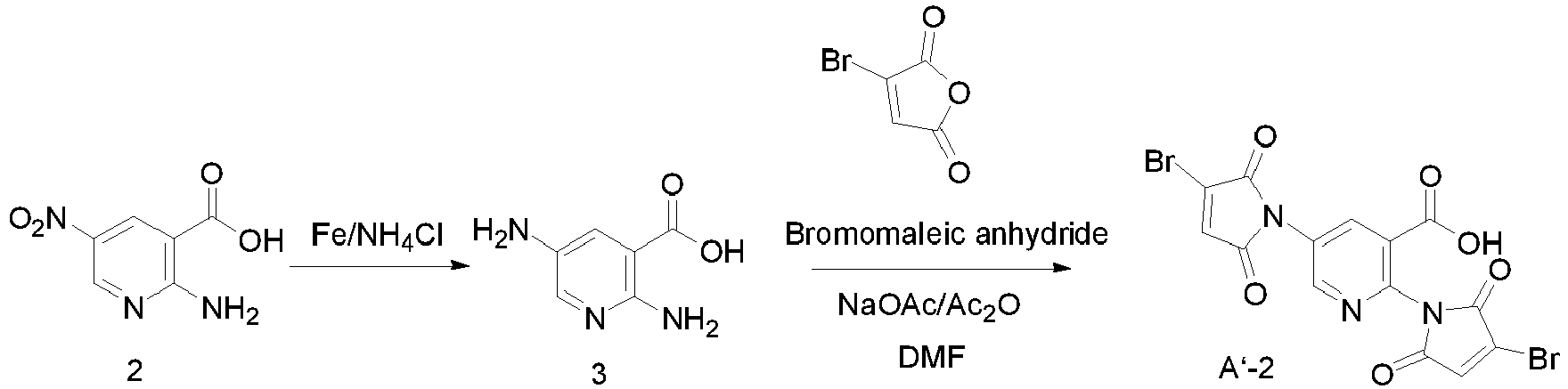
- Compound 2 (1 mol) was dissolved in a mixture of ethanol and water, stirred, to which were added at one time reduced iron powder (5 mol), ammonium chloride (3 mol), followed by reacting at 80°C for 1 h. After the reaction was completed, the reaction solution was cooled to room temperature, filtered to remove solids, and distilled under reduced pressure to remove solvent, to obtain
compound 3. LC-MS m/z (ES+), 154.05 (M+H) +. - According to General procedure A, compound 3 (1 mol) was added, while other materials being added in molar ratios. The reaction was carried out at 80°C overnight. The reaction solution was purified by preparative liquid chromatography, to obtain the target compound A'-2. LC-MS m/z (ES+), 471.85 (M+H) +.
-

- Compound 5 (Boc-imidazole, 2.37 g, 14.1 mmol) was dissolved in 30 mL of toluene, to which was added compound 4 (diethylenetriamine, 0.66 g, 6.41 mmol) at room temperature, followed by stirring with heating at 60°C for 6 h. After the reaction was completed, the reaction solution was distilled under reduced pressure to obtain an oily crude product. The crude product was dissolved in 40 mL of dichloromethane, washed with water (40 mL×3), dried, filtered and concentrated to obtain 1.84 g of
compound 6, in a yield of 95%. LC-MS (ESI+) 304.2 [M+H]+. - Compound 6 (3.3 g, 10.89 mmol) was dissolved in 30 mL of anhydrous toluene, to which was added compound 7 (succinic anhydride, 1.3 g, 13 mmol), followed by stirring with heating at 60°C overnight. After the reaction was completed, the reaction solution was distilled under reduced pressure to remove toluene, the residue was dissolved in 20 mL of dichloromethane, washed with water (20 mL×2), washed with saturated NaCl (20 mL×1), dried, filtered and distilled under reduced pressure to obtain 3.5 g of
compound 8, in a yield of 80%. LC-MS (ESI+) 404.3 [M+H]+. - According to General procedure A, 100 mg of
compound 8 was added, while other materials being added in molar ratios. The reaction was carried out at 70°C overnight. The reaction solution was purified by preparative liquid chromatography, to obtain 25.8 mg of the target compound A'-7, in a yield of 20%. LC-MS (ESI+) 519.9 [M+H]+. -

- Compound 9 (1,3-diaminopropanol, 5.0 g, 55.47 mmol) was dissolved with 50 mL of THF and 20 mL of water with stirring. A solution of Boc2O (25.4 g, 116.5 mmol, 2.1 eq) in 30 mL of THF was added dropwise at room temperature. Thereafter, the reaction solution was stirred at room temperature overnight. After the reaction was completed, the reaction solution was concentrated under reduced pressure. The residue, to which was added 30 mL of petroleum ether, was stirred at room temperature for 20 min, to precipitate out a white solid, which was filtered and dried to obtain 14.7 g of
white compound 10, in a yield of 91%. LC-MS (ESI+) 291.2 [M+H]+. - Compound 10 (14.7 g, 50.64 mmol) was dissolved with 100 mL of anhydrous THF with stirring, followed by cooling in ice bath. Then, NaH (4.8 g, 202.55 mmol, 4 eq) was added in batches, followed by stirring for 10 min. A solution of compound 11 (tert-butyl bromoacetate, 24.7 g, 126.6 mmol, 2.5 eq) in 50 mL of THF was added dropwise. Thereafter, the reaction solution was heated up to 40°C, and stirred overnight. After the reaction was completed, the reaction solution was cooled to room temperature, diluted with 250 mL of ethyl acetate, to which was added slowly an ice-water mixture until no large amount of bubbles were formed, and then liquid separation was performed. The aqueous phase was extracted with ethyl acetate, and the organic phases were combined, washed, dried and concentrated. The residue, to which was added 50 mL of petroleum ether, was stirred at room temperature for 20 min, to precipitate out a white solid, which was filtered and dried to obtain 12.1 g of
white compound 12, in a yield of 60%. LC-MS (ESI+) 404.1 [M+H]+. - Compound 12 (12.1 g, 30.0 mmol) was dissolved with 120 mL of anhydrous DCM with stirring, to which was then added a solution (4 M, 45 mL, 180 mmol) of hydrogen chloride in 1,4-dioxane, followed by stirring at room temperature overnight. After the reaction was completed, the reaction solution was concentrated under reduced pressure. The residue was dispersed by ultrasound with 30 mL of methyl tert-butyl ether, centrifuged with the removal of supernatant, and then dispersed with 30 mL of petroleum ether, centrifuged with the removal of supernatant. The solid was distilled under reduced pressure to remove the solvent, to obtain 7.7 g of
white compound 13, in a yield of 100%. LC-MS (ESI+) 148.1 [M+H]+. - According to General procedure A, 1.2 g of
compound 13 was added, while other materials being added in molar ratios. The reaction was carried out at 85°C for 5 h. The reaction solution was purified by preparative liquid chromatography, to obtain 890 mg of the target compound A'-8, in a yield of 35%. LC-MS (ESI+) 464.9 [M+H]+. -

- According to General procedure A, 500 mg of compound 14 (2, 3-diaminopropionic acid) was added, while other materials being added in molar ratios. The reaction was carried out at 70°Covernight. The reaction solution was purified by normal phase column chromatography, to obtain 240 mg of the target compound A'-9, in a yield of 23%. LC-MS (ESI+) 420.9 [M+H]+.
-

- According to General procedure B, 104 mg of compound A'-7 was added, while other materials being added in molar ratios. The reaction was carried out at room temperature for 2.5 h. The reaction solution was purified by preparative liquid chromatography, to obtain 27.7 mg of the target compound A'-10, in a yield of 24%. LC-MS (ESI+) 596.1 [M+H]+.
-

- According to General procedure B, 600 mg of compound A'-8 was added, while other materials being added in molar ratios. The reaction was carried out at room temperature for 2.5 h. The reaction solution was purified by preparative liquid chromatography, to obtain 203 mg of the target compound A'-11, in a yield of 30%. LC-MS (ESI+) 525.1 [M+H]+.
-

- According to General procedure B, 120 mg of compound A'-9 was added, while other materials being added in molar ratios. The reaction was carried out at room temperature for 0.7 h. The reaction solution was purified by preparative liquid chromatography, to obtain 30 mg of the target compound A'-12, in a yield of 22%. LC-MS (ESI+) 481.0 [M+H]+.
-

- According to General procedure A, 500 mg of compound 15 (L-lysine) was added, while other materials being added in molar ratios. The reaction was carried out at 70°C overnight. The reaction solution was purified by normal phase column chromatography, to obtain 410 mg of the target compound A'-13, in a yield of 26%. LC-MS (ESI+) 462.9 [M+H]+.
-

- Compound 16 (500 mg, 2.03 mmol) was dissolved with the addtion of 1 mL of THF and 1 mL of saturated NaHCOs aqueous solution with stirring, followed by stirring in ice bath for 5 min. Then, compound 17 (724.4 mg, 4.67 mmol) was added slowly in batches, followed by stirring in ice bath for 40 min, and then stirring at room temperature for 2.5 h. After the reaction was completed, the reaction solution was subjected to rotary evaporation to remove THF, diluted with 1 mL of methanol, and separated by preparative liquid chromatography to obtain 245 mg of
compound 18, in a yield of 37%. LC-MS (ESI+) 327.1 [M+H]+. - According to General procedure A, 245 mg of
compound 18 was added, while other materials being added in molar ratios. The reaction was carried out at 70°C overnight. The reaction solution was purified by normal phase column chromatography, to obtain 67 mg of the target compound A'-14, in a yield of 23%. LC-MS (ESI+) 462.9 [M+H]+. -

- According to General procedure A, 56.1 mg of compound 19 (Boc-4-amino-L-phenylalanine) was added, while other materials being added in molar ratios. The reaction was carried out at 70 °C overnight. The reaction solution was purified by normal phase column chromatography, to obtain 17.9 mg of the target compound A'-15, in a yield of 18%. LC-MS (ESI+) 496.9 [M+H]+.
-

- According to General procedure B, 218 mg of compound A'-13 was added, while other materials being added in molar ratios. The reaction was carried out at room temperature for 0.7 h. The reaction solution was purified by preparative liquid chromatography, to obtain 65 mg of the target compound A'-16, in a yield of 26%. LC-MS (ESI+) 523.1 [M+H]+.
-

- Compound 20 (140 mg, 0.5 mmol) was dissolved with 3 mL of dichloromethane, to which was added triethylamine (210 µL, 1.5 mmol), followed by stirring in ice bath. Compound 21 (62.5 µL, 0.75 mmol) was dissolved in 2 mL of DCM, and added dropwise to the reaction solution, followed by stirring in ice bath for 0.5 h, and stirring at room temperature for 2 h. After the reaction was completed, the reaction solution was concentrated. The residue was dissolved with acetonitrile, and separated by preparative liquid chromatography to obtain 93.5 mg of
compound 22, in a yield of 56.1%. LC-MS (ESI+) 335.2 [M+H]+. - According to General procedure A, 33.4 mg of
compound 22 was added, while other materials being added in molar ratios. The reaction was carried out at 70°C overnight. The reaction solution was purified by normal phase column chromatography, to obtain 7.5 mg of the target compound A'-19, in a yield of 19.1%. LC-MS (ESI+) 393.0 [M+H]+. -

- Compound 23 (230 mg, 1 mmol) was dissolved in 3 mL of THF, to which was added bromomaleic anhydride (354 mg, 2 mmol), followed by stirring at room temperature for 3 h. After the reaction was completed, the reaction solution was subjected to rotary evaporation to remove THF, to obtain a crude product of
compound 24.Compound 24 was dissolved with 3 mL of acetic anhydride, to which was added sodium acetate (41 mg, 0.5 mmol), followed by stirring at 70°C for 8 h. After the reaction was completed, the reaction solution was subjected to rotary evaporation to remove the solvent. The residue was dissolved with 4 mL of acetonitrile/water (1:1), and purified by preparative liquid chromatography to obtain 70 mg ofcompound 25, in a yield of 18%. LC-MS (ESI+) 389.0 [M+H]+. - To compound 25 (99.2 mg, 0.32 mmol) 2 mL of a solution (4M, 8 mmol) of hydrogen chloride in 1,4-dioxane was added, followed by stirring in ice bath for 2h. After the reaction was completed, the reaction solution was subjected to rotary evaporation to remove the solvent. The residue was washed with diethyl ether (5 mL×3), and dried to obtain 64.1 mg of compound 26, in a yield of 95.3%. LC-MS (ESI+) 289.0 [M+H]+.
- Compound 26 (21 mg, 0.1 mmol) was dissolved with 1 mL of dichloromethane, to which was added triethylamine (42 µL, 0.3 mmol), followed by stirring in ice bath. Compound 21 (12.5 µL, 0.15 mmol) was dissolved in 1 mL of DCM, and added dropwise to the reaction solution, followed by stirring in ice bath for 0.5 h, and stirring at room temperature for 2 h. After the reaction was completed, the reaction solution was concentrated. The residue was dissolved with acetonitrile, and separated by preparative liquid chromatography to obtain 18.2 mg of A'-20, in a yield of 69.1%. LC-MS (ESI+) 343.0 [M+H]+.
-

- Compound 27 (150 mg, 0.63 mmol, 1.0 eq) was dissolved with 5 mL of anhydrous THF, and then cooled to -5°C under the protection of Ar, to which was added carefully BH3-THF (1N, 2.5 mL, 2.5 mmol, 4.0 eq), followed by stirring for 10 min, and then stirring at room temperature for 10 min. Thereafter, the solution was steadily heated up to 65°C, and reacted overnight. After the reaction was completed, the reaction solution was cooled down to 0°C, and 5 mL of methanol was slowly added dropwise to the reaction solution, followed by stirring for 30 min, and then stirring at room temperature for 10 min. Thereafter, the reaction solution was heated up to 60°C, stirred for 3 h, and concentrated under reduced pressure, to obtain a crude product of 140 mg of
compound 28, as an oily liquid, which, without purification, was directly put into the next step. LC-MS (ESI+) 167.1 [M+H]+. - The crude product of compound 28 (140.0 mg, 0.58 mmol, 1.0 eq) was dissolved in 5 mL of THF, to which was added 3 mL of water, and then added dropwise a solution of Boc2O (255.5 g, 1.17 mmol, 2.0 eq) in 2.5 mL of THF, followed by stirring at room temperature overnight. After the reaction was completed, the reaction solution was concentrated under reduced pressure. The residue, to which was added 30 mL of EA, was washed, dried, concentrated and purified to obtain 185 mg of compound 29, as a white solid, in a yield of 72%. LC-MS (ESI+) 367.1 [M+H]+.
- Compound 29 (94.0 mg, 0.25 mmol, 1.0 eq) was dissolved in 3 mL of DMF, to which was added K2CO3 (71.0 mg, 0.51 mmol, 2.0 eq), and then added dropwise a solution of compound 11 (75.0 mg, 0.38 mmol, 1.5 eq) in 1 mL of DMF, followed by heating up to 55°C and stirring overnight. After the reaction was completed, 20 mL of EA was added to the reaction solution. The reaction solution was adjusted with 30% citric acid solution to pH=3, extracted, washed, dried and concentrated to obtain 108 mg of
compound 30, as an off-white solid, in a yield of 88%. LC-MS (ESI+) 481.3 [M+H]+. - Compound 30 (108 mg, 0.22 mmol, 1.0 eq) was dissolved in 5 mL of anhydrous DCM, to which was then added a solution (4 M, 1.5 mL, 6.0 mmol, 27.0 eq) of HCl in 1,4-dioxane, followed by stirring at room temperature for 3 h. After the reaction was completed, the reaction solution was concentrated under reduced pressure. The residue was dispersed by ultrasound with 10 mL of methyl tert-butyl ether, centrifuged with the removal of supernatant, and then dispersed with 10 mL of petroleum ether, centrifuged with the removal of supernatant. The solid was distilled under reduced pressure to remove the solvent, to obtain 66.6 mg of
compound 31, as a white solid, in a yield of 100%. LC-MS (ESI+) 225.1 [M+H]+. - According to General procedure A, 66.6 mg of
compound 31 was added, while other materials being added in molar ratios. The reaction was carried out at 70°C overnight. The reaction solution was purified by normal phase column chromatography, to obtain 40 mg of the target compound A'-26, in a yield of 33%. LC-MS (ESI+) 540.9 [M+H]+. -

- Compound A'-26 (40.0 mg, 0.074 mmol, 1.0 eq) was dissolved with 1.0 mL of anhydrous THF, to which was added a solution of TEA (22.5 mg, 0.22 mmol, 3.0 eq) in 500 µL of THF, followed by stirring at room temperature for 5 min. Compound 32 (20.5 mg, 0.16 mmol, 2.2 eq) was dissolved in 500 µL of DMF, and added dropwise to the reaction solution, followed by stirring at room temperature overnight. After the reaction was completed, 15 mL of ethyl acetate was added to the reaction solution. The reaction solution was washed with 15% citric acid solution, washed with water, washed with saturated NaCl solution, dried, concentrated, and purified to obtain 12 mg of compound A'-27, as a white solid, in a yield of 26%. LC-MS (ESI+) 629.1 [M+H]+.
-

- Compound 33 (150 mg, 2 mmol, 1.0 eq) was dissolved in 5 mL of dioxane, to which was added 3 mL of a saturated sodium bicarbonate aqueous solution, and then added dropwise a solution of Boc2O (523 mg, 2.40 mmol, 1.2 eq) in 2.5 mL of dioxane, followed by stirring at room temperature for 2 h. The reaction solution was concentrated under reduced pressure. The residue, to which was added 30 mL of EA, was adjusted with 30% citric acid to pH=3, extracted, washed, dried, concentrated, dispersed with 15 mL of PE, filtered, and dried to obtain 344 mg of compound 34, in a yield of 62%. LC-MS (ESI+) 176.1 [M+H]+.
- Compound 34 (350 mg, 2.00 mmol, 1.0 eq) was dissolved in 4 mL of DMF, and cooled down to -15°C under Ar atmosphere, to which was added a solution of TEA (606.0 mg, 6.00 mmol, 3.0 eq) in 1 mL of DMF, followed by stirring for 5 min, and then added a solution of T3P (700.0 mg, 2.20 mmol, 1.1 eq) in 1 mL of DMF, followed by stirring for 1.5 h. A solution of compound 35 (135.0 mg, 1.00 mmol, 0.5 eq) in 1 mL of DMF was added dropwise to the reaction solution, followed by stirring overnight. The reaction solution, in which was added 30 mL of EA, was adjusted with 30% citric acid to pH=3, extracted, washed, dried and concentrated to obtain 350 mg of compound 36 as an oily liquid, which, without purification, was directly put into the next step. LC-MS (ESI+) 449.2 [M+H]+.
- Compound 36 (350 mg, 0.78 mmol, 1.0 eq) was dissolved with 5 mL of anhydrous DCM with stirring, to which was then added a solution (4 M, 2.0 mL, 8.0 mmol, 10.2 eq) of HCl in 1,4-dioxane, followed by stirring at room temperature for 2 h. The reaction solution was concentrated under reduced pressure. The residue was dispersed by ultrasound with 20 mL of methyl tert-butyl ether, centrifuged with the removal of supernatant, and then dispersed with 20 mL of petroleum ether, centrifuged with the removal of supernatant. The solid was distilled under reduced pressure to remove the solvent, to obtain 254 mg of compound 37, in a yield of 100%. LC-MS (ESI+) 249.1 [M+H]+.
- According to General procedure A, 195 mg of compound 37 was added, while other materials being added in molar ratios. The reaction was carried out at 70°C overnight. The reaction solution was purified by normal phase column chromatography, to obtain 58 mg of the target compound A'-28, as a light yellow solid, in a yield of 17%. LC-MS (ESI+) 564.9 [M+H]+.
-

- According to General procedure B, 58 mg of compound 38 was added, while other materials being added in molar ratios. The reaction was carried out at room temperature for 0.7 h. The reaction solution was purified by normal phase column chromatography, to obtain 14.1 mg of the target compound A'-29, in a yield of 22%. LC-MS (ESI+) 625.1 [M+H]+.
-

- Compound 43 (342.0 mg, 3.00 mmol, 1.0 eq) was dissolved with 15 mL of anhydrous THF, and to which was added dropwise bromomaleic anhydride (1110.0 mg, 6.30 mmol, 2.1eq), followed by stirring at room temperature overnight. After the reaction was completed, the reaction solution was filtered. The filter cake was washed with DCM, and dried to obtain 1160 mg of compound 44, as a white solid, in a yield of 83%. LC-MS (ESI+) 466.9 [M+H]+.
- To compound 45 (300 mg, 0.64 mmol, 1.0 eq) and anhydrous sodium acetate (158.0 mg, 1.93 mmol, 3.0 eq) was added 6 mL of acetic acid, followed by heating up to 85°C and reacting overnight. The reaction solution was cooled to 45°C, and concentrated under reduced pressure. The residue, in which was added 20 mL of acetonitrile, was filtered. The filtrate was purified by preparative liquid chromatography to obtain 15 mg of a light yellow solid (i.e., compound A'-31), in a yield of 5%. LC-MS (ESI+) 430.9 [M+H]+.
-

- According to General procedure A, compound 48 (95 mg, 0.5 mmol) and compound 8 (80.6 mg, 0.2 mmol) were added, to obtain 10.9 mg of compound A'-33, in a yield of 10.1%. LC-MS (ESI+) 548.0 [M+H]+.
-

- According to General procedure A, compound 49 (2-amino-6-chloroisonicotinic acid, 86 mg, 0.5 mmol) was added, to obtain 21.3 mg of compound A'-34, in a yield of 13%. LC-MS (ESI+) 330.9 [M+H]+.
- The linker (i.e., first linker moiety A) provided by the present invention was mainly used for coupling with antibody in the antibody-drug conjugate. In order to verify the coupling ability of the linker provided by the present invention with antibody, the linker synthesized in the above examples was coupled separately with antibody. The coupling method used was as follows:
- 1) Preparation of mother liquors of reducing agent and protective agent: mother liquors of reducing agent and protective agent, 1~20 mM TCEP (Tris-2-carboxyethyl-phosphine) (reducing agent) and 1~20 mM DTPA (Diethylene triamine pentacetate acid) (protective agent), were respectively prepared with purified water;
- 2) Reduction reaction of antibody: the DTPA and TCEP mother liquors were added to a monoclonal antibody solution (e.g., 5-30 mg/mL) respectively. The DTPA mother liquor was mixed in the monoclonal antibody solution (e.g., 5-30 mg/mL) according to a certain volume ratio (1~5:10), and the molar ratio of TCEP to monoclonal antibody was 0.5-6.0:1. After the reducing agent and protective agent were added, the reaction was carried out at 25°C with stirring for 1 h;
- 3) Preparation of first linker moiety (A) solution: a first linker moiety (A) was dissolved in 25% DMSO (dimethyl sulfoxide) to form a first linker moiety (A) solution in a concentration of 5 mM;
- 4) Coupling reaction between first linker moiety (A) and antibody: the first linker moiety (A) solution obtained in step 3) was slowly added to the reduced monoclonal antibody solution obtained in step 2), and, according to actual needs, while controlling the molar ratio of first linker moiety (A) to thio group of antibody to be in the range of 0.3~5:1, the reaction was carried out at 25°C with stirring for 4 h;
- 5) Purification and detection steps: after the reaction of step 4) was completed, the reaction solution was centrifuged and ultrafiltered 3 times with PBS buffer to purify and remove residual unreacted chemcials and free small molecules such as DMSO, and the coupling result was detected by SDS-PAGE electrophoresis.
- The coupling result of antibody-linker conjugate was analyzed by SDS-PAGE electrophoresis. The method used was as follows: for SDS-PAGE detection, a gel plate of NUPAGE 4-12% was used, 1.5 µL of a sample was put in a 1.5 mL EP tube, 2.5 µL of buffer was added, then 1.5 µL of reducing agent was added, and water was added to make the volume to 10 µL. The mixture was mixed on an oscillator, and heated in a microwave oven for 1 min. After the sample was loaded, gel electrophoresis was performed. After the gel electrophoresis was completed, the gel was taken out and put in a fresh-keeping box, to which was added 50 mL of a quick stain, heated in a microwave oven for 5 min, and then dyed on a shaker for 5 min. After the staining solution was poured out, 100 mL of purified water was added, heated in an induction cooker for 5 min, and decolored on a shaker for 1 h. This operation was repeated three times.
- The antibody used here was Her2 monoclonal antibody (as for the sequence information of the antibody, please refer to paragraphs 41,42, 43 of the specification in Chinese Patent Publication No.
CN105008398B ), and the linkers were:


- The coupling results were as shown in
Figure 5 . InFigure 5 , Nos. 1, 2, 3 were Her2-A'-7, coupling buffers respectively had pH of 8.5, 9.0, 7.4; Nos. 4, 5, 6 were Her2-A'-8, coupling buffers respectively had pH of 8.5, 7.4, 9.0; Nos. 7, 8, 9 were Her2-A'-10, coupling buffers respectively had pH of 8.5, 9.0, 7.4; Nos. 10, 11, 12 were Her2-A'-11, coupling buffers respectively had pH of 9.0, 7.4, 9.5; Nos. 13, 14, 15 were Her2-A'-12, coupling buffers respectively had pH of 7.4, 9.0, 8.5; Nos. 16, 17, 18 were Her2-A'-20, coupling buffers respectively had pH of 8.5, 9.0, 7.4; Nos. 19, 20, 21 were Her2-A'-28, coupling buffers respectively had pH of 9.0, 8.5, 7.4; Nos. 22, 23, 24 were Her2-A'-31, coupling buffers respectively had pH of 7.4, 8.5, 9.0. - Due to the use of reduction electrophoresis, all the thio groups among antibodies were exposed. Therefore, in
Figure 5 , 25KD represented the molecular weight of one light chain of the antibody, 50KD represented the molecular weight of one heavy chain, and 75KD represented the molecular weight of one light chain and one heavy chain (i.e., one linker was covalently linked to the thio group between one heavy chain and one light chain), 100KD represented the molecular weight of two heavy chains (i.e., one linker was covalently linked to the thio group between two heavy chains), 125KD represented the molecular weight of one light chain and two heavy chains (i.e., one linker was covalently linked to the thio groups among two heavy chains and one light chain), 150KD represented the molecular weight of two heavy chains and two light chains (i.e., one linker was covalently linked to the thio groups among two heavy chains and two light chains). - The results showed that the above antibody-linker conjugates each had linkers that were simultaneously covalently linked to the thio groups respectively between one heavy chain and one light chain, between two heavy chains, among two heavy chains and one light chain, or among two heavy chains and two light chains. And, there were 150-75 KD bands in most antibody-linker conjugates, which proved that the 4 pairs of disulfide bonds in the antibody were fully or partially bridged, and the bridge coupling effect was better. From
Figure 5 , it could also be seen that the coupling result under the condition of buffer pH = 9.0 was better than that under the conditions of pH = 8.5 and 7.4. - In view of the better bridging coupling effect of the linker provided by the present invention with antibody, A'-7, A'-8, A'-10, A'-11, A'-28 were selected for the preparation of antibody-drug conjugates. The antibody used was Her2 monoclonal antibody (the same as above), and the drugs used were MMAE, MMAF, MMAD, CBI, DM1, DM4.
- As for MMAE and MMAD, the preparation of the antibody-drug conjugate involved in the present invention was generally divided into three steps: the first step was to prepare a conjugate L-D of second linker L and drug D; the second step was to prepare a conjugate A-L-D of first linker A and L-D; and the third step was to prepare a conjugate of antibody Ab and A-L-D, i.e., an antibody-drug conjugate Ab-A-L-D.
- As for MMAF, CBI, DM1, DM4, the preparation of the antibody-drug conjugate involved in the present invention was generally divided into two steps: the first step was to prepare a conjugate A-D of first linker A and drug D; and the second step was to prepare a conjugate of antibody Ab and A-D, i.e., an antibody-drug conjugate Ab-A-D.
- The specific preparation method was shown in Examples 26-29.
- General method for the synthesis of L-D: a second linker moiety L was dissolved in a suitable amount of DMF, to which were added, under the protection of nitrogen gas, drug (D), HOBt, DIPEA and pyridine in suitable amounts, followed by stirring at room temperature for 24 hours, while TLC was used to monitor the progress of the reaction. After the reaction was completed, the reaction solution was purified by preparative high performance liquid chromatography, and the preparation solution was lyophilized to obtain a conjugate (L-D) of the second linker moiety and the drug.
- Val-Cit-PAB-MMAE was prepared by the general method described above, and the synthetic route was shown below:

- Compound 53 (i.e., Fomc-Val-Cit-PAB-PNP, 995.4 mg, 1.3 mmol) and HOBt (67.6 mg, 0.65 mmol) were put in a reaction bottle, and dissolved with 5 mL of anhydrous DMF, to which was added DIPEA (258.5 mg, 2 mmol), followed by stirring at room temperature for 10 min. Compound 54 (i.e., MMAE, 717 mg, 1 mmol) was dissolved in 5 mL of anhydrous DMF, and added dropwise to the reaction solution, followed by stirring at room temperature overnight. After the reaction was completed, the reaction solution was filtered. The organic phase was concentrated. The residue was separated by preparative liquid chromatography to obtain 636.2 mg of compound 55 (i.e., Fmoc-Val-Cit-PAB-MMAE), as a white solid, in a yield of 47.3%, LC-MS (ESI+) 1345.8 [M+H]+.
- Compound 55 (270 mg, 0.2 mmol) was added to 3 mL of a 20% solution of piperidine in acetonitrile (v/v), followed by stirring at room temperature for 2.5 h, to gradually dissolve the solid. After the reaction was completed, the reaction solution was distilled under reduced pressure to remove the solvent. The residue was separated by preparative liquid chromatography, to obtain 214 mg of compound 62 (i.e., Val-Cit-PAB-MMAE), in a yield of 95%. LC-MS (ESI+) 1123.7 [M+H]+.
- The synthesis with the use of second linker moiety (L) and drug (D) was a general method for the synthesis of other L-D compounds, such as Val-Cit-PAB-MMAD.
- General method for the synthesis of A-L-D: first linker moiety, EDCI, HOBt in suitable amounts were dissolved in a suitable amount of anhydrous DMF, and stirred at room temperature for 2 h. A suitable amount of self-made L-D was dissolved in a suitable amount of anhydrous DMF, and slowly added dropwise to the reaction solution, followed by stirring at room temperature for 4 h. After the reaction was completed, the reaction solution was diluted with acetonitrile, and then separated by preparative liquid chromatography. The eluent was lyophilized to obtain a conjugate of first linker moiety (A) and second linker moiety-drug conjugate (L-D).
- Conjugate of A'-7 and compound 56 (Val-Cit-PAB-MMAE) was synthesized by using the above general method. The synthetic route was shown below:

- Compound A'-7 (27.8 mg, 0.053 mmol), EDCI (11.2 mg, 0.058 mmol), HOBt (1.4 mg, 0.01 mmol) were dissolved in 0.3 mL of anhydrous DMF, and stirred at room temperature for 2 h. Compound 56 (i.e., Val-Cit-PAB-MMAE, 40 mg, 0.035 mmol) was dissolved in 0.2 mL of anhydrous DMF, and added dropwise to the reaction solution, followed by stirring at room temperature for 4 h. After the reaction was completed, the reaction solution was diluted with 2 mL of acetonitrile, and then separated by preparative liquid chromatography. The eluent was lyophilized to obtain 8.6 mg of compound 57 (i.e., A'-7-Val-Cit-PAB-MMAE), as a light yellow solid, in a yield of 15%. LC-MS (ESI+) 1624.6 [M+H]+.
- Other conjugates of first linker moiety and L-D compound were synthesized by using the above general method, such as A'-8-Val-Cit-PAB-MMAE, A'-10-Val-Cit-PAB-MMAE, A'-11-Val-Cit-PAB-MMAE, A'-11-Val-Cit-PAB-MMAD, A'-28-Val-Cit-PAB-MMAE and the like.


- For comparison, a conjugate 575DZ-Val-Cit-PAB-MMAE of compound 6 (this compound is defined herein as 575DZ) disclosed on
page 7 of the claims of the Chinese patent No.CN103933575A with second linker moiety (Val-Cit-PAB) and drug moiety (MMAE) was also prepared here.
-

- Compound A'-7 (51.8 mg, 0.1 mmol), EDCI (21.1 mg, 0.11 mmol), HOBt (2.7 mg, 0.01 mmol) were dissolved in 2 mL of anhydrous DMF, and stirred at room temperature for 2 h. Compound 58 (i.e., MMAF, 48.8 mg, 0.066 mmol) was dissolved in 0.8 mL of anhydrous DMF, and added dropwise to the reaction solution, followed by stirring at room temperature for 4 h. After the reaction was completed, the reaction solution was diluted with 4 mL of acetonitrile, and separated by preparative liquid chromatography. The eluent was lyophilized to obtain 25.9 mg of compound A'-7-MMAF, as a light yellow solid, in a yield of 21%. LC-MS (ESI+) 1233.4 [M+H]+.
-

- The synthesis method was the same as that of A'-7-MMAF. A'-8 (22.0 mg, 0.047 mmol, 1.0 eq) and compound 59 (i.e., CBI, 14.0 mg, 0.020 mmol, 0.7 eq) were added, to obtain 6.0 mg of a white solid A'-8-CBI, in a yield of 21%. LC-MS (ESI+) 868.0 [M+H]+.
-


- Compound 60 (45.0 mg, 0.21 mmol, 1.0 eq) was dissolved with 2 mL of anhydrous THF, to which was added 1 mL of sat. NaHCOs aqueous solution, and added dropwise a solution of DM1 (61, 150.0 mg, 0.21 mmol, 1.0 eq) in 1 mL of DMF, followed by stirring at room temperature for 2 h. The reaction solution was diluted with 10 mL of water, and extracted with EA. The aqueous phase was adjusted with 15% citric acid solution to pH=3, extracted with 15 mL of EA, washed with saturated NaCl, dried and concentrated to obtain 165.7 mg of compound 62, as a white solid, in a yield of 85%. LC-MS (ESI+) 949.3 [M+H]+.
- A'-8 (150.0 mg, 0.33 mmol, 1.0 eq) was dissolved in 5 mL of DMF, and cooled down to -15°C under Ar atmosphere, to which was added a solution of TEA (98.0 mg, 0.99 mmol, 3.0 eq) in 1 mL of DMF, followed by stirring for 5 min, and then added a solution of T3P (154.0 mg, 0.48 mmol, 1.5 eq) in 1 mL of DMF, followed by stirring for 1.5 h. A solution of compound 63 (46.0 mg, 0.29 mmol, 0.9 eq) in 1 mL of DMF was added dropwise to the reaction solution, followed by stirring overnight. After the reaction was completed, 30 mL of EA was added, and the reaction solution was adjusted with 30% citric acid to pH=3, extracted, washed, dried, concentrated, and purified by normal phase column chromatography to obtain 90 mg of compound 64, as a white solid, in a yield of 52%. LC-MS (ESI+) 607.1 [M+H]+.
- Compound 64 (90 mg, 0.15 mmol, 1.0 eq) was dissolved with 3 mL of anhydrous DCM with stirring, to which was then added a solution (4 M, 1.0 mL, 4 mmol, 26.7 eq) of HCl in 1,4-dioxane, followed by stirring at room temperature for 2 h. The reaction solution was concentrated under reduced pressure. The residue was dispersed by ultrasound with 20 mL of methyl tert-butyl ether, centrifuged with the removal of supernatant, and then dispersed with 20 mL of petroleum ether, centrifuged with the removal of supernatant. The solid was distilled under reduced pressure to remove the solvent, to obtain 82 mg of compound 65, as a white solid, in a yield of 100%. LC-MS (ESI+) 506.9 [M+H]+.
- Compound 62 (30.0 mg, 0.03 mmol, 1.0 eq) was dissolved in 2 mL of DMF, and cooled down to -15°C under Ar atmosphere, to which was added a solution of TEA (11.0 mg, 0.095 mmol, 4.0 eq) in 500 µL of DMF, followed by stirring for 5 min, and then added a solution of T3P (15.0 mg, 0.047 mmol, 1.5 eq) in 500 µL of DMF, followed by stirring for 1.5 h. A solution of compound 65 (19.0 mg, 0.035 mmol, 1.1 eq) in 500 µL of DMF was added dropwise to the reaction solution, followed by stirring overnight. After the reaction was completed, the reaction solution was diluted with 2 mL of acetonitrile, and purified by preparative liquid chromatography, to obtain 9 mg of the product A'-8-DM1, in a yield of 20 %. LC-MS (ESI+) 1437.3 [M+H]+.
-
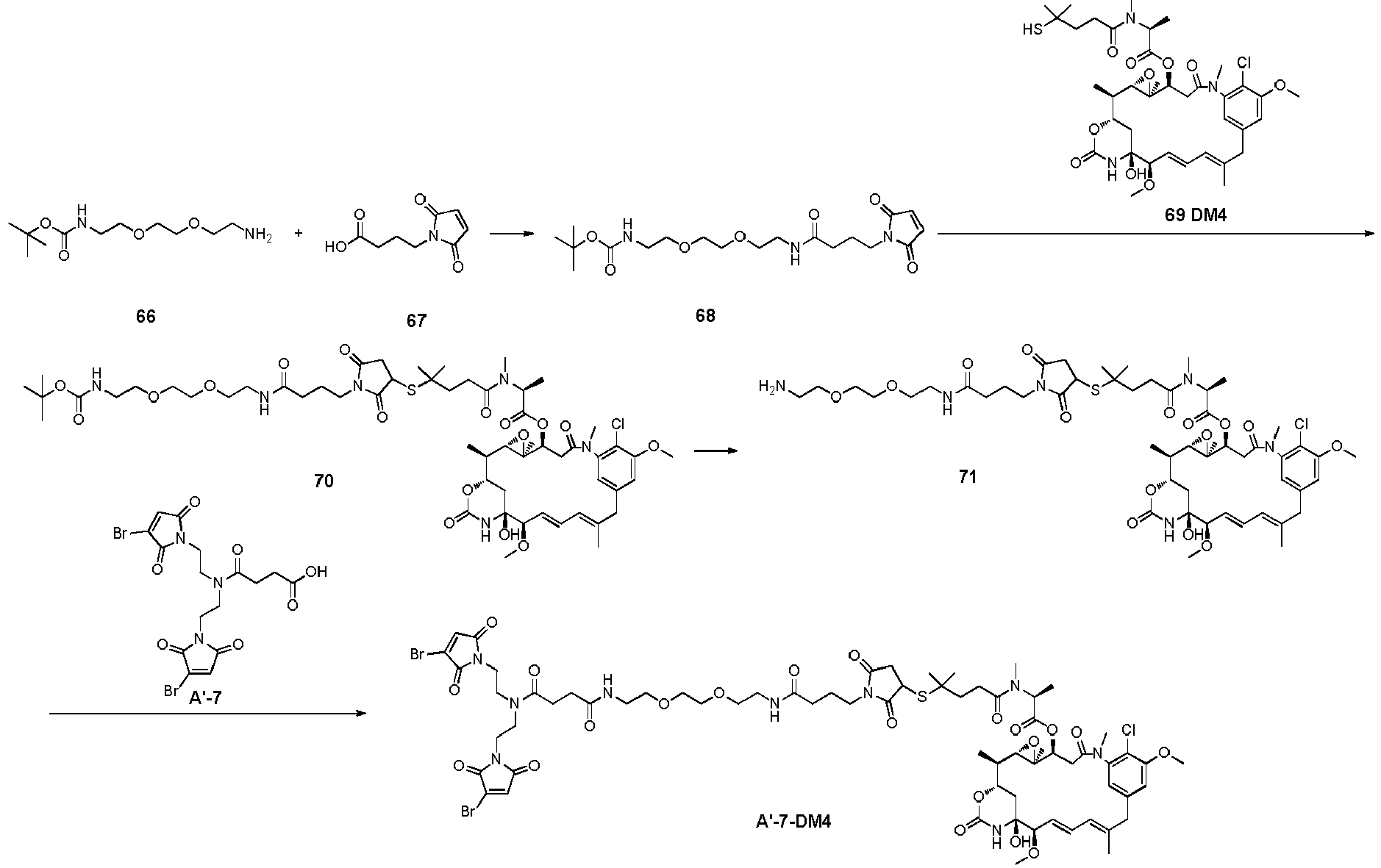
- Compound 67 (737.5 mg, 4.03 mmol), EDCI (846.13 mg, 4.43 mmol), HOBt (108.9 mg, 0.806 mmol) were dissolved in 10 mL of DCM, followed by stirring at room temperature for 2 h. Compound 66 (1 g, 4.03 mmol) was dissolved in 5 mL of dichloromethane, and slowly added dropwise in 3 batches to the reaction system, followed by stirring at room temperature overnight. After the reaction was completed, the reaction solution was concentrated under reduced pressure to remove the solvent. The residue was dissolved with 6 mL of acetonitrile/water (1:1), separated by preparative liquid chromatography, and lyophilized to obtain 1.11 g of compound 68, as a colorless oily compound, in a yield of 67%. LC-MS (ESI+) 414.2 [M+H]+.
- Compound 68 (1.11 g, 2.7 mmol) was dissolved with 1.1 mL of DMA. 0.1 mL of the obtained solution was dissolved in 1 mL of DMA, to which was added DIPEA (41.3 mg, 0.32 mmol), followed by stirring at room temperature for 2 min, and then added DM4 (69, 202.5 mg, 0.26 mmol), followed by stirring at room temperature for 6 h. The reaction solution was directly separated by preparative liquid chromatography, and lyophilized to obtain 260 mg of
compound 70, as a white solid, in a yield of 84%. LC-MS (ESI+) 1193.5 [M+H]+. - The synthesis method of compound 71 was the same as that of compound 65. 119.3 mg of
compound 70 was added, to obtain 106 mg of compound 71, as a white solid, in a yield of 96%. LC-MS (ESI+) 1093.5 [M+H]+. - The synthesis method of A'-7-DM4 was the same as that of A'-8-DM1. 52 mg of A'-7 and 54.6 mg of compound 71 were added, to obtain 15 mg of A'-8-DM1, as a white solid, in a yield of 19%. LC-MS (ESI+) 1594.4 [M+H]+.
- General method for the synthsis of antibody-drug conjugate:
- 1) Preparation of mother liquors of reducing agent and protective agent: mother liquors of reducing agent and protective agent, 1~20 mM TCEP (Tris-2-carboxyethyl-phosphine) (reducing agent) and 1~20 mM DTPA (Diethylene triamine pentacetate acid) (protective agent), were respectively prepared with purified water;
- 2) Reduction reaction of antibody: the DTPA and TCEP mother liquors were added to a monoclonal antibody solution (e.g., 5-30 mg/mL) respectively. The DTPA mother liquor was mixed with the monoclonal antibody solution (e.g., 5-30 mg/mL) according to a certain volume ratio (1~5:10), and the molar ratio of TCEP to monoclonal antibody was 0.5~6.0:1. After the reducing agent and protective agent were added, the reaction was carried out at 25°C with stirring for 1 h.
- 3) Synthesis of A-L-D and preparation of solution: a conjugate (A-L-D) of first linker moiety-second linker moiety-drug moiety was synthesized, and the synthesized A-L-D was dissolved in 25% DMSO (dimethyl sulfoxide) to obtain a A-L-D solution with concentration of 5 mM;
- 4) Coupling reaction of drug and antibody: the A-L-D solution obtained in step 3) was slowly added to the reduced monoclonal antibody solution obtained in step 1), and, according to actual needs, while controlling the molar ratio of A-L-D to thio group of antibody to be in the range of 0.3~5:1, the reaction was carried out at 25°C with stirring for 4 h;
- 5) Purification and detection steps: after the reaction of step 4) was completed, the reaction solution was centrifuged and ultrafiltered 3 times with PBS buffer to purify and remove residual unreacted chemcials and free small molecules such as DMSO, and the coupling result was detected by SDS-PAGE electrophoresis and hydrophobic high performance liquid chromatography (HIC-HPLC).
- The coupling result of the antibody-drug conjugate was analyzed by SDS-PAGE electrophoresis and HIC-HPLC. The method used was shown as follows:
- For SDS-PAGE detection, a gel plate of NUPAGE 4-12% was used, 1.5 µL of a sample was put in a 1.5 mL EP tube, 2.5 µL of buffer was added, then 1.5 µL of reducing agent was added, and water was added to make the volume to 10 µL, followed by mixing on an oscillator, and heating in a microwave oven for 1 min. After the sample was loaded, gel electrophoresis was performed. After the gel electrophoresis was completed, the gel was taken out and put in a fresh-keeping box, to which was added 50 mL of a quick stain, and heated in a microwave oven for 5 min, and then dyed on a shaker for 5 min. After the staining solution was poured out, 100 mL of purified water was added, heated in an induction cooker for 5 min, and decolored on a shaker for 1 h. This operation was repeated three times.
- Test conditions: HIC-HPLC: Tosoh TSK Gel Butyl, 4.6 mm × 3.5 cm, 10 mm; buffer A: 20 mM sodium phosphate, 1.5 M ammonium sulfate, pH 7.0; buffer B: 20 mM sodium phosphate, 25% (v/v) isopronal, pH 7.0; flow rate: 1 ml/min; gradient: 10% buffer B to 100% buffer B in 15 minutes; 10 µL of sample.
- The following 4 antibody-drug conjugates were prepared using the above method: Her2-A'-7-Val-Cit-PAB-MMAE, Her2-A'-11-Val-Cit-PAB-MMAE, Her2-A'-10-Val-Cit-PAB-MMAE, Her2-575DZ-Val-Cit-PAB-MMAE, wherein the antibody is Her2 monoclonal antibody (the same as above). The coupling results of the above 4 antibody-drug conjugates were analyzed by HIC-HPLC and SDS-PAGE electrophoresis, which were shown in Table 1,
Figure 1A, Figure 1B ,Figure 1C, Figure 1D andFigure 2A, Figure 2B . - In Table 1 and
Figure 1A, Figure 1B ,Figure 1C, Figure 1D , D0% represented a proportion of antibody-drug conjugates with 0 drug coupled to one antibody via linker, i.e., a proportion of naked antibody, D1% represented a proportion of antibody-drug conjugates with 1 drug coupled to one antibody via linker, D2% represented a proportion of antibody-drug conjugates with 2 drugs coupled to one antibody via linker, D3% represented a proportion of antibody-drug conjugates with 3 drugs coupled to one antibody via linker, D4% represented a proportion of antibody-drug conjugates with 4 drugs coupled to one antibody via linker, and D5% represented a proportion of antibody-drug conjugates with 5 drugs coupled to one antibody via linker. - The results showed that the average DAR value of Her2-A'-7-Val-Cit-PAB-MMAE was 4.10 (the molar ratio of drug to antibody during coupling was 5:1); the average DAR value of Her2-A'-11-Val-Cit-PAB-MMAE was 2.12 (the molar ratio of drug to antibody was 5:1 during coupling); the average DAR value of Her2-A'-10-Val-Cit-PAB-MMAE was 2.26 (the molar ratio of drug to antibody was 5:1 during coupling); the average DAR value of Her2-575DZ-Val-Cit-PAB-MMAE was 4.10 (the molar ratio of drug to antibody was 5:1 during coupling). The results showed that Her2-A'-7-Val-Cit-PAB-MMAE, Her2-A'-11-Val-Cit-PAB-MMAE, Her2-A'-10-Val-Cit-PAB-MMAE all had good coupling effect (the average DAR value was between 2-4 under ideal conditions), wherein the DAR2 ratios of Her2-A'-11-Val-Cit-PAB-MMAE and Her2-A'-10-Val-Cit-PAB-MMAE were 65.574% and 78.9% respectively, the D4% ratio of Her2-A'-7-Val-Cit-PAB-MMAE was 59.45%, the DAR value distribution was very concentrated, and the product uniformity was very good (all being better than Her2-575DZ-Val-Cit-PAB-MMAE).
Table 1 Analytical results of the antibody-drug conjugates by hydrophobic high performance liquid chromatography (HIC-HPLC) ADC D0% D1% D2% D3% D4% D5% DAR Her2-A'-7-Val-Cit-PAB-MMAE 0 0.07 1.93 12.16 59.45 26.40 4.10 Her2-A'-10-Val-Cit-PAB-MMAE 0 9.03 78.9 11.9 0 0 2.26 Her2-A'-11-Val-Cit-PAB-MMAE 0 11.41 65.57 23.02 0 0 2.12 Her2-575DZ-Val-Cit-PAB-MMAE 0 0 1.99 18.46 52.94 21.17 4.10 -
Figure 2A, Figure 2B showed the SDS-PAGE electrophoresis patterns of the above antibody-drug conjugates, whereinFigure 2A showed the SDS-PAGE electrophoresis patterns of Her2-A'-11-Val-Cit-PAB-MMAE (coupling buffers respectively had pH of 8.5, 9.0, 7.4), Her2-A'-7-Val-Cit-PAB-MMAE (coupling buffers respectively had pH of 8.5, 9.0, 7.4), Her2-A'-10-Val-Cit-PAB-MMAE (coupling buffers respectively had pH of 8.5, 9.0, 7.4), andFigure 2B showed the SDS-PAGE electrophoresis patterns from left to right of Her2-A'-7-Val-Cit-PAB-MMAE, Her2-575DZ-Val-Cit-PAB-MMAE, Her2-A'-10-Val-Cit-PAB-MMAE (coupling buffer had pH of 9.0). - Due to the use of reduction electrophoresis, all the thio groups among antibodies were exposed. Therefore, 25KD represented the molecular weight of one light chain of the antibody, 50KD represented the molecular weight of one heavy chain, and 75KD represented the molecular weight of one light chain and one heavy chain (i.e., one linker was covalently linked to the thio group between one heavy chain and one light chain), 100KD represented the molecular weight of two heavy chains (i.e., one linker was covalently linked to the thio group between two heavy chains), 125KD represented the molecular weight of one light chain and two heavy chains (i.e., one linker was covalently linked to the thio groups among two heavy chains and one light chain), 150KD represented the molecular weight of two heavy chains and two light chains (i.e., one linker was covalently linked to the thio groups among two heavy chains and two light chains).
-
Figure 2A showed that the antibody-drug conjugates (Her2-A'-7-Val-Cit-PAB-MMAE, Her2-A'-10-Val-Cit-PAB-MMAE, Her2-A'-11-Val-Cit-PAB-MMAE) provided in the present examples each had linkers that were simultaneously covalently linked to the thio groups respectively between one heavy chain and one light chain (75KD), between two heavy chains (100KD), among two heavy chains and one light chain (125KD), or among two heavy chains and two light chains (150KD), which proved that the 4 pairs of disulfide bonds in the antibody were fully or partially bridged, and the bridge coupling effect was better. -
Figure 2B showed the parallel contrast SDS-PAGE electrophoresis patterns of Her2-A'-7-Val-Cit-PAB-MMAE, Her2-575DZ-Val-Cit-PAB-MMAE, Her2-A'-10-Val-Cit-PAB-MMAE (coupling buffer had pH of 9.0). From the Figure, it could be seen that the ratio of 150KD and 125KD bands in the conjugates Her2-A'-7-Val-Cit-PAB-MMAE and Her2-A'-10-Val-Cit-PAB-MMAE was significantly higher than the ratio of the corresponding bands in the conjugate Her2-575DZ-Val-Cit-PAB-MMAE. At the same time, the ratio of 50KD and 25KD bands was also significantly reduced, which proved that the first linker moiety of the present invention had better coupling efficiency and could result in an antibody-drug conjugate with a higher bridging ratio. - The hydrolysis result of the antibody-drug conjugate (claudin18.2-A'-7-VC-PAB-MMAE) was characterized by molecular weight analysis and protein isoelectric point analysis.
- Test conditions: instrument model: Thermo Q Exactive Plus; mobile phase: 25 mM ammonium acetate solution; flow rate: 0.3 mL/min; injection volume: 1 mg/mL, 20 µL, i.e., 20 µg; detection range: 5000-8000 Da; output range: 140000-160000 Da.
- Instrument Information: Imaging Capillary Isoelectric Focusing Electrophoresis Instrument, model:
iCE 3. - Instrument settings: focus time 1: 1500V for 1.00 min; focus time 2: 3000V for 8.00 min.
- Naked antibody (claudin18.2 antibody): amphoteric electrolyte carrier: 1% Pharmalyte 5-8, 3% Pharmalyte 8-10.5; low isoelectric point marker: 8.18; high electric point marker: 9.77; protein concentration: 0.25 mg/mL; tray temperature: 15°C.
claudin18.2-A'-7-VC-PAB-MMAE: amphoteric electrolyte carrier: 3% Servalyt 5-9, 1% Servalyt 9-11; low isoelectric point marker: 5.85; high electric point marker: 9.46; protein concentration: 0.50 mg/mL; tray temperature: 15°C. -
Figure 6A showed the molecular weight result of naked antibody, andFigure 6B showed the molecular weight result of claudin18.2-A'-7-VC-PAB-MMAE. From the Figures, it could be seen that the molecular weight of naked antibody was 145144Da, and the molecular weights of claudin18.2-A'-7-VC-PAB-MMAE (when the ratio of A'-7-VC-PAB-MMAE to antibody was 4:1) were 152078 Da, 152119 Da, 152147 Da. When one antibody was coupled with 4 A'-7-VC-PAB-MMAE without hydrolysis, its theoretical molecular weight was 151999 Da. The actual determined molecular weights were 152078 Da, 152119 Da, 152147 Da, which had a big deviation from the theoretical molecular weight, exceeding the deviation range (20 Da) of the instrument. When the conjugate claudin18.2-A'-7-VC-PAB-MMAE underwent hydrolysis in which 4, 7, 8 maleimides were hydrolyzed, its theoretical molecular weights were 152071 Da, 152125 Da, 152143 Da. Compared with these theoretical values, the relative deviation of the actual determined values was within the deviation range of the instrument. It was speculated that antibody-A'-7-VC-PAB-MMAE was partially hydrolyzed. - Next, the hydrolyzed moiety was studied.
Figure 7A showed the isoelectric point distribution result of naked antibody, andFigure 7B showed the isoelectric point distribution result of claudin18.2-A'-7-VC-PAB-MMAE. FromFigure 7A , it could be seen that the main peak of isoelectric point of naked antibody was 8.91, and the ratio of acidic peak (isoelectric point <8.91) and alkaline peak (isoelectric point >8.91) was relatively low. FromFigure 7B , it could be seen that the isoelectric point of antibody-A'-7-VC-PAB-MMAE was distributed between 7.86-8.70. Compared with naked antibody, the isoelectric point of antibody-A'-7-VC-PAB-MMAE was significantly decreased, indicating that there were more acidic groups, such as carboxyl groups, on its surface. By combining the structural analysis, it could be seen that the position of hydrolysis was in the maleimide moiety of antibody-A'-7-VC-PAB-MMAE, and, by controlling the synthesis and hydrolysis environment of the antibody-drug conjugate, it was possible to control the degree of hydrolysis of maleimide in the linker of the antibody-drug conjugate, for example, to achieve full hydrolysis or no hydrolysis. In addition, purification means could also be employed to separate products, which were hydrolysed at the same degree, from the synthesized products. - General procedure: antigen was diluted with a coating buffer to the required concentration (such as 500 ng/ml, 250 ng/ml, 100 ng/ml, or arranged by oneself according to experimental needs) at 100 µl/well, and set aside at 4°C overnight; plate washing: a plate was washed 3 times with a PBST washing solution at 350 µl/well, and pat dried; blocking: the plate was blocked with 3% BSA blocking solution at 200 µl/well, and set aside at 4°C overnight; plate washing: the plate was washed twice with PBST at 300 µl/well, and the solution in the well was blotted; loading of sample: a sample was diluted with a diluent 1%BSA-PBST solution, then the diluted sample was added to the blocked cell culture plate at 100 µl/well, with three replicates, and the diluent as a blank control, and incubated in a incubator at 37°C for 2 h (the dilution scheme could be changed according to actual situation); plate washing: the plate was washed twice with PBST at 200 µl/well, and the solution in the well was blotted; loading of test antibody: Goat antA-Human IgG-Fc HRP conjugated was diluted at 1:5000 with 1% BSA-PBST at 100µl/well, and incubated at 37°C for 1 h (the diluent could be changed according to actual situation); plate washing: the plate was washed 4 times with PBST at 200 µl/well, and the solution in the well was blotted; color development: TMB substrate was added at 100µl/well, to effect color development for 2 min; termination: 2 M H2SO4 was added at 50 µl/well to terminate the reaction; reading: the optical density absorbance at 450/655 nm was measured by a microplate reader, and the experimental results were analyzed by prism analysis software, with the concentration as the abscissa, and the optical density absorbance as the ordinate, the values of EC50 and the like were automatically calculated by the software. The results were shown in Table 2 and
Figure 3 . - Table 2 showed the EC50 values of the antibody-drug conjugates (Her2-A'-7-Val-Cit-PAB-MMAE, Her2-A'-10-Val-Cit-PAB-MMAE) against Her2 antigen, wherein Her2 was naked antibody, with Her2-Mc-vc-PAB-MMAE as the control ADC. The results showed that Her2-A'-10-Val-Cit-PAB-MMAE and Her2-A'-7-Val-Cit-PAB-MMAE both had better affinity to the antigen, and the data results showed that the linking method used did not change the original affinity of the antibody.
Table 2 Affinity of the antibody-drug conjugates to antigen (EC50 value) ADC EC50 (ng/mL) R2 Her2 1.073 0.999 Her2-Mc-vc-PAB-MMAE 2.132 0.994 Her2-A'-10-Val-Cit-PAB-MMAE 1.725 0.999 Her2-A'-7-Val-Cit-PAB-MMAE 2.692 1.000 - A culture dish containing human breast cancer SK-BR-3 cells and culture medium was placed in a 37°C, 5% CO2 incubator for incubation. The cells in good growth condition were taken and the original culture medium was discarded, then the obtained celles were suspended with the culture medium and counted separately. The cell suspension was added to a 96-well plate (5000 cells per well), and incubated in a 37°C, 5% CO2 incubator overnight. Then a drug which had been diluted was added to the cell suspension for incubation. After incubation for 72 h, Cell Counting Kit-8 (abbreviated as CCK-8 kit) was used for active color development, and the 96-well plate after color development was detected by a microplate reader to obtain OD value at 450 nm. IC50 value was calculated through the OD value by Prism software. A four parameter curve fitting was performed by using the software with the inhibition rate as y value, and the drug concentration as x value, and the drug concentration value (which was defaulted to be the IC50 value by the software) corresponding to the inhibition rate value between the maximum inhibition rate and the minimum inhibition rate was recorded. When the fitted curve was "S curve" and R2 ≥ 0.95, the IC50 value was valid. The IC50 values of the antibody-drug conjugates Her2-A'-8-Val-Cit-PAB-MMAE, Her2-A'-7-Val-Cit-PAB-MMAE, Her2-A'-11-Val-Cit-PAB-MMAE, Her2-A'-10-Val-Cit-PAB-MMAE against human breast cancer SK-BR-3 cells were shown in Table 3, and the inhibition rate curves were shown in
Figure 4A andFigure 4B . - Table 3 showed the IC50 inhibition rates of the antibody-drug conjugates (Her2-A'-8-Val-Cit-PAB-MMAE, Her2-A'-7-Val-Cit-PAB-MMAE, Her2-A'-11-Val-Cit-PAB-MMAE, Her2-A'-10-Val-Cit-PAB-MMAE) against human breast cancer SK-BR-3 cells.
Table 3 In vitro efficacy of the antibody-drug conjugates against human breast cancer SK-BR-3 cells ADC IC50 (ng/mL) Her2-A'-8-Val-Cit-PAB-MMAE 5.13 Her2-A'-7-Val-Cit-PAB-MMAE 1.57 Her2-A'-11-Val-Cit-PAB-MMAE 2.53 Her2-A'-10-Val-Cit-PAB-MMAE 2.11
Claims (14)
- A compound having the structure:
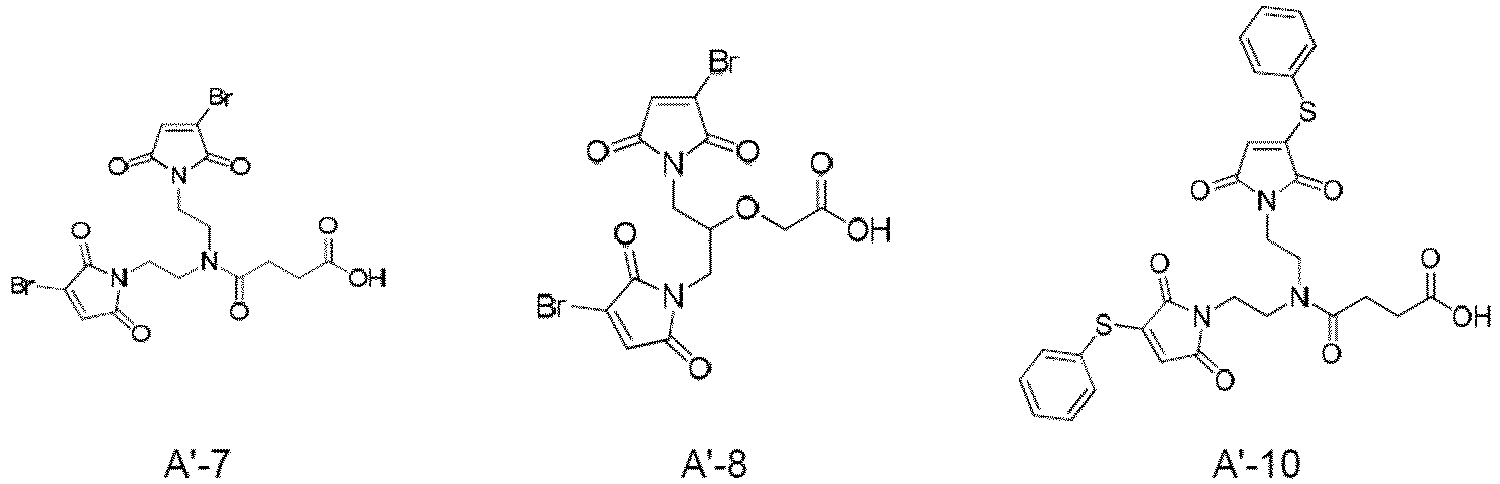
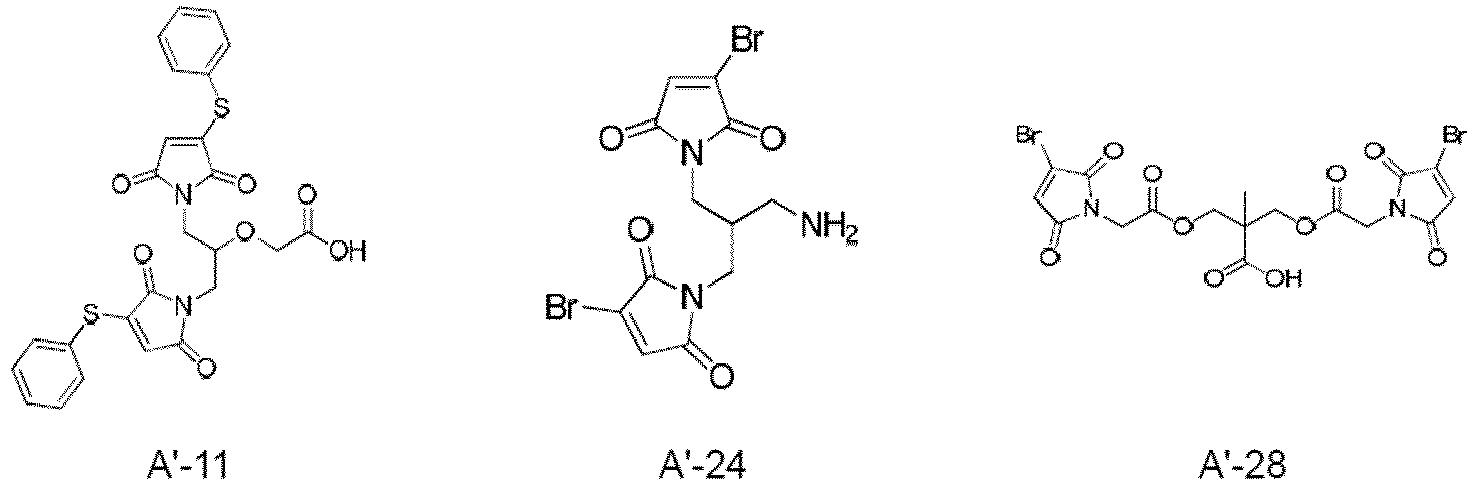

- Use of the compound as claimed in claim 1 as a linker in the preparation of antibody-drug conjugates.
- An antibody-drug conjugate, which has the structure represented by Formula II:
Ab-(A-L-D)n (II)
wherein,Ab is an antibody or functional fragment of the antibody;the linker moiety includes a first linker moiety A and a second linker moiety L;D is a drug moiety;n is 1, 2, 3 or 4;wherein:the first linker moiety A includes a group covalently linked to the thiol group or amino group in the Ab,the antibody-drug conjugate is prepared from the compound as claimed in claim 1,said first linker moiety A is selected from the following:

 the second linker moiety L is selected from the following:


- The antibody-drug conjugate as claimed in claim 3, which is characterized in that the antibody or functional fragment of the antibody specifically binds to cell surface receptors or tumor-related antigens.
- The antibody-drug conjugate as claimed in any one of claims 3-4, which is characterized in that the drug moiety D is cytotoxic drugs, cell differentiation factors, stem cell nutritional factors, steroid drugs, drugs for the treatment of autoimmune diseases, anti-inflammatory drugs or drugs for the treatment of infectious diseases.
- The antibody-drug conjugate as claimed in claim 5, which is haracterized in that the drug moiety D is tubulin inhibitors or DNA damaging agents.
- The antibody-drug conjugate as claimed in claim 5, which is haracterized in that the drug moiety D is further preferably dolastatins, auristatins, maytansines, calicheamicins, duocarmycins, anthramycin derivative PBD, camptothecin derivative SN-38, topoisomerase I inhibitors, amanitins, anthracyclines, baccatins, camptothecins, cemadotins, colchicines, colcimids, combretastatins, cryptophycins, discodermolides, docetaxel, doxorubicin, echinomycins, eleutherobins, epothilones, estramustines, lexitropsins, maytansines, methotrexate, netropsins, puromycins, rhizoxins, taxanes, tubulysins, vinca alkaloids, Vitamin A precursor, folic acid.
- The antibody-drug conjugate as claimed in claim 5, which is characterized in that the drug moiety D is further more preferably:


- The antibody-drug conjugate as claimed in any one of claims 3-8, which is characterized in that the antibody-drug conjugate has the structure:


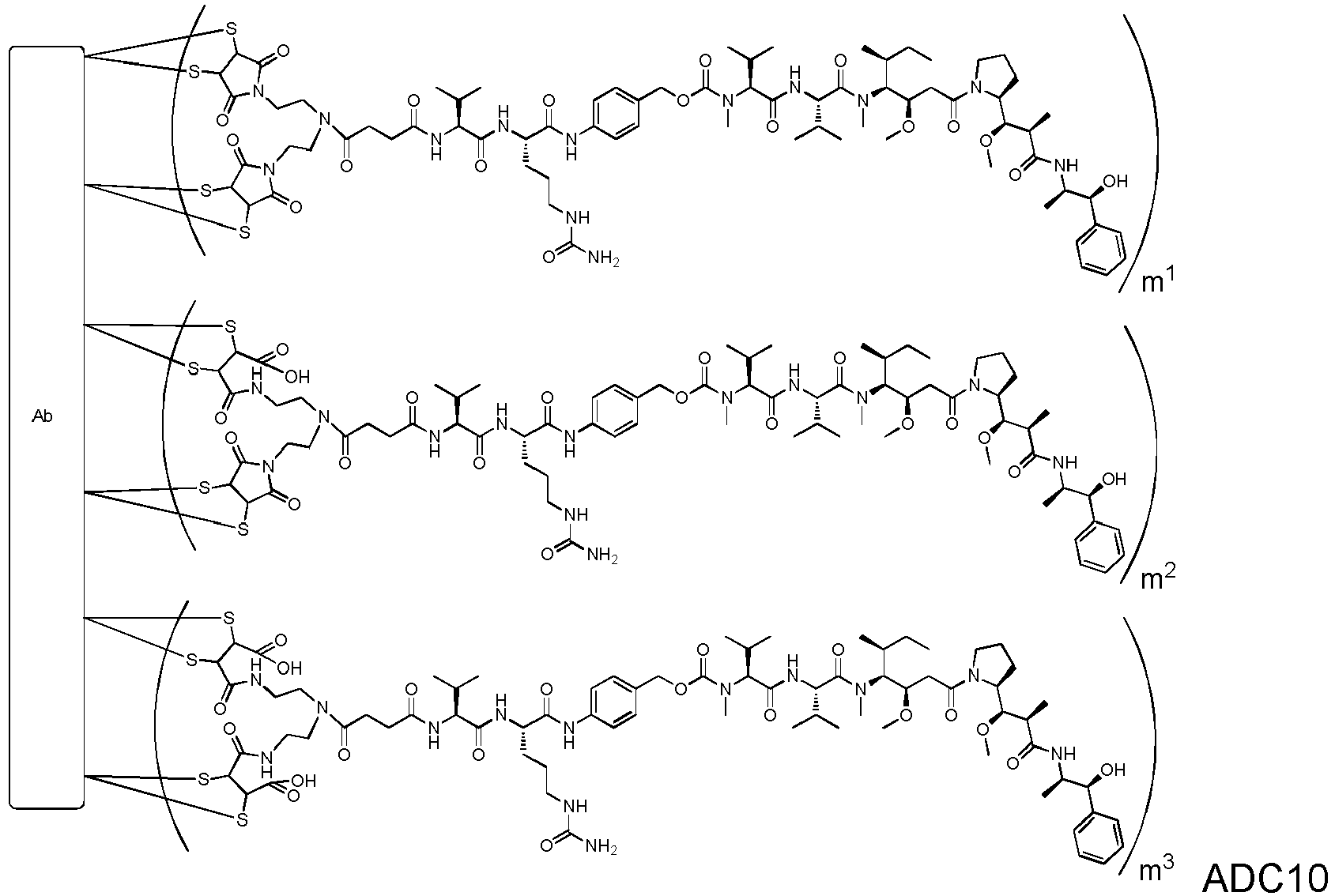
 the Ab is an antibody against cell surface receptors and tumor-related antigens;n1, n2, n3 each are independently selected from 0, 1, 2, 3, 4; n1, n2, n3 are not 0 at the same time, and n1+n2+n3≤4;m1, m2, m3 each are independently selected from 0, 1, 2; at least one of m1, m2, m3 is 0, but m1, m2, m3 are not 0 at the same time, and m1+m2+m3≤2;
 - The antibody-drug conjugate as claimed in claim 9, which is characterized in that the antibody-drug conjugate has the structure:


 the Ab is an antibody against cell surface receptors and tumor-related antigens;n10 is 0, 1, 2, 3 or 4;m6 is 0, 1 or 2.
 - The antibody-drug conjugate as claimed in claim 9, which is characterized in that the antibody-drug conjugate has the structure:


 the Ab is an antibody against cell surface receptors and tumor-related antigens;n11 is 0, 1, 2, 3 or 4;m7 is 0, 1 or 2.
 - The antibody-drug conjugate as claimed in any one of claims 3-11, which is characterized in that the antibody is selected from: murine antibodies, mammalian antibodies, chimeric antibodies, humanized antibodies, human antibody, multispecific antibodies.
- A pharmaceutical composition, which comprises the antibody-drug conjugate as claimed in any one of claims 3-12 and a pharmaceutically acceptable carrier.
- The antibody-drug conjugate as claimed in any one of claims 3-12 or the pharmaceutical composition as claimed in claim 13 for use in a method of treatment of cancer, autoimmune diseases, inflammatory diseases or infectious diseases.
Applications Claiming Priority (2)
| Application Number | Priority Date | Filing Date | Title |
|---|---|---|---|
| CN201811541356 | 2018-12-17 | ||
| PCT/CN2019/124982 WO2020125546A1 (en) | 2018-12-17 | 2019-12-13 | Connector for use in antibody medicament conjugate and applications of connector |
Publications (3)
| Publication Number | Publication Date |
|---|---|
| EP3868409A1 EP3868409A1 (en) | 2021-08-25 |
| EP3868409A4 EP3868409A4 (en) | 2022-06-15 |
| EP3868409B1 true EP3868409B1 (en) | 2024-07-17 |
Family
ID=71100395
Family Applications (1)
| Application Number | Title | Priority Date | Filing Date |
|---|---|---|---|
| EP19900942.4A Active EP3868409B1 (en) | 2018-12-17 | 2019-12-13 | Thiophenol-maleimide and brom-maleimide derivatives as linker for antibody-drug conjugates (adc) for treating tumors |
Country Status (11)
| Country | Link |
|---|---|
| US (2) | US12195552B2 (en) |
| EP (1) | EP3868409B1 (en) |
| JP (1) | JP2022512057A (en) |
| KR (1) | KR20210083282A (en) |
| CN (2) | CN116920115A (en) |
| AU (1) | AU2019405358A1 (en) |
| BR (1) | BR112021005320A2 (en) |
| CA (1) | CA3106493C (en) |
| SG (1) | SG11202105135QA (en) |
| TW (1) | TW202034960A (en) |
| WO (1) | WO2020125546A1 (en) |
Families Citing this family (16)
| Publication number | Priority date | Publication date | Assignee | Title |
|---|---|---|---|---|
| FR3112547B1 (en) * | 2020-07-20 | 2023-01-20 | Mc Saf | Compounds capable of binding to proteins and conjugates obtained from these compounds |
| CN115297889A (en) * | 2020-09-01 | 2022-11-04 | 荣昌生物制药(烟台)股份有限公司 | anti-c-Met antibody drug conjugate and application thereof |
| AU2021354827A1 (en) * | 2020-09-30 | 2023-06-01 | Jiangsu Hengrui Pharmaceuticals Co., Ltd. | Pharmaceutical composition comprising antibody-drug conjugate, and use of pharmaceutical composition |
| CN112285238B (en) * | 2020-10-23 | 2022-12-23 | 东曜药业有限公司 | Liquid chromatography for detecting content of free micromolecules of ADC (azodicarbonamide) medicine |
| CN114478420B (en) * | 2020-11-13 | 2025-02-07 | 北京大学 | Multispecific bioconjugate linker and synthesis method thereof |
| CN114106088A (en) * | 2021-04-28 | 2022-03-01 | 联宁(苏州)生物制药有限公司 | Bromomethylpyrazine-based drug conjugates and ADCs |
| KR20230135653A (en) | 2021-05-08 | 2023-09-25 | 레메젠 코, 리미티드 | Anti-claudin 18.2 antibodies and antibody-drug conjugates thereof |
| FR3125965B1 (en) * | 2021-08-05 | 2024-06-21 | Mc Saf | Antibody-drug conjugates |
| CN118159300A (en) * | 2021-09-27 | 2024-06-07 | 苏州信诺维医药科技股份有限公司 | Antibody and drug conjugate thereof and use thereof |
| CN117801107A (en) | 2022-09-30 | 2024-04-02 | 上海迪诺医药科技有限公司 | Benzazepine derivatives, conjugates containing them and their applications |
| CN117347519B (en) * | 2023-10-23 | 2024-07-02 | 上海药明合联生物技术有限公司 | Liquid chromatography method for detecting content of residual SN38 small molecules in antibody coupled drug |
| WO2025162493A1 (en) * | 2024-01-29 | 2025-08-07 | 甘李药业股份有限公司 | Anti-nectin-4 antibody/ligand-drug conjugate and use thereof |
| CN118580194A (en) * | 2024-05-21 | 2024-09-03 | 南方科技大学 | A method for preparing a dual-functional molecular probe |
| CN121622915A (en) * | 2024-08-30 | 2026-03-10 | 中国科学院杭州医学研究所 | A high drug loading ratio nucleic acid aptamer conjugate drug and its application |
| CN121445888B (en) * | 2025-12-31 | 2026-04-07 | 苏州宜联生物医药有限公司 | Antibody drug conjugate containing phenanthroquinolizidine compound, pharmaceutical composition and application thereof |
| CN121422249B (en) * | 2025-12-31 | 2026-04-07 | 苏州宜联生物医药有限公司 | Antibody drug conjugate containing phenanthroquinolizidine compound, pharmaceutical composition, preparation method and application thereof |
Family Cites Families (21)
| Publication number | Priority date | Publication date | Assignee | Title |
|---|---|---|---|---|
| CH577481A5 (en) | 1969-07-18 | 1976-07-15 | Ciba Geigy Ag | |
| JPS5293765A (en) | 1976-02-02 | 1977-08-06 | Kureha Chem Ind Co Ltd | 3,4-dichloropyprole-2,5-dione derivatives, their preparation and germi cide for agriculture and horticulture |
| AU1383395A (en) | 1993-12-17 | 1995-07-03 | Akzo Nobel N.V. | Electronegative-substituted bismaleimide anti-reversion coagents |
| EP2073820A4 (en) | 2006-09-15 | 2014-07-16 | Belrose Pharma Inc | TARGETED POLYMER PRODRUGS CONTAINING MULTIFUNCTIONAL BINDING SEGMENTS |
| WO2011018613A1 (en) | 2009-08-10 | 2011-02-17 | Ucl Business Plc | Functionalisation of solid substrates |
| AU2012348017A1 (en) * | 2011-12-05 | 2014-07-03 | Igenica Biotherapeutics, Inc. | Antibody-drug conjugates and related compounds, compositions, and methods |
| CA2857127A1 (en) | 2012-01-27 | 2013-08-01 | F. Hoffmann-La Roche Ag | Integrin antagonist conjugates for targeted delivery to cells expressing lfa-1 |
| US10010623B2 (en) * | 2012-02-16 | 2018-07-03 | Ucl Business Plc | Lysosome-cleavable linker |
| CN103933575B (en) * | 2013-01-23 | 2017-09-29 | 上海新理念生物医药科技有限公司 | A kind of three flute profile connexons and its application |
| US20140363454A1 (en) | 2013-06-06 | 2014-12-11 | Igenica Biotherapeutics, Inc. | Antibody-Drug Conjugates, Compositions and Methods of Use |
| FR3008408B1 (en) | 2013-07-11 | 2018-03-09 | Mc Saf | NOVEL ANTIBODY-MEDICAMENT CONJUGATES AND THEIR USE IN THERAPY |
| EP3072907B1 (en) | 2013-11-19 | 2019-02-20 | Remegen, Ltd | Anti-her2 antibody and conjugate thereof |
| WO2016004048A2 (en) * | 2014-06-30 | 2016-01-07 | Blend Therapeutics, Inc. | Targeted conjugates and particles and formulations thereof |
| EP3209334A2 (en) * | 2014-10-20 | 2017-08-30 | Igenica Biotherapeutics, Inc. | Novel antibody-drug conjugates and related compounds, compositions, and methods of use |
| CN106267225B (en) | 2015-05-29 | 2020-03-06 | 上海新理念生物医药科技有限公司 | Trimaleimide-type linker and use thereof |
| EP3319936B1 (en) | 2015-07-12 | 2025-12-17 | Hangzhou Dac Biotech Co., Ltd. | Bridge linkers for conjugation of cell-binding molecules |
| HUE057906T2 (en) | 2015-08-14 | 2022-07-28 | Remegen Biosciences Inc | Covalent linkers in antibody-drug conjugates and methods of making and using the same |
| MX2018012803A (en) * | 2016-04-20 | 2019-06-24 | Hangzhou Dac Biotech Co Ltd | Derivatives of amanita toxins and their conjugation to a cell binding molecule. |
| MA49339A (en) * | 2017-04-05 | 2020-02-12 | Novo Nordisk As | Oligomer extended insulin-fc conjugates |
| CN107400072B (en) * | 2017-06-30 | 2021-02-05 | 上海科技大学 | Diethenesulfonamide linker and preparation and application thereof |
| CN107652219B (en) | 2017-08-14 | 2021-06-08 | 上海新理念生物医药科技有限公司 | Tetramaleimide type linker and its application |
-
2019
- 2019-12-13 KR KR1020217014918A patent/KR20210083282A/en not_active Ceased
- 2019-12-13 JP JP2021517698A patent/JP2022512057A/en active Pending
- 2019-12-13 SG SG11202105135QA patent/SG11202105135QA/en unknown
- 2019-12-13 BR BR112021005320-4A patent/BR112021005320A2/en not_active IP Right Cessation
- 2019-12-13 EP EP19900942.4A patent/EP3868409B1/en active Active
- 2019-12-13 CA CA3106493A patent/CA3106493C/en active Active
- 2019-12-13 US US17/260,901 patent/US12195552B2/en active Active
- 2019-12-13 WO PCT/CN2019/124982 patent/WO2020125546A1/en not_active Ceased
- 2019-12-13 CN CN202310760612.XA patent/CN116920115A/en active Pending
- 2019-12-13 CN CN201980005073.0A patent/CN111433188B/en active Active
- 2019-12-13 AU AU2019405358A patent/AU2019405358A1/en not_active Abandoned
- 2019-12-17 TW TW108146262A patent/TW202034960A/en unknown
-
2024
- 2024-11-19 US US18/952,310 patent/US20250145731A1/en active Pending
Also Published As
| Publication number | Publication date |
|---|---|
| US20220072137A1 (en) | 2022-03-10 |
| CA3106493C (en) | 2024-01-09 |
| EP3868409A4 (en) | 2022-06-15 |
| JP2022512057A (en) | 2022-02-02 |
| AU2019405358A1 (en) | 2021-01-28 |
| CA3106493A1 (en) | 2020-06-25 |
| US12195552B2 (en) | 2025-01-14 |
| BR112021005320A2 (en) | 2021-06-15 |
| EP3868409A1 (en) | 2021-08-25 |
| SG11202105135QA (en) | 2021-07-29 |
| CN111433188A (en) | 2020-07-17 |
| US20250145731A1 (en) | 2025-05-08 |
| WO2020125546A1 (en) | 2020-06-25 |
| TW202034960A (en) | 2020-10-01 |
| CN111433188B (en) | 2023-08-01 |
| CN116920115A (en) | 2023-10-24 |
| KR20210083282A (en) | 2021-07-06 |
Similar Documents
| Publication | Publication Date | Title |
|---|---|---|
| US20250145731A1 (en) | Linker for antibody-drug conjugates and its use | |
| EP4349371A1 (en) | Drug conjugate and use thereof | |
| CN117500527A (en) | Antibody drug conjugates and preparation methods and uses thereof | |
| CA3082160C (en) | Anti-mesothelin antibody and antibody drug conjugate thereof | |
| CN117320757A (en) | Anti-HER2 antibody-drug conjugates and their uses | |
| JP2025524637A (en) | Antibody-drug conjugates and methods for preparing and using the same | |
| JP2025505809A (en) | Antibody-Eribulin or Derivative Conjugates, Intermediates, Manufacturing Methods, Pharmaceutical Compositions and Uses Thereof | |
| CN111542324B (en) | Cytotoxic agents and conjugates thereof, preparation methods and uses thereof | |
| CN120826405A (en) | Conjugate with targeting effect and preparation method and use thereof | |
| WO2025167743A1 (en) | Antibody-drug conjugate, preparation method therefor, and use thereof | |
| EP4601702A1 (en) | Linker-payload compound, conjugates and applications thereof | |
| CN119300868B (en) | Camptothecin compounds and their conjugates, their preparation methods and uses | |
| WO2025167742A1 (en) | Antibody-drug conjugate, method for preparing same, and use thereof | |
| CN120957755A (en) | Polycyclic drug conjugates, their preparation methods and uses | |
| HK40050887A (en) | Connector for use in antibody medicament conjugate and applications of connector | |
| JP2025535258A (en) | Antibodies, antibody-drug conjugates, their preparation and uses | |
| RU2792201C2 (en) | Linker for antibody-drug conjugates and their use | |
| CN119744183A (en) | Antibody-drug conjugates with high drug loading and uses thereof | |
| CA3300455A1 (en) | Antibody-drug conjugate having high drug load and use thereof | |
| CN120957757A (en) | Macrocyclic drug conjugates, their preparation methods and uses | |
| CN120957758A (en) | Macrocyclic compounds, their preparation methods and uses | |
| CN120923577A (en) | Macrocyclic drug conjugate and preparation method and application thereof | |
| EP4684807A1 (en) | Linker and use thereof in ligand drug conjugate | |
| CN120957759A (en) | Compounds with antitumor effects, their preparation methods and uses | |
| HK40079580B (en) | Bioactive substance conjugate, preparation method therefor and use thereof |
Legal Events
| Date | Code | Title | Description |
|---|---|---|---|
| STAA | Information on the status of an ep patent application or granted ep patent |
Free format text: STATUS: THE INTERNATIONAL PUBLICATION HAS BEEN MADE |
|
| PUAI | Public reference made under article 153(3) epc to a published international application that has entered the european phase |
Free format text: ORIGINAL CODE: 0009012 |
|
| STAA | Information on the status of an ep patent application or granted ep patent |
Free format text: STATUS: REQUEST FOR EXAMINATION WAS MADE |
|
| PUAB | Information related to the publication of an a document modified or deleted |
Free format text: ORIGINAL CODE: 0009199EPPU |
|
| PUAI | Public reference made under article 153(3) epc to a published international application that has entered the european phase |
Free format text: ORIGINAL CODE: 0009012 |
|
| 17P | Request for examination filed |
Effective date: 20210318 |
|
| AK | Designated contracting states |
Kind code of ref document: A1 Designated state(s): AL AT BE BG CH CY CZ DE DK EE ES FI FR GB GR HR HU IE IS IT LI LT LU LV MC MK MT NL NO PL PT RO RS SE SI SK SM TR |
|
| REG | Reference to a national code |
Ref country code: HK Ref legal event code: DE Ref document number: 40050887 Country of ref document: HK |
|
| DAV | Request for validation of the european patent (deleted) | ||
| DAX | Request for extension of the european patent (deleted) | ||
| REG | Reference to a national code |
Ref country code: DE Ref legal event code: R079 Free format text: PREVIOUS MAIN CLASS: A61K0047680000 Ipc: C07D0207456000 Ref country code: DE Ref legal event code: R079 Ref document number: 602019055538 Country of ref document: DE Free format text: PREVIOUS MAIN CLASS: A61K0047680000 Ipc: C07D0207456000 |
|
| A4 | Supplementary search report drawn up and despatched |
Effective date: 20220513 |
|
| RIC1 | Information provided on ipc code assigned before grant |
Ipc: A61P 35/00 20060101ALI20220509BHEP Ipc: A61K 47/68 20170101ALI20220509BHEP Ipc: C07K 16/32 20060101ALI20220509BHEP Ipc: C07D 401/04 20060101ALI20220509BHEP Ipc: C07D 207/456 20060101AFI20220509BHEP |
|
| STAA | Information on the status of an ep patent application or granted ep patent |
Free format text: STATUS: EXAMINATION IS IN PROGRESS |
|
| 17Q | First examination report despatched |
Effective date: 20230523 |
|
| GRAP | Despatch of communication of intention to grant a patent |
Free format text: ORIGINAL CODE: EPIDOSNIGR1 |
|
| STAA | Information on the status of an ep patent application or granted ep patent |
Free format text: STATUS: GRANT OF PATENT IS INTENDED |
|
| INTG | Intention to grant announced |
Effective date: 20240214 |
|
| GRAS | Grant fee paid |
Free format text: ORIGINAL CODE: EPIDOSNIGR3 |
|
| GRAA | (expected) grant |
Free format text: ORIGINAL CODE: 0009210 |
|
| STAA | Information on the status of an ep patent application or granted ep patent |
Free format text: STATUS: THE PATENT HAS BEEN GRANTED |
|
| AK | Designated contracting states |
Kind code of ref document: B1 Designated state(s): AL AT BE BG CH CY CZ DE DK EE ES FI FR GB GR HR HU IE IS IT LI LT LU LV MC MK MT NL NO PL PT RO RS SE SI SK SM TR |
|
| REG | Reference to a national code |
Ref country code: CH Ref legal event code: EP |
|
| REG | Reference to a national code |
Ref country code: DE Ref legal event code: R096 Ref document number: 602019055538 Country of ref document: DE |
|
| REG | Reference to a national code |
Ref country code: IE Ref legal event code: FG4D |
|
| REG | Reference to a national code |
Ref country code: SE Ref legal event code: TRGR |
|
| P01 | Opt-out of the competence of the unified patent court (upc) registered |
Free format text: CASE NUMBER: APP_50217/2024 Effective date: 20240904 |
|
| REG | Reference to a national code |
Ref country code: LT Ref legal event code: MG9D |
|
| REG | Reference to a national code |
Ref country code: NL Ref legal event code: MP Effective date: 20240717 |
|
| PG25 | Lapsed in a contracting state [announced via postgrant information from national office to epo] |
Ref country code: PT Free format text: LAPSE BECAUSE OF FAILURE TO SUBMIT A TRANSLATION OF THE DESCRIPTION OR TO PAY THE FEE WITHIN THE PRESCRIBED TIME-LIMIT Effective date: 20241118 |
|
| REG | Reference to a national code |
Ref country code: AT Ref legal event code: MK05 Ref document number: 1704015 Country of ref document: AT Kind code of ref document: T Effective date: 20240717 |
|
| PG25 | Lapsed in a contracting state [announced via postgrant information from national office to epo] |
Ref country code: NL Free format text: LAPSE BECAUSE OF FAILURE TO SUBMIT A TRANSLATION OF THE DESCRIPTION OR TO PAY THE FEE WITHIN THE PRESCRIBED TIME-LIMIT Effective date: 20240717 |
|
| PG25 | Lapsed in a contracting state [announced via postgrant information from national office to epo] |
Ref country code: PT Free format text: LAPSE BECAUSE OF FAILURE TO SUBMIT A TRANSLATION OF THE DESCRIPTION OR TO PAY THE FEE WITHIN THE PRESCRIBED TIME-LIMIT Effective date: 20241118 Ref country code: NL Free format text: LAPSE BECAUSE OF FAILURE TO SUBMIT A TRANSLATION OF THE DESCRIPTION OR TO PAY THE FEE WITHIN THE PRESCRIBED TIME-LIMIT Effective date: 20240717 |
|
| PG25 | Lapsed in a contracting state [announced via postgrant information from national office to epo] |
Ref country code: NO Free format text: LAPSE BECAUSE OF FAILURE TO SUBMIT A TRANSLATION OF THE DESCRIPTION OR TO PAY THE FEE WITHIN THE PRESCRIBED TIME-LIMIT Effective date: 20241017 |
|
| PG25 | Lapsed in a contracting state [announced via postgrant information from national office to epo] |
Ref country code: FI Free format text: LAPSE BECAUSE OF FAILURE TO SUBMIT A TRANSLATION OF THE DESCRIPTION OR TO PAY THE FEE WITHIN THE PRESCRIBED TIME-LIMIT Effective date: 20240717 Ref country code: GR Free format text: LAPSE BECAUSE OF FAILURE TO SUBMIT A TRANSLATION OF THE DESCRIPTION OR TO PAY THE FEE WITHIN THE PRESCRIBED TIME-LIMIT Effective date: 20241018 Ref country code: PL Free format text: LAPSE BECAUSE OF FAILURE TO SUBMIT A TRANSLATION OF THE DESCRIPTION OR TO PAY THE FEE WITHIN THE PRESCRIBED TIME-LIMIT Effective date: 20240717 |
|
| PG25 | Lapsed in a contracting state [announced via postgrant information from national office to epo] |
Ref country code: BG Free format text: LAPSE BECAUSE OF FAILURE TO SUBMIT A TRANSLATION OF THE DESCRIPTION OR TO PAY THE FEE WITHIN THE PRESCRIBED TIME-LIMIT Effective date: 20240717 |
|
| PG25 | Lapsed in a contracting state [announced via postgrant information from national office to epo] |
Ref country code: LV Free format text: LAPSE BECAUSE OF FAILURE TO SUBMIT A TRANSLATION OF THE DESCRIPTION OR TO PAY THE FEE WITHIN THE PRESCRIBED TIME-LIMIT Effective date: 20240717 |
|
| PG25 | Lapsed in a contracting state [announced via postgrant information from national office to epo] |
Ref country code: IS Free format text: LAPSE BECAUSE OF FAILURE TO SUBMIT A TRANSLATION OF THE DESCRIPTION OR TO PAY THE FEE WITHIN THE PRESCRIBED TIME-LIMIT Effective date: 20241117 Ref country code: AT Free format text: LAPSE BECAUSE OF FAILURE TO SUBMIT A TRANSLATION OF THE DESCRIPTION OR TO PAY THE FEE WITHIN THE PRESCRIBED TIME-LIMIT Effective date: 20240717 |
|
| PG25 | Lapsed in a contracting state [announced via postgrant information from national office to epo] |
Ref country code: HR Free format text: LAPSE BECAUSE OF FAILURE TO SUBMIT A TRANSLATION OF THE DESCRIPTION OR TO PAY THE FEE WITHIN THE PRESCRIBED TIME-LIMIT Effective date: 20240717 |
|
| PG25 | Lapsed in a contracting state [announced via postgrant information from national office to epo] |
Ref country code: ES Free format text: LAPSE BECAUSE OF FAILURE TO SUBMIT A TRANSLATION OF THE DESCRIPTION OR TO PAY THE FEE WITHIN THE PRESCRIBED TIME-LIMIT Effective date: 20240717 Ref country code: RS Free format text: LAPSE BECAUSE OF FAILURE TO SUBMIT A TRANSLATION OF THE DESCRIPTION OR TO PAY THE FEE WITHIN THE PRESCRIBED TIME-LIMIT Effective date: 20241017 |
|
| PG25 | Lapsed in a contracting state [announced via postgrant information from national office to epo] |
Ref country code: RS Free format text: LAPSE BECAUSE OF FAILURE TO SUBMIT A TRANSLATION OF THE DESCRIPTION OR TO PAY THE FEE WITHIN THE PRESCRIBED TIME-LIMIT Effective date: 20241017 Ref country code: PL Free format text: LAPSE BECAUSE OF FAILURE TO SUBMIT A TRANSLATION OF THE DESCRIPTION OR TO PAY THE FEE WITHIN THE PRESCRIBED TIME-LIMIT Effective date: 20240717 Ref country code: NO Free format text: LAPSE BECAUSE OF FAILURE TO SUBMIT A TRANSLATION OF THE DESCRIPTION OR TO PAY THE FEE WITHIN THE PRESCRIBED TIME-LIMIT Effective date: 20241017 Ref country code: LV Free format text: LAPSE BECAUSE OF FAILURE TO SUBMIT A TRANSLATION OF THE DESCRIPTION OR TO PAY THE FEE WITHIN THE PRESCRIBED TIME-LIMIT Effective date: 20240717 Ref country code: IS Free format text: LAPSE BECAUSE OF FAILURE TO SUBMIT A TRANSLATION OF THE DESCRIPTION OR TO PAY THE FEE WITHIN THE PRESCRIBED TIME-LIMIT Effective date: 20241117 Ref country code: HR Free format text: LAPSE BECAUSE OF FAILURE TO SUBMIT A TRANSLATION OF THE DESCRIPTION OR TO PAY THE FEE WITHIN THE PRESCRIBED TIME-LIMIT Effective date: 20240717 Ref country code: GR Free format text: LAPSE BECAUSE OF FAILURE TO SUBMIT A TRANSLATION OF THE DESCRIPTION OR TO PAY THE FEE WITHIN THE PRESCRIBED TIME-LIMIT Effective date: 20241018 Ref country code: FI Free format text: LAPSE BECAUSE OF FAILURE TO SUBMIT A TRANSLATION OF THE DESCRIPTION OR TO PAY THE FEE WITHIN THE PRESCRIBED TIME-LIMIT Effective date: 20240717 Ref country code: ES Free format text: LAPSE BECAUSE OF FAILURE TO SUBMIT A TRANSLATION OF THE DESCRIPTION OR TO PAY THE FEE WITHIN THE PRESCRIBED TIME-LIMIT Effective date: 20240717 Ref country code: BG Free format text: LAPSE BECAUSE OF FAILURE TO SUBMIT A TRANSLATION OF THE DESCRIPTION OR TO PAY THE FEE WITHIN THE PRESCRIBED TIME-LIMIT Effective date: 20240717 Ref country code: AT Free format text: LAPSE BECAUSE OF FAILURE TO SUBMIT A TRANSLATION OF THE DESCRIPTION OR TO PAY THE FEE WITHIN THE PRESCRIBED TIME-LIMIT Effective date: 20240717 |
|
| PG25 | Lapsed in a contracting state [announced via postgrant information from national office to epo] |
Ref country code: RO Free format text: LAPSE BECAUSE OF FAILURE TO SUBMIT A TRANSLATION OF THE DESCRIPTION OR TO PAY THE FEE WITHIN THE PRESCRIBED TIME-LIMIT Effective date: 20240717 Ref country code: SM Free format text: LAPSE BECAUSE OF FAILURE TO SUBMIT A TRANSLATION OF THE DESCRIPTION OR TO PAY THE FEE WITHIN THE PRESCRIBED TIME-LIMIT Effective date: 20240717 Ref country code: DK Free format text: LAPSE BECAUSE OF FAILURE TO SUBMIT A TRANSLATION OF THE DESCRIPTION OR TO PAY THE FEE WITHIN THE PRESCRIBED TIME-LIMIT Effective date: 20240717 |
|
| REG | Reference to a national code |
Ref country code: DE Ref legal event code: R097 Ref document number: 602019055538 Country of ref document: DE |
|
| PG25 | Lapsed in a contracting state [announced via postgrant information from national office to epo] |
Ref country code: EE Free format text: LAPSE BECAUSE OF FAILURE TO SUBMIT A TRANSLATION OF THE DESCRIPTION OR TO PAY THE FEE WITHIN THE PRESCRIBED TIME-LIMIT Effective date: 20240717 |
|
| PG25 | Lapsed in a contracting state [announced via postgrant information from national office to epo] |
Ref country code: CZ Free format text: LAPSE BECAUSE OF FAILURE TO SUBMIT A TRANSLATION OF THE DESCRIPTION OR TO PAY THE FEE WITHIN THE PRESCRIBED TIME-LIMIT Effective date: 20240717 |
|
| PG25 | Lapsed in a contracting state [announced via postgrant information from national office to epo] |
Ref country code: SK Free format text: LAPSE BECAUSE OF FAILURE TO SUBMIT A TRANSLATION OF THE DESCRIPTION OR TO PAY THE FEE WITHIN THE PRESCRIBED TIME-LIMIT Effective date: 20240717 |
|
| PLBE | No opposition filed within time limit |
Free format text: ORIGINAL CODE: 0009261 |
|
| STAA | Information on the status of an ep patent application or granted ep patent |
Free format text: STATUS: NO OPPOSITION FILED WITHIN TIME LIMIT |
|
| 26N | No opposition filed |
Effective date: 20250422 |
|
| REG | Reference to a national code |
Ref country code: BE Ref legal event code: MM Effective date: 20241231 |
|
| PG25 | Lapsed in a contracting state [announced via postgrant information from national office to epo] |
Ref country code: BE Free format text: LAPSE BECAUSE OF NON-PAYMENT OF DUE FEES Effective date: 20241231 |
|
| PGFP | Annual fee paid to national office [announced via postgrant information from national office to epo] |
Ref country code: LU Payment date: 20251124 Year of fee payment: 7 |
|
| REG | Reference to a national code |
Ref country code: CH Ref legal event code: U11 Free format text: ST27 STATUS EVENT CODE: U-0-0-U10-U11 (AS PROVIDED BY THE NATIONAL OFFICE) Effective date: 20260101 |
|
| PGFP | Annual fee paid to national office [announced via postgrant information from national office to epo] |
Ref country code: DE Payment date: 20251119 Year of fee payment: 7 |
|
| PGFP | Annual fee paid to national office [announced via postgrant information from national office to epo] |
Ref country code: GB Payment date: 20251112 Year of fee payment: 7 |
|
| PGFP | Annual fee paid to national office [announced via postgrant information from national office to epo] |
Ref country code: MC Payment date: 20251126 Year of fee payment: 7 |
|
| PGFP | Annual fee paid to national office [announced via postgrant information from national office to epo] |
Ref country code: FR Payment date: 20251112 Year of fee payment: 7 |
|
| PGFP | Annual fee paid to national office [announced via postgrant information from national office to epo] |
Ref country code: SE Payment date: 20251112 Year of fee payment: 7 |
|
| PGFP | Annual fee paid to national office [announced via postgrant information from national office to epo] |
Ref country code: IE Payment date: 20251112 Year of fee payment: 7 |
|
| PG25 | Lapsed in a contracting state [announced via postgrant information from national office to epo] |
Ref country code: IT Free format text: LAPSE BECAUSE OF FAILURE TO SUBMIT A TRANSLATION OF THE DESCRIPTION OR TO PAY THE FEE WITHIN THE PRESCRIBED TIME-LIMIT Effective date: 20240717 |
|
| PGFP | Annual fee paid to national office [announced via postgrant information from national office to epo] |
Ref country code: CH Payment date: 20260101 Year of fee payment: 7 |
|
| PG25 | Lapsed in a contracting state [announced via postgrant information from national office to epo] |
Ref country code: CY Free format text: LAPSE BECAUSE OF FAILURE TO SUBMIT A TRANSLATION OF THE DESCRIPTION OR TO PAY THE FEE WITHIN THE PRESCRIBED TIME-LIMIT Effective date: 20240717 |