EP3866429A1 - Multipath capable network device and communication systems for centrally monitoring and controlling data traffic to and/or from a multipath capable customer equipment - Google Patents
Multipath capable network device and communication systems for centrally monitoring and controlling data traffic to and/or from a multipath capable customer equipment Download PDFInfo
- Publication number
- EP3866429A1 EP3866429A1 EP20157336.7A EP20157336A EP3866429A1 EP 3866429 A1 EP3866429 A1 EP 3866429A1 EP 20157336 A EP20157336 A EP 20157336A EP 3866429 A1 EP3866429 A1 EP 3866429A1
- Authority
- EP
- European Patent Office
- Prior art keywords
- multipath
- network
- network device
- customer equipment
- multipath capable
- Prior art date
- Legal status (The legal status is an assumption and is not a legal conclusion. Google has not performed a legal analysis and makes no representation as to the accuracy of the status listed.)
- Granted
Links
Images


Classifications
-
- H—ELECTRICITY
- H04—ELECTRIC COMMUNICATION TECHNIQUE
- H04L—TRANSMISSION OF DIGITAL INFORMATION, e.g. TELEGRAPHIC COMMUNICATION
- H04L43/00—Arrangements for monitoring or testing data switching networks
- H04L43/06—Generation of reports
- H04L43/062—Generation of reports related to network traffic
-
- H—ELECTRICITY
- H04—ELECTRIC COMMUNICATION TECHNIQUE
- H04L—TRANSMISSION OF DIGITAL INFORMATION, e.g. TELEGRAPHIC COMMUNICATION
- H04L69/00—Network arrangements, protocols or services independent of the application payload and not provided for in the other groups of this subclass
- H04L69/14—Multichannel or multilink protocols
-
- H—ELECTRICITY
- H04—ELECTRIC COMMUNICATION TECHNIQUE
- H04W—WIRELESS COMMUNICATION NETWORKS
- H04W24/00—Supervisory, monitoring or testing arrangements
- H04W24/08—Testing, supervising or monitoring using real traffic
-
- H—ELECTRICITY
- H04—ELECTRIC COMMUNICATION TECHNIQUE
- H04W—WIRELESS COMMUNICATION NETWORKS
- H04W48/00—Access restriction; Network selection; Access point selection
- H04W48/02—Access restriction performed under specific conditions
Definitions
- the present invention generally relates to a multipath capable network device and communication systems for centrally monitoring and controlling data traffic to and/or from a multipath capable customer equipment, and in particular to a centrally managed and executed firewall for protecting at least one multipath capable customer equipment which is configured to transmit and receive data traffic via a multipath transmission link.
- the Internet has developed into a ubiquitous communication system accessible through multiple access technologies, which, inter alia, provides a huge amount of data to end users.
- great efforts are undertaken with respect to multi-connectivity or multipath solutions for aggregation and improved traffic balancing by using different access technologies.
- HCPE hybrid customer premises equipment
- ISP Internet Service Provider
- HOG hybrid access gateway
- the Internet Engineering Task Force has designed the Multipath TCP (MPTCP) as a multipath network protocol, which is described inter alia in RFC 6824.
- MPTCP Multipath TCP
- a user device for example a mobile phone, which exploits MPTCP, is able to establish a TCP channel, called subflow, over each single path to be used in a multipath transmission link to a termination point of an ISP.
- multipath network protocols are, for example, MP-QUIC (https://datatracker.ieft.org/doc/draft-deconinck-quic-multipath /) and MP-DCCP (( https://datatracker.ieft.org/doc/draft-amend -tsvwg-multipath-dccp/)
- hybrid access networks for example on the basis of Fixed-Mobile Convergence (FMC) or 3GPP ATSSS exploits a core network having a single termination point that controls every possible connectivity and/or access towards the Internet.
- This network architecture can be exploited to implement a protection software component in a multipath capable network device, which can be considered as a single termination point of an Internet Service Provider.
- the multipath capable network device is configured to centrally manage and execute the protection software component to protect at least one multipath capable customer equipment and services without storing any application on the at least one multipath capable customer equipment which is configured to transmit and receive data traffic via a multipath transmission link or multipath connection.
- the protection software component is adapted to monitor and control each single path of a multipath transmission link in order to keep track of path specific information belonging to portions of data transmitted or received by the multipath capable network device.
- the protection software component can preferably perform a firewall functionality with respect to each single path of a multipath connection.
- the present invention can be realized in any network architecture, which preferably provide access over multiple access technologies and exploits a converged userplane implemented in a multipath capable network device of an ISP.
- a protection software configuration e.g. different protection rules, can be applied from the network operator of the multipath capable network device.
- Another option may provide an interface (API) for external configuration by a client device or a customer webinterface.
- API interface
- multipath capable network device and "multipath capable customer equipment” mean in particular the capability that the multipath customer equipment and the multipath capable network device are each configured to establish and/or communicate via single paths multiplexed to a multipath transmission link, also called a multipath connection, of a single communication session.
- the single paths logically forming a multipath transmission link can be, for example, established over different access networks or over a common access network.
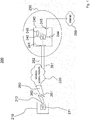
- Fig. 1 an illustrative communication system 200 is depicted which exploits at least one access network 220.
- a single wireless access network 220 is implemented, which might be a 3GPP based wireless access network.
- the exemplary communication system 200 is capable of centrally monitoring and controlling data traffic between a multipath capable network device 240 and at least one multipath capable customer equipment 210 by using the multipath capable network device 240, which can be implemented in an ISP network 230.
- the multipath capable network device 240 is thus adapted to protect the at least one multipath capable customer equipment 210 and or services provided by a data network 250 without requiring any protection software on the at least one multipath capable customer equipment 210.
- the data network 250 is the Internet, which can be connected via a network interface 245 to the network device 240. Only for the sake of simplicity, only one customer equipment 210 is illustrated. In the present case, the multipath capable customer equipment 210 is a mobile phone.
- the multipath capable mobile phone 210 comprises at least one wireless access interfaces, preferable a 3GPP based wireless access interface 212.
- the mobile device 210 comprises a control unit 211, e.g. a microcontroller, which is adapted to perform a bundling software stored in mobile device 210 to steer single path or multipath data transmission.
- the Multipath TCP (MPTCP) network communication protocol can be deployed as the bundling software.
- the multipath capable mobile phone 210 is adapted to establish a multipath transmission link 260 including for example two bundled single paths 261 and 262 via the wireless access network 220 to the multipath capable network device 240 in order to get access to the Internet 250.
- network device 240 comprises at least a multipath capable network interface 241, which terminates the wireless access network 220.
- the network device 240 comprises a control unit 242, e.g. a microcontroller, which is adapted to perform a bundling software to steer data transmission from the data network 250 to the mobile phone 210 by using for example the bundled paths 261, 262 of the multipath connection 260.
- the multipath capable network device 240 and in particular the microcontroller 242 is configured to centrally monitor and control data traffic of a single session transmitted through each bundled path 261 and 262 of the establish multipath transmission link 260 from and/or to the at least one multipath capable customer equipment 210 in response to at least one protection rule.
- the network device 240 and preferably the microcontroller 242 is configured to perform the stored protection software to monitor and control the data traffic of the single session transmitted through each single path 261 and 261 of the established multipath transmission link 260 form and/or to the mobile phone 210.
- the bundling software may also be stored in the memory 246.
- the at least one protection rule can be based on information about an identification of a multipath network protocol, e.g. the MPTCP, MP-QUIC or MP-DCCP protocol, used by the at least one multipath capable equipment 210 and/or the at least one access network type and/or the source IP address of the at least one multipath capable customer equipment 210 and/or a destination IP address, e.g.
- a multipath network protocol e.g. the MPTCP, MP-QUIC or MP-DCCP protocol
- a further protection rule can be based on multipath protocol specific information, e.g. protocol specific sequencing or latency information, or location specific information from a wireless access network and/or a non-wireless access network or cryptographic information identifying streams of a multipath session.
- each data packet transmitted by the mobile phone 210 may include in its header inter alia the source IP of the mobile phone 210, a destination IP address of the network device 240, a sequence number, a session identification indicating which session the data packets belong to, a multipath network protocol identification, indicating that the source device, e.g. the mobile phone 210 is capable of transmitting and receiving data packet over a multipath transmission link, e.g. the multipath transmission link 260.
- the network device 240 when performing the protection software component using the above mentioned protection rules the network device 240 is adapted to monitor each data packet transmitted over the multiple paths 261 and 262 and check whether the data packets received at the network device 240 belong to the same session, keep a required sequence order and/or a required latency, include the same source and destination IP address, the same multipath network protocol identification. If discrepancies are detected, a failure or attack is presumed which causes the network device 240 to interrupt or block the data transmission from and/or to the mobile phone 210 over the multiple paths 261 and 262 of the multipath transmission link 260.
- predefined data patterns can be stored for example in the memory 246 of the multipath capable network device 240.
- the network device 240 is configured to perform the protection software component to monitor and control the data traffic, i.e. the respective data packets, transmitted over the multiple paths 261 and 262 of the multipath transmission link 260 to detect malware or a cyber attack in response to the predefined data patterns.
- the protection software component may allow a content filtering with a deep packet inspection with respect to each data packet transmitted by and received at the network device 240 via the multipath transmission link 240.
- the network device 240 is configured to perform the protection software component in order to check the content of each data packet transmitted over the multiple paths 261 and 262. If one of the data packets which belong to the same session include a content belonging to a black list stored in the network device 240 the network device can block or interrupt data transmission over the multiple transmission link 260 between the mobile phone 210 and the network device 240.
- the appropriate protection software can be applied from the network operator, e.g. by defining the respective protection rules.
- the network device may comprise an interface 244 for external configuration of the protection settings by a client device or by the client itself, e.g. using a management via a customer web interface.
- Fig. 2 depicts an exemplary communication system 10 based on a hybrid access architecture.
- the exemplary communication system 10 is capable of centrally monitoring and controlling data traffic between a multipath capable network device 80 and at least one multipath capable customer equipment 20 by using the multipath capable network device 80, which can be implemented in an ISP network 70.
- the multipath capable network device 80 is thus adapted to protect the at least one multipath capable customer equipment 20 and or services provided by a data network 90 without implementing any protection software on the at least one multipath capable customer equipment 20.
- the data network 90 is the Internet, which can be connected via a network interface 84 to the network device 80. Only for the sake of simplicity, only one customer equipment 30 is illustrated.
- the multipath capable customer equipment 20 comprises at least a first access interface 44 and a second access interface 45.
- the first access network interface 44 is a 3GPP based wireless access network interface, e.g. a LTE or 5G based wireless access interface
- the second access interface 45 is, for example, a fixed access interface, in particular a DSL or fiber based access interface.
- the multipath capable customer equipment 20 may comprise a multipath capable coupling device 40, which includes the first access interface 44 and the second access interface 45.
- the customer equipment 20 may comprise a fixed-line end user device 30 and/or a mobile end user device 31.
- the coupling device 40 can comprise a fixed-line interface 41 and/or a Wi-Fi based interface 42, wherein the fixed-line interface 41 is connected by wire to the fixed-line end user device 30 and the Wi-Fi based interface 42 is adapted to communicate via air with a Wi-Fi interface of the mobile end user device 31.
- the coupling device 40 can be realized as a router.
- the coupling device 40 comprises a control unit 43, e.g. a microcontroller, which is adapted to perform a bundling software stored in the coupling device 40 to steer data transmission by selecting one of the access interfaces 44 and 45 or by using both access interfaces 44 and 45 simultaneously in order to establish a multipath transmission link between the coupling device 40 and the network device 80.
- the Multipath TCP (MPTCP) network communication protocol can be used as the bundling software.
- the bundling software and a firmware may be stored in a memory 46 of the coupling device 40.
- the coupling device 40 is adapted to be connected via a wireless access network 50, e.g. a LTE or 5G wireless access network, and a fixed access network 60 to the multi-connectivity capable network device 80. Therefore, the multipath capable network device 80 comprises at least one network interface 82, which terminates both the wireless access network 50 and the fixed access network 60. It should be noted that the multipath capable network device 80 may comprise for example two separate network interfaces, each terminating the wireless access network 50 and the fixed access network 60, respectively.
- the operation of the communication system 10 is similar to that of the communication system 200 in that a multipath transmission link can be established between the coupling device 40 and the network device 80 by using only the wireless access network 50 or the fixed access network 60 or both.
- the multiple paths of a multipath transmission link are established via one of the access networks 50 or 60 or some of the multiple paths are established via the wireless access network 50 and the remaining paths of the multipath transmission link are established via the fixed access network 60.
- a multipath transmission link 65 has been established by the coupling device 40 via the fixed access network 60.
- the multipath capable network device 80 and in particular its microcontroller 81 is configured to centrally monitor and control data traffic of a single session transmitted through each bundled path of the establish multipath transmission link 65 from and/or to the at least one multipath capable customer equipment 20 in response to at least one protection rule.
- This can be achieved by storing a protection software in a memory 86 of the network device 80.
- the network device 80 and preferably the microcontroller 81 is configured to perform the stored protection software to monitor and control the data traffic of the single session transmitted through each single path of the established multipath transmission link 65 from and/or to the coupling device 40 or the user device 30 and 31, respectively.
- a bundling software may also be stored in the memory 86.
- the at least one protection rule can be based on information about an identification of a multipath network protocol, e.g. the MPTCP protocol, used by the at least one multipath capable equipment 20 and/or the at least one access network type and/or the source IP address of the at least one multipath capable customer equipment 20 and/or a destination IP address, e.g.
- a multipath network protocol e.g. the MPTCP protocol
- a further protection rule can be based on multipath protocol specific information, e.g. protocol specific sequencing or latency information, or location specific information from a wireless access network and/or a non-wireless access network. Using such location specific information rules the multipath capable network device 80 may be configured to detect an attack on a multipath session, if, for example, a single path of the multipath session has a non-German origin, whereas the multipath session has been initiated from Germany.
- each data packet transmitted for example by the user device 30 via the coupling device 40 may include in its header inter alia the source IP of the coupling device 40, a destination IP address of the network device 80, a sequence number, a session identification indicating which session the data packets belong to, a multipath network protocol identification, indicating that the source device, e.g. the coupling device 40 is capable of transmitting and receiving data packet over a multipath transmission link, e.g. the multipath transmission link 65.
- the network device 80 when performing the protection software component using the above mentioned protection rules the network device 80 is adapted to monitor each data packet transmitted over the multiple paths of the multipath transmission link 65 and check whether the data packets received at the network device 80 belong to the same session, keep a required sequence order and/or a required latency, include the same source and destination IP address, the same multipath network protocol identification. If discrepancies are detected, a failure or attack is presumed which causes the network device 80 to interrupt or block the data transmission from and/or to the coupling device 40 over the multiple paths of the multipath transmission link 65.
- predefined data patterns can be stored for example in the memory 86 of the multipath capable network device 80.
- the network device 80 is configured to perform the protection software component to monitor and control the data traffic, i.e. the respective data packets, transmitted over the multiple paths of the multipath transmission link 65 to detect malware or a cyber attack in response to the predefined data patterns.
- the protection software component may allow a content filtering with a deep packet inspection with respect to each data packet transmitted by and received at the network device 80 via the multipath transmission link 80.
- the network device 80 is configured to perform the protection software component in order to check the content of each data packet transmitted over the multiple paths of the multipath transmission link 65. If one of the data packets which belongs to the same session include a content belonging to a black list stored in the network device 80 the network device can block or interrupt data transmission over the multiple transmission link 65 between the coupling device 40 and the network device 80.
- the appropriate protection software can be applied from the network operator, e.g. by defining the respective protection rules.
- the network device 80 may comprise an interface 85 for external configuration of the protection settings by a client device or by the client itself, e.g. using a management via a customer web interface.
- FIG. 3 an alternative communication system 100 is depicted which exploits instead of a hybrid access network architecture as shown in Fig. 2 a fixed mobile convergence access network architecture according to 3GPP ATSSS, which may comprise an untrusted non-wireless access network 141 and a trusted wireless access network 140.
- 3GPP ATSSS 3GPP ATSSS
- the exemplary communication system 200 is capable of centrally monitoring and controlling data traffic between a multipath capable network device 160 and at least one multipath capable customer equipment 110 by using the multipath capable network device 160, which can be implemented in an ISP network 170.
- the multipath capable network device 160 is thus adapted to protect the at least one multipath capable customer equipment and or services provided by a data network 150 without implementing any protection software on the at least one multipath capable customer equipment 110.
- the data network 150 is the Internet, which can be connected via a network interface 163 to the network device 160.
- the network device 160 can be substantially identical in construction and function to the network device 80 or 240.
- the multipath capable customer equipment 110 comprises a mobile device 120, e.g. a mobile phone, and a coupling device 130, which may be a router.
- the mobile device 120 comprises preferably two different wireless access interfaces, namely a 3GPP based wireless access interface 121 and a Wi-Fi based wireless access interface 122.
- wireless access network interface 121 is a LTE or 5G based wireless access interface.
- the coupling device 130 comprises a Wi-Fi based interface 131, which is adapted to communicate via air with the Wi-Fi access interface 122 of the mobile end user device 120.
- the mobile device 120 comprises a control unit 123, e.g. a microcontroller, which is adapted to perform a bundling software stored in the mobile device 120 to steer data transmission by selecting one of the wireless access interfaces 121 and 122 or by using both access interfaces 121 and 122 simultaneously.
- the Multipath TCP (MPTCP) network communication protocol can be used as the bundling software.
- the bundling software and e.g. a firmware can be stored in a storage 124 of the mobile device 120.
- the mobile end user device 120 is adapted to be connected via a wireless access network 140, e.g. a LTE or 5G wireless access network, and/or via a fixed access network 141 to the multi-connectivity capable network device 160. Therefore, network device 160 comprises at least one network interface 161, which terminates the wireless access network 140 and the fixed access network 141. It should be further noted, that the mobile device 120 is configured to execute for example the multipath network protocol MPTCP in order to establish a multipath transmission link via the wireless access network 140 and/or the fixed access network 141.
- MPTCP multipath network protocol
- the operation of the communication system 100 is similar to that of the communication system 200 or 10 in that a multipath transmission link can be established between the mobile end user device 120 and the network device 160 by using only the wireless access network 140 or the fixed access network 141 or both.
- the multiple paths of a multipath transmission link are established via one of the wireless access network 140 or the fixed access network 141 or some of the multiple paths are established via the wireless access network 140, whereas the remaining paths of the multipath transmission link are established via the fixed access network 141.
- a multipath transmission link 180 has been established by the mobile device 120 via the wireless access network 140, so that data packets, which preferably belong to a single Internet session, can be exchanged between the mobile end user device 120 and the network device 170.
- a further multipath transmission link 181 can be established alternatively or simultaneously by the mobile device 120 via the fixed access network 141 with respect to a further Internet session.
- the multipath capable network device 160 and in particular its microcontroller 164 is configured to centrally monitor and control data traffic transmitted through each bundled path of the establish multipath transmission link 180 from and/or to the mobile device 120 in response to at least one protection rule.
- This can be achieved by storing a protection software in a memory 166 of the network device 160.
- the network device 160 and preferably the microcontroller 166 is configured to perform the stored protection software to monitor and control the data traffic, e.g. data packets of the single session, transmitted through each single path of the established multipath transmission link 140 from and/or to the coupling mobile device 120.
- a bundling software may also be stored in the memory 166.
- the at least one protection rule can be based on information about an identification of a multipath network protocol, e.g. the MPTCP protocol, used by the at least one multipath capable equipment 110 and the mobile device, respectively, and/or the at least one access network type and/or the source IP address of the at least one multipath capable customer equipment 110 and/or a destination IP address, e.g.
- a multipath network protocol e.g. the MPTCP protocol
- a further protection rule can be based on multipath protocol specific information, e.g. protocol specific sequencing or latency information.
- each data packet transmitted for example by the mobile device 120 may include in its header inter alia the source IP of the coupling device 40, a destination IP address of the network device 80, a sequence number, a session identification indicating which session the data packets belong to, a multipath network protocol identification, indicating that the source device, e.g. the mobile device 120 is capable of transmitting and receiving data packet over a multipath transmission link, e.g. the multipath transmission link 180.
- the network device 160 is adapted to monitor each data packet transmitted over the multiple paths of the multipath transmission link 180 and check whether the data packets received at the network device 160
- predefined data patterns can be stored for example in the memory 166 of the multipath capable network device 160.
- the network device 160 is configured to perform the protection software component to monitor and control the data traffic, i.e. the respective data packets, transmitted over the multiple paths of the multipath transmission link 180 to detect malware or a cyber attack in response to the predefined data patterns.
- the protection software component may allow a content filtering with a deep packet inspection with respect to each data packet transmitted by and received at the network device 160 via the multipath transmission link 80.
- the network device 160 is configured to perform the protection software component in order to check the content of each data packet transmitted over the multiple paths of the multipath transmission link 180. If one of the data packets which belongs to the same session include a content belonging to a black list stored in the network device 160 the network device can block or interrupt data transmission over the multiple transmission link 180 between the mobile device 120 and the network device 160.
- the appropriate protection software can be applied from the network operator, e.g. by defining the respective protection rules.
- the network device 160 may comprise an interface 165 for external configuration of the protection settings by a client device or by the client itself, e.g. using a management via a customer web interface.
- a multipath capable network device 80, 160, 240 (see Fig. 1 , 2 and 3 , respectively) is provided for centrally monitoring and controlling data traffic to and/or from a multipath capable customer equipment 20, 110, 210, wherein the multipath capable network device is configured to be connected to a data network 90, 150 and 250, respectively, and, via a multipath transmission link 65, 180, 260 established over at least one access network, e.g.
- the multipath capable network device 80, 160 and 240, respectively is further configured to monitor and control data traffic transmitted through each single multipath of an established multipath transmission link from and/or to at least one multipath capable customer equipment 20, 110 and 210, respectively, in response to at least one protection rule.
- the multipath capable network device is configured to perform a protection software component stored in the network device 80, 160 and 240, respectively, to monitor and control data traffic transmitted through each single multipath of an established multipath transmission link from and/or to at least one multipath capable customer equipment 20, 110 and 210, respectively.
- the protection software component is preferably adapted to conduct a kind of firewall with respect to each path of a established multipath transmission link.
- the at least one protection rule is based on information about an identification of a multipath network protocol used by the at least one multipath capable customer equipment and/or the at least one access network type and/or the source IP address of the at least one multipath capable customer equipment and/or a destination IP address and/or a source port of the at least one multipath capable customer equipment and/or a destination port and/or service based information and/or content based information, wherein the multipath capable network device 80, 160 and 240, respectively, is configured to allow or deny in response to the at least one protection rule transmission of data traffic with respect to each single multipath of the multipath transmission link established between the multipath capable network device 80, 160, 240 and the at least one multipath capable customer equipment 20, 110, 210.
- the multipath capable network device 80, 160 and 240 is configured to monitor and control data traffic transmitted through each single multipath of the multipath transmission link to detect malware or a cyber attack in response to predefined patterns stored in the multipath capable network device.
- the multipath capable network device 80, 160 and 240 respectively may further comprise an interface 84, 163 and 244, respectively, for external configuration of the at least one protection rule and/or the predefined patterns.
- a communication system 10, 100 and 200 are provided for centrally monitoring and controlling data traffic between a multipath capable network device 80, 160, 240 and at least one multipath capable customer equipment 20, 110, 210.
- the communication system 10, 100, 200 may comprise the following features:
- the at least one access network is a wireless access network 50, 140, 220 or a fixed access network 60, 141.
- the at least one customer equipment 20 comprises an end user device 30, 31 and a multipath capable coupling device 40 connected thereto, the multipath coupling device 40 being configured to be connected to the at least one access network 50 and/or 60 as shown in Fig, 2 .
- the at least one customer equipment 210 may comprise a multipath capable mobile end user device configured to establish a multipath transmission link over the at least one access network 220 to the multipath capable network device 240, as depicted in Fig. 1 .
- the multipath capable network device 80, 160, 240 is configured to identify the at least one multipath capable customer equipment 20, 110, 210 and to detect, whether the at least one multipath capable customer equipment is connected to the multipath capable network device via a multipath transmission link established over the at least one access network.
- the at least one multipath capable customer equipment 20, 110, 210 and the multipath capable network device 80, 160, 240 are configured each for executing a multipath network protocol, wherein the multipath network protocol may be, for example, the MPTCP, MP-QUIC or MP-DCCP protocol.
- the multipath network protocol may be, for example, the MPTCP, MP-QUIC or MP-DCCP protocol.
- each multipath capable customer equipment 20, 110, 210 and in particular the coupling device 40, the user device 120 and the user device 210 are configured to establish at least one multipath transmission link to the multipath capable network device 80, 160 and 240, respectively, to get access to the Internet.
Landscapes
- Engineering & Computer Science (AREA)
- Computer Networks & Wireless Communication (AREA)
- Signal Processing (AREA)
- Computer Security & Cryptography (AREA)
- Small-Scale Networks (AREA)
- Mobile Radio Communication Systems (AREA)
- Data Exchanges In Wide-Area Networks (AREA)
Abstract
Description
- The present invention generally relates to a multipath capable network device and communication systems for centrally monitoring and controlling data traffic to and/or from a multipath capable customer equipment, and in particular to a centrally managed and executed firewall for protecting at least one multipath capable customer equipment which is configured to transmit and receive data traffic via a multipath transmission link.
- The Internet has developed into a ubiquitous communication system accessible through multiple access technologies, which, inter alia, provides a huge amount of data to end users. As a result, great efforts are undertaken with respect to multi-connectivity or multipath solutions for aggregation and improved traffic balancing by using different access technologies.
- Different approaches are pursued to provide customers multiple types of access technologies to get access to the Internet. One approach is the combination of a fixed access network like DSL and a mobile access network like LTE, which connect at least one hybrid customer premises equipment (HCPE) to a single termination point of an Internet Service Provider (ISP), called hybrid access gateway (HAG) to converge user based functionalities. This approach is described in the Broadband Forum (BBF) technical report, "Hybrid Access Broadband Network Architecture", TR-348, July 2016.
- An alternative approach is described for example in the 3rd Generation Partnership Project (3GPP) technical report, "System Architecture for the 5G System (Release 15)", TR 23.793 February 2017. This system architecture supports mobile devices having two different wireless access interfaces in getting multiple access via a 3GPP access network like LTE or 5G and an untrusted non-3GPP access network like DSL to the internet by using a single multi-connectivity termination point with a user plane functionality (UPF).
- In order to increase in particular data traffic throughput between a customer equipment and the Internet multipath network protocols are developed which logically bundle multiple single paths to a multipath transmission link or a multipath connection. For example, the Internet Engineering Task Force (IEFT) has designed the Multipath TCP (MPTCP) as a multipath network protocol, which is described inter alia in RFC 6824. In short, a user device, for example a mobile phone, which exploits MPTCP, is able to establish a TCP channel, called subflow, over each single path to be used in a multipath transmission link to a termination point of an ISP. Other multipath network protocols are, for example, MP-QUIC (https://datatracker.ieft.org/doc/draft-deconinck-quic-multipath/) and MP-DCCP ((https://datatracker.ieft.org/doc/draft-amend-tsvwg-multipath-dccp/)
- It is an object of the present invention to provide a multipath capable network device and communication systems for centrally monitoring and controlling data traffic to and/or from a multipath capable customer equipment, wherein data traffic belonging to a single communication session is transmitted over a multipath transmission link.
- The technical problem mentioned above is solved by the features of independent claims 1 and 6.
- An illustrative aspect of the invention can be seen in that that hybrid access networks for example on the basis of Fixed-Mobile Convergence (FMC) or 3GPP ATSSS exploits a core network having a single termination point that controls every possible connectivity and/or access towards the Internet. This network architecture can be exploited to implement a protection software component in a multipath capable network device, which can be considered as a single termination point of an Internet Service Provider. In particular the multipath capable network device is configured to centrally manage and execute the protection software component to protect at least one multipath capable customer equipment and services without storing any application on the at least one multipath capable customer equipment which is configured to transmit and receive data traffic via a multipath transmission link or multipath connection. In particular the protection software component is adapted to monitor and control each single path of a multipath transmission link in order to keep track of path specific information belonging to portions of data transmitted or received by the multipath capable network device. With other words: The protection software component can preferably perform a firewall functionality with respect to each single path of a multipath connection. Independent of any mentioned use cases like 5G ATSSS and hybrid access networks, the present invention can be realized in any network architecture, which preferably provide access over multiple access technologies and exploits a converged userplane implemented in a multipath capable network device of an ISP.
- A protection software configuration, e.g. different protection rules, can be applied from the network operator of the multipath capable network device. Another option may provide an interface (API) for external configuration by a client device or a customer webinterface.
- In the claims and the description the expressions "multipath capable network device" and "multipath capable customer equipment" mean in particular the capability that the multipath customer equipment and the multipath capable network device are each configured to establish and/or communicate via single paths multiplexed to a multipath transmission link, also called a multipath connection, of a single communication session. The single paths logically forming a multipath transmission link can be, for example, established over different access networks or over a common access network.
- Preferred embodiments of the invention are described in detail with respect to the accompanied figures, wherein:
- Fig. 1
- shows an exemplary communication system according to the invention comprising a single access network, which provides a multipath access,
- Fig. 2
- shows an alternative exemplary communication system according to the invention, which exploits a hybrid access network architecture,
- Fig. 3
- shows an alternative exemplary communication system according to the invention, which exploits different access technologies based on 3GPP ATSSS.
- In
Fig. 1 anillustrative communication system 200 is depicted which exploits at least oneaccess network 220. In the present case a singlewireless access network 220 is implemented, which might be a 3GPP based wireless access network. - The
exemplary communication system 200 is capable of centrally monitoring and controlling data traffic between a multipathcapable network device 240 and at least one multipathcapable customer equipment 210 by using the multipathcapable network device 240, which can be implemented in anISP network 230. It should be noted, that the multipathcapable network device 240 is thus adapted to protect the at least one multipathcapable customer equipment 210 and or services provided by adata network 250 without requiring any protection software on the at least one multipathcapable customer equipment 210. Preferably, thedata network 250 is the Internet, which can be connected via anetwork interface 245 to thenetwork device 240. Only for the sake of simplicity, only onecustomer equipment 210 is illustrated. In the present case, the multipathcapable customer equipment 210 is a mobile phone. - The multipath capable
mobile phone 210 comprises at least one wireless access interfaces, preferable a 3GPP basedwireless access interface 212. In addition, themobile device 210 comprises acontrol unit 211, e.g. a microcontroller, which is adapted to perform a bundling software stored inmobile device 210 to steer single path or multipath data transmission. For example, the Multipath TCP (MPTCP) network communication protocol can be deployed as the bundling software. In particular, the multipath capablemobile phone 210 is adapted to establish amultipath transmission link 260 including for example two bundledsingle paths wireless access network 220 to the multipathcapable network device 240 in order to get access to the Internet 250. Therefore,network device 240 comprises at least a multipathcapable network interface 241, which terminates thewireless access network 220. In addition, thenetwork device 240 comprises acontrol unit 242, e.g. a microcontroller, which is adapted to perform a bundling software to steer data transmission from thedata network 250 to themobile phone 210 by using for example the bundledpaths multipath connection 260. - Furthermore, the multipath
capable network device 240 and in particular themicrocontroller 242 is configured to centrally monitor and control data traffic of a single session transmitted through each bundledpath multipath transmission link 260 from and/or to the at least one multipathcapable customer equipment 210 in response to at least one protection rule. - This can be achieved by storing a protection software in a
memory 246 of thenetwork device 240. Thenetwork device 240 and preferably themicrocontroller 242 is configured to perform the stored protection software to monitor and control the data traffic of the single session transmitted through eachsingle path multipath transmission link 260 form and/or to themobile phone 210. The bundling software may also be stored in thememory 246. - The at least one protection rule can be based on information about an identification of a multipath network protocol, e.g. the MPTCP, MP-QUIC or MP-DCCP protocol, used by the at least one multipath
capable equipment 210 and/or the at least one access network type and/or the source IP address of the at least one multipathcapable customer equipment 210 and/or a destination IP address, e.g. destination IP address of thenetwork device 240 and/or a source port of the at least one multipathcapable customer equipment 210 and/or a destination port and/or service based information and/or content based information, wherein the multipathcapable network device 240 is configured to allow or deny in response to the at least one protection rule transmission of data traffic with respect to eachsingle multipath multipath transmission link 260 established between the multipathcapable network device 240 and the at least one multipathcapable customer equipment 210. A further protection rule can be based on multipath protocol specific information, e.g. protocol specific sequencing or latency information, or location specific information from a wireless access network and/or a non-wireless access network or cryptographic information identifying streams of a multipath session. - It should be noted, that according to the MPTCP protocol each data packet transmitted by the
mobile phone 210 may include in its header inter alia the source IP of themobile phone 210, a destination IP address of thenetwork device 240, a sequence number, a session identification indicating which session the data packets belong to, a multipath network protocol identification, indicating that the source device, e.g. themobile phone 210 is capable of transmitting and receiving data packet over a multipath transmission link, e.g. themultipath transmission link 260. For example, when performing the protection software component using the above mentioned protection rules thenetwork device 240 is adapted to monitor each data packet transmitted over themultiple paths network device 240 belong to the same session, keep a required sequence order and/or a required latency, include the same source and destination IP address, the same multipath network protocol identification. If discrepancies are detected, a failure or attack is presumed which causes thenetwork device 240 to interrupt or block the data transmission from and/or to themobile phone 210 over themultiple paths multipath transmission link 260. - In order to detect malware or a cyber attack during data transmission over the
multipath transmission link 260 predefined data patterns can be stored for example in thememory 246 of the multipathcapable network device 240. In this case, thenetwork device 240 is configured to perform the protection software component to monitor and control the data traffic, i.e. the respective data packets, transmitted over themultiple paths multipath transmission link 260 to detect malware or a cyber attack in response to the predefined data patterns. - In addition, the protection software component may allow a content filtering with a deep packet inspection with respect to each data packet transmitted by and received at the
network device 240 via themultipath transmission link 240. This means that thenetwork device 240 is configured to perform the protection software component in order to check the content of each data packet transmitted over themultiple paths network device 240 the network device can block or interrupt data transmission over themultiple transmission link 260 between themobile phone 210 and thenetwork device 240. - It should be noted, that the appropriate protection software can be applied from the network operator, e.g. by defining the respective protection rules. In addition or alternative the network device may comprise an
interface 244 for external configuration of the protection settings by a client device or by the client itself, e.g. using a management via a customer web interface. -
Fig. 2 depicts anexemplary communication system 10 based on a hybrid access architecture. - The
exemplary communication system 10 is capable of centrally monitoring and controlling data traffic between a multipathcapable network device 80 and at least one multipathcapable customer equipment 20 by using the multipathcapable network device 80, which can be implemented in anISP network 70. It should be noted, that the multipathcapable network device 80 is thus adapted to protect the at least one multipathcapable customer equipment 20 and or services provided by adata network 90 without implementing any protection software on the at least one multipathcapable customer equipment 20. Preferably, thedata network 90 is the Internet, which can be connected via anetwork interface 84 to thenetwork device 80. Only for the sake of simplicity, only onecustomer equipment 30 is illustrated. - The multipath
capable customer equipment 20 comprises at least afirst access interface 44 and asecond access interface 45. Preferably, the firstaccess network interface 44 is a 3GPP based wireless access network interface, e.g. a LTE or 5G based wireless access interface, whereas thesecond access interface 45 is, for example, a fixed access interface, in particular a DSL or fiber based access interface. As shown inFig. 2 , the multipathcapable customer equipment 20 may comprise a multipathcapable coupling device 40, which includes thefirst access interface 44 and thesecond access interface 45. Furthermore, thecustomer equipment 20 may comprise a fixed-lineend user device 30 and/or a mobileend user device 31. Thecoupling device 40 can comprise a fixed-line interface 41 and/or a Wi-Fi basedinterface 42, wherein the fixed-line interface 41 is connected by wire to the fixed-lineend user device 30 and the Wi-Fi basedinterface 42 is adapted to communicate via air with a Wi-Fi interface of the mobileend user device 31. Thecoupling device 40 can be realized as a router. In addition, thecoupling device 40 comprises acontrol unit 43, e.g. a microcontroller, which is adapted to perform a bundling software stored in thecoupling device 40 to steer data transmission by selecting one of the access interfaces 44 and 45 or by using bothaccess interfaces coupling device 40 and thenetwork device 80. For example, the Multipath TCP (MPTCP) network communication protocol can be used as the bundling software. The bundling software and a firmware may be stored in amemory 46 of thecoupling device 40. - In order to obtain multiple access to the
data network 90 via the multipathcapable network device 80, thecoupling device 40 is adapted to be connected via awireless access network 50, e.g. a LTE or 5G wireless access network, and afixed access network 60 to the multi-connectivitycapable network device 80. Therefore, the multipathcapable network device 80 comprises at least onenetwork interface 82, which terminates both thewireless access network 50 and the fixedaccess network 60. It should be noted that the multipathcapable network device 80 may comprise for example two separate network interfaces, each terminating thewireless access network 50 and the fixedaccess network 60, respectively. - It should be noted that the operation of the
communication system 10 is similar to that of thecommunication system 200 in that a multipath transmission link can be established between thecoupling device 40 and thenetwork device 80 by using only thewireless access network 50 or the fixedaccess network 60 or both. With other words: The multiple paths of a multipath transmission link are established via one of theaccess networks wireless access network 50 and the remaining paths of the multipath transmission link are established via the fixedaccess network 60. In the present case it is assumed that amultipath transmission link 65 has been established by thecoupling device 40 via the fixedaccess network 60. - The multipath
capable network device 80 and in particular itsmicrocontroller 81 is configured to centrally monitor and control data traffic of a single session transmitted through each bundled path of the establishmultipath transmission link 65 from and/or to the at least one multipathcapable customer equipment 20 in response to at least one protection rule. This can be achieved by storing a protection software in amemory 86 of thenetwork device 80. Thenetwork device 80 and preferably themicrocontroller 81 is configured to perform the stored protection software to monitor and control the data traffic of the single session transmitted through each single path of the establishedmultipath transmission link 65 from and/or to thecoupling device 40 or theuser device memory 86. - The at least one protection rule can be based on information about an identification of a multipath network protocol, e.g. the MPTCP protocol, used by the at least one multipath
capable equipment 20 and/or the at least one access network type and/or the source IP address of the at least one multipathcapable customer equipment 20 and/or a destination IP address, e.g. destination IP address of thenetwork device 80 and/or a source port of the at least one multipathcapable customer equipment 20 and/or a destination port and/or service based information and/or content based information, wherein the multipathcapable network device 80 is configured to allow or deny in response to the at least one protection rule transmission of data traffic with respect to each single multipath of themultipath transmission link 65 established between the multipathcapable network device 80 and the at least one multipathcapable customer equipment 20. A further protection rule can be based on multipath protocol specific information, e.g. protocol specific sequencing or latency information, or location specific information from a wireless access network and/or a non-wireless access network. Using such location specific information rules the multipathcapable network device 80 may be configured to detect an attack on a multipath session, if, for example, a single path of the multipath session has a non-German origin, whereas the multipath session has been initiated from Germany. - It should be noted, that according to the MPTCP protocol each data packet transmitted for example by the
user device 30 via thecoupling device 40 may include in its header inter alia the source IP of thecoupling device 40, a destination IP address of thenetwork device 80, a sequence number, a session identification indicating which session the data packets belong to, a multipath network protocol identification, indicating that the source device, e.g. thecoupling device 40 is capable of transmitting and receiving data packet over a multipath transmission link, e.g. themultipath transmission link 65. For example, when performing the protection software component using the above mentioned protection rules thenetwork device 80 is adapted to monitor each data packet transmitted over the multiple paths of themultipath transmission link 65 and check whether the data packets received at thenetwork device 80 belong to the same session, keep a required sequence order and/or a required latency, include the same source and destination IP address, the same multipath network protocol identification. If discrepancies are detected, a failure or attack is presumed which causes thenetwork device 80 to interrupt or block the data transmission from and/or to thecoupling device 40 over the multiple paths of themultipath transmission link 65. - In order to detect malware or a cyber attack during data transmission over the
multipath transmission link 65 predefined data patterns can be stored for example in thememory 86 of the multipathcapable network device 80. In this case, thenetwork device 80 is configured to perform the protection software component to monitor and control the data traffic, i.e. the respective data packets, transmitted over the multiple paths of themultipath transmission link 65 to detect malware or a cyber attack in response to the predefined data patterns. - In addition, the protection software component may allow a content filtering with a deep packet inspection with respect to each data packet transmitted by and received at the
network device 80 via themultipath transmission link 80. This means that thenetwork device 80 is configured to perform the protection software component in order to check the content of each data packet transmitted over the multiple paths of themultipath transmission link 65. If one of the data packets which belongs to the same session include a content belonging to a black list stored in thenetwork device 80 the network device can block or interrupt data transmission over themultiple transmission link 65 between thecoupling device 40 and thenetwork device 80. - It should be noted, that the appropriate protection software can be applied from the network operator, e.g. by defining the respective protection rules. In addition or alternative the
network device 80 may comprise aninterface 85 for external configuration of the protection settings by a client device or by the client itself, e.g. using a management via a customer web interface. - In
Fig. 3 analternative communication system 100 is depicted which exploits instead of a hybrid access network architecture as shown inFig. 2 a fixed mobile convergence access network architecture according to 3GPP ATSSS, which may comprise an untrustednon-wireless access network 141 and a trustedwireless access network 140. - The
exemplary communication system 200 is capable of centrally monitoring and controlling data traffic between a multipathcapable network device 160 and at least one multipathcapable customer equipment 110 by using the multipathcapable network device 160, which can be implemented in anISP network 170. It should be noted, that the multipathcapable network device 160 is thus adapted to protect the at least one multipath capable customer equipment and or services provided by adata network 150 without implementing any protection software on the at least one multipathcapable customer equipment 110. Preferably, thedata network 150 is the Internet, which can be connected via anetwork interface 163 to thenetwork device 160. For the sake of better understanding, only onecustomer equipment 110 is illustrated. It should be noted, that thenetwork device 160 can be substantially identical in construction and function to thenetwork device - The multipath
capable customer equipment 110 comprises amobile device 120, e.g. a mobile phone, and acoupling device 130, which may be a router. Themobile device 120 comprises preferably two different wireless access interfaces, namely a 3GPP basedwireless access interface 121 and a Wi-Fi basedwireless access interface 122. Preferably, wirelessaccess network interface 121 is a LTE or 5G based wireless access interface. - As shown in
Fig. 3 , thecoupling device 130 comprises a Wi-Fi basedinterface 131, which is adapted to communicate via air with the Wi-Fi access interface 122 of the mobileend user device 120. In addition, themobile device 120 comprises acontrol unit 123, e.g. a microcontroller, which is adapted to perform a bundling software stored in themobile device 120 to steer data transmission by selecting one of thewireless access interfaces access interfaces storage 124 of themobile device 120. - In order to obtain access to the
data network 150 via the multipathcapable network device 160, the mobileend user device 120 is adapted to be connected via awireless access network 140, e.g. a LTE or 5G wireless access network, and/or via a fixedaccess network 141 to the multi-connectivitycapable network device 160. Therefore,network device 160 comprises at least onenetwork interface 161, which terminates thewireless access network 140 and the fixedaccess network 141. It should be further noted, that themobile device 120 is configured to execute for example the multipath network protocol MPTCP in order to establish a multipath transmission link via thewireless access network 140 and/or the fixedaccess network 141. - It should be noted that the operation of the
communication system 100 is similar to that of thecommunication system end user device 120 and thenetwork device 160 by using only thewireless access network 140 or the fixedaccess network 141 or both. With other words: The multiple paths of a multipath transmission link are established via one of thewireless access network 140 or the fixedaccess network 141 or some of the multiple paths are established via thewireless access network 140, whereas the remaining paths of the multipath transmission link are established via the fixedaccess network 141. In the present case it is assumed that amultipath transmission link 180 has been established by themobile device 120 via thewireless access network 140, so that data packets, which preferably belong to a single Internet session, can be exchanged between the mobileend user device 120 and thenetwork device 170. A furthermultipath transmission link 181 can be established alternatively or simultaneously by themobile device 120 via the fixedaccess network 141 with respect to a further Internet session. - The multipath
capable network device 160 and in particular itsmicrocontroller 164 is configured to centrally monitor and control data traffic transmitted through each bundled path of the establishmultipath transmission link 180 from and/or to themobile device 120 in response to at least one protection rule. This can be achieved by storing a protection software in amemory 166 of thenetwork device 160. Thenetwork device 160 and preferably themicrocontroller 166 is configured to perform the stored protection software to monitor and control the data traffic, e.g. data packets of the single session, transmitted through each single path of the establishedmultipath transmission link 140 from and/or to the couplingmobile device 120. A bundling software may also be stored in thememory 166. - The at least one protection rule can be based on information about an identification of a multipath network protocol, e.g. the MPTCP protocol, used by the at least one multipath
capable equipment 110 and the mobile device, respectively, and/or the at least one access network type and/or the source IP address of the at least one multipathcapable customer equipment 110 and/or a destination IP address, e.g. destination IP address of thenetwork device 160 and/or a source port of the at least onemobile device 120 and/or a destination port and/or service based information and/or content based information, wherein the multipathcapable network device 160 is configured to allow or deny in response to the at least one protection rule transmission of data traffic with respect to each single multipath of themultipath transmission link 180 established between the multipathcapable network device 80 and the at least one multipathcapable customer equipment 20. A further protection rule can be based on multipath protocol specific information, e.g. protocol specific sequencing or latency information. - It should be noted, that according to the MPTCP protocol each data packet transmitted for example by the
mobile device 120 may include in its header inter alia the source IP of thecoupling device 40, a destination IP address of thenetwork device 80, a sequence number, a session identification indicating which session the data packets belong to, a multipath network protocol identification, indicating that the source device, e.g. themobile device 120 is capable of transmitting and receiving data packet over a multipath transmission link, e.g. themultipath transmission link 180. For example, when performing the protection software component using the above mentioned protection rules thenetwork device 160 is adapted to monitor each data packet transmitted over the multiple paths of themultipath transmission link 180 and check whether the data packets received at thenetwork device 160 - a) belong to the same session and/or keep a required sequence order and/or a required latency, and/or
- b) include the same source and destination IP address, the same multipath network protocol identification. If any discrepancies are detected, a failure or attack is presumed which causes the
network device 160 to interrupt or block the data transmission from and/or to themobile device 120 over the multiple paths of themultipath transmission link 180. - In order to detect malware or a cyber attack during data transmission over the
multipath transmission link 180 predefined data patterns can be stored for example in thememory 166 of the multipathcapable network device 160. In this case, thenetwork device 160 is configured to perform the protection software component to monitor and control the data traffic, i.e. the respective data packets, transmitted over the multiple paths of themultipath transmission link 180 to detect malware or a cyber attack in response to the predefined data patterns. - In addition, the protection software component may allow a content filtering with a deep packet inspection with respect to each data packet transmitted by and received at the
network device 160 via themultipath transmission link 80. This means that thenetwork device 160 is configured to perform the protection software component in order to check the content of each data packet transmitted over the multiple paths of themultipath transmission link 180. If one of the data packets which belongs to the same session include a content belonging to a black list stored in thenetwork device 160 the network device can block or interrupt data transmission over themultiple transmission link 180 between themobile device 120 and thenetwork device 160. - It should be noted, that the appropriate protection software can be applied from the network operator, e.g. by defining the respective protection rules. In addition or alternative the
network device 160 may comprise aninterface 165 for external configuration of the protection settings by a client device or by the client itself, e.g. using a management via a customer web interface. - At least some of the exemplary aspects illustrated above are summarized now.
- According to a preferred aspect, a multipath
capable network device Fig. 1 ,2 and3 , respectively) is provided for centrally monitoring and controlling data traffic to and/or from a multipathcapable customer equipment
the multipath capable network device is configured to be connected to adata network multipath transmission link e.g. access network capable customer equipment data network
the multipathcapable network device capable customer equipment - According to a preferred embodiment the multipath capable network device is configured to perform a protection software component stored in the
network device capable customer equipment - Preferably, the at least one protection rule is based on information about an identification of a multipath network protocol used by the at least one multipath capable customer equipment and/or the at least one access network type and/or the source IP address of the at least one multipath capable customer equipment and/or a destination IP address and/or a source port of the at least one multipath capable customer equipment and/or a destination port and/or service based information and/or content based information, wherein the multipath
capable network device capable network device capable customer equipment - Preferably, the multipath
capable network device - The multipath
capable network device interface - According to a further exemplary aspect, a
communication system capable network device capable customer equipment communication system - at least one
access network data network - a multipath
capable network device capable network - at least one multipath
capable customer equipment multipath transmission link - Preferably, the at least one access network is a
wireless access network fixed access network - Preferably, the at least one
customer equipment 20 comprises anend user device capable coupling device 40 connected thereto, themultipath coupling device 40 being configured to be connected to the at least oneaccess network 50 and/or 60 as shown inFig, 2 . - If, for example, the at least one
access network 220 is a wireless access network,
the at least onecustomer equipment 210 may comprise a multipath capable mobile end user device configured to establish a multipath transmission link over the at least oneaccess network 220 to the multipathcapable network device 240, as depicted inFig. 1 . - Preferably, the multipath
capable network device capable customer equipment - Preferably, the at least one multipath
capable customer equipment capable network device - It should be noted, that each multipath
capable customer equipment coupling device 40, theuser device 120 and theuser device 210 are configured to establish at least one multipath transmission link to the multipathcapable network device
Claims (12)
- A multipath capable network device (80, 160, 240) for centrally monitoring and controlling data traffic to and/or from a multipath capable customer equipment (20, 110, 210), wherein
the multipath capable network device (80, 160, 240) is configured to be connected to a data network (90, 150, 250) and, via a multipath transmission link (65, 180, 181, 260) established over at least one access network (50, 60, 140, 141, 220) to at least one multipath capable customer equipment (20, 110, 210) in order to enable the at least one multipath capable customer equipment (20, 110, 210) to get access to the data network (90, 150, 250) and/or services provided by the data network, and wherein
the multipath capable network device (80, 160, 240) is further configured to monitor and control data traffic transmitted through each single multipath of an established multipath transmission link (65, 180, 181, 260) from and/or to at least one multipath capable customer equipment (20, 110, 210) in response to at least one protection rule. - The multipath capable network device of claim 1,
wherein the multipath capable network device (80, 160, 240) is configured to perform a protection software component stored in the network device (80, 160, 240) to monitor and control data traffic transmitted through each single multipath of an established multipath transmission link (65, 180, 181, 260) from and/or to at least one multipath capable customer equipment (20, 110, 210). - The multipath capable network device of claim 1 or 2, wherein the at least one protection rule is based on information about an identification of a multipath network protocol used by the at least one multipath capable customer equipment (20, 110, 210) and/or the at least one access network type and/or the source IP address of the at least one multipath capable customer equipment (20, 110, 210) and/or a destination IP address and/or a source port of the at least one multipath capable customer equipment (20, 110, 210) and/or a destination port and/or service based information and/or content based information, wherein the multipath capable network device (80, 160, 240) is configured to allow or deny in response to the at least one protection rule transmission of data traffic with respect to each single multipath of the multipath transmission link (65, 180, 181, 260) established between the multipath capable network device (80, 160, 240) and the at least one multipath capable customer equipment (20, 110, 210).
- The multipath capable network device of claim 1, 2 or 3,
wherein the multipath capable network (80, 160, 240) is configured to monitor and control data traffic transmitted through each single multipath of the multipath transmission link (65, 180, 181, 260) to detect malware or a cyber attack in response to predefined patterns stored in the multipath capable network device (20, 110, 210). - The multipath capable network device of any one of the preceding claims, further comprising an interface for external configuration of the at least one protection rule and/or the predefined patterns.
- A communication system (10, 100, 200) for centrally monitoring and controlling data traffic between a multipath capable network device (80, 160, 240) and at least one multipath capable customer equipment (20, 110, 210), the communication system comprising:- at least one access network (50, 60, 140, 141, 220) and a data network (90, 150, 250),- a multipath capable network device (80, 160, 240) according to any one of the claims 1 to 5, wherein the multipath capable network device (80, 160, 240) is connected to the at least one access network (50, 60, 140, 141, 220) and the data network (90, 150, 250),- at least one multipath capable customer equipment (20, 110, 210) being configured to establish a multipath transmission link (65, 180, 181, 260) over the at least one access network (50, 60, 140, 141, 220) to the multipath capable network device (80, 160, 240), whereinthe multipath capable network device (80, 160, 240) is configured to monitor and control data traffic transmitted through each single multipath of the multipath transmission link (65, 180, 181, 260) from and/or to the at least one multipath capable customer equipment (20, 110, 210) in response to at least one protection rule.
- The communication system of claim 6, wherein the at least one access network (50, 60, 140, 141, 220) is a wireless access network or a fixed access network.
- The communication system (10) claim 6 or 7, wherein the at least one customer equipment (20) comprises at least one end user device (30, 31) and a multipath capable coupling device (40) connected thereto, the multipath coupling device being configured to be connected to the at least one access network (50, 60) .
- The communication system of claim 6 or 7,
wherein the at least one access network (220) is a wireless access network and wherein
the at least one customer equipment (210) comprises a multipath capable mobile end user device configured to establish a multipath transmission link (260) over the at least one access network (220) to the multipath capable network device (240). - The communication system of any one of the claims 6 to 9,
wherein the multipath capable network device (80, 160, 240) is configured to identify the at least one multipath capable customer equipment (20, 110, 210) and to detect, whether the at least one multipath capable customer equipment (20, 110, 210) is connected to the multipath capable network device (80, 160, 240) via a multipath transmission link (65, 180, 181, 260) established over the at least one access network (50, 60, 140, 141, 220). - The communication system of any one of the claims 6 to 10, wherein
the at least one multipath capable customer equipment (20, 110, 210) and the multipath capable network device (80, 160, 240) are configured each for executing a multipath network protocol. - The communication system of claim 11,
wherein the multipath network protocol is the MPTCP protocol.
Priority Applications (2)
| Application Number | Priority Date | Filing Date | Title |
|---|---|---|---|
| EP20157336.7A EP3866429B1 (en) | 2020-02-14 | 2020-02-14 | Multipath capable network device and communication systems for centrally monitoring and controlling data traffic to and/or from a multipath capable customer equipment |
| ES20157336T ES2948719T3 (en) | 2020-02-14 | 2020-02-14 | A multipath capable network device and communication systems to centrally monitor and control data traffic to and/or from a multipath capable customer computer |
Applications Claiming Priority (1)
| Application Number | Priority Date | Filing Date | Title |
|---|---|---|---|
| EP20157336.7A EP3866429B1 (en) | 2020-02-14 | 2020-02-14 | Multipath capable network device and communication systems for centrally monitoring and controlling data traffic to and/or from a multipath capable customer equipment |
Publications (2)
| Publication Number | Publication Date |
|---|---|
| EP3866429A1 true EP3866429A1 (en) | 2021-08-18 |
| EP3866429B1 EP3866429B1 (en) | 2023-05-24 |
Family
ID=69593595
Family Applications (1)
| Application Number | Title | Priority Date | Filing Date |
|---|---|---|---|
| EP20157336.7A Active EP3866429B1 (en) | 2020-02-14 | 2020-02-14 | Multipath capable network device and communication systems for centrally monitoring and controlling data traffic to and/or from a multipath capable customer equipment |
Country Status (2)
| Country | Link |
|---|---|
| EP (1) | EP3866429B1 (en) |
| ES (1) | ES2948719T3 (en) |
Cited By (1)
| Publication number | Priority date | Publication date | Assignee | Title |
|---|---|---|---|---|
| WO2023051213A1 (en) * | 2021-09-30 | 2023-04-06 | 大唐移动通信设备有限公司 | Information transmission method, measuring terminal, location resolving terminal, apparatus and storage medium |
Citations (1)
| Publication number | Priority date | Publication date | Assignee | Title |
|---|---|---|---|---|
| US20200007449A1 (en) * | 2018-06-27 | 2020-01-02 | Nokia Solutions And Networks Oy | Application-based traffic control in multipath networks |
-
2020
- 2020-02-14 ES ES20157336T patent/ES2948719T3/en active Active
- 2020-02-14 EP EP20157336.7A patent/EP3866429B1/en active Active
Patent Citations (1)
| Publication number | Priority date | Publication date | Assignee | Title |
|---|---|---|---|---|
| US20200007449A1 (en) * | 2018-06-27 | 2020-01-02 | Nokia Solutions And Networks Oy | Application-based traffic control in multipath networks |
Non-Patent Citations (3)
| Title |
|---|
| "3rd Generation Partnership Project; Technical Specification Group Services and System Aspects; System architecture for the 5G System (5GS); Stage 2 (Release 16)", vol. SA WG2, no. V16.3.0, 22 December 2019 (2019-12-22), pages 1 - 417, XP051840930, Retrieved from the Internet <URL:ftp://ftp.3gpp.org/Specs/archive/23_series/23.501/23501-g30.zip 23501-g30.docx> [retrieved on 20191222] * |
| "Hybrid Access Broadband Network Architecture", TR-348, July 2016 (2016-07-01) |
| "System Architecture for the 5G System (Release 15", TR 23.793, February 2017 (2017-02-01) |
Cited By (1)
| Publication number | Priority date | Publication date | Assignee | Title |
|---|---|---|---|---|
| WO2023051213A1 (en) * | 2021-09-30 | 2023-04-06 | 大唐移动通信设备有限公司 | Information transmission method, measuring terminal, location resolving terminal, apparatus and storage medium |
Also Published As
| Publication number | Publication date |
|---|---|
| ES2948719T3 (en) | 2023-09-18 |
| EP3866429B1 (en) | 2023-05-24 |
Similar Documents
| Publication | Publication Date | Title |
|---|---|---|
| CN111934993B (en) | Method and system for communicating through a slave gateway | |
| US10110485B2 (en) | Techniques for traffic diversion in software defined networks for mitigating denial of service attacks | |
| EP2725829B1 (en) | Common control protocol for wired and wireless nodes | |
| US6917592B1 (en) | LNS high availability and load balancing with LNS-to-LNS state offloading | |
| US7376134B2 (en) | Privileged network routing | |
| EP3897027B1 (en) | Methods and apparatus for controlling wireless access points | |
| CN101771619B (en) | Network system for realizing integrated security services | |
| US8320242B2 (en) | Active response communications network tap | |
| CN108234235A (en) | For the method for data monitoring, the network equipment and computer readable storage medium | |
| EP2618521A1 (en) | Method, apparatus and system for link aggregation failure protection | |
| CN101005454A (en) | System and method for prioritization of traffic through internet access network | |
| JP2008523735A (en) | Electronic message distribution system having network device | |
| US8701175B2 (en) | Methods, devices, systems and computer program products for providing secure communications between managed devices in firewall protected areas and networks segregated therefrom | |
| JP4620070B2 (en) | Traffic control system and traffic control method | |
| EP3866429B1 (en) | Multipath capable network device and communication systems for centrally monitoring and controlling data traffic to and/or from a multipath capable customer equipment | |
| US8964766B2 (en) | Session relay equipment and session relay method | |
| CN105850091B (en) | Method for providing connection between communication service provider and IP server providing service, border network device and IP server | |
| US11844129B2 (en) | Access to a home network within a multi-connectivity framework | |
| CN115380508B (en) | Communication management methods and related equipment | |
| CN116015943A (en) | A privacy protection method based on multi-level tunnel obfuscation | |
| US7761508B2 (en) | Access device-based fragmentation and interleaving support for tunneled communication sessions | |
| Seggelmann | SCTP: strategies to secure end-to-end communication | |
| KR102959734B1 (en) | Software defined networking switch and operating method thereof | |
| Abdin | Protecting Integrity and Confidentiality of Network Traffic with Media Access Control Security (MACsec) | |
| Sun et al. | simulation and safety Analysis of 6to4 Tunnel Technology Based on eNsP |
Legal Events
| Date | Code | Title | Description |
|---|---|---|---|
| PUAI | Public reference made under article 153(3) epc to a published international application that has entered the european phase |
Free format text: ORIGINAL CODE: 0009012 |
|
| STAA | Information on the status of an ep patent application or granted ep patent |
Free format text: STATUS: THE APPLICATION HAS BEEN PUBLISHED |
|
| AK | Designated contracting states |
Kind code of ref document: A1 Designated state(s): AL AT BE BG CH CY CZ DE DK EE ES FI FR GB GR HR HU IE IS IT LI LT LU LV MC MK MT NL NO PL PT RO RS SE SI SK SM TR |
|
| STAA | Information on the status of an ep patent application or granted ep patent |
Free format text: STATUS: REQUEST FOR EXAMINATION WAS MADE |
|
| 17P | Request for examination filed |
Effective date: 20220204 |
|
| RBV | Designated contracting states (corrected) |
Designated state(s): AL AT BE BG CH CY CZ DE DK EE ES FI FR GB GR HR HU IE IS IT LI LT LU LV MC MK MT NL NO PL PT RO RS SE SI SK SM TR |
|
| REG | Reference to a national code |
Ref country code: DE Ref legal event code: R079 Ref document number: 602020010995 Country of ref document: DE Free format text: PREVIOUS MAIN CLASS: H04L0029060000 Ipc: H04W0088160000 |
|
| GRAP | Despatch of communication of intention to grant a patent |
Free format text: ORIGINAL CODE: EPIDOSNIGR1 |
|
| STAA | Information on the status of an ep patent application or granted ep patent |
Free format text: STATUS: GRANT OF PATENT IS INTENDED |
|
| RIC1 | Information provided on ipc code assigned before grant |
Ipc: H04W 88/16 20090101AFI20221117BHEP |
|
| INTG | Intention to grant announced |
Effective date: 20221214 |
|
| GRAS | Grant fee paid |
Free format text: ORIGINAL CODE: EPIDOSNIGR3 |
|
| GRAA | (expected) grant |
Free format text: ORIGINAL CODE: 0009210 |
|
| STAA | Information on the status of an ep patent application or granted ep patent |
Free format text: STATUS: THE PATENT HAS BEEN GRANTED |
|
| AK | Designated contracting states |
Kind code of ref document: B1 Designated state(s): AL AT BE BG CH CY CZ DE DK EE ES FI FR GB GR HR HU IE IS IT LI LT LU LV MC MK MT NL NO PL PT RO RS SE SI SK SM TR |
|
| REG | Reference to a national code |
Ref country code: GB Ref legal event code: FG4D |
|
| REG | Reference to a national code |
Ref country code: CH Ref legal event code: EP |
|
| REG | Reference to a national code |
Ref country code: DE Ref legal event code: R096 Ref document number: 602020010995 Country of ref document: DE |
|
| REG | Reference to a national code |
Ref country code: AT Ref legal event code: REF Ref document number: 1570382 Country of ref document: AT Kind code of ref document: T Effective date: 20230615 |
|
| REG | Reference to a national code |
Ref country code: IE Ref legal event code: FG4D |
|
| REG | Reference to a national code |
Ref country code: LT Ref legal event code: MG9D |
|
| REG | Reference to a national code |
Ref country code: ES Ref legal event code: FG2A Ref document number: 2948719 Country of ref document: ES Kind code of ref document: T3 Effective date: 20230918 |
|
| REG | Reference to a national code |
Ref country code: NL Ref legal event code: MP Effective date: 20230524 |
|
| REG | Reference to a national code |
Ref country code: AT Ref legal event code: MK05 Ref document number: 1570382 Country of ref document: AT Kind code of ref document: T Effective date: 20230524 |
|
| PG25 | Lapsed in a contracting state [announced via postgrant information from national office to epo] |
Ref country code: SE Free format text: LAPSE BECAUSE OF FAILURE TO SUBMIT A TRANSLATION OF THE DESCRIPTION OR TO PAY THE FEE WITHIN THE PRESCRIBED TIME-LIMIT Effective date: 20230524 Ref country code: PT Free format text: LAPSE BECAUSE OF FAILURE TO SUBMIT A TRANSLATION OF THE DESCRIPTION OR TO PAY THE FEE WITHIN THE PRESCRIBED TIME-LIMIT Effective date: 20230925 Ref country code: NO Free format text: LAPSE BECAUSE OF FAILURE TO SUBMIT A TRANSLATION OF THE DESCRIPTION OR TO PAY THE FEE WITHIN THE PRESCRIBED TIME-LIMIT Effective date: 20230824 Ref country code: NL Free format text: LAPSE BECAUSE OF FAILURE TO SUBMIT A TRANSLATION OF THE DESCRIPTION OR TO PAY THE FEE WITHIN THE PRESCRIBED TIME-LIMIT Effective date: 20230524 Ref country code: AT Free format text: LAPSE BECAUSE OF FAILURE TO SUBMIT A TRANSLATION OF THE DESCRIPTION OR TO PAY THE FEE WITHIN THE PRESCRIBED TIME-LIMIT Effective date: 20230524 |
|
| PG25 | Lapsed in a contracting state [announced via postgrant information from national office to epo] |
Ref country code: RS Free format text: LAPSE BECAUSE OF FAILURE TO SUBMIT A TRANSLATION OF THE DESCRIPTION OR TO PAY THE FEE WITHIN THE PRESCRIBED TIME-LIMIT Effective date: 20230524 Ref country code: PL Free format text: LAPSE BECAUSE OF FAILURE TO SUBMIT A TRANSLATION OF THE DESCRIPTION OR TO PAY THE FEE WITHIN THE PRESCRIBED TIME-LIMIT Effective date: 20230524 Ref country code: LV Free format text: LAPSE BECAUSE OF FAILURE TO SUBMIT A TRANSLATION OF THE DESCRIPTION OR TO PAY THE FEE WITHIN THE PRESCRIBED TIME-LIMIT Effective date: 20230524 Ref country code: LT Free format text: LAPSE BECAUSE OF FAILURE TO SUBMIT A TRANSLATION OF THE DESCRIPTION OR TO PAY THE FEE WITHIN THE PRESCRIBED TIME-LIMIT Effective date: 20230524 Ref country code: IS Free format text: LAPSE BECAUSE OF FAILURE TO SUBMIT A TRANSLATION OF THE DESCRIPTION OR TO PAY THE FEE WITHIN THE PRESCRIBED TIME-LIMIT Effective date: 20230924 Ref country code: HR Free format text: LAPSE BECAUSE OF FAILURE TO SUBMIT A TRANSLATION OF THE DESCRIPTION OR TO PAY THE FEE WITHIN THE PRESCRIBED TIME-LIMIT Effective date: 20230524 Ref country code: GR Free format text: LAPSE BECAUSE OF FAILURE TO SUBMIT A TRANSLATION OF THE DESCRIPTION OR TO PAY THE FEE WITHIN THE PRESCRIBED TIME-LIMIT Effective date: 20230825 |
|
| PG25 | Lapsed in a contracting state [announced via postgrant information from national office to epo] |
Ref country code: FI Free format text: LAPSE BECAUSE OF FAILURE TO SUBMIT A TRANSLATION OF THE DESCRIPTION OR TO PAY THE FEE WITHIN THE PRESCRIBED TIME-LIMIT Effective date: 20230524 |
|
| PG25 | Lapsed in a contracting state [announced via postgrant information from national office to epo] |
Ref country code: SK Free format text: LAPSE BECAUSE OF FAILURE TO SUBMIT A TRANSLATION OF THE DESCRIPTION OR TO PAY THE FEE WITHIN THE PRESCRIBED TIME-LIMIT Effective date: 20230524 |
|
| PG25 | Lapsed in a contracting state [announced via postgrant information from national office to epo] |
Ref country code: SM Free format text: LAPSE BECAUSE OF FAILURE TO SUBMIT A TRANSLATION OF THE DESCRIPTION OR TO PAY THE FEE WITHIN THE PRESCRIBED TIME-LIMIT Effective date: 20230524 Ref country code: SK Free format text: LAPSE BECAUSE OF FAILURE TO SUBMIT A TRANSLATION OF THE DESCRIPTION OR TO PAY THE FEE WITHIN THE PRESCRIBED TIME-LIMIT Effective date: 20230524 Ref country code: RO Free format text: LAPSE BECAUSE OF FAILURE TO SUBMIT A TRANSLATION OF THE DESCRIPTION OR TO PAY THE FEE WITHIN THE PRESCRIBED TIME-LIMIT Effective date: 20230524 Ref country code: EE Free format text: LAPSE BECAUSE OF FAILURE TO SUBMIT A TRANSLATION OF THE DESCRIPTION OR TO PAY THE FEE WITHIN THE PRESCRIBED TIME-LIMIT Effective date: 20230524 Ref country code: DK Free format text: LAPSE BECAUSE OF FAILURE TO SUBMIT A TRANSLATION OF THE DESCRIPTION OR TO PAY THE FEE WITHIN THE PRESCRIBED TIME-LIMIT Effective date: 20230524 Ref country code: CZ Free format text: LAPSE BECAUSE OF FAILURE TO SUBMIT A TRANSLATION OF THE DESCRIPTION OR TO PAY THE FEE WITHIN THE PRESCRIBED TIME-LIMIT Effective date: 20230524 |
|
| REG | Reference to a national code |
Ref country code: DE Ref legal event code: R097 Ref document number: 602020010995 Country of ref document: DE |
|
| PLBE | No opposition filed within time limit |
Free format text: ORIGINAL CODE: 0009261 |
|
| STAA | Information on the status of an ep patent application or granted ep patent |
Free format text: STATUS: NO OPPOSITION FILED WITHIN TIME LIMIT |
|
| 26N | No opposition filed |
Effective date: 20240227 |
|
| PG25 | Lapsed in a contracting state [announced via postgrant information from national office to epo] |
Ref country code: SI Free format text: LAPSE BECAUSE OF FAILURE TO SUBMIT A TRANSLATION OF THE DESCRIPTION OR TO PAY THE FEE WITHIN THE PRESCRIBED TIME-LIMIT Effective date: 20230524 |
|
| PG25 | Lapsed in a contracting state [announced via postgrant information from national office to epo] |
Ref country code: SI Free format text: LAPSE BECAUSE OF FAILURE TO SUBMIT A TRANSLATION OF THE DESCRIPTION OR TO PAY THE FEE WITHIN THE PRESCRIBED TIME-LIMIT Effective date: 20230524 |
|
| PG25 | Lapsed in a contracting state [announced via postgrant information from national office to epo] |
Ref country code: MC Free format text: LAPSE BECAUSE OF FAILURE TO SUBMIT A TRANSLATION OF THE DESCRIPTION OR TO PAY THE FEE WITHIN THE PRESCRIBED TIME-LIMIT Effective date: 20230524 |
|
| REG | Reference to a national code |
Ref country code: CH Ref legal event code: PL |
|
| PG25 | Lapsed in a contracting state [announced via postgrant information from national office to epo] |
Ref country code: LU Free format text: LAPSE BECAUSE OF NON-PAYMENT OF DUE FEES Effective date: 20240214 |
|
| PG25 | Lapsed in a contracting state [announced via postgrant information from national office to epo] |
Ref country code: CH Free format text: LAPSE BECAUSE OF NON-PAYMENT OF DUE FEES Effective date: 20240229 |
|
| PG25 | Lapsed in a contracting state [announced via postgrant information from national office to epo] |
Ref country code: LU Free format text: LAPSE BECAUSE OF NON-PAYMENT OF DUE FEES Effective date: 20240214 Ref country code: CH Free format text: LAPSE BECAUSE OF NON-PAYMENT OF DUE FEES Effective date: 20240229 |
|
| PG25 | Lapsed in a contracting state [announced via postgrant information from national office to epo] |
Ref country code: BG Free format text: LAPSE BECAUSE OF FAILURE TO SUBMIT A TRANSLATION OF THE DESCRIPTION OR TO PAY THE FEE WITHIN THE PRESCRIBED TIME-LIMIT Effective date: 20230524 |
|
| PG25 | Lapsed in a contracting state [announced via postgrant information from national office to epo] |
Ref country code: BG Free format text: LAPSE BECAUSE OF FAILURE TO SUBMIT A TRANSLATION OF THE DESCRIPTION OR TO PAY THE FEE WITHIN THE PRESCRIBED TIME-LIMIT Effective date: 20230524 |
|
| REG | Reference to a national code |
Ref country code: BE Ref legal event code: MM Effective date: 20240229 |
|
| PG25 | Lapsed in a contracting state [announced via postgrant information from national office to epo] |
Ref country code: BE Free format text: LAPSE BECAUSE OF NON-PAYMENT OF DUE FEES Effective date: 20240229 |
|
| PG25 | Lapsed in a contracting state [announced via postgrant information from national office to epo] |
Ref country code: IE Free format text: LAPSE BECAUSE OF NON-PAYMENT OF DUE FEES Effective date: 20240214 |
|
| PG25 | Lapsed in a contracting state [announced via postgrant information from national office to epo] |
Ref country code: IE Free format text: LAPSE BECAUSE OF NON-PAYMENT OF DUE FEES Effective date: 20240214 Ref country code: BE Free format text: LAPSE BECAUSE OF NON-PAYMENT OF DUE FEES Effective date: 20240229 |
|
| PG25 | Lapsed in a contracting state [announced via postgrant information from national office to epo] |
Ref country code: CY Free format text: LAPSE BECAUSE OF FAILURE TO SUBMIT A TRANSLATION OF THE DESCRIPTION OR TO PAY THE FEE WITHIN THE PRESCRIBED TIME-LIMIT; INVALID AB INITIO Effective date: 20200214 |
|
| PG25 | Lapsed in a contracting state [announced via postgrant information from national office to epo] |
Ref country code: HU Free format text: LAPSE BECAUSE OF FAILURE TO SUBMIT A TRANSLATION OF THE DESCRIPTION OR TO PAY THE FEE WITHIN THE PRESCRIBED TIME-LIMIT; INVALID AB INITIO Effective date: 20200214 |
|
| PG25 | Lapsed in a contracting state [announced via postgrant information from national office to epo] |
Ref country code: TR Free format text: LAPSE BECAUSE OF FAILURE TO SUBMIT A TRANSLATION OF THE DESCRIPTION OR TO PAY THE FEE WITHIN THE PRESCRIBED TIME-LIMIT Effective date: 20230524 |
|
| PGFP | Annual fee paid to national office [announced via postgrant information from national office to epo] |
Ref country code: GB Payment date: 20260219 Year of fee payment: 7 |
|
| PGFP | Annual fee paid to national office [announced via postgrant information from national office to epo] |
Ref country code: ES Payment date: 20260319 Year of fee payment: 7 |
|
| PGFP | Annual fee paid to national office [announced via postgrant information from national office to epo] |
Ref country code: DE Payment date: 20260217 Year of fee payment: 7 |
|
| PGFP | Annual fee paid to national office [announced via postgrant information from national office to epo] |
Ref country code: IT Payment date: 20260227 Year of fee payment: 7 |
|
| PGFP | Annual fee paid to national office [announced via postgrant information from national office to epo] |
Ref country code: FR Payment date: 20260223 Year of fee payment: 7 |