EP3866378A1 - First apparatus, method to operate a first apparatus, second apparatus, method to operate a second apparatus - Google Patents
First apparatus, method to operate a first apparatus, second apparatus, method to operate a second apparatus Download PDFInfo
- Publication number
- EP3866378A1 EP3866378A1 EP21155127.0A EP21155127A EP3866378A1 EP 3866378 A1 EP3866378 A1 EP 3866378A1 EP 21155127 A EP21155127 A EP 21155127A EP 3866378 A1 EP3866378 A1 EP 3866378A1
- Authority
- EP
- European Patent Office
- Prior art keywords
- radio resource
- feedback information
- mapping
- offset
- successful
- Prior art date
- Legal status (The legal status is an assumption and is not a legal conclusion. Google has not performed a legal analysis and makes no representation as to the accuracy of the status listed.)
- Granted
Links
Images




Classifications
-
- H—ELECTRICITY
- H04—ELECTRIC COMMUNICATION TECHNIQUE
- H04L—TRANSMISSION OF DIGITAL INFORMATION, e.g. TELEGRAPHIC COMMUNICATION
- H04L5/00—Arrangements affording multiple use of the transmission path
- H04L5/003—Arrangements for allocating sub-channels of the transmission path
- H04L5/0053—Allocation of signalling, i.e. of overhead other than pilot signals
- H04L5/0055—Physical resource allocation for ACK/NACK
-
- H—ELECTRICITY
- H04—ELECTRIC COMMUNICATION TECHNIQUE
- H04L—TRANSMISSION OF DIGITAL INFORMATION, e.g. TELEGRAPHIC COMMUNICATION
- H04L1/00—Arrangements for detecting or preventing errors in the information received
- H04L1/12—Arrangements for detecting or preventing errors in the information received by using return channel
- H04L1/16—Arrangements for detecting or preventing errors in the information received by using return channel in which the return channel carries supervisory signals, e.g. repetition request signals
- H04L1/18—Automatic repetition systems, e.g. Van Duuren systems
- H04L1/1829—Arrangements specially adapted for the receiver end
- H04L1/1854—Scheduling and prioritising arrangements
-
- H—ELECTRICITY
- H04—ELECTRIC COMMUNICATION TECHNIQUE
- H04L—TRANSMISSION OF DIGITAL INFORMATION, e.g. TELEGRAPHIC COMMUNICATION
- H04L1/00—Arrangements for detecting or preventing errors in the information received
- H04L1/12—Arrangements for detecting or preventing errors in the information received by using return channel
- H04L1/16—Arrangements for detecting or preventing errors in the information received by using return channel in which the return channel carries supervisory signals, e.g. repetition request signals
- H04L1/18—Automatic repetition systems, e.g. Van Duuren systems
- H04L1/1867—Arrangements specially adapted for the transmitter end
- H04L1/1896—ARQ related signaling
-
- H—ELECTRICITY
- H04—ELECTRIC COMMUNICATION TECHNIQUE
- H04L—TRANSMISSION OF DIGITAL INFORMATION, e.g. TELEGRAPHIC COMMUNICATION
- H04L5/00—Arrangements affording multiple use of the transmission path
- H04L5/003—Arrangements for allocating sub-channels of the transmission path
- H04L5/0078—Timing of allocation
-
- H—ELECTRICITY
- H04—ELECTRIC COMMUNICATION TECHNIQUE
- H04L—TRANSMISSION OF DIGITAL INFORMATION, e.g. TELEGRAPHIC COMMUNICATION
- H04L5/00—Arrangements affording multiple use of the transmission path
- H04L5/14—Two-way operation using the same type of signal, i.e. duplex
- H04L5/1469—Two-way operation using the same type of signal, i.e. duplex using time-sharing
Definitions
- Various example embodiments relate to feedback enhancements for scheduling in radio networks.
- any radio slot can be configured as DL-only, UL-only, or mixed DL and UL.
- flexible symbols can be also configured where the link direction (UL/DL) can be selected statically, semi-statically and/or in a dynamic manner (via Slot Format Indication (SFI) or dynamic grant).
- SFI Slot Format Indication
- a first aspect of this description is directed to a first apparatus comprising at least one processor, at least one memory including computer program code, and at least one communication module, the at least one memory and computer program code configured, with the at least one processor, and the at least one communication module, to cause the first apparatus at least to determine a feedback information for data received via a semi-persistent-scheduled radio resource; map the feedback information to a radio resource in dependence on a plurality of offset indicators; and transmit, if the mapping was successful, the feedback information for the data via the mapped radio resource.
- the "synchronization" of this flexible feedback information between the network entities is established by using the plurality of offset indicators, for example a UE-specific set of offset indicators is known to the UE and the gNB and also an a-priori known iteration scheme for the set is known to both the UE and the gNB.
- a UE-specific set of offset indicators is known to the UE and the gNB and also an a-priori known iteration scheme for the set is known to both the UE and the gNB.
- different sets for different UEs may coexist.
- feedback configuration could be less coupled to the TDD allocation pattern and the timing of the scheduled downlink resources.
- uplink radio resources are determined in dependence on the position of the respective downlink radio resource and the set of offset indicators, for example arranged in form of the linked-list.
- the k1 set in form of the plurality of offset indicators - is to a large extent independent of the timing of the SPS configuration (periodicity, offset) or TDD frame structure. In other words, if SPS or TDD configuration changes, UE may still use the same k1 set. Moreover, the signaling overhead could be reduced, as the respective apparatus determines the mapping and the k1 set may remain active.
- the first apparatus is further configured to determine, for at least one of the plurality of offset indicators, a first position in an allocation pattern by applying the at least one of the offset indicators as an offset to a second position of the data in the allocation pattern; and map the feedback information to the radio resource at the determined first position upon determining, that the radio resource at the determined first position is valid.
- this iteration scheme provides advantageously an unambiguous and explicit specification of the uplink radio resource for the feedback information in form of the mapping.
- the first apparatus is further configured to postpone the transmission of the feedback information until a next available radio resource if the mapping was not successful, or drop the transmission of the feedback information if the mapping was not successful.
- the first apparatus is further configured to drop the transmission of the feedback information if the mapping was not successful.
- Dropping the feedback information represents a trade-off between successfully submitted feedback informations and a reduction of control overhead. Transmitting HARQ-ACK feedback as early as possible is beneficial for latency, since retransmissions can be employed in case the initial transmission was not correctly decoded. The reasoning for dropping HARQ feedback information is that it is anyway too late to perform HARQ retransmission (e.g. due to tight latency requirement), so feedback information could be useless.
- the first apparatus is further configured to receive the plurality of offsets.
- the second apparatus is in charge of determining the offsets in its serving cell.
- the first apparatus is further configured to receive a start indicator; and map the feedback information to the radio resource in dependence on the plurality of offset indicators and in dependence on the received start indicator, wherein the start indicator determines the first one of the offset indicators.
- the starting point for trying to find a mapping is provided throughout the cell.
- the first apparatus is further configured to receive a SPS configuration comprising the plurality of offset indicators.
- the serving second apparatus provides the feedback configuration for the cell in form of the set/plurality of offset indicators via the SPS configuration.
- a second aspect of this description is directed to a method for operating a first apparatus, wherein the method comprises: determine a feedback information for data received via a semi-persistent-scheduled radio resource; map the feedback information to a radio resource in dependence on a plurality of offset indicators; and transmit, if the mapping was successful, the feedback information for the data via the mapped radio resource.
- a third aspect of this description is directed to a second apparatus, the second apparatus comprising at least one processor, at least one memory including computer program code, and at least one communication module, the at least one memory and computer program code configured, with the at least one processor, and the at least one communication module, to cause the second apparatus at least to transmit data via a semi-persistent-scheduled radio resource; map a feedback information to a radio resource in dependence on a plurality of offset indicators; and receive, if the mapping was successful, the feedback information for the data via the mapped uplink radio resource.
- the second apparatus is further configured to determine, for at least one of the plurality of offset indicators, a first position in an allocation pattern by applying the at least one of the plurality of offset indicators as an offset to a second position of the data in the allocation pattern; and map the feedback information to the radio resource at the determined first position upon determining, that the radio resource at the determined first position is valid.
- the second apparatus is further configured to postpone the reception of the feedback information until a next available radio resource if the mapping was not successful, or drop the reception of the feedback information if the mapping was not successful.
- the second apparatus is further configured to drop the reception of the feedback information if the mapping was not successful.
- the second apparatus is further configured to determine the plurality of offset indicators; and transmit the plurality of offset indicators.
- the second apparatus is further configured to transmit a start indicator; and map the feedback information to the radio resource in dependence on the plurality of offset indicators and in dependence on the received start indicator, wherein the start indicator determines the first one of the offset indicators.
- a fourth aspect of this description is directed to a method to operate a second apparatus, the method comprising: transmit data via a semi-persistent-scheduled radio resource; map a feedback information to a radio resource in dependence on a plurality of offset indicators; and receive, if the mapping was successful, the feedback information for the data via the mapped radio resource.
- a fifth aspect of this description is directed to a radio communications network comprising the first apparatus according to the first aspect and the second apparatus according to the third aspect.
- a sixth aspect of this description is directed to a method to operate a radio communications network, wherein the method comprises the method to operate the first apparatus according to the second aspect and the method to operate the second apparatus according to the fourth aspect.
- a first apparatus comprising at least determining means to determine a feedback information for data received via a semi-persistent-scheduled radio resource; mapping means to map the feedback information to a radio resource in dependence on a plurality of offset indicators; and transmitting means to transmit, if the mapping was successful, the feedback information for the data via the mapped radio resource.
- the first apparatus further comprises the determining means to determine, for at least one of the plurality of offset indicators, a first position in an allocation pattern by applying the at least one of the offset indicators as an offset to a second position of the data in the allocation pattern; and the mapping means to map the feedback information to the radio resource at the determined first position upon determining, that the radio resource at the determined first position is valid.
- the first apparatus further comprises postponing means to postpone the transmission of the feedback information until a next available radio resource if the mapping was not successful, or dropping means to drop the transmission of the feedback information if the mapping was not successful.
- the first apparatus further comprises receiving means to receive the plurality of offsets.
- the first apparatus further comprises receiving means to receive a start indicator; and the mapping means to map the feedback information to the radio resource in dependence on the plurality of offset indicators and in dependence on the received start indicator, wherein the start indicator determines the first one of the offset indicators.
- the first apparatus further comprises receiving means to receive a SPS configuration comprising a plurality of offset indicators.
- Another aspect of this description is directed to a second apparatus comprising at least transmitting means to transmit data via a semi-persistent-scheduled radio resource; mapping means to map a feedback information to a radio resource in dependence on a plurality of offset indicators; and receiving means to receive, if the mapping was successful, the feedback information for the data via the mapped uplink radio resource.
- the first apparatus further comprises determination means to determine, for at least one of the plurality of offset indicators, a first position in an allocation pattern by applying the at least one of the plurality of offset indicators as an offset to a second position of the data in the allocation pattern; and mapping means to map the feedback information to the radio resource at the determined first position upon determining, that the radio resource at the determined first position is valid.
- the second apparatus further comprises postponing means to postpone the reception of the feedback information until a next available radio resource if the mapping was not successful, or dropping means to drop the reception of the feedback information if the mapping was not successful.
- the second apparatus further comprises determination means to determine the plurality of offset indicators; and transmitting means to transmit the plurality of offset indicators.
- the second apparatus further comprises transmitting means to transmit a start indicator; and mapping means to map the feedback information to the radio resource in dependence on the plurality of offset indicators and in dependence on the received start indicator, wherein the start indicator determines the first one of the offset indicators.
- Figure 1 depicts a schematical block diagram for operating a first apparatus 100 of a radio communications network.
- the first apparatus 100 determines, according to a processing module 102, a HARQ feedback information HARQ-fb for downlink data d.
- the HARQ feedback information HARQ-fb is part of a Hybrid Automatic Repeat reQuest (hybrid ARQ or HARQ), which is a combination of high-rate forward error-correcting coding and ARQ error-control.
- Hybrid ARQ or HARQ Hybrid Automatic Repeat reQuest
- Feedback information comprises at least one bit, in particular a plurality of bits, which represent the reception status of the received data.
- the downlink data d was received via receiving means from a second apparatus of the radio communications network via a semi-persistent-scheduled downlink radio resource DL# of a TDD, Time Division Duplex, allocation pattern Palloc.
- the first apparatus 100 maps, according to a processing module or mapping means 104, the semi-persistent-scheduled downlink radio resource DL# to an uplink radio resource UL# of the TDD allocation pattern Palloc in dependence on at least one of a plurality of offset indicators, e.g. a set k1.
- the feedback information HARQ-fb is mapped to the uplink radio resource UL# in dependence on the plurality of offset indicators and in dependence on the semi-persistent-scheduled downlink radio resource DL#, which transports the downlink data d.
- the first apparatus 100 transmits, according to a processing module or transmitting means 106, if the mapping 104 was successful, the determined HARQ feedback information HARQ-fb for the downlink data d via the mapped uplink radio resource UL# towards the second apparatus.
- Time Division Duplexing comprises to use one subset of radio resources, in particular symbols, being used for downlink transmissions and another subset of radio resources, in particular symbols, for uplink transmission.
- a further subset of radio resources could be used for transceiver switching and guarding.
- the first apparatus 100 is a radio terminal or user equipment, UE.
- the second apparatus is a central node of the radio communications network like a next generation NodeB, short gNB.
- a reference to an uplink radio resource in this description comprises slots and sub-slots.
- the provided solution is therefore not only applicable to a slot operation but also a sub-slot operation, which allows more granular PUCCH timing indication than slot operation only (PUCCH: Physical Uplink Control Channel).
- Figure 2 depicts a schematical block diagram for operating the second apparatus 200 of the radio communications network.
- the second apparatus 200 transmits, according to a processing module or transmitting means 202, downlink data d towards the first apparatus via the semi-persistent-scheduled downlink radio resource DL# of the TDD allocation pattern Palloc.
- the second apparatus 200 maps, according to a processing module or mapping means 204, the semi-persistent-scheduled downlink radio resource DL# to the uplink radio resource UL# of the TDD allocation pattern Palloc in dependence on at least one of a plurality of offset indicators, e.g. a set k1.
- the mapping and determination of the uplink radio resource UL# is equal for both the first and second apparatus.
- the mapping in gNB and UE could result in different outcome, is for dynamic TDD pattern, where the UL/DL direction is signaled to the UE via SFI.
- the apparatus 200 receives, according to a processing module or receiving means 206, if the mapping 204 was successful, the HARQ feedback information HARQ-fb for the downlink data d via the mapped uplink radio resource UL# from the first apparatus.
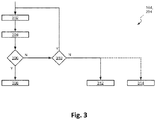
- Figure 3 depicts schematically an iteration through a set, in which the offset indicators are arranged.
- the following is both valid for the first and second apparatus and represent the processing modules 104 and 204.
- a singly linked list is just an example of arranging the plurality offset indicators, which come as a set.
- the plurality of offset indicators could be arranged in a different data structure, like a double-linked list, a circular linked list or the like.
- the next offset indicator is taken from the set.
- a first position in the TDD allocation pattern is determined by applying the selected offset indicator as an offset to a second position of the downlink radio resource, in which the downlink data connected to the HARQ-feedback information was received, of the TDD allocation pattern Palloc.
- the second position corresponds to the position / slot of the downlink data.
- the valid UL resource / slot is determined based on a dynamic TDD configuration.
- Dynamic TDD configuration allows to map flexible symbols to either DL or UL via dynamic signaling (DCI containing Slot Format Indicator (SFI)).
- DCI containing Slot Format Indicator (SFI) dynamic signaling
- determining the valid UL resource based on semi-static configuration is preferred, since both UE and gNB have always same understanding of TDD frame format.
- the valid UL resource / slot is determined based on a semi-static TDD configuration.
- one or more steps according to the processing module 312 are conducted, and finally the processing module 314 for dropping the HARQ feedback information is conducted.
- the number and scheme, which indicate how to postpone and drop HARQ feedback information, is known to both the first and second apparatus and can be part of the configuration. In other words, SPS HARQ-ACK feedback information is postponed to next available occasion if none of the configured offset indicators k1 result in a valid PUCCH occasion.
- the HARQ feedback information is immediately dropped after an occurrence of a negative check in processing module 310.
- SPS HARQ-ACK feedback information is dropped if none of the configured offset indicators k1 results in a valid PUCCH occasion.
- processing module or mapping means 308 maps the downlink radio resource to the radio resource at the determined first position. In other words, upon determining, according to the processing module or determination means 306, that the radio resource at the determined first position is valid, especially is of an uplink type, then the HARQ feedback information is to be transmitted in the uplink direction via the radio resource at the first position, namely via the mapped uplink radio resource.
- the proposed scheme provides a flexible mapping of SPS HARQ-ACK bits to PUCCH resources to avoid HARQ-ACK dropping due to conflicts with the TDD frame/slot structure.
- the signalling is reduced, while providing a balance of the number of HARQ-ACK bits on the available uplink radio resources.
- the set k1 comprises an indication for the feedback information to be sent in later valid occasion.
- a valid transmission occasion for the feedback information needs to be a valid uplink slot and needs to be within the channel occupancy time, COT.
- the COT is informed to UEs by a multicast group common PDCCH.
- the gNB gains access to the channel and informs the COT to the UE during DL period through a multi-cast signalling.
- a non-numerical, NN, entry in the set k1 allows the UE to postpone the transmission of the feedback information to a later valid occasion. This is especially advantageous for operation in unlicensed bands, such as New Radio Unlicensed, NR-U.
- Figure 4 depicts a schematical sequence diagram.
- the indices a and b reference different communication processes.
- the second apparatus 200 determines, according to a processing module or determination means 402, the plurality of offset indicators in form of a set or set k1. In other words, the second apparatus 200 determines at least one set k1 of offset indicators based on the TDD frame/slot structure and the SPS configuration, wherein the set is to be used after an activation.
- the second apparatus 200 transmits, according to a transmission 404 via transmission means, the determined set k1 as part of a SPS configuration SPSc (SPS: Semi-Persistent Scheduling) to the first apparatus 100.
- SPS Semi-Persistent Scheduling
- the second apparatus 200 provides the first apparatus 100 with one or multiple SPS configurations SPSc via RRC signaling (RRC: Radio Resource Control).
- RRC Radio Resource Control
- a field containing the set k1 is added to the existing SPS-Config information element, which allows separate definition of the set k1 per SPS configuration.
- the proposed k1 set can be configured as part of PUCCH-Config information element, which would apply to all the active SPS configurations for a given UE.
- the semi-persistent scheduling, SPS is activated via DCI, Downlink Control Indication, signaling scrambled with CS-RNTI, Configured Scheduling Radio Network Temporary Identifier.
- Semi-persistent scheduling, SPS refers to a plurality of pre-configured radio resources scheduled in a recurring or periodic manner. SPS allocates radio resources for a period of time.
- the first apparatus 100 is pre-configured by the second apparatus 200 with the SPS-RNTI and a periodicity. Once configured and activated via an activation DCI, the first apparatus 100 receives the downlink data at the configured periodicity.
- the second apparatus 200 decodes, according to decoding means, the SPS HARQ feedback information HARQ-fb (da), HARQ-fb (db) from the first apparatus 100 and forwards the decoded SPS HARQ feedback information to higher layers or triggers a HARQ retransmission depending on whether an ACK, acknowledgement, or NACK, non-acknowledgement, is received via the HARQ feedback information.
- the second apparatus 200 By transmitting a set indicator si in transmission 404 instead or together with the set k1, the second apparatus 200 clearly indicates for the first apparatus 100, which set to use for determining the HARQ feedback uplink radio resource UL#.
- the each one of the first apparatus 100 and the second apparatus selects, for example, the first offset indicator in the set k1.
- the selection of the first offset indicator could immediately result in a valid PUCCH occasion.
- the mapping, according to each processing module 104, 204, of the semi-persistent-scheduled downlink radio resource DL# to the uplink radio resource UL# of the TDD allocation pattern in dependence on at least one of a plurality of offset indicators, is successful at the first selected offset indicator, e.g. no conflict with DL semi-static symbols is determined.
- the selected offset indicator is k1*.
- the set k1 of offset indicators is defined in SPS-Config or PUCCH-Config information element.
- the pdsch-to-HARQ_feedback timing indicator in activation DCI is ignored, if present.
- the mapping, according to processing modules 104, 204 of the semi-persistent-scheduled downlink radio resource DL# to the uplink radio resource UL# of the TDD allocation pattern is determined in dependence on at least one of a plurality of offset indicators k1# and in dependence on the received start indicator, wherein the start indicator determines the first one of the offset indicators k1# to be iterated through.
- the set k1 of offset indicators in SPS-Config or PUCCH-Config information element indicates multiple offsets relative to the pdsch-to-HARQ_feedback value indicated in the activation DCI.
- multiplexing of SPS HARQ-ACK feedback information with dynamic PDSCH HARQ-ACK feedback information on a Type-1 HARQ-ACK codebook can be achieved with reduced additional modification as follows:
- the set of values according to the set k1 is also present in the higher-layer parameter dl-DataToUL-ACK which is used for the HARQ-ACK codebook construction.
- multiplexing of SPS HARQ-ACK feedback information with dynamic PDSCH HARQ-ACK feedback information on a Type-1 HARQ-ACK codebook can be achieved with reduced additional modification as follows:
- the set k1 of offset indicators for HARQ-ACK Type-1 codebook construction consists on a union of the existing higher-layer configured dl-DataToUL-ACK set and the proposed SPS-specific set k1 (or sets, if there are more than one active SPS configuration with separate k1 definition).
- the set k1 is fully defined by RRC signaling according to processing module 404.
- the transmitting and receiving side have DL#0 as a starting point and begin to search for a valid uplink.
- the first iteration DL#0 + 3 results in a valid uplink resource UL#3.
- the iteration is stopped.
- the transmitting and receiving side have DL#2 as a starting point and begin to search for a valid uplink.
- the first iteration DL#2 + 3 results in the downlink resource DL#5.
- UL#4 is recognized as a valid uplink resource UL#3. The iteration is stopped.
- the first apparatus 100 comprises at least one processor P1 that represents determining means, at least one memory M1 including computer program code CPC1, and at least one communication module C1 that represents a transmitting means and a receiving means and that is coupled with at least one antenna A1.
- the at least one memory M1 and computer program code CPC1 are configured, with the at least one processor P1, and the at least one communication module C1, to cause the first apparatus 100 at least to operate according to the present description.
- the second apparatus 200 comprises at least one processor P2 that represents determining means, at least one memory M2 including computer program code CPC2, and at least one communication module C2 that represents a transmitting means and a receiving means and that is coupled with at least one antenna A2.
- the at least one memory M2 and computer program code CPC2 are configured, with the at least one processor P2, and the at least one communication module C2, to cause the second apparatus 200 at least to operate according to the present description.
- the first apparatus 100 transmits signals in a first direction UL to the second apparatus 200.
- the second apparatus 200 transmits signals in a second direction DL to the first apparatus 100.
- the radio communications network RCN is a cellular radio communications network.
- the first direction UL is an uplink direction.
- the second direction DL is a downlink direction.
- the first apparatus 100 is a radio terminal.
- the second apparatus 200 is a base station.
Landscapes
- Engineering & Computer Science (AREA)
- Signal Processing (AREA)
- Computer Networks & Wireless Communication (AREA)
- Mobile Radio Communication Systems (AREA)
Abstract
Description
- Various example embodiments relate to feedback enhancements for scheduling in radio networks.
- 5G NR standard allows flexible TDD operation (TDD: Time Division Duplex) for unpaired spectrum. In a nutshell, any radio slot can be configured as DL-only, UL-only, or mixed DL and UL. Furthermore, flexible symbols can be also configured where the link direction (UL/DL) can be selected statically, semi-statically and/or in a dynamic manner (via Slot Format Indication (SFI) or dynamic grant).
- A first aspect of this description is directed to a first apparatus comprising at least one processor, at least one memory including computer program code, and at least one communication module, the at least one memory and computer program code configured, with the at least one processor, and the at least one communication module, to cause the first apparatus at least to determine a feedback information for data received via a semi-persistent-scheduled radio resource; map the feedback information to a radio resource in dependence on a plurality of offset indicators; and transmit, if the mapping was successful, the feedback information for the data via the mapped radio resource.
- The "synchronization" of this flexible feedback information between the network entities is established by using the plurality of offset indicators, for example a UE-specific set of offset indicators is known to the UE and the gNB and also an a-priori known iteration scheme for the set is known to both the UE and the gNB. In particular, different sets for different UEs may coexist. As a result, feedback configuration could be less coupled to the TDD allocation pattern and the timing of the scheduled downlink resources.
- Moreover, large HARQ-ACK codebook sizes are avoided as the uplink radio resources are determined in dependence on the position of the respective downlink radio resource and the set of offset indicators, for example arranged in form of the linked-list.
- Accordingly, feedback information for semi-persistent scheduled downlink data is provided with an increased flexibility. Compared to the prior art, the k1 set in form of the plurality of offset indicators - is to a large extent independent of the timing of the SPS configuration (periodicity, offset) or TDD frame structure. In other words, if SPS or TDD configuration changes, UE may still use the same k1 set. Moreover, the signaling overhead could be reduced, as the respective apparatus determines the mapping and the k1 set may remain active.
- According to an advantageous example, the first apparatus is further configured to determine, for at least one of the plurality of offset indicators, a first position in an allocation pattern by applying the at least one of the offset indicators as an offset to a second position of the data in the allocation pattern; and map the feedback information to the radio resource at the determined first position upon determining, that the radio resource at the determined first position is valid.
- Therefore, this iteration scheme provides advantageously an unambiguous and explicit specification of the uplink radio resource for the feedback information in form of the mapping.
- According to an advantageous example, the first apparatus is further configured to postpone the transmission of the feedback information until a next available radio resource if the mapping was not successful, or drop the transmission of the feedback information if the mapping was not successful.
- According to an advantageous example, the first apparatus is further configured to drop the transmission of the feedback information if the mapping was not successful.
- Dropping the feedback information represents a trade-off between successfully submitted feedback informations and a reduction of control overhead. Transmitting HARQ-ACK feedback as early as possible is beneficial for latency, since retransmissions can be employed in case the initial transmission was not correctly decoded. The reasoning for dropping HARQ feedback information is that it is anyway too late to perform HARQ retransmission (e.g. due to tight latency requirement), so feedback information could be useless.
- According to an advantageous example, the first apparatus is further configured to receive the plurality of offsets.
- Therefore, the second apparatus is in charge of determining the offsets in its serving cell.
- According to an advantageous example, the first apparatus is further configured to receive a start indicator; and map the feedback information to the radio resource in dependence on the plurality of offset indicators and in dependence on the received start indicator, wherein the start indicator determines the first one of the offset indicators.
- Advantageously, the starting point for trying to find a mapping is provided throughout the cell.
- According to an advantageous example, the first apparatus is further configured to receive a SPS configuration comprising the plurality of offset indicators.
- Advantageously, the serving second apparatus provides the feedback configuration for the cell in form of the set/plurality of offset indicators via the SPS configuration.
- A second aspect of this description is directed to a method for operating a first apparatus, wherein the method comprises: determine a feedback information for data received via a semi-persistent-scheduled radio resource; map the feedback information to a radio resource in dependence on a plurality of offset indicators; and transmit, if the mapping was successful, the feedback information for the data via the mapped radio resource..
- A third aspect of this description is directed to a second apparatus, the second apparatus comprising at least one processor, at least one memory including computer program code, and at least one communication module, the at least one memory and computer program code configured, with the at least one processor, and the at least one communication module, to cause the second apparatus at least to transmit data via a semi-persistent-scheduled radio resource; map a feedback information to a radio resource in dependence on a plurality of offset indicators; and receive, if the mapping was successful, the feedback information for the data via the mapped uplink radio resource.
- According to an advantageous example, the second apparatus is further configured to determine, for at least one of the plurality of offset indicators, a first position in an allocation pattern by applying the at least one of the plurality of offset indicators as an offset to a second position of the data in the allocation pattern; and map the feedback information to the radio resource at the determined first position upon determining, that the radio resource at the determined first position is valid.
- According to an advantageous example, the second apparatus is further configured to postpone the reception of the feedback information until a next available radio resource if the mapping was not successful, or drop the reception of the feedback information if the mapping was not successful.
- According to an advantageous example, the second apparatus is further configured to drop the reception of the feedback information if the mapping was not successful.
- According to an advantageous example, the second apparatus is further configured to determine the plurality of offset indicators; and transmit the plurality of offset indicators.
- According to an advantageous example, the second apparatus is further configured to transmit a start indicator; and map the feedback information to the radio resource in dependence on the plurality of offset indicators and in dependence on the received start indicator, wherein the start indicator determines the first one of the offset indicators.
- A fourth aspect of this description is directed to a method to operate a second apparatus, the method comprising: transmit data via a semi-persistent-scheduled radio resource; map a feedback information to a radio resource in dependence on a plurality of offset indicators; and receive, if the mapping was successful, the feedback information for the data via the mapped radio resource.
- A fifth aspect of this description is directed to a radio communications network comprising the first apparatus according to the first aspect and the second apparatus according to the third aspect.
- A sixth aspect of this description is directed to a method to operate a radio communications network, wherein the method comprises the method to operate the first apparatus according to the second aspect and the method to operate the second apparatus according to the fourth aspect.
- According to a further aspect of the description a first apparatus is provided, the first apparatus comprising at least determining means to determine a feedback information for data received via a semi-persistent-scheduled radio resource; mapping means to map the feedback information to a radio resource in dependence on a plurality of offset indicators; and transmitting means to transmit, if the mapping was successful, the feedback information for the data via the mapped radio resource.
- According to an example, the first apparatus further comprises the determining means to determine, for at least one of the plurality of offset indicators, a first position in an allocation pattern by applying the at least one of the offset indicators as an offset to a second position of the data in the allocation pattern; and the mapping means to map the feedback information to the radio resource at the determined first position upon determining, that the radio resource at the determined first position is valid.
- According to an example, the first apparatus further comprises postponing means to postpone the transmission of the feedback information until a next available radio resource if the mapping was not successful, or dropping means to drop the transmission of the feedback information if the mapping was not successful.
- According to an example, the first apparatus further comprises receiving means to receive the plurality of offsets.
- According to an example, the first apparatus further comprises receiving means to receive a start indicator; and the mapping means to map the feedback information to the radio resource in dependence on the plurality of offset indicators and in dependence on the received start indicator, wherein the start indicator determines the first one of the offset indicators.
- According to an example, the first apparatus further comprises receiving means to receive a SPS configuration comprising a plurality of offset indicators.
- Another aspect of this description is directed to a second apparatus comprising at least transmitting means to transmit data via a semi-persistent-scheduled radio resource; mapping means to map a feedback information to a radio resource in dependence on a plurality of offset indicators; and receiving means to receive, if the mapping was successful, the feedback information for the data via the mapped uplink radio resource.
- According to an example, the first apparatus further comprises determination means to determine, for at least one of the plurality of offset indicators, a first position in an allocation pattern by applying the at least one of the plurality of offset indicators as an offset to a second position of the data in the allocation pattern; and mapping means to map the feedback information to the radio resource at the determined first position upon determining, that the radio resource at the determined first position is valid.
- According to an example, the second apparatus further comprises postponing means to postpone the reception of the feedback information until a next available radio resource if the mapping was not successful, or dropping means to drop the reception of the feedback information if the mapping was not successful.
- According to an example, the second apparatus further comprises determination means to determine the plurality of offset indicators; and transmitting means to transmit the plurality of offset indicators.
- According to an example, the second apparatus further comprises transmitting means to transmit a start indicator; and mapping means to map the feedback information to the radio resource in dependence on the plurality of offset indicators and in dependence on the received start indicator, wherein the start indicator determines the first one of the offset indicators.
- In the drawing show:
- Figure 1
- a schematical block diagram for operating a first apparatus of a radio communications network;
- Figure 2
- a schematical block diagram for operating a second apparatus of a radio communications network;
- Figure 3
- schematically a flowchart;
- Figure 4
- a schematical sequence diagram;
- Figure 5
- schematically a mapping of downlink radio resources to uplink radio resources; and
- Figure 6
- schematically a cellular radio communications network.
-
Figure 1 depicts a schematical block diagram for operating afirst apparatus 100 of a radio communications network. Thefirst apparatus 100 determines, according to aprocessing module 102, a HARQ feedback information HARQ-fb for downlink data d. The HARQ feedback information HARQ-fb is part of a Hybrid Automatic Repeat reQuest (hybrid ARQ or HARQ), which is a combination of high-rate forward error-correcting coding and ARQ error-control. - Feedback information comprises at least one bit, in particular a plurality of bits, which represent the reception status of the received data.
- The downlink data d was received via receiving means from a second apparatus of the radio communications network via a semi-persistent-scheduled downlink radio resource DL# of a TDD, Time Division Duplex, allocation pattern Palloc. The
first apparatus 100 maps, according to a processing module or mapping means 104, the semi-persistent-scheduled downlink radio resource DL# to an uplink radio resource UL# of the TDD allocation pattern Palloc in dependence on at least one of a plurality of offset indicators, e.g. a set k1. In other words, the feedback information HARQ-fb is mapped to the uplink radio resource UL# in dependence on the plurality of offset indicators and in dependence on the semi-persistent-scheduled downlink radio resource DL#, which transports the downlink data d. Thefirst apparatus 100 transmits, according to a processing module or transmitting means 106, if themapping 104 was successful, the determined HARQ feedback information HARQ-fb for the downlink data d via the mapped uplink radio resource UL# towards the second apparatus. - Time Division Duplexing, TDD, comprises to use one subset of radio resources, in particular symbols, being used for downlink transmissions and another subset of radio resources, in particular symbols, for uplink transmission. A further subset of radio resources could be used for transceiver switching and guarding.
- According to an example, the
first apparatus 100 is a radio terminal or user equipment, UE. The second apparatus is a central node of the radio communications network like a next generation NodeB, short gNB. - A reference to an uplink radio resource in this description comprises slots and sub-slots. The provided solution is therefore not only applicable to a slot operation but also a sub-slot operation, which allows more granular PUCCH timing indication than slot operation only (PUCCH: Physical Uplink Control Channel).
-
Figure 2 depicts a schematical block diagram for operating thesecond apparatus 200 of the radio communications network. Thesecond apparatus 200 transmits, according to a processing module or transmitting means 202, downlink data d towards the first apparatus via the semi-persistent-scheduled downlink radio resource DL# of the TDD allocation pattern Palloc. Thesecond apparatus 200 maps, according to a processing module or mapping means 204, the semi-persistent-scheduled downlink radio resource DL# to the uplink radio resource UL# of the TDD allocation pattern Palloc in dependence on at least one of a plurality of offset indicators, e.g. a set k1. According to an example, the mapping and determination of the uplink radio resource UL# is equal for both the first and second apparatus. According to an alternative example, where the mapping in gNB and UE could result in different outcome, is for dynamic TDD pattern, where the UL/DL direction is signaled to the UE via SFI. - The
apparatus 200 receives, according to a processing module or receiving means 206, if themapping 204 was successful, the HARQ feedback information HARQ-fb for the downlink data d via the mapped uplink radio resource UL# from the first apparatus. -
Figure 3 depicts schematically an iteration through a set, in which the offset indicators are arranged. The following is both valid for the first and second apparatus and represent theprocessing modules - According to a
processing module 302, the next offset indicator is taken from the set. For the selected offset indicator, according to a processing module or determination means 304, a first position in the TDD allocation pattern is determined by applying the selected offset indicator as an offset to a second position of the downlink radio resource, in which the downlink data connected to the HARQ-feedback information was received, of the TDD allocation pattern Palloc. In other words, the second position corresponds to the position / slot of the downlink data. - According to a processing module or determination means 306, a determination is made whether the determined first position is a valid uplink radio resource for HARQ feedback information transmission. If the former is not the case, then, according to a processing module or determination means 310, a determination is made whether there are still offset indicators in the set, which have not been visited. If there are still offset indicators, which have not been visited, then the next offset indicator is selected in the processing module or selection means 302. If there are no further offset indicators, then, according to a
processing module 314, the HARQ feedback information is dropped in aprocessing module 314 or postponed 312. - According to an example, the valid UL resource / slot is determined based on a dynamic TDD configuration. Dynamic TDD configuration allows to map flexible symbols to either DL or UL via dynamic signaling (DCI containing Slot Format Indicator (SFI)). However, determining the valid UL resource based on semi-static configuration is preferred, since both UE and gNB have always same understanding of TDD frame format.
- According to a further example, the valid UL resource / slot is determined based on a semi-static TDD configuration. According to an example, for a specific HARQ feedback information, one or more steps according to the
processing module 312 are conducted, and finally theprocessing module 314 for dropping the HARQ feedback information is conducted. The number and scheme, which indicate how to postpone and drop HARQ feedback information, is known to both the first and second apparatus and can be part of the configuration. In other words, SPS HARQ-ACK feedback information is postponed to next available occasion if none of the configured offset indicators k1 result in a valid PUCCH occasion. - According to a further example, the HARQ feedback information is immediately dropped after an occurrence of a negative check in
processing module 310. In other words, SPS HARQ-ACK feedback information is dropped if none of the configured offset indicators k1 results in a valid PUCCH occasion. - Consequently, for each offset indicator iterated through, it is determined whether an uplink radio resource is available at a distance according to the offset indicator.
- If, according to processing module or determination means 306, a determination is made that the radio resource, that is explicitly defined by the selected offset indicator and the TDD semi-persistent scheduled downlink radio resource, then processing module or mapping means 308 maps the downlink radio resource to the radio resource at the determined first position. In other words, upon determining, according to the processing module or determination means 306, that the radio resource at the determined first position is valid, especially is of an uplink type, then the HARQ feedback information is to be transmitted in the uplink direction via the radio resource at the first position, namely via the mapped uplink radio resource.
- As mentioned, the proposed scheme provides a flexible mapping of SPS HARQ-ACK bits to PUCCH resources to avoid HARQ-ACK dropping due to conflicts with the TDD frame/slot structure. The signalling is reduced, while providing a balance of the number of HARQ-ACK bits on the available uplink radio resources.
- According to a further example, the set k1 comprises an indication for the feedback information to be sent in later valid occasion. For example, a valid transmission occasion for the feedback information needs to be a valid uplink slot and needs to be within the channel occupancy time, COT. The COT is informed to UEs by a multicast group common PDCCH. The gNB gains access to the channel and informs the COT to the UE during DL period through a multi-cast signalling. For example, a non-numerical, NN, entry in the set k1 allows the UE to postpone the transmission of the feedback information to a later valid occasion. This is especially advantageous for operation in unlicensed bands, such as New Radio Unlicensed, NR-U.
-
Figure 4 depicts a schematical sequence diagram. The indices a and b reference different communication processes. Thesecond apparatus 200 determines, according to a processing module or determination means 402, the plurality of offset indicators in form of a set or set k1. In other words, thesecond apparatus 200 determines at least one set k1 of offset indicators based on the TDD frame/slot structure and the SPS configuration, wherein the set is to be used after an activation. - The
second apparatus 200 transmits, according to atransmission 404 via transmission means, the determined set k1 as part of a SPS configuration SPSc (SPS: Semi-Persistent Scheduling) to thefirst apparatus 100. In other words, thesecond apparatus 200 provides thefirst apparatus 100 with one or multiple SPS configurations SPSc via RRC signaling (RRC: Radio Resource Control). For example, a field containing the set k1 is added to the existing SPS-Config information element, which allows separate definition of the set k1 per SPS configuration. Alternatively, the proposed k1 set can be configured as part of PUCCH-Config information element, which would apply to all the active SPS configurations for a given UE. - According to a
transmission 406 via transmission means, the semi-persistent scheduling, SPS, is activated via DCI, Downlink Control Indication, signaling scrambled with CS-RNTI, Configured Scheduling Radio Network Temporary Identifier. Semi-persistent scheduling, SPS, refers to a plurality of pre-configured radio resources scheduled in a recurring or periodic manner. SPS allocates radio resources for a period of time. In SPS thefirst apparatus 100 is pre-configured by thesecond apparatus 200 with the SPS-RNTI and a periodicity. Once configured and activated via an activation DCI, thefirst apparatus 100 receives the downlink data at the configured periodicity. - When a SPS PDSCH, Physical Downlink Shared Channel, is received on (sub-)slot n, the UE reports feedback information on (sub-)slot indicated via the selected offset indicator k1*, where k1* is the first entry in the configured k1 set resulting in a valid PUCCH occasion. Therefore, if the PUCCH resource determined by k1* HARQ-ACK timing in the activation DCI collides with DL or flexible symbols given by semi-static TDD configuration, the PUCCH transmission is cancelled.
- After the
transmission 206a and thereception 206b, thesecond apparatus 200 decodes, according to decoding means, the SPS HARQ feedback information HARQ-fb (da), HARQ-fb (db) from thefirst apparatus 100 and forwards the decoded SPS HARQ feedback information to higher layers or triggers a HARQ retransmission depending on whether an ACK, acknowledgement, or NACK, non-acknowledgement, is received via the HARQ feedback information. - According to example, there are different pre-set sets of offset indicators known to the first and
second apparatus transmission 404 instead or together with the set k1, thesecond apparatus 200 clearly indicates for thefirst apparatus 100, which set to use for determining the HARQ feedback uplink radio resource UL#. - For each SPS PDSCH, Physical Downlink Shared Channel, belonging to such configuration SPSc, the each one of the
first apparatus 100 and the second apparatus selects, for example, the first offset indicator in the set k1. The selection of the first offset indicator could immediately result in a valid PUCCH occasion. In other words, the mapping, according to eachprocessing module - The k1 set does not need to be in increasing order, e.g. it can be kl= {3,2,4,5}. For a SPS PDSCH on downlink radio resource DL#, HARQ-ACK feedback information is transmitted on uplink radio resource UL# = DL# + 2 as the valid offset indicator is k1*=2. The first offset indicator k1*=3 results in an invalid PUCCH allocation, and so on. Therefore, the iterating scheme, that means in which order the set k1 is processed, is also known by both of the first and
second apparatus - According to an example, the set k1 of offset indicators is defined in SPS-Config or PUCCH-Config information element. The pdsch-to-HARQ_feedback timing indicator in activation DCI is ignored, if present.
- According to an example, a timing indicator in the activation DCI is used to shift/select starting point of the RRC-defined k1 set. For instance, if timing
indicator 2 is signalled in the DCI, k1 set becomes k1={4,5,3,2} instead of k1={3,2,4,5}. In other words, a starting indicator in the sense of the timing indicator is determined by thesecond apparatus 200 and transmitted to thefirst apparatus 100. Then, the mapping, according toprocessing modules - According to an example, the set k1 of offset indicators in SPS-Config or PUCCH-Config information element indicates multiple offsets relative to the pdsch-to-HARQ_feedback value indicated in the activation DCI. As an example, a set k1={3,2,4,5} can be derived from e.g. k1_dci = 3 in activation DCI and k1_set_SPS_RRC = {0,-1,1,2} via RRC configuration.
- According to an example, multiplexing of SPS HARQ-ACK feedback information with dynamic PDSCH HARQ-ACK feedback information on a Type-1 HARQ-ACK codebook can be achieved with reduced additional modification as follows: The set of values according to the set k1 is also present in the higher-layer parameter dl-DataToUL-ACK which is used for the HARQ-ACK codebook construction.
- According to an example, multiplexing of SPS HARQ-ACK feedback information with dynamic PDSCH HARQ-ACK feedback information on a Type-1 HARQ-ACK codebook can be achieved with reduced additional modification as follows: The set k1 of offset indicators for HARQ-ACK Type-1 codebook construction consists on a union of the existing higher-layer configured dl-DataToUL-ACK set and the proposed SPS-specific set k1 (or sets, if there are more than one active SPS configuration with separate k1 definition). In this example, the set k1 is fully defined by RRC signaling according to
processing module 404. -
Figure 5 depicts schematically a mapping of downlink radio resources to uplink radio resources. For instance, with respect to the shown TDD frame structure with downlink radio resources DL# and uplink radio resources, the mapping is shown which is achieved by iterating through the set k1 = {3,2,4,5}. - For example, the transmitting and receiving side have
DL# 0 as a starting point and begin to search for a valid uplink. The firstiteration DL# 0 + 3 results in a valid uplinkresource UL# 3. The iteration is stopped. - For example, the transmitting and receiving side have
DL# 2 as a starting point and begin to search for a valid uplink. The firstiteration DL# 2 + 3 results in the downlink resource DL#5. In the seconditeration DL# 2 + 2,UL# 4 is recognized as a valid uplinkresource UL# 3. The iteration is stopped. -
Figure 6 depicts schematically a radio communications network RCN. Thefirst apparatus 100 comprises at least one processor P1 that represents determining means, at least one memory M1 including computer program code CPC1, and at least one communication module C1 that represents a transmitting means and a receiving means and that is coupled with at least one antenna A1. The at least one memory M1 and computer program code CPC1 are configured, with the at least one processor P1, and the at least one communication module C1, to cause thefirst apparatus 100 at least to operate according to the present description. Thesecond apparatus 200 comprises at least one processor P2 that represents determining means, at least one memory M2 including computer program code CPC2, and at least one communication module C2 that represents a transmitting means and a receiving means and that is coupled with at least one antenna A2. The at least one memory M2 and computer program code CPC2 are configured, with the at least one processor P2, and the at least one communication module C2, to cause thesecond apparatus 200 at least to operate according to the present description. Thefirst apparatus 100 transmits signals in a first direction UL to thesecond apparatus 200. Thesecond apparatus 200 transmits signals in a second direction DL to thefirst apparatus 100. - According to an example the radio communications network RCN is a cellular radio communications network. The first direction UL is an uplink direction. The second direction DL is a downlink direction. The
first apparatus 100 is a radio terminal. Thesecond apparatus 200 is a base station. - Even though the invention has been described above with reference to an example according to the accompanying drawings, it is clear that the invention is not restricted thereto but can be modified in several ways within the scope of the appended claims. Therefore, all words and expressions should be interpreted broadly and they are intended to illustrate, not to restrict, the embodiment. It will be obvious to a person skilled in the art that, as technology advances, the inventive concept can be implemented in various ways. Further, it is clear to a person skilled in the art that the described embodiments may, but are not required to, be combined with other embodiments in various ways.
Claims (13)
- A method for operating a first apparatus (100), wherein the method comprises:determining (102) a feedback information for data (d) received via a semi-persistent-scheduled radio resource (DL#) ;mapping (104) the feedback information to a radio resource (UL#) in dependence on a plurality of offset indicators (k1#); andtransmitting (106), if the mapping (104) was successful, the feedback information for the data (d) via the mapped radio resource (UL#).determining (304), for at least one of the plurality of offset indicators (k1#), a first position in an allocation pattern (Palloc) by applying the at least one of the offset indicators (k1#) as an offset to a second position of the data (d) in the allocation pattern; andmapping (308) the feedback information to the radio resource at the determined first position upon determining (306), that the radio resource at the determined first position is valid.
- A method according to claim 1 wherein the method further comprises
postponing (312) the transmission of the feedback information until a next available radio resource if the mapping (308) was not successful, or
dropping (314) the transmission of the feedback information if the mapping (308) was not successful. - A method to operate a second apparatus (200), wherein the method comprises:transmitting (202) data (d) via a semi-persistent-scheduled radio resource (DL#);mapping (204) a feedback information to a radio resource (UL#) in dependence on a plurality of offset indicators (k1#); andreceiving (206), if the mapping (308) was successful, the feedback information for the data (d) via the mapped radio resource (UL#).determining (304), for at least one of the plurality of offset indicators (k1#), a first position in an allocation pattern by applying the at least one of the plurality of offset indicators (k1#) as an offset to a second position of the data (d) in the allocation pattern; andmapping (308) the feedback information to the radio resource at the determined first position upon determining (306), that the radio resource at the determined first position is valid.
- A method according to claim 3, wherein the method further comprises
postponing (312) the reception of the feedback information until a next available radio resource if the mapping (308) was not successful, or
dropping (314) the reception of the feedback information if the mapping (308) was not successful. - A first apparatus (100) comprising at least
determining means to determine (102) a feedback information for data (d) received via a semi-persistent-scheduled radio resource (DL#);
mapping means to map (104) the feedback information to a radio resource (UL#) in dependence on a plurality of offset indicators (k1#); and
transmitting means to transmit (106), if the mapping (104) was successful, the feedback information for the data (d) via the mapped radio resource (UL#).
determining means to determine (304), for at least one of the plurality of offset indicators (k1#), a first position in an allocation pattern (Palloc) by applying the at least one of the offset indicators (k1#) as an offset to a second position of the data (d) in the allocation pattern; and
the mapping means to map (308) the feedback information to the radio resource at the determined first position upon determining (306), that the radio resource at the determined first position is valid. - The first apparatus (100) according to claim 5, further comprising
postponing means to postpone (312) the transmission of the feedback information until a next available radio resource if the mapping (308) was not successful, or dropping means to drop (314) the transmission of the feedback information if the mapping (308) was not successful. - The first apparatus (100) according to one of claims 5 to 6, further comprising
receiving means to receive the plurality of offsets (k1#) . - The first apparatus (100) according to one of the claims 5 to 7, further comprising
receiving means to receive a start indicator; and
the mapping means to map (104) the feedback information to the radio resource (UL#) in dependence on the plurality of offset indicators (k1#) and in dependence on the received start indicator, wherein the start indicator determines the first one of the offset indicators (k1#). - The first apparatus (100) according to one of the claims 5 to 8, further comprising
receiving means to receive a SPS configuration (SPSc) comprising the plurality of offset indicators (k1#). - A second apparatus (200) comprising at least
transmitting means to transmit (202) data (d) via a semi-persistent-scheduled radio resource (DL#);
mapping means to map (204) a feedback information to a radio resource (UL#) in dependence on a plurality of offset indicators (k1#); and
receiving means to receive (206), if the mapping (308) was successful, the feedback information for the data (d) via the mapped uplink radio resource (UL#).
determination means to determine (304), for at least one of the plurality of offset indicators (k1#), a first position in an allocation pattern by applying the at least one of the plurality of offset indicators (k1#) as an offset to a second position of the data (d) in the allocation pattern; and
mapping means to map (308) the feedback information to the radio resource at the determined first position upon determining (306), that the radio resource at the determined first position is valid. - The second apparatus (200) according to claim 10, further comprising
postponing means to postpone (312) the reception of the feedback information until a next available radio resource if the mapping (308) was not successful, or
dropping means to drop (314) the reception of the feedback information if the mapping (308) was not successful. - The second apparatus (200) according to one of the claims 10 to 11, further comprising
determination means to determine the plurality of offset indicators (k1#); and
transmitting means to transmit the plurality of offset indicators. - The second apparatus (200) according to one of the claims 10 to 12, further comprising
transmitting means to transmit a start indicator; and
mapping means to map (104) the feedback information to the radio resource (UL#) in dependence on the plurality of offset indicators (k1#) and in dependence on the received start indicator, wherein the start indicator determines the first one of the offset indicators (k1#).
Applications Claiming Priority (1)
| Application Number | Priority Date | Filing Date | Title |
|---|---|---|---|
| PCT/EP2020/053734 WO2021160262A1 (en) | 2020-02-13 | 2020-02-13 | First apparatus, method to operate a first apparatus, second apparatus, method to operate a second apparatus |
Publications (2)
| Publication Number | Publication Date |
|---|---|
| EP3866378A1 true EP3866378A1 (en) | 2021-08-18 |
| EP3866378B1 EP3866378B1 (en) | 2025-10-29 |
Family
ID=69701153
Family Applications (1)
| Application Number | Title | Priority Date | Filing Date |
|---|---|---|---|
| EP21155127.0A Active EP3866378B1 (en) | 2020-02-13 | 2021-02-04 | First apparatus, method to operate a first apparatus, second apparatus, method to operate a second apparatus |
Country Status (2)
| Country | Link |
|---|---|
| EP (1) | EP3866378B1 (en) |
| WO (1) | WO2021160262A1 (en) |
Cited By (1)
| Publication number | Priority date | Publication date | Assignee | Title |
|---|---|---|---|---|
| WO2022083782A1 (en) | 2020-10-23 | 2022-04-28 | FG Innovation Company Limited | Transmitting hybrid automatic repeat request acknowledgement in next generation networks |
Citations (1)
| Publication number | Priority date | Publication date | Assignee | Title |
|---|---|---|---|---|
| US20190254053A1 (en) * | 2018-02-13 | 2019-08-15 | Sharp Laboratories Of America, Inc. | User equipments, base stations and methods for downlink semi-persistent scheduling |
Family Cites Families (2)
| Publication number | Priority date | Publication date | Assignee | Title |
|---|---|---|---|---|
| CN105210403B (en) * | 2013-01-10 | 2019-04-05 | 韩国电子通信研究院 | Method for enhancing small cell |
| WO2016086405A1 (en) * | 2014-12-05 | 2016-06-09 | Telefonaktiebolaget Lm Ericsson (Publ) | Method and bs for scheduling ue and method and ue for transmitting harq |
-
2020
- 2020-02-13 WO PCT/EP2020/053734 patent/WO2021160262A1/en not_active Ceased
-
2021
- 2021-02-04 EP EP21155127.0A patent/EP3866378B1/en active Active
Patent Citations (1)
| Publication number | Priority date | Publication date | Assignee | Title |
|---|---|---|---|---|
| US20190254053A1 (en) * | 2018-02-13 | 2019-08-15 | Sharp Laboratories Of America, Inc. | User equipments, base stations and methods for downlink semi-persistent scheduling |
Non-Patent Citations (1)
| Title |
|---|
| HUAWEI ET AL: "Other aspects for URLLC/IIOT enhancements", vol. RAN WG1, no. Reno, USA; 20191118 - 20191122, 9 November 2019 (2019-11-09), XP051823682, Retrieved from the Internet <URL:https://ftp.3gpp.org/tsg_ran/WG1_RL1/TSGR1_99/Docs/R1-1912919.zip R1-1912919.docx> [retrieved on 20191109] * |
Cited By (3)
| Publication number | Priority date | Publication date | Assignee | Title |
|---|---|---|---|---|
| WO2022083782A1 (en) | 2020-10-23 | 2022-04-28 | FG Innovation Company Limited | Transmitting hybrid automatic repeat request acknowledgement in next generation networks |
| CN116325629A (en) * | 2020-10-23 | 2023-06-23 | 鸿颖创新有限公司 | Transmission of Hybrid Automatic Repeat Request Acknowledgments in Next Generation Networks |
| EP4211860A4 (en) * | 2020-10-23 | 2024-07-10 | Fg Innovation Company Limited | TRANSFERRING CONFIRMATION OF HYBRID AUTOMATIC REPEAT REQUESTS IN NEXT GENERATION NETWORKS |
Also Published As
| Publication number | Publication date |
|---|---|
| WO2021160262A1 (en) | 2021-08-19 |
| EP3866378B1 (en) | 2025-10-29 |
Similar Documents
| Publication | Publication Date | Title |
|---|---|---|
| US12009926B2 (en) | Method and device for transmitting data | |
| US11638240B2 (en) | Method and device for transmitting control information in wireless communication system | |
| US11122609B2 (en) | Systems and methods for grant-free uplink transmissions | |
| CN115021878B (en) | HARQ processing method and device for SPS PDSCH and electronic equipment | |
| CN110447281B (en) | Configuration, indication and ACK/NACK for multiple HARQ grant-free transmissions | |
| CA3056577C (en) | Method and device by which terminal receives data in wireless communication system | |
| KR102278389B1 (en) | Method and apparatus for transmission and reception with reduced transmission time interval in wirelss cellular communication system | |
| US10285166B2 (en) | Transmission/reception method and apparatus for uplink MIMO retransmission in LTE system | |
| US8681667B2 (en) | Method for allocating physical hybrid ARQ indicator channels | |
| RU2452108C2 (en) | Method and system for selective use of control channel element based implicit pointing | |
| EP4099596B1 (en) | Method for acquiring resource region information for phich and method of receiving pdcch | |
| US10470166B2 (en) | Hybrid automatic repeat request-acknowledgment transmission method and apparatus | |
| US10999021B2 (en) | Method for supporting multiple transmission time intervals, multiple subcarrier intervals, or multiple processing time intervals in wireless communication system, and apparatus therefor | |
| US9906334B2 (en) | Method and apparatus for transmitting ACK/NACK signal in wireless communication system | |
| US20190036655A1 (en) | Harq systems and methods for grant-free uplink transmissions | |
| US9553685B2 (en) | PHICH-less operation for uplink-downlink configuration zero | |
| KR20180013171A (en) | Method and apparatus for managing hybrid automatic repeat request process in mobile communication system | |
| WO2018204861A1 (en) | Indicating resources for transmitting modulation symbols | |
| EP3273734A1 (en) | Channel state information transmission method, user equipment, and access network device | |
| KR20240041915A (en) | Methods, communication devices, and infrastructure equipment | |
| EP3866378B1 (en) | First apparatus, method to operate a first apparatus, second apparatus, method to operate a second apparatus | |
| CN103095437A (en) | Acknowledgement character (ACK)/negative acknowledgement (NACK) feedback method aiming at downlink transmission | |
| WO2026085800A1 (en) | Information generation and processing in wireless communications | |
| EP2410812B1 (en) | Method for operating a relay node of a mobile communication network and relay node of a mobile communication network |
Legal Events
| Date | Code | Title | Description |
|---|---|---|---|
| PUAI | Public reference made under article 153(3) epc to a published international application that has entered the european phase |
Free format text: ORIGINAL CODE: 0009012 |
|
| STAA | Information on the status of an ep patent application or granted ep patent |
Free format text: STATUS: THE APPLICATION HAS BEEN PUBLISHED |
|
| AK | Designated contracting states |
Kind code of ref document: A1 Designated state(s): AL AT BE BG CH CY CZ DE DK EE ES FI FR GB GR HR HU IE IS IT LI LT LU LV MC MK MT NL NO PL PT RO RS SE SI SK SM TR |
|
| STAA | Information on the status of an ep patent application or granted ep patent |
Free format text: STATUS: REQUEST FOR EXAMINATION WAS MADE |
|
| 17P | Request for examination filed |
Effective date: 20220218 |
|
| RBV | Designated contracting states (corrected) |
Designated state(s): AL AT BE BG CH CY CZ DE DK EE ES FI FR GB GR HR HU IE IS IT LI LT LU LV MC MK MT NL NO PL PT RO RS SE SI SK SM TR |
|
| STAA | Information on the status of an ep patent application or granted ep patent |
Free format text: STATUS: EXAMINATION IS IN PROGRESS |
|
| 17Q | First examination report despatched |
Effective date: 20230127 |
|
| GRAP | Despatch of communication of intention to grant a patent |
Free format text: ORIGINAL CODE: EPIDOSNIGR1 |
|
| STAA | Information on the status of an ep patent application or granted ep patent |
Free format text: STATUS: GRANT OF PATENT IS INTENDED |
|
| INTG | Intention to grant announced |
Effective date: 20250714 |
|
| GRAS | Grant fee paid |
Free format text: ORIGINAL CODE: EPIDOSNIGR3 |
|
| GRAA | (expected) grant |
Free format text: ORIGINAL CODE: 0009210 |
|
| STAA | Information on the status of an ep patent application or granted ep patent |
Free format text: STATUS: THE PATENT HAS BEEN GRANTED |
|
| AK | Designated contracting states |
Kind code of ref document: B1 Designated state(s): AL AT BE BG CH CY CZ DE DK EE ES FI FR GB GR HR HU IE IS IT LI LT LU LV MC MK MT NL NO PL PT RO RS SE SI SK SM TR |
|
| REG | Reference to a national code |
Ref country code: CH Ref legal event code: F10 Free format text: ST27 STATUS EVENT CODE: U-0-0-F10-F00 (AS PROVIDED BY THE NATIONAL OFFICE) Effective date: 20251029 Ref country code: GB Ref legal event code: FG4D |
|
| REG | Reference to a national code |
Ref country code: IE Ref legal event code: FG4D |
|
| REG | Reference to a national code |
Ref country code: DE Ref legal event code: R096 Ref document number: 602021041105 Country of ref document: DE |
|
| P01 | Opt-out of the competence of the unified patent court (upc) registered |
Free format text: CASE NUMBER: UPC_APP_0013295_3866378/2025 Effective date: 20251113 |
|
| PGFP | Annual fee paid to national office [announced via postgrant information from national office to epo] |
Ref country code: FR Payment date: 20251231 Year of fee payment: 6 |
|
| REG | Reference to a national code |
Ref country code: NL Ref legal event code: MP Effective date: 20251029 |
|
| PGFP | Annual fee paid to national office [announced via postgrant information from national office to epo] |
Ref country code: GB Payment date: 20260106 Year of fee payment: 6 |
|
| PG25 | Lapsed in a contracting state [announced via postgrant information from national office to epo] |
Ref country code: ES Free format text: LAPSE BECAUSE OF FAILURE TO SUBMIT A TRANSLATION OF THE DESCRIPTION OR TO PAY THE FEE WITHIN THE PRESCRIBED TIME-LIMIT Effective date: 20251029 |
|
| REG | Reference to a national code |
Ref country code: LT Ref legal event code: MG9D |
|
| PG25 | Lapsed in a contracting state [announced via postgrant information from national office to epo] |
Ref country code: NO Free format text: LAPSE BECAUSE OF FAILURE TO SUBMIT A TRANSLATION OF THE DESCRIPTION OR TO PAY THE FEE WITHIN THE PRESCRIBED TIME-LIMIT Effective date: 20260129 |
|
| PGFP | Annual fee paid to national office [announced via postgrant information from national office to epo] |
Ref country code: DE Payment date: 20251230 Year of fee payment: 6 |
|
| PG25 | Lapsed in a contracting state [announced via postgrant information from national office to epo] |
Ref country code: AT Free format text: LAPSE BECAUSE OF FAILURE TO SUBMIT A TRANSLATION OF THE DESCRIPTION OR TO PAY THE FEE WITHIN THE PRESCRIBED TIME-LIMIT Effective date: 20251029 Ref country code: HR Free format text: LAPSE BECAUSE OF FAILURE TO SUBMIT A TRANSLATION OF THE DESCRIPTION OR TO PAY THE FEE WITHIN THE PRESCRIBED TIME-LIMIT Effective date: 20251029 Ref country code: FI Free format text: LAPSE BECAUSE OF FAILURE TO SUBMIT A TRANSLATION OF THE DESCRIPTION OR TO PAY THE FEE WITHIN THE PRESCRIBED TIME-LIMIT Effective date: 20251029 |
|
| REG | Reference to a national code |
Ref country code: AT Ref legal event code: MK05 Ref document number: 1852908 Country of ref document: AT Kind code of ref document: T Effective date: 20251029 |
|
| PG25 | Lapsed in a contracting state [announced via postgrant information from national office to epo] |
Ref country code: NL Free format text: LAPSE BECAUSE OF FAILURE TO SUBMIT A TRANSLATION OF THE DESCRIPTION OR TO PAY THE FEE WITHIN THE PRESCRIBED TIME-LIMIT Effective date: 20251029 |
|
| PG25 | Lapsed in a contracting state [announced via postgrant information from national office to epo] |
Ref country code: RS Free format text: LAPSE BECAUSE OF FAILURE TO SUBMIT A TRANSLATION OF THE DESCRIPTION OR TO PAY THE FEE WITHIN THE PRESCRIBED TIME-LIMIT Effective date: 20260129 |
|
| PG25 | Lapsed in a contracting state [announced via postgrant information from national office to epo] |
Ref country code: IS Free format text: LAPSE BECAUSE OF FAILURE TO SUBMIT A TRANSLATION OF THE DESCRIPTION OR TO PAY THE FEE WITHIN THE PRESCRIBED TIME-LIMIT Effective date: 20260228 |
|
| PG25 | Lapsed in a contracting state [announced via postgrant information from national office to epo] |
Ref country code: PT Free format text: LAPSE BECAUSE OF FAILURE TO SUBMIT A TRANSLATION OF THE DESCRIPTION OR TO PAY THE FEE WITHIN THE PRESCRIBED TIME-LIMIT Effective date: 20260302 |
|
| PG25 | Lapsed in a contracting state [announced via postgrant information from national office to epo] |
Ref country code: PL Free format text: LAPSE BECAUSE OF FAILURE TO SUBMIT A TRANSLATION OF THE DESCRIPTION OR TO PAY THE FEE WITHIN THE PRESCRIBED TIME-LIMIT Effective date: 20251029 |
|
| PG25 | Lapsed in a contracting state [announced via postgrant information from national office to epo] |
Ref country code: LV Free format text: LAPSE BECAUSE OF FAILURE TO SUBMIT A TRANSLATION OF THE DESCRIPTION OR TO PAY THE FEE WITHIN THE PRESCRIBED TIME-LIMIT Effective date: 20251029 |
|
| PG25 | Lapsed in a contracting state [announced via postgrant information from national office to epo] |
Ref country code: BG Free format text: LAPSE BECAUSE OF FAILURE TO SUBMIT A TRANSLATION OF THE DESCRIPTION OR TO PAY THE FEE WITHIN THE PRESCRIBED TIME-LIMIT Effective date: 20251029 |