EP3866299B1 - Method, apparatus, storage medium, and electronic device for controlling temperature - Google Patents
Method, apparatus, storage medium, and electronic device for controlling temperature Download PDFInfo
- Publication number
- EP3866299B1 EP3866299B1 EP20191366.2A EP20191366A EP3866299B1 EP 3866299 B1 EP3866299 B1 EP 3866299B1 EP 20191366 A EP20191366 A EP 20191366A EP 3866299 B1 EP3866299 B1 EP 3866299B1
- Authority
- EP
- European Patent Office
- Prior art keywords
- temperature control
- target
- temperature
- control strategy
- terminal
- Prior art date
- Legal status (The legal status is an assumption and is not a legal conclusion. Google has not performed a legal analysis and makes no representation as to the accuracy of the status listed.)
- Active
Links
Images




Classifications
-
- G—PHYSICS
- G06—COMPUTING OR CALCULATING; COUNTING
- G06F—ELECTRIC DIGITAL DATA PROCESSING
- G06F11/00—Error detection; Error correction; Monitoring
- G06F11/30—Monitoring
- G06F11/3058—Monitoring arrangements for monitoring environmental properties or parameters of the computing system or of the computing system component, e.g. monitoring of power, currents, temperature, humidity, position, vibrations
-
- G—PHYSICS
- G01—MEASURING; TESTING
- G01K—MEASURING TEMPERATURE; MEASURING QUANTITY OF HEAT; THERMALLY-SENSITIVE ELEMENTS NOT OTHERWISE PROVIDED FOR
- G01K7/00—Measuring temperature based on the use of electric or magnetic elements directly sensitive to heat ; Power supply therefor, e.g. using thermoelectric elements
- G01K7/42—Circuits effecting compensation of thermal inertia; Circuits for predicting the stationary value of a temperature
- G01K7/425—Thermal management of integrated systems
-
- H—ELECTRICITY
- H02—GENERATION; CONVERSION OR DISTRIBUTION OF ELECTRIC POWER
- H02J—ELECTRIC POWER NETWORKS; CIRCUIT ARRANGEMENTS OR SYSTEMS FOR SUPPLYING OR DISTRIBUTING ELECTRIC POWER; SYSTEMS FOR STORING ELECTRIC ENERGY
- H02J7/00—Circuit arrangements for charging or discharging batteries or for supplying loads from batteries
- H02J7/60—Circuit arrangements for charging or discharging batteries or for supplying loads from batteries including safety or protection arrangements
- H02J7/65—Circuit arrangements for charging or discharging batteries or for supplying loads from batteries including safety or protection arrangements against overtemperature
-
- G—PHYSICS
- G01—MEASURING; TESTING
- G01K—MEASURING TEMPERATURE; MEASURING QUANTITY OF HEAT; THERMALLY-SENSITIVE ELEMENTS NOT OTHERWISE PROVIDED FOR
- G01K13/00—Thermometers specially adapted for specific purposes
- G01K13/10—Thermometers specially adapted for specific purposes for measuring temperature within piled or stacked materials
-
- G—PHYSICS
- G05—CONTROLLING; REGULATING
- G05D—SYSTEMS FOR CONTROLLING OR REGULATING NON-ELECTRIC VARIABLES
- G05D23/00—Control of temperature
- G05D23/19—Control of temperature characterised by the use of electric means
- G05D23/1902—Control of temperature characterised by the use of electric means characterised by the use of a variable reference value
Definitions
- the present invention relates to the field of temperature control, and more particularly to a method, apparatus, storage medium, and electronic device for controlling temperature.
- the temperature of the terminal is controlled on the basis of a fixed environment temperature.
- JPH0837035A discloses a battery charger includes a thermistor to measure the temperature of battery and another thermistor installed inside the charger, and a CPU determining the difference between the temperatures measured by the two thermistors during the charging, and the charge rate of this temperature difference varying with time. In order to charge a battery without causing insufficient charging or overcharging.
- US20140266071A1 discloses a battery pack includes: a connecting portion connected to a battery charger; a battery chargeable by the battery charger connected to the connecting portion; an environment temperature detecting element detecting an environment temperature around the battery; and a control circuit.
- EP2003762A2 discloses a charging system for charging a battery mounted on a portable telephone, and includes a charging control unit that performs supply and control of the charging electric current and the charging voltage to the battery, a device temperature monitoring unit that monitors the device temperature inside the portable telephone, and a battery temperature monitoring unit that monitors the battery temperature of the battery.
- WO2018228559A1 discloses a charging device for charging a battery pack.
- the charging device comprises: a parameter detection unit, being used for detecting a parameter related to the charging current of the battery pack, the parameter comprising the temperature of the battery pack; and a control unit, being used for adjusting the charging current of the battery pack according to an output of the parameter detection unit to prevent the temperature of the battery pack from reaching a first preset temperature.
- CN204857809U discloses a charging case and movable platform, which effectively protects the battery at a default temperature within range through the environmental temperature control battery temperature of the adjustment battery compartment that the battery is located, extension battery life.
- the present invention provides a method, an apparatus, a storage medium, and an electronic device for controlling temperature.
- a non-transitory computer-readable storage medium having stored therein instructions is provided according to claim 12.
- an electronic device for controlling temperature is provided according to claim 13.
- first, second, third, and the like may be used in the present invention to describe various information, such information should not be limited to these terms. These terms are only used to distinguish one category of information from another. For example, without departing from the scope of the present invention, first information may be referred as second information; and similarly, second information may also be referred as first information. Depending on the context, the word “if' as used herein may be interpreted as “when” or “upon” or “in response to determining.”
- the method of controlling temperature provided by the examples of the present invention may be applied to a terminal such as a smartphone, a tablet computer, and a Personal Digital Assistant (PDA).
- a terminal such as a smartphone, a tablet computer, and a Personal Digital Assistant (PDA).
- PDA Personal Digital Assistant
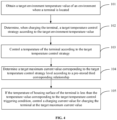
- FIG. 1 which is a flowchart illustrating a method of controlling temperature according to an example of the present invention, steps 101-103 are included.
- a target environment temperature value of an environment where the terminal is located is obtained.
- the target environment temperature value may be, for example, the temperature of the terminal's surrounding environment.
- the terminal may be in an office and the target environment temperature value may be the temperature of the office.
- the terminal may be in a desk drawer in the office, and the target environment temperature value may be the temperature inside the desk drawer.
- the target environment temperature value of the environment where the terminal is located may be obtained through a temperature sensor pre-installed on the terminal, which measures preferably the temperature of the environment of the terminal.
- the target environment temperature value may be obtained periodically.
- the terminal is located outdoors, and the target environment temperature value obtained at t1 is 10 degrees Celcius.
- the terminal is brought indoors, and the target environment temperature value increases, for example, the target environment temperature value at t2 is 20 degrees Celcius.
- a temperature control strategy for 10 degrees Celcius may not be suitable for a temperature control strategy for 20 degrees Celcius, affecting the accuracy of controlling the temperature of the terminal.
- periodically obtaining the target environment temperature value may effectively ensure the accuracy of the obtained target environment temperature value when the environment where the terminal is located changes, and facilitate the subsequent accurate control over the temperature of the terminal.
- a target temperature control strategy is determined according to the target environment temperature value.
- Charging the terminal may include electrically charging through a wire or wirelessly.
- charging the terminal may also include the terminal communicating, through wire or wirelessly, to a separate device.
- target temperature control strategies corresponding to different terminals may be the same or different, which is not limited in the present invention.
- a target temperature control strategy corresponding to terminal 1 may be strategy 1
- a target temperature control strategy corresponding to terminal 2 may be strategy 2.
- Strategy 1 and strategy 2 may be the same or different.
- a temperature of the terminal is controlled according to the target temperature control strategy.
- the temperature of the terminal for example, may be the surface temperature of the terminal or the inner body temperature of the terminal.
- the target temperature control strategy may include a target temperature control triggering condition and a target temperature control releasing condition.
- the target temperature control triggering condition may indicate a temperature value at which the control over the temperature of the terminal is triggered.
- the target temperature control releasing condition may indicate a temperature value at which the control over the temperature of the terminal is no longer performed. The temperature corresponding to the target temperature control triggering condition is higher than the temperature corresponding to the target temperature control releasing condition.
- a charging current value for charging the terminal may be flexibly controlled, so that the temperature of the terminal may be controlled.
- the temperature of the terminal may refer to a temperature of the housing surface of the terminal.
- the target environment temperature value of the environment where the terminal is located may be obtained first, and when charging the terminal, the target temperature control strategy is determined according to the target environment temperature value, so that the temperature of the terminal is controlled during the charging of the terminal.
- the target temperature control strategy is determined according to the target environment temperature value of the environment where the terminal is located, and then the charging current value for charging the terminal is flexibly controlled according to the target temperature control strategy to avoid the overheating of the terminal caused by rapid charging and achieve the purpose of controlling the temperature of the terminal, so that the controlling of the temperature of the terminal is more flexible and usable.
- controlling the temperature of the terminal includes, but is not limited to, controlling the charging current value for charging the terminal, and may further include other methods of controlling temperature, for example, closing high energy-consuming background applications, which is not limited in the present invention.
- step 102 further includes steps 102-1 and 102-2.
- a target temperature control strategy level corresponding to the target environment temperature value is determined according to a pre-stored first correspondence.
- the first correspondence includes a plurality of environment temperature values, and temperature control strategy levels corresponding thereto one to one, which are, as shown in table 1, arranged in ascending order of the environment temperature values.
- Table 1 Environment temperature values
- the terminal has pre-stored therein the first correspondence.
- the temperature control strategy level may be lower as the environment temperature value is higher. For example, d 1 ⁇ d 2 ⁇ d 3 , n 1 >n 2 >n 3 .
- the target temperature control strategy level corresponding to the target environment temperature value may be determined according to the first correspondence.
- the target temperature control strategy is determined according to the target temperature control strategy level.
- the target temperature control triggering condition and the target temperature control releasing condition which are included in the target temperature control strategy corresponding to the target temperature control strategy level, may be determined.
- the target temperature control strategy level corresponding to the target environment temperature value of the environment where the terminal is located may be determined according to the pre-stored first correspondence, so that the target temperature control strategy corresponding to the target temperature control strategy level is further determined, and thereby the temperature of the terminal is controlled.
- the first correspondence may be used to search the target temperature control strategy level easily and quickly.
- the step 102-1 further includes steps 102-11 to 102-13.
- a temperature control strategy level in the first correspondence and corresponding to the target environment temperature value is determined or selected as the target temperature control strategy level.
- the target temperature control strategy level corresponding to the target environment temperature value may be determined directly according to the first correspondence.
- the target temperature control strategy level may be determined to be n 2 , according to table 1.
- an environment temperature value closest to the target environment temperature value is determined from the plurality of environment temperature values included in the first correspondence.
- an environment temperature value having the minimum absolute value of difference from the target environment temperature value may be determined from the plurality of environment temperature values included in the first correspondence.
- an environment temperature value having a smallest absolute value of difference from the target environment temperature value m may be determined from d 1 , d 2 , d 3 , ... in table 1.
- d 5 it is d 5 .
- a temperature control strategy level corresponding to the environment temperature value closest to the target environment temperature value and in the first correspondence is determined or selected as the target temperature control strategy level.
- a temperature control strategy level n 5 corresponding to d 5 may be selected as the target temperature control strategy level.
- a temperature control strategy level in the first correspondence and corresponding to the target environment temperature value may be determined or selected as the target temperature control strategy level. If the target environment temperature value is not one of the plurality of environment temperature values included in the first correspondence, an environment temperature value closest to the target environment temperature value may be determined from the plurality of environment temperature values included in the first correspondence, and the temperature control strategy level corresponding to the determined environment temperature value is determined as the target temperature control strategy level. In this way, the corresponding target temperature control strategy level may be determined quickly according to the target environment temperature value of the environment where the terminal is located, and the target temperature control strategy is determined according to the target temperature control strategy level.
- the charging current value for charging the terminal is flexibly controlled through the target temperature control strategy, which facilitates the subsequent control over the temperature of the terminal, and has high usability.
- the step 102-2 may include: determining a target temperature control triggering condition and a target temperature control releasing condition corresponding to the target temperature control strategy level according to a pre-stored second correspondence.
- the second correspondence includes temperature control strategy levels, and temperature control triggering conditions and temperature control releasing conditions corresponding thereto one to one, as shown in table 2.
- Table 2 Environment temperature values Temperature control strategy levels
- Temperature control triggering conditions Temperature control releasing conditions d 1 n 1 B 1 C 1 d 2 n 2 B 2 C 2 d 3 n 3 B 3 C 3 ... ... ... ... ...
- temperature values of temperature control triggering conditions corresponding to the one or more temperature control strategy levels may be same.
- temperature values of temperature control releasing conditions corresponding to the one or more temperature control strategy levels may be the same. If the environment temperature value is greater than the preset temperature value, the temperature values of the temperature control triggering conditions, and the temperature control releasing condition may be increased.
- the preset temperature value may be 38 degrees Celcius or any value greater than 38 degrees Celcius. Table 2 may be adaptively adjusted to table 3.
- the terminal has pre-stored the second correspondence, and the target temperature control triggering condition and the target temperature control releasing condition corresponding to the target temperature control strategy level may be determined according to the second correspondence and the target environment temperature detected by the terminal.
- the target temperature control triggering condition and the target temperature control releasing condition corresponding to the target temperature control strategy level may be determined according to the pre-stored second correspondence and the target environment temperature detected by the terminal, so that the temperature of the terminal is controlled subsequently according to the target temperature control triggering condition and the target temperature control releasing condition.
- the second correspondence may be used to search the target temperature control triggering condition and the target temperature control releasing condition easily and quickly.
- step 103 may include the following steps: when a temperature of a housing surface of the terminal reaches a temperature value corresponding to the target temperature control triggering condition, a charging current value for charging the terminal is reduced until the temperature of housing surface of the terminal is less than or equal to a temperature value corresponding to the target temperature control releasing condition.
- the temperature of housing surface of the terminal rises continuously.
- the control over the temperature of the terminal is triggered.
- the charging current value for charging the terminal may be reduced until the temperature of the housing surface of the terminal is less than or equal to the temperature value corresponding to the target temperature control releasing condition. In this case, the control over the temperature of the terminal is released. For example, the charging current value may be increased again.
- the charging current value for charging the terminal is reduced until the temperature of housing surface of the terminal is less than or equal to the temperature value corresponding to the target temperature control releasing condition.
- FIG. 4 is a flowchart illustrating still another method of controlling temperature according to an example of the present invention.
- a target maximum current value corresponding to the target temperature control strategy level is determined according to a pre-stored third correspondence.
- the third correspondence includes temperature control strategy levels, and maximum current values corresponding thereto one to one, as shown in table 4.
- Table 4 Environment temperature values
- Temperature control strategy levels Maximum current values d 1 n 1 A 1 d 2 n 2 A 2 d 3 n 3 A 3 ... ... ... ...
- d 1 ⁇ d 2 ⁇ d 3 n 1 >n 2 >n 3 , A 1 >A 2 >A 3 .
- a charging current value for charging the terminal is controlled at the target maximum current value.
- the charging current value for charging the terminal may be controlled at the target maximum current value.
- the terminal may use a higher charging current value to achieve the purpose of fast charging.
- the terminal uses a lower charging current value for charging to avoid the temperature of the terminal from rising too fast.
- the present invention further provides apparatus examples.
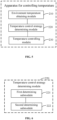
- FIG. 5 is a block diagram illustrating an apparatus for controlling temperature according to an example of the present invention.
- the apparatus is applied to a terminal.
- the apparatus includes an environment temperature obtaining module 210, a temperature control strategy determining module 220, and a temperature controlling module 230.
- the environment temperature obtaining module 210 is configured to obtain a target environment temperature value of an environment where the terminal is located.
- the temperature control strategy determining module 220 is configured to, when charging the terminal, determine a target temperature control strategy according to the target environment temperature value.
- the temperature controlling module 230 is configured to control a temperature of the terminal according to the target temperature control strategy.
- the temperature control strategy determining module 220 includes a first determining submodule 221 and a second determining submodule 222.
- the first determining submodule 221 is configured to determine a target temperature control strategy level corresponding to the target environment temperature value according to a pre-stored first correspondence, where the first correspondence includes a plurality of environment temperature values, and temperature control strategy levels corresponding thereto one to one.
- the second determining submodule 222 is configured to determine the target temperature control strategy according to the target temperature control strategy level.
- the first determining submodule 221 includes a first determining unit 2211, a second determining unit 2212, and a third determining unit 2213.
- the first determining unit 2211 is configured to, if the target environment temperature value is one of the plurality of environment temperature values included in the first correspondence, determine or select, a temperature control strategy level in the first correspondence and corresponding to the target environment temperature value as the target temperature control strategy level.
- the second determining unit 2212 is configured to, if the target environment temperature value is not one of the plurality of environment temperature values included in the first correspondence, determine, an environment temperature value closest to the target environment temperature value from the plurality of environment temperature values included in the first correspondence.
- the third determining unit 2213 is configured to determine or select, a temperature control strategy level corresponding to the environment temperature value in the first correspondence closest to the target environment temperature value, as the target temperature control strategy level.
- the second determining submodule 222 includes a fourth determining unit 2221.
- the fourth determining unit 2221 is configured to determine a target temperature control triggering condition and a target temperature control releasing condition corresponding to the target temperature control strategy level according to a pre-stored second correspondence, where the second correspondence includes temperature control strategy levels, and temperature control triggering conditions and temperature control releasing conditions corresponding thereto one to one.
- the temperature controlling module 230 includes a controlling submodule 231.
- the controlling submodule 231 is configured to, when a temperature of a housing surface of the terminal reaches a temperature value corresponding to the target temperature control triggering condition, reduce a charging current value for charging the terminal until the temperature of the housing surface of the terminal is less than or equal to a temperature value corresponding to the target temperature control releasing condition.
- the apparatus includes an environment temperature obtaining module 210, a temperature control strategy determining module 220, a temperature controlling module 230, a maximum current determining module 240, and a charging current controlling module 250.
- the maximum current determining module 240 is configured to determine a target maximum current value corresponding to the target temperature control strategy level according to a pre-stored third correspondence, where the third correspondence includes temperature control strategy levels, and maximum current values corresponding thereto one to one.
- the charging current controlling module 250 is configured to, if the temperature of the housing surface of the terminal is less than the temperature value corresponding to the target temperature control triggering condition, control a charging current value for charging the terminal as the target maximum current value.
- the present invention further provides a computer-readable storage medium having a computer program stored thereon, where the computer program is configured to implement any of the methods of controlling temperature as described above.
- the present invention further provides an electronic device, including: a processor; and a memory for storing processor-executable instructions, where the processor, when executing the executable instructions, is configured to: obtain a target environment temperature value of an environment where the terminal is located; when charging the terminal, determine a target temperature control strategy according to the target environment temperature value; and control a temperature of the terminal according to the target temperature control strategy.
- FIG. 11 is a schematic structural diagram illustrating an electronic device 1100 according to an example of the present invention.
- the electronic device 1100 may be a mobile phone, a tablet computer, an e-book reader, a multimedia player, a wearable device, a vehicle-mounted terminal, or other terminal.
- the electronic device 1100 may include one or more of the following components: a processing component 1102, a memory 1104, a power component 1106, a multimedia component 1108, an audio component 1110, an input/output (I/O) interface 1112, a sensor component 1116, and a communication component 1118.
- a processing component 1102 a memory 1104, a power component 1106, a multimedia component 1108, an audio component 1110, an input/output (I/O) interface 1112, a sensor component 1116, and a communication component 1118.
- the processing component 1102 usually controls the overall operation of the electronic device 1100, such as operations associated with display, telephone calls, data communications, camera operations, and recording operations.
- the processing component 1102 may include one or more processors 1120 to execute instructions to perform all or part of the steps in the methods described above.
- the processing component 1102 may include one or more modules to facilitate interaction between the processing component 1102 and other components.
- the processing component 1102 may include a multimedia module to facilitate interaction between the multimedia component 1108 and the processing component 1102.
- the processing component 1102 may read executable instructions from the memory to perform steps in the method of controlling temperature provided in an example as described above.
- the memory 1104 is configured to store various types of data to support operation at the electronic device 1100. Examples of these data include instructions for any application or method operating at the electronic device 1100, contact data, phone book data, messages, pictures, videos, and the like.
- the memory 1104 may be implemented by any type of volatile or non-volatile storage device or a combination thereof, such as a static random access memory (SRAM), an electrically erasable programmable read-only memory (EEPROM), an erasable programmable read-only memory (EPROM), a programmable read-only memory (PROM), a read-only memory (ROM), a magnetic memory, a flash memory, a disk or an optical disk.
- SRAM static random access memory
- EEPROM electrically erasable programmable read-only memory
- EPROM erasable programmable read-only memory
- PROM programmable read-only memory
- ROM read-only memory
- magnetic memory a magnetic memory
- flash memory a flash memory
- the power component 1106 provides power to various components of the electronic device 1100.
- the power component 1106 may include a power management system, one or more power sources, and other components associated with power generated, managed, and distributed for the electronic device 1100.
- the multimedia component 1108 includes a display screen that provides an output interface between the electronic device 1100 and a user.
- the multimedia component 1108 includes a front camera and/or a rear camera.
- the front camera and/or the rear camera may receive external multimedia data.
- Each of the front and rear cameras may be a fixed optical lens system or have a focal length and an optical zoom capability.
- the audio component 1110 is configured to output and/or input audio signals.
- the audio component 1110 includes a microphone (MIC) configured to receive an external audio signal when the electronic device 1100 is in an operation mode, such as a call mode, a recording mode, and a voice recognition mode.
- the received audio signal may be further stored in the memory 1104 or transmitted via the communication component 1118.
- the audio component 1110 also includes a loudspeaker for outputting an audio signal.
- the I/O interface 1112 provides an interface between the processing component 1102 and a peripheral interface module, which may be a keyboard, a click wheel, a button, or the like. These buttons may include, but are not limited to, a home button, a volume button, a start button, and a lock button.
- the sensor component 1116 includes one or more sensors for providing a status assessment in various aspects to the electronic device 1100.
- the sensor component 1116 may detect an open/closed state of the electronic device 1100, and the relative positioning of components, for example, the component is a display and a keypad of the electronic device 1100.
- the sensor component 1116 may also detect a change in position of the electronic device 1100 or a component of the electronic device 1100, the presence or absence of a user in contact with the electronic device 1100, the orientation or acceleration/deceleration of the electronic device 1100 and a change in temperature of the electronic device 1100.
- the sensor component 1116 may include a proximity sensor configured to detect the presence of nearby objects without any physical contact.
- the sensor component 1116 may also include an optical sensor, such as a CMOS or CCD image sensor, for use in imaging applications.
- the sensor component 1116 may also include an acceleration sensor, a gyro sensor, a magnetic sensor, a pressure sensor, or a temperature sensor.
- the communication component 1118 is configured to facilitate wired or wireless communication between the electronic device 1100 and other devices.
- the electronic device 1100 may access a wireless network based on a communication standard, such as Wi-Fi, 2G, 3G, 4G or 5G, or a combination thereof.
- the communication component 1118 receives broadcast signals or broadcast associated information from an external broadcast management system via a broadcast channel.
- the communication component 1118 also includes a near field communication (NFC) module to facilitate short-range communication.
- the NFC module may be implemented based on a radio frequency identification (RFID) technology, an infrared data association (IrDA) technology, an ultra wideband (UWB) technology, a Bluetooth (BT) technology, and other technologies.
- RFID radio frequency identification
- IrDA infrared data association
- UWB ultra wideband
- BT Bluetooth
- the electronic device 1100 may be implemented by one or more application-specific integrated circuits (ASICs), digital signal processors (DSPs), digital signal processing devices (DSPDs), programmable logic devices (PLDs), a field-programmable gate array (FPGA), a controller, a microcontroller, a microprocessor or other electronic elements for performing the above methods.
- ASICs application-specific integrated circuits
- DSPs digital signal processors
- DSPDs digital signal processing devices
- PLDs programmable logic devices
- FPGA field-programmable gate array
- controller a microcontroller, a microprocessor or other electronic elements for performing the above methods.
- non-transitory computer-readable storage medium including instructions, such as a memory 1104 including instructions, where the instructions are executable by the processor 1120 of the electronic device 1100 to implement the method of controlling temperature as described above.
- the non-transitory computer-readable storage medium may be a ROM, a random access memory (RAM), a CD-ROM, a magnetic tape, a floppy disk, and an optical data storage device.
Landscapes
- Engineering & Computer Science (AREA)
- Physics & Mathematics (AREA)
- General Physics & Mathematics (AREA)
- Theoretical Computer Science (AREA)
- Power Engineering (AREA)
- Automation & Control Theory (AREA)
- Computing Systems (AREA)
- Quality & Reliability (AREA)
- General Engineering & Computer Science (AREA)
- Charge And Discharge Circuits For Batteries Or The Like (AREA)
Description
- The present invention relates to the field of temperature control, and more particularly to a method, apparatus, storage medium, and electronic device for controlling temperature.
- With the improvement in the charging power of a smart terminal, fast charging will cause the terminal to overheat. There is a need to control the temperature of the terminal. At present, the temperature of the terminal is controlled on the basis of a fixed environment temperature.
-
JPH0837035A -
US20140266071A1 discloses a battery pack includes: a connecting portion connected to a battery charger; a battery chargeable by the battery charger connected to the connecting portion; an environment temperature detecting element detecting an environment temperature around the battery; and a control circuit. -
EP2003762A2 discloses a charging system for charging a battery mounted on a portable telephone, and includes a charging control unit that performs supply and control of the charging electric current and the charging voltage to the battery, a device temperature monitoring unit that monitors the device temperature inside the portable telephone, and a battery temperature monitoring unit that monitors the battery temperature of the battery. -
WO2018228559A1 discloses a charging device for charging a battery pack. The charging device comprises: a parameter detection unit, being used for detecting a parameter related to the charging current of the battery pack, the parameter comprising the temperature of the battery pack; and a control unit, being used for adjusting the charging current of the battery pack according to an output of the parameter detection unit to prevent the temperature of the battery pack from reaching a first preset temperature. -
CN204857809U discloses a charging case and movable platform, which effectively protects the battery at a default temperature within range through the environmental temperature control battery temperature of the adjustment battery compartment that the battery is located, extension battery life. - In view of this, the present invention provides a method, an apparatus, a storage medium, and an electronic device for controlling temperature.
- According to a first aspect of the present invention, there is provided a method of controlling temperature according to
claim 1. - According to a second aspect of the present invention, there is provided an apparatus for controlling temperature according to claim 7.
- According to a third aspect of the present invention, a non-transitory computer-readable storage medium having stored therein instructions is provided according to claim 12.
- According to a fourth aspect of the present invention, an electronic device for controlling temperature is provided according to claim 13.
- It should be understood that the above general description and the following detailed description are only examples and explanatory and are not restrictive of the present invention.
- The accompanying drawings, which are incorporated in and constitute a part of this specification, illustrate examples consistent with the present invention and, together with the description, serve to explain the principles of the invention.
-
FIG. 1 is a flowchart illustrating a method of controlling temperature, according to an example of the present invention. -
FIG. 2 is a flowchart illustrating another method of controlling temperature, according to an example of the present invention. -
FIG. 3 is a flowchart illustrating yet another method of controlling temperature, according to an example of the present invention. -
FIG. 4 is a flowchart illustrating still another method of controlling temperature, according to an example of the present invention. -
FIG. 5 is a block diagram illustrating an apparatus for controlling temperature, according to an example of the present invention. -
FIG. 6 is a block diagram illustrating another apparatus for controlling temperature, according to an example of the present invention. -
FIG. 7 is a block diagram illustrating yet another apparatus for controlling temperature, according to an example of the present invention. -
FIG. 8 is a block diagram illustrating still another apparatus for controlling temperature, according to an example of the present invention. -
FIG. 9 is a block diagram illustrating another apparatus for controlling temperature, according to an example of the present invention. -
FIG. 10 is a block diagram illustrating yet another apparatus for controlling temperature, according to an example of the present invention. -
FIG. 11 is a schematic structural diagram illustrating an electronic device, according to an example of the present invention. - Reference will now be made in detail to example embodiments, examples of which are illustrated in the accompanying drawings. When the following descriptions involve drawings, like numerals in different drawings, the drawings refer to like or similar elements unless otherwise indicated. The embodiments described in the following examples do not represent all embodiments consistent with the present invention. Rather, they are merely examples of apparatuses and methods consistent with some aspects of the present invention as detailed in the appended claims.
- The terms used in the present invention are for the purpose of describing particular examples only, and are not intended to limit the present invention. Terms determined by "a," "the" and "said" in their singular forms in the present invention and the appended claims are also intended to include plurality, unless clearly indicated otherwise in the context. It should also be understood that the term "and/or" as used herein refers to and includes any and all possible combinations of one or more of the associated listed items.
- It is to be understood that, although terms "first," "second," "third," and the like may be used in the present invention to describe various information, such information should not be limited to these terms. These terms are only used to distinguish one category of information from another. For example, without departing from the scope of the present invention, first information may be referred as second information; and similarly, second information may also be referred as first information. Depending on the context, the word "if' as used herein may be interpreted as "when" or "upon" or "in response to determining."
- The method of controlling temperature provided by the examples of the present invention may be applied to a terminal such as a smartphone, a tablet computer, and a Personal Digital Assistant (PDA). As shown in
FIG. 1 , which is a flowchart illustrating a method of controlling temperature according to an example of the present invention, steps 101-103 are included. - At
step 101, a target environment temperature value of an environment where the terminal is located is obtained. The target environment temperature value may be, for example, the temperature of the terminal's surrounding environment. For example, the terminal may be in an office and the target environment temperature value may be the temperature of the office. In another example, the terminal may be in a desk drawer in the office, and the target environment temperature value may be the temperature inside the desk drawer. - In the examples of the present invention, the target environment temperature value of the environment where the terminal is located may be obtained through a temperature sensor pre-installed on the terminal, which measures preferably the temperature of the environment of the terminal. Optionally, the target environment temperature value may be obtained periodically.
- For example, at time t1, the terminal is located outdoors, and the target environment temperature value obtained at t1 is 10 degrees Celcius. At time t2, the terminal is brought indoors, and the target environment temperature value increases, for example, the target environment temperature value at t2 is 20 degrees Celcius. Now, if the target environment temperature value of 10 degrees Celcius is still used, a temperature control strategy for 10 degrees Celcius may not be suitable for a temperature control strategy for 20 degrees Celcius, affecting the accuracy of controlling the temperature of the terminal.
- In the examples of the present invention, periodically obtaining the target environment temperature value may effectively ensure the accuracy of the obtained target environment temperature value when the environment where the terminal is located changes, and facilitate the subsequent accurate control over the temperature of the terminal.
- At
step 102, when charging the terminal, a target temperature control strategy is determined according to the target environment temperature value. Charging the terminal, for example, may include electrically charging through a wire or wirelessly. In another example, charging the terminal may also include the terminal communicating, through wire or wirelessly, to a separate device. - In the examples of the present invention, when charging different types of terminals, in a case of the same target environment temperature value, target temperature control strategies corresponding to different terminals may be the same or different, which is not limited in the present invention.
- For example, when all target environment temperature values are d, a target temperature control strategy corresponding to
terminal 1 may bestrategy 1, and a target temperature control strategy corresponding to terminal 2 may be strategy 2.Strategy 1 and strategy 2 may be the same or different. - At
step 103, a temperature of the terminal is controlled according to the target temperature control strategy. The temperature of the terminal, for example, may be the surface temperature of the terminal or the inner body temperature of the terminal. - The target temperature control strategy may include a target temperature control triggering condition and a target temperature control releasing condition. The target temperature control triggering condition may indicate a temperature value at which the control over the temperature of the terminal is triggered. The target temperature control releasing condition may indicate a temperature value at which the control over the temperature of the terminal is no longer performed. The temperature corresponding to the target temperature control triggering condition is higher than the temperature corresponding to the target temperature control releasing condition.
- According to the target temperature control strategy, when charging the terminal, a charging current value for charging the terminal may be flexibly controlled, so that the temperature of the terminal may be controlled. The temperature of the terminal may refer to a temperature of the housing surface of the terminal.
- In the above example, the target environment temperature value of the environment where the terminal is located may be obtained first, and when charging the terminal, the target temperature control strategy is determined according to the target environment temperature value, so that the temperature of the terminal is controlled during the charging of the terminal. The target temperature control strategy is determined according to the target environment temperature value of the environment where the terminal is located, and then the charging current value for charging the terminal is flexibly controlled according to the target temperature control strategy to avoid the overheating of the terminal caused by rapid charging and achieve the purpose of controlling the temperature of the terminal, so that the controlling of the temperature of the terminal is more flexible and usable. When charging the terminal, controlling the temperature of the terminal includes, but is not limited to, controlling the charging current value for charging the terminal, and may further include other methods of controlling temperature, for example, closing high energy-consuming background applications, which is not limited in the present invention.
- In some examples, as shown in
FIG. 2 , which is a flowchart illustrating another method of controlling the temperature on the basis of the example shown inFIG. 1 , step 102 further includes steps 102-1 and 102-2. - At step 102-1, a target temperature control strategy level corresponding to the target environment temperature value is determined according to a pre-stored first correspondence.
- In the examples of the present invention, the first correspondence includes a plurality of environment temperature values, and temperature control strategy levels corresponding thereto one to one, which are, as shown in table 1, arranged in ascending order of the environment temperature values.
Table 1 Environment temperature values Temperature control strategy levels d1 n1 d2 n2 d3 n3 ... ... - The terminal has pre-stored therein the first correspondence. Optionally, the temperature control strategy level may be lower as the environment temperature value is higher. For example, d1<d2<d3, n1>n2>n3.
- After the target environment temperature value of the environment where the terminal is currently located is obtained, when the terminal is to be charged, the target temperature control strategy level corresponding to the target environment temperature value may be determined according to the first correspondence.
- At step 102-2, the target temperature control strategy is determined according to the target temperature control strategy level.
- After the target temperature control strategy level is determined, the target temperature control triggering condition and the target temperature control releasing condition, which are included in the target temperature control strategy corresponding to the target temperature control strategy level, may be determined.
- In the above example, the target temperature control strategy level corresponding to the target environment temperature value of the environment where the terminal is located may be determined according to the pre-stored first correspondence, so that the target temperature control strategy corresponding to the target temperature control strategy level is further determined, and thereby the temperature of the terminal is controlled. The first correspondence may be used to search the target temperature control strategy level easily and quickly.
- In an alternative example, as shown in
FIG. 3 , which is a flowchart illustrating yet another method of controlling the temperature on the basis of the example shown inFIG. 2 , the step 102-1 further includes steps 102-11 to 102-13. - At steps 102-11, if the target environment temperature value is one of a plurality of environment temperature values included in the first correspondence, a temperature control strategy level in the first correspondence and corresponding to the target environment temperature value is determined or selected as the target temperature control strategy level.
- If the target environment temperature value is one of the plurality of environment temperature values included in the first correspondence, the target temperature control strategy level corresponding to the target environment temperature value may be determined directly according to the first correspondence.
- For example, if the target environment temperature value is d2, the target temperature control strategy level may be determined to be n2, according to table 1.
- At steps 102-12, if the target environment temperature value is not one of the plurality of environment temperature values included in the first correspondence, an environment temperature value closest to the target environment temperature value is determined from the plurality of environment temperature values included in the first correspondence.
- If the target environment temperature value is not one of the plurality of environment temperature values included in the first correspondence, an environment temperature value having the minimum absolute value of difference from the target environment temperature value may be determined from the plurality of environment temperature values included in the first correspondence.
- For example, if the target environment temperature value is m, and m is not included in table 1, an environment temperature value having a smallest absolute value of difference from the target environment temperature value m may be determined from d1, d2, d3, ... in table 1. Suppose it is d5.
- At steps 102-13, a temperature control strategy level corresponding to the environment temperature value closest to the target environment temperature value and in the first correspondence is determined or selected as the target temperature control strategy level.
- For example, if the environment temperature value in the first correspondence having the smallest absolute value of difference from the target environment temperature value m is d5, a temperature control strategy level n5 corresponding to d5 may be selected as the target temperature control strategy level.
- In the above examples, if the target environment temperature value is one of the plurality of environment temperature values included in the pre-stored first correspondence, a temperature control strategy level in the first correspondence and corresponding to the target environment temperature value may be determined or selected as the target temperature control strategy level. If the target environment temperature value is not one of the plurality of environment temperature values included in the first correspondence, an environment temperature value closest to the target environment temperature value may be determined from the plurality of environment temperature values included in the first correspondence, and the temperature control strategy level corresponding to the determined environment temperature value is determined as the target temperature control strategy level. In this way, the corresponding target temperature control strategy level may be determined quickly according to the target environment temperature value of the environment where the terminal is located, and the target temperature control strategy is determined according to the target temperature control strategy level. The charging current value for charging the terminal is flexibly controlled through the target temperature control strategy, which facilitates the subsequent control over the temperature of the terminal, and has high usability.
- In some examples, the step 102-2 may include: determining a target temperature control triggering condition and a target temperature control releasing condition corresponding to the target temperature control strategy level according to a pre-stored second correspondence.
- The second correspondence includes temperature control strategy levels, and temperature control triggering conditions and temperature control releasing conditions corresponding thereto one to one, as shown in table 2.
Table 2 Environment temperature values Temperature control strategy levels Temperature control triggering conditions Temperature control releasing conditions d1 n1 B1 C1 d2 n2 B2 C2 d3 n3 B3 C3 ... ... ... ... - In the examples of the present invention, if environment temperature values corresponding to one or more temperature control strategy levels are less than or equal to a preset temperature value, temperature values of temperature control triggering conditions corresponding to the one or more temperature control strategy levels may be same. Similarly, temperature values of temperature control releasing conditions corresponding to the one or more temperature control strategy levels may be the same. If the environment temperature value is greater than the preset temperature value, the temperature values of the temperature control triggering conditions, and the temperature control releasing condition may be increased. The preset temperature value may be 38 degrees Celcius or any value greater than 38 degrees Celcius. Table 2 may be adaptively adjusted to table 3.
Table 3 Environment temperature values Temperature control strategy levels Temperature control triggering conditions Temperature control releasing conditions d1 n1 B1 C1 d2 n2 B1 C1 d3 n3 B1 C1 ...... ...... ...... ...... Preset temperature value (dL) nL B1 C1 dL+1 nL+1 B2 C2 dL+2 nL+2 B2 C2 dL+3 nL+3 B3 C3 ... ... ... ... - In the table 3, B1<B2<B3, C1<C2<C3, B1>C1, B2>C2, and B3>C3.
- The terminal has pre-stored the second correspondence, and the target temperature control triggering condition and the target temperature control releasing condition corresponding to the target temperature control strategy level may be determined according to the second correspondence and the target environment temperature detected by the terminal.
- In the above examples, the target temperature control triggering condition and the target temperature control releasing condition corresponding to the target temperature control strategy level may be determined according to the pre-stored second correspondence and the target environment temperature detected by the terminal, so that the temperature of the terminal is controlled subsequently according to the target temperature control triggering condition and the target temperature control releasing condition. The second correspondence may be used to search the target temperature control triggering condition and the target temperature control releasing condition easily and quickly.
- In some examples, in the first correspondence and the second correspondence, the smaller the difference between two adjacent environment temperature values is, the more accurate the target temperature control strategy finally determined is.
- In some examples,
step 103 may include the following steps:
when a temperature of a housing surface of the terminal reaches a temperature value corresponding to the target temperature control triggering condition, a charging current value for charging the terminal is reduced until the temperature of housing surface of the terminal is less than or equal to a temperature value corresponding to the target temperature control releasing condition. - During the charging of the terminal, the temperature of housing surface of the terminal rises continuously. When the temperature of the housing surface of the terminal reaches the temperature value corresponding to the target temperature control triggering condition, the control over the temperature of the terminal is triggered. For example, the charging current value for charging the terminal may be reduced until the temperature of the housing surface of the terminal is less than or equal to the temperature value corresponding to the target temperature control releasing condition. In this case, the control over the temperature of the terminal is released. For example, the charging current value may be increased again.
- In the above example, when the temperature of the terminal is controlled during the charging of the terminal, when the temperature of housing surface of the terminal reaches the temperature value corresponding to the target temperature control triggering condition, the charging current value for charging the terminal is reduced until the temperature of housing surface of the terminal is less than or equal to the temperature value corresponding to the target temperature control releasing condition. The purpose of controlling the temperature of the terminal according to environments with different temperatures where the terminal is located is achieved, so that the controlling of the temperature of the terminal is more flexible and usable.
- In some examples, as shown in
FIG. 4 , which is a flowchart illustrating still another method of controlling temperature according to an example of the present invention, steps 101-105 are included. - For the steps 101-103, reference may be made to the example shown in
FIG. 1 , which will not be repeated here. Atstep 104, a target maximum current value corresponding to the target temperature control strategy level is determined according to a pre-stored third correspondence. - The third correspondence includes temperature control strategy levels, and maximum current values corresponding thereto one to one, as shown in table 4.
Table 4 Environment temperature values Temperature control strategy levels Maximum current values d1 n1 A1 d2 n2 A2 d3 n3 A3 ... ... ... - In table 4, the lower the temperature control strategy level is, the lower the maximum current value is. For example, d1<d2<d3, n1>n2>n3, A1>A2>A3.
- As can be taken from the table 4, the higher the environment temperature value is, the lower the maximum current value is.
- At
step 105, if the temperature of the housing surface of the terminal is less than the temperature value corresponding to the target temperature control triggering condition, a charging current value for charging the terminal is controlled at the target maximum current value. - In this step, if the control over the temperature of the terminal is not triggered, the charging current value for charging the terminal may be controlled at the target maximum current value.
- When the environment temperature value is lower, the terminal may use a higher charging current value to achieve the purpose of fast charging. When the environment temperature value is higher, the terminal uses a lower charging current value for charging to avoid the temperature of the terminal from rising too fast. Corresponding to the method examples, the present invention further provides apparatus examples.
-
FIG. 5 is a block diagram illustrating an apparatus for controlling temperature according to an example of the present invention. The apparatus is applied to a terminal. The apparatus includes an environmenttemperature obtaining module 210, a temperature controlstrategy determining module 220, and atemperature controlling module 230. - The environment
temperature obtaining module 210 is configured to obtain a target environment temperature value of an environment where the terminal is located. - The temperature control
strategy determining module 220 is configured to, when charging the terminal, determine a target temperature control strategy according to the target environment temperature value. - The
temperature controlling module 230 is configured to control a temperature of the terminal according to the target temperature control strategy. - As shown in
FIG. 6 , which is a block diagram illustrating another apparatus for controlling temperature according to an example of the present invention, on the basis of the example shown inFIG. 5 , the temperature controlstrategy determining module 220 includes a first determiningsubmodule 221 and a second determiningsubmodule 222. - The first determining
submodule 221 is configured to determine a target temperature control strategy level corresponding to the target environment temperature value according to a pre-stored first correspondence, where the first correspondence includes a plurality of environment temperature values, and temperature control strategy levels corresponding thereto one to one. - The second determining
submodule 222 is configured to determine the target temperature control strategy according to the target temperature control strategy level. - As shown in
FIG. 7 , which is a block diagram illustrating yet another apparatus for controlling temperature according to an example of the present invention, on the basis of the example shown inFIG. 6 , the first determiningsubmodule 221 includes a first determiningunit 2211, a second determiningunit 2212, and a third determiningunit 2213. - The first determining
unit 2211 is configured to, if the target environment temperature value is one of the plurality of environment temperature values included in the first correspondence, determine or select, a temperature control strategy level in the first correspondence and corresponding to the target environment temperature value as the target temperature control strategy level. - The second determining
unit 2212 is configured to, if the target environment temperature value is not one of the plurality of environment temperature values included in the first correspondence, determine, an environment temperature value closest to the target environment temperature value from the plurality of environment temperature values included in the first correspondence. - The third determining
unit 2213 is configured to determine or select, a temperature control strategy level corresponding to the environment temperature value in the first correspondence closest to the target environment temperature value, as the target temperature control strategy level. - As shown in
FIG. 8 , which is a block diagram illustrating still another apparatus for controlling temperature according to an example of the present invention, on the basis of the example shown inFIG. 6 , the second determiningsubmodule 222 includes a fourth determiningunit 2221. - The fourth determining
unit 2221 is configured to determine a target temperature control triggering condition and a target temperature control releasing condition corresponding to the target temperature control strategy level according to a pre-stored second correspondence, where the second correspondence includes temperature control strategy levels, and temperature control triggering conditions and temperature control releasing conditions corresponding thereto one to one. - As shown in
FIG. 9 , which is a block diagram illustrating another apparatus for controlling temperature according to an example of the present invention, on the basis of the example shown inFIG. 8 , thetemperature controlling module 230 includes a controllingsubmodule 231. - The controlling
submodule 231 is configured to, when a temperature of a housing surface of the terminal reaches a temperature value corresponding to the target temperature control triggering condition, reduce a charging current value for charging the terminal until the temperature of the housing surface of the terminal is less than or equal to a temperature value corresponding to the target temperature control releasing condition. - As shown in
FIG. 10 , which is a block diagram illustrating another apparatus for controlling temperature according to an example of the present invention, the apparatus includes an environmenttemperature obtaining module 210, a temperature controlstrategy determining module 220, atemperature controlling module 230, a maximum current determiningmodule 240, and a chargingcurrent controlling module 250. - For the environment
temperature obtaining module 210, the temperature controlstrategy determining module 220, and thetemperature controlling module 230, reference may be made to the description of the above examples, which will not be repeated here. - The maximum current determining
module 240 is configured to determine a target maximum current value corresponding to the target temperature control strategy level according to a pre-stored third correspondence, where the third correspondence includes temperature control strategy levels, and maximum current values corresponding thereto one to one. - The charging
current controlling module 250 is configured to, if the temperature of the housing surface of the terminal is less than the temperature value corresponding to the target temperature control triggering condition, control a charging current value for charging the terminal as the target maximum current value. - For the apparatus examples, since they basically correspond to the method examples, reference may be made to the partial description of the method examples. The apparatus examples described above are merely illustrative, wherein the units described as separate components may or may not be physically separated, and the components displayed as units may or may not be physical units, i.e., may be located in one place or may be distributed to multiple network units. Some or all of the modules may be selected according to actual needs to achieve the objectives of the present invention. Those of ordinary skill in the art can understand and implement the present invention without any creative effort.
- Correspondingly, the present invention further provides a computer-readable storage medium having a computer program stored thereon, where the computer program is configured to implement any of the methods of controlling temperature as described above.
- Correspondingly, the present invention further provides an electronic device, including: a processor; and a memory for storing processor-executable instructions, where the processor, when executing the executable instructions, is configured to: obtain a target environment temperature value of an environment where the terminal is located; when charging the terminal, determine a target temperature control strategy according to the target environment temperature value; and control a temperature of the terminal according to the target temperature control strategy.
-
FIG. 11 is a schematic structural diagram illustrating anelectronic device 1100 according to an example of the present invention. For example, theelectronic device 1100 may be a mobile phone, a tablet computer, an e-book reader, a multimedia player, a wearable device, a vehicle-mounted terminal, or other terminal. - Referring to
FIG. 11 , theelectronic device 1100 may include one or more of the following components: aprocessing component 1102, amemory 1104, apower component 1106, amultimedia component 1108, anaudio component 1110, an input/output (I/O)interface 1112, asensor component 1116, and acommunication component 1118. - The
processing component 1102 usually controls the overall operation of theelectronic device 1100, such as operations associated with display, telephone calls, data communications, camera operations, and recording operations. Theprocessing component 1102 may include one ormore processors 1120 to execute instructions to perform all or part of the steps in the methods described above. Moreover, theprocessing component 1102 may include one or more modules to facilitate interaction between theprocessing component 1102 and other components. For example, theprocessing component 1102 may include a multimedia module to facilitate interaction between themultimedia component 1108 and theprocessing component 1102. For another example, theprocessing component 1102 may read executable instructions from the memory to perform steps in the method of controlling temperature provided in an example as described above. - The
memory 1104 is configured to store various types of data to support operation at theelectronic device 1100. Examples of these data include instructions for any application or method operating at theelectronic device 1100, contact data, phone book data, messages, pictures, videos, and the like. Thememory 1104 may be implemented by any type of volatile or non-volatile storage device or a combination thereof, such as a static random access memory (SRAM), an electrically erasable programmable read-only memory (EEPROM), an erasable programmable read-only memory (EPROM), a programmable read-only memory (PROM), a read-only memory (ROM), a magnetic memory, a flash memory, a disk or an optical disk. - The
power component 1106 provides power to various components of theelectronic device 1100. Thepower component 1106 may include a power management system, one or more power sources, and other components associated with power generated, managed, and distributed for theelectronic device 1100. - The
multimedia component 1108 includes a display screen that provides an output interface between theelectronic device 1100 and a user. In some examples, themultimedia component 1108 includes a front camera and/or a rear camera. When theelectronic device 1100 is in an operation mode, such as a shooting mode or a video mode, the front camera and/or the rear camera may receive external multimedia data. Each of the front and rear cameras may be a fixed optical lens system or have a focal length and an optical zoom capability. - The
audio component 1110 is configured to output and/or input audio signals. For example, theaudio component 1110 includes a microphone (MIC) configured to receive an external audio signal when theelectronic device 1100 is in an operation mode, such as a call mode, a recording mode, and a voice recognition mode. The received audio signal may be further stored in thememory 1104 or transmitted via thecommunication component 1118. In some examples, theaudio component 1110 also includes a loudspeaker for outputting an audio signal. - The I/
O interface 1112 provides an interface between theprocessing component 1102 and a peripheral interface module, which may be a keyboard, a click wheel, a button, or the like. These buttons may include, but are not limited to, a home button, a volume button, a start button, and a lock button. - The
sensor component 1116 includes one or more sensors for providing a status assessment in various aspects to theelectronic device 1100. For example, thesensor component 1116 may detect an open/closed state of theelectronic device 1100, and the relative positioning of components, for example, the component is a display and a keypad of theelectronic device 1100. Thesensor component 1116 may also detect a change in position of theelectronic device 1100 or a component of theelectronic device 1100, the presence or absence of a user in contact with theelectronic device 1100, the orientation or acceleration/deceleration of theelectronic device 1100 and a change in temperature of theelectronic device 1100. Thesensor component 1116 may include a proximity sensor configured to detect the presence of nearby objects without any physical contact. Thesensor component 1116 may also include an optical sensor, such as a CMOS or CCD image sensor, for use in imaging applications. In some examples, thesensor component 1116 may also include an acceleration sensor, a gyro sensor, a magnetic sensor, a pressure sensor, or a temperature sensor. - The
communication component 1118 is configured to facilitate wired or wireless communication between theelectronic device 1100 and other devices. Theelectronic device 1100 may access a wireless network based on a communication standard, such as Wi-Fi, 2G, 3G, 4G or 5G, or a combination thereof. In an example, thecommunication component 1118 receives broadcast signals or broadcast associated information from an external broadcast management system via a broadcast channel. In an example, thecommunication component 1118 also includes a near field communication (NFC) module to facilitate short-range communication. For example, the NFC module may be implemented based on a radio frequency identification (RFID) technology, an infrared data association (IrDA) technology, an ultra wideband (UWB) technology, a Bluetooth (BT) technology, and other technologies. - In an example, the
electronic device 1100 may be implemented by one or more application-specific integrated circuits (ASICs), digital signal processors (DSPs), digital signal processing devices (DSPDs), programmable logic devices (PLDs), a field-programmable gate array (FPGA), a controller, a microcontroller, a microprocessor or other electronic elements for performing the above methods. - In an example embodiment, there is also provided a non-transitory computer-readable storage medium including instructions, such as a
memory 1104 including instructions, where the instructions are executable by theprocessor 1120 of theelectronic device 1100 to implement the method of controlling temperature as described above. For example, the non-transitory computer-readable storage medium may be a ROM, a random access memory (RAM), a CD-ROM, a magnetic tape, a floppy disk, and an optical data storage device. - Other embodiments of the present invention will be readily apparent to those skilled in the art after considering the specification and practicing the contents disclosed herein. The present application is intended to cover any variations, uses, or adaptations of the present invention, which follow the general principle of the present invention and include common knowledge or conventional technical means in the art that are not disclosed in the present invention. The specification and examples are to be regarded as illustrative only. The true scope of the present invention are pointed out by the following claims
- The above are only examples of the present invention, which are not used to limit the present invention. Any modification, equivalent replacement, improvement, etc. made within the spirit and principle of the present invention should be included within the protection scope of the present invention.
Claims (13)
- A temperature control method applied to a terminal, comprising:obtaining a target environment temperature value of an environment where the terminal is located (101);determining, when charging the terminal, a target temperature control strategy according to the target environment temperature value (102); andcontrolling a temperature of the terminal according to the target temperature control strategy (103);characterized in that determining the target temperature control strategy according to the target environment temperature value (102) comprises:determining a target temperature control strategy level corresponding to the target environment temperature value according to a pre-stored first correspondence (102-1), wherein the pre-stored first correspondence comprises a plurality of environment temperature values and temperature control strategy levels, the plurality of environment temperature values correspond one to one to the temperature control strategy levels; anddetermining the target temperature control strategy according to the target temperature control strategy level (102-2), wherein the target temperature control strategy level corresponds to the target temperature control strategy.
- The temperature control method according to claim 1, wherein determining the target temperature control strategy level corresponding to the target environment temperature value according to the pre-stored first correspondence (102-1) comprises:
in response to determining that the target environment temperature value is equal to one of the plurality of environment temperature values, selecting a temperature control strategy level in the pre-stored first correspondence and corresponding to the target environment temperature value as the target temperature control strategy level (102-11). - The temperature control method according to claim 1 or 2, wherein determining the target temperature control strategy level corresponding to the target environment temperature value according to the pre-stored first correspondence (102-1) comprises:in response to determining that the target environment temperature value is not equal to one of the plurality of environment temperature values, obtaining an environment temperature value closest to the target environment temperature value from the plurality of environment temperature values included in the pre-stored first correspondence (102-12); andselecting a temperature control strategy level corresponding to the environment temperature value closest to the target environment temperature value as the target temperature control strategy level.
- The temperature control method according to any one of claims 1 to 3, wherein determining the target temperature control strategy according to the target temperature control strategy level (102-1) comprises:
determining a target temperature control triggering condition and a target temperature control releasing condition corresponding to the target temperature control strategy level according to a pre-stored second correspondence, wherein the second correspondence comprises the temperature control strategy levels, temperature control triggering conditions, and temperature control releasing conditions, and wherein the temperature control strategy levels, the temperature control triggering conditions, and the temperature control releasing conditions correspond one to one to each other. - The temperature control method according to claim 4, wherein controlling the temperature of the terminal according to the target temperature control strategy comprises:
reducing, when a temperature of a housing surface of the terminal reaches a temperature value corresponding to the target temperature control triggering condition, a first charging current value for charging the terminal until the temperature of the housing surface of the terminal is less than or equal to a temperature value corresponding to the target temperature control releasing condition. - The temperature control method according to claim 5, further comprising:determining a target maximum current value corresponding to the target temperature control strategy level according to a pre-stored third correspondence, wherein the pre-stored third correspondence comprises temperature control strategy levels and maximum current values, and wherein the temperature control strategy levels correspond one to one to the maximum current values; andcontrolling, in response to determining that the temperature of the housing surface of the terminal is less than the temperature value corresponding to the target temperature control triggering condition, a second charging current value for charging the terminal at the target maximum current value.
- A temperature control apparatus configured to be
applied to a terminal, comprising:an environment temperature obtaining module (210) configured to obtain a target environment temperature value of an environment where the terminal is located;a temperature control strategy determining module (220) configured to determine, when charging the terminal, a target temperature control strategy according to the target environment temperature value; anda temperature controlling module (230) configured to control a temperature of the terminal according to the target temperature control strategy;characterized in that the temperature control strategy determining module (220) comprises:a first determining submodule (221) configured to determine a target temperature control strategy level corresponding to the target environment temperature value according to a pre-stored first correspondence, wherein the pre-stored first correspondence comprises a plurality of environment temperature values and temperature control strategy levels, the plurality of environment temperature values correspond one to one to the temperature control strategy levels; anda second determining submodule (222) configured to determine the target temperature control strategy according to the target temperature control strategy level, wherein the target temperature control strategy level corresponds to the target temperature control strategy. - The temperature control apparatus according to claim 7, wherein the first determining submodule (221) comprises:a first determining unit (2211) configured to, in response to determining that the target environment temperature value is equal to one of the plurality of environment temperature values, select a temperature control strategy level in the pre-stored first correspondence and corresponding to the target environment temperature value as the target temperature control strategy level;a second determining unit (2212) configured to, in response to determining that the target environment temperature value is not equal to one of the plurality of environment temperature values, obtain an environment temperature value closest to the target environment temperature value from the plurality of environment temperature values included in the pre-stored first correspondence; anda third determining unit (2213) configured to select a temperature control strategy level corresponding to the environment temperature value closest to the target environment temperature value as the target temperature control strategy level.
- The temperature control apparatus according to claim 7 or 8, wherein the second determining submodule (222) comprises:
a fourth determining unit (2221) configured to determine a target temperature control triggering condition and a target temperature control releasing condition corresponding to the target temperature control strategy level according to a pre-stored second correspondence, wherein the second correspondence comprises the temperature control strategy levels, temperature control triggering conditions, and temperature control releasing conditions, and wherein the temperature control strategy levels, the temperature control triggering conditions, and the temperature control releasing conditions correspond one to one to each other. - The temperature control apparatus according to any one of claims 7 to 9, wherein the temperature controlling module (230) comprises:
a controlling submodule (231) configured to reduce, when a temperature of a housing surface of the terminal reaches a temperature value corresponding to the target temperature control triggering condition, a first charging current value for charging the terminal until the temperature of the housing surface of the terminal is less than or equal to a temperature value corresponding to the target temperature control releasing condition. - The temperature control apparatus according to any one of claims 7 to 10, further comprising:a maximum current determining module (240) configured to determine a target maximum current value corresponding to the target temperature control strategy level according to a pre-stored third correspondence, wherein the pre-stored third correspondence comprises temperature control strategy levels and maximum current values, and wherein the temperature control strategy levels correspond one to one to the maximum current values; anda charging current controlling module (250) configured to control, in response to determining that the temperature of the housing surface of the terminal is less than the temperature value corresponding to the target temperature control triggering condition, a second charging current value for charging the terminal at the target maximum current value.
- A non-transitory computer-readable storage medium having a plurality of programs stored thereon, wherein the plurality of programs are executable by one or more processors to implement the method according to any one of claims 1 to 6.
- An electronic device, comprising:one or more processors; anda non-transitory computer-readable storage medium for storing instructions that are executable by the one or more processors to implement the method according to any one of claims 1 to 6.
Applications Claiming Priority (1)
| Application Number | Priority Date | Filing Date | Title |
|---|---|---|---|
| CN202010087777.1A CN113254300A (en) | 2020-02-11 | 2020-02-11 | Temperature control method and device and storage medium |
Publications (2)
| Publication Number | Publication Date |
|---|---|
| EP3866299A1 EP3866299A1 (en) | 2021-08-18 |
| EP3866299B1 true EP3866299B1 (en) | 2024-10-23 |
Family
ID=72139524
Family Applications (1)
| Application Number | Title | Priority Date | Filing Date |
|---|---|---|---|
| EP20191366.2A Active EP3866299B1 (en) | 2020-02-11 | 2020-08-17 | Method, apparatus, storage medium, and electronic device for controlling temperature |
Country Status (3)
| Country | Link |
|---|---|
| US (1) | US11719583B2 (en) |
| EP (1) | EP3866299B1 (en) |
| CN (1) | CN113254300A (en) |
Families Citing this family (6)
| Publication number | Priority date | Publication date | Assignee | Title |
|---|---|---|---|---|
| CN114430190A (en) * | 2022-01-07 | 2022-05-03 | 深圳市冠旭电子股份有限公司 | Battery charging method and device, electronic equipment and storage medium |
| CN114879823B (en) * | 2022-03-24 | 2024-10-08 | 深圳市广通远驰科技有限公司 | Configuration method, device, electronic device and storage medium of temperature protection strategy |
| CN116963250A (en) * | 2022-04-18 | 2023-10-27 | 北京小米移动软件有限公司 | Methods, devices, electronic equipment and storage media for adjusting terminal temperature |
| CN117375125A (en) * | 2022-06-30 | 2024-01-09 | 北京小米移动软件有限公司 | Charging control method and device, electronic equipment and storage medium |
| TWI870119B (en) * | 2023-11-22 | 2025-01-11 | 廣達電腦股份有限公司 | Method and device for artificial intelligence monitoring and protecting battery performance |
| CN119419414B (en) * | 2024-11-28 | 2025-09-23 | 孝感楚能新能源创新科技有限公司 | Control method, device, equipment and medium of power battery temperature equalizing system |
Family Cites Families (20)
| Publication number | Priority date | Publication date | Assignee | Title |
|---|---|---|---|---|
| JP3444977B2 (en) | 1994-07-25 | 2003-09-08 | キヤノン株式会社 | Charger and control method thereof |
| US5633573A (en) * | 1994-11-10 | 1997-05-27 | Duracell, Inc. | Battery pack having a processor controlled battery operating system |
| EP2003762B1 (en) | 2006-03-24 | 2016-10-12 | Lenovo Innovations Limited (Hong Kong) | Charging system, charging control program, and portable terminal |
| JP2011229319A (en) * | 2010-04-21 | 2011-11-10 | Makita Corp | Electric tool battery pack |
| US8443071B2 (en) * | 2011-10-04 | 2013-05-14 | Advanergy, Inc. | Data server system and method |
| US10142122B1 (en) * | 2012-04-11 | 2018-11-27 | Google Llc | User interfaces, systems and methods for configuring smart devices for interoperability with a smart hub device |
| JP6148882B2 (en) | 2013-03-13 | 2017-06-14 | 株式会社マキタ | Battery pack and charger |
| US9423146B2 (en) * | 2013-03-14 | 2016-08-23 | Bradley Steve Bruce | HVAC controller having integrated comfort window display |
| JP6628501B2 (en) * | 2015-06-08 | 2020-01-08 | 株式会社マキタ | Charge control device, charger and charging system |
| CN105187627A (en) * | 2015-07-21 | 2015-12-23 | 小米科技有限责任公司 | Method and device for adjusting temperature of mobile phone |
| CN204857809U (en) | 2015-07-31 | 2015-12-09 | 深圳市大疆创新科技有限公司 | Charging case and movable platform |
| CN105807873B (en) * | 2016-03-08 | 2019-03-08 | 北京小米移动软件有限公司 | Temprature control method and device |
| KR102629141B1 (en) * | 2016-04-25 | 2024-01-26 | 삼성전자주식회사 | Method for controlling chargering of battery and electronic device thereof |
| KR102082381B1 (en) * | 2016-11-24 | 2020-02-27 | 주식회사 엘지화학 | Battery charge control algorithm |
| CN106774519B (en) * | 2017-03-06 | 2019-08-06 | 华为技术有限公司 | The temperature control method of portable electronic device and portable electronic device |
| CN109148985A (en) | 2017-06-15 | 2019-01-04 | 苏州宝时得电动工具有限公司 | A kind of battery pack charging method and device |
| CN107566622B (en) * | 2017-08-23 | 2019-12-13 | 维沃移动通信有限公司 | A temperature control method and mobile terminal |
| CN109032290A (en) * | 2018-06-27 | 2018-12-18 | 北京小米移动软件有限公司 | The temprature control method and device of terminal device |
| US11243258B2 (en) * | 2018-11-13 | 2022-02-08 | Robert Bosch Gmbh | Method for approximating algorithms for fast charging li-ion batteries based on electrochemical battery models |
| CN110729800B (en) * | 2019-11-28 | 2021-06-29 | Oppo广东移动通信有限公司 | A charging control method, device, storage medium and terminal device |
-
2020
- 2020-02-11 CN CN202010087777.1A patent/CN113254300A/en active Pending
- 2020-07-29 US US16/942,700 patent/US11719583B2/en active Active
- 2020-08-17 EP EP20191366.2A patent/EP3866299B1/en active Active
Also Published As
| Publication number | Publication date |
|---|---|
| US11719583B2 (en) | 2023-08-08 |
| US20210247244A1 (en) | 2021-08-12 |
| CN113254300A (en) | 2021-08-13 |
| EP3866299A1 (en) | 2021-08-18 |
Similar Documents
| Publication | Publication Date | Title |
|---|---|---|
| EP3866299B1 (en) | Method, apparatus, storage medium, and electronic device for controlling temperature | |
| CN112448050B (en) | Charging method and charging device for lithium ion battery | |
| EP3032821B1 (en) | Method and device for shooting a picture | |
| US10790690B2 (en) | Method and apparatus for controlling charging of terminal device | |
| EP3832840B1 (en) | Charging method and device, terminal device and storage medium | |
| CN105100481A (en) | Shooting method and apparatus, and mobile terminal | |
| CN105896666A (en) | Charging method and device of terminal and terminal | |
| US11011124B2 (en) | Method and device for adjusting current of backlight, and storage medium | |
| CN105187627A (en) | Method and device for adjusting temperature of mobile phone | |
| CN112421702A (en) | Lithium battery charging method and device | |
| CN108110854A (en) | Charging method, device and computer readable storage medium | |
| CN112865207A (en) | Charging control method and device, mobile terminal and storage medium | |
| CN112821508A (en) | Charging method, charging device and storage medium | |
| CN108279384B (en) | Battery state information recording method and device | |
| EP4152609A1 (en) | Working state adjustment method and apparatus, terminal and storage medium | |
| CN114814587B (en) | Battery temperature detection method, battery temperature detection device, and storage medium | |
| CN115173495A (en) | Charging control method, charging control device and storage medium | |
| CN114977348A (en) | Method and device for determining battery charging time and storage medium | |
| US20230244287A1 (en) | Method and apparatus of temperature control, and storage medium | |
| US12609551B2 (en) | Method of charging processing, electronic device and storage medium | |
| CN114362294B (en) | Method and device for determining charging control parameters, electronic equipment and storage medium | |
| CN115118018A (en) | Wireless charging transmitting terminal, wireless charging control method, device and system | |
| CN117916606A (en) | Battery state determining method, device and storage medium | |
| CN119864891A (en) | Charging method, charging device, and storage medium | |
| CN116937716A (en) | Charging method, charging device, electronic equipment and storage medium |
Legal Events
| Date | Code | Title | Description |
|---|---|---|---|
| PUAI | Public reference made under article 153(3) epc to a published international application that has entered the european phase |
Free format text: ORIGINAL CODE: 0009012 |
|
| STAA | Information on the status of an ep patent application or granted ep patent |
Free format text: STATUS: THE APPLICATION HAS BEEN PUBLISHED |
|
| AK | Designated contracting states |
Kind code of ref document: A1 Designated state(s): AL AT BE BG CH CY CZ DE DK EE ES FI FR GB GR HR HU IE IS IT LI LT LU LV MC MK MT NL NO PL PT RO RS SE SI SK SM TR |
|
| STAA | Information on the status of an ep patent application or granted ep patent |
Free format text: STATUS: REQUEST FOR EXAMINATION WAS MADE |
|
| 17P | Request for examination filed |
Effective date: 20220207 |
|
| RBV | Designated contracting states (corrected) |
Designated state(s): AL AT BE BG CH CY CZ DE DK EE ES FI FR GB GR HR HU IE IS IT LI LT LU LV MC MK MT NL NO PL PT RO RS SE SI SK SM TR |
|
| RIC1 | Information provided on ipc code assigned before grant |
Ipc: H02J 7/00 20060101AFI20240202BHEP |
|
| GRAP | Despatch of communication of intention to grant a patent |
Free format text: ORIGINAL CODE: EPIDOSNIGR1 |
|
| STAA | Information on the status of an ep patent application or granted ep patent |
Free format text: STATUS: GRANT OF PATENT IS INTENDED |
|
| INTG | Intention to grant announced |
Effective date: 20240603 |
|
| P01 | Opt-out of the competence of the unified patent court (upc) registered |
Free format text: CASE NUMBER: APP_43131/2024 Effective date: 20240723 |
|
| GRAS | Grant fee paid |
Free format text: ORIGINAL CODE: EPIDOSNIGR3 |
|
| GRAA | (expected) grant |
Free format text: ORIGINAL CODE: 0009210 |
|
| STAA | Information on the status of an ep patent application or granted ep patent |
Free format text: STATUS: THE PATENT HAS BEEN GRANTED |
|
| AK | Designated contracting states |
Kind code of ref document: B1 Designated state(s): AL AT BE BG CH CY CZ DE DK EE ES FI FR GB GR HR HU IE IS IT LI LT LU LV MC MK MT NL NO PL PT RO RS SE SI SK SM TR |
|
| REG | Reference to a national code |
Ref country code: GB Ref legal event code: FG4D |
|
| REG | Reference to a national code |
Ref country code: CH Ref legal event code: EP |
|
| REG | Reference to a national code |
Ref country code: DE Ref legal event code: R096 Ref document number: 602020039802 Country of ref document: DE |
|
| REG | Reference to a national code |
Ref country code: IE Ref legal event code: FG4D |
|
| REG | Reference to a national code |
Ref country code: LT Ref legal event code: MG9D |
|
| REG | Reference to a national code |
Ref country code: NL Ref legal event code: MP Effective date: 20241023 |
|
| REG | Reference to a national code |
Ref country code: AT Ref legal event code: MK05 Ref document number: 1735647 Country of ref document: AT Kind code of ref document: T Effective date: 20241023 |
|
| PG25 | Lapsed in a contracting state [announced via postgrant information from national office to epo] |
Ref country code: NL Free format text: LAPSE BECAUSE OF FAILURE TO SUBMIT A TRANSLATION OF THE DESCRIPTION OR TO PAY THE FEE WITHIN THE PRESCRIBED TIME-LIMIT Effective date: 20241023 |
|
| PG25 | Lapsed in a contracting state [announced via postgrant information from national office to epo] |
Ref country code: NL Free format text: LAPSE BECAUSE OF FAILURE TO SUBMIT A TRANSLATION OF THE DESCRIPTION OR TO PAY THE FEE WITHIN THE PRESCRIBED TIME-LIMIT Effective date: 20241023 |
|
| PG25 | Lapsed in a contracting state [announced via postgrant information from national office to epo] |
Ref country code: HR Free format text: LAPSE BECAUSE OF FAILURE TO SUBMIT A TRANSLATION OF THE DESCRIPTION OR TO PAY THE FEE WITHIN THE PRESCRIBED TIME-LIMIT Effective date: 20241023 Ref country code: IS Free format text: LAPSE BECAUSE OF FAILURE TO SUBMIT A TRANSLATION OF THE DESCRIPTION OR TO PAY THE FEE WITHIN THE PRESCRIBED TIME-LIMIT Effective date: 20250223 Ref country code: PT Free format text: LAPSE BECAUSE OF FAILURE TO SUBMIT A TRANSLATION OF THE DESCRIPTION OR TO PAY THE FEE WITHIN THE PRESCRIBED TIME-LIMIT Effective date: 20250224 |
|
| PG25 | Lapsed in a contracting state [announced via postgrant information from national office to epo] |
Ref country code: FI Free format text: LAPSE BECAUSE OF FAILURE TO SUBMIT A TRANSLATION OF THE DESCRIPTION OR TO PAY THE FEE WITHIN THE PRESCRIBED TIME-LIMIT Effective date: 20241023 |
|
| PG25 | Lapsed in a contracting state [announced via postgrant information from national office to epo] |
Ref country code: BG Free format text: LAPSE BECAUSE OF FAILURE TO SUBMIT A TRANSLATION OF THE DESCRIPTION OR TO PAY THE FEE WITHIN THE PRESCRIBED TIME-LIMIT Effective date: 20241023 |
|
| PG25 | Lapsed in a contracting state [announced via postgrant information from national office to epo] |
Ref country code: ES Free format text: LAPSE BECAUSE OF FAILURE TO SUBMIT A TRANSLATION OF THE DESCRIPTION OR TO PAY THE FEE WITHIN THE PRESCRIBED TIME-LIMIT Effective date: 20241023 |
|
| PG25 | Lapsed in a contracting state [announced via postgrant information from national office to epo] |
Ref country code: NO Free format text: LAPSE BECAUSE OF FAILURE TO SUBMIT A TRANSLATION OF THE DESCRIPTION OR TO PAY THE FEE WITHIN THE PRESCRIBED TIME-LIMIT Effective date: 20250123 |
|
| PG25 | Lapsed in a contracting state [announced via postgrant information from national office to epo] |
Ref country code: AT Free format text: LAPSE BECAUSE OF FAILURE TO SUBMIT A TRANSLATION OF THE DESCRIPTION OR TO PAY THE FEE WITHIN THE PRESCRIBED TIME-LIMIT Effective date: 20241023 Ref country code: LV Free format text: LAPSE BECAUSE OF FAILURE TO SUBMIT A TRANSLATION OF THE DESCRIPTION OR TO PAY THE FEE WITHIN THE PRESCRIBED TIME-LIMIT Effective date: 20241023 Ref country code: GR Free format text: LAPSE BECAUSE OF FAILURE TO SUBMIT A TRANSLATION OF THE DESCRIPTION OR TO PAY THE FEE WITHIN THE PRESCRIBED TIME-LIMIT Effective date: 20250124 |
|
| PG25 | Lapsed in a contracting state [announced via postgrant information from national office to epo] |
Ref country code: PL Free format text: LAPSE BECAUSE OF FAILURE TO SUBMIT A TRANSLATION OF THE DESCRIPTION OR TO PAY THE FEE WITHIN THE PRESCRIBED TIME-LIMIT Effective date: 20241023 |
|
| PG25 | Lapsed in a contracting state [announced via postgrant information from national office to epo] |
Ref country code: RS Free format text: LAPSE BECAUSE OF FAILURE TO SUBMIT A TRANSLATION OF THE DESCRIPTION OR TO PAY THE FEE WITHIN THE PRESCRIBED TIME-LIMIT Effective date: 20250123 |
|
| PG25 | Lapsed in a contracting state [announced via postgrant information from national office to epo] |
Ref country code: SM Free format text: LAPSE BECAUSE OF FAILURE TO SUBMIT A TRANSLATION OF THE DESCRIPTION OR TO PAY THE FEE WITHIN THE PRESCRIBED TIME-LIMIT Effective date: 20241023 |
|
| PG25 | Lapsed in a contracting state [announced via postgrant information from national office to epo] |
Ref country code: DK Free format text: LAPSE BECAUSE OF FAILURE TO SUBMIT A TRANSLATION OF THE DESCRIPTION OR TO PAY THE FEE WITHIN THE PRESCRIBED TIME-LIMIT Effective date: 20241023 |
|
| PG25 | Lapsed in a contracting state [announced via postgrant information from national office to epo] |
Ref country code: EE Free format text: LAPSE BECAUSE OF FAILURE TO SUBMIT A TRANSLATION OF THE DESCRIPTION OR TO PAY THE FEE WITHIN THE PRESCRIBED TIME-LIMIT Effective date: 20241023 |
|
| PG25 | Lapsed in a contracting state [announced via postgrant information from national office to epo] |
Ref country code: RO Free format text: LAPSE BECAUSE OF FAILURE TO SUBMIT A TRANSLATION OF THE DESCRIPTION OR TO PAY THE FEE WITHIN THE PRESCRIBED TIME-LIMIT Effective date: 20241023 |
|
| REG | Reference to a national code |
Ref country code: DE Ref legal event code: R097 Ref document number: 602020039802 Country of ref document: DE |
|
| PG25 | Lapsed in a contracting state [announced via postgrant information from national office to epo] |
Ref country code: SK Free format text: LAPSE BECAUSE OF FAILURE TO SUBMIT A TRANSLATION OF THE DESCRIPTION OR TO PAY THE FEE WITHIN THE PRESCRIBED TIME-LIMIT Effective date: 20241023 |
|
| PG25 | Lapsed in a contracting state [announced via postgrant information from national office to epo] |
Ref country code: CZ Free format text: LAPSE BECAUSE OF FAILURE TO SUBMIT A TRANSLATION OF THE DESCRIPTION OR TO PAY THE FEE WITHIN THE PRESCRIBED TIME-LIMIT Effective date: 20241023 |
|
| PG25 | Lapsed in a contracting state [announced via postgrant information from national office to epo] |
Ref country code: IT Free format text: LAPSE BECAUSE OF FAILURE TO SUBMIT A TRANSLATION OF THE DESCRIPTION OR TO PAY THE FEE WITHIN THE PRESCRIBED TIME-LIMIT Effective date: 20241023 |
|
| PLBE | No opposition filed within time limit |
Free format text: ORIGINAL CODE: 0009261 |
|
| STAA | Information on the status of an ep patent application or granted ep patent |
Free format text: STATUS: NO OPPOSITION FILED WITHIN TIME LIMIT |
|
| PG25 | Lapsed in a contracting state [announced via postgrant information from national office to epo] |
Ref country code: SE Free format text: LAPSE BECAUSE OF FAILURE TO SUBMIT A TRANSLATION OF THE DESCRIPTION OR TO PAY THE FEE WITHIN THE PRESCRIBED TIME-LIMIT Effective date: 20241023 |
|
| 26N | No opposition filed |
Effective date: 20250724 |
|
| PGFP | Annual fee paid to national office [announced via postgrant information from national office to epo] |
Ref country code: GB Payment date: 20250820 Year of fee payment: 6 |
|
| REG | Reference to a national code |
Ref country code: DE Ref legal event code: R119 Ref document number: 602020039802 Country of ref document: DE |
|
| REG | Reference to a national code |
Ref country code: CH Ref legal event code: H13 Free format text: ST27 STATUS EVENT CODE: U-0-0-H10-H13 (AS PROVIDED BY THE NATIONAL OFFICE) Effective date: 20260324 |
|
| PG25 | Lapsed in a contracting state [announced via postgrant information from national office to epo] |
Ref country code: MC Free format text: LAPSE BECAUSE OF FAILURE TO SUBMIT A TRANSLATION OF THE DESCRIPTION OR TO PAY THE FEE WITHIN THE PRESCRIBED TIME-LIMIT Effective date: 20241023 |
|
| PG25 | Lapsed in a contracting state [announced via postgrant information from national office to epo] |
Ref country code: LU Free format text: LAPSE BECAUSE OF NON-PAYMENT OF DUE FEES Effective date: 20250817 |
|
| PG25 | Lapsed in a contracting state [announced via postgrant information from national office to epo] |
Ref country code: CH Free format text: LAPSE BECAUSE OF NON-PAYMENT OF DUE FEES Effective date: 20250831 |