EP3865693B1 - Gas turbine engine cooling system - Google Patents
Gas turbine engine cooling system Download PDFInfo
- Publication number
- EP3865693B1 EP3865693B1 EP21150825.4A EP21150825A EP3865693B1 EP 3865693 B1 EP3865693 B1 EP 3865693B1 EP 21150825 A EP21150825 A EP 21150825A EP 3865693 B1 EP3865693 B1 EP 3865693B1
- Authority
- EP
- European Patent Office
- Prior art keywords
- gas turbine
- cooling
- turbine engine
- engine
- cooling duct
- Prior art date
- Legal status (The legal status is an assumption and is not a legal conclusion. Google has not performed a legal analysis and makes no representation as to the accuracy of the status listed.)
- Active
Links
Images




Classifications
-
- F—MECHANICAL ENGINEERING; LIGHTING; HEATING; WEAPONS; BLASTING
- F02—COMBUSTION ENGINES; HOT-GAS OR COMBUSTION-PRODUCT ENGINE PLANTS
- F02C—GAS-TURBINE PLANTS; AIR INTAKES FOR JET-PROPULSION PLANTS; CONTROLLING FUEL SUPPLY IN AIR-BREATHING JET-PROPULSION PLANTS
- F02C7/00—Features, components parts, details or accessories, not provided for in, or of interest apart form groups F02C1/00 - F02C6/00; Air intakes for jet-propulsion plants
- F02C7/12—Cooling of plants
-
- F—MECHANICAL ENGINEERING; LIGHTING; HEATING; WEAPONS; BLASTING
- F02—COMBUSTION ENGINES; HOT-GAS OR COMBUSTION-PRODUCT ENGINE PLANTS
- F02C—GAS-TURBINE PLANTS; AIR INTAKES FOR JET-PROPULSION PLANTS; CONTROLLING FUEL SUPPLY IN AIR-BREATHING JET-PROPULSION PLANTS
- F02C7/00—Features, components parts, details or accessories, not provided for in, or of interest apart form groups F02C1/00 - F02C6/00; Air intakes for jet-propulsion plants
- F02C7/12—Cooling of plants
- F02C7/16—Cooling of plants characterised by cooling medium
- F02C7/18—Cooling of plants characterised by cooling medium the medium being gaseous, e.g. air
-
- F—MECHANICAL ENGINEERING; LIGHTING; HEATING; WEAPONS; BLASTING
- F02—COMBUSTION ENGINES; HOT-GAS OR COMBUSTION-PRODUCT ENGINE PLANTS
- F02K—JET-PROPULSION PLANTS
- F02K3/00—Plants including a gas turbine driving a compressor or a ducted fan
- F02K3/02—Plants including a gas turbine driving a compressor or a ducted fan in which part of the working fluid by-passes the turbine and combustion chamber
- F02K3/04—Plants including a gas turbine driving a compressor or a ducted fan in which part of the working fluid by-passes the turbine and combustion chamber the plant including ducted fans, i.e. fans with high volume, low pressure outputs, for augmenting the jet thrust, e.g. of double-flow type
-
- F—MECHANICAL ENGINEERING; LIGHTING; HEATING; WEAPONS; BLASTING
- F02—COMBUSTION ENGINES; HOT-GAS OR COMBUSTION-PRODUCT ENGINE PLANTS
- F02K—JET-PROPULSION PLANTS
- F02K3/00—Plants including a gas turbine driving a compressor or a ducted fan
- F02K3/08—Plants including a gas turbine driving a compressor or a ducted fan with supplementary heating of the working fluid; Control thereof
- F02K3/105—Heating the by-pass flow
- F02K3/115—Heating the by-pass flow by means of indirect heat exchange
-
- F—MECHANICAL ENGINEERING; LIGHTING; HEATING; WEAPONS; BLASTING
- F05—INDEXING SCHEMES RELATING TO ENGINES OR PUMPS IN VARIOUS SUBCLASSES OF CLASSES F01-F04
- F05D—INDEXING SCHEME FOR ASPECTS RELATING TO NON-POSITIVE-DISPLACEMENT MACHINES OR ENGINES, GAS-TURBINES OR JET-PROPULSION PLANTS
- F05D2220/00—Application
- F05D2220/30—Application in turbines
- F05D2220/32—Application in turbines in gas turbines
- F05D2220/323—Application in turbines in gas turbines for aircraft propulsion, e.g. jet engines
-
- F—MECHANICAL ENGINEERING; LIGHTING; HEATING; WEAPONS; BLASTING
- F05—INDEXING SCHEMES RELATING TO ENGINES OR PUMPS IN VARIOUS SUBCLASSES OF CLASSES F01-F04
- F05D—INDEXING SCHEME FOR ASPECTS RELATING TO NON-POSITIVE-DISPLACEMENT MACHINES OR ENGINES, GAS-TURBINES OR JET-PROPULSION PLANTS
- F05D2260/00—Function
- F05D2260/20—Heat transfer, e.g. cooling
- F05D2260/232—Heat transfer, e.g. cooling characterized by the cooling medium
-
- Y—GENERAL TAGGING OF NEW TECHNOLOGICAL DEVELOPMENTS; GENERAL TAGGING OF CROSS-SECTIONAL TECHNOLOGIES SPANNING OVER SEVERAL SECTIONS OF THE IPC; TECHNICAL SUBJECTS COVERED BY FORMER USPC CROSS-REFERENCE ART COLLECTIONS [XRACs] AND DIGESTS
- Y02—TECHNOLOGIES OR APPLICATIONS FOR MITIGATION OR ADAPTATION AGAINST CLIMATE CHANGE
- Y02T—CLIMATE CHANGE MITIGATION TECHNOLOGIES RELATED TO TRANSPORTATION
- Y02T50/00—Aeronautics or air transport
- Y02T50/60—Efficient propulsion technologies, e.g. for aircraft
Definitions
- the present disclosure relates to gas turbine engines and, more particularly, to cooling systems for gas turbine engines.
- Gas turbine engines are used for power generation and vehicle (e.g., aircraft) propulsion.
- a typical gas turbine engine includes a compressor section, a combustor section, and a turbine section that utilize a primary air flow into the engine to generate power or propel the vehicle.
- Air may be bled from the compressor section of the engine for cooling and sealing purposes.
- the cooling air may be needed to protect materials of the engine from early degradation and to prevent the materials from reaching temperatures which would be detrimental to their properties.
- the cooling air may not provide sufficient cooling. Further, there is a limit to an amount of air that can be bled from the compressor section without impacting normal operation of the engine.
- United States patent US 5012639 discloses a buffer system for cooling a buffer region in the nacelle of a gas turbine engine after engine shutdown.
- the buffer system comprises: a nacelle wall extending circumferentially about the engine having an interior and an exterior, the nacelle wall having an opening in the nacelle wall for flowing air from the exterior of the nacelle to the interior; a buffer region on the interior of the nacelle having a portion of at least one coolable component disposed therein; a passage for buffer air in flow communication with the opening in the nacelle wall and with the buffer region on the interior of the nacelle; and, means for positively moving air through the passage to the preselected buffer region after cessation of engine operation, the means including a source of energy which is not dependent on engine operation to supply energy after engine operation to enable operation of the means after the cessation of engine operation.
- the buffer air region blocks air in the nacelle which is heated by the engine after engine operation from transferring heat by convection to the component.
- United States patent application US 2009/0297342 A1 discloses a gas turbine engine that has an engine core extending along a core axis, a cooling-air delivery duct on the engine core, and a removable nacelle cowl overlying the engine core.
- a cooling-air nacelle-cowl duct delivers cooling air to the cooling-air delivery duct.
- At least a portion of the length of the cooling-air nacelle-cowl duct is integral with the nacelle cowl and not directly supported on the engine core.
- the present invention provides a gas turbine engine as set out in the appended claims.
- a gas turbine engine including a nacelle and an engine core received within the nacelle.
- the engine core defines a principal rotational axis along its length.
- the engine core and the nacelle define a bypass passage therebetween.
- the gas turbine engine further includes a cooling system including a cooling duct.
- the cooling duct defines an inlet for receiving bypass air from the bypass passage at an upstream location and an outlet for discharging the bypass air at a downstream location back into the bypass passage.
- the cooling duct extends, relative to the principal axis, both axially and circumferentially around a section of the engine core.
- the cooling duct comprises: a first portion that extends at least axially relative to the principal rotational axis; a second portion downstream of the first portion that extends circumferentially around the engine core relative to the principal rotational axis; and a third portion downstream of the second portion that extends at least axially relative to the principal rotational axis.
- the cooling system further comprises one or more heat transfer enhancement elements disposed between the engine core and the cooling duct for increasing heat transfer from the engine core to the cooling duct.
- the cooling system may provide cooling to the engine core without impacting normal operation of the gas turbine engine. Since the cooling duct extends both axially and circumferentially around the section of the engine core, heat transfer between the engine core and the cooling duct may be enhanced.
- the engine core may include a combustor section.
- the cooling duct extends, relative to the principal axis, circumferentially around a section of the engine core including the combustor section.
- the gas turbine engine may further include one or more grids disposed within the cooling duct for preventing debris entering the cooling duct.
- the one or more grids may include a first grid disposed proximate to the inlet and a second grid disposed proximate to the outlet.
- At least one of the one or more grids may be a fractal grid.
- the one or more grids may be used to further enhance the heat exchange rate.
- the gas turbine engine may further include a non-return valve disposed within the cooling duct for preventing airflow from the outlet to the inlet.
- the non-return valve may be disposed proximate to the outlet.
- the non-return valve may be a tricuspid valve.
- the tricuspid valve may operate without any actuator.
- the one or more heat transfer enhancement elements may include at least one of fins and heat pipes.
- the cooling system may further include one or more airflow boosters disposed within the cooling duct.
- the one or more airflow boosters may include at least one of nozzle ejectors, an electric fan and micro-compressors.
- the cooling duct may be spiral-shaped.
- the cooling system may include a plurality of the cooling ducts.
- the cooling system may include two cooling ducts that merge with each other at a junction downstream of their inlets so that the two cooling ducts share a common outlet.
- Each of the two cooling ducts may include a first portion extending at least axially relative to the principal rotational axis and a second portion downstream of the first portion.
- the second portion may extend circumferentially around the engine core relative to the principal rotational axis.
- the two cooling ducts may merge with each other at the junction downstream of the second portions.
- the two cooling ducts may include a shared third portion downstream of the junction and extending at least axially relative to the principal rotational axis.
- the third portion may include the common outlet.
- the gas turbine engine may further include a non-return valve disposed downstream of the junction and upstream of the common outlet for preventing airflow from the common outlet to the inlets of the two cooling ducts.
- the gas turbine engine may further include a grid disposed downstream of the junction and upstream of the common outlet for preventing debris entering the common outlet of the two cooling ducts.
- the cooling system of the present disclosure may provide cooling to the engine core without requiring any additional power or actuators, thereby enhancing cooling without impacting the efficiency of the gas turbine engine. Further, the cooling system may need minimal maintenance or servicing.
- a component extends "axially” relative to an axis if the component extends along the axis.
- a component extends "circumferentially” relative to an axis if the component extends in a circumferential direction defined around the axis.
- a component extends "radially” relative to an axis if the component extends radially inward or outward relative to the axis.
- FIG. 1 illustrates a gas turbine engine 10 having a principal rotational axis 9.
- the engine 10 comprises an air intake 12 and a propulsive fan 23 that generates two airflows: a core airflow A and a bypass airflow B.
- the gas turbine engine 10 comprises a core 11 that receives the core airflow A.
- the engine core 11 comprises, in axial flow series, a low pressure compressor 14, a high pressure compressor 15, a combustor section 16, a high pressure turbine 17, a low pressure turbine 19 and a core exhaust nozzle 20.
- a nacelle 21 surrounds the gas turbine engine 10 and defines a bypass passage 22 and a bypass exhaust nozzle 18.
- the bypass airflow B flows through the bypass passage 22.
- the propulsive fan 23 is attached to and driven by the low pressure turbine 19 via a shaft 26 and an epicyclic gearbox 30.
- the core airflow A is accelerated and compressed by the low pressure compressor 14 and directed into the high pressure compressor 15 where further compression takes place.
- the compressed air exhausted from the high pressure compressor 15 is directed into the combustor section 16 where it is mixed with fuel and the mixture is combusted.
- the resultant hot combustion products then expand through, and thereby drive, the high pressure and low pressure turbines 17, 19 before being exhausted through the core exhaust nozzle 20 to provide some propulsive thrust.
- the high pressure turbine 17 drives the high pressure compressor 15 by a suitable interconnecting shaft 27.
- the propulsive fan 23 generally provides the majority of the propulsive thrust.
- the epicyclic gearbox 30 is a reduction gearbox.
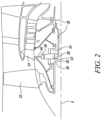
- FIG. 2 An exemplary arrangement for a geared fan gas turbine engine 10 is shown in Figure 2 .
- the low pressure turbine 19 (see Figure 1 ) drives the shaft 26, which is coupled to a sun wheel, or sun gear, 28 of the epicyclic gear arrangement 30.
- a sun wheel, or sun gear, 28 of the epicyclic gear arrangement 30 Radially outwardly of the sun gear 28 and intermeshing therewith is a plurality of planet gears 32 that are coupled together by a planet carrier 34.
- the planet carrier 34 constrains the planet gears 32 to process around the sun gear 28 in synchronicity whilst enabling each planet gear 32 to rotate about its own axis.
- the planet carrier 34 is coupled via linkages 36 to the propulsive fan 23 in order to drive its rotation about the engine axis 9.
- an annulus or ring gear 38 Radially outwardly of the planet gears 32 and intermeshing therewith is an annulus or ring gear 38 that is coupled, via linkages 40, to a stationary supporting structure 24.
- low pressure turbine and “low pressure compressor” as used herein may be taken to mean the lowest pressure turbine stages and lowest pressure compressor stages (i.e. not including the propulsive fan 23) respectively and/or the turbine and compressor stages that are connected together by the interconnecting shaft 26 with the lowest rotational speed in the engine (i.e. not including the gearbox output shaft that drives the propulsive fan 23).
- the "low pressure turbine” and “low pressure compressor” referred to herein may alternatively be known as the “intermediate pressure turbine” and “intermediate pressure compressor”. Where such alternative nomenclature is used, the propulsive fan 23 may be referred to as a first, or lowest pressure, compression stage.
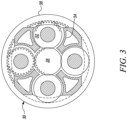
- the epicyclic gearbox 30 is shown by way of example in greater detail in Figure 3 .
- Each of the sun gear 28, planet gears 32 and ring gear 38 comprise teeth about their periphery to intermesh with the other gears. However, for clarity only exemplary portions of the teeth are illustrated in Figure 3 .
- Practical applications of a planetary epicyclic gearbox 30 generally comprise at least three planet gears 32.
- the epicyclic gearbox 30 illustrated by way of example in Figures 2 and 3 is of the planetary type, in that the planet carrier 34 is coupled to an output shaft via linkages 36, with the ring gear 38 fixed.
- the epicyclic gearbox 30 may be a star arrangement, in which the planet carrier 34 is held fixed, with the ring (or annulus) gear 38 allowed to rotate. In such an arrangement the propulsive fan 23 is driven by the ring gear 38.
- the gearbox 30 may be a differential gearbox in which the ring gear 38 and the planet carrier 34 are both allowed to rotate.
- any suitable arrangement may be used for locating the gearbox 30 in the engine 10 and/or for connecting the gearbox 30 to the engine 10.
- the connections (such as the linkages 36, 40 in the Figure 2 example) between the gearbox 30 and other parts of the engine 10 (such as the input shaft 26, the output shaft and the fixed structure 24) may have any desired degree of stiffness or flexibility.
- any suitable arrangement of the bearings between rotating and stationary parts of the engine (for example between the input and output shafts from the gearbox and the fixed structures, such as the gearbox casing) may be used, and the disclosure is not limited to the exemplary arrangement of Figure 2 .
- the gearbox 30 has a star arrangement (described above), the skilled person would readily understand that the arrangement of output and support linkages and bearing locations would typically be different to that shown by way of example in Figure 2 .
- the present disclosure extends to a gas turbine engine having any arrangement of gearbox styles (for example star or planetary), support structures, input and output shaft arrangement, and bearing locations.
- gearbox styles for example star or planetary
- support structures for example star or planetary
- input and output shaft arrangement for example star or planetary
- bearing locations for example star or planetary
- the gearbox may drive additional and/or alternative components (e.g. the intermediate pressure compressor and/or a booster compressor).
- additional and/or alternative components e.g. the intermediate pressure compressor and/or a booster compressor.
- gas turbine engines to which the present disclosure may be applied may have alternative configurations.
- such engines may have an alternative number of compressors and/or turbines and/or an alternative number of interconnecting shafts.
- the gas turbine engine shown in Figure 1 has a split flow nozzle 18, 20 meaning that the flow through the bypass passage 22 has its own nozzle 18 that is separate to and radially outside the core exhaust nozzle 20.
- this is not limiting, and any aspect of the present disclosure may also apply to engines in which the flow through the bypass passage 22 and the flow through the core 11 are mixed, or combined, before (or upstream of) a single nozzle, which may be referred to as a mixed flow nozzle.
- One or both nozzles may have a fixed or variable area.
- the described example relates to a turbofan engine, the disclosure may apply, for example, to any type of gas turbine engine, such as an open rotor (in which the fan stage is not surrounded by a nacelle) or turboprop engine, for example.
- the gas turbine engine 10 may not comprise a gearbox 30.
- the geometry of the gas turbine engine 10, and components thereof, is defined by a conventional axis system, comprising an axial direction (which is aligned with the principal rotational axis 9), a radial direction (in the bottom-to-top direction in Figure 1 ), and a circumferential direction (perpendicular to the page in the Figure 1 view).
- the axial, radial and circumferential directions are mutually perpendicular.
- present disclosure is equally applicable to aero gas turbine engines, marine gas turbine engines and land-based gas turbine engines.
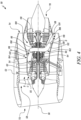
- Figure 4 is a sectional side view of a gas turbine engine 50.
- the gas turbine engine 50 may be used for propulsion of an aircraft.
- the gas turbine engine 50 may be similar to the gas turbine engine 10 of Figure 1 .
- the gas turbine engine 50 includes a nacelle 52, an engine core 54, and a propulsive fan 55.
- the engine core 54 is received within the nacelle 52.
- the engine core 54 defines a principal rotational axis 56 along its length. In other words, the engine core 54 and the nacelle 52 are circumferentially disposed about the principal rotational axis 56.
- the engine core 54 further includes, in axial flow series, a low pressure compressor 62, a high pressure compressor 64, a combustor section 60, a high pressure turbine 66, a low pressure turbine 68, a core exhaust nozzle 70.
- the engine core 54 and the nacelle 52 define a bypass passage 58 therebetween.
- the gas turbine engine 50 further includes an air intake 72 and a bypass exhaust nozzle 74.
- the propulsive fan 55 that generates two airflows: a core airflow C and a bypass airflow D.
- the engine core 54 receives the core airflow C.
- the bypass airflow D flows through the bypass passage 58.
- the bypass airflow D is interchangeably referred to as "the bypass air D".
- the gas turbine engine 50 further includes a cooling system 100.
- the cooling system 100 includes a cooling duct 102.
- the cooling system 100 includes a single cooling duct 102.
- the cooling system 100 may include a plurality of the cooling ducts 102 similar to the cooling duct 102.
- the cooling duct 102 extends, relative to the principal rotational axis 56, both axially and circumferentially around a section of the engine core 54.
- the cooling duct 102 extends, relative to the principal rotational axis 56, circumferentially around a section of the engine core 54 including the combustor section 60.
- the section of the engine core 54 may be a high pressure section.
- the cooling duct 102 is a hollow tubular component having an inlet 104 and an outlet 106.
- the cooling duct 102 defines the inlet 104 for receiving the bypass air D from the bypass passage 58 at an upstream location 122 and the outlet 106 for discharging the bypass air D at a downstream location 124.
- the inlet 104 and the outlet 106 may be flush with the outer skin of the core.
- the cooling duct 102 guides a portion of the bypass air D from the upstream location 122 to the downstream location 124, the downstream location 124 being upstream of the bypass discharge nozzle.
- the cooling duct 102 further includes a first portion 108, a second portion 110 and a third portion 112.
- the first portion 108 extends at least axially relative to the principal rotational axis 56.
- the second portion 110 is downstream of the first portion 108.
- the second portion 110 extends circumferentially around the engine core 54 relative to the principal rotational axis 56.
- the third portion 112 is downstream of the second portion 110 and extends at least axially relative to the principal rotational axis 56.
- the cooling duct 102 surrounds the engine core 54.
- the cooling duct 102 may direct the bypass air D around the engine core 54 by means of venturi effect from the upstream location 122 to the downstream location 124 of the bypass passage 58.
- the cooling duct 102 may extend along an outer surface (not shown in Figure 4 ) of the engine core 54.
- the cooling duct 102 contacts the outer surface of the section of the engine core 54 including the combustor section 60.
- the cooling duct 102 may contact and extend along the outer surface of a high pressure section of the engine core 54 adjacent to the combustor section 60.
- the high pressure section may include the high pressure compressor 64 and the high pressure turbine 66.
- the bypass air D is guided around the engine core 54 by the cooling duct 102.
- the Mach number may be kept approximately constant downstream of the first portion 108 of the cooling duct 102, up to a point proximate to the outlet 106.
- a cross-sectional area of the cooling duct 102 may be reduced proximate to the outlet 106 to increase the Mach number and provide a needed thrust.
- the increase in Mach number may generate suction to draw the bypass air D into the inlet 104.
- a difference in the Mach number between two points in the cooling duct 102 can be used to produce a cross-flow around the engine core 54, thereby channelling the bypass air D across from the inlet 104 to the outlet 106.
- the cooling duct 102 is spiral shaped.
- the cooling duct 102 spirals half a turn (i.e., about 180 degrees) around the engine core 54 relative to the principal rotational axis 56.
- the cooling duct 102 may spiral less than half a turn (i.e., less than 180 degrees) around the engine core 54 or more than half a turn (i.e., greater than 180 degrees) around the engine core 54.
- the cooling duct 102 may spiral a whole turn or multiple turns (i.e, greater than or equal to 360 degrees) around the engine core 54. Increase the number of turns (or the angular extent of the turn if there is less than one turn or a fractional number of turns) of the cooling duct 102 may enable higher heat exchange.
- a smaller cross-section of the cooling duct 102 may increase a rate of flow of the bypass air D, which may in turn further increase the heat exchange.
- the number of turns in the cooling duct 102 and the cross-section of the cooling duct 102 may vary according to the desired cooling attributes as well as the space requirements of the application.
- the cooling system 100 of the gas turbine engine 50 may further include one or more grids 116, 118 disposed within the cooling duct 102 for preventing debris entering the cooling duct 102.
- Each of the one or more grids may have a rectangular grid pattern. In other examples, each of the one or more grids may have a square, triangular, polygonal, circular or irregular grid pattern.
- the at least one of the one or more grids may be a fractal grid, as described in more detail below with reference to Figure 8 .
- two grids are disposed within the cooling duct 102 for preventing debris entering the cooling duct 102.
- a first grid 116 and a second grid 118 are disposed within the cooling duct 102.
- the first grid 116 is disposed proximate to the inlet 104.
- the second grid 118 is disposed proximate to the outlet 106.
- the cooling system 100 may further include one or more non-return valves disposed within the cooling duct 102 for preventing airflow from the outlet 106 to the inlet 104.
- the cooling system 100 of the gas turbine engine 50 includes a non-return valve 120 disposed within the cooling duct 102.
- the non-return valve 120 is disposed proximate to the outlet 106.
- the non-return valve 120 may be a tricuspid valve.
- the non-return valve 120 may prevent backflow in the cooling duct 102.
- the cooling system 100 further includes one or more airflow boosters (not shown in Figure 4 ) disposed within the cooling duct 102.
- the one or more airflow boosters include at least one of nozzle ejectors, an electric fan and micro-compressors. Air flow boosters are described in more detail below with reference to Figure 12 .
- the cooling system 100 may be a passive and an actuator-free system. In other words, the cooling system 100 may not need any additional components to power the cooling system 100.
- the cooling system 100 may reduce the temperature of a high pressure cooling air that flows around the combustor section 60 of the gas turbine engine 50.
- the cooling air may flow within the engine core 54.
- the air may reduce the temperature of downstream components such as the high and intermediate pressure turbines; high and intermediate pressure vanes; high, intermediate and/or low pressure rotating discs; inter-turbine bearing chambers; and other turbine sealing flows.
- the cooling system 100 may improve a cooling effectiveness of the gas turbine engine 50 and in turn increase life of its components.
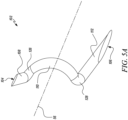
- Figures 5A-5C illustrate different views of the cooling duct 102.
- Figure 5A illustrates a perspective view of the cooling duct 102.
- Figure 5B illustrates a top view of the cooling duct 102.
- Figure 5C illustrates a front view of the cooling duct 102.
- the cooling duct 102 includes the inlet 104, the outlet 106, the first portion 108, the second portion 110, and the third portion 112.
- the cooling duct 102 has an approximately circular cross-section along its length.
- the cooling duct 102 may have one of an elliptical, rectangular, and polygonal cross-section along its length.
- the first portion 108 extends at least axially and radially relative to the principal rotational axis 56.
- the first portion 108 may further extend circumferentially relative to the principal rotational axis 56.
- the second portion 110 is downstream of the first portion 108 and connected to the first portion 108 via a first curved portion 126.
- the second portion 110 extends circumferentially around the engine core 54 relative to the principal rotational axis 56.
- the second portion 110 may be the spiral portion of the cooling duct 102.
- the second portion 110 may extend circumferentially by about 180 degrees relative to the principal rotational axis 56.
- the second portion 110 may extend circumferentially by less than 180 degrees or greater than 180 degrees.
- the second portion 110 may form one or more turns relative to the principal rotational axis 56.
- the third portion 112 is downstream of the second portion 110.
- the second portion 110 is connected to the third portion 112 via a second curved portion 128.
- the third portion 112 also extends at least axially and radially relative to the principal rotational axis 56.
- the first curved portion 126 may ensure a smooth transition between the first and second portions 108, 110.
- the second curved portion 128 may allow a smooth transition between the second and third portions 110, 112.
- the first and second curved portions 126, 128 may therefore allow a smooth flow of bypass air D between the first portion 108, the second portion 110 and the third portion 112.
- Each of the cooling ducts 202A, 202B extends, relative to the principal rotational axis 56, both axially and circumferentially around a section of the engine core 54.
- each of the cooling ducts 202A, 202B extends, relative to the principal rotational axis 56, circumferentially around a section of the engine core 54 including the combustor section 60.
- Each of the cooling ducts 202A, 202B is a hollow tubular component.
- Each of the cooling ducts 202A, 202B defines the respective inlet 204A, 2024B for receiving the bypass air D from the bypass passage 58 at an upstream location 222 and the common outlet 206 for discharging the bypass air D at a downstream location 224.
- each of the two cooling ducts 202A, 202B includes a first portion 208A, 208B and a second portion 210A, 210B.
- the first portion 208A of the cooling duct 202A defines the inlet 204A.
- the first portion 208B of the cooling duct 202B defines the inlet 204B.
- Each of the first portions 208A, 208B extends at least axially relative to the principal rotational axis 56.
- Each of the second portions 210A, 210B is downstream of the respective first portion 208A, 208B.
- the second portion 210A is downstream of the first portion 208A.
- the second portion 210B is downstream of the first portion 208B.
- Each of the second portions 210A, 210B extends circumferentially around the engine core 54 relative to the principal rotational axis 56.
- Each of the two cooling ducts 202A, 202B merge with each other at the junction 226 downstream of each of the second portions 210A, 210B.
- the two cooling ducts 202A, 202B further include a shared third portion 212 downstream of the junction 226.
- the third portion 212 extends at least axially relative to the principal rotational axis 56.
- the third portion 212 defines the common outlet 206.
- the cooling system 200 includes one or more grids, one or more non-return valve, and one or more airflow boosters (not shown in Figure 6 ).
- the cooling system 200 includes a first grid 216, a second grid 218, and a third grid 219.
- the first grid 216 and the second grid 218 are disposed proximate to the inlets 204A, 204B, respectively.
- the first grid 216 is disposed in the cooling duct 202A proximate to the inlet 204A.
- the first grid 216 may prevent debris from entering the cooling duct 202A via the inlet 204A.
- the second grid 218 is disposed in the cooling duct 202B proximate to the inlet 204B.
- the second grid 218 may prevent debris from entering the cooling duct 202B via the inlet 204B.
- the cooling system 200 further includes the third grid 219 disposed downstream of the junction 226 and upstream of the common outlet 206 for preventing debris entering the common outlet 206 of the two cooling ducts 202A, 202B. Therefore, only one grid may be needed in the cooling system 200 proximate to the common outlet 206.
- the cooling system 200 further includes a non-return valve 220 disposed downstream of the junction 226 and upstream of the common outlet 206 for preventing airflow from the common outlet 206 to the inlets 204A, 204B of the two cooling ducts 202A, 202B.
- the non-return valve 220 may therefore prevent backflow in the cooling ducts 202A, 202B.
- the cooling system 200 may include more than two cooling ducts.
- the cooling ducts may be disposed around, for example symmetrically around, the engine core 54, which may reduce potential distortion in flow through the bypass passage 58.
- the two cooling ducts 202A, 202B have a symmetric configuration that may allow installation of other components that surround the engine core 54.
- the inlets 204A, 204B may be also be disposed in suitable locations that allow installation of other components, such as struts.
- Figure 6 illustrates the inlets 204A, 204B disposed at an upper side of the engine core 54 and the common outlet 206 disposed at a lower side of the engine core 54.
- the inlets 204A, 204B may be disposed at the lower side of the engine core 54 and the common outlet 206 may be disposed at the upper side of the engine core 54.
- the inlets could also be disposed on opposite sides of the engine core 54.
- Figures 7A-7D illustrate a perspective view, a front view, a side view, and a top view, respectively, of the two cooling ducts 202A, 202B of the cooling system 200 shown in Figure 6 .
- Each of the two cooling ducts 202A, 202B includes the first portions 208A, 208B and the second portions 210A, 210B.
- Each of the first portions 208A, 208B extends at least axially relative to the principal rotational axis 56.
- each of the first portions 208A, 208B extends axially, circumferentially and radially relative to the principal rotational axis 56.
- Each of the second portions 210A, 210B extends circumferentially around the engine core 54 relative to the principal rotational axis 56.
- the first portion 208A of the cooling duct 202A is connected to the second portion 210A via a curved portion 226A.
- the curved portion 226A may enable a smooth transition between the first portion 208A and the second portion 210A. Further, the first portion 208B of the cooling duct 202B is connected to the second portion 210B via a curved portion 226B. The curved portion 226B may enable a smooth transition between the first portion 208B and the second portion 210B.
- Each of the two cooling ducts 202A, 202B merge with each other at the junction 226 downstream of each of the second portions 210A, 210B.
- the two cooling ducts 202A, 202B further include the shared third portion 212 extending at least axially relative to the principal rotational axis 56.
- Each of the first portions 208A, 208B is inclined radially at an angle relative to the principal rotational axis 56.
- the shared third portion 212 is also inclined radially at an angle relative to the principal rotational axis 56.
- the first portions 208A, 208B, and the shared third portion 212 may be approximately parallel to the principal rotational axis 56.
- Each of the second portions 210A, 210B may be the spiral portion of the respective cooling duct 202A, 202B.
- each of the second portions 210A, 210B may extend circumferentially by about 180 degrees relative to the principal rotational axis 56.
- each of the second portions 210A, 210B may extend circumferentially by less than 180 degrees or greater than 180 degrees.
- each of the second portions 210A, 210B may form one or more turns relative to the principal rotational axis 56.
- each of the two cooling ducts 202A, 202B has a circular cross-section along its length. In some other examples, each of the two cooling ducts 202A, 202B may have one of elliptical, rectangular, and polygonal cross-section along its length.
- the cooling duct 202A may be a mirror image of the cooling duct 202B. However, in some other examples, the two cooling ducts 202A, 202B may not be mirror images of each other.
- each the inlets 204A, 204B has an elliptical shape. Further, the common outlet 206 has an elliptical shape.
- Figure 8 illustrates the schematic view of a fractal grid 300. While Figure 8 shows a fractal grid having a particular fractal pattern, it is to be appreciate that this only to illustrate the concept and that other fractal grids could be used.
- the grid 300 includes multiple microgrids arranged to follow a fractal or recursive pattern. In the grid 300, a microgrid may further include smaller microgrids or "fractal units".
- the grid 300 may act as a turbulator and generate turbulence in the airflow, thereby increasing the heat exchange with the engine core 54.
- the grid 300 may be disposed within the cooling duct 102 of the cooling system 100 shown in Figure 4 . The grid 300 may also prevent debris from entering the cooling duct 102.
- the grid 300 may further reduce pressure drop to increase airflow in the cooling duct 102 as opposed to conventional Foreign Object Debris (FOD) screens.
- the grid 300 may be disposed proximate to the inlet 104 and/or the outlet 106 of the cooling duct 102.
- the grid 300 may also be disposed within at least one of the two cooling ducts 202A, 202B of the cooling system 200 shown in Figure 6 .
- the grid 300 may prevent debris from entering the cooling ducts 202A, 202B.
- the grid 300 may be disposed proximate to the inlets 204A, 204B and/or the common outlet 206.
- Figures 9A and 9B are front views of a non-return valve 400.
- the non-return valve 400 is a tricuspid valve.
- the non-return valve 400 is further an actuator-free valve. In other words, the non-return valve 400 may not need a separate actuator.
- the non-return valve 400 is a one-way valve that provides unidirectional flow across it.
- Figure 9A shows a closed position of the non-return valve 400.
- Figure 9B shows an open position of the non-return valve 400.
- the non-return valve 400 includes flaps 402 and support legs 404.
- the flaps 402 may be approximately triangular.
- the support legs 404 may prevent opening of the non-return valve 400 beyond desirable angles.
- the non-return valve 400 may be disposed within the cooling system 100 (shown in Figure 4 ) for preventing airflow from the outlet 106 to the inlet 104.
- the non-return valve 400 may be in the closed position when the airflow is from the outlet 106 to the inlet 104 and may be in the open position during a regular airflow.
- the non-return valve 400 may be disposed proximate to the outlet 106.
- the non-return valve 400 may also be disposed within the cooling system 200 shown in Figure 6 for preventing airflow from the common outlet 206 to the inlets 204A, 204B.
- FIGS 10A-10C illustrate a cross-section of the cooling duct 102 of Figure 4 including the non-return valve 400 shown in Figures 9A and 9B .
- the non-return valve 400 is disposed within the cooling duct 102.
- the non-return valve 400 allows a unidirectional airflow AF in the cooling duct 102.
- the airflow AF is present in both top and bottom sides of the flaps 402.
- the support legs 404 may ensure a minimum angle of the respective flaps 402 with respect to an axis of the cooling duct 102.
- the support legs 404 may retain the flaps 402 in the open position.
- the flaps 402 may hinge to contact one another so that the non-return valve 400 is in the closed position.
- the non-return valve 400 is shown in a closed, a partially open, and an open position, respectively.
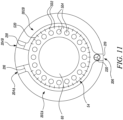
- Figure 11 is a cross-sectional view of an engine core 54 and cooling system 200 showing one or more heat transfer enhancement elements 502 of the cooling system 200. Note that combustor cans 504 in the combustor section 60, are visible in Figure 11 .
- the one or more heat transfer enhancement elements 502 are disposed between the engine core 54 and the cooling ducts 202A, 202B and are, in this example, arranged around the core 54.
- the heat transfer enhancement elements 502 may be provided in an outer wall or casing of the engine core 54, or otherwise at an interface between the cooling ducts 202A, 202B and the engine core 54.
- the one or more heat transfer enhancement elements 502 may include fins and/or heat pipes and may promote or enhance turbulence in the airflow around the core 54 to increase the rate of heat ejection. Cooling air may flow around the heat pipes and/or fins.
- the heat transfer enhancement elements 502 may have different shapes as per desired application attributes.
- the fins may be of a rectangular, triangular, shark-fin or cylindrical geometry or of any other suitable geometry.
- the heat pipes may be of a rectangular, cylindrical or curved geometry, or of any other suitable geometry. Heat pipes may be used in conjunction with fins to further boost the rate of heat rejection.
- FIG 12 is a schematic view of optional airflow boosters 600 of the cooling system 200 of the gas turbine engine 50.
- the airflow boosters 600 may be, for example, one or more of nozzle ejectors, an electric fan or micro-compressors and introduce a relatively small amount of high pressure bleed air to increase the amount of the airflow through the cooling ducts 202A. This may increase the amount of airflow through the cooling ducts 102, 202A, 202B.
- Each of the nozzle ejectors may be of a convergent or a convergent-divergent nozzle design.
- each of the nozzle ejectors may have small diameter, for example less than 5 mm, less than 4 mm, less than 2mm, or less than 1mm.
- the nozzle ejectors may be directly welded or bolted onto the outer casing of the engine core 54.
- the airflow boosters 600 may be disposed proximate to the outlet 106 or the common outlet 206.
- heat transfer enhancement elements 502 and airflow boosters 600 have generally been described in the context of the cooling system 200 with two ducts, it will be understood that they could equally be used in a system 100 with one duct or a system with greater than two ducts.
Landscapes
- Engineering & Computer Science (AREA)
- Chemical & Material Sciences (AREA)
- Combustion & Propulsion (AREA)
- Mechanical Engineering (AREA)
- General Engineering & Computer Science (AREA)
- Structures Of Non-Positive Displacement Pumps (AREA)
- Turbine Rotor Nozzle Sealing (AREA)
Description
- The present disclosure relates to gas turbine engines and, more particularly, to cooling systems for gas turbine engines.
- Gas turbine engines are used for power generation and vehicle (e.g., aircraft) propulsion. A typical gas turbine engine includes a compressor section, a combustor section, and a turbine section that utilize a primary air flow into the engine to generate power or propel the vehicle.
- Air may be bled from the compressor section of the engine for cooling and sealing purposes. The cooling air may be needed to protect materials of the engine from early degradation and to prevent the materials from reaching temperatures which would be detrimental to their properties. However, in some cases, the cooling air may not provide sufficient cooling. Further, there is a limit to an amount of air that can be bled from the compressor section without impacting normal operation of the engine.
-
United States patent US 5012639 discloses a buffer system for cooling a buffer region in the nacelle of a gas turbine engine after engine shutdown. The buffer system comprises: a nacelle wall extending circumferentially about the engine having an interior and an exterior, the nacelle wall having an opening in the nacelle wall for flowing air from the exterior of the nacelle to the interior; a buffer region on the interior of the nacelle having a portion of at least one coolable component disposed therein; a passage for buffer air in flow communication with the opening in the nacelle wall and with the buffer region on the interior of the nacelle; and, means for positively moving air through the passage to the preselected buffer region after cessation of engine operation, the means including a source of energy which is not dependent on engine operation to supply energy after engine operation to enable operation of the means after the cessation of engine operation. The buffer air region blocks air in the nacelle which is heated by the engine after engine operation from transferring heat by convection to the component. - United States patent application
US 2009/0297342 A1 discloses a gas turbine engine that has an engine core extending along a core axis, a cooling-air delivery duct on the engine core, and a removable nacelle cowl overlying the engine core. A cooling-air nacelle-cowl duct delivers cooling air to the cooling-air delivery duct. At least a portion of the length of the cooling-air nacelle-cowl duct is integral with the nacelle cowl and not directly supported on the engine core. - The present invention provides a gas turbine engine as set out in the appended claims.
- According to a first aspect there is provided a gas turbine engine including a nacelle and an engine core received within the nacelle. The engine core defines a principal rotational axis along its length. The engine core and the nacelle define a bypass passage therebetween. The gas turbine engine further includes a cooling system including a cooling duct. The cooling duct defines an inlet for receiving bypass air from the bypass passage at an upstream location and an outlet for discharging the bypass air at a downstream location back into the bypass passage. The cooling duct extends, relative to the principal axis, both axially and circumferentially around a section of the engine core. The cooling duct comprises: a first portion that extends at least axially relative to the principal rotational axis; a second portion downstream of the first portion that extends circumferentially around the engine core relative to the principal rotational axis; and a third portion downstream of the second portion that extends at least axially relative to the principal rotational axis. The cooling system further comprises one or more heat transfer enhancement elements disposed between the engine core and the cooling duct for increasing heat transfer from the engine core to the cooling duct.
- Since the cooling system uses the bypass air flowing through the bypass passage and discharges the bypass air back into the bypass passage, the cooling system may provide cooling to the engine core without impacting normal operation of the gas turbine engine. Since the cooling duct extends both axially and circumferentially around the section of the engine core, heat transfer between the engine core and the cooling duct may be enhanced.
- The engine core may include a combustor section. The cooling duct extends, relative to the principal axis, circumferentially around a section of the engine core including the combustor section.
- The gas turbine engine may further include one or more grids disposed within the cooling duct for preventing debris entering the cooling duct.
- The one or more grids may include a first grid disposed proximate to the inlet and a second grid disposed proximate to the outlet.
- At least one of the one or more grids may be a fractal grid. The one or more grids may be used to further enhance the heat exchange rate.
- The gas turbine engine may further include a non-return valve disposed within the cooling duct for preventing airflow from the outlet to the inlet. The non-return valve may be disposed proximate to the outlet. The non-return valve may be a tricuspid valve. The tricuspid valve may operate without any actuator.
- The one or more heat transfer enhancement elements may include at least one of fins and heat pipes.
- The cooling system may further include one or more airflow boosters disposed within the cooling duct. The one or more airflow boosters may include at least one of nozzle ejectors, an electric fan and micro-compressors.
- The cooling duct may be spiral-shaped.
- The cooling system may include a plurality of the cooling ducts.
- The cooling system may include two cooling ducts that merge with each other at a junction downstream of their inlets so that the two cooling ducts share a common outlet.
- Each of the two cooling ducts may include a first portion extending at least axially relative to the principal rotational axis and a second portion downstream of the first portion. The second portion may extend circumferentially around the engine core relative to the principal rotational axis. The two cooling ducts may merge with each other at the junction downstream of the second portions.
- The two cooling ducts may include a shared third portion downstream of the junction and extending at least axially relative to the principal rotational axis. The third portion may include the common outlet.
- The gas turbine engine may further include a non-return valve disposed downstream of the junction and upstream of the common outlet for preventing airflow from the common outlet to the inlets of the two cooling ducts.
- The gas turbine engine may further include a grid disposed downstream of the junction and upstream of the common outlet for preventing debris entering the common outlet of the two cooling ducts.
- The cooling system of the present disclosure may provide cooling to the engine core without requiring any additional power or actuators, thereby enhancing cooling without impacting the efficiency of the gas turbine engine. Further, the cooling system may need minimal maintenance or servicing.
- Embodiments will now be described by way of example only, with reference to the Figures, in which:
-
Figure 1 is a sectional side view of a gas turbine engine; -
Figure 2 is a close up sectional side view of an upstream portion of a gas turbine engine; -
Figure 3 is a partially cut-away view of a gearbox for a gas turbine engine; -
Figure 4 is a sectional side view of a gas turbine engine including a cooling system having a cooling duct; -
Figures 5A-5C are perspective, top and front views of a cooling duct of the cooling system ofFigure 4 ; -
Figure 6 is a sectional top view of a gas turbine engine including a cooling system having two cooling ducts sharing a common outlet; -
Figures 7A-7D are perspective, front, side and top views of the cooling ducts of the cooling system ofFigure 6 ; -
Figure 8 is a schematic view of a fractal grid used in a cooling system of a gas turbine engine; -
Figure 9A is schematic front view of a non-return valve in a closed position used in a cooling system of a gas turbine engine; -
Figure 9B is schematic front view of the non-return valve ofFigure 9A in an open position; -
Figures 10A-10C are schematic top views of the non-return valve ofFigures 9A-B in closed, partially open and open positions; -
Figure 11 is a schematic view of one or more heat transfer enhancement elements of a cooling system of a gas turbine engine; and -
Figure 12 is a schematic view of an airflow booster of a cooling system of a gas turbine engine. - Aspects and embodiments of the present disclosure will now be discussed with reference to the accompanying figures. Further aspects and embodiments will be apparent to those skilled in the art.
- As used herein, a component extends "axially" relative to an axis if the component extends along the axis. A component extends "circumferentially" relative to an axis if the component extends in a circumferential direction defined around the axis. A component extends "radially" relative to an axis if the component extends radially inward or outward relative to the axis.
-
Figure 1 illustrates agas turbine engine 10 having a principalrotational axis 9. Theengine 10 comprises anair intake 12 and apropulsive fan 23 that generates two airflows: a core airflow A and a bypass airflow B. Thegas turbine engine 10 comprises a core 11 that receives the core airflow A. Theengine core 11 comprises, in axial flow series, alow pressure compressor 14, ahigh pressure compressor 15, acombustor section 16, ahigh pressure turbine 17, alow pressure turbine 19 and acore exhaust nozzle 20. Anacelle 21 surrounds thegas turbine engine 10 and defines abypass passage 22 and abypass exhaust nozzle 18. The bypass airflow B flows through thebypass passage 22. Thepropulsive fan 23 is attached to and driven by thelow pressure turbine 19 via ashaft 26 and anepicyclic gearbox 30. - In use, the core airflow A is accelerated and compressed by the
low pressure compressor 14 and directed into thehigh pressure compressor 15 where further compression takes place. The compressed air exhausted from thehigh pressure compressor 15 is directed into thecombustor section 16 where it is mixed with fuel and the mixture is combusted. The resultant hot combustion products then expand through, and thereby drive, the high pressure andlow pressure turbines core exhaust nozzle 20 to provide some propulsive thrust. Thehigh pressure turbine 17 drives thehigh pressure compressor 15 by a suitable interconnectingshaft 27. Thepropulsive fan 23 generally provides the majority of the propulsive thrust. Theepicyclic gearbox 30 is a reduction gearbox. - An exemplary arrangement for a geared fan
gas turbine engine 10 is shown inFigure 2 . The low pressure turbine 19 (seeFigure 1 ) drives theshaft 26, which is coupled to a sun wheel, or sun gear, 28 of theepicyclic gear arrangement 30. Radially outwardly of thesun gear 28 and intermeshing therewith is a plurality of planet gears 32 that are coupled together by aplanet carrier 34. Theplanet carrier 34 constrains the planet gears 32 to process around thesun gear 28 in synchronicity whilst enabling eachplanet gear 32 to rotate about its own axis. Theplanet carrier 34 is coupled vialinkages 36 to thepropulsive fan 23 in order to drive its rotation about theengine axis 9. Radially outwardly of the planet gears 32 and intermeshing therewith is an annulus orring gear 38 that is coupled, vialinkages 40, to a stationary supportingstructure 24. - Note that the terms "low pressure turbine" and "low pressure compressor" as used herein may be taken to mean the lowest pressure turbine stages and lowest pressure compressor stages (i.e. not including the propulsive fan 23) respectively and/or the turbine and compressor stages that are connected together by the interconnecting
shaft 26 with the lowest rotational speed in the engine (i.e. not including the gearbox output shaft that drives the propulsive fan 23). In some literature, the "low pressure turbine" and "low pressure compressor" referred to herein may alternatively be known as the "intermediate pressure turbine" and "intermediate pressure compressor". Where such alternative nomenclature is used, thepropulsive fan 23 may be referred to as a first, or lowest pressure, compression stage. - The
epicyclic gearbox 30 is shown by way of example in greater detail inFigure 3 . Each of thesun gear 28, planet gears 32 andring gear 38 comprise teeth about their periphery to intermesh with the other gears. However, for clarity only exemplary portions of the teeth are illustrated inFigure 3 . There are fourplanet gears 32 illustrated, although it will be apparent to the skilled reader that more or fewer planet gears 32 may be provided within the scope of the claimed invention. Practical applications of a planetaryepicyclic gearbox 30 generally comprise at least three planet gears 32. - The
epicyclic gearbox 30 illustrated by way of example inFigures 2 and3 is of the planetary type, in that theplanet carrier 34 is coupled to an output shaft vialinkages 36, with thering gear 38 fixed. However, any other suitable type ofepicyclic gearbox 30 may be used. By way of further example, theepicyclic gearbox 30 may be a star arrangement, in which theplanet carrier 34 is held fixed, with the ring (or annulus)gear 38 allowed to rotate. In such an arrangement thepropulsive fan 23 is driven by thering gear 38. By way of further alternative example, thegearbox 30 may be a differential gearbox in which thering gear 38 and theplanet carrier 34 are both allowed to rotate. - It will be appreciated that the arrangement shown in
Figures 2 and3 is by way of example only, and various alternatives are within the scope of the present disclosure. - Purely by way of example, any suitable arrangement may be used for locating the
gearbox 30 in theengine 10 and/or for connecting thegearbox 30 to theengine 10. By way of further example, the connections (such as thelinkages Figure 2 example) between thegearbox 30 and other parts of the engine 10 (such as theinput shaft 26, the output shaft and the fixed structure 24) may have any desired degree of stiffness or flexibility. By way of further example, any suitable arrangement of the bearings between rotating and stationary parts of the engine (for example between the input and output shafts from the gearbox and the fixed structures, such as the gearbox casing) may be used, and the disclosure is not limited to the exemplary arrangement ofFigure 2 . For example, where thegearbox 30 has a star arrangement (described above), the skilled person would readily understand that the arrangement of output and support linkages and bearing locations would typically be different to that shown by way of example inFigure 2 . - Accordingly, the present disclosure extends to a gas turbine engine having any arrangement of gearbox styles (for example star or planetary), support structures, input and output shaft arrangement, and bearing locations.
- Optionally, the gearbox may drive additional and/or alternative components (e.g. the intermediate pressure compressor and/or a booster compressor).
- Other gas turbine engines to which the present disclosure may be applied may have alternative configurations. For example, such engines may have an alternative number of compressors and/or turbines and/or an alternative number of interconnecting shafts. By way of further example, the gas turbine engine shown in
Figure 1 has asplit flow nozzle bypass passage 22 has itsown nozzle 18 that is separate to and radially outside thecore exhaust nozzle 20. However, this is not limiting, and any aspect of the present disclosure may also apply to engines in which the flow through thebypass passage 22 and the flow through the core 11 are mixed, or combined, before (or upstream of) a single nozzle, which may be referred to as a mixed flow nozzle. One or both nozzles (whether mixed or split flow) may have a fixed or variable area. Whilst the described example relates to a turbofan engine, the disclosure may apply, for example, to any type of gas turbine engine, such as an open rotor (in which the fan stage is not surrounded by a nacelle) or turboprop engine, for example. In some arrangements, thegas turbine engine 10 may not comprise agearbox 30. - The geometry of the
gas turbine engine 10, and components thereof, is defined by a conventional axis system, comprising an axial direction (which is aligned with the principal rotational axis 9), a radial direction (in the bottom-to-top direction inFigure 1 ), and a circumferential direction (perpendicular to the page in theFigure 1 view). The axial, radial and circumferential directions are mutually perpendicular. - In addition, the present disclosure is equally applicable to aero gas turbine engines, marine gas turbine engines and land-based gas turbine engines.
-
Figure 4 is a sectional side view of agas turbine engine 50. Thegas turbine engine 50 may be used for propulsion of an aircraft. Thegas turbine engine 50 may be similar to thegas turbine engine 10 ofFigure 1 . Thegas turbine engine 50 includes anacelle 52, anengine core 54, and apropulsive fan 55. Theengine core 54 is received within thenacelle 52. Theengine core 54 defines a principalrotational axis 56 along its length. In other words, theengine core 54 and thenacelle 52 are circumferentially disposed about the principalrotational axis 56. Theengine core 54 further includes, in axial flow series, alow pressure compressor 62, ahigh pressure compressor 64, acombustor section 60, ahigh pressure turbine 66, alow pressure turbine 68, acore exhaust nozzle 70. - The
engine core 54 and thenacelle 52 define abypass passage 58 therebetween. Thegas turbine engine 50 further includes anair intake 72 and abypass exhaust nozzle 74. Thepropulsive fan 55 that generates two airflows: a core airflow C and a bypass airflow D. Theengine core 54 receives the core airflow C. The bypass airflow D flows through thebypass passage 58. The bypass airflow D is interchangeably referred to as "the bypass air D". - The
gas turbine engine 50 further includes acooling system 100. Thecooling system 100 includes a coolingduct 102. In the example ofFigure 4 thecooling system 100 includes asingle cooling duct 102. However, in some other examples, thecooling system 100 may include a plurality of the coolingducts 102 similar to the coolingduct 102. - The cooling
duct 102 extends, relative to the principalrotational axis 56, both axially and circumferentially around a section of theengine core 54. In an example, the coolingduct 102 extends, relative to the principalrotational axis 56, circumferentially around a section of theengine core 54 including thecombustor section 60. The section of theengine core 54 may be a high pressure section. - The cooling
duct 102 is a hollow tubular component having aninlet 104 and anoutlet 106. The coolingduct 102 defines theinlet 104 for receiving the bypass air D from thebypass passage 58 at anupstream location 122 and theoutlet 106 for discharging the bypass air D at adownstream location 124. Theinlet 104 and theoutlet 106 may be flush with the outer skin of the core. The coolingduct 102 guides a portion of the bypass air D from theupstream location 122 to thedownstream location 124, thedownstream location 124 being upstream of the bypass discharge nozzle. The coolingduct 102 further includes afirst portion 108, asecond portion 110 and athird portion 112. Thefirst portion 108 extends at least axially relative to the principalrotational axis 56. Thesecond portion 110 is downstream of thefirst portion 108. Thesecond portion 110 extends circumferentially around theengine core 54 relative to the principalrotational axis 56. Thethird portion 112 is downstream of thesecond portion 110 and extends at least axially relative to the principalrotational axis 56. - The cooling
duct 102 surrounds theengine core 54. The coolingduct 102 may direct the bypass air D around theengine core 54 by means of venturi effect from theupstream location 122 to thedownstream location 124 of thebypass passage 58. In an example, the coolingduct 102 may extend along an outer surface (not shown inFigure 4 ) of theengine core 54. In some examples, the coolingduct 102 contacts the outer surface of the section of theengine core 54 including thecombustor section 60. In some examples, the coolingduct 102 may contact and extend along the outer surface of a high pressure section of theengine core 54 adjacent to thecombustor section 60. The high pressure section may include thehigh pressure compressor 64 and thehigh pressure turbine 66. - The bypass air D is guided around the
engine core 54 by the coolingduct 102. In order to minimise pressure losses, the Mach number may be kept approximately constant downstream of thefirst portion 108 of the coolingduct 102, up to a point proximate to theoutlet 106. A cross-sectional area of the coolingduct 102 may be reduced proximate to theoutlet 106 to increase the Mach number and provide a needed thrust. The increase in Mach number may generate suction to draw the bypass air D into theinlet 104. In some examples, a difference in the Mach number between two points in the coolingduct 102 can be used to produce a cross-flow around theengine core 54, thereby channelling the bypass air D across from theinlet 104 to theoutlet 106. - In this example the cooling
duct 102 is spiral shaped. The coolingduct 102 spirals half a turn (i.e., about 180 degrees) around theengine core 54 relative to the principalrotational axis 56. In other examples the coolingduct 102 may spiral less than half a turn (i.e., less than 180 degrees) around theengine core 54 or more than half a turn (i.e., greater than 180 degrees) around theengine core 54. In some examples, the coolingduct 102 may spiral a whole turn or multiple turns (i.e, greater than or equal to 360 degrees) around theengine core 54. Increase the number of turns (or the angular extent of the turn if there is less than one turn or a fractional number of turns) of the coolingduct 102 may enable higher heat exchange. Further, a smaller cross-section of the coolingduct 102 may increase a rate of flow of the bypass air D, which may in turn further increase the heat exchange. The number of turns in the coolingduct 102 and the cross-section of the coolingduct 102 may vary according to the desired cooling attributes as well as the space requirements of the application. - The
cooling system 100 of thegas turbine engine 50 may further include one ormore grids duct 102 for preventing debris entering the coolingduct 102. Each of the one or more grids may have a rectangular grid pattern. In other examples, each of the one or more grids may have a square, triangular, polygonal, circular or irregular grid pattern. In some examples, the at least one of the one or more grids may be a fractal grid, as described in more detail below with reference toFigure 8 . In the example illustrated inFigure 4 , two grids are disposed within the coolingduct 102 for preventing debris entering the coolingduct 102. Specifically, afirst grid 116 and asecond grid 118 are disposed within the coolingduct 102. Thefirst grid 116 is disposed proximate to theinlet 104. Thesecond grid 118 is disposed proximate to theoutlet 106. - The
cooling system 100 may further include one or more non-return valves disposed within the coolingduct 102 for preventing airflow from theoutlet 106 to theinlet 104. In the example illustrated inFigure 4 , thecooling system 100 of thegas turbine engine 50 includes anon-return valve 120 disposed within the coolingduct 102. Thenon-return valve 120 is disposed proximate to theoutlet 106. Thenon-return valve 120 may be a tricuspid valve. Thenon-return valve 120 may prevent backflow in the coolingduct 102. - The
cooling system 100 further includes one or more heat transfer enhancement elements (not shown inFigure 4 ) disposed between theengine core 54 and the coolingduct 102 for increasing heat transfer from theengine core 54 to the coolingduct 102. The one or more heat transfer enhancement elements may include at least one of fins and heat pipes, as explained in more detail below with reference toFigure 11 . - In some examples, the
cooling system 100 further includes one or more airflow boosters (not shown inFigure 4 ) disposed within the coolingduct 102. The one or more airflow boosters include at least one of nozzle ejectors, an electric fan and micro-compressors. Air flow boosters are described in more detail below with reference toFigure 12 . - The
cooling system 100 may be a passive and an actuator-free system. In other words, thecooling system 100 may not need any additional components to power thecooling system 100. Thecooling system 100 may reduce the temperature of a high pressure cooling air that flows around thecombustor section 60 of thegas turbine engine 50. The cooling air may flow within theengine core 54. The air, in turn, may reduce the temperature of downstream components such as the high and intermediate pressure turbines; high and intermediate pressure vanes; high, intermediate and/or low pressure rotating discs; inter-turbine bearing chambers; and other turbine sealing flows. Thecooling system 100 may improve a cooling effectiveness of thegas turbine engine 50 and in turn increase life of its components. -
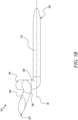
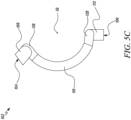
Figures 5A-5C illustrate different views of the coolingduct 102.Figure 5A illustrates a perspective view of the coolingduct 102.Figure 5B illustrates a top view of the coolingduct 102.Figure 5C illustrates a front view of the coolingduct 102. The coolingduct 102 includes theinlet 104, theoutlet 106, thefirst portion 108, thesecond portion 110, and thethird portion 112. In this example, the coolingduct 102 has an approximately circular cross-section along its length. In some examples, the coolingduct 102 may have one of an elliptical, rectangular, and polygonal cross-section along its length. In the example illustrated inFigures 5A-5C , each of theinlet 104 and theoutlet 106 has an approximately elliptical shape. In this example, an area of theinlet 104 is different from an area of theoutlet 106. Specifically, the area of theinlet 104 is less than the area of theoutlet 106. In some other examples, the area of theinlet 104 may be equal to or greater than the area of theoutlet 106. - The
first portion 108 extends at least axially and radially relative to the principalrotational axis 56. Thefirst portion 108 may further extend circumferentially relative to the principalrotational axis 56. Thesecond portion 110 is downstream of thefirst portion 108 and connected to thefirst portion 108 via a firstcurved portion 126. Thesecond portion 110 extends circumferentially around theengine core 54 relative to the principalrotational axis 56. Thesecond portion 110 may be the spiral portion of the coolingduct 102. In this example, thesecond portion 110 may extend circumferentially by about 180 degrees relative to the principalrotational axis 56. However, thesecond portion 110 may extend circumferentially by less than 180 degrees or greater than 180 degrees. In some examples, thesecond portion 110 may form one or more turns relative to the principalrotational axis 56. Thethird portion 112 is downstream of thesecond portion 110. Thesecond portion 110 is connected to thethird portion 112 via a secondcurved portion 128. Thethird portion 112 also extends at least axially and radially relative to the principalrotational axis 56. - The first
curved portion 126 may ensure a smooth transition between the first andsecond portions curved portion 128 may allow a smooth transition between the second andthird portions curved portions first portion 108, thesecond portion 110 and thethird portion 112. -
Figure 6 is a sectional top view of thegas turbine engine 50 including acooling system 200. Thecooling system 200 includes twocooling ducts cooling ducts junction 226 downstream of theirinlets cooling ducts common outlet 206. - Each of the
cooling ducts rotational axis 56, both axially and circumferentially around a section of theengine core 54. In an example, each of thecooling ducts rotational axis 56, circumferentially around a section of theengine core 54 including thecombustor section 60. - Each of the
cooling ducts cooling ducts respective inlet 204A, 2024B for receiving the bypass air D from thebypass passage 58 at anupstream location 222 and thecommon outlet 206 for discharging the bypass air D at adownstream location 224. - In this example each of the two
cooling ducts first portion second portion first portion 208A of the coolingduct 202A defines theinlet 204A. Similarly, thefirst portion 208B of the coolingduct 202B defines theinlet 204B. Each of thefirst portions rotational axis 56. Each of thesecond portions first portion second portion 210A is downstream of thefirst portion 208A. Thesecond portion 210B is downstream of thefirst portion 208B. Each of thesecond portions engine core 54 relative to the principalrotational axis 56. Each of the twocooling ducts junction 226 downstream of each of thesecond portions cooling ducts third portion 212 downstream of thejunction 226. Thethird portion 212 extends at least axially relative to the principalrotational axis 56. Thethird portion 212 defines thecommon outlet 206. - In some examples the
cooling system 200 includes one or more grids, one or more non-return valve, and one or more airflow boosters (not shown inFigure 6 ). - In the example illustrated in
Figure 6 , thecooling system 200 includes afirst grid 216, asecond grid 218, and athird grid 219. Thefirst grid 216 and thesecond grid 218 are disposed proximate to theinlets first grid 216 is disposed in the coolingduct 202A proximate to theinlet 204A. Thefirst grid 216 may prevent debris from entering the coolingduct 202A via theinlet 204A. Thesecond grid 218 is disposed in the coolingduct 202B proximate to theinlet 204B. Thesecond grid 218 may prevent debris from entering the coolingduct 202B via theinlet 204B. Thecooling system 200 further includes thethird grid 219 disposed downstream of thejunction 226 and upstream of thecommon outlet 206 for preventing debris entering thecommon outlet 206 of the twocooling ducts cooling system 200 proximate to thecommon outlet 206. - In the example illustrated in
Figure 6 , thecooling system 200 further includes anon-return valve 220 disposed downstream of thejunction 226 and upstream of thecommon outlet 206 for preventing airflow from thecommon outlet 206 to theinlets cooling ducts non-return valve 220 may therefore prevent backflow in thecooling ducts - While in this example the
cooling system 200 has two cooling ducts, the cooling system may include more than two cooling ducts. The cooling ducts may be disposed around, for example symmetrically around, theengine core 54, which may reduce potential distortion in flow through thebypass passage 58. In the example illustrated inFigure 6 , the twocooling ducts engine core 54. Moreover, theinlets -
Figure 6 illustrates theinlets engine core 54 and thecommon outlet 206 disposed at a lower side of theengine core 54. However, in some other examples, theinlets engine core 54 and thecommon outlet 206 may be disposed at the upper side of theengine core 54. The inlets could also be disposed on opposite sides of theengine core 54. -
Figures 7A-7D illustrate a perspective view, a front view, a side view, and a top view, respectively, of the twocooling ducts cooling system 200 shown inFigure 6 . - Each of the two
cooling ducts first portions second portions first portions rotational axis 56. In this example, each of thefirst portions rotational axis 56. Each of thesecond portions engine core 54 relative to the principalrotational axis 56. Thefirst portion 208A of the coolingduct 202A is connected to thesecond portion 210A via acurved portion 226A. Thecurved portion 226A may enable a smooth transition between thefirst portion 208A and thesecond portion 210A. Further, thefirst portion 208B of the coolingduct 202B is connected to thesecond portion 210B via acurved portion 226B. Thecurved portion 226B may enable a smooth transition between thefirst portion 208B and thesecond portion 210B. Each of the twocooling ducts junction 226 downstream of each of thesecond portions cooling ducts third portion 212 extending at least axially relative to the principalrotational axis 56. Each of thefirst portions rotational axis 56. Similarly, the sharedthird portion 212 is also inclined radially at an angle relative to the principalrotational axis 56. In some other examples, thefirst portions third portion 212 may be approximately parallel to the principalrotational axis 56. - Each of the
second portions respective cooling duct second portions rotational axis 56. However, each of thesecond portions second portions rotational axis 56. - In the example illustrated in
Figures 7A-7D , each of the twocooling ducts cooling ducts duct 202A may be a mirror image of the coolingduct 202B. However, in some other examples, the twocooling ducts Figures 7A-7D , each theinlets common outlet 206 has an elliptical shape. An area of each of theinlets common outlet 206. Specifically, the area of thecommon outlet 206 is greater than the area of each of theinlets common outlet 206 may discharge combined flows received at theinlets inlets common outlet 206 may be varied as per desired flow attributes. -
Figure 8 illustrates the schematic view of afractal grid 300. WhileFigure 8 shows a fractal grid having a particular fractal pattern, it is to be appreciate that this only to illustrate the concept and that other fractal grids could be used. Thegrid 300 includes multiple microgrids arranged to follow a fractal or recursive pattern. In thegrid 300, a microgrid may further include smaller microgrids or "fractal units". Thegrid 300 may act as a turbulator and generate turbulence in the airflow, thereby increasing the heat exchange with theengine core 54. Thegrid 300 may be disposed within the coolingduct 102 of thecooling system 100 shown inFigure 4 . Thegrid 300 may also prevent debris from entering the coolingduct 102. Thegrid 300 may further reduce pressure drop to increase airflow in the coolingduct 102 as opposed to conventional Foreign Object Debris (FOD) screens. In some examples, thegrid 300 may be disposed proximate to theinlet 104 and/or theoutlet 106 of the coolingduct 102. Thegrid 300 may also be disposed within at least one of the twocooling ducts cooling system 200 shown inFigure 6 . Thegrid 300 may prevent debris from entering thecooling ducts grid 300 may be disposed proximate to theinlets common outlet 206. -
Figures 9A and 9B are front views of anon-return valve 400. In this example, thenon-return valve 400 is a tricuspid valve. Thenon-return valve 400 is further an actuator-free valve. In other words, thenon-return valve 400 may not need a separate actuator. Thenon-return valve 400 is a one-way valve that provides unidirectional flow across it.Figure 9A shows a closed position of thenon-return valve 400.Figure 9B shows an open position of thenon-return valve 400. Thenon-return valve 400 includesflaps 402 and supportlegs 404. Theflaps 402 may be approximately triangular. Thesupport legs 404 may prevent opening of thenon-return valve 400 beyond desirable angles. Different intermediate positions of thenon-return valve 400 are also possible with the help ofsupport legs 404. Thenon-return valve 400 may be disposed within the cooling system 100 (shown inFigure 4 ) for preventing airflow from theoutlet 106 to theinlet 104. Thenon-return valve 400 may be in the closed position when the airflow is from theoutlet 106 to theinlet 104 and may be in the open position during a regular airflow. Thenon-return valve 400 may be disposed proximate to theoutlet 106. Thenon-return valve 400 may also be disposed within thecooling system 200 shown inFigure 6 for preventing airflow from thecommon outlet 206 to theinlets -
Figures 10A-10C illustrate a cross-section of the coolingduct 102 ofFigure 4 including thenon-return valve 400 shown inFigures 9A and 9B . In this example, thenon-return valve 400 is disposed within the coolingduct 102. Thenon-return valve 400 allows a unidirectional airflow AF in the coolingduct 102. The airflow AF is present in both top and bottom sides of theflaps 402. Thesupport legs 404 may ensure a minimum angle of therespective flaps 402 with respect to an axis of the coolingduct 102. Thesupport legs 404 may retain theflaps 402 in the open position. In case of a reverse airflow, theflaps 402 may hinge to contact one another so that thenon-return valve 400 is in the closed position. Referring toFigures 10A-C , thenon-return valve 400 is shown in a closed, a partially open, and an open position, respectively. -
Figure 11 is a cross-sectional view of anengine core 54 andcooling system 200 showing one or more heattransfer enhancement elements 502 of thecooling system 200. Note thatcombustor cans 504 in thecombustor section 60, are visible inFigure 11 . The one or more heattransfer enhancement elements 502 are disposed between theengine core 54 and thecooling ducts core 54. The heattransfer enhancement elements 502 may be provided in an outer wall or casing of theengine core 54, or otherwise at an interface between the coolingducts engine core 54. - The one or more heat
transfer enhancement elements 502 may include fins and/or heat pipes and may promote or enhance turbulence in the airflow around thecore 54 to increase the rate of heat ejection. Cooling air may flow around the heat pipes and/or fins. The heattransfer enhancement elements 502 may have different shapes as per desired application attributes. For example, the fins may be of a rectangular, triangular, shark-fin or cylindrical geometry or of any other suitable geometry. The heat pipes may be of a rectangular, cylindrical or curved geometry, or of any other suitable geometry. Heat pipes may be used in conjunction with fins to further boost the rate of heat rejection. -
Figure 12 is a schematic view ofoptional airflow boosters 600 of thecooling system 200 of thegas turbine engine 50. Theairflow boosters 600 may be, for example, one or more of nozzle ejectors, an electric fan or micro-compressors and introduce a relatively small amount of high pressure bleed air to increase the amount of the airflow through thecooling ducts 202A. This may increase the amount of airflow through the coolingducts engine core 54. Theairflow boosters 600 may be disposed proximate to theoutlet 106 or thecommon outlet 206. - While the heat
transfer enhancement elements 502 andairflow boosters 600 have generally been described in the context of thecooling system 200 with two ducts, it will be understood that they could equally be used in asystem 100 with one duct or a system with greater than two ducts. - It will be understood that the invention is not limited to the embodiments above-described and various modifications and improvements can be made without departing from the concepts described herein within the scope of the following claims.
Claims (14)
- A gas turbine engine (50) comprising:a nacelle (52);an engine core (54) received within the nacelle (52) and defining a principal rotational axis (56) along its length, the engine core (54) and the nacelle (52) defining a bypass passage (58) therebetween; anda cooling system (100) comprising a cooling duct (102) that defines an inlet (104) for receiving bypass air (D) from the bypass passage (58) at an upstream location (122) and an outlet (106) for discharging the bypass air (D) at a downstream location (124) back into the bypass passage, and extends, relative to the principal rotational axis (56), both axially and circumferentially around a section of the engine core (54);the cooling duct (102) comprises: a first portion (108) that extends at least axially relative to the principal rotational axis (56); a second portion (110) downstream of the first portion (108) that extends circumferentially around the engine core (54) relative to the principal rotational axis (56); and a third portion (112) downstream of the second portion (110) that extends at least axially relative to the principal rotational axis (56);characterised in that the cooling system (100) further comprises one or more heat transfer enhancement elements (502) disposed between the engine core (54) and the cooling duct (102) for increasing heat transfer from the engine core (54) to the cooling duct (102).
- The gas turbine engine of claim 1, wherein the engine core (54) comprises a combustor section (60), and wherein the cooling duct (100) extends, relative to the principal rotational axis (56), circumferentially around a section of the engine core (54) comprising the combustor section (60).
- The gas turbine engine of claim 1 or 2, further comprising one or more grids (116, 118) disposed within the cooling duct (102) for preventing debris entering the cooling duct (102).
- The gas turbine engine of claim 3, wherein the one or more grids (116, 118) comprise a first grid (116) disposed proximate to the inlet (104) and a second grid (118) disposed proximate to the outlet (106).
- The gas turbine engine of claim 3 or 4, wherein at least one of the one or more grids (116, 118) is a fractal grid.
- The gas turbine engine of any one of the preceding claims, further comprising a non-return valve (120) disposed within the cooling duct (102) for preventing airflow (AF) from the outlet (106) to the inlet (104).
- The gas turbine engine of claim 6, wherein the non-return valve (120) is disposed proximate to the outlet (106).
- The gas turbine engine of claim 6 or 7, wherein the non-return valve (400) is a tricuspid valve.
- The gas turbine engine of any one of the preceding claims, wherein the one or more heat transfer enhancement elements (502) comprise at least one of fins and heat pipes.
- The gas turbine engine of any one of the preceding claims, wherein the cooling system (100) further comprises one or more airflow boosters (600) disposed within the cooling duct (102).
- The gas turbine engine of claim 10, wherein the one or more airflow boosters (600) comprise at least one of nozzle ejectors, an electric fan and micro-compressors.
- The gas turbine engine of any one of the preceding claims, wherein the cooling duct (102) is spiral-shaped.
- The gas turbine engine of any one of the preceding claims, wherein the cooling system (200) comprises a plurality of the cooling ducts (202A, 202B).
- The gas turbine engine of claim 13, wherein the cooling system (200) comprises two cooling ducts (202A, 202B) that merge with each other at a junction (226) downstream of their inlets (204A, 204B) so that the two cooling ducts (202A, 202B) share a common outlet (206).
Applications Claiming Priority (1)
| Application Number | Priority Date | Filing Date | Title |
|---|---|---|---|
| GBGB2001821.4A GB202001821D0 (en) | 2020-02-11 | 2020-02-11 | Gas turbine engine cooling system |
Publications (2)
| Publication Number | Publication Date |
|---|---|
| EP3865693A1 EP3865693A1 (en) | 2021-08-18 |
| EP3865693B1 true EP3865693B1 (en) | 2023-08-16 |
Family
ID=69897076
Family Applications (1)
| Application Number | Title | Priority Date | Filing Date |
|---|---|---|---|
| EP21150825.4A Active EP3865693B1 (en) | 2020-02-11 | 2021-01-11 | Gas turbine engine cooling system |
Country Status (4)
| Country | Link |
|---|---|
| US (1) | US11572834B2 (en) |
| EP (1) | EP3865693B1 (en) |
| CN (1) | CN113250825B (en) |
| GB (1) | GB202001821D0 (en) |
Family Cites Families (29)
| Publication number | Priority date | Publication date | Assignee | Title |
|---|---|---|---|---|
| US4504030A (en) | 1982-12-06 | 1985-03-12 | United Technologies Corporation | Cooling means |
| US5012639A (en) * | 1989-01-23 | 1991-05-07 | United Technologies Corporation | Buffer region for the nacelle of a gas turbine engine |
| US5284012A (en) * | 1991-05-16 | 1994-02-08 | General Electric Company | Nacelle cooling and ventilation system |
| US5269135A (en) * | 1991-10-28 | 1993-12-14 | General Electric Company | Gas turbine engine fan cooled heat exchanger |
| US5540547A (en) * | 1994-06-23 | 1996-07-30 | General Electric Company | Method and apparatus for damping vibrations of external tubing of a gas turbine engine |
| JP3165611B2 (en) * | 1995-02-07 | 2001-05-14 | 三菱重工業株式会社 | Gas turbine cooling air introduction device |
| FR2864996B1 (en) | 2004-01-13 | 2006-03-10 | Snecma Moteurs | SYSTEM FOR COOLING HOT PARTS OF AN AIRCRAFT ENGINE, AND AIRCRAFT ENGINE EQUIPPED WITH SUCH A COOLING SYSTEM |
| GB0514338D0 (en) * | 2005-07-13 | 2005-08-17 | Univ City | Control of fluid flow separation |
| GB0607771D0 (en) * | 2006-04-20 | 2006-05-31 | Rolls Royce Plc | A heat exchanger arrangement |
| GB0607773D0 (en) * | 2006-04-20 | 2006-05-31 | Rolls Royce Plc | A gas turbine engine |
| GB2437295B (en) * | 2006-04-20 | 2008-06-25 | Rolls Royce Plc | Aeroengine ventilation system |
| US7717667B2 (en) * | 2006-09-29 | 2010-05-18 | General Electric Company | Method and apparatus for operating gas turbine engines |
| WO2008045054A1 (en) | 2006-10-12 | 2008-04-17 | United Technologies Corporation | Modulating flow through gas turbine engine cooling system |
| US7665310B2 (en) * | 2006-12-27 | 2010-02-23 | General Electric Company | Gas turbine engine having a cooling-air nacelle-cowl duct integral with a nacelle cowl |
| US20090175718A1 (en) * | 2007-12-31 | 2009-07-09 | Carlos Diaz | System and method for passive cooling of gas turbine engine control components |
| US9234481B2 (en) * | 2008-01-25 | 2016-01-12 | United Technologies Corporation | Shared flow thermal management system |
| GB0822639D0 (en) | 2008-12-12 | 2009-01-21 | Rolls Royce Plc | By virtue of section 39(1)(a) of the Patents Act 1977 |
| US8789376B2 (en) | 2011-05-27 | 2014-07-29 | General Electric Company | Flade duct turbine cooling and power and thermal management |
| US8915701B2 (en) * | 2011-09-08 | 2014-12-23 | General Electric Company | Piping assembly and method for connecting inner and outer shell in turbine system |
| US9080511B2 (en) | 2011-10-21 | 2015-07-14 | United Technologies Corporation | Integrated thermal system for a gas turbine engine |
| CN105026727A (en) * | 2013-03-06 | 2015-11-04 | 庞巴迪公司 | Apparatus for protecting aircraft components against foreign object damage |
| FR3008449B1 (en) * | 2013-07-12 | 2015-07-24 | Snecma | OIL COOLING DEVICE FOR A TURBOMACHINE |
| US9803546B2 (en) * | 2013-10-31 | 2017-10-31 | The Boeing Company | Dual inlets for a turbofan precooler |
| EP3092388B8 (en) * | 2014-01-07 | 2021-03-03 | Raytheon Technologies Corporation | Cross-stream heat exchanger |
| US10253726B2 (en) * | 2015-08-07 | 2019-04-09 | Pratt & Whitney Canada Corp. | Engine assembly with combined engine and cooling exhaust |
| EP3176371A1 (en) * | 2015-12-03 | 2017-06-07 | Siemens Aktiengesellschaft | Component for a fluid flow engine and method |
| US10563585B2 (en) * | 2016-03-02 | 2020-02-18 | United Technologies Corporation | Heat exchanger for gas turbine engine |
| US11015524B2 (en) * | 2017-08-30 | 2021-05-25 | Parker-Hannifin Corporation | Turbine engine air control valve |
| US11078842B2 (en) * | 2019-03-26 | 2021-08-03 | Raytheon Technologies Corporation | Exhaust distribution manifold |
-
2020
- 2020-02-11 GB GBGB2001821.4A patent/GB202001821D0/en not_active Ceased
-
2021
- 2021-01-07 CN CN202110018788.9A patent/CN113250825B/en active Active
- 2021-01-11 EP EP21150825.4A patent/EP3865693B1/en active Active
- 2021-01-19 US US17/152,139 patent/US11572834B2/en active Active
Also Published As
| Publication number | Publication date |
|---|---|
| GB202001821D0 (en) | 2020-03-25 |
| US11572834B2 (en) | 2023-02-07 |
| CN113250825A (en) | 2021-08-13 |
| EP3865693A1 (en) | 2021-08-18 |
| US20210246831A1 (en) | 2021-08-12 |
| CN113250825B (en) | 2025-04-22 |
Similar Documents
| Publication | Publication Date | Title |
|---|---|---|
| US11655767B2 (en) | Gearbox for an engine | |
| US11454174B2 (en) | Gas turbine | |
| EP3808963B1 (en) | Gas turbine engine | |
| US20190323433A1 (en) | Gas turbine engine | |
| US20200003122A1 (en) | Gas turbine engine | |
| US20190309681A1 (en) | Gas turbine engine and turbine arrangement | |
| US11293346B2 (en) | Air intake system | |
| US11073108B2 (en) | Louvre offtake arrangement | |
| EP3594447B1 (en) | Gas turbine engine outlet guide vanes | |
| EP4219920B1 (en) | A gas turbine engine and a method of operating a heat exchanger assembly for a gas turbine engine | |
| EP4198269B1 (en) | GUIDE BOWL ARRANGEMENT FOR A GAS TURBINE ENGINE | |
| EP3611398B1 (en) | Stabilization bearing system for geared turbofan engines | |
| US20200102067A1 (en) | Nacelle intake | |
| US11162423B2 (en) | Gas turbine engine | |
| EP3741974A1 (en) | Gas turbine engine | |
| US20200056496A1 (en) | Turbine-tip clearance control system offtake | |
| EP3865693B1 (en) | Gas turbine engine cooling system | |
| US20200003129A1 (en) | Gas turbine | |
| WO2020249599A1 (en) | Gas turbine engine and heat management system for cooling oil in an oil system of a gas turbine engine | |
| US20200256251A1 (en) | Thermal management system and a gas turbine engine | |
| US12193198B2 (en) | Propulsion system comprising a heat exchanger | |
| EP4339432B1 (en) | Gas turbine engines with a fuel cell assembly | |
| US11346558B2 (en) | Fuel injector | |
| US20190316490A1 (en) | Joint | |
| CN116498442A (en) | Gas turbine engine and method of operating a heat exchanger assembly for a gas turbine engine |
Legal Events
| Date | Code | Title | Description |
|---|---|---|---|
| PUAI | Public reference made under article 153(3) epc to a published international application that has entered the european phase |
Free format text: ORIGINAL CODE: 0009012 |
|
| STAA | Information on the status of an ep patent application or granted ep patent |
Free format text: STATUS: THE APPLICATION HAS BEEN PUBLISHED |
|
| AK | Designated contracting states |
Kind code of ref document: A1 Designated state(s): AL AT BE BG CH CY CZ DE DK EE ES FI FR GB GR HR HU IE IS IT LI LT LU LV MC MK MT NL NO PL PT RO RS SE SI SK SM TR |
|
| STAA | Information on the status of an ep patent application or granted ep patent |
Free format text: STATUS: REQUEST FOR EXAMINATION WAS MADE |
|
| 17P | Request for examination filed |
Effective date: 20220114 |
|
| RBV | Designated contracting states (corrected) |
Designated state(s): AL AT BE BG CH CY CZ DE DK EE ES FI FR GB GR HR HU IE IS IT LI LT LU LV MC MK MT NL NO PL PT RO RS SE SI SK SM TR |
|
| GRAP | Despatch of communication of intention to grant a patent |
Free format text: ORIGINAL CODE: EPIDOSNIGR1 |
|
| STAA | Information on the status of an ep patent application or granted ep patent |
Free format text: STATUS: GRANT OF PATENT IS INTENDED |
|
| GRAS | Grant fee paid |
Free format text: ORIGINAL CODE: EPIDOSNIGR3 |
|
| GRAA | (expected) grant |
Free format text: ORIGINAL CODE: 0009210 |
|
| STAA | Information on the status of an ep patent application or granted ep patent |
Free format text: STATUS: THE PATENT HAS BEEN GRANTED |
|
| INTG | Intention to grant announced |
Effective date: 20230630 |
|
| AK | Designated contracting states |
Kind code of ref document: B1 Designated state(s): AL AT BE BG CH CY CZ DE DK EE ES FI FR GB GR HR HU IE IS IT LI LT LU LV MC MK MT NL NO PL PT RO RS SE SI SK SM TR |
|
| P01 | Opt-out of the competence of the unified patent court (upc) registered |
Effective date: 20230711 |
|
| REG | Reference to a national code |
Ref country code: CH Ref legal event code: EP |
|
| REG | Reference to a national code |
Ref country code: DE Ref legal event code: R096 Ref document number: 602021004201 Country of ref document: DE |
|
| REG | Reference to a national code |
Ref country code: IE Ref legal event code: FG4D |
|
| REG | Reference to a national code |
Ref country code: LT Ref legal event code: MG9D |
|
| REG | Reference to a national code |
Ref country code: NL Ref legal event code: MP Effective date: 20230816 |
|
| REG | Reference to a national code |
Ref country code: AT Ref legal event code: MK05 Ref document number: 1600271 Country of ref document: AT Kind code of ref document: T Effective date: 20230816 |
|
| PG25 | Lapsed in a contracting state [announced via postgrant information from national office to epo] |
Ref country code: GR Free format text: LAPSE BECAUSE OF FAILURE TO SUBMIT A TRANSLATION OF THE DESCRIPTION OR TO PAY THE FEE WITHIN THE PRESCRIBED TIME-LIMIT Effective date: 20231117 |
|
| PG25 | Lapsed in a contracting state [announced via postgrant information from national office to epo] |
Ref country code: IS Free format text: LAPSE BECAUSE OF FAILURE TO SUBMIT A TRANSLATION OF THE DESCRIPTION OR TO PAY THE FEE WITHIN THE PRESCRIBED TIME-LIMIT Effective date: 20231216 |
|
| PG25 | Lapsed in a contracting state [announced via postgrant information from national office to epo] |
Ref country code: SE Free format text: LAPSE BECAUSE OF FAILURE TO SUBMIT A TRANSLATION OF THE DESCRIPTION OR TO PAY THE FEE WITHIN THE PRESCRIBED TIME-LIMIT Effective date: 20230816 Ref country code: RS Free format text: LAPSE BECAUSE OF FAILURE TO SUBMIT A TRANSLATION OF THE DESCRIPTION OR TO PAY THE FEE WITHIN THE PRESCRIBED TIME-LIMIT Effective date: 20230816 Ref country code: PT Free format text: LAPSE BECAUSE OF FAILURE TO SUBMIT A TRANSLATION OF THE DESCRIPTION OR TO PAY THE FEE WITHIN THE PRESCRIBED TIME-LIMIT Effective date: 20231218 Ref country code: NO Free format text: LAPSE BECAUSE OF FAILURE TO SUBMIT A TRANSLATION OF THE DESCRIPTION OR TO PAY THE FEE WITHIN THE PRESCRIBED TIME-LIMIT Effective date: 20231116 Ref country code: NL Free format text: LAPSE BECAUSE OF FAILURE TO SUBMIT A TRANSLATION OF THE DESCRIPTION OR TO PAY THE FEE WITHIN THE PRESCRIBED TIME-LIMIT Effective date: 20230816 Ref country code: LV Free format text: LAPSE BECAUSE OF FAILURE TO SUBMIT A TRANSLATION OF THE DESCRIPTION OR TO PAY THE FEE WITHIN THE PRESCRIBED TIME-LIMIT Effective date: 20230816 Ref country code: LT Free format text: LAPSE BECAUSE OF FAILURE TO SUBMIT A TRANSLATION OF THE DESCRIPTION OR TO PAY THE FEE WITHIN THE PRESCRIBED TIME-LIMIT Effective date: 20230816 Ref country code: IS Free format text: LAPSE BECAUSE OF FAILURE TO SUBMIT A TRANSLATION OF THE DESCRIPTION OR TO PAY THE FEE WITHIN THE PRESCRIBED TIME-LIMIT Effective date: 20231216 Ref country code: HR Free format text: LAPSE BECAUSE OF FAILURE TO SUBMIT A TRANSLATION OF THE DESCRIPTION OR TO PAY THE FEE WITHIN THE PRESCRIBED TIME-LIMIT Effective date: 20230816 Ref country code: GR Free format text: LAPSE BECAUSE OF FAILURE TO SUBMIT A TRANSLATION OF THE DESCRIPTION OR TO PAY THE FEE WITHIN THE PRESCRIBED TIME-LIMIT Effective date: 20231117 Ref country code: FI Free format text: LAPSE BECAUSE OF FAILURE TO SUBMIT A TRANSLATION OF THE DESCRIPTION OR TO PAY THE FEE WITHIN THE PRESCRIBED TIME-LIMIT Effective date: 20230816 Ref country code: AT Free format text: LAPSE BECAUSE OF FAILURE TO SUBMIT A TRANSLATION OF THE DESCRIPTION OR TO PAY THE FEE WITHIN THE PRESCRIBED TIME-LIMIT Effective date: 20230816 |
|
| PG25 | Lapsed in a contracting state [announced via postgrant information from national office to epo] |
Ref country code: PL Free format text: LAPSE BECAUSE OF FAILURE TO SUBMIT A TRANSLATION OF THE DESCRIPTION OR TO PAY THE FEE WITHIN THE PRESCRIBED TIME-LIMIT Effective date: 20230816 |
|
| PG25 | Lapsed in a contracting state [announced via postgrant information from national office to epo] |
Ref country code: ES Free format text: LAPSE BECAUSE OF FAILURE TO SUBMIT A TRANSLATION OF THE DESCRIPTION OR TO PAY THE FEE WITHIN THE PRESCRIBED TIME-LIMIT Effective date: 20230816 |
|
| PG25 | Lapsed in a contracting state [announced via postgrant information from national office to epo] |
Ref country code: SM Free format text: LAPSE BECAUSE OF FAILURE TO SUBMIT A TRANSLATION OF THE DESCRIPTION OR TO PAY THE FEE WITHIN THE PRESCRIBED TIME-LIMIT Effective date: 20230816 Ref country code: RO Free format text: LAPSE BECAUSE OF FAILURE TO SUBMIT A TRANSLATION OF THE DESCRIPTION OR TO PAY THE FEE WITHIN THE PRESCRIBED TIME-LIMIT Effective date: 20230816 Ref country code: ES Free format text: LAPSE BECAUSE OF FAILURE TO SUBMIT A TRANSLATION OF THE DESCRIPTION OR TO PAY THE FEE WITHIN THE PRESCRIBED TIME-LIMIT Effective date: 20230816 Ref country code: EE Free format text: LAPSE BECAUSE OF FAILURE TO SUBMIT A TRANSLATION OF THE DESCRIPTION OR TO PAY THE FEE WITHIN THE PRESCRIBED TIME-LIMIT Effective date: 20230816 Ref country code: DK Free format text: LAPSE BECAUSE OF FAILURE TO SUBMIT A TRANSLATION OF THE DESCRIPTION OR TO PAY THE FEE WITHIN THE PRESCRIBED TIME-LIMIT Effective date: 20230816 Ref country code: CZ Free format text: LAPSE BECAUSE OF FAILURE TO SUBMIT A TRANSLATION OF THE DESCRIPTION OR TO PAY THE FEE WITHIN THE PRESCRIBED TIME-LIMIT Effective date: 20230816 Ref country code: SK Free format text: LAPSE BECAUSE OF FAILURE TO SUBMIT A TRANSLATION OF THE DESCRIPTION OR TO PAY THE FEE WITHIN THE PRESCRIBED TIME-LIMIT Effective date: 20230816 |
|
| REG | Reference to a national code |
Ref country code: DE Ref legal event code: R097 Ref document number: 602021004201 Country of ref document: DE |
|
| PLBE | No opposition filed within time limit |
Free format text: ORIGINAL CODE: 0009261 |
|
| STAA | Information on the status of an ep patent application or granted ep patent |
Free format text: STATUS: NO OPPOSITION FILED WITHIN TIME LIMIT |
|
| 26N | No opposition filed |
Effective date: 20240517 |
|
| PG25 | Lapsed in a contracting state [announced via postgrant information from national office to epo] |
Ref country code: IT Free format text: LAPSE BECAUSE OF FAILURE TO SUBMIT A TRANSLATION OF THE DESCRIPTION OR TO PAY THE FEE WITHIN THE PRESCRIBED TIME-LIMIT Effective date: 20230816 Ref country code: SI Free format text: LAPSE BECAUSE OF FAILURE TO SUBMIT A TRANSLATION OF THE DESCRIPTION OR TO PAY THE FEE WITHIN THE PRESCRIBED TIME-LIMIT Effective date: 20230816 |
|
| PG25 | Lapsed in a contracting state [announced via postgrant information from national office to epo] |
Ref country code: MC Free format text: LAPSE BECAUSE OF FAILURE TO SUBMIT A TRANSLATION OF THE DESCRIPTION OR TO PAY THE FEE WITHIN THE PRESCRIBED TIME-LIMIT Effective date: 20230816 |
|
| PG25 | Lapsed in a contracting state [announced via postgrant information from national office to epo] |
Ref country code: MC Free format text: LAPSE BECAUSE OF FAILURE TO SUBMIT A TRANSLATION OF THE DESCRIPTION OR TO PAY THE FEE WITHIN THE PRESCRIBED TIME-LIMIT Effective date: 20230816 |
|
| REG | Reference to a national code |
Ref country code: CH Ref legal event code: PL |
|
| PG25 | Lapsed in a contracting state [announced via postgrant information from national office to epo] |
Ref country code: LU Free format text: LAPSE BECAUSE OF NON-PAYMENT OF DUE FEES Effective date: 20240111 |
|
| PG25 | Lapsed in a contracting state [announced via postgrant information from national office to epo] |
Ref country code: LU Free format text: LAPSE BECAUSE OF NON-PAYMENT OF DUE FEES Effective date: 20240111 |
|
| PG25 | Lapsed in a contracting state [announced via postgrant information from national office to epo] |
Ref country code: BE Free format text: LAPSE BECAUSE OF NON-PAYMENT OF DUE FEES Effective date: 20240131 |
|
| PG25 | Lapsed in a contracting state [announced via postgrant information from national office to epo] |
Ref country code: CH Free format text: LAPSE BECAUSE OF NON-PAYMENT OF DUE FEES Effective date: 20240131 |
|
| PG25 | Lapsed in a contracting state [announced via postgrant information from national office to epo] |
Ref country code: CH Free format text: LAPSE BECAUSE OF NON-PAYMENT OF DUE FEES Effective date: 20240131 Ref country code: BE Free format text: LAPSE BECAUSE OF NON-PAYMENT OF DUE FEES Effective date: 20240131 |
|
| REG | Reference to a national code |
Ref country code: BE Ref legal event code: MM Effective date: 20240131 |
|
| PG25 | Lapsed in a contracting state [announced via postgrant information from national office to epo] |
Ref country code: BG Free format text: LAPSE BECAUSE OF FAILURE TO SUBMIT A TRANSLATION OF THE DESCRIPTION OR TO PAY THE FEE WITHIN THE PRESCRIBED TIME-LIMIT Effective date: 20230816 |
|
| PG25 | Lapsed in a contracting state [announced via postgrant information from national office to epo] |
Ref country code: BG Free format text: LAPSE BECAUSE OF FAILURE TO SUBMIT A TRANSLATION OF THE DESCRIPTION OR TO PAY THE FEE WITHIN THE PRESCRIBED TIME-LIMIT Effective date: 20230816 |
|
| PG25 | Lapsed in a contracting state [announced via postgrant information from national office to epo] |
Ref country code: IE Free format text: LAPSE BECAUSE OF NON-PAYMENT OF DUE FEES Effective date: 20240111 |
|
| PG25 | Lapsed in a contracting state [announced via postgrant information from national office to epo] |
Ref country code: IE Free format text: LAPSE BECAUSE OF NON-PAYMENT OF DUE FEES Effective date: 20240111 |
|
| PG25 | Lapsed in a contracting state [announced via postgrant information from national office to epo] |
Ref country code: CY Free format text: LAPSE BECAUSE OF FAILURE TO SUBMIT A TRANSLATION OF THE DESCRIPTION OR TO PAY THE FEE WITHIN THE PRESCRIBED TIME-LIMIT; INVALID AB INITIO Effective date: 20210111 |
|
| PG25 | Lapsed in a contracting state [announced via postgrant information from national office to epo] |
Ref country code: HU Free format text: LAPSE BECAUSE OF FAILURE TO SUBMIT A TRANSLATION OF THE DESCRIPTION OR TO PAY THE FEE WITHIN THE PRESCRIBED TIME-LIMIT; INVALID AB INITIO Effective date: 20210111 |
|
| PG25 | Lapsed in a contracting state [announced via postgrant information from national office to epo] |
Ref country code: TR Free format text: LAPSE BECAUSE OF FAILURE TO SUBMIT A TRANSLATION OF THE DESCRIPTION OR TO PAY THE FEE WITHIN THE PRESCRIBED TIME-LIMIT Effective date: 20230816 |
|
| PGFP | Annual fee paid to national office [announced via postgrant information from national office to epo] |
Ref country code: GB Payment date: 20260126 Year of fee payment: 6 |
|
| PGFP | Annual fee paid to national office [announced via postgrant information from national office to epo] |
Ref country code: DE Payment date: 20260127 Year of fee payment: 6 |
|
| PGFP | Annual fee paid to national office [announced via postgrant information from national office to epo] |
Ref country code: FR Payment date: 20260126 Year of fee payment: 6 |