EP3865495B1 - Ruthenium complexes useful for catalyzing metathesis reactions - Google Patents
Ruthenium complexes useful for catalyzing metathesis reactions Download PDFInfo
- Publication number
- EP3865495B1 EP3865495B1 EP21168132.5A EP21168132A EP3865495B1 EP 3865495 B1 EP3865495 B1 EP 3865495B1 EP 21168132 A EP21168132 A EP 21168132A EP 3865495 B1 EP3865495 B1 EP 3865495B1
- Authority
- EP
- European Patent Office
- Prior art keywords
- formula
- alkyl
- complex
- carbene
- aryl
- Prior art date
- Legal status (The legal status is an assumption and is not a legal conclusion. Google has not performed a legal analysis and makes no representation as to the accuracy of the status listed.)
- Active
Links
Classifications
-
- B—PERFORMING OPERATIONS; TRANSPORTING
- B01—PHYSICAL OR CHEMICAL PROCESSES OR APPARATUS IN GENERAL
- B01J—CHEMICAL OR PHYSICAL PROCESSES, e.g. CATALYSIS OR COLLOID CHEMISTRY; THEIR RELEVANT APPARATUS
- B01J31/00—Catalysts comprising hydrides, coordination complexes or organic compounds
- B01J31/16—Catalysts comprising hydrides, coordination complexes or organic compounds containing coordination complexes
- B01J31/22—Organic complexes
- B01J31/2265—Carbenes or carbynes, i.e.(image)
- B01J31/2269—Heterocyclic carbenes
- B01J31/2273—Heterocyclic carbenes with only nitrogen as heteroatomic ring members, e.g. 1,3-diarylimidazoline-2-ylidenes
-
- B—PERFORMING OPERATIONS; TRANSPORTING
- B01—PHYSICAL OR CHEMICAL PROCESSES OR APPARATUS IN GENERAL
- B01J—CHEMICAL OR PHYSICAL PROCESSES, e.g. CATALYSIS OR COLLOID CHEMISTRY; THEIR RELEVANT APPARATUS
- B01J31/00—Catalysts comprising hydrides, coordination complexes or organic compounds
- B01J31/16—Catalysts comprising hydrides, coordination complexes or organic compounds containing coordination complexes
- B01J31/22—Organic complexes
- B01J31/2204—Organic complexes the ligands containing oxygen or sulfur as complexing atoms
- B01J31/2208—Oxygen, e.g. acetylacetonates
-
- B—PERFORMING OPERATIONS; TRANSPORTING
- B01—PHYSICAL OR CHEMICAL PROCESSES OR APPARATUS IN GENERAL
- B01J—CHEMICAL OR PHYSICAL PROCESSES, e.g. CATALYSIS OR COLLOID CHEMISTRY; THEIR RELEVANT APPARATUS
- B01J31/00—Catalysts comprising hydrides, coordination complexes or organic compounds
- B01J31/16—Catalysts comprising hydrides, coordination complexes or organic compounds containing coordination complexes
- B01J31/22—Organic complexes
- B01J31/2204—Organic complexes the ligands containing oxygen or sulfur as complexing atoms
- B01J31/226—Sulfur, e.g. thiocarbamates
-
- B—PERFORMING OPERATIONS; TRANSPORTING
- B01—PHYSICAL OR CHEMICAL PROCESSES OR APPARATUS IN GENERAL
- B01J—CHEMICAL OR PHYSICAL PROCESSES, e.g. CATALYSIS OR COLLOID CHEMISTRY; THEIR RELEVANT APPARATUS
- B01J31/00—Catalysts comprising hydrides, coordination complexes or organic compounds
- B01J31/16—Catalysts comprising hydrides, coordination complexes or organic compounds containing coordination complexes
- B01J31/22—Organic complexes
- B01J31/2265—Carbenes or carbynes, i.e.(image)
- B01J31/2278—Complexes comprising two carbene ligands differing from each other, e.g. Grubbs second generation catalysts
-
- C—CHEMISTRY; METALLURGY
- C07—ORGANIC CHEMISTRY
- C07C—ACYCLIC OR CARBOCYCLIC COMPOUNDS
- C07C67/00—Preparation of carboxylic acid esters
- C07C67/475—Preparation of carboxylic acid esters by splitting of carbon-to-carbon bonds and redistribution, e.g. disproportionation or migration of groups between different molecules
-
- C—CHEMISTRY; METALLURGY
- C07—ORGANIC CHEMISTRY
- C07F—ACYCLIC, CARBOCYCLIC OR HETEROCYCLIC COMPOUNDS CONTAINING ELEMENTS OTHER THAN CARBON, HYDROGEN, HALOGEN, OXYGEN, NITROGEN, SULFUR, SELENIUM OR TELLURIUM
- C07F15/00—Compounds containing elements of Groups 8, 9, 10 or 18 of the Periodic Table
- C07F15/0006—Compounds containing elements of Groups 8, 9, 10 or 18 of the Periodic Table compounds of the platinum group
- C07F15/0046—Ruthenium compounds
-
- B—PERFORMING OPERATIONS; TRANSPORTING
- B01—PHYSICAL OR CHEMICAL PROCESSES OR APPARATUS IN GENERAL
- B01J—CHEMICAL OR PHYSICAL PROCESSES, e.g. CATALYSIS OR COLLOID CHEMISTRY; THEIR RELEVANT APPARATUS
- B01J2231/00—Catalytic reactions performed with catalysts classified in B01J31/00
- B01J2231/50—Redistribution or isomerisation reactions of C-C, C=C or C-C triple bonds
- B01J2231/54—Metathesis reactions, e.g. olefin metathesis
- B01J2231/543—Metathesis reactions, e.g. olefin metathesis alkene metathesis
-
- B—PERFORMING OPERATIONS; TRANSPORTING
- B01—PHYSICAL OR CHEMICAL PROCESSES OR APPARATUS IN GENERAL
- B01J—CHEMICAL OR PHYSICAL PROCESSES, e.g. CATALYSIS OR COLLOID CHEMISTRY; THEIR RELEVANT APPARATUS
- B01J2531/00—Additional information regarding catalytic systems classified in B01J31/00
- B01J2531/80—Complexes comprising metals of Group VIII as the central metal
- B01J2531/82—Metals of the platinum group
- B01J2531/821—Ruthenium
-
- B—PERFORMING OPERATIONS; TRANSPORTING
- B01—PHYSICAL OR CHEMICAL PROCESSES OR APPARATUS IN GENERAL
- B01J—CHEMICAL OR PHYSICAL PROCESSES, e.g. CATALYSIS OR COLLOID CHEMISTRY; THEIR RELEVANT APPARATUS
- B01J2540/00—Compositional aspects of coordination complexes or ligands in catalyst systems
- B01J2540/20—Non-coordinating groups comprising halogens
-
- B—PERFORMING OPERATIONS; TRANSPORTING
- B01—PHYSICAL OR CHEMICAL PROCESSES OR APPARATUS IN GENERAL
- B01J—CHEMICAL OR PHYSICAL PROCESSES, e.g. CATALYSIS OR COLLOID CHEMISTRY; THEIR RELEVANT APPARATUS
- B01J2540/00—Compositional aspects of coordination complexes or ligands in catalyst systems
- B01J2540/20—Non-coordinating groups comprising halogens
- B01J2540/22—Non-coordinating groups comprising halogens comprising fluorine, e.g. trifluoroacetate
-
- B—PERFORMING OPERATIONS; TRANSPORTING
- B01—PHYSICAL OR CHEMICAL PROCESSES OR APPARATUS IN GENERAL
- B01J—CHEMICAL OR PHYSICAL PROCESSES, e.g. CATALYSIS OR COLLOID CHEMISTRY; THEIR RELEVANT APPARATUS
- B01J2540/00—Compositional aspects of coordination complexes or ligands in catalyst systems
- B01J2540/20—Non-coordinating groups comprising halogens
- B01J2540/22—Non-coordinating groups comprising halogens comprising fluorine, e.g. trifluoroacetate
- B01J2540/225—Non-coordinating groups comprising halogens comprising fluorine, e.g. trifluoroacetate comprising perfluoroalkyl groups or moieties
-
- B—PERFORMING OPERATIONS; TRANSPORTING
- B01—PHYSICAL OR CHEMICAL PROCESSES OR APPARATUS IN GENERAL
- B01J—CHEMICAL OR PHYSICAL PROCESSES, e.g. CATALYSIS OR COLLOID CHEMISTRY; THEIR RELEVANT APPARATUS
- B01J2540/00—Compositional aspects of coordination complexes or ligands in catalyst systems
- B01J2540/40—Non-coordinating groups comprising nitrogen
- B01J2540/44—Non-coordinating groups comprising nitrogen being derivatives of carboxylic or carbonic acids, e.g. amide (RC(=O)-NR2, RC(=O)-NR-C(=O)R), nitrile, urea (R2N-C(=O)-NR2), guanidino (R2N-C(=NR)-NR2) groups
- B01J2540/442—Amide groups or imidato groups (R-C=NR(OR))
-
- B—PERFORMING OPERATIONS; TRANSPORTING
- B01—PHYSICAL OR CHEMICAL PROCESSES OR APPARATUS IN GENERAL
- B01J—CHEMICAL OR PHYSICAL PROCESSES, e.g. CATALYSIS OR COLLOID CHEMISTRY; THEIR RELEVANT APPARATUS
- B01J2540/00—Compositional aspects of coordination complexes or ligands in catalyst systems
- B01J2540/40—Non-coordinating groups comprising nitrogen
- B01J2540/44—Non-coordinating groups comprising nitrogen being derivatives of carboxylic or carbonic acids, e.g. amide (RC(=O)-NR2, RC(=O)-NR-C(=O)R), nitrile, urea (R2N-C(=O)-NR2), guanidino (R2N-C(=NR)-NR2) groups
- B01J2540/444—Nitrile groups
-
- B—PERFORMING OPERATIONS; TRANSPORTING
- B01—PHYSICAL OR CHEMICAL PROCESSES OR APPARATUS IN GENERAL
- B01J—CHEMICAL OR PHYSICAL PROCESSES, e.g. CATALYSIS OR COLLOID CHEMISTRY; THEIR RELEVANT APPARATUS
- B01J2540/00—Compositional aspects of coordination complexes or ligands in catalyst systems
- B01J2540/60—Groups characterized by their function
- B01J2540/62—Activating groups
-
- C—CHEMISTRY; METALLURGY
- C07—ORGANIC CHEMISTRY
- C07C—ACYCLIC OR CARBOCYCLIC COMPOUNDS
- C07C2601/00—Systems containing only non-condensed rings
- C07C2601/12—Systems containing only non-condensed rings with a six-membered ring
- C07C2601/16—Systems containing only non-condensed rings with a six-membered ring the ring being unsaturated
Definitions
- the invention relates to ruthenium complexes bearing a neutral ligand, in particular a nitrogen-containing heterocyclic carbene (NHC)-ligand.
- the complexes may be used for catalyzing metathesis reactions.
- Catalytic metathesis has transformed chemical synthesis and offers exceptionally efficient pathways for the synthesis of commercially important chemicals, including but not limited to biologically active molecules, oleochemicals, renewables, fine chemicals, and polymeric materials.
- Organometallic catalysts based on ruthenium are used in many of such organic transformation reactions.
- US 6 921 735 discloses ruthenium complexes bearing a 1,3-dimesityl-4,5-dihydroimidazol-2-ylidene and styrenyl ether ligand.
- US 8 288 576 discloses a ruthenium catalyst having the following structure 2b: wherein:
- WO 2014/201300 A1 discloses a ruthenium catalyst of formula 3 wherein the substituents R 1 , R 2 , R 3 , R x , X, Y, and Z are broadly defined as specified therein.
- WO 2017/055945 A1 discloses a ruthenium catalyst represented by the following formula wherein:
- WO 2008/046106 A2 relates generally to olefin metathesis, and more particularly relates to the synthesis of terminal alkenes from internal alkenes using a cross-metathesis reaction catalyzed by an olefin metathesis catalyst.
- the catalyst may be a ruthenium catalyst.
- ruthenium complexes bearing at least an aryliden ligand, a sulfur-based bidentate ligand, and a neutral ligand, the neutral ligand preferably being selected from a nitrogen-containing heterocyclic carbene (NHC), as defined in claim 1.
- NEC nitrogen-containing heterocyclic carbene
- the invention relates to a compound of formula I - c : wherein:
- the carbene is a N-heterocyclic carbene (NHC).
- the electron-donating nitrogen-containing heterocyclic carbene contains only one nitrogen atom.
- the electron-donating carbene is a cyclic (CAAC) or bicyclic (BICAAC) aminoalkyl carbene 7: wherein Ar as defined in formula 7 is aryl, preferably phenyl, optionally substituted with one or more groups selected from: C 1 -C 12 alkyl, C 1 -C 12 perfluoroalkyl, C 1 -C 12 alkoxy, C 6 -C 14 aryl, C 6 -C 14 aryloxy, or halogen; and wherein the chemical bonds which are symbolized with a wiggly line are connected to an optionally substituted alkenylene or alkylene group, respectively, wherein the carbon atom, the carbene carbon atom, the nitrogen atom and the optionally substituted alkenylene or alkylene group form a ring, which may optionally be bridged by an alkylene group.
- CAAC cyclic
- BICAAC bicyclic
- Suitable optional substituents of the optionally substituted alkenylene or alkylene groups are e.g. C 1-10 alkyl, C 3-10 cycloalkyl, C 1-10 alkoxyl, C 3-10 cycloalkoxyl phenyl, or halogen.
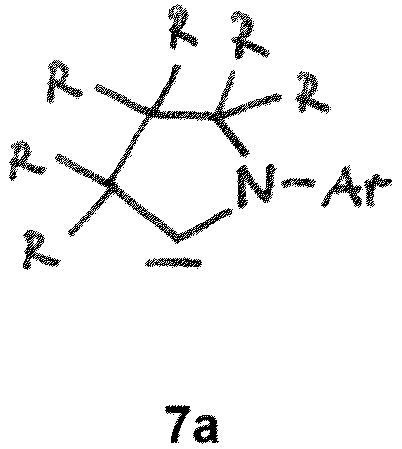
- the CAAC ligand is of formula 7a wherein each R in formula 7a is independently hydrogen, C 1 -C 12 alkyl, C 3 -C 12 cycloalkyl, C 2 -C 12 alkenyl, C 6 -C 14 aryl, C 1 -C 5 perfluoroalkyl, C 7 -C 24 aralkyl, or C 6 -C 14 perfluoroaryl group, which are optionally substituted with at least one C 1 -C 12 alkyl, C 1 -C 12 perfluoroalkyl, C 1 -C 12 alkoxy, C 6 -C 14 aryloxy, or a halogen atom; and wherein two R which are separated by the C-CR 2 -C moiety can be combined with to form a cyclic system
- the CAAC ligand is of formula 7a' wherein R 12 , R 13 , R 14 , and R 15 in formula 7a are each independently hydrogen, C 1 -C 12 alkyl, C 3 -C 12 cycloalkyl, C 2 -C 12 alkenyl, C 6 -C 14 aryl, C 1 -C 5 perfluoroalkyl, C 7 -C 24 aralkyl, or C 6 -C 14 perfluoroaryl group, which are optionally substituted with at least one C 1 -C 12 alkyl, C 1 -C 12 perfluoroalkyl, C 1 -C 12 alkoxy, C 6 -C 14 aryloxy, or a halogen atom; and wherein R 12 and/or R 13 can be combined with R 14 and/or R 15 to form a cyclic system.
- the BICAAC ligand is of formula 7b: wherein each R in formula 7b is independently hydrogen, C 1 -C 12 alkyl, C 3 -C 12 cycloalkyl, C 2 -C 12 alkenyl, C 6 -C 14 aryl, C 1 -C 5 perfluoroalkyl, C 7 -C 24 aralkyl, or C 6 -C 14 perfluoroaryl group, which are optionally substituted with at least one C 1 -C 12 alkyl, C 1 -C 12 perfluoroalkyl, C 1 -C 12 alkoxy, C 6 -C 14 aryloxy, or a halogen atom; and wherein n is 1, 2 or 3; preferably wherein R 16 , R 17 and R 18 in formula 7b are each independently hydrogen, C 1 -C 12 alkyl, or C 3 -C 12 cycloalkyl.
- the BICAAC ligand is of formula 7b' wherein R 16 , R 17 and R 18 in formula 7b' are each independently hydrogen or C 1 -C 12 alkyl, or C 3 -C 12 cycloalkyl, or C 2 -C 12 alkenyl, C 6 -C 14 aryl, C 1 -C 5 perfluoroalkyl, C 7 -C 24 aralkyl, or C 6 -C 14 perfluoroaryl group, which are optionally substituted with at least one C 1 -C 12 alkyl, C 1 -C 12 perfluoroalkyl, C 1 -C 12 alkoxy, C 6 -C 14 aryloxy, or a halogen atom, preferably wherein R 16 , R 17 and R 18 in formula 7b' are each independently hydrogen, C 1 -C 12 alkyl, or C 3 -C 12 cycloalkyl.
- the CAAC or BICAAC ligand is of one of the following structures 7c to 7k, i.e. a carbene of structure 7c wherein in formula 7c m is an integer of from 0 to 4, and each R y independently has the meaning of C 1 -C 12 alkyl, C 1 -C 12 perfluoroalkyl, C 1 -C 12 alkoxy, C 6 -C 14 aryl, C 6 -C 14 aryloxy, or halogen; such as a carbene of formula 7c' or is a carbene of formula 7d wherein in formula 7d m is an integer of from 0 to 4, and each R y independently has the meaning of C 1 -C 12 alkyl, C 1 -C 12 perfluoroalkyl, C 1 -C 12 alkoxy, C 6 -C 14 aryl, C 6 -C 14 aryloxy, or halogen; such as a carbene of formula 7d' or is a carbene of formula
- Z is -O-.
- the invention relates to compound E12.
- Compounds E3 to E11 are comparison examples:
- L in E1 and E2 is a NHC ligand.
- the complex is immobilized on a solid support.
- a suitable thiocatechol zinc salt or a suitable ethane 1,2-dithiol zinc salt is reacted with a suitable dichloro ruthenium precursor complex to afford a compound according to the invention.
- Thiocatechole and ethane 1,2-dithiols are known in the art or may be prepared according to known methods.
- Dichloro ruthenium complexes are also known in the art or may be prepared according to known methods.
- CAAC carbenes of formula 7 such as 7a are known in the art and may be prepared according to known methods (see e.g. WO 2017/055945 A1 ; Eur. J. Inorg. Chem. 2017, 3362-3375 ; ACS Catal. 2017, 5443-5449 ; Angew. Chem. Int. Ed. 2015, 54, 1919-1923 ).
- BICAAC carbenes of formula 7b are known in the art and may be prepared according to known methods (see e.g. J. Am. Chem. Soc. 2017, 139, 7753-7756 ).
- the new ruthenium complexes may be used for catalysing a metathesis reaction.
- the metathesis reaction is a metathesis reaction of one or more olefins.
- the invention relates to a method of catalysing a metathesis reaction, comprising providing a compound as defined in the first aspect.
- the method further comprises providing one or more olefins, wherein more than 80 % of the olefins formed in the catalysed metathesis reaction are Z-olefins.
- more than 85 % or more than 90 % or more than 95 % of the olefins formed in the catalysed metathesis reaction are Z-olefins.
- Suitable thiocatecholate zinc salts in the form of complexes may be prepared by reacting an aryl 1,2-dithiol with ethylenediamine in the presence of a zinc salt such as zinc acetate:
- Suitable aryl 1,2-thiolates may be prepared by reacting a suitable arene with sulfur in the presence of a strong base such as an alkyl lithium:
- the Ru precursors are known from the prior art as e.g. referred to in the Background section or may be produced according to known methods.
- reaction according to the general procedure is schematically shown in the following scheme using a Ru dichloro complex bearing an NHC ligand containing one nitrogen atom (CAAC ligand) which is reacted with a suitable dithiolate complex:
- Ruthenium complex 24 was synthetized according to the following steps: Compound 22 (106 mg, 0.106 mmol, 1.0 eq) was added under nitrogen to a solution of 23 (35 mg, 0.127 mmol, 1.2 eq) and suspension of CuCl (21 mg, 0.212 mmol, 2 eq) in benzene (5 mL). The reaction mixture was stirred at 60 °C for 60 minutes. After cooling down to room temperature, the mixture was poured onto silica gel and the product was eluted with Et 2 O/pentane (3:7 v/v) mixture. Green band was collected and solvents were removed. After drying in high vacuum the green solid 24 was obtained, 30 mg (38 %).
- CM Z-selective cross-metathesis reaction
- CM Z-selective cross-metathesis reaction
Landscapes
- Chemical & Material Sciences (AREA)
- Organic Chemistry (AREA)
- Inorganic Chemistry (AREA)
- Engineering & Computer Science (AREA)
- Materials Engineering (AREA)
- Chemical Kinetics & Catalysis (AREA)
Description
- The invention relates to ruthenium complexes bearing a neutral ligand, in particular a nitrogen-containing heterocyclic carbene (NHC)-ligand. The complexes may be used for catalyzing metathesis reactions.
- Catalytic metathesis has transformed chemical synthesis and offers exceptionally efficient pathways for the synthesis of commercially important chemicals, including but not limited to biologically active molecules, oleochemicals, renewables, fine chemicals, and polymeric materials. Organometallic catalysts based on ruthenium are used in many of such organic transformation reactions.
- E.g.,
US 7 723 255 B1 discloses a transition metal catalyst 1 having the following structure:
- M comprises a transition metal such as Ru;
- R comprises an alkyl, alkenyl, alkynyl, aryl, alkoxy, alkenyloxy, alkynyloxy, aryloxy, alkoxy carbonyl, alkylamino, alkylthio, alkylsulfonyl, or alkylsulfinyl; each optionally substituted with an alkyl, halogen, aryl or heteroaryl moiety; R1 and R2 each comprises, or together comprise, an electron withdrawing group;
- a, b, c and d each comprise a hydrogen or halogen atom or an alkyl, alkenyl, alkynyl, aryl, alkoxy, alkenyloxy, alkynyloxy, aryloxy, alkoxycarbonyl, alkylamino, alkylthio, alkylsulfonyl or alkylsulfinyl group optionally substituted with an alkyl, halogen, aryl or heteroaryl moiety
- X is oxygen, sulfur, nitrogen or phosphorus; and
- Y comprises an electron-donating heterocyclic carbene ligand.
- Similar structures as in
US 7 723 255 B1 are disclosed inEP 1 313 559 B1 . -
US 6 921 735 discloses ruthenium complexes bearing a 1,3-dimesityl-4,5-dihydroimidazol-2-ylidene and styrenyl ether ligand. -
US 6 867 303 B2 discloses a compound of formula 2a,
- L1 is a neutral ligand;
- X and X' are anionic ligands;
- R1 is C1-5 alkyl or C5-6 cycloalkyl;
- R2 is H, C1-20 alkyl, C2-20 alkenyl, C2-20 alkynyl or aryl;
- R3 is C1-6 alkyl, C1-6 alkoxy or aryl, wherein aryl is optionally substituted with C1-6 alkyl or C1-6 alkoxy;
- and n is 0, 1, 2 or 3.
-
US 8 288 576 discloses a ruthenium catalyst having the following structure 2b:
- X1 and X2 are the same or different and each selected from electron-withdrawing anionic ligands, wherein X1 and X2 may be linked to each other via carbon-carbon and/or carbon-heteroatom bonds;
- Y is a neutral two-electron donor selected from oxygen, sulfur, nitrogen or phosphorus;
- R is H, halogen atom, alkyl, alkoxy, aryl, aryloxy, alkylcarbonyl, arylcarbonyl, alkoxycarbonyl, aryloxycarbonyl, heteroaryl, carboxyl, cyano, nitro, amido, amino, aminosulfonyl, N-heteroarylsulfonyl, alkylsulfonyl, arylsulfonyl, alkylsulfinyl, arylsulfinyl, alkylthio, arylthio, or sulfonamido group;
- R1 and R2 are each H, Br, I, alkyl, alkoxy, aryl, aryloxy, alkylcarbonyl, arylcarbonyl, alkoxycarbonyl, aryloxycarbonyl, carboxyl, amido, amino, heteroaryl, alkylthio, arylthio, or sulfonamido group;
- R3 is an alkyl, aryl, heteroaryl, alkylcarbonyl, arylcarbonyl, thiocarbonyl, or aminocarbonyl group;
- EWG is chloro or CO2Me; and
- L is an electron donating ligand, which may be linked to X1 via carbon-carbon and/or carbon-heteroatom bonds.
- Similar compounds as in
US 8 049 025 are disclosed inUS 7 632 772 . -
WO 2014/201300 A1 discloses a ruthenium catalyst of formula 3
-
WO 2017/055945 A1 discloses a ruthenium catalyst represented by the following formula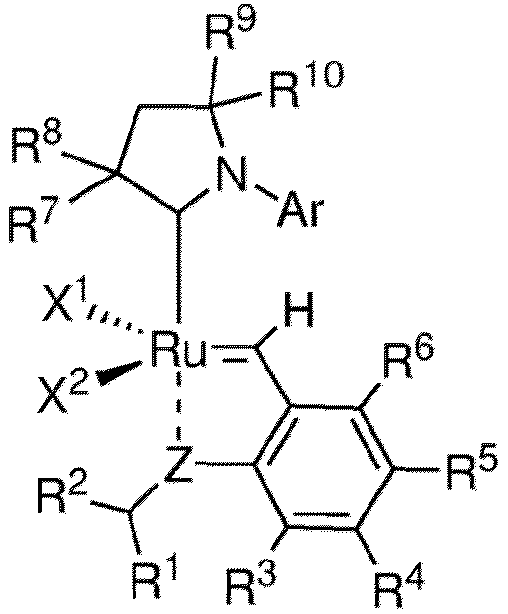
- X1 and X2 are each independently an anionic ligand selected from halogen atoms, - CN, -SCN, -OR', -SR', -O(C=O)R', -O(SO2)R', and -OSi(R')3group, wherein R' is C1-C12 alkyl, C3-C12 cycloalkyl, C2-C12 alkenyl, C5-C20 aryl, which are optionally substituted with at least one C1-C12 alkyl, C1-C12 perfluoroalkyl, C1-C12 alkoxy, C5-C24 aryloxy, C5-C20 heteroaryloxy, or a halogen atom;
- Z is an atom selected from a group of O, S, NR', wherein R' is C1-C12 alkyl, C3-C12 cycloalkyl, C2-C12 alkenyl, C5-C20 aryl, which are optionally substituted with at least one C1-C12 alkyl, C1-C12 perfluoroalkyl, C1-C12 alkoxy, C5-C24 aryloxy, C5-C20 heteroaryloxy, or a halogen atom;
- Ar is an aryl group substituted with hydrogen atoms or optionally substituted with at least one C1-C12 alkyl, C1-C12 perfluoroalkyl, C1-C12 alkoxy, C5-C24 aryloxy, and C5-C20 heteroaryloxy group, or a halogen atom;
- R1 and R2, are each independently hydrogen atom, C1-C25 alkyl group, C1-C25 alkoxy group, C2-C25 alkenyl group, C1-C12 perfluoroalkyl, C5-C20 aryl, C5-C24 aryloxy, C5-C20 heteroaryloxy, or can be combined together to form substituted or unsubstituted C4-C10 cyclic or C4-C12 polycyclic system, can also be an ester (-COOR'), amide (-CONR'2), formyl (-CHO), ketone (-COR'), and hydroxamic (-CON(OR')(R')) group or a halogen atom, in which R' is C1-C12 alkyl, C3-C12 cycloalkyl, C2-C12 alkenyl, C5-C20 aryl, which are optionally substituted with at least one C1-C12 alkyl, C1-C12 perfluoroalkyl, C1-C12 alkoxy, C5-C24 aryloxy, C5-C20 heteroaryloxy, or a halogen atom;
- R3, R4, R5, R6 are each independently hydrogen atom, sulfoxide group (-S(O)R'), sulphonamide group (-SO2NR'2), phosphonate group (-P(O)(OR')2), phosphinate group (-P(O)R'(OR')), phosphoninum group (- P(OR')2), phosphine group (-PR'2), nitro group (-NO2), nitroso group (-NO), carboxy group (-COOH), ester group (-COOR'), formyl group (-CHO), ketone group (-COR'), wherein R' is C1-C5 alkyl, C1-C5 perfluoroalkyl, C5-C24 aryl, C7-C24 aralkyl, C5-C24 perfluoroaryl;
- wherein when R1 and R2 are -CH3 group, then at least one of R3, R4, R5, R6 substituents is not hydrogen atom;
- R7, R8, R9, and R10 are each independently hydrogen atom or C1-C25 alkyl group, R7 and/or R8 can be combined with R9 and/or R10 to form cyclic system, are also independently C1-C12 alkyl, C3-C12 cycloalkyl, C2-C12 alkenyl, C5-C20 aryl, C1-C5 perfluoroalkyl, C7-C24 aralkyl, and C5-C24 perfluoroaryl group, which are optionally substituted with at least one C1-C12 alkyl, C1-C12 perfluoroalkyl, C1-C12 alkoxy, C5-C24 aryloxy, C5-C20 heteroaryloxy, or a halogen atom.
-
US 9,249,170 B2 
- wherein, independently for each occurrence,
- X is, independently for each occurrence, alkoxy or halo;
- R2 is, independently for each occurrence, alkyl;
- R3 is alkyl;
- R4 is alkyl, aryl, heteroaryl, aralkyl, or heteroaralkyl;
- or R3 and R4, taken together with the carbon atom to which they are attached, form a five-, six-, or ten-membered cycloalkyl or heterocyclyl ring;
- R5 is alkyl;
- R6 is H or alkyl, provided that (i) R5 and R6 are not the same, and (ii) R6 has fewer atoms than R5; and
- R7 is alkyl;
- or a compound of formula

- wherein, independently for each occurrence,
- X is, independently for each occurrence, alkoxy or halo;
- R2 is, independently for each occurrence, alkyl;
- R3 is alkyl;
- R4 is alkyl, aryl, heteroaryl, aralkyl, or heteroaralkyl;
- or R3 and R4, taken together with the carbon atom to which they are attached, form a five-, six-, or ten-membered cycloalkyl or heterocyclyl ring;
- R5 is, independently for each occurrence, alkyl; and
- R7 is alkyl;
- or a compound of formula

- wherein, independently for each occurrence,
- X is, independently for each occurrence, alkoxy or halo; R2 is alkyl;
- R3 is alkyl;
- R5 is, independently for each occurrence, alkyl;
- R7 is alkyl; and
- R8 is aryl or heteroaryl;
- or a compound of formula

- wherein, independently for each occurrence,
- X is, independently for each occurrence, alkoxy or halo;
- R2 is alkyl;
- R3 is alkyl;
- R5 is, independently for each occurrence, alkyl;
- R7 is alkyl; and
- R9 is C2-C6 alkyl;
- or R3 and R9, taken together with the carbon atom to which they are attached, form a five-, or ten-membered cycloalkyl or heterocyclyl ring.
-
WO 2008/046106 A2 relates generally to olefin metathesis, and more particularly relates to the synthesis of terminal alkenes from internal alkenes using a cross-metathesis reaction catalyzed by an olefin metathesis catalyst. The catalyst may be a ruthenium catalyst. - M. S. Mikus et al., Organometallics 2016, 35, 3878-3892, disclose pentacoordinate ruthenium(II) catecholthiolate and mercaptophenolate catalysts for olefin metathesis.
- D. R. Anderson et al., Angew. Chem. Int. Ed. 2007, 46, 7261-7265 disclose synthesis and reactivity of olefin metathesis catalysts bearing cyclic (alkyl)(amino)carbenes.
- D. R. Anderson et al., Organometallics 2008, 27, 563 - 566 disclose the kinetic selectivity of olefin metathesis catalysts bearing cyclic (alkyl)(amino)carbenes.
- There remains an ongoing need for providing new and improved catalysts useful for catalyzing metathesis reactions, for example, in terms of better catalyst stability and/or activity, efficiency and stereoselectivity.
- The inventors of the present invention discovered that the underlying problem may be solved by selected ruthenium complexes bearing at least an aryliden ligand, a sulfur-based bidentate ligand, and a neutral ligand, the neutral ligand preferably being selected from a nitrogen-containing heterocyclic carbene (NHC), as defined in claim 1. Preferred embodiments are defined in the claims depending thereon.
- All terms in quotation marks are defined in the meaning of the invention.
- In a first aspect, the invention relates to a compound of formula I-c:

- each of R6 and R7 is independently R, -CN, halogen, -OR, -OC(O)R, -OSiI3, -SR, -S(O)R, -S(O)2R, -NO2, -N(R')2, -NR'C(O)R, -NR'C(O)OR, -NR'C(O)N(R')2, -NR'SO2R, - NR'SO2N(R')2, -NR'OR, -SeR, -SiI3, or R6 and R7 are optionally taken together with their intervening atoms to form an optionally substituted 3-10 membered, saturated, partially unsaturated or aryl monocyclic or bicyclic ring having 0-4 heteroatoms independently selected from nitrogen, oxygen, or sulfur; or
- wherein the compound has the structure of formula I-d:

- or wherein the compound has the structure of formula I-e:

- or wherein the compound has the structure of formula I-f:

- wherein in each of formulas I-c to I-f
- R1 is a carbene containing the moiety of formula 7

- wherein Ar as defined in formula 7 is aryl, preferably phenyl, optionally substituted with one or more groups selected from: C1-C12 alkyl, C1-C12 perfluoroalkyl, C1-C12 alkoxy, C6-C14 aryloxy, or halogen; and
- wherein the chemical bonds which are symbolized with a wiggly line are connected to an optionally substituted alkenylene or alkylene group, respectively, wherein the carbon atom, the carbene carbon atom, the nitrogen atom and the optionally substituted alkenylene or alkylene group form a ring, which may optionally be bridged by an alkylene group;
- r is 1 or 2, preferably 1;
- X and Y are -S-;
- Ring A is an optionally substituted ring selected from phenyl, an 8-10 membered bicyclic aryl ring, a 5-6 membered monocyclic heteroaryl ring having 1-4 heteroatoms independently selected from nitrogen, oxygen, or sulfur, or an 8-10 membered bicyclic heteroaryl ring having 1-5 heteroatoms independently selected from nitrogen, oxygen, or sulfur;
- each Rx is independently halogen, R, -CN, -C(O)N(R')2, -C(O)R, -C(O)OR, -OR, - OC(O)R, -OC(O)OR, -OC(O)N(R')2, -OSiI3, -N(R')2, -N(R')3 +, -NR'C(O)R, -NR'C(O)OR, - NR'C(O)N(R')2, -NR'SO2R, -NR'SO2N(R')2, -NR'OR, -NO2, -SiI3, -PI2, -P(O)I2, - P(O)(OR)2, -SR, -SC(O)R, -S(O)R, -SO2R, -SO3R, -SO2N(R')2, or -SeR;
- each R' is independently R, -C(O)R, -C(O)NI2, -C(O)OR, -SO2R, -SO2NI2, -P(O)(OR)2, or -OR; and
- each R is independently hydrogen or an optionally substituted group selected from C1-20 aliphatic, C1-20 heteroaliphatic, phenyl, a 3-7 membered saturated or partially unsaturated carbocyclic ring, an 8-10 membered bicyclic saturated, partially unsaturated or aryl ring, a 5-6 membered monocyclic heteroaryl ring having 1-4 heteroatoms independently selected from nitrogen, oxygen, or sulfur, a 3-7 membered saturated or partially unsaturated heterocyclic ring having 1-3 heteroatoms independently selected from nitrogen, oxygen, or sulfur, a 7-10 membered bicyclic saturated or partially unsaturated heterocyclic ring having 1-5 heteroatoms independently selected from nitrogen, oxygen, or sulfur, or an 8-10 membered bicyclic heteroaryl ring having 1-5 heteroatoms independently selected from nitrogen, oxygen, or sulfur; or:
- two R groups are optionally taken together with their intervening atoms to form an optionally substituted 3-10 membered, saturated, partially unsaturated, or aryl ring having, in addition to the intervening atoms, 0-4 heteroatoms independently selected from nitrogen, oxygen, or sulfur;
- m is 0-6;
- R2 is H;
- R3 is hydrogen or an optionally substituted group selected from C1-20 aliphatic, C1-20 heteroaliphatic, phenyl, a 3-7 membered saturated or partially unsaturated carbocyclic ring, a 5-6 membered monocyclic heteroaryl ring having 1-4 heteroatoms independently selected from nitrogen, oxygen, or sulfur, or a 3-7 membered saturated or partially unsaturated heterocyclic ring having 1-3 heteroatoms independently selected from nitrogen, oxygen, or sulfur; and
- Z is -O- or -S-.
- According to the invention, the carbene is a N-heterocyclic carbene (NHC).
- The electrons at the carbene carbon atom form a bond with Ru.
- According to the invention, the electron-donating nitrogen-containing heterocyclic carbene contains only one nitrogen atom.
- According to the invention, the electron-donating carbene is a cyclic (CAAC) or bicyclic (BICAAC) aminoalkyl carbene 7:

wherein the chemical bonds which are symbolized with a wiggly line are connected to an optionally substituted alkenylene or alkylene group, respectively, wherein the carbon atom, the carbene carbon atom, the nitrogen atom and the optionally substituted alkenylene or alkylene group form a ring, which may optionally be bridged by an alkylene group. - Suitable optional substituents of the optionally substituted alkenylene or alkylene groups are e.g. C1-10 alkyl, C3-10 cycloalkyl, C1-10 alkoxyl, C3-10 cycloalkoxyl phenyl, or halogen.
- In one embodiment, the CAAC ligand is of formula 7a
- In one embodiment, the CAAC ligand is of formula 7a'

- In another embodiment, the BICAAC ligand is of formula 7b:

- In one embodiment, the BICAAC ligand is of formula 7b'

- In further embodiments, the CAAC or BICAAC ligand is of one of the following structures 7c to 7k, i.e. a carbene of structure 7c


- In one embodiment, Z is -O-.
- In one embodiment, the invention relates to compound E12. Compounds E3 to E11 are comparison examples:


- Preferably, L in E1 and E2 is a NHC ligand.
- In one embodiment, the complex is immobilized on a solid support.
- Compounds according to the invention may be prepared according to methods which are described in the Example section below. Some of said methods are known in the art.
- E.g., in one embodiment, a suitable thiocatechol zinc salt or a suitable ethane 1,2-dithiol zinc salt is reacted with a suitable dichloro ruthenium precursor complex to afford a compound according to the invention.
- Thiocatechole and ethane 1,2-dithiols are known in the art or may be prepared according to known methods.
- Dichloro ruthenium complexes are also known in the art or may be prepared according to known methods.
- CAAC carbenes of formula 7 such as 7a are known in the art and may be prepared according to known methods (see e.g.
WO 2017/055945 A1 ; Eur. J. Inorg. Chem. 2017, 3362-3375; ACS Catal. 2017, 5443-5449; Angew. Chem. Int. Ed. 2015, 54, 1919-1923). - BICAAC carbenes of formula 7b are known in the art and may be prepared according to known methods (see e.g. J. Am. Chem. Soc. 2017, 139, 7753-7756).
- The new ruthenium complexes may be used for catalysing a metathesis reaction. Preferably, the metathesis reaction is a metathesis reaction of one or more olefins.
- Accordingly, in a second aspect, the invention relates to a method of catalysing a metathesis reaction, comprising providing a compound as defined in the first aspect.
- In one embodiment, the method further comprises providing one or more olefins, wherein more than 80 % of the olefins formed in the catalysed metathesis reaction are Z-olefins.
- In a preferred embodiment, more than 85 % or more than 90 % or more than 95 % of the olefins formed in the catalysed metathesis reaction are Z-olefins.
- Suitable thiocatecholate zinc salts in the form of complexes may be prepared by reacting an aryl 1,2-dithiol with ethylenediamine in the presence of a zinc salt such as zinc acetate:
-

- Suitable aryl 1,2-thiolates may be prepared by reacting a suitable arene with sulfur in the presence of a strong base such as an alkyl lithium:
-
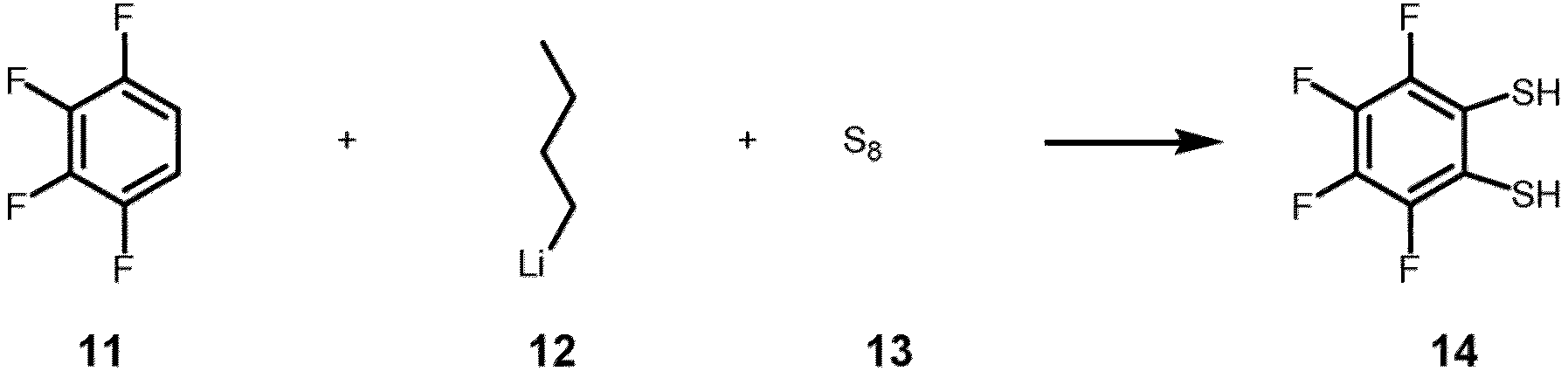
- In a subsequent step, 3,4,5,6-tetrafluorobenzene-1,2-dithiol 14 is converted to a zinc complex 15

- A mixture of dithiol 14 (471 mg, 2.20 mmol, 1.00 equiv), Zn(Oac)2.2H2O (9, 1932 mg, 8.80 mmol, 4.00 equiv) and ethylenediamine (8, 0.88 mL, 13.20 mmol, 6.00 equiv) in i-PrOH (16 mL) was allowed to stir for three hours at 22 °C. The precipitated solid was filtered, washed with methanol (5.0 mL) and hot chloroform (5.0 mL), and dried in a vacuum desiccator overnight to afford 3,4,5,6-tetrafluorobenzene-1,2-dithiolate Zinc 15 (470 mg, 1.39 mmol, 63% yield) as white solid.
- The Ru precursors are known from the prior art as e.g. referred to in the Background section or may be produced according to known methods.
- General procedure for the synthesis of dithiolate Ru complexes:
- The reaction according to the general procedure is schematically shown in the following scheme using a Ru dichloro complex bearing a NHC ligand containing two nitrogen atoms which is reacted with a suitable dithiolate complex to afford a compound E6 for comparison:

- To a 4 mL vial charged with stir bar and zinc dithiolate 10 or 15 (0.098 mmol, 2.00 equiv) under N2 atmosphere, a solution of dichloro ruthenium complex (0.049 mmol, 1.00 equiv) in tetrahydrofuran (650 µL) was added and allowed to stir at 22 °C. Reaction progress was monitored by 1H NMR spectroscopy. Upon >97 % conversion after two to five hours, the solvent was evaporated under vacuum. Residual tetrahydrofuran was removed through co-evaporation with dichloromethane (2×2 mL). The obtained solid was dissolved in dichloromethane and filtered. After removal of dichloromethane from the filtrate, complexes were isolated as green solids.
- Ruthenium complex E6 was synthetized according to the general procedure and isolated in the form of a green solid (35 mg, 0.04 mmol, 57% yield). 1H-NMR (C6D6): δ = 1.46 (d, 3H, CH 3 CHCH3), 1.69 (br, 6H, CH3 Mes), 1.75 (d, 3H, CH3CHCH 3 ), 2.17 (s, 6H, CH3 Mes), 2.54 (s, 6H, CH3 Mes), 3.98 (br, 4H, CH2 NHC), 5.41 (sept, 1H, CH3CHCH3), 6.25 (br, 1H, CH Mes), 6.60 (br, 1H, CH Mes), 6.96 (br, 2H, CH Mes), 6.80 (d, J=2.3 Hz,1H, C6-H), 7.27 (d, J=9.0 Hz, 1H, C3-H), 7.78 (dd, J=2.3 Hz, 9.0 Hz, 1H, C4-H), 10.11 (s, 1H, NH), 14.30 ppm (s, 1H, Ru=CH).
- 19F-NMR (C6D6): δ = -76.4 (s), -139.8 (ddd), -144.8 (ddd), -166.4 (ddd), -167.3 ppm (ddd).
- 13C-NMR (C6D6): δ = 19.9 (CH3 Mes), 21.5 (CH3CHCH3), 23.8 (CH3CHCH3), 52.8 (CH2 NHC), 84.0 (CH3 CHCH3), 116.8 (C6), 117.0 (C3), 118.6 (C4), 129.8 (CH Mes), 130.0 (CH Mes), 132.7 (C5), 135.5 (C Mes), 137.1 (C Mes), 139.1 (C Mes), 142.6 (C1), 152.5 (C2), 251.4 ppm (Ru=CH).
-

- 19F-NMR (C6D6): δ = -76.4 ppm (s).
- 13C-NMR (C6D6): δ = 19.7 (CH3 Mes), 20.5 (CH3CHCH3), 23.1 (CH3CHCH3), 51.2 (CH2 NHC), 81.3 (CH3 CHCH3), 115.3 (C3, C6), 118.6 (C4), 120.5 (C3'), 121.9 (C4'), 128.8 (CH Mes), 129.5 (C5'), 130.9 (C2'), 131.3 (C5), 137.9 (C Mes), 141.7(c1), 142.1 (C1'), 151.4 (C2), 154.1 (C6'), 248.1 ppm (Ru=CH).
-

- 1H-NMR (C6D6): δ = 0.87 (d, 6H, -CH 3 CHCH 3 ), 1.26 (d, 3H, O-CH 3 CHCH3), 1.37 (d, 3H, O-CH3CHCH 3 ), 1.48 (s br, 3H, CH3 Mes), 1.90 (sept, 1H, CH3CHCH3), 2.06 (s, 6H, CH3 Mes), 2.27 (s br, 3H, CH3 Mes), 2.45 (s br, 3H, CH3 Mes), 2.59 (s br, 3H, CH3 Mes), 3.03 (br, 2H, CH2 NHC), 3.18 (br, 2H, CH2 NHC), 3.99 (m, 2H, O-CH2), 5.34 (sept, 1H, O-CH3CHCH3), 5.82 (d, J=2.2 Hz, 1H, C6-H), 6.13 (br, 1H, CH Mes), 6.29 (s, 1H, NH), 6.46 (br, 1H, CH Mes), 6.54 (d, J=9.0 Hz, 1H, C3-H), 6.60 (br, 1H, CH Mes), 6.77 (br, 1H, CH Mes), 6.90&7.01 (Abq, 2H, C3'-H, C4'-H), 7.74 (d br, J=9.0 Hz, 1H, C4-H), 14.47 ppm (s, 1H, Ru=CH).
- 13C-NMR (C6D6): δ = 20.7 (CH3 Mes), 18.9 (CH3CHCH3), 20.7 (O-CH3CHCH3), 23.7 (O-CH3CHCH3), 28.1 (CH3 CHCH3), 50.9 (CH2 NHC), 71.0 (O-CH2), 81.3 (O-CH3 CHCH3), 113.7 (C6), 115.4 (C3), 116.5 (C4), 121.9 (C3'), 123.5 (C4'), 129.1 (CH Mes), 129.2 (CH Mes), 129.4 (CH Mes), 129.6 (CH Mes), 130.0 (C5'), 131.9 (C2'), 133.3 (C5), 141.8 (C1), 142.2 (C1'), 149.6 (C2), 153.2 (NHCOO), 154.6 (C6'), 250.1 ppm (Ru=CH).
-

- 1H-NMR (C6D6): δ = 0.88 (d, 6H, CH 3CHCH 3 ), 1.22 (d, 3H, O-CH 3 CHCH3), 1.35 (d, 3H, O-CH3CHCH 3 ), 1.45 (br, 3H, CH3 Mes), 1.91 (sept, 1H, CH3CHCH3), 2.01 (br, 3H, CH3 Mes), 2.06 (br, 3H, CH3 Mes), 2.25 (br, 3H, CH3 Mes), 2.40 (s, 3H, CH3 Mes), 2.47 (s, 3H, CH3 Mes), 3.05 (br m, 4H, CH2 NHC), 3.98 (m, 2H, O-CH2), 5.41 (sept, 1H, O-CH3CHCH3), 5.78 (d, J=2.3 Hz, 1H, C6-H), 6.06 (br, 1H, CH Mes), 6.37 (s, 1H, NH), 6.47 (br, 1H, CH Mes), 6.53 (d, J=9.0 Hz, 1H, C3-H), 6.56 (br, 1H, CH Mes), 6.75 (br, 1H, CH Mes), 7.74 (br d, J= 9.0 Hz, 1H, C4-H), 14.63 ppm (s, 1H, Ru=CH).
- 13C-NMR (C6D6): δ = 17.1 (CH3 Mes), 18.4 (CH3 Mes), 19.0 (CH3CHCH3), 19.3 (CH3 Mes), 20.0 (CH3 Mes), 20.7 (CH3 Mes), 20.7 (CH3 Mes), 20.9 (O-CH3CHCH3), 23.8 (O-CH3CHCH3), 51.2 (CH2 NHC), 71.2 (O-CH2), 82.3 (O-CH3 CHCH3), 113.7 (C6), 115.8 (C3), 117.0 (C4), 129.0 (CH Mes), 129.3 (CH Mes), 129.6 (CH Mes), 129.9 (CH Mes), 133.9 (C5), 134.5 (C Mes), 134.7 (C Mes), 135.1 (C Mes), 135.7 (C Mes), 137.0 (C Mes), 138.2 (C Mes), 138.5 (C Mes), 139.1 (C Mes), 142.0 (C1), 149.8 (C2), 153.9 (NHCOO), 252.3 ppm (Ru=CH).
- In a further example, the reaction according to the general procedure is schematically shown in the following scheme using a Ru dichloro complex bearing an NHC ligand containing one nitrogen atom (CAAC ligand) which is reacted with a suitable dithiolate complex:
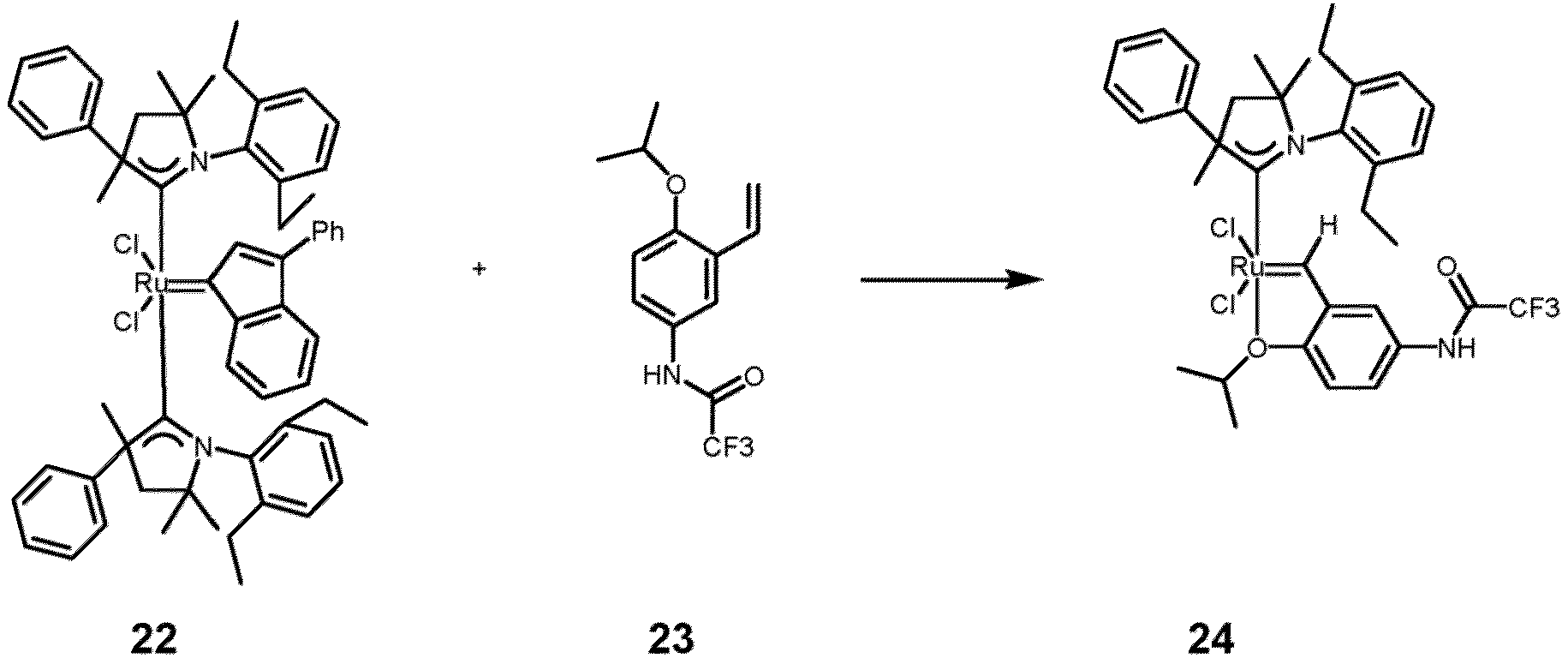
- Ruthenium complex 24 was synthetized according to the following steps: Compound 22 (106 mg, 0.106 mmol, 1.0 eq) was added under nitrogen to a solution of 23 (35 mg, 0.127 mmol, 1.2 eq) and suspension of CuCl (21 mg, 0.212 mmol, 2 eq) in benzene (5 mL). The reaction mixture was stirred at 60 °C for 60 minutes. After cooling down to room temperature, the mixture was poured onto silica gel and the product was eluted with Et2O/pentane (3:7 v/v) mixture. Green band was collected and solvents were removed. After drying in high vacuum the green solid 24 was obtained, 30 mg (38 %).
- 1H-NMR (C6D6): δ = 0.63 (s, 6H, CH3 CAAC), 0.71 (s, 3H, CH3 CAAC), 1.37 (br, 6H, O-CH 3CHCH 3 ), 1.48 (s br, 3H, CH3 CAAC), 1.59&2.02 (ABq, 2H, CH2 CAAC), 2.17 (m, 2H, CH2 Et), 2.38 (m, 2H, CH2 Et), 4.50 (sept, 1H, O-CH3CHCH3), 6.26 (d br, 1H, C3-H), 7.23 (d br, 1H, C4-H), 7.49 (m, 2H, Cortho-H Ph), 16.49 ppm (br, 1H, Ru=CH).
- 13C-NMR (C6D6): δ = 15.7 (CH3 Et), 21.5 (O-CH3CHCH3), 25.0 (CH2 Et), 26.8 (CH3 CAAC), 27.0 (CH3 CAAC), 29.4 (CH3 CAAC), 50.5 (CH2 CAAC), 60.4 (CCH3Ph), 74.8 (O-CH3 CHCH3), 79.8 (NC(CH3)2), 112.7 (C3), 122.2 (C4), 129.5 (C5), 135.9 (C-Et), 139.6 (N-Cipso), 140.7 (C2), 143.5 (C1), 145.2 (Cipso Ph), 247.7 ppm (NC: CAAC).
- Ruthenium complex E12 according to the invention was synthetized according to the general procedure and identified without isolation by the characteristic new alkylidene signal at δ = 13.85 ppm (1H-NMR (CD2Cl2)s, Ru=CH,):

- Z-selective cross-metathesis reaction (CM) between allylbenzene 17 and cis-1,4-butendiol-diacetate 18 to yield (Z)-4-phenyl-2-buteneyl-1-acetate 19 (Z-isomer was confirmed by GC standards):

- A 3 mol % [Ru] catalyst (complexes E5, E6, E7, E8, and complexes 20 or 21 for comparison) (0.0006 mmol, 3.0 mol %) in THF (290 µL) was transferred by syringe to a vial containing 17 (2.4 mg, 0.02 mmol, 1.00 equiv) and 18 (6.9 mg, 0.04 mmol, 2.00 equiv). The resulting mixture was allowed to stir for 9 hours at 22 °C. Analysis of the GC-MS chromatogram revealed surprisingly different yields of the substrate 19 with the different [Ru] catalysts, however the corresponding CM product was obtained in each case in >98:2 Z/E ratio.


Catalyst Yield of 19 [%] Z/E ratio 20 46 >98:2 21 49 >98:2 E5 54 >98:2 E7 54 >98:2 E8 56 >98:2 E6 58 >98:2 - Z-selective cross-metathesis reaction (CM) between oct-1-ene 22 and cis-1,4-butendiol-diacetate 18 to yield (Z)-non-2-en-1-yl acetate 23 (Z-isomer was confirmed by GC standards):

- A 3 mol % [Ru] catalyst (complexes E5, E7, and complex 21 for comparison) (0.00126 mmol, 3.0 mol %) in THF (290 µL) was transferred by syringe to a vial containing 18 (14.5 mg, 0.084 mmol, 2.00 equiv) and 22 (4.71 mg, 0.042 mmol, 1.00 equiv). The resulting mixture was allowed to stir for 9 hours at 22 °C. Analysis of the GC-MS chromatogram revealed surprisingly different yields of the substrate 23 with the different [Ru] catalysts, however the corresponding CM product was obtained in each case in >98:2 Z/E ratio.

Catalyst Yield of 23 [%] Z/E ratio 21 64 >98:2 E7 72 >98:2 E5 74 >98:2 - As can be seen from compounds E5, E6, E7 and E8 compared to compound 20 and 21, the omission of the amido group results in a drop of yield of target product. Accordingly, one can draw the conclusion from these results that the introduction of an amide function on the styrenyl ether ligand promotes the activation of the catalyst. Besides the significant activation of the catalyst relatively high conversions in very short amounts of time are observed. Under these conditions, an economic impact can be envisaged by significantly reducing the catalytic load in the metathesis reactions compared to the known catalysts lacking the amido group without affecting the yield.
Claims (10)
- A ruthenium complex, wherein the complex has the structure of formula I-c:
 each of R6 and R7 is independently R, -CN, halogen, -OR, -OC(O)R, -OSiR3, -SR, - S(O)R, -S(O)2R, -NO2, -N(R')2, -NR'C(O)R, -NR'C(O)OR, -NR'C(O)N(R')2, - NR'SO2R, - NR'SO2N(R')2, -NR'OR, -SeR, -SiR3; or R6 and R7 are optionally taken together with their intervening atoms to form an optionally substituted 3-10 membered, saturated, partially unsaturated or aryl monocyclic or bicyclic ring having 0-4 heteroatoms independently selected from nitrogen, oxygen, or sulfur; orwherein the complex has the structure of formula I-d:
 or wherein the complex has the structure of formula I-e:
 or wherein the complex has the structure of formula I-f:
 wherein in each of formulas I-c to I-fR1 is a carbene containing the moiety of formula 7
 wherein Ar as defined in formula 7 is aryl, preferably phenyl, optionally substituted with one or more groups selected from: C1-C12 alkyl, C1-C12 perfluoroalkyl, C1-C12 alkoxy, C6-C14 aryloxy, or halogen; andwherein the chemical bonds which are symbolized with a wiggly line are connected to an optionally substituted alkenylene or alkylene group, respectively, wherein the carbene carbon atom, the nitrogen atom and the optionally substituted alkenylene or alkylene group form a ring, which may optionally be bridged by an alkylene group;r is 1 or 2, preferably 1;X and Y are -S-;Ring A is an optionally substituted ring selected from phenyl, an 8-10 membered bicyclic aryl ring, a 5-6 membered monocyclic heteroaryl ring having 1-4 heteroatoms independently selected from nitrogen, oxygen, or sulfur, or an 8-10 membered bicyclic heteroaryl ring having 1-5 heteroatoms independently selected from nitrogen, oxygen, or sulfur;each Rx is independently halogen, R, -CN, -C(O)N(R')2, -C(O)R, -C(O)OR, -OR, - OC(O)R, -OC(O)OR, -OC(O)N(R')2, -OSiR3, -N(R')2, -N(R')3 +, -NR'C(O)R, - NR'C(O)OR, -NR'C(O)N(R')2, -NR'SO2R, -NR'SO2N(R')2, -NR'OR, -NO2, -SiR3, -PR2, -P(O)R2, -P(O)(OR)2, -SR, -SC(O)R, -S(O)R, -SO2R, -SO3R, -SO2N(R')2, or -SeR;each R' is independently R, -C(O)R, -C(O)NR2, -C(O)OR, -SO2R, -SO2NR2, - P(O)(OR)2, or -OR; andeach R is independently hydrogen or an optionally substituted group selected from C1-20 aliphatic, C1-20 heteroaliphatic, phenyl, a 3-7 membered saturated or partially unsaturated carbocyclic ring, an 8-10 membered bicyclic saturated, partially unsaturated or aryl ring, a 5-6 membered monocyclic heteroaryl ring having 1-4 heteroatoms independently selected from nitrogen, oxygen, or sulfur, a 3-7 membered saturated or partially unsaturated heterocyclic ring having 1-3 heteroatoms independently selected from nitrogen, oxygen, or sulfur, a 7-10 membered bicyclic saturated or partially unsaturated heterocyclic ring having 1-5 heteroatoms independently selected from nitrogen, oxygen, or sulfur, or an 8-10 membered bicyclic heteroaryl ring having 1-5 heteroatoms independently selected from nitrogen, oxygen, or sulfur; or:two R groups are optionally taken together with their intervening atoms to form an optionally substituted 3-10 membered, saturated, partially unsaturated, or aryl ring having, in addition to the intervening atoms, 0-4 heteroatoms independently selected from nitrogen, oxygen, or sulfur;m is 0-6;R2 is H;R3 is hydrogen or an optionally substituted group selected from C1-20 aliphatic, C1-20 heteroaliphatic, phenyl, a 3-7 membered saturated or partially unsaturated carbocyclic ring, a 5-6 membered monocyclic heteroaryl ring having 1-4 heteroatoms independently selected from nitrogen, oxygen, or sulfur, or a 3-7 membered saturated or partially unsaturated heterocyclic ring having 1-3 heteroatoms independently selected from nitrogen, oxygen, or sulfur; andZ is -O- or -S-.
 - The complex of claim 1, wherein the complex has the structure of formula I-g:

- The complex of any one of the preceding claims, wherein the carbene is of formula 7a or 7b:


- The complex of any one of the preceding claims, wherein the carbene of formula 7a is of formula 7a'
 wherein R12, R13, R14, and R15 in formula 7a are each independently hydrogen, C1-C12 alkyl, C3-C12 cycloalkyl, C2-C12 alkenyl, C6-C14 aryl, C1-C5 perfluoroalkyl,C7-C24 aralkyl, or C6-C14 perfluoroaryl group, which are optionally substituted with at least one C1-C12 alkyl, C1-C12 perfluoroalkyl, C1-C12 alkoxy, C6-C14 aryloxy, or a halogen atom; and wherein R12 and/or R13 can be combined with R14 and/or R15 to form a cyclic system; orwherein the carbene of formula 7b is of formula 7b'.
 wherein R16, R17 and R18 in formula 7b' are each independently hydrogen or C1-C12 alkyl, or C3-C12 cycloalkyl, or C2-C12 alkenyl, C6-C14 aryl, C1-C5 perfluoroalkyl, C7-C24 aralkyl, or C6-C14 perfluoroaryl group, which are optionally substituted with at least one C1-C12 alkyl, C1-C12 perfluoroalkyl, C1-C12 alkoxy, C6-C14 aryloxy, or a halogen atom, preferably wherein R16, R17 and R18 in formula 7b' are each independently hydrogen, C1-C12 alkyl, or C3-C12 cycloalkyl.
 - The complex of any one of claims 1 or 2, wherein R1 is a carbene of formula 7c


- The complex of any one of claims 1 to 5, wherein Z is -O-.
- The complex of any one of the preceding claims, wherein the complex is

- The complex of any one of the preceding claims, wherein the complex is immobilized on a solid support.
- Method of catalysing a metathesis reaction, comprising providing a complex as defined in any one of claims 1 to 8.
- Method of claim 9, further comprising providing one or more olefins, wherein more than 80 % of the olefins formed in the catalysed metathesis reaction are Z-olefins.
Priority Applications (1)
| Application Number | Priority Date | Filing Date | Title |
|---|---|---|---|
| EP24204879.1A EP4501901A3 (en) | 2016-11-09 | 2017-11-09 | Ruthenium complexes useful for catalyzing metathesis reactions |
Applications Claiming Priority (4)
| Application Number | Priority Date | Filing Date | Title |
|---|---|---|---|
| EP16002372 | 2016-11-09 | ||
| EP17194384 | 2017-10-02 | ||
| PCT/EP2017/078761 WO2018087230A1 (en) | 2016-11-09 | 2017-11-09 | Ruthenium complexes useful for catalyzing metathesis reactions |
| EP17794749.6A EP3538508B1 (en) | 2016-11-09 | 2017-11-09 | Ruthenium complexes useful for catalyzing metathesis reactions |
Related Parent Applications (1)
| Application Number | Title | Priority Date | Filing Date |
|---|---|---|---|
| EP17794749.6A Division EP3538508B1 (en) | 2016-11-09 | 2017-11-09 | Ruthenium complexes useful for catalyzing metathesis reactions |
Related Child Applications (1)
| Application Number | Title | Priority Date | Filing Date |
|---|---|---|---|
| EP24204879.1A Division EP4501901A3 (en) | 2016-11-09 | 2017-11-09 | Ruthenium complexes useful for catalyzing metathesis reactions |
Publications (3)
| Publication Number | Publication Date |
|---|---|
| EP3865495A2 EP3865495A2 (en) | 2021-08-18 |
| EP3865495A3 EP3865495A3 (en) | 2021-10-13 |
| EP3865495B1 true EP3865495B1 (en) | 2024-10-09 |
Family
ID=60268399
Family Applications (3)
| Application Number | Title | Priority Date | Filing Date |
|---|---|---|---|
| EP21168132.5A Active EP3865495B1 (en) | 2016-11-09 | 2017-11-09 | Ruthenium complexes useful for catalyzing metathesis reactions |
| EP24204879.1A Withdrawn EP4501901A3 (en) | 2016-11-09 | 2017-11-09 | Ruthenium complexes useful for catalyzing metathesis reactions |
| EP17794749.6A Active EP3538508B1 (en) | 2016-11-09 | 2017-11-09 | Ruthenium complexes useful for catalyzing metathesis reactions |
Family Applications After (2)
| Application Number | Title | Priority Date | Filing Date |
|---|---|---|---|
| EP24204879.1A Withdrawn EP4501901A3 (en) | 2016-11-09 | 2017-11-09 | Ruthenium complexes useful for catalyzing metathesis reactions |
| EP17794749.6A Active EP3538508B1 (en) | 2016-11-09 | 2017-11-09 | Ruthenium complexes useful for catalyzing metathesis reactions |
Country Status (5)
| Country | Link |
|---|---|
| US (2) | US10688481B2 (en) |
| EP (3) | EP3865495B1 (en) |
| HU (2) | HUE054859T2 (en) |
| PL (2) | PL3865495T3 (en) |
| WO (1) | WO2018087230A1 (en) |
Families Citing this family (8)
| Publication number | Priority date | Publication date | Assignee | Title |
|---|---|---|---|---|
| CN108368001B (en) | 2015-12-10 | 2021-07-23 | 优美科股份公司及两合公司 | Olefin Metathesis Catalyst |
| PL3865495T3 (en) | 2016-11-09 | 2025-01-27 | Verbio Vereinigte Bioenergie Ag | Ruthenium complexes useful for catalyzing metathesis reactions |
| CN111195532B (en) * | 2018-11-20 | 2021-05-25 | 中国科学院大连化学物理研究所 | Atomic-level monodisperse iridium-based catalyst, preparation method thereof and application of atomic-level monodisperse iridium-based catalyst in preparation of methyl acetate through methanol gas-phase carbonylation |
| TWI895585B (en) * | 2021-02-02 | 2025-09-01 | 日商住友電木股份有限公司 | Long shelf life stable photoactive mass polymerizable polycycloolefin compositions as optical materials |
| PL440147A1 (en) * | 2022-01-17 | 2023-07-24 | Uniwersytet Warszawski | New stereoretentive ruthenium complexes, method of their preparation, intermediates used in this method and the use of new stereoretentive ruthenium complexes in olefin metathesis reactions |
| US20250186979A1 (en) * | 2022-02-18 | 2025-06-12 | Pannon Egyetem | Catalyst system and process for the preparation of alpha olefins and alpha olefin-containing products from long-chain paraffins |
| EP4686722A1 (en) | 2024-07-29 | 2026-02-04 | Umicore AG & Co. KG | Zinc dithiolate compounds |
| WO2026027552A2 (en) | 2024-07-29 | 2026-02-05 | Umicore Ag & Co. Kg | Metal organic compounds |
Family Cites Families (21)
| Publication number | Priority date | Publication date | Assignee | Title |
|---|---|---|---|---|
| AU2001284773B2 (en) | 2000-08-10 | 2004-08-05 | Trustees Of Boston College | Recyclable metathesis catalysts |
| PL199412B1 (en) | 2002-10-15 | 2008-09-30 | Boehringer Ingelheim Int | Ruthenium new complexes as (pre) catalytic agents of permutation reaction, new derivatives of 2-alkoxy-5-nitrostyrene as intermediate compounds and method of their receiving |
| KR101269568B1 (en) | 2005-07-04 | 2013-06-04 | 자난 사이텍 컴퍼니 리미티드 | Ruthenium complex ligand, ruthenium complex, carried ruthenium complex catalyst and the preparing methods and the use thereof |
| WO2008010961A2 (en) * | 2006-07-13 | 2008-01-24 | Elevance Renewable Sciences, Inc. | Synthesis of terminal alkenes from internal alkenes and ethylene via olefin metathesis |
| CN102123979A (en) * | 2006-10-13 | 2011-07-13 | 埃莱文斯可更新科学公司 | Process for the synthesis of terminal olefins from internal olefins by olefin metathesis |
| CN101594937B (en) * | 2006-11-21 | 2014-04-30 | 加州理工学院 | Olefin metathesis initiators bearing thiazol-2-ylidene ligands |
| FR2909382B1 (en) | 2006-11-30 | 2009-01-23 | Enscr | RUTHENIUM CATALYTIC COMPLEXES AND THE USE OF SUCH COMPLEXES FOR OLEFIN METATHESIS |
| CN105238435A (en) | 2007-08-09 | 2016-01-13 | 埃莱文斯可更新科学公司 | Thermal methods for treating a metathesis feedstock |
| FR2934178B1 (en) * | 2008-07-25 | 2010-09-10 | Rhodia Operations | CATALYTIC COMPOSITIONS FOR THE METATHESIS OF UNSATURATED FATTY BODIES WITH OLEFINS AND METATHESIS PROCESSES IMPLEMENTING THE SAME |
| FR2947189B1 (en) | 2009-06-29 | 2011-07-29 | Rhodia Operations | PROCESS FOR THE REPAIR OF A CATALYTIC COMPOSITION FOR METATHESIS OF UNSATURATED FATTY BODIES |
| US8329921B2 (en) * | 2009-11-09 | 2012-12-11 | Exxonmobil Chemical Patents Inc. | Metathesis catalyst and process for use thereof |
| US9249170B2 (en) | 2013-04-11 | 2016-02-02 | California Institute Of Technology | Cyclic alkyl amino carbene (CAAC) ruthenium complexes as improved catalysts for ethenolysis reactions |
| WO2014201300A1 (en) | 2013-06-12 | 2014-12-18 | Trustees Of Boston College | Catalysts for efficient z-selective metathesis |
| CN104437642B (en) * | 2013-09-16 | 2017-11-07 | 中国石油化工股份有限公司 | It is a kind of for catalyst of olefin metathesis reaction and preparation method thereof |
| WO2015157736A1 (en) | 2014-04-10 | 2015-10-15 | California Institute Of Technology | Reactions in the presence of ruthenium complexes |
| DE102014105885A1 (en) * | 2014-04-25 | 2015-10-29 | Universität Stuttgart | N-heterocyclic carbene complexes of metalimidoalkylidenes and metalloxoalkylidenes and their use |
| PL238806B1 (en) | 2015-09-30 | 2021-10-04 | Apeiron Synthesis Spolka Akcyjna | Method for producing complexes of ruthenium and intermediate compounds and their application in the metathesis of olefins |
| CN108368001B (en) * | 2015-12-10 | 2021-07-23 | 优美科股份公司及两合公司 | Olefin Metathesis Catalyst |
| PL3865495T3 (en) | 2016-11-09 | 2025-01-27 | Verbio Vereinigte Bioenergie Ag | Ruthenium complexes useful for catalyzing metathesis reactions |
| WO2022008946A1 (en) * | 2020-07-08 | 2022-01-13 | Centre National De La Recherche Scientifique | Optically pure enantiomers of ruthenium complexes and uses thereof |
| EP3936511A1 (en) * | 2020-07-08 | 2022-01-12 | Centre national de la recherche scientifique | Ruthenium complexes, their optically pure enantiomers and uses thereof |
-
2017
- 2017-11-09 PL PL21168132.5T patent/PL3865495T3/en unknown
- 2017-11-09 US US16/333,341 patent/US10688481B2/en active Active
- 2017-11-09 EP EP21168132.5A patent/EP3865495B1/en active Active
- 2017-11-09 EP EP24204879.1A patent/EP4501901A3/en not_active Withdrawn
- 2017-11-09 HU HUE17794749A patent/HUE054859T2/en unknown
- 2017-11-09 EP EP17794749.6A patent/EP3538508B1/en active Active
- 2017-11-09 PL PL17794749T patent/PL3538508T3/en unknown
- 2017-11-09 WO PCT/EP2017/078761 patent/WO2018087230A1/en not_active Ceased
- 2017-11-09 HU HUE21168132A patent/HUE069420T2/en unknown
-
2020
- 2020-05-22 US US16/882,288 patent/US11484873B2/en active Active
Non-Patent Citations (1)
| Title |
|---|
| ANDERSON D R ET AL: "Kinetic Selectivity of Olefin Metathesis Catalysts Bearing Cyclic (Alkyl)(Amino)Carbenes", ORGANOMETALLICS, AMERICAN CHEMICAL SOCIETY, vol. 27, no. 4, 1 January 2008 (2008-01-01), pages 563 - 566, XP002588686, ISSN: 0276-7333 * |
Also Published As
| Publication number | Publication date |
|---|---|
| US11484873B2 (en) | 2022-11-01 |
| WO2018087230A1 (en) | 2018-05-17 |
| US20200282386A1 (en) | 2020-09-10 |
| PL3865495T3 (en) | 2025-01-27 |
| US20190210012A1 (en) | 2019-07-11 |
| US10688481B2 (en) | 2020-06-23 |
| PL3538508T3 (en) | 2021-10-25 |
| HUE069420T2 (en) | 2025-03-28 |
| EP4501901A3 (en) | 2025-05-28 |
| EP3538508B1 (en) | 2021-04-14 |
| EP3865495A3 (en) | 2021-10-13 |
| EP3865495A2 (en) | 2021-08-18 |
| EP3538508A1 (en) | 2019-09-18 |
| HUE054859T2 (en) | 2021-10-28 |
| EP4501901A2 (en) | 2025-02-05 |
Similar Documents
| Publication | Publication Date | Title |
|---|---|---|
| EP3538508B1 (en) | Ruthenium complexes useful for catalyzing metathesis reactions | |
| US8519069B2 (en) | Catalytic complex for olefin metathesis reactions, process for the preparation thereof and use thereof | |
| JP5066656B2 (en) | Catalytic complexes with carbene ligands | |
| US6613910B2 (en) | One-pot synthesis of group 8 transition metal carbene complexes useful as olefin metathesis catalysts | |
| US7632772B2 (en) | Recyclable ruthenium catalysts for metathesis reactions | |
| US8604227B2 (en) | Process for preparing linear alpha,omega-dicarboxylic diesters | |
| US9233994B2 (en) | Ruthenium complexes for use in olefin metathesis | |
| KR20080103961A (en) | Organometallic ruthenium complexes and related methods for the preparation of tetrasubstituted and other hindered olefins | |
| WO2004103948A1 (en) | Process for the carbonylation of a conjugated diene | |
| JP4550413B2 (en) | Novel transition metal complexes and their use in transition metal-catalyzed reactions | |
| US20180065914A1 (en) | Ruthenium polymerisation catalysts | |
| EP1948671B1 (en) | Preparation of catalysts | |
| KR20240134027A (en) | Novel stereoretentive ruthenium complexes, methods for their preparation, intermediates used in the methods and uses of the novel stereoretentive ruthenium complexes in olefin metathesis reactions | |
| GB2537416A (en) | Process | |
| Ma et al. | Reaction between N-(thio) phosphoryl imines and diethylzinc |
Legal Events
| Date | Code | Title | Description |
|---|---|---|---|
| PUAI | Public reference made under article 153(3) epc to a published international application that has entered the european phase |
Free format text: ORIGINAL CODE: 0009012 |
|
| STAA | Information on the status of an ep patent application or granted ep patent |
Free format text: STATUS: THE APPLICATION HAS BEEN PUBLISHED |
|
| AC | Divisional application: reference to earlier application |
Ref document number: 3538508 Country of ref document: EP Kind code of ref document: P |
|
| AK | Designated contracting states |
Kind code of ref document: A2 Designated state(s): AL AT BE BG CH CY CZ DE DK EE ES FI FR GB GR HR HU IE IS IT LI LT LU LV MC MK MT NL NO PL PT RO RS SE SI SK SM TR |
|
| PUAL | Search report despatched |
Free format text: ORIGINAL CODE: 0009013 |
|
| AK | Designated contracting states |
Kind code of ref document: A3 Designated state(s): AL AT BE BG CH CY CZ DE DK EE ES FI FR GB GR HR HU IE IS IT LI LT LU LV MC MK MT NL NO PL PT RO RS SE SI SK SM TR |
|
| RIC1 | Information provided on ipc code assigned before grant |
Ipc: C07B 37/08 20060101ALI20210907BHEP Ipc: B01J 31/16 20060101ALI20210907BHEP Ipc: C07C 69/145 20060101ALI20210907BHEP Ipc: C07C 69/157 20060101ALI20210907BHEP Ipc: C07F 3/06 20060101ALI20210907BHEP Ipc: C07C 67/475 20060101ALI20210907BHEP Ipc: C07F 15/00 20060101AFI20210907BHEP |
|
| STAA | Information on the status of an ep patent application or granted ep patent |
Free format text: STATUS: REQUEST FOR EXAMINATION WAS MADE |
|
| 17P | Request for examination filed |
Effective date: 20220412 |
|
| RBV | Designated contracting states (corrected) |
Designated state(s): AL AT BE BG CH CY CZ DE DK EE ES FI FR GB GR HR HU IE IS IT LI LT LU LV MC MK MT NL NO PL PT RO RS SE SI SK SM TR |
|
| STAA | Information on the status of an ep patent application or granted ep patent |
Free format text: STATUS: EXAMINATION IS IN PROGRESS |
|
| 17Q | First examination report despatched |
Effective date: 20230424 |
|
| P01 | Opt-out of the competence of the unified patent court (upc) registered |
Effective date: 20230507 |
|
| RIC1 | Information provided on ipc code assigned before grant |
Ipc: C07C 67/475 20060101ALI20231214BHEP Ipc: B01J 31/22 20060101ALI20231214BHEP Ipc: C07F 15/00 20060101AFI20231214BHEP |
|
| GRAP | Despatch of communication of intention to grant a patent |
Free format text: ORIGINAL CODE: EPIDOSNIGR1 |
|
| STAA | Information on the status of an ep patent application or granted ep patent |
Free format text: STATUS: GRANT OF PATENT IS INTENDED |
|
| INTG | Intention to grant announced |
Effective date: 20240207 |
|
| GRAS | Grant fee paid |
Free format text: ORIGINAL CODE: EPIDOSNIGR3 |
|
| GRAA | (expected) grant |
Free format text: ORIGINAL CODE: 0009210 |
|
| STAA | Information on the status of an ep patent application or granted ep patent |
Free format text: STATUS: THE PATENT HAS BEEN GRANTED |
|
| AC | Divisional application: reference to earlier application |
Ref document number: 3538508 Country of ref document: EP Kind code of ref document: P |
|
| AK | Designated contracting states |
Kind code of ref document: B1 Designated state(s): AL AT BE BG CH CY CZ DE DK EE ES FI FR GB GR HR HU IE IS IT LI LT LU LV MC MK MT NL NO PL PT RO RS SE SI SK SM TR |
|
| REG | Reference to a national code |
Ref country code: CH Ref legal event code: EP |
|
| REG | Reference to a national code |
Ref country code: DE Ref legal event code: R096 Ref document number: 602017085473 Country of ref document: DE |
|
| REG | Reference to a national code |
Ref country code: IE Ref legal event code: FG4D Ref country code: DE Ref legal event code: R081 Ref document number: 602017085473 Country of ref document: DE Owner name: VERBIO SE, DE Free format text: FORMER OWNER: VERBIO VEREINIGTE BIOENERGIE AG, 06780 ZOERBIG, DE Ref country code: DE Ref legal event code: R081 Ref document number: 602017085473 Country of ref document: DE Owner name: VERBIO SE, DE Free format text: FORMER OWNER: ANMELDERANGABEN UNKLAR / UNVOLLSTAENDIG, 80297 MUENCHEN, DE |
|
| TPAC | Observations filed by third parties |
Free format text: ORIGINAL CODE: EPIDOSNTIPA |
|
| REG | Reference to a national code |
Ref country code: NL Ref legal event code: FP |
|
| REG | Reference to a national code |
Ref country code: LT Ref legal event code: MG9D |
|
| RAP4 | Party data changed (patent owner data changed or rights of a patent transferred) |
Owner name: VERBIO SE |
|
| REG | Reference to a national code |
Ref country code: AT Ref legal event code: MK05 Ref document number: 1730509 Country of ref document: AT Kind code of ref document: T Effective date: 20241009 |
|
| REG | Reference to a national code |
Ref country code: HU Ref legal event code: AG4A Ref document number: E069420 Country of ref document: HU |
|
| PG25 | Lapsed in a contracting state [announced via postgrant information from national office to epo] |
Ref country code: IS Free format text: LAPSE BECAUSE OF FAILURE TO SUBMIT A TRANSLATION OF THE DESCRIPTION OR TO PAY THE FEE WITHIN THE PRESCRIBED TIME-LIMIT Effective date: 20250209 Ref country code: PT Free format text: LAPSE BECAUSE OF FAILURE TO SUBMIT A TRANSLATION OF THE DESCRIPTION OR TO PAY THE FEE WITHIN THE PRESCRIBED TIME-LIMIT Effective date: 20250210 Ref country code: HR Free format text: LAPSE BECAUSE OF FAILURE TO SUBMIT A TRANSLATION OF THE DESCRIPTION OR TO PAY THE FEE WITHIN THE PRESCRIBED TIME-LIMIT Effective date: 20241009 |
|
| PG25 | Lapsed in a contracting state [announced via postgrant information from national office to epo] |
Ref country code: FI Free format text: LAPSE BECAUSE OF FAILURE TO SUBMIT A TRANSLATION OF THE DESCRIPTION OR TO PAY THE FEE WITHIN THE PRESCRIBED TIME-LIMIT Effective date: 20241009 |
|
| PG25 | Lapsed in a contracting state [announced via postgrant information from national office to epo] |
Ref country code: BG Free format text: LAPSE BECAUSE OF FAILURE TO SUBMIT A TRANSLATION OF THE DESCRIPTION OR TO PAY THE FEE WITHIN THE PRESCRIBED TIME-LIMIT Effective date: 20241009 |
|
| PG25 | Lapsed in a contracting state [announced via postgrant information from national office to epo] |
Ref country code: ES Free format text: LAPSE BECAUSE OF FAILURE TO SUBMIT A TRANSLATION OF THE DESCRIPTION OR TO PAY THE FEE WITHIN THE PRESCRIBED TIME-LIMIT Effective date: 20241009 |
|
| PG25 | Lapsed in a contracting state [announced via postgrant information from national office to epo] |
Ref country code: NO Free format text: LAPSE BECAUSE OF FAILURE TO SUBMIT A TRANSLATION OF THE DESCRIPTION OR TO PAY THE FEE WITHIN THE PRESCRIBED TIME-LIMIT Effective date: 20250109 |
|
| PG25 | Lapsed in a contracting state [announced via postgrant information from national office to epo] |
Ref country code: LV Free format text: LAPSE BECAUSE OF FAILURE TO SUBMIT A TRANSLATION OF THE DESCRIPTION OR TO PAY THE FEE WITHIN THE PRESCRIBED TIME-LIMIT Effective date: 20241009 Ref country code: GR Free format text: LAPSE BECAUSE OF FAILURE TO SUBMIT A TRANSLATION OF THE DESCRIPTION OR TO PAY THE FEE WITHIN THE PRESCRIBED TIME-LIMIT Effective date: 20250110 Ref country code: AT Free format text: LAPSE BECAUSE OF FAILURE TO SUBMIT A TRANSLATION OF THE DESCRIPTION OR TO PAY THE FEE WITHIN THE PRESCRIBED TIME-LIMIT Effective date: 20241009 |
|
| PG25 | Lapsed in a contracting state [announced via postgrant information from national office to epo] |
Ref country code: RS Free format text: LAPSE BECAUSE OF FAILURE TO SUBMIT A TRANSLATION OF THE DESCRIPTION OR TO PAY THE FEE WITHIN THE PRESCRIBED TIME-LIMIT Effective date: 20250109 |
|
| REG | Reference to a national code |
Ref country code: CH Ref legal event code: PL |
|
| PG25 | Lapsed in a contracting state [announced via postgrant information from national office to epo] |
Ref country code: SM Free format text: LAPSE BECAUSE OF FAILURE TO SUBMIT A TRANSLATION OF THE DESCRIPTION OR TO PAY THE FEE WITHIN THE PRESCRIBED TIME-LIMIT Effective date: 20241009 |
|
| PG25 | Lapsed in a contracting state [announced via postgrant information from national office to epo] |
Ref country code: MC Free format text: LAPSE BECAUSE OF FAILURE TO SUBMIT A TRANSLATION OF THE DESCRIPTION OR TO PAY THE FEE WITHIN THE PRESCRIBED TIME-LIMIT Effective date: 20241009 |
|
| PG25 | Lapsed in a contracting state [announced via postgrant information from national office to epo] |
Ref country code: DK Free format text: LAPSE BECAUSE OF FAILURE TO SUBMIT A TRANSLATION OF THE DESCRIPTION OR TO PAY THE FEE WITHIN THE PRESCRIBED TIME-LIMIT Effective date: 20241009 |
|
| REG | Reference to a national code |
Ref country code: DE Ref legal event code: R097 Ref document number: 602017085473 Country of ref document: DE |
|
| PG25 | Lapsed in a contracting state [announced via postgrant information from national office to epo] |
Ref country code: LU Free format text: LAPSE BECAUSE OF NON-PAYMENT OF DUE FEES Effective date: 20241109 |
|
| REG | Reference to a national code |
Ref country code: CH Ref legal event code: PL |
|
| PG25 | Lapsed in a contracting state [announced via postgrant information from national office to epo] |
Ref country code: EE Free format text: LAPSE BECAUSE OF FAILURE TO SUBMIT A TRANSLATION OF THE DESCRIPTION OR TO PAY THE FEE WITHIN THE PRESCRIBED TIME-LIMIT Effective date: 20241009 |
|
| PG25 | Lapsed in a contracting state [announced via postgrant information from national office to epo] |
Ref country code: CH Free format text: LAPSE BECAUSE OF NON-PAYMENT OF DUE FEES Effective date: 20241130 |
|
| PG25 | Lapsed in a contracting state [announced via postgrant information from national office to epo] |
Ref country code: RO Free format text: LAPSE BECAUSE OF FAILURE TO SUBMIT A TRANSLATION OF THE DESCRIPTION OR TO PAY THE FEE WITHIN THE PRESCRIBED TIME-LIMIT Effective date: 20241009 |
|
| PG25 | Lapsed in a contracting state [announced via postgrant information from national office to epo] |
Ref country code: SK Free format text: LAPSE BECAUSE OF FAILURE TO SUBMIT A TRANSLATION OF THE DESCRIPTION OR TO PAY THE FEE WITHIN THE PRESCRIBED TIME-LIMIT Effective date: 20241009 |
|
| PG25 | Lapsed in a contracting state [announced via postgrant information from national office to epo] |
Ref country code: CZ Free format text: LAPSE BECAUSE OF FAILURE TO SUBMIT A TRANSLATION OF THE DESCRIPTION OR TO PAY THE FEE WITHIN THE PRESCRIBED TIME-LIMIT Effective date: 20241009 |
|
| PG25 | Lapsed in a contracting state [announced via postgrant information from national office to epo] |
Ref country code: IT Free format text: LAPSE BECAUSE OF FAILURE TO SUBMIT A TRANSLATION OF THE DESCRIPTION OR TO PAY THE FEE WITHIN THE PRESCRIBED TIME-LIMIT Effective date: 20241009 |
|
| PLBE | No opposition filed within time limit |
Free format text: ORIGINAL CODE: 0009261 |
|
| STAA | Information on the status of an ep patent application or granted ep patent |
Free format text: STATUS: NO OPPOSITION FILED WITHIN TIME LIMIT |
|
| PG25 | Lapsed in a contracting state [announced via postgrant information from national office to epo] |
Ref country code: SE Free format text: LAPSE BECAUSE OF FAILURE TO SUBMIT A TRANSLATION OF THE DESCRIPTION OR TO PAY THE FEE WITHIN THE PRESCRIBED TIME-LIMIT Effective date: 20241009 |
|
| 26N | No opposition filed |
Effective date: 20250710 |
|
| PG25 | Lapsed in a contracting state [announced via postgrant information from national office to epo] |
Ref country code: IE Free format text: LAPSE BECAUSE OF NON-PAYMENT OF DUE FEES Effective date: 20241109 |
|
| PGFP | Annual fee paid to national office [announced via postgrant information from national office to epo] |
Ref country code: HU Payment date: 20251031 Year of fee payment: 9 |
|
| PGFP | Annual fee paid to national office [announced via postgrant information from national office to epo] |
Ref country code: NL Payment date: 20251119 Year of fee payment: 9 |
|
| PGFP | Annual fee paid to national office [announced via postgrant information from national office to epo] |
Ref country code: DE Payment date: 20251118 Year of fee payment: 9 |
|
| PGFP | Annual fee paid to national office [announced via postgrant information from national office to epo] |
Ref country code: GB Payment date: 20251120 Year of fee payment: 9 |
|
| PGFP | Annual fee paid to national office [announced via postgrant information from national office to epo] |
Ref country code: FR Payment date: 20251125 Year of fee payment: 9 |
|
| PGFP | Annual fee paid to national office [announced via postgrant information from national office to epo] |
Ref country code: BE Payment date: 20251118 Year of fee payment: 9 |
|
| PGFP | Annual fee paid to national office [announced via postgrant information from national office to epo] |
Ref country code: PL Payment date: 20251105 Year of fee payment: 9 |
|
| PG25 | Lapsed in a contracting state [announced via postgrant information from national office to epo] |
Ref country code: CY Free format text: LAPSE BECAUSE OF FAILURE TO SUBMIT A TRANSLATION OF THE DESCRIPTION OR TO PAY THE FEE WITHIN THE PRESCRIBED TIME-LIMIT; INVALID AB INITIO Effective date: 20171109 |