EP3864520B1 - Systems and methods for specifying olap cube at query time - Google Patents
Systems and methods for specifying olap cube at query time Download PDFInfo
- Publication number
- EP3864520B1 EP3864520B1 EP19706193.0A EP19706193A EP3864520B1 EP 3864520 B1 EP3864520 B1 EP 3864520B1 EP 19706193 A EP19706193 A EP 19706193A EP 3864520 B1 EP3864520 B1 EP 3864520B1
- Authority
- EP
- European Patent Office
- Prior art keywords
- data
- cube
- olap
- source
- query
- Prior art date
- Legal status (The legal status is an assumption and is not a legal conclusion. Google has not performed a legal analysis and makes no representation as to the accuracy of the status listed.)
- Active
Links
Images


Classifications
-
- G—PHYSICS
- G06—COMPUTING OR CALCULATING; COUNTING
- G06F—ELECTRIC DIGITAL DATA PROCESSING
- G06F16/00—Information retrieval; Database structures therefor; File system structures therefor
- G06F16/20—Information retrieval; Database structures therefor; File system structures therefor of structured data, e.g. relational data
- G06F16/24—Querying
- G06F16/245—Query processing
- G06F16/2458—Special types of queries, e.g. statistical queries, fuzzy queries or distributed queries
- G06F16/2465—Query processing support for facilitating data mining operations in structured databases
-
- G—PHYSICS
- G06—COMPUTING OR CALCULATING; COUNTING
- G06F—ELECTRIC DIGITAL DATA PROCESSING
- G06F16/00—Information retrieval; Database structures therefor; File system structures therefor
- G06F16/20—Information retrieval; Database structures therefor; File system structures therefor of structured data, e.g. relational data
- G06F16/22—Indexing; Data structures therefor; Storage structures
- G06F16/2228—Indexing structures
- G06F16/2264—Multidimensional index structures
-
- G—PHYSICS
- G06—COMPUTING OR CALCULATING; COUNTING
- G06F—ELECTRIC DIGITAL DATA PROCESSING
- G06F16/00—Information retrieval; Database structures therefor; File system structures therefor
- G06F16/20—Information retrieval; Database structures therefor; File system structures therefor of structured data, e.g. relational data
- G06F16/24—Querying
- G06F16/245—Query processing
- G06F16/2452—Query translation
-
- G—PHYSICS
- G06—COMPUTING OR CALCULATING; COUNTING
- G06F—ELECTRIC DIGITAL DATA PROCESSING
- G06F16/00—Information retrieval; Database structures therefor; File system structures therefor
- G06F16/20—Information retrieval; Database structures therefor; File system structures therefor of structured data, e.g. relational data
- G06F16/24—Querying
- G06F16/245—Query processing
- G06F16/2455—Query execution
- G06F16/24552—Database cache management
-
- G—PHYSICS
- G06—COMPUTING OR CALCULATING; COUNTING
- G06F—ELECTRIC DIGITAL DATA PROCESSING
- G06F16/00—Information retrieval; Database structures therefor; File system structures therefor
- G06F16/20—Information retrieval; Database structures therefor; File system structures therefor of structured data, e.g. relational data
- G06F16/28—Databases characterised by their database models, e.g. relational or object models
- G06F16/283—Multi-dimensional databases or data warehouses, e.g. MOLAP or ROLAP
Definitions
- Schemas including star schemas, can generally be described as relational data warehouses.
- Cube structures are often built from relational data warehouses in order to provide faster and more powerful analysis of data.
- cube structures accomplish this by organizing data in a hierarchical arrangement according to dimensions and measures.
- Dimensions may group the data along natural categories and consist of one or more levels where each level represents a different grouping within the same dimension.
- the levels can be organized into one or more hierarchies, typically from a coarse-grained level down to the most detailed.
- Measures can be the cube data values that are summarized and analyzed.
- US 2009/228436 A1 (PASUMANSKY MOSHA [US] ET AL) 10 September 2009 , relates to a method for generating a multidimensional data cube based on receiving a definition of at least one measure for indicating one or more facts in the data source and receiving a definition of at least one dimension, wherein the at least one dimension includes one or more attributes, receiving a definition of at least one data domain, wherein the at least one data domain comprises at least one parameter for structuring the data as a multidimensional data cube.
- One aspect of the present disclosure relates to a system configured for generating an online analytical processing (OLAP) cube in accordance with claim 1.
- OLAP online analytical processing
- Another aspect of the present disclosure relates to a method for generating an online analytical processing cube in accordance with claim 5.
- Star schemas can more generally be described as a relational data warehouse designed for speed of retrieval. Cube structures are often built from relational data warehouses in order to provide faster and more powerful analysis of the data. In general, cube structures accomplish this by organizing data in a hierarchical arrangement according to dimensions and measures.
- Dimensions may group the data along natural categories and consist of one or more levels where each level represents a different grouping within the same dimension.
- the levels can be organized into one or more hierarchies, typically from a coarse-grained level down to the most detailed. Measures can be the cube data values that are summarized and analyzed.
- OLAP cubes or other cube database structures are a managed service that allows developers to improve queriability of their multidimensional data through cube modeling. It provides data curation, protection against erroneous schema modification, and fast querying. It handles both simple and complex business logic.
- a schema is the structure behind the data organization. It comprises different table relationships enabling the business rules for the underlying mission for which the database is created. Simplification would result in a reduction of time taken to write the schema.
- the single configuration file (1) the data-source property configuration for each data-source is automatically generated and (2) whether the columns of relational data-sources are key, attribute, or measure are automatically generated.
- Cube creation may involve a tool which involves human in building the cube definition.
- the tool can automatically generate configuration and schema (or cube definition) of the OLAP cube and when tool finds anything ambiguous it involves human to remove the ambiguity. asks questions to the end user to generate the cube definition itself.
- Another technical and computer-centric problem solved is the reduction of time to write a query, from deciding to use an OLAP cube to execution of the query.
- the time may be reduced from on the order of days to on the order of seconds.
- one component of the disclosed systems and methods is providing functionality for a user to specify a cube identifier in the request itself.
- Another component may be a schema-less tenant/instance which brings the cube definition file from a data-source at query time and then executes the query over the cube definition file. This may involve reducing the cube definition file creation time by not creating self-contained query language specific objects inside the cube definition file.
- additional latency due to cube definition file creation on the fly may be reduced by (1) cube definition file caching for reuse of cube definition files if the query comes again over the same cube, (2) prefetching cube definition files, where changes in OLAP cubes are scanned for changes and the in-memory cache of the cube is updated whenever a cube definition changes, and (3) a tenant owns the datascape schema provider instead of creating datascape schema provider every time at query time.
- FIG. 1 is a block diagram of an example network architecture 100 for specifying an OLAP cube at query time.
- An architecture can include one or more database servers 110, user devices 130, and a network 140.
- the user devices 130 may be used by a user to perform various actions and/or access various types of content, some of which may be provided over a network 140 (e.g., the Internet, LAN, WAN, etc.).
- a "user” or “entity” used herein may refer to an individual operating user devices 130, interacting with resources or content items via the user devices 130, etc.
- the user devices 130 may be used to access websites (e.g., using an internet browser), media files, and/or any other types of content.
- An API e.g., cube definition file API 204) may be configured to access content for display to users within resources (e.g., webpages, applications, etc.) and to provide content items to the user devices 130 over the network 140 for display within the resources.
- the content from which the API selects items may be provided by one or more database servers 110 via the network 140.
- one or more of the database servers can be at least a data catalog 208 and/or a schemaless database server 210.
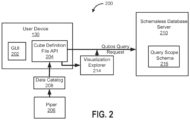
- FIG. 2 is a block diagram of an example query system 200.
- the user device 130 can contain a graphical user interface (GUI) 202 and a cube definition file API 204.
- GUI graphical user interface
- the query request may also go through one or more of a visualization explorer 214.
- a drag and drop query interface may be used.
- the schemaless database server 210 can contain a query scope schema.
- the user device 130 contains a GUI 202.
- the GUI can be configured to allow a user to create new dimensions and measures and then map them onto data-source columns.
- the user device 130 contains a cube definition file API 204.
- the cube definition file API 204 may provide a shell to allow a user to set the cube definition file during a session.
- cube definition file creation time is reduced by not creating self-contained query language (e.g., RVL) specific objects inside the cube definition file. Further latency may be avoided by cube definition file caching and prefetching.
- Cube definition file caching may include storing a cube definition file to use if a query is received again over the same cube instead of recreating the cube definition file every time.
- a cube definition file prefetcher may scan for changes in OLAP cubes in data catalog 208. Whenever a cube definition changes, the cube definition file prefetcher can update the in-memory cache of the OLAP cube.
- a query specific field may be used to bypass the cache completely and access data catalog 208 directly to fetch cube definition file changes.
- the example query system 200 includes a piper 206 (i.e., a version control system).
- the piper 206 can be used to modify a cube definition file and can validate a query against the modified schema.
- piper 206 can be used to search for an OLAP cube.
- piper 206 accesses the index in data catalog 208.
- Schema in piper 206 may be synced to data catalog 208 for discovery.
- Schema in piper 206 may be synced to data catalog 208 for use in a schemaless database server 210.
- the example query system 200 includes a data catalog 208.
- the data catalog 208 may index every OLAP cube where it can be searched and discovered.
- cube definition files may be stored in data catalog 208 where it is discoverable.
- data catalog 208 can be used to modify a cube definition file and can validate a query against the modified query.
- piper 206 accesses the index in data catalog 208. Cube definition files in piper 206 may be synced to data catalog 208 for discovery.
- the example query system 200 includes a visualization explorer 214.
- the visualization explorer 214 can serve a static dashboard or dynamic dashboard on top of an OLAP cube.
- visualization explorer 214 can be used as a service to generate an interactive report.
- a visualization explorer 214 instance may have to be set up and customized.
- the example query system 200 includes other visualization explorers.
- the visualization explorers may provide access to a data-source.
- visualization explorers can be used as a service to generate an interactive report.
- the example query system 200 comprises a schemaless database server 210.
- the schemaless database server 210 may contain a query scope schema 216.
- the schemaless database server 210 may use schema (i.e., cube definition files) in piper 206 synced to data catalog 208.
- the schemaless database server 210 can run a request on an OLAP cube that is provided as part of the query request.
- the query scope schema 216 can be configured to use a reference to data catalog 208 in a query specifying what cube definition file to use.
- the example query system 200 uses an OLAP context container, wherein an OLAP context container is an object that is used during OLAP query execution to convert an OLAP query to an SQL query.
- the OLAP context container may contain mapping from an OLAP model to relational data sources.
- the OLAP context container may also contain various indexes to speed up an OLAP conversion request.
- the OLAP context container further comprises user-specified data to influence the heuristics used during the SQL generation. For example, user-specified data in the OLAP context container may determine that a cube schema preferentially selects one data source over another when a particular set of fields are requests.
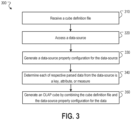
- FIG. 3 illustrates a method 300 for generating an online analytical processing cube, in accordance with one or more implementations.
- the operations of method 300 presented below are intended to be illustrative. In some implementations, method 300 may be accomplished with one or more additional operations not described, and/or without one or more of the operations discussed. Additionally, the order in which the operations of method 300 are illustrated in FIG. 3 and described below is not intended to be limiting.
- method 300 comprises receiving a cube definition file, accessing a data source, generating a data-source property configuration for the data source, determining each of the respective parsed data from the data source is a key, attribute, or measure, and generating an OLAP cube by combining the cube definition file and the data-source property configuration for the data.
- method 300 may be implemented in one or more processing devices (e.g., a digital processor, an analog processor, a digital circuit designed to process information, an analog circuit designed to process information, a state machine, and/or other mechanisms for electronically processing information).
- the one or more processing devices e.g., database servers 110, schemaless database server 210, etc.
- the one or more processing devices may include one or more devices executing some or all of the operations of method 300 in response to instructions stored electronically on an electronic storage medium.
- the one or more processing devices may include one or more devices configured through hardware, firmware, and/or software to be specifically designed for execution of one or more of the operations of method 300.
- an operation 310 includes receiving a cube definition file.
- an OLAP cube can be created using a data-source (e.g., a non RVL data-source, wherein RVL or Relational View Language is a self-contained query language where RVL uses information in the schema to automatically aggregate data when columns are projected) with just a single cube definition file.
- the cube definition file may be a cube_definition configuration file.
- this is a cube definition file for creation of an OLAP cube in "RVL_LESS" mode. The RVL_LESS mode may be hidden from the end user.
- An operation 320 includes accessing a data-source.
- the data-source may not use relational view language.
- the data-source e.g., data catalog 208
- cube definition may be stored in the data-source where it is discoverable.
- the data-source can be used to modify a cube definition file and can validate a query against the modified query.
- the data-source allows access to the index and may allow syncing for discovery.
- An operation 330 includes generating a data-source property configuration for the data-source using the cube definition file.
- a data-source property configuration may comprise a list of data sources and keys, attributes, and/or measures contained respectively within.
- An operation 340 includes determining each of respective parsed data from the data-source is a key, attribute, or measure. In some implementations, it is automatically determined if columns of relational data-sources are a key, an attribute, or a measure. Measure may be inferred from a default aggregation function in the cube definition. In some implementations, the user may be able to specify the overlay to indicate the key columns and other information. In some implementations, an overlay schema is provided to the user to allow the user to specify whether a column is a key or attribute. A key is a key attribute.
- each dimension in an OLAP cube contains a key attribute and the key attribute is the attribute in a dimension that identifies the columns in the dimension main table that are used in foreign key relationships to the fact table.
- the key attribute can represent the primary key column or column in the dimension table.
- a measure can be an aggregation of numeric data values. They can be a static element created at design time, or a calculated member based on other measures in the data structure by being summed, averaged, or otherwise mathematically manipulated. Attributes can be used to create foreign key relationships to dimension tables so that quantifiable data in the measure columns can be organized by the data contained in the dimension tables. Attributes can also be used to define the granularity of fact tables and corresponding measures.
- An operation 350 includes generating the OLAP cube using the data-source property configuration and the determination of each of the respective parsed data from the data-source.
- the OLAP cube is generated using a single cube definition file using the data-source (e.g., a non RVL data-source).
- the cube definition file may be a cube_definition configuration file.
- this is a cube definition file for creation of an OLAP cube in "RVL_LESS" mode.
- the RVL_LESS mode may be hidden from the end user.
- FIG. 4 illustrates a method 400 for operating a query system, in accordance with one or more implementations.
- the operations of method 400 presented below are intended to be illustrative. In some implementations, method 400 may be accomplished with one or more additional operations not described, and/or without one or more of the operations discussed. Additionally, the order in which the operations of method 400 are illustrated in FIG. 4 and described below is not intended to be limiting.
- method 400 may be implemented in one or more processing devices (e.g., a digital processor, an analog processor, a digital circuit designed to process information, an analog circuit designed to process information, a state machine, and/or other mechanisms for electronically processing information).
- the one or more processing devices e.g., user devices 130, database servers 110, schemaless database server 210, etc.
- the one or more processing devices may include one or more devices executing some or all of the operations of method 300 in response to instructions stored electronically on an electronic storage medium.
- the one or more processing devices may include one or more devices configured through hardware, firmware, and/or software to be specifically designed for execution of one or more of the operations of method 400.
- An operation 410 may include receiving a query including a cube identifier.
- the cube identifier is specified in the query itself.
- the tenant can create the cube definition file specified in the cube associated with the cube identifier and build a query scope schema configuration to execute the query.
- An operation 420 includes retrieving objects from a data source associated with the cube identifier.
- the objects include cube definition files retrieved from the data source (e.g., data catalog 208).
- An operation 430 includes determining if an associated cached cube definition file is accessible.
- Cube definition file caching includes storing a cube definition file to use if a query is received again over the same cube instead of recreating the cube definition file every time.
- a cube definition file prefetcher may scan for changes in OLAP cubes in a data source (e.g., data catalog 208).
- An operation 440 includes generating a cube definition file based on the query using the cached cube definition file.
- An operation 450 includes generating a cube definition file based on the query.
- the cube definition file is generated without using a cached cube definition file.
- the cube definition file may be a star schema.
- the cube definition file comprises dimensions and their attributes, simple measures and user-defined measures, mapping to columns form data sources, and prohibition rules (i.e., combinations of dimensions and measures that cannot be requested together).
- a public cube definition file may be generated from a checked-in cube definition file. The generation may include removing some details (e.g., data source mappings) that should not be visible to query users and adding data types from data sources.
- An operation 460 may include responding to the query based on the generated cube definition file and retrieved objects from the data source.
- Embodiments of the subject matter described in this specification can be implemented as one or more computer program products, i.e., one or more modules of computer program instructions encoded on a computer readable medium for execution by, or to control the operation of, data processing apparatus.
- the computer readable medium can be a machine-readable storage device, a machine-readable storage substrate, a memory device, a composition of matter effecting a machine-readable propagated signal, or a combination of one or more of them.
- data processing apparatus encompasses all apparatus, devices, and machines for processing data, including by way of example a programmable processor, a computer, or multiple processors or computers.
- the apparatus can include, in addition to hardware, code that creates an execution environment for the computer program in question, e.g., code that constitutes processor firmware, a protocol stack, a database management system, an operating system, or a combination of one or more of them.
- a propagated signal is an artificially generated signal, e.g., a machine-generated electrical, optical, or electromagnetic signal, that is generated to encode information for transmission to suitable receiver apparatus.
- a computer program (also known as a program, software, software application, script, or code) can be written in any form of programming language, including compiled or interpreted languages, and it can be deployed in any form, including as a stand alone program or as a module, component, subroutine, or other unit suitable for use in a computing environment.
- a computer program does not necessarily correspond to a file in a file system.
- a program can be stored in a portion of a file that holds other programs or data (e.g., one or more scripts stored in a markup language document), in a single file dedicated to the program in question, or in multiple coordinated files (e.g., files that store one or more modules, sub programs, or portions of code).
- a computer program can be deployed to be executed on one computer or on multiple computers that are located at one site or distributed across multiple sites and interconnected by a communication network.
- processors suitable for the execution of a computer program include, by way of example, both general and special purpose microprocessors, and any one or more processors of any kind of digital computer.
- a processor will receive instructions and data from a read only memory or a random access memory or both.
- the essential elements of a computer are a processor for performing instructions and one or more memory devices for storing instructions and data.
- a computer will also include, or be operatively coupled to receive data from or transfer data to, or both, one or more mass storage devices for storing data, e.g., magnetic, magneto optical disks, or optical disks.
- mass storage devices for storing data, e.g., magnetic, magneto optical disks, or optical disks.
- a computer need not have such devices.
- a computer can be embedded in another device, e.g., a mobile telephone, a personal digital assistant (PDA), a mobile audio player, a Global Positioning System (GPS) receiver, to name just a few.
- Computer readable media suitable for storing computer program instructions and data include all forms of non volatile memory, media and memory devices, including by way of example semiconductor memory devices, e.g., EPROM, EEPROM, and flash memory devices; magnetic disks, e.g., internal hard disks or removable disks; magneto optical disks; and CD ROM and DVD-ROM disks.
- the processor and the memory can be supplemented by, or incorporated in, special purpose logic circuitry.
- embodiments of the subject matter described in this specification can be implemented on a computer having a display device, e.g., a CRT (cathode ray tube) or LCD (liquid crystal display) monitor, for displaying information to the user and a keyboard and a pointing device, e.g., a mouse or a trackball, by which the user can provide input to the computer.
- a display device e.g., a CRT (cathode ray tube) or LCD (liquid crystal display) monitor
- keyboard and a pointing device e.g., a mouse or a trackball
- Other kinds of devices can be used to provide for interaction with a user as well; for example, feedback provided to the user can be any form of sensory feedback, e.g., visual feedback, auditory feedback, or tactile feedback; and input from the user can be received in any form, including acoustic, speech, or tactile input.
- a computing system that includes a back end component, e.g., as a data server, or that includes a middleware component, e.g., an application server, or that includes a front end component, e.g., a client computer having a graphical user interface or a Web browser through which a user can interact with an implementation of the subject matter described in this specification, or any combination of one or more such back end, middleware, or front end components.
- the components of the system can be interconnected by any form or medium of digital data communication, e.g., a communication network. Examples of communication networks include a local area network (“LAN”) and a wide area network (“WAN”), e.g., the Internet.
- LAN local area network
- WAN wide area network
Landscapes
- Engineering & Computer Science (AREA)
- Databases & Information Systems (AREA)
- Theoretical Computer Science (AREA)
- Physics & Mathematics (AREA)
- General Engineering & Computer Science (AREA)
- General Physics & Mathematics (AREA)
- Data Mining & Analysis (AREA)
- Computational Linguistics (AREA)
- Software Systems (AREA)
- Fuzzy Systems (AREA)
- Mathematical Physics (AREA)
- Probability & Statistics with Applications (AREA)
- Information Retrieval, Db Structures And Fs Structures Therefor (AREA)
Description
- This disclosure is related to information distribution. Schemas, including star schemas, can generally be described as relational data warehouses. Cube structures are often built from relational data warehouses in order to provide faster and more powerful analysis of data. In general, cube structures accomplish this by organizing data in a hierarchical arrangement according to dimensions and measures. Dimensions may group the data along natural categories and consist of one or more levels where each level represents a different grouping within the same dimension. The levels can be organized into one or more hierarchies, typically from a coarse-grained level down to the most detailed. Measures can be the cube data values that are summarized and analyzed.
US 2009/228436 A1 (PASUMANSKY MOSHA [US] ET AL) 10 September 2009 , relates to a method for generating a multidimensional data cube based on receiving a definition of at least one measure for indicating one or more facts in the data source and receiving a definition of at least one dimension, wherein the at least one dimension includes one or more attributes, receiving a definition of at least one data domain, wherein the at least one data domain comprises at least one parameter for structuring the data as a multidimensional data cube. - One aspect of the present disclosure relates to a system configured for generating an online analytical processing (OLAP) cube in accordance with claim 1.
- Another aspect of the present disclosure relates to a method for generating an online analytical processing cube in accordance with claim 5.
- Yet other aspects of the present disclosure relate to a non-transient computer-readable storage medium in accordance with claim 7.
-
-
FIG. 1 is a block diagram of an example network architecture for specifying an OLAP cube at query time. -
FIG. 2 is a block diagram of an example query system. -
FIG. 3 is a flow chart of a method for generating an online analytical processing cube, in accordance with one or more implementations. -
FIG. 4 is a flow chart of a method for operating a query system, in accordance with one or more implementations. - Systems and methods are disclosed for specifying OLAP cubes at a database query time. Additionally, the creation of OLAP cubes over star schema is simplified. The search and discovery of existing OLAP cubes is simplified. Finally, the time is reduced to start querying an OLAP cube after it is defined and updated. These features and advantages are at least partially accomplished by decoupling the schema from the instance. Star schemas can more generally be described as a relational data warehouse designed for speed of retrieval. Cube structures are often built from relational data warehouses in order to provide faster and more powerful analysis of the data. In general, cube structures accomplish this by organizing data in a hierarchical arrangement according to dimensions and measures. Dimensions may group the data along natural categories and consist of one or more levels where each level represents a different grouping within the same dimension. The levels can be organized into one or more hierarchies, typically from a coarse-grained level down to the most detailed. Measures can be the cube data values that are summarized and analyzed.
- Some types of OLAP cubes or other cube database structures are a managed service that allows developers to improve queriability of their multidimensional data through cube modeling. It provides data curation, protection against erroneous schema modification, and fast querying. It handles both simple and complex business logic. One technical and computer-centric problem solved is simplifying creation of a cube database which would otherwise require writing multiple schema files. A schema is the structure behind the data organization. It comprises different table relationships enabling the business rules for the underlying mission for which the database is created. Simplification would result in a reduction of time taken to write the schema. Using the single configuration file, (1) the data-source property configuration for each data-source is automatically generated and (2) whether the columns of relational data-sources are key, attribute, or measure are automatically generated. Cube creation may involve a tool which involves human in building the cube definition. The tool can automatically generate configuration and schema (or cube definition) of the OLAP cube and when tool finds anything ambiguous it involves human to remove the ambiguity. asks questions to the end user to generate the cube definition itself.
- Another technical and computer-centric problem solved is creation of a mechanism where none exists for discovery of existing and new OLAP cubes. Cubes are indexed so that they can be searched and discovered.
- Another technical and computer-centric problem solved is the reduction of time to write a query, from deciding to use an OLAP cube to execution of the query. In some implementations, the time may be reduced from on the order of days to on the order of seconds.
- In some implementations, one component of the disclosed systems and methods is providing functionality for a user to specify a cube identifier in the request itself. Another component may be a schema-less tenant/instance which brings the cube definition file from a data-source at query time and then executes the query over the cube definition file. This may involve reducing the cube definition file creation time by not creating self-contained query language specific objects inside the cube definition file. In some implementations, additional latency due to cube definition file creation on the fly may be reduced by (1) cube definition file caching for reuse of cube definition files if the query comes again over the same cube, (2) prefetching cube definition files, where changes in OLAP cubes are scanned for changes and the in-memory cache of the cube is updated whenever a cube definition changes, and (3) a tenant owns the datascape schema provider instead of creating datascape schema provider every time at query time.
-
FIG. 1 is a block diagram of anexample network architecture 100 for specifying an OLAP cube at query time. An architecture can include one ormore database servers 110,user devices 130, and anetwork 140. - In some implementations, the
user devices 130 may be used by a user to perform various actions and/or access various types of content, some of which may be provided over a network 140 (e.g., the Internet, LAN, WAN, etc.). A "user" or "entity" used herein may refer to an individualoperating user devices 130, interacting with resources or content items via theuser devices 130, etc. Theuser devices 130 may be used to access websites (e.g., using an internet browser), media files, and/or any other types of content. An API (e.g., cube definition file API 204) may be configured to access content for display to users within resources (e.g., webpages, applications, etc.) and to provide content items to theuser devices 130 over thenetwork 140 for display within the resources. The content from which the API selects items may be provided by one ormore database servers 110 via thenetwork 140. In some implementations, one or more of the database servers can be at least adata catalog 208 and/or a schemaless database server 210. -
FIG. 2 is a block diagram of anexample query system 200. In some implementations, theuser device 130 can contain a graphical user interface (GUI) 202 and a cubedefinition file API 204. There may be data flow frompiper 206 todata catalog 208 into the cubedefinition file API 204. There may be an OLAP cube query request from the cubedefinition file API 204 to the schemaless database server 210. The query request may also go through one or more of avisualization explorer 214. In some implementations, a drag and drop query interface may be used. The schemaless database server 210 can contain a query scope schema. - In some implementations, the
user device 130 contains aGUI 202. The GUI can be configured to allow a user to create new dimensions and measures and then map them onto data-source columns. - In some implementations, the
user device 130 contains a cubedefinition file API 204. The cubedefinition file API 204 may provide a shell to allow a user to set the cube definition file during a session. In some implementations, cube definition file creation time is reduced by not creating self-contained query language (e.g., RVL) specific objects inside the cube definition file. Further latency may be avoided by cube definition file caching and prefetching. Cube definition file caching may include storing a cube definition file to use if a query is received again over the same cube instead of recreating the cube definition file every time. A cube definition file prefetcher may scan for changes in OLAP cubes indata catalog 208. Whenever a cube definition changes, the cube definition file prefetcher can update the in-memory cache of the OLAP cube. A query specific field may be used to bypass the cache completely andaccess data catalog 208 directly to fetch cube definition file changes. - In some implementations, the
example query system 200 includes a piper 206 (i.e., a version control system). Thepiper 206 can be used to modify a cube definition file and can validate a query against the modified schema. In some implementations,piper 206 can be used to search for an OLAP cube. In some implementations, were the OLAP cubes are indexed indata catalog 208,piper 206 accesses the index indata catalog 208. Schema inpiper 206 may be synced todata catalog 208 for discovery. Schema inpiper 206 may be synced todata catalog 208 for use in a schemaless database server 210. - In some implementations, the
example query system 200 includes adata catalog 208. Thedata catalog 208 may index every OLAP cube where it can be searched and discovered. In some implementations, cube definition files may be stored indata catalog 208 where it is discoverable. In some implementations,data catalog 208 can be used to modify a cube definition file and can validate a query against the modified query. In some implementations, were the OLAP cubes are indexed indata catalog 208,piper 206 accesses the index indata catalog 208. Cube definition files inpiper 206 may be synced todata catalog 208 for discovery. - In some implementations, the
example query system 200 includes avisualization explorer 214. Thevisualization explorer 214 can serve a static dashboard or dynamic dashboard on top of an OLAP cube. In some implementations,visualization explorer 214 can be used as a service to generate an interactive report. Avisualization explorer 214 instance may have to be set up and customized. In some implementations, theexample query system 200 includes other visualization explorers. The visualization explorers may provide access to a data-source. In some implementations, visualization explorers can be used as a service to generate an interactive report. - In some implementations, the
example query system 200 comprises a schemaless database server 210. The schemaless database server 210 may contain aquery scope schema 216. The schemaless database server 210 may use schema (i.e., cube definition files) inpiper 206 synced todata catalog 208. In some implementations, the schemaless database server 210 can run a request on an OLAP cube that is provided as part of the query request. Thequery scope schema 216 can be configured to use a reference todata catalog 208 in a query specifying what cube definition file to use. In some implementations, theexample query system 200 uses an OLAP context container, wherein an OLAP context container is an object that is used during OLAP query execution to convert an OLAP query to an SQL query. The OLAP context container may contain mapping from an OLAP model to relational data sources. The OLAP context container may also contain various indexes to speed up an OLAP conversion request. In some implementations, the OLAP context container further comprises user-specified data to influence the heuristics used during the SQL generation. For example, user-specified data in the OLAP context container may determine that a cube schema preferentially selects one data source over another when a particular set of fields are requests. -
FIG. 3 illustrates a method 300 for generating an online analytical processing cube, in accordance with one or more implementations. The operations of method 300 presented below are intended to be illustrative. In some implementations, method 300 may be accomplished with one or more additional operations not described, and/or without one or more of the operations discussed. Additionally, the order in which the operations of method 300 are illustrated inFIG. 3 and described below is not intended to be limiting. In brief, method 300 comprises receiving a cube definition file, accessing a data source, generating a data-source property configuration for the data source, determining each of the respective parsed data from the data source is a key, attribute, or measure, and generating an OLAP cube by combining the cube definition file and the data-source property configuration for the data. - In some implementations, method 300 may be implemented in one or more processing devices (e.g., a digital processor, an analog processor, a digital circuit designed to process information, an analog circuit designed to process information, a state machine, and/or other mechanisms for electronically processing information). The one or more processing devices (e.g.,
database servers 110, schemaless database server 210, etc.) may include one or more devices executing some or all of the operations of method 300 in response to instructions stored electronically on an electronic storage medium. The one or more processing devices may include one or more devices configured through hardware, firmware, and/or software to be specifically designed for execution of one or more of the operations of method 300. - Still referring to
Fig. 3 and in more detail, anoperation 310 includes receiving a cube definition file. In some implementations, rather than requiring multiple cube definition files to create an OLAP cube, an OLAP cube can be created using a data-source (e.g., a non RVL data-source, wherein RVL or Relational View Language is a self-contained query language where RVL uses information in the schema to automatically aggregate data when columns are projected) with just a single cube definition file. For example, the cube definition file may be a cube_definition configuration file. In some implementations, this is a cube definition file for creation of an OLAP cube in "RVL_LESS" mode. The RVL_LESS mode may be hidden from the end user. - An
operation 320 includes accessing a data-source. The data-source may not use relational view language. In some implementations, the data-source (e.g., data catalog 208) may index every OLAP cube where it can be searched and discovered. In some implementations, cube definition may be stored in the data-source where it is discoverable. In some implementations, the data-source can be used to modify a cube definition file and can validate a query against the modified query. In some implementations, were the OLAP cubes are indexed in the data-source, the data-source allows access to the index and may allow syncing for discovery. - An
operation 330 includes generating a data-source property configuration for the data-source using the cube definition file. A data-source property configuration may comprise a list of data sources and keys, attributes, and/or measures contained respectively within. - An
operation 340 includes determining each of respective parsed data from the data-source is a key, attribute, or measure. In some implementations, it is automatically determined if columns of relational data-sources are a key, an attribute, or a measure. Measure may be inferred from a default aggregation function in the cube definition. In some implementations, the user may be able to specify the overlay to indicate the key columns and other information. In some implementations, an overlay schema is provided to the user to allow the user to specify whether a column is a key or attribute. A key is a key attribute. In some implementations, each dimension in an OLAP cube contains a key attribute and the key attribute is the attribute in a dimension that identifies the columns in the dimension main table that are used in foreign key relationships to the fact table. The key attribute can represent the primary key column or column in the dimension table. A measure can be an aggregation of numeric data values. They can be a static element created at design time, or a calculated member based on other measures in the data structure by being summed, averaged, or otherwise mathematically manipulated. Attributes can be used to create foreign key relationships to dimension tables so that quantifiable data in the measure columns can be organized by the data contained in the dimension tables. Attributes can also be used to define the granularity of fact tables and corresponding measures. - An
operation 350 includes generating the OLAP cube using the data-source property configuration and the determination of each of the respective parsed data from the data-source. In some implementations, the OLAP cube is generated using a single cube definition file using the data-source (e.g., a non RVL data-source). For example, the cube definition file may be a cube_definition configuration file. In some implementations, this is a cube definition file for creation of an OLAP cube in "RVL_LESS" mode. The RVL_LESS mode may be hidden from the end user. -
FIG. 4 illustrates amethod 400 for operating a query system, in accordance with one or more implementations. The operations ofmethod 400 presented below are intended to be illustrative. In some implementations,method 400 may be accomplished with one or more additional operations not described, and/or without one or more of the operations discussed. Additionally, the order in which the operations ofmethod 400 are illustrated inFIG. 4 and described below is not intended to be limiting. - In some implementations,
method 400 may be implemented in one or more processing devices (e.g., a digital processor, an analog processor, a digital circuit designed to process information, an analog circuit designed to process information, a state machine, and/or other mechanisms for electronically processing information). The one or more processing devices (e.g.,user devices 130,database servers 110, schemaless database server 210, etc.) may include one or more devices executing some or all of the operations of method 300 in response to instructions stored electronically on an electronic storage medium. The one or more processing devices may include one or more devices configured through hardware, firmware, and/or software to be specifically designed for execution of one or more of the operations ofmethod 400. - An
operation 410 may include receiving a query including a cube identifier. In some implementations, the cube identifier is specified in the query itself. In some implementations, the tenant can create the cube definition file specified in the cube associated with the cube identifier and build a query scope schema configuration to execute the query. - An
operation 420 includes retrieving objects from a data source associated with the cube identifier. The objects include cube definition files retrieved from the data source (e.g., data catalog 208). - An
operation 430 includes determining if an associated cached cube definition file is accessible. Cube definition file caching includes storing a cube definition file to use if a query is received again over the same cube instead of recreating the cube definition file every time. A cube definition file prefetcher may scan for changes in OLAP cubes in a data source (e.g., data catalog 208). - An
operation 440 includes generating a cube definition file based on the query using the cached cube definition file. Anoperation 450 includes generating a cube definition file based on the query. In some implementations, the cube definition file is generated without using a cached cube definition file. The cube definition file may be a star schema. In some implementations, the cube definition file comprises dimensions and their attributes, simple measures and user-defined measures, mapping to columns form data sources, and prohibition rules (i.e., combinations of dimensions and measures that cannot be requested together). In some implementations, a public cube definition file may be generated from a checked-in cube definition file. The generation may include removing some details (e.g., data source mappings) that should not be visible to query users and adding data types from data sources. - An
operation 460 may include responding to the query based on the generated cube definition file and retrieved objects from the data source. - The various aspects of the subject matter described in this specification and all of the functional operations described in this specification can be implemented in digital electronic circuitry, or in computer software, firmware, or hardware, including the structures disclosed in this specification and their structural equivalents, or in combinations of one or more of them. Embodiments of the subject matter described in this specification can be implemented as one or more computer program products, i.e., one or more modules of computer program instructions encoded on a computer readable medium for execution by, or to control the operation of, data processing apparatus. The computer readable medium can be a machine-readable storage device, a machine-readable storage substrate, a memory device, a composition of matter effecting a machine-readable propagated signal, or a combination of one or more of them. The term "data processing apparatus" encompasses all apparatus, devices, and machines for processing data, including by way of example a programmable processor, a computer, or multiple processors or computers. The apparatus can include, in addition to hardware, code that creates an execution environment for the computer program in question, e.g., code that constitutes processor firmware, a protocol stack, a database management system, an operating system, or a combination of one or more of them. A propagated signal is an artificially generated signal, e.g., a machine-generated electrical, optical, or electromagnetic signal, that is generated to encode information for transmission to suitable receiver apparatus.
- A computer program (also known as a program, software, software application, script, or code) can be written in any form of programming language, including compiled or interpreted languages, and it can be deployed in any form, including as a stand alone program or as a module, component, subroutine, or other unit suitable for use in a computing environment. A computer program does not necessarily correspond to a file in a file system. A program can be stored in a portion of a file that holds other programs or data (e.g., one or more scripts stored in a markup language document), in a single file dedicated to the program in question, or in multiple coordinated files (e.g., files that store one or more modules, sub programs, or portions of code). A computer program can be deployed to be executed on one computer or on multiple computers that are located at one site or distributed across multiple sites and interconnected by a communication network.
- Processors suitable for the execution of a computer program include, by way of example, both general and special purpose microprocessors, and any one or more processors of any kind of digital computer. Generally, a processor will receive instructions and data from a read only memory or a random access memory or both. The essential elements of a computer are a processor for performing instructions and one or more memory devices for storing instructions and data. Generally, a computer will also include, or be operatively coupled to receive data from or transfer data to, or both, one or more mass storage devices for storing data, e.g., magnetic, magneto optical disks, or optical disks. However, a computer need not have such devices. Moreover, a computer can be embedded in another device, e.g., a mobile telephone, a personal digital assistant (PDA), a mobile audio player, a Global Positioning System (GPS) receiver, to name just a few. Computer readable media suitable for storing computer program instructions and data include all forms of non volatile memory, media and memory devices, including by way of example semiconductor memory devices, e.g., EPROM, EEPROM, and flash memory devices; magnetic disks, e.g., internal hard disks or removable disks; magneto optical disks; and CD ROM and DVD-ROM disks. The processor and the memory can be supplemented by, or incorporated in, special purpose logic circuitry.
- To provide for interaction with a user, embodiments of the subject matter described in this specification can be implemented on a computer having a display device, e.g., a CRT (cathode ray tube) or LCD (liquid crystal display) monitor, for displaying information to the user and a keyboard and a pointing device, e.g., a mouse or a trackball, by which the user can provide input to the computer. Other kinds of devices can be used to provide for interaction with a user as well; for example, feedback provided to the user can be any form of sensory feedback, e.g., visual feedback, auditory feedback, or tactile feedback; and input from the user can be received in any form, including acoustic, speech, or tactile input.
- Various aspects of the subject matter described in this specification can be implemented in a computing system that includes a back end component, e.g., as a data server, or that includes a middleware component, e.g., an application server, or that includes a front end component, e.g., a client computer having a graphical user interface or a Web browser through which a user can interact with an implementation of the subject matter described in this specification, or any combination of one or more such back end, middleware, or front end components. The components of the system can be interconnected by any form or medium of digital data communication, e.g., a communication network. Examples of communication networks include a local area network ("LAN") and a wide area network ("WAN"), e.g., the Internet.
Claims (8)
- A system configured for generating an online analytical processing (OLAP) cube, the system comprising:
one or more processors configured by machine-readable instructions to:receive a query comprising a cube identifier;receive a cube definition file from a data source associated with the cube identifier;access and parse data of the data-source;automatically generate, responsive to receiving the query with the cube identifier, a data-source property configuration for the data-source using the cube definition file;automatically determine if each of respective parsed data from the data-source is a key, attribute, or measure;generate the OLAP cube by combining the cube definition file and the data-source property configuration for the parsed data from the data-source determined to be a key, attribute or measure;generate an OLAP context container based on the cube identifier provided in the query by determining if a cached OLAP context container associated with the cube identifier is accessible; andrespond to the query based on the generated OLAP context container and retrieved objects from the data source. - The system of claim 1, wherein a plurality of data-sources are accessed and parsed, and wherein the one or more processers are further configured by machine-readable instructions to:generate a respective data-source property configuration for each of the plurality of data-sources; andgenerate the OLAP cube by combining the cube definition file and the respective data-source property configuration for each of the plurality of data-sources.
- The system of claim 1, wherein the one or more processors are further configured by machine-readable instructions to:determine if a cached OLAP context container associated with the cube identifier is accessible, wherein an OLAP context container is an object that is used during OLAP query execution to convert an OLAP query to an SQL query;if a cached OLAP context container is accessible, fetch an OLAP context container;if a cached OLAP context container is not accessible, automatically generate an OLAP context container based on the cube identifier provided in the query; andrespond to the query based on the generated OLAP context container and retrieved objects from the data source.
- The system of claim 3, wherein:a) the cached OLAP context container is updated by scanning the data source associated with the cube identifier for changes and updating the cached OLAP context container whenever a cube definition of the data source has changed, wherein the cached OLAP context container is preferably stored in an in-memory cache of a cube, wherein the data source associated with the cube identifier comprises the cube; orb) the data-source property configuration is generated at query time responsive to receiving the query comprising the cube identifier.
- A method of generating an online analytical processing cube, executing on a computing device, the method comprising:receive a query comprising a cube identifier;receive a cube definition file from a data source associated with the cube identifier;accessing and parsing data of the data-source;automatically generating, responsive to receiving the query with the cube identifier, a data-source property configuration for the data-source using the cube definition file using the cube definition file;automatically determining if each of respective parsed data from the data-source is a key, attribute, or measure;generating the OLAP cube by combining the cube definition file and the data-source property configuration for the parsed data from the data-source determined to be a key, attribute or measure;generating an OLAP context container based on the cube identifier provided in the query by determining if a cached OLAP context container associated with the cube identifier is accessible; andresponding to the query based on the generated OLAP context container and retrieved objects from the data source.
- The method of claim 5, wherein a plurality of data-sources are accessed and parsed, further comprising using the cube definition file to generate a respective data-source property configuration for each of the plurality of data-sources, and generating the OLAP cube by combining the cube definition file and the respective data-source property configuration for each of the plurality of data-sources.
- A non-transient computer-readable storage medium having instructions embodied thereon, the instructions being executable by one or more processors to perform a method for generating an online analytical processing cube, the method comprising:receive a query comprising a cube identifier;receive a cube definition file from a data source associated with the cube identifier;accessing and parsing data of the data-source;automatically generating, responsive to receiving the query with the cube identifier, a data-source property configuration for the data-source using the cube definition file using the cube definition file;automatically determining if each of respective parsed data from the data-source is a key, attribute, or measure;generating the OLAP cube by combining the cube definition file and the data-source property configuration for the parsed data from the data-source determined to be a key, attribute or measure;generating an OLAP context container based on the cube identifier provided in the query by determining if a cached OLAP context container associated with the cube identifier is accessible; andresponding to the query based on the generated OLAP context container and retrieved objects from the data source.
- The computer-readable storage medium of claim 7, wherein a plurality of data-sources are accessed, further comprising using the cube definition file to generate a respective data-source property configuration for each of the plurality of data-sources, and generating the OLAP cube by combining the cube definition and the respective data-source property configuration for each of the plurality of data-sources.
Applications Claiming Priority (2)
| Application Number | Priority Date | Filing Date | Title |
|---|---|---|---|
| US201962792640P | 2019-01-15 | 2019-01-15 | |
| PCT/US2019/016901 WO2020149865A1 (en) | 2019-01-15 | 2019-02-06 | Systems and methods for specifying olap cube at query time |
Publications (2)
| Publication Number | Publication Date |
|---|---|
| EP3864520A1 EP3864520A1 (en) | 2021-08-18 |
| EP3864520B1 true EP3864520B1 (en) | 2025-05-21 |
Family
ID=65494633
Family Applications (1)
| Application Number | Title | Priority Date | Filing Date |
|---|---|---|---|
| EP19706193.0A Active EP3864520B1 (en) | 2019-01-15 | 2019-02-06 | Systems and methods for specifying olap cube at query time |
Country Status (4)
| Country | Link |
|---|---|
| US (1) | US11941031B2 (en) |
| EP (1) | EP3864520B1 (en) |
| CN (1) | CN112970012A (en) |
| WO (1) | WO2020149865A1 (en) |
Families Citing this family (3)
| Publication number | Priority date | Publication date | Assignee | Title |
|---|---|---|---|---|
| US12505084B2 (en) * | 2020-02-12 | 2025-12-23 | NextWorld, LLC | Realtime data summarization and aggregation with cubes |
| US12278831B2 (en) * | 2021-12-30 | 2025-04-15 | Pelatro Pte. Ltd. | System and method for real time distributed adaptive cube aggregation, heuristics based hierarchical clustering and anomaly detection framework for high volume streaming datasets |
| CN114860731A (en) * | 2022-05-18 | 2022-08-05 | 上海跬智信息技术有限公司 | Index data management method and device |
Family Cites Families (20)
| Publication number | Priority date | Publication date | Assignee | Title |
|---|---|---|---|---|
| US6633882B1 (en) * | 2000-06-29 | 2003-10-14 | Microsoft Corporation | Multi-dimensional database record compression utilizing optimized cluster models |
| US9626421B2 (en) * | 2007-09-21 | 2017-04-18 | Hasso-Plattner-Institut Fur Softwaresystemtechnik Gmbh | ETL-less zero-redundancy system and method for reporting OLTP data |
| US7904413B2 (en) * | 2007-09-28 | 2011-03-08 | International Business Machines Corporation | Method and system to segment an OLAP set |
| US8121975B2 (en) | 2008-02-20 | 2012-02-21 | Panorama Software Inc. | Creating pivot tables from tabular data |
| US7958122B2 (en) * | 2008-03-05 | 2011-06-07 | Microsoft Corporation | Data domains in multidimensional databases |
| US8983989B2 (en) * | 2010-02-05 | 2015-03-17 | Microsoft Technology Licensing, Llc | Contextual queries |
| CN102207940B (en) * | 2010-03-31 | 2014-11-05 | 国际商业机器公司 | Method and system for checking data |
| US9495429B2 (en) * | 2010-07-09 | 2016-11-15 | Daniel Paul Miranker | Automatic synthesis and presentation of OLAP cubes from semantically enriched data sources |
| US9418101B2 (en) * | 2012-09-12 | 2016-08-16 | International Business Machines Corporation | Query optimization |
| US20160103903A1 (en) * | 2013-03-15 | 2016-04-14 | Decisyon, Inc. | Systems, devices, and methods for generation of contextual objects mapped by dimensional data to data measures |
| US11176175B1 (en) * | 2014-07-31 | 2021-11-16 | Pulselight Holdings, Inc. | System and method for computing and managing datasets using hierarchical analytics |
| US10528540B2 (en) * | 2015-05-11 | 2020-01-07 | AtScale, Inc. | Dynamic aggregate generation and updating for high performance querying of large datasets |
| CN104933115B (en) * | 2015-06-05 | 2019-05-03 | 北京京东尚科信息技术有限公司 | A multidimensional analysis method and system |
| US9817876B2 (en) * | 2015-06-29 | 2017-11-14 | Planisware SAS | Enhanced mechanisms for managing multidimensional data |
| US10838982B2 (en) * | 2015-10-23 | 2020-11-17 | Oracle International Corporation | System and method for aggregating values through risk dimension hierarchies in a multidimensional database environment |
| US10140325B2 (en) * | 2015-12-30 | 2018-11-27 | Business Objects Software Limited | Data source identification mapping in blended data operations |
| CN107301206A (en) | 2017-06-01 | 2017-10-27 | 华南理工大学 | A kind of distributed olap analysis method and system based on pre-computation |
| US10896205B2 (en) * | 2018-04-30 | 2021-01-19 | Pelatro Pte. Ltd. | Interactive on-demand hypercube synthesis based multi-dimensional drilldown and a pivotal analysis tool and methods of use |
| CN108875008A (en) * | 2018-06-15 | 2018-11-23 | 湖北德普电气股份有限公司 | A kind of Large Volume Data analysis method and device |
| US11188554B2 (en) * | 2018-07-19 | 2021-11-30 | Oracle International Corporation | System and method for real time data aggregation in a virtual cube in a multidimensional database environment |
-
2019
- 2019-02-06 CN CN201980073362.4A patent/CN112970012A/en active Pending
- 2019-02-06 WO PCT/US2019/016901 patent/WO2020149865A1/en not_active Ceased
- 2019-02-06 US US17/290,543 patent/US11941031B2/en active Active
- 2019-02-06 EP EP19706193.0A patent/EP3864520B1/en active Active
Non-Patent Citations (1)
| Title |
|---|
| ANONYMOUS: "CREATE MATERIALIZED VIEW", 11 August 2018 (2018-08-11), pages 1 - 18, XP093161739, Retrieved from the Internet <URL:https://web.archive.org/web/20180811134850/https://pages.di.unipi.it/ghelli/didattica/bdldoc/B19306_01/server.102/b14200/statements_6002.htm> * |
Also Published As
| Publication number | Publication date |
|---|---|
| EP3864520A1 (en) | 2021-08-18 |
| WO2020149865A1 (en) | 2020-07-23 |
| US20220012266A1 (en) | 2022-01-13 |
| CN112970012A (en) | 2021-06-15 |
| US11941031B2 (en) | 2024-03-26 |
Similar Documents
| Publication | Publication Date | Title |
|---|---|---|
| JP6850907B2 (en) | Generate and execute query plans in a relational database management system with a temporal-relational database | |
| US9495429B2 (en) | Automatic synthesis and presentation of OLAP cubes from semantically enriched data sources | |
| US11726999B1 (en) | Obtaining inferences to perform access requests at a non-relational database system | |
| US20180336365A1 (en) | Database public interface | |
| US10102269B2 (en) | Object query model for analytics data access | |
| US8726229B2 (en) | Multi-language support for service adaptation | |
| US20040034615A1 (en) | Universal drill-down system for coordinated presentation of items in different databases | |
| US20140059038A1 (en) | Filtering structured data using inexact, culture-dependent terms | |
| US20090070300A1 (en) | Method for Processing Data Queries | |
| WO2017100544A1 (en) | Query processor | |
| US20170161511A1 (en) | Database public interface | |
| EP3913496B1 (en) | Enabling data access by external cloud-based analytics system | |
| CN103870532B (en) | Higher level service query language | |
| JP2014523013A (en) | Data enrichment recommendations | |
| US11947537B1 (en) | Automatic index management for a non-relational database | |
| US11941031B2 (en) | Systems and methods for specifying OLAP cube at query time | |
| EP4258127A1 (en) | Data artifact instances faciliating flexible data access | |
| US10769164B2 (en) | Simplified access for core business with enterprise search | |
| US20130024761A1 (en) | Semantic tagging of user-generated content | |
| KR100861799B1 (en) | A method and system for providing personal history data for content of interest to a user, and a computer readable medium for recording a computer program for executing the method. | |
| US11663231B2 (en) | Access sharing to data from cloud-based analytics engine | |
| US20180329970A1 (en) | Providing metadata to database systems and environments with multiple processing units or modules | |
| US8015210B2 (en) | Method and system for generating string-based addresses | |
| Varanasi et al. | Beginning QuickPoll Application |
Legal Events
| Date | Code | Title | Description |
|---|---|---|---|
| STAA | Information on the status of an ep patent application or granted ep patent |
Free format text: STATUS: UNKNOWN |
|
| STAA | Information on the status of an ep patent application or granted ep patent |
Free format text: STATUS: THE INTERNATIONAL PUBLICATION HAS BEEN MADE |
|
| PUAI | Public reference made under article 153(3) epc to a published international application that has entered the european phase |
Free format text: ORIGINAL CODE: 0009012 |
|
| STAA | Information on the status of an ep patent application or granted ep patent |
Free format text: STATUS: REQUEST FOR EXAMINATION WAS MADE |
|
| 17P | Request for examination filed |
Effective date: 20210510 |
|
| AK | Designated contracting states |
Kind code of ref document: A1 Designated state(s): AL AT BE BG CH CY CZ DE DK EE ES FI FR GB GR HR HU IE IS IT LI LT LU LV MC MK MT NL NO PL PT RO RS SE SI SK SM TR |
|
| DAV | Request for validation of the european patent (deleted) | ||
| DAX | Request for extension of the european patent (deleted) | ||
| STAA | Information on the status of an ep patent application or granted ep patent |
Free format text: STATUS: EXAMINATION IS IN PROGRESS |
|
| 17Q | First examination report despatched |
Effective date: 20220920 |
|
| GRAP | Despatch of communication of intention to grant a patent |
Free format text: ORIGINAL CODE: EPIDOSNIGR1 |
|
| STAA | Information on the status of an ep patent application or granted ep patent |
Free format text: STATUS: GRANT OF PATENT IS INTENDED |
|
| INTG | Intention to grant announced |
Effective date: 20241219 |
|
| GRAS | Grant fee paid |
Free format text: ORIGINAL CODE: EPIDOSNIGR3 |
|
| GRAA | (expected) grant |
Free format text: ORIGINAL CODE: 0009210 |
|
| STAA | Information on the status of an ep patent application or granted ep patent |
Free format text: STATUS: THE PATENT HAS BEEN GRANTED |
|
| P01 | Opt-out of the competence of the unified patent court (upc) registered |
Free format text: CASE NUMBER: APP_15244/2025 Effective date: 20250328 |
|
| AK | Designated contracting states |
Kind code of ref document: B1 Designated state(s): AL AT BE BG CH CY CZ DE DK EE ES FI FR GB GR HR HU IE IS IT LI LT LU LV MC MK MT NL NO PL PT RO RS SE SI SK SM TR |
|
| REG | Reference to a national code |
Ref country code: GB Ref legal event code: FG4D |
|
| REG | Reference to a national code |
Ref country code: CH Ref legal event code: EP |
|
| REG | Reference to a national code |
Ref country code: DE Ref legal event code: R096 Ref document number: 602019070205 Country of ref document: DE |
|
| REG | Reference to a national code |
Ref country code: IE Ref legal event code: FG4D |
|
| REG | Reference to a national code |
Ref country code: NL Ref legal event code: MP Effective date: 20250521 |
|
| PG25 | Lapsed in a contracting state [announced via postgrant information from national office to epo] |
Ref country code: PT Free format text: LAPSE BECAUSE OF FAILURE TO SUBMIT A TRANSLATION OF THE DESCRIPTION OR TO PAY THE FEE WITHIN THE PRESCRIBED TIME-LIMIT Effective date: 20250922 Ref country code: FI Free format text: LAPSE BECAUSE OF FAILURE TO SUBMIT A TRANSLATION OF THE DESCRIPTION OR TO PAY THE FEE WITHIN THE PRESCRIBED TIME-LIMIT Effective date: 20250521 Ref country code: ES Free format text: LAPSE BECAUSE OF FAILURE TO SUBMIT A TRANSLATION OF THE DESCRIPTION OR TO PAY THE FEE WITHIN THE PRESCRIBED TIME-LIMIT Effective date: 20250521 |
|
| REG | Reference to a national code |
Ref country code: LT Ref legal event code: MG9D |
|
| PG25 | Lapsed in a contracting state [announced via postgrant information from national office to epo] |
Ref country code: NO Free format text: LAPSE BECAUSE OF FAILURE TO SUBMIT A TRANSLATION OF THE DESCRIPTION OR TO PAY THE FEE WITHIN THE PRESCRIBED TIME-LIMIT Effective date: 20250821 Ref country code: GR Free format text: LAPSE BECAUSE OF FAILURE TO SUBMIT A TRANSLATION OF THE DESCRIPTION OR TO PAY THE FEE WITHIN THE PRESCRIBED TIME-LIMIT Effective date: 20250822 |
|
| PG25 | Lapsed in a contracting state [announced via postgrant information from national office to epo] |
Ref country code: PL Free format text: LAPSE BECAUSE OF FAILURE TO SUBMIT A TRANSLATION OF THE DESCRIPTION OR TO PAY THE FEE WITHIN THE PRESCRIBED TIME-LIMIT Effective date: 20250521 Ref country code: NL Free format text: LAPSE BECAUSE OF FAILURE TO SUBMIT A TRANSLATION OF THE DESCRIPTION OR TO PAY THE FEE WITHIN THE PRESCRIBED TIME-LIMIT Effective date: 20250521 |
|
| PG25 | Lapsed in a contracting state [announced via postgrant information from national office to epo] |
Ref country code: BG Free format text: LAPSE BECAUSE OF FAILURE TO SUBMIT A TRANSLATION OF THE DESCRIPTION OR TO PAY THE FEE WITHIN THE PRESCRIBED TIME-LIMIT Effective date: 20250521 |
|
| PG25 | Lapsed in a contracting state [announced via postgrant information from national office to epo] |
Ref country code: HR Free format text: LAPSE BECAUSE OF FAILURE TO SUBMIT A TRANSLATION OF THE DESCRIPTION OR TO PAY THE FEE WITHIN THE PRESCRIBED TIME-LIMIT Effective date: 20250521 |
|
| PG25 | Lapsed in a contracting state [announced via postgrant information from national office to epo] |
Ref country code: RS Free format text: LAPSE BECAUSE OF FAILURE TO SUBMIT A TRANSLATION OF THE DESCRIPTION OR TO PAY THE FEE WITHIN THE PRESCRIBED TIME-LIMIT Effective date: 20250821 |
|
| PG25 | Lapsed in a contracting state [announced via postgrant information from national office to epo] |
Ref country code: IS Free format text: LAPSE BECAUSE OF FAILURE TO SUBMIT A TRANSLATION OF THE DESCRIPTION OR TO PAY THE FEE WITHIN THE PRESCRIBED TIME-LIMIT Effective date: 20250921 |
|
| PG25 | Lapsed in a contracting state [announced via postgrant information from national office to epo] |
Ref country code: LV Free format text: LAPSE BECAUSE OF FAILURE TO SUBMIT A TRANSLATION OF THE DESCRIPTION OR TO PAY THE FEE WITHIN THE PRESCRIBED TIME-LIMIT Effective date: 20250521 |
|
| REG | Reference to a national code |
Ref country code: AT Ref legal event code: MK05 Ref document number: 1797368 Country of ref document: AT Kind code of ref document: T Effective date: 20250521 |
|
| PG25 | Lapsed in a contracting state [announced via postgrant information from national office to epo] |
Ref country code: DK Free format text: LAPSE BECAUSE OF FAILURE TO SUBMIT A TRANSLATION OF THE DESCRIPTION OR TO PAY THE FEE WITHIN THE PRESCRIBED TIME-LIMIT Effective date: 20250521 Ref country code: SM Free format text: LAPSE BECAUSE OF FAILURE TO SUBMIT A TRANSLATION OF THE DESCRIPTION OR TO PAY THE FEE WITHIN THE PRESCRIBED TIME-LIMIT Effective date: 20250521 Ref country code: AT Free format text: LAPSE BECAUSE OF FAILURE TO SUBMIT A TRANSLATION OF THE DESCRIPTION OR TO PAY THE FEE WITHIN THE PRESCRIBED TIME-LIMIT Effective date: 20250521 |
|
| PG25 | Lapsed in a contracting state [announced via postgrant information from national office to epo] |
Ref country code: CZ Free format text: LAPSE BECAUSE OF FAILURE TO SUBMIT A TRANSLATION OF THE DESCRIPTION OR TO PAY THE FEE WITHIN THE PRESCRIBED TIME-LIMIT Effective date: 20250521 |
|
| PG25 | Lapsed in a contracting state [announced via postgrant information from national office to epo] |
Ref country code: EE Free format text: LAPSE BECAUSE OF FAILURE TO SUBMIT A TRANSLATION OF THE DESCRIPTION OR TO PAY THE FEE WITHIN THE PRESCRIBED TIME-LIMIT Effective date: 20250521 |
|
| PG25 | Lapsed in a contracting state [announced via postgrant information from national office to epo] |
Ref country code: RO Free format text: LAPSE BECAUSE OF FAILURE TO SUBMIT A TRANSLATION OF THE DESCRIPTION OR TO PAY THE FEE WITHIN THE PRESCRIBED TIME-LIMIT Effective date: 20250521 Ref country code: SK Free format text: LAPSE BECAUSE OF FAILURE TO SUBMIT A TRANSLATION OF THE DESCRIPTION OR TO PAY THE FEE WITHIN THE PRESCRIBED TIME-LIMIT Effective date: 20250521 |
|
| PG25 | Lapsed in a contracting state [announced via postgrant information from national office to epo] |
Ref country code: IT Free format text: LAPSE BECAUSE OF FAILURE TO SUBMIT A TRANSLATION OF THE DESCRIPTION OR TO PAY THE FEE WITHIN THE PRESCRIBED TIME-LIMIT Effective date: 20250521 |
|
| REG | Reference to a national code |
Ref country code: DE Ref legal event code: R097 Ref document number: 602019070205 Country of ref document: DE |
|
| PLBE | No opposition filed within time limit |
Free format text: ORIGINAL CODE: 0009261 |
|
| STAA | Information on the status of an ep patent application or granted ep patent |
Free format text: STATUS: NO OPPOSITION FILED WITHIN TIME LIMIT |
|
| REG | Reference to a national code |
Ref country code: CH Ref legal event code: L10 Free format text: ST27 STATUS EVENT CODE: U-0-0-L10-L00 (AS PROVIDED BY THE NATIONAL OFFICE) Effective date: 20260402 |
|
| PGFP | Annual fee paid to national office [announced via postgrant information from national office to epo] |
Ref country code: GB Payment date: 20260227 Year of fee payment: 8 |
|
| PGFP | Annual fee paid to national office [announced via postgrant information from national office to epo] |
Ref country code: DE Payment date: 20260227 Year of fee payment: 8 |
|
| PGFP | Annual fee paid to national office [announced via postgrant information from national office to epo] |
Ref country code: FR Payment date: 20260225 Year of fee payment: 8 |
|
| 26N | No opposition filed |
Effective date: 20260224 |