EP3864271B1 - Agencement de turboréacteur double flux à réducteur épicycloïdal ou planétaire - Google Patents
Agencement de turboréacteur double flux à réducteur épicycloïdal ou planétaire Download PDFInfo
- Publication number
- EP3864271B1 EP3864271B1 EP19835454.0A EP19835454A EP3864271B1 EP 3864271 B1 EP3864271 B1 EP 3864271B1 EP 19835454 A EP19835454 A EP 19835454A EP 3864271 B1 EP3864271 B1 EP 3864271B1
- Authority
- EP
- European Patent Office
- Prior art keywords
- carried
- rotor
- downstream
- central shaft
- reduction gear
- Prior art date
- Legal status (The legal status is an assumption and is not a legal conclusion. Google has not performed a legal analysis and makes no representation as to the accuracy of the status listed.)
- Active
Links
Images


Classifications
-
- F—MECHANICAL ENGINEERING; LIGHTING; HEATING; WEAPONS; BLASTING
- F02—COMBUSTION ENGINES; HOT-GAS OR COMBUSTION-PRODUCT ENGINE PLANTS
- F02C—GAS-TURBINE PLANTS; AIR INTAKES FOR JET-PROPULSION PLANTS; CONTROLLING FUEL SUPPLY IN AIR-BREATHING JET-PROPULSION PLANTS
- F02C7/00—Features, components parts, details or accessories, not provided for in, or of interest apart form groups F02C1/00 - F02C6/00; Air intakes for jet-propulsion plants
- F02C7/36—Power transmission arrangements between the different shafts of the gas turbine plant, or between the gas-turbine plant and the power user
-
- F—MECHANICAL ENGINEERING; LIGHTING; HEATING; WEAPONS; BLASTING
- F01—MACHINES OR ENGINES IN GENERAL; ENGINE PLANTS IN GENERAL; STEAM ENGINES
- F01D—NON-POSITIVE DISPLACEMENT MACHINES OR ENGINES, e.g. STEAM TURBINES
- F01D25/00—Component parts, details, or accessories, not provided for in, or of interest apart from, other groups
- F01D25/16—Arrangement of bearings; Supporting or mounting bearings in casings
-
- F—MECHANICAL ENGINEERING; LIGHTING; HEATING; WEAPONS; BLASTING
- F02—COMBUSTION ENGINES; HOT-GAS OR COMBUSTION-PRODUCT ENGINE PLANTS
- F02C—GAS-TURBINE PLANTS; AIR INTAKES FOR JET-PROPULSION PLANTS; CONTROLLING FUEL SUPPLY IN AIR-BREATHING JET-PROPULSION PLANTS
- F02C3/00—Gas-turbine plants characterised by the use of combustion products as the working fluid
- F02C3/04—Gas-turbine plants characterised by the use of combustion products as the working fluid having a turbine driving a compressor
- F02C3/107—Gas-turbine plants characterised by the use of combustion products as the working fluid having a turbine driving a compressor with two or more rotors connected by power transmission
-
- F—MECHANICAL ENGINEERING; LIGHTING; HEATING; WEAPONS; BLASTING
- F02—COMBUSTION ENGINES; HOT-GAS OR COMBUSTION-PRODUCT ENGINE PLANTS
- F02C—GAS-TURBINE PLANTS; AIR INTAKES FOR JET-PROPULSION PLANTS; CONTROLLING FUEL SUPPLY IN AIR-BREATHING JET-PROPULSION PLANTS
- F02C7/00—Features, components parts, details or accessories, not provided for in, or of interest apart form groups F02C1/00 - F02C6/00; Air intakes for jet-propulsion plants
- F02C7/06—Arrangements of bearings; Lubricating
-
- F—MECHANICAL ENGINEERING; LIGHTING; HEATING; WEAPONS; BLASTING
- F05—INDEXING SCHEMES RELATING TO ENGINES OR PUMPS IN VARIOUS SUBCLASSES OF CLASSES F01-F04
- F05D—INDEXING SCHEME FOR ASPECTS RELATING TO NON-POSITIVE-DISPLACEMENT MACHINES OR ENGINES, GAS-TURBINES OR JET-PROPULSION PLANTS
- F05D2240/00—Components
- F05D2240/50—Bearings
-
- F—MECHANICAL ENGINEERING; LIGHTING; HEATING; WEAPONS; BLASTING
- F05—INDEXING SCHEMES RELATING TO ENGINES OR PUMPS IN VARIOUS SUBCLASSES OF CLASSES F01-F04
- F05D—INDEXING SCHEME FOR ASPECTS RELATING TO NON-POSITIVE-DISPLACEMENT MACHINES OR ENGINES, GAS-TURBINES OR JET-PROPULSION PLANTS
- F05D2240/00—Components
- F05D2240/60—Shafts
-
- F—MECHANICAL ENGINEERING; LIGHTING; HEATING; WEAPONS; BLASTING
- F05—INDEXING SCHEMES RELATING TO ENGINES OR PUMPS IN VARIOUS SUBCLASSES OF CLASSES F01-F04
- F05D—INDEXING SCHEME FOR ASPECTS RELATING TO NON-POSITIVE-DISPLACEMENT MACHINES OR ENGINES, GAS-TURBINES OR JET-PROPULSION PLANTS
- F05D2260/00—Function
- F05D2260/40—Transmission of power
- F05D2260/403—Transmission of power through the shape of the drive components
- F05D2260/4031—Transmission of power through the shape of the drive components as in toothed gearing
- F05D2260/40311—Transmission of power through the shape of the drive components as in toothed gearing of the epicyclical, planetary or differential type
-
- Y—GENERAL TAGGING OF NEW TECHNOLOGICAL DEVELOPMENTS; GENERAL TAGGING OF CROSS-SECTIONAL TECHNOLOGIES SPANNING OVER SEVERAL SECTIONS OF THE IPC; TECHNICAL SUBJECTS COVERED BY FORMER USPC CROSS-REFERENCE ART COLLECTIONS [XRACs] AND DIGESTS
- Y02—TECHNOLOGIES OR APPLICATIONS FOR MITIGATION OR ADAPTATION AGAINST CLIMATE CHANGE
- Y02T—CLIMATE CHANGE MITIGATION TECHNOLOGIES RELATED TO TRANSPORTATION
- Y02T50/00—Aeronautics or air transport
- Y02T50/60—Efficient propulsion technologies, e.g. for aircraft
Definitions
- the invention relates to a twin-body turbojet arrangement integrating an epicyclic or planetary reduction gear.
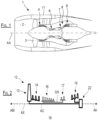
- the air is admitted into an inlet sleeve 2 to pass through a fan 3 comprising a series of rotating blades before splitting into a central primary flow and a secondary flow surrounding the primary flow.
- the primary flow is then compressed in compression stages 4 and 6 before arriving in a combustion chamber 7, after which it is expanded through a high pressure turbine 8 and a low pressure turbine 9 before being evacuated towards the 'back.
- the secondary flow is propelled directly backwards by the fan in a vein delimited by the casing 11.
- Such a double-body type engine comprises a so-called low-pressure body by which the fan 3 is coupled to the low-pressure turbine, and a so-called high-pressure body by which the compressor is coupled to the high-pressure turbine, these two bodies being coaxial and independent of each other in rotation.
- the low pressure turbine turns faster than the fan it drives, in order to increase efficiency.
- the low pressure body comprises a central fan drive shaft and a rotor carrying the low pressure turbine while being linked to the central shaft by the reduction gear.
- the high pressure and low pressure bodies are held by bearings carried by structural elements of the engine.
- the low pressure body is a critical element of the arrangement, because its central shaft extends substantially over the entire length of the motor, so that in service, that is to say when it rotates, it may be subject to vibrational modes likely to lead to engine failure.
- the first mode of vibration in flexion of the central shaft is found to be in its operating range, that is to say in the frequency range corresponding to its rotation frequencies.
- Such bearings comprise a fixed flexible cage carrying a bearing receiving the low pressure body, and around which a hydraulic pressure is maintained, this type of bearing being expensive to install. artwork.
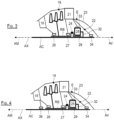
- the invention also relates to a turbojet thus defined, in which the downstream shaft bearing is carried by the exhaust casing while being located downstream of the reduction gear.
- the invention also relates to a turbojet engine thus defined, comprising a low pressure middle bearing carried by the inter-turbine casing and guiding the central shaft in rotation.
- the invention also relates to a turbojet engine thus defined, comprising an outlet cone carried by the exhaust casing, and in which the downstream shaft bearing is located in an internal space of the outlet cone.
- the invention also relates to a turbojet thus defined, in which the reduction gear is located inside the internal space.
- the invention also relates to a turbojet engine thus defined, in which the low pressure rotor is equipped with a radially flexible element located between the downstream rotor bearing and the reduction gear.
- the invention also relates to a turbojet thus defined, comprising a low pressure compressor driven by the central shaft being located between the fan and the high pressure compressor.
- the engine according to the invention has an architecture comprising a fan 13 at its upstream part AM followed by a low pressure compressor 14.
- the fan and the low pressure compressor are driven in rotation by a central shaft AC extending over the essential of the length of the engine, the fan being crossed by the entire flow entering this engine.
- the upstream AM and downstream AV directions are defined in relation to the direction of flow in the engine along its longitudinal axis AX, in accordance with usual conventions.
- a high pressure compressor 16 located immediately downstream AV of the compressor 14 compresses the fluid of the primary flow having passed through the low pressure compressor, before its admission into a combustion chamber not shown located immediately downstream of this high pressure compressor 16.
- the fluid After passing through the combustion chamber, the fluid is expanded through a high pressure turbine 17 which drives the compressor 16.
- the blades of the high pressure compressor 16 and the high pressure turbine 17 are carried by the same high pressure body CH or are integral part of it.
- This high pressure body CH extends in the central region of the motor along the axis AX, it surrounds the central shaft AC while being completely independent in rotation from it.
- the fluid After passing through the high pressure turbine 17, the fluid passes through an inter-turbine casing marked 18 on the Figure 3 , before passing through a low pressure turbine 19, to then be evacuated through an exhaust casing 21.
- the inter-turbine casing 18 comprises a concentric external shroud and an internal shroud delimiting between them an annular space for passage of the primary flow, as well as a set of fixed radial blades each connecting the external shroud to the internal shroud and making it possible to untwist the primary flow.
- the exhaust casing 21 comprises a concentric external shroud and an internal shroud delimiting an annular space for the passage of the relaxed primary flow, as well as a set of fixed radial arms each connecting these two shrouds to each other. other.
- the low pressure turbine 19 is linked in rotation to the central shaft by an epicyclic gearbox 22 located downstream of it AV, and thanks to which it rotates faster than the fan 13, in order to improve the efficiency of the engine.
- the exhaust casing 21 carries an outlet cone 23 which closes the downstream region of the engine located radially inside the primary vein, this outlet cone 23 extending downstream.
- the reducer 22 is located inside an internal space E delimited by the exhaust casing 21 and by the outlet cone 23 extending this casing 21, being connected to the central shaft AC and to a rotor RB carrying the low pressure turbine.
- This rotor RB which surrounds the central shaft AC extends from a middle part through which it carries the discs or blades of the low pressure turbine, to a downstream part through which it is coupled to the reduction gear.
- This rotor RB comprises in its central region, a radially flexible element 24.
- This flexible element 24 is flexible in the radial direction to allow eccentricity of the upstream part of the rotor RB relative to its downstream part while ensuring torque transmission from one part to the other.
- the low pressure rotor RB is held and guided in rotation by an upstream bearing 26 located upstream of the low pressure turbine 19 and by a downstream bearing 27 located between this low pressure turbine 19 and the radially flexible element 24.
- the upstream bearing rotor 26 is carried by the inter-turbine casing 18, and the downstream rotor bearing 27 is carried by the exhaust casing 21.
- At least one of the two rotor bearings 26 and 27 is a thrust bearing, c that is to say recovering the axial thrust force generated by the low pressure turbine to transfer it to the engine structure.
- This reduction gear comprises satellite pinions 28 surrounding an internal ring gear 29, also called solar ring gear, and surrounded by an external ring gear 33, each being meshed with these two ring gears, these pinions 28 being carried by a satellite carrier 32.
- the reduction gear which is marked by 22 is of the epicyclic type, that is to say that the satellite carrier 32 is movable in rotation while being rigidly attached to the central shaft AC.
- the internal crown 29 is for its part rigidly secured to the low pressure rotor RB while the external crown 33 is rigidly secured to the exhaust casing 21 by being carried by the latter.
- the central shaft AC is carried and guided in rotation by an upstream bearing not visible on the Figure 3 and located in the upstream part of the engine, and by a downstream central shaft bearing 34 which is located downstream of the reduction gear 22, being carried by the exhaust casing 21. As visible in the figures, the downstream bearing 34 is located in an internal space E of the exit cone 23.
- the maintenance of the central shaft AC can be improved by providing a low pressure middle bearing 36, as shown in the Figure 4 , this middle bearing being carried by the inter-turbine casing 18 and receiving the central shaft AC to support its middle region.
- This middle bearing 36 makes it possible to increase the support of the central shaft AC to further reduce the frequencies of its vibration modes.
- FIGS. 5 and 6 show embodiments having respectively the same architectures as in the figures 3 and 4 , but in which the gearbox, marked 22', is a planetary gearbox and not an epicyclic gearbox.
- This planetary gearbox 22' also includes satellite pinions 28 surrounding an internal ring gear 29 and surrounded by an external ring gear 33, each being meshed with these two ring gears, these pinions 28 being carried by a satellite carrier 32'.
- the satellite carrier identified by 32', is fixed by being carried by the exhaust casing 21, and the external ring 33 is movable by being rigidly attached to the central shaft AC.
- the internal crown 29 is carried by the low pressure rotor RB, as in the embodiments of the figures 3 and 4 .
- the central shaft is held by a non-visible upstream bearing and by the downstream bearing 34
- this AC shaft is held by the downstream bearing 34 and also by a low pressure middle bearing, these two bearings having the same arrangement as in the examples of figures 3 and 4 already described.
- the downstream bearing of the central shaft 34 is a fixed bearing carried by the exhaust casing 21 while being located downstream of the reduction gear 22 or 22'.
- the downstream shaft bearing, marked 34' can be an inter-shaft bearing, which surrounds the shaft AC to maintain and guide it in rotation, by being surrounded by the rotor RB, and by being located downstream of the downstream rotor bearing 27. In this configuration, the downstream portion of the central shaft AC is thus maintained via the low pressure rotor RB, and not directly by the exhaust casing 21.
- the invention makes it possible to eliminate additional bearings usually provided to support the central shaft with the aim of moving the natural frequencies of this shaft outside of its rotational frequencies. It thus makes it possible to limit the implementation of complex bearings such as SFD bearings, and to reduce the balancing precision required for the central shaft.
Landscapes
- Engineering & Computer Science (AREA)
- Chemical & Material Sciences (AREA)
- Combustion & Propulsion (AREA)
- Mechanical Engineering (AREA)
- General Engineering & Computer Science (AREA)
- Retarders (AREA)
- Structures Of Non-Positive Displacement Pumps (AREA)
- Supercharger (AREA)
- Turbine Rotor Nozzle Sealing (AREA)
Description
- L'invention concerne un agencement de turboréacteur double corps intégrant un réducteur épicycloidal ou planétaire.
- Dans un tel moteur 1 représenté sur la
figure 1 , l'air est admis dans une manche d'entrée 2 pour traverser une soufflante 3 comportant une série de pales rotatives avant de se scinder en un flux primaire central et un flux secondaire entourant le flux primaire. - Le flux primaire est ensuite compressé dans des étages de compression 4 et 6 avant d'arriver dans une chambre de combustion 7, après quoi il est détendu à travers une turbine haute pression 8 et une turbine basse pression 9 avant d'être évacué vers l'arrière. Le flux secondaire est quant à lui propulsé directement vers l'arrière par la soufflante dans une veine délimitée par le carter 11.
- Un tel moteur de type double-corps comporte un corps dit basse pression par lequel la soufflante 3 est couplée à la turbine basse pression, et un corps dit haute pression par lequel le compresseur est couplé à la turbine haute pression, ces deux corps étant coaxiaux et indépendants l'un de l'autre en rotation.
- Grâce à un réducteur interposé entre la turbine basse pression et la soufflante, la turbine basse pression tourne plus vite que la soufflante qu'elle entraîne, afin d'accroître le rendement. Dans cette configuration, le corps basse pression comporte un arbre central d'entrainement de la soufflante et un rotor portant la turbine basse pression en étant lié à l'arbre central par le réducteur.
- Les corps haute pression et basse pression sont maintenus par des paliers portés par des éléments structuraux du moteur. En pratique, le corps basse pression est un élément critique de l'agencement, car son arbre central s'étend sensiblement sur toute la longueur du moteur, de sorte qu'en service, c'est-à-dire lorsqu'il tourne, il peut être sujet à des modes vibratoires susceptibles de conduire à la ruine du moteur. En particulier, du fait de sa longueur importante, le premier mode de vibration en flexion de l'arbre central se trouve être dans sa plage de fonctionnement, c'est-à-dire dans la plage de fréquences correspondant à ses fréquences de rotation.
- Cette situation nécessite de réaliser un équilibrage à grande vitesse de l'arbre central, mais également de prévoir des paliers capables d'amortir ses modes vibratoires pour limiter les éventuelles instabilités. De tels paliers, généralement désignés par l'acronyme SFD signifiant « squeeze film dampers » comportent une cage souple fixe portant un roulement recevant le corps basse pression, et autour de laquelle est maintenue une pression hydraulique, ce type de palier étant coûteux à mettre en oeuvre.
- Les documents
EP2199568A2 ,US3673802A etUS2013/287575A1 divulguent des turboréacteurs selon l'art antérieur. Le but de l'invention est d'apporter des solutions d'agencement permettant d'améliorer le maintien des éléments rotatifs basse pression pour limiter le recours à des paliers complexes d'amortissement de modes vibratoires. - A cet effet, l'invention a pour objet un turboréacteur à double flux comportant un arbre central entouré par un corps haute pression coaxiaux et indépendants en rotation, ce turboréacteur comportant depuis l'amont vers l'aval considérés selon le sens de circulation du flux qui le traverse lorsqu'il est en service :
- une soufflante entraînée par l'arbre central ;
- un compresseur haute pression et une turbine haute pression faisant partie du corps haute pression ;
- un carter inter-turbines ;
- une turbine basse pression ;
- un carter d'échappement ;
- un rotor basse pression qui entoure l'arbre central et qui comprend la turbine basse pression ;
- un palier amont de rotor porté par le carter inter-turbines et qui guide en rotation le rotor basse pression en étant situé en aval du compresseur haute pression ;
- un palier aval de rotor porté par le carter d'échappement, et qui guide en rotation le rotor basse pression ;
- un réducteur par l'intermédiaire duquel le rotor basse pression entraine l'arbre central, ce réducteur étant situé en aval du palier aval de rotor ;
- un palier aval d'arbre qui guide en rotation l'arbre central en étant situé en aval du palier aval de rotor.
- Avec cet agencement, la vitesse de l'arbre central est abaissée et sa longueur est augmentée grâce au palier d'arbre situé en aval, ce qui contribue à diminuer les fréquences de ses modes propres pour les éloigner des fréquences de rotation. L'abaissement de cette vitesse permet également d'augmenter le diamètre de soufflante sans que la vitesse en extrémité des pales de cette soufflante ne soit excessive.
- L'invention concerne également un turboréacteur ainsi défini, dans lequel le palier aval d'arbre est porté par le carter d'échappement en étant situé en aval du réducteur.
- L'invention concerne également un turboréacteur ainsi défini, comprenant un palier médian basse pression porté par le carter inter-turbines et guidant en rotation l'arbre central.
- L'invention concerne également un turboréacteur ainsi défini, comprenant un cône de sortie porté par le carter d'échappement, et dans lequel le palier aval d'arbre est situé dans un espace interne du cône de sortie.
- L'invention concerne également un turboréacteur ainsi défini, dans lequel le réducteur est situé à l'intérieur de l'espace interne.
- L'invention concerne également un turboréacteur ainsi défini, dans lequel le rotor basse pression est équipé d'un élément radialement flexible situé entre le palier aval de rotor et le réducteur.
- L'invention concerne également un turboréacteur ainsi défini, comportant un compresseur basse pression entraîné par l'arbre central en étant situé entre la soufflante et le compresseur haute pression.
- L'invention concerne également un turboréacteur ainsi défini, dans lequel le réducteur est un réducteur épicycloïdal comprenant :
- des satellites portés par un porte satellites qui est porté par l'arbre central ;
- une couronne interne qui est portée par le rotor basse pression ;
- une couronne externe qui est portée par le carter d'échappement ;
- chaque satellite étant engrené avec la couronne interne et la couronne externe.
- L'invention concerne également un turboréacteur ainsi défini, dans lequel le réducteur est un réducteur planétaire comprenant :
- des satellites portés par un porte satellites qui est porté par le carter d'échappement ;
- une couronne interne qui est portée par le rotor basse pression ;
- une couronne externe qui est portée par l'arbre central ;
- chaque satellite étant engrené avec la couronne interne et la couronne externe.
-
- [
Fig. 1 ] est une vue en coupe longitudinale d'un turboréacteur double flux et double corps connu ; - [
Fig. 2 ] est une vue schématique en coupe longitudinale d'une architecture de turboréacteur selon l'invention ; - [
Fig. 3 ] est une vue schématique en coupe longitudinale d'une portion aval d'architecture de turboréacteur selon un premier mode de réalisation de l'invention ; - [
Fig. 4 ] est une vue schématique en coupe longitudinale d'une portion aval d'architecture de turboréacteur selon un deuxième mode de réalisation de l'invention ; - [
Fig. 5 ] est une vue schématique en coupe longitudinale d'une portion aval d'architecture de turboréacteur selon un troisième mode de réalisation de l'invention ; - [
Fig. 6 ] est une vue schématique en coupe longitudinale d'une portion aval d'architecture de turboréacteur selon un quatrième mode de réalisation de l'invention ; - [
Fig. 7 ] est une vue schématique en coupe longitudinale d'une portion aval d'architecture de turboréacteur selon un cinquième mode de réalisation de l'invention. - Comme représenté schématiquement sur la
figure 2 , le moteur selon l'invention présente une architecture comprenant une soufflante 13 à sa partie amont AM suivie d'un compresseur basse pression 14. La soufflante et le compresseur basse pression sont entraînés en rotation par un arbre central AC s'étendant sur l'essentiel de la longueur du moteur, la soufflante étant traversée par l'ensemble du flux entrant dans ce moteur. - Les directions amont AM et aval AV sont définies par rapport au sens de circulation du flux dans le moteur le long de son axe longitudinal AX, conformément aux conventions usuelles.
- Un compresseur haute pression 16 situé immédiatement en aval AV du compresseur 14 comprime le fluide du flux primaire ayant traversé le compresseur basse pression, avant son admission dans une chambre de combustion non représentée située immédiatement en aval de ce compresseur haute pression 16.
- Après passage dans la chambre de combustion, le fluide est détendu à travers une turbine haute pression 17 qui entraine le compresseur 16. Les aubages du compresseur haute pression 16 et de la turbine haute pression 17 sont portés par un même corps haute pression CH ou font partie intégrante de celui-ci. Ce corps haute pression CH s'étend dans la région centrale du moteur le long de l'axe AX, il entoure l'arbre central AC en étant complètement indépendant en rotation de celui-ci.
- Après avoir traversé la turbine haute pression 17, le fluide transite dans un carter inter-turbines repéré par 18 sur la
figure 3 , avant de traverser une turbine basse pression 19, pour être ensuite évacué à travers un carter d'échappement 21. - Le carter inter-turbines 18 comporte une virole externe et une virole interne concentriques délimitant entre elles un espace annulaire de passage du flux primaire, ainsi qu'un ensemble de pales radiales fixes reliant chacune la virole externe à la virole interne et permettant de dévriller le flux primaire. De manière analogue, le carter d'échappement 21 comporte une virole externe et une virole interne concentriques délimitant un espace annulaire de passage du flux primaire détendu, ainsi qu'un ensemble de bras radiaux fixes reliant chacun ces deux viroles l'une à l'autre.
- La turbine basse pression 19 est liée en rotation à l'arbre central par un réducteur épicycloïdal 22 situé à son aval AV, et grâce auquel elle tourne plus vite que la soufflante 13, afin d'améliorer le rendement du moteur.
- Comme visible plus clairement sur la
figure 3 , le carter d'échappement 21 porte un cône de sortie 23 qui ferme la région aval du moteur située radialement à l'intérieur de la veine primaire, ce cône de sortie 23 s'étendant vers l'aval. - Le réducteur 22 est situé à l'intérieur d'un espace interne E délimité par le carter d'échappement 21 et par le cône de sortie 23 prolongeant ce carter 21, en étant relié à l'arbre central AC et à un rotor RB portant la turbine basse pression.
- Ce rotor RB qui entoure l'arbre central AC s'étend depuis une partie médiane par laquelle il porte les disques ou aubages de la turbine basse pression, jusqu'à une partie aval par laquelle il est accouplé au réducteur. Ce rotor RB comporte dans sa région centrale, un élément radialement flexible 24.
- Cet élément flexible 24 est souple selon la direction radiale pour autoriser une excentration de la partie amont du rotor RB par rapport à sa partie aval tout en assurant une transmission de couple d'une partie à l'autre.
- Comme visible sur la
figure 3 , le rotor basse pression RB est maintenu et guidé en rotation par un palier amont 26 situé en amont de la turbine basse pression 19 et par un palier aval 27 situé entre cette turbine basse pression 19 et l'élément radialement flexible 24. Le palier amont de rotor 26 est porté par le carter inter-turbines 18, et le palier aval de rotor 27 est porté par le carter d'échappement 21. Au moins l'un des deux paliers de rotor 26 et 27 est un palier de butée, c'est-à-dire récupérant l'effort axial de poussée généré par la turbine basse pression pour le transférer à la structure du moteur. - Ce réducteur comporte des pignons satellites 28 entourant une couronne interne 29, encore appelée couronne solaire, et entourés par une couronne externe 33 en étant chacun engrené avec ces deux couronnes, ces pignons 28 étant portés par un porte satellite 32.
- Dans le cas de la
figure 3 , le réducteur qui est repéré par 22 est de type épicycloïdal, c'est-à-dire que le porte satellites 32 est mobile en rotation en étant rigidement solidaire de l'arbre central AC. La couronne interne 29 est quant à elle rigidement solidaire du rotor basse pression RB alors que la couronne externe 33 est rigidement solidaire du carter d'échappement 21 en étant portée par celui-ci. - L'arbre central AC est porté et guidé en rotation par un palier amont non visible sur la
figure 3 et situé en partie amont du moteur, et par un palier aval d'arbre central 34 qui est situé en aval du réducteur 22, en étant porté par le carter d'échappement 21. Comme visible sur les figures, le palier aval 34 est situé dans un espace interne E du cône de sortie 23. - Le maintien de l'arbre central AC peut être amélioré en prévoyant un palier médian basse pression 36, comme représenté sur la
figure 4 , ce palier médian étant porté par le carter inter-turbines 18 et recevant l'arbre central AC pour supporter sa région médiane. L'ajout de ce palier médian 36 permet d'accroître le maintien de l'arbre central AC pour diminuer encore les fréquences de ses modes vibratoires. - Les exemples des
figures 5 et 6 montrent des modes de réalisation ayant respectivement les mêmes architectures que dans lesfigures 3 et 4 , mais dans lesquels le réducteur, repéré par 22', est un réducteur planétaire et non pas épicycloïdal. - Ce Réducteur planétaire 22' comporte aussi des pignons satellites 28 entourant une couronne interne 29 et entourés par une couronne externe 33 en étant chacun engrené avec ces deux couronnes, ces pignons 28 étant portés par un porte satellite 32'.
- Le porte satellites, repéré par 32', est fixe en étant porté par le carter d'échappement 21, et la couronne externe 33 est mobile en étant rigidement solidaire de l'arbre central AC. La couronne interne 29 est quant à elle portée par le rotor basse pression RB, comme dans les modes de réalisation des
figures 3 et 4 . - Ainsi, dans l'exemple de la
figure 5 , l'arbre central est maintenu par un palier amont non visible et par le palier aval 34, et dans l'exemple de lafigure 6 , cet arbre AC est maintenu par le palier aval 34 et également par un palier médian basse pression, ces deux paliers ayant le même agencement que dans les exemples desfigures 3 et 4 déjà décrites. - Dans les modes de réalisation des
figures 2 à 6 , le palier aval d'arbre central 34 est un palier fixe porté par le carter d'échappement 21 en étant situé en aval du réducteur 22 ou 22'. Complémentairement, ou alternativement comme représenté sur lafigure 7 , le palier aval d'arbre, repéré par 34', peut être un palier inter-arbres, qui entoure l'arbre AC pour le maintenir et le guidé en rotation, en étant entouré par le rotor RB, et en étant situé en aval du palier de rotor aval 27. Dans cette configuration, la portion aval de l'arbre central AC est ainsi maintenue par l'intermédiaire du rotor basse pression RB, et non pas directement par le carter d'échappement 21. - L'invention permet de supprimer des paliers additionnels usuellement prévus pour supporter l'arbre central dans le but de déplacer les fréquences propres de cet arbre hors de ses fréquences de rotation. Elle permet ainsi de limiter la mise en oeuvre de paliers complexes tels que les paliers SFD, et de réduire la précision d'équilibrage requise pour l'arbre central.
Claims (9)
- Turboréacteur à double flux comportant un arbre central (AC) entouré par un corps haute pression (CH) coaxiaux et indépendants en rotation, ce turboréacteur comportant depuis l'amont (AM) vers l'aval (AV) considérés selon le sens de circulation du flux qui le traverse lorsqu'il est en service :- une soufflante (13) entraînée par l'arbre central (AC) ;- un compresseur haute pression (16) et une turbine haute pression (17) faisant partie du corps haute pression (CH) ;- un carter inter-turbines (18) ;- une turbine basse pression (19) ;- un carter d'échappement (21) ;ce turboréacteur comportant en outre :- un rotor basse pression (RB) qui entoure l'arbre central (AC) et qui comprend la turbine basse pression (19) ;- un palier amont de rotor (26) porté par le carter inter-turbines (18) et qui guide en rotation le rotor basse pression (RB) en étant situé en aval du compresseur haute pression (16) ;- un palier aval de rotor (27) porté par le carter d'échappement (21), et qui guide en rotation le rotor basse pression (RB) ;- un réducteur (22, 22') par l'intermédiaire duquel le rotor basse pression (RB) entraine l'arbre central (AC), ce réducteur étant situé en aval du palier aval de rotor (27) ;- un palier aval d'arbre (34, 34') qui guide en rotation l'arbre central (AC) en étant situé en aval du palier aval de rotor (27).
- Turboréacteur selon la revendication 1, dans lequel le palier aval d'arbre (34) est porté par le carter d'échappement (21) en étant situé en aval du réducteur (22, 22').
- Turboréacteur selon la revendication 1 ou 2, comprenant un palier médian basse pression (36) porté par le carter inter-turbines (18) et recevant l'arbre central (AC).
- Turboréacteur selon l'une des revendications précédentes, comprenant un cône de sortie (23) porté par le carter d'échappement (21), et dans lequel le palier aval d'arbre (34) est situé dans un espace interne (E) du cône de sortie (23).
- Turboréacteur selon la revendication 4, dans lequel le réducteur (22, 22') est situé à l'intérieur de l'espace interne (E) du cône de sortie (23).
- Turboréacteur selon l'une des revendications précédentes, dans lequel le rotor basse pression (RB) est équipé d'un élément radialement flexible (24) situé entre le palier aval de rotor (27) et le réducteur (22).
- Turboréacteur selon l'une des revendications précédentes, comportant un compresseur basse pression (14) entraîné par l'arbre central (AC) en étant situé entre la soufflante (13) et le compresseur haute pression (16).
- Turboréacteur selon l'une des revendications précédentes, dans lequel le réducteur (22) est un réducteur épicycloïdal comprenant :- des satellites (28) portés par un porte satellites (32) qui est porté par l'arbre central (AC) ;- une couronne interne (29) qui est portée par le rotor basse pression (RB) ;- une couronne externe (33) qui est portée par le carter d'échappement (21) ;- chaque satellite (28) étant engrené avec la couronne interne (29) et la couronne externe (33).
- Turboréacteur selon l'une des revendications 1 à 8, dans lequel le réducteur (22') est un réducteur planétaire comprenant :- des satellites (28) portés par un porte satellites (32') qui est porté par le carter d'échappement (21) ;- une couronne interne (29) qui est portée par le rotor basse pression (RB) ;- une couronne externe (33) qui est portée par l'arbre central (AC) ;- chaque satellite (28) étant engrené avec la couronne interne (29) et la couronne externe (33).
Applications Claiming Priority (2)
| Application Number | Priority Date | Filing Date | Title |
|---|---|---|---|
| FR1871931A FR3088967B1 (fr) | 2018-11-27 | 2018-11-27 | Agencement de turboréacteur double flux à réducteur épicycloïdal ou planétaire |
| PCT/FR2019/052774 WO2020109702A1 (fr) | 2018-11-27 | 2019-11-21 | Agencement de turboréacteur double flux à réducteur épicycloïdal ou planétaire |
Publications (2)
| Publication Number | Publication Date |
|---|---|
| EP3864271A1 EP3864271A1 (fr) | 2021-08-18 |
| EP3864271B1 true EP3864271B1 (fr) | 2024-03-27 |
Family
ID=65861466
Family Applications (1)
| Application Number | Title | Priority Date | Filing Date |
|---|---|---|---|
| EP19835454.0A Active EP3864271B1 (fr) | 2018-11-27 | 2019-11-21 | Agencement de turboréacteur double flux à réducteur épicycloïdal ou planétaire |
Country Status (6)
| Country | Link |
|---|---|
| US (1) | US11698029B2 (fr) |
| EP (1) | EP3864271B1 (fr) |
| CN (1) | CN113167174B (fr) |
| CA (1) | CA3120209A1 (fr) |
| FR (1) | FR3088967B1 (fr) |
| WO (1) | WO2020109702A1 (fr) |
Family Cites Families (11)
| Publication number | Priority date | Publication date | Assignee | Title |
|---|---|---|---|---|
| US3673802A (en) * | 1970-06-18 | 1972-07-04 | Gen Electric | Fan engine with counter rotating geared core booster |
| US8191352B2 (en) * | 2008-12-19 | 2012-06-05 | General Electric Company | Geared differential speed counter-rotatable low pressure turbine |
| US20130138082A1 (en) | 2010-03-24 | 2013-05-30 | Amr Salahieh | Intravascular Tissue Disruption |
| US9631558B2 (en) | 2012-01-03 | 2017-04-25 | United Technologies Corporation | Geared architecture for high speed and small volume fan drive turbine |
| US20130192191A1 (en) * | 2012-01-31 | 2013-08-01 | Frederick M. Schwarz | Gas turbine engine with high speed low pressure turbine section and bearing support features |
| US20130192265A1 (en) * | 2012-01-31 | 2013-08-01 | Frederick M. Schwarz | Gas turbine engine with high speed low pressure turbine section and bearing support features |
| US20160053631A1 (en) * | 2012-11-14 | 2016-02-25 | United Technologies Corporation | Gas turbine engine with mount for low pressure turbine section |
| WO2014151176A1 (fr) * | 2013-03-15 | 2014-09-25 | United Technologies Corporation | Agencement de paliers de moteur à double flux |
| WO2014151785A1 (fr) * | 2013-03-15 | 2014-09-25 | United Technologies Corporation | Agencement paliers et boîtier de transmission de réacteur à double flux |
| US20150176484A1 (en) * | 2013-12-23 | 2015-06-25 | United Technologies Corporation | Geared turbofan with a gearbox aft of a fan drive turbine |
| GB201704502D0 (en) * | 2017-03-22 | 2017-05-03 | Rolls Royce Plc | Gas turbine engine |
-
2018
- 2018-11-27 FR FR1871931A patent/FR3088967B1/fr active Active
-
2019
- 2019-11-21 CA CA3120209A patent/CA3120209A1/fr active Pending
- 2019-11-21 WO PCT/FR2019/052774 patent/WO2020109702A1/fr not_active Ceased
- 2019-11-21 US US17/294,543 patent/US11698029B2/en active Active
- 2019-11-21 CN CN201980075805.3A patent/CN113167174B/zh active Active
- 2019-11-21 EP EP19835454.0A patent/EP3864271B1/fr active Active
Also Published As
| Publication number | Publication date |
|---|---|
| EP3864271A1 (fr) | 2021-08-18 |
| US11698029B2 (en) | 2023-07-11 |
| WO2020109702A1 (fr) | 2020-06-04 |
| FR3088967A1 (fr) | 2020-05-29 |
| CA3120209A1 (fr) | 2020-06-04 |
| CN113167174B (zh) | 2024-05-14 |
| FR3088967B1 (fr) | 2020-11-06 |
| US20220025821A1 (en) | 2022-01-27 |
| CN113167174A (zh) | 2021-07-23 |
Similar Documents
| Publication | Publication Date | Title |
|---|---|---|
| FR2950381A1 (fr) | Turbomachine a helices non carenees contrarotatives | |
| EP4073366B1 (fr) | Système propulsif aéronautique à faible débit de fuite et rendement propulsif amélioré | |
| EP3673164B2 (fr) | Turboréacteur à double corps ayant un palier de butée d'arbre basse pression positionné dans le carter d'échappement | |
| EP4073369A1 (fr) | Système propulsif aéronautique à rendement propulsif amélioré | |
| EP4308794A1 (fr) | Module de soufflante equipe d'un dispositif de transfert d'huile | |
| EP3864272B1 (fr) | Agencement de turboréacteur double flux à réducteur épicycloïdal ou planétaire | |
| EP4073371B1 (fr) | Système propulsif aéronautique à faible débit de fuite et rendement propulsif amélioré | |
| EP1181438B1 (fr) | Turbomachine radiale | |
| EP3587245B1 (fr) | Groupe propulseur d'aeronef comprenant un assemblage d'au moins deux arbres coaxiaux, l'un etant relie a la soufflante et l'autre a l'ensemble d'aubes fixes | |
| EP3864273B1 (fr) | Agencement de turboréacteur double flux à réducteur épicycloïdal ou planétaire | |
| WO2020109705A1 (fr) | Turboréacteur à double flux comprenant un cône de sortie refroidi par son flux secondaire | |
| EP3580432B1 (fr) | Turboréacteur à architecture de paliers optimisée pour le support d'un arbre basse pression | |
| EP3864271B1 (fr) | Agencement de turboréacteur double flux à réducteur épicycloïdal ou planétaire | |
| FR3021296A1 (fr) | Ensemble de propulsion a doublet d'helices pour aeronef | |
| EP4073356B1 (fr) | Turbomachine à turbine contrarotative pour un aéronef | |
| FR3104644A1 (fr) | Système propulsif aéronautique à rendement propulsif amélioré | |
| WO2026062350A1 (fr) | Turbomachine d'aéronef à double corps et à au moins deux flux | |
| FR3144198A1 (fr) | Maîtrise du comportement dynamique de l’arbre d’entrainement de la soufflante d’un système propulsif aéronautique | |
| FR3144201A1 (fr) | Maîtrise du comportement dynamique de l’arbre d’entrainement d’une soufflante d’un système propulsif aéronautique | |
| WO2024121463A1 (fr) | Ensemble propulsif pour un aéronef | |
| WO2022079378A1 (fr) | Système propulsif aéronautique ayant un rendement propulsif amélioré | |
| FR3126017A1 (fr) | Module de soufflante a pales a calage variable |
Legal Events
| Date | Code | Title | Description |
|---|---|---|---|
| STAA | Information on the status of an ep patent application or granted ep patent |
Free format text: STATUS: UNKNOWN |
|
| STAA | Information on the status of an ep patent application or granted ep patent |
Free format text: STATUS: THE INTERNATIONAL PUBLICATION HAS BEEN MADE |
|
| PUAI | Public reference made under article 153(3) epc to a published international application that has entered the european phase |
Free format text: ORIGINAL CODE: 0009012 |
|
| STAA | Information on the status of an ep patent application or granted ep patent |
Free format text: STATUS: REQUEST FOR EXAMINATION WAS MADE |
|
| 17P | Request for examination filed |
Effective date: 20210512 |
|
| AK | Designated contracting states |
Kind code of ref document: A1 Designated state(s): AL AT BE BG CH CY CZ DE DK EE ES FI FR GB GR HR HU IE IS IT LI LT LU LV MC MK MT NL NO PL PT RO RS SE SI SK SM TR |
|
| DAV | Request for validation of the european patent (deleted) | ||
| DAX | Request for extension of the european patent (deleted) | ||
| GRAP | Despatch of communication of intention to grant a patent |
Free format text: ORIGINAL CODE: EPIDOSNIGR1 |
|
| STAA | Information on the status of an ep patent application or granted ep patent |
Free format text: STATUS: GRANT OF PATENT IS INTENDED |
|
| INTG | Intention to grant announced |
Effective date: 20231109 |
|
| GRAS | Grant fee paid |
Free format text: ORIGINAL CODE: EPIDOSNIGR3 |
|
| GRAA | (expected) grant |
Free format text: ORIGINAL CODE: 0009210 |
|
| STAA | Information on the status of an ep patent application or granted ep patent |
Free format text: STATUS: THE PATENT HAS BEEN GRANTED |
|
| AK | Designated contracting states |
Kind code of ref document: B1 Designated state(s): AL AT BE BG CH CY CZ DE DK EE ES FI FR GB GR HR HU IE IS IT LI LT LU LV MC MK MT NL NO PL PT RO RS SE SI SK SM TR |
|
| REG | Reference to a national code |
Ref country code: GB Ref legal event code: FG4D Free format text: NOT ENGLISH |
|
| REG | Reference to a national code |
Ref country code: CH Ref legal event code: EP |
|
| REG | Reference to a national code |
Ref country code: DE Ref legal event code: R096 Ref document number: 602019049151 Country of ref document: DE |
|
| REG | Reference to a national code |
Ref country code: IE Ref legal event code: FG4D Free format text: LANGUAGE OF EP DOCUMENT: FRENCH |
|
| PG25 | Lapsed in a contracting state [announced via postgrant information from national office to epo] |
Ref country code: LT Free format text: LAPSE BECAUSE OF FAILURE TO SUBMIT A TRANSLATION OF THE DESCRIPTION OR TO PAY THE FEE WITHIN THE PRESCRIBED TIME-LIMIT Effective date: 20240327 |
|
| REG | Reference to a national code |
Ref country code: LT Ref legal event code: MG9D |
|
| PG25 | Lapsed in a contracting state [announced via postgrant information from national office to epo] |
Ref country code: GR Free format text: LAPSE BECAUSE OF FAILURE TO SUBMIT A TRANSLATION OF THE DESCRIPTION OR TO PAY THE FEE WITHIN THE PRESCRIBED TIME-LIMIT Effective date: 20240628 |
|
| PG25 | Lapsed in a contracting state [announced via postgrant information from national office to epo] |
Ref country code: RS Free format text: LAPSE BECAUSE OF FAILURE TO SUBMIT A TRANSLATION OF THE DESCRIPTION OR TO PAY THE FEE WITHIN THE PRESCRIBED TIME-LIMIT Effective date: 20240627 Ref country code: HR Free format text: LAPSE BECAUSE OF FAILURE TO SUBMIT A TRANSLATION OF THE DESCRIPTION OR TO PAY THE FEE WITHIN THE PRESCRIBED TIME-LIMIT Effective date: 20240327 |
|
| PG25 | Lapsed in a contracting state [announced via postgrant information from national office to epo] |
Ref country code: RS Free format text: LAPSE BECAUSE OF FAILURE TO SUBMIT A TRANSLATION OF THE DESCRIPTION OR TO PAY THE FEE WITHIN THE PRESCRIBED TIME-LIMIT Effective date: 20240627 Ref country code: NO Free format text: LAPSE BECAUSE OF FAILURE TO SUBMIT A TRANSLATION OF THE DESCRIPTION OR TO PAY THE FEE WITHIN THE PRESCRIBED TIME-LIMIT Effective date: 20240627 Ref country code: LT Free format text: LAPSE BECAUSE OF FAILURE TO SUBMIT A TRANSLATION OF THE DESCRIPTION OR TO PAY THE FEE WITHIN THE PRESCRIBED TIME-LIMIT Effective date: 20240327 Ref country code: HR Free format text: LAPSE BECAUSE OF FAILURE TO SUBMIT A TRANSLATION OF THE DESCRIPTION OR TO PAY THE FEE WITHIN THE PRESCRIBED TIME-LIMIT Effective date: 20240327 Ref country code: GR Free format text: LAPSE BECAUSE OF FAILURE TO SUBMIT A TRANSLATION OF THE DESCRIPTION OR TO PAY THE FEE WITHIN THE PRESCRIBED TIME-LIMIT Effective date: 20240628 Ref country code: FI Free format text: LAPSE BECAUSE OF FAILURE TO SUBMIT A TRANSLATION OF THE DESCRIPTION OR TO PAY THE FEE WITHIN THE PRESCRIBED TIME-LIMIT Effective date: 20240327 Ref country code: BG Free format text: LAPSE BECAUSE OF FAILURE TO SUBMIT A TRANSLATION OF THE DESCRIPTION OR TO PAY THE FEE WITHIN THE PRESCRIBED TIME-LIMIT Effective date: 20240327 |
|
| REG | Reference to a national code |
Ref country code: NL Ref legal event code: MP Effective date: 20240327 |
|
| PG25 | Lapsed in a contracting state [announced via postgrant information from national office to epo] |
Ref country code: SE Free format text: LAPSE BECAUSE OF FAILURE TO SUBMIT A TRANSLATION OF THE DESCRIPTION OR TO PAY THE FEE WITHIN THE PRESCRIBED TIME-LIMIT Effective date: 20240327 Ref country code: LV Free format text: LAPSE BECAUSE OF FAILURE TO SUBMIT A TRANSLATION OF THE DESCRIPTION OR TO PAY THE FEE WITHIN THE PRESCRIBED TIME-LIMIT Effective date: 20240327 |
|
| PG25 | Lapsed in a contracting state [announced via postgrant information from national office to epo] |
Ref country code: NL Free format text: LAPSE BECAUSE OF FAILURE TO SUBMIT A TRANSLATION OF THE DESCRIPTION OR TO PAY THE FEE WITHIN THE PRESCRIBED TIME-LIMIT Effective date: 20240327 |
|
| REG | Reference to a national code |
Ref country code: AT Ref legal event code: MK05 Ref document number: 1670116 Country of ref document: AT Kind code of ref document: T Effective date: 20240327 |
|
| PG25 | Lapsed in a contracting state [announced via postgrant information from national office to epo] |
Ref country code: NL Free format text: LAPSE BECAUSE OF FAILURE TO SUBMIT A TRANSLATION OF THE DESCRIPTION OR TO PAY THE FEE WITHIN THE PRESCRIBED TIME-LIMIT Effective date: 20240327 |
|
| PG25 | Lapsed in a contracting state [announced via postgrant information from national office to epo] |
Ref country code: IS Free format text: LAPSE BECAUSE OF FAILURE TO SUBMIT A TRANSLATION OF THE DESCRIPTION OR TO PAY THE FEE WITHIN THE PRESCRIBED TIME-LIMIT Effective date: 20240727 |
|
| PG25 | Lapsed in a contracting state [announced via postgrant information from national office to epo] |
Ref country code: PT Free format text: LAPSE BECAUSE OF FAILURE TO SUBMIT A TRANSLATION OF THE DESCRIPTION OR TO PAY THE FEE WITHIN THE PRESCRIBED TIME-LIMIT Effective date: 20240729 Ref country code: SM Free format text: LAPSE BECAUSE OF FAILURE TO SUBMIT A TRANSLATION OF THE DESCRIPTION OR TO PAY THE FEE WITHIN THE PRESCRIBED TIME-LIMIT Effective date: 20240327 |
|
| PG25 | Lapsed in a contracting state [announced via postgrant information from national office to epo] |
Ref country code: ES Free format text: LAPSE BECAUSE OF FAILURE TO SUBMIT A TRANSLATION OF THE DESCRIPTION OR TO PAY THE FEE WITHIN THE PRESCRIBED TIME-LIMIT Effective date: 20240327 |
|
| PG25 | Lapsed in a contracting state [announced via postgrant information from national office to epo] |
Ref country code: CZ Free format text: LAPSE BECAUSE OF FAILURE TO SUBMIT A TRANSLATION OF THE DESCRIPTION OR TO PAY THE FEE WITHIN THE PRESCRIBED TIME-LIMIT Effective date: 20240327 Ref country code: EE Free format text: LAPSE BECAUSE OF FAILURE TO SUBMIT A TRANSLATION OF THE DESCRIPTION OR TO PAY THE FEE WITHIN THE PRESCRIBED TIME-LIMIT Effective date: 20240327 |
|
| PG25 | Lapsed in a contracting state [announced via postgrant information from national office to epo] |
Ref country code: AT Free format text: LAPSE BECAUSE OF FAILURE TO SUBMIT A TRANSLATION OF THE DESCRIPTION OR TO PAY THE FEE WITHIN THE PRESCRIBED TIME-LIMIT Effective date: 20240327 |
|
| PG25 | Lapsed in a contracting state [announced via postgrant information from national office to epo] |
Ref country code: PL Free format text: LAPSE BECAUSE OF FAILURE TO SUBMIT A TRANSLATION OF THE DESCRIPTION OR TO PAY THE FEE WITHIN THE PRESCRIBED TIME-LIMIT Effective date: 20240327 |
|
| PG25 | Lapsed in a contracting state [announced via postgrant information from national office to epo] |
Ref country code: SK Free format text: LAPSE BECAUSE OF FAILURE TO SUBMIT A TRANSLATION OF THE DESCRIPTION OR TO PAY THE FEE WITHIN THE PRESCRIBED TIME-LIMIT Effective date: 20240327 |
|
| PG25 | Lapsed in a contracting state [announced via postgrant information from national office to epo] |
Ref country code: SM Free format text: LAPSE BECAUSE OF FAILURE TO SUBMIT A TRANSLATION OF THE DESCRIPTION OR TO PAY THE FEE WITHIN THE PRESCRIBED TIME-LIMIT Effective date: 20240327 Ref country code: SK Free format text: LAPSE BECAUSE OF FAILURE TO SUBMIT A TRANSLATION OF THE DESCRIPTION OR TO PAY THE FEE WITHIN THE PRESCRIBED TIME-LIMIT Effective date: 20240327 Ref country code: RO Free format text: LAPSE BECAUSE OF FAILURE TO SUBMIT A TRANSLATION OF THE DESCRIPTION OR TO PAY THE FEE WITHIN THE PRESCRIBED TIME-LIMIT Effective date: 20240327 Ref country code: PT Free format text: LAPSE BECAUSE OF FAILURE TO SUBMIT A TRANSLATION OF THE DESCRIPTION OR TO PAY THE FEE WITHIN THE PRESCRIBED TIME-LIMIT Effective date: 20240729 Ref country code: PL Free format text: LAPSE BECAUSE OF FAILURE TO SUBMIT A TRANSLATION OF THE DESCRIPTION OR TO PAY THE FEE WITHIN THE PRESCRIBED TIME-LIMIT Effective date: 20240327 Ref country code: IS Free format text: LAPSE BECAUSE OF FAILURE TO SUBMIT A TRANSLATION OF THE DESCRIPTION OR TO PAY THE FEE WITHIN THE PRESCRIBED TIME-LIMIT Effective date: 20240727 Ref country code: ES Free format text: LAPSE BECAUSE OF FAILURE TO SUBMIT A TRANSLATION OF THE DESCRIPTION OR TO PAY THE FEE WITHIN THE PRESCRIBED TIME-LIMIT Effective date: 20240327 Ref country code: EE Free format text: LAPSE BECAUSE OF FAILURE TO SUBMIT A TRANSLATION OF THE DESCRIPTION OR TO PAY THE FEE WITHIN THE PRESCRIBED TIME-LIMIT Effective date: 20240327 Ref country code: CZ Free format text: LAPSE BECAUSE OF FAILURE TO SUBMIT A TRANSLATION OF THE DESCRIPTION OR TO PAY THE FEE WITHIN THE PRESCRIBED TIME-LIMIT Effective date: 20240327 Ref country code: AT Free format text: LAPSE BECAUSE OF FAILURE TO SUBMIT A TRANSLATION OF THE DESCRIPTION OR TO PAY THE FEE WITHIN THE PRESCRIBED TIME-LIMIT Effective date: 20240327 |
|
| PG25 | Lapsed in a contracting state [announced via postgrant information from national office to epo] |
Ref country code: IT Free format text: LAPSE BECAUSE OF FAILURE TO SUBMIT A TRANSLATION OF THE DESCRIPTION OR TO PAY THE FEE WITHIN THE PRESCRIBED TIME-LIMIT Effective date: 20240327 |
|
| PG25 | Lapsed in a contracting state [announced via postgrant information from national office to epo] |
Ref country code: IT Free format text: LAPSE BECAUSE OF FAILURE TO SUBMIT A TRANSLATION OF THE DESCRIPTION OR TO PAY THE FEE WITHIN THE PRESCRIBED TIME-LIMIT Effective date: 20240327 |
|
| REG | Reference to a national code |
Ref country code: DE Ref legal event code: R097 Ref document number: 602019049151 Country of ref document: DE |
|
| PG25 | Lapsed in a contracting state [announced via postgrant information from national office to epo] |
Ref country code: DK Free format text: LAPSE BECAUSE OF FAILURE TO SUBMIT A TRANSLATION OF THE DESCRIPTION OR TO PAY THE FEE WITHIN THE PRESCRIBED TIME-LIMIT Effective date: 20240327 |
|
| PG25 | Lapsed in a contracting state [announced via postgrant information from national office to epo] |
Ref country code: DK Free format text: LAPSE BECAUSE OF FAILURE TO SUBMIT A TRANSLATION OF THE DESCRIPTION OR TO PAY THE FEE WITHIN THE PRESCRIBED TIME-LIMIT Effective date: 20240327 |
|
| PLBE | No opposition filed within time limit |
Free format text: ORIGINAL CODE: 0009261 |
|
| STAA | Information on the status of an ep patent application or granted ep patent |
Free format text: STATUS: NO OPPOSITION FILED WITHIN TIME LIMIT |
|
| 26N | No opposition filed |
Effective date: 20250103 |
|
| PG25 | Lapsed in a contracting state [announced via postgrant information from national office to epo] |
Ref country code: SI Free format text: LAPSE BECAUSE OF FAILURE TO SUBMIT A TRANSLATION OF THE DESCRIPTION OR TO PAY THE FEE WITHIN THE PRESCRIBED TIME-LIMIT Effective date: 20240327 |
|
| REG | Reference to a national code |
Ref country code: CH Ref legal event code: PL |
|
| PG25 | Lapsed in a contracting state [announced via postgrant information from national office to epo] |
Ref country code: MC Free format text: LAPSE BECAUSE OF FAILURE TO SUBMIT A TRANSLATION OF THE DESCRIPTION OR TO PAY THE FEE WITHIN THE PRESCRIBED TIME-LIMIT Effective date: 20240327 |
|
| PG25 | Lapsed in a contracting state [announced via postgrant information from national office to epo] |
Ref country code: LU Free format text: LAPSE BECAUSE OF NON-PAYMENT OF DUE FEES Effective date: 20241121 |
|
| REG | Reference to a national code |
Ref country code: CH Ref legal event code: PL |
|
| PG25 | Lapsed in a contracting state [announced via postgrant information from national office to epo] |
Ref country code: CH Free format text: LAPSE BECAUSE OF NON-PAYMENT OF DUE FEES Effective date: 20241130 |
|
| REG | Reference to a national code |
Ref country code: BE Ref legal event code: MM Effective date: 20241130 |
|
| PG25 | Lapsed in a contracting state [announced via postgrant information from national office to epo] |
Ref country code: BE Free format text: LAPSE BECAUSE OF NON-PAYMENT OF DUE FEES Effective date: 20241130 |
|
| PG25 | Lapsed in a contracting state [announced via postgrant information from national office to epo] |
Ref country code: IE Free format text: LAPSE BECAUSE OF NON-PAYMENT OF DUE FEES Effective date: 20241121 |
|
| PGFP | Annual fee paid to national office [announced via postgrant information from national office to epo] |
Ref country code: DE Payment date: 20251118 Year of fee payment: 7 |
|
| PGFP | Annual fee paid to national office [announced via postgrant information from national office to epo] |
Ref country code: GB Payment date: 20251125 Year of fee payment: 7 |
|
| PGFP | Annual fee paid to national office [announced via postgrant information from national office to epo] |
Ref country code: FR Payment date: 20251125 Year of fee payment: 7 |
|
| PG25 | Lapsed in a contracting state [announced via postgrant information from national office to epo] |
Ref country code: HU Free format text: LAPSE BECAUSE OF FAILURE TO SUBMIT A TRANSLATION OF THE DESCRIPTION OR TO PAY THE FEE WITHIN THE PRESCRIBED TIME-LIMIT; INVALID AB INITIO Effective date: 20191121 |
|
| PG25 | Lapsed in a contracting state [announced via postgrant information from national office to epo] |
Ref country code: CY Free format text: LAPSE BECAUSE OF FAILURE TO SUBMIT A TRANSLATION OF THE DESCRIPTION OR TO PAY THE FEE WITHIN THE PRESCRIBED TIME-LIMIT; INVALID AB INITIO Effective date: 20191121 |