EP3862765B1 - Battery degradation evaluation system, battery degradation evaluation method, and battery degradation evaluation program - Google Patents
Battery degradation evaluation system, battery degradation evaluation method, and battery degradation evaluation program Download PDFInfo
- Publication number
- EP3862765B1 EP3862765B1 EP21150462.6A EP21150462A EP3862765B1 EP 3862765 B1 EP3862765 B1 EP 3862765B1 EP 21150462 A EP21150462 A EP 21150462A EP 3862765 B1 EP3862765 B1 EP 3862765B1
- Authority
- EP
- European Patent Office
- Prior art keywords
- battery
- degradation
- state quantities
- probability
- learning
- Prior art date
- Legal status (The legal status is an assumption and is not a legal conclusion. Google has not performed a legal analysis and makes no representation as to the accuracy of the status listed.)
- Active
Links
Images






Classifications
-
- G—PHYSICS
- G01—MEASURING; TESTING
- G01R—MEASURING ELECTRIC VARIABLES; MEASURING MAGNETIC VARIABLES
- G01R31/00—Arrangements for testing electric properties; Arrangements for locating electric faults; Arrangements for electrical testing characterised by what is being tested not provided for elsewhere
- G01R31/36—Arrangements for testing, measuring or monitoring the electrical condition of accumulators or electric batteries, e.g. capacity or state of charge [SoC]
- G01R31/367—Software therefor, e.g. for battery testing using modelling or look-up tables
-
- G—PHYSICS
- G01—MEASURING; TESTING
- G01R—MEASURING ELECTRIC VARIABLES; MEASURING MAGNETIC VARIABLES
- G01R31/00—Arrangements for testing electric properties; Arrangements for locating electric faults; Arrangements for electrical testing characterised by what is being tested not provided for elsewhere
- G01R31/36—Arrangements for testing, measuring or monitoring the electrical condition of accumulators or electric batteries, e.g. capacity or state of charge [SoC]
- G01R31/392—Determining battery ageing or deterioration, e.g. state of health
-
- B—PERFORMING OPERATIONS; TRANSPORTING
- B60—VEHICLES IN GENERAL
- B60L—PROPULSION OF ELECTRICALLY-PROPELLED VEHICLES; SUPPLYING ELECTRIC POWER FOR AUXILIARY EQUIPMENT OF ELECTRICALLY-PROPELLED VEHICLES; ELECTRODYNAMIC BRAKE SYSTEMS FOR VEHICLES IN GENERAL; MAGNETIC SUSPENSION OR LEVITATION FOR VEHICLES; MONITORING OPERATING VARIABLES OF ELECTRICALLY-PROPELLED VEHICLES; ELECTRIC SAFETY DEVICES FOR ELECTRICALLY-PROPELLED VEHICLES
- B60L58/00—Methods or circuit arrangements for monitoring or controlling batteries or fuel cells, specially adapted for electric vehicles
- B60L58/10—Methods or circuit arrangements for monitoring or controlling batteries or fuel cells, specially adapted for electric vehicles for monitoring or controlling batteries
- B60L58/16—Methods or circuit arrangements for monitoring or controlling batteries or fuel cells, specially adapted for electric vehicles for monitoring or controlling batteries responding to battery ageing, e.g. to the number of charging cycles or the state of health [SoH]
-
- B—PERFORMING OPERATIONS; TRANSPORTING
- B60—VEHICLES IN GENERAL
- B60R—VEHICLES, VEHICLE FITTINGS, OR VEHICLE PARTS, NOT OTHERWISE PROVIDED FOR
- B60R16/00—Electric or fluid circuits specially adapted for vehicles and not otherwise provided for; Arrangement of elements of electric or fluid circuits specially adapted for vehicles and not otherwise provided for
- B60R16/02—Electric or fluid circuits specially adapted for vehicles and not otherwise provided for; Arrangement of elements of electric or fluid circuits specially adapted for vehicles and not otherwise provided for electric constitutive elements
- B60R16/03—Electric or fluid circuits specially adapted for vehicles and not otherwise provided for; Arrangement of elements of electric or fluid circuits specially adapted for vehicles and not otherwise provided for electric constitutive elements for supply of electrical power to vehicle subsystems or for
- B60R16/033—Electric or fluid circuits specially adapted for vehicles and not otherwise provided for; Arrangement of elements of electric or fluid circuits specially adapted for vehicles and not otherwise provided for electric constitutive elements for supply of electrical power to vehicle subsystems or for characterised by the use of electrical cells or batteries
-
- G—PHYSICS
- G01—MEASURING; TESTING
- G01R—MEASURING ELECTRIC VARIABLES; MEASURING MAGNETIC VARIABLES
- G01R31/00—Arrangements for testing electric properties; Arrangements for locating electric faults; Arrangements for electrical testing characterised by what is being tested not provided for elsewhere
- G01R31/36—Arrangements for testing, measuring or monitoring the electrical condition of accumulators or electric batteries, e.g. capacity or state of charge [SoC]
- G01R31/382—Arrangements for monitoring battery or accumulator variables, e.g. SoC
- G01R31/3835—Arrangements for monitoring battery or accumulator variables, e.g. SoC involving only voltage measurements
-
- G—PHYSICS
- G06—COMPUTING OR CALCULATING; COUNTING
- G06N—COMPUTING ARRANGEMENTS BASED ON SPECIFIC COMPUTATIONAL MODELS
- G06N20/00—Machine learning
-
- H—ELECTRICITY
- H02—GENERATION; CONVERSION OR DISTRIBUTION OF ELECTRIC POWER
- H02J—ELECTRIC POWER NETWORKS; CIRCUIT ARRANGEMENTS OR SYSTEMS FOR SUPPLYING OR DISTRIBUTING ELECTRIC POWER; SYSTEMS FOR STORING ELECTRIC ENERGY
- H02J7/00—Circuit arrangements for charging or discharging batteries or for supplying loads from batteries
- H02J7/80—Circuit arrangements for charging or discharging batteries or for supplying loads from batteries including monitoring or indicating arrangements
- H02J7/84—Control of state of health [SOH]
-
- Y—GENERAL TAGGING OF NEW TECHNOLOGICAL DEVELOPMENTS; GENERAL TAGGING OF CROSS-SECTIONAL TECHNOLOGIES SPANNING OVER SEVERAL SECTIONS OF THE IPC; TECHNICAL SUBJECTS COVERED BY FORMER USPC CROSS-REFERENCE ART COLLECTIONS [XRACs] AND DIGESTS
- Y02—TECHNOLOGIES OR APPLICATIONS FOR MITIGATION OR ADAPTATION AGAINST CLIMATE CHANGE
- Y02E—REDUCTION OF GREENHOUSE GAS [GHG] EMISSIONS, RELATED TO ENERGY GENERATION, TRANSMISSION OR DISTRIBUTION
- Y02E60/00—Enabling technologies; Technologies with a potential or indirect contribution to GHG emissions mitigation
- Y02E60/10—Energy storage using batteries
-
- Y—GENERAL TAGGING OF NEW TECHNOLOGICAL DEVELOPMENTS; GENERAL TAGGING OF CROSS-SECTIONAL TECHNOLOGIES SPANNING OVER SEVERAL SECTIONS OF THE IPC; TECHNICAL SUBJECTS COVERED BY FORMER USPC CROSS-REFERENCE ART COLLECTIONS [XRACs] AND DIGESTS
- Y02—TECHNOLOGIES OR APPLICATIONS FOR MITIGATION OR ADAPTATION AGAINST CLIMATE CHANGE
- Y02T—CLIMATE CHANGE MITIGATION TECHNOLOGIES RELATED TO TRANSPORTATION
- Y02T10/00—Road transport of goods or passengers
- Y02T10/60—Other road transportation technologies with climate change mitigation effect
- Y02T10/70—Energy storage systems for electromobility, e.g. batteries
Definitions
- the present disclosure relates to a battery degradation evaluation system for evaluating degradation of a battery such as an auxiliary battery of a vehicle or the like, a battery degradation assessment method, and a non-transitory storage medium storing a battery degradation assessment program.
- US 2019/212391 A1 describes a method and a system for monitoring a battery in a motor vehicle.
- a first module ascertains operating quantities of the battery.
- Variables that represent the operating quantities are compared with a load capacity model in order to ascertain quantities characterizing the reliability of the battery, so that a future behavior of the battery can be predicted.
- US 2013/135110 A1 describes systems, apparatuses and methods for detecting internal cell faults using online and real-time sensing techniques, and providing an accurate and reliable early warning for the incoming failure of battery cells hours or days prior to failure.
- a system is configured to perform real-time and direct measurement of battery cell parameters of temperature, voltage, and AC impedance through online sensing.
- JP-A No. 2018-179733 proposes a battery life assessment device including: a storage unit that stores durations of use of a battery that are measured at time intervals and measured values of a degradation index that are measured at the time intervals, the degradation index representing degradation of the battery; and a processing unit that assesses a life of the battery. Based on the durations of use of the battery and the measured values of the degradation index, the processing unit finds changes over time of the degradation index.
- the processing unit finds a corresponding prediction function of the degradation index for the individual battery. Based on of the degradation index prediction function, the processing unit finds predicted values of the degradation index, and based on the predicted values of the degradation index, the processing unit assesses the life of the battery.
- JP-A No. 2018-179733 there is scope for improvement of the technology disclosed in JP-A No. 2018-179733 in that degradation of a battery may not be evaluated until information on internal resistances, which serve as the measured values of the degradation index, has been accumulated, and even if evaluation is possible, evaluation accuracy is poor.
- the present invention provides a battery degradation evaluation device, a battery degradation evaluation method, and a non-transitory storage medium storing a battery degradation evaluation program that may accurately evaluate degradation of a battery even when plentiful data has not been collected.
- a battery degradation evaluation device according to a first aspect is defined in appended claim 1.
- the acquisition section acquires each state quantity of the battery.
- the acquired state quantity is a physical quantity that changes in association with degradation of the battery.
- voltage, resistance, temperature and the like of the battery can be mentioned as examples.
- the derivation section Based on each state quantity acquired by the acquisition section and the pre-specified computation model, the derivation section derives the short-term degradation probability of the battery degrading in the pre-specified short period, the medium-term degradation probability of the battery degrading in the medium period that is longer than the short period, and the long-term degradation probability of the battery degrading in the long period that is longer than the medium period (in other words, a probability of the battery not degrading until the long period).
- the evaluation section evaluates degradation of the battery based on the derived results from the derivation section, setting a higher weighting for a combined degradation probability for the short period and medium period, which is calculated from the long-term degradation probability (100 minus the long-term degradation probability), when a number of the state quantities being used as data in learning by the computation model is smaller, and setting a higher weighting for the short-term degradation probability when the number of state quantities is larger.
- degradation of the battery may be evaluated using more accurate degradation probabilities.
- the number of state quantities is small, degradation of the battery may be evaluated accurately.
- the evaluation section may evaluate degradation of the battery based on the combined degradation probability for the short period and medium period that is calculated from the long-term degradation probability, and when the number of state quantities is equal to or greater than the threshold, the evaluation section may evaluate degradation of the battery based on the short-term degradation probability.
- battery degradation evaluation accuracy may be improved.
- the computation model may conduct learning with training data including state quantities of a degrading battery mounted at a different vehicle that is different from the evaluation object vehicle and state quantities of an undegraded battery at the evaluation object vehicle, and in accordance with the progress of learning, the computation model may conduct learning with state quantities of the degrading battery at the evaluation object vehicle replacing state quantities of the battery mounted at the different vehicle in the learning data.
- the computation model may conduct learning with an increased number of the state quantities of the degrading battery at the evaluation object vehicle and a decreased number of the state quantities of the undegraded battery at the evaluation object vehicle.
- processing loads may be reduced.
- the state quantity that the acquisition section acquires may be detected by a sensor mounted at the vehicle.
- the present invention is a computer-implemented battery degradation evaluation method as defined in appended claim 6.
- the present invention is a computer program as defined in appended claim 11.
- a battery degradation evaluation device may accurately evaluate degradation of a battery even when plentiful data has not been collected.
- Fig. 1 is a diagram showing schematic structures of a battery degradation evaluation system according to the present exemplary embodiment.
- an on-board device 16 mounted at a vehicle 14 is connected with a center 12 via a communications network 18.
- state quantities of batteries mounted at multiple on-board devices 16 are sent to the center 12, and the center 12 evaluates degradation of the batteries.
- the center 12 employs big data of state quantities of batteries gathered from multiple vehicles and machine learning based on artificial intelligence (AI) to evaluate degradation of the batteries, using the state quantities of the batteries as input values.
- AI artificial intelligence
- the state quantity is a state quantity representing a state of a battery.
- the state quantity is a physical quantity that changes in association with degradation of the battery.
- voltage, resistance, temperature and the like of the battery can be mentioned as examples.
- an example in which the state quantity is, as an example, a voltage of the battery is described.
- Fig. 2 is a block diagram showing structures of the on-board device 16 and center 12 of the battery degradation evaluation system 10 according to the present exemplary embodiment.
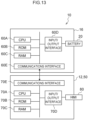
- Fig. 13 is a block diagram showing hardware structures of the battery degradation evaluation system 10 according to the present exemplary embodiment.
- the on-board device 16 is constituted by a microcomputer including a central processing unit (CPU) 60A that serves as a processor, read-only memory (ROM) 60B and random access memory (RAM) 60C that serve as memory, an input/output interface 60D, a communications interface 60E and so forth.
- the CPU 60A features the functions of a battery information acquisition section 22 and a data transmission section 24.
- the battery information acquisition section 22 acquires state quantities of a battery 20 mounted at the vehicle 14, which are voltages of the battery 20, to serve as battery information.
- the battery information acquisition section 22 acquires the voltages of the battery 20 with, for example, a voltage sensor.
- the battery information acquisition section 22 may be further provided with a temperature sensor that detects a temperature of the battery 20 and may acquire temperatures of the battery 20.
- the data transmission section 24 sends the battery information acquired by the battery information acquisition section 22 to the center 12 via the communications network 18.
- the center 12 is constituted by a computer including a CPU 70A that serves as a processor, ROM 70B and RAM 70C that serve as memory, an input/output interface 70D, a communications interface 70E and so forth.
- the input/output interface 70D may be connected with a human-machine interface (HMI) such as a monitor 80 provided with a touch panel or the like.
- HMI human-machine interface
- the CPU 70A functions as a data reception section 30, a data update section 32, a data operations section 40 and a data output section 46.
- the data reception section 30 acquires the battery information representing the state quantities of the battery 20 from the on-board device 16 of the vehicle 14, by receiving the battery information sent from the data transmission section 24 of the on-board device 16 via the communications network 18.
- the battery information is a state quantity of the battery 20 is described.
- the data update section 32 features functions of a data update permission judgment section 34 and a data creation section 36.
- the data update section 32 executes replacements of training data and machine learning based on AI, and carries out processing to update an AI data map.
- the data update permission judgment section 34 carries out processing to identify the batteries 20 that may be degrading, and accordingly judges the appropriateness of a data update.
- the data creation section 36 carries out processing to replace training data and conduct machine learning. That is, training data is replaced and the data creation section 36 creates a data map by machine learning based on an AI model, which serves as a pre-specified computation model, such as a neural network, a convolutional neural network (CNN) or the like.
- an AI model which serves as a pre-specified computation model, such as a neural network, a convolutional neural network (CNN) or the like.
- CNN convolutional neural network
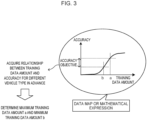
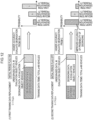
- the data creation section 36 switches between a first training data replacement and a second training data replacement in accordance with an amount of degrading data being used as training data. More specifically, as illustrated in Fig.
- a function (a data map or a mathematical expression) of amounts of training data and accuracy is acquired in advance for each of different types of vehicle. For each function, a maximum value a and minimum value b of training data amounts corresponding with accuracy objectives are determined.
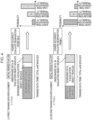
- degrading data of different vehicles of other vehicle types or the like is added to the training data to create a data map, as in the first training data replacement illustrated in Fig. 4 .
- the total number of items of training data represents training data of (a+M) vehicles: degrading data of (a-N) of the different vehicles, degrading data of (N) of the evaluation object vehicles, and undegraded data of (M) of the evaluation object vehicles.
- the data map is created with the degrading data of the different vehicles being replaced with degrading data of the evaluation object vehicles, as in the second training data replacement illustrated in Fig. 4 .
- the data operations section 40 features functions of a probability calculation section 42 and a degradation evaluation section 44 (see Fig. 2 ).
- the data operations section 40 evaluates degradation of each battery 20 based on the state quantities acquired from the on-board device 16.
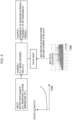
- the probability calculation section 42 uses the data map created by the data creation section 36, with a state quantity of the battery 20 as an input, to calculate degradation probabilities.
- the degradation probabilities that are calculated are, for example, a probability of degrading in a pre-specified period a, the probability of not degrading in the period a, and the like.
- a usage period of the battery 20 is divided into three pre-specified divisions and the probability calculation section 42 calculates three kinds of probability: a short-term degradation probability, a medium-term degradation probability and a long-term degradation probability.
- the probability calculation section 42 calculates the three kinds of probability-the short-term degradation probability, the medium-term degradation probability and the long-term degradation probability-but this is not limiting.
- the usage period of the battery 20 may be divided into four periods or more, and four or more kinds of probability may be calculated.
- the degradation evaluation section 44 evaluates whether the battery 20 has degraded by making a determination as to whether the state quantity meets a pre-specified degrading condition. For example, the degradation evaluation section 44 evaluates degradation by making a determination as to whether a probability of degrading calculated by the probability calculation section 42 is at least a pre-specified threshold value. In the present exemplary embodiment, as with the first training data replacement shown in Fig. 4 , in the initial period when there is little training data obtained from degrading data of the evaluation object vehicles, the degradation evaluation section 44 evaluates degradation of the battery 20 based on a combined degradation probability for the short period and medium period that is calculated from the long-term degradation probability.
- the degradation evaluation section 44 calculates 100 minus the long-term degradation probability to evaluate the degradation of the battery 20.
- the degradation evaluation section 44 evaluates degradation of the battery 20 based on the short-term degradation probability.
- an example is described in which, depending on amounts of training data, the evaluation of degradation of the battery 20 is based on a degradation probability calculated from the long-term degradation probability or on the short-term degradation probability, but this is not limiting.
- both a degradation probability calculated from the long-term degradation probability (100 minus the long-term degradation probability) and the short-term degradation probability may be used to calculate a final probability of degrading for evaluating degradation of the battery 20.
- a coefficient ⁇ that serves as a weighting is set in advance in accordance with an amount of training data, and the probability of degrading is calculated from (1- ⁇ ) ⁇ (short-term degradation probability) + ⁇ (100-long-term degradation probability).
- Fig. 11 depicts an example for the coefficient ⁇ in which the coefficient ⁇ increases quadratically with increasing amounts of training data, but this is not limiting. As shown by the dotted line in Fig. 11 , the coefficient ⁇ may increase linearly.
- the coefficient ⁇ may increase in a negative quadratic manner.
- a configuration in which the coefficient ⁇ is set to zero until the amount of training data reaches a pre-specified threshold a and the coefficient ⁇ is set to 1 when the amount of training data equals or exceeds a also corresponds with the present exemplary embodiment.
- the data output section 46 sends an evaluation result from the degradation evaluation section 44 to the on-board device 16 of the vehicle 14 from which the state quantity was acquired. Hence, a degradation evaluation result of the battery 20 may be reported by the on-board device 16.
- the battery information acquisition section 22 or data reception section 30 corresponds to an acquisition section
- the probability calculation section 42 corresponds to a derivation section
- the degradation evaluation section 44 corresponds to an evaluation section.
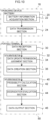
- Fig. 6 is a flowchart showing an example of a flow of processing that is carried out by the data update section 32 of the center 12 of the battery degradation evaluation system 10 according to the present exemplary embodiment.
- the processing in Fig. 6 may start, for example, at pre-specified time intervals, and may start each time a pre-specified number of state quantities have been gathered at the center 12. Alternatively, the processing may start when the center 12 receives a start command.
- step 100 the data update permission judgment section 34 sets a data update permission flag to off, and the data update section 32 proceeds to step 102.
- step 102 the data update permission judgment section 34 acquires state quantity data received by the data reception section 30, and the data update section 32 proceeds to step 104.
- step 104 the data update permission judgment section 34 makes a determination as to whether the acquired state quantity data exceeds a pre-specified threshold. This determination is a determination as to whether the battery 20 may have degraded. When the result of this determination is affirmative, the data update section 32 proceeds to step 106, and when the result is negative, the data update section 32 proceeds to step 108.
- step 106 the data update permission judgment section 34 sets the data update permission flag to on, and the data update section 32 proceeds to step 112.
- step 108 the data update permission judgment section 34 makes a determination as to whether the processing described above has been completed for all data from the particular vehicle 14. When the result of this determination is negative, the data update section 32 proceeds to step 110, and when the result is affirmative, the data update section 32 proceeds to step 112.
- step 112 the data update permission judgment section 34 makes a determination as to whether the processing described above has been completed for all vehicles. When the result of this determination is negative, the data update section 32 returns to step 100 and repeats the processing described above, and when the result is affirmative, the data update section 32 proceeds to step 114.
- step 114 the data creation section 36 counts the number of times the data update permission flag has been set to on, and the data update section 32 proceeds to step 116.
- step 116 the data creation section 36 makes a determination as to whether the flag-on count is more than a pre-specified threshold a. This determination is a determination as to whether the flag-on count is at least the maximum value a of the training data, which is specified as in Fig. 3 . When the result of this determination is affirmative, this sequence of processing by the data update section 32 ends, and when the result is negative, the data update section 32 proceeds to step 118.
- step 118 the data creation section 36 makes a determination as to whether the flag-on count is less than a pre-specified threshold b. This determination is a determination as to whether the flag-on count is at most the minimum value b of the training data, which is specified as in Fig. 3 . When the result of this determination is affirmative, the data update section 32 proceeds to step 120, and when the result is negative, the data update section 32 proceeds to step 124.
- step 120 the data creation section 36 sets an initial period flag to off, and the data update section 32 proceeds to step 122.
- step 122 the data creation section 36 switches to the second training data replacement described in Fig. 4 , the data creation section 36 implements a replacement of training data, and the data update section 32 proceeds to step 128.
- step 124 the data creation section 36 sets the initial period flag to on, and the data update section 32 proceeds to step 126.
- step 126 the data creation section 36 switches to the first training data replacement described in Fig. 4 , the data creation section 36 implements a replacement of training data, and the data update section 32 proceeds to step 128.
- step 128 the data creation section 36 uses the training data after the replacement to conduct machine learning and update the data map, and the data update section 32 ends this sequence of processing.
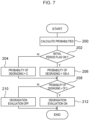
- FIG. 7 is a flowchart showing an example of a flow of the processing carried out by the data operations section 40 of the center 12 of the battery degradation evaluation system 10 according to the present exemplary embodiment.
- the processing in Fig. 7 starts, for example, when the processing by the data update section 32 in Fig. 6 ends.
- step 200 the probability calculation section 42 calculates degradation probabilities of the battery 20, and the data operations section 40 proceeds to step 202. That is, the data map created beforehand is used to calculate the degradation probabilities, with the state quantity of the battery 20 as an input. Three kinds of degradation probability are calculated in the present exemplary embodiment: the short-term degradation probability, the medium-term degradation probability and the long-term degradation probability.
- step 202 the probability calculation section 42 makes a determination as to whether the initial period flag is on. That is, the probability calculation section 42 makes a determination as to whether the initial period flag has been set to on in step 124 at the data creation section 36.
- the data operations section 40 proceeds to step 204, and when the result is affirmative, the data operations section 40 proceeds to step 206.
- step 204 the probability calculation section 42 employs the short-term degradation probability C as a probability of degrading, and the data operations section 40 proceeds to step 208.
- step 206 the probability calculation section 42 employs 100 minus the long-term degradation probability A as the probability of degrading (in other words, a probability of not degrading until the long term), and the data operations section 40 proceeds to step 208.
- step 208 the degradation evaluation section 44 makes a determination as to whether the calculated probability of degrading is greater than a pre-specified threshold CP. When the result of this determination is negative, the data operations section 40 proceeds to step 210, and when the result is affirmative, the data operations section 40 proceeds to step 212.
- step 210 the degradation evaluation section 44 evaluates that the battery is not degrading and sets degradation evaluation to off, and this sequence of processing by the data operations section 40 ends.
- step 212 the degradation evaluation section 44 evaluates that the battery is degrading and sets the degradation evaluation to on, and this sequence of processing by the data operations section 40 ends.
- model accuracy in the initial period in which there is little training data from the evaluation object vehicles, may be improved by conducting machine learning using training data from other vehicles in the initial period.
- the model accuracy may be steadily brought into conformance with the evaluation object vehicles by conducting machine learning with training data from the evaluation object vehicles replacing the training data from the other vehicles.
- a current or power relating to the battery 20 may prospectively be the state quantity.
- a prospective state quantity that is employed may be a single quantity and may be plural quantities. Which state quantity is most appropriate may vary in accordance with conditions, required accuracy and the like. Accordingly, it is sufficient to select the state quantity as appropriate.
- a communications device is provided at the vehicle 14 for communicating with the center 12, but this is not limiting.
- a portable terminal 50 such as a smartphone carried by a vehicle occupant or the like may be employed as the communications device.
- the functions of the center 12 shown in Fig. 2 may be provided at the portable terminal 50, and processing to evaluate degradation of the battery 20 may be carried out by the portable terminal 50.
- the portable terminal 50 is equipped with hardware structures similar to the hardware structures of the center 12, as shown in Fig. 13 .
- an example is described in which degradation of the battery 20 is evaluated using big data and machine learning based on an AI model that serves as the pre-specified computation model, but this is not limiting.
- an evaluation method may be employed that uses single regression analysis, multiple regression analysis or the like.
- a degradation evaluation method may be employed that uses small-quantity data and a physical model that serves as the pre-specified computation model.
- a degradation evaluation method may be employed that uses both machine learning and a physical model that serves as the pre-specified computation model.
- degrading data may be increased and undegraded data may be decreased, as shown in Fig. 12 .
- the processing executed by the center 12 is described as software processing that is implemented by a program being executed, but this is not limiting.
- the processing may be carried out by hardware such as a graphics processing unit (GPU), application-specific integrated circuit (ASIC), field-programmable gate array (FPGA) or the like.
- the processing may combine both software and hardware.
- the program may be memorized in any of various non-transitory storage media and distributed.
Landscapes
- Physics & Mathematics (AREA)
- General Physics & Mathematics (AREA)
- Engineering & Computer Science (AREA)
- Mechanical Engineering (AREA)
- Power Engineering (AREA)
- Theoretical Computer Science (AREA)
- Software Systems (AREA)
- Medical Informatics (AREA)
- Sustainable Energy (AREA)
- Mathematical Physics (AREA)
- Computer Vision & Pattern Recognition (AREA)
- Data Mining & Analysis (AREA)
- Evolutionary Computation (AREA)
- Transportation (AREA)
- Sustainable Development (AREA)
- Computing Systems (AREA)
- General Engineering & Computer Science (AREA)
- Artificial Intelligence (AREA)
- Life Sciences & Earth Sciences (AREA)
- Secondary Cells (AREA)
- Tests Of Electric Status Of Batteries (AREA)
- Electric Propulsion And Braking For Vehicles (AREA)
- Health & Medical Sciences (AREA)
- General Health & Medical Sciences (AREA)
- Charge And Discharge Circuits For Batteries Or The Like (AREA)
Description
- The present disclosure relates to a battery degradation evaluation system for evaluating degradation of a battery such as an auxiliary battery of a vehicle or the like, a battery degradation assessment method, and a non-transitory storage medium storing a battery degradation assessment program.
-
US 2019/212391 A1 describes a method and a system for monitoring a battery in a motor vehicle. In the method, a first module ascertains operating quantities of the battery. Variables that represent the operating quantities are compared with a load capacity model in order to ascertain quantities characterizing the reliability of the battery, so that a future behavior of the battery can be predicted.US 2013/135110 A1 describes systems, apparatuses and methods for detecting internal cell faults using online and real-time sensing techniques, and providing an accurate and reliable early warning for the incoming failure of battery cells hours or days prior to failure. A system is configured to perform real-time and direct measurement of battery cell parameters of temperature, voltage, and AC impedance through online sensing. These parameters may be simultaneously processed using advanced probabilistic and/or fuzzy logic-based algorithms to provide an early warning for the incoming failure of battery cells in a battery pack. This technology may safeguard the LIB battery packs while allowing them to operate at or near 100% capacity in both transportation and stationary applications. Japanese Patent Application Laid-Open (JP-A) No. 2018-179733 - However, there is scope for improvement of the technology disclosed in
JP-A No. 2018-179733 - The present invention provides a battery degradation evaluation device, a battery degradation evaluation method, and a non-transitory storage medium storing a battery degradation evaluation program that may accurately evaluate degradation of a battery even when plentiful data has not been collected.
- A battery degradation evaluation device according to a first aspect is defined in appended
claim 1. - According to the first aspect, the acquisition section acquires each state quantity of the battery. The acquired state quantity is a physical quantity that changes in association with degradation of the battery. For example, voltage, resistance, temperature and the like of the battery can be mentioned as examples.
- Based on each state quantity acquired by the acquisition section and the pre-specified computation model, the derivation section derives the short-term degradation probability of the battery degrading in the pre-specified short period, the medium-term degradation probability of the battery degrading in the medium period that is longer than the short period, and the long-term degradation probability of the battery degrading in the long period that is longer than the medium period (in other words, a probability of the battery not degrading until the long period).
- The evaluation section evaluates degradation of the battery based on the derived results from the derivation section, setting a higher weighting for a combined degradation probability for the short period and medium period, which is calculated from the long-term degradation probability (100 minus the long-term degradation probability), when a number of the state quantities being used as data in learning by the computation model is smaller, and setting a higher weighting for the short-term degradation probability when the number of state quantities is larger. As a result, degradation of the battery may be evaluated using more accurate degradation probabilities. Thus, even when the number of state quantities is small, degradation of the battery may be evaluated accurately.
- As in a second aspect, when the number of state quantities is less than a pre-specified threshold, the evaluation section may evaluate degradation of the battery based on the combined degradation probability for the short period and medium period that is calculated from the long-term degradation probability, and when the number of state quantities is equal to or greater than the threshold, the evaluation section may evaluate degradation of the battery based on the short-term degradation probability. Thus, battery degradation evaluation accuracy may be improved.
- As in a third aspect, once the computation model starts learning, the computation model may conduct learning with training data including state quantities of a degrading battery mounted at a different vehicle that is different from the evaluation object vehicle and state quantities of an undegraded battery at the evaluation object vehicle, and in accordance with the progress of learning, the computation model may conduct learning with state quantities of the degrading battery at the evaluation object vehicle replacing state quantities of the battery mounted at the different vehicle in the learning data. Thus, amounts of data during learning may be assured and degradation evaluation accuracy in an initial period may be improved. As in a fourth aspect, in accordance with the progress of learning, the computation model may conduct learning with an increased number of the state quantities of the degrading battery at the evaluation object vehicle and a decreased number of the state quantities of the undegraded battery at the evaluation object vehicle. Thus, processing loads may be reduced.
- As in a fifth aspect, the state quantity that the acquisition section acquires may be detected by a sensor mounted at the vehicle.
- As in a sixth aspect, the present invention is a computer-implemented battery degradation evaluation method as defined in appended claim 6.
- Alternatively, as in a seventh aspect, the present invention is a computer program as defined in appended claim 11.
- According to the present invention as described above, a battery degradation evaluation device, computer-implemented battery degradation evaluation method, and computer program may be provided that may accurately evaluate degradation of a battery even when plentiful data has not been collected.
- Exemplary embodiments of the present invention will be described in detail based on the following figures, wherein:
-
Fig. 1 is a diagram showing schematic structures of a battery degradation evaluation system according to a present exemplary embodiment; -
Fig. 2 is a block diagram showing functional structures of an on-board device and a center of the battery degradation evaluation system according to the present exemplary embodiment; -
Fig. 3 is a diagram for describing a method of determining a maximum value a and a minimum value b of training data; -
Fig. 4 is a diagram for describing a first training data replacement and a second training data replacement; -
Fig. 5 is a diagram showing an example of calculation of a degradation probability by a probability calculation section; -
Fig. 6 is a flowchart showing an example of a flow of processing that is carried out by a data update section of the center of the battery degradation evaluation system according to the present exemplary embodiment; -
Fig. 7 is a flowchart showing an example of a flow of processing that is carried out by a data operations section of the center of the battery degradation evaluation system according to the present exemplary embodiment; -
Fig. 8 is a diagram illustrating a method for evaluating degradation as time passes in the battery degradation evaluation system according to the present exemplary embodiment; -
Fig. 9 is a diagram showing schematic structures of a degradation evaluation system when a portable terminal is employed as a communications device; -
Fig. 10 is a block diagram showing functional structures of a portable terminal equipped with functions of the center; -
Fig. 11 is a diagram for describing an example of calculating a final degradation probability using both an initial period degradation probability calculation method and a later period degradation probability calculation method; -
Fig. 12 is a diagram illustrating an example in which undegraded data used for machine learning is decreased and degrading data is increased; and -
Fig. 13 is a block diagram showing hardware structures of the degradation evaluation system according to the present exemplary embodiment. - Below, an example of an embodiment of the present invention is described in detail with reference to the attached drawings.
Fig. 1 is a diagram showing schematic structures of a battery degradation evaluation system according to the present exemplary embodiment. - In a battery
degradation evaluation system 10 according to the present exemplary embodiment, an on-board device 16 mounted at avehicle 14 is connected with acenter 12 via acommunications network 18. In the batterydegradation evaluation system 10 according to the present exemplary embodiment, state quantities of batteries mounted at multiple on-board devices 16 are sent to thecenter 12, and thecenter 12 evaluates degradation of the batteries. Thecenter 12 employs big data of state quantities of batteries gathered from multiple vehicles and machine learning based on artificial intelligence (AI) to evaluate degradation of the batteries, using the state quantities of the batteries as input values. - In the present exemplary embodiment, a case of application to, for example, an auxiliary lead storage battery of the
vehicle 14 is described. The state quantity is a state quantity representing a state of a battery. In particular, the state quantity is a physical quantity that changes in association with degradation of the battery. For example, voltage, resistance, temperature and the like of the battery can be mentioned as examples. In the present exemplary embodiment, an example in which the state quantity is, as an example, a voltage of the battery is described. -
Fig. 2 is a block diagram showing structures of the on-board device 16 andcenter 12 of the batterydegradation evaluation system 10 according to the present exemplary embodiment.Fig. 13 is a block diagram showing hardware structures of the batterydegradation evaluation system 10 according to the present exemplary embodiment. - As shown in
Fig. 13 , the on-board device 16 is constituted by a microcomputer including a central processing unit (CPU) 60A that serves as a processor, read-only memory (ROM) 60B and random access memory (RAM) 60C that serve as memory, an input/output interface 60D, acommunications interface 60E and so forth. TheCPU 60A features the functions of a batteryinformation acquisition section 22 and adata transmission section 24. - As shown in
Fig. 2 , the batteryinformation acquisition section 22 acquires state quantities of abattery 20 mounted at thevehicle 14, which are voltages of thebattery 20, to serve as battery information. The batteryinformation acquisition section 22 acquires the voltages of thebattery 20 with, for example, a voltage sensor. The batteryinformation acquisition section 22 may be further provided with a temperature sensor that detects a temperature of thebattery 20 and may acquire temperatures of thebattery 20. - The
data transmission section 24 sends the battery information acquired by the batteryinformation acquisition section 22 to thecenter 12 via thecommunications network 18. - As shown in
Fig. 13 , thecenter 12 is constituted by a computer including aCPU 70A that serves as a processor,ROM 70B andRAM 70C that serve as memory, an input/output interface 70D, acommunications interface 70E and so forth. The input/output interface 70D may be connected with a human-machine interface (HMI) such as amonitor 80 provided with a touch panel or the like. TheCPU 70A functions as adata reception section 30, adata update section 32, adata operations section 40 and adata output section 46. - As shown in
Fig. 2 , thedata reception section 30 acquires the battery information representing the state quantities of thebattery 20 from the on-board device 16 of thevehicle 14, by receiving the battery information sent from thedata transmission section 24 of the on-board device 16 via thecommunications network 18. Below, a case in which the battery information is a state quantity of thebattery 20 is described. - The
data update section 32 features functions of a data updatepermission judgment section 34 and adata creation section 36. Thedata update section 32 executes replacements of training data and machine learning based on AI, and carries out processing to update an AI data map. - Data of the state quantities of the
batteries 20 is gathered from the on-board devices 16 of allvehicles 14 being administered by thecenter 12. The data updatepermission judgment section 34 carries out processing to identify thebatteries 20 that may be degrading, and accordingly judges the appropriateness of a data update. - When a data update is judged to be appropriate by the data update
permission judgment section 34, thedata creation section 36 carries out processing to replace training data and conduct machine learning. That is, training data is replaced and thedata creation section 36 creates a data map by machine learning based on an AI model, which serves as a pre-specified computation model, such as a neural network, a convolutional neural network (CNN) or the like. In the present exemplary embodiment, there are two types of training data replacement. Thedata creation section 36 switches between a first training data replacement and a second training data replacement in accordance with an amount of degrading data being used as training data. More specifically, as illustrated inFig. 3 , a function (a data map or a mathematical expression) of amounts of training data and accuracy is acquired in advance for each of different types of vehicle. For each function, a maximum value a and minimum value b of training data amounts corresponding with accuracy objectives are determined. When a degrading data amount N is 0≤N≤b, thedata creation section 36 switches to the first training data replacement, and when the degrading data amount N is b<N≤a, thedata creation section 36 switches to the second training data replacement. - In the present exemplary embodiment, in an initial state in which there is little training data obtained from degrading data of the evaluation object vehicles, degrading data of different vehicles of other vehicle types or the like is added to the training data to create a data map, as in the first training data replacement illustrated in
Fig. 4 . InFig. 4 , the total number of items of training data represents training data of (a+M) vehicles: degrading data of (a-N) of the different vehicles, degrading data of (N) of the evaluation object vehicles, and undegraded data of (M) of the evaluation object vehicles. As more degrading data is collected, the data map is created with the degrading data of the different vehicles being replaced with degrading data of the evaluation object vehicles, as in the second training data replacement illustrated inFig. 4 . - The
data operations section 40 features functions of aprobability calculation section 42 and a degradation evaluation section 44 (seeFig. 2 ). Thedata operations section 40 evaluates degradation of eachbattery 20 based on the state quantities acquired from the on-board device 16. - As shown in
Fig. 5 , theprobability calculation section 42 uses the data map created by thedata creation section 36, with a state quantity of thebattery 20 as an input, to calculate degradation probabilities. The degradation probabilities that are calculated are, for example, a probability of degrading in a pre-specified period a, the probability of not degrading in the period a, and the like. For example, a usage period of thebattery 20 is divided into three pre-specified divisions and theprobability calculation section 42 calculates three kinds of probability: a short-term degradation probability, a medium-term degradation probability and a long-term degradation probability. In an initial period when there is little training data obtained from degrading data of the evaluation object vehicles, a relatively large quantity of the training data is obtained from undegraded data of the evaluation object vehicles. Thus, as with the first training data replacement shown inFig. 4 , a model accuracy with the long-term degradation probability is higher than a model accuracy with the short-term degradation probability. Therefore, the long-term degradation probability with higher accuracy (in other words, a probability of not degrading until the long term) is employed. On the other hand, when theprobability calculation section 42 has collected training data obtained from degrading data of the evaluation object vehicles, as with the second training data replacement shown inFig. 4 , the model accuracy of the short-term degradation probability is improved. Therefore, the short-term degradation probability is employed. In the present exemplary embodiment, an example is described in which theprobability calculation section 42 calculates the three kinds of probability-the short-term degradation probability, the medium-term degradation probability and the long-term degradation probability-but this is not limiting. The usage period of thebattery 20 may be divided into four periods or more, and four or more kinds of probability may be calculated. - Based on the calculation results serving as derivation results from the
probability calculation section 42, thedegradation evaluation section 44 evaluates whether thebattery 20 has degraded by making a determination as to whether the state quantity meets a pre-specified degrading condition. For example, thedegradation evaluation section 44 evaluates degradation by making a determination as to whether a probability of degrading calculated by theprobability calculation section 42 is at least a pre-specified threshold value. In the present exemplary embodiment, as with the first training data replacement shown inFig. 4 , in the initial period when there is little training data obtained from degrading data of the evaluation object vehicles, thedegradation evaluation section 44 evaluates degradation of thebattery 20 based on a combined degradation probability for the short period and medium period that is calculated from the long-term degradation probability. That is, thedegradation evaluation section 44 calculates 100 minus the long-term degradation probability to evaluate the degradation of thebattery 20. Alternatively, as with the second training data replacement shown inFig. 4 , when the training data obtained from degrading data of the evaluation object vehicles has increased, thedegradation evaluation section 44 evaluates degradation of thebattery 20 based on the short-term degradation probability. In the present exemplary embodiment, an example is described in which, depending on amounts of training data, the evaluation of degradation of thebattery 20 is based on a degradation probability calculated from the long-term degradation probability or on the short-term degradation probability, but this is not limiting. For example, both a degradation probability calculated from the long-term degradation probability (100 minus the long-term degradation probability) and the short-term degradation probability may be used to calculate a final probability of degrading for evaluating degradation of thebattery 20. For example, as illustrated inFig. 11 , a coefficient β that serves as a weighting is set in advance in accordance with an amount of training data, and the probability of degrading is calculated from (1-β)×(short-term degradation probability) + β×(100-long-term degradation probability).Fig. 11 depicts an example for the coefficient β in which the coefficient β increases quadratically with increasing amounts of training data, but this is not limiting. As shown by the dotted line inFig. 11 , the coefficient β may increase linearly. Alternatively, as shown by the single-dot chain line inFig. 11 , the coefficient β may increase in a negative quadratic manner. A configuration in which the coefficient β is set to zero until the amount of training data reaches a pre-specified threshold a and the coefficient β is set to 1 when the amount of training data equals or exceeds a also corresponds with the present exemplary embodiment. - The
data output section 46 sends an evaluation result from thedegradation evaluation section 44 to the on-board device 16 of thevehicle 14 from which the state quantity was acquired. Hence, a degradation evaluation result of thebattery 20 may be reported by the on-board device 16. - Herein, the battery
information acquisition section 22 ordata reception section 30 corresponds to an acquisition section, theprobability calculation section 42 corresponds to a derivation section, and thedegradation evaluation section 44 corresponds to an evaluation section. - Now, specific processing that is carried out at the
center 12 of the batterydegradation evaluation system 10 according to the present exemplary embodiment configured as described above is described. -
Fig. 6 is a flowchart showing an example of a flow of processing that is carried out by thedata update section 32 of thecenter 12 of the batterydegradation evaluation system 10 according to the present exemplary embodiment. The processing inFig. 6 may start, for example, at pre-specified time intervals, and may start each time a pre-specified number of state quantities have been gathered at thecenter 12. Alternatively, the processing may start when thecenter 12 receives a start command. - In
step 100, the data updatepermission judgment section 34 sets a data update permission flag to off, and thedata update section 32 proceeds to step 102. - In
step 102, the data updatepermission judgment section 34 acquires state quantity data received by thedata reception section 30, and thedata update section 32 proceeds to step 104. The data updatepermission judgment section 34 acquires one item of data (for example, data for a time t=t0) from the state quantity data received from a particular vehicle. - In
step 104, the data updatepermission judgment section 34 makes a determination as to whether the acquired state quantity data exceeds a pre-specified threshold. This determination is a determination as to whether thebattery 20 may have degraded. When the result of this determination is affirmative, thedata update section 32 proceeds to step 106, and when the result is negative, thedata update section 32 proceeds to step 108. - In
step 106, the data updatepermission judgment section 34 sets the data update permission flag to on, and thedata update section 32 proceeds to step 112. - Alternatively, in
step 108, the data updatepermission judgment section 34 makes a determination as to whether the processing described above has been completed for all data from theparticular vehicle 14. When the result of this determination is negative, thedata update section 32 proceeds to step 110, and when the result is affirmative, thedata update section 32 proceeds to step 112. - In
step 110, the data updatepermission judgment section 34 acquires the next data (for example, data for a subsequent time t=t+Δt) from the state quantity data acquired from the particular vehicle, and thedata update section 32 proceeds to step 104. - In
step 112, the data updatepermission judgment section 34 makes a determination as to whether the processing described above has been completed for all vehicles. When the result of this determination is negative, thedata update section 32 returns to step 100 and repeats the processing described above, and when the result is affirmative, thedata update section 32 proceeds to step 114. - In
step 114, thedata creation section 36 counts the number of times the data update permission flag has been set to on, and thedata update section 32 proceeds to step 116. - In
step 116, thedata creation section 36 makes a determination as to whether the flag-on count is more than a pre-specified threshold a. This determination is a determination as to whether the flag-on count is at least the maximum value a of the training data, which is specified as inFig. 3 . When the result of this determination is affirmative, this sequence of processing by thedata update section 32 ends, and when the result is negative, thedata update section 32 proceeds to step 118. - In
step 118, thedata creation section 36 makes a determination as to whether the flag-on count is less than a pre-specified threshold b. This determination is a determination as to whether the flag-on count is at most the minimum value b of the training data, which is specified as inFig. 3 . When the result of this determination is affirmative, thedata update section 32 proceeds to step 120, and when the result is negative, thedata update section 32 proceeds to step 124. - In
step 120, thedata creation section 36 sets an initial period flag to off, and thedata update section 32 proceeds to step 122. - In
step 122, thedata creation section 36 switches to the second training data replacement described inFig. 4 , thedata creation section 36 implements a replacement of training data, and thedata update section 32 proceeds to step 128. - Alternatively, in
step 124 thedata creation section 36 sets the initial period flag to on, and thedata update section 32 proceeds to step 126. - In
step 126, thedata creation section 36 switches to the first training data replacement described inFig. 4 , thedata creation section 36 implements a replacement of training data, and thedata update section 32 proceeds to step 128. - In
step 128, thedata creation section 36 uses the training data after the replacement to conduct machine learning and update the data map, and thedata update section 32 ends this sequence of processing. - Now, processing that is carried out by the
data operations section 40, which is carried out following the processing by thedata update section 32, is described.Fig. 7 is a flowchart showing an example of a flow of the processing carried out by thedata operations section 40 of thecenter 12 of the batterydegradation evaluation system 10 according to the present exemplary embodiment. The processing inFig. 7 starts, for example, when the processing by thedata update section 32 inFig. 6 ends. - In
step 200, theprobability calculation section 42 calculates degradation probabilities of thebattery 20, and thedata operations section 40 proceeds to step 202. That is, the data map created beforehand is used to calculate the degradation probabilities, with the state quantity of thebattery 20 as an input. Three kinds of degradation probability are calculated in the present exemplary embodiment: the short-term degradation probability, the medium-term degradation probability and the long-term degradation probability. - In
step 202, theprobability calculation section 42 makes a determination as to whether the initial period flag is on. That is, theprobability calculation section 42 makes a determination as to whether the initial period flag has been set to on instep 124 at thedata creation section 36. When the result of this determination is negative, thedata operations section 40 proceeds to step 204, and when the result is affirmative, thedata operations section 40 proceeds to step 206. - In
step 204, theprobability calculation section 42 employs the short-term degradation probability C as a probability of degrading, and thedata operations section 40 proceeds to step 208. - Alternatively, in
step 206 theprobability calculation section 42 employs 100 minus the long-term degradation probability A as the probability of degrading (in other words, a probability of not degrading until the long term), and thedata operations section 40 proceeds to step 208. - In
step 208, thedegradation evaluation section 44 makes a determination as to whether the calculated probability of degrading is greater than a pre-specified threshold CP. When the result of this determination is negative, thedata operations section 40 proceeds to step 210, and when the result is affirmative, thedata operations section 40 proceeds to step 212. - In
step 210, thedegradation evaluation section 44 evaluates that the battery is not degrading and sets degradation evaluation to off, and this sequence of processing by thedata operations section 40 ends. - Alternatively, in
step 212, thedegradation evaluation section 44 evaluates that the battery is degrading and sets the degradation evaluation to on, and this sequence of processing by thedata operations section 40 ends. - Because the processing described above is carried out in the present exemplary embodiment, in the initial period in which there is little training data obtained from degrading data of the evaluation object vehicles, degradation of the
battery 20 is evaluated using long-term degradation probabilities (probabilities of not degrading until the long period), as shown inFig. 8 . That is, as shown inFig. 8 , 100 minus the long-term degradation probability A is calculated for evaluating degradation of thebattery 20. Thus, the accuracy of degradation evaluation may be improved compared to a situation in which degradation is evaluated using short-term degradation probabilities in the initial period. - As is further shown in
Fig. 8 , as training data obtained from degrading data of the evaluation object vehicles steadily increases and a later period is entered, the model accuracy of short-term degradation probabilities improves. Therefore, degradation of thebattery 20 is evaluated using short-term degradation probabilities C. Thus, the accuracy of degradation evaluation may be improved compared to a situation in which degradation is evaluated using long-term degradation probabilities. - In the present exemplary embodiment, model accuracy in the initial period, in which there is little training data from the evaluation object vehicles, may be improved by conducting machine learning using training data from other vehicles in the initial period. Hence, as the training data obtained from degrading data of the evaluation object vehicles increases, the model accuracy may be steadily brought into conformance with the evaluation object vehicles by conducting machine learning with training data from the evaluation object vehicles replacing the training data from the other vehicles.
- In the exemplary embodiment described above, voltage, resistance, temperature and the like of the
battery 20 are mentioned as examples of the state quantity, but the state quantity is not limited thus. For example, a current or power relating to thebattery 20, a two-dimensionally obtained state of charge (SOC) or the like, or a quantity in which these quantities are multiplied or added may prospectively be the state quantity. A prospective state quantity that is employed may be a single quantity and may be plural quantities. Which state quantity is most appropriate may vary in accordance with conditions, required accuracy and the like. Accordingly, it is sufficient to select the state quantity as appropriate. - In the exemplary embodiment described above, an example is described in which a communications device is provided at the
vehicle 14 for communicating with thecenter 12, but this is not limiting. For example, as shown inFig. 9 , aportable terminal 50 such as a smartphone carried by a vehicle occupant or the like may be employed as the communications device. Alternatively, as shown inFig. 10 , the functions of thecenter 12 shown inFig. 2 may be provided at theportable terminal 50, and processing to evaluate degradation of thebattery 20 may be carried out by theportable terminal 50. In this configuration, theportable terminal 50 is equipped with hardware structures similar to the hardware structures of thecenter 12, as shown inFig. 13 . - In the exemplary embodiment described above, an example is described in which degradation of the
battery 20 is evaluated using big data and machine learning based on an AI model that serves as the pre-specified computation model, but this is not limiting. For example, an evaluation method may be employed that uses single regression analysis, multiple regression analysis or the like. Alternatively, a degradation evaluation method may be employed that uses small-quantity data and a physical model that serves as the pre-specified computation model. Alternatively again, a degradation evaluation method may be employed that uses both machine learning and a physical model that serves as the pre-specified computation model. - In the exemplary embodiment described above, an example is described in which undegraded data from the beginning is retained, but this is not limiting. For example, in order to reduce machine learning loads, degrading data may be increased and undegraded data may be decreased, as shown in
Fig. 12 . - The processing executed by the
center 12 according to the exemplary embodiment described above is described as software processing that is implemented by a program being executed, but this is not limiting. For example, the processing may be carried out by hardware such as a graphics processing unit (GPU), application-specific integrated circuit (ASIC), field-programmable gate array (FPGA) or the like. Alternatively, the processing may combine both software and hardware. Further, if the processing is implemented in software, the program may be memorized in any of various non-transitory storage media and distributed. - The present disclosure is not limited by the above recitations. In addition to the above recitations, it will be clear that numerous modifications may be embodied within a technical scope not departing from the appended claims.
Claims (15)
- A battery degradation evaluation system (10) comprising:an acquisition section (22, 30) configured to acquire state quantities of a battery (20) mounted at a vehicle (14);a derivation section (42) configured to, based on each state quantity acquired by the acquisition section and a pre-specified computation model, derive each ofa short-term degradation probability of the battery (20) degrading in a pre-specified short period,a medium-term degradation probability of the battery (20) degrading in a medium period that is longer than the short period, anda long-term degradation probability of the battery (20) degrading in a long period that is longer than the medium period; andan evaluation section (44) configured to evaluate degradation of the battery (20) based on derivation results from the derivation section (42), the evaluation section (44) being configured tothe state quantities being used as data for learning of the computation model.set a higher weighting for a combined degradation probability for the short period and the medium period when a number of state quantities is smaller, the combined degradation probability being calculated from the long-term degradation probability, andset a higher weighting for the short-term degradation probability when the number of state quantities is larger,
- The battery degradation evaluation system (10) according to claim 1, wherein:in a case in which the number of state quantities is less than a pre-specified threshold, the evaluation section (44) evaluates degradation of the battery (20) based on the combined degradation probability for the short period and the medium period that is calculated from the long-term degradation probability; and,in a case in which the number of state quantities is equal to or greater than the threshold, the evaluation section (44) evaluates degradation of the battery (20) based on the short-term degradation probability.
- The battery degradation evaluation system (10) according to claim 1 or claim 2, wherein:once the computation model starts learning, the computation model conducts learning with training data including state quantities of a degrading battery (20) mounted at a different vehicle (14) that is different from an evaluation object vehicle (14) and state quantities of an undegraded battery (20) at the evaluation object vehicle (14); and,in accordance with progress of learning, the computation model conducts learning with state quantities of the degrading battery (20) at the evaluation object vehicle (14) replacing state quantities of the battery (20) mounted at the different vehicle (14) in the learning data.
- The battery degradation evaluation system (10) according to claim 3, wherein, in accordance with the progress of learning, the computation model conducts learning with an increased number of the state quantities of the degrading battery (20) at the evaluation object vehicle (14) and a decreased number of the state quantities of the undegraded battery (20) at the evaluation object vehicle (14).
- The battery degradation evaluation system (10) according to any one of claims 1 to 4, wherein the state quantity that the acquisition section (22, 30) acquires is detected by a sensor mounted at the vehicle (14).
- A computer-implemented battery degradation evaluation method comprising:acquiring state quantities of a battery (20) mounted at a vehicle (14);based on each state quantity and a pre-specified computation model, deriving each ofa short-term degradation probability of the battery (20) degrading in a pre-specified short period,a medium-term degradation probability of the battery (20) degrading in a medium period that is longer than the short period, anda long-term degradation probability of the battery (20) degrading in a long period that is longer than the medium period; andevaluating degradation of the battery (20) based on results of the deriving, the evaluating includingthe state quantities being used as data for learning of the computation model.setting a higher weighting for a combined degradation probability for the short period and the medium period when a number of state quantities is smaller, the combined degradation probability being calculated from the long-term degradation probability, andsetting a higher weighting for the short-term degradation probability when the number of state quantities is larger,
- The battery degradation evaluation method according to claim 6, wherein the evaluating includes:in a case in which the number of state quantities is less than a pre-specified threshold, evaluating degradation of the battery (20) based on the combined degradation probability for the short period and the medium period that is calculated from the long-term degradation probability; and,in a case in which the number of state quantities is equal to or greater than the threshold, evaluating degradation of the battery (20) based on the short-term degradation probability.
- The battery degradation evaluation method according to claim 6 or claim 7, wherein:once the computation model starts learning, the computation model conducts learning with training data including state quantities of a degrading battery (20) mounted at a different vehicle (14) that is different from an evaluation object vehicle (14) and state quantities of an undegraded battery (20) at the evaluation object vehicle (14); and,in accordance with progress of learning, the computation model conducts learning with state quantities of the degrading battery (20) at the evaluation object vehicle (14) replacing state quantities of the battery (20) mounted at the different vehicle (14) in the learning data.
- The battery degradation evaluation method according to claim 8, wherein, in accordance with the progress of learning, the computation model conducts learning with an increased number of the state quantities of the degrading battery (20) at the evaluation object vehicle (14) and a decreased number of the state quantities of the undegraded battery at the evaluation object vehicle (14).
- The battery degradation evaluation method according to any one of claims 6 to 9, wherein the state quantity is acquired from a sensor mounted at the vehicle (14).
- A computer program comprising instructions which, when the program is executed by a computer, cause the computer to carry out battery degradation evaluation processing, the battery degradation evaluation processing comprising:acquiring state quantities of a battery (20) mounted at a vehicle (14);based on each state quantity and a pre-specified computation model, deriving each ofa short-term degradation probability of the battery (20) degrading in a pre-specified short period,a medium-term degradation probability of the battery (20) degrading in a medium period that is longer than the short period, anda long-term degradation probability of the battery (20) degrading in a long period that is longer than the medium period; andevaluating degradation of the battery (20) based on results of the deriving, the evaluating includingthe state quantities being used as data for learning of the computation model.setting a higher weighting for a combined degradation probability for the short period and the medium period when a number of state quantities is smaller, the combined degradation probability being calculated from the long-term degradation probability, andsetting a higher weighting for the short-term degradation probability when the number of state quantities is larger,
- The program according to claim 11, wherein the battery degradation evaluation processing further comprises:in a case in which the number of state quantities is less than a pre-specified threshold, evaluating degradation of the battery (20) based on the combined degradation probability for the short period and the medium period that is calculated from the long-term degradation probability; and,in a case in which the number of state quantities is equal to or greater than the threshold, evaluating degradation of the battery (20) based on the short-term degradation probability.
- The program according to claim 11 or claim 12, wherein the battery degradation evaluation processing further comprises:once the computation model starts learning, the computation model conducting learning with training data including state quantities of a degrading battery (20) mounted at a different vehicle (14) that is different from an evaluation object vehicle (14) and state quantities of an undegraded battery (20) at the evaluation object vehicle (14); and,in accordance with progress of learning, the computation model conducting learning with state quantities of the degrading battery (20) at the evaluation object vehicle (14) replacing state quantities of the battery (20) mounted at the different vehicle (14) in the learning data.
- The program according to claim 13, wherein the battery degradation evaluation processing further comprises, in accordance with the progress of learning, the computation model conducting learning with an increased number of the state quantities of the degrading battery (20) at the evaluation object vehicle (14) and a decreased number of the state quantities of the undegraded battery (20) at the evaluation object vehicle (14).
- The program according to any one of claims 11 to 14, wherein the state quantities are acquired from a sensor mounted at the vehicle (14).
Applications Claiming Priority (1)
| Application Number | Priority Date | Filing Date | Title |
|---|---|---|---|
| JP2020018737A JP7314822B2 (en) | 2020-02-06 | 2020-02-06 | Battery deterioration determination device, battery deterioration determination method, and battery deterioration determination program |
Publications (2)
| Publication Number | Publication Date |
|---|---|
| EP3862765A1 EP3862765A1 (en) | 2021-08-11 |
| EP3862765B1 true EP3862765B1 (en) | 2023-06-21 |
Family
ID=74105871
Family Applications (1)
| Application Number | Title | Priority Date | Filing Date |
|---|---|---|---|
| EP21150462.6A Active EP3862765B1 (en) | 2020-02-06 | 2021-01-07 | Battery degradation evaluation system, battery degradation evaluation method, and battery degradation evaluation program |
Country Status (4)
| Country | Link |
|---|---|
| US (2) | US11460514B2 (en) |
| EP (1) | EP3862765B1 (en) |
| JP (1) | JP7314822B2 (en) |
| CN (1) | CN113219338B (en) |
Families Citing this family (5)
| Publication number | Priority date | Publication date | Assignee | Title |
|---|---|---|---|---|
| CN113902121B (en) * | 2021-07-15 | 2023-07-21 | 陈九廷 | Method, device, equipment and medium for verifying battery degradation estimation device |
| JP2023114373A (en) * | 2022-02-04 | 2023-08-17 | トヨタ自動車株式会社 | Model update device, model update method, and model update program |
| US12119700B2 (en) * | 2023-01-20 | 2024-10-15 | Element Energy, Inc. | Systems and methods for adaptive electrochemical cell management |
| CN116424156B (en) * | 2023-04-18 | 2025-10-21 | 浙江吉利控股集团有限公司 | A power battery abnormality warning method and warning device |
| US12488355B2 (en) | 2023-09-22 | 2025-12-02 | Toyota Motor North America, Inc. | Limiting battery degradation for a group of vehicles |
Family Cites Families (21)
| Publication number | Priority date | Publication date | Assignee | Title |
|---|---|---|---|---|
| KR100936892B1 (en) | 2007-09-13 | 2010-01-14 | 주식회사 엘지화학 | Battery long-term prediction system and method |
| JP5343168B2 (en) | 2010-06-24 | 2013-11-13 | パナソニック株式会社 | Method and system for obtaining the degree of battery degradation |
| US9177466B2 (en) * | 2011-01-20 | 2015-11-03 | Indiana University Research And Technology Corporation | Advanced battery early warning and monitoring system |
| JP2013115863A (en) | 2011-11-25 | 2013-06-10 | Honda Motor Co Ltd | Battery management system |
| US9316699B2 (en) * | 2012-04-05 | 2016-04-19 | Samsung Sdi Co., Ltd. | System for predicting lifetime of battery |
| CN103033761B (en) * | 2012-12-17 | 2014-12-10 | 哈尔滨工业大学 | Lithium ion battery residual life forecasting method of dynamic gray related vector machine |
| US10203375B2 (en) * | 2013-11-14 | 2019-02-12 | Nec Corporation | Method for ascertaining storage battery state, state-ascertaining system, and computer program |
| KR102205293B1 (en) * | 2014-04-18 | 2021-01-20 | 삼성전자주식회사 | A method and device to calibrate error from estimation of batter life |
| KR102399720B1 (en) * | 2014-08-06 | 2022-05-19 | 삼성전자주식회사 | Method and device to estimate battery life about user characteristic based on pattern information |
| KR102357351B1 (en) * | 2015-01-07 | 2022-01-28 | 삼성전자주식회사 | Device and apparatus to estimate state of batter pakc including the plurality of battery cells |
| WO2016147722A1 (en) | 2015-03-19 | 2016-09-22 | 日本電気株式会社 | Estimating device, estimating method and program |
| KR102559199B1 (en) * | 2015-11-02 | 2023-07-25 | 삼성전자주식회사 | Method of managing battery and batter management appratus |
| JP6339618B2 (en) * | 2016-03-29 | 2018-06-06 | 古河電気工業株式会社 | Secondary battery degradation estimation device and secondary battery degradation estimation method |
| DE102016211898A1 (en) * | 2016-06-30 | 2018-01-04 | Robert Bosch Gmbh | Method for monitoring a battery |
| KR102042077B1 (en) * | 2016-09-26 | 2019-11-07 | 주식회사 엘지화학 | Intelligent fuel cell system |
| JP2018179733A (en) | 2017-04-12 | 2018-11-15 | 日立化成株式会社 | Battery life diagnostic device and battery life diagnostic method |
| WO2019021095A1 (en) * | 2017-07-26 | 2019-01-31 | 株式会社半導体エネルギー研究所 | System for controlling charging of secondary cell and method for detecting abnormality in secondary cell |
| WO2019181727A1 (en) * | 2018-03-20 | 2019-09-26 | 株式会社Gsユアサ | Abnormal factor determination device, deterioration determination device, computer program, deterioration determination method and abnormal factor determination method |
| JP7063455B2 (en) * | 2018-04-06 | 2022-05-17 | 株式会社スリーダム | Diagnostic device and diagnostic method for secondary batteries |
| EP3560751A1 (en) * | 2018-04-27 | 2019-10-30 | Panasonic Intellectual Property Corporation of America | Control method, server, in-vehicle device, and program |
| EP3875976A4 (en) * | 2018-10-31 | 2022-01-05 | GS Yuasa International Ltd. | ELECTRICITY STORAGE ELEMENT EVALUATION DEVICE, COMPUTER PROGRAM, ELECTRICITY STORAGE ELEMENT EVALUATION PROCESS, LEARNING PROCESS AND CREATION PROCESS |
-
2020
- 2020-02-06 JP JP2020018737A patent/JP7314822B2/en active Active
- 2020-12-23 US US17/131,963 patent/US11460514B2/en active Active
-
2021
- 2021-01-07 EP EP21150462.6A patent/EP3862765B1/en active Active
- 2021-01-11 CN CN202110032169.5A patent/CN113219338B/en active Active
-
2022
- 2022-08-25 US US17/895,591 patent/US11675020B2/en active Active
Also Published As
| Publication number | Publication date |
|---|---|
| JP2021124420A (en) | 2021-08-30 |
| EP3862765A1 (en) | 2021-08-11 |
| US20210247458A1 (en) | 2021-08-12 |
| JP7314822B2 (en) | 2023-07-26 |
| US20220404429A1 (en) | 2022-12-22 |
| US11675020B2 (en) | 2023-06-13 |
| US11460514B2 (en) | 2022-10-04 |
| CN113219338A (en) | 2021-08-06 |
| CN113219338B (en) | 2023-12-22 |
Similar Documents
| Publication | Publication Date | Title |
|---|---|---|
| EP3862765B1 (en) | Battery degradation evaluation system, battery degradation evaluation method, and battery degradation evaluation program | |
| KR102943076B1 (en) | Apparatus of Detecting Abnormal Portent Cell in Batter Pack and Method thereof | |
| KR102633335B1 (en) | Method for detecting abnomal cells and estimating SOH in Lithium-Ion battery pack | |
| US20210373082A1 (en) | Method and device for operating an electrically drivable motor vehicle depending on a predicted state of health of an electrical energy store | |
| CN110161414B (en) | Power battery thermal runaway online prediction method and system | |
| EP3709039A1 (en) | Battery life learning device, battery life prediction device, method and program | |
| US12560654B2 (en) | Method and system for efficiently monitoring battery cells of a device battery in an external central processing unit using a digital twin | |
| EP3862764B1 (en) | Battery deterioration judging system, battery deterioration judging method, and battery deterioration judging program | |
| EP3316387A1 (en) | Energy storage system | |
| CN115219932A (en) | Method and device for evaluating the relative aging state of a battery of a device | |
| US20230059529A1 (en) | Characterization of Rechargeable Batteries Using Machine-Learned Algorithms | |
| US12362404B2 (en) | Method and apparatus for operating an early warning system for robustly detecting an error of an electrical energy store for a device by means of machine learning methods | |
| CN117761541B (en) | Battery energy state detection method for battery management system | |
| US20230324463A1 (en) | Method and Apparatus for Operating a System for Detecting an Anomaly of an Electrical Energy Store for a Device by Means of Machine Learning Methods | |
| CN116736142B (en) | Method, system and device for early warning of health condition of battery pack | |
| US20220187376A1 (en) | Method and Device for Predicting a State of Health of an Energy Storage System | |
| US11733313B2 (en) | Method and apparatus for operating a system for providing states of health of electrical energy stores for a multiplicity of devices with the aid of machine learning methods | |
| EP3593156A2 (en) | A battery state of power estimation method and a battery state monitoring system | |
| CN114631032A (en) | Method and system for monitoring health of battery pack | |
| US20220099752A1 (en) | Method and Apparatus for Machine-Individual Improvement of the Lifetime of a Battery in a Battery-Operated Machine | |
| US11573271B1 (en) | Battery fault detection | |
| EP3862766A1 (en) | Battery degradation evaluation system, battery degradation evaluation method, and non-transitory storage medium storing battery degradation evaluation program | |
| CN112530049A (en) | Battery state monitoring method and device, electronic equipment and storage medium | |
| CN117007973A (en) | Battery state prediction method, device, equipment and storage medium | |
| CN120270101A (en) | Electric vehicle battery charge and discharge management method |
Legal Events
| Date | Code | Title | Description |
|---|---|---|---|
| PUAI | Public reference made under article 153(3) epc to a published international application that has entered the european phase |
Free format text: ORIGINAL CODE: 0009012 |
|
| STAA | Information on the status of an ep patent application or granted ep patent |
Free format text: STATUS: REQUEST FOR EXAMINATION WAS MADE |
|
| 17P | Request for examination filed |
Effective date: 20210107 |
|
| AK | Designated contracting states |
Kind code of ref document: A1 Designated state(s): AL AT BE BG CH CY CZ DE DK EE ES FI FR GB GR HR HU IE IS IT LI LT LU LV MC MK MT NL NO PL PT RO RS SE SI SK SM TR |
|
| GRAP | Despatch of communication of intention to grant a patent |
Free format text: ORIGINAL CODE: EPIDOSNIGR1 |
|
| STAA | Information on the status of an ep patent application or granted ep patent |
Free format text: STATUS: GRANT OF PATENT IS INTENDED |
|
| INTG | Intention to grant announced |
Effective date: 20230412 |
|
| RIN1 | Information on inventor provided before grant (corrected) |
Inventor name: HAGA, NOBUYASU |
|
| GRAS | Grant fee paid |
Free format text: ORIGINAL CODE: EPIDOSNIGR3 |
|
| GRAA | (expected) grant |
Free format text: ORIGINAL CODE: 0009210 |
|
| STAA | Information on the status of an ep patent application or granted ep patent |
Free format text: STATUS: THE PATENT HAS BEEN GRANTED |
|
| AK | Designated contracting states |
Kind code of ref document: B1 Designated state(s): AL AT BE BG CH CY CZ DE DK EE ES FI FR GB GR HR HU IE IS IT LI LT LU LV MC MK MT NL NO PL PT RO RS SE SI SK SM TR |
|
| REG | Reference to a national code |
Ref country code: CH Ref legal event code: EP |
|
| REG | Reference to a national code |
Ref country code: DE Ref legal event code: R096 Ref document number: 602021002963 Country of ref document: DE |
|
| REG | Reference to a national code |
Ref country code: AT Ref legal event code: REF Ref document number: 1581261 Country of ref document: AT Kind code of ref document: T Effective date: 20230715 |
|
| REG | Reference to a national code |
Ref country code: IE Ref legal event code: FG4D |
|
| REG | Reference to a national code |
Ref country code: LT Ref legal event code: MG9D |
|
| REG | Reference to a national code |
Ref country code: NL Ref legal event code: MP Effective date: 20230621 |
|
| PG25 | Lapsed in a contracting state [announced via postgrant information from national office to epo] |
Ref country code: SE Free format text: LAPSE BECAUSE OF FAILURE TO SUBMIT A TRANSLATION OF THE DESCRIPTION OR TO PAY THE FEE WITHIN THE PRESCRIBED TIME-LIMIT Effective date: 20230621 Ref country code: NO Free format text: LAPSE BECAUSE OF FAILURE TO SUBMIT A TRANSLATION OF THE DESCRIPTION OR TO PAY THE FEE WITHIN THE PRESCRIBED TIME-LIMIT Effective date: 20230921 |
|
| REG | Reference to a national code |
Ref country code: AT Ref legal event code: MK05 Ref document number: 1581261 Country of ref document: AT Kind code of ref document: T Effective date: 20230621 |
|
| P01 | Opt-out of the competence of the unified patent court (upc) registered |
Effective date: 20231024 |
|
| PG25 | Lapsed in a contracting state [announced via postgrant information from national office to epo] |
Ref country code: RS Free format text: LAPSE BECAUSE OF FAILURE TO SUBMIT A TRANSLATION OF THE DESCRIPTION OR TO PAY THE FEE WITHIN THE PRESCRIBED TIME-LIMIT Effective date: 20230621 Ref country code: NL Free format text: LAPSE BECAUSE OF FAILURE TO SUBMIT A TRANSLATION OF THE DESCRIPTION OR TO PAY THE FEE WITHIN THE PRESCRIBED TIME-LIMIT Effective date: 20230621 Ref country code: LV Free format text: LAPSE BECAUSE OF FAILURE TO SUBMIT A TRANSLATION OF THE DESCRIPTION OR TO PAY THE FEE WITHIN THE PRESCRIBED TIME-LIMIT Effective date: 20230621 Ref country code: LT Free format text: LAPSE BECAUSE OF FAILURE TO SUBMIT A TRANSLATION OF THE DESCRIPTION OR TO PAY THE FEE WITHIN THE PRESCRIBED TIME-LIMIT Effective date: 20230621 Ref country code: HR Free format text: LAPSE BECAUSE OF FAILURE TO SUBMIT A TRANSLATION OF THE DESCRIPTION OR TO PAY THE FEE WITHIN THE PRESCRIBED TIME-LIMIT Effective date: 20230621 Ref country code: GR Free format text: LAPSE BECAUSE OF FAILURE TO SUBMIT A TRANSLATION OF THE DESCRIPTION OR TO PAY THE FEE WITHIN THE PRESCRIBED TIME-LIMIT Effective date: 20230922 |
|
| PG25 | Lapsed in a contracting state [announced via postgrant information from national office to epo] |
Ref country code: FI Free format text: LAPSE BECAUSE OF FAILURE TO SUBMIT A TRANSLATION OF THE DESCRIPTION OR TO PAY THE FEE WITHIN THE PRESCRIBED TIME-LIMIT Effective date: 20230621 |
|
| PG25 | Lapsed in a contracting state [announced via postgrant information from national office to epo] |
Ref country code: SK Free format text: LAPSE BECAUSE OF FAILURE TO SUBMIT A TRANSLATION OF THE DESCRIPTION OR TO PAY THE FEE WITHIN THE PRESCRIBED TIME-LIMIT Effective date: 20230621 |
|
| PG25 | Lapsed in a contracting state [announced via postgrant information from national office to epo] |
Ref country code: ES Free format text: LAPSE BECAUSE OF FAILURE TO SUBMIT A TRANSLATION OF THE DESCRIPTION OR TO PAY THE FEE WITHIN THE PRESCRIBED TIME-LIMIT Effective date: 20230621 |
|
| PG25 | Lapsed in a contracting state [announced via postgrant information from national office to epo] |
Ref country code: IS Free format text: LAPSE BECAUSE OF FAILURE TO SUBMIT A TRANSLATION OF THE DESCRIPTION OR TO PAY THE FEE WITHIN THE PRESCRIBED TIME-LIMIT Effective date: 20231021 |
|
| PG25 | Lapsed in a contracting state [announced via postgrant information from national office to epo] |
Ref country code: SM Free format text: LAPSE BECAUSE OF FAILURE TO SUBMIT A TRANSLATION OF THE DESCRIPTION OR TO PAY THE FEE WITHIN THE PRESCRIBED TIME-LIMIT Effective date: 20230621 Ref country code: SK Free format text: LAPSE BECAUSE OF FAILURE TO SUBMIT A TRANSLATION OF THE DESCRIPTION OR TO PAY THE FEE WITHIN THE PRESCRIBED TIME-LIMIT Effective date: 20230621 Ref country code: RO Free format text: LAPSE BECAUSE OF FAILURE TO SUBMIT A TRANSLATION OF THE DESCRIPTION OR TO PAY THE FEE WITHIN THE PRESCRIBED TIME-LIMIT Effective date: 20230621 Ref country code: PT Free format text: LAPSE BECAUSE OF FAILURE TO SUBMIT A TRANSLATION OF THE DESCRIPTION OR TO PAY THE FEE WITHIN THE PRESCRIBED TIME-LIMIT Effective date: 20231023 Ref country code: IS Free format text: LAPSE BECAUSE OF FAILURE TO SUBMIT A TRANSLATION OF THE DESCRIPTION OR TO PAY THE FEE WITHIN THE PRESCRIBED TIME-LIMIT Effective date: 20231021 Ref country code: ES Free format text: LAPSE BECAUSE OF FAILURE TO SUBMIT A TRANSLATION OF THE DESCRIPTION OR TO PAY THE FEE WITHIN THE PRESCRIBED TIME-LIMIT Effective date: 20230621 Ref country code: EE Free format text: LAPSE BECAUSE OF FAILURE TO SUBMIT A TRANSLATION OF THE DESCRIPTION OR TO PAY THE FEE WITHIN THE PRESCRIBED TIME-LIMIT Effective date: 20230621 Ref country code: CZ Free format text: LAPSE BECAUSE OF FAILURE TO SUBMIT A TRANSLATION OF THE DESCRIPTION OR TO PAY THE FEE WITHIN THE PRESCRIBED TIME-LIMIT Effective date: 20230621 Ref country code: AT Free format text: LAPSE BECAUSE OF FAILURE TO SUBMIT A TRANSLATION OF THE DESCRIPTION OR TO PAY THE FEE WITHIN THE PRESCRIBED TIME-LIMIT Effective date: 20230621 |
|
| PG25 | Lapsed in a contracting state [announced via postgrant information from national office to epo] |
Ref country code: PL Free format text: LAPSE BECAUSE OF FAILURE TO SUBMIT A TRANSLATION OF THE DESCRIPTION OR TO PAY THE FEE WITHIN THE PRESCRIBED TIME-LIMIT Effective date: 20230621 |
|
| REG | Reference to a national code |
Ref country code: DE Ref legal event code: R097 Ref document number: 602021002963 Country of ref document: DE |
|
| REG | Reference to a national code |
Ref country code: DE Ref legal event code: R084 Ref document number: 602021002963 Country of ref document: DE |
|
| PLBE | No opposition filed within time limit |
Free format text: ORIGINAL CODE: 0009261 |
|
| STAA | Information on the status of an ep patent application or granted ep patent |
Free format text: STATUS: NO OPPOSITION FILED WITHIN TIME LIMIT |
|
| PG25 | Lapsed in a contracting state [announced via postgrant information from national office to epo] |
Ref country code: DK Free format text: LAPSE BECAUSE OF FAILURE TO SUBMIT A TRANSLATION OF THE DESCRIPTION OR TO PAY THE FEE WITHIN THE PRESCRIBED TIME-LIMIT Effective date: 20230621 |
|
| PG25 | Lapsed in a contracting state [announced via postgrant information from national office to epo] |
Ref country code: SI Free format text: LAPSE BECAUSE OF FAILURE TO SUBMIT A TRANSLATION OF THE DESCRIPTION OR TO PAY THE FEE WITHIN THE PRESCRIBED TIME-LIMIT Effective date: 20230621 |
|
| 26N | No opposition filed |
Effective date: 20240322 |
|
| PG25 | Lapsed in a contracting state [announced via postgrant information from national office to epo] |
Ref country code: SI Free format text: LAPSE BECAUSE OF FAILURE TO SUBMIT A TRANSLATION OF THE DESCRIPTION OR TO PAY THE FEE WITHIN THE PRESCRIBED TIME-LIMIT Effective date: 20230621 Ref country code: IT Free format text: LAPSE BECAUSE OF FAILURE TO SUBMIT A TRANSLATION OF THE DESCRIPTION OR TO PAY THE FEE WITHIN THE PRESCRIBED TIME-LIMIT Effective date: 20230621 |
|
| REG | Reference to a national code |
Ref country code: GB Ref legal event code: 746 Effective date: 20240529 |
|
| PG25 | Lapsed in a contracting state [announced via postgrant information from national office to epo] |
Ref country code: MC Free format text: LAPSE BECAUSE OF FAILURE TO SUBMIT A TRANSLATION OF THE DESCRIPTION OR TO PAY THE FEE WITHIN THE PRESCRIBED TIME-LIMIT Effective date: 20230621 |
|
| PG25 | Lapsed in a contracting state [announced via postgrant information from national office to epo] |
Ref country code: MC Free format text: LAPSE BECAUSE OF FAILURE TO SUBMIT A TRANSLATION OF THE DESCRIPTION OR TO PAY THE FEE WITHIN THE PRESCRIBED TIME-LIMIT Effective date: 20230621 |
|
| REG | Reference to a national code |
Ref country code: CH Ref legal event code: PL |
|
| PG25 | Lapsed in a contracting state [announced via postgrant information from national office to epo] |
Ref country code: LU Free format text: LAPSE BECAUSE OF NON-PAYMENT OF DUE FEES Effective date: 20240107 |
|
| PG25 | Lapsed in a contracting state [announced via postgrant information from national office to epo] |
Ref country code: LU Free format text: LAPSE BECAUSE OF NON-PAYMENT OF DUE FEES Effective date: 20240107 |
|
| PG25 | Lapsed in a contracting state [announced via postgrant information from national office to epo] |
Ref country code: BE Free format text: LAPSE BECAUSE OF NON-PAYMENT OF DUE FEES Effective date: 20240131 |
|
| PG25 | Lapsed in a contracting state [announced via postgrant information from national office to epo] |
Ref country code: CH Free format text: LAPSE BECAUSE OF NON-PAYMENT OF DUE FEES Effective date: 20240131 |
|
| PG25 | Lapsed in a contracting state [announced via postgrant information from national office to epo] |
Ref country code: CH Free format text: LAPSE BECAUSE OF NON-PAYMENT OF DUE FEES Effective date: 20240131 Ref country code: BE Free format text: LAPSE BECAUSE OF NON-PAYMENT OF DUE FEES Effective date: 20240131 |
|
| REG | Reference to a national code |
Ref country code: BE Ref legal event code: MM Effective date: 20240131 |
|
| PG25 | Lapsed in a contracting state [announced via postgrant information from national office to epo] |
Ref country code: BG Free format text: LAPSE BECAUSE OF FAILURE TO SUBMIT A TRANSLATION OF THE DESCRIPTION OR TO PAY THE FEE WITHIN THE PRESCRIBED TIME-LIMIT Effective date: 20230621 |
|
| PG25 | Lapsed in a contracting state [announced via postgrant information from national office to epo] |
Ref country code: BG Free format text: LAPSE BECAUSE OF FAILURE TO SUBMIT A TRANSLATION OF THE DESCRIPTION OR TO PAY THE FEE WITHIN THE PRESCRIBED TIME-LIMIT Effective date: 20230621 |
|
| PG25 | Lapsed in a contracting state [announced via postgrant information from national office to epo] |
Ref country code: IE Free format text: LAPSE BECAUSE OF NON-PAYMENT OF DUE FEES Effective date: 20240107 |
|
| PG25 | Lapsed in a contracting state [announced via postgrant information from national office to epo] |
Ref country code: IE Free format text: LAPSE BECAUSE OF NON-PAYMENT OF DUE FEES Effective date: 20240107 |
|
| PG25 | Lapsed in a contracting state [announced via postgrant information from national office to epo] |
Ref country code: CY Free format text: LAPSE BECAUSE OF FAILURE TO SUBMIT A TRANSLATION OF THE DESCRIPTION OR TO PAY THE FEE WITHIN THE PRESCRIBED TIME-LIMIT; INVALID AB INITIO Effective date: 20210107 |
|
| PG25 | Lapsed in a contracting state [announced via postgrant information from national office to epo] |
Ref country code: HU Free format text: LAPSE BECAUSE OF FAILURE TO SUBMIT A TRANSLATION OF THE DESCRIPTION OR TO PAY THE FEE WITHIN THE PRESCRIBED TIME-LIMIT; INVALID AB INITIO Effective date: 20210107 |
|
| PG25 | Lapsed in a contracting state [announced via postgrant information from national office to epo] |
Ref country code: TR Free format text: LAPSE BECAUSE OF FAILURE TO SUBMIT A TRANSLATION OF THE DESCRIPTION OR TO PAY THE FEE WITHIN THE PRESCRIBED TIME-LIMIT Effective date: 20230621 |
|
| PGFP | Annual fee paid to national office [announced via postgrant information from national office to epo] |
Ref country code: GB Payment date: 20251127 Year of fee payment: 6 |
|
| PGFP | Annual fee paid to national office [announced via postgrant information from national office to epo] |
Ref country code: FR Payment date: 20251128 Year of fee payment: 6 |
|
| PGFP | Annual fee paid to national office [announced via postgrant information from national office to epo] |
Ref country code: DE Payment date: 20251203 Year of fee payment: 6 |