EP3862549B1 - Method for operating a power plant, and power plant - Google Patents
Method for operating a power plant, and power plant Download PDFInfo
- Publication number
- EP3862549B1 EP3862549B1 EP20155657.8A EP20155657A EP3862549B1 EP 3862549 B1 EP3862549 B1 EP 3862549B1 EP 20155657 A EP20155657 A EP 20155657A EP 3862549 B1 EP3862549 B1 EP 3862549B1
- Authority
- EP
- European Patent Office
- Prior art keywords
- fuel gas
- power output
- gas turbine
- turbine engine
- fuel
- Prior art date
- Legal status (The legal status is an assumption and is not a legal conclusion. Google has not performed a legal analysis and makes no representation as to the accuracy of the status listed.)
- Active
Links
Images

Classifications
-
- F—MECHANICAL ENGINEERING; LIGHTING; HEATING; WEAPONS; BLASTING
- F02—COMBUSTION ENGINES; HOT-GAS OR COMBUSTION-PRODUCT ENGINE PLANTS
- F02C—GAS-TURBINE PLANTS; AIR INTAKES FOR JET-PROPULSION PLANTS; CONTROLLING FUEL SUPPLY IN AIR-BREATHING JET-PROPULSION PLANTS
- F02C9/00—Controlling gas-turbine plants; Controlling fuel supply in air- breathing jet-propulsion plants
- F02C9/48—Control of fuel supply conjointly with another control of the plant
- F02C9/56—Control of fuel supply conjointly with another control of the plant with power transmission control
-
- F—MECHANICAL ENGINEERING; LIGHTING; HEATING; WEAPONS; BLASTING
- F01—MACHINES OR ENGINES IN GENERAL; ENGINE PLANTS IN GENERAL; STEAM ENGINES
- F01K—STEAM ENGINE PLANTS; STEAM ACCUMULATORS; ENGINE PLANTS NOT OTHERWISE PROVIDED FOR; ENGINES USING SPECIAL WORKING FLUIDS OR CYCLES
- F01K23/00—Plants characterised by more than one engine delivering power external to the plant, the engines being driven by different fluids
- F01K23/02—Plants characterised by more than one engine delivering power external to the plant, the engines being driven by different fluids the engine cycles being thermally coupled
- F01K23/06—Plants characterised by more than one engine delivering power external to the plant, the engines being driven by different fluids the engine cycles being thermally coupled combustion heat from one cycle heating the fluid in another cycle
- F01K23/10—Plants characterised by more than one engine delivering power external to the plant, the engines being driven by different fluids the engine cycles being thermally coupled combustion heat from one cycle heating the fluid in another cycle with exhaust fluid of one cycle heating the fluid in another cycle
-
- F—MECHANICAL ENGINEERING; LIGHTING; HEATING; WEAPONS; BLASTING
- F02—COMBUSTION ENGINES; HOT-GAS OR COMBUSTION-PRODUCT ENGINE PLANTS
- F02C—GAS-TURBINE PLANTS; AIR INTAKES FOR JET-PROPULSION PLANTS; CONTROLLING FUEL SUPPLY IN AIR-BREATHING JET-PROPULSION PLANTS
- F02C3/00—Gas-turbine plants characterised by the use of combustion products as the working fluid
- F02C3/20—Gas-turbine plants characterised by the use of combustion products as the working fluid using a special fuel, oxidant, or dilution fluid to generate the combustion products
- F02C3/22—Gas-turbine plants characterised by the use of combustion products as the working fluid using a special fuel, oxidant, or dilution fluid to generate the combustion products the fuel or oxidant being gaseous at standard temperature and pressure
-
- F—MECHANICAL ENGINEERING; LIGHTING; HEATING; WEAPONS; BLASTING
- F02—COMBUSTION ENGINES; HOT-GAS OR COMBUSTION-PRODUCT ENGINE PLANTS
- F02C—GAS-TURBINE PLANTS; AIR INTAKES FOR JET-PROPULSION PLANTS; CONTROLLING FUEL SUPPLY IN AIR-BREATHING JET-PROPULSION PLANTS
- F02C6/00—Plural gas-turbine plants; Combinations of gas-turbine plants with other apparatus; Adaptations of gas-turbine plants for special use
- F02C6/18—Plural gas-turbine plants; Combinations of gas-turbine plants with other apparatus; Adaptations of gas-turbine plants for special use using the waste heat of gas-turbine plants outside the plants themselves, e.g. gas-turbine power heat plants
-
- F—MECHANICAL ENGINEERING; LIGHTING; HEATING; WEAPONS; BLASTING
- F02—COMBUSTION ENGINES; HOT-GAS OR COMBUSTION-PRODUCT ENGINE PLANTS
- F02C—GAS-TURBINE PLANTS; AIR INTAKES FOR JET-PROPULSION PLANTS; CONTROLLING FUEL SUPPLY IN AIR-BREATHING JET-PROPULSION PLANTS
- F02C7/00—Features, components parts, details or accessories, not provided for in, or of interest apart form groups F02C1/00 - F02C6/00; Air intakes for jet-propulsion plants
- F02C7/22—Fuel supply systems
- F02C7/222—Fuel flow conduits, e.g. manifolds
-
- F—MECHANICAL ENGINEERING; LIGHTING; HEATING; WEAPONS; BLASTING
- F02—COMBUSTION ENGINES; HOT-GAS OR COMBUSTION-PRODUCT ENGINE PLANTS
- F02C—GAS-TURBINE PLANTS; AIR INTAKES FOR JET-PROPULSION PLANTS; CONTROLLING FUEL SUPPLY IN AIR-BREATHING JET-PROPULSION PLANTS
- F02C7/00—Features, components parts, details or accessories, not provided for in, or of interest apart form groups F02C1/00 - F02C6/00; Air intakes for jet-propulsion plants
- F02C7/22—Fuel supply systems
- F02C7/232—Fuel valves; Draining valves or systems
-
- F—MECHANICAL ENGINEERING; LIGHTING; HEATING; WEAPONS; BLASTING
- F02—COMBUSTION ENGINES; HOT-GAS OR COMBUSTION-PRODUCT ENGINE PLANTS
- F02C—GAS-TURBINE PLANTS; AIR INTAKES FOR JET-PROPULSION PLANTS; CONTROLLING FUEL SUPPLY IN AIR-BREATHING JET-PROPULSION PLANTS
- F02C7/00—Features, components parts, details or accessories, not provided for in, or of interest apart form groups F02C1/00 - F02C6/00; Air intakes for jet-propulsion plants
- F02C7/22—Fuel supply systems
- F02C7/236—Fuel delivery systems comprising two or more pumps
-
- F—MECHANICAL ENGINEERING; LIGHTING; HEATING; WEAPONS; BLASTING
- F02—COMBUSTION ENGINES; HOT-GAS OR COMBUSTION-PRODUCT ENGINE PLANTS
- F02C—GAS-TURBINE PLANTS; AIR INTAKES FOR JET-PROPULSION PLANTS; CONTROLLING FUEL SUPPLY IN AIR-BREATHING JET-PROPULSION PLANTS
- F02C9/00—Controlling gas-turbine plants; Controlling fuel supply in air- breathing jet-propulsion plants
- F02C9/26—Control of fuel supply
- F02C9/263—Control of fuel supply by means of fuel metering valves
-
- F—MECHANICAL ENGINEERING; LIGHTING; HEATING; WEAPONS; BLASTING
- F02—COMBUSTION ENGINES; HOT-GAS OR COMBUSTION-PRODUCT ENGINE PLANTS
- F02C—GAS-TURBINE PLANTS; AIR INTAKES FOR JET-PROPULSION PLANTS; CONTROLLING FUEL SUPPLY IN AIR-BREATHING JET-PROPULSION PLANTS
- F02C9/00—Controlling gas-turbine plants; Controlling fuel supply in air- breathing jet-propulsion plants
- F02C9/26—Control of fuel supply
- F02C9/42—Control of fuel supply specially adapted for the control of two or more plants simultaneously
-
- F—MECHANICAL ENGINEERING; LIGHTING; HEATING; WEAPONS; BLASTING
- F02—COMBUSTION ENGINES; HOT-GAS OR COMBUSTION-PRODUCT ENGINE PLANTS
- F02C—GAS-TURBINE PLANTS; AIR INTAKES FOR JET-PROPULSION PLANTS; CONTROLLING FUEL SUPPLY IN AIR-BREATHING JET-PROPULSION PLANTS
- F02C9/00—Controlling gas-turbine plants; Controlling fuel supply in air- breathing jet-propulsion plants
- F02C9/26—Control of fuel supply
- F02C9/46—Emergency fuel control
-
- F—MECHANICAL ENGINEERING; LIGHTING; HEATING; WEAPONS; BLASTING
- F05—INDEXING SCHEMES RELATING TO ENGINES OR PUMPS IN VARIOUS SUBCLASSES OF CLASSES F01-F04
- F05D—INDEXING SCHEME FOR ASPECTS RELATING TO NON-POSITIVE-DISPLACEMENT MACHINES OR ENGINES, GAS-TURBINES OR JET-PROPULSION PLANTS
- F05D2220/00—Application
- F05D2220/70—Application in combination with
- F05D2220/72—Application in combination with a steam turbine
-
- F—MECHANICAL ENGINEERING; LIGHTING; HEATING; WEAPONS; BLASTING
- F05—INDEXING SCHEMES RELATING TO ENGINES OR PUMPS IN VARIOUS SUBCLASSES OF CLASSES F01-F04
- F05D—INDEXING SCHEME FOR ASPECTS RELATING TO NON-POSITIVE-DISPLACEMENT MACHINES OR ENGINES, GAS-TURBINES OR JET-PROPULSION PLANTS
- F05D2260/00—Function
- F05D2260/80—Diagnostics
-
- F—MECHANICAL ENGINEERING; LIGHTING; HEATING; WEAPONS; BLASTING
- F05—INDEXING SCHEMES RELATING TO ENGINES OR PUMPS IN VARIOUS SUBCLASSES OF CLASSES F01-F04
- F05D—INDEXING SCHEME FOR ASPECTS RELATING TO NON-POSITIVE-DISPLACEMENT MACHINES OR ENGINES, GAS-TURBINES OR JET-PROPULSION PLANTS
- F05D2260/00—Function
- F05D2260/84—Redundancy
-
- F—MECHANICAL ENGINEERING; LIGHTING; HEATING; WEAPONS; BLASTING
- F05—INDEXING SCHEMES RELATING TO ENGINES OR PUMPS IN VARIOUS SUBCLASSES OF CLASSES F01-F04
- F05D—INDEXING SCHEME FOR ASPECTS RELATING TO NON-POSITIVE-DISPLACEMENT MACHINES OR ENGINES, GAS-TURBINES OR JET-PROPULSION PLANTS
- F05D2270/00—Control
- F05D2270/01—Purpose of the control system
- F05D2270/05—Purpose of the control system to affect the output of the engine
- F05D2270/053—Explicitly mentioned power
-
- F—MECHANICAL ENGINEERING; LIGHTING; HEATING; WEAPONS; BLASTING
- F05—INDEXING SCHEMES RELATING TO ENGINES OR PUMPS IN VARIOUS SUBCLASSES OF CLASSES F01-F04
- F05D—INDEXING SCHEME FOR ASPECTS RELATING TO NON-POSITIVE-DISPLACEMENT MACHINES OR ENGINES, GAS-TURBINES OR JET-PROPULSION PLANTS
- F05D2270/00—Control
- F05D2270/01—Purpose of the control system
- F05D2270/09—Purpose of the control system to cope with emergencies
-
- F—MECHANICAL ENGINEERING; LIGHTING; HEATING; WEAPONS; BLASTING
- F05—INDEXING SCHEMES RELATING TO ENGINES OR PUMPS IN VARIOUS SUBCLASSES OF CLASSES F01-F04
- F05D—INDEXING SCHEME FOR ASPECTS RELATING TO NON-POSITIVE-DISPLACEMENT MACHINES OR ENGINES, GAS-TURBINES OR JET-PROPULSION PLANTS
- F05D2270/00—Control
- F05D2270/01—Purpose of the control system
- F05D2270/09—Purpose of the control system to cope with emergencies
- F05D2270/095—Purpose of the control system to cope with emergencies by temporary overriding set control limits
-
- F—MECHANICAL ENGINEERING; LIGHTING; HEATING; WEAPONS; BLASTING
- F05—INDEXING SCHEMES RELATING TO ENGINES OR PUMPS IN VARIOUS SUBCLASSES OF CLASSES F01-F04
- F05D—INDEXING SCHEME FOR ASPECTS RELATING TO NON-POSITIVE-DISPLACEMENT MACHINES OR ENGINES, GAS-TURBINES OR JET-PROPULSION PLANTS
- F05D2270/00—Control
- F05D2270/30—Control parameters, e.g. input parameters
- F05D2270/301—Pressure
-
- F—MECHANICAL ENGINEERING; LIGHTING; HEATING; WEAPONS; BLASTING
- F05—INDEXING SCHEMES RELATING TO ENGINES OR PUMPS IN VARIOUS SUBCLASSES OF CLASSES F01-F04
- F05D—INDEXING SCHEME FOR ASPECTS RELATING TO NON-POSITIVE-DISPLACEMENT MACHINES OR ENGINES, GAS-TURBINES OR JET-PROPULSION PLANTS
- F05D2270/00—Control
- F05D2270/30—Control parameters, e.g. input parameters
- F05D2270/301—Pressure
- F05D2270/3013—Outlet pressure
-
- F—MECHANICAL ENGINEERING; LIGHTING; HEATING; WEAPONS; BLASTING
- F05—INDEXING SCHEMES RELATING TO ENGINES OR PUMPS IN VARIOUS SUBCLASSES OF CLASSES F01-F04
- F05D—INDEXING SCHEME FOR ASPECTS RELATING TO NON-POSITIVE-DISPLACEMENT MACHINES OR ENGINES, GAS-TURBINES OR JET-PROPULSION PLANTS
- F05D2270/00—Control
- F05D2270/30—Control parameters, e.g. input parameters
- F05D2270/331—Mechanical loads
Definitions
- the present disclosure relates to a method for operating a power plant and a power plant configured to be operated according to the method, as set forth in the claims.
- a gas turbine or combined cycle power plant comprises one or more gas turbine engines and, if the gas turbine engines are intended to be operated on fuel gas, a fuel gas supply system.
- the fuel gas supply system typically includes either at least one fuel gas compressor or reducing equipment, or a combination of both.
- a fuel gas compressor may be dedicated to one single gas turbine engine or may be configured to operate on a common header which is connected to a plurality of gas turbine engines.
- the fuel gas supply system comprises pressure controllers, which typically work slow so as to avoid steep pressure gradients and significant oscillations of the supply pressure of the fuel gas supplied to the gas turbine engines.
- the load control of the power plant also works comparatively slow, so as to account for the delay times of feedback signals inherent to the power plant.
- the fuel gas compressors are generally designed and operated so as to run close to full load at a fuel mass flow and pressure just sufficient to operate the one or more gas turbine engines in steady state at rated load.
- failure of a fuel gas compressor may, with the one or more gas turbine engines running at a set power output, result in a fast drop of the plant fuel gas supply pressure on which the control systems may not be able to react.
- the gas turbine engines may thus experience a sudden shutdown either due to a lack of capability of the control systems to adjust fuel control valve, or the simple lack of a sufficient mass flow of fuel gas at a minimum required plant fuel gas supply pressure.
- a sudden shutdown, also referred to as a TRIP, of major rotating equipment results in heavy stresses in the thermally loaded parts of gas and steam turbines, and accordingly high lifetime consumption, and the potential need for delays until the power plant again supplies power to the grid.
- EP 3 081 785 discloses a load running system that comprises a plurality of compressors that compress a fuel gas and supply the compressed fuel gas to a load apparatus.
- a compressor control device comprises a feedforward control signal generation unit that, on the basis of a value that is found by dividing the total load of the load apparatus by the number of running compressors, generates a first control signal for controlling the amount of fuel gas supplied by the compressors, and a control unit that, on the basis of the first control signal, controls the amount of fuel gas supplied by the compressors.
- US 2017/044,997 suggests a control device that controls a fuel gas supply system.
- the fuel gas supply system has: a compressor that supplies compressed fuel gas to a load apparatus; an inflow amount regulating means that regulates the amount of fuel gas that flows into the compressor; an anti-surge valve that is for returning to an inlet side of the compressor fuel gas that is discharged from the compressor; and an inlet pressure-regulating valve that regulates the pressure of fuel gas supplied toward the inflow amount regulating means.
- the control device includes a main pressure-regulating unit that controls the inflow amount regulating means and the anti-surge valve using a first feedforward control value that is generated on the basis of the load of the load apparatus and of a first conversion process and using a feedback control value that is generated on the basis of the deviation between a set value and a measured value for the discharge pressure of the compressor; and an inlet pressure-regulating unit that controls the inlet pressure-regulating valve using a second feedforward control value that is generated on the basis of the load of the load apparatus and of a second conversion process.
- a method shall be provided which allows to avoid the sudden shutdown of major rotating equipment of a power plant upon failure of a fuel gas compressor.
- a method for operating a power plant wherein the power plant comprises at least one gas turbine engine and at least one fuel gas compressor.
- the method comprises supplying fuel gas through a utility supply line, wherein the fuel gas in the utility supply line is at a line supply pressure.
- the fuel gas supplied through the utility supply line and at the line supply pressure is subsequently compressed to a plant supply pressure in at least one fuel gas compressor and the compressed fuel gas at the plant supply pressure is supplied to a plant supply line.
- the skilled person will readily understand that from the plant supply line the compressed fuel gas is supplied to the at least one gas turbine engine through at least one fuel gas control valve of each gas turbine engine.
- the at least one fuel control valve may comprise a control valve for controlling the total fuel gas mass flow to a respective gas turbine engine, but may also, in addition or alternatively, comprise control or stop valves for distributing the fuel gas mass flow to, for instance, while not being limited to, different fuel lances, burners, fuel discharge openings of a burner, or combustion zones within a gas turbine engine.
- the method comprises, initially, operating the gas turbine engine at a set power output according to a power demand signal. That is, in other words, the operation of the gas turbine engine is controlled by a load controller and at a power output matching a control input according to an externally scheduled demand signal.
- the method further comprises detecting whether an operating fuel gas compressor experiences a failure.
- This functionality can, for example, while not being limited to, be included into a fuel gas pressure controller.
- the power output of the at least one gas turbine engine is reduced to an emergency power output which is lower than the set power output.
- the term "emergency power output” is, in this respect, to be interpreted broadly and the method may, in embodiments, comprise step-downloading the at least one gas turbine engine to "full speed - no load"; that is, the power output to the grid is zero, but the at least one gas turbine engine is maintained running at at least essentially a speed which is synchronous with the grid frequency.
- the flue gas from the at least one gas turbine engine is used to generate steam in a combined cycle power plant, this may likely require a shut-down of the steam turbine, as the mass flow and temperature of the flue gas at "full speed - no load" may be insufficient to maintain a minimum required live steam temperature and/or mass flow.
- the power output of the at least one gas turbine engine is subsequently restricted to the emergency power output.
- the reduction of the power output is performed in one single step and may in particular be a sudden deloading, in an essentially discontinuous, step-like manner, and is controlled by at least one feedforward signal. That is, the control signal or control signals are directly set by a control system and fed to certain hardware control members without involving a closed loop controller.
- the at least one feedforward control signal is not dependent on a control loop and hence provides significantly faster dynamics than a closed loop control signal.
- the method comprises providing a feedforward control signal to at least one fuel flow control valve of the at least one gas turbine engine and changing the valve position to a predefined emergency position and subsequently operating the at least one gas turbine engine in a load control mode at the emergency power output.
- feedforward signals may also be sent to other hardware components of the at least one gas turbine engine, like, for instance, rows of variable inlet guide vanes, and feedforward signals may be used to adjust further operating parameters to the emergency power output.
- the predefined emergency position of the at least one fuel flow control valve may in particular embodiments be determined, for instance during test runs, as a valve position which is suitable to safely operate the at least one gas turbine engine at approximately the emergency power output.
- the predetermined emergency valve position is a valve position corresponding to the position of the fuel flow control valve expected at the emergency power output if it were operated in closed loop control.
- the gas turbine engine is very fast deloaded to approximately the emergency power output, wherein a fine adjustment of the actual power output to the emergency power output may then be achieved by a closed loop load control.
- the at least one fuel control valve may comprise a control valve for controlling the fuel gas mass flow the respective gas turbine engine, but may also, in addition or alternatively, comprise control or stop valves for distributing the fuel gas mass flow to, for instance, while not being limited to, different fuel lances, burners, fuel discharge openings of a burner, or combustion zones within a gas turbine engine.
- the fuel gas compressors operate according to a characteristic map of pressure ratio vs. inlet mass flow, or, provided a constant pressure in the utility supply line, plant supply pressure vs. mass flow.
- the at least one gas turbine engine at each power output, has a characteristic pair of fuel mass flow and required minimum fuel gas pressure. Steady state operation is attainable if, at the mass flow required by the at least one gas turbine engine at a specific power output, is lower than the mass flow the at least one fuel gas compressor can convey at the required minimum fuel gas pressure at said specific power output.
- the power output of the at least one gas turbine engine is reduced to an emergency power output at which the consumed fuel mass flow is lower than the mass flow at least one fuel gas compressor remaining in operation can convey at the required minimum fuel gas pressure at said power output, operation of the at least one gas turbine engine at the emergency power output can be sustained for an essentially unlimited time.
- the line supply pressure is sufficient to sustain operation of the at least one gas turbine engine at an emergency power output.
- At least the plant supply line provides a buffering volume which is initially, upon failure of a fuel gas compressor, charged with buffered fuel gas at an initial pressure.
- This buffered fuel gas may be used to make up for a difference between the fuel mass flow requirement of the at least one gas turbine engine and the supply capacity, if any, of the fuel gas compressor or the fuel gas compressors remaining in operation.
- the plant supply pressure in the plant supply line steadily drops as a net extraction of fuel gas takes place.
- operation of the at least one gas turbine engine may be sustained for a limited time.
- reducing the power output of the at least one gas turbine engine to an emergency power output served at least one of the following purposes: (a) reduce the fuel mass flow consumed by the at least one gas turbine engine and required minimum fuel pressure to values which may be sustained by the fuel gas supply system with reduced capacity or without additional fuel gas compression, and/or (b) reduce the fuel mass flow consumed by the at least one gas turbine engine and required minimum fuel pressure so as to extend the time until the pressure in the plant supply line has dropped below the required minimum fuel pressure at the emergency power output.
- the emergency power output is sufficiently high so as to maintain the generators of the gas turbine engines connected to the grid.
- the method comprises determining a critical gas turbine engine power output which is sustainable based upon the fuel gas mass flow/output pressure characteristics of one or more fuel gas compressors remaining in operation and determining the emergency power output to be lower or at most equal to the critical power output. A shutdown of the at least one gas turbine engine can thus be avoided.
- the method comprises guiding the exhaust gas mass flow of the at least one gas turbine engine through at least one heat recovery steam generator, generating steam, and supplying the generated steam to a steam turbine to drive the steam turbine, wherein the emergency power output is higher than or at least equal to a minimum gas turbine engine power output required to generate steam of a minimum mass flow, pressure and temperature to drive the steam turbine. A shutdown of the steam turbine engine can thus be avoided.
- the power plant comprises redundant fuel gas compressing capacities, in the sense that, for instance, out of three fuel gas compressors only two are required to operate the power plant at a rated power output.
- the power plant at the time of the failure of a fuel gas compressor the power plant at least one fuel gas compressor is non-operative.
- the herein disclosed method in these cases, may comprise starting and putting into operation a previously non-operative fuel gas compressor.
- the method may then further comprise determining a minimum required plant supply pressure for operation of the at least one gas turbine engine at the emergency power output, determining a start-up time of the previously non-operative fuel gas compressor, and providing a buffering volume suitable for buffering fuel gas and fluidly arranged between the at least one fuel gas compressor and the at least one gas turbine engine wherein said buffering volume is sufficiently large to supply fuel gas to the at least one gas turbine engine running at the emergency power output after fuel gas compressor failure and before the previously non-operative fuel gas compressor is in full operation without the pressure in the buffering volume dropping below the minimum required plant supply pressure.
- the buffering volume is provided in and by the plant supply line, i.e.
- the fuel supply line extending from downstream the at least one fuel gas compressor to the at least one gas turbine engine.
- the method may in particular, non-nonlimiting embodiments comprise providing the fuel supply lines with a sufficiently large cross section or, more specifically, diameter so as to provide a sufficient buffering volume.
- the restriction of the power output to the emergency power output may be terminated and the power output of the at least one gas turbine engine may be controlled by the power demand signal, so as to return to a normal operation of the power plant.
- a bypass line is installed connecting the utility supply line and the plant supply line and bypassing the at least one fuel gas compressor, and a check valve is installed in said bypass line to avoid backflow of fuel gas from the plant supply line into the utility supply line while enabling flow of fuel gas from the utility supply line to the plant supply line.
- the line supply pressure provided by the utility in the utility supply line is sufficiently high so that the at least one gas turbine engine can be operated with the line supply pressure from the utility supply line.
- the method may comprise determining a critical gas turbine power output which is sustainable with the line supply pressure and determining the emergency power output to be lower or at most equal to said critical power output.
- the method may then further comprise determining a power output of the at least one gas turbine engine sustainable with the supply line pressure, a power output of the at least one gas turbine engine sustainable with the at least one fuel gas compressor remaining in operation, and, if the power output of the at least one gas turbine engine sustainable with the supply line pressure is larger than the power output of the at least one gas turbine engine sustainable with the at least one fuel gas compressor remaining in operation, fluidly isolating the at least one fuel gas compressor remaining in operation from the plant supply line.
- the method may in embodiments comprise determining a critical gas turbine power output which is sustainable with a maximum pressure of the plant supply pressure sustainable by the at least one fuel gas compressor remaining in operation and the line supply pressure and determining the emergency power output to be lower or at most equal to said critical power output.
- a power plant comprising at least one gas turbine engine, at least one fuel gas compressor, and a plant supply line connecting a downstream end of the at least one fuel gas compressor and the at least one gas turbine engine, wherein an upstream end of the at least one fuel gas compressor is connected to a utility supply line.
- the power plant further comprises a fuel gas pressure control system and a gas turbine engine control system.
- a control line is provided from the fuel gas pressure control system to the gas turbine control system and is adapted and configured to forward a fuel gas compressor failure signal from the fuel gas pressure control system to the gas turbine engine control system.
- the gas turbine engine control system is adapted and configured to, in response to a fuel gas compressor failure signal, forward a preset feedforward emergency control signal at least to at least one fuel flow control valve of the at least one gas turbine engine.
- the power plant may, in non-limiting more specific embodiments, further comprise a buffering volume suitable for buffering fuel gas and fluidly arranged between the at least one fuel gas compressor and the at least one gas turbine engine, wherein the buffering volume is sufficiently large to supply fuel gas to the at least one gas turbine engine running at an emergency power output during the time required to start a fuel gas compressor from standstill without the pressure in the buffering volume dropping below a minimum required plant supply pressure required to operate the at least one gas turbine engine at the emergency power output.
- FIG. 1 depicts an exemplary combined cycle power plant 1.
- Combined cycle power plant 1 comprises two gas turbine engines 10 and 20.
- each gas turbine engine 10 and 20 comprises a respective compressor 11 and 21, a respective combustion chamber 12 and 22, a respective expansion turbine 13 and 23 and a respective generator 15 and 25.
- the respective expansion turbine, compressor and generator of each gas turbine engine are mechanically coupled by a shaft, such that mechanical power from the expansion turbine drives the compressor and the generator.
- compressors 11 and 21 compress ambient air. The compressed ambient air flows to the respective combustion chamber 12, 22, where it is admixed with fuel.
- the gas turbine engines further comprise a control system which, inter alia, controls the electric power output.
- the control system is not shown in the current depiction; however, the skilled person is perfectly familiar with a control system in a gas turbine engine and in a power plant, respectively.
- each gas turbine engine receives a power demand signal, compares it to an actual electric power output from the respective generator, and sends an actuation signal to a respective fuel control valve 16 and 26, thus controlling the mass flow of fuel provided to the combustion chamber such that the actual electric power output matches a set power output corresponding to the power demand signal.
- the fuel control valve of each gas turbine engine is thus operated in closed loop control.
- the control parameters are set such that the control loop works relatively slow, so as to avoid instabilities and oscillations of the control signal.
- gas turbine engines are commonly provided with a multitude of fuel control valve so as to, on the one hand, control the total fuel mass flow and, on the other hand, distribute the total fuel mass flow to different burners, combustion zones, fuel discharge orifices, combustors, and so forth.
- the skilled person is further familiar with the fact that the gas turbine engines may comprise multiple combustors, turbines and compressors. This, however, is not relevant to the understanding of the subject matter of the present disclosure, and hence a quite basic, non-limiting example has been chosen to outline the subject matter of the present disclosure, wherein the fuel control system of a gas turbine engine is represented by one single fuel gas control valve.
- the exemplary power plant 1 further comprises a heat recovery steam generator 40 and a steam turbine engine 30. Expanded exhaust gases from the gas turbine engine expansion turbines 13 and 23 are guided through heat recovery steam generator 40, thereby, in a manner known to the skilled person, exchanging heat with feedwater fed to the heat recovery steam generator and generating steam. Said steam is guided to an expansion steam turbine 33, where it is expanded, thereby generating useful shaft power for driving a steam turbine engine generator 35 and producing additional electrical power output.
- Fuel gas 5 is provided by a utility to utility supply line 51 at a line supply pressure.
- the supply line pressure may not be sufficient to supply the gas turbine engines when operating through all operating states.
- Fuel gas compressors 53, 54 and 55 are thus provided for compressing the fuel gas from the line supply pressure to a plant supply pressure.
- the fuel gas at plant supply pressure is fed through plant supply line 52 to combustion chambers 12 and 22, whereby the fuel mass flow is controlled by fuel control valves 16 and 26.
- the combustion systems of the gas turbine engines comprise nozzles through which the fuel gas is injected into the compressed air inside the combustion chambers.
- the fuel gas when provided into the combustion chambers, must be supplied at a minimum required fuel gas pressure, which, as will be appreciated, generally, as a rule of thumb, is the higher the higher the fuel mass flow, or the power output of the gas turbine engine, is. In other words, if the plant supply pressure drops below a certain threshold this limits the power output that can be generated by the gas turbine engines.
- the fuel gas compressors inhere redundancy that is, the cumulated pressure/mass flow capacity of all fuel gas compressors is higher than the demand of the gas turbines running at rated power output.
- each fuel gas compressor may be able to provide 50%, or, slightly above 50%, of the maximum fuel gas mass flow cumulatively required by the gas turbine engines running at maximum power output, and at the related required fuel gas pressure.
- fuel gas compressors 53 and 54 may be running, while fuel gas compressor 55 is non-operative.
- at least one of the lines connecting each fuel gas compressor with the utility supply line 51 and the plant supply line 52, respectively, is furnished with a check or shut-off valve so as to avoid backflow of fuel gas from the plant supply line to the utility supply line through a non-operative compressor.
- each fuel gas compressor may be equipped with a line and valve system allowing startup of the compressor while another one of the fuel gas compressors is running.
- Said auxiliary systems of the fuel gas compressors which are not immediately required for the understanding of the herein disclosed subject matter, are omitted from the drawing for the sake of clarity, but are familiar to a person having skill in the art.
- the fuel gas compressors are controlled by a pressure control system, which is not shown, but well-known to a skilled person.
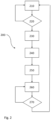
- Figure 2 outlines an exemplary embodiment of a method 200 as herein described.
- fuel gas compressors 53 and 54 are running, while fuel gas compressor 55 is non-operative.
- the gas turbine engines are running in closed loop load control mode, as indicated above, wherein the fuel mass flow to the gas turbine engines is controlled by the fuel control valves so as to operate the gas turbine engines at a set power output and according to an externally provided load demand signal.
- This initial operation state is indicated at 210.
- step 220 it is determined whether an operating fuel gas compressor fails. If this is not the case, the gas turbine engines continue to operate in load control mode at the set power output according to a power demand signal at 210.
- a failure of an operating fuel gas compressor for instance fuel gas compressor 53
- a startup signal 103 is sent to non-operating fuel gas compressor 55.
- a failure signal 100 is generated and at 240 a startup signal 103 is sent to non-operating fuel gas compressor 55.
- it requires a certain start up time until previously non-operating fuel gas compressor 55 can fully replace the compression and fuel mass flow capacity previously provided by failed compressor 53.
- the gas turbine engines are running at a power output above a certain threshold, remaining fuel gas compressor 54 might not be able to sustain the required fuel mass flow at the required minimum plant supply pressure for operating the gas turbine engines at a power output according to the power demand signal.
- the gas turbine engines will likely be subject to suddenly switching off. That is, the combustion inside the combustion chambers suddenly extinguishes from a high power level, causing high temperature gradients inside the gas turbine engines and, in turn, causing high thermally induced stresses and lifetime consumption.
- shutdown of the gas turbine engines will also cause a shutdown of the steam turbine engine.
- the power plant completely ceases to produce electric power. Starting the power plant again may require an extended delay time. It may hence be found of paramount interest to avoid the total shutdown of the major rotating equipment, that is, primarily the gas turbine engines, but also the steam turbine engine.
- plant supply line 52 is filled with fuel gas at the plant supply pressure, and consequently works as a compressed fuel buffering volume.
- the gas turbine engines may be run on fuel from this buffering volume as long as the pressure in the buffering volume does not drop below a minimum pressure required to operate the gas turbine engines at a specific power output. It is understood that, for a given buffering volume and initial pressure, a certain pressure drop occurs the slower the less fuel is consumed per time unit, that is, the lower the power output is with which the gas turbine engines are operated. Moreover, it may generally and reasonably be assumed that the critical required minimum plant supply pressure to sustain operation of the gas turbine engines is the lower the lower the power output of the gas turbine engines is.
- feedforward control signals 101, 102 are generated in response to the fuel gas compressor failure signal and forwarded to the fuel control systems of the gas turbine engines, as simplistically represented by fuel flow control valves 16 and 26.
- the fuel control systems may be significantly more complex and comprise a multitude of fuel flow control valves which control the total fuel mass flow to a gas turbine engine and/or the distribution of fractions of the total fuel mass flow within the combustion system of a gas turbine engine.
- the feedforward control signals may also act on the position of one or more rows of variable inlet guide vanes so as to reduce the air mass flow through the gas turbine engines.
- the feedforward control signals 101, 102 are transmitted very fast and are predetermined fixed signals not being subject to closed loop control. Feedforward control signals 101 and 102 are predetermined such that the total fuel mass flow provided to each of the gas turbine engines corresponds to a fuel mass flow required to operate the gas turbine engines approximately at the emergency power output.
- the fuel flow control valves and other operation parameters are controlled by the feedforward control signals 101, 102 to predetermined values which ensure a safe operation of the gas turbine engines at the emergency power output.
- the quantitative values of feedforward control signals 101 and 102 may depend on the actual initial plant supply pressure in plant supply line 52, the type of fuel, and other parameters, like for instance, ambient conditions or power plant operating states, which is familiar to a person having ordinary skill in the art.
- step 240 and 250 may be reversed, or they may be effected at least essentially concurrently.
- fuel gas compressor startup signal 103 and feedforward control signals 101, 102 should be generated and provided to the respective components within fractions of seconds.
- the gas turbine engines may, at 260, be operated at the emergency power output in a closed loop load control mode.
- step 270 it is verified whether previously non-operative fuel gas compressor 55 has fully ran up. As long as this is not the case, the gas turbine engines are continued to be operated at emergency power output in step 260.
- the fuel mass flow consumed by the gas turbine engines is made up from the remaining fuel mass flow provided by fuel gas compressor 54 remaining in operation, plus a mass flow by which the fuel mass buffered in the buffering volume provided by plant supply line 52 is reduced. If the mass flow which can be sustained by fuel gas compressor 54 is lower than the fuel mass flow consumed by the gas turbine engines at the emergency power output, the pressure in plant supply line 52 drops over time. As soon as the actual pressure in plant supply line 52 drops below a critical required minimum pressure for operating the gas turbine engines at the emergency power output, the gas turbine engines must be shut down.
- the emergency power output may be chosen such that the fuel mass flow provided by fuel gas compressor 54 plus the fuel mass buffered in plant supply line 52 are sufficient to operate the gas turbine engines at the emergency power output during the time required to take fuel gas compressor 55 into operation.
- the emergency power output of the gas turbine engines shall, preferably, be a power output at which the generators of the gas turbine engines stay connected to the grid, that is, the related grid switches shall not be opened, while in embodiments it is possible to step-download the gas turbine engines to "full speed - no load", that is, operating at a speed which is at least essentially synchronous with the grid frequency, but the grid switches opened, as indicated above. This, at least, provides a lower limitation for an allowable emergency power output.
- fuel supply line 52 is designed and dimensioned so as to provide a sufficiently large buffering volume for operating the gas turbine engines at a minimum allowable emergency power output during the time until a previously non-operating fuel gas compressor is in full operation. This may, for one instance, be achieved in designing the plant supply line with a sufficiently large cross section. In other instances, where the plant supply line is already existing, an external buffering vessel may be provided in fluid communication with plant supply line 52.
- the power output of the gas turbine engines has a direct impact on the mass flow and temperature of the gas turbine flue gases which are used to generate steam for steam turbine engine 30 in heat recovery steam generator 40.
- the emergency power output of the gas turbine engines may be defined such that a minimum temperature and pressure can be provided in heat recovery steam generator 40 so as to sustain operation of the steam turbine engine with steam turbine engine generator 35 staying connected to the grid.
- the buffering volume provided by plant supply line 52 may be designed such that the pressure in the plant supply line, starting at a nominal plant supply pressure, does not drop below a fuel pressure required to operate the gas turbine engines at the emergency power output when operating the gas turbine engines that the emergency power output and with the reduced mass flow provided by the fuel gas compressor remaining in operation.
- the above-described method may be conducted in a slightly different manner. If the line supply pressure is sufficient to operate the gas turbine engines at the emergency power output, the fuel gas compressors may, during the run-up period of the previously non-operating fuel gas compressor, be completely isolated from the plant supply line and the fuel may be supplied to the plant supply line through a bypass line 57 and check valve 56, which provide a bypass connection between utility supply line 51 and plant supply line 52, bypassing the fuel gas compressors.
- Check valve 56 is provided so as to avoid backflow of fuel from plant supply line 52 into a utility supply line 51, but to allow the flow of fuel from utility supply line 51 to plant supply line 52.
- compressor 53 remaining in operation may be operated and provide compressed fuel gas from utility supply line 51 to plant supply line 52 as long as the actual plant supply pressure in plant supply line 52 is higher than the line supply pressure in utility supply line 51, that is, as long as check valve 56 is closed.
- check valve 56 opens fluid communication between utility supply line 51 and plant supply line 52 through bypass line 57
- the fuel gas compressors are fluidly isolated from plant supply line 52 and the gas turbine engines are supplied with fuel gas from utility supply line 51 through bypass line 57 at the line supply pressure.
- the pressure in plant supply line 52 that is, the fuel pressure available for the gas turbine engines, will not drop essentially below the line supply pressure.
- the emergency power output of the gas turbine engines may thus be chosen dependent on the line supply pressure and so that the associated minimum required fuel gas pressure is lower than or at most equal to the line supply pressure.
Landscapes
- Engineering & Computer Science (AREA)
- Chemical & Material Sciences (AREA)
- Combustion & Propulsion (AREA)
- Mechanical Engineering (AREA)
- General Engineering & Computer Science (AREA)
- Control Of Turbines (AREA)
- Engine Equipment That Uses Special Cycles (AREA)
- Control Of Eletrric Generators (AREA)
Description
- The present disclosure relates to a method for operating a power plant and a power plant configured to be operated according to the method, as set forth in the claims.
- A gas turbine or combined cycle power plant comprises one or more gas turbine engines and, if the gas turbine engines are intended to be operated on fuel gas, a fuel gas supply system. The fuel gas supply system typically includes either at least one fuel gas compressor or reducing equipment, or a combination of both. A fuel gas compressor may be dedicated to one single gas turbine engine or may be configured to operate on a common header which is connected to a plurality of gas turbine engines.
- In order to provide stable gas supply pressure during gas turbine steady state operation, the fuel gas supply system comprises pressure controllers, which typically work slow so as to avoid steep pressure gradients and significant oscillations of the supply pressure of the fuel gas supplied to the gas turbine engines. The load control of the power plant also works comparatively slow, so as to account for the delay times of feedback signals inherent to the power plant.
- While these systems yield stable operation of the gas turbine engines and other rotating equipment of the power plant, these control mechanisms may be too slow if unexpected transients occur.
- For the sake of plant economics, which includes economizing self-consumption by the plant and auxiliaries, as well as the investment cost, the fuel gas compressors are generally designed and operated so as to run close to full load at a fuel mass flow and pressure just sufficient to operate the one or more gas turbine engines in steady state at rated load. Hence, failure of a fuel gas compressor may, with the one or more gas turbine engines running at a set power output, result in a fast drop of the plant fuel gas supply pressure on which the control systems may not be able to react. The gas turbine engines may thus experience a sudden shutdown either due to a lack of capability of the control systems to adjust fuel control valve, or the simple lack of a sufficient mass flow of fuel gas at a minimum required plant fuel gas supply pressure. In a combined cycle power plant, the shutdown of the gas turbine engine or the gas turbine engines also results in a fast steam turbine shutdown. A sudden shutdown, also referred to as a TRIP, of major rotating equipment results in heavy stresses in the thermally loaded parts of gas and steam turbines, and accordingly high lifetime consumption, and the potential need for delays until the power plant again supplies power to the grid.
-
EP 3 081 785 discloses a load running system that comprises a plurality of compressors that compress a fuel gas and supply the compressed fuel gas to a load apparatus. A compressor control device comprises a feedforward control signal generation unit that, on the basis of a value that is found by dividing the total load of the load apparatus by the number of running compressors, generates a first control signal for controlling the amount of fuel gas supplied by the compressors, and a control unit that, on the basis of the first control signal, controls the amount of fuel gas supplied by the compressors.US 2017/044,997 suggests a control device that controls a fuel gas supply system. The fuel gas supply system has: a compressor that supplies compressed fuel gas to a load apparatus; an inflow amount regulating means that regulates the amount of fuel gas that flows into the compressor; an anti-surge valve that is for returning to an inlet side of the compressor fuel gas that is discharged from the compressor; and an inlet pressure-regulating valve that regulates the pressure of fuel gas supplied toward the inflow amount regulating means. The control device includes a main pressure-regulating unit that controls the inflow amount regulating means and the anti-surge valve using a first feedforward control value that is generated on the basis of the load of the load apparatus and of a first conversion process and using a feedback control value that is generated on the basis of the deviation between a set value and a measured value for the discharge pressure of the compressor; and an inlet pressure-regulating unit that controls the inlet pressure-regulating valve using a second feedforward control value that is generated on the basis of the load of the load apparatus and of a second conversion process. - It is an object of the presently disclosed subject matter to provide a method for operating a power plant of the type initially mentioned and a power plant suitable for being operated according to said method. In a more specific aspect, a method shall be provided which allows to avoid the sudden shutdown of major rotating equipment of a power plant upon failure of a fuel gas compressor. In more specific aspects, it may be found desirable to be able to return to a normal, e.g. unrestricted load controlled operation mode, so as to provide a scheduled or demanded power output to the grid.
- This is achieved by the subject matter described in the independent claims.
- Further effects and advantages of the disclosed subject matter, whether explicitly mentioned or not, will become apparent in view of the disclosure provided below.
- It is noted that within the framework of the present disclosure the use of the indefinite article "a" or "an" does in no way stipulate a singularity nor does it exclude the presence of a multitude of the named member or feature. It is thus to be read in the sense of "at least one" or "one or a multitude of".
- Accordingly, disclosed is a method for operating a power plant, wherein the power plant comprises at least one gas turbine engine and at least one fuel gas compressor. The method comprises supplying fuel gas through a utility supply line, wherein the fuel gas in the utility supply line is at a line supply pressure. The fuel gas supplied through the utility supply line and at the line supply pressure is subsequently compressed to a plant supply pressure in at least one fuel gas compressor and the compressed fuel gas at the plant supply pressure is supplied to a plant supply line. The skilled person will readily understand that from the plant supply line the compressed fuel gas is supplied to the at least one gas turbine engine through at least one fuel gas control valve of each gas turbine engine. The skilled person will further appreciate, that the at least one fuel control valve may comprise a control valve for controlling the total fuel gas mass flow to a respective gas turbine engine, but may also, in addition or alternatively, comprise control or stop valves for distributing the fuel gas mass flow to, for instance, while not being limited to, different fuel lances, burners, fuel discharge openings of a burner, or combustion zones within a gas turbine engine. The method comprises, initially, operating the gas turbine engine at a set power output according to a power demand signal. That is, in other words, the operation of the gas turbine engine is controlled by a load controller and at a power output matching a control input according to an externally scheduled demand signal. The method further comprises detecting whether an operating fuel gas compressor experiences a failure. This functionality can, for example, while not being limited to, be included into a fuel gas pressure controller. According to the herein disclosed method, if a failure of an operating fuel gas compressor is detected, which means that this fuel gas compressor may no longer be operating, the power output of the at least one gas turbine engine is reduced to an emergency power output which is lower than the set power output. The term "emergency power output" is, in this respect, to be interpreted broadly and the method may, in embodiments, comprise step-downloading the at least one gas turbine engine to "full speed - no load"; that is, the power output to the grid is zero, but the at least one gas turbine engine is maintained running at at least essentially a speed which is synchronous with the grid frequency. However, as outlined in more detail below, if the flue gas from the at least one gas turbine engine is used to generate steam in a combined cycle power plant, this may likely require a shut-down of the steam turbine, as the mass flow and temperature of the flue gas at "full speed - no load" may be insufficient to maintain a minimum required live steam temperature and/or mass flow. The power output of the at least one gas turbine engine is subsequently restricted to the emergency power output. The reduction of the power output is performed in one single step and may in particular be a sudden deloading, in an essentially discontinuous, step-like manner, and is controlled by at least one feedforward signal. That is, the control signal or control signals are directly set by a control system and fed to certain hardware control members without involving a closed loop controller. The at least one feedforward control signal is not dependent on a control loop and hence provides significantly faster dynamics than a closed loop control signal. In embodiments, the method comprises providing a feedforward control signal to at least one fuel flow control valve of the at least one gas turbine engine and changing the valve position to a predefined emergency position and subsequently operating the at least one gas turbine engine in a load control mode at the emergency power output. The skilled person will readily appreciate that feedforward signals may also be sent to other hardware components of the at least one gas turbine engine, like, for instance, rows of variable inlet guide vanes, and feedforward signals may be used to adjust further operating parameters to the emergency power output. The predefined emergency position of the at least one fuel flow control valve may in particular embodiments be determined, for instance during test runs, as a valve position which is suitable to safely operate the at least one gas turbine engine at approximately the emergency power output. In other words, the predetermined emergency valve position is a valve position corresponding to the position of the fuel flow control valve expected at the emergency power output if it were operated in closed loop control. In providing the feedforward control signal, the gas turbine engine is very fast deloaded to approximately the emergency power output, wherein a fine adjustment of the actual power output to the emergency power output may then be achieved by a closed loop load control. The fuel gas consumption of the at least one gas turbine engine is accordingly reduced very quickly, such that the fuel gas buffered in a buffering volume provided by the plant supply line and/or in communication with the plant supply line can longer sustain the supply of fuel gas to the at least one gas turbine engine at a sufficiently high plant supply pressure. As mentioned above, the at least one fuel control valve may comprise a control valve for controlling the fuel gas mass flow the respective gas turbine engine, but may also, in addition or alternatively, comprise control or stop valves for distributing the fuel gas mass flow to, for instance, while not being limited to, different fuel lances, burners, fuel discharge openings of a burner, or combustion zones within a gas turbine engine.
- It is generally understood that the fuel gas compressors operate according to a characteristic map of pressure ratio vs. inlet mass flow, or, provided a constant pressure in the utility supply line, plant supply pressure vs. mass flow. Moreover, the at least one gas turbine engine, at each power output, has a characteristic pair of fuel mass flow and required minimum fuel gas pressure. Steady state operation is attainable if, at the mass flow required by the at least one gas turbine engine at a specific power output, is lower than the mass flow the at least one fuel gas compressor can convey at the required minimum fuel gas pressure at said specific power output. Hence, if upon failure of a fuel gas compressor, the power output of the at least one gas turbine engine is reduced to an emergency power output at which the consumed fuel mass flow is lower than the mass flow at least one fuel gas compressor remaining in operation can convey at the required minimum fuel gas pressure at said power output, operation of the at least one gas turbine engine at the emergency power output can be sustained for an essentially unlimited time. In other instances, as outlined below, it might be the case that the line supply pressure is sufficient to sustain operation of the at least one gas turbine engine at an emergency power output. If, however, no fuel gas compressor remains in operation or the at least one fuel gas compressor remaining in operation can not supply the required fuel mass flow at the required fuel gas pressure, it may be considered that at least the plant supply line provides a buffering volume which is initially, upon failure of a fuel gas compressor, charged with buffered fuel gas at an initial pressure. This buffered fuel gas may be used to make up for a difference between the fuel mass flow requirement of the at least one gas turbine engine and the supply capacity, if any, of the fuel gas compressor or the fuel gas compressors remaining in operation. In such a case, the plant supply pressure in the plant supply line steadily drops as a net extraction of fuel gas takes place. Such, operation of the at least one gas turbine engine may be sustained for a limited time. Said time, ideally, is sufficient to restore full fuel gas supply capability, or at least for a normal shutdown of the at least one gas turbine engine with a significantly lower lifetime consumption than a sudden unscheduled flame-off. Hence, reducing the power output of the at least one gas turbine engine to an emergency power output served at least one of the following purposes: (a) reduce the fuel mass flow consumed by the at least one gas turbine engine and required minimum fuel pressure to values which may be sustained by the fuel gas supply system with reduced capacity or without additional fuel gas compression, and/or (b) reduce the fuel mass flow consumed by the at least one gas turbine engine and required minimum fuel pressure so as to extend the time until the pressure in the plant supply line has dropped below the required minimum fuel pressure at the emergency power output.
- It is understood that, preferably, the emergency power output is sufficiently high so as to maintain the generators of the gas turbine engines connected to the grid.
- In further, non-nonlimiting embodiments, the method comprises determining a critical gas turbine engine power output which is sustainable based upon the fuel gas mass flow/output pressure characteristics of one or more fuel gas compressors remaining in operation and determining the emergency power output to be lower or at most equal to the critical power output. A shutdown of the at least one gas turbine engine can thus be avoided.
- In further, non-limiting embodiments the method comprises guiding the exhaust gas mass flow of the at least one gas turbine engine through at least one heat recovery steam generator, generating steam, and supplying the generated steam to a steam turbine to drive the steam turbine, wherein the emergency power output is higher than or at least equal to a minimum gas turbine engine power output required to generate steam of a minimum mass flow, pressure and temperature to drive the steam turbine. A shutdown of the steam turbine engine can thus be avoided.
- In that the major rotating equipment, that is the gas and, optionally, steam turbine engines remain in operation, and standstill is avoided, the lifetime consumption is largely reduced and delay times for a complete start up from standstill are avoided, whereby both measures yield significant economic and technical advantages.
- In frequently applied embodiments, the power plant comprises redundant fuel gas compressing capacities, in the sense that, for instance, out of three fuel gas compressors only two are required to operate the power plant at a rated power output. In this respect, at the time of the failure of a fuel gas compressor the power plant at least one fuel gas compressor is non-operative. The herein disclosed method, in these cases, may comprise starting and putting into operation a previously non-operative fuel gas compressor.
- The method may then further comprise determining a minimum required plant supply pressure for operation of the at least one gas turbine engine at the emergency power output, determining a start-up time of the previously non-operative fuel gas compressor, and providing a buffering volume suitable for buffering fuel gas and fluidly arranged between the at least one fuel gas compressor and the at least one gas turbine engine wherein said buffering volume is sufficiently large to supply fuel gas to the at least one gas turbine engine running at the emergency power output after fuel gas compressor failure and before the previously non-operative fuel gas compressor is in full operation without the pressure in the buffering volume dropping below the minimum required plant supply pressure. In embodiments, the buffering volume is provided in and by the plant supply line, i.e. the fuel supply line extending from downstream the at least one fuel gas compressor to the at least one gas turbine engine. The method may in particular, non-nonlimiting embodiments comprise providing the fuel supply lines with a sufficiently large cross section or, more specifically, diameter so as to provide a sufficient buffering volume.
- Once the previously non-operative fuel gas compressor is in full operation, the restriction of the power output to the emergency power output may be terminated and the power output of the at least one gas turbine engine may be controlled by the power demand signal, so as to return to a normal operation of the power plant.
- In certain power plants, a bypass line is installed connecting the utility supply line and the plant supply line and bypassing the at least one fuel gas compressor, and a check valve is installed in said bypass line to avoid backflow of fuel gas from the plant supply line into the utility supply line while enabling flow of fuel gas from the utility supply line to the plant supply line. It may in particular be the case that the line supply pressure provided by the utility in the utility supply line is sufficiently high so that the at least one gas turbine engine can be operated with the line supply pressure from the utility supply line. In this case, the method may comprise determining a critical gas turbine power output which is sustainable with the line supply pressure and determining the emergency power output to be lower or at most equal to said critical power output. If at least one fuel gas compressor remains in operation after failure of a fuel gas compressor, the method may then further comprise determining a power output of the at least one gas turbine engine sustainable with the supply line pressure, a power output of the at least one gas turbine engine sustainable with the at least one fuel gas compressor remaining in operation, and, if the power output of the at least one gas turbine engine sustainable with the supply line pressure is larger than the power output of the at least one gas turbine engine sustainable with the at least one fuel gas compressor remaining in operation, fluidly isolating the at least one fuel gas compressor remaining in operation from the plant supply line.
- In a further aspect, wherein at least one fuel gas compressor remains in operation after failure of a fuel gas compressor, the method may in embodiments comprise determining a critical gas turbine power output which is sustainable with a maximum pressure of the plant supply pressure sustainable by the at least one fuel gas compressor remaining in operation and the line supply pressure and determining the emergency power output to be lower or at most equal to said critical power output.
- In further aspects, disclosed is a power plant comprising at least one gas turbine engine, at least one fuel gas compressor, and a plant supply line connecting a downstream end of the at least one fuel gas compressor and the at least one gas turbine engine, wherein an upstream end of the at least one fuel gas compressor is connected to a utility supply line. The power plant further comprises a fuel gas pressure control system and a gas turbine engine control system. A control line is provided from the fuel gas pressure control system to the gas turbine control system and is adapted and configured to forward a fuel gas compressor failure signal from the fuel gas pressure control system to the gas turbine engine control system. The gas turbine engine control system is adapted and configured to, in response to a fuel gas compressor failure signal, forward a preset feedforward emergency control signal at least to at least one fuel flow control valve of the at least one gas turbine engine. The power plant may, in non-limiting more specific embodiments, further comprise a buffering volume suitable for buffering fuel gas and fluidly arranged between the at least one fuel gas compressor and the at least one gas turbine engine, wherein the buffering volume is sufficiently large to supply fuel gas to the at least one gas turbine engine running at an emergency power output during the time required to start a fuel gas compressor from standstill without the pressure in the buffering volume dropping below a minimum required plant supply pressure required to operate the at least one gas turbine engine at the emergency power output.
- It is understood that the features and embodiments disclosed above may be combined with each other. It will further be appreciated that further embodiments are conceivable within the scope of the present disclosure and the claimed subject matter which are obvious and apparent to the skilled person.
- The subject matter of the present disclosure is now to be explained in more detail by means of selected exemplary embodiments shown in the accompanying drawings. The figures show.
- Fig. 1
- an exemplary embodiment of a power plant; and
- Fig. 2
- a flow diagram of an exemplary embodiment of the above-described method.
- It is understood that the drawings are highly schematic, and details not required for instruction purposes may have been omitted for the ease of understanding and depiction. It is further understood that the drawings show only selected, illustrative embodiments, and embodiments not shown may still be well within the scope of the herein disclosed and/or claimed subject matter.
-
Figure 1 depicts an exemplary combined cycle power plant 1. Combined cycle power plant 1 comprises twogas turbine engines gas turbine engine respective compressor respective combustion chamber respective expansion turbine respective generator compressors respective combustion chamber respective expansion turbine fuel control valve - The exemplary power plant 1 further comprises a heat
recovery steam generator 40 and asteam turbine engine 30. Expanded exhaust gases from the gas turbineengine expansion turbines recovery steam generator 40, thereby, in a manner known to the skilled person, exchanging heat with feedwater fed to the heat recovery steam generator and generating steam. Said steam is guided to anexpansion steam turbine 33, where it is expanded, thereby generating useful shaft power for driving a steamturbine engine generator 35 and producing additional electrical power output. -
Fuel gas 5 is provided by a utility toutility supply line 51 at a line supply pressure. The supply line pressure may not be sufficient to supply the gas turbine engines when operating through all operating states.Fuel gas compressors plant supply line 52 tocombustion chambers fuel control valves fuel gas compressors fuel gas compressor 55 is non-operative. It will be understood, in this respect, that at least one of the lines connecting each fuel gas compressor with theutility supply line 51 and theplant supply line 52, respectively, is furnished with a check or shut-off valve so as to avoid backflow of fuel gas from the plant supply line to the utility supply line through a non-operative compressor. It will further be appreciated that each fuel gas compressor may be equipped with a line and valve system allowing startup of the compressor while another one of the fuel gas compressors is running. Said auxiliary systems of the fuel gas compressors, which are not immediately required for the understanding of the herein disclosed subject matter, are omitted from the drawing for the sake of clarity, but are familiar to a person having skill in the art. The fuel gas compressors are controlled by a pressure control system, which is not shown, but well-known to a skilled person. -
Figure 2 outlines an exemplary embodiment of amethod 200 as herein described. For outlining the herein disclosed method by virtue offigure 1 in connection withfigure 2 , it is now assumed, as indicated above, that, initially,fuel gas compressors fuel gas compressor 55 is non-operative. The gas turbine engines are running in closed loop load control mode, as indicated above, wherein the fuel mass flow to the gas turbine engines is controlled by the fuel control valves so as to operate the gas turbine engines at a set power output and according to an externally provided load demand signal. This initial operation state is indicated at 210. Atstep 220, it is determined whether an operating fuel gas compressor fails. If this is not the case, the gas turbine engines continue to operate in load control mode at the set power output according to a power demand signal at 210. If, however, a failure of an operating fuel gas compressor, for instancefuel gas compressor 53, is detected, at 230 afailure signal 100 is generated and at 240 astartup signal 103 is sent to non-operatingfuel gas compressor 55. However, it requires a certain start up time until previously non-operatingfuel gas compressor 55 can fully replace the compression and fuel mass flow capacity previously provided by failedcompressor 53. If the gas turbine engines are running at a power output above a certain threshold, remainingfuel gas compressor 54 might not be able to sustain the required fuel mass flow at the required minimum plant supply pressure for operating the gas turbine engines at a power output according to the power demand signal. If, thus, the pressure in the plant supply line drops below a required minimum pressure corresponding to the power output of the gas turbine engines, the gas turbine engines will likely be subject to suddenly switching off. That is, the combustion inside the combustion chambers suddenly extinguishes from a high power level, causing high temperature gradients inside the gas turbine engines and, in turn, causing high thermally induced stresses and lifetime consumption. As will be appreciated, shutdown of the gas turbine engines will also cause a shutdown of the steam turbine engine. In addition to the high lifetime consumption of the engines, the power plant completely ceases to produce electric power. Starting the power plant again may require an extended delay time. It may hence be found of paramount interest to avoid the total shutdown of the major rotating equipment, that is, primarily the gas turbine engines, but also the steam turbine engine. At the time of failure of a fuel gas compressor,plant supply line 52 is filled with fuel gas at the plant supply pressure, and consequently works as a compressed fuel buffering volume. The gas turbine engines may be run on fuel from this buffering volume as long as the pressure in the buffering volume does not drop below a minimum pressure required to operate the gas turbine engines at a specific power output. It is understood that, for a given buffering volume and initial pressure, a certain pressure drop occurs the slower the less fuel is consumed per time unit, that is, the lower the power output is with which the gas turbine engines are operated. Moreover, it may generally and reasonably be assumed that the critical required minimum plant supply pressure to sustain operation of the gas turbine engines is the lower the lower the power output of the gas turbine engines is. Thus, at 250 a fast, feedforward, de-loading ofgas turbine engines flow control valves plant supply line 52, the type of fuel, and other parameters, like for instance, ambient conditions or power plant operating states, which is familiar to a person having ordinary skill in the art. It will be readily appreciated that the order of method steps 240 and 250 may be reversed, or they may be effected at least essentially concurrently. The skilled person will appreciate that fuel gascompressor startup signal 103 and feedforward control signals 101, 102 should be generated and provided to the respective components within fractions of seconds. After the power output has been reduced in an essentially discontinuous, step-like manner in reducing the total fuel mass flow, the gas turbine engines may, at 260, be operated at the emergency power output in a closed loop load control mode. Instep 270 it is verified whether previously non-operativefuel gas compressor 55 has fully ran up. As long as this is not the case, the gas turbine engines are continued to be operated at emergency power output instep 260. If, however,fuel gas compressor 55 is fully operative and is capable of fully replacing failedfuel gas compressor 53, the limitation of the gas turbine power output to the emergency power output is terminated and the power output of the gas turbine engine is ramped up so that the gas turbine engines may again be operated at a set power output according to a power demand signal instep 210. - During
method step 260, the fuel mass flow consumed by the gas turbine engines is made up from the remaining fuel mass flow provided byfuel gas compressor 54 remaining in operation, plus a mass flow by which the fuel mass buffered in the buffering volume provided byplant supply line 52 is reduced. If the mass flow which can be sustained byfuel gas compressor 54 is lower than the fuel mass flow consumed by the gas turbine engines at the emergency power output, the pressure inplant supply line 52 drops over time. As soon as the actual pressure inplant supply line 52 drops below a critical required minimum pressure for operating the gas turbine engines at the emergency power output, the gas turbine engines must be shut down. Hence, the emergency power output may be chosen such that the fuel mass flow provided byfuel gas compressor 54 plus the fuel mass buffered inplant supply line 52 are sufficient to operate the gas turbine engines at the emergency power output during the time required to takefuel gas compressor 55 into operation. The skilled person will appreciate that the emergency power output of the gas turbine engines shall, preferably, be a power output at which the generators of the gas turbine engines stay connected to the grid, that is, the related grid switches shall not be opened, while in embodiments it is possible to step-download the gas turbine engines to "full speed - no load", that is, operating at a speed which is at least essentially synchronous with the grid frequency, but the grid switches opened, as indicated above. This, at least, provides a lower limitation for an allowable emergency power output. Other operating considerations may provide further restrictions as to a lower allowable emergency power output. In embodiments,fuel supply line 52 is designed and dimensioned so as to provide a sufficiently large buffering volume for operating the gas turbine engines at a minimum allowable emergency power output during the time until a previously non-operating fuel gas compressor is in full operation. This may, for one instance, be achieved in designing the plant supply line with a sufficiently large cross section. In other instances, where the plant supply line is already existing, an external buffering vessel may be provided in fluid communication withplant supply line 52. - It will be appreciated that the power output of the gas turbine engines has a direct impact on the mass flow and temperature of the gas turbine flue gases which are used to generate steam for
steam turbine engine 30 in heatrecovery steam generator 40. This means on the one hand, that also the power output of the steam turbine engine is reduced, whereby this reduction in power output is delayed due to the thermal inertia of the heat recovery steam generator. If the temperature of the flue gases from the gas turbine engines drops below a certain threshold, the steam generated in the heat recovery steam generator may no longer be at a temperature and pressure sufficient to sustain operation of the steam turbine engine. As a consequence, it may be necessary to shut down the steam turbine engine. In this respect, the emergency power output of the gas turbine engines may be defined such that a minimum temperature and pressure can be provided in heatrecovery steam generator 40 so as to sustain operation of the steam turbine engine with steamturbine engine generator 35 staying connected to the grid. The buffering volume provided byplant supply line 52 may be designed such that the pressure in the plant supply line, starting at a nominal plant supply pressure, does not drop below a fuel pressure required to operate the gas turbine engines at the emergency power output when operating the gas turbine engines that the emergency power output and with the reduced mass flow provided by the fuel gas compressor remaining in operation. - Depending on the line supply pressure, the above-described method may be conducted in a slightly different manner. If the line supply pressure is sufficient to operate the gas turbine engines at the emergency power output, the fuel gas compressors may, during the run-up period of the previously non-operating fuel gas compressor, be completely isolated from the plant supply line and the fuel may be supplied to the plant supply line through a
bypass line 57 andcheck valve 56, which provide a bypass connection betweenutility supply line 51 andplant supply line 52, bypassing the fuel gas compressors. Checkvalve 56 is provided so as to avoid backflow of fuel fromplant supply line 52 into autility supply line 51, but to allow the flow of fuel fromutility supply line 51 to plantsupply line 52. In another variant,compressor 53 remaining in operation may be operated and provide compressed fuel gas fromutility supply line 51 to plantsupply line 52 as long as the actual plant supply pressure inplant supply line 52 is higher than the line supply pressure inutility supply line 51, that is, as long ascheck valve 56 is closed. However, if it is detected thatcheck valve 56 opens fluid communication betweenutility supply line 51 andplant supply line 52 throughbypass line 57, the fuel gas compressors are fluidly isolated fromplant supply line 52 and the gas turbine engines are supplied with fuel gas fromutility supply line 51 throughbypass line 57 at the line supply pressure. In these operating modes the pressure inplant supply line 52, that is, the fuel pressure available for the gas turbine engines, will not drop essentially below the line supply pressure. The emergency power output of the gas turbine engines may thus be chosen dependent on the line supply pressure and so that the associated minimum required fuel gas pressure is lower than or at most equal to the line supply pressure.. - While the subject matter of the disclosure has been explained by means of exemplary embodiments, it is understood that these are in no way intended to limit the scope of the claimed invention. It will be appreciated that the claims cover embodiments not explicitly shown or disclosed herein, and embodiments deviating from those disclosed in the exemplary modes of carrying out the teaching of the present disclosure will still be covered by the claims.
Claims (13)
- A method (200) for operating a power plant (1), the power plant comprising at least one gas turbine engine (10, 20) and at least one fuel gas compressor (53. 54, 55), the method comprisingsupplying fuel gas (5) through a utility supply line (51), wherein the fuel gas in the utility supply line is at a line supply pressure;compressing the fuel gas to a plant supply pressure in at least one operating fuel gas compressor and supplying the compressed fuel gas to a plant supply line (52);operating (210) the at least one gas turbine engine at a set power output according to a power demand signal, anddetecting (220) whether an operating fuel gas compressor has a failure; characterized by, if a failure of an operating fuel gas compressor is detected, reducing the power output of the at least one gas turbine engine to an emergency power output which is lower than the set power output and restricting the power output of the at least one gas turbine engine to the emergency power output;wherein the reduction of the power output is performed in one single step and controlled by at least one feedforward control signal.
- The method according to the preceding claim, comprising providing (250) at least one of the at least one feedforward control signal to at least one fuel flow control valve (16, 26) of the at least one gas turbine engine and changing the valve position to a predefined emergency position and subsequently operating (260) the at least one gas turbine engine in a load control mode at the emergency power output.
- The method according to the preceding claim, wherein the predetermined emergency valve position is a valve position corresponding to the position of the fuel flow control valve expected at the emergency power output.
- The method according to any preceding claim, wherein the method comprises determining a critical gas turbine engine power output which is sustainable based upon the fuel gas mass flow/output pressure characteristics of one or more fuel gas compressors (53, 54, 55) remaining in operation and determining the emergency power output to be lower or at most equal to the critical power output.
- The method of any preceding claim, wherein the method comprises guiding the exhaust gas mass flow of the at least one gas turbine engine (10, 20) through at least one heat recovery steam generator (40), generating steam, and supplying the generated steam to a steam turbine (32) to drive the steam turbine, wherein the emergency power output is higher than or at least equal to a minimum gas turbine engine power output required to generate steam of a minimum mass flow, pressure and temperature to drive the steam turbine.
- The method according to any preceding claim, comprising starting and putting into operation (240) a previously non-operative fuel gas compressor.
- The method according to the preceding claim, comprising determining a minimum required plant supply pressure for operation of the at least one gas turbine engine (10, 20) at the emergency power output, determining a start-up time of the previously non-operative fuel gas compressor, and providing a buffering volume suitable for buffering fuel gas and fluidly arranged between the at least one fuel gas compressor (53, 54, 55) and the at least one gas turbine engine (10, 20), wherein said buffering volume is sufficiently large to supply fuel gas to the at least one gas turbine engine running at the emergency power output after fuel gas compressor failure and prior to full operation of the previously non-operative fuel gas compressor without the pressure in the buffering volume dropping below the minimum required plant supply pressure.
- The method according to any of the two preceding claims, comprising terminating the restriction of the power output to the emergency power output and controlling the power output of the gas turbine engine by the power demand signal after the previously non-operative fuel gas compressor is in full operation.
- The method according to any preceding claim, wherein a bypass line (57) is installed connecting the utility supply line (51) and the plant supply line (52) and bypassing the at least one fuel gas compressor (53, 54, 55) and wherein a check valve (56) is installed in said bypass line to avoid backflow of fuel gas from the plant supply line (52) into the utility supply line (51) while enabling flow of fuel gas from the utility supply line (51) to the plant supply line (52), wherein the method comprises determining a critical gas turbine power output which is sustainable with the line supply pressure and determining the emergency power output to be lower or at most equal to the critical power output.
- The method according to any preceding claim, wherein a bypass line (57) is installed connecting the utility supply line (51) and the plant supply line (52) and bypassing the at least one fuel gas compressor (53, 54, 55) and wherein a check valve (56) is installed in said bypass line (57) to avoid backflow of fuel gas from the plant supply line (52) into the utility supply line (51) while enabling flow of fuel gas from the utility supply line to the plant supply line and wherein at least one fuel gas compressor remains in operation after failure of a fuel gas compressor, the method comprising determining a power output of the at least one gas turbine engine (10, 20) sustainable with the supply line pressure, a power output of the at least one gas turbine engine sustainable with the at least one fuel gas compressor remaining in operation, and, if the power output of the at least one gas turbine engine sustainable with the supply line pressure is larger than the power output of the at least one gas turbine engine sustainable with the at least one fuel gas compressor remaining in operation, fluidly isolating the at least one fuel gas compressor remaining in operation from the plant supply line.
- The method according to any preceding claim wherein at least one fuel gas compressor (53, 54, 55) remains in operation after failure of a fuel gas compressor, comprising determining a critical power output of the at least one gas turbine engine which is sustainable with a maximum pressure of the plant supply pressure sustainable by the at least one fuel gas compressor remaining in operation and the line supply pressure, and determining the emergency power output to be lower or at most equal to the critical power output.
- A power plant (1) comprising at least one gas turbine engine (10, 20), at least one fuel gas compressor (53, 54, 55), and a plant supply line (52) connecting a downstream end of the at least one fuel gas compressor and the at least one gas turbine engine, wherein an upstream end of the at least one fuel gas compressor is connected to a utility supply line (51), and further comprising a fuel gas pressure control system and a gas turbine engine control system, wherein a control line is provided from the fuel gas pressure control system to the gas turbine control system and is adapted and configured to forward a fuel gas compressor failure signal (100) from the fuel gas pressure control system to the gas turbine engine control system, characterized in that the gas turbine engine control system is adapted and configured to, in response to a fuel gas compressor failure signal, forward a preset feedforward emergency control signal (101, 102) at least to at least one fuel flow control valve of the at least one gas turbine engine.
- The power plant according to the preceding claim, comprising a buffering volume suitable for buffering fuel gas and fluidly arranged between the at least one fuel gas compressor (53, 54, 55) and the at least one gas turbine engine (10, 20), wherein the buffering volume is sufficiently large to supply fuel gas to the at least one gas turbine engine running at an emergency power output during the time required to start a fuel gas compressor from standstill without the pressure in the buffering volume dropping below a minimum required plant supply pressure required to operate the at least one gas turbine engine at the emergency power output.
Priority Applications (4)
| Application Number | Priority Date | Filing Date | Title |
|---|---|---|---|
| EP20155657.8A EP3862549B1 (en) | 2020-02-05 | 2020-02-05 | Method for operating a power plant, and power plant |
| JP2021009059A JP7686399B2 (en) | 2020-02-05 | 2021-01-22 | Method for operating a power plant and power plant |
| CN202110103483.8A CN113217197B (en) | 2020-02-05 | 2021-01-26 | Method for operating a power plant and power plant |
| US17/160,867 US11459961B2 (en) | 2020-02-05 | 2021-01-28 | Method for operating a power plant, and power plant |
Applications Claiming Priority (1)
| Application Number | Priority Date | Filing Date | Title |
|---|---|---|---|
| EP20155657.8A EP3862549B1 (en) | 2020-02-05 | 2020-02-05 | Method for operating a power plant, and power plant |
Publications (2)
| Publication Number | Publication Date |
|---|---|
| EP3862549A1 EP3862549A1 (en) | 2021-08-11 |
| EP3862549B1 true EP3862549B1 (en) | 2025-05-07 |
Family
ID=69500611
Family Applications (1)
| Application Number | Title | Priority Date | Filing Date |
|---|---|---|---|
| EP20155657.8A Active EP3862549B1 (en) | 2020-02-05 | 2020-02-05 | Method for operating a power plant, and power plant |
Country Status (4)
| Country | Link |
|---|---|
| US (1) | US11459961B2 (en) |
| EP (1) | EP3862549B1 (en) |
| JP (1) | JP7686399B2 (en) |
| CN (1) | CN113217197B (en) |
Families Citing this family (3)
| Publication number | Priority date | Publication date | Assignee | Title |
|---|---|---|---|---|
| GB202118041D0 (en) | 2021-12-14 | 2022-01-26 | Rolls Royce Plc | Restarting a gas turbine engine |
| IT202200016938A1 (en) * | 2022-08-08 | 2024-02-08 | Nuovo Pignone Tecnologie Srl | Fuel Gas Booster-Gas Turbine Integration for Energy Saving and Optimized Operation |
| EP4489247A1 (en) * | 2023-06-05 | 2025-01-08 | General Electric Technology GmbH | Systems and methods for improved transient response of turbine generators |
Family Cites Families (24)
| Publication number | Priority date | Publication date | Assignee | Title |
|---|---|---|---|---|
| JPH09317498A (en) * | 1996-03-29 | 1997-12-09 | Nkk Corp | Operation control method for multiple gas compressors for multiple gas turbine generators |
| US6176074B1 (en) * | 1998-06-05 | 2001-01-23 | Pratt & Whitney Canada Corp. | Shaft decouple logic for gas turbine |
| JP2001355594A (en) * | 2000-06-13 | 2001-12-26 | Mitsubishi Heavy Ind Ltd | High-pressure fluid processing device, compressor system, and starting method-for high-pressure fluid processing device |
| JP2002303274A (en) * | 2001-04-02 | 2002-10-18 | Mitsubishi Heavy Ind Ltd | Auxiliary compressor starter |
| JP3854556B2 (en) * | 2002-09-11 | 2006-12-06 | 三菱重工業株式会社 | Gas turbine plant control mechanism |
| JP3988705B2 (en) * | 2003-09-30 | 2007-10-10 | トヨタ自動車株式会社 | Control device and flying body of single-shaft gas turbine engine |
| EP1730445B1 (en) * | 2004-03-31 | 2009-05-13 | Alstom Technology Ltd | Method for operating a heat engine, preferably a gas turbine installation |
| US20080128029A1 (en) * | 2006-12-05 | 2008-06-05 | Walter T. Gorman Llc | Method, system and computer product for ensuring backup generator fuel availability |
| JP4918436B2 (en) * | 2007-08-31 | 2012-04-18 | 三菱重工業株式会社 | Gas turbine fuel gas supply device |
| US9097188B2 (en) * | 2008-10-01 | 2015-08-04 | Mitsubishi Hitachi Power Systems, Ltd. | Gas turbine device |
| US9650909B2 (en) * | 2009-05-07 | 2017-05-16 | General Electric Company | Multi-stage compressor fault detection and protection |
| CH700991A1 (en) * | 2009-05-13 | 2010-11-15 | Alstom Technology Ltd | Method for operating a gas turbine plant with a compressor station for gaseous fuel. |
| US8471702B2 (en) * | 2010-12-22 | 2013-06-25 | General Electric Company | Method and system for compressor health monitoring |
| CN202832796U (en) * | 2012-03-30 | 2013-03-27 | 通用电气公司 | Fuel supply system |
| EP2775106A1 (en) * | 2013-03-06 | 2014-09-10 | Alstom Technology Ltd | Method for operating a combined-cycle power plant |
| EP2775107A1 (en) * | 2013-03-06 | 2014-09-10 | Alstom Technology Ltd | Method for starting-up and operating a combined-cycle power plant |
| US20150184594A1 (en) * | 2013-12-31 | 2015-07-02 | General Electric Company | Systems and methods to maintain stability of fuel flow in gas turbine engines |
| US20170082033A1 (en) * | 2014-06-10 | 2017-03-23 | Wenjie Wu | Gas turbine system and method |
| JP6140899B2 (en) * | 2014-07-31 | 2017-06-07 | 三菱重工業株式会社 | Control apparatus and control method |
| JP6187890B2 (en) * | 2014-07-31 | 2017-08-30 | 三菱重工業株式会社 | Control apparatus and control method |
| EP3081785A4 (en) * | 2014-07-31 | 2017-03-29 | Mitsubishi Heavy Industries, Ltd. | Compressor control device, compressor control system, and compressor control method |
| DE112015003585T5 (en) * | 2015-03-19 | 2017-06-08 | Mitsubishi Heavy Industries, Ltd. | Condition monitoring and condition monitoring method for a delivery gas compression system and delivery gas compression system |
| JP6935327B2 (en) * | 2017-12-28 | 2021-09-15 | 三菱パワー株式会社 | Controls, gas turbines, control methods and programs |
| GB201808436D0 (en) * | 2018-05-23 | 2018-07-11 | Rolls Royce Plc | Gas turbine engine compressor control method |
-
2020
- 2020-02-05 EP EP20155657.8A patent/EP3862549B1/en active Active
-
2021
- 2021-01-22 JP JP2021009059A patent/JP7686399B2/en active Active
- 2021-01-26 CN CN202110103483.8A patent/CN113217197B/en active Active
- 2021-01-28 US US17/160,867 patent/US11459961B2/en active Active
Also Published As
| Publication number | Publication date |
|---|---|
| US11459961B2 (en) | 2022-10-04 |
| CN113217197A (en) | 2021-08-06 |
| JP7686399B2 (en) | 2025-06-02 |
| US20210396185A1 (en) | 2021-12-23 |
| JP2021124116A (en) | 2021-08-30 |
| EP3862549A1 (en) | 2021-08-11 |
| CN113217197B (en) | 2025-03-28 |
Similar Documents
| Publication | Publication Date | Title |
|---|---|---|
| JP5457626B2 (en) | Method and system for detection and transmission for isolated operation of power | |
| CN101657963B (en) | Method for operating a power plant | |
| CN101657609B (en) | For running the method for power plant equipment | |
| US11459961B2 (en) | Method for operating a power plant, and power plant | |
| CN103967623B (en) | The response of gas turbine under-frequency improves system and method | |
| US8578717B2 (en) | Method for controlling the load variations in a gas turbine | |
| EP2799671B1 (en) | Method for starting-up and operating a combined-cycle power plant | |
| RU2535442C2 (en) | Method of operation of combined power station | |
| JP2007315398A (en) | Method of gas turbine operation by using bleed air during under frequency operation | |
| JP2008051099A (en) | Gas turbine and system for operating gas turbine | |
| JP5808819B2 (en) | Operation method of stationary gas turbine, operation adjusting device for gas turbine, and power plant | |
| CN107407204A (en) | Air mixture turbine electricity generation system | |
| EP2770172B1 (en) | Method for providing a frequency response for a combined cycle power plant | |
| JP3677536B2 (en) | Gas turbine power generation control device | |
| EP3495731B1 (en) | Once-through evaporator systems | |
| US20170207628A1 (en) | Method for operating a power plant, and power plant | |
| JP2010216441A (en) | Rotation control device for gas turbine | |
| JP2005127203A (en) | Control device for gas turbine equipment | |
| JP2017180454A (en) | Gas turbine variable flow compressor | |
| EP3495729A1 (en) | Once-through evaporator systems | |
| EP3301268A1 (en) | Power plant control in coordination with further energy sources, like renewable energy | |
| JP2014125988A (en) | Gas turbine for power generation | |
| CN113154371A (en) | Circulating fluidized bed set fluidized air system and control method thereof |
Legal Events
| Date | Code | Title | Description |
|---|---|---|---|
| PUAI | Public reference made under article 153(3) epc to a published international application that has entered the european phase |
Free format text: ORIGINAL CODE: 0009012 |
|
| STAA | Information on the status of an ep patent application or granted ep patent |
Free format text: STATUS: THE APPLICATION HAS BEEN PUBLISHED |
|
| AK | Designated contracting states |
Kind code of ref document: A1 Designated state(s): AL AT BE BG CH CY CZ DE DK EE ES FI FR GB GR HR HU IE IS IT LI LT LU LV MC MK MT NL NO PL PT RO RS SE SI SK SM TR |
|
| STAA | Information on the status of an ep patent application or granted ep patent |
Free format text: STATUS: REQUEST FOR EXAMINATION WAS MADE |
|
| 17P | Request for examination filed |
Effective date: 20220126 |
|
| RBV | Designated contracting states (corrected) |
Designated state(s): AL AT BE BG CH CY CZ DE DK EE ES FI FR GB GR HR HU IE IS IT LI LT LU LV MC MK MT NL NO PL PT RO RS SE SI SK SM TR |
|
| STAA | Information on the status of an ep patent application or granted ep patent |
Free format text: STATUS: EXAMINATION IS IN PROGRESS |
|
| 17Q | First examination report despatched |
Effective date: 20230519 |
|
| RAP1 | Party data changed (applicant data changed or rights of an application transferred) |
Owner name: GENERAL ELECTRIC TECHNOLOGY GMBH |
|
| GRAP | Despatch of communication of intention to grant a patent |
Free format text: ORIGINAL CODE: EPIDOSNIGR1 |
|
| STAA | Information on the status of an ep patent application or granted ep patent |
Free format text: STATUS: GRANT OF PATENT IS INTENDED |
|
| INTG | Intention to grant announced |
Effective date: 20241001 |
|
| GRAJ | Information related to disapproval of communication of intention to grant by the applicant or resumption of examination proceedings by the epo deleted |
Free format text: ORIGINAL CODE: EPIDOSDIGR1 |
|
| STAA | Information on the status of an ep patent application or granted ep patent |
Free format text: STATUS: EXAMINATION IS IN PROGRESS |
|
| GRAP | Despatch of communication of intention to grant a patent |
Free format text: ORIGINAL CODE: EPIDOSNIGR1 |
|
| STAA | Information on the status of an ep patent application or granted ep patent |
Free format text: STATUS: GRANT OF PATENT IS INTENDED |
|
| INTC | Intention to grant announced (deleted) | ||
| INTG | Intention to grant announced |
Effective date: 20250218 |
|
| GRAS | Grant fee paid |
Free format text: ORIGINAL CODE: EPIDOSNIGR3 |
|
| GRAA | (expected) grant |
Free format text: ORIGINAL CODE: 0009210 |
|
| STAA | Information on the status of an ep patent application or granted ep patent |
Free format text: STATUS: THE PATENT HAS BEEN GRANTED |
|
| AK | Designated contracting states |
Kind code of ref document: B1 Designated state(s): AL AT BE BG CH CY CZ DE DK EE ES FI FR GB GR HR HU IE IS IT LI LT LU LV MC MK MT NL NO PL PT RO RS SE SI SK SM TR |
|
| REG | Reference to a national code |
Ref country code: GB Ref legal event code: FG4D |
|
| REG | Reference to a national code |
Ref country code: CH Ref legal event code: EP |
|
| REG | Reference to a national code |
Ref country code: DE Ref legal event code: R096 Ref document number: 602020050694 Country of ref document: DE |
|
| REG | Reference to a national code |
Ref country code: IE Ref legal event code: FG4D |
|
| REG | Reference to a national code |
Ref country code: NL Ref legal event code: MP Effective date: 20250507 |
|
| RAP4 | Party data changed (patent owner data changed or rights of a patent transferred) |
Owner name: GE VERNOVA TECHNOLOGY GMBH |
|
| PG25 | Lapsed in a contracting state [announced via postgrant information from national office to epo] |
Ref country code: PT Free format text: LAPSE BECAUSE OF FAILURE TO SUBMIT A TRANSLATION OF THE DESCRIPTION OR TO PAY THE FEE WITHIN THE PRESCRIBED TIME-LIMIT Effective date: 20250908 Ref country code: FI Free format text: LAPSE BECAUSE OF FAILURE TO SUBMIT A TRANSLATION OF THE DESCRIPTION OR TO PAY THE FEE WITHIN THE PRESCRIBED TIME-LIMIT Effective date: 20250507 Ref country code: ES Free format text: LAPSE BECAUSE OF FAILURE TO SUBMIT A TRANSLATION OF THE DESCRIPTION OR TO PAY THE FEE WITHIN THE PRESCRIBED TIME-LIMIT Effective date: 20250507 |
|
| REG | Reference to a national code |
Ref country code: LT Ref legal event code: MG9D |
|
| PG25 | Lapsed in a contracting state [announced via postgrant information from national office to epo] |
Ref country code: NO Free format text: LAPSE BECAUSE OF FAILURE TO SUBMIT A TRANSLATION OF THE DESCRIPTION OR TO PAY THE FEE WITHIN THE PRESCRIBED TIME-LIMIT Effective date: 20250807 Ref country code: GR Free format text: LAPSE BECAUSE OF FAILURE TO SUBMIT A TRANSLATION OF THE DESCRIPTION OR TO PAY THE FEE WITHIN THE PRESCRIBED TIME-LIMIT Effective date: 20250808 |
|
| PG25 | Lapsed in a contracting state [announced via postgrant information from national office to epo] |
Ref country code: NL Free format text: LAPSE BECAUSE OF FAILURE TO SUBMIT A TRANSLATION OF THE DESCRIPTION OR TO PAY THE FEE WITHIN THE PRESCRIBED TIME-LIMIT Effective date: 20250507 Ref country code: PL Free format text: LAPSE BECAUSE OF FAILURE TO SUBMIT A TRANSLATION OF THE DESCRIPTION OR TO PAY THE FEE WITHIN THE PRESCRIBED TIME-LIMIT Effective date: 20250507 |
|
| REG | Reference to a national code |
Ref country code: AT Ref legal event code: MK05 Ref document number: 1792685 Country of ref document: AT Kind code of ref document: T Effective date: 20250507 |
|
| PG25 | Lapsed in a contracting state [announced via postgrant information from national office to epo] |
Ref country code: BG Free format text: LAPSE BECAUSE OF FAILURE TO SUBMIT A TRANSLATION OF THE DESCRIPTION OR TO PAY THE FEE WITHIN THE PRESCRIBED TIME-LIMIT Effective date: 20250507 |
|
| PG25 | Lapsed in a contracting state [announced via postgrant information from national office to epo] |
Ref country code: HR Free format text: LAPSE BECAUSE OF FAILURE TO SUBMIT A TRANSLATION OF THE DESCRIPTION OR TO PAY THE FEE WITHIN THE PRESCRIBED TIME-LIMIT Effective date: 20250507 |
|
| PG25 | Lapsed in a contracting state [announced via postgrant information from national office to epo] |
Ref country code: AT Free format text: LAPSE BECAUSE OF FAILURE TO SUBMIT A TRANSLATION OF THE DESCRIPTION OR TO PAY THE FEE WITHIN THE PRESCRIBED TIME-LIMIT Effective date: 20250507 |
|
| PG25 | Lapsed in a contracting state [announced via postgrant information from national office to epo] |
Ref country code: RS Free format text: LAPSE BECAUSE OF FAILURE TO SUBMIT A TRANSLATION OF THE DESCRIPTION OR TO PAY THE FEE WITHIN THE PRESCRIBED TIME-LIMIT Effective date: 20250807 |
|
| PG25 | Lapsed in a contracting state [announced via postgrant information from national office to epo] |
Ref country code: IS Free format text: LAPSE BECAUSE OF FAILURE TO SUBMIT A TRANSLATION OF THE DESCRIPTION OR TO PAY THE FEE WITHIN THE PRESCRIBED TIME-LIMIT Effective date: 20250907 |
|
| PG25 | Lapsed in a contracting state [announced via postgrant information from national office to epo] |
Ref country code: LV Free format text: LAPSE BECAUSE OF FAILURE TO SUBMIT A TRANSLATION OF THE DESCRIPTION OR TO PAY THE FEE WITHIN THE PRESCRIBED TIME-LIMIT Effective date: 20250507 |
|
| PG25 | Lapsed in a contracting state [announced via postgrant information from national office to epo] |
Ref country code: DK Free format text: LAPSE BECAUSE OF FAILURE TO SUBMIT A TRANSLATION OF THE DESCRIPTION OR TO PAY THE FEE WITHIN THE PRESCRIBED TIME-LIMIT Effective date: 20250507 Ref country code: SM Free format text: LAPSE BECAUSE OF FAILURE TO SUBMIT A TRANSLATION OF THE DESCRIPTION OR TO PAY THE FEE WITHIN THE PRESCRIBED TIME-LIMIT Effective date: 20250507 |
|
| PG25 | Lapsed in a contracting state [announced via postgrant information from national office to epo] |
Ref country code: CZ Free format text: LAPSE BECAUSE OF FAILURE TO SUBMIT A TRANSLATION OF THE DESCRIPTION OR TO PAY THE FEE WITHIN THE PRESCRIBED TIME-LIMIT Effective date: 20250507 |
|
| PG25 | Lapsed in a contracting state [announced via postgrant information from national office to epo] |
Ref country code: EE Free format text: LAPSE BECAUSE OF FAILURE TO SUBMIT A TRANSLATION OF THE DESCRIPTION OR TO PAY THE FEE WITHIN THE PRESCRIBED TIME-LIMIT Effective date: 20250507 |
|
| PG25 | Lapsed in a contracting state [announced via postgrant information from national office to epo] |
Ref country code: RO Free format text: LAPSE BECAUSE OF FAILURE TO SUBMIT A TRANSLATION OF THE DESCRIPTION OR TO PAY THE FEE WITHIN THE PRESCRIBED TIME-LIMIT Effective date: 20250507 Ref country code: SK Free format text: LAPSE BECAUSE OF FAILURE TO SUBMIT A TRANSLATION OF THE DESCRIPTION OR TO PAY THE FEE WITHIN THE PRESCRIBED TIME-LIMIT Effective date: 20250507 |
|
| REG | Reference to a national code |
Ref country code: DE Ref legal event code: R097 Ref document number: 602020050694 Country of ref document: DE |
|
| PLBE | No opposition filed within time limit |
Free format text: ORIGINAL CODE: 0009261 |
|
| STAA | Information on the status of an ep patent application or granted ep patent |
Free format text: STATUS: NO OPPOSITION FILED WITHIN TIME LIMIT |
|
| REG | Reference to a national code |
Ref country code: CH Ref legal event code: L10 Free format text: ST27 STATUS EVENT CODE: U-0-0-L10-L00 (AS PROVIDED BY THE NATIONAL OFFICE) Effective date: 20260318 |
|
| PGFP | Annual fee paid to national office [announced via postgrant information from national office to epo] |
Ref country code: DE Payment date: 20260121 Year of fee payment: 7 |
|
| 26N | No opposition filed |
Effective date: 20260210 |
|
| PGFP | Annual fee paid to national office [announced via postgrant information from national office to epo] |
Ref country code: IT Payment date: 20260121 Year of fee payment: 7 |