EP3862548B1 - Gas turbine combustor - Google Patents
Gas turbine combustor Download PDFInfo
- Publication number
- EP3862548B1 EP3862548B1 EP21154725.2A EP21154725A EP3862548B1 EP 3862548 B1 EP3862548 B1 EP 3862548B1 EP 21154725 A EP21154725 A EP 21154725A EP 3862548 B1 EP3862548 B1 EP 3862548B1
- Authority
- EP
- European Patent Office
- Prior art keywords
- pipe
- shaped member
- combustor
- casing
- fluid
- Prior art date
- Legal status (The legal status is an assumption and is not a legal conclusion. Google has not performed a legal analysis and makes no representation as to the accuracy of the status listed.)
- Active
Links
Images




Classifications
-
- F—MECHANICAL ENGINEERING; LIGHTING; HEATING; WEAPONS; BLASTING
- F23—COMBUSTION APPARATUS; COMBUSTION PROCESSES
- F23R—GENERATING COMBUSTION PRODUCTS OF HIGH PRESSURE OR HIGH VELOCITY, e.g. GAS-TURBINE COMBUSTION CHAMBERS
- F23R3/00—Continuous combustion chambers using liquid or gaseous fuel
- F23R3/002—Wall structures
-
- F—MECHANICAL ENGINEERING; LIGHTING; HEATING; WEAPONS; BLASTING
- F02—COMBUSTION ENGINES; HOT-GAS OR COMBUSTION-PRODUCT ENGINE PLANTS
- F02C—GAS-TURBINE PLANTS; AIR INTAKES FOR JET-PROPULSION PLANTS; CONTROLLING FUEL SUPPLY IN AIR-BREATHING JET-PROPULSION PLANTS
- F02C3/00—Gas-turbine plants characterised by the use of combustion products as the working fluid
- F02C3/34—Gas-turbine plants characterised by the use of combustion products as the working fluid with recycling of part of the working fluid, i.e. semi-closed cycles with combustion products in the closed part of the cycle
-
- F—MECHANICAL ENGINEERING; LIGHTING; HEATING; WEAPONS; BLASTING
- F02—COMBUSTION ENGINES; HOT-GAS OR COMBUSTION-PRODUCT ENGINE PLANTS
- F02C—GAS-TURBINE PLANTS; AIR INTAKES FOR JET-PROPULSION PLANTS; CONTROLLING FUEL SUPPLY IN AIR-BREATHING JET-PROPULSION PLANTS
- F02C6/00—Plural gas-turbine plants; Combinations of gas-turbine plants with other apparatus; Adaptations of gas-turbine plants for special use
-
- F—MECHANICAL ENGINEERING; LIGHTING; HEATING; WEAPONS; BLASTING
- F02—COMBUSTION ENGINES; HOT-GAS OR COMBUSTION-PRODUCT ENGINE PLANTS
- F02C—GAS-TURBINE PLANTS; AIR INTAKES FOR JET-PROPULSION PLANTS; CONTROLLING FUEL SUPPLY IN AIR-BREATHING JET-PROPULSION PLANTS
- F02C7/00—Features, components parts, details or accessories, not provided for in, or of interest apart form groups F02C1/00 - F02C6/00; Air intakes for jet-propulsion plants
- F02C7/26—Starting; Ignition
- F02C7/264—Ignition
-
- F—MECHANICAL ENGINEERING; LIGHTING; HEATING; WEAPONS; BLASTING
- F05—INDEXING SCHEMES RELATING TO ENGINES OR PUMPS IN VARIOUS SUBCLASSES OF CLASSES F01-F04
- F05D—INDEXING SCHEME FOR ASPECTS RELATING TO NON-POSITIVE-DISPLACEMENT MACHINES OR ENGINES, GAS-TURBINES OR JET-PROPULSION PLANTS
- F05D2220/00—Application
- F05D2220/30—Application in turbines
- F05D2220/32—Application in turbines in gas turbines
-
- F—MECHANICAL ENGINEERING; LIGHTING; HEATING; WEAPONS; BLASTING
- F05—INDEXING SCHEMES RELATING TO ENGINES OR PUMPS IN VARIOUS SUBCLASSES OF CLASSES F01-F04
- F05D—INDEXING SCHEME FOR ASPECTS RELATING TO NON-POSITIVE-DISPLACEMENT MACHINES OR ENGINES, GAS-TURBINES OR JET-PROPULSION PLANTS
- F05D2240/00—Components
- F05D2240/35—Combustors or associated equipment
-
- F—MECHANICAL ENGINEERING; LIGHTING; HEATING; WEAPONS; BLASTING
- F05—INDEXING SCHEMES RELATING TO ENGINES OR PUMPS IN VARIOUS SUBCLASSES OF CLASSES F01-F04
- F05D—INDEXING SCHEME FOR ASPECTS RELATING TO NON-POSITIVE-DISPLACEMENT MACHINES OR ENGINES, GAS-TURBINES OR JET-PROPULSION PLANTS
- F05D2260/00—Function
- F05D2260/60—Fluid transfer
- F05D2260/607—Preventing clogging or obstruction of flow paths by dirt, dust, or foreign particles
-
- F—MECHANICAL ENGINEERING; LIGHTING; HEATING; WEAPONS; BLASTING
- F05—INDEXING SCHEMES RELATING TO ENGINES OR PUMPS IN VARIOUS SUBCLASSES OF CLASSES F01-F04
- F05D—INDEXING SCHEME FOR ASPECTS RELATING TO NON-POSITIVE-DISPLACEMENT MACHINES OR ENGINES, GAS-TURBINES OR JET-PROPULSION PLANTS
- F05D2260/00—Function
- F05D2260/60—Fluid transfer
- F05D2260/608—Aeration, ventilation, dehumidification or moisture removal of closed spaces
-
- F—MECHANICAL ENGINEERING; LIGHTING; HEATING; WEAPONS; BLASTING
- F05—INDEXING SCHEMES RELATING TO ENGINES OR PUMPS IN VARIOUS SUBCLASSES OF CLASSES F01-F04
- F05D—INDEXING SCHEME FOR ASPECTS RELATING TO NON-POSITIVE-DISPLACEMENT MACHINES OR ENGINES, GAS-TURBINES OR JET-PROPULSION PLANTS
- F05D2260/00—Function
- F05D2260/60—Fluid transfer
- F05D2260/61—Removal of CO2
-
- Y—GENERAL TAGGING OF NEW TECHNOLOGICAL DEVELOPMENTS; GENERAL TAGGING OF CROSS-SECTIONAL TECHNOLOGIES SPANNING OVER SEVERAL SECTIONS OF THE IPC; TECHNICAL SUBJECTS COVERED BY FORMER USPC CROSS-REFERENCE ART COLLECTIONS [XRACs] AND DIGESTS
- Y02—TECHNOLOGIES OR APPLICATIONS FOR MITIGATION OR ADAPTATION AGAINST CLIMATE CHANGE
- Y02E—REDUCTION OF GREENHOUSE GAS [GHG] EMISSIONS, RELATED TO ENERGY GENERATION, TRANSMISSION OR DISTRIBUTION
- Y02E20/00—Combustion technologies with mitigation potential
- Y02E20/16—Combined cycle power plant [CCPP], or combined cycle gas turbine [CCGT]
Definitions
- Embodiments described herein relate generally to a gas turbine combustor.
- a gas turbine facility including a combustor which combusts a fuel and oxygen in a supercritical CO 2 atmosphere (to be referred to as a CO 2 gas turbine facility, hereinafter) is under consideration.
- a part of a combustion gas produced in the combustor is circulated in a system as a working fluid.
- excess oxygen and fuel preferably do not remain in the combustion gas discharged from the combustor.
- flow rates of the fuel and an oxidant are regulated so as to have a stoichiometric mixture ratio (equivalence ratio 1), for example.
- the equivalence ratio which is mentioned here is an equivalence ratio calculated based on a fuel flow rate and an oxygen flow rate. In other words, it is an equivalence ratio when it is assumed that the fuel and the oxygen are uniformly mixed (overall equivalence ratio).
- a fuel-oxidant mixture mixed in the combustor is ignited by using an ignition device.
- an ignition device included in the combustor of the CO 2 gas turbine facility a laser spark ignition device is under consideration.
- the laser ignition device irradiates the mixture inside the combustor with laser light to cause ignition.
- the laser spark ignition device includes a laser oscillator, a lens, a heat-resistant glass provided in a casing part, and a laser passage pipe coupling a casing and a combustor liner, for example. Then, the interior of the combustor liner is irradiated through the lens, the heat-resistant glass, and the laser passage pipe with laser light emitted from the laser oscillator.
- the laser light is focused in the combustor liner.
- an energy density increases.
- gas in the portion where the energy density increases is plasmatized (breaks down) to ignite the mixture.
- the combustion gas sometimes flows into the laser passage pipe. Then, an inner surface of the heat-resistant glass is exposed to the combustion gas and impurities such as soot adhere to the inner surface of the heat-resistant glass in some cases. This sometimes causes a reduction in transmittance of the laser light passing through the heat-resistant glass, resulting in not enabling stable ignition.
- An example of such a previously known gas turbine combustor is derivable from US 5, 367 869 A , which forms basis for the two-part form of independent claims 1, 3, and 4.
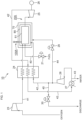
- Fig. 1 is a system diagram of a gas turbine facility 10 including a combustor 20A of a first embodiment.
- the gas turbine facility 10 includes the combustor 20A which combusts a fuel and an oxidant, a pipe 40 which supplies the fuel to the combustor 20A, and a pipe 41 which supplies the oxidant to the combustor 20A.
- the combustor 20A includes an ignition device 100A which ignites a mixture of the fuel and the oxidant in the combustor 20A. Note that the combustor 20A functions as a gas turbine combustor.
- the pipe 40 includes a flow rate regulating valve 21 which regulates a flow rate of the fuel to be supplied into a combustor liner 61 of the combustor 20A.
- a flow rate regulating valve 21 which regulates a flow rate of the fuel to be supplied into a combustor liner 61 of the combustor 20A.
- the fuel for example, hydrocarbon such as methane or natural gas is used.
- a coal gasification gas fuel containing carbon monoxide, hydrogen, and the like can also be used.
- the combustor liner 61 functions as a combustion cylinder.
- the pipe 41 is provided with a compressor 23 which pressurizes the oxidant.
- a compressor 23 which pressurizes the oxidant.
- oxygen separated from the atmosphere by an air separating apparatus (not illustrated) is used.
- the oxidant flowing through the pipe 41 is heated by passing through a heat exchanger 24 to be supplied to the combustor 20A.
- the fuel and the oxidant guided to the combustor liner 61 undergo reaction (combustion) in a combustion region in the combustor liner 61 and are turned into a combustion gas.
- reaction combustion
- a part of the combustion gas exhausted from a turbine 25 is circulated in the system, which is described later. Therefore, excess oxidant (oxygen) and fuel preferably do not remain in the combustion gas discharged from the combustor liner 61.
- flow rates of the fuel and the oxidant are regulated so as to have a stoichiometric mixture ratio (equivalence ratio 1), for example.
- equivalence ratio 1 a stoichiometric mixture ratio (equivalence ratio 1), for example.
- the equivalence ratio mentioned here is an equivalence ratio (overall equivalence ratio) when it is assumed that the fuel and the oxygen are uniformly mixed.
- the gas turbine facility 10 includes a turbine 25, a generator 26, a heat exchanger 24, a cooler 27, and a compressor 28. Moreover, the gas turbine facility 10 includes a pipe 42 for circulating a part of the combustion gas discharged from the turbine 25 in the system.
- the turbine 25 is moved rotationally by the combustion gas discharged from the combustor liner 61.
- the generator 26 is coupled to the turbine 25, for example.
- the combustion gas discharged from the combustor liner 61 which is mentioned here, is one containing a combustion product produced from the fuel and the oxidant and carbon dioxide to be circulated in the combustor liner 61 (a combustion gas from which water vapor has been removed).
- the combustion gas discharged from the turbine 25 is guided to the pipe 42 and cooled by passing through the heat exchanger 24. At this time, the oxidant flowing through the pipe 41 and carbon dioxide flowing through the pipe 42 to be circulated through the combustor 20A are heated by heat release from the combustion gas.
- the combustion gas having passed through the heat exchanger 24 passes through the cooler 27.
- the water vapor contained in the combustion gas is removed therefrom.
- the water vapor in the combustion gas condenses into water. This water is discharged through a pipe 43 to the outside, for example.
- the carbon dioxide is pressurized to a pressure equal to or more than a critical pressure by the compressor 28 interposed in the pipe 42 to become a supercritical fluid.
- a part of the pressurized carbon dioxide flows through the pipe 42 and is heated in the heat exchanger 24. Then, the carbon dioxide is guided between the combustor liner 61 and a cylinder body 80.
- the temperature of the carbon dioxide having passed through the heat exchanger 24 becomes, for example, about 700°C.
- the pipe 42 which supplies carbon dioxide between the combustor liner 61 and the cylinder body 80 also functions as a first fluid supply part.
- Another part of the pressurized carbon dioxide is introduced to a pipe 44 branching off from the pipe 42, for example.
- the carbon dioxide introduced to the pipe 44 is guided between a combustor casing 70 and the cylinder body 80 as a cooling medium after its flow rate is regulated by a flow rate regulating valve 29.
- the temperature of the carbon dioxide guided between the combustor casing 70 and the cylinder body 80 by the pipe 44 is, for example, about 400°C.
- This temperature of the carbon dioxide guided between the combustor casing 70 and the cylinder body 80 is lower than the previously-described temperature of the carbon dioxide guided between the combustor liner 61 and the cylinder body 80.
- the pipe 44 which supplies the carbon dioxide between the combustor casing 70 and the cylinder body 80 also functions as a first fluid supply part. Further, the combustor casing 70 functions as a casing.
- a pipe 45 branching off from the pipe 42 is introduced to a pipe 45 branching off from the pipe 42.
- the carbon dioxide introduced to the pipe 45 is discharged to the outside after its flow rate is regulated by a flow rate regulating valve 30.
- the pipe 45 functions as a discharge pipe.
- the carbon dioxide discharged to the outside can be utilized for EOR (Enhanced Oil Recovery) or the like employed at an oil drilling field, for example.
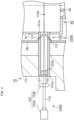
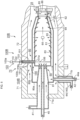
- Fig. 2 is a view schematically illustrating a longitudinal section of the combustor 20A of the first embodiment.
- Fig. 3 is an enlarged view schematically illustrating a longitudinal section of the ignition device 100A in the combustor 20A of the first embodiment.
- the combustor 20A includes a fuel nozzle part 60, the combustor liner 61, a transition piece 62, the combustor casing 70, the cylinder body 80, and the ignition device 100A.
- the fuel nozzle part 60 ejects the fuel supplied from the pipe 40 and the oxidant supplied from the pipe 41 into the combustor liner 61.
- the fuel is ejected from the center and the oxidant is ejected from the periphery of the center.
- the combustor casing 70 is provided along a longitudinal direction of the combustor 20A so as to surround a part of the fuel nozzle part 60, the combustor liner 61, and the transition piece 62, for example.
- the combustor casing 70 is divided into two parts in the longitudinal direction of the combustor 20A, for example.
- the combustor casing 70 is constituted of an upstream-side casing 71 on an upstream side and a downstream-side casing 72 on a downstream side, for example.
- the upstream-side casing 71 is constituted by a cylinder body having one end (upstream end) thereof closed and the other end (downstream end) thereof opened, for example. In the center of the one end, an opening 71a into which the fuel nozzle part 60 is inserted is formed. Further, the pipe 44 is coupled to a side portion of the upstream-side casing 71. The pipe 44 is fitted in and joined to an opening 71b formed in the side portion of the upstream-side casing 71, for example.
- the downstream-side casing 72 is constituted by a cylinder body having both ends thereof opened. One end of the downstream-side casing 72 is connected to the upstream-side casing 71. The other end of the downstream-side casing 72 is connected to, for example, a casing surrounding the turbine 25.
- the cylinder body 80 which surrounds peripheries of a part of the fuel nozzle part 60, the combustor liner 61, and the transition piece 62 and demarcates a space between the combustor casing 70 and the combustor liner 61 is provided. Predetermined spaces exist between the combustor liner 61 and the cylinder body 80 and between the combustor casing 70 and the cylinder body 80.
- the cylinder body 80 has one end (upstream end) thereof closed, in which an opening 81 into which the fuel nozzle part 60 is inserted is formed.
- the cylinder body 80 has the other end (downstream end) thereof closed, in which an opening 82 through which a downstream end of the transition piece 62 penetrates is formed.
- the cylinder body 80 is formed by joining a plate-shaped lid member 80a having the opening 81 therein to a cylindrical main body member 80b, for example.
- a configuration of the cylinder body 80 is not limited as long as the cylinder body 80 has a structure which surrounds the peripheries of a part of the fuel nozzle part 60, the combustor liner 61, and the transition piece 62 as illustrated in Fig. 2 .
- An inner peripheral surface of the downstream-side opening 82 in the cylinder body 80 is in contact with an outer peripheral surface of the downstream end portion of the transition piece 62.
- the pipe 42 is coupled to an upstream-side side portion of the cylinder body 80.
- the pipe 42 is coupled to the side portion of the cylinder body 80 by passing through the interior of the pipe 44 coupled to the side portion of the upstream-side casing 71, as illustrated in Fig. 2 , for example.
- the pipe 44 and the pipe 42 passes through the interior of the pipe 44 form a double-pipe structure.
- the pipe 42 is inserted through an opening 44a formed in the pipe 44 into the interior of the pipe 44, for example. Then, the pipe 42 is joined to the pipe 44 in an opening portion having the opening 44a, for example. Further, the double-pipe structure of the pipe 42 and the pipe 44 is not limited to being provided at one place and may be plurally provided in a circumferential direction.
- the ignition device 100A includes a pipe-shaped member 101, a heat-resistant glass 102, a laser light supply mechanism 103, and a contact prevention mechanism 104A as illustrated in Fig. 2 and Fig. 3 .
- the pipe-shaped member 101 is constituted by a cylindrical pipe having both ends thereof opened, or the like.
- the pipe-shaped member 101 is provided to penetrate the combustor casing 70, the cylinder body 80, and the combustor liner 61.
- the pipe-shaped member 101 is disposed so as to penetrate through a coaxial circular communication hole (through hole) formed in each of the combustor casing 70, the cylinder body 80, and the combustor liner 61 from the direction perpendicular to the longitudinal direction of the combustor 20A.
- an inner end portion 101a of the pipe-shaped member 101 is configured not to project to the interior of the combustor liner 61. Further, an inside diameter of the pipe-shaped member 101 is set to the extent that laser light is not hindered when it passes through the interior of the pipe-shaped member 101.
- the heat-resistant glass 102 is provided on the outer side (combustor casing 70 side) in the pipe-shaped member 101. Specifically, the heat-resistant glass 102 is preferably provided in the pipe-shaped member 101 on a side close to the outside than a flow path between the combustor casing 70 and the cylinder body 80, through which the carbon dioxide flows. For example, the heat-resistant glass 102 is provided on an outer end portion 101b side of the pipe-shaped member 101.
- the heat-resistant glass 102 is provided so as to close the interior of the pipe-shaped member 101. This shuts off communication between the inside and the outside of the combustor 20A.
- the laser light supply mechanism 103 irradiates the interior of the combustor liner 61 through the heat-resistant glass 102 and the interior of the pipe-shaped member 101 with a laser light 110.
- the laser light supply mechanism 103 includes a laser oscillator 103a and a condensing lens 103b.
- the condensing lens 103b is provided outside the combustor casing 70 (downstream-side casing 72) to face the heat-resistant glass 102. That is, the condensing lens 103b is provided between the laser oscillator 103a and the heat-resistant glass 102. A focal length and an installation position of the condensing lens 103b are set so as to have a focal point 11a at a position suitable for igniting the fuel-air mixture.
- the laser oscillator 103a is disposed outside the combustor casing 70.
- the laser oscillator 103a irradiates the interior of the combustor liner 61 through the condensing lens 103b, the heat-resistant glass 102, and the interior of the pipe-shaped member 101 with the laser light 110. That is, the laser oscillator 103a is disposed so as to be able to irradiate the interior of the combustor liner 61 with the laser light 110 by passing the laser light 110 through the condensing lens 103b, the heat-resistant glass 102, and the interior of the pipe-shaped member 101 in this order.
- the condensing lens 103b may be irradiated through an optical fiber with the laser light 110 oscillated by the laser oscillator 103a.
- the fluid supply part 120 supplies a fluid for preventing the contact between the combustion gas in the combustor liner 61 and the heat-resistant glass 102.
- the fluid for preventing the contact between the combustion gas in the combustor liner 61 and the heat-resistant glass 102 is hereinafter referred to as a contact prevention fluid.
- the fluid supply part 120 supplies the contact prevention fluid between the combustor casing 70 and the combustor liner 61.
- the fluid supply part 120 supplies the contact prevention fluid between the combustor liner 61 and the cylinder body 80.
- the fluid supply part 120 is constituted of the pipe 42 which circulates the carbon dioxide heated in the heat exchanger 24 between the combustor liner 61 and the cylinder body 80. Note that, the fluid supply part 120 functions as the first fluid supply part, and the contact prevention fluid to be supplied by the fluid supply part 120 functions as a first fluid.
- the carbon dioxide supplied between the combustor liner 61 and the cylinder body 80 also functions as a cooling medium to cool the combustor liner 61 and the transition piece 62 other than the function as the contact prevention fluid.
- the ejection part 130 ejects the contact prevention fluid into the pipe-shaped member 101.
- the ejection part 130 has a plurality of ejection holes 131 formed in a circumferential direction of the pipe-shaped member 101.
- the ejection part 130 is formed in the pipe-shaped member 101 located between the combustor liner 61 and the cylinder body 80, for example.
- the ejection holes 131 are formed in the circumferential direction of the pipe-shaped member 101 located between the combustor liner 61 and the cylinder body 80.
- the ejection hole 131 is constituted by a circular hole, a slit, or the like. Further, the ejection holes 131 are disposed uniformly in the circumferential direction of the pipe-shaped member 101. The ejection holes 131 each penetrate in a direction perpendicular to a center axis of the pipe-shaped member 101, for example.
- a pressure of the contact prevention fluid to be ejected into the pipe-shaped member 101 is higher than a pressure in the combustor liner 61. Therefore, the combustion gas flowing into the pipe-shaped member 101 does not pass through the ejection holes 131 to flow in between the combustor liner 61 and the cylinder body 80. In other words, the contact prevention fluid ejected from the ejection holes 131 into the pipe-shaped member 101 flows into the combustor liner 61.
- the laser oscillator 103a is driven to oscillate the laser light 110.
- the laser light 110 oscillated by the laser oscillator 103a passes through the condensing lens 103b and the heat-resistant glass 102 to enter the pipe-shaped member 101.
- the laser light 110 having passed through the interior of the pipe-shaped member 101 is focused on the focal point 110a in a predetermined region in the combustor liner 61. Note that the laser light 110 travels from the focal point 110a in a traveling direction while expanding a beam diameter.
- the fuel and the oxygen are ejected from the fuel nozzle part 60 into the combustor liner 61.
- the fuel and the oxygen are ejected from the fuel nozzle part 60 in a state of the oxidant flow rate and the fuel flow rate being reduced in order to suppress a sudden heat load on the combustor 20A.
- the oxidant and the fuel ejected from the fuel nozzle part 60 flow while mixing together to create a mixture. Then, when the mixture flows to a high energy density position where the laser light is focused on the focal point 110a, the mixture is ignited. This initiates combustion. Note that drive of the ignition device 100A is stopped when the combustion in the combustor liner 61 is stabilized, for example.
- the flow rate of the circulating carbon dioxide and the oxidant flow rate are increased to increase the pressure in the combustor, and at the same time, the fuel flow rate is increased to increase the combustion gas temperature in the combustor. Then, the fuel flow rate, the flow rate of the circulating carbon dioxide, and the oxidant flow rate are increased up to a rated load condition of the turbine.
- a part of the carbon dioxide introduced from the pipe 42 into the cylinder body 80 functions as the contact prevention fluid. As illustrated in Fig. 3 , a part of the carbon dioxide passes through the ejection holes 131 of the pipe-shaped member 101 to be ejected into the pipe-shaped member 101. Note that in Fig. 3 , flows of the contact prevention fluid (carbon dioxide) ejected from the ejection holes 131 are indicated by arrows.
- the flows of the contact prevention fluid (carbon dioxide) ejected from the ejection holes 131 each travel in the direction perpendicular to the center axis of the pipe-shaped member 101, and at the same time, turn to the combustor liner 61 side, as illustrated in Fig. 3 , for example. That is, in the pipe-shaped member 101, a flow field toward the interior of the combustor liner 61 is formed by the contact prevention fluid ejected from the ejection holes 131.
- such a flow field as to shut off a cross section of the interior of the pipe-shaped member 101 is formed by the contact prevention fluid ejected from the plurality of ejection holes 131 formed in the circumferential direction.
- the contact prevention fluid to be ejected from the ejection holes 131 preferably has a penetration force to the extent of being capable of reaching the vicinity of the center axis of the pipe-shaped member 101.
- the contact prevention fluid to be ejected from the ejection holes 131 preferably has a penetration force to the extent of coming into contact with an outer periphery of the laser light 110 (laser beam) passing through the center of the pipe-shaped member 101, for example.
- the above-described flows formed by the contact prevention fluid ejected from the ejection holes 131 prevent the combustion gas in the combustor liner 61 from flowing into the pipe-shaped member 101.
- the flows formed by the contact prevention fluid ejected from the ejection holes 131 prevent the combustion gas flowing from the interior of the combustor liner 61 into the pipe-shaped member 101 from flowing into the side closer to the heat-resistant glass 102 from positions formed with the ejection holes 131.
- the contact prevention fluid ejected from the ejection holes 131 into the pipe-shaped member 101 flows into the combustor liner 61.
- the contact prevention fluid flowing into the combustor liner 61 is introduced into the transition piece 62 together with the combustion gas.
- a flow rate of the contact prevention fluid to be ejected to the pipe-shaped member 101 can be regulated by a hole diameter of the ejection hole 131 and the number of the ejection holes 131.
- the flow rate of the contact prevention fluid to be ejected from the ejection holes 131 into the pipe-shaped member 101 is preferably a minimum flow rate which can prevent inflow of the combustion gas to the heat-resistant glass 102 side.
- the carbon dioxide is introduced from, for example, holes 63, 64 of a porous film cooling part, dilution holes 65, and the like in the combustor liner 61 and the transition piece 62 into the combustor liner 61 and the transition piece 62.
- the carbon dioxide introduced into the combustor liner 61 and the transition piece 62 is introduced to the turbine 25 together with the combustion gas produced by the combustion.
- the low-temperature carbon dioxide flowing through the pipe 44 is guided to a double pipe constituted by the pipe 42 and the pipe 44.
- the carbon dioxide guided to the double pipe passes through an annular passage between the pipe 42 and the pipe 44 to be guided between the combustor casing 70 and the cylinder body 80.
- the temperature of the combustor casing 70 with the heat-resistant glass 102 of the ignition device 100A installed therein is maintained to about 400°C even at the time of the turbine rated load of the CO 2 gas turbine facility. That is, the temperature of the heat-resistant glass 102 of the ignition device 100A is maintained to about 400°C.
- the combustor 20A of the first embodiment as described above including the contact prevention mechanism 104A makes it possible to prevent the contact between the heat-resistant glass 102 included in the pipe-shaped member 101 of the ignition device 100A and the combustion gas. Therefore, the impurities such as soot do not adhere to the inner surface 102a of the heat-resistant glass 102. This prevents the reduction in transmittance of the laser light 110 passing through the heat-resistant glass 102, resulting in enabling stable ignition.
- ejection holes 131 each penetrating in the direction perpendicular to the center axis of the pipe-shaped member 101 is indicated, but a configuration of the ejection hole 131 is not limited to this.
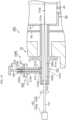
- Fig. 4 is an enlarged view schematically illustrating a longitudinal section of the ignition device 100A including another configuration in the combustor 20A of the first embodiment.
- ejection holes 131 may each be formed to be inclined to the end portion 101a side of the pipe-shaped member 101 relative to the direction perpendicular to the center axis of the pipe-shaped member 101. That is, the ejection holes 131 may each be formed to be inclined so that an outlet of the ejection hole 131 is located closer to the end portion 101a side of the pipe-shaped member 101 than an inlet of the ejection hole 131.
- the contact prevention fluid ejected from the ejection holes 131 has a component of velocity along the center axis of the pipe-shaped member 101. This makes it likely to form a flow field of the contact prevention fluid having a penetration force to the extent of coming into contact with an outer periphery of the laser light 110 (laser beam) passing through the center of the pipe-shaped member 101. Then, the interior of the combustor liner 61 is irradiated with the laser light 110 in a state of suppressing an influence from the contact prevention fluid.
- Fig. 5 is a view schematically illustrating a longitudinal section of a combustor 20B of a second embodiment not forming part of the invention.
- Fig. 6 is an enlarged view schematically illustrating a longitudinal section of an ignition device 100B in the combustor 20B of the second embodiment. Note that in the following embodiment, the same constituent portions as those of the combustor 20A of the first embodiment are denoted by the same reference signs, and redundant explanations are omitted or simplified.
- the combustor 20B of the second embodiment has the same configuration as that of the combustor 20A of the first embodiment except a configuration of a contact prevention mechanism 104B of the ignition device 100B. Therefore, the configuration of the contact prevention mechanism 104B is mainly described here.
- the ignition device 100B includes a pipe-shaped member 101, a heat-resistant glass 102, a laser light supply mechanism 103, and the contact prevention mechanism 104B.
- the contact prevention mechanism 104B prevents a combustion gas in a combustor liner 61 from coming into contact with the heat-resistant glass 102.
- the contact prevention mechanism 104B includes a fluid supply part 140 and an ejection part 150.
- the fluid supply part 140 supplies a contact prevention fluid.
- the fluid supply part 140 supplies the contact prevention fluid between a combustor casing 70 and a cylinder body 80.
- the fluid supply part 140 is constituted of a pipe 44 which circulates the carbon dioxide pressurized by the compressor 28 between the combustor casing 70 and the cylinder body 80.
- the carbon dioxide circulated by the pipe 44 is not heated in the heat exchanger 24.
- the fluid supply part 140 functions as a first fluid supply part, and the contact prevention fluid to be supplied by the fluid supply part 140 functions as a first fluid.
- the carbon dioxide supplied between the combustor casing 70 and the cylinder body 80 also functions as a cooling medium to cool the combustor casing 70, the cylinder body 80 and the pipe-shaped member 101 of the ignition device 100B other than the function as the contact prevention fluid.
- the ejection part 150 ejects the contact prevention fluid into the pipe-shaped member 101.
- the ejection part 150 has a plurality of ejection holes 151 formed in a circumferential direction of the pipe-shaped member 101.
- the ejection part 150 is formed in the pipe-shaped member 101 located between the combustor casing 70 and the cylinder body 80, for example.
- the ejection holes 151 are formed in the circumferential direction of the pipe-shaped member 101 located between the combustor casing 70 and the cylinder body 80.
- a shape and a disposition configuration of the ejection holes 151 are the same as those of the ejection holes 131 of the first embodiment. Further, the ejection holes 151 each penetrate in a direction perpendicular to a center axis of the pipe-shaped member 101, for example.
- the ejection holes 151 may each be formed to be inclined to an end portion 101a side of the pipe-shaped member 101 relative to the direction perpendicular to the center axis of the pipe-shaped member 101.
- a pressure of the contact prevention fluid to be ejected into the pipe-shaped member 101 is higher than a pressure in the combustor liner 61. Therefore, the combustion gas flowing into the pipe-shaped member 101 does not pass through the ejection holes 151 to flow in between the combustor casing 70 and the cylinder body 80. In other words, the contact prevention fluid ejected from the ejection holes 151 into the pipe-shaped member 101 flows into the combustor liner 61.
- a part of the carbon dioxide introduced between the combustor casing 70 and the cylinder body 80 from the pipe 44 functions as the contact prevention fluid.
- a part of the carbon dioxide passes through the ejection holes 151 of the pipe-shaped member 101 to be ejected into the pipe-shaped member 101.
- flows of the carbon dioxide (contact prevention fluid) ejected from the ejection holes 151 are indicated by arrows.
- the flows of the carbon dioxide (contact prevention fluid) ejected from the ejection holes 151 are similar to the flows of the carbon dioxide (contact prevention fluid) ejected from the ejection holes 131 in the first embodiment. That is, the flows of the carbon dioxide (contact prevention fluid) ejected from the ejection holes 151 each travel in the direction perpendicular to the center axis of the pipe-shaped member 101, and at the same time, turn to the combustor liner 61 side, as illustrated in Fig. 6 , for example.
- such a flow field as to shut off a cross section of the interior of the pipe-shaped member 101 is formed by the carbon dioxide ejected from the plurality of ejection holes 151 formed in the circumferential direction.
- the flows formed by the carbon dioxide ejected from the ejection holes 151 prevent the combustion gas in the combustor liner 61 from flowing into the pipe-shaped member 101.
- the flows formed by the carbon dioxide ejected from the ejection holes 151 prevent the combustion gas flowing from the interior of the combustor liner 61 into the pipe-shaped member 101 from flowing into the side closer to the heat-resistant glass 102 from positions formed with the ejection holes 151.
- a flow rate of the contact prevention fluid to be ejected to the pipe-shaped member 101 can be regulated by a hole diameter of the ejection hole 151 and the number of the ejection holes 151.
- An effect obtained by the above is also the same as that of the first embodiment.
- the carbon dioxide cools the combustor casing 70, the cylinder body 80 and the pipe-shaped member 101 of the ignition device 110B.
- the combustor 20B of the second embodiment as described above including the contact prevention mechanism 104B makes it possible to prevent the contact between the heat-resistant glass 102 included in the pipe-shaped member 101 of the ignition device 100B and the combustion gas. Therefore, the impurities such as soot do not adhere to the inner surface 102a of the heat-resistant glass 102. This prevents the reduction in transmittance of the laser light 110 passing through the heat-resistant glass 102, resulting in enabling stable ignition.
- Fig. 7 is an enlarged view schematically illustrating a longitudinal section of an ignition device 100C in a combustor 20C of a third embodiment.
- the combustor 20C of the third embodiment has the same configuration as that of the combustor 20A of the first embodiment except a configuration of a contact prevention mechanism 104C of the ignition device 100C. Therefore, the configuration of the contact prevention mechanism 104C is mainly described here.
- the ignition device 100C includes a pipe-shaped member 101, a heat-resistant glass 102, a laser light supply mechanism 103, and the contact prevention mechanism 104C.
- the contact prevention mechanism 104C prevents a combustion gas in a combustor liner 61 from coming into contact with the heat-resistant glass 102.
- the contact prevention mechanism 104C includes an annular groove 160, a flow path 161, a fluid supply part 170 and an ejection part 180.
- the annular groove 160 is formed around a periphery of the pipe-shaped member 101 in a combustor casing 70 (for example, a downstream-side casing 72) through which the pipe-shaped member 101 penetrates.
- the annular groove 160 is formed on a side closer to a combustor liner 61 from the heat-resistant glass 102 in the combustor casing 70.
- the flow path 161 is a flow path coupling the outside of the combustor casing 70 and the annular groove 160.
- the flow path 161 is constituted by a through hole penetrating from a side surface of the combustor casing 70 to the annular groove 160.
- the fluid supply part 170 supplies a contact prevention fluid to the flow path 161. Specifically, the fluid supply part 170 is coupled to the flow path 161.
- the fluid supply part 170 may be constituted by a pipe branching off from the pipe 42 which circulates the carbon dioxide heated in the heat exchanger 24 between the combustor liner 61 and the cylinder body 80 (refer to Fig. 1 ), for example.
- the fluid supply part 170 may be constituted by a pipe branching off from the pipe 44 which circulates the carbon dioxide pressurized by the compressor 28 between the combustor casing 70 and the cylinder body 80 (refer to Fig. 1 ), for example.
- a filter (not illustrated) is preferably interposed in the fluid supply part 170. Passing through the filter enables removal of foreign matter contained in a flow of the carbon dioxide. This makes it possible to prevent the foreign matter from flowing into the combustor liner 61 and the turbine 25.
- the fluid supply part 170 may be a supply system (supply pipe) other than the system of the gas turbine facility 10, for example. Also in this case, the fluid supply part 170 supplies carbon dioxide at a supercritical pressure as the contact prevention fluid to the flow path 161.
- the fluid supply part 170 supplies the contact prevention fluid to the flow path 161 so that a pressure of the contact prevention fluid to be ejected from the ejection part 180 into the pipe-shaped member 101 is higher than a pressure in the combustor liner 61.
- the fluid supply part 170 functions as a second fluid supply part. Further, the contact prevention fluid to be supplied from the fluid supply part 170 functions as a second fluid.
- the ejection part 180 ejects the contact prevention fluid supplied to the annular groove 160 into the pipe-shaped member 101.
- the ejection part 180 has a plurality of ejection holes 181 formed in a circumferential direction of the pipe-shaped member 101.
- the ejection part 180 is formed in the pipe-shaped member 101 in a position formed with the annular groove 160, as illustrated in Fig. 7 .
- the ejection holes 181 are formed in the circumferential direction of the pipe-shaped member 101 in the position formed with the annular groove 160.
- a shape and a disposition configuration of the ejection holes 181 are the same as those of the ejection holes 131 of the first embodiment. Further, the ejection holes 181 each penetrate in a direction perpendicular to a center axis of the pipe-shaped member 101, for example.
- the ejection holes 181 may each be formed to be inclined to an end portion 101a side of the pipe-shaped member 101 relative to the direction perpendicular to the center axis of the pipe-shaped member 101.
- the pressure of the contact prevention fluid to be ejected into the pipe-shaped member 101 is higher than the pressure in the combustor liner 61. Therefore, the combustion gas flowing into the pipe-shaped member 101 does not pass through the ejection holes 181 to flow into the annular groove 160. In other words, the contact prevention fluid ejected from the ejection holes 181 into the pipe-shaped member 101 flows into the combustor liner 61.
- the contact prevention fluid supplied from the fluid supply part 170 to the annular groove 160 expands in the circumferential direction in the annular groove 160.
- the contact prevention fluid expanded in the circumferential direction in the annular groove 160 is ejected through the ejection holes 181 of the pipe-shaped member 101 into the pipe-shaped member 101.
- flows of the contact prevention fluid ejected from the ejection holes 181 are indicated by arrows.
- a flow rate of the contact prevention fluid ejected from each of the ejection holes 181 is nearly uniform.
- fixing an end portion 101b on an outer side of the pipe-shaped member 101 to the combustor casing 70 by welding prevents the contact prevention fluid introduced to the annular groove 160 from leaking outside the combustor casing 70.
- the flows of the carbon dioxide (contact prevention fluid) ejected from the ejection holes 181 are similar to the flows of the carbon dioxide (contact prevention fluid) ejected from the ejection holes 131 in the first embodiment. That is, the flows of the contact prevention fluid ejected from the ejection holes 181 each travel in the direction perpendicular to the center axis of the pipe-shaped member 101, and at the same time, turn to the combustor liner 61 side, as illustrated in Fig. 7 , for example.
- such a flow field as to shut off a cross section of the interior of the pipe-shaped member 101 is formed by the contact prevention fluid ejected from the plurality of ejection holes 181 formed in the circumferential direction.
- the flows formed by the contact prevention fluid ejected from the ejection holes 181 prevent the combustion gas in the combustor liner 61 from flowing into the pipe-shaped member 101.
- the flows formed by the contact prevention fluid ejected from the ejection holes 181 prevent the combustion gas flowing from the interior of the combustor liner 61 into the pipe-shaped member 101 from flowing into the side closer to the heat-resistant glass 102 from positions formed with the ejection holes 181.
- a flow rate of the contact prevention fluid to be ejected to the pipe-shaped member 101 can be regulated by a hole diameter of the ejection hole 181 and the number of the ejection holes 181. An effect obtained by the above is also the same as that of the first embodiment.
- the combustor 20C of the third embodiment as described above including the contact prevention mechanism 104C makes it possible to prevent the contact between the heat-resistant glass 102 included in the pipe-shaped member 101 of the ignition device 100C and the combustion gas. Therefore, the impurities such as soot do not adhere to the inner surface 102a of the heat-resistant glass 102. This prevents the reduction in transmittance of the laser light 110 passing through the heat-resistant glass 102, resulting in enabling stable ignition.
- a configuration of the contact prevention mechanism 104C in the combustor 20C is not limited to the above-described structure.
- Fig. 8 is an enlarged view schematically illustrating a longitudinal section of the ignition device 100C including another configuration in the combustor 20C of the third embodiment.
- the contact prevention mechanism 104C may be provided outside the combustor casing 70.
- the pipe-shaped member 101 is constituted by a cylindrical pipe having both ends thereof opened, or the like.
- the pipe-shaped member 101 is provided to penetrate the combustor casing 70, the cylinder body 80 and the combustor liner 61.
- one end side of the pipe-shaped member 101 projects from the combustor casing 70 to the outside. That is, the one end side of the pipe-shaped member 101 is extended to the outside of the combustor casing 70. Note that in the pipe-shaped member 101, a portion projecting from the combustor casing 70 to the outside is referred to as an outside projecting portion 101e.
- a flange 101c is included on an outer periphery of the outside projecting portion 101e of the pipe-shaped member 101. Then, attaching the flange 101c on an outer surface of the combustor casing 70 makes the pipe-shaped member 101 be fixed thereto.
- the outside projecting portion 101e is provided with the contact prevention mechanism 104C. Then, the heat-resistant glass 102 is disposed in the pipe-shaped member 101 on a side closer to the outside (laser light supply mechanism 103 side) than a position provided with the contact prevention mechanism 104C.
- the contact prevention mechanism 104C includes an annular member 165, a fluid supply part 170 and an ejection part 185.
- the annular member 165 is provided on the outer periphery of the outside projecting portion 101e over the circumferential direction, as illustrated in Fig. 8 .
- a cross-sectional shape perpendicular to the circumferential direction in the annular member 165 is a U-shape.
- the annular member 165 has a hollow portion.
- An open side (inner peripheral side) of the annular member 165 is joined to the outer periphery of the outside projecting portion 101e.
- an annular passage 166 is formed on the outer periphery of the outside projecting portion 101e.
- annular member 165 is disposed between a position provided with the flange 101c and a position provided with the heat-resistant glass 102 in an axial direction of the pipe-shaped member 101.
- the fluid supply part 170 supplies the contact prevention fluid to the annular passage 166. Specifically, the fluid supply part 170 is connected to the annular member 165. Note that a pipe constituting the fluid supply part 170, or the like is as previously described.
- the ejection part 185 ejects the contact prevention fluid supplied to the annular passage 166 in the annular member 165 into the pipe-shaped member 101.
- the ejection part 185 has a plurality of ejection holes 186 formed in a circumferential direction of the outside projecting portion 101e.
- the ejection holes 186 are formed in the pipe-shaped member 101 in a position formed with the annular passage 166, as illustrated in Fig. 8 .
- the ejection holes 186 are formed in the circumferential direction of the outside projecting portion 101e in the position formed with the annular passage 166.
- a shape and a configuration of the ejection holes 186 are the same as the previously-described shape and configuration of the ejection holes 181.
- the contact prevention fluid supplied from the fluid supply part 170 to the annular passage 166 expands in the circumferential direction in the annular passage 166. Then, the contact prevention fluid expanded in the annular passage 166 is ejected from the ejection holes 186 into the pipe-shaped member 101. Flows of the contact prevention fluid ejected from the ejection holes 186 into the pipe-shaped member 101 are similar to the previously-described flows of the contact prevention fluid ejected from the ejection holes 181 into the pipe-shaped member 101.
- a pressure of the contact prevention fluid to be ejected into the pipe-shaped member 101 is higher than a pressure in the combustor liner 61. Therefore, the combustion gas flowing into the pipe-shaped member 101 does not pass through the ejection holes 186 to flow into the annular passage 166. In other words, the contact prevention fluid ejected from the ejection holes 186 into the pipe-shaped member 101 flows into the combustor liner 61.
- Fig. 9 is an enlarged view schematically illustrating a longitudinal section of an ignition device 100D in a combustor 20D of a fourth embodiment not forming part of the invention.
- the combustor 20D of the fourth embodiment not forming part of the invention has the same configuration as that of the combustor 20A of the first embodiment except a configuration of a contact prevention mechanism 104D of the ignition device 100D. Therefore, the configuration of the contact prevention mechanism 104D is mainly described here.
- the ignition device 100D includes a pipe-shaped member 101, a heat-resistant glass 102, a laser light supply mechanism 103, and the contact prevention mechanism 104D.
- the contact prevention mechanism 104D prevents a combustion gas in a combustor liner 61 from coming into contact with the heat-resistant glass 102.
- the contact prevention mechanism 104D includes an orifice member 190.
- the orifice member 190 is constituted by a circular plate-shaped member provided in the pipe-shaped member 101.
- the orifice member 190 has a through hole 191 which passes a laser light 110 through the center thereof.
- An outer periphery of the orifice member 190 is in contact with an inner periphery of the pipe-shaped member 101. Such a configuration makes it possible to prevent the combustion gas from flowing from between the outer periphery of the orifice member 190 and an inner surface of the pipe-shaped member 101 into the heat-resistant glass 102 side. Note that an outer shape of the orifice member 190 is formed to correspond to a shape of an interior of the pipe-shaped member 101 in which the orifice member 190 is disposed.
- a bore of the through hole 191 is set to a size to the extent that the laser light 110 is not prevented from passing therethrough.
- the orifice member 190 may be included in the pipe-shaped member 101 between a combustor liner 61 and the cylinder body 80.
- the laser light 110 is focused by a condensing lens 103b, a beam diameter of the laser light 110 is reduced to a focal point 110a. Therefore, including the orifice member 190 on the combustor liner 61 side allows the bore of the through hole 191 to be smaller. This makes it possible to more securely suppress a flow of the combustion gas flowing through the through hole 191 into the heat-resistant glass 102 side.
- the laser light 110 oscillated by a laser oscillator 103a passes through the condensing lens 103b, the heat-resistant glass 102, and the through hole 191 of the orifice member 190 to enter the pipe-shaped member 101.
- the laser light 110 having passed through the interior of the pipe-shaped member 101 is focused on the focal point 110a in a predetermined region in the combustor liner 61.
- the combustor 20D of the fourth embodiment not forming part of the invention as described above including the contact prevention mechanism 104D makes it possible to suppress the contact between the heat-resistant glass 102 included in the pipe-shaped member 101 of the ignition device 100D and the combustion gas. Therefore, the impurities such as soot do not adhere to the inner surface 102a of the heat-resistant glass 102. This prevents the reduction in transmittance of the laser light 110 passing through the heat-resistant glass 102, resulting in enabling stable ignition.
- a configuration of the combustor 20D of the fourth embodiment not forming part of the invention is not limited to the above-described configuration.
- the contact prevention mechanism 104C of the third embodiment may be further included.
- the contact prevention mechanism 104B of the second embodiment may be further included on the combustor casing 70 side of the orifice member 190.
- the contact prevention mechanism 104B of the second embodiment or the contact prevention mechanism 104C of the third embodiment may be further included.
- the contact prevention mechanism 104A of the first embodiment may be further included on the combustor casing 70 side of the orifice member 190.
- the contact prevention fluids ejected from the ejection holes 131, 151, 181 of the contact prevention mechanisms 104A, 104B, 104C into the pipe-shaped member 101 each flow through the through hole 191 of the orifice member 190 to the combustor liner 61 side. This makes it possible to prevent the combustion gas from flowing through the through hole 191 to the heat-resistant glass 102 side.
- Fig. 10 is an enlarged view schematically illustrating a longitudinal section of an ignition device 100E in a combustor 20E of a fifth embodiment not forming part of the invention. Note that Fig. 10 illustrates a state where a shutoff valve 200 is opened.
- the combustor 20E of the fifth embodiment not forming part of the invention has the same configuration as that of the combustor 20A of the first embodiment except a configuration of a contact prevention mechanism 104E of the ignition device 100E. Therefore, the configuration of the contact prevention mechanism 104E is mainly described here.
- the ignition device 100E includes a pipe-shaped member 101, a heat-resistant glass 102, a laser light supply mechanism 103, and the contact prevention mechanism 104E.
- the pipe-shaped member 101 is constituted by a cylindrical pipe having both ends thereof opened, or the like.
- the pipe-shaped member 101 is provided to penetrate a combustor casing 70, a cylinder body 80 and a combustor liner 61. Further, one end side of the pipe-shaped member 101 projects from the combustor casing 70 to the outside. That is, the one end side of the pipe-shaped member 101 is extended to the outside of the combustor casing 70.
- a portion projecting from the combustor casing 70 to the outside is referred to as an outside projecting portion 101e.
- a flange 101c is included on an outer periphery of the outside projecting portion 101e of the pipe-shaped member 101. Then, attaching the flange 101c on an outer surface of the combustor casing 70 makes the pipe-shaped member 101 be fixed thereto.
- the outside projecting portion 101e is provided with the contact prevention mechanism 104E. Then, the heat-resistant glass 102 is disposed in the pipe-shaped member 101 on a side closer to the outside (laser light supply mechanism 103 side) than a position provided with the contact prevention mechanism 104E.
- the contact prevention mechanism 104E prevents the combustion gas in the combustor liner 61 from coming into contact with the heat-resistant glass 102.
- the contact prevention mechanism 104E includes the shutoff valve 200.
- the shutoff valve 200 is provided in a side portion of the outside projecting portion 101e.
- the shutoff valve 200 is disposed between a position provided with a flange 101c and a position provided with the heat-resistant glass 12 in an axial position of the pipe-shaped member 101. Then, the shutoff valve 200 communicates or shuts off a space 240a on the heat-resistant glass 102 side in the pipe-shaped member 101 and a space 240b on the combustor liner 61 side in the pipe-shaped member 101.
- the shutoff valve 200 includes valve casings 210, 220 and a shutoff portion 230.
- the valve casing 210 is constituted by a cylinder body having both ends thereof opened, or the like. As illustrated in Fig. 10 , one end 210a of the valve casing 210 is fitted in and joined to an opening 101d formed in a sidewall of the outside projecting portion 101e. The other end 210b of the valve casing 210 has a flange 211, for example. Note that the valve casing 210 may be formed integrally with the outside projecting portion 101e.
- the valve casing 220 is constituted by a cylinder body having both ends thereof opened, or the like.
- One end 220a of the valve casing 220 has a flange 221, for example.
- One valve casing is constituted by fastening the flange 221 of the valve casing 220 and the flange 211 of the valve casing 210 with a bolt, for example.
- the shutoff portion 230 shuts off space in the pipe-shaped member 101.
- the shutoff portion 230 is provided to be movable forward and backward in the valve casings 210, 220. For example, in a state where the shutoff portion 230 is closed, namely a closed state, the space 240a and the space 240b are shut off. Here, in the closed state, the combustion gas flowing into the space 240b does not flow to the space 240a side.
- a sealing member 250 such as packing is provided on an inner wall 220b of the valve casing 220.
- the shutoff portion 230 moves while coming into contact with the sealing member 250.
- the valve casing 220 and the shutoff portion 230 are sealed therebetween by the sealing member 250.
- shutoff valve 200 for example, a needle valve, a ball valve, or the like can be used. Note that the shutoff valve 200 is not limited to these. As long as the shutoff valve 200 is a one which can shut off the space 240a and the space 240b when the shutoff portion 230 is closed, the one can be used.
- a laser light 110 oscillated by a laser oscillator 103a passes through a condensing lens 103b and the heat-resistant glass 102 to enter the pipe-shaped member 101.
- the laser light 110 having passed through the interior of the pipe-shaped member 101 is focused on a focal point 110a in a predetermined region in the combustor liner 61.
- the oscillation of the laser light 110 by the laser oscillator 103a is stopped, and at same time, the shutoff portion 230 is closed. This causes the space 240a and the space 240b to be shut off.
- the contact prevention mechanism 104E makes it possible to suppress the contact between the heat-resistant glass 102 included in the pipe-shaped member 101 of the ignition device 100E and the combustion gas. Therefore, the impurities such as soot do not adhere to the inner surface 102a of the heat-resistant glass 102. This prevents the reduction in transmittance of the laser light 110 passing through the heat-resistant glass 102, resulting in enabling stable ignition.
Landscapes
- Engineering & Computer Science (AREA)
- Chemical & Material Sciences (AREA)
- Combustion & Propulsion (AREA)
- Mechanical Engineering (AREA)
- General Engineering & Computer Science (AREA)
- Life Sciences & Earth Sciences (AREA)
- Sustainable Development (AREA)
- Lasers (AREA)
- Laser Beam Processing (AREA)
Description
- Embodiments described herein relate generally to a gas turbine combustor.
- Increasing the efficiency of power generation plants is in progress in response to demands for reduction of carbon dioxide, resource conservation, and the like. Specifically, increasing the temperature of a working fluid of a gas turbine, employing a combined cycle, and the like are actively in progress. Further, research and development of collection techniques of carbon dioxide are also in progress.
- Under such circumstances, a gas turbine facility including a combustor which combusts a fuel and oxygen in a supercritical CO2 atmosphere (to be referred to as a CO2 gas turbine facility, hereinafter) is under consideration. In this CO2 gas turbine facility, a part of a combustion gas produced in the combustor is circulated in a system as a working fluid.
- Therefore, in the CO2 gas turbine facility, excess oxygen and fuel preferably do not remain in the combustion gas discharged from the combustor. Thus, flow rates of the fuel and an oxidant are regulated so as to have a stoichiometric mixture ratio (equivalence ratio 1), for example.
- Incidentally, the equivalence ratio which is mentioned here is an equivalence ratio calculated based on a fuel flow rate and an oxygen flow rate. In other words, it is an equivalence ratio when it is assumed that the fuel and the oxygen are uniformly mixed (overall equivalence ratio).
- In the combustor of the CO2 gas turbine facility, a fuel-oxidant mixture mixed in the combustor is ignited by using an ignition device. At present, as the ignition device included in the combustor of the CO2 gas turbine facility, a laser spark ignition device is under consideration. The laser ignition device irradiates the mixture inside the combustor with laser light to cause ignition.
- The laser spark ignition device includes a laser oscillator, a lens, a heat-resistant glass provided in a casing part, and a laser passage pipe coupling a casing and a combustor liner, for example. Then, the interior of the combustor liner is irradiated through the lens, the heat-resistant glass, and the laser passage pipe with laser light emitted from the laser oscillator.
- Then, the laser light is focused in the combustor liner. By the laser light being focused, an energy density increases. Then, gas in the portion where the energy density increases is plasmatized (breaks down) to ignite the mixture.
- In the above-described laser ignition device of the CO2 gas turbine facility, the combustion gas sometimes flows into the laser passage pipe. Then, an inner surface of the heat-resistant glass is exposed to the combustion gas and impurities such as soot adhere to the inner surface of the heat-resistant glass in some cases. This sometimes causes a reduction in transmittance of the laser light passing through the heat-resistant glass, resulting in not enabling stable ignition.
An example of such a previously known gas turbine combustor is derivable fromUS 5, 367 869 A , which forms basis for the two-part form of independent claims 1, 3, and 4. -
-
Fig. 1 is a system diagram of a gas turbine facility including a combustor of a first embodiment. -
Fig. 2 is a view schematically illustrating a longitudinal section of the combustor of the first embodiment. -
Fig. 3 is an enlarged view schematically illustrating a longitudinal section of an ignition device in the combustor of the first embodiment. -
Fig. 4 is an enlarged view schematically illustrating a longitudinal section of the ignition device including another configuration in the combustor of the first embodiment. -
Fig. 5 is a view schematically illustrating a longitudinal section of a combustor of a second embodiment not forming part of the invention. -
Fig. 6 is an enlarged view schematically illustrating a longitudinal section of an ignition device in the combustor of the second embodiment. -
Fig. 7 is an enlarged view schematically illustrating a longitudinal section of an ignition device in a combustor of a third embodiment. -
Fig. 8 is an enlarged view schematically illustrating a longitudinal section of the ignition device including another configuration in the combustor of the third embodiment. -
Fig. 9 is an enlarged view schematically illustrating a longitudinal section of an ignition device in a combustor of a fourth embodiment not forming part of the invention. -
Fig. 10 is an enlarged view schematically illustrating a longitudinal section of an ignition device in a combustor of a fifth embodiment not forming part of the invention. - Hereinafter, embodiments of the present invention will be described with reference to the drawings.
- The above-described problems are addressed by means of a gas turbine combustor according to independent claims 1, 3, and/or 4. Distinct embodiments are derivable from the dependent claims.
-
Fig. 1 is a system diagram of agas turbine facility 10 including acombustor 20A of a first embodiment. As illustrated inFig. 1 , thegas turbine facility 10 includes thecombustor 20A which combusts a fuel and an oxidant, apipe 40 which supplies the fuel to thecombustor 20A, and apipe 41 which supplies the oxidant to thecombustor 20A. Further, thecombustor 20A includes anignition device 100A which ignites a mixture of the fuel and the oxidant in thecombustor 20A. Note that thecombustor 20A functions as a gas turbine combustor. - The
pipe 40 includes a flowrate regulating valve 21 which regulates a flow rate of the fuel to be supplied into acombustor liner 61 of thecombustor 20A. Here, as the fuel, for example, hydrocarbon such as methane or natural gas is used. Further, as the fuel, for example, a coal gasification gas fuel containing carbon monoxide, hydrogen, and the like can also be used. Note that thecombustor liner 61 functions as a combustion cylinder. - The
pipe 41 is provided with acompressor 23 which pressurizes the oxidant. As the oxidant, for example, oxygen separated from the atmosphere by an air separating apparatus (not illustrated) is used. The oxidant flowing through thepipe 41 is heated by passing through aheat exchanger 24 to be supplied to thecombustor 20A. - The fuel and the oxidant guided to the
combustor liner 61 undergo reaction (combustion) in a combustion region in thecombustor liner 61 and are turned into a combustion gas. Here, in thegas turbine facility 10, a part of the combustion gas exhausted from aturbine 25 is circulated in the system, which is described later. Therefore, excess oxidant (oxygen) and fuel preferably do not remain in the combustion gas discharged from thecombustor liner 61. - Thus, flow rates of the fuel and the oxidant are regulated so as to have a stoichiometric mixture ratio (equivalence ratio 1), for example. Note that the equivalence ratio mentioned here is an equivalence ratio (overall equivalence ratio) when it is assumed that the fuel and the oxygen are uniformly mixed.
- Further, the
gas turbine facility 10 includes aturbine 25, agenerator 26, aheat exchanger 24, acooler 27, and acompressor 28. Moreover, thegas turbine facility 10 includes apipe 42 for circulating a part of the combustion gas discharged from theturbine 25 in the system. - The
turbine 25 is moved rotationally by the combustion gas discharged from thecombustor liner 61. To theturbine 25, for example, thegenerator 26 is coupled. The combustion gas discharged from thecombustor liner 61, which is mentioned here, is one containing a combustion product produced from the fuel and the oxidant and carbon dioxide to be circulated in the combustor liner 61 (a combustion gas from which water vapor has been removed). - The combustion gas discharged from the
turbine 25 is guided to thepipe 42 and cooled by passing through theheat exchanger 24. At this time, the oxidant flowing through thepipe 41 and carbon dioxide flowing through thepipe 42 to be circulated through thecombustor 20A are heated by heat release from the combustion gas. - The combustion gas having passed through the
heat exchanger 24 passes through the cooler 27. By the combustion gas passing through thecooler 27, the water vapor contained in the combustion gas is removed therefrom. At this time, the water vapor in the combustion gas condenses into water. This water is discharged through apipe 43 to the outside, for example. - Here, as described previously, when the flow rates of the fuel and the oxidant are regulated so as to have the stoichiometric mixture ratio (equivalence ratio 1), most of components of the combustion gas (dry combustion gas) from which the water vapor has been removed are carbon dioxide. Note that, for example, a slight amount of carbon monoxide, or the like is sometimes mixed in the combustion gas from which the water vapor has been removed, but hereinafter, the combustion gas from which the water vapor has been removed is simply referred to as carbon dioxide.
- The carbon dioxide is pressurized to a pressure equal to or more than a critical pressure by the
compressor 28 interposed in thepipe 42 to become a supercritical fluid. A part of the pressurized carbon dioxide flows through thepipe 42 and is heated in theheat exchanger 24. Then, the carbon dioxide is guided between thecombustor liner 61 and acylinder body 80. The temperature of the carbon dioxide having passed through theheat exchanger 24 becomes, for example, about 700°C. Note that thepipe 42 which supplies carbon dioxide between thecombustor liner 61 and thecylinder body 80 also functions as a first fluid supply part. - Another part of the pressurized carbon dioxide is introduced to a
pipe 44 branching off from thepipe 42, for example. The carbon dioxide introduced to thepipe 44 is guided between acombustor casing 70 and thecylinder body 80 as a cooling medium after its flow rate is regulated by a flowrate regulating valve 29. The temperature of the carbon dioxide guided between thecombustor casing 70 and thecylinder body 80 by thepipe 44 is, for example, about 400°C. - This temperature of the carbon dioxide guided between the
combustor casing 70 and thecylinder body 80 is lower than the previously-described temperature of the carbon dioxide guided between thecombustor liner 61 and thecylinder body 80. Note that thepipe 44 which supplies the carbon dioxide between thecombustor casing 70 and thecylinder body 80 also functions as a first fluid supply part. Further, thecombustor casing 70 functions as a casing. - Meanwhile, further another part of the pressurized carbon dioxide is introduced to a
pipe 45 branching off from thepipe 42. The carbon dioxide introduced to thepipe 45 is discharged to the outside after its flow rate is regulated by a flowrate regulating valve 30. Note that thepipe 45 functions as a discharge pipe. The carbon dioxide discharged to the outside can be utilized for EOR (Enhanced Oil Recovery) or the like employed at an oil drilling field, for example. - Next, a configuration of the
combustor 20A of the first embodiment is described in detail. -
Fig. 2 is a view schematically illustrating a longitudinal section of thecombustor 20A of the first embodiment.Fig. 3 is an enlarged view schematically illustrating a longitudinal section of theignition device 100A in thecombustor 20A of the first embodiment. - As illustrated in
Fig. 2 , thecombustor 20A includes afuel nozzle part 60, thecombustor liner 61, atransition piece 62, thecombustor casing 70, thecylinder body 80, and theignition device 100A. - The
fuel nozzle part 60 ejects the fuel supplied from thepipe 40 and the oxidant supplied from thepipe 41 into thecombustor liner 61. For example, the fuel is ejected from the center and the oxidant is ejected from the periphery of the center. - The
combustor casing 70 is provided along a longitudinal direction of thecombustor 20A so as to surround a part of thefuel nozzle part 60, thecombustor liner 61, and thetransition piece 62, for example. Thecombustor casing 70 is divided into two parts in the longitudinal direction of thecombustor 20A, for example. Thecombustor casing 70 is constituted of an upstream-side casing 71 on an upstream side and a downstream-side casing 72 on a downstream side, for example. - The upstream-
side casing 71 is constituted by a cylinder body having one end (upstream end) thereof closed and the other end (downstream end) thereof opened, for example. In the center of the one end, anopening 71a into which thefuel nozzle part 60 is inserted is formed. Further, thepipe 44 is coupled to a side portion of the upstream-side casing 71. Thepipe 44 is fitted in and joined to anopening 71b formed in the side portion of the upstream-side casing 71, for example. - The downstream-
side casing 72 is constituted by a cylinder body having both ends thereof opened. One end of the downstream-side casing 72 is connected to the upstream-side casing 71. The other end of the downstream-side casing 72 is connected to, for example, a casing surrounding theturbine 25. - As illustrated in
Fig. 2 , in thecombustor casing 70, thecylinder body 80 which surrounds peripheries of a part of thefuel nozzle part 60, thecombustor liner 61, and thetransition piece 62 and demarcates a space between thecombustor casing 70 and thecombustor liner 61 is provided. Predetermined spaces exist between thecombustor liner 61 and thecylinder body 80 and between thecombustor casing 70 and thecylinder body 80. - The
cylinder body 80 has one end (upstream end) thereof closed, in which anopening 81 into which thefuel nozzle part 60 is inserted is formed. Thecylinder body 80 has the other end (downstream end) thereof closed, in which anopening 82 through which a downstream end of thetransition piece 62 penetrates is formed. Thecylinder body 80 is formed by joining a plate-shapedlid member 80a having the opening 81 therein to a cylindricalmain body member 80b, for example. - A configuration of the
cylinder body 80 is not limited as long as thecylinder body 80 has a structure which surrounds the peripheries of a part of thefuel nozzle part 60, thecombustor liner 61, and thetransition piece 62 as illustrated inFig. 2 . - An inner peripheral surface of the downstream-
side opening 82 in thecylinder body 80 is in contact with an outer peripheral surface of the downstream end portion of thetransition piece 62. - Further, the
pipe 42 is coupled to an upstream-side side portion of thecylinder body 80. Thepipe 42 is coupled to the side portion of thecylinder body 80 by passing through the interior of thepipe 44 coupled to the side portion of the upstream-side casing 71, as illustrated inFig. 2 , for example. Thepipe 44 and thepipe 42 passes through the interior of thepipe 44 form a double-pipe structure. - Incidentally, the
pipe 42 is inserted through anopening 44a formed in thepipe 44 into the interior of thepipe 44, for example. Then, thepipe 42 is joined to thepipe 44 in an opening portion having theopening 44a, for example. Further, the double-pipe structure of thepipe 42 and thepipe 44 is not limited to being provided at one place and may be plurally provided in a circumferential direction. - The
ignition device 100A includes a pipe-shapedmember 101, a heat-resistant glass 102, a laserlight supply mechanism 103, and acontact prevention mechanism 104A as illustrated inFig. 2 andFig. 3 . - The pipe-shaped
member 101 is constituted by a cylindrical pipe having both ends thereof opened, or the like. The pipe-shapedmember 101 is provided to penetrate thecombustor casing 70, thecylinder body 80, and thecombustor liner 61. In other words, the pipe-shapedmember 101 is disposed so as to penetrate through a coaxial circular communication hole (through hole) formed in each of thecombustor casing 70, thecylinder body 80, and thecombustor liner 61 from the direction perpendicular to the longitudinal direction of thecombustor 20A. - Incidentally, an
inner end portion 101a of the pipe-shapedmember 101 is configured not to project to the interior of thecombustor liner 61. Further, an inside diameter of the pipe-shapedmember 101 is set to the extent that laser light is not hindered when it passes through the interior of the pipe-shapedmember 101. - The heat-
resistant glass 102 is provided on the outer side (combustor casing 70 side) in the pipe-shapedmember 101. Specifically, the heat-resistant glass 102 is preferably provided in the pipe-shapedmember 101 on a side close to the outside than a flow path between thecombustor casing 70 and thecylinder body 80, through which the carbon dioxide flows. For example, the heat-resistant glass 102 is provided on anouter end portion 101b side of the pipe-shapedmember 101. - The heat-
resistant glass 102 is provided so as to close the interior of the pipe-shapedmember 101. This shuts off communication between the inside and the outside of thecombustor 20A. - The laser
light supply mechanism 103 irradiates the interior of thecombustor liner 61 through the heat-resistant glass 102 and the interior of the pipe-shapedmember 101 with alaser light 110. The laserlight supply mechanism 103 includes alaser oscillator 103a and a condensinglens 103b. - The condensing
lens 103b is provided outside the combustor casing 70 (downstream-side casing 72) to face the heat-resistant glass 102. That is, the condensinglens 103b is provided between thelaser oscillator 103a and the heat-resistant glass 102. A focal length and an installation position of the condensinglens 103b are set so as to have a focal point 11a at a position suitable for igniting the fuel-air mixture. - The
laser oscillator 103a is disposed outside thecombustor casing 70. Thelaser oscillator 103a irradiates the interior of thecombustor liner 61 through the condensinglens 103b, the heat-resistant glass 102, and the interior of the pipe-shapedmember 101 with thelaser light 110. That is, thelaser oscillator 103a is disposed so as to be able to irradiate the interior of thecombustor liner 61 with thelaser light 110 by passing thelaser light 110 through the condensinglens 103b, the heat-resistant glass 102, and the interior of the pipe-shapedmember 101 in this order. - Incidentally, the condensing
lens 103b may be irradiated through an optical fiber with thelaser light 110 oscillated by thelaser oscillator 103a. - The
contact prevention mechanism 104A prevents the combustion gas in thecombustor liner 61 from coming into contact with the heat-resistant glass 102. Thecontact prevention mechanism 104A includes afluid supply part 120 and anejection part 130. - The
fluid supply part 120 supplies a fluid for preventing the contact between the combustion gas in thecombustor liner 61 and the heat-resistant glass 102. Note that the fluid for preventing the contact between the combustion gas in thecombustor liner 61 and the heat-resistant glass 102 is hereinafter referred to as a contact prevention fluid. - The
fluid supply part 120 supplies the contact prevention fluid between thecombustor casing 70 and thecombustor liner 61. Here, specifically, thefluid supply part 120 supplies the contact prevention fluid between thecombustor liner 61 and thecylinder body 80. - Here, the
fluid supply part 120 is constituted of thepipe 42 which circulates the carbon dioxide heated in theheat exchanger 24 between thecombustor liner 61 and thecylinder body 80. Note that, thefluid supply part 120 functions as the first fluid supply part, and the contact prevention fluid to be supplied by thefluid supply part 120 functions as a first fluid. - Further, the carbon dioxide supplied between the
combustor liner 61 and thecylinder body 80 also functions as a cooling medium to cool thecombustor liner 61 and thetransition piece 62 other than the function as the contact prevention fluid. - The
ejection part 130 ejects the contact prevention fluid into the pipe-shapedmember 101. Theejection part 130 has a plurality of ejection holes 131 formed in a circumferential direction of the pipe-shapedmember 101. - The
ejection part 130 is formed in the pipe-shapedmember 101 located between thecombustor liner 61 and thecylinder body 80, for example. In other words, the ejection holes 131 are formed in the circumferential direction of the pipe-shapedmember 101 located between thecombustor liner 61 and thecylinder body 80. - The
ejection hole 131 is constituted by a circular hole, a slit, or the like. Further, the ejection holes 131 are disposed uniformly in the circumferential direction of the pipe-shapedmember 101. The ejection holes 131 each penetrate in a direction perpendicular to a center axis of the pipe-shapedmember 101, for example. - Here, a pressure of the contact prevention fluid to be ejected into the pipe-shaped
member 101 is higher than a pressure in thecombustor liner 61. Therefore, the combustion gas flowing into the pipe-shapedmember 101 does not pass through the ejection holes 131 to flow in between thecombustor liner 61 and thecylinder body 80. In other words, the contact prevention fluid ejected from the ejection holes 131 into the pipe-shapedmember 101 flows into thecombustor liner 61. - Next, the operation of the
combustor 20A is described. - At the time of ignition, the
laser oscillator 103a is driven to oscillate thelaser light 110. Thelaser light 110 oscillated by thelaser oscillator 103a passes through the condensinglens 103b and the heat-resistant glass 102 to enter the pipe-shapedmember 101. Thelaser light 110 having passed through the interior of the pipe-shapedmember 101 is focused on thefocal point 110a in a predetermined region in thecombustor liner 61. Note that thelaser light 110 travels from thefocal point 110a in a traveling direction while expanding a beam diameter. - After the irradiation of the interior of the
combustor liner 61 with thelaser light 110, the fuel and the oxygen are ejected from thefuel nozzle part 60 into thecombustor liner 61. At this time, the fuel and the oxygen are ejected from thefuel nozzle part 60 in a state of the oxidant flow rate and the fuel flow rate being reduced in order to suppress a sudden heat load on thecombustor 20A. - The oxidant and the fuel ejected from the
fuel nozzle part 60 flow while mixing together to create a mixture. Then, when the mixture flows to a high energy density position where the laser light is focused on thefocal point 110a, the mixture is ignited. This initiates combustion. Note that drive of theignition device 100A is stopped when the combustion in thecombustor liner 61 is stabilized, for example. - Then, after the ignition, the flow rate of the circulating carbon dioxide and the oxidant flow rate are increased to increase the pressure in the combustor, and at the same time, the fuel flow rate is increased to increase the combustion gas temperature in the combustor. Then, the fuel flow rate, the flow rate of the circulating carbon dioxide, and the oxidant flow rate are increased up to a rated load condition of the turbine.
- Since the action of the combustion gas discharged from the
combustor liner 61 has been already described with reference toFig. 1 , flows of the carbon dioxide introduced from thepipe 42 and thepipe 44 into thecombustor 20A are described here with reference toFig. 2 andFig. 3 . - A part of the carbon dioxide introduced from the
pipe 42 into thecylinder body 80 functions as the contact prevention fluid. As illustrated inFig. 3 , a part of the carbon dioxide passes through the ejection holes 131 of the pipe-shapedmember 101 to be ejected into the pipe-shapedmember 101. Note that inFig. 3 , flows of the contact prevention fluid (carbon dioxide) ejected from the ejection holes 131 are indicated by arrows. - The flows of the contact prevention fluid (carbon dioxide) ejected from the ejection holes 131 each travel in the direction perpendicular to the center axis of the pipe-shaped
member 101, and at the same time, turn to thecombustor liner 61 side, as illustrated inFig. 3 , for example. That is, in the pipe-shapedmember 101, a flow field toward the interior of thecombustor liner 61 is formed by the contact prevention fluid ejected from the ejection holes 131. - Further, in the interior of the pipe-shaped
member 101 being an inner side of the ejection holes 131, such a flow field as to shut off a cross section of the interior of the pipe-shapedmember 101 is formed by the contact prevention fluid ejected from the plurality of ejection holes 131 formed in the circumferential direction. - Here, the contact prevention fluid to be ejected from the ejection holes 131 preferably has a penetration force to the extent of being capable of reaching the vicinity of the center axis of the pipe-shaped
member 101. Specifically, the contact prevention fluid to be ejected from the ejection holes 131 preferably has a penetration force to the extent of coming into contact with an outer periphery of the laser light 110 (laser beam) passing through the center of the pipe-shapedmember 101, for example. - The above-described flows formed by the contact prevention fluid ejected from the ejection holes 131 prevent the combustion gas in the
combustor liner 61 from flowing into the pipe-shapedmember 101. Alternatively, the flows formed by the contact prevention fluid ejected from the ejection holes 131 prevent the combustion gas flowing from the interior of thecombustor liner 61 into the pipe-shapedmember 101 from flowing into the side closer to the heat-resistant glass 102 from positions formed with the ejection holes 131. - This makes it possible to prevent the combustion gas in the
combustor liner 61 from coming into contact with the heat-resistant glass 102 (aninner surface 102a of the heat-resistant glass 102). Then, impurities such as soot contained in the combustion gas do not adhere to theinner surface 102a of the heat-resistant glass 102. Therefore, it is possible to prevent a reduction in transmittance of thelaser light 110 passing through the heat-resistant glass 102. - Incidentally, the contact prevention fluid ejected from the ejection holes 131 into the pipe-shaped
member 101 flows into thecombustor liner 61. The contact prevention fluid flowing into thecombustor liner 61 is introduced into thetransition piece 62 together with the combustion gas. - Here, a flow rate of the contact prevention fluid to be ejected to the pipe-shaped
member 101 can be regulated by a hole diameter of theejection hole 131 and the number of the ejection holes 131. The flow rate of the contact prevention fluid to be ejected from the ejection holes 131 into the pipe-shapedmember 101 is preferably a minimum flow rate which can prevent inflow of the combustion gas to the heat-resistant glass 102 side. - This allows flames to be formed in the
combustor liner 61 without being affected by the contact prevention fluid flowing from the pipe-shapedmember 101 into thecombustor liner 61. - On one hand, the remaining part of the carbon dioxide introduced from the
pipe 42 into thecylinder body 80 flows through an annular space between thecombustor liner 61 and thecylinder body 80 to the downstream side. At this time, the carbon dioxide cools thecombustor liner 61 and thetransition piece 62. - Then, the carbon dioxide is introduced from, for example, holes 63, 64 of a porous film cooling part, dilution holes 65, and the like in the
combustor liner 61 and thetransition piece 62 into thecombustor liner 61 and thetransition piece 62. The carbon dioxide introduced into thecombustor liner 61 and thetransition piece 62 is introduced to theturbine 25 together with the combustion gas produced by the combustion. - As illustrated in
Fig. 2 , the low-temperature carbon dioxide flowing through thepipe 44 is guided to a double pipe constituted by thepipe 42 and thepipe 44. The carbon dioxide guided to the double pipe passes through an annular passage between thepipe 42 and thepipe 44 to be guided between thecombustor casing 70 and thecylinder body 80. - The carbon dioxide guided between the
combustor casing 70 and thecylinder body 80 flows through the annular space between thecombustor casing 70 and thecylinder body 80 to the downstream side. At this time, the carbon dioxide cools thecombustor casing 70, thecylinder body 80, and the pipe-shapedmember 101 of theignition device 100A. This carbon dioxide is used also for coolingstator blades 85 androtor blades 86 of theturbine 25, for example. By such cooling, the temperature of thecombustor casing 70 becomes, for example, about 400°C. - Therefore, it is possible to maintain the temperature of the
combustor casing 70 with the heat-resistant glass 102 of theignition device 100A installed therein to about 400°C even at the time of the turbine rated load of the CO2 gas turbine facility. That is, the temperature of the heat-resistant glass 102 of theignition device 100A is maintained to about 400°C. - According to the
combustor 20A of the first embodiment as described above, including thecontact prevention mechanism 104A makes it possible to prevent the contact between the heat-resistant glass 102 included in the pipe-shapedmember 101 of theignition device 100A and the combustion gas. Therefore, the impurities such as soot do not adhere to theinner surface 102a of the heat-resistant glass 102. This prevents the reduction in transmittance of thelaser light 110 passing through the heat-resistant glass 102, resulting in enabling stable ignition. - Here, in the above-described embodiment, one example of the ejection holes 131 each penetrating in the direction perpendicular to the center axis of the pipe-shaped
member 101 is indicated, but a configuration of theejection hole 131 is not limited to this. -
Fig. 4 is an enlarged view schematically illustrating a longitudinal section of theignition device 100A including another configuration in thecombustor 20A of the first embodiment. - As illustrated in
Fig. 4 , ejection holes 131 may each be formed to be inclined to theend portion 101a side of the pipe-shapedmember 101 relative to the direction perpendicular to the center axis of the pipe-shapedmember 101. That is, the ejection holes 131 may each be formed to be inclined so that an outlet of theejection hole 131 is located closer to theend portion 101a side of the pipe-shapedmember 101 than an inlet of theejection hole 131. - In this case, the contact prevention fluid ejected from the ejection holes 131 has a component of velocity along the center axis of the pipe-shaped
member 101. This makes it likely to form a flow field of the contact prevention fluid having a penetration force to the extent of coming into contact with an outer periphery of the laser light 110 (laser beam) passing through the center of the pipe-shapedmember 101. Then, the interior of thecombustor liner 61 is irradiated with thelaser light 110 in a state of suppressing an influence from the contact prevention fluid. -
Fig. 5 is a view schematically illustrating a longitudinal section of a combustor 20B of a second embodiment not forming part of the invention.Fig. 6 is an enlarged view schematically illustrating a longitudinal section of anignition device 100B in the combustor 20B of the second embodiment. Note that in the following embodiment, the same constituent portions as those of thecombustor 20A of the first embodiment are denoted by the same reference signs, and redundant explanations are omitted or simplified. - The combustor 20B of the second embodiment has the same configuration as that of the
combustor 20A of the first embodiment except a configuration of acontact prevention mechanism 104B of theignition device 100B. Therefore, the configuration of thecontact prevention mechanism 104B is mainly described here. - As illustrated in
Fig. 5 , theignition device 100B includes a pipe-shapedmember 101, a heat-resistant glass 102, a laserlight supply mechanism 103, and thecontact prevention mechanism 104B. - The
contact prevention mechanism 104B prevents a combustion gas in acombustor liner 61 from coming into contact with the heat-resistant glass 102. Thecontact prevention mechanism 104B includes afluid supply part 140 and anejection part 150. - The
fluid supply part 140 supplies a contact prevention fluid. Thefluid supply part 140 supplies the contact prevention fluid between acombustor casing 70 and acylinder body 80. - Here, the
fluid supply part 140 is constituted of apipe 44 which circulates the carbon dioxide pressurized by thecompressor 28 between thecombustor casing 70 and thecylinder body 80. Here, the carbon dioxide circulated by thepipe 44 is not heated in theheat exchanger 24. - Incidentally, the
fluid supply part 140 functions as a first fluid supply part, and the contact prevention fluid to be supplied by thefluid supply part 140 functions as a first fluid. - Further, the carbon dioxide supplied between the
combustor casing 70 and thecylinder body 80 also functions as a cooling medium to cool thecombustor casing 70, thecylinder body 80 and the pipe-shapedmember 101 of theignition device 100B other than the function as the contact prevention fluid. - The
ejection part 150 ejects the contact prevention fluid into the pipe-shapedmember 101. Theejection part 150 has a plurality of ejection holes 151 formed in a circumferential direction of the pipe-shapedmember 101. - The
ejection part 150 is formed in the pipe-shapedmember 101 located between thecombustor casing 70 and thecylinder body 80, for example. In other words, the ejection holes 151 are formed in the circumferential direction of the pipe-shapedmember 101 located between thecombustor casing 70 and thecylinder body 80. - A shape and a disposition configuration of the ejection holes 151 are the same as those of the ejection holes 131 of the first embodiment. Further, the ejection holes 151 each penetrate in a direction perpendicular to a center axis of the pipe-shaped
member 101, for example. - Incidentally, as exemplified by the first embodiment (refer to
Fig. 4 ), the ejection holes 151 may each be formed to be inclined to anend portion 101a side of the pipe-shapedmember 101 relative to the direction perpendicular to the center axis of the pipe-shapedmember 101. An effect obtained by the above is the same as the effect described by the first embodiment. - Here, a pressure of the contact prevention fluid to be ejected into the pipe-shaped
member 101 is higher than a pressure in thecombustor liner 61. Therefore, the combustion gas flowing into the pipe-shapedmember 101 does not pass through the ejection holes 151 to flow in between thecombustor casing 70 and thecylinder body 80. In other words, the contact prevention fluid ejected from the ejection holes 151 into the pipe-shapedmember 101 flows into thecombustor liner 61. - Next, the operation of the
combustor 20B is described. - Here, the operation of the
contact prevention mechanism 104B is described. - A part of the carbon dioxide introduced between the
combustor casing 70 and thecylinder body 80 from thepipe 44 functions as the contact prevention fluid. As illustrated inFig. 6 , a part of the carbon dioxide passes through the ejection holes 151 of the pipe-shapedmember 101 to be ejected into the pipe-shapedmember 101. Note that inFig. 6 , flows of the carbon dioxide (contact prevention fluid) ejected from the ejection holes 151 are indicated by arrows. - The flows of the carbon dioxide (contact prevention fluid) ejected from the ejection holes 151 are similar to the flows of the carbon dioxide (contact prevention fluid) ejected from the ejection holes 131 in the first embodiment. That is, the flows of the carbon dioxide (contact prevention fluid) ejected from the ejection holes 151 each travel in the direction perpendicular to the center axis of the pipe-shaped
member 101, and at the same time, turn to thecombustor liner 61 side, as illustrated inFig. 6 , for example. - Further, in the interior of the pipe-shaped
member 101 being an inner side of the ejection holes 151, such a flow field as to shut off a cross section of the interior of the pipe-shapedmember 101 is formed by the carbon dioxide ejected from the plurality of ejection holes 151 formed in the circumferential direction. - The flows formed by the carbon dioxide ejected from the ejection holes 151 prevent the combustion gas in the
combustor liner 61 from flowing into the pipe-shapedmember 101. Alternatively, the flows formed by the carbon dioxide ejected from the ejection holes 151 prevent the combustion gas flowing from the interior of thecombustor liner 61 into the pipe-shapedmember 101 from flowing into the side closer to the heat-resistant glass 102 from positions formed with the ejection holes 151. - This makes it possible to prevent the combustion gas in the
combustor liner 61 from coming into contact with the heat-resistant glass 102 (aninner surface 102a of the heat-resistant glass 102). Then, impurities such as soot contained in the combustion gas do not adhere to theinner surface 102a of the heat-resistant glass 102. Therefore, it is possible to prevent a reduction in transmittance of thelaser light 110 passing through the heat-resistant glass 102. - Incidentally, similarly to the first embodiment, a flow rate of the contact prevention fluid to be ejected to the pipe-shaped
member 101 can be regulated by a hole diameter of theejection hole 151 and the number of the ejection holes 151. An effect obtained by the above is also the same as that of the first embodiment. - On one hand, the remaining part of the carbon dioxide introduced between the
combustor casing 70 and thecylinder body 80 from thepipe 44 flows through an annular space between thecombustor casing 70 and thecylinder body 80 to the downstream side. At this time, similarly to the first embodiment, the carbon dioxide cools thecombustor casing 70, thecylinder body 80 and the pipe-shapedmember 101 of the ignition device 110B. - According to the combustor 20B of the second embodiment as described above, including the
contact prevention mechanism 104B makes it possible to prevent the contact between the heat-resistant glass 102 included in the pipe-shapedmember 101 of theignition device 100B and the combustion gas. Therefore, the impurities such as soot do not adhere to theinner surface 102a of the heat-resistant glass 102. This prevents the reduction in transmittance of thelaser light 110 passing through the heat-resistant glass 102, resulting in enabling stable ignition. -
Fig. 7 is an enlarged view schematically illustrating a longitudinal section of anignition device 100C in acombustor 20C of a third embodiment. - The
combustor 20C of the third embodiment has the same configuration as that of thecombustor 20A of the first embodiment except a configuration of acontact prevention mechanism 104C of theignition device 100C. Therefore, the configuration of thecontact prevention mechanism 104C is mainly described here. - As illustrated in
Fig. 7 , theignition device 100C includes a pipe-shapedmember 101, a heat-resistant glass 102, a laserlight supply mechanism 103, and thecontact prevention mechanism 104C. - The
contact prevention mechanism 104C prevents a combustion gas in acombustor liner 61 from coming into contact with the heat-resistant glass 102. Thecontact prevention mechanism 104C includes anannular groove 160, aflow path 161, afluid supply part 170 and anejection part 180. - The
annular groove 160 is formed around a periphery of the pipe-shapedmember 101 in a combustor casing 70 (for example, a downstream-side casing 72) through which the pipe-shapedmember 101 penetrates. Theannular groove 160 is formed on a side closer to acombustor liner 61 from the heat-resistant glass 102 in thecombustor casing 70. - The
flow path 161 is a flow path coupling the outside of thecombustor casing 70 and theannular groove 160. Theflow path 161 is constituted by a through hole penetrating from a side surface of thecombustor casing 70 to theannular groove 160. - The
fluid supply part 170 supplies a contact prevention fluid to theflow path 161. Specifically, thefluid supply part 170 is coupled to theflow path 161. - Here, the
fluid supply part 170 may be constituted by a pipe branching off from thepipe 42 which circulates the carbon dioxide heated in theheat exchanger 24 between thecombustor liner 61 and the cylinder body 80 (refer toFig. 1 ), for example. - Further, the
fluid supply part 170 may be constituted by a pipe branching off from thepipe 44 which circulates the carbon dioxide pressurized by thecompressor 28 between thecombustor casing 70 and the cylinder body 80 (refer toFig. 1 ), for example. - Here, when the
fluid supply part 170 is constituted by each of the pipes branching off from the system of thegas turbine facility 10 as described above, a filter (not illustrated) is preferably interposed in thefluid supply part 170. Passing through the filter enables removal of foreign matter contained in a flow of the carbon dioxide. This makes it possible to prevent the foreign matter from flowing into thecombustor liner 61 and theturbine 25. - Moreover, the
fluid supply part 170 may be a supply system (supply pipe) other than the system of thegas turbine facility 10, for example. Also in this case, thefluid supply part 170 supplies carbon dioxide at a supercritical pressure as the contact prevention fluid to theflow path 161. - Here, even in any of the above-described configurations, the
fluid supply part 170 supplies the contact prevention fluid to theflow path 161 so that a pressure of the contact prevention fluid to be ejected from theejection part 180 into the pipe-shapedmember 101 is higher than a pressure in thecombustor liner 61. - Incidentally, the
fluid supply part 170 functions as a second fluid supply part. Further, the contact prevention fluid to be supplied from thefluid supply part 170 functions as a second fluid. - The
ejection part 180 ejects the contact prevention fluid supplied to theannular groove 160 into the pipe-shapedmember 101. Theejection part 180 has a plurality of ejection holes 181 formed in a circumferential direction of the pipe-shapedmember 101. - The
ejection part 180 is formed in the pipe-shapedmember 101 in a position formed with theannular groove 160, as illustrated inFig. 7 . In other words, the ejection holes 181 are formed in the circumferential direction of the pipe-shapedmember 101 in the position formed with theannular groove 160. - A shape and a disposition configuration of the ejection holes 181 are the same as those of the ejection holes 131 of the first embodiment. Further, the ejection holes 181 each penetrate in a direction perpendicular to a center axis of the pipe-shaped
member 101, for example. - Incidentally, as exemplified by the first embodiment (refer to
Fig. 4 ), the ejection holes 181 may each be formed to be inclined to anend portion 101a side of the pipe-shapedmember 101 relative to the direction perpendicular to the center axis of the pipe-shapedmember 101. An effect obtained by the above is the same as the effect described by the first embodiment. - Here, the pressure of the contact prevention fluid to be ejected into the pipe-shaped
member 101 is higher than the pressure in thecombustor liner 61. Therefore, the combustion gas flowing into the pipe-shapedmember 101 does not pass through the ejection holes 181 to flow into theannular groove 160. In other words, the contact prevention fluid ejected from the ejection holes 181 into the pipe-shapedmember 101 flows into thecombustor liner 61. - Next, the operation of the
combustor 20C is described. - Here, the operation of the
contact prevention mechanism 104C is described. - The contact prevention fluid supplied from the
fluid supply part 170 to theannular groove 160 expands in the circumferential direction in theannular groove 160. The contact prevention fluid expanded in the circumferential direction in theannular groove 160 is ejected through the ejection holes 181 of the pipe-shapedmember 101 into the pipe-shapedmember 101. Note that inFig. 7 , flows of the contact prevention fluid ejected from the ejection holes 181 are indicated by arrows. Further, a flow rate of the contact prevention fluid ejected from each of the ejection holes 181 is nearly uniform. Here, for example, fixing anend portion 101b on an outer side of the pipe-shapedmember 101 to thecombustor casing 70 by welding prevents the contact prevention fluid introduced to theannular groove 160 from leaking outside thecombustor casing 70. - The flows of the carbon dioxide (contact prevention fluid) ejected from the ejection holes 181 are similar to the flows of the carbon dioxide (contact prevention fluid) ejected from the ejection holes 131 in the first embodiment. That is, the flows of the contact prevention fluid ejected from the ejection holes 181 each travel in the direction perpendicular to the center axis of the pipe-shaped
member 101, and at the same time, turn to thecombustor liner 61 side, as illustrated inFig. 7 , for example. - Further, in the interior of the pipe-shaped
member 101 being an inner side of the ejection holes 181, such a flow field as to shut off a cross section of the interior of the pipe-shapedmember 101 is formed by the contact prevention fluid ejected from the plurality of ejection holes 181 formed in the circumferential direction. - The flows formed by the contact prevention fluid ejected from the ejection holes 181 prevent the combustion gas in the
combustor liner 61 from flowing into the pipe-shapedmember 101. Alternatively, the flows formed by the contact prevention fluid ejected from the ejection holes 181 prevent the combustion gas flowing from the interior of thecombustor liner 61 into the pipe-shapedmember 101 from flowing into the side closer to the heat-resistant glass 102 from positions formed with the ejection holes 181. - This makes it possible to prevent the combustion gas in the
combustor liner 61 from coming into contact with the heat-resistant glass 102 (aninner surface 102a of the heat-resistant glass 102). Then, impurities such as soot contained in the combustion gas do not adhere to theinner surface 102a of the heat-resistant glass 102. Therefore, it is possible to prevent a reduction in transmittance of thelaser light 110 passing through the heat-resistant glass 102. - Incidentally, similarly to the first embodiment, a flow rate of the contact prevention fluid to be ejected to the pipe-shaped
member 101 can be regulated by a hole diameter of theejection hole 181 and the number of the ejection holes 181. An effect obtained by the above is also the same as that of the first embodiment. - According to the
combustor 20C of the third embodiment as described above, including thecontact prevention mechanism 104C makes it possible to prevent the contact between the heat-resistant glass 102 included in the pipe-shapedmember 101 of theignition device 100C and the combustion gas. Therefore, the impurities such as soot do not adhere to theinner surface 102a of the heat-resistant glass 102. This prevents the reduction in transmittance of thelaser light 110 passing through the heat-resistant glass 102, resulting in enabling stable ignition. - Here, a configuration of the
contact prevention mechanism 104C in thecombustor 20C is not limited to the above-described structure.Fig. 8 is an enlarged view schematically illustrating a longitudinal section of theignition device 100C including another configuration in thecombustor 20C of the third embodiment. - As illustrated in
Fig. 8 , thecontact prevention mechanism 104C may be provided outside thecombustor casing 70. - In this case, the pipe-shaped
member 101 is constituted by a cylindrical pipe having both ends thereof opened, or the like. The pipe-shapedmember 101 is provided to penetrate thecombustor casing 70, thecylinder body 80 and thecombustor liner 61. - Further, one end side of the pipe-shaped
member 101 projects from thecombustor casing 70 to the outside. That is, the one end side of the pipe-shapedmember 101 is extended to the outside of thecombustor casing 70. Note that in the pipe-shapedmember 101, a portion projecting from thecombustor casing 70 to the outside is referred to as anoutside projecting portion 101e. - Further, on an outer periphery of the outside projecting
portion 101e of the pipe-shapedmember 101, for example, aflange 101c is included. Then, attaching theflange 101c on an outer surface of thecombustor casing 70 makes the pipe-shapedmember 101 be fixed thereto. - The outside projecting
portion 101e is provided with thecontact prevention mechanism 104C. Then, the heat-resistant glass 102 is disposed in the pipe-shapedmember 101 on a side closer to the outside (laserlight supply mechanism 103 side) than a position provided with thecontact prevention mechanism 104C. - The
contact prevention mechanism 104C includes anannular member 165, afluid supply part 170 and anejection part 185. - The
annular member 165 is provided on the outer periphery of the outside projectingportion 101e over the circumferential direction, as illustrated inFig. 8 . A cross-sectional shape perpendicular to the circumferential direction in theannular member 165 is a U-shape. Then, theannular member 165 has a hollow portion. An open side (inner peripheral side) of theannular member 165 is joined to the outer periphery of the outside projectingportion 101e. By including theannular member 165 as described above, anannular passage 166 is formed on the outer periphery of the outside projectingportion 101e. - Further, the
annular member 165 is disposed between a position provided with theflange 101c and a position provided with the heat-resistant glass 102 in an axial direction of the pipe-shapedmember 101. - The
fluid supply part 170 supplies the contact prevention fluid to theannular passage 166. Specifically, thefluid supply part 170 is connected to theannular member 165. Note that a pipe constituting thefluid supply part 170, or the like is as previously described. - The
ejection part 185 ejects the contact prevention fluid supplied to theannular passage 166 in theannular member 165 into the pipe-shapedmember 101. Theejection part 185 has a plurality of ejection holes 186 formed in a circumferential direction of the outside projectingportion 101e. - The ejection holes 186 are formed in the pipe-shaped
member 101 in a position formed with theannular passage 166, as illustrated inFig. 8 . In other words, the ejection holes 186 are formed in the circumferential direction of the outside projectingportion 101e in the position formed with theannular passage 166. A shape and a configuration of the ejection holes 186 are the same as the previously-described shape and configuration of the ejection holes 181. - Here, the contact prevention fluid supplied from the
fluid supply part 170 to theannular passage 166 expands in the circumferential direction in theannular passage 166. Then, the contact prevention fluid expanded in theannular passage 166 is ejected from the ejection holes 186 into the pipe-shapedmember 101. Flows of the contact prevention fluid ejected from the ejection holes 186 into the pipe-shapedmember 101 are similar to the previously-described flows of the contact prevention fluid ejected from the ejection holes 181 into the pipe-shapedmember 101. - Incidentally, a pressure of the contact prevention fluid to be ejected into the pipe-shaped
member 101 is higher than a pressure in thecombustor liner 61. Therefore, the combustion gas flowing into the pipe-shapedmember 101 does not pass through the ejection holes 186 to flow into theannular passage 166. In other words, the contact prevention fluid ejected from the ejection holes 186 into the pipe-shapedmember 101 flows into thecombustor liner 61. -
Fig. 9 is an enlarged view schematically illustrating a longitudinal section of anignition device 100D in acombustor 20D of a fourth embodiment not forming part of the invention. - The
combustor 20D of the fourth embodiment not forming part of the invention has the same configuration as that of thecombustor 20A of the first embodiment except a configuration of acontact prevention mechanism 104D of theignition device 100D. Therefore, the configuration of thecontact prevention mechanism 104D is mainly described here. - As illustrated in
Fig. 9 , theignition device 100D includes a pipe-shapedmember 101, a heat-resistant glass 102, a laserlight supply mechanism 103, and thecontact prevention mechanism 104D. - The
contact prevention mechanism 104D prevents a combustion gas in acombustor liner 61 from coming into contact with the heat-resistant glass 102. Thecontact prevention mechanism 104D includes anorifice member 190. - The
orifice member 190 is constituted by a circular plate-shaped member provided in the pipe-shapedmember 101. Theorifice member 190 has a throughhole 191 which passes alaser light 110 through the center thereof. - An outer periphery of the
orifice member 190 is in contact with an inner periphery of the pipe-shapedmember 101. Such a configuration makes it possible to prevent the combustion gas from flowing from between the outer periphery of theorifice member 190 and an inner surface of the pipe-shapedmember 101 into the heat-resistant glass 102 side. Note that an outer shape of theorifice member 190 is formed to correspond to a shape of an interior of the pipe-shapedmember 101 in which theorifice member 190 is disposed. - A bore of the through
hole 191 is set to a size to the extent that thelaser light 110 is not prevented from passing therethrough. - Here, one example of including the
orifice member 190 in the pipe-shapedmember 101 between acombustor casing 70 and acylinder body 80 is indicated, but this configuration is not restrictive. - For example, the
orifice member 190 may be included in the pipe-shapedmember 101 between acombustor liner 61 and thecylinder body 80. - Here, since the
laser light 110 is focused by a condensinglens 103b, a beam diameter of thelaser light 110 is reduced to afocal point 110a. Therefore, including theorifice member 190 on thecombustor liner 61 side allows the bore of the throughhole 191 to be smaller. This makes it possible to more securely suppress a flow of the combustion gas flowing through the throughhole 191 into the heat-resistant glass 102 side. - Next, the operation of the
combustor 20D is described. - Here, the operation of the
contact prevention mechanism 104D is described. - At the time of ignition, the
laser light 110 oscillated by alaser oscillator 103a passes through the condensinglens 103b, the heat-resistant glass 102, and the throughhole 191 of theorifice member 190 to enter the pipe-shapedmember 101. Thelaser light 110 having passed through the interior of the pipe-shapedmember 101 is focused on thefocal point 110a in a predetermined region in thecombustor liner 61. - The inflow to the heat-
resistant glass 102 side of the combustion gas flowing into the pipe-shapedmember 101 is blocked by theorifice member 190. Note that even though the combustion gas flows through the throughhole 191 to the heat-resistant glass 102 side, a flow amount thereof is a very small amount. Therefore, impurities such as soot do not adhere to aninner surface 102a of the heat-resistant glass 102. - According to the
combustor 20D of the fourth embodiment not forming part of the invention as described above, including thecontact prevention mechanism 104D makes it possible to suppress the contact between the heat-resistant glass 102 included in the pipe-shapedmember 101 of theignition device 100D and the combustion gas. Therefore, the impurities such as soot do not adhere to theinner surface 102a of the heat-resistant glass 102. This prevents the reduction in transmittance of thelaser light 110 passing through the heat-resistant glass 102, resulting in enabling stable ignition. - Here, a configuration of the
combustor 20D of the fourth embodiment not forming part of the invention is not limited to the above-described configuration. - For example, when the
orifice member 190 is included in the pipe-shapedmember 101 between thecombustor casing 70 and thecylinder body 80, thecontact prevention mechanism 104C of the third embodiment may be further included. Further, when theorifice member 190 is included in the pipe-shapedmember 101 between thecombustor casing 70 and thecylinder body 80, thecontact prevention mechanism 104B of the second embodiment may be further included on thecombustor casing 70 side of theorifice member 190. - For example, when the
orifice member 190 is included in the pipe-shapedmember 101 between thecombustor liner 61 and thecylinder body 80, thecontact prevention mechanism 104B of the second embodiment or thecontact prevention mechanism 104C of the third embodiment may be further included. Further, when theorifice member 190 is included in the pipe-shapedmember 101 between thecombustor liner 61 and thecylinder body 80, thecontact prevention mechanism 104A of the first embodiment may be further included on thecombustor casing 70 side of theorifice member 190. - In any of the cases, the contact prevention fluids ejected from the ejection holes 131, 151, 181 of the
contact prevention mechanisms member 101 each flow through the throughhole 191 of theorifice member 190 to thecombustor liner 61 side. This makes it possible to prevent the combustion gas from flowing through the throughhole 191 to the heat-resistant glass 102 side. -
Fig. 10 is an enlarged view schematically illustrating a longitudinal section of an ignition device 100E in acombustor 20E of a fifth embodiment not forming part of the invention. Note thatFig. 10 illustrates a state where ashutoff valve 200 is opened. - The
combustor 20E of the fifth embodiment not forming part of the invention has the same configuration as that of thecombustor 20A of the first embodiment except a configuration of acontact prevention mechanism 104E of the ignition device 100E. Therefore, the configuration of thecontact prevention mechanism 104E is mainly described here. - As illustrated in
Fig. 10 , the ignition device 100E includes a pipe-shapedmember 101, a heat-resistant glass 102, a laserlight supply mechanism 103, and thecontact prevention mechanism 104E. - The pipe-shaped
member 101 is constituted by a cylindrical pipe having both ends thereof opened, or the like. The pipe-shapedmember 101 is provided to penetrate acombustor casing 70, acylinder body 80 and acombustor liner 61. Further, one end side of the pipe-shapedmember 101 projects from thecombustor casing 70 to the outside. That is, the one end side of the pipe-shapedmember 101 is extended to the outside of thecombustor casing 70. Note that in the pipe-shapedmember 101, a portion projecting from thecombustor casing 70 to the outside is referred to as anoutside projecting portion 101e. - Further, on an outer periphery of the outside projecting
portion 101e of the pipe-shapedmember 101, for example, aflange 101c is included. Then, attaching theflange 101c on an outer surface of thecombustor casing 70 makes the pipe-shapedmember 101 be fixed thereto. - The outside projecting
portion 101e is provided with thecontact prevention mechanism 104E. Then, the heat-resistant glass 102 is disposed in the pipe-shapedmember 101 on a side closer to the outside (laserlight supply mechanism 103 side) than a position provided with thecontact prevention mechanism 104E. - The
contact prevention mechanism 104E prevents the combustion gas in thecombustor liner 61 from coming into contact with the heat-resistant glass 102. Thecontact prevention mechanism 104E includes theshutoff valve 200. - The
shutoff valve 200 is provided in a side portion of the outside projectingportion 101e. Theshutoff valve 200 is disposed between a position provided with aflange 101c and a position provided with the heat-resistant glass 12 in an axial position of the pipe-shapedmember 101. Then, theshutoff valve 200 communicates or shuts off aspace 240a on the heat-resistant glass 102 side in the pipe-shapedmember 101 and aspace 240b on thecombustor liner 61 side in the pipe-shapedmember 101. - The
shutoff valve 200 includesvalve casings shutoff portion 230. - The
valve casing 210 is constituted by a cylinder body having both ends thereof opened, or the like. As illustrated inFig. 10 , oneend 210a of thevalve casing 210 is fitted in and joined to anopening 101d formed in a sidewall of the outside projectingportion 101e. Theother end 210b of thevalve casing 210 has aflange 211, for example. Note that thevalve casing 210 may be formed integrally with the outside projectingportion 101e. - The
valve casing 220 is constituted by a cylinder body having both ends thereof opened, or the like. Oneend 220a of thevalve casing 220 has aflange 221, for example. One valve casing is constituted by fastening theflange 221 of thevalve casing 220 and theflange 211 of thevalve casing 210 with a bolt, for example. - The
shutoff portion 230 shuts off space in the pipe-shapedmember 101. Theshutoff portion 230 is provided to be movable forward and backward in thevalve casings shutoff portion 230 is closed, namely a closed state, thespace 240a and thespace 240b are shut off. Here, in the closed state, the combustion gas flowing into thespace 240b does not flow to thespace 240a side. - A sealing
member 250 such as packing is provided on aninner wall 220b of thevalve casing 220. Theshutoff portion 230 moves while coming into contact with the sealingmember 250. Thus, thevalve casing 220 and theshutoff portion 230 are sealed therebetween by the sealingmember 250. - As the
shutoff valve 200, for example, a needle valve, a ball valve, or the like can be used. Note that theshutoff valve 200 is not limited to these. As long as theshutoff valve 200 is a one which can shut off thespace 240a and thespace 240b when theshutoff portion 230 is closed, the one can be used. - Next, the operation of the
combustor 20E is described. - Here, the operation of the
contact prevention mechanism 104E is described. - At the time of ignition, the
shutoff portion 230 is opened. Therefore, alaser light 110 oscillated by alaser oscillator 103a passes through a condensinglens 103b and the heat-resistant glass 102 to enter the pipe-shapedmember 101. Thelaser light 110 having passed through the interior of the pipe-shapedmember 101 is focused on afocal point 110a in a predetermined region in thecombustor liner 61. - After confirming the ignition, the oscillation of the
laser light 110 by thelaser oscillator 103a is stopped, and at same time, theshutoff portion 230 is closed. This causes thespace 240a and thespace 240b to be shut off. - Therefore, the inflow to the heat-
resistant glass 102 side of the combustion gas flowing into the pipe-shapedmember 101 is blocked by theshutoff portion 230. This causes impurities such as soot not to adhere to aninner surface 102a of the heat-resistant glass 102. - According to the
combustor 20E of the fifth embodiment not forming part of the invention as described above, including thecontact prevention mechanism 104E makes it possible to suppress the contact between the heat-resistant glass 102 included in the pipe-shapedmember 101 of the ignition device 100E and the combustion gas. Therefore, the impurities such as soot do not adhere to theinner surface 102a of the heat-resistant glass 102. This prevents the reduction in transmittance of thelaser light 110 passing through the heat-resistant glass 102, resulting in enabling stable ignition. - According to the embodiments described above, it becomes possible to prevent the impurities such as soot from adhering to the heat-resistant glass of the laser ignition device and to perform stable ignition.
- While certain embodiments have been described, these embodiments have been presented by way of example only, and are not intended to limit the scope of the inventions, which is defined by the appended claims. Indeed, the novel embodiments described herein may be embodied in a variety of other forms; furthermore, various omissions, substitutions and changes in the form of the embodiments described herein may be made without departing from the scope of the inventions as defined by the appended claims. The accompanying claims are intended to cover such forms or modifications as would fall within the scope of the inventions.
Claims (5)
- A gas turbine combustor (20A), comprising:a casing (70);a combustion cylinder (61) which is provided in the casing (70) and combusts a fuel and an oxidant to produce a combustion gas;a pipe-shaped member (101) having an open inner end portion (101a) and an open outer end portion (101b) to penetrate the casing (70) and the combustion cylinder (61);a heat-resistant glass (102) which is provided on the casing side in the pipe-shaped member (101) and closes the pipe-shaped member (101);a laser light supply mechanism (103) which irradiates an interior of the combustion cylinder (61) through the heat-resistant glass (102) and an interior of the pipe-shaped member (101) with a laser light (110);a contact prevention mechanism (104A), which uses a flow of a contact prevention fluid for preventing a combustion gas in the combustion cylinder (61) from coming into contact with the heat-resistant glass (102) via the open inner end portion (101a) of the pipe-shaped member (101);a cylinder body (80) which demarcates a space between the casing (70) and the combustion cylinder (61);wherein the pipe-shaped member (101) penetrates the cylinder body (80);characterized in that the contact prevention mechanism (104A) comprises:a first fluid supply part which supplies a first fluid between the cylinder body (80) and the combustion cylinder (61); andan ejection part (130), which is formed in the pipe-shaped member (101) located between the cylinder body (80) and the combustion cylinder (61), wherein the ejection part (130) has a plurality of ejection holes (131) formed in a circumferential direction of the pipe-shaped member (101) and ejects the first fluid through the ejection holes (131) into the pipe-shaped member (101).
- The gas turbine combustor (20A) according to claim 1, wherein
the first fluid is a combustion gas discharged from the combustion cylinder (61) to drive a turbine (25). - A gas turbine combustor (20C), comprising:a casing (70);a combustion cylinder (61) which is provided in the casing (70) and combusts a fuel and an oxidant to produce a combustion gas;a pipe-shaped member (101) having an open inner end portion (101a) and an open outer end portion (101b) to penetrate the casing (70) and the combustion cylinder (61);a heat-resistant glass (102) which is provided on the casing side in the pipe-shaped member (101) and closes the pipe-shaped member (101);a laser light supply mechanism (103) which irradiates an interior of the combustion cylinder (61) through the heat-resistant glass (102) and an interior of the pipe-shaped member (101) with a laser light (110); anda contact prevention mechanism (104C), which uses a flow of a contact prevention fluid for preventing a combustion gas in the combustion cylinder (61) from coming into contact with the heat-resistant glass (102) via the open inner end portion (101a) of the pipe-shaped member (101),characterized in thatthe contact prevention mechanism (104C) comprises:an annular groove (160) formed around a periphery of the pipe-shaped member (101) in the casing (70) through which the pipe-shaped member (101) penetrates;a flow path (161) which is formed in the casing (70) and guides a second fluid to the annular groove (160);a second fluid supply part (170) which supplies the second fluid to the flow path (161); andan ejection part (180) which has a plurality of ejection holes (181) formed in a circumferential direction of the pipe-shaped member (101) and ejects the second fluid supplied to the annular groove (160) through the ejection holes (181) into the pipe-shaped member (101).
- A gas turbine combustor (20C), comprising:a casing (70);a combustion cylinder (61) which is provided in the casing (70) and combusts a fuel and an oxidant to produce a combustion gas;a pipe-shaped member (101) having an open inner end portion (101a) and an open outer end portion (101b) to penetrate the casing (70) and the combustion cylinder (61);a heat-resistant glass (102) which is provided on the casing side in the pipe-shaped member (101) and closes the pipe-shaped member (101);a laser light supply mechanism (103) which irradiates an interior of the combustion cylinder (61) through the heat-resistant glass (102) and an interior of the pipe-shaped member (101) with a laser light (110);a contact prevention mechanism (104C), which uses a flow of a contact prevention fluid for preventing a combustion gas in the combustion cylinder (61) from coming into contact with the heat-resistant glass (102) via the open inner end portion (101a) of the pipe-shaped member (101), andthe pipe-shaped member (101) has an outside projecting portion (101e) projecting to an outside of the casing (70); characterized in thatthe contact prevention mechanism (104C) comprises:an annular member (165) which is provided on an outer periphery of the outside projecting portion (101e) over a circumferential direction and includes an annular passage (166);a second fluid supply part (170) which supplies a second fluid to the annular passage (166); andan ejection part (185) which has a plurality of ejection holes (186) formed in a circumferential direction of the outside projecting portion (101e) and ejects the second fluid supplied to the annular passage (166) through the ejection holes (186) into the pipe-shaped member (101).
- The gas turbine combustor (20C) according to claim 3 or 4, wherein
the second fluid is a combustion gas discharged from the combustion cylinder (61) to drive a turbine (25).
Applications Claiming Priority (1)
| Application Number | Priority Date | Filing Date | Title |
|---|---|---|---|
| JP2020020881A JP7332252B2 (en) | 2020-02-10 | 2020-02-10 | gas turbine combustor |
Publications (2)
| Publication Number | Publication Date |
|---|---|
| EP3862548A1 EP3862548A1 (en) | 2021-08-11 |
| EP3862548B1 true EP3862548B1 (en) | 2025-03-05 |
Family
ID=74505067
Family Applications (1)
| Application Number | Title | Priority Date | Filing Date |
|---|---|---|---|
| EP21154725.2A Active EP3862548B1 (en) | 2020-02-10 | 2021-02-02 | Gas turbine combustor |
Country Status (3)
| Country | Link |
|---|---|
| US (2) | US11578867B2 (en) |
| EP (1) | EP3862548B1 (en) |
| JP (1) | JP7332252B2 (en) |
Families Citing this family (5)
| Publication number | Priority date | Publication date | Assignee | Title |
|---|---|---|---|---|
| US11747018B2 (en) | 2022-01-05 | 2023-09-05 | General Electric Company | Combustor with dilution openings |
| CN117490096A (en) * | 2022-07-25 | 2024-02-02 | 中国航发商用航空发动机有限责任公司 | Combustion chamber, gas turbine engine, combustion vessel for hydrogen-based fuel and combustion method |
| US12018839B2 (en) | 2022-10-20 | 2024-06-25 | General Electric Company | Gas turbine engine combustor with dilution passages |
| EP4390226A1 (en) | 2022-12-20 | 2024-06-26 | General Electric Company | Gas turbine engine combustor with a set of dilution passages |
| US12158270B2 (en) | 2022-12-20 | 2024-12-03 | General Electric Company | Gas turbine engine combustor with a set of dilution passages |
Family Cites Families (16)
| Publication number | Priority date | Publication date | Assignee | Title |
|---|---|---|---|---|
| JPS6029817B2 (en) * | 1981-04-27 | 1985-07-12 | 株式会社日立製作所 | gas turbine ignition system |
| US5636511A (en) * | 1992-02-14 | 1997-06-10 | Precision Combustion, Inc. | Torch assembly |
| US5367869A (en) * | 1993-06-23 | 1994-11-29 | Simmonds Precision Engine Systems | Laser ignition methods and apparatus for combustors |
| US5573565A (en) * | 1994-06-17 | 1996-11-12 | The United States Of America As Represented By The Department Of Energy | Method of making an integral window hermetic fiber optic component |
| JPH08303300A (en) * | 1995-05-10 | 1996-11-19 | Mitsubishi Heavy Ind Ltd | Safe arm device for laser ignition explosive device |
| EP0816674A1 (en) * | 1996-06-24 | 1998-01-07 | Simmonds Precision Engine Systems, Inc. | Ignition methods and apparatus using broadband laser energy |
| WO2004072443A1 (en) * | 2003-02-11 | 2004-08-26 | Statoil Asa | Efficient combined cycle power plant with co2 capture and a combustor arrangement with separate flows |
| AT505766B1 (en) * | 2007-12-19 | 2009-04-15 | Ge Jenbacher Gmbh & Co Ohg | DEVICE FOR COUPLING LASER LIGHT INTO A COMBUSTION CHAMBER OF AN INTERNAL COMBUSTION ENGINE |
| DE102008040429A1 (en) * | 2008-07-15 | 2010-01-28 | Ge Jenbacher Gmbh & Co. Ohg | Flow protection device on a laser spark plug to improve the ignition behavior |
| DE102009000958A1 (en) * | 2009-02-18 | 2010-08-19 | Robert Bosch Gmbh | laser spark plug |
| DE102009047021A1 (en) * | 2009-11-23 | 2011-05-26 | Robert Bosch Gmbh | laser spark plug |
| US20120107750A1 (en) * | 2010-11-02 | 2012-05-03 | General Electric Company | System and method for igniting a combustor |
| US8616006B2 (en) * | 2010-11-30 | 2013-12-31 | General Electric Company | Advanced optics and optical access for laser ignition for gas turbines including aircraft engines |
| JP6271352B2 (en) * | 2014-06-26 | 2018-01-31 | 株式会社東芝 | Gas turbine equipment |
| WO2016139696A1 (en) * | 2015-03-03 | 2016-09-09 | 株式会社 東芝 | Ignition device and gas turbine burner |
| JP6637179B2 (en) * | 2016-08-05 | 2020-01-29 | 東芝エネルギーシステムズ株式会社 | Gas turbine combustor |
-
2020
- 2020-02-10 JP JP2020020881A patent/JP7332252B2/en active Active
-
2021
- 2021-02-02 EP EP21154725.2A patent/EP3862548B1/en active Active
- 2021-02-02 US US17/165,147 patent/US11578867B2/en active Active
-
2023
- 2023-01-20 US US18/157,565 patent/US11906164B2/en active Active
Also Published As
| Publication number | Publication date |
|---|---|
| US11906164B2 (en) | 2024-02-20 |
| US11578867B2 (en) | 2023-02-14 |
| US20210247069A1 (en) | 2021-08-12 |
| EP3862548A1 (en) | 2021-08-11 |
| US20230151965A1 (en) | 2023-05-18 |
| JP2021127841A (en) | 2021-09-02 |
| JP7332252B2 (en) | 2023-08-23 |
Similar Documents
| Publication | Publication Date | Title |
|---|---|---|
| EP3862548B1 (en) | Gas turbine combustor | |
| US11047310B2 (en) | Gas turbine combustor including laser ignition | |
| JP6516996B2 (en) | Combustor and gas turbine engine | |
| US11892169B2 (en) | Gas turbine combustor structure | |
| JP6334817B2 (en) | Gas turbine equipment | |
| US12111054B2 (en) | Gas turbine combustor structure | |
| EP3475616A1 (en) | A burner with fuel and air supply incorporated in a wall of the burner | |
| EP3879178B1 (en) | Gas turbine combustor system | |
| JP6271352B2 (en) | Gas turbine equipment | |
| US20210396180A1 (en) | Gas turbine facility | |
| WO2016139696A1 (en) | Ignition device and gas turbine burner | |
| JP2023151988A (en) | gas turbine combustor structure | |
| JP7193962B2 (en) | Combustor and gas turbine equipped with the same | |
| CN106917680B (en) | Gas-turbine plant |
Legal Events
| Date | Code | Title | Description |
|---|---|---|---|
| PUAI | Public reference made under article 153(3) epc to a published international application that has entered the european phase |
Free format text: ORIGINAL CODE: 0009012 |
|
| STAA | Information on the status of an ep patent application or granted ep patent |
Free format text: STATUS: REQUEST FOR EXAMINATION WAS MADE |
|
| 17P | Request for examination filed |
Effective date: 20210202 |
|
| AK | Designated contracting states |
Kind code of ref document: A1 Designated state(s): AL AT BE BG CH CY CZ DE DK EE ES FI FR GB GR HR HU IE IS IT LI LT LU LV MC MK MT NL NO PL PT RO RS SE SI SK SM TR |
|
| STAA | Information on the status of an ep patent application or granted ep patent |
Free format text: STATUS: EXAMINATION IS IN PROGRESS |
|
| 17Q | First examination report despatched |
Effective date: 20230922 |
|
| GRAP | Despatch of communication of intention to grant a patent |
Free format text: ORIGINAL CODE: EPIDOSNIGR1 |
|
| STAA | Information on the status of an ep patent application or granted ep patent |
Free format text: STATUS: GRANT OF PATENT IS INTENDED |
|
| INTG | Intention to grant announced |
Effective date: 20241030 |
|
| GRAS | Grant fee paid |
Free format text: ORIGINAL CODE: EPIDOSNIGR3 |
|
| GRAA | (expected) grant |
Free format text: ORIGINAL CODE: 0009210 |
|
| STAA | Information on the status of an ep patent application or granted ep patent |
Free format text: STATUS: THE PATENT HAS BEEN GRANTED |
|
| AK | Designated contracting states |
Kind code of ref document: B1 Designated state(s): AL AT BE BG CH CY CZ DE DK EE ES FI FR GB GR HR HU IE IS IT LI LT LU LV MC MK MT NL NO PL PT RO RS SE SI SK SM TR |
|
| REG | Reference to a national code |
Ref country code: GB Ref legal event code: FG4D |
|
| REG | Reference to a national code |
Ref country code: CH Ref legal event code: EP |
|
| REG | Reference to a national code |
Ref country code: DE Ref legal event code: R096 Ref document number: 602021026992 Country of ref document: DE |
|
| REG | Reference to a national code |
Ref country code: IE Ref legal event code: FG4D |
|
| PG25 | Lapsed in a contracting state [announced via postgrant information from national office to epo] |
Ref country code: RS Free format text: LAPSE BECAUSE OF FAILURE TO SUBMIT A TRANSLATION OF THE DESCRIPTION OR TO PAY THE FEE WITHIN THE PRESCRIBED TIME-LIMIT Effective date: 20250605 |
|
| PG25 | Lapsed in a contracting state [announced via postgrant information from national office to epo] |
Ref country code: FI Free format text: LAPSE BECAUSE OF FAILURE TO SUBMIT A TRANSLATION OF THE DESCRIPTION OR TO PAY THE FEE WITHIN THE PRESCRIBED TIME-LIMIT Effective date: 20250305 |
|
| REG | Reference to a national code |
Ref country code: NL Ref legal event code: MP Effective date: 20250305 |
|
| PG25 | Lapsed in a contracting state [announced via postgrant information from national office to epo] |
Ref country code: ES Free format text: LAPSE BECAUSE OF FAILURE TO SUBMIT A TRANSLATION OF THE DESCRIPTION OR TO PAY THE FEE WITHIN THE PRESCRIBED TIME-LIMIT Effective date: 20250305 |
|
| REG | Reference to a national code |
Ref country code: LT Ref legal event code: MG9D |
|
| PG25 | Lapsed in a contracting state [announced via postgrant information from national office to epo] |
Ref country code: NO Free format text: LAPSE BECAUSE OF FAILURE TO SUBMIT A TRANSLATION OF THE DESCRIPTION OR TO PAY THE FEE WITHIN THE PRESCRIBED TIME-LIMIT Effective date: 20250605 |
|
| PG25 | Lapsed in a contracting state [announced via postgrant information from national office to epo] |
Ref country code: HR Free format text: LAPSE BECAUSE OF FAILURE TO SUBMIT A TRANSLATION OF THE DESCRIPTION OR TO PAY THE FEE WITHIN THE PRESCRIBED TIME-LIMIT Effective date: 20250305 |
|
| PG25 | Lapsed in a contracting state [announced via postgrant information from national office to epo] |
Ref country code: LV Free format text: LAPSE BECAUSE OF FAILURE TO SUBMIT A TRANSLATION OF THE DESCRIPTION OR TO PAY THE FEE WITHIN THE PRESCRIBED TIME-LIMIT Effective date: 20250305 |
|
| PG25 | Lapsed in a contracting state [announced via postgrant information from national office to epo] |
Ref country code: GR Free format text: LAPSE BECAUSE OF FAILURE TO SUBMIT A TRANSLATION OF THE DESCRIPTION OR TO PAY THE FEE WITHIN THE PRESCRIBED TIME-LIMIT Effective date: 20250606 Ref country code: BG Free format text: LAPSE BECAUSE OF FAILURE TO SUBMIT A TRANSLATION OF THE DESCRIPTION OR TO PAY THE FEE WITHIN THE PRESCRIBED TIME-LIMIT Effective date: 20250305 |
|
| REG | Reference to a national code |
Ref country code: AT Ref legal event code: MK05 Ref document number: 1773114 Country of ref document: AT Kind code of ref document: T Effective date: 20250305 |
|
| PG25 | Lapsed in a contracting state [announced via postgrant information from national office to epo] |
Ref country code: NL Free format text: LAPSE BECAUSE OF FAILURE TO SUBMIT A TRANSLATION OF THE DESCRIPTION OR TO PAY THE FEE WITHIN THE PRESCRIBED TIME-LIMIT Effective date: 20250305 |
|
| PG25 | Lapsed in a contracting state [announced via postgrant information from national office to epo] |
Ref country code: SE Free format text: LAPSE BECAUSE OF FAILURE TO SUBMIT A TRANSLATION OF THE DESCRIPTION OR TO PAY THE FEE WITHIN THE PRESCRIBED TIME-LIMIT Effective date: 20250305 |
|
| PG25 | Lapsed in a contracting state [announced via postgrant information from national office to epo] |
Ref country code: SM Free format text: LAPSE BECAUSE OF FAILURE TO SUBMIT A TRANSLATION OF THE DESCRIPTION OR TO PAY THE FEE WITHIN THE PRESCRIBED TIME-LIMIT Effective date: 20250305 |
|
| PG25 | Lapsed in a contracting state [announced via postgrant information from national office to epo] |
Ref country code: PT Free format text: LAPSE BECAUSE OF FAILURE TO SUBMIT A TRANSLATION OF THE DESCRIPTION OR TO PAY THE FEE WITHIN THE PRESCRIBED TIME-LIMIT Effective date: 20250707 |
|
| PG25 | Lapsed in a contracting state [announced via postgrant information from national office to epo] |
Ref country code: IT Free format text: LAPSE BECAUSE OF FAILURE TO SUBMIT A TRANSLATION OF THE DESCRIPTION OR TO PAY THE FEE WITHIN THE PRESCRIBED TIME-LIMIT Effective date: 20250305 Ref country code: PL Free format text: LAPSE BECAUSE OF FAILURE TO SUBMIT A TRANSLATION OF THE DESCRIPTION OR TO PAY THE FEE WITHIN THE PRESCRIBED TIME-LIMIT Effective date: 20250305 |
|
| PG25 | Lapsed in a contracting state [announced via postgrant information from national office to epo] |
Ref country code: AT Free format text: LAPSE BECAUSE OF FAILURE TO SUBMIT A TRANSLATION OF THE DESCRIPTION OR TO PAY THE FEE WITHIN THE PRESCRIBED TIME-LIMIT Effective date: 20250305 |
|
| PG25 | Lapsed in a contracting state [announced via postgrant information from national office to epo] |
Ref country code: CZ Free format text: LAPSE BECAUSE OF FAILURE TO SUBMIT A TRANSLATION OF THE DESCRIPTION OR TO PAY THE FEE WITHIN THE PRESCRIBED TIME-LIMIT Effective date: 20250305 Ref country code: EE Free format text: LAPSE BECAUSE OF FAILURE TO SUBMIT A TRANSLATION OF THE DESCRIPTION OR TO PAY THE FEE WITHIN THE PRESCRIBED TIME-LIMIT Effective date: 20250305 |
|
| PG25 | Lapsed in a contracting state [announced via postgrant information from national office to epo] |
Ref country code: RO Free format text: LAPSE BECAUSE OF FAILURE TO SUBMIT A TRANSLATION OF THE DESCRIPTION OR TO PAY THE FEE WITHIN THE PRESCRIBED TIME-LIMIT Effective date: 20250305 |
|
| PG25 | Lapsed in a contracting state [announced via postgrant information from national office to epo] |
Ref country code: SK Free format text: LAPSE BECAUSE OF FAILURE TO SUBMIT A TRANSLATION OF THE DESCRIPTION OR TO PAY THE FEE WITHIN THE PRESCRIBED TIME-LIMIT Effective date: 20250305 |
|
| PG25 | Lapsed in a contracting state [announced via postgrant information from national office to epo] |
Ref country code: IS Free format text: LAPSE BECAUSE OF FAILURE TO SUBMIT A TRANSLATION OF THE DESCRIPTION OR TO PAY THE FEE WITHIN THE PRESCRIBED TIME-LIMIT Effective date: 20250705 |
|
| REG | Reference to a national code |
Ref country code: DE Ref legal event code: R097 Ref document number: 602021026992 Country of ref document: DE |
|
| PLBE | No opposition filed within time limit |
Free format text: ORIGINAL CODE: 0009261 |
|
| STAA | Information on the status of an ep patent application or granted ep patent |
Free format text: STATUS: NO OPPOSITION FILED WITHIN TIME LIMIT |
|
| PG25 | Lapsed in a contracting state [announced via postgrant information from national office to epo] |
Ref country code: DK Free format text: LAPSE BECAUSE OF FAILURE TO SUBMIT A TRANSLATION OF THE DESCRIPTION OR TO PAY THE FEE WITHIN THE PRESCRIBED TIME-LIMIT Effective date: 20250305 |
|
| REG | Reference to a national code |
Ref country code: CH Ref legal event code: L10 Free format text: ST27 STATUS EVENT CODE: U-0-0-L10-L00 (AS PROVIDED BY THE NATIONAL OFFICE) Effective date: 20260114 |
|
| 26N | No opposition filed |
Effective date: 20251208 |
|
| PGFP | Annual fee paid to national office [announced via postgrant information from national office to epo] |
Ref country code: DE Payment date: 20251210 Year of fee payment: 6 |