EP3862367A1 - High-molecular-weight polymerization initiator and production method for high-molecular-weight polymerization initiator - Google Patents
High-molecular-weight polymerization initiator and production method for high-molecular-weight polymerization initiator Download PDFInfo
- Publication number
- EP3862367A1 EP3862367A1 EP19869632.0A EP19869632A EP3862367A1 EP 3862367 A1 EP3862367 A1 EP 3862367A1 EP 19869632 A EP19869632 A EP 19869632A EP 3862367 A1 EP3862367 A1 EP 3862367A1
- Authority
- EP
- European Patent Office
- Prior art keywords
- sio
- substituted
- general formula
- polymerization initiator
- carbon atoms
- Prior art date
- Legal status (The legal status is an assumption and is not a legal conclusion. Google has not performed a legal analysis and makes no representation as to the accuracy of the status listed.)
- Pending
Links
- 239000003505 polymerization initiator Substances 0.000 title claims abstract description 42
- 238000004519 manufacturing process Methods 0.000 title claims abstract description 10
- 125000000217 alkyl group Chemical group 0.000 claims abstract description 31
- 125000004435 hydrogen atom Chemical group [H]* 0.000 claims abstract description 22
- 229910020388 SiO1/2 Inorganic materials 0.000 claims abstract description 12
- 229910020447 SiO2/2 Inorganic materials 0.000 claims abstract description 12
- 229910020487 SiO3/2 Inorganic materials 0.000 claims abstract description 11
- 125000003118 aryl group Chemical group 0.000 claims abstract description 10
- -1 siloxane units Chemical group 0.000 claims abstract description 10
- 229910020485 SiO4/2 Inorganic materials 0.000 claims abstract description 8
- 125000000962 organic group Chemical group 0.000 claims abstract description 8
- 125000004432 carbon atom Chemical group C* 0.000 claims description 43
- 150000001875 compounds Chemical class 0.000 claims description 27
- 238000006459 hydrosilylation reaction Methods 0.000 claims description 4
- 229920001296 polysiloxane Polymers 0.000 abstract description 23
- 238000006116 polymerization reaction Methods 0.000 abstract description 13
- 229910004298 SiO 2 Inorganic materials 0.000 abstract 1
- YXFVVABEGXRONW-UHFFFAOYSA-N Toluene Chemical compound CC1=CC=CC=C1 YXFVVABEGXRONW-UHFFFAOYSA-N 0.000 description 54
- 239000000243 solution Substances 0.000 description 34
- BASFCYQUMIYNBI-UHFFFAOYSA-N platinum Chemical compound [Pt] BASFCYQUMIYNBI-UHFFFAOYSA-N 0.000 description 22
- UIIMBOGNXHQVGW-UHFFFAOYSA-M Sodium bicarbonate Chemical compound [Na+].OC([O-])=O UIIMBOGNXHQVGW-UHFFFAOYSA-M 0.000 description 18
- 239000002904 solvent Substances 0.000 description 18
- 239000003054 catalyst Substances 0.000 description 16
- 238000005160 1H NMR spectroscopy Methods 0.000 description 11
- 239000000203 mixture Substances 0.000 description 11
- 229910052697 platinum Inorganic materials 0.000 description 11
- WYURNTSHIVDZCO-UHFFFAOYSA-N Tetrahydrofuran Chemical compound C1CCOC1 WYURNTSHIVDZCO-UHFFFAOYSA-N 0.000 description 10
- 239000003999 initiator Substances 0.000 description 9
- 239000000047 product Substances 0.000 description 9
- 229910000030 sodium bicarbonate Inorganic materials 0.000 description 9
- 235000017557 sodium bicarbonate Nutrition 0.000 description 9
- 238000001816 cooling Methods 0.000 description 8
- 229920002554 vinyl polymer Polymers 0.000 description 8
- 238000007259 addition reaction Methods 0.000 description 7
- 238000006243 chemical reaction Methods 0.000 description 7
- ZMXDDKWLCZADIW-UHFFFAOYSA-N N,N-Dimethylformamide Chemical compound CN(C)C=O ZMXDDKWLCZADIW-UHFFFAOYSA-N 0.000 description 6
- RTZKZFJDLAIYFH-UHFFFAOYSA-N ether Substances CCOCC RTZKZFJDLAIYFH-UHFFFAOYSA-N 0.000 description 6
- 125000002496 methyl group Chemical group [H]C([H])([H])* 0.000 description 6
- 150000002430 hydrocarbons Chemical group 0.000 description 5
- 150000003254 radicals Chemical class 0.000 description 5
- YLQBMQCUIZJEEH-UHFFFAOYSA-N tetrahydrofuran Natural products C=1C=COC=1 YLQBMQCUIZJEEH-UHFFFAOYSA-N 0.000 description 5
- KDLHZDBZIXYQEI-UHFFFAOYSA-N Palladium Chemical compound [Pd] KDLHZDBZIXYQEI-UHFFFAOYSA-N 0.000 description 4
- 125000002947 alkylene group Chemical group 0.000 description 4
- 229920000058 polyacrylate Polymers 0.000 description 4
- 229920000642 polymer Polymers 0.000 description 4
- ZWEHNKRNPOVVGH-UHFFFAOYSA-N 2-Butanone Chemical compound CCC(C)=O ZWEHNKRNPOVVGH-UHFFFAOYSA-N 0.000 description 3
- WEVYAHXRMPXWCK-UHFFFAOYSA-N Acetonitrile Chemical compound CC#N WEVYAHXRMPXWCK-UHFFFAOYSA-N 0.000 description 3
- UHOVQNZJYSORNB-UHFFFAOYSA-N Benzene Chemical compound C1=CC=CC=C1 UHOVQNZJYSORNB-UHFFFAOYSA-N 0.000 description 3
- YMWUJEATGCHHMB-UHFFFAOYSA-N Dichloromethane Chemical compound ClCCl YMWUJEATGCHHMB-UHFFFAOYSA-N 0.000 description 3
- 239000004793 Polystyrene Substances 0.000 description 3
- 239000003795 chemical substances by application Substances 0.000 description 3
- 238000005227 gel permeation chromatography Methods 0.000 description 3
- 230000000977 initiatory effect Effects 0.000 description 3
- 229910052751 metal Inorganic materials 0.000 description 3
- 239000002184 metal Substances 0.000 description 3
- 239000000178 monomer Substances 0.000 description 3
- VLKZOEOYAKHREP-UHFFFAOYSA-N n-Hexane Chemical compound CCCCCC VLKZOEOYAKHREP-UHFFFAOYSA-N 0.000 description 3
- 125000001997 phenyl group Chemical group [H]C1=C([H])C([H])=C(*)C([H])=C1[H] 0.000 description 3
- 229920002223 polystyrene Polymers 0.000 description 3
- 239000007870 radical polymerization initiator Substances 0.000 description 3
- 125000004434 sulfur atom Chemical group 0.000 description 3
- CSCPPACGZOOCGX-UHFFFAOYSA-N Acetone Chemical compound CC(C)=O CSCPPACGZOOCGX-UHFFFAOYSA-N 0.000 description 2
- HEDRZPFGACZZDS-UHFFFAOYSA-N Chloroform Chemical compound ClC(Cl)Cl HEDRZPFGACZZDS-UHFFFAOYSA-N 0.000 description 2
- PXHVJJICTQNCMI-UHFFFAOYSA-N Nickel Chemical compound [Ni] PXHVJJICTQNCMI-UHFFFAOYSA-N 0.000 description 2
- HEDRZPFGACZZDS-MICDWDOJSA-N Trichloro(2H)methane Chemical compound [2H]C(Cl)(Cl)Cl HEDRZPFGACZZDS-MICDWDOJSA-N 0.000 description 2
- NIXOWILDQLNWCW-UHFFFAOYSA-N acrylic acid group Chemical group C(C=C)(=O)O NIXOWILDQLNWCW-UHFFFAOYSA-N 0.000 description 2
- 238000004458 analytical method Methods 0.000 description 2
- 150000004945 aromatic hydrocarbons Chemical class 0.000 description 2
- 230000003197 catalytic effect Effects 0.000 description 2
- 239000007809 chemical reaction catalyst Substances 0.000 description 2
- 239000002537 cosmetic Substances 0.000 description 2
- 230000000694 effects Effects 0.000 description 2
- IIEWJVIFRVWJOD-UHFFFAOYSA-N ethylcyclohexane Chemical compound CCC1CCCCC1 IIEWJVIFRVWJOD-UHFFFAOYSA-N 0.000 description 2
- 150000002576 ketones Chemical class 0.000 description 2
- 238000000034 method Methods 0.000 description 2
- UAEPNZWRGJTJPN-UHFFFAOYSA-N methylcyclohexane Chemical compound CC1CCCCC1 UAEPNZWRGJTJPN-UHFFFAOYSA-N 0.000 description 2
- 125000004433 nitrogen atom Chemical group N* 0.000 description 2
- 239000003960 organic solvent Substances 0.000 description 2
- 125000004430 oxygen atom Chemical group O* 0.000 description 2
- 229910052763 palladium Inorganic materials 0.000 description 2
- 230000009257 reactivity Effects 0.000 description 2
- 239000005871 repellent Substances 0.000 description 2
- 230000002940 repellent Effects 0.000 description 2
- 229910052703 rhodium Inorganic materials 0.000 description 2
- 239000010948 rhodium Substances 0.000 description 2
- MHOVAHRLVXNVSD-UHFFFAOYSA-N rhodium atom Chemical compound [Rh] MHOVAHRLVXNVSD-UHFFFAOYSA-N 0.000 description 2
- 239000000126 substance Substances 0.000 description 2
- 230000002194 synthesizing effect Effects 0.000 description 2
- VZGDMQKNWNREIO-UHFFFAOYSA-N tetrachloromethane Chemical compound ClC(Cl)(Cl)Cl VZGDMQKNWNREIO-UHFFFAOYSA-N 0.000 description 2
- RIOQSEWOXXDEQQ-UHFFFAOYSA-N triphenylphosphine Chemical compound C1=CC=CC=C1P(C=1C=CC=CC=1)C1=CC=CC=C1 RIOQSEWOXXDEQQ-UHFFFAOYSA-N 0.000 description 2
- XDTMQSROBMDMFD-UHFFFAOYSA-N Cyclohexane Chemical compound C1CCCCC1 XDTMQSROBMDMFD-UHFFFAOYSA-N 0.000 description 1
- 229910002621 H2PtCl6 Inorganic materials 0.000 description 1
- CTQNGGLPUBDAKN-UHFFFAOYSA-N O-Xylene Chemical compound CC1=CC=CC=C1C CTQNGGLPUBDAKN-UHFFFAOYSA-N 0.000 description 1
- YNHIGQDRGKUECZ-UHFFFAOYSA-L PdCl2(PPh3)2 Substances [Cl-].[Cl-].[Pd+2].C1=CC=CC=C1P(C=1C=CC=CC=1)C1=CC=CC=C1.C1=CC=CC=C1P(C=1C=CC=CC=1)C1=CC=CC=C1 YNHIGQDRGKUECZ-UHFFFAOYSA-L 0.000 description 1
- 229910019029 PtCl4 Inorganic materials 0.000 description 1
- KJTLSVCANCCWHF-UHFFFAOYSA-N Ruthenium Chemical compound [Ru] KJTLSVCANCCWHF-UHFFFAOYSA-N 0.000 description 1
- 239000002253 acid Substances 0.000 description 1
- 239000000654 additive Substances 0.000 description 1
- 150000001298 alcohols Chemical class 0.000 description 1
- 150000001338 aliphatic hydrocarbons Chemical class 0.000 description 1
- 125000003342 alkenyl group Chemical group 0.000 description 1
- 150000001491 aromatic compounds Chemical class 0.000 description 1
- WXNOJTUTEXAZLD-UHFFFAOYSA-L benzonitrile;dichloropalladium Chemical compound Cl[Pd]Cl.N#CC1=CC=CC=C1.N#CC1=CC=CC=C1 WXNOJTUTEXAZLD-UHFFFAOYSA-L 0.000 description 1
- 229920001400 block copolymer Polymers 0.000 description 1
- 239000006227 byproduct Substances 0.000 description 1
- 239000011248 coating agent Substances 0.000 description 1
- 238000000576 coating method Methods 0.000 description 1
- 230000000052 comparative effect Effects 0.000 description 1
- BITPLIXHRASDQB-UHFFFAOYSA-N ethenyl-[ethenyl(dimethyl)silyl]oxy-dimethylsilane Chemical compound C=C[Si](C)(C)O[Si](C)(C)C=C BITPLIXHRASDQB-UHFFFAOYSA-N 0.000 description 1
- 239000000835 fiber Substances 0.000 description 1
- 239000012467 final product Substances 0.000 description 1
- 125000000524 functional group Chemical group 0.000 description 1
- PCHJSUWPFVWCPO-UHFFFAOYSA-N gold Chemical compound [Au] PCHJSUWPFVWCPO-UHFFFAOYSA-N 0.000 description 1
- 229910052737 gold Inorganic materials 0.000 description 1
- 239000010931 gold Substances 0.000 description 1
- 229920000578 graft copolymer Polymers 0.000 description 1
- 229930195733 hydrocarbon Natural products 0.000 description 1
- 230000002209 hydrophobic effect Effects 0.000 description 1
- 238000002347 injection Methods 0.000 description 1
- 239000007924 injection Substances 0.000 description 1
- 230000001788 irregular Effects 0.000 description 1
- 239000000463 material Substances 0.000 description 1
- 238000005259 measurement Methods 0.000 description 1
- 125000005641 methacryl group Chemical group 0.000 description 1
- GYNNXHKOJHMOHS-UHFFFAOYSA-N methyl-cycloheptane Natural products CC1CCCCCC1 GYNNXHKOJHMOHS-UHFFFAOYSA-N 0.000 description 1
- 229910052759 nickel Inorganic materials 0.000 description 1
- 150000002978 peroxides Chemical class 0.000 description 1
- 230000000379 polymerizing effect Effects 0.000 description 1
- 238000009700 powder processing Methods 0.000 description 1
- 238000010526 radical polymerization reaction Methods 0.000 description 1
- 230000035484 reaction time Effects 0.000 description 1
- 229910052707 ruthenium Inorganic materials 0.000 description 1
- 229910052717 sulfur Inorganic materials 0.000 description 1
- 239000004094 surface-active agent Substances 0.000 description 1
- FBEIPJNQGITEBL-UHFFFAOYSA-J tetrachloroplatinum Chemical compound Cl[Pt](Cl)(Cl)Cl FBEIPJNQGITEBL-UHFFFAOYSA-J 0.000 description 1
- 238000012719 thermal polymerization Methods 0.000 description 1
- 238000006276 transfer reaction Methods 0.000 description 1
- XLYOFNOQVPJJNP-UHFFFAOYSA-N water Substances O XLYOFNOQVPJJNP-UHFFFAOYSA-N 0.000 description 1
- 239000008096 xylene Substances 0.000 description 1
Images
Classifications
-
- C—CHEMISTRY; METALLURGY
- C08—ORGANIC MACROMOLECULAR COMPOUNDS; THEIR PREPARATION OR CHEMICAL WORKING-UP; COMPOSITIONS BASED THEREON
- C08G—MACROMOLECULAR COMPOUNDS OBTAINED OTHERWISE THAN BY REACTIONS ONLY INVOLVING UNSATURATED CARBON-TO-CARBON BONDS
- C08G77/00—Macromolecular compounds obtained by reactions forming a linkage containing silicon with or without sulfur, nitrogen, oxygen or carbon in the main chain of the macromolecule
- C08G77/48—Macromolecular compounds obtained by reactions forming a linkage containing silicon with or without sulfur, nitrogen, oxygen or carbon in the main chain of the macromolecule in which at least two but not all the silicon atoms are connected by linkages other than oxygen atoms
- C08G77/50—Macromolecular compounds obtained by reactions forming a linkage containing silicon with or without sulfur, nitrogen, oxygen or carbon in the main chain of the macromolecule in which at least two but not all the silicon atoms are connected by linkages other than oxygen atoms by carbon linkages
-
- C—CHEMISTRY; METALLURGY
- C08—ORGANIC MACROMOLECULAR COMPOUNDS; THEIR PREPARATION OR CHEMICAL WORKING-UP; COMPOSITIONS BASED THEREON
- C08G—MACROMOLECULAR COMPOUNDS OBTAINED OTHERWISE THAN BY REACTIONS ONLY INVOLVING UNSATURATED CARBON-TO-CARBON BONDS
- C08G77/00—Macromolecular compounds obtained by reactions forming a linkage containing silicon with or without sulfur, nitrogen, oxygen or carbon in the main chain of the macromolecule
- C08G77/04—Polysiloxanes
- C08G77/38—Polysiloxanes modified by chemical after-treatment
-
- C—CHEMISTRY; METALLURGY
- C08—ORGANIC MACROMOLECULAR COMPOUNDS; THEIR PREPARATION OR CHEMICAL WORKING-UP; COMPOSITIONS BASED THEREON
- C08F—MACROMOLECULAR COMPOUNDS OBTAINED BY REACTIONS ONLY INVOLVING CARBON-TO-CARBON UNSATURATED BONDS
- C08F4/00—Polymerisation catalysts
-
- C—CHEMISTRY; METALLURGY
- C08—ORGANIC MACROMOLECULAR COMPOUNDS; THEIR PREPARATION OR CHEMICAL WORKING-UP; COMPOSITIONS BASED THEREON
- C08G—MACROMOLECULAR COMPOUNDS OBTAINED OTHERWISE THAN BY REACTIONS ONLY INVOLVING UNSATURATED CARBON-TO-CARBON BONDS
- C08G77/00—Macromolecular compounds obtained by reactions forming a linkage containing silicon with or without sulfur, nitrogen, oxygen or carbon in the main chain of the macromolecule
- C08G77/04—Polysiloxanes
- C08G77/06—Preparatory processes
-
- C—CHEMISTRY; METALLURGY
- C08—ORGANIC MACROMOLECULAR COMPOUNDS; THEIR PREPARATION OR CHEMICAL WORKING-UP; COMPOSITIONS BASED THEREON
- C08G—MACROMOLECULAR COMPOUNDS OBTAINED OTHERWISE THAN BY REACTIONS ONLY INVOLVING UNSATURATED CARBON-TO-CARBON BONDS
- C08G77/00—Macromolecular compounds obtained by reactions forming a linkage containing silicon with or without sulfur, nitrogen, oxygen or carbon in the main chain of the macromolecule
- C08G77/04—Polysiloxanes
- C08G77/06—Preparatory processes
- C08G77/08—Preparatory processes characterised by the catalysts used
-
- C—CHEMISTRY; METALLURGY
- C08—ORGANIC MACROMOLECULAR COMPOUNDS; THEIR PREPARATION OR CHEMICAL WORKING-UP; COMPOSITIONS BASED THEREON
- C08G—MACROMOLECULAR COMPOUNDS OBTAINED OTHERWISE THAN BY REACTIONS ONLY INVOLVING UNSATURATED CARBON-TO-CARBON BONDS
- C08G77/00—Macromolecular compounds obtained by reactions forming a linkage containing silicon with or without sulfur, nitrogen, oxygen or carbon in the main chain of the macromolecule
- C08G77/04—Polysiloxanes
- C08G77/14—Polysiloxanes containing silicon bound to oxygen-containing groups
- C08G77/18—Polysiloxanes containing silicon bound to oxygen-containing groups to alkoxy or aryloxy groups
-
- C—CHEMISTRY; METALLURGY
- C08—ORGANIC MACROMOLECULAR COMPOUNDS; THEIR PREPARATION OR CHEMICAL WORKING-UP; COMPOSITIONS BASED THEREON
- C08G—MACROMOLECULAR COMPOUNDS OBTAINED OTHERWISE THAN BY REACTIONS ONLY INVOLVING UNSATURATED CARBON-TO-CARBON BONDS
- C08G77/00—Macromolecular compounds obtained by reactions forming a linkage containing silicon with or without sulfur, nitrogen, oxygen or carbon in the main chain of the macromolecule
- C08G77/42—Block-or graft-polymers containing polysiloxane sequences
- C08G77/442—Block-or graft-polymers containing polysiloxane sequences containing vinyl polymer sequences
-
- C—CHEMISTRY; METALLURGY
- C08—ORGANIC MACROMOLECULAR COMPOUNDS; THEIR PREPARATION OR CHEMICAL WORKING-UP; COMPOSITIONS BASED THEREON
- C08K—Use of inorganic or non-macromolecular organic substances as compounding ingredients
- C08K5/00—Use of organic ingredients
- C08K5/54—Silicon-containing compounds
- C08K5/541—Silicon-containing compounds containing oxygen
- C08K5/5425—Silicon-containing compounds containing oxygen containing at least one C=C bond
-
- C—CHEMISTRY; METALLURGY
- C08—ORGANIC MACROMOLECULAR COMPOUNDS; THEIR PREPARATION OR CHEMICAL WORKING-UP; COMPOSITIONS BASED THEREON
- C08F—MACROMOLECULAR COMPOUNDS OBTAINED BY REACTIONS ONLY INVOLVING CARBON-TO-CARBON UNSATURATED BONDS
- C08F283/00—Macromolecular compounds obtained by polymerising monomers on to polymers provided for in subclass C08G
- C08F283/002—Macromolecular compounds obtained by polymerising monomers on to polymers provided for in subclass C08G on to polymers modified by after-treatment
- C08F283/004—Macromolecular compounds obtained by polymerising monomers on to polymers provided for in subclass C08G on to polymers modified by after-treatment modified by incorporation of silicium atoms
-
- C—CHEMISTRY; METALLURGY
- C08—ORGANIC MACROMOLECULAR COMPOUNDS; THEIR PREPARATION OR CHEMICAL WORKING-UP; COMPOSITIONS BASED THEREON
- C08G—MACROMOLECULAR COMPOUNDS OBTAINED OTHERWISE THAN BY REACTIONS ONLY INVOLVING UNSATURATED CARBON-TO-CARBON BONDS
- C08G77/00—Macromolecular compounds obtained by reactions forming a linkage containing silicon with or without sulfur, nitrogen, oxygen or carbon in the main chain of the macromolecule
- C08G77/04—Polysiloxanes
- C08G77/12—Polysiloxanes containing silicon bound to hydrogen
Definitions
- the present invention relates to: a novel polymeric polymerization initiator; and a method for producing the polymeric polymerization initiator.
- a (meth)acrylic-grafted silicone having a silicone chain on a main chain and having a (meth)acryl (the term "(meth)acryl” used in the following description refers to methacryl and acryl) chain on a side chain has both a hydrophobic moiety and a polar moiety, and therefore, functions as a surfactant, and is used as a powder processing agent or a material for cosmetics.
- Patent Documents 1 and 2 disclose methods for producing this (meth)acrylic-grafted silicone.
- Examples of the polymerization initiator in the method for producing a (meth)acrylic-grafted silicone of Patent Document 1 include radical polymerization initiators such as an azo initiator, a peroxide initiator, a persulfuric initiator, and a photopolymerization initiator.
- Examples of the polymerization initiators used in Patent Document 2 include radical polymerization initiators, specifically, a thermal polymerization initiator and a photopolymerization initiator.
- a (meth)acrylic-grafted silicone is synthesized by a radical generated by an ordinary radical polymerization initiator such as those disclosed in Patent Document 1 and Patent Document 2 being transferred onto a sulfur atom of a mercapto-modified silicone by a chain transfer reaction, and (meth)acrylic monomers being polymerized therefrom.
- the ordinary radical initiator being the source of the radical
- the ordinary radical initiator also becomes a polymerization initiation site
- (meth)acrylic monomers become polymerized. Consequently, there has been a problem that the final product becomes a mixture of a (meth)acrylic-grafted silicone and a (meth)acrylic polymer.
- a polymeric polymerization initiator is a polymer having a functional group that may become a polymerization initiation site, and characteristic polymers such as a graft copolymer or a block copolymer can be polymerized by polymerizing monomers using the polymeric polymerization initiator.
- characteristic polymers such as a graft copolymer or a block copolymer
- a polymeric polymerization initiator for synthesizing a (meth)acrylic-grafted silicone has not been considered sufficiently.
- consideration of a polymeric polymerization initiator which enables a (meth)acrylic-grafted silicone to be synthesized by group transfer polymerization has been insufficient.
- Patent Document 3 discloses a silicone having a ketene silyl acetal structure as an intermediate for synthesizing a sulfonyl-modified silicone.
- the silicone is not used as a polymeric polymerization initiator.
- the present invention has been made in view of the above-described circumstances, and an object thereof is to provide: a polymeric polymerization initiator for obtaining a (meth)acrylic-grafted silicone by group transfer polymerization; and a method for producing the polymeric polymerization initiator.
- the present invention provides a polymeric polymerization initiator represented by the following general formula (I): M 1 a M 2 b D 1 c D 2 d T 1 e T 2 f Q g (I)
- the inventive polymeric polymerization initiator as described makes it possible to synthesize a (meth)acrylic-grafted silicone by group transfer polymerization without the presence of a (meth)acrylic polymer derived from an ordinary radical initiator.
- the present invention provides a method for producing the above-described polymeric polymerization initiator, comprising a step of adding a compound represented by the following general formula (III) to a hydrogensiloxane represented by the following general formula (IV) by a hydrosilylation reaction, wherein in the general formula (III), A represents a single bond or a divalent organic group, R 3 each independently represents a hydrogen atom or a substituted or unsubstituted alkyl group having 1 to 4 carbon atoms, and R 4 each independently represents a substituted or unsubstituted alkyl group having 1 to 4 carbon atoms, M 3 h D 3 i T 3 j Q k (IV)
- the inventive polymeric polymerization initiator can be produced by such an addition reaction.
- the inventive polymeric polymerization initiator it is possible to synthesize a (meth)acrylic-grafted silicone by group transfer polymerization without the presence of a (meth)acrylic polymer derived from an ordinary radical initiator.
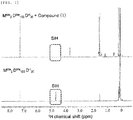
- FIG. 1 is a general view of a 1 H NMR chart after the reaction between a hydrogensiloxane and a compound represented by the formula (1) in Example 1.
- a silicone having a ketene silyl acetal structure represented by the following general formula (I) can be suitably used as a polymeric polymerization initiator that can synthesize a (meth)acrylic-grafted silicone by group transfer polymerization, and completed the present invention.
- the present invention is a polymeric polymerization initiator represented by the following general formula (I): M 1 a M 2 b D 1 c D 2 d T 1 e T 2 f Qg (I)
- the inventive polymeric polymerization initiator is represented by the general formula (I), and R 2 has a ketene silyl acetal structure. Since the ketene silyl acetal structure functions as an initiator of group transfer polymerization, the inventive polymeric polymerization initiator can be used as a polymeric polymerization initiator of group transfer polymerization.
- R 1 each independently represents a hydrogen atom, a substituted or unsubstituted alkyl group having 1 to 10 carbon atoms, or a substituted or unsubstituted aryl group having 6 to 22 carbon atoms, preferably an alkyl group having 1 to 4 carbon atoms or an aryl group having 6 to 14 carbon atoms, further preferably a methyl group or a phenyl group.
- R 2 represents a group having a ketene silyl acetal structure represented by the general formula (II).
- the order of bonding of the repeating units represented by M 1 , M 2 , D 1 , D 2 , T 1 , T 2 , and Q is optionally determined, and an arrangement constituted by the respective repeating units may be irregular, or may be regular.
- "a”, "b”, “c”, “d”, “e”, “f”, and “g” represent 0 or a positive integer
- the polymerization initiator represented by the general formula (I) has a number-average molecular weight of 1,000 to 1,000,000 g/mol, further preferably a number-average molecular weight of 1,000 to 100,000 g/mol, and further preferably a number-average molecular weight of 2,000 to 20,000 g/mol.
- the number-average molecular weight is a value in terms of polystyrene in GPC (gel permeation chromatography) analysis (hereinafter, number-average molecular weight refers to such a value in terms of polystyrene). If “b", “d", and “f” do not satisfy the conditional expression, the polymeric polymerization initiator of the general formula (I) does not have R 2 in a molecule thereof, and does not polymerize. In addition, if the number-average molecular weight of the polymeric polymerization initiator is outside the above-described range, reactivity of the polymerization becomes poor.
- A represents a single bond or a divalent organic group, preferably an alkylene group having 1 to 10 carbon atoms or a substituted or unsubstituted divalent hydrocarbon group having 1 to 20 carbon atoms optionally containing one or more selected from -O-, -S-, and NR- (R represents a monovalent hydrocarbon group having 1 to 20 carbon atoms) (note that oxygen atoms, sulfur atoms, and nitrogen atoms are not adjacent to one another), further preferably an alkylene group having 0 to 6 carbon atoms.
- R 3 each independently represents a hydrogen atom or a substituted or unsubstituted alkyl group having 1 to 4 carbon atoms, preferably an alkyl group having 1 to 3, and further preferably a methyl group.
- R 4 each independently represents a substituted or unsubstituted alkyl group having 1 to 4 carbon atoms, preferably an alkyl group having 1 or 2 carbon atoms, and further preferably a methyl group.
- the inventive polymeric polymerization initiator can be obtained by adding a compound represented by the following general formula (III) to a hydrogensiloxane represented by the following general formula (IV) by a hydrosilylation reaction.
- This production method includes a step of obtaining the polymeric polymerization initiator by adding a compound represented by the following general formula (III): to a hydrogensiloxane represented by the following general formula (IV) by a hydrosilylation reaction.
- a compound represented by the following general formula (III) to a hydrogensiloxane represented by the following general formula (IV) by a hydrosilylation reaction.
- A represents a single bond or a divalent organic group, preferably an alkylene group having 0 to 10 carbon atoms or a substituted or unsubstituted divalent hydrocarbon group having 1 to 20 carbon atoms optionally containing one or more selected from -O-, -S-, and NR-(R represents a monovalent hydrocarbon group having 1 to 20 carbon atoms) (note that oxygen atoms, sulfur atoms, and nitrogen atoms are not adjacent to one another), further preferably an alkylene group having 0 to 6 carbon atoms.
- R 3 each independently represents a hydrogen atom or a substituted or unsubstituted alkyl group having 1 to 4 carbon atoms, preferably an alkyl group having 1 to 3, further preferably a methyl group.
- R 4 each independently represents a substituted or unsubstituted alkyl group having 1 to 4 carbon atoms, preferably an alkyl group having 1 to 2 carbon atoms, further preferably a methyl group.
- Examples of the compound represented by the general formula (III) include compounds having the following structures, but are not limited thereto.
- R 5 each independently represents a hydrogen atom, a substituted or unsubstituted alkyl group having 1 to 10 carbon atoms, or a substituted or unsubstituted aryl group having 6 to 22 carbon atoms, preferably an alkyl group having 1 to 6 carbon atoms. However, at least one is a hydrogen atom.
- "h”, "i”, “j”, and “k” represent 0 or a positive integer, and the hydrogensiloxane represented by the general formula (IV) has a number-average molecular weight of 500 to 900,000 g/mol, further preferably 1,000 to 100,000 g/mol, and particularly preferably 2,000 to 20,000 g/mol.
- the addition reaction is preferably performed with a catalyst, and a known addition reaction catalyst can be used.
- a catalyst include metal catalysts containing platinum, palladium, rhodium, ruthenium, gold, nickel, or the like.
- a catalyst containing platinum, palladium, or rhodium is preferable.
- a catalyst containing platinum is further preferable, and more specifically, PtCl 4 , H 2 PtCl 6 ⁇ 6H 2 O, a Pt-ether complex, a Pt-olefin complex, PdCl 2 (PPh 3 ) 2 , PdCl 2 (PhCN) 2 , and RhCl 2 (PPh 3 ) 3 (in the formulae, Ph represents a phenyl group) can be used.
- the catalyst can be one catalyst alone or a mixture of two or more catalysts.
- the catalyst can be diluted with a solvent of alcohols, aromatic compounds, hydrocarbons, ketones, a basic solvent, or the like as necessary and used.
- a complex of 1,1,3,3-tetramethyl-1,3-divinyldisiloxane and neutralized sodium bicarbonate of chloroplatinic acid (Karstedt's catalyst) is the most suitable as an addition reaction catalyst.
- a catalytic amount refers to an amount sufficient for making the addition reaction progress.
- the amount of the catalyst is 0.02 parts by mass or less in terms of the main metal of the metal catalyst, preferably 0.0001 to 0.02 parts by mass, particularly preferably 0.0003 to 0.005 parts by mass relative to 100 parts by mass of hydrogensiloxane.
- the catalyst can be added from the beginning of the reaction or can be added during the reaction over several times. In the inventive production method, the reaction can be sufficiently progressed even with a low amount of catalyst. However, if the amount of the catalyst is too low, reaction rate becomes slow, and therefore, the amount is preferably the above-described lower limit or more. Meanwhile, too large an amount of the catalyst is uneconomical and unfavorable, and does not particularly improve the reaction rate.
- the amount of the compound represented by the general formula (III) is not particularly limited, and normally, the total number of alkenyl groups the compound represented by the general formula (III) has is 0.1 to 10, preferably 0.5 to 2 relative to one hydrosilyl group of the hydrogensiloxane.
- the addition reaction may be without a solvent or an organic solvent may be used if necessary.
- an aromatic hydrocarbon solvent such as toluene, xylene, and benzene
- an aliphatic hydrocarbon solvent such as hexane, cyclohexane, methylcyclohexane, and ethylcyclohexane
- a chlorinated solvent such as chloroform, dichloromethane, and carbon tetrachloride
- an ether solvent such as tetrahydrofuran (THF) and diethyl ether
- a ketone solvent such as acetone and methyl ethyl ketone
- an aromatic hydrocarbon such as toluene is the most suitable.
- the addition reaction temperature is 20 to 250°C, preferably 40 to 180°C, particularly preferably 80 to 120°C.
- the reaction time is within 20 hours, preferably within 12 hours, particularly preferably within 8 hours.
- the inventive polymeric polymerization initiator can produce a (meth)acrylic-grafted silicone by group transfer polymerization.
- a (meth)acrylic-grafted silicone produced by the inventive polymeric polymerization initiator has few by-product polymers unlike in a case where the (meth)acrylic-grafted silicone is synthesized by radical polymerization, and is therefore useful for cosmetics, fiber treatment agents, water repellents, oil repellents, release agents, and coating additives, for example.
- the number-average molecular weight referred to in the present invention refers to a number-average molecular weight measured by GPC under the following conditions using polystyrene as a standard substance.
- M Me , M H , D Me , D Ph , D H , T Me , and Q siloxane units, and each siloxane unit represents the following structure.
- MMe Me 3 SiO 1/2
- M H Me 2 HSiO 1/2
- D Me Me 2 SiO 2/2
- D Ph Ph 2 SiO 2/2
- D H MeHSiO 2/2
- Q SiO 4/2
- Me represents a methyl group and Ph represents a phenyl group.
- FIG. 1 is a general view of a 1 H NMR chart after the reaction between a hydrogensiloxane and a compound represented by the formula (1) in Example 1.
- the obtained product was analyzed by 1 H NMR, and it was confirmed that the peak attributable to hydrosilyl groups had disappeared, and that there was a peak attributable to a ketene silyl acetal structure near a 1 H chemical shift of 0.2 ppm, 0.5 ppm, 1.4 to 1.6 ppm, and 3.7 ppm.
- the solution was stirred for 6 hours while keeping the temperature of the solution at 100°C. Subsequently, the solvent was removed at 120°C and 10 mmHg to obtain the target compound (number-average molecular weight: 13,110 g/mol).
- the obtained product was analyzed by 1 H NMR, and it was confirmed that the peak attributable to hydrosilyl groups had disappeared, and that there was a peak attributable to a ketene silyl acetal structure.
- the solution was stirred for 6 hours while keeping the temperature of the solution at 100°C. Subsequently, the solvent was removed at 120°C and 10 mmHg to obtain the target compound (number-average molecular weight: 14,960 g/mol).
- the obtained product was analyzed by 1 H NMR, and it was confirmed that the peak attributable to hydrosilyl groups had disappeared, and that there was a peak attributable to a ketene silyl acetal structure.
- the solution was stirred for 6 hours while keeping the temperature of the solution at 100°C. Subsequently, the solvent was removed at 120°C and 10 mmHg to obtain the target compound (number-average molecular weight: 2,850 g/mol).
- the obtained product was analyzed by 1 H NMR, and it was confirmed that the peak attributable to hydrosilyl groups had disappeared, and that there was a peak attributable to a ketene silyl acetal structure.
- the solution was stirred for 6 hours while keeping the temperature of the solution at 100°C. Subsequently, the solvent was removed at 120°C and 10 mmHg to obtain the target compound (number-average molecular weight: 3,920 g/mol).
- the obtained product was analyzed by 1 H NMR, and it was confirmed that the peak attributable to hydrosilyl groups had disappeared, and that there was a peak attributable to a ketene silyl acetal structure.
- the solution was stirred for 6 hours while keeping the temperature of the solution at 100°C. Subsequently, the solvent was removed at 120°C and 10 mmHg to obtain the target compound (number-average molecular weight: 14,500 g/mol).
- the obtained product was analyzed by 1 H NMR, and it was confirmed that the peak attributable to hydrosilyl groups had disappeared, and that there was a peak attributable to a ketene silyl acetal structure.
- the solution was stirred for 6 hours while keeping the temperature of the solution at 100°C. Subsequently, the solvent was removed at 120°C and 10 mmHg to obtain the target compound (number-average molecular weight: 15,230 g/mol).
- the obtained product was analyzed by 1 H NMR, and it was confirmed that the peak attributable to hydrosilyl groups had disappeared, and that there was a peak attributable to a ketene silyl acetal structure.
- the solution was stirred for 6 hours while keeping the temperature of the solution at 100°C. Subsequently, the solvent was removed at 120°C and 10 mmHg to obtain the target compound (number-average molecular weight: 10,210 g/mol).
- the obtained product was analyzed by 1 H NMR, and it was confirmed that the peak attributable to hydrosilyl groups had disappeared, and that there was a peak attributable to a ketene silyl acetal structure.
Landscapes
- Chemical & Material Sciences (AREA)
- Health & Medical Sciences (AREA)
- Chemical Kinetics & Catalysis (AREA)
- Medicinal Chemistry (AREA)
- Polymers & Plastics (AREA)
- Organic Chemistry (AREA)
- General Chemical & Material Sciences (AREA)
- Engineering & Computer Science (AREA)
- Materials Engineering (AREA)
- Silicon Polymers (AREA)
- Polymerization Catalysts (AREA)
- Graft Or Block Polymers (AREA)
Abstract
Description
- The present invention relates to: a novel polymeric polymerization initiator; and a method for producing the polymeric polymerization initiator.
- A (meth)acrylic-grafted silicone having a silicone chain on a main chain and having a (meth)acryl (the term "(meth)acryl" used in the following description refers to methacryl and acryl) chain on a side chain has both a hydrophobic moiety and a polar moiety, and therefore, functions as a surfactant, and is used as a powder processing agent or a material for cosmetics.
Patent Documents - Examples of the polymerization initiator in the method for producing a (meth)acrylic-grafted silicone of
Patent Document 1 include radical polymerization initiators such as an azo initiator, a peroxide initiator, a persulfuric initiator, and a photopolymerization initiator. Examples of the polymerization initiators used inPatent Document 2 include radical polymerization initiators, specifically, a thermal polymerization initiator and a photopolymerization initiator. - Generally, a (meth)acrylic-grafted silicone is synthesized by a radical generated by an ordinary radical polymerization initiator such as those disclosed in
Patent Document 1 andPatent Document 2 being transferred onto a sulfur atom of a mercapto-modified silicone by a chain transfer reaction, and (meth)acrylic monomers being polymerized therefrom. However, when a (meth)acrylic-grafted silicone is synthesized by such a method, the ordinary radical initiator, being the source of the radical, also becomes a polymerization initiation site, and (meth)acrylic monomers become polymerized. Consequently, there has been a problem that the final product becomes a mixture of a (meth)acrylic-grafted silicone and a (meth)acrylic polymer. - Meanwhile, a polymeric polymerization initiator is a polymer having a functional group that may become a polymerization initiation site, and characteristic polymers such as a graft copolymer or a block copolymer can be polymerized by polymerizing monomers using the polymeric polymerization initiator. In addition, theoretically, it is possible to suppress the product from becoming a mixture of a (meth)acrylic-grafted silicone and a (meth)acrylic polymer as described above since polymerization initiation sites are only present on the polymer chain.
- However, a polymeric polymerization initiator for synthesizing a (meth)acrylic-grafted silicone has not been considered sufficiently. In particular, consideration of a polymeric polymerization initiator which enables a (meth)acrylic-grafted silicone to be synthesized by group transfer polymerization has been insufficient.
- In addition, Patent Document 3 discloses a silicone having a ketene silyl acetal structure as an intermediate for synthesizing a sulfonyl-modified silicone. However, the silicone is not used as a polymeric polymerization initiator.
-
- Patent Document 1:
JP 2014-177447 A - Patent Document 2:
JP 2008-274116 A - Patent Document 3:
US 5326890 B2 - The present invention has been made in view of the above-described circumstances, and an object thereof is to provide: a polymeric polymerization initiator for obtaining a (meth)acrylic-grafted silicone by group transfer polymerization; and a method for producing the polymeric polymerization initiator.
- To solve the above-described problems, the present invention provides
a polymeric polymerization initiator represented by the following general formula (I):
M1 aM2 bD1 cD2 dT1 eT2 fQg (I)
- M1 = R1 3SiO1/2
- M2 = R1 2R2SiO1/2
- D1 = R1 2SiO2/2
- D2 = R1R2SiO2/2
- T1 = R1SiO3/2
- T2 = R2SiO3/2
- Q = SiO4/2
- The inventive polymeric polymerization initiator as described makes it possible to synthesize a (meth)acrylic-grafted silicone by group transfer polymerization without the presence of a (meth)acrylic polymer derived from an ordinary radical initiator.
- Furthermore, the present invention provides a method for producing the above-described polymeric polymerization initiator, comprising a step of adding a compound represented by the following general formula (III) to a hydrogensiloxane represented by the following general formula (IV) by a hydrosilylation reaction,

M3 hD3 iT3 jQk (IV)
- M3 = R5 3SiO1/2
- D3 = R5 2SiO2/2
- T3 = R5SiO3/2
- Q = SiO4/2
- The inventive polymeric polymerization initiator can be produced by such an addition reaction.
- By using the inventive polymeric polymerization initiator, it is possible to synthesize a (meth)acrylic-grafted silicone by group transfer polymerization without the presence of a (meth)acrylic polymer derived from an ordinary radical initiator.
-
FIG. 1 is a general view of a 1H NMR chart after the reaction between a hydrogensiloxane and a compound represented by the formula (1) in Example 1. - The present inventor has repeated ingenuity, and as a result, has found that a silicone having a ketene silyl acetal structure represented by the following general formula (I) can be suitably used as a polymeric polymerization initiator that can synthesize a (meth)acrylic-grafted silicone by group transfer polymerization, and completed the present invention.
- That is, the present invention is
a polymeric polymerization initiator represented by the following general formula (I):
M1 aM2 bD1 cD2 dT1 eT2 fQg (I)
- M1 = R1 3SiO1/2
- M2 = R1 2R2SiO1/2
- D1 = R1 2SiO2/2
- D2 = R1R2SiO2/2
- T1 = R1SiO3/2
- T2 = R2SiO3/2
- Q = SiO4/2
- The inventive polymeric polymerization initiator is represented by the general formula (I), and R2 has a ketene silyl acetal structure. Since the ketene silyl acetal structure functions as an initiator of group transfer polymerization, the inventive polymeric polymerization initiator can be used as a polymeric polymerization initiator of group transfer polymerization.
- In the general formula (I), R1 each independently represents a hydrogen atom, a substituted or unsubstituted alkyl group having 1 to 10 carbon atoms, or a substituted or unsubstituted aryl group having 6 to 22 carbon atoms, preferably an alkyl group having 1 to 4 carbon atoms or an aryl group having 6 to 14 carbon atoms, further preferably a methyl group or a phenyl group. R2 represents a group having a ketene silyl acetal structure represented by the general formula (II).
- In the general formula (I), the order of bonding of the repeating units represented by M1, M2, D1, D2, T1, T2, and Q is optionally determined, and an arrangement constituted by the respective repeating units may be irregular, or may be regular. "a", "b", "c", "d", "e", "f", and "g" represent 0 or a positive integer, and the polymerization initiator represented by the general formula (I) has a number-average molecular weight of 1,000 to 1,000,000 g/mol, further preferably a number-average molecular weight of 1,000 to 100,000 g/mol, and further preferably a number-average molecular weight of 2,000 to 20,000 g/mol. b + d + f ≥ 1, preferably 1 to 5000, further preferably 1 to 500. Note that in the present invention, the number-average molecular weight is a value in terms of polystyrene in GPC (gel permeation chromatography) analysis (hereinafter, number-average molecular weight refers to such a value in terms of polystyrene). If "b", "d", and "f" do not satisfy the conditional expression, the polymeric polymerization initiator of the general formula (I) does not have R2 in a molecule thereof, and does not polymerize. In addition, if the number-average molecular weight of the polymeric polymerization initiator is outside the above-described range, reactivity of the polymerization becomes poor.
- In the general formula (II), A represents a single bond or a divalent organic group, preferably an alkylene group having 1 to 10 carbon atoms or a substituted or unsubstituted divalent hydrocarbon group having 1 to 20 carbon atoms optionally containing one or more selected from -O-, -S-, and NR- (R represents a monovalent hydrocarbon group having 1 to 20 carbon atoms) (note that oxygen atoms, sulfur atoms, and nitrogen atoms are not adjacent to one another), further preferably an alkylene group having 0 to 6 carbon atoms. R3 each independently represents a hydrogen atom or a substituted or unsubstituted alkyl group having 1 to 4 carbon atoms, preferably an alkyl group having 1 to 3, and further preferably a methyl group. R4 each independently represents a substituted or unsubstituted alkyl group having 1 to 4 carbon atoms, preferably an alkyl group having 1 or 2 carbon atoms, and further preferably a methyl group.
- The inventive polymeric polymerization initiator can be obtained by adding a compound represented by the following general formula (III) to a hydrogensiloxane represented by the following general formula (IV) by a hydrosilylation reaction.
- Hereinafter, a method for producing the inventive polymeric polymerization initiator will be described in detail. This production method includes a step of obtaining the polymeric polymerization initiator by adding a compound represented by the following general formula (III):

M3 hD3 iT3 jQk (IV)
- M3 = R5 3SiO1/2
- D3 = R5 2SiO2/2
- T3 = R5SiO3/2
- Q = SiO4/2
- In the general formula (III), A, as described above, represents a single bond or a divalent organic group, preferably an alkylene group having 0 to 10 carbon atoms or a substituted or unsubstituted divalent hydrocarbon group having 1 to 20 carbon atoms optionally containing one or more selected from -O-, -S-, and NR-(R represents a monovalent hydrocarbon group having 1 to 20 carbon atoms) (note that oxygen atoms, sulfur atoms, and nitrogen atoms are not adjacent to one another), further preferably an alkylene group having 0 to 6 carbon atoms. R3 each independently represents a hydrogen atom or a substituted or unsubstituted alkyl group having 1 to 4 carbon atoms, preferably an alkyl group having 1 to 3, further preferably a methyl group. R4 each independently represents a substituted or unsubstituted alkyl group having 1 to 4 carbon atoms, preferably an alkyl group having 1 to 2 carbon atoms, further preferably a methyl group.
- Examples of the compound represented by the general formula (III) include compounds having the following structures, but are not limited thereto.


- In the general formula (IV), R5 each independently represents a hydrogen atom, a substituted or unsubstituted alkyl group having 1 to 10 carbon atoms, or a substituted or unsubstituted aryl group having 6 to 22 carbon atoms, preferably an alkyl group having 1 to 6 carbon atoms. However, at least one is a hydrogen atom. "h", "i", "j", and "k" represent 0 or a positive integer, and the hydrogensiloxane represented by the general formula (IV) has a number-average molecular weight of 500 to 900,000 g/mol, further preferably 1,000 to 100,000 g/mol, and particularly preferably 2,000 to 20,000 g/mol. If every R5 is not a hydrogen atom, the produced compound cannot be polymerized. In addition, if the number-average molecular weight of the hydrogensiloxane of the general formula (IV) is outside the above-described range, reactivity of the produced polymeric polymerization initiator becomes poor.
- The addition reaction is preferably performed with a catalyst, and a known addition reaction catalyst can be used. Examples include metal catalysts containing platinum, palladium, rhodium, ruthenium, gold, nickel, or the like. In particular, a catalyst containing platinum, palladium, or rhodium is preferable. A catalyst containing platinum is further preferable, and more specifically, PtCl4, H2PtCl6·6H2O, a Pt-ether complex, a Pt-olefin complex, PdCl2(PPh3)2, PdCl2(PhCN)2, and RhCl2(PPh3)3 (in the formulae, Ph represents a phenyl group) can be used. The catalyst can be one catalyst alone or a mixture of two or more catalysts. The catalyst can be diluted with a solvent of alcohols, aromatic compounds, hydrocarbons, ketones, a basic solvent, or the like as necessary and used. In particular, a complex of 1,1,3,3-tetramethyl-1,3-divinyldisiloxane and neutralized sodium bicarbonate of chloroplatinic acid (Karstedt's catalyst) is the most suitable as an addition reaction catalyst.
- It is sufficient for the amount of the catalyst to be a catalytic amount. A catalytic amount refers to an amount sufficient for making the addition reaction progress. The amount of the catalyst is 0.02 parts by mass or less in terms of the main metal of the metal catalyst, preferably 0.0001 to 0.02 parts by mass, particularly preferably 0.0003 to 0.005 parts by mass relative to 100 parts by mass of hydrogensiloxane. The catalyst can be added from the beginning of the reaction or can be added during the reaction over several times. In the inventive production method, the reaction can be sufficiently progressed even with a low amount of catalyst. However, if the amount of the catalyst is too low, reaction rate becomes slow, and therefore, the amount is preferably the above-described lower limit or more. Meanwhile, too large an amount of the catalyst is uneconomical and unfavorable, and does not particularly improve the reaction rate.
- The amount of the compound represented by the general formula (III) is not particularly limited, and normally, the total number of alkenyl groups the compound represented by the general formula (III) has is 0.1 to 10, preferably 0.5 to 2 relative to one hydrosilyl group of the hydrogensiloxane.
- The addition reaction may be without a solvent or an organic solvent may be used if necessary. As the organic solvent, an aromatic hydrocarbon solvent such as toluene, xylene, and benzene; an aliphatic hydrocarbon solvent such as hexane, cyclohexane, methylcyclohexane, and ethylcyclohexane; a chlorinated solvent such as chloroform, dichloromethane, and carbon tetrachloride; an ether solvent such as tetrahydrofuran (THF) and diethyl ether; a ketone solvent such as acetone and methyl ethyl ketone; dimethylformamide (DMF), and acetonitrile, etc. can be used, for example. In particular, an aromatic hydrocarbon such as toluene is the most suitable.
- The addition reaction temperature is 20 to 250°C, preferably 40 to 180°C, particularly preferably 80 to 120°C. The reaction time is within 20 hours, preferably within 12 hours, particularly preferably within 8 hours.
- The inventive polymeric polymerization initiator can produce a (meth)acrylic-grafted silicone by group transfer polymerization. A (meth)acrylic-grafted silicone produced by the inventive polymeric polymerization initiator has few by-product polymers unlike in a case where the (meth)acrylic-grafted silicone is synthesized by radical polymerization, and is therefore useful for cosmetics, fiber treatment agents, water repellents, oil repellents, release agents, and coating additives, for example.
- Hereinafter, the present invention will be described in more detail with reference to Examples and Comparative Examples, but the present invention is not limited to the following Examples. In the following description, 1H NMR analysis was performed using ECX-500 II (manufactured by JEOL Ltd.) and using deuterated chloroform as a measuring solvent.
- Note that the number-average molecular weight referred to in the present invention refers to a number-average molecular weight measured by GPC under the following conditions using polystyrene as a standard substance.
-
- Developing solvent: tetrahydrofuran (THF)
- Flow amount: 0.6 mL/min
- Detector: Differential refractive index detector (RI)
- Column: TSK Guard column SuperH-L TSKgel SuperH4000 (6.0 mm I.D. × 15 cm × 1) TSKgel SuperH3000 (6.0 mm I.D. × 15 cm × 1) TSKgel SuperH2000 (6.0 mm I.D. × 15 cm × 2) (each available from Tosoh Corporation)
- Column temperature: 40°C
- Sample injection amount: 50 µL (THF solution with a concentration of 0.5 mass%)
- In addition, MMe, MH, DMe, DPh, DH, TMe, and Q represent siloxane units, and each siloxane unit represents the following structure.
MMe = Me3SiO1/2
MH = Me2HSiO1/2
DMe = Me2SiO2/2
DPh = Ph2SiO2/2
DH = MeHSiO2/2
TMe = MeSiO3/2
Q = SiO4/2 - Here, Me represents a methyl group and Ph represents a phenyl group.
- In a three-necked flask equipped with a thermometer and a cooling pipe were charged 100 parts by mass of hydrogensiloxane (number-average molecular weight: 7,780 g/mol) whose average composition was represented by MMe 2DMe 103DH 30 and 85.1 parts by mass of the compound represented by the following formula (1), and were dissolved in 100 parts by mass of toluene. The temperature of the solution was raised to 100°C using an oil bath, and 0.0333 parts by mass of a solution of a neutralized sodium bicarbonate of chloroplatinic acid-vinyl siloxane complex in toluene (platinum content: 0.5 wt%) was added dropwise. After adding dropwise, the solution was stirred for 6 hours while keeping the temperature of the solution at 100°C. Subsequently, the solvent was removed at 120°C and 10 mmHg to obtain the target compound (number-average molecular weight: 16,850 g/mol).
FIG. 1 is a general view of a 1H NMR chart after the reaction between a hydrogensiloxane and a compound represented by the formula (1) in Example 1. The obtained product was analyzed by 1H NMR, and it was confirmed that the peak attributable to hydrosilyl groups had disappeared, and that there was a peak attributable to a ketene silyl acetal structure near a 1H chemical shift of 0.2 ppm, 0.5 ppm, 1.4 to 1.6 ppm, and 3.7 ppm.
- In a three-necked flask equipped with a thermometer and a cooling pipe were charged 100 parts by mass of hydrogensiloxane (number-average molecular weight: 6,490 g/mol) whose average composition was represented by MMe 2DMe 123DH 10 and 28.4 parts by mass of the compound represented by the formula (1), and were dissolved in 100 parts by mass of toluene. The temperature of the solution was raised to 100°C using an oil bath, and 0.0333 parts by mass of a solution of a neutralized sodium bicarbonate of chloroplatinic acid-vinyl siloxane complex in toluene (platinum content: 0.5 wt%) was added dropwise. After adding dropwise, the solution was stirred for 6 hours while keeping the temperature of the solution at 100°C. Subsequently, the solvent was removed at 120°C and 10 mmHg to obtain the target compound (number-average molecular weight: 13,110 g/mol). The obtained product was analyzed by 1H NMR, and it was confirmed that the peak attributable to hydrosilyl groups had disappeared, and that there was a peak attributable to a ketene silyl acetal structure.
- In a three-necked flask equipped with a thermometer and a cooling pipe were charged 100 parts by mass of hydrogensiloxane (number-average molecular weight: 7,740 g/mol) whose average composition was represented by MMe 2DMe 113DH 20 and 55.6 parts by mass of the compound represented by the formula (1), and were dissolved in 100 parts by mass of toluene. The temperature of the solution was raised to 100°C using an oil bath, and 0.0333 parts by mass of a solution of a neutralized sodium bicarbonate of chloroplatinic acid-vinyl siloxane complex in toluene (platinum content: 0.5 wt%) was added dropwise. After adding dropwise, the solution was stirred for 6 hours while keeping the temperature of the solution at 100°C. Subsequently, the solvent was removed at 120°C and 10 mmHg to obtain the target compound (number-average molecular weight: 14,960 g/mol). The obtained product was analyzed by 1H NMR, and it was confirmed that the peak attributable to hydrosilyl groups had disappeared, and that there was a peak attributable to a ketene silyl acetal structure.
- In a three-necked flask equipped with a thermometer and a cooling pipe were charged 100 parts by mass of hydrogensiloxane (number-average molecular weight: 1,080 g/mol) whose average composition was represented by MMe 2DMe 10DH 5 and 120 parts by mass of the compound represented by the formula (1), and were dissolved in 100 parts by mass of toluene. The temperature of the solution was raised to 100°C using an oil bath, and 0.0333 parts by mass of a solution of a neutralized sodium bicarbonate of chloroplatinic acid-vinyl siloxane complex in toluene (platinum content: 0.5 wt%) was added dropwise. After adding dropwise, the solution was stirred for 6 hours while keeping the temperature of the solution at 100°C. Subsequently, the solvent was removed at 120°C and 10 mmHg to obtain the target compound (number-average molecular weight: 2,850 g/mol). The obtained product was analyzed by 1H NMR, and it was confirmed that the peak attributable to hydrosilyl groups had disappeared, and that there was a peak attributable to a ketene silyl acetal structure.
- In a three-necked flask equipped with a thermometer and a cooling pipe were charged 100 parts by mass of hydrogensiloxane (number-average molecular weight: 2,950 g/mol) whose average composition was represented by MH 2DMe 40 and 16.9 parts by mass of the compound represented by the formula (1), and were dissolved in 100 parts by mass of toluene. The temperature of the solution was raised to 100°C using an oil bath, and 0.0333 parts by mass of a solution of a neutralized sodium bicarbonate of chloroplatinic acid-vinyl siloxane complex in toluene (platinum content: 0.5 wt%) was added dropwise. After adding dropwise, the solution was stirred for 6 hours while keeping the temperature of the solution at 100°C. Subsequently, the solvent was removed at 120°C and 10 mmHg to obtain the target compound (number-average molecular weight: 3,920 g/mol). The obtained product was analyzed by 1H NMR, and it was confirmed that the peak attributable to hydrosilyl groups had disappeared, and that there was a peak attributable to a ketene silyl acetal structure.
- In a three-necked flask equipped with a thermometer and a cooling pipe were charged 100 parts by mass of hydrogensiloxane (number-average molecular weight: 4,220 g/mol) whose average composition was represented by MMe 2DPh 9DH 43 and 154 parts by mass of the compound represented by the formula (1), and were dissolved in 100 parts by mass of toluene. The temperature of the solution was raised to 100°C using an oil bath, and 0.0333 parts by mass of a solution of a neutralized sodium bicarbonate of chloroplatinic acid-vinyl siloxane complex in toluene (platinum content: 0.5 wt%) was added dropwise. After adding dropwise, the solution was stirred for 6 hours while keeping the temperature of the solution at 100°C. Subsequently, the solvent was removed at 120°C and 10 mmHg to obtain the target compound (number-average molecular weight: 14,500 g/mol). The obtained product was analyzed by 1H NMR, and it was confirmed that the peak attributable to hydrosilyl groups had disappeared, and that there was a peak attributable to a ketene silyl acetal structure.
- In a three-necked flask equipped with a thermometer and a cooling pipe were charged 100 parts by mass of hydrogensiloxane (number-average molecular weight: 9,850 g/mol) whose average composition was represented by MMe 6DMe 113DH20TMe 4 and 28.4 parts by mass of the compound represented by the formula (1), and were dissolved in 100 parts by mass of toluene. The temperature of the solution was raised to 100°C using an oil bath, and 0.0333 parts by mass of a solution of a neutralized sodium bicarbonate of chloroplatinic acid-vinyl siloxane complex in toluene (platinum content: 0.5 wt%) was added dropwise. After adding dropwise, the solution was stirred for 6 hours while keeping the temperature of the solution at 100°C. Subsequently, the solvent was removed at 120°C and 10 mmHg to obtain the target compound (number-average molecular weight: 15,230 g/mol). The obtained product was analyzed by 1H NMR, and it was confirmed that the peak attributable to hydrosilyl groups had disappeared, and that there was a peak attributable to a ketene silyl acetal structure.
- In a three-necked flask equipped with a thermometer and a cooling pipe were charged 100 parts by mass of hydrogensiloxane (number-average molecular weight: 7,720 g/mol) whose average composition was represented by MMe 100MH 20Q60 and 39.9 parts by mass of the compound represented by the formula (1), and were dissolved in 100 parts by mass of toluene. The temperature of the solution was raised to 100°C using an oil bath, and 0.0333 parts by mass of a solution of a neutralized sodium bicarbonate of chloroplatinic acid-vinyl siloxane complex in toluene (platinum content: 0.5 wt%) was added dropwise. After adding dropwise, the solution was stirred for 6 hours while keeping the temperature of the solution at 100°C. Subsequently, the solvent was removed at 120°C and 10 mmHg to obtain the target compound (number-average molecular weight: 10,210 g/mol). The obtained product was analyzed by 1H NMR, and it was confirmed that the peak attributable to hydrosilyl groups had disappeared, and that there was a peak attributable to a ketene silyl acetal structure.
- As described above, it was confirmed that the inventive polymeric polymerization initiator was obtained.
- It should be noted that the present invention is not limited to the above-described embodiments. The embodiments are just examples, and any examples that have substantially the same feature and demonstrate the same functions and effects as those in the technical concept disclosed in claims of the present invention are included in the technical scope of the present invention.

"a", "b", "c", "d", "e", "f", and "g" represent 0 or a positive integer where b + d + f ≥ 1, and the polymerization initiator represented by the general formula (I) has a number-average molecular weight of 1,000 to 1,000,000 g/mol; and an order of bonding of siloxane units represented by M1, M2, D1, D2, T1, T2, and Q is optionally determined.

"a", "b", "c", "d", "e", "f", and "g" represent 0 or a positive integer where b + d + f ≥ 1, and the polymerization initiator represented by the general formula (I) has a number-average molecular weight of 1,000 to 1,000,000 g/mol; and an order of bonding of siloxane units represented by M1, M2, D1, D2, T1, T2, and Q is optionally determined.
Claims (2)
- A polymeric polymerization initiator represented by the following general formula (I):
M1 aM2 bD1 cD2 dT1 eT2 fQg (I)
M1 = R1 3SiO1/2M2 = R1 2R2SiO1/2D1 = R1 2SiO2/2D2 = R1R2SiO2/2T1 = R1SiO3/2T2 = R2SiO3/2Q = SiO4/2wherein in the general formula (I), R1 each independently represents a hydrogen atom, a substituted or unsubstituted alkyl group having 1 to 10 carbon atoms, or a substituted or unsubstituted aryl group having 6 to 22 carbon atoms; R2 represents a group having a ketene silyl acetal structure represented by the following general formula (II):
"a", "b", "c", "d", "e", "f", and "g" represent 0 or a positive integer where b + d + f ≥ 1, and the polymerization initiator represented by the general formula (I) has a number-average molecular weight of 1,000 to 1,000,000 g/mol; and an order of bonding of siloxane units represented by M1, M2, D1, D2, T1, T2, and Q is optionally determined. - A method for producing the polymeric polymerization initiator according to claim 1, comprising a step of adding a compound represented by the following general formula (III) to a hydrogensiloxane represented by the following general formula (IV) by a hydrosilylation reaction,

M3 hD3 iT3 jQk (IV)
M3 = R5 3SiO1/2D3 = R5 2SiO2/2T3 = R5SiO3/2Q = SiO4/2wherein R5 each independently represents a hydrogen atom, a substituted or unsubstituted alkyl group having 1 to 10 carbon atoms, or a substituted or unsubstituted aryl group having 6 to 22 carbon atoms, and at least one is a hydrogen atom; "h", "i", "j", and "k" represent 0 or a positive integer where h + i + j ≥ 1, and the hydrogensiloxane represented by the general formula (IV) has a number-average molecular weight of 500 to 900,000 g/mol; and an order of bonding of siloxane units represented by M3, D3, T3, and Q is optionally determined.
Applications Claiming Priority (2)
| Application Number | Priority Date | Filing Date | Title |
|---|---|---|---|
| JP2018188153A JP7082023B6 (en) | 2018-10-03 | 2018-10-03 | Polymer polymerization initiator and method for producing polymer polymerization initiator |
| PCT/JP2019/030395 WO2020070964A1 (en) | 2018-10-03 | 2019-08-02 | High-molecular-weight polymerization initiator and production method for high-molecular-weight polymerization initiator |
Publications (2)
| Publication Number | Publication Date |
|---|---|
| EP3862367A1 true EP3862367A1 (en) | 2021-08-11 |
| EP3862367A4 EP3862367A4 (en) | 2022-06-22 |
Family
ID=70055700
Family Applications (1)
| Application Number | Title | Priority Date | Filing Date |
|---|---|---|---|
| EP19869632.0A Pending EP3862367A4 (en) | 2018-10-03 | 2019-08-02 | HIGH MOLECULAR WEIGHT POLYMERIZATION INITIATOR AND PRODUCTION PROCESS FOR HIGH MOLECULAR WEIGHT POLYMERIZATION INITIATOR |
Country Status (6)
| Country | Link |
|---|---|
| US (1) | US11629234B2 (en) |
| EP (1) | EP3862367A4 (en) |
| JP (1) | JP7082023B6 (en) |
| KR (1) | KR102731687B1 (en) |
| CN (1) | CN112771082A (en) |
| WO (1) | WO2020070964A1 (en) |
Families Citing this family (1)
| Publication number | Priority date | Publication date | Assignee | Title |
|---|---|---|---|---|
| JP7082024B2 (en) * | 2018-10-03 | 2022-06-07 | 信越化学工業株式会社 | (Meta) Acrylic Graft Silicone and its manufacturing method |
Family Cites Families (10)
| Publication number | Priority date | Publication date | Assignee | Title |
|---|---|---|---|---|
| US520746A (en) * | 1894-05-29 | Carriage | ||
| CA1337700C (en) * | 1985-10-15 | 1995-12-05 | Anthony Revis | Process for preparation of silyl ketene acetals |
| US5187244A (en) * | 1988-07-22 | 1993-02-16 | Mitsubishi Rayon Co., Ltd. | Preparation process of block copolymers and resulting block copolymers |
| JP2876013B2 (en) * | 1990-02-23 | 1999-03-31 | 三菱レイヨン株式会社 | Oxygen permeable molding |
| JP2741436B2 (en) * | 1991-06-24 | 1998-04-15 | 信越化学工業株式会社 | Surface-treated alumina and thermally conductive silicone composition containing the same |
| US5326890A (en) | 1992-10-16 | 1994-07-05 | Rensselaer Polytechnic Institute | Sulfonated silicones and methods for their production |
| JP2008274116A (en) | 2007-04-27 | 2008-11-13 | Three M Innovative Properties Co | Grafted silicone polymer and product composed thereof |
| BR112015019323B1 (en) | 2013-02-13 | 2021-11-16 | Kao Corporation | USE OF AN ORGANOPOLYSILOXAN GRAFT POLYMER FOR A HAIR COSMETIC |
| JP6131918B2 (en) | 2013-12-13 | 2017-05-24 | 信越化学工業株式会社 | Method for producing low-foaming room temperature curable organopolysiloxane composition and method for producing automobile oil seal |
| JP6907856B2 (en) | 2016-10-04 | 2021-07-21 | 信越化学工業株式会社 | Copolymer of (meth) acrylic acid triisopropylsilyl and (meth) acrylic acid derivative and method for producing the same |
-
2018
- 2018-10-03 JP JP2018188153A patent/JP7082023B6/en active Active
-
2019
- 2019-08-02 CN CN201980063287.3A patent/CN112771082A/en active Pending
- 2019-08-02 KR KR1020217008702A patent/KR102731687B1/en active Active
- 2019-08-02 US US17/276,095 patent/US11629234B2/en active Active
- 2019-08-02 EP EP19869632.0A patent/EP3862367A4/en active Pending
- 2019-08-02 WO PCT/JP2019/030395 patent/WO2020070964A1/en not_active Ceased
Also Published As
| Publication number | Publication date |
|---|---|
| US11629234B2 (en) | 2023-04-18 |
| JP2020055965A (en) | 2020-04-09 |
| EP3862367A4 (en) | 2022-06-22 |
| CN112771082A (en) | 2021-05-07 |
| WO2020070964A1 (en) | 2020-04-09 |
| KR102731687B1 (en) | 2024-11-18 |
| US20220081516A1 (en) | 2022-03-17 |
| JP7082023B6 (en) | 2023-12-22 |
| KR20210070982A (en) | 2021-06-15 |
| JP7082023B2 (en) | 2022-06-07 |
Similar Documents
| Publication | Publication Date | Title |
|---|---|---|
| KR101028348B1 (en) | Branched polymers from organohydrogensilicon compounds | |
| JP4925026B2 (en) | Method for preparing branched polymer derived from organohydrogensilicon compound | |
| KR100962056B1 (en) | Organohydrogensilicon Compound | |
| EP1799729B1 (en) | Functional siloxanes and their vinyl co-polymers | |
| EP2301986B1 (en) | One-terminal reactive organopolysiloxane having a polyalkyleneoxide group at the omega-terminal and a method for the preparation thereof | |
| US6310169B1 (en) | Polymerizable terminal group-containing polyorganosiloxane and production process for the same | |
| CZ292758B6 (en) | Novel block copolymers and process of their preparation | |
| JP5828964B2 (en) | Novel polyorganosiloxane, polycarbonate resin composition containing the same, and modified polycarbonate resin | |
| US11629234B2 (en) | Polymeric polymerization initiator and method for producing polymeric polymerization initiator | |
| RU2019105172A (en) | NEW PILIACRYLATE-POLYSILANE BLOCKS-COPOLYMERS | |
| JP4362926B2 (en) | Terminally polymerizable polyorganosiloxane and process for producing the same | |
| CN101010355A (en) | Functionalized siloxanes and silanes and their vinyl copolymers | |
| FR2652582A1 (en) | DISULFIDE OF THIURAM GRAFT POLYDIORGANOSILOXANE AND ITS USE IN THE RADICAL POLYMERIZATION OF VINYL MONOMERS. | |
| KR20250151353A (en) | Organopolysiloxane compounds, their derivatives, and methods for producing them | |
| KR20010096271A (en) | Perfluoroalkyl-functional organopolysiloxane | |
| EP1142931A1 (en) | Perfluoroalkyl-functional organopolysiloxane |
Legal Events
| Date | Code | Title | Description |
|---|---|---|---|
| STAA | Information on the status of an ep patent application or granted ep patent |
Free format text: STATUS: THE INTERNATIONAL PUBLICATION HAS BEEN MADE |
|
| PUAI | Public reference made under article 153(3) epc to a published international application that has entered the european phase |
Free format text: ORIGINAL CODE: 0009012 |
|
| STAA | Information on the status of an ep patent application or granted ep patent |
Free format text: STATUS: REQUEST FOR EXAMINATION WAS MADE |
|
| 17P | Request for examination filed |
Effective date: 20210312 |
|
| AK | Designated contracting states |
Kind code of ref document: A1 Designated state(s): AL AT BE BG CH CY CZ DE DK EE ES FI FR GB GR HR HU IE IS IT LI LT LU LV MC MK MT NL NO PL PT RO RS SE SI SK SM TR |
|
| DAV | Request for validation of the european patent (deleted) | ||
| DAX | Request for extension of the european patent (deleted) | ||
| RAP3 | Party data changed (applicant data changed or rights of an application transferred) |
Owner name: SHIN-ETSU CHEMICAL CO., LTD. |
|
| REG | Reference to a national code |
Ref country code: DE Ref legal event code: R079 Free format text: PREVIOUS MAIN CLASS: C08F0004000000 Ipc: C08G0077380000 |
|
| A4 | Supplementary search report drawn up and despatched |
Effective date: 20220525 |
|
| RIC1 | Information provided on ipc code assigned before grant |
Ipc: C08F 4/00 20060101ALI20220519BHEP Ipc: C08G 77/38 20060101AFI20220519BHEP |
|
| STAA | Information on the status of an ep patent application or granted ep patent |
Free format text: STATUS: EXAMINATION IS IN PROGRESS |
|
| 17Q | First examination report despatched |
Effective date: 20240724 |