EP3861867A1 - Production method for smoking article - Google Patents
Production method for smoking article Download PDFInfo
- Publication number
- EP3861867A1 EP3861867A1 EP18936076.1A EP18936076A EP3861867A1 EP 3861867 A1 EP3861867 A1 EP 3861867A1 EP 18936076 A EP18936076 A EP 18936076A EP 3861867 A1 EP3861867 A1 EP 3861867A1
- Authority
- EP
- European Patent Office
- Prior art keywords
- tobacco
- segment
- double
- length
- tobacco rod
- Prior art date
- Legal status (The legal status is an assumption and is not a legal conclusion. Google has not performed a legal analysis and makes no representation as to the accuracy of the status listed.)
- Pending
Links
Images


Classifications
-
- A—HUMAN NECESSITIES
- A24—TOBACCO; CIGARS; CIGARETTES; SIMULATED SMOKING DEVICES; SMOKERS' REQUISITES
- A24C—MACHINES FOR MAKING CIGARS OR CIGARETTES
- A24C5/00—Making cigarettes; Making tipping materials for, or attaching filters or mouthpieces to, cigars or cigarettes
- A24C5/01—Making cigarettes for simulated smoking devices
-
- A—HUMAN NECESSITIES
- A24—TOBACCO; CIGARS; CIGARETTES; SIMULATED SMOKING DEVICES; SMOKERS' REQUISITES
- A24C—MACHINES FOR MAKING CIGARS OR CIGARETTES
- A24C5/00—Making cigarettes; Making tipping materials for, or attaching filters or mouthpieces to, cigars or cigarettes
- A24C5/47—Attaching filters or mouthpieces to cigars or cigarettes, e.g. inserting filters into cigarettes or their mouthpieces
- A24C5/475—Attaching filters or mouthpieces to cigars or cigarettes, e.g. inserting filters into cigarettes or their mouthpieces adapted for composite filters
-
- A—HUMAN NECESSITIES
- A24—TOBACCO; CIGARS; CIGARETTES; SIMULATED SMOKING DEVICES; SMOKERS' REQUISITES
- A24D—CIGARS; CIGARETTES; TOBACCO SMOKE FILTERS; MOUTHPIECES OF CIGARS OR CIGARETTES; MANUFACTURE OF TOBACCO SMOKE FILTERS OR MOUTHPIECES
- A24D1/00—Cigars; Cigarettes
- A24D1/20—Cigarettes specially adapted for simulated smoking devices
Definitions
- the present invention relates to a method of manufacturing a smoking article.
- Patent Literature (PTL) 1 discloses a manufacturing method including: step 1 of placing a cooling part at each end of a tobacco rod and joining by wrapping in a first tipping paper; step 2 of cutting in the central part of the tobacco rod in the longitudinal direction to form a pair of tobacco rod/cooling part segments; step 3 of placing the segments via a gap and placing a filter segment in the gap; and step 4 of joining the tobacco rod/cooling part segments placed at both ends of the filter segment by wrapping in a second tipping paper.
- an object of the present invention is to provide a method of efficiently manufacturing a smoking article.
- the inventors resolved the above-mentioned problem by performing once a step of joining with a tipping paper.
- the above-mentioned problem is resolved by the present invention below.
- Embodiment 2 The method according to Embodiment 1, where a step of A includes
- Embodiment 5 The method according to any of Embodiments 1 to 4, where the filter segment includes an acetate filter and a center hole filter.
- Embodiment 8 The method according to Embodiment 7, where the tobacco rod has a diameter 0.05 to 0.15 mm larger than the neighboring member.
- Embodiment 10 The method according to any of Embodiments 1 to 9, where a member neighboring the tobacco rod has stiffness higher than the tobacco rod.
- Embodiment 11 The method according to any of Embodiments 1 to 10, where the cooling segment includes a paper tube having a plurality of holes in the circumferential direction.
- Embodiment 12 The method according to Embodiment 11, where the cooling segment includes a paper tube; and the method further includes forming a plurality of holes in the circumferential direction of the paper tube by laser processing.
- a smoking article including a tobacco rod, a cooling segment, and a filter segment, where the tobacco rod has a diameter larger than a neighboring member.
- Embodiment 15 The smoking article according to Embodiment 14, where the tobacco rod has a diameter 0.05 to 0.15 mm larger than the neighboring member.
- Embodiment 16 The smoking article according to Embodiment 14, where the tobacco rod has a diameter 0.5 to 2.5% larger than the neighboring member.
- the present invention relates to a method of manufacturing a smoking article that includes a tobacco rod, a cooling segment, and a filter segment.
- a smoking article that includes a tobacco rod, a cooling segment, and a filter segment.
- the expression "X to Y" includes the lower and the upper limits of X and Y.
- a smoking article of the present invention includes a tobacco rod, a cooling segment, and a filter segment.
- Fig. 1 (i) illustrates an embodiment of the smoking article of the present invention.
- 100 is a smoking article
- 1 is a tobacco rod
- 3 is a cooling segment
- 5 is a filter segment
- 7 is a tipping paper.
- a tobacco rod is an almost cylindrical member for generating smoking flavor components contained in tobacco raw materials and includes tobacco filler and a paper wrapper wrapped therearound.
- the tobacco filler is not limited, and tobacco shreds or tobacco sheets, for example, may be used therefor.
- tobacco shreds prepared by cutting dry tobacco leaves into a width of 0.8 to 1.2 mm may be packed inside a paper wrapper.
- those prepared by uniformly pulverizing dry tobacco leaves into an average particle size of about 20 to 200 ⁇ m, forming into sheets, and cutting the sheets into a width of 0.8 to 1.2 mm may be packed inside a paper wrapper.
- such sheets may be gathered, folded, or spirally rolled without cutting and packed inside a paper wrapper.
- such sheets may be cut into strips and packed inside a paper wrapper concentrically or with the longitudinal direction of the strips aligned parallel to the longitudinal direction of a tobacco rod.
- the tobacco rod 1 may generate an aerosol upon heating.
- an aerosol source such as glycerol, propylene glycol, 1,3-butanediol, or other polyols
- the amount of an aerosol source to be added is preferably 5 to 50 weight% and more preferably 10 to 30 weight% based on the dry weight of the tobacco filler.
- the tobacco rod may contain a flavor, such as menthol.
- the length of the tobacco rod 1 is not limited but is preferably 15 to 25 mm.
- the diameter is also not limited but is preferably 6.5 to 7.5 mm.
- the tobacco rod when a neighboring member has stiffness higher than the tobacco rod, the tobacco rod preferably has a diameter larger than the neighboring member. As a result, deformation of the tobacco rod can be suppressed.
- the tobacco rod has a diameter preferably 0.5 to 2.5% larger and more preferably 1.0 to 2.0% larger than the neighboring member.
- the tobacco rod preferably has a diameter about 0.05 to 0.15 mm larger than the neighboring member.
- Exemplary neighboring members include a cooling segment and a filter segment.
- Stiffness in the present invention means the resistance of a member to deformation as disclosed in paragraphs [0010] to [0014] of Japanese Unexamined Patent Application Publication (Translation of PCT Application) No. 2016-523565 .
- Stiffness can be obtained from a change in diameter before and after applying a load F on the side surface of a tobacco rod.
- Ds the diameter of a tobacco rod before applying a load F
- Dd the diameter after applying the load
- the stiffness is defined by the following formula. The same applies to other members.
- Stiffness % Dd / Ds ⁇ 100
- a cooling segment is a member for cooling an aerosol and smoking flavor components generated in the tobacco rod 1.
- the cooling segment 3 may be a hollow paper tube.
- the paper tube is preferably made of cardboard having stiffness higher than paper wrappers and a tipping paper.
- the paper tube may be provided with holes (ventilation holes).
- a plurality of holes are preferably formed along the circumference of the paper tube. In view of efficient operations, such holes are preferably formed by laser processing of a finished smoking article.
- gathered sheets may be packed inside the cooling segment 3.
- the length is preferably 15 to 25 mm and the diameter is preferably 5.5 to 7.5 mm
- the cooling segment 3 has a diameter preferably 0.5 to 2.5% smaller and preferably 1.0 to 2.0% smaller than the neighboring member.
- the cooling segment 3 includes a paper tube made of cardboard, the segment generally has stiffness higher than a tobacco rod.
- a filter segment is a member including a filter.
- a publicly known filter member such as an acetate filter or a paper filter
- a paper filter is a paper-filled filter prepared by creasing paper through processing with a crepe roller or the like and by rolling the paper using a plug wrapper.
- An acetate filter is a filter filled with cellulose acetate fibers.
- a filter segment 5 is preferably composed of a plurality of members, and more preferably includes a filter 51 and a center holefilter 53.
- the center hole filter may be a space provided in the central part of the acetate filter, for example.
- the length of the filter segment 5 is not limited but is preferably 10 to 20 mm.
- both a center hole filter and an acetate filter are arranged as a filter segment, the order is not limited. Moreover, individual members may be wrapped in each filter inner wrapper and joined with a filter outer wrapper.
- the diameter of the filter segment is not limited but is preferably almost the same as those of other segments excluding a tobacco rod. As a result, tearing and creasing of a tipping paper can be suppressed.
- tipping paper refers to a paper used for joining two or more of a tobacco rod, a cooling segment, and a filter segment.
- paper wrapper refers to a paper for wrapping individual members that constitute a tobacco rod, a cooling segment, or a filter segment.
- a filter segment includes a center hole filter and an acetate filter as in the foregoing, a paper for wrapping the center hole filter and a paper for wrapping the acetate filter are each paper wrapper.
- Exemplary base paper for a tipping paper and paper wrappers includes, but is not limited to, paper using cellulose fibers.
- cellulose fibers may be either derived from plants or chemically synthesized, or may be a mixture thereof.
- Exemplary plant-derived fibers include pulp of flax fibers, wood fibers, or seed fibers, for example. Such pulp may be colored unbleached pulp.
- bleached pulp which is prepared using a bleaching agent, such as an oxidant or a reductant.
- a citric acid alkali metal salt or the like is used as a common burning chemical (combustion aid, for example) that can affect the spontaneous combustion rate of the paper wrapper.
- a heating-type smoking article but not a combustion-type is preferable. In this case, since the combustion of a paper wrapper is unnecessary, the paper wrapper need not contain a burning chemical.
- the lower limit of the basis weight of a paper wrapper is preferably 30 g/m 2 or more, more preferably 35 g/m 2 or more, and further preferably 40 g/m 2 or more.
- the upper limit is preferably 65 g/m 2 or less and more preferably 50 g/m 2 or less.
- the lower limit of the basis weight of a tipping paper is preferably 20 g/m 2 or more, more preferably 25 g/m 2 or more, and further preferably 30 g/m 2 or more.
- the upper limit is preferably 50 g/m 2 or less, more preferably 45 g/m 2 or less, and further preferably 40 g/m 2 or less.
- the basis weight can be measured by the method specified in JIS P 8124.
- Fig. 2 The outline of the present process is illustrated in Fig. 2 .
- "w" indicates "double-length.”
- 5w represents a double-length filter segment.
- a pair of tobacco segments 10 each of which includes a tobacco rod 1 and a cooling segment 3 in contact with the end of the tobacco rod are prepared and placed via a gap to align the longitudinal axes of the tobacco segments.
- the distance between the tobacco segments is preferably the length of a double-length filter segment 5w used in the next step.
- Step A is performed in any appropriate manner but is preferably preformed through the following steps ( Fig. 3 );
- step A1 can be performed in the first unit 81 of Fig. 7 where 81f is a feeder for tobacco rods 1, 81p is a picking-up drum, and 81s is a separating drum. A pair of tobacco rods 1 fed from the feeder 81f are passed to a holding section provided on the circumferential surface of the picking-up drum 81p.
- the pair of the tobacco rods 1 are passed to the separating drum 81s and separated in a holding section while being transferred.
- one or a plurality of drums may have a feeding, receiving, transferring, or separating function.
- Step A2 can be performed in the second unit 82 of Fig. 7 where 82f is a feeder for a double-length cooling segment 3w, 82t is a transfer drum, 82p is a picking-up drum, and 82a is a receiving drum.
- the pair of the tobacco rods 1 placed via a gap are passed in this state to the transfer drum 82t.
- a double-length cooling segment 3w fed from the feeder 82f is passed to a holding section provided on the circumferential surface of the picking-up drum 82p and then passed to the receiving drum 82a.
- the double-length cooling segment 3w is placed in the gap between the pair of the separately placed tobacco rods 1 such that both ends of the double-length cooling segment 3w come into contact with the end of either of the tobacco rods 1.
- Step A3 can be performed in the third unit 83 of Fig. 7 where 83c is a cutter drum, 83c' is a cutter, and 83s is a separating drum.
- a segment including the pair of the tobacco rods 1 at either end of the double-length cooling segment 3w is passed to the cutter drum 83c and cut with the cutter 83c' in the central part in the longitudinal direction of the double-length cooling segment 3w. Subsequently, the segment is passed to the separating drum 83s and placed via a gap.
- step A is preferably performed through the following steps ( Fig. 4 );
- step A2' the double-length cooling segment 3w' cut in advance
- cutting failure can be avoided even if the cooling segment is formed from a hard-to-cut material.
- double-length segment cut in advance there is also an advantage that the entire length of a machine for performing this method can be shortened.
- step A is preferably performed through the following steps ( Fig. 5 );
- step A1 Since the distance between the tobacco rods is long in step A1, the number of times the tobacco rods are moved can be reduced in this method. Consequently, there is an advantage that the damage to tobacco rods can be avoided during high-speed manufacture or the like.
- Step A has an advantage, in addition to the foregoing, that the height of an apparatus body can be reduced in an apparatus for performing this method since cutting is performed after placing each member. For example, when cutting is performed before placing a member in the above-described apparatus, it is necessary to provide a drum for cutting the member above a drum for transferring the member. As a result, the apparatus body becomes high since a cutting drum needs to be added in the height direction of the apparatus. Meanwhile, since cutting is performed after placing each member, step A can reduce the height of an apparatus body.
- a double-length filter segment 5w which has a double length of the filter segment 5 is prepared and placed in the gap such that both ends of the double-length filter segment 5w come into contact with the end of either of the tobacco segments 1, thereby preparing a composite segment.
- This step can be performed in the fourth unit 84 of Fig. 7 .
- 84f is a feeder for a double-length filter segment 5w
- 84p is a picking-up drum
- 84a is a receiving drum.
- the segments prepared in the third unit 83 are passed to the receiving drum 84a.
- a double-length filter segment 5w fed from the feeder 84f is passed to a holding section provided on the circumferential surface of the picking-up drum 84p and then passed to the receiving drum 84a.
- the double-length filter segment 5w is placed in the gap between the pair of the separately placed tobacco segments 10 such that both ends of the double-length filter segment 5w come into contact with the end of either of the tobacco segments 10, thereby forming a composite segment 90.
- the composite segment is integrated by wrapping in one tipping paper 7 to obtain a double-length smoking article 100w.
- the tipping paper any paper common in the field concerned can be used.
- the tipping paper may be coated with a publicly known adhesive.
- the composite segment in the separable state is integrated into the inseparable state.
- the tipping paper 7 need not cover the entire range of the tobacco rods 1.
- the region covered with the tipping paper 7 is preferably a region extending from the bonding face between the tobacco rod 1 and the cooling segment 3 to the position of 0.2X to 0.4X in the longitudinal direction of the tobacco rod 1.
- thermal conductivity can be enhanced in the case of heating the tobacco rod 1 from the outside.
- This step can be performed in the fifth unit 85 of Fig. 7 .
- 85f is a feeder for a tipping paper 7
- 85t is a transfer drum
- 85r is a rolling drum
- 85h is a rolling hand.
- a rolling drum is a drum having a holding section that is for holding a member on the circumferential surface and that enables a segment or another member to rotate on its central axis in the longitudinal direction.
- a rolling hand is a means that is disposed facing the circumferential surface of the rolling drum and that is for forming a gap of a constant distance from the circumferential surface.
- the composite segment 90 is passed to the transfer drum 85t and then passed to the rolling drum 85r.
- the precursor 92 includes the tipping paper 7 attached, like a flag, to the composite segment 90. In other words, part of the tipping paper 7 is attached to the circumferential surface of the composite segment 90 while leaving the remainder free.
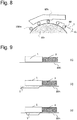
- the precursor 92 is fixed to the holding section on the circumferential surface of the rolling drum 85r through suction or the like and transferred to the gap formed between the rolling drum 85r and the rolling hand 85h. While passing through this gap, the entire circumferential surface of the precursor 92 is wrapped in the tipping paper 7 to form a double-length smoking article 100w (see Fig. 8 ).
- the tobacco rod 1 preferably has a diameter larger than the neighboring cooling segment 3 in the present invention.
- the surfaces of the rolling drum 85r and the rolling hand 85h are flat, excessive contact arises between these surfaces and the tobacco rod 1 ( Fig. 9 (1)). This results in a problem of falling fillings from the leading end under the impact on the tobacco rod 1.
- the difference in circumference causes twisting, thereby developing defects, such as creases, in a product.
- a depression may be provided on the rolling drum 85r or both the rolling drum and the rolling hand.
- the depth of the depression (T in Figs. 9(2) and ( 3 )) is appropriately adjusted and is preferably 0.05 to 0.15 mm.
- Such a depression need not be provided on the entire surface that faces the tobacco rod 1.
- a depression may be provided on part of the surface that faces the tobacco rod 1. Meanwhile, to reliably attach a tobacco rod to another member by using a tipping paper, a depression is preferably absent near the boundary between these two members.
- the double-length smoking article 100w is cut in the central part in the longitudinal direction.
- a pair of smoking articles 100 can be manufactured.
- This step may further include aligning two smoking articles 100 in the same direction by inverting either of the smoking articles 100.
- This step can be performed in the sixth unit 86 of Fig. 7 .
- 86c is a cutter drum
- 86c' is a cutter
- 86a is a receiving drum.
- the double-length smoking article 100w is passed to the cutter drum 86c and cut in the central part in the longitudinal direction to form smoking articles 100.
- the smoking articles 100 are passed to the receiving drum 86a, separated, and isolated as products.
- the present invention even when a member having a smaller diameter than a tobacco rod is placed neighboring the tobacco rod, it is possible to avoid failure, such as jams during rolling, and consequently to perform satisfactory rolling. Moreover, the present invention is also advantageous in terms of costs since one tipping paper is used. Further, conventional methods that use a plurality of tipping papers need a measure of providing steps on drums, for example, since steps are formed on smoking articles. In contrast, the manufacturing method of the present invention does not need such a measure.
- Tobacco rod of 7.0 mm in diameter and 20.0 mm in length (from Japan Tobacco Inc.)
- Double-length filter segment of 6.9 mm in diameter consisting of a center hole filter (8.0 mm)/a double-length acetate filter (14.0 mm)/a center hole filters (8.0 mm)
- a pair of tobacco rods were placed via a gap to align the longitudinal axes of the tobacco rods (step A1).
- a double-length paper tube was inserted (step A2).
- both ends of the double-length cooling segment were in contact with the end of either of the tobacco rods.
- the double-length cooling segment was cut in the central part in the longitudinal direction and separated, thereby placing a pair of tobacco segments via a gap to align the longitudinal axes of the tobacco segments (step A3).
- a double-length filter segment was inserted.
- both ends of the double-length filter segment were in contact with the end of either the paper tube (step B).
- a composite segment thus obtained was integrated by wrapping in one tipping paper to obtain a double-length smoking article (step C).
- the double-length smoking article was cut in the central part in the longitudinal direction to yield two smoking articles (step D).
Landscapes
- Cigarettes, Filters, And Manufacturing Of Filters (AREA)
- Manufacturing Of Cigar And Cigarette Tobacco (AREA)
Abstract
Description
- The present invention relates to a method of manufacturing a smoking article.
- A smoking article, such as a cigarette, that includes a tobacco rod, a cooling segment, and a filter segment has conventionally been manufactured using a plurality of tipping papers. For example, Patent Literature (PTL) 1 discloses a manufacturing method including:
step 1 of placing a cooling part at each end of a tobacco rod and joining by wrapping in a first tipping paper;step 2 of cutting in the central part of the tobacco rod in the longitudinal direction to form a pair of tobacco rod/cooling part segments;step 3 of placing the segments via a gap and placing a filter segment in the gap; and step 4 of joining the tobacco rod/cooling part segments placed at both ends of the filter segment by wrapping in a second tipping paper. - PTL 1: Japanese Unexamined Patent Application Publication (Translation of PCT Application) No.
2015-536678 - Since a plurality of steps of joining with a tipping paper are included, the method described in PTL is more likely to damage rods. In view of this, an object of the present invention is to provide a method of efficiently manufacturing a smoking article.
- The inventors resolved the above-mentioned problem by performing once a step of joining with a tipping paper. In other words, the above-mentioned problem is resolved by the present invention below.
- [Embodiment 1] A method of manufacturing a smoking article that has a tobacco rod, a cooling segment, and a filter segment, including
- (A) preparing a pair of tobacco segments each of which includes the tobacco rod and the cooling segment in contact with the end of the tobacco rod and placing the tobacco segments via a gap to align the longitudinal axes of the tobacco segments;
- (B) preparing a double-length filter segment, which has a double length of the filter segment, and placing the double-length filter segment in the gap such that both ends of the double-length filter segment come into contact with the end of either of the tobacco segments, thereby preparing a composite segment;
- (C) integrating the composite segment by wrapping in one tipping paper to obtain a double-length smoking article; and
- (D) cutting the double-length smoking article in the central part in the longitudinal direction.
- [Embodiment 2] The method according to
Embodiment 1, where a step of A includes - (A1) placing a pair of the tobacco rods via a gap to align the longitudinal axes of the tobacco rods;
- (A2) preparing a double-length cooling segment, which has a double length of the cooling segment, and placing the double-length cooling segment in the gap such that both ends of the double-length cooling segment come into contact with the end of either of the tobacco rods; and
- (A3) cutting the double-length cooling segment in the central part in the longitudinal direction and separating, thereby placing a pair of the tobacco segments via a gap to align the longitudinal axes of the tobacco segments.
- [Embodiment 3] The method according to
Embodiment 1, where a step of A includes - (A1) placing a pair of the tobacco rods via a gap to align the longitudinal axes of the tobacco rods;
- (A2') preparing a separable double-length cooling segment, which has a double length of the cooling segment and is cut in the central part in the longitudinal direction, and placing the double-length cooling segment in the gap such that both ends of the double-length cooling segment come into contact with the end of either of the tobacco rods; and
- (A3') separating the double-length cooling segment in the central part, thereby placing a pair of the tobacco segments via a gap to align the longitudinal axes of the tobacco segments.
- [Embodiment 4] The method according to
Embodiment 1, where a step of A includes - (A1) placing a pair of the tobacco rods via a gap to align the longitudinal axes of the tobacco rods; and
- (A2") preparing a pair of the cooling segments and placing the cooling segments such that either ends of the respective cooling segments come into contact with the ends of the tobacco rods and the other ends are set apart from each other, thereby placing a pair of the tobacco segments via a gap to align the longitudinal axes of the tobacco segments.
- [Embodiment 5] The method according to any of
Embodiments 1 to 4, where the filter segment includes an acetate filter and a center hole filter. - [Embodiment 6] The method according to any of
Embodiments 1 to 5, where the smoking article includes the tobacco rod, the cooling segment, and the filter segment in this order toward the downstream direction. - [Embodiment 7] The method according to any of
Embodiments 1 to 6, where the tobacco rod has a diameter larger than a neighboring member. - [Embodiment 8] The method according to
Embodiment 7, where the tobacco rod has a diameter 0.05 to 0.15 mm larger than the neighboring member. - [Embodiment 9] The method according to Embodiment 7, where the tobacco rod has a diameter 0.5 to 2.5% larger than the neighboring member.
- [Embodiment 10] The method according to any of
Embodiments 1 to 9, where a member neighboring the tobacco rod has stiffness higher than the tobacco rod. - [Embodiment 11] The method according to any of
Embodiments 1 to 10, where the cooling segment includes a paper tube having a plurality of holes in the circumferential direction. - [Embodiment 12] The method according to Embodiment 11, where the cooling segment includes a paper tube; and the method further includes forming a plurality of holes in the circumferential direction of the paper tube by laser processing.
- [Embodiment 13] The method according to any of
Embodiments 1 to 12, where - a step of C is a step performed by preparing a precursor in which part of the tipping paper is attached to a circumferential surface of the composite segment, placing the precursor between a rolling drum and a rolling hand that is provided facing a circumferential surface of the rolling drum, and rotating the precursor on the circumferential surface of the rolling drum; and
- the rolling drum or the rolling hand has, in a portion facing a section of the tobacco rod, a depression for forming a gap from the section of the tobacco rod.
- [Embodiment 14] A smoking article including a tobacco rod, a cooling segment, and a filter segment, where the tobacco rod has a diameter larger than a neighboring member.
- [Embodiment 15] The smoking article according to Embodiment 14, where the tobacco rod has a diameter 0.05 to 0.15 mm larger than the neighboring member.
- [Embodiment 16] The smoking article according to Embodiment 14, where the tobacco rod has a diameter 0.5 to 2.5% larger than the neighboring member.
- [Embodiment 17] The smoking article according to any of Embodiments 14 to 16, where a segment neighboring the tobacco rod has stiffness higher than the tobacco rod.
- According to the present invention, it is possible to provide a method of efficiently manufacturing a smoking article.
-
-
Fig. 1 schematically illustrates smoking articles. -
Fig. 2 illustrates an embodiment of the manufacturing method of the present invention. -
Fig. 3 illustrates an embodiment of step A in the manufacturing method of the present invention. -
Fig. 4 illustrates another embodiment of step A in the manufacturing method of the present invention. -
Fig. 5 illustrates a further embodiment of step A in the manufacturing method of the present invention. -
Fig. 6 is a view for illustrating a measurement method for stiffness. -
Fig. 7 illustrates an embodiment of an apparatus for performing the manufacturing method of the present invention. -
Fig. 8 illustrates an embodiment of step C. -
Fig. 9 illustrates embodiments of step C. - The present invention relates to a method of manufacturing a smoking article that includes a tobacco rod, a cooling segment, and a filter segment. Hereinafter, the present invention will be described in detail. In the present invention, the expression "X to Y" includes the lower and the upper limits of X and Y.
- A smoking article of the present invention includes a tobacco rod, a cooling segment, and a filter segment.
Fig. 1 (i) illustrates an embodiment of the smoking article of the present invention. In the figure, 100 is a smoking article, 1 is a tobacco rod, 3 is a cooling segment, 5 is a filter segment, and 7 is a tipping paper. - A tobacco rod is an almost cylindrical member for generating smoking flavor components contained in tobacco raw materials and includes tobacco filler and a paper wrapper wrapped therearound. The tobacco filler is not limited, and tobacco shreds or tobacco sheets, for example, may be used therefor. Specifically, tobacco shreds prepared by cutting dry tobacco leaves into a width of 0.8 to 1.2 mm may be packed inside a paper wrapper. Alternatively, those prepared by uniformly pulverizing dry tobacco leaves into an average particle size of about 20 to 200 µm, forming into sheets, and cutting the sheets into a width of 0.8 to 1.2 mm may be packed inside a paper wrapper. Moreover, such sheets may be gathered, folded, or spirally rolled without cutting and packed inside a paper wrapper. Further, such sheets may be cut into strips and packed inside a paper wrapper concentrically or with the longitudinal direction of the strips aligned parallel to the longitudinal direction of a tobacco rod.
- The
tobacco rod 1 may generate an aerosol upon heating. To promote the generation of an aerosol, it is preferable to add an aerosol source, such as glycerol, propylene glycol, 1,3-butanediol, or other polyols, to the tobacco filler. The amount of an aerosol source to be added is preferably 5 to 50 weight% and more preferably 10 to 30 weight% based on the dry weight of the tobacco filler. In addition, the tobacco rod may contain a flavor, such as menthol. The length of thetobacco rod 1 is not limited but is preferably 15 to 25 mm. The diameter is also not limited but is preferably 6.5 to 7.5 mm. Meanwhile, when a neighboring member has stiffness higher than the tobacco rod, the tobacco rod preferably has a diameter larger than the neighboring member. As a result, deformation of the tobacco rod can be suppressed. In this view, the tobacco rod has a diameter preferably 0.5 to 2.5% larger and more preferably 1.0 to 2.0% larger than the neighboring member. In actual dimension, the tobacco rod preferably has a diameter about 0.05 to 0.15 mm larger than the neighboring member. Exemplary neighboring members include a cooling segment and a filter segment. - The term "stiffness" in the present invention means the resistance of a member to deformation as disclosed in paragraphs [0010] to [0014] of Japanese Unexamined Patent Application Publication (Translation of PCT Application) No.
2016-523565 Fig. 6 , the amount depressed is d = Ds - Dd and the stiffness is defined by the following formula. The same applies to other members.
- A cooling segment is a member for cooling an aerosol and smoking flavor components generated in the
tobacco rod 1. Thecooling segment 3 may be a hollow paper tube. The paper tube is preferably made of cardboard having stiffness higher than paper wrappers and a tipping paper. The paper tube may be provided with holes (ventilation holes). A plurality of holes are preferably formed along the circumference of the paper tube. In view of efficient operations, such holes are preferably formed by laser processing of a finished smoking article. Moreover, to enhance heat exchange efficiency, gathered sheets may be packed inside thecooling segment 3. Although the dimensions of thecooling segment 3 are not limited, the length is preferably 15 to 25 mm and the diameter is preferably 5.5 to 7.5 mm Meanwhile, when a member neighboring thecooling segment 3 has stiffness lower than thecooling segment 3, thecooling segment 3 has a diameter preferably 0.5 to 2.5% smaller and preferably 1.0 to 2.0% smaller than the neighboring member. When thecooling segment 3 includes a paper tube made of cardboard, the segment generally has stiffness higher than a tobacco rod. - A filter segment is a member including a filter. As the filter, a publicly known filter member, such as an acetate filter or a paper filter, may be used. A paper filter is a paper-filled filter prepared by creasing paper through processing with a crepe roller or the like and by rolling the paper using a plug wrapper. An acetate filter is a filter filled with cellulose acetate fibers. As illustrated in
Fig. 1 (ii) , afilter segment 5 is preferably composed of a plurality of members, and more preferably includes afilter 51 and acenter holefilter 53. The center hole filter may be a space provided in the central part of the acetate filter, for example. The length of thefilter segment 5 is not limited but is preferably 10 to 20 mm. When both a center hole filter and an acetate filter are arranged as a filter segment, the order is not limited. Moreover, individual members may be wrapped in each filter inner wrapper and joined with a filter outer wrapper. The diameter of the filter segment is not limited but is preferably almost the same as those of other segments excluding a tobacco rod. As a result, tearing and creasing of a tipping paper can be suppressed. - The term "tipping paper" refers to a paper used for joining two or more of a tobacco rod, a cooling segment, and a filter segment. Meanwhile, the term "paper wrapper" refers to a paper for wrapping individual members that constitute a tobacco rod, a cooling segment, or a filter segment. For example, when a filter segment includes a center hole filter and an acetate filter as in the foregoing, a paper for wrapping the center hole filter and a paper for wrapping the acetate filter are each paper wrapper.
- Exemplary base paper for a tipping paper and paper wrappers includes, but is not limited to, paper using cellulose fibers. Such cellulose fibers may be either derived from plants or chemically synthesized, or may be a mixture thereof. Exemplary plant-derived fibers include pulp of flax fibers, wood fibers, or seed fibers, for example. Such pulp may be colored unbleached pulp. However, from a viewpoint of obtaining white clean appearance, it is preferable to use bleached pulp, which is prepared using a bleaching agent, such as an oxidant or a reductant.
- For a typical paper wrapper for cigarettes, a citric acid alkali metal salt or the like is used as a common burning chemical (combustion aid, for example) that can affect the spontaneous combustion rate of the paper wrapper. In the present invention, a heating-type smoking article but not a combustion-type is preferable. In this case, since the combustion of a paper wrapper is unnecessary, the paper wrapper need not contain a burning chemical.
- The lower limit of the basis weight of a paper wrapper is preferably 30 g/m2 or more, more preferably 35 g/m2 or more, and further preferably 40 g/m2 or more. The upper limit is preferably 65 g/m2 or less and more preferably 50 g/m2 or less. Meanwhile, the lower limit of the basis weight of a tipping paper is preferably 20 g/m2 or more, more preferably 25 g/m2 or more, and further preferably 30 g/m2 or more. The upper limit is preferably 50 g/m2 or less, more preferably 45 g/m2 or less, and further preferably 40 g/m2 or less. The basis weight can be measured by the method specified in JIS P 8124.
- The outline of the present process is illustrated in
Fig. 2 . In the figure, "w" indicates "double-length." For example, 5w represents a double-length filter segment. - In this step, a pair of
tobacco segments 10 each of which includes atobacco rod 1 and acooling segment 3 in contact with the end of the tobacco rod are prepared and placed via a gap to align the longitudinal axes of the tobacco segments. The distance between the tobacco segments is preferably the length of a double-length filter segment 5w used in the next step. Step A is performed in any appropriate manner but is preferably preformed through the following steps (Fig. 3 ); - (A1) a step of placing a pair of
tobacco rods 1 via a gap to align the longitudinal axes of the tobacco rods; - (A2) a step of preparing a double-
length cooling segment 3w, which has a double length of thecooling segment 3, and placing the double-length cooling segment 3w in the gap such that both ends of the double-length cooling segment 3w come into contact with the end of either of thetobacco rods 1; and - (A3) a step of cutting the double-
length cooling segment 3w in the central part in the longitudinal direction and separating, thereby placing a pair of thetobacco segments 10 via a gap to align the longitudinal axes of the tobacco segments. - The manufacturing method of the present invention can be performed using any appropriate apparatus but is preferably performed using, for example, an apparatus that includes a plurality of drums and that feeds each member from above as illustrated in
Fig. 7 . One drum preferably has one function rather than a plurality of functions since defect generation can be suppressed in high-speed manufacture. For example, step A1 can be performed in thefirst unit 81 ofFig. 7 where 81f is a feeder fortobacco rods tobacco rods 1 fed from thefeeder 81f are passed to a holding section provided on the circumferential surface of the picking-updrum 81p. Subsequently, the pair of thetobacco rods 1 are passed to the separatingdrum 81s and separated in a holding section while being transferred. In each unit, one or a plurality of drums may have a feeding, receiving, transferring, or separating function. - Step A2 can be performed in the
second unit 82 ofFig. 7 where 82f is a feeder for a double-length cooling segment tobacco rods 1 placed via a gap are passed in this state to thetransfer drum 82t. Meanwhile, a double-length cooling segment 3w fed from thefeeder 82f is passed to a holding section provided on the circumferential surface of the picking-updrum 82p and then passed to the receivingdrum 82a. On this occasion, the double-length cooling segment 3w is placed in the gap between the pair of the separately placedtobacco rods 1 such that both ends of the double-length cooling segment 3w come into contact with the end of either of thetobacco rods 1. - Step A3 can be performed in the
third unit 83 ofFig. 7 where 83c is a cutter drum, 83c' is a cutter, and 83s is a separating drum. A segment including the pair of thetobacco rods 1 at either end of the double-length cooling segment 3w is passed to thecutter drum 83c and cut with thecutter 83c' in the central part in the longitudinal direction of the double-length cooling segment 3w. Subsequently, the segment is passed to the separatingdrum 83s and placed via a gap. - Moreover, step A is preferably performed through the following steps (
Fig. 4 ); - (A1) a step of placing a pair of
tobacco rods 1 via a gap to align the longitudinal axes of the tobacco rods; - (A2') a step of preparing a separable double-
length cooling segment 3w', which has a double length of thecooling segment 3 and is cut in the central part in the longitudinal direction, and placing the double-length cooling segment 3w' in the gap such that both ends of the double-length cooling segment 3w' come into contact with the end of either of thetobacco rods 1; and - (A3') a step of separating the double-
length cooling segment 3w' in the central part, thereby placing a pair of thetobacco segments 10 via a gap to align the longitudinal axes of the tobacco segments. - Since this method uses, in step A2', the double-
length cooling segment 3w' cut in advance, there is an advantage that cutting failure can be avoided even if the cooling segment is formed from a hard-to-cut material. In addition, by using the double-length segment cut in advance, there is also an advantage that the entire length of a machine for performing this method can be shortened. - Further, step A is preferably performed through the following steps (
Fig. 5 ); - (A1) a step of placing a pair of
tobacco rods 1 via a gap to align the longitudinal axes of the tobacco rods; and - (A2") a step of preparing a pair of
cooling segments 3 and placing the cooling segments such that either ends of the respective cooling segments come into contact with the ends of thetobacco rods 1 and the other ends are set apart from each other, thereby placing a pair of thetobacco segments 10 via a gap to align the longitudinal axes of the tobacco segments. - Since the distance between the tobacco rods is long in step A1, the number of times the tobacco rods are moved can be reduced in this method. Consequently, there is an advantage that the damage to tobacco rods can be avoided during high-speed manufacture or the like.
- Step A has an advantage, in addition to the foregoing, that the height of an apparatus body can be reduced in an apparatus for performing this method since cutting is performed after placing each member. For example, when cutting is performed before placing a member in the above-described apparatus, it is necessary to provide a drum for cutting the member above a drum for transferring the member. As a result, the apparatus body becomes high since a cutting drum needs to be added in the height direction of the apparatus. Meanwhile, since cutting is performed after placing each member, step A can reduce the height of an apparatus body.
- In this step, a double-
length filter segment 5w, which has a double length of thefilter segment 5, is prepared and placed in the gap such that both ends of the double-length filter segment 5w come into contact with the end of either of thetobacco segments 1, thereby preparing a composite segment. - This step can be performed in the
fourth unit 84 ofFig. 7 . In the figure, 84f is a feeder for a double-length filter segment third unit 83 are passed to the receivingdrum 84a. Meanwhile, a double-length filter segment 5w fed from thefeeder 84f is passed to a holding section provided on the circumferential surface of the picking-updrum 84p and then passed to the receivingdrum 84a. On this occasion, the double-length filter segment 5w is placed in the gap between the pair of the separately placedtobacco segments 10 such that both ends of the double-length filter segment 5w come into contact with the end of either of thetobacco segments 10, thereby forming acomposite segment 90. - In this step, the composite segment is integrated by wrapping in one
tipping paper 7 to obtain a double-length smoking article 100w. As the tipping paper, any paper common in the field concerned can be used. The tipping paper may be coated with a publicly known adhesive. As a result, the composite segment in the separable state is integrated into the inseparable state. On this occasion, the tippingpaper 7 need not cover the entire range of thetobacco rods 1. When the length of thetobacco rod 1 is denoted by X, the region covered with the tippingpaper 7 is preferably a region extending from the bonding face between thetobacco rod 1 and thecooling segment 3 to the position of 0.2X to 0.4X in the longitudinal direction of thetobacco rod 1. When the region covered with the tippingpaper 7 falls within this range, there is an advantage that thermal conductivity can be enhanced in the case of heating thetobacco rod 1 from the outside. - In conventional methods, every time when a certain segment is prepared by combining a plurality of members, the segment is wrapped in a tipping paper. Consequently, a plurality of tipping papers are needed in conventional methods. In contrast, a composite segment is wrapped with one tipping paper in the present invention. Accordingly, it is possible to avoid steps formed on a product due to the use of a plurality of tipping papers, thereby reducing the occurrence of defects in manufacture.
- This step can be performed in the
fifth unit 85 ofFig. 7 . In the figure, 85f is a feeder for atipping paper composite segment 90 is passed to thetransfer drum 85t and then passed to the rollingdrum 85r. Meanwhile, part of the tippingpaper 7 fed from thefeeder 85f is attached to the circumferential surface of the segment on the rollingdrum 85r, thereby forming a precursor 92 (seeFig. 8 ). Theprecursor 92 includes the tippingpaper 7 attached, like a flag, to thecomposite segment 90. In other words, part of the tippingpaper 7 is attached to the circumferential surface of thecomposite segment 90 while leaving the remainder free. Theprecursor 92 is fixed to the holding section on the circumferential surface of the rollingdrum 85r through suction or the like and transferred to the gap formed between the rollingdrum 85r and therolling hand 85h. While passing through this gap, the entire circumferential surface of theprecursor 92 is wrapped in thetipping paper 7 to form a double-length smoking article 100w (seeFig. 8 ). - As in the foregoing, the
tobacco rod 1 preferably has a diameter larger than the neighboringcooling segment 3 in the present invention. In this case, if the surfaces of the rollingdrum 85r and therolling hand 85h are flat, excessive contact arises between these surfaces and the tobacco rod 1 (Fig. 9 (1)). This results in a problem of falling fillings from the leading end under the impact on thetobacco rod 1. In addition, the difference in circumference causes twisting, thereby developing defects, such as creases, in a product. For these reasons, it is preferable in the present invention to form a gap from thetobacco rod 1 by providing a depression on the rollingdrum 85r or rollinghand 85h surface that faces thetobacco rod 1 as illustrated inFigs. 9 (2) and (3) . AlthoughFigs. 9 (2) and (3) illustrate embodiments in which a depression is provided on therolling hand 85h, a depression may be provided on the rollingdrum 85r or both the rolling drum and the rolling hand. The depth of the depression (T inFigs. 9(2) and (3 )) is appropriately adjusted and is preferably 0.05 to 0.15 mm. Such a depression need not be provided on the entire surface that faces thetobacco rod 1. As illustrated inFig. 9 , a depression may be provided on part of the surface that faces thetobacco rod 1. Meanwhile, to reliably attach a tobacco rod to another member by using a tipping paper, a depression is preferably absent near the boundary between these two members. - In this step, the double-
length smoking article 100w is cut in the central part in the longitudinal direction. Through this step, a pair ofsmoking articles 100 can be manufactured. This step may further include aligning two smokingarticles 100 in the same direction by inverting either of thesmoking articles 100. - This step can be performed in the
sixth unit 86 ofFig. 7 . In the figure, 86c is a cutter drum, 86c' is a cutter, and 86a is a receiving drum. The double-length smoking article 100w is passed to thecutter drum 86c and cut in the central part in the longitudinal direction to formsmoking articles 100. Thesmoking articles 100 are passed to the receivingdrum 86a, separated, and isolated as products. - In the present invention, even when a member having a smaller diameter than a tobacco rod is placed neighboring the tobacco rod, it is possible to avoid failure, such as jams during rolling, and consequently to perform satisfactory rolling. Moreover, the present invention is also advantageous in terms of costs since one tipping paper is used. Further, conventional methods that use a plurality of tipping papers need a measure of providing steps on drums, for example, since steps are formed on smoking articles. In contrast, the manufacturing method of the present invention does not need such a measure.
- The following members were prepared.
- Tobacco rod of 7.0 mm in diameter and 20.0 mm in length (from Japan Tobacco Inc.)
- Double-length paper tube of 6.9 mm in diameter and 40.0 mm in length as a cooling segment
- Double-length filter segment of 6.9 mm in diameter consisting of a center hole filter (8.0 mm)/a double-length acetate filter (14.0 mm)/a center hole filters (8.0 mm)
- Tipping paper of 24.0 mm × 80.0 mm
- A pair of tobacco rods were placed via a gap to align the longitudinal axes of the tobacco rods (step A1). Into the gap, a double-length paper tube was inserted (step A2). On this occasion, both ends of the double-length cooling segment were in contact with the end of either of the tobacco rods. The double-length cooling segment was cut in the central part in the longitudinal direction and separated, thereby placing a pair of tobacco segments via a gap to align the longitudinal axes of the tobacco segments (step A3). Into the gap, a double-length filter segment was inserted. On this occasion, both ends of the double-length filter segment were in contact with the end of either the paper tube (step B). A composite segment thus obtained was integrated by wrapping in one tipping paper to obtain a double-length smoking article (step C). The double-length smoking article was cut in the central part in the longitudinal direction to yield two smoking articles (step D).
-
- 1
- Tobacco rod
- 3
- Cooling segment
- 3w
- Double-length cooling segment
- 3w'
- Separable double-length cooling segment
- 5
- Filter segment
- 5w
- Double-length filter segment
- 51
- Acetate filter
- 53
- Center hole filter
- 7
- Tipping paper
- 10
- Tobacco segment
- 80
- Manufacturing apparatus
- 81
- First unit
- 81f
- Feeder
- 81s
- Separating drum
- 82
- Second unit
- 82f
- Feeder
- 82t
- Transfer drum
- 82p
- Picking-up drum
- 82a
- Receiving drum
- 83
- Third unit
- 83c
- Cutter drum
- 83c'
- Cutter
- 84
- Fourth unit
- 84f
- Feeder
- 84p
- Picking-up drum
- 84a
- Receiving drum
- 85
- Fifth unit
- 85f
- Tipping paper feeder
- 85t
- Transfer drum
- 85r
- Rolling drum
- 85h
- Rolling hand
- 86
- Sixth unit
- 86c
- Cutter drum
- 86c'
- Cutter
- 86a
- Receiving drum
- 90
- Composite segment
- 92
- Precursor
- 100
- Smoking article
- 100w
- Double-length smoking article
Claims (17)
- A method of manufacturing a smoking article that includes a tobacco rod, a cooling segment, and a filter segment, comprising(A) preparing a pair of tobacco segments each of which includes the tobacco rod and the cooling segment in contact with the end of the tobacco rod and placing the tobacco segments via a gap to align the longitudinal axes of the tobacco segments;(B) preparing a double-length filter segment, which has a double length of the filter segment, and placing the double-length filter segment in the gap such that both ends of the double-length filter segment come into contact with the end of either of the tobacco segments, thereby preparing a composite segment;(C) integrating the composite segment by wrapping in one tipping paper to obtain a double-length smoking article; and(D) cutting the double-length smoking article in the central part in the longitudinal direction.
- The method according to Claim 1, wherein a step of A includes(A1) placing a pair of the tobacco rods via a gap to align the longitudinal axes of the tobacco rods;(A2) preparing a double-length cooling segment, which has a double length of the cooling segment, and placing the double-length cooling segment in the gap such that both ends of the double-length cooling segment come into contact with the end of either of the tobacco rods; and(A3) cutting the double-length cooling segment in the central part in the longitudinal direction and separating, thereby placing a pair of the tobacco segments via a gap to align the longitudinal axes of the tobacco segments.
- The method according to Claim 1, wherein a step of A includes(A1) placing a pair of the tobacco rods via a gap to align the longitudinal axes of the tobacco rods;(A2') preparing a separable double-length cooling segment, which has a double length of the cooling segment and is cut in the central part in the longitudinal direction, and placing the double-length cooling segment in the gap such that both ends of the double-length cooling segment come into contact with the end of either of the tobacco rods; and(A3') separating the double-length cooling segment in the central part, thereby placing a pair of the tobacco segments via a gap to align the longitudinal axes of the tobacco segments.
- The method according to Claim 1, wherein a step of A includes(A1) placing a pair of the tobacco rods via a gap to align the longitudinal axes of the tobacco rods; and(A2") preparing a pair of the cooling segments and placing the cooling segments such that either ends of the respective cooling segments come into contact with the ends of the tobacco rods and the other ends are set apart from each other, thereby placing a pair of the tobacco segments via a gap to align the longitudinal axes of the tobacco segments.
- The method according to any of Claims 1 to 4, wherein the filter segment includes an acetate filter and a center hole filter.
- The method according to any of Claims 1 to 5, wherein the smoking article includes the tobacco rod, the cooling segment, and the filter segment in this order toward the downstream direction.
- The method according to any of Claims 1 to 6, wherein the tobacco rod has a diameter larger than a neighboring member.
- The method according to Claim 7, wherein the tobacco rod has a diameter 0.05 to 0.15 mm larger than the neighboring member.
- The method according to Claim 7, wherein the tobacco rod has a diameter 0.5 to 2.5% larger than the neighboring member.
- The method according to any of Claims 1 to 9, wherein a member neighboring the tobacco rod has stiffness higher than the tobacco rod.
- The method according to any of Claims 1 to 10, wherein the cooling segment includes a paper tube having a plurality of holes in the circumferential direction.
- The method according to Claim 11, wherein the cooling segment includes a paper tube; and the method further comprises forming a plurality of holes in the circumferential direction of the paper tube by laser processing.
- The method according to any of Claims 1 to 12, wherein
a step of C is a step performed by preparing a precursor in which part of the tipping paper is attached to a circumferential surface of the composite segment, placing the precursor between a rolling drum and a rolling hand that is provided facing a circumferential surface of the rolling drum, and rotating the precursor on the circumferential surface of the rolling drum; and
the rolling drum or the rolling hand has, in a portion facing a section of the tobacco rod, a depression for forming a gap from the section of the tobacco rod. - A smoking article comprising a tobacco rod, a cooling segment, and a filter segment, wherein the tobacco rod has a diameter larger than a neighboring member.
- The smoking article according to Claim 14, wherein the tobacco rod has a diameter 0.05 to 0.15 mm larger than the neighboring member.
- The smoking article according to Claim 14, wherein the tobacco rod has a diameter 0.5 to 2.5% larger than the neighboring member.
- The smoking article according to any of Claims 14 to 16, wherein a segment neighboring the tobacco rod has stiffness higher than the tobacco rod.
Applications Claiming Priority (1)
| Application Number | Priority Date | Filing Date | Title |
|---|---|---|---|
| PCT/JP2018/037320 WO2020070868A1 (en) | 2018-10-05 | 2018-10-05 | Production method for smoking article |
Publications (2)
| Publication Number | Publication Date |
|---|---|
| EP3861867A1 true EP3861867A1 (en) | 2021-08-11 |
| EP3861867A4 EP3861867A4 (en) | 2022-09-28 |
Family
ID=70055375
Family Applications (1)
| Application Number | Title | Priority Date | Filing Date |
|---|---|---|---|
| EP18936076.1A Pending EP3861867A4 (en) | 2018-10-05 | 2018-10-05 | METHOD FOR PRODUCING A SMOKING ARTICLE |
Country Status (4)
| Country | Link |
|---|---|
| EP (1) | EP3861867A4 (en) |
| JP (1) | JP7469230B2 (en) |
| CN (1) | CN112839531A (en) |
| WO (1) | WO2020070868A1 (en) |
Families Citing this family (1)
| Publication number | Priority date | Publication date | Assignee | Title |
|---|---|---|---|---|
| WO2025216581A1 (en) * | 2024-04-11 | 2025-10-16 | 주식회사 이노아이티 | Improved aerosol-generating device and combustion-type cigarette having dual filter structure |
Family Cites Families (26)
| Publication number | Priority date | Publication date | Assignee | Title |
|---|---|---|---|---|
| GB1088503A (en) * | 1964-03-26 | 1967-10-25 | Desmond Walter Molins | Improvements in or relating to the manufacture of mouthpiece cigarettes |
| US3638662A (en) * | 1970-02-19 | 1972-02-01 | Reynolds Tobacco Co R | Smoke filter |
| JPS633782A (en) * | 1986-06-25 | 1988-01-08 | 日本たばこ産業株式会社 | Apparatus for producing cigarette with filter |
| US5360023A (en) * | 1988-05-16 | 1994-11-01 | R. J. Reynolds Tobacco Company | Cigarette filter |
| JP3428698B2 (en) * | 1992-09-10 | 2003-07-22 | フィリップ・モーリス・プロダクツ・インコーポレイテッド | Apparatus and method for making cigarettes with combination filter mouthpieces |
| US5666976A (en) * | 1992-09-11 | 1997-09-16 | Philip Morris Incorporated | Cigarette and method of manufacturing cigarette for electrical smoking system |
| US5469871A (en) * | 1992-09-17 | 1995-11-28 | R. J. Reynolds Tobacco Company | Cigarette and method of making same |
| US5435326A (en) * | 1993-07-27 | 1995-07-25 | R. J. Reynolds Tobacco Company | Controlled delivery smoking article and method |
| DE19757712C1 (en) * | 1997-12-23 | 1999-06-24 | Bat Cigarettenfab Gmbh | Cross flow barrier coaxial cigarette and method of making a coaxial cigarette |
| DE19856934A1 (en) * | 1998-12-10 | 2000-06-15 | Hauni Maschinenbau Ag | Method and appliance for producing filter cigarettes with different filter components involve stores, conveyor tracks formed by drums |
| US6443161B1 (en) * | 1999-06-14 | 2002-09-03 | Roths, Benson & Hedges Inc. | Make-your-own cigarette |
| JP2002176965A (en) * | 2000-12-13 | 2002-06-25 | Japan Tobacco Inc | Filter mounting device |
| DK1845809T3 (en) * | 2005-02-01 | 2008-12-01 | Philip Morris Prod | Thin cigarette |
| WO2008059377A2 (en) | 2006-11-13 | 2008-05-22 | Philip Morris Products S.A. | Smoking article with a flow restrictor |
| AR076450A1 (en) * | 2008-12-24 | 2011-06-15 | Philip Morris Prod | FILTER CIGARETTE |
| IN2014CN02160A (en) * | 2011-09-20 | 2015-05-29 | Reynolds Tobacco Co R | |
| HUE025010T2 (en) * | 2011-10-21 | 2016-04-28 | Philip Morris Products Sa | Smoking article having a mouth end cavity with indicia |
| ITBO20120582A1 (en) * | 2012-10-25 | 2014-04-26 | Gd Spa | ASSEMBLY MACHINE FOR CIGARETTES PRODUCTION AND RELATIVE ASSEMBLY METHOD. |
| KR102344811B1 (en) | 2012-12-06 | 2021-12-28 | 브리티시 아메리칸 토바코 (인베스트먼츠) 리미티드 | Improvements relating to smoking article assembly |
| GB201407513D0 (en) * | 2014-04-29 | 2014-06-11 | Tobacco Res & Dev Inst Proprietary Ltd | A smoking article assembly machine for assembling smoking articles having segmented filters |
| KR102526262B1 (en) * | 2014-09-19 | 2023-04-27 | 필립모리스 프로덕츠 에스.에이. | Method and apparatus for intermediately storing double-length semi-finished products |
| KR102242830B1 (en) * | 2015-04-06 | 2021-04-20 | 니뽄 다바코 산교 가부시키가이샤 | Flavor inhaler |
| TW201703660A (en) * | 2015-06-23 | 2017-02-01 | 菲利浦莫里斯製品股份有限公司 | Aerosol-generating article and method of producing aerosol-generating article |
| GB201608931D0 (en) * | 2016-05-20 | 2016-07-06 | British American Tobacco Co | Article for use in apparatus for heating smokeable material |
| GB201608928D0 (en) | 2016-05-20 | 2016-07-06 | British American Tobacco Co | Article for use in apparatus for heating smokable material |
| CN108113051B (en) * | 2017-12-07 | 2019-03-12 | 共青城道乐投资管理合伙企业(有限合伙) | Cigarette filter is not burnt in a kind of heating and heating is not burnt cigarette |
-
2018
- 2018-10-05 EP EP18936076.1A patent/EP3861867A4/en active Pending
- 2018-10-05 WO PCT/JP2018/037320 patent/WO2020070868A1/en not_active Ceased
- 2018-10-05 JP JP2020551045A patent/JP7469230B2/en active Active
- 2018-10-05 CN CN201880098430.8A patent/CN112839531A/en active Pending
Also Published As
| Publication number | Publication date |
|---|---|
| WO2020070868A1 (en) | 2020-04-09 |
| JPWO2020070868A1 (en) | 2021-10-14 |
| JP7469230B2 (en) | 2024-04-16 |
| CN112839531A (en) | 2021-05-25 |
| EP3861867A4 (en) | 2022-09-28 |
Similar Documents
| Publication | Publication Date | Title |
|---|---|---|
| EP3861871B1 (en) | Method for manufacturing heated cigarette product | |
| EP3861868B1 (en) | Production method for smoking article | |
| CN104540402B (en) | Smoking article with mouth end cavity | |
| EP3861869B1 (en) | Production method for smoking article | |
| CN1112863C (en) | A kind of cigarette and the method for producing cigarette | |
| JP7469230B2 (en) | Manufacturing method of smoking article | |
| RU2783703C2 (en) | Method for manufacture of smoking product | |
| RU2772196C1 (en) | Method for making a smoking article | |
| RU2772166C1 (en) | Method for making a smoking product | |
| TW202014107A (en) | Method for manufacturing smoking article | |
| WO2025115173A1 (en) | Non-combustion type flavor-generating article | |
| TW202014488A (en) | Method for manufacturing heat type smoking article | |
| TW202014108A (en) | Method for manufacturing a smoking article | |
| TW202014106A (en) | Method for manufacturing a smoking article |
Legal Events
| Date | Code | Title | Description |
|---|---|---|---|
| STAA | Information on the status of an ep patent application or granted ep patent |
Free format text: STATUS: THE INTERNATIONAL PUBLICATION HAS BEEN MADE |
|
| PUAI | Public reference made under article 153(3) epc to a published international application that has entered the european phase |
Free format text: ORIGINAL CODE: 0009012 |
|
| STAA | Information on the status of an ep patent application or granted ep patent |
Free format text: STATUS: REQUEST FOR EXAMINATION WAS MADE |
|
| 17P | Request for examination filed |
Effective date: 20210413 |
|
| AK | Designated contracting states |
Kind code of ref document: A1 Designated state(s): AL AT BE BG CH CY CZ DE DK EE ES FI FR GB GR HR HU IE IS IT LI LT LU LV MC MK MT NL NO PL PT RO RS SE SI SK SM TR |
|
| DAV | Request for validation of the european patent (deleted) | ||
| DAX | Request for extension of the european patent (deleted) | ||
| RIC1 | Information provided on ipc code assigned before grant |
Ipc: A24D 1/20 20200101ALI20220412BHEP Ipc: A24C 5/47 20060101ALI20220412BHEP Ipc: A24C 5/01 20200101AFI20220412BHEP |
|
| REG | Reference to a national code |
Ref country code: DE Ref legal event code: R079 Free format text: PREVIOUS MAIN CLASS: A24C0005520000 Ipc: A24C0005010000 |
|
| A4 | Supplementary search report drawn up and despatched |
Effective date: 20220830 |
|
| RIC1 | Information provided on ipc code assigned before grant |
Ipc: A24D 1/20 20200101ALI20220824BHEP Ipc: A24C 5/47 20060101ALI20220824BHEP Ipc: A24C 5/01 20200101AFI20220824BHEP |
|
| STAA | Information on the status of an ep patent application or granted ep patent |
Free format text: STATUS: EXAMINATION IS IN PROGRESS |
|
| 17Q | First examination report despatched |
Effective date: 20240312 |
|
| TPAC | Observations filed by third parties |
Free format text: ORIGINAL CODE: EPIDOSNTIPA |