EP3860166B1 - Message sending method and device, and computer-readable storage medium - Google Patents
Message sending method and device, and computer-readable storage medium Download PDFInfo
- Publication number
- EP3860166B1 EP3860166B1 EP19864906.3A EP19864906A EP3860166B1 EP 3860166 B1 EP3860166 B1 EP 3860166B1 EP 19864906 A EP19864906 A EP 19864906A EP 3860166 B1 EP3860166 B1 EP 3860166B1
- Authority
- EP
- European Patent Office
- Prior art keywords
- message
- data packet
- address
- sent
- called terminal
- Prior art date
- Legal status (The legal status is an assumption and is not a legal conclusion. Google has not performed a legal analysis and makes no representation as to the accuracy of the status listed.)
- Active
Links
Images


Classifications
-
- H—ELECTRICITY
- H04—ELECTRIC COMMUNICATION TECHNIQUE
- H04M—TELEPHONIC COMMUNICATION
- H04M3/00—Automatic or semi-automatic exchanges
- H04M3/42—Systems providing special services or facilities to subscribers
- H04M3/42025—Calling or Called party identification service
- H04M3/42034—Calling party identification service
- H04M3/42059—Making use of the calling party identifier
-
- H—ELECTRICITY
- H04—ELECTRIC COMMUNICATION TECHNIQUE
- H04L—TRANSMISSION OF DIGITAL INFORMATION, e.g. TELEGRAPHIC COMMUNICATION
- H04L65/00—Network arrangements, protocols or services for supporting real-time applications in data packet communication
- H04L65/10—Architectures or entities
- H04L65/102—Gateways
- H04L65/1033—Signalling gateways
-
- H—ELECTRICITY
- H04—ELECTRIC COMMUNICATION TECHNIQUE
- H04L—TRANSMISSION OF DIGITAL INFORMATION, e.g. TELEGRAPHIC COMMUNICATION
- H04L65/00—Network arrangements, protocols or services for supporting real-time applications in data packet communication
- H04L65/1066—Session management
- H04L65/1069—Session establishment or de-establishment
-
- H—ELECTRICITY
- H04—ELECTRIC COMMUNICATION TECHNIQUE
- H04L—TRANSMISSION OF DIGITAL INFORMATION, e.g. TELEGRAPHIC COMMUNICATION
- H04L67/00—Network arrangements or protocols for supporting network services or applications
- H04L67/50—Network services
- H04L67/55—Push-based network services
-
- H—ELECTRICITY
- H04—ELECTRIC COMMUNICATION TECHNIQUE
- H04L—TRANSMISSION OF DIGITAL INFORMATION, e.g. TELEGRAPHIC COMMUNICATION
- H04L67/00—Network arrangements or protocols for supporting network services or applications
- H04L67/50—Network services
- H04L67/56—Provisioning of proxy services
- H04L67/561—Adding application-functional data or data for application control, e.g. adding metadata
-
- H—ELECTRICITY
- H04—ELECTRIC COMMUNICATION TECHNIQUE
- H04L—TRANSMISSION OF DIGITAL INFORMATION, e.g. TELEGRAPHIC COMMUNICATION
- H04L69/00—Network arrangements, protocols or services independent of the application payload and not provided for in the other groups of this subclass
- H04L69/22—Parsing or analysis of headers
-
- H—ELECTRICITY
- H04—ELECTRIC COMMUNICATION TECHNIQUE
- H04M—TELEPHONIC COMMUNICATION
- H04M3/00—Automatic or semi-automatic exchanges
- H04M3/42—Systems providing special services or facilities to subscribers
-
- H—ELECTRICITY
- H04—ELECTRIC COMMUNICATION TECHNIQUE
- H04M—TELEPHONIC COMMUNICATION
- H04M3/00—Automatic or semi-automatic exchanges
- H04M3/42—Systems providing special services or facilities to subscribers
- H04M3/42025—Calling or Called party identification service
- H04M3/42085—Called party identification service
- H04M3/42102—Making use of the called party identifier
-
- H—ELECTRICITY
- H04—ELECTRIC COMMUNICATION TECHNIQUE
- H04M—TELEPHONIC COMMUNICATION
- H04M3/00—Automatic or semi-automatic exchanges
- H04M3/42—Systems providing special services or facilities to subscribers
- H04M3/50—Centralised arrangements for answering calls; Centralised arrangements for recording messages for absent or busy subscribers ; Centralised arrangements for recording messages
- H04M3/53—Centralised arrangements for recording incoming messages, i.e. mailbox systems
- H04M3/533—Voice mail systems
- H04M3/53333—Message receiving aspects
- H04M3/53341—Message reply
-
- H—ELECTRICITY
- H04—ELECTRIC COMMUNICATION TECHNIQUE
- H04W—WIRELESS COMMUNICATION NETWORKS
- H04W4/00—Services specially adapted for wireless communication networks; Facilities therefor
- H04W4/12—Messaging; Mailboxes; Announcements
-
- H—ELECTRICITY
- H04—ELECTRIC COMMUNICATION TECHNIQUE
- H04W—WIRELESS COMMUNICATION NETWORKS
- H04W4/00—Services specially adapted for wireless communication networks; Facilities therefor
- H04W4/50—Service provisioning or reconfiguring
-
- H—ELECTRICITY
- H04—ELECTRIC COMMUNICATION TECHNIQUE
- H04W—WIRELESS COMMUNICATION NETWORKS
- H04W76/00—Connection management
- H04W76/10—Connection setup
-
- H—ELECTRICITY
- H04—ELECTRIC COMMUNICATION TECHNIQUE
- H04W—WIRELESS COMMUNICATION NETWORKS
- H04W8/00—Network data management
- H04W8/26—Network addressing or numbering for mobility support
-
- H—ELECTRICITY
- H04—ELECTRIC COMMUNICATION TECHNIQUE
- H04L—TRANSMISSION OF DIGITAL INFORMATION, e.g. TELEGRAPHIC COMMUNICATION
- H04L67/00—Network arrangements or protocols for supporting network services or applications
- H04L67/01—Protocols
- H04L67/02—Protocols based on web technology, e.g. hypertext transfer protocol [HTTP]
-
- H—ELECTRICITY
- H04—ELECTRIC COMMUNICATION TECHNIQUE
- H04M—TELEPHONIC COMMUNICATION
- H04M2207/00—Type of exchange or network, i.e. telephonic medium, in which the telephonic communication takes place
- H04M2207/18—Type of exchange or network, i.e. telephonic medium, in which the telephonic communication takes place wireless networks
-
- H—ELECTRICITY
- H04—ELECTRIC COMMUNICATION TECHNIQUE
- H04M—TELEPHONIC COMMUNICATION
- H04M7/00—Arrangements for interconnection between switching centres
- H04M7/006—Networks other than PSTN/ISDN providing telephone service, e.g. Voice over Internet Protocol (VoIP), including next generation networks with a packet-switched transport layer
- H04M7/0075—Details of addressing, directories or routing tables
-
- H—ELECTRICITY
- H04—ELECTRIC COMMUNICATION TECHNIQUE
- H04W—WIRELESS COMMUNICATION NETWORKS
- H04W76/00—Connection management
- H04W76/10—Connection setup
- H04W76/12—Setup of transport tunnels
Definitions
- the present disclosure relates to communication technologies and, in particular, a message sending method and device, and a computer-readable storage medium.
- party B is expected to automatically reply to party A with a message edited by party B in advance.
- a carrier for implementing this function is usually a service provider (SP).
- SP service provider
- a sender of the replied message received by party A is displayed as an access number of the SP, a multimedia message service center identity (MMSCID) or other number information, instead of number information about party B.
- MMSCID multimedia message service center identity
- party A needs to manually edit and send the message.
- the shopkeeper After a customer calls a shopkeeper, the shopkeeper expects to reply to the customer with a multimedia message whose sender is displayed as a mobile phone number of the shopkeeper.
- the preceding function can only be implemented by manually editing.
- VoIP voice and short messages of the voice message service (VMS)
- VMS voice message service
- embodiments of the present disclosure provide a message sending method and device, and a computer-readable storage medium.
- a sent message in the embodiments of the present disclosure may be a multimedia message, a short message, a VMS voice and other information.
- a description is given below in detail by using an example where the sent message is the multimedia message.
- a newly added network element may be selected as a performing body of the message sending method in an embodiment of the present disclosure.
- the newly added network element may be a multimedia message platform, which may be composed of a simulated UA module and a simulated gateway general packet radio service (GPRS) support node (GGSN) module, hereinafter referred to as a UA module and a RAD_C module, respectively.
- GPRS general packet radio service
- FIG. 1 is a flowchart of a message sending method according to an embodiment of the present disclosure. As shown in FIG. 1 , the message sending method includes the steps described below.
- step 101 a number of a calling terminal and a number of a called terminal which are sent by a mobile switching center (MSC) are received.
- MSC mobile switching center
- the RAD_C module of the multimedia message platform simulates the function of the GGSN, and the number of the called terminal and the number of the calling terminal pushed by the MSC are received.
- the number of the calling terminal is set to a receiver of a multimedia message, and the number of the called terminal is set to a sender of the multimedia message.
- Communications between the RAD_C module and an interface of the MSC network element may be performed by using a user datagram protocol (UDP).
- UDP user datagram protocol
- step 102 an IP address of a user agent (UA) of the called terminal is acquired, and the IP address is associated with the number of the calling terminal to obtain association information.
- UA user agent
- a correspondence between the IP address of the UA of the called terminal and the number of the calling terminal is established to obtain the association information.
- an IP address of the UA module of the multimedia message platform is set to an IP address of the called terminal.
- step 103 the association information is sent to a wireless application protocol gateway (WAPGW).
- WAPGW wireless application protocol gateway
- the RAD_C module of the multimedia message platform simulates the function of the GGSN, online information is requested from the WAPGW.
- the correspondence after the acquired IP address of the UA is associated with the number of the calling terminal is sent in a form of an ACCOUNTING_REQ (START) message to the WAPGW via a remote authentication dial-in user server (RADIUS) interface configured on the RAD_C module.
- ACCOUNTING_REQ START
- RADIUS remote authentication dial-in user server
- step 104 after a response that the WAPGW successfully records the association information is received, a source IP address of a data packet of a to-be-sent message is set to the IP address of the UA of the called terminal, and a number of a sender of the data packet of the to-be-sent message is set to the number of the called terminal.
- the WAPGW After receiving an RADIUS message that includes the correspondence and is sent by the RAD_C module of the multimedia message platform, the WAPGW records the correspondence, and replies an ACCOUNTING_RES response message to the RAD_C module of the multimedia message platform to inform the RAD_C module of the successful reception.
- an edited message is encapsulated into a data packet.
- the message here includes the multimedia message content edited by a user in advance.
- a source IP address of the data packet is set to the IP address of the UA of the called terminal.
- the IP address of the module that is in the multimedia message platform and responsible for sending the multimedia message may be selected as the IP address of the UA of the called terminal, which is consistent with the IP address of the UA contained in the ACCOUNTING_REQ (START) message in step 103. Additionally, a number of a sender of the data packet is set to the number of the called terminal.
- step 105 the data packet of the to-be-sent message is sent to the WAPGW after the data packet of the to-be-sent message is set.
- the UA module of the multimedia message platform sends the data packet of the to-be-sent message to the WAPGW.
- the multimedia message platform may be deployed on the same IP bearer network as the WAPGW and establish a network link with the WAPGW in the manner of a generic route encapsulation (GRE) tunnel.
- GRE generic route encapsulation
- HTTP hyper text transfer protocol
- a source address of the request is the IP address for sending the multimedia message, which is set to the IP address of the UA of the called terminal.
- a destination address and a port of the data packet request are set to an address and a port of an M1 interface of the multimedia message service center (MMSC).
- MMSC multimedia message service center
- An X-UP-CALLING-LINE-ID field in an HTTP packet header is filled in with the calling number, and this function is implemented by the WAPGW.
- the WAPGW inquires the calling number corresponding to the IP address of the UA of the called terminal according to the previously recorded correspondence information, and the calling number is filled into the X-UP-CALLING-LINE-ID field and used as the receiver of the multimedia message; after the data packet is set, the data packet is sent to the multimedia message service center (MMSC) where the calling terminal is located, and the MMSC sends the data packet of the message to the calling terminal.
- MMSC multimedia message service center
- the WAPGW is notified to delete the correspondence information between the IP address of the UA of the called terminal and the number of the calling terminal.
- the response of the successful submission is replied to the multimedia message platform via the WAPGW.
- the RAD_C module of the multimedia message platform sends an RADIUS message to the WAPGW to notify the WAPGW that the user goes offline, so as to release the correspondence between the IP address and the number previously recorded by the WAPGW; after the WAPGW receives the RADIUS offline message, the correspondence is deleted, and a success response is replied to the multimedia message platform.
- the service process of sending a message described above may be implemented with reference to FIG. 2 .
- the service process includes steps S201 to S208.
- step S201 the RAD_C module of the multimedia message platform simulates the function of the GGSN; before the UA module sends a multimedia message, calling number information and called number information pushed by the MSC are received, which are explicit about a receiver and a sender of the multimedia message, and a correspondence between these two is maintained.
- step S202 after recording the correspondence between the IP address of the UA module of the multimedia message platform and the number of the calling terminal, the WAPGW replies an ACCOUNTING_RES response message to notify the RAD_C module of the multimedia message platform of the successful reception.
- step S203 after the multimedia platform receives an RADIUS message, the UA module sends the multimedia message to the WAPGW, where the IP address of the UA module needs to be consistent with the IP of the UA of the called terminal indicated in the previous ACCOUNTING_REQ (START) message, and the sender of the multimedia message is set to the called number of a telephone call.
- step S204 after receiving a request for sending the multimedia message, the WAPGW inquires the number of the calling terminal according to the IP address of the UA module and fills the number of the calling number into an HTTP request header, and the multimedia message request is sent to an MMSC to which the calling terminal belongs.
- step S205 after successfully receiving the multimedia message, the MMSC replies a response of multimedia message submission.
- step S206 after receiving the response, the WAPGW replies the response of the multimedia message submission to the multimedia message platform.
- step S207 after successfully sending the multimedia message, the multimedia message platform sends an RADIUS message to notify the WAPGW that a user goes offline, and the correspondence between the IP address of the UA module and the number of the calling terminal is released.
- step S208 after receiving the RADIUS offline message, the WAPGW deletes the correspondence and replies a success response to the platform.
- the multimedia message service process includes generally as follows:
- the multimedia message service process is changed as follows: the multimedia message platform---the WAPGW---the MMSC---the WAPGW---the UA.
- the embodiments of the present disclosure merely give an example of an application scenario using the multimedia message service; when the application scenario is changed to a short message, VMS voice or other services, the related wireless application protocol gateway (WAPGW) may be replaced with another type of gateways, for example, a WEB Gate-Way (WEBGW), and the corresponding implementation solution is similar to the solution described above.
- WAPGW wireless application protocol gateway
- WEBGW WEB Gate-Way
- the embodiments of the present disclosure merely give a description using an example where the performing body of the message sending method is an independent newly added network element.
- the modules for implementing the method may be integrated into the WAPGW.
- the mode of adding the network element is used for implementing the corresponding functions.
- the number of the called terminal can be acquired, that is, the number of the sender is acquired, thereby achieving the purpose of displaying the number of the called terminal at the receiver.
- the message sending method of the embodiments of the present disclosure is applicable to not only e-commerce promotion scenarios such as multimedia message replying, but also scenarios such as enterprises, physical stores or individuals, where the message sending method serves as a supplement to current SP services owned by large enterprises and institutions. Especially, the message sending method is applicable to small enterprises or individuals that cannot afford the costs of SP construction.
- FIG. 3 is a flowchart of a message sending method according to an embodiment of the present disclosure. As shown in FIG. 3 , the message sending method includes the steps described below.
- step 301 association information between an IP address of a user agent (UA) of a called terminal and a number of a calling terminal is received and recorded, and a response that the association information is successfully recorded is sent to a source of the association information.
- UA user agent
- the message sending method is applied to a WAPGW gateway side, which may be understood with reference to the message sending method of the multimedia message platform described above.
- the WAPGW receives the association information between the IP address of the user agent (UA) of the called terminal and the number of the calling terminal, where the association information is sent by the RAD_C module of the multimedia message platform, the correspondence is recorded, and a response of the successful reception is replied to the RAD_C module of the multimedia message platform.
- a data packet of a to-be-sent message is received.
- the data packet of the to-be-sent message meets that a source IP address of the data packet of the to-be-sent message is the IP address of the UA of the called terminal, and a number of a sender of the data packet of the to-be-sent message is a number of the called terminal.
- a multimedia message is received from the UA module of the multimedia message platform.
- a source address of the multimedia message is the IP address of the UA of the called terminal.
- step 303 the number of the calling terminal is inquired according to the association information and the IP address of the UA of the called terminal, and a number of a receiver of the data packet of the to-be-sent message is set to the inquired number of the calling terminal.
- the WAPGW inquires the number of the calling terminal corresponding to the IP address, and then, the WAPGW fills the number of the calling terminal into an X-UP-CALLING-LINE-ID field in an HTTP packet header of the received data packet of the multimedia message, so as to indicate that the receiver of the multimedia message is the number of the calling terminal.
- step 304 the data packet of the to-be-sent message is sent to a multimedia message service center (MMSC) to which the calling terminal belongs, after the data packet of the to-be-sent message is set.
- MMSC multimedia message service center
- the WAPGW forwards the data packet to the MMSC to which the calling terminal belongs, and the multimedia message is issued to the calling terminal through the MMSC.
- the association information between the IP address of the UA of the called terminal and the number of the calling terminal is deleted.
- the WAPGW receives the offline notification sent by the multimedia message platform, the previously recorded association information is deleted, and a success response is replied to the multimedia message platform after the deletion is completed.
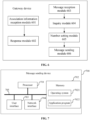
- FIG. 4 is a structural diagram of a message sending device according to an embodiment of the present disclosure.
- the message sending device includes a number reception module 401, an association module 402, an association information sending module 403, a setting module 404 and a message sending module 405.
- the number reception module 401 is configured to receive a number of a calling terminal and a number of a called terminal which are sent by a mobile switching center (MSC).
- the association module 402 is configured to acquire an IP address of a user agent (UA) of the called terminal, and associate the IP address with the number of the calling terminal to obtain association information.
- the association information sending module 403 is configured to send the association information to a wireless application protocol gateway (WAPGW).
- WAPGW wireless application protocol gateway
- the setting module 404 is configured to, after receiving a response that the WAPGW successfully records the association information, set a source IP address of a data packet of a to-be-sent message to the IP address of the UA of the called terminal, and set a number of a sender of the data packet of the to-be-sent message to the number of the called terminal.
- the message sending module 405 is configured to send, to the WAPGW, the data packet of the to-be-sent message after the data packet of the to-be-sent message is set.
- FIG. 5 is a structural diagram of an optional device corresponding to the virtual device illustrated in FIG. 4 in a practical application.
- the device includes an RAD_C module 501, a UA module 502, a user online and offline interface 503, a UA interface 504, and a calling and called number interface 505.
- the RAD_C module 501 is configured to: simulate the GGSN, request online information about a user from the WAPGW, and acquire a correspondence between an IP allocated for the user and a mobile phone number (mobile station integrated services digital network number (MSISDN)) of the user to send a multimedia message.
- MSISDN mobile station integrated services digital network number
- the UA module 502 is configured to edit and send the multimedia message.
- a standard RADIUS protocol is used in the message on the user online and offline interface 503, and reference may be made to the ACCOUNTING message of the RADIUS protocol.
- a standard HTTP request is used on the UA interface 504, where a source address of the request is an IP address for sending the MMS message, a destination address and a port of the request are an address and a port of an M1 interface of the multimedia message center, respectively, and the X-UP-CALLING-LINE-ID field of the HTTP packet header is filled in with the calling number.
- the calling and called number interface 505 is an interface between the RAD_C module 501 and an MSC network element, in which the UDP protocol is used.
- FIG. 6 is a structural diagram of a gateway device according to an embodiment of the present disclosure. As shown in FIG. 6 , the gateway device includes an association information reception module 601, a response module 602, a message reception module 603, an inquiry module 604, a number setting module 605 and a message sending module 606.
- the gateway device includes an association information reception module 601, a response module 602, a message reception module 603, an inquiry module 604, a number setting module 605 and a message sending module 606.
- the association information reception module 601 is configured to receive and record association information between an IP address of a user agent (UA) of a called terminal and a number of a calling terminal.
- the response module 602 is configured to send, to a source of the association information, a response that the association information is successfully recorded.
- the message reception module 603 is configured to receive a data packet of a to-be-sent message, where the data packet of the to-be-sent message meets that a source IP address of the data packet of the to-be-sent message is the IP address of the UA of the called terminal, and a number of a sender of the data packet of the to-be-sent message is a number of the called terminal.
- the inquiry module 604 is configured to inquire the number of the calling terminal according to the association information and the IP address of the UA of the called terminal.
- the number setting module 605 is configured to set a number of a receiver of the data packet of the to-be-sent message to the inquired number of the calling terminal.
- the message sending module 606 is configured to send the data packet of the to-be-sent message to a multimedia message service center (MMSC) to which the calling terminal belongs after the data packet of the to-be-sent message is set.
- MMSC multimedia message service center
- FIG. 7 is a structural diagram of a message sending device according to an embodiment of the present disclosure.
- the message sending device 700 shown in FIG. 7 is configured on a terminal.
- the message sending device 700 includes at least one processor 701, a memory 702, a user interface 703 and at least one network interface 704.
- Various components in the message sending device 700 are coupled together via a bus system 705.
- the bus system 705 is configured to implement connections and communications among these components.
- the bus system 705 further includes a power bus, a control bus and a state signal bus.
- various buses are all marked as the bus system 705 in FIG. 7 .
- the user interface 703 may include a display, a keyboard, a mouse, a trackball, a click wheel, a key, a button, a touch pad, a touch screen or the like.
- the memory 702 is configured to store various types of data to support operations of the message sending device 700.
- Examples of such data include any computer program executed on the message sending device 700, such as an operating system 7021 and an application program 7022.
- the operating system 7021 includes various system programs, such as a framework layer, a core library layer and a driver layer, and the various system programs are used for implementing various basic services and processing hardware-based tasks.
- the application program 7022 may include various application programs for implementing various application services. Programs for implementing the method of the embodiments of the present disclosure may be included in the application program 7022.
- the methods disclosed by the embodiments of the present disclosure described above may be applied to the processor 701 or may be implemented by the processor 701.
- the processor 701 may be an integrated circuit chip with a signal processing capability. In the implementation process, various steps of the method described above may be completed by an integrated logic circuit of hardware in the processor 701 or instructions in the form of software.
- the processor 701 described above may be a general-purpose processor, a digital signal processor, any other programmable logic element, a discrete gate or a transistor logic element, a discrete hardware component or the like.
- the processor 701 may implement or execute various methods, steps and logic block diagrams disclosed in the embodiments of the present disclosure.
- the general-purpose processor may be a microprocessor or any conventional processor.
- the steps in the methods disclosed by embodiments of the present disclosure may be directly implemented by a hardware decoding processor or may be implemented by a combination of hardware and software modules in the decoding processor.
- the software module may be located in a storage medium in the memory 702.
- the processor 701 reads information from the memory 702 and implements the steps of the method described above in conjunction with hardware of the processor 701.
- the memory 702 may be a volatile memory or a non-volatile memory, or may include both the volatile memory and the non-volatile memory.
- the non-volatile memory may be a read only memory (ROM), a programmable read-only memory (PROM), an erasable programmable read-only memory (EPROM), an electrically erasable programmable read-only memory (EEPROM), a ferromagnetic random access memory (FRAM), a flash memory, a magnetic surface memory, an optical disk or a compact disc read-only memory (CD-ROM).
- the magnetic surface memory may be a magnetic disk memory or a magnetic tape memory.
- the volatile memory may be a random-access memory (RAM), which serves as an external cache.
- RAMs may be used, such as a static random access memory (SRAM), a synchronous static random access memory (SSRAM), a dynamic random access memory (DRAM), a synchronous dynamic random access memory (SDRAM), a double data rate synchronous dynamic random access memory (DDRSDRAM), an enhanced synchronous dynamic random access memory (ESDRAM), a SyncLink dynamic random access memory (SLDRAM) and a direct Rambus random access memory (DRRAM).
- SRAM static random access memory
- SSRAM synchronous static random access memory
- DRAM dynamic random access memory
- SDRAM synchronous dynamic random access memory
- DDRSDRAM double data rate synchronous dynamic random access memory
- ESDRAM enhanced synchronous dynamic random access memory
- SLDRAM SyncLink dynamic random access memory
- DRRAM direct Rambus random access memory
- the present disclosure further provides a computer-readable storage medium.
- the computer-readable storage medium may include a memory 702 for storing a computer program executable by a processor 701 of a message sending device 700 to complete the steps of the method described above.
- the computer-readable storage medium may be a memory such as an FRAM, a ROM, a PROM, an EPROM, an EEPROM, a Flash Memory, a magnetic surface memory, an optical disk or a CD-ROM.
- a number of a calling terminal and a number of a called terminal which are sent by a mobile switching center (MSC) are received; an IP address of a user agent (UA) of the called terminal is acquired, and the IP address is associated with the number of the calling terminal to obtain association information; a correspondence after the association is sent to a wireless application protocol gateway (WAPGW); after a response that the WAPGW successfully records the association information is received, a source IP address of a data packet of a to-be-sent message is set to the IP address of the UA of the called terminal, and a number of a sender of the data packet of the to-be-sent message is set to the number of the called terminal; and the data packet of the to-be-sent message is sent to the WAPGW after the data packet of the to-be-sent message is set.
- MSC mobile switching center
- association information between an IP address of a user agent (UA) of a called terminal and a number of a calling terminal are received and recorded, and a response that the association information is successfully recorded is sent to a source of the association information; a data packet of a to-be-sent message is received, where the data packet of the to-be-sent message meets that a source IP address of the data packet of the to-be-sent message is the IP address of the UA of the called terminal, and a number of a sender of the data packet of the to-be-sent message is a number of the called terminal; the number of the calling terminal is inquired according to the association information and the IP address of the UA of the called terminal, and the inquired number of the calling terminal is set as a number of a receiver of the data packet of the to-be-sent message; and the data packet of the to-be
- the present disclosure further provides a computer-readable storage medium.
- the computer-readable storage medium may include a memory 702 for storing a computer program executable by a processor 701 of a message sending device 700 to complete the steps of the method described above.
- the computer-readable storage medium may be a memory such as an FRAM, a ROM, a PROM, an EPROM, an EEPROM, a Flash Memory, a magnetic surface memory, an optical disk or a CD-ROM.
- a number of a calling terminal and a number of a called terminal which are sent by a mobile switching center (MSC) are received; an IP address of a user agent (UA) of the called terminal is acquired, and the IP address is associated with the number of the calling terminal to obtain association information; a correspondence after the association is sent to a wireless application protocol gateway (WAPGW); after a response that the WAPGW successfully records the association information is received, a source IP address of a data packet of a to-be-sent message is set to the IP address of the UA of the called terminal, and a number of a sender of the data packet of the to-be-sent message is set to the number of the called terminal; and the data packet of the to-be-sent message is sent to the WAPGW after the data packet of the to-be-sent message is set.
- MSC mobile switching center
- association information between an IP address of a user agent (UA) of a called terminal and a number of a calling terminal are received and recorded, and a response that the association information is successfully recorded is sent to a source of the association information; a data packet of a to-be-sent message is received, where the data packet of the to-be-sent message meets that a source IP address of the data packet of the to-be-sent message is the IP address of the UA of the called terminal, and a number of a sender of the data packet of the to-be-sent message is a number of the called terminal; the number of the calling terminal is inquired according to the association information and the IP address of the UA of the called terminal, and the inquired number of the calling terminal is set as a number of a receiver of the data packet of the to-be-sent message; and the data packet of the to-be
- the functions of automatically sending the message and displaying the number of the called terminal at the sender are implemented on a gateway device, and the number of the calling terminal and the number of the called terminal are matched by using the recorded association information, thereby implementing the function of displaying the number of the called terminal.
Landscapes
- Engineering & Computer Science (AREA)
- Signal Processing (AREA)
- Computer Networks & Wireless Communication (AREA)
- Multimedia (AREA)
- Databases & Information Systems (AREA)
- Computer Security & Cryptography (AREA)
- Business, Economics & Management (AREA)
- General Business, Economics & Management (AREA)
- Library & Information Science (AREA)
- Mobile Radio Communication Systems (AREA)
- Telephonic Communication Services (AREA)
Description
- The present disclosure relates to communication technologies and, in particular, a message sending method and device, and a computer-readable storage medium.
- In a scenario of a specific communication service, for example, after party A communicates with party B, party B is expected to automatically reply to party A with a message edited by party B in advance. However, under current networking conditions, a carrier for implementing this function is usually a service provider (SP). Thus, a sender of the replied message received by party A is displayed as an access number of the SP, a multimedia message service center identity (MMSCID) or other number information, instead of number information about party B. To implement the function of displaying the sender of a message, which is replied to party B, as number information about party A, party A needs to manually edit and send the message. For example, after a customer calls a shopkeeper, the shopkeeper expects to reply to the customer with a multimedia message whose sender is displayed as a mobile phone number of the shopkeeper. Currently, the preceding function can only be implemented by manually editing. Additionally, not only in the field of multimedia message services, but also in application scenarios such as voice and short messages of the voice message service (VMS), there is no corresponding solutions and devices that can implement both the function of automatically editing a message and sending the message to a calling party, and the function of displaying a number of a called party after hanging up.
- Further relevant technologies are also known from
US 20060142029A1 which relates to a wireless network system for efficiently delivering multimedia messages,CN 103200537 A which relates to a method, system and server for carrying out number conversion on multimedia message service, andUS 8412846 B2 which relates to a wireless network system for efficiently delivering multimedia messages. - To solve the technical problem described above, embodiments of the present disclosure provide a message sending method and device, and a computer-readable storage medium.
- The invention is set out in the appended set of claims.
- The drawings generally illustrate various embodiments discussed herein by way of examples rather than limitations.
-
FIG. 1 is a flowchart of a message sending method according to an embodiment of the present disclosure; -
FIG. 2 is a flowchart of a message sending service according to an embodiment of the present disclosure; -
FIG. 3 is a flowchart of a message sending method according to an embodiment of the present disclosure; -
FIG. 4 is a structural diagram of a message sending device according to an embodiment of the present disclosure; -
FIG. 5 is a structural diagram of a message sending device according to an embodiment of the present disclosure; -
FIG. 6 is a structural diagram of a gateway device according to an embodiment of the present disclosure; and -
FIG. 7 is a structural diagram of a message sending device according to an embodiment of the present disclosure. - To provide a more detailed understanding of features and technical content of embodiments of the present disclosure, an implementation of the embodiments of the present disclosure is described below in detail in conjunction with the drawings. The drawings are merely provided for reference and are not intended to limit the embodiments of the present disclosure.
- A sent message in the embodiments of the present disclosure may be a multimedia message, a short message, a VMS voice and other information. A description is given below in detail by using an example where the sent message is the multimedia message. A newly added network element may be selected as a performing body of the message sending method in an embodiment of the present disclosure. Specifically, the newly added network element may be a multimedia message platform, which may be composed of a simulated UA module and a simulated gateway general packet radio service (GPRS) support node (GGSN) module, hereinafter referred to as a UA module and a RAD_C module, respectively.
-
FIG. 1 is a flowchart of a message sending method according to an embodiment of the present disclosure. As shown inFIG. 1 , the message sending method includes the steps described below. - In
step 101, a number of a calling terminal and a number of a called terminal which are sent by a mobile switching center (MSC) are received. - When the called terminal opens the multimedia message service, service opening information is synchronized to the MSC. When the called terminal completes a call and hangs up, the RAD_C module of the multimedia message platform simulates the function of the GGSN, and the number of the called terminal and the number of the calling terminal pushed by the MSC are received. The number of the calling terminal is set to a receiver of a multimedia message, and the number of the called terminal is set to a sender of the multimedia message. Communications between the RAD_C module and an interface of the MSC network element may be performed by using a user datagram protocol (UDP).
- In
step 102, an IP address of a user agent (UA) of the called terminal is acquired, and the IP address is associated with the number of the calling terminal to obtain association information. - A correspondence between the IP address of the UA of the called terminal and the number of the calling terminal is established to obtain the association information. In an embodiment, an IP address of the UA module of the multimedia message platform is set to an IP address of the called terminal.
- In
step 103, the association information is sent to a wireless application protocol gateway (WAPGW). - The RAD_C module of the multimedia message platform simulates the function of the GGSN, online information is requested from the WAPGW. The correspondence after the acquired IP address of the UA is associated with the number of the calling terminal is sent in a form of an ACCOUNTING_REQ (START) message to the WAPGW via a remote authentication dial-in user server (RADIUS) interface configured on the RAD_C module.
- In
step 104, after a response that the WAPGW successfully records the association information is received, a source IP address of a data packet of a to-be-sent message is set to the IP address of the UA of the called terminal, and a number of a sender of the data packet of the to-be-sent message is set to the number of the called terminal. - After receiving an RADIUS message that includes the correspondence and is sent by the RAD_C module of the multimedia message platform, the WAPGW records the correspondence, and replies an ACCOUNTING_RES response message to the RAD_C module of the multimedia message platform to inform the RAD_C module of the successful reception. After the multimedia message platform receives the response, an edited message is encapsulated into a data packet. The message here includes the multimedia message content edited by a user in advance. A source IP address of the data packet is set to the IP address of the UA of the called terminal. In an embodiment, the IP address of the module that is in the multimedia message platform and responsible for sending the multimedia message, that is, the IP address of the UA module of the multimedia message platform, may be selected as the IP address of the UA of the called terminal, which is consistent with the IP address of the UA contained in the ACCOUNTING_REQ (START) message in
step 103. Additionally, a number of a sender of the data packet is set to the number of the called terminal. - In
step 105, the data packet of the to-be-sent message is sent to the WAPGW after the data packet of the to-be-sent message is set. - The UA module of the multimedia message platform sends the data packet of the to-be-sent message to the WAPGW. Here, the multimedia message platform may be deployed on the same IP bearer network as the WAPGW and establish a network link with the WAPGW in the manner of a generic route encapsulation (GRE) tunnel. And a standard hyper text transfer protocol (HTTP) request may be used over the interface of the UA module. A source address of the request is the IP address for sending the multimedia message, which is set to the IP address of the UA of the called terminal. A destination address and a port of the data packet request are set to an address and a port of an M1 interface of the multimedia message service center (MMSC). An X-UP-CALLING-LINE-ID field in an HTTP packet header is filled in with the calling number, and this function is implemented by the WAPGW. In an embodiment, after the WAPGW receives the data packet, the WAPGW inquires the calling number corresponding to the IP address of the UA of the called terminal according to the previously recorded correspondence information, and the calling number is filled into the X-UP-CALLING-LINE-ID field and used as the receiver of the multimedia message; after the data packet is set, the data packet is sent to the multimedia message service center (MMSC) where the calling terminal is located, and the MMSC sends the data packet of the message to the calling terminal.
- In an embodiment of the present disclosure, after a response that the data packet of the to-be-sent message is successfully submitted is received, where the response is from the multimedia message service center (MMSC) and sent by the WAPGW, the WAPGW is notified to delete the correspondence information between the IP address of the UA of the called terminal and the number of the calling terminal. In an embodiment, when the MMSC successfully receives the data packet of the to-be-sent message, the response of the successful submission is replied to the multimedia message platform via the WAPGW. After the response is received, the RAD_C module of the multimedia message platform sends an RADIUS message to the WAPGW to notify the WAPGW that the user goes offline, so as to release the correspondence between the IP address and the number previously recorded by the WAPGW; after the WAPGW receives the RADIUS offline message, the correspondence is deleted, and a success response is replied to the multimedia message platform.
- The service process of sending a message described above may be implemented with reference to
FIG. 2 . As shown inFIG. 2 , the service process includes steps S201 to S208. In step S201, the RAD_C module of the multimedia message platform simulates the function of the GGSN; before the UA module sends a multimedia message, calling number information and called number information pushed by the MSC are received, which are explicit about a receiver and a sender of the multimedia message, and a correspondence between these two is maintained. After that, the correspondence between an IP address of the UA module and the number of a calling terminal is sent in a form of an ACCOUNTING REQ (START) message to the WAPGW over the RADIUS interface, where the IP address of the UA of the called terminal is set to the IP address of the UA module. In step S202, after recording the correspondence between the IP address of the UA module of the multimedia message platform and the number of the calling terminal, the WAPGW replies an ACCOUNTING_RES response message to notify the RAD_C module of the multimedia message platform of the successful reception. In step S203, after the multimedia platform receives an RADIUS message, the UA module sends the multimedia message to the WAPGW, where the IP address of the UA module needs to be consistent with the IP of the UA of the called terminal indicated in the previous ACCOUNTING_REQ (START) message, and the sender of the multimedia message is set to the called number of a telephone call. In step S204, after receiving a request for sending the multimedia message, the WAPGW inquires the number of the calling terminal according to the IP address of the UA module and fills the number of the calling number into an HTTP request header, and the multimedia message request is sent to an MMSC to which the calling terminal belongs. In step S205, after successfully receiving the multimedia message, the MMSC replies a response of multimedia message submission. In step S206, after receiving the response, the WAPGW replies the response of the multimedia message submission to the multimedia message platform. In step S207, after successfully sending the multimedia message, the multimedia message platform sends an RADIUS message to notify the WAPGW that a user goes offline, and the correspondence between the IP address of the UA module and the number of the calling terminal is released. In step S208, after receiving the RADIUS offline message, the WAPGW deletes the correspondence and replies a success response to the platform. - It is to be noted that in some cases, the multimedia message service process includes generally as follows:
- the UA of a user terminal---the GGSN---the WAPGW---the MMSC---the WAPGW---the UA; or
- the SP---a multimedia messaging service gateway (MMSG)---the MMSC---the WAPGW---the UA.
- According to the multimedia message platform provided by the embodiments of the present disclosure, the multimedia message service process is changed as follows:
the multimedia message platform---the WAPGW---the MMSC---the WAPGW---the UA. - It is to be understood by those of ordinary skill in the art that the embodiments of the present disclosure merely give an example of an application scenario using the multimedia message service; when the application scenario is changed to a short message, VMS voice or other services, the related wireless application protocol gateway (WAPGW) may be replaced with another type of gateways, for example, a WEB Gate-Way (WEBGW), and the corresponding implementation solution is similar to the solution described above.
- It is to be understood by those of ordinary skill in the art that the embodiments of the present disclosure merely give a description using an example where the performing body of the message sending method is an independent newly added network element. In a practical application, the modules for implementing the method may be integrated into the WAPGW. However, compared with that in the mode of adding a network element, devices in the network are greatly changed in this case. Therefore, in an embodiment, the mode of adding the network element is used for implementing the corresponding functions.
- In an embodiment of the present disclosure, by receiving the number of the calling terminal and the number of the called terminal sent by the mobile switching center (MSC), the number of the called terminal can be acquired, that is, the number of the sender is acquired, thereby achieving the purpose of displaying the number of the called terminal at the receiver. The message sending method of the embodiments of the present disclosure is applicable to not only e-commerce promotion scenarios such as multimedia message replying, but also scenarios such as enterprises, physical stores or individuals, where the message sending method serves as a supplement to current SP services owned by large enterprises and institutions. Especially, the message sending method is applicable to small enterprises or individuals that cannot afford the costs of SP construction.
-
FIG. 3 is a flowchart of a message sending method according to an embodiment of the present disclosure. As shown inFIG. 3 , the message sending method includes the steps described below. - In
step 301, association information between an IP address of a user agent (UA) of a called terminal and a number of a calling terminal is received and recorded, and a response that the association information is successfully recorded is sent to a source of the association information. - Here, the message sending method is applied to a WAPGW gateway side, which may be understood with reference to the message sending method of the multimedia message platform described above. After the WAPGW receives the association information between the IP address of the user agent (UA) of the called terminal and the number of the calling terminal, where the association information is sent by the RAD_C module of the multimedia message platform, the correspondence is recorded, and a response of the successful reception is replied to the RAD_C module of the multimedia message platform.
- In
step 302, a data packet of a to-be-sent message is received. The data packet of the to-be-sent message meets that a source IP address of the data packet of the to-be-sent message is the IP address of the UA of the called terminal, and a number of a sender of the data packet of the to-be-sent message is a number of the called terminal. - A multimedia message is received from the UA module of the multimedia message platform. A source address of the multimedia message is the IP address of the UA of the called terminal.
- In
step 303, the number of the calling terminal is inquired according to the association information and the IP address of the UA of the called terminal, and a number of a receiver of the data packet of the to-be-sent message is set to the inquired number of the calling terminal. - According to the association information recorded in
step 301, the WAPGW inquires the number of the calling terminal corresponding to the IP address, and then, the WAPGW fills the number of the calling terminal into an X-UP-CALLING-LINE-ID field in an HTTP packet header of the received data packet of the multimedia message, so as to indicate that the receiver of the multimedia message is the number of the calling terminal. - In
step 304, the data packet of the to-be-sent message is sent to a multimedia message service center (MMSC) to which the calling terminal belongs, after the data packet of the to-be-sent message is set. - After the field of the HTTP packet header of the data packet is filled, the WAPGW forwards the data packet to the MMSC to which the calling terminal belongs, and the multimedia message is issued to the calling terminal through the MMSC.
- In an embodiment of the present disclosure, when a user offline notification is received, the association information between the IP address of the UA of the called terminal and the number of the calling terminal is deleted. In an embodiment, after the WAPGW receives the offline notification sent by the multimedia message platform, the previously recorded association information is deleted, and a success response is replied to the multimedia message platform after the deletion is completed.
-
FIG. 4 is a structural diagram of a message sending device according to an embodiment of the present disclosure. As shown inFIG. 4 , the message sending device includes anumber reception module 401, anassociation module 402, an associationinformation sending module 403, asetting module 404 and amessage sending module 405. Thenumber reception module 401 is configured to receive a number of a calling terminal and a number of a called terminal which are sent by a mobile switching center (MSC). Theassociation module 402 is configured to acquire an IP address of a user agent (UA) of the called terminal, and associate the IP address with the number of the calling terminal to obtain association information. The associationinformation sending module 403 is configured to send the association information to a wireless application protocol gateway (WAPGW). Thesetting module 404 is configured to, after receiving a response that the WAPGW successfully records the association information, set a source IP address of a data packet of a to-be-sent message to the IP address of the UA of the called terminal, and set a number of a sender of the data packet of the to-be-sent message to the number of the called terminal. Themessage sending module 405 is configured to send, to the WAPGW, the data packet of the to-be-sent message after the data packet of the to-be-sent message is set. - It is to be understood by those skilled in the art that implementation of functions of various units of the message sending device in
FIG. 4 may be understood with reference to the related description of the message sending method described above. The functions of the various modules of the message sending device inFIG. 4 may be implemented by programs running on a processor or by specific logic circuits. -
FIG. 5 is a structural diagram of an optional device corresponding to the virtual device illustrated inFIG. 4 in a practical application. As shown inFIG. 5 , the device includes anRAD_C module 501, aUA module 502, a user online and offline interface 503, aUA interface 504, and a calling and callednumber interface 505. TheRAD_C module 501 is configured to: simulate the GGSN, request online information about a user from the WAPGW, and acquire a correspondence between an IP allocated for the user and a mobile phone number (mobile station integrated services digital network number (MSISDN)) of the user to send a multimedia message. TheUA module 502 is configured to edit and send the multimedia message. A standard RADIUS protocol is used in the message on the user online and offline interface 503, and reference may be made to the ACCOUNTING message of the RADIUS protocol. A standard HTTP request is used on theUA interface 504, where a source address of the request is an IP address for sending the MMS message, a destination address and a port of the request are an address and a port of an M1 interface of the multimedia message center, respectively, and the X-UP-CALLING-LINE-ID field of the HTTP packet header is filled in with the calling number. The calling and callednumber interface 505 is an interface between theRAD_C module 501 and an MSC network element, in which the UDP protocol is used. - The implementation of specific functions of the modules and interfaces described above is understood with reference to the contents in
steps 101 to 105 of the message sending method described above. -
FIG. 6 is a structural diagram of a gateway device according to an embodiment of the present disclosure. As shown inFIG. 6 , the gateway device includes an associationinformation reception module 601, aresponse module 602, amessage reception module 603, aninquiry module 604, anumber setting module 605 and amessage sending module 606. - The association
information reception module 601 is configured to receive and record association information between an IP address of a user agent (UA) of a called terminal and a number of a calling terminal. Theresponse module 602 is configured to send, to a source of the association information, a response that the association information is successfully recorded. Themessage reception module 603 is configured to receive a data packet of a to-be-sent message, where the data packet of the to-be-sent message meets that a source IP address of the data packet of the to-be-sent message is the IP address of the UA of the called terminal, and a number of a sender of the data packet of the to-be-sent message is a number of the called terminal. Theinquiry module 604 is configured to inquire the number of the calling terminal according to the association information and the IP address of the UA of the called terminal. Thenumber setting module 605 is configured to set a number of a receiver of the data packet of the to-be-sent message to the inquired number of the calling terminal. Themessage sending module 606 is configured to send the data packet of the to-be-sent message to a multimedia message service center (MMSC) to which the calling terminal belongs after the data packet of the to-be-sent message is set. - It is to be understood by those skilled in the art that implementation of functions of various units of the gateway device in
FIG. 6 may be understood with reference to the related description of the message sending method of the gateway side described above. The functions of various modules in the gateway device inFIG. 6 may be implemented by programs running on a processor or by specific logic circuits. -
FIG. 7 is a structural diagram of a message sending device according to an embodiment of the present disclosure. Themessage sending device 700 shown inFIG. 7 is configured on a terminal. Themessage sending device 700 includes at least oneprocessor 701, a memory 702, auser interface 703 and at least onenetwork interface 704. Various components in themessage sending device 700 are coupled together via abus system 705. It may be understood that thebus system 705 is configured to implement connections and communications among these components. In addition to a data bus, thebus system 705 further includes a power bus, a control bus and a state signal bus. However, for a clear description, various buses are all marked as thebus system 705 inFIG. 7 . - The
user interface 703 may include a display, a keyboard, a mouse, a trackball, a click wheel, a key, a button, a touch pad, a touch screen or the like. - In an embodiment of the present disclosure, the memory 702 is configured to store various types of data to support operations of the
message sending device 700. Examples of such data include any computer program executed on themessage sending device 700, such as anoperating system 7021 and anapplication program 7022. Theoperating system 7021 includes various system programs, such as a framework layer, a core library layer and a driver layer, and the various system programs are used for implementing various basic services and processing hardware-based tasks. Theapplication program 7022 may include various application programs for implementing various application services. Programs for implementing the method of the embodiments of the present disclosure may be included in theapplication program 7022. - The methods disclosed by the embodiments of the present disclosure described above may be applied to the
processor 701 or may be implemented by theprocessor 701. Theprocessor 701 may be an integrated circuit chip with a signal processing capability. In the implementation process, various steps of the method described above may be completed by an integrated logic circuit of hardware in theprocessor 701 or instructions in the form of software. Theprocessor 701 described above may be a general-purpose processor, a digital signal processor, any other programmable logic element, a discrete gate or a transistor logic element, a discrete hardware component or the like. Theprocessor 701 may implement or execute various methods, steps and logic block diagrams disclosed in the embodiments of the present disclosure. The general-purpose processor may be a microprocessor or any conventional processor. The steps in the methods disclosed by embodiments of the present disclosure may be directly implemented by a hardware decoding processor or may be implemented by a combination of hardware and software modules in the decoding processor. The software module may be located in a storage medium in the memory 702. Theprocessor 701 reads information from the memory 702 and implements the steps of the method described above in conjunction with hardware of theprocessor 701. - It may be understood that the memory 702 may be a volatile memory or a non-volatile memory, or may include both the volatile memory and the non-volatile memory. The non-volatile memory may be a read only memory (ROM), a programmable read-only memory (PROM), an erasable programmable read-only memory (EPROM), an electrically erasable programmable read-only memory (EEPROM), a ferromagnetic random access memory (FRAM), a flash memory, a magnetic surface memory, an optical disk or a compact disc read-only memory (CD-ROM). The magnetic surface memory may be a magnetic disk memory or a magnetic tape memory. The volatile memory may be a random-access memory (RAM), which serves as an external cache. By way of an exemplary description rather than a limited description, many forms of RAMs may be used, such as a static random access memory (SRAM), a synchronous static random access memory (SSRAM), a dynamic random access memory (DRAM), a synchronous dynamic random access memory (SDRAM), a double data rate synchronous dynamic random access memory (DDRSDRAM), an enhanced synchronous dynamic random access memory (ESDRAM), a SyncLink dynamic random access memory (SLDRAM) and a direct Rambus random access memory (DRRAM). The memory 702 described in an embodiment of the present disclosure is intended to include, but is not limited to, these memories and any other suitable type of memory.
- On the basis of the message sending methods provided by various embodiments of the present disclosure, the present disclosure further provides a computer-readable storage medium. With reference to
FIG. 7 , the computer-readable storage medium may include a memory 702 for storing a computer program executable by aprocessor 701 of amessage sending device 700 to complete the steps of the method described above. The computer-readable storage medium may be a memory such as an FRAM, a ROM, a PROM, an EPROM, an EEPROM, a Flash Memory, a magnetic surface memory, an optical disk or a CD-ROM. - It is to be noted that if not in collision, the technical solutions described in the embodiments of the present disclosure may be combined.
- According to a solution of an embodiment of the present disclosure, a number of a calling terminal and a number of a called terminal which are sent by a mobile switching center (MSC) are received; an IP address of a user agent (UA) of the called terminal is acquired, and the IP address is associated with the number of the calling terminal to obtain association information; a correspondence after the association is sent to a wireless application protocol gateway (WAPGW); after a response that the WAPGW successfully records the association information is received, a source IP address of a data packet of a to-be-sent message is set to the IP address of the UA of the called terminal, and a number of a sender of the data packet of the to-be-sent message is set to the number of the called terminal; and the data packet of the to-be-sent message is sent to the WAPGW after the data packet of the to-be-sent message is set. In this way, the functions of automatically sending the message and displaying the number of the called terminal at the sender are implemented. Additionally, according to a solution of an embodiment of the present disclosure, association information between an IP address of a user agent (UA) of a called terminal and a number of a calling terminal are received and recorded, and a response that the association information is successfully recorded is sent to a source of the association information; a data packet of a to-be-sent message is received, where the data packet of the to-be-sent message meets that a source IP address of the data packet of the to-be-sent message is the IP address of the UA of the called terminal, and a number of a sender of the data packet of the to-be-sent message is a number of the called terminal; the number of the calling terminal is inquired according to the association information and the IP address of the UA of the called terminal, and the inquired number of the calling terminal is set as a number of a receiver of the data packet of the to-be-sent message; and the data packet of the to-be-sent message is sent to a multimedia message service center (MMSC) after the data packet of the to-be-sent message is set. In this way, the functions of automatically sending the message and displaying the number of the called terminal at the sender are implemented on a gateway device, and the number of the calling terminal and the number of the called terminal are matched by using the recorded association information, thereby implementing the function of displaying the number of the called terminal.
disclosure, the present disclosure further provides a computer-readable storage medium. With reference toFIG. 7 , the computer-readable storage medium may include a memory 702 for storing a computer program executable by aprocessor 701 of amessage sending device 700 to complete the steps of the method described above. The computer-readable storage medium may be a memory such as an FRAM, a ROM, a PROM, an EPROM, an EEPROM, a Flash Memory, a magnetic surface memory, an optical disk or a CD-ROM. - It is to be noted that if not in collision, the technical solutions described in the embodiments of the present disclosure may be combined.
- According to a solution of an embodiment of the present disclosure, a number of a calling terminal and a number of a called terminal which are sent by a mobile switching center (MSC) are received; an IP address of a user agent (UA) of the called terminal is acquired, and the IP address is associated with the number of the calling terminal to obtain association information; a correspondence after the association is sent to a wireless application protocol gateway (WAPGW); after a response that the WAPGW successfully records the association information is received, a source IP address of a data packet of a to-be-sent message is set to the IP address of the UA of the called terminal, and a number of a sender of the data packet of the to-be-sent message is set to the number of the called terminal; and the data packet of the to-be-sent message is sent to the WAPGW after the data packet of the to-be-sent message is set. In this way, the functions of automatically sending the message and displaying the number of the called terminal at the sender are implemented. Additionally, according to a solution of an embodiment of the present disclosure, association information between an IP address of a user agent (UA) of a called terminal and a number of a calling terminal are received and recorded, and a response that the association information is successfully recorded is sent to a source of the association information; a data packet of a to-be-sent message is received, where the data packet of the to-be-sent message meets that a source IP address of the data packet of the to-be-sent message is the IP address of the UA of the called terminal, and a number of a sender of the data packet of the to-be-sent message is a number of the called terminal; the number of the calling terminal is inquired according to the association information and the IP address of the UA of the called terminal, and the inquired number of the calling terminal is set as a number of a receiver of the data packet of the to-be-sent message; and the data packet of the to-be-sent message is sent to a multimedia message service center (MMSC) after the data packet of the to-be-sent message is set. In this way, the functions of automatically sending the message and displaying the number of the called terminal at the sender are implemented on a gateway device, and the number of the calling terminal and the number of the called terminal are matched by using the recorded association information, thereby implementing the function of displaying the number of the called terminal.
- The above are merely preferred embodiments of the present disclosure and are not intended to limit the scope of the present disclosure. The present invention is only defined by the appended claims.
Claims (9)
- A message sending method, applied to a multimedia message platform, comprising:receiving (101) a number of a calling terminal and a number of a called terminal which are pushed by a mobile switching center, MSC after the called terminal completes a call and hangs up;wherein the calling terminal belongs to a multimedia message service center, MMSC;acquiring (102) an Internet protocol, IP, address of a user agent, UA, of the called terminal, and associating the IP address with the number of the calling terminal to obtain association information;characterized in that, the method further comprises:sending (103) the association information to a wireless application protocol gateway, WAPGW;after receiving a response that the WAPGW successfully recorded the association information, setting (104) a source IP address of a data packet of a to-be-sent message to the IP address of the UA of the called terminal, and setting a number of a sender of the data packet of the to-be-sent message to the number of the called terminal; wherein the to-be-sent message is a multimedia message and is edited by the multimedia message platform; andsending (105) the data packet of the to-be-sent message to the WAPGW after encapsulating the edited to-be-sent message in the data packet.
- The method of claim 1, further comprising:
after receiving a response that the data packet of the to-be-sent message is successfully submitted, notifying the WAPGW to delete correspondence information between the IP address of the UA of the called terminal and the number of the calling terminal; wherein the response is sent by the WAPGW after the WAPGW receives the response from the MMSC. - A message sending method, applied to a wireless application protocol gateway, WAPGW, characterized by comprising:receiving, from a multimedia message platform, and recording (301) association information between an Internet protocol, IP, address of a user agent, UA, of a called terminal and a number of a calling terminal, and sending, to he multimedia message platform, a response that the association information is successfully recorded;receiving (302), from the multimedia message platform, a data packet of a to-be-sent message, wherein the data packet of the to-be-sent message meets that a source IP address of the data packet of the to-be-sent message is the IP address of the UA of the called terminal, and a number of a sender of the data packet of the to-be-sent message is a number of the called terminal; wherein the to-be-sent message is a multimedia message and is edited by the multimedia message platform;inquiring (303) the number of the calling terminal according to the association information and the IP address of the UA of the called terminal, and setting a number of a receiver of the data packet of the to-be-sent message to the inquired number of the calling terminal; andsending (304) the data packet of the to-be-sent message to a multimedia message service center, MMSC, to which the calling terminal belongs after the number of the receiver of the data packet of the to-be-sent message is set.
- The message sending method of claim 3, further comprising:
in a case of receiving a user offline notification, deleting the association information between the IP address of the UA of the called terminal and the number of the calling terminal. - A multimedia message platform comprising:a number reception module (401), which is configured to receive a number of a calling terminal and a number of a called terminal which are pushed by a mobile switching center, MSC after the called terminal completes a call and hangs up; wherein the calling terminal belongs to a multimedia message service center, MMSC;an association module (402), which is configured to acquire an Internet protocol, IP, address of a user agent, UA, of the called terminal, and associate the IP address with the number of the calling terminal to obtain association information;characterized in that, the multimedia message platform further comprises:an association information sending module (403), which is configured to send the association information to a wireless application protocol gateway, WAPGW;a setting module (404), which is configured to, after receiving a response that the WAPGW successfully recorded the association information, set a source IP address of a data packet of a to-be-sent message to the IP address of the UA of the called terminal, and set a number of a sender of the data packet of the to-be-sent message to the number of the called terminal; wherein the to-be-sent message is a multimedia message and is edited by the multimedia message platform; anda message sending module (405), which is configured to send the data packet of the to-be-sent message to the WAPGW after encapsulating the edited to-be-sent message in the data packet.
- The message sending device of claim 5, further comprising:
a notification module, which is configured to, after receiving a response that the data packet of the to-be-sent message is successfully submitted, notify the WAPGW to delete correspondence information between the IP address of the UA of the called terminal and the number of the calling terminal, wherein the response is sent by the WAPGW and from a multimedia message service center, MMSC. - A wireless application protocol gateway, WAPGW, device, characterized by comprising:an association information reception module (601), which is configured to receive from a multimedia message platform and record association information between an Internet protocol, IP, address of a user agent, UA, of a called terminal and a number of a calling terminal;a response module (602), which is configured to send, to the multimedia message platform, a response that the association information is successfully recorded;a message reception module (603), which is configured to receive a data packet of a to-be-sent message from a multimedia message platform,wherein the data packet of the to-be-sent message meets that a source IP address of the data packet of the to-be-sent message is the IP address of the UA of the called terminal, and a number of a sender of the data packet of the to-be-sent message is a number of the called terminal;wherein the to-be-sent message is a multimedia message and is edited by the multimedia message platform;an inquiry module (604), which is configured to inquire the number of the calling terminal according to the association information and the IP address of the UA of the called terminal;a number setting module (605), which is configured to set a number of a receiver of the data packet of the to-be-sent message to the inquired number of the calling terminal; anda message sending module (606), which is configured to send the data packet of the to-be-sent message to a multimedia message service center, MMSC, to which the calling terminal belongs after the number of the receiver of the data packet of the to-be-sent message is set
- The gateway device of claim 7, further comprising:
a deletion module, which is configured to, in a case of receiving a user offline notification, delete the association information between the IP address of the UA of the called terminal and the number of the calling terminal. - A computer-readable storage medium, storing a computer program, wherein the computer program, when executed by a processor, implements steps of the message sending method of any one of claims 1-4.
Applications Claiming Priority (2)
| Application Number | Priority Date | Filing Date | Title |
|---|---|---|---|
| CN201811160187.6A CN110972084B (en) | 2018-09-30 | 2018-09-30 | Method, equipment and computer readable storage medium for sending message |
| PCT/CN2019/108065 WO2020063725A1 (en) | 2018-09-30 | 2019-09-26 | Message sending method and device, and computer-readable storage medium |
Publications (3)
| Publication Number | Publication Date |
|---|---|
| EP3860166A1 EP3860166A1 (en) | 2021-08-04 |
| EP3860166A4 EP3860166A4 (en) | 2022-06-08 |
| EP3860166B1 true EP3860166B1 (en) | 2024-09-04 |
Family
ID=69949551
Family Applications (1)
| Application Number | Title | Priority Date | Filing Date |
|---|---|---|---|
| EP19864906.3A Active EP3860166B1 (en) | 2018-09-30 | 2019-09-26 | Message sending method and device, and computer-readable storage medium |
Country Status (4)
| Country | Link |
|---|---|
| EP (1) | EP3860166B1 (en) |
| CN (1) | CN110972084B (en) |
| BR (1) | BR112021006156A2 (en) |
| WO (1) | WO2020063725A1 (en) |
Families Citing this family (2)
| Publication number | Priority date | Publication date | Assignee | Title |
|---|---|---|---|---|
| CN113923097B (en) * | 2020-06-22 | 2025-06-03 | 中兴通讯股份有限公司 | Fault reproduction method, fault reproduction device and storage medium |
| CN114554427B (en) * | 2020-11-24 | 2023-10-17 | 中国移动通信集团有限公司 | A 5G message processing method, device, equipment and computer storage medium |
Family Cites Families (15)
| Publication number | Priority date | Publication date | Assignee | Title |
|---|---|---|---|---|
| CN1505417B (en) * | 2002-12-03 | 2010-06-16 | 皇家飞利浦电子股份有限公司 | Wireless network system capable of transferring multimedia information with high efficiency |
| CN100429914C (en) * | 2003-09-08 | 2008-10-29 | 周良勇 | Fixed telephone short message sending method needing no short messages sent from calling party |
| KR101252609B1 (en) * | 2004-08-31 | 2013-04-09 | 쿠니히로 시이나 | Push-type telecommunications accompanied by a telephone call |
| CN100466670C (en) * | 2004-11-24 | 2009-03-04 | 华为技术有限公司 | A method for realizing do-not-disturb service in communication network |
| CN1997065A (en) * | 2005-12-31 | 2007-07-11 | 北京三星通信技术研究有限公司 | Method and device for caller customized information transfer in VoIP network |
| CN1829262B (en) * | 2006-04-04 | 2010-04-14 | 侯万春 | Apparatus and method for realizing to display switchboard number when virtual switchboard mobile extension calling |
| CN101087445B (en) * | 2007-07-19 | 2010-06-16 | 中兴通讯股份有限公司 | A method and terminal equipment for triggering short message sending according to called number |
| KR100776031B1 (en) * | 2007-08-10 | 2007-11-15 | (주)무한비트 | Method for transmitting message during call and system for same |
| CN101345792A (en) * | 2008-08-28 | 2009-01-14 | 中兴通讯股份有限公司 | A way to automatically send text messages |
| ES2350541B1 (en) * | 2008-11-28 | 2011-11-16 | Ericsson Inc. | METHOD, APPARATUS AND SYSTEM FOR SENDING A MULTIMEDIA MESSAGE WHEN A CALLED SUBSCRIBER DOES NOT RESPOND TO THE CALL. |
| CN101651936A (en) * | 2009-09-08 | 2010-02-17 | 中兴通讯股份有限公司 | Automatic reply method and system based on intelligent network |
| CN101873554A (en) * | 2010-06-07 | 2010-10-27 | 中兴通讯股份有限公司 | Short message distribution system and method based on ring back tone service |
| CN101917688A (en) * | 2010-08-16 | 2010-12-15 | 候万春 | Mobile phone, system and method supporting transmission of hang-up short message from called party to calling party |
| CN103200537B (en) * | 2012-01-04 | 2016-09-07 | 中国移动通信集团公司 | Multimedia messaging service, MMS is carried out the method for number translated, system and server |
| CN104284370B (en) * | 2014-10-27 | 2018-09-11 | 中国联合网络通信集团有限公司 | A kind of soft switchcall server transmits the method for information and corresponding system to user agent |
-
2018
- 2018-09-30 CN CN201811160187.6A patent/CN110972084B/en active Active
-
2019
- 2019-09-26 EP EP19864906.3A patent/EP3860166B1/en active Active
- 2019-09-26 BR BR112021006156-8A patent/BR112021006156A2/en unknown
- 2019-09-26 WO PCT/CN2019/108065 patent/WO2020063725A1/en not_active Ceased
Also Published As
| Publication number | Publication date |
|---|---|
| EP3860166A1 (en) | 2021-08-04 |
| CN110972084A (en) | 2020-04-07 |
| WO2020063725A1 (en) | 2020-04-02 |
| EP3860166A4 (en) | 2022-06-08 |
| CN110972084B (en) | 2022-01-25 |
| BR112021006156A2 (en) | 2021-06-29 |
Similar Documents
| Publication | Publication Date | Title |
|---|---|---|
| US8014402B2 (en) | Methods and apparatus for use in forwarding short messages for mobile communication devices | |
| ES2403188T3 (en) | Instant message retrieval offline | |
| CN1391758A (en) | Authentication method and system | |
| CN111314202A (en) | Message sending method and device | |
| CN104168545B (en) | A method and system for realizing intercommunication between instant message and SMS/MMS | |
| EP3860166A1 (en) | Message sending method and device, and computer-readable storage medium | |
| CN113746721B (en) | Mail processing method, server and storage medium | |
| CN113422772B (en) | Private network terminal access processing method, device and electronic equipment | |
| CN101297522B (en) | Apparatus and method for service continuity between universal mobile communication system network and wireless local area network | |
| CN1645885A (en) | Method and system for automatic storing and inquiring user short-message by short-message transmitting receiving system | |
| WO2022193771A1 (en) | Location-based service data processing method and apparatus | |
| CN115103303B (en) | Application management method, server and storage medium | |
| CN101472257B (en) | Method ,system and device for triggering authentication | |
| CN111614425B (en) | Time synchronization method and access network equipment | |
| CN114979978A (en) | A message sending method, message device, gateway and electronic device | |
| KR100658501B1 (en) | Data processing systems | |
| KR100658505B1 (en) | Data processing systems | |
| KR100661185B1 (en) | Data processing systems | |
| KR100658503B1 (en) | Data processing systems | |
| CN115134937A (en) | Dedicated bearer establishment method, gateway device, and computer-readable storage medium | |
| WO2015131478A1 (en) | Information processing method and apparatus, im server, convergence gateway, and storage medium | |
| KR20070072475A (en) | Multimedia Contents Registration System | |
| KR20070077809A (en) | Wireless multimedia message processing server | |
| KR20050107738A (en) | Method for providing wireless bulletin board service | |
| CN1984361A (en) | System and method for interconnecting multi-medium SMS |
Legal Events
| Date | Code | Title | Description |
|---|---|---|---|
| STAA | Information on the status of an ep patent application or granted ep patent |
Free format text: STATUS: THE INTERNATIONAL PUBLICATION HAS BEEN MADE |
|
| PUAI | Public reference made under article 153(3) epc to a published international application that has entered the european phase |
Free format text: ORIGINAL CODE: 0009012 |
|
| STAA | Information on the status of an ep patent application or granted ep patent |
Free format text: STATUS: REQUEST FOR EXAMINATION WAS MADE |
|
| 17P | Request for examination filed |
Effective date: 20210426 |
|
| AK | Designated contracting states |
Kind code of ref document: A1 Designated state(s): AL AT BE BG CH CY CZ DE DK EE ES FI FR GB GR HR HU IE IS IT LI LT LU LV MC MK MT NL NO PL PT RO RS SE SI SK SM TR |
|
| DAV | Request for validation of the european patent (deleted) | ||
| DAX | Request for extension of the european patent (deleted) | ||
| A4 | Supplementary search report drawn up and despatched |
Effective date: 20220506 |
|
| RIC1 | Information provided on ipc code assigned before grant |
Ipc: H04W 8/26 20090101ALI20220429BHEP Ipc: H04W 4/50 20180101ALI20220429BHEP Ipc: H04M 7/00 20060101ALI20220429BHEP Ipc: H04M 3/533 20060101ALI20220429BHEP Ipc: H04M 3/42 20060101ALI20220429BHEP Ipc: H04L 69/22 20220101ALI20220429BHEP Ipc: H04L 67/561 20220101ALI20220429BHEP Ipc: H04L 67/55 20220101ALI20220429BHEP Ipc: H04L 65/1069 20220101ALI20220429BHEP Ipc: H04L 65/1033 20220101ALI20220429BHEP Ipc: H04W 4/12 20090101AFI20220429BHEP |
|
| GRAP | Despatch of communication of intention to grant a patent |
Free format text: ORIGINAL CODE: EPIDOSNIGR1 |
|
| STAA | Information on the status of an ep patent application or granted ep patent |
Free format text: STATUS: GRANT OF PATENT IS INTENDED |
|
| INTG | Intention to grant announced |
Effective date: 20240611 |
|
| GRAS | Grant fee paid |
Free format text: ORIGINAL CODE: EPIDOSNIGR3 |
|
| GRAA | (expected) grant |
Free format text: ORIGINAL CODE: 0009210 |
|
| STAA | Information on the status of an ep patent application or granted ep patent |
Free format text: STATUS: THE PATENT HAS BEEN GRANTED |
|
| AK | Designated contracting states |
Kind code of ref document: B1 Designated state(s): AL AT BE BG CH CY CZ DE DK EE ES FI FR GB GR HR HU IE IS IT LI LT LU LV MC MK MT NL NO PL PT RO RS SE SI SK SM TR |
|
| REG | Reference to a national code |
Ref country code: GB Ref legal event code: FG4D |
|
| REG | Reference to a national code |
Ref country code: CH Ref legal event code: EP |
|
| REG | Reference to a national code |
Ref country code: IE Ref legal event code: FG4D |
|
| REG | Reference to a national code |
Ref country code: DE Ref legal event code: R096 Ref document number: 602019058472 Country of ref document: DE |
|
| REG | Reference to a national code |
Ref country code: LT Ref legal event code: MG9D |
|
| REG | Reference to a national code |
Ref country code: NL Ref legal event code: MP Effective date: 20240904 |
|
| PG25 | Lapsed in a contracting state [announced via postgrant information from national office to epo] |
Ref country code: NO Free format text: LAPSE BECAUSE OF FAILURE TO SUBMIT A TRANSLATION OF THE DESCRIPTION OR TO PAY THE FEE WITHIN THE PRESCRIBED TIME-LIMIT Effective date: 20241204 |
|
| PG25 | Lapsed in a contracting state [announced via postgrant information from national office to epo] |
Ref country code: FI Free format text: LAPSE BECAUSE OF FAILURE TO SUBMIT A TRANSLATION OF THE DESCRIPTION OR TO PAY THE FEE WITHIN THE PRESCRIBED TIME-LIMIT Effective date: 20240904 Ref country code: PL Free format text: LAPSE BECAUSE OF FAILURE TO SUBMIT A TRANSLATION OF THE DESCRIPTION OR TO PAY THE FEE WITHIN THE PRESCRIBED TIME-LIMIT Effective date: 20240904 Ref country code: GR Free format text: LAPSE BECAUSE OF FAILURE TO SUBMIT A TRANSLATION OF THE DESCRIPTION OR TO PAY THE FEE WITHIN THE PRESCRIBED TIME-LIMIT Effective date: 20241205 |
|
| PG25 | Lapsed in a contracting state [announced via postgrant information from national office to epo] |
Ref country code: BG Free format text: LAPSE BECAUSE OF FAILURE TO SUBMIT A TRANSLATION OF THE DESCRIPTION OR TO PAY THE FEE WITHIN THE PRESCRIBED TIME-LIMIT Effective date: 20240904 |
|
| PG25 | Lapsed in a contracting state [announced via postgrant information from national office to epo] |
Ref country code: LV Free format text: LAPSE BECAUSE OF FAILURE TO SUBMIT A TRANSLATION OF THE DESCRIPTION OR TO PAY THE FEE WITHIN THE PRESCRIBED TIME-LIMIT Effective date: 20240904 |
|
| PG25 | Lapsed in a contracting state [announced via postgrant information from national office to epo] |
Ref country code: HR Free format text: LAPSE BECAUSE OF FAILURE TO SUBMIT A TRANSLATION OF THE DESCRIPTION OR TO PAY THE FEE WITHIN THE PRESCRIBED TIME-LIMIT Effective date: 20240904 |
|
| PG25 | Lapsed in a contracting state [announced via postgrant information from national office to epo] |
Ref country code: ES Free format text: LAPSE BECAUSE OF FAILURE TO SUBMIT A TRANSLATION OF THE DESCRIPTION OR TO PAY THE FEE WITHIN THE PRESCRIBED TIME-LIMIT Effective date: 20240904 Ref country code: RS Free format text: LAPSE BECAUSE OF FAILURE TO SUBMIT A TRANSLATION OF THE DESCRIPTION OR TO PAY THE FEE WITHIN THE PRESCRIBED TIME-LIMIT Effective date: 20241204 |
|
| PG25 | Lapsed in a contracting state [announced via postgrant information from national office to epo] |
Ref country code: RS Free format text: LAPSE BECAUSE OF FAILURE TO SUBMIT A TRANSLATION OF THE DESCRIPTION OR TO PAY THE FEE WITHIN THE PRESCRIBED TIME-LIMIT Effective date: 20241204 Ref country code: PL Free format text: LAPSE BECAUSE OF FAILURE TO SUBMIT A TRANSLATION OF THE DESCRIPTION OR TO PAY THE FEE WITHIN THE PRESCRIBED TIME-LIMIT Effective date: 20240904 Ref country code: NO Free format text: LAPSE BECAUSE OF FAILURE TO SUBMIT A TRANSLATION OF THE DESCRIPTION OR TO PAY THE FEE WITHIN THE PRESCRIBED TIME-LIMIT Effective date: 20241204 Ref country code: LV Free format text: LAPSE BECAUSE OF FAILURE TO SUBMIT A TRANSLATION OF THE DESCRIPTION OR TO PAY THE FEE WITHIN THE PRESCRIBED TIME-LIMIT Effective date: 20240904 Ref country code: HR Free format text: LAPSE BECAUSE OF FAILURE TO SUBMIT A TRANSLATION OF THE DESCRIPTION OR TO PAY THE FEE WITHIN THE PRESCRIBED TIME-LIMIT Effective date: 20240904 Ref country code: GR Free format text: LAPSE BECAUSE OF FAILURE TO SUBMIT A TRANSLATION OF THE DESCRIPTION OR TO PAY THE FEE WITHIN THE PRESCRIBED TIME-LIMIT Effective date: 20241205 Ref country code: FI Free format text: LAPSE BECAUSE OF FAILURE TO SUBMIT A TRANSLATION OF THE DESCRIPTION OR TO PAY THE FEE WITHIN THE PRESCRIBED TIME-LIMIT Effective date: 20240904 Ref country code: ES Free format text: LAPSE BECAUSE OF FAILURE TO SUBMIT A TRANSLATION OF THE DESCRIPTION OR TO PAY THE FEE WITHIN THE PRESCRIBED TIME-LIMIT Effective date: 20240904 Ref country code: BG Free format text: LAPSE BECAUSE OF FAILURE TO SUBMIT A TRANSLATION OF THE DESCRIPTION OR TO PAY THE FEE WITHIN THE PRESCRIBED TIME-LIMIT Effective date: 20240904 |
|
| REG | Reference to a national code |
Ref country code: AT Ref legal event code: MK05 Ref document number: 1721658 Country of ref document: AT Kind code of ref document: T Effective date: 20240904 |
|
| PG25 | Lapsed in a contracting state [announced via postgrant information from national office to epo] |
Ref country code: NL Free format text: LAPSE BECAUSE OF FAILURE TO SUBMIT A TRANSLATION OF THE DESCRIPTION OR TO PAY THE FEE WITHIN THE PRESCRIBED TIME-LIMIT Effective date: 20240904 |
|
| PG25 | Lapsed in a contracting state [announced via postgrant information from national office to epo] |
Ref country code: IS Free format text: LAPSE BECAUSE OF FAILURE TO SUBMIT A TRANSLATION OF THE DESCRIPTION OR TO PAY THE FEE WITHIN THE PRESCRIBED TIME-LIMIT Effective date: 20250104 Ref country code: PT Free format text: LAPSE BECAUSE OF FAILURE TO SUBMIT A TRANSLATION OF THE DESCRIPTION OR TO PAY THE FEE WITHIN THE PRESCRIBED TIME-LIMIT Effective date: 20250106 |
|
| PG25 | Lapsed in a contracting state [announced via postgrant information from national office to epo] |
Ref country code: SM Free format text: LAPSE BECAUSE OF FAILURE TO SUBMIT A TRANSLATION OF THE DESCRIPTION OR TO PAY THE FEE WITHIN THE PRESCRIBED TIME-LIMIT Effective date: 20240904 Ref country code: RO Free format text: LAPSE BECAUSE OF FAILURE TO SUBMIT A TRANSLATION OF THE DESCRIPTION OR TO PAY THE FEE WITHIN THE PRESCRIBED TIME-LIMIT Effective date: 20240904 |
|
| PG25 | Lapsed in a contracting state [announced via postgrant information from national office to epo] |
Ref country code: EE Free format text: LAPSE BECAUSE OF FAILURE TO SUBMIT A TRANSLATION OF THE DESCRIPTION OR TO PAY THE FEE WITHIN THE PRESCRIBED TIME-LIMIT Effective date: 20240904 Ref country code: AT Free format text: LAPSE BECAUSE OF FAILURE TO SUBMIT A TRANSLATION OF THE DESCRIPTION OR TO PAY THE FEE WITHIN THE PRESCRIBED TIME-LIMIT Effective date: 20240904 |
|
| PG25 | Lapsed in a contracting state [announced via postgrant information from national office to epo] |
Ref country code: CZ Free format text: LAPSE BECAUSE OF FAILURE TO SUBMIT A TRANSLATION OF THE DESCRIPTION OR TO PAY THE FEE WITHIN THE PRESCRIBED TIME-LIMIT Effective date: 20240904 |
|
| PG25 | Lapsed in a contracting state [announced via postgrant information from national office to epo] |
Ref country code: IT Free format text: LAPSE BECAUSE OF FAILURE TO SUBMIT A TRANSLATION OF THE DESCRIPTION OR TO PAY THE FEE WITHIN THE PRESCRIBED TIME-LIMIT Effective date: 20240904 Ref country code: SK Free format text: LAPSE BECAUSE OF FAILURE TO SUBMIT A TRANSLATION OF THE DESCRIPTION OR TO PAY THE FEE WITHIN THE PRESCRIBED TIME-LIMIT Effective date: 20240904 |
|
| REG | Reference to a national code |
Ref country code: CH Ref legal event code: PL |
|
| PG25 | Lapsed in a contracting state [announced via postgrant information from national office to epo] |
Ref country code: LU Free format text: LAPSE BECAUSE OF NON-PAYMENT OF DUE FEES Effective date: 20240926 |
|
| REG | Reference to a national code |
Ref country code: DE Ref legal event code: R097 Ref document number: 602019058472 Country of ref document: DE |
|
| PG25 | Lapsed in a contracting state [announced via postgrant information from national office to epo] |
Ref country code: MC Free format text: LAPSE BECAUSE OF FAILURE TO SUBMIT A TRANSLATION OF THE DESCRIPTION OR TO PAY THE FEE WITHIN THE PRESCRIBED TIME-LIMIT Effective date: 20240904 |
|
| PG25 | Lapsed in a contracting state [announced via postgrant information from national office to epo] |
Ref country code: DK Free format text: LAPSE BECAUSE OF FAILURE TO SUBMIT A TRANSLATION OF THE DESCRIPTION OR TO PAY THE FEE WITHIN THE PRESCRIBED TIME-LIMIT Effective date: 20240904 |
|
| REG | Reference to a national code |
Ref country code: BE Ref legal event code: MM Effective date: 20240930 |
|
| PLBE | No opposition filed within time limit |
Free format text: ORIGINAL CODE: 0009261 |
|
| STAA | Information on the status of an ep patent application or granted ep patent |
Free format text: STATUS: NO OPPOSITION FILED WITHIN TIME LIMIT |
|
| PG25 | Lapsed in a contracting state [announced via postgrant information from national office to epo] |
Ref country code: BE Free format text: LAPSE BECAUSE OF NON-PAYMENT OF DUE FEES Effective date: 20240930 |
|
| PG25 | Lapsed in a contracting state [announced via postgrant information from national office to epo] |
Ref country code: CH Free format text: LAPSE BECAUSE OF NON-PAYMENT OF DUE FEES Effective date: 20240930 |
|
| PG25 | Lapsed in a contracting state [announced via postgrant information from national office to epo] |
Ref country code: IE Free format text: LAPSE BECAUSE OF NON-PAYMENT OF DUE FEES Effective date: 20240926 |
|
| 26N | No opposition filed |
Effective date: 20250605 |
|
| PG25 | Lapsed in a contracting state [announced via postgrant information from national office to epo] |
Ref country code: SE Free format text: LAPSE BECAUSE OF FAILURE TO SUBMIT A TRANSLATION OF THE DESCRIPTION OR TO PAY THE FEE WITHIN THE PRESCRIBED TIME-LIMIT Effective date: 20240904 |
|
| PGFP | Annual fee paid to national office [announced via postgrant information from national office to epo] |
Ref country code: DE Payment date: 20250919 Year of fee payment: 7 |
|
| PGFP | Annual fee paid to national office [announced via postgrant information from national office to epo] |
Ref country code: GB Payment date: 20250919 Year of fee payment: 7 |
|
| PGFP | Annual fee paid to national office [announced via postgrant information from national office to epo] |
Ref country code: FR Payment date: 20250922 Year of fee payment: 7 |
|
| PG25 | Lapsed in a contracting state [announced via postgrant information from national office to epo] |
Ref country code: CY Free format text: LAPSE BECAUSE OF FAILURE TO SUBMIT A TRANSLATION OF THE DESCRIPTION OR TO PAY THE FEE WITHIN THE PRESCRIBED TIME-LIMIT; INVALID AB INITIO Effective date: 20190926 |
|
| PG25 | Lapsed in a contracting state [announced via postgrant information from national office to epo] |
Ref country code: HU Free format text: LAPSE BECAUSE OF FAILURE TO SUBMIT A TRANSLATION OF THE DESCRIPTION OR TO PAY THE FEE WITHIN THE PRESCRIBED TIME-LIMIT; INVALID AB INITIO Effective date: 20190926 |