EP3860131A1 - Data transmission method and apparatus - Google Patents
Data transmission method and apparatus Download PDFInfo
- Publication number
- EP3860131A1 EP3860131A1 EP19865006.1A EP19865006A EP3860131A1 EP 3860131 A1 EP3860131 A1 EP 3860131A1 EP 19865006 A EP19865006 A EP 19865006A EP 3860131 A1 EP3860131 A1 EP 3860131A1
- Authority
- EP
- European Patent Office
- Prior art keywords
- video data
- data packet
- sent
- preset
- volume
- Prior art date
- Legal status (The legal status is an assumption and is not a legal conclusion. Google has not performed a legal analysis and makes no representation as to the accuracy of the status listed.)
- Granted
Links
Images



Classifications
-
- H—ELECTRICITY
- H04—ELECTRIC COMMUNICATION TECHNIQUE
- H04N—PICTORIAL COMMUNICATION, e.g. TELEVISION
- H04N21/00—Selective content distribution, e.g. interactive television or video on demand [VOD]
- H04N21/20—Servers specifically adapted for the distribution of content, e.g. VOD servers; Operations thereof
- H04N21/23—Processing of content or additional data; Elementary server operations; Server middleware
- H04N21/236—Assembling of a multiplex stream, e.g. transport stream, by combining a video stream with other content or additional data, e.g. inserting a URL [Uniform Resource Locator] into a video stream, multiplexing software data into a video stream; Remultiplexing of multiplex streams; Insertion of stuffing bits into the multiplex stream, e.g. to obtain a constant bit-rate; Assembling of a packetised elementary stream
- H04N21/23611—Insertion of stuffing data into a multiplex stream, e.g. to obtain a constant bitrate
-
- H—ELECTRICITY
- H04—ELECTRIC COMMUNICATION TECHNIQUE
- H04N—PICTORIAL COMMUNICATION, e.g. TELEVISION
- H04N21/00—Selective content distribution, e.g. interactive television or video on demand [VOD]
- H04N21/20—Servers specifically adapted for the distribution of content, e.g. VOD servers; Operations thereof
- H04N21/25—Management operations performed by the server for facilitating the content distribution or administrating data related to end-users or client devices, e.g. end-user or client device authentication, learning user preferences for recommending movies
- H04N21/266—Channel or content management, e.g. generation and management of keys and entitlement messages in a conditional access system, merging a VOD unicast channel into a multicast channel
- H04N21/2662—Controlling the complexity of the video stream, e.g. by scaling the resolution or bitrate of the video stream based on the client capabilities
-
- H—ELECTRICITY
- H04—ELECTRIC COMMUNICATION TECHNIQUE
- H04N—PICTORIAL COMMUNICATION, e.g. TELEVISION
- H04N21/00—Selective content distribution, e.g. interactive television or video on demand [VOD]
- H04N21/20—Servers specifically adapted for the distribution of content, e.g. VOD servers; Operations thereof
- H04N21/23—Processing of content or additional data; Elementary server operations; Server middleware
- H04N21/24—Monitoring of processes or resources, e.g. monitoring of server load, available bandwidth, upstream requests
- H04N21/2402—Monitoring of the downstream path of the transmission network, e.g. bandwidth available
-
- H—ELECTRICITY
- H04—ELECTRIC COMMUNICATION TECHNIQUE
- H04N—PICTORIAL COMMUNICATION, e.g. TELEVISION
- H04N21/00—Selective content distribution, e.g. interactive television or video on demand [VOD]
- H04N21/20—Servers specifically adapted for the distribution of content, e.g. VOD servers; Operations thereof
- H04N21/25—Management operations performed by the server for facilitating the content distribution or administrating data related to end-users or client devices, e.g. end-user or client device authentication, learning user preferences for recommending movies
- H04N21/262—Content or additional data distribution scheduling, e.g. sending additional data at off-peak times, updating software modules, calculating the carousel transmission frequency, delaying a video stream transmission, generating play-lists
- H04N21/26208—Content or additional data distribution scheduling, e.g. sending additional data at off-peak times, updating software modules, calculating the carousel transmission frequency, delaying a video stream transmission, generating play-lists the scheduling operation being performed under constraints
- H04N21/26216—Content or additional data distribution scheduling, e.g. sending additional data at off-peak times, updating software modules, calculating the carousel transmission frequency, delaying a video stream transmission, generating play-lists the scheduling operation being performed under constraints involving the channel capacity, e.g. network bandwidth
-
- H—ELECTRICITY
- H04—ELECTRIC COMMUNICATION TECHNIQUE
- H04N—PICTORIAL COMMUNICATION, e.g. TELEVISION
- H04N21/00—Selective content distribution, e.g. interactive television or video on demand [VOD]
- H04N21/60—Network structure or processes for video distribution between server and client or between remote clients; Control signalling between clients, server and network components; Transmission of management data between server and client, e.g. sending from server to client commands for recording incoming content stream; Communication details between server and client
- H04N21/63—Control signaling related to video distribution between client, server and network components; Network processes for video distribution between server and clients or between remote clients, e.g. transmitting basic layer and enhancement layers over different transmission paths, setting up a peer-to-peer communication via Internet between remote STB's; Communication protocols; Addressing
- H04N21/643—Communication protocols
- H04N21/6437—Real-time Transport Protocol [RTP]
Definitions
- the present disclosure relates to the field of Internet technology, and more particularly to a data transmission method and apparatus.
- a sending terminal may continuously capture an environmental video by a video capturing device, process the environmental video by encoding, compressing, packaging or the like to obtain a real-time transport protocol (RTP) data packet, and then send the RTP data packet immediately to a receiving terminal through a transmission network based on the RTP. Since each RTP data packet carries a corresponding serial number, the receiving terminal may determine whether packet loss occurs based on whether the serial number is discontinued. If the packet loss occurs, the sending terminal may send the serial number corresponding to the RTP data packet with the packet loss to the sending terminal, and the sending terminal retransmits the RTP data packet with the packet loss based on the serial number.
- RTP real-time transport protocol
- the method for solving this problem may be that the sending terminal generates redundant data for recovering the RTP data packet, and sends the redundant data together with the RTP data packet to the receiving terminal.
- the receiving terminal may recover the RTP data packet with the packet loss based on the redundant data, which eliminates the time consumed by the back-and-forth process.
- an additional bandwidth is required for transmitting the redundant data.
- the sending terminal may determine the current expected sending bit rate based on a preset bit rate algorithm, an actual sending bit rate of the previous preset data sending cycle, and a packet loss rate.
- the environmental video is then encoded according to the expected sending bit rate to ensure that the actual outputting bit rate is less than the expected sending bit rate, so that the encoded data obtained after encoding may be transmitted to the receiving terminal under the current transmission network environment.
- CBR constant bit rate
- VBR variable bit rate
- the data volume of the encoded data obtained after the encoding process may vary with the speed of the scene changes in the environmental video. If the scene changes quickly, the data volume of the encoded data obtained after the encoding process is large, and if the scene changes slowly, the data volume of the encoded data obtained after the encoding process is small. When the data volume is large, the sending terminal needs to send more data, and when the data volume is small, the sending needs to send less data.
- the current expected sending bit rate determined based on the small actual sending bit rate is also small and may have a great difference with the sending bit rate actually achieved currently, so that the sending terminal may determine a wrong current expected sending bit rate, and thereby a number of bandwidths may get vacant and not utilized currently, which is not beneficial to network transmission.
- a data transmission method includes:
- selecting at least one video data packet, the number of times the at least one video data packet has been sent satisfying the preset sending-times condition and total data volume of the at least one video data packet satisfying the preset expected data-volume condition, from the sent video data packets based on the number of times each of the sent video data packets has been sent, and determining the filling data packet according to the selected video data packet include: selecting at least one video data packet, the number of times the at least one video data packet has been sent satisfying the preset sending-times condition and total data volume of the at least one video data packet satisfying the preset expected data-volume condition, from the sent video data packets corresponding to a current video frame and a previous video frame based on the number of times each of the sent video data packets has been sent, and determining the filling data packet according to the selected video data packet.
- selecting at least one video data packet, the number of times the at least one video data packet has been sent satisfying the preset sending-times condition and total data volume of the at least one video data packet satisfying the preset expected data-volume condition, from the sent video data packets corresponding to the current video frame and the previous video frame based on the number of times each of the sent video data packets has been sent, and determining the filling data packet according to the selected video data packet include:
- selecting at least one video data packet, the number of times the at least one video data packet has been sent satisfying the preset sending-times condition and total data volume of the at least one video data packet satisfying the preset expected data-volume condition, from the sent video data packets corresponding to the current video frame and the previous video frame based on the number of times each of the sent video data packets has been sent, and determining the filling data packet according to the selected video data packet include:
- determining the filling data packet according to the selected video data packet if the total data volume of all the selected video data packet satisfies the preset expected data-volume condition includes:
- selecting the video data packet which has been sent less than the first preset times threshold includes:
- a data transmission apparatus includes:
- the filling module is used to: select at least one video data packet, the number of times the at least one video data packet has been sent satisfying the preset sending-times condition and total data volume of the at least one video data packet satisfying the preset expected data-volume condition, from the sent video data packets corresponding to a current video frame and a previous video frame based on the number of times each of the sent video data packets has been sent, and determine the filling data packet according to the selected video data packet.
- the filling module is used to:
- the filling module is used to:
- the filling module is used to:
- the filling module is used to:
- a computer device includes: a processor, a communication interface, a memory, and a communication bus, wherein:
- a computer-readable storage medium storing computer programs.
- the computer programs are executed by a processor, the data transmission method as described above is implemented.
- the sent video data packet may be sent to the receiving terminal as a filling data packet.
- the sending terminal may send data to the receiving terminal in each data sending cycle, and the data volume as sent is approximate to the expected data volume, so that the actual sending bit rate of the sending terminal is approximately equal to the expected sending bit rate, and the sending terminal may thereby determine an accurate expected sending bit rate when the next bit rate calculating cycle is reached, which is beneficial for the sending terminal to send data according to the accurate expected sending bit rate, and thereby improves the network transmission efficiency.
- a video data packet based on the number of times each of the sent video data packets has been sent, a video data packet, the number of times the at least one video data packet has been sent satisfying the preset sending-times condition and total data volume of the at least one video data packet satisfying the preset expected data-volume condition, may be selected as the filling data packet and then sent to the receiving terminal.
- the filling data packet may be adopted to replace the video data packet where the loss occurs, so that the filling data packet is effectively utilized to improve the quality of data transmission.
- An exemplary embodiment of the present disclosure provides a data transmission method.
- the method may be implemented by a computer device composed of modules shown in FIG. 1 , and functions of each module will be introduced one by one in the process of describing the method provided by the embodiment of the present disclosure.
- a computer device may be adopted as the sending terminal.
- the sending terminal may obtain the environmental video captured by the video capturing device, process the environment video by encoding, compressing, and packaging to obtain a video data packet, and send the video data packet to the receiving terminal through a transmission network based on the RTP.
- the receiving terminal may play the environmental video based on the video data packet. That is, after receiving the video data packet, the receiving terminal may obtain the video compressed data in the video data packet, decompress the video compressed data to obtain the video encoded data, decode the video encoded data to obtain the environmental data, and then play the environmental video.
- the sending terminal may determine the current expected sending bit rate based on a preset bit rate algorithm, an actual sending bit rate of the previous preset data sending cycle, and a packet loss rate.
- the environmental video is then encoded according to the expected sending bit rate to ensure that the actual outputting bit rate is less than the expected sending bit rate, so that the encoded data obtained after encoding may be transmitted to the receiving terminal under the current transmission network environment.
- CBR constant bit rate
- VBR variable bit rate
- the data volume of the encoded data obtained after the encoding process may vary with the speed of the scene changes in the environmental video. If the scene changes quickly, the data volume of the encoded data obtained after the encoding process is large, and if the scene changes slowly, the data volume of the encoded data obtained after the encoding process is small. When the data volume is large, the sending terminal needs to send more data, and when the data volume is small, the sending needs to send less data.
- the current expected sending bit rate determined based on the small actual sending bit rate is also small and may have a great difference with the sending bit rate actually achieved currently, so that the sending terminal may determine a wrong current expected sending bit rate, and thereby a number of bandwidths may get vacant and not utilized currently, which is not beneficial to network transmission.
- the vacant bandwidth may be adopted to send the filling data packet.
- the vacant bandwidth is utilized, and the actual sending bit rate is approximately equal to the current expected sending bit rate.
- the embodiment of the present disclosure provides a method for selecting the filling data packet.
- the vacant bandwidth can be utilized in the process of sending the filling data packet, and meanwhile, the quality of data transmission can be improved by sending the filling data packet.
- the embodiment of the present disclosure provides a data transmission method. As shown in FIG. 2 , the processing procedure of the method may include following steps.
- step S210 whether a to-be-sent video data packet exists is determined each time a preset data sending cycle is reached.
- a congestion controlling module shown in FIG. 1 may determine the current expected sending bit rate, such as 400MB per second, based on the preset bit rate algorithm, the actual sending bit rate in the previous preset data sending cycle, the packet loss rate, and the packet receiving delay time.
- the congestion controlling module may calculate the expected sending bit rate according to the preset calculating period, and may, for example, calculate the expected sending bit rate every 200 milliseconds. If the transmission rate of the transmission network is relatively stable and there is no large jitter, it may be deemed that the expected sending bit rates calculated in adjacent calculating cycles are approximate to each other.
- the congestion controlling module may send the current expected sending bit rate to the encoding module shown in FIG. 1 , so that the encoding module may determine the encoding mode based on the current expected sending bit rate. If the current expected sending bit rate is high, an encoding mode with a higher outputting bit rate may be selected, and if the current expected sending bit rate is low, an encoding mode with a lower outputting bit rate may be selected, so that the outputting bit rate can adapt to the current bandwidth of the transmission network. Next, the encoding module encodes the video stream captured by the video capturing device based on the determined encoding mode, and the outputting bit rate is generally lower than the current expected sending bit rate. Subsequently, the encoding module sends the encoded data obtained after the encoding process to a beat module shown in FIG. 1 , and the beat module controls a rhythm of the encoded data obtained after the encoding process is sent to the receiving terminal.
- the beat module receives the encoded data obtained after the encoding processing is sent by the encoding module, and the encoded data obtained after the encoding processing is segmented and packaged to obtain a plurality of video data packets.
- the data volume in these video data packets is not exactly the same, and generally falls between a few hundred KB and one thousand KB.
- the congestion controlling module may send the current expected sending bit rate to the beat module.
- the beat module determines the expected data volume of the video data packets to be sent in each data sending cycle based on the current expected sending bit rate, and then selects at least one video data packet, whose total data volume is approximately equal to the expected data volume, as the video data packet sent to the receiving terminal.
- a sending queue may be provided in the beat module, and the video data packets sent to the receiving terminal each time are added to the sending queue.
- the beat module may determine whether a to-be-sent video data packet exists in the sending queue. If yes, the beat module sends at least one video data packet whose total data volume is approximately equal to the expected data volume in the sending queue to the receiving terminal.
- the beat module stores 1000 video data packets each 200KB in size (this is only exemplary, and in actual cases, the sizes of video data packets are not exactly equal) and the expected data volume is 2MB
- 10 video data packets would be selected each time, and the total data volume of these video data packets is 2000KB, which is approximately equal to the expected data volume.
- the selected 10 video data packets are sent to the receiving terminal when the preset data sending cycle is reached. In this way, it can be ensured that the data volume as sent is approximately equal to the expected data volume, and the actual sending bit rate is approximately equal to the expected sending bit rate.
- the outputting bit rate will be less than the expected sending bit rate, which may cause that the data to be sent is insufficient. For example, if the beat module merely stores 1,000 video data packets and the encoded data obtained after the new encoding process has not arrived yet, the 1000 video data packets each 200KB in size may merely satisfy the data volume for 100 data sending cycles, and no data will be sent after the 100 data sending cycles.
- the encoded data obtained after the new encoding process may arrive after a plurality of data sending cycles. However, if the data approximate to the expected data volume is not sent in the data sending cycle in which data shall be sent, the actual sending bit rate may fail to reach the expected sending bit rate.
- the expected sending bit rate is 400MB per second
- 400MB of data shall be sent per second.
- the data sending cycle is 5 milliseconds, there are 200 data transmission cycles per second.
- the data volume to be sent per data sending cycle is 2 MB.
- the beat module only stores 1000 video data packets each 200KB in size.
- the 1000 video data packets each 200KB in size may all be sent to the receiving terminal in the former 100 data sending cycles, and thus the encoded data obtained after the new encoding processing may fail to arrive at the latter 100 data sending cycles, which may cause a case that there is no data to send.
- step S220 if the to-be-sent video data packet does not exist, at least one video data packet, a number of times the at least one video data packet has been sent satisfying a preset sending-times condition and total data volume of the at least one video data packet satisfying a preset expected data-volume condition, is selected from sent video data packets based on a number of times each of the sent video data packets has been sent, and a filling data packet is determined according to selected video data packet.
- the beat module may notify the filling module shown in FIG. 1 .
- the filling module may select at least one video data packet, a number of times the at least one video data packet has been sent satisfying a preset sending-times condition and whose total data volume is approximately equal to the expected data volume, from the sent video data packets based on the number of times each of the sent video data packets has been sent, and then determine the filling data packet according to the selected video data packet. Since the size of the data volume of each video data packet ranges from several hundred KB to one thousand KB, the total data volume of the selected video data packet may not be completely equal to the expected data volume. When the total data volume of the selected video data packet is not exactly equal to the expected data volume, the video data packet having the total data volume most approximate to the expected data volume may be selected. The method for determining the filling data packet according to the selected video data packet will be described below.
- step S230 the filling data packet is sent to a receiving terminal.
- the filling module sends the filling data packet to the beat module.
- the beat module adds the filling data packet to the sending queue and sends the filling data packet to the receiving terminal through the sending queue.
- the beat module may only store 1000 video data packets each 200KB in size.
- the 1000 video data packets each 200KB in size may all be sent to the receiving terminal in the former 100 data sending cycles. If no to-be-sent video data packet is detected in the 101 st data sending cycle, the filling module may select at least one video data packet, a number of times the at least one video data packet has been sent satisfying a preset sending-times condition and whose total data volume is approximately equal to 2M, from the sent video data packets based on the number of times each of the sent video data packets has been sent, determine the filling data packet according to the selected video data packet, and then send the filling data packet to the beat module. The beat module adds the filling data packet to the sending queue.
- the filling data packet is sent to the receiving terminal through the sending queue. If there is still no to-be-sent video data packet in the 102 nd data sending cycle, the aforesaid steps may be performed cyclically until the to-be-sent video data packet is detected in the sending queue.
- the receiving terminal may determine whether packet loss occurs according to the serial number. For example, if the serial number of the currently received video data packet is 121, the serial number of the next video data packet shall be 122. If packet loss occurs, the receiving terminal may fail to receive the video data packet with the serial number 122 after elapse of a preset waiting time period but has received a plurality of video data packets with the serial number 123 or even later at this time. Thus, it may be determined that the packet loss occurs in the video data packet with the serial number of 122. Since the sending terminal may send the sent video data packet again as the filling data packet, the receiving terminal may look for a video data packet with the serial number 122 in the filling data packet. If it is found, the video data packet that has the serial number 122 and serves as the filling data packet may be adopted for recovering the video data packet where packet loss occurs.
- step S220 may include: if the to-be-sent video data packet does not exist, selecting at least one video data packet, a number of times the at least one video data packet has been sent satisfying a preset sending-times condition and total data volume of the at least one video data packet satisfying a preset expected data-volume condition, from the sent video data packets based on a number of times each of the sent video data packets has been sent.
- step S220 may include: if the to-be-sent video data packet does not exist, selecting at least one video data packet, a number of times the at least one video data packet has been sent satisfying the preset sending-times condition and total data volume of the at least one video data packet satisfying the preset expected data-volume condition, from the sent video data packets corresponding to a current video frame and a previous video frame based on the number of times each of the sent video data packets has been sent, and determining the filling data packet according to the selected video data packet.
- a video frame is generally sent to the receiving terminal through several data sending cycles. After the completion of sending, the sent video data packets are temporarily stored in the sending terminal. During the process of selecting at least one video data packet, the filling module may make selection merely from the sent video data packets corresponding to the current video frame and the previous video frame.
- the sending terminal sends the video data packet to the receiving terminal in real time through the transmission network based on the RTP protocol, and the receiving terminal plays the video frame based on the video data packet after receiving the video data packet. Thus, it is necessary to ensure the real-time performance during the data transmission process.
- the receiving terminal has played the current video frame and the video frame before the previous video frame even if the selected video data packet is sent to the receiving terminal. Therefore, even if packet loss occurs to the video data packets corresponding to the current video frame and the video frame before the previous video frame, when the receiving terminal receives the video data packets corresponding to the current video frame and the video frame before the previous video frame for filling, the video data packets may fail to be utilized for recovering the video data packets where the packet loss occurs. Two modes for determining the filling data packet will be described below.
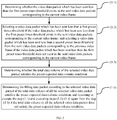
- steps of selecting at least one video data packet, the number of times the at least one video data packet has been sent satisfying the preset sending-times condition and total data volume of the at least one video data packet satisfying the preset expected data-volume condition, from the sent video data packets corresponding to the current video frame and the previous video frame based on the number of times each of the sent video data packets has been sent, and determining the filling data packet according to the selected video data packet may include following steps.
- step (1.1) it is determined whether the video data packet which has been sent less than the first preset times threshold exists in the sent video data packets corresponding to the current video frame.
- step (1.2) a video data packet which has been sent less than a first preset times threshold is selected if the video data packet which has been sent less than the first preset times threshold exists in the sent video data packets corresponding to the current video frame; and a video data packet which has been sent less than a second preset times threshold is selected from the sent video data packets corresponding to the previous video frame if the video data packet which has been sent less than the first preset times threshold does not exist in the sent video data packets corresponding to the current video frame.
- step (1.3) it is determined whether the total data volume of the selected video data packet satisfies the preset expected data-volume condition.
- step (1.4) the filling data packet is determined according to the selected video data packet if the total data volume of all the selected video data packet satisfies the preset expected data-volume condition; and if the total data volume of all the selected video data packet does not satisfy the preset expected data-volume condition, it is switched to execute the step (1.1), and steps (1.1)- (1.4) are executed again from the step (1.1).
- the second preset times threshold is smaller than the first preset times threshold. For example, if the video data packet which has been sent less than 6 times exists in the sent video data packets corresponding to the current video frame, a video data packet is selected from the video data packets that have been sent less than 6 times. If the video data packet which has been sent less than 6 times does not exists in the sent video data packets corresponding to the current video frame, a video data packet which has been sent less than 3 times is selected from the sent video data packet corresponding to the previous video frame.
- the filling data packet is determined according to the selected video data packet. If the total data volume of all the selected video data packet does not satisfy the preset expected data-volume condition, a video data packet is selected again according to the mode shown in step (1.2) until the total data volume of all the selected video data packet satisfies the preset expected data-volume condition.
- steps of selecting at least one video data packet, the number of times the at least one video data packet has been sent satisfying the preset sending-times condition and total data volume of the at least one video data packet satisfying the preset expected data-volume condition, from the sent video data packets corresponding to the current video frame and the previous video frame based on the number of times each of the sent video data packets has been sent, and determining the filling data packet according to the selected video data packet may include following steps.
- step (2.1) it is determined whether the video data packet which has been sent less than the first preset times threshold exists in the sent video data packets corresponding to the current video frame.
- step (2.2) if the video data packet which has been sent less than the first preset times threshold exists in the sent video data packets corresponding to the current video frame, a video data packet which has been sent less than the first preset times threshold is selected.
- step (2.3) if the video data packet which has been sent less than the first preset times threshold does not exist in the sent video data packets corresponding to the current video frame, and the video data packet which has been sent less than the second preset times threshold exists in the sent video data packet corresponding to the previous video frame, a video data packet which has been sent less than the second preset times threshold is selected from the sent video data packets corresponding to the previous video frame.
- step (2.4) if the video data packet which has been sent less than the first preset times threshold does not exist in the sent video data packets corresponding to the current video frame, and the video data packet which has been sent less than the second preset times threshold does not exist in the sent video data packet corresponding to the previous video frame, the first preset times threshold is increased by a first preset increase value, the second preset times threshold is increased by a second preset increase value, and the process is restarted from step (2.1).
- step (2.5) it is determined whether the total data volume of the selected video data packet satisfies the preset expected data-volume condition.
- step (2.6) if the total data volume of all the selected video data packet satisfies the preset expected data-volume condition, the filling data packet is determined according to the selected video data packet; and if the total data volume of all the selected video data packet does not satisfy the preset expected data-volume condition, the process is restarted from step (2.1) again and continued by executing the following steps.
- the second preset times threshold is smaller than the first preset times threshold.
- a video data packet is selected from the video data packets that have been sent less than 6 times.
- a video data packet which has been sent less than 3 times is selected from the sent video data packets corresponding to the previous video frame.
- the first preset times threshold is increased by 3 times
- the second preset times threshold is increased by 3 times
- the process is switched to execute step (2.1), and continued by executing the following steps from step (2.1).
- the first preset times threshold is changed to 9 times
- the second preset times threshold is changed to 6 times. That is, the preset times threshold may be stepped by 3 times each time there is no video data packet to fill, and a video data packet is selected again according to the new condition.
- the filling data packet is determined according to the selected video data packet. If the total data volume of all the selected video data packet does not satisfy the preset expected data-volume condition, a video data packet is selected again according to the mode shown in step (2.1) until the total data volume of the selected video data packet satisfies the preset expected data-volume condition.
- the step of selecting a video data packet which has been sent less than a first preset times threshold may include: selecting a video data packet which has been sent a number of times that is less than the first preset times threshold and has a minimum value.
- the step of selecting a video data packet which has been sent less than the second preset times threshold from the send video data packet corresponding to the previous video frame may include: selecting a video data packet, which has been sent a number of times that is less than the second preset times threshold and has a minimum value, from the send video data packet corresponding to the previous video frame.
- one of the two video data packets whose data volume is most approximate to the expected data volume may be selected based on the expected data volume.
- the aforesaid step (1.4) or step (2.6) may include: determining the total data volume of all the selected video data packet and a sum of data volume of the selected video data packet except the video data packet currently selected; if the total data volume is greater than a preset expected data volume, determining an absolute value of a difference value between the total data volume and the expected data volume, determining an absolute value of a difference value between the sum and the expected data volume, and determining the video data packet corresponding to the minimum absolute value as the filling data packet; if the total data volume is equal to the preset expected data volume, determining the selected video data packet as the filling data packet; and if the total data volume is less than the preset expected data volume, returning to execute step (1.1) or (2.1), and continuing to execute following steps from step (1.1) or step (2.1).
- the video data packet whose total data volume is most approximate to the expected data volume may be selected as the filling data packet. For example, if the expected data volume is 2M and the data volume of each video data packet is 200KB, the total data volume is 2000KB when the 10 th video data packet is selected, which is 48KB less than the expected data volume. The total data volume becomes 2200KB when the 11 th video data packet is selected, which is 152KB more than the expected data volume. Thus, the 10 video data packets, ignoring the 11 th video data packet, may be adopted as the filling data packets and sent to the receiving terminal in one data sending cycle.
- the selected video data packet when it is determined that the total data volume of the selected video data packet is greater than or equal to the preset expected data volume, the selected video data packet may be determined as the filling data packets. In this way, the filling data packet selected each time may be a bit more than the expected data volume.
- the sent video data packet may be sent to the receiving terminal as a filling data packet.
- the sending terminal may send data to the receiving terminal in each data sending cycle, and the data volume as sent is approximate to the expected data volume, so that the actual sending bit rate of the sending terminal is approximately equal to the expected sending bit rate, and the sending terminal may thereby determine an accurate expected sending bit rate when the next bit rate calculating cycle is reached, which is beneficial for the sending terminal to send data according to the accurate expected sending bit rate, and thereby improves the network transmission efficiency.
- a video data packet based on the number of times each of the sent video data packets has been sent, a video data packet, the number of times the at least one video data packet has been sent satisfying the preset sending-times condition and total data volume of the at least one video data packet satisfying the preset expected data-volume condition, may be selected as the filling data packet and then sent to the receiving terminal.
- the filling data packet may be adopted to replace the video data packet where the loss occurs, so that the filling data packet is effectively utilized to improve the quality of data transmission.
- the apparatus may include following modules.
- a determining module 510 is used to determine whether a to-be-sent video data packet exist or not each time a preset data sending cycle is reached.
- a filling module 520 is used to select, if the to-be-sent video data packet does not exist, at least one video data packet, a number of times the at least one video data packet has been sent satisfying a preset sending-times condition and total data volume of the at least one video data packet satisfying a preset expected data-volume condition, from sent video data packets based on a number of times each of the sent video data packets has been sent, and determine a filling data packet according to selected video data packet.
- a sending module 530 is used to send the filling data packet to a receiving terminal.
- the filling module 520 is used to: select at least one video data packet, the number of times the at least one video data packet has been sent satisfying the preset sending-times condition and total data volume of the at least one video data packet satisfying the preset expected data-volume condition, from the sent video data packets corresponding to a current video frame and a previous video frame based on the number of times each of the sent video data packets has been sent, and determine the filling data packet according to the selected video data packet.
- the filling module 520 is used to:
- the filling module 520 is used to:
- the filling module 520 is used to:
- the filling module 520 is used to:
- the sent video data packet may be sent to the receiving terminal as a filling data packet.
- the sending terminal may send data to the receiving terminal in each data sending cycle, and the data volume as sent is approximate to the expected data volume, so that the actual sending bit rate of the sending terminal is approximately equal to the expected sending bit rate, and the sending terminal may thereby determine an accurate expected sending bit rate when the next bit rate calculating cycle is reached, which is beneficial for the sending terminal to send data according to the accurate expected sending bit rate, and thereby improves the network transmission efficiency.
- a video data packet based on the number of times each of the sent video data packets has been sent, a video data packet, the number of times the at least one video data packet has been sent satisfying the preset sending-times condition and total data volume of the at least one video data packet satisfying the preset expected data-volume condition, may be selected as the filling data packet and then sent to the receiving terminal.
- the filling data packet may be adopted to replace the video data packet where the loss occurs, so that the filling data packet is effectively utilized to improve the quality of data transmission.
- the data transmission apparatus provided by the present embodiment only takes division of all the functional modules as an example for explanation when transmitting data.
- the above functions can be finished by the different functional modules as required. That is, the internal structure of the apparatus is divided into different functional modules to finish all or part of the functions described above.
- the data transmission apparatus provided by the present embodiment has the same concept as the data transmission method provided by the foregoing embodiment. Refer to the method embodiment for the specific implementation process of the method, which will not be repeated herein.
- Fig. 6 is a block diagram showing a computer device 1900 according to an embodiment of the present disclosure.
- the computer device 1900 may vary significantly in configuration or capabilities, and may include one or more processors 1910 (for example, one or more central processing units (CPUs)), and one or more memories 1920.
- the one or more memories 1920 store at least one instruction which may be loaded and executed by the processor 1910 to realize the data transmission method provided by the above embodiments.
Landscapes
- Engineering & Computer Science (AREA)
- Multimedia (AREA)
- Signal Processing (AREA)
- Databases & Information Systems (AREA)
- Computer Networks & Wireless Communication (AREA)
- Data Exchanges In Wide-Area Networks (AREA)
Abstract
Description
- The present application claims priority to Chinese Patent Application No.
201811142210.9, filed on September 28, 2018 - The present disclosure relates to the field of Internet technology, and more particularly to a data transmission method and apparatus.
- With the development of science and technology, the real-time transmission technology has stepped into people's lives. A sending terminal may continuously capture an environmental video by a video capturing device, process the environmental video by encoding, compressing, packaging or the like to obtain a real-time transport protocol (RTP) data packet, and then send the RTP data packet immediately to a receiving terminal through a transmission network based on the RTP. Since each RTP data packet carries a corresponding serial number, the receiving terminal may determine whether packet loss occurs based on whether the serial number is discontinued. If the packet loss occurs, the sending terminal may send the serial number corresponding to the RTP data packet with the packet loss to the sending terminal, and the sending terminal retransmits the RTP data packet with the packet loss based on the serial number. However, this back-and-forth process takes a rather long time. The method for solving this problem may be that the sending terminal generates redundant data for recovering the RTP data packet, and sends the redundant data together with the RTP data packet to the receiving terminal. Thus, when the packet loss occurs, the receiving terminal may recover the RTP data packet with the packet loss based on the redundant data, which eliminates the time consumed by the back-and-forth process. However, an additional bandwidth is required for transmitting the redundant data.
- During the encoding process, in order to better adapt to a bandwidth of the current transmission network and thereby adjust an outputting bit rate for encoding the environmental video, the sending terminal may determine the current expected sending bit rate based on a preset bit rate algorithm, an actual sending bit rate of the previous preset data sending cycle, and a packet loss rate. The environmental video is then encoded according to the expected sending bit rate to ensure that the actual outputting bit rate is less than the expected sending bit rate, so that the encoded data obtained after encoding may be transmitted to the receiving terminal under the current transmission network environment. In the related prior art, two encoding modes, namely, a constant bit rate (CBR) and a variable bit rate (VBR) are proposed. When the environmental video is encoded by the aforesaid two encoding modes, the data volume of the encoded data obtained after the encoding process may vary with the speed of the scene changes in the environmental video. If the scene changes quickly, the data volume of the encoded data obtained after the encoding process is large, and if the scene changes slowly, the data volume of the encoded data obtained after the encoding process is small. When the data volume is large, the sending terminal needs to send more data, and when the data volume is small, the sending needs to send less data.
- In the process of implementing the present disclosure, the inventor has found at least the following disadvantages.
- If a small actual sending bit rate is adopted in the previous preset data sending cycle due to the small volume of the data to be sent, the current expected sending bit rate determined based on the small actual sending bit rate is also small and may have a great difference with the sending bit rate actually achieved currently, so that the sending terminal may determine a wrong current expected sending bit rate, and thereby a number of bandwidths may get vacant and not utilized currently, which is not beneficial to network transmission.
- In order to overcome the problems in the related prior art, the present disclosure provides the following technical solutions.
- According to a first aspect of embodiments of the present disclosure, a data transmission method is provided. The method includes:
- determining whether a to-be-sent video data packet exists each time a preset data sending cycle is reached;
- if the to-be-sent video data packet does not exist, selecting at least one video data packet, a number of times the at least one video data packet has been sent satisfying a preset sending-times condition and total data volume of the at least one video data packet satisfying a preset expected data-volume condition, from sent video data packets based on a number of times each of the sent video data packets has been sent, and determining a filling data packet according to selected video data packet; and
- sending the filling data packet to a receiving terminal.
- Optionally, selecting at least one video data packet, the number of times the at least one video data packet has been sent satisfying the preset sending-times condition and total data volume of the at least one video data packet satisfying the preset expected data-volume condition, from the sent video data packets based on the number of times each of the sent video data packets has been sent, and determining the filling data packet according to the selected video data packet include:
selecting at least one video data packet, the number of times the at least one video data packet has been sent satisfying the preset sending-times condition and total data volume of the at least one video data packet satisfying the preset expected data-volume condition, from the sent video data packets corresponding to a current video frame and a previous video frame based on the number of times each of the sent video data packets has been sent, and determining the filling data packet according to the selected video data packet. - Optionally, selecting at least one video data packet, the number of times the at least one video data packet has been sent satisfying the preset sending-times condition and total data volume of the at least one video data packet satisfying the preset expected data-volume condition, from the sent video data packets corresponding to the current video frame and the previous video frame based on the number of times each of the sent video data packets has been sent, and determining the filling data packet according to the selected video data packet include:
- determining whether the video data packet which has been sent less than the first preset times threshold exists in the sent video data packets corresponding to the current video frame;
- selecting a video data packet which has been sent less than a first preset times threshold if the video data packet which has been sent less than the first preset times threshold exists in the sent video data packets corresponding to the current video frame; selecting a video data packet which has been sent less than a second preset times threshold from the sent video data packets corresponding to the previous video frame if the video data packet which has been sent less than the first preset times threshold does not exist in the sent video data packets corresponding to the current video frame;
- determining whether the total data volume of the selected video data packet satisfies the preset expected data-volume condition or not; and
- determining the filling data packet according to the selected video data packet if the total data volume of all the selected video data packet satisfies the preset expected data-volume condition; and returning to execute a step of determining whether the video data packet which has been sent less than the first preset times threshold exists in the sent video data packets corresponding to the current video frame if the total data volume of all the selected video data packet does not satisfy the preset expected data-volume condition.
- Optionally, selecting at least one video data packet, the number of times the at least one video data packet has been sent satisfying the preset sending-times condition and total data volume of the at least one video data packet satisfying the preset expected data-volume condition, from the sent video data packets corresponding to the current video frame and the previous video frame based on the number of times each of the sent video data packets has been sent, and determining the filling data packet according to the selected video data packet include:
- determining whether the video data packet which has been sent less than the first preset times threshold exists in the sent video data packets corresponding to the current video frame;
- selecting a video data packet which has been sent less than the first preset times threshold if the video data packet which has been sent less than the first preset times threshold exists in the sent video data packets corresponding to the current video frame; selecting a video data packet which has been sent less than the second preset times threshold from the sent video data packets corresponding to the previous video frame if the video data packet which has been sent less than the first preset times threshold does not exist in the sent video data packets corresponding to the current video frame and the video data packet which has been sent less than the second preset times threshold exists in the sent video data packet corresponding to the previous video frame; and increasing the first preset times threshold by a first preset increase value, increasing the second preset times threshold by a second preset increase value, and returning to execute the step of determining whether the video data packet which has been sent less than the first preset times threshold exists in the sent video data packets corresponding to the current video frame if the video data packet which has been sent less than the first preset times threshold does not exist in the sent video data packets corresponding to the current video frame, and the video data packet which has been sent less than the second preset times threshold does not exist in the sent video data packet corresponding to the previous video frame;
- determining whether the total data volume of the selected video data packet satisfies the preset expected data-volume condition or not; and
- determining the filling data packet according to the selected video data packet if the total data volume of all the selected video data packet satisfies the preset expected data-volume condition; and returning to execute a step of determining whether the video data packet which has been sent less than the first preset times threshold exists in the sent video data packets corresponding to the current video frame if the total data volume of all the selected video data packet does not satisfy the preset expected data-volume condition.
- Optionally, determining the filling data packet according to the selected video data packet if the total data volume of all the selected video data packet satisfies the preset expected data-volume condition includes:
- determining the total data volume of all the selected video data packet and a sum of data volume of the selected video data packet except the video data packet currently selected;
- if the total data volume is greater than a preset expected data volume, determining an absolute value of a difference value between the total data volume and the expected data volume, determining an absolute value of a difference value between the sum and the expected data volume, and determining the video data packet corresponding to the minimum absolute value as the filling data packet;
- if the total data volume is equal to the preset expected data volume, determining the selected video data packet as the filling data packet;
- returning to execute a step of determining whether the video data packet which has been sent less than the first preset times threshold exists in the sent video data packets corresponding to the current video frame if the total data volume of all the selected video data packet does not satisfy the preset expected data-volume condition includes:
- if the total data volume is less than the preset expected data volume, returning to execute a step of determining whether the video data packet which has been sent less than the first preset times threshold exists in the sent video data packets corresponding to the current video frame.
- Optionally, selecting the video data packet which has been sent less than the first preset times threshold includes:
- selecting a video data packet which has been sent a number of times that is less than the first preset times threshold and has a minimum value;
- selecting the video data packet which has been sent less than the second preset times threshold from the sent video data packets corresponding to the previous video frame includes:
- selecting a video data packet, which has been sent a number of times that is less than the second preset times threshold and has a minimum value, from the sent video data packets corresponding to the previous video frame.
- According to a second aspect of embodiments of the present disclosure, a data transmission apparatus is provided. The apparatus includes:
- a determining module used to determine whether a to-be-sent video data packet exist or not each time a preset data sending cycle is reached;
- a filling module used to select, if the to-be-sent video data packet does not exist, at least one video data packet, a number of times the at least one video data packet has been sent satisfying a preset sending-times condition and total data volume of the at least one video data packet satisfying a preset expected data-volume condition, from sent video data packets based on a number of times each of the sent video data packets has been sent, and determine a filling data packet according to the selected video data packet; and
- a sending module used to send the filling data packet to a receiving terminal.
- Optionally, the filling module is used to:
select at least one video data packet, the number of times the at least one video data packet has been sent satisfying the preset sending-times condition and total data volume of the at least one video data packet satisfying the preset expected data-volume condition, from the sent video data packets corresponding to a current video frame and a previous video frame based on the number of times each of the sent video data packets has been sent, and determine the filling data packet according to the selected video data packet. - Optionally, the filling module is used to:
- determine whether the video data packet which has been sent less than the first preset times threshold exists in the sent video data packets corresponding to the current video frame;
- select a video data packet which has been sent less than a first preset times threshold if the video data packet which has been sent less than the first preset times threshold exists in the sent video data packets corresponding to the current video frame; select a video data packet which has been sent less than a second preset times threshold from the sent video data packets corresponding to the previous video frame if the video data packet which has been sent less than the first preset times threshold does not exist in the sent video data packets corresponding to the current video frame;
- determine whether the total data volume of the selected video data packet satisfies the preset expected data-volume condition or not; and
- determine the filling data packet according to the selected video data packet if the total data volume of all the selected video data packet satisfies the preset expected data-volume condition; and return to execute a step of determining whether the video data packet which has been sent less than the first preset times threshold exists in the sent video data packets corresponding to the current video frame if the total data volume of all the selected video data packet does not satisfy the preset expected data-volume condition.
- Optionally, the filling module is used to:
- determine whether the video data packet which has been sent less than the first preset times threshold exists in the sent video data packets corresponding to the current video frame;
- select a video data packet which has been sent less than the first preset times threshold if the video data packet which has been sent less than the first preset times threshold exists in the sent video data packets corresponding to the current video frame; select a video data packet which has been sent less than the second preset times threshold from the sent video data packets corresponding to the previous video frame if the video data packet which has been sent less than the first preset times threshold does not exist in the sent video data packets corresponding to the current video frame and the video data packet which has been sent less than the second preset times threshold exists in the sent video data packet corresponding to the previous video frame; and increase the first preset times threshold by a first preset increase value, increase the second preset times threshold by a second preset increase value, and return to execute the step of determining whether the video data packet which has been sent less than the first preset times threshold exists in the sent video data packets corresponding to the current video frame, if the video data packet which has been sent less than the first preset times threshold does not exist in the sent video data packets corresponding to the current video frame and the video data packet which has been sent less than the second preset times threshold does not exist in the sent video data packet corresponding to the previous video frame;
- determine whether the total data volume of the selected video data packet satisfies the preset expected data-volume condition or not; and
- determine the filling data packet according to the selected video data packet if the total data volume of all the selected video data packet satisfies the preset expected data-volume condition; and returning to execute a step of determining whether the video data packet which has been sent less than the first preset times threshold exists in the sent video data packets corresponding to the current video frame if the total data volume of all the selected video data packet does not satisfy the preset expected data-volume condition.
- Optionally, the filling module is used to:
- determine the total data volume of all the selected video data packet and a sum of data volume of the selected video data packet except the video data packet currently selected;
- if the total data volume is greater than a preset expected data volume, determine an absolute value of a difference value between the total data volume and the expected data volume, determine an absolute value of a difference value between the sum and the expected data volume, and determine the video data packet corresponding to the minimum absolute value as the filling data packet;
- if the total data volume is equal to the preset expected data volume, determine the selected video data packet as the filling data packet; and
- if the total data volume is less than the preset expected data volume, return to execute a step of determining whether the video data packet which has been sent less than the first preset times threshold exists in the sent video data packets corresponding to the current video frame.
- Optionally, the filling module is used to:
- select a video data packet which has been sent a number of times that is less than the first preset times threshold and has a minimum value; and
- select a video data packet, which has been sent a number of times that is less than the second preset times threshold value and has a minimum value, from the sent video data packets corresponding to the previous video frame.
- According to a third aspect of embodiments of the present disclosure, a computer device is provided. The computer device includes: a processor, a communication interface, a memory, and a communication bus, wherein:
- the processor, the communication interface, and the memory complete communication with each other through the communication bus;
- the memory is used to store a computer program; and
- the processor is used to execute the program stored in the memory to implement the data transmission method as described above.
- According to a fourth aspect of embodiments of the present disclosure, a computer-readable storage medium storing computer programs is provided. When the computer programs are executed by a processor, the data transmission method as described above is implemented.
- The technical solutions provided by the present disclosure may include the following benefits.
- With the method provided in the embodiment of the present disclosure, when the to-be-sent video data pack does not exist, the sent video data packet may be sent to the receiving terminal as a filling data packet. In this way, it can be ensured that the sending terminal may send data to the receiving terminal in each data sending cycle, and the data volume as sent is approximate to the expected data volume, so that the actual sending bit rate of the sending terminal is approximately equal to the expected sending bit rate, and the sending terminal may thereby determine an accurate expected sending bit rate when the next bit rate calculating cycle is reached, which is beneficial for the sending terminal to send data according to the accurate expected sending bit rate, and thereby improves the network transmission efficiency. Furthermore, with the method provided in the embodiment of the present disclosure, based on the number of times each of the sent video data packets has been sent, a video data packet, the number of times the at least one video data packet has been sent satisfying the preset sending-times condition and total data volume of the at least one video data packet satisfying the preset expected data-volume condition, may be selected as the filling data packet and then sent to the receiving terminal. In this way, even if the previously sent video data packet is lost, the filling data packet may be adopted to replace the video data packet where the loss occurs, so that the filling data packet is effectively utilized to improve the quality of data transmission.
- It is to be understood that both the foregoing general description and the following detailed description are exemplary and explanatory only and are not intended to limit the present disclosure.
- The accompanying drawings, which are incorporated in and constitute a part of this specification, illustrate embodiments consistent with the present disclosure, and together with the description, serve to explain the principles of the present disclosure. In the drawings:
-
FIG. 1 is a schematic diagram of a structure of a computer device according to an exemplary embodiment; -
FIG. 2 is a flow chart of a data transmission method according to an exemplary embodiment; -
FIG. 3 is a flow chart of a data transmission method according to an exemplary embodiment; -
FIG. 4 is a flow chart of a data transmission method according to an exemplary embodiment; -
FIG. 5 is a schematic diagram of a structure of a data transmission apparatus according to an exemplary embodiment; and -
FIG. 6 is a schematic diagram of a structure of a computer device according to an exemplary embodiment. - Through the aforesaid drawings, certain embodiments of the present disclosure have been shown and will be described in more detail below. The drawings and written description are not intended to limit the scope of the concepts of the present disclosure in any way, but rather to illustrate the concepts of the present disclosure to those skilled in the art by referring to specific embodiments
- Reference will now be made in detail to exemplary embodiments, examples of which are illustrated in the accompanying drawings. Where the following description hereinafter refers to the accompanying drawings, the same reference numerals in different drawings represent the same or similar elements, unless otherwise represented. The implementations set forth in the following description of exemplary embodiments do not represent all implementations consistent with the present disclosure. Instead, these implementations are merely examples of devices and methods consistent with aspects related to the disclosure as recited in the appended claims.
- An exemplary embodiment of the present disclosure provides a data transmission method. The method may be implemented by a computer device composed of modules shown in
FIG. 1 , and functions of each module will be introduced one by one in the process of describing the method provided by the embodiment of the present disclosure. A computer device may be adopted as the sending terminal. The sending terminal may obtain the environmental video captured by the video capturing device, process the environment video by encoding, compressing, and packaging to obtain a video data packet, and send the video data packet to the receiving terminal through a transmission network based on the RTP. After receiving the video data packet, the receiving terminal may play the environmental video based on the video data packet. That is, after receiving the video data packet, the receiving terminal may obtain the video compressed data in the video data packet, decompress the video compressed data to obtain the video encoded data, decode the video encoded data to obtain the environmental data, and then play the environmental video. - During the encoding process, in order to better adapt to a bandwidth of the current transmission network and thereby adjust an outputting bit rate for encoding the environmental video, the sending terminal may determine the current expected sending bit rate based on a preset bit rate algorithm, an actual sending bit rate of the previous preset data sending cycle, and a packet loss rate. The environmental video is then encoded according to the expected sending bit rate to ensure that the actual outputting bit rate is less than the expected sending bit rate, so that the encoded data obtained after encoding may be transmitted to the receiving terminal under the current transmission network environment. There are two encoding modes, namely, a constant bit rate (CBR) and a variable bit rate (VBR). When the environmental video is encoded by the aforesaid two encoding modes, the data volume of the encoded data obtained after the encoding process may vary with the speed of the scene changes in the environmental video. If the scene changes quickly, the data volume of the encoded data obtained after the encoding process is large, and if the scene changes slowly, the data volume of the encoded data obtained after the encoding process is small. When the data volume is large, the sending terminal needs to send more data, and when the data volume is small, the sending needs to send less data.
- If a small actual sending bit rate is adopted in the previous preset data sending cycle due to the small volume of the data to be sent, the current expected sending bit rate determined based on the small actual sending bit rate is also small and may have a great difference with the sending bit rate actually achieved currently, so that the sending terminal may determine a wrong current expected sending bit rate, and thereby a number of bandwidths may get vacant and not utilized currently, which is not beneficial to network transmission.
- In order to solve the aforesaid problem, the vacant bandwidth may be adopted to send the filling data packet. In this way, the vacant bandwidth is utilized, and the actual sending bit rate is approximately equal to the current expected sending bit rate. The embodiment of the present disclosure provides a method for selecting the filling data packet. The vacant bandwidth can be utilized in the process of sending the filling data packet, and meanwhile, the quality of data transmission can be improved by sending the filling data packet.
- The embodiment of the present disclosure provides a data transmission method. As shown in
FIG. 2 , the processing procedure of the method may include following steps. - In step S210, whether a to-be-sent video data packet exists is determined each time a preset data sending cycle is reached.
- A congestion controlling module shown in
FIG. 1 may determine the current expected sending bit rate, such as 400MB per second, based on the preset bit rate algorithm, the actual sending bit rate in the previous preset data sending cycle, the packet loss rate, and the packet receiving delay time. The congestion controlling module may calculate the expected sending bit rate according to the preset calculating period, and may, for example, calculate the expected sending bit rate every 200 milliseconds. If the transmission rate of the transmission network is relatively stable and there is no large jitter, it may be deemed that the expected sending bit rates calculated in adjacent calculating cycles are approximate to each other. - The congestion controlling module may send the current expected sending bit rate to the encoding module shown in
FIG. 1 , so that the encoding module may determine the encoding mode based on the current expected sending bit rate. If the current expected sending bit rate is high, an encoding mode with a higher outputting bit rate may be selected, and if the current expected sending bit rate is low, an encoding mode with a lower outputting bit rate may be selected, so that the outputting bit rate can adapt to the current bandwidth of the transmission network. Next, the encoding module encodes the video stream captured by the video capturing device based on the determined encoding mode, and the outputting bit rate is generally lower than the current expected sending bit rate. Subsequently, the encoding module sends the encoded data obtained after the encoding process to a beat module shown inFIG. 1 , and the beat module controls a rhythm of the encoded data obtained after the encoding process is sent to the receiving terminal. - The beat module receives the encoded data obtained after the encoding processing is sent by the encoding module, and the encoded data obtained after the encoding processing is segmented and packaged to obtain a plurality of video data packets. The data volume in these video data packets is not exactly the same, and generally falls between a few hundred KB and one thousand KB. At the same time, the congestion controlling module may send the current expected sending bit rate to the beat module. The beat module determines the expected data volume of the video data packets to be sent in each data sending cycle based on the current expected sending bit rate, and then selects at least one video data packet, whose total data volume is approximately equal to the expected data volume, as the video data packet sent to the receiving terminal. A sending queue may be provided in the beat module, and the video data packets sent to the receiving terminal each time are added to the sending queue. Each time a preset data sending cycle, such as 5 milliseconds, is reached, the beat module may determine whether a to-be-sent video data packet exists in the sending queue. If yes, the beat module sends at least one video data packet whose total data volume is approximately equal to the expected data volume in the sending queue to the receiving terminal.
- For example, if the beat module stores 1000 video data packets each 200KB in size (this is only exemplary, and in actual cases, the sizes of video data packets are not exactly equal) and the expected data volume is 2MB, 10 video data packets would be selected each time, and the total data volume of these video data packets is 2000KB, which is approximately equal to the expected data volume. The selected 10 video data packets are sent to the receiving terminal when the preset data sending cycle is reached. In this way, it can be ensured that the data volume as sent is approximately equal to the expected data volume, and the actual sending bit rate is approximately equal to the expected sending bit rate.
- If the scene in the video changes quickly, the data volume of the encoded data obtained after the encoding process is large, and if the scene changes slowly, the data volume of the encoded data obtained after the encoding process is small. However, no matter how much the data volume of the encoded data obtained after the encoding process is, the outputting bit rate will be less than the expected sending bit rate, which may cause that the data to be sent is insufficient. For example, if the beat module merely stores 1,000 video data packets and the encoded data obtained after the new encoding process has not arrived yet, the 1000 video data packets each 200KB in size may merely satisfy the data volume for 100 data sending cycles, and no data will be sent after the 100 data sending cycles. The encoded data obtained after the new encoding process may arrive after a plurality of data sending cycles. However, if the data approximate to the expected data volume is not sent in the data sending cycle in which data shall be sent, the actual sending bit rate may fail to reach the expected sending bit rate.
- For example, if the expected sending bit rate is 400MB per second, 400MB of data shall be sent per second. If the data sending cycle is 5 milliseconds, there are 200 data transmission cycles per second. Thus, the data volume to be sent per data sending cycle is 2 MB. The beat module only stores 1000 video data packets each 200KB in size. The 1000 video data packets each 200KB in size may all be sent to the receiving terminal in the former 100 data sending cycles, and thus the encoded data obtained after the new encoding processing may fail to arrive at the latter 100 data sending cycles, which may cause a case that there is no data to send.
- In step S220, if the to-be-sent video data packet does not exist, at least one video data packet, a number of times the at least one video data packet has been sent satisfying a preset sending-times condition and total data volume of the at least one video data packet satisfying a preset expected data-volume condition, is selected from sent video data packets based on a number of times each of the sent video data packets has been sent, and a filling data packet is determined according to selected video data packet.
- After determining that the to-be-sent video data packet does not exist, the beat module may notify the filling module shown in
FIG. 1 . Based on the expected data volume, the filling module may select at least one video data packet, a number of times the at least one video data packet has been sent satisfying a preset sending-times condition and whose total data volume is approximately equal to the expected data volume, from the sent video data packets based on the number of times each of the sent video data packets has been sent, and then determine the filling data packet according to the selected video data packet. Since the size of the data volume of each video data packet ranges from several hundred KB to one thousand KB, the total data volume of the selected video data packet may not be completely equal to the expected data volume. When the total data volume of the selected video data packet is not exactly equal to the expected data volume, the video data packet having the total data volume most approximate to the expected data volume may be selected. The method for determining the filling data packet according to the selected video data packet will be described below. - In step S230, the filling data packet is sent to a receiving terminal.
- The filling module sends the filling data packet to the beat module. The beat module adds the filling data packet to the sending queue and sends the filling data packet to the receiving terminal through the sending queue.
- For example, the beat module may only store 1000 video data packets each 200KB in size. The 1000 video data packets each 200KB in size may all be sent to the receiving terminal in the former 100 data sending cycles. If no to-be-sent video data packet is detected in the 101st data sending cycle, the filling module may select at least one video data packet, a number of times the at least one video data packet has been sent satisfying a preset sending-times condition and whose total data volume is approximately equal to 2M, from the sent video data packets based on the number of times each of the sent video data packets has been sent, determine the filling data packet according to the selected video data packet, and then send the filling data packet to the beat module. The beat module adds the filling data packet to the sending queue. In the 101st data sending cycle, the filling data packet is sent to the receiving terminal through the sending queue. If there is still no to-be-sent video data packet in the 102nd data sending cycle, the aforesaid steps may be performed cyclically until the to-be-sent video data packet is detected in the sending queue.
- Since each video data packet carries a corresponding serial number, the receiving terminal may determine whether packet loss occurs according to the serial number. For example, if the serial number of the currently received video data packet is 121, the serial number of the next video data packet shall be 122. If packet loss occurs, the receiving terminal may fail to receive the video data packet with the serial number 122 after elapse of a preset waiting time period but has received a plurality of video data packets with the serial number 123 or even later at this time. Thus, it may be determined that the packet loss occurs in the video data packet with the serial number of 122. Since the sending terminal may send the sent video data packet again as the filling data packet, the receiving terminal may look for a video data packet with the serial number 122 in the filling data packet. If it is found, the video data packet that has the serial number 122 and serves as the filling data packet may be adopted for recovering the video data packet where packet loss occurs.
- Optionally, step S220 may include: if the to-be-sent video data packet does not exist, selecting at least one video data packet, a number of times the at least one video data packet has been sent satisfying a preset sending-times condition and total data volume of the at least one video data packet satisfying a preset expected data-volume condition, from the sent video data packets based on a number of times each of the sent video data packets has been sent.
- Optionally, step S220 may include: if the to-be-sent video data packet does not exist, selecting at least one video data packet, a number of times the at least one video data packet has been sent satisfying the preset sending-times condition and total data volume of the at least one video data packet satisfying the preset expected data-volume condition, from the sent video data packets corresponding to a current video frame and a previous video frame based on the number of times each of the sent video data packets has been sent, and determining the filling data packet according to the selected video data packet.
- Since the data volume of a video frame is rather large, a video frame is generally sent to the receiving terminal through several data sending cycles. After the completion of sending, the sent video data packets are temporarily stored in the sending terminal. During the process of selecting at least one video data packet, the filling module may make selection merely from the sent video data packets corresponding to the current video frame and the previous video frame. The sending terminal sends the video data packet to the receiving terminal in real time through the transmission network based on the RTP protocol, and the receiving terminal plays the video frame based on the video data packet after receiving the video data packet. Thus, it is necessary to ensure the real-time performance during the data transmission process. If at least one video data packet is selected from the sent video data packets corresponding to the current video frame and the video frame before the previous video frame, the receiving terminal has played the current video frame and the video frame before the previous video frame even if the selected video data packet is sent to the receiving terminal. Therefore, even if packet loss occurs to the video data packets corresponding to the current video frame and the video frame before the previous video frame, when the receiving terminal receives the video data packets corresponding to the current video frame and the video frame before the previous video frame for filling, the video data packets may fail to be utilized for recovering the video data packets where the packet loss occurs. Two modes for determining the filling data packet will be described below.
- In the first mode, optionally, as shown in
FIG. 3 , steps of selecting at least one video data packet, the number of times the at least one video data packet has been sent satisfying the preset sending-times condition and total data volume of the at least one video data packet satisfying the preset expected data-volume condition, from the sent video data packets corresponding to the current video frame and the previous video frame based on the number of times each of the sent video data packets has been sent, and determining the filling data packet according to the selected video data packet may include following steps. - In step (1.1), it is determined whether the video data packet which has been sent less than the first preset times threshold exists in the sent video data packets corresponding to the current video frame.
- In step (1.2), a video data packet which has been sent less than a first preset times threshold is selected if the video data packet which has been sent less than the first preset times threshold exists in the sent video data packets corresponding to the current video frame; and a video data packet which has been sent less than a second preset times threshold is selected from the sent video data packets corresponding to the previous video frame if the video data packet which has been sent less than the first preset times threshold does not exist in the sent video data packets corresponding to the current video frame.
- In step (1.3), it is determined whether the total data volume of the selected video data packet satisfies the preset expected data-volume condition.
- In step (1.4), the filling data packet is determined according to the selected video data packet if the total data volume of all the selected video data packet satisfies the preset expected data-volume condition; and if the total data volume of all the selected video data packet does not satisfy the preset expected data-volume condition, it is switched to execute the step (1.1), and steps (1.1)- (1.4) are executed again from the step (1.1).
- The second preset times threshold is smaller than the first preset times threshold. For example, if the video data packet which has been sent less than 6 times exists in the sent video data packets corresponding to the current video frame, a video data packet is selected from the video data packets that have been sent less than 6 times. If the video data packet which has been sent less than 6 times does not exists in the sent video data packets corresponding to the current video frame, a video data packet which has been sent less than 3 times is selected from the sent video data packet corresponding to the previous video frame.
- After selecting a video data packet each time, it may be determined whether the total data volume of all the selected video data packet satisfies the preset expected data-volume condition or not. If the total data volume of all the selected video data packet satisfies the preset expected data-volume condition, the filling data packet is determined according to the selected video data packet. If the total data volume of all the selected video data packet does not satisfy the preset expected data-volume condition, a video data packet is selected again according to the mode shown in step (1.2) until the total data volume of all the selected video data packet satisfies the preset expected data-volume condition.
- In the second mode, optionally, as shown in
FIG. 4 , steps of selecting at least one video data packet, the number of times the at least one video data packet has been sent satisfying the preset sending-times condition and total data volume of the at least one video data packet satisfying the preset expected data-volume condition, from the sent video data packets corresponding to the current video frame and the previous video frame based on the number of times each of the sent video data packets has been sent, and determining the filling data packet according to the selected video data packet may include following steps. - In step (2.1), it is determined whether the video data packet which has been sent less than the first preset times threshold exists in the sent video data packets corresponding to the current video frame.
- In step (2.2), if the video data packet which has been sent less than the first preset times threshold exists in the sent video data packets corresponding to the current video frame, a video data packet which has been sent less than the first preset times threshold is selected.
- In step (2.3), if the video data packet which has been sent less than the first preset times threshold does not exist in the sent video data packets corresponding to the current video frame, and the video data packet which has been sent less than the second preset times threshold exists in the sent video data packet corresponding to the previous video frame, a video data packet which has been sent less than the second preset times threshold is selected from the sent video data packets corresponding to the previous video frame.
- In step (2.4), if the video data packet which has been sent less than the first preset times threshold does not exist in the sent video data packets corresponding to the current video frame, and the video data packet which has been sent less than the second preset times threshold does not exist in the sent video data packet corresponding to the previous video frame, the first preset times threshold is increased by a first preset increase value, the second preset times threshold is increased by a second preset increase value, and the process is restarted from step (2.1).
- In step (2.5), it is determined whether the total data volume of the selected video data packet satisfies the preset expected data-volume condition.
- In step (2.6), if the total data volume of all the selected video data packet satisfies the preset expected data-volume condition, the filling data packet is determined according to the selected video data packet; and if the total data volume of all the selected video data packet does not satisfy the preset expected data-volume condition, the process is restarted from step (2.1) again and continued by executing the following steps.
- The second preset times threshold is smaller than the first preset times threshold.
- For example, if the video data packet which has been sent less than 6 times exists in the sent video data packets corresponding to the current video frame, a video data packet is selected from the video data packets that have been sent less than 6 times.
- If the video data packet which has been sent less than 6 times does not exist in the sent video data packets corresponding to the current video frame, and the video data packet which has been sent less than 3 times exists in the sent video data packet corresponding to the previous video frame, a video data packet which has been sent less than 3 times is selected from the sent video data packets corresponding to the previous video frame.
- If the video data packet which has been sent less than 6 times does not exist in the sent video data packets corresponding to the current video frame, and the video data packet which has been sent less than 3 times does not exist in the sent video data packet corresponding to the previous video frame, the first preset times threshold is increased by 3 times, the second preset times threshold is increased by 3 times, and the process is switched to execute step (2.1), and continued by executing the following steps from step (2.1). At this point, the first preset times threshold is changed to 9 times, and the second preset times threshold is changed to 6 times. That is, the preset times threshold may be stepped by 3 times each time there is no video data packet to fill, and a video data packet is selected again according to the new condition.
- After selecting a video data packet each time, it may be determined whether the total data volume of all the selected video data packet satisfies the preset expected data-volume condition or not. If the total data volume of all the selected video data packet satisfies the preset expected data-volume condition, the filling data packet is determined according to the selected video data packet. If the total data volume of all the selected video data packet does not satisfy the preset expected data-volume condition, a video data packet is selected again according to the mode shown in step (2.1) until the total data volume of the selected video data packet satisfies the preset expected data-volume condition.
- Optionally, the step of selecting a video data packet which has been sent less than a first preset times threshold may include: selecting a video data packet which has been sent a number of times that is less than the first preset times threshold and has a minimum value. The step of selecting a video data packet which has been sent less than the second preset times threshold from the send video data packet corresponding to the previous video frame may include: selecting a video data packet, which has been sent a number of times that is less than the second preset times threshold and has a minimum value, from the send video data packet corresponding to the previous video frame.
- When there are two video data packets which have been sent the minimum number of times, one of the two video data packets whose data volume is most approximate to the expected data volume may be selected based on the expected data volume.
- Optionally, the aforesaid step (1.4) or step (2.6) may include: determining the total data volume of all the selected video data packet and a sum of data volume of the selected video data packet except the video data packet currently selected; if the total data volume is greater than a preset expected data volume, determining an absolute value of a difference value between the total data volume and the expected data volume, determining an absolute value of a difference value between the sum and the expected data volume, and determining the video data packet corresponding to the minimum absolute value as the filling data packet; if the total data volume is equal to the preset expected data volume, determining the selected video data packet as the filling data packet; and if the total data volume is less than the preset expected data volume, returning to execute step (1.1) or (2.1), and continuing to execute following steps from step (1.1) or step (2.1).
- The video data packet whose total data volume is most approximate to the expected data volume may be selected as the filling data packet. For example, if the expected data volume is 2M and the data volume of each video data packet is 200KB, the total data volume is 2000KB when the 10th video data packet is selected, which is 48KB less than the expected data volume. The total data volume becomes 2200KB when the 11th video data packet is selected, which is 152KB more than the expected data volume. Thus, the 10 video data packets, ignoring the 11th video data packet, may be adopted as the filling data packets and sent to the receiving terminal in one data sending cycle.
- Of course, in addition to the aforesaid modes, when it is determined that the total data volume of the selected video data packet is greater than or equal to the preset expected data volume, the selected video data packet may be determined as the filling data packets. In this way, the filling data packet selected each time may be a bit more than the expected data volume.
- With the method provided in the embodiment of the present disclosure, when the to-be-sent video data pack does not exist, the sent video data packet may be sent to the receiving terminal as a filling data packet. In this way, it can be ensured that the sending terminal may send data to the receiving terminal in each data sending cycle, and the data volume as sent is approximate to the expected data volume, so that the actual sending bit rate of the sending terminal is approximately equal to the expected sending bit rate, and the sending terminal may thereby determine an accurate expected sending bit rate when the next bit rate calculating cycle is reached, which is beneficial for the sending terminal to send data according to the accurate expected sending bit rate, and thereby improves the network transmission efficiency. Furthermore, with the method provided in the embodiment of the present disclosure, based on the number of times each of the sent video data packets has been sent, a video data packet, the number of times the at least one video data packet has been sent satisfying the preset sending-times condition and total data volume of the at least one video data packet satisfying the preset expected data-volume condition, may be selected as the filling data packet and then sent to the receiving terminal. In this way, even if the previously sent video data packet is lost, the filling data packet may be adopted to replace the video data packet where the loss occurs, so that the filling data packet is effectively utilized to improve the quality of data transmission.
- Another embodiment of the present disclosure provides a data transmission apparatus. As shown in
FIG. 5 , the apparatus may include following modules. - A determining module 510 is used to determine whether a to-be-sent video data packet exist or not each time a preset data sending cycle is reached.
- A filling module 520 is used to select, if the to-be-sent video data packet does not exist, at least one video data packet, a number of times the at least one video data packet has been sent satisfying a preset sending-times condition and total data volume of the at least one video data packet satisfying a preset expected data-volume condition, from sent video data packets based on a number of times each of the sent video data packets has been sent, and determine a filling data packet according to selected video data packet.
- A sending module 530 is used to send the filling data packet to a receiving terminal.
- Optionally, the filling module 520 is used to:
select at least one video data packet, the number of times the at least one video data packet has been sent satisfying the preset sending-times condition and total data volume of the at least one video data packet satisfying the preset expected data-volume condition, from the sent video data packets corresponding to a current video frame and a previous video frame based on the number of times each of the sent video data packets has been sent, and determine the filling data packet according to the selected video data packet. - Optionally, the filling module 520 is used to:
- determine whether the video data packet which has been sent less than the first preset times threshold exists in the sent video data packets corresponding to the current video frame;
- select a video data packet which has been sent less than a first preset times threshold if the video data packet which has been sent less than the first preset times threshold exists in the sent video data packets corresponding to the current video frame; select a video data packet which has been sent less than a second preset times threshold from the sent video data packets corresponding to the previous video frame if the video data packet which has been sent less than the first preset times threshold does not exist in the sent video data packets corresponding to the current video frame;
- determine whether the total data volume of the selected video data packet satisfies the preset expected data-volume condition; and
- determine the filling data packet according to the selected video data packet if the total data volume of all the selected video data packet satisfies the preset expected data-volume condition; and return to execute a step of determining whether the video data packet which has been sent less than the first preset times threshold exists in the sent video data packets corresponding to the current video frame if the total data volume of all the selected video data packet does not satisfy the preset expected data-volume condition.
- Optionally, the filling module 520 is used to:
- determine whether the video data packet which has been sent less than the first preset times threshold exists in the sent video data packets corresponding to the current video frame;
- select a video data packet which has been sent less than the first preset times threshold if the video data packet which has been sent less than the first preset times threshold exists in the sent video data packets corresponding to the current video frame; select a video data packet which has been sent less than the second preset times threshold from the sent video data packets corresponding to the previous video frame if the video data packet which has been sent less than the first preset times threshold does not exist in the sent video data packets corresponding to the current video frame and the video data packet which has been sent less than the second preset times threshold exists in the sent video data packet corresponding to the previous video frame; and increase the first preset times threshold by a first preset increase value, increase the second preset times threshold by a second preset increase value, and return to execute the step of determining whether the video data packet which has been sent less than the first preset times threshold exists in the sent video data packets corresponding to the current video frame if the video data packet which has been sent less than the first preset times threshold does not exist in the sent video data packets corresponding to the current video frame, and the video data packet which has been sent less than the second preset times threshold does not exist in the sent video data packet corresponding to the previous video frame;
- determine whether the total data volume of the selected video data packet satisfies the preset expected data-volume condition; and
- determine the filling data packet according to the selected video data packet if the total data volume of all the selected video data packet satisfies the preset expected data-volume condition; and return to execute a step of determining whether the video data packet which has been sent less than the first preset times threshold exists in the sent video data packets corresponding to the current video frame if the total data volume of all the selected video data packet does not satisfy the preset expected data-volume condition.
- Optionally, the filling module 520 is used to:
- determine the total data volume of all the selected video data packet and a sum of data volume of the selected video data packet except the video data packet currently selected;
- if the total data volume is greater than a preset expected data volume, determine an absolute value of a difference value between the total data volume and the expected data volume, determine an absolute value of a difference value between the sum and the expected data volume, and determine the video data packet corresponding to the minimum absolute value as the filling data packet;
- if the total data volume is equal to the preset expected data volume, determine the selected video data packet as the filling data packet; and
- return to execute a step of determining whether the video data packet which has been sent less than the first preset times threshold exists in the sent video data packets corresponding to the current video frame if the total data volume is less than a preset expected data volume.
- Optionally, the filling module 520 is used to:
- select a video data packet which has been sent a number of times that is less than the first preset times threshold value and has a minimum value; and
- select a video data packet, which has been sent a number of times that is less than the second preset times threshold value and has a minimum value, from the sent video data packets corresponding to the previous video frame.
- With regard to the apparatus in the forgoing described embodiments, the specific manner in which the respective modules perform the operations has been described in detail in the embodiments of the method, and will not be explained in detail herein.
- With the apparatus provided in the embodiment of the present disclosure, when the to-be-sent video data pack does not exist, the sent video data packet may be sent to the receiving terminal as a filling data packet. In this way, it can be ensured that the sending terminal may send data to the receiving terminal in each data sending cycle, and the data volume as sent is approximate to the expected data volume, so that the actual sending bit rate of the sending terminal is approximately equal to the expected sending bit rate, and the sending terminal may thereby determine an accurate expected sending bit rate when the next bit rate calculating cycle is reached, which is beneficial for the sending terminal to send data according to the accurate expected sending bit rate, and thereby improves the network transmission efficiency. Furthermore, with the method provided in the embodiment of the present disclosure, based on the number of times each of the sent video data packets has been sent, a video data packet, the number of times the at least one video data packet has been sent satisfying the preset sending-times condition and total data volume of the at least one video data packet satisfying the preset expected data-volume condition, may be selected as the filling data packet and then sent to the receiving terminal. In this way, even if the previously sent video data packet is lost, the filling data packet may be adopted to replace the video data packet where the loss occurs, so that the filling data packet is effectively utilized to improve the quality of data transmission.
- It should be noted that the data transmission apparatus provided by the present embodiment only takes division of all the functional modules as an example for explanation when transmitting data. In practice, the above functions can be finished by the different functional modules as required. That is, the internal structure of the apparatus is divided into different functional modules to finish all or part of the functions described above. In addition, the data transmission apparatus provided by the present embodiment has the same concept as the data transmission method provided by the foregoing embodiment. Refer to the method embodiment for the specific implementation process of the method, which will not be repeated herein.
-
Fig. 6 is a block diagram showing acomputer device 1900 according to an embodiment of the present disclosure. For example, thecomputer device 1900 may vary significantly in configuration or capabilities, and may include one or more processors 1910 (for example, one or more central processing units (CPUs)), and one ormore memories 1920. The one ormore memories 1920 store at least one instruction which may be loaded and executed by theprocessor 1910 to realize the data transmission method provided by the above embodiments. - Other embodiments of the present disclosure will be apparent to those skilled in the art from consideration of the specification and practice of the present disclosure. This application is intended to cover any variations, uses, or adaptations of the present disclosure following the general principles thereof and including common knowledge or commonly used technical measures which are not disclosed herein. The specification and embodiments are to be considered as exemplary only, and the true scope and spirit of the present disclosure are indicated by the following claims.
- It will be appreciated that the present disclosure is not limited to the exact construction that has been described above and illustrated in the accompanying drawings, and that various modifications and changes can be made without departing from the scope thereof. It is intended that the scope of the present disclosure is only limited by the appended claims.
Claims (14)
- A data transmission method, comprising:determining whether a to-be-sent video data packet exists each time a preset data sending cycle is reached;if the to-be-sent video data packet does not exist, selecting at least one video data packet, a number of times the at least one video data packet has been sent satisfying a preset sending-times condition and total data volume of the at least one video data packet satisfying a preset expected data-volume condition, from sent video data packets based on a number of times each of the sent video data packets has been sent, and determining a filling data packet according to selected video data packet; andsending the filling data packet to a receiving terminal.
- The method according to claim 1, wherein selecting at least one video data packet, the number of times the at least one video data packet has been sent satisfying the preset sending-times condition, and the total data volume of the at least one video data packet satisfying the preset expected data-volume condition, from the sent video data packets based on the number of times each of the sent video data packets has been sent, and determining the filling data packet according to the selected video data packet comprise:
selecting at least one video data packet, a number of times the at least one video data packet has been sent satisfying the preset sending-times condition and total data volume of the at least one video data packet satisfying the preset expected data-volume condition, from sent video data packets corresponding to a current video frame and a previous video frame based on the number of times each of the sent video data packets has been sent, and determining the filling data packet according to the selected video data packet. - The method according to claim 2, wherein selecting at least one video data packet, the number of times the at least one video data packet has been sent satisfying the preset sending-times condition and the total data volume of the at least one video data packet satisfying the preset expected data-volume condition, from the sent video data packets corresponding to the current video frame and the previous video frame based on the number of times each of the sent video data packets has been sent, and determining the filling data packet according to the selected video data packet comprise:selecting a video data packet which has been sent less than a first preset times threshold if the video data packet which has been sent less than the first preset times threshold exists in the sent video data packets corresponding to the current video frame; selecting a video data packet which has been sent less than a second preset times threshold from sent video data packets corresponding to the previous video frame if the video data packet which has been sent less than the first preset times threshold does not exist in the sent video data packets corresponding to the current video frame;determining whether total data volume of the selected video data packet satisfies the preset expected data-volume condition; anddetermining the filling data packet according to the selected video data packet if the total data volume of all the selected video data packet satisfies the preset expected data-volume condition; and returning to execute a step of determining whether the video data packet which has been sent less than the first preset times threshold exists in the sent video data packets corresponding to the current video frame if the total data volume of all the selected video data packet does not satisfy the preset expected data-volume condition.
- The method according to claim 2, wherein selecting at least one video data packet, the number of times the at least one video data packet has been sent satisfying the preset sending-times condition and the total data volume of the at least one video data packet satisfying the preset expected data-volume condition, from the sent video data packets corresponding to the current video frame and the previous video frame based on the number of times each of the sent video data packets has been sent, and determining the filling data packet according to the selected video data packet comprise:determining whether a video data packet which has been sent less than a first preset times threshold exists in sent video data packets corresponding to the current video frame;selecting a video data packet which has been sent less than the first preset times threshold if the video data packet which has been sent less than the first preset times threshold exists in the sent video data packets corresponding to the current video frame; selecting a video data packet which has been sent less than a second preset times threshold from sent video data packets corresponding to the previous video frame if the video data packet which has been sent less than the first preset times threshold does not exist in the sent video data packets corresponding to the current video frame and the video data packet which has been sent less than the second preset times threshold exists in the sent video data packets corresponding to the previous video frame; and increasing the first preset times threshold by a first preset increase value, increasing the second preset times threshold by a second preset increase value, and returning to execute the step of determining whether the video data packet which has been sent less than the first preset times threshold exists in the sent video data packets corresponding to the current video frame if the video data packet which has been sent less than the first preset times threshold does not exist in the sent video data packets corresponding to the current video frame, and the video data packet which has been sent less than the second preset times threshold does not exist in the sent video data packets corresponding to the previous video frame;determining whether total data volume of the selected video data packet satisfies the preset expected data-volume condition; anddetermining the filling data packet according to the selected video data packet if the total data volume of all the selected video data packet satisfies the preset expected data-volume condition; and returning to execute the step of determining whether the video data packet which has been sent less than the first preset times threshold exists in the sent video data packets corresponding to the current video frame if the total data volume of all the selected video data packet does not satisfy the preset expected data-volume condition.
- The method according to claim 3 or 4, wherein determining the filling data packet according to the selected video data packet if the total data volume of all the selected video data packet satisfies the preset expected data-volume condition comprises:determining the total data volume of all the selected video data packet and a sum of data volume of the selected video data packet except a video data packet currently selected;if the total data volume is greater than a preset expected data volume, determining an absolute value of a difference value between the total data volume and the expected data volume, determining an absolute value of a difference value between the sum and the expected data volume, and determining a video data packet corresponding to a minimum absolute value as the filling data packet;if the total data volume is equal to the preset expected data volume, determining the selected video data packet as the filling data packet;wherein returning to execute the step of determining whether the video data packet which has been sent less than the first preset times threshold exists in the sent video data packets corresponding to the current video frame if the total data volume of all the selected video data packet does not satisfy the preset expected data-volume condition comprises:
if the total data volume is less than the preset expected data volume, returning to execute the step of determining whether the video data packet which has been sent less than the first preset times threshold exists in the sent video data packets corresponding to the current video frame. - The method according to claim 3, wherein selecting the video data packet which has been sent less than the first preset times threshold comprises:selecting a video data packet which has been sent less than the first preset times threshold and has been sent a minimum number of times;and, wherein selecting the video data packet which has been sent less than the second preset times threshold from the sent video data packets corresponding to the previous video frame comprises:
selecting a video data packet, which has been sent less than the second preset times threshold and has been sent a minimum number of times, from the sent video data packets corresponding to the previous video frame. - A data transmission apparatus, comprising:a determining module, configured to determine whether a to-be-sent video data packet exist each time a preset data sending cycle is reached;a filling module, configured to select, if the to-be-sent video data packet does not exist, at least one video data packet, a number of times the at least one video data packet has been sent satisfying a preset sending-times condition and total data volume of the at least one video data packet satisfying a preset expected data-volume condition, from sent video data packets based on a number of times each of the sent video data packets has been sent, and determine a filling data packet according to selected video data packet; anda sending module, configured to send the filling data packet to a receiving terminal.
- The apparatus according to claim 7, wherein the filling module is configured to:
select at least one video data packet, the number of times the at least one video data packet has been sent satisfying the preset sending-times condition and the total data volume of the at least one video data packet satisfying the preset expected data-volume condition, from sent video data packets corresponding to a current video frame and a previous video frame based on the number of times each of the sent video data packets has been sent, and determine the filling data packet according to the selected video data packet. - The apparatus according to claim 8, wherein the filling module is configured to:determine whether a video data packet which has been sent less than a first preset times threshold exists in sent video data packets corresponding to the current video frame;select a video data packet which has been sent less than the first preset times threshold if the video data packet which has been sent less than the first preset times threshold exists in the sent video data packets corresponding to the current video frame; select a video data packet which has been sent less than a second preset times threshold from sent video data packets corresponding to the previous video frame if the video data packet which has been sent less than the first preset times threshold does not exist in the sent video data packets corresponding to the current video frame;determine whether total data volume of the selected video data packet satisfies the preset expected data-volume condition; anddetermine the filling data packet according to the selected video data packet if the total data volume of all the selected video data packet satisfies the preset expected data-volume condition; and return to execute a step of determining whether the video data packet which has been sent less than the first preset times threshold exists in the sent video data packets corresponding to the current video frame if the total data volume of all the selected video data packet does not satisfy the preset expected data-volume condition.
- The apparatus according to claim 8, wherein the filling module is configured to:determine whether a video data packet which has been sent less than a first preset times threshold exists in sent video data packets corresponding to the current video frame;select a video data packet which has been sent less than the first preset times threshold if the video data packet which has been sent less than the first preset times threshold exists in the sent video data packets corresponding to the current video frame; select a video data packet which has been sent less than a second preset times threshold from sent video data packets corresponding to the previous video frame if the video data packet which has been sent less than the first preset times threshold does not exist in the sent video data packets corresponding to the current video frame and the video data packet which has been sent less than the second preset times threshold exists in the sent video data packets corresponding to the previous video frame; and increase the first preset times threshold by a first preset increase value, increase the second preset times threshold by a second preset increase value, and return to execute the step of determining whether the video data packet which has been sent less than the first preset times threshold exists in the sent video data packets corresponding to the current video frame, if the video data packet which has been sent less than the first preset times threshold does not exist in the sent video data packets corresponding to the current video frame and the video data packet which has been sent less than the second preset times threshold does not exist in the sent video data packets corresponding to the previous video frame;determine whether total data volume of the selected video data packet satisfies the preset expected data-volume condition; anddetermine the filling data packet according to the selected video data packet if the total data volume of all the selected video data packet satisfies the preset expected data-volume condition; and returning to execute a step of determining whether the video data packet which has been sent less than the first preset times threshold exists in the sent video data packets corresponding to the current video frame if the total data volume of all the selected video data packet does not satisfy the preset expected data-volume condition.
- The apparatus according to claim 9 or 10, wherein the filling module is configured to:determine the total data volume of all the selected video data packet and a sum of data volume of the selected video data packet except a video data packet currently selected;if the total data volume is greater than a preset expected data volume, determine an absolute value of a difference value between the total data volume and the expected data volume, determine an absolute value of a difference value between the sum and the expected data volume, and determine a video data packet corresponding to a minimum absolute value as the filling data packet;if the total data volume is equal to the preset expected data volume, determine the selected video data packet as the filling data packet; andif the total data volume is less than the preset expected data volume, return to execute a step of determining whether the video data packet which has been sent less than the first preset times threshold exists in the sent video data packets corresponding to the current video frame.
- The apparatus according to claim 9, wherein the filling module is configured to:select a video data packet which has been sent less than the first preset times threshold and has been sent a minimum number of times; andselect a video data packet, which has been sent less than the second preset times threshold value and has been sent a minimum number of times, from the sent video data packets corresponding to the previous video frame.
- A computer device, comprising: a processor, a communication interface, a memory, and a communication bus, wherein:the processor, the communication interface, and the memory complete communication with each other through the communication bus;the memory is configured to store a computer program; andthe processor is configured to execute programs stored in the memory to implement steps in the method according to any one of claims 1-6.
- A computer-readable storage medium storing computer programs, wherein the computer programs, when executed by a processor, cause the processor to implement steps in the method according to any one of claims 1-6.
Applications Claiming Priority (2)
| Application Number | Priority Date | Filing Date | Title |
|---|---|---|---|
| CN201811142210.9A CN110971942B (en) | 2018-09-28 | 2018-09-28 | Data transmission method and device |
| PCT/CN2019/107731 WO2020063635A1 (en) | 2018-09-28 | 2019-09-25 | Data transmission method and apparatus |
Publications (3)
| Publication Number | Publication Date |
|---|---|
| EP3860131A1 true EP3860131A1 (en) | 2021-08-04 |
| EP3860131A4 EP3860131A4 (en) | 2021-11-24 |
| EP3860131B1 EP3860131B1 (en) | 2025-08-06 |
Family
ID=69952434
Family Applications (1)
| Application Number | Title | Priority Date | Filing Date |
|---|---|---|---|
| EP19865006.1A Active EP3860131B1 (en) | 2018-09-28 | 2019-09-25 | Data transmission method and apparatus |
Country Status (4)
| Country | Link |
|---|---|
| US (1) | US11589101B2 (en) |
| EP (1) | EP3860131B1 (en) |
| CN (1) | CN110971942B (en) |
| WO (1) | WO2020063635A1 (en) |
Families Citing this family (3)
| Publication number | Priority date | Publication date | Assignee | Title |
|---|---|---|---|---|
| CN113194292A (en) * | 2021-04-30 | 2021-07-30 | 招商局金融科技有限公司 | Coordination management method, device, equipment and storage medium for intelligent equipment |
| CN113592216A (en) * | 2021-06-09 | 2021-11-02 | 瑞祥集团(河北)科技材料有限公司 | Production management method and system applied to intelligent factory |
| CN116017050B (en) * | 2022-12-29 | 2026-02-27 | 杭州海康威视数字技术股份有限公司 | Video frame transmission and processing methods, systems, electronic devices, and readable storage media |
Family Cites Families (16)
| Publication number | Priority date | Publication date | Assignee | Title |
|---|---|---|---|---|
| GB0218961D0 (en) * | 2002-08-15 | 2002-09-25 | Koninkl Philips Electronics Nv | Transmission method and system |
| US8737219B2 (en) | 2004-01-30 | 2014-05-27 | Hewlett-Packard Development Company, L.P. | Methods and systems that use information about data packets to determine an order for sending the data packets |
| US9544602B2 (en) | 2005-12-30 | 2017-01-10 | Sharp Laboratories Of America, Inc. | Wireless video transmission system |
| CN100477641C (en) * | 2006-06-30 | 2009-04-08 | 华中科技大学 | Data dispatching method of stream medium request broadcast system |
| US20080273600A1 (en) | 2007-05-01 | 2008-11-06 | Samsung Electronics Co., Ltd. | Method and apparatus of wireless communication of uncompressed video having channel time blocks |
| US8059622B2 (en) * | 2008-09-04 | 2011-11-15 | Intel Corporation | Multi-radio platform and method for coordinating activities between a broadband wireless access network transceiver and co-located transceiver |
| CN101729373B (en) | 2008-10-29 | 2012-10-17 | 阿尔卡特朗讯 | Method and device for dispatching multipriority traffic |
| CN102045552B (en) | 2009-10-14 | 2012-12-19 | 中兴通讯股份有限公司 | Method and system for sending multimedia code stream |
| CN101707697B (en) * | 2009-12-09 | 2011-09-28 | 深圳市同洲电子股份有限公司 | Method, system and equipment for pushing video and data contents |
| CN102316315B (en) * | 2010-06-29 | 2013-01-23 | 中国科学院软件研究所 | Real-time video transmission method |
| US20130042008A1 (en) * | 2011-08-12 | 2013-02-14 | Splunk Inc. | Elastic scaling of data volume |
| US8964553B2 (en) | 2011-12-13 | 2015-02-24 | Ixia | Network impairment unit with bandwidth-constrained packet duplication |
| KR20140050454A (en) | 2012-10-19 | 2014-04-29 | 삼성전자주식회사 | Server, client device and control method thereof |
| EP2978171B1 (en) * | 2013-03-20 | 2017-09-20 | Fujitsu Limited | Communication method, communication device, and communication program |
| CN104320416B (en) | 2014-11-13 | 2018-03-20 | 杭州海康威视数字技术股份有限公司 | The method and device packed to Realtime Transport Protocol data |
| CN104410587A (en) * | 2014-11-13 | 2015-03-11 | 京信通信系统(中国)有限公司 | Method and device for controlling capacity of receive buffer zone |
-
2018
- 2018-09-28 CN CN201811142210.9A patent/CN110971942B/en active Active
-
2019
- 2019-09-25 EP EP19865006.1A patent/EP3860131B1/en active Active
- 2019-09-25 WO PCT/CN2019/107731 patent/WO2020063635A1/en not_active Ceased
- 2019-09-25 US US17/281,222 patent/US11589101B2/en active Active
Also Published As
| Publication number | Publication date |
|---|---|
| CN110971942A (en) | 2020-04-07 |
| CN110971942B (en) | 2021-08-17 |
| EP3860131A4 (en) | 2021-11-24 |
| EP3860131B1 (en) | 2025-08-06 |
| US11589101B2 (en) | 2023-02-21 |
| WO2020063635A1 (en) | 2020-04-02 |
| US20210392391A1 (en) | 2021-12-16 |
Similar Documents
| Publication | Publication Date | Title |
|---|---|---|
| US20200177660A1 (en) | Offload of streaming protocol packet formation | |
| CN109756536B (en) | Data transmission method, device and system | |
| CN104394486B (en) | A kind of video stream processing method and device based on cloud desktop | |
| CN109660879B (en) | Live broadcast frame loss method, system, computer equipment and storage medium | |
| CN110430441B (en) | Cloud mobile phone video acquisition method, system, device and storage medium | |
| CN104125429B (en) | Video data transmission adjusting method and device | |
| US11589101B2 (en) | Data transmission method and apparatus | |
| US12192478B2 (en) | Adaptively encoding video frames using content and network analysis | |
| US8010863B2 (en) | Method and apparatus for synchronizing multiple multimedia streams | |
| CN114640886B (en) | Self-adaptive bandwidth audio/video transmission method, device, computer equipment and medium | |
| WO2024141075A1 (en) | Adaptive method and apparatus for video stream bitrate, and computer device and storage medium | |
| US10020916B2 (en) | Method and apparatus for data communication of vehicle | |
| CN103533451A (en) | Method and system for regulating jitter buffer | |
| WO2021219563A1 (en) | Method and server for audio and/or video content delivery | |
| CN114142968A (en) | Data packet transmission method and device, terminal equipment and storage medium | |
| CN105763375B (en) | A kind of data packet sending method, method of reseptance and microwave station | |
| US11303690B1 (en) | Method and system for enhancing quality of experience (QOE) of video reception at receiver | |
| WO2024244879A1 (en) | Network transmission optimization method and apparatus, storage medium, electronic device, and program product | |
| CN108924485B (en) | Client real-time video stream interrupt processing method and system and monitoring system | |
| CN109587511A (en) | More equipment net cast methods, equipment, system and storage medium | |
| CN104703051A (en) | Code stream transmitting method and code stream transmitting device | |
| EP4395349A1 (en) | Camera control method and system, electronic device and storage medium | |
| CN113992609B (en) | Method and system for processing multilink service data disorder | |
| CN114827638B (en) | VR video cloud live broadcast method, device and equipment | |
| CN109982080A (en) | A video transmission method, storage medium, robot and control system |
Legal Events
| Date | Code | Title | Description |
|---|---|---|---|
| STAA | Information on the status of an ep patent application or granted ep patent |
Free format text: STATUS: THE INTERNATIONAL PUBLICATION HAS BEEN MADE |
|
| PUAI | Public reference made under article 153(3) epc to a published international application that has entered the european phase |
Free format text: ORIGINAL CODE: 0009012 |
|
| STAA | Information on the status of an ep patent application or granted ep patent |
Free format text: STATUS: REQUEST FOR EXAMINATION WAS MADE |
|
| 17P | Request for examination filed |
Effective date: 20210428 |
|
| AK | Designated contracting states |
Kind code of ref document: A1 Designated state(s): AL AT BE BG CH CY CZ DE DK EE ES FI FR GB GR HR HU IE IS IT LI LT LU LV MC MK MT NL NO PL PT RO RS SE SI SK SM TR |
|
| A4 | Supplementary search report drawn up and despatched |
Effective date: 20211021 |
|
| RIC1 | Information provided on ipc code assigned before grant |
Ipc: H04N 21/647 20110101ALI20211015BHEP Ipc: H04N 21/262 20110101ALI20211015BHEP Ipc: H04N 21/24 20110101ALI20211015BHEP Ipc: H04N 21/6437 20110101ALI20211015BHEP Ipc: H04N 21/2662 20110101AFI20211015BHEP |
|
| DAV | Request for validation of the european patent (deleted) | ||
| DAX | Request for extension of the european patent (deleted) | ||
| STAA | Information on the status of an ep patent application or granted ep patent |
Free format text: STATUS: EXAMINATION IS IN PROGRESS |
|
| 17Q | First examination report despatched |
Effective date: 20231107 |
|
| GRAP | Despatch of communication of intention to grant a patent |
Free format text: ORIGINAL CODE: EPIDOSNIGR1 |
|
| STAA | Information on the status of an ep patent application or granted ep patent |
Free format text: STATUS: GRANT OF PATENT IS INTENDED |
|
| INTG | Intention to grant announced |
Effective date: 20250325 |
|
| GRAS | Grant fee paid |
Free format text: ORIGINAL CODE: EPIDOSNIGR3 |
|
| GRAA | (expected) grant |
Free format text: ORIGINAL CODE: 0009210 |
|
| STAA | Information on the status of an ep patent application or granted ep patent |
Free format text: STATUS: THE PATENT HAS BEEN GRANTED |
|
| P01 | Opt-out of the competence of the unified patent court (upc) registered |
Free format text: CASE NUMBER: APP_27775/2025 Effective date: 20250611 |
|
| AK | Designated contracting states |
Kind code of ref document: B1 Designated state(s): AL AT BE BG CH CY CZ DE DK EE ES FI FR GB GR HR HU IE IS IT LI LT LU LV MC MK MT NL NO PL PT RO RS SE SI SK SM TR |
|
| REG | Reference to a national code |
Ref country code: GB Ref legal event code: FG4D |
|
| REG | Reference to a national code |
Ref country code: CH Ref legal event code: EP |
|
| REG | Reference to a national code |
Ref country code: DE Ref legal event code: R096 Ref document number: 602019073853 Country of ref document: DE |
|
| REG | Reference to a national code |
Ref country code: IE Ref legal event code: FG4D |
|
| REG | Reference to a national code |
Ref country code: NL Ref legal event code: FP |
|
| PGFP | Annual fee paid to national office [announced via postgrant information from national office to epo] |
Ref country code: DE Payment date: 20250919 Year of fee payment: 7 |
|
| PGFP | Annual fee paid to national office [announced via postgrant information from national office to epo] |
Ref country code: NL Payment date: 20250918 Year of fee payment: 7 |
|
| PGFP | Annual fee paid to national office [announced via postgrant information from national office to epo] |
Ref country code: GB Payment date: 20250917 Year of fee payment: 7 |
|
| PGFP | Annual fee paid to national office [announced via postgrant information from national office to epo] |
Ref country code: FR Payment date: 20250930 Year of fee payment: 7 |
|
| PG25 | Lapsed in a contracting state [announced via postgrant information from national office to epo] |
Ref country code: IS Free format text: LAPSE BECAUSE OF FAILURE TO SUBMIT A TRANSLATION OF THE DESCRIPTION OR TO PAY THE FEE WITHIN THE PRESCRIBED TIME-LIMIT Effective date: 20251206 |
|
| PG25 | Lapsed in a contracting state [announced via postgrant information from national office to epo] |
Ref country code: NO Free format text: LAPSE BECAUSE OF FAILURE TO SUBMIT A TRANSLATION OF THE DESCRIPTION OR TO PAY THE FEE WITHIN THE PRESCRIBED TIME-LIMIT Effective date: 20251106 |
|
| REG | Reference to a national code |
Ref country code: LT Ref legal event code: MG9D |
|
| PG25 | Lapsed in a contracting state [announced via postgrant information from national office to epo] |
Ref country code: PT Free format text: LAPSE BECAUSE OF FAILURE TO SUBMIT A TRANSLATION OF THE DESCRIPTION OR TO PAY THE FEE WITHIN THE PRESCRIBED TIME-LIMIT Effective date: 20251209 |
|
| PG25 | Lapsed in a contracting state [announced via postgrant information from national office to epo] |
Ref country code: FI Free format text: LAPSE BECAUSE OF FAILURE TO SUBMIT A TRANSLATION OF THE DESCRIPTION OR TO PAY THE FEE WITHIN THE PRESCRIBED TIME-LIMIT Effective date: 20250806 |
|
| PG25 | Lapsed in a contracting state [announced via postgrant information from national office to epo] |
Ref country code: HR Free format text: LAPSE BECAUSE OF FAILURE TO SUBMIT A TRANSLATION OF THE DESCRIPTION OR TO PAY THE FEE WITHIN THE PRESCRIBED TIME-LIMIT Effective date: 20250806 |
|
| PG25 | Lapsed in a contracting state [announced via postgrant information from national office to epo] |
Ref country code: GR Free format text: LAPSE BECAUSE OF FAILURE TO SUBMIT A TRANSLATION OF THE DESCRIPTION OR TO PAY THE FEE WITHIN THE PRESCRIBED TIME-LIMIT Effective date: 20251107 |
|
| PG25 | Lapsed in a contracting state [announced via postgrant information from national office to epo] |
Ref country code: SE Free format text: LAPSE BECAUSE OF FAILURE TO SUBMIT A TRANSLATION OF THE DESCRIPTION OR TO PAY THE FEE WITHIN THE PRESCRIBED TIME-LIMIT Effective date: 20250806 |
|
| PG25 | Lapsed in a contracting state [announced via postgrant information from national office to epo] |
Ref country code: LV Free format text: LAPSE BECAUSE OF FAILURE TO SUBMIT A TRANSLATION OF THE DESCRIPTION OR TO PAY THE FEE WITHIN THE PRESCRIBED TIME-LIMIT Effective date: 20250806 |
|
| PG25 | Lapsed in a contracting state [announced via postgrant information from national office to epo] |
Ref country code: BG Free format text: LAPSE BECAUSE OF FAILURE TO SUBMIT A TRANSLATION OF THE DESCRIPTION OR TO PAY THE FEE WITHIN THE PRESCRIBED TIME-LIMIT Effective date: 20250806 Ref country code: PL Free format text: LAPSE BECAUSE OF FAILURE TO SUBMIT A TRANSLATION OF THE DESCRIPTION OR TO PAY THE FEE WITHIN THE PRESCRIBED TIME-LIMIT Effective date: 20250806 |
|
| PG25 | Lapsed in a contracting state [announced via postgrant information from national office to epo] |
Ref country code: RS Free format text: LAPSE BECAUSE OF FAILURE TO SUBMIT A TRANSLATION OF THE DESCRIPTION OR TO PAY THE FEE WITHIN THE PRESCRIBED TIME-LIMIT Effective date: 20251106 |
|
| PG25 | Lapsed in a contracting state [announced via postgrant information from national office to epo] |
Ref country code: ES Free format text: LAPSE BECAUSE OF FAILURE TO SUBMIT A TRANSLATION OF THE DESCRIPTION OR TO PAY THE FEE WITHIN THE PRESCRIBED TIME-LIMIT Effective date: 20250806 |
|
| REG | Reference to a national code |
Ref country code: AT Ref legal event code: MK05 Ref document number: 1823359 Country of ref document: AT Kind code of ref document: T Effective date: 20250806 |
|
| PG25 | Lapsed in a contracting state [announced via postgrant information from national office to epo] |
Ref country code: RO Free format text: LAPSE BECAUSE OF FAILURE TO SUBMIT A TRANSLATION OF THE DESCRIPTION OR TO PAY THE FEE WITHIN THE PRESCRIBED TIME-LIMIT Effective date: 20250806 |
|
| PG25 | Lapsed in a contracting state [announced via postgrant information from national office to epo] |
Ref country code: SM Free format text: LAPSE BECAUSE OF FAILURE TO SUBMIT A TRANSLATION OF THE DESCRIPTION OR TO PAY THE FEE WITHIN THE PRESCRIBED TIME-LIMIT Effective date: 20250806 |
|
| PG25 | Lapsed in a contracting state [announced via postgrant information from national office to epo] |
Ref country code: DK Free format text: LAPSE BECAUSE OF FAILURE TO SUBMIT A TRANSLATION OF THE DESCRIPTION OR TO PAY THE FEE WITHIN THE PRESCRIBED TIME-LIMIT Effective date: 20250806 |
|
| PG25 | Lapsed in a contracting state [announced via postgrant information from national office to epo] |
Ref country code: AT Free format text: LAPSE BECAUSE OF FAILURE TO SUBMIT A TRANSLATION OF THE DESCRIPTION OR TO PAY THE FEE WITHIN THE PRESCRIBED TIME-LIMIT Effective date: 20250806 |
|
| PG25 | Lapsed in a contracting state [announced via postgrant information from national office to epo] |
Ref country code: IT Free format text: LAPSE BECAUSE OF FAILURE TO SUBMIT A TRANSLATION OF THE DESCRIPTION OR TO PAY THE FEE WITHIN THE PRESCRIBED TIME-LIMIT Effective date: 20250806 |
|
| PG25 | Lapsed in a contracting state [announced via postgrant information from national office to epo] |
Ref country code: CZ Free format text: LAPSE BECAUSE OF FAILURE TO SUBMIT A TRANSLATION OF THE DESCRIPTION OR TO PAY THE FEE WITHIN THE PRESCRIBED TIME-LIMIT Effective date: 20250806 |
|
| PG25 | Lapsed in a contracting state [announced via postgrant information from national office to epo] |
Ref country code: EE Free format text: LAPSE BECAUSE OF FAILURE TO SUBMIT A TRANSLATION OF THE DESCRIPTION OR TO PAY THE FEE WITHIN THE PRESCRIBED TIME-LIMIT Effective date: 20250806 Ref country code: SK Free format text: LAPSE BECAUSE OF FAILURE TO SUBMIT A TRANSLATION OF THE DESCRIPTION OR TO PAY THE FEE WITHIN THE PRESCRIBED TIME-LIMIT Effective date: 20250806 |
|
| REG | Reference to a national code |
Ref country code: CH Ref legal event code: H13 Free format text: ST27 STATUS EVENT CODE: U-0-0-H10-H13 (AS PROVIDED BY THE NATIONAL OFFICE) Effective date: 20260504 |