EP3859935A1 - Battery unit, power storage system, and method for charging/discharging battery unit - Google Patents
Battery unit, power storage system, and method for charging/discharging battery unit Download PDFInfo
- Publication number
- EP3859935A1 EP3859935A1 EP19866482.3A EP19866482A EP3859935A1 EP 3859935 A1 EP3859935 A1 EP 3859935A1 EP 19866482 A EP19866482 A EP 19866482A EP 3859935 A1 EP3859935 A1 EP 3859935A1
- Authority
- EP
- European Patent Office
- Prior art keywords
- secondary battery
- path
- charging
- input
- electric power
- Prior art date
- Legal status (The legal status is an assumption and is not a legal conclusion. Google has not performed a legal analysis and makes no representation as to the accuracy of the status listed.)
- Pending
Links
Images






Classifications
-
- H—ELECTRICITY
- H01—ELECTRIC ELEMENTS
- H01M—PROCESSES OR MEANS, e.g. BATTERIES, FOR THE DIRECT CONVERSION OF CHEMICAL ENERGY INTO ELECTRICAL ENERGY
- H01M10/00—Secondary cells; Manufacture thereof
- H01M10/42—Methods or arrangements for servicing or maintenance of secondary cells or secondary half-cells
- H01M10/425—Structural combination with electronic components, e.g. electronic circuits integrated to the outside of the casing
-
- H—ELECTRICITY
- H02—GENERATION; CONVERSION OR DISTRIBUTION OF ELECTRIC POWER
- H02J—ELECTRIC POWER NETWORKS; CIRCUIT ARRANGEMENTS OR SYSTEMS FOR SUPPLYING OR DISTRIBUTING ELECTRIC POWER; SYSTEMS FOR STORING ELECTRIC ENERGY
- H02J7/00—Circuit arrangements for charging or discharging batteries or for supplying loads from batteries
- H02J7/90—Regulation of charging or discharging current or voltage
- H02J7/933—Regulation of charging or discharging current or voltage the cycle being controlled or terminated in response to electric parameters
-
- H—ELECTRICITY
- H01—ELECTRIC ELEMENTS
- H01M—PROCESSES OR MEANS, e.g. BATTERIES, FOR THE DIRECT CONVERSION OF CHEMICAL ENERGY INTO ELECTRICAL ENERGY
- H01M10/00—Secondary cells; Manufacture thereof
- H01M10/42—Methods or arrangements for servicing or maintenance of secondary cells or secondary half-cells
- H01M10/44—Methods for charging or discharging
-
- H—ELECTRICITY
- H01—ELECTRIC ELEMENTS
- H01M—PROCESSES OR MEANS, e.g. BATTERIES, FOR THE DIRECT CONVERSION OF CHEMICAL ENERGY INTO ELECTRICAL ENERGY
- H01M10/00—Secondary cells; Manufacture thereof
- H01M10/42—Methods or arrangements for servicing or maintenance of secondary cells or secondary half-cells
- H01M10/46—Accumulators structurally combined with charging apparatus
-
- H—ELECTRICITY
- H01—ELECTRIC ELEMENTS
- H01M—PROCESSES OR MEANS, e.g. BATTERIES, FOR THE DIRECT CONVERSION OF CHEMICAL ENERGY INTO ELECTRICAL ENERGY
- H01M10/00—Secondary cells; Manufacture thereof
- H01M10/42—Methods or arrangements for servicing or maintenance of secondary cells or secondary half-cells
- H01M10/48—Accumulators combined with arrangements for measuring, testing or indicating the condition of cells, e.g. the level or density of the electrolyte
-
- H—ELECTRICITY
- H02—GENERATION; CONVERSION OR DISTRIBUTION OF ELECTRIC POWER
- H02J—ELECTRIC POWER NETWORKS; CIRCUIT ARRANGEMENTS OR SYSTEMS FOR SUPPLYING OR DISTRIBUTING ELECTRIC POWER; SYSTEMS FOR STORING ELECTRIC ENERGY
- H02J7/00—Circuit arrangements for charging or discharging batteries or for supplying loads from batteries
- H02J7/80—Circuit arrangements for charging or discharging batteries or for supplying loads from batteries including monitoring or indicating arrangements
- H02J7/82—Control of state of charge [SOC]
-
- H—ELECTRICITY
- H02—GENERATION; CONVERSION OR DISTRIBUTION OF ELECTRIC POWER
- H02J—ELECTRIC POWER NETWORKS; CIRCUIT ARRANGEMENTS OR SYSTEMS FOR SUPPLYING OR DISTRIBUTING ELECTRIC POWER; SYSTEMS FOR STORING ELECTRIC ENERGY
- H02J7/00—Circuit arrangements for charging or discharging batteries or for supplying loads from batteries
- H02J7/90—Regulation of charging or discharging current or voltage
-
- H—ELECTRICITY
- H02—GENERATION; CONVERSION OR DISTRIBUTION OF ELECTRIC POWER
- H02J—ELECTRIC POWER NETWORKS; CIRCUIT ARRANGEMENTS OR SYSTEMS FOR SUPPLYING OR DISTRIBUTING ELECTRIC POWER; SYSTEMS FOR STORING ELECTRIC ENERGY
- H02J9/00—Circuit arrangements for emergency or stand-by power supply, e.g. for emergency lighting
- H02J9/04—Circuit arrangements for emergency or stand-by power supply, e.g. for emergency lighting in which the distribution system is disconnected from the normal source and connected to a standby source
- H02J9/06—Circuit arrangements for emergency or stand-by power supply, e.g. for emergency lighting in which the distribution system is disconnected from the normal source and connected to a standby source with automatic change-over, e.g. UPS systems
- H02J9/061—Circuit arrangements for emergency or stand-by power supply, e.g. for emergency lighting in which the distribution system is disconnected from the normal source and connected to a standby source with automatic change-over, e.g. UPS systems for DC powered loads
-
- H—ELECTRICITY
- H02—GENERATION; CONVERSION OR DISTRIBUTION OF ELECTRIC POWER
- H02J—ELECTRIC POWER NETWORKS; CIRCUIT ARRANGEMENTS OR SYSTEMS FOR SUPPLYING OR DISTRIBUTING ELECTRIC POWER; SYSTEMS FOR STORING ELECTRIC ENERGY
- H02J2207/00—Details of circuit arrangements for charging or discharging batteries or supplying loads from batteries
- H02J2207/20—Charging or discharging characterised by the power electronics converter
-
- H—ELECTRICITY
- H02—GENERATION; CONVERSION OR DISTRIBUTION OF ELECTRIC POWER
- H02J—ELECTRIC POWER NETWORKS; CIRCUIT ARRANGEMENTS OR SYSTEMS FOR SUPPLYING OR DISTRIBUTING ELECTRIC POWER; SYSTEMS FOR STORING ELECTRIC ENERGY
- H02J7/00—Circuit arrangements for charging or discharging batteries or for supplying loads from batteries
- H02J7/34—Parallel operation in networks using both storage and other DC sources, e.g. providing buffering
- H02J7/342—The other DC source being a battery actively interacting with the first one, i.e. battery to battery charging
-
- Y—GENERAL TAGGING OF NEW TECHNOLOGICAL DEVELOPMENTS; GENERAL TAGGING OF CROSS-SECTIONAL TECHNOLOGIES SPANNING OVER SEVERAL SECTIONS OF THE IPC; TECHNICAL SUBJECTS COVERED BY FORMER USPC CROSS-REFERENCE ART COLLECTIONS [XRACs] AND DIGESTS
- Y02—TECHNOLOGIES OR APPLICATIONS FOR MITIGATION OR ADAPTATION AGAINST CLIMATE CHANGE
- Y02E—REDUCTION OF GREENHOUSE GAS [GHG] EMISSIONS, RELATED TO ENERGY GENERATION, TRANSMISSION OR DISTRIBUTION
- Y02E60/00—Enabling technologies; Technologies with a potential or indirect contribution to GHG emissions mitigation
- Y02E60/10—Energy storage using batteries
Definitions
- the present disclosure relates to a battery unit, a power storage system, and a method for charging/discharging the battery unit.
- Patent Document 1 there is known a battery pack capable of charging a secondary battery, such as a nickel-cadmium battery or a nickel-metal hydride battery, by using an inexpensive charging power source for a lead battery.
- a charging voltage supplied from the charging power source is stepped up and converted into a charging voltage corresponding to a nickel-cadmium battery or a nickel-metal hydride battery, so that the secondary battery can be charged with the converted charging voltage.
- Patent Document 1 Japanese Patent Laid-Open No. 2004-288537
- the battery pack is based on the premise of stepping up the charging voltage supplied from the charging power source to charge the secondary battery, the secondary battery cannot be charged simply with electric power supplied from the charging power source. Also, in the battery pack, an output voltage to be output from a discharging terminal has been determined, and hence, a device not corresponding to the output voltage cannot be connected. Furthermore, in the battery pack, a charging terminal and the discharging terminal are provided separately, thus causing a problem that the number of components increases.
- the present disclosure has been made in consideration of such circumstances, and it is an object of the present disclosure to provide a battery unit, a power storage system, and a method for charging/discharging the battery unit, which are highly versatile compared to the conventional battery unit.
- a battery unit, a power storage system, and a method for charging/discharging the battery unit according to the present aspect include: a chargeable/dischargeable and removable secondary battery; an input/output terminal connected to an external power source or an external device; a charging path for inputting electric power, supplied from the external power source via the input/output terminal, to the secondary battery; a discharging path for outputting electric power, accumulated in the secondary battery, to the external device via the input/output terminal; a voltage adjuster that is provided in the charging path and the discharging path and is configured to adjust a charging voltage of the external power source to a predetermined voltage corresponding to the secondary battery to output electric power received as an input via the input/output terminal, or adjust an output voltage of the secondary battery to a predetermined voltage corresponding to the external device to output electric power received as an input from the secondary battery, to the external device via the input/output terminal; and a controller configured to control an operation of the voltage adjuster in accordance with charge or discharge of the secondary battery.
- the charging path and the discharging path are formed of common circuit wiring.
- the voltage adjuster has a current path connecting one end on the input/output terminal side and the other end on the secondary battery side, a bypass path of the current path, a converter provided in the bypass path and capable of changing input electric power to a predetermined voltage corresponding to the secondary battery or a predetermined voltage corresponding to the external device in accordance with the charge or discharge of the second battery, and a path selector configured to select a path to be used out of the current path or the bypass path in accordance with the charge or discharge of the secondary battery.
- the battery unit, the power storage system, and the method for charging/discharging the battery unit according to the present aspect can charge the secondary battery with the charging voltage that corresponds to the secondary battery.
- the battery unit, the power storage system, and the method for charging/discharging the battery unit according to the present aspect can output electric power accumulated in the secondary battery to the external device with the output voltage that corresponds to the external device.
- the charging path and the discharging path are formed of common circuit wiring, so that it is possible to simplify the circuit while preventing an increase in the number of components.
- the battery unit, the power storage system, and the method for charging/discharging the battery unit according to the present aspect are highly versatile compared to the conventional battery unit.
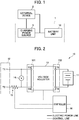
- FIG. 1 is a block diagram illustrating a power storage system 1 that includes a battery unit 10 according to the present embodiment.
- the power storage system 1 according to the present embodiment is connected between an external device 2 and a power source such as a commercial power source (not illustrated), and is used as a backup power source, an emergency power source, and an uninterruptible power source for the external device 2.
- the power storage system 1 illustrated in FIG. 1 includes, for example, a battery unit 10 and a charging power source 3.
- the battery unit 10 includes a chargeable/dischargeable and removable secondary battery 11 to be described later.
- the battery unit 10 charges the secondary battery 11 with electric power supplied from the charging power source 3.
- the battery unit 10 supplies the electric power accumulated in the secondary battery 11 to the external device 2, at the time of a power failure.
- the power storage system 1 according to the present embodiment can continue to supply electric power to the external device 2 even when electric power cannot be supplied from the charging power source 3 to the external device 2 due to the power failure.
- the charging power source 3 supplies electric power to the battery unit 10 or the external device 2.
- the charging power source 3 is, for example, a power source corresponding to a generally known secondary battery such as a lead battery or a nickel-metal hydride battery.
- FIG. 2 is a circuit diagram of the battery unit 10 illustrated in FIG. 1 .
- the battery unit illustrated in FIG. 2 includes the secondary battery 11, an input/output terminal 12, a voltage adjuster 13, a voltage detector 14, a current detection resistor 15, and a controller 16.
- the secondary battery 11 is, for example, a generally known secondary battery such as a lead battery or a nickel-metal hydride battery.
- the input/output terminal 12 is connected to the charging power source 3 and is used to input electric power, supplied from the charging power source 3, to the secondary battery 11. Also, the input/output terminal 12 is connected to the external device 2 and is used to output the electric power, accumulated in the secondary battery 11, to the external device at the time of a power failure.
- the voltage adjuster 13 is provided between the input/output terminal 12 and the secondary battery 11.
- one end 131 of the voltage adjuster 13 is connected to the input/output terminal 12.
- the other end 132 of the voltage adjuster 13 is connected to the secondary battery 11.
- a positive electrode T3 at the one end 131 of the voltage adjuster 13 is connected to a positive electrode T1 of the input/output terminal 12.
- a negative electrode T4 at one end 131 of the voltage adjuster 13 is connected to a negative electrode T2 of the input/output terminal 12.
- a positive electrode T5 of the other end 132 of the voltage adjuster 13 is connected to the positive electrode of the secondary battery 11.
- a negative electrode T6 of the other end 132 of the voltage adjuster 13 is connected to the negative electrode of the secondary battery 11.
- the negative electrode T2 of the input/output terminal 12 is grounded. That is, the voltage adjuster 13 is provided in a charging path for inputting the electric power, supplied from the charging power source 3 via the input/output terminal 12, to the secondary battery 11 and in a discharging path for outputting the electric power, accumulated in the secondary battery 11, to the external device 2 via the input/output terminal 12. Note that the charging path and the discharging path are formed of common circuit wiring.
- the voltage adjuster 13 adjusts the charging voltage of the charging power source 3 to a predetermined voltage corresponding to the secondary battery 11 and outputs the electric power input from the charging power source 3 via the input/output terminal 12.
- the voltage adjuster 13 adjusts the output voltage of the secondary battery 11 to a predetermined voltage corresponding to the external device 2 and outputs the electric power received as an input from the secondary battery 11, to the external device 2 via the input/output terminal 12. Note that the internal configuration of the voltage adjuster 13 will be described later with reference to the drawings.
- the voltage detector 14 detects an input voltage (charging voltage) input to the battery unit 10 and detects an output voltage output from the secondary battery 11. The voltage detector 14 transmits information on the detected input voltage and output voltage to the controller 16 to be described later.
- the current detection resistor 15 detects an input current (charging current) input to the battery unit 10 and an output current output from the secondary battery 11. The current detection resistor 15 transmits information on the detected input current and output current to the controller 16 to be described later.
- the controller 16 includes a predetermined processor as a hardware resource. For example, the controller 16 controls the operation of the voltage adjuster 13 in accordance with the charge or discharge of the secondary battery 11. The controller 16 determines whether or not the charging power source 3 is operating normally based on the information on the input voltage received from the voltage detector 14 and the information on the input current received from the current detection resistor 15. The controller 16 determines whether or not the charging power source 3 has been restored based on the information on the output voltage received from the voltage detector 14 and the information on the output current received from the current detection resistor 15. Further, the controller 16 determines the state of charge and the degree of degradation of the secondary battery 11 based on information on temperature from a temperature detector (not illustrated) installed in the secondary battery 11.
- a temperature detector not illustrated
- FIGS. 3 to 18 a specific circuit configuration of the voltage adjuster 13, the operation of the path selector 17 to be described later, and the current flow during charge and discharge will be described with reference to FIGS. 3 to 18 .
- the voltage detector 14, the current detection resistor 15, and the controller 16 are omitted from the drawings that explain the operation of the path selector 17 to be described later and the current flow during charge and discharge.
- FIG. 3 is a circuit diagram of the voltage adjuster 13 in a first embodiment.
- the voltage adjuster 13 in the first embodiment has a current path R1 connecting the one end 131 on the input/output terminal 12 side and the other end 132 on the secondary battery 11 side, and a bypass path R2 of the current path R1.
- the voltage adjuster 13 has a converter CV1 provided in the bypass path R2 and capable of changing the input electric power to the predetermined voltage corresponding to the secondary battery 11, or to the predetermined voltage corresponding to the external device 2, in accordance with the charge or discharge of the secondary battery 11.
- the converter CV1 in the first embodiment is a unidirectional converter capable of changing the input electric power to the predetermined voltage corresponding to the secondary battery 11.
- the unidirectional converter is a step-up converter, a step-down converter, or a variable converter capable of step-up or step-down.
- the unidirectional converter is a non-insulated or insulated unidirectional converter.
- the voltage adjuster 13 has a path selector 17.
- the path selector 17 selects a path to be used out of the current path R1 and the bypass path R2 in accordance with the charge or discharge of the secondary battery 11.
- the path selector 17 in the first embodiment is made up of a first diode D1, a second diode D2, and a switching element SW1.
- the first diode D1 is provided in the bypass path R2 and has an anode connected to the input/output terminal 12 side and a cathode connected to the secondary battery 11 side.
- the second diode D2 is provided in the current path R1 between a branching point P1 of the current path R1 and the bypass path R2 and a converging point P2 of the current path R1 and the bypass path R2, and has an anode connected to the secondary battery 11 side and a cathode connected to the input/output terminal 12 side.
- the switching element SW1 is provided in the current path R1 between the branching point P1 and the converging point P2.
- a switching element SW2 is provided between the converging point P2 and the other end 132.
- the first diode D1 and the second diode D2 serve to separate the charging path and the discharging path by limiting the direction in which the current flows.
- the switching element SW1 serves to prevent the reverse flow of the charging current from the converging point P2 to the input/output terminal 12 side when the secondary battery 11 is charged.
- the switching element SW2 serves to stop the charging operation or the discharging operation when a failure occurs in the battery unit 10.
- a switching element such as a bipolar transistor or a field-effect transistor (FET)
- FET field-effect transistor
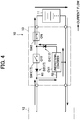
- FIG. 4 is a diagram illustrating the operation of the path selector 17 and the flow of the charging current when the secondary battery 11 is charged in the voltage adjuster 13 in the first embodiment.
- the controller 16 turns off the switching element SW1 and turns on the switching element SW2.
- the charging current is input from the input/output terminal 12 to the secondary battery 11 through the bypass path R2.
- the controller 16 operates the converter CV1.
- the voltage adjuster 13 in the first embodiment can adjust the charging voltage of the charging power source 3 to the predetermined voltage corresponding to the secondary battery 11.
- the battery unit 10 in the first embodiment can charge the secondary battery 11 with the charging voltage that corresponds to the secondary battery 11.
- the charging power source 3 is a charging power source for a lead battery and that the secondary battery 11 is a lead battery
- the charging voltage corresponds to the secondary battery 11, and the charging voltage does not need to be converted by the converter CV1.
- the battery unit 10 does not adjust the charging voltage by using the converter CV1 of the voltage adjuster 13 but inputs the electric power, supplied from the charging power source 3 via the input/output terminal 12, to the secondary battery 11.
- the charging power source 3 is a charging power source for a lead battery and that the secondary battery 11 is a nickel-metal hydride battery
- the charging voltage does not correspond to the secondary battery 11, and the charging voltage needs to be converted by the converter CV1.
- the battery unit 10 adjusts the charging voltage to the predetermined voltage corresponding to the secondary battery 11 by using the converter CV1 of the voltage adjuster 13 and inputs the electric power, supplied from the charging power source 3 through the input/output terminal 12, to the secondary battery 11.
- the battery unit 10 in the first embodiment can charge the secondary battery 11 with the charging voltage that corresponds to the secondary battery 11.
- the converter CV1 is an insulated unidirectional converter, even when a large amount of noise is contained in the electric power input from the input/output terminal 12, passing through the converter CV1 can allow the noise to be removed.
- FIG. 5 is a diagram illustrating the operation of the path selector 17 and the flow of the output current when the electric power is output from the secondary battery 11 to the external device 2 in the voltage adjuster 13 in the first embodiment.
- the controller 16 turns on the switching elements SW1, SW2.
- the battery unit 10 in the first embodiment can output the electric power accumulated in the secondary battery 11 to the external device 2 through the current path R1.
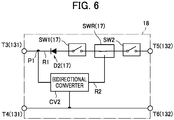
- FIG. 6 is a circuit diagram of a voltage adjuster 18 according to a second embodiment.
- the voltage adjuster 18 in the second embodiment is formed by removing the first diode D1 from the voltage adjuster 13 in the first embodiment and providing a relay switch SWR at the converging point P2 of the current path R1 and the bypass path R2.
- the relay switch SWR serves to allow a path used as a discharging path to be selected out of the current path R1 and the bypass path R2.
- the relay switch SWR together with the second diode D2, serves to separate the charging path and the discharging path.
- the converter CV2 in the second embodiment is a bidirectional converter capable of changing the input electric power to the predetermined voltage corresponding to the secondary battery 11 or the predetermined voltage corresponding to the external device 2.
- the bidirectional converter is a non-insulated or insulated bidirectional converter.
- the path selector 17 in the second embodiment is assumed to be made up of the second diode D2, the relay switch SWR, and the switching element SW1. Note that the other configurations are the same as those of the voltage adjuster 13 in the first embodiment.
- FIG. 7 is a diagram illustrating the operation of the path selector 17 and the flow of the charging current when the secondary battery 11 is charged in the voltage adjuster 18 in the second embodiment.
- the controller 16 turns off the switching element SW1 and turns on the switching element SW2. Further, the controller 16 switches the relay switch SWR to the bypass path R2 side. As a result, as illustrated in FIG. 7 , the charging current is input from the input/output terminal 12 to the secondary battery 11 through the bypass path R2. At this time, when the charging voltage of the charging power source 3 does not correspond to the secondary battery 11, the controller 16 operates the converter CV2.
- the voltage adjuster 18 in the second embodiment can adjust the charging voltage of the charging power source 3 to the predetermined voltage corresponding to the secondary battery 11. That is, as in the first embodiment, the battery unit 10 in the second embodiment can charge the secondary battery 11 with the charging voltage that corresponds to the secondary battery 11. Further, assuming that the converter CV2 is an insulated bidirectional converter, even when a large amount of noise is contained in the electric power input from the input/output terminal 12, passing through the bypass path R2 can allow the noise to be removed by the converter CV2.
- FIG. 8 is a diagram illustrating the operation of the path selector 17 and the flow of the output current when the electric power is output from the secondary battery 11 to the external device 2 by using the current path R1 in the voltage adjuster 18 in the second embodiment.
- the controller 16 turns on the switching elements SW1, SW2. Further, the controller 16 switches the relay switch SWR to the current path R1 side.
- the battery unit 10 in the second embodiment can output the electric power accumulated in the secondary battery 11 to the external device 2 through the current path R1.
- FIG. 9 is a diagram illustrating the operation of the path selector 17 and the flow of the output current when the electric power is output from the secondary battery 11 to the external device 2 by using the bypass path R2 in the voltage adjuster 18 in the second embodiment.
- the controller 16 turns off the switching element SW1 and turns on the switching element SW2. Further, the controller 16 switches the relay switch SWR to the bypass path R2 side.
- the battery unit 10 in the second embodiment can output the electric power accumulated in the secondary battery 11 to the external device 2 through the bypass path R2.
- the controller 16 operates the converter CV2.
- the battery unit 10 in the second embodiment can adjust the charging voltage of the charging power source 3 to the predetermined voltage corresponding to the secondary battery 11 through the bypass path R2.
- the battery unit 10 in the second embodiment can output the electric power accumulated in the secondary battery 11 to the external device 2 with the output voltage that corresponds to the external device 2.
- the output voltage does not need to be converted by the converter CV2.
- the battery unit 10 outputs the electric power accumulated in the secondary battery 11 to the external device 2 through the current path R1.
- the battery unit 10 adjusts the output voltage to the predetermined voltage corresponding to the external device 2 by using the converter CV2 through the bypass path R2 and outputs the electric power accumulated in the secondary battery 11 to the external device 2.
- the battery unit 10 in the second embodiment can output the electric power accumulated in the secondary battery 11 to the external device 2 with the output voltage that corresponds to the external device 2.
- the converter CV2 is an insulated bidirectional converter
- passing through the converter CV2 can allow the noise to be removed.
- the battery unit 10 removes the noise by using the converter CV2 of the voltage adjuster 18 through the bypass path R2 and outputs the electric power accumulated in the secondary battery 11 to the external device 2.
- the battery unit 10 in the second embodiment even when a large amount of noise is contained in the electric power output from the secondary battery 11, passing through the converter CV2 can allow the noise to be removed.
- the battery unit 10 outputs the electric power accumulated in the secondary battery 11 to the external device 2 through the current path R1.
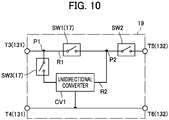
- FIG. 10 is a circuit diagram of a voltage adjuster 19 according to a third embodiment.
- the voltage adjuster 19 in the third embodiment is formed by removing the first diode D1 and the second diode D2 from the voltage adjuster 13 in the first embodiment and further providing a switching element SW3 between the converter CV1 and the branching point P1 of the current path R1 and the bypass path R2.
- the switching element SW3, together with the switching element SW1, serves to separate the charging path and a discharging path.
- the converter CV1 in the third embodiment is a unidirectional converter.
- the path selector 17 in the third embodiment is assumed to be made up of the switching element SW1 and the switching element SW3.
- FIG. 11 is a diagram illustrating the operation of the path selector 17 and the flow of the charging current when the secondary battery 11 is charged by using the current path R1 in the voltage adjuster 19 in the third embodiment.
- the controller 16 turns on the switching elements SW1, SW2 and turns off the switching element SW3.
- the charging current is input from the input/output terminal 12 to the secondary battery 11 through the current path R1.
- FIG. 12 is a diagram illustrating the operation of the path selector 17 and the flow of the charging current when the secondary battery 11 is charged by using the bypass path R2 in the voltage adjuster 19 in the third embodiment.
- the controller 16 turns off the switching element SW1 and turns on the switching elements SW2, SW3.
- the charging current is input from the input/output terminal 12 to the secondary battery 11 through the bypass path R2.
- the controller 16 operates the converter CV1.
- the voltage adjuster 19 in the third embodiment can adjust the charging voltage of the charging power source 3 to the predetermined voltage corresponding to the secondary battery 11. That is, as in the first and second embodiments, the battery unit 10 in the third embodiment can charge the secondary battery 11 with the charging voltage that corresponds to the secondary battery 11.
- the battery unit 10 of the third embodiment as in those of the first and second embodiments, assuming that the converter CV1 is an insulated unidirectional converter, even when a large amount of noise is contained in the electric power input from the input/output terminal 12, the noise can be removed by the electric power passing through the converter CV1.
- the battery unit 10 removes the noise by using the converter CV1 of the voltage adjuster 18 through the bypass path R2 and inputs the electric power, supplied from the charging power source 3 via the input/output terminal 12, to the secondary battery 11.
- the battery unit 10 in the third embodiment, even when a large amount of noise is contained in the electric power input from the input/output terminal 12, the noise can be removed by the electric power passing through the converter CV1. Note that when the electric power supplied from the charging power source 3 does not contain noise, in order to minimize power loss, the battery unit 10 inputs the electric power, supplied from the charging power source 3 via the input/output terminal 12, to the secondary battery 11 through the current path R1.
- FIG. 13 is a diagram illustrating the operation of the path selector 17 and the flow of the output current when the electric power is output from the secondary battery 11 to the external device 2 in the voltage adjuster 19 in the third embodiment.
- the controller 16 turns on the switching elements SW1, SW2 and turns off the switching element SW3.
- the battery unit 10 in the third embodiment can output the electric power accumulated in the secondary battery 11 to the external device 2 through the current path R1.
- FIG. 14 is a circuit diagram of a voltage adjuster 20 according to a fourth embodiment.
- the voltage adjuster 20 in the fourth embodiment is formed by replacing the unidirectional converter of the voltage adjuster 19 in the third embodiment with a bidirectional converter. Note that the other configurations are the same as those of the voltage adjuster 19 in the third embodiment.
- FIG. 15 is a diagram illustrating the operation of the path selector 17 and the flow of the charging current when the secondary battery 11 is charged by using the current path R1 in the voltage adjuster 20 in the fourth embodiment.
- the controller 16 turns on the switching elements SW1, SW2 and turns off the switching element SW3.
- the charging current is input from the input/output terminal 12 to the secondary battery 11 through the current path R1.
- FIG. 16 is a diagram illustrating the operation of the path selector 17 and the flow of the charging current when the secondary battery 11 is charged by using the bypass path R2 in the voltage adjuster 20 in the fourth embodiment.
- the controller 16 turns off the switching element SW1 and turns on the switching elements SW2, SW3.
- the charging current is input from the input/output terminal 12 to the secondary battery 11 through the bypass path R2.
- the controller 16 operates the converter CV2.
- the voltage adjuster 20 in the fourth embodiment can adjust the charging voltage of the charging power source 3 to the predetermined voltage corresponding to the secondary battery 11. That is, as in the first to third embodiments, the battery unit 10 in the fourth embodiment can charge the secondary battery 11 with the charging voltage that corresponds to the secondary battery 11.
- the converter CV2 is an insulated bidirectional converter, even when a large amount of noise is contained in the electric power input from the input/output terminal 12, the noise can be removed by the electric power passing through the converter CV2.
- FIG. 17 is a diagram illustrating the operation of the path selector 17 and the flow of the output current when the electric power is output from the secondary battery 11 to the external device 2 by using the current path R1 in the voltage adjuster 20 in the fourth embodiment.
- the controller 16 turns on the switching elements SW1, SW2 and turns off the switching element SW3.
- the battery unit 10 in the fourth embodiment can output the electric power accumulated in the secondary battery 11 to the external device 2 through the current path R1.
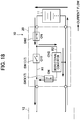
- FIG. 18 is a diagram illustrating the operation of the path selector 17 and the flow of the output current when the electric power is output from the secondary battery 11 to the external device 2 by using the bypass path R2 in the voltage adjuster 20 in the fourth embodiment.
- the controller 16 turns off the switching elements SW1 and turns on the switching elements SW2, SW3.
- the controller 16 operates the converter CV2.
- the voltage adjuster 13 in the fourth embodiment can adjust the charging voltage of the charging power source 3 to the predetermined voltage corresponding to the secondary battery 11 through the bypass path R2. That is, as in the second embodiment, the battery unit 10 in the fourth embodiment can output the electric power accumulated in the secondary battery 11 to the external device 2 with the output voltage that corresponds to the external device 2.
- the converter CV2 is an insulated bidirectional converter, even when a large amount of noise is contained in the electric power output from the secondary battery 11, the noise can be removed by the electric power passing through the converter CV2.
- the voltage adjusters 13, 18, 19, 20 illustrated in the first to fourth embodiments are merely illustrated as examples, and components such as the converters CV1, CV2, the diodes D1, D2, the switching elements SW1, SW2, SW3, and the relay switch SWR may be combined to achieve a voltage adjuster capable of performing at least one of the adjustment of the charging voltage and the removal of noise during the charge of the secondary battery 11 and the adjustment of the output voltage and the removal of noise during the discharge of the secondary battery 11.
- the battery unit 10 according to the present embodiment can charge the secondary battery 11 with the charging voltage that corresponds to the secondary battery 11.
- the battery unit 10 according to the present embodiment can output the electric power accumulated in the secondary battery 11 to the external device 2 with the output voltage that corresponds to the external device 2.
- the charging path and the discharging path are formed of common circuit wiring, so that it is possible to simplify the circuit while preventing an increase in the number of components.
- the charging power source 3 in the present embodiment is provided in the power storage system 1.
- the charging power source 3 in the present embodiment is not limited thereto.
- the charging power source 3 in the present embodiment may be an external power source provided outside the power storage system 1.
- predetermined processor means, for example, a microcomputer-dedicated or general-purpose processor, an application-specific integrated circuit (ASIC), a programmable logic device (e.g., a simple programmable logic device (SPLD), a complex programmable logic device (CPLD), a field-programmable gate array (FPGA), or the like.
- ASIC application-specific integrated circuit
- SPLD simple programmable logic device
- CPLD complex programmable logic device
- FPGA field-programmable gate array
- Each component (each processing unit) of the present embodiment is not limited to a single processor but may be achieved by a plurality of processors.
Landscapes
- Engineering & Computer Science (AREA)
- Manufacturing & Machinery (AREA)
- Chemical & Material Sciences (AREA)
- Chemical Kinetics & Catalysis (AREA)
- Electrochemistry (AREA)
- General Chemical & Material Sciences (AREA)
- Power Engineering (AREA)
- Microelectronics & Electronic Packaging (AREA)
- Business, Economics & Management (AREA)
- Emergency Management (AREA)
- Charge And Discharge Circuits For Batteries Or The Like (AREA)
- Secondary Cells (AREA)
Abstract
Description
- The present disclosure relates to a battery unit, a power storage system, and a method for charging/discharging the battery unit.
- For example, as disclosed in
Patent Document 1 below, there is known a battery pack capable of charging a secondary battery, such as a nickel-cadmium battery or a nickel-metal hydride battery, by using an inexpensive charging power source for a lead battery. In the battery pack, a charging voltage supplied from the charging power source is stepped up and converted into a charging voltage corresponding to a nickel-cadmium battery or a nickel-metal hydride battery, so that the secondary battery can be charged with the converted charging voltage. - Patent Document 1:
Japanese Patent Laid-Open No. 2004-288537 - Meanwhile, since the battery pack is based on the premise of stepping up the charging voltage supplied from the charging power source to charge the secondary battery, the secondary battery cannot be charged simply with electric power supplied from the charging power source. Also, in the battery pack, an output voltage to be output from a discharging terminal has been determined, and hence, a device not corresponding to the output voltage cannot be connected. Furthermore, in the battery pack, a charging terminal and the discharging terminal are provided separately, thus causing a problem that the number of components increases.
- The present disclosure has been made in consideration of such circumstances, and it is an object of the present disclosure to provide a battery unit, a power storage system, and a method for charging/discharging the battery unit, which are highly versatile compared to the conventional battery unit.
- The present disclosure has been made in order to solve at least some of the problems described above and can be achieved as the following aspects.
- A battery unit, a power storage system, and a method for charging/discharging the battery unit according to the present aspect include: a chargeable/dischargeable and removable secondary battery; an input/output terminal connected to an external power source or an external device; a charging path for inputting electric power, supplied from the external power source via the input/output terminal, to the secondary battery; a discharging path for outputting electric power, accumulated in the secondary battery, to the external device via the input/output terminal; a voltage adjuster that is provided in the charging path and the discharging path and is configured to adjust a charging voltage of the external power source to a predetermined voltage corresponding to the secondary battery to output electric power received as an input via the input/output terminal, or adjust an output voltage of the secondary battery to a predetermined voltage corresponding to the external device to output electric power received as an input from the secondary battery, to the external device via the input/output terminal; and a controller configured to control an operation of the voltage adjuster in accordance with charge or discharge of the secondary battery. The charging path and the discharging path are formed of common circuit wiring. The voltage adjuster has a current path connecting one end on the input/output terminal side and the other end on the secondary battery side, a bypass path of the current path, a converter provided in the bypass path and capable of changing input electric power to a predetermined voltage corresponding to the secondary battery or a predetermined voltage corresponding to the external device in accordance with the charge or discharge of the second battery, and a path selector configured to select a path to be used out of the current path or the bypass path in accordance with the charge or discharge of the secondary battery.
- With the above configuration, the battery unit, the power storage system, and the method for charging/discharging the battery unit according to the present aspect can charge the secondary battery with the charging voltage that corresponds to the secondary battery. The battery unit, the power storage system, and the method for charging/discharging the battery unit according to the present aspect can output electric power accumulated in the secondary battery to the external device with the output voltage that corresponds to the external device. In the battery unit, the power storage system, and the method for charging/discharging the battery unit according to the present aspect, the charging path and the discharging path are formed of common circuit wiring, so that it is possible to simplify the circuit while preventing an increase in the number of components. Thus, the battery unit, the power storage system, and the method for charging/discharging the battery unit according to the present aspect are highly versatile compared to the conventional battery unit.
-
-
FIG. 1 is a block diagram illustrating a power storage system that includes a battery unit according to the present embodiment. -
FIG. 2 is a circuit diagram of the battery unit illustrated inFIG. 1 . -
FIG. 3 is a circuit diagram of a voltage adjuster in the first embodiment. -
FIG. 4 is a diagram illustrating an operation of a path selector and the flow of a charging current when a secondary battery is charged in the voltage adjuster in the first embodiment. -
FIG. 5 is a diagram illustrating the operation of the path selector and the flow of an output current when electric power is output from the secondary battery to the external device in the voltage adjuster in the first embodiment. -
FIG. 6 is a circuit diagram of a voltage adjuster in a second embodiment. -
FIG. 7 is a diagram illustrating an operation of a path selector and the flow of a charging current when the secondary battery is charged in the voltage adjuster in the second embodiment. -
FIG. 8 is a diagram illustrating the operation of the path selector and the flow of an output current when electric power is output from the secondary battery to the external device by using a current path in the voltage adjuster in the second embodiment. -
FIG. 9 is a diagram illustrating the operation of the path selector and the flow of the output current when the electric power is output from the secondary battery to the external device by using a bypass path in the voltage adjuster in the second embodiment. -
FIG. 10 is a circuit diagram of a voltage adjuster in a third embodiment. -
FIG. 11 is a diagram illustrating an operation of a path selector and the flow of a charging current when the secondary battery is charged by using a current path in the voltage adjuster in the third embodiment. -
FIG. 12 is a diagram illustrating the operation of the path selector and the flow of the charging current when the secondary battery is charged by using a bypass path in the voltage adjuster in the third embodiment. -
FIG. 13 is a diagram illustrating the operation of the path selector and the flow of an output current when electric power is output from the secondary battery to the external device in the voltage adjuster in the third embodiment. -
FIG. 14 is a circuit diagram of a voltage adjuster in a fourth embodiment. -
FIG. 15 is a diagram illustrating an operation of a path selector and the flow of a charging current when the secondary battery is charged by using a current path in the voltage adjuster in the fourth embodiment. -
FIG. 16 is a diagram illustrating the operation of the path selector and the flow of the charging current when the secondary battery is charged by using a bypass path in the voltage adjuster in the fourth embodiment. -
FIG. 17 is a diagram illustrating the operation of the path selector and the flow of an output current when electric power is output from the secondary battery to the external device by using a current path in the voltage adjuster in the fourth embodiment. -
FIG. 18 is a diagram illustrating the operation of the path selector and the flow of the output current when the electric power is output from the secondary battery to the external device by using a bypass path in the voltage adjuster in the fourth embodiment. - Hereinafter, a battery unit, a power storage system, and a method for charging/discharging the battery unit according to an embodiment of the present disclosure will be described with reference to the drawings. Note that the present embodiment is not limited to the content described below and can be implemented with arbitrary modifications within the scope of the gist thereof being unchanged. In addition, all the drawings used in the description of the embodiments schematically illustrate constituent members, are partially emphasized, enlarged, reduced, or omitted for better understanding, and may not accurately illustrate the scale or shape of the constituent members.
-
FIG. 1 is a block diagram illustrating apower storage system 1 that includes abattery unit 10 according to the present embodiment. Thepower storage system 1 according to the present embodiment is connected between anexternal device 2 and a power source such as a commercial power source (not illustrated), and is used as a backup power source, an emergency power source, and an uninterruptible power source for theexternal device 2. Thepower storage system 1 illustrated inFIG. 1 includes, for example, abattery unit 10 and acharging power source 3. - The
battery unit 10 includes a chargeable/dischargeable and removablesecondary battery 11 to be described later. Thebattery unit 10 charges thesecondary battery 11 with electric power supplied from thecharging power source 3. Thebattery unit 10 supplies the electric power accumulated in thesecondary battery 11 to theexternal device 2, at the time of a power failure. Thus, thepower storage system 1 according to the present embodiment can continue to supply electric power to theexternal device 2 even when electric power cannot be supplied from thecharging power source 3 to theexternal device 2 due to the power failure. Thecharging power source 3 supplies electric power to thebattery unit 10 or theexternal device 2. Thecharging power source 3 is, for example, a power source corresponding to a generally known secondary battery such as a lead battery or a nickel-metal hydride battery. - Here, the circuit configuration of the
battery unit 10 will be described in detail.FIG. 2 is a circuit diagram of thebattery unit 10 illustrated inFIG. 1 . The battery unit illustrated inFIG. 2 includes thesecondary battery 11, an input/output terminal 12, avoltage adjuster 13, avoltage detector 14, acurrent detection resistor 15, and acontroller 16. Thesecondary battery 11 is, for example, a generally known secondary battery such as a lead battery or a nickel-metal hydride battery. - The input/
output terminal 12 is connected to thecharging power source 3 and is used to input electric power, supplied from thecharging power source 3, to thesecondary battery 11. Also, the input/output terminal 12 is connected to theexternal device 2 and is used to output the electric power, accumulated in thesecondary battery 11, to the external device at the time of a power failure. - The
voltage adjuster 13 is provided between the input/output terminal 12 and thesecondary battery 11. For example, oneend 131 of thevoltage adjuster 13 is connected to the input/output terminal 12. Theother end 132 of thevoltage adjuster 13 is connected to thesecondary battery 11. Specifically, a positive electrode T3 at the oneend 131 of thevoltage adjuster 13 is connected to a positive electrode T1 of the input/output terminal 12. A negative electrode T4 at oneend 131 of thevoltage adjuster 13 is connected to a negative electrode T2 of the input/output terminal 12. A positive electrode T5 of theother end 132 of thevoltage adjuster 13 is connected to the positive electrode of thesecondary battery 11. A negative electrode T6 of theother end 132 of thevoltage adjuster 13 is connected to the negative electrode of thesecondary battery 11. Note that the negative electrode T2 of the input/output terminal 12 is grounded. That is, thevoltage adjuster 13 is provided in a charging path for inputting the electric power, supplied from the chargingpower source 3 via the input/output terminal 12, to thesecondary battery 11 and in a discharging path for outputting the electric power, accumulated in thesecondary battery 11, to theexternal device 2 via the input/output terminal 12. Note that the charging path and the discharging path are formed of common circuit wiring. - The
voltage adjuster 13 adjusts the charging voltage of the chargingpower source 3 to a predetermined voltage corresponding to thesecondary battery 11 and outputs the electric power input from the chargingpower source 3 via the input/output terminal 12. Thevoltage adjuster 13 adjusts the output voltage of thesecondary battery 11 to a predetermined voltage corresponding to theexternal device 2 and outputs the electric power received as an input from thesecondary battery 11, to theexternal device 2 via the input/output terminal 12. Note that the internal configuration of thevoltage adjuster 13 will be described later with reference to the drawings. - The
voltage detector 14 detects an input voltage (charging voltage) input to thebattery unit 10 and detects an output voltage output from thesecondary battery 11. Thevoltage detector 14 transmits information on the detected input voltage and output voltage to thecontroller 16 to be described later. Thecurrent detection resistor 15 detects an input current (charging current) input to thebattery unit 10 and an output current output from thesecondary battery 11. Thecurrent detection resistor 15 transmits information on the detected input current and output current to thecontroller 16 to be described later. - The
controller 16 includes a predetermined processor as a hardware resource. For example, thecontroller 16 controls the operation of thevoltage adjuster 13 in accordance with the charge or discharge of thesecondary battery 11. Thecontroller 16 determines whether or not the chargingpower source 3 is operating normally based on the information on the input voltage received from thevoltage detector 14 and the information on the input current received from thecurrent detection resistor 15. Thecontroller 16 determines whether or not the chargingpower source 3 has been restored based on the information on the output voltage received from thevoltage detector 14 and the information on the output current received from thecurrent detection resistor 15. Further, thecontroller 16 determines the state of charge and the degree of degradation of thesecondary battery 11 based on information on temperature from a temperature detector (not illustrated) installed in thesecondary battery 11. - Here, a specific circuit configuration of the
voltage adjuster 13, the operation of thepath selector 17 to be described later, and the current flow during charge and discharge will be described with reference toFIGS. 3 to 18 . For preventing the drawings from becoming complex, thevoltage detector 14, thecurrent detection resistor 15, and thecontroller 16 are omitted from the drawings that explain the operation of thepath selector 17 to be described later and the current flow during charge and discharge. -
FIG. 3 is a circuit diagram of thevoltage adjuster 13 in a first embodiment. Thevoltage adjuster 13 in the first embodiment has a current path R1 connecting the oneend 131 on the input/output terminal 12 side and theother end 132 on thesecondary battery 11 side, and a bypass path R2 of the current path R1. Thevoltage adjuster 13 has a converter CV1 provided in the bypass path R2 and capable of changing the input electric power to the predetermined voltage corresponding to thesecondary battery 11, or to the predetermined voltage corresponding to theexternal device 2, in accordance with the charge or discharge of thesecondary battery 11. The converter CV1 in the first embodiment is a unidirectional converter capable of changing the input electric power to the predetermined voltage corresponding to thesecondary battery 11. For example, the unidirectional converter is a step-up converter, a step-down converter, or a variable converter capable of step-up or step-down. The unidirectional converter is a non-insulated or insulated unidirectional converter. - The
voltage adjuster 13 has apath selector 17. Thepath selector 17 selects a path to be used out of the current path R1 and the bypass path R2 in accordance with the charge or discharge of thesecondary battery 11. Thepath selector 17 in the first embodiment is made up of a first diode D1, a second diode D2, and a switching element SW1. The first diode D1 is provided in the bypass path R2 and has an anode connected to the input/output terminal 12 side and a cathode connected to thesecondary battery 11 side. The second diode D2 is provided in the current path R1 between a branching point P1 of the current path R1 and the bypass path R2 and a converging point P2 of the current path R1 and the bypass path R2, and has an anode connected to thesecondary battery 11 side and a cathode connected to the input/output terminal 12 side. The switching element SW1 is provided in the current path R1 between the branching point P1 and the converging point P2. A switching element SW2 is provided between the converging point P2 and theother end 132. For example, the first diode D1 and the second diode D2 serve to separate the charging path and the discharging path by limiting the direction in which the current flows. The switching element SW1 serves to prevent the reverse flow of the charging current from the converging point P2 to the input/output terminal 12 side when thesecondary battery 11 is charged. The switching element SW2 serves to stop the charging operation or the discharging operation when a failure occurs in thebattery unit 10. For each of the switching elements SW1, SW2, one generally used as a switching element, such as a bipolar transistor or a field-effect transistor (FET), is used. -
FIG. 4 is a diagram illustrating the operation of thepath selector 17 and the flow of the charging current when thesecondary battery 11 is charged in thevoltage adjuster 13 in the first embodiment. As illustrated inFIG. 4 , in the case of charging thesecondary battery 11, thecontroller 16 turns off the switching element SW1 and turns on the switching element SW2. As a result, as illustrated inFIG. 4 , the charging current is input from the input/output terminal 12 to thesecondary battery 11 through the bypass path R2. At this time, when the charging voltage of the chargingpower source 3 does not correspond to thesecondary battery 11, thecontroller 16 operates the converter CV1. Thus, thevoltage adjuster 13 in the first embodiment can adjust the charging voltage of the chargingpower source 3 to the predetermined voltage corresponding to thesecondary battery 11. - That is, the
battery unit 10 in the first embodiment can charge thesecondary battery 11 with the charging voltage that corresponds to thesecondary battery 11. For example, assuming that the chargingpower source 3 is a charging power source for a lead battery and that thesecondary battery 11 is a lead battery, the charging voltage corresponds to thesecondary battery 11, and the charging voltage does not need to be converted by the converter CV1. Hence, thebattery unit 10 does not adjust the charging voltage by using the converter CV1 of thevoltage adjuster 13 but inputs the electric power, supplied from the chargingpower source 3 via the input/output terminal 12, to thesecondary battery 11. Assuming that the chargingpower source 3 is a charging power source for a lead battery and that thesecondary battery 11 is a nickel-metal hydride battery, the charging voltage does not correspond to thesecondary battery 11, and the charging voltage needs to be converted by the converter CV1. Hence, thebattery unit 10 adjusts the charging voltage to the predetermined voltage corresponding to thesecondary battery 11 by using the converter CV1 of thevoltage adjuster 13 and inputs the electric power, supplied from the chargingpower source 3 through the input/output terminal 12, to thesecondary battery 11. Thereby, thebattery unit 10 in the first embodiment can charge thesecondary battery 11 with the charging voltage that corresponds to thesecondary battery 11. Further, assuming that the converter CV1 is an insulated unidirectional converter, even when a large amount of noise is contained in the electric power input from the input/output terminal 12, passing through the converter CV1 can allow the noise to be removed. -
FIG. 5 is a diagram illustrating the operation of thepath selector 17 and the flow of the output current when the electric power is output from thesecondary battery 11 to theexternal device 2 in thevoltage adjuster 13 in the first embodiment. As illustrated inFIG. 5 , in the case of outputting the electric power accumulated in thesecondary battery 11 to theexternal device 2, thecontroller 16 turns on the switching elements SW1, SW2. Thus, thebattery unit 10 in the first embodiment can output the electric power accumulated in thesecondary battery 11 to theexternal device 2 through the current path R1. -
FIG. 6 is a circuit diagram of avoltage adjuster 18 according to a second embodiment. Thevoltage adjuster 18 in the second embodiment is formed by removing the first diode D1 from thevoltage adjuster 13 in the first embodiment and providing a relay switch SWR at the converging point P2 of the current path R1 and the bypass path R2. In the case of outputting the electric power accumulated in thesecondary battery 11 to theexternal device 2, the relay switch SWR serves to allow a path used as a discharging path to be selected out of the current path R1 and the bypass path R2. The relay switch SWR, together with the second diode D2, serves to separate the charging path and the discharging path. The converter CV2 in the second embodiment is a bidirectional converter capable of changing the input electric power to the predetermined voltage corresponding to thesecondary battery 11 or the predetermined voltage corresponding to theexternal device 2. For example, the bidirectional converter is a non-insulated or insulated bidirectional converter. Thepath selector 17 in the second embodiment is assumed to be made up of the second diode D2, the relay switch SWR, and the switching element SW1. Note that the other configurations are the same as those of thevoltage adjuster 13 in the first embodiment. -
FIG. 7 is a diagram illustrating the operation of thepath selector 17 and the flow of the charging current when thesecondary battery 11 is charged in thevoltage adjuster 18 in the second embodiment. As illustrated inFIG. 7 , in the case of charging thesecondary battery 11, thecontroller 16 turns off the switching element SW1 and turns on the switching element SW2. Further, thecontroller 16 switches the relay switch SWR to the bypass path R2 side. As a result, as illustrated inFIG. 7 , the charging current is input from the input/output terminal 12 to thesecondary battery 11 through the bypass path R2. At this time, when the charging voltage of the chargingpower source 3 does not correspond to thesecondary battery 11, thecontroller 16 operates the converter CV2. Thus, thevoltage adjuster 18 in the second embodiment can adjust the charging voltage of the chargingpower source 3 to the predetermined voltage corresponding to thesecondary battery 11. That is, as in the first embodiment, thebattery unit 10 in the second embodiment can charge thesecondary battery 11 with the charging voltage that corresponds to thesecondary battery 11. Further, assuming that the converter CV2 is an insulated bidirectional converter, even when a large amount of noise is contained in the electric power input from the input/output terminal 12, passing through the bypass path R2 can allow the noise to be removed by the converter CV2. -
FIG. 8 is a diagram illustrating the operation of thepath selector 17 and the flow of the output current when the electric power is output from thesecondary battery 11 to theexternal device 2 by using the current path R1 in thevoltage adjuster 18 in the second embodiment. As illustrated inFIG. 8 , in the case of outputting the electric power accumulated in thesecondary battery 11 to theexternal device 2, thecontroller 16 turns on the switching elements SW1, SW2. Further, thecontroller 16 switches the relay switch SWR to the current path R1 side. Thus, thebattery unit 10 in the second embodiment can output the electric power accumulated in thesecondary battery 11 to theexternal device 2 through the current path R1. -
FIG. 9 is a diagram illustrating the operation of thepath selector 17 and the flow of the output current when the electric power is output from thesecondary battery 11 to theexternal device 2 by using the bypass path R2 in thevoltage adjuster 18 in the second embodiment. As illustrated inFIG. 9 , thecontroller 16 turns off the switching element SW1 and turns on the switching element SW2. Further, thecontroller 16 switches the relay switch SWR to the bypass path R2 side. Thus, thebattery unit 10 in the second embodiment can output the electric power accumulated in thesecondary battery 11 to theexternal device 2 through the bypass path R2. At this time, when theexternal device 2 does not correspond to the output voltage of thesecondary battery 11, thecontroller 16 operates the converter CV2. Thus, thebattery unit 10 in the second embodiment can adjust the charging voltage of the chargingpower source 3 to the predetermined voltage corresponding to thesecondary battery 11 through the bypass path R2. - That is, the
battery unit 10 in the second embodiment can output the electric power accumulated in thesecondary battery 11 to theexternal device 2 with the output voltage that corresponds to theexternal device 2. For example, assuming that thesecondary battery 11 is a nickel-metal hydride battery and that theexternal device 2 corresponds to the output voltage of the nickel-metal hydride battery, the output voltage does not need to be converted by the converter CV2. Hence, thebattery unit 10 outputs the electric power accumulated in thesecondary battery 11 to theexternal device 2 through the current path R1. - Further, assuming that the
secondary battery 11 is a nickel-metal hydride battery and that theexternal device 2 does not correspond to the output voltage of the nickel-metal hydride battery, the output voltage needs to be converted by the converter CV2. Hence, thebattery unit 10 adjusts the output voltage to the predetermined voltage corresponding to theexternal device 2 by using the converter CV2 through the bypass path R2 and outputs the electric power accumulated in thesecondary battery 11 to theexternal device 2. Thus, thebattery unit 10 in the second embodiment can output the electric power accumulated in thesecondary battery 11 to theexternal device 2 with the output voltage that corresponds to theexternal device 2. - In the
battery unit 10 in the second embodiment, assuming that the converter CV2 is an insulated bidirectional converter, even when a large amount of noise is contained in the electric power output from thesecondary battery 11, passing through the converter CV2 can allow the noise to be removed. For example, when the electric power output from thesecondary battery 11 contains a large amount of noise, there is a possibility that a trouble such as a failure or a defect occurs in theexternal device 2. Hence, thebattery unit 10 removes the noise by using the converter CV2 of thevoltage adjuster 18 through the bypass path R2 and outputs the electric power accumulated in thesecondary battery 11 to theexternal device 2. That is, in thebattery unit 10 in the second embodiment, even when a large amount of noise is contained in the electric power output from thesecondary battery 11, passing through the converter CV2 can allow the noise to be removed. When the electric power output from thesecondary battery 11 does not contain noise, in order to minimize power loss, thebattery unit 10 outputs the electric power accumulated in thesecondary battery 11 to theexternal device 2 through the current path R1. -
FIG. 10 is a circuit diagram of avoltage adjuster 19 according to a third embodiment. Thevoltage adjuster 19 in the third embodiment is formed by removing the first diode D1 and the second diode D2 from thevoltage adjuster 13 in the first embodiment and further providing a switching element SW3 between the converter CV1 and the branching point P1 of the current path R1 and the bypass path R2. The switching element SW3, together with the switching element SW1, serves to separate the charging path and a discharging path. The converter CV1 in the third embodiment is a unidirectional converter. Thepath selector 17 in the third embodiment is assumed to be made up of the switching element SW1 and the switching element SW3. For the switching element SW3, similarly to the switching elements SW1, SW2, one generally used as a switching element, such as a bipolar transistor or an FET, is used. -
FIG. 11 is a diagram illustrating the operation of thepath selector 17 and the flow of the charging current when thesecondary battery 11 is charged by using the current path R1 in thevoltage adjuster 19 in the third embodiment. As illustrated inFIG. 11 , in the case of charging thesecondary battery 11 by using the current path R1, thecontroller 16 turns on the switching elements SW1, SW2 and turns off the switching element SW3. As a result, as illustrated inFIG. 11 , the charging current is input from the input/output terminal 12 to thesecondary battery 11 through the current path R1. -
FIG. 12 is a diagram illustrating the operation of thepath selector 17 and the flow of the charging current when thesecondary battery 11 is charged by using the bypass path R2 in thevoltage adjuster 19 in the third embodiment. As illustrated inFIG. 12 , in the case of charging thesecondary battery 11 by using the bypass path R2, thecontroller 16 turns off the switching element SW1 and turns on the switching elements SW2, SW3. As a result, as illustrated inFIG. 12 , the charging current is input from the input/output terminal 12 to thesecondary battery 11 through the bypass path R2. At this time, when the charging voltage of the chargingpower source 3 does not correspond to thesecondary battery 11, thecontroller 16 operates the converter CV1. Thus, thevoltage adjuster 19 in the third embodiment can adjust the charging voltage of the chargingpower source 3 to the predetermined voltage corresponding to thesecondary battery 11. That is, as in the first and second embodiments, thebattery unit 10 in the third embodiment can charge thesecondary battery 11 with the charging voltage that corresponds to thesecondary battery 11. - In the
battery unit 10 of the third embodiment, as in those of the first and second embodiments, assuming that the converter CV1 is an insulated unidirectional converter, even when a large amount of noise is contained in the electric power input from the input/output terminal 12, the noise can be removed by the electric power passing through the converter CV1. For example, when the electric power supplied from the chargingpower source 3 via the input/output terminal 12 contains a large amount of noise, there is a possibility that a trouble such as a failure or a defect occurs inside thebattery unit 10. Hence, thebattery unit 10 removes the noise by using the converter CV1 of thevoltage adjuster 18 through the bypass path R2 and inputs the electric power, supplied from the chargingpower source 3 via the input/output terminal 12, to thesecondary battery 11. That is, in thebattery unit 10 in the third embodiment, even when a large amount of noise is contained in the electric power input from the input/output terminal 12, the noise can be removed by the electric power passing through the converter CV1. Note that when the electric power supplied from the chargingpower source 3 does not contain noise, in order to minimize power loss, thebattery unit 10 inputs the electric power, supplied from the chargingpower source 3 via the input/output terminal 12, to thesecondary battery 11 through the current path R1. -
FIG. 13 is a diagram illustrating the operation of thepath selector 17 and the flow of the output current when the electric power is output from thesecondary battery 11 to theexternal device 2 in thevoltage adjuster 19 in the third embodiment. As illustrated inFIG. 13 , in the case of outputting the electric power accumulated in thesecondary battery 11 to theexternal device 2, thecontroller 16 turns on the switching elements SW1, SW2 and turns off the switching element SW3. Thus, as in the first embodiment, thebattery unit 10 in the third embodiment can output the electric power accumulated in thesecondary battery 11 to theexternal device 2 through the current path R1. -
FIG. 14 is a circuit diagram of avoltage adjuster 20 according to a fourth embodiment. Thevoltage adjuster 20 in the fourth embodiment is formed by replacing the unidirectional converter of thevoltage adjuster 19 in the third embodiment with a bidirectional converter. Note that the other configurations are the same as those of thevoltage adjuster 19 in the third embodiment. -
FIG. 15 is a diagram illustrating the operation of thepath selector 17 and the flow of the charging current when thesecondary battery 11 is charged by using the current path R1 in thevoltage adjuster 20 in the fourth embodiment. As illustrated inFIG. 15 , in the case of charging thesecondary battery 11 by using the current path R1, thecontroller 16 turns on the switching elements SW1, SW2 and turns off the switching element SW3. As a result, as illustrated inFIG. 15 , the charging current is input from the input/output terminal 12 to thesecondary battery 11 through the current path R1. -
FIG. 16 is a diagram illustrating the operation of thepath selector 17 and the flow of the charging current when thesecondary battery 11 is charged by using the bypass path R2 in thevoltage adjuster 20 in the fourth embodiment. As illustrated inFIG. 16 , in the case of charging thesecondary battery 11 by using the bypass path R2, thecontroller 16 turns off the switching element SW1 and turns on the switching elements SW2, SW3. As a result, as illustrated inFIG. 16 , the charging current is input from the input/output terminal 12 to thesecondary battery 11 through the bypass path R2. At this time, when the charging voltage of the chargingpower source 3 does not correspond to thesecondary battery 11, thecontroller 16 operates the converter CV2. Thus, thevoltage adjuster 20 in the fourth embodiment can adjust the charging voltage of the chargingpower source 3 to the predetermined voltage corresponding to thesecondary battery 11. That is, as in the first to third embodiments, thebattery unit 10 in the fourth embodiment can charge thesecondary battery 11 with the charging voltage that corresponds to thesecondary battery 11. - In the
battery unit 10 of the fourth embodiment, as in those of the first to third embodiments, assuming that the converter CV2 is an insulated bidirectional converter, even when a large amount of noise is contained in the electric power input from the input/output terminal 12, the noise can be removed by the electric power passing through the converter CV2. -
FIG. 17 is a diagram illustrating the operation of thepath selector 17 and the flow of the output current when the electric power is output from thesecondary battery 11 to theexternal device 2 by using the current path R1 in thevoltage adjuster 20 in the fourth embodiment. As illustrated inFIG. 17 , in the case of outputting the electric power accumulated in thesecondary battery 11 to theexternal device 2, thecontroller 16 turns on the switching elements SW1, SW2 and turns off the switching element SW3. Thus, thebattery unit 10 in the fourth embodiment can output the electric power accumulated in thesecondary battery 11 to theexternal device 2 through the current path R1. -
FIG. 18 is a diagram illustrating the operation of thepath selector 17 and the flow of the output current when the electric power is output from thesecondary battery 11 to theexternal device 2 by using the bypass path R2 in thevoltage adjuster 20 in the fourth embodiment. As illustrated inFIG. 18 , in the case of outputting the electric power accumulated in thesecondary battery 11 to theexternal device 2 by using the bypass path R2, thecontroller 16 turns off the switching elements SW1 and turns on the switching elements SW2, SW3. At this time, when theexternal device 2 does not correspond to the output voltage of thesecondary battery 11, thecontroller 16 operates the converter CV2. Thus, thevoltage adjuster 13 in the fourth embodiment can adjust the charging voltage of the chargingpower source 3 to the predetermined voltage corresponding to thesecondary battery 11 through the bypass path R2. That is, as in the second embodiment, thebattery unit 10 in the fourth embodiment can output the electric power accumulated in thesecondary battery 11 to theexternal device 2 with the output voltage that corresponds to theexternal device 2. - In the
battery unit 10 of the fourth embodiment, as in that of the second embodiment, assuming that the converter CV2 is an insulated bidirectional converter, even when a large amount of noise is contained in the electric power output from thesecondary battery 11, the noise can be removed by the electric power passing through the converter CV2. - Note that the
voltage adjusters secondary battery 11 and the adjustment of the output voltage and the removal of noise during the discharge of thesecondary battery 11. - With the above configuration, the
battery unit 10 according to the present embodiment can charge thesecondary battery 11 with the charging voltage that corresponds to thesecondary battery 11. Thebattery unit 10 according to the present embodiment can output the electric power accumulated in thesecondary battery 11 to theexternal device 2 with the output voltage that corresponds to theexternal device 2. Further, in thebattery unit 10 according to the present embodiment, the charging path and the discharging path are formed of common circuit wiring, so that it is possible to simplify the circuit while preventing an increase in the number of components. - It is thus possible to achieve the
battery unit 10, which is highly versatile compared to the conventional battery unit, and thepower storage system 1 including thebattery unit 10. - Note that the charging
power source 3 in the present embodiment is provided in thepower storage system 1. However, the chargingpower source 3 in the present embodiment is not limited thereto. For example, the chargingpower source 3 in the present embodiment may be an external power source provided outside thepower storage system 1. - The term "predetermined processor" used in the above description means, for example, a microcomputer-dedicated or general-purpose processor, an application-specific integrated circuit (ASIC), a programmable logic device (e.g., a simple programmable logic device (SPLD), a complex programmable logic device (CPLD), a field-programmable gate array (FPGA), or the like. Each component (each processing unit) of the present embodiment is not limited to a single processor but may be achieved by a plurality of processors.
- While the embodiments of the present disclosure have been described above, the embodiments have been presented as examples and are not intended to limit the scope of the disclosure. These new embodiments can be implemented in various other forms, and various omissions, substitutions, and modifications can be made without departing from the scope of the disclosure. The present embodiments and the modifications thereof are included in the scope and the gist of the disclosure and are also included in the scope equivalent to the disclosure described in the claims.
-
- 1
- power storage system
- 2
- external device
- 3
- charging power source (external power source)
- 10
- battery unit
- 11
- secondary battery
- 12
- input/output terminal
- 13, 18, 19, 20
- voltage adjuster
- 14
- voltage detector
- 15
- current detection resistor
- 16
- controller
- 17
- path selector
- R1
- current path
- R2
- bypass path
- SW1, SW2, SW3
- switching element
- SWR
- relay switch
Claims (5)
- A battery unit comprising:a chargeable/dischargeable and removable secondary battery;an input/output terminal connected to an external power source or an external device;a charging path for inputting electric power, supplied from the external power source via the input/output terminal, to the secondary battery;a discharging path for outputting electric power, accumulated in the secondary battery, to the external device via the input/output terminal;a voltage adjuster that is provided in the charging path and the discharging path and is configured to adjust a charging voltage of the external power source to a predetermined voltage corresponding to the secondary battery to output electric power received as an input via the input/output terminal, or adjust an output voltage of the secondary battery to a predetermined voltage corresponding to the external device to output electric power received as an input from the secondary battery, to the external device via the input/output terminal; anda controller configured to control an operation of the voltage adjuster in accordance with charge or discharge of the secondary battery,
whereinthe charging path and the discharging path are formed of common circuit wiring, andthe voltage adjuster hasa current path connecting one end on the input/output terminal side and the other end on the secondary battery side,a bypass path of the current path,a converter provided in the bypass path and capable of changing input electric power to a predetermined voltage corresponding to the secondary battery or a predetermined voltage corresponding to the external device in accordance with the charge or discharge of the second battery, anda path selector configured to select a path to be used out of the current path or the bypass path in accordance with the charge or discharge of the secondary battery. - The battery unit according to claim 1, wherein:
the path selector includes
a first diode provided in the bypass path and having an anode connected to the input/output terminal side and a cathode connected to the secondary battery side,
a second diode provided in the current path between a branching point and a converging point of the current path and the bypass path and having an anode connected to the secondary battery side and a cathode connected to the input/output terminal side, and
a switching element that is provided in the current path between the branching point and the converging point of the current path and the bypass path, and
the controller controls on/off of the switching element in accordance with the charge or discharge of the secondary battery. - The battery unit according to claim 1, wherein
the path selector includes a first switching element provided in the bypass path and a second switching element provided in the current path, and
the controller controls on/off of the first switching element and the second switching element in accordance with the charge or discharge of the secondary battery. - A power storage system comprising:the battery unit according to any one of claims 1 to 3; anda charging power source configured to supply electric power to at least one of the battery unit and the external device.
- A method for charging/discharging a battery unit that is a method for charging/discharging a chargeable/dischargeable and removable secondary battery, the method comprising:adjusting a charging voltage of an external power source, which supplies electric power for charging the secondary battery, to a predetermined voltage corresponding to the secondary battery and outputting the electric power input from the external power source to the secondary battery; andadjusting the output voltage of the secondary battery to a predetermined voltage corresponding to the external device, and outputting the electric power to be output from the secondary battery to the external device.
Applications Claiming Priority (2)
| Application Number | Priority Date | Filing Date | Title |
|---|---|---|---|
| JP2018180877A JP7161357B2 (en) | 2018-09-26 | 2018-09-26 | Battery unit, power storage system, and battery unit charging/discharging method |
| PCT/JP2019/034160 WO2020066460A1 (en) | 2018-09-26 | 2019-08-30 | Battery unit, power storage system, and method for charging/discharging battery unit |
Publications (2)
| Publication Number | Publication Date |
|---|---|
| EP3859935A1 true EP3859935A1 (en) | 2021-08-04 |
| EP3859935A4 EP3859935A4 (en) | 2022-07-20 |
Family
ID=69951347
Family Applications (1)
| Application Number | Title | Priority Date | Filing Date |
|---|---|---|---|
| EP19866482.3A Pending EP3859935A4 (en) | 2018-09-26 | 2019-08-30 | BATTERY UNIT, ENERGY STORAGE SYSTEM AND METHOD FOR CHARGE/DISCHARGE BATTERY UNIT |
Country Status (5)
| Country | Link |
|---|---|
| US (1) | US11777333B2 (en) |
| EP (1) | EP3859935A4 (en) |
| JP (1) | JP7161357B2 (en) |
| CN (1) | CN112771752A (en) |
| WO (1) | WO2020066460A1 (en) |
Cited By (1)
| Publication number | Priority date | Publication date | Assignee | Title |
|---|---|---|---|---|
| WO2024228629A1 (en) * | 2023-05-03 | 2024-11-07 | Breeze Energies Sp. Z O.O. | Hybrid battery system and photovoltaic installation comprising the same |
Families Citing this family (1)
| Publication number | Priority date | Publication date | Assignee | Title |
|---|---|---|---|---|
| US12384274B2 (en) * | 2023-11-21 | 2025-08-12 | GM Global Technology Operations LLC | Low-cost balancing control for distributed low voltage system with bi-directional converters to support multiple low voltage busses |
Family Cites Families (12)
| Publication number | Priority date | Publication date | Assignee | Title |
|---|---|---|---|---|
| JPH08196042A (en) * | 1995-01-12 | 1996-07-30 | Fuji Photo Film Co Ltd | Charging and discharging protection unit for secondary battery |
| GB2332105B (en) * | 1997-12-03 | 2000-01-26 | Samsung Electronics Co Ltd | Power supply |
| JP2004288537A (en) * | 2003-03-24 | 2004-10-14 | Sanyo Electric Co Ltd | Battery pack, secondary battery charging device, and secondary battery charging method |
| EP1995818A1 (en) * | 2007-05-12 | 2008-11-26 | Huettinger Electronic Sp. z o. o | Circuit and method for reducing electrical energy stored in a lead inductance for fast extinction of plasma arcs |
| JP5683372B2 (en) * | 2011-04-27 | 2015-03-11 | デクセリアルズ株式会社 | Charge / discharge control device, battery pack, electric device, and charge / discharge control method |
| CN103545896B (en) * | 2013-11-07 | 2015-09-30 | 成都芯源系统有限公司 | Bidirectional switch circuit, mobile power supply circuit and control method thereof |
| KR102331825B1 (en) | 2014-03-28 | 2021-11-30 | 삼성전자주식회사 | Method for charging battery and electronic device |
| WO2015200437A1 (en) * | 2014-06-25 | 2015-12-30 | Emerson Network Power, Energy Systems, North America, Inc. | Battery backup units and systems including bypassing circuitry for regulating outputs |
| DE102014012479A1 (en) * | 2014-08-27 | 2016-03-03 | Bvb Innovate Gmbh | Mobile energy sources for buffering grid energy and providing energy |
| US9997933B2 (en) * | 2014-09-03 | 2018-06-12 | Mophie, Inc. | Systems and methods for battery charging and management |
| US9997940B2 (en) * | 2015-04-23 | 2018-06-12 | Apple Inc. | Smart power bank system for efficient energy transfer |
| US20160322671A1 (en) * | 2015-04-30 | 2016-11-03 | Sensors Unlimited, Inc. | Battery pack |
-
2018
- 2018-09-26 JP JP2018180877A patent/JP7161357B2/en active Active
-
2019
- 2019-08-30 CN CN201980063268.0A patent/CN112771752A/en not_active Withdrawn
- 2019-08-30 WO PCT/JP2019/034160 patent/WO2020066460A1/en not_active Ceased
- 2019-08-30 US US17/274,371 patent/US11777333B2/en active Active
- 2019-08-30 EP EP19866482.3A patent/EP3859935A4/en active Pending
Cited By (1)
| Publication number | Priority date | Publication date | Assignee | Title |
|---|---|---|---|---|
| WO2024228629A1 (en) * | 2023-05-03 | 2024-11-07 | Breeze Energies Sp. Z O.O. | Hybrid battery system and photovoltaic installation comprising the same |
Also Published As
| Publication number | Publication date |
|---|---|
| EP3859935A4 (en) | 2022-07-20 |
| US11777333B2 (en) | 2023-10-03 |
| JP7161357B2 (en) | 2022-10-26 |
| US20220052543A1 (en) | 2022-02-17 |
| CN112771752A (en) | 2021-05-07 |
| WO2020066460A1 (en) | 2020-04-02 |
| JP2020054106A (en) | 2020-04-02 |
Similar Documents
| Publication | Publication Date | Title |
|---|---|---|
| US10658835B2 (en) | Power supply device | |
| US7893562B2 (en) | Electric power supply system | |
| US11984758B2 (en) | In-vehicle backup power source control apparatus and in-vehicle backup power source apparatus | |
| US20190097452A1 (en) | Battery module voltage control device, battery module, and power supply system | |
| US20200395840A1 (en) | Flexible bootstrapping for power electronics circuits | |
| EP3163712B1 (en) | Uninterruptible power-supply system | |
| JPH09322431A (en) | Power supply | |
| US11552483B2 (en) | Electric storage system | |
| US20150084424A1 (en) | Energy supply module as a two-port network, use of a separating device in such an energy supply module, and method for operating such an energy supply module | |
| US9374077B2 (en) | Switch circuit, semiconductor device, and battery device | |
| EP3168961A1 (en) | Uninterruptible power source device | |
| US9985445B2 (en) | Charging/discharging control circuit, charging/discharging control device, and battery apparatus | |
| EP3859935A1 (en) | Battery unit, power storage system, and method for charging/discharging battery unit | |
| JP2022184089A (en) | Power storage system, uninterruptible power supply system, charge/discharge control method, and charge/discharge control program | |
| US11979042B2 (en) | Charging / discharging control device and dc power supply system | |
| JP2009095107A (en) | Uninterruptible backup power supply device | |
| EP3386063B1 (en) | Power supply control device | |
| US11146080B2 (en) | Power supply device | |
| US12328027B2 (en) | Power supply device and battery pack charging method | |
| EP4358351A1 (en) | Power supply system and electricity storage device | |
| JP7515994B2 (en) | Charging/discharging system and charging/discharging method | |
| JP2002171680A (en) | Storage battery charging method and power supply device | |
| US20250300456A1 (en) | Dc power distribution system and control power generation device | |
| JP2018064365A (en) | Electric vehicle power conversion device and electric vehicle power conversion method | |
| JP2025099172A (en) | Battery unit charge/discharge control device, charge/discharge control method and charge/discharge control program |
Legal Events
| Date | Code | Title | Description |
|---|---|---|---|
| STAA | Information on the status of an ep patent application or granted ep patent |
Free format text: STATUS: THE INTERNATIONAL PUBLICATION HAS BEEN MADE |
|
| PUAI | Public reference made under article 153(3) epc to a published international application that has entered the european phase |
Free format text: ORIGINAL CODE: 0009012 |
|
| STAA | Information on the status of an ep patent application or granted ep patent |
Free format text: STATUS: REQUEST FOR EXAMINATION WAS MADE |
|
| 17P | Request for examination filed |
Effective date: 20210324 |
|
| AK | Designated contracting states |
Kind code of ref document: A1 Designated state(s): AL AT BE BG CH CY CZ DE DK EE ES FI FR GB GR HR HU IE IS IT LI LT LU LV MC MK MT NL NO PL PT RO RS SE SI SK SM TR |
|
| DAV | Request for validation of the european patent (deleted) | ||
| DAX | Request for extension of the european patent (deleted) | ||
| A4 | Supplementary search report drawn up and despatched |
Effective date: 20220615 |
|
| RIC1 | Information provided on ipc code assigned before grant |
Ipc: H02J 7/34 20060101ALN20220611BHEP Ipc: H01M 10/42 20060101ALI20220611BHEP Ipc: H02J 7/00 20060101AFI20220611BHEP |
|
| P01 | Opt-out of the competence of the unified patent court (upc) registered |
Effective date: 20230509 |