EP3859825B1 - Positive electrode additive and preparation method therefor, positive electrode and preparation method therefor, and lithium ion battery - Google Patents
Positive electrode additive and preparation method therefor, positive electrode and preparation method therefor, and lithium ion battery Download PDFInfo
- Publication number
- EP3859825B1 EP3859825B1 EP18935918.5A EP18935918A EP3859825B1 EP 3859825 B1 EP3859825 B1 EP 3859825B1 EP 18935918 A EP18935918 A EP 18935918A EP 3859825 B1 EP3859825 B1 EP 3859825B1
- Authority
- EP
- European Patent Office
- Prior art keywords
- cathode
- carbon
- iron phosphate
- lithium manganese
- additive
- Prior art date
- Legal status (The legal status is an assumption and is not a legal conclusion. Google has not performed a legal analysis and makes no representation as to the accuracy of the status listed.)
- Active
Links
Images




Classifications
-
- H—ELECTRICITY
- H01—ELECTRIC ELEMENTS
- H01M—PROCESSES OR MEANS, e.g. BATTERIES, FOR THE DIRECT CONVERSION OF CHEMICAL ENERGY INTO ELECTRICAL ENERGY
- H01M10/00—Secondary cells; Manufacture thereof
- H01M10/05—Accumulators with non-aqueous electrolyte
- H01M10/052—Li-accumulators
-
- H—ELECTRICITY
- H01—ELECTRIC ELEMENTS
- H01M—PROCESSES OR MEANS, e.g. BATTERIES, FOR THE DIRECT CONVERSION OF CHEMICAL ENERGY INTO ELECTRICAL ENERGY
- H01M10/00—Secondary cells; Manufacture thereof
- H01M10/05—Accumulators with non-aqueous electrolyte
- H01M10/052—Li-accumulators
- H01M10/0525—Rocking-chair batteries, i.e. batteries with lithium insertion or intercalation in both electrodes; Lithium-ion batteries
-
- H—ELECTRICITY
- H01—ELECTRIC ELEMENTS
- H01M—PROCESSES OR MEANS, e.g. BATTERIES, FOR THE DIRECT CONVERSION OF CHEMICAL ENERGY INTO ELECTRICAL ENERGY
- H01M4/00—Electrodes
- H01M4/02—Electrodes composed of, or comprising, active material
- H01M4/13—Electrodes for accumulators with non-aqueous electrolyte, e.g. for lithium-accumulators; Processes of manufacture thereof
- H01M4/131—Electrodes based on mixed oxides or hydroxides, or on mixtures of oxides or hydroxides, e.g. LiCoOx
-
- H—ELECTRICITY
- H01—ELECTRIC ELEMENTS
- H01M—PROCESSES OR MEANS, e.g. BATTERIES, FOR THE DIRECT CONVERSION OF CHEMICAL ENERGY INTO ELECTRICAL ENERGY
- H01M4/00—Electrodes
- H01M4/02—Electrodes composed of, or comprising, active material
- H01M4/13—Electrodes for accumulators with non-aqueous electrolyte, e.g. for lithium-accumulators; Processes of manufacture thereof
- H01M4/139—Processes of manufacture
- H01M4/1391—Processes of manufacture of electrodes based on mixed oxides or hydroxides, or on mixtures of oxides or hydroxides, e.g. LiCoOx
-
- H—ELECTRICITY
- H01—ELECTRIC ELEMENTS
- H01M—PROCESSES OR MEANS, e.g. BATTERIES, FOR THE DIRECT CONVERSION OF CHEMICAL ENERGY INTO ELECTRICAL ENERGY
- H01M4/00—Electrodes
- H01M4/02—Electrodes composed of, or comprising, active material
- H01M4/36—Selection of substances as active materials, active masses, active liquids
- H01M4/362—Composites
- H01M4/364—Composites as mixtures
-
- H—ELECTRICITY
- H01—ELECTRIC ELEMENTS
- H01M—PROCESSES OR MEANS, e.g. BATTERIES, FOR THE DIRECT CONVERSION OF CHEMICAL ENERGY INTO ELECTRICAL ENERGY
- H01M4/00—Electrodes
- H01M4/02—Electrodes composed of, or comprising, active material
- H01M4/36—Selection of substances as active materials, active masses, active liquids
- H01M4/362—Composites
- H01M4/366—Composites as layered products
-
- H—ELECTRICITY
- H01—ELECTRIC ELEMENTS
- H01M—PROCESSES OR MEANS, e.g. BATTERIES, FOR THE DIRECT CONVERSION OF CHEMICAL ENERGY INTO ELECTRICAL ENERGY
- H01M4/00—Electrodes
- H01M4/02—Electrodes composed of, or comprising, active material
- H01M4/36—Selection of substances as active materials, active masses, active liquids
- H01M4/48—Selection of substances as active materials, active masses, active liquids of inorganic oxides or hydroxides
- H01M4/50—Selection of substances as active materials, active masses, active liquids of inorganic oxides or hydroxides of manganese
- H01M4/505—Selection of substances as active materials, active masses, active liquids of inorganic oxides or hydroxides of manganese of mixed oxides or hydroxides containing manganese for inserting or intercalating light metals, e.g. LiMn2O4 or LiMn2OxFy
-
- H—ELECTRICITY
- H01—ELECTRIC ELEMENTS
- H01M—PROCESSES OR MEANS, e.g. BATTERIES, FOR THE DIRECT CONVERSION OF CHEMICAL ENERGY INTO ELECTRICAL ENERGY
- H01M4/00—Electrodes
- H01M4/02—Electrodes composed of, or comprising, active material
- H01M4/36—Selection of substances as active materials, active masses, active liquids
- H01M4/48—Selection of substances as active materials, active masses, active liquids of inorganic oxides or hydroxides
- H01M4/52—Selection of substances as active materials, active masses, active liquids of inorganic oxides or hydroxides of nickel, cobalt or iron
- H01M4/525—Selection of substances as active materials, active masses, active liquids of inorganic oxides or hydroxides of nickel, cobalt or iron of mixed oxides or hydroxides containing iron, cobalt or nickel for inserting or intercalating light metals, e.g. LiNiO2, LiCoO2 or LiCoOxFy
-
- H—ELECTRICITY
- H01—ELECTRIC ELEMENTS
- H01M—PROCESSES OR MEANS, e.g. BATTERIES, FOR THE DIRECT CONVERSION OF CHEMICAL ENERGY INTO ELECTRICAL ENERGY
- H01M4/00—Electrodes
- H01M4/02—Electrodes composed of, or comprising, active material
- H01M4/36—Selection of substances as active materials, active masses, active liquids
- H01M4/58—Selection of substances as active materials, active masses, active liquids of inorganic compounds other than oxides or hydroxides, e.g. sulfides, selenides, tellurides, halogenides or LiCoFy; of polyanionic structures, e.g. phosphates, silicates or borates
- H01M4/5825—Oxygenated metallic salts or polyanionic structures, e.g. borates, phosphates, silicates, olivines
-
- H—ELECTRICITY
- H01—ELECTRIC ELEMENTS
- H01M—PROCESSES OR MEANS, e.g. BATTERIES, FOR THE DIRECT CONVERSION OF CHEMICAL ENERGY INTO ELECTRICAL ENERGY
- H01M4/00—Electrodes
- H01M4/02—Electrodes composed of, or comprising, active material
- H01M4/62—Selection of inactive substances as ingredients for active masses, e.g. binders, fillers
-
- H—ELECTRICITY
- H01—ELECTRIC ELEMENTS
- H01M—PROCESSES OR MEANS, e.g. BATTERIES, FOR THE DIRECT CONVERSION OF CHEMICAL ENERGY INTO ELECTRICAL ENERGY
- H01M4/00—Electrodes
- H01M4/02—Electrodes composed of, or comprising, active material
- H01M4/62—Selection of inactive substances as ingredients for active masses, e.g. binders, fillers
- H01M4/621—Binders
- H01M4/622—Binders being polymers
-
- H—ELECTRICITY
- H01—ELECTRIC ELEMENTS
- H01M—PROCESSES OR MEANS, e.g. BATTERIES, FOR THE DIRECT CONVERSION OF CHEMICAL ENERGY INTO ELECTRICAL ENERGY
- H01M4/00—Electrodes
- H01M4/02—Electrodes composed of, or comprising, active material
- H01M4/62—Selection of inactive substances as ingredients for active masses, e.g. binders, fillers
- H01M4/621—Binders
- H01M4/622—Binders being polymers
- H01M4/623—Binders being polymers fluorinated polymers
-
- H—ELECTRICITY
- H01—ELECTRIC ELEMENTS
- H01M—PROCESSES OR MEANS, e.g. BATTERIES, FOR THE DIRECT CONVERSION OF CHEMICAL ENERGY INTO ELECTRICAL ENERGY
- H01M4/00—Electrodes
- H01M4/02—Electrodes composed of, or comprising, active material
- H01M4/62—Selection of inactive substances as ingredients for active masses, e.g. binders, fillers
- H01M4/624—Electric conductive fillers
- H01M4/625—Carbon or graphite
-
- H—ELECTRICITY
- H01—ELECTRIC ELEMENTS
- H01M—PROCESSES OR MEANS, e.g. BATTERIES, FOR THE DIRECT CONVERSION OF CHEMICAL ENERGY INTO ELECTRICAL ENERGY
- H01M4/00—Electrodes
- H01M4/02—Electrodes composed of, or comprising, active material
- H01M2004/021—Physical characteristics, e.g. porosity, surface area
-
- H—ELECTRICITY
- H01—ELECTRIC ELEMENTS
- H01M—PROCESSES OR MEANS, e.g. BATTERIES, FOR THE DIRECT CONVERSION OF CHEMICAL ENERGY INTO ELECTRICAL ENERGY
- H01M4/00—Electrodes
- H01M4/02—Electrodes composed of, or comprising, active material
- H01M2004/026—Electrodes composed of, or comprising, active material characterised by the polarity
- H01M2004/028—Positive electrodes
-
- Y—GENERAL TAGGING OF NEW TECHNOLOGICAL DEVELOPMENTS; GENERAL TAGGING OF CROSS-SECTIONAL TECHNOLOGIES SPANNING OVER SEVERAL SECTIONS OF THE IPC; TECHNICAL SUBJECTS COVERED BY FORMER USPC CROSS-REFERENCE ART COLLECTIONS [XRACs] AND DIGESTS
- Y02—TECHNOLOGIES OR APPLICATIONS FOR MITIGATION OR ADAPTATION AGAINST CLIMATE CHANGE
- Y02E—REDUCTION OF GREENHOUSE GAS [GHG] EMISSIONS, RELATED TO ENERGY GENERATION, TRANSMISSION OR DISTRIBUTION
- Y02E60/00—Enabling technologies; Technologies with a potential or indirect contribution to GHG emissions mitigation
- Y02E60/10—Energy storage using batteries
Definitions
- the present disclosure relates to the field of lithium ion batteries, particularly to a cathode additive and a preparation method thereof, a cathode electrode and a preparation method thereof, and a lithium ion battery.
- lithium ion batteries which have been commercialized production, while people are still developing high-voltage spinel materials LiNi 0.5 Mn 1.5 O 4 , lithium-rich phase cathode material, etc.
- the energy density of lithium ion batteries can be effectively increased by the use of these cathode materials.
- the lithium cobaltate battery has been charged to 4.35 V
- the current ternary materials used in the batteries of electric vehicle are shifting from NCM111 (LiNi 1/3 Co 1/3 Mn 1/3 O 2 ) to NCM523 (LiNi 0.5 Co 0.2 Mn 0.3 O 2 ) and further developing to NCM811 (LiNi 0.8 Co 0.1 Mn 0.1 O 2 ) and NCA (lithium nickel cobalt aluminate).
- lithium ion battery cathode materials are developing towards high voltage and high specific capacity, including enhancing the working voltage of lithium cobaltate materials and increasing the content of nickel in cathode materials.
- the interface between the cathode material and the organic electrolyte will be unstable after the working voltage of lithium cobaltate battery is increased, and the cathode in the high voltage state has a very high reactivity, thus the battery is prone to thermal runaway, causing combustion or explosion; while, as for ternary materials, with increasing the content of nickel, the thermal stability of the cathode material rapidly decreases, which also increases a great security hazard. When it is widely used in the power battery pack of electric vehicles, it will cause more serious consequences. Therefore, while pursuing high energy density of batteries, how to ensure the safety of batteries has become a major challenge in the lithium ion battery industry.
- CN 106129365 B describes a high-safety lithium iron manganese phosphate battery, which includes a positive electrode sheet, a negative electrode sheet, a separator, an electrolyte and a battery casing.
- the positive electrode sheet includes a positive electrode current collector and a positive electrode current collector coated on the positive electrode current collector.
- the positive electrode active material layer on the surface contains the following components: 90 to 96 wt% of the positive electrode active material, 1.5 to 5 wt% of the positive electrode conductive agent, and 2 to 5 wt% of the positive electrode binder.
- the positive electrode conductive agent is conductive carbon black and carbon nanoparticles.
- At least one of the tubes or graphene is mixed, and based on the weight percentage in the positive active material layer, the ratio of conductive carbon black to at least one other conductive agent is 1wt%: 0.5wt ⁇ 4wt%: 1wt%; the isolation film is polyethylene
- the electrolyte is a high-temperature-resistant electrolyte in an olefin film or a non-woven film.
- CN 107546379 A describes a lithium manganese ferric phosphate-ternary material composite positive electrode material and a preparation method therefor. Lithium manganese ferric phosphate nanoparticles are fixed on the surfaces of the ternary material granules through a mechanical fusion method to form a tight porous coating layer.
- a method for preparing a cathode electrode comprises the following steps:
- a cathode additive is a dispersion liquid of lithium manganese iron phosphate, which comprises, in percentage by mass, 10% to 40% carbon-coated lithium manganese iron phosphate (LMFP) and an organic solvent, and the carbon-coated lithium manganese iron phosphate is dispersed in the organic solvent.
- LMFP carbon-coated lithium manganese iron phosphate
- the median particle diameter (D 50 ) of the carbon-coated lithium manganese iron phosphate is 30 nm to 100 nm. If the median particle diameter of the carbon-coated lithium manganese iron phosphate is greater than 100 nm, the cathode material cannot be coated well, which will affect the specific capacity of the cathode material, resulting in a lower specific capacity of the cathode material.
- the carbon-coated lithium manganese iron phosphate can be purchased commercially. Generally, the mass percentage of carbon in the carbon-coated lithium manganese iron phosphate is 2% to 15%.
- the organic solvent may be an organic solvent commonly used in the art.
- the organic solvent is at least one selected from the group consisting of N-methylpyrrolidone (NMP) and N, N-dimethylformamide (DMF).
- the preparation steps of the cathode additive includes: dispersing the carbon-coated lithium manganese iron phosphate in an organic solvent to obtain a dispersion liquid of the carbon-coated lithium manganese iron phosphate, thereby obtaining the cathode additive. Specifically, by grinding the carbon-coated lithium manganese iron phosphate in an organic solvent, the carbon-coated lithium manganese iron phosphate is dispersed in the organic solvent to form the dispersion liquid.
- the agglomerated carbon-coated lithium manganese iron phosphate is dispersed by grinding, so that the carbon-coated lithium manganese iron phosphate in the cathode additive becomes primary particles, that is, the median particle diameter (D 50 ) is 30 nm to 100 nm.
- the median particle diameter (D 50 ) of the carbon-coated lithium manganese iron phosphate is 60 nm to 80 nm. If the particle diameter of the carbon-coated lithium manganese iron phosphate is too small, the cost is high, and the production cost of the cathode material is increased.
- the carbon-coated lithium manganese iron phosphate in this particle diameter range can not only ensure that the cathode additive has a suitable cost, but also can coat the cathode material well, and make the cathode material have a higher specific capacity.
- the cathode additive also includes a binder with a mass percentage of less than 2%. Too much binder will affect the electrical properties of the cathode materials.
- the binder may be a binder commonly used in the art. Specifically, the binder is polyvinylidene fluoride (PVDF) or styrene butadiene rubber (SBR).
- PVDF polyvinylidene fluoride
- SBR styrene butadiene rubber
- the cathode additive is prepared by the following steps: mixing the binder and the organic solvent with stirring until they are completely dissolved, and then adding carbon-coated lithium manganese iron phosphate to obtain the cathode additive.
- the cathode additive also includes an inorganic material with a mass percentage of less than 0.5%.
- the inorganic material is at least one selected from the group consisting of nano-aluminum oxide, nano-titanium oxide, and nano-magnesium oxide, and these inorganic materials are inert metal oxide materials.
- the above content of the inorganic material may effectively block the reactions between the cathode material and the electrolyte, and can further improve safety and reliability. However, too much inorganic material will affect the performance of the specific capacity of the cathode material.
- the inorganic material is also added in the step of adding carbon-coated lithium manganese iron phosphate.
- the mass ratio of the inorganic material to the carbon-coated lithium manganese iron phosphate is less than 1:20. If there is too much the inorganic material, it will lead to the poor electrical conductivity of the cathode material, resulting in the lower specific capacity of the cathode material.
- the cathode additive also includes a conductive agent with a mass percentage of less than 10%. Too much conductive agent will reduce the content of active material and cause a decrease in capacity.
- the conductive agent may be a conductive agent commonly used in the art.
- the conductive agent is at least one selected from the group consisting of acetylene black, Ketjen black, graphene and carbon nanotube, which are all nanocarbon and are commonly used conductive agents for lithium ion batteries. Therefore, these substances are also used as conductive agents in the cathode additives.
- a conductive agent is also added in the step of adding carbon-coated lithium manganese iron phosphate.
- the mass percentage of solid in the cathode additive is 10% to 45%.
- the cathode additive with this solid content is moderately viscous. If the concentration is too high, the cathode additive has poor fluidity and is not easy to use; if the concentration is too low, the cathode additive will be used too much in the later stage, resulting in a waste of solvent, thus it is uneconomical. Further, the mass percentage of solids in the cathode additive is 25% to 30%.
- a method for preparing a cathode electrode includes the following steps:
- the cathode material is at least one selected from the group consisting of a nickel cobalt manganese ternary material (NCM), a nickel cobalt aluminum ternary material (NCA), lithium manganate (LiMn 2 O 4 ) and lithium cobaltate (LiCoO 2 ).
- NCM nickel cobalt manganese ternary material
- NCA nickel cobalt aluminum ternary material
- LiMn 2 O 4 lithium manganate
- LiCoO 2 lithium cobaltate
- the general structural formula of the nickel cobalt manganese ternary material is LiNi 1-y-z Co y Mn z O 2 , where 0 ⁇ y ⁇ 1, 0 ⁇ z ⁇ 1, y+z ⁇ 1.
- the general structural formula of lithium nickel cobalt aluminate ternary material is LiNi 1-y-z Co y Al z O 2 , where 0 ⁇ y ⁇ 1, 0 ⁇ z ⁇ 1, y+z ⁇ 1, 1-y-z ⁇ 0.8.
- the median particle diameter of the cathode material is 3 ⁇ m to 20 ⁇ m.
- the cathode additive is the aforementioned cathode additive, which will not be further described here.
- the mass ratio of the cathode material to the carbon-coated lithium manganese iron phosphate in the cathode additive is 80 : 20 to 99 : 1. If the mass ratio of the cathode material to the carbon-coated lithium manganese iron phosphate in the cathode additive is greater than 99 : 1, it cannot provide sufficient safety, and if the mass ratio thereof is less than 80 : 20, the production cost of the cathode electrode is too high, and will result in a low compaction of the cathode electrode. When the usage amount of the additive is between 60 : 40 to 80 : 20, it can also improve the safety, but it will cause a decrease in energy density.
- the binder may be a binder commonly used in the art.
- the binder is polyvinylidene fluoride.
- the conductive material may be a conductive agent commonly used in the art.
- the conductive material is composed of acetylene black and carbon nanotube with a mass ratio of 1 : 0.1 ⁇ 1 : 2. If the mass ratio of the cathode material to the carbon-coated lithium manganese iron phosphate in the cathode additive is greater than 99 : 1, it cannot provide sufficient safety, and if the mass ratio thereof is less than 80 : 20, the production cost of the cathode electrode is too high, and will result in a low compaction of the cathode electrode. When the usage amount of the additive is between 60 : 40 to 80 : 20, it can also improve the safety, but it will cause a decrease in energy density.
- N-methylpyrrolidone is the organic solvent.
- the mass ratio of the total amount of the cathode material and the carbon-coated lithium manganese iron phosphate in the cathode additive to the binder and the conductive material is (94 to 98.49): (1.5 to 3) : (0.01 to 3) .
- Step S120 preparing the cathode slurry into a cathode electrode.
- the step of preparing the cathode slurry into a cathode electrode includes: coating the cathode slurry on a current collector and then drying to obtain a cathode electrode.
- the current collector may be a cathode current collector commonly used in the art, such as aluminum foil, nickel foam, and the like.
- a cathode electrode is prepared by the method described above for preparing a cathode electrode.
- the cathode electrode not only has a higher specific capacity and a higher rate performance, which is beneficial to increase the energy density of the lithium ion battery, but also has a better cycle performance, which is beneficial to improve the cycle life and safety performance of the lithium ion battery.
- a lithium ion battery includes the above-mentioned cathode electrode.
- the lithium ion battery has a higher energy density, a longer cycle life and a better safety performance.
- the preparation process of the cathode additives of Examples 1 to 10 are as follows: Each raw material was weighed, in percentage by mass, according to Table 1; a binder and an organic solvent were mechanically stirred and mixed for 1 hour to obtain a premixed solution, then the carbon-coated lithium manganese iron phosphate, an inorganic material and a conductive agent were added into the premixed solution, the mixture was mechanically stirred for 0.5 hours, and then ground in a sand mill for 2 hours, to disperse lithium manganese iron phosphate, the inorganic material and the conductive agent in the premixed solution to obtain a cathode additive.
- the preparation process of the cathode additive of this example is roughly the same as that of Example 7, the difference is that, the preparation of the cathode additive in step (1) of this example is different.
- the cathode additive of this example does not contain an inorganic material, a binder and a conductive agent, the preparation process is as follows: Each raw material was weighed, in percentage by mass, according to Table 1; an organic solvent and the carbon-coated lithium manganese iron phosphate were mechanically stirred and mixed for 0.5 hours, and then ground in a sand mill for 2 hours, to obtain a cathode additive. Wherein, the mass percentage of carbon in the carbon-coated lithium manganese iron phosphate used in this example is the same as that of Example 7.
- the preparation process of the cathode additive of this example is roughly the same as that of Example 7, the difference is that, the preparation of the cathode additive in step (1) of this example is different.
- the cathode additive of this example does not contain a conductive agent and a binder, the preparation process is as follows: Each raw material was weighed, in percentage by mass, according to Table 1; the carbon-coated lithium manganese iron phosphate and an inorganic material were added to an organic solvent, the mixture was mechanically stirred for 0.5 hours, and then ground in a sand mill for 2 hours, to obtain a cathode additive. Wherein, the mass percentage of carbon in the carbon-coated lithium manganese iron phosphate used in this example is the same as that of Example 7.
- the preparation process of the cathode additive of this example is roughly the same as that of Example 7, the difference is that, the preparation of the cathode additive in step (1) of this example is different.
- the cathode additive of this example does not contain an inorganic material and a conductive agent, the preparation process is as follows: Each raw material was weighed, in percentage by mass, according to Table 1; a binder and an organic solvent were mechanically stirred and mixed for 1 hour to obtain a premixed solution, then the carbon-coated lithium manganese iron phosphate was added to the premixed solution, the mixture was mechanically stirred for 0.5 hours, and then ground in a sand mill for 2 hours, to obtain a cathode additive.
- the mass percentage of carbon in the carbon-coated lithium manganese iron phosphate used in this example is the same as that of Example 7.
- the preparation process of the cathode additive of this example is roughly the same as that of Example 7, the difference is that, the preparation of the cathode additive in step (1) of this example is different.
- the cathode additive of this example does not contain an inorganic material and a binder, the preparation process is as follows: Each raw material was weighed, in percentage by mass, according to Table 1; a conductive agent and the carbon-coated lithium manganese iron phosphate were added to a premixed solution, then the mixture was mechanically stirred for 0.5 hours, and then ground in a sand mill for 2 hours, to obtain a cathode additive.
- the mass percentage of carbon in the carbon-coated lithium manganese iron phosphate used in this example is the same as that of Example 7.
- the preparation process of the cathode additive of this example is roughly the same as that of Example 7, the difference is that, the preparation of the cathode additive in step (1) of this example is different.
- the cathode additive of this example does not contain a conductive agent, the preparation process is as follows: Each raw material was weighed, in percentage by mass, according to Table 1; a binder and an organic solvent were mechanically stirred and mixed for 1 hour to obtain a premixed solution, then an inorganic material and the carbon-coated lithium manganese iron phosphate were added into the premixed solution, the mixture was mechanically stirred for 0.5 hours, and then ground in a sand mill for 2 hours, to obtain a cathode additive.
- the mass percentage of carbon in the carbon-coated lithium manganese iron phosphate used in this example is the same as that of Example 7.
- the preparation process of the cathode additive of this example is roughly the same as that of Example 7, the difference is that, the preparation of the cathode additive in step (1) of this example is different.
- the cathode additive of this example does not contain a binder, the preparation process is as follows: Each raw material was weighed, in percentage by mass, according to Table 1; the carbon-coated lithium manganese iron phosphate, an inorganic material and a conductive agent were added to an organic solvent, the mixture was mechanically stirred for 0.5 hours, and then ground in a sand mill for 2 hours, to obtain a cathode additive. Wherein, the mass percentage of carbon in the carbon-coated lithium manganese iron phosphate used in this example is the same as that of Example 7.
- Example 17 and Example 18 The preparation process of the cathode additive of Example 17 and Example 18 is roughly the same as that of Example 7, the difference is that, the mass percentage of each raw material is different.
- the preparation processes of the cathode additive of Example 17 and Example 18 are shown in Table 1, the mass percentages of carbon in the carbon-coated lithium manganese iron phosphate used in Example 17 and Example 18 are the same as that in Example 7.
- the preparation process of the cathode additive of Comparative Example 1 is roughly the same as that of Example 1, the difference is that, the preparation of the cathode additive in step (1) of this example is different.
- the cathode additive of this example does not contain the carbon-coated lithium manganese iron phosphate.
- the mass percentage of the inorganic material is 10.2%
- the mass percentage of the binder is 1.5%
- the mass percentage of the conductive agent is 0.01%
- the solid content of the cathode additive is 11.71wt% .
- the mass percentage of carbon in the carbon-coated lithium manganese iron phosphate used in this example is the same as that of Example 1.
- the preparation processes of the cathode electrodes of Examples 19 to 34 are as follows: According to the specific materials and proportions in Table 3, a binder and N-methylpyrrolidone were stirred and mixed for 30 minutes, then a conductive material was added under continuous stirring, after stirring and mixing for 30 minutes, the cathode additive prepared from Examples 1 to 18 was added, then the mixture was stirred and mixed for 30 minutes and then the cathode material was added, the mixture was finally stirred and mixed for 12 hours, to obtain a cathode slurry. The cathode slurry was coated on a current collector and dried at 110°C, to obtain a cathode electrode.
- the particle diameters of the cathode materials of Examples 19-28 are as shown in Table 3, and the particle diameters of the cathode materials of Examples 29 to 36 are the same as that of Example 25.
- A represents the mass of the cathode material
- B represents the mass of the carbon-coated lithium manganese iron phosphate in the cathode additive. Then, the sum of the mass of the cathode material and the carbon-coated lithium manganese iron phosphate in the cathode additive is recorded as A + B, the mass ratio of the cathode material to the carbon-coated lithium manganese iron phosphate in the cathode additive is recorded as A : B; C represents the mass of the binder, D represents the mass of the conductive material, (A + B) : C : D represents the mass ratio of the three, the total amount of the cathode material and the carbon-coated lithium manganese iron phosphate in the cathode additive, the binder, and the conductive material.
- NCM (523) represents LiNi 0.5 Co 0.3 Mn 0.2 O 2
- NCM (622) represents LiNi 0.6 Co 0.2 Mn 0.2 O 2
- NCM (811) represents LiNi 0.8 Co 8.1 Mn 0.1 O 2
- Table 4 Exam ple 19 Exam ple 20
- Exam ple 21 Exam ple 22
- Exam ple 23 Exam ple 24
- Exam ple 25 Exam ple 26
- Exam ple 27 Exam ple 28 Particle diameter (micron) of cathode material 10 12 3 20 8 15 18 5 6 14
- the preparation process of the cathode electrode of Comparative Example 2 is roughly the same as that of Example 19, the difference is that, the cathode additive of Comparative Example 1 is used for the cathode elctrode of Comparative Example 2.
- the preparation process of the cathode electrode of Comparative Example 3 is as follows: A binder and N-methylpyrrolidone were stirred and mixed for 30 minutes, then a conductive material was added under continuous stirring, after stirring and mixing for 30 minutes, nano-aluminum oxide was added, then the mixture was stirred and mixed for 30 minutes and then NCM (523) cathode material was added, the mixture was finally stirred and mixed for 12 hours, to obtain a cathode slurry. The cathode slurry was coated on a current collector and dried at 110°C, to obtain a cathode electrode.
- the cathode material, binder, conductive material and N-methylpyrrolidone are the same as that in Example 20, and the addition ratio is also the same as that in Example 20.
- the preparation process of the cathode electrode of Comparative Example 4 is as follows: A binder and N-methylpyrrolidone were stirred and mixed for 30 minutes, then a conductive material was added under continuous stirring, after stirring and mixing for 30 minutes, carbon-coated lithium manganese iron phosphate was added, then the mixture was stirred and mixed for 30 minutes and then a cathode material was added, the mixture was finally stirred and mixed for 12 hours, to obtain a cathode slurry. The cathode slurry was coated on a current collector and dried at 110°C, to obtain a cathode electrode.
- the cathode material, binder, conductive material and N-methylpyrrolidone are the same as that in Example 20, and the addition ratio is also the same as that in Example 20.
- the preparation process of the cathode electrode of Comparative Example 5 is as follows: The carbon-coated lithium manganese iron phosphate and NCM (523) were mechanically fused at a mass ratio of 93 : 7 for 15 minutes, then a conductive agent and a binder were added, and then the mechanical fusion was continued for 15 minutes, to obtain a cathode active material; the binder and N-methylpyrrolidone was stirred and mixed for 30 minutes, and then the conductive material was added under continuous stirring. After stirring and mixing for 30 minutes, a cathode active material was added, the mixture was finally stirred and mixed for 12 hours, to obtain a cathode slurry.
- the cathode slurry was coated on a current collector and dried at 110°C, to obtain a cathode electrode.
- the conductive agent and the binder of Comparative Example 5 are the same as that of Example 1.
- the mass ratio of the conductive agent and the carbon-coated lithium manganese iron phosphate is 1 : 14.3.
- the mass ratio of the binder to the carbon-coated lithium manganese iron phosphate is 1 : 19.
- the binder, conductive material, and N-methylpyrrolidone are the same as that in Example 20, and the addition ratio is the same as that of Example 20.
- the preparation process of the cathode electrode of Comparative Example 6 is as follows: A binder and N-methylpyrrolidone were stirred and mixed for 30 minutes, then a conductive material was added under continuous stirring, after stirring and mixing for 30 minutes, NCM (523) cathode material was added, the mixture was finally stirred and mixed for 12 hours, to obtain a cathode slurry. The cathode slurry was coated on a current collector and dried at 110°C, to obtain a cathode electrode.
- the preparation process of the cathode electrode of Comparative Example 7 is as follows: A binder and N-methylpyrrolidone were stirred and mixed for 30 minutes, then a conductive material was added under continuous stirring, after stirring and mixing for 30 minutes, LiMn 2 O 4 cathode material was added, the mixture was finally stirred and mixed for 12 hours, to obtain a cathode slurry. The cathode slurry was coated on a current collector and dried at 110°C, to obtain a cathode electrode.
- the preparation process of the cathode electrode of Comparative Example 8 is as follows: A binder and N-methylpyrrolidone were stirred and mixed for 30 minutes, then a conductive material was added under continuous stirring, after stirring and mixing for 30 minutes, LiCoO 2 cathode material was added, the mixture was finally stirred and mixed for 12 hours, to obtain a cathode slurry. The cathode slurry was coated on a current collector and dried at 110°C, to obtain a cathode electrode.
- FIG. 2a is a scanning electron microscope (SEM) image of the cathode material on the cathode electrode prepared in Comparative Example 6, and FIG. 2b is a magnified view of FIG. 2a at 10 magnification. It can be seen from the figures that, the particle surface of the cathode material is coated with a layer of conductive materials, and a uniform network layer structure is formed between the conductive materials.
- SEM scanning electron microscope
- FIG. 3a is a (SEM) scanning electron microscope image of the cathode material on the cathode electrode prepared in Example 20, and FIG. 3b is a magnified view of FIG. 3a at 10 magnification. It can be seen from the figures that, the lithium manganese iron phosphate and the conductive agent form a uniform network layer structure, which is uniformly and densely coated on the particle surface of the cathode material, and the particle diameter of the lithium manganese iron phosphate is about 60 nm.
- FIG. 4a is a scanning electron microscope image of the cathode material on the cathode electrode prepared in Comparative Example 7, and FIG. 4b is a magnified view of FIG. 4a at 10 magnification. It can be seen from the figures that, the irregular particle surface of the cathode material is coated with a layer of conductive materials, and a uniform network layer structure is formed between the conductive materials.
- FIG. 5a is a scanning electron microscope image of the cathode material on the cathode electrode prepared in Example 26, and FIG. 5b is a magnified view of FIG. 5a at 10 magnification. It can be seen from the figures that, the lithium manganese iron phosphate and the conductive agent form a uniform network layer structure, which is uniformly and densely coated on the irregular particle surface of the lithium manganate material, and the particle diameter of the lithium manganese iron phosphate is about 60 nm.
- FIG. 6a is a scanning electron microscope image of the cathode material on the cathode electrode prepared in Comparative Example 8, and FIG. 6b is a magnified view of FIG. 6a at 10 magnification. It can be seen from the figures that, the spherical particle surface of the cathode material is coated with a layer of conductive materials, and a uniform network layer structure is formed between the conductive materials.
- FIG. 7a is a scanning electron microscope image of the cathode material on the cathode electrode prepared in Example 27, and FIG. 7b is a magnified view of FIG. 7a at 10 magnification. It can be seen from the figures that, the lithium manganese iron phosphate particles and the conductive agent form a uniform network layer structure, which is uniformly and densely coated on the sphere-like particle surface of the cathode material; the particle diameter of the lithium manganese iron phosphate is about 60 nm.
- the cathode materials on the cathode electrodes of Examples 19, 21 to 25, and Examples 28 to 36 have morphology similar to that of Examples 20, 26, and 27, and will not be repeated here.
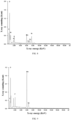
- FIG. 8 is an EDX energy spectrum diagram of the cathode material on the cathode electrode prepared according to Example 20. It can be seen from the figure that, the cathode material contains elements such as Ni, Co, Mn, Fe, O, P, C, and the like. These indicate that the surface of the ternary cathode material contains the component of lithium manganese iron phosphate.
- FIG. 9 is an EDX energy spectrum diagram of the cathode material on the cathode electrode prepared according to Example 26. It can be seen from the figure that, the cathode material contains elements such as Mn, Fe, O, P, C, and the like. These indicate that the surface of the lithium manganate cathode material contains the component of lithium manganese iron phosphate.
- FIG. 10 is an EDX energy spectrum diagram of the cathode material on the cathode electrode prepared according to Example 27. It can be seen from the figure that, the cathode material contains elements such as Co, Mn, Fe, O, P, C, and the like, which indicates that the surface of the lithium cobaltate cathode material contains the component of lithium manganese iron phosphate.
- the cathode materials on the cathode electrodes of Examples 19, 21 to 25, and Examples 28 to 36 have EDX energy spectrum diagrams similar to that of Examples 20, 26, and 27, and will not be repeated here.
- the cathode electrodes of Examples 20, 26, 27 and Comparative Examples 6 to 8 were assembled into coin half-cells, in which all half-cells used lithium sheets as the anode electrode.
- the half-cells made from the cathode electrodes of Example 20 and Comparative Example 6 were charged and discharged at a constant current and constant voltage with a current of 0.2 C in the range of 2.75 V to 4.3 V
- the half-cells made from the cathode electrodes of Example 26 and Comparative Example 7 were charged and discharged at a constant current and constant voltage with a current of 0.2 C in the range of 3.0 V to 4.3 V
- the half-cells made from the cathode electrodes of Example 27 and Comparative Example 8 were charged and discharged at a constant current and constant voltage with a current of 0.2 C in the range of 3.5 V to 4.35 V.
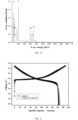
- FIG. 11 is an electrical test curve chart of the coin half-cells assembled from the cathode electrode of Example 20 and Comparative Example 6.
- the discharge specific capacity of the half-cells made from the cathode electrodes of Example 20 and Comparative Example 6 at a current of 0.2 C is 163.5 mAh/g and 162.8 mAh/g, respectively; this shows that the cathode additive of Example 1 does not affect the electrochemical performance of the ternary lithium ion battery.
- the electrical curve of the half-cell made from the cathode electrode of Example 20 has a bend with a small amplitude at the voltage platform of 3.6 V ⁇ 3.4 V, which should be the discharge platform of Fe 2+ /Fe 3+ in the lithium manganese iron phosphate, because the cathode additive in Example 2 is added in a less amount and the bending amplitude is smaller.
- FIG. 12 is an electrical test curve chart of the coin half-cells assembled from the cathode electrode of Example 26 and Comparative Example 7. It can be seen from the figure that, the discharge specific capacities of the half-cells made from the cathode electrodes of Example 26 and Comparative Example 7 at a current of 0.2 C is 109.0 mAh/g and 108.9 mAh/g, respectively; this shows that the cathode additive of Example 8 does not affect the electrochemical performance of the lithium manganate lithium ion battery.
- the electrical curve of Example 26 has a bend with a small amplitude at the voltage platform of 3.6 V ⁇ 3.4 V, which should be the discharge platform of Fe 2+ /Fe 3+ in the lithium manganese iron phosphate, because the cathode additive is added in a less amount and the bending amplitude is smaller.
- FIG. 13 is an electrical test curve chart of the coin half-cells assembled from the cathode electrode of Example 27 and Comparative Example 8. It can be seen from the figure that, the discharge specific capacities of the half-cells made from the cathode electrodes of Example 27 and Comparative Example 8 at a current of 0.2 C is 160.0 mAh/g and 158.7 mAh/g, respectively; this shows that the cathode additive of Example 9 does not affect the electrochemical performance of the lithium cobaltate lithium ion battery.
- the electrical curve of Example 27 has a bend with a small amplitude at the voltage platform of 3.6 V ⁇ 3.4 V, which should be the discharge platform of Fe 2+ /Fe 3+ in the lithium manganese iron phosphate, because the cathode additive is added in a less amount and the bending amplitude is smaller.
- FIG. 14 is a comparison diagram of the rate test of the coin half-cells assembled from the cathode electrode of Example 20 and Comparative Example 6.
- the two types of coin cells were tested three cycles of charge-discharge tests at currents of 0.2 C, 0.5 C, 1 C, and 2 C, respectively, and these data were counted in the comparison diagram. It can be found from the figure that the rate performance of Example 20 is similar to that of Comparative Example 6. This indicates that the cathode additive of Example 2 does not affect the rate performance of the ternary lithium ion battery.
- the cathode electrodes of Examples 19, 21 to 25, Examples 28 to 36, and Comparative Examples 2 to 5 were also assembled into coin half-cells according to the above method.
- the half-cells made from the cathode electrodes of Examples 19, 21 to 25, Examples 29 to 36, and Comparative Examples 2 to 5 were charged and discharged at a constant current and constant voltage with a current of 0.2 C, 1 C, and 2 C in the range of 2.75 V to 4.3 V
- the half-cells made from the cathode electrodes of Example 28 was charged and discharged at a constant current and constant voltage with a current of 0.2 C, 1 C, and 2 C in the range of 3.0 V to 4.3 V
- the discharge specific capacities of the half-cells made from the cathode electrodes of Example 19 to Example 36 and Comparative Example 2 to Comparative Example 8 with a current of 0.2 C, 1 C, and 2 C are shown in Table 5.
- the coin half-cells assembled from the cathode electrodes of Example 19 to Example 36 have discharge specific capacities of at least 110.3 mAh/g, 100.5 mAh/g and 89.2 mAh/g at a current of 0.2 C, 1 C and 2 C, respectively, with higher specific discharge capacity.
- the coin half-cell assembled from the cathode electrode of Example 25 has a specific discharge capacity of at least 198 mAh/g, 186.4 mAh/g and 175.4 mAh/g at a current of 0.2 C, 1 C and 2 C, respectively, which has a higher specific discharge capacity than that of the coin half-cells assembled from the cathode electrodes of Examples 26 to 36.
- the coin half-cells assembled from the cathode electrodes of Example 20 and Comparative Example 3 has the same conditions except for the different types of additives.
- the coin half-cell assembled from Example 20 has a specific discharge capacity at least of 163.9 mAh/g, 153.0 mAh/g and 136.8 mAh/g at a current of 0.2 C, 1 C, and 2 C, respectively; while the coin half-cell assembled from Comparative Example 3 has a specific discharge capacity at least of 140.7 mAh/g, 128.2 mAh/g and 115.3 mAh/g at a current of 0.2 C, 1 C, and 2 C, respectively, which is far worse than that of Example 20.
- Example 20 the lithium manganese iron phosphate with capacity was used as an additive, while in Comparative Example 3, a non-capacity aluminium oxide was used as an additive. If only inorganic materials are used as cathode additives to coat the cathode material, although it can form an artificial passivation layer, reduce the direct contact between the electrolyte and the cathode material, inhibit the dissolution of metal ions, and in extreme cases, it can relieve the irreversible reaction between the cathode material and the electrolyte and thus can make the cathode material have longer cycle and safety stability than the unmodified cathode material, because the inorganic material itself is inert and has no specific capacity, it will reduce the develop of the overallspecific capacity of the cathode material and reduce the energy density of the lithium ion battery.
- the direct contact between the electrolyte and the cathode material is reduced, and the rate performance of the cathode material is also reduced; when lithium manganese iron phosphate is used as a cathode additive, it can not only solve the safety problem of the battery, but at the same time it is a cathode active material itself, which can provide capacity, without significantly reducing the energy density and rate performance of the cathode material.
- the cathode additives containing lithium manganese iron phosphate or using lithium manganese iron phosphate powder the specific capacity of the cathode materials are all increased, and the rate performances are all better; while after using the cathode additives containing only inorganic materials or using inorganic material powder, the specific capacity of the cathode materials are all reduced, and the rate performances are all poor.
- the electrochemical performance of the coin half-cell assembled from the cathode electrode of Comparative Example 4 is far inferior to that of Example 20.
- the cathode electrode of Comparative Example 4 has a lower specific capacity and poor rate performance, and the cathode electrode of Example 20 has a higher specific capacity and better rate performance.
- the primary lithium manganese iron phosphate particles in the cathode additive are uniformly coated on the surface of the cathode material, but the lithium manganese iron phosphate powder is only mixed with the cathode material, the structure of the former is conducive to the improvement of the electrical conductivity of the lithium manganese iron phosphate particles, improving the development of the capacity of lithium manganese iron phosphate;
- the NCM (523)-lithium manganese iron phosphate cathode active material prepared by the fusion pre-coating method and the cathode material using the cathode additive containing lithium manganese iron phosphate have substantially the same specific capacity development and rate performance.
- the cathode electrodes pieces produced in Examples 20, 26, 27 and Comparative Examples 6 to 8 were made into soft-pack full-batteries, and the soft-pack full-batteries were subjected to needle-punch and overcharge tests and electrical performance test.
- the results of needle-punch, the results of overcharge test, and the specific capacities at a current of 1 C of the soft-pack full-batteries obtained from Examples 20, 26, 27 and Comparative Examples 6 to 8 are shown in Table 6.
- Needle-punch test a fully charged soft-pack full-battery was spiked using a smooth stainless steel needle with a diameter of 6 mm at a speed of 2.2cm/s, and observed for 1 hour. No explosion or ignition is a pass.
- the cathode materials on the cathode electrodes of Examples 19, 20 to 25, and 28 to 36 have safety performances similar to that of Examples 20, 26, and 27, and will not be repeated here.
Landscapes
- Chemical & Material Sciences (AREA)
- Chemical Kinetics & Catalysis (AREA)
- Electrochemistry (AREA)
- General Chemical & Material Sciences (AREA)
- Engineering & Computer Science (AREA)
- Materials Engineering (AREA)
- Manufacturing & Machinery (AREA)
- Composite Materials (AREA)
- Inorganic Chemistry (AREA)
- Crystallography & Structural Chemistry (AREA)
- Battery Electrode And Active Subsutance (AREA)
Description
- The present disclosure relates to the field of lithium ion batteries, particularly to a cathode additive and a preparation method thereof, a cathode electrode and a preparation method thereof, and a lithium ion battery.
- In recent years, with the rapid changes of various consumer electronics such as smart phones, tablet computers, electronic wristbands, the rapid growth of the energy-saving and environmentally-friendly electric vehicle market, and the emergence of the energy storage battery market, the market for lithium ion batteries as the power supply of these products has developed rapidly. With the explosive growth of the application fields and markets of the lithium batteries, higher requirements have been placed on the energy density of the lithium ion batteries. For this reason, people have begun to use high-voltage lithium cobaltate (charge cut-off voltage > 4.3 V), high-nickel ternary materials such as LiNi0.6Co0.2Mn0.2O2, LiNi0.8Co0.1Mn0.1O2 and lithium nickel cobalt aluminate, etc. on the cathode material side of lithium ion batteries, which have been commercialized production, while people are still developing high-voltage spinel materials LiNi0.5Mn1.5O4, lithium-rich phase cathode material, etc. The energy density of lithium ion batteries can be effectively increased by the use of these cathode materials.
- The traditional lithium cobaltate material can release specific capacity of 140 mAh/g at a charge cut-off voltage=4.2 V, and the specific capacity can reach 190 mAh/g at a charge cut-off voltage = 4.5 V, and the working voltage has been increased. Currently, as for the batteries in some mobile phones, the lithium cobaltate battery has been charged to 4.35 V Additionally, in order to increase the driving mileage of electric vehicles and reduce the amount of cobalt in the battery, the current ternary materials used in the batteries of electric vehicle are shifting from NCM111 (LiNi1/3Co1/3Mn1/3O2) to NCM523 (LiNi0.5Co0.2Mn0.3O2) and further developing to NCM811 (LiNi0.8Co0.1Mn0.1O2) and NCA (lithium nickel cobalt aluminate). As the content of nickel in the cathode material increases, the specific capacity of the cathode material gradually increases, which helps to increase the energy density of batteries. At the same time, the reduction of the content of cobalt in the ternary material can also reduce the raw material cost of the cathode material. Therefore, it can be said that, currently, lithium ion battery cathode materials are developing towards high voltage and high specific capacity, including enhancing the working voltage of lithium cobaltate materials and increasing the content of nickel in cathode materials.
- However, the interface between the cathode material and the organic electrolyte will be unstable after the working voltage of lithium cobaltate battery is increased, and the cathode in the high voltage state has a very high reactivity, thus the battery is prone to thermal runaway, causing combustion or explosion; while, as for ternary materials, with increasing the content of nickel, the thermal stability of the cathode material rapidly decreases, which also increases a great security hazard. When it is widely used in the power battery pack of electric vehicles, it will cause more serious consequences. Therefore, while pursuing high energy density of batteries, how to ensure the safety of batteries has become a major challenge in the lithium ion battery industry.
-
CN 106129365 B describes a high-safety lithium iron manganese phosphate battery, which includes a positive electrode sheet, a negative electrode sheet, a separator, an electrolyte and a battery casing. The positive electrode sheet includes a positive electrode current collector and a positive electrode current collector coated on the positive electrode current collector. The positive electrode active material layer on the surface contains the following components: 90 to 96 wt% of the positive electrode active material, 1.5 to 5 wt% of the positive electrode conductive agent, and 2 to 5 wt% of the positive electrode binder. The positive electrode conductive agent is conductive carbon black and carbon nanoparticles. At least one of the tubes or graphene is mixed, and based on the weight percentage in the positive active material layer, the ratio of conductive carbon black to at least one other conductive agent is 1wt%: 0.5wt~4wt%: 1wt%; the isolation film is polyethylene The electrolyte is a high-temperature-resistant electrolyte in an olefin film or a non-woven film. -
CN 107546379 A describes a lithium manganese ferric phosphate-ternary material composite positive electrode material and a preparation method therefor. Lithium manganese ferric phosphate nanoparticles are fixed on the surfaces of the ternary material granules through a mechanical fusion method to form a tight porous coating layer. - A method for preparing a cathode electrode comprises the following steps:
- under a condition of continuous stirring, mixing a binder with N-methylpyrrolidone, and adding a conductive material, a cathode additive, and a cathode material to obtain a cathode slurry,
- the cathode additive having been prepared by dispersing a carbon-coated lithium manganese iron phosphate in an organic solvent to obtain the cathode additive and wherein the cathode additive comprises, in percentage by mass, 10% to 40% carbon-coated lithium manganese iron phosphate and an organic solvent, wherein the carbon-coated lithium manganese iron phosphate is dispersed in the organic solvent, and a median particle diameter of the carbon-coated lithium manganese iron phosphate is 30 nm to 100 nm, a mass ratio of the cathode material to the carbon-coated lithium manganese iron phosphate in the cathode additive is 80 : 20 to 99 : 1; and
- preparing the cathode slurry into the cathode electrode;
- wherein the cathode material is at least one selected from a group consisting of a nickel cobalt manganese ternary material, a nickel cobalt aluminum ternary material, lithium nickel manganese oxide, lithium manganate, and lithium cobaltate.
- The details of one or more embodiments of the present disclosure are set forth in the accompanying drawings and the description below. Other features, objects and advantages of the present disclosure will become apparent from the description, the accompanying drawings, and the claims.
- To illustrate the technical solutions of the embodiments of the present disclosure or the prior art more clearly, the accompany drawings for describing the embodiments or the prior art are introduced briefly in the following. Apparently, the accompanying drawings in the following description are only some embodiments of the present disclosure, and persons of ordinary skill in the art can derive accompany drawings of the other embodiments from these accompanying drawings without any creative efforts.
-
FIG. 1 is a flowchart of a method for preparing a cathode electrode according to an embodiment. -
FIG. 2a is a scanning electron microscope image of the cathode material on the cathode electrode prepared according to Comparative Example 6. -
FIG. 2b is a scanning electron microscope image ofFIG. 2a at 10 magnification. -
FIG. 3a is a scanning electron microscope image of the cathode material on the cathode electrode prepared according to Example 20. -
FIG. 3b is a scanning electron microscope image ofFIG. 3a at 10 magnification. -
FIG. 4a is a scanning electron microscope image of the cathode material on the cathode electrode prepared according to Comparative Example 7. -
FIG. 4b is a scanning electron microscope image ofFIG. 4a at 10 magnification. -
FIG. 5a is a scanning electron microscope image of the cathode material on the cathode electrode prepared according to Example 26. -
FIG. 5b is a scanning electron microscope image ofFIG. 5a at 10 magnification. -
FIG. 6a is a scanning electron microscope image of the cathode material on the cathode electrode prepared according to Comparative Example 8. -
FIG. 6b is a scanning electron microscope image ofFIG. 6a at 10 magnification. -
FIG. 7a is a scanning electron microscope image of the cathode material on the cathode electrode prepared according to Example 27. -
FIG. 7b is a scanning electron microscope image ofFIG. 7a at 10 magnification. -
FIG. 8 is an EDX energy spectrum diagram of the cathode material on the cathode electrode prepared according to Example 20. -
FIG. 9 is an EDX energy spectrum diagram of the cathode material on the cathode electrode prepared according to Example 26. -
FIG. 10 is an EDX energy spectrum diagram of the cathode material on the cathode electrode prepared according to Example 27. -
FIG. 11 is an electrical test curve chart of the coin half-cells assembled from the cathode electrode of Example 20 and Comparative Example 6. -
FIG. 12 is an electrical test curve chart of the coin half-cells assembled from the cathode electrode of Example 26 and Comparative Example 7. -
FIG. 13 is an electrical test curve chart of the coin half-cells assembled from the cathode electrode of Example 27 and Comparative Example 8. -
FIG. 14 is a comparison diagram of the rate test of the coin half-cells assembled from the cathode electrode of Example 20 and Comparative Example 6. - For the convenience of understanding the present disclosure, embodiments of the disclosure are described more fully hereinafter with reference to the accompanying drawings.
- A cathode additive is a dispersion liquid of lithium manganese iron phosphate, which comprises, in percentage by mass, 10% to 40% carbon-coated lithium manganese iron phosphate (LMFP) and an organic solvent, and the carbon-coated lithium manganese iron phosphate is dispersed in the organic solvent.
- Wherein, the median particle diameter (D50) of the carbon-coated lithium manganese iron phosphate is 30 nm to 100 nm. If the median particle diameter of the carbon-coated lithium manganese iron phosphate is greater than 100 nm, the cathode material cannot be coated well, which will affect the specific capacity of the cathode material, resulting in a lower specific capacity of the cathode material. The carbon-coated lithium manganese iron phosphate can be purchased commercially. Generally, the mass percentage of carbon in the carbon-coated lithium manganese iron phosphate is 2% to 15%.
- Wherein, the organic solvent may be an organic solvent commonly used in the art. Specifically, the organic solvent is at least one selected from the group consisting of N-methylpyrrolidone (NMP) and N, N-dimethylformamide (DMF).
- The preparation steps of the cathode additive includes: dispersing the carbon-coated lithium manganese iron phosphate in an organic solvent to obtain a dispersion liquid of the carbon-coated lithium manganese iron phosphate, thereby obtaining the cathode additive. Specifically, by grinding the carbon-coated lithium manganese iron phosphate in an organic solvent, the carbon-coated lithium manganese iron phosphate is dispersed in the organic solvent to form the dispersion liquid. That is, the agglomerated carbon-coated lithium manganese iron phosphate is dispersed by grinding, so that the carbon-coated lithium manganese iron phosphate in the cathode additive becomes primary particles, that is, the median particle diameter (D50) is 30 nm to 100 nm.
- Furthermore, the median particle diameter (D50) of the carbon-coated lithium manganese iron phosphate is 60 nm to 80 nm. If the particle diameter of the carbon-coated lithium manganese iron phosphate is too small, the cost is high, and the production cost of the cathode material is increased. The carbon-coated lithium manganese iron phosphate in this particle diameter range can not only ensure that the cathode additive has a suitable cost, but also can coat the cathode material well, and make the cathode material have a higher specific capacity.
- Further, the cathode additive also includes a binder with a mass percentage of less than 2%. Too much binder will affect the electrical properties of the cathode materials. Wherein, the binder may be a binder commonly used in the art. Specifically, the binder is polyvinylidene fluoride (PVDF) or styrene butadiene rubber (SBR). At this time, the cathode additive is prepared by the following steps: mixing the binder and the organic solvent with stirring until they are completely dissolved, and then adding carbon-coated lithium manganese iron phosphate to obtain the cathode additive.
- Further, the cathode additive also includes an inorganic material with a mass percentage of less than 0.5%. The inorganic material is at least one selected from the group consisting of nano-aluminum oxide, nano-titanium oxide, and nano-magnesium oxide, and these inorganic materials are inert metal oxide materials. The above content of the inorganic material may effectively block the reactions between the cathode material and the electrolyte, and can further improve safety and reliability. However, too much inorganic material will affect the performance of the specific capacity of the cathode material. At this time, when preparing the cathode additive, the inorganic material is also added in the step of adding carbon-coated lithium manganese iron phosphate.
- Furthermore, the mass ratio of the inorganic material to the carbon-coated lithium manganese iron phosphate is less than 1:20. If there is too much the inorganic material, it will lead to the poor electrical conductivity of the cathode material, resulting in the lower specific capacity of the cathode material.
- Further, the cathode additive also includes a conductive agent with a mass percentage of less than 10%. Too much conductive agent will reduce the content of active material and cause a decrease in capacity. Wherein, the conductive agent may be a conductive agent commonly used in the art. Specifically, the conductive agent is at least one selected from the group consisting of acetylene black, Ketjen black, graphene and carbon nanotube, which are all nanocarbon and are commonly used conductive agents for lithium ion batteries. Therefore, these substances are also used as conductive agents in the cathode additives. At this time, when preparing the cathode additive, a conductive agent is also added in the step of adding carbon-coated lithium manganese iron phosphate.
- Further, the mass percentage of solid in the cathode additive is 10% to 45%. The cathode additive with this solid content is moderately viscous. If the concentration is too high, the cathode additive has poor fluidity and is not easy to use; if the concentration is too low, the cathode additive will be used too much in the later stage, resulting in a waste of solvent, thus it is uneconomical. Further, the mass percentage of solids in the cathode additive is 25% to 30%.
- The above-mentioned cathode additive has at least the following advantages:
- (1) It is found via experiments that the cathode additive of the above formula is added to the cathode material and together with the cathode material to make a cathode electrode, which not only reduces the direct contact area between the cathode material on the cathode electrode and the electrolyte, to reduce adverse reactions between the cathode material and the electrolyte and thus reducing the dissolution of the transition metal ions in the cathode material into the electrolyte, but also can even reduce the possibility of dangers, such as burning, exploding, and the like, of lithium ion battery, under extreme conditions such as puncture, short-circuit, overcharge, and high temperature occurred in the lithium ion battery, so that the lithium ion battery has a higher safety performance, while it can also ensure that the cathode material has a higher specific capacity and a rate performance, so that the lithium ion battery has a higher energy density.
- (2) The carbon-coated lithium manganese iron phosphate can be better dispersed in the organic solvent through adding a binder to the cathode additive, and it is not easy to settle in the organic solvent, reducing the weighing error during mixing cathode slurry.
- (3) Mixing the carbon-coated lithium manganese iron phosphate and a conductive agent uniformly through adding the conductive agent to the cathode additive can improve the electrical conductivity of the carbon-coated lithium manganese iron phosphate material itself, thereby increasing the specific capacity of the cathode material.
- As shown in
FIG. 1 , a method for preparing a cathode electrode according to an embodiment includes the following steps: - Step S110: mixing a cathode material, a cathode additive, a binder, a conductive material, and N-methylpyrrolidone to obtain a cathode slurry.
- Step S110 includes: under the condition of continuous stirring, mixing the binder with the N-methylpyrrolidone, and adding the conductive material, the cathode additive and the cathode material successively, to mix the cathode slurry more uniformly.
- Wherein, the cathode material is at least one selected from the group consisting of a nickel cobalt manganese ternary material (NCM), a nickel cobalt aluminum ternary material (NCA), lithium manganate (LiMn2O4) and lithium cobaltate (LiCoO2).
- Wherein, the general structural formula of the nickel cobalt manganese ternary material is LiNi1-y-zCoyMnzO2, where 0<y<1, 0<z<1, y+z<1.
- Wherein, the general structural formula of lithium nickel cobalt aluminate ternary material (NCA) is LiNi1-y-zCoyAlzO2, where 0<y<1, 0<z<1, y+z<1, 1-y-z≥0.8.
- Further, the median particle diameter of the cathode material is 3 µm to 20 µm.
- Wherein, the cathode additive is the aforementioned cathode additive, which will not be further described here. The mass ratio of the cathode material to the carbon-coated lithium manganese iron phosphate in the cathode additive is 80 : 20 to 99 : 1. If the mass ratio of the cathode material to the carbon-coated lithium manganese iron phosphate in the cathode additive is greater than 99 : 1, it cannot provide sufficient safety, and if the mass ratio thereof is less than 80 : 20, the production cost of the cathode electrode is too high, and will result in a low compaction of the cathode electrode. When the usage amount of the additive is between 60 : 40 to 80 : 20, it can also improve the safety, but it will cause a decrease in energy density.
- Wherein, the binder may be a binder commonly used in the art. Specifically, the binder is polyvinylidene fluoride.
- Wherein, the conductive material may be a conductive agent commonly used in the art. The conductive material is composed of acetylene black and carbon nanotube with a mass ratio of 1 : 0.1 ~ 1 : 2. If the mass ratio of the cathode material to the carbon-coated lithium manganese iron phosphate in the cathode additive is greater than 99 : 1, it cannot provide sufficient safety, and if the mass ratio thereof is less than 80 : 20, the production cost of the cathode electrode is too high, and will result in a low compaction of the cathode electrode. When the usage amount of the additive is between 60 : 40 to 80 : 20, it can also improve the safety, but it will cause a decrease in energy density.
- Wherein, N-methylpyrrolidone is the organic solvent.
- Further, the mass ratio of the total amount of the cathode material and the carbon-coated lithium manganese iron phosphate in the cathode additive to the binder and the conductive material is (94 to 98.49): (1.5 to 3) : (0.01 to 3) .
- Step S120: preparing the cathode slurry into a cathode electrode.
- Specifically, the step of preparing the cathode slurry into a cathode electrode includes: coating the cathode slurry on a current collector and then drying to obtain a cathode electrode. The current collector may be a cathode current collector commonly used in the art, such as aluminum foil, nickel foam, and the like.
- The above-mentioned method for preparing a cathode electrode has at least the following advantages:
- (1) The above-mentioned method for preparing a cathode electrode has simple operation and is easy for industrial production.
- (2) The above-mentioned method for preparing a cathode electrode, through making the cathode additive of the above formula, and the cathode material, the binder, the conductive material and N-methylpyrrolidone together to prepare a cathode slurry, and then making the cathode slurry into a cathode electrode, results in that the direct contact area between the cathode material on the cathode electrode and the electrolyte is less, reducing adverse reactions between the cathode material and the electrolyte and thus reducing the dissolution of the metal ions in the cathode material into the electrolyte, and can even reduce the possibility of dangers, such as burning, exploding, and the like, of lithium ion battery, under extreme conditions such as puncture, short-circuit, overcharge, and high temperature occurred in the lithium ion battery, so that the lithium ion battery has a higher safety performance, while it can also make the cathode have a higher specific capacity and a rate performance, so that the lithium ion battery has a higher energy density.
- A cathode electrode is prepared by the method described above for preparing a cathode electrode. The cathode electrode not only has a higher specific capacity and a higher rate performance, which is beneficial to increase the energy density of the lithium ion battery, but also has a better cycle performance, which is beneficial to improve the cycle life and safety performance of the lithium ion battery.
- A lithium ion battery includes the above-mentioned cathode electrode. The lithium ion battery has a higher energy density, a longer cycle life and a better safety performance.
- The following is the part of the specific examples (the following examples do not contain any other unspecified component other than the unavoidable impurities unless otherwise specified):
- The preparation process of the cathode additives of Examples 1 to 10 are as follows:
Each raw material was weighed, in percentage by mass, according to Table 1; a binder and an organic solvent were mechanically stirred and mixed for 1 hour to obtain a premixed solution, then the carbon-coated lithium manganese iron phosphate, an inorganic material and a conductive agent were added into the premixed solution, the mixture was mechanically stirred for 0.5 hours, and then ground in a sand mill for 2 hours, to disperse lithium manganese iron phosphate, the inorganic material and the conductive agent in the premixed solution to obtain a cathode additive. Wherein, the mass percentages of carbon in the carbon-coated lithium manganese iron phosphate used in Examples 1-10 are shown in Table 2.Table 1 Exa mple Carbon-coated lithium manganese iron phosphate Inorganic material Binder Conductive agent Organ ic solven t Solid content (wt%) of cathode additive Median particle diamet er (nm) Cont ent (%) Material Cont ent (%) Mate rial Con tent (%) Material Cont ent (%) Exa mple 1 30 10 nano-alum inium oxide 0.2 PVD F 2.0 graphene 0.01 NMP 12.21 Exa mple 2 60 20 nano-titani um oxide 0.01 PVD F 0.01 carbon nanotube 1 NMP 21.02 Exa mple 3 80 30 nano-mag nesium oxide 0.5 SBR 0.5 Ketjen black 0.5 DMF 31.5 Exa mple 4 100 40 nano-alum inium oxide : nano-titani um oxide =1:1 0.1 SBR 1 acetylene black 2 DMF 43.1 Exa mple 5 60 25 nano-titani um oxide : nano-aluminium oxide : nano-mag nesium oxide = 1 : 3 : 6 0.4 PVD F 0.8 acetylene black 2 NMP 28.2 Exa mple 6 65 27 nano-alum inium oxide 0.1 PVD F 0.1 carbon nanotube graphene = 1 : 1 1 NMP 28.2 Exa mple 7 70 27 nano-titani um oxide 0.2 PVD F 0.2 carbon nanotube 0.2 NMP 27.6 Exa mple 8 60 28 nano-titani um oxide 0.05 SBR 0.8 Ketjen black 0.6 DMF 29.45 Exa mple 9 60 25 nano-mag nesium oxide 0.2 SBR 0.6 graphene 0.1 DMF 25.9 Exa mple 10 60 25 nano-alum inium oxide 0.2 PVD F 0.3 acetylene black 0.5 DMF NMP = 1:2 26 Exa mple 11 70 27 -- -- -- -- -- -- NMP 27 Exa mple 12 70 27 nano-titani um oxide 0.2 -- -- -- -- NMP 27.2 Exa mple 13 70 27 -- -- PVD F 0.4 -- -- NMP 27.4 Example 14 70 27 -- -- -- -- carbon nanotube 0.2 NMP 27.2 Exa mple 15 70 27 nano-titani um oxide 0.2 PVD F 0.4 -- -- NMP 27.6 Exa mple 16 70 27 nano-titani um oxide 0.2 -- -- carbon nanotube 0.2 NMP 27.4 Exa mple 17 70 20 nano-titani um oxide 0.01 PVD F 0.01 carbon nanotube 5.78 NMP 25.8 Exa mple 18 70 18 nano-titani um oxide 0.05 PVD F 0.03 carbon nanotube 10 NMP 28.08 - Wherein, the "--" in Table 1 represents that the material is not present or the content of the material is 0; and in the column of "Material" of the inorganic material in Table 1, nano-aluminium oxide : nano-titanium oxide = 1 : 1, and nano-titanium oxide : nano-aluminium oxide : nano-magnesium oxide = 1 : 3 : 6, represent the mass ratio, in the column of "Material" of the conductive agent, carbon nanotube : graphene = 1 : 1 represents the mass ratio, and in the column of "Organic solvent", DMF : NMP = 1 : 2 represents the mass ratio.
Table 2 Exam ple 1 Exam ple 2Exam ple 3 Exam ple 4 Exam ple 5 Exam ple 6Exam ple 7Exam ple 8Exam ple 9 Exam ple 10Carbon content (wt%) 9 5 8 4 2 7 15 8 13 10 - The preparation process of the cathode additive of this example is roughly the same as that of Example 7, the difference is that, the preparation of the cathode additive in step (1) of this example is different. The cathode additive of this example does not contain an inorganic material, a binder and a conductive agent, the preparation process is as follows:
Each raw material was weighed, in percentage by mass, according to Table 1; an organic solvent and the carbon-coated lithium manganese iron phosphate were mechanically stirred and mixed for 0.5 hours, and then ground in a sand mill for 2 hours, to obtain a cathode additive. Wherein, the mass percentage of carbon in the carbon-coated lithium manganese iron phosphate used in this example is the same as that of Example 7. - The preparation process of the cathode additive of this example is roughly the same as that of Example 7, the difference is that, the preparation of the cathode additive in step (1) of this example is different. The cathode additive of this example does not contain a conductive agent and a binder, the preparation process is as follows:
Each raw material was weighed, in percentage by mass, according to Table 1; the carbon-coated lithium manganese iron phosphate and an inorganic material were added to an organic solvent, the mixture was mechanically stirred for 0.5 hours, and then ground in a sand mill for 2 hours, to obtain a cathode additive. Wherein, the mass percentage of carbon in the carbon-coated lithium manganese iron phosphate used in this example is the same as that of Example 7. - The preparation process of the cathode additive of this example is roughly the same as that of Example 7, the difference is that, the preparation of the cathode additive in step (1) of this example is different. The cathode additive of this example does not contain an inorganic material and a conductive agent, the preparation process is as follows:
Each raw material was weighed, in percentage by mass, according to Table 1; a binder and an organic solvent were mechanically stirred and mixed for 1 hour to obtain a premixed solution, then the carbon-coated lithium manganese iron phosphate was added to the premixed solution, the mixture was mechanically stirred for 0.5 hours, and then ground in a sand mill for 2 hours, to obtain a cathode additive. Wherein, the mass percentage of carbon in the carbon-coated lithium manganese iron phosphate used in this example is the same as that of Example 7. - The preparation process of the cathode additive of this example is roughly the same as that of Example 7, the difference is that, the preparation of the cathode additive in step (1) of this example is different. The cathode additive of this example does not contain an inorganic material and a binder, the preparation process is as follows:
Each raw material was weighed, in percentage by mass, according to Table 1; a conductive agent and the carbon-coated lithium manganese iron phosphate were added to a premixed solution, then the mixture was mechanically stirred for 0.5 hours, and then ground in a sand mill for 2 hours, to obtain a cathode additive. Wherein, the mass percentage of carbon in the carbon-coated lithium manganese iron phosphate used in this example is the same as that of Example 7. - The preparation process of the cathode additive of this example is roughly the same as that of Example 7, the difference is that, the preparation of the cathode additive in step (1) of this example is different. The cathode additive of this example does not contain a conductive agent, the preparation process is as follows:
Each raw material was weighed, in percentage by mass, according to Table 1; a binder and an organic solvent were mechanically stirred and mixed for 1 hour to obtain a premixed solution, then an inorganic material and the carbon-coated lithium manganese iron phosphate were added into the premixed solution, the mixture was mechanically stirred for 0.5 hours, and then ground in a sand mill for 2 hours, to obtain a cathode additive. Wherein, the mass percentage of carbon in the carbon-coated lithium manganese iron phosphate used in this example is the same as that of Example 7. - The preparation process of the cathode additive of this example is roughly the same as that of Example 7, the difference is that, the preparation of the cathode additive in step (1) of this example is different. The cathode additive of this example does not contain a binder, the preparation process is as follows:
Each raw material was weighed, in percentage by mass, according to Table 1; the carbon-coated lithium manganese iron phosphate, an inorganic material and a conductive agent were added to an organic solvent, the mixture was mechanically stirred for 0.5 hours, and then ground in a sand mill for 2 hours, to obtain a cathode additive. Wherein, the mass percentage of carbon in the carbon-coated lithium manganese iron phosphate used in this example is the same as that of Example 7. - The preparation process of the cathode additive of Example 17 and Example 18 is roughly the same as that of Example 7, the difference is that, the mass percentage of each raw material is different. Wherein, the preparation processes of the cathode additive of Example 17 and Example 18 are shown in Table 1, the mass percentages of carbon in the carbon-coated lithium manganese iron phosphate used in Example 17 and Example 18 are the same as that in Example 7.
- The preparation process of the cathode additive of Comparative Example 1 is roughly the same as that of Example 1, the difference is that, the preparation of the cathode additive in step (1) of this example is different. The cathode additive of this example does not contain the carbon-coated lithium manganese iron phosphate. In this case, in the cathode additive, the mass percentage of the inorganic material is 10.2%, the mass percentage of the binder is 1.5%, the mass percentage of the conductive agent is 0.01%, and the solid content of the cathode additive is 11.71wt% . Wherein, the mass percentage of carbon in the carbon-coated lithium manganese iron phosphate used in this example is the same as that of Example 1.
- The preparation processes of the cathode electrodes of Examples 19 to 34 are as follows:
According to the specific materials and proportions in Table 3, a binder and N-methylpyrrolidone were stirred and mixed for 30 minutes, then a conductive material was added under continuous stirring, after stirring and mixing for 30 minutes, the cathode additive prepared from Examples 1 to 18 was added, then the mixture was stirred and mixed for 30 minutes and then the cathode material was added, the mixture was finally stirred and mixed for 12 hours, to obtain a cathode slurry. The cathode slurry was coated on a current collector and dried at 110°C, to obtain a cathode electrode. Wherein, the particle diameters of the cathode materials of Examples 19-28 are as shown in Table 3, and the particle diameters of the cathode materials of Examples 29 to 36 are the same as that of Example 25. - In Table 3, A represents the mass of the cathode material, and B represents the mass of the carbon-coated lithium manganese iron phosphate in the cathode additive. Then, the sum of the mass of the cathode material and the carbon-coated lithium manganese iron phosphate in the cathode additive is recorded as A + B, the mass ratio of the cathode material to the carbon-coated lithium manganese iron phosphate in the cathode additive is recorded as A : B; C represents the mass of the binder, D represents the mass of the conductive material, (A + B) : C : D represents the mass ratio of the three, the total amount of the cathode material and the carbon-coated lithium manganese iron phosphate in the cathode additive, the binder, and the conductive material.
Table 3 Cathode material Cathode additive Binder Conductive material A: B (A + B) : C : D Example 19 NCM (523) Example 1 PVDF acetylene black and carbon nanotube with a mass ratio of 1 : 2 99 : 1 95 : 2.5 : 2.5 Example 20 NCM (523) Example 2 PVDF acetylene black and carbon nanotube with a mass ratio of 1 : 2 93 : 7 97 : 1.5 : 1.5 Example 21 NCM (622) Example 3 PVDF acetylene black and carbon nanotube with a mass ratio of 1 : 2 90 : 10 96 : 2 : 2 Example 22 NCM (523) and LiCoO2 with a mass ratio of 1 : 1 Example 4 PVDF acetylene black and carbon nanotube with a mass ratio of 1 : 2 88 : 12 97 : 2 : 1 Example 23 NCM (811) Example 5 PVDF acetylene black and carbon nanotube with a mass ratio of 1 : 2 90 : 10 95 : 3 : 2 Example 24 NCM (622) and LiMn2O4 with a mass ratio of 1 : 1 Example 6 PVDF acetylene black and carbon nanotube with a mass ratio of 1 : 2 85 : 15 97 : 1 : 2 Example 25 LiNi0.8Co0.15 Al0.05O2 Example 7 PVDF acetylene black and carbon nanotube with a mass ratio of 1 : 2 88 : 12 97 : 1.5 : 1.5 Example 26 LiMn2O4 Example 8 PVDF acetylene black and carbon nanotube with a mass ratio of 1 : 2 93 : 7 97 : 1.5 : 1.5 Example 27 LiCoO2 Example 9 PVDF acetylene black and carbon nanotube with a mass ratio of 1 : 2 90 : 10 97 : 2 : 1 Example 28 LiMn2O4 Example 10 PVDF acetylene black and carbon nanotube with a mass ratio of 1 : 2 80 : 20 94 : 3 : 3 Example 29 LiNi0.8Co0.15 Al0.05O2 Example 11 PVDF acetylene black and carbon nanotube with a mass ratio of 1 : 2 88 : 12 97 : 1.5 : 1.5 Example 30 LiNi0.8Co0.15 Al0.05O2 Example 12 PVDF acetylene black and carbon nanotube with a mass ratio of 1 : 2 88 : 12 97 : 1.5 : 1.5 Example 31 LiNi0.8Co0.15 Al0.05O2 Example 13 PVDF acetylene black and carbon nanotube with a mass ratio of 1 : 2 88 : 12 97 : 1.5 : 1.5 Example 32 LiNi0.8Co0.15 Al0.05O2 Example 14 PVDF acetylene black and carbon nanotube with a mass ratio of 1 : 2 88 : 12 97 : 1.5 : 1.5 Example 33 LiNi0.8Co0.15 Al0.05O2 Example 15 PVDF acetylene black and carbon nanotube with a mass ratio of 1 : 2 88 : 12 97 : 1.5 : 1.5 Example 34 LiNi0.8Co0.15 Al0.05O2 Example 16 PVDF acetylene black and carbon nanotube with a mass ratio of 1 : 2 88 : 12 97 : 1.5 : 1.5 Example 35 NCM (523) Example 17 PVDF acetylene black and carbon nanotube with a mass ratio of 1 : 1 93 : 7 98 : 1.5 : 0.5 Example 36 NCM (622) Example 18 PVDF acetylene black and carbon nanotube with a mass ratio of 1 : 0.1 90 : 10 98.49 : 1.5 : 0.01 - Wherein, NCM (523) represents LiNi0.5Co0.3Mn0.2O2; NCM (622) represents LiNi0.6Co0.2Mn0.2O2; and NCM (811) represents LiNi0.8Co8.1Mn0.1O2.
Table 4 Exam ple 19 Exam ple 20Exam ple 21 Exam ple 22 Exam ple 23 Exam ple 24 Exam ple 25 Exam ple 26Exam ple 27Exam ple 28 Particle diameter (micron) of cathode material 10 12 3 20 8 15 18 5 6 14 - The preparation process of the cathode electrode of Comparative Example 2 is roughly the same as that of Example 19, the difference is that, the cathode additive of Comparative Example 1 is used for the cathode elctrode of Comparative Example 2.
- The preparation process of the cathode electrode of Comparative Example 3 is as follows:
A binder and N-methylpyrrolidone were stirred and mixed for 30 minutes, then a conductive material was added under continuous stirring, after stirring and mixing for 30 minutes, nano-aluminum oxide was added, then the mixture was stirred and mixed for 30 minutes and then NCM (523) cathode material was added, the mixture was finally stirred and mixed for 12 hours, to obtain a cathode slurry. The cathode slurry was coated on a current collector and dried at 110°C, to obtain a cathode electrode. Wherein, the cathode material, binder, conductive material and N-methylpyrrolidone are the same as that in Example 20, and the addition ratio is also the same as that in Example 20. The mass ratio of the cathode material to aluminum oxide in Comparative Example 3 is 93 : 7, and the sum of the mass of the cathode material and aluminum oxide : the mass of the binder: the mass of the conductive material = 97 : 1.5 : 1.5. - The preparation process of the cathode electrode of Comparative Example 4 is as follows:
A binder and N-methylpyrrolidone were stirred and mixed for 30 minutes, then a conductive material was added under continuous stirring, after stirring and mixing for 30 minutes, carbon-coated lithium manganese iron phosphate was added, then the mixture was stirred and mixed for 30 minutes and then a cathode material was added, the mixture was finally stirred and mixed for 12 hours, to obtain a cathode slurry. The cathode slurry was coated on a current collector and dried at 110°C, to obtain a cathode electrode. Wherein, the cathode material, binder, conductive material and N-methylpyrrolidone are the same as that in Example 20, and the addition ratio is also the same as that in Example 20. The mass ratio of the cathode material to the carbon-coated lithium manganese iron phosphate in Comparative Example 4 is 93 : 7, and the sum of the mass of the cathode material and aluminum oxide : the mass of the binder: the mass of the conductive material = 97 : 1.5 : 1.5. - The preparation process of the cathode electrode of Comparative Example 5 is as follows:
The carbon-coated lithium manganese iron phosphate and NCM (523) were mechanically fused at a mass ratio of 93 : 7 for 15 minutes, then a conductive agent and a binder were added, and then the mechanical fusion was continued for 15 minutes, to obtain a cathode active material; the binder and N-methylpyrrolidone was stirred and mixed for 30 minutes, and then the conductive material was added under continuous stirring. After stirring and mixing for 30 minutes, a cathode active material was added, the mixture was finally stirred and mixed for 12 hours, to obtain a cathode slurry. The cathode slurry was coated on a current collector and dried at 110°C, to obtain a cathode electrode. Wherein, the conductive agent and the binder of Comparative Example 5 are the same as that of Example 1. The mass ratio of the conductive agent and the carbon-coated lithium manganese iron phosphate is 1 : 14.3. The mass ratio of the binder to the carbon-coated lithium manganese iron phosphate is 1 : 19. The binder, conductive material, and N-methylpyrrolidone are the same as that in Example 20, and the addition ratio is the same as that of Example 20. In Comparative Example 5, the mass of the cathode active material: the mass of the binder: the mass of the conductive material = 97 : 1.5 : 1.5. - The preparation process of the cathode electrode of Comparative Example 6 is as follows:
A binder and N-methylpyrrolidone were stirred and mixed for 30 minutes, then a conductive material was added under continuous stirring, after stirring and mixing for 30 minutes, NCM (523) cathode material was added, the mixture was finally stirred and mixed for 12 hours, to obtain a cathode slurry. The cathode slurry was coated on a current collector and dried at 110°C, to obtain a cathode electrode. Wherein, the binder, conductive material and N-methylpyrrolidone are the same as that in Example 20, in Comparative Example 6, the mass of the cathode material : the mass of the binder: the mass of the conductive material = 97 : 1.5 : 1.5. - The preparation process of the cathode electrode of Comparative Example 7 is as follows:
A binder and N-methylpyrrolidone were stirred and mixed for 30 minutes, then a conductive material was added under continuous stirring, after stirring and mixing for 30 minutes, LiMn2O4 cathode material was added, the mixture was finally stirred and mixed for 12 hours, to obtain a cathode slurry. The cathode slurry was coated on a current collector and dried at 110°C, to obtain a cathode electrode. Wherein, the binder, conductive material and N-methylpyrrolidone are the same as that in Example 26, in Comparative Example 7, the mass of the cathode material: the mass of the binder: the mass of the conductive material = 97 : 1.5 : 1.5. - The preparation process of the cathode electrode of Comparative Example 8 is as follows:
A binder and N-methylpyrrolidone were stirred and mixed for 30 minutes, then a conductive material was added under continuous stirring, after stirring and mixing for 30 minutes, LiCoO2 cathode material was added, the mixture was finally stirred and mixed for 12 hours, to obtain a cathode slurry. The cathode slurry was coated on a current collector and dried at 110°C, to obtain a cathode electrode. Wherein, the binder, conductive material and N-methylpyrrolidone are the same as that in Example 27, in Comparative Example 8, the mass of the cathode material: the mass of the binder: the mass of the conductive material = 97 : 2 : 1. -
FIG. 2a is a scanning electron microscope (SEM) image of the cathode material on the cathode electrode prepared in Comparative Example 6, andFIG. 2b is a magnified view ofFIG. 2a at 10 magnification. It can be seen from the figures that, the particle surface of the cathode material is coated with a layer of conductive materials, and a uniform network layer structure is formed between the conductive materials. -
FIG. 3a is a (SEM) scanning electron microscope image of the cathode material on the cathode electrode prepared in Example 20, andFIG. 3b is a magnified view ofFIG. 3a at 10 magnification. It can be seen from the figures that, the lithium manganese iron phosphate and the conductive agent form a uniform network layer structure, which is uniformly and densely coated on the particle surface of the cathode material, and the particle diameter of the lithium manganese iron phosphate is about 60 nm. -
FIG. 4a is a scanning electron microscope image of the cathode material on the cathode electrode prepared in Comparative Example 7, andFIG. 4b is a magnified view ofFIG. 4a at 10 magnification. It can be seen from the figures that, the irregular particle surface of the cathode material is coated with a layer of conductive materials, and a uniform network layer structure is formed between the conductive materials. -
FIG. 5a is a scanning electron microscope image of the cathode material on the cathode electrode prepared in Example 26, andFIG. 5b is a magnified view ofFIG. 5a at 10 magnification. It can be seen from the figures that, the lithium manganese iron phosphate and the conductive agent form a uniform network layer structure, which is uniformly and densely coated on the irregular particle surface of the lithium manganate material, and the particle diameter of the lithium manganese iron phosphate is about 60 nm. -
FIG. 6a is a scanning electron microscope image of the cathode material on the cathode electrode prepared in Comparative Example 8, andFIG. 6b is a magnified view ofFIG. 6a at 10 magnification. It can be seen from the figures that, the spherical particle surface of the cathode material is coated with a layer of conductive materials, and a uniform network layer structure is formed between the conductive materials. -
FIG. 7a is a scanning electron microscope image of the cathode material on the cathode electrode prepared in Example 27, andFIG. 7b is a magnified view ofFIG. 7a at 10 magnification. It can be seen from the figures that, the lithium manganese iron phosphate particles and the conductive agent form a uniform network layer structure, which is uniformly and densely coated on the sphere-like particle surface of the cathode material; the particle diameter of the lithium manganese iron phosphate is about 60 nm. - Wherein, the cathode materials on the cathode electrodes of Examples 19, 21 to 25, and Examples 28 to 36 have morphology similar to that of Examples 20, 26, and 27, and will not be repeated here.
-
FIG. 8 is an EDX energy spectrum diagram of the cathode material on the cathode electrode prepared according to Example 20. It can be seen from the figure that, the cathode material contains elements such as Ni, Co, Mn, Fe, O, P, C, and the like. These indicate that the surface of the ternary cathode material contains the component of lithium manganese iron phosphate. -
FIG. 9 is an EDX energy spectrum diagram of the cathode material on the cathode electrode prepared according to Example 26. It can be seen from the figure that, the cathode material contains elements such as Mn, Fe, O, P, C, and the like. These indicate that the surface of the lithium manganate cathode material contains the component of lithium manganese iron phosphate. -
FIG. 10 is an EDX energy spectrum diagram of the cathode material on the cathode electrode prepared according to Example 27. It can be seen from the figure that, the cathode material contains elements such as Co, Mn, Fe, O, P, C, and the like, which indicates that the surface of the lithium cobaltate cathode material contains the component of lithium manganese iron phosphate. - Wherein, the cathode materials on the cathode electrodes of Examples 19, 21 to 25, and Examples 28 to 36 have EDX energy spectrum diagrams similar to that of Examples 20, 26, and 27, and will not be repeated here.
- The cathode electrodes of Examples 20, 26, 27 and Comparative Examples 6 to 8 were assembled into coin half-cells, in which all half-cells used lithium sheets as the anode electrode. The half-cells made from the cathode electrodes of Example 20 and Comparative Example 6 were charged and discharged at a constant current and constant voltage with a current of 0.2 C in the range of 2.75 V to 4.3 V, the half-cells made from the cathode electrodes of Example 26 and Comparative Example 7 were charged and discharged at a constant current and constant voltage with a current of 0.2 C in the range of 3.0 V to 4.3 V, and the half-cells made from the cathode electrodes of Example 27 and Comparative Example 8 were charged and discharged at a constant current and constant voltage with a current of 0.2 C in the range of 3.5 V to 4.35 V.
-
FIG. 11 is an electrical test curve chart of the coin half-cells assembled from the cathode electrode of Example 20 and Comparative Example 6. The discharge specific capacity of the half-cells made from the cathode electrodes of Example 20 and Comparative Example 6 at a current of 0.2 C is 163.5 mAh/g and 162.8 mAh/g, respectively; this shows that the cathode additive of Example 1 does not affect the electrochemical performance of the ternary lithium ion battery. At the same time, it can be found in the figure that, the electrical curve of the half-cell made from the cathode electrode of Example 20 has a bend with a small amplitude at the voltage platform of 3.6 V ~ 3.4 V, which should be the discharge platform of Fe2+/Fe3+ in the lithium manganese iron phosphate, because the cathode additive in Example 2 is added in a less amount and the bending amplitude is smaller. -
FIG. 12 is an electrical test curve chart of the coin half-cells assembled from the cathode electrode of Example 26 and Comparative Example 7. It can be seen from the figure that, the discharge specific capacities of the half-cells made from the cathode electrodes of Example 26 and Comparative Example 7 at a current of 0.2 C is 109.0 mAh/g and 108.9 mAh/g, respectively; this shows that the cathode additive of Example 8 does not affect the electrochemical performance of the lithium manganate lithium ion battery. At the same time, it can be found in the figure that, the electrical curve of Example 26 has a bend with a small amplitude at the voltage platform of 3.6 V ~ 3.4 V, which should be the discharge platform of Fe2+/Fe3+ in the lithium manganese iron phosphate, because the cathode additive is added in a less amount and the bending amplitude is smaller. -
FIG. 13 is an electrical test curve chart of the coin half-cells assembled from the cathode electrode of Example 27 and Comparative Example 8. It can be seen from the figure that, the discharge specific capacities of the half-cells made from the cathode electrodes of Example 27 and Comparative Example 8 at a current of 0.2 C is 160.0 mAh/g and 158.7 mAh/g, respectively; this shows that the cathode additive of Example 9 does not affect the electrochemical performance of the lithium cobaltate lithium ion battery. At the same time, it can be found in the figure that, the electrical curve of Example 27 has a bend with a small amplitude at the voltage platform of 3.6 V ~ 3.4 V, which should be the discharge platform of Fe2+/Fe3+ in the lithium manganese iron phosphate, because the cathode additive is added in a less amount and the bending amplitude is smaller. -
FIG. 14 is a comparison diagram of the rate test of the coin half-cells assembled from the cathode electrode of Example 20 and Comparative Example 6. The two types of coin cells were tested three cycles of charge-discharge tests at currents of 0.2 C, 0.5 C, 1 C, and 2 C, respectively, and these data were counted in the comparison diagram. It can be found from the figure that the rate performance of Example 20 is similar to that of Comparative Example 6. This indicates that the cathode additive of Example 2 does not affect the rate performance of the ternary lithium ion battery. - The cathode electrodes of Examples 19, 21 to 25, Examples 28 to 36, and Comparative Examples 2 to 5 were also assembled into coin half-cells according to the above method. The half-cells made from the cathode electrodes of Examples 19, 21 to 25, Examples 29 to 36, and Comparative Examples 2 to 5 were charged and discharged at a constant current and constant voltage with a current of 0.2 C, 1 C, and 2 C in the range of 2.75 V to 4.3 V, the half-cells made from the cathode electrodes of Example 28 was charged and discharged at a constant current and constant voltage with a current of 0.2 C, 1 C, and 2 C in the range of 3.0 V to 4.3 V Wherein, the discharge specific capacities of the half-cells made from the cathode electrodes of Example 19 to Example 36 and Comparative Example 2 to Comparative Example 8 with a current of 0.2 C, 1 C, and 2 C are shown in Table 5.
Table 5 specific discharge capacity (mAh/g) at 0.2 C specific discharge capacity (mAh/g) at 1 C specific discharge capacity (mAh/g) at 2 C Example 19 167 155 139 Example 20 163.9 153.0 136.8 Example 21 176.2 162.3 144.5 Example 22 150.8 141.0 133.6 Example 23 200.4 191.8 182.8 Example 24 137.4 131.1 116.8 Example 25 198 186.4 175.4 Example 26 110.3 100.5 89.2 Example 27 145.0 140.4 130.4 Example 28 116.3 104.3 92.1 Example 29 199.3 191.5 180.2 Example 30 197.0 182.2 173.2 Example 31 195.6 177.7 170.2 Example 32 204.6 191.8 182.8 Example 33 196.6 175.9 164.7 Example 34 196.2 178.0 171.0 Example 35 164.0 153.2 137.0 Example 36 176.0 162.2 144.3 Comparative Example 2 164.3 153.1 137.4 Comparative Example 3 140.7 128.2 115.3 Comparative Example 4 160.0 146.8 132.9 Comparative Example 5 160.4 150.1 134.2 Comparative Example 6 162.8 152.1 135.8 Comparative Example 7 108.9 100.2 88.1 Comparative Example 8 144.3 140.1 130.0 - It can be seen from Table 5 that, the coin half-cells assembled from the cathode electrodes of Example 19 to Example 36 have discharge specific capacities of at least 110.3 mAh/g, 100.5 mAh/g and 89.2 mAh/g at a current of 0.2 C, 1 C and 2 C, respectively, with higher specific discharge capacity.
- Wherein, the coin half-cell assembled from the cathode electrode of Example 25 has a specific discharge capacity of at least 198 mAh/g, 186.4 mAh/g and 175.4 mAh/g at a current of 0.2 C, 1 C and 2 C, respectively, which has a higher specific discharge capacity than that of the coin half-cells assembled from the cathode electrodes of Examples 26 to 36.
- Wherein, the coin half-cells assembled from the cathode electrodes of Example 20 and Comparative Example 3 has the same conditions except for the different types of additives. However, the coin half-cell assembled from Example 20 has a specific discharge capacity at least of 163.9 mAh/g, 153.0 mAh/g and 136.8 mAh/g at a current of 0.2 C, 1 C, and 2 C, respectively; while the coin half-cell assembled from Comparative Example 3 has a specific discharge capacity at least of 140.7 mAh/g, 128.2 mAh/g and 115.3 mAh/g at a current of 0.2 C, 1 C, and 2 C, respectively, which is far worse than that of Example 20. The reason is that, in Example 20, the lithium manganese iron phosphate with capacity was used as an additive, while in Comparative Example 3, a non-capacity aluminium oxide was used as an additive. If only inorganic materials are used as cathode additives to coat the cathode material, although it can form an artificial passivation layer, reduce the direct contact between the electrolyte and the cathode material, inhibit the dissolution of metal ions, and in extreme cases, it can relieve the irreversible reaction between the cathode material and the electrolyte and thus can make the cathode material have longer cycle and safety stability than the unmodified cathode material, because the inorganic material itself is inert and has no specific capacity, it will reduce the develop of the overallspecific capacity of the cathode material and reduce the energy density of the lithium ion battery. At the same time, after the surface of the cathode material is coated by the inorganic material, the direct contact between the electrolyte and the cathode material is reduced, and the rate performance of the cathode material is also reduced; when lithium manganese iron phosphate is used as a cathode additive, it can not only solve the safety problem of the battery, but at the same time it is a cathode active material itself, which can provide capacity, without significantly reducing the energy density and rate performance of the cathode material. That is, after using the cathode additives containing lithium manganese iron phosphate or using lithium manganese iron phosphate powder, the specific capacity of the cathode materials are all increased, and the rate performances are all better; while after using the cathode additives containing only inorganic materials or using inorganic material powder, the specific capacity of the cathode materials are all reduced, and the rate performances are all poor.
- It can also be seen from Table 5 that, expect for the ways of introducing lithium manganese iron phosphate of Example 20 and Comparative Example 4 (the former is in way of making as an additive, and the latter is introducing in a powder) are different , other conditions are the same. However, the specific discharge capacity of the coin half-cell assembled from the cathode electrode of Example 20 is at least 163.9 mAh/g, 153.0 mAh/g, and 136.8 mAh/g at a current of 0.2 C, 1 C and 2 C, respectively; while the specific discharge capacity of the coin half-cell assembled from Comparative Example 4 is only 160 mAh/g, 146.8 mAh/g and 132.9 mAh/g at a current of 0.2 C, 1 C and 2 C, respectively. Obviously, the electrochemical performance of the coin half-cell assembled from the cathode electrode of Comparative Example 4 is far inferior to that of Example 20. The cathode electrode of Comparative Example 4 has a lower specific capacity and poor rate performance, and the cathode electrode of Example 20 has a higher specific capacity and better rate performance. This is because the primary lithium manganese iron phosphate particles in the cathode additive are uniformly coated on the surface of the cathode material, but the lithium manganese iron phosphate powder is only mixed with the cathode material, the structure of the former is conducive to the improvement of the electrical conductivity of the lithium manganese iron phosphate particles, improving the development of the capacity of lithium manganese iron phosphate; the NCM (523)-lithium manganese iron phosphate cathode active material prepared by the fusion pre-coating method and the cathode material using the cathode additive containing lithium manganese iron phosphate have substantially the same specific capacity development and rate performance.
- The cathode electrodes pieces produced in Examples 20, 26, 27 and Comparative Examples 6 to 8 were made into soft-pack full-batteries, and the soft-pack full-batteries were subjected to needle-punch and overcharge tests and electrical performance test. Wherein, the results of needle-punch, the results of overcharge test, and the specific capacities at a current of 1 C of the soft-pack full-batteries obtained from Examples 20, 26, 27 and Comparative Examples 6 to 8 are shown in Table 6.
- Needle-punch test: a fully charged soft-pack full-battery was spiked using a smooth stainless steel needle with a diameter of 6 mm at a speed of 2.2cm/s, and observed for 1 hour. No explosion or ignition is a pass.
- Overcharge test: the fully charged soft-pack full-battery was charged to 1.5 times the end-of-charge voltage under the specified conditions at a current of 1 C, observed for 1 hour. No explosion or ignition is a pass.
Table 6 Needle-punch Overcharge Specific capacity (mAh/g) Comparative Example 6 igniting, smoking igniting, smoking 150 Example 20 no apparent reaction, no ignition or smoke no apparent reaction, no ignition or smoke 149 Comparative Example 7 igniting, smoking igniting, smoking 94 Example 26 no apparent reaction, no ignition or smoke no apparent reaction, no ignition or smoke 90 Comparative Example 8 igniting, smoking igniting, smoking 148 Example 27 no apparent reaction, no ignition or smoke no apparent reaction, no ignition or smoke 146 - It can be seen from Table 6 that, the soft-pack full-batteries made from the cathode slurries of Examples 20, 26, and 27 all passed the safety test, while the soft-pack full-batteries made from the cathode slurries of Comparative Examples 6 to 8 all failed the safety test; and the soft-pack full-batteries made from the cathode slurries of Examples 20, 26, and 27 respectively have a specific capacity similar to those of the soft-pack full-batteries made from the cathode slurries of Comparative Examples 8 to 10, which indicates the cathode additives of Example 2, Example 8 and Example 9 have little effect on the specific capacity of the soft-pack full-battery.
- Wherein, the cathode materials on the cathode electrodes of Examples 19, 20 to 25, and 28 to 36 have safety performances similar to that of Examples 20, 26, and 27, and will not be repeated here.
- Each of the technical features of the above-mentioned embodiments may be combined arbitrarily. To simplify the description, not all the possible combinations of each of the technical features in the above examples are described. However, all of the combinations of these technical features should be considered as within the scope of this disclosure, as long as such combinations do not contradict with each other.
Claims (9)
- A method for preparing a cathode electrode, comprising the following steps:under a condition of continuous stirring, mixing a binder with N-methylpyrrolidone, and adding a conductive material, a cathode additive, and a cathode material to obtain a cathode slurry,the cathode additive having been prepared by dispersing a carbon-coated lithium manganese iron phosphate in an organic solvent to obtain the cathode additive and wherein the cathode additive comprises, in percentage by mass, 10% to 40% carbon-coated lithium manganese iron phosphate and the organic solvent, wherein the carbon-coated lithium manganese iron phosphate is dispersed in the organic solvent, and a median particle diameter of the carbon-coated lithium manganese iron phosphate is 30 nm to 100 nm, a mass ratio of the cathode material to the carbon-coated lithium manganese iron phosphate in the cathode additive is 80 : 20 to 99 : 1; andpreparing the cathode slurry into the cathode electrode;wherein the cathode material is at least one selected from a group consisting of a nickel cobalt manganese ternary material, a nickel cobalt aluminum ternary material, lithium nickel manganese oxide, lithium manganate, and lithium cobaltate.
- The method for preparing the cathode electrode according to claim 1, wherein the median particle diameter of the carbon-coated lithium manganese iron phosphate is 60 nm to 80 nm.
- The method for preparing the cathode additive according to claim 1, wherein the cathode additive comprises an inorganic material with a mass percentage of less than 0.5%, wherein the inorganic material is at least one selected from a group consisting of nano-aluminium oxide, nano-titanium oxide, and nano-magnesium oxide.
- The method for preparing the cathode additive according to claim 1, wherein a mass percentage of carbon in the carbon-coated lithium manganese iron phosphate is 2% to 15%.
- The method for preparing the cathode additive according to claim 1, wherein the organic solvent is at least one selected from a group consisting of N-methylpyrrolidone and N, N-dimethylformamide.
- The method for preparing the cathode additive according to claim 1, wherein the cathode additive comprises adding a binder with a mass percentage of less than 2%, optionally wherein the binder is polyvinylidene fluoride or styrene butadiene rubber.
- The method for preparing the cathode additive according to any one of claims 1 to 6, wherein the cathode additive comprises a conductive agent with a mass percentage of less than 10%, optionally wherein the conductive agent is at least one selected from a group consisting of acetylene black, Ketjen black, graphene, and carbon nanotube.
- The method for preparing the cathode additive according to claim 1, wherein a mass percentage of solid in the cathode additive is 10% to 45%.
- The method for preparing the cathode additive according to claim 8, wherein the mass percentage of solid in the cathode additive is 25% to 30%.
Applications Claiming Priority (1)
| Application Number | Priority Date | Filing Date | Title |
|---|---|---|---|
| PCT/CN2018/108383 WO2020062046A1 (en) | 2018-09-28 | 2018-09-28 | Positive electrode additive and preparation method therefor, positive electrode and preparation method therefor, and lithium ion battery |
Publications (4)
| Publication Number | Publication Date |
|---|---|
| EP3859825A1 EP3859825A1 (en) | 2021-08-04 |
| EP3859825A4 EP3859825A4 (en) | 2022-04-27 |
| EP3859825C0 EP3859825C0 (en) | 2025-02-19 |
| EP3859825B1 true EP3859825B1 (en) | 2025-02-19 |
Family
ID=65462550
Family Applications (1)
| Application Number | Title | Priority Date | Filing Date |
|---|---|---|---|
| EP18935918.5A Active EP3859825B1 (en) | 2018-09-28 | 2018-09-28 | Positive electrode additive and preparation method therefor, positive electrode and preparation method therefor, and lithium ion battery |
Country Status (8)
| Country | Link |
|---|---|
| US (1) | US12100830B2 (en) |
| EP (1) | EP3859825B1 (en) |
| JP (1) | JP7158595B2 (en) |
| KR (1) | KR102699307B1 (en) |
| CN (1) | CN109417162B (en) |
| ES (1) | ES3014483T3 (en) |
| PL (1) | PL3859825T3 (en) |
| WO (1) | WO2020062046A1 (en) |
Families Citing this family (16)
| Publication number | Priority date | Publication date | Assignee | Title |
|---|---|---|---|---|
| CN109888257A (en) * | 2019-04-03 | 2019-06-14 | 山东星火科学技术研究院 | A kind of graphene coating modified lithium ion battery positive electrode material and preparation method thereof |
| US20210112669A1 (en) * | 2019-10-09 | 2021-04-15 | National Taiwan University Of Science And Technology | Conductive slurry and plating method using the same |
| CN110993894A (en) * | 2019-11-25 | 2020-04-10 | 宁波致良新能源有限公司 | Positive electrode additive and preparation method thereof, positive electrode and preparation method thereof, and lithium ion battery |
| CN112054202A (en) * | 2020-09-10 | 2020-12-08 | 辽宁九夷锂能股份有限公司 | High-energy high-rate lithium battery positive electrode additive, preparation method thereof and positive plate containing positive electrode additive |
| KR102921923B1 (en) * | 2021-03-08 | 2026-02-03 | 에스케이온 주식회사 | Positive Electrode for Lithium Secondary Battery and Lithium Secondary Battery Including the Same |
| CN113193199A (en) * | 2021-04-30 | 2021-07-30 | 中国科学院宁波材料技术与工程研究所 | Graphene-lithium ion conductor material composite conductive slurry, and preparation method and application thereof |
| KR102798805B1 (en) * | 2021-06-03 | 2025-04-23 | 주식회사 엘지에너지솔루션 | Positive electrode for lithium secondary battery and lithium secondary battery containing the same |
| CN113247962B (en) * | 2021-06-26 | 2021-10-29 | 深圳中科精研科技有限公司 | Battery anode material and method for rapidly synthesizing battery anode material |
| US12412884B2 (en) | 2021-10-19 | 2025-09-09 | Lg Chem, Ltd. | Manufacturing method of cathode additives for lithium secondary battery |
| CN114203991B (en) * | 2021-12-01 | 2024-06-11 | 远景动力技术(江苏)有限公司 | Cathode material additive, cathode and lithium ion battery |
| US20230207807A1 (en) * | 2021-12-24 | 2023-06-29 | Lg Energy Solution, Ltd. | Positive Electrode Slurry Composition and Lithium Secondary Battery Manufactured Using the Same |
| CN115832236B (en) * | 2022-03-25 | 2025-02-21 | 宁德时代新能源科技股份有限公司 | Lithium iron phosphate positive electrode material, preparation method thereof, positive electrode plate, lithium ion battery, battery module, battery pack and power utilization device |
| CN115148945B (en) * | 2022-06-24 | 2023-03-07 | 广东墨睿科技有限公司 | Modification method of high-nickel ternary cathode material |
| CN115954460A (en) * | 2023-02-17 | 2023-04-11 | 河南佰利新能源材料有限公司 | A kind of lithium manganese iron phosphate cathode material and its preparation method and application |
| CN116646470A (en) * | 2023-07-18 | 2023-08-25 | 宁德时代新能源科技股份有限公司 | Positive electrode plate, preparation method of positive electrode plate, battery and electric equipment |
| CN119297186B (en) * | 2024-09-09 | 2025-11-11 | 湖北亿纬动力有限公司 | Homogenization method of composite anode slurry |
Family Cites Families (13)
| Publication number | Priority date | Publication date | Assignee | Title |
|---|---|---|---|---|
| JP5381024B2 (en) * | 2008-11-06 | 2014-01-08 | 株式会社Gsユアサ | Positive electrode for lithium secondary battery and lithium secondary battery |
| KR101810259B1 (en) * | 2010-03-19 | 2017-12-18 | 도다 고교 가부시끼가이샤 | Method for producing lithium manganese iron phosphate particulate powder, lithium manganese iron phosphate particulate powder and non-aqueous electrolyte secondary battery using that particulate powder |
| CN103500829B (en) * | 2013-08-15 | 2016-12-28 | 江苏华东锂电技术研究院有限公司 | The preparation method of LiFePO 4 |
| EP3018740B1 (en) | 2013-09-02 | 2017-11-01 | LG Chem, Ltd. | Anode for secondary battery and secondary battery including same |
| CN104425845A (en) | 2013-09-09 | 2015-03-18 | 北京国能电池科技有限公司 | High-energy density lithium ion power battery and manufacturing method thereof |
| CN105024047B (en) * | 2014-04-23 | 2017-06-16 | 宁德时代新能源科技股份有限公司 | Lithium ion secondary battery, composite positive electrode active material thereof and preparation method |
| CN105977456A (en) | 2015-03-12 | 2016-09-28 | 中国科学院成都有机化学有限公司 | Solid-phase synthesis method for preparing LiMn1-xFexPO4/C composite material |
| US11127937B2 (en) * | 2015-11-25 | 2021-09-21 | Research & Business Foundation Sungkyunkwan University | Method of manufacturing carbon-coated electrode active material and electrode active material manufactured by the method |
| CN105304880B (en) | 2015-11-27 | 2019-05-03 | 上海空间电源研究所 | A kind of mixed cathode material for lithium ion battery |
| US10910679B2 (en) * | 2016-07-19 | 2021-02-02 | Uchicago Argonne, Llc | Photo-assisted fast charging of lithium manganese oxide spinel (LiMn2O4) in lithium-ion batteries |
| CN106129365B (en) * | 2016-08-19 | 2017-05-17 | 骆驼集团新能源电池有限公司 | High-safety lithium manganese iron phosphate battery |
| CN106384807B (en) | 2016-11-24 | 2018-11-02 | 山东精工电子科技有限公司 | A kind of based lithium-ion battery positive plate and preparation method thereof |
| CN107546379B (en) | 2017-08-18 | 2020-02-28 | 宁波致良新能源有限公司 | Lithium iron manganese phosphate-ternary material composite cathode material and preparation method thereof |
-
2018
- 2018-09-28 CN CN201880001558.8A patent/CN109417162B/en active Active
- 2018-09-28 WO PCT/CN2018/108383 patent/WO2020062046A1/en not_active Ceased
- 2018-09-28 EP EP18935918.5A patent/EP3859825B1/en active Active
- 2018-09-28 JP JP2021542236A patent/JP7158595B2/en active Active
- 2018-09-28 PL PL18935918.5T patent/PL3859825T3/en unknown
- 2018-09-28 US US17/277,809 patent/US12100830B2/en active Active
- 2018-09-28 ES ES18935918T patent/ES3014483T3/en active Active
- 2018-09-28 KR KR1020217012856A patent/KR102699307B1/en active Active
Also Published As
| Publication number | Publication date |
|---|---|
| CN109417162B (en) | 2021-09-21 |
| ES3014483T3 (en) | 2025-04-22 |
| JP2022502830A (en) | 2022-01-11 |
| CN109417162A (en) | 2019-03-01 |
| US20210351395A1 (en) | 2021-11-11 |
| KR102699307B1 (en) | 2024-08-30 |
| EP3859825A4 (en) | 2022-04-27 |
| EP3859825C0 (en) | 2025-02-19 |
| PL3859825T3 (en) | 2025-06-02 |
| EP3859825A1 (en) | 2021-08-04 |
| US12100830B2 (en) | 2024-09-24 |
| JP7158595B2 (en) | 2022-10-21 |
| WO2020062046A1 (en) | 2020-04-02 |
| KR20210064360A (en) | 2021-06-02 |
Similar Documents
| Publication | Publication Date | Title |
|---|---|---|
| EP3859825B1 (en) | Positive electrode additive and preparation method therefor, positive electrode and preparation method therefor, and lithium ion battery | |
| CN115020696B (en) | Positive electrode active material, electrochemical device and electronic device | |
| CN115020678B (en) | Positive electrode active material, electrochemical device and electronic device | |
| CN112542589B (en) | A kind of preparation method, product and application of positive electrode prelithiation material | |
| CN105185987B (en) | Positive electrode and lithium rechargeable battery | |
| JP5961911B2 (en) | Mixed cathode active material with improved output characteristics and safety and lithium secondary battery including the same | |
| CN112542583A (en) | Positive electrode active material and high-voltage lithium ion battery comprising same | |
| CN112701277A (en) | Lithium ion battery prelithiation additive and application thereof | |
| JP7807137B2 (en) | Negative electrode and secondary battery including the same | |
| CN112563462A (en) | High-voltage composite anode material and lithium ion battery containing same | |
| KR20130134949A (en) | Mixed positive-electrode active material and lithium secondary battery comprising the same | |
| CN102306791A (en) | A kind of preparation method of carbon-coated non-stoichiometric ratio lithium iron phosphorus oxide material | |
| CN113937255A (en) | Lithium ion battery composite positive electrode material and preparation method and application thereof | |
| CN115881889A (en) | Lithium ion battery | |
| KR20110108301A (en) | Manufacturing method of nonaqueous electrolyte secondary battery and nonaqueous electrolyte secondary battery | |
| CN118908285A (en) | Lithium manganese iron phosphate coated lithium manganate positive electrode material and preparation method thereof | |
| EP3553852B1 (en) | Power battery and positive electrode plate thereof | |
| CN110993894A (en) | Positive electrode additive and preparation method thereof, positive electrode and preparation method thereof, and lithium ion battery | |
| CN113097479B (en) | Preparation method of quick-charging type lithium ion battery negative electrode powder and application of quick-charging type lithium ion battery negative electrode powder in lithium ion battery | |
| CN115394951A (en) | Negative electrode active material of secondary battery and secondary battery | |
| EP4447142B1 (en) | Cell and electronic device | |
| CN117219835A (en) | Battery cell, preparation method thereof and lithium battery using battery cell | |
| CN116864650A (en) | Positive electrode active material of lithium ion battery and preparation method thereof | |
| WO2023143516A1 (en) | Positive electrode sheet having high rate capability, long cycle, and high safety for use in lithium battery, and preparation method therefor and application thereof | |
| CN115312746A (en) | Cathode material and preparation method thereof |
Legal Events
| Date | Code | Title | Description |
|---|---|---|---|
| STAA | Information on the status of an ep patent application or granted ep patent |
Free format text: STATUS: THE INTERNATIONAL PUBLICATION HAS BEEN MADE |
|
| PUAI | Public reference made under article 153(3) epc to a published international application that has entered the european phase |
Free format text: ORIGINAL CODE: 0009012 |
|
| STAA | Information on the status of an ep patent application or granted ep patent |
Free format text: STATUS: REQUEST FOR EXAMINATION WAS MADE |
|
| 17P | Request for examination filed |
Effective date: 20210423 |
|
| AK | Designated contracting states |
Kind code of ref document: A1 Designated state(s): AL AT BE BG CH CY CZ DE DK EE ES FI FR GB GR HR HU IE IS IT LI LT LU LV MC MK MT NL NO PL PT RO RS SE SI SK SM TR |
|
| DAV | Request for validation of the european patent (deleted) | ||
| DAX | Request for extension of the european patent (deleted) | ||
| A4 | Supplementary search report drawn up and despatched |
Effective date: 20220330 |
|
| RIC1 | Information provided on ipc code assigned before grant |
Ipc: H01M 10/052 20100101ALN20220324BHEP Ipc: H01M 4/58 20100101ALI20220324BHEP Ipc: H01M 4/525 20100101ALI20220324BHEP Ipc: H01M 4/505 20100101ALI20220324BHEP Ipc: H01M 4/36 20060101ALI20220324BHEP Ipc: H01M 10/0525 20100101ALI20220324BHEP Ipc: H01M 4/62 20060101ALI20220324BHEP Ipc: H01M 4/1391 20100101ALI20220324BHEP Ipc: H01M 4/131 20100101AFI20220324BHEP |
|
| STAA | Information on the status of an ep patent application or granted ep patent |
Free format text: STATUS: EXAMINATION IS IN PROGRESS |
|
| 17Q | First examination report despatched |
Effective date: 20231124 |
|
| RIC1 | Information provided on ipc code assigned before grant |
Ipc: H01M 10/052 20100101ALN20240715BHEP Ipc: H01M 4/58 20100101ALI20240715BHEP Ipc: H01M 4/525 20100101ALI20240715BHEP Ipc: H01M 4/505 20100101ALI20240715BHEP Ipc: H01M 4/36 20060101ALI20240715BHEP Ipc: H01M 10/0525 20100101ALI20240715BHEP Ipc: H01M 4/62 20060101ALI20240715BHEP Ipc: H01M 4/1391 20100101ALI20240715BHEP Ipc: H01M 4/131 20100101AFI20240715BHEP |
|
| GRAP | Despatch of communication of intention to grant a patent |
Free format text: ORIGINAL CODE: EPIDOSNIGR1 |
|
| STAA | Information on the status of an ep patent application or granted ep patent |
Free format text: STATUS: GRANT OF PATENT IS INTENDED |
|
| INTG | Intention to grant announced |
Effective date: 20240916 |
|
| GRAS | Grant fee paid |
Free format text: ORIGINAL CODE: EPIDOSNIGR3 |
|
| GRAA | (expected) grant |
Free format text: ORIGINAL CODE: 0009210 |
|
| STAA | Information on the status of an ep patent application or granted ep patent |
Free format text: STATUS: THE PATENT HAS BEEN GRANTED |
|
| AK | Designated contracting states |
Kind code of ref document: B1 Designated state(s): AL AT BE BG CH CY CZ DE DK EE ES FI FR GB GR HR HU IE IS IT LI LT LU LV MC MK MT NL NO PL PT RO RS SE SI SK SM TR |
|
| REG | Reference to a national code |
Ref country code: GB Ref legal event code: FG4D |
|
| REG | Reference to a national code |
Ref country code: CH Ref legal event code: EP |
|
| REG | Reference to a national code |
Ref country code: IE Ref legal event code: FG4D |
|
| REG | Reference to a national code |
Ref country code: DE Ref legal event code: R096 Ref document number: 602018079478 Country of ref document: DE |
|
| U01 | Request for unitary effect filed |
Effective date: 20250313 |
|
| REG | Reference to a national code |
Ref country code: ES Ref legal event code: FG2A Ref document number: 3014483 Country of ref document: ES Kind code of ref document: T3 Effective date: 20250422 |
|
| U07 | Unitary effect registered |
Designated state(s): AT BE BG DE DK EE FI FR IT LT LU LV MT NL PT RO SE SI Effective date: 20250319 |
|
| PG25 | Lapsed in a contracting state [announced via postgrant information from national office to epo] |
Ref country code: RS Free format text: LAPSE BECAUSE OF FAILURE TO SUBMIT A TRANSLATION OF THE DESCRIPTION OR TO PAY THE FEE WITHIN THE PRESCRIBED TIME-LIMIT Effective date: 20250519 |
|
| PG25 | Lapsed in a contracting state [announced via postgrant information from national office to epo] |
Ref country code: IS Free format text: LAPSE BECAUSE OF FAILURE TO SUBMIT A TRANSLATION OF THE DESCRIPTION OR TO PAY THE FEE WITHIN THE PRESCRIBED TIME-LIMIT Effective date: 20250619 Ref country code: NO Free format text: LAPSE BECAUSE OF FAILURE TO SUBMIT A TRANSLATION OF THE DESCRIPTION OR TO PAY THE FEE WITHIN THE PRESCRIBED TIME-LIMIT Effective date: 20250519 |
|
| PG25 | Lapsed in a contracting state [announced via postgrant information from national office to epo] |
Ref country code: HR Free format text: LAPSE BECAUSE OF FAILURE TO SUBMIT A TRANSLATION OF THE DESCRIPTION OR TO PAY THE FEE WITHIN THE PRESCRIBED TIME-LIMIT Effective date: 20250219 |
|
| PG25 | Lapsed in a contracting state [announced via postgrant information from national office to epo] |
Ref country code: GR Free format text: LAPSE BECAUSE OF FAILURE TO SUBMIT A TRANSLATION OF THE DESCRIPTION OR TO PAY THE FEE WITHIN THE PRESCRIBED TIME-LIMIT Effective date: 20250520 |
|
| PG25 | Lapsed in a contracting state [announced via postgrant information from national office to epo] |
Ref country code: SM Free format text: LAPSE BECAUSE OF FAILURE TO SUBMIT A TRANSLATION OF THE DESCRIPTION OR TO PAY THE FEE WITHIN THE PRESCRIBED TIME-LIMIT Effective date: 20250219 |
|
| PGFP | Annual fee paid to national office [announced via postgrant information from national office to epo] |
Ref country code: TR Payment date: 20250922 Year of fee payment: 8 Ref country code: PL Payment date: 20250922 Year of fee payment: 8 |
|
| U20 | Renewal fee for the european patent with unitary effect paid |
Year of fee payment: 8 Effective date: 20250908 |
|
| PGFP | Annual fee paid to national office [announced via postgrant information from national office to epo] |
Ref country code: GB Payment date: 20250825 Year of fee payment: 8 |
|
| PG25 | Lapsed in a contracting state [announced via postgrant information from national office to epo] |
Ref country code: CZ Free format text: LAPSE BECAUSE OF FAILURE TO SUBMIT A TRANSLATION OF THE DESCRIPTION OR TO PAY THE FEE WITHIN THE PRESCRIBED TIME-LIMIT Effective date: 20250219 |
|
| PG25 | Lapsed in a contracting state [announced via postgrant information from national office to epo] |
Ref country code: SK Free format text: LAPSE BECAUSE OF FAILURE TO SUBMIT A TRANSLATION OF THE DESCRIPTION OR TO PAY THE FEE WITHIN THE PRESCRIBED TIME-LIMIT Effective date: 20250219 |
|
| PLBE | No opposition filed within time limit |
Free format text: ORIGINAL CODE: 0009261 |
|
| STAA | Information on the status of an ep patent application or granted ep patent |
Free format text: STATUS: NO OPPOSITION FILED WITHIN TIME LIMIT |
|
| 26N | No opposition filed |
Effective date: 20251120 |
|
| PGFP | Annual fee paid to national office [announced via postgrant information from national office to epo] |
Ref country code: ES Payment date: 20251020 Year of fee payment: 8 |
|
| U1N | Appointed representative for the unitary patent procedure changed after the registration of the unitary effect |
Representative=s name: MARKS & CLERK LLP; GB |