EP3859817B1 - Battery module - Google Patents
Battery module Download PDFInfo
- Publication number
- EP3859817B1 EP3859817B1 EP19887156.8A EP19887156A EP3859817B1 EP 3859817 B1 EP3859817 B1 EP 3859817B1 EP 19887156 A EP19887156 A EP 19887156A EP 3859817 B1 EP3859817 B1 EP 3859817B1
- Authority
- EP
- European Patent Office
- Prior art keywords
- bending portion
- batteries
- plate
- battery module
- side plate
- Prior art date
- Legal status (The legal status is an assumption and is not a legal conclusion. Google has not performed a legal analysis and makes no representation as to the accuracy of the status listed.)
- Active
Links
Images






Classifications
-
- H—ELECTRICITY
- H01—ELECTRIC ELEMENTS
- H01M—PROCESSES OR MEANS, e.g. BATTERIES, FOR THE DIRECT CONVERSION OF CHEMICAL ENERGY INTO ELECTRICAL ENERGY
- H01M50/00—Constructional details or processes of manufacture of the non-active parts of electrochemical cells other than fuel cells, e.g. hybrid cells
- H01M50/50—Current conducting connections for cells or batteries
- H01M50/572—Means for preventing undesired use or discharge
- H01M50/584—Means for preventing undesired use or discharge for preventing incorrect connections inside or outside the batteries
- H01M50/59—Means for preventing undesired use or discharge for preventing incorrect connections inside or outside the batteries characterised by the protection means
- H01M50/593—Spacers; Insulating plates
-
- H—ELECTRICITY
- H01—ELECTRIC ELEMENTS
- H01M—PROCESSES OR MEANS, e.g. BATTERIES, FOR THE DIRECT CONVERSION OF CHEMICAL ENERGY INTO ELECTRICAL ENERGY
- H01M50/00—Constructional details or processes of manufacture of the non-active parts of electrochemical cells other than fuel cells, e.g. hybrid cells
- H01M50/20—Mountings; Secondary casings or frames; Racks, modules or packs; Suspension devices; Shock absorbers; Transport or carrying devices; Holders
- H01M50/204—Racks, modules or packs for multiple batteries or multiple cells
- H01M50/207—Racks, modules or packs for multiple batteries or multiple cells characterised by their shape
- H01M50/209—Racks, modules or packs for multiple batteries or multiple cells characterised by their shape adapted for prismatic or rectangular cells
-
- H—ELECTRICITY
- H01—ELECTRIC ELEMENTS
- H01M—PROCESSES OR MEANS, e.g. BATTERIES, FOR THE DIRECT CONVERSION OF CHEMICAL ENERGY INTO ELECTRICAL ENERGY
- H01M50/00—Constructional details or processes of manufacture of the non-active parts of electrochemical cells other than fuel cells, e.g. hybrid cells
- H01M50/20—Mountings; Secondary casings or frames; Racks, modules or packs; Suspension devices; Shock absorbers; Transport or carrying devices; Holders
- H01M50/262—Mountings; Secondary casings or frames; Racks, modules or packs; Suspension devices; Shock absorbers; Transport or carrying devices; Holders with fastening means, e.g. locks
-
- H—ELECTRICITY
- H01—ELECTRIC ELEMENTS
- H01M—PROCESSES OR MEANS, e.g. BATTERIES, FOR THE DIRECT CONVERSION OF CHEMICAL ENERGY INTO ELECTRICAL ENERGY
- H01M50/00—Constructional details or processes of manufacture of the non-active parts of electrochemical cells other than fuel cells, e.g. hybrid cells
- H01M50/20—Mountings; Secondary casings or frames; Racks, modules or packs; Suspension devices; Shock absorbers; Transport or carrying devices; Holders
- H01M50/289—Mountings; Secondary casings or frames; Racks, modules or packs; Suspension devices; Shock absorbers; Transport or carrying devices; Holders characterised by spacing elements or positioning means within frames, racks or packs
-
- H—ELECTRICITY
- H01—ELECTRIC ELEMENTS
- H01M—PROCESSES OR MEANS, e.g. BATTERIES, FOR THE DIRECT CONVERSION OF CHEMICAL ENERGY INTO ELECTRICAL ENERGY
- H01M50/00—Constructional details or processes of manufacture of the non-active parts of electrochemical cells other than fuel cells, e.g. hybrid cells
- H01M50/20—Mountings; Secondary casings or frames; Racks, modules or packs; Suspension devices; Shock absorbers; Transport or carrying devices; Holders
- H01M50/289—Mountings; Secondary casings or frames; Racks, modules or packs; Suspension devices; Shock absorbers; Transport or carrying devices; Holders characterised by spacing elements or positioning means within frames, racks or packs
- H01M50/291—Mountings; Secondary casings or frames; Racks, modules or packs; Suspension devices; Shock absorbers; Transport or carrying devices; Holders characterised by spacing elements or positioning means within frames, racks or packs characterised by their shape
-
- Y—GENERAL TAGGING OF NEW TECHNOLOGICAL DEVELOPMENTS; GENERAL TAGGING OF CROSS-SECTIONAL TECHNOLOGIES SPANNING OVER SEVERAL SECTIONS OF THE IPC; TECHNICAL SUBJECTS COVERED BY FORMER USPC CROSS-REFERENCE ART COLLECTIONS [XRACs] AND DIGESTS
- Y02—TECHNOLOGIES OR APPLICATIONS FOR MITIGATION OR ADAPTATION AGAINST CLIMATE CHANGE
- Y02E—REDUCTION OF GREENHOUSE GAS [GHG] EMISSIONS, RELATED TO ENERGY GENERATION, TRANSMISSION OR DISTRIBUTION
- Y02E60/00—Enabling technologies; Technologies with a potential or indirect contribution to GHG emissions mitigation
- Y02E60/10—Energy storage using batteries
Definitions
- the present invention relates to the field of secondary batteries, and in particular, to a battery module.
- some cushions are used to achieve purposes of: adjusting a length of the battery module through elastic deformation of the cushions to ensure that the batteries can be normally assembled with side plates and end plates; and forming a gap between two adjacent batteries, reserving a space for expansion of the batteries, reducing an expansion force of the batteries, reducing a risk of a battery plunge, and controlling a cycle expansion length of the battery module.
- the existing cushion-based solution has some disadvantages. A thickness of a cushion itself reduces the space for the expansion of the batteries. The assembly and fixation between the cushion and the battery need to allow for gluing, positioning, and the like, thereby making an assembly process more difficult. The added cushions increase manufacturing cost of the battery module.
- CN 203631621 U describes a battery module including a battery assembly and a metal base plate assembly. More specially, CN 203631621 U states a battery module, comprising: a battery assembly (1), including: a plurality of batteries (11), the top of each battery (11) is provided with an explosion-proof valve (111) and poles (112) having different polarities, and the plurality of batteries (11) are sequentially stacked to form a battery pack; two metal end plates (12); two end insulating plates (13); a structural adhesive (14); two metal side plates (15); two side insulating plates (16) and a metal base plate assembly (2) disposed at the bottom of the battery assembly (1), includes: a metal base plate (21); an insulating film (22); a thermal conductive adhesive (23).
- a battery assembly (1) including: a plurality of batteries (11), the top of each battery (11) is provided with an explosion-proof valve (111) and poles (112) having different polarities, and the plurality of batteries (11) are sequentially stacked
- CN 107672435 A relates to a battery pack-integrated electric vehicle integrated chassis including a chassis body 10, a plurality of battery slots 12 disposed on the chassis body 10 and integrated with the chassis body 10, and each battery slot. 12 includes a bottom plate 1 and four side wall plates 9 fixed on the bottom plate 1. A plurality of limiting ribs 3 can be arranged on the inner surface of the side wall plate 9 of CN 107672435 A .
- an objective of the present invention is to provide a battery module to reserve more space for expansion of a battery, simplify an assembly process of the battery module, and reduce costs.
- the present invention provides a battery module, including a plurality of batteries, arranged sequentially along a thickness direction, where a gap exists between every two adj acent batteries; and a first side plate, disposed on one side of the plurality of batteries in a width direction.
- a plurality of notches and a plurality of flanges are formed on the first side plate. Each notch corresponds to a location of the gap between every two adjacent batteries. Each flange bends from one side of a corresponding notch and extends into the corresponding gap between the two adjacent batteries to separate the two adjacent batteries.
- the first side plate includes a plate body and an upper bending portion.
- the upper bending portion bends from an upper side of the plate body toward the plurality of batteries along the width direction.
- the upper bending portion is located on an upper side of the plurality of batteries in a height direction.
- a plurality of notches and a plurality of flanges are formed on the upper bending portion. Each notch of the upper bending portion corresponds to the location of the gap between every two adjacent batteries.
- Each flange of the upper bending portion bends downward from a thickness-wise side edge of a corresponding notch.
- the first side plate includes a plate body and a lower bending portion.
- the lower bending portion bends from a lower side of the plate body toward the plurality of batteries along the width direction.
- the lower bending portion is located on a lower side of the plurality of batteries in a height direction.
- a plurality of notches and a plurality of flanges are formed on the lower bending portion.
- Each notch of the lower bending portion corresponds to the location of the gap between every two adj acent batteries.
- Each flange of the lower bending portion bends upward from a thickness-wise side edge of a corresponding notch.
- the first side plate includes a plate body.
- a plurality of notches and a plurality of flanges are formed on at least one of an upper side, a lower side, or a position between the upper side and the lower side of the plate body in the height direction.
- Each notch on at least one of the upper side, the lower side, or the position between the upper side and the lower side of the plate body in the height direction corresponds to the location of the gap between every two adjacent batteries.
- Each flange at the corresponding position bends from a thickness-wise side edge of a corresponding notch toward the plurality of batteries along the width direction.
- a thickness of the first side plate is smaller than a width of the gap between two adjacent batteries.
- a bulging rib that bulges in the thickness direction is formed on each flange.
- the bulging rib is parallel to the thickness-wise side edge of the corresponding notch.
- a plurality of notches and a plurality of flanges are formed on an upper side and a lower side of the first side plate separately in the height direction.
- a bulging direction of the bulging rib on each flange on the upper side of the first side plate in the height direction is opposite to a bulging direction of the bulging rib on each flange on the lower side of the first side plate in the height direction.
- the battery module further includes a second side plate.
- the second side plate adopts a structure of the first side plate described above.
- a shape of the second side plate is identical to that of the first side plate.
- Beneficial effects of this application are as follows: In the battery module according to the present invention, two adjacent batteries are separated by a plurality of notches and a plurality of flanges formed on the first side plate, thereby reserving more space for expansion of each battery, simplifying an assembly process of the battery module, and reducing costs.
- FIG. 1 is a three-dimensional view of a battery module according to a first embodiment of the present invention
- FIG. 2 is a sectional view of the battery module shown in FIG. 1 sectioned along a thickness direction
- FIG. 3 is a three-dimensional assembly diagram of a first side plate, a second side plate, and end plates of the battery module shown in FIG. 1
- FIG. 4 is a three-dimensional exploded view of a plurality of batteries, insulation shields, and end plates of the battery module shown in FIG. 1 .
- the battery module includes: a plurality of batteries 1, arranged sequentially along a thickness direction T, where a gap exists between every two adjacent batteries 1; and a first side plate (2), disposed on one side of the plurality of batteries 1 in a width direction.
- the battery module further includes: a second side plate 3; and an end plate 4, disposed at either end of the plurality of batteries 1 in the thickness direction T; and an insulation shield 5, disposed between the end plate 4 and a battery 1 located at either end of the plurality of batteries 1, and configured to insulate and protect an conductive part (such as main output electrodes (a main positive electrode and main negative electrode)) of the battery module) in the battery module and corresponding electrical connection parts (such as connectors and wires).
- an conductive part such as main output electrodes (a main positive electrode and main negative electrode)
- the battery 1 is a hard-case battery (or called a can-shaped battery), and includes an electrode assembly (not shown), a housing 11, a top cover 12, an electrode post 13, and an explosion-proof valve 14.
- the housing 11 includes major faces 111 and minor side faces 112.
- An accommodation cavity is formed inside the housing 11 to accommodate the electrode assembly and an electrolytic solution.
- the electrode assembly includes a positive electrode plate, a negative electrode plate, and a separator that separates the positive electrode plate from the negative electrode plate.
- the electrode assembly may be formed by winding the positive electrode plate, the negative electrode plate, and the separator, or by stacking the positive electrode plate, the negative electrode plate, and the separator.
- the positive electrode plate and the negative electrode plate each include a current collector and an active substance layer disposed on the current collector.
- the first side plate 2 is made of a metal material to improve strength.
- a plurality of notches N and a plurality of flanges F are formed on the first side plate 2.
- Each notch N corresponds to a location of the gap between every two adjacent batteries 1, and each flange F bends from one side of a corresponding notch N and extends into the corresponding gap between the two adjacent batteries 1 to separate the two adjacent batteries 1 and limit the position of each battery 1.
- Each notch N is formed by cutting a part of the first side plate 2 and bending the part.
- a size of each flange F is up to a size of a single battery 1 in the width direction W, and is preferably 1/4 of the size of a single battery 1 in the width direction W to ensure connection strength of the flange and avoid occupying the space for expansion of the major face 111 of the housing 11 of the battery 1.
- a disposition manner of the plurality of notches N and the plurality of flanges F varies depending on the structure of the first side plate 2.
- FIG. 5 is a three-dimensional view of a first side plate of the battery module shown in FIG. 1 according to a first embodiment
- FIG. 6 is a local detailed three-dimensional view of a part A shown in FIG. 5
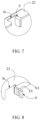
- FIG. 7 is a local detailed three-dimensional view of a part A corresponding to
- FIG. 6 shows another embodiment of a flange in the part A
- FIG. 8 is a local detailed three-dimensional view of a part B shown in FIG. 5
- FIG. 9 is a local detailed three-dimensional view of a part B corresponding to FIG. 8 , and shows another embodiment of a flange in the part B;
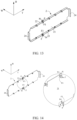
- FIG. 10 is a three-dimensional view of a first side plate of a battery module according to a second embodiment.
- the first side plate 2 includes a plate body 21 and an upper bending portion 22.
- the upper bending portion 22 bends from an upper side of the plate body 21 toward the plurality of batteries 1 along the width direction W.
- the upper bending portion 22 is located on an upper side of the plurality of batteries 1 in a height direction H.
- a plurality of notches N and a plurality of flanges F are formed on the upper bending portion 22.
- Each notch N of the upper bending portion 22 corresponds to the location of the gap between every two adjacent batteries 1.
- Each flange F of the upper bending portion 22 bends downward from a thickness-wise side edge N1 of a corresponding notch N.
- the size of the upper bending portion 22 and size of the upper bending portion 22 in a fifth embodiment described later are appropriate as long as no interference with a most neighboring part (such as the electrode post 13) on the top cover 12 occurs.
- a plurality of notches N and a plurality of flanges F are formed on the upper bending portion 22.
- a plurality of notches N and a plurality of flanges F are also formed on the lower side of the plate body 21 in the height direction H.
- Each notch N on the lower side of the plate body 21 in the height direction H corresponds to the location of the gap between every two adjacent batteries 1.
- Each flange F on the lower side of the plate body 21 in the height direction H bends from a thickness-wise side edge N1 of a corresponding notch N toward the plurality of batteries 1 along the width direction W.
- a plurality of notches N and a plurality of flanges F may be formed not only on the lower side of the plate body 21 in the height direction H, but also between the upper bending portion 22 in the height direction H and the lower side of the plate body 21 (for example, may be formed in a middle part between the upper bending portion 22 in the height direction H and the lower side of the plate body 21).
- Each notch N between the upper bending portion 22 in the height direction H and the lower side of the plate body 21 corresponds to the location of the gap between every two adjacent batteries 1.
- Each flange F between the upper bending portion 22 in the height direction H and the lower side of the plate body 21 bends from a thickness-wise side edge N1 of a corresponding notch N toward the plurality of batteries 1 along the width direction W.
- a plurality of notches N and a plurality of flanges F are formed merely on the upper bending portion 22 of the first side plate 2.
- FIG. 11 is a three-dimensional view of a first side plate of a battery module according to a third embodiment
- FIG. 12 is a three-dimensional view of a first side plate of a battery module according to a fourth embodiment.
- the first side plate 2 includes a plate body 21 and a lower bending portion 23.
- the lower bending portion 23 bends from a lower side of the plate body 21 toward the plurality of batteries 1 along the width direction W.
- the lower bending portion 23 is located on a lower side of the plurality of batteries 1 in a height direction H.
- a plurality of notches N and a plurality of flanges F are formed on the lower bending portion 23.
- Each notch N of the lower bending portion 23 corresponds to the location of the gap between every two adjacent batteries 1.
- Each flange F of the lower bending portion 23 bends upward from a thickness-wise side edge N1 of a corresponding notch N.
- a plurality of notches N and a plurality of flanges F are formed merely on the lower bending portion 23 of the first side plate 2.
- a plurality of notches N and a plurality of flanges F are formed on the lower bending portion 23.
- a plurality of notches N and a plurality of flanges F are also formed on the upper side of the plate body 21 in the height direction H. Each notch N on the upper side of the plate body 21 in the height direction H corresponds to the location of the gap between every two adjacent batteries 1.
- Each flange F on the upper side of the plate body 21 in the height direction H bends from a thickness-wise side edge N1 of a corresponding notchN toward the plurality of batteries 1 along the width direction W.
- a plurality of notches N and a plurality of flanges F may be formed not only on the upper side of the plate body 21 in the height direction H, but also between the lower bending portion 23 in the height direction H and the upper side of the plate body 21 (for example, may be formed in a middle part between the lower bending portion 23 in the height direction H and the upper side of the plate body 21).
- Each notch N between the lower bending portion 23 in the height direction H and the upper side of the plate body 21 corresponds to the location of the gap between every two adjacent batteries 1.
- Each flange F between the lower bending portion 23 in the height direction H and the upper side of the plate body 21 bends from a thickness-wise side edge N1 of a corresponding notch N toward the plurality of batteries 1 along the width direction W.
- FIG. 13 is a three-dimensional view of a first side plate of a battery module according to a fifth embodiment
- the first side plate 2 includes a plate body 21, an upper bending portion 22, and a lower bending portion 23.
- the upper bending portion 22 bends from the upper side of the plate body 21 toward the plurality of batteries 1 along the width direction W.
- the upper bending portion 22 is located on the upper side of the plurality of batteries 1 in the height direction H.
- a plurality of notches N and a plurality of flanges F are formed on the upper bending portion 22.
- Each notch N of the upper bending portion 22 corresponds to the location of the gap between every two adjacent batteries 1.
- Each flange F of the upper bending portion 22 bends downward from a thickness-wise side edge N1 of a corresponding notch N.
- the lower bending portion 23 bends from the lower side of the plate body 21 toward the plurality of batteries 1 along the width direction W.
- the lower bending portion 23 is located on the lower side of the plurality of batteries 1 in the height direction H.
- a plurality of notches N and a plurality of flanges F are also formed on the lower bending portion 23.
- Each notch N of the lower bending portion 23 corresponds to the location of the gap between every two adjacent batteries 1.
- Each flange F of the lower bending portion 23 bends upward from a thickness-wise side edge N1 of a corresponding notch N of the lower bending portion 23.
- a plurality of notches N and flanges F may be formed merely on the upper bending portion 22, or a plurality of notches N and flanges F may be formed merely on the lower bending portion 23.
- a plurality of notches N and flanges F may be formed merely on the upper bending portion 22, or merely on the lower bending portion 23, or on both the upper bending portion 22 and the lower bending portion 23, a plurality of notches N and flanges F are also formed between the upper bending portion 22 and the lower bending portion 23 in the height direction H.
- Each notch N between the upper bending portion 22 and the lower bending portion 23 in the height direction H corresponds to the location of the gap between every two adjacent batteries 1.
- Each flange F between the upper bending portion 22 and the lower bending portion 23 in the height direction H bends from a thickness-wise side edge N1 of a corresponding notch N toward the plurality of batteries 1 along the width direction W.
- FIG. 14 is a three-dimensional view of a first side plate of a battery module according to a sixth embodiment
- FIG. 15 is a three-dimensional view of a first side plate of a battery module according to a seventh embodiment
- FIG. 16 is a three-dimensional view of a first side plate of a battery module according to an eighth embodiment
- FIG. 17 is a three-dimensional view of a first side plate of a battery module according to a ninth embodiment.
- the first side plate 2 includes neither the upper bending portion 22 nor the lower bending portion 23. Instead, the first side plate 2 includes a plate body 21. A plurality of notches N and a plurality of flanges F are formed on at least one of an upper side, a lower side, or a position between the upper side and the lower side of the plate body 21 in the height direction H. Each notch N on at least one of the upper side, the lower side, or the position between the upper side and the lower side of the plate body 21 in the height direction H corresponds to the location of the gap between every two adjacent batteries 1.
- Each flange F at the corresponding position bends from a thickness-wise side edge N1 of a corresponding notch N toward the plurality of batteries 1 along the width direction W.
- the positions at which the plurality of notches N and flanges F are formed may be determined according to actual needs.
- the first side plate 2 includes a plate body 21.
- a plurality of notches N and flanges F are formed on both the upper side and the lower side of the plate body 21 in the height direction H.
- Each notch N on the upper side of the plate body 21 in the height direction H corresponds to the location of the gap between every two adjacent batteries 1.
- Each flange F on the upper side of the plate body 21 in the height direction H bends from a thickness-wise side edge N1 of a corresponding notch N toward the plurality of batteries 1 along the width direction W.
- each notch N on the lower side of the plate body 21 in the height direction H corresponds to the location of the gap between every two adjacent batteries 1.
- Each flange F on the lower side of the plate body 21 in the height direction H bends from a thickness-wise side edge N1 of a corresponding notch N toward the plurality of batteries 1 along the width direction W.
- the first side plate 2 includes a plate body 21.
- a plurality of notches N and a plurality of flanges F are formed on the upper side of the plate body 21 in the height direction H.
- Each notch N on the upper side of the plate body 21 in the height direction H corresponds to the location of the gap between every two adjacent batteries 1.
- Each flange F on the upper side of the plate body 21 in the height direction H bends from a thickness-wise side edge N1 of a corresponding notch N toward the plurality of batteries 1 along the width direction W.
- the first side plate 2 includes a plate body 21.
- a plurality of notches N and a plurality of flanges F are formed on the lower side of the plate body 21 in the height direction H.
- Each notch N on the lower side of the plate body 21 in the height direction H corresponds to the location of the gap between every two adjacent batteries 1.
- Each flange F on the lower side of the plate body 21 in the height direction H bends from a thickness-wise side edge N1 of a corresponding notch N toward the plurality of batteries 1 along the width direction W.
- the first side plate 2 includes a plate body 21.
- a plurality of notches N and a plurality of flanges F are formed on the upper side and the lower side of the plate body 21 in the height direction H and in the middle part between the upper side and the lower side.
- Each notch N on the upper side of the plate body 21 in the height direction H corresponds to the location of the gap between every two adjacent batteries 1.
- Each flange F on the upper side of the plate body 21 in the height direction H bends from a thickness-wise side edge N1 of a corresponding notch N toward the plurality of batteries 1 along the width direction W.
- each notch N on the lower side of the plate body 21 in the height direction H corresponds to the location of the gap between every two adjacent batteries 1.
- Each flange F on the lower side of the plate body 21 in the height direction H bends from a thickness-wise side edge N1 of a corresponding notch N toward the plurality of batteries 1 along the width direction W.
- each notch N in the middle part between the upper side and the lower side of the plate body 21 in the height direction H corresponds to the location of the gap between every two adjacent batteries 1.
- Each flange F in the middle part between the upper side and the lower side of the plate body 21 in the height direction H bends from a thickness-wise side edge N1 of a corresponding notch N toward the plurality of batteries 1 along the width direction W.
- a plurality of notches N and a plurality of flanges F may also be formed merely in the middle part between the upper side and the lower side of the plate body 21 in the height direction H.
- a plurality of notches N and a plurality of flanges F may also be formed in another position between the upper side and the lower side of the plate body 21 in the height direction H.
- Each notch N in the other position between the upper side and the lower side of the plate body 21 in the height direction H corresponds to the location of the gap between every two adjacent batteries 1.
- Each flange F in the other position between the upper side and the lower side of the plate body 21 in the height direction H bends from a thickness-wise side edge N1 of a corresponding notch N toward the plurality of batteries 1 along the width direction W.
- a bulging rib F1 that bulges in the thickness direction T is formed on each flange F.
- the bulging rib F1 is approximately parallel to the thickness-wise side edge N1 of the corresponding notch N, and is configured to adjust the gap between two adjacent batteries 1.
- the bulging rib F1 is stamped into a shape that is convex on one side and concave on the other side, and can bulge toward any direction as long as a thickness in the thickness direction T is formed.
- the bulging rib F1 formed by stamping is characterized by high precision, convenience to operate, and cost-efficiency.
- a bulging direction of the bulging rib F1 on each flange F on the upper side of the first side plate 2 in the height direction H is opposite to a bulging direction of the bulging rib F1 on each flange F on the lower side of the first side plate 2 in the height direction H.
- the upper side of the first side plate 2 in the height direction H when the first side plate 2 includes an upper bending portion 22, means the upper bending portion 22 of the first side plate 2, as in the first embodiment shown in FIG. 5 and the fifth embodiment shown in FIG. 13 ; and, when the first side plate 2 includes no upper bending portion 22, means the upper side of the plate body 21 of the first side plate 2, as in the fourth embodiment shown in FIG. 12 and the ninth embodiment shown in FIG. 17 .
- the lower side of the first side plate 2 in the height direction H when the first side plate 2 includes a lower bending portion 23, means the lower bending portion 23 of the first side plate 2, as in the fourth embodiment shown in FIG. 12 and the fifth embodiment shown in FIG.
- the second side plate 3 may adopt any structure of the first side plate 2 according to the foregoing embodiments, and has a shape identical to that of the first side plate 2, and therefore, the corresponding schematic diagram and description are omitted.
- the first side plate 2 may further include end bending portions 24 extending from the two ends of the plate body 21 in the thickness direction T toward the plurality of batteries 1 along the width direction W.
- Each end bending portion 24 of the first side plate 2 is fixed to an end of the corresponding end plate 4 in the width direction W by welding.
- the second side plate 3 may also be fixed and welded to the end plate 4 in the same way as the first side plate 2, so as to strengthen overall rigidity of a battery module frame that includes the first side plate 2, the second side plate 3, and the end plates 6.
- two adjacent batteries 1 are separated by a plurality of notches N and a plurality of flanges F formed on the first side plate 2, thereby reserving more space for expansion of each battery 1, simplifying an assembly process of the battery module, and reducing costs.
Landscapes
- Chemical & Material Sciences (AREA)
- Chemical Kinetics & Catalysis (AREA)
- Electrochemistry (AREA)
- General Chemical & Material Sciences (AREA)
- Battery Mounting, Suspending (AREA)
Description
- The present invention relates to the field of secondary batteries, and in particular, to a battery module.
- In the design of battery modules currently, when batteries combine into a battery module, some cushions are used to achieve purposes of: adjusting a length of the battery module through elastic deformation of the cushions to ensure that the batteries can be normally assembled with side plates and end plates; and forming a gap between two adjacent batteries, reserving a space for expansion of the batteries, reducing an expansion force of the batteries, reducing a risk of a battery plunge, and controlling a cycle expansion length of the battery module. However, the existing cushion-based solution has some disadvantages. A thickness of a cushion itself reduces the space for the expansion of the batteries. The assembly and fixation between the cushion and the battery need to allow for gluing, positioning, and the like, thereby making an assembly process more difficult. The added cushions increase manufacturing cost of the battery module.
-
CN 203631621 U describes a battery module including a battery assembly and a metal base plate assembly. More specially,CN 203631621 U states a battery module, comprising: a battery assembly (1), including: a plurality of batteries (11), the top of each battery (11) is provided with an explosion-proof valve (111) and poles (112) having different polarities, and the plurality of batteries (11) are sequentially stacked to form a battery pack; two metal end plates (12); two end insulating plates (13); a structural adhesive (14); two metal side plates (15); two side insulating plates (16) and a metal base plate assembly (2) disposed at the bottom of the battery assembly (1), includes: a metal base plate (21); an insulating film (22); a thermal conductive adhesive (23). -
CN 107672435 A relates to a battery pack-integrated electric vehicle integrated chassis including a chassis body 10, a plurality of battery slots 12 disposed on the chassis body 10 and integrated with the chassis body 10, and each battery slot. 12 includes a bottom plate 1 and four side wall plates 9 fixed on the bottom plate 1. A plurality of limitingribs 3 can be arranged on the inner surface of the side wall plate 9 ofCN 107672435 A . - In view of disadvantages in existing technologies, an objective of the present invention is to provide a battery module to reserve more space for expansion of a battery, simplify an assembly process of the battery module, and reduce costs.
- To achieve the foregoing objective, the present invention provides a battery module, including a plurality of batteries, arranged sequentially along a thickness direction, where a gap exists between every two adj acent batteries; and a first side plate, disposed on one side of the plurality of batteries in a width direction. A plurality of notches and a plurality of flanges are formed on the first side plate. Each notch corresponds to a location of the gap between every two adjacent batteries. Each flange bends from one side of a corresponding notch and extends into the corresponding gap between the two adjacent batteries to separate the two adjacent batteries.
- In an embodiment, the first side plate includes a plate body and an upper bending portion. The upper bending portion bends from an upper side of the plate body toward the plurality of batteries along the width direction. The upper bending portion is located on an upper side of the plurality of batteries in a height direction. A plurality of notches and a plurality of flanges are formed on the upper bending portion. Each notch of the upper bending portion corresponds to the location of the gap between every two adjacent batteries. Each flange of the upper bending portion bends downward from a thickness-wise side edge of a corresponding notch.
- In an embodiment, the first side plate includes a plate body and a lower bending portion. The lower bending portion bends from a lower side of the plate body toward the plurality of batteries along the width direction. The lower bending portion is located on a lower side of the plurality of batteries in a height direction. A plurality of notches and a plurality of flanges are formed on the lower bending portion. Each notch of the lower bending portion corresponds to the location of the gap between every two adj acent batteries. Each flange of the lower bending portion bends upward from a thickness-wise side edge of a corresponding notch.
- In an embodiment, the first side plate includes a plate body. A plurality of notches and a plurality of flanges are formed on at least one of an upper side, a lower side, or a position between the upper side and the lower side of the plate body in the height direction. Each notch on at least one of the upper side, the lower side, or the position between the upper side and the lower side of the plate body in the height direction corresponds to the location of the gap between every two adjacent batteries. Each flange at the corresponding position bends from a thickness-wise side edge of a corresponding notch toward the plurality of batteries along the width direction.
- In an embodiment, a thickness of the first side plate is smaller than a width of the gap between two adjacent batteries.
- In an embodiment, a bulging rib that bulges in the thickness direction is formed on each flange. In an embodiment, the bulging rib is parallel to the thickness-wise side edge of the corresponding notch.
- In an embodiment, a plurality of notches and a plurality of flanges are formed on an upper side and a lower side of the first side plate separately in the height direction. A bulging direction of the bulging rib on each flange on the upper side of the first side plate in the height direction is opposite to a bulging direction of the bulging rib on each flange on the lower side of the first side plate in the height direction.
- In an embodiment, the battery module further includes a second side plate. The second side plate adopts a structure of the first side plate described above.
- In an embodiment, a shape of the second side plate is identical to that of the first side plate. Beneficial effects of this application are as follows:
In the battery module according to the present invention, two adjacent batteries are separated by a plurality of notches and a plurality of flanges formed on the first side plate, thereby reserving more space for expansion of each battery, simplifying an assembly process of the battery module, and reducing costs. -
-
FIG. 1 is a three-dimensional view of a battery module according to a first embodiment of the present invention; -
FIG. 2 is a sectional view of the battery module shown inFIG. 1 sectioned along a thickness direction; -
FIG. 3 is a three-dimensional assembly diagram of a first side plate, a second side plate, and end plates of the battery module shown inFIG. 1 ; -
FIG. 4 is a three-dimensional exploded view of a plurality of batteries, insulation shields, and end plates of the battery module shown inFIG. 1 ; -
FIG. 5 is a three-dimensional view of a first side plate of the battery module shown inFIG. 1 according to a first embodiment; -
FIG. 6 is a local detailed three-dimensional view of a part A shown inFIG. 5 ; -
FIG. 7 is a local detailed three-dimensional view of a part A corresponding toFIG. 6 , and shows another embodiment of a flange in the part A; -
FIG. 8 is a local detailed three-dimensional view of a part B shown inFIG. 5 ; -
FIG. 9 is a local detailed three-dimensional view of a part B corresponding toFIG. 8 , and shows another embodiment of a flange in the part B; -
FIG. 10 is a three-dimensional view of a first side plate of a battery module according to a second embodiment; -
FIG. 11 is a three-dimensional view of a first side plate of a battery module according to a third embodiment; -
FIG. 12 is a three-dimensional view of a first side plate of a battery module according to a fourth embodiment; -
FIG. 13 is a three-dimensional view of a first side plate of a battery module according to a fifth embodiment; -
FIG. 14 is a three-dimensional view of a first side plate of a battery module according to a sixth embodiment; -
FIG. 15 is a three-dimensional view of a first side plate of a battery module according to a seventh embodiment; -
FIG. 16 is a three-dimensional view of a first side plate of a battery module according to an eighth embodiment; and -
FIG. 17 is a three-dimensional view of a first side plate of a battery module according to a ninth embodiment. - Reference numerals are as follows:
- 1: Battery;
- 11: Housing;
- 111: Major face;
- 112: Minor side face;
- 12: Top cover;
- 13: Electrode post
- 14: Explosion-proof valve
- 2: First side plate;
- 21: Plate body;
- 22: Upper bending portion;
- 23: Lower bending portion;
- 24: End bending portion;
- 3. Second side plate;
- 4: End plate;
- 5: Insulation shield;
- N: Notch;
- N1: Thickness-wise side edge;
- F: Flange;
- F1: Bulging rib;
- T: Thickness direction;
- W: Width direction; and
- H: Height direction
- The accompanying drawings show embodiments of the present invention. Understandably, the disclosed embodiments are merely examples of the present invention, and the present invention may be implemented in various forms. Therefore, the details disclosed herein are not to be interpreted as a limitation, but are merely as a basis of the claims and as a representative basis for teaching one skilled in the art to variously implement the present invention.
-
FIG. 1 is a three-dimensional view of a battery module according to a first embodiment of the present invention;FIG. 2 is a sectional view of the battery module shown inFIG. 1 sectioned along a thickness direction;FIG. 3 is a three-dimensional assembly diagram of a first side plate, a second side plate, and end plates of the battery module shown inFIG. 1 ; andFIG. 4 is a three-dimensional exploded view of a plurality of batteries, insulation shields, and end plates of the battery module shown inFIG. 1 . - The battery module according to the present invention includes: a plurality of batteries 1, arranged sequentially along a thickness direction T, where a gap exists between every two adjacent batteries 1; and a first side plate (2), disposed on one side of the plurality of batteries 1 in a width direction. The battery module further includes: a
second side plate 3; and anend plate 4, disposed at either end of the plurality of batteries 1 in the thickness direction T; and aninsulation shield 5, disposed between theend plate 4 and a battery 1 located at either end of the plurality of batteries 1, and configured to insulate and protect an conductive part (such as main output electrodes (a main positive electrode and main negative electrode)) of the battery module) in the battery module and corresponding electrical connection parts (such as connectors and wires). - The battery 1 is a hard-case battery (or called a can-shaped battery), and includes an electrode assembly (not shown), a
housing 11, a top cover 12, anelectrode post 13, and an explosion-proof valve 14. Thehousing 11 includesmajor faces 111 and minor side faces 112. An accommodation cavity is formed inside thehousing 11 to accommodate the electrode assembly and an electrolytic solution. The electrode assembly includes a positive electrode plate, a negative electrode plate, and a separator that separates the positive electrode plate from the negative electrode plate. The electrode assembly may be formed by winding the positive electrode plate, the negative electrode plate, and the separator, or by stacking the positive electrode plate, the negative electrode plate, and the separator. The positive electrode plate and the negative electrode plate each include a current collector and an active substance layer disposed on the current collector. - The
first side plate 2 is made of a metal material to improve strength. A plurality of notches N and a plurality of flanges F are formed on thefirst side plate 2. Each notch N corresponds to a location of the gap between every two adjacent batteries 1, and each flange F bends from one side of a corresponding notch N and extends into the corresponding gap between the two adjacent batteries 1 to separate the two adjacent batteries 1 and limit the position of each battery 1. Each notch N is formed by cutting a part of thefirst side plate 2 and bending the part. A size of each flange F is up to a size of a single battery 1 in the width direction W, and is preferably 1/4 of the size of a single battery 1 in the width direction W to ensure connection strength of the flange and avoid occupying the space for expansion of themajor face 111 of thehousing 11 of the battery 1. - A disposition manner of the plurality of notches N and the plurality of flanges F varies depending on the structure of the
first side plate 2. -
FIG. 5 is a three-dimensional view of a first side plate of the battery module shown inFIG. 1 according to a first embodiment;FIG. 6 is a local detailed three-dimensional view of a part A shown inFIG. 5 ;FIG. 7 is a local detailed three-dimensional view of a part A corresponding to -
FIG. 6 , and shows another embodiment of a flange in the part A;FIG. 8 is a local detailed three-dimensional view of a part B shown inFIG. 5 ;FIG. 9 is a local detailed three-dimensional view of a part B corresponding toFIG. 8 , and shows another embodiment of a flange in the part B; and -
FIG. 10 is a three-dimensional view of a first side plate of a battery module according to a second embodiment. - In the first embodiment and the second embodiment shown in
FIG. 5 to FIG. 10 , thefirst side plate 2 includes aplate body 21 and anupper bending portion 22. Theupper bending portion 22 bends from an upper side of theplate body 21 toward the plurality of batteries 1 along the width direction W. Theupper bending portion 22 is located on an upper side of the plurality of batteries 1 in a height direction H. A plurality of notches N and a plurality of flanges F are formed on theupper bending portion 22. Each notch N of theupper bending portion 22 corresponds to the location of the gap between every two adjacent batteries 1. Each flange F of theupper bending portion 22 bends downward from a thickness-wise side edge N1 of a corresponding notch N. The size of theupper bending portion 22 and size of theupper bending portion 22 in a fifth embodiment described later are appropriate as long as no interference with a most neighboring part (such as the electrode post 13) on the top cover 12 occurs. - Specifically, in the first embodiment shown in
FIG. 5 to FIG. 9 , a plurality of notches N and a plurality of flanges F are formed on theupper bending portion 22. In addition, a plurality of notches N and a plurality of flanges F are also formed on the lower side of theplate body 21 in the height direction H. Each notch N on the lower side of theplate body 21 in the height direction H corresponds to the location of the gap between every two adjacent batteries 1. Each flange F on the lower side of theplate body 21 in the height direction H bends from a thickness-wise side edge N1 of a corresponding notch N toward the plurality of batteries 1 along the width direction W. Nevertheless, a plurality of notches N and a plurality of flanges F may be formed not only on the lower side of theplate body 21 in the height direction H, but also between theupper bending portion 22 in the height direction H and the lower side of the plate body 21 (for example, may be formed in a middle part between theupper bending portion 22 in the height direction H and the lower side of the plate body 21). Each notch N between theupper bending portion 22 in the height direction H and the lower side of theplate body 21 corresponds to the location of the gap between every two adjacent batteries 1. Each flange F between theupper bending portion 22 in the height direction H and the lower side of theplate body 21 bends from a thickness-wise side edge N1 of a corresponding notch N toward the plurality of batteries 1 along the width direction W. Specifically, in the second embodiment shown inFIG. 10 , a plurality of notches N and a plurality of flanges F are formed merely on theupper bending portion 22 of thefirst side plate 2. -
FIG. 11 is a three-dimensional view of a first side plate of a battery module according to a third embodiment; andFIG. 12 is a three-dimensional view of a first side plate of a battery module according to a fourth embodiment. - In the third embodiment and the fourth embodiment shown in
FIG. 11 and FIG. 12 , thefirst side plate 2 includes aplate body 21 and alower bending portion 23. Thelower bending portion 23 bends from a lower side of theplate body 21 toward the plurality of batteries 1 along the width direction W. Thelower bending portion 23 is located on a lower side of the plurality of batteries 1 in a height direction H. A plurality of notches N and a plurality of flanges F are formed on thelower bending portion 23. Each notch N of thelower bending portion 23 corresponds to the location of the gap between every two adjacent batteries 1. Each flange F of thelower bending portion 23 bends upward from a thickness-wise side edge N1 of a corresponding notch N. Specifically, in the third embodiment shown inFIG. 11 , a plurality of notches N and a plurality of flanges F are formed merely on thelower bending portion 23 of thefirst side plate 2. Specifically, in the fourth embodiment shown inFIG. 12 , a plurality of notches N and a plurality of flanges F are formed on thelower bending portion 23. In addition, a plurality of notches N and a plurality of flanges F are also formed on the upper side of theplate body 21 in the height direction H. Each notch N on the upper side of theplate body 21 in the height direction H corresponds to the location of the gap between every two adjacent batteries 1. Each flange F on the upper side of theplate body 21 in the height direction H bends from a thickness-wise side edge N1 of a corresponding notchN toward the plurality of batteries 1 along the width direction W. Nevertheless, a plurality of notches N and a plurality of flanges F may be formed not only on the upper side of theplate body 21 in the height direction H, but also between thelower bending portion 23 in the height direction H and the upper side of the plate body 21 (for example, may be formed in a middle part between thelower bending portion 23 in the height direction H and the upper side of the plate body 21). Each notch N between thelower bending portion 23 in the height direction H and the upper side of theplate body 21 corresponds to the location of the gap between every two adjacent batteries 1. Each flange F between thelower bending portion 23 in the height direction H and the upper side of theplate body 21 bends from a thickness-wise side edge N1 of a corresponding notch N toward the plurality of batteries 1 along the width direction W. -
FIG. 13 is a three-dimensional view of a first side plate of a battery module according to a fifth embodiment; - In the fifth embodiment shown in
FIG. 13 , thefirst side plate 2 includes aplate body 21, anupper bending portion 22, and alower bending portion 23. Theupper bending portion 22 bends from the upper side of theplate body 21 toward the plurality of batteries 1 along the width direction W. Theupper bending portion 22 is located on the upper side of the plurality of batteries 1 in the height direction H. A plurality of notches N and a plurality of flanges F are formed on theupper bending portion 22. Each notch N of theupper bending portion 22 corresponds to the location of the gap between every two adjacent batteries 1. Each flange F of theupper bending portion 22 bends downward from a thickness-wise side edge N1 of a corresponding notch N. Thelower bending portion 23 bends from the lower side of theplate body 21 toward the plurality of batteries 1 along the width direction W. Thelower bending portion 23 is located on the lower side of the plurality of batteries 1 in the height direction H. A plurality of notches N and a plurality of flanges F are also formed on thelower bending portion 23. Each notch N of thelower bending portion 23 corresponds to the location of the gap between every two adjacent batteries 1. Each flange F of thelower bending portion 23 bends upward from a thickness-wise side edge N1 of a corresponding notch N of thelower bending portion 23. In addition, in other embodiments, a plurality of notches N and flanges F may be formed merely on theupper bending portion 22, or a plurality of notches N and flanges F may be formed merely on thelower bending portion 23. A plurality of notches N and flanges F may be formed merely on theupper bending portion 22, or merely on thelower bending portion 23, or on both theupper bending portion 22 and thelower bending portion 23, a plurality of notches N and flanges F are also formed between theupper bending portion 22 and thelower bending portion 23 in the height direction H. Each notch N between theupper bending portion 22 and thelower bending portion 23 in the height direction H corresponds to the location of the gap between every two adjacent batteries 1. Each flange F between theupper bending portion 22 and thelower bending portion 23 in the height direction H bends from a thickness-wise side edge N1 of a corresponding notch N toward the plurality of batteries 1 along the width direction W. -
FIG. 14 is a three-dimensional view of a first side plate of a battery module according to a sixth embodiment;FIG. 15 is a three-dimensional view of a first side plate of a battery module according to a seventh embodiment;FIG. 16 is a three-dimensional view of a first side plate of a battery module according to an eighth embodiment; andFIG. 17 is a three-dimensional view of a first side plate of a battery module according to a ninth embodiment. - In the sixth embodiment to the ninth embodiment shown in
FIG. 14 to FIG. 17 , thefirst side plate 2 includes neither theupper bending portion 22 nor thelower bending portion 23. Instead, thefirst side plate 2 includes aplate body 21. A plurality of notches N and a plurality of flanges F are formed on at least one of an upper side, a lower side, or a position between the upper side and the lower side of theplate body 21 in the height direction H. Each notch N on at least one of the upper side, the lower side, or the position between the upper side and the lower side of theplate body 21 in the height direction H corresponds to the location of the gap between every two adjacent batteries 1. Each flange F at the corresponding position bends from a thickness-wise side edge N1 of a corresponding notch N toward the plurality of batteries 1 along the width direction W. The positions at which the plurality of notches N and flanges F are formed may be determined according to actual needs. - Specifically, in the sixth embodiment shown in
FIG. 14 , thefirst side plate 2 includes aplate body 21. A plurality of notches N and flanges F are formed on both the upper side and the lower side of theplate body 21 in the height direction H. Each notch N on the upper side of theplate body 21 in the height direction H corresponds to the location of the gap between every two adjacent batteries 1. Each flange F on the upper side of theplate body 21 in the height direction H bends from a thickness-wise side edge N1 of a corresponding notch N toward the plurality of batteries 1 along the width direction W. In addition, each notch N on the lower side of theplate body 21 in the height direction H corresponds to the location of the gap between every two adjacent batteries 1. Each flange F on the lower side of theplate body 21 in the height direction H bends from a thickness-wise side edge N1 of a corresponding notch N toward the plurality of batteries 1 along the width direction W. - Specifically, in the seventh embodiment shown in
FIG. 15 , thefirst side plate 2 includes aplate body 21. A plurality of notches N and a plurality of flanges F are formed on the upper side of theplate body 21 in the height direction H. Each notch N on the upper side of theplate body 21 in the height direction H corresponds to the location of the gap between every two adjacent batteries 1. Each flange F on the upper side of theplate body 21 in the height direction H bends from a thickness-wise side edge N1 of a corresponding notch N toward the plurality of batteries 1 along the width direction W. - Specifically, in the eighth embodiment shown in
FIG. 16 , thefirst side plate 2 includes aplate body 21. A plurality of notches N and a plurality of flanges F are formed on the lower side of theplate body 21 in the height direction H. Each notch N on the lower side of theplate body 21 in the height direction H corresponds to the location of the gap between every two adjacent batteries 1. Each flange F on the lower side of theplate body 21 in the height direction H bends from a thickness-wise side edge N1 of a corresponding notch N toward the plurality of batteries 1 along the width direction W. - Specifically, in the ninth embodiment shown in
FIG. 17 , thefirst side plate 2 includes aplate body 21. A plurality of notches N and a plurality of flanges F are formed on the upper side and the lower side of theplate body 21 in the height direction H and in the middle part between the upper side and the lower side. Each notch N on the upper side of theplate body 21 in the height direction H corresponds to the location of the gap between every two adjacent batteries 1. Each flange F on the upper side of theplate body 21 in the height direction H bends from a thickness-wise side edge N1 of a corresponding notch N toward the plurality of batteries 1 along the width direction W. In addition, each notch N on the lower side of theplate body 21 in the height direction H corresponds to the location of the gap between every two adjacent batteries 1. Each flange F on the lower side of theplate body 21 in the height direction H bends from a thickness-wise side edge N1 of a corresponding notch N toward the plurality of batteries 1 along the width direction W. Moreover, each notch N in the middle part between the upper side and the lower side of theplate body 21 in the height direction H corresponds to the location of the gap between every two adjacent batteries 1. Each flange F in the middle part between the upper side and the lower side of theplate body 21 in the height direction H bends from a thickness-wise side edge N1 of a corresponding notch N toward the plurality of batteries 1 along the width direction W. In other embodiments, a plurality of notches N and a plurality of flanges F may also be formed merely in the middle part between the upper side and the lower side of theplate body 21 in the height direction H. Alternatively, a plurality of notches N and a plurality of flanges F may also be formed in another position between the upper side and the lower side of theplate body 21 in the height direction H. Each notch N in the other position between the upper side and the lower side of theplate body 21 in the height direction H corresponds to the location of the gap between every two adjacent batteries 1. Each flange F in the other position between the upper side and the lower side of theplate body 21 in the height direction H bends from a thickness-wise side edge N1 of a corresponding notch N toward the plurality of batteries 1 along the width direction W. - In the foregoing embodiments, when the thickness of the
first side plate 2 is smaller than the width of the gap between two adjacent batteries 1, a bulging rib F1 that bulges in the thickness direction T is formed on each flange F. The bulging rib F1 is approximately parallel to the thickness-wise side edge N1 of the corresponding notch N, and is configured to adjust the gap between two adjacent batteries 1. The bulging rib F1 is stamped into a shape that is convex on one side and concave on the other side, and can bulge toward any direction as long as a thickness in the thickness direction T is formed. The bulging rib F1 formed by stamping is characterized by high precision, convenience to operate, and cost-efficiency. - In the embodiment in which a plurality of notches N and a plurality of flanges F are formed on both the upper side and the lower side of the
first side plate 2 in the height direction (H), a bulging direction of the bulging rib F1 on each flange F on the upper side of thefirst side plate 2 in the height direction H is opposite to a bulging direction of the bulging rib F1 on each flange F on the lower side of thefirst side plate 2 in the height direction H. In this way, opposite forces that abut against each battery 1 are exerted on the battery 1 from two sides of the battery 1, and more space is reserved for expansion of the battery 1. The upper side of thefirst side plate 2 in the height direction H, when thefirst side plate 2 includes anupper bending portion 22, means theupper bending portion 22 of thefirst side plate 2, as in the first embodiment shown inFIG. 5 and the fifth embodiment shown inFIG. 13 ; and, when thefirst side plate 2 includes noupper bending portion 22, means the upper side of theplate body 21 of thefirst side plate 2, as in the fourth embodiment shown inFIG. 12 and the ninth embodiment shown inFIG. 17 . The lower side of thefirst side plate 2 in the height direction H, when thefirst side plate 2 includes alower bending portion 23, means thelower bending portion 23 of thefirst side plate 2, as in the fourth embodiment shown inFIG. 12 and the fifth embodiment shown inFIG. 13 ; and, when thefirst side plate 2 includes nolower bending portion 23, means the lower side of theplate body 21 of thefirst side plate 2, as in the first embodiment shown inFIG. 5 , the sixth embodiment shown inFIG. 14 , and the ninth embodiment shown inFIG. 17 . Thesecond side plate 3 may adopt any structure of thefirst side plate 2 according to the foregoing embodiments, and has a shape identical to that of thefirst side plate 2, and therefore, the corresponding schematic diagram and description are omitted. - Two ends of the
plate body 21 of thefirst side plate 2 in the thickness direction T are fixed to the corresponding two ends of the twoend plates 4 in the width direction W by welding. Further, as shown inFIG. 1 andFIG. 3 , thefirst side plate 2 may further includeend bending portions 24 extending from the two ends of theplate body 21 in the thickness direction T toward the plurality of batteries 1 along the width direction W. Eachend bending portion 24 of thefirst side plate 2 is fixed to an end of thecorresponding end plate 4 in the width direction W by welding. Thesecond side plate 3 may also be fixed and welded to theend plate 4 in the same way as thefirst side plate 2, so as to strengthen overall rigidity of a battery module frame that includes thefirst side plate 2, thesecond side plate 3, and the end plates 6. - In conclusion, in the battery module according to the present invention, two adjacent batteries 1 are separated by a plurality of notches N and a plurality of flanges F formed on the
first side plate 2, thereby reserving more space for expansion of each battery 1, simplifying an assembly process of the battery module, and reducing costs. - Although a plurality of exemplary embodiments are described above, this disclosure is not limited to the explicitly disclosed combinations. Therefore, unless otherwise specified herein, the features disclosed herein may be combined together variously. For brevity, other combinations are not described herein.
- The foregoing descriptions are merely exemplary embodiments of this application, but are not intended to limit this application. A person skilled in the art understands that this application may have various modifications and variations.
Claims (10)
- A battery module, wherein the battery module comprises:a plurality of batteries (1), arranged sequentially along a thickness direction (T), wherein a gap exists between every two adjacent batteries (1); anda first side plate (2), disposed on one side of the plurality of batteries (1) in a width direction (W), whereina plurality of notches (N) and a plurality of flanges (F) are formed on the first side plate (2), each notch (N) corresponds to a location of the gap between every two adjacent batteries (1), and each flange (F) is bent from one side of a corresponding notch (N) and extends into the corresponding gap between the two adjacent batteries (1) to separate the two adjacent batteries (1).
- The battery module according to claim 1, wherein the first side plate (2) comprises a plate body (21) and an upper bending portion (22), the upper bending portion (22) is bent from an upper side of the plate body (21) toward the plurality of batteries (1) along the width direction (W), the upper bending portion (22) is located on an upper side of the plurality of batteries (1) in a height direction (H), a plurality of notches (N) and a plurality of flanges (F) are formed on the upper bending portion (22), each notch (N) of the upper bending portion (22) corresponds to the location of the gap between every two adjacent batteries (1), and each flange (F) of the upper bending portion (22) is bent downward from a thickness-wise side edge (N1) of a corresponding notch (N).
- The battery module according to claim 1, wherein the first side plate (2) comprises a plate body (21) and a lower bending portion (23), the lower bending portion (23) is bent from a lower side of the plate body (21) toward the plurality of batteries (1) along the width direction (W), the lower bending portion (23) is located on a lower side of the plurality of batteries (1) in a height direction (H), a plurality of notches (N) and a plurality of flanges (F) are formed on the lower bending portion (23), each notch (N) of the lower bending portion (23) corresponds to the location of the gap between every two adjacent batteries (1), and each flange (F) of the lower bending portion (23) is bent upward from a thickness-wise side edge (N1) of a corresponding notch (N).
- The battery module according to claim 1, wherein the first side plate (2) comprises a plate body (21), a plurality of notches (N) and a plurality of flanges (F) are formed on at least one of an upper side, a lower side, or a position between the upper side and the lower side of the plate body (21) in the height direction (H), each notch (N) on at least one of the upper side, the lower side, or the position between the upper side and the lower side of the plate body (21) in the height direction (H) corresponds to the location of the gap between every two adjacent batteries (1), and each flange (F) at the corresponding position is bent from a thickness-wise side edge (N1) of a corresponding notch (N) toward the plurality of batteries (1) along the width direction (W).
- The battery module according to any one of claims 1 to 4, wherein a thickness of the first side plate (2) is smaller than a width of the gap between two adjacent batteries (1).
- The battery module according to claim 5, wherein a bulging rib (F1) that bulges in the thickness direction (T) is formed on each flange (F).
- The battery module according to claim 6, wherein the bulging rib (F1) is parallel to the thickness-wise side edge (N1) of the corresponding notch (N).
- The battery module according to claim 7, wherein a plurality of notches (N) and a plurality of flanges (F) are formed on an upper side and a lower side of the first side plate (2) separately in the height direction (H), and a bulging direction of the bulging rib (F1) on each flange (F) on the upper side of the first side plate (2) in the height direction (H) is opposite to a bulging direction of the bulging rib (F1) on each flange (F) on the lower side of the first side plate (2) in the height direction (H).
- The battery module according to claim 1, wherein the battery module further comprises a second side plate (3), and the second side plate (3) adopts a structure of the first side plate (2) according to any one of claims 1 to 4.
- The battery module according to claim 9, wherein a shape of the second side plate (3) is identical to that of the first side plate (2).
Applications Claiming Priority (2)
| Application Number | Priority Date | Filing Date | Title |
|---|---|---|---|
| CN201821946727.9U CN209104208U (en) | 2018-11-23 | 2018-11-23 | battery module |
| PCT/CN2019/091349 WO2020103441A1 (en) | 2018-11-23 | 2019-06-14 | Battery module |
Publications (3)
| Publication Number | Publication Date |
|---|---|
| EP3859817A1 EP3859817A1 (en) | 2021-08-04 |
| EP3859817A4 EP3859817A4 (en) | 2021-12-15 |
| EP3859817B1 true EP3859817B1 (en) | 2023-06-07 |
Family
ID=67161313
Family Applications (1)
| Application Number | Title | Priority Date | Filing Date |
|---|---|---|---|
| EP19887156.8A Active EP3859817B1 (en) | 2018-11-23 | 2019-06-14 | Battery module |
Country Status (5)
| Country | Link |
|---|---|
| US (1) | US11784380B2 (en) |
| EP (1) | EP3859817B1 (en) |
| CN (1) | CN209104208U (en) |
| HU (1) | HUE062877T2 (en) |
| WO (1) | WO2020103441A1 (en) |
Family Cites Families (9)
| Publication number | Priority date | Publication date | Assignee | Title |
|---|---|---|---|---|
| EP0952620B1 (en) * | 1998-03-25 | 2002-11-20 | Matsushita Electric Industrial Co., Ltd. | Sealed storage battery and modular system therefor |
| KR101794265B1 (en) * | 2013-07-18 | 2017-11-07 | 삼성에스디아이 주식회사 | Battery pack having reinforcement bead |
| CN203631621U (en) * | 2013-12-05 | 2014-06-04 | 宁德时代新能源科技有限公司 | Battery module |
| CN204809283U (en) | 2015-07-08 | 2015-11-25 | 宁德时代新能源科技有限公司 | Battery module |
| KR101943285B1 (en) * | 2015-10-22 | 2019-01-28 | 닛산 지도우샤 가부시키가이샤 | Battery pack and manufacturing method thereof |
| CN106299188A (en) * | 2016-09-29 | 2017-01-04 | 常州普莱德新能源电池科技有限公司 | A kind of soft package battery module used for electric vehicle |
| JP6861045B2 (en) * | 2017-02-09 | 2021-04-21 | 株式会社エンビジョンAescジャパン | Assembled battery, battery pack, manufacturing method of assembled battery and manufacturing method of battery pack |
| CN107672435A (en) * | 2017-10-27 | 2018-02-09 | 江苏罗思韦尔电气有限公司 | A kind of electronic vehicle integrated chassis of integrated battery group |
| CN207967119U (en) * | 2018-04-02 | 2018-10-12 | 宁德时代新能源科技股份有限公司 | Framework and battery modules |
-
2018
- 2018-11-23 CN CN201821946727.9U patent/CN209104208U/en active Active
-
2019
- 2019-06-14 WO PCT/CN2019/091349 patent/WO2020103441A1/en not_active Ceased
- 2019-06-14 EP EP19887156.8A patent/EP3859817B1/en active Active
- 2019-06-14 HU HUE19887156A patent/HUE062877T2/en unknown
-
2021
- 2021-05-10 US US17/316,533 patent/US11784380B2/en active Active
Also Published As
| Publication number | Publication date |
|---|---|
| EP3859817A1 (en) | 2021-08-04 |
| EP3859817A4 (en) | 2021-12-15 |
| US20210265712A1 (en) | 2021-08-26 |
| HUE062877T2 (en) | 2023-12-28 |
| CN209104208U (en) | 2019-07-12 |
| WO2020103441A1 (en) | 2020-05-28 |
| US11784380B2 (en) | 2023-10-10 |
Similar Documents
| Publication | Publication Date | Title |
|---|---|---|
| EP3748732B1 (en) | Secondary battery | |
| JP7090172B2 (en) | Batteries, battery modules, power batteries and electric vehicles | |
| JP5538178B2 (en) | Secondary battery | |
| US9397364B2 (en) | Electric storage device and electric storage apparatus | |
| KR101403388B1 (en) | Battery Cell of Irregular Structure and Battery Module Employed with the Same | |
| JP7024735B2 (en) | Power storage device | |
| JP2022529883A (en) | Battery unit and battery module | |
| US20130330593A1 (en) | Rechargeable battery | |
| JPWO2016093338A1 (en) | Electricity storage element | |
| JP2022523847A (en) | Battery module | |
| US10763461B2 (en) | Secondary battery | |
| JP2017528870A (en) | Battery spacer, electrical core protection assembly, and power battery | |
| US12191513B2 (en) | Battery module | |
| JP7792353B2 (en) | Batteries, battery packs and automobiles | |
| JP2022010084A (en) | Battery wiring module | |
| JP5810861B2 (en) | battery | |
| JP2017041311A (en) | Battery module unit and battery pack | |
| CN212907959U (en) | Battery module and electric automobile | |
| EP3859817B1 (en) | Battery module | |
| JP7445019B2 (en) | Batteries, battery packs and automobiles | |
| CN220544183U (en) | Battery | |
| CN219677497U (en) | Battery and battery device | |
| CN221574074U (en) | Battery and battery device | |
| JP2013187141A (en) | Power storage device and vehicle | |
| KR20250158416A (en) | Battery pack |
Legal Events
| Date | Code | Title | Description |
|---|---|---|---|
| STAA | Information on the status of an ep patent application or granted ep patent |
Free format text: STATUS: THE INTERNATIONAL PUBLICATION HAS BEEN MADE |
|
| PUAI | Public reference made under article 153(3) epc to a published international application that has entered the european phase |
Free format text: ORIGINAL CODE: 0009012 |
|
| STAA | Information on the status of an ep patent application or granted ep patent |
Free format text: STATUS: REQUEST FOR EXAMINATION WAS MADE |
|
| 17P | Request for examination filed |
Effective date: 20210429 |
|
| AK | Designated contracting states |
Kind code of ref document: A1 Designated state(s): AL AT BE BG CH CY CZ DE DK EE ES FI FR GB GR HR HU IE IS IT LI LT LU LV MC MK MT NL NO PL PT RO RS SE SI SK SM TR |
|
| REG | Reference to a national code |
Ref country code: DE Ref legal event code: R079 Ipc: H01M0050200000 Ref country code: DE Ref legal event code: R079 Ref document number: 602019030799 Country of ref document: DE Free format text: PREVIOUS MAIN CLASS: H01M0002100000 Ipc: H01M0050200000 |
|
| A4 | Supplementary search report drawn up and despatched |
Effective date: 20211111 |
|
| RIC1 | Information provided on ipc code assigned before grant |
Ipc: H01M 50/20 20210101AFI20211105BHEP |
|
| DAV | Request for validation of the european patent (deleted) | ||
| DAX | Request for extension of the european patent (deleted) | ||
| STAA | Information on the status of an ep patent application or granted ep patent |
Free format text: STATUS: EXAMINATION IS IN PROGRESS |
|
| 17Q | First examination report despatched |
Effective date: 20220419 |
|
| GRAP | Despatch of communication of intention to grant a patent |
Free format text: ORIGINAL CODE: EPIDOSNIGR1 |
|
| STAA | Information on the status of an ep patent application or granted ep patent |
Free format text: STATUS: GRANT OF PATENT IS INTENDED |
|
| INTG | Intention to grant announced |
Effective date: 20230322 |
|
| GRAS | Grant fee paid |
Free format text: ORIGINAL CODE: EPIDOSNIGR3 |
|
| GRAA | (expected) grant |
Free format text: ORIGINAL CODE: 0009210 |
|
| STAA | Information on the status of an ep patent application or granted ep patent |
Free format text: STATUS: THE PATENT HAS BEEN GRANTED |
|
| AK | Designated contracting states |
Kind code of ref document: B1 Designated state(s): AL AT BE BG CH CY CZ DE DK EE ES FI FR GB GR HR HU IE IS IT LI LT LU LV MC MK MT NL NO PL PT RO RS SE SI SK SM TR |
|
| REG | Reference to a national code |
Ref country code: GB Ref legal event code: FG4D |
|
| REG | Reference to a national code |
Ref country code: CH Ref legal event code: EP Ref country code: AT Ref legal event code: REF Ref document number: 1577654 Country of ref document: AT Kind code of ref document: T Effective date: 20230615 Ref country code: DE Ref legal event code: R096 Ref document number: 602019030799 Country of ref document: DE |
|
| P01 | Opt-out of the competence of the unified patent court (upc) registered |
Effective date: 20230612 |
|
| REG | Reference to a national code |
Ref country code: LT Ref legal event code: MG9D |
|
| REG | Reference to a national code |
Ref country code: NL Ref legal event code: MP Effective date: 20230607 |
|
| PG25 | Lapsed in a contracting state [announced via postgrant information from national office to epo] |
Ref country code: SE Free format text: LAPSE BECAUSE OF FAILURE TO SUBMIT A TRANSLATION OF THE DESCRIPTION OR TO PAY THE FEE WITHIN THE PRESCRIBED TIME-LIMIT Effective date: 20230607 Ref country code: NO Free format text: LAPSE BECAUSE OF FAILURE TO SUBMIT A TRANSLATION OF THE DESCRIPTION OR TO PAY THE FEE WITHIN THE PRESCRIBED TIME-LIMIT Effective date: 20230907 Ref country code: ES Free format text: LAPSE BECAUSE OF FAILURE TO SUBMIT A TRANSLATION OF THE DESCRIPTION OR TO PAY THE FEE WITHIN THE PRESCRIBED TIME-LIMIT Effective date: 20230607 |
|
| REG | Reference to a national code |
Ref country code: AT Ref legal event code: MK05 Ref document number: 1577654 Country of ref document: AT Kind code of ref document: T Effective date: 20230607 |
|
| PG25 | Lapsed in a contracting state [announced via postgrant information from national office to epo] |
Ref country code: RS Free format text: LAPSE BECAUSE OF FAILURE TO SUBMIT A TRANSLATION OF THE DESCRIPTION OR TO PAY THE FEE WITHIN THE PRESCRIBED TIME-LIMIT Effective date: 20230607 Ref country code: NL Free format text: LAPSE BECAUSE OF FAILURE TO SUBMIT A TRANSLATION OF THE DESCRIPTION OR TO PAY THE FEE WITHIN THE PRESCRIBED TIME-LIMIT Effective date: 20230607 Ref country code: LV Free format text: LAPSE BECAUSE OF FAILURE TO SUBMIT A TRANSLATION OF THE DESCRIPTION OR TO PAY THE FEE WITHIN THE PRESCRIBED TIME-LIMIT Effective date: 20230607 Ref country code: LT Free format text: LAPSE BECAUSE OF FAILURE TO SUBMIT A TRANSLATION OF THE DESCRIPTION OR TO PAY THE FEE WITHIN THE PRESCRIBED TIME-LIMIT Effective date: 20230607 Ref country code: HR Free format text: LAPSE BECAUSE OF FAILURE TO SUBMIT A TRANSLATION OF THE DESCRIPTION OR TO PAY THE FEE WITHIN THE PRESCRIBED TIME-LIMIT Effective date: 20230607 Ref country code: GR Free format text: LAPSE BECAUSE OF FAILURE TO SUBMIT A TRANSLATION OF THE DESCRIPTION OR TO PAY THE FEE WITHIN THE PRESCRIBED TIME-LIMIT Effective date: 20230908 |
|
| REG | Reference to a national code |
Ref country code: HU Ref legal event code: AG4A Ref document number: E062877 Country of ref document: HU |
|
| PG25 | Lapsed in a contracting state [announced via postgrant information from national office to epo] |
Ref country code: FI Free format text: LAPSE BECAUSE OF FAILURE TO SUBMIT A TRANSLATION OF THE DESCRIPTION OR TO PAY THE FEE WITHIN THE PRESCRIBED TIME-LIMIT Effective date: 20230607 |
|
| PG25 | Lapsed in a contracting state [announced via postgrant information from national office to epo] |
Ref country code: SK Free format text: LAPSE BECAUSE OF FAILURE TO SUBMIT A TRANSLATION OF THE DESCRIPTION OR TO PAY THE FEE WITHIN THE PRESCRIBED TIME-LIMIT Effective date: 20230607 |
|
| PG25 | Lapsed in a contracting state [announced via postgrant information from national office to epo] |
Ref country code: IS Free format text: LAPSE BECAUSE OF FAILURE TO SUBMIT A TRANSLATION OF THE DESCRIPTION OR TO PAY THE FEE WITHIN THE PRESCRIBED TIME-LIMIT Effective date: 20231007 |
|
| PG25 | Lapsed in a contracting state [announced via postgrant information from national office to epo] |
Ref country code: SM Free format text: LAPSE BECAUSE OF FAILURE TO SUBMIT A TRANSLATION OF THE DESCRIPTION OR TO PAY THE FEE WITHIN THE PRESCRIBED TIME-LIMIT Effective date: 20230607 Ref country code: SK Free format text: LAPSE BECAUSE OF FAILURE TO SUBMIT A TRANSLATION OF THE DESCRIPTION OR TO PAY THE FEE WITHIN THE PRESCRIBED TIME-LIMIT Effective date: 20230607 Ref country code: RO Free format text: LAPSE BECAUSE OF FAILURE TO SUBMIT A TRANSLATION OF THE DESCRIPTION OR TO PAY THE FEE WITHIN THE PRESCRIBED TIME-LIMIT Effective date: 20230607 Ref country code: PT Free format text: LAPSE BECAUSE OF FAILURE TO SUBMIT A TRANSLATION OF THE DESCRIPTION OR TO PAY THE FEE WITHIN THE PRESCRIBED TIME-LIMIT Effective date: 20231009 Ref country code: IS Free format text: LAPSE BECAUSE OF FAILURE TO SUBMIT A TRANSLATION OF THE DESCRIPTION OR TO PAY THE FEE WITHIN THE PRESCRIBED TIME-LIMIT Effective date: 20231007 Ref country code: EE Free format text: LAPSE BECAUSE OF FAILURE TO SUBMIT A TRANSLATION OF THE DESCRIPTION OR TO PAY THE FEE WITHIN THE PRESCRIBED TIME-LIMIT Effective date: 20230607 Ref country code: CZ Free format text: LAPSE BECAUSE OF FAILURE TO SUBMIT A TRANSLATION OF THE DESCRIPTION OR TO PAY THE FEE WITHIN THE PRESCRIBED TIME-LIMIT Effective date: 20230607 Ref country code: AT Free format text: LAPSE BECAUSE OF FAILURE TO SUBMIT A TRANSLATION OF THE DESCRIPTION OR TO PAY THE FEE WITHIN THE PRESCRIBED TIME-LIMIT Effective date: 20230607 |
|
| REG | Reference to a national code |
Ref country code: CH Ref legal event code: PL |
|
| REG | Reference to a national code |
Ref country code: BE Ref legal event code: MM Effective date: 20230630 |
|
| PG25 | Lapsed in a contracting state [announced via postgrant information from national office to epo] |
Ref country code: PL Free format text: LAPSE BECAUSE OF FAILURE TO SUBMIT A TRANSLATION OF THE DESCRIPTION OR TO PAY THE FEE WITHIN THE PRESCRIBED TIME-LIMIT Effective date: 20230607 |
|
| PG25 | Lapsed in a contracting state [announced via postgrant information from national office to epo] |
Ref country code: LU Free format text: LAPSE BECAUSE OF NON-PAYMENT OF DUE FEES Effective date: 20230614 |
|
| REG | Reference to a national code |
Ref country code: DE Ref legal event code: R097 Ref document number: 602019030799 Country of ref document: DE |
|
| PG25 | Lapsed in a contracting state [announced via postgrant information from national office to epo] |
Ref country code: MC Free format text: LAPSE BECAUSE OF FAILURE TO SUBMIT A TRANSLATION OF THE DESCRIPTION OR TO PAY THE FEE WITHIN THE PRESCRIBED TIME-LIMIT Effective date: 20230607 |
|
| REG | Reference to a national code |
Ref country code: IE Ref legal event code: MM4A |
|
| PG25 | Lapsed in a contracting state [announced via postgrant information from national office to epo] |
Ref country code: MC Free format text: LAPSE BECAUSE OF FAILURE TO SUBMIT A TRANSLATION OF THE DESCRIPTION OR TO PAY THE FEE WITHIN THE PRESCRIBED TIME-LIMIT Effective date: 20230607 Ref country code: LU Free format text: LAPSE BECAUSE OF NON-PAYMENT OF DUE FEES Effective date: 20230614 |
|
| PLBE | No opposition filed within time limit |
Free format text: ORIGINAL CODE: 0009261 |
|
| STAA | Information on the status of an ep patent application or granted ep patent |
Free format text: STATUS: NO OPPOSITION FILED WITHIN TIME LIMIT |
|
| PG25 | Lapsed in a contracting state [announced via postgrant information from national office to epo] |
Ref country code: IE Free format text: LAPSE BECAUSE OF NON-PAYMENT OF DUE FEES Effective date: 20230614 |
|
| PG25 | Lapsed in a contracting state [announced via postgrant information from national office to epo] |
Ref country code: IE Free format text: LAPSE BECAUSE OF NON-PAYMENT OF DUE FEES Effective date: 20230614 Ref country code: DK Free format text: LAPSE BECAUSE OF FAILURE TO SUBMIT A TRANSLATION OF THE DESCRIPTION OR TO PAY THE FEE WITHIN THE PRESCRIBED TIME-LIMIT Effective date: 20230607 Ref country code: CH Free format text: LAPSE BECAUSE OF NON-PAYMENT OF DUE FEES Effective date: 20230630 |
|
| PG25 | Lapsed in a contracting state [announced via postgrant information from national office to epo] |
Ref country code: SI Free format text: LAPSE BECAUSE OF FAILURE TO SUBMIT A TRANSLATION OF THE DESCRIPTION OR TO PAY THE FEE WITHIN THE PRESCRIBED TIME-LIMIT Effective date: 20230607 |
|
| 26N | No opposition filed |
Effective date: 20240308 |
|
| PG25 | Lapsed in a contracting state [announced via postgrant information from national office to epo] |
Ref country code: SI Free format text: LAPSE BECAUSE OF FAILURE TO SUBMIT A TRANSLATION OF THE DESCRIPTION OR TO PAY THE FEE WITHIN THE PRESCRIBED TIME-LIMIT Effective date: 20230607 Ref country code: IT Free format text: LAPSE BECAUSE OF FAILURE TO SUBMIT A TRANSLATION OF THE DESCRIPTION OR TO PAY THE FEE WITHIN THE PRESCRIBED TIME-LIMIT Effective date: 20230607 Ref country code: BE Free format text: LAPSE BECAUSE OF NON-PAYMENT OF DUE FEES Effective date: 20230630 |
|
| REG | Reference to a national code |
Ref country code: DE Ref legal event code: R081 Ref document number: 602019030799 Country of ref document: DE Owner name: CONTEMPORARY AMPEREX TECHNOLOGY (HONG KONG) LI, HK Free format text: FORMER OWNER: CONTEMPORARY AMPEREX TECHNOLOGY CO., LIMITED, NINGDE, FUJIAN, CN |
|
| REG | Reference to a national code |
Ref country code: GB Ref legal event code: 732E Free format text: REGISTERED BETWEEN 20240829 AND 20240904 |
|
| REG | Reference to a national code |
Ref country code: HU Ref legal event code: GB9C Owner name: CONTEMPORARY AMPEREX TECHNOLOGY (HONG KONG) LIMITED, HK Free format text: FORMER OWNER(S): CONTEMPORARY AMPEREX TECHNOLOGY CO., LIMITED, CN Ref country code: HU Ref legal event code: FH1C Free format text: FORMER REPRESENTATIVE(S): DANUBIA SZABADALMI ES JOGI IRODA KFT., HU Representative=s name: DANUBIA SZABADALMI ES JOGI IRODA KFT., HU |
|
| PG25 | Lapsed in a contracting state [announced via postgrant information from national office to epo] |
Ref country code: BG Free format text: LAPSE BECAUSE OF FAILURE TO SUBMIT A TRANSLATION OF THE DESCRIPTION OR TO PAY THE FEE WITHIN THE PRESCRIBED TIME-LIMIT Effective date: 20230607 |
|
| PG25 | Lapsed in a contracting state [announced via postgrant information from national office to epo] |
Ref country code: BG Free format text: LAPSE BECAUSE OF FAILURE TO SUBMIT A TRANSLATION OF THE DESCRIPTION OR TO PAY THE FEE WITHIN THE PRESCRIBED TIME-LIMIT Effective date: 20230607 |
|
| PGFP | Annual fee paid to national office [announced via postgrant information from national office to epo] |
Ref country code: DE Payment date: 20250625 Year of fee payment: 7 |
|
| PGFP | Annual fee paid to national office [announced via postgrant information from national office to epo] |
Ref country code: GB Payment date: 20250620 Year of fee payment: 7 |
|
| PGFP | Annual fee paid to national office [announced via postgrant information from national office to epo] |
Ref country code: FR Payment date: 20250620 Year of fee payment: 7 Ref country code: HU Payment date: 20250612 Year of fee payment: 7 |
|
| PG25 | Lapsed in a contracting state [announced via postgrant information from national office to epo] |
Ref country code: CY Free format text: LAPSE BECAUSE OF FAILURE TO SUBMIT A TRANSLATION OF THE DESCRIPTION OR TO PAY THE FEE WITHIN THE PRESCRIBED TIME-LIMIT; INVALID AB INITIO Effective date: 20190614 |
|
| PG25 | Lapsed in a contracting state [announced via postgrant information from national office to epo] |
Ref country code: TR Free format text: LAPSE BECAUSE OF FAILURE TO SUBMIT A TRANSLATION OF THE DESCRIPTION OR TO PAY THE FEE WITHIN THE PRESCRIBED TIME-LIMIT Effective date: 20230607 |