EP3859735A2 - Voice conversion method, voice conversion apparatus, electronic device, and storage medium - Google Patents
Voice conversion method, voice conversion apparatus, electronic device, and storage medium Download PDFInfo
- Publication number
- EP3859735A2 EP3859735A2 EP21178557.1A EP21178557A EP3859735A2 EP 3859735 A2 EP3859735 A2 EP 3859735A2 EP 21178557 A EP21178557 A EP 21178557A EP 3859735 A2 EP3859735 A2 EP 3859735A2
- Authority
- EP
- European Patent Office
- Prior art keywords
- acoustic feature
- speech
- voice conversion
- network
- inputting
- Prior art date
- Legal status (The legal status is an assumption and is not a legal conclusion. Google has not performed a legal analysis and makes no representation as to the accuracy of the status listed.)
- Withdrawn
Links
Images


Classifications
-
- G—PHYSICS
- G10—MUSICAL INSTRUMENTS; ACOUSTICS
- G10L—SPEECH ANALYSIS TECHNIQUES OR SPEECH SYNTHESIS; SPEECH RECOGNITION; SPEECH OR VOICE PROCESSING TECHNIQUES; SPEECH OR AUDIO CODING OR DECODING
- G10L21/00—Speech or voice signal processing techniques to produce another audible or non-audible signal, e.g. visual or tactile, in order to modify its quality or its intelligibility
- G10L21/003—Changing voice quality, e.g. pitch or formants
- G10L21/007—Changing voice quality, e.g. pitch or formants characterised by the process used
- G10L21/013—Adapting to target pitch
-
- G—PHYSICS
- G10—MUSICAL INSTRUMENTS; ACOUSTICS
- G10L—SPEECH ANALYSIS TECHNIQUES OR SPEECH SYNTHESIS; SPEECH RECOGNITION; SPEECH OR VOICE PROCESSING TECHNIQUES; SPEECH OR AUDIO CODING OR DECODING
- G10L13/00—Speech synthesis; Text to speech systems
- G10L13/02—Methods for producing synthetic speech; Speech synthesisers
-
- G—PHYSICS
- G06—COMPUTING OR CALCULATING; COUNTING
- G06N—COMPUTING ARRANGEMENTS BASED ON SPECIFIC COMPUTATIONAL MODELS
- G06N3/00—Computing arrangements based on biological models
- G06N3/02—Neural networks
- G06N3/04—Architecture, e.g. interconnection topology
- G06N3/044—Recurrent networks, e.g. Hopfield networks
- G06N3/0442—Recurrent networks, e.g. Hopfield networks characterised by memory or gating, e.g. long short-term memory [LSTM] or gated recurrent units [GRU]
-
- G—PHYSICS
- G06—COMPUTING OR CALCULATING; COUNTING
- G06N—COMPUTING ARRANGEMENTS BASED ON SPECIFIC COMPUTATIONAL MODELS
- G06N3/00—Computing arrangements based on biological models
- G06N3/02—Neural networks
- G06N3/04—Architecture, e.g. interconnection topology
- G06N3/045—Combinations of networks
- G06N3/0455—Auto-encoder networks; Encoder-decoder networks
-
- G—PHYSICS
- G06—COMPUTING OR CALCULATING; COUNTING
- G06N—COMPUTING ARRANGEMENTS BASED ON SPECIFIC COMPUTATIONAL MODELS
- G06N3/00—Computing arrangements based on biological models
- G06N3/02—Neural networks
- G06N3/08—Learning methods
-
- G—PHYSICS
- G06—COMPUTING OR CALCULATING; COUNTING
- G06N—COMPUTING ARRANGEMENTS BASED ON SPECIFIC COMPUTATIONAL MODELS
- G06N3/00—Computing arrangements based on biological models
- G06N3/02—Neural networks
- G06N3/08—Learning methods
- G06N3/09—Supervised learning
-
- G—PHYSICS
- G10—MUSICAL INSTRUMENTS; ACOUSTICS
- G10L—SPEECH ANALYSIS TECHNIQUES OR SPEECH SYNTHESIS; SPEECH RECOGNITION; SPEECH OR VOICE PROCESSING TECHNIQUES; SPEECH OR AUDIO CODING OR DECODING
- G10L13/00—Speech synthesis; Text to speech systems
- G10L13/02—Methods for producing synthetic speech; Speech synthesisers
- G10L13/033—Voice editing, e.g. manipulating the voice of the synthesiser
-
- G—PHYSICS
- G10—MUSICAL INSTRUMENTS; ACOUSTICS
- G10L—SPEECH ANALYSIS TECHNIQUES OR SPEECH SYNTHESIS; SPEECH RECOGNITION; SPEECH OR VOICE PROCESSING TECHNIQUES; SPEECH OR AUDIO CODING OR DECODING
- G10L13/00—Speech synthesis; Text to speech systems
- G10L13/08—Text analysis or generation of parameters for speech synthesis out of text, e.g. grapheme to phoneme translation, prosody generation or stress or intonation determination
-
- G—PHYSICS
- G10—MUSICAL INSTRUMENTS; ACOUSTICS
- G10L—SPEECH ANALYSIS TECHNIQUES OR SPEECH SYNTHESIS; SPEECH RECOGNITION; SPEECH OR VOICE PROCESSING TECHNIQUES; SPEECH OR AUDIO CODING OR DECODING
- G10L15/00—Speech recognition
- G10L15/02—Feature extraction for speech recognition; Selection of recognition unit
-
- G—PHYSICS
- G10—MUSICAL INSTRUMENTS; ACOUSTICS
- G10L—SPEECH ANALYSIS TECHNIQUES OR SPEECH SYNTHESIS; SPEECH RECOGNITION; SPEECH OR VOICE PROCESSING TECHNIQUES; SPEECH OR AUDIO CODING OR DECODING
- G10L21/00—Speech or voice signal processing techniques to produce another audible or non-audible signal, e.g. visual or tactile, in order to modify its quality or its intelligibility
- G10L21/003—Changing voice quality, e.g. pitch or formants
-
- G—PHYSICS
- G10—MUSICAL INSTRUMENTS; ACOUSTICS
- G10L—SPEECH ANALYSIS TECHNIQUES OR SPEECH SYNTHESIS; SPEECH RECOGNITION; SPEECH OR VOICE PROCESSING TECHNIQUES; SPEECH OR AUDIO CODING OR DECODING
- G10L21/00—Speech or voice signal processing techniques to produce another audible or non-audible signal, e.g. visual or tactile, in order to modify its quality or its intelligibility
- G10L21/003—Changing voice quality, e.g. pitch or formants
- G10L21/007—Changing voice quality, e.g. pitch or formants characterised by the process used
-
- G—PHYSICS
- G10—MUSICAL INSTRUMENTS; ACOUSTICS
- G10L—SPEECH ANALYSIS TECHNIQUES OR SPEECH SYNTHESIS; SPEECH RECOGNITION; SPEECH OR VOICE PROCESSING TECHNIQUES; SPEECH OR AUDIO CODING OR DECODING
- G10L25/00—Speech or voice analysis techniques not restricted to a single one of groups G10L15/00 - G10L21/00
- G10L25/03—Speech or voice analysis techniques not restricted to a single one of groups G10L15/00 - G10L21/00 characterised by the type of extracted parameters
-
- G—PHYSICS
- G10—MUSICAL INSTRUMENTS; ACOUSTICS
- G10L—SPEECH ANALYSIS TECHNIQUES OR SPEECH SYNTHESIS; SPEECH RECOGNITION; SPEECH OR VOICE PROCESSING TECHNIQUES; SPEECH OR AUDIO CODING OR DECODING
- G10L25/00—Speech or voice analysis techniques not restricted to a single one of groups G10L15/00 - G10L21/00
- G10L25/27—Speech or voice analysis techniques not restricted to a single one of groups G10L15/00 - G10L21/00 characterised by the analysis technique
- G10L25/30—Speech or voice analysis techniques not restricted to a single one of groups G10L15/00 - G10L21/00 characterised by the analysis technique using neural networks
-
- G—PHYSICS
- G10—MUSICAL INSTRUMENTS; ACOUSTICS
- G10L—SPEECH ANALYSIS TECHNIQUES OR SPEECH SYNTHESIS; SPEECH RECOGNITION; SPEECH OR VOICE PROCESSING TECHNIQUES; SPEECH OR AUDIO CODING OR DECODING
- G10L15/00—Speech recognition
- G10L15/08—Speech classification or search
- G10L15/14—Speech classification or search using statistical models, e.g. Hidden Markov Models [HMMs]
-
- G—PHYSICS
- G10—MUSICAL INSTRUMENTS; ACOUSTICS
- G10L—SPEECH ANALYSIS TECHNIQUES OR SPEECH SYNTHESIS; SPEECH RECOGNITION; SPEECH OR VOICE PROCESSING TECHNIQUES; SPEECH OR AUDIO CODING OR DECODING
- G10L15/00—Speech recognition
- G10L15/02—Feature extraction for speech recognition; Selection of recognition unit
- G10L2015/025—Phonemes, fenemes or fenones being the recognition units
-
- G—PHYSICS
- G10—MUSICAL INSTRUMENTS; ACOUSTICS
- G10L—SPEECH ANALYSIS TECHNIQUES OR SPEECH SYNTHESIS; SPEECH RECOGNITION; SPEECH OR VOICE PROCESSING TECHNIQUES; SPEECH OR AUDIO CODING OR DECODING
- G10L21/00—Speech or voice signal processing techniques to produce another audible or non-audible signal, e.g. visual or tactile, in order to modify its quality or its intelligibility
- G10L21/003—Changing voice quality, e.g. pitch or formants
- G10L21/007—Changing voice quality, e.g. pitch or formants characterised by the process used
- G10L21/013—Adapting to target pitch
- G10L2021/0135—Voice conversion or morphing
Definitions
- the disclosure relates to the field of voice conversion, speech interaction, natural language processing, and deep learning in the field of computer technologies, especially to a voice conversion method, a voice conversion apparatus, an electronic device, and a storage medium.
- the voice conversion method may convert a speech segment of a user into a speech segment with a timbre of a target user, which may realize an imitation of the timbre of the target user.
- a voice conversion method includes: acquiring a source speech of a first user and a reference speech of a second user; extracting first speech content information and a first acoustic feature from the source speech; extracting a second acoustic feature from the reference speech; acquiring a reconstructed third acoustic feature by inputting the first speech content information, the first acoustic feature, and the second acoustic feature into a pre-trained voice conversion model, in which the pre-trained voice conversion model is acquired by training based on speeches of a third user; and synthesizing a target speech based on the third acoustic feature.
- a voice conversion apparatus in a second aspect.
- the apparatus includes: an acquiring module, configured to acquire a source speech of a first user and a reference speech of a second user; a first extracting module, configured to extract first speech content information and a first acoustic feature from the source speech; a second extracting module, configured to extract a second acoustic feature from the reference speech; a conversion module, configured to acquire a reconstructed third acoustic feature by inputting the first speech content information, the first acoustic feature, and the second acoustic feature into a pre-trained voice conversion model, in which the pre-trained voice conversion model is acquired by training based on speeches of a third user; and a synthesizing module, configured to synthesize a target speech based on the third acoustic feature.
- An electronic device in a third aspect.
- the electronic device includes: at least one processor, and a memory communicatively connected to the at least one processor.
- the memory is configured to store instructions executable by the at least one processor, and when the instructions are executed by the at least one processor, the at least one processor is caused to implement the voice conversion method according to the first aspect of the disclosure.
- a computer-readable storage medium is provided in a fourth aspect.
- the non-transitory computer-readable storage medium has stored therein instructions that, when executed by a computer, the computer is caused to implement the voice conversion method according to the first aspect of the disclosure.
- a program product is provided in a fifth aspect.
- the program product has stored therein instructions that, when executed by one or more processors of an apparatus, causes the apparatus to perform the voice conversion method according to the first aspect of the disclosure.
- a computer program is provided in a sixth aspect.
- the computer program is executing on a processor, to perform the voice conversion method according to the first aspect of the disclosure.
- the voice conversion method in the related art requires the user to record speech segments in advance, a model training and updating may be performed based on the speech segments of the user, and the voice conversion may be performed based on the updated model.
- This method has higher requirements for the user's speech recording.
- the model needs to be updated every time before the voice conversion is performed, and the waiting duration for the voice conversion is long and flexibility is poor.
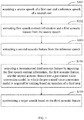
- FIG. 1 is a flowchart of a voice conversion method according to a first embodiment of the disclosure.
- the voice conversion method according to the first embodiment of the disclosure may include actions in the following blocks.
- a source speech of a first user and a reference speech of a second user are acquired.
- an execution body of the voice conversion method in some embodiments of the disclosure may be a hardware device with data and information processing capabilities and/or necessary software to drive the hardware device to work.
- the execution body may include a workstation, a server, a computer, a user terminal, and other equipment.
- the user terminal may include but be not limited to, a mobile phone, a personal computer, a smart speech interaction device, a smart home appliance, and a vehicle-mounted terminal.
- the source speech may be a speech segment uttered by the first user without timbre conversion and may have timbre characteristics of the first user; and the reference speech may be a speech segment uttered by the second user and may have timbre characteristics of the second user.
- the voice conversion method in some embodiments of the disclosure may convert the source speech of the first user into a speech segment with the timbre of the second user characterized by the reference speech of the second user, so as to realize the imitation of the timbre of the second user.
- the first user and the second user may include, but be not limited to, humans, smart speech interaction devices, and the like.
- both the source speech of the first user and the reference speech of the second user may be acquired through recording, network transmission, or the like.
- the device may have a speech collection apparatus, and the speech collection apparatus may be a microphone (Microphone), a microphone array, or the like.
- the speech collection apparatus may be a microphone (Microphone), a microphone array, or the like.
- the device when the source speech of the first user and/or the reference speech of the second user are acquired through network transmission, the device may have a networking apparatus, and network transmission may be performed with other devices or servers through the networking apparatus.
- the voice conversion method provided in some embodiments of the disclosure may be applicable to a smart speech interaction device.
- the smart speech interaction device may implement functions such as reading article aloud, question and answer. If a user wants to replace the timbre of reading aloud a text by the smart speech interaction device with his/her timbre, the source speech of reading aloud the text by the smart speech interaction device may be acquired and his/her reference speech may be recorded in this scenario.
- the voice conversion method provided in some embodiments of the disclosure may also be applicable to a video APP (Application).
- the video APP may implement the secondary creation of film and television works.
- the user may want to replace a speech segment in the film and television work with a speech segment having an actor's timbre and semantics.
- the user may record his/her source speech and download a reference speech segment of the actor through the network.
- first speech content information and a first acoustic feature are extracted from the source speech.
- the first speech content information may include but be not limited to a speech text and a semantic text of the source speech.
- the first acoustic feature may include but be not limited to a Mel feature, a Mel-scale frequency cepstral coefficient, a perceptual linear predict (PLP) feature, etc.
- the first speech content information may be extracted from the source speech through the speech recognition model, and the first acoustic feature may be extracted from the source speech through the acoustic model.
- Both the speech recognition model and the acoustic model may be preset based on actual situations.
- a second acoustic feature is extracted from the reference speech.
- a reconstructed third acoustic feature is acquired by inputting the first speech content information, the first acoustic feature, and the second acoustic feature into a pre-trained voice conversion model, in which the pre-trained voice conversion model is acquired by training based on speeches of a third user.
- the voice conversion model may be pre-trained based on speeches of the third user to acquire the pre-trained voice conversion model, which is configured to acquire the reconstructed third acoustic feature based on the first speech content information, the first acoustic feature, and the second acoustic feature.
- the related content of the third acoustic feature may refer to the related content of the first acoustic feature in the above-mentioned embodiments, which will not be repeated herein.
- the first acoustic feature, the second acoustic feature, and the third acoustic feature may all be Mel features.
- the pre-trained voice conversion model is not related to the first user and the second user.
- the voice conversion model in this method is pre-established and does not need to be trained and updated based on different users in the subsequent. It has a high flexibility, helps to save computing resources and storage resources, realizes real-time voice conversion, helps to shorten the waiting duration of voice conversion, and has low speech recording requirements for users.
- the voice conversion method provided in some embodiments of the disclosure may be applicable to scenarios such as multilingual switching and multi-timbre switching.
- the multilingual switching scenario refers to a case where the language corresponding to the source speech of the first user is different from the language corresponding to the reference speech of the second user.
- the multi-timbre switching scenario refers to a case where there is one first user and multiple second users.
- a plurality of different voice conversion models need to be established in scenarios such as multilingual switching and multi-timbre switching in the related art.
- the training and updating of the voice conversion models may be cumbersome, and the stability and smoothness of voice conversion may be poor.
- Only one voice conversion model needs to be established in advance in the disclosure, and there is no need to train and update the model based on different users in the future, which helps to improve the stability and smoothness of voice conversion in scenarios such as multilingual switching and multi-timbre switching including Mandarin.
- a target speech is synthesized based on the third acoustic feature.
- the timbre characteristics corresponding to the target speech may be the timbre characteristics corresponding to the reference speech of the second user. That is, the method may realize the imitation of the timbre of the second user.
- the speech content information corresponding to the target speech may be the first speech content information of the source speech. That is, the method may retain the speech content information of the source speech of the first user.
- characteristics such as the speech speed, emotion, and rhythm corresponding to the target speech may be characteristics such as the speech speed, emotion, and rhythm corresponding to the source speech. That is, the method may retain characteristics such as the speech speed, emotion, and rhythm of the source speech of the first user, which may help to improve the consistency between the target speech and the source speech.
- the target speech may be synthesized based on the third acoustic model by a vocoder.
- the first speech content information and the first acoustic feature of the source speech and the second acoustic feature of the reference speech may be inputted into the pre-trained voice conversion model, to acquire the reconstructed third acoustic feature, and the target speech may be synthesized based on the reconstructed third acoustic feature.
- the voice conversion model is pre-established and does not need to be trained and updated in the future. It has the high flexibility and may realize the instant voice conversion, which helps to shorten the waiting duration of voice conversion and is suitable for scenarios such as multilingual switching and multi-timbre switching.
- extracting the first speech content information from the source speech at block S102 may include: acquiring a phonetic posterior gram by inputting the source speech into a pre-trained multilingual automatic speech recognition model; and using the phonetic posterior gram as the first speech content information.
- the phonetic posterior gram may represent the speech content information of the speech, and is not related to the originator of the speech.
- the phonetic posterior gram may be acquired through a multilingual automatic speech recognition (ASR) model, and the phonetic posterior gram may be used as the first speech content information of the source speech.
- ASR multilingual automatic speech recognition
- the multilingual automatic speech recognition does not limit the language of the source speech, and may perform speech recognition on the source speeches of multiple different languages to acquire the corresponding phonetic posterior grams.
- the first speech content information and the first acoustic feature may be extracted from the source speech and the second acoustic feature may be extracted from the reference speech.
- the first speech content information, the first acoustic feature, and the second acoustic feature may be inputted into the pre-trained voice conversion model to acquire the reconstructed third acoustic feature.
- the target speech may be synthesized based on the third acoustic feature to achieve the voice conversion.
- the voice conversion model may include a hidden-variable network, a timbre network, and a reconstruction network.
- acquiring the reconstructed third acoustic feature by inputting the first speech content information, the first acoustic feature, and the second acoustic feature into the pre-trained voice conversion model at block S104 may include the following.
- a fundamental frequency and an energy parameter are acquired by inputting the first acoustic feature into the hidden-variable network.
- the hidden-variable network may acquire the fundamental frequency and the energy parameter of the source speech based on the first acoustic feature.
- the hidden-variable network may be set based on actual situations.
- the energy parameter may include but be not limited to the frequency and amplitude of the source speech, which is not limited herein.
- the fundamental frequency and the energy parameter of the source speech is a low-dimensional parameter of the source speech, which may reflect the fundamental frequency and the energy of the source speech and other low-dimensional characteristics.
- acquiring the fundamental frequency and energy parameter by inputting the first acoustic feature into the hidden-variable network may include: inputting the first acoustic feature into the hidden-variable network, such that the hidden-variable network compresses the first acoustic feature on a frame scale, and extracts the fundamental frequency and the energy parameter from the compressed first acoustic feature. Therefore, the method may acquire the fundamental frequency and the energy parameter from the first acoustic feature in a compressing manner.
- the hidden-variable network may acquire a matrix of T*3 based on the first acoustic feature, and the matrix includes the fundamental frequency and the energy parameter of the source speech.
- a timbre parameter is acquired by inputting the second acoustic feature into the timbre network.
- the timbre network may acquire the timbre parameter of the reference speech based on the second acoustic feature.
- the timbre network may be set based on actual situations.
- the timbre network may include but be not limited to a deep neural network (DNN), a recurrent neural network (RNN), a convolutional neural network (CNN) and on the like.
- DNN deep neural network
- RNN recurrent neural network
- CNN convolutional neural network
- timbre parameter of the reference speech may reflect the timbre characteristics of the reference speech.
- acquiring the timbre parameter by inputting the second acoustic feature into the timbre network may include: inputting the second acoustic feature into the timbre network, such that the timbre network abstracts the second acoustic feature by a deep recurrent neural network (DRNN) and a variational auto encoder (VAE) to acquire the timbre parameter. Therefore, the method may acquire the timbre parameter from the second acoustic feature in an abstracting manner.
- DRNN deep recurrent neural network
- VAE variational auto encoder
- the timbre network may acquire a 1*64 matrix based on the second acoustic feature, and the matrix includes the timbre parameter of the reference speech.
- the third acoustic feature is acquired by inputting the first speech content information, the fundamental frequency and energy parameter, and the timbre parameter into the reconstruction network.
- the reconstruction network may acquire the third acoustic feature based on the first speech content information, the fundamental frequency and the energy parameter, and the timbre parameter.
- the relevant content of the reconstruction network reference should be made to the relevant content of the timbre network in the above embodiments, which is not be repeated herein.
- the first speech content information may reflect the speech content information of the source speech
- the fundamental frequency and the energy parameter may reflect the fundamental frequency
- the timbre parameter may reflect the timbre characteristics of the reference speech.
- the third acoustic feature acquired based on the first speech content information, the fundamental frequency and the energy parameter, and the timbre parameter may reflect the speech content information of the source speech, as well as the low-dimensional characteristics such as the fundamental frequency and the energy of the source speech, and the timbre characteristics of the reference speech, so that when the target speech is subsequently synthesized based on the third acoustic feature, the speech content information of the source speech of the first user may be retained, the fundamental frequency and the energy stability of the target speech may be maintained, and the timbre characteristics of the reference speech of the second user may be retained.
- acquiring the third acoustic feature by inputting the first speech content information, the fundamental frequency and energy parameter, and the timbre parameter into the reconstruction network may include: inputting the first speech content information, the fundamental frequency and energy parameter, and the timbre parameter into the reconstruction network, such that the reconstruction network performs an acoustic feature reconstruction on the first speech content information, the fundamental frequency and energy parameter, and the timbre parameter by a deep recurrent neural network to acquire the third acoustic feature.
- the voice conversion model in this method may include the hidden-variable network, the timbre network, and the reconstruction network.
- the hidden-variable network may acquire the fundamental frequency and the energy parameter of the source speech based on the first acoustic feature;
- the timbre network may acquire the timbre parameter of the reference speech based on the second acoustic feature;
- the reconstruction network may acquire the third acoustic feature based on the first speech content information, the fundamental frequency and energy parameter, and the timbre parameter.
- the speech content information of the source speech of the first user may be retained, the stability of the fundamental frequency and energy of the target speech may be maintained, and the timbre characteristics of the reference speech of the second user may be retained.
- acquiring the pre-trained speech conversion model may include the following.
- a first speech and a second speech of the third user are acquired.
- the first speech is different from the second speech.
- second speech content information and a fourth acoustic feature are extracted from the first speech.
- a fifth acoustic feature is extracted from the second speech.
- a reconstructed sixth acoustic feature is acquired by inputting the second speech content information, the fourth acoustic feature, and the fifth acoustic feature into a voice conversion model to be trained.
- model parameters in the voice conversion model to be trained are adjusted based on a difference between the sixth acoustic feature and the fourth acoustic feature, and it returns to the acquiring the first speech and the second speech of the third user until the difference between the sixth acoustic feature and the fourth acoustic feature satisfies a preset training end condition, and the voice conversion model to be trained after a last adjusting of model parameters is determined as the pre-trained voice conversion model.
- two different speeches of the same user may be employed to train the voice conversion model to be trained each time, in which one of the speeches is employed as the source speech in the above-mentioned embodiments, and another of the speeches is employed as the reference speech in the above-mentioned embodiments.
- the first speech and the second speech of the third user are employed for training the voice conversion model to be trained as an example.
- the first speech of the third user may be used as the source speech in the above embodiments.
- the second speech content information and the fourth acoustic feature may be extracted from the first speech.
- the second speech of the third user may be used as the reference speech in the above embodiments.
- the fifth acoustic feature may be extracted from the second speech.
- the second speech content information, the fourth acoustic feature, and the fifth acoustic feature are input into the voice conversion model to be trained to acquire the reconstructed sixth acoustic feature.
- the model parameters in the voice conversion model to be trained are adjusted based on the difference between the sixth acoustic feature and the fourth acoustic feature, and it returns to the action of acquiring the first speech and the second speech of the third user and the subsequent actions.
- the voice conversion model to be trained may be trained and updated based on multiple sets of sample data, until the difference between the sixth acoustic feature and the fourth acoustic feature satisfies the preset training end condition.
- the voice conversion model to be trained after a last adjusting of model parameters is determined as the pre-trained voice conversion model.
- the preset training end condition may be set based on actual situations, for example, it may be set that the difference between the sixth acoustic feature and the fourth acoustic feature is less than the preset threshold.
- the method may train and update the voice conversion model to be trained based on sets of sample data to acquire the pre-trained voice conversion model.
- the voice conversion model may include networks, and each network corresponds to its own network parameters.
- a joint training may be performed on the networks in the voice conversion model to be trained based on the sets of sample data, to separately adjust the network parameters in each network in the voice conversion model to be trained, so that the pre-trained voice conversion model may be acquired.
- the voice conversion model may include a hidden-variable network, a timbre network, and a reconstruction network.
- the joint training may be performed on the hidden-variable network, the timbre network, and the reconstruction network in the voice conversion model to be trained, to separately adjust the network parameters in the hidden-variable network, the timbre network, and the reconstruction network, so that the pre-trained voice conversion model may be acquired.
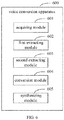
- FIG. 6 is a block diagram of a voice conversion apparatus according to a first embodiment of the disclosure.
- the voice conversion apparatus 600 may include an acquiring module 601, a first extracting module 602, a second extracting module 603, a conversion module 604, and a synthesizing module 605.
- the acquiring module 601 is configured to acquire a source speech of a first user and a reference speech of a second user.
- the first extracting module 602 is configured to extract first speech content information and a first acoustic feature from the source speech.
- the second extracting module 603 is configured to extract a second acoustic feature from the reference speech.
- the conversion module 604 is configured to acquire a reconstructed third acoustic feature by inputting the first speech content information, the first acoustic feature, and the second acoustic feature into a pre-trained voice conversion model, in which the pre-trained voice conversion model is acquired by training based on speeches of a third user.
- the synthesizing module 605 is configured to synthesize a target speech based on the third acoustic feature.
- the first extracting module 602 is configured to: acquire a phonetic posterior gram by inputting the source speech into a pre-trained multilingual automatic speech recognition model; and use the phonetic posterior gram as the first speech content information.
- the first acoustic feature, the second acoustic feature, and the third acoustic feature are Mel features.
- the voice conversion model includes a hidden-variable network, a timbre network, and a reconstruction network.
- the conversion module 604 includes: a first inputting unit, configured to acquire a fundamental frequency and an energy parameter by inputting the first acoustic feature into the hidden-variable network; a second inputting unit, configured to acquire a timbre parameter by inputting the second acoustic feature into the timbre network; and a third inputting unit, configured to acquire the third acoustic feature by inputting the first speech content information, the fundamental frequency and energy parameter, and the timbre parameter into the reconstruction network.
- the first inputting unit is configured to: input the first acoustic feature into the hidden-variable network, such that the hidden-variable network compresses the first acoustic feature on a frame scale, and extracts the fundamental frequency and energy parameter from the compressed first acoustic feature.
- the second inputting unit is configured to: input the second acoustic feature into the timbre network, such that the timbre network abstracts the second acoustic feature by a deep recurrent neural network and a variational auto encoder to acquire the timbre parameter.
- the third inputting unit is configured to: input the first speech content information, the fundamental frequency and energy parameter, and the timbre parameter into the reconstruction network, such that the reconstruction network performs an acoustic feature reconstruction on the first speech content information, the fundamental frequency and energy parameter, and the timbre parameter by a deep recurrent neural network to acquire the third acoustic feature.
- the apparatus 600 further includes a model training module 606.
- the model training module 606 is configured to: acquire a first speech and a second speech of the third user; extract second speech content information and a fourth acoustic feature from the first speech; extract a fifth acoustic feature from the second speech; acquire a reconstructed sixth acoustic feature by inputting the second speech content information, the fourth acoustic feature, and the fifth acoustic feature into a voice conversion model to be trained; adjust model parameters in the voice conversion model to be trained based on a difference between the sixth acoustic feature and the fourth acoustic feature, and return to acquire the first speech and the second speech of the third user until the difference between the sixth acoustic feature and the fourth acoustic feature satisfies a preset training end condition; and determine the voice conversion model to be trained after a last adjusting of model parameters as the pre-trained voice conversion model.
- the first speech content information and the first acoustic feature of the source speech and the second acoustic feature of the reference speech may be inputted into the pre-trained voice conversion model, to acquire the reconstructed third acoustic feature, and the target speech may be synthesized based on the reconstructed third acoustic feature.
- the voice conversion model is pre-established and does not need to be trained and updated in the future. It has the high flexibility and may realize the instant voice conversion, which helps to shorten the waiting duration of voice conversion and is suitable for scenarios such as multilingual switching and multi-timbre switching.
- the disclosure also provides an electronic device and a readable storage medium.
- FIG. 8 is a block diagram of an electronic device for implementing a voice conversion method according to some embodiments of the disclosure.
- Electronic devices are intended to represent various forms of digital computers, such as laptop computers, desktop computers, workbenches, personal digital assistants, servers, blade servers, mainframe computers, and other suitable computers.
- Electronic devices may also represent various forms of mobile devices, such as smart speech interaction devices, personal digital processing, cellular phones, smart phones, wearable devices, and other similar computing devices.
- the components shown here, their connections and relations, and their functions are merely examples, and are not intended to limit the implementation of the disclosure described and/or required herein.
- the electronic device includes: one or more processors 801, a memory 802, and interfaces for connecting various components, including a high-speed interface and a low-speed interface.
- the various components are interconnected using different buses and may be mounted on a common mainboard or otherwise installed as required.
- the processor 801 may process instructions executed within the electronic device, including instructions stored in or on the memory to display graphical information of the GUI on an external input/output device such as a display device coupled to the interface.
- a plurality of processors and/or buses can be used with a plurality of memories and processors, if desired.
- a plurality of electronic devices can be connected, each providing some of the necessary operations (for example, as a server array, a group of blade servers, or a multiprocessor system).
- a processor 801 is taken as an example in FIG. 8 .
- the memory 802 is a non-transitory computer-readable storage medium according to the disclosure.
- the memory stores instructions executable by at least one processor, so that the at least one processor executes the method according to the disclosure.
- the non-transitory computer-readable storage medium of the disclosure stores computer instructions, which are used to cause a computer to execute the method according to the disclosure.
- the memory 802 is configured to store non-transitory software programs, non-transitory computer executable programs and modules, such as program instructions/modules corresponding to the method in the embodiment of the disclosure (For example, an acquiring module 601, a first extracting module 602, a second extracting module 603, a conversion module 604, and a synthesizing module 605 in FIG. 6 ).
- the processor 801 executes various functional applications and data processing of the server by running non-transitory software programs, instructions, and modules stored in the memory 802, that is, implementing the method in the foregoing method embodiments.
- the memory 802 may include a storage program area and a storage data area, where the storage program area may store an operating system and application programs required for at least one function.
- the storage data area may store data created according to the use of the electronic device, and the like.
- the memory 802 may include a high-speed random access memory, and a non-transitory memory, such as at least one magnetic disk storage device, a flash memory device, or other non-transitory solid-state storage device.
- the memory 802 may optionally include a memory remotely disposed with respect to the processor 801, and these remote memories may be connected to the electronic device through a network. Examples of the above network include, but are not limited to, the Internet, an intranet, a local area network, a mobile communication network, and combinations thereof.
- the electronic device for implementing the method may further include: an input device 803 and an output device 804.
- the processor 801, the memory 802, the input device 803, and the output device 804 may be connected through a bus or in other manners. In FIG. 8 , the connection through the bus is taken as an example.
- the input device 803 may receive inputted numeric or character information, and generate key signal inputs related to user settings and function control of an electronic device, such as a touch screen, a keypad, a mouse, a trackpad, a touchpad, an indication rod, one or more mouse buttons, trackballs, joysticks and other input devices.
- the output device 804 may include a display device, an auxiliary lighting device (for example, an LED), a haptic feedback device (for example, a vibration motor), and the like.
- the display device may include, but is not limited to, a liquid crystal display (LCD), a light emitting diode (LED) display, and a plasma display. In some embodiments, the display device may be a touch screen.
- Various embodiments of the systems and technologies described herein may be implemented in digital electronic circuit systems, integrated circuit systems, application specific integrated circuits (ASICs), computer hardware, firmware, software, and/or combinations thereof. These various embodiments may be implemented in one or more computer programs, which may be executed and/or interpreted on a programmable system including at least one programmable processor.
- the programmable processor may be dedicated or general purpose programmable processor that receives data and instructions from a storage system, at least one input device, and at least one output device, and transmits the data and instructions to the storage system, the at least one input device, and the at least one output device.
- machine-readable medium and “computer-readable medium” refer to any computer program product, device, and/or device used to provide machine instructions and/or data to a programmable processor (for example, magnetic disks, optical disks, memories, programmable logic devices (PLDs), including machine-readable media that receive machine instructions as machine-readable signals.
- machine-readable signal refers to any signal used to provide machine instructions and/or data to a programmable processor.
- the systems and techniques described herein may be implemented on a computer having a display device (e.g., a Cathode Ray Tube (CRT) or a Liquid Crystal Display (LCD) monitor for displaying information to a user); and a keyboard and pointing device (such as a mouse or trackball) through which the user can provide input to the computer.
- a display device e.g., a Cathode Ray Tube (CRT) or a Liquid Crystal Display (LCD) monitor for displaying information to a user
- LCD Liquid Crystal Display
- keyboard and pointing device such as a mouse or trackball
- Other kinds of devices may also be used to provide interaction with the user.
- the feedback provided to the user may be any form of sensory feedback (e.g., visual feedback, auditory feedback, or haptic feedback), and the input from the user may be received in any form (including acoustic input, sound input, or tactile input).
- the systems and technologies described herein can be implemented in a computing system that includes background components (for example, a data server), or a computing system that includes middleware components (for example, an application server), or a computing system that includes front-end components (For example, a user computer with a graphical user interface or a web browser, through which the user can interact with the implementation of the systems and technologies described herein), or include such background components, intermediate computing components, or any combination of front-end components.
- the components of the system may be interconnected by any form or medium of digital data communication (e.g., a communication network). Examples of communication networks include: local area network (LAN), wide area network (WAN), and the Internet.
- the computer system may include a client and a server.
- the client and server are generally remote from each other and interacting through a communication network.
- the client-server relation is generated by computer programs running on the respective computers and having a client-server relation with each other.
- the server may be a cloud server, also known as a cloud computing server or a cloud host. It is a host product in the cloud computing service system to solve the shortcomings of difficult management and weak scalability in the conventional physical host and the VPS service ("Virtual Private Server").
- the server may perform speech recognition and semantic analysis according to the user's first speech signal sent by the smart speech interaction device to obtain the user's semantic text, and may obtain the service query result according to the semantic text and feed it back to the smart speech interaction device.
- speech processing technology to automate service processing, users may handle service without the assistance of staff, and the labor cost is low, which helps reduce people's waiting duration and processing time for service processing, and improves the efficiency of service processing.
Landscapes
- Engineering & Computer Science (AREA)
- Physics & Mathematics (AREA)
- Computational Linguistics (AREA)
- Health & Medical Sciences (AREA)
- Acoustics & Sound (AREA)
- Audiology, Speech & Language Pathology (AREA)
- Multimedia (AREA)
- Human Computer Interaction (AREA)
- Signal Processing (AREA)
- Quality & Reliability (AREA)
- Theoretical Computer Science (AREA)
- Evolutionary Computation (AREA)
- Artificial Intelligence (AREA)
- Mathematical Physics (AREA)
- General Engineering & Computer Science (AREA)
- Molecular Biology (AREA)
- Software Systems (AREA)
- Biomedical Technology (AREA)
- Biophysics (AREA)
- General Health & Medical Sciences (AREA)
- General Physics & Mathematics (AREA)
- Life Sciences & Earth Sciences (AREA)
- Data Mining & Analysis (AREA)
- Computing Systems (AREA)
- Computer Vision & Pattern Recognition (AREA)
- Telephonic Communication Services (AREA)
- User Interface Of Digital Computer (AREA)
- Electrically Operated Instructional Devices (AREA)
- Machine Translation (AREA)
Abstract
Description
- The disclosure relates to the field of voice conversion, speech interaction, natural language processing, and deep learning in the field of computer technologies, especially to a voice conversion method, a voice conversion apparatus, an electronic device, and a storage medium.
- The voice conversion method may convert a speech segment of a user into a speech segment with a timbre of a target user, which may realize an imitation of the timbre of the target user.
- A voice conversion method is provided in a first aspect. The method includes: acquiring a source speech of a first user and a reference speech of a second user; extracting first speech content information and a first acoustic feature from the source speech; extracting a second acoustic feature from the reference speech; acquiring a reconstructed third acoustic feature by inputting the first speech content information, the first acoustic feature, and the second acoustic feature into a pre-trained voice conversion model, in which the pre-trained voice conversion model is acquired by training based on speeches of a third user; and synthesizing a target speech based on the third acoustic feature.
- A voice conversion apparatus is provided in a second aspect. The apparatus includes: an acquiring module, configured to acquire a source speech of a first user and a reference speech of a second user; a first extracting module, configured to extract first speech content information and a first acoustic feature from the source speech; a second extracting module, configured to extract a second acoustic feature from the reference speech; a conversion module, configured to acquire a reconstructed third acoustic feature by inputting the first speech content information, the first acoustic feature, and the second acoustic feature into a pre-trained voice conversion model, in which the pre-trained voice conversion model is acquired by training based on speeches of a third user; and a synthesizing module, configured to synthesize a target speech based on the third acoustic feature.
- An electronic device is provided in a third aspect. The electronic device includes: at least one processor, and a memory communicatively connected to the at least one processor. The memory is configured to store instructions executable by the at least one processor, and when the instructions are executed by the at least one processor, the at least one processor is caused to implement the voice conversion method according to the first aspect of the disclosure.
- A computer-readable storage medium is provided in a fourth aspect. The non-transitory computer-readable storage medium has stored therein instructions that, when executed by a computer, the computer is caused to implement the voice conversion method according to the first aspect of the disclosure.
- A program product is provided in a fifth aspect. The program product has stored therein instructions that, when executed by one or more processors of an apparatus, causes the apparatus to perform the voice conversion method according to the first aspect of the disclosure.
- A computer program is provided in a sixth aspect. The computer program is executing on a processor, to perform the voice conversion method according to the first aspect of the disclosure.
- The preferred embodiments are defined in the dependent claims.
- It should be understood that the content described in this section is not intended to identify the key or important features of the embodiments of the disclosure, nor is it intended to limit the scope of the disclosure. Additional features of the disclosure will be easily understood by the following description.
- The accompanying drawings are used to understand the solution better, and do not constitute a limitation on the application, in which:
-
FIG. 1 is a flowchart of a voice conversion method according to a first embodiment of the disclosure. -
FIG. 2 is a schematic diagram of a scene of a voice conversion method according to a second embodiment of the disclosure. -
FIG. 3 is a schematic diagram of a scene of a voice conversion method according to a third embodiment of the disclosure. -
FIG. 4 is a flowchart of acquiring a reconstructed third acoustic feature in a voice conversion method according to a fourth embodiment of the disclosure. -
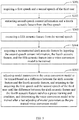
FIG. 5 is a flowchart of acquiring a pre-trained voice conversion model in a voice conversion method according to a fourth embodiment of the disclosure. -
FIG. 6 is a block diagram of a voice conversion apparatus according to a first embodiment of the disclosure. -
FIG. 7 is a block diagram of a voice conversion apparatus according to a second embodiment of the disclosure. -
FIG. 8 is a block diagram of an electronic device for implementing a voice conversion method according to some embodiments of the disclosure. - The following describes the exemplary embodiments of the disclosure with reference to the accompanying drawings, which includes various details of the embodiments of the disclosure to facilitate understanding and shall be considered merely exemplary. Therefore, those of ordinary skill in the art should recognize that various changes and modifications can be made to the embodiments described herein without departing from the scope and spirit of the disclosure. For clarity and conciseness, descriptions of well-known functions and structures are omitted in the following description.
- The voice conversion method in the related art requires the user to record speech segments in advance, a model training and updating may be performed based on the speech segments of the user, and the voice conversion may be performed based on the updated model. This method has higher requirements for the user's speech recording. The model needs to be updated every time before the voice conversion is performed, and the waiting duration for the voice conversion is long and flexibility is poor.
-
FIG. 1 is a flowchart of a voice conversion method according to a first embodiment of the disclosure. - As illustrated in
FIG. 1 , the voice conversion method according to the first embodiment of the disclosure may include actions in the following blocks. - At block S101, a source speech of a first user and a reference speech of a second user are acquired.
- It should be noted that an execution body of the voice conversion method in some embodiments of the disclosure may be a hardware device with data and information processing capabilities and/or necessary software to drive the hardware device to work. Optionally, the execution body may include a workstation, a server, a computer, a user terminal, and other equipment. The user terminal may include but be not limited to, a mobile phone, a personal computer, a smart speech interaction device, a smart home appliance, and a vehicle-mounted terminal.
- It should be noted that the source speech may be a speech segment uttered by the first user without timbre conversion and may have timbre characteristics of the first user; and the reference speech may be a speech segment uttered by the second user and may have timbre characteristics of the second user. The voice conversion method in some embodiments of the disclosure may convert the source speech of the first user into a speech segment with the timbre of the second user characterized by the reference speech of the second user, so as to realize the imitation of the timbre of the second user. The first user and the second user may include, but be not limited to, humans, smart speech interaction devices, and the like.
- Optionally, both the source speech of the first user and the reference speech of the second user may be acquired through recording, network transmission, or the like.
- It should be understood that when the source speech of the first user and/or the reference speech of the second user are acquired through recording, the device may have a speech collection apparatus, and the speech collection apparatus may be a microphone (Microphone), a microphone array, or the like.
- Alternatively, when the source speech of the first user and/or the reference speech of the second user are acquired through network transmission, the device may have a networking apparatus, and network transmission may be performed with other devices or servers through the networking apparatus.
- In some implementations, the voice conversion method provided in some embodiments of the disclosure may be applicable to a smart speech interaction device. The smart speech interaction device may implement functions such as reading article aloud, question and answer. If a user wants to replace the timbre of reading aloud a text by the smart speech interaction device with his/her timbre, the source speech of reading aloud the text by the smart speech interaction device may be acquired and his/her reference speech may be recorded in this scenario.
- In some implementations, the voice conversion method provided in some embodiments of the disclosure may also be applicable to a video APP (Application). The video APP may implement the secondary creation of film and television works. For example, the user may want to replace a speech segment in the film and television work with a speech segment having an actor's timbre and semantics. In this scenario, the user may record his/her source speech and download a reference speech segment of the actor through the network.
- At block S102, first speech content information and a first acoustic feature are extracted from the source speech.
- In some embodiments of the disclosure, the first speech content information may include but be not limited to a speech text and a semantic text of the source speech. The first acoustic feature may include but be not limited to a Mel feature, a Mel-scale frequency cepstral coefficient, a perceptual linear predict (PLP) feature, etc.
- In some implementations, the first speech content information may be extracted from the source speech through the speech recognition model, and the first acoustic feature may be extracted from the source speech through the acoustic model. Both the speech recognition model and the acoustic model may be preset based on actual situations.
- At block S103, a second acoustic feature is extracted from the reference speech.
- Reference should be made to the relevant content of extracting the first acoustic feature from the source speech in the foregoing embodiments for the implementation process and principle of the action at block S103, which will not be repeated herein.
- At block S104, a reconstructed third acoustic feature is acquired by inputting the first speech content information, the first acoustic feature, and the second acoustic feature into a pre-trained voice conversion model, in which the pre-trained voice conversion model is acquired by training based on speeches of a third user.
- In some embodiments of the disclosure, the voice conversion model may be pre-trained based on speeches of the third user to acquire the pre-trained voice conversion model, which is configured to acquire the reconstructed third acoustic feature based on the first speech content information, the first acoustic feature, and the second acoustic feature.
- It should be noted that the related content of the third acoustic feature may refer to the related content of the first acoustic feature in the above-mentioned embodiments, which will not be repeated herein.
- Optionally, the first acoustic feature, the second acoustic feature, and the third acoustic feature may all be Mel features.
- It should be understandable that the pre-trained voice conversion model is not related to the first user and the second user. Compared with the related art where the user needs to record a long-term high-quality speech before each voice conversion and the voice conversion model is trained and updated based on the speech recorded by the user, the voice conversion model in this method is pre-established and does not need to be trained and updated based on different users in the subsequent. It has a high flexibility, helps to save computing resources and storage resources, realizes real-time voice conversion, helps to shorten the waiting duration of voice conversion, and has low speech recording requirements for users.
- It should be understood that the voice conversion method provided in some embodiments of the disclosure may be applicable to scenarios such as multilingual switching and multi-timbre switching. The multilingual switching scenario refers to a case where the language corresponding to the source speech of the first user is different from the language corresponding to the reference speech of the second user. The multi-timbre switching scenario refers to a case where there is one first user and multiple second users.
- A plurality of different voice conversion models need to be established in scenarios such as multilingual switching and multi-timbre switching in the related art. The training and updating of the voice conversion models may be cumbersome, and the stability and smoothness of voice conversion may be poor. Only one voice conversion model needs to be established in advance in the disclosure, and there is no need to train and update the model based on different users in the future, which helps to improve the stability and smoothness of voice conversion in scenarios such as multilingual switching and multi-timbre switching including Mandarin.
- At block S105, a target speech is synthesized based on the third acoustic feature.
- In some embodiments of the disclosure, the timbre characteristics corresponding to the target speech may be the timbre characteristics corresponding to the reference speech of the second user. That is, the method may realize the imitation of the timbre of the second user.
- Optionally, the speech content information corresponding to the target speech may be the first speech content information of the source speech. That is, the method may retain the speech content information of the source speech of the first user.
- Optionally, characteristics such as the speech speed, emotion, and rhythm corresponding to the target speech may be characteristics such as the speech speed, emotion, and rhythm corresponding to the source speech. That is, the method may retain characteristics such as the speech speed, emotion, and rhythm of the source speech of the first user, which may help to improve the consistency between the target speech and the source speech.
- Optionally, the target speech may be synthesized based on the third acoustic model by a vocoder.
- In summary, with the voice conversion method provided in the embodiments of the disclosure, the first speech content information and the first acoustic feature of the source speech and the second acoustic feature of the reference speech may be inputted into the pre-trained voice conversion model, to acquire the reconstructed third acoustic feature, and the target speech may be synthesized based on the reconstructed third acoustic feature. The voice conversion model is pre-established and does not need to be trained and updated in the future. It has the high flexibility and may realize the instant voice conversion, which helps to shorten the waiting duration of voice conversion and is suitable for scenarios such as multilingual switching and multi-timbre switching.
- On the basis of any of the foregoing embodiments, extracting the first speech content information from the source speech at block S102 may include: acquiring a phonetic posterior gram by inputting the source speech into a pre-trained multilingual automatic speech recognition model; and using the phonetic posterior gram as the first speech content information.
- It should be noted that the phonetic posterior gram (PPG) may represent the speech content information of the speech, and is not related to the originator of the speech.
- In some embodiments of the disclosure, the phonetic posterior gram may be acquired through a multilingual automatic speech recognition (ASR) model, and the phonetic posterior gram may be used as the first speech content information of the source speech. The multilingual automatic speech recognition does not limit the language of the source speech, and may perform speech recognition on the source speeches of multiple different languages to acquire the corresponding phonetic posterior grams.
- On the basis of any of the foregoing embodiments, as illustrated in
FIG. 2 , the first speech content information and the first acoustic feature may be extracted from the source speech and the second acoustic feature may be extracted from the reference speech. The first speech content information, the first acoustic feature, and the second acoustic feature may be inputted into the pre-trained voice conversion model to acquire the reconstructed third acoustic feature. The target speech may be synthesized based on the third acoustic feature to achieve the voice conversion. - It is understandable that multiple networks may be included in the voice conversion model. Taking
FIG. 3 as an example, the voice conversion model may include a hidden-variable network, a timbre network, and a reconstruction network. - Furthermore, as illustrated in
FIG. 4 , acquiring the reconstructed third acoustic feature by inputting the first speech content information, the first acoustic feature, and the second acoustic feature into the pre-trained voice conversion model at block S104 may include the following. - At block S201, a fundamental frequency and an energy parameter are acquired by inputting the first acoustic feature into the hidden-variable network.
- In some embodiments of the disclosure, the hidden-variable network may acquire the fundamental frequency and the energy parameter of the source speech based on the first acoustic feature. The hidden-variable network may be set based on actual situations. The energy parameter may include but be not limited to the frequency and amplitude of the source speech, which is not limited herein.
- It is understandable that the fundamental frequency and the energy parameter of the source speech is a low-dimensional parameter of the source speech, which may reflect the fundamental frequency and the energy of the source speech and other low-dimensional characteristics.
- Optionally, acquiring the fundamental frequency and energy parameter by inputting the first acoustic feature into the hidden-variable network may include: inputting the first acoustic feature into the hidden-variable network, such that the hidden-variable network compresses the first acoustic feature on a frame scale, and extracts the fundamental frequency and the energy parameter from the compressed first acoustic feature. Therefore, the method may acquire the fundamental frequency and the energy parameter from the first acoustic feature in a compressing manner.
- In some implementations, it is assumed that the length of the source speech is T seconds, and the hidden-variable network may acquire a matrix of T*3 based on the first acoustic feature, and the matrix includes the fundamental frequency and the energy parameter of the source speech.
- At block S202, a timbre parameter is acquired by inputting the second acoustic feature into the timbre network.
- In some embodiments of the disclosure, the timbre network may acquire the timbre parameter of the reference speech based on the second acoustic feature. The timbre network may be set based on actual situations. For example, the timbre network may include but be not limited to a deep neural network (DNN), a recurrent neural network (RNN), a convolutional neural network (CNN) and on the like.
- It is understandable that the timbre parameter of the reference speech may reflect the timbre characteristics of the reference speech.
- Optionally, acquiring the timbre parameter by inputting the second acoustic feature into the timbre network may include: inputting the second acoustic feature into the timbre network, such that the timbre network abstracts the second acoustic feature by a deep recurrent neural network (DRNN) and a variational auto encoder (VAE) to acquire the timbre parameter. Therefore, the method may acquire the timbre parameter from the second acoustic feature in an abstracting manner.
- In implementations, the timbre network may acquire a 1*64 matrix based on the second acoustic feature, and the matrix includes the timbre parameter of the reference speech.
- At block S203, the third acoustic feature is acquired by inputting the first speech content information, the fundamental frequency and energy parameter, and the timbre parameter into the reconstruction network.
- In some embodiments of the disclosure, the reconstruction network may acquire the third acoustic feature based on the first speech content information, the fundamental frequency and the energy parameter, and the timbre parameter. For the relevant content of the reconstruction network, reference should be made to the relevant content of the timbre network in the above embodiments, which is not be repeated herein.
- It is understandable that the first speech content information may reflect the speech content information of the source speech, the fundamental frequency and the energy parameter may reflect the fundamental frequency, the energy and other low-dimensional characteristics of the source speech, and the timbre parameter may reflect the timbre characteristics of the reference speech. The third acoustic feature acquired based on the first speech content information, the fundamental frequency and the energy parameter, and the timbre parameter may reflect the speech content information of the source speech, as well as the low-dimensional characteristics such as the fundamental frequency and the energy of the source speech, and the timbre characteristics of the reference speech, so that when the target speech is subsequently synthesized based on the third acoustic feature, the speech content information of the source speech of the first user may be retained, the fundamental frequency and the energy stability of the target speech may be maintained, and the timbre characteristics of the reference speech of the second user may be retained.
- Optionally, acquiring the third acoustic feature by inputting the first speech content information, the fundamental frequency and energy parameter, and the timbre parameter into the reconstruction network may include: inputting the first speech content information, the fundamental frequency and energy parameter, and the timbre parameter into the reconstruction network, such that the reconstruction network performs an acoustic feature reconstruction on the first speech content information, the fundamental frequency and energy parameter, and the timbre parameter by a deep recurrent neural network to acquire the third acoustic feature.
- Therefore, the voice conversion model in this method may include the hidden-variable network, the timbre network, and the reconstruction network. The hidden-variable network may acquire the fundamental frequency and the energy parameter of the source speech based on the first acoustic feature; the timbre network may acquire the timbre parameter of the reference speech based on the second acoustic feature; and the reconstruction network may acquire the third acoustic feature based on the first speech content information, the fundamental frequency and energy parameter, and the timbre parameter. Therefore, when synthesizing the target speech based on the third acoustic feature, the speech content information of the source speech of the first user may be retained, the stability of the fundamental frequency and energy of the target speech may be maintained, and the timbre characteristics of the reference speech of the second user may be retained.
- On the basis of any of the foregoing embodiments, as illustrated in
FIG. 5 , acquiring the pre-trained speech conversion model may include the following. - At block S301, a first speech and a second speech of the third user are acquired.
- In some embodiments of the disclosure, the first speech is different from the second speech.
- At block S302, second speech content information and a fourth acoustic feature are extracted from the first speech.
- At block S303, a fifth acoustic feature is extracted from the second speech.
- At block S304, a reconstructed sixth acoustic feature is acquired by inputting the second speech content information, the fourth acoustic feature, and the fifth acoustic feature into a voice conversion model to be trained.
- For the implementation process and principles of blocks S301-S304, reference should be made to the relevant content in the above-mentioned embodiments, which may not be repeated herein.
- At block S305, model parameters in the voice conversion model to be trained are adjusted based on a difference between the sixth acoustic feature and the fourth acoustic feature, and it returns to the acquiring the first speech and the second speech of the third user until the difference between the sixth acoustic feature and the fourth acoustic feature satisfies a preset training end condition, and the voice conversion model to be trained after a last adjusting of model parameters is determined as the pre-trained voice conversion model.
- In some embodiments of the disclosure, two different speeches of the same user may be employed to train the voice conversion model to be trained each time, in which one of the speeches is employed as the source speech in the above-mentioned embodiments, and another of the speeches is employed as the reference speech in the above-mentioned embodiments. In the disclosure, the first speech and the second speech of the third user are employed for training the voice conversion model to be trained as an example.
- For example, the first speech of the third user may be used as the source speech in the above embodiments. The second speech content information and the fourth acoustic feature may be extracted from the first speech. The second speech of the third user may be used as the reference speech in the above embodiments. The fifth acoustic feature may be extracted from the second speech. The second speech content information, the fourth acoustic feature, and the fifth acoustic feature are input into the voice conversion model to be trained to acquire the reconstructed sixth acoustic feature.
- It is understandable that since the first speech and the second speech are both uttered by the third user, the target speech should be not much different from the source speech, and the reconstructed sixth acoustic feature should be not much different from the fourth acoustic feature. At this time, the model parameters in the voice conversion model to be trained are adjusted based on the difference between the sixth acoustic feature and the fourth acoustic feature, and it returns to the action of acquiring the first speech and the second speech of the third user and the subsequent actions. The voice conversion model to be trained may be trained and updated based on multiple sets of sample data, until the difference between the sixth acoustic feature and the fourth acoustic feature satisfies the preset training end condition. The voice conversion model to be trained after a last adjusting of model parameters is determined as the pre-trained voice conversion model.
- The preset training end condition may be set based on actual situations, for example, it may be set that the difference between the sixth acoustic feature and the fourth acoustic feature is less than the preset threshold.
- Therefore, the method may train and update the voice conversion model to be trained based on sets of sample data to acquire the pre-trained voice conversion model.
- As another possible implementation manner, the voice conversion model may include networks, and each network corresponds to its own network parameters. A joint training may be performed on the networks in the voice conversion model to be trained based on the sets of sample data, to separately adjust the network parameters in each network in the voice conversion model to be trained, so that the pre-trained voice conversion model may be acquired.
- Taking
FIG. 3 as an example, the voice conversion model may include a hidden-variable network, a timbre network, and a reconstruction network. The joint training may be performed on the hidden-variable network, the timbre network, and the reconstruction network in the voice conversion model to be trained, to separately adjust the network parameters in the hidden-variable network, the timbre network, and the reconstruction network, so that the pre-trained voice conversion model may be acquired. -
FIG. 6 is a block diagram of a voice conversion apparatus according to a first embodiment of the disclosure. - As illustrated in
FIG. 6 , thevoice conversion apparatus 600 according to some embodiments of the disclosure may include an acquiringmodule 601, a first extractingmodule 602, a second extractingmodule 603, aconversion module 604, and asynthesizing module 605. - The acquiring
module 601 is configured to acquire a source speech of a first user and a reference speech of a second user. - The first extracting
module 602 is configured to extract first speech content information and a first acoustic feature from the source speech. - The second extracting
module 603 is configured to extract a second acoustic feature from the reference speech. - The
conversion module 604 is configured to acquire a reconstructed third acoustic feature by inputting the first speech content information, the first acoustic feature, and the second acoustic feature into a pre-trained voice conversion model, in which the pre-trained voice conversion model is acquired by training based on speeches of a third user. - The
synthesizing module 605 is configured to synthesize a target speech based on the third acoustic feature. - In some embodiments of the disclosure, the first extracting
module 602 is configured to: acquire a phonetic posterior gram by inputting the source speech into a pre-trained multilingual automatic speech recognition model; and use the phonetic posterior gram as the first speech content information. - In some embodiments of the disclosure, the first acoustic feature, the second acoustic feature, and the third acoustic feature are Mel features.
- In some embodiments of the disclosure, the voice conversion model includes a hidden-variable network, a timbre network, and a reconstruction network. The
conversion module 604 includes: a first inputting unit, configured to acquire a fundamental frequency and an energy parameter by inputting the first acoustic feature into the hidden-variable network; a second inputting unit, configured to acquire a timbre parameter by inputting the second acoustic feature into the timbre network; and a third inputting unit, configured to acquire the third acoustic feature by inputting the first speech content information, the fundamental frequency and energy parameter, and the timbre parameter into the reconstruction network. - In some embodiments of the disclosure, the first inputting unit is configured to: input the first acoustic feature into the hidden-variable network, such that the hidden-variable network compresses the first acoustic feature on a frame scale, and extracts the fundamental frequency and energy parameter from the compressed first acoustic feature.
- In some embodiments of the disclosure, the second inputting unit is configured to: input the second acoustic feature into the timbre network, such that the timbre network abstracts the second acoustic feature by a deep recurrent neural network and a variational auto encoder to acquire the timbre parameter.
- In some embodiments of the disclosure, the third inputting unit is configured to: input the first speech content information, the fundamental frequency and energy parameter, and the timbre parameter into the reconstruction network, such that the reconstruction network performs an acoustic feature reconstruction on the first speech content information, the fundamental frequency and energy parameter, and the timbre parameter by a deep recurrent neural network to acquire the third acoustic feature.
- In some embodiments of the disclosure, as illustrated in
FIG. 7 , theapparatus 600 further includes amodel training module 606. Themodel training module 606 is configured to: acquire a first speech and a second speech of the third user; extract second speech content information and a fourth acoustic feature from the first speech; extract a fifth acoustic feature from the second speech; acquire a reconstructed sixth acoustic feature by inputting the second speech content information, the fourth acoustic feature, and the fifth acoustic feature into a voice conversion model to be trained; adjust model parameters in the voice conversion model to be trained based on a difference between the sixth acoustic feature and the fourth acoustic feature, and return to acquire the first speech and the second speech of the third user until the difference between the sixth acoustic feature and the fourth acoustic feature satisfies a preset training end condition; and determine the voice conversion model to be trained after a last adjusting of model parameters as the pre-trained voice conversion model. - In summary, with the voice conversion apparatus provided in the embodiments of the disclosure, the first speech content information and the first acoustic feature of the source speech and the second acoustic feature of the reference speech may be inputted into the pre-trained voice conversion model, to acquire the reconstructed third acoustic feature, and the target speech may be synthesized based on the reconstructed third acoustic feature. The voice conversion model is pre-established and does not need to be trained and updated in the future. It has the high flexibility and may realize the instant voice conversion, which helps to shorten the waiting duration of voice conversion and is suitable for scenarios such as multilingual switching and multi-timbre switching.
- According to the embodiments of the disclosure, the disclosure also provides an electronic device and a readable storage medium.
-
FIG. 8 is a block diagram of an electronic device for implementing a voice conversion method according to some embodiments of the disclosure. Electronic devices are intended to represent various forms of digital computers, such as laptop computers, desktop computers, workbenches, personal digital assistants, servers, blade servers, mainframe computers, and other suitable computers. Electronic devices may also represent various forms of mobile devices, such as smart speech interaction devices, personal digital processing, cellular phones, smart phones, wearable devices, and other similar computing devices. The components shown here, their connections and relations, and their functions are merely examples, and are not intended to limit the implementation of the disclosure described and/or required herein. - As illustrated in
FIG. 8 , the electronic device includes: one ormore processors 801, amemory 802, and interfaces for connecting various components, including a high-speed interface and a low-speed interface. The various components are interconnected using different buses and may be mounted on a common mainboard or otherwise installed as required. Theprocessor 801 may process instructions executed within the electronic device, including instructions stored in or on the memory to display graphical information of the GUI on an external input/output device such as a display device coupled to the interface. In other embodiments, a plurality of processors and/or buses can be used with a plurality of memories and processors, if desired. Similarly, a plurality of electronic devices can be connected, each providing some of the necessary operations (for example, as a server array, a group of blade servers, or a multiprocessor system). Aprocessor 801 is taken as an example inFIG. 8 . - The
memory 802 is a non-transitory computer-readable storage medium according to the disclosure. The memory stores instructions executable by at least one processor, so that the at least one processor executes the method according to the disclosure. The non-transitory computer-readable storage medium of the disclosure stores computer instructions, which are used to cause a computer to execute the method according to the disclosure. - As a non-transitory computer-readable storage medium, the
memory 802 is configured to store non-transitory software programs, non-transitory computer executable programs and modules, such as program instructions/modules corresponding to the method in the embodiment of the disclosure (For example, an acquiringmodule 601, a first extractingmodule 602, a second extractingmodule 603, aconversion module 604, and asynthesizing module 605 inFIG. 6 ). Theprocessor 801 executes various functional applications and data processing of the server by running non-transitory software programs, instructions, and modules stored in thememory 802, that is, implementing the method in the foregoing method embodiments. - The
memory 802 may include a storage program area and a storage data area, where the storage program area may store an operating system and application programs required for at least one function. The storage data area may store data created according to the use of the electronic device, and the like. In addition, thememory 802 may include a high-speed random access memory, and a non-transitory memory, such as at least one magnetic disk storage device, a flash memory device, or other non-transitory solid-state storage device. In some embodiments, thememory 802 may optionally include a memory remotely disposed with respect to theprocessor 801, and these remote memories may be connected to the electronic device through a network. Examples of the above network include, but are not limited to, the Internet, an intranet, a local area network, a mobile communication network, and combinations thereof. - The electronic device for implementing the method may further include: an
input device 803 and anoutput device 804. Theprocessor 801, thememory 802, theinput device 803, and theoutput device 804 may be connected through a bus or in other manners. InFIG. 8 , the connection through the bus is taken as an example. - The
input device 803 may receive inputted numeric or character information, and generate key signal inputs related to user settings and function control of an electronic device, such as a touch screen, a keypad, a mouse, a trackpad, a touchpad, an indication rod, one or more mouse buttons, trackballs, joysticks and other input devices. Theoutput device 804 may include a display device, an auxiliary lighting device (for example, an LED), a haptic feedback device (for example, a vibration motor), and the like. The display device may include, but is not limited to, a liquid crystal display (LCD), a light emitting diode (LED) display, and a plasma display. In some embodiments, the display device may be a touch screen. - Various embodiments of the systems and technologies described herein may be implemented in digital electronic circuit systems, integrated circuit systems, application specific integrated circuits (ASICs), computer hardware, firmware, software, and/or combinations thereof. These various embodiments may be implemented in one or more computer programs, which may be executed and/or interpreted on a programmable system including at least one programmable processor. The programmable processor may be dedicated or general purpose programmable processor that receives data and instructions from a storage system, at least one input device, and at least one output device, and transmits the data and instructions to the storage system, the at least one input device, and the at least one output device.
- These computing programs (also known as programs, software, software applications, or code) include machine instructions of a programmable processor and may utilize high-level processes and/or object-oriented programming languages, and/or assembly/machine languages to implement these calculation procedures. As used herein, the terms "machine-readable medium" and "computer-readable medium" refer to any computer program product, device, and/or device used to provide machine instructions and/or data to a programmable processor (for example, magnetic disks, optical disks, memories, programmable logic devices (PLDs), including machine-readable media that receive machine instructions as machine-readable signals. The term "machine-readable signal" refers to any signal used to provide machine instructions and/or data to a programmable processor.
- In order to provide interaction with a user, the systems and techniques described herein may be implemented on a computer having a display device (e.g., a Cathode Ray Tube (CRT) or a Liquid Crystal Display (LCD) monitor for displaying information to a user); and a keyboard and pointing device (such as a mouse or trackball) through which the user can provide input to the computer. Other kinds of devices may also be used to provide interaction with the user. For example, the feedback provided to the user may be any form of sensory feedback (e.g., visual feedback, auditory feedback, or haptic feedback), and the input from the user may be received in any form (including acoustic input, sound input, or tactile input).
- The systems and technologies described herein can be implemented in a computing system that includes background components (for example, a data server), or a computing system that includes middleware components (for example, an application server), or a computing system that includes front-end components (For example, a user computer with a graphical user interface or a web browser, through which the user can interact with the implementation of the systems and technologies described herein), or include such background components, intermediate computing components, or any combination of front-end components. The components of the system may be interconnected by any form or medium of digital data communication (e.g., a communication network). Examples of communication networks include: local area network (LAN), wide area network (WAN), and the Internet.
- The computer system may include a client and a server. The client and server are generally remote from each other and interacting through a communication network. The client-server relation is generated by computer programs running on the respective computers and having a client-server relation with each other. The server may be a cloud server, also known as a cloud computing server or a cloud host. It is a host product in the cloud computing service system to solve the shortcomings of difficult management and weak scalability in the conventional physical host and the VPS service ("Virtual Private Server").
- In the method according to the embodiments of the disclosure, the server may perform speech recognition and semantic analysis according to the user's first speech signal sent by the smart speech interaction device to obtain the user's semantic text, and may obtain the service query result according to the semantic text and feed it back to the smart speech interaction device. Using the speech processing technology to automate service processing, users may handle service without the assistance of staff, and the labor cost is low, which helps reduce people's waiting duration and processing time for service processing, and improves the efficiency of service processing.
- It should be understood that various forms of processes shown above may be used to reorder, add, or delete steps. For example, the steps described in the disclosure may be performed in parallel, sequentially, or in different orders. As long as the desired results of the technical solutions disclosed in the disclosure can be achieved, no limitation is made herein.
- The above specific embodiments do not constitute a limitation on the protection scope of the disclosure. Those skilled in the art should understand that various modifications, combinations, sub-combinations and substitutions can be made according to design requirements and other factors. Any modification, equivalent replacement and improvement made within the spirit and principle of this application shall be included in the protection scope of this application.
Claims (15)
- A voice conversion method, comprising:acquiring (S101) a source speech of a first user and a reference speech of a second user;extracting (S102) first speech content information and a first acoustic feature from the source speech;extracting (S103) a second acoustic feature from the reference speech;acquiring (S104) a reconstructed third acoustic feature by inputting the first speech content information, the first acoustic feature, and the second acoustic feature into a pre-trained voice conversion model, in which the pre-trained voice conversion model is acquired by training based on speeches of a third user; andsynthesizing (S105) a target speech based on the third acoustic feature.
- The method as claimed in claim 1, wherein extracting (S102) the first speech content information from the source speech comprises:acquiring a phonetic posterior gram by inputting the source speech into a pre-trained multilingual automatic speech recognition model; andusing the phonetic posterior gram as the first speech content information.
- The method as claimed in claim 1 or 2, wherein the first acoustic feature, the second acoustic feature, and the third acoustic feature are Mel features.
- The method as claimed in any one of claims 1 to 3, wherein the voice conversion model comprises a hidden-variable network, a timbre network, and a reconstruction network, and acquiring (S104) the reconstructed third acoustic feature by inputting the first speech content information, the first acoustic feature, and the second acoustic feature into the pre-trained voice conversion model comprises:acquiring (S201) a fundamental frequency and an energy parameter by inputting the first acoustic feature into the hidden-variable network;acquiring (S202) a timbre parameter by inputting the second acoustic feature into the timbre network; andacquiring (S203) the third acoustic feature by inputting the first speech content information, the fundamental frequency and energy parameter, and the timbre parameter into the reconstruction network.
- The method as claimed in claim 4, wherein acquiring (S201) the fundamental frequency and energy parameter by inputting the first acoustic feature into the hidden-variable network comprises:
inputting the first acoustic feature into the hidden-variable network, such that the hidden-variable network compresses the first acoustic feature on a frame scale, and extracts the fundamental frequency and energy parameter from the compressed first acoustic feature. - The method as claimed in claim 4 or 5, wherein acquiring (S202) the timbre parameter by inputting the second acoustic feature into the timbre network comprises:
inputting the second acoustic feature into the timbre network, such that the timbre network abstracts the second acoustic feature by a deep recurrent neural network and a variational auto encoder to acquire the timbre parameter. - The method as claimed in claim 4, 5, or 6, wherein acquiring (S203) the third acoustic feature by inputting the first speech content information, the fundamental frequency and energy parameter, and the timbre parameter into the reconstruction network comprises:
inputting the first speech content information, the fundamental frequency and energy parameter, and the timbre parameter into the reconstruction network, such that the reconstruction network performs an acoustic feature reconstruction on the first speech content information, the fundamental frequency and energy parameter, and the timbre parameter by a deep recurrent neural network to acquire the third acoustic feature. - The method as claimed in any one of claims 1 to 7, further comprising:acquiring (S301) a first speech and a second speech of the third user;extracting (S302) second speech content information and a fourth acoustic feature from the first speech;extracting (S303) a fifth acoustic feature from the second speech;acquiring (S304) a reconstructed sixth acoustic feature by inputting the second speech content information, the fourth acoustic feature, and the fifth acoustic feature into a voice conversion model to be trained;adjusting (S305) model parameters in the voice conversion model to be trained based on a difference between the sixth acoustic feature and the fourth acoustic feature, and returning to the acquiring the first speech and the second speech of the third user until the difference between the sixth acoustic feature and the fourth acoustic feature satisfies a preset training end condition; anddetermining (S305) the voice conversion model to be trained after a last adjusting of model parameters as the pre-trained voice conversion model.
- A voice conversion apparatus, comprises:an acquiring module (601), configured to acquire a source speech of a first user and a reference speech of a second user;a first extracting module (602), configured to extract first speech content information and a first acoustic feature from the source speech;a second extracting module (603), configured to extract a second acoustic feature from the reference speech;a conversion module (604), configured to acquire a reconstructed third acoustic feature by inputting the first speech content information, the first acoustic feature, and the second acoustic feature into a pre-trained voice conversion model, in which the pre-trained voice conversion model is acquired by training based on speeches of a third user; anda synthesizing module (605), configured to synthesize a target speech based on the third acoustic feature.
- The apparatus as claimed in claim 9, wherein the first extracting module (602) is configured to:acquire a phonetic posterior gram by inputting the source speech into a pre-trained multilingual automatic speech recognition model; anduse the phonetic posterior gram as the first speech content information.
- The apparatus as claimed in claim 9 or 10, wherein the voice conversion model comprises a hidden-variable network, a timbre network, and a reconstruction network, and the conversion module (604) comprises:a first inputting unit, configured to acquire a fundamental frequency and an energy parameter by inputting the first acoustic feature into the hidden-variable network;a second inputting unit, configured to acquire a timbre parameter by inputting the second acoustic feature into the timbre network; anda third inputting unit, configured to acquire the third acoustic feature by inputting the first speech content information, the fundamental frequency and energy parameter, and the timbre parameter into the reconstruction network.
- An electronic device, comprising:at least one processor; anda memory communicatively connected to the at least one processor; wherein,the memory is configured to store instructions executable by the at least one processor, and when the instructions are executed by the at least one processor, the at least one processor is caused to implement the method according to any one of claims 1 to 8.
- A computer-readable storage medium having stored therein instructions that, when executed by a computer, the computer is caused to implement the method according to any one of claims 1 to 8.
- A program product having stored therein instructions that, when executed by one or more processors of an apparatus, causes the apparatus to perform the method according to any one of claims 1 to 8.
- A computer program, which when executing on a processor, performs the method according to any one of claims 1 to 8.
Applications Claiming Priority (1)
| Application Number | Priority Date | Filing Date | Title |
|---|---|---|---|
| CN202011025400.XA CN112259072B (en) | 2020-09-25 | 2020-09-25 | Voice conversion method, device and electronic device |
Publications (2)
| Publication Number | Publication Date |
|---|---|
| EP3859735A2 true EP3859735A2 (en) | 2021-08-04 |
| EP3859735A3 EP3859735A3 (en) | 2022-01-05 |
Family
ID=74234043
Family Applications (1)
| Application Number | Title | Priority Date | Filing Date |
|---|---|---|---|
| EP21178557.1A Withdrawn EP3859735A3 (en) | 2020-09-25 | 2021-06-09 | Voice conversion method, voice conversion apparatus, electronic device, and storage medium |
Country Status (5)
| Country | Link |
|---|---|
| US (1) | US20210280202A1 (en) |
| EP (1) | EP3859735A3 (en) |
| JP (1) | JP7181332B2 (en) |
| KR (1) | KR102484967B1 (en) |
| CN (1) | CN112259072B (en) |
Families Citing this family (40)
| Publication number | Priority date | Publication date | Assignee | Title |
|---|---|---|---|---|
| CN113066498B (en) * | 2021-03-23 | 2022-12-30 | 上海掌门科技有限公司 | Information processing method, apparatus and medium |
| CN113223555A (en) * | 2021-04-30 | 2021-08-06 | 北京有竹居网络技术有限公司 | Video generation method and device, storage medium and electronic equipment |
| CN113314101B (en) * | 2021-04-30 | 2024-05-14 | 北京达佳互联信息技术有限公司 | Voice processing method and device, electronic equipment and storage medium |
| CN113409767B (en) * | 2021-05-14 | 2023-04-25 | 北京达佳互联信息技术有限公司 | Voice processing method and device, electronic equipment and storage medium |
| CN113345411B (en) * | 2021-05-31 | 2024-01-05 | 多益网络有限公司 | Sound changing method, device, equipment and storage medium |
| CN113345454B (en) * | 2021-06-01 | 2024-02-09 | 平安科技(深圳)有限公司 | Training and application methods, devices, equipment and storage medium of voice conversion model |
| CN113571039B (en) * | 2021-08-09 | 2022-04-08 | 北京百度网讯科技有限公司 | Speech conversion method, system, electronic device and readable storage medium |
| CN114822496B (en) * | 2021-08-20 | 2024-09-20 | 美的集团(上海)有限公司 | A method, device, equipment and medium for switching tone |
| CN113470622B (en) * | 2021-09-06 | 2021-11-19 | 成都启英泰伦科技有限公司 | Conversion method and device capable of converting any voice into multiple voices |
| CN113823300B (en) * | 2021-09-18 | 2024-03-22 | 京东方科技集团股份有限公司 | Voice processing method and device, storage medium and electronic equipment |
| CN113889130B (en) * | 2021-09-27 | 2025-01-07 | 平安科技(深圳)有限公司 | A voice conversion method, device, equipment and medium |
| CN113782052A (en) * | 2021-11-15 | 2021-12-10 | 北京远鉴信息技术有限公司 | Tone conversion method, device, electronic equipment and storage medium |
| CN114242093A (en) * | 2021-12-16 | 2022-03-25 | 游密科技(深圳)有限公司 | Voice tone conversion method, device, computer equipment and storage medium |
| CN114495893B (en) * | 2021-12-20 | 2025-08-12 | 青岛海尔科技有限公司 | Voice audio processing method and device and electronic equipment |
| CN114267352B (en) * | 2021-12-24 | 2023-04-14 | 北京信息科技大学 | A voice information processing method, electronic equipment, and computer storage medium |
| CN114360558B (en) * | 2021-12-27 | 2022-12-13 | 北京百度网讯科技有限公司 | Voice conversion method, voice conversion model generation method and device |
| CN114550717B (en) * | 2022-02-16 | 2026-01-06 | 北京梧桐车联科技有限责任公司 | Voice region switching methods, devices, equipment and storage media |
| CN114255737B (en) * | 2022-02-28 | 2022-05-17 | 北京世纪好未来教育科技有限公司 | Voice generation method and device and electronic equipment |
| CN114648986B (en) * | 2022-04-07 | 2025-08-12 | 游密科技(深圳)有限公司 | Speech conversion method, apparatus, computer device, storage medium, and program product |
| CN115294963B (en) * | 2022-04-12 | 2025-06-13 | 阿里巴巴达摩院(杭州)科技有限公司 | Speech Synthesis Model Products |
| US12354594B2 (en) | 2022-04-19 | 2025-07-08 | Tencent America LLC | Techniques for disentangled variational speech representation learning for zero-shot voice conversion |
| CN114678032B (en) * | 2022-04-24 | 2022-09-27 | 北京世纪好未来教育科技有限公司 | A training method, voice conversion method and device and electronic equipment |
| CN114999506A (en) * | 2022-04-27 | 2022-09-02 | 成都爱奇艺智能创新科技有限公司 | Voice processing method and device and network equipment |
| US12586590B2 (en) | 2022-05-27 | 2026-03-24 | Tencent America LLC | Techniques for improved zero-shot voice conversion with a conditional disentangled sequential variational auto-encoder |
| FR3136581B1 (en) * | 2022-06-08 | 2024-05-31 | Musiciens Artistes Interpretes Associes M A I A | Masking a speaker's voice |
| US12307213B2 (en) | 2022-06-09 | 2025-05-20 | Microsoft Technology Licensing, Llc | Automatic speech recognition systems and processes |
| CN115273777B (en) * | 2022-07-22 | 2025-02-07 | 魔珐(上海)信息科技有限公司 | Updating method and application method of sound conversion model |
| CN115171667B (en) * | 2022-07-28 | 2026-02-06 | 平安科技(深圳)有限公司 | Audio generation method, device, equipment and storage medium based on artificial intelligence |
| CN115457969B (en) * | 2022-09-06 | 2024-10-11 | 平安科技(深圳)有限公司 | Speech conversion method, device, computer equipment and medium based on artificial intelligence |
| CN115691523A (en) * | 2022-09-20 | 2023-02-03 | 百果园技术(新加坡)有限公司 | Sound changing control method, device, equipment, storage medium and product |
| CN115762491A (en) * | 2022-11-11 | 2023-03-07 | 上海喜马拉雅科技有限公司 | Tone conversion method, device, electronic equipment and storage medium |
| CN116312581A (en) * | 2023-02-09 | 2023-06-23 | 上海科技大学 | Method and device for converting tone color |
| CN116168680B (en) * | 2023-02-24 | 2026-03-27 | 阳光保险集团股份有限公司 | A method, apparatus, storage medium, and electronic device for audio synthesis |
| CN116343820A (en) * | 2023-03-17 | 2023-06-27 | 维沃移动通信有限公司 | Audio processing method, device, device and storage medium |
| CN116403571B (en) * | 2023-04-04 | 2025-09-30 | 平安科技(深圳)有限公司 | Speech recognition model processing method, device, computer equipment and storage medium |
| CN116741144B (en) * | 2023-05-26 | 2024-07-16 | 北京邮电大学 | Voice tone conversion method and system |
| CN119964552A (en) * | 2023-11-08 | 2025-05-09 | 脸萌有限公司 | Method, system, electronic device and medium for generating speech |
| CN117476027B (en) * | 2023-12-28 | 2024-04-23 | 南京硅基智能科技有限公司 | Voice conversion method and device, storage medium, and electronic device |
| CN117953906B (en) * | 2024-02-18 | 2025-03-07 | 立心通智科技(北京)有限公司 | High-fidelity voice conversion system and method |
| CN119152865B (en) * | 2024-11-20 | 2025-02-18 | 广州趣丸网络科技有限公司 | Voice conversion method, device, computer equipment and storage medium |
Family Cites Families (34)
| Publication number | Priority date | Publication date | Assignee | Title |
|---|---|---|---|---|
| US20100198577A1 (en) * | 2009-02-03 | 2010-08-05 | Microsoft Corporation | State mapping for cross-language speaker adaptation |
| US9798653B1 (en) * | 2010-05-05 | 2017-10-24 | Nuance Communications, Inc. | Methods, apparatus and data structure for cross-language speech adaptation |
| US9564120B2 (en) * | 2010-05-14 | 2017-02-07 | General Motors Llc | Speech adaptation in speech synthesis |
| US9922641B1 (en) * | 2012-10-01 | 2018-03-20 | Google Llc | Cross-lingual speaker adaptation for multi-lingual speech synthesis |
| JP5817854B2 (en) * | 2013-02-22 | 2015-11-18 | ヤマハ株式会社 | Speech synthesis apparatus and program |
| US9195656B2 (en) * | 2013-12-30 | 2015-11-24 | Google Inc. | Multilingual prosody generation |
| US9542927B2 (en) * | 2014-11-13 | 2017-01-10 | Google Inc. | Method and system for building text-to-speech voice from diverse recordings |
| CN104575487A (en) * | 2014-12-11 | 2015-04-29 | 百度在线网络技术(北京)有限公司 | Voice signal processing method and device |
| CN105845127B (en) * | 2015-01-13 | 2019-10-01 | 阿里巴巴集团控股有限公司 | Audio recognition method and its system |
| US9842105B2 (en) * | 2015-04-16 | 2017-12-12 | Apple Inc. | Parsimonious continuous-space phrase representations for natural language processing |
| US9754580B2 (en) * | 2015-10-12 | 2017-09-05 | Technologies For Voice Interface | System and method for extracting and using prosody features |
| US10176819B2 (en) * | 2016-07-11 | 2019-01-08 | The Chinese University Of Hong Kong | Phonetic posteriorgrams for many-to-one voice conversion |
| CN107863095A (en) * | 2017-11-21 | 2018-03-30 | 广州酷狗计算机科技有限公司 | Acoustic signal processing method, device and storage medium |
| JP6773634B2 (en) * | 2017-12-15 | 2020-10-21 | 日本電信電話株式会社 | Voice converter, voice conversion method and program |
| JP7178028B2 (en) * | 2018-01-11 | 2022-11-25 | ネオサピエンス株式会社 | Speech translation method and system using multilingual text-to-speech synthesis model |
| JP6973304B2 (en) * | 2018-06-14 | 2021-11-24 | 日本電信電話株式会社 | Speech conversion learning device, speech converter, method, and program |
| JP7127419B2 (en) * | 2018-08-13 | 2022-08-30 | 日本電信電話株式会社 | VOICE CONVERSION LEARNING DEVICE, VOICE CONVERSION DEVICE, METHOD, AND PROGRAM |
| CN109192218B (en) * | 2018-09-13 | 2021-05-07 | 广州酷狗计算机科技有限公司 | Method and apparatus for audio processing |
| US11068668B2 (en) * | 2018-10-25 | 2021-07-20 | Facebook Technologies, Llc | Natural language translation in augmented reality(AR) |
| KR102495888B1 (en) * | 2018-12-04 | 2023-02-03 | 삼성전자주식회사 | Electronic device for outputting sound and operating method thereof |
| CN111508511A (en) * | 2019-01-30 | 2020-08-07 | 北京搜狗科技发展有限公司 | Real-time voice changing method and device |
| CN110097890B (en) * | 2019-04-16 | 2021-11-02 | 北京搜狗科技发展有限公司 | Voice processing method and device for voice processing |
| DK3726856T3 (en) * | 2019-04-17 | 2023-01-09 | Oticon As | HEARING DEVICE COMPRISING A KEYWORD DETECTOR AND A SEPARATE VOICE DETECTOR |
| CN110288975B (en) * | 2019-05-17 | 2022-04-22 | 北京达佳互联信息技术有限公司 | Voice style migration method and device, electronic equipment and storage medium |
| US10997970B1 (en) * | 2019-07-30 | 2021-05-04 | Abbas Rafii | Methods and systems implementing language-trainable computer-assisted hearing aids |
| CN110781394A (en) * | 2019-10-24 | 2020-02-11 | 西北工业大学 | Personalized commodity description generation method based on multi-source crowd-sourcing data |
| CN110970014B (en) * | 2019-10-31 | 2023-12-15 | 阿里巴巴集团控股有限公司 | Voice conversion, file generation, broadcasting, voice processing methods, equipment and media |
| CN111247584B (en) * | 2019-12-24 | 2023-05-23 | 深圳市优必选科技股份有限公司 | Voice conversion method, system, device and storage medium |
| CN111223474A (en) * | 2020-01-15 | 2020-06-02 | 武汉水象电子科技有限公司 | Voice cloning method and system based on multi-neural network |
| CN111326138A (en) * | 2020-02-24 | 2020-06-23 | 北京达佳互联信息技术有限公司 | Voice generation method and device |
| CN111429877B (en) * | 2020-03-03 | 2023-04-07 | 云知声智能科技股份有限公司 | Song processing method and device |
| US11881210B2 (en) * | 2020-05-05 | 2024-01-23 | Google Llc | Speech synthesis prosody using a BERT model |
| US11514888B2 (en) * | 2020-08-13 | 2022-11-29 | Google Llc | Two-level speech prosody transfer |
| CN114203147B (en) * | 2020-08-28 | 2026-03-06 | 微软技术许可有限责任公司 | Systems and methods for cross-speaker style transfer in text-to-speech and for training data generation. |
-
2020
- 2020-09-25 CN CN202011025400.XA patent/CN112259072B/en active Active
-
2021
- 2021-03-25 JP JP2021051620A patent/JP7181332B2/en active Active
- 2021-05-25 US US17/330,126 patent/US20210280202A1/en not_active Abandoned
- 2021-06-09 EP EP21178557.1A patent/EP3859735A3/en not_active Withdrawn
- 2021-08-10 KR KR1020210105264A patent/KR102484967B1/en active Active
Also Published As
| Publication number | Publication date |
|---|---|
| US20210280202A1 (en) | 2021-09-09 |
| JP2021103328A (en) | 2021-07-15 |
| CN112259072B (en) | 2024-07-26 |
| CN112259072A (en) | 2021-01-22 |
| KR20210106397A (en) | 2021-08-30 |
| JP7181332B2 (en) | 2022-11-30 |
| KR102484967B1 (en) | 2023-01-05 |
| EP3859735A3 (en) | 2022-01-05 |
Similar Documents
| Publication | Publication Date | Title |
|---|---|---|
| US20210280202A1 (en) | Voice conversion method, electronic device, and storage medium | |
| US11769480B2 (en) | Method and apparatus for training model, method and apparatus for synthesizing speech, device and storage medium | |
| JP7247442B2 (en) | Information processing method, device, electronic device and storage medium in user interaction | |
| CN112466275B (en) | Speech conversion and corresponding model training methods, devices, equipment and storage media | |
| CN111754978B (en) | Prosodic hierarchy labeling method, device, equipment and storage medium | |
| CN112434139B (en) | Information interaction method, device, electronic device and storage medium | |
| JP7550257B2 (en) | Video generation method and device, neural network training method and device | |
| CN112365882B (en) | Speech synthesis method and model training method, device, equipment and storage medium | |
| US11417314B2 (en) | Speech synthesis method, speech synthesis device, and electronic apparatus | |
| CN112365875B (en) | Voice synthesis method, device, vocoder and electronic equipment | |
| CN112487783B (en) | Compression of neural networks for natural language understanding | |
| CN116894078A (en) | An information interaction method, device, electronic equipment and medium | |
| CN113689866B (en) | Training method and device of voice conversion model, electronic equipment and medium | |
| JP2021128327A (en) | Mouth shape feature prediction method, device, and electronic apparatus | |
| US20220068267A1 (en) | Method and apparatus for recognizing speech, electronic device and storage medium | |
| CN112287698A (en) | Chapter translation method and device, electronic equipment and storage medium | |
| US20210312926A1 (en) | Method, apparatus, system, electronic device for processing information and storage medium | |
| CN115631251A (en) | Method, device, electronic device and medium for generating image based on text | |
| KR20210058765A (en) | Speech recognition method, device, electronic device and storage media | |
| CN114064943A (en) | Conference management method, conference management device, storage medium and electronic equipment | |
| CN114360558B (en) | Voice conversion method, voice conversion model generation method and device | |
| CN116011542A (en) | Intelligent questionnaire interview model training method, intelligent questionnaire interview method and device | |
| CN116564308A (en) | A programming system, method and device for logic control based on voice | |
| KR102694139B1 (en) | Method and device for processing voice | |
| JP2024508412A (en) | Generating natural language interfaces from graphical user interfaces |
Legal Events
| Date | Code | Title | Description |
|---|---|---|---|
| PUAI | Public reference made under article 153(3) epc to a published international application that has entered the european phase |
Free format text: ORIGINAL CODE: 0009012 |
|
| STAA | Information on the status of an ep patent application or granted ep patent |
Free format text: STATUS: THE APPLICATION HAS BEEN PUBLISHED |
|
| AK | Designated contracting states |
Kind code of ref document: A2 Designated state(s): AL AT BE BG CH CY CZ DE DK EE ES FI FR GB GR HR HU IE IS IT LI LT LU LV MC MK MT NL NO PL PT RO RS SE SI SK SM TR |
|
| PUAL | Search report despatched |
Free format text: ORIGINAL CODE: 0009013 |
|
| AK | Designated contracting states |
Kind code of ref document: A3 Designated state(s): AL AT BE BG CH CY CZ DE DK EE ES FI FR GB GR HR HU IE IS IT LI LT LU LV MC MK MT NL NO PL PT RO RS SE SI SK SM TR |
|
| RIC1 | Information provided on ipc code assigned before grant |
Ipc: G10L 25/30 20130101ALN20211126BHEP Ipc: G10L 21/013 20130101ALN20211126BHEP Ipc: G10L 21/007 20130101AFI20211126BHEP |
|
| STAA | Information on the status of an ep patent application or granted ep patent |
Free format text: STATUS: REQUEST FOR EXAMINATION WAS MADE |
|
| 17P | Request for examination filed |
Effective date: 20220705 |
|
| RBV | Designated contracting states (corrected) |
Designated state(s): AL AT BE BG CH CY CZ DE DK EE ES FI FR GB GR HR HU IE IS IT LI LT LU LV MC MK MT NL NO PL PT RO RS SE SI SK SM TR |
|
| STAA | Information on the status of an ep patent application or granted ep patent |
Free format text: STATUS: EXAMINATION IS IN PROGRESS |
|
| 17Q | First examination report despatched |
Effective date: 20230320 |
|
| STAA | Information on the status of an ep patent application or granted ep patent |
Free format text: STATUS: THE APPLICATION HAS BEEN WITHDRAWN |
|
| 18W | Application withdrawn |
Effective date: 20230623 |