EP3859090B1 - Outer profile measurement system for operating machine, outer profile display system for operating machine, control system for operating machine, and operating machine - Google Patents
Outer profile measurement system for operating machine, outer profile display system for operating machine, control system for operating machine, and operating machine Download PDFInfo
- Publication number
- EP3859090B1 EP3859090B1 EP18931280.4A EP18931280A EP3859090B1 EP 3859090 B1 EP3859090 B1 EP 3859090B1 EP 18931280 A EP18931280 A EP 18931280A EP 3859090 B1 EP3859090 B1 EP 3859090B1
- Authority
- EP
- European Patent Office
- Prior art keywords
- work
- implement
- image
- machine
- coordinate system
- Prior art date
- Legal status (The legal status is an assumption and is not a legal conclusion. Google has not performed a legal analysis and makes no representation as to the accuracy of the status listed.)
- Active
Links
Images




Classifications
-
- H—ELECTRICITY
- H04—ELECTRIC COMMUNICATION TECHNIQUE
- H04N—PICTORIAL COMMUNICATION, e.g. TELEVISION
- H04N7/00—Television systems
- H04N7/18—Closed-circuit television [CCTV] systems, i.e. systems in which the video signal is not broadcast
- H04N7/183—Closed-circuit television [CCTV] systems, i.e. systems in which the video signal is not broadcast for receiving images from a single remote source
-
- E—FIXED CONSTRUCTIONS
- E02—HYDRAULIC ENGINEERING; FOUNDATIONS; SOIL SHIFTING
- E02F—DREDGING; SOIL-SHIFTING
- E02F3/00—Dredgers; Soil-shifting machines
- E02F3/04—Dredgers; Soil-shifting machines mechanically-driven
- E02F3/28—Dredgers; Soil-shifting machines mechanically-driven with digging tools mounted on a dipper- or bucket-arm, i.e. there is either one arm or a pair of arms, e.g. dippers, buckets
- E02F3/30—Dredgers; Soil-shifting machines mechanically-driven with digging tools mounted on a dipper- or bucket-arm, i.e. there is either one arm or a pair of arms, e.g. dippers, buckets with a dipper-arm pivoted on a cantilever beam, i.e. boom
- E02F3/32—Dredgers; Soil-shifting machines mechanically-driven with digging tools mounted on a dipper- or bucket-arm, i.e. there is either one arm or a pair of arms, e.g. dippers, buckets with a dipper-arm pivoted on a cantilever beam, i.e. boom working downwardly and towards the machine, e.g. with backhoes
-
- E—FIXED CONSTRUCTIONS
- E02—HYDRAULIC ENGINEERING; FOUNDATIONS; SOIL SHIFTING
- E02F—DREDGING; SOIL-SHIFTING
- E02F9/00—Component parts of dredgers or soil-shifting machines, not restricted to one of the kinds covered by groups E02F3/00 - E02F7/00
- E02F9/26—Indicating devices
-
- E—FIXED CONSTRUCTIONS
- E02—HYDRAULIC ENGINEERING; FOUNDATIONS; SOIL SHIFTING
- E02F—DREDGING; SOIL-SHIFTING
- E02F9/00—Component parts of dredgers or soil-shifting machines, not restricted to one of the kinds covered by groups E02F3/00 - E02F7/00
- E02F9/26—Indicating devices
- E02F9/261—Surveying the work-site to be treated
- E02F9/262—Surveying the work-site to be treated with follow-up actions to control the work tool, e.g. controller
-
- E—FIXED CONSTRUCTIONS
- E02—HYDRAULIC ENGINEERING; FOUNDATIONS; SOIL SHIFTING
- E02F—DREDGING; SOIL-SHIFTING
- E02F9/00—Component parts of dredgers or soil-shifting machines, not restricted to one of the kinds covered by groups E02F3/00 - E02F7/00
- E02F9/26—Indicating devices
- E02F9/264—Sensors and their calibration for indicating the position of the work tool
- E02F9/265—Sensors and their calibration for indicating the position of the work tool with follow-up actions (e.g. control signals sent to actuate the work tool)
-
- G—PHYSICS
- G01—MEASURING; TESTING
- G01B—MEASURING LENGTH, THICKNESS OR SIMILAR LINEAR DIMENSIONS; MEASURING ANGLES; MEASURING AREAS; MEASURING IRREGULARITIES OF SURFACES OR CONTOURS
- G01B11/00—Measuring arrangements characterised by the use of optical techniques
- G01B11/002—Measuring arrangements characterised by the use of optical techniques for measuring two or more coordinates
-
- G—PHYSICS
- G01—MEASURING; TESTING
- G01B—MEASURING LENGTH, THICKNESS OR SIMILAR LINEAR DIMENSIONS; MEASURING ANGLES; MEASURING AREAS; MEASURING IRREGULARITIES OF SURFACES OR CONTOURS
- G01B11/00—Measuring arrangements characterised by the use of optical techniques
- G01B11/24—Measuring arrangements characterised by the use of optical techniques for measuring contours or curvatures
-
- G—PHYSICS
- G05—CONTROLLING; REGULATING
- G05B—CONTROL OR REGULATING SYSTEMS IN GENERAL; FUNCTIONAL ELEMENTS OF SUCH SYSTEMS; MONITORING OR TESTING ARRANGEMENTS FOR SUCH SYSTEMS OR ELEMENTS
- G05B19/00—Program-control systems
- G05B19/02—Program-control systems electric
- G05B19/18—Numerical control [NC], i.e. automatically operating machines, in particular machine tools, e.g. in a manufacturing environment, so as to execute positioning, movement or co-ordinated operations by means of program data in numerical form
- G05B19/19—Numerical control [NC], i.e. automatically operating machines, in particular machine tools, e.g. in a manufacturing environment, so as to execute positioning, movement or co-ordinated operations by means of program data in numerical form characterised by positioning or contouring control systems, e.g. to control position from one programmed point to another or to control movement along a programmed continuous path
-
- G—PHYSICS
- G06—COMPUTING OR CALCULATING; COUNTING
- G06T—IMAGE DATA PROCESSING OR GENERATION, IN GENERAL
- G06T11/00—Two-dimensional [2D] image generation
-
- G—PHYSICS
- G06—COMPUTING OR CALCULATING; COUNTING
- G06T—IMAGE DATA PROCESSING OR GENERATION, IN GENERAL
- G06T7/00—Image analysis
- G06T7/50—Depth or shape recovery
- G06T7/55—Depth or shape recovery from multiple images
- G06T7/593—Depth or shape recovery from multiple images from stereo images
-
- G—PHYSICS
- G06—COMPUTING OR CALCULATING; COUNTING
- G06T—IMAGE DATA PROCESSING OR GENERATION, IN GENERAL
- G06T7/00—Image analysis
- G06T7/60—Analysis of geometric attributes
-
- G—PHYSICS
- G06—COMPUTING OR CALCULATING; COUNTING
- G06T—IMAGE DATA PROCESSING OR GENERATION, IN GENERAL
- G06T7/00—Image analysis
- G06T7/60—Analysis of geometric attributes
- G06T7/64—Analysis of geometric attributes of convexity or concavity
-
- G—PHYSICS
- G06—COMPUTING OR CALCULATING; COUNTING
- G06T—IMAGE DATA PROCESSING OR GENERATION, IN GENERAL
- G06T7/00—Image analysis
- G06T7/70—Determining position or orientation of objects or cameras
-
- G—PHYSICS
- G06—COMPUTING OR CALCULATING; COUNTING
- G06T—IMAGE DATA PROCESSING OR GENERATION, IN GENERAL
- G06T7/00—Image analysis
- G06T7/70—Determining position or orientation of objects or cameras
- G06T7/73—Determining position or orientation of objects or cameras using feature-based methods
-
- H—ELECTRICITY
- H04—ELECTRIC COMMUNICATION TECHNIQUE
- H04N—PICTORIAL COMMUNICATION, e.g. TELEVISION
- H04N23/00—Cameras or camera modules comprising electronic image sensors; Control thereof
- H04N23/90—Arrangement of cameras or camera modules, e.g. multiple cameras in TV studios or sports stadiums
-
- B—PERFORMING OPERATIONS; TRANSPORTING
- B60—VEHICLES IN GENERAL
- B60R—VEHICLES, VEHICLE FITTINGS, OR VEHICLE PARTS, NOT OTHERWISE PROVIDED FOR
- B60R2300/00—Details of viewing arrangements using cameras and displays, specially adapted for use in a vehicle
- B60R2300/30—Details of viewing arrangements using cameras and displays, specially adapted for use in a vehicle characterised by the type of image processing
-
- G—PHYSICS
- G05—CONTROLLING; REGULATING
- G05B—CONTROL OR REGULATING SYSTEMS IN GENERAL; FUNCTIONAL ELEMENTS OF SUCH SYSTEMS; MONITORING OR TESTING ARRANGEMENTS FOR SUCH SYSTEMS OR ELEMENTS
- G05B2219/00—Program-control systems
- G05B2219/30—Nc systems
- G05B2219/39—Robotics, robotics to robotics hand
- G05B2219/39393—Camera detects projected image, compare with reference image, position end effector
-
- G—PHYSICS
- G06—COMPUTING OR CALCULATING; COUNTING
- G06T—IMAGE DATA PROCESSING OR GENERATION, IN GENERAL
- G06T2207/00—Indexing scheme for image analysis or image enhancement
- G06T2207/10—Image acquisition modality
- G06T2207/10004—Still image; Photographic image
- G06T2207/10012—Stereo images
-
- G—PHYSICS
- G06—COMPUTING OR CALCULATING; COUNTING
- G06T—IMAGE DATA PROCESSING OR GENERATION, IN GENERAL
- G06T2207/00—Indexing scheme for image analysis or image enhancement
- G06T2207/30—Subject of image; Context of image processing
- G06T2207/30204—Marker
Definitions
- the present invention relates to a work-implement external-shape measurement system including a measurement controller that measures the shape of a work implement mounted on a work machine.
- some work machines including hydraulic excavators include: (1) a machine guidance (MG) function that senses the position and posture of a work implement (a front work implement) such as a boom, an arm or a bucket by a sensor, and provides to an operator an image of the bucket at the position and posture in line with the sensor information by displaying the image on a monitor; and (2) a machine control (MC) function that uses sensor information on the position and posture of the work implement in a similar manner to MG to control the work implement in accordance with a predetermined condition.
- MG machine guidance
- MC machine control
- an image of a bucket as seen in a side view is displayed on a monitor in a cab along with a target surface in order to let an operator know an actual relative positional relationship between the bucket and the target surface.
- Patent Document 1 discloses a technology like the following one from the perspective of reducing a sense of discomfort felt by an operator when images of a plurality of types of buckets are displayed on a monitor. That is, Patent Document 1 discloses a display system for a work machine having a work implement to which a bucket is attached, the display system including: a generating section that uses information on the shape and dimensions of the bucket to generate drawing information for drawing an image of the bucket as seen in a side view; and a display section that displays the image of the bucket in the side view on the basis of the drawing information generated by the generating section, and an image indicating a cross-section of a terrain profile.
- the information on the shape and dimensions of the bucket includes: in a side view of the bucket, a distance between the blade tip of the bucket and a bucket pin used to attach the bucket to the work implement; an angle formed between a straight line linking the blade tip and the bucket pin, and a straight line indicating the bottom surface of the bucket; a position of the blade tip; a position of the bucket pin; and at least one position of the external surface of the bucket, the one position being located between a portion at which the bucket is coupled to the work implement and the blade tip.
- Patent Document 2 shows a detection processing device, of a work machine, which includes a measurement data acquisition unit which acquires measurement data of a target that is measured by a measurement device provided at a work machine, a working equipment position data calculation unit which calculates working equipment position data indicating a position of a working equipment of the work machine, and a three-dimensional data calculation unit which calculates target data that is three-dimensional data in which at least a part of the working equipment is removed, based on the measurement data and the working equipment position data.
- a measurement data acquisition unit which acquires measurement data of a target that is measured by a measurement device provided at a work machine
- a working equipment position data calculation unit which calculates working equipment position data indicating a position of a working equipment of the work machine
- a three-dimensional data calculation unit which calculates target data that is three-dimensional data in which at least a part of the working equipment is removed, based on the measurement data and the working equipment position data.
- work implements including buckets are typically manufactured by manual work of workers such as welding, they are finished in shapes different from those in design data due to deformation, positional misalignment and the like in the process. Accordingly, external-shape information on work implements is typically acquired by performing measurement by using a tape measurement, measurement by using a total station, and the like for each work machine. In these techniques, the posture of a work implement should be restricted and a large-scale measurement device needs to be used in order to attain sufficient measurement precision. Moreover, accurately displaying the shape of the work implement in line with its actual shape on a monitor requires measurement of as many points as possible to be performed in advance, and this is a very cumbersome work.
- An object of the present invention is to provide a measurement system that allows simple and easy measurement of external-shape information on a work implement, and a display system and a control system that use the measurement system to assist an operator in shaping a target surface precisely, and further to provide a work machine including the measurement system, the control system and the display system.
- the present invention allows simple and easy measurement of external-shape information on a work implement.
- a hydraulic excavator including a bucket 4 as an attachment to the tip of a work implement (front work implement) is illustrated as an example of a work machine to which the present invention is applied
- the present invention may be applied to a hydraulic excavator including an attachment other than a bucket.
- the present invention can be applied also to a work machine other than a hydraulic excavator as long as the work machine has a work implement like a wheel loader, for example.
- a plurality of front-implement members included in a work implement 1A
- one or more front-implement members whose shapes are desired to be measured by a measurement controller 20 (positions in a work-implement coordinate system Co3 (mentioned below) of points on the work implement 1A) are referred to as work implements in some cases.
- a system including an image-capturing device (e.g. a camera) 19, a measurement controller 20 and a work-machine controller 50 is explained.
- the image-capturing device 19 captures an image of the work implement 1A mounted on a hydraulic excavator (work machine) 1.
- the measurement controller 20 uses an image of a side surface of the work implement 1A (hereinafter, referred to as a "work-implement side-surface image" in some cases) captured by the image-capturing device 19, to measure shape-related information on the work implement 1A.
- the work-machine controller 50 is mounted on the hydraulic excavator 1, and receives an input of the shape-related information on the work implement 1A calculated at the measurement controller 20, to use the shape-related information for MG and/or MC, for example, executed at the hydraulic excavator 1.
- FIG. 1 is a configuration figure of the hydraulic excavator 1, and the image-capturing device 19 and the measurement controller 20 according to an embodiment of the present invention.
- FIG. 2 is a configuration figure of the system of the present embodiment.
- the system of the present embodiment includes the hydraulic excavator 1 equipped with the work-machine controller 50, and the image-capturing device 19 and the measurement controller 20 that are installed at a position located apart from the hydraulic excavator 1.
- the image-capturing device 19 is a camera that captures photographs (images) of a side surface of the work implement 1A.
- the measurement controller 20 computes the position of a plane representing the side surface of the work implement 1A.
- the measurement controller 20 On the basis of the position of the plane and an image captured by the image-capturing device 19, the measurement controller 20 generates a work-implement-1A drawing image and the coordinate values, in a work-implement coordinate system Co3, of a point on the side surface of the work implement 1A.
- the work-machine controller 50 mounted on the hydraulic excavator 1 provides a machine guidance (MG) function and a machine control (MC) function.
- MG machine guidance
- MC machine control
- the work-machine controller 50 uses the work-implement-1A drawing image and the coordinate values, in the work-implement coordinate system Co3, of the point on the side surface of the work implement 1A, the coordinate values being output by the measurement controller 20.
- the measurement controller 20 and the work-machine controller 50 are controllers each having: a processing device (e.g. a CPU); and a storage device (e.g. a semiconductor memory such as a ROM or a RAM) storing a program to be executed by the processing device.
- the controllers 20 and 50 of the present embodiment each receive information and signals from an external device (e.g. the image-capturing device 19, a target-surface-data input device 37 (see FIG.
- the hydraulic excavator 1 is constituted by: the articulated-type work implement (front work implement) 1A configured by coupling a plurality of front-implement members (the boom 2, the arm 3 and the bucket 4) that pivot in the vertical direction individually; and a machine body 1B including an upper swing structure 1BA and a lower track structure 1BB.
- the base end of the boom 2 positioned closer to the base end side of the work implement 1A is supported at a front portion of the upper swing structure 1BA so as to be pivotable upward/downward.
- the upper swing structure 1BA is attached swingably at an upper portion of the lower track structure 1BB.
- the image-capturing device 19 for capturing photographs of a side surface of the work implement 1A, and the measurement controller 20 are installed on a side of the work implement 1A.
- Internal parameters of the image-capturing device 19 e.g. the focal length (f), the image-sensor size (vertical h and horizontal w), the pixel count (vertical H and horizontal W), the unit-cell size, the image-center coordinates, etc. are known.
- the image-capturing device 19 is a monocular camera including an image-capturing element (image sensor) such as a CCD (Charge Coupled Device) or a CMOS (Complementary Metal Oxide Semiconductor).
- image sensor image sensor
- the image-capturing device 19 outputs data of captured images to the measurement controller 20.
- the image-capturing device 19 may be substituted by a stereo camera that can acquire depth information (information on a distance to a subject) by using parallax, or a camera that can acquire depth information by emitting laser light or the like to measure time of arrival of reflected light thereof, in addition to acquire image information.
- the measurement controller 20 may be built in the image-capturing device 19.
- the boom 2, the arm 3, the bucket 4, the upper swing structure 1BA and the lower track structure 1BB constitute driven members driven by a boom cylinder 5, an arm cylinder 6, a bucket cylinder 7, a swing hydraulic motor 8 and left and right travel hydraulic motors 9a and 9b (hydraulic actuators), respectively.
- Operation of the plurality of driven members is controlled by pilot pressures produced by a travel-right lever 10a, a travel-left lever 10b, an operation-right lever 11a and an operation-left lever 11b (which are collectively referred to as operation levers 10 and 11 in some cases) that are installed in the cab on the upper swing structure 1BA being operated by an operator.
- the pilot pressures to drive the plurality of driven members explained above include not only pressures output by operation of the operation levers 10 and 11, but also pressures output through operation operated, independently of operation of the operation levers 10 and 11, by some (pressure-increasing valves) of a plurality of proportional solenoid valves 39 (see FIG. 9 ) mounted on the hydraulic excavator 1, and pressures produced by reducing pilot pressures output by operation of the operation levers 10 and 11 due to some (pressure-reducing valves) of the plurality of proportional solenoid valves 39 being operated.
- the pilot pressures output from the plurality of proportional solenoid valves 39 trigger MC to operate the boom cylinder 5, the arm cylinder 6 and the bucket cylinder 7 in accordance with a predetermined condition.
- the boom-angle sensor 12, the arm-angle sensor 13, and the bucket-angle sensor 14 are attached to a boom pin, an arm pin and a bucket link 15, respectively, such that the angles of pivoting motion ⁇ , ⁇ and ⁇ (see FIG. 3 ) of the boom 2, the arm 3 and the bucket 4 can be measured.
- a machine-body front-rear-inclination-angle sensor 16a and a machine-body left-right-inclination-angle sensor 16b are attached to the upper swing structure 1BA.
- the machine-body front-rear-inclination-angle sensor 16a senses a front-rear-direction inclination angle ⁇ (see FIG. 3 ) of the upper swing structure 1BA (machine body 1B) relative to a reference plane (e.g.
- the machine-body left-right-inclination-angle sensor 16b senses a left-right-direction inclination angle ⁇ (not illustrated) of the upper swing structure 1BA (machine body 1B) relative to the reference plane.
- ⁇ left-right-direction inclination angle
- the X axis and the Z axis illustrated in FIG. 3 represent a machine-body coordinate system Co4 having its origin at a point (e.g. the middle point) on the shaft center of the boom pin, and having the Z axis along the machine-body upward direction, the X axis along the machine-body front direction, and the Y axis along the machine-body rightward direction.
- a first GNSS antenna 17a and a second GNSS antenna 17b are arranged on the upper swing structure 1BA.
- the first GNSS antenna 17a and the second GNSS antenna 17b are antennas for the RTK-GNSS (Real Time Kinematic-Global Navigation Satellite Systems), and receive radio waves (navigation signals) emitted from a plurality of GNSS satellites.
- the work-machine controller 50 can measure the latitude, longitude and height (ellipsoidal height) of the position of each antenna on the basis of lengths of time required for radio waves emitted from a plurality of GNSS satellites to reach the first and second GNSS antennas 17a and 17b.
- the position and orientation of the hydraulic excavator 1 in a geographic coordinate system (global coordinate system) Co5 which is a three-dimensional coordinate system can be calculated.
- a configuration may be adopted in which the positions and heights of the first and second GNSS antenna 17a and 17b are calculated by a dedicated receiving section, and a result of the calculation is output to the work-machine controller 50.
- an image of the work implement 1A as seen in a side view and a cross-sectional shape of a target surface are displayed on the basis of postural information on the work implement 1A calculated from outputs of various types of the posture sensors 12, 13, 14 and 16, positional information on the upper swing structure 1BA calculated from reception signals of the GNSS antennas 17a and 17b, and/or the like.
- the image of the work implement 1A as seen in the side view is generated at the measurement controller 20 on the basis of a work-implement side-surface image captured by the image-capturing device 19.
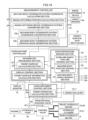
- FIG. 4 is a functional block diagram of the measurement controller 20 according to an embodiment of the present invention.
- the measurement controller 20 includes a work-implement coordinate-system coordinate calculating section 21 that calculates the coordinate values of the work implement 1A in the work-implement coordinate system Co3, and a work-implement coordinate-system drawing-image generating section 22 that generates a work-implement-1A drawing image in the work-implement coordinate system Co3.
- the measurement controller 20 receives an input of a side-surface photograph of the work implement 1A captured by the image-capturing device 19.
- the work-implement coordinate-system coordinate calculating section 21 includes: an image-capturing-position calculating section 23 that computes the position of a plane representing a side surface of the work implement 1A in an image-capturing-device coordinate system Co1 which is a three-dimensional coordinate system set for the image-capturing device 19; an image-capturing-device coordinate-system coordinate converting section 24 that computes the coordinate values, in the image-capturing-device coordinate system Co1, of points on the work implement 1A (hereinafter, referred to as "work-implement corresponding points" in some cases) corresponding to pixels included in pixels constituting the work implement 1A (hereinafter, referred to as "work-implement constituting pixels” in some cases) on a work-implement side-surface image captured by the image-capturing device 19; and a work-implement coordinate-system coordinate converting section 25 that converts the coordinate values of the work-implement corresponding points in the image-capturing-device coordinate system Co1 to coordinate values in the work-implement coordinate system Co3.
- the work-implement coordinate-system coordinate calculating section 21 uses as an input a side-surface image of the work implement 1A (work-implement side-surface image) captured by the image-capturing device 19, and outputs the coordinate values, in the work-implement coordinate system Co3, of work-implement corresponding points of work-implement constituting pixels designated on the work-implement side-surface image.
- a process of performing distortion correction on the work-implement side-surface image on the basis of an internal parameter of the image-capturing device 19 may be executed at the measurement controller 20.
- coordinate values in the work-implement coordinate system Co3 are output for work-implement corresponding points of all pixels on a contour line which is the boundary line between a work-implement side-surface section and other sections (background) in a work-implement side-surface image.
- Other methods that may be adopted include: a method in which work-implement coordinate-system coordinate values are output for work-implement corresponding points of all pixels of a work-implement side-surface section (i.e. all pixels in the contour line of the work-implement side-surface section) on a work-implement side-surface image; a method in which work-implement coordinate-system coordinate values are output for work-implement corresponding points of pixels on a work-implement side-surface section that are designated by a user via some input interface; and the like.
- the image-capturing-position calculating section 23 computes the position of a plane S1 (mentioned below; see FIG. 8 ) representing the side surface of the work implement 1A in the image-capturing-device coordinate system Co1 which is a three-dimensional coordinate system set for the image-capturing device 19.
- the position of the plane S1 in the image-capturing-device coordinate system Co1 is identified with an equation for the plane S1 in the image-capturing-device coordinate system Co1.
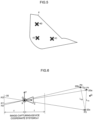
- the image-capturing-position calculating section 23 of the equation for the plane S1 representing the work implement 1A, three markers (known-point markers) 40 whose distances to each other on a side surface of the work implement 1A captured by the image-capturing device 19 are known are installed at such positions that the known-point markers 40 form a triangle as illustrated in FIG. 5 .
- the positions (coordinates) in the image-capturing-device coordinate system Co1 of the three known-point markers 40 are calculated from the pixel positions in the work-implement side-surface image of the three markers 40, and the equation for the plane S1 is calculated from the positions of the three points.
- an image of the work implement 1A displayed on the display monitor 18 is typically a side-surface image in the field of work machines including hydraulic excavators
- three markers are preferably arranged on a surface parallel to an operation plane of the work implement 1A (e.g. a surface orthogonal to the boom pin) such that the plane S1 becomes parallel to the operation plane, but it is allowed to arrange three markers on a surface that crosses the operation plane (i.e. a surface not parallel to the operation plane). Since it is only required that the plane should be able to be defined by known-point markers 40, four or more known-point markers 40 may be attached to a side surface of the work implement 1A, and an equation for the plane S1 on which all the markers 40 are positioned may be obtained.
- Markers 40 are objects having features such as predetermined sizes, colors, pattern, shapes or properties, and markers may be used that include: markers that reflect light with a particular wavelength; markers that reflect light in a particular direction; AR markers used in AR (Augmented Reality) technology; and markers that include two-dimensional codes like QR codes (registered trademark).
- FIG. 5 illustrates a specific example of known-point markers 40 in the present embodiment.
- three known-point markers 40 are installed so as not to be positioned collinearly on a side surface of the bucket 4, and the plane is computed by obtaining the coordinate values of the three known-point markers 40.
- three straight lines may be drawn on a work-implement side surface, and the three markers 40 may be arranged at three intersections at which the three straight lines cross.
- FIG. 6 is a figure representing a positional relationship between an image-capturing device of the image-capturing device 19, and known-point markers 40 (P1, P2 and P3) on a work-implement side surface, in the image-capturing-device coordinate system Co1.
- the image-capturing-device coordinate system Co1 is a coordinate system having its origin O at the lens center of the image-capturing device 19, and having the Z axis along the direction of the optical axis, the Y axis in the upward direction of the image-capturing device 19, and the X axis along the rightward direction.
- the unit of coordinate values in the image-capturing-device coordinate system Co1 is a unit of length like millimeter, for example.
- the points P1 to P3 are the positions of the known-point markers 40, and a point on the work-implement side surface similar to the points P1 to P3 is defined as Q.
- L ij is a known value.
- FIG. 7 represents images of the points P1 to 3 and the point Q that are formed on the image sensor 35 of the image-capturing device 19, and points P1' to P3' and Q' are the positions of the images of the points P1 to P3 and Q, respectively.
- a two-dimensional coordinate system having its origin O' at the center of the optical axis, and having the U axis along the rightward direction of the sensor, and the V axis along the upward direction of the sensor is defined as an image-sensor coordinate system Co2.
- Equation 3 O P k : r k ⁇ x k , r k ⁇ y k , r k ⁇ ⁇ f
- x k U k ⁇ h H
- y k V k ⁇ w W
- n ⁇ c ⁇ P i P j ⁇ ⁇ P i P k ⁇
- the image-capturing-device coordinate-system coordinate converting section 24 computes the coordinate values, in the image-capturing-device coordinate system Co1, of work-implement corresponding points of the work-implement constituting pixels.
- the image-capturing-device coordinate-system coordinate converting section 24 extracts, by image processing, the contour line of the work implement 1A from the work-implement side-surface image captured by the image-capturing device 19, and obtains the coordinate values, in the image-capturing-device coordinate system Co1, of work-implement corresponding points of pixels positioned on the extracted contour line (work-implement constituting pixels) on the basis of the pixel positional information and the equation related to the point Q (the equation for the plane S1).
- a method of obtaining the coordinates in the image-capturing-device coordinate system Co1 of a point on the work implement 1A (a work-implement corresponding point) corresponding to a point whose image is formed at a pixel position (U, V) (i.e. a work-implement constituting pixel) corresponding to a point on the work-implement side surface is as follows.
- a point whose image is formed on the image sensor (a work-implement constituting pixel) corresponding to a point Q (a work-implement corresponding point) on the plane S1 of the work-implement side surface is defined as a point Q'.
- the position (coordinates) of the point Q (work-implement corresponding point) in the image-capturing-device coordinate system Co1 is obtained from the intersection between the equation for the plane S1 (Formula (6) explained above) representing the side surface of the work implement 1A, and the equation for a straight line passing through the point Q' on the image sensor and the origin O (Formula (8) explained above).
- the work-implement coordinate-system coordinate converting section 25 converts the coordinate values of the work-implement corresponding point (the position of the point Q) in the image-capturing-device coordinate system Co1 to coordinate values in the work-implement coordinate system Co3, and outputs, to the work-machine controller 50 and the work-implement coordinate-system drawing-image generating section 22, the coordinate values after the conversion (hereinafter, referred to as "work-implement coordinate-system coordinate values" in some cases).
- the work-implement coordinate system Co3 is a two-dimensional coordinate system set on the plane S1 representing a side surface of the work implement 1A for which an equation is obtained at the image-capturing-position calculating section 23, and the unit of coordinate values in the work-implement coordinate system Co3 is a unit of length like millimeter, for example.
- the work-implement coordinate system Co3 has its origin at the pivot of the work implement 1A, an has the x axis along the work-implement-tip direction, and the y axis along the direction orthogonal to the x axis.
- FIG. 8 is a diagram illustrating the relationship between the plane S1 representing a side surface of the work implement 1A, the work-implement coordinate system Co3, and the image-capturing-device coordinate system Co1 in the present embodiment.
- the bucket 4 among a plurality of front-implement members 2, 3 and 4 constituting the articulated-type work implement 1A is treated as a target
- the origin of the work-implement coordinate system Co3 is set to the pivot of the bucket 4
- the x axis of the work-implement coordinate system Co3 is set to a straight line from the origin toward the bucket-claw tip
- the y axis of the work-implement coordinate system Co3 is set to the direction orthogonal to the x axis.
- the origin may be set to the pivot of the base end side of the boom 2 or the arm 3
- the x axis may be set to extend toward the pivot of the arm 3 or the bucket 4 (a tip portion of each front-implement member).
- the work-implement coordinate-system coordinate calculating section 21 calculates the work-implement coordinate-system coordinates of work-implement corresponding points of all pixels on the contour line of the work implement 1A, and outputs the work-implement coordinate-system coordinates to the work-implement coordinate-system drawing-image generating section 22, the coordinates in the work-implement coordinate system Co3 of work-implement corresponding points of some pixels on the contour line may be calculated and output.
- the work-implement coordinate-system drawing-image generating section 22 can be omitted in a case, for example, that the accuracy of the shape of the work implement 1A displayed on the display monitor 18 is not required.
- the work-implement coordinate-system drawing-image generating section 22 On the basis of the coordinate values of work-implement corresponding points in the work-implement coordinate system Co3 which are obtained through conversion at the work-implement coordinate-system coordinate converting section 24, the work-implement coordinate-system drawing-image generating section 22 generates a work-implement-1A drawing image in the work-implement coordinate system Co3 (hereinafter, referred to as a "work-implement coordinate-system drawing image" in some cases; this includes an image of the bucket 4 as seen in a side view, for example) and outputs the drawing image to the work-machine controller 50.
- a work-implement coordinate-system drawing image includes an image of the bucket 4 as seen in a side view, for example
- Specific methods of generating a work-implement-1A drawing image include, for example, a method of executing a process of filling an area surrounded by points, on the contour line of the work implement 1A in the work-implement coordinate system Co3, output at the work-implement coordinate-system coordinate calculating section 21 with a color predetermined as a color of the work implement 1A.
- a method of copying and pasting corresponding pixels on a work-implement side-surface image may be used for generation of a work-implement-1A drawing image. Since an image which is the same as an image (i.e.
- an image of a real object) formed on the work-implement side-surface image can be displayed on the display monitor 18 by creating a drawing image in this manner, occurrence of a sense of discomfort felt by an operator can be suppressed considerably easily.
- a method of deforming a previously prepared image or the like in line with a contour or other methods may be used.
- the position of the plane S1 in the image-capturing-device coordinate system Co1 is identified on the basis of a side-surface image of the work implement 1A to which three known-point markers 40 are attached in the embodiment explained above, a technique of identifying the position of the plane S1 is not limited to this.
- methods that may be used include: (1) a method in which three or more markers 40 are projected onto a side surface of the work implement 1A from a projection device such as a projector whose positional relationship with the image-capturing device 19 is known, images of the markers 40 are captured in a work-implement side-surface image with the image-capturing device 19, and an equation for the plane S1 is computed from the pixel positions of the markers 40 on the work-implement side-surface image; (2) a method in which an image of a side surface of the work implement 1A is captured by each of a plurality of image-capturing devices (e.g.
- a stereo camera whose positional relationship to each other are known, and distances (positions) to three points on two work-implement side-surface images are computed on the basis of the distance(s) between the plurality of image-capturing devices to thereby compute an equation for the plane S1;
- a distance measuring device e.g. a laser, LED or ultrasonic distance sensor
- identification of the plane S1 is not limited to a method for identification from the positions of three or more points on the plane S1 like the ones explained above.
- the plane S1 can be identified only from the position of one point on the plane S1 if an inclination of the plane S1 (e.g. a normal vector) can be known.
- FIG. 9 is a system configuration diagram of the hydraulic excavator 1 in FIG. 1 .
- the hydraulic excavator 1 in the present embodiment includes: an engine 47; a hydraulic pump 46 and a pilot pump (not illustrated) that are mechanically coupled to an output shaft of the engine 47 and are driven by the engine 47; the operation levers 10 and 11 each of which outputs to a control valve 45 via a proportional solenoid valve 39, a hydraulic fluid that is delivered from the pilot pump and then reduced in pressure in accordance with an operation amount of each of the operation levers 10 and 11, as a control signal for each of the hydraulic actuators 5 to 9; a plurality of control valves 45 that control the flow rate and direction of a hydraulic operating fluid guided from the hydraulic pump 46 to each of the hydraulic actuators 5 to 9 on the basis of a control signal (pilot pressure) output from the operation lever 10 or 11 or a proportional solenoid valve 39; a plurality of pressure sensors 48 that sense the pressure value of a pilot pressure acting on each control valve 45; the work-machine
- the hydraulic pump 46 is controlled mechanically in terms of its torque and flow rate such that the machine body operates in accordance with a target output power of each of the hydraulic actuators 5 to 8.
- the number of the control valves 45 is the same as the number of the control-target hydraulic actuators 5 to 8, but one of the control valves 45 is representatively illustrated in FIG. 9 .
- Two pilot pressures act on each control valve to move a spool therein in one direction or the other direction of the axial directions.
- a boom-raising pilot pressure and a boom-lowering pilot pressure act on a control valve 45 for the boom cylinder 5.
- the pressure sensors 48 sense pilot pressures acting on each control valve 45, and the number of the pressure sensors 48 may be twice the number of the control valves.
- the pressure sensors 48 are provided directly under the control valves 45, and sense pilot pressures actually acting on the control valves 45.
- proportional solenoid valves 39 there are the plurality of proportional solenoid valves 39, one block is representatively illustrated in FIG. 9 .
- One of the types is pressure-reducing valves that directly output pilot pressures input from the operation levers 10 and 11 or reduce the pilot pressures input from the operation levers 10 and 11 to desired corrected target pilot pressures designated by command voltages and output the reduced pilot pressures.
- the other of the types is pressure-increasing valves that reduce pilot pressures input from pilot pumps to desired corrected target pilot pressures designated by command voltages and output the reduced pilot pressures in a case where pilot pressures higher than pilot pressures output by the operation levers 10 and 11 are required.
- a pilot pressure is generated via a pressure-increasing valve.
- a pilot pressure is generated via a pressure-reducing valve.
- a pilot pressure is generated via a pressure-increasing valve.
- pressure-reducing valves and pressure-increasing valves allow pilot pressures with pressure values different from pilot pressures input from the operation levers 10 and 11 (pilot pressures based on operator operation) to act on control valves 45, and this makes it possible to cause hydraulic actuators which are control targets of the control valves 45 to perform desired operation.
- the maximum number of each of pressure-reducing valves and pressure-increasing valves that can be present per control valve 45 is two.
- two pressure-reducing valves and two pressure-increasing valves are provided for the control valve 45 of the boom cylinder 5.
- the hydraulic excavator 1 includes: a first pressure-reducing valve provided in a first line that guides a boom-raising pilot pressure from the operation lever 11 to a control valve 45; a first pressure-increasing valve provided in a second line that guides a boom-raising pilot pressure from the pilot pump to the control valve 45, bypassing the operation lever 11; a second pressure-reducing valve provided in a third line that guides a boom-lowering pilot pressure from the operation lever 11 to the control valve 45; and a second pressure-increasing valve provided in a fourth line that guides a boom-lowering pilot pressure from the pilot pump to the control valve 45, bypassing the operation lever 11.
- the work-machine controller 50 includes a position/posture sensing section 26, an information processing section 30, a display control section 33 and a work-implement control section 35.
- the position/posture sensing section 26 includes a work-implement-posture sensing section 27, a machine-body-position sensing section 28 and a machine-body-angle sensing section 29.
- the position/posture sensing section 26 receives an input of various types of sensor information, and outputs postural information, machine-body positional information and machine-body angle information on the work implement 1A.
- the work-implement-posture sensing section 27 senses the posture of the work implement 1A in the machine-body coordinate system Co4 on the basis of outputs of the posture sensors 12, 13 and 14 attached to the work implement 1A. More specifically, on the basis of information from the boom-angle sensor 12, the arm-angle sensor 13 and the bucket-angle sensor 14, the work-implement-posture sensing section 27 senses postural information on the work implement 1A like the angles of pivoting motion ⁇ , ⁇ and ⁇ (see FIG. 3 ) of the boom 2, the arm 3 and bucket 4.
- the machine-body-position sensing section 28 senses machine-body positional information on the basis of information obtained from the first GNSS antenna 17a.
- the machine-body-angle sensing section 29 senses the inclination angle ⁇ (see FIG. 3 ) by the machine-body front-rear-inclination-angle sensor 16a, senses the left-right-direction inclination angle ⁇ (not illustrated) by the machine-body left-right-inclination-angle sensor 16b, senses the azimuth of the machine body from positional information on the first GNSS antenna 17a and the second GNSS antenna 17b, and obtains machine-body angle information.
- the machine-body positional information is obtained on the basis of information on the first GNSS antenna 17a in the present embodiment, positional information on the second GNSS antenna 17b may be used or a three-dimensional surveying instrument such as a total station may be used.
- azimuth information on the machine body is sensed from positional information on the first GNSS antenna 17a and the second GNSS antenna 17b in the present embodiment
- methods that may be adopted include a method that uses an electromagnetic compass and a method that uses a swing-angle sensor.
- the information processing section 30 includes a machine-body-coordinate converting section 31, and a target-surface calculating section 32.
- Input data of the information processing section 30 includes: work-implement coordinate-system coordinate values and a work-implement coordinate-system drawing image output by the measurement controller 20; target-surface data input by the target-surface-data input device 37; and postural information, machine-body positional information and machine-body angle information on the work implement output by the position/posture sensing section 26.
- output data of the information processing section 30 includes, in addition to the postural information, machine-body positional information and machine-body angle information on the work implement 1A input from the position/posture sensing section 26, machine-body coordinate-system coordinate-value information and machine-body coordinate-system drawing-image information on the work implement 1A obtained by the machine-body-coordinate converting section 31, and information on a target surface in the machine-body coordinate system Co4 obtained by the target-surface calculating section 32.
- the machine-body-coordinate converting section 31 converts the coordinate values of work-implement corresponding points (machine-body coordinate-system coordinate-value information) and a work-implement-1A drawing image (machine-body coordinate-system drawing-image information) in the work-implement coordinate system Co3 that are output from the measurement controller 20 (the work-implement coordinate-system coordinate converting section 25 and the work-implement coordinate-system drawing-image generating section 22) to coordinate values in the machine-body coordinate system Co4 which is a two-dimensional coordinate system set for the hydraulic excavator 1.
- the machine-body-coordinate converting section 31 translates and/or rotates the work-implement coordinate-system coordinate values and the work-implement coordinate-system drawing image output by the measurement controller 20, such that the work-implement coordinate-system coordinate values and the work-implement coordinate-system drawing image match the actual position and/or posture of the work implement 1A as illustrated in FIG.
- amounts of a translation and/or a rotation for converting the work-implement coordinate-system coordinate values and the work-implement coordinate-system drawing image to the coordinate values in the machine-body coordinate system Co4 may be obtained by comparing the coordinate values, in the work-implement coordinate system Co3, of two different two points and the coordinate values in the machine-body coordinate system Co4 that are measured by a measurement device such as a total station when the angles of pivoting motion ⁇ , ⁇ and ⁇ of the boom 2, the arm 3 and the bucket 4 are known.
- the target-surface calculating section 32 calculates a line segment along which target-surface data (three-dimensional data) 51 input through the target-surface-data input device 37 and the X-Z plane of the machine-body coordinate system Co4 intersect, and sets the line segment as the target surface 55.
- the X-Z plane of the machine-body coordinate system Co4 is obtained on the basis of machine-body positional information output by the position/posture sensing section 26 and machine-body angle information output by the machine-body-angle sensing section 29.
- the target-surface data 51 input through the target-surface-data input device 37 is assumed to be three-dimensional data in the present embodiment, the target-surface data 51 may be two-dimensional data, that is, line-segment data indicating a target surface.
- the target-surface data is two-dimensional data, it is not necessary to use machine-body positional information on the machine-body-position sensing section 28, and a machine-body azimuth information on the machine-body-angle sensing section 29.
- the display control section 33 displays the work-implement-1A drawing image on the display monitor 18 in line with the posture of the work implement 1A in the machine-body coordinate system Co4.
- the display control section 33 includes a target-surface-information calculating section 34, and input data of the display control section 33 includes: the postural information, the machine-body positional information and the machine-body angle information on the work implement 1A that are output by the information processing section 30; the machine-body coordinate-system coordinate-value information and the machine-body coordinate-system drawing-image information on the work implement 1A that are output from the information processing section 30; and information on a target surface on the machine-body-coordinate-system X-Z plane.
- output data includes work-implement/target-surface vector information. The output information is input to the display monitor 18, and presented to a user.
- the target-surface-information calculating section 34 is explained by using FIG. 12 in which an example of a positional relationship between the work implement 1A and the target surface 55 is illustrated.
- the target-surface-information calculating section 34 obtains nearest points (a point P1 and a point P2) on planes (a target plane 1 and a target plane 2 in FIG. 12 ) that are among a plurality of planes (hereinafter, referred to as "target planes" in some cases) constituting the target surface 55 and that are present at a certain distance from the work implement 1A, for a point on the contour line of the work implement 1A (a point P in FIG. 12 ).
- work-implement/target-surface vectors (a vector PP1 and a vector PP2) from the point on the work-implement contour line (the point P) to the nearest points (the point P1 and the point P2) on the target planes are obtained.
- These calculations are performed for all points on the work-implement contour line (i.e. all work-implement coordinate-system coordinate values) input from the measurement controller 20 to obtain information to be output to the display monitor 18.
- information on vectors from a point on the work implement 1A to nearest points on planes of the target surface 55 is used as output information in the present embodiment, distance information may be output, or a distance in the vertical direction from a point on the work implement 1A to the target surface 55 or the like may be output.
- the calculations are performed for all points on the contour line of the work implement 1A in the present embodiment, the calculations may be performed only for particular points, like points at the tip of the work implement 1A or points on the back of the work implement 1A.
- FIG. 13 An example of a screen displayed on the display monitor 18 is illustrated in FIG. 13 .
- a guidance screen IM On a guidance screen IM, a machine-body image IM1 drawn on the basis of the machine-body coordinate-system drawing-image information, a target-surface image IM2 drawn on the basis of data of a target surface on the X-Z plane of the machine-body coordinate system Co4, and a work-implement/target-surface vector image IM3 drawn on the basis of the work-implement/target-surface vector information are displayed.
- the work-implement/target-surface vector image IM3 is a drawn image of a vector which is among vectors relative to corresponding target planes in the work-implement/target-surface vector information output at the target-surface-information calculating section 34, and which has the smallest vector size among the vectors.
- the vector size in a case where a point on the work-implement contour line has gone under the target surface 55 has a negative value.
- information output from the target-surface-information calculating section 34, and information obtained by processing the information may be displayed as the guidance screen IM.
- information may be presented by sounds, vibration and the like, other than such visual information.
- the work-implement control section 35 controls the work implement 1A (the hydraulic cylinders 5, 6 and 7) such that control points of the work implement 1A corresponding to the work-implement corresponding points are kept above the target surface 55.
- the work-implement control section 35 includes a target-operation calculating section 36.
- Input data of the work-implement control section 35 includes: an output of the display control section 33; postural information on the work implement 1A of the position/posture sensing section 26; and operation inputs to an operation input device including the operation levers 10 and 11.
- Output data of the work-implement control section 35 includes control signals of the proportional solenoid valves 39.
- the target-operation calculating section 36 predicts a direction and a speed of a motion of the work implement 1A. For example, in a case where the work implement 1A is predicted to go under the target surface 55 at this time, a control signal giving an instruction on reducing or increasing in pilot pressure is output to the solenoid proportional valves 39 such that a motion that prevents the work implement 1A from going under the target surface 55 is produced.
- the pilot pressures corrected by the solenoid proportional valves 39 drive the control valves 45, and the hydraulic cylinders 5, 6 and 7 are driven as appropriate on the basis of the operation to thereby prevent the work implement 1A from going under the target surface 55.
- the solenoid proportional valves 39 control the pilot pressures in the present embodiment, the solenoid proportional valves may directly control hydraulic-operating-fluid pressures of actuators.
- MG and MC are performed by using coordinate information and a drawing image that are calculated on the basis of a side-surface image of the work implement 1A at the measurement controller 20, and that match well with the actual shape of the work implement 1A.
- the degree of accuracy of guidance information e.g. the work-implement/target-surface vector image IM3, information on a distance from the work implement 1A to the target surface 55, etc.
- the work-implement control section 35 can perform accurate MC even if the work implement 1A has a shape that requires many control points such as curved sections and protruding sections.
- a second embodiment is characterized in that the image-capturing device 19 and the measurement controller 20 are mounted on the hydraulic excavator 1, and a machine guidance function and a machine control function are provided while measurement of external-shape information on the work implement 1A (machine-body coordinate-system coordinate-value information and machine-body coordinate-system drawing-image information on the work implement 1A) is being performed in real time. Note that portions that are the same as in the previous embodiment are given the same signs, and explanations thereof are omitted as appropriate in some cases.
- the image-capturing device 19 in the present embodiment is attached at a portion forward of the upper swing structure 1BA via a support device (articulated arm) 60.
- the support device 60 in FIG. 14 is a horizontal articulated arm formed by coupling a plurality of horizontal arms, and can change the orientation and/or position of the image-capturing device 19 in the machine-body coordinate system Co4 by driving an actuator (e.g. motor) 19b embedded in each joint.
- each joint of the support device 60 is provided with an angle sensor (image-capturing-device sensor) 19a that senses a rotation angle of each horizontal arm, and a sensing value of the angle sensor 19a is output to the measurement controller 20 as illustrated in FIG. 15 .
- the support device 60 is a horizontal articulated arm in the present embodiment, an arm that can move in the vertical direction or other support devices can also be used as the support device 60.
- FIG. 15 is a system configuration diagram of the hydraulic excavator 1 according to the present embodiment. As illustrated in this figure, the hydraulic excavator 1 in the present embodiment includes the image-capturing device 19, the measurement controller 20 and the work-machine controller 50.
- the image-capturing device 19 captures work-implement side-surface images at predetermined intervals, and on the basis of the work-implement side-surface images, the measurement controller 20 calculates the machine-body coordinate-system coordinate values and a machine-body coordinate-system drawing image of the work implement 1A in real time, and outputs the machine-body coordinate-system coordinate values and machine-body coordinate-system drawing image to the work-machine controller 50.
- the measurement controller 20 in the first embodiment outputs coordinates values and a drawing image in the work-implement coordinate system Co3
- coordinate values and a drawing image in the machine-body coordinate system Co4 can be directly computed since the image-capturing device 19 is attached to the machine body (upper swing structure 1BA) of the hydraulic excavator 1 in the present embodiment.
- the work-machine controller 50 in the present embodiment provides a machine guidance function and a machine control function to a user on the basis of information output from the measurement controller 20 in real time.
- the measurement controller 20 includes a machine-body coordinate-system coordinate calculating section 21b, and a machine-body coordinate-system drawing-image generating section 22b.
- the measurement controller 20 receives an input of a side-surface image of the work implement 1A captured by the image-capturing device 19, and positional information and orientation information, in the machine-body coordinate system, of the image-capturing device 19 from the angle sensor 19a.
- the machine-body coordinate-system coordinate calculating section 21b includes the image-capturing-position calculating section 23, the image-capturing-device coordinate-system coordinate converting section 24 and a machine-body coordinate-system coordinate converting section 25b.
- the machine-body coordinate-system coordinate calculating section 21b receives an input of a side-surface image of the work implement 1A captured by the image-capturing device 19, outputs the machine-body coordinate-system coordinate values of a point designated on the side-surface image of the work implement 1A, and also outputs a machine-body coordinate-system drawing image matching the shape and dimensions of the work implement 1A in the machine-body coordinate system Co4.
- machine-body coordinate-system coordinate values of work-implement corresponding points of all pixels on the contour line of the work implement in a work-implement side-surface image are output in the present embodiment also, it is needless to say that other methods may be adopted in a similar manner to the first embodiment (e.g. only the coordinate values of work-implement corresponding points of some pixels on the contour line are output).
- the image-capturing-position calculating section 23 and the image-capturing-device coordinate-system coordinate converting section 24 at the machine-body coordinate-system coordinate calculating section 21b perform calculations similar to those in the first embodiment.
- the machine-body coordinate-system coordinate converting section 25b translates and/or rotates coordinate values in the image-capturing-device coordinate system Co1, and converts the coordinate values to coordinate values in the machine-body coordinate system Co4.
- the machine-body coordinate-system drawing-image generating section 22b also generates a drawing image after conversion of its coordinates to those in the machine-body coordinate system Co4 similarly.
- information input from the measurement controller 20 to the work-machine controller 50 (the machine-body coordinate-system coordinate values and a machine-body coordinate-system drawing image of the work implement 1A) is already information in the machine-body coordinate system Co4. Because of this, although the information processing section 30 of the work-machine controller 50 in the present embodiment does not have the machine-body-coordinate converting section 31 in the first embodiment, configurations and processing contents of the other sections are the same. In addition, the work-implement-posture sensing section 27 at the position/posture sensing section 26 is not required since the posture of the work implement 1A can be sensed also by the measurement controller 20. Processing contents at the display control section 33 and the work-implement control section 35 are similar to those in the first embodiment.
- the measurement controller 20 measures the positional and shape information on the work implement 1A in real time. Because of this, a user is not required to measure the shape and the like of the work implement 1A in advance unlike the first embodiment, but work-implement shape information can be acquired simply and easily. In addition, since the position and shape of the work implement 1A are acquired in real time, an accurate work-implement shape can be measured even in a case where wear, deformation and the like have occurred to the work implement 1A, and the work-implement shape can be presented to a user in an easyto-understand manner in a machine guidance function by the display control section 33. In addition, accurate control can be performed by the work-implement control section 35 in accordance with the actual state of the work implement.
- each configuration according to the controllers 20 and 50 explained above, and the function, execution process and the like of such each configuration may be partially or entirely realized by hardware (e.g. designing logic to execute each function in an integrated circuit, etc.).
- configurations according to the controllers 20 and 50 explained above may be programs (software) that are read out and executed by a calculation processing device (e.g. a CPU) to realize each function according to the configurations of the controllers 20 and 50.
- Information according to the programs can be stored on, for example, a semiconductor memory (a flash memory, an SSD, and the like), a magnetic storage device (a hard disk drive, and the like), a recoding medium (a magnetic disk, an optical disc, and the like) and the like.
Landscapes
- Engineering & Computer Science (AREA)
- Physics & Mathematics (AREA)
- General Physics & Mathematics (AREA)
- Theoretical Computer Science (AREA)
- General Engineering & Computer Science (AREA)
- Mining & Mineral Resources (AREA)
- Civil Engineering (AREA)
- Structural Engineering (AREA)
- Computer Vision & Pattern Recognition (AREA)
- Geometry (AREA)
- Multimedia (AREA)
- Signal Processing (AREA)
- Mechanical Engineering (AREA)
- Human Computer Interaction (AREA)
- Manufacturing & Machinery (AREA)
- Automation & Control Theory (AREA)
- Component Parts Of Construction Machinery (AREA)
- Length Measuring Devices By Optical Means (AREA)
Description
- The present invention relates to a work-implement external-shape measurement system including a measurement controller that measures the shape of a work implement mounted on a work machine.
- In recent years, in order to respond to computerized construction, some work machines including hydraulic excavators include: (1) a machine guidance (MG) function that senses the position and posture of a work implement (a front work implement) such as a boom, an arm or a bucket by a sensor, and provides to an operator an image of the bucket at the position and posture in line with the sensor information by displaying the image on a monitor; and (2) a machine control (MC) function that uses sensor information on the position and posture of the work implement in a similar manner to MG to control the work implement in accordance with a predetermined condition. Typically, in a hydraulic excavator equipped with such functions, an image of a bucket as seen in a side view is displayed on a monitor in a cab along with a target surface in order to let an operator know an actual relative positional relationship between the bucket and the target surface.
- In relation to this type of technology,
Patent Document 1 discloses a technology like the following one from the perspective of reducing a sense of discomfort felt by an operator when images of a plurality of types of buckets are displayed on a monitor. That is,Patent Document 1 discloses a display system for a work machine having a work implement to which a bucket is attached, the display system including: a generating section that uses information on the shape and dimensions of the bucket to generate drawing information for drawing an image of the bucket as seen in a side view; and a display section that displays the image of the bucket in the side view on the basis of the drawing information generated by the generating section, and an image indicating a cross-section of a terrain profile. In the display system, the information on the shape and dimensions of the bucket includes: in a side view of the bucket, a distance between the blade tip of the bucket and a bucket pin used to attach the bucket to the work implement; an angle formed between
a straight line linking the blade tip and the bucket pin, and a straight line indicating the bottom surface of the bucket; a position of the blade tip; a position of the bucket pin; and at least one position of the external surface of the bucket, the one position being located between a portion at which the bucket is coupled to the work implement and the blade tip.
Patent Document 2 shows a detection processing device, of a work machine, which includes a measurement data acquisition unit which acquires measurement data of a target that is measured by a measurement device provided at a work machine, a working equipment position data calculation unit which calculates working equipment position data indicating a position of a working equipment of the work machine, and a three-dimensional data calculation unit which calculates target data that is three-dimensional data in which at least a part of the working equipment is removed, based on the measurement data and the working equipment position data. -
- Patent Document 1:
WO2016/56674 - Patent Document 2:
WO 2018/062523 Al - Meanwhile, from the perspective of improving the degree of accuracy of MG and MC explained above, accurate external-shape information on work implements including buckets is required.
- Since work implements including buckets are typically manufactured by manual work of workers such as welding, they are finished in shapes different from those in design data due to deformation, positional misalignment and the like in the process. Accordingly, external-shape information on work implements is typically acquired by performing measurement by using a tape measurement, measurement by using a total station, and the like for each work machine. In these techniques, the posture of a work implement should be restricted and a large-scale measurement device needs to be used in order to attain sufficient measurement precision. Moreover, accurately displaying the shape of the work implement in line with its actual shape on a monitor requires measurement of as many points as possible to be performed in advance, and this is a very cumbersome work.
- Accordingly, there are almost no work implements for which external-shape information is registered accurately in line with real objects. In many cases, the position of only one representative point (e.g. the bucket-claw tip) or the positions of several representative points on the external shape of a work implement is/are registered, and such circumstances have become an obstacle to realization of accurate MG and/or MC. That is, there is a fear that, in MC, a point whose position on the external shape of a work implement is not registered contacts a target surface, resulting in unintended deformation or damages of the target surface, and, in MG, a wrong distance may be presented on a monitor in a case where a point on the external shape that is actually positioned at the shortest distance to a target surface is not registered.
- An object of the present invention is to provide a measurement system that allows simple and easy measurement of external-shape information on a work implement, and a display system and a control system that use the measurement system to assist an operator in shaping a target surface precisely, and further to provide a work machine including the measurement system, the control system and the display system.
- In order to solve the above problem, the invention is set out in the appended set of claims.
- The present invention allows simple and easy measurement of external-shape information on a work implement.
-
-
FIG. 1 is a configuration diagram of a hydraulic excavator and an image-capturing device according to a first embodiment of the present invention. -
FIG. 2 is a configuration diagram of a system according to the first embodiment of the present invention. -
FIG. 3 is a figure representing a coordinate system relative to the hydraulic excavator. -
FIG. 4 is a functional block diagram of a work-implement external-shape measurement system according to the first embodiment of the present invention. -
FIG. 5 is a figure illustrating an example of known-point markers attached on a work-implement side surface. -
FIG. 6 is a figure illustrating a positional relationship between the image-capturing device and known-point markers on the work-implement side surface in an image-capturing-device coordinate system. -
FIG. 7 is a figure illustrating a positional relationship of an image in an image-sensor coordinate system. -
FIG. 8 is a figure illustrating a relationship between the image-capturing-device coordinate system and a work-implement coordinate system. -
FIG. 9 is a functional block diagram of a system for the hydraulic excavator according to the first embodiment of the present embodiment. -
FIG. 10 is a figure representing conversion from the work-implement coordinate system to a machine-body coordinate system. -
FIG. 11 is a figure illustrating a target surface in the machine-body coordinate system. -
FIG. 12 is a figure illustrating an example of a relationship between a work implement and a target surface. -
FIG. 13 is a figure illustrating an example of a screen displayed on adisplay monitor 18. -
FIG. 14 is a configuration diagram of the hydraulic excavator according to a second embodiment of the present invention. -
FIG. 15 is a functional block diagram of a system according to the second embodiment of the present invention. - Hereinafter, embodiments of the present invention are explained by using the drawings. Note that although hereinafter a hydraulic excavator including a
bucket 4 as an attachment to the tip of a work implement (front work implement) is illustrated as an example of a work machine to which the present invention is applied, the present invention may be applied to a hydraulic excavator including an attachment other than a bucket. In addition, the present invention can be applied also to a work machine other than a hydraulic excavator as long as the work machine has a work implement like a wheel loader, for example. Furthermore, in the following explanation, among a plurality of front-implement members (specifically, aboom 2, anarm 3 and the bucket 4) included in awork implement 1A, one or more front-implement members whose shapes are desired to be measured by a measurement controller 20 (positions in a work-implement coordinate system Co3 (mentioned below) of points on thework implement 1A) are referred to as work implements in some cases. - In a first embodiment, a system including an image-capturing device (e.g. a camera) 19, a
measurement controller 20 and a work-machine controller 50 is explained. The image-capturingdevice 19 captures an image of thework implement 1A mounted on a hydraulic excavator (work machine) 1. Themeasurement controller 20 uses an image of a side surface of thework implement 1A (hereinafter, referred to as a "work-implement side-surface image" in some cases) captured by the image-capturingdevice 19, to measure shape-related information on thework implement 1A. The work-machine controller 50 is mounted on thehydraulic excavator 1, and receives an input of the shape-related information on thework implement 1A calculated at themeasurement controller 20, to use the shape-related information for MG and/or MC, for example, executed at thehydraulic excavator 1. -
FIG. 1 is a configuration figure of thehydraulic excavator 1, and the image-capturingdevice 19 and themeasurement controller 20 according to an embodiment of the present invention. In addition,FIG. 2 is a configuration figure of the system of the present embodiment. As illustrated inFIG. 2 , the system of the present embodiment includes thehydraulic excavator 1 equipped with the work-machine controller 50, and the image-capturingdevice 19 and themeasurement controller 20 that are installed at a position located apart from thehydraulic excavator 1. The image-capturingdevice 19 is a camera that captures photographs (images) of a side surface of thework implement 1A. Themeasurement controller 20 computes the position of a plane representing the side surface of thework implement 1A. On the basis of the position of the plane and an image captured by the image-capturingdevice 19, themeasurement controller 20 generates a work-implement-1A drawing image and the coordinate values, in a work-implement coordinate system Co3, of a point on the side surface of thework implement 1A. The work-machine controller 50 mounted on thehydraulic excavator 1 provides a machine guidance (MG) function and a machine control (MC) function. As shape information and drawing information on the work implement 1A for the MG/MC, the work-machine controller 50 uses the work-implement-1A drawing image and the coordinate values, in the work-implement coordinate system Co3, of the point on the side surface of thework implement 1A, the coordinate values being output by themeasurement controller 20. - The
measurement controller 20 and the work-machine controller 50 are controllers each having: a processing device (e.g. a CPU); and a storage device (e.g. a semiconductor memory such as a ROM or a RAM) storing a program to be executed by the processing device. Thecontrollers capturing device 19, a target-surface-data input device 37 (seeFIG. 9 ), various types ofsensors work implement 1A, and various types of calculation related to display on a display monitor (display device) 18 installed in a cab of thehydraulic excavator 1 and related to operation of thehydraulic excavator 1. Specific contents of the calculation executed by themeasurement controller 20 and the work-machine controller 50 are mentioned below by using functional block diagrams ofFIG. 4 andFIG. 9 . - As illustrated in
FIG. 1 , thehydraulic excavator 1 is constituted by: the articulated-type work implement (front work implement) 1A configured by coupling a plurality of front-implement members (theboom 2, thearm 3 and the bucket 4) that pivot in the vertical direction individually; and amachine body 1B including an upper swing structure 1BA and a lower track structure 1BB. The base end of theboom 2 positioned closer to the base end side of the work implement 1A is supported at a front portion of the upper swing structure 1BA so as to be pivotable upward/downward. The upper swing structure 1BA is attached swingably at an upper portion of the lower track structure 1BB. In addition, the image-capturingdevice 19 for capturing photographs of a side surface of the work implement 1A, and themeasurement controller 20 are installed on a side of the work implement 1A. Internal parameters of the image-capturing device 19 (e.g. the focal length (f), the image-sensor size (vertical h and horizontal w), the pixel count (vertical H and horizontal W), the unit-cell size, the image-center coordinates, etc.) are known. - The image-capturing
device 19 is a monocular camera including an image-capturing element (image sensor) such as a CCD (Charge Coupled Device) or a CMOS (Complementary Metal Oxide Semiconductor). The image-capturingdevice 19 outputs data of captured images to themeasurement controller 20. Further, the image-capturingdevice 19 may be substituted by a stereo camera that can acquire depth information (information on a distance to a subject) by using parallax, or a camera that can acquire depth information by emitting laser light or the like to measure time of arrival of reflected light thereof, in addition to acquire image information. Note that themeasurement controller 20 may be built in the image-capturingdevice 19. - The
boom 2, thearm 3, thebucket 4, the upper swing structure 1BA and the lower track structure 1BB constitute driven members driven by aboom cylinder 5, an arm cylinder 6, abucket cylinder 7, a swinghydraulic motor 8 and left and right travelhydraulic motors right lever 10a, a travel-leftlever 10b, an operation-right lever 11a and an operation-leftlever 11b (which are collectively referred to as operation levers 10 and 11 in some cases) that are installed in the cab on the upper swing structure 1BA being operated by an operator. The pilot pressures to drive the plurality of driven members explained above include not only pressures output by operation of the operation levers 10 and 11, but also pressures output through operation operated, independently of operation of the operation levers 10 and 11, by some (pressure-increasing valves) of a plurality of proportional solenoid valves 39 (seeFIG. 9 ) mounted on thehydraulic excavator 1, and pressures produced by reducing pilot pressures output by operation of the operation levers 10 and 11 due to some (pressure-reducing valves) of the plurality ofproportional solenoid valves 39 being operated. In this manner, the pilot pressures output from the plurality of proportional solenoid valves 39 (pressure-increasing valves, and pressure-reducing valves) trigger MC to operate theboom cylinder 5, the arm cylinder 6 and thebucket cylinder 7 in accordance with a predetermined condition. - In the work implement 1A, the boom-
angle sensor 12, the arm-angle sensor 13, and the bucket-angle sensor 14 are attached to a boom pin, an arm pin and abucket link 15, respectively, such that the angles of pivoting motion α, β and γ (seeFIG. 3 ) of theboom 2, thearm 3 and thebucket 4 can be measured. A machine-body front-rear-inclination-angle sensor 16a and a machine-body left-right-inclination-angle sensor 16b are attached to the upper swing structure 1BA. The machine-body front-rear-inclination-angle sensor 16a senses a front-rear-direction inclination angle θ (seeFIG. 3 ) of the upper swing structure 1BA (machine body 1B) relative to a reference plane (e.g. a horizontal plane). The machine-body left-right-inclination-angle sensor 16b senses a left-right-direction inclination angle φ (not illustrated) of the upper swing structure 1BA (machine body 1B) relative to the reference plane. Note that the X axis and the Z axis illustrated inFIG. 3 represent a machine-body coordinate system Co4 having its origin at a point (e.g. the middle point) on the shaft center of the boom pin, and having the Z axis along the machine-body upward direction, the X axis along the machine-body front direction, and the Y axis along the machine-body rightward direction. - A
first GNSS antenna 17a and asecond GNSS antenna 17b are arranged on the upper swing structure 1BA. Thefirst GNSS antenna 17a and thesecond GNSS antenna 17b are antennas for the RTK-GNSS (Real Time Kinematic-Global Navigation Satellite Systems), and receive radio waves (navigation signals) emitted from a plurality of GNSS satellites. The work-machine controller 50 can measure the latitude, longitude and height (ellipsoidal height) of the position of each antenna on the basis of lengths of time required for radio waves emitted from a plurality of GNSS satellites to reach the first andsecond GNSS antennas second GNSS antenna machine controller 50. - On a screen of the display monitor 18 in the cab of the
hydraulic excavator 1, an image of the work implement 1A as seen in a side view and a cross-sectional shape of a target surface are displayed on the basis of postural information on the work implement 1A calculated from outputs of various types of theposture sensors GNSS antennas measurement controller 20 on the basis of a work-implement side-surface image captured by the image-capturingdevice 19. Next, a process of generating coordinate values and a drawing image of the work implement 1A on the work-implement coordinate system Co3, which is executed by themeasurement controller 20 on the basis of the work-implement side-surface image of the image-capturingdevice 19, is explained by using drawings. -
FIG. 4 is a functional block diagram of themeasurement controller 20 according to an embodiment of the present invention. As illustrated in this figure, themeasurement controller 20 includes a work-implement coordinate-system coordinate calculatingsection 21 that calculates the coordinate values of the work implement 1A in the work-implement coordinate system Co3, and a work-implement coordinate-system drawing-image generating section 22 that generates a work-implement-1A drawing image in the work-implement coordinate system Co3. Themeasurement controller 20 receives an input of a side-surface photograph of the work implement 1A captured by the image-capturingdevice 19. - The work-implement coordinate-system coordinate calculating
section 21 includes: an image-capturing-position calculating section 23 that computes the position of a plane representing a side surface of the work implement 1A in an image-capturing-device coordinate system Co1 which is a three-dimensional coordinate system set for the image-capturingdevice 19; an image-capturing-device coordinate-system coordinate convertingsection 24 that computes the coordinate values, in the image-capturing-device coordinate system Co1, of points on the work implement 1A (hereinafter, referred to as "work-implement corresponding points" in some cases) corresponding to pixels included in pixels constituting the work implement 1A (hereinafter, referred to as "work-implement constituting pixels" in some cases) on a work-implement side-surface image captured by the image-capturingdevice 19; and a work-implement coordinate-system coordinate converting section 25 that converts the coordinate values of the work-implement corresponding points in the image-capturing-device coordinate system Co1 to coordinate values in the work-implement coordinate system Co3. The work-implement coordinate-system coordinate calculatingsection 21 uses as an input a side-surface image of the work implement 1A (work-implement side-surface image) captured by the image-capturingdevice 19, and outputs the coordinate values, in the work-implement coordinate system Co3, of work-implement corresponding points of work-implement constituting pixels designated on the work-implement side-surface image. - Note that when a work-implement side-surface image captured by the image-capturing
device 19 is input, a process of performing distortion correction on the work-implement side-surface image on the basis of an internal parameter of the image-capturingdevice 19 may be executed at themeasurement controller 20. In addition, in the case described in the present embodiment, coordinate values in the work-implement coordinate system Co3 (work-implement coordinate-system coordinate values) are output for work-implement corresponding points of all pixels on a contour line which is the boundary line between a work-implement side-surface section and other sections (background) in a work-implement side-surface image. Other methods that may be adopted include: a method in which work-implement coordinate-system coordinate values are output for work-implement corresponding points of all pixels of a work-implement side-surface section (i.e. all pixels in the contour line of the work-implement side-surface section) on a work-implement side-surface image; a method in which work-implement coordinate-system coordinate values are output for work-implement corresponding points of pixels on a work-implement side-surface section that are designated by a user via some input interface; and the like. - On the basis of an image of a side surface of the work implement 1A (a work-implement side-surface image) captured by the image-capturing
device 19, and an internal parameter of the image-capturingdevice 19, the image-capturing-position calculating section 23 computes the position of a plane S1 (mentioned below; seeFIG. 8 ) representing the side surface of the work implement 1A in the image-capturing-device coordinate system Co1 which is a three-dimensional coordinate system set for the image-capturingdevice 19. In the present embodiment, the position of the plane S1 in the image-capturing-device coordinate system Co1 is identified with an equation for the plane S1 in the image-capturing-device coordinate system Co1. - In the present embodiment, in a method adopted for computation, by the image-capturing-
position calculating section 23, of the equation for the plane S1 representing the work implement 1A, three markers (known-point markers) 40 whose distances to each other on a side surface of the work implement 1A captured by the image-capturingdevice 19 are known are installed at such positions that the known-point markers 40 form a triangle as illustrated inFIG. 5 . In the present embodiment, the positions (coordinates) in the image-capturing-device coordinate system Co1 of the three known-point markers 40 are calculated from the pixel positions in the work-implement side-surface image of the threemarkers 40, and the equation for the plane S1 is calculated from the positions of the three points. Note that since an image of the work implement 1A displayed on the display monitor 18 is typically a side-surface image in the field of work machines including hydraulic excavators, three markers are preferably arranged on a surface parallel to an operation plane of the work implement 1A (e.g. a surface orthogonal to the boom pin) such that the plane S1 becomes parallel to the operation plane, but it is allowed to arrange three markers on a surface that crosses the operation plane (i.e. a surface not parallel to the operation plane). Since it is only required that the plane should be able to be defined by known-point markers 40, four or more known-point markers 40 may be attached to a side surface of the work implement 1A, and an equation for the plane S1 on which all themarkers 40 are positioned may be obtained. -
Markers 40 are objects having features such as predetermined sizes, colors, pattern, shapes or properties, and markers may be used that include: markers that reflect light with a particular wavelength; markers that reflect light in a particular direction; AR markers used in AR (Augmented Reality) technology; and markers that include two-dimensional codes like QR codes (registered trademark). -
FIG. 5 illustrates a specific example of known-point markers 40 in the present embodiment. In the present embodiment, three known-point markers 40 are installed so as not to be positioned collinearly on a side surface of thebucket 4, and the plane is computed by obtaining the coordinate values of the three known-point markers 40. Note that for the arrangement positions of the threemarkers 40, three straight lines may be drawn on a work-implement side surface, and the threemarkers 40 may be arranged at three intersections at which the three straight lines cross. -
FIG. 6 is a figure representing a positional relationship between an image-capturing device of the image-capturingdevice 19, and known-point markers 40 (P1, P2 and P3) on a work-implement side surface, in the image-capturing-device coordinate system Co1. The image-capturing-device coordinate system Co1 is a coordinate system having its origin O at the lens center of the image-capturingdevice 19, and having the Z axis along the direction of the optical axis, the Y axis in the upward direction of the image-capturingdevice 19, and the X axis along the rightward direction. In addition, the unit of coordinate values in the image-capturing-device coordinate system Co1 is a unit of length like millimeter, for example. The points P1 to P3 are the positions of the known-point markers 40, and a point on the work-implement side surface similar to the points P1 to P3 is defined as Q. Lij (i, j = 1 to 3, i ≠ j) is the distance between a point Pi and a point Pj (the distance between two known-point markers 40). Here, Lij is a known value. In addition, animage sensor 35 of the image-capturingdevice 19 is on the plane of Z = -f when the focal length of the image-capturingdevice 19 is f. -
FIG. 7 represents images of the points P1 to 3 and the point Q that are formed on theimage sensor 35 of the image-capturingdevice 19, and points P1' to P3' and Q' are the positions of the images of the points P1 to P3 and Q, respectively. Here, a two-dimensional coordinate system having its origin O' at the center of the optical axis, and having the U axis along the rightward direction of the sensor, and the V axis along the upward direction of the sensor is defined as an image-sensor coordinate system Co2. If the size of the image sensor is h and w in the vertical direction and the horizontal direction, respectively, and the pixel count of the image sensor is H pixels and W pixels in the vertical direction and the horizontal direction, respectively, when each of the points P1' to P3' is formed at a pixel (Uk, Vk) (k = 1 to 3; the unit of Uk and Vk is pixel), the coordinates in the image-capturing-device coordinate system Co1 of each of the point P1' to P3' can be expressed by the following Formula (1).
[Equation 1]
- At this time, since the point O, which is the lens center of the image-capturing
device 19, and the points Pk and Pk' (k = 1 to 3) are positioned collinearly as illustrated inFIG. 6 , the point O and the points Pk and Pk' can be expressed by the following Formula (2).
[Equation 2]
- Note that rk (k = 1 to 3) is a factor of proportionality, and is an unknown value at this step. The coordinates in the image-capturing-device coordinate system Co1 of the point Pk (k = 1 to 3) can be represented by the following Formula (3) by using rk.
[Equation 3]
- At this time, the distances Lij (i, j = 1 to 3; i ≠ j) between the known-
point markers 40 can be expressed by the following Formula (4).
[Equation 4]
- Since the distances Lij (i, j = 1 to 3, i ≠ j) between the three known-
point markers 40 are known, three simultaneous equations can be derived from the values of L12, L23 and L31. rk (k = 1 to 3) can be obtained by solving the simultaneous equations, and the coordinates of the point Pk (k = 1 to 3) (i.e. the coordinates of the three known-point markers 40) in the image-capturing-device coordinate system Co1 are obtained from Formula (3) explained above. - By substituting different values among 1 to 3 for i, j and k, and defining c as a non-zero constant, a normal vector n (see
FIG. 8 ) on the plane S1 (seeFIG. 8 ) representing a side surface of the work implement 1A can be expressed by the following Formula (5).
[Equation 5]
- Then, an equation related to the point Q on the plane S1 representing the side surface of the work implement 1A is obtained in the following manner from the coordinates, in the image-capturing-device coordinate system Co1, of the point Pk (k = 1 to 3).
[Equation 6]
- Next, on the basis of positional information on a work-implement constituting pixel on the work-implement side-surface image and the equation computed at the image-capturing-
position calculating section 23, the image-capturing-device coordinate-system coordinate convertingsection 24 computes the coordinate values, in the image-capturing-device coordinate system Co1, of work-implement corresponding points of the work-implement constituting pixels. Specifically, the image-capturing-device coordinate-system coordinate convertingsection 24 extracts, by image processing, the contour line of the work implement 1A from the work-implement side-surface image captured by the image-capturingdevice 19, and obtains the coordinate values, in the image-capturing-device coordinate system Co1, of work-implement corresponding points of pixels positioned on the extracted contour line (work-implement constituting pixels) on the basis of the pixel positional information and the equation related to the point Q (the equation for the plane S1). - Here, a method of obtaining the coordinates in the image-capturing-device coordinate system Co1 of a point on the work implement 1A (a work-implement corresponding point) corresponding to a point whose image is formed at a pixel position (U, V) (i.e. a work-implement constituting pixel) corresponding to a point on the work-implement side surface is as follows. Here, a point whose image is formed on the image sensor (a work-implement constituting pixel) corresponding to a point Q (a work-implement corresponding point) on the plane S1 of the work-implement side surface is defined as a point Q'. When the pixel position of the point Q' is (U, V), the point Q' can be expressed by the following Formula (7) in a similar manner to Formula (1) explained above.
[Equation 7]
- Since the point Q', the origin O and the point Q are collinear, the straight line OQ can be expressed by the following Formula (8) by using Formula (7) explained above.
[Equation 8]
- Therefore, the position (coordinates) of the point Q (work-implement corresponding point) in the image-capturing-device coordinate system Co1 is obtained from the intersection between the equation for the plane S1 (Formula (6) explained above) representing the side surface of the work implement 1A, and the equation for a straight line passing through the point Q' on the image sensor and the origin O (Formula (8) explained above).
- The work-implement coordinate-system coordinate converting section 25 converts the coordinate values of the work-implement corresponding point (the position of the point Q) in the image-capturing-device coordinate system Co1 to coordinate values in the work-implement coordinate system Co3, and outputs, to the work-
machine controller 50 and the work-implement coordinate-system drawing-image generating section 22, the coordinate values after the conversion (hereinafter, referred to as "work-implement coordinate-system coordinate values" in some cases). Here, the work-implement coordinate system Co3 is a two-dimensional coordinate system set on the plane S1 representing a side surface of the work implement 1A for which an equation is obtained at the image-capturing-position calculating section 23, and the unit of coordinate values in the work-implement coordinate system Co3 is a unit of length like millimeter, for example. The work-implement coordinate system Co3 has its origin at the pivot of the work implement 1A, an has the x axis along the work-implement-tip direction, and the y axis along the direction orthogonal to the x axis. -
FIG. 8 is a diagram illustrating the relationship between the plane S1 representing a side surface of the work implement 1A, the work-implement coordinate system Co3, and the image-capturing-device coordinate system Co1 in the present embodiment. InFIG. 8 , thebucket 4 among a plurality of front-implementmembers bucket 4, the x axis of the work-implement coordinate system Co3 is set to a straight line from the origin toward the bucket-claw tip and the y axis of the work-implement coordinate system Co3 is set to the direction orthogonal to the x axis. Note that in a case where the work-implement coordinate system Co3 is set for points on theboom 2 or thearm 3, the origin may be set to the pivot of the base end side of theboom 2 or thearm 3, and the x axis may be set to extend toward the pivot of thearm 3 or the bucket 4 (a tip portion of each front-implement member). - Note that in a case where settings (the position of the origin, and/or the directions of the x axis and the y axis) of the work-implement coordinate system Co3 are not registered on the work-machine-controller-50 side, not only coordinate values, but also settings of the work-implement coordinate system Co3 are also output to the work-
machine controller 50. - Next, a process performed at the work-implement coordinate-system drawing-
image generating section 22 is explained. Although in the case illustrated and described as an example in the present embodiment, the work-implement coordinate-system coordinate calculatingsection 21 calculates the work-implement coordinate-system coordinates of work-implement corresponding points of all pixels on the contour line of the work implement 1A, and outputs the work-implement coordinate-system coordinates to the work-implement coordinate-system drawing-image generating section 22, the coordinates in the work-implement coordinate system Co3 of work-implement corresponding points of some pixels on the contour line may be calculated and output. In addition, the same applies also to a case where the coordinate values of work-implement corresponding points are calculated and output for: pixels on the contour line and one or more pixels included in the contour line; pixels on the contour line and all pixels included in the contour line; or one or more pixels that are among all work-implement constituting pixels and designated as desired by a user using some input interface. It should be noted, however, that since the accuracy of control of the work implement 1A in MC and the accuracy of the distance between the work implement 1A and a target surface in MG can be attained surely only with coordinate values calculated at the work-implement coordinate-system coordinate calculatingsection 21, the work-implement coordinate-system drawing-image generating section 22 can be omitted in a case, for example, that the accuracy of the shape of the work implement 1A displayed on the display monitor 18 is not required. - On the basis of the coordinate values of work-implement corresponding points in the work-implement coordinate system Co3 which are obtained through conversion at the work-implement coordinate-system coordinate converting
section 24, the work-implement coordinate-system drawing-image generating section 22 generates a work-implement-1A drawing image in the work-implement coordinate system Co3 (hereinafter, referred to as a "work-implement coordinate-system drawing image" in some cases; this includes an image of thebucket 4 as seen in a side view, for example) and outputs the drawing image to the work-machine controller 50. Specific methods of generating a work-implement-1A drawing image include, for example, a method of executing a process of filling an area surrounded by points, on the contour line of the work implement 1A in the work-implement coordinate system Co3, output at the work-implement coordinate-system coordinate calculatingsection 21 with a color predetermined as a color of the work implement 1A. In addition, other than the method of filling an area inside the contour line of the work implement 1A with a particular color, a method of copying and pasting corresponding pixels on a work-implement side-surface image may be used for generation of a work-implement-1A drawing image. Since an image which is the same as an image (i.e. an image of a real object) formed on the work-implement side-surface image can be displayed on the display monitor 18 by creating a drawing image in this manner, occurrence of a sense of discomfort felt by an operator can be suppressed considerably easily. In addition, a method of deforming a previously prepared image or the like in line with a contour or other methods may be used. -
- (1) According to a measurement system constituted by the image-capturing
device 19 and themeasurement controller 20 as mentioned above, a user only has to attach three or more known-point markers 40 on a side surface of the work implement 1A, and perform operation of capturing an image thereof (work-implement side-surface image) by the image-capturingdevice 19 when he/she is to acquire external-shape information on the work implement 1A (e.g. the bucket 4). After the work-implement side-surface image is captured, on the basis of the work-implement side-surface image and an internal parameter of the image-capturingdevice 18, themeasurement controller 20 calculates an equation for the plane S1 defined by the plurality of known-point markers 40 (a process performed by the image-capturing-position calculating section 23). On the basis of the equation for the plane S1 and positional information on all pixels (work-implement constituting pixels) positioned on the contour line of the work implement 1A on the work-implement side-surface image, themeasurement controller 20 computes the coordinate values, in the image-capturing-device coordinate system Co1, of work-implement corresponding points of all the pixels (a process performed by the image-capturing-device coordinate-system coordinate converting section 24). Themeasurement controller 20 converts the coordinate values to coordinate values in the work-implement coordinate system Co3, and outputs the coordinate values after the conversion to the work-machine controller 50 (a process performed by the work-implement coordinate-system coordinate converting section 25). Since thereby positional information on work-implement corresponding points of all pixels positioned on the contour line of the work implement 1A in the work-implement side-surface image can be acquired easily, accurate external-shape information on thework machine 1A can be measured simply and easily as compared to the conventional technology. As a result, MC and MG in line with the actual shape of the work implement 1A are executed, the degrees of accuracy of MC and MG are improved, and so improvement of the work efficiency can be expected. - (2) In addition, the measurement controller 20 (the image-capturing-device coordinate-system coordinate converting section 24) in the present embodiment extracts the contour line of the work implement 1A in a work-implement side-surface image by image processing, and, on the basis of an equation for the plane S1, and positional information on pixels on the contour line (e.g. all pixels on the contour line) in the work-implement side-surface image, computes the coordinate values, in the image-capturing-device coordinate system Co1, of work-implement corresponding points of the pixels. Thereby, positional information on the external shape (contour) of the work implement 1A as seen in a side view can be acquired automatically by the
measurement controller 20. - (3) In addition, the measurement controller 20 (the work-implement coordinate-system drawing-image generating section 22) in the present embodiment can generate a work-implement-1A drawing image in the work-implement coordinate system Co3 on the basis of the coordinate values of the work-implement corresponding points in the work-implement coordinate system Co3 that are obtained through conversion at the work-implement coordinate-system coordinate converting section 25. Thereby, the external shape of the work-implement-1A drawing image displayed on the display monitor 18 more accurately reflects a real object, it is possible, therefore, to prevent a sense of discomfort from being caused to an operator due to dissimilarity between the image of the work implement 1A and the real object.
- (4) In addition, by the
measurement controller 20 computing the coordinate values, in the image-capturing-device coordinate system Co1, of work-implement corresponding points of all pixels constituting the work implement 1A on a work-implement side-surface image (the image-capturing-device coordinate-system coordinate converting section 24), and arranging (mapping) pixels which are the same as pixels corresponding to the individual coordinate values to thereby generate a work-implement-1A drawing image (the work-implement coordinate-system drawing-image generating section 22), it is possible to make the visual appearance of the work-implement-1A drawing image displayed on the display monitor 18 more accurately reflect the real object. - Note that although the position of the plane S1 in the image-capturing-device coordinate system Co1 is identified on the basis of a side-surface image of the work implement 1A to which three known-
point markers 40 are attached in the embodiment explained above, a technique of identifying the position of the plane S1 is not limited to this. For example, methods that may be used include: (1) a method in which three or more markers 40 are projected onto a side surface of the work implement 1A from a projection device such as a projector whose positional relationship with the image-capturing device 19 is known, images of the markers 40 are captured in a work-implement side-surface image with the image-capturing device 19, and an equation for the plane S1 is computed from the pixel positions of the markers 40 on the work-implement side-surface image; (2) a method in which an image of a side surface of the work implement 1A is captured by each of a plurality of image-capturing devices (e.g. a stereo camera) whose positional relationship to each other are known, and distances (positions) to three points on two work-implement side-surface images are computed on the basis of the distance(s) between the plurality of image-capturing devices to thereby compute an equation for the plane S1; (3) a method in which distance information on three or more points on a side surface of the work implement 1A is acquired by a distance measuring device (e.g. a laser, LED or ultrasonic distance sensor) whose positional relationship with the image-capturing device 19 is known, and which can measure the distance between the image-capturing device 19 and a point on the side surface of the work implement 1A to thereby compute an equation for the plane S1; and the like. Note that identification of the plane S1 is not limited to a method for identification from the positions of three or more points on the plane S1 like the ones explained above. For example, the plane S1 can be identified only from the position of one point on the plane S1 if an inclination of the plane S1 (e.g. a normal vector) can be known. - Next, use, in the work-
machine controller 50, of the coordinate values and a drawing image of the work implement 1A that are output from themeasurement controller 20 is explained. -
FIG. 9 is a system configuration diagram of thehydraulic excavator 1 inFIG. 1 . The hydraulic excavator 1 in the present embodiment includes: an engine 47; a hydraulic pump 46 and a pilot pump (not illustrated) that are mechanically coupled to an output shaft of the engine 47 and are driven by the engine 47; the operation levers 10 and 11 each of which outputs to a control valve 45 via a proportional solenoid valve 39, a hydraulic fluid that is delivered from the pilot pump and then reduced in pressure in accordance with an operation amount of each of the operation levers 10 and 11, as a control signal for each of the hydraulic actuators 5 to 9; a plurality of control valves 45 that control the flow rate and direction of a hydraulic operating fluid guided from the hydraulic pump 46 to each of the hydraulic actuators 5 to 9 on the basis of a control signal (pilot pressure) output from the operation lever 10 or 11 or a proportional solenoid valve 39; a plurality of pressure sensors 48 that sense the pressure value of a pilot pressure acting on each control valve 45; the work-machine controller 50 that computes a corrected target pilot pressure on the basis of the position and posture of the work implement 1A, and other machine-body information, and outputs a command voltage that can generate the corrected target pilot pressure to a proportional solenoid valve 27; and the target-surface-data input device 37 for inputting information on a target surface to be formed by the work implement 1A into the work-machine controller 50. - The
hydraulic pump 46 is controlled mechanically in terms of its torque and flow rate such that the machine body operates in accordance with a target output power of each of thehydraulic actuators 5 to 8. - The number of the
control valves 45 is the same as the number of the control-targethydraulic actuators 5 to 8, but one of thecontrol valves 45 is representatively illustrated inFIG. 9 . Two pilot pressures act on each control valve to move a spool therein in one direction or the other direction of the axial directions. For example, a boom-raising pilot pressure and a boom-lowering pilot pressure act on acontrol valve 45 for theboom cylinder 5. - The
pressure sensors 48 sense pilot pressures acting on eachcontrol valve 45, and the number of thepressure sensors 48 may be twice the number of the control valves. Thepressure sensors 48 are provided directly under thecontrol valves 45, and sense pilot pressures actually acting on thecontrol valves 45. - Although there are the plurality of
proportional solenoid valves 39, one block is representatively illustrated inFIG. 9 . There are two types ofproportional solenoid valves 39. One of the types is pressure-reducing valves that directly output pilot pressures input from the operation levers 10 and 11 or reduce the pilot pressures input from the operation levers 10 and 11 to desired corrected target pilot pressures designated by command voltages and output the reduced pilot pressures. The other of the types is pressure-increasing valves that reduce pilot pressures input from pilot pumps to desired corrected target pilot pressures designated by command voltages and output the reduced pilot pressures in a case where pilot pressures higher than pilot pressures output by the operation levers 10 and 11 are required. In a case where a pilot pressure higher than a pilot pressure being output from the operation lever 10 or 11 is required as a pilot pressure for acontrol valve 45, a pilot pressure is generated via a pressure-increasing valve. In a case where a pilot pressure lower than a pilot pressure being output from the operation lever 10 or 11 is required as a pilot pressure for acontrol valve 45, a pilot pressure is generated via a pressure-reducing valve. In a case where a pilot pressure is not being output from the operation levers 10 and 11, a pilot pressure is generated via a pressure-increasing valve. That is, pressure-reducing valves and pressure-increasing valves allow pilot pressures with pressure values different from pilot pressures input from the operation levers 10 and 11 (pilot pressures based on operator operation) to act oncontrol valves 45, and this makes it possible to cause hydraulic actuators which are control targets of thecontrol valves 45 to perform desired operation. - The maximum number of each of pressure-reducing valves and pressure-increasing valves that can be present per
control valve 45 is two. For example, in the present embodiment, two pressure-reducing valves and two pressure-increasing valves are provided for thecontrol valve 45 of theboom cylinder 5. Specifically, thehydraulic excavator 1 includes: a first pressure-reducing valve provided in a first line that guides a boom-raising pilot pressure from the operation lever 11 to acontrol valve 45; a first pressure-increasing valve provided in a second line that guides a boom-raising pilot pressure from the pilot pump to thecontrol valve 45, bypassing the operation lever 11; a second pressure-reducing valve provided in a third line that guides a boom-lowering pilot pressure from the operation lever 11 to thecontrol valve 45; and a second pressure-increasing valve provided in a fourth line that guides a boom-lowering pilot pressure from the pilot pump to thecontrol valve 45, bypassing the operation lever 11. - In the present embodiment, there are no
proportional solenoid 39 forcontrol valves 45 of the travelhydraulic motors hydraulic motor 8. Accordingly, the travelhydraulic motors hydraulic motor 8 are driven on the basis of pilot pressures output from the operation levers 10 and 11. - The work-
machine controller 50 includes a position/posture sensing section 26, aninformation processing section 30, adisplay control section 33 and a work-implementcontrol section 35. - The position/
posture sensing section 26 includes a work-implement-posture sensing section 27, a machine-body-position sensing section 28 and a machine-body-angle sensing section 29. The position/posture sensing section 26 receives an input of various types of sensor information, and outputs postural information, machine-body positional information and machine-body angle information on the work implement 1A. - The work-implement-
posture sensing section 27 senses the posture of the work implement 1A in the machine-body coordinate system Co4 on the basis of outputs of theposture sensors angle sensor 12, the arm-angle sensor 13 and the bucket-angle sensor 14, the work-implement-posture sensing section 27 senses postural information on the work implement 1A like the angles of pivoting motion α, β and γ (seeFIG. 3 ) of theboom 2, thearm 3 andbucket 4. - The machine-body-
position sensing section 28 senses machine-body positional information on the basis of information obtained from thefirst GNSS antenna 17a. - The machine-body-angle sensing section 29 senses the inclination angle θ (see
FIG. 3 ) by the machine-body front-rear-inclination-angle sensor 16a, senses the left-right-direction inclination angle φ (not illustrated) by the machine-body left-right-inclination-angle sensor 16b, senses the azimuth of the machine body from positional information on thefirst GNSS antenna 17a and thesecond GNSS antenna 17b, and obtains machine-body angle information. Note that although the machine-body positional information is obtained on the basis of information on thefirst GNSS antenna 17a in the present embodiment, positional information on thesecond GNSS antenna 17b may be used or a three-dimensional surveying instrument such as a total station may be used. In addition, although azimuth information on the machine body is sensed from positional information on thefirst GNSS antenna 17a and thesecond GNSS antenna 17b in the present embodiment, methods that may be adopted include a method that uses an electromagnetic compass and a method that uses a swing-angle sensor. - The
information processing section 30 includes a machine-body-coordinate convertingsection 31, and a target-surface calculating section 32. Input data of theinformation processing section 30 includes: work-implement coordinate-system coordinate values and a work-implement coordinate-system drawing image output by themeasurement controller 20; target-surface data input by the target-surface-data input device 37; and postural information, machine-body positional information and machine-body angle information on the work implement output by the position/posture sensing section 26. In addition, output data of theinformation processing section 30 includes, in addition to the postural information, machine-body positional information and machine-body angle information on the work implement 1A input from the position/posture sensing section 26, machine-body coordinate-system coordinate-value information and machine-body coordinate-system drawing-image information on the work implement 1A obtained by the machine-body-coordinate convertingsection 31, and information on a target surface in the machine-body coordinate system Co4 obtained by the target-surface calculating section 32. - The machine-body-coordinate converting
section 31 converts the coordinate values of work-implement corresponding points (machine-body coordinate-system coordinate-value information) and a work-implement-1A drawing image (machine-body coordinate-system drawing-image information) in the work-implement coordinate system Co3 that are output from the measurement controller 20 (the work-implement coordinate-system coordinate converting section 25 and the work-implement coordinate-system drawing-image generating section 22) to coordinate values in the machine-body coordinate system Co4 which is a two-dimensional coordinate system set for thehydraulic excavator 1. Specifically, on the basis of postural information on the work implement 1A sensed by the work-implement-posture sensing section 27 of the position/posture sensing section 26, the machine-body-coordinate convertingsection 31 translates and/or rotates the work-implement coordinate-system coordinate values and the work-implement coordinate-system drawing image output by themeasurement controller 20, such that the work-implement coordinate-system coordinate values and the work-implement coordinate-system drawing image match the actual position and/or posture of the work implement 1A as illustrated inFIG. 10 , and projects the work-implement coordinate-system coordinate values and the work-implement coordinate-system drawing image onto the X-Z plane in the machine-body coordinate system Co4 to thereby convert the work-implement coordinate-system coordinate values and the work-implement coordinate-system drawing image to coordinate values in the machine-body coordinate system Co4. Note that amounts of a translation and/or a rotation for converting the work-implement coordinate-system coordinate values and the work-implement coordinate-system drawing image to the coordinate values in the machine-body coordinate system Co4 may be obtained by comparing the coordinate values, in the work-implement coordinate system Co3, of two different two points and the coordinate values in the machine-body coordinate system Co4 that are measured by a measurement device such as a total station when the angles of pivoting motion α, β and γ of theboom 2, thearm 3 and thebucket 4 are known. - As illustrated in
FIG. 11 , the target-surface calculating section 32 calculates a line segment along which target-surface data (three-dimensional data) 51 input through the target-surface-data input device 37 and the X-Z plane of the machine-body coordinate system Co4 intersect, and sets the line segment as thetarget surface 55. The X-Z plane of the machine-body coordinate system Co4 is obtained on the basis of machine-body positional information output by the position/posture sensing section 26 and machine-body angle information output by the machine-body-angle sensing section 29. Although the target-surface data 51 input through the target-surface-data input device 37 is assumed to be three-dimensional data in the present embodiment, the target-surface data 51 may be two-dimensional data, that is, line-segment data indicating a target surface. In addition, in a case where the target-surface data is two-dimensional data, it is not necessary to use machine-body positional information on the machine-body-position sensing section 28, and a machine-body azimuth information on the machine-body-angle sensing section 29. - On the basis of the work-implement-1A drawing image in the work-implement coordinate system Co4 that has coordinates obtained through the conversion at the machine-body-coordinate converting
section 31, the coordinate values, in the machine-body coordinate system Co4, of the work-implement corresponding points that are obtained through the conversion at the machine-body-coordinate convertingsection 31, and the posture of the work implement 1A in the machine-body coordinate system Co4 that is obtained by theposture sensors display control section 33 displays the work-implement-1A drawing image on the display monitor 18 in line with the posture of the work implement 1A in the machine-body coordinate system Co4. Thedisplay control section 33 includes a target-surface-information calculating section 34, and input data of thedisplay control section 33 includes: the postural information, the machine-body positional information and the machine-body angle information on the work implement 1A that are output by theinformation processing section 30; the machine-body coordinate-system coordinate-value information and the machine-body coordinate-system drawing-image information on the work implement 1A that are output from theinformation processing section 30; and information on a target surface on the machine-body-coordinate-system X-Z plane. Additionally, in addition to these types of input information, output data includes work-implement/target-surface vector information. The output information is input to thedisplay monitor 18, and presented to a user. - The target-surface-
information calculating section 34 is explained by usingFIG. 12 in which an example of a positional relationship between the work implement 1A and thetarget surface 55 is illustrated. First, the target-surface-information calculating section 34 obtains nearest points (a point P1 and a point P2) on planes (atarget plane 1 and atarget plane 2 inFIG. 12 ) that are among a plurality of planes (hereinafter, referred to as "target planes" in some cases) constituting thetarget surface 55 and that are present at a certain distance from the work implement 1A, for a point on the contour line of the work implement 1A (a point P inFIG. 12 ). Next, work-implement/target-surface vectors (a vector PP1 and a vector PP2) from the point on the work-implement contour line (the point P) to the nearest points (the point P1 and the point P2) on the target planes are obtained. These calculations are performed for all points on the work-implement contour line (i.e. all work-implement coordinate-system coordinate values) input from themeasurement controller 20 to obtain information to be output to thedisplay monitor 18. Although information on vectors from a point on the work implement 1A to nearest points on planes of thetarget surface 55 is used as output information in the present embodiment, distance information may be output, or a distance in the vertical direction from a point on the work implement 1A to thetarget surface 55 or the like may be output. In addition, although the calculations are performed for all points on the contour line of the work implement 1A in the present embodiment, the calculations may be performed only for particular points, like points at the tip of the work implement 1A or points on the back of the work implement 1A. - An example of a screen displayed on the display monitor 18 is illustrated in
FIG. 13 . On a guidance screen IM, a machine-body image IM1 drawn on the basis of the machine-body coordinate-system drawing-image information, a target-surface image IM2 drawn on the basis of data of a target surface on the X-Z plane of the machine-body coordinate system Co4, and a work-implement/target-surface vector image IM3 drawn on the basis of the work-implement/target-surface vector information are displayed. Here, the work-implement/target-surface vector image IM3 is a drawn image of a vector which is among vectors relative to corresponding target planes in the work-implement/target-surface vector information output at the target-surface-information calculating section 34, and which has the smallest vector size among the vectors. Note that the vector size in a case where a point on the work-implement contour line has gone under thetarget surface 55 has a negative value. Note that other than the one mentioned as an example in the present embodiment, information output from the target-surface-information calculating section 34, and information obtained by processing the information may be displayed as the guidance screen IM. In addition, although only the guidance screen IM displayed on the display monitor 18 is explained as a machine guidance function in the present embodiment, information may be presented by sounds, vibration and the like, other than such visual information. - On the basis of positional information on the
predetermined target surface 55 input from theinformation processing section 30, the coordinate values, in the machine-body coordinate system Co4, of work-implement corresponding points that are obtained through conversion at the machine-body-coordinate convertingsection 31, and the posture of the work implement 1A in the machine-body coordinate system Co4 obtained by theposture sensors control section 35 controls the work implement 1A (thehydraulic cylinders 5, 6 and 7) such that control points of the work implement 1A corresponding to the work-implement corresponding points are kept above thetarget surface 55. The work-implementcontrol section 35 includes a target-operation calculating section 36. Input data of the work-implementcontrol section 35 includes: an output of thedisplay control section 33; postural information on the work implement 1A of the position/posture sensing section 26; and operation inputs to an operation input device including the operation levers 10 and 11. Output data of the work-implementcontrol section 35 includes control signals of theproportional solenoid valves 39. - On the basis of the input information explained above (the postural information on the work implement 1A, and the operation input information on the operation levers 10 and 11), the target-
operation calculating section 36 predicts a direction and a speed of a motion of the work implement 1A. For example, in a case where the work implement 1A is predicted to go under thetarget surface 55 at this time, a control signal giving an instruction on reducing or increasing in pilot pressure is output to the solenoidproportional valves 39 such that a motion that prevents the work implement 1A from going under thetarget surface 55 is produced. The pilot pressures corrected by the solenoidproportional valves 39 drive thecontrol valves 45, and thehydraulic cylinders target surface 55. Note that although the solenoidproportional valves 39 control the pilot pressures in the present embodiment, the solenoid proportional valves may directly control hydraulic-operating-fluid pressures of actuators. - According to the work-machine controller 50 (mainly, the
display control section 33 and the work-implement control section 35) in the present embodiment, MG and MC are performed by using coordinate information and a drawing image that are calculated on the basis of a side-surface image of the work implement 1A at themeasurement controller 20, and that match well with the actual shape of the work implement 1A. Thereby, the degree of accuracy of guidance information (e.g. the work-implement/target-surface vector image IM3, information on a distance from the work implement 1A to thetarget surface 55, etc.) displayed on the display monitor 18 by thedisplay control section 33 improves, and in addition, it is possible to suppress a sense of discomfort felt by an operator in terms of a work-implement-1A drawing image displayed on thedisplay monitor 18. Furthermore, the work-implementcontrol section 35 can perform accurate MC even if the work implement 1A has a shape that requires many control points such as curved sections and protruding sections. - A second embodiment is characterized in that the image-capturing
device 19 and themeasurement controller 20 are mounted on thehydraulic excavator 1, and a machine guidance function and a machine control function are provided while measurement of external-shape information on the work implement 1A (machine-body coordinate-system coordinate-value information and machine-body coordinate-system drawing-image information on the work implement 1A) is being performed in real time. Note that portions that are the same as in the previous embodiment are given the same signs, and explanations thereof are omitted as appropriate in some cases. - As illustrated in
FIG. 14 , the image-capturingdevice 19 in the present embodiment is attached at a portion forward of the upper swing structure 1BA via a support device (articulated arm) 60. Thesupport device 60 inFIG. 14 is a horizontal articulated arm formed by coupling a plurality of horizontal arms, and can change the orientation and/or position of the image-capturingdevice 19 in the machine-body coordinate system Co4 by driving an actuator (e.g. motor) 19b embedded in each joint. In addition, each joint of thesupport device 60 is provided with an angle sensor (image-capturing-device sensor) 19a that senses a rotation angle of each horizontal arm, and a sensing value of theangle sensor 19a is output to themeasurement controller 20 as illustrated inFIG. 15 . Note that although thesupport device 60 is a horizontal articulated arm in the present embodiment, an arm that can move in the vertical direction or other support devices can also be used as thesupport device 60. -
FIG. 15 is a system configuration diagram of thehydraulic excavator 1 according to the present embodiment. As illustrated in this figure, thehydraulic excavator 1 in the present embodiment includes the image-capturingdevice 19, themeasurement controller 20 and the work-machine controller 50. - In the present embodiment, the image-capturing
device 19 captures work-implement side-surface images at predetermined intervals, and on the basis of the work-implement side-surface images, themeasurement controller 20 calculates the machine-body coordinate-system coordinate values and a machine-body coordinate-system drawing image of the work implement 1A in real time, and outputs the machine-body coordinate-system coordinate values and machine-body coordinate-system drawing image to the work-machine controller 50. It should be noted, however, that although themeasurement controller 20 in the first embodiment outputs coordinates values and a drawing image in the work-implement coordinate system Co3, coordinate values and a drawing image in the machine-body coordinate system Co4 can be directly computed since the image-capturingdevice 19 is attached to the machine body (upper swing structure 1BA) of thehydraulic excavator 1 in the present embodiment. In addition, the work-machine controller 50 in the present embodiment provides a machine guidance function and a machine control function to a user on the basis of information output from themeasurement controller 20 in real time. - The
measurement controller 20 includes a machine-body coordinate-system coordinate calculatingsection 21b, and a machine-body coordinate-system drawing-image generating section 22b. Themeasurement controller 20 receives an input of a side-surface image of the work implement 1A captured by the image-capturingdevice 19, and positional information and orientation information, in the machine-body coordinate system, of the image-capturingdevice 19 from theangle sensor 19a. - The machine-body coordinate-system coordinate calculating
section 21b includes the image-capturing-position calculating section 23, the image-capturing-device coordinate-system coordinate convertingsection 24 and a machine-body coordinate-system coordinate convertingsection 25b. The machine-body coordinate-system coordinate calculatingsection 21b receives an input of a side-surface image of the work implement 1A captured by the image-capturingdevice 19, outputs the machine-body coordinate-system coordinate values of a point designated on the side-surface image of the work implement 1A, and also outputs a machine-body coordinate-system drawing image matching the shape and dimensions of the work implement 1A in the machine-body coordinate system Co4. In addition, although the machine-body coordinate-system coordinate values of work-implement corresponding points of all pixels on the contour line of the work implement in a work-implement side-surface image are output in the present embodiment also, it is needless to say that other methods may be adopted in a similar manner to the first embodiment (e.g. only the coordinate values of work-implement corresponding points of some pixels on the contour line are output). - In the
measurement controller 20, the image-capturing-position calculating section 23 and the image-capturing-device coordinate-system coordinate convertingsection 24 at the machine-body coordinate-system coordinate calculatingsection 21b perform calculations similar to those in the first embodiment. On the basis of positional information and orientation information, in the machine-body coordinate system Co4, of the image-capturingdevice 19 input from theangle sensor 19a, the machine-body coordinate-system coordinate convertingsection 25b translates and/or rotates coordinate values in the image-capturing-device coordinate system Co1, and converts the coordinate values to coordinate values in the machine-body coordinate system Co4. In addition, the machine-body coordinate-system drawing-image generating section 22b also generates a drawing image after conversion of its coordinates to those in the machine-body coordinate system Co4 similarly. - In the present embodiment, information input from the
measurement controller 20 to the work-machine controller 50 (the machine-body coordinate-system coordinate values and a machine-body coordinate-system drawing image of the work implement 1A) is already information in the machine-body coordinate system Co4. Because of this, although theinformation processing section 30 of the work-machine controller 50 in the present embodiment does not have the machine-body-coordinate convertingsection 31 in the first embodiment, configurations and processing contents of the other sections are the same. In addition, the work-implement-posture sensing section 27 at the position/posture sensing section 26 is not required since the posture of the work implement 1A can be sensed also by themeasurement controller 20. Processing contents at thedisplay control section 33 and the work-implementcontrol section 35 are similar to those in the first embodiment. - In the thus-configured
hydraulic excavator 1 in the present embodiment, themeasurement controller 20 measures the positional and shape information on the work implement 1A in real time. Because of this, a user is not required to measure the shape and the like of the work implement 1A in advance unlike the first embodiment, but work-implement shape information can be acquired simply and easily. In addition, since the position and shape of the work implement 1A are acquired in real time, an accurate work-implement shape can be measured even in a case where wear, deformation and the like have occurred to the work implement 1A, and the work-implement shape can be presented to a user in an easyto-understand manner in a machine guidance function by thedisplay control section 33. In addition, accurate control can be performed by the work-implementcontrol section 35 in accordance with the actual state of the work implement. - In addition, each configuration according to the
controllers controllers controllers -
- 1: Hydraulic excavator (work machine)
- 1A: Work implement (front work implement)
- 1B: Machine body
- 1BA: Upper swing structure
- 1BB: Lower track structure
- 2: Boom
- 3: Arm
- 4: Bucket
- 5: Boom cylinder
- 6: Arm cylinder
- 7: Bucket cylinder
- 10, 11: Operation lever
- 12: Boom-angle sensor (posture sensor)
- 13: Arm-angle sensor (posture sensor)
- 14: Bucket-angle sensor (posture sensor)
- 18: Display monitor (display device)
- 19: Image-capturing device
- 20: Measurement controller
- 21: Work-implement coordinate-system coordinate calculating section
- 22: work-implement coordinate-system drawing-image generating section
- 23: Image-capturing-position calculating section
- 24: Image-capturing-device coordinate-system coordinate converting section
- 25: Work-implement coordinate-system coordinate converting section
- 39: Proportional solenoid valve
- 40: Known-point marker
- 50: Work-machine controller
Claims (9)
- A work-implement external-shape measurement system including a measurement controller (20) that measures an external shape of a work implement (1A) provided to a work machine (1), the work-implement external-shape measurement system comprising:an image-capturing device (19) that captures an image of a side surface of the work implement (1A), characterized in thatthe measurement controller (20) is configured to extract a contour line of the work implement (1A) on the image of the side surface of the work implement (1A), the image being captured by the image-capturing device (19),
compute a position of a plane (S1) representing the side surface of the work implement (1A) in an image-capturing-device coordinate system (Co1) that is a three-dimensional coordinate system set for the image-capturing device (19), the position being computed on a basis of the image, and an internal parameter of the image-capturing device (19),on a basis of information on a position of any pixel on the contour line of the work implement (1A) on the image and the position of the plane (S1),compute a coordinate value of a point on the contour line of the work implement (1A) in the image-capturing-device coordinate system (Co1), the point corresponding to the any pixel, andconvert the coordinate value of the point on the contour line of the work implement (1A) in the image-capturing-device coordinate system (Co1), the point corresponding to the pixel, to a coordinate value in a work-implement coordinate system (Co3) that is a two-dimensional coordinate system set for the work implement (1A), and output the coordinate value of the point on the contour line of the work implement (1A) in the work-implement coordinate system (Co3) to a work-machine controller (50) of the work machine (1). - The work-implement external-shape measurement system according to claim 1, wherein
the measurement controller (20) is configured to compute, on a basis of information on positions of all pixels on the contour line on the image and the position of the plane (S1), coordinate values of points on the contour line of the work implement (1A) in the image-capturing-device coordinate system (Co1), the points corresponding to all the pixels. - The work-implement external-shape measurement system according to claim 1, wherein
the measurement controller (20) is configured to compute the position of the plane (S1) on a basis of pixel positions of three or more markers (40) on the image, the markers (40) being attached to the side surface of the work implement (1A) at known distances from each other. - The work-implement external-shape measurement system according to claim 1, further comprising:a projection device whose positional relationship with the image-capturing device (19) is known, whereina marker (40) projected onto the side surface of the work implement (1A) from the projection device is captured in the image, andthe measurement controller (20) is configured to compute the position of the plane (S1) on a basis of a pixel position of the marker (40) on the image.
- The work-implement external-shape measurement system according to claim 1, wherein
the measurement controller (20) is configured to generate a drawing image of the work implement (1A) in the work-implement coordinate system (Co3) on a basis of the coordinate value of the point on the contour line of the work implement (1A) in the work-implement coordinate system (Co3), the point corresponding to the pixel. - A work-implement external-shape display system comprising:the work-implement external-shape measurement system according to claim 1;the work-machine controller (50); anda display device (18) mounted on the work machine (1), whereinthe work-machine controller (50) is configured toconvert the coordinate value of the point on the contour line of the work implement (1A) in the work-implement coordinate system (Co3), the coordinate value being output from the measurement controller (20), the point corresponding to the pixel, to a coordinate value in a machine-body coordinate system (Co4) that is a two-dimensional coordinate system set for the work machine (1),sense a posture of the work implement (1A) in the machine-body coordinate system (Co4) on a basis of an output of a posture sensor attached to the work implement (1A), andon a basis of the drawing image of the work implement (1A) in the work-implement coordinate system (Co3), the coordinate value of the point on the contour line of the work implement (1A) in the machine-body coordinate system (Co4), the point corresponding to the pixel, and the posture of the work implement (1A) in the machine-body coordinate system (Co4), display, on the display device (18), the drawing image of the work implement (1A) in line with the posture of the work implement (1A) in the machine-body coordinate system (Co4).
- A work-implement control system comprising:the work-implement external-shape measurement system according to claim 1; andthe work-machine controller (50), whereinthe work-machine controller (50) is configured toconvert the coordinate value of the point on the contour line of the work implement (1A) in the work-implement coordinate system (Co3), the coordinate value being output from the measurement controller (20), the point corresponding to the pixel, to a coordinate value in a machine-body coordinate system (Co4) that is a two-dimensional coordinate system set for the work machine (1),sense a posture of the work implement (1A) in the machine-body coordinate system (Co4) on a basis of an output of a posture sensor attached to the work implement (1A), andon a basis of positional information on a predetermined target surface (55), the coordinate value of the point on the contour line of the work implement (1A) in the machine-body coordinate system (Co4), the point corresponding to the pixel, and the posture of the work implement (1A) in the machine-body coordinate system (Co4), control the work implement (1A) such that a control point of the work implement (1A), the control point corresponding to the pixel, is kept above the target surface (55).
- A work machine (1) including: a work implement (1A); a display device (18); and a work-machine controller (50) configured to display, on the display device (18), a positional relationship between a predetermined target surface (55) and the work implement (1A), the work machine (1) comprising:an image-capturing device (19) configured to capture an image of a side surface of the work implement (1A); characterized in further comprisinga measurement controller (20) configured toextract a contour line of the work implement (1A) on the image of the side surface of the work implement (1A), the image being captured by the image-capturing device (19),
compute a position of a plane (S1) representing the side surface of the work implement (1A) in an image-capturing-device coordinate system (Co1) that is a three-dimensional coordinate system set for the image-capturing device (19), the position being computed on a basis of the image, and an internal parameter of the image-capturing device (19),on a basis of information on a position of any pixel on the contour line of the work implement (1A) on the image and the position of the plane (S1),compute a coordinate value of a point on the contour line of the work implement (1A) in the image-capturing-device coordinate system (Co1), the point corresponding to the any pixel,convert the coordinate value of the point on the contour line of the work implement (1A) in the image-capturing-device coordinate system (Co1), the point corresponding to the pixel, to a coordinate value in a machine-body coordinate system (Co4) that is a two-dimensional coordinate system set for a machine body of the work machine (1), and output the coordinate value in the machine-body coordinate system (Co4) to the work-machine controller (50), andgenerate a drawing image of the work implement (1A) in the machine-body coordinate system (Co4) on a basis of the coordinate value of the point on the contour line of the work implement (1A) in the machine-body coordinate system (Co4), the point corresponding to the pixel, and output the drawing image to the work-machine controller (50), whereinthe work-machine controller (50) is configured tosense a posture of the work implement (1A) in the machine-body coordinate system (Co4) on a basis of an output of a posture sensor attached to the work implement (1A), andon a basis of the drawing image of the work implement (1A) in the machine-body coordinate system (Co4), the coordinate value of the point on the contour line of the work implement (1A) in the machine-body coordinate system (Co4), the point corresponding to the pixel, and the posture of the work implement (1A) in the machine-body coordinate system (Co4), display, on the display device (18), the drawing image of the work implement (1A) in line with the posture of the work implement (1A) in the machine-body coordinate system (Co4). - The work machine (1) according to claim 8, wherein,
on a basis of positional information on a predetermined target surface (55), the coordinate value of the point on the contour line of the work implement (1A) in the machine-body coordinate system (Co4), the point corresponding to the pixel, and the posture of the work implement (1A) in the machine-body coordinate system (Co4), the work-machine controller (50) is configured to control the work implement (1A) such that a control point of the work implement (1A), the control point corresponding to the point on the contour line of the work implement (1A), the point corresponding to the pixel, is kept above the target surface (55).
Applications Claiming Priority (1)
| Application Number | Priority Date | Filing Date | Title |
|---|---|---|---|
| PCT/JP2018/035525 WO2020065738A1 (en) | 2018-09-25 | 2018-09-25 | Outer profile measurement system for operating machine, outer profile display system for operating machine, control system for operating machine, and operating machine |
Publications (3)
| Publication Number | Publication Date |
|---|---|
| EP3859090A1 EP3859090A1 (en) | 2021-08-04 |
| EP3859090A4 EP3859090A4 (en) | 2022-05-18 |
| EP3859090B1 true EP3859090B1 (en) | 2025-06-18 |
Family
ID=69952994
Family Applications (1)
| Application Number | Title | Priority Date | Filing Date |
|---|---|---|---|
| EP18931280.4A Active EP3859090B1 (en) | 2018-09-25 | 2018-09-25 | Outer profile measurement system for operating machine, outer profile display system for operating machine, control system for operating machine, and operating machine |
Country Status (6)
| Country | Link |
|---|---|
| US (1) | US11434623B2 (en) |
| EP (1) | EP3859090B1 (en) |
| JP (1) | JP6826233B2 (en) |
| KR (1) | KR102231510B1 (en) |
| CN (1) | CN111226009B (en) |
| WO (1) | WO2020065738A1 (en) |
Families Citing this family (13)
| Publication number | Priority date | Publication date | Assignee | Title |
|---|---|---|---|---|
| JP7155516B2 (en) * | 2017-12-20 | 2022-10-19 | コベルコ建機株式会社 | construction machinery |
| KR102735341B1 (en) * | 2018-07-31 | 2024-11-27 | 스미토모 겐키 가부시키가이샤 | Shovel |
| JP7166108B2 (en) * | 2018-08-31 | 2022-11-07 | 株式会社小松製作所 | Image processing system, display device, image processing method, trained model generation method, and training data set |
| JP7301514B2 (en) * | 2018-09-21 | 2023-07-03 | 日立建機株式会社 | Coordinate transformation system and working machine |
| CN109782767B (en) * | 2019-01-25 | 2022-06-07 | 北京百度网讯科技有限公司 | Method and apparatus for outputting information |
| CN114080481B (en) * | 2019-07-17 | 2024-01-16 | 住友建机株式会社 | Construction machines and support devices that support operations based on construction machines |
| JP2022054072A (en) * | 2020-09-25 | 2022-04-06 | コベルコ建機株式会社 | Position detection system |
| JP7533163B2 (en) * | 2020-11-27 | 2024-08-14 | 日本精機株式会社 | Control method for work support system, and control program for work support system |
| CN114550067B (en) * | 2022-02-28 | 2025-04-15 | 新华智云科技有限公司 | A method, device, equipment and storage medium for automatic live broadcast and directing of sports events |
| EP4502293A4 (en) * | 2022-03-31 | 2026-04-08 | Hitachi Construction Mach Co | WORK ASSISTANCE SYSTEM |
| JP2024055416A (en) * | 2022-10-07 | 2024-04-18 | 兵庫県公立大学法人 | Working machine and position detection device |
| US12486756B2 (en) * | 2023-04-18 | 2025-12-02 | Baker Hughes Oilfield Operations Llc | Methods for providing one or more positioning indicators via an image capture device and related systems |
| US12601158B2 (en) | 2023-12-29 | 2026-04-14 | Caterpillar Inc. | Methods for tracking ground engaging tools between and within image frames |
Family Cites Families (18)
| Publication number | Priority date | Publication date | Assignee | Title |
|---|---|---|---|---|
| JP4053960B2 (en) * | 2003-10-07 | 2008-02-27 | 日立建機株式会社 | Equipment for supporting disposal of mobile work machines |
| JP5476450B1 (en) * | 2012-11-19 | 2014-04-23 | 株式会社小松製作所 | Excavator display system and excavator |
| US20150168136A1 (en) * | 2013-12-12 | 2015-06-18 | The Regents Of The University Of Michigan | Estimating three-dimensional position and orientation of articulated machine using one or more image-capturing devices and one or more markers |
| JP6407663B2 (en) * | 2014-10-30 | 2018-10-17 | 日立建機株式会社 | Work support image generation apparatus and work machine control system including the same |
| USRE50558E1 (en) * | 2014-11-17 | 2025-08-26 | Yanmar Power Technology Co., Ltd. | Display system for remote control of working machine |
| US10203192B2 (en) * | 2015-05-29 | 2019-02-12 | Hexagon Metrology, Inc. | CMM with object location logic |
| JP6322612B2 (en) * | 2015-10-05 | 2018-05-09 | 株式会社小松製作所 | Construction management system and shape measurement method |
| JP6925775B2 (en) * | 2015-10-05 | 2021-08-25 | 株式会社小松製作所 | Construction management system |
| WO2016056674A1 (en) * | 2015-10-23 | 2016-04-14 | 株式会社小松製作所 | Display system for work machine, work machine, and image display method |
| JP6546558B2 (en) * | 2016-03-31 | 2019-07-17 | 日立建機株式会社 | Construction machine and calibration method for construction machine |
| JP6674846B2 (en) * | 2016-05-31 | 2020-04-01 | 株式会社小松製作所 | Shape measuring system, work machine and shape measuring method |
| JP6832548B2 (en) * | 2016-08-31 | 2021-02-24 | 株式会社小松製作所 | Work machine image display system, work machine remote control system, work machine and work machine image display method |
| JP6867132B2 (en) * | 2016-09-30 | 2021-04-28 | 株式会社小松製作所 | Work machine detection processing device and work machine detection processing method |
| JP6496338B2 (en) * | 2017-03-14 | 2019-04-03 | ファナック株式会社 | Machine tool control system |
| JP6445070B2 (en) * | 2017-03-27 | 2018-12-26 | ファナック株式会社 | Machine tool control system |
| GB2563262B (en) * | 2017-06-08 | 2020-06-10 | Caterpillar Sarl | Improvements in the stability of work machines |
| US10262411B2 (en) * | 2017-09-01 | 2019-04-16 | Deere & Company | Site scanning using a work machine with a camera |
| JP6927821B2 (en) * | 2017-09-15 | 2021-09-01 | 株式会社小松製作所 | Display system and display device |
-
2018
- 2018-09-25 CN CN201880055028.1A patent/CN111226009B/en active Active
- 2018-09-25 JP JP2020509531A patent/JP6826233B2/en active Active
- 2018-09-25 WO PCT/JP2018/035525 patent/WO2020065738A1/en not_active Ceased
- 2018-09-25 EP EP18931280.4A patent/EP3859090B1/en active Active
- 2018-09-25 US US16/644,229 patent/US11434623B2/en active Active
- 2018-09-25 KR KR1020207004801A patent/KR102231510B1/en active Active
Also Published As
| Publication number | Publication date |
|---|---|
| JP6826233B2 (en) | 2021-02-03 |
| EP3859090A1 (en) | 2021-08-04 |
| US20210156121A1 (en) | 2021-05-27 |
| WO2020065738A1 (en) | 2020-04-02 |
| KR20200037285A (en) | 2020-04-08 |
| CN111226009B (en) | 2022-03-04 |
| EP3859090A4 (en) | 2022-05-18 |
| JPWO2020065738A1 (en) | 2021-01-07 |
| US11434623B2 (en) | 2022-09-06 |
| CN111226009A (en) | 2020-06-02 |
| KR102231510B1 (en) | 2021-03-24 |
Similar Documents
| Publication | Publication Date | Title |
|---|---|---|
| EP3859090B1 (en) | Outer profile measurement system for operating machine, outer profile display system for operating machine, control system for operating machine, and operating machine | |
| JP7263127B2 (en) | MAP GENERATION SYSTEM AND MAP GENERATION METHOD | |
| EP3855217B1 (en) | Coordinate conversion system and work machine | |
| US11427988B2 (en) | Display control device and display control method | |
| US12088968B2 (en) | Display control device, display control system, and display control method | |
| US11459735B2 (en) | Display control system, display control device, and display control method | |
| US11908076B2 (en) | Display system and display method | |
| JP7636598B2 (en) | Display control device and display method | |
| JP7333551B2 (en) | Image display system for working machines | |
| JP2017193958A (en) | Calibration system, work machine and calibration method | |
| AU2021352215B2 (en) | Display control device and display control method | |
| JP7128497B2 (en) | Image display system for working machines | |
| JP2024083065A (en) | Shovels and other construction machinery |
Legal Events
| Date | Code | Title | Description |
|---|---|---|---|
| STAA | Information on the status of an ep patent application or granted ep patent |
Free format text: STATUS: UNKNOWN |
|
| STAA | Information on the status of an ep patent application or granted ep patent |
Free format text: STATUS: THE INTERNATIONAL PUBLICATION HAS BEEN MADE |
|
| PUAI | Public reference made under article 153(3) epc to a published international application that has entered the european phase |
Free format text: ORIGINAL CODE: 0009012 |
|
| STAA | Information on the status of an ep patent application or granted ep patent |
Free format text: STATUS: REQUEST FOR EXAMINATION WAS MADE |
|
| 17P | Request for examination filed |
Effective date: 20210426 |
|
| AK | Designated contracting states |
Kind code of ref document: A1 Designated state(s): AL AT BE BG CH CY CZ DE DK EE ES FI FR GB GR HR HU IE IS IT LI LT LU LV MC MK MT NL NO PL PT RO RS SE SI SK SM TR |
|
| DAV | Request for validation of the european patent (deleted) | ||
| DAX | Request for extension of the european patent (deleted) | ||
| REG | Reference to a national code |
Ref country code: DE Ipc: H04N0007180000 Ref country code: DE Ref legal event code: R079 Ref document number: 602018082807 Country of ref document: DE Free format text: PREVIOUS MAIN CLASS: E02F0009260000 Ipc: H04N0007180000 |
|
| A4 | Supplementary search report drawn up and despatched |
Effective date: 20220419 |
|
| RIC1 | Information provided on ipc code assigned before grant |
Ipc: E02F 9/26 20060101ALI20220411BHEP Ipc: H04N 7/18 20060101AFI20220411BHEP |
|
| STAA | Information on the status of an ep patent application or granted ep patent |
Free format text: STATUS: EXAMINATION IS IN PROGRESS |
|
| 17Q | First examination report despatched |
Effective date: 20230725 |
|
| GRAP | Despatch of communication of intention to grant a patent |
Free format text: ORIGINAL CODE: EPIDOSNIGR1 |
|
| STAA | Information on the status of an ep patent application or granted ep patent |
Free format text: STATUS: GRANT OF PATENT IS INTENDED |
|
| INTG | Intention to grant announced |
Effective date: 20250203 |
|
| GRAS | Grant fee paid |
Free format text: ORIGINAL CODE: EPIDOSNIGR3 |
|
| GRAA | (expected) grant |
Free format text: ORIGINAL CODE: 0009210 |
|
| STAA | Information on the status of an ep patent application or granted ep patent |
Free format text: STATUS: THE PATENT HAS BEEN GRANTED |
|
| AK | Designated contracting states |
Kind code of ref document: B1 Designated state(s): AL AT BE BG CH CY CZ DE DK EE ES FI FR GB GR HR HU IE IS IT LI LT LU LV MC MK MT NL NO PL PT RO RS SE SI SK SM TR |
|
| REG | Reference to a national code |
Ref country code: GB Ref legal event code: FG4D |
|
| REG | Reference to a national code |
Ref country code: CH Ref legal event code: EP |
|
| REG | Reference to a national code |
Ref country code: DE Ref legal event code: R096 Ref document number: 602018082807 Country of ref document: DE |
|
| REG | Reference to a national code |
Ref country code: CH Ref legal event code: EP |
|
| REG | Reference to a national code |
Ref country code: IE Ref legal event code: FG4D |
|
| PG25 | Lapsed in a contracting state [announced via postgrant information from national office to epo] |
Ref country code: FI Free format text: LAPSE BECAUSE OF FAILURE TO SUBMIT A TRANSLATION OF THE DESCRIPTION OR TO PAY THE FEE WITHIN THE PRESCRIBED TIME-LIMIT Effective date: 20250618 |
|
| PGFP | Annual fee paid to national office [announced via postgrant information from national office to epo] |
Ref country code: DE Payment date: 20250930 Year of fee payment: 8 |
|
| REG | Reference to a national code |
Ref country code: LT Ref legal event code: MG9D |
|
| PG25 | Lapsed in a contracting state [announced via postgrant information from national office to epo] |
Ref country code: NO Free format text: LAPSE BECAUSE OF FAILURE TO SUBMIT A TRANSLATION OF THE DESCRIPTION OR TO PAY THE FEE WITHIN THE PRESCRIBED TIME-LIMIT Effective date: 20250918 Ref country code: GR Free format text: LAPSE BECAUSE OF FAILURE TO SUBMIT A TRANSLATION OF THE DESCRIPTION OR TO PAY THE FEE WITHIN THE PRESCRIBED TIME-LIMIT Effective date: 20250919 |
|
| PG25 | Lapsed in a contracting state [announced via postgrant information from national office to epo] |
Ref country code: BG Free format text: LAPSE BECAUSE OF FAILURE TO SUBMIT A TRANSLATION OF THE DESCRIPTION OR TO PAY THE FEE WITHIN THE PRESCRIBED TIME-LIMIT Effective date: 20250618 |
|
| PGFP | Annual fee paid to national office [announced via postgrant information from national office to epo] |
Ref country code: GB Payment date: 20250923 Year of fee payment: 8 |
|
| PG25 | Lapsed in a contracting state [announced via postgrant information from national office to epo] |
Ref country code: HR Free format text: LAPSE BECAUSE OF FAILURE TO SUBMIT A TRANSLATION OF THE DESCRIPTION OR TO PAY THE FEE WITHIN THE PRESCRIBED TIME-LIMIT Effective date: 20250618 |
|
| PG25 | Lapsed in a contracting state [announced via postgrant information from national office to epo] |
Ref country code: RS Free format text: LAPSE BECAUSE OF FAILURE TO SUBMIT A TRANSLATION OF THE DESCRIPTION OR TO PAY THE FEE WITHIN THE PRESCRIBED TIME-LIMIT Effective date: 20250918 |
|
| REG | Reference to a national code |
Ref country code: NL Ref legal event code: MP Effective date: 20250618 |
|
| PG25 | Lapsed in a contracting state [announced via postgrant information from national office to epo] |
Ref country code: LV Free format text: LAPSE BECAUSE OF FAILURE TO SUBMIT A TRANSLATION OF THE DESCRIPTION OR TO PAY THE FEE WITHIN THE PRESCRIBED TIME-LIMIT Effective date: 20250618 |
|
| PG25 | Lapsed in a contracting state [announced via postgrant information from national office to epo] |
Ref country code: NL Free format text: LAPSE BECAUSE OF FAILURE TO SUBMIT A TRANSLATION OF THE DESCRIPTION OR TO PAY THE FEE WITHIN THE PRESCRIBED TIME-LIMIT Effective date: 20250618 |
|
| PG25 | Lapsed in a contracting state [announced via postgrant information from national office to epo] |
Ref country code: PT Free format text: LAPSE BECAUSE OF FAILURE TO SUBMIT A TRANSLATION OF THE DESCRIPTION OR TO PAY THE FEE WITHIN THE PRESCRIBED TIME-LIMIT Effective date: 20251020 |
|
| REG | Reference to a national code |
Ref country code: AT Ref legal event code: MK05 Ref document number: 1805273 Country of ref document: AT Kind code of ref document: T Effective date: 20250618 |
|
| PG25 | Lapsed in a contracting state [announced via postgrant information from national office to epo] |
Ref country code: IS Free format text: LAPSE BECAUSE OF FAILURE TO SUBMIT A TRANSLATION OF THE DESCRIPTION OR TO PAY THE FEE WITHIN THE PRESCRIBED TIME-LIMIT Effective date: 20251018 |
|
| PG25 | Lapsed in a contracting state [announced via postgrant information from national office to epo] |
Ref country code: AT Free format text: LAPSE BECAUSE OF FAILURE TO SUBMIT A TRANSLATION OF THE DESCRIPTION OR TO PAY THE FEE WITHIN THE PRESCRIBED TIME-LIMIT Effective date: 20250618 Ref country code: SM Free format text: LAPSE BECAUSE OF FAILURE TO SUBMIT A TRANSLATION OF THE DESCRIPTION OR TO PAY THE FEE WITHIN THE PRESCRIBED TIME-LIMIT Effective date: 20250618 |
|
| PG25 | Lapsed in a contracting state [announced via postgrant information from national office to epo] |
Ref country code: CZ Free format text: LAPSE BECAUSE OF FAILURE TO SUBMIT A TRANSLATION OF THE DESCRIPTION OR TO PAY THE FEE WITHIN THE PRESCRIBED TIME-LIMIT Effective date: 20250618 |
|
| PG25 | Lapsed in a contracting state [announced via postgrant information from national office to epo] |
Ref country code: PL Free format text: LAPSE BECAUSE OF FAILURE TO SUBMIT A TRANSLATION OF THE DESCRIPTION OR TO PAY THE FEE WITHIN THE PRESCRIBED TIME-LIMIT Effective date: 20250618 |
|
| PG25 | Lapsed in a contracting state [announced via postgrant information from national office to epo] |
Ref country code: EE Free format text: LAPSE BECAUSE OF FAILURE TO SUBMIT A TRANSLATION OF THE DESCRIPTION OR TO PAY THE FEE WITHIN THE PRESCRIBED TIME-LIMIT Effective date: 20250618 |
|
| PG25 | Lapsed in a contracting state [announced via postgrant information from national office to epo] |
Ref country code: SK Free format text: LAPSE BECAUSE OF FAILURE TO SUBMIT A TRANSLATION OF THE DESCRIPTION OR TO PAY THE FEE WITHIN THE PRESCRIBED TIME-LIMIT Effective date: 20250618 Ref country code: RO Free format text: LAPSE BECAUSE OF FAILURE TO SUBMIT A TRANSLATION OF THE DESCRIPTION OR TO PAY THE FEE WITHIN THE PRESCRIBED TIME-LIMIT Effective date: 20250618 |
|
| PG25 | Lapsed in a contracting state [announced via postgrant information from national office to epo] |
Ref country code: ES Free format text: LAPSE BECAUSE OF FAILURE TO SUBMIT A TRANSLATION OF THE DESCRIPTION OR TO PAY THE FEE WITHIN THE PRESCRIBED TIME-LIMIT Effective date: 20250618 |
|
| PG25 | Lapsed in a contracting state [announced via postgrant information from national office to epo] |
Ref country code: DK Free format text: LAPSE BECAUSE OF FAILURE TO SUBMIT A TRANSLATION OF THE DESCRIPTION OR TO PAY THE FEE WITHIN THE PRESCRIBED TIME-LIMIT Effective date: 20250618 |
|
| PG25 | Lapsed in a contracting state [announced via postgrant information from national office to epo] |
Ref country code: IT Free format text: LAPSE BECAUSE OF FAILURE TO SUBMIT A TRANSLATION OF THE DESCRIPTION OR TO PAY THE FEE WITHIN THE PRESCRIBED TIME-LIMIT Effective date: 20250618 |
|
| PLBE | No opposition filed within time limit |
Free format text: ORIGINAL CODE: 0009261 |
|
| STAA | Information on the status of an ep patent application or granted ep patent |
Free format text: STATUS: NO OPPOSITION FILED WITHIN TIME LIMIT |
|
| REG | Reference to a national code |
Ref country code: CH Ref legal event code: L10 Free format text: ST27 STATUS EVENT CODE: U-0-0-L10-L00 (AS PROVIDED BY THE NATIONAL OFFICE) Effective date: 20260430 |