EP3859030B1 - Railway wheel - Google Patents
Railway wheel Download PDFInfo
- Publication number
- EP3859030B1 EP3859030B1 EP19866642.2A EP19866642A EP3859030B1 EP 3859030 B1 EP3859030 B1 EP 3859030B1 EP 19866642 A EP19866642 A EP 19866642A EP 3859030 B1 EP3859030 B1 EP 3859030B1
- Authority
- EP
- European Patent Office
- Prior art keywords
- pro
- eutectoid cementite
- railway wheel
- eutectoid
- width
- Prior art date
- Legal status (The legal status is an assumption and is not a legal conclusion. Google has not performed a legal analysis and makes no representation as to the accuracy of the status listed.)
- Active
Links
Images





Classifications
-
- B—PERFORMING OPERATIONS; TRANSPORTING
- B60—VEHICLES IN GENERAL
- B60B—VEHICLE WHEELS; CASTORS; AXLES FOR WHEELS OR CASTORS; INCREASING WHEEL ADHESION
- B60B17/00—Wheels characterised by rail-engaging elements
- B60B17/0006—Construction of wheel bodies, e.g. disc wheels
-
- B—PERFORMING OPERATIONS; TRANSPORTING
- B60—VEHICLES IN GENERAL
- B60B—VEHICLE WHEELS; CASTORS; AXLES FOR WHEELS OR CASTORS; INCREASING WHEEL ADHESION
- B60B17/00—Wheels characterised by rail-engaging elements
- B60B17/0003—Wheel bodies characterised by use of non-metallic material
-
- C—CHEMISTRY; METALLURGY
- C21—METALLURGY OF IRON
- C21D—MODIFYING THE PHYSICAL STRUCTURE OF FERROUS METALS; GENERAL DEVICES FOR HEAT TREATMENT OF FERROUS OR NON-FERROUS METALS OR ALLOYS; MAKING METAL MALLEABLE, e.g. BY DECARBURISATION OR TEMPERING
- C21D6/00—Heat treatment of ferrous alloys
- C21D6/002—Heat treatment of ferrous alloys containing Cr
-
- C—CHEMISTRY; METALLURGY
- C21—METALLURGY OF IRON
- C21D—MODIFYING THE PHYSICAL STRUCTURE OF FERROUS METALS; GENERAL DEVICES FOR HEAT TREATMENT OF FERROUS OR NON-FERROUS METALS OR ALLOYS; MAKING METAL MALLEABLE, e.g. BY DECARBURISATION OR TEMPERING
- C21D6/00—Heat treatment of ferrous alloys
- C21D6/005—Heat treatment of ferrous alloys containing Mn
-
- C—CHEMISTRY; METALLURGY
- C21—METALLURGY OF IRON
- C21D—MODIFYING THE PHYSICAL STRUCTURE OF FERROUS METALS; GENERAL DEVICES FOR HEAT TREATMENT OF FERROUS OR NON-FERROUS METALS OR ALLOYS; MAKING METAL MALLEABLE, e.g. BY DECARBURISATION OR TEMPERING
- C21D6/00—Heat treatment of ferrous alloys
- C21D6/008—Heat treatment of ferrous alloys containing Si
-
- C—CHEMISTRY; METALLURGY
- C21—METALLURGY OF IRON
- C21D—MODIFYING THE PHYSICAL STRUCTURE OF FERROUS METALS; GENERAL DEVICES FOR HEAT TREATMENT OF FERROUS OR NON-FERROUS METALS OR ALLOYS; MAKING METAL MALLEABLE, e.g. BY DECARBURISATION OR TEMPERING
- C21D9/00—Heat treatment, e.g. annealing, hardening, quenching or tempering, adapted for particular articles; Furnaces therefor
- C21D9/0068—Heat treatment, e.g. annealing, hardening, quenching or tempering, adapted for particular articles; Furnaces therefor for particular articles not mentioned below
-
- C—CHEMISTRY; METALLURGY
- C21—METALLURGY OF IRON
- C21D—MODIFYING THE PHYSICAL STRUCTURE OF FERROUS METALS; GENERAL DEVICES FOR HEAT TREATMENT OF FERROUS OR NON-FERROUS METALS OR ALLOYS; MAKING METAL MALLEABLE, e.g. BY DECARBURISATION OR TEMPERING
- C21D9/00—Heat treatment, e.g. annealing, hardening, quenching or tempering, adapted for particular articles; Furnaces therefor
- C21D9/34—Heat treatment, e.g. annealing, hardening, quenching or tempering, adapted for particular articles; Furnaces therefor for tyres; for rims
-
- C—CHEMISTRY; METALLURGY
- C22—METALLURGY; FERROUS OR NON-FERROUS ALLOYS; TREATMENT OF ALLOYS OR NON-FERROUS METALS
- C22C—ALLOYS
- C22C38/00—Ferrous alloys, e.g. steel alloys
- C22C38/001—Ferrous alloys, e.g. steel alloys containing N
-
- C—CHEMISTRY; METALLURGY
- C22—METALLURGY; FERROUS OR NON-FERROUS ALLOYS; TREATMENT OF ALLOYS OR NON-FERROUS METALS
- C22C—ALLOYS
- C22C38/00—Ferrous alloys, e.g. steel alloys
- C22C38/002—Ferrous alloys, e.g. steel alloys containing In, Mg, or other elements not provided for in one single group C22C38/001 - C22C38/60
-
- C—CHEMISTRY; METALLURGY
- C22—METALLURGY; FERROUS OR NON-FERROUS ALLOYS; TREATMENT OF ALLOYS OR NON-FERROUS METALS
- C22C—ALLOYS
- C22C38/00—Ferrous alloys, e.g. steel alloys
- C22C38/02—Ferrous alloys, e.g. steel alloys containing silicon
-
- C—CHEMISTRY; METALLURGY
- C22—METALLURGY; FERROUS OR NON-FERROUS ALLOYS; TREATMENT OF ALLOYS OR NON-FERROUS METALS
- C22C—ALLOYS
- C22C38/00—Ferrous alloys, e.g. steel alloys
- C22C38/04—Ferrous alloys, e.g. steel alloys containing manganese
-
- C—CHEMISTRY; METALLURGY
- C22—METALLURGY; FERROUS OR NON-FERROUS ALLOYS; TREATMENT OF ALLOYS OR NON-FERROUS METALS
- C22C—ALLOYS
- C22C38/00—Ferrous alloys, e.g. steel alloys
- C22C38/06—Ferrous alloys, e.g. steel alloys containing aluminium
-
- C—CHEMISTRY; METALLURGY
- C22—METALLURGY; FERROUS OR NON-FERROUS ALLOYS; TREATMENT OF ALLOYS OR NON-FERROUS METALS
- C22C—ALLOYS
- C22C38/00—Ferrous alloys, e.g. steel alloys
- C22C38/18—Ferrous alloys, e.g. steel alloys containing chromium
- C22C38/24—Ferrous alloys, e.g. steel alloys containing chromium with vanadium
-
- B—PERFORMING OPERATIONS; TRANSPORTING
- B60—VEHICLES IN GENERAL
- B60B—VEHICLE WHEELS; CASTORS; AXLES FOR WHEELS OR CASTORS; INCREASING WHEEL ADHESION
- B60B2360/00—Materials; Physical forms thereof
- B60B2360/10—Metallic materials
-
- B—PERFORMING OPERATIONS; TRANSPORTING
- B60—VEHICLES IN GENERAL
- B60B—VEHICLE WHEELS; CASTORS; AXLES FOR WHEELS OR CASTORS; INCREASING WHEEL ADHESION
- B60B2360/00—Materials; Physical forms thereof
- B60B2360/10—Metallic materials
- B60B2360/102—Steel
-
- C—CHEMISTRY; METALLURGY
- C21—METALLURGY OF IRON
- C21D—MODIFYING THE PHYSICAL STRUCTURE OF FERROUS METALS; GENERAL DEVICES FOR HEAT TREATMENT OF FERROUS OR NON-FERROUS METALS OR ALLOYS; MAKING METAL MALLEABLE, e.g. BY DECARBURISATION OR TEMPERING
- C21D2211/00—Microstructure comprising significant phases
- C21D2211/003—Cementite
-
- C—CHEMISTRY; METALLURGY
- C21—METALLURGY OF IRON
- C21D—MODIFYING THE PHYSICAL STRUCTURE OF FERROUS METALS; GENERAL DEVICES FOR HEAT TREATMENT OF FERROUS OR NON-FERROUS METALS OR ALLOYS; MAKING METAL MALLEABLE, e.g. BY DECARBURISATION OR TEMPERING
- C21D2211/00—Microstructure comprising significant phases
- C21D2211/009—Pearlite
-
- C—CHEMISTRY; METALLURGY
- C22—METALLURGY; FERROUS OR NON-FERROUS ALLOYS; TREATMENT OF ALLOYS OR NON-FERROUS METALS
- C22C—ALLOYS
- C22C38/00—Ferrous alloys, e.g. steel alloys
- C22C38/12—Ferrous alloys, e.g. steel alloys containing tungsten, tantalum, molybdenum, vanadium, or niobium
-
- C—CHEMISTRY; METALLURGY
- C22—METALLURGY; FERROUS OR NON-FERROUS ALLOYS; TREATMENT OF ALLOYS OR NON-FERROUS METALS
- C22C—ALLOYS
- C22C38/00—Ferrous alloys, e.g. steel alloys
- C22C38/18—Ferrous alloys, e.g. steel alloys containing chromium
Definitions
- the present disclosure relates to a railway wheel.
- a railway vehicle travels on a rail constituting a railway track.
- a railway vehicle includes a plurality of railway wheels.
- the railway wheel supports the vehicle, keeps in contact with the rail, and rotates to move on the rail.
- the railway wheel wears due to the contact with the rail.
- attempts have been made to increase the loading weight on the railway vehicle and to increase the speed of the railway vehicle. As a result of that, there is need of improvement of the wear resistance of railway wheels.
- Patent Literature 1 Japanese Patent Application Publication No. H09-202937
- Patent Literature 2 Japanese Patent Application Publication No. 2012-107295
- Patent Literature 3 Japanese Patent Application Publication No. 2013-231212
- Patent Literature 4 Japanese Patent Application Publication No. 2004-315928
- the railway wheel disclosed in Patent Literature 1 consists of, in mass%, C: 0.4 to 0.75%, Si: 0.4 to 0.95%, Mn: 0.6 to 1.2%, Cr: 0 to less than 0.2%, P: less than 0.03%, and S: 0.03% or less, with the balance being Fe and other unavoidable impurities.
- a region from the surface of the wheel tread part to a depth of at least 50 mm is composed of a pearlite structure.
- a production method of a railway wheel of Patent Literature 1 includes a quenching step in which the wheel tread part is cooled in a condition that a cooling curve of the wheel tread part passes through a pearlite forming region in a continuous cooling transformation curve, and resides on the long-time side of the martensite transformation curve.
- Wheel steel disclosed in Patent Literature 2 has a chemical composition consisting of, in mass%, C: 0.65 to 0.84%, Si: 0.02 to 1.00%, Mn: 0.50 to 1.90%, Cr: 0.02 to 0.50%, V: 0.02 to 0.20%, S ⁇ 0.04%, P ⁇ 0.05%, Cu ⁇ 0.20%, and Ni ⁇ 0.20%, with the balance being Fe and impurities.
- the chemical composition further satisfies the following relational expression: [34 ⁇ 2.7 + 29.5 ⁇ C + 2.9 ⁇ Si + 6.9 ⁇ Mn + 10.8 ⁇ Cr + 30.3 ⁇ Mo + 44.3 ⁇ V ⁇ 43] and [0.76 ⁇ exp(0.05 ⁇ C) ⁇ exp(1.35 ⁇ Si) ⁇ exp(0.38 ⁇ Mn) ⁇ exp(0.77 ⁇ Cr) ⁇ exp(3.0 ⁇ Mo) ⁇ exp(4.6 ⁇ V) ⁇ 25]
- Patent Literature 2 states that this wheel steel achieves excellent wear resistance, rolling fatigue resistance, and spalling resistance by satisfying the above described chemical composition and the Formulae.
- the wheel steel disclosed in Patent Literature 3 consists of, in mass%, C: 0.65 to 0.84%, Si: 0.4 to 1.0%, Mn: 0.50 to 1.40%, Cr: 0.02 to 0.13%, S: 0.04% or less, V: 0.02 to 0.12%, with the balance being Fe and impurities, wherein Fn1 defined by Formula (1) is 32 to 43, and Fn2 defined by Formula (2) is 25 or less.
- Patent Literature 3 states that the wheel steel achieves excellent wear resistance, rolling fatigue resistance, and spalling resistance when it has the above described chemical composition, and Fn1 and Fn2 satisfy the above described range.
- the railway vehicle wheel disclosed in Patent Literature 4 is an integrated railway vehicle wheel composed of steel containing a chemical composition consisting of, in mass%, C: 0.85 to 1.20%, Si: 0.10 to 2.00%, Mn: 0.05 to 2.00%, and further as needed, one or more kinds selected from Cr, Mo, V, Nb, B, Co, Cu, Ni, Ti, Mg, Ca, Al, Zr, and N, with the balance being Fe and other unavoidable impurities, wherein at least a part of the tread and/or the flange surface of the wheel has a pearlite structure.
- Patent Literature 4 states that the life of the railway vehicle wheel depends on the amount of wear of the tread and the flange surface (paragraph
- Patent Literature 4 further depends on a heat crack in the tread and the flange surface which is caused by increase in calorific value when brake is applied in a high-speed railway. It also states that when the railway vehicle wheel has the above described configuration, it is possible to suppress wear and heat crack of the tread and the flange surface.
- Non Patent Literature 1 Nutal N et al., "IMAGE ANALYSIS OF PEARLITE SPHEROIDIZATION BASED ON THE MORPHOLOGICAL CHARACTERIZATION OF CEMENTITE PARTICLES", Imaga Anal Stereol 2010; 29: 91-98 .
- the Cr content is held to be low and an appropriate amount of Si is contained to provide an appropriate hardenability and a property to facilitate obtaining a pearlite structure.
- the railway wheel according to Patent Literature 1 contains 0.4 to 0.75% of C, that is, the wheel is made of a so-called hypo-eutectoid steel. Therefore, there is limitation on improving wear resistance.
- the pearlite structure is strengthened by making V contained in a steel having a C content of 0.65 to 0.84%, thereby improving wear resistance.
- the wheel steels proposed in Patent Literatures 2 and 3 are made of a so-called hypo-eutectoid steel, as well. Therefore, only containing V has its limitation on improvement of wear resistance.
- One example of a production method of a railway wheel is as follows.
- a billet is subjected to hot working to form an intermediate product having a railway wheel shape.
- the formed intermediate product is subjected to heat treatment (tread quenching).
- the intermediate product is heated, and thereafter the tread and the flange part of the intermediate product are rapidly cooled.
- a fine pearlite which has high wear resistance is formed in the matrix structure of the near-surface layer of the tread.
- a quenched layer composed of martensite (or martensite and bainite) is formed in a layer above the fine pearlite of the near-surface portion of the tread after tread quenching.
- the quenched layer is likely to wear during use of a railway wheel. Therefore, after tread quenching, the quenched layer which has been formed at the outer most layer of the tread is removed by cutting such that fine pearlite is exposed to the tread.
- a railway vehicle wheel made of a hyper-eutectoid steel has excellent wear resistance.
- pro-eutectoid cementite is likely to be formed in a railway wheel, for example, in a web part and/or a hub part of the railway wheel.
- the pro-eutectoid cementite deteriorates toughness of steel.
- the thickness of the web part is smaller compared with those of the hub part and the rim part. For that reason, deterioration of toughness due to pro-eutectoid cementite may lead to crack damage of a wheel particularly in the web part.
- the railway wheel according to the present disclosure exhibits excellent toughness even if the C content is as high as 0.80% or more.
- FIG. 1 is a cross sectional view including a center axis of a railway wheel according to the present embodiment.
- a railway wheel 1 has a disc shape and includes a hub part 2, a web part 3, and a rim part 4.
- the hub part 2 has a cylindrical shape and is disposed in a middle part of the railway wheel 1 in a radial direction (direction normal to the center axis) of the railway wheel 1.
- the hub part 2 has a through hole 21.
- a center axis of the through hole 21 corresponds to the center axis of the railway wheel 1.
- a railway axle shaft not shown is inserted into the through hole 21.
- a thickness T2 of the hub part 2 is larger than a thickness T3 of the web part 3.
- the rim part 4 is formed in an edge part in the outer circumference of the railway wheel 1.
- the rim part 4 includes a tread 41 and a flange part 42.
- the tread 41 is linked with the flange part 42.
- the tread 41 and the flange part 42 are in contact with a rail surface while the railway wheel 1 is used.
- a thickness T4 of the rim part 4 is larger than the thickness T3 of the web part 3.
- the web part 3 is disposed between the hub part 2 and the rim part 4 and is linked with the hub part 2 and the rim part 4. Specifically, an inner circumferential edge part of the web part 3 is linked with the hub part 2, and an outer circumference edge part of the web part 3 is linked with the rim part 4.
- the thickness T3 of the web part 3 is smaller than the thickness T2 of the hub part 2 and the thickness T4 of the rim part 4.
- the diameter of the railway wheel 1 is, though not particularly limited, for example, 700 mm to 1000 mm.
- the present inventors have studied on the chemical composition appropriate for improving wear resistance in a railway wheel. As a result, it was found that in a railway wheel, wear resistance when used as a railway wheel is improved more when hardness is increased by increasing the C content to be 0.80% or more, than when hardness is increased by increasing the V content even when the same hardness is obtained. Though this mechanism is not clear, the following matters are considered.
- the tread of the railway wheel being used is subjected to external force (load) from the rail.
- the cementite in the pearlite in the outer layer immediately below the tread is crushed, and the hardness is further increased by particle dispersion strengthening.
- carbon in crushed fine cementite dissolves supersaturatedly into ferrite in the pearlite, thereby increasing the hardness of the outer layer immediately below the tread by solid-solution strengthening.
- the present inventors contemplated that to improve wear resistance, it is necessary to use a hyper-eutectoid steel having a C content of 0.80 to 1.60% in the chemical composition of railway wheel.
- the present inventors studied on a method for improving toughness in a railway wheel made of hyper-eutectoid steel having a high C content.
- the present inventors have studied on enhancing the toughness of a railway wheel by suppressing the formation of pro-eutectoid cementite in a railway wheel made of hyper-eutectoid steel.
- a railway wheel made of hyper-eutectoid steel with a high C content it has been found to be very difficult to completely suppress the formation of pro-eutectoid cementite.
- the present inventors have considered that the toughness of a railway wheel made of hyper-eutectoid steel cannot be increased by suppressing the formation of pro-eutectoid cementite, but the toughness of a railway wheel made of hyper-eutectoid steel can be increased by controlling the morphology of the pro-eutectoid cementite on the premise that pro-eutectoid cementite is formed. Accordingly, the present inventors further studied on the relation between the morphology of pro-eutectoid cementite formed in a railway wheel made of hyper-eutectoid steel and the toughness of the railway wheel.
- the steel material had a shape of a round bar having a diameter of 20 mm and a length of 125 mm.
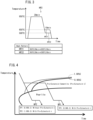
- heat treatments of heat patterns shown in FIGS. 2 and 3 were performed to vary the morphology of pro-eutectoid cementite to be formed in the steel materials TP1 and TP2.
- the heat patterns shown in FIGS. 2 and 3 each indicate the temperature of the atmosphere of heat treatment. In other words, it shows the temperature of the atmosphere in which the steel material is disposed during the heat treatment.
- the heat pattern HP1 of FIG. 2 is a heat pattern in which a residence time of the steel materials TP1 and TP2 in a formation temperature range (720°C) of pro-eutectoid cementite is increased in the steel materials TP1 and TP2.
- 3 is a heat pattern in which a residence time of the steel material TP2 (1.00% C material) in a formation temperature range of pro-eutectoid cementite is decreased by rapid cooling, or a heat pattern which does not pass through the formation temperature range of pro-eutectoid cementite in the case of the steel material TP1 (0.90% C material) which has a lower C content.
- FIG. 4 is a conceptual diagram to show a relation between the isothermal transformation diagrams of the steel materials TP1 and TP2, and heat patterns HP1, HP2 of FIGS. 2 and 3.
- FIG. 4 shows a pro-eutectoid cementite nose and a pearlite nose in the chemical composition of each of the steel materials TP1 and TP2. Note that the position of the pearlite nose is substantially the same between the steel material TP1 (0.90% C material) and the steel material TP2 (1.00% C material). On the other hand, regarding the pro-eutectoid cementite nose, that of the steel material TP2 (1.00% C material, a broken line in FIG. 4 ) is displaced leftward with respect to that of the steel material TP1 (0.90% C material, a solid line in FIG. 4 ).
- pro-eutectoid cementite also referred to as pro-eutectoid ⁇
- pro-eutectoid cementite formation temperature range will not be passed through. For that reason, substantially no pro-eutectoid cementite is formed in the microstructure of the steel material TP1 to which the heat pattern HP2 is applied.
- the cooling liquid is injected onto a tread 41 shown in FIG. 1 to cool the railway wheel 1 while performing quenching.
- the thickness T2 of the hub part 2 is larger than the thickness T3 of the web part 3, and the hub part 2 is far from the rim part 4 with which the cooling liquid comes into contact.
- the cooling rate of the hub part 2 is smaller than the cooling rate of the web part 3.
- the heat patterns HP11 and HP12 which assumed a cooling rate at the hub part, had different holding times at 720°C. Specifically, in the heat pattern HP11, the holding time at 720°C was 47 minutes, and in the heat pattern HP12, the holding time at 720°C was 17 minutes. In other words, it was assumed that the amount of pro-eutectoid cementite formed in the steel material heat-treated with the heat pattern HP11 was larger than the amount of pro-eutectoid cementite formed in the steel material heat-treated with the heat pattern HP12. Similarly, in FIG. 2 , the heat patterns HP13 and HP14, which assumed the cooling rate at the web part 3, had different holding times at 720°C.
- the holding time at 720°C was 47 minutes
- the holding time at 720°C was 17 minutes.
- the amount of pro-eutectoid cementite formed in the steel material heat-treated with the heat pattern HP13 is larger than the amount of pro-eutectoid cementite formed in the steel material heat-treated with the heat pattern HP14.
- a plurality of steel materials TP1 were prepared, and a plurality of steel materials TP2 were prepared.
- Each steel material was heat-treated according to the heat patterns HP11 to HP14, HP21 and HP22, which simulated tread quenching.
- the test materials of Test Numbers 1 to 8 shown in Table 2 were prepared by combining the steel materials TP1 and TP2, and the heat patterns HP11 to HP14, HP21 and HP22.
- the Vickers hardness of the steel material of each Test Number 1 to 8 after heat treatment was determined. Specifically, as shown in FIG. 5 , in a cross section perpendicular to the longitudinal direction of a steel material 100 of each test number, Vickers hardness (HV) was measured conforming to JIS Z 2244 (2009) at 5 points including a center point P1 of the steel material 100, and points P2 to P5 which were located at a 90° pitch on a circle having a radius of 1 mm and centered on the point P1. The test force at this time was 9.8 N (1.0 kgf). The average value of the obtained Vickers hardness was defined as the Vickers hardness (HV) of that test number.
- HV Vickers hardness
- the Charpy impact value was determined. Specifically, a U-notch test specimen conforming to JIS Z 2242 (2005) was collected from the center in a cross section perpendicular to the longitudinal direction of the steel material of each test number.
- the cross section perpendicular to the longitudinal direction of the U-notch test specimen was a square of 10 mm ⁇ 10 mm, and the length of the U-notch test specimen in the longitudinal direction was 55 mm.
- the longitudinal direction of the U-notch test specimen was parallel to the longitudinal direction of the steel material.
- the U notch was formed at a longitudinal center of the test specimen (that is, the middle position of a length of 55 mm).
- the notch depth was 2 mm and the notch bottom radius was 1 mm.
- the Charpy impact test was conducted conforming to JIS Z 2242 (2005) in the atmosphere at a room temperature. Charpy impact values (J/cm 2 ) were determined for four U-notch test specimens in each test number, and an average value thereof was defined as the Charpy impact value (J/cm 2 ) of that test number.
- the microstructure of the steel material of each test number after heat treatment was observed to investigate the presence or absence of pro-eutectoid cementite.
- a sample for microstructure observation was taken from the central position of the cross section perpendicular to the longitudinal direction of the steel material of each test number after heat treatment. Of the surfaces of the sample, the cross section perpendicular to the longitudinal direction of the steel material was used as the observation surface.
- the observation surface of each sample was mirror-finished by mechanical polishing. Then, the observation surface was etched with a sodium picric acid solution (100 ml of water + 2 g of picric acid + 25 g of sodium hydroxide), which was an etching solution suitable for revealing pro-eutectoid cementite.
- the sample was immersed in a boiled sodium picric acid solution.
- a photographic image was obtained using an optical microscope with a magnification of 500 times for any one visual field (200 ⁇ m ⁇ 200 ⁇ m) in the observation surface of the sample after etching.
- the pro-eutectoid cementite formed at the prior-austenite grain boundaries appears in black. Therefore, the presence or absence of pro-eutectoid cementite could be confirmed.
- FIG. 6 is a microstructure photographic image of Test Number 5 (0.90% C material) obtained by the above described microstructure observation.
- FIG. 7 is a microstructure photographic image of Test Number 8 (1.00% C material) obtained by the above described microstructure observation.
- black regions regions indicated by a black arrow) in those photographic images are pro-eutectoid cementite.
- the area fraction of the pro-eutectoid cementite confirmed in the above described visual field was determined. Specifically, the area of pro-eutectoid cementite in the visual field (200 ⁇ m ⁇ 200 ⁇ m) was determined. The ratio of the area of the obtained pro-eutectoid cementite to the total area of the visual field was defined as the pro-eutectoid cementite area fraction (%).
- pro-eutectoid cementite area fraction was less than 0.90%, it was judged that there was no pro-eutectoid cementite. On the other hand, if the pro-eutectoid cementite area fraction was more than 0.90%, it was judged that there was pro-eutectoid cementite.
- FIG. 8 is a diagram to show relation among the Vickers hardness (HV), the Charpy impact value (J/cm 2 ), and the presence or absence of pro-eutectoid cementite in hyper-eutectoid steel materials (0.90% C material and 1.00% C material).
- HV Vickers hardness
- J/cm 2 Charpy impact value
- FIG. 8 in Test Numbers 1, 2, 4, and 5 to which the heat pattern HP1 was applied by using the steel material TP1 (0.90% C material), there was pro-eutectoid cementite in the microstructure. For that reason, the Charpy impact value was 8.5 J/cm 2 or less.
- Test Number 1 (heat pattern HP11) with Test Number 2 (heat pattern HP12), Test Number 2, which had a shorter holding time at 720°C, had higher Vickers hardness than that of Test Number 1.
- the Charpy impact values were equal between Test Numbers 1 and 2.
- Test Number 4 (heat pattern HP13) with Test Number 5 (heat pattern HP14)
- Test number 5 which had a shorter holding time at 720°C, had higher Vickers hardness than that of Test Number 4.
- the Charpy impact values were equal between Test Numbers 4 and 5.
- Test Numbers 7 and 8 which used the steel material TP2 (1.00% C material) and to which the heat pattern HP2 (HP21 and HP22) was applied, pro-eutectoid cementite was present in the microstructure as in Test Numbers 1, 2, 4, and 5.
- the Charpy impact values of Test Numbers 7 and 8 were significantly higher than those of Test Numbers 1, 2, 4, and 5, in which pro-eutectoid cementite was present as well, and were more than 14 J/cm 2 .
- Test Number 2 comparing Test Number 7 with Test Number 7 the Charpy impact values were significantly different even though the Vickers hardness was almost the same between them.
- Test No. 5 with Test No. 8 the Charpy impact values were significantly different even though the Vickers hardness was almost the same between them.
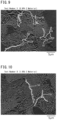
- FIG. 9 is a microstructure photographic image of Test Number 5 obtained by the SEM.
- FIG. 10 is a microstructure photographic image of Test Number 8 obtained by the SEM.
- a region surrounded by a white line in FIGS. 9 and 10 is pro-eutectoid cementite (reference sign 50). Comparing FIGS. 9 and 10 , the morphology of pro-eutectoid cementite formed in Test Number 8 which exhibited a high Charpy impact value was remarkably different from the morphology of pro-eutectoid cementite formed in Test Number 5 which exhibited a low Charpy impact value.
- the pro-eutectoid cementite of Test Number 8 was formed to have a narrower width of pro-eutectoid cementite as a whole as compared with the pro-eutectoid cementite of Test Number 5.
- the present inventors have considered that it is possible to suppress deterioration of toughness even if pro-eutectoid cementite is formed in the web part 3 of the railway wheel 1, when formed pro-eutectoid cementite has a narrow width.
- the present inventors paid attention to the width of pro-eutectoid cementite in the microstructure photographic image as an index showing the morphology of pro-eutectoid cementite in the railway wheel 1. Then, the present inventors defined the following two indexes with respect to the width of pro-eutectoid cementite.
- the average value of the width of pro-eutectoid cementite of (A) described above can be obtained based on the rectangular approximation method (ribbon-like method) described in Non-Patent Literature 1.
- the maximum width of pro-eutectoid cementite of (B) described above can be obtained by performing a thinning process, which is a type of image processing method.
- An average value of the width W of pro-eutectoid cementite is obtained by the rectangular approximation method described in Non-Patent Literature 1. Specifically, it is obtained by the following method.
- the above described microstructure photographic image (200 ⁇ m ⁇ 200 ⁇ m) obtained by the above described optical microscope with a magnification of 500 times is binarized by image processing to identify pro-eutectoid cementite.
- An area A of the identified pro-eutectoid cementite is determined. Further, the length of outer circumference P (outer circumference length) of the identified pro-eutectoid cementite is determined.
- the pro-eutectoid cementite is a rectangle having the area A and the outer circumference length P. Then, when cementite is assumed to be a rectangle, the longer side of the rectangle is regarded as the length L of the pro-eutectoid cementite, and the shorter side of the rectangle is regarded as the width W of the pro-eutectoid cementite. In other words, the pro-eutectoid cementite is regarded as a rectangle satisfying the following Formulae (a) and (b).
- L 1 / 2 ⁇ P / 2 + P / 2 2 ⁇ 4 A 1 / 2
- the width W of each pro-eutectoid cementite can be obtained from the area A and the outer circumference length P of each pro-eutectoid cementite identified in the observation visual field. Then, the average value of the width W of pro-eutectoid cementite can be obtained by using the width W of each pro-eutectoid cementite.
- the area A and the outer circumference length P were determined by the above described method for each pro-eutectoid cementite identified in the observation visual field. An average value of the area A of the identified pro-eutectoid cementite was determined, and an average value of the outer circumference length P was determined. By using the determined average value of the area A and the determined average value of the outer circumference length P, the width W of the pro-eutectoid cementite defined by Formula (1) was determined.
- the determined width W of the pro-eutectoid cementite was defined as the average value ( ⁇ m) of the width W of the pro-eutectoid cementite in that test number. Then, the relation between the determined average value of the width W of the pro-eutectoid cementite and the Charpy impact value was determined.
- FIG. 11 is a diagram to show a relation between the average value of the width W of the pro-eutectoid cementite and the Charpy impact value for Test Numbers 1, 2, 4, 5, 7, and 8.
- the Charpy impact value will be 8.5 J/cm 2 or less.
- the Charpy impact value will be more than 8.5 J/cm 2 , and moreover, the Charpy impact value will rapidly increase as the average value of the width W of the pro-eutectoid cementite decreases.
- the Charpy impact value in the graph of FIG. 11 , there is an inflection point in the vicinity of the average value of the width W of the pro-eutectoid cementite, which equals to 0.95 ⁇ m.
- the present inventors have found that in the railway wheel made of hypereutectoid steel, by controlling the morphology of pro-eutectoid cementite, specifically by controlling the average value of the width W of the pro-eutectoid cementite defined by Formula (1) to be 0.95 ⁇ m or less, the Charpy impact value becomes more than 8.5 J/cm 2 despite the presence of pro-eutectoid cementite, and thus excellent toughness can be obtained.
- the maximum width of pro-eutectoid cementite was determined by the following method.
- the above described observation surface was mirror-finished by mechanical polishing and then etched with a nital solution.
- observation is performed at a magnification of 2000 times by using a scanning electron microscope (SEM) to obtain a microstructure photographic image (60 ⁇ m ⁇ 45 ⁇ m) which is a secondary electron image.
- SEM scanning electron microscope
- the microstructure photographic image is binarized by image processing to identify pro-eutectoid cementite.
- the identified pro-eutectoid cementite is subjected to a thinning process.
- FIG. 12 is a diagram to show pro-eutectoid cementite identified by subjecting the microstructure photographic image shown in FIG. 9 to a binarization process.
- pro-eutectoid cementite 50 can be easily identified by performing a well-known binarization process.
- the pro-eutectoid cementite 50 is shown in black, and the region (pearlite region) other than the pro-eutectoid cementite is shown in white.
- the thinning process is a process of converting a binarized image (pro-eutectoid cementite 50) into a line image having a width of 1 pixel, and is a well-known image processing method.
- the line image obtained by the thinning process is referred to as a "skeleton line”.
- FIG. 13 is a diagram to show a skeleton line 60, which is obtained by subjecting the pro-eutectoid cementite 50 of FIG. 12 to the thinning process, superposed with the pro-eutectoid cementite 50.
- FIG. 14 is a partially enlarged schematic diagram of binarized pro-eutectoid cementite 50 and a skeleton line 60 of the pro-eutectoid cementite 50.
- a straight line is drawn perpendicular to the skeleton line 60 at any measurement point P on the skeleton line 60.
- a line segment L between two intersection points with the contour of the pro-eutectoid cementite 50 is defined as the width of the pro-eutectoid cementite at the measurement point P.
- a straight line perpendicular to the skeleton line 60 is drawn, and on the straight line, a length of a line segment L1 between two intersection points with the contour of the pro-eutectoid cementite 50 is defined as the width of the pro-eutectoid cementite 50 at the measurement point P1.
- a length of a line segment L2 perpendicular to the skeleton line 60 at a measurement point P2 is defined as the width of the pro-eutectoid cementite 50 at the measurement point P2.
- a branch point BP at which the skeleton line 60 branches may occur.
- the skeleton line 60 in a reference circle Cref having a diameter of 1.5 ⁇ m and centered on the branch point BP is excluded from the measurement of the width of pro-eutectoid cementite.
- the length of the line segment L is also excluded from the measurement of the width of the pro-eutectoid cementite 50.
- a line segment L3 of a measurement point P3 outside the reference circle Cref intersects with a point P4 on the skeleton line 60 in addition to the measurement point P3.
- the line segment L3 intersects with the skeleton line 60 twice or more.
- the line segment L3 is excluded from the measurement of the width of the pro-eutectoid cementite 50.
- the maximum width is defined as a maximum width ( ⁇ m) of pro-eutectoid cementite.
- the present inventors measured the maximum width of pro-eutectoid cementite by the above described method. As a result, the present inventors have found that when the maximum width of pro-eutectoid cementite is 1.80 ⁇ m or less, the Charpy impact value becomes more than 8.5 J/cm 2 , and thus excellent toughness can be achieved.
- a railway wheel 1 of the present embodiment includes a hub part 2, a web part 3, and a rim part 4, as shown in FIG. 1 .
- the chemical composition of the railway wheel 1 of the present embodiment contains the following elements.
- Carbon (C) increases the hardness of steel and increases the wear resistance of the railway wheel 1. If the C content is less than 0.80%, this effect cannot be achieved even if the contents of other elements are within a range of the present embodiment. On the other hand, if the C content is more than 1.60%, an excessive amount of pro-eutectoid cementite precipitates at prior-austenite grain boundaries, and the area fraction of pro-eutectoid cementite will be more than 15.00% even if the contents of other elements are within a range of the present embodiment. In this case, the toughness of the railway wheel 1 deteriorates. Therefore, the C content is 0.80 to 1.60%.
- the lower limit of the C content is preferably 0.85%, more preferably 0.87%, further preferably 0.90%, and further preferably 0.95%.
- the upper limit of the C content is preferably 1.55%, more preferably 1.45%, further preferably 1.30%, further preferably 1.15%, and further preferably 1.05%.
- Silicon (Si) is unavoidably contained.
- the Si content is more than 0%.
- Si solid-solution strengthens ferrite to increase the hardness of steel.
- the Si content is more than 1.00%, pro-eutectoid cementite becomes likely to be formed even if the contents of other elements are within a range of the present embodiment.
- the Si content is more than 1.00%, the hardenability of steel becomes too high, and martensite becomes likely to be formed. In such a case, the thickness of the quenched layer formed on the tread at the time of tread quenching increases. As a result, the amount of cutting increases and the yield decreases.
- the Si content is 1.00% or less.
- the upper limit of the Si content is preferably 0.90%, more preferably 0.80%, further preferably 0.70%, and further preferably 0.50%.
- the lower limit of the Si content will not be particularly limited. However, excessive decrease of the Si content will increase the production cost. Therefore, the lower limit of the Si content is preferably 0.01%, and more preferably 0.05%. In the viewpoint of increasing the hardness of steel, the lower limit of the Si content is further preferably 0.10%, and further preferably 0.15%.
- Manganese (Mn) solid-solution strengthens ferrite, thereby increasing the hardness of steel. Mn further forms MnS to improve the machinability of steel. If the Mn content is less than 0.10%, these effects cannot be achieved even if the contents of other elements are within a range of the present embodiment. On the other hand, if the Mn content is more than 1.25%, the hardenability of steel becomes too high even if the contents of other elements are within a range of the present embodiment. In such a case, the thickness of the quenched layer increases, and the yield in the production process decreases. Further, the rim part 4 is quenched caused by friction heat generated between the wheel and the brake during use of the railway wheel 1. In this case, crack resistance of steel may deteriorate.
- the Mn content is 0.10 to 1.25%.
- the lower limit of the Mn content is preferably 0.50%, more preferably 0.60%, and further preferably 0.70%.
- the upper limit of the Mn content is preferably 1.10%, more preferably 1.00%, further preferably 0.95%, and further preferably 0.90%.
- Phosphorus (P) is an unavoidably contained impurity.
- the P content is more than 0%. P segregates at grain boundaries to deteriorate the toughness of steel. Therefore, the P content is 0.050% or less.
- the upper limit of the P content is preferably 0.030%, and more preferably 0.020%.
- the P content is preferably as low as possible. However, excessive decrease of the P content will increase the production cost. Therefore, in consideration of ordinary industrial manufacturing, the lower limit of the P content is preferably 0.001%, and more preferably 0.002%.
- S Sulfur
- the S content is more than 0%.
- S forms MnS and enhances the machinability of steel.
- the S content is 0.030% or less.
- the upper limit of the S content is preferably 0.020%. Excessive reduction of the S content will increase the production cost. Therefore, the lower limit of the S content is preferably 0.001%, more preferably 0.002%, and further preferably 0.005%.
- the lower limit of the Al content is preferably 0.012%, more preferably 0.020%, further preferably 0.025%, and further preferably 0.030%.
- the upper limit of the Al content is preferably 0.600%, more preferably 0.500%, further preferably 0.300%, further preferably less than 0.250%, and further preferably 0.240%.
- the Al content as used herein means the content of acid-soluble Al (sol. Al).
- Nitrogen (N) combines with Al to form AlN and refines prior-austenite grains. As prior-austenite grains are refined, the toughness of steel is improved. If the N content is less than 0.0030%, this effect cannot be sufficiently achieved even if the contents of other elements are within a range of the present embodiment. On the other hand, if the N content is more than 0.0200%, such effect will be saturated even if the contents of other elements are within a range of the present embodiment. Therefore, the N content is 0.0030 to 0.0200%.
- the lower limit of the N content is preferably 0.0035%, and more preferably 0.0040%.
- the upper limit of the N content is preferably 0.0100%, and more preferably 0.0080%.
- the balance of the chemical composition of the railway wheel 1 according to the present embodiment consists of Fe and impurities.
- an impurity means an element, which is introduced from ores and scraps as the raw material, or from a production environment, etc., when the above described railway wheel 1 is industrially produced, and which is permitted within a range not adversely affecting the railway wheel 1 of the present embodiment.
- impurities other than the above described impurities are O, Cu, Ni, and Mo.
- the contents of these impurity elements are as follows: O: 0.0070% or less, Cu: 0.20% or less, more preferably 0.10% or less, and further preferably 0.08% or less, Ni: 0.20% or less, more preferably 0.10% or less, and further preferably 0.08% or less, and Mo: 0.07% or less.
- the chemical composition of the railway wheel 1 of the present embodiment may contain Cr in place of part of Fe.
- Chromium (Cr) is an optional element and may not be contained.
- the Cr content may be 0%.
- Cr decreases the lamellar spacing of pearlite. This significantly increases the hardness of pearlite.
- the Cr content is 0 to 0.60%.
- the lower limit of the Cr content is preferably more than 0%, more preferably 0.01%, further preferably 0.02%, and further preferably 0.03%.
- the upper limit of the Cr content is preferably 0.55%, more preferably 0.40%, further preferably 0.30%, further preferably 0.25%, and further preferably 0.20%.
- the chemical composition of the railway wheel 1 of the present embodiment may further contain V in place of part of Fe.
- Vanadium (V) is an optional element and may not be contained.
- the V content may be 0%.
- V forms any of carbide, nitride and carbonitride, thereby precipitation strengthening steel (specifically, ferrite in steel).
- the hardness of the railway wheel 1 is increased, thereby further enhancing wear resistance.
- the V content is 0 to 0.12%.
- the lower limit of the V content is preferably more than 0%, more preferably 0.01%, further preferably 0.02%, and further preferably 0.03%.
- the upper limit of the V content is preferably 0.11%, and more preferably 0.10%.
- the area fraction of pearlite is 85.0% or more, and the area fraction of pro-eutectoid cementite is 0.90 to 15.00%.
- the phases other than pearlite or pro-eutectoid cementite are, for example, martensite and/or bainite.
- the area fraction of pearlite is 85.0% or more, and the area fraction of pro-eutectoid cementite is 0.90 to 15.00%.
- the phases other than pearlite or pro-eutectoid cementite are, for example, martensite and/or bainite.
- the pearlite area fraction is preferably 95.0% or more, and more preferably 97.0% or more.
- the phases other than pearlite or pro-eutectoid cementite are, for example, martensite and/or bainite.
- the pearlite area fraction and the pro-eutectoid cementite area fraction in the microstructures of the web part 3, the hub part 2, and the rim part 4 are determined by the following method. Samples are collected from the middle position in the thickness direction of the web part 3 (the middle position of the thickness T3 in FIG. 1 ), the middle position in the thickness direction of the hub part 2 (the middle position of the thickness T2 in FIG. 1 ), and the middle position in the thickness direction of the rim part 4 (the middle position of the thickness T4 in FIG. 1 ). The observation surface of each sample is mirror-finished by mechanical polishing.
- the observation surface is etched with a sodium picric acid solution (100 ml of water + 2 g of picric acid + 25 g of sodium hydroxide).
- a sodium picric acid solution 100 ml of water + 2 g of picric acid + 25 g of sodium hydroxide.
- the sample is immersed in a boiled sodium picric acid solution.
- a photographic image is produced using an optical microscope with a magnification of 500 times for any one visual field (200 ⁇ m ⁇ 200 ⁇ m) in the observation surface of the sample after etching.
- pearlite and pro-eutectoid cementite have different contrasts.
- a black region indicated by an arrow is pro-eutectoid cementite and the remaining light gray region is pearlite.
- each phase of the microstructure can be discriminated based on the contrast.
- pearlite and pro-eutectoid cementite are identified based on contrast.
- the area fraction (%) of pearlite is determined based on the total area of the identified pearlite and the area of the observation visual field (40,000 ⁇ m 2 ).
- the area fraction (%) of pro-eutectoid cementite is determined based on the total area of the identified pro-eutectoid cementite and the area of the observation visual field (40,000 ⁇ m 2 ).
- the pearlite area fraction is 85.0% or more and the area fraction of pro-eutectoid cementite is 0.90 to 15.00% in the microstructure of the web part 3.
- the pro-eutectoid cementite is present in the web part 3.
- the railway wheel 1 of the present embodiment exhibits excellent toughness.
- the thickness T3 of the web part 3 is the thinnest among those of the rim part 4, the web part 3, and the hub part 2 of the railway wheel 1. Therefore, in the railway wheel 1, the web part 3 is required to have high toughness.
- the average value of the width W of the pro-eutectoid cementite defined by Formula (1) is 0.95 ⁇ m or less, the toughness is remarkably raised high as shown in FIG. 11 . Therefore, at least in the microstructure of the web part 3 of the railway wheel of the present embodiment, the average value of the width W of the pro-eutectoid cementite defined by Formula (1) is 0.95 ⁇ m or less.
- the upper limit of the average value of the width W of the pro-eutectoid cementite is preferably 0.90 ⁇ m, more preferably 0.85 ⁇ m, further preferably 0.80 ⁇ m, further preferably 0.75 ⁇ m, further preferably less than 0.70 ⁇ m, further preferably 0.68 ⁇ m, and further preferably 0.65 ⁇ m.
- the average value of the width W of the pro-eutectoid cementite is determined by the following method.
- a microstructure photographic image (observation visual field: 200 ⁇ m ⁇ 200 ⁇ m) of the web part 3 obtained by using the above described optical microscope is prepared.
- the binarization process is performed on the photographic image by well-known image processing.
- FIG. 15 is a diagram to show a microstructure photographic image obtained by using an optical microscope, and an image after the binarization process. Referring to FIG. 15 , in the microstructure photographic images of Mark A and Mark B, black regions are pro-eutectoid cementite and light gray regions other than that are pearlite.
- the image obtained by binarizing each of these microstructure photographic images by the image processing is shown in the "binarization" column of FIG. 15 .
- pro-eutectoid cementite is shown in white and pearlite is shown in black.
- pro-eutectoid cementite may be shown in black and pearlite may be shown in white.
- the binarization process can be performed by, for example, a well-known image processing application such as ImageJ (TM).
- TM image processing application
- the number of pixels of an image is not particularly limited, a range of the number of pixels of an image is preferably 300,000 pixels or more, more preferably 400,000 pixels or more, and further preferably 500,000 pixels or more.
- the upper limit of the number of pixels is, though not particularly limited, for example, 2 million pixels, and may be 1.2 million pixels, or 1 million pixels.
- each identified pro-eutectoid cementite is identified.
- regions which are continuously linked are identified as one grain of cementite.
- the area A ( ⁇ m 2 ) of each identified pro-eutectoid cementite is determined.
- the outer circumference length P ( ⁇ m) of each identified pro-eutectoid cementite is determined.
- the area A and the outer circumference length P can be determined by, for example, a well-known image processing application such as ImageJ (TM).
- ImageJ TM
- pro-eutectoid cementite having an area A of 0.80 ⁇ m 2 or more is targeted.
- the area A and the outer circumference length P of each targeted pro-eutectoid cementite are determined.
- An average value of the areas A of all of the targeted pro-eutectoid cementite is determined, and an average value of the outer circumference lengths P is determined.
- a width W of the pro-eutectoid cementite defined by Formula (1) is determined.
- the determined pro-eutectoid cementite width W is regarded as the average value of the width W of the pro-eutectoid cementite.
- the average value of the width W of the pro-eutectoid cementite of Mark A in FIG. 15 is 0.52 ⁇ m, and the average value of width W of the pro-eutectoid cementite of Mark B is 0.95 ⁇ m.
- the pearlite area fraction is 85.0% or more and the area fraction of pro-eutectoid cementite is 0.90 to 15.00% in the microstructure of the web part 3. Moreover, the average value of the width W of the pro-eutectoid cementite is 0.95 ⁇ m or less.
- pro-eutectoid cementite is present in the web part 3. However, since the average value of the width W of the pro-eutectoid cementite of the web part 3 is 0.95 ⁇ m or less, the railway wheel 1 of the present embodiment exhibits excellent toughness.
- the pearlite area fraction is 85.0% or more, the area fraction of pro-eutectoid cementite is 0.90 to 15.00%, and the average value of the width W of the pro-eutectoid cementite is 0.95 ⁇ m or less.
- the railway wheel 1 exhibits further excellent toughness.
- the upper limit of the average value of the width W of the pro-eutectoid cementite in the hub part 2 is preferably 0.90 ⁇ m, more preferably 0.85 ⁇ m, further preferably 0.80 ⁇ m, further preferably 0.75 ⁇ m, further preferably less than 0.70 ⁇ m, further preferably 0.68 ⁇ m, and further preferably 0.65 ⁇ m.
- the average value of the width W of the pro-eutectoid cementite in the hub part 2 can be determined by the same method as the method for determining the average value of the width W of the pro-eutectoid cementite in the web part 3 by using the microstructure photographic image of the hub part (observation visual field: 200 ⁇ m ⁇ 200 ⁇ m) obtained by the above described optical microscope.
- the pro-eutectoid cementite in the web part 3 can be defined not by the above described average value of the width W, but by the maximum width of pro-eutectoid cementite.
- the area fraction of pearlite is 85.0% or more
- the area fraction of pro-eutectoid cementite is 0.90 to 15.00%
- the maximum width of pro-eutectoid cementite is 1.80 ⁇ m or less.
- the thickness T3 of the web part 3 is the thinnest among those of the rim part 4, the web part 3, and the hub part 2 of the railway wheel 1. Therefore, in the railway wheel 1, the web part 3 is required to have high toughness.
- the maximum width of pro-eutectoid cementite is 1.80 ⁇ m or less, the toughness is remarkably improved. Therefore, the maximum width of pro-eutectoid cementite is 1.80 ⁇ m or less at least in the microstructure of the web part 3 of the railway wheel of the present embodiment.
- the upper limit of the maximum width of pro-eutectoid cementite is preferably 1.75 ⁇ m, more preferably 1.70 ⁇ m, further preferably 1.60 ⁇ m, further preferably 1.50 ⁇ m, further preferably 1.40 ⁇ m, further preferably 1.30 ⁇ m, further preferably 1.20 ⁇ m, and further preferably 1.10 ⁇ m.
- the maximum width of pro-eutectoid cementite is determined by the following method.
- a sample is collected from a middle position of an arbitrary thickness of the web part 3 (middle position of the thickness T3 of the web part 3 in FIG. 1 ).
- any surface is used as the observation surface.
- the observation surface is mirror-finished by mechanical polishing. Thereafter, the observation surface is etched with a nital solution.
- Arbitrary 8 visual fields of the observation surface of the sample after etching are observed at a magnification of 2000 times by using a scanning electron microscope (SEM) to produce a microstructure photographic image, which is a secondary electron image, of each visual field (60 ⁇ m ⁇ 45 ⁇ m).
- SEM scanning electron microscope
- the number of pixels of the image is not particularly limited, a range of the number of pixels of an image is preferably 300,000 pixels or more, more preferably 400,000 pixels or more, and further preferably 500,000 pixels or more.
- the upper limit of the number of pixels is, though not particularly limited, for example, 3 million pixels, and may be 2 million pixels or 1.5 million pixels.
- the microstructure photographic image is binarized by image processing to identify pro-eutectoid cementite.
- the identified pro-eutectoid cementite is subjected to the thinning process to identify the skeleton line of pro-eutectoid cementite.
- a line segment length between two intersection points with the contour of pro-eutectoid cementite is defined as the width of pro-eutectoid cementite at that measurement point.
- the width of pro-eutectoid cementite at a measurement point which is located within a range of a reference circle Cref with a diameter of 1.5 ⁇ m from a branch point of the skeleton line, and the width of pro-eutectoid cementite when the line segment at a measurement point intersects with the skeleton line at two or more points including the measurement point, are excluded.
- a maximum value of the width of pro-eutectoid cementite is identified in each visual field.
- the largest width is defined as the maximum width of pro-eutectoid cementite.
- the pearlite area fraction is 85.0% or more, the area fraction of pro-eutectoid cementite is 0.90 to 15.00%, and the maximum width of pro-eutectoid cementite is 1.80 ⁇ m or less.
- the railway wheel 1 exhibits further excellent toughness.
- the upper limit of the maximum width of pro-eutectoid cementite in the hub part 2 is preferably 1.75 ⁇ m, more preferably 1.70 ⁇ m, further preferably 1.60 ⁇ m, further preferably 1.50 ⁇ m, further preferably 1.40 ⁇ m, further preferably 1.30 ⁇ m, further preferably 1.20 ⁇ m, and further preferably 1.10 ⁇ m.
- This production method includes a step of producing railway wheel steel (starting material production step), a step of forming an intermediate product having a wheel shape from the railway wheel steel (forming step), a step of performing heat treatment (tread quenching) for the formed intermediate product (heat treatment step), and a step of obtaining a railway wheel by removing a quenched layer from a tread etc., of the intermediate product after the heat treatment (cutting step).
- molten steel having the above described chemical composition are melted by using an electric furnace or a converter, etc., and thereafter cast to obtain steel ingots.
- the steel ingot may be either a cast piece by continuous casting, or an ingot cast with a mold.
- the cast piece or ingot is subjected to hot working to produce a steel material for railway wheel having a desired size.
- hot working include hot forging, hot rolling, and others.
- the steel material for railway wheel is produced by hot rolling, for example, the steel material for railway wheel is produced by the following method.
- a blooming mill is used in the hot rolling.
- a blooming mill is used to perform blooming on the starting material to produce a steel material for railway wheel.
- a continuous rolling mill is installed in the downstream of the blooming mill, the steel material after blooming may be further subjected to hot rolling by use of the continuous rolling mill to produce a steel material for railway wheel.
- a horizontal stand having a pair of horizontal rolls and a vertical stand having a pair of vertical rolls are alternately arranged in a row.
- the heating temperature of the heating furnace in the hot rolling is, although not particularly limited, for example, 1100 to 1350°C.
- the steel material for railway wheel is produced by the above described production process.
- the steel material for railway wheel may be a cast material (cast piece or ingot).
- the above described hot working step may be omitted. According to the process described above, a steel material for railway wheel which is the starting material for a railway wheel is produced.
- an intermediate product having a wheel shape is formed by hot working by using the prepared steel material for railway wheel. Since the intermediate product has a wheel shape, it includes a hub part, a web part, and a rim part including a tread and a flange part. Examples of the hot working include hot forging, hot rolling, and the like.
- an intermediate product having a rough wheel shape is formed by hot forging. Hot rolling using a wheel rolling mill is performed on the rough intermediate product after preform forging. Rotary forging is performed on the rough intermediate product after hot rolling to form a through hole in a central portion corresponding to the hub part. According to the above configuration, a wheel-shaped intermediate product is formed by hot working.
- the heating temperature of the steel material for railway wheel during hot working in the forming step is preferably 1220°C or more.
- the lower limit of the heating temperature during hot working is preferably 1230°C, more preferably 1250°C, and further preferably 1300°C.
- the upper limit of the heating temperature during hot working is preferably 1350°C.
- the cooling method of the intermediate product after the hot working will not be particularly limited. It may be allowed to cool in the air, or may be water cooled.
- the formed intermediate product having a wheel shape is subjected to tread quenching.
- the intermediate product after the hot working is reheated to Ac m transformation point or higher (reheating treatment).
- the tread and the flange part of the intermediate product are subjected to rapid cooling (tread quenching).
- an average cooling rate CR 800-500 from 800°C to 500°C in the web part 3 may be less than 0.500°C/sec.
- an average cooling rate CR 750-700 from 750°C to 700°C in the web part 3 is made 0.022°C/sec or more.
- the temperature range of 750 to 700°C is a temperature range in which pro-eutectoid cementite precipitates.
- the average cooling rate CR 750-700 is 0.022°C/sec or more, the average value of the width W of pro-eutectoid cementite in the web part 3 will be 0.95 ⁇ m or less, and the maximum width of pro-eutectoid cementite will be 1.80 ⁇ m or less. In this case, the toughness of the railway wheel is excellent.
- the average cooling rate CR 750-700 from 750°C to 700°C in the web part 3 is 0.022°C/sec or more, formation of excessive pro-eutectoid cementite will be suppressed even when the average cooling rate CR 800-500 from 800°C to 500°C in the web part 3 is less than 0.500°C/sec.
- the average value of the width W of pro-eutectoid cementite in the web part 3 will be 0.95 ⁇ m or less.
- the maximum width of pro-eutectoid cementite in the web part 3 will be 1.80 ⁇ m or less.
- the lower limit of the average cooling rate CR 750-700 in the web part 3 is preferably 0.025°C/sec, more preferably 0.030°C/sec, further preferably 0.040°C/sec, further preferably 0.045°C/sec, further preferably 0.050°C/sec, further preferably 0.052°C/sec, further preferably 0.055°C/sec, further preferably 0.100°C/sec, and further preferably 0.500°C/sec.
- the average cooling rate CR 750-700 is more than 33.000°C/sec
- the average cooling rate CR 800-500 will also be 0.500°C/sec or more.
- the formation of pro-eutectoid cementite is suppressed, and the area fraction of pro-eutectoid cementite can be made less than 0.90% in a steel material having the above described chemical composition.
- the formation of the quenched layer in the web part 3 and the hub part 2 can be suppressed. Therefore, if the area fraction of pro-eutectoid cementite is to be made less than 0.90%, it is necessary to strictly adjust the cooling rate of the web part 3 while also considering suppression of the formation of the quenched layer.
- the railway wheel 1 in the present embodiment is premised on the presence of pro-eutectoid cementite at least in the web part 3. Therefore, there is no need of strictly controlling the cooling rate in the web part 3, such as suppressing the formation of pro-eutectoid cementite, as well as suppressing the formation of the quenched layer. As a result, the complexity of the production process can be suppressed.
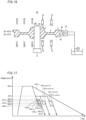
- FIG. 16 is a diagram to show an example of a cooling apparatus for cooling the intermediate product.
- a cooling apparatus 10 includes a rotating apparatus 11 having a rotational shaft, one or more cooling nozzles for hub-part 12, one or more cooling nozzles for web-part 13, and one or more cooling nozzles for tread 14.
- the cooling nozzle for tread 14 is arranged around the rotational shaft of the cooling apparatus 10.
- a nozzle port of the cooling nozzle for tread 14 is arranged so as to be opposed to the tread 41 of the intermediate product.
- the nozzle port of the cooling nozzle for tread 14 may be arranged so as to be opposed to the surface of a flange part 42 of the intermediate product.
- the cooling nozzle for web-part 13 is arranged so as to be opposed to the surface of the web part 3.
- the cooling nozzle for hub-part 12 is arranged so as to be opposed to the surface of the hub part 2.
- the cooling nozzle for tread 14 injects a cooling liquid from the nozzle port to mainly cool the surfaces of the tread 41 of the rim part 4 and the surface of the flange part 42.
- the cooling liquid is, for example, water, mist, spray and the like.
- the cooling nozzle for web-part 13 injects cooling gas from the nozzle port to mainly cool the web part 3.
- the cooling gas is, for example, compressed air and the like.
- the cooling nozzle for hub-part 12 also injects cooling gas from the nozzle port to mainly cool the hub part 2.
- the cooling apparatus 10 further includes a plurality of thermometers 20.
- the thermometer 20 is arranged around the intermediate product and measures temperatures of the rim part 4, the tread 41, the flange part 42, the web part 3, and the hub part 2.
- the plurality of thermometers 20 are arranged so as to be able to measure temperature distributions on the tread 41, the surface of the flange part 42, the surface of the rim part 4 other than the tread 41 or the surface of the flange part 42 (for example, a side surface of the rim part 4), the surface of the web part 3, and the surface of the hub part 2.
- the intermediate product heated to or above the A cm transformation point is placed in the cooling apparatus 10. While rotating the intermediate product by the rotating apparatus 11, the cooling liquid is injected from the cooling nozzle for tread 14 to perform tread quenching. Further, during the tread quenching, the web part 3 and/or the hub part 2 is cooled by injecting a cooling gas from the cooling nozzle for web-part 13 and/or the cooling nozzle for hub-part 12. While measuring the temperature distribution of the intermediate product with the thermometers 20, adjustment is made such that the cooling rate from 750 to 700°C in the web part 3 is 0.022 to 33.000°C/sec.
- the C content of the railway wheel 1 of this embodiment is as high as 0.80 to 1.60%. Therefore, the wear resistance of fine pearlite is improved. Further, at the time of the tread quenching, adjustment is made such that the average cooling rate CR 750-700 from 750 to 700°C is 0.022 to 33.000°C/sec in the web part 3.
- the pearlite area fraction will be 85.0% or more, and the area fraction of pro-eutectoid cementite will be 0.90 to 15.00% at least in the microstructure of the web part 3, the average of the width W of pro-eutectoid cementite can be made 0.95 ⁇ m or less. Further, the maximum width of pro-eutectoid cementite can be made 1.80 ⁇ m or less. Therefore, although pro-eutectoid cementite is present in the microstructure, sufficient toughness can be achieved.
- the pearlite area fraction is made 85.0% or more, and the area fraction of pro-eutectoid cementite is made 0.90 to 15.00%, and the average value of the width W of pro-eutectoid cementite is made 0.95 ⁇ m or less, or the maximum width of pro-eutectoid cementite is made 1.80 ⁇ m or less, in the microstructure of not only the web part 3, but also the hub part 2;
- the average cooling rate CR 750-700 from 750 to 700°C in the web part 3 is made 0.022 to 33.000°C/sec, and the average cooling rate CR 750-700 from 750 to 700°C in the hub part 2 is also made 0.022 to 33.0°C/sec even if the average cooling rate CR 800-500 from 800 to 500°C in the web part 3 and the hub part 2 is less than 0.500°C/sec.
- the pearlite area fraction in the microstructure of the web part 3, the pearlite area fraction will be 85.0% or more, the area fraction of pro-eutectoid cementite will be 0.90 to 15.00%, and the average value of the width W of pro-eutectoid cementite will be 0.95 ⁇ m or less, as well as in the microstructure of the hub part 2, the pearlite area fraction will be 85.0% or more, the area fraction of pro-eutectoid cementite will be 0.90 to 15.00%, and the average value of the width W of pro-eutectoid cementite will be 0.95 ⁇ m or less.
- the pearlite area fraction will be 85.0% or more, the area fraction of pro-eutectoid cementite will be 0.90 to 15.00%, and the maximum width of pro-eutectoid cementite will be 1.80 ⁇ m or less, as well as in the microstructure of the hub part 2, the pearlite area fraction will be 85.0% or more, the area fraction of pro-eutectoid cementite will be 0.90 to 15.00%, and the maximum width of pro-eutectoid cementite will be 1.80 ⁇ m or less.
- the cooling apparatus 10 described above includes the cooling nozzle for web-part 13 and the cooling nozzle for hub-part 12, the cooling apparatus 10 may not include the cooling nozzle for hub-part 12. Further, the cooling apparatus 10 may include the cooling nozzle for tread 14, and may not include the cooling nozzle for web-part 13 or the cooling nozzle for hub-part 12. In this case, by adjusting an injection amount of the cooling liquid of the cooling nozzle for tread 14 at the time of the tread quenching, the average cooling rate CR 750-700 from 750 to 700°C in the web part 3, or in the web part 3 and the hub part 2 can be adjusted to 0.022 to 33.000°C/sec.
- the intermediate product is reheated, but the intermediate product after the hot working may be directly subjected to the tread quenching (without being reheated).
- the intermediate product after the tread quenching is subjected to tempering as necessary. It is sufficient if the tempering is performed at a well-known temperature and time.
- the tempering temperature is, for example, 400 to 600°C.
- a quenched layer is formed in the layer thereabove. Since the wear resistance of the quenched layer is poor in uses of railway wheel, the quenched layer is removed by cutting. It is sufficient if the cutting is performed by a well-known method.
- the railway wheel of the present embodiment is produced by the above described process.
- the pearlite area fraction is 85.0% or more
- the area fraction of pro-eutectoid cementite is 0.90 to 15.00%
- the average value of the width W of pro-eutectoid cementite defined by Formula (1) is 0.95 ⁇ m or less.
- the maximum width of pro-eutectoid cementite is 1.80 ⁇ m or less.
- the pearlite area fraction is 85.0% or more, the area fraction of pro-eutectoid cementite is 0.90 to 15.00%, and the average value of the width W of pro-eutectoid cementite defined by Formula (1) is 0.95 ⁇ m or less. For that reason, in the railway wheel of the present embodiment, even though pro-eutectoid cementite is present, sufficient toughness can be achieved.
- the pearlite area fraction is 85.0% or more, the area fraction of pro-eutectoid cementite is 0.90 to 15.00%, and the maximum width of pro-eutectoid cementite is 1.80 ⁇ m or less.
- the pearlite area fraction is 85.0% or more, the area fraction of pro-eutectoid cementite is 0.90 to 15.00%, and the maximum width of pro-eutectoid cementite is 1.80 ⁇ m or less. For that reason, in the railway wheel of the present embodiment, even though pro-eutectoid cementite is present, sufficient toughness can be achieved.
- An ingot (a truncated cone shape having an upper face diameter of 107 mm, a bottom face diameter of 97 mm, and a height of 230 mm) was produced by an ingot-making process by using the above described molten steel. Simulating the hot working step in the production process of railway wheel, the ingot was heated to 1250°C and thereafter was hot forged to produce a round bar having a diameter of 40 mm. Further, from the central portion of the round bar, a round bar (steel material) having a diameter of 20 mm and a length of 125 mm was taken by machining.
- a simulated tread quenching test which simulates the tread quenching in the production process of railway wheel was conducted for the steel materials of each test number. Specifically, the steel materials of each test number were subjected to heat treatment with the heat patterns shown in Table 4 and FIG. 17 . In each heat pattern, the average cooling rate CR 800-500 (°C/sec) when the steel material temperature was 800 to 500°C, and the average cooling rate CR 750-700 (°C/sec) when the steel material temperature was 750 to 700°C were as shown in Table 4.
- Table 4 the average cooling rate CR 800-500 (°C/sec) when the steel material temperature was 800 to 500°C
- the average cooling rate CR 750-700 °C/sec
- the average cooling rate CR 800-500 was adjusted to 0.420°C/sec, and the average cooling rate CR 750-700 was adjusted to 0.530°C/sec by starting cooling from 950°C, holding at 690°C for a predetermined time, and then restarting cooling.
- the average cooling rate CR 800-500 was adjusted to 0.175°C/sec and the average cooling rate CR 750-700 was adjusted to 0.0480°C/sec by starting cooling from 950°C, holding at 720°C for a predetermined time, then restarting cooling, holding at 650°C for a predetermined time, and then restarting cooling.
- test specimen for microstructure observation was collected from the central position of the cross section perpendicular to the longitudinal direction of the simulated railway wheel steel material of each test number after the heat treatment.
- the cross section perpendicular to the longitudinal direction of the test material was used as the observation surface.
- the observation surface of each test specimen was mirror-finished by mechanical polishing. Then, the observation surface was etched with a sodium picric acid solution (100 ml of water + 2 g of picric acid + 25 g of sodium hydroxide). In the etching, the test specimen was immersed in a boiled sodium picric acid solution.
- a photographic image for microstructure observation was obtained using an optical microscope with a magnification of 500 times for arbitrary one visual field (200 ⁇ m ⁇ 200 ⁇ m) in the observation surface of the test specimen after etching.
- pearlite, pro-eutectoid cementite, and other phases differed in contrast, as described above. Therefore, pearlite and pro-eutectoid cementite were identified based on the contrast of the photographic image.
- the area fraction (%) of pearlite was determined based on the total area of the identified pearlite and the area of the observation visual field.
- the area fraction (%) of the pro-eutectoid cementite was determined based on the total area of the identified pro-eutectoid cementite and the area of the observation visual field.
- Table 4 shows the obtained pearlite area fraction and the pro-eutectoid cementite area fraction.
- a photographic image for observing the microstructure in arbitrary one visual field (200 ⁇ m ⁇ 200 ⁇ m) in the observation surface of the test specimen after etching described above was binarized using the image processing application ImageJ (TM) to identify individual pro-eutectoid cementite in the visual field (photographic image).
- the area A ( ⁇ m 2 ) of each identified pro-eutectoid cementite was determined.
- the outer circumference length P ( ⁇ m) of each identified pro-eutectoid cementite was determined.
- the area A and the outer circumference length P of each pro-eutectoid cementite were determined using the above described image processing application.
- each of the identified pro-eutectoid cementite one having an area A of less than 0.80 ⁇ m 2 were excluded because it may be noise.
- the area A and the outer circumference length P of each pro-eutectoid cementite to be targeted were determined.
- the average value of the areas A of all the targeted pro-eutectoid cementite was determined, and the average value of the outer circumference length P was determined.
- the width W of the pro-eutectoid cementite defined by Formula (1) was determined.
- the determined pro-eutectoid cementite width W was regarded as the average value of width W of the pro-eutectoid cementite.
- Table 4 shows the average value ( ⁇ m) of the determined pro-eutectoid cementite width W.
- Test Numbers 12 to 16 since the area fraction of the pro-eutectoid cementite was extremely small, the calculation of the average value of the width W of pro-eutectoid cementite was omitted (indicated as "-" in Table 4).
- the above described observation surface was subjected to etching with a nital solution after being mirror-finishing by mechanical polishing.
- Arbitrary 8 visual fields in the observation surface of the test specimen after the etching were observed at a magnification of 2000 times using a scanning electron microscope (SEM), and a microstructure photographic image, which is a secondary electron image, of each visual field (60 ⁇ m ⁇ 45 ⁇ m) were produced.
- the photographic image for microstructure observation was binarized using the image processing application ImageJ (TM) to identify individual pro-eutectoid cementite in the visual field (photographic image).
- the identified pro-eutectoid cementite was subjected to a thinning process to obtain a skeleton line of pro-eutectoid cementite.
- the line segment length between two intersection points with the contour of the pro-eutectoid cementite is defined as the width of pro-eutectoid cementite at that measurement point.
- the width of pro-eutectoid cementite at a measurement point which was located within a range of a reference circle Cref with a diameter of 1.5 ⁇ m from a branch point of the skeleton line, and the width of pro-eutectoid cementite when the line segment at a measurement point intersected with the skeleton line at two or more points including the measurement point, were excluded.
- a U-notch test specimen conforming to JIS Z 2242 (2005) was collected from the central position of the cross section perpendicular to the longitudinal direction of the simulated railway wheel steel material of each test number.
- the cross section perpendicular to the longitudinal direction of the U-notch test specimen was a square of 10 mm ⁇ 10 mm, and the length of the U-notch test specimen in the longitudinal direction was 55 mm.
- the longitudinal direction of the U-notch test specimen was parallel to the longitudinal direction of the steel material.
- a U-notch was formed at the middle position of the length of the U-notch test specimen (that is, the middle position of a length of 55 mm).
- the notch depth was 2 mm and the notch bottom radius was 1.0 mm.
- a Charpy impact test was conducted at room temperature in the atmosphere conforming to JIS Z 2242 (2005).
- the Charpy impact value (J/cm 2 ) was determined for four U-notch test specimens, and the average value of the four was defined as the Charpy impact value (J/cm 2 ) of that test number.
- the obtained Charpy impact values are shown in Table 4.
- Test results are shown in Table 4. Referring to FIG. 4 , chemical compositions of simulated railway wheel steel materials of Test Numbers 1 to 7 were appropriate. Further, in the heat treatment which simulated the tread quenching, the average cooling rate CR 800-500 (°C/sec) and the average cooling rate CR 750-700 (°C/sec) were appropriate. For that reason, the pearlite area fraction was 85.0% or more, and the area fraction of pro-eutectoid cementite was 0.90 to 15.00%. Further, the average value of the width W of pro-eutectoid cementite was 0.95 ⁇ m or less. Moreover, the maximum width of pro-eutectoid cementite was 1.80 ⁇ m or less. For that reason, the Charpy impact value was more than 8.5 J/cm 2 , and thus excellent toughness was achieved.
- the average cooling rate CR 800-500 was more than 0.500°C/sec, and further, in Test Numbers 14 and 15, the average cooling rate CR 750-700 was more than 33.000°C/sec. For that reason, the area fraction of pro-eutectoid cementite was less than 0.90%, which was out of the scope of the present invention.
Landscapes
- Chemical & Material Sciences (AREA)
- Engineering & Computer Science (AREA)
- Mechanical Engineering (AREA)
- Materials Engineering (AREA)
- Metallurgy (AREA)
- Organic Chemistry (AREA)
- Physics & Mathematics (AREA)
- Thermal Sciences (AREA)
- Crystallography & Structural Chemistry (AREA)
- Heat Treatment Of Steel (AREA)
- Heat Treatment Of Articles (AREA)
Description
- The present disclosure relates to a railway wheel.
- A railway vehicle travels on a rail constituting a railway track. A railway vehicle includes a plurality of railway wheels. The railway wheel supports the vehicle, keeps in contact with the rail, and rotates to move on the rail. The railway wheel wears due to the contact with the rail. In recent years, for the purpose of increasing the efficiency of railway transportation, attempts have been made to increase the loading weight on the railway vehicle and to increase the speed of the railway vehicle. As a result of that, there is need of improvement of the wear resistance of railway wheels.
- Technologies to improve wear resistance of a railway wheel have been proposed in
Japanese Patent Application Publication No. H09-202937 Japanese Patent Application Publication No. 2012-107295 Japanese Patent Application Publication No. 2013-231212 Japanese Patent Application Publication No. 2004-315928 - The railway wheel disclosed in
Patent Literature 1 consists of, in mass%, C: 0.4 to 0.75%, Si: 0.4 to 0.95%, Mn: 0.6 to 1.2%, Cr: 0 to less than 0.2%, P: less than 0.03%, and S: 0.03% or less, with the balance being Fe and other unavoidable impurities. In this railway wheel, a region from the surface of the wheel tread part to a depth of at least 50 mm is composed of a pearlite structure. A production method of a railway wheel ofPatent Literature 1 includes a quenching step in which the wheel tread part is cooled in a condition that a cooling curve of the wheel tread part passes through a pearlite forming region in a continuous cooling transformation curve, and resides on the long-time side of the martensite transformation curve. - Wheel steel disclosed in
Patent Literature 2 has a chemical composition consisting of, in mass%, C: 0.65 to 0.84%, Si: 0.02 to 1.00%, Mn: 0.50 to 1.90%, Cr: 0.02 to 0.50%, V: 0.02 to 0.20%, S ≤ 0.04%, P ≤ 0.05%, Cu ≤ 0.20%, and Ni ≤ 0.20%, with the balance being Fe and impurities. The chemical composition further satisfies the following relational expression:[34 ≤ 2.7 + 29.5 × C + 2.9 × Si + 6.9 × Mn + 10.8 × Cr + 30.3 × Mo + 44.3 × V ≤ 43] [0.76 × exp(0.05 × C) × exp(1.35 × Si) × exp(0.38 × Mn) × exp(0.77 × Cr) × exp(3.0 × Mo) × exp(4.6 × V) ≤ 25] -
Patent Literature 2 states that this wheel steel achieves excellent wear resistance, rolling fatigue resistance, and spalling resistance by satisfying the above described chemical composition and the Formulae. - The wheel steel disclosed in
Patent Literature 3 consists of, in mass%, C: 0.65 to 0.84%, Si: 0.4 to 1.0%, Mn: 0.50 to 1.40%, Cr: 0.02 to 0.13%, S: 0.04% or less, V: 0.02 to 0.12%, with the balance being Fe and impurities, wherein Fn1 defined by Formula (1) is 32 to 43, and Fn2 defined by Formula (2) is 25 or less. Here, Formula (1) is represented by Fn1 = 2.7 + 29.5C + 2.9Si + 6.9Mn + 10.8Cr + 30.3Mo + 44.3V, and Formula (2) is represented by Fn2 = exp(0.76) × exp(0.05C) × exp(1.35Si) × exp(0.38Mn) × exp(0.77Cr) × exp(3.0Mo) × exp(4.6V).Patent Literature 3 states that the wheel steel achieves excellent wear resistance, rolling fatigue resistance, and spalling resistance when it has the above described chemical composition, and Fn1 and Fn2 satisfy the above described range. - The railway vehicle wheel disclosed in
Patent Literature 4 is an integrated railway vehicle wheel composed of steel containing a chemical composition consisting of, in mass%, C: 0.85 to 1.20%, Si: 0.10 to 2.00%, Mn: 0.05 to 2.00%, and further as needed, one or more kinds selected from Cr, Mo, V, Nb, B, Co, Cu, Ni, Ti, Mg, Ca, Al, Zr, and N, with the balance being Fe and other unavoidable impurities, wherein at least a part of the tread and/or the flange surface of the wheel has a pearlite structure.Patent Literature 4 states that the life of the railway vehicle wheel depends on the amount of wear of the tread and the flange surface (paragraph - of Patent Literature 4), and further depends on a heat crack in the tread and the flange surface which is caused by increase in calorific value when brake is applied in a high-speed railway. It also states that when the railway vehicle wheel has the above described configuration, it is possible to suppress wear and heat crack of the tread and the flange surface.
Patent Literature 5 discloses a steel for wheel comprising: in mass%, C: 0.65 to 0.84%; Si: 0.4 to 1.0%; Mn: 0.50 to 1.40%; Cr: 0.02 to 0.13%; S: 0.04% or less and V: 0.02 to 0.12%, wherein Fn1 expressed by the following formula (1) is 32 to 43, and Fn2 expressed by the following formula (2) is 25 or less, the balance being Fe and impurities, and P, Cu and Ni in the impurities are P: 0.05% or less, Cu: 0.20% or less, and Ni: 0.20% or less:
Fn2 = exp(0.76) × exp(0.05 × C) × exp(1.35 × Si) × exp(0.38 × Mn) × exp(0.77 × Cr) × exp(3.0 × Mo) × exp(4.6 × V) Patent Literature 6 discloses a pearlite-based rail for improving surface damage resistance and wear resistance required for rails in a curved section of a passenger railway, and further improve toughness, and a method for manufacturing the same. -
- Patent Literature 1:
Japanese Patent Application Publication No. H09-202937 - Patent Literature 2:
Japanese Patent Application Publication No. 2012-107295 - Patent Literature 3:
Japanese Patent Application Publication No. 2013-231212 - Patent Literature 4:
Japanese Patent Application Publication No. 2004-315928 - Patent Literature 5:
European Patent Application Publication No. 2 843 071 - Patent Literature 6:
Japanese Patent Publication No. 4 949144 - Non Patent Literature 1: Nutal N et al., "IMAGE ANALYSIS OF PEARLITE SPHEROIDIZATION BASED ON THE MORPHOLOGICAL CHARACTERIZATION OF CEMENTITE PARTICLES", Imaga Anal Stereol 2010; 29: 91-98.
- In the railway wheel proposed in
Patent Literature 1, the Cr content is held to be low and an appropriate amount of Si is contained to provide an appropriate hardenability and a property to facilitate obtaining a pearlite structure. However, the railway wheel according toPatent Literature 1 contains 0.4 to 0.75% of C, that is, the wheel is made of a so-called hypo-eutectoid steel. Therefore, there is limitation on improving wear resistance. - In the wheel steels proposed in
Patent Literatures Patent Literatures - On the other hand, in the railway vehicle wheel proposed in
Patent Literature 4, wear resistance is improved by using a hyper-eutectoid steel in which the C content is increased. - One example of a production method of a railway wheel is as follows. A billet is subjected to hot working to form an intermediate product having a railway wheel shape. The formed intermediate product is subjected to heat treatment (tread quenching). In the tread quenching, the intermediate product is heated, and thereafter the tread and the flange part of the intermediate product are rapidly cooled. As a result of this, a fine pearlite which has high wear resistance is formed in the matrix structure of the near-surface layer of the tread. However, a quenched layer composed of martensite (or martensite and bainite) is formed in a layer above the fine pearlite of the near-surface portion of the tread after tread quenching. The quenched layer is likely to wear during use of a railway wheel. Therefore, after tread quenching, the quenched layer which has been formed at the outer most layer of the tread is removed by cutting such that fine pearlite is exposed to the tread. By the process described so far, a railway wheel is produced.
- As described so far, a railway vehicle wheel made of a hyper-eutectoid steel has excellent wear resistance. However, when a railway wheel is produced by the above described production method by using a hyper-eutectoid steel, it has become clear that in contrast to hypo-eutectoid steel, pro-eutectoid cementite is likely to be formed in a railway wheel, for example, in a web part and/or a hub part of the railway wheel. The pro-eutectoid cementite deteriorates toughness of steel. Particularly, the thickness of the web part is smaller compared with those of the hub part and the rim part. For that reason, deterioration of toughness due to pro-eutectoid cementite may lead to crack damage of a wheel particularly in the web part.
- It is an object of the present invention to provide a railway wheel which exhibits excellent toughness even if the C content is as high as 0.80% or more.
- A railway wheel according to the present invention is set out in the appended set of claims.
- The railway wheel according to the present disclosure exhibits excellent toughness even if the C content is as high as 0.80% or more.
-
- [
FIG. 1] FIG. 1 is a cross sectional view in parallel to a center axis of a railway wheel. - [
FIG. 2] FIG. 2 is a diagram to show a heat pattern in a heat treatment simulating tread quenching. - [
FIG. 3] FIG. 3 is a diagram to show a heat pattern in a heat treatment simulating tread quenching, which is different from that ofFIG. 2 . - [
FIG. 4] FIG. 4 is a conceptual diagram to show a relation between a time-temperature-transformation diagram and the heat patterns ofFIGS. 2 and3 in steel materials having chemical compositions shown in Table 1. - [
FIG. 5] FIG. 5 is a schematic diagram to explain measurement positions for the Vickers hardness test. - [
FIG. 6] FIG. 6 is a microstructure photographic image of Test Number 5 (0.90% C material) obtained by microstructure observation. - [
FIG. 7] FIG. 7 is a microstructure photographic image of Test Number 8 (1.00% C material) obtained by microstructure observation. - [
FIG. 8] FIG. 8 is a diagram to show relation among Vickers hardness (HV), Charpy impact value (J/cm2), and the presence or absence of pro-eutectoid cementite in hyper-eutectoid steel materials (0.90% C material and 1.00% C material). - [
FIG. 9] FIG. 9 is a microstructure photographic image of Test Number 5 (0.90% C material) in Table 2 obtained by the SEM. - [
FIG. 10] FIG. 10 is a microstructure photographic image of Test Number 8 (1.00% C material) in Table 2 obtained by the SEM. - [
FIG. 11] FIG. 11 is a diagram to show a relation between pro-eutectoid cementite widths and Charpy impact values forTest Numbers - [
FIG. 12] FIG. 12 is a diagram to show pro-eutectoid cementite identified by subjecting the microstructure photographic image shown inFIG. 9 to a binarization process. - [
FIG. 13] FIG. 13 is a diagram to show a skeleton line, which is obtained by subjecting the pro-eutectoid cementite ofFIG. 12 to a thinning process, superposed with the pro-eutectoid cementite. - [
FIG. 14] FIG. 14 is a schematic diagram to partially enlarge binarized pro-eutectoid cementite and askeleton line 60 of the pro-eutectoid cementite. - [
FIG. 15] FIG. 15 is a diagram to show an optical microscope photographic image and an image after the binarization process. - [
FIG. 16] FIG. 16 is a diagram to show an example of cooling apparatus for cooling an intermediate product. - [
FIG. 17] FIG. 17 is a diagram to show heat patterns in a heat treatment simulating tread quenching, which is adopted in Examples. -
FIG. 1 is a cross sectional view including a center axis of a railway wheel according to the present embodiment. Referring toFIG. 1 , arailway wheel 1 has a disc shape and includes ahub part 2, aweb part 3, and arim part 4. Thehub part 2 has a cylindrical shape and is disposed in a middle part of therailway wheel 1 in a radial direction (direction normal to the center axis) of therailway wheel 1. Thehub part 2 has a throughhole 21. A center axis of the throughhole 21 corresponds to the center axis of therailway wheel 1. A railway axle shaft not shown is inserted into the throughhole 21. A thickness T2 of thehub part 2 is larger than a thickness T3 of theweb part 3. Therim part 4 is formed in an edge part in the outer circumference of therailway wheel 1. Therim part 4 includes atread 41 and aflange part 42. Thetread 41 is linked with theflange part 42. Thetread 41 and theflange part 42 are in contact with a rail surface while therailway wheel 1 is used. A thickness T4 of therim part 4 is larger than the thickness T3 of theweb part 3. Theweb part 3 is disposed between thehub part 2 and therim part 4 and is linked with thehub part 2 and therim part 4. Specifically, an inner circumferential edge part of theweb part 3 is linked with thehub part 2, and an outer circumference edge part of theweb part 3 is linked with therim part 4. The thickness T3 of theweb part 3 is smaller than the thickness T2 of thehub part 2 and the thickness T4 of therim part 4. The diameter of therailway wheel 1 is, though not particularly limited, for example, 700 mm to 1000 mm. - First, the present inventors have studied on the chemical composition appropriate for improving wear resistance in a railway wheel. As a result, it was found that in a railway wheel, wear resistance when used as a railway wheel is improved more when hardness is increased by increasing the C content to be 0.80% or more, than when hardness is increased by increasing the V content even when the same hardness is obtained. Though this mechanism is not clear, the following matters are considered. The tread of the railway wheel being used is subjected to external force (load) from the rail. By this external force, the cementite in the pearlite in the outer layer immediately below the tread is crushed, and the hardness is further increased by particle dispersion strengthening. Further, carbon in crushed fine cementite dissolves supersaturatedly into ferrite in the pearlite, thereby increasing the hardness of the outer layer immediately below the tread by solid-solution strengthening.
- When the C content in steel is increased, the volume fraction of cementite in pearlite will increase, and further pearlite is likely to form finer lamellas. In this case, the wear resistance will be improved by the above described mechanism. In contrast to this, when V is contained in steel, the hardness of steel is increased by precipitation hardening of V carbonitride. In this occasion, since V carbonitride is formed in ferrite, it increases mostly the hardness of ferrite. In other words, when V is contained, although it increases the hardness of ferrite, it does not significantly affect refinement of pearlite. For that reason, although wear resistance can be improved to some extent by containing V, wear resistance cannot be improved as much as by particle dispersion strengthening by crushed cementite and solid-solution strengthening of C.
- Then, the present inventors contemplated that to improve wear resistance, it is necessary to use a hyper-eutectoid steel having a C content of 0.80 to 1.60% in the chemical composition of railway wheel.
- However, as a result of the study by the present inventors, it was found that in a railway wheel of hyper-eutectoid steel having a C content of 0.80% or more, pro-eutectoid cementite is likely to be formed. The pro-eutectoid cementite deteriorates the toughness of the railway wheel.
- Then, the present inventors studied on a method for improving toughness in a railway wheel made of hyper-eutectoid steel having a high C content.
- First, the present inventors have studied on enhancing the toughness of a railway wheel by suppressing the formation of pro-eutectoid cementite in a railway wheel made of hyper-eutectoid steel. However, in the case of a railway wheel made of hyper-eutectoid steel with a high C content, it has been found to be very difficult to completely suppress the formation of pro-eutectoid cementite. Then, in order to suppress the formation of pro-eutectoid cementite as much as possible, it has been found to be necessary to strictly control the production process.
- Accordingly, the present inventors have considered that the toughness of a railway wheel made of hyper-eutectoid steel cannot be increased by suppressing the formation of pro-eutectoid cementite, but the toughness of a railway wheel made of hyper-eutectoid steel can be increased by controlling the morphology of the pro-eutectoid cementite on the premise that pro-eutectoid cementite is formed. Accordingly, the present inventors further studied on the relation between the morphology of pro-eutectoid cementite formed in a railway wheel made of hyper-eutectoid steel and the toughness of the railway wheel. As a result, it was found for the first time that even when 0.90 to 15.00% in area fraction of pro-eutectoid cementite is formed in the web part of the railway wheel made of hyper-eutectoid steel, sufficient toughness can be obtained when an average value of a width W of the pro-eutectoid cementite defined by Formula (1) is 0.95 µm or less. This point will be described below.
- Steel materials TP1 and TP2 each having a chemical composition shown in Table 1, which each simulate a railway wheel of hyper-eutectoid steel, are produced.
-
TABLE1 Steel Material Chemical Composition (unit is mass%, the balance is Fe and impurities) C Si Mn P S Al N Cr TP1 0.90 0.30 0.80 ≤0.050 ≤0.030 0.030 0.0040 0.10 TP2 1.00 0.30 0.80 ≤0.050 ≤0.030 0.030 0.0040 0.10 - The steel material had a shape of a round bar having a diameter of 20 mm and a length of 125 mm. Of each steel material, heat treatments of heat patterns shown in
FIGS. 2 and3 were performed to vary the morphology of pro-eutectoid cementite to be formed in the steel materials TP1 and TP2. - The heat patterns shown in
FIGS. 2 and3 each indicate the temperature of the atmosphere of heat treatment. In other words, it shows the temperature of the atmosphere in which the steel material is disposed during the heat treatment. The heat pattern HP1 ofFIG. 2 is a heat pattern in which a residence time of the steel materials TP1 and TP2 in a formation temperature range (720°C) of pro-eutectoid cementite is increased in the steel materials TP1 and TP2. On the other hand, the heat pattern HP2 ofFIG. 3 is a heat pattern in which a residence time of the steel material TP2 (1.00% C material) in a formation temperature range of pro-eutectoid cementite is decreased by rapid cooling, or a heat pattern which does not pass through the formation temperature range of pro-eutectoid cementite in the case of the steel material TP1 (0.90% C material) which has a lower C content. -
FIG. 4 is a conceptual diagram to show a relation between the isothermal transformation diagrams of the steel materials TP1 and TP2, and heat patterns HP1, HP2 ofFIGS. 2 and3. FIG. 4 shows a pro-eutectoid cementite nose and a pearlite nose in the chemical composition of each of the steel materials TP1 and TP2. Note that the position of the pearlite nose is substantially the same between the steel material TP1 (0.90% C material) and the steel material TP2 (1.00% C material). On the other hand, regarding the pro-eutectoid cementite nose, that of the steel material TP2 (1.00% C material, a broken line inFIG. 4 ) is displaced leftward with respect to that of the steel material TP1 (0.90% C material, a solid line inFIG. 4 ). - With reference to
FIG. 4 , if the heat pattern HP1 is applied to the steel material TP1 (0.90% C material), the time within the temperature range where the pro-eutectoid cementite precipitates increase. For that reason, pro-eutectoid cementite (also referred to as pro-eutectoid θ) is formed in the microstructure of the steel material TP1 to which the heat pattern HP1 is applied. Further, when the heat pattern HP2 is applied to the steel material TP1 (0.90% C material), the pro-eutectoid cementite formation temperature range will not be passed through. For that reason, substantially no pro-eutectoid cementite is formed in the microstructure of the steel material TP1 to which the heat pattern HP2 is applied. On the other hand, when the heat pattern HP2 is applied to the steel material TP2 (1.00% C material) which has a higher C content than that of the steel material TP1, the heat pattern passes through the pro-eutectoid cementite formation temperature range. For that reason, in the microstructure of the steel material TP2 to which the heat pattern HP2 is applied, pro-eutectoid cementite is formed. - Note that, as described above, in the tread quenching of a railway wheel, the cooling liquid is injected onto a
tread 41 shown inFIG. 1 to cool therailway wheel 1 while performing quenching. As shown inFIG. 1 , in therailway wheel 1, the thickness T2 of thehub part 2 is larger than the thickness T3 of theweb part 3, and thehub part 2 is far from therim part 4 with which the cooling liquid comes into contact. For that reason, in tread quenching, the cooling rate of thehub part 2 is smaller than the cooling rate of theweb part 3. Accordingly, as shown inFIG. 2 , in the heat pattern HP1, heat patterns HP11 and HP12 which assumed a cooling rate at thehub part 2, and heat patterns HP13 and HP14 which assumed a cooling rate at theweb part 3 were prepared. Similarly, as shown inFIG. 3 , in the heat pattern HP2, a heat pattern HP21 which assumed a cooling rate at thehub part 2, and a heat pattern HP22 which assumed a cooling rate at theweb part 3 were prepared. - Note that in
FIG. 2 , the heat patterns HP11 and HP12, which assumed a cooling rate at the hub part, had different holding times at 720°C. Specifically, in the heat pattern HP11, the holding time at 720°C was 47 minutes, and in the heat pattern HP12, the holding time at 720°C was 17 minutes. In other words, it was assumed that the amount of pro-eutectoid cementite formed in the steel material heat-treated with the heat pattern HP11 was larger than the amount of pro-eutectoid cementite formed in the steel material heat-treated with the heat pattern HP12. Similarly, inFIG. 2 , the heat patterns HP13 and HP14, which assumed the cooling rate at theweb part 3, had different holding times at 720°C. Specifically, in the heat pattern HP13, the holding time at 720°C was 47 minutes, and in the heat pattern HP14, the holding time at 720°C was 17 minutes. In other words, it was assumed that the amount of pro-eutectoid cementite formed in the steel material heat-treated with the heat pattern HP13 is larger than the amount of pro-eutectoid cementite formed in the steel material heat-treated with the heat pattern HP14. - A plurality of steel materials TP1 were prepared, and a plurality of steel materials TP2 were prepared. Each steel material was heat-treated according to the heat patterns HP11 to HP14, HP21 and HP22, which simulated tread quenching. Specifically, the test materials of
Test Numbers 1 to 8 shown in Table 2 were prepared by combining the steel materials TP1 and TP2, and the heat patterns HP11 to HP14, HP21 and HP22. -
TABLE2 Test Number Steel Material Heat Pattern Heat Treatment Contents Remarks 1 TP1 HP11 950°C for 30 min → 720°C for 47 min → 650°C for 10 min Low C Material Hub Part Slow Cooling 2 TP1 HP12 950°C for 30 min → 720°C for 17 min → 650°C for 10 min Low C Material Hub Part Cooling 3 TP1 HP21 950°C for 30 min → 650°C for 10 min Low C Material Hub Part Accelerated Cooling 4 TP1 HP13 950°C for 30 min → 720°C for 47 min → 500°C for 10 min Low C Material Web Part Slow Cooling 5 TP1 HP14 950°C for 30 min → 720°C for 17 min → 500°C for 10 min Low C Material Web Part Cooling 6 TP1 HP22 950°C for 30 min → 500°C for 10 min Low C Material Web Part Accelerated Cooling 7 TP2 HP21 950°C for 30 min → 650°C for 10 min High C Material Hub Part Accelerated Cooling 8 TP2 HP22 950°C for 30 min → 500°C for 10 min High C Material Web Part Accelerated Cooling - The Vickers hardness of the steel material of each
Test Number 1 to 8 after heat treatment was determined. Specifically, as shown inFIG. 5 , in a cross section perpendicular to the longitudinal direction of asteel material 100 of each test number, Vickers hardness (HV) was measured conforming to JIS Z 2244 (2009) at 5 points including a center point P1 of thesteel material 100, and points P2 to P5 which were located at a 90° pitch on a circle having a radius of 1 mm and centered on the point P1. The test force at this time was 9.8 N (1.0 kgf). The average value of the obtained Vickers hardness was defined as the Vickers hardness (HV) of that test number. - Further, in order to evaluate the toughness of the steel material of each of
Test Numbers 1 to 8 after heat treatment, the Charpy impact value was determined. Specifically, a U-notch test specimen conforming to JIS Z 2242 (2005) was collected from the center in a cross section perpendicular to the longitudinal direction of the steel material of each test number. The cross section perpendicular to the longitudinal direction of the U-notch test specimen was a square of 10 mm × 10 mm, and the length of the U-notch test specimen in the longitudinal direction was 55 mm. The longitudinal direction of the U-notch test specimen was parallel to the longitudinal direction of the steel material. The U notch was formed at a longitudinal center of the test specimen (that is, the middle position of a length of 55 mm). The notch depth was 2 mm and the notch bottom radius was 1 mm. The Charpy impact test was conducted conforming to JIS Z 2242 (2005) in the atmosphere at a room temperature. Charpy impact values (J/cm2) were determined for four U-notch test specimens in each test number, and an average value thereof was defined as the Charpy impact value (J/cm2) of that test number. - Furthermore, the microstructure of the steel material of each test number after heat treatment was observed to investigate the presence or absence of pro-eutectoid cementite. Specifically, a sample for microstructure observation was taken from the central position of the cross section perpendicular to the longitudinal direction of the steel material of each test number after heat treatment. Of the surfaces of the sample, the cross section perpendicular to the longitudinal direction of the steel material was used as the observation surface. The observation surface of each sample was mirror-finished by mechanical polishing. Then, the observation surface was etched with a sodium picric acid solution (100 ml of water + 2 g of picric acid + 25 g of sodium hydroxide), which was an etching solution suitable for revealing pro-eutectoid cementite. In the etching, the sample was immersed in a boiled sodium picric acid solution. A photographic image was obtained using an optical microscope with a magnification of 500 times for any one visual field (200 µm × 200 µm) in the observation surface of the sample after etching. On the observation surface, the pro-eutectoid cementite formed at the prior-austenite grain boundaries appears in black. Therefore, the presence or absence of pro-eutectoid cementite could be confirmed.
-
FIG. 6 is a microstructure photographic image of Test Number 5 (0.90% C material) obtained by the above described microstructure observation.FIG. 7 is a microstructure photographic image of Test Number 8 (1.00% C material) obtained by the above described microstructure observation. With reference toFIGS. 6 and 7 , black regions (regions indicated by a black arrow) in those photographic images are pro-eutectoid cementite. - The area fraction of the pro-eutectoid cementite confirmed in the above described visual field was determined. Specifically, the area of pro-eutectoid cementite in the visual field (200 µm × 200 µm) was determined. The ratio of the area of the obtained pro-eutectoid cementite to the total area of the visual field was defined as the pro-eutectoid cementite area fraction (%).
- If the obtained pro-eutectoid cementite area fraction was less than 0.90%, it was judged that there was no pro-eutectoid cementite. On the other hand, if the pro-eutectoid cementite area fraction was more than 0.90%, it was judged that there was pro-eutectoid cementite.
- Based on the above described test results, relation among the Vickers hardness (HV), the Charpy impact value (J/cm2), and the presence or absence of pro-eutectoid cementite at each test number were investigated.
-
FIG. 8 is a diagram to show relation among the Vickers hardness (HV), the Charpy impact value (J/cm2), and the presence or absence of pro-eutectoid cementite in hyper-eutectoid steel materials (0.90% C material and 1.00% C material). Referring toFIG. 8 , inTest Numbers Test Number 2, which had a shorter holding time at 720°C, had higher Vickers hardness than that ofTest Number 1. However, the Charpy impact values were equal betweenTest Numbers Test number 5, which had a shorter holding time at 720°C, had higher Vickers hardness than that ofTest Number 4. However, the Charpy impact values were equal betweenTest Numbers Test Numbers - On the other hand, in
Test Numbers Test Numbers Test Numbers Test Numbers Test Number 2 withTest Number 7, the Charpy impact values were significantly different even though the Vickers hardness was almost the same between them. Similarly, comparing Test No. 5 with Test No. 8, the Charpy impact values were significantly different even though the Vickers hardness was almost the same between them. - The investigation results described above indicate that there is possibility to improve toughness even if pro-eutectoid cementite is present. Accordingly, the present inventors focused on the steel materials of
Test Numbers Test Numbers -
FIG. 9 is a microstructure photographic image ofTest Number 5 obtained by the SEM.FIG. 10 is a microstructure photographic image ofTest Number 8 obtained by the SEM. A region surrounded by a white line inFIGS. 9 and 10 is pro-eutectoid cementite (reference sign 50). ComparingFIGS. 9 and 10 , the morphology of pro-eutectoid cementite formed inTest Number 8 which exhibited a high Charpy impact value was remarkably different from the morphology of pro-eutectoid cementite formed inTest Number 5 which exhibited a low Charpy impact value. Specifically, the pro-eutectoid cementite ofTest Number 8 was formed to have a narrower width of pro-eutectoid cementite as a whole as compared with the pro-eutectoid cementite ofTest Number 5. - From the study results described above, the present inventors have considered that it is possible to suppress deterioration of toughness even if pro-eutectoid cementite is formed in the
web part 3 of therailway wheel 1, when formed pro-eutectoid cementite has a narrow width. - Accordingly, the present inventors paid attention to the width of pro-eutectoid cementite in the microstructure photographic image as an index showing the morphology of pro-eutectoid cementite in the
railway wheel 1. Then, the present inventors defined the following two indexes with respect to the width of pro-eutectoid cementite. - (A) Characterization by an average value of the width of pro-eutectoid cementite as an index
- (B) Characterization by the maximum width of pro-eutectoid cementite as an index
- The average value of the width of pro-eutectoid cementite of (A) described above can be obtained based on the rectangular approximation method (ribbon-like method) described in
Non-Patent Literature 1. The maximum width of pro-eutectoid cementite of (B) described above can be obtained by performing a thinning process, which is a type of image processing method. Hereinafter, the above described (A) and (B) will be described in detail. - An average value of the width W of pro-eutectoid cementite is obtained by the rectangular approximation method described in
Non-Patent Literature 1. Specifically, it is obtained by the following method. The above described microstructure photographic image (200 µm × 200 µm) obtained by the above described optical microscope with a magnification of 500 times is binarized by image processing to identify pro-eutectoid cementite. An area A of the identified pro-eutectoid cementite is determined. Further, the length of outer circumference P (outer circumference length) of the identified pro-eutectoid cementite is determined. Using the area A and the outer circumference length P of each of the obtained pro-eutectoid cementite, it is assumed that the pro-eutectoid cementite is a rectangle having the area A and the outer circumference length P. Then, when cementite is assumed to be a rectangle, the longer side of the rectangle is regarded as the length L of the pro-eutectoid cementite, and the shorter side of the rectangle is regarded as the width W of the pro-eutectoid cementite. In other words, the pro-eutectoid cementite is regarded as a rectangle satisfying the following Formulae (a) and (b).

- In this way, when each pro-eutectoid cementite is approximated to a rectangle, the width W of the pro-eutectoid cementite can be defined by the following Formula (1) based on Formulae (a) and (b).

- Note that the length L of pro-eutectoid cementite can be defined by the following Formula.

- By using Formula (1), the width W of each pro-eutectoid cementite can be obtained from the area A and the outer circumference length P of each pro-eutectoid cementite identified in the observation visual field. Then, the average value of the width W of pro-eutectoid cementite can be obtained by using the width W of each pro-eutectoid cementite.
- In the microstructure observation visual field (200 µm × 200 µm) of
Test Numbers -
FIG. 11 is a diagram to show a relation between the average value of the width W of the pro-eutectoid cementite and the Charpy impact value forTest Numbers FIG. 11 , when an average value of the width W of pro-eutectoid cementite defined by the above described Formula (1) is more than 0.95 µm (Test Numbers 1 and 4), the Charpy impact value will be 8.5 J/cm2 or less. In contrast to this, if the pro-eutectoid cementite becomes 9.5 µm or less (Test Numbers FIG. 11 , there is an inflection point in the vicinity of the average value of the width W of the pro-eutectoid cementite, which equals to 0.95 µm. - From the study results described above, the present inventors have found that in the railway wheel made of hypereutectoid steel, by controlling the morphology of pro-eutectoid cementite, specifically by controlling the average value of the width W of the pro-eutectoid cementite defined by Formula (1) to be 0.95 µm or less, the Charpy impact value becomes more than 8.5 J/cm2 despite the presence of pro-eutectoid cementite, and thus excellent toughness can be obtained.
- The maximum width of pro-eutectoid cementite was determined by the following method. The above described observation surface was mirror-finished by mechanical polishing and then etched with a nital solution. In any eight visual fields in the observation surface after etching, observation is performed at a magnification of 2000 times by using a scanning electron microscope (SEM) to obtain a microstructure photographic image (60 µm × 45 µm) which is a secondary electron image. The microstructure photographic image is binarized by image processing to identify pro-eutectoid cementite. The identified pro-eutectoid cementite is subjected to a thinning process.
-
FIG. 12 is a diagram to show pro-eutectoid cementite identified by subjecting the microstructure photographic image shown inFIG. 9 to a binarization process. As shown inFIG. 12 ,pro-eutectoid cementite 50 can be easily identified by performing a well-known binarization process. InFIG. 12 , in the microstructure, thepro-eutectoid cementite 50 is shown in black, and the region (pearlite region) other than the pro-eutectoid cementite is shown in white. - After identifying the
pro-eutectoid cementite 50 in the microstructure photographic image by the binarization process, the identifiedpro-eutectoid cementite 50 is subjected to a thinning process. The thinning process is a process of converting a binarized image (pro-eutectoid cementite 50) into a line image having a width of 1 pixel, and is a well-known image processing method. Hereinafter, the line image obtained by the thinning process is referred to as a "skeleton line". - The
pro-eutectoid cementite 50 in the binarized image was subjected to the thinning process to obtain a skeleton line.FIG. 13 is a diagram to show askeleton line 60, which is obtained by subjecting thepro-eutectoid cementite 50 ofFIG. 12 to the thinning process, superposed with thepro-eutectoid cementite 50. -
FIG. 14 is a partially enlarged schematic diagram of binarizedpro-eutectoid cementite 50 and askeleton line 60 of thepro-eutectoid cementite 50. Referring toFIG. 14 , a straight line is drawn perpendicular to theskeleton line 60 at any measurement point P on theskeleton line 60. Then, in the straight line, a line segment L between two intersection points with the contour of thepro-eutectoid cementite 50 is defined as the width of the pro-eutectoid cementite at the measurement point P. Referring toFIG. 14 , for example, at a measurement point P1 on theskeleton line 60, a straight line perpendicular to theskeleton line 60 is drawn, and on the straight line, a length of a line segment L1 between two intersection points with the contour of thepro-eutectoid cementite 50 is defined as the width of thepro-eutectoid cementite 50 at the measurement point P1. Similarly, on theskeleton line 60, a length of a line segment L2 perpendicular to theskeleton line 60 at a measurement point P2 is defined as the width of thepro-eutectoid cementite 50 at the measurement point P2. - Note that in the
skeleton line 60, a branch point BP at which theskeleton line 60 branches may occur. Theskeleton line 60 in a reference circle Cref having a diameter of 1.5 µm and centered on the branch point BP is excluded from the measurement of the width of pro-eutectoid cementite. Further, when the line segment L of the measurement point P outside the reference circle Cref intersects with theskeleton line 60 twice or more, the length of the line segment L is also excluded from the measurement of the width of thepro-eutectoid cementite 50. InFIG. 14 , a line segment L3 of a measurement point P3 outside the reference circle Cref intersects with a point P4 on theskeleton line 60 in addition to the measurement point P3. In other words, the line segment L3 intersects with theskeleton line 60 twice or more. In this case, the line segment L3 is excluded from the measurement of the width of thepro-eutectoid cementite 50. - Among the widths of pro-eutectoid cementite measured in each visual field (8 visual fields in total), the maximum width is defined as a maximum width (µm) of pro-eutectoid cementite.
- The present inventors measured the maximum width of pro-eutectoid cementite by the above described method. As a result, the present inventors have found that when the maximum width of pro-eutectoid cementite is 1.80 µm or less, the Charpy impact value becomes more than 8.5 J/cm2, and thus excellent toughness can be achieved.
- The railway wheel of the present invention, which has been completed based on the above described findings, has the configuration as set out in the appended set of claims.
- Hereinafter, the railway wheel of the present embodiment will be described in detail. In the present description, the symbol "%" regarding elements means, unless otherwise stated, mass%.
- A
railway wheel 1 of the present embodiment includes ahub part 2, aweb part 3, and arim part 4, as shown inFIG. 1 . The chemical composition of therailway wheel 1 of the present embodiment contains the following elements. - Carbon (C) increases the hardness of steel and increases the wear resistance of the
railway wheel 1. If the C content is less than 0.80%, this effect cannot be achieved even if the contents of other elements are within a range of the present embodiment. On the other hand, if the C content is more than 1.60%, an excessive amount of pro-eutectoid cementite precipitates at prior-austenite grain boundaries, and the area fraction of pro-eutectoid cementite will be more than 15.00% even if the contents of other elements are within a range of the present embodiment. In this case, the toughness of therailway wheel 1 deteriorates. Therefore, the C content is 0.80 to 1.60%. The lower limit of the C content is preferably 0.85%, more preferably 0.87%, further preferably 0.90%, and further preferably 0.95%. The upper limit of the C content is preferably 1.55%, more preferably 1.45%, further preferably 1.30%, further preferably 1.15%, and further preferably 1.05%. - Silicon (Si) is unavoidably contained. In other words, the Si content is more than 0%. Si solid-solution strengthens ferrite to increase the hardness of steel. However, if the Si content is more than 1.00%, pro-eutectoid cementite becomes likely to be formed even if the contents of other elements are within a range of the present embodiment. If the Si content is more than 1.00%, the hardenability of steel becomes too high, and martensite becomes likely to be formed. In such a case, the thickness of the quenched layer formed on the tread at the time of tread quenching increases. As a result, the amount of cutting increases and the yield decreases. Further, if the Si content is more than 1.00%, quenching of the
rim part 4 is caused by friction heat generated between itself and the brake during use of therailway wheel 1. In such a case, crack resistance of steel may deteriorate. Therefore, the Si content is 1.00% or less. The upper limit of the Si content is preferably 0.90%, more preferably 0.80%, further preferably 0.70%, and further preferably 0.50%.
The lower limit of the Si content will not be particularly limited. However, excessive decrease of the Si content will increase the production cost. Therefore, the lower limit of the Si content is preferably 0.01%, and more preferably 0.05%. In the viewpoint of increasing the hardness of steel, the lower limit of the Si content is further preferably 0.10%, and further preferably 0.15%. - Manganese (Mn) solid-solution strengthens ferrite, thereby increasing the hardness of steel. Mn further forms MnS to improve the machinability of steel. If the Mn content is less than 0.10%, these effects cannot be achieved even if the contents of other elements are within a range of the present embodiment. On the other hand, if the Mn content is more than 1.25%, the hardenability of steel becomes too high even if the contents of other elements are within a range of the present embodiment. In such a case, the thickness of the quenched layer increases, and the yield in the production process decreases. Further, the
rim part 4 is quenched caused by friction heat generated between the wheel and the brake during use of therailway wheel 1. In this case, crack resistance of steel may deteriorate. Therefore, the Mn content is 0.10 to 1.25%. The lower limit of the Mn content is preferably 0.50%, more preferably 0.60%, and further preferably 0.70%. The upper limit of the Mn content is preferably 1.10%, more preferably 1.00%, further preferably 0.95%, and further preferably 0.90%. - Phosphorus (P) is an unavoidably contained impurity. In other words, the P content is more than 0%. P segregates at grain boundaries to deteriorate the toughness of steel. Therefore, the P content is 0.050% or less. The upper limit of the P content is preferably 0.030%, and more preferably 0.020%. The P content is preferably as low as possible. However, excessive decrease of the P content will increase the production cost. Therefore, in consideration of ordinary industrial manufacturing, the lower limit of the P content is preferably 0.001%, and more preferably 0.002%.
- Sulfur (S) is unavoidably contained. In other words, the S content is more than 0%. S forms MnS and enhances the machinability of steel. On the other hand, if the S content is too high, the toughness of steel deteriorates. Therefore, the S content is 0.030% or less. The upper limit of the S content is preferably 0.020%. Excessive reduction of the S content will increase the production cost. Therefore, the lower limit of the S content is preferably 0.001%, more preferably 0.002%, and further preferably 0.005%.
- Aluminum (Al) deoxidizes steel. Further, Al suppresses formation of pro-eutectoid cementite, thereby enhancing the toughness of steel. Further, Al combines with N to form AlN, thereby refining grains. Refining grains will improve the toughness of steel. If the Al content is less than 0.010%, these effects cannot be sufficiently achieved even if the contents of other elements are within a range of the present embodiment. On the other hand, if the Al content is more than 0.650%, the amount of non-metallic inclusions increases, thereby deteriorating the toughness of steel even if the contents of other elements are within a range of the present embodiment. Therefore, the Al content is 0.010 to 0.650%. The lower limit of the Al content is preferably 0.012%, more preferably 0.020%, further preferably 0.025%, and further preferably 0.030%. The upper limit of the Al content is preferably 0.600%, more preferably 0.500%, further preferably 0.300%, further preferably less than 0.250%, and further preferably 0.240%. The Al content as used herein means the content of acid-soluble Al (sol. Al).
- Nitrogen (N) combines with Al to form AlN and refines prior-austenite grains. As prior-austenite grains are refined, the toughness of steel is improved. If the N content is less than 0.0030%, this effect cannot be sufficiently achieved even if the contents of other elements are within a range of the present embodiment. On the other hand, if the N content is more than 0.0200%, such effect will be saturated even if the contents of other elements are within a range of the present embodiment. Therefore, the N content is 0.0030 to 0.0200%. The lower limit of the N content is preferably 0.0035%, and more preferably 0.0040%. The upper limit of the N content is preferably 0.0100%, and more preferably 0.0080%.
- The balance of the chemical composition of the
railway wheel 1 according to the present embodiment consists of Fe and impurities. Here, an impurity means an element, which is introduced from ores and scraps as the raw material, or from a production environment, etc., when the above describedrailway wheel 1 is industrially produced, and which is permitted within a range not adversely affecting therailway wheel 1 of the present embodiment. Examples of impurities other than the above described impurities are O, Cu, Ni, and Mo. The contents of these impurity elements are as follows: O: 0.0070% or less, Cu: 0.20% or less, more preferably 0.10% or less, and further preferably 0.08% or less, Ni: 0.20% or less, more preferably 0.10% or less, and further preferably 0.08% or less, and Mo: 0.07% or less. - The chemical composition of the
railway wheel 1 of the present embodiment may contain Cr in place of part of Fe. - Chromium (Cr) is an optional element and may not be contained. In other words, the Cr content may be 0%. When contained, Cr decreases the lamellar spacing of pearlite. This significantly increases the hardness of pearlite. However, if the Cr content is more than 0.60%, the hardenability becomes excessively high even if the contents of other elements are within a range of the present embodiment, and the thickness of the quenched layer after tread quenching increases excessively. Therefore, the Cr content is 0 to 0.60%. The lower limit of the Cr content is preferably more than 0%, more preferably 0.01%, further preferably 0.02%, and further preferably 0.03%. The upper limit of the Cr content is preferably 0.55%, more preferably 0.40%, further preferably 0.30%, further preferably 0.25%, and further preferably 0.20%.
- The chemical composition of the
railway wheel 1 of the present embodiment may further contain V in place of part of Fe. - Vanadium (V) is an optional element and may not be contained. In other words, the V content may be 0%. When contained, V forms any of carbide, nitride and carbonitride, thereby precipitation strengthening steel (specifically, ferrite in steel). As a result, the hardness of the
railway wheel 1 is increased, thereby further enhancing wear resistance. However, if the V content is more than 0.12%, the hardenability becomes high, and the thickness of the quenched layer after tread quenching increases excessively. Therefore, the V content is 0 to 0.12%. The lower limit of the V content is preferably more than 0%, more preferably 0.01%, further preferably 0.02%, and further preferably 0.03%. The upper limit of the V content is preferably 0.11%, and more preferably 0.10%. - In the microstructure of the
web part 3 of therailway wheel 1 of the present embodiment, the area fraction of pearlite is 85.0% or more, and the area fraction of pro-eutectoid cementite is 0.90 to 15.00%. In the microstructure of theweb part 3, the phases other than pearlite or pro-eutectoid cementite are, for example, martensite and/or bainite. - Preferably, in the microstructure of the
hub part 2 of the railway wheel of the present embodiment, the area fraction of pearlite is 85.0% or more, and the area fraction of pro-eutectoid cementite is 0.90 to 15.00%. In the microstructure of thehub part 2, the phases other than pearlite or pro-eutectoid cementite are, for example, martensite and/or bainite. - Note that in the microstructure of the
rim part 4, the pearlite area fraction is preferably 95.0% or more, and more preferably 97.0% or more. In the microstructure of therim part 4, the phases other than pearlite or pro-eutectoid cementite are, for example, martensite and/or bainite. - The pearlite area fraction and the pro-eutectoid cementite area fraction in the microstructures of the
web part 3, thehub part 2, and therim part 4 are determined by the following method. Samples are collected from the middle position in the thickness direction of the web part 3 (the middle position of the thickness T3 inFIG. 1 ), the middle position in the thickness direction of the hub part 2 (the middle position of the thickness T2 inFIG. 1 ), and the middle position in the thickness direction of the rim part 4 (the middle position of the thickness T4 inFIG. 1 ). The observation surface of each sample is mirror-finished by mechanical polishing. Then, the observation surface is etched with a sodium picric acid solution (100 ml of water + 2 g of picric acid + 25 g of sodium hydroxide). In the etching, the sample is immersed in a boiled sodium picric acid solution. A photographic image is produced using an optical microscope with a magnification of 500 times for any one visual field (200 µm × 200 µm) in the observation surface of the sample after etching. In the observation surface, pearlite and pro-eutectoid cementite have different contrasts. For example, inFIGS. 6 and 7 , a black region indicated by an arrow is pro-eutectoid cementite and the remaining light gray region is pearlite. In this way, each phase of the microstructure can be discriminated based on the contrast. Thus, pearlite and pro-eutectoid cementite are identified based on contrast. The area fraction (%) of pearlite is determined based on the total area of the identified pearlite and the area of the observation visual field (40,000 µm2). The area fraction (%) of pro-eutectoid cementite is determined based on the total area of the identified pro-eutectoid cementite and the area of the observation visual field (40,000 µm2). - In the
railway wheel 1 of the present embodiment, the pearlite area fraction is 85.0% or more and the area fraction of pro-eutectoid cementite is 0.90 to 15.00% in the microstructure of theweb part 3. In other words, the pro-eutectoid cementite is present in theweb part 3. However, as will be described later, since the average value of the width W of the pro-eutectoid cementite is 0.95 µm or less, therailway wheel 1 of the present embodiment exhibits excellent toughness. - Further, in the railway wheel of the present embodiment, the average value of the width W of the pro-eutectoid cementite defined by Formula (1) is 0.95 µm or less, at least in the microstructure of the web part:

- As described above, referring to
FIG. 1 , the thickness T3 of theweb part 3 is the thinnest among those of therim part 4, theweb part 3, and thehub part 2 of therailway wheel 1. Therefore, in therailway wheel 1, theweb part 3 is required to have high toughness. In the microstructure of theweb part 3, if the average value of the width W of the pro-eutectoid cementite defined by Formula (1) is 0.95 µm or less, the toughness is remarkably raised high as shown inFIG. 11 . Therefore, at least in the microstructure of theweb part 3 of the railway wheel of the present embodiment, the average value of the width W of the pro-eutectoid cementite defined by Formula (1) is 0.95 µm or less. The upper limit of the average value of the width W of the pro-eutectoid cementite is preferably 0.90 µm, more preferably 0.85 µm, further preferably 0.80 µm, further preferably 0.75 µm, further preferably less than 0.70 µm, further preferably 0.68 µm, and further preferably 0.65 µm. - The average value of the width W of the pro-eutectoid cementite is determined by the following method. A microstructure photographic image (observation visual field: 200 µm × 200 µm) of the
web part 3 obtained by using the above described optical microscope is prepared. The binarization process is performed on the photographic image by well-known image processing.FIG. 15 is a diagram to show a microstructure photographic image obtained by using an optical microscope, and an image after the binarization process. Referring toFIG. 15 , in the microstructure photographic images of Mark A and Mark B, black regions are pro-eutectoid cementite and light gray regions other than that are pearlite. The image obtained by binarizing each of these microstructure photographic images by the image processing is shown in the "binarization" column ofFIG. 15 . In the images in the binarization column, pro-eutectoid cementite is shown in white and pearlite is shown in black. However, in the binarization process, pro-eutectoid cementite may be shown in black and pearlite may be shown in white. The binarization process can be performed by, for example, a well-known image processing application such as ImageJ (TM). Note that although the number of pixels of an image is not particularly limited, a range of the number of pixels of an image is preferably 300,000 pixels or more, more preferably 400,000 pixels or more, and further preferably 500,000 pixels or more. The upper limit of the number of pixels is, though not particularly limited, for example, 2 million pixels, and may be 1.2 million pixels, or 1 million pixels. - In an image after the binarization process, individual pro-eutectoid cementite is identified. At this time, regions which are continuously linked are identified as one grain of cementite. The area A (µm2) of each identified pro-eutectoid cementite is determined. Further, the outer circumference length P (µm) of each identified pro-eutectoid cementite is determined. The area A and the outer circumference length P can be determined by, for example, a well-known image processing application such as ImageJ (TM). In each identified pro-eutectoid cementite, one having an area A of less than 0.80 µm2 is excluded because it may be noise. In other words, pro-eutectoid cementite having an area A of 0.80 µm2 or more is targeted. The area A and the outer circumference length P of each targeted pro-eutectoid cementite are determined. An average value of the areas A of all of the targeted pro-eutectoid cementite is determined, and an average value of the outer circumference lengths P is determined. Using the determined average value of the area A and the determined average value of the outer circumference length P, a width W of the pro-eutectoid cementite defined by Formula (1) is determined. The determined pro-eutectoid cementite width W is regarded as the average value of the width W of the pro-eutectoid cementite. The average value of the width W of the pro-eutectoid cementite of Mark A in
FIG. 15 is 0.52 µm, and the average value of width W of the pro-eutectoid cementite of Mark B is 0.95 µm. - As described above, in the
railway wheel 1 of the present embodiment, the pearlite area fraction is 85.0% or more and the area fraction of pro-eutectoid cementite is 0.90 to 15.00% in the microstructure of theweb part 3. Moreover, the average value of the width W of the pro-eutectoid cementite is 0.95 µm or less. In therailway wheel 1 of the present embodiment, pro-eutectoid cementite is present in theweb part 3. However, since the average value of the width W of the pro-eutectoid cementite of theweb part 3 is 0.95 µm or less, therailway wheel 1 of the present embodiment exhibits excellent toughness. - Preferably, even in the microstructure of the
hub part 2 of therailway wheel 1 of the present embodiment, the pearlite area fraction is 85.0% or more, the area fraction of pro-eutectoid cementite is 0.90 to 15.00%, and the average value of the width W of the pro-eutectoid cementite is 0.95 µm or less. In this case, therailway wheel 1 exhibits further excellent toughness. The upper limit of the average value of the width W of the pro-eutectoid cementite in thehub part 2 is preferably 0.90 µm, more preferably 0.85 µm, further preferably 0.80 µm, further preferably 0.75 µm, further preferably less than 0.70 µm, further preferably 0.68 µm, and further preferably 0.65 µm. - Note that the average value of the width W of the pro-eutectoid cementite in the
hub part 2 can be determined by the same method as the method for determining the average value of the width W of the pro-eutectoid cementite in theweb part 3 by using the microstructure photographic image of the hub part (observation visual field: 200 µm × 200 µm) obtained by the above described optical microscope. - In the
railway wheel 1 according to the present embodiment, the pro-eutectoid cementite in theweb part 3 can be defined not by the above described average value of the width W, but by the maximum width of pro-eutectoid cementite. In this case, in the microstructure of theweb part 3 of therailway wheel 1 of the present embodiment, the area fraction of pearlite is 85.0% or more, the area fraction of pro-eutectoid cementite is 0.90 to 15.00%, and the maximum width of pro-eutectoid cementite is 1.80 µm or less. - As described above, referring to
FIG. 1 , the thickness T3 of theweb part 3 is the thinnest among those of therim part 4, theweb part 3, and thehub part 2 of therailway wheel 1. Therefore, in therailway wheel 1, theweb part 3 is required to have high toughness. In the microstructure of theweb part 3, when the maximum width of pro-eutectoid cementite is 1.80 µm or less, the toughness is remarkably improved. Therefore, the maximum width of pro-eutectoid cementite is 1.80 µm or less at least in the microstructure of theweb part 3 of the railway wheel of the present embodiment. The upper limit of the maximum width of pro-eutectoid cementite is preferably 1.75 µm, more preferably 1.70 µm, further preferably 1.60 µm, further preferably 1.50 µm, further preferably 1.40 µm, further preferably 1.30 µm, further preferably 1.20 µm, and further preferably 1.10 µm. - The maximum width of pro-eutectoid cementite is determined by the following method. A sample is collected from a middle position of an arbitrary thickness of the web part 3 (middle position of the thickness T3 of the
web part 3 inFIG. 1 ). Of the surfaces of the sample, any surface is used as the observation surface. The observation surface is mirror-finished by mechanical polishing. Thereafter, the observation surface is etched with a nital solution. Arbitrary 8 visual fields of the observation surface of the sample after etching are observed at a magnification of 2000 times by using a scanning electron microscope (SEM) to produce a microstructure photographic image, which is a secondary electron image, of each visual field (60 µm × 45 µm). Note that although the number of pixels of the image is not particularly limited, a range of the number of pixels of an image is preferably 300,000 pixels or more, more preferably 400,000 pixels or more, and further preferably 500,000 pixels or more. The upper limit of the number of pixels is, though not particularly limited, for example, 3 million pixels, and may be 2 million pixels or 1.5 million pixels. - The microstructure photographic image is binarized by image processing to identify pro-eutectoid cementite. The identified pro-eutectoid cementite is subjected to the thinning process to identify the skeleton line of pro-eutectoid cementite. Of a straight line perpendicular to the skeleton line from any measurement point of the skeleton line, a line segment length between two intersection points with the contour of pro-eutectoid cementite is defined as the width of pro-eutectoid cementite at that measurement point. At this time, referring to
FIG. 14 , the width of pro-eutectoid cementite at a measurement point, which is located within a range of a reference circle Cref with a diameter of 1.5 µm from a branch point of the skeleton line, and the width of pro-eutectoid cementite when the line segment at a measurement point intersects with the skeleton line at two or more points including the measurement point, are excluded. - With the width of pro-eutectoid cementite at a measurement point, which is located within a range of a reference circle Cref with a diameter of 1.5 µm from a branch point of the skeleton line, and the width of pro-eutectoid cementite when the line segment at a measurement point intersects with the skeleton line at two or more points including the measurement point being excluded, a maximum value of the width of pro-eutectoid cementite is identified in each visual field. Among the maximum values of the width of pro-eutectoid cementite of 8 visual fields, the largest width is defined as the maximum width of pro-eutectoid cementite.
- Preferably, even in the microstructure of the
hub part 2 of therailway wheel 1 of the present embodiment, the pearlite area fraction is 85.0% or more, the area fraction of pro-eutectoid cementite is 0.90 to 15.00%, and the maximum width of pro-eutectoid cementite is 1.80 µm or less. In this case, therailway wheel 1 exhibits further excellent toughness. The upper limit of the maximum width of pro-eutectoid cementite in thehub part 2 is preferably 1.75 µm, more preferably 1.70 µm, further preferably 1.60 µm, further preferably 1.50 µm, further preferably 1.40 µm, further preferably 1.30 µm, further preferably 1.20 µm, and further preferably 1.10 µm. - One example of a method for producing the above described railway wheel will be described. This production method includes a step of producing railway wheel steel (starting material production step), a step of forming an intermediate product having a wheel shape from the railway wheel steel (forming step), a step of performing heat treatment (tread quenching) for the formed intermediate product (heat treatment step), and a step of obtaining a railway wheel by removing a quenched layer from a tread etc., of the intermediate product after the heat treatment (cutting step). Hereinafter, each step will be described.
- In the starting material production step, molten steel having the above described chemical composition are melted by using an electric furnace or a converter, etc., and thereafter cast to obtain steel ingots. Note that the steel ingot may be either a cast piece by continuous casting, or an ingot cast with a mold.
- The cast piece or ingot is subjected to hot working to produce a steel material for railway wheel having a desired size. Examples of hot working include hot forging, hot rolling, and others. When the steel material for railway wheel is produced by hot rolling, for example, the steel material for railway wheel is produced by the following method. In the hot rolling, for example, a blooming mill is used. A blooming mill is used to perform blooming on the starting material to produce a steel material for railway wheel. When a continuous rolling mill is installed in the downstream of the blooming mill, the steel material after blooming may be further subjected to hot rolling by use of the continuous rolling mill to produce a steel material for railway wheel. In the continuous rolling mill, a horizontal stand having a pair of horizontal rolls and a vertical stand having a pair of vertical rolls are alternately arranged in a row. The heating temperature of the heating furnace in the hot rolling is, although not particularly limited, for example, 1100 to 1350°C. The steel material for railway wheel is produced by the above described production process.
- Note that the steel material for railway wheel may be a cast material (cast piece or ingot). In other words, the above described hot working step may be omitted. According to the process described above, a steel material for railway wheel which is the starting material for a railway wheel is produced.
- In the forming step, an intermediate product having a wheel shape is formed by hot working by using the prepared steel material for railway wheel. Since the intermediate product has a wheel shape, it includes a hub part, a web part, and a rim part including a tread and a flange part. Examples of the hot working include hot forging, hot rolling, and the like. For example, an intermediate product having a rough wheel shape is formed by hot forging. Hot rolling using a wheel rolling mill is performed on the rough intermediate product after preform forging. Rotary forging is performed on the rough intermediate product after hot rolling to form a through hole in a central portion corresponding to the hub part. According to the above configuration, a wheel-shaped intermediate product is formed by hot working.
- The heating temperature of the steel material for railway wheel during hot working in the forming step is preferably 1220°C or more. In this case, the lower limit of the heating temperature during hot working is preferably 1230°C, more preferably 1250°C, and further preferably 1300°C. The upper limit of the heating temperature during hot working is preferably 1350°C.
- Note that the cooling method of the intermediate product after the hot working will not be particularly limited. It may be allowed to cool in the air, or may be water cooled.
- In the heat treatment step, the formed intermediate product having a wheel shape is subjected to tread quenching. Specifically, the intermediate product after the hot working (hot forging or hot rolling) is reheated to Acm transformation point or higher (reheating treatment). After heating, the tread and the flange part of the intermediate product are subjected to rapid cooling (tread quenching). At this time, it is not necessary to rapidly cool the
web part 3, and an average cooling rate CR800-500 from 800°C to 500°C in theweb part 3 may be less than 0.500°C/sec. However, an average cooling rate CR750-700 from 750°C to 700°C in theweb part 3 is made 0.022°C/sec or more. - In the intermediate product of the
railway wheel 1 having the above described chemical composition, the temperature range of 750 to 700°C is a temperature range in which pro-eutectoid cementite precipitates. When the average cooling rate CR750-700 is 0.022°C/sec or more, the average value of the width W of pro-eutectoid cementite in theweb part 3 will be 0.95 µm or less, and the maximum width of pro-eutectoid cementite will be 1.80 µm or less. In this case, the toughness of the railway wheel is excellent. - If the average cooling rate CR750-700 from 750°C to 700°C in the
web part 3 is 0.022°C/sec or more, formation of excessive pro-eutectoid cementite will be suppressed even when the average cooling rate CR800-500 from 800°C to 500°C in theweb part 3 is less than 0.500°C/sec. As a result, the average value of the width W of pro-eutectoid cementite in theweb part 3 will be 0.95 µm or less. Further, the maximum width of pro-eutectoid cementite in theweb part 3 will be 1.80 µm or less. The lower limit of the average cooling rate CR750-700 in theweb part 3 is preferably 0.025°C/sec, more preferably 0.030°C/sec, further preferably 0.040°C/sec, further preferably 0.045°C/sec, further preferably 0.050°C/sec, further preferably 0.052°C/sec, further preferably 0.055°C/sec, further preferably 0.100°C/sec, and further preferably 0.500°C/sec. - If the average cooling rate CR750-700 is more than 33.000°C/sec, the average cooling rate CR800-500 will also be 0.500°C/sec or more. In this case, the formation of pro-eutectoid cementite is suppressed, and the area fraction of pro-eutectoid cementite can be made less than 0.90% in a steel material having the above described chemical composition. However, it is necessary to improve the cooling capacity of a cooling apparatus at the time of tread quenching, which increases the equipment cost. If the cooling rate is increased, a quenching layer may be formed not only in the tread surface but also in the surfaces of the
web part 3 and thehub part 2. It is preferable that the formation of the quenched layer in theweb part 3 and thehub part 2 can be suppressed. Therefore, if the area fraction of pro-eutectoid cementite is to be made less than 0.90%, it is necessary to strictly adjust the cooling rate of theweb part 3 while also considering suppression of the formation of the quenched layer. Therailway wheel 1 in the present embodiment is premised on the presence of pro-eutectoid cementite at least in theweb part 3. Therefore, there is no need of strictly controlling the cooling rate in theweb part 3, such as suppressing the formation of pro-eutectoid cementite, as well as suppressing the formation of the quenched layer. As a result, the complexity of the production process can be suppressed. -
FIG. 16 is a diagram to show an example of a cooling apparatus for cooling the intermediate product. Acooling apparatus 10 includes arotating apparatus 11 having a rotational shaft, one or more cooling nozzles for hub-part 12, one or more cooling nozzles for web-part 13, and one or more cooling nozzles fortread 14. The cooling nozzle fortread 14 is arranged around the rotational shaft of thecooling apparatus 10. A nozzle port of the cooling nozzle fortread 14 is arranged so as to be opposed to thetread 41 of the intermediate product. The nozzle port of the cooling nozzle fortread 14 may be arranged so as to be opposed to the surface of aflange part 42 of the intermediate product. The cooling nozzle for web-part 13 is arranged so as to be opposed to the surface of theweb part 3. The cooling nozzle for hub-part 12 is arranged so as to be opposed to the surface of thehub part 2. - The cooling nozzle for
tread 14 injects a cooling liquid from the nozzle port to mainly cool the surfaces of thetread 41 of therim part 4 and the surface of theflange part 42. The cooling liquid is, for example, water, mist, spray and the like. On the other hand, the cooling nozzle for web-part 13 injects cooling gas from the nozzle port to mainly cool theweb part 3. The cooling gas is, for example, compressed air and the like. Similarly to the cooling nozzle for web-part 13, the cooling nozzle for hub-part 12 also injects cooling gas from the nozzle port to mainly cool thehub part 2. - The
cooling apparatus 10 further includes a plurality ofthermometers 20. Thethermometer 20 is arranged around the intermediate product and measures temperatures of therim part 4, thetread 41, theflange part 42, theweb part 3, and thehub part 2. InFIG. 16 , the plurality ofthermometers 20 are arranged so as to be able to measure temperature distributions on thetread 41, the surface of theflange part 42, the surface of therim part 4 other than thetread 41 or the surface of the flange part 42 (for example, a side surface of the rim part 4), the surface of theweb part 3, and the surface of thehub part 2. - The intermediate product heated to or above the Acm transformation point is placed in the
cooling apparatus 10. While rotating the intermediate product by the rotatingapparatus 11, the cooling liquid is injected from the cooling nozzle fortread 14 to perform tread quenching. Further, during the tread quenching, theweb part 3 and/or thehub part 2 is cooled by injecting a cooling gas from the cooling nozzle for web-part 13 and/or the cooling nozzle for hub-part 12. While measuring the temperature distribution of the intermediate product with thethermometers 20, adjustment is made such that the cooling rate from 750 to 700°C in theweb part 3 is 0.022 to 33.000°C/sec. - As a result of the tread quenching, fine pearlite is formed on the outer layer of the
tread 41. The C content of therailway wheel 1 of this embodiment is as high as 0.80 to 1.60%. Therefore, the wear resistance of fine pearlite is improved. Further, at the time of the tread quenching, adjustment is made such that the average cooling rate CR750-700 from 750 to 700°C is 0.022 to 33.000°C/sec in theweb part 3. In this case, although the pearlite area fraction will be 85.0% or more, and the area fraction of pro-eutectoid cementite will be 0.90 to 15.00% at least in the microstructure of theweb part 3, the average of the width W of pro-eutectoid cementite can be made 0.95 µm or less. Further, the maximum width of pro-eutectoid cementite can be made 1.80 µm or less. Therefore, although pro-eutectoid cementite is present in the microstructure, sufficient toughness can be achieved. - When the pearlite area fraction is made 85.0% or more, and the area fraction of pro-eutectoid cementite is made 0.90 to 15.00%, and the average value of the width W of pro-eutectoid cementite is made 0.95 µm or less, or the maximum width of pro-eutectoid cementite is made 1.80 µm or less, in the microstructure of not only the
web part 3, but also thehub part 2; the average cooling rate CR750-700 from 750 to 700°C in theweb part 3 is made 0.022 to 33.000°C/sec, and the average cooling rate CR750-700 from 750 to 700°C in thehub part 2 is also made 0.022 to 33.0°C/sec even if the average cooling rate CR800-500 from 800 to 500°C in theweb part 3 and thehub part 2 is less than 0.500°C/sec. In this case, in the microstructure of theweb part 3, the pearlite area fraction will be 85.0% or more, the area fraction of pro-eutectoid cementite will be 0.90 to 15.00%, and the average value of the width W of pro-eutectoid cementite will be 0.95 µm or less, as well as in the microstructure of thehub part 2, the pearlite area fraction will be 85.0% or more, the area fraction of pro-eutectoid cementite will be 0.90 to 15.00%, and the average value of the width W of pro-eutectoid cementite will be 0.95 µm or less. Further, in the microstructure of theweb part 3, the pearlite area fraction will be 85.0% or more, the area fraction of pro-eutectoid cementite will be 0.90 to 15.00%, and the maximum width of pro-eutectoid cementite will be 1.80 µm or less, as well as in the microstructure of thehub part 2, the pearlite area fraction will be 85.0% or more, the area fraction of pro-eutectoid cementite will be 0.90 to 15.00%, and the maximum width of pro-eutectoid cementite will be 1.80 µm or less. - Although the
cooling apparatus 10 described above includes the cooling nozzle for web-part 13 and the cooling nozzle for hub-part 12, thecooling apparatus 10 may not include the cooling nozzle for hub-part 12. Further, thecooling apparatus 10 may include the cooling nozzle fortread 14, and may not include the cooling nozzle for web-part 13 or the cooling nozzle for hub-part 12. In this case, by adjusting an injection amount of the cooling liquid of the cooling nozzle fortread 14 at the time of the tread quenching, the average cooling rate CR750-700 from 750 to 700°C in theweb part 3, or in theweb part 3 and thehub part 2 can be adjusted to 0.022 to 33.000°C/sec. - In the above description, the intermediate product is reheated, but the intermediate product after the hot working may be directly subjected to the tread quenching (without being reheated).
- The intermediate product after the tread quenching is subjected to tempering as necessary. It is sufficient if the tempering is performed at a well-known temperature and time. The tempering temperature is, for example, 400 to 600°C.
- As described above, while fine pearlite is formed in the outer layer of the tread of the intermediate product after the heat treatment, a quenched layer is formed in the layer thereabove. Since the wear resistance of the quenched layer is poor in uses of railway wheel, the quenched layer is removed by cutting. It is sufficient if the cutting is performed by a well-known method.
- The railway wheel of the present embodiment is produced by the above described process. In the railway wheel of the present embodiment produced in the above described production process, at least in the microstructure of the
web part 3, the pearlite area fraction is 85.0% or more, the area fraction of pro-eutectoid cementite is 0.90 to 15.00%, and the average value of the width W of pro-eutectoid cementite defined by Formula (1) is 0.95 µm or less. Alternatively, the maximum width of pro-eutectoid cementite is 1.80 µm or less. Preferably,
in the microstructure of thehub part 2, the pearlite area fraction is 85.0% or more, the area fraction of pro-eutectoid cementite is 0.90 to 15.00%, and the average value of the width W of pro-eutectoid cementite defined by Formula (1) is 0.95 µm or less. For that reason, in the railway wheel of the present embodiment, even though pro-eutectoid cementite is present, sufficient toughness can be achieved. - Moreover, in the railway wheel of the present embodiment produced in the above described production process, at least in the microstructure of the
web part 3, the pearlite area fraction is 85.0% or more, the area fraction of pro-eutectoid cementite is 0.90 to 15.00%, and the maximum width of pro-eutectoid cementite is 1.80 µm or less. Preferably, in the microstructure of thehub part 2, the pearlite area fraction is 85.0% or more, the area fraction of pro-eutectoid cementite is 0.90 to 15.00%, and the maximum width of pro-eutectoid cementite is 1.80 µm or less. For that reason, in the railway wheel of the present embodiment, even though pro-eutectoid cementite is present, sufficient toughness can be achieved. - Molten steels of Steel No. A to F having chemical compositions shown in Table 3 were produced.
-
TABLE3 Steel Number Chemical Composition (unit is mass%, the balance is Fe and impurities) C Si Mn P S Al N Cr V A 0.93 0.29 0.80 0.001 0.002 0.032 0.0042 0.00 0.00 B 1.00 0.30 0.80 0.001 0.002 0.034 0.0040 0.00 0.00 C 1.09 0.30 0.79 0.001 0.002 0.036 0.0040 0.00 0.00 D 0.90 0.29 0.81 0.015 0.010 0.031 0.0041 0.08 0.00 E 0.99 0.29 0.79 0.013 0.010 0.034 0.0047 0.10 0.00 F 1.03 0.29 0.80 0.001 0.001 0.029 0.0048 0.00 0.03 - An ingot (a truncated cone shape having an upper face diameter of 107 mm, a bottom face diameter of 97 mm, and a height of 230 mm) was produced by an ingot-making process by using the above described molten steel. Simulating the hot working step in the production process of railway wheel, the ingot was heated to 1250°C and thereafter was hot forged to produce a round bar having a diameter of 40 mm. Further, from the central portion of the round bar, a round bar (steel material) having a diameter of 20 mm and a length of 125 mm was taken by machining.
- A simulated tread quenching test which simulates the tread quenching in the production process of railway wheel was conducted for the steel materials of each test number. Specifically, the steel materials of each test number were subjected to heat treatment with the heat patterns shown in Table 4 and
FIG. 17 . In each heat pattern, the average cooling rate CR800-500 (°C/sec) when the steel material temperature was 800 to 500°C, and the average cooling rate CR750-700 (°C/sec) when the steel material temperature was 750 to 700°C were as shown in Table 4. Through the above described production process, a steel material simulating a railway wheel was produced. -
TABLE4 Test Number Steel Number Cooling Method Average Cooling Rate CR800-500 (°C/sec) Average Cooling Rate CR750-700 (°C/sec) Pearlite Area Fraction (%) Pro-eutectoid θ Area Fraction (%) Pro-eutectoid θ Width W Average Value (µm) Pro-eutectoid θ Maximum Width (µm) Charpy Impact Value (J/cm2) Remarks 1 D HP720 Rapid 650 0.175 0.048 98.1% 1.90% 0.81 1.34 9.2 Inventive Example 2 D HP720 Rapid 500 0.259 0.049 97.8% 2.20% 0.90 1.74 8.8 Inventive Example 3 D HP650 0.430 0.929 98.9% 1.10% 0.41 0.65 14.7 Inventive Example 4 E HP650 0.430 0.929 96.2% 3.80% 0.63 0.84 15.9 Inventive Example 5 D HP670 0.420 0.752 98.9% 1.10% 0.50 0.98 12.9 Inventive Example 6 D HP690 0.420 0.530 98.7% 1.30% 0.60 1.02 12.6 Inventive Example 7 F HP500 1.630 11.398 98.5% 1.50% 0.53 0.61 18.5 Inventive Example 8 D HP720 Slow 400 0.107 0.019 98.2% 1.80% 1.16 2.50 5.9 Comparative Example 9 C HP0.01 0.010 0.010 93.5% 6.50% 0.96 3.96 4.8 Comparative Example 10 D HP720 Slow 650 0.085 0.017 95.5% 4.50% 1.22 2.21 8.5 Comparative Example 11 D HP400 4.620 16.270 99.9% 0.10% - - 23.0 Reference Example 12 D HP500 1.630 11.398 99.9% 0.10% - - 17.1 Reference Example 13 E HP400 2.520 16.270 99.7% 0.30% - - 23.3 Reference Example 14 A HP550 0.908 33.500 100.0% 0.00% - - 20.8 Reference Example 15 B HP550 0.908 33.500 100.0% 0.00% - - 13.9 Reference Example - In
FIG. 17 , for example, in "HP690", the average cooling rate CR800-500 was adjusted to 0.420°C/sec, and the average cooling rate CR750-700 was adjusted to 0.530°C/sec by starting cooling from 950°C, holding at 690°C for a predetermined time, and then restarting cooling. In the "HP720 Rapid 650", the average cooling rate CR800-500 was adjusted to 0.175°C/sec and the average cooling rate CR750-700 was adjusted to 0.0480°C/sec by starting cooling from 950°C, holding at 720°C for a predetermined time, then restarting cooling, holding at 650°C for a predetermined time, and then restarting cooling. - A test specimen for microstructure observation was collected from the central position of the cross section perpendicular to the longitudinal direction of the simulated railway wheel steel material of each test number after the heat treatment. Of the surface of the test specimen, the cross section perpendicular to the longitudinal direction of the test material was used as the observation surface. The observation surface of each test specimen was mirror-finished by mechanical polishing. Then, the observation surface was etched with a sodium picric acid solution (100 ml of water + 2 g of picric acid + 25 g of sodium hydroxide). In the etching, the test specimen was immersed in a boiled sodium picric acid solution. A photographic image for microstructure observation was obtained using an optical microscope with a magnification of 500 times for arbitrary one visual field (200 µm × 200 µm) in the observation surface of the test specimen after etching. In the visual field, pearlite, pro-eutectoid cementite, and other phases (martensite, bainite) differed in contrast, as described above. Therefore, pearlite and pro-eutectoid cementite were identified based on the contrast of the photographic image. The area fraction (%) of pearlite was determined based on the total area of the identified pearlite and the area of the observation visual field. In addition, the area fraction (%) of the pro-eutectoid cementite was determined based on the total area of the identified pro-eutectoid cementite and the area of the observation visual field. Table 4 shows the obtained pearlite area fraction and the pro-eutectoid cementite area fraction.
- A photographic image for observing the microstructure in arbitrary one visual field (200 µm × 200 µm) in the observation surface of the test specimen after etching described above was binarized using the image processing application ImageJ (TM) to identify individual pro-eutectoid cementite in the visual field (photographic image). The area A (µm2) of each identified pro-eutectoid cementite was determined. Furthermore, the outer circumference length P (µm) of each identified pro-eutectoid cementite was determined. The area A and the outer circumference length P of each pro-eutectoid cementite were determined using the above described image processing application. In each of the identified pro-eutectoid cementite, one having an area A of less than 0.80 µm2 were excluded because it may be noise. The area A and the outer circumference length P of each pro-eutectoid cementite to be targeted were determined. The average value of the areas A of all the targeted pro-eutectoid cementite was determined, and the average value of the outer circumference length P was determined. Using the determined average value of the area A, and the determined average value of the outer circumference length P, the width W of the pro-eutectoid cementite defined by Formula (1) was determined. The determined pro-eutectoid cementite width W was regarded as the average value of width W of the pro-eutectoid cementite. Table 4 shows the average value (µm) of the determined pro-eutectoid cementite width W.
In Test Numbers 12 to 16, since the area fraction of the pro-eutectoid cementite was extremely small, the calculation of the average value of the width W of pro-eutectoid cementite was omitted (indicated as "-" in Table 4). - The above described observation surface was subjected to etching with a nital solution after being mirror-finishing by mechanical polishing. Arbitrary 8 visual fields in the observation surface of the test specimen after the etching were observed at a magnification of 2000 times using a scanning electron microscope (SEM), and a microstructure photographic image, which is a secondary electron image, of each visual field (60 µm × 45 µm) were produced. The photographic image for microstructure observation was binarized using the image processing application ImageJ (TM) to identify individual pro-eutectoid cementite in the visual field (photographic image). Then, after identifying pro-eutectoid cementite in the microstructure photographic image by the binarization process, the identified pro-eutectoid cementite was subjected to a thinning process to obtain a skeleton line of pro-eutectoid cementite.
- Of the straight line perpendicular to the skeleton line from any measurement point on the skeleton line, the line segment length between two intersection points with the contour of the pro-eutectoid cementite is defined as the width of pro-eutectoid cementite at that measurement point. At this time, the width of pro-eutectoid cementite at a measurement point, which was located within a range of a reference circle Cref with a diameter of 1.5 µm from a branch point of the skeleton line, and the width of pro-eutectoid cementite when the line segment at a measurement point intersected with the skeleton line at two or more points including the measurement point, were excluded.
- With the width of the pro-eutectoid cementite at the measurement point within the range of the reference circle Cref with a diameter of 1.5 µm from the branch point of the skeleton line, and the width of pro-eutectoid cementite when the line segment at a measurement point intersects with the skeleton line at two or more points including the measurement point being excluded, a maximum value of the width of pro-eutectoid cementite was identified in each visual field. Of the maximum values of the width of pro-eutectoid cementite in the 8 visual fields, the largest width was defined as the maximum width of pro-eutectoid cementite. Table 4 shows the determined maximum width (µm) of pro-eutectoid cementite. In
Test Numbers 12 to 16, since the area fraction of pro-eutectoid cementite was extremely small, the calculation of the maximum width of pro-eutectoid cementite was omitted (indicated as "-" in Table 4). - A U-notch test specimen conforming to JIS Z 2242 (2005) was collected from the central position of the cross section perpendicular to the longitudinal direction of the simulated railway wheel steel material of each test number. The cross section perpendicular to the longitudinal direction of the U-notch test specimen was a square of 10 mm × 10 mm, and the length of the U-notch test specimen in the longitudinal direction was 55 mm. The longitudinal direction of the U-notch test specimen was parallel to the longitudinal direction of the steel material. A U-notch was formed at the middle position of the length of the U-notch test specimen (that is, the middle position of a length of 55 mm). The notch depth was 2 mm and the notch bottom radius was 1.0 mm. A Charpy impact test was conducted at room temperature in the atmosphere conforming to JIS Z 2242 (2005). The Charpy impact value (J/cm2) was determined for four U-notch test specimens, and the average value of the four was defined as the Charpy impact value (J/cm2) of that test number. The obtained Charpy impact values are shown in Table 4.
- Test results are shown in Table 4. Referring to
FIG. 4 , chemical compositions of simulated railway wheel steel materials ofTest Numbers 1 to 7 were appropriate. Further, in the heat treatment which simulated the tread quenching, the average cooling rate CR800-500 (°C/sec) and the average cooling rate CR750-700 (°C/sec) were appropriate. For that reason, the pearlite area fraction was 85.0% or more, and the area fraction of pro-eutectoid cementite was 0.90 to 15.00%. Further, the average value of the width W of pro-eutectoid cementite was 0.95 µm or less. Moreover, the maximum width of pro-eutectoid cementite was 1.80 µm or less. For that reason, the Charpy impact value was more than 8.5 J/cm2, and thus excellent toughness was achieved. - On the other hand, in
Test Numbers 8 to 10, although the chemical compositions were appropriate, the average cooling rate CR750-700 was as low as 0.010 to 0.019°C/sec. For that reason, in the microstructure of the simulated railway wheel steel materials of these test numbers, the average value of the width W of pro-eutectoid cementite was more than 0.95 µm. In addition, the maximum width of pro-eutectoid cementite was more than 1.80 µm. For that reason, the Charpy impact value was 8.5 J/cm2 or less. Note that inTest Numbers 11 to 15, the average cooling rate CR800-500 was more than 0.500°C/sec, and further, inTest Numbers 14 and 15, the average cooling rate CR750-700 was more than 33.000°C/sec. For that reason, the area fraction of pro-eutectoid cementite was less than 0.90%, which was out of the scope of the present invention. - Embodiments of the present invention have been described so far. However, the above described embodiments are merely examples for practicing the present invention. Therefore, the present invention will not be limited to the above described embodiments, and the present invention can be practiced by appropriately modifying the above described embodiments within the scope of the appended claims.
-
- 1 Railway wheel
- 2 Hub part
- 3 Web part
- 4 Rim part
- 41 Tread
- 42 Flange part
Claims (4)
- A railway wheel, comprising:a rim part,a hub part, anda web part which is disposed between the rim part and the hub part and is linked to the rim part and the hub part, whereina chemical composition of the railway wheel consists of: in mass%,C: 0.80 to 1.60%,Si: 1.00% or less,Mn: 0.10 to 1.25%,P: 0.050% or less,S: 0.030% or less,Al: 0.010 to 0.650%,N: 0.0030 to 0.0200%,Cr: 0 to 0.60%,V: 0 to 0.12%,O: 0.0070% or less,Cu: 0.20% or less,Ni: 0.20% or less, andMo: 0.07% or less, withthe balance being Fe and impurities, and whereinin a microstructure of the web part of the railway wheel, an area fraction of pearlite is 85.0% or more, an area fraction of pro-eutectoid cementite is 0.90 to 15.00%, and wherein a width of pro-eutectoid cementite satisfies at least one of the following conditions (A) and (B):(A) an average value of a width W of the pro-eutectoid cementite defined by Formula (1) is 0.95 µm or less:
 (B) a maximum width of the pro-eutectoid cementite is 1.80 µm or less.
 - The railway wheel according to claim 1, wherein
in a microstructure of the hub part of the railway wheel, an area fraction of pearlite is 85.0% or more, an area fraction of the pro-eutectoid cementite is 0.90 to 15.00%, and an average value of a width W of the pro-eutectoid cementite defined by Formula (1) is 0.95 µm or less. - The railway wheel according to claim 1, wherein
in a microstructure of the hub part of the railway wheel, an area fraction of pearlite is 85.0% or more, an area fraction of the pro-eutectoid cementite is 0.90 to 15.00%, and a maximum width of the pro-eutectoid cementite is 1.80 µm or less. - The railway wheel according to any one of claims 1 to 3, wherein
the chemical composition contains one or more elements selected from the group consisting of:Cr: 0.02 to 0.60%, andV: 0.02 to 0.12%.
Applications Claiming Priority (3)
| Application Number | Priority Date | Filing Date | Title |
|---|---|---|---|
| JP2018183041 | 2018-09-28 | ||
| JP2019132303 | 2019-07-17 | ||
| PCT/JP2019/038360 WO2020067506A1 (en) | 2018-09-28 | 2019-09-27 | Railway wheel |
Publications (3)
| Publication Number | Publication Date |
|---|---|
| EP3859030A1 EP3859030A1 (en) | 2021-08-04 |
| EP3859030A4 EP3859030A4 (en) | 2022-06-22 |
| EP3859030B1 true EP3859030B1 (en) | 2024-12-04 |
Family
ID=69953182
Family Applications (1)
| Application Number | Title | Priority Date | Filing Date |
|---|---|---|---|
| EP19866642.2A Active EP3859030B1 (en) | 2018-09-28 | 2019-09-27 | Railway wheel |
Country Status (6)
| Country | Link |
|---|---|
| US (1) | US12049102B2 (en) |
| EP (1) | EP3859030B1 (en) |
| JP (1) | JP6737427B1 (en) |
| CN (1) | CN112752859B (en) |
| AU (1) | AU2019346218B2 (en) |
| WO (1) | WO2020067506A1 (en) |
Families Citing this family (2)
| Publication number | Priority date | Publication date | Assignee | Title |
|---|---|---|---|---|
| AU2019347433B2 (en) * | 2018-09-28 | 2022-01-06 | Nippon Steel Corporation | Railway wheel |
| US20240399789A1 (en) | 2021-10-14 | 2024-12-05 | Nippon Steel Corporation | Railway wheel |
Family Cites Families (13)
| Publication number | Priority date | Publication date | Assignee | Title |
|---|---|---|---|---|
| JP3516189B2 (en) * | 1996-01-23 | 2004-04-05 | 住友金属工業株式会社 | Wheels for railway vehicles excellent in wear resistance and heat crack resistance and method of manufacturing the same |
| JP4336101B2 (en) * | 2002-12-25 | 2009-09-30 | 新日本製鐵株式会社 | High carbon pearlite rail with excellent wear resistance and toughness |
| JP2004315928A (en) | 2003-04-18 | 2004-11-11 | Nippon Steel Corp | Wheels for high carbon railway vehicles with excellent wear resistance and heat crack resistance |
| JP4949144B2 (en) * | 2007-07-02 | 2012-06-06 | 新日本製鐵株式会社 | Perlite rail excellent in surface damage resistance and wear resistance and method for producing the same |
| CN102220545B (en) * | 2010-04-16 | 2013-02-27 | 攀钢集团有限公司 | High-carbon high-strength heat-treated steel rail with excellent wear resistance and plasticity and manufacturing method thereof |
| JP5494433B2 (en) * | 2010-11-18 | 2014-05-14 | 新日鐵住金株式会社 | Wheel steel |
| JP5761116B2 (en) | 2012-04-27 | 2015-08-12 | 新日鐵住金株式会社 | Wheel steel |
| CA2907609C (en) * | 2013-03-27 | 2017-12-19 | Jfe Steel Corporation | Pearlitic rail and method for manufacturing pearlitic rail |
| JP5977699B2 (en) * | 2013-03-27 | 2016-08-24 | 株式会社神戸製鋼所 | High-strength wire for high-strength steel wire, high-strength steel wire, high-strength galvanized steel wire, and manufacturing method thereof |
| CN106460117A (en) * | 2014-06-11 | 2017-02-22 | 杰富意钢铁株式会社 | Wheel for railroad car and method for manufacturing wheel for railroad car |
| CN106521315B (en) * | 2016-11-10 | 2018-06-19 | 钢铁研究总院 | A kind of high-intensity and high-tenacity heavy haul train wheel-use steel material and its heat treatment method |
| UA124212C2 (en) * | 2017-03-31 | 2021-08-04 | Ніппон Стіл Корпорейшн | Railway wheel |
| CN110462069B (en) * | 2017-03-31 | 2021-06-25 | 日本制铁株式会社 | Manufacturing method of railway wheel and railway wheel |
-
2019
- 2019-09-27 EP EP19866642.2A patent/EP3859030B1/en active Active
- 2019-09-27 US US17/276,510 patent/US12049102B2/en active Active
- 2019-09-27 WO PCT/JP2019/038360 patent/WO2020067506A1/en not_active Ceased
- 2019-09-27 AU AU2019346218A patent/AU2019346218B2/en active Active
- 2019-09-27 JP JP2020518748A patent/JP6737427B1/en active Active
- 2019-09-27 CN CN201980063645.0A patent/CN112752859B/en active Active
Also Published As
| Publication number | Publication date |
|---|---|
| AU2019346218A1 (en) | 2021-05-13 |
| JPWO2020067506A1 (en) | 2021-02-15 |
| CN112752859B (en) | 2023-01-24 |
| US20220032681A1 (en) | 2022-02-03 |
| EP3859030A1 (en) | 2021-08-04 |
| CN112752859A (en) | 2021-05-04 |
| JP6737427B1 (en) | 2020-08-12 |
| US12049102B2 (en) | 2024-07-30 |
| EP3859030A4 (en) | 2022-06-22 |
| WO2020067506A1 (en) | 2020-04-02 |
| AU2019346218B2 (en) | 2022-01-06 |
Similar Documents
| Publication | Publication Date | Title |
|---|---|---|
| US11458762B2 (en) | Railway wheel | |
| JP6485604B2 (en) | Railway wheel manufacturing method and railway wheel | |
| EP3859030B1 (en) | Railway wheel | |
| US11890894B2 (en) | Railway wheel | |
| JP7332886B2 (en) | train wheels | |
| EP4130318A1 (en) | Train wheel | |
| EP4324951A1 (en) | Railroad wheel | |
| EP4417440A1 (en) | Railroad wheel |
Legal Events
| Date | Code | Title | Description |
|---|---|---|---|
| STAA | Information on the status of an ep patent application or granted ep patent |
Free format text: STATUS: THE INTERNATIONAL PUBLICATION HAS BEEN MADE |
|
| PUAI | Public reference made under article 153(3) epc to a published international application that has entered the european phase |
Free format text: ORIGINAL CODE: 0009012 |
|
| STAA | Information on the status of an ep patent application or granted ep patent |
Free format text: STATUS: REQUEST FOR EXAMINATION WAS MADE |
|
| 17P | Request for examination filed |
Effective date: 20210416 |
|
| AK | Designated contracting states |
Kind code of ref document: A1 Designated state(s): AL AT BE BG CH CY CZ DE DK EE ES FI FR GB GR HR HU IE IS IT LI LT LU LV MC MK MT NL NO PL PT RO RS SE SI SK SM TR |
|
| DAV | Request for validation of the european patent (deleted) | ||
| DAX | Request for extension of the european patent (deleted) | ||
| A4 | Supplementary search report drawn up and despatched |
Effective date: 20220523 |
|
| RIC1 | Information provided on ipc code assigned before grant |
Ipc: C22C 38/18 20060101ALN20220518BHEP Ipc: C22C 38/12 20060101ALN20220518BHEP Ipc: C22C 38/24 20060101ALN20220518BHEP Ipc: C22C 38/06 20060101ALI20220518BHEP Ipc: C22C 38/04 20060101ALI20220518BHEP Ipc: C22C 38/02 20060101ALI20220518BHEP Ipc: C21D 6/00 20060101ALI20220518BHEP Ipc: C21D 9/34 20060101ALI20220518BHEP Ipc: B60B 3/00 20060101ALI20220518BHEP Ipc: B60B 17/00 20060101ALI20220518BHEP Ipc: C22C 38/46 20060101ALI20220518BHEP Ipc: C21D 9/00 20060101ALI20220518BHEP Ipc: C21D 8/00 20060101ALI20220518BHEP Ipc: C22C 38/00 20060101AFI20220518BHEP |
|
| STAA | Information on the status of an ep patent application or granted ep patent |
Free format text: STATUS: EXAMINATION IS IN PROGRESS |
|
| 17Q | First examination report despatched |
Effective date: 20230612 |
|
| RIC1 | Information provided on ipc code assigned before grant |
Ipc: C21D 6/00 20060101ALN20230829BHEP Ipc: C22C 38/18 20060101ALN20230829BHEP Ipc: C22C 38/12 20060101ALN20230829BHEP Ipc: C22C 38/24 20060101ALN20230829BHEP Ipc: B60B 17/00 20060101ALI20230829BHEP Ipc: C22C 38/06 20060101ALI20230829BHEP Ipc: C22C 38/04 20060101ALI20230829BHEP Ipc: C22C 38/02 20060101ALI20230829BHEP Ipc: C21D 9/34 20060101ALI20230829BHEP Ipc: B60B 3/00 20060101ALI20230829BHEP Ipc: C22C 38/46 20060101ALI20230829BHEP Ipc: C21D 9/00 20060101ALI20230829BHEP Ipc: C21D 8/00 20060101ALI20230829BHEP Ipc: C22C 38/00 20060101AFI20230829BHEP |
|
| GRAP | Despatch of communication of intention to grant a patent |
Free format text: ORIGINAL CODE: EPIDOSNIGR1 |
|
| RIC1 | Information provided on ipc code assigned before grant |
Ipc: C21D 6/00 20060101ALN20240227BHEP Ipc: C22C 38/18 20060101ALN20240227BHEP Ipc: C22C 38/12 20060101ALN20240227BHEP Ipc: C22C 38/24 20060101ALN20240227BHEP Ipc: B60B 17/00 20060101ALI20240227BHEP Ipc: C22C 38/06 20060101ALI20240227BHEP Ipc: C22C 38/04 20060101ALI20240227BHEP Ipc: C22C 38/02 20060101ALI20240227BHEP Ipc: C21D 9/34 20060101ALI20240227BHEP Ipc: B60B 3/00 20060101ALI20240227BHEP Ipc: C22C 38/46 20060101ALI20240227BHEP Ipc: C21D 9/00 20060101ALI20240227BHEP Ipc: C21D 8/00 20060101ALI20240227BHEP Ipc: C22C 38/00 20060101AFI20240227BHEP |
|
| STAA | Information on the status of an ep patent application or granted ep patent |
Free format text: STATUS: GRANT OF PATENT IS INTENDED |
|
| RIC1 | Information provided on ipc code assigned before grant |
Ipc: C21D 6/00 20060101ALN20240307BHEP Ipc: C22C 38/18 20060101ALN20240307BHEP Ipc: C22C 38/12 20060101ALN20240307BHEP Ipc: C22C 38/24 20060101ALN20240307BHEP Ipc: B60B 17/00 20060101ALI20240307BHEP Ipc: C22C 38/06 20060101ALI20240307BHEP Ipc: C22C 38/04 20060101ALI20240307BHEP Ipc: C22C 38/02 20060101ALI20240307BHEP Ipc: C21D 9/34 20060101ALI20240307BHEP Ipc: B60B 3/00 20060101ALI20240307BHEP Ipc: C22C 38/46 20060101ALI20240307BHEP Ipc: C21D 9/00 20060101ALI20240307BHEP Ipc: C21D 8/00 20060101ALI20240307BHEP Ipc: C22C 38/00 20060101AFI20240307BHEP |
|
| GRAJ | Information related to disapproval of communication of intention to grant by the applicant or resumption of examination proceedings by the epo deleted |
Free format text: ORIGINAL CODE: EPIDOSDIGR1 |
|
| GRAP | Despatch of communication of intention to grant a patent |
Free format text: ORIGINAL CODE: EPIDOSNIGR1 |
|
| INTG | Intention to grant announced |
Effective date: 20240404 |
|
| INTG | Intention to grant announced |
Effective date: 20240423 |
|
| GRAJ | Information related to disapproval of communication of intention to grant by the applicant or resumption of examination proceedings by the epo deleted |
Free format text: ORIGINAL CODE: EPIDOSDIGR1 |
|
| STAA | Information on the status of an ep patent application or granted ep patent |
Free format text: STATUS: EXAMINATION IS IN PROGRESS |
|
| GRAP | Despatch of communication of intention to grant a patent |
Free format text: ORIGINAL CODE: EPIDOSNIGR1 |
|
| STAA | Information on the status of an ep patent application or granted ep patent |
Free format text: STATUS: GRANT OF PATENT IS INTENDED |
|
| INTC | Intention to grant announced (deleted) | ||
| RIC1 | Information provided on ipc code assigned before grant |
Ipc: C21D 6/00 20060101ALN20240724BHEP Ipc: C22C 38/18 20060101ALN20240724BHEP Ipc: C22C 38/12 20060101ALN20240724BHEP Ipc: C22C 38/24 20060101ALN20240724BHEP Ipc: B60B 17/00 20060101ALI20240724BHEP Ipc: C22C 38/06 20060101ALI20240724BHEP Ipc: C22C 38/04 20060101ALI20240724BHEP Ipc: C22C 38/02 20060101ALI20240724BHEP Ipc: C21D 9/34 20060101ALI20240724BHEP Ipc: B60B 3/00 20060101ALI20240724BHEP Ipc: C22C 38/46 20060101ALI20240724BHEP Ipc: C21D 9/00 20060101ALI20240724BHEP Ipc: C21D 8/00 20060101ALI20240724BHEP Ipc: C22C 38/00 20060101AFI20240724BHEP |
|
| INTG | Intention to grant announced |
Effective date: 20240820 |
|
| GRAS | Grant fee paid |
Free format text: ORIGINAL CODE: EPIDOSNIGR3 |
|
| GRAA | (expected) grant |
Free format text: ORIGINAL CODE: 0009210 |
|
| STAA | Information on the status of an ep patent application or granted ep patent |
Free format text: STATUS: THE PATENT HAS BEEN GRANTED |
|
| AK | Designated contracting states |
Kind code of ref document: B1 Designated state(s): AL AT BE BG CH CY CZ DE DK EE ES FI FR GB GR HR HU IE IS IT LI LT LU LV MC MK MT NL NO PL PT RO RS SE SI SK SM TR |
|
| REG | Reference to a national code |
Ref country code: CH Ref legal event code: EP |
|
| REG | Reference to a national code |
Ref country code: DE Ref legal event code: R096 Ref document number: 602019063132 Country of ref document: DE |
|
| REG | Reference to a national code |
Ref country code: IE Ref legal event code: FG4D |
|
| REG | Reference to a national code |
Ref country code: LT Ref legal event code: MG9D |
|
| REG | Reference to a national code |
Ref country code: NL Ref legal event code: MP Effective date: 20241204 |
|
| PG25 | Lapsed in a contracting state [announced via postgrant information from national office to epo] |
Ref country code: HR Free format text: LAPSE BECAUSE OF FAILURE TO SUBMIT A TRANSLATION OF THE DESCRIPTION OR TO PAY THE FEE WITHIN THE PRESCRIBED TIME-LIMIT Effective date: 20241204 |
|
| PG25 | Lapsed in a contracting state [announced via postgrant information from national office to epo] |
Ref country code: FI Free format text: LAPSE BECAUSE OF FAILURE TO SUBMIT A TRANSLATION OF THE DESCRIPTION OR TO PAY THE FEE WITHIN THE PRESCRIBED TIME-LIMIT Effective date: 20241204 |
|
| PG25 | Lapsed in a contracting state [announced via postgrant information from national office to epo] |
Ref country code: BG Free format text: LAPSE BECAUSE OF FAILURE TO SUBMIT A TRANSLATION OF THE DESCRIPTION OR TO PAY THE FEE WITHIN THE PRESCRIBED TIME-LIMIT Effective date: 20241204 |
|
| PG25 | Lapsed in a contracting state [announced via postgrant information from national office to epo] |
Ref country code: ES Free format text: LAPSE BECAUSE OF FAILURE TO SUBMIT A TRANSLATION OF THE DESCRIPTION OR TO PAY THE FEE WITHIN THE PRESCRIBED TIME-LIMIT Effective date: 20241204 |
|
| PG25 | Lapsed in a contracting state [announced via postgrant information from national office to epo] |
Ref country code: NO Free format text: LAPSE BECAUSE OF FAILURE TO SUBMIT A TRANSLATION OF THE DESCRIPTION OR TO PAY THE FEE WITHIN THE PRESCRIBED TIME-LIMIT Effective date: 20250304 |
|
| PG25 | Lapsed in a contracting state [announced via postgrant information from national office to epo] |
Ref country code: LV Free format text: LAPSE BECAUSE OF FAILURE TO SUBMIT A TRANSLATION OF THE DESCRIPTION OR TO PAY THE FEE WITHIN THE PRESCRIBED TIME-LIMIT Effective date: 20241204 Ref country code: GR Free format text: LAPSE BECAUSE OF FAILURE TO SUBMIT A TRANSLATION OF THE DESCRIPTION OR TO PAY THE FEE WITHIN THE PRESCRIBED TIME-LIMIT Effective date: 20250305 |
|
| PG25 | Lapsed in a contracting state [announced via postgrant information from national office to epo] |
Ref country code: RS Free format text: LAPSE BECAUSE OF FAILURE TO SUBMIT A TRANSLATION OF THE DESCRIPTION OR TO PAY THE FEE WITHIN THE PRESCRIBED TIME-LIMIT Effective date: 20250304 |
|
| PG25 | Lapsed in a contracting state [announced via postgrant information from national office to epo] |
Ref country code: NL Free format text: LAPSE BECAUSE OF FAILURE TO SUBMIT A TRANSLATION OF THE DESCRIPTION OR TO PAY THE FEE WITHIN THE PRESCRIBED TIME-LIMIT Effective date: 20241204 |
|
| REG | Reference to a national code |
Ref country code: AT Ref legal event code: MK05 Ref document number: 1748226 Country of ref document: AT Kind code of ref document: T Effective date: 20241204 |
|
| PG25 | Lapsed in a contracting state [announced via postgrant information from national office to epo] |
Ref country code: SM Free format text: LAPSE BECAUSE OF FAILURE TO SUBMIT A TRANSLATION OF THE DESCRIPTION OR TO PAY THE FEE WITHIN THE PRESCRIBED TIME-LIMIT Effective date: 20241204 |
|
| PG25 | Lapsed in a contracting state [announced via postgrant information from national office to epo] |
Ref country code: PL Free format text: LAPSE BECAUSE OF FAILURE TO SUBMIT A TRANSLATION OF THE DESCRIPTION OR TO PAY THE FEE WITHIN THE PRESCRIBED TIME-LIMIT Effective date: 20241204 |
|
| PG25 | Lapsed in a contracting state [announced via postgrant information from national office to epo] |
Ref country code: IS Free format text: LAPSE BECAUSE OF FAILURE TO SUBMIT A TRANSLATION OF THE DESCRIPTION OR TO PAY THE FEE WITHIN THE PRESCRIBED TIME-LIMIT Effective date: 20250404 |
|
| PG25 | Lapsed in a contracting state [announced via postgrant information from national office to epo] |
Ref country code: PT Free format text: LAPSE BECAUSE OF FAILURE TO SUBMIT A TRANSLATION OF THE DESCRIPTION OR TO PAY THE FEE WITHIN THE PRESCRIBED TIME-LIMIT Effective date: 20250404 |
|
| PG25 | Lapsed in a contracting state [announced via postgrant information from national office to epo] |
Ref country code: EE Free format text: LAPSE BECAUSE OF FAILURE TO SUBMIT A TRANSLATION OF THE DESCRIPTION OR TO PAY THE FEE WITHIN THE PRESCRIBED TIME-LIMIT Effective date: 20241204 |
|
| PG25 | Lapsed in a contracting state [announced via postgrant information from national office to epo] |
Ref country code: AT Free format text: LAPSE BECAUSE OF FAILURE TO SUBMIT A TRANSLATION OF THE DESCRIPTION OR TO PAY THE FEE WITHIN THE PRESCRIBED TIME-LIMIT Effective date: 20241204 Ref country code: RO Free format text: LAPSE BECAUSE OF FAILURE TO SUBMIT A TRANSLATION OF THE DESCRIPTION OR TO PAY THE FEE WITHIN THE PRESCRIBED TIME-LIMIT Effective date: 20241204 |
|
| PG25 | Lapsed in a contracting state [announced via postgrant information from national office to epo] |
Ref country code: SK Free format text: LAPSE BECAUSE OF FAILURE TO SUBMIT A TRANSLATION OF THE DESCRIPTION OR TO PAY THE FEE WITHIN THE PRESCRIBED TIME-LIMIT Effective date: 20241204 |
|
| REG | Reference to a national code |
Ref country code: DE Ref legal event code: R097 Ref document number: 602019063132 Country of ref document: DE |
|
| PG25 | Lapsed in a contracting state [announced via postgrant information from national office to epo] |
Ref country code: SE Free format text: LAPSE BECAUSE OF FAILURE TO SUBMIT A TRANSLATION OF THE DESCRIPTION OR TO PAY THE FEE WITHIN THE PRESCRIBED TIME-LIMIT Effective date: 20241204 |
|
| PG25 | Lapsed in a contracting state [announced via postgrant information from national office to epo] |
Ref country code: DK Free format text: LAPSE BECAUSE OF FAILURE TO SUBMIT A TRANSLATION OF THE DESCRIPTION OR TO PAY THE FEE WITHIN THE PRESCRIBED TIME-LIMIT Effective date: 20241204 |
|
| PLBE | No opposition filed within time limit |
Free format text: ORIGINAL CODE: 0009261 |
|
| STAA | Information on the status of an ep patent application or granted ep patent |
Free format text: STATUS: NO OPPOSITION FILED WITHIN TIME LIMIT |
|
| PGFP | Annual fee paid to national office [announced via postgrant information from national office to epo] |
Ref country code: IT Payment date: 20250825 Year of fee payment: 7 |
|
| PGFP | Annual fee paid to national office [announced via postgrant information from national office to epo] |
Ref country code: FR Payment date: 20250808 Year of fee payment: 7 |
|
| PGFP | Annual fee paid to national office [announced via postgrant information from national office to epo] |
Ref country code: CZ Payment date: 20250922 Year of fee payment: 7 |
|
| 26N | No opposition filed |
Effective date: 20250905 |