EP3858206A1 - Wet-sheet laminated body, wet-sheet package, and production method for wet-sheet laminated body - Google Patents
Wet-sheet laminated body, wet-sheet package, and production method for wet-sheet laminated body Download PDFInfo
- Publication number
- EP3858206A1 EP3858206A1 EP19867246.1A EP19867246A EP3858206A1 EP 3858206 A1 EP3858206 A1 EP 3858206A1 EP 19867246 A EP19867246 A EP 19867246A EP 3858206 A1 EP3858206 A1 EP 3858206A1
- Authority
- EP
- European Patent Office
- Prior art keywords
- wet
- sheet
- impregnated
- sheets
- laminated body
- Prior art date
- Legal status (The legal status is an assumption and is not a legal conclusion. Google has not performed a legal analysis and makes no representation as to the accuracy of the status listed.)
- Withdrawn
Links
Images


Classifications
-
- A—HUMAN NECESSITIES
- A47—FURNITURE; DOMESTIC ARTICLES OR APPLIANCES; COFFEE MILLS; SPICE MILLS; SUCTION CLEANERS IN GENERAL
- A47K—SANITARY EQUIPMENT; ACCESSORIES THEREFOR, e.g. TOILET ACCESSORIES
- A47K7/00—Body washing or cleaning implements
-
- A—HUMAN NECESSITIES
- A47—FURNITURE; DOMESTIC ARTICLES OR APPLIANCES; COFFEE MILLS; SPICE MILLS; SUCTION CLEANERS IN GENERAL
- A47K—SANITARY EQUIPMENT; ACCESSORIES THEREFOR, e.g. TOILET ACCESSORIES
- A47K10/00—Body-drying implements; Toilet paper; Holders therefor
- A47K10/24—Towel dispensers; Toilet paper dispensers
- A47K10/32—Dispensers for paper towels or toilet paper
- A47K10/42—Dispensers for paper towels or toilet paper dispensing from a store of single sheets, e.g. stacked
- A47K10/421—Dispensers for paper towels or toilet paper dispensing from a store of single sheets, e.g. stacked dispensing from the top of the dispenser
-
- B—PERFORMING OPERATIONS; TRANSPORTING
- B65—CONVEYING; PACKING; STORING; HANDLING THIN OR FILAMENTARY MATERIAL
- B65D—CONTAINERS FOR STORAGE OR TRANSPORT OF ARTICLES OR MATERIALS, e.g. BAGS, BARRELS, BOTTLES, BOXES, CANS, CARTONS, CRATES, DRUMS, JARS, TANKS, HOPPERS, FORWARDING CONTAINERS; ACCESSORIES, CLOSURES, OR FITTINGS THEREFOR; PACKAGING ELEMENTS; PACKAGES
- B65D83/00—Containers or packages with special means for dispensing contents
- B65D83/08—Containers or packages with special means for dispensing contents for dispensing thin flat articles in succession
-
- B—PERFORMING OPERATIONS; TRANSPORTING
- B65—CONVEYING; PACKING; STORING; HANDLING THIN OR FILAMENTARY MATERIAL
- B65D—CONTAINERS FOR STORAGE OR TRANSPORT OF ARTICLES OR MATERIALS, e.g. BAGS, BARRELS, BOTTLES, BOXES, CANS, CARTONS, CRATES, DRUMS, JARS, TANKS, HOPPERS, FORWARDING CONTAINERS; ACCESSORIES, CLOSURES, OR FITTINGS THEREFOR; PACKAGING ELEMENTS; PACKAGES
- B65D83/00—Containers or packages with special means for dispensing contents
- B65D83/08—Containers or packages with special means for dispensing contents for dispensing thin flat articles in succession
- B65D83/0805—Containers or packages with special means for dispensing contents for dispensing thin flat articles in succession through an aperture in a wall
-
- B—PERFORMING OPERATIONS; TRANSPORTING
- B65—CONVEYING; PACKING; STORING; HANDLING THIN OR FILAMENTARY MATERIAL
- B65D—CONTAINERS FOR STORAGE OR TRANSPORT OF ARTICLES OR MATERIALS, e.g. BAGS, BARRELS, BOTTLES, BOXES, CANS, CARTONS, CRATES, DRUMS, JARS, TANKS, HOPPERS, FORWARDING CONTAINERS; ACCESSORIES, CLOSURES, OR FITTINGS THEREFOR; PACKAGING ELEMENTS; PACKAGES
- B65D83/00—Containers or packages with special means for dispensing contents
- B65D83/08—Containers or packages with special means for dispensing contents for dispensing thin flat articles in succession
- B65D83/0894—Containers or packages with special means for dispensing contents for dispensing thin flat articles in succession the articles being positioned relative to one another or to the container in a special way, e.g. for facilitating dispensing, without additional support
-
- A—HUMAN NECESSITIES
- A47—FURNITURE; DOMESTIC ARTICLES OR APPLIANCES; COFFEE MILLS; SPICE MILLS; SUCTION CLEANERS IN GENERAL
- A47K—SANITARY EQUIPMENT; ACCESSORIES THEREFOR, e.g. TOILET ACCESSORIES
- A47K10/00—Body-drying implements; Toilet paper; Holders therefor
- A47K10/24—Towel dispensers; Toilet paper dispensers
- A47K10/32—Dispensers for paper towels or toilet paper
- A47K2010/3266—Wet wipes
-
- A—HUMAN NECESSITIES
- A47—FURNITURE; DOMESTIC ARTICLES OR APPLIANCES; COFFEE MILLS; SPICE MILLS; SUCTION CLEANERS IN GENERAL
- A47K—SANITARY EQUIPMENT; ACCESSORIES THEREFOR, e.g. TOILET ACCESSORIES
- A47K10/00—Body-drying implements; Toilet paper; Holders therefor
- A47K10/24—Towel dispensers; Toilet paper dispensers
- A47K10/32—Dispensers for paper towels or toilet paper
- A47K10/42—Dispensers for paper towels or toilet paper dispensing from a store of single sheets, e.g. stacked
- A47K2010/428—Details of the folds or interfolds of the sheets
-
- A—HUMAN NECESSITIES
- A47—FURNITURE; DOMESTIC ARTICLES OR APPLIANCES; COFFEE MILLS; SPICE MILLS; SUCTION CLEANERS IN GENERAL
- A47L—DOMESTIC WASHING OR CLEANING; SUCTION CLEANERS IN GENERAL
- A47L13/00—Implements for cleaning floors, carpets, furniture, walls, or wall coverings
- A47L13/10—Scrubbing; Scouring; Cleaning; Polishing
- A47L13/16—Cloths; Pads; Sponges
- A47L13/17—Cloths; Pads; Sponges containing cleaning agents
-
- A—HUMAN NECESSITIES
- A47—FURNITURE; DOMESTIC ARTICLES OR APPLIANCES; COFFEE MILLS; SPICE MILLS; SUCTION CLEANERS IN GENERAL
- A47L—DOMESTIC WASHING OR CLEANING; SUCTION CLEANERS IN GENERAL
- A47L13/00—Implements for cleaning floors, carpets, furniture, walls, or wall coverings
- A47L13/10—Scrubbing; Scouring; Cleaning; Polishing
- A47L13/50—Auxiliary implements
- A47L13/51—Storing of cleaning tools, e.g. containers therefor
Definitions
- the present invention relates to a wet-sheet laminated body, a wet-sheet package, and a production method for wet-sheet laminated body.
- a pop-up type wet-sheet laminated body for example, there is known a wet-sheet laminated body formed by stacking sheets to partially overlap, each of the sheets being folded in a Z form (for example, see patent document 1) .
- the pop-up type wet-sheet laminated body is used in such a manner that the wet-sheet laminated body is contained in a predetermined package and wet sheets are taken out one by one through a takeout port provided in the package.
- wet-sheet laminated bodies upon taking out one wet sheet through the takeout port, the next wet sheet was taken out in the form of a string of the wet sheets frequently.
- the wet-sheet laminated body described in patent document 1 intends to suppress the unnecessary jumping out of the next wet sheet when one wet sheet is taken out through a takeout port, by lowering the impregnation rate of the chemical solution for the overlapping portions of ends of upper and lower wet sheets.
- the effect was not always sufficient.
- An object of the present invention is to provide a wet-sheet laminated body, a wet-sheet package, and a production method for the wet-sheet laminated body which can reduce the possibility that a string of wet sheets is taken out when a wet sheet is taken out through a takeout port of the package.
- a wet-sheet laminated body includes multiple folded wet sheets that are stacked such that an end portion of one wet sheet among the wet sheets is sandwiched by a folded-back portion of another wet sheet among the wet sheets, a wet sheet that is each of the wet sheets has a base material sheet impregnated with a chemical solution such that impregnated portions that are impregnated with the chemical solution and non-impregnated portions that are not impregnated with the chemical solution are generated, and the impregnated portions and the non-impregnated portions are formed in a stripe pattern in which the multiple impregnated portions and the multiple non-impregnated portions are alternately arranged.
- a wet-sheet laminated body that can reduce the possibility that a string of wet sheets is taken out when a wet sheet is taken out through a takeout port of a package.
- the impregnated portions and the non-impregnated portions are arranged at shifted positions in a plan view in the one wet sheet and in the another wet sheet that is arranged immediately above the one wet sheet.
- a wet-sheet laminated body that can further reduce the possibility that a string of wet sheets is taken out when a wet sheet is taken out through a takeout port of a package.
- the impregnated portions and the non-impregnated portions are arranged in a staggered manner in the one wet sheet and in the another wet sheet that is arranged immediately above the one wet sheet.
- a wet-sheet laminated body that can further reduce the possibility that a string of wet sheets is taken out when a wet sheet is taken out through a takeout port of a package.
- the impregnated portions and the non-impregnated portions are formed in the stripe pattern that is parallel to a fold of the wet sheet in a plan view of the wet-sheet laminated body.
- the wet-sheet laminated body is produced easily.
- the wet sheet is formed in a rectangular shape, the wet sheet is folded back to one surface side of the wet sheet at a first fold that is substantially parallel to one edge, the wet sheet is folded back to another surface side of the wet sheet at a second fold that is formed between the first fold and the one edge and substantially parallel to the one edge, the wet sheet is folded back to the another surface side of the wet sheet so as to wrap around an outer circumference of the first fold at a third fold that is formed between the second fold and the one edge and substantially parallel to the one edge, and the multiple wet sheets are stacked such that the another surface side is directed upward in a portion between the first fold and another edge facing the one edge, and the another wet sheet is located above the one wet sheet in such a way that the another edge facing the one edge of the one wet sheet is sandwiched between a portion between the first fold and the second fold of the another wet sheet and a
- a wet-sheet laminated body that can further reduce the possibility that a string of wet sheets is taken out when a wet sheet is taken out through a takeout port of a package.
- a wet-sheet package includes:
- a wet-sheet package that can reduce the possibility that a string of wet sheets is taken out when a wet sheet is taken out through a takeout port of the package.
- a production method for a wet-sheet laminated body includes:
- a production method for a wet-sheet laminated body that can reduce the possibility that a string of wet sheets is taken out when a wet sheet is taken out through a takeout port of a package.
- a production method for a wet-sheet laminated body includes:
- a production method for a wet-sheet laminated body that can reduce the possibility that a string of wet sheets is taken out when a wet sheet is taken out through a takeout port of a package.
- a wet-sheet laminated body a wet-sheet package, and a production method for a wet-sheet laminated body that can reduce the possibility that a string of wet sheets is taken out when a wet sheet is taken out through a takeout port of a package.
- a wet-sheet laminated body 110 and a wet-sheet package 100 having the wet-sheet laminated body 110 contained in a package 120 as an embodiment of the present invention is described with reference to FIGS. 1A to FIG. 5 .
- the scope of the invention is not limited to the illustrated examples.
- front-rear direction, left-right direction, and up-down direction, and an X-axis, Y-axis, and Z-axis are defined as shown in FIG. 1A . That is, in the wet-sheet package 100, the side on which a takeout port 121a is formed in a bag body 121 and the side opposite thereto are respectively referred to as up and down, the side on which one of the long edges in a plan view of the wet-sheet package 100 is located and the side opposite thereto are respectively referred to as rear and front, the right side when seen from the front side is referred to as right, and the left side when seen from the front side is referred to as left.
- the axis along the front-rear direction is referred to as the X axis
- the axis along the left-right direction is referred to as the Y axis
- the axis along the up-down direction is referred to as the Z axis.
- the wet-sheet package 100 is obtained by containing, in the package 120, the wet-sheet laminated body 110 that is formed by stacking multiple wet sheets 111.
- the wet sheets 111 are folded by a predetermined folding manner and then stacked, and when the uppermost wet sheet 111 is lifted, the next wet sheet 111 is also lifted to be able to be continuously used, in a so-called pop-up manner.
- the wet sheet 111 is not particularly limited, and any arbitrary sheet formed by impregnating a base material sheet with a chemical solution such as a general rectangular wet sheet, a toilet cleaner, and a kitchen cleaner can be used.
- the base material sheet is preferably a nonwoven fabric that is produced with a predetermined fiber as a fiber material by any known technique such as spun-lace, air-through, air-laid, point-bond, spun-bond and needle-punch in the case of a wet tissue, for example.
- the predetermined fiber includes, for example, cellulosic fibers such as rayon, lyocell, tencel, and cotton, polyolefin fibers such as polyethylene, polypropylene, and polyvinyl alcohol, polyester fibers such as polyethylene terephthalate, and polybutylene terephthalate, and polyamide fibers such as nylon. These types of fibers may be used alone or in combination of two types or more.
- a preferred base material sheet has the basis weight (metsuke) of 30 to 100 gsm and the size of 100 to 200 mm in the MD direction (paper traveling direction on the paper machine) and 100 to 200 mm in the CD direction (direction orthogonal to the paper traveling direction on the paper machine) in the case of a wet tissue, for example.
- the basis weight indicates a basis weight which was measured in accordance with JIS P 8124:2011.
- a preferred chemical solution contains purified water, a preservative, a pH adjuster, and the like in the case of a wet tissue, for example.
- a preferable chemical solution impregnation rate is between 100 mass% and 400 mass% inclusive.
- the chemical solution impregnation rate indicates the rate obtained by measuring the mass of the base material sheet of a wet sheet 111 before impregnation with the chemical solution and the mass of the chemical solution used for the impregnation, and calculating the rate of the mass of the chemical solution used for the impregnation to the mass of the base material sheet before the impregnation with the chemical solution.
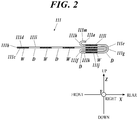
- the wet-sheet laminated body 110 is formed by folding each of multiple rectangular wet sheets 111 and then stacking the multiple wet sheets 111. The folding manner of each of the wet sheets 111 will be first described with reference to FIG. 2 .
- the wet sheet 111 is folded back to one surface side of the wet sheet 111 (the one surface is referred to as a first surface 111c, the surface opposite to the first surface 111c is referred to as a second surface 111d) at a first fold 111e which is substantially parallel to one edge of the wet sheet 111 (the one edge is referred to as a first edge 111a, the edge facing the first edge 111a is referred to as a second edge 111b).
- the wet sheet 111 is folded back to the second surface 111d side of the wet sheet 111 at a second fold 111f which is formed between the first fold 111e and the first edge 111a and substantially parallel to the first edge 111a and the second edge 111b.
- the wet sheet 111 is folded back to the second surface 111d side so as to wrap around the outer circumference of the first fold 111e at a third fold 111g which is formed between the second fold 111f and the first edge 111a and substantially parallel to the first edge 111a and the second edge 111b.
- the wet sheet 111 is folded back to the first surface 111c side at a fourth fold 111h which is formed between the third fold 111g and the first edge 111a and substantially parallel to the first edge 111a and the second edge 111b.
- folding back to the one surface 111c side as descried above is desirable.
- folding to the second surface 111d side is also possible.
- the portion between the second edge 111b and the first fold 111e is referred to as a main portion 111i.
- the portion between the first fold 111e and the second fold 111f is referred to as a first folded-back portion 111j.
- the portion between the second fold 111f and the third fold 111g is referred to as a second folded-back portion
- the portion between the third fold 111g and the fourth fold 111h is referred to as a third folded-back portion 1111.
- the portion between the fourth fold 111h and the first edge 111a is referred to as a fourth folded-back portion 111m.
- the width (the length in the direction orthogonal to the first edge 111a and the second edge 111b) of the main portion 111i is 40 to 45% of the entire width of the wet sheet 111
- the width of the first folded-back portion 111j is 14 to 20% of the entire width of the wet sheet 111
- the width of the second folded-back portion 111k is 14 to 20% of the entire width of the wet sheet 111
- the width of the third folded-back portion 1111 is 17 to 23% of the entire width of the wet sheet 111
- the width of the fourth folded-back portion 111m is 1 to 5% of the entire width of the wet sheet 111.
- the width of the second folded-back portion 111k needs to be larger than or equal to the width of the first folded-back portion 111j in order to form the third fold 111g so as to wrap around the outer circumference of the first fold 111e.
- the fourth folded-back portion 111m is formed to overlap with the first folded-back portion 111j and the second folded-back portion 111k in the up-down direction.
- the fourth fold 111h and the fourth folded-back portion 111m are not essential.
- the fourth fold 111h and the fourth folded-back portion 111m may not be provided, and the portion to the first edge 111a may be the third folded-back portion 1111.
- the wet-sheet laminated body 110 is formed such that the first edge 111a and the second edge 111b are short edges of the rectangular wet sheet 111, the first fold 111e, the second fold 111f, the third fold 111g and the fourth fold 111h are formed to be substantially parallel to the short edges of wet sheet 111, and the long direction of the wet sheet 111 which is not folded becomes the short direction in a plan view of the wet-sheet laminated body 110 by the wet sheet 111 being folded back in the long direction.
- the configuration is not limited to this, and the wet-sheet laminated body 110 can be formed such that the first fold 111e, the second fold 111f, the third fold 111g and the fourth fold 111h are formed substantially parallel to the long edge of the wet sheet 111 and the wet sheet 111 is folded back in the short direction, though this configuration is not desirable for forming the wet-sheet laminated body 110 compact.
- each of the wet sheets 111 is impregnated with a chemical solution in a stripe pattern in which multiple impregnated portions W impregnated with the chemical solution and multiple non-impregnated portions D not impregnated with the chemical solution are alternately arranged in a plan view in a state in which the wet sheet 111 is folded.
- the number of stripes each including the impregnated portion W and the non-impregnated portion D is preferably 2 to 20 in a plan view of the folded wet sheet 111, and more preferably 4 to 10. In the unfolded wet sheet 111, the number of stripes is preferably 4 to 30, and more preferably 10 to 20.
- the non-impregnated portion D not only includes the portion which does not contain the chemical solution at all, but also includes the portion which slightly contains the chemical solution due to the influence of the impregnated portion(s) W of the wet sheet(s) 111 around the non-impregnated portion D after the wet sheets 111 were stacked.
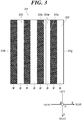
- the wet sheet 111 is impregnated with the chemical solution such that the stripe pattern is parallel to the folds formed in the wet sheet 111 and the impregnated potions W and the non-impregnated portions D are alternately arranged in the direction (X direction in FIG. 3 ) orthogonal to the folds formed in the wet sheet 111.
- the impregnated portion W is preferably formed to have the width of 2 to 40 mm in the direction (X direction in FIG. 3 ) orthogonal to the folds formed in the base material sheet, and more preferably formed to have the width of 5 to 20 mm.
- the non-impregnated portion D is preferably formed to have the width of 2 to 40 mm in the direction (X direction in FIG. 3 ) orthogonal to the folds formed in the base material sheet, and more preferably formed to have the width of 5 to 20 mm.
- Each of the wet sheets 111 forming the wet-sheet laminated body 110 preferably stretches by 100 mm or less when the force of 1.5N is applied by the following test method.
- the stretch of wet sheet 111 is a value obtained by cutting the main portion 111i of the wet sheet 111 impregnated with the chemical solution to have the width of 50 mm in the direction orthogonal to the stripes formed of the impregnated portions W and the non-impregnated portions D, and thereafter measuring the stretch when this cut portion is tensioned by 1.5N in the direction along the stripes formed of the impregnated portions W and the non-impregnated portions D by using a tensile testing machine (TENSILON RTG1210 manufactured by A&D Company, Limited) with the distance between chucks of 100 mm and the speed of 100 mm/min.
- TENSILON RTG1210 manufactured by A&D Company, Limited
- the stretch of wet sheet 111 can be reduced by adding a binder to the base material sheet.
- the stretch of wet sheet 111 can be reduced by raising the water pressure at the time of formation, raising the compressibility, and the like.
- the wet-sheet laminated body 110 is formed by stacking the multiple wet sheets 111 which were folded as described above and impregnated with the chemical solution such that the second surface 111d is directed upward in each main portion 111i.
- the wet-sheet laminated body 110 is formed by alternating stacking the wet sheets 111 arranged with the first edge 111a side and the second edge 111b side directed to opposite directions.
- the portion around the second edge 111b in the main portion 111i of each of the wet sheets 111 except for the uppermost wet sheet 111 is arranged to be sandwiched between the main portion 111i and the first folded-back portion 111j of the wet sheet 111 immediately above the wet sheet 111.
- the width of the portion around the second edge 111b in the main portion 111i of the lower wet sheet 111 which is sandwiched between the main portion 111i and the first folded-back portion 111j of the wet sheet 111 immediately above the wet sheet 111 is preferably 5 to 35% of the width of the main portion 111i of the lower wet sheet 111.
- the wet sheets 111 are stacked such that the impregnated portions W in each of the wet sheets 111 do not overlap with the impregnated portions W in the wet sheets 111 located immediately above and below the wet sheet 111 in a plan view and the arrangement is made in a staggered manner.
- the wet sheets 111 can be stacked such that the impregnated portions W in each of the wet sheets 111 are at substantially same positions in a plan view as the impregnated portions W in the wet sheets 111 located immediately above and below the wet sheet 111.
- the wet sheets 111 can be stacked such that the impregnated portions W in each of the wet sheets 111 include both of portion(s) overlapping with the impregnated portion(s) W in the wet sheets 111 located immediately above and below the wet sheet 111 and portion(s) not overlapping with the impregnated portion(s) W.
- the number of wet sheets 111 to be stacked is preferably 40 to 80.
- the package 120 is formed by a bag body 121 having a takeout port 121a to take out the wet sheet 111 one by one which is formed in the upper surface of the bag body 121, and a lid material 122 which covers the takeout port 121a to be openable and closable.
- the package 120 is used by containing the wet-sheet laminated body 110 therein.
- FIGS. 1A and 1B and FIG. 4 illustrate a case where the first edge 111a and the second edge 111b of each of the wet sheets 111 forming the wet-sheet laminated body 110 are substantially parallel to the long direction in a plan view of the package 120.
- the bag body 121 is formed of a sheet material in a bag shape.
- the sheet material for example, there can be used a single or composite material of a synthetic resin sheet such as polyethylene, polypropylene, polyethylene terephthalate, polyester, polyamide, and polyvinyl chloride, or a composite sheet attaching such a synthetic resin sheet to aluminum foil, paper or the like.
- the thickness of the sheet material is preferably 40 to 70 ⁇ m.
- the portions on the back surface side of the bag body 121 are joined along the long direction of the bag body 121 to form a center seal portion 121b, and portions at the ends in the long direction of the bag body 121 are connected to form end seal portions 121c, 121c.
- the size of the bag body 121 is determined according to the size of the wet-sheet laminated body 110 to be contained therein.
- the bag body 121 preferably has a size that enables containing the wet-sheet laminated body 110 with a slight room left so as to avoid both of the unnecessary increase in size of the package 120 and the difficulty in taking out the wet sheet 111 at the start of use.
- the shape of the takeout port 121a formed in the upper surface of the bag body 121 is preferably an oval as shown in FIG. 1A , and in order to apply an appropriate resistance to the wet sheet 111 which is pulled out, the size of takeout port 121a is preferably 30 to 50 mm in the long direction of the takeout port 121a and 10 to 30 mm in the short direction, and more preferably 35 to 45 mm in the long direction and 13 to 18 mm in the short direction.
- the long direction is substantially parallel to the direction of each fold of the wet sheets 111 contained inside.
- the takeout port 121a is formed at a position not overlapping with the third folded-back portion 1111 or the fourth folded-back portion 111m of each wet sheet 111 forming the wet-sheet laminated body 110 therein in a plan view, and only the main portion 111i of the wet sheet 111 can be seen from the takeout port 121a in a plan view.
- the lid material 122 is configured to cover the takeout port 121a to be openable and closable with a sheet piece which is separate from the bag body 121.
- the material quality of the sheet piece forming the lid material 122 there can be used a similar material quality to that of the sheet material forming the bag body 121.
- the thickness of the sheet piece forming the lid material 122 is larger than the thickness of the sheet material forming the bag body 121 and 60 to 80 ⁇ m preferably.
- lid material 122 is not particularly limited as long as the lid material 122 can completely cover the takeout port 121a, and the lid material 122 can have an arbitrary shape such as a rectangle and an oval, for example.
- a pressure sensitive adhesive of polyester series, acrylic series, rubber series, or the like is applied to the back surface of the lid material 122, and the lid material 122 is bonded to the bag body 121 so as to cover the takeout port 121a to be openable and closable.
- the lid material 122 has one end portion fixed to the bag body 121 and has the other end portion provided with a tab 122a protruding from the end portion as shown in FIG. 1A , and only the lower surface of the tab 122a does not have the pressure sensitive adhesive applied. Thus, the lid material 122 is opened and closed easily by using the tab 122a.
- the portion around the first edge 111a is folded toward the first surface 111c side to form the fourth fold 111h, and thereafter the base material sheet is folded toward the second surface 111d side at the position having a predetermined interval in a direction to the second edge 111b from the fourth fold 111h to form the second fold 111f.
- the portions of the base material sheet overlapping due to the folding at the second fold 111f are folded to the opposite side to the fourth fold 111h while maintaining the overlapping state, to form the first fold 111e and the third fold 111g together.
- each wet sheet 111 can be folded as shown in FIG. 2 .
- the base material sheet which was folded in step 1 is then impregnated with a chemical solution.
- the base material sheet is impregnated with the chemical solution by using a chemical solution applying nozzle, for example.
- the base material sheet is impregnated with the chemical solution by moving and passing the base material sheet under the chemical solution applying nozzle, which is arranged to extend in the direction orthogonal to the folds formed in the base material sheet, in the direction orthogonal to the extending direction of the chemical solution applying nozzle (direction parallel to the folds formed in the base material sheet).
- This chemical solution applying nozzle is provided with multiple fine ejection holes for ejecting the chemical solution downward.
- the portion provided with such ejection holes at only the positions matching the impregnated portions W of the wet sheet 111 in the direction orthogonal to the moving direction of the base material sheet, it is possible to form the multiple impregnated portions W and the non-impregnated portions D in a stripe pattern alternately arranging the impregnated portions W and the non-impregnated portions D in the base material sheet which passed under the chemical solution applying nozzle.
- the impregnating method with the chemical solution is not limited to the method of ejecting the chemical solution from a nozzle as descried above, and roll transfer may be performed by using the roll applying the chemical solution with a pattern matching the impregnated portions W and the non-impregnated portions D in the wet sheet 111, for example.
- Step 3 Stacking Step
- wet sheets 111 each of which was formed by being impregnated with the chemical solution after folding the base material sheet are stacked such that the second surfaces 111d in the main portions 111i are directed upward.
- the wet-sheet laminated body 110 is formed by stacking a predetermined number of wet sheets 111 in such a way that the wet sheets 111 arranged with the first edge 111a side and the second edge 111b side directed opposite to each other are stacked alternately, and the portion of the main portion 111i around the second edge 111b of each of the wet sheets 111 except for the uppermost wet sheet 111 is sandwiched between the first folded-back portion 111j and the main portion 111i of the wet sheet 111 immediately above the wet sheet 111.
- the wet-sheet laminated body 110 which was formed is wrapped in the sheet material forming the bag body 121 of the package 120, portions of the sheet material are then bonded along the long direction of the bag body 121 on the bottom surface side of the bag body 121 to form the center seal portion 121b and the end portions in the long direction of the bag body 121 are connected to form the end seal portions 121c, 121c, and thereby the wet-sheet laminated body 110 is contained in the bag body 121.
- the lid material 122 is attached so as to cover the takeout port 121a of the bag body 121.
- each of the wet sheets 111 forming the wet-sheet laminated body 110 is formed to have the multiple impregnated portions W and the multiple non-impregnated portions D in a stripe pattern in a plan view of the wet-sheet laminated body 110, and the wet sheets 111 are stacked.
- the present embodiment by arranging the multiple impregnated portions and the multiple non-impregnated portions in a stripe pattern in a plan view of the wet-sheet laminated body 110, it is possible to weaken the attachment between wet sheets nearly uniformly for the entire surface, and enhance the effect of preventing the string of wet sheets.
- the effect of preventing the string of wet sheets can be enhanced most when the wet sheets 111 are stacked such that the impregnated portions W in each of the wet sheets 111 do not overlap in a plan view with the impregnated portions W in the wet sheets 111 located immediately above and below the wet sheet 111 and the impregnated portions W are alternately arranged in a staggered manner, since there is no portion where the impregnated portions W contact the impregnated portions W of the wet sheets 111 located immediately above and below the wet sheet 111.
- the configuration which can obtain the effect of preventing the string of wet sheets is not limited to the staggered arrangement.
- the attachment between wet sheets 111 can be weakened, and it is possible to obtain a sufficient effect though the effect is inferior to the effect of the case arranging the impregnated portions W and the non-impregnated portions D in a staggered manner.
- the attachment between wet sheets 111 can be weakened, and it is possible to obtain a certain effect though the effect is inferior to the effect of the case arranging the impregnated portions W at positions shifted from the impregnated portions W in the wet sheets 111 located immediately above and below the wet sheet 111.
- the portion around the second edge 111b of the main portion 111i of the lower wet sheet 111 is sandwiched between: the main portion 111i, the third folded-back portion 1111 and the fourth folded-back portion 111m; and the first folded-back portion 111j and the second folded-back portion 111k in the upper wet sheet 111, and the sheets overlap in six layers.
- This effect is enhanced by forming the fourth fold 111h and the fourth folded-back portion 111m. However, even when these are not provided, it is possible to obtain a certain effect since five layers of the sheet material overlap.
- the wet sheet 111 when the wet sheet 111 is pulled out through the takeout port 121a of the package 120 by nipping the main portion 111i, the second fold 111f is difficult to open. Thus, the wet sheet 111 is taken out while maintaining the state in which the portion around the first edge 111a is folded at the second fold 111f.
- the production method for the wet-sheet laminated body is not limited to this.
- the wet-sheet laminated body may be obtained by first impregnating the base material sheets with a chemical solution in a stripe pattern, then folding the base material sheets by the folding manner shown in FIG. 2 , and thereafter stacking the wet sheets by the stacking method shown in FIG. 4 .
- the wet-sheet laminated body can be obtained by folding base material sheets by the folding manner shown in FIG. 2 , thereafter stacking the folded base material sheets by the stacking method shown in FIG. 4 , and after obtaining the laminated body, impregnating the laminated body with a chemical solution.
- this case is not desirable since there can be formed only the wet-sheet laminated body stacking wet sheets such that the impregnated portions W in each of the wet sheets are at substantially same positions in a plan view as the impregnated portions W in the wet sheets located immediately above and below the wet sheet 111, and when the number of wet sheets forming the wet-sheet laminated body is large and the wet-sheet laminated body is thick in the up-down direction, there is a possibility that the stripe pattern formed by the impregnated portions W and the non-impregnated portions D is not clear in the wet sheets at lower positions away from the upper surface to which the chemical solution is applied.
- the wet sheets 111 are formed such that the impregnated portions W and the non-impregnated portions D form a stripe pattern along the direction (Y direction in FIGS. 2 and 3 ) parallel to the folds and are alternately arranged in the direction (X direction in FIGS. 2 and 3 ) orthogonal to the folds.
- the configuration is not limited to this.
- the wet sheet 111 may be formed such that the impregnated portions W and the non-impregnated portions D form a stripe pattern along the direction (X direction in FIGS. 2 and 3 ) orthogonal to the folds and alternately arranged in the direction (Y direction in FIGS. 2 and 3 ) parallel to the folds.
- the wet sheet 111 can also be formed such that the stripe pattern is oblique to the folds of the wet sheet.
- the impregnated portions W and the non-impregnated portions D form a stripe pattern along the direction (Y direction in FIGS. 2 and 3 ) parallel to the folds of the wet sheet.
- each of the wet sheets 111 is folded by the folding manner shown in FIG. 2 , and these wet sheets 111 are stacked by the stacking method shown in FIG. 4 .
- the specific folding manner of wet sheets and the stacking method thereof are not limited to this.
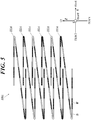
- a wet-sheet laminated body 110A which is formed by stacking wet sheets 111A folded in a Z shape as in a conventional way such that the wet sheets 111A partially overlap as shown in FIG. 5 , it is similarly possible to obtain the effect caused by providing the impregnated portions W and the non-impregnated portions D to be alternately arranged in a stripe pattern in a plan view of the wet-sheet laminated body 110A.
- the impregnated portions W in each of the wet sheets 111A do not overlap in a plan view with the impregnated portions W in the wet sheets 111A located immediately above and below the wet sheet 111A, and alternately arranged in a staggered manner, and it is preferable to arrange a stripe pattern along the direction (Y direction in FIG. 5 ) parallel to the folds in the wet sheet 111A, though the configuration is not limited to them.
- the base material sheet was folded by the folding manner shown in FIG. 2 such that the first fold 111e, the second fold 111f, the third fold 111g and the fourth fold 111h are formed by the folds parallel to the MD direction, and the main portion 111i has the width of 75 mm in the CD direction, the first folded-back portion 111j has the width of 30 mm in the CD direction, the second folded-back portion 111k has the width of 30 mm in the CD direction, the third folded-back portion 1111 has the width of 35 mm in the CD direction, and the fourth folded-back portion 111m has the width of 5 mm in the CD direction.
- the base material sheet folded in such a way was impregnated with a chemical solution in a stripe pattern which is parallel to the MD direction and alternately arranging the impregnated portions W and non-impregnated portions D in the CD direction.
- the base material sheet was impregnated with the chemical solution such that, in a plan view of the base material sheet in the folded state, the stripe pattern forms three impregnated portions W with the width of approximately 12. 5 mm (12 to 13 mm) in the CD direction and three non-impregnated portions D with the width of approximately 12. 5 mm (12 to 13 mm) in the CD direction, and the end of the base material sheet on the side where the second edge 111b is formed is the impregnated portion W.
- the stripe pattern forms three impregnated portions W with the width of approximately 12. 5 mm (12 to 13 mm) in the CD direction and three non-impregnated portions D with the width of approximately 12. 5 mm (12 to 13 mm) in the CD direction
- the end of the base material sheet on the side where the second edge 111b is formed is the impregnated portion W.
- seven impregnated portions W are formed in the CD direction and seven non-impregnated portions D are formed in the CD direction.
- the wet sheets 111 were stacked such that the impregnated portions W in each of the wet sheets 111 are arranged at positions shifted from the impregnated portions W of the wet sheets 111 located immediately above and below the wet sheet 111, and both of portions where the impregnated portions W overlap in a plan view and portions where the impregnated portions W do not overlap are generated.
- the stretch of the wet sheet when the force of 1.5N was applied by the method described in paragraph 0030 was made 101.0 mm.
- the stretch of wet sheet was made larger than the stretch of Example 1 by weakening the water pressure at the time of forming the spun-lace nonwoven fabric and weakening the compression of base material sheet without changing the compounding of fiber materials forming the base material sheet from the Example 1.
- the entire base material sheet was impregnated with the chemical solution uniformly.
- the pattern of impregnation was changed from the stripe pattern to an overall uniform pattern, and the chemical solution impregnation rate was 230% similarly to Example 1.
- the sticking force between wet sheets was measured for the wet-sheet packages of the above examples and comparative example.
- the wet-sheet laminated body was taken out from the package, a digital force gauge (IMADA, DS2-200N) was then connected to the portion of wet sheet 111 overlapping with the takeout port 121a in a plan view when packaged in the package, the wet sheet 111 was tensioned in a vertical direction in this state, the maximum value of the force which was applied when the wet sheet 111 was peeled from the sheet immediately below the wet sheet 111 was measured for the 1st sheet to the 79th sheet, and the average value thereof was obtained.
- IMADA digital force gauge
- wet-sheet packages used in the above examples and comparative example multiple wet sheets were consecutively taken out, and the probability that a string of sheets was taken out upon the taking out of sheet was calculated.
- the wet sheets were pulled out one by one while pressing, with one hand, the portion around the one end in the long direction in a plan view in such a way that the portion is sandwiched from both sides in the short direction in a plan view (thumb contacts one lateral surface, middle finger and index finger contact the other lateral surface facing the one lateral surface, and these fingers sandwich the portion) without suppressing the upper surface in each of the sheet packages.
- the test was performed twice, and the average was obtained as the number of sheets which were taken out in the form of a string of sheets. Accordingly, for example, when the first time was one sheet and the second time was zero, the number of sheets which were taken out in the form of a string of sheets is 0.5.
- Example 1 Comparative Example 1 Sticking Force between Sheets (N) 1.1 - 1.5 Number of Sheets Taken out as String of Sheets (sheet) 9 18 28 Probability of String of Sheets Taken Out (%) 11.3 22.5 35.0
- Example 1 shows that the sticking force between sheets is weakened by forming a wet-sheet laminated body with wet sheets impregnated with a chemical solution in such a stripe pattern that multiple impregnated portions W and multiple non-impregnated portions D are alternately arranged in a plan view of the wet-sheet laminated body, compared with a case where the wet-sheet laminated body is formed with wet sheets in each of which the entire sheet was uniformly impregnated with the chemical solution.
- the actual pull-out test also shows that it is possible to reduce the probability of a string of wet sheets being taken out by forming the wet-sheet laminated body with wet sheets which were impregnated with a chemical solution in such a stripe pattern that multiple impregnated portions W and multiple non-impregnated portions D are alternately arranged in a plan view of the wet-sheet laminated body, compared with a case where the wet-sheet laminated body is formed by wet sheets in each of which the entire sheet is uniformly impregnated with the chemical solution.
- the present invention is suitably applied in a technical field of producing a wet-sheet laminated body and a wet-sheet package.
Landscapes
- Health & Medical Sciences (AREA)
- Public Health (AREA)
- Engineering & Computer Science (AREA)
- Mechanical Engineering (AREA)
- Epidemiology (AREA)
- General Health & Medical Sciences (AREA)
- Containers And Packaging Bodies Having A Special Means To Remove Contents (AREA)
- Sanitary Thin Papers (AREA)
- Cleaning Implements For Floors, Carpets, Furniture, Walls, And The Like (AREA)
- Paper (AREA)
Abstract
Description
- The present invention relates to a wet-sheet laminated body, a wet-sheet package, and a production method for wet-sheet laminated body.
- There has been conventionally known a so-called pop-up type wet-sheet laminated body that enables using the next sheet continuously by lifting the next sheet when the uppermost sheet is pulled out, in order to make the laminated body easy to use when the laminated body is made by stacking multiple home wet sheets such as wet tissues, toilet cleaners, and kitchen cleaners.
- As such a pop-up type wet-sheet laminated body, for example, there is known a wet-sheet laminated body formed by stacking sheets to partially overlap, each of the sheets being folded in a Z form (for example, see patent document 1) .
- [Patent Document 1]
JP 6188234 B - The pop-up type wet-sheet laminated body is used in such a manner that the wet-sheet laminated body is contained in a predetermined package and wet sheets are taken out one by one through a takeout port provided in the package. However, in conventional wet-sheet laminated bodies, upon taking out one wet sheet through the takeout port, the next wet sheet was taken out in the form of a string of the wet sheets frequently.
- In this respect, in order to prevent this, the wet-sheet laminated body described in patent document 1 intends to suppress the unnecessary jumping out of the next wet sheet when one wet sheet is taken out through a takeout port, by lowering the impregnation rate of the chemical solution for the overlapping portions of ends of upper and lower wet sheets. However, the effect was not always sufficient.
- An object of the present invention is to provide a wet-sheet laminated body, a wet-sheet package, and a production method for the wet-sheet laminated body which can reduce the possibility that a string of wet sheets is taken out when a wet sheet is taken out through a takeout port of the package.
- In order to achieve the object, according to the invention recited in claim 1, a wet-sheet laminated body includes multiple folded wet sheets that are stacked such that an end portion of one wet sheet among the wet sheets is sandwiched by a folded-back portion of another wet sheet among the wet sheets,
a wet sheet that is each of the wet sheets has a base material sheet impregnated with a chemical solution such that impregnated portions that are impregnated with the chemical solution and non-impregnated portions that are not impregnated with the chemical solution are generated, and
the impregnated portions and the non-impregnated portions are formed in a stripe pattern in which the multiple impregnated portions and the multiple non-impregnated portions are alternately arranged. - According to the present invention, there is provided a wet-sheet laminated body that can reduce the possibility that a string of wet sheets is taken out when a wet sheet is taken out through a takeout port of a package.
- According to the invention recited in claim 2, in the wet-sheet laminated body according to claim 1, the impregnated portions and the non-impregnated portions are arranged at shifted positions in a plan view in the one wet sheet and in the another wet sheet that is arranged immediately above the one wet sheet.
- According to the present invention, there is provided a wet-sheet laminated body that can further reduce the possibility that a string of wet sheets is taken out when a wet sheet is taken out through a takeout port of a package.
- According to the invention recited in claim 3, in the wet-sheet laminated body according to claim 2, the impregnated portions and the non-impregnated portions are arranged in a staggered manner in the one wet sheet and in the another wet sheet that is arranged immediately above the one wet sheet.
- According to the present invention, there is provided a wet-sheet laminated body that can further reduce the possibility that a string of wet sheets is taken out when a wet sheet is taken out through a takeout port of a package.
- According to the invention recited in claim 4, in the wet-sheet laminated body according to any one of claims 1 to 3, the impregnated portions and the non-impregnated portions are formed in the stripe pattern that is parallel to a fold of the wet sheet in a plan view of the wet-sheet laminated body.
- According to the present invention, the wet-sheet laminated body is produced easily.
- According to the invention recited in claim 5, in the wet-sheet laminated body according to any one of claims 1 to 4,
the wet sheet is formed in a rectangular shape,
the wet sheet is folded back to one surface side of the wet sheet at a first fold that is substantially parallel to one edge,
the wet sheet is folded back to another surface side of the wet sheet at a second fold that is formed between the first fold and the one edge and substantially parallel to the one edge,
the wet sheet is folded back to the another surface side of the wet sheet so as to wrap around an outer circumference of the first fold at a third fold that is formed between the second fold and the one edge and substantially parallel to the one edge, and
the multiple wet sheets are stacked such that
the another surface side is directed upward in a portion between the first fold and another edge facing the one edge, and
the another wet sheet is located above the one wet sheet in such a way that the another edge facing the one edge of the one wet sheet is sandwiched between a portion between the first fold and the second fold of the another wet sheet and a portion between the first fold and the another edge facing the one edge of the another wet sheet. - According to the present invention, there is provided a wet-sheet laminated body that can further reduce the possibility that a string of wet sheets is taken out when a wet sheet is taken out through a takeout port of a package.
- According to the invention recited in claim 6, a wet-sheet package includes:
- the wet-sheet laminated body according to any one of claims 1 to 5; and
- a package which includes a takeout port and in which the wet-sheet laminated body is contained.
- According to the present invention, there is provided a wet-sheet package that can reduce the possibility that a string of wet sheets is taken out when a wet sheet is taken out through a takeout port of the package.
- According to the invention recited in claim 7, a production method for a wet-sheet laminated body includes:
- a folding step that is folding a base material sheet;
- a chemical solution impregnating step that is impregnating the folded base material sheet with a chemical solution to form multiple impregnated portions impregnated with the chemical solution and multiple non-impregnated portions not impregnated with the chemical solution in a stripe pattern in which the impregnated portions and the non-impregnated portions are alternately arranged; and
- a stacking step that is stacking multiple base material sheets each of which is the base material sheet impregnated with the chemical solution.
- According to the present invention, there is provided a production method for a wet-sheet laminated body that can reduce the possibility that a string of wet sheets is taken out when a wet sheet is taken out through a takeout port of a package.
- According to the invention recited in claim 8, a production method for a wet-sheet laminated body includes:
- a chemical solution impregnating step that is impregnating a base material sheet with a chemical solution to form multiple impregnated portions impregnated with the chemical solution and multiple non-impregnated portions not impregnated with the chemical solution in a stripe pattern in which the impregnated portions and the non-impregnated portions are alternately arranged;
- a folding step that is folding the base material sheet impregnated with the chemical solution; and
- a stacking step that is stacking base material sheets each of which is the folded base material sheet.
- According to the present invention, there is provided a production method for a wet-sheet laminated body that can reduce the possibility that a string of wet sheets is taken out when a wet sheet is taken out through a takeout port of a package.
- According to the present invention, there is provided a wet-sheet laminated body, a wet-sheet package, and a production method for a wet-sheet laminated body that can reduce the possibility that a string of wet sheets is taken out when a wet sheet is taken out through a takeout port of a package.
-
-
FIG. 1A is a perspective view of a wet-sheet package according to an embodiment, viewed diagonally from above. -
FIG. 1B is a perspective view of the wet-sheet package according to the embodiment, viewed diagonally from below. -
FIG. 2 is a lateral view of a folded wet sheet according to the embodiment. The interval between folded sheets is shown to be larger than the real interval. -
FIG. 3 is a plan view of the folded wet sheet according to the embodiment. -
FIG. 4 is a sectional view along the IV-IV portion inFIG. 1A . The interval between folded sheets and interval between stacked sheets are shown to be larger than the real intervals. The number of stacked sheets is shown to be smaller than the real number of stacked sheets. -
FIG. 5 is a lateral view of a wet-sheet laminated body according to a modification example. The interval between folded sheets and interval between stacked sheets are shown to be larger than the real intervals. The number of stacked sheets is shown to be smaller than the real number of stacked sheets. - Hereinafter, a wet-sheet
laminated body 110 and a wet-sheet package 100 having the wet-sheetlaminated body 110 contained in apackage 120 as an embodiment of the present invention is described with reference toFIGS. 1A to FIG. 5 . However, the scope of the invention is not limited to the illustrated examples. - In the following description, front-rear direction, left-right direction, and up-down direction, and an X-axis, Y-axis, and Z-axis are defined as shown in
FIG. 1A . That is, in the wet-sheet package 100, the side on which atakeout port 121a is formed in abag body 121 and the side opposite thereto are respectively referred to as up and down, the side on which one of the long edges in a plan view of the wet-sheet package 100 is located and the side opposite thereto are respectively referred to as rear and front, the right side when seen from the front side is referred to as right, and the left side when seen from the front side is referred to as left. The axis along the front-rear direction is referred to as the X axis, the axis along the left-right direction is referred to as the Y axis, and the axis along the up-down direction is referred to as the Z axis. - As shown in
FIG. 1A , the wet-sheet package 100 according to the embodiment is obtained by containing, in thepackage 120, the wet-sheetlaminated body 110 that is formed by stacking multiplewet sheets 111. - In the wet-sheet
laminated body 110, thewet sheets 111 are folded by a predetermined folding manner and then stacked, and when the uppermostwet sheet 111 is lifted, the nextwet sheet 111 is also lifted to be able to be continuously used, in a so-called pop-up manner. - The
wet sheet 111 is not particularly limited, and any arbitrary sheet formed by impregnating a base material sheet with a chemical solution such as a general rectangular wet sheet, a toilet cleaner, and a kitchen cleaner can be used. - To be specific, the base material sheet is preferably a nonwoven fabric that is produced with a predetermined fiber as a fiber material by any known technique such as spun-lace, air-through, air-laid, point-bond, spun-bond and needle-punch in the case of a wet tissue, for example. The predetermined fiber includes, for example, cellulosic fibers such as rayon, lyocell, tencel, and cotton, polyolefin fibers such as polyethylene, polypropylene, and polyvinyl alcohol, polyester fibers such as polyethylene terephthalate, and polybutylene terephthalate, and polyamide fibers such as nylon. These types of fibers may be used alone or in combination of two types or more.
- A preferred base material sheet has the basis weight (metsuke) of 30 to 100 gsm and the size of 100 to 200 mm in the MD direction (paper traveling direction on the paper machine) and 100 to 200 mm in the CD direction (direction orthogonal to the paper traveling direction on the paper machine) in the case of a wet tissue, for example. The basis weight indicates a basis weight which was measured in accordance with JIS P 8124:2011.
- Though the base material sheet can be impregnated with an arbitrary chemical solution according to the usage of
wet sheets 111, a preferred chemical solution contains purified water, a preservative, a pH adjuster, and the like in the case of a wet tissue, for example. - In this case, a preferable chemical solution impregnation rate is between 100 mass% and 400 mass% inclusive. The chemical solution impregnation rate indicates the rate obtained by measuring the mass of the base material sheet of a
wet sheet 111 before impregnation with the chemical solution and the mass of the chemical solution used for the impregnation, and calculating the rate of the mass of the chemical solution used for the impregnation to the mass of the base material sheet before the impregnation with the chemical solution. - The pattern of impregnation of the base material sheet with the chemical solution in the
wet sheet 111 will be described later. - The wet-sheet
laminated body 110 is formed by folding each of multiple rectangularwet sheets 111 and then stacking the multiplewet sheets 111. The folding manner of each of thewet sheets 111 will be first described with reference toFIG. 2 . - First, the
wet sheet 111 is folded back to one surface side of the wet sheet 111 (the one surface is referred to as afirst surface 111c, the surface opposite to thefirst surface 111c is referred to as asecond surface 111d) at a first fold 111e which is substantially parallel to one edge of the wet sheet 111 (the one edge is referred to as afirst edge 111a, the edge facing thefirst edge 111a is referred to as asecond edge 111b). - The
wet sheet 111 is folded back to thesecond surface 111d side of thewet sheet 111 at asecond fold 111f which is formed between the first fold 111e and thefirst edge 111a and substantially parallel to thefirst edge 111a and thesecond edge 111b. - The
wet sheet 111 is folded back to thesecond surface 111d side so as to wrap around the outer circumference of the first fold 111e at athird fold 111g which is formed between thesecond fold 111f and thefirst edge 111a and substantially parallel to thefirst edge 111a and thesecond edge 111b. - The
wet sheet 111 is folded back to thefirst surface 111c side at afourth fold 111h which is formed between thethird fold 111g and thefirst edge 111a and substantially parallel to thefirst edge 111a and thesecond edge 111b. - As for the
fourth fold 111h, folding back to the onesurface 111c side as descried above is desirable. However, contrary to the above, folding to thesecond surface 111d side is also possible. - The portion between the
second edge 111b and the first fold 111e is referred to as a main portion 111i. The portion between the first fold 111e and thesecond fold 111f is referred to as a first folded-back portion 111j. The portion between thesecond fold 111f and thethird fold 111g is referred to as a second folded-back portion The portion between thethird fold 111g and thefourth fold 111h is referred to as a third folded-back portion 1111. The portion between thefourth fold 111h and thefirst edge 111a is referred to as a fourth folded-back portion 111m. - In this case, it is preferable that the width (the length in the direction orthogonal to the
first edge 111a and thesecond edge 111b) of the main portion 111i is 40 to 45% of the entire width of thewet sheet 111, the width of the first folded-back portion 111j is 14 to 20% of the entire width of thewet sheet 111, the width of the second folded-back portion 111k is 14 to 20% of the entire width of thewet sheet 111, the width of the third folded-back portion 1111 is 17 to 23% of the entire width of thewet sheet 111, and the width of the fourth folded-back portion 111m is 1 to 5% of the entire width of thewet sheet 111. - The width of the second folded-
back portion 111k needs to be larger than or equal to the width of the first folded-back portion 111j in order to form thethird fold 111g so as to wrap around the outer circumference of the first fold 111e. - It is preferable that the fourth folded-
back portion 111m is formed to overlap with the first folded-back portion 111j and the second folded-back portion 111k in the up-down direction. - Though it is preferable to have the
fourth fold 111h and the fourth folded-back portion 111m in thewet sheet 111, thefourth fold 111h and the fourth folded-back portion 111m are not essential. Thefourth fold 111h and the fourth folded-back portion 111m may not be provided, and the portion to thefirst edge 111a may be the third folded-back portion 1111. - It is desirable for forming the wet-sheet
laminated body 110 compact that the wet-sheetlaminated body 110 is formed such that thefirst edge 111a and thesecond edge 111b are short edges of the rectangularwet sheet 111, the first fold 111e, thesecond fold 111f, thethird fold 111g and thefourth fold 111h are formed to be substantially parallel to the short edges ofwet sheet 111, and the long direction of thewet sheet 111 which is not folded becomes the short direction in a plan view of the wet-sheetlaminated body 110 by thewet sheet 111 being folded back in the long direction. - However, the configuration is not limited to this, and the wet-sheet
laminated body 110 can be formed such that the first fold 111e, thesecond fold 111f, thethird fold 111g and thefourth fold 111h are formed substantially parallel to the long edge of thewet sheet 111 and thewet sheet 111 is folded back in the short direction, though this configuration is not desirable for forming the wet-sheetlaminated body 110 compact. - As shown in
FIGS. 2 and3 , each of thewet sheets 111 is impregnated with a chemical solution in a stripe pattern in which multiple impregnated portions W impregnated with the chemical solution and multiple non-impregnated portions D not impregnated with the chemical solution are alternately arranged in a plan view in a state in which thewet sheet 111 is folded. - The number of stripes each including the impregnated portion W and the non-impregnated portion D is preferably 2 to 20 in a plan view of the folded
wet sheet 111, and more preferably 4 to 10. In the unfoldedwet sheet 111, the number of stripes is preferably 4 to 30, and more preferably 10 to 20. - The non-impregnated portion D not only includes the portion which does not contain the chemical solution at all, but also includes the portion which slightly contains the chemical solution due to the influence of the impregnated portion(s) W of the wet sheet(s) 111 around the non-impregnated portion D after the
wet sheets 111 were stacked. - To be specific, as shown in
FIG. 3 , thewet sheet 111 is impregnated with the chemical solution such that the stripe pattern is parallel to the folds formed in thewet sheet 111 and the impregnated potions W and the non-impregnated portions D are alternately arranged in the direction (X direction inFIG. 3 ) orthogonal to the folds formed in thewet sheet 111. - The impregnated portion W is preferably formed to have the width of 2 to 40 mm in the direction (X direction in
FIG. 3 ) orthogonal to the folds formed in the base material sheet, and more preferably formed to have the width of 5 to 20 mm. - The non-impregnated portion D is preferably formed to have the width of 2 to 40 mm in the direction (X direction in
FIG. 3 ) orthogonal to the folds formed in the base material sheet, and more preferably formed to have the width of 5 to 20 mm. - Each of the
wet sheets 111 forming the wet-sheetlaminated body 110 preferably stretches by 100 mm or less when the force of 1.5N is applied by the following test method. - The stretch of
wet sheet 111 is a value obtained by cutting the main portion 111i of thewet sheet 111 impregnated with the chemical solution to have the width of 50 mm in the direction orthogonal to the stripes formed of the impregnated portions W and the non-impregnated portions D, and thereafter measuring the stretch when this cut portion is tensioned by 1.5N in the direction along the stripes formed of the impregnated portions W and the non-impregnated portions D by using a tensile testing machine (TENSILON RTG1210 manufactured by A&D Company, Limited) with the distance between chucks of 100 mm and the speed of 100 mm/min. - The stretch of
wet sheet 111 can be reduced by adding a binder to the base material sheet. When the base material sheet is a spun-lace nonwoven fabric, the stretch ofwet sheet 111 can be reduced by raising the water pressure at the time of formation, raising the compressibility, and the like. - The wet-sheet
laminated body 110 is formed by stacking the multiplewet sheets 111 which were folded as described above and impregnated with the chemical solution such that thesecond surface 111d is directed upward in each main portion 111i. - To be specific, as shown in
FIG. 4 , the wet-sheetlaminated body 110 is formed by alternating stacking thewet sheets 111 arranged with thefirst edge 111a side and thesecond edge 111b side directed to opposite directions. - The portion around the
second edge 111b in the main portion 111i of each of thewet sheets 111 except for the uppermostwet sheet 111 is arranged to be sandwiched between the main portion 111i and the first folded-back portion 111j of thewet sheet 111 immediately above thewet sheet 111. - In this case, the width of the portion around the
second edge 111b in the main portion 111i of the lowerwet sheet 111 which is sandwiched between the main portion 111i and the first folded-back portion 111j of thewet sheet 111 immediately above thewet sheet 111 is preferably 5 to 35% of the width of the main portion 111i of the lowerwet sheet 111. - As shown in
FIG. 4 , it is most preferable that thewet sheets 111 are stacked such that the impregnated portions W in each of thewet sheets 111 do not overlap with the impregnated portions W in thewet sheets 111 located immediately above and below thewet sheet 111 in a plan view and the arrangement is made in a staggered manner. - However, the stacking is not necessarily limited to this. The
wet sheets 111 can be stacked such that the impregnated portions W in each of thewet sheets 111 are at substantially same positions in a plan view as the impregnated portions W in thewet sheets 111 located immediately above and below thewet sheet 111. Thewet sheets 111 can be stacked such that the impregnated portions W in each of thewet sheets 111 include both of portion(s) overlapping with the impregnated portion(s) W in thewet sheets 111 located immediately above and below thewet sheet 111 and portion(s) not overlapping with the impregnated portion(s) W. - Though not particularly limited, the number of
wet sheets 111 to be stacked is preferably 40 to 80. - As shown in
FIG. 1A , thepackage 120 is formed by abag body 121 having atakeout port 121a to take out thewet sheet 111 one by one which is formed in the upper surface of thebag body 121, and alid material 122 which covers thetakeout port 121a to be openable and closable. As shown inFIG. 4 , thepackage 120 is used by containing the wet-sheetlaminated body 110 therein. -
FIGS. 1A and 1B andFIG. 4 illustrate a case where thefirst edge 111a and thesecond edge 111b of each of thewet sheets 111 forming the wet-sheetlaminated body 110 are substantially parallel to the long direction in a plan view of thepackage 120. - The
bag body 121 is formed of a sheet material in a bag shape. As the sheet material, for example, there can be used a single or composite material of a synthetic resin sheet such as polyethylene, polypropylene, polyethylene terephthalate, polyester, polyamide, and polyvinyl chloride, or a composite sheet attaching such a synthetic resin sheet to aluminum foil, paper or the like. - The thickness of the sheet material is preferably 40 to 70 µm.
- In the sheet material forming the
bag body 121, the portions on the back surface side of thebag body 121 are joined along the long direction of thebag body 121 to form acenter seal portion 121b, and portions at the ends in the long direction of thebag body 121 are connected to formend seal portions - The size of the
bag body 121 is determined according to the size of the wet-sheetlaminated body 110 to be contained therein. Thebag body 121 preferably has a size that enables containing the wet-sheetlaminated body 110 with a slight room left so as to avoid both of the unnecessary increase in size of thepackage 120 and the difficulty in taking out thewet sheet 111 at the start of use. - Though not particularly limited, the shape of the
takeout port 121a formed in the upper surface of thebag body 121 is preferably an oval as shown inFIG. 1A , and in order to apply an appropriate resistance to thewet sheet 111 which is pulled out, the size oftakeout port 121a is preferably 30 to 50 mm in the long direction of thetakeout port 121a and 10 to 30 mm in the short direction, and more preferably 35 to 45 mm in the long direction and 13 to 18 mm in the short direction. - It is desirable that the long direction is substantially parallel to the direction of each fold of the
wet sheets 111 contained inside. - As shown in
FIG. 4 , it is desirable that thetakeout port 121a is formed at a position not overlapping with the third folded-back portion 1111 or the fourth folded-back portion 111m of eachwet sheet 111 forming the wet-sheetlaminated body 110 therein in a plan view, and only the main portion 111i of thewet sheet 111 can be seen from thetakeout port 121a in a plan view. - Thereby, it is possible to prevent the user from nipping the third folded-
back portion 1111 or the fourth folded-back portion 111m and pulling out thewet sheet 111. - As shown in
FIG. 1A , thelid material 122 is configured to cover thetakeout port 121a to be openable and closable with a sheet piece which is separate from thebag body 121. As the material quality of the sheet piece forming thelid material 122, there can be used a similar material quality to that of the sheet material forming thebag body 121. - The thickness of the sheet piece forming the
lid material 122 is larger than the thickness of the sheet material forming thebag body 121 and 60 to 80 µm preferably. - The shape of
lid material 122 is not particularly limited as long as thelid material 122 can completely cover thetakeout port 121a, and thelid material 122 can have an arbitrary shape such as a rectangle and an oval, for example. - A pressure sensitive adhesive of polyester series, acrylic series, rubber series, or the like is applied to the back surface of the
lid material 122, and thelid material 122 is bonded to thebag body 121 so as to cover thetakeout port 121a to be openable and closable. - The
lid material 122 has one end portion fixed to thebag body 121 and has the other end portion provided with atab 122a protruding from the end portion as shown inFIG. 1A , and only the lower surface of thetab 122a does not have the pressure sensitive adhesive applied. Thus, thelid material 122 is opened and closed easily by using thetab 122a. - Next, an example of the production method for the wet-
sheet package 100 according to the embodiment will be described. - First, in the base material sheet of each wet sheet, the portion around the
first edge 111a is folded toward thefirst surface 111c side to form thefourth fold 111h, and thereafter the base material sheet is folded toward thesecond surface 111d side at the position having a predetermined interval in a direction to thesecond edge 111b from thefourth fold 111h to form thesecond fold 111f. - Furthermore, the portions of the base material sheet overlapping due to the folding at the
second fold 111f are folded to the opposite side to thefourth fold 111h while maintaining the overlapping state, to form the first fold 111e and thethird fold 111g together. - Thereby, the base material sheet of each
wet sheet 111 can be folded as shown inFIG. 2 . - The base material sheet which was folded in step 1 is then impregnated with a chemical solution.
- At this time, the base material sheet is impregnated with the chemical solution by using a chemical solution applying nozzle, for example. To be specific, the base material sheet is impregnated with the chemical solution by moving and passing the base material sheet under the chemical solution applying nozzle, which is arranged to extend in the direction orthogonal to the folds formed in the base material sheet, in the direction orthogonal to the extending direction of the chemical solution applying nozzle (direction parallel to the folds formed in the base material sheet).
- This chemical solution applying nozzle is provided with multiple fine ejection holes for ejecting the chemical solution downward. By forming the portion provided with such ejection holes at only the positions matching the impregnated portions W of the
wet sheet 111 in the direction orthogonal to the moving direction of the base material sheet, it is possible to form the multiple impregnated portions W and the non-impregnated portions D in a stripe pattern alternately arranging the impregnated portions W and the non-impregnated portions D in the base material sheet which passed under the chemical solution applying nozzle. - The impregnating method with the chemical solution is not limited to the method of ejecting the chemical solution from a nozzle as descried above, and roll transfer may be performed by using the roll applying the chemical solution with a pattern matching the impregnated portions W and the non-impregnated portions D in the
wet sheet 111, for example. - Multiple
wet sheets 111 each of which was formed by being impregnated with the chemical solution after folding the base material sheet are stacked such that thesecond surfaces 111d in the main portions 111i are directed upward. - To be specific, as shown in
FIG. 4 , the wet-sheetlaminated body 110 is formed by stacking a predetermined number ofwet sheets 111 in such a way that thewet sheets 111 arranged with thefirst edge 111a side and thesecond edge 111b side directed opposite to each other are stacked alternately, and the portion of the main portion 111i around thesecond edge 111b of each of thewet sheets 111 except for the uppermostwet sheet 111 is sandwiched between the first folded-back portion 111j and the main portion 111i of thewet sheet 111 immediately above thewet sheet 111. - The wet-sheet
laminated body 110 which was formed is wrapped in the sheet material forming thebag body 121 of thepackage 120, portions of the sheet material are then bonded along the long direction of thebag body 121 on the bottom surface side of thebag body 121 to form thecenter seal portion 121b and the end portions in the long direction of thebag body 121 are connected to form theend seal portions laminated body 110 is contained in thebag body 121. - Thereafter, the
lid material 122 is attached so as to cover thetakeout port 121a of thebag body 121. - By the wet-
sheet package 100 according to the embodiment, as shown inFIGS. 2 and3 , each of thewet sheets 111 forming the wet-sheetlaminated body 110 is formed to have the multiple impregnated portions W and the multiple non-impregnated portions D in a stripe pattern in a plan view of the wet-sheetlaminated body 110, and thewet sheets 111 are stacked. - When the wet sheets are stacked, hydrogen bond of the chemical solution between upper and lower wet sheets strongly attach the wet sheets to each other, which causes a string of the wet sheets to be taken out. According to the present embodiment, it is possible to weaken such attachment between the upper and lower wet sheets and reduce the possibility that a string of the wet sheets is taken out.
- Even in providing a same area of non-impregnated portion(s), when a single impregnated portion has a wide area in a plan view of the wet-sheet laminated body, for example, when the impregnated portion and the non-impregnated portion are provided by dividing the wet sheet into two, wet sheets strongly attach to each other on the impregnated portions, and it is not possible to sufficiently prevent the string of wet sheets in some cases.
- With respect to this, according to the present embodiment, by arranging the multiple impregnated portions and the multiple non-impregnated portions in a stripe pattern in a plan view of the wet-sheet
laminated body 110, it is possible to weaken the attachment between wet sheets nearly uniformly for the entire surface, and enhance the effect of preventing the string of wet sheets. - As shown in
FIG. 4 , the effect of preventing the string of wet sheets can be enhanced most when thewet sheets 111 are stacked such that the impregnated portions W in each of thewet sheets 111 do not overlap in a plan view with the impregnated portions W in thewet sheets 111 located immediately above and below thewet sheet 111 and the impregnated portions W are alternately arranged in a staggered manner, since there is no portion where the impregnated portions W contact the impregnated portions W of thewet sheets 111 located immediately above and below thewet sheet 111. - However, the configuration which can obtain the effect of preventing the string of wet sheets is not limited to the staggered arrangement.
- First, when the
wet sheets 111 are stacked such that the impregnated portions W in each of thewet sheets 111 are arranged at positions shifted from the positions of impregnated portions W in thewet sheets 111 located immediately above and below thewet sheet 111 and both of the overlapping portions and the non-overlapping portions in a plan view are generated, though there are portions where the impregnated portions W contact each other, the contacting area is narrow and at the same time there are formed portions where the non-impregnated portions D contact each other and portions where the non-impregnated portions D and the impregnated portions W contact each other. Thus, compared with a case where the entirewet sheet 111 is impregnated with the chemical solution, the attachment betweenwet sheets 111 can be weakened, and it is possible to obtain a sufficient effect though the effect is inferior to the effect of the case arranging the impregnated portions W and the non-impregnated portions D in a staggered manner. - Moreover, even when the
wet sheets 111 are stacked such that the impregnated portions W in each of thewet sheets 111 are at substantially same positions in a plan view with the impregnated portions W in thewet sheets 111 located immediately above and below thewet sheet 111, though there are portions where the impregnated portions W contact each other, at the same time, there are also formed portions where the non-impregnated portions D contact each other. Thus, compared with a case where the entirewet sheet 111 is impregnated with the chemical solution, the attachment betweenwet sheets 111 can be weakened, and it is possible to obtain a certain effect though the effect is inferior to the effect of the case arranging the impregnated portions W at positions shifted from the impregnated portions W in thewet sheets 111 located immediately above and below thewet sheet 111. - In the wet-
sheet package 100 according to the embodiment, as shown inFIG. 4 , in each portion where upper and lowerwet sheets 111 overlap, the portion around thesecond edge 111b of the main portion 111i of the lowerwet sheet 111 is sandwiched between: the main portion 111i, the third folded-back portion 1111 and the fourth folded-back portion 111m; and the first folded-back portion 111j and the second folded-back portion 111k in the upperwet sheet 111, and the sheets overlap in six layers. - This increases the resistance that is applied when the main portion 111i is nipped and the
wet sheet 111 is pulled out from around thesecond edge 111b by using thetakeout port 121a of thepackage 120, and thewet sheet 111 is not taken out unless a large force is applied. Thus, it is possible to further reduce the possibility that, when onewet sheet 111 is taken out, thewet sheet 111 immediately below the onewet sheet 111 is taken out in the form of a string of thewet sheets 111. - This effect is enhanced by forming the
fourth fold 111h and the fourth folded-back portion 111m. However, even when these are not provided, it is possible to obtain a certain effect since five layers of the sheet material overlap. - When one
wet sheet 111 is pulled out through thetakeout port 121a of thepackage 120, a large resistance is applied to the above overlapping portions, opening the first fold 111e and thethird fold 111g, and increasing the gap between the main portion 111i and the first folded-back portion 111j. This releases the portion around thesecond edge 111b of the main portion 111i of the nextwet sheet 111 which is sandwiched between the main portion 111i and the first folded-back portion 111j, and the next sheet easily comes off. - Accordingly, also from this respect, it is possible to reduce the possibility that, when one
wet sheet 111 is taken out, thewet sheet 111 immediately below thewet sheet 111 is taken out in the form of a string of thewet sheets 111. - In the wet-
sheet package 100 according to the embodiment, when thewet sheet 111 is pulled out through thetakeout port 121a of thepackage 120 by nipping the main portion 111i, thesecond fold 111f is difficult to open. Thus, thewet sheet 111 is taken out while maintaining the state in which the portion around thefirst edge 111a is folded at thesecond fold 111f. - In conventional wet sheets folded in a Z shape, since the
wet sheet 111 is taken out in a state in which the entirewet sheet 111 is unfolded, the portion around the end opposite to the portion nipped by the user when thewet sheet 111 is taken out easily stretches by the resistance at the time of taking out. However, according to the present embodiment, it is possible to reduce such a possibility since thewet sheet 111 is taken out while maintaining the portion around the end folded. - Though the above embodiment has been described for a case where a wet-sheet laminated body is obtained by folding base material sheets and then impregnating the base material sheets with a chemical solution, and thereafter stacking the wet sheets, the production method for the wet-sheet laminated body is not limited to this.
- The wet-sheet laminated body may be obtained by first impregnating the base material sheets with a chemical solution in a stripe pattern, then folding the base material sheets by the folding manner shown in
FIG. 2 , and thereafter stacking the wet sheets by the stacking method shown inFIG. 4 . - The wet-sheet laminated body can be obtained by folding base material sheets by the folding manner shown in
FIG. 2 , thereafter stacking the folded base material sheets by the stacking method shown inFIG. 4 , and after obtaining the laminated body, impregnating the laminated body with a chemical solution. - However, this case is not desirable since there can be formed only the wet-sheet laminated body stacking wet sheets such that the impregnated portions W in each of the wet sheets are at substantially same positions in a plan view as the impregnated portions W in the wet sheets located immediately above and below the
wet sheet 111, and when the number of wet sheets forming the wet-sheet laminated body is large and the wet-sheet laminated body is thick in the up-down direction, there is a possibility that the stripe pattern formed by the impregnated portions W and the non-impregnated portions D is not clear in the wet sheets at lower positions away from the upper surface to which the chemical solution is applied. - The above embodiment has been described for a case where the
wet sheets 111 are formed such that the impregnated portions W and the non-impregnated portions D form a stripe pattern along the direction (Y direction inFIGS. 2 and3 ) parallel to the folds and are alternately arranged in the direction (X direction inFIGS. 2 and3 ) orthogonal to the folds. However, the configuration is not limited to this. For example, contrary to above, thewet sheet 111 may be formed such that the impregnated portions W and the non-impregnated portions D form a stripe pattern along the direction (X direction inFIGS. 2 and3 ) orthogonal to the folds and alternately arranged in the direction (Y direction inFIGS. 2 and3 ) parallel to the folds. Thewet sheet 111 can also be formed such that the stripe pattern is oblique to the folds of the wet sheet. - However, from the viewpoint of easiness of production, it is preferable that the impregnated portions W and the non-impregnated portions D form a stripe pattern along the direction (Y direction in
FIGS. 2 and3 ) parallel to the folds of the wet sheet. - The above embodiment has been described for a case where each of the
wet sheets 111 is folded by the folding manner shown inFIG. 2 , and thesewet sheets 111 are stacked by the stacking method shown inFIG. 4 . However, the specific folding manner of wet sheets and the stacking method thereof are not limited to this. - For example, in a wet-sheet
laminated body 110A which is formed by stackingwet sheets 111A folded in a Z shape as in a conventional way such that thewet sheets 111A partially overlap as shown inFIG. 5 , it is similarly possible to obtain the effect caused by providing the impregnated portions W and the non-impregnated portions D to be alternately arranged in a stripe pattern in a plan view of the wet-sheetlaminated body 110A. - Also in this case, as shown in
FIG. 5 , it is preferable that the impregnated portions W in each of thewet sheets 111A do not overlap in a plan view with the impregnated portions W in thewet sheets 111A located immediately above and below thewet sheet 111A, and alternately arranged in a staggered manner, and it is preferable to arrange a stripe pattern along the direction (Y direction inFIG. 5 ) parallel to the folds in thewet sheet 111A, though the configuration is not limited to them. - However, in order to more enhance the effect of preventing a string of
wet sheets 111 from being taken out, it is most preferable to fold each of thewet sheets 111 by the folding manner shown inFIG. 2 , and to stack thewet sheets 111 in the stacking method shown inFIG. 4 . - Next, for wet-sheet packages according to examples of the present invention and a comparative example, description will be made for the results of measuring the sticking force between wet sheets and performing tests regarding the probability that a string of wet sheets are taken out at the time of taking out a wet sheet.
- The following wet-sheet packages according to the examples and the comparative example were prepared.
-
- Size: Rectangle of 135 mm in MD direction, 175 mm in CD direction
- Fiber material: Rayon 50 mass%, PET (polyethylene terephthalate) 50 mass%
- Production method: Spun-lace nonwoven fabric
- Basis weight: 30 gsm
-
- Components: Purified water 99 mass% or more, preservatives (benzoic acid, phenoxyethanol, etc.) less than 1 mass%
- Chemical solution impregnation rate: 230%
- The base material sheet was folded by the folding manner shown in
FIG. 2 such that the first fold 111e, thesecond fold 111f, thethird fold 111g and thefourth fold 111h are formed by the folds parallel to the MD direction, and the main portion 111i has the width of 75 mm in the CD direction, the first folded-back portion 111j has the width of 30 mm in the CD direction, the second folded-back portion 111k has the width of 30 mm in the CD direction, the third folded-back portion 1111 has the width of 35 mm in the CD direction, and the fourth folded-back portion 111m has the width of 5 mm in the CD direction. - The base material sheet folded in such a way was impregnated with a chemical solution in a stripe pattern which is parallel to the MD direction and alternately arranging the impregnated portions W and non-impregnated portions D in the CD direction.
- To be specific, the base material sheet was impregnated with the chemical solution such that, in a plan view of the base material sheet in the folded state, the stripe pattern forms three impregnated portions W with the width of approximately 12. 5 mm (12 to 13 mm) in the CD direction and three non-impregnated portions D with the width of approximately 12. 5 mm (12 to 13 mm) in the CD direction, and the end of the base material sheet on the side where the
second edge 111b is formed is the impregnated portion W. In this case, in the unfolded state of the base material sheet, seven impregnated portions W are formed in the CD direction and seven non-impregnated portions D are formed in the CD direction. - As shown in
FIG. 4 , 80 sheets of suchwet sheets 111 were stacked in such a way that the portion around thesecond edge 111b of the main portion 111i of thewet sheet 111 located below is sandwiched by the width of 20 mm in the CD direction between the first folded-back portion 111j and the main portion 111i of thewet sheet 111 immediately above thewet sheet 111. - The
wet sheets 111 were stacked such that the impregnated portions W in each of thewet sheets 111 are arranged at positions shifted from the impregnated portions W of thewet sheets 111 located immediately above and below thewet sheet 111, and both of portions where the impregnated portions W overlap in a plan view and portions where the impregnated portions W do not overlap are generated. - The stretch of the wet sheet when the force of 1.5N was applied by the method described in paragraph 0030 was 71.6 mm.
-
- Sheet material: Material PET/LLDPE, thickness 62µm
- Shape: Pillow package type shown in
FIGS. 1A and 1B - Size: Perimeter is 360 mm on the inner surface side in the cross section (cross section along the YZ plane in
FIGS. 1A and 1B ) in the long direction in a plan view excludingend seal portions FIGS. 1A and 1B ) in the short direction in a plan view - Takeout port: Oval with a long diameter of 35 mm and a short diameter of 15 mm. The takeout port was formed in the center of the upper surface of the bag body. The takeout port in a released state was used by peeling the lid material.
- The stretch of the wet sheet when the force of 1.5N was applied by the method described in paragraph 0030 was made 101.0 mm.
- The stretch of wet sheet was made larger than the stretch of Example 1 by weakening the water pressure at the time of forming the spun-lace nonwoven fabric and weakening the compression of base material sheet without changing the compounding of fiber materials forming the base material sheet from the Example 1.
- The other configurations are similar to those of Example 1.
- The entire base material sheet was impregnated with the chemical solution uniformly. The pattern of impregnation was changed from the stripe pattern to an overall uniform pattern, and the chemical solution impregnation rate was 230% similarly to Example 1.
- The other configurations are similar to those of Example 1.
- The following test was performed by using the wet-sheet packages according to the above examples and comparative example.
- The sticking force between wet sheets was measured for the wet-sheet packages of the above examples and comparative example.
- To be specific, the wet-sheet laminated body was taken out from the package, a digital force gauge (IMADA, DS2-200N) was then connected to the portion of
wet sheet 111 overlapping with thetakeout port 121a in a plan view when packaged in the package, thewet sheet 111 was tensioned in a vertical direction in this state, the maximum value of the force which was applied when thewet sheet 111 was peeled from the sheet immediately below thewet sheet 111 was measured for the 1st sheet to the 79th sheet, and the average value thereof was obtained. - As for the wet-sheet packages used in the above examples and comparative example, multiple wet sheets were consecutively taken out, and the probability that a string of sheets was taken out upon the taking out of sheet was calculated.
- To be specific, the wet sheets were pulled out one by one while pressing, with one hand, the portion around the one end in the long direction in a plan view in such a way that the portion is sandwiched from both sides in the short direction in a plan view (thumb contacts one lateral surface, middle finger and index finger contact the other lateral surface facing the one lateral surface, and these fingers sandwich the portion) without suppressing the upper surface in each of the sheet packages.
- To be specific, from the state in which the 80 wet sheets were contained, all of the 80 sheets were pulled out one by one.
- When one sheet was taken out and the sheet below the one sheet came out connected with the one sheet and the second sheet was completely taken out from the package, it was determined that a string of sheets was taken out, and the number of such sheets was counted.
- The test was performed twice, and the average was obtained as the number of sheets which were taken out in the form of a string of sheets. Accordingly, for example, when the first time was one sheet and the second time was zero, the number of sheets which were taken out in the form of a string of sheets is 0.5.
- The test results are shown in Table 1.
-
Table I Example 1 Example 2 Comparative Example 1 Sticking Force between Sheets (N) 1.1 - 1.5 Number of Sheets Taken out as String of Sheets (sheet) 9 18 28 Probability of String of Sheets Taken Out (%) 11.3 22.5 35.0 - The comparison between Example 1 and Comparative Example 1 shows that the sticking force between sheets is weakened by forming a wet-sheet laminated body with wet sheets impregnated with a chemical solution in such a stripe pattern that multiple impregnated portions W and multiple non-impregnated portions D are alternately arranged in a plan view of the wet-sheet laminated body, compared with a case where the wet-sheet laminated body is formed with wet sheets in each of which the entire sheet was uniformly impregnated with the chemical solution.
- Accordingly, when one sheet is pulled out, the force of the sheet below the one sheet sticking to and pulled by the sheet that is pulled out is weakened, which makes it difficult for a string of the sheets to be pulled out.
- The actual pull-out test also shows that it is possible to reduce the probability of a string of wet sheets being taken out by forming the wet-sheet laminated body with wet sheets which were impregnated with a chemical solution in such a stripe pattern that multiple impregnated portions W and multiple non-impregnated portions D are alternately arranged in a plan view of the wet-sheet laminated body, compared with a case where the wet-sheet laminated body is formed by wet sheets in each of which the entire sheet is uniformly impregnated with the chemical solution.
- The comparison between Examples 1 and 2 shows that it is possible to reduce the probability of a string of wet sheets being taken out by forming a wet-sheet laminated body with wet sheets each of which stretches by 100 mm or less when the force of 1.5N was applied by the method described in paragraph 0030.
- The present invention is suitably applied in a technical field of producing a wet-sheet laminated body and a wet-sheet package.
-
- 100
- wet-sheet package
- 110, 110A
- wet-sheet laminated body
- 111, 111A
- wet sheet
- 111a
- first edge
- 111b
- second edge
- 111c
- first surface
- 111d
- second surface
- 111e
- first fold
- 111f
- second fold
- 111g
- third fold
- 120
- package
- 121a
- takeout port
- W
- impregnated portion
- D
- non-impregnated portion
Claims (8)
- A wet-sheet laminated body comprising multiple folded wet sheets that are stacked such that an end portion of one wet sheet among the wet sheets is sandwiched by a folded-back portion of another wet sheet among the wet sheets,
wherein a wet sheet that is each of the wet sheets has a base material sheet impregnated with a chemical solution such that impregnated portions that are impregnated with the chemical solution and non-impregnated portions that are not impregnated with the chemical solution are generated, and
wherein the impregnated portions and the non-impregnated portions are formed in a stripe pattern in which the multiple impregnated portions and the multiple non-impregnated portions are alternately arranged. - The wet-sheet laminated body according to claim 1,
wherein the impregnated portions and the non-impregnated portions are arranged at shifted positions in a plan view in the one wet sheet and in the another wet sheet that is arranged immediately above the one wet sheet. - The wet-sheet laminated body according to claim 2,
wherein the impregnated portions and the non-impregnated portions are arranged in a staggered manner in the one wet sheet and in the another wet sheet that is arranged immediately above the one wet sheet. - The wet-sheet laminated body according to any one of claims 1 to 3,
wherein the impregnated portions and the non-impregnated portions are formed in the stripe pattern that is parallel to a fold of the wet sheet in a plan view of the wet-sheet laminated body. - The wet-sheet laminated body according to any one of claims 1 to 4,
wherein the wet sheet is formed in a rectangular shape,
wherein the wet sheet is folded back to one surface side of the wet sheet at a first fold that is substantially parallel to one edge,
wherein the wet sheet is folded back to another surface side of the wet sheet at a second fold that is formed between the first fold and the one edge and substantially parallel to the one edge,
wherein the wet sheet is folded back to the another surface side of the wet sheet so as to wrap around an outer circumference of the first fold at a third fold that is formed between the second fold and the one edge and substantially parallel to the one edge, and
wherein the multiple wet sheets are stacked such that
the another surface side is directed upward in a portion between the first fold and another edge facing the one edge, and
the another wet sheet is located above the one wet sheet in such a way that the another edge facing the one edge of the one wet sheet is sandwiched between a portion between the first fold and the second fold of the another wet sheet and a portion between the first fold and the another edge facing the one edge of the another wet sheet. - A wet-sheet package comprising:the wet-sheet laminated body according to any one of claims 1 to 5; anda package which includes a takeout port and in which the wet-sheet laminated body is contained.
- A production method for a wet-sheet laminated body, the method comprising:a folding step that is folding a base material sheet;a chemical solution impregnating step that is impregnating the folded base material sheet with a chemical solution to form multiple impregnated portions impregnated with the chemical solution and multiple non-impregnated portions not impregnated with the chemical solution in a stripe pattern in which the impregnated portions and the non-impregnated portions are alternately arranged; anda stacking step that is stacking multiple base material sheets each of which is the base material sheet impregnated with the chemical solution.
- A production method for a wet-sheet laminated body, the method comprising:a chemical solution impregnating step that is impregnating a base material sheet with a chemical solution to form multiple impregnated portions impregnated with the chemical solution and multiple non-impregnated portions not impregnated with the chemical solution in a stripe pattern in which the impregnated portions and the non-impregnated portions are alternately arranged;a folding step that is folding the base material sheet impregnated with the chemical solution; anda stacking step that is stacking base material sheets each of which is the folded base material sheet.
Applications Claiming Priority (2)
| Application Number | Priority Date | Filing Date | Title |
|---|---|---|---|
| JP2018183631A JP6962890B2 (en) | 2018-09-28 | 2018-09-28 | Wet sheet laminate, wet sheet package and wet sheet laminate manufacturing method |
| PCT/JP2019/036302 WO2020066733A1 (en) | 2018-09-28 | 2019-09-17 | Wet-sheet laminated body, wet-sheet package, and production method for wet-sheet laminated body |
Publications (2)
| Publication Number | Publication Date |
|---|---|
| EP3858206A1 true EP3858206A1 (en) | 2021-08-04 |
| EP3858206A4 EP3858206A4 (en) | 2022-06-22 |
Family
ID=69952433
Family Applications (1)
| Application Number | Title | Priority Date | Filing Date |
|---|---|---|---|
| EP19867246.1A Withdrawn EP3858206A4 (en) | 2018-09-28 | 2019-09-17 | Wet-sheet laminated body, wet-sheet package, and production method for wet-sheet laminated body |
Country Status (6)
| Country | Link |
|---|---|
| US (1) | US11432688B2 (en) |
| EP (1) | EP3858206A4 (en) |
| JP (1) | JP6962890B2 (en) |
| KR (1) | KR102616341B1 (en) |
| CN (1) | CN112739243B (en) |
| WO (1) | WO2020066733A1 (en) |
Families Citing this family (1)
| Publication number | Priority date | Publication date | Assignee | Title |
|---|---|---|---|---|
| USD1064843S1 (en) * | 2022-04-07 | 2025-03-04 | Rockline Industries, Inc. | Wipe package |
Family Cites Families (17)
| Publication number | Priority date | Publication date | Assignee | Title |
|---|---|---|---|---|
| BR8502148A (en) * | 1984-05-11 | 1986-01-07 | Unilever Nv | CLEANING ITEM SUBSTANTIALLY DRY TO TOUCH |
| JP3526161B2 (en) * | 1997-02-13 | 2004-05-10 | ユニ・チャーム株式会社 | Storage body of laminated sheet and method of manufacturing the same |
| JPH10251954A (en) * | 1997-03-07 | 1998-09-22 | Uni Charm Corp | Wiping sheet and method of manufacturing the same |
| US6270878B1 (en) * | 1999-05-27 | 2001-08-07 | The Procter & Gamble Company | Wipes having a substrate with a discontinous pattern of a high internal phase inverse emulsion disposed thereon and process of making |
| GB2363704A (en) * | 2000-06-23 | 2002-01-09 | Tracey Hannah Meadows | Cleaning wipes for fabrics and the like |
| JP2005245862A (en) * | 2004-03-05 | 2005-09-15 | Toa Kiko Kk | Wet sheet layered product |
| US7275658B2 (en) * | 2004-03-26 | 2007-10-02 | Kimberly-Clark Worldwide, Inc. | Dispenser capable of dispensing sheet-like articles |
| US20070215629A1 (en) * | 2006-03-16 | 2007-09-20 | Arthur Wong | Sheets having inverting dispensing pattern, dispenser therefor and method of dispensing |
| TW200925068A (en) * | 2007-12-10 | 2009-06-16 | Ya-Jing Yang | Auxiliary device for controlling single sheet pop-up |
| JP5651315B2 (en) * | 2009-09-18 | 2015-01-07 | ピジョン株式会社 | Hygiene sheet |
| JP5697360B2 (en) * | 2010-04-12 | 2015-04-08 | ユニ・チャーム株式会社 | Wet wipes manufacturing method and manufacturing apparatus |
| JP6150484B2 (en) * | 2012-09-28 | 2017-06-21 | 大王製紙株式会社 | Container with wet tissue laminate |
| WO2014199409A1 (en) * | 2013-06-10 | 2014-12-18 | Yamada Kikuo | Wet wipe packaging |
| JP6188234B2 (en) | 2014-03-31 | 2017-08-30 | 大王製紙株式会社 | Method for manufacturing container with wet tissue laminate |
| US20160031632A1 (en) * | 2014-07-30 | 2016-02-04 | The Clorox Company | Pop-up wipes dispensing system for substantially dry wipes |
| JP6917686B2 (en) * | 2016-08-30 | 2021-08-11 | 大王製紙株式会社 | Wet sheet packaging |
| GB2558580A (en) | 2017-01-06 | 2018-07-18 | Khattak Yasser | Rolling papers |
-
2018
- 2018-09-28 JP JP2018183631A patent/JP6962890B2/en active Active
-
2019
- 2019-09-17 KR KR1020217008762A patent/KR102616341B1/en active Active
- 2019-09-17 WO PCT/JP2019/036302 patent/WO2020066733A1/en not_active Ceased
- 2019-09-17 CN CN201980058129.9A patent/CN112739243B/en active Active
- 2019-09-17 EP EP19867246.1A patent/EP3858206A4/en not_active Withdrawn
- 2019-09-17 US US17/280,596 patent/US11432688B2/en active Active
Also Published As
| Publication number | Publication date |
|---|---|
| KR20210064220A (en) | 2021-06-02 |
| WO2020066733A1 (en) | 2020-04-02 |
| CN112739243B (en) | 2022-05-24 |
| EP3858206A4 (en) | 2022-06-22 |
| JP6962890B2 (en) | 2021-11-05 |
| JP2020049123A (en) | 2020-04-02 |
| KR102616341B1 (en) | 2023-12-20 |
| US20210393091A1 (en) | 2021-12-23 |
| US11432688B2 (en) | 2022-09-06 |
| CN112739243A (en) | 2021-04-30 |
Similar Documents
| Publication | Publication Date | Title |
|---|---|---|
| US8657152B2 (en) | Wet tissue package, manufacturing method of wet tissue package and manufacturing device of wet tissue package | |
| US7204390B2 (en) | Stack of interfolded material sheets and method for its production | |
| JP7224121B2 (en) | Sanitary thin paper package | |
| WO2008122900A1 (en) | Wet wipes having increased stack thickness | |
| US20250304359A1 (en) | Package dispenser for wipes, package blank and a method for the production of package dispenser | |
| US11432688B2 (en) | Wet-sheet laminated body, wet-sheet package, and production method for wet-sheet laminated body | |
| JP7133369B2 (en) | Sheet laminate and sheet package | |
| JP7248423B2 (en) | Sheet laminate and sheet package | |
| RU2782836C2 (en) | Multilayered block of wet sheets, pack with wet sheets, and method for manufacture of multilayered block of wet sheets | |
| US20240199310A1 (en) | Packaged product | |
| US20240057825A1 (en) | Packaged product | |
| JP7248452B2 (en) | sheet package | |
| WO2022209909A1 (en) | Packaging body | |
| JP2024006893A (en) | tissue paper storage box | |
| WO2022255457A1 (en) | Accommodation body for hygiene article | |
| WO2022209718A1 (en) | Wrapped body | |
| HK40085050A (en) | Package dispenser for wipes, package blank and a method for the production of package dispenser | |
| JP2021035848A (en) | Wet sheet package | |
| JP2010125093A (en) | Cosmetic sheet |
Legal Events
| Date | Code | Title | Description |
|---|---|---|---|
| STAA | Information on the status of an ep patent application or granted ep patent |
Free format text: STATUS: THE INTERNATIONAL PUBLICATION HAS BEEN MADE |
|
| PUAI | Public reference made under article 153(3) epc to a published international application that has entered the european phase |
Free format text: ORIGINAL CODE: 0009012 |
|
| STAA | Information on the status of an ep patent application or granted ep patent |
Free format text: STATUS: REQUEST FOR EXAMINATION WAS MADE |
|
| 17P | Request for examination filed |
Effective date: 20210325 |
|
| AK | Designated contracting states |
Kind code of ref document: A1 Designated state(s): AL AT BE BG CH CY CZ DE DK EE ES FI FR GB GR HR HU IE IS IT LI LT LU LV MC MK MT NL NO PL PT RO RS SE SI SK SM TR |
|
| DAV | Request for validation of the european patent (deleted) | ||
| DAX | Request for extension of the european patent (deleted) | ||
| A4 | Supplementary search report drawn up and despatched |
Effective date: 20220519 |
|
| RIC1 | Information provided on ipc code assigned before grant |
Ipc: B65D 83/08 20060101ALI20220513BHEP Ipc: A47L 13/17 20060101ALI20220513BHEP Ipc: A47K 7/00 20060101AFI20220513BHEP |
|
| STAA | Information on the status of an ep patent application or granted ep patent |
Free format text: STATUS: THE APPLICATION HAS BEEN WITHDRAWN |
|
| 18W | Application withdrawn |
Effective date: 20240724 |