EP3857707B1 - Parallel tuned amplifiers - Google Patents
Parallel tuned amplifiers Download PDFInfo
- Publication number
- EP3857707B1 EP3857707B1 EP19867723.9A EP19867723A EP3857707B1 EP 3857707 B1 EP3857707 B1 EP 3857707B1 EP 19867723 A EP19867723 A EP 19867723A EP 3857707 B1 EP3857707 B1 EP 3857707B1
- Authority
- EP
- European Patent Office
- Prior art keywords
- amplifier
- series
- capacitor
- antennas
- switching transistor
- Prior art date
- Legal status (The legal status is an assumption and is not a legal conclusion. Google has not performed a legal analysis and makes no representation as to the accuracy of the status listed.)
- Active
Links
Images



Classifications
-
- H—ELECTRICITY
- H03—ELECTRONIC CIRCUITRY
- H03F—AMPLIFIERS
- H03F3/00—Amplifiers with only discharge tubes or only semiconductor devices as amplifying elements
- H03F3/20—Power amplifiers, e.g. Class B amplifiers, Class C amplifiers
- H03F3/21—Power amplifiers, e.g. Class B amplifiers, Class C amplifiers with semiconductor devices only
- H03F3/217—Class D power amplifiers; Switching amplifiers
- H03F3/2178—Class D power amplifiers; Switching amplifiers using more than one switch or switching amplifier in parallel or in series
-
- H—ELECTRICITY
- H03—ELECTRONIC CIRCUITRY
- H03F—AMPLIFIERS
- H03F1/00—Details of amplifiers with only discharge tubes, only semiconductor devices or only unspecified devices as amplifying elements
- H03F1/56—Modifications of input or output impedances, not otherwise provided for
- H03F1/565—Modifications of input or output impedances, not otherwise provided for using inductive elements
-
- H—ELECTRICITY
- H02—GENERATION; CONVERSION OR DISTRIBUTION OF ELECTRIC POWER
- H02J—ELECTRIC POWER NETWORKS; CIRCUIT ARRANGEMENTS OR SYSTEMS FOR SUPPLYING OR DISTRIBUTING ELECTRIC POWER; SYSTEMS FOR STORING ELECTRIC ENERGY
- H02J50/00—Circuit arrangements or systems for wireless supply or distribution of electric power
- H02J50/10—Circuit arrangements or systems for wireless supply or distribution of electric power using inductive coupling
- H02J50/12—Circuit arrangements or systems for wireless supply or distribution of electric power using inductive coupling of the resonant type
-
- H—ELECTRICITY
- H02—GENERATION; CONVERSION OR DISTRIBUTION OF ELECTRIC POWER
- H02J—ELECTRIC POWER NETWORKS; CIRCUIT ARRANGEMENTS OR SYSTEMS FOR SUPPLYING OR DISTRIBUTING ELECTRIC POWER; SYSTEMS FOR STORING ELECTRIC ENERGY
- H02J7/00—Circuit arrangements for charging or discharging batteries or for supplying loads from batteries
- H02J7/02—Circuit arrangements for charging or discharging batteries or for supplying loads from batteries for charging batteries from AC mains by converters
-
- H—ELECTRICITY
- H03—ELECTRONIC CIRCUITRY
- H03F—AMPLIFIERS
- H03F1/00—Details of amplifiers with only discharge tubes, only semiconductor devices or only unspecified devices as amplifying elements
- H03F1/52—Circuit arrangements for protecting such amplifiers
- H03F1/523—Circuit arrangements for protecting such amplifiers for amplifiers using field-effect devices
-
- H—ELECTRICITY
- H03—ELECTRONIC CIRCUITRY
- H03F—AMPLIFIERS
- H03F3/00—Amplifiers with only discharge tubes or only semiconductor devices as amplifying elements
- H03F3/189—High-frequency amplifiers, e.g. radio frequency amplifiers
- H03F3/19—High-frequency amplifiers, e.g. radio frequency amplifiers with semiconductor devices only
- H03F3/191—Tuned amplifiers
-
- H—ELECTRICITY
- H03—ELECTRONIC CIRCUITRY
- H03F—AMPLIFIERS
- H03F3/00—Amplifiers with only discharge tubes or only semiconductor devices as amplifying elements
- H03F3/189—High-frequency amplifiers, e.g. radio frequency amplifiers
- H03F3/19—High-frequency amplifiers, e.g. radio frequency amplifiers with semiconductor devices only
- H03F3/195—High-frequency amplifiers, e.g. radio frequency amplifiers with semiconductor devices only in integrated circuits
-
- H—ELECTRICITY
- H03—ELECTRONIC CIRCUITRY
- H03F—AMPLIFIERS
- H03F3/00—Amplifiers with only discharge tubes or only semiconductor devices as amplifying elements
- H03F3/20—Power amplifiers, e.g. Class B amplifiers, Class C amplifiers
- H03F3/21—Power amplifiers, e.g. Class B amplifiers, Class C amplifiers with semiconductor devices only
- H03F3/217—Class D power amplifiers; Switching amplifiers
- H03F3/2171—Class D power amplifiers; Switching amplifiers with field-effect devices
-
- H—ELECTRICITY
- H03—ELECTRONIC CIRCUITRY
- H03F—AMPLIFIERS
- H03F3/00—Amplifiers with only discharge tubes or only semiconductor devices as amplifying elements
- H03F3/20—Power amplifiers, e.g. Class B amplifiers, Class C amplifiers
- H03F3/21—Power amplifiers, e.g. Class B amplifiers, Class C amplifiers with semiconductor devices only
- H03F3/217—Class D power amplifiers; Switching amplifiers
- H03F3/2176—Class E amplifiers
-
- H—ELECTRICITY
- H03—ELECTRONIC CIRCUITRY
- H03F—AMPLIFIERS
- H03F3/00—Amplifiers with only discharge tubes or only semiconductor devices as amplifying elements
- H03F3/20—Power amplifiers, e.g. Class B amplifiers, Class C amplifiers
- H03F3/24—Power amplifiers, e.g. Class B amplifiers, Class C amplifiers of transmitter output stages
- H03F3/245—Power amplifiers, e.g. Class B amplifiers, Class C amplifiers of transmitter output stages with semiconductor devices only
-
- H—ELECTRICITY
- H03—ELECTRONIC CIRCUITRY
- H03F—AMPLIFIERS
- H03F3/00—Amplifiers with only discharge tubes or only semiconductor devices as amplifying elements
- H03F3/30—Single-ended push-pull [SEPP] amplifiers; Phase-splitters therefor
- H03F3/3001—Single-ended push-pull [SEPP] amplifiers; Phase-splitters therefor with field-effect transistors
-
- H—ELECTRICITY
- H03—ELECTRONIC CIRCUITRY
- H03F—AMPLIFIERS
- H03F3/00—Amplifiers with only discharge tubes or only semiconductor devices as amplifying elements
- H03F3/45—Differential amplifiers
- H03F3/45071—Differential amplifiers with semiconductor devices only
- H03F3/45076—Differential amplifiers with semiconductor devices only characterised by the way of implementation of the active amplifying circuit in the differential amplifier
- H03F3/45475—Differential amplifiers with semiconductor devices only characterised by the way of implementation of the active amplifying circuit in the differential amplifier using IC blocks as the active amplifying circuit
-
- H—ELECTRICITY
- H02—GENERATION; CONVERSION OR DISTRIBUTION OF ELECTRIC POWER
- H02J—ELECTRIC POWER NETWORKS; CIRCUIT ARRANGEMENTS OR SYSTEMS FOR SUPPLYING OR DISTRIBUTING ELECTRIC POWER; SYSTEMS FOR STORING ELECTRIC ENERGY
- H02J2207/00—Details of circuit arrangements for charging or discharging batteries or supplying loads from batteries
- H02J2207/20—Charging or discharging characterised by the power electronics converter
-
- H—ELECTRICITY
- H03—ELECTRONIC CIRCUITRY
- H03F—AMPLIFIERS
- H03F2200/00—Indexing scheme relating to amplifiers
- H03F2200/09—A balun, i.e. balanced to or from unbalanced converter, being present at the output of an amplifier
-
- H—ELECTRICITY
- H03—ELECTRONIC CIRCUITRY
- H03F—AMPLIFIERS
- H03F2200/00—Indexing scheme relating to amplifiers
- H03F2200/297—Indexing scheme relating to amplifiers the loading circuit of an amplifying stage comprising a capacitor
-
- H—ELECTRICITY
- H03—ELECTRONIC CIRCUITRY
- H03F—AMPLIFIERS
- H03F2200/00—Indexing scheme relating to amplifiers
- H03F2200/301—Indexing scheme relating to amplifiers the loading circuit of an amplifying stage comprising a coil
-
- H—ELECTRICITY
- H03—ELECTRONIC CIRCUITRY
- H03F—AMPLIFIERS
- H03F2200/00—Indexing scheme relating to amplifiers
- H03F2200/306—Indexing scheme relating to amplifiers the loading circuit of an amplifying stage being a parallel resonance circuit
-
- H—ELECTRICITY
- H03—ELECTRONIC CIRCUITRY
- H03F—AMPLIFIERS
- H03F2200/00—Indexing scheme relating to amplifiers
- H03F2200/309—Indexing scheme relating to amplifiers the loading circuit of an amplifying stage being a series resonance circuit
-
- H—ELECTRICITY
- H03—ELECTRONIC CIRCUITRY
- H03F—AMPLIFIERS
- H03F2200/00—Indexing scheme relating to amplifiers
- H03F2200/387—A circuit being added at the output of an amplifier to adapt the output impedance of the amplifier
-
- H—ELECTRICITY
- H03—ELECTRONIC CIRCUITRY
- H03F—AMPLIFIERS
- H03F2200/00—Indexing scheme relating to amplifiers
- H03F2200/391—Indexing scheme relating to amplifiers the output circuit of an amplifying stage comprising an LC-network
-
- H—ELECTRICITY
- H03—ELECTRONIC CIRCUITRY
- H03F—AMPLIFIERS
- H03F2200/00—Indexing scheme relating to amplifiers
- H03F2200/399—A parallel resonance being added in shunt in the output circuit, e.g. base, gate, of an amplifier stage
-
- H—ELECTRICITY
- H03—ELECTRONIC CIRCUITRY
- H03F—AMPLIFIERS
- H03F2200/00—Indexing scheme relating to amplifiers
- H03F2200/426—Indexing scheme relating to amplifiers the amplifier comprising circuitry for protection against overload
-
- H—ELECTRICITY
- H03—ELECTRONIC CIRCUITRY
- H03F—AMPLIFIERS
- H03F2200/00—Indexing scheme relating to amplifiers
- H03F2200/451—Indexing scheme relating to amplifiers the amplifier being a radio frequency amplifier
-
- H—ELECTRICITY
- H03—ELECTRONIC CIRCUITRY
- H03F—AMPLIFIERS
- H03F2200/00—Indexing scheme relating to amplifiers
- H03F2200/541—Transformer coupled at the output of an amplifier
-
- H—ELECTRICITY
- H03—ELECTRONIC CIRCUITRY
- H03F—AMPLIFIERS
- H03F2200/00—Indexing scheme relating to amplifiers
- H03F2200/75—Indexing scheme relating to amplifiers the amplifier stage being a common source configuration MOSFET
Definitions
- KR 2013 0094033 A describes a wireless charger equipped with a resonator which is provided to maximize control efficiency by being equipped with a resonator at only one of a transmission part and a reception part.
- US 2013/135050 A1 describes a differential electronic power amplifier which can be provided with an efficient combination of harmonic tuning and impedance matching to a load.
- US 2015 207334 A1 describes an inductive power transfer system which comprises a transmitter coil TX and a receiver coil RX spaced from the transmitter coil.
- Wireless charging systems use an electromagnetic field to transfer energy between two or more inductively coupled devices.
- one of the devices can be a transmitter device such as a charging station or platform that generates the electromagnetic field used to transmit power by amplifying a signal
- the other device can be a receiver device to receive the electromagnetic energy through resonant inductive coupling, and convert the received electromagnetic energy to electrical energy to operate the receiver device or charge its power supply.
- Resonant inductive technology based on inductive coils has been adapted to attain substantial power efficiency (e.g., above 80%) across mid-range distances such as distances two, three, or even four times the coil diameters for high quality (“Q") antennas (i.e., antennas with high inductive reactance relative to their resistance).
- Q high quality
- the intrinsic Q of an antenna is the measure of the energy dissipated in the antenna relative to the energy stored in the antenna and is a barometer for the efficiency of the antenna. The higher the Q, the better the antennas can couple electromagnetic fields, which can result to a higher power delivery to a load.
- Inductive coils can be designed to generate electromagnetic fields capable of traveling through objects in various frequency ranges including the International, Scientific, and Medical (ISM) bands, such as 6.78 MHz and 13.56 MHz, with Specific Absorption Rates (SAR) and electric fields lower than FCC regulations, and at power levels in even the kilowatt (kW) range.
- ISM International, Scientific, and Medical
- SAR Specific Absorption Rates
- kW kilowatt
- One example embodiment of the disclosed technology includes transmitter parallel tuned resonant LC networks, load networks, and impedance matching networks for Class D and E amplifier topologies, single-ended or differential, configured to improve wireless power transfer for resonant inductive systems.
- the disclosed technology provides a wireless charging system to include a power source electrically coupled to a transmitter antenna or antenna array to produce an electromagnetic field.
- the transmitter device includes a switching power amplifier such as a Class D or Class E amplifier circuit, either in single-ended or differential-mode, to draw power from a power source.
- the load network and matching network are tuned such that the transmitter antenna is in parallel rather than series to the resonant capacitor with the load network of the amplifier also tuned at the same corresponding resonant frequency.
- the LC tank is tuned so that the entire system operates completely in resonance rather than using an off-resonant load network. This way, the voltage across the transmitter coil(s) is maximized and harmonics are reduced.
- a transformer can also be included to further increase the oscillating voltage across the transmitter antenna and thereby further improve the flux linkage and power delivery between the transmitter and receiver(s).
- the amplifier is better protected from movements or changes in the position of the receiver or capacitive and inductive reflections from the surrounding environment that could cause a dramatic change in the efficiency of the amplifier or may irreparably damage it.
- the bandwidth is very narrow. For example, with an antenna with a Q of ⁇ 500, the bandwidth is less than 10kHz, so more than 50% of the power could be lost if delivered at more than 10kHz away from the resonant frequency. Furthermore, if the receiver moves closer to the transmitter, then the reflected impedance increases because the transmitter and receiver couple better. If the amplifier's load network is designed to drive the reflected impedance of the receiver, then this can cause the current and voltage waveforms to overlap and create either enormous losses in the system or irreparably damage it.
- This challenge is also present for a differential-mode Class E amplifier where the gate driver provides a square wave or pulse to the gate of two transistors in a push-pull configuration rather than a single switching transistor to reduce the voltage and power dissipated across each individual transistor and increase the total power delivered.
- the differential-mode Class E system optimizes zero-voltage-switching (ZVS) across the transistors, it is still very sensitive to any potential change in reflections, whether real or reactive. The same is true for Class D amplifier topologies and any other amplifier topologies that attempt to minimize the overlap of current and voltage waveforms across the switching components in the amplifier.
- inductive charging pads Due to these and other technical issues in amplifier technology, various commercial charging products based on resonant inductive technology (e.g., inductive charging pads) have been limited in certain aspects. Some existing inductive charging pads are configured as thin matt-like objects that charge electronic devices when placed on the pad. These products have very limited charging distances, e.g., normally within the range of several centimeters (e.g., less than 2 to 5 cm) because of these engineering challenges.
- Resonant inductive wireless charging systems today use series resonant tuning to cancel the inductive reactance of the transmitter coil. Additionally, the receiver's inductive reactance is cancelled by a corresponding series capacitor(s) at the same resonant frequency.
- the amplifier "sees" the real impedance from the receiver when the receiver or receivers are placed in close physical proximity to the transmitter. These amplifiers are typically designed to be tuned off-resonant with a wide impedance range to adjust to variations in reflected impedance from a movement of receivers, introduction of new receivers, or capacitive/inductive reflections from the surrounding environment, for example.
- the amount of power potentially delivered to the receiver is diminished, especially as the receiver or receivers move physically further away from the transmitter because the coupling will be more profoundly decreased at a distance for an off-resonant system.
- This issue is even more notable for transmitter and receiver antennas with high Q that have much tighter bandwidths like previously described.
- the wireless charging system is designed to operate off-resonant, it limits the design optimization of the transmitter and receiver antennas. This is because if the antennas have too high of a Q, there is a greater potential variation in impedance due to stronger coupling. Because this amplifier is very sensitive to changes in reflected impedance, this can potentially damage the amplifier or dramatically reduce system efficiency.
- the off-resonant load network of the amplifier may shift the resonant frequency of the transmitter antenna. With a very high Q antenna, this can result in losses if the operational frequency differs from the resonant frequency of the resonating transmitter antenna.
- FIG. 1 shows a representative schematic of a conventional single-ended class E amplifier 100 for a resonant inductive wireless charging system.
- a transistor 110 acts like a switch connecting the transistor's drain node 113 to the transistor's source node 115 when a gate voltage at the transistor's gate node 117 is above the threshold voltage of transistor 110. That is, the switch implemented by transistor 110 "closes” when the gate node 117 is positive, allowing current to flow from the drain node 113 to the source node 115. When gate node 115 is at ground (or below transistor 110's threshold voltage), the switch implemented by transistor 110 "opens” blocking a current flow from drain node 113 to source node 115.
- a load network for the amplifier 100 composed of shunt capacitor (Csh) 120, RF choke (Lchoke) 108, and extra inductor (Le) 130, is tuned such that current and voltage waveforms are out-of-phase from one another, resulting in zero-voltage-switching (ZVS) of transistor 110 which greatly reduces the power dissipated across the transistor 110.
- ZVS zero-voltage-switching
- an oscillator and gate driver integrated circuit (Vosc) 102 can supply a square wave pulse at the desired resonant frequency.
- the square wave pulse is applied to the gate node 117 of transistor 110.
- the square wave can be adjusted with dead-time circuitry, such as a diode and resistor, to better tune and adjust the ZVS waveforms described above by controlling the rise and fall time of the square wave.
- Choke inductor (Lchoke) 108 is an RF choke to protect the dc supply 104 by filtering out high frequency signals from reaching dc supply 104, and is selected along with the shunt capacitor (Csh) 120 and the extra inductor (Le) 130 to create ZVS across the switching transistor 110.
- the value of the series resonant capacitor (Cs) 122 is selected to cancel, at the desired resonant frequency, the reactance of the transmitter antenna represented by the serious inductor (Ltxcoil) 124.
- a load resistor (Rload) 106 represents the reflected impedance received by a receiver device placed near a transmitter device containing amplifier 100.
- a receiver antenna and series resonant capacitor cancel each other's reactance, such that the reflected impedance to the transmitter device is the load of the receiver device or Rload (e.g., 30 Ohms).
- the resonant frequency of the LC tank (comprising Cs and Ltxcoil) can be tuned to 6.78 MHz
- Cs can be selected to be 66.4 pf
- Ltxcoil can be selected to be 8.3 ⁇ H.
- Lchoke can be selected to be high inductance such as 100uH to protect the DC supply 104.
- Cs can be selected to be 50 pF and Le to be 1 000nH to set the voltage and current waveforms for zero current switching.
- amplifier 100 There are several issues with the topology of amplifier 100. For example, when the receiver device is not near the transmitter device to induce a real reflected impedance, there is no load to deliver the power to (i.e., Rload is 0), which results in an open circuit. As a result, power would be dissipated through the components of the transmitter device, creating a large power loss which can irreparably damage the amplifier 100. To compensate for this, inductive charging pads can add circuitry to increase the impedance range of the amplifier 100, and reduce the current drawn from the amplifier 100 when the receiver device is not present, thereby preventing damage to the transmitter components. However, such additional circuitry increase the cost of developing, prototyping, and manufacturing amplifiers for wireless charging systems.
- the amplifier 100 is extremely sensitive to changes in both real and reactive reflections. Even with an increase in operating impedance range with the use of additional circuitry as discussed above, the amplifier's ZVS is highly affected by inductive or capacitive reflections. Even though series capacitor (Cs) 122 and series inductor (Ltcoil) 124 are tuned to the desired resonant frequency, the resonant LC tank (Cs and Ltxcoil) is directly connected to the off-resonant network comprising the choke inductor (Lchoke) 108, the shunt capacitor (Csh) 120, and extra inductor (Le) 130.
- Cs series capacitor
- Ltcoil series inductor
- an inductive or capacitive reflection can cause the ZVS waveforms to dramatically shift because the value of the series capacitor (Cs) 122 is typically selected to completely cancel out the reactance of the series inductor (Ltxcoil) 124. That is, a capacitive or inductive reflection can directly alter the amplifiers switching waveforms where the reactance of Cs and Ltxcoil completely cancel each other out.
- An inductive or capacitive reflection can be from, for example, the introduction of receiver devices that do not have their reactances completely tuned at resonance, a change in the position of receiver devices relative to a paired transmitter, or from objects in the surrounding environment that can induce a capacitive or inductive reflection.
- the shift in ZVS can cause additional harmonics, decrease the amplifier's system efficiency, and/or irreparably damage the amplifier 100.
- the conventional amplifier 100 is not suitable for a loosely coupled wireless charging system, only for strongly coupled wireless charging systems such as a wireless charging pads.
- the transmitter and receiver devices are placed near each other in a repeatedly predictable or predetermined distance and orientation, typically within a few millimeters, so they strongly couple.
- the real reflected impedance or Rload can be very small.
- Such a low Rload value can be inefficient for the amplifier to deliver power to, or can lead to damage to the amplifier.
- an appropriate design value for Rload can be difficult to predict where, for example, a user can place a receiving device at different distances or orientations relative to the transmitter. For example, when the receiver device is moved physically closer to the transmitter device, a resulting increase in mutual inductance can shift the ZVS waveforms because there is no isolation between the off-resonant load network and the resonant LC tank network as described above. Conversely, when the receiver device is physically moved further away from the transmitter device, a resulting decrease in mutual inductance can also cause a shift in the ZVS waveforms. The movement of the transmitter and receiver(s) towards or away from each other or a change in coupling can cause reflections to the amplifier that shift its ZVS waveforms. Therefore, while amplifier 100 is often used, it is not robust, is highly sensitive, and results in poor performance for a loose coupling wireless charging system application.
- wireless charging pads using such a conventional amplifier 100 are typically suitable for only charging devices very close to the charging pads. Even where the distance between a transmitter device and a loosely coupled receiver device is fixed, for example, where an electric vehicle wireless charging pad is loosely coupled with a receiver installed in the vehicle, the angular alignment between the charging pad and the in-vehicle receiver can vary, for example, when the vehicle is parked at different angles above the charging pad. This variation in angular alignment can in turn shift the ZVS waveforms of amplifier 100 as described above because a change in the angle results in a change in coupling. A more robust and less sensitive amplifier design is therefore needed for higher efficiency, longer range wireless charging systems.
- FIG. 2 shows a representative schematic of a single-ended Class E amplifier 200 with a parallel tuned resonant network.
- an oscillator and gate driver integrated circuit (Vosc2) 202 can generate a signal (e.g., a square wave) at a desired resonant frequency.
- the signal is applied to the gate of a transistor 210.
- the signal can be generated by a gate driver and oscillator integrated circuit, and can be adjusted with dead-time circuitry (not shown in Figure 2 ), such as a diode and resistor, to better tune and adjust current and voltage waveforms of amplifier 200 for ZVS.
- Amplifier 200 can also include a choke inductor (Lchoke2) 208 to protect the dc supply 204, a shunt capacitor (Csh2) 220, and an extra series inductor (Le2) 230.
- Lchoke2 choke inductor
- Csh220 shunt capacitor
- Le2 extra series inductor
- the amplifier 200 of Figure 2 has a series capacitor (CS2) 222 to tune out the inductive reactance of the extra inductor (Le2) 230 at the desired resonant frequency of the signal generated by Vosc2 202 rather than cancel the inductive reactance of the transmitter antenna (Ltxcoil2).
- the series capacitor (CS2) 222 together with Le2 230 act as a series resonant filter, making the design more robust by reducing harmonics.
- Amplifier 200 also includes a parallel capacitor (Cparallel) 226 placed in parallel to the transmitter antenna (e.g., a transmitter coil) represented by an inductance Ltxcoil 224 and a parasitic resistance Rtxparasitic 225. Because the parallel capacitor (Cparallel) 226 excites the transmitter antenna, a transmitter device containing amplifier 200 is not dependent on a reflected real impedance of a receiver device for efficient operation as is a transmitter device containing amplifier 100 of Figure 1 as discussed above.
- Resonant inductive coupling can be conceptually compared to a single-phase transformer except that, in the wireless charging system, the primary and secondary windings of the conceptual transformer are placed away from each other rather than being tightly wound on a core.
- the Q of the wireless charging system's transmitter and receiver antennas (or the efficiency of the conceptual primary and secondary transformer coils) increases at resonance to increase the magnetic coupling to compensate for the physical separation of the windings.
- amplifier 100 ( Figure 1 ) can be compared to a current transformer or a series transformer.
- amplifier 200 ( Figure 2 ), can be compared to a voltage/potential transformer or parallel transformer. In a series or current transformer, the transformer can become irreparably damaged when there is an open circuit.
- the transformer in a parallel or voltage/potential transformer, the transformer can become irreparably damaged when there is a short circuit.
- a wireless charging system utilizing amplifier 100 of Figure 1 when the transmitter device and receiver device are loosely coupled (e.g., by being moved further apart), an open load or near open load condition can result which can damage amplifier 100 (of Figure 1 ).
- the amplifier 200 of Figure 2 includes a high impedance resonating LC tank with a load network fixed at a desired impedance at resonance and is thereby operational when the receiver load is not present by, for example, changes in the relative position or orientation of the transmitter and receiver devices. That is, returning to the comparison with a potential transformer, loosely coupling a wireless charging system utilizing amplifier 200 is not damaged under an open-load condition and a short circuit condition in amplifier 200 will not practically occur (unless the transmitter device were physically altered or impacted).
- the load network components comprising the choke inductor (Lchoke2) 208, the shunt capacitor (Csh2) 220, and the extra series inductor (Le2) 230 are configured to set the current and voltage waveforms out of phase thereby achieving ZVS.
- Lchoke2's inductance value is selected to cancel out (at the desired resonant frequency and the signal generated by Vosc2 202) the parasitic capacitance of the switching transistor 210, the shunt capacitance (Csh2) 220, as well as other parasitic capacitances such from a printed circuit board (PCB) on which amplifier 200 is implemented.
- the capacitance of the series capacitor (Cs2) 222 is selected to cancel out the inductive reactance of series inductor (Le2) 230 at the desired resonant frequency, as well as to form a series resonant filter which further reduces the power in the harmonics.
- the capacitance of the parallel capacitor (Cparallel) 226 is then selected to cancel out the reactance of an antenna (represented by Ltxcoil2 224) at the desired resonant frequency.
- Csh2 220 can be selected to be 158 pF
- Le2 230 can be selected to be 7 ⁇ H
- Cs2 222 can be selected to be 78.7 pF
- Cparallel 226 can be selected to be 551 pF
- Lchoke2 208 can be selected to be 600 nH for an amplifier 200 with an antenna with an inductance 224 of 1 ⁇ H and a series parasitic resistance 225 of 0.1 Ohms.
- Vosc 202 can generate a 6.78 MHz square wave alternating between 0 and 5V to drive the gate of the switching transistor 210, where the switching transistor contributes a parasitic capacitance of 760 pF.
- a 20 V dc supply 204 can drive the drain of the switching transistor 210 through the choke inductor Lchoke. From the variables in this example, the resonant frequency of the load network and LC tank is the same as the operating frequency of 6.78 MHz generated by Vosc 202.
- the periodic signal applied to the switching transistor Q2 210 is the same frequency that substantially resonates the choke inductor Lchoke2 208 and the parasitic capacitance of the switching transistor (not shown in Figure 2 ) as well as its shunt capacitor (Csh2 220), the series inductor (Le2 230) and series capacitor (Cs2 222), and the transmitter antenna (represented by Ltxoil2 224 and Rtxparasitic 225) and parallel capacitor (Cparallel 226).
- the passive components identified above (Lchoke2, parasitic capacitance (Cparasitic), Csh2, Le2, Cs2, Ltxcoil, Rtxparasitic, Cparallel) resonate at or around the fundamental frequency of the input periodic signal generated by Vosc 202.
- Amplifier 200's load network is configured to improve power efficiency (e.g., by reducing spurious harmonics and intermodulation components), and is robust to reflections because it is better isolated from the LC tank than amplifier 100 (of Figure 1 ).
- dc supply 204 can be protected from high frequency signals in amplifier 200 by a separate external filter, for example an electromagnetic compatibility (EMC) filter (not shown in Figure 2 ), rather than by the inductor choke (Lchoke2) 208.
- EMC electromagnetic compatibility
- Lchoke2 inductor choke
- the amplifier 200 operates efficiently substantially independent from the reflected impedance of a receiver device. That is, amplifier 200 when integrated in a transmitter device can operate under a "no receiver” or “open load” condition without substantial power losses or without being irreparably damaged. This is because, with the parallel resonant topology of amplifier 200, the amplifier draws more current from the dc supply 204 when coupled to a receiver, and otherwise, very little power is dissipated across the parasitic resistance of the transmitter antenna Rtxparasitic 225.
- a transmitter device integrating amplifier 200 can effectively deliver power to a receiver device which would not be the case in a transmitter device integrating amplifier 100 of Figure 1 .
- amplifier 100 can be reconfigured to improve stability for a loose coupling system by driving a conjugate matched transmitter antenna.
- This system is not as efficient nor as stable as the disclosed technology in amplifier 200, but can be connected to a series resonant amplifier like described in amplifier 100 to make it operational when the receiver is not present or when very little coupling occurs between transmitter and receiver so the amplifier is not irreparably damaged.
- the load network can be off-resonant like in amplifier 200 with Lchoke2 208 being selected with a high inductance value (e.g., 100 ⁇ H) to protect the dc supply 204; Csh2 220 (e.g., 50 pF) and Le2 230 (e.g., 1 ⁇ H) can be selected to tune the ZVS waveforms, and are not tuned at the resonant frequency of the LC tank and the pulse applied by Vosc2.
- Lchoke2 208 being selected with a high inductance value (e.g., 100 ⁇ H) to protect the dc supply 204
- Csh2 220 e.g., 50 pF
- Le2 230 e.g., 1 ⁇ H
- Cs2 222 can be approximately 70pF and Cparallel 226 can be approximately 480 pF for an antenna with an inductance Ltxcoil2 224 of 1 ⁇ H and a series parasitic resistance Rtxparasitic 225 of 0.1 Ohms to set the impedance seen by the amplifier to be approximately 6 Ohms.
- the load network of the amplifier 100 can be expensive and/or difficult to redesign at resonance, which better protects the amplifier and reduces harmonics. Instead, a conjugate matched transmitter antenna can be connected directly to the load network at a predefined impedance value that amplifier 100 is capable of driving, such as 5 ohms.
- a series resonant filter, bandpass filter, or transformer can be placed between the load network and the conjugate matched transmitter antenna, although this can impact the ZVS tuning of the load network and may diminish the benefit derived from connecting the conjugate matched antenna to an embodiment of amplifier 100.
- the capacitance values are selected based on an impedance value desired by the embodiment of amplifier 100.
- Ltxcoil2 can be tuned to a 30-ohm impedance using a Smith Chart by placing a parallel and series capacitor to Ltxcoil2 at the desired resonant frequency.
- VNA Vector Network Analyzers
- This system can operate better with an antenna with higher bandwidth or lower Q given that Ltxcoil2 may be off-resonant in order to reach a middle ground or a design point where the amplifier can safely drive the conjugate matched antenna and where the receiver requires minimal modifications to its corresponding resonant frequency.
- the Q of the transmitter antenna should not be too low because doing so can increase the overall losses in the system.
- the selection of Cs2 220 capacitance value in these embodiments is significant because a low capacitance may produce a better conjugate match to the amplifier, but it also may in turn induce a high voltage across the capacitor Cs2 220.
- Figure 3 shows a representative schematic of a class E amplifier 300 with a step-up transformer 350 between the series LC filter (Le3 330 and Cs3 322) and the LC tank of the transmitter antenna, where the LC tank comprises Cparallel2 226 in parallel with an antenna having an inductance Ltxcoil3 324 and a series equivalent resistance Rtxparasitic3 325.
- Inductor L1 352 and inductor L2 353 represent the primary and secondary windings (respectively) of step-up transformer 350.
- the transformer can be a 1:3 step-up transformer, with the transformer's turn ratio directly proportional to the voltage ratio (i.e., a transformer with a 1:N turns ratio also has a 1:N voltage ratio).
- the step-up transformer 350 can increase the voltage across the main transmitter coil and can also reduce the reflections that the amplifier 300 "sees", further improving the stability of the amplifier 300 by better isolating the amplifier 300 from the LC tank.
- the higher the oscillating voltage induced across a transmitter antenna the higher the oscillating current or magnetic field strength generated by the transmitter antenna.
- the stronger the magnetic field the greater the magnetic flux linkage between the transmitter antenna and the receiver antenna and hence the more power delivered to the receiver device from the transmitter device.
- amplifier 300's load network is configured to achieve ZVS and for resonance at the desired resonant frequency.
- amplifier 300 includes a capacitor Cp_transform 362 selected to tune out the reactance of the primary inductor winding L1 352 at the desired resonant frequency, and a capacitor Cs_transform 364 selected to tune out the reactance of the secondary inductor winding L2 353 at the desired resonant frequency.
- Parallel capacitor Cparellel2 326 is selected to tune out the reactance of the antennas inductance Ltxcoil3 324 at the desired resonant frequency.
- the transformer 350 better isolates the amplifier 300 from reflections and establishes a stable signal that has N times (for a 1:N transformer) the voltage across Ltxcoil3 324 vs voltage across Ltxcoil2 (in Figure 2 ).
- the topology of amplifier 300 is especially important for industrial applications and very loose coupling resonant inductive systems because it includes all the benefits discussed above in relation to amplifier 200 of Figure 2 but can also more readily scale the flux linkage between the transmitter and receiver(s) by increasing the turn ratios of the transformer 350. That is, amplifier 300's configuration can allow for easier scaling of the power delivered to the receiver for high power application and/or deliver more power at a further distance for an increased charging distance application.
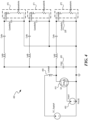
- Figure 4 shows a representative schematic of a parallel resonant class E amplifier 400 configured for multiple transmitter antennas.
- the amplifier 400 can be integrated in a transmitter configured to drive multiple transmitter antennas, such as in a three-dimensional array, to increase the charging coverage of the wireless charging system.
- amplifier 400 can be configured to drive three transmitter antennas represented by equivalent circuits 470, 471, and 472.
- Lchoke4 408 and Csh4 420 are placed to tune the ZVS at resonance.
- amplifier 400 also includes additional series inductor (Le) components and series capacitor (Cs) components for each transmitter antenna introduced into the system, for example, Le4a, Le4b, Le4c, Cs4a, Cs4b, and Cs4c respectively for the three-antenna system depicted in Figure 4 .
- Le series inductor
- Cs series capacitor
- Le4a, Le4b, Le4c, Cs4a, Cs4b, and Cs4c respectively for the three-antenna system depicted in Figure 4 .
- These additional Le and Cs components are configured to set the current and voltage waveforms out of phase and achieve ZVS. Additionally, the values are selected so that their reactance tune out at the desired resonant frequency (i.e., the frequency of each LC tank and the pulse voltage generated by Vosc4 402 and applied to the gate of transistor 410).
- the Le and Cs components act as resonant filters, reducing harmonics and creating better isolation from reflections to each antenna's LC tank.
- the transmitter can employ one or more transmitter antennas and the receiver can employ multiple receiver antennas, where the number of transmitter antennas and the number of receiver antennas need not be equal.
- amplifier 400's performance (e.g., power efficiency) is not substantially degraded under no load conditions or when the receivers are not present.
- the same voltage is applied to each resonant LC tank. That is, the voltages across Ltxcoil4a, Ltxcoil4b, and Ltxcoil4c are all identical, so there is more opportunity for receivers to couple stronger with the transmitter without sacrificing overall performance as is the case for single transmitter antenna systems like the embodiments described in relation to Figures 2 and 3 above.
- multiple amplifiers are not needed for multiple transmitter antennas.
- Additional transmitter antennas can be introduced to the system for different applications, for example, automotive, consumer electronics, and aerospace applications, while maintaining low implementation cost because the same amplifier can drive each transmitter antenna with the primary loss just being the parasitic resistance of the antennas Rtxparasitic4a, Rtxparasitic4b, and Rtxparasitic4c, which especially for a high Q system is very low.
- the transmitter antennas are not identical.
- amplifier 400 is configured to tune out the value of the antennas' equivalent inductance at the desired resonant frequency by Cparallel in the transmitter antenna branch.
- a transformer (such as transformer 350 of Figure 3 ) can be added to amplifier 400 for every transmitter antenna introduced to scale the oscillating voltages across each transmitter antenna thereby increasing the power delivered to the receiver and/or increasing the charging distance.
- the turns ratio for the transformers corresponding to different antenna branches can be selected to be different so that each transmitter antenna has a different oscillating voltage resulting in the flux linkage varying for different transmitter antennas connected to the same amplifier system.
- FIG. 5 shows a representative schematic of a parallel resonant Class E amplifier 500 configured for multiple transmitter antennas in differential mode.
- a Class E amplifier can include two transistors (e.g., transistor Q5a 510a and transistor Q5b 510b) tuned for ZVS with two separate load networks that drive the transmitter antennas differentially.
- a first pulse is coupled the gate of transistor Q5a 510a from a pulse generator 502a and a complementary pulse is coupled to the gate of transistor Q5b 510b from a pulse generator 502b.
- the pulses can be generated by an oscillator or an integrated circuit square wave signal generator represented by Vosc5a 502a and Vosc5b 502b.
- Vosc5a 502a and Vosc5b 502b can generate a 6.78 MHz square wave alternating between 0 and 5V to drive the gate of the switching transistors 510a and 510b where the switching transistors Q5a 510a and Q5b 510b are turned on/off during separate intervals.
- the complementary pulse signals can be generated by separate oscillator integrated circuits.
- a single oscillator integrated circuit or pulse generator can generate a single pulse that is coupled to logic circuitry (e.g., NAND/AND gates, inverters, etc.) to provide the complementary signals to drive transistor Q5a 510a and Q5b 510b.
- logic circuitry e.g., NAND/AND gates, inverters, etc.
- the amplifier 500 can double the gain across each transmitter antenna in the system.
- the described embodiment of a differential parallel resonant topology provides the additional benefits described above in relation to Figure 2 .
- choke inductor Lchoke5a 508a and shunt capacitor Csh5a 520a are configured to tune the ZVS at resonance for transistor Q5a 510a. Furthermore, in order to apply the signals differentially to the transmitter coils, choke inductor Lchoke5b 508b and shunt capacitor Csh5b 520b are configured to tune the ZVS at resonance for transistor Q5b 510b.
- Amplifier 500 includes additional series inductors (e.g., Le5a 530a, and Le5b 530b) and series capacitors (e.g., Cs5a 522a, and Cs5b 522b), which, unlike the embodiments described in relation to Figure 4 , are selected for each differential line rather than each antenna introduced into the system. That is, in some embodiments, Le5a 530a, Le5b 530b, Cs5a 522a, and Cs5b 522b are configured for the differential system depicted in Figure 5 , to set the current and voltage waveforms out of phase to achieve ZVS for both differential lines.
- Le5a 530a, Le5b 530b, Cs5a 522a, and Cs5b 522b are configured for the differential system depicted in Figure 5 , to set the current and voltage waveforms out of phase to achieve ZVS for both differential lines.
- the values are selected so that their reactances tune out at the desired resonant frequency (i.e., the frequency of each LC tank and the pulse voltage generated by Vosc5a 502a and applied to the gate of Q5a transistor 510a).
- the load network for the second transistor Q5b 510b can be selected such that the reactances are also tuned out at the desired resonant frequency like the load network of the first transistor Q5a 510a (i.e., at the frequency of the pulse generated by Vosc5b 502b and applied to the gate of the Q5b transistor 510a).
- the Le and Cs components act as resonant filters, reducing harmonics and creating better isolation from reflections to each antenna's LC tank.
- amplifier 500 Like in the amplifier 200 of Figure 2 , the amplifier 300 of Figure 3 , or amplifier 400 of Figure 4 , amplifier 500's performance (e.g., power efficiency) is not substantially degraded under no load conditions or when the receivers are not present. Furthermore, in amplifier 500, the same voltage is applied to each resonant LC tank like that of amplifier 400 in Figure 4 . That is, the voltages across equivalent inductors Txcoil5a 524a, Txcoil5b 524b, and Txcoil5c 524c are all identical, so there is more opportunity for receivers to couple stronger with the transmitter without sacrificing overall performance as is the case for single transmitter antenna systems like the embodiments described in relation to Figures 2 and 3 .
- Txcoil5a 524a, Txcoil5b 524b, and Txcoil5c 524c are all identical, so there is more opportunity for receivers to couple stronger with the transmitter without sacrificing overall performance as is the case for single transmitter antenna systems like the embodiments described in relation to Figures 2
- the differential signal of amplifier 500 doubles the oscillating voltage across each transmitter antenna compared to amplifier 400. This can increase the amount of power delivered and/or the charging distance when amplifier 500 is used in a wireless charging system. Additionally, like the topology of amplifier 400, using amplifier 500 eliminates the need for multiple amplifiers for multiple transmitter antennas. Additional transmitter antennas can be introduced to the system for different applications, for example, automotive, consumer electronics, and aerospace applications, while maintaining low implementation cost because the same amplifier can drive each transmitter antenna, with the main loss being the parasitic resistance of the antennas Txparasitic5a 525a, Txparasitic5b 525b, and Txparasitic5c 525c. These parasitic resistances are small, especially for a high Q system.
- the transmitter antennas are not identical.
- amplifier 500 is configured to tune out the value of the antennas' equivalent inductance at the desired resonant frequency by parallel capacitor Cparallel in the transmitter antenna branch (e.g., Cparallel5a 526a in the first branch, Cparallel5b 526b in the second branch, and Cparallel5c 526c in the third branch).
- a transformer (such as transformer 350 of Figure 3 ) can be added to amplifier 500 for every transmitter antenna introduced to scale the oscillating voltages across each transmitter antenna thereby increasing the power delivered to the receiver and/or increasing the charging distance.
- the turns ratio for the transformers corresponding to different antenna branches can be selected to be different so that each transmitter antenna has a different oscillating voltage resulting in the flux linkage varying for different transmitter antennas connected to the same amplifier system.
- Csh5a 520a and Csh5b 520b can be selected to be 180 pF
- Le5a 530a and Le5b 530b can be selected to be 7 ⁇ H
- Cs5a 522a and Cs5b 522b can be selected to be 78.7 pF
- Cparallel5a/b/c (526a, 526b, 526c) can be selected to be 551 pF
- Lchoke5a 508a and Lchoke5b 508b can be selected to be 600 nH for an amplifier 500 with antennas with an inductance of 1 ⁇ H and a series parasitic resistance 0.1 Ohms.
- Vosc5a 502a and Vosc5b 502b can generate complementary 6.78 MHz square waves alternating between 0 and 5V to drive the gate of the switching transistor Q5a 510a approximately 180 degrees out of phase with the signal driven to the gate of the switching transistor Q5b 510b.
- a 20 V dc supply 504 can drive the drains of the switching transistors 510a and 510b through the 600 nH choke inductors Lchoke5a and Lchoke 5b, respectively.
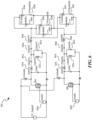
- Figure 6 shows a representative schematic of a parallel resonant Class E amplifier 600 with a bandpass filter instead of a series filter for each differential line.
- a series filter for each differential line e.g., the series filter comprising Le5a 530a and Cs5a 522a in Figure 5
- three inductors Lband1a 531a, Lband1b 533a, Lband1c 537a and three capacitors Cband1a 561a, Cband1b 563a, and Cband1c 567a are tuned at the same resonant frequency as the system (i.e.
- the bandpass filter provides greater attenuation to the harmonics of the fundamental frequency for the amplifier. This can be important for electromagnetic compatibility or electromagnetic interference (EMC/EMI) compliance when greater attenuation for a project is desired.
- EMC/EMI electromagnetic interference
- the bandpass filter when compared to the embodiments with the resonant series filters (e.g., filter comprising Le2 and Cs2 in Figure 2 ), can attenuate the harmonics of the fundamental frequency by 30 dB or more.
- Lband1a and Lband1b can be 7 uH, and Cband1a and Cband1b can be 79 pF.
- Lband1c can be 0.7 uH, and Cband1c can be 787 pF. All inductors in the bandpass filters can simultaneously resonate at 6.78 MHz, which, in this example, is the same resonant frequency as the entire amplifier (i.e. the frequency of each LC tank, etc.).
- Lband2a 531b and Lband2b 533b can be 8 uH; Cband2a 561b and Cband2b 563b can be 69 pF; Lband2c can be 0.8 uH, and Cband2c can be 689 pF.
- Txcoil6a 624a, Txcoil6b 624b and Txcoil6c 624c can be 1 uH; TxParasitic6a 625a, TxParasitic6a 625b, and TxParasitic6a 625c can be 0.1 Ohms.
- Cparallel6a 626a, Cparallel6b 626b, and Cparallel6c 626c can be 551 pF.
- the remaining components, e.g., Lchoke6a, Lchoke6b, Csh6a, Csh6b, etc. can have the same values as in the example of Figure 5 .
- the band pass filter can comprise a first inductor (Lband1a 531a), a second inductor (Lband1b 533a), a third inductor (Lband1c 537a), a first capacitor (Cband1a 561a), a second capacitor (Cband1b 563a), and a third capacitor (Cband1c 567a).
- the first inductor is the series inductor of the series filter embodiments (e.g., inductor Le5a 530a of Figure 5 )
- the first capacitor is the series capacitor of the series filter embodiments (e.g., capacitor Cs5a 522a of Figure 5 ).
- second inductor is configured with an inductance value substantially equal to an inductance of the first inductor (e.g., both 7 uH) and the second capacitor is configured with a capacitance value substantially equal to a capacitance of the first capacitor (e.g., both 79 pF).
- the third inductor (e.g., 0.7 uH) and the third capacitor (e.g., 787 pF) are coupled in parallel forming an LC tank, coupled to the first capacitor and the second capacitor, and coupled to the source node of the switching transistor (which is coupled to ground).
- the output substantially reduces the harmonics at 6.78 MHz in comparison to the series resonant filter.
- filters can be used as substitutes to the bandpass filters, such as other types of Pi filters.
- These alternative filter topologies can be utilized instead of the series resonate filters (Le and Cs) described in relation to the amplifier embodiments of Figures 2 , 3 , 4 and 5 , where additional attenuation for the harmonics of the amplifier is required.
- the words “comprise,” “comprising,” and the like are to be construed in an inclusive sense, as opposed to an exclusive or exhaustive sense; in the sense of “including, but not limited to.”
- the terms “connected,” “coupled,” or any variant thereof means any connection or coupling, either direct or indirect, between two or more elements; the coupling or connection between the elements can be physical, logical, or a combination thereof.
- the words “herein,” “above,” “below,” and words of similar import, when used in this application refer to this application as a whole and not to any particular portions of this application.
Landscapes
- Engineering & Computer Science (AREA)
- Power Engineering (AREA)
- Computer Networks & Wireless Communication (AREA)
- Microelectronics & Electronic Packaging (AREA)
- Amplifiers (AREA)
Description
- The present document claims priority to
U.S. Provisional Patent Application No. 62/736,843, entitled "PARALLEL TUNED AMPLIFIERS," filed on September 26, 2018 - The number of devices that use rechargeable power source is ever increasing. To solve the operational issues associated with wired power charging solutions, in the recent years, wireless charging technology has been introduced and being used primarily for recharging mobile phones. In the next few years, the use of wireless charging is expected to increase even more for an even wider range of electronic devices.
KR 2013 0094033 A
US 2013/135050 A1 describes a differential electronic power amplifier which can be provided with an efficient combination of harmonic tuning and impedance matching to a load.
US 2015 207334 A1 describes an inductive power transfer system which comprises a transmitter coil TX and a receiver coil RX spaced from the transmitter coil. -
-
Figure 1 shows a representative schematic of a conventional single-ended class E amplifier for a resonant inductive wireless charging system. -
Figure 2 shows a representative schematic of a single-ended class E amplifier with a parallel tuned resonant network, which is not part of the invention. -
Figure 3 shows a representative schematic of a parallel tuned class E amplifier with a step-up transformer, which is not part of the invention. -
Figure 4 shows a representative schematic of a parallel tuned class E amplifier configured for multiple antennas, which is part of the invention. -
Figure 5 shows a representative schematic of a parallel tuned class E amplifier configured for multiple antennas in differential mode, which is not part of the invention. -
Figure 6 shows a representative schematic of a parallel tuned class E amplifier configured for multiple antennas in differential mode with a bandpass filter, which is not part of the invention. - The claimed invention is defined by the independent claims, while preferred embodiments form the subject of the dependent claims.
- Wireless charging systems use an electromagnetic field to transfer energy between two or more inductively coupled devices. For example, one of the devices can be a transmitter device such as a charging station or platform that generates the electromagnetic field used to transmit power by amplifying a signal, and the other device can be a receiver device to receive the electromagnetic energy through resonant inductive coupling, and convert the received electromagnetic energy to electrical energy to operate the receiver device or charge its power supply.
- Resonant inductive technology based on inductive coils has been adapted to attain substantial power efficiency (e.g., above 80%) across mid-range distances such as distances two, three, or even four times the coil diameters for high quality ("Q") antennas (i.e., antennas with high inductive reactance relative to their resistance). The intrinsic Q of an antenna is the measure of the energy dissipated in the antenna relative to the energy stored in the antenna and is a barometer for the efficiency of the antenna. The higher the Q, the better the antennas can couple electromagnetic fields, which can result to a higher power delivery to a load. Inductive coils can be designed to generate electromagnetic fields capable of traveling through objects in various frequency ranges including the International, Scientific, and Medical (ISM) bands, such as 6.78 MHz and 13.56 MHz, with Specific Absorption Rates (SAR) and electric fields lower than FCC regulations, and at power levels in even the kilowatt (kW) range. To maintain high system efficiencies, wireless charging systems based on resonant inductive technology need to be driven by very efficient amplifier topologies, such as Class D or Class E amplifiers. However, because of limitations in current amplifier designs, current wireless charging systems are limited to short inductive coupling distances where the wireless charging transmitter and receiver devices are strongly electromagnetically coupled.
- Techniques, systems, and devices are described in the present document that can be used, for example, for providing wireless power transmission for charging electronic devices, e.g., smartphones, medical devices, industrial equipment, and robotics (e.g., microbotics). One example embodiment of the disclosed technology includes transmitter parallel tuned resonant LC networks, load networks, and impedance matching networks for Class D and E amplifier topologies, single-ended or differential, configured to improve wireless power transfer for resonant inductive systems.
- In some example implementations, the disclosed technology provides a wireless charging system to include a power source electrically coupled to a transmitter antenna or antenna array to produce an electromagnetic field. The transmitter device includes a switching power amplifier such as a Class D or Class E amplifier circuit, either in single-ended or differential-mode, to draw power from a power source. The load network and matching network are tuned such that the transmitter antenna is in parallel rather than series to the resonant capacitor with the load network of the amplifier also tuned at the same corresponding resonant frequency. The LC tank is tuned so that the entire system operates completely in resonance rather than using an off-resonant load network. This way, the voltage across the transmitter coil(s) is maximized and harmonics are reduced. By maximizing the voltage of the LC tank, there is higher oscillating current flowing through the transmitter antenna or a stronger magnetic field to be coupled with the receiver, especially in a loose coupling resonant inductive system, such as when the transmitter and receiver are physically far apart. In some embodiments, a transformer can also be included to further increase the oscillating voltage across the transmitter antenna and thereby further improve the flux linkage and power delivery between the transmitter and receiver(s). Furthermore, by having a parallel resonant LC tank, the amplifier is better protected from movements or changes in the position of the receiver or capacitive and inductive reflections from the surrounding environment that could cause a dramatic change in the efficiency of the amplifier or may irreparably damage it.
- The practical realization of efficient amplifier topologies like Class E and D for wireless charging systems is difficult because they tend to be sensitive to changes in load impedance. If the impedance is even a few ohms different than the designed value or if there is slightly more reactance or slightly less reactance than the designed value, the system efficiency can drop dramatically because the amplifiers' voltage and current waveforms become more in-phase, creating power losses. Furthermore, as the waveforms become more in-phase, the likelihood of irreparably damaging the amplifiers increases due to voltage or current spikes over components, such as the switching transistor.
- For high 'Q' resonant inductive systems, impedance mismatches and resonant frequency shifts become more problematic, creating substantial power losses in the wireless charging system. For a transmitter or receiver antenna with high Q, the bandwidth is very narrow. For example, with an antenna with a Q of ~500, the bandwidth is less than 10kHz, so more than 50% of the power could be lost if delivered at more than 10kHz away from the resonant frequency. Furthermore, if the receiver moves closer to the transmitter, then the reflected impedance increases because the transmitter and receiver couple better. If the amplifier's load network is designed to drive the reflected impedance of the receiver, then this can cause the current and voltage waveforms to overlap and create either enormous losses in the system or irreparably damage it. Conversely, if the receiver moves further away from the transmitter, then the reflected impedance approaches zero. If the amplifier's load network again is designed to drive the reflected impedance of the receiver, this would be effectively driving an open load and could irreparably damage the amplifier. As the Q of the antennas increase at resonance, the coupling increases so while there can be more power delivered to the load, there is also a greater potential variation in reflected impedance, which makes driving a high Q system with these amplifiers even more difficult. In addition, there can be objects in the nearby environment that induce an inductive or capacitive reflection to the amplifier, which can potentially damage the amplifier or dramatically reduce its system efficiency. This potential change in reflections to the transmitter creates significant challenges for the design of a Class E and Class D amplifier topologies, especially for wireless charging systems.
- This challenge is also present for a differential-mode Class E amplifier where the gate driver provides a square wave or pulse to the gate of two transistors in a push-pull configuration rather than a single switching transistor to reduce the voltage and power dissipated across each individual transistor and increase the total power delivered. Because the differential-mode Class E system optimizes zero-voltage-switching (ZVS) across the transistors, it is still very sensitive to any potential change in reflections, whether real or reactive. The same is true for Class D amplifier topologies and any other amplifier topologies that attempt to minimize the overlap of current and voltage waveforms across the switching components in the amplifier.
- Due to these and other technical issues in amplifier technology, various commercial charging products based on resonant inductive technology (e.g., inductive charging pads) have been limited in certain aspects. Some existing inductive charging pads are configured as thin matt-like objects that charge electronic devices when placed on the pad. These products have very limited charging distances, e.g., normally within the range of several centimeters (e.g., less than 2 to 5 cm) because of these engineering challenges.
- Resonant inductive wireless charging systems today use series resonant tuning to cancel the inductive reactance of the transmitter coil. Additionally, the receiver's inductive reactance is cancelled by a corresponding series capacitor(s) at the same resonant frequency. Thus, the amplifier "sees" the real impedance from the receiver when the receiver or receivers are placed in close physical proximity to the transmitter. These amplifiers are typically designed to be tuned off-resonant with a wide impedance range to adjust to variations in reflected impedance from a movement of receivers, introduction of new receivers, or capacitive/inductive reflections from the surrounding environment, for example. However, by tuning the transmitter off-resonant, the amount of power potentially delivered to the receiver is diminished, especially as the receiver or receivers move physically further away from the transmitter because the coupling will be more profoundly decreased at a distance for an off-resonant system. This issue is even more notable for transmitter and receiver antennas with high Q that have much tighter bandwidths like previously described. If the wireless charging system is designed to operate off-resonant, it limits the design optimization of the transmitter and receiver antennas. This is because if the antennas have too high of a Q, there is a greater potential variation in impedance due to stronger coupling. Because this amplifier is very sensitive to changes in reflected impedance, this can potentially damage the amplifier or dramatically reduce system efficiency. Furthermore, the off-resonant load network of the amplifier may shift the resonant frequency of the transmitter antenna. With a very high Q antenna, this can result in losses if the operational frequency differs from the resonant frequency of the resonating transmitter antenna.
- Various embodiments of amplifier circuits are described in the present document. The present description provides specific details for a thorough understanding and an enabling description of these embodiments. One skilled in the art will understand, however, that the described techniques can be practiced without many of these details. Additionally, some well-known schematic topologies may not be shown or described in detail, to avoid unnecessarily obscuring the relevant description of the various embodiments. The terminology used in the description presented below is intended to be interpreted in its broadest reasonable manner, even though it is being used in conjunction with a detailed description of certain specific embodiments.
-
Figure 1 shows a representative schematic of a conventional single-endedclass E amplifier 100 for a resonant inductive wireless charging system. Inamplifier 100, atransistor 110 acts like a switch connecting the transistor'sdrain node 113 to the transistor'ssource node 115 when a gate voltage at the transistor'sgate node 117 is above the threshold voltage oftransistor 110. That is, the switch implemented bytransistor 110 "closes" when thegate node 117 is positive, allowing current to flow from thedrain node 113 to thesource node 115. Whengate node 115 is at ground (or belowtransistor 110's threshold voltage), the switch implemented bytransistor 110 "opens" blocking a current flow fromdrain node 113 to sourcenode 115. - A load network for the
amplifier 100, composed of shunt capacitor (Csh) 120, RF choke (Lchoke) 108, and extra inductor (Le) 130, is tuned such that current and voltage waveforms are out-of-phase from one another, resulting in zero-voltage-switching (ZVS) oftransistor 110 which greatly reduces the power dissipated across thetransistor 110. When the load network is properly tuned, the voltage acrosstransistor 110 is minimized when the switch is "closed" and the current across thetransistor 110 is minimized when the switch is "open." This improves the power efficiency ofamplifier 100 to more than 90% efficiency, making such class E amplifier topologies suitable for wireless power transfer. - In
amplifier 100, an oscillator and gate driver integrated circuit (Vosc) 102 can supply a square wave pulse at the desired resonant frequency. The square wave pulse is applied to thegate node 117 oftransistor 110. The square wave can be adjusted with dead-time circuitry, such as a diode and resistor, to better tune and adjust the ZVS waveforms described above by controlling the rise and fall time of the square wave. Choke inductor (Lchoke) 108 is an RF choke to protect thedc supply 104 by filtering out high frequency signals from reachingdc supply 104, and is selected along with the shunt capacitor (Csh) 120 and the extra inductor (Le) 130 to create ZVS across the switchingtransistor 110. The value of the series resonant capacitor (Cs) 122 is selected to cancel, at the desired resonant frequency, the reactance of the transmitter antenna represented by the serious inductor (Ltxcoil) 124. A load resistor (Rload) 106 represents the reflected impedance received by a receiver device placed near a transmitterdevice containing amplifier 100. On the receiver device, a receiver antenna and series resonant capacitor (not shown inFigure 1 ) cancel each other's reactance, such that the reflected impedance to the transmitter device is the load of the receiver device or Rload (e.g., 30 Ohms). For example, ifVosc 102 applied a pulse with frequency 6.78 MHz, the resonant frequency of the LC tank (comprising Cs and Ltxcoil) can be tuned to 6.78 MHz, Cs can be selected to be 66.4 pf, and Ltxcoil can be selected to be 8.3 µH. Lchoke can be selected to be high inductance such as 100uH to protect theDC supply 104. Cs can be selected to be 50 pF and Le to be 1 000nH to set the voltage and current waveforms for zero current switching. - There are several issues with the topology of
amplifier 100. For example, when the receiver device is not near the transmitter device to induce a real reflected impedance, there is no load to deliver the power to (i.e., Rload is 0), which results in an open circuit. As a result, power would be dissipated through the components of the transmitter device, creating a large power loss which can irreparably damage theamplifier 100. To compensate for this, inductive charging pads can add circuitry to increase the impedance range of theamplifier 100, and reduce the current drawn from theamplifier 100 when the receiver device is not present, thereby preventing damage to the transmitter components. However, such additional circuitry increase the cost of developing, prototyping, and manufacturing amplifiers for wireless charging systems. - Another issue is that the
amplifier 100 is extremely sensitive to changes in both real and reactive reflections. Even with an increase in operating impedance range with the use of additional circuitry as discussed above, the amplifier's ZVS is highly affected by inductive or capacitive reflections. Even though series capacitor (Cs) 122 and series inductor (Ltcoil) 124 are tuned to the desired resonant frequency, the resonant LC tank (Cs and Ltxcoil) is directly connected to the off-resonant network comprising the choke inductor (Lchoke) 108, the shunt capacitor (Csh) 120, and extra inductor (Le) 130. With no isolation between the off-resonant network and the resonant LC tank network, an inductive or capacitive reflection can cause the ZVS waveforms to dramatically shift because the value of the series capacitor (Cs) 122 is typically selected to completely cancel out the reactance of the series inductor (Ltxcoil) 124. That is, a capacitive or inductive reflection can directly alter the amplifiers switching waveforms where the reactance of Cs and Ltxcoil completely cancel each other out. An inductive or capacitive reflection can be from, for example, the introduction of receiver devices that do not have their reactances completely tuned at resonance, a change in the position of receiver devices relative to a paired transmitter, or from objects in the surrounding environment that can induce a capacitive or inductive reflection. The shift in ZVS can cause additional harmonics, decrease the amplifier's system efficiency, and/or irreparably damage theamplifier 100. - Because of the issues identified above, the
conventional amplifier 100, is not suitable for a loosely coupled wireless charging system, only for strongly coupled wireless charging systems such as a wireless charging pads. For a wireless charging pad, the transmitter and receiver devices are placed near each other in a repeatedly predictable or predetermined distance and orientation, typically within a few millimeters, so they strongly couple. In a loose coupling system, where the transmitter and receiver are physically far apart and/or oriented such that the electromagnetic wave generated by the transmitter is not strongly coupled by the receiver, the real reflected impedance or Rload can be very small. Such a low Rload value can be inefficient for the amplifier to deliver power to, or can lead to damage to the amplifier. Furthermore, an appropriate design value for Rload can be difficult to predict where, for example, a user can place a receiving device at different distances or orientations relative to the transmitter. For example, when the receiver device is moved physically closer to the transmitter device, a resulting increase in mutual inductance can shift the ZVS waveforms because there is no isolation between the off-resonant load network and the resonant LC tank network as described above. Conversely, when the receiver device is physically moved further away from the transmitter device, a resulting decrease in mutual inductance can also cause a shift in the ZVS waveforms. The movement of the transmitter and receiver(s) towards or away from each other or a change in coupling can cause reflections to the amplifier that shift its ZVS waveforms. Therefore, whileamplifier 100 is often used, it is not robust, is highly sensitive, and results in poor performance for a loose coupling wireless charging system application. - Because loosely coupled systems as described above could lead to damage of the amplifier or a drastic drop in power efficiency, wireless charging pads using such a
conventional amplifier 100 are typically suitable for only charging devices very close to the charging pads. Even where the distance between a transmitter device and a loosely coupled receiver device is fixed, for example, where an electric vehicle wireless charging pad is loosely coupled with a receiver installed in the vehicle, the angular alignment between the charging pad and the in-vehicle receiver can vary, for example, when the vehicle is parked at different angles above the charging pad. This variation in angular alignment can in turn shift the ZVS waveforms ofamplifier 100 as described above because a change in the angle results in a change in coupling. A more robust and less sensitive amplifier design is therefore needed for higher efficiency, longer range wireless charging systems. -
Figure 2 shows a representative schematic of a single-endedClass E amplifier 200 with a parallel tuned resonant network. InFigure 2 , an oscillator and gate driver integrated circuit (Vosc2) 202 can generate a signal (e.g., a square wave) at a desired resonant frequency. The signal is applied to the gate of atransistor 210. In some embodiments, the signal can be generated by a gate driver and oscillator integrated circuit, and can be adjusted with dead-time circuitry (not shown inFigure 2 ), such as a diode and resistor, to better tune and adjust current and voltage waveforms ofamplifier 200 for ZVS.Amplifier 200 can also include a choke inductor (Lchoke2) 208 to protect thedc supply 204, a shunt capacitor (Csh2) 220, and an extra series inductor (Le2) 230. - Unlike the
amplifier 100 ofFigure 1 , theamplifier 200 ofFigure 2 has a series capacitor (CS2) 222 to tune out the inductive reactance of the extra inductor (Le2) 230 at the desired resonant frequency of the signal generated byVosc2 202 rather than cancel the inductive reactance of the transmitter antenna (Ltxcoil2). The series capacitor (CS2) 222 together withLe2 230 act as a series resonant filter, making the design more robust by reducing harmonics.Amplifier 200 also includes a parallel capacitor (Cparallel) 226 placed in parallel to the transmitter antenna (e.g., a transmitter coil) represented by aninductance Ltxcoil 224 and aparasitic resistance Rtxparasitic 225. Because the parallel capacitor (Cparallel) 226 excites the transmitter antenna, a transmitterdevice containing amplifier 200 is not dependent on a reflected real impedance of a receiver device for efficient operation as is a transmitterdevice containing amplifier 100 ofFigure 1 as discussed above. - Resonant inductive coupling can be conceptually compared to a single-phase transformer except that, in the wireless charging system, the primary and secondary windings of the conceptual transformer are placed away from each other rather than being tightly wound on a core. The Q of the wireless charging system's transmitter and receiver antennas (or the efficiency of the conceptual primary and secondary transformer coils) increases at resonance to increase the magnetic coupling to compensate for the physical separation of the windings. Based on this analogy, amplifier 100 (
Figure 1 ) can be compared to a current transformer or a series transformer. Conversely, amplifier 200 (Figure 2 ), can be compared to a voltage/potential transformer or parallel transformer. In a series or current transformer, the transformer can become irreparably damaged when there is an open circuit. On the other hand, in a parallel or voltage/potential transformer, the transformer can become irreparably damaged when there is a short circuit. As discussed above, in a wireless chargingsystem utilizing amplifier 100 ofFigure 1 , when the transmitter device and receiver device are loosely coupled (e.g., by being moved further apart), an open load or near open load condition can result which can damage amplifier 100 (ofFigure 1 ). On the other hand, theamplifier 200 ofFigure 2 includes a high impedance resonating LC tank with a load network fixed at a desired impedance at resonance and is thereby operational when the receiver load is not present by, for example, changes in the relative position or orientation of the transmitter and receiver devices. That is, returning to the comparison with a potential transformer, loosely coupling a wireless chargingsystem utilizing amplifier 200 is not damaged under an open-load condition and a short circuit condition inamplifier 200 will not practically occur (unless the transmitter device were physically altered or impacted). - In
amplifier 200, the load network components comprising the choke inductor (Lchoke2) 208, the shunt capacitor (Csh2) 220, and the extra series inductor (Le2) 230 are configured to set the current and voltage waveforms out of phase thereby achieving ZVS. However, unlike in amplifier 100 (Figure 1 ), rather than selecting a very high inductance choke inductor, Lchoke2's inductance value is selected to cancel out (at the desired resonant frequency and the signal generated by Vosc2 202) the parasitic capacitance of the switchingtransistor 210, the shunt capacitance (Csh2) 220, as well as other parasitic capacitances such from a printed circuit board (PCB) on whichamplifier 200 is implemented. This results in less harmonics and a more robust amplifier. Additionally, the capacitance of the series capacitor (Cs2) 222 is selected to cancel out the inductive reactance of series inductor (Le2) 230 at the desired resonant frequency, as well as to form a series resonant filter which further reduces the power in the harmonics. The capacitance of the parallel capacitor (Cparallel) 226 is then selected to cancel out the reactance of an antenna (represented by Ltxcoil2 224) at the desired resonant frequency. For example, in some embodiments,Csh2 220 can be selected to be 158 pF,Le2 230 can be selected to be 7 µH,Cs2 222 can be selected to be 78.7 pF,Cparallel 226 can be selected to be 551 pF, andLchoke2 208 can be selected to be 600 nH for anamplifier 200 with an antenna with aninductance 224 of 1 µH and a seriesparasitic resistance 225 of 0.1 Ohms.Vosc 202 can generate a 6.78 MHz square wave alternating between 0 and 5V to drive the gate of the switchingtransistor 210, where the switching transistor contributes a parasitic capacitance of 760 pF. A 20V dc supply 204 can drive the drain of the switchingtransistor 210 through the choke inductor Lchoke. From the variables in this example, the resonant frequency of the load network and LC tank is the same as the operating frequency of 6.78 MHz generated byVosc 202. That is, the periodic signal applied to theswitching transistor Q2 210 is the same frequency that substantially resonates thechoke inductor Lchoke2 208 and the parasitic capacitance of the switching transistor (not shown inFigure 2 ) as well as its shunt capacitor (Csh2 220), the series inductor (Le2 230) and series capacitor (Cs2 222), and the transmitter antenna (represented byLtxoil2 224 and Rtxparasitic 225) and parallel capacitor (Cparallel 226). That is, the passive components identified above (Lchoke2, parasitic capacitance (Cparasitic), Csh2, Le2, Cs2, Ltxcoil, Rtxparasitic, Cparallel) resonate at or around the fundamental frequency of the input periodic signal generated byVosc 202. -
Amplifier 200's load network is configured to improve power efficiency (e.g., by reducing spurious harmonics and intermodulation components), and is robust to reflections because it is better isolated from the LC tank than amplifier 100 (ofFigure 1 ). In some embodiments,dc supply 204 can be protected from high frequency signals inamplifier 200 by a separate external filter, for example an electromagnetic compatibility (EMC) filter (not shown inFigure 2 ), rather than by the inductor choke (Lchoke2) 208. In this way,Lchoke 208 can be configured to operate at resonance with the load network rather than as a high frequency block protectingdc supply 204. By having a high impedance LC tank and high isolation to the load network, theamplifier 200 operates efficiently substantially independent from the reflected impedance of a receiver device. That is,amplifier 200 when integrated in a transmitter device can operate under a "no receiver" or "open load" condition without substantial power losses or without being irreparably damaged. This is because, with the parallel resonant topology ofamplifier 200, the amplifier draws more current from thedc supply 204 when coupled to a receiver, and otherwise, very little power is dissipated across the parasitic resistance of thetransmitter antenna Rtxparasitic 225. In a loosely coupled wireless charging system where the reflected impedance may only be a few ohms, a transmitterdevice integrating amplifier 200 can effectively deliver power to a receiver device which would not be the case in a transmitterdevice integrating amplifier 100 ofFigure 1 . - In some embodiments,
amplifier 100 can be reconfigured to improve stability for a loose coupling system by driving a conjugate matched transmitter antenna. This system is not as efficient nor as stable as the disclosed technology inamplifier 200, but can be connected to a series resonant amplifier like described inamplifier 100 to make it operational when the receiver is not present or when very little coupling occurs between transmitter and receiver so the amplifier is not irreparably damaged. In these embodiments, the load network can be off-resonant like inamplifier 200 withLchoke2 208 being selected with a high inductance value (e.g., 100 µH) to protect thedc supply 204; Csh2 220 (e.g., 50 pF) and Le2 230 (e.g., 1 µH) can be selected to tune the ZVS waveforms, and are not tuned at the resonant frequency of the LC tank and the pulse applied by Vosc2.Cs2 222 can be approximately 70pF andCparallel 226 can be approximately 480 pF for an antenna with aninductance Ltxcoil2 224 of 1 µH and a seriesparasitic resistance Rtxparasitic 225 of 0.1 Ohms to set the impedance seen by the amplifier to be approximately 6 Ohms. The load network of theamplifier 100 can be expensive and/or difficult to redesign at resonance, which better protects the amplifier and reduces harmonics. Instead, a conjugate matched transmitter antenna can be connected directly to the load network at a predefined impedance value that amplifier 100 is capable of driving, such as 5 ohms. In some embodiments, a series resonant filter, bandpass filter, or transformer can be placed between the load network and the conjugate matched transmitter antenna, although this can impact the ZVS tuning of the load network and may diminish the benefit derived from connecting the conjugate matched antenna to an embodiment ofamplifier 100. Instead of selecting the capacitance value ofCs2 222 andCparallel 226 to tune out the reactance ofLtxcoil2 224 in purely parallel or series, the capacitance values are selected based on an impedance value desired by the embodiment ofamplifier 100. For example, if a desired design point of the amplifier is driving approximately 30-ohm load, then Ltxcoil2 can be tuned to a 30-ohm impedance using a Smith Chart by placing a parallel and series capacitor to Ltxcoil2 at the desired resonant frequency. One difficulty with these embodiments employing this topology is that they can require additional modifications to the receiver because the frequency seen by the amplifier in reflection mode using equipment such as Vector Network Analyzers (VNA) can be different than the frequency seen in transmission mode by the receiver. This system can operate better with an antenna with higher bandwidth or lower Q given that Ltxcoil2 may be off-resonant in order to reach a middle ground or a design point where the amplifier can safely drive the conjugate matched antenna and where the receiver requires minimal modifications to its corresponding resonant frequency. However, the Q of the transmitter antenna should not be too low because doing so can increase the overall losses in the system. Additionally, the selection ofCs2 220 capacitance value in these embodiments is significant because a low capacitance may produce a better conjugate match to the amplifier, but it also may in turn induce a high voltage across thecapacitor Cs2 220. -
Figure 3 shows a representative schematic of aclass E amplifier 300 with a step-uptransformer 350 between the series LC filter (Le3 330 and Cs3 322) and the LC tank of the transmitter antenna, where the LC tank comprisesCparallel2 226 in parallel with an antenna having aninductance Ltxcoil3 324 and a seriesequivalent resistance Rtxparasitic3 325.Inductor L1 352 andinductor L2 353 represent the primary and secondary windings (respectively) of step-uptransformer 350. In some embodiments, the transformer can be a 1:3 step-up transformer, with the transformer's turn ratio directly proportional to the voltage ratio (i.e., a transformer with a 1:N turns ratio also has a 1:N voltage ratio). - The step-up
transformer 350 can increase the voltage across the main transmitter coil and can also reduce the reflections that theamplifier 300 "sees", further improving the stability of theamplifier 300 by better isolating theamplifier 300 from the LC tank. In general, the higher the oscillating voltage induced across a transmitter antenna, the higher the oscillating current or magnetic field strength generated by the transmitter antenna. For a wireless charging system based on resonant inductive coupling, the stronger the magnetic field, the greater the magnetic flux linkage between the transmitter antenna and the receiver antenna and hence the more power delivered to the receiver device from the transmitter device. - Like the
amplifier 200 ofFigure 2 ,amplifier 300's load network is configured to achieve ZVS and for resonance at the desired resonant frequency. However,amplifier 300 includes acapacitor Cp_transform 362 selected to tune out the reactance of the primaryinductor winding L1 352 at the desired resonant frequency, and acapacitor Cs_transform 364 selected to tune out the reactance of the secondaryinductor winding L2 353 at the desired resonant frequency.Parallel capacitor Cparellel2 326 is selected to tune out the reactance of theantennas inductance Ltxcoil3 324 at the desired resonant frequency. Thetransformer 350 better isolates theamplifier 300 from reflections and establishes a stable signal that has N times (for a 1:N transformer) the voltage acrossLtxcoil3 324 vs voltage across Ltxcoil2 (inFigure 2 ). The topology ofamplifier 300 is especially important for industrial applications and very loose coupling resonant inductive systems because it includes all the benefits discussed above in relation toamplifier 200 ofFigure 2 but can also more readily scale the flux linkage between the transmitter and receiver(s) by increasing the turn ratios of thetransformer 350. That is,amplifier 300's configuration can allow for easier scaling of the power delivered to the receiver for high power application and/or deliver more power at a further distance for an increased charging distance application. -
Figure 4 shows a representative schematic of a parallel resonantclass E amplifier 400 configured for multiple transmitter antennas. For example, theamplifier 400 can be integrated in a transmitter configured to drive multiple transmitter antennas, such as in a three-dimensional array, to increase the charging coverage of the wireless charging system. In some embodiments, such as depicted inFigure 4 ,amplifier 400 can be configured to drive three transmitter antennas represented byequivalent circuits amplifier 200 ofFigure 2 , oramplifier 300 ofFigure 3 ,Lchoke4 408 andCsh4 420 are placed to tune the ZVS at resonance. However,amplifier 400 also includes additional series inductor (Le) components and series capacitor (Cs) components for each transmitter antenna introduced into the system, for example, Le4a, Le4b, Le4c, Cs4a, Cs4b, and Cs4c respectively for the three-antenna system depicted inFigure 4 . These additional Le and Cs components are configured to set the current and voltage waveforms out of phase and achieve ZVS. Additionally, the values are selected so that their reactance tune out at the desired resonant frequency (i.e., the frequency of each LC tank and the pulse voltage generated byVosc4 402 and applied to the gate of transistor 410). Like inamplifier 200 ofFigure 2 , the Le and Cs components act as resonant filters, reducing harmonics and creating better isolation from reflections to each antenna's LC tank. In some embodiments, the transmitter can employ one or more transmitter antennas and the receiver can employ multiple receiver antennas, where the number of transmitter antennas and the number of receiver antennas need not be equal. - Like in the
amplifier 200 ofFigure 2 or theamplifier 300 ofFigure 3 ,amplifier 400's performance (e.g., power efficiency) is not substantially degraded under no load conditions or when the receivers are not present. Furthermore, inamplifier 400, the same voltage is applied to each resonant LC tank. That is, the voltages across Ltxcoil4a, Ltxcoil4b, and Ltxcoil4c are all identical, so there is more opportunity for receivers to couple stronger with the transmitter without sacrificing overall performance as is the case for single transmitter antenna systems like the embodiments described in relation toFigures 2 and3 above. Additionally, with the topology ofamplifier 400, multiple amplifiers are not needed for multiple transmitter antennas. Additional transmitter antennas can be introduced to the system for different applications, for example, automotive, consumer electronics, and aerospace applications, while maintaining low implementation cost because the same amplifier can drive each transmitter antenna with the primary loss just being the parasitic resistance of the antennas Rtxparasitic4a, Rtxparasitic4b, and Rtxparasitic4c, which especially for a high Q system is very low. - In some embodiments, the transmitter antennas are not identical. In these embodiments,
amplifier 400 is configured to tune out the value of the antennas' equivalent inductance at the desired resonant frequency by Cparallel in the transmitter antenna branch. In other embodiments, a transformer (such astransformer 350 ofFigure 3 ) can be added toamplifier 400 for every transmitter antenna introduced to scale the oscillating voltages across each transmitter antenna thereby increasing the power delivered to the receiver and/or increasing the charging distance. In some embodiments, the turns ratio for the transformers corresponding to different antenna branches can be selected to be different so that each transmitter antenna has a different oscillating voltage resulting in the flux linkage varying for different transmitter antennas connected to the same amplifier system. -
Figure 5 shows a representative schematic of a parallel resonantClass E amplifier 500 configured for multiple transmitter antennas in differential mode. In differential mode, a Class E amplifier can include two transistors (e.g.,transistor Q5a 510a andtransistor Q5b 510b) tuned for ZVS with two separate load networks that drive the transmitter antennas differentially. A first pulse is coupled the gate oftransistor Q5a 510a from apulse generator 502a and a complementary pulse is coupled to the gate oftransistor Q5b 510b from apulse generator 502b. As described above in relation toFigure 2 , the pulses can be generated by an oscillator or an integrated circuit square wave signal generator represented byVosc5a 502a andVosc5b 502b. Applying a pulse to the gate oftransistor Q5b 510b that is an inverse (or complement, or around 180 degrees out of phase) to the pulse applied to the gate oftransistor Q5a 510a, results in a differential signal coupled across each transmitter coil (e.g., coils represented byTxcoil5a 524a,Txcoil5b 524b, andTxcoil5c 524c). For example,Vosc5a 502a andVosc5b 502b can generate a 6.78 MHz square wave alternating between 0 and 5V to drive the gate of the switchingtransistors transistors Q5a 510a andQ5b 510b are turned on/off during separate intervals. That is, whenQ5a 510a is closed or driven at 5V byVosc5a 502a, thenQ5b 510b is open or driven at 0V byVosc5b 502b. In some embodiments, the complementary pulse signals (e.g., square wave signals) can be generated by separate oscillator integrated circuits. In other embodiments, a single oscillator integrated circuit or pulse generator can generate a single pulse that is coupled to logic circuitry (e.g., NAND/AND gates, inverters, etc.) to provide the complementary signals to drivetransistor Q5a 510a andQ5b 510b. By driving the antennas differentially, theamplifier 500 can double the gain across each transmitter antenna in the system. Additionally, unlike a typical differential Class E amplifier that is tuned series-resonant with an off-resonant load network, the described embodiment of a differential parallel resonant topology provides the additional benefits described above in relation toFigure 2 . - Like in
amplifier 200 ofFigure 2 , oramplifier 300 ofFigure 3 , oramplifier 400 ofFigure 4 , chokeinductor Lchoke5a 508a and shuntcapacitor Csh5a 520a are configured to tune the ZVS at resonance fortransistor Q5a 510a. Furthermore, in order to apply the signals differentially to the transmitter coils,choke inductor Lchoke5b 508b andshunt capacitor Csh5b 520b are configured to tune the ZVS at resonance fortransistor Q5b 510b.Amplifier 500 includes additional series inductors (e.g.,Le5a 530a, andLe5b 530b) and series capacitors (e.g.,Cs5a 522a, andCs5b 522b), which, unlike the embodiments described in relation toFigure 4 , are selected for each differential line rather than each antenna introduced into the system. That is, in some embodiments,Le5a 530a,Le5b 530b,Cs5a 522a, andCs5b 522b are configured for the differential system depicted inFigure 5 , to set the current and voltage waveforms out of phase to achieve ZVS for both differential lines. Additionally, the values are selected so that their reactances tune out at the desired resonant frequency (i.e., the frequency of each LC tank and the pulse voltage generated byVosc5a 502a and applied to the gate ofQ5a transistor 510a). However, since the circuit depicted inFigure 5 embodies a differential topology, the load network for thesecond transistor Q5b 510b can be selected such that the reactances are also tuned out at the desired resonant frequency like the load network of thefirst transistor Q5a 510a (i.e., at the frequency of the pulse generated byVosc5b 502b and applied to the gate of theQ5b transistor 510a). Like inamplifier 200 ofFigure 2 , oramplifier 300 ofFigure 3 , oramplifier 400 ofFigure 4 , the Le and Cs components act as resonant filters, reducing harmonics and creating better isolation from reflections to each antenna's LC tank. - Like in the
amplifier 200 ofFigure 2 , theamplifier 300 ofFigure 3 , oramplifier 400 ofFigure 4 ,amplifier 500's performance (e.g., power efficiency) is not substantially degraded under no load conditions or when the receivers are not present. Furthermore, inamplifier 500, the same voltage is applied to each resonant LC tank like that ofamplifier 400 inFigure 4 . That is, the voltages acrossequivalent inductors Txcoil5a 524a,Txcoil5b 524b, andTxcoil5c 524c are all identical, so there is more opportunity for receivers to couple stronger with the transmitter without sacrificing overall performance as is the case for single transmitter antenna systems like the embodiments described in relation toFigures 2 and3 . However, at the same input voltage, the differential signal ofamplifier 500 doubles the oscillating voltage across each transmitter antenna compared toamplifier 400. This can increase the amount of power delivered and/or the charging distance whenamplifier 500 is used in a wireless charging system. Additionally, like the topology ofamplifier 400, usingamplifier 500 eliminates the need for multiple amplifiers for multiple transmitter antennas. Additional transmitter antennas can be introduced to the system for different applications, for example, automotive, consumer electronics, and aerospace applications, while maintaining low implementation cost because the same amplifier can drive each transmitter antenna, with the main loss being the parasitic resistance of theantennas Txparasitic5a 525a,Txparasitic5b 525b, andTxparasitic5c 525c. These parasitic resistances are small, especially for a high Q system. - In some embodiments, the transmitter antennas (represented by Txcoil5a, Txcoil5b and Txcoil5c and TxParasitic5a, TxParasitic5b, TxParasitic5c) are not identical. In these embodiments,
amplifier 500 is configured to tune out the value of the antennas' equivalent inductance at the desired resonant frequency by parallel capacitor Cparallel in the transmitter antenna branch (e.g.,Cparallel5a 526a in the first branch,Cparallel5b 526b in the second branch, andCparallel5c 526c in the third branch). In other embodiments, a transformer (such astransformer 350 ofFigure 3 ) can be added toamplifier 500 for every transmitter antenna introduced to scale the oscillating voltages across each transmitter antenna thereby increasing the power delivered to the receiver and/or increasing the charging distance. In some embodiments, the turns ratio for the transformers corresponding to different antenna branches can be selected to be different so that each transmitter antenna has a different oscillating voltage resulting in the flux linkage varying for different transmitter antennas connected to the same amplifier system. - In some embodiments,
Csh5a 520a andCsh5b 520b can be selected to be 180 pF,Le5a 530a andLe5b 530b can be selected to be 7 µH,Cs5a 522a andCs5b 522b can be selected to be 78.7 pF, Cparallel5a/b/c (526a, 526b, 526c) can be selected to be 551 pF, andLchoke5a 508a andLchoke5b 508b can be selected to be 600 nH for anamplifier 500 with antennas with an inductance of 1 µH and a series parasitic resistance 0.1 Ohms.Vosc5a 502a andVosc5b 502b can generate complementary 6.78 MHz square waves alternating between 0 and 5V to drive the gate of the switchingtransistor Q5a 510a approximately 180 degrees out of phase with the signal driven to the gate of the switchingtransistor Q5b 510b. A 20V dc supply 504 can drive the drains of the switchingtransistors -
Figure 6 shows a representative schematic of a parallel resonantClass E amplifier 600 with a bandpass filter instead of a series filter for each differential line. In some embodiments, instead of a series filter for each differential line (e.g., the seriesfilter comprising Le5a 530a andCs5a 522a inFigure 5 ), threeinductors Lband1a 531a,Lband1b 533a,Lband1c 537a and threecapacitors Cband1a 561a,Cband1b 563a, andCband1c 567a. Each inductor in the bandpass filter is tuned at the same resonant frequency as the system (i.e. the frequency of each LC tank and the pulse voltage generated byVosc6a 602a andVosc6b 602b) with each capacitor in the bandpass filter. For example,Lband1a 531a is tuned to resonate withCband1a 561a,Lband1b 533a is tuned to resonate withCband1b 563a, andLband1c 537a is tuned to resonate withCband1c 567a. Compared to the series filter in the previous embodiments of the disclosed technology, the bandpass filter provides greater attenuation to the harmonics of the fundamental frequency for the amplifier. This can be important for electromagnetic compatibility or electromagnetic interference (EMC/EMI) compliance when greater attenuation for a project is desired. In some embodiments, when compared to the embodiments with the resonant series filters (e.g., filter comprising Le2 and Cs2 inFigure 2 ), the bandpass filter can attenuate the harmonics of the fundamental frequency by 30 dB or more. - For example, in some embodiments, Lband1a and Lband1b can be 7 uH, and Cband1a and Cband1b can be 79 pF. Meanwhile, Lband1c can be 0.7 uH, and Cband1c can be 787 pF. All inductors in the bandpass filters can simultaneously resonate at 6.78 MHz, which, in this example, is the same resonant frequency as the entire amplifier (i.e. the frequency of each LC tank, etc.). Additionally,
Lband2a 531b andLband2b 533b can be 8 uH;Cband2a 561b andCband2b 563b can be 69 pF; Lband2c can be 0.8 uH, and Cband2c can be 689 pF.Txcoil6a 624a,Txcoil6b 624b andTxcoil6c 624c can be 1 uH;TxParasitic6a 625a,TxParasitic6a 625b, andTxParasitic6a 625c can be 0.1 Ohms.Cparallel6a 626a,Cparallel6b 626b, andCparallel6c 626c can be 551 pF. The remaining components, e.g., Lchoke6a, Lchoke6b, Csh6a, Csh6b, etc., can have the same values as in the example ofFigure 5 . - That is, the band pass filter can comprise a first inductor (
Lband1a 531a), a second inductor (Lband1b 533a), a third inductor (Lband1c 537a), a first capacitor (Cband1a 561a), a second capacitor (Cband1b 563a), and a third capacitor (Cband1c 567a). The first inductor is the series inductor of the series filter embodiments (e.g.,inductor Le5a 530a ofFigure 5 ), the first capacitor is the series capacitor of the series filter embodiments (e.g.,capacitor Cs5a 522a ofFigure 5 ). Additionally, in some embodiments second inductor is configured with an inductance value substantially equal to an inductance of the first inductor (e.g., both 7 uH) and the second capacitor is configured with a capacitance value substantially equal to a capacitance of the first capacitor (e.g., both 79 pF). The third inductor (e.g., 0.7 uH) and the third capacitor (e.g., 787 pF) are coupled in parallel forming an LC tank, coupled to the first capacitor and the second capacitor, and coupled to the source node of the switching transistor (which is coupled to ground). - When using the bandpass filters, the output substantially reduces the harmonics at 6.78 MHz in comparison to the series resonant filter. It will be appreciated that other filters can be used as substitutes to the bandpass filters, such as other types of Pi filters. These alternative filter topologies can be utilized instead of the series resonate filters (Le and Cs) described in relation to the amplifier embodiments of
Figures 2 ,3 ,4 and5 , where additional attenuation for the harmonics of the amplifier is required. - Unless the context clearly requires otherwise, throughout the description and the claims, the words "comprise," "comprising," and the like are to be construed in an inclusive sense, as opposed to an exclusive or exhaustive sense; in the sense of "including, but not limited to." As used herein, the terms "connected," "coupled," or any variant thereof means any connection or coupling, either direct or indirect, between two or more elements; the coupling or connection between the elements can be physical, logical, or a combination thereof. Additionally, the words "herein," "above," "below," and words of similar import, when used in this application, refer to this application as a whole and not to any particular portions of this application. Where the context permits, words in the above Detailed Description using the singular or plural number may also include the plural or singular number respectively. The word "or" in reference to a list of two or more items covers all of the following interpretations of the word: any of the items in the list, all of the items in the list, and any combination of the items in the list.
- The above Detailed Description of examples is not intended to be exhaustive or to limit the invention to the precise form disclosed above. While specific examples for the embodiments are described above for illustrative purposes, various equivalent modifications are possible, as those skilled in the relevant art will recognize. For example, while processes or blocks are presented in a given order, alternative implementations can perform routines having steps/blocks, or employ systems having blocks, in a different order, and some processes or blocks can be deleted, moved, added, subdivided, combined, and/or modified to provide alternative or subcombinations. Each of these processes or blocks can be implemented in a variety of different ways. Also, while processes or blocks are at times shown as being performed in series, these processes or blocks can instead be performed or implemented in parallel, or can be performed at different times. Further any specific numbers noted herein are only examples: alternative implementations can employ differing values or ranges.
- The teachings provided herein can be applied to other systems, not necessarily the system described above. The elements and acts of the various examples described above can be combined to provide further implementations of the invention. Some alternative implementations of the invention can include not only additional elements to those implementations noted above, but also can include fewer elements.
- These and other changes can be made to the invention in light of the above Detailed Description. While the above description describes certain examples of the invention, and describes the best mode contemplated, no matter how detailed the above appears in text, the invention can be practiced in many ways. Details of the system can vary considerably in its specific implementation, while still being encompassed by the invention determined by the appended set of claims. As noted above, terminology used when describing certain features or aspects of the invention should not be taken to imply that the terminology is being redefined herein to be restricted to any specific characteristics, features, or aspects of the invention with which that terminology is associated. In general, the terms used in the following claims should not be construed to limit the invention to the specific examples disclosed in the specification, unless the above Detailed Description section explicitly defines such terms. Accordingly, the actual scope of the invention encompasses not only the disclosed examples, but also all equivalent ways of practicing or implementing the invention under the claims.
Claims (5)
- An amplifier (400) for amplifying a periodic signal, comprising:a switching transistor (410) comprising a gate node, a source node coupled to a ground node, and a drain node, wherein the gate node is configured to receive the periodic signal;a dc bias circuit configured to bias the drain node of the switching transistor, wherein the dc bias circuit is coupled to the drain node through a choke inductor (408);a shunt capacitor (420) coupled between the source node and the drain node of the switching transistor;a plurality of series inductors coupled between the drain node of the switching transistor and respectively a first terminal of a respective series capacitor of a plurality of series capacitors; anda plurality of antennas, wherein each one of the antennas comprises an equivalent inductance in series with an equivalent resistance; anda plurality of parallel capacitors respectively coupled between a second terminal of the respective series capacitor of the plurality of series capacitors and the ground node, wherein each one of the parallel capacitors is coupled in parallel to a corresponding antenna's equivalent inductance and equivalent resistance;wherein each series capacitor of the plurality of series capacitors is configured with a capacitance value to cause the series capacitor to resonate with the respective series inductor of the plurality of series inductors at a fundamental frequency of the periodic signal;wherein each parallel capacitor of the plurality of parallel capacitors is configured with a capacitance value to cause the parallel capacitor to resonate with the equivalent inductance of the respective corresponding antenna of the plurality of antennas at the fundamental frequency of the periodic signal;wherein the choke inductor is configured with an inductance value to cause the choke inductor to resonate with the parasitic capacitance of the switching transistor and the shunt capacitor at the fundamental frequency of the periodic signal.
- The amplifier (400) of claim 1, wherein the amplifier comprises at least one of a single-ended or a differential mode class E amplifier.
- The amplifier (400) of claim 1, wherein at least one of the plurality of antennas has a different equivalent inductance from the remainder of the antennas; and/orwherein each one of the plurality of parallel capacitors is configured with a capacitance value to resonate a corresponding equivalent inductance of a corresponding antenna of the plurality of antennas; and/orthe amplifier further comprising a plurality of transformers coupled to the plurality of parallel capacitors and the second terminal of the plurality of series capacitors; and optionallywherein at least one of the plurality of transformers is configured with a turns ratio that is different from a turns ratio of the remainder of the transformers.
- A method for amplifying, by means of an amplifier in accordance with any of claims 1 to 3, a periodic signal for driving a plurality of antennas, the method comprising:switching the switching transistor (410) on or off in response to receiving the periodic signal at the gate of the switching transistor;biasing, through the choke inductor (408), a drain of the switching transistor at a dc bias level;adjusting a voltage and a current waveform of the switching transistor, the voltage and current waveforms generated in response to switching the switching transistor on or off, to reduce an overlap of the voltage and current waveforms, wherein the adjusting is in response to resonating the choke inductor and the plurality of series inductors coupled to the drain of the switching transistor with the shunt capacitor (420) shunting the drain to the ground node;filtering harmonic components of the periodic signal using a filter; andresonating, at a fundamental frequency of the periodic signal;wherein each series capacitor of the plurality of series capacitors is configured with a capacitance value to cause the series capacitor to resonate with the respective series inductor of the plurality of series inductors at the fundamental frequency of the periodic signal;wherein each parallel capacitor of the plurality of parallel capacitors is configured with a capacitance value to cause the parallel capacitor to resonate with the equivalent inductance of the respective corresponding antenna of the plurality of antennas at the fundamental frequency of the periodic signal;wherein the choke inductor is configured with an inductance value to cause the choke inductor to resonate with the parasitic capacitance of the switching transistor and the shunt capacitor at the fundamental frequency of the periodic signal.
- A wireless charging system, comprising:a signal generator circuit configured to generate a periodic signal;the plurality of antennas; andan amplifier of any of claims 1 to 3 coupled to the signal generator and to the plurality of antennas, and configured to amplify the periodic signal;wherein the gate node of the switching transistor is coupled to the signal generator circuit.
Applications Claiming Priority (2)
| Application Number | Priority Date | Filing Date | Title |
|---|---|---|---|
| US201862736843P | 2018-09-26 | 2018-09-26 | |
| PCT/US2019/053266 WO2020069198A1 (en) | 2018-09-26 | 2019-09-26 | Parallel tuned amplifiers |
Publications (3)
| Publication Number | Publication Date |
|---|---|
| EP3857707A1 EP3857707A1 (en) | 2021-08-04 |
| EP3857707A4 EP3857707A4 (en) | 2021-11-24 |
| EP3857707B1 true EP3857707B1 (en) | 2025-01-01 |
Family
ID=69950795
Family Applications (1)
| Application Number | Title | Priority Date | Filing Date |
|---|---|---|---|
| EP19867723.9A Active EP3857707B1 (en) | 2018-09-26 | 2019-09-26 | Parallel tuned amplifiers |
Country Status (7)
| Country | Link |
|---|---|
| US (1) | US12149095B2 (en) |
| EP (1) | EP3857707B1 (en) |
| JP (1) | JP7441829B2 (en) |
| KR (1) | KR102817554B1 (en) |
| AU (1) | AU2019346612C1 (en) |
| CA (1) | CA3112046A1 (en) |
| WO (1) | WO2020069198A1 (en) |
Families Citing this family (11)
| Publication number | Priority date | Publication date | Assignee | Title |
|---|---|---|---|---|
| KR102674446B1 (en) * | 2018-11-02 | 2024-06-11 | 니치콘 가부시키가이샤 | Wireless electrical power supply device |
| GB2580155A (en) * | 2018-12-21 | 2020-07-15 | Comet Ag | Radiofrequency power amplifier |
| US10985724B1 (en) * | 2020-06-10 | 2021-04-20 | Apple Inc. | Transformer-based wideband filter with ripple reduction |
| US11585840B2 (en) * | 2020-09-03 | 2023-02-21 | Raytheon Company | Tuning of narrowband near-field probes |
| JP7605052B2 (en) * | 2021-07-08 | 2024-12-24 | トヨタ自動車株式会社 | Power Supply System |
| WO2023018409A1 (en) * | 2021-08-10 | 2023-02-16 | Google Llc | Wireless charging with split resonant capacitors |
| CN117652075A (en) | 2021-09-29 | 2024-03-05 | 三星电子株式会社 | Wireless power transmitter including reduced size inverter for harmonic reduction |
| KR102744917B1 (en) * | 2022-02-25 | 2024-12-19 | 경상국립대학교산학협력단 | Apparatus for controlling output of power amplifier |
| KR102786539B1 (en) * | 2022-02-25 | 2025-03-26 | 경상국립대학교산학협력단 | Power amplifier for supporting low distortion and high output |
| US12519456B2 (en) * | 2022-08-31 | 2026-01-06 | QuantalRF AG | Integrated coupled resonator filtering |
| JP7412048B1 (en) * | 2023-05-10 | 2024-01-12 | 株式会社アドテックプラズマテクノロジー | Variable reactance circuit and impedance matching device equipped with the circuit |
Family Cites Families (14)
| Publication number | Priority date | Publication date | Assignee | Title |
|---|---|---|---|---|
| US8204458B2 (en) * | 2006-07-13 | 2012-06-19 | Freescale Semiconductor, Inc. | Transmitting device and method of tuning the transmitting device |
| US8000113B2 (en) * | 2009-04-07 | 2011-08-16 | Maxim Integrated Products, Inc. | Efficient power regulation for class-E amplifiers |
| US20140312969A1 (en) | 2011-10-14 | 2014-10-23 | Indice Pty Ltd | Power control |
| GB2499565B (en) | 2011-11-29 | 2018-09-19 | Qualcomm Technologies Int Ltd | Class-E differential power amplifier |
| KR20130094033A (en) * | 2012-02-15 | 2013-08-23 | 주식회사 케이더파워 | Wireless charger with the resonator |
| US20170317529A1 (en) * | 2012-05-21 | 2017-11-02 | University Of Washington | Distributed control adaptive wireless power transfer system |
| GB201215152D0 (en) | 2012-08-24 | 2012-10-10 | Imp Innovations Ltd | Maximising DC to load efficiency for inductive power transfer |
| KR101631669B1 (en) | 2014-08-06 | 2016-06-17 | 주식회사 맵스 | Magnetic resonance wireless power transmitting apparatus for tuning resonance frequency |
| US9762090B2 (en) | 2014-09-24 | 2017-09-12 | Avago Technologies General Ip (Singapore) Pte. Ltd. | High efficiency gate driver for wireless power transmission |
| DE102016201148A1 (en) * | 2015-01-30 | 2016-08-04 | Samsung Electro-Mechanics Co., Ltd | Wireless Power Transmitter and Wireless Power Receiver |
| JP2017046417A (en) * | 2015-08-25 | 2017-03-02 | 船井電機株式会社 | Power supply apparatus |
| EP3136545B1 (en) * | 2015-08-25 | 2019-04-03 | Funai Electric Co., Ltd. | Wireless power transfer to a plurality of receivers |
| JP2017093180A (en) * | 2015-11-11 | 2017-05-25 | 株式会社ダイヘン | Non-contact power transmission system and power transmission device |
| US10971953B2 (en) * | 2016-08-26 | 2021-04-06 | Maxell, Ltd. | Contactless power receiving device, contactless power transfer device, and contactless power transfer and receiving device |
-
2019
- 2019-09-26 CA CA3112046A patent/CA3112046A1/en active Pending
- 2019-09-26 AU AU2019346612A patent/AU2019346612C1/en active Active
- 2019-09-26 KR KR1020217009371A patent/KR102817554B1/en active Active
- 2019-09-26 JP JP2021517008A patent/JP7441829B2/en active Active
- 2019-09-26 EP EP19867723.9A patent/EP3857707B1/en active Active
- 2019-09-26 WO PCT/US2019/053266 patent/WO2020069198A1/en not_active Ceased
- 2019-09-26 US US17/278,255 patent/US12149095B2/en active Active
Non-Patent Citations (1)
| Title |
|---|
| GREBENNIKOV A V ET AL: "Class E with parallel circuit - a new challenge for high-efficiency RF and microwave power amplifiers", 2002 IEEE MTT-S INTERNATIONAL MICROWAVE SYMPOSIUM DIGEST (CAT. NO.02CH37278) IEEE PISCATAWAY, NJ, USA; [IEEE MTT-S INTERNATIONAL MICROWAVE SYMPOSIUM], IEEE, 2 June 2002 (2002-06-02), pages 1627 - 1630vol.3, XP032408565, ISBN: 978-0-7803-7239-9, DOI: 10.1109/MWSYM.2002.1012169 * |
Also Published As
| Publication number | Publication date |
|---|---|
| AU2019346612C1 (en) | 2025-04-17 |
| AU2019346612B2 (en) | 2024-10-31 |
| AU2019346612A1 (en) | 2021-03-25 |
| CA3112046A1 (en) | 2020-04-02 |
| JP2022514142A (en) | 2022-02-10 |
| EP3857707A4 (en) | 2021-11-24 |
| US20210359551A1 (en) | 2021-11-18 |
| US12149095B2 (en) | 2024-11-19 |
| JP7441829B2 (en) | 2024-03-01 |
| KR20210049902A (en) | 2021-05-06 |
| KR102817554B1 (en) | 2025-06-10 |
| WO2020069198A1 (en) | 2020-04-02 |
| EP3857707A1 (en) | 2021-08-04 |
Similar Documents
| Publication | Publication Date | Title |
|---|---|---|
| EP3857707B1 (en) | Parallel tuned amplifiers | |
| KR101244513B1 (en) | Passive receivers for wireless power transmission | |
| US11817834B2 (en) | High frequency wireless power transfer system, transmitter, and receiver therefor | |
| US8487479B2 (en) | Ferrite antennas for wireless power transfer | |
| US8912906B2 (en) | Signal processing circuit and antenna apparatus | |
| US10411660B1 (en) | Differential power amplifier | |
| US9923584B2 (en) | Rectifiers for wireless power transfer with impedance inverting filters for reduced electromagnetic interference | |
| JP2015505664A (en) | Wireless power transfer device using separately tunable resonators | |
| EP3062317A1 (en) | Transformer, manufacturing method therefor, and chip | |
| US11716056B2 (en) | Power amplifier with series transformer combiners and harmonic tuning | |
| CA3027397A1 (en) | Systems and methods for wireless power transmission | |
| US11095167B2 (en) | Power transmission device | |
| JP7630728B2 (en) | Power Transmission Coil | |
| Yamashita et al. | Wireless power transmitter using parallel-tuned class-E power oscillator | |
| US12500451B2 (en) | Wireless power transmitter and receiver | |
| EP1615292B1 (en) | AM antenna noise reduction | |
| Keskin et al. | Complementary Class-E amplifier for wireless power transfer | |
| Yashchenko et al. | Adaptive impedance-matching network for wireless power transfer system with off-center receiver | |
| Keskin et al. | Unit antenna based wireless power transfer systems | |
| Keskin et al. | Tuning of a wireless power transfer system with a hybrid capacitor array | |
| HK1066326B (en) | Am antenna noise reducing | |
| HK1084777B (en) | Am antenna noise reduction | |
| JPH05167396A (en) | Tuning circuit |
Legal Events
| Date | Code | Title | Description |
|---|---|---|---|
| STAA | Information on the status of an ep patent application or granted ep patent |
Free format text: STATUS: THE INTERNATIONAL PUBLICATION HAS BEEN MADE |
|
| PUAI | Public reference made under article 153(3) epc to a published international application that has entered the european phase |
Free format text: ORIGINAL CODE: 0009012 |
|
| STAA | Information on the status of an ep patent application or granted ep patent |
Free format text: STATUS: REQUEST FOR EXAMINATION WAS MADE |
|
| 17P | Request for examination filed |
Effective date: 20210426 |
|
| AK | Designated contracting states |
Kind code of ref document: A1 Designated state(s): AL AT BE BG CH CY CZ DE DK EE ES FI FR GB GR HR HU IE IS IT LI LT LU LV MC MK MT NL NO PL PT RO RS SE SI SK SM TR |
|
| A4 | Supplementary search report drawn up and despatched |
Effective date: 20211021 |
|
| RIC1 | Information provided on ipc code assigned before grant |
Ipc: H03F 1/52 20060101ALI20211015BHEP Ipc: H03F 3/24 20060101ALI20211015BHEP Ipc: H03F 3/195 20060101ALI20211015BHEP Ipc: H03F 1/56 20060101ALI20211015BHEP Ipc: H02J 7/02 20160101ALI20211015BHEP Ipc: H03F 3/191 20060101ALI20211015BHEP Ipc: H03F 3/30 20060101ALI20211015BHEP Ipc: H03F 3/217 20060101AFI20211015BHEP |
|
| DAV | Request for validation of the european patent (deleted) | ||
| DAX | Request for extension of the european patent (deleted) | ||
| STAA | Information on the status of an ep patent application or granted ep patent |
Free format text: STATUS: EXAMINATION IS IN PROGRESS |
|
| 17Q | First examination report despatched |
Effective date: 20231201 |
|
| REG | Reference to a national code |
Ref country code: DE Ref legal event code: R079 Ref document number: 602019064398 Country of ref document: DE Free format text: PREVIOUS MAIN CLASS: H03F0003217000 Ipc: H02J0050120000 |
|
| GRAP | Despatch of communication of intention to grant a patent |
Free format text: ORIGINAL CODE: EPIDOSNIGR1 |
|
| STAA | Information on the status of an ep patent application or granted ep patent |
Free format text: STATUS: GRANT OF PATENT IS INTENDED |
|
| RIC1 | Information provided on ipc code assigned before grant |
Ipc: H03F 1/52 20060101ALI20240630BHEP Ipc: H03F 3/24 20060101ALI20240630BHEP Ipc: H03F 3/217 20060101ALI20240630BHEP Ipc: H03F 3/195 20060101ALI20240630BHEP Ipc: H02J 7/02 20160101ALI20240630BHEP Ipc: H03F 1/56 20060101ALI20240630BHEP Ipc: H02J 50/12 20160101AFI20240630BHEP |
|
| INTG | Intention to grant announced |
Effective date: 20240722 |
|
| GRAS | Grant fee paid |
Free format text: ORIGINAL CODE: EPIDOSNIGR3 |
|
| GRAA | (expected) grant |
Free format text: ORIGINAL CODE: 0009210 |
|
| STAA | Information on the status of an ep patent application or granted ep patent |
Free format text: STATUS: THE PATENT HAS BEEN GRANTED |
|
| AK | Designated contracting states |
Kind code of ref document: B1 Designated state(s): AL AT BE BG CH CY CZ DE DK EE ES FI FR GB GR HR HU IE IS IT LI LT LU LV MC MK MT NL NO PL PT RO RS SE SI SK SM TR |
|
| REG | Reference to a national code |
Ref country code: GB Ref legal event code: FG4D |
|
| REG | Reference to a national code |
Ref country code: DE Ref legal event code: R096 Ref document number: 602019064398 Country of ref document: DE |
|
| REG | Reference to a national code |
Ref country code: CH Ref legal event code: EP |
|
| REG | Reference to a national code |
Ref country code: IE Ref legal event code: FG4D |
|
| REG | Reference to a national code |
Ref country code: LT Ref legal event code: MG9D |
|
| REG | Reference to a national code |
Ref country code: NL Ref legal event code: MP Effective date: 20250101 |
|
| REG | Reference to a national code |
Ref country code: AT Ref legal event code: MK05 Ref document number: 1757314 Country of ref document: AT Kind code of ref document: T Effective date: 20250101 |
|
| PG25 | Lapsed in a contracting state [announced via postgrant information from national office to epo] |
Ref country code: NL Free format text: LAPSE BECAUSE OF FAILURE TO SUBMIT A TRANSLATION OF THE DESCRIPTION OR TO PAY THE FEE WITHIN THE PRESCRIBED TIME-LIMIT Effective date: 20250101 |
|
| PG25 | Lapsed in a contracting state [announced via postgrant information from national office to epo] |
Ref country code: FI Free format text: LAPSE BECAUSE OF FAILURE TO SUBMIT A TRANSLATION OF THE DESCRIPTION OR TO PAY THE FEE WITHIN THE PRESCRIBED TIME-LIMIT Effective date: 20250101 |
|
| PG25 | Lapsed in a contracting state [announced via postgrant information from national office to epo] |
Ref country code: PL Free format text: LAPSE BECAUSE OF FAILURE TO SUBMIT A TRANSLATION OF THE DESCRIPTION OR TO PAY THE FEE WITHIN THE PRESCRIBED TIME-LIMIT Effective date: 20250101 |
|
| PG25 | Lapsed in a contracting state [announced via postgrant information from national office to epo] |
Ref country code: ES Free format text: LAPSE BECAUSE OF FAILURE TO SUBMIT A TRANSLATION OF THE DESCRIPTION OR TO PAY THE FEE WITHIN THE PRESCRIBED TIME-LIMIT Effective date: 20250101 |
|
| PG25 | Lapsed in a contracting state [announced via postgrant information from national office to epo] |
Ref country code: IS Free format text: LAPSE BECAUSE OF FAILURE TO SUBMIT A TRANSLATION OF THE DESCRIPTION OR TO PAY THE FEE WITHIN THE PRESCRIBED TIME-LIMIT Effective date: 20250501 Ref country code: NO Free format text: LAPSE BECAUSE OF FAILURE TO SUBMIT A TRANSLATION OF THE DESCRIPTION OR TO PAY THE FEE WITHIN THE PRESCRIBED TIME-LIMIT Effective date: 20250401 |
|
| PG25 | Lapsed in a contracting state [announced via postgrant information from national office to epo] |
Ref country code: HR Free format text: LAPSE BECAUSE OF FAILURE TO SUBMIT A TRANSLATION OF THE DESCRIPTION OR TO PAY THE FEE WITHIN THE PRESCRIBED TIME-LIMIT Effective date: 20250101 |
|
| PG25 | Lapsed in a contracting state [announced via postgrant information from national office to epo] |
Ref country code: LV Free format text: LAPSE BECAUSE OF FAILURE TO SUBMIT A TRANSLATION OF THE DESCRIPTION OR TO PAY THE FEE WITHIN THE PRESCRIBED TIME-LIMIT Effective date: 20250101 Ref country code: PT Free format text: LAPSE BECAUSE OF FAILURE TO SUBMIT A TRANSLATION OF THE DESCRIPTION OR TO PAY THE FEE WITHIN THE PRESCRIBED TIME-LIMIT Effective date: 20250502 |
|
| PG25 | Lapsed in a contracting state [announced via postgrant information from national office to epo] |
Ref country code: GR Free format text: LAPSE BECAUSE OF FAILURE TO SUBMIT A TRANSLATION OF THE DESCRIPTION OR TO PAY THE FEE WITHIN THE PRESCRIBED TIME-LIMIT Effective date: 20250402 Ref country code: BG Free format text: LAPSE BECAUSE OF FAILURE TO SUBMIT A TRANSLATION OF THE DESCRIPTION OR TO PAY THE FEE WITHIN THE PRESCRIBED TIME-LIMIT Effective date: 20250101 |
|
| PG25 | Lapsed in a contracting state [announced via postgrant information from national office to epo] |
Ref country code: AT Free format text: LAPSE BECAUSE OF FAILURE TO SUBMIT A TRANSLATION OF THE DESCRIPTION OR TO PAY THE FEE WITHIN THE PRESCRIBED TIME-LIMIT Effective date: 20250101 |
|
| PG25 | Lapsed in a contracting state [announced via postgrant information from national office to epo] |
Ref country code: CZ Free format text: LAPSE BECAUSE OF FAILURE TO SUBMIT A TRANSLATION OF THE DESCRIPTION OR TO PAY THE FEE WITHIN THE PRESCRIBED TIME-LIMIT Effective date: 20250101 |
|
| PG25 | Lapsed in a contracting state [announced via postgrant information from national office to epo] |
Ref country code: SE Free format text: LAPSE BECAUSE OF FAILURE TO SUBMIT A TRANSLATION OF THE DESCRIPTION OR TO PAY THE FEE WITHIN THE PRESCRIBED TIME-LIMIT Effective date: 20250101 |
|
| REG | Reference to a national code |
Ref country code: DE Ref legal event code: R097 Ref document number: 602019064398 Country of ref document: DE |
|
| PG25 | Lapsed in a contracting state [announced via postgrant information from national office to epo] |
Ref country code: SM Free format text: LAPSE BECAUSE OF FAILURE TO SUBMIT A TRANSLATION OF THE DESCRIPTION OR TO PAY THE FEE WITHIN THE PRESCRIBED TIME-LIMIT Effective date: 20250101 |
|
| PG25 | Lapsed in a contracting state [announced via postgrant information from national office to epo] |
Ref country code: DK Free format text: LAPSE BECAUSE OF FAILURE TO SUBMIT A TRANSLATION OF THE DESCRIPTION OR TO PAY THE FEE WITHIN THE PRESCRIBED TIME-LIMIT Effective date: 20250101 |
|
| PGFP | Annual fee paid to national office [announced via postgrant information from national office to epo] |
Ref country code: DE Payment date: 20250702 Year of fee payment: 7 |
|
| PG25 | Lapsed in a contracting state [announced via postgrant information from national office to epo] |
Ref country code: IT Free format text: LAPSE BECAUSE OF FAILURE TO SUBMIT A TRANSLATION OF THE DESCRIPTION OR TO PAY THE FEE WITHIN THE PRESCRIBED TIME-LIMIT Effective date: 20250101 |
|
| PGFP | Annual fee paid to national office [announced via postgrant information from national office to epo] |
Ref country code: GB Payment date: 20250703 Year of fee payment: 7 |
|
| PGFP | Annual fee paid to national office [announced via postgrant information from national office to epo] |
Ref country code: FR Payment date: 20250808 Year of fee payment: 7 |
|
| PG25 | Lapsed in a contracting state [announced via postgrant information from national office to epo] |
Ref country code: EE Free format text: LAPSE BECAUSE OF FAILURE TO SUBMIT A TRANSLATION OF THE DESCRIPTION OR TO PAY THE FEE WITHIN THE PRESCRIBED TIME-LIMIT Effective date: 20250101 |
|
| PG25 | Lapsed in a contracting state [announced via postgrant information from national office to epo] |
Ref country code: RO Free format text: LAPSE BECAUSE OF FAILURE TO SUBMIT A TRANSLATION OF THE DESCRIPTION OR TO PAY THE FEE WITHIN THE PRESCRIBED TIME-LIMIT Effective date: 20250101 |
|
| PG25 | Lapsed in a contracting state [announced via postgrant information from national office to epo] |
Ref country code: SK Free format text: LAPSE BECAUSE OF FAILURE TO SUBMIT A TRANSLATION OF THE DESCRIPTION OR TO PAY THE FEE WITHIN THE PRESCRIBED TIME-LIMIT Effective date: 20250101 |
|
| PLBE | No opposition filed within time limit |
Free format text: ORIGINAL CODE: 0009261 |
|
| STAA | Information on the status of an ep patent application or granted ep patent |
Free format text: STATUS: NO OPPOSITION FILED WITHIN TIME LIMIT |
|
| REG | Reference to a national code |
Ref country code: CH Ref legal event code: L10 Free format text: ST27 STATUS EVENT CODE: U-0-0-L10-L00 (AS PROVIDED BY THE NATIONAL OFFICE) Effective date: 20251112 |
|
| 26N | No opposition filed |
Effective date: 20251002 |
|
| REG | Reference to a national code |
Ref country code: CH Ref legal event code: H13 Free format text: ST27 STATUS EVENT CODE: U-0-0-H10-H13 (AS PROVIDED BY THE NATIONAL OFFICE) Effective date: 20260425 |