EP3857289B1 - Eyewear with pinhole and slit cameras - Google Patents
Eyewear with pinhole and slit cameras Download PDFInfo
- Publication number
- EP3857289B1 EP3857289B1 EP19864094.8A EP19864094A EP3857289B1 EP 3857289 B1 EP3857289 B1 EP 3857289B1 EP 19864094 A EP19864094 A EP 19864094A EP 3857289 B1 EP3857289 B1 EP 3857289B1
- Authority
- EP
- European Patent Office
- Prior art keywords
- light
- optical element
- waveguide
- coupling
- eye
- Prior art date
- Legal status (The legal status is an assumption and is not a legal conclusion. Google has not performed a legal analysis and makes no representation as to the accuracy of the status listed.)
- Active
Links
Images






















Classifications
-
- G—PHYSICS
- G06—COMPUTING OR CALCULATING; COUNTING
- G06F—ELECTRIC DIGITAL DATA PROCESSING
- G06F3/00—Input arrangements for transferring data to be processed into a form capable of being handled by the computer; Output arrangements for transferring data from processing unit to output unit, e.g. interface arrangements
- G06F3/01—Input arrangements or combined input and output arrangements for interaction between user and computer
- G06F3/011—Arrangements for interaction with the human body, e.g. for user immersion in virtual reality
- G06F3/012—Head tracking input arrangements
-
- G—PHYSICS
- G02—OPTICS
- G02B—OPTICAL ELEMENTS, SYSTEMS OR APPARATUS
- G02B27/00—Optical systems or apparatus not provided for by any of the groups G02B1/00 - G02B26/00, G02B30/00
- G02B27/0018—Optical systems or apparatus not provided for by any of the groups G02B1/00 - G02B26/00, G02B30/00 with means for preventing ghost images
-
- G—PHYSICS
- G02—OPTICS
- G02B—OPTICAL ELEMENTS, SYSTEMS OR APPARATUS
- G02B27/00—Optical systems or apparatus not provided for by any of the groups G02B1/00 - G02B26/00, G02B30/00
- G02B27/0093—Optical systems or apparatus not provided for by any of the groups G02B1/00 - G02B26/00, G02B30/00 with means for monitoring data relating to the user, e.g. head-tracking, eye-tracking
-
- G—PHYSICS
- G02—OPTICS
- G02B—OPTICAL ELEMENTS, SYSTEMS OR APPARATUS
- G02B27/00—Optical systems or apparatus not provided for by any of the groups G02B1/00 - G02B26/00, G02B30/00
- G02B27/01—Head-up displays
- G02B27/017—Head mounted
-
- G—PHYSICS
- G02—OPTICS
- G02B—OPTICAL ELEMENTS, SYSTEMS OR APPARATUS
- G02B27/00—Optical systems or apparatus not provided for by any of the groups G02B1/00 - G02B26/00, G02B30/00
- G02B27/01—Head-up displays
- G02B27/017—Head mounted
- G02B27/0172—Head mounted characterised by optical features
-
- G—PHYSICS
- G02—OPTICS
- G02B—OPTICAL ELEMENTS, SYSTEMS OR APPARATUS
- G02B27/00—Optical systems or apparatus not provided for by any of the groups G02B1/00 - G02B26/00, G02B30/00
- G02B27/42—Diffraction optics, i.e. systems including a diffractive element being designed for providing a diffractive effect
- G02B27/4205—Diffraction optics, i.e. systems including a diffractive element being designed for providing a diffractive effect having a diffractive optical element [DOE] contributing to image formation, e.g. whereby modulation transfer function MTF or optical aberrations are relevant
-
- G—PHYSICS
- G02—OPTICS
- G02B—OPTICAL ELEMENTS, SYSTEMS OR APPARATUS
- G02B6/00—Light guides; Structural details of arrangements comprising light guides and other optical elements, e.g. couplings
- G02B6/0001—Light guides; Structural details of arrangements comprising light guides and other optical elements, e.g. couplings specially adapted for lighting devices or systems
- G02B6/0011—Light guides; Structural details of arrangements comprising light guides and other optical elements, e.g. couplings specially adapted for lighting devices or systems the light guides being planar or of plate-like form
- G02B6/0013—Means for improving the coupling-in of light from the light source into the light guide
- G02B6/0023—Means for improving the coupling-in of light from the light source into the light guide provided by one optical element, or plurality thereof, placed between the light guide and the light source, or around the light source
-
- G—PHYSICS
- G02—OPTICS
- G02B—OPTICAL ELEMENTS, SYSTEMS OR APPARATUS
- G02B6/00—Light guides; Structural details of arrangements comprising light guides and other optical elements, e.g. couplings
- G02B6/0001—Light guides; Structural details of arrangements comprising light guides and other optical elements, e.g. couplings specially adapted for lighting devices or systems
- G02B6/0011—Light guides; Structural details of arrangements comprising light guides and other optical elements, e.g. couplings specially adapted for lighting devices or systems the light guides being planar or of plate-like form
- G02B6/0033—Means for improving the coupling-out of light from the light guide
- G02B6/005—Means for improving the coupling-out of light from the light guide provided by one optical element, or plurality thereof, placed on the light output side of the light guide
-
- G—PHYSICS
- G06—COMPUTING OR CALCULATING; COUNTING
- G06F—ELECTRIC DIGITAL DATA PROCESSING
- G06F3/00—Input arrangements for transferring data to be processed into a form capable of being handled by the computer; Output arrangements for transferring data from processing unit to output unit, e.g. interface arrangements
- G06F3/01—Input arrangements or combined input and output arrangements for interaction between user and computer
- G06F3/011—Arrangements for interaction with the human body, e.g. for user immersion in virtual reality
- G06F3/013—Eye tracking input arrangements
-
- G—PHYSICS
- G02—OPTICS
- G02B—OPTICAL ELEMENTS, SYSTEMS OR APPARATUS
- G02B27/00—Optical systems or apparatus not provided for by any of the groups G02B1/00 - G02B26/00, G02B30/00
- G02B27/01—Head-up displays
- G02B27/0101—Head-up displays characterised by optical features
- G02B2027/0138—Head-up displays characterised by optical features comprising image capture systems, e.g. camera
-
- G—PHYSICS
- G02—OPTICS
- G02B—OPTICAL ELEMENTS, SYSTEMS OR APPARATUS
- G02B27/00—Optical systems or apparatus not provided for by any of the groups G02B1/00 - G02B26/00, G02B30/00
- G02B27/01—Head-up displays
- G02B27/0149—Head-up displays characterised by mechanical features
- G02B2027/015—Head-up displays characterised by mechanical features involving arrangement aiming to get less bulky devices
-
- G—PHYSICS
- G02—OPTICS
- G02B—OPTICAL ELEMENTS, SYSTEMS OR APPARATUS
- G02B27/00—Optical systems or apparatus not provided for by any of the groups G02B1/00 - G02B26/00, G02B30/00
- G02B27/01—Head-up displays
- G02B27/017—Head mounted
- G02B2027/0178—Eyeglass type
-
- G—PHYSICS
- G02—OPTICS
- G02B—OPTICAL ELEMENTS, SYSTEMS OR APPARATUS
- G02B6/00—Light guides; Structural details of arrangements comprising light guides and other optical elements, e.g. couplings
- G02B6/24—Coupling light guides
- G02B6/26—Optical coupling means
- G02B6/34—Optical coupling means utilising prism or grating
Definitions
- the present disclosure relates to optical devices, including augmented reality imaging and visualization systems.
- a virtual reality, or "VR” scenario typically involves the presentation of digital or virtual image information without transparency to other actual real-world visual input;
- an augmented reality, or "AR” scenario typically involves presentation of digital or virtual image information as an augmentation to visualization of the actual world around the user.
- a mixed reality, or "MR”, scenario is a type of AR scenario and typically involves virtual objects that are integrated into, and responsive to, the natural world.
- an MR scenario may include AR image content that appears to be blocked by or is otherwise perceived to interact with objects in the real world.
- an augmented reality scene 10 is depicted.
- the user of an AR technology sees a real-world park-like setting 20 featuring people, trees, buildings in the background, and a concrete platform 30.
- the user also perceives that he/she "sees" "virtual content” such as a robot statue 40 standing upon the real-world platform 30, and a flying cartoon-like avatar character 50 which seems to be a personification of a bumble bee.
- These elements 50, 40 are "virtual” in that they do not exist in the real world.
- the human visual perception system is complex, it is challenging to produce AR technology that facilitates a comfortable, natural-feeling, rich presentation of virtual image elements amongst other virtual or real-world imagery elements.
- US 2016/018639A discloses an apparatus comprising a light guide including a proximal end, a distal end, a display positioned near the proximal end, an ocular measurement camera positioned at or near the proximal end to image ocular measurement radiation, a proximal optical element positioned in the light guide near the proximal end and a distal optical element positioned in the light guide near the distal end.
- the proximal optical element is optically coupled to the display, the ocular measurement camera and the distal optical element and the distal optical element is optically coupled to the proximal optical element, the ambient input region and an input/output optical element.
- US 2015/182748A discloses an apparatus including an extraocular device, which includes an eyeglasses frame, which is placed in front of an eye of a subject, and a power source coupled to the eyeglasses frame and configured to emit a beam of light that is outside of 380-750 nm.
- a light-guiding element is coupled to the eyeglasses frame and at least one optical coupling-in element and at least one optical coupling-out element are optically coupled to the light-guiding element.
- the coupling-in element is positioned such that the beam of light is directed into the light-guiding element via the coupling-in element, and the coupling-in and coupling-out elements are positioned such that the beam diverges from a focal point located within 3 mm of the coupling-out element.
- Polarizing beam splitters may be used in display systems to direct polarized light to light modulators and then to direct this light to a viewer.
- Various implementations described herein include display systems configured to provide illumination and/or image projection to the eye. Additionally or alternatively, the display systems can image the eye and/or the environment.
- a head mounted display system is configured to project light to an eye of a user to display augmented reality image content in a vision field of said user.
- the head-mounted display system can include a frame that is configured to be supported on a head of the user.
- the display system can also include an image projector that is configured to project images into the user's eye to display image content in the vision field of the user.
- the display system can include a camera, at least one waveguide, at least one coupling optical element that is configured such that light is coupled into said waveguide and guided therein, and at least one out-coupling element.
- the at least one out-coupling element can be configured to couple light that is guided within said waveguide out of said waveguide and direct said light to said camera.
- the camera can be disposed in an optical path with respect to said at least one out-coupling optical element to receive at least a portion of the light that is coupled into said waveguide via the coupling element and guided therein and that is coupled out from said waveguide by said out-coupling coupling element such that images may be captured by said camera.
- FIG. 2 illustrates an example of wearable display system 60.
- the display system 60 includes a display 70, and various mechanical and electronic modules and systems to support the functioning of that display 70.
- the display 70 may be coupled to a frame 80, which is wearable by a display system user or viewer 90 and which is configured to position the display 70 in front of the eyes of the user 90.
- the display 70 may be considered eyewear in some embodiments.
- a speaker 100 is coupled to the frame 80 and configured to be positioned adjacent the ear canal of the user 90 (in some embodiments, another speaker, not shown, may optionally be positioned adjacent the other ear canal of the user to provide stereo/shapeable sound control).
- the display system may also include one or more microphones 110 or other devices to detect sound.
- the microphone is configured to allow the user to provide inputs or commands to the system 60 (e.g., the selection of voice menu commands, natural language questions, etc.), and/or may allow audio communication with other persons (e.g., with other users of similar display systems.
- the microphone may further be configured as a peripheral sensor to collect audio data (e.g., sounds from the user and/or environment).
- the display system may also include a peripheral sensor 120a, which may be separate from the frame 80 and attached to the body of the user 90 (e.g., on the head, torso, an extremity, etc. of the user 90).
- the peripheral sensor 120a may be configured to acquire data characterizing a physiological state of the user 90 in some embodiments.
- the sensor 120a may be an electrode.
- the display 70 is operatively coupled by communications link 130, such as by a wired lead or wireless connectivity, to a local data processing module 140 which may be mounted in a variety of configurations, such as fixedly attached to the frame 80, fixedly attached to a helmet or hat worn by the user, embedded in headphones, or otherwise removably attached to the user 90 (e.g., in a backpack-style configuration, in a belt-coupling style configuration).
- the sensor 120a may be operatively coupled by communications link 120b, e.g., a wired lead or wireless connectivity, to the local processor and data module 140.
- the local processing and data module 140 may comprise a hardware processor, as well as digital memory, such as non-volatile memory (e.g., flash memory or hard disk drives), both of which may be utilized to assist in the processing, caching, and storage of data.
- the data include data a) captured from sensors (which may be, e.g., operatively coupled to the frame 80 or otherwise attached to the user 90), such as image capture devices (such as cameras), microphones, inertial measurement units, accelerometers, compasses, GPS units, radio devices, gyros, and/or other sensors disclosed herein; and/or b) acquired and/or processed using remote processing module 150 and/or remote data repository 160 (including data relating to virtual content), possibly for passage to the display 70 after such processing or retrieval.
- sensors which may be, e.g., operatively coupled to the frame 80 or otherwise attached to the user 90
- image capture devices such as cameras
- microphones such as cameras
- inertial measurement units such as cameras
- accelerometers compasses
- the local processing and data module 140 may be operatively coupled by communication links 170, 180, such as via a wired or wireless communication links, to the remote processing module 150 and remote data repository 160 such that these remote modules 150, 160 are operatively coupled to each other and available as resources to the local processing and data module 140.
- the local processing and data module 140 may include one or more of the image capture devices, microphones, inertial measurement units, accelerometers, compasses, GPS units, radio devices, and/or gyros. In some other embodiments, one or more of these sensors may be attached to the frame 80, or may be standalone structures that communicate with the local processing and data module 140 by wired or wireless communication pathways.
- the remote processing module 150 may comprise one or more processors configured to analyze and process data and/or image information.
- the remote data repository 160 may comprise a digital data storage facility, which may be available through the internet or other networking configuration in a "cloud" resource configuration.
- the remote data repository 160 may include one or more remote servers, which provide information, e.g., information for generating augmented reality content, to the local processing and data module 140 and/or the remote processing module 150.
- all data is stored and all computations are performed in the local processing and data module, allowing fully autonomous use from a remote module.
- Figure 3 illustrates a conventional display system for simulating three-dimensional imagery for a user.
- the images 190, 200 are spaced from the eyes 210, 220 by a distance 230 along an optical or z-axis that is parallel to the line of sight of the viewer.
- the images 190, 200 are flat and the eyes 210, 220 may focus on the images by assuming a single accommodated state.
- Such 3-D display systems rely on the human visual system to combine the images 190, 200 to provide a perception of depth and/or scale for the combined image.
- Figure 4 illustrates aspects of an approach for simulating three-dimensional imagery using multiple depth planes.
- objects at various distances from eyes 210, 220 on the z-axis are accommodated by the eyes 210, 220 so that those objects are in focus.
- the eyes 210, 220 assume particular accommodated states to bring into focus objects at different distances along the z-axis. Consequently, a particular accommodated state may be said to be associated with a particular one of depth planes 240, with has an associated focal distance, such that objects or parts of objects in a particular depth plane are in focus when the eye is in the accommodated state for that depth plane.
- three-dimensional imagery may be simulated by providing different presentations of an image for each of the eyes 210, 220, and also by providing different presentations of the image corresponding to each of the depth planes. While shown as being separate for clarity of illustration, it will be appreciated that the fields of view of the eyes 210, 220 may overlap, for example, as distance along the z-axis increases. In addition, while shown as flat for ease of illustration, it will be appreciated that the contours of a depth plane may be curved in physical space, such that all features in a depth plane are in focus with the eye in a particular accommodated state.
- the distance between an object and the eye 210 or 220 may also change the amount of divergence of light from that object, as viewed by that eye.
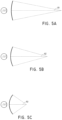
- Figures 5A-5C illustrate relationships between distance and the divergence of light rays.
- the distance between the object and the eye 210 is represented by, in order of decreasing distance, R1, R2, and R3.
- R1, R2, and R3 As shown in Figures 5A-5C , the light rays become more divergent as distance to the object decreases. As distance increases, the light rays become more collimated. Stated another way, it may be said that the light field produced by a point (the object or a part of the object) has a spherical wavefront curvature, which is a function of how far away the point is from the eye of the user.
- the curvature increases with decreasing distance between the object and the eye 210. Consequently, at different depth planes, the degree of divergence of light rays is also different, with the degree of divergence increasing with decreasing distance between depth planes and the viewer's eye 210. While only a single eye 210 is illustrated for clarity of illustration in Figures 5A-5C and other figures herein, it will be appreciated that the discussions regarding eye 210 may be applied to both eyes 210 and 220 of a viewer.
- the human eye typically can interpret a finite number of depth planes to provide depth perception. Consequently, a highly believable simulation of perceived depth may be achieved by providing, to the eye, different presentations of an image corresponding to each of these limited number of depth planes.
- the different presentations may be separately focused by the viewer's eyes, thereby helping to provide the user with depth cues based on the accommodation of the eye required to bring into focus different image features for the scene located on different depth plane and/or based on observing different image features on different depth planes being out of focus.
- FIG. 6 illustrates an example of a waveguide stack for outputting image information to a user.
- a display system 250 includes a stack of waveguides, or stacked waveguide assembly, 260 that may be utilized to provide three-dimensional perception to the eye/brain using a plurality of waveguides 270, 280, 290, 300, 310.
- the display system 250 is the system 60 of Figure 2 , with Figure 6 schematically showing some parts of that system 60 in greater detail.
- the waveguide assembly 260 may be part of the display 70 of Figure 2 .
- the display system 250 may be considered a light field display in some embodiments.
- the waveguide assembly 260 may also be referred to as an eyepiece.
- the waveguide assembly 260 may also include a plurality of features 320, 330, 340, 350 between the waveguides.
- the features 320, 330, 340, 350 may be one or more lenses.
- the waveguides 270, 280, 290, 300, 310 and/or the plurality of lenses 320, 330, 340, 350 may be configured to send image information to the eye with various levels of wavefront curvature or light ray divergence. Each waveguide level may be associated with a particular depth plane and may be configured to output image information corresponding to that depth plane.
- Image injection devices 360, 370, 380, 390, 400 may function as a source of light for the waveguides and may be utilized to inject image information into the waveguides 270, 280, 290, 300, 310, each of which may be configured, as described herein, to distribute incoming light across each respective waveguide, for output toward the eye 210.
- the each of the input surfaces 460, 470, 480, 490, 500 may be an edge of a corresponding waveguide, or may be part of a major surface of the corresponding waveguide (that is, one of the waveguide surfaces directly facing the world 510 or the viewer's eye 210).
- a single beam of light e.g. a collimated beam
- a single one of the image injection devices 360, 370, 380, 390, 400 may be associated with and inject light into a plurality (e.g., three) of the waveguides 270, 280, 290, 300, 310.
- the image injection devices 360, 370, 380, 390, 400 are discrete displays that each produce image information for injection into a corresponding waveguide 270, 280, 290, 300, 310, respectively.
- the image injection devices 360, 370, 380, 390, 400 are the output ends of a single multiplexed display which may, e.g., pipe image information via one or more optical conduits (such as fiber optic cables) to each of the image injection devices 360, 370, 380, 390, 400.
- the image information provided by the image injection devices 360, 370, 380, 390, 400 may include light of different wavelengths, or colors (e.g., different component colors, as discussed herein).
- the light injected into the waveguides 270, 280, 290, 300, 310 is provided by a light projector system 520, which comprises a light module 540, which may include a light emitter, such as a light emitting diode (LED).
- the light from the light module 540 may be directed to and modified by a light modulator 530, e.g., a spatial light modulator, via a beam splitter 550.
- the light modulator 530 may be configured to change the perceived intensity of the light injected into the waveguides 270, 280, 290, 300, 310.
- Examples of spatial light modulators include liquid crystal displays (LCD) including a liquid crystal on silicon (LCOS) displays.
- image injection devices 360, 370, 380, 390, 400 are illustrated schematically and, in some embodiments, these image injection devices may represent different light paths and locations in a common projection system configured to output light into associated ones of the waveguides 270, 280, 290, 300, 310.
- the display system 250 may be a scanning fiber display comprising one or more scanning fibers configured to project light in various patterns (e.g., raster scan, spiral scan, Lissajous patterns, etc.) into one or more waveguides 270, 280, 290, 300, 310 and ultimately to the eye 210 of the viewer.
- the illustrated image injection devices 360, 370, 380, 390, 400 may schematically represent a single scanning fiber or a bundle of scanning fibers configured to inject light into one or a plurality of the waveguides 270, 280, 290, 300, 310.
- the illustrated image injection devices 360, 370, 380, 390, 400 may schematically represent a plurality of scanning fibers or a plurality of bundles of scanning fibers, each of which are configured to inject light into an associated one of the waveguides 270, 280, 290, 300, 310. It will be appreciated that one or more optical fibers may be configured to transmit light from the light module 540 to the one or more waveguides 270, 280, 290, 300, 310.
- one or more intervening optical structures may be provided between the scanning fiber, or fibers, and the one or more waveguides 270, 280, 290, 300, 310 to, e.g., redirect light exiting the scanning fiber into the one or more waveguides 270, 280, 290, 300, 310.
- a controller 560 controls the operation of one or more of the stacked waveguide assembly 260, including operation of the image injection devices 360, 370, 380, 390, 400, the light source 540, and the light modulator 530.
- the controller 560 is part of the local data processing module 140.
- the controller 560 includes programming (e.g., instructions in a non-transitory medium) that regulates the timing and provision of image information to the waveguides 270, 280, 290, 300, 310 according to, e.g., any of the various schemes disclosed herein.
- the controller may be a single integral device, or a distributed system connected by wired or wireless communication channels.
- the controller 560 may be part of the processing modules 140 or 150 ( Figure 2 ) in some embodiments.
- the waveguides 270, 280, 290, 300, 310 may be configured to propagate light within each respective waveguide by total internal reflection (TIR).
- the waveguides 270, 280, 290, 300, 310 may each be planar or have another shape (e.g., curved), with major top and bottom surfaces and edges extending between those major top and bottom surfaces.
- the waveguides 270, 280, 290, 300, 310 may each include out-coupling optical elements 570, 580, 590, 600, 610 that are configured to extract light out of a waveguide by redirecting the light, propagating within each respective waveguide, out of the waveguide to output image information to the eye 210.
- Extracted light may also be referred to as out-coupled light and the out-coupling optical elements light may also be referred to light extracting optical elements.
- An extracted beam of light may be outputted by the waveguide at locations at which the light propagating in the waveguide strikes a light extracting optical element.
- the out-coupling optical elements 570, 580, 590, 600, 610 may, for example, be gratings, including diffractive optical features, as discussed further herein.
- the out-coupling optical elements 570, 580, 590, 600, 610 may be disposed at the top and/or bottom major surfaces, and/or may be disposed directly in the volume of the waveguides 270, 280, 290, 300, 310, as discussed further herein.
- the out-coupling optical elements 570, 580, 590, 600, 610 may be formed in a layer of material that is attached to a transparent substrate to form the waveguides 270, 280, 290, 300, 310.
- the waveguides 270, 280, 290, 300, 310 may be a monolithic piece of material and the out-coupling optical elements 570, 580, 590, 600, 610 may be formed on a surface and/or in the interior of that piece of material.
- each waveguide 270, 280, 290, 300, 310 is configured to output light to form an image corresponding to a particular depth plane.
- the waveguide 270 nearest the eye may be configured to deliver collimated light (which was injected into such waveguide 270), to the eye 210.
- the collimated light may be representative of the optical infinity focal plane.
- the next waveguide up 280 may be configured to send out collimated light which passes through the first lens 350 (e.g., a negative lens) before it can reach the eye 210; such first lens 350 may be configured to create a slight convex wavefront curvature so that the eye/brain interprets light coming from that next waveguide up 280 as coming from a first focal plane closer inward toward the eye 210 from optical infinity.
- first lens 350 e.g., a negative lens
- the third up waveguide 290 passes its output light through both the first 350 and second 340 lenses before reaching the eye 210; the combined optical power of the first 350 and second 340 lenses may be configured to create another incremental amount of wavefront curvature so that the eye/brain interprets light coming from the third waveguide 290 as coming from a second focal plane that is even closer inward toward the person from optical infinity than was light from the next waveguide up 280.
- the other waveguide layers 300, 310 and lenses 330, 320 are similarly configured, with the highest waveguide 310 in the stack sending its output through all of the lenses between it and the eye for an aggregate focal power representative of the closest focal plane to the person.
- a compensating lens layer 620 may be disposed at the top of the stack to compensate for the aggregate power of the lens stack 320, 330, 340, 350 below.
- Such a configuration provides as many perceived focal planes as there are available waveguide/lens pairings.
- Both the out-coupling optical elements of the waveguides and the focusing aspects of the lenses may be static (i.e., not dynamic or electro-active). In some alternative embodiments, either or both may be dynamic using electro-active features.
- two or more of the waveguides 270, 280, 290, 300, 310 may have the same associated depth plane.
- multiple waveguides 270, 280, 290, 300, 310 may be configured to output images set to the same depth plane, or multiple subsets of the waveguides 270, 280, 290, 300, 310 may be configured to output images set to the same plurality of depth planes, with one set for each depth plane. This can provide advantages for forming a tiled image to provide an expanded field of view at those depth planes.
- the out-coupling optical elements 570, 580, 590, 600, 610 may be configured to both redirect light out of their respective waveguides and to output this light with the appropriate amount of divergence or collimation for a particular depth plane associated with the waveguide.
- waveguides having different associated depth planes may have different configurations of out-coupling optical elements 570, 580, 590, 600, 610, which output light with a different amount of divergence depending on the associated depth plane.
- the light extracting optical elements 570, 580, 590, 600, 610 may be volumetric or surface features, which may be configured to output light at specific angles.
- the light extracting optical elements 570, 580, 590, 600, 610 may be volume holograms, surface holograms, and/or diffraction gratings.
- the features 320, 330, 340, 350 may not be lenses; rather, they may simply be spacers (e.g., cladding layers and/or structures for forming air gaps).
- the out-coupling optical elements 570, 580, 590, 600, 610 are diffractive features that form a diffraction pattern, or "diffractive optical element" (also referred to herein as a "DOE").
- the DOE's have a sufficiently low diffraction efficiency so that only a portion of the light of the beam is deflected away toward the eye 210 with each intersection of the DOE, while the rest continues to move through a waveguide via TIR.
- the light carrying the image information is thus divided into a number of related exit beams that exit the waveguide at a multiplicity of locations and the result is a fairly uniform pattern of exit emission toward the eye 210 for this particular collimated beam bouncing around within a waveguide.
- one or more DOEs may be switchable between "on” states in which they actively diffract, and "off” states in which they do not significantly diffract.
- a switchable DOE may comprise a layer of polymer dispersed liquid crystal, in which microdroplets comprise a diffraction pattern in a host medium, and the refractive index of the microdroplets may be switched to substantially match the refractive index of the host material (in which case the pattern does not appreciably diffract incident light) or the microdroplet may be switched to an index that does not match that of the host medium (in which case the pattern actively diffracts incident light).
- a camera assembly 630 may be provided to capture images of the eye 210 and/or tissue around the eye 210 to, e.g., detect user inputs and/or to monitor the physiological state of the user.
- a camera may be any image capture device.
- the camera assembly 630 may include an image capture device and a light source to project light (e.g., infrared light) to the eye, which may then be reflected by the eye and detected by the image capture device.
- the camera assembly 630 may be attached to the frame 80 ( Figure 2 ) and may be in electrical communication with the processing modules 140 and/or 150, which may process image information from the camera assembly 630. In some embodiments, one camera assembly 630 may be utilized for each eye, to separately monitor each eye.
- FIG. 7 an example of exit beams outputted by a waveguide is shown.
- One waveguide is illustrated, but it will be appreciated that other waveguides in the waveguide assembly 260 ( Figure 6 ) may function similarly, where the waveguide assembly 260 includes multiple waveguides.
- Light 640 is injected into the waveguide 270 at the input surface 460 of the waveguide 270 and propagates within the waveguide 270 by TIR. At points where the light 640 impinges on the DOE 570, a portion of the light exits the waveguide as exit beams 650.
- the exit beams 650 are illustrated as substantially parallel but, as discussed herein, they may also be redirected to propagate to the eye 210 at an angle (e.g., forming divergent exit beams), depending on the depth plane associated with the waveguide 270. It will be appreciated that substantially parallel exit beams may be indicative of a waveguide with out-coupling optical elements that out-couple light to form images that appear to be set on a depth plane at a large distance (e.g., optical infinity) from the eye 210.
- waveguides or other sets of out-coupling optical elements may output an exit beam pattern that is more divergent, which would require the eye 210 to accommodate to a closer distance to bring it into focus on the retina and would be interpreted by the brain as light from a distance closer to the eye 210 than optical infinity.
- a full color image may be formed at each depth plane by overlaying images in each of the component colors, e.g., three or more component colors.
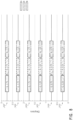
- Figure 8 illustrates an example of a stacked waveguide assembly in which each depth plane includes images formed using multiple different component colors.
- the illustrated embodiment shows depth planes 240a - 240f, although more or fewer depths are also contemplated.
- Each depth plane may have three or more component color images associated with it, including: a first image of a first color, G; a second image of a second color, R; and a third image of a third color, B.
- Different depth planes are indicated in the figure by different numbers for diopters (dpt) following the letters G, R, and B.
- the numbers following each of these letters indicate diopters (1/m), or inverse distance of the depth plane from a viewer, and each box in the figures represents an individual component color image.
- the exact placement of the depth planes for different component colors may vary. For example, different component color images for a given depth plane may be placed on depth planes corresponding to different distances from the user. Such an arrangement may increase visual acuity and user comfort and/or may decrease chromatic aberrations.
- each depth plane may have multiple waveguides associated with it.
- each box in the figures including the letters G, R, or B may be understood to represent an individual waveguide, and three waveguides may be provided per depth plane where three component color images are provided per depth plane. While the waveguides associated with each depth plane are shown adjacent to one another in this drawing for ease of description, it will be appreciated that, in a physical device, the waveguides may all be arranged in a stack with one waveguide per level. In some other embodiments, multiple component colors may be outputted by the same waveguide, such that, e.g., only a single waveguide may be provided per depth plane.
- G is the color green
- R is the color red
- B is the color blue.
- other colors associated with other wavelengths of light including magenta and cyan, may be used in addition to or may replace one or more of red, green, or blue.
- references to a given color of light throughout this disclosure will be understood to encompass light of one or more wavelengths within a range of wavelengths of light that are perceived by a viewer as being of that given color.
- red light may include light of one or more wavelengths in the range of about 620-780 nm
- green light may include light of one or more wavelengths in the range of about 492-577 nm
- blue light may include light of one or more wavelengths in the range of about 435-493 nm.
- the light source 540 ( Figure 6 ) may be configured to emit light of one or more wavelengths outside the visual perception range of the viewer, for example, infrared and/or ultraviolet wavelengths.
- the in-coupling, out-coupling, and other light redirecting structures of the waveguides of the display 250 may be configured to direct and emit this light out of the display towards the user's eye 210, e.g., for imaging and/or user stimulation applications.
- FIG. 9A illustrates a cross-sectional side view of an example of a plurality or set 660 of stacked waveguides that each includes an in-coupling optical element.
- the waveguides may each be configured to output light of one or more different wavelengths, or one or more different ranges of wavelengths.
- the stack 660 may correspond to the stack 260 ( Figure 6 ) and the illustrated waveguides of the stack 660 may correspond to part of the plurality of waveguides 270, 280, 290, 300, 310, except that light from one or more of the image injection devices 360, 370, 380, 390, 400 is injected into the waveguides from a position that requires light to be redirected for in-coupling.
- the illustrated set 660 of stacked waveguides includes waveguides 670, 680, and 690.
- Each waveguide includes an associated in-coupling optical element (which may also be referred to as a light input area on the waveguide), with, e.g., in-coupling optical element 700 disposed on a major surface (e.g., an upper major surface) of waveguide 670, in-coupling optical element 710 disposed on a major surface (e.g., an upper major surface) of waveguide 680, and in-coupling optical element 720 disposed on a major surface (e.g., an upper major surface) of waveguide 690.
- in-coupling optical element 700 disposed on a major surface (e.g., an upper major surface) of waveguide 670
- in-coupling optical element 710 disposed on a major surface (e.g., an upper major surface) of waveguide 680
- in-coupling optical element 720 disposed on a major surface (e.g., an upper major surface
- one or more of the in-coupling optical elements 700, 710, 720 may be disposed on the bottom major surface of the respective waveguide 670, 680, 690 (particularly where the one or more in-coupling optical elements are reflective, deflecting optical elements). As illustrated, the in-coupling optical elements 700, 710, 720 may be disposed on the upper major surface of their respective waveguide 670, 680, 690 (or the top of the next lower waveguide), particularly where those in-coupling optical elements are transmissive, deflecting optical elements. In some embodiments, the in-coupling optical elements 700, 710, 720 may be disposed in the body of the respective waveguide 670, 680, 690.
- the in-coupling optical elements 700, 710, 720 are wavelength selective, such that they selectively redirect one or more wavelengths of light, while transmitting other wavelengths of light. While illustrated on one side or corner of their respective waveguide 670, 680, 690, it will be appreciated that the in-coupling optical elements 700, 710, 720 may be disposed in other areas of their respective waveguide 670, 680, 690 in some embodiments.
- each in-coupling optical element 700, 710, 720 may be laterally offset from one another.
- each in-coupling optical element may be offset such that it receives light without that light passing through another in-coupling optical element.
- each in-coupling optical element 700, 710, 720 may be configured to receive light from a different image injection device 360, 370, 380, 390, and 400 as shown in Figure 6 , and may be separated (e.g., laterally spaced apart) from other in-coupling optical elements 700, 710, 720 such that it substantially does not receive light from the other ones of the in-coupling optical elements 700, 710, 720.
- Each waveguide also includes associated light distributing elements, with, e.g., light distributing elements 730 disposed on a major surface (e.g., a top major surface) of waveguide 670, light distributing elements 740 disposed on a major surface (e.g., a top major surface) of waveguide 680, and light distributing elements 750 disposed on a major surface (e.g., a top major surface) of waveguide 690.
- the light distributing elements 730, 740, 750 may be disposed on a bottom major surface of associated waveguides 670, 680, 690, respectively.
- the light distributing elements 730, 740, 750 may be disposed on both top and bottom major surface of associated waveguides 670, 680, 690, respectively; or the light distributing elements 730, 740, 750, may be disposed on different ones of the top and bottom major surfaces in different associated waveguides 670, 680, 690, respectively.
- the waveguides 670, 680, 690 may be spaced apart and separated by, e.g., gas, liquid, and/or solid layers of material.
- layer 760a may separate waveguides 670 and 680; and layer 760b may separate waveguides 680 and 690.
- the layers 760a and 760b are formed of low refractive index materials (that is, materials having a lower refractive index than the material forming the immediately adjacent one of waveguides 670, 680, 690).
- the refractive index of the material forming the layers 760a, 760b is 0.05 or more, or 0.10 or less than the refractive index of the material forming the waveguides 670, 680, 690.
- the lower refractive index layers 760a, 760b may function as cladding layers that facilitate total internal reflection (TIR) of light through the waveguides 670, 680, 690 (e.g., TIR between the top and bottom major surfaces of each waveguide).
- TIR total internal reflection
- the layers 760a, 760b are formed of air. While not illustrated, it will be appreciated that the top and bottom of the illustrated set 660 of waveguides may include immediately neighboring cladding layers.
- the material forming the waveguides 670, 680, 690 are similar or the same, and the material forming the layers 760a, 760b are similar or the same.
- the material forming the waveguides 670, 680, 690 may be different between one or more waveguides, and/or the material forming the layers 760a, 760b may be different, while still holding to the various refractive index relationships noted above.
- light rays 770, 780, 790 are incident on the set 660 of waveguides. It will be appreciated that the light rays 770, 780, 790 may be injected into the waveguides 670, 680, 690 by one or more image injection devices 360, 370, 380, 390, 400 ( Figure 6 ).
- the light rays 770, 780, 790 have different properties, e.g., different wavelengths or different ranges of wavelengths, which may correspond to different colors.
- the in-coupling optical elements 700, 710, 720 each deflect the incident light such that the light propagates through a respective one of the waveguides 670, 680, 690 by TIR.
- the incoupling optical elements 700, 710, 720 each selectively deflect one or more particular wavelengths of light, while transmitting other wavelengths to an underlying waveguide and associated incoupling optical element.
- in-coupling optical element 700 may be configured to deflect ray 770, which has a first wavelength or range of wavelengths, while transmitting rays 780 and 790, which have different second and third wavelengths or ranges of wavelengths, respectively.
- the transmitted ray 780 impinges on and is deflected by the in-coupling optical element 710, which is configured to deflect light of a second wavelength or range of wavelengths.
- the ray 790 is deflected by the in-coupling optical element 720, which is configured to selectively deflect light of third wavelength or range of wavelengths.
- the deflected light rays 770, 780, 790 are deflected so that they propagate through a corresponding waveguide 670, 680, 690; that is, the in-coupling optical elements 700, 710, 720 of each waveguide deflects light into that corresponding waveguide 670, 680, 690 to in-couple light into that corresponding waveguide.
- the light rays 770, 780, 790 are deflected at angles that cause the light to propagate through the respective waveguide 670, 680, 690 by TIR.
- the light rays 770, 780, 790 propagate through the respective waveguide 670, 680, 690 by TIR until impinging on the waveguide's corresponding light distributing elements 730, 740, 750.
- FIG. 9B a perspective view of an example of the plurality of stacked waveguides of Figure 9A is illustrated.
- the in-coupled light rays 770, 780, 790 are deflected by the in-coupling optical elements 700, 710, 720, respectively, and then propagate by TIR within the waveguides 670, 680, 690, respectively.
- the light rays 770, 780, 790 then impinge on the light distributing elements 730, 740, 750, respectively.
- the light distributing elements 730, 740, 750 deflect the light rays 770, 780, 790 so that they propagate towards the out-coupling optical elements 800, 810, 820, respectively.
- the light distributing elements 730, 740, 750 are orthogonal pupil expanders (OPE's).
- OPE's deflect or distribute light to the out-coupling optical elements 800, 810, 820 and, in some embodiments, may also increase the beam or spot size of this light as it propagates to the out-coupling optical elements.
- the light distributing elements 730, 740, 750 may be omitted and the in-coupling optical elements 700, 710, 720 may be configured to deflect light directly to the out-coupling optical elements 800, 810, 820.
- the light distributing elements 730, 740, 750 may be replaced with out-coupling optical elements 800, 810, 820, respectively.
- the out-coupling optical elements 800, 810, 820 are exit pupils (EP's) or exit pupil expanders (EPE's) that direct light in a viewer's eye 210 ( Figure 7 ).
- the OPE's may be configured to increase the dimensions of the eye box in at least one axis and the EPE's may be to increase the eye box in an axis crossing, e.g., orthogonal to, the axis of the OPEs.
- each OPE may be configured to redirect a portion of the light striking the OPE to an EPE of the same waveguide, while allowing the remaining portion of the light to continue to propagate down the waveguide.
- another portion of the remaining light is redirected to the EPE, and the remaining portion of that portion continues to propagate further down the waveguide, and so on.
- a portion of the impinging light is directed out of the waveguide towards the user, and a remaining portion of that light continues to propagate through the waveguide until it strikes the EP again, at which time another portion of the impinging light is directed out of the waveguide, and so on.
- a single beam of incoupled light may be "replicated" each time a portion of that light is redirected by an OPE or EPE, thereby forming a field of cloned beams of light, as shown in Figure 6 .
- the OPE and/or EPE may be configured to modify a size of the beams of light.
- the set 660 of waveguides includes waveguides 670, 680, 690; in-coupling optical elements 700, 710, 720; light distributing elements (e.g., OPE's) 730, 740, 750; and out-coupling optical elements (e.g., EP's) 800, 810, 820 for each component color.
- the waveguides 670, 680, 690 may be stacked with an air gap/cladding layer between each one.
- the in-coupling optical elements 700, 710, 720 redirect or deflect incident light (with different in-coupling optical elements receiving light of different wavelengths) into its waveguide.
- light ray 770 (e.g., blue light) is deflected by the first in-coupling optical element 700, and then continues to bounce down the waveguide, interacting with the light distributing element (e.g., OPE's) 730 and then the out-coupling optical element (e.g., EPs) 800, in a manner described earlier.
- the light rays 780 and 790 (e.g., green and red light, respectively) will pass through the waveguide 670, with light ray 780 impinging on and being deflected by in-coupling optical element 710.
- the light ray 780 then bounces down the waveguide 680 via TIR, proceeding on to its light distributing element (e.g., OPEs) 740 and then the out-coupling optical element (e.g., EP's) 810.
- light ray 790 (e.g., red light) passes through the waveguide 690 to impinge on the light in-coupling optical elements 720 of the waveguide 690.
- the light in-coupling optical elements 720 deflect the light ray 790 such that the light ray propagates to light distributing element (e.g., OPEs) 750 by TIR, and then to the out-coupling optical element (e.g., EPs) 820 by TIR.
- the out-coupling optical element 820 then finally out-couples the light ray 790 to the viewer, who also receives the out-coupled light from the other waveguides 670, 680.
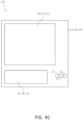
- Figure 9C illustrates a top-down plan view of an example of the plurality of stacked waveguides of Figures 9A and 9B .
- the waveguides 670, 680, 690, along with each waveguide's associated light distributing element 730, 740, 750 and associated out-coupling optical element 800, 810, 820 may be vertically aligned.
- the in-coupling optical elements 700, 710, 720 are not vertically aligned; rather, the in-coupling optical elements are preferably non-overlapping (e.g., laterally spaced apart as seen in the top-down view).
- this nonoverlapping spatial arrangement facilitates the injection of light from different resources into different waveguides on a one-to-one basis, thereby allowing a specific light source to be uniquely coupled to a specific waveguide.
- arrangements including nonoverlapping spatially-separated in-coupling optical elements may be referred to as a shifted pupil system, and the in-coupling optical elements within these arrangements may correspond to sub pupils.
- head mounted displays can be used to provide image content to a user integrated with, in conjunction with, and/or superimposed over the view of the world in front of the wearer.
- Such head mounted display systems can be configured to project light into an eye of a user to form augmented reality image content as well as to transmit light from an environment in front of the user to the user.
- a head mounted display system may include one or more cameras for imaging the environment and/or the user's eye. Outward facing cameras may be used for directly imaging the environment, for example, to determine where to place augmented reality image content with respect to objects in the environment. For example, imaging the environment may provide the location of a table such that the head mounted display may render an image of person standing next to the table instead of on the table or in the table.
- Inward-facing cameras may be used for directly imaging the eye such as for eye tracking.
- head-mounted display systems and/or imaging systems that can be configured also to image the eye and/or the environment. In some designs, the systems do not require inward and/or outward facing cameras to directly image the eye and/or environment, respectively.
- Such systems may employ one or more cameras that are configured to receive light from the eye/environment via the eyepiece such as one or more waveguides in the eyepiece that are in optical communication with the one or more cameras. With the light collected by the waveguide(s), the one or more cameras can generate images of the eye and/or the environment in front of the user.
- Using the waveguide to collect the light for imaging the eye and/or environment may potentially reduce the form factor of the head mounted display, making the head mounted display possibly more compact and/or aesthetically desirable.
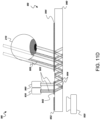
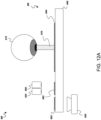
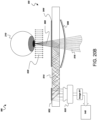
- Figure 10 illustrates an example imaging system 900 configured to image the eye that is integrated with an eyepiece 950 that can be used on in head mounted display.
- the eyepiece 950 which can be disposed in front of the user's eye 210 can be used to both inject image content into the eye as well as image the eye.
- Figure 10 shows one eyepiece 950 in front of one eye 210.
- Various head mounted display systems such as shown in Figure 2 , may include a pair of eyepieces 950 and associated components disposed in front of respective left and right eyes 210.
- a single waveguide 940 is shown in Figure 10 , but the waveguide 940 may include one, two, three, four, six, seven, eight, or more waveguides (e.g., one or more stacks of waveguides).
- the imaging system 900 can include a light source or illumination source 960 illuminating the eye to facilitate image capture, the eyepiece 950 comprising a waveguide 940 configured to propagate light therein, and/or an imaging device 920 such as a camera for image capture.
- An image projector 930 for producing an image that can be injected into the eye via the eyepiece 950 is also shown.
- the eyepiece 950 may include one or more waveguides 940 configured to transport light from the illumination source 960 and/or image projector 930 to the eye and to transport light from the eye to the camera 920.
- the eyepiece 950 may further comprise one or more coupling optical elements 944 for coupling light out of the waveguide 940 and to the eye for illuminating the eye and for image injection and/or from the eye and into the waveguide for image capture.
- the eyepiece 950 may additionally comprise one or more incoupling optical elements 942 for coupling light from the illumination source 960 and/or image projector 930 into the waveguides 940 as well as one or more outcoupling optical elements 952 for coupling light from the waveguide out to the camera 920.
- the eyepiece 950 may be disposed on a frame wearable on the head.
- the eyepiece 950 may be disposed in front of the eye 210.
- the eyepiece 950 may have a medial or nasal side closer to the nose of the wearer and an opposite lateral or temporal side closer to the temples and farther from the nose of the wearer.
- the coupling optical element 944 is medial or nasal with respect to the incoupling 942 and outcoupling 952 optical elements (which are lateral or temporal to the coupling optical elements 944).
- the illumination source 960 is also more medial or nasal with respect to the image projector 930 (or the image projector is more lateral or temporal than the illumination source.)
- the relative positions can be different, however.
- the illumination source 960 may be more lateral or temporal than the image projector 930 in some designs.
- the waveguide 940 may comprise a sheet or layer having two major surfaces (a forward and a rearward surface), having the largest surface areas, disposed opposite one another.
- the forward surface may be farther from the user's eye 210 (closer to the environment in front of the wearer) and the rearward closer to the user's eye (and farther from the environment in front of the wearer) when the user wears the head mounted display.
- the waveguide 940 may comprise a transparent material with an index of refraction greater than 1.0 (e.g., glass, plastic) such that light may be guided therein by total internal reflection between the major surfaces. Elements with the same numbers may have the same functionality for one or more of the embodiments described herein.
- a coupling optical element 944 for coupling light to the eye 210 from waveguide 940 and/or from the waveguide to the eye may be disposed on or in the waveguide 940.
- the coupling optical element 944 may be disposed in an optical path between the user's eye 210 and the waveguide 940 such that light coupled from the waveguide 940 via the coupling optical element 944 may be incident on the user's eye 210 (for example to illuminate the eye and/or for image injection).
- the coupling optical element 944 may comprise a plurality of turning features configured to turn light guided within the waveguide out of the waveguide or turn light incident on the coupling optical element 944 at an angle into the waveguide to be guided therein by total internal reflection.
- the coupling optical element 944 and turning features may be in physical engagement with the waveguide 940.
- the coupling optical element 944 may comprise a holographic or diffractive optical element (e.g., surface relief grating) patterned (e.g., etched) in or on the waveguide 940.
- the coupling optical element 944 may comprise a layer disposed on the waveguide 940 or may be formed in the waveguide 940.
- a volume holographic or other diffractive optical element may be formed by changing the index of refraction of material comprising the waveguide or a layer disposed thereon. Accordingly, the coupling optical element 944 may be disposed in the volume of the waveguide 940 or as a layer disposed thereon.
- the coupling optical element 944 may be transmissive or reflective and may operate in transmission or reflection.
- the coupling optical element 944 may include a transmissive or reflective diffractive optical element (e.g., grating) or holographical optical element that operates in transmission or reflection respectively, e.g., turning light via that is transmitted therethrough or that is reflected therefrom.
- the coupling optical element 944 can include a polarization optical element, such as a polarization selective turning element (e.g., polarizer).
- the polarization selective turning element may include one or more polarization gratings, diffractive optical elements, and/or holographic optical elements and may comprise liquid crystal structures such as liquid crystal polarization gratings.
- the coupling optical element 944 may be configured to direct light from the image projector 930 and/or light source 960 guided within the waveguide 940 by total internal reflection (TIR) to the user's eye 210 at an angle less than (e.g., more normal) than the critical angle so as to be ejected out of the waveguide to the eye. Additionally or in the alternative, the coupling optical element 944 may be configured to couple light from the eye 210 into the waveguide 940 at an angle greater (e.g., less normal) than the critical angle so as to be guided therein by total internal reflection to the camera 920.
- TIR total internal reflection
- an incoupling optical element 942 for coupling light from the illumination source 960 and/or the image projector 930 into the waveguide 940 may be disposed on or in the waveguide 940.
- the incoupling optical element 942 may be disposed in an optical path between the light source 960 and the waveguide 940 such that light coupled from the light source 960 via the incoupling optical element 942 is guided within the waveguide 940.
- the incoupling optical element 942 may comprise, for example, a plurality of turning features configured to turn light incident thereon at an angle into the waveguide to be guided therein by total internal reflection.
- the incoupling optical element 942 may comprise liquid crystal structures such as liquid crystal polarization gratings.
- the incoupling optical element 942 may include a blazed grating.
- the incoupling optical element 942 may comprise a layer disposed on the waveguide 940 or may be formed on or in the waveguide 940 (e.g., patterned) or may be otherwise manufactured therein.
- a surface holographic or diffractive optical element e.g., surface relief grating
- a volume holographic or diffractive optical element may also be formed by changing the index of refraction of material comprising the waveguide or a layer disposed thereon.
- the incoupling optical element 942 may be disposed in the volume of the waveguide 940 or a layer disposed thereon.
- the incoupling optical element 942 may be transmissive or reflective and may operate in transmission or reflection.
- the incoupling optical element 942 may include a transmissive or reflective diffractive optical element (e.g., grating) or holographical optical element that operates in transmission or reflection, respectively, e.g., turning light that is transmitted therethrough or that is reflected therefrom.
- the incoupling optical element 942 may comprise a reflective optical element (e.g., mirror).
- the incoupling optical element 942 may comprise an off-axis reflector.
- the incoupling optical element 942 and/or coupling optical element 944 can include a polarization optical element, such as a polarization selective turning element (e.g., polarizer).
- the polarization selective turning element may include one or more polarization gratings, diffractive optical elements, and/or holographic optical elements and may comprise liquid crystal structures such as liquid crystal polarization gratings.
- one or both of the incoupling optical element 942 and/or the coupling optical element 944 can include liquid crystal polarization gratings (LCPGs).
- LCPGs liquid crystal polarization gratings
- LCPGs can provide high efficiency diffraction potentially at broad wavelengths. Accordingly, LCPGs may be useful for incoupling optical elements 942 and/or the coupling optical element 944.
- the LCPG may be polarization dependent.
- the LCPG or other type of liquid crystal grating, diffractive optical element, or optical element may include a pattern or arrangement of molecules of liquid crystal configured to provide one or more functions such as turn light into a waveguide or out of a waveguide.
- incoupling optical element 942 and/or the coupling optical element 944 may comprise polarization gratings.
- incoupling optical element 942 and/or the coupling optical element 944 can comprises liquid crystal and thus in some implementations one or both may be liquid crystal gratings or liquid crystal diffractive optical elements. Additionally or alternatively, one or both of the incoupling optical element 942 and/or the coupling optical element 944 can include a blazed grating. In some designs, the incoupling optical element 942 comprises a liquid crystal reflector, such as a cholesteric liquid crystal reflective lens (e.g., reflective liquid crystal diffraction lens, Bragg-reflective structure, reflective liquid crystal diffraction grating, etc.).
- a cholesteric liquid crystal reflective lens e.g., reflective liquid crystal diffraction lens, Bragg-reflective structure, reflective liquid crystal diffraction grating, etc.
- liquid crystal gratings Some nonlimiting examples of liquid crystal gratings, liquid crystal polarization gratings and other liquid crystal optical elements are discussed in the following published applications: U.S. Publication No. 2018/0143438, titled “MULTILAYER LIQUID CRYSTAL DIFFRACTIVE GRATINGS FOR REDIRECTING LIGHT OF WIDE INCIDENT ANGLE RANGES,” filed on November 16, 2017 ; U.S. Publication No. 2018/0143485, titled “SPATIALLY VARIABLE LIQUID CRYSTAL DIFFRACTION GRATINGS,” filed on November 16, 2017 ; U.S. Publication No.
- 2018/0143509 titled “WAVEGUIDE LIGHT MULTIPLEXER USING CROSSED GRATINGS,” filed on November 16, 2017 ;
- U.S. Publication No. 2018/0239147 titled “DISPLAY SYSTEM WITH VARIABLE POWER REFLECTOR,” filed on February 22, 2018 ;
- U.S. Publication No. 2018/0239177 titled “VARIABLE-FOCUS VIRTUAL IMAGE DEVICES BASED ON POLARIZATION CONVERSION,” filed on February 22, 2018 ;
- U.S. Publication No. 2018/0164627 titled “DIFFRACTIVE DEVICES BASED ON CHOLESTERIC LIQUID CRYSTAL,” filed on December 7, 2017 .
- the designs of the incoupling optical element 942 and/or the coupling optical element 944 are not limited to these and may include other types of optical elements, diffractive optical element, liquid crystal optical element, liquid crystal gratings and liquid crystal polarization gratings. Further information on examples of cholesteric liquid crystal structures such as reflectors may also be found below in in the section titled "Cholesteric Liquid Crystal Mirror.” As discussed above, other liquid crystal optical elements as well as other non-liquid crystal optical elements may be used. Accordingly, many types of coupling optical elements (e.g.
- the incoupling optical element 942 may be configured to couple light from the image projector 930 and/or the light source 960 into the waveguide at an angle greater than the critical angle so as to be guided within the waveguide 940 by total internal reflection to the eye to the user's eye 210.
- the waveguide 940 may comprise one or more waveguides.
- the one or more waveguides 940 comprises a stack of waveguides.
- different waveguides of the stack of waveguides are configured to output light with different wavefront divergence as if projected from different distances from the user's eye.
- a first waveguide or group of waveguides may be configured to output light that is collimated or has a first divergence as if projected from a first depth
- a second waveguide or group of waveguides may be configured to output light that is diverging (not collimated) or is at a second divergence (greater than the first divergence) as if projected from a second depth closer than the first depth.
- the different waveguides may be configured to output light having different associated colors.
- a first waveguide may be configured to output red light
- a second waveguide may be configured to output green light
- a third waveguide may be configured to output blue light
- a fourth waveguide may be configured to output and/or input infrared light.
- the outcoupling optical element 952 for coupling light from the waveguide 940 to the camera 920 such as shown in Figure 10 may comprise, for example, a plurality of turning features configured to turn light incident thereon at an angle such that light is not guided within the waveguide and is turned out of the waveguide to the camera.
- the outcoupling optical element 952 may be disposed within an interior of the waveguide 940 or may be patterned (e.g., etched) in or on a surface (e.g., major surface) of the waveguide 940.
- a surface holographic or diffractive optical element e.g., surface relief grating
- a volume holographic or diffractive optical element may also be formed by changing the index of refraction of material comprising the waveguide or a layer disposed thereon.
- the outcoupling optical element 952 may be transmissive or reflective and may operate in transmission or reflection.
- the outcoupling optical element 952 may include a transmissive or reflective diffractive optical element (e.g., grating) or holographical optical element that operates in transmission or reflection, respectively, e.g., turning light that is transmitted therethrough or that is reflected therefrom.
- the outcoupling optical element 942 may comprise a reflective optical element (e.g., mirror).
- the outcoupling optical element 952 may comprise an off-axis reflector.
- the outcoupling optical element 952 can include a polarization optical element, such as a polarization selective turning element (e.g., polarizer).
- the polarization selective turning element may include one or more polarization gratings, diffractive optical elements, and/or holographic optical elements and may comprise liquid crystal structures such as liquid crystal polarization gratings.
- the outcoupling optical element 952 can include liquid crystal polarization gratings (LCPGs). LCPGs can provide high efficiency diffraction potentially at broad wavelengths.
- LCPGs liquid crystal polarization gratings
- LCPGs may be useful for outcoupling optical element 952.
- the LCPG may be polarization dependent.
- the LCPG or other types of liquid crystal gratings may include a pattern or arrangement of molecules of liquid crystal configured to provide one or more functions such as turn light into a waveguide or out of a waveguide.
- outcoupling optical element 952 may comprise polarization gratings.
- outcoupling optical element 952 can comprises liquid crystal and thus in some implementations may be liquid crystal gratings or other liquid crystal optical element such as liquid crystal diffractive optical elements. Additionally or alternatively, the outcoupling optical element 952 can include a blazed grating.
- the outcoupling optical element 952 comprises a liquid crystal reflector, such as a cholesteric liquid crystal reflective lens (e.g., reflective liquid crystal diffraction lens, Bragg-reflective structure, reflective liquid crystal diffraction grating, etc.).
- a liquid crystal reflector such as a cholesteric liquid crystal reflective lens (e.g., reflective liquid crystal diffraction lens, Bragg-reflective structure, reflective liquid crystal diffraction grating, etc.).
- a liquid crystal reflector such as a cholesteric liquid crystal reflective lens (e.g., reflective liquid crystal diffraction lens, Bragg-reflective structure, reflective liquid crystal diffraction grating, etc.).
- outcoupling optical element 952 is not limited to these and may include other types of optical elements, diffractive optical element, liquid crystal optical element, liquid crystal gratings and liquid crystal polarization gratings. Further information on examples of cholesteric liquid crystal structures such as reflectors may also be found below in the section titled “Cholesteric Liquid Crystal Mirror.” As discussed above, other liquid crystal optical elements as well as other non-liquid crystal optical elements may be used. Accordingly, many types of coupling optical elements (e.g.
- outcoupling optical element 952 diffractive optical element, gratings, polarization gratings, etc., may be used, both those described herein as well as other types of gratings, diffractive optical elements, liquid crystal elements, or optical elements generally.
- the outcoupling optical element 952 may be configured to redirected light guided within the waveguide 940 at an angle less than the critical angle so as not to be guided within the waveguide by total internal reflection but to be ejected out to the camera 920.
- the coupling optical element 944 may be transparent in the visible spectrum such that the user can see through the coupling optical element 944 and the eyepiece 950 to the environment in front of the user.
- the incoupling optical element 942 may also turn light in the visible spectrum, for example, if the incoupling optical element is used to receive light from the image projector 930 and/or if the illumination source 960 is configured to output visible light to illuminate the eye 210 with visible light.
- the incoupling optical element 942 is configured to turn infrared light, for example, if the illumination source 960 is configured to output infrared light to illuminate the eye 210 with infrared light.
- the incoupling optical element 942 may be more medial or nasal than the outcoupling optical element 952. However, in other designs the incoupling optical element 942 may be more lateral or temporal than the outcoupling optical element 952. In certain implementations such as shown in Figure 10 , the outcoupling optical element 952 may be adjacent the incoupling optical element 942 although non-adjacent positioning is possible.
- the illumination source 960 may be disposed on the same side of the eyepiece 950 as the eye 210 (e.g., rearward or proximal side), as shown in Figure 10 . (Proximal may refer to the side closest to the eye 210.) Alternatively, the illumination source 960 may be disposed on the side opposite the eye 210 (e.g., forward or distal side).
- the illumination source 960 may be configured to direct light into at least one of the major surfaces of the waveguide 940 via the incoupling optical element 942.
- the light source 960 may be configured to emit invisible light (e.g., infrared).
- the light source 960 may include one or more LEDs. The LEDs may comprise infrared LEDs.
- the light source 960 may be configured to emit coherent light.
- the light source 960 comprises a laser (e.g., infrared laser).
- the light source 960 emits pulsed light.
- the camera 920 can be configured to capture an image periodically. Accordingly, the illumination source 960 can be pulsed to coincide with the period during which the camera obtains images. The intensity output from the illumination source 960 can be reduced when the camera is not obtaining an image. By concentrating the total energy of the illumination on a short time increased signal to noise can be obtained while not exposing the eye 210 to unsafe intensity levels. In some cases, for example, the camera 920 captures one image every 30 milliseconds and the exposure time of the camera is few milliseconds.
- the illumination source 960 can be configured to output pulses having similar period and duration to match that of the camera 920.
- different light sources having different wavelengths are alternately pulsed to provide different wavelength illumination at different times as discussed below.
- the incoupling optical element 942 may be in direct optical communication with the illumination source 960 and/or image projector 930, for example, so as to guide light from said image projector 930 and/or light source 960 therein.
- light emitted by the light source 960 may be incident on the incoupling optical element 942 before optically interacting with either the coupling optical element 944 and/or outcoupling optical element 952.
- the image projector 930 may include a light source, a modulator, and/or projection optics.
- the light source for the image projector 930 may comprise one or more LEDs, lasers or other light sources and may comprises one or more visible light sources.
- the modulator may comprise a spatial light modulator such as a liquid crystal spatial light modulator. Such a spatial light modulator may be configured, for example, to modulate the intensity of light at different spatial locations.
- the projection optics may comprise one or more lenses.
- Other types of image projectors 930 capable of projecting and/or forming images may be employed.
- the image projector 930 may comprise a scanning optical fiber.
- the image projector 930 and the incoupling optical element 942 may be in direct optical communication with each other.
- the image projector 930 may, for example, be aligned with the incoupling optical element 942 into which light from the image projector 930 is directed.
- image projector 930 is disposed adjacent the corresponding incoupling optical element 942 and/or the waveguide 940.
- the image projector 930 may also be disposed in an optical path that includes the incoupling optical element 942, the coupling optical element 944, and the eye 210.
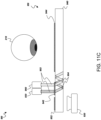
- the image projector 930 may be a separate element than the illumination source 960, as shown in Figure 10 as well as in Figures 11A-11E . However, in some cases the image projector 930 may be used as the illumination source. For example, in addition to injecting images into the eye 210, the image projector 930 may be used to direct visible and/or infrared light into the eye to illuminate the eye for image capture. Alternatively, however, one or more separate light sources 960 may be used to illuminate the eye 210 for image capture.
- the light emitted by the illumination source 960 may comprise a particular wavelength range of light such as, for example, invisible light.
- the illumination source 960 may be configured to project invisible (e.g., infrared) light onto/into the eye 210 for imaging one or more parts (e.g., cornea, retina) of the eye 210.
- the light source 960 may be configured to emit light in the range of between about 850 nm and 940 nm.
- the light source 960 may be configured to emit light extending over a wavelength range of at least about 20 nm. Other ranges are also possible.
- the wavelength range emitted may be 5 nm, 10 nm, 15 nm, 50 nm, 75 nm, 100 nm, 150 nm, 200 nm, or any range between any of these values.
- the light source 960 may be configured to emit light across a broad band of wavelengths, such as any range within the infrared spectrum.
- the imaging device 920 which may comprise a camera, may comprise a detector array and possibly imaging optics.
- the detector array may comprise, for example, a CCD or CMOS detector array and the imaging optics may comprise one or more lenses.
- the one or more lenses may have positive optical power and an associated focal length.
- the camera 920 is focused at infinity.
- the optics may have a focal length, f, and detector array may be disposed a distance away from the optics corresponding to the focal length such that objects at a large distance are imaged onto the detector array.
- light from the eye or objects in the environment that is collimated will be focus on the detector array to form an image of the eye or object thereon.
- the imaging device 920 may be disposed on the opposite side of the waveguide 940 as the illumination source 960 and/or the eye 210. In some designs, the imaging device 920 may be disposed on the same side of the waveguide 940 as the light source 960 and/or eye 210. As shown in Figure 10 , the imaging device 920 may be disposed near a lateral or temporal edge of the eyepiece 950 although other locations are possible.
- Figures 11A-11E illustrate the operation of the example imaging system 900 of Figure 10 .
- Figure 11A shows the illumination source 960 emitting light 902 toward the incoupling optical element 942 on the waveguide 940.
- the light 902 can be directed generally at normal incidence to the eyepiece 950 although other angles are possible.
- the light source 960 is configured to emit collimated light into the eyepiece 950.
- the illumination light 902 can be coupled into the waveguide 940 via the incoupling optical element 942.
- the incoupling optical element 942 comprises a diffractive optical element (e.g., grating, holographic element) the light incident thereon is diffracted at an angle greater than the critical angle of the waveguide to cause the incoupled light 904 to be guided within the eyepiece 950 by total internal reflection (TIR).
- the incoupling optical element 942 may be configured to direct light toward the coupling optical element 944.
- the incoupling optical element 942 may be polarization selective.
- the incoupling optical element 942 can include a polarization selective turning element such a polarization grating like a liquid crystal polarization grating.
- Figure 11C shows how the incoupled light 904 propagating through the waveguide 940 by TIR.
- Figure 11D illustrates an example imaging system 900 coupling light out of the eyepiece 950.
- the coupling optical element 944 can be configured to couple the incoupled light 904 out of the eyepiece 950 and toward the user's eye 210.
- the coupling optical element 944 may be configured to couple the light as collimated light toward the eye 210.
- the coupling optical element 944 may be tuned to light of a particular wavelength range.
- the coupling optical element 944 may be configured to couple infrared light (e.g., between about 700 nm and 15000 nm) out of the waveguide 940.
- the coupling optical element 944 can be configured to couple multiple wavelengths of light out of the eyepiece 950.
- the coupling optical element 944 may be tuned for both infrared and visible light.
- the coupling optical element 944 can also be configured to couple light into the waveguide 940, as described more fully below.
- the coupling optical element 944 can be configured to increase one or more dimensions of an eyebox for a user.
- the one or more dimensions may be measured along a first axis (e.g., x axis).
- the eyepiece 950 may further include an orthogonal pupil expander (OPE).
- OPE orthogonal pupil expander
- the OPE may have at least one light redirecting element disposed on or in the waveguide (e.g., on one of the major surfaces) or the OPE may be disposed within the waveguide 940.
- the OPE may include features similar or identical to those described above for light distributing elements 730, 740, 750 above.
- the light redirecting element may comprise a diffractive optical element.
- the OPE may be configured to increase a dimension of the eyebox along a second axis (e.g., y axis) orthogonal to the first axis.
- Figure 11D shows some of the light exiting the eyepiece 950 toward the user's eye 210.
- the coupling optical element 944 is configured such that incoupled light 904 that is incident on the coupling optical element 944 at various portions of the coupling optical element 944 along the first axis (e.g., parallel to the x-axis) exits the eyepiece 950 at each portion of the coupling optical element 944 along the first axis. This may provide a user with a light for projecting images or illuminating the eye for different eye positions or locations.
- the coupling optical element 944 may be configured to couple the incoupled light 904 out of the eyepiece 950 as collimated light.
- This light may also be directed in general near normal relative to a major surface of the eyepiece 950 and/or waveguide 940.
- the collimated light may be directed into the eye and focus by the eye (e.g., the cornea and natural lens of the eye) onto the retina.
- This light 908 incident on the retina may be provide illumination for imaging the retina and/or providing image content to the eye. Some of this light 908, for example, may be reflected or scatter off the retina, exiting the eye and providing for images of the retina to be captured.
- the light source 960 may be an extended light source such that the light will illuminate a region of the retina.
- Figures 12A-12E illustrate how the imaging system 900 of Figures 11A-11E may additionally or alternatively be used for image collection of the eye 210.
- Figure 12A shows light 910 reflected from the retina exiting the eye 210. As shown, the light 910 scattered or reflected from the retina that passes through the natural lens of the eye, the pupil in the eye and the cornea from may be collimated. This light may also be incident on the eyepiece 950 at normal incidence (e.g., at a right angle to a major surface of the waveguide 940 and/or coupling optical element 944). The coupling optical element 944 may be configured to couple the light 910 reflected from the retina into the waveguide 940.
- Figure 12B illustrates an example imaging system 900 as it couples light into the eyepiece 950.
- the coupling optical element 944 may include a turning feature such as a diffractive optical element, or other structures that redirect the light at an angle greater than the critical angle so as to be guided within the waveguide 940.
- the coupling optical element 944 may be configured to direct the incoupled light 914 generally toward the light source 960 and/or the imaging device 920.
- the coupling optical element 944 can be configured to couple less than a fraction of this light propagating toward the camera 920 back out of the waveguide 940.
- a partially reflective element e.g., semi-transparent mirror
- a portion of the incoupled light 914 may be disposed on or in the waveguide 940 such that a portion of the incoupled light 914 continues to propagate within the waveguide 940 by total internal reflection while reducing leakage of the incoupled light 914 out of the waveguide 940 along portions of the waveguide 940 where the coupling optical element 944 is disposed.
- the portion of light that does not leak out may be any fraction between 0 and 1.
- the portion may be 0.90, where 90% of the light rays propagating through the waveguide 940 along the coupling optical element 944 are maintained within the waveguide 940 at each reflection of the light rays.
- Other portions are possible (e.g., 0.10, 0.20, 0.30, 0.40, 0.50, 0.60, 0.70, 0.80, or any range between any of these values).
- Such partially reflective element(s) can similarly be used in implementations described below.
- collimated incoupled light 914 may continue to propagate through the waveguide 940 toward the imaging device 920.
- Figure 12D shows how some of the incoupled light 914 can continue to propagate until it is incident on one or more outcoupling optical elements 952.
- the incoupling optical element 942 can be configured to couple little of this light propagating toward the camera 920 back out of the waveguide.
- a partially reflective element e.g., semi-transparent mirror
- the portion of light that does not leak out may be any fraction between 0 and 1.
- the portion may be 0.90, where 90% of the light rays propagating through the waveguide 940 along the coupling optical element 944 are maintained within the waveguide 940 at each reflection of the light rays.
- Other portion may be possible (e.g., 0.10, 0.20, 0.30, 0.40, 0.50, 0.60, 0.70, 0.80, or any range between any of these values).
- Such partially reflective element(s) can similarly be used in implementations described below.
- the outcoupling optical element 952 can be configured to couple light guided within the waveguide 940 out of the waveguide 940 and to the imaging device 920.
- light propagating in the waveguide 940 that is incident on the outcoupling element 952 may be redirected so as to be ejected out of the waveguide 940, for example, out of a major surface of the waveguide 940 (e.g., the forward or rearward side of the waveguide 940) and directed on the imaging device 920.
- the outcoupling optical element 952 may be configured to direct the light 926 to exit the waveguide 940 perpendicular (e.g., normal) to the major surface of waveguide 940.
- the outcoupling optical element 952 is configured to direct collimated light 924 onto the imaging device 920 at normal incidence to a light sensitive portion of the imaging device 920.
- the camera 920 may be infinity focused, for example, the imaging optics may be configured to focus collimated light onto the detector array.
- the waveguide 940 may be configured to guide light coupled from the user's eye 210 into the waveguide 940 to be received by the imaging device 920 (e.g., camera) so as to capture an image of at least a portion of the eye 210 of the user.
- the same waveguide 940 may be configured to guide light coupled from the image projector 930 such that light from the image projector 930 can be directed to the user's eye 210 such that the image from the image projector 930 is in the vision field of the user.
- the same waveguide is configured to guide light coupled from the illumination source 960 such that light from the illumination source can be directed to the user's eye 210 to illuminate the eye such that an image of the eye can be captured by the camera 920.
- the same coupling optical element 944 can be configured to (i) couple light from the user's eye 210 into the waveguide 940 to be received by the imaging device 920 and (ii) couple light from the image projector 930 out from the waveguide 940 to the user's eye 210 to project image content into the user's vision field.
- the same coupling optical element 944 can be configured to couple light from the illumination source 960 out of the waveguide to the user's eye 210 such that light from the illumination source can illuminate the eye.
- a first waveguide 940 may be configured to guide light coupled from the user's eye 210 to be received by the camera 920 so as to capture an image of at least a portion of the eye 210 of the user and a second waveguide may be configured to guide light coupled from the image projector 930 such that light from the image projector 930 can be directed to the user's eye 210.
- the first and second waveguides may be stacked on top of one another.
- Another waveguide may in addition or in the alternative be configured to guide light coupled from the illumination source 960 such that light from the illumination source can be directed to the user's eye 210 to illuminate the eye.
- a first coupling optical element 944 can be configured to (i) couple light from the user's eye 210 into the waveguide 940 to be received by the imaging device 920 and (ii) couple light from the image projector 930 out from the waveguide 940 to the user's eye 210 to project image content into the user's vision field.
- Another coupling optical element may in addition or in the alternative be configured to coupled light from the illumination source 960 out of the waveguide to the user's eye 210 such that light from the illumination source can illuminate the eye.
- the coupling optical element 944 can include a plurality of diffractive optical elements (DOEs).
- DOEs diffractive optical elements
- a first DOE can be configured to couple light from the user's eye 210 into the waveguide 940 to be received by the imaging device 920.
- a second DOE can be configured to couple light from the image projector 930 out of the waveguide 940 to the user's eye 210 to project image content into the user's vision field.
- a third DOE can be configured to couple light from the light source 960 out of the waveguide 940 to the user's eye 210 to illuminate the eye.
- the first and second (and possibly third) DOEs can be stacked, e.g., in some implementations such that light from the environment in front of the user passes through the first DOE and is then incident on the second DOE and then incident on the third DOE and incident on the user's eye.
- the order may be different.
- the first and second DOEs are integrated in a single element or volume of the waveguide 940.
- both the first and second DOEs are superimposed on each other (e.g., occupy the same or approximately the same volume) within the waveguide 2102.
- the first and second DOE may be recorded in the same medium.
- Figure 13A illustrates the imaging system 900 configured to image various portions of the eye 210 (e.g., retina), for example, at different times when the eye is in different positions. Stages A and B may refer to images of the eye 210 during different orientations of the eye. Figure 13A shows imaging of the eye 210 and the results thereof during both stage A and stage B imaging.
- the light emission 928 (e.g., from an illumination source 960 such as described above or from one or more illuminations sources configured and/or located differently) can be used to obtain one or more images of the retina 962, as shown by Figure 13A .
- the image of the retina 962 may comprise one or more regions 964, 966 that are imaged during different orientations of the eye 210.
- Figure 13A shows two regions 964, 966 of the image of the retina 962.
- the region 964 of retina imaged in stage A may be imaged while the eye 210 is directed at an angle normal to the waveguide 940.
- the image data for the region 966 of retina imaged in stage B may be obtained while the eye 210 is oriented at an acute angle with the waveguide 940.
- a composite image or map of the retina 962 may be obtained.
- Processing electronics or a processor, such as data module 140 (see Figure 2 ) may be used to find overlapping image data between two neighboring regions.
- a composite image or of the retina 962 can be determined.
- a larger size (e.g., full-size) composite image or map of the user's retina can be stored.
- the head mounted display can be used to map a user's eye retina based on the direction that user's eye is directed.
- the head mounted display system can use retinal mapping to incorporate a uniqueness of a user's eye features and other conditions that may have some effect on eye measurements.
- the images may be identified based on positions of blood vessels in the corresponding retinal image.
- Retinal mapping can involve a process for enabling a computing device to learn how to associate a user's eye gaze (e.g., as identified in retinal images) with gaze points in a 2D or 3D space.
- An eye gaze may be associated with a single point in the 2D or 3D space.
- An eye gaze can also be associated with multiple points in the space, which can describe a movement of a virtual object (e.g., a series of points, a location of a moving image).
- the head mounted display system can determine a user's eye gaze based on retinal images.
- the head mounted display system can obtain retinal images using sensors (e.g., eye cameras such as the imaging device 920).
- the head mounted display system can image one or both eyes of the user while the user changes his or her eye gazes (such as, e.g., when the user is looking around to follow a moving or shifting calibration target or fixation target).
- the head mounted display system can present a virtual target, e.g., a fixation target, for the user to look at.
- the virtual target may be associated with one or more known points of gaze in the 2D or 3D space.
- the head mounted display system can acquire retinal image(s) and associate the image(s) with gaze point(s).
- the head mounted display system can calculate and/or generate a mapping matrix based on the associations of respective retinal images and points of gaze associated with the target.
- the retinal mapping result can reflect uniqueness in each person's eyes.
- the head mounted display system can generate a mapping matrix customized to one or both eyes of a specific individual.
- the users may have different amounts of eye movements or eye gazes in response to a specific target.
- the user may have a different position, size, shape, and/or orientation of blood vessels in the retina.
- the head mounted display system may allow more accurate user interactions with eye gazes and/or may allow for identification a particular user.
- the system can detect whether the user is a previous user or a new user.
- a confusion matrix can be calculated where a score for a particular eye gaze image stored in the system memory is compared to a corresponding image of the current user.
- the confusion matrix can include a comparison score for a plurality of eye gazes and associated retinal images.
- the system may be able to make a determination with regard to an identity of the user (e.g., whether the user is the same as the individual for which the stored retinal images or composite map are associated) and/or a confidence level for the determination.
- the confidence level may, for example, include an identity coefficient.
- Stored images may be compared with later obtained images referred to as instantaneous or real-time images obtained for a current user.
- the system may provide an alert if the system detects that the user is a new user or may take other action.
- the system may apply filtering such as digital filtering or image processing to the images of the retina captured by the camera.
- filtering or imaging processing may for example, enhance features that may be used for identification, stitching, assembling a composite images, eye tracking, etc.
- Such filtering or image processing may comprise edge enhancement.
- Such a filter may comprise, for example, a Frangi filter although other types of filters may be used.
- Such a filter or processing e.g., edge enhancement or a Frangi filter
- Figure 13B illustrates a pattern of sequentially displayed fixation targets that can be used in the retinal mapping process. These virtual targets on which a user's eye will direct their gaze can cause the eye's gaze to be redirected to a variety of different directions during which the retina can be imaged.
- the resultant images associated with the different gaze directions correspond to non-identical portions of the retina.
- images captured by the camera include different portions of the retina. These images can be assembled to form a larger map or composite image of the retina.
- Figure 13B shows a virtual target at sixteen different location in a user's field of view (FOV) 1200.
- the virtual target would be presented at a given location at a given time.
- One or more retinal images would be obtained during a time when the virtual target is presented at that particular location to a user. This image or these images may be associated with that target position and/or a corresponding gaze direction.
- Greater or fewer target locations may be used.
- the sixteen targets locations 1202a - 1202p are shown. More or less target locations may be used. The target locations may also be different. The order at which the targets are presented at the different locations may vary.
- the target may move in a raster pattern from the left to the right side of the field of view of the user, back to from the right to the left, and again from the left to the right, lowering the position of the target in the field of view with each lateral pass across the field of view.
- the target can be rendered identically or differently at the different locations.
- the target rendered may be different sizes, shapes, colors, etc.
- the targets can be rendered sequentially to a user during the eye tracking calibration process.
- the head mounted display system may render target in a serpentine pattern.
- the target 1202a may be followed by 1202b, then 1202c, then 1202d, then 1202h, then 1202g, and so forth.
- Other patterns are possible.
- the target could be displayed in more random or non-sequential patterns.
- a single target is displayed to the user, and the target moves around the user's field of view (for example, passing or temporarily stopping at the positions 1202a-1202p during the target's movement).
- the head mounted display system can acquire an image of the user's retina(s) while the user is looking at these targets.
- the head mounted display system can acquire a first image when the user is looking at the target at the first location 1202a while acquiring a second image when the user is looking at the target at a second location 1202b, and a third image when the user is looking at the target at a third location 1202c, and so forth.
- the wearable system can associate the first image to the first position 1202a and associate the second image with the second position 1202b, and the third image with the third position 1202c, and so forth.
- Neighboring images may be stitched together in a database to create a full or partial retinal map. For example, two image can be stitched together in appropriate registration using features or portions of the feature (e.g., blood vessels or portions thereof) that are common to the multiple images.
- adjacent target positions would produce overlapping images that can be registered and stitched together.
- target position 1202a and target position 1202b as well as target position 1202b and target position 1202c may produce overlapping and adjacent retinal images that can be stitched with each other. Accordingly, a number of different retinal images may be obtained with different eye gazes so as to assemble a larger image (e.g., a composite image or map) of the retina.
- eye tracking can be performed using the composite retinal image or map.
- the user may move their eye gaze about as the user looks at different real objects in front of the user and head mounted display or augmented reality (virtual) image content displayed by the head mounted display.
- One or more retinal images may be obtained at these times.
- the term "instantaneous” or “real-time” images may be used herein to describe these images obtained subsequent to calibration that can be used for eye tracking (or other purpose such as obtaining biometric data). These "instantaneous" or “real-time” images likely correspond to a portion of the composite retinal image or map.
- the system may be configured to sufficiently match this "instantaneous" or "real-time” retinal image with a portion of the composite retinal image or retinal map.
- Such matching may be based on features or portions of features (blood vessels or portions thereof) that are common to both the "instantaneous" or “real-time” retinal image and the portion of the composite retinal image or map.
- a gaze direction may be deduced. Different gaze directions will result in retinal images that correspond to different portions of the retinal map.
- identifying the location of the "instantaneous" or “real-time” retinal image on the composite retinal image or map will provide information as to the direction of the user's gaze.
- Eye tracking for example, tracking the movement of the eye and the change in eye gaze may be performed using such or similar methods.
- edge enhancement, edge detection, or other digital filtering and/or processing may be used to enhance and/or correlate features of different images with the composite retinal image or retinal map.
- the composite retinal image or map can still be refined.
- the composite retinal image or map can be further refined or improved using the additional images.
- the composite retinal image or map can be further refined or improved using the "instantaneous" or "real-time”.
- the retinal composite image or map may be further refined using additional images are acquired subsequent to the initial calibration where the virtual target or fixation target was displayed. The quality of the composite retinal image or map may therefore be increased.
- larger portions of the retina may be recorded and mapped by obtaining retinal images and/or other images of the eye using imaging systems such as described herein and such images may facilitate eye tracking.
- an image of the eye 210 shown in Figure 13A may be captured when the eye is in an arbitrary position.
- the processing electronics or a processor (such as the same or different one described above as forming the composite image) may then compare captured images of the user's retina in real time to the stored composite or larger size (e.g., full-size) image of the user's retina to track eye movement.
- a given image of the user's retina captured in real time may show a specific portion of the user's retina.
- the system can determine which portion of the user's retina is shown in the captured image, and can thereby determine the position/orientation of the eye that would produce such an image. See for example FIG. 13A , which shows two different images of portions of the retina that are produced when the eye is in two different positions and/or orientations. Accordingly, the position and/or orientation of the eye may be determined by capturing different images of the retina and determining which portion of the retina is visible. Such determination may be performed even if a composite image is not formed but rather multiple images of the retina for different eye positions/orientations are recorded and stored in a database.
- a future image of the retina When a future image of the retina is obtained, that image may be compared to images in the database of stored images to determine which image in the database resembles the image of the eye recently obtained. Matching the recent image to one or more of the images in the database having associated positions and/or orientations associated with them can enable determination of the orientation and/or position of the more recent image.
- Other approaches to eye tracking may be used based on the images captured using the designs described herein.
- the retinal images may be employed for other purposes as well.
- the retinal images may be used to verify that the user is the same user for which the composite retinal image or map was obtained.
- An image of the retina that is obtained when a user is wearing the head mounted display system e.g., during the calibration process and/or during later use
- a previously obtained composite retinal image or map e.g., created a prior day or when the head mounted display was previously booted up
- a conclusion may be made that the current user is different than the previous user (e.g., for which the composite virtual image or map was created).
- Such methods may be used for security, e.g., to verify that the current user of the head mounted display device is the owner or typical user of the device. Accordingly, bioimetric data obtained via retinal imaging may be used for security purposes.
- the retinal imaging may be used as well to collect biometric data for monitoring the user's health.
- Medically related data may be obtained from the retinal images. Such medical data may be useful for monitoring the health of the user.
- eye imaging such as eye tracking, collection of biometric data for heath monitoring and for security are discussed herein in the context of retinal imaging, imaging other parts of the user, for example, of the user's eye may be employed for these and other purposes.
- Figures 14A-14B illustrate an example imaging system 900 that can be used to image a portion of an environment in front of the user and/or objects in the portion of the environment.
- the imaging system 900 used may be a similar system as described for Figures 11A-11E and/or for Figures 12A-12E except that light is collected by the eyepiece 950 from the environment forward the eyepiece and the user.
- Figure 14A illustrates light 970 from the environment that is reflected off and/or emitted by one or more physical objects 972 in the environment forward the user and eyepiece 950.
- the light 970 from the environment may be approximately collimated (e.g., at infinity), for example because the physical object 972 in the environment may be located at a sufficiently large distance from the imaging system 900 for the light rays reaching the imaging system 900 to be collimated or approximately collimated.
- the imaging system 900 may be configured to image the environment and/or objects in the environment without the use of any optical elements having optical power (e.g., lenses, mirrors) in the imaging system 900.
- the imaging system 900 shown in Figure 14A and 14B is similar to the imaging systems described above.
- the imaging system includes the eyepiece 950 comprising one or more waveguides 940 including the coupling optical element 944 configured to direct light from an image projector 930 (not shown) into the eye 210 to form images therein.
- the one or more waveguides may include a plurality of waveguides (e.g., a stack of waveguides) configured to incouple/outcouple a plurality of corresponding colors/wavelengths. Each waveguide in a stack of waveguides may be configured to direct light of a particular color (e.g., red, green, blue).
- a distalmost waveguide (e.g., stack of waveguides) may be configured for visible light (e.g., red, blue, green) such that the waveguide is configured to incouple and outcouple the same wavelength(s) of visible light.
- a waveguide configured to incouple and outcouple invisible (e.g., infrared) light may be disposed proximal the eye 210.
- Such a plurality of waveguides corresponding to the waveguide 940 may be used in any other implementation described herein.
- the imaging system 900 may also include the imaging device (e.g., camera) 920 and outcoupling optical element 952 configured to turn light reflected from the eye 210 that is propagated within the waveguide 940 to the camera.
- the illumination source 960 is excluded since an illumination source may not be needed to image the environment in front of the user.
- an illumination source e.g., the light source 960 described above
- the eyepiece 950, waveguide 940, coupling optical element 944, outcoupling optical element 952 and camera 920 may be the same or similar to that describe above.
- the coupling optical element 944 may be in physical engagement with the waveguide 940.
- the coupling optical element 944 and/or outcoupling optical element 952 may be disposed in an optical path between the environment in front of the eyepiece 950 and camera 920 such that light from the environment is coupled into the waveguide 940 via the coupling optical element 944 and coupled out of the waveguide via the outcoupling optical element to be incident on the camera 210 (for example to form an image of at least a portion of the environment).
- the coupling optical element 944 may comprise a plurality of turning features configured to turn light guided within the waveguide out of the waveguide or turn light incident on the coupling optical element 944 at an angle into the waveguide to be guided therein by total internal reflection.
- the outcoupling optical element 952 may comprise a plurality of turning features configured to turn light (from the environment) that is guided within the waveguide at an angle such that the light is not guided in the waveguide by total internal reflection but is direct out toward the camera.
- the coupling optical element 944, outcoupling optical element 952 and the turning features associated with each may be in physical engagement with the waveguide 940.
- the coupling optical element 944 and/or outcoupling optical element 952 may comprise one or more holographic or diffractive optical elements (e.g., surface relief gratings) patterned (e.g., etched) in or on the waveguide 940.
- the coupling optical element 944 and/or outcoupling optical element 952 may comprise a layer disposed on the waveguide 940 or may be formed be in the waveguide 940.
- a volume holographic or diffractive optical element may be formed by changing the index of refraction of material comprising the waveguide or a layer disposed thereon.
- the coupling optical element 944 and/or outcoupling optical element 952 may be disposed in the volume of the waveguide 940 or a layer disposed thereon.
- the coupling optical element 944 and/or outcoupling optical element 952 may be transmissive or reflective and may operate in transmission or reflection.
- the coupling optical element 944 and/or outcoupling optical element 952 may include a transmissive or reflective diffractive optical element (e.g., grating) or holographical optical element that operates in transmission or reflection respectively, e.g., turning light via that is transmitted therethrough or that is reflected therefrom.
- the coupling optical element 944 and/or outcoupling optical element 952 can include a polarization optical element, such as a polarization selective turning element (e.g., polarizer).
- the polarization selective turning element may include one or more polarization gratings, diffractive optical elements, and/or holographic optical elements and may comprise liquid crystal structures such as liquid crystal polarization gratings.
- the reflective optical element may include a reflector (e.g., mirror).
- Other elements, such as for example the waveguide 940 may be similar to that described above as well.
- Figure 14B illustrates the operation of the imaging system 900 shown in Figure 14A .
- Light 970 from the environment is coupled by the coupling optical element 944 into the waveguide 940.
- the coupling optical element 944 may be configured to turn collimated light at an angle that is greater than the critical angle of the waveguide 940 such that at least a portion of this collimated light is guided within the waveguide by total internal reflection toward the camera 920.
- the outcoupling optical element 952 can be configured to receive at least a portion of the light from the environment in front of the user that is coupled into the waveguide 940 via the coupling optical element 944 and guided therein.
- the outcoupling optical element 952 may be configured to couple the incoupled light out from the waveguide 940 to the camera 920 such that images of the environment may be captured by the camera 920.
- the images of the environment may be passed to processing electronics, (e.g., one or more processors), such as data module 140 (see Figure 2 ).
- the data module 140 may be configured to reproduce a modified image of the environment in an augmented reality context.
- the processing electronics may be in communication with the camera 920 via a wired or wireless electronic signal. Additionally or alternatively, the processing electronics may communicate with the camera 920 using one or more remote receivers.
- the processing electronics may reside remotely (e.g., cloud computing devices, remote server, etc.).
- This imaging system 900 may therefore be used for directly imaging the environment, which may be useful for a variety of reasons.
- imaging the environment can be used to determine where to place augmented reality image content with respect to objects in the environment.
- imaging the environment may provide the location of a table such that the head mounted display may render an image of person standing next to the table instead of on the table or in the table.
- the imaging system 900 described for imaging the environment may also be used to image the eye 210, such as is described for Figures 10 , 11A-11E , and/or 12A-12E .
- Figure 14C schematically illustrates an imaging system 900 for collecting light from the environment using a powered optical element or lens such as refractive optical element 980 (e.g., a wide field of view lens) forward the eyepiece.
- the refractive optical element 980 may have a positive optical power.
- the refractive optical element 980 e.g., positive lens
- Other types of lenses than the lens shown in Figure 14C may be employed.
- Light that is transmitted may pass through a powered optical element or lens such as refractive optical element 990 (e.g., negative lens) that is configured for a negative power equal and opposite of the refractive optical element 980.
- the negative lens 990 may have a similar or the same optical power as the positive lens 980 to offset or counter the optical power of the positive lens or a portion thereof.
- light from the environment e.g., distal of the waveguide 940
- the negative lens 990 may be configured to offset or counter the optical power of the positive lens 980 such that a user's will not experience the power of the positive lens when viewing the environment in front of the eyepiece 950.
- the negative lens 990 will also counter the effect of the positive lens 980 to invert images of object in the environment in front of the wearer.
- Some light 970 from the environment may be incoupled into the waveguide 940 by the coupling optical element 944, in spite of some of the rays of light being convergent.
- the incoupled light incident on the outcoupling optical element 952 may be ejected out of the waveguide 940.
- Implementations may be used outside an augmented reality context.
- an imaging system 900 configured to image the environment be implemented within a wearable device, such as, for example, eyeglasses (including unpowered glasses) or bifocals.
- a wearable device such as, for example, eyeglasses (including unpowered glasses) or bifocals.
- Such an imaging system 900 may not require an image projector 930 and/or light source 960.
- an imaging system 900 may not require an incoupling optical element configured for a corresponding image projector 930 and/or light source 960.
- an imaging system 900 for imaging the environment on a viewing screen (e.g., television screen, computer screen), such as a handheld device (e.g., cell phone, tablet).
- a viewing screen e.g., television screen, computer screen
- a handheld device e.g., cell phone, tablet
- the imaging system 900 could improve video chat capabilities. For example, a viewer who is seeing a chat partner look into the screen may appear to be looking directly at the viewer. This would be possible since the light rays captured by the imaging system 900 would be captured in the same region where the user is looking (e.g., as opposed to viewing a screen but having the light rays captured by a separate outward-facing camera positioned at a different location).
- a light source 960 and/or image projector 930 may be configured to inject light into the waveguide 940. Because the light reflected from the eye that is incoupled into the waveguide will pass through the refractive optical element 990 (e.g., negative lens), a positive powered refractive optical element may be disposed between the light source 960 and/or image projector 930 and between the waveguide 940.
- the positive lens can be configured to offset or counter any optical power provided by the refractive optical element 990 before the incoupled light from the light source and/or light projector is incident on the eye 210.
- Other types of lenses than shown in Figure 14C may be uses as the optical element 990.
- processing electronics in communication with the light source and/or image projector can be configured to alter an image sufficient to present to the user an undistorted image after the light has passed through the refractive optical element 990.
- processing electronics in communication with the light source and/or image projector can be configured to alter an image sufficient to present to the user an undistorted image after the light has passed through the refractive optical element 990.
- Corresponding incoupling optical element, outcoupling optical element, and/or coupling optical element may be configured to operate on non-collimated light (e.g., divergent, convergent light) in some designs.
- the same waveguide 940 may be used to (i) propagate light from the environment in front of the eyepiece 950 and the user to the camera 940 and (ii) to propagate light from the image projector 930 to the eye 210 to form image content therein.
- Using the same waveguide 940 may simplify the system and/or the eyepiece and may make the system and/or eyepiece more compact possibly providing a reduced form factor. Reducing the thickness of the eyepiece 950 by reducing the number of waveguide 940 may be advantageous for other reasons as well. Lower cost and a more simplified manufacturing process may be some such advantages.
- the same or different imaging system may be used in the same head mounted display to image the eye by propagating light from the eye via a waveguide in the eyepiece 950 to the camera 940 such as, for example, described above.
- Such systems may also use the eyepiece to transfer light from an illumination source to the eye 210 to illuminate the eye.
- the eyepiece may additionally be used to propagate light from the image projector 930 to the eye 210 to form image content therein. Using the eyepiece to assist in imaging the environment and image the eye (and possibly to illuminate the eye) may simplify the system and/or may make the system more compact possibly providing a reduced form factor.
- the same waveguide 940 may be used to (i) propagate light from the environment in front of the eyepiece 950 to the camera 940 and (ii) to propagate light from the eye 210 to the camera to capture images of the eye.
- the same waveguide may be used to propagate light from the image projector 930 to the eye 210 to form image content therein and/or to propagate light from the illumination source 960 to the eye 210 to illuminate the eye for image capture.
- Using the same waveguide 940 may simplify the system and/or the eyepiece and may make the system and/or eyepiece more compact possibly providing a reduced form factor. Reducing the thickness of the eyepiece 950 by reducing the number of waveguide 940 may be advantage for other reasons as well. Lower cost and a more simplified manufacturing process may be some such advantages.
- the same coupling optical element 944 may be configured to direct light from the image projector 930 to the eye 210 to form image content therein and/or light from the eye into the waveguide 940 to be guided therein to the camera 920. Additionally or in the alternative, the same coupling optical element 944 may be configured to couple light from the illumination source 960 guided within the waveguide 940 out of the waveguide to the user's eye 210.
- one or more of the coupling optical element 944, the in-coupling optical element 942, or the out-coupling optical element 952 may comprises polarization selective coupling elements. Accordingly, in various designs, light input into eyepiece 950 or waveguide 940 is polarized so as to acted on appropriately by the polarization selective turning elements.
- the illumination source 960 comprises a polarized light source of suitable polarization to be acted on properly by the polarization selective coupling/turning elements.
- One or more polarization specific optical filters and polarization modifying elements may be included in various imaging systems 900, such as those where the image projector 930 and/or light source 960 are disposed directly opposite each other through the waveguide 940.
- the polarization sensitive elements may be helpful in reducing direction light emission into the imaging device 920 and/or to reduce saturation of the imaging device 920, for example, in configurations where these elements are aligned on opposite sides of the waveguide 940 at the same lateral position.
- Figures 15A-15B show such a configuration.
- the light source 960 such as shown in FIG.
- polarization specific optical filter 982 such as a polarizer (e.g., a linear polarizer) and/or through a polarization modifying element 986 configured to alter a polarization state of incident light, such as a polarization rotator.
- a retarder such as a half wave retarder may, for example, rotate linear polarization. Accordingly, an appropriately oriented half wave retarder or half wave plate may rotate s-polarized light to p-polarized light or vice versa.
- the polarization specific optical filter 982 and/or a polarization modifying element 986 are disposed in an optical path between the light source 960 and the in-coupling optical element 942 so as to provide the properly oriented polarization to the in-coupling optical element.
- the imaging system 900 does not include polarization modifying elements but includes properly oriented polarization optical filters, such as polarizers.
- the light emitted by the light source 960 may pass through an arrangement of optical elements in a particular order.
- the light may pass first from the light source 960 through the polarization specific optical filter 982 (e.g., polarizer) and then through the polarization modifying element 986 (e.g. rotator). After the light has passed through the polarization modifying element 986, the light may be incident on an incoupling optical element 942, which may direct the light into the waveguide 940 to be guided therein.
- the polarization specific optical filter 982 e.g., polarizer
- the polarization modifying element 986 e.g. rotator
- the light source 960 may be configured to emit light of a mixed polarization (e.g., s-polarization and p-polarization).
- the polarization specific optical filter 982 may be configured to transmit only light of a first polarization state (e.g., p-polarization).
- the polarization modifying element 986 may be configured to change the polarization state of the light (e.g., from p-polarized to s-polarized).
- the incoupling optical element may be configured to turn s-polarized light into an angle that is greater than the critical angle of the waveguide such that the s-polarized light is guided within the waveguide.
- the incoupled light 904 may be substantially polarized in the second polarization (s-polarization) as it propagates through the waveguide 940.
- the coupling optical element 944 may be configured to turn light only of the second polarization state (s-polarization).
- the coupling optical element 944 may be configured to couple the incoupled light 904 out of the waveguide 940 and to the eye 210 to provide illumination for image capture.
- a polarization modifying element 958 and/or a polarization specific optical filter 984 may be disposed in or on the waveguide 940 such that only light of a certain polarization state (e.g., p-polarized) can pass through the polarization specific optical filter 984 and to the imaging device 920.
- the polarization modifying element 958 e.g., half waveplate
- the polarization specific optical filter 984 may be configured to transmit only light of a certain polarization (e.g., p-polarized light) therethrough.
- the configuration of the polarization specific optical filter 982, the polarization modifying element 986, the incoupling optical element 942, the polarization modifying element 958, and/or the polarization specific optical filter 984 may be implemented according to the design of Figure 15A .
- the polarization specific optical filter 984 may be a transmissive-reflective polarizer (e.g., a polarizer beam splitter) configured to transmit light of a first polarization and to redirect or reflect light of a second polarization different from the first.
- a transmissive-reflective polarizer e.g., a polarizer beam splitter
- a partially reflective element (e.g., semi-transparent mirror) may be included to turn the incoupled light 904 to the imaging device 920.
- the partially reflective element may be disposed between the incoupling optical element 942 and the polarization modifying element 986 such that a portion of the incoupled light 914 is reflected toward the imaging device 920 while reducing leakage of the incoupled light 914 out of the waveguide 940.
- the portion of light that does not leak out may be any fraction between 0 and 1.
- the portion may be 0.90, where 90% of the light rays propagating through the waveguide 940 along the coupling optical element 944 are maintained within the waveguide 940 at each reflection of the light rays.
- Other portions are possible (e.g., 0.10, 0.20, 0.30, 0.40, 0.50, 0.60, 0.70, 0.80, or any value in a range between these values).
- Figure 15B illustrates propagation of light reflected or scatter off the retina.
- Some of the light 910 reflected from the retina that is incident on the coupling optical element 944 having the second polarization (s-polarization) is turned by the coupling optical element 944 at angle greater than the critical angle of the waveguide 940 and thus may be guided therein.
- Some of the light may not be coupled into the waveguide 940 and will transmit therethrough as non-incoupled light 912.
- the incoupled light 904 may propagate through the waveguide 940 toward the camera.
- polarization selective elements proximal the light source and camera.
- various systems can be configured to provide illumination having a first polarization and capture images with the camera using light having a different polarization.
- such a configuration may be used to reduce unwanted reflections, such as from the cornea when imaging the retina. Reflecton from the cornea will be specular. Accordingly, if light of a first polarization is incident on the cornea, the light reflected from the cornea will retain that first polarization. In contrast, the retina is diffuse. If light of a first polarization is incident on the retina, the light reflected from the retina does not retain solely the first polarization. The diffuse reflection more likely results in unpolarized light.
- a second polarization different from the first polarization will be present in the reflected light.
- the retina can be image with reduced glare from the cornea.
- the polarization specific optical filters 982, 984 may be used together to reduce unwanted reflected light from the eye 210 (e.g., from the cornea).
- unwanted light, glare, or glint may be reflected off the cornea that may saturate an image captured by the imaging device 920.
- Light reflected from the cornea may be specular and maintain its polarization.
- light reflected off the retina may be more diffusely reflected and may be less homogenously polarized.
- a combination of polarizers may be used to remove some or most of the unwanted reflected light. Initially polarized light can be used for illuminating the eye 210.
- a polarized illumination source e.g., the light source 960
- a first polarizer e.g., the polarization specific optical filter 982
- a second polarizer e.g., the polarization specific optical filter 984
- the second polarizer may be rotated at 90° from the first polarizer (e.g. the polarizers 982, 984 may be "crossed").
- the eye will be illuminated with the first polarization with some light of the first polarization reflected from the cornea.
- polarizer 984 This light will not pass through the polarizer 984 proximal the camera. However, light reflected from the retina will include the second polarization. Likewise light diffusely reflected from the retina will pass through the polarize 984 proximal the camera and will enable an image of the retina to be captured by the camera. Thus, in such as configuration unwanted light received from the eye (e.g., from cornea) may be entering the imaging device 920 may be reduced or eliminated.
- a polarization selective incoupling optical element 942 for coupling light from the light source 960 into the waveguide 940 and a polarization selective outcoupling optical element for coupling light out of the waveguide to the camera 920 may be employed having different polarization selectivity properties.
- the polarization selective incoupling optical element may selectively turn light from the illumination source having a first polarization into the waveguide while the outcoupling optical element may selectively turn light of a second different polarization out of the waveguide to the camera.
- the effect may again be to reduce or remove unwanted light received from the eye (e.g., from cornea) before entering the imaging device 920.
- imaging systems 900 are discussed herein that are capable of using the eyepiece 950 to collect light to image the retina.
- the imaging systems 900 can be configured to image other portions of the eye such as anterior portions of the eye.
- Figure 16 illustrates how an imaging system 900 can be used for imaging an anterior portion (e.g., cornea) of an eye 210.
- the imaging system 900 may include one or more elements of the example imaging systems 900 described above.
- an example imaging system 900 may include one or more powered optical elements or lenses such as powered refractive optical elements 980, 990 having optical power.
- a positive power lens or positive lens 980 may be disposed on a proximal side (e.g., closer to the eye 210) of the eyepiece 950 between the eye 210 and the eyepiece.
- a negative power lens or negative lens 990 may be disposed on a distal side of the eyepiece 950, between the eyepiece and the environment forward the user.
- One or both of the lenses 980, 990 may be variable focus elements (e.g., varifocal lenses) and/or may include a liquid crystal element.
- one or both of the lenses 980, 990 includes a Fresnel lens.
- the lenses 980, 990 may incorporate liquid crystals to produce Fresnel lens functionality. Such functionality may allow for variable focus of one or both of the lenses 980, 990.
- one or more of the lenses 980, 990 may be integrated with and/or manufactured (e.g., formed) on or into the eyepiece 950.
- the coupling optical element 944 is configured to turn collimated light reflected from the eye 210 into the light guide to be guided therein.
- the positive lens 980 may be configured to collimate light reflected from the eye 210, such as an anterior portion of the eye (e.g., the cornea).
- the positive lens 980 therefore may have a focal length that is equal or substantially equal to the distance of the lens to the portion of the eye 210 to be imaged, e.g., the cornea.
- the negative lens 990 may have a similar or the same optical power as the positive lens 980 to offset or counter the optical power of the positive lens. In this way, light from the environment (e.g., distal of the waveguide 940) may pass through the negative lens 990, the eyepiece 950, and the positive lens 980 with substantially no net change in optical power introduced by these two lenses.
- the negative lens 990 may be configured to offset or cancel out the optical power of the positive lens 980 such that a user will not experience the power of the positive lens when viewing the environment in front of the eyepiece 950.
- the negative lens 990 will also counter the effect of the positive lens 980 to invert images of object in the environment in front of the wearer.
- Figure 16 illustrates light 928 that is incident on the cornea scattering therefrom.
- the imaging system 900 may be configured to capture this light 988 reflected from the cornea.
- the positive lens 980 may collect a portion of the light 988 scattered from the cornea and collimate this light 988.
- This light 988, collimated by the positive lens 980, is incident on the coupling optical element 944, which is configured to turn collimated light into the waveguide 940 at an angle larger than the critical angle of the waveguide such that the light is guided therein by TIR.
- the coupling optical element 944, the outcoupling optical element 952, and/or the waveguide 940 may be as described above.
- Resultant outcoupled light 906 may be directed by the outcoupling optical element 952 out of the waveguide 940 to the camera (not shown).
- Figure 16 shows light 928, such as collimated light, which may be from the eyepiece 950 such as describe above.
- An illumination source 960 may couple light into the waveguide 940 and the coupling element 944 may couple this light from the illumination source 960 out of the waveguide.
- the coupling element 944 may be configured to couple light out of the waveguide 940 as collimated light.
- This light illuminates the anterior portion of the eye (e.g., the cornea) and scatters therefrom.
- this scattered light 988 can be collected by the positive lens 980 and the imaging system 900 to form an image of the anterior portion of the eye 210.
- this illumination 928 directed onto the eye 210 may be invisible (e.g., infrared) light.
- Figure 16 also shows an alternative arrangement for illuminating the eye 210.
- one or more light sources 934 such as LEDs or emitters may be disposed with respect to the eye 210 to direct light thereon without being guided by TIR through the waveguide 940 and directed onto the eye 210.
- the eyepiece 950 or waveguide 940 is not in an optical path between the one or more light source 934 and the eye 210.
- a plurality of such light sources 934 may be arranged in a pattern (e.g., circular or ring-like pattern) near and/or around the eye.
- the pattern of light sources 934 may define an illumination axis parallel (e.g., coaxial) with the optical axis of the one or more lenses 980, 990.
- the one or more light sources 934 may be similar to the one or more light sources 960 described above and may, for example, be pulsed.
- the one or more light sources 934 may comprise infrared light sources such as infrared LEDs or another type of invisible light.
- the one or more light sources may comprise visible light sources that emit visible light.
- the one or more light sources may emit both visible and invisible (e.g., infrared) light.
- Figure 17 illustrates another example imaging system 900 configured to image a portion of the eye 210 such as an anterior portion of the eye (e.g., cornea).
- the imaging system 900 shown in Figure 17 employs a reflective optical element 996 configured to collimate the light from the eye, in contrast to the transmissive optical element (lens) 980 shown in Figure 16 .
- a reflective optical element will have less aberration than a transmissive optical element as chromatic aberration is not generally applicable to reflective optical elements such as the reflector 996 shown in Figure 17 . Accordingly, by using a reflective surface in collecting light from the eye 210, less (e.g., chromatic) aberration is introduced in the image captured of the eye.
- Figure 17 illustrates, for example, an imaging system 900 that includes a curved transmissive optical element 996 having a wavelength dependent reflective coating 998.
- the curved transmissive optical element 996 may be disposed distal the waveguide 940 (on the environment side of the eyepiece 950). Accordingly, the curved transmissive optical element 996 may be disposed between the environment forward the wearer and the waveguide 940 and/or the coupling optical element 944. Similarly, the waveguide 940 and/or the coupling optical element 944 may be disposed between the curved transmissive optical element 996 and the eye 210.
- the wavelength dependent reflective coating 998 may be configured to reflect light of a certain wavelength or range of wavelengths.
- the wavelength dependent reflective coating 998 may be configured to reflect invisible light (e.g., infrared light) within a certain range of wavelength, while the wavelength dependent reflective coating 998 may be configured to transmit visible light.
- the wavelength dependent reflective coating 998 may be disposed on a surface of the curved transmissive optical element 996, in some cases.
- the coupling optical element 944 is configured to turn collimated light reflected from the eye 210 into the waveguide 940 to be guided therein.
- the reflective optical element 996 may be configured to collimate light reflected from the eye 210, such as an anterior portion of the eye (e.g., the cornea).
- the curved reflective optical element 996 may therefore have a positive optical power for light that is incident on the proximal side thereof that is reflected from wavelength dependent reflective coating 998.
- the reflective optical element 994 may have a focal length that is equal or substantially equal to the distance from the reflective optical element 996 to the portion of the eye 210 to be imaged, e.g., the cornea, iris, etc.
- Example values of focal lengths may be, for example, 2 cm to 8 cm. In some implementations, the focal length is between 4 cm and 6 cm. In some designs, the focal length is about 5 cm. The focal length may be in any range formed by any of these values or may be outside such ranges in different designs.
- the reflective optical element 996 is disposed on the distal side of the eyepiece 950 forward the eyepiece. Accordingly, the reflective optical element 996 is disposed between the eyepiece 950 and the environment forward the user. Similarly, the eyepiece 950 is disposed between the reflective optical element 996 and the eye 210.
- the curved transmissive optical element 996 may have a curved reflective surface having a curvature of any shape.
- the surface is rotationally symmetric.
- the surface may be spherical or aspheric (e.g., parabolic). Non-rotationally symmetric shapes are also possible.
- the reflective surface has positive optical power.
- the reflective optical element 996 may comprise, for example, a concave mirror at least for some wavelengths and/or polarizations.
- the curved transmissive optical element 996 may be configured to have negligible power in transmission. Likewise, the curved transmissive optical element 996 may be configured to transmit light without introducing convergence or divergence. In one example, the curved transmissive optical element 996 may have a curvature of an inner radius substantially the same as a curvature of an outer radius. A thin optical elment 996 may reduce optical aberration, for example, for light transmitted therethrough, may be lighter and/or may be more compact.
- the reflective optical element 996 comprises material transmissive to visible light such that the user can see the environment in front of wearer.
- the curved transmissive optical element 996 may be coated on an outer surface (e.g., the distal surface) with an anti-reflective coating.
- the anti-reflective coating may be configured to reduce reflection of, for example, of visible light such as red, green, and/or blue light.
- the reflective optical element 996 may be configured to reflect a portion of the light scattered from the eye 210 to form an image of the eye. Accordingly, the reflective optical element 996 may operate on different light differently. For example, the reflective optical element 996 may operate on different wavelengths differently.
- the reflective optical element 996 may be configured to reflect infrared light and transmit visible light.
- one or more light sources 934 may be configured to illuminate the eye 210 with infrared light. Resultant light 988 reflected from the eye 210 (e.g., cornea) may be diverge, as schematically illustrated in Figure 17 .
- the curved transmissive optical element 996 may be disposed to receive this light 988 reflected from the eye (e.g., cornea, iris).
- the wavelength dependent reflective coating 998 may be configured to reflect the light 988 reflected from the eye because the wavelength illumination used to illuminate the eye is the same wavelength that is reflected by the reflective coating on the curved transmissive optical element 996 (e.g., 850 nm).
- the eye may be illuminated with infrared light (e.g., 850 nm) and the curved transmissive optical element 996 may be configured to reflect infrared light (e.g., 850 nm) and to pass visible light.
- the shape of the curved transmissive optical element 996 may also be configured to collimate the light 988 reflected from the eye and to reflect the light to the coupling optical element 944, which turns the collimated light into the waveguide 940 to be guided therein by TIR.
- one or more light sources 934 such as LEDs or emitters may be disposed with respect to the eye 210 to direct light thereon without being guided by TIR through the waveguide 940 and directed onto the eye 210.
- the eyepiece 950 or waveguide 940 is not in an optical path between the one or more light source 934 and the eye 210.
- a plurality of such light sources 934 may be arranged in a pattern (e.g., circular or ring-like pattern) near and/or around the eye.
- the pattern of light sources 934 may define an illumination axis parallel (e.g., coaxial) with the optical axis of the one or more lenses 980, 990.
- the one or more light sources 934 may be similar to the one or more light sources 960 described above and may, for example, be pulsed. Similarly, the one or more light sources 934 may comprise infrared light sources such as infrared LEDs or another type of invisible light. Other types of light sources, however, can be used.
- Figure 18 illustrates another example imaging system 900 configured to image a portion of the eye 210 such as an anterior portion of the eye (e.g., cornea).
- polarization selectivity is employed to assist in controlling the path of the light reflected from the eye.
- the coupling optical element 944 is polarization selective. Light, for example, having a first polarization is transmitted through the coupling optical element 944 while light of a second different polarization is turned by the coupling optical element 944 into the waveguide 940 to be coupled therein by TIR.
- the eye 210 is illuminated with polarized light or a polarizer (not shown) is disposed between the eye and the waveguide 940 such that the light from the eye incident on the waveguide is polarized.
- the emitters 934 may emit polarized light or a polarizer may be disposed in front of the emitters 934 such that the eye 210 is illuminated with polarized light.
- the polarization of the polarized light incident and/or reflected from the eye 210 that is received by the optical coupling element 944 may the first polarization such that said light is directed to the reflector 996.
- the coupling optical element 944 (and/or an outcoupling optical element 952) is configured to transmit light of a first polarization state such as a first linear, circular, or elliptical polarization state (e.g., p-polarization, left handed circular or elliptical polarization, etc.) and turn light of a second polarization state such as a second linear, circular, or elliptical (e.g., s-polarization, right handed circular or elliptical polarization, etc.) into and/or out of the waveguide, respectively.
- a first linear, circular, or elliptical polarization state e.g., p-polarization, left handed circular or elliptical polarization, etc.
- a second polarization state such as a second linear, circular, or elliptical (e.g., s-polarization, right handed circular or elliptical polarization, etc.) into and/or out of the waveguide, respectively
- the eye illuminators 934 may emit only or primarily the first polarization (e.g., p polarization) or further include a polarization modifying element (e.g., polarizer) that is configured to transmit only light of the first polarization state (e.g., p-polarization). Additionally, the coupling optical element 944 and/or outcoupling optical element 952 may be configured to turn light of a second polarization (e.g., s-polarization) into and/or out of the waveguide, respectively.
- a second polarization e.g., s-polarization
- an imaging system 900 the curved reflector 998 shown in FIG. 17 comprises a curved transmissive optical element 996 having a wavelength dependent reflective coating 998.
- the wavelength dependent reflective coating 998 may be configured to reflect light of a certain wavelength or range of wavelengths. In some implementations, for example, the wavelength dependent reflective coating 998 may be configured to reflect invisible light (e.g., infrared light) within a certain range of wavelength, while the wavelength dependent reflective coating 998 may be configured to transmit visible light.
- the wavelength dependent reflective coating 998 may be disposed on a surface of the curved transmissive optical element 996, in some cases.
- the curved transmissive optical element 996 is disposed on the distal side of the eyepiece 950 forward the eyepiece. Accordingly, the reflective optical element 996 is disposed between the eyepiece 950 and the environment forward the user. Similarly, the eyepiece 950 is disposed between the reflective optical element 996 and the eye 210.
- the imaging system 900 further included a polarization modifying optical element 978, such as a retarder (e.g., a quarter-wave retarder).
- This retarder 978 is transmissive and imparts a quarter wave of retardance on the light transmitted therethrough.
- This light is incident on and reflected from the curved transmissive optical element 996.
- the wavelength dependent reflective coating 998 may be configured to reflect the wavelength of light reflected from the eye. Consequently, this light is reflected from the curved surface of the curved transmissive optical element 996 and is collimated.
- This collimated light passes again through the retarder 978, thereby imparting another quarter wave of retardance on the light transmitted therethrough.
- the retardance introduced on these two passes through the retarder e.g., a full wave of retardance
- the first polarization e.g., p-polarization
- transmitted through the polarization selective coupling optical element 944 on the first pass is transformed into the second polarization (s-polarization) and is turned into the waveguide 940 to be guided to the camera 920 by TIR.
- the coupling optical element 944 is configured to turn collimated light reflected from the eye 210 into the waveguide 940 to be guided therein.
- the reflective optical element 996 may be configured to collimate light reflected from the eye 210, such as an anterior portion of the eye (e.g., the cornea).
- the curved reflective optical element 996 may therefore have a positive optical power.
- the reflective optical element 994 may have a focal length that is equal or substantially equal to the distance from the reflective optical element 996 to the portion of the eye 210 to be imaged, e.g., the cornea, iris, etc.
- Example values of focal lengths may be for example, 2 cm to 8 cm. In some implementations, the focal length is between 4 cm and 6 cm. In some designs, the focal length is about 5 cm.
- the reflective optical element 996 may comprise a curved surface that is configured to reflect light.
- the curved surface may be spherical or rotationally symmetric in certain cases.
- the reflective optical element 996 may comprise, for example, a concave mirror at least for some wavelengths and/or polarizations.
- the reflective optical element 996 comprises material transmissive to visible light such that the user can see the environment in front of wearer.
- the wavelength dependent reflective coating 998 disposed on a surface of the curved transmissive optical element 996 may therefore be transmissive to visible light or at least certain wavelength of visible light.
- the curved transmissive optical element 996 may also be coated on an outer surface (e.g., the distal surface) with an anti-reflective coating.
- the anti-reflective coating may be configured to reduce reflection of red, green, and/or blue light.
- the reflective optical element 994 may be configured to reflect a portion of the light scattered from the eye 210 to form an image of the eye. Accordingly, the reflective optical element 996 may operate on different light differently. For example, the reflective optical element 996 may operate on different polarization states (and/or wavelengths) of light differently.
- the reflective optical element 996 may be configured to transmit visible light and reflect infrared light.
- the one or more light sources 934 such as LEDs or emitters in Figure 18 may be disposed with respect to the eye 210 to direct light thereon without being guided by TIR through the waveguide 940 and directed onto the eye 210. Accordingly, n some implementations, the eyepiece 950 or waveguide 940 is not in an optical path between the one or more light sources 934 and the eye 210. In some designs, a plurality of such light sources 934 may be arranged in a pattern (e.g., circular or ring-like pattern) near and/or around the eye. The one or more light sources 934 may be similar to the one or more light sources 960 described above and may, for example, be pulsed.
- the one or more light sources 934 may comprise infrared light sources such as infrared LEDs or another type of invisible light.
- the light sources 934 may emit light that is reflected by the wavelength dependent reflective coating 998 and/or the curved transmissive optical element 996. Other types of light sources, however, can be used.
- the polarization selective coupling optical element 944 is configured to be polarization selective depending on the type of linear polarization incident thereon, other polarization selective coupling optical elements may be polarization selective to other types of polarization states such as different types of circular or elliptical polarization.
- the polarization selective coupling optical element 944 may, for example, be configured such that the first polarization, such as a first circular or elliptical polarization (e.g., left handed polarization or LHP-polarization), is transmitted through the polarization selective coupling optical element 944 and the second polarization, such as second circular or elliptical polarization (e.g., right handed polarization or RHP), is turned into the light guide, or vice versa.
- first polarization such as a first circular or elliptical polarization (e.g., left handed polarization or LHP-polarization)
- the second polarization such as second circular or elliptical polarization (e
- Such a polarization selective coupling optical element 944 may comprise liquid crystal such as cholesteric liquid crystal.
- liquid crystal optical elements are discussed below in the section titled "Cholesteric Liquid Crystal Mirror,” in U.S. Publication No. 2018/0164627, titled “DIFFRACTIVE DEVICES BASED ON CHOLESTERIC LIQUID CRYSTAL,” filed on December 7, 2017 ; in U.S. Publication No. 2018/0239147, titled “DISPLAY SYSTEM WITH VARIABLE POWER REFLECTOR,” filed on February 22, 2018 ; in U.S. Publication No. 2018/0239177, titled “VARIABLE-FOCUS VIRTUAL IMAGE DEVICES BASED ON POLARIZATION CONVERSION,” filed on February 22, 2018 .
- a polarization modification element or retarder such as a circular polarizer may be disposed between the eye and the polarization selective coupling optical element 944 to convert the light reflected from the eye to the first polarization (e.g., LHP).
- the LHP light will pass through the polarization selective coupling optical element 944, reflect from the reflector 998, change polarization into RHP and be turned by the polarization selective coupling optical element 944 into the waveguide to the camera.
- the reflector 996 may be polarization selective in its reflectivity such that only light of a certain polarization state is reflected and/or that light of a different polarization state is transmitted.
- Such an optical element may comprise liquid crystal such as cholesteric liquid crystal. Examples of such optical elements are discussed below in the section titled "Cholesteric Liquid Crystal Mirror,” in U.S. Publication No. 2018/0164627, titled “DIFFRACTIVE DEVICES BASED ON CHOLESTERIC LIQUID CRYSTAL,” filed on December 7, 2017 ; in U.S. Publication No. 2018/0239147, titled “DISPLAY SYSTEM WITH VARIABLE POWER REFLECTOR,” filed on February 22, 2018 ; in U.S.
- Such optical elements may reflect light of a first polarization state such as a first circular or elliptical polarization state (left handed circular or elliptical polarization) and transmit light of a second polarization state such as a second circular or elliptical polarization state (e.g. right handed circular or elliptical polarization) or vice versa.
- the liquid crystal is disposed on a curved surface of the reflector 996 such that in reflection, the reflector has optical power such as positive optical power.
- the liquid crystal optical element may be flat or planar.
- the liquid crystal may be disposed on a flat or planar substrate or layer.
- optical power may be included in the liquid crystal optical element.
- Such an element may be referred to as a cholesteric liquid crystal reflective lens. Accordingly, light from the eye may be collimated and reflected to the coupling optical element 998.
- the reflector for example, may reflect light of a first polarization state (e.g., left handed circular or elliptical) and transmit light of a second polarization (e.g., right handed circular or elliptical polarization).
- the eye 210 is illuminated with left handed circular polarized light or the light reflected from the eye is transmitted through a polarizer (e.g., a circular or elliptical polarizer) that transmits light having the first polarization (e.g., left handed circular or elliptical polarized light).
- the coupling optical element 944 may also be polarization selective and may transmit LHP light and turn RHP light into the waveguide.
- the LHP light from the eye passes through the coupling optical element 944.
- This transmitted LHP light also is incident on the wavelength-selective liquid crystal reflector 996 and reflected therefrom.
- the wavelength-selective liquid crystal reflector 996 transforms the first polarization state (e.g.
- LHP into the second polarization state (e.g. RHP) upon reflection.
- This light of the second polarization state e.g., RHP light
- the coupling optical element 944 which turns light of the second polarization state (RHP) into the waveguide 940 to the camera 920.
- the coupling optical element 944 does not comprise a liquid crystal grating but instead comprises, for example a surface relief diffraction grating or holographic grating. As discussed above, these coupling optical element 944 that do not comprise cholesteric liquid crystal may also comprise a volume diffractive or holographic optical elements or grating.
- the reflective optical element 996 would have negligible power in transmission.
- the reflective optical element 996 may have curved surfaces on both sides of the optical element having the same curvature such that the aggregate power of the optical element for light transmitted therethrough would be negligible.
- the reflective optical element 996 comprises a cholesteric liquid crystal reflective lens, a cholesteric liquid crystal reflective element such as discussed below in the section titled "Cholesteric Liquid Crystal Mirror,” in U.S. Publication No. 2018/0164627, titled “DIFFRACTIVE DEVICES BASED ON CHOLESTERIC LIQUID CRYSTAL,” filed on December 7, 2017 ; in U.S. Publication No. 2018/0239147, titled “DISPLAY SYSTEM WITH VARIABLE POWER REFLECTOR,” filed on February 22, 2018 ; in U.S. Publication No.
- Such optical element may operate on a particular wavelength or wavelength range. Accordingly, light such as infrared light reflected from the eye may be acted on by the cholesteric liquid crystal reflective element. However, light not in that wavelength range such as visible light from the environment may be passed through the cholesteric liquid crystal reflective element without being operated on by the cholesteric liquid crystal reflective element. Accordingly, the cholesteric liquid crystal reflective element may have negligible power for this visible light from the environment passing therethrough
- the illumination source 960 couples light into the waveguide 940 that is turned out of the waveguide to illuminate the eye 210.
- the coupling optical element 944 may be polarization selective.
- the coupling optical element 944 may transmit a first polarization (p-polarization) and transmit a second polarization (s-polarization).
- a polarization modifying optical element e.g., a quarter wave retarder
- a polarization modifying optical element may be disposed between the waveguide 940 and the eye 210 so as to cause rotation of the polarized light reflected from the eye.
- Light from the light source 960 that is reflected from the eye 210 will pass twice through the quarter wave retarder and as a result the s-polarized light ejected from the waveguide by the coupling element 944 to illuminate the eye will be transformed into p-polarized light.
- This p-polarized light will be transmitted through the coupling optical element 944 and the waveguide and be incident on the reflective optical element 996.
- the imaging system 900 may further comprise a second polarization modifying element 978 which may comprise, for example, a retarder or waveplate as discussed above. This retarder may comprise for example a quarter wave retarder.
- the second polarization modifying element 978 may be disposed distal of the waveguide 940, between the waveguide and the reflector 996.
- the second polarization modifying element 978 may also be disposed between the coupling element light 944 and the reflector 996. Light (p-polarized) from the eye 210 that is transmitted through the coupling element light 944 passes through second polarization modifying element 978 is transformed into circular polarization.
- this light will be reflected back to the waveguide 940 after passing again through the polarization modifying element 978.
- Two passes through this polarization modifying element (e.g., quarter wave retarder) 978 will cause the light to be transformed into s-polarized light, which will be turned by the coupling element 944 into the waveguide to be guide therein to the camera (not shown).
- the light 988 reflected from the eye 210 is diverging. This light is incident on the reflector 996, which is curved or otherwise has positive optical power, and may be collimated thereby.
- the coupling optical element 944 which is configured to turn collimated into the waveguide 940, will therefore direct this collimated light from the curved reflective optical element 996 toward the imaging device 920 (not shown). Accordingly, the light reflected from the eye 210 that is collimated by the curved reflective optical element 996 is coupled into the waveguide 940 and guided therein toward the outcoupling optical element 952.
- the outcoupling optical element 952 may be configured to direct the light out of the eyepiece 950 to the camera (not shown).
- the reflectors 996 and coupling elements 944 may, for example, be configured to operate on linear polarized light or circular or elliptical polarized light. As discussed, the reflectors 996 have optical power.
- the reflectors 996 and coupling elements 944 may comprise cholesteric liquid crystal grating reflectors and/or lenses with our without optical power.
- Polarization modifying elements 978 such as retarders may be included between the coupling elements 944 and the reflector and/or between the coupling elements 944 and the eye.
- a polarizer such as a circular polarizer or a linear polarizer may be disposed between the eye and the coupling elements 944. If for example unpolarized light is reflected from the eye, a polarizer (e.g., circular polarizer or linear polarizer) may be disposed between the eye and the coupling elements 944. In some such cases the coupling elements 944 are polarization selective.
- the coupling optical element 944 may be configured to turn collimated light into the waveguide 940 to be guided therein to the camera 920 where an image is formed. The coupling optical element 944 will, however, turn some non-collimated light incident thereon.
- this noise can be subtracted out from the image.
- the process for subtracting out the noise from the signal may involve (a) measuring the amount of light coupled by the coupling optical element 944 on the initial pass through the coupling optical element 944 to the curved reflective optical element 996 that is turned and reaches the camera 920 (referred to as N) and (b) measuring the total signal at the camera 920 when light passes through coupling optical element 944 and the waveguide 940 to the curved reflective optical element 996, is collimated, and reflected back to the coupling optical element and turned to the camera.
- This total signal will also include some noise, N, as the uncollimated light reflected from the eye will have passed through the coupling optical element 944 to get to the curved reflective optical element 996 and thus some of uncollimated light will be turned by the coupling optical element 944 to the camera 920.
- a shutter 936 can be disposed between the curved reflective optical element 996 and the waveguide 940 and coupling optical element 944.
- This shutter 936 may be configured to block light when the shutter is in a first state and to transmit light when the shutter is in a second state.
- This shutter 936 may comprise, for example, a liquid crystal shutter.
- the noise component N can be measured when the shutter 936 is in the first state where light reflected from the eye 210 is incident on the coupling optical element 944, passes therethrough toward the curved reflective optical element 996, however, is prevented from reaching the curved reflective optical element by the closed shutter.
- some of the light reflected from the eye 210 although mainly uncollimated, does couple into the coupling optical element 944 and is turned into the waveguide and guided therein to the camera 920. As referenced above, this light does not contribute to formation of an image, but will be background noise.
- the camera 920 may record this noise, N, when the shutter 936 is closed.
- the total signal, T, including both the noise, N, and the image, can be measured when the shutter 936 is in the second state where the shutter is open.
- Light reflected from the eye 210 is again incident on the coupling optical element 944. Some of this light reflected from the eye 210, although mainly uncollimated, couples into the coupling optical element 944 and is turned into the waveguide and guided therein to the camera 920. Most of this light reflected from the eye 210, however, passes through the coupling optical element 944, through the open shutter 936 and to the curved reflective optical element 996.
- the curved reflective optical element 996 collimates and reflects at least a portion of this light back to the coupling optical element 944, which turns this collimated light into the waveguide 920 to be guided to the camera 920 to form an image of the eye 210.
- the camera 920 can capture this image of the eye 210.
- Processing electronics in communication with the camera 920 can receive the noise component, N, measured when the shutter 936 was in the first closed state as well as the total signal, T, measured when the shutter was in the second open state and can subtract the two (T-N). In this manner, the noise, N, contributed by the non-collimated light reflected from the eye 210 that is coupled into the coupling optical element 944 on the initial pass therethrough, can be subtracted from the total image signal, T.
- the processing electronics may be in communication with the camera 920 via a wired electronic signal. Additionally or alternatively, the processing electronics may communicate with the camera 920 using one or more remote receivers.
- the processing electronics may reside remotely (e.g., cloud computing devices, remote server, etc.).
- the eye can be illuminated with light of different wavelength at different times.
- the eye can be illuminated with a wavelength that is not reflected by the curved reflective optical element 996.
- the eye can be illuminated with a wavelength that is reflected by the curved reflective optical element 996.
- the noise, N can then be subtracted from the total T, as discussed above (e.g., T-N).
- Figures 20-20E illustrate an example imaging system 900 configured to use wavelength modulation to measure and subtract out the noise component, N, as discussed above.
- the imaging system 900 in Figures 20A-20E includes a curved transmissive optical element 996 that is wavelength selective (such as described with reference to Figures 17 and 18 above).
- the curved transmissive optical element 996 has a wavelength dependent reflective coating 998 on a curved surface thereof.
- the imaging system 900 may also include one or more light sources or illumination sources (not shown) configured to illuminate the eye 210.
- the one or more light sources may be configured to emit infrared light.
- the one or more light sources can be configured to emit different color or wavelength light at different times.
- Such wavelength modulation can enable the measurement of N separately so as to be subtracted out from the total signal, T.
- the one or more illumination sources 960, 934 may be configured in a first state to emit one or more wavelengths that are reflected by the curved reflective optical element, ⁇ Reflect , and in a second state one or more wavelengths that are not reflected X Not Reflect .
- the second state no more than negligible amounts of wavelengths that are reflected by the curved reflective optical element, ⁇ Reflect , are emitted.
- the first state no more than negligible amounts of wavelengths that are not reflected ⁇ Not Reflect are emitted.
- the reflected wavelength(s), ⁇ Reflect may be between about 800 nm and 950 nm.
- the reflected wavelength(s), ⁇ Reflect may be between about 835 nm and 915 nm.
- the reflected wavelength(s), ⁇ Reflect may be between about 840 nm and 870 nm. In some designs, the reflected wavelength, ⁇ Reflect , is about 850 nm.
- the light emission 928 from the one or more light sources 960 may illuminate the eye.
- light 988 having the wavelength(s) that are not reflected by the curved reflective optical element 944, ⁇ Not Reflect , (and no more than negligible amounts of light that is reflected by the curved reflective optical element 944, ⁇ Reflect ) is reflected off part of the eye 210 (e.g., the cornea). Because this light comprises wavelength(s) that are not reflected by the curved reflective optical element 944, ⁇ Not Reflect , rays of light 916 are shown propagating through the curved reflective optical element 996 to the environment forward the user.
- the coupling optical element 944 couples at least some light 914 into the waveguide 940 to be guided to the camera 920.
- the camera 920 may capture an image (Image #1) corresponding to the noise component, N, that results from uncollimated light that is turned by the coupling optical element 944 on the initial pass to the curved reflective optical element 996.
- This image (Image #1) is background noise and does is not a recognizable image of the eye.
- Processing electronics 140 is shown as receiving this first image (Image #1).
- the illumination sources (not shown) emit one or more wavelengths that are reflected by the curved reflective optical element, ⁇ Reflect , and no more than negligible amounts of wavelengths that are not reflected ⁇ Not Reflect .
- This wavelength, ⁇ Reflect may be, for example, 850 nm.
- the coupling optical element 944 As shown in Figure 20C , some of the light 988 reflected from the eye 210 that is incident on coupling optical element 944 in the first pass through the coupling optical element 944 is coupled by the coupling optical element 944 into the waveguide 940 (as in Figure 20B ) and directed toward the camera 920. Additionally, the curved transmissive optical element 996, which selectively reflect light of wavelength ⁇ Reflect , reflects and collimates the non-incoupled light 918 reflected from the eye 210 that is incident on the curved transmissive optical element. As illustrated in Figure 20E , the coupling optical element 944 turns and couples this collimated reflected light into the waveguide 940 toward the camera 920.
- Figure 20E shows both components reaching the camera 920, light 988 reflected from the eye 210 that is incident on coupling optical element 944 in the first pass through the coupling optical element 944 is coupled by the coupling optical element into the waveguide 940 and light reflected and collimate by the curved transmissive optical element 996 that is coupled by the coupling optical element into the waveguide.
- the camera 920 may capture an image (Image #2) corresponding to this total image component, T.
- Processing electronics 140 is shown as receiving this second image (Image #2).
- the processing electronics may subtract the noise from the image, T-N.
- Image #1 can be subtracted from Image #2.
- the processing electronics 140 may be configured to modify the second image based on the first image.
- the processing electronics 140 may be configured to create a new image that represents a version of the second image with reduced optical noise. Implementations for subtracting noise from the image may be used in implementations described above.
- implementations shown in Figures 10 , 11A-11E , and/or Figures 12A-12E can include a shutter 936 and/or a curved transmissive optical element 996 having a wavelength dependent reflective coating 998 configured to selectively reflect non-incoupled light 912 and to direct the light to an imaging device 920.
- the Image #1 was obtained for the case where the light was illuminated with one or more wavelengths that are not reflected by the curved reflective optical element, ⁇ Not Reflect , and no more than negligible amounts of wavelengths that are reflected ⁇ Reflect .
- Image #2 was obtained for the case where the light was illuminated with one or more wavelengths that are reflected by the curved reflective optical element, ⁇ Reflect , and no more than negligible amounts of wavelengths that are not reflected ⁇ Not Reflect .
- the one or more illumination sources 960, 934 may be configured to modulate in wavelength.
- the one or more illumination sources 960, 934 may comprise a first illumination source configured to output one or more wavelengths not reflected by the curved reflective optical element, ⁇ Not Reflect , and no more than negligible amounts of wavelengths that are reflected ⁇ Reflect .
- the one or more illumination sources may further comprise a second illumination source configured to output one or more wavelengths that are reflected by the curved reflective optical element, ⁇ Reflect , and no more than negligible amounts of wavelengths that are not reflected ⁇ Not Reflect .
- the intensity of the first and second illumination sources can be alternately increased and decreased, turned on and off, attenuated and not attenuated, passed and blocked to provide modulation in the wavelength of light illuminating the eye.
- the first illumination source can be blocked while the second illumination source is not blocked.
- the second illumination source can be blocked while the first illumination source is not blocked. This process can be repeated to provide modulation of the wavelength of light illuminating the eye.
- the wavelength of a light source may be tuned and detuned to shifted the wavelength back and forth between ⁇ Reflect and ⁇ Not Reflect . Other arrangements are possible.
- imaging systems 900 may be included in head mounted displays such as augmented reality displays that additionally provide the ability to image the eye by collecting light with the eyepiece 950.
- Such imaging systems 900 may be used for eye tracking. Multiple images of the retina or an anterior portion of the eye may be obtained. Movement and/or repositioning of the eye can be ascertained from these images to track the eye position and/or orientation.
- These imaging system may also be use as for biometric imaging and/or for identifying the user. For example, an image of the user's eye such as of the retina or iris may be obtained and recorded. A subsequent image of the eye (e.g., retina, or iris) of the wearer may be obtained at a later time. The two images may be compared to determine whether the wearer in that later instance was the wearer in the first instance.
- Other uses for the imaging systems however are possible.
- illumination systems may be described above as waveguide based and comprising one or more waveguides
- other types of light turning optical elements may be employed instead of a waveguide.
- Such light turning optical elements may include turning features to eject the light out of the light turning optical element, for example, onto the spatial light modulator.
- any reference to waveguide may be replaced with light turning optical element instead of a waveguide.
- Such a light turning optical element may comprise, for example, a polarizing beam splitter such as a polarizing beam splitting prism.
- the systems described herein can allow for collection of biometric data and/or biometric identification.
- the eye or portions thereof e.g., the retina
- images of the eye such as of the retina may be obtained at various times when the head mounted display system is being worn by a user, presumably the same user.
- a collection of such images can be recorded, for example, in a database.
- These images may be analyzed to collect biometric data.
- biometric data may be useful for monitoring the user's health or medical status.
- Different medical parameters can be monitored by imaging the patient, for example, the patient eye (e.g., retina). The medical parameters can be recorded and compared with subsequent measurements obtained when the user is wearing the head mounted display system.
- the head mounted display may be configured to identify a wearer based on characteristics of the wearer's eye.
- the system can be configured to determine an individual based on features of a wearer's retina (e.g. blood vessels), cornea, or other eye features.
- a series of markers may be determined for a particular wearer. Based on the series of markers, the system may be able to determine that the previous user is wearing the headset or, alternatively, that another user is wearing the headset.
- the markers may include a shape or center of a user's cornea, a configuration of blood vessels in the user's retina, an intensity and/or position of a reflection of light from the cornea, a shape of an aspect of the eye, and/or any other biometric marker.
- a confusion matrix can be determined. As discussed above for example in the discussion of developing a retinal map using a virtual/fixation target at a variety of location (see, e.g., Fig.
- the system may have a user look in a set of predetermined directions or eye poses and develop a matrix of characteristics of the eye or part of the eye (e.g., cornea, retina, etc.) associated with each direction or eye pose. Using such a matrix, the system can determine an identity of the individual. Other methods are possible.
- Figure 21 shows an example eyepiece 900 that can be used to simultaneously project light into a user's eye while imaging the user's eye.
- the eyepiece 900 shown includes an incoupling optical element 2104, a light distributing element 2108, and a light consolidating element 2116, and an outcoupling optical element 2120 on opposite sides of a coupling optical element 2112.
- Each of these optical elements may be disposed within or on a waveguide 2102.
- the waveguide 2102 may correspond, for example, to one of the waveguides 670, 680, 690 described herein (see, e.g., Figure 9A-9C ).
- the incoupling optical element 2104 may correspond to one of incoupling optical elements 700, 710, 720 described herein and/or to the incoupling optical element 942 (see, e.g., Figure 10 ) and may be configured to inject image content from a projector into the waveguide and/or illumination from a light source 960.
- the light distributing element 2108 may correspond to one of the light distributing elements 730, 740, 750 described herein (see, e.g., Figures 9A-9C and may be used to spread light in a given direction and redirect the light from the incoupling optical element 2104 to the coupling optical element 2112.
- the coupling optical element 2112 may correspond to the coupling optical element 944 described herein (see, e.g., Figure 10 ).
- the coupling optical element 2112 includes functionality described herein with respect to the outcoupling optical elements 800, 810, 820 (see Figures 9A-9C ).
- the light consolidating element 2116 may be configured to reduce the lateral spatial extent of light received from the coupling optical element 2112 and redirect said light toward the outcoupling optical element 2120.
- the outcoupling optical element 2120 may correspond to the outcoupling optical element 952 described herein (see, e.g., Figure 10 ).
- the incoupling optical element 2104 may be disposed within or on the waveguide 2102 so as to receive light, such as from a projector (e.g., the image projector 930) and/or an illuminator (e.g., the light source 960). The light may be passed via the waveguide 2102 to the associated light distributing optical element 2108. Any of the incoupling optical element 2104, light distributed optical element 2108 or coupling optical element 2112 may be disposed on a major surface of (e.g., on a top or bottom surface) of the waveguide or within the waveguide. Similarly, any one or combination of the light consolidating element 2116, and/or the outcoupling optical element 2120 may be disposed on the major surface (e.g., a top or both major surface) of the waveguide 2102 or within the waveguide.
- a projector e.g., the image projector 930
- an illuminator e.g., the light source 960
- the light may be passed via the wave
- the coupling optical element 2112 may receive the light (e.g., via TIR) from the light distributing element 2108 and expand the light to enter the user's eye.
- the coupling optical element 2112 may be disposed in front of a user's eye and project image content therein. Additionally or alternatively, the coupling optical element 2112 may be configured to provide illuminating light onto and/or into the user's eye.
- the coupling optical element 2112 can serve to both outcouple light received from the light distributing element 2108 and incouple light received from the eye into the waveguide 2102.
- the coupling optical element 2112 may include one or more diffractive optical elements (DOEs) such that the coupling optical element 2112 has dual functionality.
- DOEs diffractive optical elements
- a first DOE e.g., a grating, holographic region
- a second DOE may be configured to incouple reflected light from the eye into the waveguide 2102.
- both the first and second DOEs are superimposed (e.g., occupy the same or approximately the same volume) within the waveguide 2102.
- the coupling optical element 2112 includes at least two DOEs that are stacked on over or in front of the other.
- the first DOE of the coupling optical element 2112 may be disposed over, whereas the second diffractive element may be disposed under the first DOE.
- the order of each DOE may be reversed in other implementations.
- a cholesteric liquid crystal (CLC) layer comprises a plurality of liquid crystal molecules in a cholesteric phase that extend in a direction, e.g., a direction perpendicular to the director such as a layer depth direction, and that are successively rotated or twisted in a rotation direction, e.g., clockwise or counterclockwise.
- the directors of the liquid crystal molecules in a chiral structure can be characterized as a helix having a helical pitch (p), which corresponds to a length in the layer depth direction corresponding to a net rotation angle of the liquid crystal molecules of the chiral structures by one full rotation in the first rotation direction.
- p helical pitch
- the helical pitch refers to the distance over which the liquid crystal molecules undergo a full 360° twist.
- the liquid crystals displaying chirality can also be described as having a twist angle, or a rotation angle ( ⁇ ), which can refer to, for example, the relative azimuthal angular rotation between successive liquid crystal molecules in the layer normal direction, and as having a net twist angle, or a net rotation angle, which can refer to, for example, the relative azimuthal angular rotation between an uppermost liquid crystal molecule and a lowermost liquid crystal molecule across a specified length, e.g., the length of a chiral structure or the thickness of the liquid crystal layer.
- ⁇ rotation angle
- a chiral structure refers to a plurality of liquid crystal molecules in a cholesteric phase that extend in a direction, e.g., a direction perpendicular to the director such as a layer depth direction, and are successively rotated or twisted in a rotation direction, e.g., clockwise or counterclockwise.
- the directors of the liquid crystal molecules in a chiral structure can be characterized as a helix having a helical pitch.
- Figure 22 illustrates a cross-sectional side view of a cholesteric liquid crystal (CLC) layer 1004 comprising a plurality of uniform chiral structures, according to embodiments.
- CLC cholesteric liquid crystal
- the chiral structures that are adjacent in a lateral direction, e.g., x-direction, have similarly arranged liquid crystal molecules.
- the chiral structures 1012-1, 1012-2,...1012-i are similarly configured such that liquid crystal molecules of the different chiral structures that are at about the same depth, e.g., the liquid crystal molecules closest to the light-incident surface 1004S, have the same rotation angle, as well as successive rotation angles of successive liquid crystal molecules at about the same depth, as well as the net rotation angle of the liquid crystal molecules of each chiral structure.
- the CLC 1004 comprises a CLC layer 1008 comprising liquid crystal molecules arranged as a plurality of chiral structures 1012-1, 1012-2,...1012-i, wherein each chiral structure comprises a plurality of liquid crystal molecules, where i is any suitable integer greater than 2.
- incident light having a combination of light beams having left-handed circular polarization and light beams having right-handed circular polarization are incident on the surface 1004S of the CLC layer 1008, by Bragg-reflection, light with one of the circular polarization handedness is reflected by the CLC layer 1004, while light with the opposite polarization handedness is transmitted through the CLC layer 1008 without substantial interference.
- the handedness is defined as viewed in the direction of propagation.
- the direction of polarization, or handedness of the polarization, of the light beams 1016-L, 1016-R is matched such that it and has the same direction of rotation as the liquid crystal molecules of the chiral structures 1012-1, 1012-2,...1012-i, the incident light is reflected.
- incident on the surface 1004S are light beams 1016-L having left-handed circular polarization and light beams 1016-R having a right-handed circular polarization.
- the liquid crystal molecules of the chiral structures 1012-1, 1012-2,...1012-i are rotated in a clockwise direction successively in the direction in which incident light beams 1016-L, 1016-R travel, i.e., positive x-direction, which is the same rotation direction as the light teams 1016-R having right-handed circular polarization.
- the light beams 1016-R having right-handed circular polarization are substantially reflected, whereas the light beams 1016-L having left-handed circular polarization are substantially transmitted through the CLC layer 1004.
- the CLC layer can be configured as a Bragg reflector.
- one or more CLC layers having different helical pitches can be configured as a wave-length selective Bragg reflector with high bandwidth.
- the CLC layers can be configured as an off-axis or on-axis mirror configured to selectively reflect a first range of wavelengths, for example, infrared wavelengths (e.g., the near infrared), while transmitting another range of wavelengths, e.g., visible wavelengths.
- FIG 23 illustrates an example of an eye-tracking system 2300 employing a cholesteric liquid crystal reflector (CLCR), e.g., a wavelength-selective CLCR 1150 configured to image an eye 302 of a viewer, according to various embodiments.
- CLCR cholesteric liquid crystal reflector
- the chiral structures in the wavelength-selective CLCR 1150 that are adjacent in a lateral direction, e.g., x-direction have differently arranged liquid crystal molecules. That is, the chiral structures are configured such that liquid crystal molecules of the different chiral structures that are at about the same depth, e.g., the liquid crystal molecules closest to the light-incident surface 1004S, have different rotation angle.
- ⁇ R an angle
- Eye tracking can be a useful feature in interactive vision or control systems including wearable display systems described elsewhere in the specification, for virtual/augmented/mixed reality display applications, among other applications.
- an eye-tracking camera 702b may interfere with user's view.
- the eye-tracking camera 702b may be disposed to a lower position or a side.
- such position of the camera may increase the difficulty of obtaining robust and accurate eye tracking since the eye images are captured at a steeper angle.
- the CLCR 1150 By configuring the CLCR 1150 to selectively reflect infrared (IR) light 2308 (e.g., having a wavelength of 850 nm) from the eye 302 while transmitting visible light 2304 from the world, the camera 702b can be placed away from the user's view while capturing eye images at normal or low perspective angles. Such configuration does not interfere with user's view since visible light is not reflected.
- the same CLCR 1150 can also be configured as an IR illumination source 2320 by reflecting IR light from an IR source, e.g., IR LED, into the eye 302, as illustrated.
- a low perspective angle of IR illuminator can results in less occlusions, e.g., from eye lashes, which configuration allows more robust detection of specular reflections, which can be useful feature in modern eye-tracking systems.
- the CLCR 1150 comprises one or more cholesteric liquid crystal (CLC) layers each comprising a plurality of chiral structures, wherein each chiral structure comprises a plurality of liquid crystal molecules that extend in a layer depth direction (e.g., z-direction) and are successively rotated in a first rotation direction, as described supra.
- the arrangements of the liquid crystal molecules of the chiral structures vary periodically in a lateral direction perpendicular to the layer depth direction such that the one or more CLC layers are configured to substantially Bragg-reflect a first incident light having a first wavelength ( ⁇ 1 ) while substantially transmitting a second incident light having a second wavelength ( ⁇ 2 ).
- each of the one or more CLC layers are configured to substantially Bragg-reflect elliptically or circularly polarized first and second incident light having a handedness of polarization that is matched to the first rotation direction, when viewed in the layer depth direction, while being configured to substantially transmit elliptically or circularly polarized first and second incident light having a handedness of polarization that is opposite to the first rotation direction, when viewed in the layer depth direction.
- the arrangements of the liquid crystal molecules varying periodically in the lateral direction are arranged to have a period in the lateral direction such that a ratio between the first wavelength and the period is between about 0.5 and about 2.0.
- the first wavelength is in the near infrared range between about 600 nm and about 1.4 ⁇ m, for instance about 850 nm and the second wavelength in is in the visible range having one or more colors as described elsewhere in the specification.
- the liquid crystal molecules of the chiral structures are pre-tilted relative to a direction normal to the layer depth direction.
- the one or more CLC layers are configured such that the first incident light is reflected at an angle ( ⁇ R ) relative to the layer depth direction (z-direction) exceeding about 50°, about 60°, about 70° or about 80° degrees relative to the layer depth direction.
- the wavelength-selective CLCR 1150 comprises one or more cholesteric liquid crystal (CLC) layers each comprising a plurality of liquid crystal molecules that extend in a layer depth direction and are successively rotated in a first rotation direction, wherein arrangements of the liquid crystal molecules of the chiral structures vary periodically in a lateral direction perpendicular to the layer depth direction such that the one or more CLC layers are configured to substantially Bragg-reflect a first incident light having a first wavelength, e.g., an IR wavelength, while substantially transmitting a second incident light having a second wavelength, e.g., a visible wavelength.
- a first wavelength e.g., an IR wavelength
- the coating 998 may for example comprise a liquid crystal coating and may be wavelength and/or polarization selective in certain implementations. Other types of coatings 998 and reflectors 996, however, may be employed.
- a lens 980 may be used to alter the propagation of (e.g., collimate) light directed to the coupling optical element 944.
- This light may be light reflected from, for example, the user's eye such as an anterior surface (e.g., corneal surface) of the user's eye.
- the distance from the eye, e.g., the anterior surface (e.g., corneal surface) to the coupling optical element 944 may be for example about 20 mm.
- a positive lens 980 such as a lens having a focal length of about 20 mm may be configured to collimate light reflected from the eye 210, such as an anterior portion of the eye (e.g., the cornea).
- the anterior surface eye may be coupled into the waveguide 940 and guided therein to a camera.
- the camera can image such surfaces.
- the positive lens 980 therefore may have a focal length that is equal or substantially equal to the distance of the lens to the portion of the eye 210 to be imaged, e.g., the cornea.
- the lens may comprises a diffractive optical element such as a diffractive lens or hologram.
- a diffractive optical element such as a diffractive lens or hologram.
- Such a lens may be disposed between the eye and the coupling optical element 944 in some implementations.
- the coupling optical element 944 may include optical power.
- the coupling optical element 944 may, for example, comprise a diffractive optical element having optical power.
- the diffractive optical element may comprises, for example, a diffractive grating.
- the diffractive optical element may comprise a holographic optical element or a hologram.
- the diffractive optical element may have diffractive features such as for example surface features that are configured to both turn light into the waveguide and to provide optical power. Other types of diffractive optical elements are possible.
- the diffractive optical elements may comprise liquid crystal and may comprises liquid crystal gratings.
- the diffractive optical elements may also comprise polarization grating.
- the diffractive optical elements may comprise liquid crystal polarization gratings.
- liquid crystal polarization gratings Some nonlimiting examples of liquid crystal gratings, liquid crystal polarization gratings and other liquid crystal optical elements are discussed in the following published applications: U.S. Publication No. 2018/0143438, titled “MULTILAYER LIQUID CRYSTAL DIFFRACTIVE GRATINGS FOR REDIRECTING LIGHT OF WIDE INCIDENT ANGLE RANGES,” filed on November 16, 2017 ; U.S. Publication No. 2018/0143485, titled “SPATIALLY VARIABLE LIQUID CRYSTAL DIFFRACTION GRATINGS,” filed on November 16, 2017 ; U.S. Publication No.
- 2018/0143509 titled “WAVEGUIDE LIGHT MULTIPLEXER USING CROSSED GRATINGS,” filed on November 16, 2017 ;
- U.S. Publication No. 2018/0239177 titled “VARIABLE-FOCUS VIRTUAL IMAGE DEVICES BASED ON POLARIZATION CONVERSION,” filed on February 22, 2018 ;
- U.S. Publication No. 2018/0164627 titled “DIFFRACTIVE DEVICES BASED ON CHOLESTERIC LIQUID CRYSTAL,” filed on December 7, 2017 .
- This diffractive optical element may have optical power that alters on the propagation of light incident thereon.
- the diffractive optical element may for example, collimate light reflected from as surface having a distance from said diffractive optical element corresponding to the focal length of the diffractive optical element. Such distance may be for example from about 15 to 20 mm (e.g., 20 mm or thereabouts).
- Such a focal length may provide for collimating light reflected from an anterior surface of the eye such as a corneal surface (e.g., cornea).
- Other distances are possible.
- the distance may be in a range from about 10 to 40 mm or 10 to 50 mm, 5 to 40 mm or 5 to 50 mm or any range between any of the distance values herein. Values outside these ranges are also possible.
- Figure 24 shows an example, of a coupling optical element (e.g., coupling grating) 2111 disposed on a waveguide 2102 of an eyepiece 950.
- the coupling optical element 2111 comprises a diffractive optical element configured to couple light incident thereon into the waveguide 2102.
- the diffractive optical element also includes optical power.
- the diffractive optical element includes diffractive features such as surface diffractive features that are configured to provide optical power, for example, to collimate light incident thereon from an anterior surface of the eye (e.g., corneal surface).
- a light consolidating element 2116, and an outcoupling optical element 2120 are also shown disposed on the waveguide 2102.
- the light consolidating element 2116 is disposed to receive light coupled into the waveguide 2102 by the coupling element 2111.
- the light consolidating element 2116 is configured to redirect light incident thereon from the coupling optical element 2111 to the out-coupling optical element 2120.
- the light consolidating element 2116 is configured to reduce lateral spatial extent of light (e.g., the light beam) from said at least one coupling element prior to reaching said at least one out-coupling optical element, and an outcoupling optical element 2120. In certain configurations, fewer optical elements may be used, possibly, for example, to reduce cost and/or optical losses or for other reasons. For example, the light consolidating element 2116 may be omitted in certain embodiments.
- light may be incoupled from the input coupling element 2111 (e.g., after being reflected from the eye 210) and directly coupled to the outcoupling optical element 2120.
- the light may propagate through the eyepiece 950 between the input coupling element 2111 and the outcoupling optical element 2120.
- a camera is disposed with respect to the out-coupling optical element 2120 to receive light therefrom.
- the out-coupling optical element 2120 is configured to direct light received from the light consolidating element 2116 to the camera for capturing an image.
- Figure 24 also shows incoupling optical element 2104, a light distributing element 2108, and an image content out-coupling optical element 2110 disposed on the waveguide 2102.
- the incoupling optical element 2104 may be configured to couple light received from an image projector into the waveguide 2102.
- the light distribution element 2108 may be configured to redirect light received from the incoupling optical element 2104 to the out-coupling optical element 2110, additionally increasing the spatial extent of the light as discussed above.
- the out-coupling optical element 2110 may be configured to couple light guided within the waveguide 2102 out of the waveguide and direct such light to the eye for viewing image content from the projector.
- one or more of these optical elements 2111, 2116, 2120, 2110, 2108, 2104 may be disposed within or on a waveguide 2102. Similarly, as discussed above, one or more of these optical elements 2111, 2116, 2120, 2110, 2108, 2104 may comprise diffractive optical elements.
- the coupling optical element (e.g., coupling grating) 2111 may be displaced lateral from the out-coupling optical element 2110 on the waveguide 2102. In the implementation shown, a space laterally separates the coupling optical element 2111 from the out-coupling optical element 2110.
- Figure 25 shows another similar implementations wherein the coupling optical element (e.g., coupling grating) 2111 is displaced laterally from the out-coupling optical element 2110 on the waveguide 2102. In the implementation shown in Figure 25 , however, a space does not laterally separate the coupling optical element 2111 from the out-coupling optical element 2110.
- the coupling optical element e.g., coupling grating
- the coupling optical element e.g., coupling grating
- the coupling optical element can include optical power, for example, that collimates light received from an anterior surface of the eye (e.g., corneal surface) such that this optical power does not affect the propagation of light from and/or through the out-coupling optical element 2110 to the eye.
- Images presented to the eye from the image projector as well as the view of the environment in front of the user and the head mounted display, need not therefore be affected (e.g., distorted or defocused, etc.) by the optical power of the coupling optical element 2111.
- Figure 26 illustrates an implementation of an imaging system 900 configured to image multiple portions of the eye.
- an imaging system 900 such as shown in Figure 26 may be configured to image both anterior surfaces of the eye (e.g., corneal surfaces) as well as the retina.
- the imaging system 900 includes a pair of incoupling optical elements, a first incoupling optical element 2111a and a second incoupling optical element, disposed on the waveguide 2102 of the eyepiece.
- the imaging system 900 additionally includes a pair of light consolidating elements, a first light consolidating optical element 2116a and a second light consolidating element 2116b, disposed on the waveguide 2102. In certain configurations, fewer optical elements may be used, possibly, for example, to reduce cost and/or optical losses or for other reasons.
- the light consolidating elements 2116a, 2116b may be omitted in certain embodiments.
- light may be incoupled from the first and second input coupling elements 2111a, 2111b (e.g., after being reflected from portions the eye 210 such as the retina and/or cornea) and directly coupled to corresponding first and second outcoupling optical elements 2120a, 2120b.
- the light may propagate through the eyepiece 950 (e.g., via a waveguide such as the waveguide 2102) between the first and second input coupling elements 2111a, 2111b and the corresponding outcoupling optical elements 2120a, 2120b.
- the imaging system 900 additionally includes a pair of light out-couplng optical elements, a first out-coupling optical element 2120a and a second out-coupling optical element 2120b, disposed on the waveguide 2102.
- the first coupling optical element 2111a is configured to couple light incident thereon into the waveguide 2102.
- the first light consolidating element 2116a is disposed to receive light coupled into the waveguide 2102 by the first coupling element 2111a.
- the first light consolidating element 2116a is configured to redirect light incident thereon from the first coupling optical element 2111a to the first out-coupling optical element 2120a.
- the first light consolidating element 2116a is also configured to reduce the lateral spatial extent of light (e.g., the light beam) from the first coupling element 2111a prior to reaching the first out-coupling optical element 2120a.
- a camera is disposed with respect to the first out-coupling optical element 2120a to receive light therefrom.
- the first out-coupling optical element 2120a is configured to direct light received from the first light consolidating element 2116a to the camera and, in particular, to the detection area 2130 shown in Figure 26 , for capturing an image.
- the second coupling optical element 2111b is configured to couple light incident thereon into the waveguide 2102.
- the second light consolidating element 2116b is disposed to receive light coupled into the waveguide 2102 by the second coupling element 2111b.
- the second light consolidating element 2116b is configured to redirect light incident thereon from the second coupling optical element 2111b to the second out-coupling optical element 2120b.
- the second light consolidating element 2116b is also configured to reduce the lateral spatial extent of light (e.g., the light beam) from the second coupling element 2111a prior to reaching the second out-coupling optical element 2120a.
- a camera is disposed with respect to the second out-coupling optical element 2120b to receive light therefrom.
- the second out-coupling optical element 2120b is configured to direct light received from the second light consolidating element 2116b to the camera and, in particular, to the detection area 2130 shown in Figure 26 for capturing an image.
- Figure 26 also shows incoupling optical element 2104, a light distributing element 2108, and an image content out-coupling optical element 2110 disposed on the waveguide 2102.
- the incoupling optical element 2104 may be configured to couple light received from an image projector into the waveguide 2102.
- the light distribution element 2108 may be configured to redirect light received from the incoupling optical element 2104 to the out-coupling optical element 2110, additionally increasing the spatial extent of the light as discussed above.
- the out-coupling optical element 2110 may be configured to couple light guided within the waveguide 2102 out of the waveguide and direct such light to the eye for viewing image content from the projector.
- the first and second coupling optical elements e.g., coupling gratings
- the first and second coupling optical elements 2111a, 2111b are displaced lateral from the out-coupling optical element 2110 on the waveguide 2102.
- a space laterally separates the first and second coupling optical elements 2111a, 2111b from the out-coupling optical element 2110.
- the first and second coupling optical elements 2111a, 2111b are displaced lateral from each other on the waveguide 2102.
- two or more of the first coupling optical element (e.g., coupling grating) 2111a, the second coupling optical element 2111b, and the out-coupling optical element 2110 need not be displaced laterally from each other on the waveguide 2102.
- one or more of these optical elements 2111a, 2111b, 2116a, 2116b, 2120a, 2120b, 2110, 2108, 2104 may be disposed within or on a waveguide 2102.
- one or more of these optical elements 2111a, 2111b, 2116a, 2116b, 2120a, 2120b, 2110, 2108, 2104 may comprise diffractive optical elements.
- the imaging system 900 of Figure 26 can be configured to image multiple portions of the eye.
- an imaging system 900 may be configured to image both anterior surfaces of the eye (e.g., corneal surfaces) as well as the retina.
- the first incoupling optical element 2111a may, for example, have optical power or have a lens disposed in front thereof with optical power.
- the first coupling optical element 2111a may, for example, comprise a diffractive optical element configured to couple light into the waveguide 2102 but also configured to impart optical power thereto. Additionally or alternatively, a lens having optical power may be disposed in front of the first coupling optical element 2111a.
- the optical power may be configured to alter the propagation of light received by the first incoupling optical element 2111a such that a particular portion of the eye may be imaged.
- the optical power may be positive optical power.
- the optical power may be such that an anterior surface of the eye may be imaged.
- the optical power may, for example, correspond to a focal length of between about 15 to 25 mm (e.g., about 20 mm).
- a focal length of between about 15 to 25 mm (e.g., about 20 mm).
- the focal length may be in a range from about 10 to 40 mm or 10 to 50 mm, 5 to 40 mm or 5 to 50 mm or any range between any of the distance values herein. Values outside these ranges are also possible.
- the second coupling optical element 2111b may neither have optical power nor include a lens disposed in front thereof.
- the lack of optical power associated with the second coupling optical element 2111b will result in light from the anterior portion of the eye (e.g., corneal surfaces) not being collimated and not being imaged by the camera.
- light reflected from the retina may upon passing through the natural lens of the eye of the user may be collimated. This light collimated by the natural lens of the eye may be coupled into the waveguide 2102 by the second coupling optical element 2111b and imaged by the camera.
- light collected by the first coupling optical element 2111a may image an anterior surface of the eye (e.g., a corneal surface of the eye) and the second coupling optical element 2111b may image the retina of the eye of the user.
- an anterior surface of the eye e.g., a corneal surface of the eye
- the second coupling optical element 2111b may image the retina of the eye of the user as discussed above.
- the second coupling optical element 2111b and/or a lens disposed in front thereof may have some amount of net optical power (e.g., a non-zero amount of net optical power) that is weaker than that of the first coupling optical element 2111a and/or a lens disposed in front of the first coupling optical element 2111a.
- the second coupling optical element 2112b can have optical power and/or a lens associated therewith, however, total optical power of the second coupling optical element 2112b and/or any lens associated second coupling optical element is less than the optical power of the first coupling optical element and/or any lens associated with the first coupling optical element).
- the images formed by light collected by the first coupling optical element 2111a are next to (e.g., not superimposed over) images formed by light collected by the second coupling optical element 2111b.
- images of the anterior surface(s) of the user's eye e.g., cornea
- images of the retina may be formed next to (e.g., not superimposed over) images of the retina.
- Polarization techniques can be used to attenuate or remove light from the anterior surfaces (e.g., corneal surfaces) from affecting images formed by light collected by the second coupling optical element 2111b.
- the eye can be illuminated with polarized light having a first polarization and the camera can form an image using light from the second out-coupling optical element 2120b using light of a second different polarization.
- the second out-coupling optical element 2111b may be a polarization selective coupling element that selectively couples out light of the second polarization different than the first polarization.
- a polarizer 2140 that filters out the first polarization may be included between the second out-coupling optical element 2120b and the camera 920 as illustrated in Figure 27 , which is a cross-section through the waveguide 950, 2102, consolidating optical elements 2116a, 2116b, and out-coupling optical elements 2120a, 2120b shown in Figure 26 .
- Such a configuration may be used to reduce unwanted reflections (e.g., glint), such as from the cornea when imaging the retina.
- Reflection from the cornea will be specular. Accordingly, if light of the first polarization is incident on the cornea, the light reflected from the cornea will retain that first polarization. In contrast, the retina is diffuse. If light of the first polarization is incident on the retina, the light reflected from the retina does not retain solely the first polarization. The diffuse reflection more likely results in unpolarized light. Accordingly, the second polarization, different from the first polarization will be present in the light reflected from the retina.
- unwanted reflections e.g., glint
- polarization specific optical filters or polarization selective optical elements may be used to reduce unwanted reflected light from the eye 210 (e.g., from the cornea).
- unwanted light, glare, or glint may be reflected off the cornea that may saturate an image captured by the camera.
- light reflected from the cornea may be specular and maintain its polarization.
- light reflected off the retina may be more diffusely reflected and may be less homogenously polarized.
- a combination of polarizers may be used to remove some or most of the unwanted light reflected from the cornea. Initially polarized light can be used for illuminating the eye of the user.
- a polarized illumination source e.g., the light source
- a first polarizer e.g., a polarization specific optical filter or a polarization selective optical coupling element coupling illumination light into an illumination waveguide
- a second polarizer e.g., a polarization specific optical filter or polarization selective coupling element
- the second polarizer may be rotated at 90° from the first polarizer (e.g. the polarizers may be "crossed").
- the eye will be illuminated with the first polarization with some light of the first polarization reflected from the cornea.
- This light will not pass through the crossed polarizer (that preferentially passes light of the second polarization) located proximal the camera.
- light reflected from the retina will include the second polarization.
- light diffusely reflected from the retina will pass through the polarizer 2140 proximal the camera and will enable an image of the retina to be captured by the camera.
- unwanted light received from the eye e.g., from cornea
- entering the camera may be reduced or eliminated from the images captured using light from the second coupling optical element 2111b.
- Other configurations are possible.
- a polarization selective coupling elements 2111b and/or a polarization selective out-coupling optical elements 2120b may be used in addition or in alternative to polarizers such as the polarizer 2140 proximal the camera.
- a polarized light source may be used for illumination (e.g., illuminating the eye). The effect may again be to reduce or remove unwanted light received from the eye (e.g., from cornea) before entering the imaging device 920.
- such polarizers are not used in an optical path from the first coupling optical element 2111a and the camera or between the first out-coupling optical element 2120a and the camera.
- images of the cornea and glint may be obtained from light coupled by the first coupling optical element 2111a into the waveguide and/or light coupled out of the waveguide from the first out-coupling optical element 2120a.
- this first coupling optical element 2111a may have optical power or a lens associated therewith that is specifically used to image the cornea and/or glint.
- polarization selective coupling optical elements 2111a or polarization selective out-coupling optical element 2120a that filter out light of the first polarization would not be used as the first coupling optical element 2111a and out-coupling optical element 2120a, respectively.
- polarizers 2140 between the coupling optical element 2111a and the camera 920 or between the out-coupling optical element 2111a and the camera 920 that filter out light of the first polarization would not be used.
- first and second out-coupling optical elements 2120a, 2120b are described above as coupling light and forming images on a single camera (e.g., a single detection area 2130), in other implementations, the first and second out-coupling optical elements 2120a, 2120b can coupling light and forming images on respective first and second cameras. Other variations are possible.
- one or more of the eyepieces described above may be a dedicated imaging eyepiece layer (e.g., omitting the incoupling optical element 2104, the light distributing element 2108, and/or the output coupling element 2110).
- the imaging eyepiece layer may be included as a layer in a stack of waveguides.
- the one or more other layers in the stack of waveguides may include the incoupling optical element 2104, the light distributing element 2108, and/or the output coupling element 2110.
- the dedicated imaging eyepiece layer can be configured to capture images of the environment. In some such embodiments, the imaging eyepiece layer may be disposed most proximal to the environment when installed in the head-mounted display. In some such configurations, the dedicated imaging eyepiece layer may be the outermost layer in the waveguide stack such that it is positioned between the other layers (e.g., waveguides) and the environment. In some embodiments, the dedicated imaging eyepiece layer can be configured to capture images of the user's eye 210. In some such embodiments, the imaging eyepiece layer may be disposed most proximal to the user when installed in the head-mounted display. In some implementations, the dedicated imaging eyepiece layer may be the innermost layer in the waveguide stack such that it is positioned between the other layers (e.g., waveguides) and the user. Other configurations are possible.
- the first and second coupling elements 2111a, 2111b may be laterally aligned but displaced in depth (e.g., along the z-axis or into the page of Figure 26 ).
- the first and second coupling elements 2111a, 2111b may be positioned on opposite sides of the same waveguide.
- the first input coupling element 2111a may be disposed on or within a first waveguide and the second input coupling element 2111b may be disposed on or within a second waveguide.
- first and second light consolidating elements 2116a, 2116b and/or the first and second outcoupling optical elementss 2120a, 2120b may be disposed on opposite sides of the same waveguide and/or may be disposed on or in corresponding separate waveguides.
- One or more of the coupling optical elements 2111, 2111a, 2111b described above with reference to Figures 24-27 may be wavelength-selective such that the optical elements are configured to interact only with a certain wavelength or band of wavelengths.
- the wavelength or band of wavelengths may include invisible light (e.g., infrared light, or a specific band thereof).
- the first input coupling element 2111a may be configured to operate on a wavelength lower than that for the second input coupling element 2111b (or vice versa).
- the first coupling optical element 2111a may be configured to interact with about 800 nm light
- the second coupling optical element 2111b may be configured to interact with about 950 nm light (or vice versa).
- Optical filters may also be used to effectuate similar wavelength selectivity.
- light coupled into the waveguide by the first coupling optical element that reaches the at least one camera can be of a different wavelength than light coupled into the waveguide by the second optical element that reaches the at least one camera.
- Other configurations are possible.
- the size and shape of the coupling optical element 2120 for coupling light into the waveguide 2102 and the out-coupling optical element 2112 for coupling light out of the waveguide 2102 to a camera can be varied.
- Coupling area as used herein refers to the area of the optical element that is configured to receive light and couple said light into the waveguide or out of the waveguide for use by the system for example for imaging (e.g., the eye or the environment in front of the user).
- the coupling area may corresponds to the area of the optical element in its entirety or to a portion of the area of the optical element that is configured to be used in the system to couple light into or out of the waveguide for use by the system.
- the coupling area of a coupling element comprising a diffractive optical element used to couple light (from the eye or the environment in front of the user) into the waveguide is that area of the diffractive optical element used by the system to couple light into the waveguide.
- the coupling optical element for example, the diffractive grating or diffractive optical element may be larger than the coupling area in some cases.
- the size and shape of the coupling area may be controlled by the size and perimeter of the optical element (e.g., the spatial extent of the diffractive optical element or grating) as well as other optical elements or other components or features that may block light from reaching portions of the optical element. Other factors may potentially reduce, alter or otherwise influence the size and shape of the coupling area.
- Figures 28A and 28B show a coupling optical element 2120 for coupling light into the waveguide 2102 wherein the coupling optical element has a reduced size.
- the coupling optical element 2120 has a pinhole size coupling area.
- the size of the coupling area may for example be about 1.5 mm x 1.5 mm.
- coupling area of the coupling optical element 2120 may have a length, L, and thickness, T. The length and thickness may both be about 1.5 mm in certain implementations.
- the reduced size of the coupling area removes multiple (e.g. ghost) images from being collected by the coupling optical element 2120.
- the pinhole size coupling area of the coupling optical element 2120 for coupling light from an object such as the user's eye or an object in the environment in front of the user and the eyewear has an effect similar to that of a pinhole camera on the collection of light and resultant imaging.
- the reduced coupling area size of the coupling optical element 2120 is akin to the reduced size of a pinhole camera coupling area. The result is that a large depth of focus or depth of field is provided without the need for a lens.
- the coupling optical element 2120 also need not have optical power nor does a lens need to be provided at the coupling optical element 2120. Nevertheless a large range of object distances are in focus with such a design.
- the out-coupling optical element 2112 shown in Figures 28A and 28B for coupling light out of the waveguide 2102 to a camera is also of reduced size.
- the size and shape of the coupling optical element 2120 and the out-coupling optical element 2112 are similar or the same.
- the out-coupling optical element 2112 may also be 1.5 x 1.5 mm.
- the coupling optical element 2120 and the out-coupling optical element 2112 may comprise diffractive optical elements such as diffraction gratings.
- the coupling optical element 2120 and the out-coupling optical element 2112 may comprise holograms or holographic optical elements.
- the coupling optical element 2120 and the out-coupling optical element 2112 may comprise liquid crystal, liquid crystal gratings, polarization gratings and/or liquid crystal polarization gratings.
- the coupling optical element 2120 may be configured to receive light (e.g., from the eye of the user or from the environment in front of the user) and couple at least a portion of that light into the waveguide 2102.
- the coupling optical element 2120 may also be configured to turn and direct a portion of the light to the out-coupling optical element 2112.
- the out-coupling optical element 2112 may be configured to couple light received from the coupling optical element 2120 and guided within the waveguide 2102 out of the waveguide, for example, to a camera. In the configuration shown, a light consolidating optical element such as described above is not included.
- the size and shape of the coupling area of the coupling optical element 2120 and the out-coupling optical element 2112 may vary.
- the coupling optical element 2120 and the out-coupling optical element 2112 are shown as squares, the shapes of either or both may be different.
- the size and relative placement of each of optical elements 2120, 2112 may be selected based at least in part on the desired distance from the user's eye (i.e., focal length), the wavelength of the light to be captured, or both.
- the desired distance between the waveguide and the user's eye may be, for example, from about 15 mm to 25 mm. Other configurations are possible.
- the optical elements 2120, 2112 may, for example, be disposed 15 mm to 25 mm away from each other on or in the waveguide.
- the shape of the coupling area may, for example, be circular or otherwise round.
- the size of the coupling area may also be different.
- the dimension (e.g., average or maximum) along one direction of the coupling area may be from 0.1 to 3 mm, 0.1 to 0.3 mm, 0.1 to 0.5 mm, 0.5 to 3 mm, 0.5 to 2 mm, from 1 to 3 mm, from 1 to 2 mm, from 0.5 to 2.5 mm, from 1.0 to 2.5 mm, from 1.0 mm to 1.5 mm or 1.5 mm to 2 mm or any range formed by any of these values. Values outside these ranges are also possible.
- dimensions (e.g., maximum or average) along another direction of the coupling area may be from 0.1 to 3 mm, 0.1 to 0.3 mm, 0.1. to 0.5 mm, 0.5 to 3 mm, 0.5 to 2 mm, from 1 to 3 mm, from 1 to 2 mm, from 0.5 to 2.5 mm, from 1.0 to 2.5 mm, from 1.0 mm to 1.5 mm or 1.5 mm to 2 mm or any range formed by any of these values. Values outside these ranges are also possible.
- These two directions may be orthogonal in some implementations. The dimensions along the two directions need not be the same. Accordingly, the coupling area may be symmetrical or asymmetrical.
- the aspect ratio of the coupling area (e.g., as measured by the ratio of the length to thickness such as maximum length to maximum thickness or average length to average thickness) may be from 1 to 2, from 1 to 1.75, from 1 to 1.5, from 1 to 1.3, from 1 to 1.2, from 1 to 1.1 or any range formed by any of these values. Values outside these ranges are also possible.
- Figures 29A and 29B show a coupling optical element 2120 for coupling light into the waveguide 2102 and an out-coupling optical element 2112 for coupling light out of the waveguide to a camera wherein the coupling optical element 2120 has an arcuate slit-shaped coupling area.
- the outcoupling optical element 2112 has a pinhole coupling area similar to that shown in Figure 28A and 28B .
- a slit may be advantageous in being larger than a pinhole and therefore may collect more light.
- the narrowness of the slit provides a similar effect as a pinhole.
- the reduced thickness, T, of the coupling area may remove multiple images from being collected by the coupling optical element 2120. ghost images and/or blur can thereby be reduced.
- the coupling area of the coupling optical element 2120 may have a length, L, and thickness, T.
- the thickness, T may be about 1.0 mm or 1.5 mm in certain implementations.
- the pinhole size thickness, T, of the coupling optical element 2120 for coupling light from an object such as the eye or an object in the environment in front of the user and the eyewear has an effect similar to that of a pinhole camera on the collection of light and resultant imaging.
- the reduced size of the coupling area of the coupling optical element 2120 is akin to the reduce size of a pinhole camera coupling area. The result is that a large depth of focus or depth of field is provided without the need for a lens.
- the coupling optical element 2120 also need not have optical power nor does a lens need to be provided at the coupling optical element 2120. Nevertheless, a large range of object distances are in focus with such a design.
- the out-coupling optical element 2112 shown in Figures 29A and 29B for coupling light out of the waveguide to a camera is also of reduced size.
- the size and shape of the out-coupling optical element 2112 are similar or the same as that described above in connection with Figures 28A and 28B .
- the out-coupling optical element 2112 may also be 1.5 x 1.5 mm.
- the coupling optical element 2120 and the out-coupling optical element 2112 may comprise diffractive optical elements such as diffraction gratings.
- the coupling optical element 2120 and the out-coupling optical element 2112 may comprise holograms or holographic optical elements.
- the coupling optical element 2120 and the out-coupling optical element 2112 may comprise liquid crystal, liquid crystal gratings, polarization gratings, liquid crystal polarization gratings or any combination thereof.
- the coupling optical element 2120 may be configured to receive light (e.g., from the eye of the user or from the environment in front of the user) and couple at least a portion of that light into the waveguide 2102.
- the coupling optical element 2120 may also be configured to turn and direct a portion of the light to the out-coupling optical element 2112.
- the out-coupling optical element 2112 may be configured to couple light received from the coupling optical element 2120 and guided within the waveguide 2102 to the out-coupling optical element 2112 out of the waveguide, for example, to a camera.
- a light consolidating optical element such as described above is not included.
- the shape of the coupling area of the coupling optical element 2120 and the out-coupling optical element 2112 may vary.
- a curved slit may potentially facilitate directing the light from the coupling optical element 2120 to the out-coupling optical element.
- the arcuate slit may have a curvature described by a radius of curvature and a center of curvature.
- the curvature of the slit may be such that the out-coupling optical element 2112 is at the center of curvature of the arcuate-shape slit.
- the curvature may be different, for example, larger or smaller. Still other variations in the shape are possible.
- the edges of the arcuate shaped slit may be rounded.
- the size of the coupling area may also be different.
- the shorter dimension, the thickness, T, along one direction of the coupling area may be from 0.1 to 0.3 mm, 0.1 to 0.5 mm, 0.3 to 0.5 mm, 0.2 to 0.5 mm, 0.1 to 1.0 mm, 0.3. to 1.0, 0.5 to 3 mm, 0.5 to 2 mm, from 1 to 3 mm, from 1 to 2 mm, from 0.5 to 2.5 mm, from 1.0 to 2.5 mm, from 1.0 mm to 1.5 mm or 1.5 mm to 2 mm or any range formed by any of these values. Values outside these ranges are also possible.
- This dimension, the thickness, T may be smaller than the other dimension, the length, L.
- the other dimension, length, L may correspond to the length or resultant displacement from one end to another.
- a path length, P or in this case an arc length, may be used to provide a measure of the larger dimension of the coupling area.
- the length, L, or path length or arc length, P may be from 5 mm to 40 mm, 10 to 40 mm, from 10 to 30 mm, from 15 to 30 mm, from 15 to 25 mm, from 1 to 5 mm, from 3 to 5 mm, or any range formed by any of these values. Values outside these ranges are also possible.
- These two directions may be orthogonal in some implementations, however, the directions need not be orthogonal.
- the slit is asymmetric.
- the aspect ratio of the coupling area (e.g., as measured by the ratio of the length, L, to thickness where length can be either the resultant displacement from one end to another or the path length such as the arc length, P) may be from 5 to 100, from 10 to 100, from 15 to 100, from 20 to 100, from 10 to 40, from 10 to 50 or any range formed by any of these values. Values outside these ranges are also possible.
- the dimension along one direction of the coupling area of the coupling optical element 2120 may be less than or equal to 2.5% of the distance between the center of the coupling optical element 2120 and the center of the out-coupling optical element 2112.
- the center-to-center distance between optical elements 2120, 2112 may be about 20 mm and said dimension (e.g., thickness, T) may be less than or equal to about 0.5 mm (e.g., 2.5% of 20 mm).
- said dimension (e.g., thickness, T) may be less than or equal to 2%, 1.5%, and/or 1% of the distance between the center of the coupling optical element 2120 and the center of the out-coupling optical element 2112.
- the dimensions referred to herein such as thickness, T, length, L, path length P may be single measurements, averages, maximums or minimums.
- the shape and size of the out-coupling optical element 2112 may also be vary.
- the out-coupling optical element 2112 are shown as squares, the shapes may be different.
- the shape of the coupling area may, for example, be circular or otherwise round.
- the size of the coupling area may also be different.
- the dimension e.g.
- thickness, T, along one direction of the coupling area may be from 0.1 to 0.3 mm, 0.1 to 0.5 mm, 0.3 to 0.5 mm, 0.5 to 3 mm, 0.5 to 2 mm, from 1 to 3 mm, from 1 to 2 mm, from 0.5 to 2.5 mm, from 1.0 to 2.5 mm, from 1.0 mm to 1.5 mm or 1.5 mm to 2 mm or any range formed by any of these values. Values outside these ranges are also possible. Similarly, dimension e.g.
- length, L, along another direction of the coupling area may be from 0.1 to 0.3 mm, 0.1 to 0.5 mm, 0.3 to 0.5 mm, 0.5 to 3 mm, 0.5 to 2 mm, from 1 to 3 mm, from 1 to 2 mm, from 0.5 to 2.5 mm, from 1.0 to 2.5 mm, from 1.0 mm to 1.5 mm or 1.5 mm to 2 mm or any range formed by any of these values. Values outside these ranges are also possible.
- These two directions may be orthogonal in some implementations. The dimensions along the two directions need not be the same. Accordingly, the coupling area may be symmetrical or asymmetrical.
- the aspect ratio of the coupling area (e.g., as measured by the ratio of the length, L, to thickness, T, where length can be either the resultant displacement from one end to another or the path length such as the arc length, P) may be from 1 to 2, from 1 to 1.75, from 1 to 1.5, from 1 to 1.3, from 1 to 1.2, from 1 to 1.1 or any range formed by any of these values. Values outside these ranges are also possible.
- the dimension referred to herein such as thickness, T, length, L, path length P may be single measurements, averages, maximums or minimums.
- Figure 30A and 30B show a coupling optical element 2120 for coupling light into the waveguide 2102 having a non-arcuate slit-shaped coupling area.
- the coupling optical element 2120 has a straight slit coupling area.
- the slit is rectangularly shaped.
- the outcoupling optical element 2112 comprises a pinhole size coupling area similar to that shown in Figures 28A and 28B as well as Figures 29A and 29B .
- a slit may be advantageous in being larger than a pinhole and therefore collect more light.
- the narrowness of the slit provides a similar effect as a pinhole.
- the reduced thickness, T, of the coupling area may remove multiple images from being collected by the coupling optical element 2120. ghost images and/or blur can thereby be reduced.
- the coupling area of the coupling optical element 2120 may have a length, L, and thickness, T.
- the thickness, T may be about 1.0 mm or 1.5 mm in certain implementations.
- the pinhole size thickness, T, of the coupling optical element 2120 for coupling light from an object such as the eye or an object in the environment in front of the user and the eyewear has an effect similar to that of a pinhole camera on the collection of light and resultant imaging.
- the reduced size of the coupling area of the coupling optical element 2120 is akin to the reduce size of a pinhole camera aperture. The result is that a large depth of focus or depth of field is provided without the need for a lens.
- the coupling optical element 2120 also need not have optical power nor does a lens need to be provided at the coupling optical element 2120. Nevertheless, a large range of object distances are in focus with such a design.
- the out-coupling optical element 2112 shown in Figures 30A and 30B for coupling light out of the waveguide to a camera is also of reduced size.
- the size and shape of the out-coupling optical element 2112 are similar or the same as that described above in connection with Figures 28A and 28B and 29A and 29B .
- the out-coupling optical element 2112 may also be 1.5 x 1.5 mm.
- the coupling optical element 2120 and the out-coupling optical element 2112 may comprise diffractive optical elements such as diffraction gratings.
- the coupling optical element 2120 and the out-coupling optical element 2112 may comprise holograms or holographic optical elements.
- the coupling optical element 2120 and the out-coupling optical element 2112 may comprise liquid crystal, liquid crystal gratings, polarization gratings, liquid crystal polarization gratings or any combination thereof.
- the coupling optical element 2120 may be configured to receive light (e.g., from the eye of the user or from the environment in front of the user) and couple at least a portion of that light into the waveguide 2102.
- the coupling optical element 2120 may also be configured to turn and direct a portion of the light to the out-coupling optical element 2112.
- the out-coupling optical element 2112 may be configured to couple light received from the coupling optical element 2120 and guided within the waveguide 2102 to the out-coupling optical element 2112 out of the waveguide, for example, to a camera.
- a light consolidating optical element such as described above is not included.
- the shape of the coupling area of the coupling optical element 2120 and the out-coupling optical element 2112 may vary.
- a curved slit may potentially facilitate directing the light from the coupling optical element 2120 to the out-coupling optical element.
- a non-arcuate slit can also be used.
- a straight slit or a rectangular slit such as shown in Figures 30A and 30B can direct sufficient light to the outcoupling optical element 2112 so as to capture images with the camera.
- the edges of the slit may be rounded.
- the size of the coupling area may also be different.
- the shorter dimension, the thickness, T, along one direction of the coupling area may be from 0.1 to 0.3 mm, 0.1 to 0.5 mm, 0.3 to 0.5 mm, 0.5 to 3 mm, 0.5 to 2 mm, from 1 to 3 mm, from 1 to 2 mm, from 0.5 to 2.5 mm, from 1.0 to 2.5 mm, from 1.0 mm to 1.5 mm or 1.5 mm to 2 mm or any range formed by any of these values. Values outside these ranges are also possible.
- This dimension, the thickness, T may be smaller than the other dimension, the length, L.
- the other dimension, length, L may correspond to the length or resultant displacement from one end to another.
- a path length, P may be used to provide a measure of the larger dimension of the coupling area.
- the length, L, as measured by the displacement from one end to another is the same as the path length, P.
- the length, L, or path length or arc length, P may be from 1 to 5 mm, 1 to 3 mm, 5 mm to 40 mm, 10 to 40 mm, from 10 to 30 mm, from 15 to 30 mm, from 15 to 25 mm, or any range formed by any of these values. Values outside these ranges are also possible.
- the directions may be orthogonal in some implementations such as for the straight or rectangular slit, however, the directions need not be orthogonal.
- the slit is asymmetric.
- the aspect ratio of the coupling area e.g., as measured by the ratio of the length, L, to thickness, T, where length can be either the resultant displacement from one end to another or the path length such as the arc length, P
- the aspect ratio of the coupling area may be from 5 to 100, from 10 to 100, from 15 to 100, from 20 to 100, from 10 to 40, from 10 to 50 or any range formed by any of these values. Values outside these ranges are also possible.
- the dimensions referred to herein such as thickness, T, length, L, path length P may be single measurements, averages, maximums, or minimums.
- the shape and size of the out-coupling optical element 2112 may also vary.
- the out-coupling optical element 2112 are shown as squares, the shapes of either or both may be different.
- the shape of the coupling area may, for example, be circular or otherwise round.
- the size of the coupling area may also be different.
- the dimension e.g.
- thickness, T, along one direction of the coupling area may be from 0.1 to 0.3 mm, 0.1 to 0.5 mm, 0.3 to 0.5 mm, 0.5 to 3 mm, 0.5 to 2 mm, from 1 to 3 mm, from 1 to 2 mm, from 0.5 to 2.5 mm, from 1.0 to 2.5 mm, from 1.0 mm to 1.5 mm or 1.5 mm to 2 mm or any range formed by any of these values. Values outside these ranges are also possible. Similarly, dimension e.g.
- length, L, along another direction of the coupling area may be from 0.1 to 0.3 mm, 0.1 to 0.5 mm 0.3 to 0.5 mm, 0.5 to 3 mm, 0.5 to 2 mm, from 1 to 3 mm, from 1 to 2 mm, from 0.5 to 2.5 mm, from 1.0 to 2.5 mm, from 1.0 mm to 1.5 mm or 1.5 mm to 2 mm or any range formed by any of these values. Values outside these ranges are also possible.
- These two directions may be orthogonal in some implementations. The dimensions along the two directions need not be the same. Accordingly, the coupling area may be symmetrical or asymmetrical.
- the aspect ratio of the coupling area (e.g., as measured by the ratio of the length, L, to thickness, T, where length can be either the resultant displacement from one end to another or the path length such as the arc length, P) may be from 1 to 2, from 1 to 1.75, from 1 to 1.5, from 1 to 1.3, from 1 to 1.2, from 1 to 1.1 or any range formed by any of these values. Values outside these ranges are also possible.
- the dimensions referred to herein such as thickness, T, length, L, path length P may be single measurements, averages, maximums or minimums (e.g., average thickness, maximum thickness, average length, maximum length).
- Figure 31 shows an eyepiece including a coupling optical element 2112 for coupling light into the waveguide 2102 and an out-coupling optical element 2120 for coupling light out of the waveguide 2102 to a camera wherein the coupling optical element 2112 has a non-arcuate (e.g. straight rectangular) slit-shaped coupling area included together with an image content incoupling optical element 2104 for receiving light from an image projector, a light distribution element 2108 for directing light from the image content incoupling optical element 2104 to an out-coupling optical element 2110, and an out-coupling optical element 2110 for coupling light guided within the waveguide to a user for viewing image content.
- a non-arcuate e.g. straight rectangular
- the coupling optical element 2112 includes optical power or has a lens associated therewith that provides optical power.
- This optical power may collimate light from objects at a particular distance, such as from the anterior surface of the eye (e.g., cornea) to facilitate image capture of that object (e.g., glint on the cornea).
- the optical power the first coupling optical element 2112a and/or a lens associated therewith may correspond to a focal length in a range from about 15 to 25 mm, 10 to 40 mm or 10 to 50 mm, 5 to 40 mm or 5 to 50 mm or any range between any of the distance values herein. Values outside these ranges are also possible.
- the slit coupling optical element 2112 is displaced laterally from the out-coupling optical element 2110.
- the system 900 need not be included on an eyepiece with such components for presenting images to a user.
- Figures 32A and 32B show first and second coupling optical elements 2112a, 2112b for coupling light into the waveguide 2102 and first and second out-coupling optical elements 2120a, 2120b for coupling light out of the waveguide to a camera wherein the coupling optical elements 2112am 2112b have non-arcuate (e.g. straight rectangular) slit-shaped coupling areas.
- the coupling optical elements 2112am 2112b have non-arcuate (e.g. straight rectangular) slit-shaped coupling areas.
- Such a configuration may be useful for imaging different objects simultaneously.
- different portions of the eye such as the retina and the cornea (or glint thereon) can be imaged with the pair of coupling optical elements 2112a, 2112b, the pair of out-coupling optical elements 2120a, 2120b and one or more cameras.
- the first coupling optical element 2112a has optical power or is associated with a lens while the second coupling optical element 2112b does not have a similar optical power or a similar lens (e.g., has no optical power and no lens associated therewith).
- the second coupling optical element 2112b could have optical power and/or a lens associated therewith, however, total optical power of the second coupling optical element 2112b and/or any lens associated second coupling optical element is less than the optical power of the first coupling optical element and/or any lens associated with the first coupling optical element).
- such a system 900 may be configured, for example, to image an anterior portion of the eye using the first coupling optical element 2112a and image the retina using the second coupling optical element 2112b.
- the eye is illuminated with light having a first polarization and the second out-coupling optical element 2120b is polarization selective or has associated therewith a polarizer configured to filter out light of the first polarization so as to remove reflections from the cornea such as glint from degrading images of the retina.
- Figure 33 shows the first and second coupling optical elements 2112a, 2112b for coupling light into the waveguide 2102 and first and second out-coupling optical elements 2120a, 2120b for coupling light out of the waveguide 2102 to a camera
- the coupling optical elements 2112am 2112b comprise a non-arcuate (e.g. straight rectangular) slit-shaped coupling area integrated on an eyepiece.
- the eyepiece further includes an image content incoupling optical element 2104 for receiving light from an image projector, a light distribution element 2108 for directing light from the incoupling optical element 2104 to an out-coupling optical element 2110 for coupling light guided within the waveguide 2102 to a user for viewing image content.
- the system 900 need not be included on a waveguide with such components 2104, 2108, 2110 for presenting images to a user.
- Figures 34A and 34B show first and second coupling optical elements 2112a, 2112b for coupling light into the waveguide 2102 and first and second out-coupling optical elements 2120a, 2120b for coupling light out of the waveguide to a camera wherein the coupling optical elements 2112a, 2112b comprise a non-arcuate (e.g. straight rectangular) slit-shaped coupling area.
- the coupling optical elements 2112a, 2112b comprise a non-arcuate (e.g. straight rectangular) slit-shaped coupling area.
- Such a configuration may be useful for imaging different objects simultaneously.
- different portions of the eye such as the retina and the cornea (or glint thereon) can be imaged with the pair of coupling optical elements 2112a, 2112b, the pair of out-coupling optical elements 2120a, 2120b and one or more cameras.
- the first coupling optical element 2112a has optical power or is associated with a lens while the second coupling optical element 2112b does not have a similar optical power or a similar lens (e.g., has no optical power and no lens associated therewith).
- the second coupling optical element 2112b could have optical power and/or a lens associated therewith, however, total optical power of the second coupling optical element 2112b and/or any lens associated second coupling optical element is less than the optical power of the first coupling optical element and/or any lens associated with the first coupling optical element).
- the optical power of the first coupling optical element 2112a and/or a lens associated therewith may correspond to a focal length in a range from about 15 to 25 mm, 10 to 30 mm, 10 to 40 mm or 10 to 50 mm, 5 to 40 mm or 5 to 50 mm or any range between any of the distance values herein. Values outside these ranges are also possible.
- such a system 900 may be configured, for example, to image an anterior portion of the eye using the first coupling optical element 2112a and image the retina using the second coupling optical element 2112b.
- the eye is illuminated with light having a first polarization and the second out-coupling optical element 2120b is polarization selective or has associated therewith a polarizer configured to filter out light of the first polarization so as to remove reflections from the cornea such as glint from degrading images of the retina.
- the arrangement shown in Figure 34A and 34B is different than that shown in Figures 32A and 32B .
- the first and second coupling optical elements 2112a, 2112b and the first and second out-coupling optical elements 2120a, 2120b are aligned on the same axis.
- Figure 35 shows the first and second coupling optical elements 2112a, 2112b for coupling light into the waveguide 2102 and first and second out-coupling optical elements 2120a, 2120b for coupling light out of the waveguide 2102 to a camera similar to that shown in Figures 33A and 33B.
- the coupling optical elements 2112am 2112b comprise non-arcuate (e.g. straight rectangular) slit-shaped coupling areas aligned along a common axis and integrated on an eyepiece.
- the eyepiece further includes an image content incoupling optical element 2104 for receiving light from an image projector, a light distribution element 2108 for directing light from the image content incoupling optical element 2104 to an out-coupling optical element 2110 for coupling light guided within the waveguide 2102 to a user for viewing image content.
- the system 900 need not be included on a waveguide with such components 2104, 2108, 2110 for presenting images to a user.
- polarization techniques can be used to attenuate or remove light from the anterior surfaces (e.g., corneal surfaces) from affecting images formed by light collected by the second coupling optical element 2112b.
- the eye can be illuminated with polarized light having a first polarization and the camera can form an image using light from the second out-coupling optical element 2120b using light of a second different polarization.
- the second out-coupling optical element 2112b may be a polarization selective coupling element that selectively couples out light of the second polarization different than the first polarization.
- a polarizer 2140 that filters out the first polarization (e.g., selectively transmits the second polarization) may be included between the second out-coupling optical element 2120b and the camera 920 as illustrated in Figure 27 .
- Such a configuration may be used to reduce unwanted reflections (e.g., glint), such as from the cornea when imaging the retina.
- Reflection from the cornea will be specular. Accordingly, if light of the first polarization is incident on the cornea, the light reflected from the cornea will retain that first polarization. In contrast, the retina is diffuse. If light of the first polarization is incident on the retina, the light reflected from the retina does not retain solely the first polarization. The diffuse reflection more likely results in unpolarized light. Accordingly, the second polarization, different from the first polarization will be present in the light reflected from the retina.
- unwanted reflections e.g., glint
- polarization specific optical filters or polarization selective optical elements may be used to reduce unwanted reflected light from the eye 210 (e.g., from the cornea).
- unwanted light, glare, or glint may be reflected off the cornea that may saturate an image captured by the camera.
- light reflected from the cornea may be specular and maintain its polarization.
- light reflected off the retina may be more diffusely reflected and may be less homogenously polarized.
- a combination of polarizers may be used to remove some or most of the unwanted light reflected from the cornea. Initially polarized light can be used for illuminating the eye of the user.
- a polarized illumination source e.g., the light source
- a first polarizer e.g., a polarization specific optical filter or a polarization selective optical coupling element coupling illumination light into an illumination waveguide
- a second polarizer e.g., a polarization specific optical filter or polarization selective coupling element
- the second polarizer may be rotated at 90° from the first polarizer (e.g. the polarizers may be "crossed").
- the eye will be illuminated with the first polarization with some light of the first polarization reflected from the cornea.
- This light will not pass through the crossed polarizer (that preferentially passes light of the second polarization) located proximal the camera.
- light reflected from the retina will include the second polarization.
- light diffusely reflected from the retina will pass through the polarizer 2140 proximal the camera and will enable an image of the retina to be captured by the camera.
- unwanted light received from the eye e.g., from cornea
- entering the camera may be reduced or eliminated from the images captured using light from the second coupling optical element 2112b.
- Other configurations are possible.
- a polarization selective coupling elements 2112b and/or a polarization selective out-coupling optical elements 2120b may be used in addition or in alternative to polarizers such as the polarizer 2140 proximal the camera.
- a polarized light source may be used for illumination (e.g., illuminating the eye). The effect may again be to reduce or remove unwanted light received from the eye (e.g., from cornea) before entering the imaging device 920.
- such polarizers are not used in an optical path from the first coupling optical element 2112a and the camera or between the first out-coupling optical element 2120a and the camera.
- images of the cornea and glint may be obtained from light coupled by the first coupling optical element 2112a into the waveguide and/or light coupled out of the waveguide from the first out-coupling optical element 2120a.
- this first coupling optical element 2112a may have optical power or a lens associated therewith that is specifically used to image the cornea and/or glint.
- polarization selective coupling optical elements 2112a or polarization selective out-coupling optical element 2120a that filter out light of the first polarization would not be used as the first coupling optical element 2112a and out-coupling optical element 2120a, respectively.
- polarizers 2140 between the coupling optical element 2112a and the camera 920 or between the out-coupling optical element 2112a and the camera 920 that filter out light of the first polarization would not be used.
- conditional language used herein such as, among others, “can,” “could,” “might,” “may,” “e.g.,” and the like, unless specifically stated otherwise, or otherwise understood within the context as used, is generally intended to convey that certain embodiments include, while other embodiments do not include, certain features, elements and/or steps. Thus, such conditional language is not generally intended to imply that features, elements and/or steps are in any way required for one or more embodiments or that one or more embodiments necessarily include logic for deciding, with or without author input or prompting, whether these features, elements and/or steps are included or are to be performed in any particular embodiment.
Landscapes
- Physics & Mathematics (AREA)
- General Physics & Mathematics (AREA)
- Optics & Photonics (AREA)
- Engineering & Computer Science (AREA)
- General Engineering & Computer Science (AREA)
- Theoretical Computer Science (AREA)
- Human Computer Interaction (AREA)
- Diffracting Gratings Or Hologram Optical Elements (AREA)
- Optical Elements Other Than Lenses (AREA)
- Eye Examination Apparatus (AREA)
- Optical Couplings Of Light Guides (AREA)
- Polarising Elements (AREA)
Priority Applications (1)
| Application Number | Priority Date | Filing Date | Title |
|---|---|---|---|
| EP25162775.8A EP4542283A3 (en) | 2018-09-26 | 2019-09-25 | Eyewear with pinhole and slit cameras |
Applications Claiming Priority (3)
| Application Number | Priority Date | Filing Date | Title |
|---|---|---|---|
| US201862737063P | 2018-09-26 | 2018-09-26 | |
| US201862737817P | 2018-09-27 | 2018-09-27 | |
| PCT/US2019/053026 WO2020069037A1 (en) | 2018-09-26 | 2019-09-25 | Eyewear with pinhole and slit cameras |
Related Child Applications (2)
| Application Number | Title | Priority Date | Filing Date |
|---|---|---|---|
| EP25162775.8A Division EP4542283A3 (en) | 2018-09-26 | 2019-09-25 | Eyewear with pinhole and slit cameras |
| EP25162775.8A Division-Into EP4542283A3 (en) | 2018-09-26 | 2019-09-25 | Eyewear with pinhole and slit cameras |
Publications (3)
| Publication Number | Publication Date |
|---|---|
| EP3857289A1 EP3857289A1 (en) | 2021-08-04 |
| EP3857289A4 EP3857289A4 (en) | 2022-07-13 |
| EP3857289B1 true EP3857289B1 (en) | 2025-04-23 |
Family
ID=69953289
Family Applications (2)
| Application Number | Title | Priority Date | Filing Date |
|---|---|---|---|
| EP19864094.8A Active EP3857289B1 (en) | 2018-09-26 | 2019-09-25 | Eyewear with pinhole and slit cameras |
| EP25162775.8A Pending EP4542283A3 (en) | 2018-09-26 | 2019-09-25 | Eyewear with pinhole and slit cameras |
Family Applications After (1)
| Application Number | Title | Priority Date | Filing Date |
|---|---|---|---|
| EP25162775.8A Pending EP4542283A3 (en) | 2018-09-26 | 2019-09-25 | Eyewear with pinhole and slit cameras |
Country Status (5)
| Country | Link |
|---|---|
| US (4) | US12050318B2 (https=) |
| EP (2) | EP3857289B1 (https=) |
| JP (3) | JP7376578B2 (https=) |
| CN (1) | CN113168008A (https=) |
| WO (1) | WO2020069037A1 (https=) |
Families Citing this family (18)
| Publication number | Priority date | Publication date | Assignee | Title |
|---|---|---|---|---|
| AU2018348229A1 (en) | 2017-10-11 | 2020-04-23 | Magic Leap, Inc. | Augmented reality display comprising eyepiece having a transparent emissive display |
| AU2018355446A1 (en) | 2017-10-26 | 2020-05-14 | Magic Leap, Inc. | Broadband adaptive lens assembly for augmented reality display |
| JP2021536592A (ja) | 2018-08-31 | 2021-12-27 | マジック リープ, インコーポレイテッドMagic Leap, Inc. | 拡張現実デバイスのための空間的に分解された動的調光 |
| JP7376578B2 (ja) | 2018-09-26 | 2023-11-08 | マジック リープ, インコーポレイテッド | ピンホールおよびスリットカメラを伴うアイウェア |
| WO2020122128A1 (ja) * | 2018-12-11 | 2020-06-18 | 富士フイルム株式会社 | 導光素子、画像表示装置およびセンシング装置 |
| CN113544570B (zh) | 2019-01-11 | 2025-02-14 | 奇跃公司 | 各种深度处的虚拟内容的时间复用显示 |
| CN114128256B (zh) * | 2019-07-12 | 2025-03-04 | 奇跃公司 | 眼球相机系统和用于显示系统校准的方法 |
| JP7534420B2 (ja) | 2020-01-31 | 2024-08-14 | マジック リープ, インコーポレイテッド | 眼球運動測定査定のための拡張および仮想現実ディスプレイシステム |
| EP4154050A4 (en) * | 2020-05-22 | 2024-06-05 | Magic Leap, Inc. | Augmented and virtual reality display systems with correlated in-coupling and out-coupling optical regions |
| WO2022020262A1 (en) * | 2020-07-24 | 2022-01-27 | Perdix Systems Llc | Optical system having light sources with a power-saving mode |
| US12216282B2 (en) | 2021-02-11 | 2025-02-04 | Apple Inc. | Waveguide display with gaze tracking |
| US12001017B1 (en) * | 2021-05-17 | 2024-06-04 | Meta Platforms Technologies, Llc | Illumination system for object tracking |
| JP2023019911A (ja) * | 2021-07-30 | 2023-02-09 | セイコーエプソン株式会社 | 光学素子及び虚像表示装置 |
| EP4381340A4 (en) * | 2021-09-22 | 2024-11-20 | Samsung Electronics Co., Ltd. | AUGMENTED REALITY DEVICE BASED ON VARIABLE CURVATURE WAVEGUIDE, METHOD FOR OPERATING THE AUGMENTED REALITY DEVICE, AUGMENTED REALITY GLASSES, OPTICAL COMPENSATOR |
| WO2023075291A1 (en) * | 2021-10-25 | 2023-05-04 | Samsung Electronics Co., Ltd. | Mid-air imaging device and method of its operation, projection optical system for mid-air imaging device, interaction mid-air imaging display system, method for operating the interaction mid-air imaging display system |
| US12196976B2 (en) | 2021-12-28 | 2025-01-14 | Meta Platforms Technologies, Llc | Multi-directional gratings in a waveguide system |
| CN114236819B (zh) * | 2021-12-29 | 2022-09-27 | 东南大学 | 一种基于偏振体全息光栅的波导显示二维扩瞳方法 |
| US12449614B1 (en) | 2022-12-22 | 2025-10-21 | Apple Inc. | Optical systems with one dimensional eye tracking |
Family Cites Families (69)
| Publication number | Priority date | Publication date | Assignee | Title |
|---|---|---|---|---|
| US6222525B1 (en) | 1992-03-05 | 2001-04-24 | Brad A. Armstrong | Image controllers with sheet connected sensors |
| JPH08286141A (ja) * | 1995-04-14 | 1996-11-01 | Canon Inc | 注視点検出システム及びそれを用いた制御システム |
| US5670988A (en) | 1995-09-05 | 1997-09-23 | Interlink Electronics, Inc. | Trigger operated electronic device |
| US5886822A (en) * | 1996-10-08 | 1999-03-23 | The Microoptical Corporation | Image combining system for eyeglasses and face masks |
| JPH10282448A (ja) * | 1997-04-04 | 1998-10-23 | Minolta Co Ltd | ディスプレイ |
| JP4029662B2 (ja) | 2002-05-17 | 2008-01-09 | ソニー株式会社 | 画像表示装置 |
| JP4218553B2 (ja) | 2004-03-08 | 2009-02-04 | ソニー株式会社 | 画像表示装置 |
| GB0512179D0 (en) * | 2005-06-15 | 2005-07-20 | Light Blue Optics Ltd | Holographic dispaly devices |
| US8696113B2 (en) | 2005-10-07 | 2014-04-15 | Percept Technologies Inc. | Enhanced optical and perceptual digital eyewear |
| US20070081123A1 (en) | 2005-10-07 | 2007-04-12 | Lewis Scott W | Digital eyewear |
| US11428937B2 (en) | 2005-10-07 | 2022-08-30 | Percept Technologies | Enhanced optical and perceptual digital eyewear |
| DE102006055480A1 (de) * | 2006-11-24 | 2008-05-29 | Bayer Innovation Gmbh | Codierverfahren, Decodierverfahren, Codec sowie Datenträger zur holographischen Speicherung |
| AU2008313502A1 (en) * | 2007-10-18 | 2009-04-23 | Bae Systems Plc | Improvements in or relating to head mounted display systems |
| JP4518193B2 (ja) | 2008-06-10 | 2010-08-04 | ソニー株式会社 | 光学装置および虚像表示装置 |
| GB2461294B (en) * | 2008-06-26 | 2011-04-06 | Light Blue Optics Ltd | Holographic image display systems |
| JP5295714B2 (ja) | 2008-10-27 | 2013-09-18 | 株式会社ソニー・コンピュータエンタテインメント | 表示装置、画像処理方法、及びコンピュータプログラム |
| DE102009009367B4 (de) * | 2009-02-18 | 2018-01-11 | Schott Ag | Lichtleiter zur Übertragung von Strahlung sowie Herstellverfahren |
| WO2011015843A2 (en) * | 2009-08-07 | 2011-02-10 | Light Blue Optics Ltd | Head up displays |
| US9028123B2 (en) * | 2010-04-16 | 2015-05-12 | Flex Lighting Ii, Llc | Display illumination device with a film-based lightguide having stacked incident surfaces |
| US9304319B2 (en) | 2010-11-18 | 2016-04-05 | Microsoft Technology Licensing, Llc | Automatic focus improvement for augmented reality displays |
| US10156722B2 (en) | 2010-12-24 | 2018-12-18 | Magic Leap, Inc. | Methods and systems for displaying stereoscopy with a freeform optical system with addressable focus for virtual and augmented reality |
| AU2011348122A1 (en) | 2010-12-24 | 2013-07-11 | Magic Leap Inc. | An ergonomic head mounted display device and optical system |
| JP6316186B2 (ja) | 2011-05-06 | 2018-04-25 | マジック リープ, インコーポレイテッドMagic Leap,Inc. | 広範囲同時遠隔ディジタル提示世界 |
| EP2760363A4 (en) | 2011-09-29 | 2015-06-24 | Magic Leap Inc | TACTILE GLOVE FOR HUMAN COMPUTER INTERACTION |
| US9215293B2 (en) | 2011-10-28 | 2015-12-15 | Magic Leap, Inc. | System and method for augmented and virtual reality |
| US8913789B1 (en) | 2012-01-06 | 2014-12-16 | Google Inc. | Input methods and systems for eye positioning using plural glints |
| WO2013152205A1 (en) | 2012-04-05 | 2013-10-10 | Augmented Vision Inc. | Wide-field of view (fov) imaging devices with active foveation capability |
| US20130300635A1 (en) * | 2012-05-09 | 2013-11-14 | Nokia Corporation | Method and apparatus for providing focus correction of displayed information |
| US9456744B2 (en) | 2012-05-11 | 2016-10-04 | Digilens, Inc. | Apparatus for eye tracking |
| US9671566B2 (en) | 2012-06-11 | 2017-06-06 | Magic Leap, Inc. | Planar waveguide apparatus with diffraction element(s) and system employing same |
| US9645394B2 (en) * | 2012-06-25 | 2017-05-09 | Microsoft Technology Licensing, Llc | Configured virtual environments |
| KR20150054967A (ko) | 2012-09-11 | 2015-05-20 | 매직 립, 인코포레이티드 | 인체공학적 헤드 마운티드 디스플레이 디바이스 및 광학 시스템 |
| KR102152353B1 (ko) * | 2012-10-24 | 2020-09-07 | 시리얼 테크놀로지즈 에스.에이. | 조명 디바이스 |
| US9417452B2 (en) | 2013-03-15 | 2016-08-16 | Magic Leap, Inc. | Display system and method |
| WO2014188149A1 (en) | 2013-05-20 | 2014-11-27 | Milan Momcilo Popovich | Holographic waveguide eye tracker |
| US9874749B2 (en) | 2013-11-27 | 2018-01-23 | Magic Leap, Inc. | Virtual and augmented reality systems and methods |
| DE102013216566A1 (de) * | 2013-08-21 | 2015-02-26 | Fraunhofer-Gesellschaft zur Förderung der angewandten Forschung e.V. | Vorrichtung und verfahren zur erfassung einer zumindest teilweise spiegelnden oberfläche |
| JP6349660B2 (ja) | 2013-09-18 | 2018-07-04 | コニカミノルタ株式会社 | 画像表示装置、画像表示方法、および画像表示プログラム |
| JP6479785B2 (ja) | 2013-10-16 | 2019-03-06 | マジック リープ, インコーポレイテッドMagic Leap,Inc. | 調節可能な瞳孔間距離を有する仮想または拡張現実ヘッドセット |
| US9857591B2 (en) | 2014-05-30 | 2018-01-02 | Magic Leap, Inc. | Methods and system for creating focal planes in virtual and augmented reality |
| CN107272199B (zh) | 2013-11-27 | 2023-04-07 | 奇跃公司 | 虚拟和增强现实系统与方法 |
| US9474902B2 (en) * | 2013-12-31 | 2016-10-25 | Nano Retina Ltd. | Wearable apparatus for delivery of power to a retinal prosthesis |
| JP6341270B2 (ja) | 2014-02-21 | 2018-06-13 | 旭硝子株式会社 | 導光素子および映像表示装置 |
| US10203762B2 (en) | 2014-03-11 | 2019-02-12 | Magic Leap, Inc. | Methods and systems for creating virtual and augmented reality |
| JP2015194549A (ja) | 2014-03-31 | 2015-11-05 | セイコーエプソン株式会社 | 光学デバイス、画像投影装置及び電子機器 |
| JP2015213226A (ja) * | 2014-05-02 | 2015-11-26 | コニカミノルタ株式会社 | ウエアラブルディスプレイ及びその表示制御プログラム |
| EP3140780B1 (en) | 2014-05-09 | 2020-11-04 | Google LLC | Systems and methods for discerning eye signals and continuous biometric identification |
| US9606354B2 (en) | 2014-07-17 | 2017-03-28 | Google Inc. | Heads-up display with integrated display and imaging system |
| JP6726110B2 (ja) | 2014-07-31 | 2020-07-22 | イマジンオプティクス・コーポレイション | 光学素子、及び回折光学素子 |
| US9494799B2 (en) | 2014-09-24 | 2016-11-15 | Microsoft Technology Licensing, Llc | Waveguide eye tracking employing switchable diffraction gratings |
| JP2016142887A (ja) | 2015-02-02 | 2016-08-08 | セイコーエプソン株式会社 | 頭部装着型表示装置およびその制御方法、並びにコンピュータープログラム |
| EP3062142B1 (en) | 2015-02-26 | 2018-10-03 | Nokia Technologies OY | Apparatus for a near-eye display |
| NZ773818A (en) * | 2015-03-16 | 2022-07-29 | Magic Leap Inc | Methods and systems for diagnosing and treating health ailments |
| US10334154B2 (en) * | 2015-08-31 | 2019-06-25 | Snap Inc. | Automated adjustment of digital image capture parameters |
| US11209898B2 (en) | 2016-01-19 | 2021-12-28 | Magic Leap, Inc. | Eye image collection |
| US9964768B2 (en) * | 2016-03-04 | 2018-05-08 | Sharp Kabushiki Kaisha | Head mounted display using spatial light modulator to generate a holographic image |
| US10732414B2 (en) * | 2016-08-17 | 2020-08-04 | Microsoft Technology Licensing, Llc | Scanning in optical systems |
| WO2018039277A1 (en) | 2016-08-22 | 2018-03-01 | Magic Leap, Inc. | Diffractive eyepiece |
| US10553139B2 (en) | 2016-11-10 | 2020-02-04 | Microsoft Technology Licensing, Llc | Enhanced imaging system for linear micro-displays |
| CN110192146B (zh) | 2016-11-18 | 2022-09-23 | 奇跃公司 | 空间可变液晶衍射光栅 |
| IL312713A (en) | 2016-11-18 | 2024-07-01 | Magic Leap Inc | Waveguide light multiplexer using crossed gratings |
| JP7019695B2 (ja) | 2016-11-18 | 2022-02-15 | マジック リープ, インコーポレイテッド | 広入射角範囲の光を再指向するための多層液晶回折格子 |
| WO2018106963A1 (en) | 2016-12-08 | 2018-06-14 | Magic Leap, Inc. | Diffractive devices based on cholesteric liquid crystal |
| US10222620B2 (en) | 2017-02-15 | 2019-03-05 | Microsoft Technology Licensing, Llc | Pupil-expansion optic with offset entry apertures |
| IL268630B2 (en) | 2017-02-23 | 2023-09-01 | Magic Leap Inc | Display system with variable power reflector |
| RU2763922C2 (ru) * | 2017-04-06 | 2022-01-11 | Константин РОГГАЦ | Очки дополненной реальности (др) и способ добавления виртуальных изображений в изображение, видимое носителю очков по меньшей мере через одно стекло очков |
| US10409074B2 (en) | 2017-05-03 | 2019-09-10 | Microsoft Technology Licensing, Llc | Near-to-eye display with steerable phased arrays |
| US10546518B2 (en) | 2017-05-15 | 2020-01-28 | Google Llc | Near-eye display with extended effective eyebox via eye tracking |
| JP7376578B2 (ja) | 2018-09-26 | 2023-11-08 | マジック リープ, インコーポレイテッド | ピンホールおよびスリットカメラを伴うアイウェア |
-
2019
- 2019-09-25 JP JP2021516924A patent/JP7376578B2/ja active Active
- 2019-09-25 EP EP19864094.8A patent/EP3857289B1/en active Active
- 2019-09-25 WO PCT/US2019/053026 patent/WO2020069037A1/en not_active Ceased
- 2019-09-25 EP EP25162775.8A patent/EP4542283A3/en active Pending
- 2019-09-25 US US17/279,428 patent/US12050318B2/en active Active
- 2019-09-25 CN CN201980077143.3A patent/CN113168008A/zh active Pending
-
2023
- 2023-10-04 JP JP2023172745A patent/JP7650329B2/ja active Active
-
2024
- 2024-06-04 US US18/733,144 patent/US12332451B2/en active Active
- 2024-12-26 JP JP2024230211A patent/JP2025039596A/ja active Pending
-
2025
- 2025-05-14 US US19/208,205 patent/US20250271676A1/en active Pending
- 2025-09-15 US US19/328,998 patent/US20260010010A1/en active Pending
Also Published As
| Publication number | Publication date |
|---|---|
| JP2025039596A (ja) | 2025-03-21 |
| US20250271676A1 (en) | 2025-08-28 |
| US20260010010A1 (en) | 2026-01-08 |
| US20220011578A1 (en) | 2022-01-13 |
| JP7650329B2 (ja) | 2025-03-24 |
| EP3857289A4 (en) | 2022-07-13 |
| JP2022502703A (ja) | 2022-01-11 |
| US12332451B2 (en) | 2025-06-17 |
| EP4542283A3 (en) | 2025-08-06 |
| JP2023171481A (ja) | 2023-12-01 |
| WO2020069037A1 (en) | 2020-04-02 |
| US20240319508A1 (en) | 2024-09-26 |
| CN113168008A (zh) | 2021-07-23 |
| JP7376578B2 (ja) | 2023-11-08 |
| US12050318B2 (en) | 2024-07-30 |
| EP3857289A1 (en) | 2021-08-04 |
| EP4542283A2 (en) | 2025-04-23 |
Similar Documents
| Publication | Publication Date | Title |
|---|---|---|
| US12306409B2 (en) | Diffractive optical elements with optical power | |
| US12298517B2 (en) | Augmented reality display with waveguide configured to capture images of eye and/or environment | |
| US12332451B2 (en) | Eyewear with pinhole and slit cameras | |
| US12504635B2 (en) | System for providing illumination of the eye | |
| US12399370B2 (en) | System for collecting light |
Legal Events
| Date | Code | Title | Description |
|---|---|---|---|
| STAA | Information on the status of an ep patent application or granted ep patent |
Free format text: STATUS: THE INTERNATIONAL PUBLICATION HAS BEEN MADE |
|
| PUAI | Public reference made under article 153(3) epc to a published international application that has entered the european phase |
Free format text: ORIGINAL CODE: 0009012 |
|
| STAA | Information on the status of an ep patent application or granted ep patent |
Free format text: STATUS: REQUEST FOR EXAMINATION WAS MADE |
|
| 17P | Request for examination filed |
Effective date: 20210331 |
|
| AK | Designated contracting states |
Kind code of ref document: A1 Designated state(s): AL AT BE BG CH CY CZ DE DK EE ES FI FR GB GR HR HU IE IS IT LI LT LU LV MC MK MT NL NO PL PT RO RS SE SI SK SM TR |
|
| DAV | Request for validation of the european patent (deleted) | ||
| DAX | Request for extension of the european patent (deleted) | ||
| A4 | Supplementary search report drawn up and despatched |
Effective date: 20220615 |
|
| RIC1 | Information provided on ipc code assigned before grant |
Ipc: G02B 27/00 20060101ALI20220610BHEP Ipc: G06T 19/00 20110101ALI20220610BHEP Ipc: G06F 3/01 20060101ALI20220610BHEP Ipc: G02B 27/01 20060101AFI20220610BHEP |
|
| GRAP | Despatch of communication of intention to grant a patent |
Free format text: ORIGINAL CODE: EPIDOSNIGR1 |
|
| STAA | Information on the status of an ep patent application or granted ep patent |
Free format text: STATUS: GRANT OF PATENT IS INTENDED |
|
| INTG | Intention to grant announced |
Effective date: 20241126 |
|
| GRAS | Grant fee paid |
Free format text: ORIGINAL CODE: EPIDOSNIGR3 |
|
| GRAA | (expected) grant |
Free format text: ORIGINAL CODE: 0009210 |
|
| STAA | Information on the status of an ep patent application or granted ep patent |
Free format text: STATUS: THE PATENT HAS BEEN GRANTED |
|
| P01 | Opt-out of the competence of the unified patent court (upc) registered |
Free format text: CASE NUMBER: APP_10132/2025 Effective date: 20250227 |
|
| AK | Designated contracting states |
Kind code of ref document: B1 Designated state(s): AL AT BE BG CH CY CZ DE DK EE ES FI FR GB GR HR HU IE IS IT LI LT LU LV MC MK MT NL NO PL PT RO RS SE SI SK SM TR |
|
| REG | Reference to a national code |
Ref country code: GB Ref legal event code: FG4D |
|
| REG | Reference to a national code |
Ref country code: CH Ref legal event code: EP |
|
| REG | Reference to a national code |
Ref country code: DE Ref legal event code: R096 Ref document number: 602019069131 Country of ref document: DE |
|
| REG | Reference to a national code |
Ref country code: IE Ref legal event code: FG4D |
|
| REG | Reference to a national code |
Ref country code: NL Ref legal event code: FP |
|
| PGFP | Annual fee paid to national office [announced via postgrant information from national office to epo] |
Ref country code: NL Payment date: 20250820 Year of fee payment: 7 |
|
| REG | Reference to a national code |
Ref country code: AT Ref legal event code: MK05 Ref document number: 1788291 Country of ref document: AT Kind code of ref document: T Effective date: 20250423 |
|
| PG25 | Lapsed in a contracting state [announced via postgrant information from national office to epo] |
Ref country code: PT Free format text: LAPSE BECAUSE OF FAILURE TO SUBMIT A TRANSLATION OF THE DESCRIPTION OR TO PAY THE FEE WITHIN THE PRESCRIBED TIME-LIMIT Effective date: 20250825 Ref country code: FI Free format text: LAPSE BECAUSE OF FAILURE TO SUBMIT A TRANSLATION OF THE DESCRIPTION OR TO PAY THE FEE WITHIN THE PRESCRIBED TIME-LIMIT Effective date: 20250423 Ref country code: ES Free format text: LAPSE BECAUSE OF FAILURE TO SUBMIT A TRANSLATION OF THE DESCRIPTION OR TO PAY THE FEE WITHIN THE PRESCRIBED TIME-LIMIT Effective date: 20250423 |
|
| PGFP | Annual fee paid to national office [announced via postgrant information from national office to epo] |
Ref country code: DE Payment date: 20250820 Year of fee payment: 7 |
|
| REG | Reference to a national code |
Ref country code: LT Ref legal event code: MG9D |
|
| PG25 | Lapsed in a contracting state [announced via postgrant information from national office to epo] |
Ref country code: NO Free format text: LAPSE BECAUSE OF FAILURE TO SUBMIT A TRANSLATION OF THE DESCRIPTION OR TO PAY THE FEE WITHIN THE PRESCRIBED TIME-LIMIT Effective date: 20250723 Ref country code: GR Free format text: LAPSE BECAUSE OF FAILURE TO SUBMIT A TRANSLATION OF THE DESCRIPTION OR TO PAY THE FEE WITHIN THE PRESCRIBED TIME-LIMIT Effective date: 20250724 |
|
| PG25 | Lapsed in a contracting state [announced via postgrant information from national office to epo] |
Ref country code: PL Free format text: LAPSE BECAUSE OF FAILURE TO SUBMIT A TRANSLATION OF THE DESCRIPTION OR TO PAY THE FEE WITHIN THE PRESCRIBED TIME-LIMIT Effective date: 20250423 |
|
| PG25 | Lapsed in a contracting state [announced via postgrant information from national office to epo] |
Ref country code: BG Free format text: LAPSE BECAUSE OF FAILURE TO SUBMIT A TRANSLATION OF THE DESCRIPTION OR TO PAY THE FEE WITHIN THE PRESCRIBED TIME-LIMIT Effective date: 20250423 |
|
| PGFP | Annual fee paid to national office [announced via postgrant information from national office to epo] |
Ref country code: BE Payment date: 20250820 Year of fee payment: 7 Ref country code: GB Payment date: 20250820 Year of fee payment: 7 |
|
| PG25 | Lapsed in a contracting state [announced via postgrant information from national office to epo] |
Ref country code: HR Free format text: LAPSE BECAUSE OF FAILURE TO SUBMIT A TRANSLATION OF THE DESCRIPTION OR TO PAY THE FEE WITHIN THE PRESCRIBED TIME-LIMIT Effective date: 20250423 |
|
| PG25 | Lapsed in a contracting state [announced via postgrant information from national office to epo] |
Ref country code: AT Free format text: LAPSE BECAUSE OF FAILURE TO SUBMIT A TRANSLATION OF THE DESCRIPTION OR TO PAY THE FEE WITHIN THE PRESCRIBED TIME-LIMIT Effective date: 20250423 |
|
| PGFP | Annual fee paid to national office [announced via postgrant information from national office to epo] |
Ref country code: FR Payment date: 20250821 Year of fee payment: 7 |
|
| PG25 | Lapsed in a contracting state [announced via postgrant information from national office to epo] |
Ref country code: RS Free format text: LAPSE BECAUSE OF FAILURE TO SUBMIT A TRANSLATION OF THE DESCRIPTION OR TO PAY THE FEE WITHIN THE PRESCRIBED TIME-LIMIT Effective date: 20250723 |
|
| PG25 | Lapsed in a contracting state [announced via postgrant information from national office to epo] |
Ref country code: IS Free format text: LAPSE BECAUSE OF FAILURE TO SUBMIT A TRANSLATION OF THE DESCRIPTION OR TO PAY THE FEE WITHIN THE PRESCRIBED TIME-LIMIT Effective date: 20250823 |
|
| PG25 | Lapsed in a contracting state [announced via postgrant information from national office to epo] |
Ref country code: LV Free format text: LAPSE BECAUSE OF FAILURE TO SUBMIT A TRANSLATION OF THE DESCRIPTION OR TO PAY THE FEE WITHIN THE PRESCRIBED TIME-LIMIT Effective date: 20250423 |
|
| PG25 | Lapsed in a contracting state [announced via postgrant information from national office to epo] |
Ref country code: SM Free format text: LAPSE BECAUSE OF FAILURE TO SUBMIT A TRANSLATION OF THE DESCRIPTION OR TO PAY THE FEE WITHIN THE PRESCRIBED TIME-LIMIT Effective date: 20250423 Ref country code: DK Free format text: LAPSE BECAUSE OF FAILURE TO SUBMIT A TRANSLATION OF THE DESCRIPTION OR TO PAY THE FEE WITHIN THE PRESCRIBED TIME-LIMIT Effective date: 20250423 |
|
| PG25 | Lapsed in a contracting state [announced via postgrant information from national office to epo] |
Ref country code: CZ Free format text: LAPSE BECAUSE OF FAILURE TO SUBMIT A TRANSLATION OF THE DESCRIPTION OR TO PAY THE FEE WITHIN THE PRESCRIBED TIME-LIMIT Effective date: 20250423 |
|
| PG25 | Lapsed in a contracting state [announced via postgrant information from national office to epo] |
Ref country code: EE Free format text: LAPSE BECAUSE OF FAILURE TO SUBMIT A TRANSLATION OF THE DESCRIPTION OR TO PAY THE FEE WITHIN THE PRESCRIBED TIME-LIMIT Effective date: 20250423 |
|
| REG | Reference to a national code |
Ref country code: DE Ref legal event code: R097 Ref document number: 602019069131 Country of ref document: DE |
|
| PG25 | Lapsed in a contracting state [announced via postgrant information from national office to epo] |
Ref country code: SK Free format text: LAPSE BECAUSE OF FAILURE TO SUBMIT A TRANSLATION OF THE DESCRIPTION OR TO PAY THE FEE WITHIN THE PRESCRIBED TIME-LIMIT Effective date: 20250423 Ref country code: RO Free format text: LAPSE BECAUSE OF FAILURE TO SUBMIT A TRANSLATION OF THE DESCRIPTION OR TO PAY THE FEE WITHIN THE PRESCRIBED TIME-LIMIT Effective date: 20250423 |
|
| PG25 | Lapsed in a contracting state [announced via postgrant information from national office to epo] |
Ref country code: IT Free format text: LAPSE BECAUSE OF FAILURE TO SUBMIT A TRANSLATION OF THE DESCRIPTION OR TO PAY THE FEE WITHIN THE PRESCRIBED TIME-LIMIT Effective date: 20250423 |
|
| PLBE | No opposition filed within time limit |
Free format text: ORIGINAL CODE: 0009261 |
|
| STAA | Information on the status of an ep patent application or granted ep patent |
Free format text: STATUS: NO OPPOSITION FILED WITHIN TIME LIMIT |
|
| REG | Reference to a national code |
Ref country code: CH Ref legal event code: L10 Free format text: ST27 STATUS EVENT CODE: U-0-0-L10-L00 (AS PROVIDED BY THE NATIONAL OFFICE) Effective date: 20260304 |
|
| 26N | No opposition filed |
Effective date: 20260126 |