EP3856711B1 - Synthetic method for the preparation of an hydrazine compound - Google Patents
Synthetic method for the preparation of an hydrazine compound Download PDFInfo
- Publication number
- EP3856711B1 EP3856711B1 EP19780306.7A EP19780306A EP3856711B1 EP 3856711 B1 EP3856711 B1 EP 3856711B1 EP 19780306 A EP19780306 A EP 19780306A EP 3856711 B1 EP3856711 B1 EP 3856711B1
- Authority
- EP
- European Patent Office
- Prior art keywords
- compound
- nitrite
- sulfite
- reaction mass
- salts
- Prior art date
- Legal status (The legal status is an assumption and is not a legal conclusion. Google has not performed a legal analysis and makes no representation as to the accuracy of the status listed.)
- Active
Links
Images

Classifications
-
- C—CHEMISTRY; METALLURGY
- C07—ORGANIC CHEMISTRY
- C07D—HETEROCYCLIC COMPOUNDS
- C07D231/00—Heterocyclic compounds containing 1,2-diazole or hydrogenated 1,2-diazole rings
- C07D231/02—Heterocyclic compounds containing 1,2-diazole or hydrogenated 1,2-diazole rings not condensed with other rings
- C07D231/10—Heterocyclic compounds containing 1,2-diazole or hydrogenated 1,2-diazole rings not condensed with other rings having two or three double bonds between ring members or between ring members and non-ring members
- C07D231/14—Heterocyclic compounds containing 1,2-diazole or hydrogenated 1,2-diazole rings not condensed with other rings having two or three double bonds between ring members or between ring members and non-ring members with hetero atoms or with carbon atoms having three bonds to hetero atoms with at the most one bond to halogen, e.g. ester or nitrile radicals, directly attached to ring carbon atoms
- C07D231/38—Nitrogen atoms
-
- C—CHEMISTRY; METALLURGY
- C07—ORGANIC CHEMISTRY
- C07C—ACYCLIC OR CARBOCYCLIC COMPOUNDS
- C07C241/00—Preparation of compounds containing chains of nitrogen atoms singly-bound to each other, e.g. hydrazines, triazanes
- C07C241/02—Preparation of hydrazines
-
- C—CHEMISTRY; METALLURGY
- C07—ORGANIC CHEMISTRY
- C07C—ACYCLIC OR CARBOCYCLIC COMPOUNDS
- C07C243/00—Compounds containing chains of nitrogen atoms singly-bound to each other, e.g. hydrazines, triazanes
- C07C243/10—Hydrazines
- C07C243/22—Hydrazines having nitrogen atoms of hydrazine groups bound to carbon atoms of six-membered aromatic rings
-
- C—CHEMISTRY; METALLURGY
- C07—ORGANIC CHEMISTRY
- C07C—ACYCLIC OR CARBOCYCLIC COMPOUNDS
- C07C255/00—Carboxylic acid nitriles
- C07C255/49—Carboxylic acid nitriles having cyano groups bound to carbon atoms of six-membered aromatic rings of a carbon skeleton
- C07C255/56—Carboxylic acid nitriles having cyano groups bound to carbon atoms of six-membered aromatic rings of a carbon skeleton containing cyano groups and doubly-bound oxygen atoms bound to the carbon skeleton
-
- C—CHEMISTRY; METALLURGY
- C07—ORGANIC CHEMISTRY
- C07C—ACYCLIC OR CARBOCYCLIC COMPOUNDS
- C07C2601/00—Systems containing only non-condensed rings
- C07C2601/12—Systems containing only non-condensed rings with a six-membered ring
- C07C2601/16—Systems containing only non-condensed rings with a six-membered ring the ring being unsaturated
Definitions
- the present invention discloses a novel process for the production of 3-hydrazino-4-methyl-benzoic acid and its use in the synthesis of 3-[5-Amino-4-(3-Cyanobenzoyl)-Pyrazol-1-yl]-N-Cyclopropyl-4-Methylbenzamide.
- the compound 3-[5-Amino-4-(3-Cyanobenzoyl)-Pyrazol-1-yl]-N-Cyclopropyl-4-Methylbenzamide was first disclosed in international patent application WO2005/009973 , amongst various other pyrazole- and imidazole-based compounds that have cytokine inhibitory activity.
- WO2005/009973 discloses that such compounds can be used to treat conditions associated with p38 kinases, especially p38 ⁇ and ⁇ kinases, including chronic obstructive pulmonary disease.
- WO2005/009973 discloses 3-[5-Amino-4-(3-Cyanobenzoyl)-Pyrazol-1-yl]-N-Cyclopropyl-4-Methylbenzamide as one such novel pyrazole-based p38 kinase inhibitor.
- 3-[5-Amino-4-(3-Cyanobenzoyl)-Pyrazol-1-yl]-N-Cyclopropyl-4-Methylbenzamide has the following chemical structure:
- WO2005/009973 describes processes for the preparation of 3-[5-Amino-4-(3-Cyanobenzoyl)-Pyrazol-1-yl]-N-Cyclopropyl-4-Methylbenzamide.
- the above processes were not designed with commercial scale production in mind. Consequently there are several problems with the previously disclosed syntheses which render them unsuitable for commercial scale production of 3-[5-Amino-4-(3-Cyanobenzoyl)-Pyrazol-1-yl]-N-Cyclopropyl-4-Methylbenzamide.
- Such problems include production of harmful or dangerous by-products, poor control of reactions, e.g. due to highly exothermic reaction thermodynamics or excessive kinetics, complex waste stream management, complex purification procedures, unacceptably impure products and poor yield.
- the present invention provides a process for preparing the compound 3 or a salt or a solvate thereof, the process comprising the steps of
- the present invention provides methods and intermediate compounds useful in the production of 3-[5-Amino-4-(3-Cyanobenzoyl)-Pyrazol-1-yl]-N-Cyclopropyl-4-Methylbenzamide. It will be appreciated that the described methods may be combined with other steps and methods not described herein in order to provide 3-[5-Amino-4-(3-Cyanobenzoyl)-Pyrazol-1-yl]-N-Cyclopropyl-4-Methylbenzamide.
- the starting material for any aspects of the invention may be any source.
- the starting material may be a crude product from a previous reaction, or the starting material may be a pure product, either commercially obtained or through purifying a crude product from a previous reaction.
- the crude products may be purified, if necessary, by conventional purification methods, such as chromatography, trituration, crystallization or preparative HPLC.
- the methods of the present invention are preferably used for large scale production (greater than 5 kg) of material.
- pure or highly pure means a purity of greater than 80 wt% of the material, or greater than 90 wt%, preferably greater than 95 wt%, for example, greater than 98 wt%.
- purity may be determined by HPLC, such as assay (%w/w) or area per cent (area %), and typically employs the use of reverse-phase chromatography using an aqueous based mobile phase and either methanol or acetonitrile.
- the compound of Formula A may be isolated from the reaction mass or the crude product, for example in solution, may be used in a subsequent reaction.
- the crude product may be used in the reaction between compounds of Formula A and the compound 3, described in detail below.
- An alkoxymethylidene of Formula A may be produced by reacting the compound 1 with a trialkyl orthoformate.
- Compounds according to the Formula A are useful intermediate compounds in the production of 3-[5-Amino-4-(3-Cyanobenzoyl)-Pyrazol-1-yl]-N-Cyclopropyl-4-Methylbenzamide. Cyclisation of compounds of Formula A with the compound 3 produces the key pyrazole intermediate compound 5 and alcohol by-products.
- the invention enables safe production of key intermediate compound 5 and 3-[5-Amino-4-(3-Cyanobenzoyl)-Pyrazol-1-yl]-N-Cyclopropyl-4-Methylbenzamide on a commercial scale.
- Reacting the compound 1 with a trialkyl orthoformate to provide a compound of Formula A may comprise one or more or all of the following steps
- Isolating the compound of Formula A may comprise steps (h)-(j) described above.
- the reaction of compound 1 with a trialkyl orthoformate may produce an alcohol by-product.
- the alcohol by-product may be predicted from the trialkyl orthoformate used in the reaction, for example triethyl orthoformate may produce ethanol as the by-product alcohol. It is preferable to remove alcohol by-products during the reaction of the trialkyl orthoformate with the compound 1. The removal of the alcohol by-product facilitates the reaction conversion to the compound 2. It has been found that removal of alcohol by-products allows improved yield.
- Removal of alcohol by-products may be achieved by distilling the reaction mass containing compound 1 in an aprotic solvent and adding the trialkyl orthoformate to the reaction mass during distillation. Removal of alcohol by-products may be achieved by addition of an organic acid anhydride, such as acetic anhydride, to the reaction mass. These may be combined to further enhance removal of alcohol by-products to allow further improved yield.
- an organic acid anhydride such as acetic anhydride
- An organic acid anhydride is a compound consisting of two acyl groups bonded to the same oxygen atom, acyl-O-acyl. Symmetric and mixed anhydrides which have identical and different acyl groups, respectively, are contemplated herein.
- the organic acid anhydride may be selected from the group consisting of acetic anhydride, propionic anhydride, butyric anhydride, acetic propionic anhydride and acetic butyric anhydride, preferably is acetic anhydride.
- the trialkyl orthoformate may be a linear or branched C1-C5 trialkyl orthoformate, in which case R may be a linear or branched C1-C5 alkyl.
- the trialkyl orthoformate may be selected from the group consisting of trimethyl orthoformate, triethyl orthoformate, tripropyl orthoformate, tributyl orthoformate and tripentyl orthoformate.
- the trialkyl orthoformate may be triethyl orthoformate, in which case Formula A is the compound 2.
- a trialkyl orthoformate such as triethyl orthoformate
- the compound 1 may produce an alcohol, such as ethanol, as a by-product.
- ethanol is a preferred by-product as it is highly volatile and forms azeotropic mixtures with certain solvents, such as toluene and cyclohexane, which facilitates its elimination and the purification of the compound of Formula A.
- solvents such as toluene and cyclohexane
- triethyl orthoformate is a preferred reagent because subsequent cyclisation of compound 2 with compound 3 produces the key pyrazole intermediate compound 5 and ethanol as a by-product.
- Ethanol is a preferred by-product as it is highly volatile, which facilitates its elimination and the purification of the compound 5. The use of the compound 2 leads to improved yield over prior processes. Ethanol also possesses an acceptable toxicological profile in the event of product contamination.
- An aprotic solvent is a solvent that is not a hydrogen bond donor.
- the aprotic solvent may be selected from the group consisting of toluene, cyclohexane and xylene.
- the reaction of a trialkyl orthoformate, such as triethyl orthoformate, with the compound 1 may produce an alcohol, such as ethanol, as a by-product.
- the aprotic solvent preferably forms an azeotropic mixture with the alcohol by-product. This facilitates elimination of the alcohol by-product and purification of the compound of Formula A.
- the alcohol by-product may be predicted from the trialkyl orthoformate used in the reaction, for example triethyl orthoformate may produce ethanol as the by-product alcohol, those skilled in the art will be able to select appropriate aprotic solvents which form an azeotrope with the by-product alcohol.
- the aprotic solvent is toluene or cyclohexane, especially when triethyl orthoformate is used. It is known that toluene and cyclohexane form azeotropic mixtures with ethanol. The inventors have found that formation of an azeotropic mixture facilitates elimination of ethanol and purification of the compound 2. Furthermore, the removal of the alcohol by-product facilitates the reaction conversion to the compound 2.
- the aprotic solvent is toluene.
- the step of distilling the reaction mass may comprise distilling the reaction mass at about 60 °C to about 130 °C under vacuum, such as at about 500 mBar to about 1 Bar.
- the reaction mass is distilled at about 105 °C and about 800 to about 900 mBar. It will be appreciated that those skilled in the art will be able to select appropriate conditions for distillation and that distillation in the present invention includes reflux.
- an antisolvent is a solvent in which a compound of Formula A is insoluble or poorly soluble in, for example less than 5 wt%, or less than 1 wt%, or even less than 0.1 wt% soluble. It will be appreciated that those skilled in the art will be able to select appropriate antisolvents for given compounds of Formula A.
- the antisolvent may be selected from the group consisting of pentane, hexane, cyclohexane, heptane and distillation fractions thereof, and unless the context demands otherwise, all isomers thereof are intended to be within the scope of the invention.
- the antisolvent is n-heptane.
- a product may be obtained by the above-described process.
- the compound 3 or a salt or a solvate thereof is produced by a process comprising the steps of
- the compound 3 may be isolated from the reaction mass.
- the crude product may be purified to produce a pure form of compound 3 that may be used in the reaction between compounds of Formula A and the compound 3, described in detail below.
- isolating the compound 3 comprises filtering the compound 3, washing the filtrate with water and optionally drying the filtrate.
- Exemplary methods include filter drying apparatus, centrifugal filtration and membrane filtration.
- the compound 4 is converted into the compound 3 using a nitrite salt or an organic nitrite derivative to form a diazonium salt, followed by subsequent reduction of the diazonium salt by a sulfur-containing reducing agent to form a hydrazyl sulfur complex, such as a hydrazyl sulfite complex. Hydrolysis of the hydrazyl sulfur complex provides the compound 3.
- Compound 3 is a key intermediate compound in the synthesis of 3-[5-Amino-4-(3-Cyanobenzoyl)-Pyrazol-1-yl]-N-Cyclopropyl-4-Methylbenzamide.
- Previously available methods of producing the compound 3 have been found to be too complex and expensive to be suitable for scale-up. There is therefore an unmet need to provide a process of producing the compound 3 that is suitable for the commercial scale.
- Nitrite salts such as sodium nitrite and organic nitrite derivatives such as alkyl nitrites are suitable for use on a commercial scale. Nitrite salts are readily available reagents and have an acceptable toxicological profile in the event of final product contamination.
- stannous chloride was used to convert the compound 4 into the compound 3.
- stannous chloride was found to result in contamination with tin-containing impurities which must be removed to provide an acceptable product. Removal of tin-containing impurities may be performed through several methods including filtration over silica gel. However, it was found that additional purification steps led to a decrease in product yield.
- the presently claimed process allows for the elimination of stannous chloride from the overall synthesis of 3-[5-Amino-4-(3-Cyanobenzoyl)-Pyrazol-1-yl]-N-Cyclopropyl-4-Methylbenzamide, thus eliminating the risk of tin-containing impurities contaminating the final product.
- the presently claimed process allows for improved yield by reducing product loss, for example due to additional purification steps used in previous syntheses.
- the compound 3 or a salt or a solvate thereof may be produced by a process comprising one or more or all of the following steps
- the mineral acid may be selected from the group consisting of HCI, H 2 SO 4 , HNO 3 , H 3 PO 4 , HBF 4 and HBr.
- the mineral acid is HCI.
- the compound 4 is reacted with a nitrite source to form a diazonium salt.
- the nitrite source is a nitrate salt or an organic nitrite derivative.
- the nitrite salt maybe selected from the group consisting of alkali metal nitrite salts, alkaline earth metal nitrite salts and silver nitrite.
- alkali metal nitrite salts include lithium nitrite, sodium nitrite and potassium nitrite.
- Exemplary alkaline earth metal nitrite salts include magnesium nitrite and calcium nitrite.
- An organic nitrite derivative is an organic compound having the formula R-ONO.
- the organic nitrite derivative may be an alkyl nitrite, such as a linear or branched C1-C5 nitrite.
- the organic nitrite derivative may be selected from the group consisting of ethyl nitrite, propyl nitrite, butyl nitrite and pentyl nitrite.
- the nitrite source is sodium nitrite.
- the sulfur-containing reducing agent may be selected from the group consisting of sulfite salts, bisulfite salts and dithionite salts.
- exemplary sulfite salts include alkali metal sulfite salts, such as lithium sulfite, sodium sulfite and potassium sulfite; alkaline earth metal sulfite salts, such as magnesium sulfite and calcium sulfite; and silver sulphite.
- Exemplary bisulfite salts include alkali metal bisulfite salts, such as sodium bisulfite and potassium bisulfite; and alkaline earth metal bisulfite salts such as calcium bisulfite.
- An exemplary dithionite salt is sodium dithionite.
- the sulfur-containing reducing agent is sodium sulfite.
- the pH of the reaction mass is adjusted to about 5 to about 7, preferably about 5.6 to about 5.8. Without wishing to be bound by theory, it is believed that this step eliminates the production of certain undesirable salt by-products, leading to a higher purity product.
- the reaction mass after adding a sulfur-containing reducing agent to the reaction mass, the reaction mass is heated, preferably to greater than about 50 °C, more preferably to about 60 °C.
- the reaction mass may be subsequently further heated to greater than about 60 °C, preferably to about 80 °C.
- the reaction mass may be subsequently cooled, preferably to less than about 30 °C, preferably to about 20 to about 30 °C, more preferably to about 25 °C. It was found that cooling the reaction mass to about 20 to about 30 °C before the compound 3 is isolated, such as before the pH of the reaction mass is adjusted, leads to improved product purity. Without wishing to be bound by theory, it is believed that this step eliminates the production of certain undesirable salt by-products, leading to a higher purity product.
- the crude filtrate is reslurried (mixed) in water, then the compound 3 is isolated, washed with water and optionally dried.
- isolating the compound 3 may comprise filtering the compound 3. The inventors have found that this additional processing step significantly improves the removal of impurities such as salt by-products, leading to a higher purity product.
- a compound may be produced by a process comprising the steps of
- the process may further comprise one or both of the following steps
- isolating the compound 5 comprises filtering the compound 5, washing the filtrate with water and drying the filtrate. Isolating the compound 5 may further comprise washing the filtrate with methanol after washing the filtrate with water.
- the compound of Formula A may be from any source.
- the material may be a crude product from a previous reaction, or the material may be a pure product, either commercially obtained or through purifying a crude product from a previous reaction. Mixtures of crude and pure products are also contemplated.
- the source of Formula A may be a crude product from the reaction of the compound 1 with a trialkyl orthoformate as described above, or the source may be a pure form of Formula A. It will be appreciated that the skilled person will know appropriate means for obtaining the crude product of previous reactions for use in further reactions, for example for use in a one-pot synthesis or a telescoping synthesis.
- the source of compound 3 may be a pure form of compound 3. In one embodiment the source of compound 3 has a water content of less than 1 % as determined by Karl Fischer titration.
- the source of compound 3 may be obtained commercially, or through purifying a crude product from a previous reaction, for example from the conversion of compound 4 to compound 3 as described above. It will be appreciated that the skilled person will know appropriate means for purifying a crude product to be suitable for use in further reactions.
- the compound 5 is produced by reacting a compound of Formula A with the compound 3.
- the compound 5 is a key intermediate compound in the production of 3-[5-Amino-4-(3-Cyanobenzoyl)-Pyrazol-1-yl]-N-Cyclopropyl-4-Methylbenzamide.
- Cyclisation of compounds of Formula A with the compound 3 produces the key pyrazole intermediate compound 5 and alcohol by-products.
- Previous processes to provide pyrazoles similar to compound 5, such as those disclosed in WO2005/009973 were found to produce harmful by-products such as aniline.
- the reaction of compounds of Formula A with the compound 3 eliminates an alcohol, which is a preferred by-product in terms of safety.
- R may be C 2 H 5 , in which case Formula A is the compound 2, 3-[2-Cyano-2-(Ethoxymethylidene)Acetyl]Benzonitrile.
- the compound 2 is a preferred reagent because cyclisation of compound 2 with compound 3 produces the key pyrazole intermediate compound 5 and ethanol as a by-product.
- Ethanol is a preferred by-product as it is highly volatile, which facilitates its elimination and the purification of intermediate compound 5. Without wishing to be bound by theory, it is believed that use of the compound 2 leads to improved yield over prior processes. Ethanol also possesses an acceptable toxicological profile in the event of product contamination.
- the compound 5 may be produced by a process comprising one or more or all of the steps of
- the process may further comprise the step of reacting the compound 5 with cyclopropylamine to provide the compound 6.
- Reacting the compound 5 with cyclopropylamine to provide the compound 6 may comprise one or more or all of the following steps
- the compound 6 may be subsequently recrystallized with a polar aprotic solvent/water recrystallization.
- This recrystallization step affords greater consistency in product quality for the final product.
- the polar aprotic solvent may be selected from the group consisting of dimethyl sulfoxide, dimethylacetamide, dimethylformamide and N-methyl-2-pyrrolidone.
- the polar aprotic solvent is dimethyl sulfoxide. Dimethyl sulfoxide is readily available and particularly suitable for use on the commercial scale.
- the coupling agent that may be used is selected from the group consisting of CDI, HOBt and HATU, preferably CDI.
- CDI is selected from the group consisting of CDI, HOBt and HATU, preferably CDI.
- the atom economy of the reaction using CDI is significantly greater than similar reactions which employ different coupling agents.
- CDI is readily available and particularly suitable for use on the commercial scale.
- Acetic anhydride (2.0 eq) was added to a mixture of 3-(cyanoacetyl)benzonitrile (compound 1) (1.0 eq) in toluene (4.5 vol) and heated to 105 °C. The pressure was reduced to 800-900 mbar slowly until slight reflux was obtained. Triethyl orthoformate (1.5 eq) was added during distillation. The reaction was post stirred for 1 h. The reaction was cooled to 25 °C and the product crystallized. n-heptane (5 vol) was added over 0.5 h. The reaction was further cooled to below 5 °C and stirred for 1 h. The product was filtered off, washed with n-heptane (2 x 2 vol) and dried under vacuum. 3-[2-Cyano-2-(Ethoxymethylidene)Acetyl]Benzonitrile (compound 2) was obtained as a red solid in 90 % yield with a purity of 98 % (HPLC, area%).
- Hydrochloric acid (30 %, 3.7 eq) was added to a suspension of 3-amino-4-methylbenzoic acid (compound 4) (1.0 eq) in water (1.5 vol). The suspension was cooled to below 10 °C and stirred for 0.5 h. A solution of sodium nitrite (1.1 eq) in water (0.85 vol) was added slowly while maintaining the temperature below 10 °C. The reaction was post-stirred for 0.5 h. A cooled ( ⁇ 5 °C) suspension of sodium sulfite (4.9 eq) in water (10 vol) was added to the reaction mixture at maintaining the temperature below 15 °C. The reaction was post-stirred for 1 h. The resulting mixture was heated to 60 °C for 1 h.
- the reaction was post-stirred for 3 ⁇ 1 h.
- the temperature of the mixture was adjusted to 30 ⁇ 5 °C.
- Water (16.8 vol) was added in 1.5 ⁇ 0.5 h.
- the temperature of the mixture was adjusted to 20 ⁇ 5 °C over a 2.5 ⁇ 0.5 h period.
- the mixture was post-stirred for 8 h.
- the mixture was then filtered, washed with water (2 ⁇ 5 vol) and dried under vacuum.
- 3-[5-Amino-4-(3-Cyanobenzoyl)-Pyrazol-1-yl]-N-Cyclopropyl-4-Methylbenzamide was obtained.
Landscapes
- Chemical & Material Sciences (AREA)
- Organic Chemistry (AREA)
- Organic Low-Molecular-Weight Compounds And Preparation Thereof (AREA)
- Pharmaceuticals Containing Other Organic And Inorganic Compounds (AREA)
Description
- The present invention discloses a novel process for the production of 3-hydrazino-4-methyl-benzoic acid and its use in the synthesis of 3-[5-Amino-4-(3-Cyanobenzoyl)-Pyrazol-1-yl]-N-Cyclopropyl-4-Methylbenzamide.
- The compound 3-[5-Amino-4-(3-Cyanobenzoyl)-Pyrazol-1-yl]-N-Cyclopropyl-4-Methylbenzamide was first disclosed in international patent application
WO2005/009973 , amongst various other pyrazole- and imidazole-based compounds that have cytokine inhibitory activity.WO2005/009973 discloses that such compounds can be used to treat conditions associated with p38 kinases, especially p38α and β kinases, including chronic obstructive pulmonary disease.WO2005/009973 discloses 3-[5-Amino-4-(3-Cyanobenzoyl)-Pyrazol-1-yl]-N-Cyclopropyl-4-Methylbenzamide as one such novel pyrazole-based p38 kinase inhibitor. 3-[5-Amino-4-(3-Cyanobenzoyl)-Pyrazol-1-yl]-N-Cyclopropyl-4-Methylbenzamide has the following chemical structure:
-
WO2005/009973 describes processes for the preparation of 3-[5-Amino-4-(3-Cyanobenzoyl)-Pyrazol-1-yl]-N-Cyclopropyl-4-Methylbenzamide. However, the above processes were not designed with commercial scale production in mind. Consequently there are several problems with the previously disclosed syntheses which render them unsuitable for commercial scale production of 3-[5-Amino-4-(3-Cyanobenzoyl)-Pyrazol-1-yl]-N-Cyclopropyl-4-Methylbenzamide. Such problems include production of harmful or dangerous by-products, poor control of reactions, e.g. due to highly exothermic reaction thermodynamics or excessive kinetics, complex waste stream management, complex purification procedures, unacceptably impure products and poor yield. - To date, there are no simple methods for the production of 3-[5-Amino-4-(3-Cyanobenzoyl)-Pyrazol-1-yl]-N-Cyclopropyl-4-Methylbenzamide that are suitable for the commercial scale. There is therefore an unmet need to provide efficient methods for the production of 3-[5-Amino-4-(3-Cyanobenzoyl)-Pyrazol-1-yl]-N-Cyclopropyl-4-Methylbenzamide and useful intermediate compounds that are suitable for the commercial scale.
- The present invention provides a process for preparing the compound 3

- a) Mixing the compound 4 with a mineral acid

- b) Adding a nitrite salt or an organic nitrite derivative to the reaction mass to form a diazonium salt;
- c) Adding a sulfur-containing reducing agent to the reaction mass to form a hydrazyl sulfur complex, such as a hydrazyl sulfite complex;
- d) Hydrolysing the hydrazyl sulfur complex to provide the compound 3 or a salt or a solvate thereof; and
- e) Optionally isolating the compound 3 or a salt or a solvate thereof.
- Certain aspects of the embodiments described herein may be more clearly understood by reference to the drawings, which are intended to illustrate, but not limit, the invention, and wherein:
-
Figure 1 is a scheme showing an exemplary process for the conversion ofcompound 1 into compounds of Formula A. -
Figure 2 is a scheme showing an exemplary process for the conversion of compound 4 into compound 3 in accordance with the invention. Compound 4 is first converted into a diazonium salt, then to a hydrazyl sulfite complex, which is subsequently hydrolysed to provide compound 3. -
Figure 3 is a scheme showing an exemplary process for the production of compound 5 from compound 3 and a compound of Formula A in accordance with the invention. -
Figure 4 is a scheme showing an exemplary process for the conversion of compound 5 into 3-[5-Amino-4-(3-Cyanobenzoyl)-Pyrazol-1-yl]-N-Cyclopropyl-4-Methylbenzamide in accordance with the invention. -
Figure 5 is a scheme showing an exemplary process for the total synthesis of 3-[5-Amino-4-(3-Cyanobenzoyl)-Pyrazol-1-yl]-N-Cyclopropyl-4-Methylbenzamide in accordance with the invention. - The present invention provides methods and intermediate compounds useful in the production of 3-[5-Amino-4-(3-Cyanobenzoyl)-Pyrazol-1-yl]-N-Cyclopropyl-4-Methylbenzamide. It will be appreciated that the described methods may be combined with other steps and methods not described herein in order to provide 3-[5-Amino-4-(3-Cyanobenzoyl)-Pyrazol-1-yl]-N-Cyclopropyl-4-Methylbenzamide. It will also be appreciated that the methods described below may be combined to provide a complete synthetic route to 3-[5-Amino-4-(3-Cyanobenzoyl)-Pyrazol-1-yl]-N-Cyclopropyl-4-Methylbenzamide.
- It will be appreciated that when specific compounds such as compounds of Formula A, 1, 2, 3, 4, 5 or 6 are mentioned herein, unless the context requires otherwise, salts and solvates thereof are also considered.
- The starting material for any aspects of the invention may be any source. For example the starting material may be a crude product from a previous reaction, or the starting material may be a pure product, either commercially obtained or through purifying a crude product from a previous reaction.
- For all synthetic steps described, after conventional work-up, the crude products may be purified, if necessary, by conventional purification methods, such as chromatography, trituration, crystallization or preparative HPLC.
- The methods of the present invention are preferably used for large scale production (greater than 5 kg) of material.
- As used herein, pure or highly pure means a purity of greater than 80 wt% of the material, or greater than 90 wt%, preferably greater than 95 wt%, for example, greater than 98 wt%. Those skilled in the art know of methods for the determination of purity. For example, purity may be determined by HPLC, such as assay (%w/w) or area per cent (area %), and typically employs the use of reverse-phase chromatography using an aqueous based mobile phase and either methanol or acetonitrile.
- It will be appreciated that when methods according to the invention mention a step of adding one component to another, unless the context requires otherwise, the addition of either component to the other component is intended to be within the scope of the invention.
-

- a) Reacting the
compound 1
wherein R is the alkyl moiety of the trialkyl orthoformate. - The compound of Formula A may be isolated from the reaction mass or the crude product, for example in solution, may be used in a subsequent reaction. For example, the crude product may be used in the reaction between compounds of Formula A and the compound 3, described in detail below.

- An alkoxymethylidene of Formula A may be produced by reacting the
compound 1 with a trialkyl orthoformate. Compounds according to the Formula A are useful intermediate compounds in the production of 3-[5-Amino-4-(3-Cyanobenzoyl)-Pyrazol-1-yl]-N-Cyclopropyl-4-Methylbenzamide. Cyclisation of compounds of Formula A with the compound 3 produces the key pyrazole intermediate compound 5 and alcohol by-products.
- Previous processes to provide pyrazoles similar to compound 5, such as those disclosed in
WO2005/009973 , were found to produce harmful by-products such as aniline. By using a trialkyl orthoformate to produce an alkoxymethylidene of Formula A, subsequent cyclisation of the compound of Formula A with the compound 3 eliminates an alcohol, which is a preferred by-product in terms of safety. - An additional problem with previous processes to provide pyrazoles similar to compound 5 is the control of the cyclisation reaction. The cyclisation reaction disclosed in
WO2005/009973 to produce a pyrazole has been found to involve a sharp exothermic reaction profile, which may render the reaction unsuitable for commercial scale production. The present invention solves this problem by providing a reaction with a slower rate, which is facile to control and avoids the safety concerns associated with a sharp exothermic reaction profile. In addition, a slower reaction rate is desirable as it affords enhanced control of the reaction and reduces the production of impurities. - Therefore the invention enables safe production of key intermediate compound 5 and 3-[5-Amino-4-(3-Cyanobenzoyl)-Pyrazol-1-yl]-N-Cyclopropyl-4-Methylbenzamide on a commercial scale.
- Reacting the
compound 1 with a trialkyl orthoformate to provide a compound of Formula A may comprise one or more or all of the following steps - a) Adding the
compound 1 in an aprotic solvent; - b) Optionally adding to the reaction mass an organic acid anhydride;
- c) Distilling the reaction mass;
- d) Adding the trialkyl orthoformate to the reaction mass during distillation to provide a compound of Formula A;
- e) Optionally cooling the reaction mass, preferably to less than about 25 °C;
- f) Optionally adding an antisolvent to the reaction mass;
- g) Optionally further cooling the reaction mass to about 0 to about 5 °C;
- h) Optionally filtering the compound of Formula A,
- i) Optionally washing the filtrate with the antisolvent; and
- j) Optionally drying the filtrate.
- Isolating the compound of Formula A may comprise steps (h)-(j) described above.
- The reaction of
compound 1 with a trialkyl orthoformate may produce an alcohol by-product. The alcohol by-product may be predicted from the trialkyl orthoformate used in the reaction, for example triethyl orthoformate may produce ethanol as the by-product alcohol. It is preferable to remove alcohol by-products during the reaction of the trialkyl orthoformate with thecompound 1. The removal of the alcohol by-product facilitates the reaction conversion to the compound 2. It has been found that removal of alcohol by-products allows improved yield. - Removal of alcohol by-products may be achieved by distilling the reaction
mass containing compound 1 in an aprotic solvent and adding the trialkyl orthoformate to the reaction mass during distillation. Removal of alcohol by-products may be achieved by addition of an organic acid anhydride, such as acetic anhydride, to the reaction mass. These may be combined to further enhance removal of alcohol by-products to allow further improved yield. - An organic acid anhydride is a compound consisting of two acyl groups bonded to the same oxygen atom, acyl-O-acyl. Symmetric and mixed anhydrides which have identical and different acyl groups, respectively, are contemplated herein.
- The organic acid anhydride may be selected from the group consisting of acetic anhydride, propionic anhydride, butyric anhydride, acetic propionic anhydride and acetic butyric anhydride, preferably is acetic anhydride.
- The trialkyl orthoformate may be a linear or branched C1-C5 trialkyl orthoformate, in which case R may be a linear or branched C1-C5 alkyl. The trialkyl orthoformate may be selected from the group consisting of trimethyl orthoformate, triethyl orthoformate, tripropyl orthoformate, tributyl orthoformate and tripentyl orthoformate.
- The trialkyl orthoformate may be triethyl orthoformate, in which case Formula A is the compound 2.

- The reaction of a trialkyl orthoformate, such as triethyl orthoformate, with the
compound 1 may produce an alcohol, such as ethanol, as a by-product. In this reaction ethanol is a preferred by-product as it is highly volatile and forms azeotropic mixtures with certain solvents, such as toluene and cyclohexane, which facilitates its elimination and the purification of the compound of Formula A. The use of triethyl orthoformate leads to improved yield over prior processes. - In addition, triethyl orthoformate is a preferred reagent because subsequent cyclisation of compound 2 with compound 3 produces the key pyrazole intermediate compound 5 and ethanol as a by-product. Ethanol is a preferred by-product as it is highly volatile, which facilitates its elimination and the purification of the compound 5. The use of the compound 2 leads to improved yield over prior processes. Ethanol also possesses an acceptable toxicological profile in the event of product contamination.
- An aprotic solvent is a solvent that is not a hydrogen bond donor. The aprotic solvent may be selected from the group consisting of toluene, cyclohexane and xylene. The reaction of a trialkyl orthoformate, such as triethyl orthoformate, with the
compound 1 may produce an alcohol, such as ethanol, as a by-product. The aprotic solvent preferably forms an azeotropic mixture with the alcohol by-product. This facilitates elimination of the alcohol by-product and purification of the compound of Formula A. As the alcohol by-product may be predicted from the trialkyl orthoformate used in the reaction, for example triethyl orthoformate may produce ethanol as the by-product alcohol, those skilled in the art will be able to select appropriate aprotic solvents which form an azeotrope with the by-product alcohol. Preferably the aprotic solvent is toluene or cyclohexane, especially when triethyl orthoformate is used. It is known that toluene and cyclohexane form azeotropic mixtures with ethanol. The inventors have found that formation of an azeotropic mixture facilitates elimination of ethanol and purification of the compound 2. Furthermore, the removal of the alcohol by-product facilitates the reaction conversion to the compound 2. Preferably the aprotic solvent is toluene. - The step of distilling the reaction mass may comprise distilling the reaction mass at about 60 °C to about 130 °C under vacuum, such as at about 500 mBar to about 1 Bar. Preferably the reaction mass is distilled at about 105 °C and about 800 to about 900 mBar. It will be appreciated that those skilled in the art will be able to select appropriate conditions for distillation and that distillation in the present invention includes reflux.
- As used herein, an antisolvent is a solvent in which a compound of Formula A is insoluble or poorly soluble in, for example less than 5 wt%, or less than 1 wt%, or even less than 0.1 wt% soluble. It will be appreciated that those skilled in the art will be able to select appropriate antisolvents for given compounds of Formula A. The antisolvent may be selected from the group consisting of pentane, hexane, cyclohexane, heptane and distillation fractions thereof, and unless the context demands otherwise, all isomers thereof are intended to be within the scope of the invention. Preferably the antisolvent is n-heptane.
- A product may be obtained by the above-described process.
- The compound 2, 3-[2-Cyano-2-(Ethoxymethylidene)Acetyl]Benzonitrile, or a salt or solvate thereof is disclosed.
- The use of a product obtained by the above process or the compound 2 as an intermediate compound in the synthesis of 3-[5-Amino-4-(3-Cyanobenzoyl)-Pyrazol-1-yl]-N-Cyclopropyl-4-Methylbenzamide is disclosed.
- In accordance with the invention the compound 3

- a) Mixing the compound 4 with a mineral acid
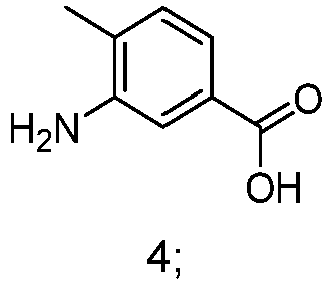
- b) Adding a nitrite salt or an organic nitrite derivative to the reaction mass to form a diazonium salt;
- c) Adding a sulfur-containing reducing agent to the reaction mass to form a hydrazyl sulfur complex, such as a hydrazyl sulfite complex;
- d) Hydrolysing the hydrazyl sulfur complex to provide the compound 3 or a salt or hydrate thereof; and
- e) Optionally isolating the compound 3 or a salt or solvate thereof.
- The compound 3 may be isolated from the reaction mass. For example, the crude product may be purified to produce a pure form of compound 3 that may be used in the reaction between compounds of Formula A and the compound 3, described in detail below.
- In one embodiment isolating the compound 3 comprises filtering the compound 3, washing the filtrate with water and optionally drying the filtrate.
- Methods of filtering are known to those skilled in the art. Exemplary methods include filter drying apparatus, centrifugal filtration and membrane filtration.
- According to the invention, the compound 4 is converted into the compound 3 using a nitrite salt or an organic nitrite derivative to form a diazonium salt, followed by subsequent reduction of the diazonium salt by a sulfur-containing reducing agent to form a hydrazyl sulfur complex, such as a hydrazyl sulfite complex. Hydrolysis of the hydrazyl sulfur complex provides the compound 3. Compound 3 is a key intermediate compound in the synthesis of 3-[5-Amino-4-(3-Cyanobenzoyl)-Pyrazol-1-yl]-N-Cyclopropyl-4-Methylbenzamide. Previously available methods of producing the compound 3 have been found to be too complex and expensive to be suitable for scale-up. There is therefore an unmet need to provide a process of producing the compound 3 that is suitable for the commercial scale.
- Nitrite salts such as sodium nitrite and organic nitrite derivatives such as alkyl nitrites are suitable for use on a commercial scale. Nitrite salts are readily available reagents and have an acceptable toxicological profile in the event of final product contamination.
- Some previous methods of converting aniline derivatives to hydrazine derivatives, such as those employing triphenylphosphine, are not suitable for the commercial scale due to complexities in handling the waste streams of those processes. For example, the negative effects of phosphorus-containing waste, such as eutrophication, are well-documented. The present invention solves this problem by providing a process that does not require the use of phosphorus-containing reagents to provide the compound 3.
- The inventors have also found that previous methods of converting aniline derivatives to hydrazine derivatives require complex isolation and purification steps to provide an acceptably pure product. These inefficiencies are believed to decrease the yield of the desired product. The use of sulfur-containing reducing agents, such as sodium sulfite, and nitrite salts or organic nitrite derivatives, such as sodium nitrite, affords a facile synthesis of the compound 3 which produces waste streams that may be managed on the commercial scale. In addition, the process according to the invention is found to produce by-products that are effectively removed, resulting in a high purity product.
- In previous syntheses of the compound 3-[5-Amino-4-(3-Cyanobenzoyl)-Pyrazol-1-yl]-N-Cyclopropyl-4-Methylbenzamide, stannous chloride was used to convert the compound 4 into the compound 3. However, use of stannous chloride was found to result in contamination with tin-containing impurities which must be removed to provide an acceptable product. Removal of tin-containing impurities may be performed through several methods including filtration over silica gel. However, it was found that additional purification steps led to a decrease in product yield. The presently claimed process allows for the elimination of stannous chloride from the overall synthesis of 3-[5-Amino-4-(3-Cyanobenzoyl)-Pyrazol-1-yl]-N-Cyclopropyl-4-Methylbenzamide, thus eliminating the risk of tin-containing impurities contaminating the final product. In addition to benefits in terms of reduced contamination and improved product safety, the presently claimed process allows for improved yield by reducing product loss, for example due to additional purification steps used in previous syntheses.
- The compound 3 or a salt or a solvate thereof may be produced by a process comprising one or more or all of the following steps
- a) Mixing the compound 4 with a mineral acid;
- b) Optionally cooling the reaction mass, preferably to less than about 10 °C;
- c) Adding a nitrite salt or an organic nitrite derivative to the reaction mass to form a diazonium salt, preferably at a temperature of less than about 10 °C;
- d) Adding a sulfur-containing reducing agent to the reaction mass, preferably at a temperature of less than about 10 °C;
- e) Optionally heating the reaction mass, preferably to greater than about 50 °C, more preferably to about 60 °C;
- f) Optionally further heating the reaction mass to greater than about 60 °C, preferably to about 80 °C;
- g) Hydrolysing the hydrazyl sulfur complex to provide the compound 3, preferably by adding a mineral acid to the reaction mass;
- h) Optionally cooling the reaction mass, preferably to less than about 30 °C, preferably to about 20 to about 30 °C, more preferably to about 25 °C;
- i) Optionally adjusting the pH of the reaction mass to about 5 to about 7, preferably about 5.6 to about 5.8;
- j) Optionally filtering the compound 3;
- k) Optionally washing the filtrate with water;
- l) Optionally drying the filtrate;
- m) Optionally reslurrying (mixing) the dried filtrate in water;
- n) Optionally isolating the compound 3;
- o) Optionally washing the compound 3 with water; and
- p) Optionally drying the compound 3.
- The mineral acid may be selected from the group consisting of HCI, H2SO4, HNO3, H3PO4, HBF4 and HBr. Preferably the mineral acid is HCI.
- In the reaction the compound 4 is reacted with a nitrite source to form a diazonium salt. The nitrite source is a nitrate salt or an organic nitrite derivative.
- The nitrite salt maybe selected from the group consisting of alkali metal nitrite salts, alkaline earth metal nitrite salts and silver nitrite. Exemplary alkali metal nitrite salts include lithium nitrite, sodium nitrite and potassium nitrite. Exemplary alkaline earth metal nitrite salts include magnesium nitrite and calcium nitrite.
- An organic nitrite derivative is an organic compound having the formula R-ONO. The organic nitrite derivative may be an alkyl nitrite, such as a linear or branched C1-C5 nitrite. The organic nitrite derivative may be selected from the group consisting of ethyl nitrite, propyl nitrite, butyl nitrite and pentyl nitrite.
- Preferably the nitrite source is sodium nitrite.
- The sulfur-containing reducing agent may be selected from the group consisting of sulfite salts, bisulfite salts and dithionite salts. Exemplary sulfite salts include alkali metal sulfite salts, such as lithium sulfite, sodium sulfite and potassium sulfite; alkaline earth metal sulfite salts, such as magnesium sulfite and calcium sulfite; and silver sulphite. Exemplary bisulfite salts include alkali metal bisulfite salts, such as sodium bisulfite and potassium bisulfite; and alkaline earth metal bisulfite salts such as calcium bisulfite. An exemplary dithionite salt is sodium dithionite.
- Preferably the sulfur-containing reducing agent is sodium sulfite.
- In one embodiment, after hydrolysing the hydrazyl sulfur complex to provide the compound 3, the pH of the reaction mass is adjusted to about 5 to about 7, preferably about 5.6 to about 5.8. Without wishing to be bound by theory, it is believed that this step eliminates the production of certain undesirable salt by-products, leading to a higher purity product.
- In one embodiment, after adding a sulfur-containing reducing agent to the reaction mass, the reaction mass is heated, preferably to greater than about 50 °C, more preferably to about 60 °C. The reaction mass may be subsequently further heated to greater than about 60 °C, preferably to about 80 °C. The reaction mass may be subsequently cooled, preferably to less than about 30 °C, preferably to about 20 to about 30 °C, more preferably to about 25 °C. It was found that cooling the reaction mass to about 20 to about 30 °C before the compound 3 is isolated, such as before the pH of the reaction mass is adjusted, leads to improved product purity. Without wishing to be bound by theory, it is believed that this step eliminates the production of certain undesirable salt by-products, leading to a higher purity product.
- In one embodiment, the crude filtrate is reslurried (mixed) in water, then the compound 3 is isolated, washed with water and optionally dried. In this embodiment, isolating the compound 3 may comprise filtering the compound 3. The inventors have found that this additional processing step significantly improves the removal of impurities such as salt by-products, leading to a higher purity product.
- In accordance with the invention a compound may be produced by a process comprising the steps of
- a) Reacting a compound of Formula A


- The process may further comprise one or both of the following steps
- b) Isolating the compound 5 or a salt or solvate thereof; and
- c) Reacting the compound 5 with cyclopropylamine to provide the compound 6 or a salt or solvate thereof

- In one embodiment isolating the compound 5 comprises filtering the compound 5, washing the filtrate with water and drying the filtrate. Isolating the compound 5 may further comprise washing the filtrate with methanol after washing the filtrate with water.
- The compound of Formula A may be from any source. For example the material may be a crude product from a previous reaction, or the material may be a pure product, either commercially obtained or through purifying a crude product from a previous reaction. Mixtures of crude and pure products are also contemplated. For example, the source of Formula A may be a crude product from the reaction of the
compound 1 with a trialkyl orthoformate as described above, or the source may be a pure form of Formula A. It will be appreciated that the skilled person will know appropriate means for obtaining the crude product of previous reactions for use in further reactions, for example for use in a one-pot synthesis or a telescoping synthesis. - The source of compound 3 may be a pure form of compound 3. In one embodiment the source of compound 3 has a water content of less than 1 % as determined by Karl Fischer titration. The source of compound 3 may be obtained commercially, or through purifying a crude product from a previous reaction, for example from the conversion of compound 4 to compound 3 as described above. It will be appreciated that the skilled person will know appropriate means for purifying a crude product to be suitable for use in further reactions.
- According to the invention the compound 5 is produced by reacting a compound of Formula A with the compound 3. The compound 5 is a key intermediate compound in the production of 3-[5-Amino-4-(3-Cyanobenzoyl)-Pyrazol-1-yl]-N-Cyclopropyl-4-Methylbenzamide.
- Cyclisation of compounds of Formula A with the compound 3 produces the key pyrazole intermediate compound 5 and alcohol by-products. Previous processes to provide pyrazoles similar to compound 5, such as those disclosed in
WO2005/009973 , were found to produce harmful by-products such as aniline. The reaction of compounds of Formula A with the compound 3 eliminates an alcohol, which is a preferred by-product in terms of safety. - An additional problem with previous processes to provide pyrazoles similar to compound 5 is the control of the cyclisation reaction. The cyclisation reaction disclosed in
WO2005/009973 to produce a pyrazole has been found to involve a sharp exothermic reaction profile, which may render the reaction unsuitable for commercial scale production. The present invention solves this problem by providing a reaction with a slower rate, which is facile to control and avoids the safety concerns associated with a sharp exothermic reaction profile. In addition, a slower reaction rate is desirable as it affords enhanced control of the reaction and reduces the production of impurities. - Therefore the presently claimed process enables safe production of key intermediate compound 5 and 3-[5-Amino-4-(3-Cyanobenzoyl)-Pyrazol-1-yl]-N-Cyclopropyl-4-Methylbenzamide on a commercial scale.
- In one embodiment, R may be C2H5, in which case Formula A is the compound 2, 3-[2-Cyano-2-(Ethoxymethylidene)Acetyl]Benzonitrile.
- The compound 2 is a preferred reagent because cyclisation of compound 2 with compound 3 produces the key pyrazole intermediate compound 5 and ethanol as a by-product. Ethanol is a preferred by-product as it is highly volatile, which facilitates its elimination and the purification of intermediate compound 5. Without wishing to be bound by theory, it is believed that use of the compound 2 leads to improved yield over prior processes. Ethanol also possesses an acceptable toxicological profile in the event of product contamination.
- The compound 5 may be produced by a process comprising one or more or all of the steps of
- a) Adding the compound of Formula A to the compound 3 in a polar aprotic solvent, optionally under anhydrous conditions, optionally at a temperature of greater than about 90 °C, preferably at about 105 °C to provide the compound 5 or a salt or solvate thereof;
- b) Optionally cooling the reaction mass, preferably to less than about 70 °C, more preferably to about 60 °C;
- c) Optionally adding water to the reaction mass;
- d) Optionally further cooling the reaction mass, preferably to less than about 30 °C, more preferably to about 20 °C;
- e) Optionally filtering the compound 5;
- f) Optionally washing the filtrate with water;
- g) Optionally washing the filtrate with methanol; and
- h) Optionally drying the filtrate,
- The process may further comprise the step of reacting the compound 5 with cyclopropylamine to provide the compound 6. Reacting the compound 5 with cyclopropylamine to provide the compound 6 may comprise one or more or all of the following steps
- a) Adding the compound 5 to a polar aprotic solvent;
- b) Heating the above reaction mass, preferably to a temperature greater than about 30 °C, more preferably to about 40 °C;
- c) Optionally adding a coupling reagent in a polar aprotic solvent;
- d) Optionally purging the reaction vessel, preferably to remove CO2;
- e) Adding cyclopropylamine to the reaction mass;
- f) Maintaining the reaction mass to provide the compound 6;
- g) Optionally cooling, preferably to less than about 30 °C, more preferably to about 25 °C;
- h) Optionally adding water to the reaction mass;
- i) Optionally filtering the compound 6;
- j) Optionally washing the filtrate with water; and
- k) Optionally drying the filtrate.
- After isolating the compound 6, which in one embodiment comprises steps (i)-(k) described above, the compound 6 may be subsequently recrystallized with a polar aprotic solvent/water recrystallization. The inventors have found that this recrystallization step affords greater consistency in product quality for the final product.
- In the reaction of Formula A with the compound 3 and subsequent conversion of compound 5 to compound 6, the polar aprotic solvent may be selected from the group consisting of dimethyl sulfoxide, dimethylacetamide, dimethylformamide and N-methyl-2-pyrrolidone. Preferably the polar aprotic solvent is dimethyl sulfoxide. Dimethyl sulfoxide is readily available and particularly suitable for use on the commercial scale.
- In one embodiment the coupling agent that may be used is selected from the group consisting of CDI, HOBt and HATU, preferably CDI. The atom economy of the reaction using CDI is significantly greater than similar reactions which employ different coupling agents. In addition, CDI is readily available and particularly suitable for use on the commercial scale.
- The invention will now be described further by reference to the following examples, which are intended to illustrate, but not limit, the scope of the appended claims.
- The process is described relative to the intake of compound 1 (1.0 eq).
- Acetic anhydride (2.0 eq) was added to a mixture of 3-(cyanoacetyl)benzonitrile (compound 1) (1.0 eq) in toluene (4.5 vol) and heated to 105 °C. The pressure was reduced to 800-900 mbar slowly until slight reflux was obtained. Triethyl orthoformate (1.5 eq) was added during distillation. The reaction was post stirred for 1 h. The reaction was cooled to 25 °C and the product crystallized. n-heptane (5 vol) was added over 0.5 h. The reaction was further cooled to below 5 °C and stirred for 1 h. The product was filtered off, washed with n-heptane (2 x 2 vol) and dried under vacuum. 3-[2-Cyano-2-(Ethoxymethylidene)Acetyl]Benzonitrile (compound 2) was obtained as a red solid in 90 % yield with a purity of 98 % (HPLC, area%).
- The process is described relative to the intake of compound 4 (1.0 eq).
- Hydrochloric acid (30 %, 3.7 eq) was added to a suspension of 3-amino-4-methylbenzoic acid (compound 4) (1.0 eq) in water (1.5 vol). The suspension was cooled to below 10 °C and stirred for 0.5 h. A solution of sodium nitrite (1.1 eq) in water (0.85 vol) was added slowly while maintaining the temperature below 10 °C. The reaction was post-stirred for 0.5 h. A cooled (< 5 °C) suspension of sodium sulfite (4.9 eq) in water (10 vol) was added to the reaction mixture at maintaining the temperature below 15 °C. The reaction was post-stirred for 1 h. The resulting mixture was heated to 60 °C for 1 h. Hydrochloric acid (30 %, 7.2 eq) was added and the mixture was stirred at 80 °C for 2 h. The mixture was cooled to 25 °C. Aqueous sodium hydroxide (33 %) was added (final pH: 5.6 - 5.8). The mixture was post-stirred for 1 h, filtered, washed with water (2 × 4 vol) and dried under vacuum to obtain 3-hydrazino-4-methyl-benzoic acid (compound 3) in 63 % yield with a purity of 87 % (HPLC, w/w%).
- The filter cake was reslurried in water (6 vol) at 25 °C for 1 h. The mixture was filtered, washed with water (2 × 4 vol) and dried under vacuum to obtain 3-hydrazino-4-methyl-benzoic acid (compound 3) in 61 % yield with a purity of 96 % (HPLC, area%).
- The process is described relative to the intake of compound 2 (1.0 eq).
- A solution of 3-[2-Cyano-2-(Ethoxymethylidene)Acetyl]Benzonitrile (compound 2) (1.0 eq) in dimethyl sulfoxide (4 vol) was added to a solution of 3-hydrazino-4-methyl-benzoic acid (compound 3) (1.2 eq) in dimethyl sulfoxide (20 vol) at 105 °C in 1.5 h. The reaction was post-stirred for 1h. Water (24 vol) was added at 60 °C over 1h and the mixture was subsequently cooled to 20 °C. The mixture was post-stirred for 1 h, filtered, washed with water (2 vol), washed with cold methanol (< 5 °C, 2 x 4 vol) and dried under vacuum. 3-[5-Amino-4-(3-Cyanobenzoyl)-1H-Pyrazol-1-yl]-4-Methylbenzoic Acid (compound 5) was obtained as a light yellow solid in 52 % yield with a purity of 98 % (HPLC, area%).
- The process is described relative to the intake of compound 2 (1.0 eq).
- A solution of 3-[2-Cyano-2-(Ethoxymethylidene)Acetyl]Benzonitrile (compound 2) (1.0 eq) in dimethyl sulfoxide (4 vol) was added to a solution of 3-hydrazino-4-methyl-benzoic acid (compound 3) (1.2 eq) in dimethyl sulfoxide (20 vol) at 105 ± 5 °C in 1.25 ± 0.25 h. The reaction was post-stirred for approximately 1 h. The temperature of the mixture was adjusted to 60 ± 5 °C. Water (24 vol) was added to the mixture at 60 ± 5 °C over a period of 1 + 0.25 h. The temperature of the mixture was adjusted to 20 ± 5 °C. The mixture was post-stirred for 1.5 ± 0.5 h then filtered. The filtrate was mixed with water (2 vol) at 20 ± 5 °C then filtered and dried under vacuum. 3-[5-Amino-4-(3-Cyanobenzoyl)-1H-Pyrazol-1-yl]-4-Methylbenzoic Acid (compound 5) was obtained.
- The process is described relative to the intake of compound 5 (1.0 eq).
- 1,1'-Carbonyldiimidazole (CDI) (1.3 eq) in DMSO (5 vol) was dosed to a suspension of 3-[5-Amino-4-(3-Cyanobenzoyl)-1H-Pyrazol-1-yl]-4-Methylbenzoic Acid (compound 5) (1.0 eq) in DMSO (5 vol) at 40 °C. The reaction was post-stirred for 1 h. The formed CO2 was removed by vacuum. Cyclopropylamine (1.2 eq) in DMSO (2 vol) was added to the mixture at 40 °C in 1 h. The mixture was cooled to 25 °C. Water (6 vol) was added in 0.5 h. If crystals were not obtained, water (4 vol) was added in 0.25 h. The mixture was post-stirred for 2 h, filtered, washed with water (2 x 1 vol) and dried under vacuum. 3-[5-Amino-4-(3-Cyanobenzoyl)-Pyrazol-1-yl]-N-Cyclopropyl-4-Methylbenzamide was obtained as yellow solid in 91 % yield with a purity of 98 % (HPLC, area%).
- The process is described relative to the intake of compound 5 (1.0 eq).
- A suspension of 3-[5-Amino-4-(3-Cyanobenzoyl)-1H-Pyrazol-1-yl]-4-Methylbenzoic Acid (compound 5) (1.0 eq) in DMSO (6.5 vol) was added to a solution of 1,1'-Carbonyldiimidazole (CDI) (1.3 eq) in DMSO (5 vol) at 40 ± 5 °C over a period of approximately 0.5 h. The reaction was post-stirred for 1.25 ± 0.25 h. The formed CO2 was removed by vacuum. Cyclopropylamine (1.2 eq) was added to the mixture at 40 ± 5 °C over a period of approximately 0.5 h. The reaction was post-stirred for 3 ± 1 h. The temperature of the mixture was adjusted to 30 ± 5 °C. Water (16.8 vol) was added in 1.5 ± 0.5 h. The temperature of the mixture was adjusted to 20 ± 5 °C over a 2.5 ± 0.5 h period. The mixture was post-stirred for 8 h. The mixture was then filtered, washed with water (2 × 5 vol) and dried under vacuum. 3-[5-Amino-4-(3-Cyanobenzoyl)-Pyrazol-1-yl]-N-Cyclopropyl-4-Methylbenzamide was obtained.
Claims (13)
- A process for preparing the compound 3
 a) Mixing the compound 4 with a mineral acid
 b) Adding a nitrite salt or an organic nitrite derivative to the reaction mass to form a diazonium salt;c) Adding a sulfur-containing reducing agent to the reaction mass to form a hydrazyl sulfur complex, such as a hydrazyl sulfite complex;d) Hydrolysing the hydrazyl sulfur complex to provide the compound 3 or a salt or solvate thereof; ande) Optionally isolating the compound 3 or a salt or solvate thereof.
 - The process of claim 1, wherein the mineral acid is selected from the group consisting of HCI, H2SO4, HNO3, H3PO4, HBF4 and HBr, preferably HCl.
- The process of claim 1 or claim 2, wherein the nitrite salt is selected from the group consisting of alkali metal nitrite salts, such as lithium nitrite, sodium nitrite and potassium nitrite; alkaline earth metal nitrite salts, such as magnesium nitrite and calcium nitrite; and silver nitrite, preferably sodium nitrite; and optionally wherein the organic nitrite derivative is selected from the group consisting of ethyl nitrite, propyl nitrite, butyl nitrite and pentyl nitrite.
- The process of any preceding claim, wherein the sulfur-containing reducing agent is selected from the group consisting of sulfite salts such as alkali metal sulfite salts, such as lithium sulfite, sodium sulfite and potassium sulfite, preferably sodium sulfite; alkaline earth metal sulfite salts, such as magnesium sulfite and calcium sulfite; silver sulphite; bisulfite salts such as alkali metal bisulfite salts, such as sodium bisulfite and potassium bisulfite; alkaline earth metal bisulfite salts such as calcium bisulfite; and dithionite salts such as sodium dithionite.
- The process of any preceding claim, wherein after step (a) the reaction mass is cooled, preferably to less than about 10 °C.
- The process of any preceding claim, wherein steps (b) and (c) are performed at a temperature of less than about 10 °C.
- The process of any preceding claim, wherein after step (c) the reaction mass is heated, preferably to greater than about 50 °C, more preferably to about 60 °C.
- The process of claim 7, wherein the reaction mass is subsequently further heated to greater than about 60 °C, preferably to about 80 °C.
- The process of claim 7 or claim 8, wherein the reaction mass is subsequently cooled, preferably to less than about 30 °C, preferably to about 20 to about 30 °C, more preferably to about 25 °C.
- The process of any preceding claim, wherein hydrolysis of the hydrazyl sulfur complex comprises adding a mineral acid, such as HCl, H2SO4, HNO3, H3PO4, HBF4 and HBr, preferably HCl.
- The process of any preceding claim, wherein after step (d) the pH of the reaction mass is adjusted to about 5 to about 7, preferably about 5.6 to about 5.8.
- The process of any preceding claim, wherein after step (e) the compound 3 is slurried in water, then the compound 3 is isolated, washed with water and optionally dried.
- The process of any preceding claim, wherein isolating the compound 3 in step (e) comprises filtering the compound 3, washing the filtrate with water, and optionally drying the filtrate.
Applications Claiming Priority (2)
| Application Number | Priority Date | Filing Date | Title |
|---|---|---|---|
| GBGB1815696.8A GB201815696D0 (en) | 2018-09-26 | 2018-09-26 | Synthetic method |
| PCT/GB2019/052719 WO2020065324A1 (en) | 2018-09-26 | 2019-09-26 | Synthetic method for the preparation of an hydrazine compound |
Publications (2)
| Publication Number | Publication Date |
|---|---|
| EP3856711A1 EP3856711A1 (en) | 2021-08-04 |
| EP3856711B1 true EP3856711B1 (en) | 2022-11-16 |
Family
ID=64024292
Family Applications (1)
| Application Number | Title | Priority Date | Filing Date |
|---|---|---|---|
| EP19780306.7A Active EP3856711B1 (en) | 2018-09-26 | 2019-09-26 | Synthetic method for the preparation of an hydrazine compound |
Country Status (12)
| Country | Link |
|---|---|
| US (1) | US20210340108A1 (en) |
| EP (1) | EP3856711B1 (en) |
| JP (1) | JP2022502415A (en) |
| KR (1) | KR20210065111A (en) |
| CN (1) | CN112839923A (en) |
| AU (1) | AU2019349863A1 (en) |
| CA (1) | CA3112998A1 (en) |
| DK (1) | DK3856711T3 (en) |
| ES (1) | ES2933568T3 (en) |
| GB (1) | GB201815696D0 (en) |
| IL (1) | IL281637A (en) |
| WO (1) | WO2020065324A1 (en) |
Family Cites Families (10)
| Publication number | Priority date | Publication date | Assignee | Title |
|---|---|---|---|---|
| FR2732967B1 (en) * | 1995-04-11 | 1997-07-04 | Sanofi Sa | 1-PHENYLPYRAZOLE-3-CARBOXAMIDES SUBSTITUTED, ACTIVE IN NEUROTENSIN, THEIR PREPARATION, THE PHARMACEUTICAL COMPOSITIONS CONTAINING IT |
| ES2393950T3 (en) * | 2003-06-26 | 2013-01-02 | Novartis Ag | P38 kinase inhibitors based on 5-membered heterocycles |
| CN1326029C (en) * | 2003-07-10 | 2007-07-11 | 富士施乐株式会社 | Print processing system, print processing method, print processing program, printer device, printing instruction device |
| US7485657B2 (en) * | 2004-05-12 | 2009-02-03 | Boehringer Ingelheim Pharmaceuticals, Inc. | Anti-cytokine heterocyclic compounds |
| AU2008281594A1 (en) * | 2007-08-02 | 2009-02-05 | Generics [Uk] Limited | Novel process |
| JP5167283B2 (en) * | 2008-01-10 | 2013-03-21 | 北興化学工業株式会社 | Process for producing phenyltriazolinones |
| JP5602387B2 (en) * | 2008-05-02 | 2014-10-08 | キヤノン株式会社 | Ink jet ink, ink jet recording method, ink cartridge, recording unit, and ink jet recording apparatus |
| CN102964270B (en) * | 2012-11-21 | 2015-01-07 | 合肥星宇化学有限责任公司 | Method for reducing hydrazine synthesized by diazonium salt by utilizing sodium sulphite |
| JP2016204436A (en) * | 2015-04-17 | 2016-12-08 | 日本化薬株式会社 | Water-soluble azo compound or salt thereof, ink composition and colored body |
| WO2018059533A1 (en) * | 2016-09-29 | 2018-04-05 | 南京明德新药研发股份有限公司 | P38α mapk kinase inhibitor, preparation method thereof and use thereof |
-
2018
- 2018-09-26 GB GBGB1815696.8A patent/GB201815696D0/en not_active Ceased
-
2019
- 2019-09-26 EP EP19780306.7A patent/EP3856711B1/en active Active
- 2019-09-26 CA CA3112998A patent/CA3112998A1/en active Pending
- 2019-09-26 ES ES19780306T patent/ES2933568T3/en active Active
- 2019-09-26 US US17/279,548 patent/US20210340108A1/en not_active Abandoned
- 2019-09-26 DK DK19780306.7T patent/DK3856711T3/en active
- 2019-09-26 CN CN201980063929.XA patent/CN112839923A/en active Pending
- 2019-09-26 JP JP2021516992A patent/JP2022502415A/en active Pending
- 2019-09-26 KR KR1020217008902A patent/KR20210065111A/en not_active Ceased
- 2019-09-26 WO PCT/GB2019/052719 patent/WO2020065324A1/en not_active Ceased
- 2019-09-26 AU AU2019349863A patent/AU2019349863A1/en not_active Abandoned
-
2021
- 2021-03-18 IL IL281637A patent/IL281637A/en unknown
Also Published As
| Publication number | Publication date |
|---|---|
| CA3112998A1 (en) | 2020-04-02 |
| JP2022502415A (en) | 2022-01-11 |
| DK3856711T3 (en) | 2022-12-12 |
| GB201815696D0 (en) | 2018-11-07 |
| CN112839923A (en) | 2021-05-25 |
| US20210340108A1 (en) | 2021-11-04 |
| IL281637A (en) | 2021-05-31 |
| KR20210065111A (en) | 2021-06-03 |
| ES2933568T3 (en) | 2023-02-10 |
| EP3856711A1 (en) | 2021-08-04 |
| AU2019349863A1 (en) | 2021-04-15 |
| WO2020065324A1 (en) | 2020-04-02 |
Similar Documents
| Publication | Publication Date | Title |
|---|---|---|
| WO2012176717A1 (en) | Method for producing pyrazole compound | |
| EP3856721B1 (en) | Synthetic method for the preparation of a 3-[5-amino-4-(3-cyanobenzoyl)-pyrazol compound | |
| EP3856712B1 (en) | Synthetic methodfor the preparation of an alkoxymethylene-benzoylacetonitrile | |
| US20210340108A1 (en) | Synthetic method for the preparation of an hydrazine compound | |
| HK40049030A (en) | Synthetic method for the preparation of a 3-[5-amino-4-(3-cyanobenzoyl)-pyrazol compound | |
| HK40049030B (en) | Synthetic method for the preparation of a 3-[5-amino-4-(3-cyanobenzoyl)-pyrazol compound | |
| WO2020004043A1 (en) | METHOD FOR PRODUCING α-AZIDOANILINE DERIVATIVE OR α, α'-DIAZIDE DERIVATIVE | |
| JP2013006782A (en) | Method for producing pyrazole compound | |
| JP5915004B2 (en) | Method for producing pyrazole compound | |
| JP2717995B2 (en) | Production method of 1,2,3-triazole | |
| KR900001081B1 (en) | Preparation of 4-acyl-5-pyrazolyl 4-toluene sulfonate derivative | |
| JP4267943B2 (en) | Process for producing 3-amino-4-substituted-5-pyrazolones | |
| JP2000086637A (en) | Pyrazole compound and its production | |
| JP2008266201A (en) | Method for producing 2,6-dichloropurine | |
| JP2005247727A (en) | High purity 5-hydroxyquinoline |
Legal Events
| Date | Code | Title | Description |
|---|---|---|---|
| STAA | Information on the status of an ep patent application or granted ep patent |
Free format text: STATUS: UNKNOWN |
|
| STAA | Information on the status of an ep patent application or granted ep patent |
Free format text: STATUS: THE INTERNATIONAL PUBLICATION HAS BEEN MADE |
|
| PUAI | Public reference made under article 153(3) epc to a published international application that has entered the european phase |
Free format text: ORIGINAL CODE: 0009012 |
|
| STAA | Information on the status of an ep patent application or granted ep patent |
Free format text: STATUS: REQUEST FOR EXAMINATION WAS MADE |
|
| 17P | Request for examination filed |
Effective date: 20210412 |
|
| AK | Designated contracting states |
Kind code of ref document: A1 Designated state(s): AL AT BE BG CH CY CZ DE DK EE ES FI FR GB GR HR HU IE IS IT LI LT LU LV MC MK MT NL NO PL PT RO RS SE SI SK SM TR |
|
| REG | Reference to a national code |
Ref country code: HK Ref legal event code: DE Ref document number: 40049029 Country of ref document: HK |
|
| DAV | Request for validation of the european patent (deleted) | ||
| DAX | Request for extension of the european patent (deleted) | ||
| GRAP | Despatch of communication of intention to grant a patent |
Free format text: ORIGINAL CODE: EPIDOSNIGR1 |
|
| STAA | Information on the status of an ep patent application or granted ep patent |
Free format text: STATUS: GRANT OF PATENT IS INTENDED |
|
| INTG | Intention to grant announced |
Effective date: 20220602 |
|
| GRAS | Grant fee paid |
Free format text: ORIGINAL CODE: EPIDOSNIGR3 |
|
| GRAA | (expected) grant |
Free format text: ORIGINAL CODE: 0009210 |
|
| STAA | Information on the status of an ep patent application or granted ep patent |
Free format text: STATUS: THE PATENT HAS BEEN GRANTED |
|
| AK | Designated contracting states |
Kind code of ref document: B1 Designated state(s): AL AT BE BG CH CY CZ DE DK EE ES FI FR GB GR HR HU IE IS IT LI LT LU LV MC MK MT NL NO PL PT RO RS SE SI SK SM TR |
|
| REG | Reference to a national code |
Ref country code: GB Ref legal event code: FG4D |
|
| REG | Reference to a national code |
Ref country code: CH Ref legal event code: EP |
|
| REG | Reference to a national code |
Ref country code: IE Ref legal event code: FG4D |
|
| REG | Reference to a national code |
Ref country code: DE Ref legal event code: R096 Ref document number: 602019022027 Country of ref document: DE |
|
| REG | Reference to a national code |
Ref country code: DK Ref legal event code: T3 Effective date: 20221206 |
|
| REG | Reference to a national code |
Ref country code: AT Ref legal event code: REF Ref document number: 1531717 Country of ref document: AT Kind code of ref document: T Effective date: 20221215 |
|
| REG | Reference to a national code |
Ref country code: SE Ref legal event code: TRGR |
|
| REG | Reference to a national code |
Ref country code: NL Ref legal event code: FP |
|
| REG | Reference to a national code |
Ref country code: ES Ref legal event code: FG2A Ref document number: 2933568 Country of ref document: ES Kind code of ref document: T3 Effective date: 20230210 |
|
| REG | Reference to a national code |
Ref country code: LT Ref legal event code: MG9D |
|
| REG | Reference to a national code |
Ref country code: AT Ref legal event code: MK05 Ref document number: 1531717 Country of ref document: AT Kind code of ref document: T Effective date: 20221116 |
|
| PG25 | Lapsed in a contracting state [announced via postgrant information from national office to epo] |
Ref country code: PT Free format text: LAPSE BECAUSE OF FAILURE TO SUBMIT A TRANSLATION OF THE DESCRIPTION OR TO PAY THE FEE WITHIN THE PRESCRIBED TIME-LIMIT Effective date: 20230316 Ref country code: NO Free format text: LAPSE BECAUSE OF FAILURE TO SUBMIT A TRANSLATION OF THE DESCRIPTION OR TO PAY THE FEE WITHIN THE PRESCRIBED TIME-LIMIT Effective date: 20230216 Ref country code: LT Free format text: LAPSE BECAUSE OF FAILURE TO SUBMIT A TRANSLATION OF THE DESCRIPTION OR TO PAY THE FEE WITHIN THE PRESCRIBED TIME-LIMIT Effective date: 20221116 Ref country code: FI Free format text: LAPSE BECAUSE OF FAILURE TO SUBMIT A TRANSLATION OF THE DESCRIPTION OR TO PAY THE FEE WITHIN THE PRESCRIBED TIME-LIMIT Effective date: 20221116 Ref country code: AT Free format text: LAPSE BECAUSE OF FAILURE TO SUBMIT A TRANSLATION OF THE DESCRIPTION OR TO PAY THE FEE WITHIN THE PRESCRIBED TIME-LIMIT Effective date: 20221116 |
|
| PG25 | Lapsed in a contracting state [announced via postgrant information from national office to epo] |
Ref country code: RS Free format text: LAPSE BECAUSE OF FAILURE TO SUBMIT A TRANSLATION OF THE DESCRIPTION OR TO PAY THE FEE WITHIN THE PRESCRIBED TIME-LIMIT Effective date: 20221116 Ref country code: PL Free format text: LAPSE BECAUSE OF FAILURE TO SUBMIT A TRANSLATION OF THE DESCRIPTION OR TO PAY THE FEE WITHIN THE PRESCRIBED TIME-LIMIT Effective date: 20221116 Ref country code: LV Free format text: LAPSE BECAUSE OF FAILURE TO SUBMIT A TRANSLATION OF THE DESCRIPTION OR TO PAY THE FEE WITHIN THE PRESCRIBED TIME-LIMIT Effective date: 20221116 Ref country code: IS Free format text: LAPSE BECAUSE OF FAILURE TO SUBMIT A TRANSLATION OF THE DESCRIPTION OR TO PAY THE FEE WITHIN THE PRESCRIBED TIME-LIMIT Effective date: 20230316 Ref country code: HR Free format text: LAPSE BECAUSE OF FAILURE TO SUBMIT A TRANSLATION OF THE DESCRIPTION OR TO PAY THE FEE WITHIN THE PRESCRIBED TIME-LIMIT Effective date: 20221116 Ref country code: GR Free format text: LAPSE BECAUSE OF FAILURE TO SUBMIT A TRANSLATION OF THE DESCRIPTION OR TO PAY THE FEE WITHIN THE PRESCRIBED TIME-LIMIT Effective date: 20230217 |
|
| PG25 | Lapsed in a contracting state [announced via postgrant information from national office to epo] |
Ref country code: SM Free format text: LAPSE BECAUSE OF FAILURE TO SUBMIT A TRANSLATION OF THE DESCRIPTION OR TO PAY THE FEE WITHIN THE PRESCRIBED TIME-LIMIT Effective date: 20221116 Ref country code: RO Free format text: LAPSE BECAUSE OF FAILURE TO SUBMIT A TRANSLATION OF THE DESCRIPTION OR TO PAY THE FEE WITHIN THE PRESCRIBED TIME-LIMIT Effective date: 20221116 Ref country code: EE Free format text: LAPSE BECAUSE OF FAILURE TO SUBMIT A TRANSLATION OF THE DESCRIPTION OR TO PAY THE FEE WITHIN THE PRESCRIBED TIME-LIMIT Effective date: 20221116 Ref country code: CZ Free format text: LAPSE BECAUSE OF FAILURE TO SUBMIT A TRANSLATION OF THE DESCRIPTION OR TO PAY THE FEE WITHIN THE PRESCRIBED TIME-LIMIT Effective date: 20221116 |
|
| REG | Reference to a national code |
Ref country code: DE Ref legal event code: R097 Ref document number: 602019022027 Country of ref document: DE |
|
| PG25 | Lapsed in a contracting state [announced via postgrant information from national office to epo] |
Ref country code: SK Free format text: LAPSE BECAUSE OF FAILURE TO SUBMIT A TRANSLATION OF THE DESCRIPTION OR TO PAY THE FEE WITHIN THE PRESCRIBED TIME-LIMIT Effective date: 20221116 Ref country code: AL Free format text: LAPSE BECAUSE OF FAILURE TO SUBMIT A TRANSLATION OF THE DESCRIPTION OR TO PAY THE FEE WITHIN THE PRESCRIBED TIME-LIMIT Effective date: 20221116 |
|
| PLBE | No opposition filed within time limit |
Free format text: ORIGINAL CODE: 0009261 |
|
| STAA | Information on the status of an ep patent application or granted ep patent |
Free format text: STATUS: NO OPPOSITION FILED WITHIN TIME LIMIT |
|
| 26N | No opposition filed |
Effective date: 20230817 |
|
| PG25 | Lapsed in a contracting state [announced via postgrant information from national office to epo] |
Ref country code: SI Free format text: LAPSE BECAUSE OF FAILURE TO SUBMIT A TRANSLATION OF THE DESCRIPTION OR TO PAY THE FEE WITHIN THE PRESCRIBED TIME-LIMIT Effective date: 20221116 |
|
| REG | Reference to a national code |
Ref country code: DE Ref legal event code: R119 Ref document number: 602019022027 Country of ref document: DE |
|
| REG | Reference to a national code |
Ref country code: DK Ref legal event code: EBP Effective date: 20230930 |
|
| REG | Reference to a national code |
Ref country code: CH Ref legal event code: PL Ref country code: SE Ref legal event code: EUG |
|
| REG | Reference to a national code |
Ref country code: NL Ref legal event code: MM Effective date: 20231001 |
|
| PG25 | Lapsed in a contracting state [announced via postgrant information from national office to epo] |
Ref country code: LU Free format text: LAPSE BECAUSE OF NON-PAYMENT OF DUE FEES Effective date: 20230926 |
|
| REG | Reference to a national code |
Ref country code: BE Ref legal event code: MM Effective date: 20230930 |
|
| GBPC | Gb: european patent ceased through non-payment of renewal fee |
Effective date: 20230926 |
|
| PG25 | Lapsed in a contracting state [announced via postgrant information from national office to epo] |
Ref country code: LU Free format text: LAPSE BECAUSE OF NON-PAYMENT OF DUE FEES Effective date: 20230926 Ref country code: MC Free format text: LAPSE BECAUSE OF FAILURE TO SUBMIT A TRANSLATION OF THE DESCRIPTION OR TO PAY THE FEE WITHIN THE PRESCRIBED TIME-LIMIT Effective date: 20221116 |
|
| PG25 | Lapsed in a contracting state [announced via postgrant information from national office to epo] |
Ref country code: NL Free format text: LAPSE BECAUSE OF NON-PAYMENT OF DUE FEES Effective date: 20231001 |
|
| PG25 | Lapsed in a contracting state [announced via postgrant information from national office to epo] |
Ref country code: NL Free format text: LAPSE BECAUSE OF NON-PAYMENT OF DUE FEES Effective date: 20231001 |
|
| REG | Reference to a national code |
Ref country code: IE Ref legal event code: MM4A |
|
| PG25 | Lapsed in a contracting state [announced via postgrant information from national office to epo] |
Ref country code: IE Free format text: LAPSE BECAUSE OF NON-PAYMENT OF DUE FEES Effective date: 20230926 |
|
| PG25 | Lapsed in a contracting state [announced via postgrant information from national office to epo] |
Ref country code: GB Free format text: LAPSE BECAUSE OF NON-PAYMENT OF DUE FEES Effective date: 20230926 |
|
| PG25 | Lapsed in a contracting state [announced via postgrant information from national office to epo] |
Ref country code: CH Free format text: LAPSE BECAUSE OF NON-PAYMENT OF DUE FEES Effective date: 20230930 |
|
| PG25 | Lapsed in a contracting state [announced via postgrant information from national office to epo] |
Ref country code: IE Free format text: LAPSE BECAUSE OF NON-PAYMENT OF DUE FEES Effective date: 20230926 Ref country code: GB Free format text: LAPSE BECAUSE OF NON-PAYMENT OF DUE FEES Effective date: 20230926 Ref country code: FR Free format text: LAPSE BECAUSE OF NON-PAYMENT OF DUE FEES Effective date: 20230930 Ref country code: DE Free format text: LAPSE BECAUSE OF NON-PAYMENT OF DUE FEES Effective date: 20240403 Ref country code: CH Free format text: LAPSE BECAUSE OF NON-PAYMENT OF DUE FEES Effective date: 20230930 |
|
| PG25 | Lapsed in a contracting state [announced via postgrant information from national office to epo] |
Ref country code: SE Free format text: LAPSE BECAUSE OF NON-PAYMENT OF DUE FEES Effective date: 20230927 Ref country code: BE Free format text: LAPSE BECAUSE OF NON-PAYMENT OF DUE FEES Effective date: 20230930 |
|
| PG25 | Lapsed in a contracting state [announced via postgrant information from national office to epo] |
Ref country code: DK Free format text: LAPSE BECAUSE OF NON-PAYMENT OF DUE FEES Effective date: 20230930 |
|
| REG | Reference to a national code |
Ref country code: ES Ref legal event code: FD2A Effective date: 20241025 |
|
| PG25 | Lapsed in a contracting state [announced via postgrant information from national office to epo] |
Ref country code: DK Free format text: LAPSE BECAUSE OF NON-PAYMENT OF DUE FEES Effective date: 20230930 |
|
| PG25 | Lapsed in a contracting state [announced via postgrant information from national office to epo] |
Ref country code: BG Free format text: LAPSE BECAUSE OF FAILURE TO SUBMIT A TRANSLATION OF THE DESCRIPTION OR TO PAY THE FEE WITHIN THE PRESCRIBED TIME-LIMIT Effective date: 20221116 |
|
| PG25 | Lapsed in a contracting state [announced via postgrant information from national office to epo] |
Ref country code: BG Free format text: LAPSE BECAUSE OF FAILURE TO SUBMIT A TRANSLATION OF THE DESCRIPTION OR TO PAY THE FEE WITHIN THE PRESCRIBED TIME-LIMIT Effective date: 20221116 |
|
| PG25 | Lapsed in a contracting state [announced via postgrant information from national office to epo] |
Ref country code: IT Free format text: LAPSE BECAUSE OF NON-PAYMENT OF DUE FEES Effective date: 20230926 |
|
| PG25 | Lapsed in a contracting state [announced via postgrant information from national office to epo] |
Ref country code: IT Free format text: LAPSE BECAUSE OF NON-PAYMENT OF DUE FEES Effective date: 20230926 |
|
| PG25 | Lapsed in a contracting state [announced via postgrant information from national office to epo] |
Ref country code: ES Free format text: LAPSE BECAUSE OF NON-PAYMENT OF DUE FEES Effective date: 20230927 |
|
| PG25 | Lapsed in a contracting state [announced via postgrant information from national office to epo] |
Ref country code: ES Free format text: LAPSE BECAUSE OF NON-PAYMENT OF DUE FEES Effective date: 20230927 |
|
| PG25 | Lapsed in a contracting state [announced via postgrant information from national office to epo] |
Ref country code: CY Free format text: LAPSE BECAUSE OF FAILURE TO SUBMIT A TRANSLATION OF THE DESCRIPTION OR TO PAY THE FEE WITHIN THE PRESCRIBED TIME-LIMIT; INVALID AB INITIO Effective date: 20190926 |
|
| PG25 | Lapsed in a contracting state [announced via postgrant information from national office to epo] |
Ref country code: HU Free format text: LAPSE BECAUSE OF FAILURE TO SUBMIT A TRANSLATION OF THE DESCRIPTION OR TO PAY THE FEE WITHIN THE PRESCRIBED TIME-LIMIT; INVALID AB INITIO Effective date: 20190926 |