EP3856427B1 - Clamping strap - Google Patents
Clamping strap Download PDFInfo
- Publication number
- EP3856427B1 EP3856427B1 EP19783450.0A EP19783450A EP3856427B1 EP 3856427 B1 EP3856427 B1 EP 3856427B1 EP 19783450 A EP19783450 A EP 19783450A EP 3856427 B1 EP3856427 B1 EP 3856427B1
- Authority
- EP
- European Patent Office
- Prior art keywords
- sectional area
- cross sectional
- end attachment
- profile
- clamping strap
- Prior art date
- Legal status (The legal status is an assumption and is not a legal conclusion. Google has not performed a legal analysis and makes no representation as to the accuracy of the status listed.)
- Active
Links
Images


Classifications
-
- B—PERFORMING OPERATIONS; TRANSPORTING
- B21—MECHANICAL METAL-WORKING WITHOUT ESSENTIALLY REMOVING MATERIAL; PUNCHING METAL
- B21C—MANUFACTURE OF METAL SHEETS, WIRE, RODS, TUBES, PROFILES OR LIKE SEMI-MANUFACTURED PRODUCTS OTHERWISE THAN BY ROLLING; AUXILIARY OPERATIONS USED IN CONNECTION WITH METAL-WORKING WITHOUT ESSENTIALLY REMOVING MATERIAL
- B21C23/00—Extruding metal; Impact extrusion
- B21C23/02—Making uncoated products
- B21C23/04—Making uncoated products by direct extrusion
- B21C23/06—Making sheets
-
- B—PERFORMING OPERATIONS; TRANSPORTING
- B21—MECHANICAL METAL-WORKING WITHOUT ESSENTIALLY REMOVING MATERIAL; PUNCHING METAL
- B21C—MANUFACTURE OF METAL SHEETS, WIRE, RODS, TUBES, PROFILES OR LIKE SEMI-MANUFACTURED PRODUCTS OTHERWISE THAN BY ROLLING; AUXILIARY OPERATIONS USED IN CONNECTION WITH METAL-WORKING WITHOUT ESSENTIALLY REMOVING MATERIAL
- B21C35/00—Removing work or waste from extruding presses; Drawing-off extruded work; Cleaning dies, ducts, containers, or mandrels for metal extruding
- B21C35/02—Removing or drawing-off work
- B21C35/023—Work treatment directly following extrusion, e.g. further deformation or surface treatment
-
- B—PERFORMING OPERATIONS; TRANSPORTING
- B21—MECHANICAL METAL-WORKING WITHOUT ESSENTIALLY REMOVING MATERIAL; PUNCHING METAL
- B21K—MAKING FORGED OR PRESSED METAL PRODUCTS, e.g. HORSE-SHOES, RIVETS, BOLTS OR WHEELS
- B21K23/00—Making other articles
-
- B—PERFORMING OPERATIONS; TRANSPORTING
- B23—MACHINE TOOLS; METAL-WORKING NOT OTHERWISE PROVIDED FOR
- B23P—METAL-WORKING NOT OTHERWISE PROVIDED FOR; COMBINED OPERATIONS; UNIVERSAL MACHINE TOOLS
- B23P15/00—Making specific metal objects by operations not covered by a single other subclass or a group in this subclass
-
- B—PERFORMING OPERATIONS; TRANSPORTING
- B60—VEHICLES IN GENERAL
- B60K—ARRANGEMENT OR MOUNTING OF PROPULSION UNITS OR OF TRANSMISSIONS IN VEHICLES; ARRANGEMENT OR MOUNTING OF PLURAL DIVERSE PRIME-MOVERS IN VEHICLES; AUXILIARY DRIVES FOR VEHICLES; INSTRUMENTATION OR DASHBOARDS FOR VEHICLES; ARRANGEMENTS IN CONNECTION WITH COOLING, AIR INTAKE, GAS EXHAUST OR FUEL SUPPLY OF PROPULSION UNITS IN VEHICLES
- B60K15/00—Arrangement in connection with fuel supply of combustion engines or other fuel consuming energy converters, e.g. fuel cells; Mounting or construction of fuel tanks
- B60K15/03—Fuel tanks
- B60K15/063—Arrangement of tanks
- B60K15/067—Mounting of tanks
-
- B—PERFORMING OPERATIONS; TRANSPORTING
- B60—VEHICLES IN GENERAL
- B60K—ARRANGEMENT OR MOUNTING OF PROPULSION UNITS OR OF TRANSMISSIONS IN VEHICLES; ARRANGEMENT OR MOUNTING OF PLURAL DIVERSE PRIME-MOVERS IN VEHICLES; AUXILIARY DRIVES FOR VEHICLES; INSTRUMENTATION OR DASHBOARDS FOR VEHICLES; ARRANGEMENTS IN CONNECTION WITH COOLING, AIR INTAKE, GAS EXHAUST OR FUEL SUPPLY OF PROPULSION UNITS IN VEHICLES
- B60K15/00—Arrangement in connection with fuel supply of combustion engines or other fuel consuming energy converters, e.g. fuel cells; Mounting or construction of fuel tanks
- B60K15/03—Fuel tanks
- B60K15/063—Arrangement of tanks
- B60K15/067—Mounting of tanks
- B60K15/07—Mounting of tanks of gas tanks
-
- F—MECHANICAL ENGINEERING; LIGHTING; HEATING; WEAPONS; BLASTING
- F16—ENGINEERING ELEMENTS AND UNITS; GENERAL MEASURES FOR PRODUCING AND MAINTAINING EFFECTIVE FUNCTIONING OF MACHINES OR INSTALLATIONS; THERMAL INSULATION IN GENERAL
- F16B—DEVICES FOR FASTENING OR SECURING CONSTRUCTIONAL ELEMENTS OR MACHINE PARTS TOGETHER, e.g. NAILS, BOLTS, CIRCLIPS, CLAMPS, CLIPS OR WEDGES; JOINTS OR JOINTING
- F16B2/00—Friction-grip releasable fastenings
- F16B2/02—Clamps, i.e. with gripping action effected by positive means other than the inherent resistance to deformation of the material of the fastening
- F16B2/06—Clamps, i.e. with gripping action effected by positive means other than the inherent resistance to deformation of the material of the fastening external, i.e. with contracting action
- F16B2/08—Clamps, i.e. with gripping action effected by positive means other than the inherent resistance to deformation of the material of the fastening external, i.e. with contracting action using bands
Definitions
- the present disclosure relates to a method of manufacturing a clamping strap configured to hold and support a hanging object against a structure which is to carry the hanging object, in particular to a clamping strap for fastening a fuel tank to a vehicle.
- the present disclosure also relates to a clamping strap manufactured by the method (see e.g. DE 10 2015 119 859 A1 ).
- Clamping straps for fastening hanging objects to a structure are known for example within the automotive industry.
- Automotive fuel tanks are generally supported and attached to the underbody of a vehicle by one or more clamping support straps. These support straps are flat, elongated and extend under the fuel tank. Both ends of the support strap are then secured to the automotive vehicle frame thus supporting the fuel tank and securing it to the vehicle.
- the previously known support straps for fuel tanks are typically constructed of steel for low cost construction.
- the present disclosure relates to a clamping strap configured to hold and support a hanging object against a structure which is to carry the hanging object.
- the method comprises providing an extruded elongated aluminium profile having an initial material thickness (T 0 ) and an initial cross-sectional area (A 0 ), said profile having a longitudinal direction, which coincides with the extrusion direction of the profile; forming the profile in a bending step into a shape comprising a first end attachment portion, a second end attachment portion, and an intermediate portion located between said first and second end attachment portions in a longitudinal direction of the profile, said intermediate portion being configured to at least partially encircle the hanging object when mounted to the structure.
- the method further includes forming said profile by means of locally thinning the profile in a longitudinal direction of the profile, in a thinning operation to obtain one or more thinned portions having a lower material thickness than the initial material thickness (T 0 ), said thinning operation preferably being performed prior to the bending step; or locally axially compressing the profile in an axial compression step to obtain one of more axially compressed portions having a higher material thickness than the initial material thickness (T 0 ) and/or greater cross sectional area than the initial cross-sectional area (A 0 ); or by a combination of said thinning operation and said axial compression step.
- the axial compression step may suitably include locally axially compressing said first and/or said second end attachment portions, so that said first and/or second end attachment portions attains a material thickness (T 1a , T 1b ), where T 1a > T 0 and /or T 1b > T 0 , or a cross sectional area (A 1a , A 1b ), where A 1a >A 0 and/or A 1b >A 0 .
- the bending step may suitably include forming the intermediate portion into a base portion, a first leg portion, and a first bend portion, wherein the first leg portion is located between the first end attachment portion and the first bend portion, and the first bend portion is located between the first leg portion and the base portion.
- the thinning operation may suitably include locally thinning the profile along a section of the profile, which is to form the base portion, so that said base portion attains a material thickness (T 3 ), where T 3 ⁇ T 0 .
- the thinning operation (103) may further suitably include locally thinning the profile along a section of the profile, which is to form the first leg portion, so that said first leg portion attains a material thickness (T 4a ), where T 4a ⁇ T 0 .
- the axial compression step may suitably include locally axially compressing the first bend portion so that said first bend portion attains a material thickness (T 5a ), where T 5a > T 0 , or a cross sectional area (A 5a ), where A 5a >A 0 .
- the bending step further may suitably include forming a second leg portion, and a second bend portion in the intermediate portion, wherein the second leg portion is located between the second end attachment portion and the second bend portion, and the second bend portion is located between the second leg portion and the base portion.
- the axial compression step may suitably include locally axially compressing the second bend portion so that said second bend portion attains a material thickness (T 5b ), where T 5b > T 0 , or a cross sectional area (A 5b ), where A 5b >A 0 ; and/or locally axially compressing the second leg portion so that said second leg portion attains a material thickness (T 4b ), where T 4b > T 0 , or a cross sectional area (A 4b ), where A 4b >A 0
- the method may further suitably include a cold forging step, in which an attachment aperture is formed in said first and/or said second end attachment portions.
- the greatest cross sectional area of the thus obtained clamping strap may suitable be ⁇ 1.2 ⁇ A 0 .
- the method may further suitably include press forming one or more longitudinal grooves.
- the present disclosure also refers to a clamping strap which is obtained by the above described method.
- said clamping strap is configured to hold and support a hanging object against a structure, which is to carry the hanging object
- said strap includes a first end attachment portion and a second end attachment portion, each being adapted for attachment to the structure to which the hanging object is to be mounted, and an intermediate portion configured to at least partially encircle the hanging object when mounted to the structure, said intermediate portion comprising a base portion located between said first and second end attachment portions; a first bend portion located between the first end attachment portion and the base portion; and a leg portion located between the first end attachment portion and the bend portion.
- the base portion and/or the first leg portion may suitably have a cross sectional area, which is 75 to 100% of the cross sectional area in the first bend portion, and the first end attachment portion may have a cross sectional area, which is 150 - 250 % of the cross sectional area in the base portion.
- the base portion and/or the first leg portion can have a cross sectional area of 50-60 mm 2
- the first bend portion can have a cross sectional area of 75-85 mm 2
- the first end attachment portion can have a cross sectional area of 90-110 mm 2 .
- the base portion can further comprise a portion having a greater cross sectional area than adjacent parts of the base portion, said portion being configured to allow connection of another strap component oriented at an angle in relation to the clamping strap.
- Conventional tank straps are characterized by having high local loads at body connection areas and at lower corner radii. Straps are normally produced from steel with simple forming, sometimes using support plates or double walls at the ends to increase strength and/or stiffness locally.
- Straps are normally produced from steel with simple forming, sometimes using support plates or double walls at the ends to increase strength and/or stiffness locally.
- the clamping strap needs to be tailored with respect to the specific shape and weight of the object that it is to hold and support.
- the present disclosure aims at providing a method for manufacturing a clamping strap suitable for holding and supporting a hanging object against a structure which is to carry the hanging object, which has such a configuration that it can be made of aluminium, in spite of using aluminium with strength lower than in steel, and a clamping strap obtained by this method.
- the present method allows versatile and flexible manufacture of clamping straps, so that optimised and tailored clamping strap design can be obtained, which is adapted to intended situation of use.
- a clamping strap can be given reduced weight, while maintaining sufficient strength by providing a higher material thickness and/or greater cross sectional area in the high loaded areas of the clamping strap, and lower material thickness and/or smaller cross sectional area in areas of the clamping strap where the load is lower during use.
- the weight can typically be reduced more than 60% as compared to a conventional steel strap.
- the clamping strap of the present disclosure is particularly suitable for use as a tank strap, i.e.
- the strap can of course find use in any application where an object is to be held and supported against a structure, and is therefore advantageously configured and dimensioned to hold and support a hanging fuel tank to a vehicle, which is to carry the hanging fuel tank, which can typically have a weight of 40-80 kg.
- the strap can have an average width of 10-40 mm and an average thickness of 1.5-4.5 mm.
- Fig. 1 illustrates how a hanging object 20 can be clamped against a structure 21 by means of a clamping strap 10.
- a clamping strap 10 is a fuel tank which is clamped to the underbody of a vehicle by means of clamping straps.
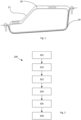
- the method 100 of the present disclosure is schematically illustrated in Fig. 2 and comprises providing 101 an extruded elongated aluminium profile having an initial material thickness (T 0 ) and an initial cross-sectional area (A 0 ) (T 0 and A 0 are not shown in the drawings).
- the extruded profile is suitably made of a 6000 series aluminium alloy, and may for example have a weight of 200-500 g/m.
- the profile has a longitudinal direction, which coincides with the extrusion direction of the profile, and which will also be the longitudinal direction of the resulting clamping strap.
- the material thickness refers to the thickness of the extruded profile, or the resulting clamping strap, in a direction perpendicular to the longitudinal direction of the profile
- the cross sectional area refers to the cross sectional area in a direction transverse to said longitudinal direction.
- Typical different cross sectional shapes that can be used for a clamping strap as schematically illustrated in Figs. 10a-e .
- the extruded profile can advantageously have outward edges which have a rounded shape ( Fig 10b ). Thereby, the weight can be further reduced and the possible fatigue stress level increased, since larger corner radii or increased thickness on outer edges reduces the risk of fatigue cracks at high loaded areas.
- the rounded edge shape along the profile edges can be provided at one or both of the longitudinal edges of the profile.
- Other cross sectional shapes that can be advantageous are: rectangular cross section ( Fig. 10a ); with bent side portions ( Fig. 10c ); with a depression ( Fig. 10d ); rounded ( Fig. 10e ).
- the method of forming the extruded profile into a clamping strap involves forming the profile by bending step 102 into a desired shape, which is roughly the shape of the final clamping strap.
- the method further includes locally thinning 103 or locally axially compressing 104 the profile at selected areas along the length of the profile, or a combination thereof.
- Local thinning will typically be performed prior to the bending step 102, and is intended to decrease material thickness in selected areas.
- Local axial compression 103 will typically be performed subsequent to the bending step 102, and is intended to increase the material thickness and/or cross sectional area in selected areas. Accordingly, local thinning 103 and/or locally axially compressing 104 is used to provide adequate strength in high load areas, and low weight in low load areas.
- the method may also include steps of cold forging apertures at the ends of the clamping strap, and press forming of grooves at certain locations.
- the bending step into a shape comprising a first end attachment portion, a second end attachment portion, and an intermediate portion located between the first and second end attachment portions in a longitudinal direction of the profile.
- the end attachment portions are intended for, and adapted to, being secured to the structure, which is to carry the hanging object held and supported by the clamping strap, and the intermediate portion is configured to at least partially encircle the object when the clamping strap is mounted to the structure.
- the intermediate portion may suitably include a base portion, a first leg portion, and a first bend portion.
- the first leg portion is located between the first end attachment portion and the first bend portion, and the first bend portion is located between the first leg portion and the base portion, so that the first leg portion is at an angle with respect to the base portion.
- the intermediate portion may also include a second leg portion, and a second bend portion, similarly positioned at the opposite end of the base portion, between the second end attachment portion and the base portion.
- One or both of the first and second end attachment portions may be at an angle with respect to the adjacent intermediate portion, and may then include an end bend portion located between the end attachment portion and the intermediate portion.
- the end attachment portions and the bend portions will typically be subjected to the highest load, while the base portion and the leg portion will be less subjected to high load. However, this may vary depending on the configuration of the hanging object.
- the local thinning of selected areas of the extruded profile is preferably performed prior to the bending step, and typically also before a cutting operation, in which the extruded profile is cut into segments, which will each form a clamping strap.
- the thinning is performed in a thinning operation 103 in which the profile is locally thinned in a longitudinal direction to obtain one or more thinned portions having a lower material thickness than the initial material thickness (T 0 ).
- the thinning operation can include rolling, stretching, or press forming, or combinations thereof.
- the profile thinned portions are sections of the clamping strap, which will be less subjected to high load during use.
- the profile is thinned along a section, which is to form the base portion, so that the base portion attains a material thickness (T 3 ), where T 3 ⁇ T 0 , and along a section, which is to form the first leg portion, so that the first leg portion attains a material thickness (T 4a ), where T 4a ⁇ T 0 .
- T 3 material thickness
- T 4a material thickness
- the local axial compressing of selected areas of the extruded profile is performed subsequent to the bending step, and is performed in an axial compression step 104 to obtain one of more axially compressed portions having a higher material thickness than the initial material thickness (T 0 ) and/or greater cross sectional area than the initial cross-sectional area (A 0 ).
- the selected areas of the extruded profile, which are subjected to local axial compression are portions of the clamping strap, which will be subjected to high load during use.
- the axial compression step may thus suitably include local axial compression of the first and/or said second end attachment portions, so that they attain an increased material thickness (T 1a , T 1b ), where T 1a > T 0 and /or T 1b > T 0 , or a cross sectional area (A 1a , A 1b ), where A 1a >A 0 and/or A 1b >A 0 , and of the first second bend portion so that the first bend portion attains a material thickness (T 5a ), where T 5a > T 0 , or a cross sectional area (A 5a ), where A 5a >A 0 .
- the second bend portion may suitably be axially compressed so that it attains a material thickness (T 5b ), where T 5b > T 0 , or a cross sectional area (A 5b ), where A 5b >A 0 .
- the second leg portion may also be axially compressed so that it attains a material thickness (T 4b ), where T 4b > T 0 , or a cross sectional area (A 4b ), where A 4b >A 0 .
- the end bend portions that may be located between the one or both of the first and second end attachment portions and the intermediate portion, can suitably also be subjected to axial compression to increase the material thickness and/or cross sectional area.
- the extruded profile is subjected to either local thinning, or local axial compression, or to a combination thereof, in order to obtain a clamping strap with improved performance and/or lower weight.
- a profile can be prepared by extrusion, so that is has a material thickness corresponding approximately to the desired final thickness in those length sections, which are to form high loaded sections in the final clamping strap during use, and the extruded profile is then locally thinned before bending it into its three-dimensional shape, so that the length sections, which are to form low loaded sections in the clamping strap during use, become thinned and gets a reduced thickness/cross-sectional area.
- a profile can be prepared by extrusion, so that is has a material thickness corresponding approximately to the desired final thickness in those length sections, which are to form low loaded sections in the final clamping strap during use. After the profile has been bent into its three-dimensional shape, the length sections, which are to form high loaded sections in the clamping strap during use, are axially compressed so that they attain an increased thickness/cross-sectional area in the high loaded sections.
- the method most advantageously comprises both the thinning and the axial compression operations, in order to provide the most flexible production of clamping straps, thus allowing manufacture of clamping straps, which comprise one or more portions having a wall gauge lower than the wall gauge of the initial material, and one or more portions having a wall gauge higher than the wall gauge of the initial material.
- an aperture configured to receive a fastener can be provided in one or both of the first and second end attachment portions.
- the present method may thus further include a cold forging step 105, in which an attachment aperture is formed in one or both of the first and second end attachment portions.
- the method may also further comprising press forming 106 of one or more longitudinal grooves in the clamping strap, in order to improve stiffness.
- the thus obtained aluminium clamping strap can typically have a weight that is approximately 30-50 % of the weight of a corresponding steel clamping strap intended for the purpose.
- the weight can be for example 125-200 g.
- a clamping strap obtained by the above method will be in the form of an elongated and bent aluminium profile, and will be configured to hold and support a hanging object against a structure, which is to carry the hanging object.
- the clamping strap comprises a first end attachment portion and a second end attachment portion each being adapted for attachment to the structure to which the hanging object is to be mounted, and an intermediate portion configured to at least partially encircle the hanging object when mounted to the structure.
- the intermediate portion comprises a base portion located between said first and second end attachment portions, a first bend portion located between the first end attachment portion and the base portion, and a leg portion located between the first end attachment portion and the bend portion.
- the base portion has a cross sectional area (A 3 ), the first bend portion has a cross sectional area (A 5a ), the first a leg portion has a cross sectional area (A 4a ), and the first end attachment portion (1a) has a cross sectional area (A 1a ), where the cross sectional areas suitably relate to each other as follows: A 3 ⁇ A 5a ⁇ A 1a , and A 4a ⁇ A 5a ⁇ A 1a .
- the base portion and/or the first leg portion may suitably have a cross sectional area, which is 75 to 100% of the cross sectional area in the first bend portion, for example 75-95% or 80-90%, and the first end attachment portion may suitably have a cross sectional area, which is 150 - 250 % of the cross sectional area in the base portion.
- the base portion and/or the first leg portion may suitably have a cross sectional area of 50-75 mm 2
- the first bend portion may suitably have a cross sectional area of 75-100 mm 2
- the first end attachment portion may suitably have a cross sectional area of 125-200 mm 2 .
- the greatest cross sectional area of the clamping strap may suitable be ⁇ 1.2 times the initial cross sectional area (A 0 ).
- the base portion can further include an portion having a greater cross sectional area than adjacent parts of the base portion. This portion can be used for connection of another strap oriented at an angle in relation to the clamping strap, typically in a substantially perpendicular direction to the clamping strap.
- the clamping strap may be symmetric or asymmetric about a transverse centreline.
- the clamping strap may be reflection symmetric about a transverse centreline, or it may be asymmetric, so that one or more of the clamping strap portions have a different shape in one end than the other.
- the first and/or second end attachment portions can comprise an aperture configured to receive a fastener, which is preferably obtained by cold forging.
- a region encircling the aperture and having increased material thickness can be formed, and/or the width of the end attachment portion can be increased in a transverse direction.
- the material in the area where the aperture is formed can be used in a beneficial way by means of cold forming, as opposed to being entirely removed, which would be the case if the aperture were formed by means of drilling or punching.
- Cold forging an aperture can be performed by using an upper tool comprising a punch, which is pressed against a flat surface of a lower tool and thereby relocates the material when forming an aperture in the end attachment portion, so that the end attachment portion has an increased material thickness, or an increased width in a transverse direction of the profile.
- Fig. 3 is a schematic side view of an example of a clamping strap 10 obtainable by the above described method
- Fig. 4 shows a perspective view of the clamping strap in Fig. 3
- the clamping strap includes a first end attachment portion 1a and a second end attachment portion 1b, which are each adapted for attachment to a structure so that the clamping strap can hold and support a hanging object.
- the clamping strap further includes an intermediate portion 2 comprising a base portion 3,a first bend portion 5a, and a leg portion 4a.
- the clamping strap shown in Fig. 3 further includes a second leg portion 4b, and a second bend portion 5b, and attachment apertures 6a, 6b is formed in the first and second end attachment portions 1a, 1b.
- Fig. 3 illustrates how the base portion 3 and the first leg portion 4a has lower thickness than the first end attachment portion 1a and the first bend portion 5a.
- the second bend portion 5b, the second leg portion 4b and the second end attachment portion 1b all have higher material thickness than the base portion 3 and the first leg portion 4a.
- Fig. 5a illustrates schematically the relations between different portions in a clamping strap which has only been locally thinned at selected areas.
- the end attachment portion 1a can have thickness T 1a , which could correspond to the initial thickness T 0 of the extruded profile
- the first leg portion 4a can have a thickness T 4a , which is lower than T 1a , and thus also lower than T 0
- the base portion 3 can have a thickness T 3 , which is lower than T 4a .
- the sections which have not been thinned will consequently have a greater thickness.
- Fig. 5b illustrates schematically the relations between different portions in a clamping strap which has been both locally thinned and locally axially compressed at selected portion.
- the end attachment portion 1a can have a thickness T 1a or a cross sectional area A 1a , which is greater than the thickness or cross sectional area of the first bend portion 5a and/or of the second leg portion 4b, which in turn can be greater than the thicknesses or cross sectional areas of the base portion 3 and the first leg portion 4a.
- the portions which have not been axially compressed will consequently have a lower thickness or a smaller cross sectional area.
- the thickness or cross sectional area of the first bend portion 5a and/or of the second leg portion 4b could correspond to the initial thickness T 0 or cross sectional area A 0 of the extruded profile.
- the combination of local thinning and local axial compression is preferred to obtain the most flexible method of manufacturing a clamping strap.
- Fig. 7a-b illustrates an alternative, where the base portion 3 of the clamping strap further includes a portion 7, which has a greater cross sectional area than the adjacent parts of the base portion. This portion can be used for connection of another strap component 8 oriented at an angle in relation to the clamping strap, typically in a substantially perpendicular direction to the clamping strap.
- Fig. 8a-c schematically illustrate different alternatives for the second leg portion of a clamping strap obtainable by the above method.
- the material thickness and/or cross sectional area can be substantially the same along the entire second leg portion ( Fig. 8a ), or can be different in different sections thereof ( Figs. 8b-c ), depending on the loads that the clamping strap will be subjected to during use.
- Fig. 9 schematically illustrates an end attachment portion of a clamping strap, in which an aperture has been cold forged, so that the width of the end attachment portion has increased.
- a conventional steel strap design were compared with aluminium clamping strap designs, meeting similar space requirements and also designed according to the present disclosure, with the finite element method (FEM). Setting the weight and results from the steel strap to 100% for ease of comparison, the FEM simulation showed that the aluminium clamping straps would perform as follows Table 1 Strap No. Strap material Description Weight [%] Highest stress [%] 1 Steel Conventional steel strap with longitudinal side flanges 100 100 2 Aluminium Similar design as steel strap 48 39 3 Aluminium Strap with thinned base portion according to the present disclosure 36 34 4 Aluminium Strap with thinned base portion and axially compressed end attachment portions according to the present disclosure 39 21
Landscapes
- Engineering & Computer Science (AREA)
- Mechanical Engineering (AREA)
- Life Sciences & Earth Sciences (AREA)
- Sustainable Development (AREA)
- Sustainable Energy (AREA)
- Chemical & Material Sciences (AREA)
- Combustion & Propulsion (AREA)
- Transportation (AREA)
- Clamps And Clips (AREA)
- Extrusion Of Metal (AREA)
- Bending Of Plates, Rods, And Pipes (AREA)
Description
- The present disclosure relates to a method of manufacturing a clamping strap configured to hold and support a hanging object against a structure which is to carry the hanging object, in particular to a clamping strap for fastening a fuel tank to a vehicle. The present disclosure also relates to a clamping strap manufactured by the method (see e.g.
DE 10 2015 119 859 A1 ). - Clamping straps for fastening hanging objects to a structure are known for example within the automotive industry. Automotive fuel tanks are generally supported and attached to the underbody of a vehicle by one or more clamping support straps. These support straps are flat, elongated and extend under the fuel tank. Both ends of the support strap are then secured to the automotive vehicle frame thus supporting the fuel tank and securing it to the vehicle. The previously known support straps for fuel tanks are typically constructed of steel for low cost construction.
- Within many technical fields, and in particular within the automotive industry, there is a continuous striving to reduce the weight of components, and there is a need for lightweight components for fastening hanging objects to a structure, in particular for holding and supporting fuel tanks to the body of a vehicle, and for methods of manufacturing such components.
- The present disclosure relates to a clamping strap configured to hold and support a hanging object against a structure which is to carry the hanging object. The method comprises providing an extruded elongated aluminium profile having an initial material thickness (T0) and an initial cross-sectional area (A0), said profile having a longitudinal direction, which coincides with the extrusion direction of the profile; forming the profile in a bending step into a shape comprising a first end attachment portion, a second end attachment portion, and an intermediate portion located between said first and second end attachment portions in a longitudinal direction of the profile, said intermediate portion being configured to at least partially encircle the hanging object when mounted to the structure. The method further includes forming said profile by means of locally thinning the profile in a longitudinal direction of the profile, in a thinning operation to obtain one or more thinned portions having a lower material thickness than the initial material thickness (T0), said thinning operation preferably being performed prior to the bending step; or locally axially compressing the profile in an axial compression step to obtain one of more axially compressed portions having a higher material thickness than the initial material thickness (T0) and/or greater cross sectional area than the initial cross-sectional area (A0); or by a combination of said thinning operation and said axial compression step.
- The axial compression step may suitably include locally axially compressing said first and/or said second end attachment portions, so that said first and/or second end attachment portions attains a material thickness (T1a, T1b), where T1a > T0 and /or T1b > T0, or a cross sectional area (A1a, A1b), where A1a>A0 and/or A1b>A0.
- The bending step may suitably include forming the intermediate portion into a base portion, a first leg portion, and a first bend portion, wherein the first leg portion is located between the first end attachment portion and the first bend portion, and the first bend portion is located between the first leg portion and the base portion.
- The thinning operation may suitably include locally thinning the profile along a section of the profile, which is to form the base portion, so that said base portion attains a material thickness (T3), where T3< T0. The thinning operation (103) may further suitably include locally thinning the profile along a section of the profile, which is to form the first leg portion, so that said first leg portion attains a material thickness (T4a), where T4a< T0.
- The axial compression step may suitably include locally axially compressing the first bend portion so that said first bend portion attains a material thickness (T5a), where T5a > T0, or a cross sectional area (A5a), where A5a>A0.
- The bending step further may suitably include forming a second leg portion, and a second bend portion in the intermediate portion, wherein the second leg portion is located between the second end attachment portion and the second bend portion, and the second bend portion is located between the second leg portion and the base portion.
- The axial compression step may suitably include locally axially compressing the second bend portion so that said second bend portion attains a material thickness (T5b), where T5b > T0, or a cross sectional area (A5b), where A5b>A0; and/or locally axially compressing the second leg portion so that said second leg portion attains a material thickness (T4b), where T4b > T0, or a cross sectional area (A4b), where A4b>A0
- The method may further suitably include a cold forging step, in which an attachment aperture is formed in said first and/or said second end attachment portions. The greatest cross sectional area of the thus obtained clamping strap may suitable be ≥ 1.2 × A0. The method may further suitably include press forming one or more longitudinal grooves.
- The present disclosure also refers to a clamping strap which is obtained by the above described method. In a preferred embodiment, said clamping strap is configured to hold and support a hanging object against a structure, which is to carry the hanging object, and said strap includes a first end attachment portion and a second end attachment portion, each being adapted for attachment to the structure to which the hanging object is to be mounted, and an intermediate portion configured to at least partially encircle the hanging object when mounted to the structure, said intermediate portion comprising a base portion located between said first and second end attachment portions; a first bend portion located between the first end attachment portion and the base portion; and a leg portion located between the first end attachment portion and the bend portion. The base portion has a cross sectional area (A3), the first bend portion has a cross sectional area (A5a), the first a leg portion has a cross sectional area (A4a), and the first end attachment portion has a cross sectional area (A1a), where suitably A3 ≤ A5a < A1a, and A4a ≤ A5a < A1a, i.e. A3 = A5a < A1a or A3 <A5a < A1a, and A4a = A5a < A1a, or A4a < A5a < A1a.
- The base portion and/or the first leg portion may suitably have a cross sectional area, which is 75 to 100% of the cross sectional area in the first bend portion, and the first end attachment portion may have a cross sectional area, which is 150 - 250 % of the cross sectional area in the base portion. The base portion and/or the first leg portion can have a cross sectional area of 50-60 mm2, the first bend portion can have a cross sectional area of 75-85 mm2, and the first end attachment portion can have a cross sectional area of 90-110 mm2. The base portion can further comprise a portion having a greater cross sectional area than adjacent parts of the base portion, said portion being configured to allow connection of another strap component oriented at an angle in relation to the clamping strap.
- A better understanding of the clamping strap and the method of the present disclosure will be had upon reference to the following detailed description when read in conjunction with the accompanying drawing, wherein like reference characters refer to like parts throughout the several views, and in which:
-
Fig. 1 illustrates how a clamping strap is used to hold and support a fuel tank to a vehicle; -
Fig. 2 schematically illustrates the method of the present disclosure; -
Fig. 3 is a schematic side view of a clamping strap that can be obtained by the method; -
Fig. 4 is a schematic perspective view of the clamping strap shown inFig. 3 ; -
Fig. 5a is a schematic perspective view of another clamping strap; -
Fig. 5b is a schematic perspective view of yet another clamping strap; -
Fig. 6 is a schematic explanatory view showing the approximate locations the thicknesses and cross sectional areas mentioned in this disclosure; -
Fig. 7a and 7b schematically illustrates a clamping strap comprising a portion in the base portion, which can be used for connection of other parts; -
Fig. 8a-c schematically illustrate different alternative for the second leg portion of a clamping strap obtainable by method of the present disclosure; -
Fig. 9 schematically illustrates an end attachment portion of a clamping strap; -
Fig. 10a-e schematically illustrate different cross sectional shapes that can be used for a clamping strap obtainable by method of the present disclosure. - When contemplating weight reduction in constructions comprising metal components, it is often suggested that heavy materials be replaced by more lightweight materials. For example, steel components can be replaced by components made of aluminium. However, for components carrying heavy loads, this is not so easily done, because aluminium cannot offer the material properties of steel. In order to compensate for the lower material properties the gauge has often to be increased, making this choice of material less interesting, due to increase of metal needed and its relatively high price.
- Conventional tank straps are characterized by having high local loads at body connection areas and at lower corner radii. Straps are normally produced from steel with simple forming, sometimes using support plates or double walls at the ends to increase strength and/or stiffness locally. For components for clamping and supporting hanging objects to a structure, in particular for holding and supporting fuel tanks to the body of a vehicle, it has been found that merely replacing a conventional clamping steel strap with a similar one made of aluminium does not lead to a successful result due to not resulting in a desired weight reduction due to the need of higher material thickness. In order to obtain the desired low weight and adequate performance, the clamping strap needs to be tailored with respect to the specific shape and weight of the object that it is to hold and support.
- The present disclosure aims at providing a method for manufacturing a clamping strap suitable for holding and supporting a hanging object against a structure which is to carry the hanging object, which has such a configuration that it can be made of aluminium, in spite of using aluminium with strength lower than in steel, and a clamping strap obtained by this method. The present method allows versatile and flexible manufacture of clamping straps, so that optimised and tailored clamping strap design can be obtained, which is adapted to intended situation of use.
- A clamping strap can be given reduced weight, while maintaining sufficient strength by providing a higher material thickness and/or greater cross sectional area in the high loaded areas of the clamping strap, and lower material thickness and/or smaller cross sectional area in areas of the clamping strap where the load is lower during use. By means of such optimisation, the weight can typically be reduced more than 60% as compared to a conventional steel strap. The clamping strap of the present disclosure is particularly suitable for use as a tank strap, i.e. for holding and supporting fuel tanks to the body of a vehicle, but the strap can of course find use in any application where an object is to be held and supported against a structure, and is therefore advantageously configured and dimensioned to hold and support a hanging fuel tank to a vehicle, which is to carry the hanging fuel tank, which can typically have a weight of 40-80 kg. For example, the strap can have an average width of 10-40 mm and an average thickness of 1.5-4.5 mm.
-
Fig. 1 illustrates how a hangingobject 20 can be clamped against astructure 21 by means of aclamping strap 10. In this case, it is a fuel tank which is clamped to the underbody of a vehicle by means of clamping straps. - The
method 100 of the present disclosure is schematically illustrated inFig. 2 and comprises providing 101 an extruded elongated aluminium profile having an initial material thickness (T0) and an initial cross-sectional area (A0) (T0 and A0 are not shown in the drawings). The extruded profile is suitably made of a 6000 series aluminium alloy, and may for example have a weight of 200-500 g/m. The profile has a longitudinal direction, which coincides with the extrusion direction of the profile, and which will also be the longitudinal direction of the resulting clamping strap. - In this context, the material thickness refers to the thickness of the extruded profile, or the resulting clamping strap, in a direction perpendicular to the longitudinal direction of the profile, and the cross sectional area refers to the cross sectional area in a direction transverse to said longitudinal direction. The approximate locations of the thicknesses and cross sectional areas mentioned in this disclosure are shown in the schematic explanatory view of
Fig. 6 . - Typical different cross sectional shapes that can be used for a clamping strap, as schematically illustrated in
Figs. 10a-e . The extruded profile can advantageously have outward edges which have a rounded shape (Fig 10b ). Thereby, the weight can be further reduced and the possible fatigue stress level increased, since larger corner radii or increased thickness on outer edges reduces the risk of fatigue cracks at high loaded areas. The rounded edge shape along the profile edges can be provided at one or both of the longitudinal edges of the profile. Other cross sectional shapes that can be advantageous are: rectangular cross section (Fig. 10a ); with bent side portions (Fig. 10c ); with a depression (Fig. 10d ); rounded (Fig. 10e ). - The method of forming the extruded profile into a clamping strap involves forming the profile by bending
step 102 into a desired shape, which is roughly the shape of the final clamping strap. The method further includes locally thinning 103 or locally axially compressing 104 the profile at selected areas along the length of the profile, or a combination thereof. Local thinning will typically be performed prior to the bendingstep 102, and is intended to decrease material thickness in selected areas. Localaxial compression 103 will typically be performed subsequent to the bendingstep 102, and is intended to increase the material thickness and/or cross sectional area in selected areas. Accordingly, local thinning 103 and/or locally axially compressing 104 is used to provide adequate strength in high load areas, and low weight in low load areas. The method may also include steps of cold forging apertures at the ends of the clamping strap, and press forming of grooves at certain locations. - In the bending step, into a shape comprising a first end attachment portion, a second end attachment portion, and an intermediate portion located between the first and second end attachment portions in a longitudinal direction of the profile. The end attachment portions are intended for, and adapted to, being secured to the structure, which is to carry the hanging object held and supported by the clamping strap, and the intermediate portion is configured to at least partially encircle the object when the clamping strap is mounted to the structure.
- The intermediate portion may suitably include a base portion, a first leg portion, and a first bend portion. The first leg portion is located between the first end attachment portion and the first bend portion, and the first bend portion is located between the first leg portion and the base portion, so that the first leg portion is at an angle with respect to the base portion. Likewise, the intermediate portion may also include a second leg portion, and a second bend portion, similarly positioned at the opposite end of the base portion, between the second end attachment portion and the base portion. One or both of the first and second end attachment portions may be at an angle with respect to the adjacent intermediate portion, and may then include an end bend portion located between the end attachment portion and the intermediate portion. In use, the end attachment portions and the bend portions will typically be subjected to the highest load, while the base portion and the leg portion will be less subjected to high load. However, this may vary depending on the configuration of the hanging object.
- The local thinning of selected areas of the extruded profile is preferably performed prior to the bending step, and typically also before a cutting operation, in which the extruded profile is cut into segments, which will each form a clamping strap. The thinning is performed in a thinning
operation 103 in which the profile is locally thinned in a longitudinal direction to obtain one or more thinned portions having a lower material thickness than the initial material thickness (T0). The thinning operation can include rolling, stretching, or press forming, or combinations thereof. The profile thinned portions are sections of the clamping strap, which will be less subjected to high load during use. Suitably, the profile is thinned along a section, which is to form the base portion, so that the base portion attains a material thickness (T3), where T3< T0, and along a section, which is to form the first leg portion, so that the first leg portion attains a material thickness (T4a), where T4a< T0. Thereby, the weight is reduced in sections which carry less load during use, leading to a reduced total weight of the clamping strap. - The local axial compressing of selected areas of the extruded profile is performed subsequent to the bending step, and is performed in an
axial compression step 104 to obtain one of more axially compressed portions having a higher material thickness than the initial material thickness (T0) and/or greater cross sectional area than the initial cross-sectional area (A0). The selected areas of the extruded profile, which are subjected to local axial compression are portions of the clamping strap, which will be subjected to high load during use. The axial compression step may thus suitably include local axial compression of the first and/or said second end attachment portions, so that they attain an increased material thickness (T1a, T1b), where T1a > T0 and /or T1b > T0, or a cross sectional area (A1a, A1b), where A1a>A0 and/or A1b>A0, and of the first second bend portion so that the first bend portion attains a material thickness (T5a), where T5a > T0, or a cross sectional area (A5a), where A5a>A0. Also the second bend portion may suitably be axially compressed so that it attains a material thickness (T5b), where T5b > T0, or a cross sectional area (A5b), where A5b>A0. The second leg portion may also be axially compressed so that it attains a material thickness (T4b), where T4b > T0, or a cross sectional area (A4b), where A4b>A0. The end bend portions, that may be located between the one or both of the first and second end attachment portions and the intermediate portion, can suitably also be subjected to axial compression to increase the material thickness and/or cross sectional area. By means of the axial compression of the portion(s) that will be subjected to high load during use, more material is located in areas where it is needed. This will increase the resistance to material failure, and will improve the performance of the clamping strap. - In the method of manufacture of a clamping strap according to the present disclosure, the extruded profile is subjected to either local thinning, or local axial compression, or to a combination thereof, in order to obtain a clamping strap with improved performance and/or lower weight. Thus, in one alternative, a profile can be prepared by extrusion, so that is has a material thickness corresponding approximately to the desired final thickness in those length sections, which are to form high loaded sections in the final clamping strap during use, and the extruded profile is then locally thinned before bending it into its three-dimensional shape, so that the length sections, which are to form low loaded sections in the clamping strap during use, become thinned and gets a reduced thickness/cross-sectional area. Similarly, in another alternative, a profile can be prepared by extrusion, so that is has a material thickness corresponding approximately to the desired final thickness in those length sections, which are to form low loaded sections in the final clamping strap during use. After the profile has been bent into its three-dimensional shape, the length sections, which are to form high loaded sections in the clamping strap during use, are axially compressed so that they attain an increased thickness/cross-sectional area in the high loaded sections.
- However, the method most advantageously comprises both the thinning and the axial compression operations, in order to provide the most flexible production of clamping straps, thus allowing manufacture of clamping straps, which comprise one or more portions having a wall gauge lower than the wall gauge of the initial material, and one or more portions having a wall gauge higher than the wall gauge of the initial material.
- In order to facilitate attachment of the clamping strap to the structure, which is to carry the hanging object, an aperture configured to receive a fastener can be provided in one or both of the first and second end attachment portions. The present method may thus further include a cold forging
step 105, in which an attachment aperture is formed in one or both of the first and second end attachment portions. The method may also further comprising press forming 106 of one or more longitudinal grooves in the clamping strap, in order to improve stiffness. - The thus obtained aluminium clamping strap can typically have a weight that is approximately 30-50 % of the weight of a corresponding steel clamping strap intended for the purpose. The weight can be for example 125-200 g.
- As indicated above, a clamping strap obtained by the above method will be in the form of an elongated and bent aluminium profile, and will be configured to hold and support a hanging object against a structure, which is to carry the hanging object. The clamping strap comprises a first end attachment portion and a second end attachment portion each being adapted for attachment to the structure to which the hanging object is to be mounted, and an intermediate portion configured to at least partially encircle the hanging object when mounted to the structure. The intermediate portion comprises a base portion located between said first and second end attachment portions, a first bend portion located between the first end attachment portion and the base portion, and a leg portion located between the first end attachment portion and the bend portion.
- The base portion has a cross sectional area (A3), the first bend portion has a cross sectional area (A5a), the first a leg portion has a cross sectional area (A4a), and the first end attachment portion (1a) has a cross sectional area (A1a), where the cross sectional areas suitably relate to each other as follows: A3 ≤ A5a < A1a, and A4a ≤ A5a < A1a. Further, the base portion and/or the first leg portion may suitably have a cross sectional area, which is 75 to 100% of the cross sectional area in the first bend portion, for example 75-95% or 80-90%, and the first end attachment portion may suitably have a cross sectional area, which is 150 - 250 % of the cross sectional area in the base portion. These relations in cross sectional area between the different portions of the clamping strap give a reduced weight and at the same time improved mechanical performance to the clamping strap. The base portion and/or the first leg portion may suitably have a cross sectional area of 50-75 mm2, the first bend portion may suitably have a cross sectional area of 75-100 mm2, and the first end attachment portion may suitably have a cross sectional area of 125-200 mm2. The greatest cross sectional area of the clamping strap may suitable be ≥ 1.2 times the initial cross sectional area (A0).
- The base portion can further include an portion having a greater cross sectional area than adjacent parts of the base portion. This portion can be used for connection of another strap oriented at an angle in relation to the clamping strap, typically in a substantially perpendicular direction to the clamping strap.
- Depending on the shape of the hanging object which is to be held and supported by the clamping strap, the clamping strap may be symmetric or asymmetric about a transverse centreline. For example, the clamping strap may be reflection symmetric about a transverse centreline, or it may be asymmetric, so that one or more of the clamping strap portions have a different shape in one end than the other.
- As mentioned above, the first and/or second end attachment portions can comprise an aperture configured to receive a fastener, which is preferably obtained by cold forging. Thereby, a region encircling the aperture and having increased material thickness can be formed, and/or the width of the end attachment portion can be increased in a transverse direction. Thus, the material in the area where the aperture is formed can be used in a beneficial way by means of cold forming, as opposed to being entirely removed, which would be the case if the aperture were formed by means of drilling or punching. Cold forging an aperture can be performed by using an upper tool comprising a punch, which is pressed against a flat surface of a lower tool and thereby relocates the material when forming an aperture in the end attachment portion, so that the end attachment portion has an increased material thickness, or an increased width in a transverse direction of the profile.
-
Fig. 3 is a schematic side view of an example of a clampingstrap 10 obtainable by the above described method, andFig. 4 shows a perspective view of the clamping strap inFig. 3 . The clamping strap includes a firstend attachment portion 1a and a secondend attachment portion 1b, which are each adapted for attachment to a structure so that the clamping strap can hold and support a hanging object. The clamping strap further includes anintermediate portion 2 comprising abase portion 3,afirst bend portion 5a, and aleg portion 4a. The clamping strap shown inFig. 3 further includes asecond leg portion 4b, and asecond bend portion 5b, andattachment apertures end attachment portions Fig. 3 illustrates how thebase portion 3 and thefirst leg portion 4a has lower thickness than the firstend attachment portion 1a and thefirst bend portion 5a. In this case, thesecond bend portion 5b, thesecond leg portion 4b and the secondend attachment portion 1b all have higher material thickness than thebase portion 3 and thefirst leg portion 4a. -
Fig. 5a illustrates schematically the relations between different portions in a clamping strap which has only been locally thinned at selected areas. Thus, theend attachment portion 1a can have thickness T1a, which could correspond to the initial thickness T0 of the extruded profile, and thefirst leg portion 4a can have a thickness T4a, which is lower than T1a, and thus also lower than T0, and thebase portion 3 can have a thickness T3, which is lower than T4a. The sections which have not been thinned will consequently have a greater thickness. -
Fig. 5b illustrates schematically the relations between different portions in a clamping strap which has been both locally thinned and locally axially compressed at selected portion. Thus, theend attachment portion 1a can have a thickness T1a or a cross sectional area A1a, which is greater than the thickness or cross sectional area of thefirst bend portion 5a and/or of thesecond leg portion 4b, which in turn can be greater than the thicknesses or cross sectional areas of thebase portion 3 and thefirst leg portion 4a. In this case, the portions which have not been axially compressed will consequently have a lower thickness or a smaller cross sectional area. In this case, the thickness or cross sectional area of thefirst bend portion 5a and/or of thesecond leg portion 4b could correspond to the initial thickness T0 or cross sectional area A0 of the extruded profile. - The combination of local thinning and local axial compression is preferred to obtain the most flexible method of manufacturing a clamping strap.
-
Fig. 7a-b illustrates an alternative, where thebase portion 3 of the clamping strap further includes aportion 7, which has a greater cross sectional area than the adjacent parts of the base portion. This portion can be used for connection of anotherstrap component 8 oriented at an angle in relation to the clamping strap, typically in a substantially perpendicular direction to the clamping strap. -
Fig. 8a-c schematically illustrate different alternatives for the second leg portion of a clamping strap obtainable by the above method. As shown, the material thickness and/or cross sectional area can be substantially the same along the entire second leg portion (Fig. 8a ), or can be different in different sections thereof (Figs. 8b-c ), depending on the loads that the clamping strap will be subjected to during use. -
Fig. 9 schematically illustrates an end attachment portion of a clamping strap, in which an aperture has been cold forged, so that the width of the end attachment portion has increased. - A conventional steel strap design were compared with aluminium clamping strap designs, meeting similar space requirements and also designed according to the present disclosure, with the finite element method (FEM). Setting the weight and results from the steel strap to 100% for ease of comparison, the FEM simulation showed that the aluminium clamping straps would perform as follows
Table 1 Strap No. Strap material Description Weight [%] Highest stress [%] 1 Steel Conventional steel strap with longitudinal side flanges 100 100 2 Aluminium Similar design as steel strap 48 39 3 Aluminium Strap with thinned base portion according to the present disclosure 36 34 4 Aluminium Strap with thinned base portion and axially compressed end attachment portions according to the present disclosure 39 21 - All straps were found to have the highest stress in the same point, in proximity in between the attachment portions and the first upper bend.
- A physical test where some of the strap design were compared in a hydro-pulse testing jig showed that the aluminium design no. 2 only could fulfil 88 % of the time that the steel design No.1 could perform, before it failed, while the aluminium design No.3 fulfilled 113% of the steel design. Aluminium design No. 4 was not tested, since it was expected to perform better than design No. 3 due to the lower stress level.
- The invention shall not be considered limited to the illustrated embodiments, but can be modified and altered in many ways, as realised by a person skilled in the art, without departing from the scope defined in the appended claims.
Claims (16)
- A method (100) of manufacturing a clamping strap (10) configured to hold and support a hanging object (20) against a structure (21), which is to carry the hanging object,said method comprisingproviding (101) an extruded elongated aluminium profile having an initial material thickness (T0) and an initial cross-sectional area (A0), said profile having a longitudinal direction, which coincides with the extrusion direction of the profile;forming the profile in a bending step (102) into a shape comprising a first end attachment portion (1a), a second end attachment portion (1b), and an intermediate portion (2) located between said first and second end attachment portions (1a; 1b) in a longitudinal direction of the profile (11), said intermediate portion (2) being configured to at least partially encircle the hanging object (20) when mounted to the structure (21); andcharacterized in that the method includes forming said profile by means oflocally thinning the profile in a longitudinal direction of the profile (11), in a thinning operation (103) to obtain one or more thinned portions having a lower material thickness than the initial material thickness (T0); orlocally axially compressing the profile in an axial compression step (104) to obtain one of more axially compressed portions having a higher material thickness than the initial material thickness (T0) and/or greater cross sectional area than the initial cross-sectional area (A0);or by a combination of said thinning operation (103) and said axial compression step (104).
- The method of claim 1, wherein the axial compression step (104) includes locally axially compressing said first and/or said second end attachment portions (1a; 1b), so that said first and/or second end attachment portions (1a; 1b) attains a material thickness (T1a, T1b), where T1a > T0 and /or T1b > T0, or a cross sectional area (A1a, A1b), where A1a>A0 and/or A1b>A0.
- The method of claim 1 or 2, wherein the bending step (102) includes forming the intermediate portion (2) into a base portion (3), a first leg portion (4a), and a first bend portion (5a), wherein the first leg portion (4a) is located between the first end attachment portion (1a) and the first bend portion (5a), and the first bend portion (5a) is located between the first leg portion (4a) and the base portion (3).
- The method of claim 3, wherein the thinning operation (103) includes locally thinning the profile along a section of the profile (11), which is to form the base portion (3), so that said base portion attains a material thickness (T3), where T3< T0.
- The method of claim 3 or 4, wherein the thinning operation (103) includes locally thinning the profile along a section of the profile (11), which is to form the first leg portion (4a), so that said first leg portion attains a material thickness (T4a), where T4a< T0.
- The method of any one of claims 3-5, wherein axial compression step (104) includes locally axially compressing the first bend portion (5a) so that said first bend portion (5a) attains a material thickness (T5a), where T5a > T0, or a cross sectional area (A5a), where A5a>A0.
- The method of any one of claims 3-6, wherein the bending step (102) further includes forming a second leg portion (4b), and a second bend portion (5b) in the intermediate portion (2), wherein the second leg portion (4b) is located between the second end attachment portion (1b) and the second bend portion (5b), and the second bend portion (5b) is located between the second leg portion (4b) and the base portion (3).
- The method of claim 7, wherein the axial compression step (104) includes locally axially compressing the second bend portion (5b) so that said second bend portion (5b) attains a material thickness (T5b), where T5b > T0, or a cross sectional area (A5b), where A5b>A0; and/or locally axially compressing the second leg portion (4b) so that said second leg portion (4b) attains a material thickness (T4b), where T4b > T0, or a cross sectional area (A4b), where A4b>A0
- The method of any one of claims 1-8, further including a cold forging step (105), in which an attachment aperture (6a, 6b) is formed in said first and/or said second end attachment portions (1a; 1b), whereby said first and/or said second end attachment portions (1a; 1b) attain a material thickness (T1a', T1b'), where T1a',>T1a, and/or T1b',>T1b, or a cross sectional area (A1a', A1b') adjacent the aperture (6) in the longitudinal direction of the clamping step, where A1a'>A1a and/or A1b'>A1b.
- The method of any one of claims 2-9, wherein the greatest cross sectional area of the clamping strap (10) is ≥ 1.2 × A0.
- The method of any one of claims 2-10, further comprising press forming (106) one or more longitudinal grooves.
- A clamping strap (10) characterised in that it is manufactured by the method of any one of claims 1-11.
- A clamping strap (10) according to claim 12, said clamping strap being configured to hold and support a hanging object (20) against a structure (21), which is to carry the hanging object, said clamping strap (10) includinga first end attachment portion (1a) and a second end attachment portion (1b), each being adapted for attachment to the structure to which the hanging object is to be mounted, andan intermediate portion (2) configured to at least partially encircle the hanging object when mounted to the structure, said intermediate portion (2) comprisinga base portion (3) located between said first and second end attachment portions (1a, 1b);wherein the strap (10) further includes a first bend portion (5a) located between the first end attachment portion (1a) and the base portion (3); and a leg portion (4a) located between the first end attachment portion (1a) and the bend portion (5a)and the base portion (3) has a cross sectional area (A3), the first bend portion (5a) has a cross sectional area (A5a), the first a leg portion (4a) has a cross sectional area (A4a), and the first end attachment portion (1a) has a cross sectional area (A1a), where


- The clamping strap of claim 13, wherein the base portion (3) and/or the first leg portion (4a) have a cross sectional area, which is 75 to 100% of the cross sectional area in the first bend portion (5a), and the first end attachment portion (1a) has a cross sectional area, which is 150 - 250 % of the cross sectional area in the base portion (3).
- The clamping strap of any one of claims 13-14, wherein the base portion (3) and/or the first leg portion (4a) have a cross sectional area of 50-60 mm2, the first bend portion (5a) has a cross sectional area of 75-85 mm2, and the first end attachment portion (1a) has a cross sectional area of 90-110 mm2.
- A clamping strap according to any one of claims 13-15, wherein the base portion (3) comprises a portion (7) having a greater cross sectional area than adjacent parts of the base portion, said portion being configured to allow connection of another strap component oriented at an angle in relation to the clamping strap.
Applications Claiming Priority (2)
| Application Number | Priority Date | Filing Date | Title |
|---|---|---|---|
| SE1851147 | 2018-09-26 | ||
| PCT/EP2019/075817 WO2020064808A1 (en) | 2018-09-26 | 2019-09-25 | Clamping strap |
Publications (2)
| Publication Number | Publication Date |
|---|---|
| EP3856427A1 EP3856427A1 (en) | 2021-08-04 |
| EP3856427B1 true EP3856427B1 (en) | 2023-04-26 |
Family
ID=68165508
Family Applications (1)
| Application Number | Title | Priority Date | Filing Date |
|---|---|---|---|
| EP19783450.0A Active EP3856427B1 (en) | 2018-09-26 | 2019-09-25 | Clamping strap |
Country Status (5)
| Country | Link |
|---|---|
| US (1) | US11745238B2 (en) |
| EP (1) | EP3856427B1 (en) |
| CN (1) | CN113165038B (en) |
| MX (1) | MX2021003377A (en) |
| WO (1) | WO2020064808A1 (en) |
Families Citing this family (2)
| Publication number | Priority date | Publication date | Assignee | Title |
|---|---|---|---|---|
| US11491867B2 (en) * | 2019-05-14 | 2022-11-08 | Ford Global Technologies, Llc | Fuel tank assembly and method for manufacture of the fuel tank assembly |
| US11597271B2 (en) * | 2021-01-15 | 2023-03-07 | Ford Global Technologies, Llc | Fuel tank mounting assembly |
Citations (4)
| Publication number | Priority date | Publication date | Assignee | Title |
|---|---|---|---|---|
| GB2117438A (en) * | 1982-03-29 | 1983-10-12 | Gkn Australia Ltd | Cable clamp |
| EP3170570A1 (en) * | 2015-11-17 | 2017-05-24 | Benteler Automobiltechnik GmbH | Method for manufacturing a motor vehicle part, and semi-finished product made of light metal |
| DE102016104216A1 (en) * | 2016-03-08 | 2017-09-14 | Benteler Automobiltechnik Gmbh | Method for producing a motor vehicle component |
| US20190030586A1 (en) * | 2016-01-29 | 2019-01-31 | Aisin Seiki Kabushiki Kaisha | Method of manufacturing skeleton member for vehicle |
Family Cites Families (23)
| Publication number | Priority date | Publication date | Assignee | Title |
|---|---|---|---|---|
| JPS597144Y2 (en) * | 1976-08-06 | 1984-03-05 | トヨタ自動車株式会社 | Automotive fuel tank protection frame structure |
| JPS56124515A (en) * | 1980-03-07 | 1981-09-30 | Nissan Motor Co Ltd | Fixing structure of fuel tank |
| JPS57134325A (en) * | 1981-02-10 | 1982-08-19 | Nissan Motor Co Ltd | Supporting device of fuel tank for automobile |
| JPS6318327U (en) * | 1986-07-21 | 1988-02-06 | ||
| US4930811A (en) * | 1987-07-28 | 1990-06-05 | Fuji Jukogyo Kabushiki Kaisha | Protecting device for a plastic fuel tank of a motor vehicle |
| US4886180A (en) * | 1988-12-09 | 1989-12-12 | Chrysler Motors Corporation | Reinforcement for a plastic fuel tank |
| US5267714A (en) * | 1992-07-07 | 1993-12-07 | Sparton Corporation | Fuel tank hanger strap |
| DE10002990B4 (en) | 2000-01-24 | 2010-02-04 | Ti Automotive Technology Center Gmbh | Arrangement for fastening a fuel tank to a vehicle body |
| US6578727B2 (en) * | 2000-01-24 | 2003-06-17 | Ti Group Automotive Systems Technology Center Gmbh | Mounting for a fuel tank on a motor vehicle |
| JP4179128B2 (en) * | 2003-10-07 | 2008-11-12 | トヨタ自動車株式会社 | Fuel tank support structure |
| JP4542119B2 (en) | 2007-06-19 | 2010-09-08 | 井上商事株式会社 | Manufacturing method of piping support band |
| JP5493901B2 (en) * | 2010-01-19 | 2014-05-14 | トヨタ自動車株式会社 | Tank holding mechanism for high-pressure gas tank and vehicle equipped with high-pressure gas tank using this mechanism |
| CN201633536U (en) | 2010-03-25 | 2010-11-17 | 浙江吉利汽车研究院有限公司 | An automobile fuel tank sling type suspension structure |
| JP5585277B2 (en) * | 2010-07-30 | 2014-09-10 | スズキ株式会社 | Vehicle fuel tank mounting structure |
| DE102012000119B4 (en) * | 2012-01-05 | 2013-09-12 | Kautex Textron Gmbh & Co. Kg | Liquid container for a motor vehicle |
| CN102601220B (en) | 2012-03-28 | 2013-12-11 | 中国重汽集团济南动力有限公司 | Machining process for bend flange channel girder fuel tank bracket |
| US9145052B2 (en) * | 2012-10-17 | 2015-09-29 | Dbg | Vehicle fuel tank mounting assembly and installation method |
| US9376013B2 (en) * | 2014-08-05 | 2016-06-28 | KIRCHHOFF Van-Rob Automotive | Composite fuel tank support |
| US9981550B2 (en) * | 2014-11-18 | 2018-05-29 | Yachiyo Industry Co., Ltd. | Vehicle body mounting structure for a fuel tank |
| DE102015119859A1 (en) | 2015-11-12 | 2017-05-18 | Benteler Automobiltechnik Gmbh | Method for producing a motor vehicle component and semifinished product made of light metal |
| SE1551554A1 (en) | 2015-11-30 | 2016-10-18 | Scania Cv Ab | Attachment arrangement for a band-shaped tightening strap |
| DE102016101159A1 (en) | 2016-01-22 | 2017-07-27 | Benteler Automobiltechnik Gmbh | Method for producing a motor vehicle component from an extruded light metal profile |
| US11491867B2 (en) * | 2019-05-14 | 2022-11-08 | Ford Global Technologies, Llc | Fuel tank assembly and method for manufacture of the fuel tank assembly |
-
2019
- 2019-09-25 CN CN201980062937.2A patent/CN113165038B/en active Active
- 2019-09-25 US US17/275,556 patent/US11745238B2/en active Active
- 2019-09-25 MX MX2021003377A patent/MX2021003377A/en unknown
- 2019-09-25 EP EP19783450.0A patent/EP3856427B1/en active Active
- 2019-09-25 WO PCT/EP2019/075817 patent/WO2020064808A1/en not_active Ceased
Patent Citations (4)
| Publication number | Priority date | Publication date | Assignee | Title |
|---|---|---|---|---|
| GB2117438A (en) * | 1982-03-29 | 1983-10-12 | Gkn Australia Ltd | Cable clamp |
| EP3170570A1 (en) * | 2015-11-17 | 2017-05-24 | Benteler Automobiltechnik GmbH | Method for manufacturing a motor vehicle part, and semi-finished product made of light metal |
| US20190030586A1 (en) * | 2016-01-29 | 2019-01-31 | Aisin Seiki Kabushiki Kaisha | Method of manufacturing skeleton member for vehicle |
| DE102016104216A1 (en) * | 2016-03-08 | 2017-09-14 | Benteler Automobiltechnik Gmbh | Method for producing a motor vehicle component |
Also Published As
| Publication number | Publication date |
|---|---|
| WO2020064808A1 (en) | 2020-04-02 |
| EP3856427A1 (en) | 2021-08-04 |
| CN113165038A (en) | 2021-07-23 |
| CN113165038B (en) | 2023-06-06 |
| US11745238B2 (en) | 2023-09-05 |
| MX2021003377A (en) | 2021-08-16 |
| US20210362206A1 (en) | 2021-11-25 |
Similar Documents
| Publication | Publication Date | Title |
|---|---|---|
| US5404690A (en) | Impact beam assembly method and apparatus | |
| US6923482B2 (en) | Multiple material bumper beam | |
| US20120315109A1 (en) | Metal Members and Assemblies that have Reinforced Punched Holes and Method of Forming the Holes | |
| US20190381553A1 (en) | Pressed component manufacturing method and press apparatus | |
| EP3856427B1 (en) | Clamping strap | |
| US7543384B2 (en) | Method of making a variable thickness member for a vehicle | |
| DE102013105867A1 (en) | Method for producing a spring leg dome | |
| TW201505734A (en) | Blank, formed plate, method for producing press-formed product, and press-formed product | |
| US10987718B2 (en) | Method for production of a supporting member and a ladder frame or box frame | |
| EP3408162B1 (en) | Method for producing a component and component produced according to said method | |
| US20200010122A1 (en) | Vehicle structural member and method for producing same | |
| DE102013215323A1 (en) | Fastening element for a body part and fastening system with fastening element | |
| DE102021122902A1 (en) | housing arrangement | |
| WO2020031868A1 (en) | Pipe member crimp joining method | |
| US7546754B2 (en) | Method of fabricating tubular structure from hybrid material | |
| DE10351954A1 (en) | Twist-beam axle and method for producing a cross member | |
| JP7044690B2 (en) | Manufacturing method of metal parts | |
| EP4620593A1 (en) | Structure around through-holes in metal sheet, and blank and automotive part | |
| EP4574296A1 (en) | An arrangement of tools for the forming of spot joints and a method of the forming of clinched spot joints with better strength parameters | |
| DE202009016416U1 (en) | bearing element | |
| EP4631670A1 (en) | Method of manufacturing metal sheet structure | |
| CN108274968B (en) | Method for manufacturing a wheel connecting rod for receiving a vehicle bearing | |
| JPH09291928A (en) | Connecting rod made of steel plate | |
| US12202028B2 (en) | Method for joining members, and composite elastic body used in said method | |
| DE102018129231A1 (en) | METHOD FOR PRODUCING A STRUT |
Legal Events
| Date | Code | Title | Description |
|---|---|---|---|
| STAA | Information on the status of an ep patent application or granted ep patent |
Free format text: STATUS: UNKNOWN |
|
| STAA | Information on the status of an ep patent application or granted ep patent |
Free format text: STATUS: THE INTERNATIONAL PUBLICATION HAS BEEN MADE |
|
| PUAI | Public reference made under article 153(3) epc to a published international application that has entered the european phase |
Free format text: ORIGINAL CODE: 0009012 |
|
| STAA | Information on the status of an ep patent application or granted ep patent |
Free format text: STATUS: REQUEST FOR EXAMINATION WAS MADE |
|
| 17P | Request for examination filed |
Effective date: 20210407 |
|
| AK | Designated contracting states |
Kind code of ref document: A1 Designated state(s): AL AT BE BG CH CY CZ DE DK EE ES FI FR GB GR HR HU IE IS IT LI LT LU LV MC MK MT NL NO PL PT RO RS SE SI SK SM TR |
|
| DAV | Request for validation of the european patent (deleted) | ||
| DAX | Request for extension of the european patent (deleted) | ||
| GRAP | Despatch of communication of intention to grant a patent |
Free format text: ORIGINAL CODE: EPIDOSNIGR1 |
|
| STAA | Information on the status of an ep patent application or granted ep patent |
Free format text: STATUS: GRANT OF PATENT IS INTENDED |
|
| INTG | Intention to grant announced |
Effective date: 20221121 |
|
| GRAS | Grant fee paid |
Free format text: ORIGINAL CODE: EPIDOSNIGR3 |
|
| GRAA | (expected) grant |
Free format text: ORIGINAL CODE: 0009210 |
|
| STAA | Information on the status of an ep patent application or granted ep patent |
Free format text: STATUS: THE PATENT HAS BEEN GRANTED |
|
| AK | Designated contracting states |
Kind code of ref document: B1 Designated state(s): AL AT BE BG CH CY CZ DE DK EE ES FI FR GB GR HR HU IE IS IT LI LT LU LV MC MK MT NL NO PL PT RO RS SE SI SK SM TR |
|
| REG | Reference to a national code |
Ref country code: GB Ref legal event code: FG4D |
|
| REG | Reference to a national code |
Ref country code: CH Ref legal event code: EP |
|
| REG | Reference to a national code |
Ref country code: DE Ref legal event code: R096 Ref document number: 602019028108 Country of ref document: DE |
|
| REG | Reference to a national code |
Ref country code: AT Ref legal event code: REF Ref document number: 1562469 Country of ref document: AT Kind code of ref document: T Effective date: 20230515 |
|
| REG | Reference to a national code |
Ref country code: IE Ref legal event code: FG4D |
|
| P01 | Opt-out of the competence of the unified patent court (upc) registered |
Effective date: 20230525 |
|
| REG | Reference to a national code |
Ref country code: LT Ref legal event code: MG9D |
|
| REG | Reference to a national code |
Ref country code: NL Ref legal event code: MP Effective date: 20230426 |
|
| REG | Reference to a national code |
Ref country code: AT Ref legal event code: MK05 Ref document number: 1562469 Country of ref document: AT Kind code of ref document: T Effective date: 20230426 |
|
| PG25 | Lapsed in a contracting state [announced via postgrant information from national office to epo] |
Ref country code: NL Free format text: LAPSE BECAUSE OF FAILURE TO SUBMIT A TRANSLATION OF THE DESCRIPTION OR TO PAY THE FEE WITHIN THE PRESCRIBED TIME-LIMIT Effective date: 20230426 |
|
| PG25 | Lapsed in a contracting state [announced via postgrant information from national office to epo] |
Ref country code: SE Free format text: LAPSE BECAUSE OF FAILURE TO SUBMIT A TRANSLATION OF THE DESCRIPTION OR TO PAY THE FEE WITHIN THE PRESCRIBED TIME-LIMIT Effective date: 20230426 Ref country code: PT Free format text: LAPSE BECAUSE OF FAILURE TO SUBMIT A TRANSLATION OF THE DESCRIPTION OR TO PAY THE FEE WITHIN THE PRESCRIBED TIME-LIMIT Effective date: 20230828 Ref country code: NO Free format text: LAPSE BECAUSE OF FAILURE TO SUBMIT A TRANSLATION OF THE DESCRIPTION OR TO PAY THE FEE WITHIN THE PRESCRIBED TIME-LIMIT Effective date: 20230726 Ref country code: ES Free format text: LAPSE BECAUSE OF FAILURE TO SUBMIT A TRANSLATION OF THE DESCRIPTION OR TO PAY THE FEE WITHIN THE PRESCRIBED TIME-LIMIT Effective date: 20230426 Ref country code: AT Free format text: LAPSE BECAUSE OF FAILURE TO SUBMIT A TRANSLATION OF THE DESCRIPTION OR TO PAY THE FEE WITHIN THE PRESCRIBED TIME-LIMIT Effective date: 20230426 |
|
| PG25 | Lapsed in a contracting state [announced via postgrant information from national office to epo] |
Ref country code: RS Free format text: LAPSE BECAUSE OF FAILURE TO SUBMIT A TRANSLATION OF THE DESCRIPTION OR TO PAY THE FEE WITHIN THE PRESCRIBED TIME-LIMIT Effective date: 20230426 Ref country code: PL Free format text: LAPSE BECAUSE OF FAILURE TO SUBMIT A TRANSLATION OF THE DESCRIPTION OR TO PAY THE FEE WITHIN THE PRESCRIBED TIME-LIMIT Effective date: 20230426 Ref country code: LV Free format text: LAPSE BECAUSE OF FAILURE TO SUBMIT A TRANSLATION OF THE DESCRIPTION OR TO PAY THE FEE WITHIN THE PRESCRIBED TIME-LIMIT Effective date: 20230426 Ref country code: LT Free format text: LAPSE BECAUSE OF FAILURE TO SUBMIT A TRANSLATION OF THE DESCRIPTION OR TO PAY THE FEE WITHIN THE PRESCRIBED TIME-LIMIT Effective date: 20230426 Ref country code: IS Free format text: LAPSE BECAUSE OF FAILURE TO SUBMIT A TRANSLATION OF THE DESCRIPTION OR TO PAY THE FEE WITHIN THE PRESCRIBED TIME-LIMIT Effective date: 20230826 Ref country code: HR Free format text: LAPSE BECAUSE OF FAILURE TO SUBMIT A TRANSLATION OF THE DESCRIPTION OR TO PAY THE FEE WITHIN THE PRESCRIBED TIME-LIMIT Effective date: 20230426 Ref country code: GR Free format text: LAPSE BECAUSE OF FAILURE TO SUBMIT A TRANSLATION OF THE DESCRIPTION OR TO PAY THE FEE WITHIN THE PRESCRIBED TIME-LIMIT Effective date: 20230727 |
|
| PG25 | Lapsed in a contracting state [announced via postgrant information from national office to epo] |
Ref country code: FI Free format text: LAPSE BECAUSE OF FAILURE TO SUBMIT A TRANSLATION OF THE DESCRIPTION OR TO PAY THE FEE WITHIN THE PRESCRIBED TIME-LIMIT Effective date: 20230426 |
|
| PG25 | Lapsed in a contracting state [announced via postgrant information from national office to epo] |
Ref country code: SK Free format text: LAPSE BECAUSE OF FAILURE TO SUBMIT A TRANSLATION OF THE DESCRIPTION OR TO PAY THE FEE WITHIN THE PRESCRIBED TIME-LIMIT Effective date: 20230426 |
|
| REG | Reference to a national code |
Ref country code: DE Ref legal event code: R097 Ref document number: 602019028108 Country of ref document: DE |
|
| PG25 | Lapsed in a contracting state [announced via postgrant information from national office to epo] |
Ref country code: SM Free format text: LAPSE BECAUSE OF FAILURE TO SUBMIT A TRANSLATION OF THE DESCRIPTION OR TO PAY THE FEE WITHIN THE PRESCRIBED TIME-LIMIT Effective date: 20230426 Ref country code: SK Free format text: LAPSE BECAUSE OF FAILURE TO SUBMIT A TRANSLATION OF THE DESCRIPTION OR TO PAY THE FEE WITHIN THE PRESCRIBED TIME-LIMIT Effective date: 20230426 Ref country code: RO Free format text: LAPSE BECAUSE OF FAILURE TO SUBMIT A TRANSLATION OF THE DESCRIPTION OR TO PAY THE FEE WITHIN THE PRESCRIBED TIME-LIMIT Effective date: 20230426 Ref country code: EE Free format text: LAPSE BECAUSE OF FAILURE TO SUBMIT A TRANSLATION OF THE DESCRIPTION OR TO PAY THE FEE WITHIN THE PRESCRIBED TIME-LIMIT Effective date: 20230426 Ref country code: DK Free format text: LAPSE BECAUSE OF FAILURE TO SUBMIT A TRANSLATION OF THE DESCRIPTION OR TO PAY THE FEE WITHIN THE PRESCRIBED TIME-LIMIT Effective date: 20230426 Ref country code: CZ Free format text: LAPSE BECAUSE OF FAILURE TO SUBMIT A TRANSLATION OF THE DESCRIPTION OR TO PAY THE FEE WITHIN THE PRESCRIBED TIME-LIMIT Effective date: 20230426 |
|
| PLBE | No opposition filed within time limit |
Free format text: ORIGINAL CODE: 0009261 |
|
| STAA | Information on the status of an ep patent application or granted ep patent |
Free format text: STATUS: NO OPPOSITION FILED WITHIN TIME LIMIT |
|
| 26N | No opposition filed |
Effective date: 20240129 |
|
| REG | Reference to a national code |
Ref country code: CH Ref legal event code: PL |
|
| PG25 | Lapsed in a contracting state [announced via postgrant information from national office to epo] |
Ref country code: SI Free format text: LAPSE BECAUSE OF FAILURE TO SUBMIT A TRANSLATION OF THE DESCRIPTION OR TO PAY THE FEE WITHIN THE PRESCRIBED TIME-LIMIT Effective date: 20230426 |
|
| PG25 | Lapsed in a contracting state [announced via postgrant information from national office to epo] |
Ref country code: LU Free format text: LAPSE BECAUSE OF NON-PAYMENT OF DUE FEES Effective date: 20230925 |
|
| REG | Reference to a national code |
Ref country code: BE Ref legal event code: MM Effective date: 20230930 |
|
| GBPC | Gb: european patent ceased through non-payment of renewal fee |
Effective date: 20230925 |
|
| PG25 | Lapsed in a contracting state [announced via postgrant information from national office to epo] |
Ref country code: SI Free format text: LAPSE BECAUSE OF FAILURE TO SUBMIT A TRANSLATION OF THE DESCRIPTION OR TO PAY THE FEE WITHIN THE PRESCRIBED TIME-LIMIT Effective date: 20230426 Ref country code: LU Free format text: LAPSE BECAUSE OF NON-PAYMENT OF DUE FEES Effective date: 20230925 Ref country code: IT Free format text: LAPSE BECAUSE OF FAILURE TO SUBMIT A TRANSLATION OF THE DESCRIPTION OR TO PAY THE FEE WITHIN THE PRESCRIBED TIME-LIMIT Effective date: 20230426 Ref country code: MC Free format text: LAPSE BECAUSE OF FAILURE TO SUBMIT A TRANSLATION OF THE DESCRIPTION OR TO PAY THE FEE WITHIN THE PRESCRIBED TIME-LIMIT Effective date: 20230426 |
|
| REG | Reference to a national code |
Ref country code: IE Ref legal event code: MM4A |
|
| PG25 | Lapsed in a contracting state [announced via postgrant information from national office to epo] |
Ref country code: IE Free format text: LAPSE BECAUSE OF NON-PAYMENT OF DUE FEES Effective date: 20230925 |
|
| PG25 | Lapsed in a contracting state [announced via postgrant information from national office to epo] |
Ref country code: GB Free format text: LAPSE BECAUSE OF NON-PAYMENT OF DUE FEES Effective date: 20230925 |
|
| PG25 | Lapsed in a contracting state [announced via postgrant information from national office to epo] |
Ref country code: CH Free format text: LAPSE BECAUSE OF NON-PAYMENT OF DUE FEES Effective date: 20230930 |
|
| PG25 | Lapsed in a contracting state [announced via postgrant information from national office to epo] |
Ref country code: IE Free format text: LAPSE BECAUSE OF NON-PAYMENT OF DUE FEES Effective date: 20230925 Ref country code: GB Free format text: LAPSE BECAUSE OF NON-PAYMENT OF DUE FEES Effective date: 20230925 Ref country code: FR Free format text: LAPSE BECAUSE OF NON-PAYMENT OF DUE FEES Effective date: 20230930 Ref country code: CH Free format text: LAPSE BECAUSE OF NON-PAYMENT OF DUE FEES Effective date: 20230930 |
|
| PG25 | Lapsed in a contracting state [announced via postgrant information from national office to epo] |
Ref country code: BE Free format text: LAPSE BECAUSE OF NON-PAYMENT OF DUE FEES Effective date: 20230930 |
|
| PG25 | Lapsed in a contracting state [announced via postgrant information from national office to epo] |
Ref country code: BG Free format text: LAPSE BECAUSE OF FAILURE TO SUBMIT A TRANSLATION OF THE DESCRIPTION OR TO PAY THE FEE WITHIN THE PRESCRIBED TIME-LIMIT Effective date: 20230426 |
|
| PG25 | Lapsed in a contracting state [announced via postgrant information from national office to epo] |
Ref country code: BG Free format text: LAPSE BECAUSE OF FAILURE TO SUBMIT A TRANSLATION OF THE DESCRIPTION OR TO PAY THE FEE WITHIN THE PRESCRIBED TIME-LIMIT Effective date: 20230426 |
|
| PG25 | Lapsed in a contracting state [announced via postgrant information from national office to epo] |
Ref country code: CY Free format text: LAPSE BECAUSE OF FAILURE TO SUBMIT A TRANSLATION OF THE DESCRIPTION OR TO PAY THE FEE WITHIN THE PRESCRIBED TIME-LIMIT; INVALID AB INITIO Effective date: 20190925 |
|
| PG25 | Lapsed in a contracting state [announced via postgrant information from national office to epo] |
Ref country code: HU Free format text: LAPSE BECAUSE OF FAILURE TO SUBMIT A TRANSLATION OF THE DESCRIPTION OR TO PAY THE FEE WITHIN THE PRESCRIBED TIME-LIMIT; INVALID AB INITIO Effective date: 20190925 |
|
| PGFP | Annual fee paid to national office [announced via postgrant information from national office to epo] |
Ref country code: DE Payment date: 20250820 Year of fee payment: 7 |
|
| PG25 | Lapsed in a contracting state [announced via postgrant information from national office to epo] |
Ref country code: TR Free format text: LAPSE BECAUSE OF FAILURE TO SUBMIT A TRANSLATION OF THE DESCRIPTION OR TO PAY THE FEE WITHIN THE PRESCRIBED TIME-LIMIT Effective date: 20230426 |