EP3855712B1 - Mobile terminal and method for controlling same - Google Patents
Mobile terminal and method for controlling same Download PDFInfo
- Publication number
- EP3855712B1 EP3855712B1 EP18933925.2A EP18933925A EP3855712B1 EP 3855712 B1 EP3855712 B1 EP 3855712B1 EP 18933925 A EP18933925 A EP 18933925A EP 3855712 B1 EP3855712 B1 EP 3855712B1
- Authority
- EP
- European Patent Office
- Prior art keywords
- processor
- front image
- camera
- image
- data
- Prior art date
- Legal status (The legal status is an assumption and is not a legal conclusion. Google has not performed a legal analysis and makes no representation as to the accuracy of the status listed.)
- Active
Links
Images









Classifications
-
- G—PHYSICS
- G06—COMPUTING OR CALCULATING; COUNTING
- G06T—IMAGE DATA PROCESSING OR GENERATION, IN GENERAL
- G06T19/00—Manipulating three-dimensional [3D] models or images for computer graphics
- G06T19/006—Mixed reality
-
- H—ELECTRICITY
- H04—ELECTRIC COMMUNICATION TECHNIQUE
- H04M—TELEPHONIC COMMUNICATION
- H04M1/00—Substation equipment, e.g. for use by subscribers
- H04M1/72—Mobile telephones; Cordless telephones, i.e. devices for establishing wireless links to base stations without route selection
- H04M1/724—User interfaces specially adapted for cordless or mobile telephones
- H04M1/72448—User interfaces specially adapted for cordless or mobile telephones with means for adapting the functionality of the device according to specific conditions
- H04M1/72457—User interfaces specially adapted for cordless or mobile telephones with means for adapting the functionality of the device according to specific conditions according to geographic location
-
- B—PERFORMING OPERATIONS; TRANSPORTING
- B60—VEHICLES IN GENERAL
- B60R—VEHICLES, VEHICLE FITTINGS, OR VEHICLE PARTS, NOT OTHERWISE PROVIDED FOR
- B60R1/00—Optical viewing arrangements; Real-time viewing arrangements for drivers or passengers using optical image capturing systems, e.g. cameras or video systems specially adapted for use in or on vehicles
-
- G—PHYSICS
- G01—MEASURING; TESTING
- G01C—MEASURING DISTANCES, LEVELS OR BEARINGS; SURVEYING; NAVIGATION; GYROSCOPIC INSTRUMENTS; PHOTOGRAMMETRY OR VIDEOGRAMMETRY
- G01C21/00—Navigation; Navigational instruments not provided for in groups G01C1/00 - G01C19/00
- G01C21/26—Navigation; Navigational instruments not provided for in groups G01C1/00 - G01C19/00 specially adapted for navigation in a road network
- G01C21/34—Route searching; Route guidance
- G01C21/36—Input/output arrangements for on-board computers
-
- G—PHYSICS
- G01—MEASURING; TESTING
- G01C—MEASURING DISTANCES, LEVELS OR BEARINGS; SURVEYING; NAVIGATION; GYROSCOPIC INSTRUMENTS; PHOTOGRAMMETRY OR VIDEOGRAMMETRY
- G01C21/00—Navigation; Navigational instruments not provided for in groups G01C1/00 - G01C19/00
- G01C21/26—Navigation; Navigational instruments not provided for in groups G01C1/00 - G01C19/00 specially adapted for navigation in a road network
- G01C21/34—Route searching; Route guidance
- G01C21/36—Input/output arrangements for on-board computers
- G01C21/3602—Input other than that of destination using image analysis, e.g. detection of road signs, lanes, buildings, real preceding vehicles using a camera
-
- G—PHYSICS
- G01—MEASURING; TESTING
- G01C—MEASURING DISTANCES, LEVELS OR BEARINGS; SURVEYING; NAVIGATION; GYROSCOPIC INSTRUMENTS; PHOTOGRAMMETRY OR VIDEOGRAMMETRY
- G01C21/00—Navigation; Navigational instruments not provided for in groups G01C1/00 - G01C19/00
- G01C21/26—Navigation; Navigational instruments not provided for in groups G01C1/00 - G01C19/00 specially adapted for navigation in a road network
- G01C21/34—Route searching; Route guidance
- G01C21/36—Input/output arrangements for on-board computers
- G01C21/3626—Details of the output of route guidance instructions
-
- G—PHYSICS
- G06—COMPUTING OR CALCULATING; COUNTING
- G06T—IMAGE DATA PROCESSING OR GENERATION, IN GENERAL
- G06T3/00—Geometric image transformations in the plane of the image
- G06T3/40—Scaling of whole images or parts thereof, e.g. expanding or contracting
-
- G—PHYSICS
- G06—COMPUTING OR CALCULATING; COUNTING
- G06V—IMAGE OR VIDEO RECOGNITION OR UNDERSTANDING
- G06V20/00—Scenes; Scene-specific elements
- G06V20/50—Context or environment of the image
- G06V20/56—Context or environment of the image exterior to a vehicle by using sensors mounted on the vehicle
- G06V20/588—Recognition of the road, e.g. of lane markings; Recognition of the vehicle driving pattern in relation to the road
-
- G—PHYSICS
- G08—SIGNALLING
- G08G—TRAFFIC CONTROL SYSTEMS
- G08G1/00—Traffic control systems for road vehicles
- G08G1/09—Arrangements for giving variable traffic instructions
- G08G1/0962—Arrangements for giving variable traffic instructions having an indicator mounted inside the vehicle, e.g. giving voice messages
- G08G1/0968—Systems involving transmission of navigation instructions to the vehicle
-
- G—PHYSICS
- G08—SIGNALLING
- G08G—TRAFFIC CONTROL SYSTEMS
- G08G1/00—Traffic control systems for road vehicles
- G08G1/09—Arrangements for giving variable traffic instructions
- G08G1/0962—Arrangements for giving variable traffic instructions having an indicator mounted inside the vehicle, e.g. giving voice messages
- G08G1/0968—Systems involving transmission of navigation instructions to the vehicle
- G08G1/096855—Systems involving transmission of navigation instructions to the vehicle where the output is provided in a suitable form to the driver
-
- G—PHYSICS
- G08—SIGNALLING
- G08G—TRAFFIC CONTROL SYSTEMS
- G08G1/00—Traffic control systems for road vehicles
- G08G1/09—Arrangements for giving variable traffic instructions
- G08G1/0962—Arrangements for giving variable traffic instructions having an indicator mounted inside the vehicle, e.g. giving voice messages
- G08G1/0968—Systems involving transmission of navigation instructions to the vehicle
- G08G1/096855—Systems involving transmission of navigation instructions to the vehicle where the output is provided in a suitable form to the driver
- G08G1/096861—Systems involving transmission of navigation instructions to the vehicle where the output is provided in a suitable form to the driver where the immediate route instructions are output to the driver, e.g. arrow signs for next turn
-
- G—PHYSICS
- G08—SIGNALLING
- G08G—TRAFFIC CONTROL SYSTEMS
- G08G1/00—Traffic control systems for road vehicles
- G08G1/09—Arrangements for giving variable traffic instructions
- G08G1/0962—Arrangements for giving variable traffic instructions having an indicator mounted inside the vehicle, e.g. giving voice messages
- G08G1/0968—Systems involving transmission of navigation instructions to the vehicle
- G08G1/096877—Systems involving transmission of navigation instructions to the vehicle where the input to the navigation device is provided by a suitable I/O arrangement
- G08G1/096883—Systems involving transmission of navigation instructions to the vehicle where the input to the navigation device is provided by a suitable I/O arrangement where input information is obtained using a mobile device, e.g. a mobile phone, a PDA
-
- H—ELECTRICITY
- H04—ELECTRIC COMMUNICATION TECHNIQUE
- H04M—TELEPHONIC COMMUNICATION
- H04M1/00—Substation equipment, e.g. for use by subscribers
- H04M1/72—Mobile telephones; Cordless telephones, i.e. devices for establishing wireless links to base stations without route selection
- H04M1/724—User interfaces specially adapted for cordless or mobile telephones
- H04M1/72403—User interfaces specially adapted for cordless or mobile telephones with means for local support of applications that increase the functionality
- H04M1/72409—User interfaces specially adapted for cordless or mobile telephones with means for local support of applications that increase the functionality by interfacing with external accessories
- H04M1/724098—Interfacing with an on-board device of a vehicle
-
- H—ELECTRICITY
- H04—ELECTRIC COMMUNICATION TECHNIQUE
- H04M—TELEPHONIC COMMUNICATION
- H04M1/00—Substation equipment, e.g. for use by subscribers
- H04M1/72—Mobile telephones; Cordless telephones, i.e. devices for establishing wireless links to base stations without route selection
- H04M1/724—User interfaces specially adapted for cordless or mobile telephones
- H04M1/72403—User interfaces specially adapted for cordless or mobile telephones with means for local support of applications that increase the functionality
- H04M1/7243—User interfaces specially adapted for cordless or mobile telephones with means for local support of applications that increase the functionality with interactive means for internal management of messages
- H04M1/72439—User interfaces specially adapted for cordless or mobile telephones with means for local support of applications that increase the functionality with interactive means for internal management of messages for image or video messaging
-
- H—ELECTRICITY
- H04—ELECTRIC COMMUNICATION TECHNIQUE
- H04M—TELEPHONIC COMMUNICATION
- H04M1/00—Substation equipment, e.g. for use by subscribers
- H04M1/72—Mobile telephones; Cordless telephones, i.e. devices for establishing wireless links to base stations without route selection
- H04M1/724—User interfaces specially adapted for cordless or mobile telephones
- H04M1/72448—User interfaces specially adapted for cordless or mobile telephones with means for adapting the functionality of the device according to specific conditions
-
- B—PERFORMING OPERATIONS; TRANSPORTING
- B60—VEHICLES IN GENERAL
- B60R—VEHICLES, VEHICLE FITTINGS, OR VEHICLE PARTS, NOT OTHERWISE PROVIDED FOR
- B60R2300/00—Details of viewing arrangements using cameras and displays, specially adapted for use in a vehicle
- B60R2300/30—Details of viewing arrangements using cameras and displays, specially adapted for use in a vehicle characterised by the type of image processing
- B60R2300/302—Details of viewing arrangements using cameras and displays, specially adapted for use in a vehicle characterised by the type of image processing combining image information with GPS information or vehicle data, e.g. vehicle speed, gyro, steering angle data
-
- B—PERFORMING OPERATIONS; TRANSPORTING
- B60—VEHICLES IN GENERAL
- B60R—VEHICLES, VEHICLE FITTINGS, OR VEHICLE PARTS, NOT OTHERWISE PROVIDED FOR
- B60R2300/00—Details of viewing arrangements using cameras and displays, specially adapted for use in a vehicle
- B60R2300/30—Details of viewing arrangements using cameras and displays, specially adapted for use in a vehicle characterised by the type of image processing
- B60R2300/307—Details of viewing arrangements using cameras and displays, specially adapted for use in a vehicle characterised by the type of image processing virtually distinguishing relevant parts of a scene from the background of the scene
-
- B—PERFORMING OPERATIONS; TRANSPORTING
- B60—VEHICLES IN GENERAL
- B60R—VEHICLES, VEHICLE FITTINGS, OR VEHICLE PARTS, NOT OTHERWISE PROVIDED FOR
- B60R2300/00—Details of viewing arrangements using cameras and displays, specially adapted for use in a vehicle
- B60R2300/30—Details of viewing arrangements using cameras and displays, specially adapted for use in a vehicle characterised by the type of image processing
- B60R2300/307—Details of viewing arrangements using cameras and displays, specially adapted for use in a vehicle characterised by the type of image processing virtually distinguishing relevant parts of a scene from the background of the scene
- B60R2300/308—Details of viewing arrangements using cameras and displays, specially adapted for use in a vehicle characterised by the type of image processing virtually distinguishing relevant parts of a scene from the background of the scene by overlaying the real scene, e.g. through a head-up display on the windscreen
-
- B—PERFORMING OPERATIONS; TRANSPORTING
- B60—VEHICLES IN GENERAL
- B60R—VEHICLES, VEHICLE FITTINGS, OR VEHICLE PARTS, NOT OTHERWISE PROVIDED FOR
- B60R2300/00—Details of viewing arrangements using cameras and displays, specially adapted for use in a vehicle
- B60R2300/60—Details of viewing arrangements using cameras and displays, specially adapted for use in a vehicle characterised by monitoring and displaying vehicle exterior scenes from a transformed perspective
- B60R2300/602—Details of viewing arrangements using cameras and displays, specially adapted for use in a vehicle characterised by monitoring and displaying vehicle exterior scenes from a transformed perspective with an adjustable viewpoint
- B60R2300/605—Details of viewing arrangements using cameras and displays, specially adapted for use in a vehicle characterised by monitoring and displaying vehicle exterior scenes from a transformed perspective with an adjustable viewpoint the adjustment being automatic
-
- G—PHYSICS
- G06—COMPUTING OR CALCULATING; COUNTING
- G06T—IMAGE DATA PROCESSING OR GENERATION, IN GENERAL
- G06T2200/00—Indexing scheme for image data processing or generation, in general
- G06T2200/24—Indexing scheme for image data processing or generation, in general involving graphical user interfaces [GUIs]
-
- G—PHYSICS
- G06—COMPUTING OR CALCULATING; COUNTING
- G06T—IMAGE DATA PROCESSING OR GENERATION, IN GENERAL
- G06T2210/00—Indexing scheme for image generation or computer graphics
- G06T2210/22—Cropping
-
- H—ELECTRICITY
- H04—ELECTRIC COMMUNICATION TECHNIQUE
- H04M—TELEPHONIC COMMUNICATION
- H04M1/00—Substation equipment, e.g. for use by subscribers
- H04M1/72—Mobile telephones; Cordless telephones, i.e. devices for establishing wireless links to base stations without route selection
- H04M1/724—User interfaces specially adapted for cordless or mobile telephones
- H04M1/72448—User interfaces specially adapted for cordless or mobile telephones with means for adapting the functionality of the device according to specific conditions
- H04M1/72454—User interfaces specially adapted for cordless or mobile telephones with means for adapting the functionality of the device according to specific conditions according to context-related or environment-related conditions
-
- H—ELECTRICITY
- H04—ELECTRIC COMMUNICATION TECHNIQUE
- H04M—TELEPHONIC COMMUNICATION
- H04M2201/00—Electronic components, circuits, software, systems or apparatus used in telephone systems
- H04M2201/34—Microprocessors
-
- H—ELECTRICITY
- H04—ELECTRIC COMMUNICATION TECHNIQUE
- H04M—TELEPHONIC COMMUNICATION
- H04M2201/00—Electronic components, circuits, software, systems or apparatus used in telephone systems
- H04M2201/38—Displays
-
- H—ELECTRICITY
- H04—ELECTRIC COMMUNICATION TECHNIQUE
- H04M—TELEPHONIC COMMUNICATION
- H04M2250/00—Details of telephonic subscriber devices
- H04M2250/12—Details of telephonic subscriber devices including a sensor for measuring a physical value, e.g. temperature or motion
-
- H—ELECTRICITY
- H04—ELECTRIC COMMUNICATION TECHNIQUE
- H04M—TELEPHONIC COMMUNICATION
- H04M2250/00—Details of telephonic subscriber devices
- H04M2250/52—Details of telephonic subscriber devices including functional features of a camera
Definitions
- the present disclosure relates to a mobile terminal and a control method thereof.
- a user When not getting on a vehicle, a user carries the mobile terminal in his/her bag or pocket, and if he/she gets on the vehicle, the mobile terminal is hold in the vehicle and used as a navigation device.
- the location or posture of the mobile terminal is changed whenever it is hold in the vehicle. Accordingly, there is a problem in that the image photographed by a camera is not uniform.
- US 2013/293582 A1 relates to generating a virtual model of environment in front of a vehicle based on images captured using an image capturing.
- US 2012/226437 A1 relates to a navigation device including a display, a recording medium, a navigation camera, a global positioning system (GPS), and a processor.
- GPS global positioning system
- KR 2014 0054909 A relates to an apparatus to increase navigation guidance efficiency using a camera image, and to a method thereof.
- Another object of the present disclosure is to provide a method of operating a mobile terminal displaying an augmented reality navigation screen including an AR graphic object and a calibrated front image.
- a mobile terminal that provides an augmented reality navigation screen in a state of being hold in a vehicle, includes: at least one camera configured to obtain a front image; a display; and at least one processor configured to calibrate the front image, and to drive an augmented reality navigation application so that the augmented reality navigation screen including at least one augmented reality (AR) graphic object and the calibrated front image is displayed on the display.
- AR augmented reality
- the processor crops a first area in which at least a portion of the vehicle is located in the front image, and the at least a portion of the vehicle includes at least one of a bonnet, a roof, an A-pillar, a dashboard, and a holder.
- the at least one camera includes: a first camera configured to obtain the front image; and a second camera configured to obtain a wide-angle image in comparison with the first camera, wherein the processor determines a balance of top, bottom, left and right of the front image, based on at least one of a horizontal line passing through a vanishing point detectable in the front image and a vertical line passing through the vanishing point, and determines whether to use the wide-angle image, based on the balance.
- the at least one camera includes: a first camera configured to obtain the front image; and a second camera configured to obtain a wide-angle image in comparison with the first camera, wherein the processor overlays a first AR graphic object on a point of the front image corresponding to a first object detected from the front image, and determines whether to use the wide-angle image, based on a location of the first AR graphic object in the front image.
- the processor positions a left-right vanishing line detectable in the front image in a center of vertical direction of the navigation screen.
- the mobile terminal further includes; a gyroscope sensor configured to generate first sensing data; and an acceleration sensor configured to generate second sensing data, wherein the mobile terminal determines a holding tilt value, based on the first sensing data and the second sensing data, and compensates the holding tilt value on the navigation screen.
- the processor when receiving at least one of a home button input signal and other application execution input signal, deactivates the camera and drives the augmented reality navigation application in a background.
- the processor when obtaining vehicle stop state information, deactivates the camera and drives the augmented reality navigation application to display a navigation screen excluding the front image and the AR graphic object.
- the processor when obtaining vehicle moving state information after a vehicle stop state, activates the camera and calibrates a front image obtained from the activated camera based on calibration data prior to deactivation of the camera.
- first the terms “first,” “second,” etc., may be used herein to describe various components, these components should not be limited by these terms. These terms are only used to distinguish one component from another component.
- a component When a component is referred to as being “connected to” or “coupled to” another component, it may be directly connected to or coupled to another component or intervening components may be present. In contrast, when a component is referred to as being “directly connected to” or “directly coupled to” another component, there are no intervening components present.
- the left side means the left side in the forward driving direction of a vehicle
- the right side means the right side in the forward driving direction of a vehicle
- FIG. 1 is a block diagram of a mobile terminal according to an embodiment of the present disclosure.
- the mobile terminal 100 may further include a wireless communication unit including a broadcast reception module, a mobile communication module, a wireless Internet module, a short-range communication module, and a location information module.
- the mobile terminal 100 may further include an input unit including a microphone and a user input unit.
- the camera 121 may be classified as a sub-element of the input unit.
- the mobile terminal 100 may further include a sensing unit including a proximity sensor and an illuminance sensor.
- the mobile terminal 100 may include an output unit including an audio output unit, a haptic module, and an optical output unit.
- the display 151 may be classified as a sub-element of the output unit.
- the mobile terminal 100 may further include an interface unit for exchanging power or data with other device.
- the wireless communication unit 110 may include one or more modules that enable a wireless communication between the mobile terminal 100 and a wireless communication system, between the mobile terminal 100 and other mobile terminal 100, or between the mobile terminal 100 and an external server.
- the wireless communication unit 110 may include one or more modules that connect the mobile terminal 100 to one or more networks.
- the wireless communication unit 110 transmits and receives a wireless signal with at least one of a base station, an external terminal, and a server on a mobile communication network built according to technical standards or communication methods for mobile communication (e.g. Global System for Mobile communication (GSM), Code Division Multi Access (CDMA), Code Division Multi Access 2000 (CDMA2000), Enhanced Voice-Data Optimized or Enhanced Voice-Data Only (EV-DO), Wideband CDMA (WCDMA), High Speed Downlink Packet Access (HSDPA), High Speed Uplink Packet Access (HSUPA), Long Term Evolution (LTE), Long Term Evolution-Advanced (LTE-A, 5G), and the like).
- GSM Global System for Mobile communication
- CDMA Code Division Multi Access
- CDMA2000 Code Division Multi Access 2000
- EV-DO Enhanced Voice-Data Optimized or Enhanced Voice-Data Only
- WCDMA Wideband CDMA
- HSDPA High Speed Downlink Packet Access
- HSUPA High Speed Uplink Packet Access
- LTE Long
- the camera 121 may obtain a front image of the vehicle.
- the obtained front image of the vehicle may be stored in the memory 170 or transmitted to the processor 180.
- the camera 121 may be activated or deactivated based on a control signal generated by the processor 180.
- the camera 121 may include a first camera and a second camera.
- the first camera may obtain a front image of the vehicle.
- the first camera may obtain a narrow angle image in comparison with the second camera.
- the first camera may be disposed around the second camera.
- the first camera may be activated or deactivated based on a control signal generated by the processor 180.
- the second camera may obtain a front image of the vehicle.
- the second camera may be activated according to a request signal from the processor 180 to obtain a front image.
- the second camera may obtain a wide-angle image in comparison with the first camera.
- the second camera may be activated or deactivated based on a control signal generated by the processor 180.
- the gyroscope sensor 143 may allow the mobile terminal 100 to measure the angular velocity of the mobile terminal 100.
- the gyroscope sensor 143 may generate first sensing data based on the measured angular velocity.
- the acceleration sensor 144 may measure the acceleration of the mobile terminal 100.
- the acceleration sensor 144 may generate second sensing data based on the measured acceleration.
- the display 151 displays (outputs) information processed by the mobile terminal 100.
- the display unit 151 may display execution screen information of an application program driven in the mobile terminal 100, or User Interface (UI) and Graphic User Interface (GUI) information according to the execution screen information.
- UI User Interface
- GUI Graphic User Interface
- the display unit 151 may include at least one of a liquid crystal display (LCD), a thin film transistor-liquid crystal display (TFT LCD), an organic light-emitting diode (OLED), a flexible display, a 3D display, and an e-ink display.
- LCD liquid crystal display
- TFT LCD thin film transistor-liquid crystal display
- OLED organic light-emitting diode
- two or more display units 151 may exist according to the implementation form of the mobile terminal 100.
- a plurality of display units may be spaced apart from or integrally disposed on one surface, or may be disposed on different surfaces respectively.
- the display unit 151 may include a touch sensor that senses a touch on the display unit 151 so as to receive a control command by a touch method. Using this, when a touch is accomplished for the display unit 151, the touch sensor detects the touch, and based on this, the processor 180 may be configured to generate a control command corresponding to the touch.
- the content input by the touch method may be letters or numbers, or menu items that can be indicated or designated in various modes.
- the display unit 151 may form a touch screen together with a touch sensor, and in this case, the touch screen may serve as a user input unit.
- the memory 170 stores data supporting various functions of the mobile terminal 100.
- the memory 170 may store a number of application programs or applications driven by the mobile terminal 100, data for operation of the mobile terminal 100, and commands. At least some of these application programs may be downloaded from an external server through wireless communication. In addition, at least some of these application programs may exist in the mobile terminal 100 from the time of delivery for the basic function (e.g. call receipt, outgoing functions, message reception and outgoing functions) of the mobile terminal 100. Meanwhile, the application program may be stored in the memory 170, installed in the mobile terminal 100, and driven by the processor 180 to perform an operation (or function) of the mobile terminal.
- the memory 170 may store a program for the operation of the processor 180, and may temporarily store input/output data (e.g. a phone book, a message, a still image, a moving image, etc.).
- the memory 170 may store data on vibration and sound of various patterns that are output when a touch input on the touch screen is accomplished.
- the memory 170 may include at least one type of storage medium among a flash memory type, a hard disk type, a solid state disk (SSD) type, a silicon disk drive (SDD) type, a multimedia card micro type, a card-type memory (e.g., SD or XD memory, etc), a random access memory (RAM), a static random access memory (SRAM), a read-only memory (ROM), an electrically erasable programmable read-only memory (EEPROM), a programmable read-only memory (PROM), a magnetic memory, a magnetic disk, and an optical disk.
- the mobile terminal 100 may be operated in connection with a web storage that performs a storage function of the memory 170 over the Internet.
- the processor 180 may be electrically connected to the camera 121, the gyroscope sensor 143, the acceleration sensor 144, the display 151, the memory 170, and the power supply unit 190 to exchange signals.
- the processor 180 may be implemented by using at least one of application specific integrated circuits (ASICs), digital signal processors (DSPs), digital signal processing devices (DSPDs), programmable logic devices (PLDs), field programmable gate arrays (FPGAs), processors, and controllers, micro-controllers, microprocessors, and electrical units for performing other functions.
- the processor 180 may be driven by power provided from the power supply unit 190.
- the processor 180 controls the overall operation of the mobile terminal 100.
- the processor 180 may provide or process appropriate information or functions to a user by processing the above input or output signals, data, information, etc., or by driving an application program stored in the memory 170.
- the processor 180 may receive a front image of the vehicle.
- the processor 180 may calibrate the front image.
- the processor 180 may perform calibration by cropping the front image. In the front image, areas that are unnecessary for the configuration of the navigation screen may exist. The processor 180 may remove these unnecessary areas. The processor 180 may crop a first area where at least a portion of the vehicle is located in the front image. Here, at least a portion of the vehicle may include at least one of a bonnet, a roof, an A-pillar, a dashboard, and a holder. The processor 180 may crop the first area based on image processing using a histogram.
- the processor 180 may output navigation related information to the cropped area.
- the processor 180 may display at least one of time information, location information, information of road being driven, departure point information, departure time information, destination information, information of distance remaining to destination, information of time remaining to the destination, and estimated arrival time information, on the cropped area.
- the processor 180 may perform calibration by using a wide-angle image.
- the processor 180 may determine the balance of top, bottom, left and right of the front image, based on at least one of a horizontal line passing through a vanishing point detectable in the front image acquired by the first camera and a vertical line passing through the vanishing point.
- the processor 180 may determine whether to use the wide-angle image obtained by the second camera, based on the balance of top, bottom, left and right of the front image.
- the processor 180 may overlay a first AR graphic object on a point of the front image corresponding to the first object detected in the front image obtained by the first camera.
- the processor 180 may determine whether to use the wide-angle image, based on the location of the first AR graphic object in the front image.
- the processor 180 may perform calibration by adjusting the location of a vanishing line detectable in the front image.
- the processor 180 may position a left-right direction vanishing line detectable in the front image at the center of the navigation screen in the vertical direction.
- the processor 180 may perform calibration by compensating a holding tilt value of the mobile terminal 100.
- the processor 180 may determine the holding tilt value, based on the first sensing data received from the gyroscope sensor 143 and the second sensing data received from the acceleration sensor 144.
- the processor 180 may compensate the tilt value on the navigation screen.
- the processor 180 may compensate the first sensing data and the second sensing data using a Kalman filter.
- the processor 180 may determine a holding tilt value, further based on data received from the geomagnetic sensor and the temperature sensor.
- the processor 180 may determine and compensate a holding tilt value, based on third sensing data received from a gravity sensor.
- the processor 180 may drive an augmented reality navigation application so that the augmented reality navigation screen is displayed on the display 151.
- the augmented reality navigation screen may include at least one augmented reality AR graphic object and a calibrated front image.
- the processor 180 may receive at least one of a home button input signal and other application execution input signal, through a user input unit. In this case, the processor 180 may deactivate the camera 121 so that acquisition of the front image is stopped. The processor 180 may drive an augmented reality navigation application in the background. Through such control, it is possible to prevent the waste of battery and processing power generated while unnecessarily obtaining and processing a front image.
- the processor 180 may obtain vehicle stop state information by processing the front image or receiving a signal from the vehicle.
- the processor 180 may deactivate the camera 121 when obtaining the vehicle stop state information.
- the processor 180 may drive the augmented reality navigation application to display the navigation screen excluding the front image and the AR graphic object.
- the processor 180 may obtain information on vehicle moving state after the vehicle is stopped, by processing a front image or receiving a signal from the vehicle.
- the processor 180 may activate the camera 121, when obtaining the information on vehicle moving state after the vehicle is stopped.
- the processor 180 may calibrate the front image obtained from the activated camera, based on the calibration data before the camera 121 is deactivated.
- the processor 180 may receive at least one of a signal, information, and data from a server, through the wireless communication unit 110.
- the processor 180 may receive augmented reality navigation application data from a server.
- the processor 180 may receive directions information from a server, and drive a navigation application based on the directions information.
- the directions information may include map data and an AR graphic object.
- the processor 180 may receive map data from a server.
- the map data may include at least one of standard definition (SD) map data and high definition (HD) map data.
- SD standard definition
- HD high definition
- the processor 180 may download the entire map data at a specific time and store it in the memory 170 for use.
- the processor 180 may download only some of the entire map data at a preset cycle, store it in the memory 170 and use it temporarily. Map data that completed usage may be deleted.
- the processor 180 may receive AR graphic object (e.g. AR indicator) data from a server.
- AR graphic object e.g. AR indicator
- the processor 180 may download only some data of the entire map data based on a set route, store it in the memory 170 and use it temporarily.
- the processor 180 may receive map data corresponding to a route generated by a destination input by a user, and store the received map data in the memory 170.
- the processor 170 may receive an AR graphic object corresponding to a route along with map data, and store the received AR graphic object in the memory 170.
- the processor 170 may delete the map data and the AR graphic object stored in the memory 170 after using them.
- the processor 180 may receive the updated directions information and drive the navigation application.
- the processor 180 may change a preset route according to the updated directions information.
- the processor 180 may receive directions information corresponding to an expected driving route in real time.
- the processor 180 may adjust the amount of reception of directions information corresponding to a section including the expected driving route according to the communication strength. For example, when the communication strength is greater than or equal to a first reference value, the processor 180 may receive directions information corresponding to a relatively long section.
- a plurality of surfaces (a navigation map surface, an AR camera surface, an AR GUI surface, and a navigation GUI surface) described later may be generated in a server.
- the processor 180 may receive a plurality of surfaces from a server to configure a navigation screen.
- the processor 180 may adjust the number of received surfaces according to the communication strength. For example, when the communication strength is weak, the processor 180 may receive only the navigation GUI surface and then additionally receive the AR GUI surface when the communication strength is gradually increased.
- the mobile terminal 100 may include a computer-readable medium that executes a plurality of steps, when driven by the processor 180.
- the plurality of steps may include a step of receiving a front image, a step of calibrating the front image, and a step of driving an augmented reality navigation application so that an augmented reality navigation screen including at least one AR graphic object and the calibrated front image is displayed on the display.
- the plurality of steps will be described in more detail with reference to FIG. 5 .
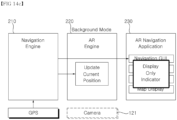
- FIG. 2 is a detailed block diagram of a processor according to an embodiment of the present disclosure.
- FIG. 3 is a diagram referenced for explaining a navigation screen according to an embodiment of the present disclosure.
- FIG. 4 is a diagram referenced for explaining an operation of generating a navigation screen according to an embodiment of the present disclosure.
- the processor 180 may include a navigation engine 210, an augmented reality AR engine 220, and a navigation application 230.
- the navigation engine 210 may receive map data and GPS data.
- the navigation engine 210 may perform map matching based on the map data and the GPS data.
- the navigation engine 210 may perform route planning.
- the navigation engine 210 may display a map and perform route guidance.
- the navigation engine 210 may provide route guidance information to the navigation application 230.
- the navigation engine 210 may include a navigation controller 211.
- the navigation controller 211 may receive map matching data, map display data, and route guidance data.
- the navigation controller 211 may provide route data, point of interest (POI) data, and the like to the AR engine 220.
- the navigation controller 211 may provide route guidance data and a map display frame to the navigation application 230.
- the AR engine 220 may include an adapter 221 and a renderer 222.
- the adapter 221 may receive front image data from the camera 121, first sensing data from a gyroscope sensor 143, and second sensing data from an acceleration sensor 144.
- the adapter may receive sensing data from at least one of a geomagnetic sensor, a temperature sensor, and a gravity sensor.
- the AR engine 220 may perform object detection, based on the front image data and route data.
- the AR engine 220 may perform prediction and interpolation.
- the renderer 222 may perform rendering based on root data, POI data, and prediction and interpolation result data.
- the renderer 222 may provide an AR graphical user interface (GUI) frame and an AR camera frame to the navigation application 230.
- GUI graphical user interface
- the navigation application 230 may generate an augmented reality navigation screen.
- the augmented reality navigation screen may include a navigation map surface 310, an AR camera surface 320, an AR GUI surface 330, and a navigation GUI surface 340.
- the navigation application 230 may generate the navigation map surface 310, based on the map display frame provided from the navigation controller 211.
- the navigation application 230 may generate the AR camera surface 320, based on the AR camera frame provided from the renderer 222.
- the navigation application 230 may generate the AR GUI surface 330, based on the AR GUI frame provided from the renderer 222.
- the navigation application 230 may generate the navigation GUI surface 340, based on the route guidance data provided from the navigation controller 211.
- the navigation application 230 may generate the navigation map surface 310, the AR camera surface 320, the AR GUI surface 330, and the navigation GUI surface 340 (S420).
- the navigation application 230 may provide the parameter of the AR camera surface 320 and the parameter of the AR GUI surface 330 to the AR engine 220 (S430).
- the AR engine 220 may register a callback function in the camera server 171 so as to receive front image data (S440).
- the camera server 171 may be considered to be included in the memory 170.
- the AR engine 220 may receive and crop the front image data (S450).
- the navigation application 230 may display the cropped front image on the AR camera surface 320 (S460).
- the AR engine 230 may perform AR (S470).
- the navigation application 230 may display the AR GUI on the AR GUI surface 330, based on the cropped front image (S480).
- FIG. 5 is a flow chart according to an embodiment of the present disclosure.
- the mobile terminal 100 may provide an augmented reality navigation screen while being hold in a vehicle.
- the processor 180 may receive a vehicle front image (S510).
- the camera 121 may photograph the vehicle front image.
- the processor 180 may receive the vehicle front image photographed by the camera 121.
- Step S510 may include step S511, step S512, and step S513.
- the processor 180 may generate the AR GUI surface 330 and the AR camera surface 320 (S511).
- the processor 180 may obtain a camera 121 control and receive the vehicle front image (S512).
- the processor 180 may display the vehicle front image from the camera 121 on the AR GUI surface 330 and the AR camera surface 320 (S513).
- the processor 180 may calibrate the vehicle front image (S520).
- Step S520 may include step S521, step S522, step S523, step S524, step S525, and step S526.
- the processor 180 may detect and extract a vanishing line, a bonnet line, and a center line from the vehicle front image (S522 and S523). Data on the vanishing line, bonnet line, and center line extracted in step S523 may be stored in the calibration factor DB 172.
- the calibration factor DB 172 may be included in the memory 170.
- the processor 180 may calculate the height and tilt of the camera 121 (S524). For example, the processor 180 may calculate the height and tilt of the camera 121, based on the sensing data (e.g. first sensing data and second sensing data) (S524).
- the processor 180 may perform calibration for the vehicle front image, based on the data obtained in steps S523 and S524 (S525).
- the processor 180 may terminate the calibration (S526).
- the step of performing the calibration may include a step of cropping, by the processor 180, a first area in which at least a portion of the vehicle is located from the front image. At least a portion of the vehicle may include at least one of a bonnet, a roof, an A-pillar, a dashboard, and a holder.
- the step of performing the calibration may include a step of determining, by the processor 180, a balance of top, bottom, left and right of the front image, based on at least one of a horizontal line passing through a vanishing point detectable in the front image and a vertical line passing through the vanishing point, and a step of determining, by the processor, whether to use the wide-angle image, based on the balance.
- the method of operating a mobile terminal may include a step of overlaying the first AR graphic object on a point of the front image corresponding to the first object detected from the vehicle front image.
- the step of overlaying may be a sub-element of step S544.
- the step of performing the calibration may include a step of determining, by the processor 180, whether to use the wide-angle image, based on the location of the first AR graphic object in the front image.
- the step of performing the calibration may include a step of positioning, by the processor 180, a left-right vanishing line detectable from the front image in the center of the vertical direction of the navigation screen.
- the method of operating a mobile terminal may further include a step of generating first sensing data by the gyroscope sensor 143 and a step of generating second sensing data by the acceleration sensor 144.
- the step of performing the calibration may further include a step of determines a holding tilt by the processor, based on the first sensing data and the second sensing data, and a step of compensating the holding tilt with respect to the navigation screen by the processor.
- the processor 180 may drive the augmented reality navigation application so that the augmented reality navigation screen 300 including at least one AR graphic object and the calibrated front image is displayed on the display 151 (S530).
- Step S530 may include steps S531 to S549.
- the processor 180 may display the calibration result (S531). When it is determined that the calibration is successful (S532), the processor 180 may start the navigation mode after starting the AR mode (S533, S534). The processor 180 may search a route (S535). The processor 180 may receive and parse the route information (S536).
- the processor 180 may start sensor control (S540).
- the processor 180 may register various sensor data reception callbacks (S541).
- the processor 180 may receive and parse IMU sensor data.
- the IMU sensor includes the gyroscope sensor 143 and the acceleration sensor 144, and the processor 180 may receive the first sensing data and the second sensing data as IMU sensor data.
- the processor 180 may predict and interpolate the traveling of the vehicle, based on the parsing result of step S546 and the parsing result of step S542 (S543).
- the processor 180 may display a maneuver on the AR GUI surface 330 (S544).
- the processor 180 may display an AR graphic object on the AR GUI surface 330.
- the processor 180 may overlay the first AR graphic object on a point of the front image corresponding to the first object detected in the front image through step S546. Thereafter, the processor 180 may guide a route (S537). The processor 180 may guide the route, based on the route searched in step S535 and the maneuver in step S544. The processor 180 may determine AR guidance and determine whether it is an AR guidance timing (S538, S539). When it is determined that it is the AR guidance timing, the processor 180 may perform step S544. When it is determined that it is not the AR guidance timing, the processor 180 may perform step S537.
- the processor 180 may receive and parse the camera 121 sensor data (S546).
- the processor 180 may detect an object (e.g. a lane, other vehicle, a two-wheeled vehicle, a pedestrian, etc.) based on the image obtained by the camera 121.
- the processor 180 may recognize a lane, based on information on the detected object (S547).
- the processor 180 may cut the camera image (S548).
- the processor 180 may cut the front image, based on data stored in the calibration factor DB 172.
- the processor 180 may display a 3D carpet on the AR camera surface 320, based on the lane recognition data of S547 and the image data of S548 (S549).
- the processor 180 may display the calibration result (S531). When it is determined that the calibration is failed (S532), the processor 180 may start the navigation mode without starting the AR mode (S534). The processor 180 may search a route (S535). The processor 180 may perform route guidance according to the searched route (S537).
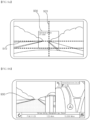
- FIGS. 6A and 6B are diagrams referenced for explaining a vanishing line, a bonnet line, and a center line according to an embodiment of the present disclosure.
- the processor 180 may detect a vanishing line 610, a bonnet line 620, and a center line 630 from a vehicle front image photographed by the camera 121. It may be defined as a horizontal line passing through the vanishing point 601 detected in the vehicle front image.
- the bonnet line 620 may be defined as a horizontal line passing through an uppermost end of the bonnet detected in the vehicle front image.
- the center line 630 may be defined as a vertical line passing through the vanishing point 601.
- the processor 180 may perform calibration based on the vanishing line 610, the bonnet line 620, and the center line 630 in response to a user input. As illustrated in FIG. 6A , when the vanishing line 610, the bonnet line 620, and the center line 630 are set according to a user input, the processor 180 may calibrate the front image to be adjusted to the location set in each of the vanishing line 610, the bonnet line 620, and the center line 630.
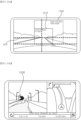
- FIGS. 7A to 7D are diagrams referenced for explaining a cropping operation according to an embodiment of the present disclosure.
- the processor 180 may detect a vanishing line 710, a bonnet line 720, and a center line 730 from a vehicle front image photographed by the camera 121. As illustrated in FIG. 7B , the processor 180 may delete the area under the bonnet line 710 from the vehicle front image.
- the processor 180 may output navigation related information 740, on the area under the deleted bonnet line 710. For example, the processor 180 may display at least one of time information, location information, information of the road being driven, departure point information, departure time information, destination information, information of distance remaining to destination, information of time remaining to the destination, and estimated arrival time information, on the area under the bonnet line 710.
- the processor 180 may display a navigation map 750 and a navigation GUI 755, on one area of the display 151.
- the processor 180 may delete an unnecessary area from the vehicle front image.
- the processor 180 may delete an object area that does not affect the driving of the vehicle.
- the processor 180 may delete an area corresponding to a fixed object located in the sidewalk, from the vehicle front image.
- the processor 180 may display the AR navigation screen 300.
- FIGS. 8A and 8B are diagrams referenced for explaining a cropping operation according to an embodiment of the present disclosure.
- the processor 180 may detect a holder line 810.
- the holder line 810 may be defined as a line formed in a vertical direction or a horizontal direction from a portion of the holder of the mobile terminal that protrudes most toward the center of the screen.
- the processor 180 may delete an area in which the holder is displayed around the holder line 810 in order to delete a holder 820.
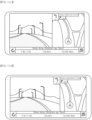
- FIGS. 9A to 11D are diagrams referenced for explaining an operation of using a wide-angle image according to an embodiment of the present disclosure.
- the camera 121 may include a first camera and a second camera.
- the first camera may obtain a front image of the vehicle.
- the second camera may obtain a wide-angle image in comparison with the first camera.
- the second camera may be activated when the processor 180 determines to use the wide-angle image.
- the processor 180 may determine the balance of the top, bottom, left and right, based on the vanishing line 910 and the center line 920 in the front image. The processor 180 may determine whether to use the wide-angle image, based on the balance of the top, bottom, left and right. For example, when it is determined that the center line 920 is leaned toward the left of the front image, the processor 180 may activate the second camera. The processor 180 may supplement the front image of the first camera by taking an image outside the left side of the obtained image of the first camera from the image obtained by the activated second camera.
- the processor 180 may gradually enlarge and display the front image while gradually changing the angle of view of the first camera.
- the processor 180 may determine whether to use the wide-angle image, based on shape data of a road. For example, the processor 180 may determine whether to use a wide-angle image, based on curve data of a road formed to the left or right side.
- Reference numeral 1010 of FIG. 10A illustrates a front image obtained by the first camera.
- Reference numeral 1020 illustrates a front image obtained by the second camera.
- the processor 180 may overlay the first AR graphic object on a point of the front image corresponding to the first object detected in the front image.
- the processor 180 may determine whether to use the wide-angle image, based on the location of the first AR graphic object in the front image.
- FIG. 10B when the route is formed to the right so that the AR graphic object 1030 is located in the right side of the front image, the processor 180 may supplement the front image of the first camera by obtaining a right area that deviates from the front image of the first camera among the wide-angle images of the second camera. In this case, as illustrated in FIG.
- the processor 180 when using a wide-angle image, may combine and display a portion of the front image of the first camera and the wide-angle image of the second camera, by reducing a scale in comparison with a scale before using the wide-angle image. Alternatively, the processor 180 may process and display only the wide-angle image of the second camera. In this case, the processor 180 may maintain the size of the front area display area. As illustrated in FIG. 10D , when using a wide-angle image, the processor 180 may combine and display a portion of the front image of the first camera and the wide-angle image of the second camera, by making a scale to be equal to a scale before using the wide-angle image. Alternatively, the processor 180 may process and display only the wide-angle image of the second camera. In this case, the processor 180 may increase the size of the display area of the front area. The processor 180 may reduce the navigation map display area.
- Reference numeral 1110 of FIG. 11A illustrates a front image obtained by the first camera.
- Reference numeral 1120 illustrates a front image obtained by the second camera.
- the processor 180 may overlay the first AR graphic object on a point of the front image corresponding to the first object detected in the front image.
- the processor 180 may determine whether to use the wide-angle image, based on the location of the first AR graphic object in the front image.
- FIG. 11B when the route is formed to the left so that the AR graphic object 1130 is located in the left side of the front image, the processor 180 may supplement the front image of the first camera by obtaining a left area that deviates from the front image of the first camera among the wide-angle images of the second camera. In this case, as illustrated in FIG.
- the processor 180 when using a wide-angle image, may combine and display a portion of the front image of the first camera and the wide-angle image of the second camera, by reducing a scale in comparison with a scale before using the wide-angle image. Alternatively, the processor 180 may process and display only the wide-angle image of the second camera. In this case, the processor 180 may maintain the size of the front area display area. As illustrated in FIG. 11D , when using a wide-angle image, the processor 180 may combine and display a portion of the front image of the first camera and the wide-angle image of the second camera, by making a scale to be equal to a scale before using the wide-angle image. Alternatively, the processor 180 may process and display only the wide-angle image of the second camera. In this case, the processor 180 may increase the size of the display area of the front area. The processor 180 may reduce the navigation map display area.
- FIGS. 12A and 12B are diagrams referenced for explaining an operation of adjusting a vanishing line according to an embodiment of the present disclosure.
- the processor 180 may detect a vanishing line 1210 from a front image. As illustrated in FIG. 12A , the processor 180 may determine whether the vanishing line 1210 is positioned below the center 1220 in the vertical direction of the navigation screen. In this case, the processor 180 may adjust an area displayed on the navigation screen of the front image so that the vanishing line 1210 is positioned in the center 1220. As illustrated in FIG. 12B , the processor 180 may position the vanishing line 1210 in the center 1220 of the navigation screen in the vertical direction.
- the processor 180 may determine whether the vanishing line is positioned above the center of the navigation screen in the vertical direction. In this case, the processor 180 may position the vanishing line in the center of the navigation screen in the vertical direction.
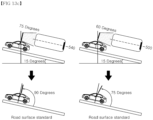
- FIGS. 13A to 13C are diagrams referenced for explaining an operation of compensating a tilt value when a vehicle according to an embodiment of the present disclosure travels on a slope.
- the processor 180 may configure a lookup table 1310 by calculating a tilt value of the mobile terminal and calculating a vanishing line.
- the lookup table 1310 may be stored in the memory 170. For example, when the tilt of the mobile terminal 100 is 90 degrees, 85 degrees, 80 degrees, and 75 degrees, each vanishing line may be calculated to configure the lookup table 1310.
- the processor 180 may compensate the installation tilt value of the mobile terminal 100, based on the lookup table 1310. For example, the processor 180 may determine that the installation tilt value of the mobile terminal 100 is 75 degrees, based on at least one of the first sensing data and the second sensing data. The processor 180 may check that the value of the vanishing line is 540. The processor 180 may determine that the tilt value of the mobile terminal corresponding to the vanishing line value is 90 degrees based on the lookup table 1310. The processor 180 may compensate the installation tilt of the mobile terminal 100 as 90 degrees when the vehicle travels on a slope.
- FIGS. 14A to 14C are diagrams referenced for explaining an operation of a mobile terminal in a specific situation according to an embodiment of the present disclosure.
- FIG. 14B illustrates a case in which an AR navigation application is driven in the foreground in a state where the camera is deactivated.
- the operating method of the mobile terminal 100 may further include a step of obtaining vehicle stop state information by the processor 180, a step of deactivating the camera 121 by the processor 180, and a step of driving the augmented reality navigation application to display a navigation screen excluding the front image and the AR graphic object by the processor 180.
- the processor 180 may deactivate the camera, and drive the augmented reality navigation application to display a navigation screen excluding the front image and the AR graphic object.
- the processor 180 may configure the AR navigation screen by including only the navigation GUI surface and the navigation map surface while excluding the AR GUI surface and the AR camera surface.
- the operating method of the mobile terminal 100 may further include a step of obtaining vehicle moving state information after the vehicle stop state by the processor 180, a step of activating the camera by the processor 180, and a step of calibrating the front image obtained from the activated camera 121, based on the calibration data prior to deactivation of the camera 121, by the processor 180.
- the processor 180 When obtaining the vehicle moving state information after the vehicle stop state, the processor 180 activates the camera 121, and may calibrate the front image obtained from the activated camera 121, based on the calibration data prior to deactivation of the camera 121.
- the processor 180 may calibrate the front image obtained from the activated camera 121 by calling calibration data from the calibration factor DB 172.
- FIG. 14C illustrates a case where the AR navigation application is driven in a background.
- the operating method of the mobile terminal 100 may include a step of receiving at least one of a home button input signal and other application execution input signal by the processor 180, a step of deactivating the camera 121 by the processor 180, and a step of driving the augmented reality navigation application in the background by the processor 180.
- the processor 180 may deactivate the camera 121, and drive the augmented reality navigation application in the background.
- FIG. 15 is a diagram referenced for explaining an operation of a mobile terminal in a walking mode according to an embodiment of the present disclosure.
- the processor 180 may provide an AR navigation screen for walking.
- the processor 180 may perform calibration so that an area of an object that does not interfere with walking is excluded from a pedestrian front image.
- the processor 180 may enlarge and display an area for guiding a pedestrian in the pedestrian front image, and delete the remaining area.
- the present disclosure described above can be implemented as a computer-readable code on a medium on which a program is recorded.
- the computer-readable medium includes all types of recording devices that store data that can be read by a computer system. Examples of computer-readable media include hard disk drives (HDDs), solid state disks (SSDs), silicon disk drives (SDDs), ROMs, RAM, CD-ROMs, magnetic tapes, floppy disks, optical data storage devices, etc. There are also carrier waves (for example, transmission over the Internet).
- the computer may include a processor or a processor. Therefore, the detailed description above should not be construed as restrictive in all respects and should be considered as illustrative. The scope of the present disclosure should be determined by rational interpretation of the appended claims.
Landscapes
- Engineering & Computer Science (AREA)
- Radar, Positioning & Navigation (AREA)
- Remote Sensing (AREA)
- General Physics & Mathematics (AREA)
- Physics & Mathematics (AREA)
- Human Computer Interaction (AREA)
- Signal Processing (AREA)
- Computer Networks & Wireless Communication (AREA)
- Automation & Control Theory (AREA)
- Theoretical Computer Science (AREA)
- Multimedia (AREA)
- Environmental & Geological Engineering (AREA)
- General Engineering & Computer Science (AREA)
- Software Systems (AREA)
- Computer Hardware Design (AREA)
- Computer Graphics (AREA)
- Business, Economics & Management (AREA)
- General Business, Economics & Management (AREA)
- Computer Vision & Pattern Recognition (AREA)
- Mechanical Engineering (AREA)
- Navigation (AREA)
Description
- The present disclosure relates to a mobile terminal and a control method thereof.
- Recently, navigation using a mobile terminal is more invigorated than a navigation device embedded in a vehicle.
- When not getting on a vehicle, a user carries the mobile terminal in his/her bag or pocket, and if he/she gets on the vehicle, the mobile terminal is hold in the vehicle and used as a navigation device.
- Meanwhile, in recent years, the development of augmented reality navigation has been actively conducted. Furthermore, research for implementing augmented reality navigation in mobile terminal has been also conducted.
- However, in the mobile terminal, the location or posture of the mobile terminal is changed whenever it is hold in the vehicle. Accordingly, there is a problem in that the image photographed by a camera is not uniform.
-
US 2013/293582 A1 relates to generating a virtual model of environment in front of a vehicle based on images captured using an image capturing. -
US 2012/226437 A1 relates to a navigation device including a display, a recording medium, a navigation camera, a global positioning system (GPS), and a processor. -
KR 2014 0054909 A - In order to solve the above problems, an object of the present disclosure is to provide a mobile terminal that displays an augmented reality navigation screen including an AR graphic object and a calibrated front image.
- Another object of the present disclosure is to provide a method of operating a mobile terminal displaying an augmented reality navigation screen including an AR graphic object and a calibrated front image.
- The problems of the present disclosure are not limited to the problems mentioned above, and other problems that are not mentioned will be clearly understood by those skilled in the art from the following description.
- The invention is specified by the independent claims. Preferred embodiments are defined in the dependent claims.
- In order to achieve the above object, according to an embodiment of the present disclosure, a mobile terminal that provides an augmented reality navigation screen in a state of being hold in a vehicle, includes: at least one camera configured to obtain a front image; a display; and at least one processor configured to calibrate the front image, and to drive an augmented reality navigation application so that the augmented reality navigation screen including at least one augmented reality (AR) graphic object and the calibrated front image is displayed on the display.
- According to an embodiment of the present disclosure, the processor crops a first area in which at least a portion of the vehicle is located in the front image, and the at least a portion of the vehicle includes at least one of a bonnet, a roof, an A-pillar, a dashboard, and a holder.
- According to an embodiment of the present disclosure, the at least one camera includes: a first camera configured to obtain the front image; and a second camera configured to obtain a wide-angle image in comparison with the first camera, wherein the processor determines a balance of top, bottom, left and right of the front image, based on at least one of a horizontal line passing through a vanishing point detectable in the front image and a vertical line passing through the vanishing point, and determines whether to use the wide-angle image, based on the balance.
- According to an embodiment of the present disclosure, the at least one camera includes: a first camera configured to obtain the front image; and a second camera configured to obtain a wide-angle image in comparison with the first camera, wherein the processor overlays a first AR graphic object on a point of the front image corresponding to a first object detected from the front image, and determines whether to use the wide-angle image, based on a location of the first AR graphic object in the front image.
- According to an embodiment of the present disclosure, the processor positions a left-right vanishing line detectable in the front image in a center of vertical direction of the navigation screen.
- According to an embodiment of the present disclosure, the mobile terminal further includes; a gyroscope sensor configured to generate first sensing data; and an acceleration sensor configured to generate second sensing data, wherein the mobile terminal determines a holding tilt value, based on the first sensing data and the second sensing data, and compensates the holding tilt value on the navigation screen.
- According to an embodiment of the present disclosure, when receiving at least one of a home button input signal and other application execution input signal, the processor deactivates the camera and drives the augmented reality navigation application in a background.
- According to an embodiment of the present disclosure, when obtaining vehicle stop state information, the processor deactivates the camera and drives the augmented reality navigation application to display a navigation screen excluding the front image and the AR graphic object.
- According to an embodiment of the present disclosure, when obtaining vehicle moving state information after a vehicle stop state, the processor activates the camera and calibrates a front image obtained from the activated camera based on calibration data prior to deactivation of the camera.
- Details of other embodiments are included in the detailed description and drawings.
- According to the present disclosure, there are one or more of the following effects.
- First, when a mobile terminal is hold in a vehicle, there is an effect of providing an augmented reality navigation screen based on a front image that is calibrated without a separate setting.
- Second, whenever a mobile terminal is hold in the vehicle, it is not necessary to adjust the posture of the mobile terminal or to perform manual calibration.
- Third, even when a user gets on various types of vehicles, there is an effect of relieving the hassle of setting each time.
- The effects of the present disclosure are not limited to the effects mentioned above, and other effects not mentioned can be clearly understood by those skilled in the art from the description of the claims.
-
-
FIG. 1 is a block diagram of a mobile terminal according to an embodiment of the present disclosure. -
FIG. 2 is a detailed block diagram of a processor according to an embodiment of the present disclosure. -
FIG. 3 is a diagram referenced for explaining a navigation screen according to an embodiment of the present disclosure. -
FIG. 4 is a diagram referenced for explaining an operation of generating a navigation screen according to an embodiment of the present disclosure. -
FIG. 5 is a flow chart according to an embodiment of the present disclosure. -
FIGS. 6A and 6B are diagrams referenced for explaining a vanishing line, a bonnet line, and a center line according to an embodiment of the present disclosure. -
FIGS. 7A to 7D are diagrams referenced for explaining a cropping operation according to an embodiment of the present disclosure. -
FIGS. 8A and 8B are diagrams referenced for explaining a cropping operation according to an embodiment of the present disclosure. -
FIGS. 9A to 11D are diagrams referenced for explaining an operation of using a wide-angle image according to an embodiment of the present disclosure. -
FIGS. 12A and 12B are diagrams referenced for explaining an operation of adjusting a vanishing line according to an embodiment of the present disclosure. -
FIGS. 13A to 13C are diagrams referenced for explaining an operation of compensating a tilt value of mobile terminal setting according to an embodiment of the present disclosure. -
FIGS. 14A to 14C are diagrams referenced for explaining an operation of a mobile terminal in a specific situation according to an embodiment of the present disclosure. -
FIG. 15 is a diagram referenced for explaining an operation of a mobile terminal in a walking mode according to an embodiment of the present disclosure. - Hereinafter, the embodiments disclosed in the present specification will be described in detail with reference to the accompanying drawings, and the same or similar elements are denoted by the same reference numerals even though they are depicted in different drawings and redundant descriptions thereof will be omitted. In the following description, with respect to constituent elements used in the following description, the suffixes "module" and "unit" are used or combined with each other only in consideration of ease in the preparation of the specification, and do not have or serve as different meanings. Accordingly, the suffixes "module" and "unit" may be interchanged with each other. In addition, the accompanying drawings are provided only for a better understanding of the embodiments disclosed in the present specification and are not intended to limit the technical ideas disclosed in the present specification. Therefore, it should be understood that the accompanying drawings include all modifications, equivalents and substitutions included in the scope of the appended claims.
- Although the terms "first," "second," etc., may be used herein to describe various components, these components should not be limited by these terms. These terms are only used to distinguish one component from another component. When a component is referred to as being "connected to" or "coupled to" another component, it may be directly connected to or coupled to another component or intervening components may be present. In contrast, when a component is referred to as being "directly connected to" or "directly coupled to" another component, there are no intervening components present.
- As used herein, the singular form is intended to include the plural forms as well, unless the context clearly indicates otherwise.
- In the present application, it will be further understood that the terms "comprises", includes," etc. specify the presence of stated features, integers, steps, operations, elements, components, or combinations thereof, but do not preclude the presence or addition of one or more other features, integers, steps, operations, elements, components, or combinations thereof.
- In the following description, the left side means the left side in the forward driving direction of a vehicle, and the right side means the right side in the forward driving direction of a vehicle.
-
FIG. 1 is a block diagram of a mobile terminal according to an embodiment of the present disclosure. - Referring to
FIG. 1 , amobile terminal 100 may include a portable phone, a smart phone, a laptop computer, a digital broadcasting terminal, a personal digital assistants (PDA), a portable multimedia player (PMP), a navigation system, a slate PC, a tablet PC, an ultrabook, wearable device (e.g., a smartwatch, a smart glass, a head mounted display (HMD)), and the like. - The
mobile terminal 100 may provide an augmented reality navigation screen while being hold in a vehicle. Themobile terminal 100 may be hold inside the vehicle such that adisplay 151 faces the cabin of the vehicle and at least onecamera 121 faces the front of the vehicle. - The
mobile terminal 100 may include awireless communication unit 110, at least onecamera 121, agyroscope sensor 143, anacceleration sensor 144, adisplay 151, amemory 170, at least oneprocessor 180, and apower supply unit 190. - The
mobile terminal 100 may further include a wireless communication unit including a broadcast reception module, a mobile communication module, a wireless Internet module, a short-range communication module, and a location information module. Themobile terminal 100 may further include an input unit including a microphone and a user input unit. According to an embodiment, thecamera 121 may be classified as a sub-element of the input unit. Themobile terminal 100 may further include a sensing unit including a proximity sensor and an illuminance sensor. Themobile terminal 100 may include an output unit including an audio output unit, a haptic module, and an optical output unit. According to an embodiment, thedisplay 151 may be classified as a sub-element of the output unit. Themobile terminal 100 may further include an interface unit for exchanging power or data with other device. - The
wireless communication unit 110 may include one or more modules that enable a wireless communication between themobile terminal 100 and a wireless communication system, between themobile terminal 100 and othermobile terminal 100, or between themobile terminal 100 and an external server. Thewireless communication unit 110 may include one or more modules that connect themobile terminal 100 to one or more networks. - The
wireless communication unit 110 transmits and receives a wireless signal with at least one of a base station, an external terminal, and a server on a mobile communication network built according to technical standards or communication methods for mobile communication (e.g. Global System for Mobile communication (GSM), Code Division Multi Access (CDMA), Code Division Multi Access 2000 (CDMA2000), Enhanced Voice-Data Optimized or Enhanced Voice-Data Only (EV-DO), Wideband CDMA (WCDMA), High Speed Downlink Packet Access (HSDPA), High Speed Uplink Packet Access (HSUPA), Long Term Evolution (LTE), Long Term Evolution-Advanced (LTE-A, 5G), and the like). - The
camera 121 may process an image frame such as a still image or a moving image obtained by an image sensor. The processed image frame may be displayed on thedisplay unit 151 or stored in thememory 170. Thecamera 121 includes at least one of a camera sensor (e.g. CCD, CMOS, etc.), a photo sensor (or image sensor), and a laser sensor. - The
camera 121 may obtain a front image of the vehicle. The obtained front image of the vehicle may be stored in thememory 170 or transmitted to theprocessor 180. Thecamera 121 may be activated or deactivated based on a control signal generated by theprocessor 180. - The
camera 121 may include a first camera and a second camera. - The first camera may obtain a front image of the vehicle. The first camera may obtain a narrow angle image in comparison with the second camera. The first camera may be disposed around the second camera. The first camera may be activated or deactivated based on a control signal generated by the
processor 180. - The second camera may obtain a front image of the vehicle. In a deactivated state, the second camera may be activated according to a request signal from the
processor 180 to obtain a front image. The second camera may obtain a wide-angle image in comparison with the first camera. The second camera may be activated or deactivated based on a control signal generated by theprocessor 180. - The
gyroscope sensor 143 may allow themobile terminal 100 to measure the angular velocity of themobile terminal 100. Thegyroscope sensor 143 may generate first sensing data based on the measured angular velocity. - The
acceleration sensor 144 may measure the acceleration of themobile terminal 100. Theacceleration sensor 144 may generate second sensing data based on the measured acceleration. - The
display 151 displays (outputs) information processed by themobile terminal 100. For example, thedisplay unit 151 may display execution screen information of an application program driven in themobile terminal 100, or User Interface (UI) and Graphic User Interface (GUI) information according to the execution screen information. - The
display unit 151 may include at least one of a liquid crystal display (LCD), a thin film transistor-liquid crystal display (TFT LCD), an organic light-emitting diode (OLED), a flexible display, a 3D display, and an e-ink display. - In addition, two or
more display units 151 may exist according to the implementation form of themobile terminal 100. In this case, in themobile terminal 100, a plurality of display units may be spaced apart from or integrally disposed on one surface, or may be disposed on different surfaces respectively. - The
display unit 151 may include a touch sensor that senses a touch on thedisplay unit 151 so as to receive a control command by a touch method. Using this, when a touch is accomplished for thedisplay unit 151, the touch sensor detects the touch, and based on this, theprocessor 180 may be configured to generate a control command corresponding to the touch. The content input by the touch method may be letters or numbers, or menu items that can be indicated or designated in various modes. As described, thedisplay unit 151 may form a touch screen together with a touch sensor, and in this case, the touch screen may serve as a user input unit. - The
memory 170 stores data supporting various functions of themobile terminal 100. Thememory 170 may store a number of application programs or applications driven by themobile terminal 100, data for operation of themobile terminal 100, and commands. At least some of these application programs may be downloaded from an external server through wireless communication. In addition, at least some of these application programs may exist in the mobile terminal 100 from the time of delivery for the basic function (e.g. call receipt, outgoing functions, message reception and outgoing functions) of themobile terminal 100. Meanwhile, the application program may be stored in thememory 170, installed in themobile terminal 100, and driven by theprocessor 180 to perform an operation (or function) of the mobile terminal. - The
memory 170 may store a program for the operation of theprocessor 180, and may temporarily store input/output data (e.g. a phone book, a message, a still image, a moving image, etc.). Thememory 170 may store data on vibration and sound of various patterns that are output when a touch input on the touch screen is accomplished. - The
memory 170 may include at least one type of storage medium among a flash memory type, a hard disk type, a solid state disk (SSD) type, a silicon disk drive (SDD) type, a multimedia card micro type, a card-type memory (e.g., SD or XD memory, etc), a random access memory (RAM), a static random access memory (SRAM), a read-only memory (ROM), an electrically erasable programmable read-only memory (EEPROM), a programmable read-only memory (PROM), a magnetic memory, a magnetic disk, and an optical disk. Themobile terminal 100 may be operated in connection with a web storage that performs a storage function of thememory 170 over the Internet. - The
processor 180 may be electrically connected to thecamera 121, thegyroscope sensor 143, theacceleration sensor 144, thedisplay 151, thememory 170, and thepower supply unit 190 to exchange signals. Theprocessor 180 may be implemented by using at least one of application specific integrated circuits (ASICs), digital signal processors (DSPs), digital signal processing devices (DSPDs), programmable logic devices (PLDs), field programmable gate arrays (FPGAs), processors, and controllers, micro-controllers, microprocessors, and electrical units for performing other functions. Theprocessor 180 may be driven by power provided from thepower supply unit 190. - The
processor 180 controls the overall operation of themobile terminal 100. Theprocessor 180 may provide or process appropriate information or functions to a user by processing the above input or output signals, data, information, etc., or by driving an application program stored in thememory 170. - The
processor 180 may receive a front image of the vehicle. - The
processor 180 may calibrate the front image. - The
processor 180 may perform calibration by cropping the front image. In the front image, areas that are unnecessary for the configuration of the navigation screen may exist. Theprocessor 180 may remove these unnecessary areas. Theprocessor 180 may crop a first area where at least a portion of the vehicle is located in the front image. Here, at least a portion of the vehicle may include at least one of a bonnet, a roof, an A-pillar, a dashboard, and a holder. Theprocessor 180 may crop the first area based on image processing using a histogram. - The
processor 180 may output navigation related information to the cropped area. For example, theprocessor 180 may display at least one of time information, location information, information of road being driven, departure point information, departure time information, destination information, information of distance remaining to destination, information of time remaining to the destination, and estimated arrival time information, on the cropped area. - The
processor 180 may perform calibration by using a wide-angle image. Theprocessor 180 may determine the balance of top, bottom, left and right of the front image, based on at least one of a horizontal line passing through a vanishing point detectable in the front image acquired by the first camera and a vertical line passing through the vanishing point. Theprocessor 180 may determine whether to use the wide-angle image obtained by the second camera, based on the balance of top, bottom, left and right of the front image. Theprocessor 180 may overlay a first AR graphic object on a point of the front image corresponding to the first object detected in the front image obtained by the first camera. Theprocessor 180 may determine whether to use the wide-angle image, based on the location of the first AR graphic object in the front image. - The
processor 180 may perform calibration by adjusting the location of a vanishing line detectable in the front image. Theprocessor 180 may position a left-right direction vanishing line detectable in the front image at the center of the navigation screen in the vertical direction. - The
processor 180 may perform calibration by compensating a holding tilt value of themobile terminal 100. Theprocessor 180 may determine the holding tilt value, based on the first sensing data received from thegyroscope sensor 143 and the second sensing data received from theacceleration sensor 144. Theprocessor 180 may compensate the tilt value on the navigation screen. Theprocessor 180 may compensate the first sensing data and the second sensing data using a Kalman filter. According to an embodiment, theprocessor 180 may determine a holding tilt value, further based on data received from the geomagnetic sensor and the temperature sensor. According to an embodiment, theprocessor 180 may determine and compensate a holding tilt value, based on third sensing data received from a gravity sensor. - The
processor 180 may drive an augmented reality navigation application so that the augmented reality navigation screen is displayed on thedisplay 151. The augmented reality navigation screen may include at least one augmented reality AR graphic object and a calibrated front image. - The
processor 180 may receive at least one of a home button input signal and other application execution input signal, through a user input unit. In this case, theprocessor 180 may deactivate thecamera 121 so that acquisition of the front image is stopped. Theprocessor 180 may drive an augmented reality navigation application in the background. Through such control, it is possible to prevent the waste of battery and processing power generated while unnecessarily obtaining and processing a front image. - The
processor 180 may obtain vehicle stop state information by processing the front image or receiving a signal from the vehicle. Theprocessor 180 may deactivate thecamera 121 when obtaining the vehicle stop state information. In this case, theprocessor 180 may drive the augmented reality navigation application to display the navigation screen excluding the front image and the AR graphic object. Theprocessor 180 may obtain information on vehicle moving state after the vehicle is stopped, by processing a front image or receiving a signal from the vehicle. Theprocessor 180 may activate thecamera 121, when obtaining the information on vehicle moving state after the vehicle is stopped. Theprocessor 180 may calibrate the front image obtained from the activated camera, based on the calibration data before thecamera 121 is deactivated. - The
processor 180 may receive at least one of a signal, information, and data from a server, through thewireless communication unit 110. Theprocessor 180 may receive augmented reality navigation application data from a server. - The
processor 180 may receive directions information from a server, and drive a navigation application based on the directions information. The directions information may include map data and an AR graphic object. - The
processor 180 may receive map data from a server. The map data may include at least one of standard definition (SD) map data and high definition (HD) map data. Theprocessor 180 may download the entire map data at a specific time and store it in thememory 170 for use. Theprocessor 180 may download only some of the entire map data at a preset cycle, store it in thememory 170 and use it temporarily. Map data that completed usage may be deleted. Theprocessor 180 may receive AR graphic object (e.g. AR indicator) data from a server. - The
processor 180 may download only some data of the entire map data based on a set route, store it in thememory 170 and use it temporarily. Theprocessor 180 may receive map data corresponding to a route generated by a destination input by a user, and store the received map data in thememory 170. Theprocessor 170 may receive an AR graphic object corresponding to a route along with map data, and store the received AR graphic object in thememory 170. Theprocessor 170 may delete the map data and the AR graphic object stored in thememory 170 after using them. - When the directions information is updated while driving the navigation based on the directions information received from the server, the
processor 180 may receive the updated directions information and drive the navigation application. Theprocessor 180 may change a preset route according to the updated directions information. - The
processor 180 may receive directions information corresponding to an expected driving route in real time. Theprocessor 180 may adjust the amount of reception of directions information corresponding to a section including the expected driving route according to the communication strength. For example, when the communication strength is greater than or equal to a first reference value, theprocessor 180 may receive directions information corresponding to a relatively long section. - According to an embodiment, a plurality of surfaces (a navigation map surface, an AR camera surface, an AR GUI surface, and a navigation GUI surface) described later may be generated in a server. The
processor 180 may receive a plurality of surfaces from a server to configure a navigation screen. Theprocessor 180 may adjust the number of received surfaces according to the communication strength. For example, when the communication strength is weak, theprocessor 180 may receive only the navigation GUI surface and then additionally receive the AR GUI surface when the communication strength is gradually increased. - The
processor 180 may receive AR graphic information processed by the server and output an AR indicator based on the received AR graphic information. When there is a point of interest (POI) preset by the augmented reality navigation application, theprocessor 180 may additionally display an AR indicator, during AR directions. Theprocessor 180 may receive POI information from the server in real time. When receiving the POI information, theprocessor 180 may also receive an AR indicator corresponding to the POI. - The
power supply unit 190 receives external power and internal power under the control of theprocessor 180 and supplies power necessary for the operation of each of components. Thepower supply unit 190 includes a battery, and the battery may be a built-in battery configured to be rechargeable, and may be detachably coupled to a terminal body for charging. Thepower supply unit 190 may include a connection port, and the connection port may be configured as an example of an interface 160 to which an external charger supplying power for charging a battery is electrically connected. - As another example, the
power supply unit 190 may be configured to charge the battery in a wireless manner without using the connection port. In this case, thepower supply unit 190 may receive power from an external wireless power transmitter by using at least one of an inductive coupling method based on a magnetic induction phenomenon or a magnetic resonance coupling method based on an electromagnetic resonance phenomenon. - Meanwhile, the
mobile terminal 100 may include a computer-readable medium that executes a plurality of steps, when driven by theprocessor 180. The plurality of steps may include a step of receiving a front image, a step of calibrating the front image, and a step of driving an augmented reality navigation application so that an augmented reality navigation screen including at least one AR graphic object and the calibrated front image is displayed on the display. The plurality of steps will be described in more detail with reference toFIG. 5 . -
FIG. 2 is a detailed block diagram of a processor according to an embodiment of the present disclosure. -
FIG. 3 is a diagram referenced for explaining a navigation screen according to an embodiment of the present disclosure. -
FIG. 4 is a diagram referenced for explaining an operation of generating a navigation screen according to an embodiment of the present disclosure. - Referring to the drawing, the
processor 180 may include anavigation engine 210, an augmentedreality AR engine 220, and anavigation application 230. - The
navigation engine 210 may receive map data and GPS data. Thenavigation engine 210 may perform map matching based on the map data and the GPS data. Thenavigation engine 210 may perform route planning. Thenavigation engine 210 may display a map and perform route guidance. Thenavigation engine 210 may provide route guidance information to thenavigation application 230. Meanwhile, thenavigation engine 210 may include anavigation controller 211. Thenavigation controller 211 may receive map matching data, map display data, and route guidance data. Thenavigation controller 211 may provide route data, point of interest (POI) data, and the like to theAR engine 220. Thenavigation controller 211 may provide route guidance data and a map display frame to thenavigation application 230. - The
AR engine 220 may include anadapter 221 and arenderer 222. Theadapter 221 may receive front image data from thecamera 121, first sensing data from agyroscope sensor 143, and second sensing data from anacceleration sensor 144. According to an embodiment, the adapter may receive sensing data from at least one of a geomagnetic sensor, a temperature sensor, and a gravity sensor. - Based on data provided from a calibration factor DB, calibration for the front image may be performed. The
AR engine 220 may perform object detection, based on the front image data and route data. TheAR engine 220 may perform prediction and interpolation. - The
renderer 222 may perform rendering based on root data, POI data, and prediction and interpolation result data. Therenderer 222 may provide an AR graphical user interface (GUI) frame and an AR camera frame to thenavigation application 230. - The
navigation application 230 may generate an augmented reality navigation screen. As illustrated inFIG. 3 , the augmented reality navigation screen may include anavigation map surface 310, anAR camera surface 320, anAR GUI surface 330, and anavigation GUI surface 340. Thenavigation application 230 may generate thenavigation map surface 310, based on the map display frame provided from thenavigation controller 211. Thenavigation application 230 may generate theAR camera surface 320, based on the AR camera frame provided from therenderer 222. Thenavigation application 230 may generate theAR GUI surface 330, based on the AR GUI frame provided from therenderer 222. Thenavigation application 230 may generate thenavigation GUI surface 340, based on the route guidance data provided from thenavigation controller 211. - Referring to
FIG. 4 , when thenavigation application 230 is started (S410), thenavigation application 230 may generate thenavigation map surface 310, theAR camera surface 320, theAR GUI surface 330, and the navigation GUI surface 340 (S420). Thenavigation application 230 may provide the parameter of theAR camera surface 320 and the parameter of theAR GUI surface 330 to the AR engine 220 (S430). TheAR engine 220 may register a callback function in thecamera server 171 so as to receive front image data (S440). Thecamera server 171 may be considered to be included in thememory 170. TheAR engine 220 may receive and crop the front image data (S450). Thenavigation application 230 may display the cropped front image on the AR camera surface 320 (S460). TheAR engine 230 may perform AR (S470). Thenavigation application 230 may display the AR GUI on theAR GUI surface 330, based on the cropped front image (S480). -
FIG. 5 is a flow chart according to an embodiment of the present disclosure. - A method of operating a mobile terminal (S500) will be described with reference to
FIGS. 4 and5 . Themobile terminal 100 may provide an augmented reality navigation screen while being hold in a vehicle. - The
processor 180 may receive a vehicle front image (S510). Thecamera 121 may photograph the vehicle front image. Theprocessor 180 may receive the vehicle front image photographed by thecamera 121. Step S510 may include step S511, step S512, and step S513. - The
processor 180 may generate theAR GUI surface 330 and the AR camera surface 320 (S511). Theprocessor 180 may obtain acamera 121 control and receive the vehicle front image (S512). Theprocessor 180 may display the vehicle front image from thecamera 121 on theAR GUI surface 330 and the AR camera surface 320 (S513). - The
processor 180 may calibrate the vehicle front image (S520). Step S520 may include step S521, step S522, step S523, step S524, step S525, and step S526. - When calibration starts (S521), the
processor 180 may detect and extract a vanishing line, a bonnet line, and a center line from the vehicle front image (S522 and S523). Data on the vanishing line, bonnet line, and center line extracted in step S523 may be stored in thecalibration factor DB 172. Thecalibration factor DB 172 may be included in thememory 170. Theprocessor 180 may calculate the height and tilt of the camera 121 (S524). For example, theprocessor 180 may calculate the height and tilt of thecamera 121, based on the sensing data (e.g. first sensing data and second sensing data) (S524). Theprocessor 180 may perform calibration for the vehicle front image, based on the data obtained in steps S523 and S524 (S525). Theprocessor 180 may terminate the calibration (S526). - The step of performing the calibration (S525) may include a step of cropping, by the
processor 180, a first area in which at least a portion of the vehicle is located from the front image. At least a portion of the vehicle may include at least one of a bonnet, a roof, an A-pillar, a dashboard, and a holder. - The step of performing the calibration (S525) may include a step of determining, by the
processor 180, a balance of top, bottom, left and right of the front image, based on at least one of a horizontal line passing through a vanishing point detectable in the front image and a vertical line passing through the vanishing point, and a step of determining, by the processor, whether to use the wide-angle image, based on the balance. - Meanwhile, the method of operating a mobile terminal (S500) may include a step of overlaying the first AR graphic object on a point of the front image corresponding to the first object detected from the vehicle front image. The step of overlaying may be a sub-element of step S544.
- The step of performing the calibration (S525) may include a step of determining, by the
processor 180, whether to use the wide-angle image, based on the location of the first AR graphic object in the front image. The step of performing the calibration (S525) may include a step of positioning, by theprocessor 180, a left-right vanishing line detectable from the front image in the center of the vertical direction of the navigation screen. - The method of operating a mobile terminal (S500) may further include a step of generating first sensing data by the
gyroscope sensor 143 and a step of generating second sensing data by theacceleration sensor 144. The step of performing the calibration (S525) may further include a step of determines a holding tilt by the processor, based on the first sensing data and the second sensing data, and a step of compensating the holding tilt with respect to the navigation screen by the processor. - The
processor 180 may drive the augmented reality navigation application so that the augmentedreality navigation screen 300 including at least one AR graphic object and the calibrated front image is displayed on the display 151 (S530). Step S530 may include steps S531 to S549. - The
processor 180 may display the calibration result (S531). When it is determined that the calibration is successful (S532), theprocessor 180 may start the navigation mode after starting the AR mode (S533, S534). Theprocessor 180 may search a route (S535). Theprocessor 180 may receive and parse the route information (S536). - Meanwhile, the
processor 180 may start sensor control (S540). Theprocessor 180 may register various sensor data reception callbacks (S541). Theprocessor 180 may receive and parse IMU sensor data. The IMU sensor includes thegyroscope sensor 143 and theacceleration sensor 144, and theprocessor 180 may receive the first sensing data and the second sensing data as IMU sensor data. Theprocessor 180 may predict and interpolate the traveling of the vehicle, based on the parsing result of step S546 and the parsing result of step S542 (S543). Theprocessor 180 may display a maneuver on the AR GUI surface 330 (S544). Theprocessor 180 may display an AR graphic object on theAR GUI surface 330. Theprocessor 180 may overlay the first AR graphic object on a point of the front image corresponding to the first object detected in the front image through step S546. Thereafter, theprocessor 180 may guide a route (S537). Theprocessor 180 may guide the route, based on the route searched in step S535 and the maneuver in step S544. Theprocessor 180 may determine AR guidance and determine whether it is an AR guidance timing (S538, S539). When it is determined that it is the AR guidance timing, theprocessor 180 may perform step S544. When it is determined that it is not the AR guidance timing, theprocessor 180 may perform step S537. - The
processor 180 may receive and parse thecamera 121 sensor data (S546). Theprocessor 180 may detect an object (e.g. a lane, other vehicle, a two-wheeled vehicle, a pedestrian, etc.) based on the image obtained by thecamera 121. Theprocessor 180 may recognize a lane, based on information on the detected object (S547). Theprocessor 180 may cut the camera image (S548). Theprocessor 180 may cut the front image, based on data stored in thecalibration factor DB 172. Theprocessor 180 may display a 3D carpet on theAR camera surface 320, based on the lane recognition data of S547 and the image data of S548 (S549). - The
processor 180 may display the calibration result (S531). When it is determined that the calibration is failed (S532), theprocessor 180 may start the navigation mode without starting the AR mode (S534). Theprocessor 180 may search a route (S535). Theprocessor 180 may perform route guidance according to the searched route (S537). -
FIGS. 6A and 6B are diagrams referenced for explaining a vanishing line, a bonnet line, and a center line according to an embodiment of the present disclosure. - Referring to the drawings, the
processor 180 may detect a vanishingline 610, abonnet line 620, and acenter line 630 from a vehicle front image photographed by thecamera 121. It may be defined as a horizontal line passing through the vanishingpoint 601 detected in the vehicle front image. Thebonnet line 620 may be defined as a horizontal line passing through an uppermost end of the bonnet detected in the vehicle front image. Thecenter line 630 may be defined as a vertical line passing through the vanishingpoint 601. - According to an embodiment, the
processor 180 may perform calibration based on the vanishingline 610, thebonnet line 620, and thecenter line 630 in response to a user input. As illustrated inFIG. 6A , when the vanishingline 610, thebonnet line 620, and thecenter line 630 are set according to a user input, theprocessor 180 may calibrate the front image to be adjusted to the location set in each of the vanishingline 610, thebonnet line 620, and thecenter line 630. -
FIGS. 7A to 7D are diagrams referenced for explaining a cropping operation according to an embodiment of the present disclosure. - As illustrated in
FIG. 7A , theprocessor 180 may detect a vanishingline 710, abonnet line 720, and acenter line 730 from a vehicle front image photographed by thecamera 121. As illustrated inFIG. 7B , theprocessor 180 may delete the area under thebonnet line 710 from the vehicle front image. Theprocessor 180 may output navigation relatedinformation 740, on the area under the deletedbonnet line 710. For example, theprocessor 180 may display at least one of time information, location information, information of the road being driven, departure point information, departure time information, destination information, information of distance remaining to destination, information of time remaining to the destination, and estimated arrival time information, on the area under thebonnet line 710. Theprocessor 180 may display anavigation map 750 and anavigation GUI 755, on one area of thedisplay 151. - As illustrated in
FIG. 7C , theprocessor 180 may delete an unnecessary area from the vehicle front image. Theprocessor 180 may delete an object area that does not affect the driving of the vehicle. For example, theprocessor 180 may delete an area corresponding to a fixed object located in the sidewalk, from the vehicle front image. Thus, by deleting the object area that does not affect the driving of the vehicle, it is possible to prevent distraction during driving. As illustrated inFIG. 7D , theprocessor 180 may display theAR navigation screen 300. -
FIGS. 8A and 8B are diagrams referenced for explaining a cropping operation according to an embodiment of the present disclosure. - As illustrated in
FIG. 8A , theprocessor 180 may detect aholder line 810. Theholder line 810 may be defined as a line formed in a vertical direction or a horizontal direction from a portion of the holder of the mobile terminal that protrudes most toward the center of the screen. As illustrated inFIG. 8B , theprocessor 180 may delete an area in which the holder is displayed around theholder line 810 in order to delete aholder 820. -
FIGS. 9A to 11D are diagrams referenced for explaining an operation of using a wide-angle image according to an embodiment of the present disclosure. - Referring to the drawings, the
camera 121 may include a first camera and a second camera. The first camera may obtain a front image of the vehicle. The second camera may obtain a wide-angle image in comparison with the first camera. In a deactivated state, the second camera may be activated when theprocessor 180 determines to use the wide-angle image. - The
processor 180 may determine the balance of the top, bottom, left and right, based on the vanishingline 910 and thecenter line 920 in the front image. Theprocessor 180 may determine whether to use the wide-angle image, based on the balance of the top, bottom, left and right. For example, when it is determined that thecenter line 920 is leaned toward the left of the front image, theprocessor 180 may activate the second camera. Theprocessor 180 may supplement the front image of the first camera by taking an image outside the left side of the obtained image of the first camera from the image obtained by the activated second camera. - Meanwhile, when the vehicle 10 gradually approaches the intersection, the
processor 180 may gradually enlarge and display the front image while gradually changing the angle of view of the first camera. - Meanwhile, the
processor 180 may determine whether to use the wide-angle image, based on shape data of a road. For example, theprocessor 180 may determine whether to use a wide-angle image, based on curve data of a road formed to the left or right side. -
Reference numeral 1010 ofFIG. 10A illustrates a front image obtained by the first camera.Reference numeral 1020 illustrates a front image obtained by the second camera. Theprocessor 180 may overlay the first AR graphic object on a point of the front image corresponding to the first object detected in the front image. Theprocessor 180 may determine whether to use the wide-angle image, based on the location of the first AR graphic object in the front image. As illustrated inFIG. 10B , when the route is formed to the right so that the ARgraphic object 1030 is located in the right side of the front image, theprocessor 180 may supplement the front image of the first camera by obtaining a right area that deviates from the front image of the first camera among the wide-angle images of the second camera. In this case, as illustrated inFIG. 10C , when using a wide-angle image, theprocessor 180 may combine and display a portion of the front image of the first camera and the wide-angle image of the second camera, by reducing a scale in comparison with a scale before using the wide-angle image. Alternatively, theprocessor 180 may process and display only the wide-angle image of the second camera. In this case, theprocessor 180 may maintain the size of the front area display area. As illustrated inFIG. 10D , when using a wide-angle image, theprocessor 180 may combine and display a portion of the front image of the first camera and the wide-angle image of the second camera, by making a scale to be equal to a scale before using the wide-angle image. Alternatively, theprocessor 180 may process and display only the wide-angle image of the second camera. In this case, theprocessor 180 may increase the size of the display area of the front area. Theprocessor 180 may reduce the navigation map display area. -
Reference numeral 1110 ofFIG. 11A illustrates a front image obtained by the first camera. Reference numeral 1120 illustrates a front image obtained by the second camera. Theprocessor 180 may overlay the first AR graphic object on a point of the front image corresponding to the first object detected in the front image. Theprocessor 180 may determine whether to use the wide-angle image, based on the location of the first AR graphic object in the front image. As illustrated inFIG. 11B , when the route is formed to the left so that the AR graphic object 1130 is located in the left side of the front image, theprocessor 180 may supplement the front image of the first camera by obtaining a left area that deviates from the front image of the first camera among the wide-angle images of the second camera. In this case, as illustrated inFIG. 11C , when using a wide-angle image, theprocessor 180 may combine and display a portion of the front image of the first camera and the wide-angle image of the second camera, by reducing a scale in comparison with a scale before using the wide-angle image. Alternatively, theprocessor 180 may process and display only the wide-angle image of the second camera. In this case, theprocessor 180 may maintain the size of the front area display area. As illustrated inFIG. 11D , when using a wide-angle image, theprocessor 180 may combine and display a portion of the front image of the first camera and the wide-angle image of the second camera, by making a scale to be equal to a scale before using the wide-angle image. Alternatively, theprocessor 180 may process and display only the wide-angle image of the second camera. In this case, theprocessor 180 may increase the size of the display area of the front area. Theprocessor 180 may reduce the navigation map display area. -
FIGS. 12A and 12B are diagrams referenced for explaining an operation of adjusting a vanishing line according to an embodiment of the present disclosure. - Referring to the drawings, the
processor 180 may detect a vanishingline 1210 from a front image. As illustrated inFIG. 12A , theprocessor 180 may determine whether the vanishingline 1210 is positioned below thecenter 1220 in the vertical direction of the navigation screen. In this case, theprocessor 180 may adjust an area displayed on the navigation screen of the front image so that the vanishingline 1210 is positioned in thecenter 1220. As illustrated inFIG. 12B , theprocessor 180 may position the vanishingline 1210 in thecenter 1220 of the navigation screen in the vertical direction. - The
processor 180 may determine whether the vanishing line is positioned above the center of the navigation screen in the vertical direction. In this case, theprocessor 180 may position the vanishing line in the center of the navigation screen in the vertical direction. -
FIGS. 13A to 13C are diagrams referenced for explaining an operation of compensating a tilt value when a vehicle according to an embodiment of the present disclosure travels on a slope. - As illustrated in
FIGS. 13A and 13B , when the vehicle travels on a flat ground, theprocessor 180 may configure a lookup table 1310 by calculating a tilt value of the mobile terminal and calculating a vanishing line. The lookup table 1310 may be stored in thememory 170. For example, when the tilt of themobile terminal 100 is 90 degrees, 85 degrees, 80 degrees, and 75 degrees, each vanishing line may be calculated to configure the lookup table 1310. - As illustrated in
FIGS. 13C and 13D, when the vehicle travels on a slope, theprocessor 180 may compensate the installation tilt value of themobile terminal 100, based on the lookup table 1310. For example, theprocessor 180 may determine that the installation tilt value of themobile terminal 100 is 75 degrees, based on at least one of the first sensing data and the second sensing data. Theprocessor 180 may check that the value of the vanishing line is 540. Theprocessor 180 may determine that the tilt value of the mobile terminal corresponding to the vanishing line value is 90 degrees based on the lookup table 1310. Theprocessor 180 may compensate the installation tilt of themobile terminal 100 as 90 degrees when the vehicle travels on a slope. -
FIGS. 14A to 14C are diagrams referenced for explaining an operation of a mobile terminal in a specific situation according to an embodiment of the present disclosure. -
FIG. 14A illustrates a case where an AR navigation application is driven in a foreground. Foreground driving of the AR navigation application can be identically explained with a description described with reference toFIGS. 1 to 13C . -
FIG. 14B illustrates a case in which an AR navigation application is driven in the foreground in a state where the camera is deactivated. The operating method of themobile terminal 100 may further include a step of obtaining vehicle stop state information by theprocessor 180, a step of deactivating thecamera 121 by theprocessor 180, and a step of driving the augmented reality navigation application to display a navigation screen excluding the front image and the AR graphic object by theprocessor 180. - When obtaining the vehicle stop state information, the
processor 180 may deactivate the camera, and drive the augmented reality navigation application to display a navigation screen excluding the front image and the AR graphic object. In the AR navigation screen, theprocessor 180 may configure the AR navigation screen by including only the navigation GUI surface and the navigation map surface while excluding the AR GUI surface and the AR camera surface. - Meanwhile, the operating method of the
mobile terminal 100 may further include a step of obtaining vehicle moving state information after the vehicle stop state by theprocessor 180, a step of activating the camera by theprocessor 180, and a step of calibrating the front image obtained from the activatedcamera 121, based on the calibration data prior to deactivation of thecamera 121, by theprocessor 180. - When obtaining the vehicle moving state information after the vehicle stop state, the
processor 180 activates thecamera 121, and may calibrate the front image obtained from the activatedcamera 121, based on the calibration data prior to deactivation of thecamera 121. Theprocessor 180 may calibrate the front image obtained from the activatedcamera 121 by calling calibration data from thecalibration factor DB 172. -
FIG. 14C illustrates a case where the AR navigation application is driven in a background. The operating method of themobile terminal 100 may include a step of receiving at least one of a home button input signal and other application execution input signal by theprocessor 180, a step of deactivating thecamera 121 by theprocessor 180, and a step of driving the augmented reality navigation application in the background by theprocessor 180. - When receiving at least one of a home button input signal and other application execution input signal, the
processor 180 may deactivate thecamera 121, and drive the augmented reality navigation application in the background. -
FIG. 15 is a diagram referenced for explaining an operation of a mobile terminal in a walking mode according to an embodiment of the present disclosure. - Referring to
FIG. 15 , themobile terminal 100 may be used in a vehicle mode and a walking mode. When themobile terminal 100 is used in the vehicle mode, themobile terminal 100 operates as described with reference toFIGS. 1 to 14 . - When the
mobile terminal 100 is used in a walking mode, theprocessor 180 may provide an AR navigation screen for walking. Theprocessor 180 may perform calibration so that an area of an object that does not interfere with walking is excluded from a pedestrian front image. Theprocessor 180 may enlarge and display an area for guiding a pedestrian in the pedestrian front image, and delete the remaining area. - The present disclosure described above can be implemented as a computer-readable code on a medium on which a program is recorded. The computer-readable medium includes all types of recording devices that store data that can be read by a computer system. Examples of computer-readable media include hard disk drives (HDDs), solid state disks (SSDs), silicon disk drives (SDDs), ROMs, RAM, CD-ROMs, magnetic tapes, floppy disks, optical data storage devices, etc. There are also carrier waves (for example, transmission over the Internet). In addition, the computer may include a processor or a processor. Therefore, the detailed description above should not be construed as restrictive in all respects and should be considered as illustrative. The scope of the present disclosure should be determined by rational interpretation of the appended claims.
-
- 100 :
- mobile terminal
- 121 :
-
camera 121 - 151 :
- display unit
- 180 :
- processor
Claims (15)
- A method of generating an augmented reality image, the method comprising:receiving a front image obtained by at least one camera (121), by at least one processor (180);calibrating the front image by the at least one processor (180); andconfiguring an augmented reality navigation screen including at least one augmented reality ,AR, graphic object and the calibrated front image by the at least one processor (180);wherein the augmented reality navigation screen includes an AR camera surface (320) and an AR GUI surface (330),wherein calibrating the front image comprises:determining an unnecessary area of the front image;cropping the unnecessary area in the front image;displaying the cropped image on the AR camera surface (320); andrendering an AR GUI included in the AR GUI surface (330) based on the cropped image, wherein calibrating the front image comprises:determining, by the at least one processor (180), a balance of the front image, based on a calibration factor data, andcalibrating the front image, by the at least one processor (180), based on the balance of the front image.
- The method of claim 1, wherein calibrating the front image comprises cropping the unnecessary area in the front image based on the calibration factor data,wherein the calibration data comprises a first factor including at least a portion of the vehicle, and a second factor including an object that does not affect the driving of the vehicle,wherein the at least a portion of the vehicle includes at least one of a bonnet, a roof, an A-pillar, a dashboard, and a holder.
- The method of claim 1, further comprising:detecting an object, by the at least one processor (180), based on the front image obtained by the at least one camera (121),cropping the front image, by the at least one processor (180), based on data stored in a calibration factor DB (172), wherein the calibration factor DB (172) stores data on vanishing line, bonnet line and center line,recognizing a lane, by the at least one processor (180), based on information on the detected object, andbased on the lane recognition data, displaying a 3D carpet on the AR camera surface (320), by the at least one processor (180).
- The method of claim 1, wherein the at least one camera (121) comprises:a first camera configured to obtain the front image; anda second camera configured to obtain a wide-angle image in comparison with the first camera,wherein calibrating the front image comprises:determining, by the at least one processor (180), a balance of top, bottom, left and right of the front image, based on at least one of a horizontal line passing through a vanishing point detectable in the front image and a vertical line passing through the vanishing point, anddetermining, by the at least one processor (180), whether to use the wide-angle image, based on the balance.
- The method of claim 1, further comprising overlaying a first AR graphic object on a point of the front image corresponding to a first object detected from the front image,
wherein the at least one camera (121) comprises:a first camera configured to obtain the front image; anda second camera configured to obtain a wide-angle image in comparison with the first camera,wherein calibrating the front image comprises determining, by the processor (180), whether to use the wide-angle image, based on a location of the first AR graphic object in the front image. - The method of claim 1, further comprising;generating first sensing data, by a gyroscope sensor (143); andgenerating second sensing data, by an acceleration sensor (144),wherein calibrating the front image comprises determining a holding tilt based on the first sensing data and the second sensing data, by the processor (180); andcompensating the holding tilt on the navigation screen, by the processor (180).
- The method of claim 1, further comprising:receiving at least one of a home button input signal and other application execution input signal, by the processor (180);deactivating the at least one camera (121), by the processor (180); anddriving the augmented reality navigation application in a background, by the processor (180).
- The method of claim 1, further comprising:obtaining vehicle stop state information, by the processor (180);deactivating the at least one camera (121), by the processor (180); anddriving the augmented reality navigation application to display a navigation screen excluding the front image and the AR graphic object, by the processor (180),obtaining vehicle moving state information after a vehicle stop state, by the processor (180);activating the at least one camera (121), by the processor (180); andcalibrating a front image obtained from the activated camera based on calibration data prior to deactivation of the camera, by the processor (180).
- A mobile terminal that provides an augmented reality navigation screen, the mobile terminal comprising:at least one camera (121) configured to obtain a front image;a display; andat least one processor (180) configured to calibrate the front image, and to configure an augmented reality navigation screen including at least one augmented reality (AR) graphic object and the calibrated front image,wherein the augmented reality navigation screen includes an AR camera surface (320) and an AR GUI surface (330),wherein the at least one processor (180) is configured to:determine an unnecessary area of the front image,crop the unnecessary area in the front image,display the cropped image on the AR camera surface(320), andrender an AR GUI included in the AR GUI surface (330) based on the cropped image, wherein the processor (180) is configured to:determine a balance of the front image, based on a calibration factor data, andcalibrate the front image, based on the balance of the front image.
- The mobile terminal of claim 9, wherein the processor (180) is configured to crop the unnecessary area in the front image based on the calibration factor data,wherein the calibration data comprises a first factor including at least a portion of the vehicle, and a second factor including an object that does not affect the driving of the vehicle,wherein the at least a portion of the vehicle includes at least one of a bonnet, a roof, an A-pillar, a dashboard, and a holder.
- The mobile terminal of claim 9, further comprising a calibration DB (172) configured to store data on vanishing line, bonnet line and center line,
wherein the processor (180) is configured to:detect an object based on the front image obtained by the at least one camera (121),crop the front image based on data stored in the calibration factor DB (172),recognize a lane based on information on the detected object, andbased on the lane recognition data, display a 3D carpet on the AR camera surface (320) . - The mobile terminal of claim 9, wherein the at least one camera (121) comprises:a first camera configured to obtain the front image; anda second camera configured to obtain a wide-angle image in comparison with the first camera,wherein the processor (180) is configured to:determine a balance of top, bottom, left and right of the front image, based on at least one of a horizontal line passing through a vanishing point detectable in the front image and a vertical line passing through the vanishing point, anddetermine whether to use the wide-angle image, based on the balance.
- The mobile terminal of claim 9, wherein the at least one camera (121) comprises:a first camera configured to obtain the front image; anda second camera configured to obtain a wide-angle image in comparison with the first camera,wherein the processor (180) is configured to overlay a first AR graphic object on a point of the front image corresponding to a first object detected from the front image, and determine whether to use the wide-angle image, based on a location of the first AR graphic object in the front image.
- The mobile terminal of claim 9, further comprising;a gyroscope sensor (143) configured to generate first sensing data; andan acceleration sensor (144) configured to generate second sensing data, wherein the mobile terminal is configured to determine a holding tilt value, based on the first sensing data and the second sensing data, and compensate the holding tilt value on the navigation screen.
- The mobile terminal of claim 9, wherein, when obtaining vehicle stop state information, the processor (180) is configured to deactivate the at least one camera (121) and drive the augmented reality navigation application to display a navigation screen excluding the front image and the AR graphic object,
wherein, when obtaining vehicle moving state information after a vehicle stop state, the processor (180) is configured to activate the at least one camera (121) and calibrate a front image obtained from the activated camera based on calibration data prior to deactivation of the camera.
Applications Claiming Priority (1)
| Application Number | Priority Date | Filing Date | Title |
|---|---|---|---|
| PCT/KR2018/011341 WO2020059926A1 (en) | 2018-09-21 | 2018-09-21 | Mobile terminal and method for controlling same |
Publications (3)
| Publication Number | Publication Date |
|---|---|
| EP3855712A1 EP3855712A1 (en) | 2021-07-28 |
| EP3855712A4 EP3855712A4 (en) | 2022-05-04 |
| EP3855712B1 true EP3855712B1 (en) | 2025-05-07 |
Family
ID=69887324
Family Applications (1)
| Application Number | Title | Priority Date | Filing Date |
|---|---|---|---|
| EP18933925.2A Active EP3855712B1 (en) | 2018-09-21 | 2018-09-21 | Mobile terminal and method for controlling same |
Country Status (5)
| Country | Link |
|---|---|
| US (2) | US11615593B2 (en) |
| EP (1) | EP3855712B1 (en) |
| KR (1) | KR102569214B1 (en) |
| CN (2) | CN113170016A (en) |
| WO (1) | WO2020059926A1 (en) |
Families Citing this family (9)
| Publication number | Priority date | Publication date | Assignee | Title |
|---|---|---|---|---|
| WO2020059926A1 (en) * | 2018-09-21 | 2020-03-26 | 엘지전자 주식회사 | Mobile terminal and method for controlling same |
| US20210072027A1 (en) * | 2019-09-09 | 2021-03-11 | Caci, Inc. - Federal | Systems and methods for providing localization and navigation services |
| EP4191204A4 (en) * | 2020-07-30 | 2024-11-06 | LG Electronics Inc. | Route guidance device and route guidance method thereof |
| EP4209401A4 (en) * | 2020-09-02 | 2024-04-03 | LG Electronics Inc. | SYSTEM FOR VEHICLE AR SCREEN IMAGE AND METHOD FOR PROVIDING VEHICLE AR SCREEN IMAGE SERVICE |
| KR20250029130A (en) * | 2022-10-14 | 2025-03-04 | 엘지전자 주식회사 | Signal processing device and vehicle display device having the same |
| KR102551145B1 (en) * | 2022-11-30 | 2023-07-04 | 주식회사 모라이 | Method and system for generating mixed reality image related to driving environment |
| KR102548579B1 (en) * | 2022-11-30 | 2023-06-29 | 주식회사 모라이 | Method and system for evaluating autonomous vehicle based on mixed reality image |
| CN120603725B (en) * | 2023-01-26 | 2026-03-20 | Lg电子株式会社 | Augmented reality-based vehicle display device and control method for the device |
| WO2026059099A1 (en) * | 2024-09-10 | 2026-03-19 | 삼성전자 주식회사 | Electronic device and method for outputting image data of camera |
Family Cites Families (24)
| Publication number | Priority date | Publication date | Assignee | Title |
|---|---|---|---|---|
| DE60130264T2 (en) * | 2001-06-13 | 2008-05-21 | Volume Interactions Pte. Ltd. | MANAGEMENT SYSTEM |
| JP4309920B2 (en) * | 2007-01-29 | 2009-08-05 | 株式会社東芝 | Car navigation system, road marking identification program, and road marking identification method |
| EP4342723A1 (en) * | 2008-08-18 | 2024-03-27 | Christopher B. Austin | Vehicular battery charger, charging system, and method |
| US20110153198A1 (en) * | 2009-12-21 | 2011-06-23 | Navisus LLC | Method for the display of navigation instructions using an augmented-reality concept |
| TWI431250B (en) * | 2011-03-01 | 2014-03-21 | Navigation device for integrated traffic image recording and navigation information | |
| CN102692234B (en) * | 2011-03-24 | 2016-01-20 | 昆达电脑科技(昆山)有限公司 | Air navigation aid and the guider of front vehicles image is shown in navigation screen |
| US9514717B2 (en) * | 2011-09-26 | 2016-12-06 | Nokia Technology Oy | Method and apparatus for rendering items in a user interface |
| WO2013169601A2 (en) * | 2012-05-07 | 2013-11-14 | Honda Motor Co., Ltd. | Method to generate virtual display surfaces from video imagery of road based scenery |
| US9738223B2 (en) * | 2012-05-31 | 2017-08-22 | GM Global Technology Operations LLC | Dynamic guideline overlay with image cropping |
| KR20140054909A (en) | 2012-10-30 | 2014-05-09 | 팅크웨어(주) | Navigation guide apparatusand method using camera image of wide angle lens |
| WO2015164402A1 (en) * | 2014-04-22 | 2015-10-29 | Surgerati, Llc | Intra-operative medical image viewing system and method |
| WO2016188547A1 (en) | 2015-05-22 | 2016-12-01 | Here Global B.V. | An apparatus and associated methods for providing turn guidance |
| KR102222102B1 (en) | 2015-06-12 | 2021-03-03 | 주식회사 파인디지털 | An augment reality navigation system and method of route guidance of an augment reality navigation system |
| KR20170016700A (en) | 2015-08-04 | 2017-02-14 | 엘지전자 주식회사 | Mobile terminal and method for controlling the same |
| US10217286B1 (en) * | 2015-09-21 | 2019-02-26 | Amazon Technologies, Inc. | Realistic rendering for virtual reality applications |
| US20170315771A1 (en) * | 2016-04-28 | 2017-11-02 | Toyota Motor Engineering & Manufacturing North America, Inc. | System and method for selectively displaying images in an autonomous vehicle |
| EP3485465A1 (en) * | 2016-09-23 | 2019-05-22 | Apple Inc. | Augmented reality display |
| KR102436730B1 (en) * | 2017-12-06 | 2022-08-26 | 삼성전자주식회사 | Method and apparatus for estimating parameter of virtual screen |
| US10410426B2 (en) * | 2017-12-19 | 2019-09-10 | GM Global Technology Operations LLC | Augmented reality vehicle user interface |
| US10339718B1 (en) * | 2017-12-29 | 2019-07-02 | Verizon Patent And Licensing Inc. | Methods and systems for projecting augmented reality content |
| DE102018204254B4 (en) * | 2018-03-20 | 2020-12-03 | Volkswagen Aktiengesellschaft | Method for calculating a display of additional information for a display on a display unit, device for carrying out the method as well as motor vehicle and computer program |
| WO2020059926A1 (en) * | 2018-09-21 | 2020-03-26 | 엘지전자 주식회사 | Mobile terminal and method for controlling same |
| WO2020113326A1 (en) * | 2018-12-04 | 2020-06-11 | Jiang Ruowei | Automatic image-based skin diagnostics using deep learning |
| US11238657B2 (en) * | 2020-03-02 | 2022-02-01 | Adobe Inc. | Augmented video prototyping |
-
2018
- 2018-09-21 WO PCT/KR2018/011341 patent/WO2020059926A1/en not_active Ceased
- 2018-09-21 CN CN201880099670.XA patent/CN113170016A/en active Pending
- 2018-09-21 EP EP18933925.2A patent/EP3855712B1/en active Active
- 2018-09-21 US US17/278,011 patent/US11615593B2/en active Active
- 2018-09-21 CN CN202410474002.8A patent/CN118200431A/en active Pending
- 2018-09-21 KR KR1020217008117A patent/KR102569214B1/en active Active
-
2023
- 2023-02-21 US US18/112,178 patent/US12154235B2/en active Active
Also Published As
| Publication number | Publication date |
|---|---|
| US11615593B2 (en) | 2023-03-28 |
| CN118200431A (en) | 2024-06-14 |
| WO2020059926A1 (en) | 2020-03-26 |
| KR20210047896A (en) | 2021-04-30 |
| KR102569214B1 (en) | 2023-08-21 |
| CN113170016A (en) | 2021-07-23 |
| EP3855712A4 (en) | 2022-05-04 |
| EP3855712A1 (en) | 2021-07-28 |
| US12154235B2 (en) | 2024-11-26 |
| US20210375055A1 (en) | 2021-12-02 |
| US20230196695A1 (en) | 2023-06-22 |
Similar Documents
| Publication | Publication Date | Title |
|---|---|---|
| EP3855712B1 (en) | Mobile terminal and method for controlling same | |
| WO2021128777A1 (en) | Method, apparatus, device, and storage medium for detecting travelable region | |
| EP2241857B1 (en) | Method and apparatus for displaying image of mobile communication terminal | |
| KR102328382B1 (en) | Method for Controlling an Unmanned Aerial Vehicle and the Unmanned Aerial Vehicle supporting the same | |
| KR101612785B1 (en) | Mobile vehicle navigation method and apparatus thereof | |
| CN110986930B (en) | Equipment positioning method and device, electronic equipment and storage medium | |
| WO2020108647A1 (en) | Target detection method, apparatus and system based on linkage between vehicle-mounted camera and vehicle-mounted radar | |
| CN103930846B (en) | Use the dead reckoning of proximity sensor | |
| CN109253735B (en) | Path planning method, device and storage medium | |
| JP2013154730A (en) | Apparatus and method for processing image, and parking support system | |
| CN114299468B (en) | Method, device, terminal, storage medium and product for detecting junction of lanes | |
| KR101824555B1 (en) | mobile terminal for performing head up display function, operating method thereof, and routine informing device interacting thereof | |
| KR20140043948A (en) | A navigation apparatus and method for displaying thereof | |
| CN114623836B (en) | Vehicle position determination method, device and vehicle | |
| US9128170B2 (en) | Locating mobile devices | |
| US20150154769A1 (en) | Wearable map and image display | |
| CN110490179A (en) | License plate recognition method, device and storage medium | |
| CN111538009A (en) | Radar point marking method and device | |
| CN108885343A (en) | System and method for correcting vehicle-induced direction changes | |
| KR20200064543A (en) | Control apparatus of camera for autonomous driving vehicle and method thereof | |
| CN111010537B (en) | Vehicle control method, device, terminal and storage medium | |
| KR102299081B1 (en) | Electronic apparatus and control method thereof | |
| CN112241662B (en) | A method and device for detecting drivable areas | |
| CN119389191B (en) | A method, device, equipment and medium for vehicle lane keeping and lane changing control | |
| JP2009115721A (en) | Navigation device and current consumption control method |
Legal Events
| Date | Code | Title | Description |
|---|---|---|---|
| STAA | Information on the status of an ep patent application or granted ep patent |
Free format text: STATUS: THE INTERNATIONAL PUBLICATION HAS BEEN MADE |
|
| PUAI | Public reference made under article 153(3) epc to a published international application that has entered the european phase |
Free format text: ORIGINAL CODE: 0009012 |
|
| STAA | Information on the status of an ep patent application or granted ep patent |
Free format text: STATUS: REQUEST FOR EXAMINATION WAS MADE |
|
| 17P | Request for examination filed |
Effective date: 20210421 |
|
| AK | Designated contracting states |
Kind code of ref document: A1 Designated state(s): AL AT BE BG CH CY CZ DE DK EE ES FI FR GB GR HR HU IE IS IT LI LT LU LV MC MK MT NL NO PL PT RO RS SE SI SK SM TR |
|
| DAV | Request for validation of the european patent (deleted) | ||
| DAX | Request for extension of the european patent (deleted) | ||
| A4 | Supplementary search report drawn up and despatched |
Effective date: 20220405 |
|
| RIC1 | Information provided on ipc code assigned before grant |
Ipc: H04M 1/72457 20210101ALI20220330BHEP Ipc: H04M 1/72409 20210101ALI20220330BHEP Ipc: G06T 7/80 20170101ALI20220330BHEP Ipc: B60R 1/00 20060101ALI20220330BHEP Ipc: G01C 21/36 20060101ALI20220330BHEP Ipc: G08G 1/0968 20060101ALI20220330BHEP Ipc: H04M 1/725 20210101AFI20220330BHEP |
|
| GRAP | Despatch of communication of intention to grant a patent |
Free format text: ORIGINAL CODE: EPIDOSNIGR1 |
|
| STAA | Information on the status of an ep patent application or granted ep patent |
Free format text: STATUS: GRANT OF PATENT IS INTENDED |
|
| INTG | Intention to grant announced |
Effective date: 20250107 |
|
| GRAS | Grant fee paid |
Free format text: ORIGINAL CODE: EPIDOSNIGR3 |
|
| GRAA | (expected) grant |
Free format text: ORIGINAL CODE: 0009210 |
|
| STAA | Information on the status of an ep patent application or granted ep patent |
Free format text: STATUS: THE PATENT HAS BEEN GRANTED |
|
| AK | Designated contracting states |
Kind code of ref document: B1 Designated state(s): AL AT BE BG CH CY CZ DE DK EE ES FI FR GB GR HR HU IE IS IT LI LT LU LV MC MK MT NL NO PL PT RO RS SE SI SK SM TR |
|
| REG | Reference to a national code |
Ref country code: GB Ref legal event code: FG4D |
|
| REG | Reference to a national code |
Ref country code: CH Ref legal event code: EP |
|
| REG | Reference to a national code |
Ref country code: DE Ref legal event code: R096 Ref document number: 602018081838 Country of ref document: DE |
|
| REG | Reference to a national code |
Ref country code: IE Ref legal event code: FG4D |
|
| REG | Reference to a national code |
Ref country code: NL Ref legal event code: MP Effective date: 20250507 |
|
| PG25 | Lapsed in a contracting state [announced via postgrant information from national office to epo] |
Ref country code: PT Free format text: LAPSE BECAUSE OF FAILURE TO SUBMIT A TRANSLATION OF THE DESCRIPTION OR TO PAY THE FEE WITHIN THE PRESCRIBED TIME-LIMIT Effective date: 20250908 Ref country code: FI Free format text: LAPSE BECAUSE OF FAILURE TO SUBMIT A TRANSLATION OF THE DESCRIPTION OR TO PAY THE FEE WITHIN THE PRESCRIBED TIME-LIMIT Effective date: 20250507 Ref country code: ES Free format text: LAPSE BECAUSE OF FAILURE TO SUBMIT A TRANSLATION OF THE DESCRIPTION OR TO PAY THE FEE WITHIN THE PRESCRIBED TIME-LIMIT Effective date: 20250507 |
|
| PGFP | Annual fee paid to national office [announced via postgrant information from national office to epo] |
Ref country code: DE Payment date: 20250805 Year of fee payment: 8 |
|
| REG | Reference to a national code |
Ref country code: LT Ref legal event code: MG9D |
|
| PG25 | Lapsed in a contracting state [announced via postgrant information from national office to epo] |
Ref country code: NO Free format text: LAPSE BECAUSE OF FAILURE TO SUBMIT A TRANSLATION OF THE DESCRIPTION OR TO PAY THE FEE WITHIN THE PRESCRIBED TIME-LIMIT Effective date: 20250807 Ref country code: GR Free format text: LAPSE BECAUSE OF FAILURE TO SUBMIT A TRANSLATION OF THE DESCRIPTION OR TO PAY THE FEE WITHIN THE PRESCRIBED TIME-LIMIT Effective date: 20250808 |
|
| PG25 | Lapsed in a contracting state [announced via postgrant information from national office to epo] |
Ref country code: PL Free format text: LAPSE BECAUSE OF FAILURE TO SUBMIT A TRANSLATION OF THE DESCRIPTION OR TO PAY THE FEE WITHIN THE PRESCRIBED TIME-LIMIT Effective date: 20250507 Ref country code: NL Free format text: LAPSE BECAUSE OF FAILURE TO SUBMIT A TRANSLATION OF THE DESCRIPTION OR TO PAY THE FEE WITHIN THE PRESCRIBED TIME-LIMIT Effective date: 20250507 |
|
| REG | Reference to a national code |
Ref country code: AT Ref legal event code: MK05 Ref document number: 1793766 Country of ref document: AT Kind code of ref document: T Effective date: 20250507 |
|
| PG25 | Lapsed in a contracting state [announced via postgrant information from national office to epo] |
Ref country code: BG Free format text: LAPSE BECAUSE OF FAILURE TO SUBMIT A TRANSLATION OF THE DESCRIPTION OR TO PAY THE FEE WITHIN THE PRESCRIBED TIME-LIMIT Effective date: 20250507 |
|
| PGFP | Annual fee paid to national office [announced via postgrant information from national office to epo] |
Ref country code: GB Payment date: 20250805 Year of fee payment: 8 |
|
| PG25 | Lapsed in a contracting state [announced via postgrant information from national office to epo] |
Ref country code: HR Free format text: LAPSE BECAUSE OF FAILURE TO SUBMIT A TRANSLATION OF THE DESCRIPTION OR TO PAY THE FEE WITHIN THE PRESCRIBED TIME-LIMIT Effective date: 20250507 |
|
| PG25 | Lapsed in a contracting state [announced via postgrant information from national office to epo] |
Ref country code: AT Free format text: LAPSE BECAUSE OF FAILURE TO SUBMIT A TRANSLATION OF THE DESCRIPTION OR TO PAY THE FEE WITHIN THE PRESCRIBED TIME-LIMIT Effective date: 20250507 |
|
| PGFP | Annual fee paid to national office [announced via postgrant information from national office to epo] |
Ref country code: FR Payment date: 20250807 Year of fee payment: 8 |
|
| PG25 | Lapsed in a contracting state [announced via postgrant information from national office to epo] |
Ref country code: RS Free format text: LAPSE BECAUSE OF FAILURE TO SUBMIT A TRANSLATION OF THE DESCRIPTION OR TO PAY THE FEE WITHIN THE PRESCRIBED TIME-LIMIT Effective date: 20250807 |
|
| PG25 | Lapsed in a contracting state [announced via postgrant information from national office to epo] |
Ref country code: IS Free format text: LAPSE BECAUSE OF FAILURE TO SUBMIT A TRANSLATION OF THE DESCRIPTION OR TO PAY THE FEE WITHIN THE PRESCRIBED TIME-LIMIT Effective date: 20250907 |
|
| PG25 | Lapsed in a contracting state [announced via postgrant information from national office to epo] |
Ref country code: LV Free format text: LAPSE BECAUSE OF FAILURE TO SUBMIT A TRANSLATION OF THE DESCRIPTION OR TO PAY THE FEE WITHIN THE PRESCRIBED TIME-LIMIT Effective date: 20250507 |
|
| PG25 | Lapsed in a contracting state [announced via postgrant information from national office to epo] |
Ref country code: SM Free format text: LAPSE BECAUSE OF FAILURE TO SUBMIT A TRANSLATION OF THE DESCRIPTION OR TO PAY THE FEE WITHIN THE PRESCRIBED TIME-LIMIT Effective date: 20250507 Ref country code: DK Free format text: LAPSE BECAUSE OF FAILURE TO SUBMIT A TRANSLATION OF THE DESCRIPTION OR TO PAY THE FEE WITHIN THE PRESCRIBED TIME-LIMIT Effective date: 20250507 |
|
| PG25 | Lapsed in a contracting state [announced via postgrant information from national office to epo] |
Ref country code: CZ Free format text: LAPSE BECAUSE OF FAILURE TO SUBMIT A TRANSLATION OF THE DESCRIPTION OR TO PAY THE FEE WITHIN THE PRESCRIBED TIME-LIMIT Effective date: 20250507 |
|
| PG25 | Lapsed in a contracting state [announced via postgrant information from national office to epo] |
Ref country code: EE Free format text: LAPSE BECAUSE OF FAILURE TO SUBMIT A TRANSLATION OF THE DESCRIPTION OR TO PAY THE FEE WITHIN THE PRESCRIBED TIME-LIMIT Effective date: 20250507 |
|
| PG25 | Lapsed in a contracting state [announced via postgrant information from national office to epo] |
Ref country code: SK Free format text: LAPSE BECAUSE OF FAILURE TO SUBMIT A TRANSLATION OF THE DESCRIPTION OR TO PAY THE FEE WITHIN THE PRESCRIBED TIME-LIMIT Effective date: 20250507 Ref country code: RO Free format text: LAPSE BECAUSE OF FAILURE TO SUBMIT A TRANSLATION OF THE DESCRIPTION OR TO PAY THE FEE WITHIN THE PRESCRIBED TIME-LIMIT Effective date: 20250507 |
|
| PG25 | Lapsed in a contracting state [announced via postgrant information from national office to epo] |
Ref country code: IT Free format text: LAPSE BECAUSE OF FAILURE TO SUBMIT A TRANSLATION OF THE DESCRIPTION OR TO PAY THE FEE WITHIN THE PRESCRIBED TIME-LIMIT Effective date: 20250507 |
|
| REG | Reference to a national code |
Ref country code: DE Ref legal event code: R097 Ref document number: 602018081838 Country of ref document: DE |
|
| PLBE | No opposition filed within time limit |
Free format text: ORIGINAL CODE: 0009261 |
|
| STAA | Information on the status of an ep patent application or granted ep patent |
Free format text: STATUS: NO OPPOSITION FILED WITHIN TIME LIMIT |
|
| REG | Reference to a national code |
Ref country code: CH Ref legal event code: L10 Free format text: ST27 STATUS EVENT CODE: U-0-0-L10-L00 (AS PROVIDED BY THE NATIONAL OFFICE) Effective date: 20260318 |
|
| 26N | No opposition filed |
Effective date: 20260210 |