EP3855549B1 - Non-aqueous electrolyte solution for lithium secondary battery and lithium secondary battery including the same - Google Patents
Non-aqueous electrolyte solution for lithium secondary battery and lithium secondary battery including the same Download PDFInfo
- Publication number
- EP3855549B1 EP3855549B1 EP19883102.6A EP19883102A EP3855549B1 EP 3855549 B1 EP3855549 B1 EP 3855549B1 EP 19883102 A EP19883102 A EP 19883102A EP 3855549 B1 EP3855549 B1 EP 3855549B1
- Authority
- EP
- European Patent Office
- Prior art keywords
- secondary battery
- negative electrode
- electrolyte solution
- additive
- lithium
- Prior art date
- Legal status (The legal status is an assumption and is not a legal conclusion. Google has not performed a legal analysis and makes no representation as to the accuracy of the status listed.)
- Active
Links
Images



Classifications
-
- H—ELECTRICITY
- H01—ELECTRIC ELEMENTS
- H01M—PROCESSES OR MEANS, e.g. BATTERIES, FOR THE DIRECT CONVERSION OF CHEMICAL ENERGY INTO ELECTRICAL ENERGY
- H01M10/00—Secondary cells; Manufacture thereof
- H01M10/05—Accumulators with non-aqueous electrolyte
- H01M10/052—Li-accumulators
-
- H—ELECTRICITY
- H01—ELECTRIC ELEMENTS
- H01M—PROCESSES OR MEANS, e.g. BATTERIES, FOR THE DIRECT CONVERSION OF CHEMICAL ENERGY INTO ELECTRICAL ENERGY
- H01M10/00—Secondary cells; Manufacture thereof
- H01M10/05—Accumulators with non-aqueous electrolyte
- H01M10/052—Li-accumulators
- H01M10/0525—Rocking-chair batteries, i.e. batteries with lithium insertion or intercalation in both electrodes; Lithium-ion batteries
-
- H—ELECTRICITY
- H01—ELECTRIC ELEMENTS
- H01M—PROCESSES OR MEANS, e.g. BATTERIES, FOR THE DIRECT CONVERSION OF CHEMICAL ENERGY INTO ELECTRICAL ENERGY
- H01M10/00—Secondary cells; Manufacture thereof
- H01M10/05—Accumulators with non-aqueous electrolyte
- H01M10/056—Accumulators with non-aqueous electrolyte characterised by the materials used as electrolytes, e.g. mixed inorganic/organic electrolytes
- H01M10/0564—Accumulators with non-aqueous electrolyte characterised by the materials used as electrolytes, e.g. mixed inorganic/organic electrolytes the electrolyte being constituted of organic materials only
- H01M10/0566—Liquid materials
- H01M10/0567—Liquid materials characterised by the additives
-
- H—ELECTRICITY
- H01—ELECTRIC ELEMENTS
- H01M—PROCESSES OR MEANS, e.g. BATTERIES, FOR THE DIRECT CONVERSION OF CHEMICAL ENERGY INTO ELECTRICAL ENERGY
- H01M10/00—Secondary cells; Manufacture thereof
- H01M10/42—Methods or arrangements for servicing or maintenance of secondary cells or secondary half-cells
- H01M10/4235—Safety or regulating additives or arrangements in electrodes, separators or electrolyte
-
- H—ELECTRICITY
- H01—ELECTRIC ELEMENTS
- H01M—PROCESSES OR MEANS, e.g. BATTERIES, FOR THE DIRECT CONVERSION OF CHEMICAL ENERGY INTO ELECTRICAL ENERGY
- H01M4/00—Electrodes
- H01M4/02—Electrodes composed of, or comprising, active material
- H01M4/36—Selection of substances as active materials, active masses, active liquids
- H01M4/362—Composites
- H01M4/364—Composites as mixtures
-
- H—ELECTRICITY
- H01—ELECTRIC ELEMENTS
- H01M—PROCESSES OR MEANS, e.g. BATTERIES, FOR THE DIRECT CONVERSION OF CHEMICAL ENERGY INTO ELECTRICAL ENERGY
- H01M4/00—Electrodes
- H01M4/02—Electrodes composed of, or comprising, active material
- H01M4/36—Selection of substances as active materials, active masses, active liquids
- H01M4/38—Selection of substances as active materials, active masses, active liquids of elements or alloys
- H01M4/386—Silicon or alloys based on silicon
-
- H—ELECTRICITY
- H01—ELECTRIC ELEMENTS
- H01M—PROCESSES OR MEANS, e.g. BATTERIES, FOR THE DIRECT CONVERSION OF CHEMICAL ENERGY INTO ELECTRICAL ENERGY
- H01M4/00—Electrodes
- H01M4/02—Electrodes composed of, or comprising, active material
- H01M4/36—Selection of substances as active materials, active masses, active liquids
- H01M4/48—Selection of substances as active materials, active masses, active liquids of inorganic oxides or hydroxides
- H01M4/483—Selection of substances as active materials, active masses, active liquids of inorganic oxides or hydroxides for non-aqueous cells
-
- H—ELECTRICITY
- H01—ELECTRIC ELEMENTS
- H01M—PROCESSES OR MEANS, e.g. BATTERIES, FOR THE DIRECT CONVERSION OF CHEMICAL ENERGY INTO ELECTRICAL ENERGY
- H01M4/00—Electrodes
- H01M4/02—Electrodes composed of, or comprising, active material
- H01M4/36—Selection of substances as active materials, active masses, active liquids
- H01M4/58—Selection of substances as active materials, active masses, active liquids of inorganic compounds other than oxides or hydroxides, e.g. sulfides, selenides, tellurides, halogenides or LiCoFy; of polyanionic structures, e.g. phosphates, silicates or borates
- H01M4/583—Carbonaceous material, e.g. graphite-intercalation compounds or CFx
- H01M4/587—Carbonaceous material, e.g. graphite-intercalation compounds or CFx for inserting or intercalating light metals
-
- H—ELECTRICITY
- H01—ELECTRIC ELEMENTS
- H01M—PROCESSES OR MEANS, e.g. BATTERIES, FOR THE DIRECT CONVERSION OF CHEMICAL ENERGY INTO ELECTRICAL ENERGY
- H01M2300/00—Electrolytes
- H01M2300/0017—Non-aqueous electrolytes
- H01M2300/0025—Organic electrolyte
-
- H—ELECTRICITY
- H01—ELECTRIC ELEMENTS
- H01M—PROCESSES OR MEANS, e.g. BATTERIES, FOR THE DIRECT CONVERSION OF CHEMICAL ENERGY INTO ELECTRICAL ENERGY
- H01M50/00—Constructional details or processes of manufacture of the non-active parts of electrochemical cells other than fuel cells, e.g. hybrid cells
- H01M50/10—Primary casings; Jackets or wrappings
- H01M50/102—Primary casings; Jackets or wrappings characterised by their shape or physical structure
- H01M50/105—Pouches or flexible bags
-
- Y—GENERAL TAGGING OF NEW TECHNOLOGICAL DEVELOPMENTS; GENERAL TAGGING OF CROSS-SECTIONAL TECHNOLOGIES SPANNING OVER SEVERAL SECTIONS OF THE IPC; TECHNICAL SUBJECTS COVERED BY FORMER USPC CROSS-REFERENCE ART COLLECTIONS [XRACs] AND DIGESTS
- Y02—TECHNOLOGIES OR APPLICATIONS FOR MITIGATION OR ADAPTATION AGAINST CLIMATE CHANGE
- Y02E—REDUCTION OF GREENHOUSE GAS [GHG] EMISSIONS, RELATED TO ENERGY GENERATION, TRANSMISSION OR DISTRIBUTION
- Y02E60/00—Enabling technologies; Technologies with a potential or indirect contribution to GHG emissions mitigation
- Y02E60/10—Energy storage using batteries
Definitions
- the present invention relates to a non-aqueous electrolyte solution for a lithium secondary battery and a lithium secondary battery including the same.
- a technology based on secondary batteries is the most suitable technology for various applications. Since a secondary battery may be miniaturized to be applicable to a personal IT device and may be applied to an electric vehicle and a power storage device, there emerges an interest in the secondary battery.
- lithium ion batteries which are battery systems having the theoretically highest energy density, are in the spotlight, and are currently being used in various devices.
- silicon-based materials in which capacity per weight is large while a loss in operating voltage of a finished battery is small because a reaction potential is not much higher than that of graphite, are being used as a negative electrode material for a lithium secondary battery in order to improve energy per weight of a lithium ion battery.
- the silicon-based material is disadvantageous in that a change in volume of the active material itself is large when lithium and silicon are subjected to an alloying reaction during charge and discharge and this large volume change causes degradation of a negative electrode due to a physical change in the electrode itself as well as cracking of the silicon itself and formation of electrically-shorted particles.
- an operating potential of silicon is slightly higher than that of graphite, but, since it is outside a potential window of a carbonate-based electrolyte solution as a typical electrolyte solution for a lithium ion battery, a solid electrolyte interphase (SEI) layer is also formed on a surface of the negative electrode using the silicon-based negative electrode active material as in the case of using the graphite.
- SEI solid electrolyte interphase
- WO 2018/163127 A1 relates to electrolyte compositions comprising lithium hexafluorophosphate, lithium 4,5-dicyano-2-(tri-fluoromethyl)imidazolate, a solvent and at least one electrolytic additive.
- EP 3 166 170 A1 relates to an electrolyte solution for a non-aqueous electrolyte solution battery comprising a specific electrolyte salt and a specific silane compound, and a non-aqueous electrolyte solution battery using the electrolyte solution.
- WO 2018/169370 A1 relates to an electrolyte additive composition comprising a lithium-type additive while comprising a novel borate-based lithium compound, and thus the electrolyte additive composition, when used in an electrolyte, can improve high-rate charge and discharge characteristics, high-temperature storage characteristics, and service life characteristic of a lithium secondary battery, and can exhibit an effect of increasing reversible capacity.
- An aspect of the present invention provides a non-aqueous electrolyte solution for a lithium secondary battery which includes an additive capable of forming a stable film on a surface of a negative electrode.
- Another aspect of the present invention provides a lithium secondary battery in which high-temperature storage characteristics and cycle life characteristics are improved by including the non-aqueous electrolyte solution for a lithium secondary battery.
- a non-aqueous electrolyte solution for a lithium secondary battery including:
- a lithium secondary battery including the non-aqueous electrolyte solution for a lithium secondary battery of the present invention, a positive electrode, a negative electrode, and a separator.
- the negative electrode may include a silicon-based negative electrode active material and a carbon-based negative electrode active material.
- a non-aqueous electrolyte solution for a lithium secondary battery of the present invention includes two types of additives capable of forming a stable solid electrolyte interphase (SEI) layer on a surface of a negative electrode, a side reaction between the negative electrode and the electrolyte solution may be suppressed during high-temperature storage. Also, a lithium secondary battery, in which high-temperature storage characteristics and cycle life characteristics are improved by including the non-aqueous electrolyte solution, may be prepared.
- SEI solid electrolyte interphase
- a non-aqueous electrolyte solution for a lithium secondary battery including:
- any lithium salt typically used in an electrolyte solution for a lithium secondary battery may be used as the ionizable lithium salt without limitation, and, for example, the lithium salt may include Li + as a cation, and may include at least one selected from the group consisting of F - , Cl - , Br - , I - , NO 3 - , N(CN) 2 - , BF 4 - , ClO 4 - , PF 6 - , B 10 Cl 10 - , BF 2 C 2 O 4 - , BC 4 O 8 - , PF 4 C 2 O 4 - , PF 2 C 4 O 8 - , (CF 3 ) 2 PF 4 - , (CF 3 ) 3 PF 3 - , (CF 3 ) 4 PF 2 - , (CF 3 ) 5 PF - , (CF 3 ) 6 P
- the lithium salt may include a single material selected from the group consisting of LiCl, LiBr, LiI, LiBF 4 , LiClO 4 , LiPF 6 , LiB 10 Cl 10 , LiCF 3 SO 3 , LiCH 3 SO 3 , LiCH 3 CO 2 , LiCF 3 CO 2 , LiAsF 6 , LiSbF 6 , LiAlCl 4 , and LiAlO 4 , or a mixture of two or more thereof, and, in addition to them, an electrolyte salt, such as lithium imide salts represented by LiFSI (lithium bis(fluorosulfonyl)imide, LiN(SO 2 F) 2 ), LiTFSI (lithium bis (trifluoromethanesulfonyl) imide, LiN(SO 2 CF 3 ) 2 ), and LiBETI (lithium bisperfluoroethanesulfonimide, LiN(SO 2 CF 2 CF 3 ) 2 ), which are commonly used
- the electrolyte salt may include a single material selected from the group consisting of LiPF 6 , LiBF 4 , LiCH 3 CO 2 , LiCF 3 CO 2 , LiCH 3 SO 3 , LiFSI, LiTFSI, and LiBETI or a mixture of two or more thereof.
- the lithium salt does not include LiDFP which is included as a mixed additive.
- the lithium salt may be appropriately changed in a normally usable range, but may specifically be included in a concentration of 0.1 M to 3 M, for example, 0.8 M to 2.5 M in the electrolyte solution. If, in a case in which the concentration of the lithium salt is greater than 3 M, a film formation effect may be reduced.
- a type of the organic solvent is not limited as long as the organic solvent may minimize decomposition due to an oxidation reaction during charge and discharge of the secondary battery and may exhibit desired characteristics with an additive.
- a carbonate-based organic solvent, an ether-based organic solvent, an ester-based organic solvent, or an amide-based organic solvent may be used alone or in mixture of two or more thereof.
- the carbonate-based organic solvent among the organic solvents may include at least one selected from the group consisting of a cyclic carbonate-based organic solvent and a linear carbonate-based organic solvent.
- the cyclic carbonate-based organic solvent is known as a solvent which well dissociates the lithium salt in the electrolyte due to high permittivity as a highly viscous organic solvent.
- Specific examples of the cyclic carbonate-based organic solvent may be one selected from the group consisting of ethylene carbonate (EC), 1,2-butylene carbonate, 2,3-butylene carbonate, 1,2-pentylene carbonate, 2,3-pentylene carbonate, vinylene carbonate, and fluoroethylene carbonate (FEC) or a mixture of two or more thereof, and, more specifically, the cyclic carbonate-based organic solvent may include one selected from the group consisting of ethylene carbonate, 1,2-butylene carbonate, 2,3-butylene carbonate, vinylene carbonate, and fluoroethylene carbonate (FEC) or a mixture of two or more thereof.
- linear carbonate-based organic solvent may be one selected from the group consisting of dimethyl carbonate (DMC), diethyl carbonate (DEC), dipropyl carbonate, ethyl methyl carbonate (EMC), methylpropyl carbonate, and ethylpropyl carbonate or a mixture of two or more thereof, and, more specifically, the linear carbonate-based organic solvent may include one selected from the group consisting of dimethyl carbonate, diethyl carbonate, dipropyl carbonate, and ethyl methyl carbonate or a mixture of two or more thereof.
- any one selected from the group consisting of dimethyl ether, diethyl ether, dipropyl ether, methylethyl ether, methylpropyl ether, and ethylpropyl ether, or a mixture of two or more thereof may be used, but the present invention is not limited thereto.
- the ester-based organic solvent may include at least one organic solvent selected from the group consisting of a linear ester compound and a cyclic ester compound.
- linear ester compound may be any one selected from the group consisting of methyl acetate, ethyl acetate, propyl acetate, methyl propionate, ethyl propionate, propyl propionate, and butyl propionate, or a mixture of two or more thereof, but the present invention is not limited thereto.
- cyclic ester compound may be any one selected from the group consisting of ⁇ -butyrolactone, ⁇ -valerolactone, ⁇ -caprolactone, ⁇ -valerolactone, and ⁇ -caprolactone, or a mixture of two or more thereof, but the present invention is not limited thereto.
- a non-aqueous electrolyte solution having higher electrical conductivity may be prepared.
- the cyclic carbonate-based organic solvent and the linear carbonate-based organic solvent may be mixed and used, and a weight ratio of the cyclic carbonate-based organic solvent:the linear carbonate-based organic solvent in the organic solvent may be in a range of 10:90 to 70:30.
- the non-aqueous electrolyte solution for a lithium secondary battery of the present invention may include lithium 4,5-dicyano-2-(trifluoromethyl)imidazolide represented by the following Formula 1 as a first additive.
- the lithium 4,5-dicyano-2-(trifluoromethyl)imidazolide may improve durability and high-temperature storage characteristics of the battery by forming a stable solid electrolyte interphase (SEI) layer on a surface of a negative electrode through a reduction reaction generated during initial charge of the negative electrode.
- SEI solid electrolyte interphase
- the first additive may be included in an amount of 0.05 wt% to 0.9 wt%, for example, 0.1 wt% to 0.9 wt% based on a total weight of the non-aqueous electrolyte solution.
- the amount of the additive in the non-aqueous electrolyte solution for a lithium secondary battery may be determined by reaction specific surface areas of a positive electrode and a negative electrode, wherein, in a case in which the amount of the first additive is 0.05 wt% or more as described above, a stable SEI layer may not only be formed on the surface of the negative electrode, but expected effects resulting from the additive may also be met, for example, a gas generation reducing effect may be achieved by suppressing decomposition of the electrolyte solution due to a reaction between the electrolyte solution and the negative electrode.
- the gas generation reducing effect may not only be improved, but a stable SEI layer may also be formed on the surface of the electrode while preventing a side reaction due to the excessive use of the additive and the resulting resistance increase.
- the amount of the additive is greater than 0.9 wt%, the gas generation reducing effect may be further improved due to the excessive amount of the additive, but, since an excessively thick layer is formed, initial resistance may be increased and output degradation may occur.
- the non-aqueous electrolyte solution for a lithium secondary battery of the present invention may further include a second additive capable of assisting in forming a positive electrode layer in addition to the first additive.
- the non-aqueous electrolyte solution for a lithium secondary battery of the present invention may form a more stable and robust SEI layer on the surfaces of the positive electrode and the negative electrode by using the first additive and the second additive together, the non-aqueous electrolyte solution for a lithium secondary battery of the present invention may improve overall performance, such as high-temperature storage characteristics and life characteristics, of the lithium secondary battery.
- the non-aqueous electrolyte solution for a lithium secondary battery of the present invention may include tetravinylsilane (TVS) represented by the following Formula 2 as a second additive.
- TVS tetravinylsilane
- the tetravinylsilane may form a robust SEI layer on the surfaces of the positive electrode and the negative electrode through physical adsorption and electrochemical reaction. Accordingly, since the tetravinylsilane may prevent exposure of the positive electrode and the negative electrode to the non-aqueous electrolyte solution, the tetravinylsilane may suppress a side reaction between the non-aqueous electrolyte solution and the electrode at high temperatures and may prevent an increase in resistance, and thus, the tetravinylsilane may improve high-temperature storage stability of the lithium secondary battery.
- the first additive and the second additive may be used by appropriately adjusting a mixing ratio thereof in order to improve an SEI layer formation effect and to achieve effects of improving low-temperature high-rate discharge characteristics, high-temperature stability, overcharge protection, and high-temperature swelling, wherein the first additive and the second additive may be used by being mixed in a weight ratio of 1:0.1 to 1:1, for example, 1:0.2 to 1:1.
- the weight ratio of the second additive to the first additive is greater than 1
- the battery resistance may increase and cycle life characteristics may be degraded.
- the weight ratio of the second additive is less than 0.1, the gas generation reducing effect and the SEI layer formation effect may be insignificant.
- a solid electrolyte interphase (SEI) layer is formed on a surface of a negative electrode during initial charge and discharge as in a case of graphite, but the SEI layer is destroyed by a change in volume of the silicon-based negative electrode active material during continuous charge and discharge.
- the collapse of the SEI layer allows the surface of the negative electrode to be exposed, and the exposed surface of the negative electrode causes a continuous side reaction while reacting with the electrolyte solution.
- the side reaction continuously generates gases, and the major gases generated in this case may be CO, CO 2 , CH 4 , and C 2 H 6 , wherein the gases generated may vary depending on a type of the negative electrode active material, and, regardless of the type, the continuous gas generation increases an internal pressure of the lithium ion battery so that it becomes a cause of swelling of a battery thickness.
- the present invention aims at forming a more robust and stable SEI layer on the surface of the negative electrode by mixing the first additive and the second additive in the above-described ratio and using the mixed add itive during the preparation of the non-aqueous electrolyte solution.
- the stable SEI layer thus formed may suppress a degradation behavior of the battery by controlling the degradation of the battery which may occur due to the formation of an unstable SEI layer.
- the non-aqueous electrolyte solution of the present invention may further include an additional additive which may be used with the mixed additive to form a stable layer on the surfaces of the negative electrode and the positive electrode while not significantly increasing initial resistance in addition to the effect from the mixed additive, or which may act as a complementary agent for suppressing the decomposition of the solvent in the non-aqueous electrolyte solution and improving mobility of lithium ions.
- an additional additive which may be used with the mixed additive to form a stable layer on the surfaces of the negative electrode and the positive electrode while not significantly increasing initial resistance in addition to the effect from the mixed additive, or which may act as a complementary agent for suppressing the decomposition of the solvent in the non-aqueous electrolyte solution and improving mobility of lithium ions.
- the additive is not particularly limited as long as it is an additive capable of forming a stable layer on the surfaces of the positive electrode and the negative electrode.
- the additional additive may include at least one selected from the group consisting of a phosphate-based compound, a sulfite-based compound, a sulfone-based compound, a sulfate-based compound, a sultone-based compound, a halogen-substituted carbonate-based compound, a nitrile-based compound, a borate-based compound, and a lithium salt-based compound.
- the phosphate-based compound is a component for assisting the formation of the SEI layer by being electrochemically decomposed on the surfaces of the positive electrode and the negative electrode, wherein an effect of improving long-term cycle life characteristics of the secondary battery may be achieved by the phosphate-based compound.
- the phosphate-based compound may include at least one compound selected from the group consisting of lithium difluoro(bisoxalato)phosphate, lithium difluorophosphate, tris(trimethylsilyl) phosphate, trimethylsilyl phosphite, tris(2,2,2-trifluoroethyl) phosphate, and tris(2,2,2-trifluoroethyl) phosphite, and may specifically include lithium difluorophosphate.
- the phosphate-based compound and the first additive may be included in a weight ratio of 2:1 to 5:1.
- the amount ratio of the phosphate-based compound is greater than 5, since internal resistance of the battery is increased due to the excessive use of the additive, the cycle life characteristics are degraded, and, if the amount ratio of the phosphate-based compound is less than 2, since a stabilization effect during the formation of the SEI layer is insignificant, the high-temperature storage characteristics and the cycle life characteristics may be degraded.
- the sulfite-based compound may include at least one compound selected from the group consisting of ethylene sulfite, methylethylene sulfite, ethylethylene sulfite, 4,5-dimethylethylene sulfite, 4,5-diethylethylene sulfite, propylene sulfite, 4,5-dimethylpropylene sulfite, 4,5-diethylpropylene sulfite, 4,6-dimethylpropylene sulfite, 4,6-diethylpropylene sulfite, and 1,3-butylene glycol sulfite, and may be included in an amount of 3 wt% or less based on the total weight of the non-aqueous electrolyte solution.
- the sulfone-based compound may include at least one compound selected from the group consisting of divinyl sulfone, dimethyl sulfone, diethyl sulfone, methylethyl sulfone, and methylvinyl sulfone, and may be included in an amount of 3 wt% or less based on the total weight of the non-aqueous electrolyte solution.
- the sulfate-based compound may include ethylene sulfate (Esa), trimethylene sulfate (TMS), or methyl trimethylene sulfate (MTMS), and may be included in an amount of 3 wt% or less based on the total weight of the non-aqueous electrolyte solution.
- Esa ethylene sulfate
- TMS trimethylene sulfate
- MTMS methyl trimethylene sulfate
- the sultone-based compound may include at least one compound selected from the group consisting of 1,3-propane sultone (PS), 1,4-butane sultone, ethane sultone, 1,3-propene sultone (PRS), 1,4-butene sultone, and 1-methyl-1,3-propene sultone, and may be included in an amount of 0.3 wt% to 5 wt%, for example, 1 wt% to 5 wt% based on the total weight of the non-aqueous electrolyte solution.
- PS 1,3-propane sultone
- PRS 1,3-propene sultone
- 1-methyl-1,3-propene sultone 1,3-propene sultone
- an excessively thick layer may be formed on the surface of the electrode to cause an increase in resistance and a degradation of output, and resistance due to the excessive amount of the additive in the non-aqueous electrolyte solution may be increased to degrade output characteristics.
- the halogen-substituted carbonate-based compound may include fluoroethylene carbonate (FEC), and may be included in an amount of 5 wt% or less based on the total weight of the non-aqueous electrolyte solution. In a case in which the amount of the halogen-substituted carbonate-based compound in the non-aqueous electrolyte solution is greater than 5 wt%, cell swelling performance may be degraded.
- FEC fluoroethylene carbonate
- the nitrile-based compound may include at least one compound selected from the group consisting of succinonitrile (SN), adiponitrile (Adn), acetonitrile, propionitrile, butyronitrile, valeronitrile, caprylonitrile, heptanenitrile, cyclopentane carbonitrile, cyclohexane carbonitrile, 2-fluorobenzonitrile, 4-fluorobenzonitrile, difluorobenzonitrile, trifluorobenzonitrile, phenylacetonitrile, 2-fluorophenylacetonitrile, and 4-fluorophenylacetonitrile.
- SN succinonitrile
- Adn adiponitrile
- acetonitrile acetonitrile
- propionitrile propionitrile
- butyronitrile valeronitrile
- caprylonitrile caprylonitrile
- heptanenitrile cyclopentane carbonitrile
- the borate-based compound may include lithium oxalyldifluoroborate, and may be included in an amount of 3 wt% or less based on the total weight of the non-aqueous electrolyte solution.
- the lithium salt-based compound is a compound different from the lithium salt included in the non-aqueous electrolyte solution, wherein the lithium salt-based compound may include at least one compound selected from the group consisting of LiPO 2 F 2 , LiODFB, LiBOB (lithium bis (oxalato) borate (LiB(C 2 O 4 ) 2 )), and LiBF 4 , and may be included in an amount of 3 wt% or less based on the total weight of the non-aqueous electrolyte solution.
- the lithium salt-based compound may include at least one compound selected from the group consisting of LiPO 2 F 2 , LiODFB, LiBOB (lithium bis (oxalato) borate (LiB(C 2 O 4 ) 2 )), and LiBF 4 , and may be included in an amount of 3 wt% or less based on the total weight of the non-aqueous electrolyte solution.
- Two types or more of the additives may be mixed and included, and a total amount of the additives included may be 20 wt% or less, for example, 10 wt% or less based on the total weight of the non-aqueous electrolyte solution. If the amount of the additives is greater than 20 wt%, there is not only a possibility that a side reaction in the non-aqueous electrolyte solution occurs excessively during charge and discharge of the battery, but also, since the additives may not be sufficiently decomposed at high temperatures, the additives may be present in the form of an unreacted material or precipitates in the non-aqueous electrolyte solution at room temperature, and, accordingly, life or resistance characteristics of the secondary battery may be degraded.
- a lithium secondary battery including the above-described non-aqueous electrolyte solution may be provided.
- the lithium secondary battery includes a positive electrode including a positive electrode active material, a negative electrode including a negative electrode active material, a separator disposed between the positive electrode and the negative electrode, and the above-described non-aqueous electrolyte solution.
- the lithium secondary battery of the present invention may be prepared by injecting the non-aqueous electrolyte solution of the present invention into an electrode assembly which is formed by sequentially stacking a positive electrode, a negative electrode, and a separator disposed between the positive electrode and the negative electrode.
- those typically used in the preparation of a lithium secondary battery may all be used as the positive electrode, negative electrode, and separator which constitute the electrode assembly.
- the positive electrode and the negative electrode, which constitute the lithium secondary battery of the present invention may be prepared by a conventional method and used.
- the positive electrode may be prepared by forming a positive electrode material mixture layer on a positive electrode collector.
- the positive electrode material mixture layer may be prepared by coating the positive electrode collector with a positive electrode slurry including a positive electrode active material, a binder, a conductive agent, and a solvent, and then drying and rolling the coated positive electrode collector.
- the positive electrode collector is not particularly limited so long as it has conductivity without causing adverse chemical changes in the battery, and, for example, stainless steel, aluminum, nickel, titanium, fired carbon, or aluminum or stainless steel that is surface-treated with one of carbon, nickel, titanium, silver, or the like may be used.
- the positive electrode active material is a compound capable of reversibly intercalating and deintercalating lithium, wherein the positive electrode active material may specifically include a lithium composite metal oxide including lithium and at least one metal such as cobalt, manganese, nickel, or aluminum. More specifically, the lithium composite metal oxide may include lithium-manganese-based oxide (e.g., LiMnO 2 , LiMn 2 O 4 , etc.), lithium-cobalt-based oxide (e.g., LiCoO 2 , etc.), lithium-nickel-based oxide (e.g., LiNiO 2 , etc.), lithium-nickel-manganese-based oxide (e.g., LiNi 1-Y Mn Y O 2 (where 0 ⁇ Y ⁇ 1), LiMn 2-Z Ni z O 4 (where 0 ⁇ Z ⁇ 2), etc.), lithium-nickel-cobalt-based oxide (e.g., LiNi 1-Y1 Co Y1 O 2 (where 0 ⁇ Y1 ⁇ 1), etc
- the lithium composite metal oxide may include LiCoO 2 , LiMnO 2 , LiNiO 2 , lithium nickel manganese cobalt oxide (e.g., Li(Ni 1/3 Mn 1/3 Co 1/3 )O 2 , Li (Ni 0.6 Mn 0.2 Co 0.2 )O 2 , Li(Ni 0.5 Mn 0.3 Co 0.2 )O 2 , Li(Ni 0.7 Mn 0.15 Co 0.15 )O 2 , and Li(Ni 0.8 Mn 0.1 Co 0.1 )O 2 ), or lithium nickel cobalt aluminum oxide (e.g., LiNi 0.8 Co 0.15 Al 0.05 O 2 , etc.).
- the positive electrode active material may be included in an amount of 80 wt% to 99.5 wt%, for example, 85 wt% to 95 wt% based on a total weight of solid content in the positive electrode slurry. In a case in which the amount of the positive electrode active material is 80 wt% or less, since energy density is reduced, capacity may be reduced.
- the binder is a component that assists in the binding between the active material and the conductive agent and in the binding with the current collector, wherein the binder is commonly added in an amount of 1 wt% to 30 wt% based on the total weight of the solid content in the positive electrode slurry. If the amount of the binder is less than 1 wt%, adhesion between the electrode active material and the current collector may be insufficient, and, if the amount of the binder is greater than 30 wt%, the adhesion is improved, but, since the amount of the electrode active material is reduced by that amount, battery capacity may be reduced.
- binder may be polyvinylidene fluoride (PVDF), polyvinyl alcohol, carboxymethylcellulose (CMC), starch, hydroxypropylcellulose, regenerated cellulose, polyvinylpyrrolidone, polytetrafluoroethylene, polyethylene, polypropylene, an ethylene-propylene-diene termonomer (EPDM), a sulfonated EPDM, a styrene-butadiene rubber, a fluoro rubber, various copolymers, and the like.
- PVDF polyvinylidene fluoride
- CMC carboxymethylcellulose
- EPDM ethylene-propylene-diene termonomer
- EPDM ethylene-propylene-diene termonomer
- sulfonated EPDM a styrene-butadiene rubber
- fluoro rubber various copolymers, and the like.
- the conductive agent may be added in an amount of 1 wt% to 20 wt% based on the total weight of the solid content in the positive electrode slurry.
- the conductive agent is not particularly limited as long as it has conductivity without causing adverse chemical changes in the battery, and, for example, a conductive material, such as: carbon powder such as carbon black, acetylene black (or Denka black), Ketjen black, channel black, furnace black, lamp black, or thermal black; graphite powder such as natural graphite with a well-developed crystal structure, artificial graphite, or graphite; conductive fibers such as carbon fibers or metal fibers; metal powder such as fluorocarbon powder, aluminum powder, and nickel powder; conductive whiskers such as zinc oxide whiskers and potassium titanate whiskers; conductive metal oxide such as titanium oxide; or polyphenylene derivatives, may be used.
- a conductive material such as: carbon powder such as carbon black, acetylene black (or Denka black), Ketjen black, channel black, furnace black, lamp black, or thermal black; graphite powder such as natural graphite with a well-developed crystal structure, artificial graphite, or graphite; conductive
- NMP N-methyl-2-pyrrolidone
- DMSO dimethyl sulfoxide
- isopropyl alcohol acetone
- water water
- An amount of the solvent used may be appropriately adjusted in consideration of a coating thickness of the slurry, manufacturing yield, and viscosity, and, for example, the solvent may be included in an amount such that a concentration of the solid content in the slurry including the positive electrode active material as well as selectively the binder and the conductive agent is in a range of 10 wt% to 70 wt%, for example, 20 wt% to 60 wt%.
- the negative electrode may be prepared by forming a negative electrode material mixture layer on a negative electrode collector.
- the negative electrode material mixture layer may be formed by coating the negative electrode collector with a slurry including a negative electrode active material, a binder, a conductive agent, and a solvent, and then drying and rolling the coated negative electrode collector.
- the negative electrode collector generally has a thickness of 3 um to 500 um.
- the negative electrode collector is not particularly limited so long as it has high conductivity without causing adverse chemical changes in the battery, and, for example, copper, stainless steel, aluminum, nickel, titanium, fired carbon, copper or stainless steel that is surface-treated with one of carbon, nickel, titanium, silver, or the like, an aluminum-cadmium alloy, or the like may be used.
- the negative electrode collector may have fine surface roughness to improve bonding strength with the negative electrode active material, and the negative electrode collector may be used in various shapes such as a film, a sheet, a foil, a net, a porous body, a foam body, a non-woven fabric body, and the like.
- the negative electrode active material may include a silicon-based negative electrode active material, which may be doped and undoped with lithium, and a carbon-based negative electrode active material capable of reversibly intercalating/deintercalating lithium ions.
- the silicon-based negative electrode active material which may be doped and undoped with lithium, may include at least one selected from the group consisting of silicon (Si), SiO x (0 ⁇ x ⁇ 2), and a Si-Y alloy (where Y is an element selected from the group consisting of alkali metal, alkaline earth metal, a Group 13 element, a Group 14 element, transition metal, a rare earth element, and a combination thereof, and is not Si).
- a carbon-based negative electrode active material capable of reversibly intercalating/deintercalating lithium ions
- a carbon-based negative electrode active material generally used in a lithium ion secondary battery may be used without particular limitation, and, as a typical example, crystalline carbon, amorphous carbon, or both thereof may be used.
- the crystalline carbon may be graphite-based carbon such as irregular, planar, flaky, spherical, or fibrous natural graphite, artificial graphite, or graphite
- examples of the amorphous carbon may be soft carbon (low-temperature sintered carbon) or hard carbon, mesophase pitch carbide, and fired cokes.
- the silicon-based negative electrode active material and the carbon-based negative electrode active material may be included in a weight ratio of 5:95 to 50:50, particularly 20:80 to 40:60, and more particularly 30:70.
- a negative electrode active material satisfying the above amount range may secure room-temperature life characteristics and high-temperature life characteristics as well as excellent capacity characteristics.
- the negative electrode active material may further include at least one selected from the group consisting of a tin-based material which may be doped and undoped with lithium, lithium metal, metal or an alloy of lithium and the metal, a metal composite oxide, and a transition metal oxide.
- the tin-based material may include tin (Sn), SnO 2 , and Sn-Y (where Y is an element selected from the group consisting of alkali metal, alkaline earth metal, a Group 13 element, a Group 14 element, transition metal, a rare earth element, and a combination thereof, and is not Sn), and a mixture of SiO 2 and at least one thereof may also be used.
- the element Y may be selected from the group consisting of Mg, calcium (Ca), strontium (Sr), barium (Ba), radium (Ra), scandium (Sc), yttrium (Y), Ti, zirconium (Zr), hafnium (Hf), rutherfordium (Rf), V, niobium (Nb), Ta, dubnium (Db), Cr, Mo, tungsten (W), seaborgium (Sg), technetium (Tc), rhenium (Re), bohrium (Bh), Fe, Pb, ruthenium (Ru), osmium (Os), hassium (Hs), rhodium (Rh), iridium (Ir), palladium (Pd), platinum (Pt), copper (Cu), silver (Ag), gold (Au), zinc (Zn), cadmium (Cd), boron (B), Al, gallium (Ga), Sn, indium (In), germanium (G
- a metal selected from the group consisting of Cu, nickel (Ni), sodium (Na), potassium (K), rubidium (Rb), cesium (Cs), francium (Fr), beryllium (Be), Mg, Ca, Sr, Si, Sb, Pb, In, Zn, Ba, Ra, Ge, Al, and Sn, or an alloy of lithium and the metal may be used.
- the transition metal oxide may include lithiumcontaining titanium composite oxide (LTO), vanadium oxide, and lithium vanadium oxide.
- LTO lithiumcontaining titanium composite oxide
- vanadium oxide vanadium oxide
- lithium vanadium oxide lithium vanadium oxide
- the negative electrode active material may be included in an amount of 80 wt% to 99 wt% based on a total weight of solid content in the negative electrode slurry.
- the binder is a component that assists in the binding between the conductive agent, the active material, and the current collector, wherein the binder is commonly added in an amount of 1 wt% to 30 wt% based on the total weight of the solid content in the negative electrode slurry.
- binder may be polyvinylidene fluoride (PVDF), polyvinyl alcohol, carboxymethylcellulose (CMC), starch, poly(acrylic acid sodium)/polyvinyl alcohol (NaPAA-PVA, mixed use), hydroxypropylcellulose, regenerated cellulose, polyvinylpyrrolidone, polytetrafluoroethylene, polyethylene, polypropylene, an ethylene-propylene-diene monomer (EPDM), a sulfonated EPDM, a styrene-butadiene rubber, a fluoro rubber, and various copolymers thereof.
- PVDF polyvinylidene fluoride
- CMC carboxymethylcellulose
- NaPAA-PVA poly(acrylic acid sodium)/polyvinyl alcohol
- hydroxypropylcellulose regenerated cellulose
- polyvinylpyrrolidone polytetrafluoroethylene
- polyethylene polypropylene
- EPDM ethylene-propylene-diene
- the conductive agent is a component for further improving the conductivity of the negative electrode active material, wherein the conductive agent may be added in an amount of 1 wt% to 20 wt% based on the total weight of the solid content in the negative electrode slurry.
- Any conductive agent may be used without particular limitation so long as it has conductivity without causing adverse chemical changes in the battery, and, for example, a conductive material, such as: carbon powder such as carbon black, acetylene black (or Denka black), Ketjen black, channel black, furnace black, lamp black, or thermal black; graphite powder such as natural graphite with a well-developed crystal structure, artificial graphite, or graphite; conductive fibers such as carbon fibers or metal fibers; metal powder such as fluorocarbon powder, aluminum powder, and nickel powder; conductive whiskers such as zinc oxide whiskers and potassium titanate whiskers; conductive metal oxide such as titanium oxide; or polyphenylene derivatives, may be used.
- carbon powder such as carbon black, acet
- the solvent may include water or an organic solvent, such as NMP and alcohol, and may be used in an amount such that desirable viscosity is obtained when the negative electrode active material as well as optionally the binder and the conductive agent are included.
- the solvent may be included in an amount such that a concentration of the solid content in the negative electrode slurry including the negative electrode active material as well as optionally the binder and the conductive agent is in a range of 50 wt% to 75 wt%, for example, 50 wt% to 65 wt%.
- the separator plays a role in blocking an internal short circuit between both electrodes and being impr egnated with the electrolyte, wherein, after mixing a polymer resin, a filler, and a solvent to prepare a separator composition, the separator composition is directly coated on the electrode and dried to form a separator film, or, after the separator composition is cast on a support and dried, the separator may be prepared by laminating a separator film peeled from the support on the electrode.
- a typically used porous polymer film for example, a porous polymer film prepared from a polyolefin-based polymer, such as an ethylene homopolymer, a propylene homopolymer, an ethylene/butene copolymer, an ethylene/hexene copolymer, and an ethylene/methacrylate copolymer, may be used alone or in a lamination therewith as the separator.
- a typical porous nonwoven fabric for example, a nonwoven fabric formed of high melting point glass fibers or polyethylene terephthalate fibers may be used, but the present invention is not limited thereto.
- the porous separator may generally have a pore diameter of 0.01 ⁇ m to 50 ⁇ m and a porosity of 5% to 95%. Also, the porous separator may generally have a thickness of 5 ⁇ m to 300 ⁇ m.
- a shape of the lithium secondary battery of the present invention is not particularly limited, but a cylindrical type using a can, a prismatic type, a pouch type, or a coin type may be used.
- a non-aqueous organic solvent was prepared by dissolving LiPF 6 and LIFSI in the mixture to have concentrations of 0.7 M and 0.3 M, respectively.
- a non-aqueous electrolyte solution for a lithium secondary battery was prepared by adding 0.5 g of lithium 4,5-dicyano-2-(trifluoromethyl)imidazolide (manufactured by Aldrich, CAS: 761441-54-7 ) as a first additive, 0.1 g of tetravinylsilane as a second additive, and 1.0 g of lithium difluorophosphate, 1.0 g of ethylene sulfonate, 0.5 g of 1,3-propane sultone, and 0.2 g of LiBF 4 , as additional additives, and 6.0 g of fluorobenzene to 90.7 g of the non-aqueous organic solvent.
- NCM Li(Ni 0.8 Co 0.1 Mn 0.1 )O 2
- carbon black as a conductive agent
- PVDF polyvinylidene fluoride
- NMP N-methyl-2-pyrrolidone
- a 12 ⁇ m thick aluminum (Al) thin film was coated with the positive electrode mixture slurry, dried, and then roll-pressed to prepare a positive electrode.
- SBR-CMC as a binder
- carbon black as a conductive agent
- the positive electrode, a porous polyolefin-based separator coated with inorganic material particles (Al 2 O 3 ), and the negative electrode were sequentially stacked to prepare an electrode assembly.
- the assembled electrode assembly was accommodated in a battery case, and the non-aqueous electrolyte solution was injected thereinto to prepare a pouch type lithium secondary battery.
- a non-aqueous electrolyte solution and a pouch type lithium secondary battery including the same were prepared in the same manner as in Example 1 except that 0.2 g of lithium 4,5-dicyano-2-(trifluoromethyl)imidazolide as a first additive, 0.1 g of tetravinylsilane as a second additive, and 1.0 g of lithium difluorophosphate, 1.0 g of ethylene sulfonate, 0.5 g of 1,3-propane sultone, and 0.2 g of LiBF 4 , as additional additives, and 6.0 g of fluorobenzene were added to 91.0 g of the non-aqueous organic solvent.
- a non-aqueous electrolyte solution for a lithium secondary battery was prepared by adding 0.5 g of lithium 4,5-dicyano-2-(trifluoromethyl)imidazolide as a first additive, 0.1 g of tetravinylsilane as a second additive, and 1.0 g of lithium difluorophosphate, as an additional additive, to 98.4 g of a non-aqueous organic solvent.
- poly(acrylic acid sodium)-polyvinyl alcohol as a binder and carbon black, as a conductive agent, were added in a weight ratio of 95:3.5:1.5 to water, as a solvent, to prepare a negative electrode mixture slurry.
- the negative electrode prepared, a porous polyolefin-based separator coated with inorganic material particles (Al 2 O 3 ), and the positive electrode prepared in Example 1 were sequentially stacked to prepare an electrode assembly.
- the assembled electrode assembly was accommodated in a battery case, and the non-aqueous electrolyte solution was injected thereinto to prepare a pouch type lithium secondary battery.
- a non-aqueous electrolyte solution for a lithium secondary battery and a pouch type lithium secondary battery including the same were prepared in the same manner as in Example 1 except that 1.0 g of lithium 4,5-dicyano-2-(trifluoromethyl)imidazolide as a first additive, 0.2 g of tetravinylsilane as a second additive, and 1.0 g of lithium difluorophosphate, 1.0 g of ethylene sulfonate, 0.5 g of 1,3-propane sultone, and 0.2 g of LiBF 4 , as additional additives, and 6.0 g of fluorobenzene were added to 90.1 g of the non-aqueous organic solvent.
- a non-aqueous electrolyte solution for a lithium secondary battery and a pouch type lithium secondary battery including the same were prepared in the same manner as in Example 1 except that the first additive was not included, and 0.1 g of tetravinylsilane as a second additive, and 1.0 g of lithium difluorophosphate, 1.0 g of ethylene sulfonate, 0.5 g of 1,3-propane sultone, and 0.2 g of LiBF 4 , as additional additives, and 6.0 g of fluorobenzene were added to 91.2 g of the non-aqueous organic solvent.
- a non-aqueous electrolyte solution for a lithium secondary battery was prepared by adding 0.5 g of lithium oxalyldifluoroborate (LiODFB), 0.1 g of tetravinylsilane as a second additive, and 1.0 g of lithium difluorophosphate, 1.0 g of ethylene sulfonate, 0.5 g of 1,3-propane sultone, and 0.2 g of LiBF 4 , as additional additives, and 6.0 g of fluorobenzene to 90.7 g of a non-aqueous organic solvent.
- LiODFB lithium oxalyldifluoroborate
- a pouch type lithium secondary battery was prepared in the same manner as in Example 1 except that the above non-aqueous electrolyte solution was used.
- a non-aqueous electrolyte solution for a lithium secondary battery was prepared by adding 0.5 g of lithium bis(oxalato)borate (LiBOB), 0.1 g of tetravinylsilane as a second additive, and 1.0 g of lithium difluorophosphate, 1.0 g of ethylene sulfonate, 0.5 g of 1,3-propane sultone, and 0.2 g of LiBF 4 , as additional additives, and 6.0 g of fluorobenzene to 90.7 g of a non-aqueous organic solvent.
- LiBOB lithium bis(oxalato)borate
- tetravinylsilane 0.1 g
- lithium difluorophosphate 1.0 g of lithium difluorophosphate
- ethylene sulfonate 1.0 g of ethylene sulfonate
- 1,3-propane sultone 0.5 g of 1,3-propane sul
- a pouch type lithium secondary battery was prepared in the same manner as in Example 1 except that the above non-aqueous electrolyte solution was used.
- a negative electrode active material graphite
- SBR-CMC as a binder
- carbon black as a conductive agent
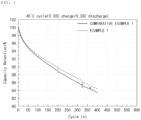
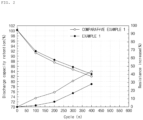
- each secondary battery was charged at 0.33 C rate under a CC condition to 4.20 V under a constant current-constant voltage (CC-CV) condition at 45°C, then subjected to 0.05 C current cut-off, and discharged at 0.33 C under a CC condition to 2.5 V.
- the above charging and discharging were set as one cycle, and 400 cycles of charging and discharging were performed at a high temperature (45°C).
- Capacity retention(%) (capacity every 100 cycles/capacity after one cycle) ⁇ 100
- each secondary battery was charged at 0.33 C rate under a CC condition to 4.20 V under a constant current-constant voltage (CC-CV) condition at 25°C, then subjected to 0.05 C current cut-off, and discharged at 0.33 C under a CC condition to 2.5 V.
- CC-CV constant current-constant voltage
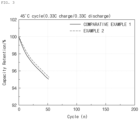
- each secondary battery was charged at 0.33 C rate under a CC condition to 4.20 V under a constant current-constant voltage (CC-CV) condition at 45°C, then subjected to 0.05 C current cut-off, and discharged at 0.33 C under a CC condition to 2.5 V.
- the above charging and discharging were set as one cycle, and 50 cycles of charging and discharging were performed at a high temperature (45°C).
- each secondary battery was charged at 0.33 C rate under a CC condition to 4.20 V under a constant current-constant voltage (CC-CV) condition at 25°C, then subjected to 0.05 C current cut-off, and discharged at 0.33 C under a CC condition to 2.5 V.
- CC-CV constant current-constant voltage
- DC-iR was calculated using a voltage drop obtained in a state in which each secondary battery was subjected to a discharge pulse at 2.5 C for 10 seconds at a SOC of 50%, the DC-iR was substituted into Equation (3) to calculate a resistance increase rate (%), and the results thereof are presented in FIG. 4 .
- the voltage drop was measured using PNE-0506 charge/discharge equipment (manufacturer: PNE SOLUTION Co., Ltd., 5 V, 6 A).
- a resistance increase rate after 12 weeks storage at high temperature of the secondary battery of Example 1 including the non-aqueous electrolyte solution of the present invention was about 6%, wherein it may be understood that the resistance increase rate was significantly reduced in comparison to that of the secondary battery of Comparative Example 1.
- a capacity retention after 8 weeks storage at high temperature of the secondary battery of Example 1 was about 84%, wherein it may be understood that the capacity retention was improved in comparison to that of the secondary battery of Comparative Example 1.
- DC-iR was calculated using a voltage drop obtained in a state in which each secondary battery was subjected to a discharge pulse at 2.5 C for 10 seconds at a SOC of 50%, the DC-iR was substituted into Equation (3) to calculate a resistance increase rate (%), and the results thereof are presented in FIG. 6 .
- the voltage drop was measured using PNE-0506 charge/discharge equipment (manufacturer: PNE SOLUTION Co., Ltd., 5 V, 6 A).
- a resistance increase rate after 8 weeks storage at high temperature of the secondary battery of Example 4 was about 3% or less, wherein it may be understood that the resistance increase rate was significantly reduced in comparison to that of the secondary battery of Comparative Example 1. Also, it may be understood that a capacity retention after 8 weeks storage at high temperature of the secondary battery of Example 4 was improved in comparison to that of the secondary battery of Comparative Example 1.
- initial resistance was calculated using a voltage drop obtained in a state in which each secondary battery was subjected to a discharge pulse at 2.5 C rate under a CC condition for 10 seconds at a SOC of 50%, and the results thereof are presented in FIG. 7 .
- the voltage drop was measured using PNE-0506 charge/discharge equipment (manufacturer: PNE SOLUTION Co., Ltd., 5 V, 6 A) .
- each secondary battery was charged at 0.33 C rate under a CC condition to 4.20 V under a constant current-constant voltage (CC-CV) condition at 25°C, then subjected to 0.05 C current cut-off, and discharged at 0.33 C under a CC condition to 2.5 V.
- CC-CV constant current-constant voltage
- each secondary battery was charged at 0.33 C rate under a CC condition to 4.20 V under a constant current-constant voltage (CC-CV) condition at 45°C, then subjected to 0.05 C current cut-off, and discharged at 0.33 C under a CC condition to 2.5 V.
- the above charging and discharging were set as one cycle, and 300 cycles of charging and discharging were performed at a high temperature (45°C).
Landscapes
- Chemical & Material Sciences (AREA)
- Chemical Kinetics & Catalysis (AREA)
- Electrochemistry (AREA)
- General Chemical & Material Sciences (AREA)
- Engineering & Computer Science (AREA)
- Manufacturing & Machinery (AREA)
- Inorganic Chemistry (AREA)
- Composite Materials (AREA)
- Physics & Mathematics (AREA)
- Condensed Matter Physics & Semiconductors (AREA)
- General Physics & Mathematics (AREA)
- Materials Engineering (AREA)
- Secondary Cells (AREA)
Description
- This application claims priority from
Korean Patent Application Nos. 2018-0137594, filed on November 9, 2018 2019-0141681, filed on November 7, 2019 - The present invention relates to a non-aqueous electrolyte solution for a lithium secondary battery and a lithium secondary battery including the same.
- There is a need to develop technology for efficiently storing and utilizing electrical energy as personal IT devices and computer networks are developed with the development of information society and the accompanying dependency of society as a whole on the electrical energy is increased.
- Among the technologies developed for this purpose, a technology based on secondary batteries is the most suitable technology for various applications. Since a secondary battery may be miniaturized to be applicable to a personal IT device and may be applied to an electric vehicle and a power storage device, there emerges an interest in the secondary battery. Among these secondary battery technologies, lithium ion batteries, which are battery systems having the theoretically highest energy density, are in the spotlight, and are currently being used in various devices.
- Recently, a significant amount of research has been conducted to develop high energy density, that is, high capacity lithium secondary batteries, and these secondary batteries are also commercialized and widely used.
- As one of methods, silicon-based materials, in which capacity per weight is large while a loss in operating voltage of a finished battery is small because a reaction potential is not much higher than that of graphite, are being used as a negative electrode material for a lithium secondary battery in order to improve energy per weight of a lithium ion battery.
- However, the silicon-based material is disadvantageous in that a change in volume of the active material itself is large when lithium and silicon are subjected to an alloying reaction during charge and discharge and this large volume change causes degradation of a negative electrode due to a physical change in the electrode itself as well as cracking of the silicon itself and formation of electrically-shorted particles.
- That is, an operating potential of silicon is slightly higher than that of graphite, but, since it is outside a potential window of a carbonate-based electrolyte solution as a typical electrolyte solution for a lithium ion battery, a solid electrolyte interphase (SEI) layer is also formed on a surface of the negative electrode using the silicon-based negative electrode active material as in the case of using the graphite. However, different from the graphite-based negative electrode active material in which an SEI layer is relatively stably maintained even through charge and discharge cycles, the SEI layer formed on a surface of the silicon is destroyed due to physical changes in the SEI caused by the large volume change of the active material, and, as a result, in the silicon-based negative electrode active material, there is a limitation in that electrolyte decomposition continuously occurs on the exposed surface of the active material due to the SEI layer destroyed during charge and discharge.
- Therefore, with respect to the silicon-based negative electrode material, it is very important to control an additional electrolyte decomposition reaction by forming a suitable film on the surface of the negative electrode, wherein the development of an electrolyte composition will be one way to achieve this.
WO 2018/163127 A1 relates to electrolyte compositions comprising lithium hexafluorophosphate,lithium 4,5-dicyano-2-(tri-fluoromethyl)imidazolate, a solvent and at least one electrolytic additive.EP 3 166 170 A1WO 2018/169370 A1 relates to an electrolyte additive composition comprising a lithium-type additive while comprising a novel borate-based lithium compound, and thus the electrolyte additive composition, when used in an electrolyte, can improve high-rate charge and discharge characteristics, high-temperature storage characteristics, and service life characteristic of a lithium secondary battery, and can exhibit an effect of increasing reversible capacity. -
Korean Patent Application Laid-open Publication No. 2017-0128238 - An aspect of the present invention provides a non-aqueous electrolyte solution for a lithium secondary battery which includes an additive capable of forming a stable film on a surface of a negative electrode.
- Another aspect of the present invention provides a lithium secondary battery in which high-temperature storage characteristics and cycle life characteristics are improved by including the non-aqueous electrolyte solution for a lithium secondary battery.
- According to an aspect of the present invention, there is provided a non-aqueous electrolyte solution for a lithium secondary battery including:
- a lithium salt, an organic solvent, a first additive, and a second additive,
- wherein the first additive is
lithium 4,5-dicyano-2-(trifluoromethyl)imidazolide (LiTDI), and - the second additive is tetravinylsilane.
- According to another aspect of the present invention, there is provided a lithium secondary battery including the non-aqueous electrolyte solution for a lithium secondary battery of the present invention, a positive electrode, a negative electrode, and a separator.
- The negative electrode may include a silicon-based negative electrode active material and a carbon-based negative electrode active material.
- Since a non-aqueous electrolyte solution for a lithium secondary battery of the present invention includes two types of additives capable of forming a stable solid electrolyte interphase (SEI) layer on a surface of a negative electrode, a side reaction between the negative electrode and the electrolyte solution may be suppressed during high-temperature storage. Also, a lithium secondary battery, in which high-temperature storage characteristics and cycle life characteristics are improved by including the non-aqueous electrolyte solution, may be prepared.
- The following drawings attached to the specification illustrate preferred examples of the present invention by example, and serve to enable technical concepts of the present invention to be further understood together with detailed description of the invention given below, and therefore the present invention should not be interpreted only with matters in such drawings.
-
FIG. 1 is a graph illustrating the results of cycle life characteristics evaluation of Example 1 and Comparative Example 1 according to Experimental Example 1 of the present invention; -
FIG. 2 is a graph illustrating the results of discharge capacity retention and resistance characteristics evaluation of Example 1 and Comparative Example 1 according to Experimental Example 1 of the present invention; -
FIG. 3 is a graph illustrating the results of cycle life characteristics evaluation of Example 2 and Comparative Example 1 according to Experimental Example 2 of the present invention; -
FIG. 4 is a graph illustrating the results of discharge capacity retention and resistance characteristics evaluation after high-temperature storage according to Experimental Example 3 of the present invention; -
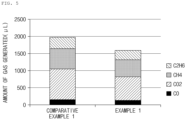
FIG. 5 is a graph illustrating the results of measuring an amount of gas generated after high-temperature storage according to Experimental Example 3 of the present invention; -
FIG. 6 is a graph illustrating the results of discharge capacity retention and resistance characteristics evaluation after high-temperature storage according to Experimental Example 4 of the present invention; -
FIG. 7 is a graph illustrating the results of initial resistance evaluation according to Experimental Example 5 of the present invention; -
FIG. 8 is a graph illustrating an effect of forming a solid electrolyte interphase (SEI) layer on a surface of a negative electrode according to Experimental Example 6 of the present invention; and -
FIG. 9 is a graph illustrating the results of resistance evaluation of secondary batteries according to Experimental Example 7 of the present invention. - Hereinafter, the present invention will be described in more detail.
- It will be understood that words or terms used in the specification and claims shall not be interpreted as the meaning defined in commonly used dictionaries, and it will be further understood that the words or terms should be interpreted as having a meaning that is consistent with their meaning in the context of the relevant art and the technical idea of the invention, based on the principle that an inventor may properly define the meaning of the words or terms to best explain the invention.
- Specifically, in an embodiment of the present invention, provided is a non-aqueous electrolyte solution for a lithium secondary battery including:
- a lithium salt, an organic solvent, a first additive, and a second additive,
- wherein the first additive is
lithium 4,5-dicyano-2-(trifluoromethyl)imidazolide; and - the second additive is tetravinylsilane.
- In the non-aqueous electrolyte solution for a lithium secondary battery according to the embodiment of the present invention, any lithium salt typically used in an electrolyte solution for a lithium secondary battery may be used as the ionizable lithium salt without limitation, and, for example, the lithium salt may include Li+ as a cation, and may include at least one selected from the group consisting of F-, Cl-, Br-, I-, NO3 -, N(CN)2 -, BF4 -, ClO4 -, PF6 -, B10Cl10 -, BF2C2O4 -, BC4O8 -, PF4C2O4 -, PF2C4O8 -, (CF3)2PF4 -, (CF3)3PF3 -, (CF3)4PF2 -, (CF3)5PF-, (CF3)6P-, CF3SO3 -, CH3CO2 -, C4F9SO3 -, CF3CO2 -, SbF6 -, AsF6 -, AlCl4 -, AlO4 -, CF3CF2SO3 -, (CF3SO2)2N-, (FSO2)2N-, CF3CF2(CF3)2CO-, (CF3SO2)2CH-, CH3SO3 -, CF3(CF2)7SO3 -, SCN-, and (CF3CF2SO2)2N- as an anion. Specifically, the lithium salt may include a single material selected from the group consisting of LiCl, LiBr, LiI, LiBF4, LiClO4, LiPF6, LiB10Cl10, LiCF3SO3, LiCH3SO3, LiCH3CO2, LiCF3CO2, LiAsF6, LiSbF6, LiAlCl4, and LiAlO4, or a mixture of two or more thereof, and, in addition to them, an electrolyte salt, such as lithium imide salts represented by LiFSI (lithium bis(fluorosulfonyl)imide, LiN(SO2F)2), LiTFSI (lithium bis (trifluoromethanesulfonyl) imide, LiN(SO2CF3)2), and LiBETI (lithium bisperfluoroethanesulfonimide, LiN(SO2CF2CF3)2), which are commonly used in an electrolyte solution of a lithium secondary battery, may be additionally used without limitation. Specifically, the electrolyte salt may include a single material selected from the group consisting of LiPF6, LiBF4, LiCH3CO2, LiCF3CO2, LiCH3SO3, LiFSI, LiTFSI, and LiBETI or a mixture of two or more thereof. However, the lithium salt does not include LiDFP which is included as a mixed additive.
- The lithium salt may be appropriately changed in a normally usable range, but may specifically be included in a concentration of 0.1 M to 3 M, for example, 0.8 M to 2.5 M in the electrolyte solution. If, in a case in which the concentration of the lithium salt is greater than 3 M, a film formation effect may be reduced.
- Also, in the non-aqueous electrolyte solution for a lithium secondary battery according to the embodiment of the present invention, a type of the organic solvent is not limited as long as the organic solvent may minimize decomposition due to an oxidation reaction during charge and discharge of the secondary battery and may exhibit desired characteristics with an additive. For example, as the organic solvent, a carbonate-based organic solvent, an ether-based organic solvent, an ester-based organic solvent, or an amide-based organic solvent may be used alone or in mixture of two or more thereof.
- The carbonate-based organic solvent among the organic solvents may include at least one selected from the group consisting of a cyclic carbonate-based organic solvent and a linear carbonate-based organic solvent.
- The cyclic carbonate-based organic solvent is known as a solvent which well dissociates the lithium salt in the electrolyte due to high permittivity as a highly viscous organic solvent. Specific examples of the cyclic carbonate-based organic solvent may be one selected from the group consisting of ethylene carbonate (EC), 1,2-butylene carbonate, 2,3-butylene carbonate, 1,2-pentylene carbonate, 2,3-pentylene carbonate, vinylene carbonate, and fluoroethylene carbonate (FEC) or a mixture of two or more thereof, and, more specifically, the cyclic carbonate-based organic solvent may include one selected from the group consisting of ethylene carbonate, 1,2-butylene carbonate, 2,3-butylene carbonate, vinylene carbonate, and fluoroethylene carbonate (FEC) or a mixture of two or more thereof.
- Also, specific examples of the linear carbonate-based organic solvent may be one selected from the group consisting of dimethyl carbonate (DMC), diethyl carbonate (DEC), dipropyl carbonate, ethyl methyl carbonate (EMC), methylpropyl carbonate, and ethylpropyl carbonate or a mixture of two or more thereof, and, more specifically, the linear carbonate-based organic solvent may include one selected from the group consisting of dimethyl carbonate, diethyl carbonate, dipropyl carbonate, and ethyl methyl carbonate or a mixture of two or more thereof.
- As the ether-based organic solvent, any one selected from the group consisting of dimethyl ether, diethyl ether, dipropyl ether, methylethyl ether, methylpropyl ether, and ethylpropyl ether, or a mixture of two or more thereof may be used, but the present invention is not limited thereto.
- Also, the ester-based organic solvent may include at least one organic solvent selected from the group consisting of a linear ester compound and a cyclic ester compound.
- Specific examples of the linear ester compound may be any one selected from the group consisting of methyl acetate, ethyl acetate, propyl acetate, methyl propionate, ethyl propionate, propyl propionate, and butyl propionate, or a mixture of two or more thereof, but the present invention is not limited thereto.
- Specific examples of the cyclic ester compound may be any one selected from the group consisting of γ-butyrolactone, γ-valerolactone, γ-caprolactone, σ-valerolactone, and ε-caprolactone, or a mixture of two or more thereof, but the present invention is not limited thereto.
- In a case in which the cyclic carbonate-based organic solvent and the low viscosity, low permittivity linear carbonate-based organic solvent, such as dimethyl carbonate and diethyl carbonate, and/or the cyclic carbonate-based organic solvent and the linear ester compound are mixed in an appropriate ratio and used, a non-aqueous electrolyte solution having higher electrical conductivity may be prepared.
- As the organic solvent, the cyclic carbonate-based organic solvent and the linear carbonate-based organic solvent may be mixed and used, and a weight ratio of the cyclic carbonate-based organic solvent:the linear carbonate-based organic solvent in the organic solvent may be in a range of 10:90 to 70:30.
- The non-aqueous electrolyte solution for a lithium secondary battery of the present invention may include
lithium 4,5-dicyano-2-(trifluoromethyl)imidazolide represented by the followingFormula 1 as a first additive.

- The
lithium 4,5-dicyano-2-(trifluoromethyl)imidazolide may improve durability and high-temperature storage characteristics of the battery by forming a stable solid electrolyte interphase (SEI) layer on a surface of a negative electrode through a reduction reaction generated during initial charge of the negative electrode. - The first additive may be included in an amount of 0.05 wt% to 0.9 wt%, for example, 0.1 wt% to 0.9 wt% based on a total weight of the non-aqueous electrolyte solution.
- The amount of the additive in the non-aqueous electrolyte solution for a lithium secondary battery may be determined by reaction specific surface areas of a positive electrode and a negative electrode, wherein, in a case in which the amount of the first additive is 0.05 wt% or more as described above, a stable SEI layer may not only be formed on the surface of the negative electrode, but expected effects resulting from the additive may also be met, for example, a gas generation reducing effect may be achieved by suppressing decomposition of the electrolyte solution due to a reaction between the electrolyte solution and the negative electrode. Also, in a case in which the amount of the additive is 0.9 wt% or less, the gas generation reducing effect may not only be improved, but a stable SEI layer may also be formed on the surface of the electrode while preventing a side reaction due to the excessive use of the additive and the resulting resistance increase.
- If the amount of the additive is greater than 0.9 wt%, the gas generation reducing effect may be further improved due to the excessive amount of the additive, but, since an excessively thick layer is formed, initial resistance may be increased and output degradation may occur.
- As described above, since the first additive reduces a reaction of the positive electrode with other materials by playing a role in the formation of the stable SEI layer on the surface of the negative electrode, the first additive may improve the durability of the battery. Thus, the non-aqueous electrolyte solution for a lithium secondary battery of the present invention may further include a second additive capable of assisting in forming a positive electrode layer in addition to the first additive. That is, since the non-aqueous electrolyte solution for a lithium secondary battery of the present invention may form a more stable and robust SEI layer on the surfaces of the positive electrode and the negative electrode by using the first additive and the second additive together, the non-aqueous electrolyte solution for a lithium secondary battery of the present invention may improve overall performance, such as high-temperature storage characteristics and life characteristics, of the lithium secondary battery.
- The non-aqueous electrolyte solution for a lithium secondary battery of the present invention may include tetravinylsilane (TVS) represented by the following
Formula 2 as a second additive. - The tetravinylsilane (TVS) may form a robust SEI layer on the surfaces of the positive electrode and the negative electrode through physical adsorption and electrochemical reaction. Accordingly, since the tetravinylsilane may prevent exposure of the positive electrode and the negative electrode to the non-aqueous electrolyte solution, the tetravinylsilane may suppress a side reaction between the non-aqueous electrolyte solution and the electrode at high temperatures and may prevent an increase in resistance, and thus, the tetravinylsilane may improve high-temperature storage stability of the lithium secondary battery.


- The first additive and the second additive may be used by appropriately adjusting a mixing ratio thereof in order to improve an SEI layer formation effect and to achieve effects of improving low-temperature high-rate discharge characteristics, high-temperature stability, overcharge protection, and high-temperature swelling, wherein the first additive and the second additive may be used by being mixed in a weight ratio of 1:0.1 to 1:1, for example, 1:0.2 to 1:1.
- In a case in which the weight ratio of the second additive to the first additive is greater than 1, since a thick layer is formed due to the excessive amount of the second additive, the battery resistance may increase and cycle life characteristics may be degraded. Also, in a case in which the weight ratio of the second additive is less than 0.1, the gas generation reducing effect and the SEI layer formation effect may be insignificant.
- In general, in a case in which a silicon-based active material is used as a negative electrode active material, a solid electrolyte interphase (SEI) layer is formed on a surface of a negative electrode during initial charge and discharge as in a case of graphite, but the SEI layer is destroyed by a change in volume of the silicon-based negative electrode active material during continuous charge and discharge. The collapse of the SEI layer allows the surface of the negative electrode to be exposed, and the exposed surface of the negative electrode causes a continuous side reaction while reacting with the electrolyte solution.
- Furthermore, the side reaction continuously generates gases, and the major gases generated in this case may be CO, CO2, CH4, and C2H6, wherein the gases generated may vary depending on a type of the negative electrode active material, and, regardless of the type, the continuous gas generation increases an internal pressure of the lithium ion battery so that it becomes a cause of swelling of a battery thickness.
- Thus, the present invention aims at forming a more robust and stable SEI layer on the surface of the negative electrode by mixing the first additive and the second additive in the above-described ratio and using the mixed add itive during the preparation of the non-aqueous electrolyte solution.
- The stable SEI layer thus formed may suppress a degradation behavior of the battery by controlling the degradation of the battery which may occur due to the formation of an unstable SEI layer.
- The non-aqueous electrolyte solution of the present invention may further include an additional additive which may be used with the mixed additive to form a stable layer on the surfaces of the negative electrode and the positive electrode while not significantly increasing initial resistance in addition to the effect from the mixed additive, or which may act as a complementary agent for suppressing the decomposition of the solvent in the non-aqueous electrolyte solution and improving mobility of lithium ions.
- The additive is not particularly limited as long as it is an additive capable of forming a stable layer on the surfaces of the positive electrode and the negative electrode.
- As a representative example, the additional additive may include at least one selected from the group consisting of a phosphate-based compound, a sulfite-based compound, a sulfone-based compound, a sulfate-based compound, a sultone-based compound, a halogen-substituted carbonate-based compound, a nitrile-based compound, a borate-based compound, and a lithium salt-based compound.
- The phosphate-based compound is a component for assisting the formation of the SEI layer by being electrochemically decomposed on the surfaces of the positive electrode and the negative electrode, wherein an effect of improving long-term cycle life characteristics of the secondary battery may be achieved by the phosphate-based compound. As a representative example, the phosphate-based compound may include at least one compound selected from the group consisting of lithium difluoro(bisoxalato)phosphate, lithium difluorophosphate, tris(trimethylsilyl) phosphate, trimethylsilyl phosphite, tris(2,2,2-trifluoroethyl) phosphate, and tris(2,2,2-trifluoroethyl) phosphite, and may specifically include lithium difluorophosphate.
- The phosphate-based compound and the first additive may be included in a weight ratio of 2:1 to 5:1.
- If the amount ratio of the phosphate-based compound is greater than 5, since internal resistance of the battery is increased due to the excessive use of the additive, the cycle life characteristics are degraded, and, if the amount ratio of the phosphate-based compound is less than 2, since a stabilization effect during the formation of the SEI layer is insignificant, the high-temperature storage characteristics and the cycle life characteristics may be degraded.
- The sulfite-based compound may include at least one compound selected from the group consisting of ethylene sulfite, methylethylene sulfite, ethylethylene sulfite, 4,5-dimethylethylene sulfite, 4,5-diethylethylene sulfite, propylene sulfite, 4,5-dimethylpropylene sulfite, 4,5-diethylpropylene sulfite, 4,6-dimethylpropylene sulfite, 4,6-diethylpropylene sulfite, and 1,3-butylene glycol sulfite, and may be included in an amount of 3 wt% or less based on the total weight of the non-aqueous electrolyte solution.
- The sulfone-based compound may include at least one compound selected from the group consisting of divinyl sulfone, dimethyl sulfone, diethyl sulfone, methylethyl sulfone, and methylvinyl sulfone, and may be included in an amount of 3 wt% or less based on the total weight of the non-aqueous electrolyte solution.
- The sulfate-based compound may include ethylene sulfate (Esa), trimethylene sulfate (TMS), or methyl trimethylene sulfate (MTMS), and may be included in an amount of 3 wt% or less based on the total weight of the non-aqueous electrolyte solution.
- The sultone-based compound may include at least one compound selected from the group consisting of 1,3-propane sultone (PS), 1,4-butane sultone, ethane sultone, 1,3-propene sultone (PRS), 1,4-butene sultone, and 1-methyl-1,3-propene sultone, and may be included in an amount of 0.3 wt% to 5 wt%, for example, 1 wt% to 5 wt% based on the total weight of the non-aqueous electrolyte solution. In a case in which the amount of the sultone-based compound in the non-aqueous electrolyte solution is greater than 5 wt%, an excessively thick layer may be formed on the surface of the electrode to cause an increase in resistance and a degradation of output, and resistance due to the excessive amount of the additive in the non-aqueous electrolyte solution may be increased to degrade output characteristics.
- The halogen-substituted carbonate-based compound may include fluoroethylene carbonate (FEC), and may be included in an amount of 5 wt% or less based on the total weight of the non-aqueous electrolyte solution. In a case in which the amount of the halogen-substituted carbonate-based compound in the non-aqueous electrolyte solution is greater than 5 wt%, cell swelling performance may be degraded.
- Also, the nitrile-based compound may include at least one compound selected from the group consisting of succinonitrile (SN), adiponitrile (Adn), acetonitrile, propionitrile, butyronitrile, valeronitrile, caprylonitrile, heptanenitrile, cyclopentane carbonitrile, cyclohexane carbonitrile, 2-fluorobenzonitrile, 4-fluorobenzonitrile, difluorobenzonitrile, trifluorobenzonitrile, phenylacetonitrile, 2-fluorophenylacetonitrile, and 4-fluorophenylacetonitrile.
- The borate-based compound may include lithium oxalyldifluoroborate, and may be included in an amount of 3 wt% or less based on the total weight of the non-aqueous electrolyte solution.
- The lithium salt-based compound is a compound different from the lithium salt included in the non-aqueous electrolyte solution, wherein the lithium salt-based compound may include at least one compound selected from the group consisting of LiPO2F2, LiODFB, LiBOB (lithium bis (oxalato) borate (LiB(C2O4)2)), and LiBF4, and may be included in an amount of 3 wt% or less based on the total weight of the non-aqueous electrolyte solution.
- Two types or more of the additives may be mixed and included, and a total amount of the additives included may be 20 wt% or less, for example, 10 wt% or less based on the total weight of the non-aqueous electrolyte solution. If the amount of the additives is greater than 20 wt%, there is not only a possibility that a side reaction in the non-aqueous electrolyte solution occurs excessively during charge and discharge of the battery, but also, since the additives may not be sufficiently decomposed at high temperatures, the additives may be present in the form of an unreacted material or precipitates in the non-aqueous electrolyte solution at room temperature, and, accordingly, life or resistance characteristics of the secondary battery may be degraded.
- Also, in the present invention, a lithium secondary battery including the above-described non-aqueous electrolyte solution may be provided.
- The lithium secondary battery includes a positive electrode including a positive electrode active material, a negative electrode including a negative electrode active material, a separator disposed between the positive electrode and the negative electrode, and the above-described non-aqueous electrolyte solution.
- Specifically, the lithium secondary battery of the present invention may be prepared by injecting the non-aqueous electrolyte solution of the present invention into an electrode assembly which is formed by sequentially stacking a positive electrode, a negative electrode, and a separator disposed between the positive electrode and the negative electrode. In this case, those typically used in the preparation of a lithium secondary battery may all be used as the positive electrode, negative electrode, and separator which constitute the electrode assembly.
- The positive electrode and the negative electrode, which constitute the lithium secondary battery of the present invention, may be prepared by a conventional method and used.
- First, the positive electrode may be prepared by forming a positive electrode material mixture layer on a positive electrode collector. The positive electrode material mixture layer may be prepared by coating the positive electrode collector with a positive electrode slurry including a positive electrode active material, a binder, a conductive agent, and a solvent, and then drying and rolling the coated positive electrode collector.
- The positive electrode collector is not particularly limited so long as it has conductivity without causing adverse chemical changes in the battery, and, for example, stainless steel, aluminum, nickel, titanium, fired carbon, or aluminum or stainless steel that is surface-treated with one of carbon, nickel, titanium, silver, or the like may be used.
- The positive electrode active material is a compound capable of reversibly intercalating and deintercalating lithium, wherein the positive electrode active material may specifically include a lithium composite metal oxide including lithium and at least one metal such as cobalt, manganese, nickel, or aluminum. More specifically, the lithium composite metal oxide may include lithium-manganese-based oxide (e.g., LiMnO2, LiMn2O4, etc.), lithium-cobalt-based oxide (e.g., LiCoO2, etc.), lithium-nickel-based oxide (e.g., LiNiO2, etc.), lithium-nickel-manganese-based oxide (e.g., LiNi1-YMnYO2 (where 0<Y<1), LiMn2-ZNizO4 (where 0<Z<2), etc.), lithium-nickel-cobalt-based oxide (e.g., LiNi1-Y1CoY1O2 (where 0<Y1<1), etc.), lithium-manganese-cobalt-based oxide (e.g., LiCo1-Y2MnY2O2 (where 0<Y2<1), LiMn2-Z1Coz1O4 (where 0<Z1<2), etc.), lithium-nickel-manganese-cobalt-based oxide (e.g., Li(NipCoqMnr1)O2 (where 0<p<1, 0<q<1, 0<r1<1, and p+q+r1=1) or Li(Nip1Coq1Mnr2)O4 (where 0<p1<2, 0<q1<2, 0<r2<2, and p1+q1+r2=2), etc.), or lithium-nickel-cobalt-transition metal (M) oxide (e.g., Li(Nip2Coq2Mnr3MS2)O2 (where M is selected from the group consisting of aluminum (Al), iron (Fe), vanadium (V), chromium (Cr), titanium (Ti), tantalum (Ta), magnesium (Mg), and molybdenum (Mo), and p2, q2, r3, and s2 are atomic fractions of each independent elements, wherein 0<p2<1, 0<q2<1, 0<r3<1, 0<S2<1, and p2+q2+r3+S2=1), etc.), and any one thereof or two or more compounds thereof may be included.
- Among these materials, in terms of the improvement of capacity characteristics and stability of the battery, the lithium composite metal oxide may include LiCoO2, LiMnO2, LiNiO2, lithium nickel manganese cobalt oxide (e.g., Li(Ni1/3Mn1/3Co1/3)O2, Li (Ni0.6Mn0.2Co0.2)O2, Li(Ni0.5Mn0.3Co0.2)O2, Li(Ni0.7Mn0.15Co0.15)O2, and Li(Ni0.8Mn0.1Co0.1)O2), or lithium nickel cobalt aluminum oxide (e.g., LiNi0.8Co0.15Al0.05O2, etc.).
- The positive electrode active material may be included in an amount of 80 wt% to 99.5 wt%, for example, 85 wt% to 95 wt% based on a total weight of solid content in the positive electrode slurry. In a case in which the amount of the positive electrode active material is 80 wt% or less, since energy density is reduced, capacity may be reduced.
- The binder is a component that assists in the binding between the active material and the conductive agent and in the binding with the current collector, wherein the binder is commonly added in an amount of 1 wt% to 30 wt% based on the total weight of the solid content in the positive electrode slurry. If the amount of the binder is less than 1 wt%, adhesion between the electrode active material and the current collector may be insufficient, and, if the amount of the binder is greater than 30 wt%, the adhesion is improved, but, since the amount of the electrode active material is reduced by that amount, battery capacity may be reduced.
- Examples of the binder may be polyvinylidene fluoride (PVDF), polyvinyl alcohol, carboxymethylcellulose (CMC), starch, hydroxypropylcellulose, regenerated cellulose, polyvinylpyrrolidone, polytetrafluoroethylene, polyethylene, polypropylene, an ethylene-propylene-diene termonomer (EPDM), a sulfonated EPDM, a styrene-butadiene rubber, a fluoro rubber, various copolymers, and the like.
- Also, the conductive agent may be added in an amount of 1 wt% to 20 wt% based on the total weight of the solid content in the positive electrode slurry.
- The conductive agent is not particularly limited as long as it has conductivity without causing adverse chemical changes in the battery, and, for example, a conductive material, such as: carbon powder such as carbon black, acetylene black (or Denka black), Ketjen black, channel black, furnace black, lamp black, or thermal black; graphite powder such as natural graphite with a well-developed crystal structure, artificial graphite, or graphite; conductive fibers such as carbon fibers or metal fibers; metal powder such as fluorocarbon powder, aluminum powder, and nickel powder; conductive whiskers such as zinc oxide whiskers and potassium titanate whiskers; conductive metal oxide such as titanium oxide; or polyphenylene derivatives, may be used.
- As the solvent, N-methyl-2-pyrrolidone (NMP), dimethyl sulfoxide (DMSO), isopropyl alcohol, acetone, or water may be used alone or in a mixture thereof. An amount of the solvent used may be appropriately adjusted in consideration of a coating thickness of the slurry, manufacturing yield, and viscosity, and, for example, the solvent may be included in an amount such that a concentration of the solid content in the slurry including the positive electrode active material as well as selectively the binder and the conductive agent is in a range of 10 wt% to 70 wt%, for example, 20 wt% to 60 wt%.
- Also, the negative electrode may be prepared by forming a negative electrode material mixture layer on a negative electrode collector. The negative electrode material mixture layer may be formed by coating the negative electrode collector with a slurry including a negative electrode active material, a binder, a conductive agent, and a solvent, and then drying and rolling the coated negative electrode collector.
- The negative electrode collector generally has a thickness of 3 um to 500 um. The negative electrode collector is not particularly limited so long as it has high conductivity without causing adverse chemical changes in the battery, and, for example, copper, stainless steel, aluminum, nickel, titanium, fired carbon, copper or stainless steel that is surface-treated with one of carbon, nickel, titanium, silver, or the like, an aluminum-cadmium alloy, or the like may be used. Also, similar to the positive electrode collector, the negative electrode collector may have fine surface roughness to improve bonding strength with the negative electrode active material, and the negative electrode collector may be used in various shapes such as a film, a sheet, a foil, a net, a porous body, a foam body, a non-woven fabric body, and the like.
- The negative electrode active material may include a silicon-based negative electrode active material, which may be doped and undoped with lithium, and a carbon-based negative electrode active material capable of reversibly intercalating/deintercalating lithium ions.
- The silicon-based negative electrode active material, which may be doped and undoped with lithium, may include at least one selected from the group consisting of silicon (Si), SiOx (0<x≤2), and a Si-Y alloy (where Y is an element selected from the group consisting of alkali metal, alkaline earth metal, a
Group 13 element, aGroup 14 element, transition metal, a rare earth element, and a combination thereof, and is not Si). - Furthermore, as the carbon-based negative electrode active material capable of reversibly intercalating/deintercalating lithium ions, a carbon-based negative electrode active material generally used in a lithium ion secondary battery may be used without particular limitation, and, as a typical example, crystalline carbon, amorphous carbon, or both thereof may be used. Examples of the crystalline carbon may be graphite-based carbon such as irregular, planar, flaky, spherical, or fibrous natural graphite, artificial graphite, or graphite, and examples of the amorphous carbon may be soft carbon (low-temperature sintered carbon) or hard carbon, mesophase pitch carbide, and fired cokes.
- In this case, the silicon-based negative electrode active material and the carbon-based negative electrode active material may be included in a weight ratio of 5:95 to 50:50, particularly 20:80 to 40:60, and more particularly 30:70.
- A negative electrode active material satisfying the above amount range may secure room-temperature life characteristics and high-temperature life characteristics as well as excellent capacity characteristics.
- Also, in addition to the silicon-based negative electrode active material and the carbon-based negative electrode active material, the negative electrode active material may further include at least one selected from the group consisting of a tin-based material which may be doped and undoped with lithium, lithium metal, metal or an alloy of lithium and the metal, a metal composite oxide, and a transition metal oxide.
- As a representative example, the tin-based material may include tin (Sn), SnO2, and Sn-Y (where Y is an element selected from the group consisting of alkali metal, alkaline earth metal, a
Group 13 element, aGroup 14 element, transition metal, a rare earth element, and a combination thereof, and is not Sn), and a mixture of SiO2 and at least one thereof may also be used. In this case, the element Y may be selected from the group consisting of Mg, calcium (Ca), strontium (Sr), barium (Ba), radium (Ra), scandium (Sc), yttrium (Y), Ti, zirconium (Zr), hafnium (Hf), rutherfordium (Rf), V, niobium (Nb), Ta, dubnium (Db), Cr, Mo, tungsten (W), seaborgium (Sg), technetium (Tc), rhenium (Re), bohrium (Bh), Fe, Pb, ruthenium (Ru), osmium (Os), hassium (Hs), rhodium (Rh), iridium (Ir), palladium (Pd), platinum (Pt), copper (Cu), silver (Ag), gold (Au), zinc (Zn), cadmium (Cd), boron (B), Al, gallium (Ga), Sn, indium (In), germanium (Ge), phosphorus (P), arsenic (As), antimony (Sb), bismuth (Bi), sulfur (S), selenium (Se), tellurium (Te), polonium (Po), and a combination thereof. - As the metal or the alloy of lithium and the metal, a metal selected from the group consisting of Cu, nickel (Ni), sodium (Na), potassium (K), rubidium (Rb), cesium (Cs), francium (Fr), beryllium (Be), Mg, Ca, Sr, Si, Sb, Pb, In, Zn, Ba, Ra, Ge, Al, and Sn, or an alloy of lithium and the metal may be used.
- One selected from the group consisting of PbO, PbO2, Pb2O3, Pb3O4, Sb2O3, Sb2O4, Sb2O5, GeO, GeO2, Bi2O3, Bi2O4, Bi2O5, LixFe2O3 (0≤x≤1), LixWO2 (0≤x≤1), and SnxMe1-xMe'yOz (Me: manganese (Mn), Fe, Pb, or Ge; Me': Al, B, P, Si, Groups I, II and III elements of the periodic table, or halogen; 0<x≤ 1; 1≤y≤3; 1≤z≤8) may be used as the metal composite oxide.
- The transition metal oxide may include lithiumcontaining titanium composite oxide (LTO), vanadium oxide, and lithium vanadium oxide.
- The negative electrode active material may be included in an amount of 80 wt% to 99 wt% based on a total weight of solid content in the negative electrode slurry.
- The binder is a component that assists in the binding between the conductive agent, the active material, and the current collector, wherein the binder is commonly added in an amount of 1 wt% to 30 wt% based on the total weight of the solid content in the negative electrode slurry. Examples of the binder may be polyvinylidene fluoride (PVDF), polyvinyl alcohol, carboxymethylcellulose (CMC), starch, poly(acrylic acid sodium)/polyvinyl alcohol (NaPAA-PVA, mixed use), hydroxypropylcellulose, regenerated cellulose, polyvinylpyrrolidone, polytetrafluoroethylene, polyethylene, polypropylene, an ethylene-propylene-diene monomer (EPDM), a sulfonated EPDM, a styrene-butadiene rubber, a fluoro rubber, and various copolymers thereof.
- The conductive agent is a component for further improving the conductivity of the negative electrode active material, wherein the conductive agent may be added in an amount of 1 wt% to 20 wt% based on the total weight of the solid content in the negative electrode slurry. Any conductive agent may be used without particular limitation so long as it has conductivity without causing adverse chemical changes in the battery, and, for example, a conductive material, such as: carbon powder such as carbon black, acetylene black (or Denka black), Ketjen black, channel black, furnace black, lamp black, or thermal black; graphite powder such as natural graphite with a well-developed crystal structure, artificial graphite, or graphite; conductive fibers such as carbon fibers or metal fibers; metal powder such as fluorocarbon powder, aluminum powder, and nickel powder; conductive whiskers such as zinc oxide whiskers and potassium titanate whiskers; conductive metal oxide such as titanium oxide; or polyphenylene derivatives, may be used.
- The solvent may include water or an organic solvent, such as NMP and alcohol, and may be used in an amount such that desirable viscosity is obtained when the negative electrode active material as well as optionally the binder and the conductive agent are included. For example, the solvent may be included in an amount such that a concentration of the solid content in the negative electrode slurry including the negative electrode active material as well as optionally the binder and the conductive agent is in a range of 50 wt% to 75 wt%, for example, 50 wt% to 65 wt%.
- Also, the separator plays a role in blocking an internal short circuit between both electrodes and being impr egnated with the electrolyte, wherein, after mixing a polymer resin, a filler, and a solvent to prepare a separator composition, the separator composition is directly coated on the electrode and dried to form a separator film, or, after the separator composition is cast on a support and dried, the separator may be prepared by laminating a separator film peeled from the support on the electrode.
- A typically used porous polymer film, for example, a porous polymer film prepared from a polyolefin-based polymer, such as an ethylene homopolymer, a propylene homopolymer, an ethylene/butene copolymer, an ethylene/hexene copolymer, and an ethylene/methacrylate copolymer, may be used alone or in a lamination therewith as the separator. Also, a typical porous nonwoven fabric, for example, a nonwoven fabric formed of high melting point glass fibers or polyethylene terephthalate fibers may be used, but the present invention is not limited thereto.
- In this case, the porous separator may generally have a pore diameter of 0.01 µm to 50 µm and a porosity of 5% to 95%. Also, the porous separator may generally have a thickness of 5 µm to 300 µm.
- A shape of the lithium secondary battery of the present invention is not particularly limited, but a cylindrical type using a can, a prismatic type, a pouch type, or a coin type may be used.
- Hereinafter, the present invention will be described in more detail according to examples. However, the invention may be embodied in many different forms and should not be construed as being limited to the embodiments set forth herein. Rather, these example embodiments are provided so that this description will be thorough and complete, and will fully convey the scope of the present invention to those skilled in the art.
- After ethylene carbonate (EC) and ethyl methyl carbonate (EMC) were mixed in a volume ratio of 30:70, a non-aqueous organic solvent was prepared by dissolving LiPF6 and LIFSI in the mixture to have concentrations of 0.7 M and 0.3 M, respectively. A non-aqueous electrolyte solution for a lithium secondary battery was prepared by adding 0.5 g of
lithium 4,5-dicyano-2-(trifluoromethyl)imidazolide (manufactured by Aldrich, CAS: 761441-54-7) as a first additive, 0.1 g of tetravinylsilane as a second additive, and 1.0 g of lithium difluorophosphate, 1.0 g of ethylene sulfonate, 0.5 g of 1,3-propane sultone, and 0.2 g of LiBF4, as additional additives, and 6.0 g of fluorobenzene to 90.7 g of the non-aqueous organic solvent. - Li(Ni0.8Co0.1Mn0.1)O2 (NCM) as a positive electrode active material, carbon black as a conductive agent, and polyvinylidene fluoride (PVDF), as a binder, were added to N-methyl-2-pyrrolidone (NMP), as a solvent, at a weight ratio of 97.5:1:1.5 to prepare a positive electrode mixture slurry (solid content: 50 wt%). A 12 µm thick aluminum (Al) thin film, as a positive electrode collector, was coated with the positive electrode mixture slurry, dried, and then roll-pressed to prepare a positive electrode.
- A negative electrode active material (SiO:graphite = 5:95 weight ratio), SBR-CMC as a binder, and carbon black, as a conductive agent, were added in a weight ratio of 95:3.5:1.5 to water, as a solvent, to prepare a negative electrode mixture slurry (solid content: 60 wt%). A 6 µm thick copper (Cu) thin film, as a negative electrode collector, was coated with the negative electrode mixture slurry, dried, and then roll-pressed to prepare a negative electrode.
- The positive electrode, a porous polyolefin-based separator coated with inorganic material particles (Al2O3), and the negative electrode were sequentially stacked to prepare an electrode assembly.
- The assembled electrode assembly was accommodated in a battery case, and the non-aqueous electrolyte solution was injected thereinto to prepare a pouch type lithium secondary battery.
- A non-aqueous electrolyte solution and a pouch type lithium secondary battery including the same were prepared in the same manner as in Example 1 except that 0.2 g of
lithium 4,5-dicyano-2-(trifluoromethyl)imidazolide as a first additive, 0.1 g of tetravinylsilane as a second additive, and 1.0 g of lithium difluorophosphate, 1.0 g of ethylene sulfonate, 0.5 g of 1,3-propane sultone, and 0.2 g of LiBF4, as additional additives, and 6.0 g of fluorobenzene were added to 91.0 g of the non-aqueous organic solvent. - A non-aqueous electrolyte solution for a lithium secondary battery was prepared by adding 0.5 g of
lithium 4,5-dicyano-2-(trifluoromethyl)imidazolide as a first additive, 0.1 g of tetravinylsilane as a second additive, and 1.0 g of lithium difluorophosphate, as an additional additive, to 98.4 g of a non-aqueous organic solvent. - A negative electrode active material (SiO:graphite = 30:70 weight ratio), poly(acrylic acid sodium)-polyvinyl alcohol as a binder, and carbon black, as a conductive agent, were added in a weight ratio of 95:3.5:1.5 to water, as a solvent, to prepare a negative electrode mixture slurry. A 6 µm thick copper (Cu) thin film, as a negative electrode collector, was coated with the negative electrode mixture slurry, dried, and then roll-pressed to prepare a negative electrode.
- The negative electrode prepared, a porous polyolefin-based separator coated with inorganic material particles (Al2O3), and the positive electrode prepared in Example 1 were sequentially stacked to prepare an electrode assembly.
- The assembled electrode assembly was accommodated in a battery case, and the non-aqueous electrolyte solution was injected thereinto to prepare a pouch type lithium secondary battery.
- A non-aqueous electrolyte solution for a lithium secondary battery and a pouch type lithium secondary battery including the same were prepared in the same manner as in Example 1 except that 1.0 g of
lithium 4,5-dicyano-2-(trifluoromethyl)imidazolide as a first additive, 0.2 g of tetravinylsilane as a second additive, and 1.0 g of lithium difluorophosphate, 1.0 g of ethylene sulfonate, 0.5 g of 1,3-propane sultone, and 0.2 g of LiBF4, as additional additives, and 6.0 g of fluorobenzene were added to 90.1 g of the non-aqueous organic solvent. - A non-aqueous electrolyte solution for a lithium secondary battery and a pouch type lithium secondary battery including the same were prepared in the same manner as in Example 1 except that the first additive was not included, and 0.1 g of tetravinylsilane as a second additive, and 1.0 g of lithium difluorophosphate, 1.0 g of ethylene sulfonate, 0.5 g of 1,3-propane sultone, and 0.2 g of LiBF4, as additional additives, and 6.0 g of fluorobenzene were added to 91.2 g of the non-aqueous organic solvent.
- A non-aqueous electrolyte solution for a lithium secondary battery was prepared by adding 0.5 g of lithium oxalyldifluoroborate (LiODFB), 0.1 g of tetravinylsilane as a second additive, and 1.0 g of lithium difluorophosphate, 1.0 g of ethylene sulfonate, 0.5 g of 1,3-propane sultone, and 0.2 g of LiBF4, as additional additives, and 6.0 g of fluorobenzene to 90.7 g of a non-aqueous organic solvent.
- A pouch type lithium secondary battery was prepared in the same manner as in Example 1 except that the above non-aqueous electrolyte solution was used.
- A non-aqueous electrolyte solution for a lithium secondary battery was prepared by adding 0.5 g of lithium bis(oxalato)borate (LiBOB), 0.1 g of tetravinylsilane as a second additive, and 1.0 g of lithium difluorophosphate, 1.0 g of ethylene sulfonate, 0.5 g of 1,3-propane sultone, and 0.2 g of LiBF4, as additional additives, and 6.0 g of fluorobenzene to 90.7 g of a non-aqueous organic solvent.
- A pouch type lithium secondary battery was prepared in the same manner as in Example 1 except that the above non-aqueous electrolyte solution was used.
- A negative electrode active material (graphite), SBR-CMC as a binder, and carbon black, as a conductive agent, were added in a weight ratio of 95:3.5:1.5 to water, as a solvent, to prepare a negative electrode mixture slurry. A 6 µm thick copper (Cu) thin film, as a negative electrode collector, was coated with the negative electrode mixture slurry, dried, and then roll-pressed to prepare a negative electrode.
- A pouch type lithium secondary battery was prepared in the same manner as in Example 3 except that the aboveprepared negative electrode was used.
- After each of the lithium secondary battery prepared in Example 1 and the secondary battery prepared in Comparative Example 1 was activated at 0.1 C rate under a constant current (CC) condition, degas was performed.
- Subsequently, each secondary battery was charged at 0.33 C rate under a CC condition to 4.20 V under a constant current-constant voltage (CC-CV) condition at 25°C, then subjected to 0.05 C current cut-off, and discharged at 0.33 C rate under a CC condition to 2.5 V. The above charging and discharging were set as one cycle, and 3 cycles were performed.
- Next, each secondary battery was charged at 0.33 C rate under a CC condition to 4.20 V under a constant current-constant voltage (CC-CV) condition at 45°C, then subjected to 0.05 C current cut-off, and discharged at 0.33 C under a CC condition to 2.5 V. The above charging and discharging were set as one cycle, and 400 cycles of charging and discharging were performed at a high temperature (45°C).
- In this case, capacity was measured every 100 cycles using PNE-0506 charge/discharge equipment (manufacturer: PNE SOLUTION Co., Ltd., 5 V, 6 A), and the capacity was substituted into the following Equation (1) to calculate capacity retention, and the results thereof are presented in
FIG. 1 .Capacity retention(%)=(capacity every 100 cycles/capacity after one cycle)×100 - Also, discharge capacity was measured every 100 cycles using PNE-0506 charge/discharge equipment (manufacturer: PNE SOLUTION Co., Ltd., 5 V, 6 A), and the discharge capacity was substituted into the following Equation (2) to calculate discharge capacity retention, and the results thereof are presented in
FIG. 2 .Discharge capacity retention (%) = (discharge capacity every 100 cycles/discharge capacity after one cycle)×100 - Furthermore, direct current internal resistance (hereinafter, referred to as "DC-iR") was calculated using a voltage drop obtained in a state in which each secondary battery was subjected to a discharge pulse at 2.5 C for 10 seconds at a state of charge (SOC) of 50%, the DC-iR was substituted into the following Equation (3) to calculate a resistance increase rate (%), and the results thereof are presented in
FIG. 2 . In this case, the voltage drop was measured using PNE-0506 charge/discharge equipment (manufacturer: PNE SOLUTION Co., Ltd., 5 V, 6 A).Resistance increase rate (%)={(resistance after every 100 cycles-initial resistance)/initial resistance}×100 - Referring to
FIG. 1 , with respect to the secondary battery of Example 1 including the non-aqueous electrolyte solution of the present invention, since an irreversible loss of lithium due to the additional decomposition of the electrolyte was smaller than that of the secondary battery of Comparative Example 1 even after 400 cycles at a high temperature (45°C), it may be confirmed that the capacity retention of the battery was improved. - Also, referring to
FIG. 2 , with respect to the secondary battery of Example 1, since a stable layer was formed on the surfaces of the positive electrode/the negative electrode, capacity retention was improved in comparison to that of the secondary battery of Comparative Example 1 even after 400 cycles at a high temperature (45°C) and a resistance increase rate was about 27%, wherein it may be confirmed that the resistance increase rate was significantly reduced in comparison to that of the secondary battery of Comparative Example 1. - After each of the lithium secondary battery prepared in Example 2 and the secondary battery prepared in Comparative Example 1 was activated at 0.1 C rate under a CC condition, degas was performed.
- Subsequently, each secondary battery was charged at 0.33 C rate under a CC condition to 4.20 V under a constant current-constant voltage (CC-CV) condition at 25°C, then subjected to 0.05 C current cut-off, and discharged at 0.33 C under a CC condition to 2.5 V. The above charging and discharging were set as one cycle, and 3 cycles were performed.
- Next, each secondary battery was charged at 0.33 C rate under a CC condition to 4.20 V under a constant current-constant voltage (CC-CV) condition at 45°C, then subjected to 0.05 C current cut-off, and discharged at 0.33 C under a CC condition to 2.5 V. The above charging and discharging were set as one cycle, and 50 cycles of charging and discharging were performed at a high temperature (45°C).
- In this case, capacity was measured every 10 cycles using PNE-0506 charge/discharge equipment (manufacturer: PNE SOLUTION Co., Ltd., 5 V, 6 A), and the capacity was substituted into Equation (1) to calculate capacity retention, and the results thereof are presented in
FIG. 3 . - Referring to
FIG. 3 , with respect to the secondary battery of Example 2 of the present invention, since a stable layer was formed on the surfaces of the positive electrode/the negative electrode, a continuous electrolyte decomposition reaction due to the destruction and regeneration of the layer was suppressed even if continuous charge and discharge were performed at high temperature, and thus, it may be confirmed that capacity retention was improved in comparison to that of the secondary battery of Comparative Example 1. - After each of the secondary batteries prepared in Example 1 and Comparative Example 1 was activated at 0.1 C rate under a CC condition, degas was performed.
- Subsequently, each secondary battery was charged at 0.33 C rate under a CC condition to 4.20 V under a constant current-constant voltage (CC-CV) condition at 25°C, then subjected to 0.05 C current cut-off, and discharged at 0.33 C under a CC condition to 2.5 V. The above charging and discharging were set as one cycle, and 3 cycles were performed.
- Next, each secondary battery was recharged at 0.33 C rate under a CC condition to a SOC of 100% and then stored at a high temperature of 60°C for 12 weeks.
- After CC-CV charge and discharge were performed at 0.33 C rate every two weeks, discharge capacity was measured using PNE-0506 charge/discharge equipment (manufacturer: PNE SOLUTION Co., Ltd., 5 V, 6 A), the discharge capacity was substituted into Equation (2) to measure discharge capacity retention, and the results thereof are presented in
FIG. 4 . - Also, DC-iR was calculated using a voltage drop obtained in a state in which each secondary battery was subjected to a discharge pulse at 2.5 C for 10 seconds at a SOC of 50%, the DC-iR was substituted into Equation (3) to calculate a resistance increase rate (%), and the results thereof are presented in
FIG. 4 . In this case, the voltage drop was measured using PNE-0506 charge/discharge equipment (manufacturer: PNE SOLUTION Co., Ltd., 5 V, 6 A). - Furthermore, after the secondary batteries of Example 1 and Comparative Example 1 were partially opened and degassed when 12 weeks passed after the high-temperature storage, amounts of gases generated in each battery and extracted components were compared and presented in
FIG. 5 . - First, referring to
FIG. 4 , a resistance increase rate after 12 weeks storage at high temperature of the secondary battery of Example 1 including the non-aqueous electrolyte solution of the present invention was about 6%, wherein it may be understood that the resistance increase rate was significantly reduced in comparison to that of the secondary battery of Comparative Example 1. Also, a capacity retention after 8 weeks storage at high temperature of the secondary battery of Example 1 was about 84%, wherein it may be understood that the capacity retention was improved in comparison to that of the secondary battery of Comparative Example 1. The reason for this is that, with respect to the secondary battery of Example 1 including the non-aqueous electrolyte solution of the present invention, since an SEI layer, which was more stable than that of the secondary battery of Comparative Example 1, was formed on the surface of the negative electrode, the destruction of the layer at high temperature was prevented and the resulting additional decomposition of the electrolyte was suppressed, and thus, the resistance increase rate was reduced and the capacity retention was increased. - Also, referring to
FIG. 5 , with respect to the secondary battery of Example 1 including the non-aqueous electrolyte solution of the present invention, since a stable layer was formed on the surfaces of the positive electrode/the negative electrode to reduce the decomposition of the electrolyte during high-temperature storage, amounts of CO2 and CH4, which were generated due to the decomposition of the electrolyte solution in the battery, were 650 µℓ and 550 µl, respectively, wherein it may be understood that the amounts were respectively reduced in comparison to those of the secondary battery of Comparative Example 1 in which amounts of CO2 and CH4 generated were 870 µl and 690 µl, respectively. - After each of the secondary batteries prepared in Example 4 and Comparative Example 1 was activated at a CC of 0.1 C, degas was performed.
- Subsequently, each secondary battery was charged at a CC of 0.33 C to 4.20 V under a constant current-constant voltage (CC-CV) condition at 25°C, then subjected to 0.05 C current cut-off, and discharged at 0.33 C under a CC condition to 2.5 V. The above charging and discharging were set as one cycle, and 3 cycles were performed.
- Next, each secondary battery was recharged at a CC of 0.33 C to a SOC of 100% and then stored at a high temperature of 60°C for 8 weeks.
- After CC-CV charge and discharge were performed at 0.33 C rate every two weeks, discharge capacity was measured using PNE-0506 charge/discharge equipment (manufacturer: PNE SOLUTION Co., Ltd., 5 V, 6 A), the discharge capacity was substituted into Equation (2) to measure discharge capacity retention, and the results thereof are presented in
FIG. 6 . - Also, DC-iR was calculated using a voltage drop obtained in a state in which each secondary battery was subjected to a discharge pulse at 2.5 C for 10 seconds at a SOC of 50%, the DC-iR was substituted into Equation (3) to calculate a resistance increase rate (%), and the results thereof are presented in
FIG. 6 . In this case, the voltage drop was measured using PNE-0506 charge/discharge equipment (manufacturer: PNE SOLUTION Co., Ltd., 5 V, 6 A). - Referring to
FIG. 6 , a resistance increase rate after 8 weeks storage at high temperature of the secondary battery of Example 4 was about 3% or less, wherein it may be understood that the resistance increase rate was significantly reduced in comparison to that of the secondary battery of Comparative Example 1. Also, it may be understood that a capacity retention after 8 weeks storage at high temperature of the secondary battery of Example 4 was improved in comparison to that of the secondary battery of Comparative Example 1. The reason for this is that, with respect to the secondary battery of Example 4 including the non-aqueous electrolyte solution of the present invention, since an SEI layer, which was more stable than that of the secondary battery of Comparative Example 1, was formed on the surface of the negative electrode, the destruction of the layer at high temperature was prevented and the resulting additional decomposition of the electrolyte was suppressed, and thus, the resistance increase rate was reduced and the capacity retention was increased. - After each of the secondary batteries prepared in Example 1 and Example 4 was activated at 0.1 C rate under a CC condition, each secondary battery was charged at 0.33 C rate under a CC condition to 4.20 V under a constant current-constant voltage (CC-CV) condition at 45°C, then subjected to 0.05 C current cut-off, and discharged at 0.33 C under a CC condition to 2.5 V.
- After the above charging and discharging were set as one cycle and 3 cycles were performed, initial resistance was calculated using a voltage drop obtained in a state in which each secondary battery was subjected to a discharge pulse at 2.5 C rate under a CC condition for 10 seconds at a SOC of 50%, and the results thereof are presented in
FIG. 7 . In this case, the voltage drop was measured using PNE-0506 charge/discharge equipment (manufacturer: PNE SOLUTION Co., Ltd., 5 V, 6 A) . - Referring to
FIG. 7 , with respect to the secondary battery of Example 4 including the non-aqueous electrolyte solution having a large amount of the first additive, it may be confirmed that the initial resistance was increased. - After each of the secondary batteries prepared in Example 3 and Reference Example was CC-CV charged at 0.1 C to 4.2 V to be activated with 0.05 C cut-off, degas was performed.
- Subsequently, capacity was measured using PNE-0506 charge/discharge equipment (manufacturer: PNE SOLUTION Co., Ltd., 5 V, 6 A), and a differential capacity curve, which was obtained by performing the first derivative of a capacityvoltage curve thus obtained, was illustrated in
FIG. 8 . - Referring to
FIG. 8 , with respect to the secondary battery of Example 3 which included the negative electrode containing a silicon component (SiO), a decomposition peak, showing that the additives included in the non-aqueous electrolyte solution were decomposed and reduced on the surface of the negative electrode between about 1.00 V and about 1.25 V, was confirmed in comparison to the secondary battery of Reference Example which included the negative electrode containing a graphite component alone. Accordingly, it may be confirmed that the non-aqueous electrolyte solution of the present invention may additionally form a stable SEI layer on the negative electrode in which the silicon component is mixed. - After each of the lithium secondary batteries prepared in Example 1 and Comparative Examples 1 to 3 was activated at 0.1 C rate under a CC condition, degas was performed.
- Subsequently, each secondary battery was charged at 0.33 C rate under a CC condition to 4.20 V under a constant current-constant voltage (CC-CV) condition at 25°C, then subjected to 0.05 C current cut-off, and discharged at 0.33 C under a CC condition to 2.5 V. The above charging and discharging were set as one cycle, and 3 cycles were performed.
- Next, each secondary battery was charged at 0.33 C rate under a CC condition to 4.20 V under a constant current-constant voltage (CC-CV) condition at 45°C, then subjected to 0.05 C current cut-off, and discharged at 0.33 C under a CC condition to 2.5 V. The above charging and discharging were set as one cycle, and 300 cycles of charging and discharging were performed at a high temperature (45°C).
- Subsequently, direct current internal resistance (hereinafter, referred to as "DC-iR") was calculated using a voltage drop obtained in a state in which each secondary battery was subjected to a discharge pulse at 2.5 C for 10 seconds at a SOC of 50%, the DC-iR was substituted into Equation (3) to calculate a resistance increase rate (%), and the results thereof are presented in
FIG. 9 . In this case, the voltage drop was measured using PNE-0506 charge/discharge equipment (manufacturer: PNE SOLUTION Co., Ltd., 5 V, 6 A). - Referring to
FIG. 9 , with respect to the secondary battery of Comparative Example 1, which did not include the first additive, and the secondary batteries of Comparative Examples 2 and 3 respectively including the borate-based compounds different from the first additive, it may be confirmed that resistances after 300 cycles at high temperature were increased in comparison to that of the secondary battery of Example 1.
Claims (10)
- A non-aqueous electrolyte solution for a lithium secondary battery, the non-aqueous electrolyte solution comprising a lithium salt; an organic solvent; a first additive; and a second additive,
wherein the first additive is lithium 4,5-dicyano-2-(trifluoromethyl)imidazolide, and the second additive is tetravinylsilane. - The non-aqueous electrolyte solution for a lithium secondary battery of claim 1, wherein the first additive is included in an amount of 0.05 wt% to 0.9 wt% based on a total weight of the non-aqueous electrolyte solution for a lithium secondary battery.
- The non-aqueous electrolyte solution for a lithium secondary battery of claim 1, wherein the first additive is included in an amount of 0.1 wt% to 0.9 wt% based on a total weight of the non-aqueous electrolyte solution for a lithium secondary battery.
- The non-aqueous electrolyte solution for a lithium secondary battery of claim 1, wherein a weight ratio of the first additive:the second additive is in a range of 1:0.1 to 1:1.
- The non-aqueous electrolyte solution for a lithium secondary battery of claim 1, wherein a weight ratio of the first additive:the second additive is in a range of 1:0.2 to 1:1.
- The non-aqueous electrolyte solution for a lithium secondary battery of claim 1, further composing at least one additional additive selected from the group consisting of a phosphate-based compound, a sulfite-based compound, a sulfone-based compound, a sulfate-based compound, a sultonebased compound, a halogen-substituted carbonate-based compound, a nitrile-based compound, a borate-based compound, and a lithium salt-based compound.
- A lithium secondary battery comprising the non-aqueous electrolyte solution for a lithium secondary battery of claim 1, a positive electrode, a negative electrode, and a separator.
- The lithium secondary battery of claim 7, wherein the negative electrode comprises a silicon-based negative electrode active material and a carbon-based negative electrode active material.
- The lithium secondary battery of claim 8, wherein the silicon-based negative electrode active material and the carbon-based negative electrode active material are included in a weight ratio of 5:95 to 50:50.
- The lithium secondary battery of claim 9, wherein the silicon-based negative electrode active material and the carbon-based negative electrode active material are included in a weight ratio of 20:80 to 40:60.
Applications Claiming Priority (3)
| Application Number | Priority Date | Filing Date | Title |
|---|---|---|---|
| KR20180137594 | 2018-11-09 | ||
| KR1020190141681A KR102434070B1 (en) | 2018-11-09 | 2019-11-07 | Non-aqueous electrolyte for lithium secondary battery and lithium secondary battery comprising the same |
| PCT/KR2019/015159 WO2020096411A1 (en) | 2018-11-09 | 2019-11-08 | Non-aqueous electrolyte for lithium secondary battery, and lithium secondary battering including same |
Publications (3)
| Publication Number | Publication Date |
|---|---|
| EP3855549A1 EP3855549A1 (en) | 2021-07-28 |
| EP3855549A4 EP3855549A4 (en) | 2021-11-24 |
| EP3855549B1 true EP3855549B1 (en) | 2025-01-08 |
Family
ID=70913468
Family Applications (1)
| Application Number | Title | Priority Date | Filing Date |
|---|---|---|---|
| EP19883102.6A Active EP3855549B1 (en) | 2018-11-09 | 2019-11-08 | Non-aqueous electrolyte solution for lithium secondary battery and lithium secondary battery including the same |
Country Status (3)
| Country | Link |
|---|---|
| EP (1) | EP3855549B1 (en) |
| KR (1) | KR102434070B1 (en) |
| CN (1) | CN113614974B (en) |
Families Citing this family (18)
| Publication number | Priority date | Publication date | Assignee | Title |
|---|---|---|---|---|
| CN113571773B (en) * | 2021-06-23 | 2024-02-23 | 惠州锂威新能源科技有限公司 | Lithium-ion battery electrolyte and lithium-ion battery containing the electrolyte |
| US12438195B2 (en) | 2021-07-29 | 2025-10-07 | Lg Energy Solution, Ltd. | Non-aqueous electrolyte, and lithium secondary battery comprising the same |
| CN118056306A (en) * | 2021-09-30 | 2024-05-17 | 松下知识产权经营株式会社 | Non-aqueous electrolyte secondary battery |
| CN116014312A (en) * | 2021-10-22 | 2023-04-25 | 株式会社Lg新能源 | Cylindrical battery, battery pack including the cylindrical battery, and automobile |
| CN116014310A (en) * | 2021-10-22 | 2023-04-25 | 株式会社Lg新能源 | Cylindrical battery, battery pack including the cylindrical battery, and automobile |
| CN219350420U (en) * | 2021-10-22 | 2023-07-14 | 株式会社Lg新能源 | Cylindrical battery, battery pack including the same, and automobile |
| CN219123348U (en) * | 2021-10-22 | 2023-06-02 | 株式会社Lg新能源 | Cylindrical battery, battery pack including the same, and automobile |
| JP7752748B2 (en) * | 2022-05-09 | 2025-10-10 | 香港時代新能源科技有限公司 | Electrolyte, secondary battery, battery module, battery pack and power consumption device |
| CN115911550A (en) * | 2022-08-11 | 2023-04-04 | 惠州锂威新能源科技有限公司 | A kind of lithium ion electrolyte additive, lithium ion electrolyte and lithium ion battery |
| CN115425292B (en) * | 2022-08-16 | 2024-07-23 | 华中科技大学 | High temperature resistant electrolyte, secondary battery and its application |
| JP7833195B2 (en) * | 2022-09-22 | 2026-03-19 | ドクサン・エレクテラ・カンパニー・リミテッド | Electrolyte additive for secondary batteries, non-aqueous electrolyte for lithium secondary batteries containing the same, and lithium secondary battery containing the same |
| CN115513608B (en) * | 2022-09-23 | 2024-09-20 | 珠海冠宇电池股份有限公司 | Battery |
| EP4611099A4 (en) * | 2023-01-12 | 2026-01-07 | Contemporary Amperex Technology Hong Kong Ltd | LITHIUM-ION BATTERY WITH DOTED POSITIVE ELECTRODEACTIVATED MATERIAL |
| KR102600163B1 (en) * | 2023-05-16 | 2023-11-07 | 주식회사 덕산일렉테라 | Electrolyte Additives for Secondary Batteries, Non-Aqueous Electrolytes for Lithium Secondary Batteries Containing the Same, and Lithium Secondary Batteries Including the Same |
| JP2026509675A (en) * | 2023-09-05 | 2026-03-23 | エルジー エナジー ソリューション リミテッド | Electrolyte additive, electrolyte for lithium secondary battery containing the same, and lithium secondary battery |
| CN117438666A (en) * | 2023-10-26 | 2024-01-23 | 深圳新宙邦科技股份有限公司 | A cylindrical lithium-ion battery |
| CN118352635A (en) * | 2024-03-28 | 2024-07-16 | 宁德新能源科技有限公司 | Electrochemical device and electronic device |
| CN118099529B (en) * | 2024-04-28 | 2024-07-19 | 广州天赐高新材料股份有限公司 | Electrolyte additives, electrolytes and batteries |
Family Cites Families (12)
| Publication number | Priority date | Publication date | Assignee | Title |
|---|---|---|---|---|
| JP2011198508A (en) * | 2010-03-17 | 2011-10-06 | Sony Corp | Lithium secondary battery, electrolyte for lithium secondary battery, power tool, electric vehicle, and power storage system |
| CN105074994B (en) * | 2013-03-27 | 2018-10-19 | 三菱化学株式会社 | Nonaqueous electrolytic solution and nonaqueous electrolyte battery using the nonaqueous electrolytic solution |
| FR3018634B1 (en) * | 2014-03-14 | 2021-10-01 | Arkema France | LONG-LIFE LITHIUM-ION BATTERIES |
| JP6365082B2 (en) * | 2014-08-01 | 2018-08-01 | セントラル硝子株式会社 | Non-aqueous electrolyte battery electrolyte and non-aqueous electrolyte battery using the same |
| FR3033945B1 (en) * | 2015-03-16 | 2017-03-03 | Arkema France | ELECTROLYTE FORMULATION FOR LITHIUM-ION BATTERIES |
| CN108604709B (en) * | 2016-11-15 | 2021-03-02 | 株式会社Lg化学 | Non-aqueous electrolyte for lithium secondary battery and lithium secondary battery comprising same |
| KR102053313B1 (en) * | 2017-01-20 | 2019-12-06 | 주식회사 엘지화학 | Electrolyte for lithium secondary battery and lithium secondary battery comprising the same |
| KR20190122260A (en) * | 2017-03-10 | 2019-10-29 | 하이드로-퀘벡 | Electrolyte Compositions and Uses thereof in Lithium-ion Batteries |
| PL3512027T3 (en) * | 2017-03-17 | 2021-08-30 | Lg Chem, Ltd. | Electrolyte additive composition, as well as electrolyte and lithium secondary battery comprising the same |
| WO2018169369A1 (en) * | 2017-03-17 | 2018-09-20 | 주식회사 엘지화학 | Electrolyte additive and lithium secondary battery electrolyte comprising same |
| CN107768719A (en) * | 2017-10-18 | 2018-03-06 | 东莞市杉杉电池材料有限公司 | A kind of lithium-ion battery electrolytes and lithium ion battery |
| KR102447200B1 (en) * | 2019-02-28 | 2022-09-26 | 주식회사 엘지에너지솔루션 | Electrolyte for lithium secondary battery and lithium secondary battery comprising same |
-
2019
- 2019-11-07 KR KR1020190141681A patent/KR102434070B1/en active Active
- 2019-11-08 EP EP19883102.6A patent/EP3855549B1/en active Active
- 2019-11-08 CN CN201980070874.5A patent/CN113614974B/en active Active
Also Published As
| Publication number | Publication date |
|---|---|
| EP3855549A1 (en) | 2021-07-28 |
| KR20200054097A (en) | 2020-05-19 |
| CN113614974B (en) | 2024-03-15 |
| EP3855549A4 (en) | 2021-11-24 |
| CN113614974A (en) | 2021-11-05 |
| KR102434070B1 (en) | 2022-08-22 |
Similar Documents
| Publication | Publication Date | Title |
|---|---|---|
| EP3855549B1 (en) | Non-aqueous electrolyte solution for lithium secondary battery and lithium secondary battery including the same | |
| EP3944392B1 (en) | Non-aqueous electrolyte for lithium secondary battery and lithium secondary battery comprising same | |
| EP3648231B1 (en) | Non-aqueous electrolyte for lithium secondary battery and lithium secondary battery comprising same | |
| EP3648232B1 (en) | Nonaqueous electrolytic solution for lithium secondary battery, and lithium secondary battery comprising same | |
| KR102452329B1 (en) | Electrolyte for lithium secondary battery, and lithium secondary battery comprising the same | |
| EP3651256B1 (en) | Lithium secondary battery having improved high-temperature storage characteristics | |
| EP3648233B1 (en) | Non-aqueous electrolyte solution for lithium secondary battery and lithium secondary battery comprising the same | |
| EP3651254B1 (en) | Lithium secondary battery having improved high-temperature storage characteristics | |
| EP3893312B1 (en) | Non-aqueous electrolyte for lithium secondary battery and lithium secondary battery including the same | |
| US11437650B2 (en) | Non-aqueous electrolyte solution for lithium secondary battery and lithium secondary battery including the same | |
| US12148887B2 (en) | Non-aqueous electrolyte solution for lithium secondary battery and lithium secondary battery including the same | |
| EP3396769B1 (en) | Electrolyte for lithium secondary battery and lithium secondary battery comprising same | |
| EP3958369A1 (en) | Non-aqueous electrolytic solution, and lithium secondary battery comprising same | |
| EP3951989A1 (en) | Non-aqueous electrolyte solution for lithium secondary battery and lithium secondary battery comprising same | |
| CN114600295B (en) | Electrolyte solution additive for lithium secondary batteries, non-aqueous electrolyte solution for lithium secondary batteries containing the same, and lithium secondary batteries | |
| US12040450B2 (en) | Non-aqueous electrolyte solution for lithium secondary battery and lithium secondary battery including the same | |
| EP3944394B1 (en) | Non-aqueous electrolyte solution for lithium secondary battery and lithium secondary battery including the same | |
| EP3934001B1 (en) | Non-aqueous electrolyte solution additive for lithium secondary battery, and non-aqueous electrolyte solution for lithium secondary battery and lithium secondary battery which include the same | |
| US12195431B2 (en) | Non-aqueous electrolyte solution additive, and non-aqueous electrolyte solution for lithium secondary battery and lithium secondary battery which include the same | |
| EP3993127A1 (en) | Non-aqueous electrolyte for lithium secondary battery and lithium secondary battery comprising same | |
| EP3975304A1 (en) | Electrolyte additive for lithium secondary battery, and non-aqueous electrolyte and lithium secondary battery which comprise same | |
| EP3993128B1 (en) | Non-aqueous electrolyte solution for lithium secondary battery and lithium secondary battery including the same |
Legal Events
| Date | Code | Title | Description |
|---|---|---|---|
| STAA | Information on the status of an ep patent application or granted ep patent |
Free format text: STATUS: THE INTERNATIONAL PUBLICATION HAS BEEN MADE |
|
| PUAI | Public reference made under article 153(3) epc to a published international application that has entered the european phase |
Free format text: ORIGINAL CODE: 0009012 |
|
| STAA | Information on the status of an ep patent application or granted ep patent |
Free format text: STATUS: REQUEST FOR EXAMINATION WAS MADE |
|
| 17P | Request for examination filed |
Effective date: 20210421 |
|
| AK | Designated contracting states |
Kind code of ref document: A1 Designated state(s): AL AT BE BG CH CY CZ DE DK EE ES FI FR GB GR HR HU IE IS IT LI LT LU LV MC MK MT NL NO PL PT RO RS SE SI SK SM TR |
|
| A4 | Supplementary search report drawn up and despatched |
Effective date: 20211021 |
|
| RIC1 | Information provided on ipc code assigned before grant |
Ipc: H01M 10/0525 20100101ALI20211015BHEP Ipc: H01M 4/38 20060101ALI20211015BHEP Ipc: H01M 4/587 20100101ALI20211015BHEP Ipc: H01M 4/36 20060101ALI20211015BHEP Ipc: H01M 10/42 20060101ALI20211015BHEP Ipc: H01M 10/0567 20100101AFI20211015BHEP |
|
| DAV | Request for validation of the european patent (deleted) | ||
| DAX | Request for extension of the european patent (deleted) | ||
| RAP3 | Party data changed (applicant data changed or rights of an application transferred) |
Owner name: LG ENERGY SOLUTION, LTD. |
|
| GRAP | Despatch of communication of intention to grant a patent |
Free format text: ORIGINAL CODE: EPIDOSNIGR1 |
|
| STAA | Information on the status of an ep patent application or granted ep patent |
Free format text: STATUS: GRANT OF PATENT IS INTENDED |
|
| INTG | Intention to grant announced |
Effective date: 20241009 |
|
| GRAS | Grant fee paid |
Free format text: ORIGINAL CODE: EPIDOSNIGR3 |
|
| P01 | Opt-out of the competence of the unified patent court (upc) registered |
Free format text: CASE NUMBER: APP_58438/2024 Effective date: 20241025 |
|
| GRAA | (expected) grant |
Free format text: ORIGINAL CODE: 0009210 |
|
| STAA | Information on the status of an ep patent application or granted ep patent |
Free format text: STATUS: THE PATENT HAS BEEN GRANTED |
|
| AK | Designated contracting states |
Kind code of ref document: B1 Designated state(s): AL AT BE BG CH CY CZ DE DK EE ES FI FR GB GR HR HU IE IS IT LI LT LU LV MC MK MT NL NO PL PT RO RS SE SI SK SM TR |
|
| REG | Reference to a national code |
Ref country code: GB Ref legal event code: FG4D |
|
| REG | Reference to a national code |
Ref country code: CH Ref legal event code: EP |
|
| REG | Reference to a national code |
Ref country code: DE Ref legal event code: R096 Ref document number: 602019064790 Country of ref document: DE |
|
| REG | Reference to a national code |
Ref country code: IE Ref legal event code: FG4D |
|
| REG | Reference to a national code |
Ref country code: ES Ref legal event code: FG2A Ref document number: 3010712 Country of ref document: ES Kind code of ref document: T3 Effective date: 20250404 |
|
| REG | Reference to a national code |
Ref country code: LT Ref legal event code: MG9D |
|
| REG | Reference to a national code |
Ref country code: NL Ref legal event code: MP Effective date: 20250108 |
|
| REG | Reference to a national code |
Ref country code: HU Ref legal event code: AG4A Ref document number: E070012 Country of ref document: HU |
|
| REG | Reference to a national code |
Ref country code: AT Ref legal event code: MK05 Ref document number: 1758938 Country of ref document: AT Kind code of ref document: T Effective date: 20250108 |
|
| PG25 | Lapsed in a contracting state [announced via postgrant information from national office to epo] |
Ref country code: NL Free format text: LAPSE BECAUSE OF FAILURE TO SUBMIT A TRANSLATION OF THE DESCRIPTION OR TO PAY THE FEE WITHIN THE PRESCRIBED TIME-LIMIT Effective date: 20250108 |
|
| PG25 | Lapsed in a contracting state [announced via postgrant information from national office to epo] |
Ref country code: RS Free format text: LAPSE BECAUSE OF FAILURE TO SUBMIT A TRANSLATION OF THE DESCRIPTION OR TO PAY THE FEE WITHIN THE PRESCRIBED TIME-LIMIT Effective date: 20250408 |
|
| PG25 | Lapsed in a contracting state [announced via postgrant information from national office to epo] |
Ref country code: FI Free format text: LAPSE BECAUSE OF FAILURE TO SUBMIT A TRANSLATION OF THE DESCRIPTION OR TO PAY THE FEE WITHIN THE PRESCRIBED TIME-LIMIT Effective date: 20250108 |
|
| PG25 | Lapsed in a contracting state [announced via postgrant information from national office to epo] |
Ref country code: PL Free format text: LAPSE BECAUSE OF FAILURE TO SUBMIT A TRANSLATION OF THE DESCRIPTION OR TO PAY THE FEE WITHIN THE PRESCRIBED TIME-LIMIT Effective date: 20250108 |
|
| PG25 | Lapsed in a contracting state [announced via postgrant information from national office to epo] |
Ref country code: IS Free format text: LAPSE BECAUSE OF FAILURE TO SUBMIT A TRANSLATION OF THE DESCRIPTION OR TO PAY THE FEE WITHIN THE PRESCRIBED TIME-LIMIT Effective date: 20250508 Ref country code: NO Free format text: LAPSE BECAUSE OF FAILURE TO SUBMIT A TRANSLATION OF THE DESCRIPTION OR TO PAY THE FEE WITHIN THE PRESCRIBED TIME-LIMIT Effective date: 20250408 |
|
| PG25 | Lapsed in a contracting state [announced via postgrant information from national office to epo] |
Ref country code: LV Free format text: LAPSE BECAUSE OF FAILURE TO SUBMIT A TRANSLATION OF THE DESCRIPTION OR TO PAY THE FEE WITHIN THE PRESCRIBED TIME-LIMIT Effective date: 20250108 Ref country code: PT Free format text: LAPSE BECAUSE OF FAILURE TO SUBMIT A TRANSLATION OF THE DESCRIPTION OR TO PAY THE FEE WITHIN THE PRESCRIBED TIME-LIMIT Effective date: 20250508 |
|
| PG25 | Lapsed in a contracting state [announced via postgrant information from national office to epo] |
Ref country code: GR Free format text: LAPSE BECAUSE OF FAILURE TO SUBMIT A TRANSLATION OF THE DESCRIPTION OR TO PAY THE FEE WITHIN THE PRESCRIBED TIME-LIMIT Effective date: 20250409 Ref country code: BG Free format text: LAPSE BECAUSE OF FAILURE TO SUBMIT A TRANSLATION OF THE DESCRIPTION OR TO PAY THE FEE WITHIN THE PRESCRIBED TIME-LIMIT Effective date: 20250108 |
|
| PG25 | Lapsed in a contracting state [announced via postgrant information from national office to epo] |
Ref country code: AT Free format text: LAPSE BECAUSE OF FAILURE TO SUBMIT A TRANSLATION OF THE DESCRIPTION OR TO PAY THE FEE WITHIN THE PRESCRIBED TIME-LIMIT Effective date: 20250108 |
|
| PG25 | Lapsed in a contracting state [announced via postgrant information from national office to epo] |
Ref country code: SE Free format text: LAPSE BECAUSE OF FAILURE TO SUBMIT A TRANSLATION OF THE DESCRIPTION OR TO PAY THE FEE WITHIN THE PRESCRIBED TIME-LIMIT Effective date: 20250108 |
|
| PG25 | Lapsed in a contracting state [announced via postgrant information from national office to epo] |
Ref country code: SM Free format text: LAPSE BECAUSE OF FAILURE TO SUBMIT A TRANSLATION OF THE DESCRIPTION OR TO PAY THE FEE WITHIN THE PRESCRIBED TIME-LIMIT Effective date: 20250108 |
|
| REG | Reference to a national code |
Ref country code: DE Ref legal event code: R097 Ref document number: 602019064790 Country of ref document: DE |
|
| PG25 | Lapsed in a contracting state [announced via postgrant information from national office to epo] |
Ref country code: DK Free format text: LAPSE BECAUSE OF FAILURE TO SUBMIT A TRANSLATION OF THE DESCRIPTION OR TO PAY THE FEE WITHIN THE PRESCRIBED TIME-LIMIT Effective date: 20250108 |
|
| PG25 | Lapsed in a contracting state [announced via postgrant information from national office to epo] |
Ref country code: EE Free format text: LAPSE BECAUSE OF FAILURE TO SUBMIT A TRANSLATION OF THE DESCRIPTION OR TO PAY THE FEE WITHIN THE PRESCRIBED TIME-LIMIT Effective date: 20250108 Ref country code: CZ Free format text: LAPSE BECAUSE OF FAILURE TO SUBMIT A TRANSLATION OF THE DESCRIPTION OR TO PAY THE FEE WITHIN THE PRESCRIBED TIME-LIMIT Effective date: 20250108 |
|
| PG25 | Lapsed in a contracting state [announced via postgrant information from national office to epo] |
Ref country code: RO Free format text: LAPSE BECAUSE OF FAILURE TO SUBMIT A TRANSLATION OF THE DESCRIPTION OR TO PAY THE FEE WITHIN THE PRESCRIBED TIME-LIMIT Effective date: 20250108 |
|
| PG25 | Lapsed in a contracting state [announced via postgrant information from national office to epo] |
Ref country code: SK Free format text: LAPSE BECAUSE OF FAILURE TO SUBMIT A TRANSLATION OF THE DESCRIPTION OR TO PAY THE FEE WITHIN THE PRESCRIBED TIME-LIMIT Effective date: 20250108 |
|
| PLBE | No opposition filed within time limit |
Free format text: ORIGINAL CODE: 0009261 |
|
| STAA | Information on the status of an ep patent application or granted ep patent |
Free format text: STATUS: NO OPPOSITION FILED WITHIN TIME LIMIT |
|
| PGFP | Annual fee paid to national office [announced via postgrant information from national office to epo] |
Ref country code: HU Payment date: 20251127 Year of fee payment: 7 |
|
| 26N | No opposition filed |
Effective date: 20251009 |
|
| PGFP | Annual fee paid to national office [announced via postgrant information from national office to epo] |
Ref country code: DE Payment date: 20251020 Year of fee payment: 7 |
|
| PGFP | Annual fee paid to national office [announced via postgrant information from national office to epo] |
Ref country code: GB Payment date: 20251023 Year of fee payment: 7 |
|
| PGFP | Annual fee paid to national office [announced via postgrant information from national office to epo] |
Ref country code: FR Payment date: 20251021 Year of fee payment: 7 |
|
| PGFP | Annual fee paid to national office [announced via postgrant information from national office to epo] |
Ref country code: BE Payment date: 20251020 Year of fee payment: 7 |
|
| PG25 | Lapsed in a contracting state [announced via postgrant information from national office to epo] |
Ref country code: IT Free format text: LAPSE BECAUSE OF FAILURE TO SUBMIT A TRANSLATION OF THE DESCRIPTION OR TO PAY THE FEE WITHIN THE PRESCRIBED TIME-LIMIT Effective date: 20250108 |
|
| PGFP | Annual fee paid to national office [announced via postgrant information from national office to epo] |
Ref country code: ES Payment date: 20251215 Year of fee payment: 7 |