EP3855547B1 - Battery and battery pack - Google Patents
Battery and battery pack Download PDFInfo
- Publication number
- EP3855547B1 EP3855547B1 EP18933938.5A EP18933938A EP3855547B1 EP 3855547 B1 EP3855547 B1 EP 3855547B1 EP 18933938 A EP18933938 A EP 18933938A EP 3855547 B1 EP3855547 B1 EP 3855547B1
- Authority
- EP
- European Patent Office
- Prior art keywords
- active material
- battery
- positive electrode
- negative electrode
- thickness
- Prior art date
- Legal status (The legal status is an assumption and is not a legal conclusion. Google has not performed a legal analysis and makes no representation as to the accuracy of the status listed.)
- Active
Links
Images


Classifications
-
- H—ELECTRICITY
- H01—ELECTRIC ELEMENTS
- H01M—PROCESSES OR MEANS, e.g. BATTERIES, FOR THE DIRECT CONVERSION OF CHEMICAL ENERGY INTO ELECTRICAL ENERGY
- H01M10/00—Secondary cells; Manufacture thereof
- H01M10/05—Accumulators with non-aqueous electrolyte
- H01M10/058—Construction or manufacture
- H01M10/0587—Construction or manufacture of accumulators having only wound construction elements, i.e. wound positive electrodes, wound negative electrodes and wound separators
-
- H—ELECTRICITY
- H01—ELECTRIC ELEMENTS
- H01M—PROCESSES OR MEANS, e.g. BATTERIES, FOR THE DIRECT CONVERSION OF CHEMICAL ENERGY INTO ELECTRICAL ENERGY
- H01M10/00—Secondary cells; Manufacture thereof
- H01M10/04—Construction or manufacture in general
- H01M10/0431—Cells with wound or folded electrodes
-
- H—ELECTRICITY
- H01—ELECTRIC ELEMENTS
- H01M—PROCESSES OR MEANS, e.g. BATTERIES, FOR THE DIRECT CONVERSION OF CHEMICAL ENERGY INTO ELECTRICAL ENERGY
- H01M10/00—Secondary cells; Manufacture thereof
- H01M10/05—Accumulators with non-aqueous electrolyte
- H01M10/052—Li-accumulators
- H01M10/0525—Rocking-chair batteries, i.e. batteries with lithium insertion or intercalation in both electrodes; Lithium-ion batteries
-
- H—ELECTRICITY
- H01—ELECTRIC ELEMENTS
- H01M—PROCESSES OR MEANS, e.g. BATTERIES, FOR THE DIRECT CONVERSION OF CHEMICAL ENERGY INTO ELECTRICAL ENERGY
- H01M4/00—Electrodes
- H01M4/02—Electrodes composed of, or comprising, active material
- H01M4/13—Electrodes for accumulators with non-aqueous electrolyte, e.g. for lithium-accumulators; Processes of manufacture thereof
- H01M4/131—Electrodes based on mixed oxides or hydroxides, or on mixtures of oxides or hydroxides, e.g. LiCoOx
-
- H—ELECTRICITY
- H01—ELECTRIC ELEMENTS
- H01M—PROCESSES OR MEANS, e.g. BATTERIES, FOR THE DIRECT CONVERSION OF CHEMICAL ENERGY INTO ELECTRICAL ENERGY
- H01M4/00—Electrodes
- H01M4/02—Electrodes composed of, or comprising, active material
- H01M4/36—Selection of substances as active materials, active masses, active liquids
- H01M4/48—Selection of substances as active materials, active masses, active liquids of inorganic oxides or hydroxides
- H01M4/485—Selection of substances as active materials, active masses, active liquids of inorganic oxides or hydroxides of mixed oxides or hydroxides for inserting or intercalating light metals, e.g. LiTi2O4 or LiTi2OxFy
-
- H—ELECTRICITY
- H01—ELECTRIC ELEMENTS
- H01M—PROCESSES OR MEANS, e.g. BATTERIES, FOR THE DIRECT CONVERSION OF CHEMICAL ENERGY INTO ELECTRICAL ENERGY
- H01M50/00—Constructional details or processes of manufacture of the non-active parts of electrochemical cells other than fuel cells, e.g. hybrid cells
- H01M50/10—Primary casings; Jackets or wrappings
- H01M50/102—Primary casings; Jackets or wrappings characterised by their shape or physical structure
- H01M50/103—Primary casings; Jackets or wrappings characterised by their shape or physical structure prismatic or rectangular
-
- H—ELECTRICITY
- H01—ELECTRIC ELEMENTS
- H01M—PROCESSES OR MEANS, e.g. BATTERIES, FOR THE DIRECT CONVERSION OF CHEMICAL ENERGY INTO ELECTRICAL ENERGY
- H01M50/00—Constructional details or processes of manufacture of the non-active parts of electrochemical cells other than fuel cells, e.g. hybrid cells
- H01M50/10—Primary casings; Jackets or wrappings
- H01M50/183—Sealing members
- H01M50/184—Sealing members characterised by their shape or structure
-
- H—ELECTRICITY
- H01—ELECTRIC ELEMENTS
- H01M—PROCESSES OR MEANS, e.g. BATTERIES, FOR THE DIRECT CONVERSION OF CHEMICAL ENERGY INTO ELECTRICAL ENERGY
- H01M50/00—Constructional details or processes of manufacture of the non-active parts of electrochemical cells other than fuel cells, e.g. hybrid cells
- H01M50/40—Separators; Membranes; Diaphragms; Spacing elements inside cells
- H01M50/463—Separators, membranes or diaphragms characterised by their shape
-
- H—ELECTRICITY
- H01—ELECTRIC ELEMENTS
- H01M—PROCESSES OR MEANS, e.g. BATTERIES, FOR THE DIRECT CONVERSION OF CHEMICAL ENERGY INTO ELECTRICAL ENERGY
- H01M4/00—Electrodes
- H01M4/02—Electrodes composed of, or comprising, active material
- H01M2004/021—Physical characteristics, e.g. porosity, surface area
-
- Y—GENERAL TAGGING OF NEW TECHNOLOGICAL DEVELOPMENTS; GENERAL TAGGING OF CROSS-SECTIONAL TECHNOLOGIES SPANNING OVER SEVERAL SECTIONS OF THE IPC; TECHNICAL SUBJECTS COVERED BY FORMER USPC CROSS-REFERENCE ART COLLECTIONS [XRACs] AND DIGESTS
- Y02—TECHNOLOGIES OR APPLICATIONS FOR MITIGATION OR ADAPTATION AGAINST CLIMATE CHANGE
- Y02E—REDUCTION OF GREENHOUSE GAS [GHG] EMISSIONS, RELATED TO ENERGY GENERATION, TRANSMISSION OR DISTRIBUTION
- Y02E60/00—Enabling technologies; Technologies with a potential or indirect contribution to GHG emissions mitigation
- Y02E60/10—Energy storage using batteries
-
- Y—GENERAL TAGGING OF NEW TECHNOLOGICAL DEVELOPMENTS; GENERAL TAGGING OF CROSS-SECTIONAL TECHNOLOGIES SPANNING OVER SEVERAL SECTIONS OF THE IPC; TECHNICAL SUBJECTS COVERED BY FORMER USPC CROSS-REFERENCE ART COLLECTIONS [XRACs] AND DIGESTS
- Y02—TECHNOLOGIES OR APPLICATIONS FOR MITIGATION OR ADAPTATION AGAINST CLIMATE CHANGE
- Y02P—CLIMATE CHANGE MITIGATION TECHNOLOGIES IN THE PRODUCTION OR PROCESSING OF GOODS
- Y02P70/00—Climate change mitigation technologies in the production process for final industrial or consumer products
- Y02P70/50—Manufacturing or production processes characterised by the final manufactured product
Definitions
- Embodiments described herein relate generally to a battery and a battery pack.
- lithium ion secondary batteries have been mainly used as nonaqueous electrolyte batteries capable of charge and discharge.
- the lithium ion secondary battery is produced by, for example, the following method.
- a positive electrode and a negative electrode are prepared.
- the positive electrode and the negative electrode can be formed by applying slurries containing a positive electrode active material and a negative electrode active material that are capable of absorbing and releasing lithium ions, onto their respective current collectors, and drying their respective coating films to provide a positive electrode active material-containing layer and a negative electrode active material-containing layer.
- Such positive and negative electrodes are wound with a separator interposed therebetween, thereby producing a flat-shaped electrode group.
- the electrode group is housed in a container made of metal such as aluminum or an aluminum alloy, and a sealing plate is welded onto an opening portion of the container.
- a nonaqueous electrolyte is put into the container from an inlet provided on the sealing plate. Subsequently, a seal member is welded to the inlet to obtain a battery unit. Then, the battery unit is subjected to an initial charging and/or an aging treatment, whereby the lithium ion secondary battery can be obtained.
- the nonaqueous electrolyte batteries such as the lithium ion secondary battery thus obtained have been demanded to have a high input/output performance.
- Examples of the prior art can be seen in documents Jpn. Pat. Appln. KOKAI Publication No. 2004-95357 and Jpn. Pat. Appln. KOKAI Publication No. 2012-182025 and JP 2007 1 57560 A .
- Document US 2008/241 687 A1 is consider the closest prior art and describes a nonaqueous electrolyte battery including a positive electrode and a negative electrode.
- the negative electrode includes a negative electrode current collector, a negative electrode layer and a top part.
- the positive electrode includes an end portion as viewed in a length direction of the positive electrode.
- the top part is gradually decreased in width towards an apex of the top part on one end of the current collector as viewed in a length direction of the current collector.
- the apex is arranged at a position corresponding to one-half of a maximum width of the negative electrode layer.
- the top part has a shape symmetric with respect to the position and is arranged between the end portion of the positive electrode and a positive electrode portion outward of the end portion of the positive electrode.
- the end portion is arranged at a position preceding the top part.
- a problem to be solved by the present invention is to provide a battery and a battery pack that can achieve a long life.
- a battery is provided.
- the battery includes the features of claim 1.
- a battery pack comprises the features of claim 14 and includes the battery according to an embodiment.
- An excellent output performance may be required for a nonaqueous electrolyte battery.
- it is considered effective to reduce the thickness of an active material-containing layer. That is, when the thickness of the active material-containing layer is small, the distance for lithium ions to move between a positive electrode and a negative electrode is shortened, and the facing areas of the positive electrode and the negative electrode can be increased, as well. This can reduce the internal resistance in the electrodes, and it is considered that the output performance of the nonaqueous electrolyte battery is thereby enhanced.
- the present inventors have found that when the thickness of the active material-containing layer is reduced, although the output performance of the nonaqueous electrolyte battery is enhanced, there arises the problem of a significant drop in life performance.
- a nonaqueous solvent and an electrolytic salt contained in the nonaqueous electrolyte may be partly decomposed through an aging treatment and/or charge and discharge, which may generate gas.
- the gas is usually released through a porous body such as an active material-containing layer and a separator to the outside of an electrode group, and may accumulate in a gap between the electrode group and the exterior parts. At this time, the gas generated at the electrode may widen the gap between the electrode and its counter electrode.
- the rigidity of the electrode tends to be low, and thus the release of the gas is more likely to widen the gap between the electrode and its counter electrode.
- large crimples may occur in the electrodes. If such large crimples occur in the electrodes or if a localized large gap is present between the electrodes, no reaction between the electrodes would occur at those places, whereby a nominal capacity decreases. Further, the reaction between the electrodes may be concentrated at some portions. This accelerates the deterioration of the electrodes or the decomposition of the nonaqueous electrolyte, resulting in the drop in the life performance of the battery.
- the internal resistance may increase and the nominal capacity of the battery may decrease, as well.
- a battery according to the embodiment includes an external container, an electrode group, and a sealing plate.
- the external container includes a bottom wall and a lateral wall. The lateral wall extends from the bottom wall in a first direction.
- the external container is provided with an opening portion opposing the bottom wall.
- the electrode group includes a positive electrode, a negative electrode, and an insulating layer. The positive electrode and the negative electrode are wound in a flat shape, having the insulating layer interposed therebetween.
- the electrode group is housed in the external container in such a manner that a winding axis direction is orthogonal to the first direction.
- the sealing plate is attached to the opening portion of the external container.
- a thickness of the positive electrode and a thickness of the negative electrode may be equal to one another or maybe different from one another.
- a thickness T E of each of the electrodes is from 0.03 mm to 0.08 mm.
- a second direction is a direction parallel to the winding axis direction.
- a third direction is a direction orthogonal to the first direction and the second direction.
- the thickness T E (mm) of the electrode, a thickness T W (mm) of the electrode group in a direction parallel to the third direction, and an innermost circumferential height H IC (mm) of the electrode group in a direction parallel to the first direction satisfy the following formula (1): 0.02 ⁇ T E ⁇ T W / HIC ⁇ 0.04 .
- the battery according to the embodiment includes the electrodes having a relatively small thickness of 0.08 mm or less.
- the electrodes by adjusting the thickness T W of the electrode group and the innermost circumferential height H IC of the electrode group to satisfy the above formula (1), even though electrodes with a relatively small thickness are included, the electrodes can be made less likely to crimple.
- the battery according to the embodiment can achieve an excellent life performance.
- the battery according to the embodiment can attain both excellent life performance and excellent input/output performance.
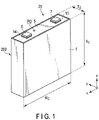
- FIG. 1 is a perspective view schematically showing an example of the battery according to the embodiment.
- a battery 20 shown in FIG. 1 includes exterior parts 200, an electrode group and an electrolyte (not illustrated), a positive electrode terminal 6, a negative electrode terminal 7, and insulating gaskets 14 and 15.
- the battery 20 shown in FIG. 1 is a prismatic battery in which the electrode group and the electrolyte (not illustrated) are housed in the exterior parts 200.
- the exterior parts 200 includes an external container 1 having an opening portion, and a sealing plate 5 attached to the opening portion of the external container 1.
- the sealing plate 5 is provided with an inlet PO.
- the inlet PO is welded with a seal member (not illustrated).
- the exterior part 200 has a prismatic shape, as shown in FIG. 1 .
- the volumetric energy density of the battery 20 can be increased.
- the external container 1 has a shape of a prismatic can which includes a bottom wall, a pair of long-side lateral walls, and a pair of short-side lateral walls, and which is provided with an opening portion opposite the bottom wall.
- the bottom wall is in a rectangular shape having a pair of long sides parallel to the X-axis direction and a pair of short sides parallel to the Y-axis direction.
- the pair of long-side lateral walls extend from the pair of long sides of the bottom wall in the Z-axis direction.
- the pair of short-side lateral walls extend from the pair of short sides of the bottom wall in the Z-axis direction.
- the X-axis direction and the Y-axis direction are directions which are parallel to the bottom wall and which intersect with each other.
- the Z-axis direction is a direction orthogonal to the X-axis direction and the Y-axis direction.
- the X-axis direction is a direction parallel to the winding axis of the electrode group (not illustrated) as well as a direction parallel to the second direction.
- the Y-axis direction is a direction parallel to the third direction.
- the Z-axis direction is a direction parallel to the first direction.
- the external container 1 is formed of, for example, a metal plate.
- the metal include aluminum, an aluminum alloy, iron, and stainless steel.
- thicknesses of the plates forming the long-side lateral walls of the external container 1 are smaller than a thickness of the plate forming the bottom wall of the external container 1 and smaller than thicknesses of the plates forming the short-side lateral walls of the external container 1.
- the long-side lateral walls of the external container 1 are portions occupying the largest area among the rectangle-shaped exterior parts 200. Therefore, when the thicknesses of the plates forming the long-side lateral walls of the external container 1 are small, the battery 20 can have an enhanced heat dissipation, and thus can have an enhanced life performance.
- the thicknesses of the plates forming the long-side lateral walls of the external container 1 are preferably 2.0 mm or less, more preferably 1.0 mm or less, and even more preferably 0.7 mm or less.
- the thicknesses of the plates forming the long-side lateral walls of the external container 1 are excessively small, the rigidity of the external container 1 would be lowered, and the battery performance may deteriorate due to the weakness in maintaining the shape of the electrode group when gas is generated within the external container 1.
- the thicknesses of the plates forming the long-side lateral walls of the external container 1 are preferably 0.3 mm or more, and more preferably 0.5 mm or more.
- the thicknesses of the plates of the bottom wall, the long-side lateral walls, and the short-side lateral walls of the external container 1 are obtained by measuring thicknesses of the centers of their respective plates with a micrometer. Namely, the thickness of the bottom wall plate of the external container 1 is obtained by a method described below. First, the plate forming the bottom wall is cut in parallel with the YZ plane at the middle along the X-axis direction. Next, the thickness of the plate is measured at the middle along the Y-axis direction in the cross-section, and defined as a thickness of the bottom wall plate of the external container 1. The thicknesses of the plates forming the long-side lateral walls of the external container 1 are obtained by a method described below.
- the plates forming the long-side lateral walls are cut in parallel with the XY plane at the middle along the Z-axis direction.
- the thicknesses of the plates are measured at the middle along the X-axis direction in the cross-section and defined as thicknesses of the long-side lateral wall plates of the external container 1.
- the thicknesses of the plates forming the short-side lateral walls of the external container 1 are obtained by a method described below.
- the plates forming the short-side lateral walls are cut in parallel with the XY plane at the middle along the Z-axis direction.
- the thicknesses of the plates are measured at the middle along the Y-axis direction in the section and defined as thicknesses of the short-side lateral wall plates of the external container 1.
- the micrometer for example, Quick Mini PK-1012CPX manufactured by Mitutoyo Corporation or a device having a function equivalent thereto is used.
- the sealing plate 5 is positioned parallel to the bottom wall of the external container 1.
- the sealing plate 5 is made of the same material as the material of the external container 1.
- the sealing plate 5 may be made of a material different from that of the external container 1.
- the sealing plate 5 is, for example, attached to the opening portion of the external container 1 by welding.
- On the main surface of the sealing plate 5 inside the container an insulating sheet (not illustrated) is provided.
- the sealing plate 5 may be provided with a degassing port or a gas discharge valve for discharging gas generated inside the exterior parts 200 to the outside.
- the positive electrode terminal 6 and the negative electrode terminal 7 are attached to the sealing plate 5 respectively via the insulating gaskets 14 and 15.
- the positive electrode terminal 6 and the negative electrode terminal 7 may be fixed to the sealing plate 5 by caulking.
- the protrusions (not illustrated) at the lower ends of the positive electrode terminal 6 and the negative electrode terminal 7 penetrate the sealing plate 5 and extend toward the inside of the external container 1.
- the positive electrode terminals 6 and 7 are made of, for example, a metal such as aluminum, aluminum alloy, copper, or nickel.
- the insulating gaskets 14 and 15 are made of, for example, an insulating material.
- the insulating material is, for example, a resin. Note that the insulating gaskets 14 and 15 may be omitted.
- a width W C of the exterior part 200 in a direction parallel to the second direction is selected appropriately according to the size of the electrode group to be housed therein.
- the lower limit of the width W C of the exterior part 200 is 70 mm or more according to one example, and 80 mm or more according to another example.
- the upper limit of the width W C of the exterior part 200 is 160 mm or less according to one example, and 150 mm or less according to another example.
- the width W C of the exterior part 200 is obtained by measuring the length from one short-side lateral wall to the other short-side lateral wall of the exterior part 200 in the X-axis direction at a position in the middle along the Y-axis direction and the Z-axis direction.
- a micrometer such as Quick Mini PK-1012CPX manufactured by Mitutoyo Corporation, or a device having a function equivalent thereto is used.
- a thickness T C of the exterior part 200 in a direction parallel to the third direction is selected appropriately according to the size of the electrode group to be housed therein.
- the lower limit of the thickness T C of the exterior part 200 is 10 mm or more according to one example, and 14 mm or more according to another example.
- the upper limit of the thickness T C of the exterior part 200 is 25 mm or less according to one example, and 24 mm or less according to another example.
- the thickness T C of the exterior part 200 is obtained by measuring the length from one long-side lateral wall to the other long-side lateral wall of the exterior part 200 in the Y-axis direction at a position in the middle along the X-axis direction and the Z-axis direction.
- a micrometer such as Quick Mini PK-1012CPX manufactured by Mitutoyo Corporation, or a device having a function equivalent thereto is used.
- a height H C of the exterior part 200 in a direction parallel to the first direction is selected appropriately according to the size of the electrode group to be housed therein.
- the lower limit of the height H C of the exterior part 200 is 40 mm or more according to one example, and 45 mm or more according to another example.
- the upper limit of the height H C of the exterior part 200 is 85 mm or less according to one example, and 80 mm or less according to another example.
- the height H C of the exterior part 200 is obtained by measuring the length from the bottom wall to the sealing plate 5 of the exterior parts 200 in the Z-axis direction at position in the middle along the X-axis direction and the Y-axis direction.
- a micrometer such as Quick Mini PK-1012CPX manufactured by Mitutoyo Corporation, or a device having a function equivalent thereto is used.
- the exterior parts 200 may be swollen and deformed by gas generated inside the exterior parts 200 through charge and discharge and/or an aging treatment of the battery 20.
- long-side lateral wall portions are apt to be expanded by the internal gas, and the thickness T C of the exterior part 200 is thus more likely to be affected by the expansion. Therefore, the measurements of the width W C , the thickness T C , and the height H C of the exterior part 200 is performed after a degassing treatment for releasing the gas inside the exterior parts 200 to the outside.
- the thickness T C and the height H C of the exterior part preferably satisfy the following formula (7): 2.5 ⁇ H C / T C ⁇ 3.5
- Such a battery 20 can be considered as having a smaller height H C and a larger thickness T C as compared with a battery using conventional exterior parts.
- Such a battery 20 has long-side lateral walls with smaller areas as compared with a conventional battery, and thus is less likely to expand and deform even when gas is generated inside the exterior parts 200.
- Such a battery 20 tends to have a high life performance.
- the width W C and the thickness T C of the exterior part 200 preferably satisfy the following formula (8): 4.5 ⁇ W C / T C ⁇ 6.5
- Such a battery 20 can be considered as having a larger thickness T C as compared with a battery using conventional exterior parts. There is tendency in such a battery 20, where the electrode group less likely to deteriorate and life performance is higher, as compared with the conventional battery.
- a ratio W C /H C between the width W C and the height H C of the exterior part 200 is preferably from 1.3 to 2.2.
- the life performance of the battery 20 tends to be enhanced. That is, conventional prismatic exterior parts have a ratio W C/ H C lower than 1.3.
- Such exterior parts have long-side lateral walls with large areas, and thus is excellent in heat dissipation. However, as described above, the long-side lateral walls are apt to expand when gas is generated, and the expansion between the electrodes of the electrode group housed therein is also likely to occur, which makes the electrodes likely to become crimpled.
- the exterior parts having a prismatic shape has been described as an example, but the shape of the exterior parts is not limited to a prismatic shape. That is, the bottom wall of the external container 1 may be in a circular shape, an elliptical shape, or a polygonal shape. Further, the shape of the exterior container 1 may be cylindrical or indefinite.
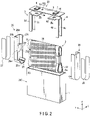
- FIG. 2 is an exploded perspective view of the battery shown in FIG. 1 .
- the battery 20 includes the exterior parts 200 housing an electrode group 2, a positive electrode lead 3, a negative electrode lead 4, fixing members 11 and 12, a positive electrode insulating cover 25, a negative electrode insulating cover 26, insulating cover fixing tapes 27 and 28, an insulating tape 30, and an electrolyte (not illustrated).
- the electrode group 2 includes a positive electrode, a negative electrode, and an insulating layer.
- the electrode group 2 is configured by winding the positive electrode and the negative electrode with the insulating layer interposed therebetween about the winding axis in a flat shape. Details of the electrode group 2 will be described later.
- the fixing members 11 and 12 partially fix a positive electrode current collecting tab 8a and a negative electrode current collecting tab 9a of the electrode group 2, respectively.
- Each of the fixing members 11 and 12 has two sandwiching units. The two sandwiching units bundle the current collecting tabs at parts that face each other through the innermost circumferential face in the wound tab. Details of the positive electrode current collecting tab 8a and the negative electrode current collecting tab 9a will be described later.
- the fixing members 11 and 12 are made, for example, of a metal such as aluminum, aluminum alloy, copper, or nickel. Note that the fixing members 11 and 12 may be omitted.
- the insulating tape 30 covers a portion of the electrode group 2 excluding the positive electrode current collecting tab 8a and the negative electrode current collecting tab 9a.
- a substrate of the insulating tape 30 at least one resin selected from the group consisting of polyester (PET), polyimide, polyphenylene sulfide (PPS), and polypropylene may be used. Note that the insulating tape 30 may be omitted.
- the positive electrode lead 3 is electrically connected to the positive electrode terminal 6 and the positive electrode current collecting tab 8a.
- the positive electrode lead 3 includes: a connection plate 3a for connecting to the positive electrode terminal 6; and first and second sandwiching strips 3c and 3d for connecting to the positive electrode current collecting tab 8a.
- the connection plate 3a comes into contact with the sealing plate 5 via an insulating sheet (not illustrated) provided on the main surface of the sealing plate 5 inside the container.
- the protrusion of the positive electrode terminal 6 is inserted into a through hole 3b provided on the connection plate 3a and is fixed by caulking.
- the first and second sandwiching strips 3c and 3d are bifurcated from the connection plate 3a and sandwich the fixing member 11 and the positive electrode current collecting tab 8a. Note that the positive electrode lead 3 may be omitted.
- the negative electrode lead 4 is electrically connected to the negative electrode terminal 7 and the negative electrode current collecting tab 9a.
- the negative electrode lead 4 includes: a connection plate 4a for connecting to the negative electrode terminal 7; and first and second sandwiching strips 4c and 4d for connecting to the negative electrode current collecting tab 9a.
- the connection plate 4a comes into contact with the sealing plate 5 via an insulating sheet (not illustrated) provided on the main surface of the sealing plate 5 inside the container.
- the protrusion of the negative electrode terminal 7 is inserted into a through hole 4b provided on the connection plate 4a and is fixed by caulking.
- the first and second sandwiching strips 4c and 4d are bifurcated from the connection plate 4a and sandwich the fixing member 12 and the negative electrode current collecting tab 9a. Note that the negative electrode lead 4 may be omitted.
- the positive electrode insulating cover 25 covers one side surface of the electrode group 2 in the X-axis direction so as to sandwich the first and second sandwiching strips 3c and 3d of the positive electrode lead 3, the fixing member 11, and the positive electrode current collecting tab 8a.
- the positive electrode insulating cover 25 includes: a first lateral wall 25b and a second lateral wall 25c facing each other; a back surface member 25d coupling the first and second lateral walls; a convex portion 25e provided on the first lateral wall; a convex portion 25f provided on the second lateral wall; a convex portion 25g provided on the back surface member 25d; and an extending portion 25h extending from lower end portions of the first lateral wall 25b, the second lateral wall 25c, and the back surface member 25d.
- the convex portions 25e, 25f, and 25g are fitted onto the side surface of the electrode group 2 in the X-axis direction so as to sandwich the two sandwiching units of the fixing member 11.
- the extending portion 25h is provided with a channel groove 25i extending in the X-axis direction.
- the channel groove 25i may hold the electrolyte (not illustrated). Note that the positive electrode insulating cover 25 may be omitted.
- the negative electrode insulating cover 26 has the same structure as the positive electrode insulating cover 25.
- the negative electrode insulating cover 26 covers the other side surface of the electrode group 2 in the X-axis direction so as to sandwich the first and second sandwiching strips 4c and 4d of the negative electrode lead 4, the fixing member 12, and the positive electrode current collecting tab 9a. Note that the negative electrode insulating cover 26 may be omitted.
- Insulating cover fixing tapes 27 and 28 respectively fix the positive electrode insulating cover 25 and the negative electrode insulating cover 26 to the insulating tape 30. Note that the insulating cover fixing tapes 27 and 28 may be omitted.
- FIG. 3 is an unwound perspective view of the electrode group included in the battery shown in FIG. 2 .
- the electrode group 2 shown in FIG. 3 includes a positive electrode 8 and a negative electrode 9 as a pair of electrodes, and separators 10a and 10b as insulating layers.
- the electrode group 2 includes a sheet-shaped stack having the negative electrode 9, the separator 10a, the positive electrode 8, and the separator 10b stacked in this order.
- the electrode group 2 is one where the stack is wound around the winding axis WA in a flat shape such that the separator 10b is positioned at the innermost circumference.
- the winding axis WA is parallel to the X-axis direction.
- the positive electrode 8 includes a positive electrode current collector 8c, a positive electrode active material-containing layer 8b, and the positive electrode current collecting tab 8a.
- the positive electrode current collector 8c has a belt shape having a pair of long sides parallel to the Z-axis direction and a pair of short sides parallel to the X-axis direction.
- the positive electrode active material-containing layer 8b is provided on at least one main surface of the positive electrode current collector 8c, from one long side to a position between the one long side and the other long side in the X-axis direction. The length from the one long side to the position between the one long side and the other long side is defined as a width W PE of the positive electrode active material-containing layer 8b in a direction parallel to the second direction.
- the width W PE can be referred to as a length of a short side of the positive electrode active material-containing layer 8b.
- the positive electrode active material-containing layer 8b is provided on at least one main surface of the positive electrode current collector 8c, from one short side to the other short side in the Z-axis direction.
- the positive electrode current collecting tab 8a is a portion on the positive electrode current collector 8c that is not coated with the positive electrode active material-containing layer 8b.
- the positive electrode current collecting tab 8a extends along the X-axis direction in a direction different from that of the negative electrode current collecting tab 9a.
- the positive electrode current collector 8c is, for example, a metal foil such as of aluminum, aluminum alloy, copper, or nickel. Note that the positive electrode current collecting tab 8a may be unintegrated with the positive electrode current collector 8c. That is, the positive electrode current collector tab 8a may be implemented by joining a metal foil to one long side of the positive electrode current collector 8c. As the metal foil, the same as that for the positive electrode current collector 8c may be used.
- the positive electrode active material-containing layer 8b may be provided on either main surface or both main surfaces of the positive electrode current collector 8c.
- the positive electrode active material-containing layer 8b includes a positive electrode active material.
- the positive electrode active material-containing layer 8b may include an electro-conductive agent and a binder in addition to the positive electrode active material.
- a lithium transition metal composite oxide may be used as the positive electrode active material.
- examples include LiCoO 2 , LiNi 1-x Co x O 2 (0 ⁇ x ⁇ 0.3), LiMn x Ni y Co z O 2 (0 ⁇ x ⁇ 0.5, 0 ⁇ y ⁇ 0.8, 0 ⁇ z ⁇ 0.5), LiMn 2-x M x O 4 (M is at least one element selected from the group consisting of Mg, Co, Al, and Ni, 0 ⁇ x ⁇ 0.2), LiMPO 4 (M is at least one element selected from the group consisting of Fe, Co, Ni, and Mn), and the like.
- An average particle size of secondary particles of the positive electrode active material is preferably 10 ⁇ m or less, and more preferably 6 ⁇ m or less.
- the internal resistance is small, and thus the heat dissipation associated with charge and discharge tends to be small. Therefore, when the average particle size of the secondary particles of the positive electrode active material is small, the battery 20 can be enhanced in life performance.
- the electro-conductive agent increases electronic conductivity of the electrodes.
- carbonaceous materials such as acetylene black, carbon black, and graphite may be used.
- the binder increases the adhesiveness between the active material, the electro-conductive agent and the current collector.
- PTFE polytetrafluoroethylene
- PVdF polyvinylidene fluoride
- fluorine rubber or the like may be used.
- the mixing ratios of the positive electrode active material, the electro-conductive agent, and the binder are preferably in ranges of 80 to 95 mass% of the positive electrode active material, 3 to 18 mass% of the electro-conductive agent, and 2 to 7 mass% of the binder.
- a density of the positive electrode active material-containing layer 8b is preferably from 2.7 g/cm 3 to 3.3 g/cm 3 .
- the life performance of the battery 20 tends to be high. That is, when the density of the positive electrode active material-containing layer 8b is 3.3 g/cm 3 or less, the positive electrode is less likely to form crimples when gas is generated, which can suppress an increase in distance between the electrodes, and thus the battery performance can improve. Further, when the density of the positive electrode active material-containing layer 8b is 2.7 g/cm 3 or more, the distance between the positive electrode active material particles is more adequate, and thus the internal resistance tends to decrease.
- the negative electrode 9 includes a negative electrode current collector 9c, a negative electrode active material-containing layer 9b, and the negative electrode current collecting tab 9a.
- the negative electrode current collector 9c has a belt shape having a pair of long sides parallel to the Z-axis direction and a pair of short sides parallel to the X-axis direction.
- the negative electrode active material-containing layer 9b is provided on at least one main surface of the negative electrode current collector 9c, from one long side to a position between the one long side and the other long side in the X-axis direction. The length from the one long side to the position between the one long side and the other long side is defined as a width W NE of the negative electrode active material-containing layer 9b in a direction parallel to the second direction.
- the width W NE can be referred to as a length of a short side of the negative electrode active material-containing layer 9b.
- the negative electrode active material-containing layer 9b is provided on at least one main surface of the negative electrode current collector 9c from one short side to the other short side in the Z-axis direction.
- the negative electrode current collecting tab 9a is a portion not coated with the negative electrode active material-containing layer 9b on the negative electrode current collector 9c.
- the negative electrode current collecting tab 9a extends along the X-axis direction in a direction different from that of the positive electrode current collecting tab 8a.
- the negative electrode current collecting tab 9a may extend in the same direction as that of the positive electrode current collecting tab 8a.
- the negative electrode current collector 9c is, for example, a metal foil such as of aluminum, aluminum alloy, copper, or nickel. Note that the negative electrode current collecting tab 9a may be unintegrated with the negative electrode current collector 9c. That is, the negative electrode current collector tab 9a may be implemented by joining a metal foil to one long side of the negative electrode current collector 9c. As the metal foil, the same as that for the negative electrode current collector 9c may be used.
- the negative electrode active material-containing layer 9b may be provided on both main surfaces of the negative electrode current collector 9c, or on one of the main surfaces.
- the negative electrode active material-containing layer 9b includes a negative electrode active material.
- the negative electrode active material-containing layer 9b may include an electro-conductive agent and a binder in addition to the negative electrode active material.
- the negative electrode active material it is preferable to use a compound whose lower limit of the potential capable of having lithium ions charged and discharged is 1.0 V (vs. Li/Li + ) or more.
- a compound whose lower limit of the potential capable of having lithium ions charged and discharged is 1.0 V (vs. Li/Li + ) or more.
- a lithium titanium composite oxide As such a compound, it is preferable to use a lithium titanium composite oxide.
- the lithium titanium composite oxide hardly has volume change accompanying charge and discharge reactions. Therefore, use of the lithium titanium composite oxide as the negative electrode active material suppresses the expansion and contraction of the electrodes. Thus, the use of the lithium titanium composite oxide as the negative electrode active material can make crimpling of the electrodes less likely to occur when gas is generated.
- the lithium titanium composite oxide has a small amount of heat dissipation associated with charge and discharge. Therefore, the use of the lithium titanium composite oxide as the negative electrode active material can enhance the battery 20 in life performance even when the areas of the long-side
- lithium titanium composite oxide examples include Li 4+x Ti 5 O 12 (0 ⁇ x ⁇ 3) having a spinel structure, Li 2+y Ti 3 O 7 (0 ⁇ y ⁇ 3) having a ramsdellite structure, and an orthorhombic titanium-containing oxide.
- orthorhombic titanium-containing oxide examples include a sodium-containing niobium titanium composite oxide.
- Examples of the sodium-containing niobium titanium composite oxide include a compound represented by the general formula Li 2+v Na 2-w M1 x Ti 6-y-z Nb y M2 z O 14+ ⁇ , where 0 ⁇ v ⁇ 4, 0 ⁇ w ⁇ 2, 0 ⁇ x ⁇ 2, 0 ⁇ y ⁇ 6, 0 ⁇ z ⁇ 3, y + z ⁇ 6, -0.5 ⁇ ⁇ ⁇ 0.5, M1 includes at least one selected from Cs, K, Sr, Ba, and Ca, and M2 includes at least one selected from Zr, Sn, V, Ta, Mo, W, Fe, Co, Mn, and Al.
- the negative electrode potential can be lowered as compared with the case of using Li 4+x Ti 5 O 12 , and thus, the voltage of the battery 20 can be increased.
- An average primary particle size of the negative electrode active material is preferably 1 ⁇ m or less.
- the internal resistance is small, and thus the heat dissipation associated with charge and discharge tends to be small. Therefore, when the average particle size of the secondary particles of the negative electrode active material is small, the battery 20 can be enhanced in life performance.
- the negative electrode active material-containing layer 9b may include a negative electrode active material other than the lithium titanium composite oxide.
- examples of such other negative electrode active material include carbonaceous materials such as graphite, and tin-silicon alloy materials.
- the electro-conductive agent increases electronic conductivity of the electrodes.
- carbonaceous materials such as acetylene black, carbon black, and graphite may be used.
- the binder increases the adhesiveness between the active material, the electro-conductive agent and the current collector.
- PTFE polytetrafluoroethylene
- PVdF polyvinylidene fluoride
- fluorine rubber fluorine rubber
- styrene-butadiene rubber or the like
- the mixing ratios of the negative electrode active material, the electro-conductive agent, and the binder are preferably in ranges of 73 to 98 mass% of the negative electrode active material, 0 to 20 mass% of the electro-conductive agent and 2 to 7 mass% of the binder.
- the separators 10a and 10b serve as insulating layers.
- the separators 10a and 10b are, for example, porous films or nonwoven fabrics.
- the porous films and the nonwoven fabrics each may include at least one compound selected from the group consisting of polyethylene, polypropylene, polyethylene terephthalate, and cellulose.
- the separators 10a and 10b may be organic fibrous films or inorganic films that coat at least part of the main surfaces of the positive electrode 8 and the negative electrode 9. Further, as the insulating layers, a solid electrolytic layer may be used instead of the separators 10a and 10b.
- a thickness of the separators is preferably from 6 ⁇ m to 15 ⁇ m.
- the thickness of the separators is within the above range, the safety, capacity, and life performance of the battery 20 can be enhanced. That is, the thickness of the separator being 6 ⁇ m or more may lower the probability of short circuit of the positive electrode and the negative electrode, and thus the safety and reliability of the battery 20 may be improved.
- the thickness of the separator being 15 ⁇ m or less, an increase in the amount of auxiliary materials in the battery 20 can be suppressed, whereby the energy density can be improved.
- the thickness of the separator is 15 ⁇ m or less, adequate spaces are present inside the exterior parts 200, whereby the battery 20 is less likely to expand when gas is generated, and thus, the battery performance may improve.
- the electrolyte which is not illustrated, may be held in the positive electrode 8, negative electrode 9, and the separators 10a and 10b.
- the electrolyte may be a nonaqueous electrode including an electrolyte salt and an organic solvent.
- the battery according to the embodiment may be a nonaqueous electrolyte battery.
- the nonaqueous electrolyte may be liquid or gel.
- the liquid nonaqueous electrolyte is prepared by dissolving an electrolyte salt in an organic solvent.
- the gel nonaqueous electrolyte is prepared by gelling the liquid nonaqueous electrolyte using a polymeric material.
- the concentration of electrolyte salt in the liquid nonaqueous electrolyte is preferably from 0.5 mol/L to 2.5 mol/L.
- the electrolyte examples include lithium salts such as lithium perchlorate (LiCl 4 ), lithium hexafluorophosphate (LiPF 6 ), lithium tetrafluoroborate (LiBF 4 ), lithium hexafluoroarsenate (LiAsF 6 ), lithium trifluoromethanesulfonate (LiCF 3 SO 3 ), and lithium bistrifluoromethylsulfonylimide [LiN(CF 3 SO 2 ) 2 ], and mixtures thereof.
- the electrolyte salt is preferably resistant to oxidation even at a high potential, and most preferably LiPF 6 .
- organic solvent examples include cyclic carbonates such as propylene carbonate (PC), ethylene carbonate (EC), and vinylene carbonate; linear carbonates such as diethyl carbonate (DEC), dimethyl carbonate (DMC), and methyl ethyl carbonate (MEC); cyclic ethers such as tetrahydrofuran (THF), 2-methyl tetrahydrofuran (2MeTHF), and dioxolane (DOX); linear ethers such as dimethoxy ethane (DME) and diethoxy ethane (DEE); ⁇ -butyrolactone (GBL), acetonitrile (AN), and sulfolane (SL).
- cyclic carbonates such as propylene carbonate (PC), ethylene carbonate (EC), and vinylene carbonate
- linear carbonates such as diethyl carbonate (DEC), dimethyl carbonate (DMC), and methyl ethyl carbonate (MEC)
- cyclic ethers
- polymeric material examples include polyvinylidene fluoride (PVdF), polyacrylonitrile (PAN), polyethylene oxide (PEO), and the like.
- a room temperature molten salt which contain lithium ions, and the like may be used as the nonaqueous electrolyte.
- the lower limit of the coating width W W of the electrode group 2 in a direction parallel to the second direction is 85 mm or more according to one example, and 90 mm or more according to another example.
- the upper limit of the coating width W W of the electrode group 2 is 130 mm or less according to one example, and 125 mm or less according to another example.
- the coating width W W of the electrode group 2 is a larger active material-containing layer width of, the width W PE of the positive electrode active material-containing layer in a direction parallel to the second direction and the width W NE of the negative electrode active material-containing layer in a direction parallel to the second direction. Note that when the width W PE of the positive electrode active material-containing layer and the width W NE of the negative electrode active material-containing layer are the same, either of the widths is defined as the coating width W W .
- the coating width W W of the electrode group 2 can be obtained by a method described below. First, the battery 20 is disassembled in an atmosphere of an inert gas such as argon gas to take out the electrode group 2 from the exterior parts 200. Next, the electrode group 2 is immersed in an organic solvent such as methyl ethyl carbonate for 24 hours. Next, the electrode group 2 is taken out from the organic solvent and further immersed in an organic solvent such as methyl ethyl carbonate for 24 hours. Subsequently, the electrode group 2 is taken out from the organic solvent and vacuum dried at a temperature of 90 °C to remove the electrolyte from the electrode group 2. The washed electrode group 2 is thus obtained.
- an inert gas such as argon gas
- the washed electrode group 2 is unwound, and the sheet-shaped positive electrode 8 and negative electrode 9 are taken out.
- the widths of the positive electrode active material-containing layer 8b and the negative electrode active material-containing layer 9b in a direction parallel to the second direction namely, the widths in directions parallel to the short sides of the positive electrode active material-containing layer 8b and the negative electrode active material-containing layer 9b are measured.
- the measurement is performed at five places equally spaced along the long side direction in the positive electrode active material-containing layer 8b and the negative electrode active material-containing layer 9b, and the average values thereof are respectively defined as the width W PE of the positive electrode active material-containing layer and the width W NE of the negative electrode active material-containing layer.
- the larger one of the width W PE and the width W NE is taken as the coating width W W of the electrode group 2.
- Digimatic Indicator ID-H0530543 series manufactured by Mitutoyo Corporation or a device having a function equivalent thereto is used.
- FIG. 4 is a perspective view of the electrode group shown in FIG. 3 .
- the lower limit of the thickness T W of the electrode group 2 in a direction parallel to the third direction is 13 mm or more according to one example, and 14 mm or more according to another example.
- the upper limit of the thickness T W of the electrode group 2 is 24 mm or less according to one example, and 23 mm or less according to another example.
- the thickness T W of the electrode group 2 can be obtained by a method described below. First, the washed electrode group 2 is obtained by the same method as described above. Next, the washed electrode group 2 is set on a table such that one surface parallel to the XZ plane is the bottom surface. Next, a weight is put on the other surface parallel to the XZ plane so as to impose a load of 100 kPa on this surface. Next, the length from one surface to the other surface of the electrode group 2 at a position at the middle in the X-axis direction and the Z-axis direction, namely, the length of the electrode group 2 in the Y-axis direction is measured with a caliper. The length is defined as the thickness T W of the electrode group 2. For the measurement, for example, Digimatic Indicator ID-H0530543 series manufactured by Mitutoyo Corporation or a device having a function equivalent thereto is used.
- the lower limit of the height H W of the electrode group 2 in a direction parallel to the first direction is 35 mm or more according to one example, and 40 mm or more according to another example.
- the upper limit of the height H W of the electrode group 2 is 75 mm or less according to one example, and 73 mm or less according to another example.
- the height H W of the electrode group 2 can be obtained by a method described below. First, by the same method as described above, the washed electrode group 2 is set on a table such that one surface parallel to the XZ plane is horizontal. Next, a weight is put on the other surface parallel to the XZ plane so as to impose a load of 100 kPa on this surface. Next, the length of the electrode group 2 in the Z-axis direction is measured with a caliper at a position at the middle in the X-axis direction and the Y-axis direction. The length is defined as the height H W of the electrode group 2. For the measurement, for example, Digimatic Indicator ID-H0530543 series manufactured by Mitutoyo Co., Ltd. or a device having a function equivalent thereto is used.
- a nominal capacity A of the battery 20 is preferably 4 Ah or more, and more preferably 5 Ah or more. That is, the battery 20 according to the embodiment can be suitably used as a high-capacity battery.
- An upper limit of the nominal capacity is not limited to a particular value, but is, for example, 17 Ah.
- the nominal capacity of the battery 20 is a discharge capacity obtained by a method described below. First, the battery is charged with a constant current at a rate of 0.05 C up to the maximum working voltage in an environment of 25°C. Next, the battery is further charged until the current value becomes 0.01 C with the maximum working voltage maintained. Subsequently, the battery is discharged at a rate of 0.05 C to the end voltage to obtain a discharge capacity.
- maximum working voltage is a maximum voltage at which the battery can be used without any danger or defect, which is a value unique to each battery.
- the maximum working voltage is, for example, a voltage such as “a charging voltage” and “a secure maximum voltage” described in a battery specification.
- end voltage is a minimum working voltage at which the battery can be used with over-discharge of both the positive electrode and the negative electrode suppressed, namely, with deterioration of the battery suppressed, which is a value unique to each battery.
- the facing area S (m 2 ) and the nominal capacity A (Ah) preferably satisfy the following formula (6) . 3.5 ⁇ A / S ⁇ 10
- the above battery 20 can attain both an excellent life performance and an excellent output performance.
- the ratio A/S between the nominal capacity A and the facing area S being smaller than 3.5 may indicate that the thickness T E of the electrode is excessively small.
- the ratio A/S being larger than 10 may indicate that the thickness T E of the electrode is excessively large.
- the ratio A/S is preferably from 3.9 to 10.
- the facing area S is an area of one active material-containing layer that is either of the area of the positive electrode active material-containing layer 8b and the area of the negative electrode active material-containing layer 9b in a pair of the positive electrode 8 and the negative electrode 9 facing each other. That is, when the area of the positive electrode active material-containing layer 8b differs from the area of the negative electrode active material-containing layer 9b, the facing area S is an area of the active material-containing layer having the smaller area. When the area of the positive electrode active material-containing layer 8b is equal to the area of the negative electrode active material-containing layer 9b, the facing area S is the area of either active material-containing layer.
- the positive electrode active material-containing layer 8b and the negative electrode active material-containing layer 9b are provided on both main surfaces of their respective current collectors, a sum of the area of the active material-containing layer provided on one main surface of the current collector and the area of the active material-containing layer provided on the other main surface of the current collector is defined as the facing area S.
- the facing area S can be calculated in, for example, a manner described below.
- the washed electrode group 2 is obtained by the above-described method.
- the above electrode group 2 is unwound, and the sheet-shaped positive electrode 8 and negative electrode 9 are taken out.
- the lengths of the long sides and the lengths of the short sides of the positive electrode active material-containing layer 8b and the negative electrode active material-containing layer 9b respectively provided on one main surface of their respective current collector are measured, to calculate an area of one of the positive electrode active material-containing layer 8b and an area of one of the negative electrode active material-containing layer 9b.
- the lengths of the long sides and the lengths of the short sides of the positive electrode active material-containing layer 8b and the negative electrode active material-containing layer 9b respectively provided on the other main surface of their respective current collector are measured to calculate an area of the other of the positive electrode active material-containing layer 8b and an area of the other of the negative electrode active material-containing layer 9b. Sums of the one area and the other area thus obtained are defined respectively as areas of the positive electrode active material-containing layer 8b and the negative electrode active material-containing layer 9b. Note that when an active material-containing layer is provided only on one main surface, the calculation of an area of the other is omitted.
- the smaller area is defined as the facing area S.
- the area of the positive electrode active material-containing layer 8b and the area of the negative electrode active material-containing layer 9b are equal to each other, either area is defined as the facing area S.
- Digimatic Indicator ID-H0530543 series manufactured by Mitutoyo Co., Ltd. or a device having a function equivalent thereto is used.
- FIG. 5 is a cross-sectional view of the electrode group shown in FIG. 4 taken along the V-V line.
- the cross-sectional view shown in FIG. 5 is a cross-sectional view obtained by cutting the electrode group 2 in parallel with the YZ plane.
- the boldface solid line indicates the positive electrode 8
- the dotted line indicates the negative electrode 9
- the thin solid line indicates the separators 10a and 10b.
- the innermost surface of the electrode group 2 namely, the innermost circumferential surface
- the innermost circumferential surface is configured of a part 10b-1 of the separator 10b and a part 9-1 of the negative electrode 9.
- the portion enclosed by the innermost circumferential surface forms a through hole along a direction orthogonal to the Y-axis direction and the Z-axis direction, namely, along the X-axis direction.
- the through hole may be closed by parts 10b-1 of the separator coming into contact with each other or by the separator 10b-1 coming into contact with the part 9-1 of the negative electrode 9 at the middle of the electrode group 2 along the X-axis direction.
- the lower limit of the innermost circumferential height H IC of the electrode group 2 in a direction parallel to the first direction is 26 mm or more according to one example.
- the upper limit of the height H IC is 53 mm or less according to one example.
- the innermost circumferential height H IC is approximately equal to the length of the portions in the electrode group 2 where the electrodes extend in the Z-axis direction without curving, namely, straight portions.
- the electrodes positioned in the straight portions tend to be more likely to crimple when gas is generated within the electrode group, as compared with the electrodes positioned in portions other than the straight portions in the electrode group 2, namely, curved portions.
- the innermost circumferential height H IC of the electrode group 2 is made small, making the proportion of the straight portions in the electrode group 2 reduced, crimples in the electrodes are less likely to arise.
- the innermost circumferential height H IC is the distance between the straight line passing through a point P1 and parallel to the Y-axis direction, and the straight line passing through a point P2 and parallel to the Y-axis direction shown in FIG. 5 .
- the points P1 and P2 are positioned farthest from each other in the Z-axis direction on the innermost circumferential surface.
- the innermost circumferential height H IC of the electrode group 2 can be determined by a method described below. First, the washed electrode group 2 is obtained by the above-described method. Next, the electrode group 2 is cut in parallel with the YZ plane at five places. Then, creases of the separator 10b positioned at the innermost circumference are examined by eye in the section. That is, in the separator 10b, a portion bent by a large external force applied in winding can be examined by eye as a crease.
- the crease at the winding start portion of the electrode group 2 is defined as the point P1, and the crease next to the winding start portion is defined as the point P2.
- the distance between the straight line passing through the point P1 and parallel to the Y-axis direction, and the straight line passing through the point P2 and parallel to the Y-axis direction is measured with a caliper.
- This procedure is performed on the five cross-sections, and the average value thereof is defined as the innermost circumferential height H IC of the electrode group 2.
- Digimatic Indicator ID-H0530543 series manufactured by Mitutoyo Corporation or a device having a function equivalent thereto is used.
- the description herein has been made, taking the separator 10b as being positioned at the innermost circumference of the electrode group 2; however, note that at the innermost circumference, either the positive electrode or the negative electrode may be positioned.
- the crease at the winding start and the crease next to the crease at the winding start of the electrode group 2 are examined in the positive electrode or the negative electrode positioned at the innermost circumference of the electrode group 2, thereby the innermost circumferential height H IC can be obtained by the same method as described with the separator 10b taken as an example.
- the thickness T W (mm) of the electrode group 2 and the innermost circumferential height H IC (mm) of the electrode group 2 preferably satisfy the following formula (5): 1.8 ⁇ H IC / T W ⁇ 3.2 .
- Such a battery 20 can achieve an excellent life performance. That is, when the ratio H IC /T W between the innermost circumferential height H IC of the electrode group 2 and the thickness T W of the electrode group is 1.8 or more, upon gas generation, the gas is more easily released from the electrode group 2 to the outside. In addition, when the ratio H IC /T W is 3.2 or less, the electrode group 2 has an adequate strength to hold its shape, and therefore, deformation of the electrode group 2 may be suppressed when gas is generated.
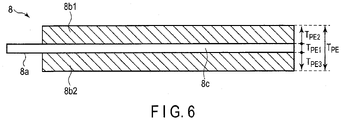
- FIG. 6 is a cross-sectional view of the positive electrode included in the electrode group shown in FIGS. 3 to 5 .
- the positive electrode 8 shown in FIG. 6 includes a positive electrode current collector 8c, a positive electrode active material-containing layer 8b1 provided on one main surface of the positive electrode current collector 8c, a positive electrode active material-containing layer 8b2 provided on the other main surface of the positive electrode current collector 8c, and a positive electrode current collecting tab 8a.
- a thickness T PE of the positive electrode is the sum of a thickness T PE1 of the positive electrode current collector 8c, a thickness T PE2 of the positive electrode active material-containing layer 8b1, and a thickness T PE3 of the positive electrode active material-containing layer 8b2. Note that when the positive electrode active material-containing layer 8b is provided only on one of the surfaces of the positive electrode current collector 8c, the thickness T PE of the positive electrode is the sum of the thickness T PE1 of the positive electrode current collector 8c and the thickness T PE2 of the positive electrode active material-containing layer 8b1 or the thickness T PE3 of the positive electrode active material-containing layer 8b2.
- a thickness T NE of the negative electrode can also be determined by the same method as the thickness T PE of the positive electrode.
- the thickness T PE of the positive electrode may be either equal to or different from the thickness T NE of the negative electrode.
- the thickness T PE of the positive electrode is preferably thicker than the thickness T NE of the negative electrode. When the thickness T PE of the positive electrode is thicker than the thickness T NE of the negative electrode, the safety of the battery 20 tends to be high.
- a thickness T E of the electrode can be determined by a method described below. First, the washed electrode group 2 is obtained by the above-described method. Next, the electrode group 2 is unwound, and the sheet-shaped positive electrode 8 and negative electrode 9 are taken out. Then, in the positive electrode 8 and the negative electrode 9, the thickness of the positive electrode and the negative electrode is measured at 50 points where the positive electrode active material-containing layer 8b and the negative electrode active material-containing layer 9b are provided, and the average value thereof is determined as a thickness of each electrode.
- the 50 points are points where ten straight lines parallel to the short side that are equally spaced along the long side direction, intersect with five straight lines parallel to the long side that are equally spaced along the short side direction, in the positive electrode active material-containing layer 8b and the negative electrode active material-containing layer 9b.
- the larger thickness is defined as the thickness T E of the electrode. Note that when the thicknesses T PE and T NE have the same value, either of the thicknesses is defined as the thickness T E of the electrode.
- the thickness T E of the electrode is from 0.03 mm to 0.08 mm. That is, the thickness T E of the electrode is from 30 ⁇ m to 80 ⁇ m.
- the battery 20 can be enhanced in life performance. That is, if the thickness T E of the electrode is less than 0.03 mm, the rigidity of the electrode would be so low that the electrode is more likely to form crimples when releasing gas. On the other hand, if the thickness T E of the electrode is larger than 0.08 mm, the rigidity of the electrode would be excessively high, which makes gaps difficult to be provided between the electrodes when gas is generated, and making gas difficult to be released from the electrodes. Therefore, the gas stay between the electrodes, whereby localized large gaps may be generated. Further, if the thickness T E of the electrode is larger than 0.08 mm, the internal resistance would increase, and the heat generated accompanying charge and discharge thus would increase.
- the thickness T E of the electrode, the thickness T W of the electrode group, and the innermost circumferential height H IC of the electrode group satisfy the following formula (1): 0.02 ⁇ T E ⁇ T W / H IC ⁇ 0.04 .
- Such an electrode group 2 can be said to have a lesser thickness T E of the electrode, a greater thickness T W of the electrode group 2, and a lesser inner circumferential surface height H IC of the electrode group 2, as compared with the conventional electrode group.
- rigidity of the electrode group 2 itself is high because of the relatively large thickness of the electrode group 2, and even when the thickness T E of the electrode is relatively small, the electrode is less likely to form crimples when gas is generated within the electrode group.
- the relatively small inner circumferential surface height H IC the proportion occupied by the straight portions in the electrode group 2 is small, and the electrodes are still less likely to form crimples. From the above, the battery satisfying the above formula (1) can achieve excellent life performance.
- the ratio (T E ⁇ T W )/H IC between the product of the electrode thickness T E and the electrode group thickness T W and the innermost circumferential height H IC of the electrode group is preferably from 0.02 to 0.033.
- the thickness T E (mm) of the electrode and the height H W (mm) of the electrode group preferably satisfy the following formula (2): 800 ⁇ H W / T E ⁇ 1500 .
- the battery 20 can be enhanced in life performance. That is, when the ratio H W /T E between the height H W of the electrode group and the thickness T E of the electrode is 800 or more, upon gas generation, the gas easily escapes from the electrodes and is less likely to accumulate between the electrodes, and a localized increase in distance between the electrodes tends to be suppressed. Therefore, when the ratio H W /T E is 800 or more, the internal resistance of the battery 20 may be lowered and the capacity may improve. Further, when the ratio H W /T E is 1500 or less, the electrode is less likely to form crimples when gas is generated, which, in turn, may lower the internal resistance of the battery 20 and improve the capacity.
- the thickness T E of the electrode and the coating width W W of the electrode group preferably satisfy the following formula (3): 1600 ⁇ W W / T E ⁇ 2500 .
- the battery 20 including such an electrode group 2 tends to have a high life performance. That is, when the ratio W W /T E between the coating width W W of the electrode group and the thickness T E of the electrode is from 1600 to 2500, upon gas generation, the gas easily escapes from the electrodes, and also, crimples tends to be less apt to occur in the electrode group. Therefore, when the electrode group having a ratio W W /T E of from 1600 to 2500 is used, the battery performance is less likely to deteriorate when gas is generated.
- the thickness T W of the electrode group and the thickness T E of the electrode preferably satisfy the following formula (4): 250 ⁇ T W / T E ⁇ 450 .
- Such a battery 20 can have an enhanced life performance. Namely, when the ratio T W /T E between the thickness T W of the electrode group and the thickness T E of the electrode is 250 or more, the electrode group 2 has an adequate strength to hold its shape, which can suppress deformation of the electrode group 2 when gas is generated. Further, when the ratio T W /T E is 450 or less, upon gas generation, the gas easily escapes from the electrode group 2 to the outside, and the battery performance may improve.
- the battery according to the above-described embodiment includes the electrode having the relatively small thickness of 0.08 mm or less.
- the ratio (T E ⁇ T W ) /H IC between the product of the electrode thickness T E and the electrode group thickness T W and the innermost circumferential height H IC of the electrode group be from 0.02 to 0.04, even when including the electrode with the relatively small thickness, crimpling of the electrode can be made less apt to occur.
- the battery according to the embodiment can achieve excellent life performance.
- the battery according to the embodiment can attain both excellent life performance and excellent input/output performance.
- the battery according to the embodiment is suitably used as a secondary battery.
- a battery pack is provided.
- the battery pack according to the second embodiment includes the battery according to the first embodiment.
- the number of batteries (single-batteries) included in the battery pack may be one or plural.
- the plural batteries may be electrically connected in series, in parallel or in combination of in-series and in-parallel connections to configure a battery module.
- the battery pack may include plural battery modules.
- the battery pack may further include a protective circuit.
- the protective circuit has a function to control charging and discharging of the battery(s).
- a circuit included in equipment where the battery pack serves as a power source for example, electronic devices, automobiles, and the like may be used as the protective circuit for the battery pack.
- the battery pack may further include an external power distribution terminal.
- the external power distribution terminal is configured to externally output current from the battery(s), and to input external current into the secondary battery (s) .
- the current is provided out via the external power distribution terminal.
- the charging current including regenerative energy of motive force of automobiles
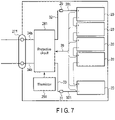
- FIG. 7 is a block diagram showing an example of an electric circuit of the battery pack according to the embodiment.
- the battery pack shown in FIG. 7 includes plural flat batteries 20.
- the plural single-batteries 20 are stacked such that externally protruding negative electrode terminals and positive electrode terminals are arranged in the same direction, and are fastened by an adhesive tape to configure a battery module.
- the single-batteries 20 are electrically connected in series, as shown in FIG. 7 .
- a printed wiring board is arranged facing the side surfaces of the plural single-batteries 20 from which the negative electrode terminals and the positive electrode terminals protrude out.
- a thermistor 251, a protective circuit 261, and an energizing terminal 271 for energization to external device (s) are mounted on the printed wiring board.
- an insulating plate (not shown) is attached to the surface of the printed wiring board facing the battery module to avoid unwanted connection to the wires of the battery module.
- a positive electrode-side electrode lead 281 is connected to the positive electrode terminal of the single-battery 20 located lowermost in the battery module, and a distal end thereof is inserted into a positive electrode-side electrode connector 29 of the printed wiring board and electrically connected thereto.
- a negative electrode-side electrode lead 301 is connected to the negative electrode terminal of the single-battery 20 located uppermost in the battery module, and a distal end thereof is inserted into a negative electrode-side connector 31 of the printed wiring board and electrically connected thereto.
- the connectors 29 and 31 are connected to the protective circuit 261 via wirings 32 and 33 formed on the printed wiring board.
- the thermistor 251 detects the temperature of the single-batteries 20, and the detection signal is transmitted to the protective circuit 261.
- the protective circuit 261 can cutoff a plus-side wiring 34a and a minus-side wiring 34b between the protective circuit 261 and the energizing terminal 271 to external device (s) under a predetermined condition.
- predetermined condition is, for example, when a signal is received from the thermistor 251 indicating that a temperature of the single-battery(s) 20 is a predetermined temperature or more.
- Another example of predetermined condition is, when overcharge, over-discharge, an overcurrent, or the like of the single-battery(s) 20 is detected.
- Detection of the overcharge and the like is done for each single-battery 20 or for all the single-batteries 20.
- the battery voltage may be detected, or the positive electrode potential or negative electrode potential may be detected. In the latter case, a lithium electrode used as a reference electrode is inserted into each single-battery 20.
- a wire 35 for voltage detection is connected to each of the single-batteries 20, and a detection signal is transmitted to the protective circuit 261 via the wires 35.
- the battery pack shown in FIG. 7 has a form where plural single-batteries 20 are connected in series
- the battery pack according to the second embodiment may have the single-batteries be connected in parallel, in order to increase the battery capacity.
- the battery pack according to the second embodiment may include plural single-batteries 20 connected with a combination of in-series connection and in-parallel connection. Assembled battery packs may further be connected in series or in parallel, also.
- the battery pack shown in FIG. 7 includes plural single-batteries 20
- the battery pack according to the second embodiment may be one that includes one single battery 20.
- the form of the battery pack can be appropriately changed depending on applications.
- the application of the battery pack one for which good cycle performance during a large current performance is preferable.
- the applications include power source for a digital camera and onboard applications for a two-wheeled or four-wheeled hybrid electric vehicle, a two-wheeled or four-wheeled electric vehicle, or a power-assisted bicycle.
- onboard applications are preferable.
- the battery pack for example, recovers regenerative energy of motive force of the automobile.
- the battery pack according to the second embodiment described above in detail includes the battery according to the first embodiment. Therefore, the battery pack according to the second embodiment can attain excellent life performance.
- the lithium-nickel-cobalt-manganese composite oxide LiNi 0.33 CO 0.33 Mn 0.33 O 2 was prepared.
- the positive electrode active material, acetylene black, graphite, and polyvinylidene fluoride were mixed at a mass ratio of 100:2:3:3 to obtain a mixture.
- the mixture was mixed with N-methyl-2-pyrrolidone, and then kneaded and stirred with a planetary mixer to prepare a positive electrode slurry.
- the positive electrode slurry was applied onto both main surfaces of an aluminum foil having a thickness of 12 ⁇ m so as to have a partially uncoated portion, and the coating was dried. The dried coating was compressed with a roll press, thereby producing a positive electrode.
- the lithium titanate Li 4 Ti 5 O 12 was prepared.
- the negative electrode active material, graphite, and polyvinylidene fluoride were mixed at a mass ratio of 100:10:5 to obtain a mixture.
- the mixture was mixed with N-methyl-2-pyrrolidone, and then kneaded and stirred with a planetary mixer to prepare a negative electrode slurry.
- the negative electrode slurry was applied onto both main surfaces of an aluminum foil having a thickness of 12 ⁇ m so as to have a partially uncoated portion, and the coating was dried. The dried coating was compressed with a roll press, thereby producing a negative electrode.
- the negative electrode, a first separator, the positive electrode, and a second separator were stacked in this order to obtain a stack.
- As the first and second separators a nonwoven fabric made of cellulose having a thickness of 14 ⁇ m was used. The first and second separators had a porosity of 60%. Then, the stack was transferred to a winding device and spirally wound. Then, a pressing treatment was performed on the wound stacked body, thereby obtaining a flat-shaped electrode group.
- Lithium hexafluorophosphate (LiPF 6 ) as electrolyte was dissolved in the nonaqueous solvent so as to have a concentration of 1 mol/L. A liquid nonaqueous electrolyte was thus prepared.
- a sealing plate including a positive electrode lead electrically connected to a positive electrode terminal and a negative electrode lead electrically connected to a negative electrode terminal was prepared.
- the positive electrode non-coated portion situated at one end of the electrode group was ultrasonically joined to the positive electrode lead.
- the negative electrode non-coated portion situated at the other end of the electrode group was ultrasonically joined to the negative electrode lead.
- the sealing plate was attached to the electrode group. Then, the electrode group was inserted into an external container, and the sealing plate and the external can were welded. Next, the liquid nonaqueous electrolyte was put into the external container from an inlet provided on the sealing plate. Subsequently, a seal member made of aluminum was fitted into the inlet, and the periphery of the seal member was welded to the sealing body.
- the battery was obtained.
- Batteries according to Examples 2 to 12 and Comparative Examples 1 to 3 were obtained by the same method as described in Example 1 except that changes were made to the specie of the positive electrode active material, the specie of the negative electrode active material, the density of the positive electrode active material-containing layer, the thickness of the positive electrode, the thickness of the negative electrode, the thickness of the separator, the size of the exterior parts, the size of the electrode group, etc, as shown in Tables 1 to 3 below.
- the battery was charged with a constant current at a rate of 0.05 C up to the maximum working voltage in an environment of 25°C. Then, the battery was further charged until the current value had become 0.01 C, with the maximum working voltage maintained. Subsequently, the battery was discharged at a rate of 0.05 C to the end voltage, and a discharge capacity was obtained. The discharge capacity thus obtained was taken as a nominal capacity A. Taking the above charge and discharge of the battery as one cycle, 1000 cycles were performed under a 55°C environment. The discharge capacity of the battery after the 1000 cycles was measured and taken as a discharge capacity A1. The ratio of the discharge capacity A1 to the nominal capacity A was calculated as a capacity retention ratio.
- the battery according to Examples 1 to 8 and 12 and Comparative Examples 1 to 3 had a maximum working voltage of 2.8 V, and an end voltage of 1.3 V.
- the battery according to Examples 9 and 10 had a maximum working voltage of 2.9 V, and an end voltage of 1.5 V.
- the battery according to Example 11 had a maximum working voltage of 3.1 V, and a final voltage of 1.5 V.
- the thickness T C1 of the exterior parts after the cycling test was measured.
- the thickness T C1 of the exterior parts after the cycling test was approximately the same in Examples 1 to 12 and Comparative Examples 1 to 3. This shows that gas was generated within the exterior parts in all the batteries through the cycling test.
- Table 1 summarizes the data relevant to the positive electrode, the negative electrode and the separator.
- Example 1 Positive Electrode Negative Electrode Separator Active Material Density (g/cm 3 ) Thickness T PE (mm) Width W PE (mm) Active Material Thickness T NE (mm) Width W NE (mm) Thickness ( ⁇ m)
- Example 1 LiNi 0.33 CO 0.33 Mn 0.33 O 2 3.1 0.068 120 Li 4 Ti 5 O 12 0.054 122 14
- Example 2 LiNi 0.5 CO 0.2 Mn 0.3 O 2 3.1 0.065 120 Li 4 Ti 5 O 12 0.075 122 12
- Example 3 LiNi 0.5 CO 0.2 Mn 0.3 O 2 3.2 0.049 120 Li 4 Ti 5 O 12 0.045 122 10
- Example 4 LiNi 0.5 CO 0.2 Mn 0.3 O 2 3.2 0.049 89 Li 4 Ti 5 O 12 0.045 91 10
- Example 5 LiNi 0.5 CO 0.2 Mn 0.3 O 2 3.2 0.049 89 Li 4 Ti 5 O 12 0.045 91 10
- Example 6 Li
- the facing area S is the area of the positive electrode active material-containing layer.
- Example 1 0.5 142 23 75 6.2 3.3 14.9 2.25 6.6 25 98
- Example 2 0.5 136 21 70 6.5 3.3 17.3 1.74 9.9 26 99
- Example 3 2 129 21 63 6.1 3.0 9.9 1.91 5.2 25 98
- Example 4 0.5 104 23 78 4.5 3.4 12 2.11 5.7 25 99
- Example 5 2 98 18 45 5.4 2.5 4.1 0.79 5.2 26 99
- Example 6 0.5 142 24 75 5.9 3.1 15.5 2.35 6.6 26 99
- Example 7 2 129 21 73 6.1 3.5 8.7 1.96 4.4 25 98
- Example 8 0.5 120 20 65 6.0 3.3 7.9 2.00 4.0 25
- the batteries according to Examples 1 to 12 having the ratio (T E ⁇ T W ) /H IC between the product of the electrode thickness T E and the electrode group thickness T W and the innermost circumferential height H IC of the electrode group of from 0.02 to 0.04 had a higher capacity retention ratio than the capacity retention ratios of the batteries according to Comparative Examples 1 to 3 having a ratio (T E ⁇ T W ) /H IC of less than 0.02.
- Example 1 the high capacity retention ratio was attained regardless of whether the positive electrode was thicker than the negative electrode or the negative electrode was thicker than the positive electrode.
- the battery according to the above-described embodiment includes electrodes of a relatively small thickness of 0.08 mm or less.
- the ratio between the product of the thickness T E of the electrode (s) and the thickness T W of the electrode, and the innermost circumferential height H IC (mm) of the electrode group (T E ⁇ T W ) /H IC be 0. 02 or greater and 0.04 or less, crimples in the electrode can be made less likely to be generated.
- the battery according to the embodiment can achieve excellent life performance.
- the battery according to the embodiment can accomplish both an excellent life performance and an excellent input/output performance.
Landscapes
- Chemical & Material Sciences (AREA)
- Chemical Kinetics & Catalysis (AREA)
- Electrochemistry (AREA)
- General Chemical & Material Sciences (AREA)
- Engineering & Computer Science (AREA)
- Manufacturing & Machinery (AREA)
- Materials Engineering (AREA)
- Inorganic Chemistry (AREA)
- Secondary Cells (AREA)
- Battery Electrode And Active Subsutance (AREA)
- Sealing Battery Cases Or Jackets (AREA)
- Cell Separators (AREA)
Description
- Embodiments described herein relate generally to a battery and a battery pack.
- Recently, the prevalence of electric vehicles such as hybrid electric vehicles and plug-in electric vehicles has rapidly increased. For power sources of these electric vehicles, lithium ion secondary batteries have been mainly used as nonaqueous electrolyte batteries capable of charge and discharge.
- The lithium ion secondary battery is produced by, for example, the following method. First, a positive electrode and a negative electrode are prepared. The positive electrode and the negative electrode can be formed by applying slurries containing a positive electrode active material and a negative electrode active material that are capable of absorbing and releasing lithium ions, onto their respective current collectors, and drying their respective coating films to provide a positive electrode active material-containing layer and a negative electrode active material-containing layer. Such positive and negative electrodes are wound with a separator interposed therebetween, thereby producing a flat-shaped electrode group. Next, the electrode group is housed in a container made of metal such as aluminum or an aluminum alloy, and a sealing plate is welded onto an opening portion of the container. Then, a nonaqueous electrolyte is put into the container from an inlet provided on the sealing plate. Subsequently, a seal member is welded to the inlet to obtain a battery unit. Then, the battery unit is subjected to an initial charging and/or an aging treatment, whereby the lithium ion secondary battery can be obtained.
- The nonaqueous electrolyte batteries such as the lithium ion secondary battery thus obtained have been demanded to have a high input/output performance.
Examples of the prior art can be seen in documentsJpn. Pat. Appln. KOKAI Publication No. 2004-95357 Jpn. Pat. Appln. KOKAI Publication No. 2012-182025 JP 2007 1 57560 A US 2008/241 687 A1 is consider the closest prior art and describes a nonaqueous electrolyte battery including a positive electrode and a negative electrode. The negative electrode includes a negative electrode current collector, a negative electrode layer and a top part. The positive electrode includes an end portion as viewed in a length direction of the positive electrode. The top part is gradually decreased in width towards an apex of the top part on one end of the current collector as viewed in a length direction of the current collector. The apex is arranged at a position corresponding to one-half of a maximum width of the negative electrode layer. The top part has a shape symmetric with respect to the position and is arranged between the end portion of the positive electrode and a positive electrode portion outward of the end portion of the positive electrode. The end portion is arranged at a position preceding the top part. - A problem to be solved by the present invention is to provide a battery and a battery pack that can achieve a long life.
- According to one embodiment, a battery is provided. The battery includes the features of
claim 1. - According to another embodiment, a battery pack is provided. The battery pack comprises the features of
claim 14 and includes the battery according to an embodiment. -
-
FIG. 1 is a perspective view schematically showing an example of a battery according to an embodiment; -
FIG. 2 is an exploded perspective view of the battery shown inFIG. 1 ; -
FIG. 3 is an unwound perspective view of an electrode included in the battery shown inFIG. 2 ; -
FIG. 4 is a perspective view of the electrode group shown inFIG. 3 ; -
FIG. 5 is a cross-sectional view of the electrode shown inFIG. 4 cut along a V-V line; -
FIG. 6 is a cross-sectional view of a positive electrode included in the electrode group shown inFIGS. 3 to 5 ; and -
FIG. 7 is a block diagram showing an example of an electric circuit of a battery pack according to an embodiment. - An excellent output performance may be required for a nonaqueous electrolyte battery. As one way to enhance the output performance of the nonaqueous electrolyte battery, it is considered effective to reduce the thickness of an active material-containing layer. That is, when the thickness of the active material-containing layer is small, the distance for lithium ions to move between a positive electrode and a negative electrode is shortened, and the facing areas of the positive electrode and the negative electrode can be increased, as well. This can reduce the internal resistance in the electrodes, and it is considered that the output performance of the nonaqueous electrolyte battery is thereby enhanced.
- However, after having intensively studied on the basis of such findings, the present inventors have found that when the thickness of the active material-containing layer is reduced, although the output performance of the nonaqueous electrolyte battery is enhanced, there arises the problem of a significant drop in life performance.
- After having further studied the cause of the problem, the present inventors have found that the drop in life performance results from generation of crimples in the electrode inside exterior parts. That is, in an electrode of the nonaqueous electrolyte battery, a nonaqueous solvent and an electrolytic salt contained in the nonaqueous electrolyte may be partly decomposed through an aging treatment and/or charge and discharge, which may generate gas. The gas is usually released through a porous body such as an active material-containing layer and a separator to the outside of an electrode group, and may accumulate in a gap between the electrode group and the exterior parts. At this time, the gas generated at the electrode may widen the gap between the electrode and its counter electrode.
- Here, when the thickness of an electrode is small, the rigidity of the electrode tends to be low, and thus the release of the gas is more likely to widen the gap between the electrode and its counter electrode. As a result, large crimples may occur in the electrodes. If such large crimples occur in the electrodes or if a localized large gap is present between the electrodes, no reaction between the electrodes would occur at those places, whereby a nominal capacity decreases. Further, the reaction between the electrodes may be concentrated at some portions. This accelerates the deterioration of the electrodes or the decomposition of the nonaqueous electrolyte, resulting in the drop in the life performance of the battery. In addition, the internal resistance may increase and the nominal capacity of the battery may decrease, as well.
- A battery according to the embodiment includes an external container, an electrode group, and a sealing plate. The external container includes a bottom wall and a lateral wall. The lateral wall extends from the bottom wall in a first direction. The external container is provided with an opening portion opposing the bottom wall. The electrode group includes a positive electrode, a negative electrode, and an insulating layer. The positive electrode and the negative electrode are wound in a flat shape, having the insulating layer interposed therebetween. The electrode group is housed in the external container in such a manner that a winding axis direction is orthogonal to the first direction. The sealing plate is attached to the opening portion of the external container. A thickness of the positive electrode and a thickness of the negative electrode may be equal to one another or maybe different from one another. A thickness TE of each of the electrodes is from 0.03 mm to 0.08 mm. A second direction is a direction parallel to the winding axis direction. A third direction is a direction orthogonal to the first direction and the second direction. The thickness TE (mm) of the electrode, a thickness TW (mm) of the electrode group in a direction parallel to the third direction, and an innermost circumferential height HIC (mm) of the electrode group in a direction parallel to the first direction satisfy the following formula (1):

- The battery according to the embodiment includes the electrodes having a relatively small thickness of 0.08 mm or less. In the battery according to the embodiment, by adjusting the thickness TW of the electrode group and the innermost circumferential height HIC of the electrode group to satisfy the above formula (1), even though electrodes with a relatively small thickness are included, the electrodes can be made less likely to crimple. Thus, the battery according to the embodiment can achieve an excellent life performance. In addition, the battery according to the embodiment can attain both excellent life performance and excellent input/output performance.
- Hereinafter, the battery according to the embodiment will be described in detail with reference to the drawings.
-
FIG. 1 is a perspective view schematically showing an example of the battery according to the embodiment. - A
battery 20 shown inFIG. 1 includesexterior parts 200, an electrode group and an electrolyte (not illustrated), apositive electrode terminal 6, anegative electrode terminal 7, and insulatinggaskets battery 20 shown inFIG. 1 is a prismatic battery in which the electrode group and the electrolyte (not illustrated) are housed in theexterior parts 200. Theexterior parts 200 includes anexternal container 1 having an opening portion, and asealing plate 5 attached to the opening portion of theexternal container 1. The sealingplate 5 is provided with an inlet PO. The inlet PO is welded with a seal member (not illustrated). - The
exterior part 200 has a prismatic shape, as shown inFIG. 1 . When theexterior part 200 has the prismatic shape, the volumetric energy density of thebattery 20 can be increased. - The
external container 1 has a shape of a prismatic can which includes a bottom wall, a pair of long-side lateral walls, and a pair of short-side lateral walls, and which is provided with an opening portion opposite the bottom wall. The bottom wall is in a rectangular shape having a pair of long sides parallel to the X-axis direction and a pair of short sides parallel to the Y-axis direction. The pair of long-side lateral walls extend from the pair of long sides of the bottom wall in the Z-axis direction. The pair of short-side lateral walls extend from the pair of short sides of the bottom wall in the Z-axis direction. Note that the X-axis direction and the Y-axis direction are directions which are parallel to the bottom wall and which intersect with each other. Also note that the Z-axis direction is a direction orthogonal to the X-axis direction and the Y-axis direction. - Here, the X-axis direction is a direction parallel to the winding axis of the electrode group (not illustrated) as well as a direction parallel to the second direction. The Y-axis direction is a direction parallel to the third direction. The Z-axis direction is a direction parallel to the first direction.
- The
external container 1 is formed of, for example, a metal plate. Examples of the metal include aluminum, an aluminum alloy, iron, and stainless steel. - Preferably, thicknesses of the plates forming the long-side lateral walls of the
external container 1 are smaller than a thickness of the plate forming the bottom wall of theexternal container 1 and smaller than thicknesses of the plates forming the short-side lateral walls of theexternal container 1. Namely, the long-side lateral walls of theexternal container 1 are portions occupying the largest area among the rectangle-shapedexterior parts 200. Therefore, when the thicknesses of the plates forming the long-side lateral walls of theexternal container 1 are small, thebattery 20 can have an enhanced heat dissipation, and thus can have an enhanced life performance. The thicknesses of the plates forming the long-side lateral walls of theexternal container 1 are preferably 2.0 mm or less, more preferably 1.0 mm or less, and even more preferably 0.7 mm or less. - On the other hand, if the thicknesses of the plates forming the long-side lateral walls of the
external container 1 are excessively small, the rigidity of theexternal container 1 would be lowered, and the battery performance may deteriorate due to the weakness in maintaining the shape of the electrode group when gas is generated within theexternal container 1. The thicknesses of the plates forming the long-side lateral walls of theexternal container 1 are preferably 0.3 mm or more, and more preferably 0.5 mm or more. - Note that the thicknesses of the plates of the bottom wall, the long-side lateral walls, and the short-side lateral walls of the
external container 1 are obtained by measuring thicknesses of the centers of their respective plates with a micrometer. Namely, the thickness of the bottom wall plate of theexternal container 1 is obtained by a method described below. First, the plate forming the bottom wall is cut in parallel with the YZ plane at the middle along the X-axis direction. Next, the thickness of the plate is measured at the middle along the Y-axis direction in the cross-section, and defined as a thickness of the bottom wall plate of theexternal container 1. The thicknesses of the plates forming the long-side lateral walls of theexternal container 1 are obtained by a method described below. First, the plates forming the long-side lateral walls are cut in parallel with the XY plane at the middle along the Z-axis direction. Next, the thicknesses of the plates are measured at the middle along the X-axis direction in the cross-section and defined as thicknesses of the long-side lateral wall plates of theexternal container 1. The thicknesses of the plates forming the short-side lateral walls of theexternal container 1 are obtained by a method described below. First, the plates forming the short-side lateral walls are cut in parallel with the XY plane at the middle along the Z-axis direction. Next, the thicknesses of the plates are measured at the middle along the Y-axis direction in the section and defined as thicknesses of the short-side lateral wall plates of theexternal container 1. Note that as the micrometer, for example, Quick Mini PK-1012CPX manufactured by Mitutoyo Corporation or a device having a function equivalent thereto is used. - The sealing
plate 5 is positioned parallel to the bottom wall of theexternal container 1. The sealingplate 5 is made of the same material as the material of theexternal container 1. The sealingplate 5 may be made of a material different from that of theexternal container 1. The sealingplate 5 is, for example, attached to the opening portion of theexternal container 1 by welding. On the main surface of the sealingplate 5 inside the container, an insulating sheet (not illustrated) is provided. The sealingplate 5 may be provided with a degassing port or a gas discharge valve for discharging gas generated inside theexterior parts 200 to the outside. - The
positive electrode terminal 6 and thenegative electrode terminal 7 are attached to the sealingplate 5 respectively via the insulatinggaskets positive electrode terminal 6 and thenegative electrode terminal 7 may be fixed to the sealingplate 5 by caulking. The protrusions (not illustrated) at the lower ends of thepositive electrode terminal 6 and thenegative electrode terminal 7 penetrate the sealingplate 5 and extend toward the inside of theexternal container 1. Thepositive electrode terminals - The insulating
gaskets gaskets - Preferably, a width WC of the
exterior part 200 in a direction parallel to the second direction is selected appropriately according to the size of the electrode group to be housed therein. The lower limit of the width WC of theexterior part 200 is 70 mm or more according to one example, and 80 mm or more according to another example. The upper limit of the width WC of theexterior part 200 is 160 mm or less according to one example, and 150 mm or less according to another example. - The width WC of the
exterior part 200 is obtained by measuring the length from one short-side lateral wall to the other short-side lateral wall of theexterior part 200 in the X-axis direction at a position in the middle along the Y-axis direction and the Z-axis direction. For the measurement, for example, a micrometer such as Quick Mini PK-1012CPX manufactured by Mitutoyo Corporation, or a device having a function equivalent thereto is used. - Preferably, a thickness TC of the
exterior part 200 in a direction parallel to the third direction is selected appropriately according to the size of the electrode group to be housed therein. The lower limit of the thickness TC of theexterior part 200 is 10 mm or more according to one example, and 14 mm or more according to another example. The upper limit of the thickness TC of theexterior part 200 is 25 mm or less according to one example, and 24 mm or less according to another example. When the thickness TC of theexterior part 200 is large, the sizes of thepositive electrode terminal 6 and thenegative electrode terminal 7 to be fixed to the sealingplate 5 or the size of the gas discharge valve can be increased, and thus the safety of thebattery 20 can be enhanced. - The thickness TC of the
exterior part 200 is obtained by measuring the length from one long-side lateral wall to the other long-side lateral wall of theexterior part 200 in the Y-axis direction at a position in the middle along the X-axis direction and the Z-axis direction. For the measurement, for example, a micrometer such as Quick Mini PK-1012CPX manufactured by Mitutoyo Corporation, or a device having a function equivalent thereto is used. - Preferably, a height HC of the
exterior part 200 in a direction parallel to the first direction is selected appropriately according to the size of the electrode group to be housed therein. The lower limit of the height HC of theexterior part 200 is 40 mm or more according to one example, and 45 mm or more according to another example. The upper limit of the height HC of theexterior part 200 is 85 mm or less according to one example, and 80 mm or less according to another example. When the height HC of theexterior part 200 is small, the area of the long-side lateral wall of theexterior parts 200 can be reduced, and thus the rigidity of thebattery 20 can be increased. - The height HC of the
exterior part 200 is obtained by measuring the length from the bottom wall to the sealingplate 5 of theexterior parts 200 in the Z-axis direction at position in the middle along the X-axis direction and the Y-axis direction. For the measurement, for example, a micrometer such as Quick Mini PK-1012CPX manufactured by Mitutoyo Corporation, or a device having a function equivalent thereto is used. - Here, the
exterior parts 200 may be swollen and deformed by gas generated inside theexterior parts 200 through charge and discharge and/or an aging treatment of thebattery 20. In particular, long-side lateral wall portions are apt to be expanded by the internal gas, and the thickness TC of theexterior part 200 is thus more likely to be affected by the expansion. Therefore, the measurements of the width WC, the thickness TC, and the height HC of theexterior part 200 is performed after a degassing treatment for releasing the gas inside theexterior parts 200 to the outside. - The thickness TC and the height HC of the exterior part preferably satisfy the following formula (7):

- Such a
battery 20 can be considered as having a smaller height HC and a larger thickness TC as compared with a battery using conventional exterior parts. Such abattery 20 has long-side lateral walls with smaller areas as compared with a conventional battery, and thus is less likely to expand and deform even when gas is generated inside theexterior parts 200. Such abattery 20 tends to have a high life performance. - The width WC and the thickness TC of the
exterior part 200 preferably satisfy the following formula (8):
- Such a
battery 20 can be considered as having a larger thickness TC as compared with a battery using conventional exterior parts. There is tendency in such abattery 20, where the electrode group less likely to deteriorate and life performance is higher, as compared with the conventional battery. - A ratio WC/HC between the width WC and the height HC of the
exterior part 200 is preferably from 1.3 to 2.2. When suchexterior parts 200 are used, the life performance of thebattery 20 tends to be enhanced. That is, conventional prismatic exterior parts have a ratio WC/HC lower than 1.3. Such exterior parts have long-side lateral walls with large areas, and thus is excellent in heat dissipation. However, as described above, the long-side lateral walls are apt to expand when gas is generated, and the expansion between the electrodes of the electrode group housed therein is also likely to occur, which makes the electrodes likely to become crimpled. - Here, the exterior parts having a prismatic shape has been described as an example, but the shape of the exterior parts is not limited to a prismatic shape. That is, the bottom wall of the
external container 1 may be in a circular shape, an elliptical shape, or a polygonal shape. Further, the shape of theexterior container 1 may be cylindrical or indefinite. -
FIG. 2 is an exploded perspective view of the battery shown inFIG. 1 . As shown inFIG. 2 , thebattery 20 includes theexterior parts 200 housing anelectrode group 2, a positive electrode lead 3, anegative electrode lead 4, fixingmembers electrode insulating cover 25, a negativeelectrode insulating cover 26, insulatingcover fixing tapes tape 30, and an electrolyte (not illustrated). - The
electrode group 2 includes a positive electrode, a negative electrode, and an insulating layer. Theelectrode group 2 is configured by winding the positive electrode and the negative electrode with the insulating layer interposed therebetween about the winding axis in a flat shape. Details of theelectrode group 2 will be described later. - The fixing
members current collecting tab 8a and a negative electrodecurrent collecting tab 9a of theelectrode group 2, respectively. Each of the fixingmembers current collecting tab 8a and the negative electrodecurrent collecting tab 9a will be described later. The fixingmembers members - The insulating
tape 30 covers a portion of theelectrode group 2 excluding the positive electrodecurrent collecting tab 8a and the negative electrodecurrent collecting tab 9a. As a substrate of the insulatingtape 30, at least one resin selected from the group consisting of polyester (PET), polyimide, polyphenylene sulfide (PPS), and polypropylene may be used. Note that the insulatingtape 30 may be omitted. - The positive electrode lead 3 is electrically connected to the
positive electrode terminal 6 and the positive electrodecurrent collecting tab 8a. The positive electrode lead 3 includes: aconnection plate 3a for connecting to thepositive electrode terminal 6; and first and second sandwiching strips 3c and 3d for connecting to the positive electrodecurrent collecting tab 8a. Theconnection plate 3a comes into contact with the sealingplate 5 via an insulating sheet (not illustrated) provided on the main surface of the sealingplate 5 inside the container. The protrusion of thepositive electrode terminal 6 is inserted into a throughhole 3b provided on theconnection plate 3a and is fixed by caulking. The first and second sandwiching strips 3c and 3d are bifurcated from theconnection plate 3a and sandwich the fixingmember 11 and the positive electrodecurrent collecting tab 8a. Note that the positive electrode lead 3 may be omitted. - The
negative electrode lead 4 is electrically connected to thenegative electrode terminal 7 and the negative electrodecurrent collecting tab 9a. Thenegative electrode lead 4 includes: aconnection plate 4a for connecting to thenegative electrode terminal 7; and first and second sandwiching strips 4c and 4d for connecting to the negative electrodecurrent collecting tab 9a. Theconnection plate 4a comes into contact with the sealingplate 5 via an insulating sheet (not illustrated) provided on the main surface of the sealingplate 5 inside the container. The protrusion of thenegative electrode terminal 7 is inserted into a throughhole 4b provided on theconnection plate 4a and is fixed by caulking. The first and second sandwiching strips 4c and 4d are bifurcated from theconnection plate 4a and sandwich the fixingmember 12 and the negative electrodecurrent collecting tab 9a. Note that thenegative electrode lead 4 may be omitted. - The positive
electrode insulating cover 25 covers one side surface of theelectrode group 2 in the X-axis direction so as to sandwich the first and second sandwiching strips 3c and 3d of the positive electrode lead 3, the fixingmember 11, and the positive electrodecurrent collecting tab 8a. The positiveelectrode insulating cover 25 includes: a firstlateral wall 25b and a secondlateral wall 25c facing each other; aback surface member 25d coupling the first and second lateral walls; aconvex portion 25e provided on the first lateral wall; aconvex portion 25f provided on the second lateral wall; aconvex portion 25g provided on theback surface member 25d; and an extendingportion 25h extending from lower end portions of the firstlateral wall 25b, the secondlateral wall 25c, and theback surface member 25d. Theconvex portions electrode group 2 in the X-axis direction so as to sandwich the two sandwiching units of the fixingmember 11. The extendingportion 25h is provided with achannel groove 25i extending in the X-axis direction. Thechannel groove 25i may hold the electrolyte (not illustrated). Note that the positiveelectrode insulating cover 25 may be omitted. - The negative
electrode insulating cover 26 has the same structure as the positiveelectrode insulating cover 25. The negativeelectrode insulating cover 26 covers the other side surface of theelectrode group 2 in the X-axis direction so as to sandwich the first and second sandwiching strips 4c and 4d of thenegative electrode lead 4, the fixingmember 12, and the positive electrodecurrent collecting tab 9a. Note that the negativeelectrode insulating cover 26 may be omitted. - Insulating
cover fixing tapes electrode insulating cover 25 and the negativeelectrode insulating cover 26 to the insulatingtape 30. Note that the insulatingcover fixing tapes -
FIG. 3 is an unwound perspective view of the electrode group included in the battery shown inFIG. 2 . Theelectrode group 2 shown inFIG. 3 includes apositive electrode 8 and anegative electrode 9 as a pair of electrodes, andseparators electrode group 2 includes a sheet-shaped stack having thenegative electrode 9, theseparator 10a, thepositive electrode 8, and theseparator 10b stacked in this order. Theelectrode group 2 is one where the stack is wound around the winding axis WA in a flat shape such that theseparator 10b is positioned at the innermost circumference. The winding axis WA is parallel to the X-axis direction. - The
positive electrode 8 includes a positive electrodecurrent collector 8c, a positive electrode active material-containinglayer 8b, and the positive electrodecurrent collecting tab 8a. The positive electrodecurrent collector 8c has a belt shape having a pair of long sides parallel to the Z-axis direction and a pair of short sides parallel to the X-axis direction. The positive electrode active material-containinglayer 8b is provided on at least one main surface of the positive electrodecurrent collector 8c, from one long side to a position between the one long side and the other long side in the X-axis direction. The length from the one long side to the position between the one long side and the other long side is defined as a width WPE of the positive electrode active material-containinglayer 8b in a direction parallel to the second direction. That is, the width WPE can be referred to as a length of a short side of the positive electrode active material-containinglayer 8b. Also, the positive electrode active material-containinglayer 8b is provided on at least one main surface of the positive electrodecurrent collector 8c, from one short side to the other short side in the Z-axis direction. The positive electrodecurrent collecting tab 8a is a portion on the positive electrodecurrent collector 8c that is not coated with the positive electrode active material-containinglayer 8b. The positive electrodecurrent collecting tab 8a extends along the X-axis direction in a direction different from that of the negative electrodecurrent collecting tab 9a. - The positive electrode
current collector 8c is, for example, a metal foil such as of aluminum, aluminum alloy, copper, or nickel. Note that the positive electrodecurrent collecting tab 8a may be unintegrated with the positive electrodecurrent collector 8c. That is, the positive electrodecurrent collector tab 8a may be implemented by joining a metal foil to one long side of the positive electrodecurrent collector 8c. As the metal foil, the same as that for the positive electrodecurrent collector 8c may be used. - The positive electrode active material-containing
layer 8b may be provided on either main surface or both main surfaces of the positive electrodecurrent collector 8c. The positive electrode active material-containinglayer 8b includes a positive electrode active material. The positive electrode active material-containinglayer 8b may include an electro-conductive agent and a binder in addition to the positive electrode active material. - As the positive electrode active material, for example, a lithium transition metal composite oxide may be used. Examples include LiCoO2, LiNi1-xCoxO2 (0 < x < 0.3), LiMnxNiyCozO2 (0 < x < 0.5, 0 < y < 0.8, 0 ≤ z < 0.5), LiMn2-xMxO4 (M is at least one element selected from the group consisting of Mg, Co, Al, and Ni, 0 < x < 0.2), LiMPO4 (M is at least one element selected from the group consisting of Fe, Co, Ni, and Mn), and the like.
- An average particle size of secondary particles of the positive electrode active material is preferably 10 µm or less, and more preferably 6 µm or less. When the average particle size of the secondary particles of the positive electrode active material is small, the internal resistance is small, and thus the heat dissipation associated with charge and discharge tends to be small. Therefore, when the average particle size of the secondary particles of the positive electrode active material is small, the
battery 20 can be enhanced in life performance. - The electro-conductive agent increases electronic conductivity of the electrodes. As the electro-conductive agent, carbonaceous materials such as acetylene black, carbon black, and graphite may be used.
- The binder increases the adhesiveness between the active material, the electro-conductive agent and the current collector. As the binder, polytetrafluoroethylene (PTFE), polyvinylidene fluoride (PVdF), fluorine rubber, or the like may be used.
- In the positive electrode active material-containing layer, the mixing ratios of the positive electrode active material, the electro-conductive agent, and the binder are preferably in ranges of 80 to 95 mass% of the positive electrode active material, 3 to 18 mass% of the electro-conductive agent, and 2 to 7 mass% of the binder.
- A density of the positive electrode active material-containing
layer 8b is preferably from 2.7 g/cm3 to 3.3 g/cm3. When the density of the positive electrode active material-containinglayer 8b is within the above range, the life performance of thebattery 20 tends to be high. That is, when the density of the positive electrode active material-containinglayer 8b is 3.3 g/cm3 or less, the positive electrode is less likely to form crimples when gas is generated, which can suppress an increase in distance between the electrodes, and thus the battery performance can improve. Further, when the density of the positive electrode active material-containinglayer 8b is 2.7 g/cm3 or more, the distance between the positive electrode active material particles is more adequate, and thus the internal resistance tends to decrease. - The
negative electrode 9 includes a negative electrodecurrent collector 9c, a negative electrode active material-containinglayer 9b, and the negative electrodecurrent collecting tab 9a. The negative electrodecurrent collector 9c has a belt shape having a pair of long sides parallel to the Z-axis direction and a pair of short sides parallel to the X-axis direction. The negative electrode active material-containinglayer 9b is provided on at least one main surface of the negative electrodecurrent collector 9c, from one long side to a position between the one long side and the other long side in the X-axis direction. The length from the one long side to the position between the one long side and the other long side is defined as a width WNE of the negative electrode active material-containinglayer 9b in a direction parallel to the second direction. That is, the width WNE can be referred to as a length of a short side of the negative electrode active material-containinglayer 9b. The negative electrode active material-containinglayer 9b is provided on at least one main surface of the negative electrodecurrent collector 9c from one short side to the other short side in the Z-axis direction. The negative electrodecurrent collecting tab 9a is a portion not coated with the negative electrode active material-containinglayer 9b on the negative electrodecurrent collector 9c. The negative electrodecurrent collecting tab 9a extends along the X-axis direction in a direction different from that of the positive electrodecurrent collecting tab 8a. The negative electrodecurrent collecting tab 9a may extend in the same direction as that of the positive electrodecurrent collecting tab 8a. - The negative electrode
current collector 9c is, for example, a metal foil such as of aluminum, aluminum alloy, copper, or nickel. Note that the negative electrodecurrent collecting tab 9a may be unintegrated with the negative electrodecurrent collector 9c. That is, the negative electrodecurrent collector tab 9a may be implemented by joining a metal foil to one long side of the negative electrodecurrent collector 9c. As the metal foil, the same as that for the negative electrodecurrent collector 9c may be used. - The negative electrode active material-containing
layer 9b may be provided on both main surfaces of the negative electrodecurrent collector 9c, or on one of the main surfaces. The negative electrode active material-containinglayer 9b includes a negative electrode active material. The negative electrode active material-containinglayer 9b may include an electro-conductive agent and a binder in addition to the negative electrode active material. - For the negative electrode active material, it is preferable to use a compound whose lower limit of the potential capable of having lithium ions charged and discharged is 1.0 V (vs. Li/Li+) or more. As such a compound, it is preferable to use a lithium titanium composite oxide. The lithium titanium composite oxide hardly has volume change accompanying charge and discharge reactions. Therefore, use of the lithium titanium composite oxide as the negative electrode active material suppresses the expansion and contraction of the electrodes. Thus, the use of the lithium titanium composite oxide as the negative electrode active material can make crimpling of the electrodes less likely to occur when gas is generated. In addition, the lithium titanium composite oxide has a small amount of heat dissipation associated with charge and discharge. Therefore, the use of the lithium titanium composite oxide as the negative electrode active material can enhance the
battery 20 in life performance even when the areas of the long-side lateral walls of theexterior parts 200 are relatively small whereby the heat dissipation is small. - Examples of the lithium titanium composite oxide include Li4+xTi5O12 (0 ≤ x ≤ 3) having a spinel structure, Li2+yTi3O7 (0 ≤ y ≤ 3) having a ramsdellite structure, and an orthorhombic titanium-containing oxide. Examples of the orthorhombic titanium-containing oxide include a sodium-containing niobium titanium composite oxide. Examples of the sodium-containing niobium titanium composite oxide include a compound represented by the general formula Li2+vNa2-wM1xTi6-y-zNbyM2zO14+δ, where 0 ≤ v ≤ 4, 0 < w < 2, 0 ≤ x < 2, 0 < y < 6, 0 ≤ z < 3, y + z < 6, -0.5 ≤ δ ≤ 0.5, M1 includes at least one selected from Cs, K, Sr, Ba, and Ca, and M2 includes at least one selected from Zr, Sn, V, Ta, Mo, W, Fe, Co, Mn, and Al.
- When the sodium-containing niobium titanium composite oxide is used as the negative electrode active material, the negative electrode potential can be lowered as compared with the case of using Li4+xTi5O12, and thus, the voltage of the
battery 20 can be increased. - An average primary particle size of the negative electrode active material is preferably 1 µm or less. When the average particle size of the primary particles of the negative electrode active material is small, the internal resistance is small, and thus the heat dissipation associated with charge and discharge tends to be small. Therefore, when the average particle size of the secondary particles of the negative electrode active material is small, the
battery 20 can be enhanced in life performance. - The negative electrode active material-containing
layer 9b may include a negative electrode active material other than the lithium titanium composite oxide. Examples of such other negative electrode active material include carbonaceous materials such as graphite, and tin-silicon alloy materials. - The electro-conductive agent increases electronic conductivity of the electrodes. As the electro-conductive agent, carbonaceous materials such as acetylene black, carbon black, and graphite may be used.
- The binder increases the adhesiveness between the active material, the electro-conductive agent and the current collector. As the binder, polytetrafluoroethylene (PTFE), polyvinylidene fluoride (PVdF), fluorine rubber, styrene-butadiene rubber, or the like may be used.
- In the negative electrode active material-containing
layer 9b, the mixing ratios of the negative electrode active material, the electro-conductive agent, and the binder are preferably in ranges of 73 to 98 mass% of the negative electrode active material, 0 to 20 mass% of the electro-conductive agent and 2 to 7 mass% of the binder. - The
separators separators separators positive electrode 8 and thenegative electrode 9. Further, as the insulating layers, a solid electrolytic layer may be used instead of theseparators - A thickness of the separators is preferably from 6 µm to 15 µm. When the thickness of the separators is within the above range, the safety, capacity, and life performance of the
battery 20 can be enhanced. That is, the thickness of the separator being 6 µm or more may lower the probability of short circuit of the positive electrode and the negative electrode, and thus the safety and reliability of thebattery 20 may be improved. On the other hand, with the thickness of the separator being 15 µm or less, an increase in the amount of auxiliary materials in thebattery 20 can be suppressed, whereby the energy density can be improved. Further, when the thickness of the separator is 15 µm or less, adequate spaces are present inside theexterior parts 200, whereby thebattery 20 is less likely to expand when gas is generated, and thus, the battery performance may improve. - The electrolyte, which is not illustrated, may be held in the
positive electrode 8,negative electrode 9, and theseparators - Examples of the electrolyte include lithium salts such as lithium perchlorate (LiCl4), lithium hexafluorophosphate (LiPF6), lithium tetrafluoroborate (LiBF4), lithium hexafluoroarsenate (LiAsF6), lithium trifluoromethanesulfonate (LiCF3SO3), and lithium bistrifluoromethylsulfonylimide [LiN(CF3SO2)2], and mixtures thereof. The electrolyte salt is preferably resistant to oxidation even at a high potential, and most preferably LiPF6.
- Examples of the organic solvent include cyclic carbonates such as propylene carbonate (PC), ethylene carbonate (EC), and vinylene carbonate; linear carbonates such as diethyl carbonate (DEC), dimethyl carbonate (DMC), and methyl ethyl carbonate (MEC); cyclic ethers such as tetrahydrofuran (THF), 2-methyl tetrahydrofuran (2MeTHF), and dioxolane (DOX); linear ethers such as dimethoxy ethane (DME) and diethoxy ethane (DEE); γ-butyrolactone (GBL), acetonitrile (AN), and sulfolane (SL). Such organic solvents may be used singularly or as a mixed solvent of two or more.
- Examples of the polymeric material include polyvinylidene fluoride (PVdF), polyacrylonitrile (PAN), polyethylene oxide (PEO), and the like.
- Note, that a room temperature molten salt (ionic melt), which contain lithium ions, and the like may be used as the nonaqueous electrolyte.
- The lower limit of the coating width WW of the
electrode group 2 in a direction parallel to the second direction is 85 mm or more according to one example, and 90 mm or more according to another example. The upper limit of the coating width WW of theelectrode group 2 is 130 mm or less according to one example, and 125 mm or less according to another example. Here, the coating width WW of theelectrode group 2 is a larger active material-containing layer width of, the width WPE of the positive electrode active material-containing layer in a direction parallel to the second direction and the width WNE of the negative electrode active material-containing layer in a direction parallel to the second direction. Note that when the width WPE of the positive electrode active material-containing layer and the width WNE of the negative electrode active material-containing layer are the same, either of the widths is defined as the coating width WW. - The coating width WW of the
electrode group 2 can be obtained by a method described below. First, thebattery 20 is disassembled in an atmosphere of an inert gas such as argon gas to take out theelectrode group 2 from theexterior parts 200. Next, theelectrode group 2 is immersed in an organic solvent such as methyl ethyl carbonate for 24 hours. Next, theelectrode group 2 is taken out from the organic solvent and further immersed in an organic solvent such as methyl ethyl carbonate for 24 hours. Subsequently, theelectrode group 2 is taken out from the organic solvent and vacuum dried at a temperature of 90 °C to remove the electrolyte from theelectrode group 2. The washedelectrode group 2 is thus obtained. - Next, the washed
electrode group 2 is unwound, and the sheet-shapedpositive electrode 8 andnegative electrode 9 are taken out. Next, in thepositive electrode 8 and thenegative electrode 9, respectively, the widths of the positive electrode active material-containinglayer 8b and the negative electrode active material-containinglayer 9b in a direction parallel to the second direction, namely, the widths in directions parallel to the short sides of the positive electrode active material-containinglayer 8b and the negative electrode active material-containinglayer 9b are measured. The measurement is performed at five places equally spaced along the long side direction in the positive electrode active material-containinglayer 8b and the negative electrode active material-containinglayer 9b, and the average values thereof are respectively defined as the width WPE of the positive electrode active material-containing layer and the width WNE of the negative electrode active material-containing layer. The larger one of the width WPE and the width WNE is taken as the coating width WW of theelectrode group 2. For the measurement, for example, Digimatic Indicator ID-H0530543 series manufactured by Mitutoyo Corporation or a device having a function equivalent thereto is used. -
FIG. 4 is a perspective view of the electrode group shown inFIG. 3 . - The lower limit of the thickness TW of the
electrode group 2 in a direction parallel to the third direction is 13 mm or more according to one example, and 14 mm or more according to another example. The upper limit of the thickness TW of theelectrode group 2 is 24 mm or less according to one example, and 23 mm or less according to another example. When the thickness TW of theelectrode group 2 is large, the rigidity of theelectrode group 2 is increased, and thus, theelectrode group 2 is less likely to deform when gas is generated. Therefore, thebattery 20 tends to be enhanced in life performance. - The thickness TW of the
electrode group 2 can be obtained by a method described below. First, the washedelectrode group 2 is obtained by the same method as described above. Next, the washedelectrode group 2 is set on a table such that one surface parallel to the XZ plane is the bottom surface. Next, a weight is put on the other surface parallel to the XZ plane so as to impose a load of 100 kPa on this surface. Next, the length from one surface to the other surface of theelectrode group 2 at a position at the middle in the X-axis direction and the Z-axis direction, namely, the length of theelectrode group 2 in the Y-axis direction is measured with a caliper. The length is defined as the thickness TW of theelectrode group 2. For the measurement, for example, Digimatic Indicator ID-H0530543 series manufactured by Mitutoyo Corporation or a device having a function equivalent thereto is used. - The lower limit of the height HW of the
electrode group 2 in a direction parallel to the first direction is 35 mm or more according to one example, and 40 mm or more according to another example. The upper limit of the height HW of theelectrode group 2 is 75 mm or less according to one example, and 73 mm or less according to another example. When the height HW of theelectrode group 2 is small, thebattery 20 tends to be enhanced in life performance. - The height HW of the
electrode group 2 can be obtained by a method described below. First, by the same method as described above, the washedelectrode group 2 is set on a table such that one surface parallel to the XZ plane is horizontal. Next, a weight is put on the other surface parallel to the XZ plane so as to impose a load of 100 kPa on this surface. Next, the length of theelectrode group 2 in the Z-axis direction is measured with a caliper at a position at the middle in the X-axis direction and the Y-axis direction. The length is defined as the height HW of theelectrode group 2. For the measurement, for example, Digimatic Indicator ID-H0530543 series manufactured by Mitutoyo Co., Ltd. or a device having a function equivalent thereto is used. - A nominal capacity A of the
battery 20 is preferably 4 Ah or more, and more preferably 5 Ah or more. That is, thebattery 20 according to the embodiment can be suitably used as a high-capacity battery. An upper limit of the nominal capacity is not limited to a particular value, but is, for example, 17 Ah. - The nominal capacity of the
battery 20 is a discharge capacity obtained by a method described below. First, the battery is charged with a constant current at a rate of 0.05 C up to the maximum working voltage in an environment of 25°C. Next, the battery is further charged until the current value becomes 0.01 C with the maximum working voltage maintained. Subsequently, the battery is discharged at a rate of 0.05 C to the end voltage to obtain a discharge capacity. - Note that the above-mentioned "maximum working voltage" is a maximum voltage at which the battery can be used without any danger or defect, which is a value unique to each battery. The maximum working voltage is, for example, a voltage such as "a charging voltage" and "a secure maximum voltage" described in a battery specification. Also note that the "end voltage" is a minimum working voltage at which the battery can be used with over-discharge of both the positive electrode and the negative electrode suppressed, namely, with deterioration of the battery suppressed, which is a value unique to each battery.
- In the
battery 20, the facing area S (m2) and the nominal capacity A (Ah) preferably satisfy the following formula (6) .
- The
above battery 20 can attain both an excellent life performance and an excellent output performance. Namely, the ratio A/S between the nominal capacity A and the facing area S being smaller than 3.5 may indicate that the thickness TE of the electrode is excessively small. Also, the ratio A/S being larger than 10 may indicate that the thickness TE of the electrode is excessively large. The ratio A/S is preferably from 3.9 to 10. - Here, the facing area S is an area of one active material-containing layer that is either of the area of the positive electrode active material-containing
layer 8b and the area of the negative electrode active material-containinglayer 9b in a pair of thepositive electrode 8 and thenegative electrode 9 facing each other. That is, when the area of the positive electrode active material-containinglayer 8b differs from the area of the negative electrode active material-containinglayer 9b, the facing area S is an area of the active material-containing layer having the smaller area. When the area of the positive electrode active material-containinglayer 8b is equal to the area of the negative electrode active material-containinglayer 9b, the facing area S is the area of either active material-containing layer. - Note that when the positive electrode active material-containing
layer 8b and the negative electrode active material-containinglayer 9b are provided on both main surfaces of their respective current collectors, a sum of the area of the active material-containing layer provided on one main surface of the current collector and the area of the active material-containing layer provided on the other main surface of the current collector is defined as the facing area S. - The facing area S can be calculated in, for example, a manner described below. First, the washed
electrode group 2 is obtained by the above-described method. Next, theabove electrode group 2 is unwound, and the sheet-shapedpositive electrode 8 andnegative electrode 9 are taken out. Next, the lengths of the long sides and the lengths of the short sides of the positive electrode active material-containinglayer 8b and the negative electrode active material-containinglayer 9b respectively provided on one main surface of their respective current collector are measured, to calculate an area of one of the positive electrode active material-containinglayer 8b and an area of one of the negative electrode active material-containinglayer 9b. Next, the lengths of the long sides and the lengths of the short sides of the positive electrode active material-containinglayer 8b and the negative electrode active material-containinglayer 9b respectively provided on the other main surface of their respective current collector are measured to calculate an area of the other of the positive electrode active material-containinglayer 8b and an area of the other of the negative electrode active material-containinglayer 9b. Sums of the one area and the other area thus obtained are defined respectively as areas of the positive electrode active material-containinglayer 8b and the negative electrode active material-containinglayer 9b. Note that when an active material-containing layer is provided only on one main surface, the calculation of an area of the other is omitted. - When the area of the positive electrode active material-containing
layer 8b and the area of the negative electrode active material-containinglayer 9b differ from each other, the smaller area is defined as the facing area S. When the area of the positive electrode active material-containinglayer 8b and the area of the negative electrode active material-containinglayer 9b are equal to each other, either area is defined as the facing area S. For the measurement, for example, Digimatic Indicator ID-H0530543 series manufactured by Mitutoyo Co., Ltd. or a device having a function equivalent thereto is used. -
FIG. 5 is a cross-sectional view of the electrode group shown inFIG. 4 taken along the V-V line. The cross-sectional view shown inFIG. 5 is a cross-sectional view obtained by cutting theelectrode group 2 in parallel with the YZ plane. InFIG. 5 , the boldface solid line indicates thepositive electrode 8, the dotted line indicates thenegative electrode 9, and the thin solid line indicates theseparators - As shown in
FIG. 5 , the innermost surface of theelectrode group 2, namely, the innermost circumferential surface, is configured of apart 10b-1 of theseparator 10b and a part 9-1 of thenegative electrode 9. The portion enclosed by the innermost circumferential surface forms a through hole along a direction orthogonal to the Y-axis direction and the Z-axis direction, namely, along the X-axis direction. The through hole may be closed byparts 10b-1 of the separator coming into contact with each other or by theseparator 10b-1 coming into contact with the part 9-1 of thenegative electrode 9 at the middle of theelectrode group 2 along the X-axis direction. - The lower limit of the innermost circumferential height HIC of the
electrode group 2 in a direction parallel to the first direction is 26 mm or more according to one example. The upper limit of the height HIC is 53 mm or less according to one example. The innermost circumferential height HIC is approximately equal to the length of the portions in theelectrode group 2 where the electrodes extend in the Z-axis direction without curving, namely, straight portions. The electrodes positioned in the straight portions tend to be more likely to crimple when gas is generated within the electrode group, as compared with the electrodes positioned in portions other than the straight portions in theelectrode group 2, namely, curved portions. Thus, when the innermost circumferential height HIC of theelectrode group 2 is made small, making the proportion of the straight portions in theelectrode group 2 reduced, crimples in the electrodes are less likely to arise. - Here, the innermost circumferential height HIC is the distance between the straight line passing through a point P1 and parallel to the Y-axis direction, and the straight line passing through a point P2 and parallel to the Y-axis direction shown in
FIG. 5 . The points P1 and P2 are positioned farthest from each other in the Z-axis direction on the innermost circumferential surface. - The innermost circumferential height HIC of the
electrode group 2 can be determined by a method described below. First, the washedelectrode group 2 is obtained by the above-described method. Next, theelectrode group 2 is cut in parallel with the YZ plane at five places. Then, creases of theseparator 10b positioned at the innermost circumference are examined by eye in the section. That is, in theseparator 10b, a portion bent by a large external force applied in winding can be examined by eye as a crease. The crease at the winding start portion of theelectrode group 2 is defined as the point P1, and the crease next to the winding start portion is defined as the point P2. Then, the distance between the straight line passing through the point P1 and parallel to the Y-axis direction, and the straight line passing through the point P2 and parallel to the Y-axis direction is measured with a caliper. This procedure is performed on the five cross-sections, and the average value thereof is defined as the innermost circumferential height HIC of theelectrode group 2. For the measurement, for example, Digimatic Indicator ID-H0530543 series manufactured by Mitutoyo Corporation or a device having a function equivalent thereto is used. - The description herein has been made, taking the
separator 10b as being positioned at the innermost circumference of theelectrode group 2; however, note that at the innermost circumference, either the positive electrode or the negative electrode may be positioned. In this case, the crease at the winding start and the crease next to the crease at the winding start of theelectrode group 2 are examined in the positive electrode or the negative electrode positioned at the innermost circumference of theelectrode group 2, thereby the innermost circumferential height HIC can be obtained by the same method as described with theseparator 10b taken as an example. - The thickness TW (mm) of the
electrode group 2 and the innermost circumferential height HIC (mm) of theelectrode group 2 preferably satisfy the following formula (5):
- Such a
battery 20 can achieve an excellent life performance. That is, when the ratio HIC/TW between the innermost circumferential height HIC of theelectrode group 2 and the thickness TW of the electrode group is 1.8 or more, upon gas generation, the gas is more easily released from theelectrode group 2 to the outside. In addition, when the ratio HIC/TW is 3.2 or less, theelectrode group 2 has an adequate strength to hold its shape, and therefore, deformation of theelectrode group 2 may be suppressed when gas is generated. -
FIG. 6 is a cross-sectional view of the positive electrode included in the electrode group shown inFIGS. 3 to 5 . Thepositive electrode 8 shown inFIG. 6 includes a positive electrodecurrent collector 8c, a positive electrode active material-containing layer 8b1 provided on one main surface of the positive electrodecurrent collector 8c, a positive electrode active material-containing layer 8b2 provided on the other main surface of the positive electrodecurrent collector 8c, and a positive electrodecurrent collecting tab 8a. - A thickness TPE of the positive electrode is the sum of a thickness TPE1 of the positive electrode
current collector 8c, a thickness TPE2 of the positive electrode active material-containing layer 8b1, and a thickness TPE3 of the positive electrode active material-containing layer 8b2. Note that when the positive electrode active material-containinglayer 8b is provided only on one of the surfaces of the positive electrodecurrent collector 8c, the thickness TPE of the positive electrode is the sum of the thickness TPE1 of the positive electrodecurrent collector 8c and the thickness TPE2 of the positive electrode active material-containing layer 8b1 or the thickness TPE3 of the positive electrode active material-containing layer 8b2. A thickness TNE of the negative electrode can also be determined by the same method as the thickness TPE of the positive electrode. - The thickness TPE of the positive electrode may be either equal to or different from the thickness TNE of the negative electrode. The thickness TPE of the positive electrode is preferably thicker than the thickness TNE of the negative electrode. When the thickness TPE of the positive electrode is thicker than the thickness TNE of the negative electrode, the safety of the
battery 20 tends to be high. - A thickness TE of the electrode can be determined by a method described below. First, the washed
electrode group 2 is obtained by the above-described method. Next, theelectrode group 2 is unwound, and the sheet-shapedpositive electrode 8 andnegative electrode 9 are taken out. Then, in thepositive electrode 8 and thenegative electrode 9, the thickness of the positive electrode and the negative electrode is measured at 50 points where the positive electrode active material-containinglayer 8b and the negative electrode active material-containinglayer 9b are provided, and the average value thereof is determined as a thickness of each electrode. The 50 points are points where ten straight lines parallel to the short side that are equally spaced along the long side direction, intersect with five straight lines parallel to the long side that are equally spaced along the short side direction, in the positive electrode active material-containinglayer 8b and the negative electrode active material-containinglayer 9b. Of the thicknesses TPE and TNE thus obtained, the larger thickness is defined as the thickness TE of the electrode. Note that when the thicknesses TPE and TNE have the same value, either of the thicknesses is defined as the thickness TE of the electrode. - The thickness TE of the electrode is from 0.03 mm to 0.08 mm. That is, the thickness TE of the electrode is from 30 µm to 80 µm. When the thickness TE of the electrode is within the above range, the
battery 20 can be enhanced in life performance. That is, if the thickness TE of the electrode is less than 0.03 mm, the rigidity of the electrode would be so low that the electrode is more likely to form crimples when releasing gas. On the other hand, if the thickness TE of the electrode is larger than 0.08 mm, the rigidity of the electrode would be excessively high, which makes gaps difficult to be provided between the electrodes when gas is generated, and making gas difficult to be released from the electrodes. Therefore, the gas stay between the electrodes, whereby localized large gaps may be generated. Further, if the thickness TE of the electrode is larger than 0.08 mm, the internal resistance would increase, and the heat generated accompanying charge and discharge thus would increase. - The thickness TE of the electrode, the thickness TW of the electrode group, and the innermost circumferential height HIC of the electrode group satisfy the following formula (1):

- Such an
electrode group 2 can be said to have a lesser thickness TE of the electrode, a greater thickness TW of theelectrode group 2, and a lesser inner circumferential surface height HIC of theelectrode group 2, as compared with the conventional electrode group. In such anelectrode group 2, rigidity of theelectrode group 2 itself is high because of the relatively large thickness of theelectrode group 2, and even when the thickness TE of the electrode is relatively small, the electrode is less likely to form crimples when gas is generated within the electrode group. Further, because of the relatively small inner circumferential surface height HIC, the proportion occupied by the straight portions in theelectrode group 2 is small, and the electrodes are still less likely to form crimples. From the above, the battery satisfying the above formula (1) can achieve excellent life performance. The ratio (TE × TW)/HIC between the product of the electrode thickness TE and the electrode group thickness TW and the innermost circumferential height HIC of the electrode group is preferably from 0.02 to 0.033. - The thickness TE (mm) of the electrode and the height HW (mm) of the electrode group preferably satisfy the following formula (2):

- By virtue of including the
above electrode group 2, thebattery 20 can be enhanced in life performance. That is, when the ratio HW/TE between the height HW of the electrode group and the thickness TE of the electrode is 800 or more, upon gas generation, the gas easily escapes from the electrodes and is less likely to accumulate between the electrodes, and a localized increase in distance between the electrodes tends to be suppressed. Therefore, when the ratio HW/TE is 800 or more, the internal resistance of thebattery 20 may be lowered and the capacity may improve. Further, when the ratio HW/TE is 1500 or less, the electrode is less likely to form crimples when gas is generated, which, in turn, may lower the internal resistance of thebattery 20 and improve the capacity. - The thickness TE of the electrode and the coating width WW of the electrode group preferably satisfy the following formula (3):

- The
battery 20 including such anelectrode group 2 tends to have a high life performance. That is, when the ratio WW/TE between the coating width WW of the electrode group and the thickness TE of the electrode is from 1600 to 2500, upon gas generation, the gas easily escapes from the electrodes, and also, crimples tends to be less apt to occur in the electrode group. Therefore, when the electrode group having a ratio WW/TE of from 1600 to 2500 is used, the battery performance is less likely to deteriorate when gas is generated. - The thickness TW of the electrode group and the thickness TE of the electrode preferably satisfy the following formula (4):

- Such a
battery 20 can have an enhanced life performance. Namely, when the ratio TW/TE between the thickness TW of the electrode group and the thickness TE of the electrode is 250 or more, theelectrode group 2 has an adequate strength to hold its shape, which can suppress deformation of theelectrode group 2 when gas is generated. Further, when the ratio TW/TE is 450 or less, upon gas generation, the gas easily escapes from theelectrode group 2 to the outside, and the battery performance may improve. - The battery according to the above-described embodiment includes the electrode having the relatively small thickness of 0.08 mm or less. In the battery according to the first embodiment, by making the ratio (TE × TW) /HIC between the product of the electrode thickness TE and the electrode group thickness TW and the innermost circumferential height HIC of the electrode group be from 0.02 to 0.04, even when including the electrode with the relatively small thickness, crimpling of the electrode can be made less apt to occur. Thus, the battery according to the embodiment can achieve excellent life performance. In addition, the battery according to the embodiment can attain both excellent life performance and excellent input/output performance. Further, the battery according to the embodiment is suitably used as a secondary battery.
- According to a second embodiment, a battery pack is provided. The battery pack according to the second embodiment includes the battery according to the first embodiment. The number of batteries (single-batteries) included in the battery pack may be one or plural.
- The plural batteries may be electrically connected in series, in parallel or in combination of in-series and in-parallel connections to configure a battery module. The battery pack may include plural battery modules.
- The battery pack may further include a protective circuit. The protective circuit has a function to control charging and discharging of the battery(s). Alternatively, a circuit included in equipment where the battery pack serves as a power source (for example, electronic devices, automobiles, and the like) may be used as the protective circuit for the battery pack.
- In addition, the battery pack may further include an external power distribution terminal. The external power distribution terminal is configured to externally output current from the battery(s), and to input external current into the secondary battery (s) . In other words, when the battery pack is used as a power source, the current is provided out via the external power distribution terminal. When the battery pack is charged, the charging current (including regenerative energy of motive force of automobiles) is provided to the battery pack via the external power distribution terminal.
- Next, an example of a battery pack according to the second embodiment will be described with reference to the drawings.
-
FIG. 7 is a block diagram showing an example of an electric circuit of the battery pack according to the embodiment. The battery pack shown inFIG. 7 includes pluralflat batteries 20. - The plural single-
batteries 20 are stacked such that externally protruding negative electrode terminals and positive electrode terminals are arranged in the same direction, and are fastened by an adhesive tape to configure a battery module. The single-batteries 20 are electrically connected in series, as shown inFIG. 7 . - A printed wiring board is arranged facing the side surfaces of the plural single-
batteries 20 from which the negative electrode terminals and the positive electrode terminals protrude out. As shown inFIG. 7 , athermistor 251, aprotective circuit 261, and an energizingterminal 271 for energization to external device (s) are mounted on the printed wiring board. Note, that an insulating plate (not shown) is attached to the surface of the printed wiring board facing the battery module to avoid unwanted connection to the wires of the battery module. - A positive electrode-
side electrode lead 281 is connected to the positive electrode terminal of the single-battery 20 located lowermost in the battery module, and a distal end thereof is inserted into a positive electrode-side electrode connector 29 of the printed wiring board and electrically connected thereto. A negative electrode-side electrode lead 301 is connected to the negative electrode terminal of the single-battery 20 located uppermost in the battery module, and a distal end thereof is inserted into a negative electrode-side connector 31 of the printed wiring board and electrically connected thereto. Theconnectors protective circuit 261 viawirings - The
thermistor 251 detects the temperature of the single-batteries 20, and the detection signal is transmitted to theprotective circuit 261. Theprotective circuit 261 can cutoff a plus-side wiring 34a and a minus-side wiring 34b between theprotective circuit 261 and the energizingterminal 271 to external device (s) under a predetermined condition. An example of predetermined condition is, for example, when a signal is received from thethermistor 251 indicating that a temperature of the single-battery(s) 20 is a predetermined temperature or more. Another example of predetermined condition is, when overcharge, over-discharge, an overcurrent, or the like of the single-battery(s) 20 is detected. Detection of the overcharge and the like is done for each single-battery 20 or for all the single-batteries 20. When performing detection for each single-battery 20, the battery voltage may be detected, or the positive electrode potential or negative electrode potential may be detected. In the latter case, a lithium electrode used as a reference electrode is inserted into each single-battery 20. In the battery pack ofFIG. 7 , awire 35 for voltage detection is connected to each of the single-batteries 20, and a detection signal is transmitted to theprotective circuit 261 via thewires 35. - Although the battery pack shown in
FIG. 7 has a form where plural single-batteries 20 are connected in series, the battery pack according to the second embodiment may have the single-batteries be connected in parallel, in order to increase the battery capacity. Alternatively, the battery pack according to the second embodiment may include plural single-batteries 20 connected with a combination of in-series connection and in-parallel connection. Assembled battery packs may further be connected in series or in parallel, also. - In addition, while the battery pack shown in
FIG. 7 includes plural single-batteries 20, the battery pack according to the second embodiment may be one that includes onesingle battery 20. - The form of the battery pack can be appropriately changed depending on applications. As the application of the battery pack, one for which good cycle performance during a large current performance is preferable. More specifically, examples of the applications include power source for a digital camera and onboard applications for a two-wheeled or four-wheeled hybrid electric vehicle, a two-wheeled or four-wheeled electric vehicle, or a power-assisted bicycle. In particular, onboard applications are preferable.
- In an automobile to which is installed the battery pack according to the embodiment, the battery pack, for example, recovers regenerative energy of motive force of the automobile.
- The battery pack according to the second embodiment described above in detail includes the battery according to the first embodiment. Therefore, the battery pack according to the second embodiment can attain excellent life performance.
- Examples will be described below.
- As a positive electrode active material, the lithium-nickel-cobalt-manganese composite oxide LiNi0.33CO0.33Mn0.33O2 was prepared. The positive electrode active material, acetylene black, graphite, and polyvinylidene fluoride were mixed at a mass ratio of 100:2:3:3 to obtain a mixture. The mixture was mixed with N-methyl-2-pyrrolidone, and then kneaded and stirred with a planetary mixer to prepare a positive electrode slurry. The positive electrode slurry was applied onto both main surfaces of an aluminum foil having a thickness of 12 µm so as to have a partially uncoated portion, and the coating was dried. The dried coating was compressed with a roll press, thereby producing a positive electrode.
- As a negative electrode active material, the lithium titanate Li4Ti5O12 was prepared. The negative electrode active material, graphite, and polyvinylidene fluoride were mixed at a mass ratio of 100:10:5 to obtain a mixture. The mixture was mixed with N-methyl-2-pyrrolidone, and then kneaded and stirred with a planetary mixer to prepare a negative electrode slurry. The negative electrode slurry was applied onto both main surfaces of an aluminum foil having a thickness of 12 µm so as to have a partially uncoated portion, and the coating was dried. The dried coating was compressed with a roll press, thereby producing a negative electrode.
- The negative electrode, a first separator, the positive electrode, and a second separator were stacked in this order to obtain a stack. As the first and second separators, a nonwoven fabric made of cellulose having a thickness of 14 µm was used. The first and second separators had a porosity of 60%. Then, the stack was transferred to a winding device and spirally wound. Then, a pressing treatment was performed on the wound stacked body, thereby obtaining a flat-shaped electrode group.
- Ethylene carbonate and dimethyl carbonate were mixed at a volume ratio of 1:1 to prepare a nonaqueous solvent. Lithium hexafluorophosphate (LiPF6) as electrolyte was dissolved in the nonaqueous solvent so as to have a concentration of 1 mol/L. A liquid nonaqueous electrolyte was thus prepared.
- A sealing plate including a positive electrode lead electrically connected to a positive electrode terminal and a negative electrode lead electrically connected to a negative electrode terminal was prepared. The positive electrode non-coated portion situated at one end of the electrode group was ultrasonically joined to the positive electrode lead. Also, the negative electrode non-coated portion situated at the other end of the electrode group was ultrasonically joined to the negative electrode lead. By the method described above, the sealing plate was attached to the electrode group. Then, the electrode group was inserted into an external container, and the sealing plate and the external can were welded. Next, the liquid nonaqueous electrolyte was put into the external container from an inlet provided on the sealing plate. Subsequently, a seal member made of aluminum was fitted into the inlet, and the periphery of the seal member was welded to the sealing body. By the method described above, the battery was obtained.
- Batteries according to Examples 2 to 12 and Comparative Examples 1 to 3 were obtained by the same method as described in Example 1 except that changes were made to the specie of the positive electrode active material, the specie of the negative electrode active material, the density of the positive electrode active material-containing layer, the thickness of the positive electrode, the thickness of the negative electrode, the thickness of the separator, the size of the exterior parts, the size of the electrode group, etc, as shown in Tables 1 to 3 below.
- First, the battery was charged with a constant current at a rate of 0.05 C up to the maximum working voltage in an environment of 25°C. Then, the battery was further charged until the current value had become 0.01 C, with the maximum working voltage maintained. Subsequently, the battery was discharged at a rate of 0.05 C to the end voltage, and a discharge capacity was obtained. The discharge capacity thus obtained was taken as a nominal capacity A. Taking the above charge and discharge of the battery as one cycle, 1000 cycles were performed under a 55°C environment. The discharge capacity of the battery after the 1000 cycles was measured and taken as a discharge capacity A1. The ratio of the discharge capacity A1 to the nominal capacity A was calculated as a capacity retention ratio.
- The battery according to Examples 1 to 8 and 12 and Comparative Examples 1 to 3 had a maximum working voltage of 2.8 V, and an end voltage of 1.3 V. The battery according to Examples 9 and 10 had a maximum working voltage of 2.9 V, and an end voltage of 1.5 V. The battery according to Example 11 had a maximum working voltage of 3.1 V, and a final voltage of 1.5 V.
- Then, the thickness TC1 of the exterior parts after the cycling test was measured. As a result, the thickness TC1 of the exterior parts after the cycling test was approximately the same in Examples 1 to 12 and Comparative Examples 1 to 3. This shows that gas was generated within the exterior parts in all the batteries through the cycling test.
- These results are shown in Table 3.
- Table 1 below summarizes the data relevant to the positive electrode, the negative electrode and the separator.
-
Table 1 Positive Electrode Negative Electrode Separator Active Material Density (g/cm3) Thickness TPE (mm) Width WPE (mm) Active Material Thickness TNE (mm) Width WNE (mm) Thickness (µm) Example 1 LiNi0.33CO0.33Mn0.33O2 3.1 0.068 120 Li4Ti5O12 0.054 122 14 Example 2 LiNi0.5CO0.2Mn0.3O2 3.1 0.065 120 Li4Ti5O12 0.075 122 12 Example 3 LiNi0.5CO0.2Mn0.3O2 3.2 0.049 120 Li4Ti5O12 0.045 122 10 Example 4 LiNi0.5CO0.2Mn0.3O2 3.2 0.049 89 Li4Ti5O12 0.045 91 10 Example 5 LiNi0.5CO0.2Mn0.3O2 3.2 0.049 89 Li4Ti5O12 0.045 91 10 Example 6 LiNi0.5CO0.2Mno.3O2 3.1 0.068 120 Li4Ti5O12 0.054 122 14 Example 7 LiNi0.5CO0.2Mn0.3O2 3.1 0.068 120 Li4Ti5O12 0.054 122 14 Example 8 LiNi0.5CO0.2Mn0.3O2 3.2 0.044 98 Li4Ti5O12 0.036 100 10 Example 9 Li2MnO4 2.7 0.062 109 Li4Ti5O12 0.051 111 14 Example 10 Li2MnO4 2.7 0.062 105 Li4Ti5O12 0.051 107 14 Example 11 Li2MnO4 2.7 0.062 105 Li2Na2Ti5.5Nb0.5O14 0.051 107 14 Example 12 LiNi0.5CO0.2Mn0.3O2 3.2 0.044 98 Li4Ti5O12 0.036 100 6 Comparative Example 1 LiNi0.5CO0.2Mn0.3O2 3.1 0.065 114 Li4Ti5O12 0.054 116 10 Comparative Example 2 LiNi0.5CO0.2Mn0.3O2 3.2 0.049 110 Li4Ti5O12 0.045 112 12 Comparative Example 3 LiNi0.5CO0.2Mno.3O2 3.2 0.049 121 Li4Ti5O12 0.045 123 12 -
Table 2 Electrode Group Thickness TE (mm) Coating Width WW (mm) Thickness Tw (mm) Height Hw (mm) Height HIC (mm) WW/TE TW/TE HW/TE HIC/TW (TE×TW)/HIC Example 1 0.068 122 22 70 48 1794 324 1029 2.2 0.031 Example 2 0.075 122 20 65 45 1627 267 867 2.3 0.033 Example 3 0.049 122 17 58 41 2490 347 1184 2.4 0.020 Example 4 0.049 91 22 73 51 1857 449 1490 2.3 0.021 Example 5 0.049 91 14 40 26 1857 286 816 1.9 0.026 Example 6 0.068 122 23 70 47 1794 338 1029 2.0 0.033 Example 7 0.068 122 17 70 53 1794 250 1029 3.1 0.022 Example 8 0.044 100 19 60 41 2273 432 1364 2.2 0.020 Example 9 0.062 111 20 68 48 1790 323 1097 2.4 0.026 Example 10 0.062 107 22 68 46 1726 355 1097 2.1 0.030 Example 11 0.062 107 20 68 48 1726 323 1097 2.4 0.026 Example 12 0.044 100 19 60 41 2273 432 1364 2.2 0.020 Comparative Example 1 0.065 116 22 100 78 1785 338 1538 7.1 0.018 Comparative Example 2 0.049 112 14 137 123 2286 286 2796 17.6 0.006 Comparative Example 3 0.049 123 14 60 46 2510 286 1224 6.6 0.015 - Note that for Examples 1 to 12 and Comparative
- Examples 1 to 3 in Table 3, the facing area S is the area of the positive electrode active material-containing layer.
-
Table 3 Battery Cycling Test Long-side Lateral Wall Thickness (mm) Width Wc (mm) Thickness Tc (mm) Height Hc (mm) WC/TC HC/TC Nominal Capacity A (Ah) Opposing Area S (m2) A/S Thickness Tci After Test (mm) Capacity Retention Ratio (%) Example 1 0.5 142 23 75 6.2 3.3 14.9 2.25 6.6 25 98 Example 2 0.5 136 21 70 6.5 3.3 17.3 1.74 9.9 26 99 Example 3 2 129 21 63 6.1 3.0 9.9 1.91 5.2 25 98 Example 4 0.5 104 23 78 4.5 3.4 12 2.11 5.7 25 99 Example 5 2 98 18 45 5.4 2.5 4.1 0.79 5.2 26 99 Example 6 0.5 142 24 75 5.9 3.1 15.5 2.35 6.6 26 99 Example 7 2 129 21 73 6.1 3.5 8.7 1.96 4.4 25 98 Example 8 0.5 120 20 65 6.0 3.3 7.9 2.00 4.0 25 98 Example 9 0.5 131 21 73 6.2 3.5 14 2.40 5.8 26 99 Example 10 0.5 127 23 73 5.5 3.2 14 2.30 6.1 26 98 Example 11 0.5 127 21 73 6.0 3.5 15 2.30 6.5 26 97 Example 12 0.5 120 20 65 6.0 3.3 8.7 2.22 3.9 25 98 Comparative Example 1 0.5 136 23 105 5.9 4.6 22.3 3.38 6.6 25 79 Comparative Example 2 0.5 132 15 142 8.8 9.5 17.7 3.41 5.2 26 78 Comparative Example 5 0.5 143 15 65 9.5 4.3 8.3 1.60 5.2 25 83 - As is clear from Tables 2 and 3, the batteries according to Examples 1 to 12 having the ratio (TE × TW) /HIC between the product of the electrode thickness TE and the electrode group thickness TW and the innermost circumferential height HIC of the electrode group of from 0.02 to 0.04 had a higher capacity retention ratio than the capacity retention ratios of the batteries according to Comparative Examples 1 to 3 having a ratio (TE × TW) /HIC of less than 0.02.
- Further, as is clear from the comparison between Example 1 and Example 2, the high capacity retention ratio was attained regardless of whether the positive electrode was thicker than the negative electrode or the negative electrode was thicker than the positive electrode.
- Further, as is clear from the comparison of Examples 1, 2, 9, and 12, the high capacity retention ratio was attained even when the species of the negative electrode active material were different. Further, as is clear from the comparison between Example 9 and Example 1, the high capacity retention ratio was attained when the species of the positive electrode active material were different.
- The battery according to the above-described embodiment includes electrodes of a relatively small thickness of 0.08 mm or less. In the battery according to the first embodiment, by having the ratio between the product of the thickness TE of the electrode (s) and the thickness TW of the electrode, and the innermost circumferential height HIC (mm) of the electrode group (TE × TW) /HIC be 0. 02 or greater and 0.04 or less, crimples in the electrode can be made less likely to be generated. Thereby, the battery according to the embodiment can achieve excellent life performance. In addition, the battery according to the embodiment can accomplish both an excellent life performance and an excellent input/output performance.
- While certain embodiments have been described, these embodiments have been presented by way of example only, and are not intended to limit the scope of the invention, which is defined in the appended claims.
Claims (14)
- A battery (20) comprising:an external container (1) comprising a bottom wall and a lateral wall extending from the bottom wall in a first direction parallel to a Z-axis direction, the external container (1) being provided with an opening portion opposing the bottom wall;an electrode group (2) comprising a positive electrode (8), a negative electrode (9), and an insulating layer, the positive electrode (8) and the negative electrode (9) being wound in a flat shape with the insulating layer interposed therebetween, the electrode group (2) being housed within the external container (1) such that a winding axis direction (WA) is orthogonal to the first direction, the positive electrode (8) comprising a positive electrode current collector (8c) and a positive electrode active material-containing layer (8b) provided on at least one side of the positive electrode current collector (8c), the positive electrode active material-containing layer (b) comprising a positive electrode active material, and the negative electrode (9) comprising a negative electrode current collector (9c) and a negative electrode active material-containing layer (9b) provided on at least one side of the negative electrode current collector (9c), the negative electrode active material-containing layer (9b) comprising a negative electrode active material; anda sealing plate (5) attached to the opening portion of the external container (1),a thickness TPE of the positive electrode (8) and a thickness TNE of the negative electrode (9) being equal to or different from each other, and each being from 0.03 mm to 0.08 mm, the thickness TPE and the thickness TNE respectively being an average value of thicknesses measured at 50 points where the positive electrode active material-containing layer (8b) is provided in the positive electrode (8) and the negative electrode active material-containing layer (9b) is provided in the negative electrode (9), the 50 points being points where ten straight lines parallel to a short side that are equally spaced along a long side direction intersect with five straight lines parallel to the long side that are equally spaced along the short side direction respectively in the positive electrode active material-containing layer (8b) and the negative electrode active material-containing layer (9b) with the electrode group (2) unwound, andtaking an X-axis direction parallel to the winding axis direction as a second direction and taking a Y-axis direction orthogonal to the first direction and the second direction as a third direction, a thickness TE (mm) which is defined as the larger thickness between the thicknesses TPE and TNE or as either one of the thicknesses TPE and TNE when the thicknesses TPE and TNE are equal, a thickness TW (mm) of the electrode group (2) in a direction parallel to the third direction, and an innermost circumferential height HIC (mm) of the electrode group in a direction parallel to the first direction, where the thickness TW is a length of the electrode group (2) in the Y-axis direction measured with a caliper with the electrode group (2) set on a table such that one surface parallel to an XZ plane is a bottom surface and a weight is put on another surface parallel to the XZ plane so as to impose a load of 100 kPa thereon, which is measured at a position at a middle in the X-axis direction and the Z-axis direction, and the innermost circumferential height HIC being a distance between a straight line passing through a point P1 and parallel to the Y-axis direction, and a straight line passing through a point P2 and parallel to the Y-axis direction, the points P1 and P2 being positioned farthest from each other in the first direction on an innermost circumferential surface of the electrode group (2), the innermost circumferential height HIC being determined as an average value of the distance measured with a caliper respectively for five cross-sections where the electrode group (2) is cut in parallel with the YZ plane at five places, satisfying following formula (1):

- The battery (20) according to claim 1, wherein the negative electrode (9) comprises a lithium titanium composite oxide.
- The battery (20) according to claim 1 or 2, wherein a height HW (mm) of the electrode group (2) in a direction parallel to the first direction, where the height HW is a length of the electrode group (2) in the Z-axis direction measured with a caliper with the electrode group (2) set on a table such that one surface parallel to an XZ plane is horizontal and a weight is put on the other surface parallel to the XZ plane so as to impose a load of 100 kPa thereon, which is measured at a position at a middle in the X-axis direction and the Y-axis direction, and the thickness TE (mm) of the electrode satisfy following formula (2):

- The battery (20) according to any one of claims 1 to 3, wherein:a width WPE of the positive electrode active material-containing layer (8b) in a direction parallel to the second direction, and a width of the negative electrode active material-containing layer (9b) in a direction parallel to the second direction are equal to or different from each other , the width WPE and the width WNE respectively being an average value of widths in directions parallel to short sides of the positive electrode active material-containing layer (8b) and the negative electrode active material-containing layer (9b) measured at five places equally spaced along a long side direction in the positive electrode active material-containing layer (8b) and the negative electrode active material-containing layer (9b); andtaking at least a larger one of the width WPE and the width WNE as an electrode group coating width WW, the electrode group coating width WW (mm) and the thickness TE (mm) of the electrode satisfy following formula (3):

- The battery (20) according to any one of claims 1 to 4, wherein the thickness TE (mm) of the electrode and the thickness TW (mm) of the electrode group (2) satisfy following formula (4):

- The battery according to any one of claims 1 to 5, wherein the thickness TW (mm) of the electrode group (2) and the innermost circumferential height HIC (mm) of the electrode group (2) satisfy following formula (5):

- The battery (20) according to any one of claims 1 to 6, wherein
the positive electrode active material active material-containing layer (8b) has a density of from 2.7 g/cm3 to 3.3 g/cm3. - The battery (20) according to any one of claims 1 to 7, wherein the insulating layer is a separator (10a, 10b) having a thickness of from 6 µm to 15 µm.
- The battery (20) according to claim 4, wherein;an area of the positive electrode active material-containing layer (8b) and an area of the negative electrode active material-containing layer (9b) are equal to or different from each other, the areas respectively being calculated from lengths of long sides and lengths of short sides of the positive electrode active material-containing layer (8b) and the negative electrode active material-containing layer (9b) as described in the description; andtaking at least one of the areas as a facing area S, the facing area S (m2) and a nominal capacity A (Ah) of the battery satisfy following formula (6):

- The battery (20) according to any one of claims 1 to 9, wherein:the external container (1) comprises a pair of long-side lateral walls and a pair of short-side lateral walls as the lateral wall; andthe long-side lateral walls have plate thicknesses of from 0.3 mm to 0.7 mm.
- The battery (20) according to any one of claims 1 to 10, wherein for the external container (1) having the sealing plate (5) attached, a thickness TC (mm) in a direction parallel to the third direction and a height HC (mm) in a direction parallel to the first direction satisfy following formula (7):

- The battery (20) according to any one of claims 1 to 10, wherein for the external container (1) having the sealing plate (5) attached, a width WC (mm) in a direction parallel to the second direction and a thickness TC (mm) in a direction parallel to the third direction satisfy following formula (8) :

- The battery (20) according claim 9, wherein the nominal capacity A of the battery (20) is 4 Ah or more.
- A battery pack comprising the battery (20) according to any one of claims 1 to 13.
Priority Applications (1)
| Application Number | Priority Date | Filing Date | Title |
|---|---|---|---|
| EP22167847.7A EP4050693B1 (en) | 2018-09-21 | 2018-09-21 | Electrode group |
Applications Claiming Priority (1)
| Application Number | Priority Date | Filing Date | Title |
|---|---|---|---|
| PCT/JP2018/035142 WO2020059131A1 (en) | 2018-09-21 | 2018-09-21 | Battery and battery pack |
Related Child Applications (2)
| Application Number | Title | Priority Date | Filing Date |
|---|---|---|---|
| EP22167847.7A Division EP4050693B1 (en) | 2018-09-21 | 2018-09-21 | Electrode group |
| EP22167847.7A Division-Into EP4050693B1 (en) | 2018-09-21 | 2018-09-21 | Electrode group |
Publications (3)
| Publication Number | Publication Date |
|---|---|
| EP3855547A1 EP3855547A1 (en) | 2021-07-28 |
| EP3855547A4 EP3855547A4 (en) | 2021-09-29 |
| EP3855547B1 true EP3855547B1 (en) | 2022-06-01 |
Family
ID=69886809
Family Applications (2)
| Application Number | Title | Priority Date | Filing Date |
|---|---|---|---|
| EP22167847.7A Active EP4050693B1 (en) | 2018-09-21 | 2018-09-21 | Electrode group |
| EP18933938.5A Active EP3855547B1 (en) | 2018-09-21 | 2018-09-21 | Battery and battery pack |
Family Applications Before (1)
| Application Number | Title | Priority Date | Filing Date |
|---|---|---|---|
| EP22167847.7A Active EP4050693B1 (en) | 2018-09-21 | 2018-09-21 | Electrode group |
Country Status (5)
| Country | Link |
|---|---|
| US (1) | US12027672B2 (en) |
| EP (2) | EP4050693B1 (en) |
| JP (2) | JP6961103B2 (en) |
| CN (1) | CN112204791B (en) |
| WO (1) | WO2020059131A1 (en) |
Families Citing this family (13)
| Publication number | Priority date | Publication date | Assignee | Title |
|---|---|---|---|---|
| JP7153193B2 (en) * | 2018-12-11 | 2022-10-14 | トヨタ自動車株式会社 | Non-aqueous electrolyte secondary battery |
| JP7125656B2 (en) * | 2019-04-22 | 2022-08-25 | トヨタ自動車株式会社 | Non-aqueous electrolyte secondary battery |
| JP7770305B2 (en) * | 2020-03-26 | 2025-11-14 | 三洋電機株式会社 | secondary battery |
| JP7325471B2 (en) | 2021-03-30 | 2023-08-14 | プライムプラネットエナジー&ソリューションズ株式会社 | Nonaqueous electrolyte secondary battery and method for manufacturing nonaqueous electrolyte secondary battery |
| JP7280914B2 (en) * | 2021-04-26 | 2023-05-24 | プライムプラネットエナジー&ソリューションズ株式会社 | Non-aqueous electrolyte secondary battery |
| JP7412389B2 (en) | 2021-05-28 | 2024-01-12 | プライムプラネットエナジー&ソリューションズ株式会社 | Non-aqueous electrolyte secondary battery and method for manufacturing non-aqueous electrolyte secondary battery |
| JP7516323B2 (en) * | 2021-08-13 | 2024-07-16 | 株式会社東芝 | Secondary battery, battery pack, and vehicle |
| JP7638836B2 (en) * | 2021-09-15 | 2025-03-04 | 株式会社東芝 | Secondary battery, battery module, and vehicle |
| CN114188673B (en) * | 2021-12-09 | 2024-03-19 | 远景动力技术(江苏)有限公司 | Batteries and electronic equipment |
| WO2023168553A1 (en) * | 2022-03-07 | 2023-09-14 | 宁德时代新能源科技股份有限公司 | Battery module, battery pack and electric device |
| CN217134614U (en) * | 2022-05-12 | 2022-08-05 | 比亚迪股份有限公司 | Battery, battery pack and vehicle |
| CN115458797A (en) * | 2022-10-27 | 2022-12-09 | 欣旺达电动汽车电池有限公司 | Secondary battery and electric equipment |
| JP2025185419A (en) * | 2024-06-10 | 2025-12-22 | 株式会社東芝 | Secondary battery manufacturing method and secondary battery |
Family Cites Families (17)
| Publication number | Priority date | Publication date | Assignee | Title |
|---|---|---|---|---|
| JP4250932B2 (en) | 2002-08-30 | 2009-04-08 | ソニー株式会社 | Battery block made of non-aqueous electrolyte battery and battery pack of exchange equipment size |
| JP5261869B2 (en) * | 2005-10-07 | 2013-08-14 | 株式会社Gsユアサ | Nonaqueous electrolyte secondary battery |
| JP5157062B2 (en) * | 2005-12-07 | 2013-03-06 | 株式会社Gsユアサ | Nonaqueous electrolyte secondary battery |
| JP4412304B2 (en) * | 2006-05-17 | 2010-02-10 | ソニー株式会社 | Secondary battery |
| JP4296205B2 (en) * | 2007-03-29 | 2009-07-15 | 株式会社東芝 | Non-aqueous electrolyte battery, battery pack and automobile |
| JP4438863B2 (en) | 2007-12-27 | 2010-03-24 | Tdk株式会社 | Winding type electrochemical device and manufacturing method thereof |
| JP5696886B2 (en) | 2011-03-01 | 2015-04-08 | トヨタ自動車株式会社 | Secondary battery |
| KR101748508B1 (en) * | 2013-01-29 | 2017-06-16 | 도요타지도샤가부시키가이샤 | Battery |
| JP6250941B2 (en) | 2013-03-15 | 2017-12-20 | 株式会社東芝 | Nonaqueous electrolyte secondary battery |
| WO2015045400A1 (en) * | 2013-09-30 | 2015-04-02 | 三洋電機株式会社 | Flat non-aqueous electrolyte secondary cell and group of cells using same |
| JP2015138621A (en) * | 2014-01-21 | 2015-07-30 | 日立オートモティブシステムズ株式会社 | lithium ion secondary battery |
| WO2015129376A1 (en) * | 2014-02-25 | 2015-09-03 | 株式会社 東芝 | Rolled electrode set and nonaqueous-electrolyte battery |
| JP2017126400A (en) * | 2014-06-05 | 2017-07-20 | 株式会社東芝 | Secondary battery |
| JP6748401B2 (en) | 2014-08-18 | 2020-09-02 | 株式会社Gsユアサ | Storage element |
| JP6582489B2 (en) | 2015-03-30 | 2019-10-02 | 三洋電機株式会社 | Square secondary battery and battery pack using the same |
| JP6106774B2 (en) * | 2016-02-04 | 2017-04-05 | 日立オートモティブシステムズ株式会社 | Prismatic lithium-ion battery |
| JP6460413B2 (en) * | 2016-08-26 | 2019-01-30 | トヨタ自動車株式会社 | Lithium ion secondary battery and battery pack |
-
2018
- 2018-09-21 WO PCT/JP2018/035142 patent/WO2020059131A1/en not_active Ceased
- 2018-09-21 JP JP2020547589A patent/JP6961103B2/en active Active
- 2018-09-21 CN CN201880094043.7A patent/CN112204791B/en active Active
- 2018-09-21 EP EP22167847.7A patent/EP4050693B1/en active Active
- 2018-09-21 EP EP18933938.5A patent/EP3855547B1/en active Active
-
2021
- 2021-02-16 US US17/176,270 patent/US12027672B2/en active Active
- 2021-10-07 JP JP2021165535A patent/JP7140899B2/en active Active
Also Published As
| Publication number | Publication date |
|---|---|
| JP7140899B2 (en) | 2022-09-21 |
| EP4050693B1 (en) | 2023-10-18 |
| EP3855547A4 (en) | 2021-09-29 |
| US12027672B2 (en) | 2024-07-02 |
| CN112204791B (en) | 2024-12-06 |
| JPWO2020059131A1 (en) | 2021-05-13 |
| JP2022003649A (en) | 2022-01-11 |
| EP3855547A1 (en) | 2021-07-28 |
| EP4050693A1 (en) | 2022-08-31 |
| JP6961103B2 (en) | 2021-11-05 |
| WO2020059131A1 (en) | 2020-03-26 |
| US20210184267A1 (en) | 2021-06-17 |
| CN112204791A (en) | 2021-01-08 |
Similar Documents
| Publication | Publication Date | Title |
|---|---|---|
| US12027672B2 (en) | Battery and battery pack | |
| US8178244B2 (en) | Non-aqueous electrolyte battery and battery pack | |
| US8404387B2 (en) | Nonaqueous electrolyte battery and battery pack | |
| EP2980894B1 (en) | Nonaqueous electrolyte battery and battery pack | |
| EP3694028B1 (en) | Electrode, nonaqueous electrolyte battery, and battery pack | |
| EP4376139A1 (en) | Cylindrical secondary battery, and battery pack and vehicle including same | |
| EP2980888A1 (en) | Nonaqueous electrolyte battery and battery pack | |
| EP4395026B1 (en) | Cylindrical battery, and battery pack and vehicle including the same | |
| KR20180032159A (en) | Electrode structure, secondary battery, battery pack and vehicle | |
| US12068458B2 (en) | Battery group, battery, and battery pack | |
| US10461314B2 (en) | Nonaqueous electrolyte battery and battery pack | |
| US20230361269A1 (en) | Electrode, battery, and battery pack | |
| JP2024537842A (en) | Lithium secondary battery | |
| KR20230054601A (en) | Lithium secondary battery | |
| JP2026065031A (en) | Lithium-ion rechargeable battery | |
| JP2011070932A (en) | Lithium secondary battery | |
| EP4593151A1 (en) | Lithium secondary battery | |
| JP7350761B2 (en) | Nonaqueous electrolyte secondary battery, its manufacturing method, and nonaqueous electrolyte secondary battery system | |
| JP5776948B2 (en) | Lithium secondary battery and manufacturing method thereof | |
| US20260081150A1 (en) | Nonaqueous electrolyte battery and battery pack | |
| US20250391904A1 (en) | Secondary battery | |
| US20250392025A1 (en) | Secondary battery | |
| KR20250149498A (en) | Lithium secondary battery |
Legal Events
| Date | Code | Title | Description |
|---|---|---|---|
| STAA | Information on the status of an ep patent application or granted ep patent |
Free format text: STATUS: THE INTERNATIONAL PUBLICATION HAS BEEN MADE |
|
| PUAI | Public reference made under article 153(3) epc to a published international application that has entered the european phase |
Free format text: ORIGINAL CODE: 0009012 |
|
| STAA | Information on the status of an ep patent application or granted ep patent |
Free format text: STATUS: REQUEST FOR EXAMINATION WAS MADE |
|
| 17P | Request for examination filed |
Effective date: 20210201 |
|
| AK | Designated contracting states |
Kind code of ref document: A1 Designated state(s): AL AT BE BG CH CY CZ DE DK EE ES FI FR GB GR HR HU IE IS IT LI LT LU LV MC MK MT NL NO PL PT RO RS SE SI SK SM TR |
|
| A4 | Supplementary search report drawn up and despatched |
Effective date: 20210831 |
|
| RIC1 | Information provided on ipc code assigned before grant |
Ipc: H01M 50/204 20210101ALI20210825BHEP Ipc: H01M 50/184 20210101ALI20210825BHEP Ipc: H01M 50/103 20210101ALI20210825BHEP Ipc: H01M 10/0525 20100101ALI20210825BHEP Ipc: H01M 4/131 20100101ALI20210825BHEP Ipc: H01M 10/0587 20100101ALI20210825BHEP Ipc: H01M 4/485 20100101ALI20210825BHEP Ipc: H01M 10/04 20060101AFI20210825BHEP |
|
| DAV | Request for validation of the european patent (deleted) | ||
| DAX | Request for extension of the european patent (deleted) | ||
| GRAP | Despatch of communication of intention to grant a patent |
Free format text: ORIGINAL CODE: EPIDOSNIGR1 |
|
| STAA | Information on the status of an ep patent application or granted ep patent |
Free format text: STATUS: GRANT OF PATENT IS INTENDED |
|
| INTG | Intention to grant announced |
Effective date: 20220112 |
|
| GRAS | Grant fee paid |
Free format text: ORIGINAL CODE: EPIDOSNIGR3 |
|
| GRAA | (expected) grant |
Free format text: ORIGINAL CODE: 0009210 |
|
| STAA | Information on the status of an ep patent application or granted ep patent |
Free format text: STATUS: THE PATENT HAS BEEN GRANTED |
|
| AK | Designated contracting states |
Kind code of ref document: B1 Designated state(s): AL AT BE BG CH CY CZ DE DK EE ES FI FR GB GR HR HU IE IS IT LI LT LU LV MC MK MT NL NO PL PT RO RS SE SI SK SM TR |
|
| REG | Reference to a national code |
Ref country code: GB Ref legal event code: FG4D |
|
| RIN1 | Information on inventor provided before grant (corrected) |
Inventor name: MURATA, MASAHIRO Inventor name: TAKESHITA, KOICHI Inventor name: KOBAYASHI, MAKOTO Inventor name: MURASHI, YASUAKI Inventor name: SHINODA, TATSUYA Inventor name: TANAKA, MASANORI |
|
| REG | Reference to a national code |
Ref country code: AT Ref legal event code: REF Ref document number: 1496019 Country of ref document: AT Kind code of ref document: T Effective date: 20220615 Ref country code: CH Ref legal event code: EP Ref country code: DE Ref legal event code: R096 Ref document number: 602018036382 Country of ref document: DE |
|
| REG | Reference to a national code |
Ref country code: IE Ref legal event code: FG4D |
|
| REG | Reference to a national code |
Ref country code: LT Ref legal event code: MG9D |
|
| REG | Reference to a national code |
Ref country code: NL Ref legal event code: MP Effective date: 20220601 |
|
| PG25 | Lapsed in a contracting state [announced via postgrant information from national office to epo] |
Ref country code: SE Free format text: LAPSE BECAUSE OF FAILURE TO SUBMIT A TRANSLATION OF THE DESCRIPTION OR TO PAY THE FEE WITHIN THE PRESCRIBED TIME-LIMIT Effective date: 20220601 Ref country code: NO Free format text: LAPSE BECAUSE OF FAILURE TO SUBMIT A TRANSLATION OF THE DESCRIPTION OR TO PAY THE FEE WITHIN THE PRESCRIBED TIME-LIMIT Effective date: 20220901 Ref country code: LT Free format text: LAPSE BECAUSE OF FAILURE TO SUBMIT A TRANSLATION OF THE DESCRIPTION OR TO PAY THE FEE WITHIN THE PRESCRIBED TIME-LIMIT Effective date: 20220601 Ref country code: HR Free format text: LAPSE BECAUSE OF FAILURE TO SUBMIT A TRANSLATION OF THE DESCRIPTION OR TO PAY THE FEE WITHIN THE PRESCRIBED TIME-LIMIT Effective date: 20220601 Ref country code: GR Free format text: LAPSE BECAUSE OF FAILURE TO SUBMIT A TRANSLATION OF THE DESCRIPTION OR TO PAY THE FEE WITHIN THE PRESCRIBED TIME-LIMIT Effective date: 20220902 Ref country code: FI Free format text: LAPSE BECAUSE OF FAILURE TO SUBMIT A TRANSLATION OF THE DESCRIPTION OR TO PAY THE FEE WITHIN THE PRESCRIBED TIME-LIMIT Effective date: 20220601 Ref country code: BG Free format text: LAPSE BECAUSE OF FAILURE TO SUBMIT A TRANSLATION OF THE DESCRIPTION OR TO PAY THE FEE WITHIN THE PRESCRIBED TIME-LIMIT Effective date: 20220901 |
|
| REG | Reference to a national code |
Ref country code: AT Ref legal event code: MK05 Ref document number: 1496019 Country of ref document: AT Kind code of ref document: T Effective date: 20220601 |
|
| PG25 | Lapsed in a contracting state [announced via postgrant information from national office to epo] |
Ref country code: RS Free format text: LAPSE BECAUSE OF FAILURE TO SUBMIT A TRANSLATION OF THE DESCRIPTION OR TO PAY THE FEE WITHIN THE PRESCRIBED TIME-LIMIT Effective date: 20220601 Ref country code: PL Free format text: LAPSE BECAUSE OF FAILURE TO SUBMIT A TRANSLATION OF THE DESCRIPTION OR TO PAY THE FEE WITHIN THE PRESCRIBED TIME-LIMIT Effective date: 20220601 Ref country code: LV Free format text: LAPSE BECAUSE OF FAILURE TO SUBMIT A TRANSLATION OF THE DESCRIPTION OR TO PAY THE FEE WITHIN THE PRESCRIBED TIME-LIMIT Effective date: 20220601 |
|
| PG25 | Lapsed in a contracting state [announced via postgrant information from national office to epo] |
Ref country code: NL Free format text: LAPSE BECAUSE OF FAILURE TO SUBMIT A TRANSLATION OF THE DESCRIPTION OR TO PAY THE FEE WITHIN THE PRESCRIBED TIME-LIMIT Effective date: 20220601 |
|
| PG25 | Lapsed in a contracting state [announced via postgrant information from national office to epo] |
Ref country code: SM Free format text: LAPSE BECAUSE OF FAILURE TO SUBMIT A TRANSLATION OF THE DESCRIPTION OR TO PAY THE FEE WITHIN THE PRESCRIBED TIME-LIMIT Effective date: 20220601 Ref country code: SK Free format text: LAPSE BECAUSE OF FAILURE TO SUBMIT A TRANSLATION OF THE DESCRIPTION OR TO PAY THE FEE WITHIN THE PRESCRIBED TIME-LIMIT Effective date: 20220601 Ref country code: RO Free format text: LAPSE BECAUSE OF FAILURE TO SUBMIT A TRANSLATION OF THE DESCRIPTION OR TO PAY THE FEE WITHIN THE PRESCRIBED TIME-LIMIT Effective date: 20220601 Ref country code: PT Free format text: LAPSE BECAUSE OF FAILURE TO SUBMIT A TRANSLATION OF THE DESCRIPTION OR TO PAY THE FEE WITHIN THE PRESCRIBED TIME-LIMIT Effective date: 20221003 Ref country code: ES Free format text: LAPSE BECAUSE OF FAILURE TO SUBMIT A TRANSLATION OF THE DESCRIPTION OR TO PAY THE FEE WITHIN THE PRESCRIBED TIME-LIMIT Effective date: 20220601 Ref country code: EE Free format text: LAPSE BECAUSE OF FAILURE TO SUBMIT A TRANSLATION OF THE DESCRIPTION OR TO PAY THE FEE WITHIN THE PRESCRIBED TIME-LIMIT Effective date: 20220601 Ref country code: CZ Free format text: LAPSE BECAUSE OF FAILURE TO SUBMIT A TRANSLATION OF THE DESCRIPTION OR TO PAY THE FEE WITHIN THE PRESCRIBED TIME-LIMIT Effective date: 20220601 Ref country code: AT Free format text: LAPSE BECAUSE OF FAILURE TO SUBMIT A TRANSLATION OF THE DESCRIPTION OR TO PAY THE FEE WITHIN THE PRESCRIBED TIME-LIMIT Effective date: 20220601 |
|
| PG25 | Lapsed in a contracting state [announced via postgrant information from national office to epo] |
Ref country code: IS Free format text: LAPSE BECAUSE OF FAILURE TO SUBMIT A TRANSLATION OF THE DESCRIPTION OR TO PAY THE FEE WITHIN THE PRESCRIBED TIME-LIMIT Effective date: 20221001 |
|
| REG | Reference to a national code |
Ref country code: DE Ref legal event code: R097 Ref document number: 602018036382 Country of ref document: DE |
|
| PG25 | Lapsed in a contracting state [announced via postgrant information from national office to epo] |
Ref country code: AL Free format text: LAPSE BECAUSE OF FAILURE TO SUBMIT A TRANSLATION OF THE DESCRIPTION OR TO PAY THE FEE WITHIN THE PRESCRIBED TIME-LIMIT Effective date: 20220601 |
|
| PLBE | No opposition filed within time limit |
Free format text: ORIGINAL CODE: 0009261 |
|
| STAA | Information on the status of an ep patent application or granted ep patent |
Free format text: STATUS: NO OPPOSITION FILED WITHIN TIME LIMIT |
|
| PG25 | Lapsed in a contracting state [announced via postgrant information from national office to epo] |
Ref country code: MC Free format text: LAPSE BECAUSE OF FAILURE TO SUBMIT A TRANSLATION OF THE DESCRIPTION OR TO PAY THE FEE WITHIN THE PRESCRIBED TIME-LIMIT Effective date: 20220601 Ref country code: DK Free format text: LAPSE BECAUSE OF FAILURE TO SUBMIT A TRANSLATION OF THE DESCRIPTION OR TO PAY THE FEE WITHIN THE PRESCRIBED TIME-LIMIT Effective date: 20220601 |
|
| REG | Reference to a national code |
Ref country code: CH Ref legal event code: PL |
|
| 26N | No opposition filed |
Effective date: 20230302 |
|
| REG | Reference to a national code |
Ref country code: BE Ref legal event code: MM Effective date: 20220930 |
|
| PG25 | Lapsed in a contracting state [announced via postgrant information from national office to epo] |
Ref country code: LU Free format text: LAPSE BECAUSE OF NON-PAYMENT OF DUE FEES Effective date: 20220921 |
|
| PG25 | Lapsed in a contracting state [announced via postgrant information from national office to epo] |
Ref country code: LI Free format text: LAPSE BECAUSE OF NON-PAYMENT OF DUE FEES Effective date: 20220930 Ref country code: IE Free format text: LAPSE BECAUSE OF NON-PAYMENT OF DUE FEES Effective date: 20220921 Ref country code: CH Free format text: LAPSE BECAUSE OF NON-PAYMENT OF DUE FEES Effective date: 20220930 |
|
| PG25 | Lapsed in a contracting state [announced via postgrant information from national office to epo] |
Ref country code: BE Free format text: LAPSE BECAUSE OF NON-PAYMENT OF DUE FEES Effective date: 20220930 |
|
| PG25 | Lapsed in a contracting state [announced via postgrant information from national office to epo] |
Ref country code: IT Free format text: LAPSE BECAUSE OF FAILURE TO SUBMIT A TRANSLATION OF THE DESCRIPTION OR TO PAY THE FEE WITHIN THE PRESCRIBED TIME-LIMIT Effective date: 20220601 |
|
| PG25 | Lapsed in a contracting state [announced via postgrant information from national office to epo] |
Ref country code: CY Free format text: LAPSE BECAUSE OF FAILURE TO SUBMIT A TRANSLATION OF THE DESCRIPTION OR TO PAY THE FEE WITHIN THE PRESCRIBED TIME-LIMIT Effective date: 20220601 |
|
| PG25 | Lapsed in a contracting state [announced via postgrant information from national office to epo] |
Ref country code: MK Free format text: LAPSE BECAUSE OF FAILURE TO SUBMIT A TRANSLATION OF THE DESCRIPTION OR TO PAY THE FEE WITHIN THE PRESCRIBED TIME-LIMIT Effective date: 20220601 Ref country code: HU Free format text: LAPSE BECAUSE OF FAILURE TO SUBMIT A TRANSLATION OF THE DESCRIPTION OR TO PAY THE FEE WITHIN THE PRESCRIBED TIME-LIMIT; INVALID AB INITIO Effective date: 20180921 |
|
| PG25 | Lapsed in a contracting state [announced via postgrant information from national office to epo] |
Ref country code: MT Free format text: LAPSE BECAUSE OF FAILURE TO SUBMIT A TRANSLATION OF THE DESCRIPTION OR TO PAY THE FEE WITHIN THE PRESCRIBED TIME-LIMIT Effective date: 20220601 |
|
| PG25 | Lapsed in a contracting state [announced via postgrant information from national office to epo] |
Ref country code: BG Free format text: LAPSE BECAUSE OF FAILURE TO SUBMIT A TRANSLATION OF THE DESCRIPTION OR TO PAY THE FEE WITHIN THE PRESCRIBED TIME-LIMIT Effective date: 20220601 |
|
| PG25 | Lapsed in a contracting state [announced via postgrant information from national office to epo] |
Ref country code: BG Free format text: LAPSE BECAUSE OF FAILURE TO SUBMIT A TRANSLATION OF THE DESCRIPTION OR TO PAY THE FEE WITHIN THE PRESCRIBED TIME-LIMIT Effective date: 20220601 |
|
| PGFP | Annual fee paid to national office [announced via postgrant information from national office to epo] |
Ref country code: DE Payment date: 20250702 Year of fee payment: 8 |
|
| PGFP | Annual fee paid to national office [announced via postgrant information from national office to epo] |
Ref country code: GB Payment date: 20250703 Year of fee payment: 8 |
|
| PGFP | Annual fee paid to national office [announced via postgrant information from national office to epo] |
Ref country code: FR Payment date: 20250708 Year of fee payment: 8 |
|
| PG25 | Lapsed in a contracting state [announced via postgrant information from national office to epo] |
Ref country code: TR Free format text: LAPSE BECAUSE OF FAILURE TO SUBMIT A TRANSLATION OF THE DESCRIPTION OR TO PAY THE FEE WITHIN THE PRESCRIBED TIME-LIMIT Effective date: 20220601 |
|
| PG25 | Lapsed in a contracting state [announced via postgrant information from national office to epo] |
Ref country code: SI Free format text: LAPSE BECAUSE OF FAILURE TO SUBMIT A TRANSLATION OF THE DESCRIPTION OR TO PAY THE FEE WITHIN THE PRESCRIBED TIME-LIMIT Effective date: 20220601 |