EP3854215A1 - Fermented dairy product that is a source of fibre and probiotics with vegetable jam - Google Patents
Fermented dairy product that is a source of fibre and probiotics with vegetable jam Download PDFInfo
- Publication number
- EP3854215A1 EP3854215A1 EP19861962.9A EP19861962A EP3854215A1 EP 3854215 A1 EP3854215 A1 EP 3854215A1 EP 19861962 A EP19861962 A EP 19861962A EP 3854215 A1 EP3854215 A1 EP 3854215A1
- Authority
- EP
- European Patent Office
- Prior art keywords
- product
- fibre
- jam
- product according
- lactobacillus
- Prior art date
- Legal status (The legal status is an assumption and is not a legal conclusion. Google has not performed a legal analysis and makes no representation as to the accuracy of the status listed.)
- Granted
Links
Classifications
-
- A—HUMAN NECESSITIES
- A23—FOODS OR FOODSTUFFS; TREATMENT THEREOF, NOT COVERED BY OTHER CLASSES
- A23C—DAIRY PRODUCTS, e.g. MILK, BUTTER OR CHEESE; MILK OR CHEESE SUBSTITUTES; PREPARATION THEREOF
- A23C9/00—Milk preparations; Milk powder or milk powder preparations
- A23C9/12—Fermented milk preparations; Treatment using microorganisms or enzymes
- A23C9/123—Fermented milk preparations; Treatment using microorganisms or enzymes using only microorganisms of the genus lactobacteriaceae; Yoghurt
- A23C9/1234—Fermented milk preparations; Treatment using microorganisms or enzymes using only microorganisms of the genus lactobacteriaceae; Yoghurt characterised by using a Lactobacillus sp. other than Lactobacillus Bulgaricus, including Bificlobacterium sp.
-
- A—HUMAN NECESSITIES
- A23—FOODS OR FOODSTUFFS; TREATMENT THEREOF, NOT COVERED BY OTHER CLASSES
- A23C—DAIRY PRODUCTS, e.g. MILK, BUTTER OR CHEESE; MILK OR CHEESE SUBSTITUTES; PREPARATION THEREOF
- A23C9/00—Milk preparations; Milk powder or milk powder preparations
- A23C9/12—Fermented milk preparations; Treatment using microorganisms or enzymes
- A23C9/13—Fermented milk preparations; Treatment using microorganisms or enzymes using additives
- A23C9/133—Fruit or vegetables
-
- A—HUMAN NECESSITIES
- A23—FOODS OR FOODSTUFFS; TREATMENT THEREOF, NOT COVERED BY OTHER CLASSES
- A23C—DAIRY PRODUCTS, e.g. MILK, BUTTER OR CHEESE; MILK OR CHEESE SUBSTITUTES; PREPARATION THEREOF
- A23C9/00—Milk preparations; Milk powder or milk powder preparations
- A23C9/12—Fermented milk preparations; Treatment using microorganisms or enzymes
- A23C9/13—Fermented milk preparations; Treatment using microorganisms or enzymes using additives
- A23C9/137—Thickening substances
-
- A—HUMAN NECESSITIES
- A23—FOODS OR FOODSTUFFS; TREATMENT THEREOF, NOT COVERED BY OTHER CLASSES
- A23V—INDEXING SCHEME RELATING TO FOODS, FOODSTUFFS OR NON-ALCOHOLIC BEVERAGES AND LACTIC OR PROPIONIC ACID BACTERIA USED IN FOODSTUFFS OR FOOD PREPARATION
- A23V2002/00—Food compositions, function of food ingredients or processes for food or foodstuffs
Definitions
- the present invention falls within the sector of the agri-food industry, encompassing the dairy and vegetable sectors, providing a new fermented dairy product that is a source of fibre, with a base of vegetable jam sweetened with fibre having a low glycaemic index.
- the product includes the lactic bacteria Streptococcus thermophilus and Lactobacillus delbrueckii subsp. bulgaricus, and at least one probiotic strain that facilitates dairy fermentation and achieves the viability suitable to be able to exercise beneficial effects in human health.
- the product of the invention also contains fibre that contributes texturising properties and contributes to improving intestinal function.
- Tomato pulp or fibre corresponds to the fraction of the pericarp in contact with the epicarp (formed by the heavily cutinised epidermis and subepidermal collenchyma). It is a co-product that has a high content of soluble fibre, unlike skins and seeds characterised by the insoluble fibre content thereof.
- the intake of fibre in the diet has been shown to be necessary for proper intestinal functionality, with a daily recommendation of 25 g ( EFSA J 2010; 8:1462 ).
- An intake of fibre greater than this minimum recommended amount has been acknowledged to contribute health benefits against cardiovascular diseases and type 2 diabetes and to favour the maintenance of an ideal weight.
- the average intake of fibre in the Spanish diet is 19 g per day ( EFSA J 2010; 8:1462 ), which requires consumer education focussed on the importance of dietary fibre, as well as promoting strategies for fibre enrichment in foods capable of including it.
- both yoghurt and the equivalent fermented dairy products are prepared by means of the controlled bacterial growth that transforms the components of milk to produce compounds of improved nutritional value and digestibility and healthy metabolites important in one's daily diet.
- the contribution to human health of these fermented dairy products is due to the contribution of beneficial bacteria that can partially rebuild the diversity of the intestinal microbiota, partially lost due to the current lack of dietary fibre intake in industrialised societies.
- the nutritional value of fermented dairy products is acknowledged by the dietary guidelines of different countries that recommend the inclusion thereof in one's daily diet. These bacteria improve intestinal transit and strengthen the intestinal barrier.
- fermented dairy products can be labelled as improving the effects of lactose maldigestion when the dose of bacteria present is at least 10 8 cfu/g ( EFSA J 2010; 8:1763 ).
- probiotics are defined as "live microorganisms which, when administered in suitable amounts, confer a benefit to the health of the host".
- the development of foods with probiotics requires scientific studies that contribute knowledge about the mechanisms that explain probiotic functionality, the development of probiotics aimed at specific population groups with certain needs being of great importance.
- the bacterial genera mainly used as probiotics in dairy products belong to the genera Lactobacillus and Bifidobacterium. Probiotics must be viable and functional both in the food matrix and when reaching the intestine to exercise the beneficial effects thereof. Therefore, it is necessary that the amount of probiotic food consumed contributes a minimum of 10 6 -10 7 cfu/g.
- the present invention relates to a new food product comprising a fermented dairy product with vegetable pulp jam, preferably made of tomato, that contains probiotic bacteria and at the same time serves as a source of fibre.
- the fermented dairy product contains lactic bacteria, preferably of the species Streptococcus thermophilus and Lactobacillus delbrueckii subsp. bulgaricus, and at least one probiotic strain, preferably of the species Lactobacillus rhamnosus, since it achieves the viability suitable to be able to exercise beneficial effects in human health.
- This dairy fraction also contains fibre that contributes texturising properties and contributes to improving intestinal function.
- the basis of the food product of the invention is a vegetable jam with fibre having a low glycaemic index, preferably oligofructose, which contributes sweetness without increasing the caloric value of the product.
- the strange flavour provided by vegetables to a dairy product compared to the sweeter and more scented one of fruits has favoured the use of the latter in the production of this type of food product.
- the healthy nature of the food product of the invention includes:
- the dietary fibre added to the fermented dairy fraction has a high degree of polymerisation which facilitates the consistent texture of the product and is not degraded during fermentation by the lactic bacteria added in this fraction.
- both types of fibre enhance the sensory features of the final food product of this invention.
- the invention further includes the method of preparation which enables all the aforementioned components to be combined in a sensory-pleasing product with health benefits for the consumer that are associated with the source of fibre and the properties of the probiotic.
- This method comprises: i) a first phase of preparing the product which contains vegetables in the form of jam; ii) a second phase of preparing the dairy fraction which contains the lactic bacteria, fibre and at least one probiotic strain; iii) a third phase of dosing both products in the container using the vegetable jam as a base; and iv) a fourth phase of fermentation that takes place in the same container.
- the vegetable jam is prepared with more than 40% and less than 60% of the vegetable pulp or extract and the remaining sweetener, of which more than 40% is a fibre having a low degree of polymerisation and with at least 30% sweetening capacity compared to that of sucrose.
- This ingredient in the formulated proportion enables the postprandial glycaemic response to be reduced relative to a conventional jam made with sucrose, and it contributes at least 3 g of dietary fibre per 100 g of the food product.
- the fermented dairy product is formulated from milk, to which skimmed milk powder (between 1% and 3%) is added to increase the percentage of non-fat solid matter in the product and, therefore, the consistency of the fermented product.
- dietary fibre having a high degree of polymerisation, with low glycaemic index and water retention capacity is added to the milk to improve the consistency of the final product.
- This ingredient contributes at least 2 g of dietary fibre to the fermented dairy product, for which reason the dietary fibre content of the product of the invention represents at least 5 g of dietary fibre per 100 g of product. Therefore, the dietary fibre content in the jam enables the final product to be identified as a "source of fibre".
- lactic bacteria selected from Streptococcus thermophilus, Lactobacillus delbrueckii subsp. bulgaricus, Lactobacillus acidophilus, Lactobacillus casei, Lactobacillus delbrueckii subsp. lactis, Lactococcus lactis, Lactobacillus kefiranofaciens, Leuconostoc, and the mixtures thereof are used, and they are added in an amount that provides between 10 6 and 10 7 cfu per ml or g of dairy product, preferably milk, in manufacturing and at least 10 7 cfu/g during the time to market.
- the preferred microbial formulation is a mixture, in equivalent proportions, of Streptococcus thermophilus and a strain of Lactobacillus delbrueckii subsp. bulgaricus having a low acidification capacity as it enables a fermented dairy product to be obtained that is less acidic and has a creamier texture than that provided by a traditional starter culture.
- at least one probiotic strain is added to the product before fermentation, preferably from the genus Lactobacillus, and more preferably from the strain Lactobacillus rhamnosus GG (ATCC 53103).
- the probiotic strain must be included in an amount that provides between 10 7 and 10 8 cfu per ml or g of dairy product, preferably milk, in manufacturing.
- the vegetable jam must be first introduced into the container and it represents at least 10% of the final food product, on which the dairy fraction is added, which represents at least 80% of the final food product, without mixing the two fractions, and the container is then closed.
- This separation of the two fractions in the product of the invention facilitates a correct preparation of the product without interference between the two. In addition, it enables choosing how to mix these fractions at the time of consumption.
- the product is subjected to incubation at a temperature between 37 and 45°C until the dairy fraction coagulates and pH values lower than 4.5 are reached.
- the preparation of the product of the invention is completed by cooling it below 7°C.
- dietary fibre is understood as that which contains polysaccharides resistant to hydrolysis by human digestive enzymes. Additionally, in the present invention, the dietary fibre having a low degree of polymerisation comprises polysaccharides of between 2 and 9 monomers, and the dietary fibre having a high degree of polymerisation comprises polysaccharides of between 10 and 60 monomers.
- low glycaemic index of a food is understood to be when the ability to release a certain amount of glucose after digestion or the bioavailability of the carbohydrates is low, or, in other words, it causes a low and even negligible intestinal absorption rate.
- low post-acidification capacity of a lactic bacterium is understood as the limited or null ability to reduce the corresponding pH under the usual preservation conditions of fermented dairy products.
- highly viscous nature of a substance is understood to be that when added to a mixture, the viscosity thereof increases without substantially modifying other properties.
- the present invention relates to a food product that comprises a fermented dairy fraction representing between 80% and 90% of the final product and a second fraction that consists of a vegetable jam representing between 10% and 20% of the final product, characterised in that:
- the vegetables used in the preparation of the jam are selected from tomato, apple, nectarine, cherry, quince and strawberry and lemon concentrates.
- the jam is made of tomato, and even more preferably made of tomato pulp.
- the dietary fibre having a low degree of polymerisation and a low glycaemic index of the jam is selected from oligofructose, sucralose, lactitol, kojibiose and tagatose.
- the fibre having a low degree of polymerisation and a low glycaemic index in the jam is oligofructose.
- the lactic bacterium is selected from Streptococcus thermophilus, Lactobacillus delbrueckii subsp. bulgaricus, Lactobacillus acidophilus, Lactobacillus casei, Lactobacillus delbrueckii subsp. lactis, Lactococcus lactis, Lactobacillus kefiranofaciens, Leuconostoc, and the mixtures thereof. And more preferably, it is a mixture, in equivalent proportions, of Streptococcus thermophilus and Lactobacillus delbrueckii subsp. bulgaricus.
- the dietary fibre having a high degree of polymerisation of the fermented dairy fraction is selected from inulin, starch, polydextrose, pectin, galactomannan, and arabinoxylan.
- the fibre having a high degree of polymerisation of the fermented dairy fraction is inulin.
- the probiotic strain is selected from the genera Lactobacillus, Bifidobacterium, and Streptococcus, and more preferably from the genus Lactobacillus.
- the probiotic strain is Lactobacillus rhamnosus.
- a second aspect of the invention is a method for obtaining a food product comprising the following steps:
- the vegetables used in the preparation of the jam are selected from tomato, apple, nectarine, cherry, quince and strawberry and lemon concentrates.
- the jam is made of tomato, and even more preferably made of tomato pulp.
- the fibre having a low degree of polymerisation of the jam is selected from oligofructose, sucralose, lactitol, kojibiose and tagatose.
- the fibre having a low degree of polymerisation is oligofructose.
- the lactic bacterium is selected from Streptococcus thermophilus, Lactobacillus delbrueckii subsp. bulgaricus, Lactobacillus acidophilus, Lactobacillus casei, Lactobacillus delbrueckii subsp. lactis, Lactococcus lactis, Lactobacillus kefiranofaciens, Leuconostoc, and the mixtures thereof. And more preferably it is a mixture of Streptococcus thermophilus, Lactobacillus delbrueckii bulgaricus.
- the dietary fibre having a high degree of polymerisation of the fermented dairy fraction is selected from inulin, starch, polydextrose, pectin, galactomannan, and arabinoxylan.
- the fibre having a high degree of polymerisation of the fermented dairy fraction is inulin.
- the probiotic strain is selected from the genera Lactobacillus, Bifidobacterium, and Streptococcus, and more preferably from the genus Lactobacillus.
- the probiotic strain is Lactobacillus rhamnosus.
- three jams were prepared from a tomato pulp obtained from the industrial transformation of fresh tomato.
- the pulp was obtained as a co-product of the industrial processing of fresh tomato concentrate and represented 1% of the tomato fruit.
- the tomato pulp was generated in the refining phase of the concentrate.
- a fibre content between 3.1 and 3.2 g/100 g is worth noting in the tomato pulp.
- the tomato pulp was heated. Next, the sweetener (sucrose and oligofructose) was added until the texture typical of a jam was obtained. It was allowed to stand and cool off.
- sweetener sucrose and oligofructose
- L. rhamnosus GG reached counts of 10 7 cfu/g in the manufacturing process and the values remained stable throughout the shelf life, decreasing to 10 6 cfu/g only at the end of the useful life period (28 days).
- Products made with L. reuteri DSM17938 were characterised by a significant decrease in the viability of the probiotic during cold preservation, with values of 10 5 cfu/g at the end of the useful life period of the fermented dairy product.
- the probiotic L. salivarius SV1 was characterised by a very low resistance to cold preservation, with counts of 10 4 cfu/g after 28 days of preservation.
- Example 3 Use of fibre and viscous starter culture in the preparation of a fermented dairy product with probiotics.
- a fermented dairy product obtained as described in product 4 of Example 2 was formulated, which included a viscous starter culture and little post-acidification activity, such as the FD-DVS YoFlex Mild 1.0 ferment by Chr. Hansen in the amounts recommended by the manufacturer, and to which inulin with a high degree of polymerisation was added in the preparation process, for example, inulin GR® (ORAFTI), at 2%.
- the features of the fermented dairy product were a firm, creamy texture and low acidity, and the viability counts for L. rhamnosus GG described in Example 2 were maintained.
- Example 4 Sensory evaluation of the fermented dairy product with probiotics and tomato jam.
- Tomato pulp jam was prepared as described in Example 1 and 20-30 g were added to a glass vessel. A mixture of pasteurised milk, powdered milk, the strains S. thermophilus STY-31, L. bulgaricus LBY-27, and inulin was heated as described in Examples 2 and 3. Subsequently, the FD-DVS YoFlex Mild 1.0 ferment and L. rhamnosus GG were added to provide starting counts of 10 7 -10 8 cfu/ml.
- the product obtained was evaluated by means of a descriptive and acceptance sensory analysis.
- the fermented dairy product that is a source of fibre with tomato jam and the probiotic L. rhamnosus GG of the invention was administered daily for 6 months to 26 children diagnosed with Autism Spectrum Disorders (ASD).
- ASD Autism Spectrum Disorders
- irregularities in food intake which may be accompanied by constipation are usually observed.
- 3 of them have noticed an improvement in their defecation pattern.
Landscapes
- Life Sciences & Earth Sciences (AREA)
- Microbiology (AREA)
- Chemical & Material Sciences (AREA)
- Engineering & Computer Science (AREA)
- Food Science & Technology (AREA)
- Polymers & Plastics (AREA)
- Dairy Products (AREA)
- Coloring Foods And Improving Nutritive Qualities (AREA)
- Jellies, Jams, And Syrups (AREA)
Abstract
Description
- The present invention falls within the sector of the agri-food industry, encompassing the dairy and vegetable sectors, providing a new fermented dairy product that is a source of fibre, with a base of vegetable jam sweetened with fibre having a low glycaemic index. In addition, the product includes the lactic bacteria Streptococcus thermophilus and Lactobacillus delbrueckii subsp. bulgaricus, and at least one probiotic strain that facilitates dairy fermentation and achieves the viability suitable to be able to exercise beneficial effects in human health. The product of the invention also contains fibre that contributes texturising properties and contributes to improving intestinal function.
- In the agri-food industry, vegetable processing generates a large amount of by-products. In the case of tomato, a fraction is especially separated which contains skins and seeds and another one made up of tomato pulp or fibre. Tomato pulp or fibre corresponds to the fraction of the pericarp in contact with the epicarp (formed by the heavily cutinised epidermis and subepidermal collenchyma). It is a co-product that has a high content of soluble fibre, unlike skins and seeds characterised by the insoluble fibre content thereof.
- The use of these by-products offers an opportunity to generate new resources and a requirement to minimise environmental pollution. The use of fibre in the processing of vegetables such as tomato has a lower incidence than that practiced in obtaining fibre in the processing of cereals, tomato pulp or fibre being scarcely intended for revaluation as a source of soluble fibre.
- The intake of fibre in the diet has been shown to be necessary for proper intestinal functionality, with a daily recommendation of 25 g (EFSA J 2010; 8:1462). An intake of fibre greater than this minimum recommended amount has been acknowledged to contribute health benefits against cardiovascular diseases and type 2 diabetes and to favour the maintenance of an ideal weight. However, the average intake of fibre in the Spanish diet is 19 g per day (EFSA J 2010; 8:1462), which requires consumer education focussed on the importance of dietary fibre, as well as promoting strategies for fibre enrichment in foods capable of including it.
- Moreover, both yoghurt and the equivalent fermented dairy products are prepared by means of the controlled bacterial growth that transforms the components of milk to produce compounds of improved nutritional value and digestibility and healthy metabolites important in one's daily diet. The contribution to human health of these fermented dairy products is due to the contribution of beneficial bacteria that can partially rebuild the diversity of the intestinal microbiota, partially lost due to the current lack of dietary fibre intake in industrialised societies. The nutritional value of fermented dairy products is acknowledged by the dietary guidelines of different countries that recommend the inclusion thereof in one's daily diet. These bacteria improve intestinal transit and strengthen the intestinal barrier. In addition, fermented dairy products can be labelled as improving the effects of lactose maldigestion when the dose of bacteria present is at least 108 cfu/g (EFSA J 2010; 8:1763).
- However, neither yoghurt nor equivalent fermented dairy products are commonly used in the food industry as a potential source of dietary fibre, although yoghurts which include cereals as a source of insoluble fibre using whole grain or cereal flours have been developed (
WO 2013/010908 A1 ). - Moreover, probiotics are defined as "live microorganisms which, when administered in suitable amounts, confer a benefit to the health of the host". The development of foods with probiotics requires scientific studies that contribute knowledge about the mechanisms that explain probiotic functionality, the development of probiotics aimed at specific population groups with certain needs being of great importance. The bacterial genera mainly used as probiotics in dairy products belong to the genera Lactobacillus and Bifidobacterium. Probiotics must be viable and functional both in the food matrix and when reaching the intestine to exercise the beneficial effects thereof. Therefore, it is necessary that the amount of probiotic food consumed contributes a minimum of 106-107 cfu/g. Within the beneficial effect of probiotics, a new perspective has emerged that establishes a link between human brain activity and bacteria, coining the term psychobiotic (Bambury, A., Sandhu, K., Cryan, JF, & Dinan, T. G. British Journal of Pharmacology, 2017). In this context, the intestinal microbiota has signalling mechanisms that affect the neural circuits involved in motor control and behaviour.
- The present invention relates to a new food product comprising a fermented dairy product with vegetable pulp jam, preferably made of tomato, that contains probiotic bacteria and at the same time serves as a source of fibre.
- The fermented dairy product contains lactic bacteria, preferably of the species Streptococcus thermophilus and Lactobacillus delbrueckii subsp. bulgaricus, and at least one probiotic strain, preferably of the species Lactobacillus rhamnosus, since it achieves the viability suitable to be able to exercise beneficial effects in human health. This dairy fraction also contains fibre that contributes texturising properties and contributes to improving intestinal function.
- The basis of the food product of the invention is a vegetable jam with fibre having a low glycaemic index, preferably oligofructose, which contributes sweetness without increasing the caloric value of the product. The strange flavour provided by vegetables to a dairy product compared to the sweeter and more scented one of fruits has favoured the use of the latter in the production of this type of food product.
- Therefore, the healthy nature of the food product of the invention includes:
- Bacteria beneficial to health (for example, Streptococcus thermophilus and Lactobacillus delbrueckii subsp. bulgaricus) that enable the final product of the invention to improve lactose digestion. In addition, the species recommended for the fermented dairy product have a low post-acidification capacity and a highly viscous nature, so that they positively contribute to the sensory features of the final product.
- Inclusion of at least one probiotic strain. The added strain must have high scientific evidence of health benefits. A strain with a low acidification capacity such as Lactobacillus rhamnosus GG is recommended, which remains viable at levels of at least 106-107 cfu/g of the fermented dairy product, does not interfere with acidification and contributes to the good sensory evaluations of the product. At these daily supply doses, the GG strain can contribute health benefits such as, among others, improving allergic processes, atopic dermatitis, diarrhoea, respiratory tract infections and anxiety and behavioural disorders.
- High content of dietary fibre from the dairy fraction and fibre with sweetening power instead of sugar from vegetable jam. Both cause the fibre content to be at least 5% by weight of the final product, which enables the food to be identified as a "source of fibre", since it contributes at least 20% of the recommended daily allowance (RDA) of fibre. This fibre content contributes benefits in intestinal function and in the composition, variety and functionality of intestinal microbiota.
- In addition, the dietary fibre added to the fermented dairy fraction has a high degree of polymerisation which facilitates the consistent texture of the product and is not degraded during fermentation by the lactic bacteria added in this fraction. Lastly, both types of fibre enhance the sensory features of the final food product of this invention.
- Moreover, the invention further includes the method of preparation which enables all the aforementioned components to be combined in a sensory-pleasing product with health benefits for the consumer that are associated with the source of fibre and the properties of the probiotic.
- This method comprises: i) a first phase of preparing the product which contains vegetables in the form of jam; ii) a second phase of preparing the dairy fraction which contains the lactic bacteria, fibre and at least one probiotic strain; iii) a third phase of dosing both products in the container using the vegetable jam as a base; and iv) a fourth phase of fermentation that takes place in the same container.
- The vegetable jam is prepared with more than 40% and less than 60% of the vegetable pulp or extract and the remaining sweetener, of which more than 40% is a fibre having a low degree of polymerisation and with at least 30% sweetening capacity compared to that of sucrose. This ingredient in the formulated proportion enables the postprandial glycaemic response to be reduced relative to a conventional jam made with sucrose, and it contributes at least 3 g of dietary fibre per 100 g of the food product.
- Furthermore, the fermented dairy product is formulated from milk, to which skimmed milk powder (between 1% and 3%) is added to increase the percentage of non-fat solid matter in the product and, therefore, the consistency of the fermented product. In addition, dietary fibre having a high degree of polymerisation, with low glycaemic index and water retention capacity is added to the milk to improve the consistency of the final product. This ingredient contributes at least 2 g of dietary fibre to the fermented dairy product, for which reason the dietary fibre content of the product of the invention represents at least 5 g of dietary fibre per 100 g of product. Therefore, the dietary fibre content in the jam enables the final product to be identified as a "source of fibre".
- For the fermentation of the dairy product, lactic bacteria selected from Streptococcus thermophilus, Lactobacillus delbrueckii subsp. bulgaricus, Lactobacillus acidophilus, Lactobacillus casei, Lactobacillus delbrueckii subsp. lactis, Lactococcus lactis, Lactobacillus kefiranofaciens, Leuconostoc, and the mixtures thereof are used, and they are added in an amount that provides between 106 and 107 cfu per ml or g of dairy product, preferably milk, in manufacturing and at least 107 cfu/g during the time to market. The preferred microbial formulation is a mixture, in equivalent proportions, of Streptococcus thermophilus and a strain of Lactobacillus delbrueckii subsp. bulgaricus having a low acidification capacity as it enables a fermented dairy product to be obtained that is less acidic and has a creamier texture than that provided by a traditional starter culture. In addition, at least one probiotic strain is added to the product before fermentation, preferably from the genus Lactobacillus, and more preferably from the strain Lactobacillus rhamnosus GG (ATCC 53103). The probiotic strain must be included in an amount that provides between 107 and 108 cfu per ml or g of dairy product, preferably milk, in manufacturing.
- Regarding the dosage of each of the fractions in the container, the vegetable jam must be first introduced into the container and it represents at least 10% of the final food product, on which the dairy fraction is added, which represents at least 80% of the final food product, without mixing the two fractions, and the container is then closed. This separation of the two fractions in the product of the invention (the vegetable jam at the base of the container and the solid consistency dairy fraction in the upper phase) facilitates a correct preparation of the product without interference between the two. In addition, it enables choosing how to mix these fractions at the time of consumption.
- Lastly, the product is subjected to incubation at a temperature between 37 and 45°C until the dairy fraction coagulates and pH values lower than 4.5 are reached. The preparation of the product of the invention is completed by cooling it below 7°C.
- In the present invention, "dietary fibre" is understood as that which contains polysaccharides resistant to hydrolysis by human digestive enzymes. Additionally, in the present invention, the dietary fibre having a low degree of polymerisation comprises polysaccharides of between 2 and 9 monomers, and the dietary fibre having a high degree of polymerisation comprises polysaccharides of between 10 and 60 monomers.
- In the present invention, "low glycaemic index" of a food is understood to be when the ability to release a certain amount of glucose after digestion or the bioavailability of the carbohydrates is low, or, in other words, it causes a low and even negligible intestinal absorption rate.
- In the present invention, "low post-acidification capacity" of a lactic bacterium is understood as the limited or null ability to reduce the corresponding pH under the usual preservation conditions of fermented dairy products.
- In the present invention, "highly viscous nature" of a substance is understood to be that when added to a mixture, the viscosity thereof increases without substantially modifying other properties.
- Therefore, in a first aspect, the present invention relates to a food product that comprises a fermented dairy fraction representing between 80% and 90% of the final product and a second fraction that consists of a vegetable jam representing between 10% and 20% of the final product, characterised in that:
- the jam comprises between 30 and 60% by weight of the vegetable pulp or extract and at least 40% by weight of a dietary fibre having a low degree of polymerisation and a low glycaemic index, and wherein
- the fermented dairy fraction comprises at least one lactic bacterium, dietary fibre having a high degree of polymerisation and at least one probiotic strain.
- In a preferred embodiment, the vegetables used in the preparation of the jam are selected from tomato, apple, nectarine, cherry, quince and strawberry and lemon concentrates.
- In a more preferred embodiment, the jam is made of tomato, and even more preferably made of tomato pulp.
- In a preferred embodiment, the dietary fibre having a low degree of polymerisation and a low glycaemic index of the jam is selected from oligofructose, sucralose, lactitol, kojibiose and tagatose.
- In a more preferred embodiment, the fibre having a low degree of polymerisation and a low glycaemic index in the jam is oligofructose.
- In another preferred embodiment, the lactic bacterium is selected from Streptococcus thermophilus, Lactobacillus delbrueckii subsp. bulgaricus, Lactobacillus acidophilus, Lactobacillus casei, Lactobacillus delbrueckii subsp. lactis, Lactococcus lactis, Lactobacillus kefiranofaciens, Leuconostoc, and the mixtures thereof. And more preferably, it is a mixture, in equivalent proportions, of Streptococcus thermophilus and Lactobacillus delbrueckii subsp. bulgaricus.
- In another preferred embodiment, the dietary fibre having a high degree of polymerisation of the fermented dairy fraction is selected from inulin, starch, polydextrose, pectin, galactomannan, and arabinoxylan.
- In a more preferred embodiment, the fibre having a high degree of polymerisation of the fermented dairy fraction is inulin.
- In a preferred embodiment, the probiotic strain is selected from the genera Lactobacillus, Bifidobacterium, and Streptococcus, and more preferably from the genus Lactobacillus.
- In a more preferred embodiment, the probiotic strain is Lactobacillus rhamnosus.
- A second aspect of the invention is a method for obtaining a food product comprising the following steps:
- i) Preparing a vegetable jam comprising between 40 and 60% by weight of the vegetable pulp or extract and less than 60% by weight of sweetener, of which more than 40% is a fibre having a low degree of polymerisation;
- ii) Preparing the dairy fraction based on milk, powdered milk in a proportion of between 1% and 3% by weight, dietary fibre having a high degree of polymerisation, lactic bacteria in a concentration of between 106 and 107 cfu per ml or g of dairy product in manufacturing, and at least one probiotic strain in a concentration of between 107 and 108 cfu per ml or g of dairy product in manufacturing;
- iii) Optionally including a viscous starter culture with low post-acidification activity in the dairy fraction obtained in step ii);
- iv) Dosing the vegetable jam obtained in step i) as a base in a container;
- v) Dosing the dairy fraction obtained in step ii) or iii) on the jam, without mixing the two fractions;
- vi) Incubating the product obtained in step v) at a temperature between 37 and 45°C until the dairy fraction coagulates and pH values lower than 4.5 are reached;
- vii) Refrigerating the product obtained in step vi) below 7°C;
- In a preferred embodiment, the vegetables used in the preparation of the jam are selected from tomato, apple, nectarine, cherry, quince and strawberry and lemon concentrates.
- In a more preferred embodiment, the jam is made of tomato, and even more preferably made of tomato pulp.
- In a preferred embodiment, the fibre having a low degree of polymerisation of the jam is selected from oligofructose, sucralose, lactitol, kojibiose and tagatose.
- In a more preferred embodiment, the fibre having a low degree of polymerisation is oligofructose.
- In another preferred embodiment, the lactic bacterium is selected from Streptococcus thermophilus, Lactobacillus delbrueckii subsp. bulgaricus, Lactobacillus acidophilus, Lactobacillus casei, Lactobacillus delbrueckii subsp. lactis, Lactococcus lactis, Lactobacillus kefiranofaciens, Leuconostoc, and the mixtures thereof. And more preferably it is a mixture of Streptococcus thermophilus, Lactobacillus delbrueckii bulgaricus.
- In another preferred embodiment, the dietary fibre having a high degree of polymerisation of the fermented dairy fraction is selected from inulin, starch, polydextrose, pectin, galactomannan, and arabinoxylan.
- In a more preferred embodiment, the fibre having a high degree of polymerisation of the fermented dairy fraction is inulin.
- In a preferred embodiment, the probiotic strain is selected from the genera Lactobacillus, Bifidobacterium, and Streptococcus, and more preferably from the genus Lactobacillus.
- In a more preferred embodiment, the probiotic strain is Lactobacillus rhamnosus.
- Throughout the description and the claims, the word "comprises" and its variants do not intend to exclude other technical features, additives, components or steps. For those skilled in the art, other objects, advantages and features of the invention may be partially deduced from both the description and the embodiment of the invention. The following examples are provided by way of illustration and are not intended to limit the present invention.
- Next, the invention will be illustrated by means of assays carried out by the inventors that demonstrate the effectiveness of the product of the invention.
- By way of example, three jams were prepared from a tomato pulp obtained from the industrial transformation of fresh tomato. The pulp was obtained as a co-product of the industrial processing of fresh tomato concentrate and represented 1% of the tomato fruit. The tomato pulp was generated in the refining phase of the concentrate. For the purposes of this invention, a fibre content between 3.1 and 3.2 g/100 g is worth noting in the tomato pulp.

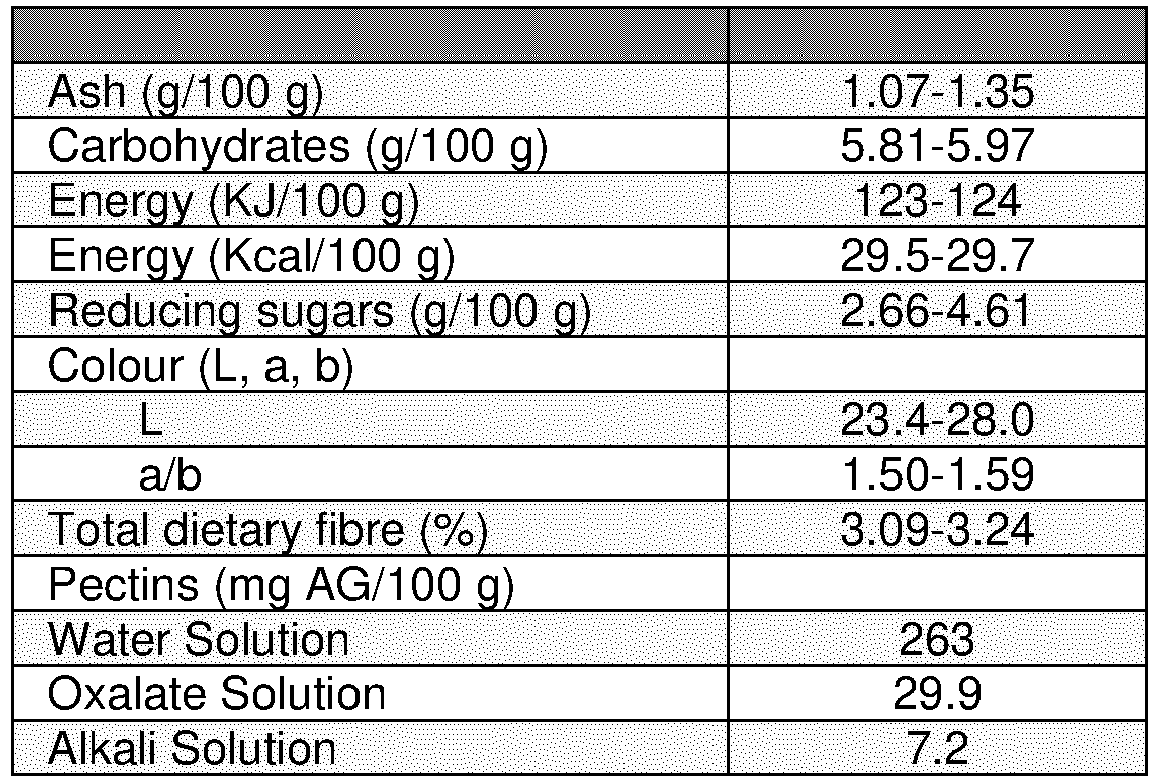
- To obtain the tomato jam, the ingredients were combined, varying the proportion of sweetener:
- 1. Tomato pulp (1 kg) + sucrose (0.5 kg)
- 2. Tomato pulp (1 kg) + sucrose (0.29 kg) + oligofructose powder (Raftilosa® P95 Orafti) (0.21 kg)
- 3. Tomato pulp (1 kg) + sucrose (0.25 kg) + liquid oligofructose (Orafti® L85) (0.25 kg)
- The tomato pulp was heated. Next, the sweetener (sucrose and oligofructose) was added until the texture typical of a jam was obtained. It was allowed to stand and cool off.
- The general acceptance of the product was evaluated, the most organoleptically acceptable one being that made with oligofructose compared to only sucrose or the mixture of sucrose with oligofructose.
- By way of example, seven fermented dairy products were prepared with the milk-grown bacterial strains specified below:
- 1. Streptococcus thermophilus STY-31.
- 2. S. thermophilus STY-31 and Lactobacillus delbrueckii subsp. bulgaricus LBY-27.
- 3. S. thermophilus STY-31, L. bulgaricus LBY-27 and Lactobacillus reuteri DMS 17938.
- 4. S. thermophilus STY-31, L. bulgaricus LBY-27 and Lactobacillus rhamnosus GG.
- 5. S. thermophilus STY-31 and L. reuteri DMS 17938.
- 6. S. thermophilus STY-31 and L. rhamnosus GG.
- 7. S. thermophilus STY-31 and Lactobacillus salivarius SV1.
- For the preparation of fermented dairy products, pasteurised whole milk was used, to which skimmed milk powder was added and it was inoculated with the strains indicated for products 1 to 7. The milk coagulation process was carried out by incubating the products at 44°C and stopped when a pH equal to or less than 4.5 was reached. The products were analysed to estimate the viability of the added strains. Sensory evaluation of the products was also carried out.
- Regarding the quantification of probiotics, L. rhamnosus GG reached counts of 107 cfu/g in the manufacturing process and the values remained stable throughout the shelf life, decreasing to 106 cfu/g only at the end of the useful life period (28 days). Products made with L. reuteri DSM17938, however, were characterised by a significant decrease in the viability of the probiotic during cold preservation, with values of 105 cfu/g at the end of the useful life period of the fermented dairy product. Furthermore, the probiotic L. salivarius SV1 was characterised by a very low resistance to cold preservation, with counts of 104 cfu/g after 28 days of preservation.
- The sensory evaluation of the products showed the following results:
- L. reuteri DSM17938 provides a strange taste rejected by all members of the tasting panel.
- L. rhamnosus GG contributes attributes of low acidity and creamy texture to the product.
- In order to improve the texture features of the fermented dairy product prepared with L. rhamnosus GG, a fermented dairy product obtained as described in product 4 of Example 2 was formulated, which included a viscous starter culture and little post-acidification activity, such as the FD-DVS YoFlex Mild 1.0 ferment by Chr. Hansen in the amounts recommended by the manufacturer, and to which inulin with a high degree of polymerisation was added in the preparation process, for example, inulin GR® (ORAFTI), at 2%. The features of the fermented dairy product were a firm, creamy texture and low acidity, and the viability counts for L. rhamnosus GG described in Example 2 were maintained.
- Tomato pulp jam was prepared as described in Example 1 and 20-30 g were added to a glass vessel. A mixture of pasteurised milk, powdered milk, the strains S. thermophilus STY-31, L. bulgaricus LBY-27, and inulin was heated as described in Examples 2 and 3. Subsequently, the FD-DVS YoFlex Mild 1.0 ferment and L. rhamnosus GG were added to provide starting counts of 107-108 cfu/ml.
- The product obtained was evaluated by means of a descriptive and acceptance sensory analysis.
- For the descriptive analysis, the following attributes were evaluated on a linear scale of intensity of 10 cm, from less intense (0 cm) to more intense (10 cm):
- Appearance: assessment of the overall appearance of the product.
- Syneresis: assessment of the degree of syneresis or serum separation.
- Colour: assessment of the colour of the product.
- Scent: assessment of the general scent of the product.
- Spoon consistency: assessment of the consistency of the product on the spoon.
- Flavour: assessment of the general flavour of the product.
- Texture in the mouth: assessment of the texture of the product in the mouth.
- Observations: contribution of all the necessary observations.
- The acceptance sensory analysis was performed following a 7-point facial hedonic scale (like: extremely, moderately, slightly; neither like nor dislike; dislike: slightly, moderately, extremely).
- The results of the sensory analysis indicated that the fermented dairy product with L. rhamnosus GG and tomato pulp jam has good appearance, colour, flavour, improved scent, and a good degree of syneresis; the weak points thereof being the spoon consistency and texture in the mouth, but with an acceptable score (6). Sensory acceptance of the product was on the hedonic "like" scale and general acceptance improved as the entire product was mixed. Among the observations of the tasters, it was indicated that it was an innovative product.
- The fermented dairy product that is a source of fibre with tomato jam and the probiotic L. rhamnosus GG of the invention was administered daily for 6 months to 26 children diagnosed with Autism Spectrum Disorders (ASD). In this population, irregularities in food intake which may be accompanied by constipation are usually observed. In the study it was observed that of the 4 children who initially had constipation, 3 of them have noticed an improvement in their defecation pattern. In the study as a whole, it was observed that 7 children improved in their evolving capacities and of those children, 5 noticed an improvement in their defecation pattern.
Claims (12)
- A food product that comprises a fermented dairy fraction representing between 80% and 90% by weight of the final product and a second fraction that consists of a vegetable jam representing between 10% and 20% by weight of the final product, characterised in that:- the jam comprises between 40 and 60% by weight of the vegetable pulp or extract and at least 40% by weight of a dietary fibre having a low degree of polymerisation and a low glycaemic index, and wherein- the fermented dairy fraction comprises at least one lactic bacterium, dietary fibre having a high degree of polymerisation and at least one probiotic strain.
- The product according to claim 1, wherein the vegetables used in the preparation of the jam are selected from tomato, apple, nectarine, cherry, quince and strawberry and lemon concentrates.
- The product according to any of the preceding claims, wherein the jam is made of tomato.
- The product according to claim 3, wherein the jam is made of tomato pulp.
- The product according to any of the preceding claims, wherein the dietary fibre having a low degree of polymerisation and a low glycaemic index of the jam is selected from oligofructose, sucralose, lactitol, kojibiose and tagatose.
- The product according to any of the preceding claims, wherein the fibre having a low degree of polymerisation and a low glycaemic index of the jam is oligofructose.
- The product according to any of the preceding claims, wherein the lactic bacterium is selected from Streptococcus thermophilus, Lactobacillus delbrueckii subsp. bulgaricus, Lactobacillus acidophilus, Lactobacillus casei, Lactobacillus delbrueckii subsp. lactis, Lactococcus lactis, Lactobacillus kefiranofaciens, Leuconostoc, and the mixtures thereof.
- The product according to any of the preceding claims, wherein lactic bacteria are a mixture in equivalent proportions of Streptococcus thermophilus and Lactobacillus delbrueckii subsp. bulgaricus.
- The product according to any of the preceding claims, wherein the dietary fibre having a high degree of polymerisation of the fermented dairy fraction is selected from inulin, starch, polydextrose, pectin, galactomannan and arabinoxylan.
- The product according to any of the preceding claims, wherein the dietary fibre having a high degree of polymerisation of the fermented dairy fraction is inulin.
- The product according to any of the preceding claims, wherein the probiotic strain is selected from the genera Lactobacillus, Bifidobacterium, and Streptococcus.
- The product according to any of the preceding claims, wherein the probiotic strain is of the species Lactobacillus rhamnosus.
Applications Claiming Priority (2)
| Application Number | Priority Date | Filing Date | Title |
|---|---|---|---|
| ES201831412U ES1219985Y (en) | 2018-09-19 | 2018-09-19 | FERMENTED LACTEO PRODUCT SOURCE OF FIBER AND VEGETABLE CONMERMELED PROBIOTICS |
| PCT/ES2019/070603 WO2020058544A1 (en) | 2018-09-19 | 2019-09-12 | Fermented dairy product that is a source of fibre and probiotics with vegetable jam |
Publications (4)
| Publication Number | Publication Date |
|---|---|
| EP3854215A1 true EP3854215A1 (en) | 2021-07-28 |
| EP3854215A4 EP3854215A4 (en) | 2022-05-11 |
| EP3854215C0 EP3854215C0 (en) | 2024-01-31 |
| EP3854215B1 EP3854215B1 (en) | 2024-01-31 |
Family
ID=63998410
Family Applications (1)
| Application Number | Title | Priority Date | Filing Date |
|---|---|---|---|
| EP19861962.9A Active EP3854215B1 (en) | 2018-09-19 | 2019-09-12 | Fermented dairy product that is a source of fibre and probiotics with vegetable jam |
Country Status (3)
| Country | Link |
|---|---|
| EP (1) | EP3854215B1 (en) |
| ES (2) | ES1219985Y (en) |
| WO (1) | WO2020058544A1 (en) |
Family Cites Families (8)
| Publication number | Priority date | Publication date | Assignee | Title |
|---|---|---|---|---|
| WO2012044242A1 (en) * | 2010-09-29 | 2012-04-05 | Procordia Food Ab | Use of a food product comprising viscous fibres which has a beneficial effect on cognitive performance. |
| CN102028032A (en) * | 2010-12-14 | 2011-04-27 | 内蒙古伊利实业集团股份有限公司 | Novel prebiotics-added fermented milk and preparation method thereof |
| CN102258080A (en) | 2011-07-15 | 2011-11-30 | 帝斯曼知识产权资产管理有限公司 | Cereal yoghurt and preparation method thereof |
| CN103431042B (en) * | 2013-08-28 | 2015-01-21 | 光明乳业股份有限公司 | Fermented milk base material, whey-removed flavored fermented milk, raw material composite as well as preparation methods thereof |
| CN104522168A (en) * | 2014-12-09 | 2015-04-22 | 柳州三元天爱乳业有限公司 | Strawberry-state probiotic yogurt production process |
| CN104814124A (en) * | 2015-05-19 | 2015-08-05 | 光明乳业股份有限公司 | Normal-temperature drinking type yoghourt and preparation method thereof |
| CN105580900A (en) * | 2015-12-10 | 2016-05-18 | 光明乳业股份有限公司 | Fermented milk and preparation method thereof |
| CN106172775A (en) * | 2016-07-19 | 2016-12-07 | 北京乐纯悠品商贸有限公司 | A kind of fruity flavored fermented milk and preparation method thereof |
-
2018
- 2018-09-19 ES ES201831412U patent/ES1219985Y/en active Active
-
2019
- 2019-09-12 EP EP19861962.9A patent/EP3854215B1/en active Active
- 2019-09-12 ES ES19861962T patent/ES2978031T3/en active Active
- 2019-09-12 WO PCT/ES2019/070603 patent/WO2020058544A1/en not_active Ceased
Also Published As
| Publication number | Publication date |
|---|---|
| ES2978031T3 (en) | 2024-09-04 |
| EP3854215C0 (en) | 2024-01-31 |
| ES1219985Y (en) | 2019-01-25 |
| ES1219985U (en) | 2018-11-05 |
| EP3854215B1 (en) | 2024-01-31 |
| EP3854215A4 (en) | 2022-05-11 |
| WO2020058544A1 (en) | 2020-03-26 |
Similar Documents
| Publication | Publication Date | Title |
|---|---|---|
| Shah | Yogurt in health and disease prevention | |
| Bankole et al. | Application of natural and modified additives in yogurt formulation: Types, production, and rheological and nutraceutical benefits | |
| JP7280243B2 (en) | Nutritional composition, food and drink composition and prepared milk powder using the nutritional composition | |
| Tamime | Fermented milks: a historical food with modern applications–a review | |
| Chen et al. | Yogurt fortification with chickpea (Cicer arietinum) flour: Physicochemical and sensory effects | |
| Cardarelli et al. | Effect of inulin and Lactobacillus paracasei on sensory and instrumental texture properties of functional chocolate mousse | |
| Mazzaglia et al. | The influence of almond flour, inulin and whey protein on the sensory and microbiological quality of goat milk yogurt | |
| CN106804711A (en) | It is a kind of to drink type flavored fermented milk and preparation method thereof containing particle | |
| EP1169925A1 (en) | Foodstuffs containing a fermented vegetable matrix and relevant preparation process | |
| EP3364766A1 (en) | Low sugar flavoured yogurt | |
| Ziarno et al. | Properties of non-dairy gluten-free millet-based fermented beverages developed with yoghurt cultures. | |
| CN109393025A (en) | A kind of Yoghourt and preparation method thereof | |
| CN112841309A (en) | Spoon-eating type yoghourt additive composition and application thereof, spoon-eating type yoghourt and preparation method | |
| US20160066590A1 (en) | Fermented dairy products suitable for fruit taste enhancement | |
| Rad et al. | Chocolate as a probiotic carrier food--A review | |
| JP2015512269A (en) | Synbiotic food composition containing tagatose and probiotic lactic acid bacteria | |
| EP3854215B1 (en) | Fermented dairy product that is a source of fibre and probiotics with vegetable jam | |
| Pereira et al. | Lactobacillus acidophilus and Bifidobacterium sp. in co-culture improve sensory acceptance of potentially probiotic petit-suisse cheese | |
| WO2014173983A1 (en) | Fruit flavor enhancement in fermented dairy products | |
| Yadav et al. | Flavors in probiotics and prebiotics | |
| EP4728871A1 (en) | Streptococcus thermophilus strain for use in preparation of fermented products | |
| PRAVITHA | DEVELOPMENT OF FRUIT BLENDED YOGHURTS AND QUALITY EVALUATION | |
| Kumar et al. | Composite Probiotic Dairy Products: Concepts and Design with a Focus on Millets | |
| Bezirtzoglou | Potential effects of probiotics in cheese and yogurt production: A review | |
| Palop Herreros et al. | Screening of Lactic Acid Bacteria Strains to Improve the Properties of Non-fat Set Yogurt by in situ EPS Production |
Legal Events
| Date | Code | Title | Description |
|---|---|---|---|
| STAA | Information on the status of an ep patent application or granted ep patent |
Free format text: STATUS: THE INTERNATIONAL PUBLICATION HAS BEEN MADE |
|
| PUAI | Public reference made under article 153(3) epc to a published international application that has entered the european phase |
Free format text: ORIGINAL CODE: 0009012 |
|
| STAA | Information on the status of an ep patent application or granted ep patent |
Free format text: STATUS: REQUEST FOR EXAMINATION WAS MADE |
|
| 17P | Request for examination filed |
Effective date: 20210415 |
|
| AK | Designated contracting states |
Kind code of ref document: A1 Designated state(s): AL AT BE BG CH CY CZ DE DK EE ES FI FR GB GR HR HU IE IS IT LI LT LU LV MC MK MT NL NO PL PT RO RS SE SI SK SM TR |
|
| DAV | Request for validation of the european patent (deleted) | ||
| DAX | Request for extension of the european patent (deleted) | ||
| A4 | Supplementary search report drawn up and despatched |
Effective date: 20220411 |
|
| RIC1 | Information provided on ipc code assigned before grant |
Ipc: A23C 9/133 20060101AFI20220405BHEP |
|
| GRAP | Despatch of communication of intention to grant a patent |
Free format text: ORIGINAL CODE: EPIDOSNIGR1 |
|
| STAA | Information on the status of an ep patent application or granted ep patent |
Free format text: STATUS: GRANT OF PATENT IS INTENDED |
|
| INTG | Intention to grant announced |
Effective date: 20231027 |
|
| GRAS | Grant fee paid |
Free format text: ORIGINAL CODE: EPIDOSNIGR3 |
|
| GRAA | (expected) grant |
Free format text: ORIGINAL CODE: 0009210 |
|
| STAA | Information on the status of an ep patent application or granted ep patent |
Free format text: STATUS: THE PATENT HAS BEEN GRANTED |
|
| AK | Designated contracting states |
Kind code of ref document: B1 Designated state(s): AL AT BE BG CH CY CZ DE DK EE ES FI FR GB GR HR HU IE IS IT LI LT LU LV MC MK MT NL NO PL PT RO RS SE SI SK SM TR |
|
| REG | Reference to a national code |
Ref country code: GB Ref legal event code: FG4D Ref country code: CH Ref legal event code: EP |
|
| REG | Reference to a national code |
Ref country code: DE Ref legal event code: R096 Ref document number: 602019046029 Country of ref document: DE |
|
| REG | Reference to a national code |
Ref country code: IE Ref legal event code: FG4D |
|
| U01 | Request for unitary effect filed |
Effective date: 20240222 |
|
| U07 | Unitary effect registered |
Designated state(s): AT BE BG DE DK EE FI FR IT LT LU LV MT NL PT SE SI Effective date: 20240311 |
|
| PG25 | Lapsed in a contracting state [announced via postgrant information from national office to epo] |
Ref country code: IS Free format text: LAPSE BECAUSE OF FAILURE TO SUBMIT A TRANSLATION OF THE DESCRIPTION OR TO PAY THE FEE WITHIN THE PRESCRIBED TIME-LIMIT Effective date: 20240531 |
|
| PG25 | Lapsed in a contracting state [announced via postgrant information from national office to epo] |
Ref country code: GR Free format text: LAPSE BECAUSE OF FAILURE TO SUBMIT A TRANSLATION OF THE DESCRIPTION OR TO PAY THE FEE WITHIN THE PRESCRIBED TIME-LIMIT Effective date: 20240501 |
|
| PG25 | Lapsed in a contracting state [announced via postgrant information from national office to epo] |
Ref country code: HR Free format text: LAPSE BECAUSE OF FAILURE TO SUBMIT A TRANSLATION OF THE DESCRIPTION OR TO PAY THE FEE WITHIN THE PRESCRIBED TIME-LIMIT Effective date: 20240131 Ref country code: RS Free format text: LAPSE BECAUSE OF FAILURE TO SUBMIT A TRANSLATION OF THE DESCRIPTION OR TO PAY THE FEE WITHIN THE PRESCRIBED TIME-LIMIT Effective date: 20240430 |
|
| PG25 | Lapsed in a contracting state [announced via postgrant information from national office to epo] |
Ref country code: RS Free format text: LAPSE BECAUSE OF FAILURE TO SUBMIT A TRANSLATION OF THE DESCRIPTION OR TO PAY THE FEE WITHIN THE PRESCRIBED TIME-LIMIT Effective date: 20240430 Ref country code: NO Free format text: LAPSE BECAUSE OF FAILURE TO SUBMIT A TRANSLATION OF THE DESCRIPTION OR TO PAY THE FEE WITHIN THE PRESCRIBED TIME-LIMIT Effective date: 20240430 Ref country code: IS Free format text: LAPSE BECAUSE OF FAILURE TO SUBMIT A TRANSLATION OF THE DESCRIPTION OR TO PAY THE FEE WITHIN THE PRESCRIBED TIME-LIMIT Effective date: 20240531 Ref country code: HR Free format text: LAPSE BECAUSE OF FAILURE TO SUBMIT A TRANSLATION OF THE DESCRIPTION OR TO PAY THE FEE WITHIN THE PRESCRIBED TIME-LIMIT Effective date: 20240131 Ref country code: GR Free format text: LAPSE BECAUSE OF FAILURE TO SUBMIT A TRANSLATION OF THE DESCRIPTION OR TO PAY THE FEE WITHIN THE PRESCRIBED TIME-LIMIT Effective date: 20240501 |
|
| PG25 | Lapsed in a contracting state [announced via postgrant information from national office to epo] |
Ref country code: PL Free format text: LAPSE BECAUSE OF FAILURE TO SUBMIT A TRANSLATION OF THE DESCRIPTION OR TO PAY THE FEE WITHIN THE PRESCRIBED TIME-LIMIT Effective date: 20240131 |
|
| PG25 | Lapsed in a contracting state [announced via postgrant information from national office to epo] |
Ref country code: PL Free format text: LAPSE BECAUSE OF FAILURE TO SUBMIT A TRANSLATION OF THE DESCRIPTION OR TO PAY THE FEE WITHIN THE PRESCRIBED TIME-LIMIT Effective date: 20240131 |
|
| REG | Reference to a national code |
Ref country code: ES Ref legal event code: FG2A Ref document number: 2978031 Country of ref document: ES Kind code of ref document: T3 Effective date: 20240904 |
|
| PG25 | Lapsed in a contracting state [announced via postgrant information from national office to epo] |
Ref country code: SM Free format text: LAPSE BECAUSE OF FAILURE TO SUBMIT A TRANSLATION OF THE DESCRIPTION OR TO PAY THE FEE WITHIN THE PRESCRIBED TIME-LIMIT Effective date: 20240131 |
|
| PG25 | Lapsed in a contracting state [announced via postgrant information from national office to epo] |
Ref country code: CZ Free format text: LAPSE BECAUSE OF FAILURE TO SUBMIT A TRANSLATION OF THE DESCRIPTION OR TO PAY THE FEE WITHIN THE PRESCRIBED TIME-LIMIT Effective date: 20240131 |
|
| PG25 | Lapsed in a contracting state [announced via postgrant information from national office to epo] |
Ref country code: SK Free format text: LAPSE BECAUSE OF FAILURE TO SUBMIT A TRANSLATION OF THE DESCRIPTION OR TO PAY THE FEE WITHIN THE PRESCRIBED TIME-LIMIT Effective date: 20240131 |
|
| U20 | Renewal fee for the european patent with unitary effect paid |
Year of fee payment: 6 Effective date: 20240924 |
|
| PG25 | Lapsed in a contracting state [announced via postgrant information from national office to epo] |
Ref country code: SM Free format text: LAPSE BECAUSE OF FAILURE TO SUBMIT A TRANSLATION OF THE DESCRIPTION OR TO PAY THE FEE WITHIN THE PRESCRIBED TIME-LIMIT Effective date: 20240131 Ref country code: SK Free format text: LAPSE BECAUSE OF FAILURE TO SUBMIT A TRANSLATION OF THE DESCRIPTION OR TO PAY THE FEE WITHIN THE PRESCRIBED TIME-LIMIT Effective date: 20240131 Ref country code: RO Free format text: LAPSE BECAUSE OF FAILURE TO SUBMIT A TRANSLATION OF THE DESCRIPTION OR TO PAY THE FEE WITHIN THE PRESCRIBED TIME-LIMIT Effective date: 20240131 Ref country code: CZ Free format text: LAPSE BECAUSE OF FAILURE TO SUBMIT A TRANSLATION OF THE DESCRIPTION OR TO PAY THE FEE WITHIN THE PRESCRIBED TIME-LIMIT Effective date: 20240131 |
|
| REG | Reference to a national code |
Ref country code: DE Ref legal event code: R097 Ref document number: 602019046029 Country of ref document: DE |
|
| PLBE | No opposition filed within time limit |
Free format text: ORIGINAL CODE: 0009261 |
|
| STAA | Information on the status of an ep patent application or granted ep patent |
Free format text: STATUS: NO OPPOSITION FILED WITHIN TIME LIMIT |
|
| 26N | No opposition filed |
Effective date: 20241101 |
|
| PG25 | Lapsed in a contracting state [announced via postgrant information from national office to epo] |
Ref country code: MC Free format text: LAPSE BECAUSE OF FAILURE TO SUBMIT A TRANSLATION OF THE DESCRIPTION OR TO PAY THE FEE WITHIN THE PRESCRIBED TIME-LIMIT Effective date: 20240131 |
|
| REG | Reference to a national code |
Ref country code: CH Ref legal event code: PL |
|
| GBPC | Gb: european patent ceased through non-payment of renewal fee |
Effective date: 20240912 |
|
| PG25 | Lapsed in a contracting state [announced via postgrant information from national office to epo] |
Ref country code: GB Free format text: LAPSE BECAUSE OF NON-PAYMENT OF DUE FEES Effective date: 20240912 |
|
| PG25 | Lapsed in a contracting state [announced via postgrant information from national office to epo] |
Ref country code: CH Free format text: LAPSE BECAUSE OF NON-PAYMENT OF DUE FEES Effective date: 20240930 |
|
| PG25 | Lapsed in a contracting state [announced via postgrant information from national office to epo] |
Ref country code: IE Free format text: LAPSE BECAUSE OF NON-PAYMENT OF DUE FEES Effective date: 20240912 |
|
| U20 | Renewal fee for the european patent with unitary effect paid |
Year of fee payment: 7 Effective date: 20250903 |
|
| PG25 | Lapsed in a contracting state [announced via postgrant information from national office to epo] |
Ref country code: CY Free format text: LAPSE BECAUSE OF FAILURE TO SUBMIT A TRANSLATION OF THE DESCRIPTION OR TO PAY THE FEE WITHIN THE PRESCRIBED TIME-LIMIT; INVALID AB INITIO Effective date: 20190912 |
|
| PGFP | Annual fee paid to national office [announced via postgrant information from national office to epo] |
Ref country code: ES Payment date: 20251001 Year of fee payment: 7 |
|
| PG25 | Lapsed in a contracting state [announced via postgrant information from national office to epo] |
Ref country code: HU Free format text: LAPSE BECAUSE OF FAILURE TO SUBMIT A TRANSLATION OF THE DESCRIPTION OR TO PAY THE FEE WITHIN THE PRESCRIBED TIME-LIMIT; INVALID AB INITIO Effective date: 20190912 |