EP3853123B1 - Train d'atterrissage d'un aéronef et procédé de refroidissement d'un moteur électrique de taxiage et des freins d'un tel train d'atterrissage - Google Patents
Train d'atterrissage d'un aéronef et procédé de refroidissement d'un moteur électrique de taxiage et des freins d'un tel train d'atterrissage Download PDFInfo
- Publication number
- EP3853123B1 EP3853123B1 EP19790657.1A EP19790657A EP3853123B1 EP 3853123 B1 EP3853123 B1 EP 3853123B1 EP 19790657 A EP19790657 A EP 19790657A EP 3853123 B1 EP3853123 B1 EP 3853123B1
- Authority
- EP
- European Patent Office
- Prior art keywords
- landing gear
- motor
- brakes
- electric
- wheel
- Prior art date
- Legal status (The legal status is an assumption and is not a legal conclusion. Google has not performed a legal analysis and makes no representation as to the accuracy of the status listed.)
- Active
Links
Images
Classifications
-
- B—PERFORMING OPERATIONS; TRANSPORTING
- B64—AIRCRAFT; AVIATION; COSMONAUTICS
- B64C—AEROPLANES; HELICOPTERS
- B64C25/00—Alighting gear
- B64C25/32—Alighting gear characterised by elements which contact the ground or similar surface
- B64C25/42—Arrangement or adaptation of brakes
-
- B—PERFORMING OPERATIONS; TRANSPORTING
- B60—VEHICLES IN GENERAL
- B60L—PROPULSION OF ELECTRICALLY-PROPELLED VEHICLES; SUPPLYING ELECTRIC POWER FOR AUXILIARY EQUIPMENT OF ELECTRICALLY-PROPELLED VEHICLES; ELECTRODYNAMIC BRAKE SYSTEMS FOR VEHICLES IN GENERAL; MAGNETIC SUSPENSION OR LEVITATION FOR VEHICLES; MONITORING OPERATING VARIABLES OF ELECTRICALLY-PROPELLED VEHICLES; ELECTRIC SAFETY DEVICES FOR ELECTRICALLY-PROPELLED VEHICLES
- B60L1/00—Supplying electric power to auxiliary equipment of vehicles
- B60L1/003—Supplying electric power to auxiliary equipment of vehicles to auxiliary motors, e.g. for pumps, compressors
-
- B—PERFORMING OPERATIONS; TRANSPORTING
- B60—VEHICLES IN GENERAL
- B60L—PROPULSION OF ELECTRICALLY-PROPELLED VEHICLES; SUPPLYING ELECTRIC POWER FOR AUXILIARY EQUIPMENT OF ELECTRICALLY-PROPELLED VEHICLES; ELECTRODYNAMIC BRAKE SYSTEMS FOR VEHICLES IN GENERAL; MAGNETIC SUSPENSION OR LEVITATION FOR VEHICLES; MONITORING OPERATING VARIABLES OF ELECTRICALLY-PROPELLED VEHICLES; ELECTRIC SAFETY DEVICES FOR ELECTRICALLY-PROPELLED VEHICLES
- B60L1/00—Supplying electric power to auxiliary equipment of vehicles
- B60L1/02—Supplying electric power to auxiliary equipment of vehicles to electric heating circuits
-
- B—PERFORMING OPERATIONS; TRANSPORTING
- B60—VEHICLES IN GENERAL
- B60L—PROPULSION OF ELECTRICALLY-PROPELLED VEHICLES; SUPPLYING ELECTRIC POWER FOR AUXILIARY EQUIPMENT OF ELECTRICALLY-PROPELLED VEHICLES; ELECTRODYNAMIC BRAKE SYSTEMS FOR VEHICLES IN GENERAL; MAGNETIC SUSPENSION OR LEVITATION FOR VEHICLES; MONITORING OPERATING VARIABLES OF ELECTRICALLY-PROPELLED VEHICLES; ELECTRIC SAFETY DEVICES FOR ELECTRICALLY-PROPELLED VEHICLES
- B60L3/00—Electric devices on electrically-propelled vehicles for safety purposes; Monitoring operating variables, e.g. speed, deceleration or energy consumption
- B60L3/0023—Detecting, eliminating, remedying or compensating for drive train abnormalities, e.g. failures within the drive train
- B60L3/0061—Detecting, eliminating, remedying or compensating for drive train abnormalities, e.g. failures within the drive train relating to electrical machines
-
- B—PERFORMING OPERATIONS; TRANSPORTING
- B60—VEHICLES IN GENERAL
- B60L—PROPULSION OF ELECTRICALLY-PROPELLED VEHICLES; SUPPLYING ELECTRIC POWER FOR AUXILIARY EQUIPMENT OF ELECTRICALLY-PROPELLED VEHICLES; ELECTRODYNAMIC BRAKE SYSTEMS FOR VEHICLES IN GENERAL; MAGNETIC SUSPENSION OR LEVITATION FOR VEHICLES; MONITORING OPERATING VARIABLES OF ELECTRICALLY-PROPELLED VEHICLES; ELECTRIC SAFETY DEVICES FOR ELECTRICALLY-PROPELLED VEHICLES
- B60L3/00—Electric devices on electrically-propelled vehicles for safety purposes; Monitoring operating variables, e.g. speed, deceleration or energy consumption
- B60L3/0023—Detecting, eliminating, remedying or compensating for drive train abnormalities, e.g. failures within the drive train
- B60L3/0076—Detecting, eliminating, remedying or compensating for drive train abnormalities, e.g. failures within the drive train relating to braking
-
- B—PERFORMING OPERATIONS; TRANSPORTING
- B60—VEHICLES IN GENERAL
- B60L—PROPULSION OF ELECTRICALLY-PROPELLED VEHICLES; SUPPLYING ELECTRIC POWER FOR AUXILIARY EQUIPMENT OF ELECTRICALLY-PROPELLED VEHICLES; ELECTRODYNAMIC BRAKE SYSTEMS FOR VEHICLES IN GENERAL; MAGNETIC SUSPENSION OR LEVITATION FOR VEHICLES; MONITORING OPERATING VARIABLES OF ELECTRICALLY-PROPELLED VEHICLES; ELECTRIC SAFETY DEVICES FOR ELECTRICALLY-PROPELLED VEHICLES
- B60L7/00—Electrodynamic brake systems for vehicles in general
- B60L7/10—Dynamic electric regenerative braking
-
- B—PERFORMING OPERATIONS; TRANSPORTING
- B60—VEHICLES IN GENERAL
- B60T—VEHICLE BRAKE CONTROL SYSTEMS OR PARTS THEREOF; BRAKE CONTROL SYSTEMS OR PARTS THEREOF, IN GENERAL; ARRANGEMENT OF BRAKING ELEMENTS ON VEHICLES IN GENERAL; PORTABLE DEVICES FOR PREVENTING UNWANTED MOVEMENT OF VEHICLES; VEHICLE MODIFICATIONS TO FACILITATE COOLING OF BRAKES
- B60T5/00—Vehicle modifications to facilitate cooling of brakes
-
- B—PERFORMING OPERATIONS; TRANSPORTING
- B64—AIRCRAFT; AVIATION; COSMONAUTICS
- B64C—AEROPLANES; HELICOPTERS
- B64C25/00—Alighting gear
- B64C25/32—Alighting gear characterised by elements which contact the ground or similar surface
- B64C25/405—Powered wheels, e.g. for taxing
-
- F—MECHANICAL ENGINEERING; LIGHTING; HEATING; WEAPONS; BLASTING
- F16—ENGINEERING ELEMENTS AND UNITS; GENERAL MEASURES FOR PRODUCING AND MAINTAINING EFFECTIVE FUNCTIONING OF MACHINES OR INSTALLATIONS; THERMAL INSULATION IN GENERAL
- F16D—COUPLINGS FOR TRANSMITTING ROTATION; CLUTCHES; BRAKES
- F16D65/00—Parts or details
- F16D65/78—Features relating to cooling
- F16D65/84—Features relating to cooling for disc brakes
- F16D65/847—Features relating to cooling for disc brakes with open cooling system, e.g. cooled by air
-
- H—ELECTRICITY
- H02—GENERATION; CONVERSION OR DISTRIBUTION OF ELECTRIC POWER
- H02K—DYNAMO-ELECTRIC MACHINES
- H02K9/00—Arrangements for cooling or ventilating
- H02K9/02—Arrangements for cooling or ventilating by ambient air flowing through the machine
- H02K9/04—Arrangements for cooling or ventilating by ambient air flowing through the machine having means for generating a flow of cooling medium
-
- B—PERFORMING OPERATIONS; TRANSPORTING
- B60—VEHICLES IN GENERAL
- B60L—PROPULSION OF ELECTRICALLY-PROPELLED VEHICLES; SUPPLYING ELECTRIC POWER FOR AUXILIARY EQUIPMENT OF ELECTRICALLY-PROPELLED VEHICLES; ELECTRODYNAMIC BRAKE SYSTEMS FOR VEHICLES IN GENERAL; MAGNETIC SUSPENSION OR LEVITATION FOR VEHICLES; MONITORING OPERATING VARIABLES OF ELECTRICALLY-PROPELLED VEHICLES; ELECTRIC SAFETY DEVICES FOR ELECTRICALLY-PROPELLED VEHICLES
- B60L2200/00—Type of vehicles
- B60L2200/10—Air crafts
-
- B—PERFORMING OPERATIONS; TRANSPORTING
- B60—VEHICLES IN GENERAL
- B60L—PROPULSION OF ELECTRICALLY-PROPELLED VEHICLES; SUPPLYING ELECTRIC POWER FOR AUXILIARY EQUIPMENT OF ELECTRICALLY-PROPELLED VEHICLES; ELECTRODYNAMIC BRAKE SYSTEMS FOR VEHICLES IN GENERAL; MAGNETIC SUSPENSION OR LEVITATION FOR VEHICLES; MONITORING OPERATING VARIABLES OF ELECTRICALLY-PROPELLED VEHICLES; ELECTRIC SAFETY DEVICES FOR ELECTRICALLY-PROPELLED VEHICLES
- B60L2220/00—Electrical machine types; Structures or applications thereof
- B60L2220/50—Structural details of electrical machines
-
- B—PERFORMING OPERATIONS; TRANSPORTING
- B60—VEHICLES IN GENERAL
- B60L—PROPULSION OF ELECTRICALLY-PROPELLED VEHICLES; SUPPLYING ELECTRIC POWER FOR AUXILIARY EQUIPMENT OF ELECTRICALLY-PROPELLED VEHICLES; ELECTRODYNAMIC BRAKE SYSTEMS FOR VEHICLES IN GENERAL; MAGNETIC SUSPENSION OR LEVITATION FOR VEHICLES; MONITORING OPERATING VARIABLES OF ELECTRICALLY-PROPELLED VEHICLES; ELECTRIC SAFETY DEVICES FOR ELECTRICALLY-PROPELLED VEHICLES
- B60L2240/00—Control parameters of input or output; Target parameters
- B60L2240/40—Drive Train control parameters
- B60L2240/42—Drive Train control parameters related to electric machines
- B60L2240/425—Temperature
-
- F—MECHANICAL ENGINEERING; LIGHTING; HEATING; WEAPONS; BLASTING
- F16—ENGINEERING ELEMENTS AND UNITS; GENERAL MEASURES FOR PRODUCING AND MAINTAINING EFFECTIVE FUNCTIONING OF MACHINES OR INSTALLATIONS; THERMAL INSULATION IN GENERAL
- F16D—COUPLINGS FOR TRANSMITTING ROTATION; CLUTCHES; BRAKES
- F16D65/00—Parts or details
- F16D65/78—Features relating to cooling
- F16D2065/787—Pumps
-
- Y—GENERAL TAGGING OF NEW TECHNOLOGICAL DEVELOPMENTS; GENERAL TAGGING OF CROSS-SECTIONAL TECHNOLOGIES SPANNING OVER SEVERAL SECTIONS OF THE IPC; TECHNICAL SUBJECTS COVERED BY FORMER USPC CROSS-REFERENCE ART COLLECTIONS [XRACs] AND DIGESTS
- Y02—TECHNOLOGIES OR APPLICATIONS FOR MITIGATION OR ADAPTATION AGAINST CLIMATE CHANGE
- Y02T—CLIMATE CHANGE MITIGATION TECHNOLOGIES RELATED TO TRANSPORTATION
- Y02T10/00—Road transport of goods or passengers
- Y02T10/60—Other road transportation technologies with climate change mitigation effect
- Y02T10/64—Electric machine technologies in electromobility
-
- Y—GENERAL TAGGING OF NEW TECHNOLOGICAL DEVELOPMENTS; GENERAL TAGGING OF CROSS-SECTIONAL TECHNOLOGIES SPANNING OVER SEVERAL SECTIONS OF THE IPC; TECHNICAL SUBJECTS COVERED BY FORMER USPC CROSS-REFERENCE ART COLLECTIONS [XRACs] AND DIGESTS
- Y02—TECHNOLOGIES OR APPLICATIONS FOR MITIGATION OR ADAPTATION AGAINST CLIMATE CHANGE
- Y02T—CLIMATE CHANGE MITIGATION TECHNOLOGIES RELATED TO TRANSPORTATION
- Y02T50/00—Aeronautics or air transport
- Y02T50/80—Energy efficient operational measures, e.g. ground operations or mission management
Definitions
- the invention relates to a method for cooling both an electric motor of an electric taxiing system and the brakes of a braking system of an aircraft landing gear.
- the invention also relates to an aircraft landing gear comprising an electric taxiing system, a braking system and a system for cooling an electric motor of said electric taxiing system and the brakes of said braking system.
- the state of the art includes in particular patent applications WO-A1-2013/123993 , US-A1-2012/104159 , DE-A1-42 35 815 , US-A1-2015/266566 , EP-A1-3 165 455 And WO-A1-2014/202457 .
- the patent WO-A1-2013/123993 discloses an aircraft ground wheel drive unit associated with a brake unit for braking the ground wheel, the drive unit including a drive motor which is driveable to the wheel at the floor; and a cooling system comprising at least one transmission cooling unit that is configured to generate a flow of transmission cooling air for cooling the drive unit and a brake cooling unit configured to generate a flow of brake cooling air by drawing air from the brake unit.
- Taxiing is an operation which groups together all of the taxiing stages of the aircraft before takeoff and after the aircraft has landed.
- Such an electric taxiing system comprises at least one electric motor arranged at the level of the main landing gear of the aircraft, and configured to rotate at least one wheel of the main landing gear of the aircraft.
- the electric motor is generally supplied with electricity by an auxiliary power unit (APU) of the aircraft.
- APU auxiliary power unit
- an aircraft equipped with such an electric taxiing system can move on the ground autonomously, on the basis of electrical energy, that is to say without using the turbojet engine(s) of the aircraft or towing system.
- the electric motor heats up and therefore needs to be cooled.
- such an electric motor usually does not turn fast enough to drive, in addition to the wheel of the main landing gear of the aircraft, a ventilation wheel which would make it possible to generate a cooling flow of said electric motor.
- the electric motor is cooled by means of an independent fan, that is to say a fan equipped with its own motor. Nevertheless, this generates congestion problems at the level of the main landing gear of the aircraft where said electric motor is installed.
- the aircraft is provided with a braking system arranged at the level of the main landing gear of the aircraft and comprising brakes configured to slow down and then stop the wheels of the main landing gear.
- a brake ventilation system is mounted on the main landing gear, at the level of the wheel axis.
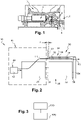
- Such a ventilation system is for example represented on the figure 1 , and generally comprises a fan 4 (BCF, acronym for the English expression “Brake Cooling Fan”) on the outer side of the rim 1 which is configured to draw in a flow of air from the outlet of the brakes 2, represented by the arrows F , when said brakes 2 are activated to slow down and then stop the wheel 3 of the main landing gear, and also during the stopping phase at the boarding gate.
- BCF fan 4
- the BCF fan makes it possible to cool the brakes 2, as long as they are at a temperature above 300° C. During this phase, the temperature of the air drawn in can reach 170°C.
- a BCF fan is bulky, which leads to problems of bulk at the level of the main landing gear of the aircraft.
- the electric taxiing system of the aircraft is separate from the brake ventilation system, and each system comprises its own fan configured to generate a cooling flow for the electric motor of the electric taxiing system or the brakes of the braking system.
- the object of the present invention is in particular to provide a simple, economical and effective solution to these problems, making it possible to avoid the drawbacks of the known technique.
- the object of the present invention is to propose a system and a method allowing coupling of the cooling of the electric motor of the electric taxiing system and of the brakes of the braking system of the landing gear of the aircraft.
- the landing gear according to the invention advantageously makes it possible to solve the problem of cooling the electric taxiing motor coupled to the cooling of the brakes of the landing gear of the aircraft.
- the cooling system according to the invention advantageously makes it possible to perform the function of the BCF fan of the prior art for cooling the brakes by means of ventilation means common between said brakes and the electric taxiing motor.
- the ventilation means make it possible to suck in the flow of air coming from said brakes, and therefore to recover the flow of air at high temperature (approximately 170° C.) coming from the brakes, which makes it possible to cool them.
- the cooling system according to the invention advantageously makes it possible to cool the electric taxiing motor by means of the flow of air coming from the brakes.
- the ventilation means allow a mixture between the flow of air at high temperature coming from the brakes and the flow of air coming from outside the landing gear, that is to say at ambient temperature of the landing/take-off runway of the aircraft, which makes it possible to cool the flow of air coming from said brakes, then to use it for cooling the electric taxiing motor.
- the mixing of the air flow coming from the brakes and the air flow coming from outside the landing gear makes it possible to standardize the temperature of the air for cooling the electric taxiing motor.
- an electric taxiing system advantageously makes it possible to reduce the fuel consumption of the aircraft (by approximately 4%) during the mobility of said aircraft on the ground.
- the brake cooling system allows ventilation of the brakes, which advantageously makes it possible to reduce the stopover time of the aircraft.
- the aircraft landing gear may be the main landing gear of the aircraft.
- the ventilation means comprise a single ventilation wheel.
- the ventilation wheel is configured to suck in parallel the flow of air coming from the brakes and the flow of air coming from outside the landing gear.
- the cooling system according to the invention comprises only one fan wheel making it possible to perform both the function of cooling the brakes and the function of cooling the electric taxiing motor by means of the mixing of the flow of hot air from the brakes and cool airflow from outside the landing gear.
- the motor and fan wheel form an independent fan. This makes it possible to overcome the fact that the electric taxiing motor does not rotate fast enough to drive both a wheel of the landing gear of the aircraft and a ventilation wheel suitable for cooling it.
- the ventilation means may comprise at least one series of fins positioned along the path of the mixing of the air flows.
- this series of fins allows heat to be dissipated along the path of the mixing of the air flows.
- the ventilation means comprise a plurality of series of fins positioned along the path of the mixing of the air flows.
- the fins of the or each series of fins can be staggered. This advantageously makes it possible to avoid the development of the boundary layer, which would disturb the heat exchange between the electric taxiing motor and the air.
- the flow rate of the air flow coming from the brakes is lower than the flow rate of the air flow coming from the outside of the landing gear.
- this makes it possible to have a temperature of the mixture of the air flows lower than the temperature of the air flow coming from the brakes, and therefore to ensure the cooling function of the electric taxiing motor on the basis of said mixture of the flows of air.
- the ventilation means of the ventilation system can be adapted to mix the air flows upstream of the electric taxiing motor.
- the ventilation wheel of the ventilation means can be arranged downstream of the electric taxiing motor.
- the fan wheel can be configured to draw in the mixture of airflows along the electric taxiing motor.
- the at least one series of fins of the ventilation means can be positioned along the electric taxiing motor, in particular between upstream and downstream of said electric taxiing motor.
- the fins can be arranged above said electric taxiing motor.
- this series of fins makes it possible to dissipate the heat from the electric taxiing motor, along said electric taxiing motor.
- the ventilation means comprise a plurality of series of fins positioned between the upstream and downstream of the electric taxiing motor, along said electric taxiing motor.
- the landing gear may include a cowl surrounding the braking system.
- the ventilation means can be arranged with a clearance relative to said cover.
- the clearance between the ventilation means and the cowl can be shaped so that, in the mixing of the air flows, the flow rate of the air flow coming from outside the landing gear is greater than the flow rate of the air flow. air from the brakes.
- the landing gear may include a gearbox connected to the electric taxiing motor and to the at least one wheel.
- FIG. 1 There picture 2 represents a landing gear 10 of an aircraft according to the invention comprising at least one wheel 20, an electric taxiing system 30 and a braking system 40.
- the landing gear 10 can be the main landing gear of the aircraft.
- the electric taxiing system 30 comprises an electric taxiing motor 32 adapted to drive the wheel 20 in rotation.
- the electric taxiing motor 32 can be configured to drive the wheel 20 in rotation only. be positioned directly on a hub (not shown) of the landing gear.
- the electric taxiing system 30 can be connected to the wheel 20 by means of a gear box 34.
- the gear box 34 makes it possible to reduce the speed of rotation between the wheel 20 and the electric motor 32 for taxiing.
- the braking system 40 comprises brakes 42 adapted to slow down, then stop, the rotation of the wheel 20.
- the brakes 42 can be disc brakes, for example brakes made of carbon.
- a landing gear 10 can comprise a plurality of wheels 20 which can be rotated by an electric taxiing system 30 comprising at least one electric taxiing motor 32 .
- an electric taxiing system 30 comprising at least one electric taxiing motor 32 .
- one of the wheels 20 or each wheel 20 can be driven in rotation by the electric motor 32 for taxiage.
- the braking system 40 may include brakes 42 arranged on each wheel 20.
- a cover 44 can be arranged so as to surround at least the braking system 40.
- the cover 44 is shown in dotted lines and surrounds both the wheel 20 and the braking system 40.
- the landing gear 10 also includes a cooling system 50 for the electric taxiing motor 32 and the brakes 42.
- the cooling system 50 comprises ventilation means 52 suitable for mixing an air flow coming from the brakes 42, denoted F1, and an air flow coming from outside the landing gear 10, denoted F2.
- the ventilation means 52 can be adapted to mix the air flows upstream of the electric motor 32 for taxiage.
- the brakes 42 heat up, so that a flow of air F1 at high temperature, in particular between 150° C. and 200° C., for example at around 170° C., is generated at the level of the brakes 42.
- the means ventilation 52 are configured to suck this flow of hot air F1 from the brakes 42, which cools them.
- the ventilation means 52 are also adapted to ventilate the electric taxiing motor 32 by means of the mixing of the air flows, denoted F3.
- the air flow F2 coming from outside the landing gear 10 is at ambient temperature of the landing/take-off runway of the aircraft, in particular between 0°C and 30°C, for example at about 15°C.
- the mixing of the flow of air F2 coming from the outside of the landing gear 10 and the flow of hot air F1 coming from the brakes 42 makes it possible to cool the flow of air F1 coming from the brakes 42, and therefore to homogenize the temperature of the mixture of air flows F3. Then, this mixture of air flows F3 is used to cool the electric taxiing motor 32, in particular so that the electric taxiing motor 32 is at a temperature compatible with its operation.
- the ventilation means 52 can be arranged with a clearance, denoted J, relative to the cowl 44. This clearance J allows the suction of the air flow F2 coming from outside the landing gear 10.
- the clearance J between the ventilation means 52 and the cowl 44 can be shaped so that, in the mixing of the air flows F3, the flow rate of the air flow F2 coming from outside the landing gear 10 is greater than the flow rate of the air flow F1 from the brakes 42.
- the flow rate of the air flow F1 from the brakes 42 is lower than the flow rate of the air flow F2 from outside the train. landing 10 in order to ensure that the temperature of the mixture of air flows F3 is lower than the temperature of the air flow F1 coming from the brakes 42.
- the ventilation means 52 may comprise a ventilation wheel 54 configured to suck in the mixture of air flows F3.
- the ventilation wheel 54 sucks in parallel the flow of air F1 coming from the brakes 42 and the flow of air F2 coming from outside the landing gear 10.
- the fan wheel 54 can be arranged downstream of the electric motor 32 taxiage.
- the fan wheel 54 can be configured to suck the mixture of air flows F3 along the electric motor 32 taxiage.
- the ventilation means 52 here comprise only one ventilation wheel 54 to cool both the brakes 42 and the electric motor 32 for taxiage.
- the ventilation means 52 may comprise a motor 56 adapted to drive the ventilation wheel 54 in rotation.
- the motor 56 and the ventilation wheel 54 thus form an autonomous fan.
- the motor 56 can be arranged at the end of the electric taxiing motor 32.
- the ventilation means 52 may comprise one or a plurality of series(es) of fins 58 positioned(s) along the path of the mixing of the air flows F3 so as to evacuate the heat from the electric motor 32 for taxiing.
- the or each series of fins 58 can be positioned along the electric motor 32 for taxiing, in particular between upstream and downstream of said electric motor 32 for taxiing.
- the or each series of fins 58 can be arranged above the electric motor 32 for taxiing.
- the fins of the or each series of fins 58 may be staggered. In other words, the fins of a series of fins 58 are not aligned along the electric motor 32 taxiage.
- the fins of the or each series of fins 58 may be identical, that is to say they may have the same geometric and dimensional characteristics. Alternatively, the fins of the or each set of fins 58 may be different from each other.
- the fins of the or each series of fins 58 may be spaced longitudinally by a constant spacing.
- the pitch between two fins of the same series of fins 58, or between the fins of two series of fins 58 can be variable.
- FIG. 3 represents the steps of the method of cooling an electric motor 32 for electric taxiing and the brakes 42 of the landing gear 10 as described previously.
- the method may comprise a step of recovering the flow of air F1 coming from the brakes 42, and a step of recovering the flow of air F2 coming from outside the landing gear 10.
- the method comprises a step S10 of mixing the air flow F1 coming from the brakes 42 and the air flow F2 coming from outside the landing gear 10.
- the method also includes a step S20 of sucking in the mixture of air flows F3 so as to ventilate the electric motor 32 for taxiing.
- the method may include a step of calibrating the clearance J between the cover 44 and the ventilation means 52.
- the clearance J can be calibrated so that the flow rate of the air flow F1 coming from the brakes 42 is sufficient to ensure the cooling of said brakes 42.
Landscapes
- Engineering & Computer Science (AREA)
- Mechanical Engineering (AREA)
- Power Engineering (AREA)
- Transportation (AREA)
- Aviation & Aerospace Engineering (AREA)
- General Engineering & Computer Science (AREA)
- Life Sciences & Earth Sciences (AREA)
- Sustainable Development (AREA)
- Sustainable Energy (AREA)
- Braking Arrangements (AREA)
- Motor Or Generator Cooling System (AREA)
- General Details Of Gearings (AREA)
Description
- L'invention concerne un procédé de refroidissement à la fois d'un moteur électrique d'un système de taxiage électrique et des freins d'un système de freinage d'un train d'atterrissage d'un aéronef.
- L'invention concerne également un train d'atterrissage d'un aéronef comportant un système de taxiage électrique, un système de freinage et un système de refroidissement d'un moteur électrique dudit système de taxiage électrique et des freins dudit système de freinage.
- L'état de la technique comporte notamment les demandes de brevet
WO-A1-2013/123993 ,US-A1-2012/104159 ,DE-A1-42 35 815 ,US-A1-2015/266566 ,EP-A1-3 165 455 etWO-A1-2014/202457 . Plus précisément, le brevetWO-A1-2013/123993 divulgue une unité d'entraînement pour roue au sol d'avion associée à une unité de frein servant à freiner la roue au sol, l'unité d'entraînement comportant un moteur d'entraînement qui peut être couplé de façon motrice à la roue au sol; et un système de refroidissement comprenant au moins une unité de refroidissement de transmission qui est configurée pour générer un flux d'air de refroidissement de transmission servant à refroidir l'unité d'entraînement et une unité de refroidissement de frein configurée pour générer un flux d'air de refroidissement de frein en aspirant de l'air à partir de l'unité de frein. - De façon connue, un aéronef peut être muni d'un système de taxiage électrique. Le taxiage est une opération qui regroupe l'ensemble des étapes de roulage de l'aéronef avant le décollage et après l'atterrissage de l'aéronef.
- Un tel système de taxiage électrique comporte au moins un moteur électrique agencé au niveau du train d'atterrissage principal de l'aéronef, et configuré pour entraîner en rotation au moins une roue du train d'atterrissage principal de l'aéronef. Le moteur électrique est généralement alimenté en électricité par un groupe auxiliaire de puissance (APU) de l'aéronef.
- Ainsi, un aéronef équipé d'un tel système de taxiage électrique peut se déplacer au sol de manière autonome, sur la base d'une énergie électrique, c'est-à-dire sans utiliser le ou les turboréacteur(s) de l'aéronef ou un système de tractage.
- En fonctionnement, le moteur électrique chauffe et nécessite donc d'être refroidi. Toutefois, un tel moteur électrique ne tourne généralement pas assez vite pour entraîner, en plus de la roue du train d'atterrissage principal de l'aéronef, une roue de ventilation qui permettrait de générer un flux de refroidissement dudit moteur électrique.
- De ce fait, le moteur électrique est refroidi au moyen d'un ventilateur autonome, c'est-à-dire d'un ventilateur muni de son propre moteur. Néanmoins, ceci génère des problèmes d'encombrement au niveau du train d'atterrissage principal de l'aéronef où est installé ledit moteur électrique.
- De plus, l'aéronef est muni d'un système de freinage agencé au niveau du train d'atterrissage principal de l'aéronef et comportant des freins configurés pour ralentir, puis arrêter les roues du train d'atterrissage principal.
- En fonctionnement, comme les freins s'échauffent, il est nécessaire de les refroidir. Pour cela, un système de ventilation des freins est monté sur le train d'atterrissage principal, au niveau de l'axe des roues.
- Un tel système de ventilation est par exemple représenté sur la
figure 1 , et comporte généralement un ventilateur 4 (BCF, acronyme de l'expression anglaise « Brake Cooling Fan ») du côté extérieur de la jante 1 qui est configuré pour aspirer un flux d'air de sortie des freins 2, représenté par les flèches F, lorsque lesdits freins 2 sont activés pour ralentir, puis arrêter la roue 3 du train d'atterrissage principal, et également lors de la phase d'arrêt à la porte d'embarquement. Ainsi, le ventilateur BCF permet de refroidir les freins 2, tant qu'ils sont à une température supérieure à 300°C. Lors de cette phase la température de l'air aspiré peut atteindre 170°C. Toutefois, un ventilateur BCF est volumineux, ce qui entraîne des problèmes d'encombrement au niveau du train d'atterrissage principal de l'aéronef. - Ainsi, le système de taxiage électrique de l'aéronef est séparé du système de ventilation des freins, et chaque système comporte son propre ventilateur configuré pour générer un flux de refroidissement du moteur électrique du système de taxiage électrique ou des freins du système de freinage.
- Il existe donc un besoin d'un système permettant de combiner le refroidissement du moteur électrique de taxiage et le refroidissement des freins, tout en réduisant la masse et l'encombrement d'un tel système au sein de l'aéronef.
- La présente invention a notamment pour but d'apporter une solution simple, économique et efficace à ces problèmes, permettant d'éviter les inconvénients de la technique connue.
- La présente invention a pour objectif de proposer un système et un procédé permettant un couplage du refroidissement du moteur électrique du système de taxiage électrique et des freins du système de freinage du train d'atterrissage de l'aéronef.
- A cet effet, l'invention concerne un train d'atterrissage pour un aéronef comportant :
- au moins une roue,
- un système de taxiage électrique comprenant un moteur électrique, dit moteur électrique de taxiage, adapté pour entraîner en rotation ladite au moins une roue,
- un système de freinage comprenant des freins adaptés pour ralentir ou arrêter la rotation de ladite au moins une roue, et
- un système de refroidissement dudit moteur électrique de taxiage et desdits freins comprenant des moyens de ventilation qui comprennent une roue de ventilation,
- Le train d'atterrissage selon l'invention permet avantageusement de résoudre le problème de refroidissement du moteur électrique de taxiage couplé au refroidissement des freins du train d'atterrissage de l'aéronef.
- En particulier, le système de refroidissement selon l'invention permet avantageusement de réaliser la fonction du ventilateur BCF de l'art antérieur pour refroidir les freins au moyen des moyens de ventilation communs entre lesdits freins et le moteur électrique de taxiage. En effet, les moyens de ventilation permettent d'aspirer le flux d'air provenant desdits freins, et donc de récupérer le flux d'air à température élevée (environ 170°C) venant des freins, ce qui qui permet de les refroidir.
- De plus, le système de refroidissement selon l'invention permet avantageusement de refroidir le moteur électrique de taxiage au moyen du flux d'air provenant des freins. En effet, les moyens de ventilation permettent un mélange entre le flux d'air à température élevée provenant des freins et le flux d'air venant de l'extérieur du train d'atterrissage, c'est-à-dire à température ambiante de la piste d'atterrissage/de décollage de l'aéronef, ce qui permet de refroidir le flux d'air provenant desdits freins, puis de l'utiliser pour le refroidissement du moteur électrique de taxiage. En particulier, le mélange du flux d'air provenant des freins et du flux d'air venant de l'extérieur du train d'atterrissage permet d'homogénéiser la température de l'air de refroidissement du moteur électrique de taxiage.
- L'utilisation d'un système de taxiage électrique permet avantageusement de réduire la consommation de carburant de l'aéronef (d'environ 4%) lors de la mobilité dudit aéronef au sol.
- De plus, le système de refroidissement des freins permet une ventilation des freins, ce qui permet avantageusement de réduire le temps d'escale de l'aéronef.
- Le train d'atterrissage de l'aéronef peut être le train d'atterrissage principal de l'aéronef.
- De préférence, les moyens de ventilation comportent une unique roue de ventilation.
- Autrement dit, la roue de ventilation est configurée pour aspirer en parallèle le flux d'air provenant des freins et le flux d'air provenant de l'extérieur du train d'atterrissage.
- Ainsi, le système de refroidissement selon l'invention ne comporte qu'une roue de ventilation permettant de réaliser à la fois la fonction de refroidissement des freins et la fonction de refroidissement du moteur électrique de taxiage par l'intermédiaire du mélange du flux d'air chaud provenant des freins et du flux d'air frais provenant de l'extérieur du train d'atterrissage.
- Le moteur et la roue de ventilation forment un ventilateur autonome. Ceci permet de palier le fait que le moteur électrique de taxiage ne tourne pas assez vite pour entraîner à la fois une roue du train d'atterrissage de l'aéronef et une roue de ventilation adaptée pour le refroidir.
- Les moyens de ventilation peuvent comporter au moins une série d'ailettes positionnée le long du trajet du mélange des flux d'air.
- De façon avantageuse, cette série d'ailettes permet une dissipation de calories le long du trajet du mélange des flux d'air.
- De préférence, les moyens de ventilation comportent une pluralité de séries d'ailettes positionnée le long du trajet du mélange des flux d'air.
- Les ailettes de la ou chaque série d'ailettes peuvent être disposées en quinconce. Ceci permet avantageusement d'éviter le développement de la couche limite, ce qui perturberait l'échange thermique entre le moteur électrique de taxiage et l'air.
- De préférence, le débit du flux d'air provenant des freins est inférieur au débit du flux d'air provenant de l'extérieur du train d'atterrissage.
- Avantageusement, ceci permet d'avoir une température du mélange des flux d'air inférieure à la température du flux d'air provenant des freins, et donc d'assurer la fonction de refroidissement du moteur électrique de taxiage sur la base dudit mélange des flux d'air.
- En outre, ceci permet de généré un débit du flux d'air provenant des freins suffisant pour un refroidissement correct desdits freins.
- Les moyens de ventilation du système de ventilation peuvent être adaptés pour mélanger les flux d'air en amont du moteur électrique de taxiage.
- La roue de ventilation des moyens de ventilation peut être agencée en aval du moteur électrique de taxiage.
- La roue de ventilation peut être configurée pour aspirer le mélange des flux d'air le long du moteur électrique de taxiage.
- La au moins une série d'ailettes des moyens de ventilation peut être positionnée le long du moteur électrique de taxiage, notamment entre l'amont et l'aval dudit moteur électrique de taxiage. En particulier, les ailettes peuvent être disposées au-dessus dudit moteur électrique de taxiage.
- De façon avantageuse, cette série d'ailettes permet de dissiper les calories du moteur électrique de taxiage, le long dudit moteur électrique de taxiage.
- De préférence, les moyens de ventilation comportent une pluralité de séries d'ailettes positionnées entre l'amont et l'aval du moteur électrique de taxiage, le long dudit moteur électrique de taxiage.
- Le train d'atterrissage peut comprendre un capot entourant le système de freinage. Les moyens de ventilation peuvent être agencés avec un jeu par rapport audit capot.
- Un tel jeu entre les moyens de ventilation et le capot permet l'aspiration d'un flux d'air provenant de l'extérieur du train d'atterrissage.
- Le jeu entre les moyens de ventilation et le capot peut être conformé pour que, dans le mélange des flux d'air, le débit du flux d'air provenant de l'extérieur du train d'atterrissage soit supérieur au débit du flux d'air provenant des freins.
- Le train d'atterrissage peut comprendre une boîte à engrenages reliée au moteur électrique de taxiage et à la au moins une roue.
- Ceci permet avantageusement d'augmenter la vitesse de rotation de la roue.
- L'invention concerne en outre un procédé de refroidissement d'un moteur électrique, dit moteur électrique de taxiage, d'un système de taxiage électrique et des freins d'un système de freinage d'un train d'atterrissage selon l'invention, caractérisé en ce que ledit procédé de refroidissement comprend les étapes consistant en :
- un mélange d'un flux d'air provenant desdits freins et d'un flux d'air provenant de l'extérieur dudit train d'atterrissage, et
- une aspiration dudit mélange des flux d'air de manière à ventiler ledit moteur électrique de taxiage.
- L'invention sera mieux comprise et d'autres détails, caractéristiques et avantages de l'invention apparaîtront plus clairement à la lecture de la description suivante faite à titre d'exemple non limitatif et en référence aux dessins annexés dans lesquels :
- la
figure 1 est une vue schématique en coupe d'une partie d'un train d'atterrissage d'un aéronef selon l'art antérieur tel que décrit précédemment, - la
figure 2 est une vue schématique en coupe d'un train d'atterrissage d'un aéronef selon l'invention, et - la
figure 3 est un organigramme des étapes du procédé de refroidissement d'un moteur électrique d'un système de taxiage électrique et des freins d'un système de freinage d'un train d'atterrissage d'un aéronef selon l'invention. - La
figure 2 représente un train d'atterrissage 10 d'un aéronef selon l'invention comportant au moins une roue 20, un système de taxiage 30 électrique et un système de freinage 40. Le train d'atterrissage 10 peut être le train d'atterrissage principal de l'aéronef. - Le système de taxiage 30 électrique comprend un moteur électrique 32 de taxiage adapté pour entraîner en rotation la roue 20. En particulier, le moteur électrique 32 de taxiage peut être configuré pour entraîner en rotation uniquement la roue 20. Le moteur électrique 32 de taxiage peut être positionné directement sur un moyeu (non représenté) du train d'atterrissage.
- Le système de taxiage 30 électrique peut être relié à la roue 20 au moyen d'une boîte à engrenages 34. La boîte à engrenages 34 permet de démultiplier la vitesse de rotation entre la roue 20 et le moteur électrique 32 de taxiage.
- Le système de freinage 40 comprend des freins 42 adaptés pour ralentir, puis arrêter, la rotation de la roue 20. Les freins 42 peuvent être des freins à disques, par exemple des freins réalisés en carbone.
- Un train d'atterrissage 10 peut comporter une pluralité de roues 20 qui peuvent être entraînées en rotation par un système de taxiage 30 électrique comportant au moins un moteur électrique 32 de taxiage. Par exemple, une des roues 20 ou chaque roue 20 peut être entraînée en rotation par le moteur électrique 32 de taxiage. Le système de freinage 40 peut comporter des freins 42 agencés sur chaque roue 20.
- Un capot 44 peut être agencé de sorte à entourer au moins le système de freinage 40. Sur la
figure 2 , le capot 44 est représenté en pointillés et entoure à la fois la roue 20 et le système de freinage 40. - Le train d'atterrissage 10 comporte également un système de refroidissement 50 du moteur électrique 32 de taxiage et des freins 42.
- Le système de refroidissement 50 comprend des moyens de ventilation 52 adaptés pour mélanger un flux d'air provenant des freins 42, noté F1, et un flux d'air provenant de l'extérieur du train d'atterrissage 10, noté F2.
- Les moyens de ventilation 52 peuvent être adaptés pour mélanger les flux d'air en amont du moteur électrique 32 de taxiage.
- En fonctionnement, les freins 42 chauffent, de sorte qu'un flux d'air F1 à température élevée, notamment entre 150°C et 200°C, par exemple à environ 170°C, est généré au niveau des freins 42. Les moyens de ventilation 52 sont configurés pour aspirer ce flux d'air F1 chaud provenant des freins 42, ce qui permet de les refroidir.
- Les moyens de ventilation 52 sont également adaptés pour ventiler le moteur électrique 32 de taxiage au moyen du mélange des flux d'air, noté F3.
- Le flux d'air F2 provenant de l'extérieur du train d'atterrissage 10 est à température ambiante de la piste d'atterrissage/de décollage de l'aéronef, notamment entre 0°C et 30°C, par exemple à environ 15°C. Le mélange du flux d'air F2 provenant de l'extérieur du train d'atterrissage 10 et du flux d'air F1 chaud provenant des freins 42 permet de refroidir le flux d'air F1 provenant des freins 42, et donc d'homogénéiser la température du mélange des flux d'air F3. Ensuite, ce mélange des flux d'air F3 est utilisé pour refroidir le moteur électrique 32 de taxiage, notamment pour que le moteur électrique 32 de taxiage soit à une température compatible avec son fonctionnement.
- Les moyens de ventilation 52 peuvent être agencés avec un jeu, noté J, par rapport au capot 44. Ce jeu J permet l'aspiration du flux d'air F2 provenant de l'extérieur du train d'atterrissage 10.
- En particulier, le jeu J entre les moyens de ventilation 52 et le capot 44 peut être conformé pour que, dans le mélange des flux d'air F3, le débit du flux d'air F2 provenant de l'extérieur du train d'atterrissage 10 soit supérieur au débit du flux d'air F1 provenant des freins 42. Autrement dit, le débit du flux d'air F1 provenant des freins 42 est inférieur au débit du flux d'air F2 provenant de l'extérieur du train d'atterrissage 10 afin de garantir que la température du mélange des flux d'air F3 soit inférieure à la température du flux d'air F1 provenant des freins 42.
- Les moyens de ventilation 52 peuvent comporter une roue de ventilation 54 configurée pour aspirer le mélange des flux d'air F3. En particulier, la roue de ventilation 54 aspire en parallèle le flux d'air F1 provenant des freins 42 et le flux d'air F2 provenant de l'extérieur du train d'atterrissage 10.
- La roue de ventilation 54 peut être agencée en aval du moteur électrique 32 de taxiage. Dans ce cas, la roue de ventilation 54 peut être configurée pour aspirer le mélange des flux d'air F3 le long du moteur électrique 32 de taxiage.
- Les moyens de ventilation 52 ne comportent ici qu'une seule roue de ventilation 54 pour refroidir à la fois les freins 42 et le moteur électrique 32 de taxiage.
- Les moyens de ventilation 52 peuvent comporter un moteur 56 adapté pour entraîner en rotation la roue de ventilation 54. Le moteur 56 et la roue de ventilation 54 forment ainsi un ventilateur autonome. En particulier, le moteur 56 peut être agencé en bout du moteur électrique 32 de taxiage.
- Les moyens de ventilation 52 peuvent comporter une ou une pluralité de série(s) d'ailettes 58 positionnée(s) le long du trajet du mélange des flux d'air F3 de sorte à évacuer les calories du moteur électrique 32 de taxiage. En particulier, la ou chaque série d'ailettes 58 peut être positionnée le long du moteur électrique 32 de taxiage, notamment entre l'amont et l'aval dudit moteur électrique 32 de taxiage. En particulier, la ou chaque série d'ailettes 58 peuvent être disposées au-dessus du moteur électrique 32 de taxiage.
- Les ailettes de la ou chaque série d'ailettes 58 peuvent être disposées en quinconce. Autrement dit, les ailettes d'une série d'ailettes 58 ne sont pas alignées le long du moteur électrique 32 de taxiage.
- Les ailettes de la ou chaque série d'ailettes 58 peuvent être identiques, c'est-à-dire qu'elles peuvent présenter les mêmes caractéristiques géométriques et dimensionnelles. En variante, les ailettes de la ou chaque série d'ailettes 58 peuvent être différentes les unes des autres.
- Les ailettes de la ou chaque série d'ailettes 58 peuvent être espacées longitudinalement d'un écartement constant. En variante, le pas entre deux ailettes d'une même série d'ailettes 58, ou entre les ailettes de deux séries d'ailettes 58 peut être variable.
- La
figure 3 représente les étapes du procédé de refroidissement d'un moteur électrique 32 de taxiage électrique et des freins 42 du train d'atterrissage 10 tel que décrit précédemment. - Le procédé peut comprendre une étape de récupération du flux d'air F1 provenant des freins 42, et une étape de récupération du flux d'air F2 provenant de l'extérieur du train d'atterrissage 10.
- Le procédé comprend une étape S10 de mélange du flux d'air F1 provenant des freins 42 et du flux d'air F2 provenant de l'extérieur du train d'atterrissage 10.
- Le procédé comprend également une étape S20 d'aspiration du mélange des flux d'air F3 de manière à ventiler le moteur électrique 32 de taxiage.
- Préalablement à l'étape S10, le procédé peut comprendre une étape de calibration du jeu J entre le capot 44 et les moyens de ventilation 52.
- En particulier, au cours de l'étape de calibration, le jeu J peut être calibré de sorte que le débit du flux d'air F1 provenant des freins 42 soit suffisant pour assurer le refroidissement desdits freins 42.
Claims (10)
- Train d'atterrissage (10) pour un aéronef, comportant :- au moins une roue (20),- un système de taxiage électrique (30) comprenant un moteur électrique, dit moteur électrique (32) de taxiage, adapté pour entraîner en rotation ladite au moins une roue (20),- un système de freinage (40) comprenant des freins (42) adaptés pour ralentir ou arrêter la rotation de ladite au moins une roue (20), et- un système de refroidissement (50) dudit moteur électrique (32) de taxiage et desdits freins (42) comprenant des moyens de ventilation (52) qui comprennent une roue de ventilation (54),caractérisé en ce que les moyens de ventilation (52) sont adaptés pour mélanger un flux d'air (F1) provenant desdits freins (42) et un flux d'air (F2) provenant de l'extérieur dudit train d'atterrissage (10) et pour ventiler ledit moteur électrique (32) de taxiage au moyen dudit mélange des flux d'air (F3), et en ce que la roue de ventilation (54) est configurée pour aspirer ledit mélange des flux d'air (F3), et en ce que les moyens de ventilation (52) comprennent un moteur (56) adapté pour entraîner en rotation ladite roue de ventilation (54).
- Train d'atterrissage (10) selon la revendication précédente, dans lequel lesdits moyens de ventilation (52) comportent au moins une série d'ailettes (58) positionnée le long du trajet dudit mélange des flux d'air (F3).
- Train d'atterrissage (10) selon la revendication précédente, dans lequel les ailettes de ladite au moins une série d'ailettes (58) sont disposées en quinconce.
- Train d'atterrissage (10) selon l'une des revendications précédentes, comprenant un capot (44) entourant ledit système de freinage (40), et dans lequel lesdits moyens de ventilation (52) sont agencés avec un jeu (J) par rapport audit capot (44).
- Train d'atterrissage (10) selon l'une des revendications précédentes, comprenant une boîte à engrenages (34) reliée audit moteur électrique (32) de taxiage et à ladite au moins une roue (20).
- Train d'atterrissage (10) selon l'une des revendications précédentes, dans lequel lesdits moyens de ventilation (52) comportent une unique roue de ventilation (54).
- Train d'atterrissage (10) selon l'une des revendications précédentes, dans lequel lesdits moyens de ventilation (52) sont agencés en aval dudit moteur électrique de taxiage (52).
- Train d'atterrissage (10) selon l'une des revendications précédentes, quand elle dépend de l'une des revendications 2 ou 3, dans lequel ladite au moins une série d'ailettes (58) est positionnée le long dudit moteur électrique (32) de taxiage.
- Train d'atterrissage (10) selon l'une des revendications précédentes, quand elle dépend de l'une des revendications 2 ou 3, dans lequel ladite au moins une série d'ailettes (58) est positionnée au-dessus dudit moteur électrique (32) de taxiage.
- Procédé de refroidissement d'un moteur électrique, dit moteur électrique (32) de taxiage, d'un système de taxiage électrique (30) et des freins (42) d'un système de freinage (40) d'un train d'atterrissage (10) selon l'une des revendications précédentes, caractérisé en ce qu'il comprend les étapes consistant en :- un mélange (S10) d'un flux d'air (F1) provenant desdits freins (42) et d'un flux d'air (F2) provenant de l'extérieur dudit train d'atterrissage (10), et- une aspiration (S20) dudit mélange des flux d'air (F3) de manière à ventiler ledit moteur électrique (32) de taxiage.
Applications Claiming Priority (2)
| Application Number | Priority Date | Filing Date | Title |
|---|---|---|---|
| FR1858486A FR3085942B1 (fr) | 2018-09-19 | 2018-09-19 | Systeme et procede de refroidissement d'un moteur electrique de taxiage et des freins d'un train d'atterrissage d'un aeronef |
| PCT/FR2019/052162 WO2020058624A1 (fr) | 2018-09-19 | 2019-09-17 | Train d'atterrissage d'un aéronef et procédé de refroidissement d'un moteur électrique de taxiage et des freins d'un tel train d'atterrissage |
Publications (2)
| Publication Number | Publication Date |
|---|---|
| EP3853123A1 EP3853123A1 (fr) | 2021-07-28 |
| EP3853123B1 true EP3853123B1 (fr) | 2023-03-01 |
Family
ID=65201538
Family Applications (1)
| Application Number | Title | Priority Date | Filing Date |
|---|---|---|---|
| EP19790657.1A Active EP3853123B1 (fr) | 2018-09-19 | 2019-09-17 | Train d'atterrissage d'un aéronef et procédé de refroidissement d'un moteur électrique de taxiage et des freins d'un tel train d'atterrissage |
Country Status (6)
| Country | Link |
|---|---|
| US (1) | US11834158B2 (fr) |
| EP (1) | EP3853123B1 (fr) |
| CN (1) | CN112839869B (fr) |
| CA (1) | CA3113165A1 (fr) |
| FR (1) | FR3085942B1 (fr) |
| WO (1) | WO2020058624A1 (fr) |
Families Citing this family (2)
| Publication number | Priority date | Publication date | Assignee | Title |
|---|---|---|---|---|
| FR3163923A1 (fr) * | 2024-07-01 | 2026-01-02 | Safran Landing Systems | Roue d’aéronef comprenant un dispositif d’entraînement, un dispositif de freinage et un dispositif de refroidissement du dispositif d’entraînement et du dispositif de freinage |
| FR3163922A1 (fr) * | 2024-07-01 | 2026-01-02 | Safran Landing Systems | Roue d’aéronef comprenant un dispositif d’entraînement, un dispositif de freinage et un système de refroidissement du dispositif d’entraînement et du dispositif de freinage |
Family Cites Families (8)
| Publication number | Priority date | Publication date | Assignee | Title |
|---|---|---|---|---|
| DE4235815C2 (de) * | 1992-10-23 | 1995-01-05 | Deutsche Aerospace Airbus | Anordnung zur Steuerung der Antriebs- und Kühlfunktionen für ein Flugzeugfahrwerk |
| GB0806660D0 (en) * | 2008-04-11 | 2008-05-14 | Airbus Uk Ltd | Aircraft landing gear |
| US8528856B2 (en) * | 2010-10-29 | 2013-09-10 | Honeywell International, Inc. | Compact electric taxi assembly for installation on an aircraft |
| IN2014DN06619A (fr) * | 2012-02-23 | 2015-05-22 | L 3 Comm Magnet Motor Gmbh | |
| US20150266566A1 (en) * | 2012-09-24 | 2015-09-24 | Sergey Ivanovich Ivandaev | Method for driving landing gear wheels of an aircraft and landing gear apparatus |
| US20140292122A1 (en) * | 2013-04-01 | 2014-10-02 | Hamilton Sunstrand Corporation | Motor cooling apparatus and method |
| FR3007389B1 (fr) * | 2013-06-21 | 2017-07-14 | Thales Sa | Dispositif de deplacement electrique d un aeronef au sol comprenant des moyens de refroidissement |
| GB201519755D0 (en) * | 2015-11-09 | 2015-12-23 | Airbus Operations Ltd And Airbus Operations Gmbh | Cooling of a motor for driving an aircraft wheel |
-
2018
- 2018-09-19 FR FR1858486A patent/FR3085942B1/fr not_active Expired - Fee Related
-
2019
- 2019-09-17 EP EP19790657.1A patent/EP3853123B1/fr active Active
- 2019-09-17 WO PCT/FR2019/052162 patent/WO2020058624A1/fr not_active Ceased
- 2019-09-17 US US17/277,245 patent/US11834158B2/en active Active
- 2019-09-17 CN CN201980066160.7A patent/CN112839869B/zh active Active
- 2019-09-17 CA CA3113165A patent/CA3113165A1/fr active Pending
Also Published As
| Publication number | Publication date |
|---|---|
| FR3085942A1 (fr) | 2020-03-20 |
| FR3085942B1 (fr) | 2021-05-07 |
| US20220024567A1 (en) | 2022-01-27 |
| CN112839869B (zh) | 2024-01-26 |
| EP3853123A1 (fr) | 2021-07-28 |
| US11834158B2 (en) | 2023-12-05 |
| WO2020058624A1 (fr) | 2020-03-26 |
| CA3113165A1 (fr) | 2020-03-26 |
| CN112839869A (zh) | 2021-05-25 |
Similar Documents
| Publication | Publication Date | Title |
|---|---|---|
| EP1018468B1 (fr) | Turbomachine avec un réducteur de vitesse équipé d'un dispositif de refroidissement | |
| EP3853123B1 (fr) | Train d'atterrissage d'un aéronef et procédé de refroidissement d'un moteur électrique de taxiage et des freins d'un tel train d'atterrissage | |
| EP3863901B1 (fr) | Système et procédé de refroidissement des freins d'un train d'atterrissage d'un aéronef | |
| CA2594139C (fr) | Ventilation d'une cavite aval de rouet de compresseur centrifuge | |
| EP1577502A1 (fr) | Dispositif de pilotage de jeu de turbine à gaz à équilibrage des débits d'air | |
| FR2960905A1 (fr) | Procede et systeme de pilotage de jeu en sommet d'aubes de rotor de turbine | |
| EP2867498B1 (fr) | Dispositif de ventilation et d'alimentation électrique d'un calculateur de moteur d'aéronef | |
| WO2009068807A2 (fr) | Procede de gestion des rejections thermiques generees par un aeronef et dispositif de refroidissement pour aeronef permettant la mise en oeuvre dudit procede | |
| CA2594006A1 (fr) | Systeme de refroidissement d'une cavite aval de rouet de compresseur centrifuge | |
| FR3040454A1 (fr) | Procede pour ventiler des disques de frein d'une roue d'aeronef | |
| FR3039134A1 (fr) | Aeronef avec un ensemble propulsif comprenant une soufflante a l'arriere du fuselage | |
| FR3039213A1 (fr) | Turbomachine comportant au moins deux generateurs de gaz et une distribution de flux variable dans la turbine de puissance | |
| FR3039219A1 (fr) | Aeronef comportant deux soufflantes contrarotatives a l’arriere d’un fuselage avec calage des aubes de la soufflante aval | |
| FR2563806A1 (fr) | Groupe moteur pour helicoptere compound | |
| EP2593646B1 (fr) | Dispositif de transmission d'un couple mecanique entre un organe menant et un organe mene et systeme de compression de l'air d'alimentation d'un moteur utilisant un tel dispositif | |
| FR3054855A1 (fr) | Disque de rotor de turbomachine | |
| WO2014202457A1 (fr) | Dispositif electrique de deplacement d'un aeronef au sol comprenant des moyens de refroidissement | |
| FR3101614A1 (fr) | Système propulsif pour aéronef à turbomoteur déporté | |
| FR2909966A3 (fr) | Dispositif de reduction de la trainee aerodynamique d'un vehicule | |
| WO2024231261A2 (fr) | Hélice de turbomachine d'aéronef et son procédé de dégivrage | |
| WO2015015128A1 (fr) | Ventilation d'un equipement électronique de turbomachine | |
| WO2025062094A1 (fr) | Sous-ensemble de turbomachine d'helicoptere et turbomachine d'helicoptere comprenant un tel sous-ensemble | |
| FR3163922A1 (fr) | Roue d’aéronef comprenant un dispositif d’entraînement, un dispositif de freinage et un système de refroidissement du dispositif d’entraînement et du dispositif de freinage | |
| WO2025172674A1 (fr) | Système de ventilation des freins et du moteur de taxiage d'une roue d'aéronef et ensemble de roue comportant un tel système | |
| FR3166929A1 (fr) | Echangeur de chaleur pour un ensemble propulsif d’aéronef et son procédé d’utilisation |
Legal Events
| Date | Code | Title | Description |
|---|---|---|---|
| STAA | Information on the status of an ep patent application or granted ep patent |
Free format text: STATUS: UNKNOWN |
|
| STAA | Information on the status of an ep patent application or granted ep patent |
Free format text: STATUS: THE INTERNATIONAL PUBLICATION HAS BEEN MADE |
|
| PUAI | Public reference made under article 153(3) epc to a published international application that has entered the european phase |
Free format text: ORIGINAL CODE: 0009012 |
|
| STAA | Information on the status of an ep patent application or granted ep patent |
Free format text: STATUS: REQUEST FOR EXAMINATION WAS MADE |
|
| 17P | Request for examination filed |
Effective date: 20210419 |
|
| AK | Designated contracting states |
Kind code of ref document: A1 Designated state(s): AL AT BE BG CH CY CZ DE DK EE ES FI FR GB GR HR HU IE IS IT LI LT LU LV MC MK MT NL NO PL PT RO RS SE SI SK SM TR |
|
| DAV | Request for validation of the european patent (deleted) | ||
| DAX | Request for extension of the european patent (deleted) | ||
| GRAP | Despatch of communication of intention to grant a patent |
Free format text: ORIGINAL CODE: EPIDOSNIGR1 |
|
| STAA | Information on the status of an ep patent application or granted ep patent |
Free format text: STATUS: GRANT OF PATENT IS INTENDED |
|
| RIC1 | Information provided on ipc code assigned before grant |
Ipc: F16D 65/847 20060101ALI20220310BHEP Ipc: B60L 7/10 20060101ALI20220310BHEP Ipc: B60L 3/00 20190101ALI20220310BHEP Ipc: B60L 1/02 20060101ALI20220310BHEP Ipc: B60L 1/00 20060101ALI20220310BHEP Ipc: B64C 25/40 20060101ALI20220310BHEP Ipc: B60T 5/00 20060101ALI20220310BHEP Ipc: B64C 25/42 20060101AFI20220310BHEP |
|
| INTG | Intention to grant announced |
Effective date: 20220408 |
|
| GRAJ | Information related to disapproval of communication of intention to grant by the applicant or resumption of examination proceedings by the epo deleted |
Free format text: ORIGINAL CODE: EPIDOSDIGR1 |
|
| STAA | Information on the status of an ep patent application or granted ep patent |
Free format text: STATUS: REQUEST FOR EXAMINATION WAS MADE |
|
| INTC | Intention to grant announced (deleted) | ||
| GRAP | Despatch of communication of intention to grant a patent |
Free format text: ORIGINAL CODE: EPIDOSNIGR1 |
|
| STAA | Information on the status of an ep patent application or granted ep patent |
Free format text: STATUS: GRANT OF PATENT IS INTENDED |
|
| INTG | Intention to grant announced |
Effective date: 20220927 |
|
| GRAS | Grant fee paid |
Free format text: ORIGINAL CODE: EPIDOSNIGR3 |
|
| GRAA | (expected) grant |
Free format text: ORIGINAL CODE: 0009210 |
|
| STAA | Information on the status of an ep patent application or granted ep patent |
Free format text: STATUS: THE PATENT HAS BEEN GRANTED |
|
| AK | Designated contracting states |
Kind code of ref document: B1 Designated state(s): AL AT BE BG CH CY CZ DE DK EE ES FI FR GB GR HR HU IE IS IT LI LT LU LV MC MK MT NL NO PL PT RO RS SE SI SK SM TR |
|
| REG | Reference to a national code |
Ref country code: GB Ref legal event code: FG4D Free format text: NOT ENGLISH |
|
| REG | Reference to a national code |
Ref country code: CH Ref legal event code: EP Ref country code: AT Ref legal event code: REF Ref document number: 1550794 Country of ref document: AT Kind code of ref document: T Effective date: 20230315 |
|
| REG | Reference to a national code |
Ref country code: DE Ref legal event code: R096 Ref document number: 602019025919 Country of ref document: DE |
|
| REG | Reference to a national code |
Ref country code: IE Ref legal event code: FG4D Free format text: LANGUAGE OF EP DOCUMENT: FRENCH |
|
| REG | Reference to a national code |
Ref country code: LT Ref legal event code: MG9D |
|
| REG | Reference to a national code |
Ref country code: NL Ref legal event code: MP Effective date: 20230301 |
|
| PG25 | Lapsed in a contracting state [announced via postgrant information from national office to epo] |
Ref country code: RS Free format text: LAPSE BECAUSE OF FAILURE TO SUBMIT A TRANSLATION OF THE DESCRIPTION OR TO PAY THE FEE WITHIN THE PRESCRIBED TIME-LIMIT Effective date: 20230301 Ref country code: NO Free format text: LAPSE BECAUSE OF FAILURE TO SUBMIT A TRANSLATION OF THE DESCRIPTION OR TO PAY THE FEE WITHIN THE PRESCRIBED TIME-LIMIT Effective date: 20230601 Ref country code: LV Free format text: LAPSE BECAUSE OF FAILURE TO SUBMIT A TRANSLATION OF THE DESCRIPTION OR TO PAY THE FEE WITHIN THE PRESCRIBED TIME-LIMIT Effective date: 20230301 Ref country code: LT Free format text: LAPSE BECAUSE OF FAILURE TO SUBMIT A TRANSLATION OF THE DESCRIPTION OR TO PAY THE FEE WITHIN THE PRESCRIBED TIME-LIMIT Effective date: 20230301 Ref country code: HR Free format text: LAPSE BECAUSE OF FAILURE TO SUBMIT A TRANSLATION OF THE DESCRIPTION OR TO PAY THE FEE WITHIN THE PRESCRIBED TIME-LIMIT Effective date: 20230301 Ref country code: ES Free format text: LAPSE BECAUSE OF FAILURE TO SUBMIT A TRANSLATION OF THE DESCRIPTION OR TO PAY THE FEE WITHIN THE PRESCRIBED TIME-LIMIT Effective date: 20230301 |
|
| REG | Reference to a national code |
Ref country code: AT Ref legal event code: MK05 Ref document number: 1550794 Country of ref document: AT Kind code of ref document: T Effective date: 20230301 |
|
| PG25 | Lapsed in a contracting state [announced via postgrant information from national office to epo] |
Ref country code: SE Free format text: LAPSE BECAUSE OF FAILURE TO SUBMIT A TRANSLATION OF THE DESCRIPTION OR TO PAY THE FEE WITHIN THE PRESCRIBED TIME-LIMIT Effective date: 20230301 Ref country code: PL Free format text: LAPSE BECAUSE OF FAILURE TO SUBMIT A TRANSLATION OF THE DESCRIPTION OR TO PAY THE FEE WITHIN THE PRESCRIBED TIME-LIMIT Effective date: 20230301 Ref country code: NL Free format text: LAPSE BECAUSE OF FAILURE TO SUBMIT A TRANSLATION OF THE DESCRIPTION OR TO PAY THE FEE WITHIN THE PRESCRIBED TIME-LIMIT Effective date: 20230301 Ref country code: GR Free format text: LAPSE BECAUSE OF FAILURE TO SUBMIT A TRANSLATION OF THE DESCRIPTION OR TO PAY THE FEE WITHIN THE PRESCRIBED TIME-LIMIT Effective date: 20230602 Ref country code: FI Free format text: LAPSE BECAUSE OF FAILURE TO SUBMIT A TRANSLATION OF THE DESCRIPTION OR TO PAY THE FEE WITHIN THE PRESCRIBED TIME-LIMIT Effective date: 20230301 |
|
| PG25 | Lapsed in a contracting state [announced via postgrant information from national office to epo] |
Ref country code: SM Free format text: LAPSE BECAUSE OF FAILURE TO SUBMIT A TRANSLATION OF THE DESCRIPTION OR TO PAY THE FEE WITHIN THE PRESCRIBED TIME-LIMIT Effective date: 20230301 Ref country code: RO Free format text: LAPSE BECAUSE OF FAILURE TO SUBMIT A TRANSLATION OF THE DESCRIPTION OR TO PAY THE FEE WITHIN THE PRESCRIBED TIME-LIMIT Effective date: 20230301 Ref country code: PT Free format text: LAPSE BECAUSE OF FAILURE TO SUBMIT A TRANSLATION OF THE DESCRIPTION OR TO PAY THE FEE WITHIN THE PRESCRIBED TIME-LIMIT Effective date: 20230703 Ref country code: EE Free format text: LAPSE BECAUSE OF FAILURE TO SUBMIT A TRANSLATION OF THE DESCRIPTION OR TO PAY THE FEE WITHIN THE PRESCRIBED TIME-LIMIT Effective date: 20230301 Ref country code: CZ Free format text: LAPSE BECAUSE OF FAILURE TO SUBMIT A TRANSLATION OF THE DESCRIPTION OR TO PAY THE FEE WITHIN THE PRESCRIBED TIME-LIMIT Effective date: 20230301 Ref country code: AT Free format text: LAPSE BECAUSE OF FAILURE TO SUBMIT A TRANSLATION OF THE DESCRIPTION OR TO PAY THE FEE WITHIN THE PRESCRIBED TIME-LIMIT Effective date: 20230301 |
|
| PG25 | Lapsed in a contracting state [announced via postgrant information from national office to epo] |
Ref country code: SK Free format text: LAPSE BECAUSE OF FAILURE TO SUBMIT A TRANSLATION OF THE DESCRIPTION OR TO PAY THE FEE WITHIN THE PRESCRIBED TIME-LIMIT Effective date: 20230301 Ref country code: IS Free format text: LAPSE BECAUSE OF FAILURE TO SUBMIT A TRANSLATION OF THE DESCRIPTION OR TO PAY THE FEE WITHIN THE PRESCRIBED TIME-LIMIT Effective date: 20230701 |
|
| REG | Reference to a national code |
Ref country code: DE Ref legal event code: R097 Ref document number: 602019025919 Country of ref document: DE |
|
| PLBE | No opposition filed within time limit |
Free format text: ORIGINAL CODE: 0009261 |
|
| STAA | Information on the status of an ep patent application or granted ep patent |
Free format text: STATUS: NO OPPOSITION FILED WITHIN TIME LIMIT |
|
| PG25 | Lapsed in a contracting state [announced via postgrant information from national office to epo] |
Ref country code: SI Free format text: LAPSE BECAUSE OF FAILURE TO SUBMIT A TRANSLATION OF THE DESCRIPTION OR TO PAY THE FEE WITHIN THE PRESCRIBED TIME-LIMIT Effective date: 20230301 Ref country code: DK Free format text: LAPSE BECAUSE OF FAILURE TO SUBMIT A TRANSLATION OF THE DESCRIPTION OR TO PAY THE FEE WITHIN THE PRESCRIBED TIME-LIMIT Effective date: 20230301 |
|
| 26N | No opposition filed |
Effective date: 20231204 |
|
| REG | Reference to a national code |
Ref country code: CH Ref legal event code: PL |
|
| PG25 | Lapsed in a contracting state [announced via postgrant information from national office to epo] |
Ref country code: LU Free format text: LAPSE BECAUSE OF NON-PAYMENT OF DUE FEES Effective date: 20230917 |
|
| REG | Reference to a national code |
Ref country code: BE Ref legal event code: MM Effective date: 20230930 |
|
| PG25 | Lapsed in a contracting state [announced via postgrant information from national office to epo] |
Ref country code: LU Free format text: LAPSE BECAUSE OF NON-PAYMENT OF DUE FEES Effective date: 20230917 Ref country code: IT Free format text: LAPSE BECAUSE OF FAILURE TO SUBMIT A TRANSLATION OF THE DESCRIPTION OR TO PAY THE FEE WITHIN THE PRESCRIBED TIME-LIMIT Effective date: 20230301 Ref country code: MC Free format text: LAPSE BECAUSE OF FAILURE TO SUBMIT A TRANSLATION OF THE DESCRIPTION OR TO PAY THE FEE WITHIN THE PRESCRIBED TIME-LIMIT Effective date: 20230301 |
|
| REG | Reference to a national code |
Ref country code: IE Ref legal event code: MM4A |
|
| PG25 | Lapsed in a contracting state [announced via postgrant information from national office to epo] |
Ref country code: IE Free format text: LAPSE BECAUSE OF NON-PAYMENT OF DUE FEES Effective date: 20230917 |
|
| PG25 | Lapsed in a contracting state [announced via postgrant information from national office to epo] |
Ref country code: CH Free format text: LAPSE BECAUSE OF NON-PAYMENT OF DUE FEES Effective date: 20230930 |
|
| PG25 | Lapsed in a contracting state [announced via postgrant information from national office to epo] |
Ref country code: IE Free format text: LAPSE BECAUSE OF NON-PAYMENT OF DUE FEES Effective date: 20230917 Ref country code: CH Free format text: LAPSE BECAUSE OF NON-PAYMENT OF DUE FEES Effective date: 20230930 |
|
| PG25 | Lapsed in a contracting state [announced via postgrant information from national office to epo] |
Ref country code: BE Free format text: LAPSE BECAUSE OF NON-PAYMENT OF DUE FEES Effective date: 20230930 |
|
| PG25 | Lapsed in a contracting state [announced via postgrant information from national office to epo] |
Ref country code: BG Free format text: LAPSE BECAUSE OF FAILURE TO SUBMIT A TRANSLATION OF THE DESCRIPTION OR TO PAY THE FEE WITHIN THE PRESCRIBED TIME-LIMIT Effective date: 20230301 |
|
| PG25 | Lapsed in a contracting state [announced via postgrant information from national office to epo] |
Ref country code: BG Free format text: LAPSE BECAUSE OF FAILURE TO SUBMIT A TRANSLATION OF THE DESCRIPTION OR TO PAY THE FEE WITHIN THE PRESCRIBED TIME-LIMIT Effective date: 20230301 |
|
| PG25 | Lapsed in a contracting state [announced via postgrant information from national office to epo] |
Ref country code: CY Free format text: LAPSE BECAUSE OF FAILURE TO SUBMIT A TRANSLATION OF THE DESCRIPTION OR TO PAY THE FEE WITHIN THE PRESCRIBED TIME-LIMIT; INVALID AB INITIO Effective date: 20190917 |
|
| PG25 | Lapsed in a contracting state [announced via postgrant information from national office to epo] |
Ref country code: HU Free format text: LAPSE BECAUSE OF FAILURE TO SUBMIT A TRANSLATION OF THE DESCRIPTION OR TO PAY THE FEE WITHIN THE PRESCRIBED TIME-LIMIT; INVALID AB INITIO Effective date: 20190917 |
|
| PGFP | Annual fee paid to national office [announced via postgrant information from national office to epo] |
Ref country code: DE Payment date: 20250919 Year of fee payment: 7 |
|
| PGFP | Annual fee paid to national office [announced via postgrant information from national office to epo] |
Ref country code: GB Payment date: 20250923 Year of fee payment: 7 |
|
| PGFP | Annual fee paid to national office [announced via postgrant information from national office to epo] |
Ref country code: FR Payment date: 20250923 Year of fee payment: 7 |
|
| PG25 | Lapsed in a contracting state [announced via postgrant information from national office to epo] |
Ref country code: TR Free format text: LAPSE BECAUSE OF FAILURE TO SUBMIT A TRANSLATION OF THE DESCRIPTION OR TO PAY THE FEE WITHIN THE PRESCRIBED TIME-LIMIT Effective date: 20230301 |