EP3852489A2 - Control method, device, and control system - Google Patents
Control method, device, and control system Download PDFInfo
- Publication number
- EP3852489A2 EP3852489A2 EP20212777.5A EP20212777A EP3852489A2 EP 3852489 A2 EP3852489 A2 EP 3852489A2 EP 20212777 A EP20212777 A EP 20212777A EP 3852489 A2 EP3852489 A2 EP 3852489A2
- Authority
- EP
- European Patent Office
- Prior art keywords
- terminal apparatus
- request
- modification
- specification information
- proxy
- Prior art date
- Legal status (The legal status is an assumption and is not a legal conclusion. Google has not performed a legal analysis and makes no representation as to the accuracy of the status listed.)
- Granted
Links
Images




Classifications
-
- H—ELECTRICITY
- H04—ELECTRIC COMMUNICATION TECHNIQUE
- H04W—WIRELESS COMMUNICATION NETWORKS
- H04W4/00—Services specially adapted for wireless communication networks; Facilities therefor
- H04W4/70—Services for machine-to-machine communication [M2M] or machine type communication [MTC]
-
- H—ELECTRICITY
- H04—ELECTRIC COMMUNICATION TECHNIQUE
- H04L—TRANSMISSION OF DIGITAL INFORMATION, e.g. TELEGRAPHIC COMMUNICATION
- H04L67/00—Network arrangements or protocols for supporting network services or applications
- H04L67/01—Protocols
- H04L67/02—Protocols based on web technology, e.g. hypertext transfer protocol [HTTP]
-
- H—ELECTRICITY
- H04—ELECTRIC COMMUNICATION TECHNIQUE
- H04L—TRANSMISSION OF DIGITAL INFORMATION, e.g. TELEGRAPHIC COMMUNICATION
- H04L67/00—Network arrangements or protocols for supporting network services or applications
- H04L67/01—Protocols
- H04L67/12—Protocols specially adapted for proprietary or special-purpose networking environments, e.g. medical networks, sensor networks, networks in vehicles or remote metering networks
- H04L67/125—Protocols specially adapted for proprietary or special-purpose networking environments, e.g. medical networks, sensor networks, networks in vehicles or remote metering networks involving control of end-device applications over a network
-
- H—ELECTRICITY
- H04—ELECTRIC COMMUNICATION TECHNIQUE
- H04L—TRANSMISSION OF DIGITAL INFORMATION, e.g. TELEGRAPHIC COMMUNICATION
- H04L67/00—Network arrangements or protocols for supporting network services or applications
- H04L67/50—Network services
- H04L67/56—Provisioning of proxy services
-
- H—ELECTRICITY
- H04—ELECTRIC COMMUNICATION TECHNIQUE
- H04L—TRANSMISSION OF DIGITAL INFORMATION, e.g. TELEGRAPHIC COMMUNICATION
- H04L67/00—Network arrangements or protocols for supporting network services or applications
- H04L67/50—Network services
- H04L67/56—Provisioning of proxy services
- H04L67/565—Conversion or adaptation of application format or content
-
- H—ELECTRICITY
- H04—ELECTRIC COMMUNICATION TECHNIQUE
- H04L—TRANSMISSION OF DIGITAL INFORMATION, e.g. TELEGRAPHIC COMMUNICATION
- H04L69/00—Network arrangements, protocols or services independent of the application payload and not provided for in the other groups of this subclass
- H04L69/08—Protocols for interworking; Protocol conversion
Definitions
- the embodiment discussed herein is related to a control method of a device, the device, and a control system.
- W3C World Wide Web Consortium
- API application programming interface
- Examples of the related art include Japanese Laid-open Patent Publication No. 2007-110180 , Japanese Laid-open Patent Publication No. 2015-58896 , and Japanese Laid-open Patent Publication No. 2018-121328 .
- the purpose is to verify the validity of an access from an application to an IoT device.
- a control method, of a device, executed by a processor includes transmitting specification information of the device to a terminal apparatus, receiving a request generated based on the specification information from the terminal apparatus, and determining whether to execute the request based on a comparison result between a first communication apparatus through which the request passes until the request reaches the device and a second communication apparatus through which the specification information passes until the specification information reaches the terminal apparatus.
- a proxy may be provided between the networks to allow the application to handle the IoT.
- the application receives a TD issued by the IoT device and transmits a Web request to the IoT device according to the content described in the received TD.
- a proxy is provided between the application and the IoT device as described above, it is desired to rewrite the TD so that the Web request is able to be directed to the proxy.
- the IoT device receives the Web request via the proxy.
- the IoT device may not be able to determine whether the Web request transmitted via the proxy is valid.
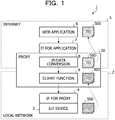
- FIG. 1 is a diagram illustrating a disposition example of each function of the WoT system.
- the system 1 includes an IoT device 3 disposed in a local network 2 and a Web application 6 disposed on the Internet 5.
- the Web application 6 may not directly handle the IoT.
- a proxy 20 between the Internet 5 and the local network 2 absorbs the difference in interface (IF) for both sides.
- the proxy 20 rewrites the IP address, data, and the like by an IP/data conversion 8 , and also includes a client function 9.
- the IoT device 3 transfers the TD 500 to the proxy 20 via an IF for proxy 4.
- TD 500 In the TD 500 output by the IoT device 3, a Uniform Resource Locator (URL) in local is described as API details.
- the proxy 200 rewrites the TD 500 and transfers the TD 500 to the Web application 6 via an IF for allocation 7.
- a URL in global and the like are described as API details.
- Various input and output parameters may be described in any TD 500.
- the following 4 detections or verifications are desired to be performed in order to ensure the reliability between the Web application 6 and the IoT device 3. For example, (1) detection of an unauthorized rewriting of a TD between a Web application and a proxy, (2) verification of a validity of rewriting of a TD in a proxy, (3) verification of a validity of a TD before rewriting, and (4) verification of the reliability of a Web access.
- the purpose of the present embodiment is to perform the detection and verification described above.
- FIGs. 2 and 3 are block diagrams illustrating a configuration example of the control system.
- the control system 1 includes a device 10, a proxy 20, and a terminal apparatus 30.
- the device 10 is, for example, an IoT device such as an automobile, a home appliance, a wearable apparatus, or a sensor.
- the proxy 20 is, for example, a server having a proxy function.
- the terminal apparatus 30 is a terminal that functions as a client of the Web application.
- the terminal apparatus 30 may be a server that provides a Web application.
- Each apparatus of the control system 1 is assumed to have the same function as each apparatus of the system illustrated in FIG. 1 .
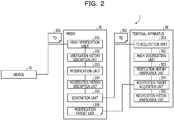
- FIG. 2 illustrates a function of each apparatus used when the device 10 transmits the TD to the terminal apparatus 30 as a processing unit.
- FIG. 3 illustrates a function of each apparatus used when the terminal apparatus 30 performs a Web access with respect to the device 10 as a processing unit.
- the proxy 20 includes a hash verification unit 201, a verification history description unit 202, a modification unit 203, a modification history description unit 204, a generation unit 205, and a modification target list 206.
- the terminal apparatus 30 includes a TD acquisition unit 301, a hash verification unit 302, a verification history verification unit 303, a modification target acquisition unit 304, and a modification history verification unit 305.
- the device 10 transmits a TD 501 to the terminal apparatus 30.
- the device 10 is able to transmit the TD at any time.
- the device 10 may automatically transmit the TD when the device 10 is added to the network, may transmit the TD by being manually operated or may transmit the TD in response to a request from another apparatus such as the terminal apparatus 30 or the proxy 20.
- the TD 501 is received by the proxy 20 on a communication path between the device 10 and the terminal apparatus 30.
- the hash verification unit 201 verifies a hash of the TD 501 transmitted by the device 10.
- the verification history description unit 202 describes the verification history in the TD 501.
- the modification unit 203 modifies the content of TD 501 before TD 501 is received by the terminal apparatus 30.
- the modification history description unit 204 describes, in the TD 501, the content of the modification, which is modified by a modification process, as a modification history.
- the TD 502 is a thing description in which the modification history is described in the TD 501 by the modification history description unit 204.
- the TD is an example of specification information.
- the TD 501 is a TD which is transmitted by the device 10 to the terminal apparatus 30 and is a TD in which information related to a request transmitted by the terminal apparatus 30 to the device 10 is described.
- the request includes a Web request such as an HTTP request.
- the modification unit 203 is able to rewrite a protocol of an API described in the TD 501 from Websocket to HTTP.
- a modification history description unit 204 describes the fact that the protocol is rewritten in the TD 501 as a modification history.
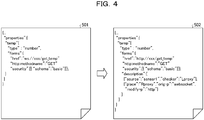
- FIG. 4 is a diagram illustrating an example of TDs before and after the modification of the protocol.
- the TD 501 is a TD at the time of reception by the proxy 20.
- the TD 502 is a TD after performing the description of the verification history by the verification history description unit 202, performing the modification of the content by the modification unit 203, and performing the description of the modification history by the modification history description unit 204.
- a description tag value included in the TD is an array having an object as an element. It is assumed that the object has one or more "key":"value" pairs.
- the description tag is an example of a tag for describing Human Readable information, for example, information which is readable by a human.
- the verification history description unit 202 describes an object indicating a TD providing source and an object indicating a hash checker in a first element of an array of a description tag.
- the hash checker is a main body that performed a hash checking and is an apparatus such as a proxy.
- “”source” :"sensor1"" of the TD 502 in FIG. 4 is an object indicating the TD providing source.
- the object indicates that it is a TD providing source, for example, "source” is “sensor1”.
- the "sensor1" is a character string for identifying the device 10.
- ""checker”:"Lproxy”" of the TD 502 in FIG. 4 is an object indicating a hash checker.
- the object indicates that it is a hash checker, for example, "checker” is "Lproxy”.
- the "Lproxy” is a character string for identifying the proxy 20.
- the fact that the verification history is described in the TD indicates that the validity is verified. Therefore, it is not desired that the verification history description unit 202 to explicitly describe whether or not it is valid.
- the modification unit 203 rewrites the protocol by modifying a href tag value. As illustrated in FIG. 4 , the modification unit 203 rewrites a href tag value from "ws://xxx/get_temp" to "http://xxx/get_temp".
- the modification history description unit 204 describes an object indicating a modifier that performed a modification of the TD, an object indicating information before the modification, and an object indicating information after the modification, in a second element of the array of the description tag.
- the modifier that performed the modification of the TD is a main body that performed a modification of the TD and is an apparatus such as a proxy.
- ""place”:"Rproxy”" of the TD 502 in FIG. 4 is an object indicating a modifier that performed a modification of the TD.
- the object indicates that it is a modifier, for example, "place” is “Rproxy”.
- the "Rproxy” is a character string for identifying the proxy 20.
- ""orig-p”:"websocket"" of the TD 502 in FIG. 4 is an object indicating information before the modification.
- the object indicates that it is a proxy before the modification, for example, "orig-p" is "websocket”.
- ""modify-p":"http"" of the TD 502 in FIG. 4 is an object indicating information after the modification.
- the object indicates that it is a proxy after the modification, for example, "modify-p" is "http".
- the modification history description unit 204 describes the content of the modification, which is modified by the modification process, and information for specifying a tag corresponding to the modified value in the tag value for describing the human-readable information.
- the modification unit 203 is able to modify at least any of the values corresponding to the tags included in the TD.
- the tag in which a value is modified by the modification unit 203 is not limited to the href tag.
- the modification unit 203 may modify a security tag value representing the authentication method.
- FIG. 5 is a diagram illustrating an example of TDs before and after a modification of an authentication method.
- the modification unit 203 rewrites the security tag value from " ⁇ "schema”:"nosec" ⁇ " to " ⁇ "schema”:"basic” ⁇ ".
- the TD 502a is a TD after performing the description of the verification history by the verification history description unit 202, performing the modification of the content by the modification unit 203, and performing the description of the modification history by the modification history description unit 204.
- ""place”:"Rproxy"" of the TD 502a in FIG. 5 is an object indicating a modifier that performed a modification of the TD.
- the object indicates that it is a modifier, for example, "place” is "Rproxy”.
- ""orig-p”:"nosec"" of the TD 502a in FIG. 5 is an object indicating information before the modification.
- the object indicates that it is an authentication method before the modification, for example, "orig-p" is "nosec”.
- ""modify-p":"basic"" of the TD 502a in FIG. 5 is an object indicating information after the modification.
- the object indicates that it is an authentication method after the modification, for example, "modify-p" is "basic".
- the generation unit 205 generates a hash of the TD 502 in which the modification history is described by the modification history description unit 204.
- the proxy 20 transmits the TD 502 together with the hash to the terminal apparatus 30.
- the TD acquisition unit 301 of the terminal apparatus 30 acquires the TD 502.
- the hash verification unit 302 verifies a hash of the TD 502 transmitted by the device 10.
- the verification history verification unit 303 verifies the validity of the verification of the hash performed by the proxy or the like.
- the verification history verification unit 303 verifies the validity of the verification of the hash performed by the proxy 20 based on the hash verification history of the TD 502.
- the modification history verification unit 305 verifies whether the content of the modification indicated by the modification history described in the TD matches the content of the modification permitted in advance.
- the modification target acquisition unit 304 acquires a modification target list 206 from the proxy 20.
- the modification target list 206 is information that defines a tag for which a modification is permitted and contents of the modification.
- the modification target list 206 may be maintained by the terminal apparatus 30 or another apparatus instead of the proxy 20.
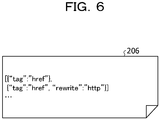
- FIG. 6 is a diagram illustrating an example of a modification target list.
- the modification target list 206 may include at least a name of a tag for which a modification of a value is permitted, and may further include the content of the modification.
- " ⁇ "tag”:"href” ⁇ ” indicates the fact that the modification of the href tag value is permitted.
- " ⁇ "tag”:"href”, "rewrite” :"http” ⁇ ” indicates the fact that the modification of the protocol, which is indicated by the href tag, to "http” is permitted.
- the device 10 includes a TD acquisition unit 151, a determination unit 152, a providing unit 153, and an authentication unit 154.
- the proxy 20 includes a requesting unit 251, a path information description unit 252, a reconfiguration unit 253, a providing unit 254, and an authentication unit 255.
- the terminal apparatus 30 includes a requesting unit 351.
- the requesting unit 351 of the terminal apparatus 30 transmits a request to the device 10.
- the providing unit 254 of the proxy 20 functions as a Web server.
- the providing unit 254 receives the request transmitted by the requesting unit 351.
- the authentication unit 255 performs an authentication of the request received by the providing unit 254.
- the reconfiguration unit 253 reconfigures the request by using a URL conversion or the like.
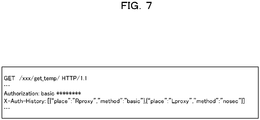
- the path information description unit 252 describes information related to the path in the request. As illustrated in FIG. 7 , the path information description unit 252 describes information in an HTTP request. FIG. 7 is a diagram illustrating an example of the HTTP request.
- the path information description unit 252 adds a unique parameter for describing the information to the request. At this time, the path information description unit 252 sets a key starting from "X -" in accordance with the convention of inserting a parameter into a header of an HTTP request. As illustrated in FIG. 7 , the path information description unit 252 adds a parameter whose key is "X-Auth-History" to the header of the HTTP request.
- the path information description unit 252 describes, for example, an authentication location and an authentication method.
- " ⁇ "place”:"Rproxy”, “method”:”basic” ⁇ ” indicates that the authentication location is “Rproxy” and the authentication method is “basic”.
- the path information description unit 252 further adds an object to the parameter "X-Auth-History”.
- " ⁇ "place”:"Lproxy”, “method”:"nosec” ⁇ ” indicates that the authentication location is "Lproxy” and the authentication method is "nosec”. The "nosec" indicates that there is no authentication.
- the requesting unit 251 functions as a client. For example, the requesting unit 251 transmits a request which is reconfigured by the reconfiguration unit 253 and in which a description is performed by the path information description unit 252, to the device 10.
- the providing unit 153 of the device 10 functions as a Web server.
- the providing unit 153 receives the request transmitted by the requesting unit 251 of the proxy 20.
- the authentication unit 154 performs an authentication of the request received by the providing unit 153.
- the TD acquisition unit 151 acquires a TD in which a communication path of the request transmitted from the terminal apparatus 30 to the device 10 is defined in advance.
- the TD acquired by the TD acquisition unit 151 is the same as the TD acquired by the terminal apparatus 30.
- the TD acquisition unit 151 acquires the TD 502 from the proxy 20.
- the TD acquisition unit 151 acquires the TD by reading a predetermined parameter which is described in a header of the request transmitted from the terminal apparatus 30 to the device 10. For example, as illustrated in FIG. 7 , in the HTTP request, at least the "place" which is information for specifying the proxy 20 on the communication path and the "method" which is an authentication method in each proxy 20 are described. The TD acquisition unit 151 couples to the proxy 20 based on the information read from the HTTP request and acquires the TD 502.
- the determination unit 152 determines whether to execute the request.
- the determination unit 152 makes a determination based on a comparison result between a communication apparatus through which the request passes until the request reaches the device 10 and a communication apparatus through which the TD passes until the TD reaches the terminal apparatus 30.
- the TD is acquired by the TD acquisition unit 151.
- the request is transmitted by the proxy 20 and received by the providing unit 153.
- the HTTP request indicates that the request has passed at least "Lproxy”.
- the TD 502 also indicates that the request has passed at least "Lproxy”.
- the determination unit 152 determines to execute the request because at least a part of the proxies on the communication path match.
- the determination unit 152 may determine to execute the request when at least a part of the communication path through which a first request passes and the communication path defined by the TD acquired by the TD acquisition unit 151 match.
- the determination unit 152 may determine to execute the request when the communication path through which a first request passes and the communication path defined by the TD acquired by the TD acquisition unit 151 completely match.
- FIG. 8 is a flowchart illustrating the flow of the modification process of the TD.
- the device 10 generates a hash of the TD (operation S101).
- the proxy 20 acquires the TD (operation S102).
- the proxy 20 verifies the hash (operation S103).
- the proxy 20 attaches a hash verification history to the TD (operation S104).
- the proxy 20 rewrites the TD (operation S105). For example, the proxy 20 rewrites a protocol, an authentication method, and the like.
- the proxy 20 describes a modification history in the TD (operation S106).
- the proxy 20 generates a hash of the TD in which the description of the rewriting and the modification history are performed (operation S107).
- the terminal apparatus 30, for example, an application acquires the TD from the proxy 20 (operation S108).
- the terminal apparatus 30 verifies the hash of the acquired TD (operation S109).
- the terminal apparatus 30 verifies the hash history (operation S110).
- the terminal apparatus 30 acquires a modification target list (operation S111) and checks whether the modification history matches the modification target list (operation S112).
- FIG. 9 is a flowchart illustrating a flow of the verification process of the request.
- the terminal apparatus 30, for example, the application transmits a Web request to the proxy 20 (operation S201).
- the proxy 20 receives the request (operation S202) and performs an authentication (operation S203).
- the proxy 20 reconfigures the request by using a URL conversion or the like (operation S204).
- the proxy 20 attaches a proxy ID and authentication information to the request as a path history (operation S205).
- the proxy 20 transmits the request to the device 10 (operation S206).
- the device 10 receives the request (operation S207) and performs an authentication (operation S208).
- the device 10 acquires the TD acquired by the application from the proxy 20 (operation S209).
- the device 10 compares the hash history and the modification history of the acquired TD with the path history described in the request and checks the matching (operation S210).
- the determination unit 152 determines whether to execute the request.
- the determination unit 152 makes a determination based on a comparison result between a communication apparatus through which the request passes until the request reaches the device 10 and a communication apparatus through which the TD passes until the TD reaches the terminal apparatus 30.
- the device 10 which is an IoT device, compares an actual communication path of the request transmitted by the terminal apparatus 30 which executes the application with the communication path based on the TD in which the rewriting is finished.
- the validity of an access from the application to the IoT device is able to be verified. For example, according to the Embodiment, it is possible to verify the reliability of the Web access.
- the modification unit 203 modifies the content of the TD.
- the modification history description unit 204 describes, in the TD, the content of the modification, which is modified by the modification process, as a modification history.
- the modification history verification unit 305 verifies whether the content of the modification indicated by the modification history described in the TD matches the content of the modification permitted in advance. In this way, the terminal apparatus 30 is able to verify the validity of the TD based on the description content of the TD itself. As a result, according to the Embodiment, it is possible to verify the validity of the TD rewriting in the proxy.
- the determination unit 152 determines whether to execute the request based on a comparison result between the communication apparatus through which the request passes until the request reaches the device 10 and the communication apparatus, which is defined in the TD acquired by reading a parameter and through which the TD passes until the TD reaches the terminal apparatus 30.
- the parameter is described in the header of the request transmitted from the terminal apparatus 30 to the device 10.
- the parameter at least information for specifying a predetermined proxy on a communication path and an authentication method in each proxy are described. In this way, the device 10 is able to acquire the TD by coupling the proxy 20.
- the modification unit 203 modifies at least any of the values corresponding to the tags included in the TD.
- the modification history description unit 204 describes the content of the modification, which is modified by the modification process, and information for specifying a tag corresponding to the modified value in the tag value for describing the human-readable information.
- the proxy 20 describes information in the description tag value, for example.
- the number of proxies between the device 10 and the terminal apparatus 30 is one.
- one or more proxies 20 provided on the communication path between the terminal apparatus 30 and the device 10 execute the modification process.
- the modification history description unit 204 of each proxy describes, in the TD, the content of the modification, which is modified by the modification process, and the information for specifying the proxy in which the modification is performed as a modification history.
- a TD modification process when a first proxy and a second proxy are present between the device 10 and the terminal apparatus 30 will be described.
- the first proxy provided on the communication path between the terminal apparatus 30 and the device 10 executes the modification process and a description process.
- the first proxy further executes a process of generating a hash from the TD in which the content of the modification is described by the description process.
- a second proxy provided on the communication path verifies the validity of the hash generated by the first proxy, and further, describes the verification result in the TD.
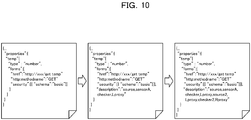
- FIG. 10 is a diagram illustrating an example of TDs in which a hash verification history is described.
- each proxy makes a distinction by numbering Key values.
- the first proxy uses “source” and “checker” as the Key values.
- the second proxy uses “source2" and “checker2” as the Key values.
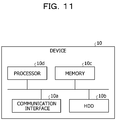
- FIG. 11 is a diagram for explaining a hardware configuration example.
- the device 10 includes a communication interface 10a, a hard disk drive (HDD) 10b, a memory 10c, and a processor 10d.
- the respective units illustrated in FIG. 11 are coupled to each other by a bus or the like.
- the proxy 20 and the terminal apparatus 30 may have the hardware configuration illustrated in FIG. 11 .
- the communication interface 10a is a network interface card or the like and performs communication with other servers.
- the HDD 10b stores a program or a database (DB) for operating functions illustrated in FIG. 3 .
- the processor 10d is a hardware circuit that reads, from the HDD 10b or the like, a program for executing the same processing as each processing unit illustrated in FIG. 3 and loads the program to the memory 10c to operate a process of executing each function described in FIG. 3 or the like. For example, this process executes the similar function to that of each processing unit included in the device 10.
- the processor 10d reads out a program having the same functions as those of the TD acquisition unit 151, the determination unit 152, the providing unit 153, and the authentication unit 154 from the HDD 10b and the like.
- the processor 10d executes a process of executing the same process as the TD acquisition unit 151, the determination unit 152, the providing unit 153, the authentication unit 154, and the like.
- the device 10 operates as an information processing apparatus that performs a learning method as a result of reading and executing the program.
- the device 10 may also realize the similar functions to those of the embodiments described above by reading the program from a recording medium by a medium reading apparatus and executing the read program.
- the program described in other embodiments is not limited to a program that is executed by the device 10.
- the present disclosure may also be similarly applied to cases where another computer or a server executes the program and where the other computer and the server execute the program in cooperation with each other.
- This program may be distributed via a network such as the Internet.
- This program may be recorded on a computer-readable recording medium such as a hard disk, a flexible disk (FD), a compact disc read-only memory (CD-ROM), a magneto-optical disk (MO), or a digital versatile disc (DVD) and may be executed after being read from the recording medium by a computer.
- a computer-readable recording medium such as a hard disk, a flexible disk (FD), a compact disc read-only memory (CD-ROM), a magneto-optical disk (MO), or a digital versatile disc (DVD)
Landscapes
- Engineering & Computer Science (AREA)
- Computer Networks & Wireless Communication (AREA)
- Signal Processing (AREA)
- Computer Security & Cryptography (AREA)
- Computing Systems (AREA)
- Health & Medical Sciences (AREA)
- General Health & Medical Sciences (AREA)
- Medical Informatics (AREA)
- Computer And Data Communications (AREA)
- Information Transfer Between Computers (AREA)
- Selective Calling Equipment (AREA)
- Accessory Devices And Overall Control Thereof (AREA)
Abstract
Description
- The embodiment discussed herein is related to a control method of a device, the device, and a control system.
- The concept of Web of Things (WoT) has been proposed by World Wide Web Consortium (W3C) to enable Web technology to handle all Internet of Things (IoT) devices. In the WoT, it is possible to access an IoT device using a Thing Description (TD) which is for describing a profile such as an application programming interface (API) in a unified format.
- Examples of the related art include Japanese Laid-open Patent Publication No.
2007-110180 2015-58896 2018-121328 - In one aspect, the purpose is to verify the validity of an access from an application to an IoT device.
- According to an aspect of the embodiments, a control method, of a device, executed by a processor, the control method includes transmitting specification information of the device to a terminal apparatus, receiving a request generated based on the specification information from the terminal apparatus, and determining whether to execute the request based on a comparison result between a first communication apparatus through which the request passes until the request reaches the device and a second communication apparatus through which the specification information passes until the specification information reaches the terminal apparatus.
-
-
FIG. 1 is a diagram illustrating a disposition example of each apparatus of a WoT system; -
FIG. 2 is a block diagram illustrating a configuration example of a control system; -
FIG. 3 is a block diagram illustrating a configuration example of the control system; -
FIG. 4 is a diagram illustrating an example of TDs before and after a modification of a protocol; -
FIG. 5 is a diagram illustrating an example of TDs before and after a modification of an authentication method; -
FIG. 6 is a diagram illustrating an example of a modification target list; -
FIG. 7 is a diagram illustrating an example of a HyperText Transfer Protocol (HTTP) request; -
FIG. 8 is a flowchart illustrating a flow of a modification process of a TD; -
FIG. 9 is a flowchart illustrating a flow of a verification process of a request; -
FIG. 10 is a diagram illustrating an example of TDs in which a hash verification history is described; and -
FIG. 11 is a diagram for explaining a hardware configuration example. - When an application and an IoT device are present on different networks, a proxy may be provided between the networks to allow the application to handle the IoT.
- In the above-described technology, it may be difficult to verify a validity of an access from the application to the IoT device.
- For example, the application receives a TD issued by the IoT device and transmits a Web request to the IoT device according to the content described in the received TD. At this time, when a proxy is provided between the application and the IoT device as described above, it is desired to rewrite the TD so that the Web request is able to be directed to the proxy. When the TD is rewritten, the IoT device receives the Web request via the proxy.
- Since the TD, which is initially issued from the IoT device, is not written assuming that the Web request passes through the proxy, the IoT device may not be able to determine whether the Web request transmitted via the proxy is valid.
- Hereinafter, an embodiment of technology according to the present disclosure that makes it possible to verify the validity of an access from the application to the IoT device will be described in detail with reference to the drawings. The embodiment does not limit the present disclosure. Each embodiment may be combined as appropriate within a scope without contradiction.
- First, a WoT system for realizing WoT will be described with reference to
FIG. 1. FIG. 1 is a diagram illustrating a disposition example of each function of the WoT system. The system 1 includes anIoT device 3 disposed in alocal network 2 and aWeb application 6 disposed on the Internet 5. - The
Web application 6 may not directly handle the IoT. In such a case, aproxy 20 between the Internet 5 and thelocal network 2 absorbs the difference in interface (IF) for both sides. For example, theproxy 20 rewrites the IP address, data, and the like by an IP/data conversion 8 , and also includes aclient function 9. TheIoT device 3 transfers theTD 500 to theproxy 20 via an IF forproxy 4. - In the TD 500 output by the
IoT device 3, a Uniform Resource Locator (URL) in local is described as API details. The proxy 200 rewrites theTD 500 and transfers theTD 500 to theWeb application 6 via an IF forallocation 7. In theTD 500 after the rewrite, a URL in global and the like are described as API details. Various input and output parameters may be described in anyTD 500. - In the system illustrated in
FIG. 1 , for example, the following 4 detections or verifications are desired to be performed in order to ensure the reliability between theWeb application 6 and theIoT device 3. For example, (1) detection of an unauthorized rewriting of a TD between a Web application and a proxy, (2) verification of a validity of rewriting of a TD in a proxy, (3) verification of a validity of a TD before rewriting, and (4) verification of the reliability of a Web access. - In one aspect, the purpose of the present embodiment is to perform the detection and verification described above. For example, according to the present embodiment, it is possible to perform the above-described verifications (2) and (4), which have been difficult in the related art.
- A configuration of a control system 1 according to the embodiment will be described with reference to
FIGs. 2 and3 .FIGs. 2 and3 are block diagrams illustrating a configuration example of the control system. As illustrated inFIGs. 2 and3 , the control system 1 includes adevice 10, aproxy 20, and aterminal apparatus 30. - The
device 10 is, for example, an IoT device such as an automobile, a home appliance, a wearable apparatus, or a sensor. Theproxy 20 is, for example, a server having a proxy function. Theterminal apparatus 30 is a terminal that functions as a client of the Web application. Theterminal apparatus 30 may be a server that provides a Web application. Each apparatus of the control system 1 is assumed to have the same function as each apparatus of the system illustrated inFIG. 1 . -
FIG. 2 illustrates a function of each apparatus used when thedevice 10 transmits the TD to theterminal apparatus 30 as a processing unit. On the other hand,FIG. 3 illustrates a function of each apparatus used when theterminal apparatus 30 performs a Web access with respect to thedevice 10 as a processing unit. - First, each processing unit used when the
device 10 transmits the TD will be described. As illustrated inFIG. 2 , theproxy 20 includes ahash verification unit 201, a verification history description unit 202, amodification unit 203, a modificationhistory description unit 204, ageneration unit 205, and amodification target list 206. Theterminal apparatus 30 includes aTD acquisition unit 301, ahash verification unit 302, a verification history verification unit 303, a modification target acquisition unit 304, and a modificationhistory verification unit 305. - The
device 10 transmits aTD 501 to theterminal apparatus 30. Thedevice 10 is able to transmit the TD at any time. For example, thedevice 10 may automatically transmit the TD when thedevice 10 is added to the network, may transmit the TD by being manually operated or may transmit the TD in response to a request from another apparatus such as theterminal apparatus 30 or theproxy 20. At this time, theTD 501 is received by theproxy 20 on a communication path between thedevice 10 and theterminal apparatus 30. Thehash verification unit 201 verifies a hash of theTD 501 transmitted by thedevice 10. When thehash verification unit 201 verifies that theTD 501 is valid, the verification history description unit 202 describes the verification history in theTD 501. - The
modification unit 203 modifies the content ofTD 501 beforeTD 501 is received by theterminal apparatus 30. The modificationhistory description unit 204 describes, in theTD 501, the content of the modification, which is modified by a modification process, as a modification history. TheTD 502 is a thing description in which the modification history is described in theTD 501 by the modificationhistory description unit 204. The TD is an example of specification information. TheTD 501 is a TD which is transmitted by thedevice 10 to theterminal apparatus 30 and is a TD in which information related to a request transmitted by theterminal apparatus 30 to thedevice 10 is described. The request includes a Web request such as an HTTP request. - For example, when the
proxy 20 does not support Websocket but supports HTTP, themodification unit 203 is able to rewrite a protocol of an API described in theTD 501 from Websocket to HTTP. At that time, a modificationhistory description unit 204 describes the fact that the protocol is rewritten in theTD 501 as a modification history. -
FIG. 4 is a diagram illustrating an example of TDs before and after the modification of the protocol. TheTD 501 is a TD at the time of reception by theproxy 20. TheTD 502 is a TD after performing the description of the verification history by the verification history description unit 202, performing the modification of the content by themodification unit 203, and performing the description of the modification history by the modificationhistory description unit 204. - A description tag value included in the TD is an array having an object as an element. It is assumed that the object has one or more "key":"value" pairs. The description tag is an example of a tag for describing Human Readable information, for example, information which is readable by a human.
- The verification history description unit 202 describes an object indicating a TD providing source and an object indicating a hash checker in a first element of an array of a description tag. The hash checker is a main body that performed a hash checking and is an apparatus such as a proxy.
- ""source" :"sensor1"" of the
TD 502 inFIG. 4 is an object indicating the TD providing source. The object indicates that it is a TD providing source, for example, "source" is "sensor1". The "sensor1" is a character string for identifying thedevice 10. - ""checker":"Lproxy"" of the
TD 502 inFIG. 4 is an object indicating a hash checker. The object indicates that it is a hash checker, for example, "checker" is "Lproxy". The "Lproxy" is a character string for identifying theproxy 20. The fact that the verification history is described in the TD indicates that the validity is verified. Therefore, it is not desired that the verification history description unit 202 to explicitly describe whether or not it is valid. - The
modification unit 203 rewrites the protocol by modifying a href tag value. As illustrated inFIG. 4 , themodification unit 203 rewrites a href tag value from "ws://xxx/get_temp" to "http://xxx/get_temp". - The modification
history description unit 204 describes an object indicating a modifier that performed a modification of the TD, an object indicating information before the modification, and an object indicating information after the modification, in a second element of the array of the description tag. The modifier that performed the modification of the TD is a main body that performed a modification of the TD and is an apparatus such as a proxy. - ""place":"Rproxy"" of the
TD 502 inFIG. 4 is an object indicating a modifier that performed a modification of the TD. The object indicates that it is a modifier, for example, "place" is "Rproxy". The "Rproxy" is a character string for identifying theproxy 20. - ""orig-p":"websocket"" of the
TD 502 inFIG. 4 is an object indicating information before the modification. The object indicates that it is a proxy before the modification, for example, "orig-p" is "websocket". - ""modify-p":"http"" of the
TD 502 inFIG. 4 is an object indicating information after the modification. The object indicates that it is a proxy after the modification, for example, "modify-p" is "http". - As described above, the modification
history description unit 204 describes the content of the modification, which is modified by the modification process, and information for specifying a tag corresponding to the modified value in the tag value for describing the human-readable information. - The
modification unit 203 is able to modify at least any of the values corresponding to the tags included in the TD. The tag in which a value is modified by themodification unit 203 is not limited to the href tag. For example, themodification unit 203 may modify a security tag value representing the authentication method. -
FIG. 5 is a diagram illustrating an example of TDs before and after a modification of an authentication method. In the example inFIG. 5 , themodification unit 203 rewrites the security tag value from "{"schema":"nosec"}" to "{"schema":"basic"}". TheTD 502a is a TD after performing the description of the verification history by the verification history description unit 202, performing the modification of the content by themodification unit 203, and performing the description of the modification history by the modificationhistory description unit 204. - ""place":"Rproxy"" of the
TD 502a inFIG. 5 is an object indicating a modifier that performed a modification of the TD. The object indicates that it is a modifier, for example, "place" is "Rproxy". - ""orig-p":"nosec"" of the
TD 502a inFIG. 5 is an object indicating information before the modification. The object indicates that it is an authentication method before the modification, for example, "orig-p" is "nosec". - ""modify-p":"basic"" of the
TD 502a inFIG. 5 is an object indicating information after the modification. The object indicates that it is an authentication method after the modification, for example, "modify-p" is "basic". - Returning to
FIG. 2 , thegeneration unit 205 generates a hash of theTD 502 in which the modification history is described by the modificationhistory description unit 204. Theproxy 20 transmits theTD 502 together with the hash to theterminal apparatus 30. - The
TD acquisition unit 301 of theterminal apparatus 30 acquires theTD 502. Thehash verification unit 302 verifies a hash of theTD 502 transmitted by thedevice 10. The verification history verification unit 303 verifies the validity of the verification of the hash performed by the proxy or the like. The verification history verification unit 303 verifies the validity of the verification of the hash performed by theproxy 20 based on the hash verification history of theTD 502. - The modification
history verification unit 305 verifies whether the content of the modification indicated by the modification history described in the TD matches the content of the modification permitted in advance. The modification target acquisition unit 304 acquires amodification target list 206 from theproxy 20. Themodification target list 206 is information that defines a tag for which a modification is permitted and contents of the modification. Themodification target list 206 may be maintained by theterminal apparatus 30 or another apparatus instead of theproxy 20. -
FIG. 6 is a diagram illustrating an example of a modification target list. As illustrated inFIG. 6 , themodification target list 206 may include at least a name of a tag for which a modification of a value is permitted, and may further include the content of the modification. "{"tag":"href"}" indicates the fact that the modification of the href tag value is permitted. "{"tag":"href", "rewrite" :"http"}" indicates the fact that the modification of the protocol, which is indicated by the href tag, to "http" is permitted. - Each processing unit used when the
terminal apparatus 30 performs a Web access with respect to thedevice 10 will be described. As illustrated inFIG. 3 , thedevice 10 includes aTD acquisition unit 151, adetermination unit 152, a providingunit 153, and anauthentication unit 154. Theproxy 20 includes a requestingunit 251, a path information description unit 252, areconfiguration unit 253, a providingunit 254, and anauthentication unit 255. Theterminal apparatus 30 includes a requestingunit 351. - The requesting
unit 351 of theterminal apparatus 30 transmits a request to thedevice 10. The providingunit 254 of the proxy 20 functions as a Web server. For example, the providingunit 254 receives the request transmitted by the requestingunit 351. Theauthentication unit 255 performs an authentication of the request received by the providingunit 254. Thereconfiguration unit 253 reconfigures the request by using a URL conversion or the like. - The path information description unit 252 describes information related to the path in the request. As illustrated in
FIG. 7 , the path information description unit 252 describes information in an HTTP request.FIG. 7 is a diagram illustrating an example of the HTTP request. - The path information description unit 252 adds a unique parameter for describing the information to the request. At this time, the path information description unit 252 sets a key starting from "X -" in accordance with the convention of inserting a parameter into a header of an HTTP request. As illustrated in
FIG. 7 , the path information description unit 252 adds a parameter whose key is "X-Auth-History" to the header of the HTTP request. - The path information description unit 252 describes, for example, an authentication location and an authentication method. Among the objects of the parameter "X-Auth-History" in
FIG. 7 , "{"place":"Rproxy", "method":"basic"}" indicates that the authentication location is "Rproxy" and the authentication method is "basic". When the HTTP request passes through a plurality of proxies, the path information description unit 252 further adds an object to the parameter "X-Auth-History". "{"place":"Lproxy", "method":"nosec"}" indicates that the authentication location is "Lproxy" and the authentication method is "nosec". The "nosec" indicates that there is no authentication. - The requesting
unit 251 functions as a client. For example, the requestingunit 251 transmits a request which is reconfigured by thereconfiguration unit 253 and in which a description is performed by the path information description unit 252, to thedevice 10. - The providing
unit 153 of thedevice 10 functions as a Web server. For example, the providingunit 153 receives the request transmitted by the requestingunit 251 of theproxy 20. Theauthentication unit 154 performs an authentication of the request received by the providingunit 153. - The
TD acquisition unit 151 acquires a TD in which a communication path of the request transmitted from theterminal apparatus 30 to thedevice 10 is defined in advance. The TD acquired by theTD acquisition unit 151 is the same as the TD acquired by theterminal apparatus 30. For example, theTD acquisition unit 151 acquires theTD 502 from theproxy 20. - The
TD acquisition unit 151 acquires the TD by reading a predetermined parameter which is described in a header of the request transmitted from theterminal apparatus 30 to thedevice 10. For example, as illustrated inFIG. 7 , in the HTTP request, at least the "place" which is information for specifying theproxy 20 on the communication path and the "method" which is an authentication method in each proxy 20 are described. TheTD acquisition unit 151 couples to theproxy 20 based on the information read from the HTTP request and acquires theTD 502. - After transmitting the TD of the
device 10 to theterminal apparatus 30, when the request generated by using the TD is received from theterminal apparatus 30, thedetermination unit 152 determines whether to execute the request. Thedetermination unit 152 makes a determination based on a comparison result between a communication apparatus through which the request passes until the request reaches thedevice 10 and a communication apparatus through which the TD passes until the TD reaches theterminal apparatus 30. The TD is acquired by theTD acquisition unit 151. The request is transmitted by theproxy 20 and received by the providingunit 153. - As illustrated in
FIG. 7 , the HTTP request indicates that the request has passed at least "Lproxy". As illustrated inFIG. 4 , theTD 502 also indicates that the request has passed at least "Lproxy". Thedetermination unit 152 determines to execute the request because at least a part of the proxies on the communication path match. - The
determination unit 152 may determine to execute the request when at least a part of the communication path through which a first request passes and the communication path defined by the TD acquired by theTD acquisition unit 151 match. Thedetermination unit 152 may determine to execute the request when the communication path through which a first request passes and the communication path defined by the TD acquired by theTD acquisition unit 151 completely match. - With reference to
FIGS. 2 and8 , a flow of a modification process of a TD when transmitting the TD will be described.FIG. 8 is a flowchart illustrating the flow of the modification process of the TD. Thedevice 10 generates a hash of the TD (operation S101). Theproxy 20 acquires the TD (operation S102). Theproxy 20 verifies the hash (operation S103). Theproxy 20 attaches a hash verification history to the TD (operation S104). - The
proxy 20 rewrites the TD (operation S105). For example, theproxy 20 rewrites a protocol, an authentication method, and the like. Theproxy 20 describes a modification history in the TD (operation S106). Theproxy 20 generates a hash of the TD in which the description of the rewriting and the modification history are performed (operation S107). - The
terminal apparatus 30, for example, an application acquires the TD from the proxy 20 (operation S108). Theterminal apparatus 30 verifies the hash of the acquired TD (operation S109). Theterminal apparatus 30 verifies the hash history (operation S110). Theterminal apparatus 30 acquires a modification target list (operation S111) and checks whether the modification history matches the modification target list (operation S112). - With reference to
FIGS. 2 and9 , a verification process of a request when performing a Web access will be described.FIG. 9 is a flowchart illustrating a flow of the verification process of the request. First, theterminal apparatus 30, for example, the application transmits a Web request to the proxy 20 (operation S201). - The
proxy 20 receives the request (operation S202) and performs an authentication (operation S203). Theproxy 20 reconfigures the request by using a URL conversion or the like (operation S204). - The
proxy 20 attaches a proxy ID and authentication information to the request as a path history (operation S205). Theproxy 20 transmits the request to the device 10 (operation S206). - The
device 10 receives the request (operation S207) and performs an authentication (operation S208). Thedevice 10 acquires the TD acquired by the application from the proxy 20 (operation S209). Thedevice 10 compares the hash history and the modification history of the acquired TD with the path history described in the request and checks the matching (operation S210). - Returning to
FIG. 3 , after transmitting the TD of thedevice 10 to theterminal apparatus 30, when the request generated by using the specification information is received from theterminal apparatus 30, thedetermination unit 152 determines whether to execute the request. Thedetermination unit 152 makes a determination based on a comparison result between a communication apparatus through which the request passes until the request reaches thedevice 10 and a communication apparatus through which the TD passes until the TD reaches theterminal apparatus 30. In this way, thedevice 10, which is an IoT device, compares an actual communication path of the request transmitted by theterminal apparatus 30 which executes the application with the communication path based on the TD in which the rewriting is finished. As a result, according to the Embodiment, the validity of an access from the application to the IoT device is able to be verified. For example, according to the Embodiment, it is possible to verify the reliability of the Web access. - Before the TD, which is transmitted by the
device 10 to theterminal apparatus 30 and in which information related to the request transmitted by theterminal apparatus 30 to thedevice 10 is described, is received by theterminal apparatus 30, themodification unit 203 modifies the content of the TD. The modificationhistory description unit 204 describes, in the TD, the content of the modification, which is modified by the modification process, as a modification history. The modificationhistory verification unit 305 verifies whether the content of the modification indicated by the modification history described in the TD matches the content of the modification permitted in advance. In this way, theterminal apparatus 30 is able to verify the validity of the TD based on the description content of the TD itself. As a result, according to the Embodiment, it is possible to verify the validity of the TD rewriting in the proxy. - The
determination unit 152 determines whether to execute the request based on a comparison result between the communication apparatus through which the request passes until the request reaches thedevice 10 and the communication apparatus, which is defined in the TD acquired by reading a parameter and through which the TD passes until the TD reaches theterminal apparatus 30. The parameter is described in the header of the request transmitted from theterminal apparatus 30 to thedevice 10. In the parameter, at least information for specifying a predetermined proxy on a communication path and an authentication method in each proxy are described. In this way, thedevice 10 is able to acquire the TD by coupling theproxy 20. - The
modification unit 203 modifies at least any of the values corresponding to the tags included in the TD. The modificationhistory description unit 204 describes the content of the modification, which is modified by the modification process, and information for specifying a tag corresponding to the modified value in the tag value for describing the human-readable information. In this way, theproxy 20 describes information in the description tag value, for example. As a result, according to the Embodiment, information for a verification is able to be added without modifying a format of the existing TD. - In the above example, the number of proxies between the
device 10 and theterminal apparatus 30 is one. On the other hand, there may be one proxy or a plurality of proxies between thedevice 10 and theterminal apparatus 30. For example, one ormore proxies 20 provided on the communication path between theterminal apparatus 30 and thedevice 10 execute the modification process. The modificationhistory description unit 204 of each proxy describes, in the TD, the content of the modification, which is modified by the modification process, and the information for specifying the proxy in which the modification is performed as a modification history. - As an example, a TD modification process when a first proxy and a second proxy are present between the
device 10 and theterminal apparatus 30 will be described. The first proxy provided on the communication path between theterminal apparatus 30 and thedevice 10 executes the modification process and a description process. The first proxy further executes a process of generating a hash from the TD in which the content of the modification is described by the description process. A second proxy provided on the communication path verifies the validity of the hash generated by the first proxy, and further, describes the verification result in the TD. -
FIG. 10 is a diagram illustrating an example of TDs in which a hash verification history is described. In this case, each proxy makes a distinction by numbering Key values. For example, the first proxy uses "source" and "checker" as the Key values. The second proxy uses "source2" and "checker2" as the Key values. - Processing procedures, control procedures, specific names, and information including various kinds of data and parameters indicated in the above-mentioned specification and the drawings may be modified in any manner unless otherwise specified. The specific examples, distributions, numerical values, and the like described according to the embodiment are merely examples and may be freely modified.
- The respective components of the respective apparatuses illustrated in the drawings are functional conceptual ones and do not have to be physically configured as illustrated in the drawings. For example, specific forms of distribution and integration of the respective apparatuses are not limited to those illustrated in the drawings. For example, all or some of the apparatuses may be configured to be distributed or integrated functionally or physically in any units depending on various loads, usage conditions, and so on. All or any part of processing functions performed by the respective apparatuses may be realized by a CPU and a program to be analyzed and executed by the CPU or may be realized as hardware by wired logic.
-
FIG. 11 is a diagram for explaining a hardware configuration example. As illustrated inFIG. 11 , thedevice 10 includes acommunication interface 10a, a hard disk drive (HDD) 10b, amemory 10c, and aprocessor 10d. The respective units illustrated inFIG. 11 are coupled to each other by a bus or the like. Similarly, theproxy 20 and theterminal apparatus 30 may have the hardware configuration illustrated inFIG. 11 . - The
communication interface 10a is a network interface card or the like and performs communication with other servers. TheHDD 10b stores a program or a database (DB) for operating functions illustrated inFIG. 3 . - The
processor 10d is a hardware circuit that reads, from theHDD 10b or the like, a program for executing the same processing as each processing unit illustrated inFIG. 3 and loads the program to thememory 10c to operate a process of executing each function described inFIG. 3 or the like. For example, this process executes the similar function to that of each processing unit included in thedevice 10. For example, theprocessor 10d reads out a program having the same functions as those of theTD acquisition unit 151, thedetermination unit 152, the providingunit 153, and theauthentication unit 154 from theHDD 10b and the like. Theprocessor 10d executes a process of executing the same process as theTD acquisition unit 151, thedetermination unit 152, the providingunit 153, theauthentication unit 154, and the like. - As described above, the
device 10 operates as an information processing apparatus that performs a learning method as a result of reading and executing the program. Thedevice 10 may also realize the similar functions to those of the embodiments described above by reading the program from a recording medium by a medium reading apparatus and executing the read program. The program described in other embodiments is not limited to a program that is executed by thedevice 10. For example, the present disclosure may also be similarly applied to cases where another computer or a server executes the program and where the other computer and the server execute the program in cooperation with each other. - This program may be distributed via a network such as the Internet. This program may be recorded on a computer-readable recording medium such as a hard disk, a flexible disk (FD), a compact disc read-only memory (CD-ROM), a magneto-optical disk (MO), or a digital versatile disc (DVD) and may be executed after being read from the recording medium by a computer.
Claims (8)
- A control method, of a device, executed by a processor, the control method comprising:transmitting specification information of the device to a terminal apparatus;receiving a request generated based on the specification information from the terminal apparatus; anddetermining whether to execute the request based on a comparison result between a first communication apparatus through which the request passes until the request reaches the device and a second communication apparatus through which the specification information passes until the specification information reaches the terminal apparatus.
- The control method according to claim 1,
wherein the second communication apparatus is defined in the specification information acquired by reading a parameter that is a predetermined parameter described in a header of the request to be transmitted to the device by the terminal apparatus, the parameter describing at least information for specifying a proxy on a communication path and an authentication method for the proxy. - A control method executed by a processor, the control method comprising:modifying a content of specification information before a terminal apparatus receives the specification information in which information related to a request to be transmitted to a device by the terminal apparatus is described, the specification information being transmitted to the terminal apparatus by the device;describing a content of a modification, which is modified by the modifying, in the specification information as a modification history; andverifying whether the content of the modification matches a content of a modification permitted in advance.
- The control method according to claim 3,
wherein the modifying modifies at least one of values corresponding to tags included in the specification information, and
wherein the describing describes the content of the modification, which is modified by the modifying, and information for specifying a tag corresponding to the modified value in a tag value for describing human-readable information. - The control method according to claims 3 or 4,
wherein the modifying is executed by one or more proxies provided on a communication path between the terminal apparatus and the device, and
wherein the describing describes, in the specification information, the content of the modification, which is modified by the modifying, and information for specifying a proxy of the one or more proxies in which the modification is performed, as a modification history. - The control method according to any one of claims 3-5,
wherein the modifying and the describing are executed by a first proxy provided on a communication path between the terminal apparatus and the device,
wherein the first proxy generates a hash by using the specification information in which the content of the modification is described by the describing, and
wherein a second proxy provided over the communication path verifies a validity of the hash and describes a verification result in the specification information. - A device comprising:
a determination unit configured to:transmit specification information of the device to a terminal apparatus;receive a request generated based on the specification information from the terminal apparatus; anddetermine whether to execute the request based on a comparison result between a first communication apparatus through which the request passes until the request reaches the device and a second communication apparatus through which the specification information passes until the specification information reaches the terminal apparatus. - A control system comprising:a terminal apparatus;a device; anda proxy provided on a communication line between the terminal apparatus and the device,wherein the device includes a determination unit configured to:transmit specification information of the device to the terminal apparatus;receive a request generated based on the specification information from the terminal apparatus, anddetermine whether to execute the request based on a comparison result between a first communication apparatus through which the request passes until the request reaches the device and a second communication apparatus through which the specification information passes until the specification information reaches the terminal apparatus.
Priority Applications (1)
| Application Number | Priority Date | Filing Date | Title |
|---|---|---|---|
| EP23165897.2A EP4224988A3 (en) | 2020-01-14 | 2020-12-09 | Control method, device, and control system |
Applications Claiming Priority (1)
| Application Number | Priority Date | Filing Date | Title |
|---|---|---|---|
| JP2020004022A JP7363497B2 (en) | 2020-01-14 | 2020-01-14 | Control methods, devices and control systems |
Related Child Applications (2)
| Application Number | Title | Priority Date | Filing Date |
|---|---|---|---|
| EP23165897.2A Division EP4224988A3 (en) | 2020-01-14 | 2020-12-09 | Control method, device, and control system |
| EP23165897.2A Division-Into EP4224988A3 (en) | 2020-01-14 | 2020-12-09 | Control method, device, and control system |
Publications (3)
| Publication Number | Publication Date |
|---|---|
| EP3852489A2 true EP3852489A2 (en) | 2021-07-21 |
| EP3852489A3 EP3852489A3 (en) | 2021-09-08 |
| EP3852489B1 EP3852489B1 (en) | 2023-05-24 |
Family
ID=73789942
Family Applications (2)
| Application Number | Title | Priority Date | Filing Date |
|---|---|---|---|
| EP23165897.2A Withdrawn EP4224988A3 (en) | 2020-01-14 | 2020-12-09 | Control method, device, and control system |
| EP20212777.5A Active EP3852489B1 (en) | 2020-01-14 | 2020-12-09 | Control method, device, and control system |
Family Applications Before (1)
| Application Number | Title | Priority Date | Filing Date |
|---|---|---|---|
| EP23165897.2A Withdrawn EP4224988A3 (en) | 2020-01-14 | 2020-12-09 | Control method, device, and control system |
Country Status (3)
| Country | Link |
|---|---|
| US (2) | US11412048B2 (en) |
| EP (2) | EP4224988A3 (en) |
| JP (1) | JP7363497B2 (en) |
Families Citing this family (1)
| Publication number | Priority date | Publication date | Assignee | Title |
|---|---|---|---|---|
| JP7675672B2 (en) * | 2022-02-21 | 2025-05-13 | 株式会社日立製作所 | Elevator connection device verification system and elevator connection device verification method |
Citations (3)
| Publication number | Priority date | Publication date | Assignee | Title |
|---|---|---|---|---|
| JP2007110180A (en) | 2005-10-11 | 2007-04-26 | Hitachi Ltd | Signature history storage device, signature history storage method and program thereof |
| JP2015058896A (en) | 2013-09-20 | 2015-03-30 | 国立大学法人名古屋大学 | Re-writing detection system, re-writing detection device, and information processing device |
| JP2018121328A (en) | 2017-01-10 | 2018-08-02 | トラストニック リミテッド | Event certificate for electronic device |
Family Cites Families (6)
| Publication number | Priority date | Publication date | Assignee | Title |
|---|---|---|---|---|
| US10298712B2 (en) * | 2013-12-11 | 2019-05-21 | Telefonaktiebolaget Lm Ericsson (Publ) | Proxy interception |
| US9871692B1 (en) | 2015-05-12 | 2018-01-16 | Alarm.Com Incorporated | Cooperative monitoring networks |
| US11108803B2 (en) * | 2017-03-01 | 2021-08-31 | Synopsys, Inc. | Determining security vulnerabilities in application programming interfaces |
| US10742612B2 (en) * | 2017-10-16 | 2020-08-11 | Cisco Technology, Inc. | Determine payload integrity for traffic flowing across proxies |
| WO2019136120A1 (en) * | 2018-01-03 | 2019-07-11 | Convida Wireless, Llc | Cross-domain discovery between service layer systems and web of things systems |
| JP7050585B2 (en) * | 2018-06-07 | 2022-04-08 | 三菱電機株式会社 | Central processing unit, meter reading system and unauthorized access detection method |
-
2020
- 2020-01-14 JP JP2020004022A patent/JP7363497B2/en active Active
- 2020-12-07 US US17/113,141 patent/US11412048B2/en active Active
- 2020-12-09 EP EP23165897.2A patent/EP4224988A3/en not_active Withdrawn
- 2020-12-09 EP EP20212777.5A patent/EP3852489B1/en active Active
-
2022
- 2022-06-24 US US17/848,437 patent/US11689624B2/en active Active
Patent Citations (3)
| Publication number | Priority date | Publication date | Assignee | Title |
|---|---|---|---|---|
| JP2007110180A (en) | 2005-10-11 | 2007-04-26 | Hitachi Ltd | Signature history storage device, signature history storage method and program thereof |
| JP2015058896A (en) | 2013-09-20 | 2015-03-30 | 国立大学法人名古屋大学 | Re-writing detection system, re-writing detection device, and information processing device |
| JP2018121328A (en) | 2017-01-10 | 2018-08-02 | トラストニック リミテッド | Event certificate for electronic device |
Also Published As
| Publication number | Publication date |
|---|---|
| EP4224988A3 (en) | 2023-08-30 |
| US20220321665A1 (en) | 2022-10-06 |
| US20210218815A1 (en) | 2021-07-15 |
| EP4224988A2 (en) | 2023-08-09 |
| JP2021111921A (en) | 2021-08-02 |
| JP7363497B2 (en) | 2023-10-18 |
| EP3852489A3 (en) | 2021-09-08 |
| EP3852489B1 (en) | 2023-05-24 |
| US11412048B2 (en) | 2022-08-09 |
| US11689624B2 (en) | 2023-06-27 |
Similar Documents
| Publication | Publication Date | Title |
|---|---|---|
| US20100017853A1 (en) | System and method for selecting a web service from a service registry based on audit and compliance qualities | |
| CN110764807A (en) | An upgrade method, system, server and terminal device | |
| US7634654B2 (en) | Method of nullifying digital certificate, apparatus for nullifying digital certificate, and system, program, and recoring medium for nullifying digital certificate | |
| CN105472052A (en) | Login method and system of cross-domain server | |
| KR20100051633A (en) | Monitoring web service transactions | |
| EP2255296A2 (en) | Web access using cross-domain cookies | |
| WO2000051031A1 (en) | Proxy server augmenting a client request with user profile data | |
| JP2009528730A (en) | Method and apparatus for conformance test of secure access protocol of authentication server | |
| US20020133719A1 (en) | Method and apparatus for sharing authentication information between multiple servers | |
| CN113438134A (en) | Request message processing method, device, server and medium | |
| JP5347429B2 (en) | Uniform resource locator rewriting method and apparatus | |
| Zegzhda et al. | Actual vulnerabilities of industrial automation protocols of an open platform communications series | |
| US20140289532A1 (en) | Validity determination method and validity determination apparatus | |
| US11689624B2 (en) | Control method and device | |
| KR20030081186A (en) | Home server access system including server and access control method | |
| CN1610296B (en) | Method for identifying executable code securely to authentication entity | |
| CN114157485A (en) | Resource access method and device and electronic equipment | |
| CN118445146A (en) | Solid state disk monitoring method, device, equipment and storage medium | |
| CN111414642B (en) | A gateway-based link generation method, device, server and storage medium | |
| KR101707633B1 (en) | Method of data enterchange between standrd/non-standard application protocol and Middleware with dynamic control from user-defined condition | |
| KR20110066000A (en) | System providing resources of sensor node in sensor network | |
| US10375141B2 (en) | Method for processing URL and associated server and non-transitory computer readable storage medium | |
| Kumar et al. | A review of web services research: current trends and future directions in computer data security | |
| CN113992734A (en) | Session connection method, device and equipment | |
| CN120897003A (en) | Data processing methods, systems, devices, storage media, and program products |
Legal Events
| Date | Code | Title | Description |
|---|---|---|---|
| PUAI | Public reference made under article 153(3) epc to a published international application that has entered the european phase |
Free format text: ORIGINAL CODE: 0009012 |
|
| STAA | Information on the status of an ep patent application or granted ep patent |
Free format text: STATUS: THE APPLICATION HAS BEEN PUBLISHED |
|
| AK | Designated contracting states |
Kind code of ref document: A2 Designated state(s): AL AT BE BG CH CY CZ DE DK EE ES FI FR GB GR HR HU IE IS IT LI LT LU LV MC MK MT NL NO PL PT RO RS SE SI SK SM TR |
|
| PUAL | Search report despatched |
Free format text: ORIGINAL CODE: 0009013 |
|
| AK | Designated contracting states |
Kind code of ref document: A3 Designated state(s): AL AT BE BG CH CY CZ DE DK EE ES FI FR GB GR HR HU IE IS IT LI LT LU LV MC MK MT NL NO PL PT RO RS SE SI SK SM TR |
|
| RIC1 | Information provided on ipc code assigned before grant |
Ipc: H04L 29/06 20060101ALI20210802BHEP Ipc: H04L 29/08 20060101ALI20210802BHEP Ipc: H04W 4/70 20180101ALI20210802BHEP Ipc: H04W 88/04 20090101AFI20210802BHEP |
|
| STAA | Information on the status of an ep patent application or granted ep patent |
Free format text: STATUS: REQUEST FOR EXAMINATION WAS MADE |
|
| 17P | Request for examination filed |
Effective date: 20211021 |
|
| RBV | Designated contracting states (corrected) |
Designated state(s): AL AT BE BG CH CY CZ DE DK EE ES FI FR GB GR HR HU IE IS IT LI LT LU LV MC MK MT NL NO PL PT RO RS SE SI SK SM TR |
|
| STAA | Information on the status of an ep patent application or granted ep patent |
Free format text: STATUS: EXAMINATION IS IN PROGRESS |
|
| 17Q | First examination report despatched |
Effective date: 20220511 |
|
| RIC1 | Information provided on ipc code assigned before grant |
Ipc: H04W 4/70 20180101ALI20230117BHEP Ipc: H04W 88/04 20090101AFI20230117BHEP |
|
| GRAP | Despatch of communication of intention to grant a patent |
Free format text: ORIGINAL CODE: EPIDOSNIGR1 |
|
| STAA | Information on the status of an ep patent application or granted ep patent |
Free format text: STATUS: GRANT OF PATENT IS INTENDED |
|
| INTG | Intention to grant announced |
Effective date: 20230224 |
|
| GRAS | Grant fee paid |
Free format text: ORIGINAL CODE: EPIDOSNIGR3 |
|
| GRAA | (expected) grant |
Free format text: ORIGINAL CODE: 0009210 |
|
| STAA | Information on the status of an ep patent application or granted ep patent |
Free format text: STATUS: THE PATENT HAS BEEN GRANTED |
|
| AK | Designated contracting states |
Kind code of ref document: B1 Designated state(s): AL AT BE BG CH CY CZ DE DK EE ES FI FR GB GR HR HU IE IS IT LI LT LU LV MC MK MT NL NO PL PT RO RS SE SI SK SM TR |
|
| REG | Reference to a national code |
Ref country code: GB Ref legal event code: FG4D |
|
| REG | Reference to a national code |
Ref country code: CH Ref legal event code: EP |
|
| REG | Reference to a national code |
Ref country code: DE Ref legal event code: R096 Ref document number: 602020011082 Country of ref document: DE |
|
| REG | Reference to a national code |
Ref country code: AT Ref legal event code: REF Ref document number: 1570380 Country of ref document: AT Kind code of ref document: T Effective date: 20230615 |
|
| REG | Reference to a national code |
Ref country code: IE Ref legal event code: FG4D |
|
| REG | Reference to a national code |
Ref country code: LT Ref legal event code: MG9D |
|
| REG | Reference to a national code |
Ref country code: NL Ref legal event code: MP Effective date: 20230524 |
|
| REG | Reference to a national code |
Ref country code: AT Ref legal event code: MK05 Ref document number: 1570380 Country of ref document: AT Kind code of ref document: T Effective date: 20230524 |
|
| PG25 | Lapsed in a contracting state [announced via postgrant information from national office to epo] |
Ref country code: SE Free format text: LAPSE BECAUSE OF FAILURE TO SUBMIT A TRANSLATION OF THE DESCRIPTION OR TO PAY THE FEE WITHIN THE PRESCRIBED TIME-LIMIT Effective date: 20230524 Ref country code: PT Free format text: LAPSE BECAUSE OF FAILURE TO SUBMIT A TRANSLATION OF THE DESCRIPTION OR TO PAY THE FEE WITHIN THE PRESCRIBED TIME-LIMIT Effective date: 20230925 Ref country code: NO Free format text: LAPSE BECAUSE OF FAILURE TO SUBMIT A TRANSLATION OF THE DESCRIPTION OR TO PAY THE FEE WITHIN THE PRESCRIBED TIME-LIMIT Effective date: 20230824 Ref country code: NL Free format text: LAPSE BECAUSE OF FAILURE TO SUBMIT A TRANSLATION OF THE DESCRIPTION OR TO PAY THE FEE WITHIN THE PRESCRIBED TIME-LIMIT Effective date: 20230524 Ref country code: ES Free format text: LAPSE BECAUSE OF FAILURE TO SUBMIT A TRANSLATION OF THE DESCRIPTION OR TO PAY THE FEE WITHIN THE PRESCRIBED TIME-LIMIT Effective date: 20230524 Ref country code: AT Free format text: LAPSE BECAUSE OF FAILURE TO SUBMIT A TRANSLATION OF THE DESCRIPTION OR TO PAY THE FEE WITHIN THE PRESCRIBED TIME-LIMIT Effective date: 20230524 |
|
| PG25 | Lapsed in a contracting state [announced via postgrant information from national office to epo] |
Ref country code: RS Free format text: LAPSE BECAUSE OF FAILURE TO SUBMIT A TRANSLATION OF THE DESCRIPTION OR TO PAY THE FEE WITHIN THE PRESCRIBED TIME-LIMIT Effective date: 20230524 Ref country code: PL Free format text: LAPSE BECAUSE OF FAILURE TO SUBMIT A TRANSLATION OF THE DESCRIPTION OR TO PAY THE FEE WITHIN THE PRESCRIBED TIME-LIMIT Effective date: 20230524 Ref country code: LV Free format text: LAPSE BECAUSE OF FAILURE TO SUBMIT A TRANSLATION OF THE DESCRIPTION OR TO PAY THE FEE WITHIN THE PRESCRIBED TIME-LIMIT Effective date: 20230524 Ref country code: LT Free format text: LAPSE BECAUSE OF FAILURE TO SUBMIT A TRANSLATION OF THE DESCRIPTION OR TO PAY THE FEE WITHIN THE PRESCRIBED TIME-LIMIT Effective date: 20230524 Ref country code: IS Free format text: LAPSE BECAUSE OF FAILURE TO SUBMIT A TRANSLATION OF THE DESCRIPTION OR TO PAY THE FEE WITHIN THE PRESCRIBED TIME-LIMIT Effective date: 20230924 Ref country code: HR Free format text: LAPSE BECAUSE OF FAILURE TO SUBMIT A TRANSLATION OF THE DESCRIPTION OR TO PAY THE FEE WITHIN THE PRESCRIBED TIME-LIMIT Effective date: 20230524 Ref country code: GR Free format text: LAPSE BECAUSE OF FAILURE TO SUBMIT A TRANSLATION OF THE DESCRIPTION OR TO PAY THE FEE WITHIN THE PRESCRIBED TIME-LIMIT Effective date: 20230825 |
|
| PG25 | Lapsed in a contracting state [announced via postgrant information from national office to epo] |
Ref country code: FI Free format text: LAPSE BECAUSE OF FAILURE TO SUBMIT A TRANSLATION OF THE DESCRIPTION OR TO PAY THE FEE WITHIN THE PRESCRIBED TIME-LIMIT Effective date: 20230524 |
|
| PG25 | Lapsed in a contracting state [announced via postgrant information from national office to epo] |
Ref country code: SK Free format text: LAPSE BECAUSE OF FAILURE TO SUBMIT A TRANSLATION OF THE DESCRIPTION OR TO PAY THE FEE WITHIN THE PRESCRIBED TIME-LIMIT Effective date: 20230524 |
|
| PG25 | Lapsed in a contracting state [announced via postgrant information from national office to epo] |
Ref country code: SM Free format text: LAPSE BECAUSE OF FAILURE TO SUBMIT A TRANSLATION OF THE DESCRIPTION OR TO PAY THE FEE WITHIN THE PRESCRIBED TIME-LIMIT Effective date: 20230524 Ref country code: SK Free format text: LAPSE BECAUSE OF FAILURE TO SUBMIT A TRANSLATION OF THE DESCRIPTION OR TO PAY THE FEE WITHIN THE PRESCRIBED TIME-LIMIT Effective date: 20230524 Ref country code: RO Free format text: LAPSE BECAUSE OF FAILURE TO SUBMIT A TRANSLATION OF THE DESCRIPTION OR TO PAY THE FEE WITHIN THE PRESCRIBED TIME-LIMIT Effective date: 20230524 Ref country code: EE Free format text: LAPSE BECAUSE OF FAILURE TO SUBMIT A TRANSLATION OF THE DESCRIPTION OR TO PAY THE FEE WITHIN THE PRESCRIBED TIME-LIMIT Effective date: 20230524 Ref country code: DK Free format text: LAPSE BECAUSE OF FAILURE TO SUBMIT A TRANSLATION OF THE DESCRIPTION OR TO PAY THE FEE WITHIN THE PRESCRIBED TIME-LIMIT Effective date: 20230524 Ref country code: CZ Free format text: LAPSE BECAUSE OF FAILURE TO SUBMIT A TRANSLATION OF THE DESCRIPTION OR TO PAY THE FEE WITHIN THE PRESCRIBED TIME-LIMIT Effective date: 20230524 |
|
| PGFP | Annual fee paid to national office [announced via postgrant information from national office to epo] |
Ref country code: DE Payment date: 20230925 Year of fee payment: 4 |
|
| REG | Reference to a national code |
Ref country code: DE Ref legal event code: R097 Ref document number: 602020011082 Country of ref document: DE |
|
| PLBE | No opposition filed within time limit |
Free format text: ORIGINAL CODE: 0009261 |
|
| STAA | Information on the status of an ep patent application or granted ep patent |
Free format text: STATUS: NO OPPOSITION FILED WITHIN TIME LIMIT |
|
| 26N | No opposition filed |
Effective date: 20240227 |
|
| PG25 | Lapsed in a contracting state [announced via postgrant information from national office to epo] |
Ref country code: SI Free format text: LAPSE BECAUSE OF FAILURE TO SUBMIT A TRANSLATION OF THE DESCRIPTION OR TO PAY THE FEE WITHIN THE PRESCRIBED TIME-LIMIT Effective date: 20230524 |
|
| PG25 | Lapsed in a contracting state [announced via postgrant information from national office to epo] |
Ref country code: SI Free format text: LAPSE BECAUSE OF FAILURE TO SUBMIT A TRANSLATION OF THE DESCRIPTION OR TO PAY THE FEE WITHIN THE PRESCRIBED TIME-LIMIT Effective date: 20230524 Ref country code: IT Free format text: LAPSE BECAUSE OF FAILURE TO SUBMIT A TRANSLATION OF THE DESCRIPTION OR TO PAY THE FEE WITHIN THE PRESCRIBED TIME-LIMIT Effective date: 20230524 |
|
| REG | Reference to a national code |
Ref country code: CH Ref legal event code: PL |
|
| PG25 | Lapsed in a contracting state [announced via postgrant information from national office to epo] |
Ref country code: LU Free format text: LAPSE BECAUSE OF NON-PAYMENT OF DUE FEES Effective date: 20231209 |
|
| PG25 | Lapsed in a contracting state [announced via postgrant information from national office to epo] |
Ref country code: MC Free format text: LAPSE BECAUSE OF FAILURE TO SUBMIT A TRANSLATION OF THE DESCRIPTION OR TO PAY THE FEE WITHIN THE PRESCRIBED TIME-LIMIT Effective date: 20230524 |
|
| REG | Reference to a national code |
Ref country code: BE Ref legal event code: MM Effective date: 20231231 |
|
| PG25 | Lapsed in a contracting state [announced via postgrant information from national office to epo] |
Ref country code: MC Free format text: LAPSE BECAUSE OF FAILURE TO SUBMIT A TRANSLATION OF THE DESCRIPTION OR TO PAY THE FEE WITHIN THE PRESCRIBED TIME-LIMIT Effective date: 20230524 Ref country code: LU Free format text: LAPSE BECAUSE OF NON-PAYMENT OF DUE FEES Effective date: 20231209 |
|
| REG | Reference to a national code |
Ref country code: IE Ref legal event code: MM4A |
|
| PG25 | Lapsed in a contracting state [announced via postgrant information from national office to epo] |
Ref country code: IE Free format text: LAPSE BECAUSE OF NON-PAYMENT OF DUE FEES Effective date: 20231209 |
|
| PG25 | Lapsed in a contracting state [announced via postgrant information from national office to epo] |
Ref country code: BE Free format text: LAPSE BECAUSE OF NON-PAYMENT OF DUE FEES Effective date: 20231231 |
|
| PG25 | Lapsed in a contracting state [announced via postgrant information from national office to epo] |
Ref country code: FR Free format text: LAPSE BECAUSE OF NON-PAYMENT OF DUE FEES Effective date: 20231231 |
|
| PG25 | Lapsed in a contracting state [announced via postgrant information from national office to epo] |
Ref country code: CH Free format text: LAPSE BECAUSE OF NON-PAYMENT OF DUE FEES Effective date: 20231231 |
|
| PG25 | Lapsed in a contracting state [announced via postgrant information from national office to epo] |
Ref country code: IE Free format text: LAPSE BECAUSE OF NON-PAYMENT OF DUE FEES Effective date: 20231209 Ref country code: FR Free format text: LAPSE BECAUSE OF NON-PAYMENT OF DUE FEES Effective date: 20231231 Ref country code: CH Free format text: LAPSE BECAUSE OF NON-PAYMENT OF DUE FEES Effective date: 20231231 Ref country code: BE Free format text: LAPSE BECAUSE OF NON-PAYMENT OF DUE FEES Effective date: 20231231 |
|
| PG25 | Lapsed in a contracting state [announced via postgrant information from national office to epo] |
Ref country code: BG Free format text: LAPSE BECAUSE OF FAILURE TO SUBMIT A TRANSLATION OF THE DESCRIPTION OR TO PAY THE FEE WITHIN THE PRESCRIBED TIME-LIMIT Effective date: 20230524 |
|
| PG25 | Lapsed in a contracting state [announced via postgrant information from national office to epo] |
Ref country code: BG Free format text: LAPSE BECAUSE OF FAILURE TO SUBMIT A TRANSLATION OF THE DESCRIPTION OR TO PAY THE FEE WITHIN THE PRESCRIBED TIME-LIMIT Effective date: 20230524 |
|
| REG | Reference to a national code |
Ref country code: DE Ref legal event code: R119 Ref document number: 602020011082 Country of ref document: DE |
|
| PG25 | Lapsed in a contracting state [announced via postgrant information from national office to epo] |
Ref country code: CY Free format text: LAPSE BECAUSE OF FAILURE TO SUBMIT A TRANSLATION OF THE DESCRIPTION OR TO PAY THE FEE WITHIN THE PRESCRIBED TIME-LIMIT; INVALID AB INITIO Effective date: 20201209 |
|
| PG25 | Lapsed in a contracting state [announced via postgrant information from national office to epo] |
Ref country code: HU Free format text: LAPSE BECAUSE OF FAILURE TO SUBMIT A TRANSLATION OF THE DESCRIPTION OR TO PAY THE FEE WITHIN THE PRESCRIBED TIME-LIMIT; INVALID AB INITIO Effective date: 20201209 |
|
| GBPC | Gb: european patent ceased through non-payment of renewal fee |
Effective date: 20241209 |
|
| PG25 | Lapsed in a contracting state [announced via postgrant information from national office to epo] |
Ref country code: DE Free format text: LAPSE BECAUSE OF NON-PAYMENT OF DUE FEES Effective date: 20250701 |
|
| PG25 | Lapsed in a contracting state [announced via postgrant information from national office to epo] |
Ref country code: GB Free format text: LAPSE BECAUSE OF NON-PAYMENT OF DUE FEES Effective date: 20241209 |
|
| PG25 | Lapsed in a contracting state [announced via postgrant information from national office to epo] |
Ref country code: TR Free format text: LAPSE BECAUSE OF FAILURE TO SUBMIT A TRANSLATION OF THE DESCRIPTION OR TO PAY THE FEE WITHIN THE PRESCRIBED TIME-LIMIT Effective date: 20230524 |