EP3852081B1 - Vehicle-mounted control device - Google Patents
Vehicle-mounted control device Download PDFInfo
- Publication number
- EP3852081B1 EP3852081B1 EP19882588.7A EP19882588A EP3852081B1 EP 3852081 B1 EP3852081 B1 EP 3852081B1 EP 19882588 A EP19882588 A EP 19882588A EP 3852081 B1 EP3852081 B1 EP 3852081B1
- Authority
- EP
- European Patent Office
- Prior art keywords
- region
- grid map
- unit
- vehicle
- information
- Prior art date
- Legal status (The legal status is an assumption and is not a legal conclusion. Google has not performed a legal analysis and makes no representation as to the accuracy of the status listed.)
- Active
Links
Images




Classifications
-
- B—PERFORMING OPERATIONS; TRANSPORTING
- B60—VEHICLES IN GENERAL
- B60W—CONJOINT CONTROL OF VEHICLE SUB-UNITS OF DIFFERENT TYPE OR DIFFERENT FUNCTION; CONTROL SYSTEMS SPECIALLY ADAPTED FOR HYBRID VEHICLES; ROAD VEHICLE DRIVE CONTROL SYSTEMS FOR PURPOSES NOT RELATED TO THE CONTROL OF A PARTICULAR SUB-UNIT
- B60W60/00—Drive control systems specially adapted for autonomous road vehicles
- B60W60/001—Planning or execution of driving tasks
-
- G—PHYSICS
- G06—COMPUTING OR CALCULATING; COUNTING
- G06T—IMAGE DATA PROCESSING OR GENERATION, IN GENERAL
- G06T7/00—Image analysis
- G06T7/10—Segmentation; Edge detection
- G06T7/13—Edge detection
-
- G—PHYSICS
- G01—MEASURING; TESTING
- G01C—MEASURING DISTANCES, LEVELS OR BEARINGS; SURVEYING; NAVIGATION; GYROSCOPIC INSTRUMENTS; PHOTOGRAMMETRY OR VIDEOGRAMMETRY
- G01C21/00—Navigation; Navigational instruments not provided for in groups G01C1/00 - G01C19/00
- G01C21/38—Electronic maps specially adapted for navigation; Updating thereof
- G01C21/3804—Creation or updating of map data
- G01C21/3807—Creation or updating of map data characterised by the type of data
- G01C21/3815—Road data
-
- G—PHYSICS
- G06—COMPUTING OR CALCULATING; COUNTING
- G06T—IMAGE DATA PROCESSING OR GENERATION, IN GENERAL
- G06T7/00—Image analysis
- G06T7/10—Segmentation; Edge detection
- G06T7/11—Region-based segmentation
-
- G—PHYSICS
- G06—COMPUTING OR CALCULATING; COUNTING
- G06T—IMAGE DATA PROCESSING OR GENERATION, IN GENERAL
- G06T7/00—Image analysis
- G06T7/70—Determining position or orientation of objects or cameras
-
- B—PERFORMING OPERATIONS; TRANSPORTING
- B60—VEHICLES IN GENERAL
- B60W—CONJOINT CONTROL OF VEHICLE SUB-UNITS OF DIFFERENT TYPE OR DIFFERENT FUNCTION; CONTROL SYSTEMS SPECIALLY ADAPTED FOR HYBRID VEHICLES; ROAD VEHICLE DRIVE CONTROL SYSTEMS FOR PURPOSES NOT RELATED TO THE CONTROL OF A PARTICULAR SUB-UNIT
- B60W2420/00—Indexing codes relating to the type of sensors based on the principle of their operation
- B60W2420/40—Photo, light or radio wave sensitive means, e.g. infrared sensors
- B60W2420/403—Image sensing, e.g. optical camera
-
- B—PERFORMING OPERATIONS; TRANSPORTING
- B60—VEHICLES IN GENERAL
- B60W—CONJOINT CONTROL OF VEHICLE SUB-UNITS OF DIFFERENT TYPE OR DIFFERENT FUNCTION; CONTROL SYSTEMS SPECIALLY ADAPTED FOR HYBRID VEHICLES; ROAD VEHICLE DRIVE CONTROL SYSTEMS FOR PURPOSES NOT RELATED TO THE CONTROL OF A PARTICULAR SUB-UNIT
- B60W2554/00—Input parameters relating to objects
- B60W2554/40—Dynamic objects, e.g. animals, windblown objects
- B60W2554/404—Characteristics
- B60W2554/4041—Position
-
- B—PERFORMING OPERATIONS; TRANSPORTING
- B60—VEHICLES IN GENERAL
- B60W—CONJOINT CONTROL OF VEHICLE SUB-UNITS OF DIFFERENT TYPE OR DIFFERENT FUNCTION; CONTROL SYSTEMS SPECIALLY ADAPTED FOR HYBRID VEHICLES; ROAD VEHICLE DRIVE CONTROL SYSTEMS FOR PURPOSES NOT RELATED TO THE CONTROL OF A PARTICULAR SUB-UNIT
- B60W2554/00—Input parameters relating to objects
- B60W2554/80—Spatial relation or speed relative to objects
- B60W2554/801—Lateral distance
-
- B—PERFORMING OPERATIONS; TRANSPORTING
- B60—VEHICLES IN GENERAL
- B60W—CONJOINT CONTROL OF VEHICLE SUB-UNITS OF DIFFERENT TYPE OR DIFFERENT FUNCTION; CONTROL SYSTEMS SPECIALLY ADAPTED FOR HYBRID VEHICLES; ROAD VEHICLE DRIVE CONTROL SYSTEMS FOR PURPOSES NOT RELATED TO THE CONTROL OF A PARTICULAR SUB-UNIT
- B60W2554/00—Input parameters relating to objects
- B60W2554/80—Spatial relation or speed relative to objects
- B60W2554/802—Longitudinal distance
-
- G—PHYSICS
- G01—MEASURING; TESTING
- G01S—RADIO DIRECTION-FINDING; RADIO NAVIGATION; DETERMINING DISTANCE OR VELOCITY BY USE OF RADIO WAVES; LOCATING OR PRESENCE-DETECTING BY USE OF THE REFLECTION OR RERADIATION OF RADIO WAVES; ANALOGOUS ARRANGEMENTS USING OTHER WAVES
- G01S13/00—Systems using the reflection or reradiation of radio waves, e.g. radar systems; Analogous systems using reflection or reradiation of waves whose nature or wavelength is irrelevant or unspecified
- G01S13/86—Combinations of radar systems with non-radar systems, e.g. sonar, direction finder
- G01S13/867—Combination of radar systems with cameras
-
- G—PHYSICS
- G01—MEASURING; TESTING
- G01S—RADIO DIRECTION-FINDING; RADIO NAVIGATION; DETERMINING DISTANCE OR VELOCITY BY USE OF RADIO WAVES; LOCATING OR PRESENCE-DETECTING BY USE OF THE REFLECTION OR RERADIATION OF RADIO WAVES; ANALOGOUS ARRANGEMENTS USING OTHER WAVES
- G01S13/00—Systems using the reflection or reradiation of radio waves, e.g. radar systems; Analogous systems using reflection or reradiation of waves whose nature or wavelength is irrelevant or unspecified
- G01S13/88—Radar or analogous systems specially adapted for specific applications
- G01S13/93—Radar or analogous systems specially adapted for specific applications for anti-collision purposes
- G01S13/931—Radar or analogous systems specially adapted for specific applications for anti-collision purposes of land vehicles
-
- G—PHYSICS
- G01—MEASURING; TESTING
- G01S—RADIO DIRECTION-FINDING; RADIO NAVIGATION; DETERMINING DISTANCE OR VELOCITY BY USE OF RADIO WAVES; LOCATING OR PRESENCE-DETECTING BY USE OF THE REFLECTION OR RERADIATION OF RADIO WAVES; ANALOGOUS ARRANGEMENTS USING OTHER WAVES
- G01S15/00—Systems using the reflection or reradiation of acoustic waves, e.g. sonar systems
- G01S15/86—Combinations of sonar systems with lidar systems; Combinations of sonar systems with systems not using wave reflection
-
- G—PHYSICS
- G01—MEASURING; TESTING
- G01S—RADIO DIRECTION-FINDING; RADIO NAVIGATION; DETERMINING DISTANCE OR VELOCITY BY USE OF RADIO WAVES; LOCATING OR PRESENCE-DETECTING BY USE OF THE REFLECTION OR RERADIATION OF RADIO WAVES; ANALOGOUS ARRANGEMENTS USING OTHER WAVES
- G01S15/00—Systems using the reflection or reradiation of acoustic waves, e.g. sonar systems
- G01S15/88—Sonar systems specially adapted for specific applications
- G01S15/93—Sonar systems specially adapted for specific applications for anti-collision purposes
- G01S15/931—Sonar systems specially adapted for specific applications for anti-collision purposes of land vehicles
-
- G—PHYSICS
- G01—MEASURING; TESTING
- G01S—RADIO DIRECTION-FINDING; RADIO NAVIGATION; DETERMINING DISTANCE OR VELOCITY BY USE OF RADIO WAVES; LOCATING OR PRESENCE-DETECTING BY USE OF THE REFLECTION OR RERADIATION OF RADIO WAVES; ANALOGOUS ARRANGEMENTS USING OTHER WAVES
- G01S17/00—Systems using the reflection or reradiation of electromagnetic waves other than radio waves, e.g. lidar systems
- G01S17/88—Lidar systems specially adapted for specific applications
- G01S17/93—Lidar systems specially adapted for specific applications for anti-collision purposes
- G01S17/931—Lidar systems specially adapted for specific applications for anti-collision purposes of land vehicles
-
- G—PHYSICS
- G01—MEASURING; TESTING
- G01S—RADIO DIRECTION-FINDING; RADIO NAVIGATION; DETERMINING DISTANCE OR VELOCITY BY USE OF RADIO WAVES; LOCATING OR PRESENCE-DETECTING BY USE OF THE REFLECTION OR RERADIATION OF RADIO WAVES; ANALOGOUS ARRANGEMENTS USING OTHER WAVES
- G01S13/00—Systems using the reflection or reradiation of radio waves, e.g. radar systems; Analogous systems using reflection or reradiation of waves whose nature or wavelength is irrelevant or unspecified
- G01S13/88—Radar or analogous systems specially adapted for specific applications
- G01S13/93—Radar or analogous systems specially adapted for specific applications for anti-collision purposes
- G01S13/931—Radar or analogous systems specially adapted for specific applications for anti-collision purposes of land vehicles
- G01S2013/9323—Alternative operation using light waves
-
- G—PHYSICS
- G01—MEASURING; TESTING
- G01S—RADIO DIRECTION-FINDING; RADIO NAVIGATION; DETERMINING DISTANCE OR VELOCITY BY USE OF RADIO WAVES; LOCATING OR PRESENCE-DETECTING BY USE OF THE REFLECTION OR RERADIATION OF RADIO WAVES; ANALOGOUS ARRANGEMENTS USING OTHER WAVES
- G01S13/00—Systems using the reflection or reradiation of radio waves, e.g. radar systems; Analogous systems using reflection or reradiation of waves whose nature or wavelength is irrelevant or unspecified
- G01S13/88—Radar or analogous systems specially adapted for specific applications
- G01S13/93—Radar or analogous systems specially adapted for specific applications for anti-collision purposes
- G01S13/931—Radar or analogous systems specially adapted for specific applications for anti-collision purposes of land vehicles
- G01S2013/9324—Alternative operation using ultrasonic waves
-
- G—PHYSICS
- G06—COMPUTING OR CALCULATING; COUNTING
- G06T—IMAGE DATA PROCESSING OR GENERATION, IN GENERAL
- G06T2207/00—Indexing scheme for image analysis or image enhancement
- G06T2207/10—Image acquisition modality
- G06T2207/10016—Video; Image sequence
-
- G—PHYSICS
- G06—COMPUTING OR CALCULATING; COUNTING
- G06T—IMAGE DATA PROCESSING OR GENERATION, IN GENERAL
- G06T2207/00—Indexing scheme for image analysis or image enhancement
- G06T2207/20—Special algorithmic details
- G06T2207/20021—Dividing image into blocks, subimages or windows
-
- G—PHYSICS
- G06—COMPUTING OR CALCULATING; COUNTING
- G06T—IMAGE DATA PROCESSING OR GENERATION, IN GENERAL
- G06T2207/00—Indexing scheme for image analysis or image enhancement
- G06T2207/30—Subject of image; Context of image processing
- G06T2207/30248—Vehicle exterior or interior
- G06T2207/30252—Vehicle exterior; Vicinity of vehicle
- G06T2207/30256—Lane; Road marking
-
- G—PHYSICS
- G08—SIGNALLING
- G08G—TRAFFIC CONTROL SYSTEMS
- G08G1/00—Traffic control systems for road vehicles
- G08G1/16—Anti-collision systems
- G08G1/166—Anti-collision systems for active traffic, e.g. moving vehicles, pedestrians, bikes
-
- G—PHYSICS
- G08—SIGNALLING
- G08G—TRAFFIC CONTROL SYSTEMS
- G08G1/00—Traffic control systems for road vehicles
- G08G1/16—Anti-collision systems
- G08G1/167—Driving aids for lane monitoring, lane changing, e.g. blind spot detection
Definitions
- PTL 1 discloses a technique in which observation data from a sensor is sampled and a distribution function of the angle representing the degree of dispersion centered on the azimuth angle from the intensity of the data is calculated, so that the distribution state of the reflection caused by the object over a plurality of grids in the occupied grid map is calculated and the state of the surrounding object is estimated with high accuracy.
- KR 1020170076169 discloses a road boundary detection system in which an occupancy map is the basis for operating a coverage grid separator, a road boundary candidate detector and a road boundary detector.
- US 2013/0266175 A1 discloses a road structure detection and tracking system in which input images are captured and transformed for performing edge analysis across time-consecutive frames.
- JP 2010/160777 A discloses a map generation device in which a map is continuously updated in accordance with information from an object position detecting means.
- JP 2014/142965 A discloses a driving support device that detects from a captured image a dividing line of the traveling road surface and sets virtual dividing lines where the partitioning line cannot be detected.
- JP 2017/0037473 A discloses a steering assistance device that sets a lane width between lane markers.
- the occupied grid map in consideration of affecting the plurality of grids is created according to the degree of the intensity obtained from the observed data, thereby clarifying the contrast between the occupied region and the unoccupied region of the object and more easily estimating the region where the vehicle can travel.
- the clarity in the position information of the detected object which is the boundary of the region where the vehicle can travel, is lowered because the occupied region of the object is spread due to dispersion. That is, there is a problem that the traveling region of the vehicle must be set in a narrow area, avoiding an uncertain region with low clarity.
- the object of the invention is to provide an in-vehicle control device capable of more clearly and easily determining a region in which a vehicle can travel.
- An in-vehicle control device includes the features of claim 1, amongst them an object detection unit that detects a position of an object in front of an own vehicle from image information captured by an image pickup device, an object information storage unit that stores a pre-processing grid map in which a position where the object detection unit has detected an object is set as an object occupied region and a position where no object has been detected is as an object unoccupied region, an information processing unit that generates a determination grid map in which a part of the object unoccupied region of the pre-processing grid map is replaced with the object occupied region, and a road surface region determination unit that generates an automatic driving grid map in which a closed space surrounded by the object occupied region of the determination grid map is set as a road surface region.
- Claim 1 recites further features.
- a road surface region in which an own vehicle travels is extracted by using a determination grid map in which an object occupied region has been complemented. Therefore, it is possible to improve the road surface region determination accuracy and reduce the processing load.
- the in-vehicle control device 100 is called a surrounding environment estimation ECU (Electronic Control Unit) that estimates the road shape around an own vehicle 20 and the surrounding environment such as other vehicles, and provides surrounding environment information (specifically, various grid maps to be described later) necessary for executing automatic driving to a driving control ECU (hereinafter, referred to as the "control unit 8") that controls acceleration, steering, braking, and the like of the own vehicle 20.
- a surrounding environment estimation ECU Electronic Control Unit
- FIG. 1 illustrates a configuration in which the in-vehicle control device 100 (surrounding environment estimation ECU) and the control unit 8 (driving control ECU) are separated, the two may be integrated.
- FIG. 1 is a functional block diagram of the in-vehicle control device 100.
- the in-vehicle control device 100 generates a grid map based on image information captured by an image pickup device 1 and provides the map to the control unit 8 (driving control ECU).
- the in-vehicle control device 100 is actually a computer including hardware such as an arithmetic device (e.g., a CPU), a main storage device (e.g., a semiconductor memory), an auxiliary storage device (e.g., a hard disk), and a communication device. Then, each function to be described later is performed by the arithmetic device executing a program loaded in the main storage device and, description of such well-known techniques may be omitted, as appropriate, in the following description.
- an arithmetic device e.g., a CPU
- main storage device e.g., a semiconductor memory
- auxiliary storage device e.g., a hard disk
- communication device e.g
- the in-vehicle control device 100 includes an object detection unit 2, an object information storage unit 3, a pre-processing grid map 4, an information processing unit 5, a determination grid map 6a, an automatic driving grid map 6b, and a road surface region determination unit 7.
- the object detection unit 2, the information processing unit 5, and the road surface region determination unit 7 are realized by the above-mentioned arithmetic device executing a predetermined program.
- the object information storage unit 3 is the auxiliary storage device described above, and grid maps, namely, the pre-processing grid map 4, the determination grid map 6a, and the automatic driving grid map 6b are also stored in this auxiliary storage device.
- the object detection unit 2 detects an object position around the own vehicle 20 based on the image information captured by the image pickup device 1.
- the object information storage unit 3 stores the position information of the object detected by the object detection unit 2 in chronological order.
- the object information stored in the object information storage unit 3 is not limited to the above-mentioned position information, and may include, for example, relative speed information of the object, attribute information such as the color and type of the object, and the like.
- the object information storage unit 3 generates the pre-processing grid map 4 by updating the information of each cell of the grid map. Although the size of each cell on the grid map may be determined as appropriate, the following description will proceed assuming a cell with a side of one meter.
- the pre-processing grid map 4 illustrated in the drawing is a grid map showing the environment in front of the own vehicle 20, and the cell in which the object detection unit 2 has detected the object (hereinafter, "object occupied region 21") is colored.
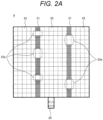
- the object occupied regions 21 are lined up in a straight line on the left and right sides of the own vehicle 20, and there are also a plurality of cells in which the object detection unit 2 has not detected the object on the same straight line (hereinafter, "object unoccupied region 22").
- the linear object occupied regions 21 on the left and right of the own vehicle 20 are specifically structures such as sidewalk curbs, guardrails, guard poles, and fences, and an object unoccupied region 22a on the same straight line corresponds to a place where there are no curbs or fences, such as the entrance of a house.
- the information processing unit 5 When the pre-processing grid map 4 is updated, the information processing unit 5 generates the determination grid map 6a for determining a road surface region 23 on which the own vehicle 20 can travel.
- the determination grid map 6a facilitates the extraction of a closed space (that is, the road surface region 23 to be described later) by smoothing and simplifying the pre-processing grid map 4.
- the determination grid maps 6a illustrated in the drawing is a grid map in which a plurality of object unoccupied regions 22 are continuously aggregated by replacing those satisfying a predetermined condition (object unoccupied region 22a) among the object unoccupied regions 22 in the pre-processing grid map 4 with the object occupied region 21.
- the information processing unit 5 that generates the determination grid map 6a based on the pre-processing grid map 4 will be described in more detail with reference to FIG. 3 .
- the information processing unit 5 includes an object region extraction unit 5a, an object region distance calculation unit 5b, and an adjacent object region complementing unit 5c.
- the object region extraction unit 5a extracts a continuous part of the object occupied region 21 from the pre-processing grid map 4.
- the inter-object region distance calculation unit 5b when there is a plurality of continuous parts of the object occupied region 21, each the distance between the continuous parts (the continuous distance of the object unoccupied region 22 sandwiched between the continuous parts of the object occupied region 21) is calculated.
- both continuous parts are regarded as a continuous object occupied region 21.
- the adjacent object region complementing unit 5c then generates the determination grid map 6a in which the object unoccupied region 22a (for example, a gap of two cells or less) sandwiched between both continuous parts is replaced with the object occupied region 21.
- the reason for replacing the object unoccupied region 22a with a short continuous distance with the object occupied region 21 is that even if there is a gap in a part of the structure such as a fence, if the gap is narrow, the own vehicle 20 cannot pass through, and thus the structure is regarded as being continuous and the determination grid map 6a is used which is complemented to keep the continuity of the object occupied region 21 as much as possible so as to extract the road surface region 23 where the own vehicle 20 travels, which is effective in improving the extraction accuracy of the road surface region 23 and reducing the extraction processing load.
- this distance threshold when replacing the object unoccupied region 22 with the object occupied region 21 is set to a fixed value (two cells) has been described, but this distance threshold may be variable, and the distance threshold may increase as the speed of the own vehicle 20 increases. This is because even if the gap is the same (for example, a gap of three cells (three meters)), the own vehicle 20 can easily pass through at low speed; however, it is difficult to pass through at high speed when the turning radius is large. Thus, it is appropriate to generate the determination grid map 6a using a high-speed distance threshold at high speed.
- the road surface region determination unit 7 determines the road surface region 23, which is a region in which the own vehicle 20 can travel, based on the determination grid map 6a, and generates the automatic driving grid map 6b.
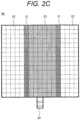
- the automatic driving grid map 6b illustrated in the drawing is a grid map in which, among the object unoccupied regions 22 of the determination grid map 6a of FIG. 2B , those satisfying a predetermined condition are set in the road surface region 23.
- a closed space in front of the own vehicle 20 and surrounded by the object occupied regions 21 in the object unoccupied region 22 of the determination grid map 6a is determined as the road surface region 23 where the own vehicle 20 can travel.
- the control unit 8 plans and controls the traveling state of the own vehicle 20 according to the surrounding environment by using the pre-processing grid map 4 and the automatic driving grid map 6b.
- the road surface region in which the own vehicle travels is extracted by using the determination grid map that has been complemented so as to maintain the continuity of the object occupied region as much as possible. Therefore, it is possible to improve the road surface region determination accuracy and reduce the processing load. Further, it is possible to reduce the communication load for transmitting the road surface region shape to the control unit by optimizing the road surface region shape.
- the determination grid map 6a is generated by using the information processing unit 5 of FIG. 3 .
- the determination grid map 6a is generated using the information processing unit 5 illustrated in FIG. 4 so that the object occupied region 21 not arranged in a straight line can be dealt with.
- the information processing unit 5 of this embodiment includes the object region extraction unit 5a, an object region line segment calculation unit 5d, and an adjacent line segment complementing unit 5e.
- the object region extraction unit 5a extracts a block of the object occupied region 21 from the pre-processing grid map 4.
- the object region line segment calculation unit 5d calculates a representative line segment L from each block when there is a plurality of blocks in the object occupied region 21.
- the adjacent line segment complementing unit 5e complements the line segments using the calculated representative line segment L.
- the complement condition for the line segments is that the line segment distance in the adjacent object occupied regions 21 is equal to or less than a threshold and the angle formed by the adjacent line segments is equal to or less than a threshold.
- 51 indicates a block of object regions
- 52 indicates the representative line segment L.
- the evaluation formula E L of the line segment L is (Expression 1)
- the line segment L that minimizes this evaluation formula E L is the representative line segment of the object region.
- the road surface region where the own vehicle travels is extracted using the determination grid map in which the line segment obtained from the object region is processed so as to be continuous. Therefore, it is possible to improve the road surface region determination accuracy and reduce the processing load.
- the information processing unit 5 processes information
- the information of a high-precision map 9 prepared in advance is used together with the processing of the above-described embodiment.
- the information processing unit 5 of this embodiment acquires map information from the high-precision map 9 regarding the road shape around the own vehicle, and switches the distance threshold between the object occupied regions 21, for determining whether the complementation is performed on the portion where the road boundary on the map is continuous, so as to be longer than usual. That is, even if the distance threshold is set to two cells, the distance threshold is set to four cells or the like in the place where the continuity of the road boundary can be confirmed by the high-precision map 9, and the continuity of the object occupied region 21 is more easily maintained.
- the image pickup device 1 has been used to grasp the surrounding environment of the own vehicle 20.
- the input information from an object detection device 11 using a sensor other than a camera is also stored in the object information storage unit 3 so as to generate the pre-processing grid map 4 with more accuracy.
- a plurality of the object detection devices 11 may be provided, and in that case, different sensors may be used for each.
- the object detection device 11 to be added for example, a millimeter wave radar, a laser radar, a sonar, etc. can be considered. Since these detect an object by a physical phenomenon different from the detection principle by the image pickup device 1, it is possible to realize the object detection more reliably by increasing redundancy in object detection. Further, it is possible to reduce the blind spot in object detection by shifting the mounting position and viewing angle of the object detection device 11 from the image pickup device 1.
- the object position is generally calculated and output directly by internal signal processing.
- the object information storage unit 3 accumulates the object positions output by the object detection device 11 in chronological order to generate the pre-processing grid map 4.
- As a method of accumulating object information it is conceivable to set an independent grid map region for each of an object position based on an image obtained by the image pickup device 1 and an object position detected by one or more object detection devices 11 , individually accumulate information, and perform fusion processing at the time of reference, generally, logical sum of cells occupying the object of the grid map.
- the information from all the detectors may be fused and accumulated in one common grid map.
- the information density of the object information can be increased by the plurality of object information detection units, and the road surface region can be determined with higher accuracy.
Landscapes
- Engineering & Computer Science (AREA)
- Physics & Mathematics (AREA)
- General Physics & Mathematics (AREA)
- Radar, Positioning & Navigation (AREA)
- Remote Sensing (AREA)
- Computer Vision & Pattern Recognition (AREA)
- Theoretical Computer Science (AREA)
- Automation & Control Theory (AREA)
- Human Computer Interaction (AREA)
- Transportation (AREA)
- Mechanical Engineering (AREA)
- Traffic Control Systems (AREA)
- Instructional Devices (AREA)
- Control Of Driving Devices And Active Controlling Of Vehicle (AREA)
- Radar Systems Or Details Thereof (AREA)
- Image Analysis (AREA)
Description
- The present invention relates to an in-vehicle control device that detects an object around an own vehicle and a vehicle traveling around the own vehicle, and controls the traveling of the own vehicle based on a road surface region determined from the detection data.
- Technology to detect an object around an own vehicle and an object traveling around the own vehicle and to estimate the environment around the vehicle is being developed. For example,
PTL 1 discloses a technique in which observation data from a sensor is sampled and a distribution function of the angle representing the degree of dispersion centered on the azimuth angle from the intensity of the data is calculated, so that the distribution state of the reflection caused by the object over a plurality of grids in the occupied grid map is calculated and the state of the surrounding object is estimated with high accuracy. Citation List - PTL 1:
JP 2017-166966 A -
KR 1020170076169 -
US 2013/0266175 A1 discloses a road structure detection and tracking system in which input images are captured and transformed for performing edge analysis across time-consecutive frames. -
JP 2010/160777 A -
JP 2014/142965 A -
JP 2017/0037473 A - In the related art of
PTL 1, the occupied grid map in consideration of affecting the plurality of grids is created according to the degree of the intensity obtained from the observed data, thereby clarifying the contrast between the occupied region and the unoccupied region of the object and more easily estimating the region where the vehicle can travel. However, there is a problem that the clarity in the position information of the detected object, which is the boundary of the region where the vehicle can travel, is lowered because the occupied region of the object is spread due to dispersion. That is, there is a problem that the traveling region of the vehicle must be set in a narrow area, avoiding an uncertain region with low clarity. - The object of the invention is to provide an in-vehicle control device capable of more clearly and easily determining a region in which a vehicle can travel.
- Solution to ProblemThe above object is accomplished by the features of
claim 1. An in-vehicle control device includes the features ofclaim 1, amongst them an object detection unit that detects a position of an object in front of an own vehicle from image information captured by an image pickup device, an object information storage unit that stores a pre-processing grid map in which a position where the object detection unit has detected an object is set as an object occupied region and a position where no object has been detected is as an object unoccupied region, an information processing unit that generates a determination grid map in which a part of the object unoccupied region of the pre-processing grid map is replaced with the object occupied region, and a road surface region determination unit that generates an automatic driving grid map in which a closed space surrounded by the object occupied region of the determination grid map is set as a road surface region.Claim 1 recites further features. - In an in-vehicle control device according to the invention, a road surface region in which an own vehicle travels is extracted by using a determination grid map in which an object occupied region has been complemented. Therefore, it is possible to improve the road surface region determination accuracy and reduce the processing load.
- Objects, configurations, and effects besides the above description will be apparent through the description of the following embodiments.
-
- [
FIG. 1] FIG. 1 is a functional block diagram of an in-vehicle control device according to a first embodiment. - [
FIG. 2A] FIG. 2A is an example of a pre-processing grid map. - [
FIG. 2B] FIG. 2B is an example of a determination grid map. - [
FIG. 2C] FIG. 2C is an example of an automatic driving grid map. - [
FIG. 3] FIG. 3 is a functional block diagram of an information processing unit of the first embodiment. - [
FIG. 4] FIG. 4 is a functional block diagram of the information processing unit of a second embodiment. - [
FIG. 5] FIG. 5 is a conceptual diagram of a representative line segment in an object region related to the grid map of the second embodiment. - [
FIG. 6] FIG. 6 is a functional block diagram of an in-vehicle control device according to a third embodiment. - [
FIG. 7] FIG. 7 is a functional block diagram of an in-vehicle control device according to a fourth embodiment. - [
FIG. 8] FIG. 8 is a functional block diagram of an in-vehicle control device according to a fifth embodiment. - Hereinafter, an in-vehicle control device according to the embodiments of the present invention will be described with reference to the drawings and the like. Although the following description illustrates specific examples of the content of the invention, the invention is not limited to the description. Various changes and modifications can be made, by those skilled in the art, within the scope of the technical idea disclosed herein. In all the drawings for describing the invention, components having the same function are designated by the same reference numeral, and the repeated description thereof may be omitted.
- An in-
vehicle control device 100 according to a first embodiment of the invention will be described with reference toFIGS. 1 to 3 . The in-vehicle control device 100 of this embodiment is called a surrounding environment estimation ECU (Electronic Control Unit) that estimates the road shape around anown vehicle 20 and the surrounding environment such as other vehicles, and provides surrounding environment information (specifically, various grid maps to be described later) necessary for executing automatic driving to a driving control ECU (hereinafter, referred to as the "control unit 8") that controls acceleration, steering, braking, and the like of theown vehicle 20. AlthoughFIG. 1 illustrates a configuration in which the in-vehicle control device 100 (surrounding environment estimation ECU) and the control unit 8 (driving control ECU) are separated, the two may be integrated. -
FIG. 1 is a functional block diagram of the in-vehicle control device 100. As illustrated in the drawing, the in-vehicle control device 100 generates a grid map based on image information captured by animage pickup device 1 and provides the map to the control unit 8 (driving control ECU). The in-vehicle control device 100 is actually a computer including hardware such as an arithmetic device (e.g., a CPU), a main storage device (e.g., a semiconductor memory), an auxiliary storage device (e.g., a hard disk), and a communication device. Then, each function to be described later is performed by the arithmetic device executing a program loaded in the main storage device and, description of such well-known techniques may be omitted, as appropriate, in the following description. - As illustrated in
FIG. 1 , the in-vehicle control device 100 includes anobject detection unit 2, an objectinformation storage unit 3, apre-processing grid map 4, aninformation processing unit 5, adetermination grid map 6a, an automaticdriving grid map 6b, and a road surfaceregion determination unit 7. Of these, theobject detection unit 2, theinformation processing unit 5, and the road surfaceregion determination unit 7 are realized by the above-mentioned arithmetic device executing a predetermined program. Further, the objectinformation storage unit 3 is the auxiliary storage device described above, and grid maps, namely, thepre-processing grid map 4, thedetermination grid map 6a, and the automaticdriving grid map 6b are also stored in this auxiliary storage device. Each of the above components will be described in detail below. - The
object detection unit 2 detects an object position around theown vehicle 20 based on the image information captured by theimage pickup device 1. The objectinformation storage unit 3 stores the position information of the object detected by theobject detection unit 2 in chronological order. The object information stored in the objectinformation storage unit 3 is not limited to the above-mentioned position information, and may include, for example, relative speed information of the object, attribute information such as the color and type of the object, and the like. The objectinformation storage unit 3 generates thepre-processing grid map 4 by updating the information of each cell of the grid map. Although the size of each cell on the grid map may be determined as appropriate, the following description will proceed assuming a cell with a side of one meter. - An example of the
pre-processing grid map 4 will be described with reference toFIG. 2A . Thepre-processing grid map 4 illustrated in the drawing is a grid map showing the environment in front of theown vehicle 20, and the cell in which theobject detection unit 2 has detected the object (hereinafter, "object occupiedregion 21") is colored. In the example ofFIG. 2A , the object occupiedregions 21 are lined up in a straight line on the left and right sides of theown vehicle 20, and there are also a plurality of cells in which theobject detection unit 2 has not detected the object on the same straight line (hereinafter, "objectunoccupied region 22"). The linear object occupiedregions 21 on the left and right of theown vehicle 20 are specifically structures such as sidewalk curbs, guardrails, guard poles, and fences, and an objectunoccupied region 22a on the same straight line corresponds to a place where there are no curbs or fences, such as the entrance of a house. - When the
pre-processing grid map 4 is updated, theinformation processing unit 5 generates thedetermination grid map 6a for determining aroad surface region 23 on which theown vehicle 20 can travel. Thedetermination grid map 6a facilitates the extraction of a closed space (that is, theroad surface region 23 to be described later) by smoothing and simplifying thepre-processing grid map 4. - An example of the
determination grid map 6a will be described with reference toFIG. 2B . Thedetermination grid maps 6a illustrated in the drawing is a grid map in which a plurality of objectunoccupied regions 22 are continuously aggregated by replacing those satisfying a predetermined condition (objectunoccupied region 22a) among the objectunoccupied regions 22 in thepre-processing grid map 4 with the object occupiedregion 21. - Next, the
information processing unit 5 that generates thedetermination grid map 6a based on thepre-processing grid map 4 will be described in more detail with reference toFIG. 3 . As illustrated in the drawing, theinformation processing unit 5 includes an objectregion extraction unit 5a, an object regiondistance calculation unit 5b, and an adjacent objectregion complementing unit 5c. The objectregion extraction unit 5a extracts a continuous part of the object occupiedregion 21 from thepre-processing grid map 4. In the inter-object regiondistance calculation unit 5b, when there is a plurality of continuous parts of the object occupiedregion 21, each the distance between the continuous parts (the continuous distance of the objectunoccupied region 22 sandwiched between the continuous parts of the object occupied region 21) is calculated. In the adjacent objectregion complementing unit 5c, when the distance calculated by the object regiondistance calculation unit 5b is equal to or less than a threshold (for example, two cells or less), both continuous parts are regarded as a continuous object occupiedregion 21. The adjacent objectregion complementing unit 5c then generates thedetermination grid map 6a in which the objectunoccupied region 22a (for example, a gap of two cells or less) sandwiched between both continuous parts is replaced with the object occupiedregion 21. - In this way, the reason for replacing the object
unoccupied region 22a with a short continuous distance with the object occupiedregion 21 is that even if there is a gap in a part of the structure such as a fence, if the gap is narrow, theown vehicle 20 cannot pass through, and thus the structure is regarded as being continuous and thedetermination grid map 6a is used which is complemented to keep the continuity of the object occupiedregion 21 as much as possible so as to extract theroad surface region 23 where theown vehicle 20 travels, which is effective in improving the extraction accuracy of theroad surface region 23 and reducing the extraction processing load. - In the above, an example in which the distance threshold when replacing the object
unoccupied region 22 with the object occupiedregion 21 is set to a fixed value (two cells) has been described, but this distance threshold may be variable, and the distance threshold may increase as the speed of theown vehicle 20 increases. This is because even if the gap is the same (for example, a gap of three cells (three meters)), theown vehicle 20 can easily pass through at low speed; however, it is difficult to pass through at high speed when the turning radius is large. Thus, it is appropriate to generate thedetermination grid map 6a using a high-speed distance threshold at high speed. - When the
determination grid map 6a is generated, the road surfaceregion determination unit 7 determines theroad surface region 23, which is a region in which theown vehicle 20 can travel, based on thedetermination grid map 6a, and generates the automaticdriving grid map 6b. - An example of the automatic
driving grid map 6b will be described with reference toFIG. 2C . The automaticdriving grid map 6b illustrated in the drawing is a grid map in which, among the objectunoccupied regions 22 of thedetermination grid map 6a ofFIG. 2B , those satisfying a predetermined condition are set in theroad surface region 23. In the road surfaceregion determination unit 7 of this embodiment, a closed space in front of theown vehicle 20 and surrounded by the object occupiedregions 21 in the objectunoccupied region 22 of thedetermination grid map 6a is determined as theroad surface region 23 where theown vehicle 20 can travel. - As described above, in the in-
vehicle control device 100 of this embodiment, after thedetermination grid map 6a obtained by simplifying thepre-processing grid map 4 in which the actual object position is recorded is generated, theroad surface region 23 in which theown vehicle 20 can travel is determined based on thisdetermination grid map 6a, and the automaticdriving grid map 6b is generated. Further, thecontrol unit 8 plans and controls the traveling state of theown vehicle 20 according to the surrounding environment by using thepre-processing grid map 4 and the automaticdriving grid map 6b. - As described above, in the in-vehicle control device of this embodiment, the road surface region in which the own vehicle travels is extracted by using the determination grid map that has been complemented so as to maintain the continuity of the object occupied region as much as possible. Therefore, it is possible to improve the road surface region determination accuracy and reduce the processing load. Further, it is possible to reduce the communication load for transmitting the road surface region shape to the control unit by optimizing the road surface region shape.
- Next, the in-
vehicle control device 100 according to a second embodiment of the invention will be described with reference toFIGS. 4 and5 . Description of some points in common with the first embodiment will be omitted. - In the first embodiment, it has been assumed that the object occupied
region 21 is a curb or the like arranged in a straight line, and thedetermination grid map 6a is generated by using theinformation processing unit 5 ofFIG. 3 . However, in the second embodiment, thedetermination grid map 6a is generated using theinformation processing unit 5 illustrated inFIG. 4 so that the object occupiedregion 21 not arranged in a straight line can be dealt with. - As illustrated in
FIG. 4 , theinformation processing unit 5 of this embodiment includes the objectregion extraction unit 5a, an object region linesegment calculation unit 5d, and an adjacent linesegment complementing unit 5e. The objectregion extraction unit 5a extracts a block of the object occupiedregion 21 from thepre-processing grid map 4. The object region linesegment calculation unit 5d calculates a representative line segment L from each block when there is a plurality of blocks in the object occupiedregion 21. The adjacent linesegment complementing unit 5e complements the line segments using the calculated representative line segment L. The complement condition for the line segments is that the line segment distance in the adjacent object occupiedregions 21 is equal to or less than a threshold and the angle formed by the adjacent line segments is equal to or less than a threshold. As a result, complementation is performed not only when the distance between the line segments is short, but also when these line segments, which are the boundary lines of theroad surface region 23, become smooth lines having a certain curvature or less. These thresholds may also be changed according to the own vehicle speed for the same reason as in the first embodiment. - Here, an example of a method of obtaining the representative line segment L from a block of object regions xi (i = 1 to N) composed of N cells by the object region line
segment calculation unit 5d will be described usingFIG. 5 . In the drawing, 51 indicates a block of object regions, and 52 indicates the representative line segment L. Assuming that the function representing the distance between the line segment L and the cell xi of the object region is d(L, xi), the evaluation formula EL of the line segment L is (Expression 1), and the line segment L that minimizes this evaluation formula EL is the representative line segment of the object region.
[Math. 1]
- As described above, in the in-vehicle control device of this embodiment, even in a situation where the cells in the object occupied region are not arranged in a straight line, the road surface region where the own vehicle travels is extracted using the determination grid map in which the line segment obtained from the object region is processed so as to be continuous. Therefore, it is possible to improve the road surface region determination accuracy and reduce the processing load.
- Next, the in-
vehicle control device 100 according to the third embodiment of the invention will be described with reference toFIG. 6 .
Description of some points in common with the above-described embodiment will be omitted. - In this embodiment, when the
information processing unit 5 processes information, the information of a high-precision map 9 prepared in advance is used together with the processing of the above-described embodiment. - With the progress of automatic driving technology in recent years, an environment in which high-precision maps can be easily used is being established, such as the commercialization of precise maps related to road shapes. Therefore, the
information processing unit 5 of this embodiment acquires map information from the high-precision map 9 regarding the road shape around the own vehicle, and switches the distance threshold between the object occupiedregions 21, for determining whether the complementation is performed on the portion where the road boundary on the map is continuous, so as to be longer than usual. That is, even if the distance threshold is set to two cells, the distance threshold is set to four cells or the like in the place where the continuity of the road boundary can be confirmed by the high-precision map 9, and the continuity of the object occupiedregion 21 is more easily maintained. - As a result, even when the
object detection unit 2 fails to detect an object and the obtained object region information is unclear, a desired complementary processing is performed by using the high-precision map 9 together, and an appropriatedetermination grid map 6a can be obtained. - Next, the in-
vehicle control device 100 according to a fourth embodiment of the invention will be described with reference toFIG. 7 . Description of some points in common with the above-described embodiment will be omitted. - In this embodiment, when the
information processing unit 5 processes information, white line information of the road extracted from the image information captured by theimage pickup device 1 is used together with the processing of the above-described embodiment. Then, in order to realize this, a whiteline extraction unit 10 is provided in the in-vehicle control device 100. - Due to the high performance of information processing devices in recent years, it has become relatively easy to obtain information on the shape of white lines of the road by image processing. Therefore, when the information on the road shape around the own vehicle is acquired from the shape and position of the white line of the road, and the continuity of the traveling zone on the road can be confirmed, the distance threshold is switched to be longer than usual.
- As a result, even when the
object detection unit 2 fails to detect an object and the obtained object region information is unclear, a desired complementary processing is performed by using the white line information together, and the continuity of the object occupiedregion 21 is easily maintained. In addition to the white line, complementation may be performed in the same manner as the method described above by extracting features and edges on the image such as curbs, guardrails, guard poles, and fences. - Next, the in-
vehicle control device 100 according to a fifth embodiment of the invention will be described with reference toFIG. 8 . Description of some points in common with the above-described embodiment will be omitted. - In the above embodiment, only the
image pickup device 1 has been used to grasp the surrounding environment of theown vehicle 20. However, in this embodiment, in addition to theimage pickup device 1, the input information from an object detection device 11 using a sensor other than a camera is also stored in the objectinformation storage unit 3 so as to generate thepre-processing grid map 4 with more accuracy. A plurality of the object detection devices 11 may be provided, and in that case, different sensors may be used for each. - As the object detection device 11 to be added, for example, a millimeter wave radar, a laser radar, a sonar, etc. can be considered. Since these detect an object by a physical phenomenon different from the detection principle by the
image pickup device 1, it is possible to realize the object detection more reliably by increasing redundancy in object detection. Further, it is possible to reduce the blind spot in object detection by shifting the mounting position and viewing angle of the object detection device 11 from theimage pickup device 1. - In such an object detection device 11, the object position is generally calculated and output directly by internal signal processing. The object
information storage unit 3 accumulates the object positions output by the object detection device 11 in chronological order to generate thepre-processing grid map 4. As a method of accumulating object information, it is conceivable to set an independent grid map region for each of an object position based on an image obtained by theimage pickup device 1 and an object position detected by one or more object detection devices 11, individually accumulate information, and perform fusion processing at the time of reference, generally, logical sum of cells occupying the object of the grid map. However, when acquiring the object information, the information from all the detectors may be fused and accumulated in one common grid map. Regardless of the method of accumulating the object information, the information density of the object information can be increased by the plurality of object information detection units, and the road surface region can be determined with higher accuracy. -
- 1
- image pickup device
- 2
- object detection unit
- 3
- object information storage unit
- 4
- pre-processing grid map
- 5
- information processing unit
- 5a
- object region extraction unit
- 5b
- object region distance calculation unit
- 5c
- adjacent object region complementing unit
- 5d
- object region line segment calculation unit
- 5e
- adjacent line segment complementing unit
- 6a
- determination grid map
- 6b
- automatic driving grid map
- 7
- road surface region determination unit
- 8
- control unit
- 20
- own vehicle
- 21
- object occupied region
- 22, 22a
- object unoccupied region
- 23
- road surface region
Claims (4)
- An in-vehicle control device, comprising:an object detection unit (2) configured to detect a position of an object in front of an own vehicle from image information captured by an image pickup device (1);an object information storage unit (3) configured to store a pre-processing grid map (4) in which a position where the object detection unit (2) has detected an object is set as an object occupied region and a position where no object has been detected is as an object unoccupied region;an information processing unit (5) configured to generate a determination grid map (6a) in which a part of the object unoccupied region of the pre-processing grid map (4) is replaced with the object occupied region; anda road surface region determination unit (7) configured to generate an automatic driving grid map (6b) in which a closed space surrounded by the object occupied region of the determination grid map (6a) is set as a road surface region,wherein the information processing unit (5) includesan object region extraction unit (5a) configured to extract a continuous part of the object occupied region from the pre-processing grid map (4),an object region distance calculation unit (5b) configured to calculate, when there is a plurality of the continuous parts, a distance between the continuous parts, andan adjacent object region complementing unit configured to generate, when the calculated distance is equal to or less than a threshold, the determination grid map (6a) in which the object unoccupied region sandwiched between both continuous parts is replaced with the object occupied region,and/or the information processing unit (5) includesan object region extraction unit (5a) configured to extract a block of object occupied regions from the pre-processing grid map (4),an object region line segment calculation unit (5d) configured to calculate a representative line segment of each block when a plurality of the blocks exist, andan adjacent line segment interpolation means configured to generate, when a distance between the calculated representative line segments is equal to or less than a threshold and an angle formed by the calculated representative line segments is equal to or less than a threshold, the determination grid map (6a) in which the object unoccupied region between both representative line segments is replaced with the object occupied region.
- The in-vehicle control device according to claim 1, wherein the information processing unit is configured to determine whether the replacement is necessary, additionally using a high-precision map created in advance.
- The in-vehicle control device according to claim 1, wherein the information processing unit is configured to determine whether the replacement is necessary, additionally using white line information extracted from image information captured by the image pickup device.
- The in-vehicle control device according to any one of claims 1 to 3, wherein, in the pre-processing grid map (4) stored in the object information storage unit, a position of an object detected by an object detection device other than the image pickup device installed in the own vehicle is also registered as the object occupied region.
Applications Claiming Priority (2)
| Application Number | Priority Date | Filing Date | Title |
|---|---|---|---|
| JP2018209810A JP7136663B2 (en) | 2018-11-07 | 2018-11-07 | In-vehicle control device |
| PCT/JP2019/041448 WO2020095673A1 (en) | 2018-11-07 | 2019-10-23 | Vehicle-mounted control device |
Publications (3)
| Publication Number | Publication Date |
|---|---|
| EP3852081A1 EP3852081A1 (en) | 2021-07-21 |
| EP3852081A4 EP3852081A4 (en) | 2022-10-19 |
| EP3852081B1 true EP3852081B1 (en) | 2025-05-21 |
Family
ID=70611334
Family Applications (1)
| Application Number | Title | Priority Date | Filing Date |
|---|---|---|---|
| EP19882588.7A Active EP3852081B1 (en) | 2018-11-07 | 2019-10-23 | Vehicle-mounted control device |
Country Status (4)
| Country | Link |
|---|---|
| US (1) | US12195032B2 (en) |
| EP (1) | EP3852081B1 (en) |
| JP (1) | JP7136663B2 (en) |
| WO (1) | WO2020095673A1 (en) |
Families Citing this family (4)
| Publication number | Priority date | Publication date | Assignee | Title |
|---|---|---|---|---|
| WO2022049924A1 (en) * | 2020-09-07 | 2022-03-10 | 住友電気工業株式会社 | Vehicle-mounted device, information distribution device, driving assistance system, control method, and computer program |
| DE102020211649A1 (en) * | 2020-09-17 | 2022-03-17 | Conti Temic Microelectronic Gmbh | Method and system for creating a road model |
| KR20240060224A (en) * | 2022-10-28 | 2024-05-08 | 현대자동차주식회사 | Autonomous driving control apparatus and method for generating route thereof |
| JPWO2025074495A1 (en) * | 2023-10-03 | 2025-04-10 |
Family Cites Families (16)
| Publication number | Priority date | Publication date | Assignee | Title |
|---|---|---|---|---|
| JP5531474B2 (en) * | 2008-12-12 | 2014-06-25 | 株式会社豊田中央研究所 | Map generation device, runway estimation device, movable region estimation device, and program |
| JP5007840B2 (en) * | 2009-05-22 | 2012-08-22 | トヨタ自動車株式会社 | Driving assistance device |
| CN102667888B (en) | 2009-11-27 | 2014-12-31 | 丰田自动车株式会社 | Drive assistance device and drive assistance method |
| DE102012204441A1 (en) * | 2011-03-21 | 2012-09-27 | Denso Corporation | Method and device for detecting a course of a road for vehicles |
| JP5348180B2 (en) * | 2011-05-30 | 2013-11-20 | トヨタ自動車株式会社 | Driving assistance device |
| US8750567B2 (en) | 2012-04-09 | 2014-06-10 | GM Global Technology Operations LLC | Road structure detection and tracking |
| DE102012107885A1 (en) | 2012-08-27 | 2014-02-27 | Continental Teves Ag & Co. Ohg | Method for determining a lane course for a vehicle |
| JP5831585B2 (en) * | 2014-04-24 | 2015-12-09 | トヨタ自動車株式会社 | Driving support device and driving support method |
| JP6160634B2 (en) * | 2015-02-09 | 2017-07-12 | トヨタ自動車株式会社 | Traveling road surface detection device and traveling road surface detection method |
| JP6222785B2 (en) * | 2015-08-10 | 2017-11-01 | 株式会社Subaru | Steering support device |
| KR101847838B1 (en) * | 2015-12-24 | 2018-04-11 | 현대자동차주식회사 | Road boundary detection system and method, and vehicle using the same |
| JP6239664B2 (en) | 2016-03-16 | 2017-11-29 | 株式会社デンソーアイティーラボラトリ | Ambient environment estimation apparatus and ambient environment estimation method |
| EP3432264A4 (en) * | 2016-03-17 | 2019-07-10 | Ricoh Company, Ltd. | IMAGE PROCESSING DEVICE, IMAGE CAPTURE DEVICE, MOBILE BODY DEVICE CONTROL SYSTEM, IMAGE PROCESSING METHOD, AND PROGRAM |
| JP6665925B2 (en) * | 2016-03-18 | 2020-03-13 | 株式会社リコー | Image processing apparatus, mobile equipment control system, image processing program, and image processing method |
| US10369994B2 (en) * | 2016-07-20 | 2019-08-06 | Ford Global Technologies, Llc | Rear camera stub detection |
| CN111108342B (en) * | 2016-12-30 | 2023-08-15 | 辉达公司 | Visual range method and pair alignment for high definition map creation |
-
2018
- 2018-11-07 JP JP2018209810A patent/JP7136663B2/en active Active
-
2019
- 2019-10-23 US US17/286,783 patent/US12195032B2/en active Active
- 2019-10-23 EP EP19882588.7A patent/EP3852081B1/en active Active
- 2019-10-23 WO PCT/JP2019/041448 patent/WO2020095673A1/en not_active Ceased
Also Published As
| Publication number | Publication date |
|---|---|
| WO2020095673A1 (en) | 2020-05-14 |
| US20210339765A1 (en) | 2021-11-04 |
| EP3852081A4 (en) | 2022-10-19 |
| JP7136663B2 (en) | 2022-09-13 |
| US12195032B2 (en) | 2025-01-14 |
| EP3852081A1 (en) | 2021-07-21 |
| JP2020077180A (en) | 2020-05-21 |
Similar Documents
| Publication | Publication Date | Title |
|---|---|---|
| US10832061B2 (en) | Traveling road boundary estimation apparatus and traveling assistance system using same | |
| EP3852081B1 (en) | Vehicle-mounted control device | |
| EP3647728B1 (en) | Map information system | |
| EP3905106A1 (en) | Method for determining a drivable area | |
| EP2767927B1 (en) | Road surface information detection apparatus, vehicle device control system employing road surface information detection apparatus, and carrier medium of road surface information detection program | |
| US10776634B2 (en) | Method for determining the course of the road for a motor vehicle | |
| US7542835B2 (en) | Vehicle image processing device | |
| US7327855B1 (en) | Vision-based highway overhead structure detection system | |
| US20200183401A1 (en) | Pass route planning method and apparatus, device and readable storage medium | |
| EP3905105A1 (en) | Method for determining a collision free space | |
| US20190162837A1 (en) | Object recognition device | |
| KR20220136679A (en) | Apparatus and method for controlling driving of vehicle | |
| CN107480592B (en) | Multi-lane detection method and tracking method | |
| Linfeng et al. | One estimation method of road slope and vehicle distance | |
| JP7344744B2 (en) | Roadside edge detection method and roadside edge detection device | |
| EP3888987B1 (en) | Lane selection method for vehicle when self-driving, selection system, and vehicle | |
| JP4003586B2 (en) | Inter-vehicle distance measuring device | |
| JP7850795B2 (en) | Information processing device, control method, program, and storage medium | |
| Yang et al. | Autonomous mining transportation systems: Integrating 4d mmwave radar for enhanced detection of obstructed static objects | |
| JP7647818B1 (en) | Information processing device and information processing method | |
| JP6890726B1 (en) | In-vehicle device, information processing method and information processing program | |
| CN118587244B (en) | Vehicle track prediction method, device, electronic equipment and storage medium | |
| JP4304260B2 (en) | Vehicle distance measurement method | |
| CN120766247A (en) | Obstacle sensing method and device, tunnel entrance passage method | |
| CN121671617A (en) | A method, apparatus, device, and storage medium for detecting static obstacles. |
Legal Events
| Date | Code | Title | Description |
|---|---|---|---|
| STAA | Information on the status of an ep patent application or granted ep patent |
Free format text: STATUS: THE INTERNATIONAL PUBLICATION HAS BEEN MADE |
|
| PUAI | Public reference made under article 153(3) epc to a published international application that has entered the european phase |
Free format text: ORIGINAL CODE: 0009012 |
|
| STAA | Information on the status of an ep patent application or granted ep patent |
Free format text: STATUS: REQUEST FOR EXAMINATION WAS MADE |
|
| 17P | Request for examination filed |
Effective date: 20210414 |
|
| AK | Designated contracting states |
Kind code of ref document: A1 Designated state(s): AL AT BE BG CH CY CZ DE DK EE ES FI FR GB GR HR HU IE IS IT LI LT LU LV MC MK MT NL NO PL PT RO RS SE SI SK SM TR |
|
| DAV | Request for validation of the european patent (deleted) | ||
| DAX | Request for extension of the european patent (deleted) | ||
| REG | Reference to a national code |
Ref legal event code: R079 Ipc: G06T0007110000 Ref country code: DE Ref legal event code: R079 Ref document number: 602019070378 Country of ref document: DE Free format text: PREVIOUS MAIN CLASS: G08G0001160000 Ipc: G06T0007110000 |
|
| A4 | Supplementary search report drawn up and despatched |
Effective date: 20220919 |
|
| RIC1 | Information provided on ipc code assigned before grant |
Ipc: G08G 1/16 20060101ALI20220913BHEP Ipc: G01S 15/931 20200101ALI20220913BHEP Ipc: G01S 13/931 20200101ALI20220913BHEP Ipc: G06T 7/13 20170101ALI20220913BHEP Ipc: G06T 7/11 20170101AFI20220913BHEP Ipc: G01S 13/86 20060101ALI20220913BHEP |
|
| GRAP | Despatch of communication of intention to grant a patent |
Free format text: ORIGINAL CODE: EPIDOSNIGR1 |
|
| STAA | Information on the status of an ep patent application or granted ep patent |
Free format text: STATUS: GRANT OF PATENT IS INTENDED |
|
| INTG | Intention to grant announced |
Effective date: 20250120 |
|
| GRAS | Grant fee paid |
Free format text: ORIGINAL CODE: EPIDOSNIGR3 |
|
| GRAA | (expected) grant |
Free format text: ORIGINAL CODE: 0009210 |
|
| STAA | Information on the status of an ep patent application or granted ep patent |
Free format text: STATUS: THE PATENT HAS BEEN GRANTED |
|
| AK | Designated contracting states |
Kind code of ref document: B1 Designated state(s): AL AT BE BG CH CY CZ DE DK EE ES FI FR GB GR HR HU IE IS IT LI LT LU LV MC MK MT NL NO PL PT RO RS SE SI SK SM TR |
|
| REG | Reference to a national code |
Ref country code: GB Ref legal event code: FG4D |
|
| REG | Reference to a national code |
Ref country code: CH Ref legal event code: EP |
|
| REG | Reference to a national code |
Ref country code: DE Ref legal event code: R096 Ref document number: 602019070378 Country of ref document: DE |
|
| REG | Reference to a national code |
Ref country code: IE Ref legal event code: FG4D |
|
| REG | Reference to a national code |
Ref country code: NL Ref legal event code: MP Effective date: 20250521 |
|
| PG25 | Lapsed in a contracting state [announced via postgrant information from national office to epo] |
Ref country code: FI Free format text: LAPSE BECAUSE OF FAILURE TO SUBMIT A TRANSLATION OF THE DESCRIPTION OR TO PAY THE FEE WITHIN THE PRESCRIBED TIME-LIMIT Effective date: 20250521 Ref country code: ES Free format text: LAPSE BECAUSE OF FAILURE TO SUBMIT A TRANSLATION OF THE DESCRIPTION OR TO PAY THE FEE WITHIN THE PRESCRIBED TIME-LIMIT Effective date: 20250521 Ref country code: PT Free format text: LAPSE BECAUSE OF FAILURE TO SUBMIT A TRANSLATION OF THE DESCRIPTION OR TO PAY THE FEE WITHIN THE PRESCRIBED TIME-LIMIT Effective date: 20250922 |
|
| REG | Reference to a national code |
Ref country code: LT Ref legal event code: MG9D |
|
| PG25 | Lapsed in a contracting state [announced via postgrant information from national office to epo] |
Ref country code: GR Free format text: LAPSE BECAUSE OF FAILURE TO SUBMIT A TRANSLATION OF THE DESCRIPTION OR TO PAY THE FEE WITHIN THE PRESCRIBED TIME-LIMIT Effective date: 20250822 Ref country code: NO Free format text: LAPSE BECAUSE OF FAILURE TO SUBMIT A TRANSLATION OF THE DESCRIPTION OR TO PAY THE FEE WITHIN THE PRESCRIBED TIME-LIMIT Effective date: 20250821 |
|
| PG25 | Lapsed in a contracting state [announced via postgrant information from national office to epo] |
Ref country code: PL Free format text: LAPSE BECAUSE OF FAILURE TO SUBMIT A TRANSLATION OF THE DESCRIPTION OR TO PAY THE FEE WITHIN THE PRESCRIBED TIME-LIMIT Effective date: 20250521 Ref country code: NL Free format text: LAPSE BECAUSE OF FAILURE TO SUBMIT A TRANSLATION OF THE DESCRIPTION OR TO PAY THE FEE WITHIN THE PRESCRIBED TIME-LIMIT Effective date: 20250521 |
|
| PG25 | Lapsed in a contracting state [announced via postgrant information from national office to epo] |
Ref country code: BG Free format text: LAPSE BECAUSE OF FAILURE TO SUBMIT A TRANSLATION OF THE DESCRIPTION OR TO PAY THE FEE WITHIN THE PRESCRIBED TIME-LIMIT Effective date: 20250521 |
|
| PG25 | Lapsed in a contracting state [announced via postgrant information from national office to epo] |
Ref country code: HR Free format text: LAPSE BECAUSE OF FAILURE TO SUBMIT A TRANSLATION OF THE DESCRIPTION OR TO PAY THE FEE WITHIN THE PRESCRIBED TIME-LIMIT Effective date: 20250521 |
|
| PG25 | Lapsed in a contracting state [announced via postgrant information from national office to epo] |
Ref country code: RS Free format text: LAPSE BECAUSE OF FAILURE TO SUBMIT A TRANSLATION OF THE DESCRIPTION OR TO PAY THE FEE WITHIN THE PRESCRIBED TIME-LIMIT Effective date: 20250821 |
|
| PG25 | Lapsed in a contracting state [announced via postgrant information from national office to epo] |
Ref country code: IS Free format text: LAPSE BECAUSE OF FAILURE TO SUBMIT A TRANSLATION OF THE DESCRIPTION OR TO PAY THE FEE WITHIN THE PRESCRIBED TIME-LIMIT Effective date: 20250921 |
|
| PG25 | Lapsed in a contracting state [announced via postgrant information from national office to epo] |
Ref country code: LV Free format text: LAPSE BECAUSE OF FAILURE TO SUBMIT A TRANSLATION OF THE DESCRIPTION OR TO PAY THE FEE WITHIN THE PRESCRIBED TIME-LIMIT Effective date: 20250521 |
|
| REG | Reference to a national code |
Ref country code: AT Ref legal event code: MK05 Ref document number: 1797447 Country of ref document: AT Kind code of ref document: T Effective date: 20250521 |
|
| PG25 | Lapsed in a contracting state [announced via postgrant information from national office to epo] |
Ref country code: AT Free format text: LAPSE BECAUSE OF FAILURE TO SUBMIT A TRANSLATION OF THE DESCRIPTION OR TO PAY THE FEE WITHIN THE PRESCRIBED TIME-LIMIT Effective date: 20250521 Ref country code: SM Free format text: LAPSE BECAUSE OF FAILURE TO SUBMIT A TRANSLATION OF THE DESCRIPTION OR TO PAY THE FEE WITHIN THE PRESCRIBED TIME-LIMIT Effective date: 20250521 Ref country code: DK Free format text: LAPSE BECAUSE OF FAILURE TO SUBMIT A TRANSLATION OF THE DESCRIPTION OR TO PAY THE FEE WITHIN THE PRESCRIBED TIME-LIMIT Effective date: 20250521 |
|
| PG25 | Lapsed in a contracting state [announced via postgrant information from national office to epo] |
Ref country code: CZ Free format text: LAPSE BECAUSE OF FAILURE TO SUBMIT A TRANSLATION OF THE DESCRIPTION OR TO PAY THE FEE WITHIN THE PRESCRIBED TIME-LIMIT Effective date: 20250521 |
|
| PG25 | Lapsed in a contracting state [announced via postgrant information from national office to epo] |
Ref country code: EE Free format text: LAPSE BECAUSE OF FAILURE TO SUBMIT A TRANSLATION OF THE DESCRIPTION OR TO PAY THE FEE WITHIN THE PRESCRIBED TIME-LIMIT Effective date: 20250521 |
|
| PG25 | Lapsed in a contracting state [announced via postgrant information from national office to epo] |
Ref country code: RO Free format text: LAPSE BECAUSE OF FAILURE TO SUBMIT A TRANSLATION OF THE DESCRIPTION OR TO PAY THE FEE WITHIN THE PRESCRIBED TIME-LIMIT Effective date: 20250521 Ref country code: SK Free format text: LAPSE BECAUSE OF FAILURE TO SUBMIT A TRANSLATION OF THE DESCRIPTION OR TO PAY THE FEE WITHIN THE PRESCRIBED TIME-LIMIT Effective date: 20250521 |
|
| PG25 | Lapsed in a contracting state [announced via postgrant information from national office to epo] |
Ref country code: IT Free format text: LAPSE BECAUSE OF FAILURE TO SUBMIT A TRANSLATION OF THE DESCRIPTION OR TO PAY THE FEE WITHIN THE PRESCRIBED TIME-LIMIT Effective date: 20250521 |
|
| REG | Reference to a national code |
Ref country code: DE Ref legal event code: R097 Ref document number: 602019070378 Country of ref document: DE |
|
| PLBE | No opposition filed within time limit |
Free format text: ORIGINAL CODE: 0009261 |
|
| STAA | Information on the status of an ep patent application or granted ep patent |
Free format text: STATUS: NO OPPOSITION FILED WITHIN TIME LIMIT |
|
| REG | Reference to a national code |
Ref country code: CH Ref legal event code: L10 Free format text: ST27 STATUS EVENT CODE: U-0-0-L10-L00 (AS PROVIDED BY THE NATIONAL OFFICE) Effective date: 20260402 |
|
| PGFP | Annual fee paid to national office [announced via postgrant information from national office to epo] |
Ref country code: DE Payment date: 20251229 Year of fee payment: 7 |
|
| 26N | No opposition filed |
Effective date: 20260224 |