EP3851992A1 - Printer, communication method, encryption method, and computer-readable recording medium - Google Patents
Printer, communication method, encryption method, and computer-readable recording medium Download PDFInfo
- Publication number
- EP3851992A1 EP3851992A1 EP19861009.9A EP19861009A EP3851992A1 EP 3851992 A1 EP3851992 A1 EP 3851992A1 EP 19861009 A EP19861009 A EP 19861009A EP 3851992 A1 EP3851992 A1 EP 3851992A1
- Authority
- EP
- European Patent Office
- Prior art keywords
- printer
- data
- encryption
- unit configured
- command
- Prior art date
- Legal status (The legal status is an assumption and is not a legal conclusion. Google has not performed a legal analysis and makes no representation as to the accuracy of the status listed.)
- Granted
Links
Images




Classifications
-
- G—PHYSICS
- G06—COMPUTING OR CALCULATING; COUNTING
- G06F—ELECTRIC DIGITAL DATA PROCESSING
- G06F21/00—Security arrangements for protecting computers, components thereof, programs or data against unauthorised activity
- G06F21/60—Protecting data
- G06F21/606—Protecting data by securing the transmission between two devices or processes
- G06F21/608—Secure printing
-
- B—PERFORMING OPERATIONS; TRANSPORTING
- B41—PRINTING; LINING MACHINES; TYPEWRITERS; STAMPS
- B41J—TYPEWRITERS; SELECTIVE PRINTING MECHANISMS, i.e. MECHANISMS PRINTING OTHERWISE THAN FROM A FORME; CORRECTION OF TYPOGRAPHICAL ERRORS
- B41J29/00—Details of, or accessories for, typewriters or selective printing mechanisms not otherwise provided for
- B41J29/38—Drives, motors, controls or automatic cut-off devices for the entire printing mechanism
-
- B—PERFORMING OPERATIONS; TRANSPORTING
- B41—PRINTING; LINING MACHINES; TYPEWRITERS; STAMPS
- B41J—TYPEWRITERS; SELECTIVE PRINTING MECHANISMS, i.e. MECHANISMS PRINTING OTHERWISE THAN FROM A FORME; CORRECTION OF TYPOGRAPHICAL ERRORS
- B41J3/00—Typewriters or selective printing or marking mechanisms characterised by the purpose for which they are constructed
- B41J3/407—Typewriters or selective printing or marking mechanisms characterised by the purpose for which they are constructed for marking on special material
- B41J3/4075—Tape printers; Label printers
-
- G—PHYSICS
- G06—COMPUTING OR CALCULATING; COUNTING
- G06F—ELECTRIC DIGITAL DATA PROCESSING
- G06F21/00—Security arrangements for protecting computers, components thereof, programs or data against unauthorised activity
- G06F21/30—Authentication, i.e. establishing the identity or authorisation of security principals
- G06F21/44—Program or device authentication
-
- G—PHYSICS
- G06—COMPUTING OR CALCULATING; COUNTING
- G06F—ELECTRIC DIGITAL DATA PROCESSING
- G06F3/00—Input arrangements for transferring data to be processed into a form capable of being handled by the computer; Output arrangements for transferring data from processing unit to output unit, e.g. interface arrangements
- G06F3/12—Digital output to print unit, e.g. line printer, chain printer
- G06F3/1201—Dedicated interfaces to print systems
- G06F3/1202—Dedicated interfaces to print systems specifically adapted to achieve a particular effect
- G06F3/1222—Increasing security of the print job
-
- G—PHYSICS
- G06—COMPUTING OR CALCULATING; COUNTING
- G06F—ELECTRIC DIGITAL DATA PROCESSING
- G06F3/00—Input arrangements for transferring data to be processed into a form capable of being handled by the computer; Output arrangements for transferring data from processing unit to output unit, e.g. interface arrangements
- G06F3/12—Digital output to print unit, e.g. line printer, chain printer
- G06F3/1201—Dedicated interfaces to print systems
- G06F3/1223—Dedicated interfaces to print systems specifically adapted to use a particular technique
- G06F3/1237—Print job management
- G06F3/1238—Secure printing, e.g. user identification, user rights for device usage, unallowed content, blanking portions or fields of a page, releasing held jobs
-
- G—PHYSICS
- G06—COMPUTING OR CALCULATING; COUNTING
- G06F—ELECTRIC DIGITAL DATA PROCESSING
- G06F3/00—Input arrangements for transferring data to be processed into a form capable of being handled by the computer; Output arrangements for transferring data from processing unit to output unit, e.g. interface arrangements
- G06F3/12—Digital output to print unit, e.g. line printer, chain printer
- G06F3/1201—Dedicated interfaces to print systems
- G06F3/1278—Dedicated interfaces to print systems specifically adapted to adopt a particular infrastructure
- G06F3/1285—Remote printer device, e.g. being remote from client or server
- G06F3/1288—Remote printer device, e.g. being remote from client or server in client-server-printer device configuration
-
- H—ELECTRICITY
- H04—ELECTRIC COMMUNICATION TECHNIQUE
- H04L—TRANSMISSION OF DIGITAL INFORMATION, e.g. TELEGRAPHIC COMMUNICATION
- H04L9/00—Cryptographic mechanisms or cryptographic arrangements for secret or secure communications; Network security protocols
- H04L9/08—Key distribution or management, e.g. generation, sharing or updating, of cryptographic keys or passwords
- H04L9/0861—Generation of secret information including derivation or calculation of cryptographic keys or passwords
-
- H—ELECTRICITY
- H04—ELECTRIC COMMUNICATION TECHNIQUE
- H04L—TRANSMISSION OF DIGITAL INFORMATION, e.g. TELEGRAPHIC COMMUNICATION
- H04L9/00—Cryptographic mechanisms or cryptographic arrangements for secret or secure communications; Network security protocols
- H04L9/08—Key distribution or management, e.g. generation, sharing or updating, of cryptographic keys or passwords
- H04L9/0861—Generation of secret information including derivation or calculation of cryptographic keys or passwords
- H04L9/0869—Generation of secret information including derivation or calculation of cryptographic keys or passwords involving random numbers or seeds
-
- H—ELECTRICITY
- H04—ELECTRIC COMMUNICATION TECHNIQUE
- H04L—TRANSMISSION OF DIGITAL INFORMATION, e.g. TELEGRAPHIC COMMUNICATION
- H04L9/00—Cryptographic mechanisms or cryptographic arrangements for secret or secure communications; Network security protocols
- H04L9/32—Cryptographic mechanisms or cryptographic arrangements for secret or secure communications; Network security protocols including means for verifying the identity or authority of a user of the system or for message authentication, e.g. authorization, entity authentication, data integrity or data verification, non-repudiation, key authentication or verification of credentials
- H04L9/3226—Cryptographic mechanisms or cryptographic arrangements for secret or secure communications; Network security protocols including means for verifying the identity or authority of a user of the system or for message authentication, e.g. authorization, entity authentication, data integrity or data verification, non-repudiation, key authentication or verification of credentials using a predetermined code, e.g. password, passphrase or PIN
- H04L9/3228—One-time or temporary data, i.e. information which is sent for every authentication or authorization, e.g. one-time-password, one-time-token or one-time-key
-
- H—ELECTRICITY
- H04—ELECTRIC COMMUNICATION TECHNIQUE
- H04L—TRANSMISSION OF DIGITAL INFORMATION, e.g. TELEGRAPHIC COMMUNICATION
- H04L9/00—Cryptographic mechanisms or cryptographic arrangements for secret or secure communications; Network security protocols
- H04L9/32—Cryptographic mechanisms or cryptographic arrangements for secret or secure communications; Network security protocols including means for verifying the identity or authority of a user of the system or for message authentication, e.g. authorization, entity authentication, data integrity or data verification, non-repudiation, key authentication or verification of credentials
- H04L9/3263—Cryptographic mechanisms or cryptographic arrangements for secret or secure communications; Network security protocols including means for verifying the identity or authority of a user of the system or for message authentication, e.g. authorization, entity authentication, data integrity or data verification, non-repudiation, key authentication or verification of credentials involving certificates, e.g. public key certificate [PKC] or attribute certificate [AC]; Public key infrastructure [PKI] arrangements
-
- H—ELECTRICITY
- H04—ELECTRIC COMMUNICATION TECHNIQUE
- H04L—TRANSMISSION OF DIGITAL INFORMATION, e.g. TELEGRAPHIC COMMUNICATION
- H04L9/00—Cryptographic mechanisms or cryptographic arrangements for secret or secure communications; Network security protocols
- H04L9/32—Cryptographic mechanisms or cryptographic arrangements for secret or secure communications; Network security protocols including means for verifying the identity or authority of a user of the system or for message authentication, e.g. authorization, entity authentication, data integrity or data verification, non-repudiation, key authentication or verification of credentials
- H04L9/3263—Cryptographic mechanisms or cryptographic arrangements for secret or secure communications; Network security protocols including means for verifying the identity or authority of a user of the system or for message authentication, e.g. authorization, entity authentication, data integrity or data verification, non-repudiation, key authentication or verification of credentials involving certificates, e.g. public key certificate [PKC] or attribute certificate [AC]; Public key infrastructure [PKI] arrangements
- H04L9/3268—Cryptographic mechanisms or cryptographic arrangements for secret or secure communications; Network security protocols including means for verifying the identity or authority of a user of the system or for message authentication, e.g. authorization, entity authentication, data integrity or data verification, non-repudiation, key authentication or verification of credentials involving certificates, e.g. public key certificate [PKC] or attribute certificate [AC]; Public key infrastructure [PKI] arrangements using certificate validation, registration, distribution or revocation, e.g. certificate revocation list [CRL]
-
- G—PHYSICS
- G06—COMPUTING OR CALCULATING; COUNTING
- G06F—ELECTRIC DIGITAL DATA PROCESSING
- G06F21/00—Security arrangements for protecting computers, components thereof, programs or data against unauthorised activity
- G06F21/30—Authentication, i.e. establishing the identity or authorisation of security principals
- G06F21/31—User authentication
- G06F21/34—User authentication involving the use of external additional devices, e.g. dongles or smart cards
-
- H—ELECTRICITY
- H04—ELECTRIC COMMUNICATION TECHNIQUE
- H04L—TRANSMISSION OF DIGITAL INFORMATION, e.g. TELEGRAPHIC COMMUNICATION
- H04L63/00—Network architectures or network communication protocols for network security
- H04L63/08—Network architectures or network communication protocols for network security for authentication of entities
- H04L63/0853—Network architectures or network communication protocols for network security for authentication of entities using an additional device, e.g. smartcard, SIM or a different communication terminal
-
- H—ELECTRICITY
- H04—ELECTRIC COMMUNICATION TECHNIQUE
- H04N—PICTORIAL COMMUNICATION, e.g. TELEVISION
- H04N1/00—Scanning, transmission or reproduction of documents or the like, e.g. facsimile transmission; Details thereof
- H04N1/00127—Connection or combination of a still picture apparatus with another apparatus, e.g. for storage, processing or transmission of still picture signals or of information associated with a still picture
- H04N1/00204—Connection or combination of a still picture apparatus with another apparatus, e.g. for storage, processing or transmission of still picture signals or of information associated with a still picture with a digital computer or a digital computer system, e.g. an internet server
- H04N1/00209—Transmitting or receiving image data, e.g. facsimile data, via a computer, e.g. using e-mail, a computer network, the internet, I-fax
Definitions
- a present disclosure relates to a printer, a communication method, an encryption method and a computer-readable recording medium.
- Japanese laid-open patent publication 2002-259108 discloses a print system in which a printer has a public key certificate and the corresponding private key, and printer authentication is performed based on the public key certificate in response to a request from a document server or a user client.
- data required for encrypted communication such as a public key certificate and a private key
- data required for encrypted communication can be downloaded to a printer via network.
- the print system disclosed in the Japanese laid-open patent publication 2002-259108 records a public key certificate and a private key in a memory as they are, and hence vulnerable against external unauthorized access.
- the present invention generally aims to enhance printer security.
- an embodiment of the present invention aims to be able to securely download, via network, data required for encrypted communication to a printer.
- Another embodiment of the present invention aims to enhance printer security when the printer performs printing based on communication with an external apparatus.
- An embodiment according to the present invention is a printer capable of communicating with an external apparatus.
- the printer includes: a processing unit configured to executing one of commands to perform corresponding processing with regard to the printer; a disabling unit configured to disable a first command among the commands, the first command to acquire data from the external apparatus; a determining unit configured to determine whether an authentication result is successful based on predetermined code information; and an enabling unit configured to enable the first command for a period of time, when the authentication result has been successful.
- Another embodiment according to the present invention is a printer that encrypts encryption target data to be encrypted.
- the printer includes: a key generating unit configured to generate an encryption key based on random data or data associated with the printer; an encrypting unit configured to encrypt the encryption target data, with the encryption key generated by the key generating unit, to generate encryption data; and an embedding unit configured to embed the encryption data generated by the encrypting unit, in a file resident in the printer.
- printer security can be enhanced.
- data required for encrypted communication can be securely downloaded via network to a printer.
- printer security can be enhanced when the printer performs printing based on communication with an external apparatus.
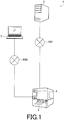
- FIG. 1 is a general system configuration of the print system 1 according to the present embodiment.
- the print system 1 includes a printer 2, a server 3, and an information processing apparatus 5.
- the printer 2 and the server 3 can communicate with each other via a network NW1.
- the printer 2 and the information processing apparatus 5 can communicate with each other via a network NW2.
- the printer 2 is connected to a router (not shown) with a cable, and communicates with the server 3 or the information processing apparatus 5 via the router. It is to be noted that the printer 2 may be connected to the router (not shown) wirelessly.
- the printer 2 may be a label printer, for example.
- the server 3 is configured to determine a print content to be printed by the printer 2 on a label, and transmit print data indicative of the print content, to the printer 2.
- the printer 2 is configured to print based on the print data received from the server 3.
- Encrypted communication in compliance with Transport Layer Security (TLS) 1.2, etc. is applied to communication between the printer 2 and the server 3.
- TLS Transport Layer Security
- the printer 2 stores a server certificate and an encryption key. With the server certificate, the printer 2 functions as a socket server in the communication in compliance with TLS 1.2.
- the printer 2 stores the certificate files encrypted. An encryption method and a storing method for the certificate files will be described specifically later.
- the certificate files may be preferably updated timely in order to enhance security.
- the certificate files in the printer 2 may be updated by downloading the files from the information processing apparatus 5 to the printer 2. It is shown as an example in FIG. 1 that the network NW1 between the printer 2 and the server 3, and the network NW2 between the printer 2 and the information processing apparatus 5, are different; however, this is not always the case.
- the printer 2, the server 3, and the information processing apparatus 5 may be connected to a common network.
- the printer 2 when the printer 2 is connected to the network NW1 and the network NW2, it is configured that the printer 2 may be equipped with two LAN cards, or that the printer 2 may not be connected to the server 3 and the information processing apparatus 5 concurrently.
- a router (not shown) may be installed for accessing the printer 2 from the outside.
- An arrangement is required to enable secure download of the certificate files in the printer 2, such that a malicious third party is unable to steal or rewrite the certificate files. Such arrangement will be described later.
- FIG. 2 is a block diagram of the print system 1 according to the present embodiment.
- the printer 2 includes a controller 21, a storage 22, an operational input unit 23, a display unit 24, a motor drive unit 25, a head drive unit 26, a cutter drive unit 27, and a communication unit 28.
- a strip-shaped continuous paper is stored in the printer 2 by winding the continuous label body into a paper roll.
- the printer 2 draws the continuous paper from the paper roll, prints on the continuous paper, and then cuts the continuous paper in predetermined length to issue a label.
- the printer 2 may cut a continuous label body, which includes an adhesive layer on a back face thereof, in predetermined length to issue a label (i.e. linerless label).
- the printer 2 may cut a continuous label body, which includes a plurality of labels is temporarily attached to on a mount, by a single label, to issue a label.
- the controller 21 mainly includes a microcontroller and memories (namely, a random access memory (RAM) and a central processing unit (CPU), a read-only memory (ROM), and a random access memory (RAM).
- RAM random access memory
- CPU central processing unit
- ROM read-only memory
- RAM random access memory
- the CPU of the controller 21 loads and executes a variety of programs stored in the ROM, to control each part of the printer 2.
- the variety of programs includes a firmware.
- the RAM functions as a work area for the CPU and temporarily stores a variety of data.
- the controller 21 executes a variety of processing in order to perform communication with the server 3 in compliance with a communication protocol such as TLS1.2, in collaboration with the communication unit 28.
- the CPU executes the programs, and thus, the controller 21 functions in the present embodiment as a processing unit, a disabling unit, a determining unit, an enabling unit, a generating unit, and an authentication result acquiring unit, which will be specifically described below.
- the controller 21 functions as a processing unit configured to executing a command to perform the corresponding processing with regard to the printer 2. For example, when acquiring a command with regard to the printer 2 from an external apparatus, the controller 21 performs processing for setting change of the printer 2, or processing for controlling a status, an operation, or the like of the printer 2, in response to the command that have been acquired.
- the controller 21 functions as a disabling unit configured to disable a command to acquire data from the information processing apparatus 5 for example (exemplary first command), among commands to execute predetermined processing with regard to the printer 2.
- a command to acquire data from the information processing apparatus 5 for example exemplary first command
- the disabled command(s) include one to acquire (i.e. download) data from an external apparatus.
- the controller 21 functions as a determining unit configured to determine whether an authentication result is successful based on predetermined code information.
- the controller 21 functions as an enabling unit configured to enable the command to acquire data from an external apparatus such as the information processing apparatus 5. That is, the control command to download data from an external apparatus to the printer 2 is disabled when the printer 2 is activated, and that the control command is then enabled for a period of time, only if the authentication result has been successful based on the predetermined code information.
- the controller 21 is allowed to download, from the information processing apparatus 5, a server certificate and a private key for update.
- a one-time password (exemplary code information) for example may be used for authentication to enable the control command to download data to the printer 2.
- the controller 21 of the printer 2 functions as a generating unit configured to generate a one-time password in accordance with a predetermined method.
- Authentication by use of a one-time password is performed by an authentication server (which will be described later).
- the controller 21 acquires, via the communication unit 28, an authentication result by the authentication server. That is, the controller 21 functions as an authentication result acquiring unit configured to acquire the authentication result with regard to the one-time password.
- the CPU executes the programs, and thus, the controller 21 functions in the present embodiment as a key generating unit, an encrypting unit, an embedding unit, a decrypting unit, and a deleting unit.
- the controller 21 exerts these units, when encrypting the server certificate and the private key downloaded from the information processing apparatus 5, or when decrypting the server certificate and the private key immediately after activated. Each unit will be specifically described below.
- the controller 21 functions as a key generating unit configured to generate an encryption key based on random data and data associated with the printer 2 (such as unique data to the printer 2 ).
- Random data may be preferably stored in an embedded state in a resident file in the printer 2.
- the resident file is a file which is not considered to be deleted from the printer 2, such as a system file, a font file, a file used by a resident application program, or the like. Embedding the random data in the resident file is performed to prevent an encrypted server certificate and an encrypted private file from being easily decrypted, when there is an unauthorized access to the printer 2 from the third party.
- the controller 21 functions as an encrypting unit configured to encrypt the server certificate and the private file, with the encryption key generated by the key generating unit, to generate the encrypted server certificate and the encrypted private file.
- the encrypted server certificate and the encrypted private file are an example of the encryption data.
- the controller 21 functions as an embedding unit configured to embed the encrypted server certificate and the encrypted private file, in a resident file in the printer 2. Embedding the server certificate and the private file in the resident file is performed to prevent the server certificate and the private file from being stolen, when there is an unauthorized access to the printer 2 from the third party.
- the printer 2 when activated, decrypts the server certificate and the private file for performing encrypted communication with the server 3.
- the controller 21 functions as a decrypting unit configured to extract the random data from the resident file, and then decrypt the encrypted server certificate and the encrypted private file, with the random data.
- the controller 21 functions as a deleting unit configured to delete the unencrypted server certificate and the unencrypted private file, after the encrypted server certificate and the encrypted private file have been generated.
- the storage 22 is a storage device such as a solid state drive (SSD).
- SSD solid state drive
- the storage 22 stores the resident file and print format data, etc.
- the print format data is required in printing based on print data.
- the operational input unit 23 includes an input device such as buttons and switches, which are operated by a user.
- the display unit 24 includes a display drive circuit for displaying data on a display panel. Such data may be inputted by the operational input unit 23.
- the display panel may preferably include a touch-panel input circuit, for example, for receiving an operational input through a touch-panel.
- the motor drive unit 25 drives a motor that controls rotation of a platen roller (not shown) to feed the continuous paper.
- a feed amount and a feed direction are based on an instruction from the controller 21.
- the controller 21 When receiving encrypted print data from the server 3, the controller 21 decrypts the print data. The controller 21 then generates graphic data to be printed on a label, and sequentially transmits line data to the head drive unit 26. The line data corresponds to each line of the graphic data.
- the head drive unit 26 causes current to selectively flow through each heating element of a thermal head (not shown) based on the line data.
- the heating element(s) heated by the current flow are pushed by the platen roller to the fed continuous paper, and then color is developed at a portion of the continuous paper to which the heating element(s) are pushed, thereby printing information on the continuous paper.
- the cutter drive unit 27 drives a cutter (not shown) to cut a printed portion of the continuous paper, under a control of the controller 21. A label, which is obtained by cutting the paper, is sequentially ejected.
- the communication unit 28 is an interface for communication with the server 3.
- the communication unit 28 may perform encrypted communication with the server 3 in accordance with TLS 1.2 for example.
- the server 3 includes a controller 31, a storage 32, and a communication unit 33.
- the controller 31 includes a microcontroller as a main component to control operations of the server 3.
- the controller 31 executes a variety of processing to perform communication with the printer 2 in compliance with a communication protocol such as TLS 1.2, in collaboration with the communication unit 33.
- the storage 32 may be a large-sized storage device such as a hard disk drive (HDD) to store a variety of print data.
- the controller 31 generates print data or acquire print data from an external apparatus to store the print data in the storage 32.
- the controller 31 When establishing a session in the communication with the printer 2, the controller 31 reads out print data from the storage 32, and transmits the print data to the printer 2. At this time, the controller 31 encrypts the print data by use of a session key (a common key), which is determined with the printer 2, and then transmits the print data to the printer 2.
- a session key a common key
- the communication unit 33 is an interface for communication with the printer 2.
- the communication unit 33 may perform encrypted communication with the printer 2 in accordance with TLS 1.2 for example.
- the information processing apparatus 5 includes a controller 51, a storage 52, an operational input unit 53, a display unit 54, and a communication unit 55.
- the controller 51 includes a microcontroller as a main component to control operations of the information processing apparatus 5.
- the storage 52 may be a storage device such as a SSD to store a server certificate of the printer 2, which has been acquired from a certificate authority, and a private key.
- the controller 51 transmits a control command to the printer 2 via the communication unit 55 before transmitting the server certificate and the private key.
- the controller 51 reads out the server certificate and the private key from the storage 52.
- the communication unit 55 is an interface for communication with the printer 2.
- FIG. 3 is a sequence chart indicating the behavior of the print system 1 according to the present embodiment when the printer 2 performs printing.
- the printer 2 when activated (step S2), the printer 2 decrypts certificate files (i.e. a server certificate and a private key) in preparation for communication with the server 3 (step S4).
- certificate files i.e. a server certificate and a private key
- the encrypted server certificate and the encrypted private key are included in a resident file of the printer 2.
- random data is included in a resident file of the printer 2. The random data is used to generate encryption data with which the server certificate and the private key are decrypted.
- the controller 21 of the printer 2 extracts the random data from the resident file, and generates encryption data based on the random data or data associated with the printer 2 (such as unique data to the printer 2 ).
- the controller 21 of the printer 2 then extracts the encrypted server certificate and the encrypted private key from the resident file, and decrypt them with the encryption data that has been generated.
- Step S6 is performed for authentication between the communication partners and determination of an algorithm.
- the algorithm is for executing encryption and a hash function.
- the negotiation process in compliance with TLS 1.2 is standardized by Internet Engineer Task Force (IETF), and may generally include the following steps.
- step S8 encryption of print data by the server 3 (step S8) and decryption of the received print data by the printer 2 (steps S10, S12) are performed by use of the common key (the session key) shared in the negotiation process.
- the printer 2 performs printing based on the decrypted print data (step S14).
- Steps S8 to S14 are repeatedly performed in response to a print request from the server 3.
- FIG. 4 is a sequence chart indicating a behavior of the print system 1 according to the present embodiment when the printer 2 updates a server certificate and a private key.
- FIG. 4 indicates a process that the printer 2 downloads a server certificate and a private key for update from the information processing apparatus 5, and encrypts the server certificate and the private key.
- the process of FIG. 4 is performed based on an update instruction by a user.
- an authorization server 7 performs authorization based on a one-time password transmitted from the printer 2.
- the printer 2 disables a control command to acquire data from an external apparatus, when activated.
- the printer 2 then enables the control command to acquire data from an external apparatus for a period of time, only if particular authentication has been successful. This enables secure download of the server certificate and the private key from the information processing apparatus 5.
- the particular authentication corresponds to authentication processing by use of a one-time password.
- a user of the printer 2 generates a one-time password by use of a hardware token (generally referred to also as "dongle").
- the printer 2 receives an input of the one-time password based on an operational input to the operational input unit 23 by the user (step S21).
- a software token may be also used to generate a one-time password.
- the software token is a software having the same function as a hardware token.
- the software token can be executed in a mobile terminal or on a web browser.
- the printer 2 transmits the one-time password, which have been inputted, to the authorization server 7 (step S22).
- the authorization server 7 executes authorization processing based on the one-time password received from the printer 2 (step S23).
- the particular authorization method based on the one-time password at step S23 is not a limiting example.
- a variety of authorization methods may be applied as an authentication method.
- a hardware token when a time-synchronized one-time password is applied, a hardware token generates a one-time password based on time when an operation is performed, in accordance with an algorithm.
- a hardware token uses a plurality of passwords sequentially generated by a mathematical algorithm.
- An authorization server also performs authentication processing by sequentially using a plurality of passwords generated by the same mathematical algorithm as that used for the hardware token. In the same manner, it is determined that authorization is OK when the both one-time passwords match; it is determined that authorization is not OK when the both one-time passwords do not match.
- challenge-response one-time passwords may be applied for an authorization method.
- the authorization server 7 transmits an authorization result (OK or Not OK) based on the on-time password, to the printer 2 (step S24). If the authorization result, which has been received at step S24, is not OK (step S28: NO), then the printer 2 does nothing. Consequently, the printer 2 is unable to download data from the information processing apparatus 5, even when receiving a control command to acquire data from the information processing apparatus 5 (referred to hereinafter as "DL command" as appropriate) afterwards.
- the DL command is an example of a first command.
- step S30 If the authorization result, which has been received at step S24, is OK (step S28: YES), then the printer 2 enables the DL command for a period of time (step S30).
- the printer 2 When the information processing apparatus 5 for example transmits a DL command to the printer 2 during the period of time (step S32), the printer 2 is able to download a server certificate and a private key from the information processing apparatus 5 (step S33).
- the printer 2 transmits an ACK message to the information processing apparatus 5 (step S34).
- the printer 2 When having received the server certificate and the private key without an error, the printer 2 encrypts the server certificate and the private key so that an unauthorized third party will not access them.
- the encryption of the server certificate and the private key may include: processing of generating an encryption key required for the encryption (step S40); and processing of encrypting the server certificate and the private key with the encryption key that have been generated (step S50).
- Steps S40 and S50 are performed by the controller 21 of the printer 2.
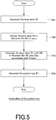
- FIG. 5 is a flowchart for the printer 2 of the present embodiment to generate an encryption key used to encrypt the server certificate and the private key.
- FIG. 6 schematically shows a process for the printer 2 of the present embodiment to generate the encryption key used to encrypt the server certificate and the private key.
- FIG. 6 includes signs of steps corresponding to those in FIG. 5 .
- the controller 21 of the printer 2 generates random data D0 (step S41).
- the random data D0 is generated every time the server certificate and the private key are updated.
- the controller 21 then embeds the generated random data D0 in a resident file R0 for data camouflage (step S42).
- the resident file R0 may be a system file, a font file, or a file used in a resident application program, etc.
- the controller 21 records the resident file R0 including the random data D0 in the storage 22 so that it can decrypt afterwards the server certificate and the private key.
- the random data D0 is saved embedded in the resident file R0, thereby reducing possibility that the random data D0 is leaked to the outside, even if an unauthorized third party tries to access the printer 2.
- the controller 21 generates random data D1 based on: the random data D0 included in the resident file R0; and data associated with the printer 2 (such as unique data to the printer 2 ) (step S43).
- the data associated with the printer 2 is preferably unique one allocated to the printer 2. Nevertheless, the data associated with the printer 2 may be any data, as long as there is a low probability that the data is commonly allocated to different printers.
- An example of the former data may be identification information for identifying the printer 2, such as a serial number, a manufacturing number, or the like.
- An example of the latter data may be a manufacturing lot number, an order number, an inventory management number, or the like.
- the controller 21 then performs calculation based on a hash function with regard to the random data D1 to generate an encryption key K1 (step S44).
- FIG. 7 is a flowchart for the printer 2 of the present embodiment to encrypt the server certificate and the private key.
- FIG. 8 schematically shows a process for the printer 2 of the present embodiment to encrypt the server certificate and the private key.
- FIG. 8 includes signs of steps corresponding to those in FIG. 7 .
- the controller 21 of the printer 2 encrypts the server certificate and the private key, which have been received from the information processing apparatus 5, with the encryption key K1 generated at step S44 (step S51).
- the encryption method may be, but not limited to, Advanced Encryption Standard (AES) 256, for example.
- AES Advanced Encryption Standard
- a key length may not be 256 bits.
- the encrypted server certificate and the encrypted private key correspond to encrypted data E1 and encrypted data E2 respectively.
- the controller 21 then embeds the encrypted data E1 , E2 in resident files R1 , R2 of the printer 2 respectively (step S52).
- One of the resident files R1 , R2 may be identical to the resident file R0, in which the random D0 has been embedded in the process of generating the encryption key K1 (see step S42 in FIG. 5 ).
- the resident files R1 , R2 may be preferably different from the resident file R0 in order to prevent data embedded in these resident files from being leaked concurrently.
- the controller 21 deletes the server certificate and the private key that have not been encrypted, to make sure that they are not stolen by the third party (step S53).
- the printer 2 enables, for a period of time, a control command to acquire data from the information processing apparatus 5, only if an authentication result has been successful.
- the printer 2 is able to securely download a new server certificate and a new private key from the information processing apparatus 5.
- the printer 2 may generate an encryption key for encrypting a server certificate and a private key, based on data associated with the printer 2.
- the printer 2 may generate an encryption key for encrypting a server certificate and a private key, based on data associated with the printer 2.
- Random data for generating the encryption key, the encrypted server certificate, and the encrypted private key are embedded in resident files of the printer 2 for data camouflage.
- a malicious third party accesses the printer 2, it is difficult for him or her to find the random data, or the encrypted server certificate and the encrypted private key in the printer 2.
- Update of the certificate files may be actively performed based on an operational input of a user to the printer 2. This method of updating the certificate files will be described with reference to FIG. 9.
- FIG. 9 is a view explaining another method when the printer 2 updates the server certificate and the private key.
- FIG. 9 shows transition of a displayed screen on the display unit 24 of the printer 2.
- a screen G1 shows selections of a plurality of items relating to communication provided at the printer 2.
- a user selects the item "Certificate" on the screen G1.
- a screen G2 Upon selection of the item "Certificate” on the screen G1, a screen G2 is displayed.
- the screens G2 and G3 are ones for setting a FTP server from which the certificate is acquired.
- the screen G2 is displayed again by selecting the item "FTP Server from which Certificate is acquired” on the screen G2, inputting an IP address of the FTP server on the screen G3, and then operating an "OK” button.
- a screen G4 is displayed.
- the screen G4 includes an item IM1 displayed as "Update Certificate” and an item IM2 displayed as “Delete Certificate.”
- the controller 21 of the printer 2 transmits, via the communication unit 28, an update request message to the FTP server which is set on the screen G3, and receives certificate files from the FTP server. After having received the certificate files, the controller 21 executes steps S40, S50, as shown in FIG. 4 .
- the certificate files can be updated actively based on an operational input by a user to the printer 2.
- the controller 21 of the printer 2 deletes encrypted certificate files.
- the controller 21 extracts an encrypted server certificate and an encrypted private key from resident files embedded therein, and then deletes the server certificate and the private key. That is, the controller 21 functions as a second deleting unit configured to delete the server certificate and the private key based on an operational input.
- the server certificate and the private key are prevented from being leaked after encrypted communication is no longer necessary.
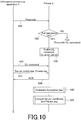
- FIG. 10 is a sequence chart indicating a behavior of the print system according to a modified example when the printer 2 updates the server certificate and the private key.
- the information processing apparatus 5 transmits a passcode (exemplary code information) to the printer 2.
- the printer 2 performs authentication of the passcode.
- the passcode transmitted from the information processing apparatus 5 to the printer 2 may be any code with which the printer 2 is able to authenticate.
- the passcode may be one that is set at provisioning of the printer 2.
- the controller 21 functions as a code information acquiring unit configured to acquire a passcode as code information from the information processing apparatus 5.
- Step S26 When the passcode received at step S26 matches a preset passcode, the controller 21 of the printer 2 determines that authorization is OK. When the passcode received at step S26 does not match a preset passcode, the controller 21 of the printer 2 determines that authorization is not OK (step S28). Step S30 and steps thereafter are same as FIG. 4 .
- the present modified example is the same as the aforementioned embodiment in that, only when predetermined authorization has been successful, a control command to acquire data from the information processing apparatus 5 is enabled for a period of time.
- a server certificate and a private key can be downloaded securely.
- the printer 2 acquires code information, as a basis for authorization, from an originating apparatus of the server certificate and the private key, until the printer 2 performs authorization.
- the printer 2 is able to determine whether the control command is enabled or disabled for each originating apparatus, even during the period of time.
- a communication port of the printer 2 may be able to be set as enabled or disabled by software.
- the controller 21 of the printer 2 may function as a setting unit configured to enable or disable the communication port based on an operational input.
- each communication port can be independently set as enabled or disabled. At least a part of the plurality of communication ports is set as disabled, depending on usage conditions of a user. Thereby, it becomes possible to increase likelihood that access to the printer 2 from a malicious third party is blocked.
- An operation on the screen G1 of FIG. 9 may be able to perform setting of the communication port as enable or disable. For example, by selecting an item "Data port" on the screen G1, the communication port can be set as enable or disable.
- the print data which has been received from the server 3 and stored in the storage 22, and the graphic data generated based on the print data, are preferably deleted after completion of printing, thereby further enhancing security for printing.
- data acquired by the printer from the external apparatus acquire target data
- encryption target data are a server certificate and a private key; however, this is not always the case.
- Acquisition target data and encryption target data can be any data.
- the server 3 may include the functions of the information processing apparatus 5.
Landscapes
- Engineering & Computer Science (AREA)
- Computer Security & Cryptography (AREA)
- Theoretical Computer Science (AREA)
- General Engineering & Computer Science (AREA)
- General Physics & Mathematics (AREA)
- Physics & Mathematics (AREA)
- Human Computer Interaction (AREA)
- Computer Networks & Wireless Communication (AREA)
- Signal Processing (AREA)
- Computer Hardware Design (AREA)
- Software Systems (AREA)
- Health & Medical Sciences (AREA)
- Bioethics (AREA)
- General Health & Medical Sciences (AREA)
- Accessory Devices And Overall Control Thereof (AREA)
Abstract
Description
- A present disclosure relates to a printer, a communication method, an encryption method and a computer-readable recording medium.
- Conventionally, it has been known encrypted communication between a client terminal, which requests to performs printing, and a printer, in order to enhance security with regard to printing performed by the printer. For instance,
Japanese laid-open patent publication 2002-259108 - Incidentally, it is preferable in conventional systems that data required for encrypted communication, such as a public key certificate and a private key, be updated timely to maintain communication security. Here, it is demanded in light of convenience that data required for encrypted communication can be downloaded to a printer via network.
- In the other perspective, the print system disclosed in the
Japanese laid-open patent publication 2002-259108 - In view of the above, the present invention generally aims to enhance printer security.
- More specifically, an embodiment of the present invention aims to be able to securely download, via network, data required for encrypted communication to a printer. Another embodiment of the present invention aims to enhance printer security when the printer performs printing based on communication with an external apparatus.
- An embodiment according to the present invention is a printer capable of communicating with an external apparatus. The printer includes: a processing unit configured to executing one of commands to perform corresponding processing with regard to the printer; a disabling unit configured to disable a first command among the commands, the first command to acquire data from the external apparatus; a determining unit configured to determine whether an authentication result is successful based on predetermined code information; and an enabling unit configured to enable the first command for a period of time, when the authentication result has been successful.
- Another embodiment according to the present invention is a printer that encrypts encryption target data to be encrypted. The printer includes: a key generating unit configured to generate an encryption key based on random data or data associated with the printer; an encrypting unit configured to encrypt the encryption target data, with the encryption key generated by the key generating unit, to generate encryption data; and an embedding unit configured to embed the encryption data generated by the encrypting unit, in a file resident in the printer.
- According to the present invention, printer security can be enhanced.
- More specifically, according to an embodiment of the present invention, data required for encrypted communication can be securely downloaded via network to a printer. According to another embodiment of the present invention, printer security can be enhanced when the printer performs printing based on communication with an external apparatus.
-
-
FIG. 1 shows a general system configuration of a print system according to an embodiment; -
FIG. 2 shows a block diagram of the print system according to the embodiment; -
FIG. 3 is a sequence chart indicating a behavior of the print system according to the embodiment when a printer performs printing; -
FIG. 4 is a sequence chart indicating a behavior of the print system according to the embodiment when a printer updates a server certificate and a private key; -
FIG. 5 is a flowchart for the printer to generate an encryption key used to encrypt the server certificate and the private key; -
FIG. 6 schematically shows a process for the printer to generate the encryption key used to encrypt the server certificate and the private key; -
FIG. 7 is a flowchart for the printer to encrypt the server certificate and the private key; -
FIG. 8 schematically shows a process for the printer to encrypt the server certificate and the private key; -
FIG. 9 is a view explaining another method when a printer according to a modified example updates the server certificate and the private key; and -
FIG. 10 is a sequence chart indicating a behavior of the print system according to a modified example when the printer updates the server certificate and the private key. - The
print system 1 according to the present embodiment will be described below with reference toFIG. 1. FIG. 1 is a general system configuration of theprint system 1 according to the present embodiment. - As illustrated in
FIG. 1 , theprint system 1 according to the present embodiment includes aprinter 2, aserver 3, and aninformation processing apparatus 5. Theprinter 2 and theserver 3 can communicate with each other via a network NW1. Theprinter 2 and theinformation processing apparatus 5 can communicate with each other via a network NW2. Theprinter 2 is connected to a router (not shown) with a cable, and communicates with theserver 3 or theinformation processing apparatus 5 via the router. It is to be noted that theprinter 2 may be connected to the router (not shown) wirelessly. - The
printer 2 may be a label printer, for example. Theserver 3 is configured to determine a print content to be printed by theprinter 2 on a label, and transmit print data indicative of the print content, to theprinter 2. Theprinter 2 is configured to print based on the print data received from theserver 3. Encrypted communication in compliance with Transport Layer Security (TLS) 1.2, etc. is applied to communication between theprinter 2 and theserver 3. In order to realize the communication in compliance with TLS 1.2, theprinter 2 stores a server certificate and an encryption key. With the server certificate, theprinter 2 functions as a socket server in the communication in compliance with TLS 1.2. - If the server certificate and the encryption key (collectively referred to hereinafter as "certificate files") were stored unencrypted in the
printer 2, a malicious third party could steal the certificate files and get unauthorized access to theserver 3 with the certificate files. Thus, in theprint system 1 according to the present embodiment, theprinter 2 stores the certificate files encrypted. An encryption method and a storing method for the certificate files will be described specifically later. - The certificate files may be preferably updated timely in order to enhance security. In an embodiment, the certificate files in the
printer 2 may be updated by downloading the files from theinformation processing apparatus 5 to theprinter 2. It is shown as an example inFIG. 1 that the network NW1 between theprinter 2 and theserver 3, and the network NW2 between theprinter 2 and theinformation processing apparatus 5, are different; however, this is not always the case. Theprinter 2, theserver 3, and theinformation processing apparatus 5 may be connected to a common network. - As illustrated in
FIG. 1 , when theprinter 2 is connected to the network NW1 and the network NW2, it is configured that theprinter 2 may be equipped with two LAN cards, or that theprinter 2 may not be connected to theserver 3 and theinformation processing apparatus 5 concurrently. When theprinter 2 is connected to theserver 3 and theinformation processing apparatus 5 concurrently, a router (not shown) may be installed for accessing theprinter 2 from the outside. - An arrangement is required to enable secure download of the certificate files in the
printer 2, such that a malicious third party is unable to steal or rewrite the certificate files. Such arrangement will be described later. - Next, an internal structure of the
print system 1 of the present embodiment will be described with reference toFIG. 2. FIG. 2 is a block diagram of theprint system 1 according to the present embodiment. - As shown in
FIG. 2 , theprinter 2 includes acontroller 21, astorage 22, anoperational input unit 23, adisplay unit 24, amotor drive unit 25, ahead drive unit 26, acutter drive unit 27, and acommunication unit 28. A strip-shaped continuous paper is stored in theprinter 2 by winding the continuous label body into a paper roll. Theprinter 2 draws the continuous paper from the paper roll, prints on the continuous paper, and then cuts the continuous paper in predetermined length to issue a label. Alternatively, theprinter 2 may cut a continuous label body, which includes an adhesive layer on a back face thereof, in predetermined length to issue a label (i.e. linerless label). Theprinter 2 may cut a continuous label body, which includes a plurality of labels is temporarily attached to on a mount, by a single label, to issue a label. - The
controller 21 mainly includes a microcontroller and memories (namely, a random access memory (RAM) and a central processing unit (CPU), a read-only memory (ROM), and a random access memory (RAM). When theprinter 2 is activated, the CPU of thecontroller 21 loads and executes a variety of programs stored in the ROM, to control each part of theprinter 2. The variety of programs includes a firmware. The RAM functions as a work area for the CPU and temporarily stores a variety of data. Thecontroller 21 executes a variety of processing in order to perform communication with theserver 3 in compliance with a communication protocol such as TLS1.2, in collaboration with thecommunication unit 28. - The CPU executes the programs, and thus, the
controller 21 functions in the present embodiment as a processing unit, a disabling unit, a determining unit, an enabling unit, a generating unit, and an authentication result acquiring unit, which will be specifically described below. - The
controller 21 functions as a processing unit configured to executing a command to perform the corresponding processing with regard to theprinter 2. For example, when acquiring a command with regard to theprinter 2 from an external apparatus, thecontroller 21 performs processing for setting change of theprinter 2, or processing for controlling a status, an operation, or the like of theprinter 2, in response to the command that have been acquired. - The
controller 21 functions as a disabling unit configured to disable a command to acquire data from theinformation processing apparatus 5 for example (exemplary first command), among commands to execute predetermined processing with regard to theprinter 2. In theprinter 2 according to the present embodiment, when theprinter 2 is activated, at least one or more control command(s) are disabled among control commands to control operations of theprinter 2 from an external apparatus, for the sake of safety. The disabled command(s) include one to acquire (i.e. download) data from an external apparatus. - The
controller 21 functions as a determining unit configured to determine whether an authentication result is successful based on predetermined code information. When the determining unit determines that the authentication result has been successful, thecontroller 21 functions as an enabling unit configured to enable the command to acquire data from an external apparatus such as theinformation processing apparatus 5. That is, the control command to download data from an external apparatus to theprinter 2 is disabled when theprinter 2 is activated, and that the control command is then enabled for a period of time, only if the authentication result has been successful based on the predetermined code information. During the period of time, thecontroller 21 is allowed to download, from theinformation processing apparatus 5, a server certificate and a private key for update. - As will be described, a one-time password (exemplary code information) for example may be used for authentication to enable the control command to download data to the
printer 2. In this case, thecontroller 21 of theprinter 2 functions as a generating unit configured to generate a one-time password in accordance with a predetermined method. - Authentication by use of a one-time password is performed by an authentication server (which will be described later). The
controller 21 acquires, via thecommunication unit 28, an authentication result by the authentication server. That is, thecontroller 21 functions as an authentication result acquiring unit configured to acquire the authentication result with regard to the one-time password. - The CPU executes the programs, and thus, the
controller 21 functions in the present embodiment as a key generating unit, an encrypting unit, an embedding unit, a decrypting unit, and a deleting unit. Thecontroller 21 exerts these units, when encrypting the server certificate and the private key downloaded from theinformation processing apparatus 5, or when decrypting the server certificate and the private key immediately after activated. Each unit will be specifically described below. - The
controller 21 functions as a key generating unit configured to generate an encryption key based on random data and data associated with the printer 2 (such as unique data to the printer 2). Random data may be preferably stored in an embedded state in a resident file in theprinter 2. The resident file is a file which is not considered to be deleted from theprinter 2, such as a system file, a font file, a file used by a resident application program, or the like. Embedding the random data in the resident file is performed to prevent an encrypted server certificate and an encrypted private file from being easily decrypted, when there is an unauthorized access to theprinter 2 from the third party. - The
controller 21 functions as an encrypting unit configured to encrypt the server certificate and the private file, with the encryption key generated by the key generating unit, to generate the encrypted server certificate and the encrypted private file. The encrypted server certificate and the encrypted private file are an example of the encryption data. - The
controller 21 functions as an embedding unit configured to embed the encrypted server certificate and the encrypted private file, in a resident file in theprinter 2. Embedding the server certificate and the private file in the resident file is performed to prevent the server certificate and the private file from being stolen, when there is an unauthorized access to theprinter 2 from the third party. - In the present embodiment, when activated, the
printer 2 decrypts the server certificate and the private file for performing encrypted communication with theserver 3. At this time, thecontroller 21 functions as a decrypting unit configured to extract the random data from the resident file, and then decrypt the encrypted server certificate and the encrypted private file, with the random data. - The
controller 21 functions as a deleting unit configured to delete the unencrypted server certificate and the unencrypted private file, after the encrypted server certificate and the encrypted private file have been generated. - The
storage 22 is a storage device such as a solid state drive (SSD). Thestorage 22 stores the resident file and print format data, etc. The print format data is required in printing based on print data. - The
operational input unit 23 includes an input device such as buttons and switches, which are operated by a user. Thedisplay unit 24 includes a display drive circuit for displaying data on a display panel. Such data may be inputted by theoperational input unit 23. The display panel may preferably include a touch-panel input circuit, for example, for receiving an operational input through a touch-panel. - The
motor drive unit 25 drives a motor that controls rotation of a platen roller (not shown) to feed the continuous paper. A feed amount and a feed direction are based on an instruction from thecontroller 21. - When receiving encrypted print data from the
server 3, thecontroller 21 decrypts the print data. Thecontroller 21 then generates graphic data to be printed on a label, and sequentially transmits line data to thehead drive unit 26. The line data corresponds to each line of the graphic data. - The
head drive unit 26 causes current to selectively flow through each heating element of a thermal head (not shown) based on the line data. The heating element(s) heated by the current flow are pushed by the platen roller to the fed continuous paper, and then color is developed at a portion of the continuous paper to which the heating element(s) are pushed, thereby printing information on the continuous paper. Thecutter drive unit 27 drives a cutter (not shown) to cut a printed portion of the continuous paper, under a control of thecontroller 21. A label, which is obtained by cutting the paper, is sequentially ejected. - The
communication unit 28 is an interface for communication with theserver 3. Thecommunication unit 28 may perform encrypted communication with theserver 3 in accordance with TLS 1.2 for example. - As shown in
FIG. 2 , theserver 3 includes a controller 31, astorage 32, and acommunication unit 33. - The controller 31 includes a microcontroller as a main component to control operations of the
server 3. For example, the controller 31 executes a variety of processing to perform communication with theprinter 2 in compliance with a communication protocol such as TLS 1.2, in collaboration with thecommunication unit 33. - The
storage 32 may be a large-sized storage device such as a hard disk drive (HDD) to store a variety of print data. The controller 31 generates print data or acquire print data from an external apparatus to store the print data in thestorage 32. - When establishing a session in the communication with the
printer 2, the controller 31 reads out print data from thestorage 32, and transmits the print data to theprinter 2. At this time, the controller 31 encrypts the print data by use of a session key (a common key), which is determined with theprinter 2, and then transmits the print data to theprinter 2. - The
communication unit 33 is an interface for communication with theprinter 2. Thecommunication unit 33 may perform encrypted communication with theprinter 2 in accordance with TLS 1.2 for example. - As shown in
FIG. 2 , theinformation processing apparatus 5 includes acontroller 51, astorage 52, anoperational input unit 53, adisplay unit 54, and acommunication unit 55. - The
controller 51 includes a microcontroller as a main component to control operations of theinformation processing apparatus 5. Thestorage 52 may be a storage device such as a SSD to store a server certificate of theprinter 2, which has been acquired from a certificate authority, and a private key. - When the
printer 2 updates the server certificate and the private key, thecontroller 51 transmits a control command to theprinter 2 via thecommunication unit 55 before transmitting the server certificate and the private key. When transmitting the server certificate and the private key, thecontroller 51 reads out the server certificate and the private key from thestorage 52. - The
communication unit 55 is an interface for communication with theprinter 2. - Next, it will be described with reference to
FIG. 3 , a system behavior when theprinter 2 performs printing through communication between theserver 3 and theprinter 2.FIG. 3 is a sequence chart indicating the behavior of theprint system 1 according to the present embodiment when theprinter 2 performs printing. - In
FIG. 3 , when activated (step S2), theprinter 2 decrypts certificate files (i.e. a server certificate and a private key) in preparation for communication with the server 3 (step S4). As will be described later, in theprinter 2 according to the present embodiment, the encrypted server certificate and the encrypted private key are included in a resident file of theprinter 2. Further, random data is included in a resident file of theprinter 2. The random data is used to generate encryption data with which the server certificate and the private key are decrypted. Thus, thecontroller 21 of theprinter 2 extracts the random data from the resident file, and generates encryption data based on the random data or data associated with the printer 2 (such as unique data to the printer 2). Thecontroller 21 of theprinter 2 then extracts the encrypted server certificate and the encrypted private key from the resident file, and decrypt them with the encryption data that has been generated. - Negotiation process in step S6 is performed for authentication between the communication partners and determination of an algorithm. The algorithm is for executing encryption and a hash function. The negotiation process in compliance with TLS 1.2 is standardized by Internet Engineer Task Force (IETF), and may generally include the following steps.
- (i) The
server 3 transmits a notice to theprinter 2 with regard to initiation of communication. The notice includes a protocol version (i.e. TLS 1.2), a list of algorithms of encryption methods and data compression methods that are available by theserver 3, and a random number used for calculating a common key afterward. - (ii) The
printer 2 notifies theserver 3 of an encryption method and a data compression method to be used, and a server certificate. - (iii) The
server 3 generates a random number, and encrypts the random number (pre-master secret), with a public key included in the server certificate from theprinter 2. Theserver 3 transmits the encrypted pre-master secret to theprinter 2. Since the pre-master secret can be decrypted with a secret key that theprinter 2 has, the pre-master secret is shared between theserver 3 and theprinter 2. - (iv) Each of the
server 3 and theprinter 2 generates a master secret based on the random number shared at step (i) and the pre-master secret shared at step (iii). Each of theserver 3 and theprinter 2 then generates a common key (a session key) based on the master secret, with the identical method. - Once the negotiation has been completed, encryption of print data by the server 3 (step S8) and decryption of the received print data by the printer 2 (steps S10, S12) are performed by use of the common key (the session key) shared in the negotiation process. The
printer 2 performs printing based on the decrypted print data (step S14). - Steps S8 to S14 are repeatedly performed in response to a print request from the
server 3. - Next, it will be described with reference to
FIG. 4 , a system behavior when theprinter 2 updates certificate files.FIG. 4 is a sequence chart indicating a behavior of theprint system 1 according to the present embodiment when theprinter 2 updates a server certificate and a private key. -
FIG. 4 indicates a process that theprinter 2 downloads a server certificate and a private key for update from theinformation processing apparatus 5, and encrypts the server certificate and the private key. The process ofFIG. 4 is performed based on an update instruction by a user. - It is to be noted that, in
FIG. 4 , an authorization server 7 performs authorization based on a one-time password transmitted from theprinter 2. - The
printer 2 according to the present embodiment disables a control command to acquire data from an external apparatus, when activated. Theprinter 2 then enables the control command to acquire data from an external apparatus for a period of time, only if particular authentication has been successful. This enables secure download of the server certificate and the private key from theinformation processing apparatus 5. In an example ofFIG. 4 , the particular authentication corresponds to authentication processing by use of a one-time password. - First, a user of the
printer 2 generates a one-time password by use of a hardware token (generally referred to also as "dongle"). Theprinter 2 then receives an input of the one-time password based on an operational input to theoperational input unit 23 by the user (step S21). It should be noted that a software token may be also used to generate a one-time password. The software token is a software having the same function as a hardware token. Generally, the software token can be executed in a mobile terminal or on a web browser. - The
printer 2 transmits the one-time password, which have been inputted, to the authorization server 7 (step S22). The authorization server 7 executes authorization processing based on the one-time password received from the printer 2 (step S23). - The particular authorization method based on the one-time password at step S23 is not a limiting example. A variety of authorization methods may be applied as an authentication method.
- For example, when a time-synchronized one-time password is applied, a hardware token generates a one-time password based on time when an operation is performed, in accordance with an algorithm. The authorization server 7, which receives the one-time password from the
printer 2, also generates a one-time password based on time when the one-time password is received, in accordance with the same algorithm as the hardware token. It is determined that authorization is OK when the both one-time passwords match. It is determined that authorization is not OK when the both one-time passwords do not match. - Alternatively, when a mathematical algorithm is applied to generate a one-time password, a hardware token uses a plurality of passwords sequentially generated by a mathematical algorithm. An authorization server also performs authentication processing by sequentially using a plurality of passwords generated by the same mathematical algorithm as that used for the hardware token. In the same manner, it is determined that authorization is OK when the both one-time passwords match; it is determined that authorization is not OK when the both one-time passwords do not match.
- Alternatively, challenge-response one-time passwords may be applied for an authorization method.
- The authorization server 7 transmits an authorization result (OK or Not OK) based on the on-time password, to the printer 2 (step S24). If the authorization result, which has been received at step S24, is not OK (step S28: NO), then the
printer 2 does nothing. Consequently, theprinter 2 is unable to download data from theinformation processing apparatus 5, even when receiving a control command to acquire data from the information processing apparatus 5 (referred to hereinafter as "DL command" as appropriate) afterwards. The DL command is an example of a first command. - If the authorization result, which has been received at step S24, is OK (step S28: YES), then the
printer 2 enables the DL command for a period of time (step S30). When theinformation processing apparatus 5 for example transmits a DL command to theprinter 2 during the period of time (step S32), theprinter 2 is able to download a server certificate and a private key from the information processing apparatus 5 (step S33). When the download of the server certificate and the private key has been completed without an error, theprinter 2 transmits an ACK message to the information processing apparatus 5 (step S34). - When having received the server certificate and the private key without an error, the
printer 2 encrypts the server certificate and the private key so that an unauthorized third party will not access them. The encryption of the server certificate and the private key may include: processing of generating an encryption key required for the encryption (step S40); and processing of encrypting the server certificate and the private key with the encryption key that have been generated (step S50). - Steps S40 and S50 are performed by the
controller 21 of theprinter 2. - The processing of generating an encryption key at step S40 will be described with reference to
FIGS. 5 and6 in more details.FIG. 5 is a flowchart for theprinter 2 of the present embodiment to generate an encryption key used to encrypt the server certificate and the private key.FIG. 6 schematically shows a process for theprinter 2 of the present embodiment to generate the encryption key used to encrypt the server certificate and the private key.FIG. 6 includes signs of steps corresponding to those inFIG. 5 . - First, the
controller 21 of theprinter 2 generates random data D0 (step S41). The random data D0 is generated every time the server certificate and the private key are updated. Thecontroller 21 then embeds the generated random data D0 in a resident file R0 for data camouflage (step S42). The resident file R0 may be a system file, a font file, or a file used in a resident application program, etc. Thecontroller 21 records the resident file R0 including the random data D0 in thestorage 22 so that it can decrypt afterwards the server certificate and the private key. The random data D0 is saved embedded in the resident file R0, thereby reducing possibility that the random data D0 is leaked to the outside, even if an unauthorized third party tries to access theprinter 2. - Next, the
controller 21 generates random data D1 based on: the random data D0 included in the resident file R0; and data associated with the printer 2 (such as unique data to the printer 2) (step S43). The data associated with theprinter 2 is preferably unique one allocated to theprinter 2. Nevertheless, the data associated with theprinter 2 may be any data, as long as there is a low probability that the data is commonly allocated to different printers. An example of the former data may be identification information for identifying theprinter 2, such as a serial number, a manufacturing number, or the like. An example of the latter data may be a manufacturing lot number, an order number, an inventory management number, or the like. - By using the data associated with the
printer 2 during the process for generating the encryption key, there is an advantage that, even if an encryption key of a printer is leaked, a situation is prevented that an encryption key of the other printer is leaked as well. - The
controller 21 then performs calculation based on a hash function with regard to the random data D1 to generate an encryption key K1 (step S44). - The processing at step S50 of encrypting the server certificate and the private key will be described in more details with reference to
FIGS. 7 and8 .FIG. 7 is a flowchart for theprinter 2 of the present embodiment to encrypt the server certificate and the private key.FIG. 8 schematically shows a process for theprinter 2 of the present embodiment to encrypt the server certificate and the private key.FIG. 8 includes signs of steps corresponding to those inFIG. 7 . - The
controller 21 of theprinter 2 encrypts the server certificate and the private key, which have been received from theinformation processing apparatus 5, with the encryption key K1 generated at step S44 (step S51). The encryption method may be, but not limited to, Advanced Encryption Standard (AES) 256, for example. Here, a key length may not be 256 bits. InFIG. 8 , the encrypted server certificate and the encrypted private key correspond to encrypted data E1 and encrypted data E2 respectively. - The
controller 21 then embeds the encrypted data E1, E2 in resident files R1, R2 of theprinter 2 respectively (step S52). One of the resident files R1, R2 may be identical to the resident file R0, in which the random D0 has been embedded in the process of generating the encryption key K1 (see step S42 inFIG. 5 ). However, the resident files R1, R2 may be preferably different from the resident file R0 in order to prevent data embedded in these resident files from being leaked concurrently. - After the encrypted data E1, E2 have been embedded in the resident files R1, R2 for data camouflage, the
controller 21 deletes the server certificate and the private key that have not been encrypted, to make sure that they are not stolen by the third party (step S53). - As described above, the
printer 2 according to the present embodiment enables, for a period of time, a control command to acquire data from theinformation processing apparatus 5, only if an authentication result has been successful. Thus, when updating the server certificate and the private key, theprinter 2 is able to securely download a new server certificate and a new private key from theinformation processing apparatus 5. - As described above, the
printer 2 according to the present embodiment may generate an encryption key for encrypting a server certificate and a private key, based on data associated with theprinter 2. Thus, even when an encryption key of the other printer has been leaked, the situation is prevented that the encryption key of theprinter 2 is leaked as well. Thereby, the server certificate and the private key can be stored securely. - Random data for generating the encryption key, the encrypted server certificate, and the encrypted private key are embedded in resident files of the
printer 2 for data camouflage. Thus, when a malicious third party accesses theprinter 2, it is difficult for him or her to find the random data, or the encrypted server certificate and the encrypted private key in theprinter 2. - Modified examples of the
aforementioned print system 1 according to the present embodiment will be described below. - Update of the certificate files may be actively performed based on an operational input of a user to the
printer 2. This method of updating the certificate files will be described with reference toFIG. 9. FIG. 9 is a view explaining another method when theprinter 2 updates the server certificate and the private key. -
FIG. 9 shows transition of a displayed screen on thedisplay unit 24 of theprinter 2. A screen G1 shows selections of a plurality of items relating to communication provided at theprinter 2. When updating certificate files, a user selects the item "Certificate" on the screen G1. - Upon selection of the item "Certificate" on the screen G1, a screen G2 is displayed. The screens G2 and G3 are ones for setting a FTP server from which the certificate is acquired. The screen G2 is displayed again by selecting the item "FTP Server from which Certificate is acquired" on the screen G2, inputting an IP address of the FTP server on the screen G3, and then operating an "OK" button. Subsequently, when an operation is performed to select the item "Certificate management" on the screen G2, a screen G4 is displayed.
- The screen G4 includes an item IM1 displayed as "Update Certificate" and an item IM2 displayed as "Delete Certificate." When the "OK" button is operated with the item IM1 being selected, the
controller 21 of theprinter 2 transmits, via thecommunication unit 28, an update request message to the FTP server which is set on the screen G3, and receives certificate files from the FTP server. After having received the certificate files, thecontroller 21 executes steps S40, S50, as shown inFIG. 4 . - With the present example, the certificate files can be updated actively based on an operational input by a user to the
printer 2. - When the "OK" button is operated with the item IM2 being selected, on the screen G4 of
FIG. 9 , thecontroller 21 of theprinter 2 deletes encrypted certificate files. In this case, thecontroller 21 extracts an encrypted server certificate and an encrypted private key from resident files embedded therein, and then deletes the server certificate and the private key. That is, thecontroller 21 functions as a second deleting unit configured to delete the server certificate and the private key based on an operational input. - Since the encrypted certificate files are actively deleted by a user, the server certificate and the private key are prevented from being leaked after encrypted communication is no longer necessary.
- In the aforementioned embodiment, it has been described with reference to
FIG. 4 that authorization using a one-time password is performed to enable, for a period of time, a control command (i.e. DL command) to acquire data. An example will be explained with reference toFIG. 10 that other authorization is performed.FIG. 10 is a sequence chart indicating a behavior of the print system according to a modified example when theprinter 2 updates the server certificate and the private key. - In the sequence chart of
FIG. 10 , different fromFIG. 4 is that theinformation processing apparatus 5 transmits a passcode (exemplary code information) to theprinter 2. Theprinter 2 performs authentication of the passcode. The passcode transmitted from theinformation processing apparatus 5 to theprinter 2 may be any code with which theprinter 2 is able to authenticate. For example, the passcode may be one that is set at provisioning of theprinter 2. In the present example, by the CPU executing a program, thecontroller 21 functions as a code information acquiring unit configured to acquire a passcode as code information from theinformation processing apparatus 5. - When the passcode received at step S26 matches a preset passcode, the
controller 21 of theprinter 2 determines that authorization is OK. When the passcode received at step S26 does not match a preset passcode, thecontroller 21 of theprinter 2 determines that authorization is not OK (step S28). Step S30 and steps thereafter are same asFIG. 4 . - The present modified example is the same as the aforementioned embodiment in that, only when predetermined authorization has been successful, a control command to acquire data from the
information processing apparatus 5 is enabled for a period of time. Thus, a server certificate and a private key can be downloaded securely. Further, theprinter 2 acquires code information, as a basis for authorization, from an originating apparatus of the server certificate and the private key, until theprinter 2 performs authorization. Thus, theprinter 2 is able to determine whether the control command is enabled or disabled for each originating apparatus, even during the period of time. - In the aforementioned embodiment, it is preferable that a communication port of the
printer 2 may be able to be set as enabled or disabled by software. In this case, thecontroller 21 of theprinter 2 may function as a setting unit configured to enable or disable the communication port based on an operational input. In a case in which theprinter 2 has a plurality of communication ports, it is preferable that each communication port can be independently set as enabled or disabled. At least a part of the plurality of communication ports is set as disabled, depending on usage conditions of a user. Thereby, it becomes possible to increase likelihood that access to theprinter 2 from a malicious third party is blocked. - An operation on the screen G1 of
FIG. 9 may be able to perform setting of the communication port as enable or disable. For example, by selecting an item "Data port" on the screen G1, the communication port can be set as enable or disable. - It should be noted that, in the aforementioned embodiment and the aforementioned modified examples, the print data, which has been received from the
server 3 and stored in thestorage 22, and the graphic data generated based on the print data, are preferably deleted after completion of printing, thereby further enhancing security for printing. - The embodiment of the present invention has been described in details. However, scope of the present invention is not limited to the aforementioned embodiment described above. The aforementioned embodiment may be improved or modified in a variety of ways to such an extent that does not depart from the spirit of the present invention.
- For example, in the aforementioned embodiment, an example has been described that data acquired by the printer from the external apparatus (acquisition target data) and encryption target data are a server certificate and a private key; however, this is not always the case. Acquisition target data and encryption target data can be any data.
- In the aforementioned embodiment, an example has been described that the
server 3 and theinformation processing apparatus 5 are separately provided; however, this is not always the case. Theserver 3 may include the functions of theinformation processing apparatus 5.
Claims (16)
- A printer capable of communicating with an external apparatus, the printer comprising:a processing unit configured to executing one of commands to perform corresponding processing with regard to the printer;a disabling unit configured to disable a first command among the commands, the first command to acquire data from the external apparatus;a determining unit configured to determine whether an authentication result is successful based on predetermined code information; andan enabling unit configured to enable the first command for a period of time, when the authentication result has been successful.
- The printer according to claim 1, further comprising:a generating unit configured to generate a one-time password as the code information; andan authentication result acquiring unit configured to acquire the authentication result, the authentication result being an authentication result with regard to the one-time password generated by the generating unit.
- The printer according to claim 1, further comprising a code information acquiring unit configured to acquire the code information from the external apparatus,
wherein the enabling unit is configured to enable the first command from the external apparatus, when the authentication result for the code information acquired by the code information acquiring unit has been successful. - The printer according to any one of claims 1 to 3, further comprising a setting unit configured to enable or disable a communication port based on an operational input.
- The printer according to any one of claims 1 to 4, wherein the data from the external apparatus is required for encrypted communication.
- A communication method for a printer to communicate with an information processing apparatus, the method comprising:disabling a first command among commands for performing processing with regard to the printer, the first command to acquire data from the information processing apparatus;determining whether an authentication result is successful based on predetermined code information; andenabling the first command for a period of time, when the authentication result has been successful.
- A computer-readable recording medium including a program, the program enabling a computer to perform a method when installed in a printer, the method comprising:disabling a first command among commands for performing processing with regard to the printer, the first command to acquire data from the information processing apparatus;determining whether an authentication result is successful based on predetermined code information; andenabling the first command for a period of time, when the authentication result has been successful.
- A printer that encrypts encryption target data to be encrypted, the printer comprising:a key generating unit configured to generate an encryption key based on random data or data associated with the printer;an encrypting unit configured to encrypt the encryption target data, with the encryption key generated by the key generating unit, to generate encryption data; andan embedding unit configured to embed the encryption data generated by the encrypting unit, in a file resident in the printer.
- The printer according to claim 8,
wherein the encryption target data includes two or more data, and
wherein the embedding unit is configured to embed each of the two or more data in separate files resident in the printer. - The printer according to claim 8 or 9, wherein the embedding unit is configured to embed the random data in a file resident in the printer.
- The printer according to claim 10, further comprising a decrypting unit configured to extract the random data from the file when the printer is activated, and then decrypt the encryption data with the random data.
- The printer according to any one of claims 8 to 11, further comprising a deleting unit configured to delete the encryption target data after the encryption data has been generated.
- The printer according to any one of claims 8 to 12, further comprising a second deleting unit configured to delete the encryption data based on a given operational input.
- The printer according to any one of claims 8 to 13, wherein the encryption target data includes a server certificate for the printer to function as a socket server and an encryption key.
- An encryption method in a printer for encrypting encryption target data to be encrypted, the method comprising:generating an encryption key based on random data or data associated with the printer;encrypting the encryption target data, with the encryption key generated by the generating, to generate encryption data; andembedding the encryption data generated by the encrypting, in a file resident in the printer.
- A computer-readable recording medium including a program, the program enabling a computer to perform a method for encrypting encryption target data to be encrypted when installed in a printer, the method comprising:generating an encryption key based on random data or data associated with the printer;encrypting the encryption target data, with the encryption key generated by the generating, to generate encryption data; andembedding the encryption data generated by the encrypting, in a file resident in the printer.
Applications Claiming Priority (3)
| Application Number | Priority Date | Filing Date | Title |
|---|---|---|---|
| JP2018169925A JP7253890B2 (en) | 2018-09-11 | 2018-09-11 | Printers, communication methods and programs |
| JP2018169933A JP7130501B2 (en) | 2018-09-11 | 2018-09-11 | Printer, encryption method in printer, and program |
| PCT/JP2019/021417 WO2020054140A1 (en) | 2018-09-11 | 2019-05-29 | Printer, communication method, encryption method, and computer-readable recording medium |
Publications (3)
| Publication Number | Publication Date |
|---|---|
| EP3851992A1 true EP3851992A1 (en) | 2021-07-21 |
| EP3851992A4 EP3851992A4 (en) | 2022-02-09 |
| EP3851992B1 EP3851992B1 (en) | 2024-08-07 |
Family
ID=69777686
Family Applications (1)
| Application Number | Title | Priority Date | Filing Date |
|---|---|---|---|
| EP19861009.9A Active EP3851992B1 (en) | 2018-09-11 | 2019-05-29 | Printer, communication method and computer-readable recording medium |
Country Status (3)
| Country | Link |
|---|---|
| US (1) | US11733944B2 (en) |
| EP (1) | EP3851992B1 (en) |
| WO (1) | WO2020054140A1 (en) |
Families Citing this family (2)
| Publication number | Priority date | Publication date | Assignee | Title |
|---|---|---|---|---|
| US12316782B2 (en) * | 2022-08-29 | 2025-05-27 | Cisco Technology, Inc. | Embedded device based digital fingerprint signing and public ledger based digital signal registering management |
| JP2024067804A (en) * | 2022-11-07 | 2024-05-17 | セイコーエプソン株式会社 | Electronic information processing system, electronic information processing method, and program |
Family Cites Families (19)
| Publication number | Priority date | Publication date | Assignee | Title |
|---|---|---|---|---|
| JP2002259108A (en) | 2001-03-02 | 2002-09-13 | Canon Inc | Printing system, printing apparatus, printing method, recording medium, and program |
| JP2003091240A (en) * | 2001-09-19 | 2003-03-28 | Dainippon Printing Co Ltd | How to manage encrypted information |
| JP4670507B2 (en) * | 2005-06-24 | 2011-04-13 | 富士ゼロックス株式会社 | Image forming apparatus management apparatus and method |
| JP4227641B2 (en) | 2006-11-20 | 2009-02-18 | キヤノン株式会社 | Information processing apparatus and information processing apparatus control method |
| JP4488080B2 (en) * | 2008-03-13 | 2010-06-23 | コニカミノルタビジネステクノロジーズ株式会社 | Image forming apparatus and license management system |
| JP4743297B2 (en) * | 2009-03-16 | 2011-08-10 | コニカミノルタビジネステクノロジーズ株式会社 | Image forming apparatus, function expansion method, and user authentication system |
| JP2010219883A (en) * | 2009-03-17 | 2010-09-30 | Sharp Corp | Image forming apparatus, and image forming method |
| JP5391756B2 (en) * | 2009-03-17 | 2014-01-15 | 株式会社リコー | Image forming apparatus, information management method, and program |
| JP5321641B2 (en) * | 2011-05-19 | 2013-10-23 | コニカミノルタ株式会社 | Information processing system, information processing apparatus, and relay server |
| JP5810776B2 (en) * | 2011-09-15 | 2015-11-11 | 株式会社リコー | Image processing apparatus and image processing apparatus processing method and program |
| JP5961012B2 (en) * | 2012-02-29 | 2016-08-02 | キヤノン株式会社 | Image forming apparatus and control method thereof |
| US20130342865A1 (en) * | 2012-06-21 | 2013-12-26 | Toshiba Tec Kabushiki Kaisha | Device discovery through a machine readable user interface |
| JP5619926B2 (en) | 2013-01-17 | 2014-11-05 | ソフトバンクモバイル株式会社 | Femtocell base station, maintenance management method, and maintenance management program |
| JP6084066B2 (en) * | 2013-02-25 | 2017-02-22 | キヤノン株式会社 | Image forming apparatus, control method therefor, and program |
| JP6002704B2 (en) * | 2014-02-20 | 2016-10-05 | シャープ株式会社 | Image forming apparatus, user authentication system, and user authentication method |
| JP6157419B2 (en) * | 2014-06-27 | 2017-07-05 | 京セラドキュメントソリューションズ株式会社 | Image forming apparatus and image forming method |
| JP6784040B2 (en) * | 2016-03-18 | 2020-11-11 | 富士ゼロックス株式会社 | Information processing equipment, image forming equipment and information processing program |
| JP6888322B2 (en) * | 2017-02-20 | 2021-06-16 | セイコーエプソン株式会社 | Printing device and content display method |
| JP2018147381A (en) * | 2017-03-08 | 2018-09-20 | 東芝テック株式会社 | Information processing terminal device and program |
-
2019
- 2019-05-29 US US16/979,566 patent/US11733944B2/en active Active
- 2019-05-29 EP EP19861009.9A patent/EP3851992B1/en active Active
- 2019-05-29 WO PCT/JP2019/021417 patent/WO2020054140A1/en not_active Ceased
Also Published As
| Publication number | Publication date |
|---|---|
| US11733944B2 (en) | 2023-08-22 |
| US20210011674A1 (en) | 2021-01-14 |
| WO2020054140A1 (en) | 2020-03-19 |
| EP3851992B1 (en) | 2024-08-07 |
| EP3851992A4 (en) | 2022-02-09 |
Similar Documents
| Publication | Publication Date | Title |
|---|---|---|
| US9059977B2 (en) | Distribution of secure or cryptographic material | |
| US7681037B2 (en) | Network connection system | |
| JP2003224561A (en) | Information processing apparatus and method | |
| US8181223B2 (en) | Electronic apparatus conducting two-port authentication, method of authenticating and receiving job data, an recording medium containing job data authentication-reception program | |
| WO2009131538A1 (en) | A portable system and method for remotely accessing data | |
| US9059962B2 (en) | Secure access to applications behind firewall | |
| US20150160900A1 (en) | Apparatus and method for controlling, and authentication server and authentication method therefor | |
| KR20040086105A (en) | Data security in an information processing device | |
| US10489093B2 (en) | Server, control method of server, and network system | |
| JP4626527B2 (en) | Print processing system and print processing apparatus | |
| US10615983B2 (en) | Printing apparatus, control method of printing apparatus, and network system | |
| US20180088872A1 (en) | Printing apparatus and control method of printing apparatus | |
| EP3851992B1 (en) | Printer, communication method and computer-readable recording medium | |
| JP2012234439A (en) | Image processing apparatus, data management method therefor, and program | |
| JP2005303676A (en) | Image forming apparatus, key pair generation method, and computer program | |
| US20150006881A1 (en) | Securing an Encryption Key of a User Device While Preserving Simplified User Experience | |
| JP7130501B2 (en) | Printer, encryption method in printer, and program | |
| JP7253890B2 (en) | Printers, communication methods and programs | |
| JP2013190884A (en) | License management system and client terminal | |
| US8817982B2 (en) | Image forming apparatus | |
| JP7169193B2 (en) | Method and apparatus for security protection in peripheral devices | |
| JP2023054387A (en) | System and its control method | |
| KR20200095147A (en) | One-way encrypted authentication method for password using one time password based on information of managed system | |
| JP2016206861A (en) | Information processing apparatus and program | |
| JP2024070731A (en) | Device, computer program, and method |
Legal Events
| Date | Code | Title | Description |
|---|---|---|---|
| STAA | Information on the status of an ep patent application or granted ep patent |
Free format text: STATUS: THE INTERNATIONAL PUBLICATION HAS BEEN MADE |
|
| PUAI | Public reference made under article 153(3) epc to a published international application that has entered the european phase |
Free format text: ORIGINAL CODE: 0009012 |
|
| STAA | Information on the status of an ep patent application or granted ep patent |
Free format text: STATUS: REQUEST FOR EXAMINATION WAS MADE |
|
| 17P | Request for examination filed |
Effective date: 20200828 |
|
| AK | Designated contracting states |
Kind code of ref document: A1 Designated state(s): AL AT BE BG CH CY CZ DE DK EE ES FI FR GB GR HR HU IE IS IT LI LT LU LV MC MK MT NL NO PL PT RO RS SE SI SK SM TR |
|
| RIC1 | Information provided on ipc code assigned before grant |
Ipc: H04L 9/32 20060101ALI20211002BHEP Ipc: H04L 9/08 20060101ALI20211002BHEP Ipc: G06F 21/31 20130101ALI20211002BHEP Ipc: G06F 3/12 20060101ALI20211002BHEP Ipc: B41J 29/38 20060101ALI20211002BHEP Ipc: B41J 29/00 20060101ALI20211002BHEP Ipc: G06F 21/62 20130101AFI20211002BHEP |
|
| DAV | Request for validation of the european patent (deleted) | ||
| DAX | Request for extension of the european patent (deleted) | ||
| A4 | Supplementary search report drawn up and despatched |
Effective date: 20220111 |
|
| RIC1 | Information provided on ipc code assigned before grant |
Ipc: H04L 9/32 20060101ALI20220104BHEP Ipc: H04L 9/08 20060101ALI20220104BHEP Ipc: G06F 21/31 20130101ALI20220104BHEP Ipc: G06F 3/12 20060101ALI20220104BHEP Ipc: B41J 29/38 20060101ALI20220104BHEP Ipc: B41J 29/00 20060101ALI20220104BHEP Ipc: G06F 21/62 20130101AFI20220104BHEP |
|
| STAA | Information on the status of an ep patent application or granted ep patent |
Free format text: STATUS: EXAMINATION IS IN PROGRESS |
|
| 17Q | First examination report despatched |
Effective date: 20230612 |
|
| GRAP | Despatch of communication of intention to grant a patent |
Free format text: ORIGINAL CODE: EPIDOSNIGR1 |
|
| STAA | Information on the status of an ep patent application or granted ep patent |
Free format text: STATUS: GRANT OF PATENT IS INTENDED |
|
| INTG | Intention to grant announced |
Effective date: 20240228 |
|
| GRAS | Grant fee paid |
Free format text: ORIGINAL CODE: EPIDOSNIGR3 |
|
| GRAA | (expected) grant |
Free format text: ORIGINAL CODE: 0009210 |
|
| STAA | Information on the status of an ep patent application or granted ep patent |
Free format text: STATUS: THE PATENT HAS BEEN GRANTED |
|
| P01 | Opt-out of the competence of the unified patent court (upc) registered |
Free format text: CASE NUMBER: APP_34570/2024 Effective date: 20240610 |
|
| AK | Designated contracting states |
Kind code of ref document: B1 Designated state(s): AL AT BE BG CH CY CZ DE DK EE ES FI FR GB GR HR HU IE IS IT LI LT LU LV MC MK MT NL NO PL PT RO RS SE SI SK SM TR |
|
| REG | Reference to a national code |
Ref country code: GB Ref legal event code: FG4D |
|
| REG | Reference to a national code |
Ref country code: CH Ref legal event code: EP |
|
| REG | Reference to a national code |
Ref country code: IE Ref legal event code: FG4D |
|
| REG | Reference to a national code |
Ref country code: DE Ref legal event code: R096 Ref document number: 602019056744 Country of ref document: DE |
|
| REG | Reference to a national code |
Ref country code: LT Ref legal event code: MG9D |
|
| REG | Reference to a national code |
Ref country code: NL Ref legal event code: MP Effective date: 20240807 |
|
| PG25 | Lapsed in a contracting state [announced via postgrant information from national office to epo] |
Ref country code: NO Free format text: LAPSE BECAUSE OF FAILURE TO SUBMIT A TRANSLATION OF THE DESCRIPTION OR TO PAY THE FEE WITHIN THE PRESCRIBED TIME-LIMIT Effective date: 20241107 |
|
| REG | Reference to a national code |
Ref country code: AT Ref legal event code: MK05 Ref document number: 1711737 Country of ref document: AT Kind code of ref document: T Effective date: 20240807 |
|
| PG25 | Lapsed in a contracting state [announced via postgrant information from national office to epo] |
Ref country code: FI Free format text: LAPSE BECAUSE OF FAILURE TO SUBMIT A TRANSLATION OF THE DESCRIPTION OR TO PAY THE FEE WITHIN THE PRESCRIBED TIME-LIMIT Effective date: 20240807 Ref country code: GR Free format text: LAPSE BECAUSE OF FAILURE TO SUBMIT A TRANSLATION OF THE DESCRIPTION OR TO PAY THE FEE WITHIN THE PRESCRIBED TIME-LIMIT Effective date: 20241108 Ref country code: NL Free format text: LAPSE BECAUSE OF FAILURE TO SUBMIT A TRANSLATION OF THE DESCRIPTION OR TO PAY THE FEE WITHIN THE PRESCRIBED TIME-LIMIT Effective date: 20240807 Ref country code: PT Free format text: LAPSE BECAUSE OF FAILURE TO SUBMIT A TRANSLATION OF THE DESCRIPTION OR TO PAY THE FEE WITHIN THE PRESCRIBED TIME-LIMIT Effective date: 20241209 Ref country code: PL Free format text: LAPSE BECAUSE OF FAILURE TO SUBMIT A TRANSLATION OF THE DESCRIPTION OR TO PAY THE FEE WITHIN THE PRESCRIBED TIME-LIMIT Effective date: 20240807 |
|
| PG25 | Lapsed in a contracting state [announced via postgrant information from national office to epo] |
Ref country code: BG Free format text: LAPSE BECAUSE OF FAILURE TO SUBMIT A TRANSLATION OF THE DESCRIPTION OR TO PAY THE FEE WITHIN THE PRESCRIBED TIME-LIMIT Effective date: 20240807 |
|
| PG25 | Lapsed in a contracting state [announced via postgrant information from national office to epo] |
Ref country code: LV Free format text: LAPSE BECAUSE OF FAILURE TO SUBMIT A TRANSLATION OF THE DESCRIPTION OR TO PAY THE FEE WITHIN THE PRESCRIBED TIME-LIMIT Effective date: 20240807 |
|
| PG25 | Lapsed in a contracting state [announced via postgrant information from national office to epo] |
Ref country code: AT Free format text: LAPSE BECAUSE OF FAILURE TO SUBMIT A TRANSLATION OF THE DESCRIPTION OR TO PAY THE FEE WITHIN THE PRESCRIBED TIME-LIMIT Effective date: 20240807 Ref country code: IS Free format text: LAPSE BECAUSE OF FAILURE TO SUBMIT A TRANSLATION OF THE DESCRIPTION OR TO PAY THE FEE WITHIN THE PRESCRIBED TIME-LIMIT Effective date: 20241207 |
|
| PG25 | Lapsed in a contracting state [announced via postgrant information from national office to epo] |
Ref country code: HR Free format text: LAPSE BECAUSE OF FAILURE TO SUBMIT A TRANSLATION OF THE DESCRIPTION OR TO PAY THE FEE WITHIN THE PRESCRIBED TIME-LIMIT Effective date: 20240807 |
|
| PG25 | Lapsed in a contracting state [announced via postgrant information from national office to epo] |
Ref country code: ES Free format text: LAPSE BECAUSE OF FAILURE TO SUBMIT A TRANSLATION OF THE DESCRIPTION OR TO PAY THE FEE WITHIN THE PRESCRIBED TIME-LIMIT Effective date: 20240807 Ref country code: RS Free format text: LAPSE BECAUSE OF FAILURE TO SUBMIT A TRANSLATION OF THE DESCRIPTION OR TO PAY THE FEE WITHIN THE PRESCRIBED TIME-LIMIT Effective date: 20241107 |
|
| PG25 | Lapsed in a contracting state [announced via postgrant information from national office to epo] |
Ref country code: RS Free format text: LAPSE BECAUSE OF FAILURE TO SUBMIT A TRANSLATION OF THE DESCRIPTION OR TO PAY THE FEE WITHIN THE PRESCRIBED TIME-LIMIT Effective date: 20241107 Ref country code: PT Free format text: LAPSE BECAUSE OF FAILURE TO SUBMIT A TRANSLATION OF THE DESCRIPTION OR TO PAY THE FEE WITHIN THE PRESCRIBED TIME-LIMIT Effective date: 20241209 Ref country code: PL Free format text: LAPSE BECAUSE OF FAILURE TO SUBMIT A TRANSLATION OF THE DESCRIPTION OR TO PAY THE FEE WITHIN THE PRESCRIBED TIME-LIMIT Effective date: 20240807 Ref country code: NO Free format text: LAPSE BECAUSE OF FAILURE TO SUBMIT A TRANSLATION OF THE DESCRIPTION OR TO PAY THE FEE WITHIN THE PRESCRIBED TIME-LIMIT Effective date: 20241107 Ref country code: NL Free format text: LAPSE BECAUSE OF FAILURE TO SUBMIT A TRANSLATION OF THE DESCRIPTION OR TO PAY THE FEE WITHIN THE PRESCRIBED TIME-LIMIT Effective date: 20240807 Ref country code: LV Free format text: LAPSE BECAUSE OF FAILURE TO SUBMIT A TRANSLATION OF THE DESCRIPTION OR TO PAY THE FEE WITHIN THE PRESCRIBED TIME-LIMIT Effective date: 20240807 Ref country code: IS Free format text: LAPSE BECAUSE OF FAILURE TO SUBMIT A TRANSLATION OF THE DESCRIPTION OR TO PAY THE FEE WITHIN THE PRESCRIBED TIME-LIMIT Effective date: 20241207 Ref country code: HR Free format text: LAPSE BECAUSE OF FAILURE TO SUBMIT A TRANSLATION OF THE DESCRIPTION OR TO PAY THE FEE WITHIN THE PRESCRIBED TIME-LIMIT Effective date: 20240807 Ref country code: GR Free format text: LAPSE BECAUSE OF FAILURE TO SUBMIT A TRANSLATION OF THE DESCRIPTION OR TO PAY THE FEE WITHIN THE PRESCRIBED TIME-LIMIT Effective date: 20241108 Ref country code: FI Free format text: LAPSE BECAUSE OF FAILURE TO SUBMIT A TRANSLATION OF THE DESCRIPTION OR TO PAY THE FEE WITHIN THE PRESCRIBED TIME-LIMIT Effective date: 20240807 Ref country code: ES Free format text: LAPSE BECAUSE OF FAILURE TO SUBMIT A TRANSLATION OF THE DESCRIPTION OR TO PAY THE FEE WITHIN THE PRESCRIBED TIME-LIMIT Effective date: 20240807 Ref country code: BG Free format text: LAPSE BECAUSE OF FAILURE TO SUBMIT A TRANSLATION OF THE DESCRIPTION OR TO PAY THE FEE WITHIN THE PRESCRIBED TIME-LIMIT Effective date: 20240807 Ref country code: AT Free format text: LAPSE BECAUSE OF FAILURE TO SUBMIT A TRANSLATION OF THE DESCRIPTION OR TO PAY THE FEE WITHIN THE PRESCRIBED TIME-LIMIT Effective date: 20240807 |
|
| PG25 | Lapsed in a contracting state [announced via postgrant information from national office to epo] |
Ref country code: SM Free format text: LAPSE BECAUSE OF FAILURE TO SUBMIT A TRANSLATION OF THE DESCRIPTION OR TO PAY THE FEE WITHIN THE PRESCRIBED TIME-LIMIT Effective date: 20240807 Ref country code: RO Free format text: LAPSE BECAUSE OF FAILURE TO SUBMIT A TRANSLATION OF THE DESCRIPTION OR TO PAY THE FEE WITHIN THE PRESCRIBED TIME-LIMIT Effective date: 20240807 Ref country code: DK Free format text: LAPSE BECAUSE OF FAILURE TO SUBMIT A TRANSLATION OF THE DESCRIPTION OR TO PAY THE FEE WITHIN THE PRESCRIBED TIME-LIMIT Effective date: 20240807 |
|
| PG25 | Lapsed in a contracting state [announced via postgrant information from national office to epo] |
Ref country code: EE Free format text: LAPSE BECAUSE OF FAILURE TO SUBMIT A TRANSLATION OF THE DESCRIPTION OR TO PAY THE FEE WITHIN THE PRESCRIBED TIME-LIMIT Effective date: 20240807 |
|
| PG25 | Lapsed in a contracting state [announced via postgrant information from national office to epo] |
Ref country code: CZ Free format text: LAPSE BECAUSE OF FAILURE TO SUBMIT A TRANSLATION OF THE DESCRIPTION OR TO PAY THE FEE WITHIN THE PRESCRIBED TIME-LIMIT Effective date: 20240807 |
|
| PG25 | Lapsed in a contracting state [announced via postgrant information from national office to epo] |
Ref country code: SK Free format text: LAPSE BECAUSE OF FAILURE TO SUBMIT A TRANSLATION OF THE DESCRIPTION OR TO PAY THE FEE WITHIN THE PRESCRIBED TIME-LIMIT Effective date: 20240807 |
|
| REG | Reference to a national code |
Ref country code: DE Ref legal event code: R097 Ref document number: 602019056744 Country of ref document: DE |
|
| PLBE | No opposition filed within time limit |
Free format text: ORIGINAL CODE: 0009261 |
|
| STAA | Information on the status of an ep patent application or granted ep patent |
Free format text: STATUS: NO OPPOSITION FILED WITHIN TIME LIMIT |
|
| PGFP | Annual fee paid to national office [announced via postgrant information from national office to epo] |
Ref country code: DE Payment date: 20250521 Year of fee payment: 7 |
|
| PGFP | Annual fee paid to national office [announced via postgrant information from national office to epo] |
Ref country code: GB Payment date: 20250527 Year of fee payment: 7 |
|
| 26N | No opposition filed |
Effective date: 20250508 |
|
| PGFP | Annual fee paid to national office [announced via postgrant information from national office to epo] |
Ref country code: FR Payment date: 20250528 Year of fee payment: 7 |
|
| PG25 | Lapsed in a contracting state [announced via postgrant information from national office to epo] |
Ref country code: SE Free format text: LAPSE BECAUSE OF FAILURE TO SUBMIT A TRANSLATION OF THE DESCRIPTION OR TO PAY THE FEE WITHIN THE PRESCRIBED TIME-LIMIT Effective date: 20240807 |
|
| REG | Reference to a national code |
Ref country code: CH Ref legal event code: H13 Free format text: ST27 STATUS EVENT CODE: U-0-0-H10-H13 (AS PROVIDED BY THE NATIONAL OFFICE) Effective date: 20251223 |
|
| PG25 | Lapsed in a contracting state [announced via postgrant information from national office to epo] |
Ref country code: LU Free format text: LAPSE BECAUSE OF NON-PAYMENT OF DUE FEES Effective date: 20250529 |
|
| PG25 | Lapsed in a contracting state [announced via postgrant information from national office to epo] |
Ref country code: CH Free format text: LAPSE BECAUSE OF NON-PAYMENT OF DUE FEES Effective date: 20250531 |
|
| PG25 | Lapsed in a contracting state [announced via postgrant information from national office to epo] |
Ref country code: IT Free format text: LAPSE BECAUSE OF FAILURE TO SUBMIT A TRANSLATION OF THE DESCRIPTION OR TO PAY THE FEE WITHIN THE PRESCRIBED TIME-LIMIT Effective date: 20240807 |
|
| REG | Reference to a national code |
Ref country code: BE Ref legal event code: MM Effective date: 20250531 |
|
| PG25 | Lapsed in a contracting state [announced via postgrant information from national office to epo] |
Ref country code: MC Free format text: LAPSE BECAUSE OF FAILURE TO SUBMIT A TRANSLATION OF THE DESCRIPTION OR TO PAY THE FEE WITHIN THE PRESCRIBED TIME-LIMIT Effective date: 20240807 |
|
| PG25 | Lapsed in a contracting state [announced via postgrant information from national office to epo] |
Ref country code: IE Free format text: LAPSE BECAUSE OF NON-PAYMENT OF DUE FEES Effective date: 20250529 |
|
| PG25 | Lapsed in a contracting state [announced via postgrant information from national office to epo] |
Ref country code: BE Free format text: LAPSE BECAUSE OF NON-PAYMENT OF DUE FEES Effective date: 20250531 |