EP3851653B1 - Geared architecture gas turbine engine with planetary gear oil scavenge - Google Patents
Geared architecture gas turbine engine with planetary gear oil scavenge Download PDFInfo
- Publication number
- EP3851653B1 EP3851653B1 EP21152054.9A EP21152054A EP3851653B1 EP 3851653 B1 EP3851653 B1 EP 3851653B1 EP 21152054 A EP21152054 A EP 21152054A EP 3851653 B1 EP3851653 B1 EP 3851653B1
- Authority
- EP
- European Patent Office
- Prior art keywords
- lubricant
- aft
- ramp portion
- carrier
- gutter
- Prior art date
- Legal status (The legal status is an assumption and is not a legal conclusion. Google has not performed a legal analysis and makes no representation as to the accuracy of the status listed.)
- Active
Links
Images




Classifications
-
- F—MECHANICAL ENGINEERING; LIGHTING; HEATING; WEAPONS; BLASTING
- F16—ENGINEERING ELEMENTS AND UNITS; GENERAL MEASURES FOR PRODUCING AND MAINTAINING EFFECTIVE FUNCTIONING OF MACHINES OR INSTALLATIONS; THERMAL INSULATION IN GENERAL
- F16H—GEARING
- F16H57/00—General details of gearing
- F16H57/04—Features relating to lubrication or cooling or heating
- F16H57/042—Guidance of lubricant
- F16H57/0427—Guidance of lubricant on rotary parts, e.g. using baffles for collecting lubricant by centrifugal force
-
- F—MECHANICAL ENGINEERING; LIGHTING; HEATING; WEAPONS; BLASTING
- F02—COMBUSTION ENGINES; HOT-GAS OR COMBUSTION-PRODUCT ENGINE PLANTS
- F02C—GAS-TURBINE PLANTS; AIR INTAKES FOR JET-PROPULSION PLANTS; CONTROLLING FUEL SUPPLY IN AIR-BREATHING JET-PROPULSION PLANTS
- F02C7/00—Features, components parts, details or accessories, not provided for in, or of interest apart form groups F02C1/00 - F02C6/00; Air intakes for jet-propulsion plants
- F02C7/06—Arrangements of bearings; Lubricating
-
- F—MECHANICAL ENGINEERING; LIGHTING; HEATING; WEAPONS; BLASTING
- F01—MACHINES OR ENGINES IN GENERAL; ENGINE PLANTS IN GENERAL; STEAM ENGINES
- F01D—NON-POSITIVE DISPLACEMENT MACHINES OR ENGINES, e.g. STEAM TURBINES
- F01D15/00—Adaptations of machines or engines for special use; Combinations of engines with devices driven thereby
- F01D15/12—Combinations with mechanical gearing
-
- F—MECHANICAL ENGINEERING; LIGHTING; HEATING; WEAPONS; BLASTING
- F01—MACHINES OR ENGINES IN GENERAL; ENGINE PLANTS IN GENERAL; STEAM ENGINES
- F01D—NON-POSITIVE DISPLACEMENT MACHINES OR ENGINES, e.g. STEAM TURBINES
- F01D25/00—Component parts, details, or accessories, not provided for in, or of interest apart from, other groups
- F01D25/18—Lubricating arrangements
-
- F—MECHANICAL ENGINEERING; LIGHTING; HEATING; WEAPONS; BLASTING
- F02—COMBUSTION ENGINES; HOT-GAS OR COMBUSTION-PRODUCT ENGINE PLANTS
- F02C—GAS-TURBINE PLANTS; AIR INTAKES FOR JET-PROPULSION PLANTS; CONTROLLING FUEL SUPPLY IN AIR-BREATHING JET-PROPULSION PLANTS
- F02C7/00—Features, components parts, details or accessories, not provided for in, or of interest apart form groups F02C1/00 - F02C6/00; Air intakes for jet-propulsion plants
- F02C7/36—Power transmission arrangements between the different shafts of the gas turbine plant, or between the gas-turbine plant and the power user
-
- F—MECHANICAL ENGINEERING; LIGHTING; HEATING; WEAPONS; BLASTING
- F02—COMBUSTION ENGINES; HOT-GAS OR COMBUSTION-PRODUCT ENGINE PLANTS
- F02K—JET-PROPULSION PLANTS
- F02K3/00—Plants including a gas turbine driving a compressor or a ducted fan
- F02K3/02—Plants including a gas turbine driving a compressor or a ducted fan in which part of the working fluid by-passes the turbine and combustion chamber
- F02K3/025—Plants including a gas turbine driving a compressor or a ducted fan in which part of the working fluid by-passes the turbine and combustion chamber the by-pass flow being at least partly used to create an independent thrust component
-
- F—MECHANICAL ENGINEERING; LIGHTING; HEATING; WEAPONS; BLASTING
- F16—ENGINEERING ELEMENTS AND UNITS; GENERAL MEASURES FOR PRODUCING AND MAINTAINING EFFECTIVE FUNCTIONING OF MACHINES OR INSTALLATIONS; THERMAL INSULATION IN GENERAL
- F16H—GEARING
- F16H1/00—Toothed gearings for conveying rotary motion
- F16H1/28—Toothed gearings for conveying rotary motion with gears having orbital motion
-
- F—MECHANICAL ENGINEERING; LIGHTING; HEATING; WEAPONS; BLASTING
- F16—ENGINEERING ELEMENTS AND UNITS; GENERAL MEASURES FOR PRODUCING AND MAINTAINING EFFECTIVE FUNCTIONING OF MACHINES OR INSTALLATIONS; THERMAL INSULATION IN GENERAL
- F16H—GEARING
- F16H57/00—General details of gearing
- F16H57/04—Features relating to lubrication or cooling or heating
- F16H57/042—Guidance of lubricant
- F16H57/0421—Guidance of lubricant on or within the casing, e.g. shields or baffles for collecting lubricant, tubes, pipes, grooves, channels or the like
- F16H57/0423—Lubricant guiding means mounted or supported on the casing, e.g. shields or baffles for collecting lubricant, tubes or pipes
-
- F—MECHANICAL ENGINEERING; LIGHTING; HEATING; WEAPONS; BLASTING
- F16—ENGINEERING ELEMENTS AND UNITS; GENERAL MEASURES FOR PRODUCING AND MAINTAINING EFFECTIVE FUNCTIONING OF MACHINES OR INSTALLATIONS; THERMAL INSULATION IN GENERAL
- F16H—GEARING
- F16H57/00—General details of gearing
- F16H57/04—Features relating to lubrication or cooling or heating
- F16H57/0434—Features relating to lubrication or cooling or heating relating to lubrication supply, e.g. pumps; Pressure control
- F16H57/0442—Features relating to lubrication or cooling or heating relating to lubrication supply, e.g. pumps; Pressure control for supply in case of failure, i.e. auxiliary supply
-
- F—MECHANICAL ENGINEERING; LIGHTING; HEATING; WEAPONS; BLASTING
- F16—ENGINEERING ELEMENTS AND UNITS; GENERAL MEASURES FOR PRODUCING AND MAINTAINING EFFECTIVE FUNCTIONING OF MACHINES OR INSTALLATIONS; THERMAL INSULATION IN GENERAL
- F16H—GEARING
- F16H57/00—General details of gearing
- F16H57/04—Features relating to lubrication or cooling or heating
- F16H57/0467—Elements of gearings to be lubricated, cooled or heated
- F16H57/0479—Gears or bearings on planet carriers
-
- F—MECHANICAL ENGINEERING; LIGHTING; HEATING; WEAPONS; BLASTING
- F16—ENGINEERING ELEMENTS AND UNITS; GENERAL MEASURES FOR PRODUCING AND MAINTAINING EFFECTIVE FUNCTIONING OF MACHINES OR INSTALLATIONS; THERMAL INSULATION IN GENERAL
- F16H—GEARING
- F16H57/00—General details of gearing
- F16H57/04—Features relating to lubrication or cooling or heating
- F16H57/048—Type of gearings to be lubricated, cooled or heated
- F16H57/0482—Gearings with gears having orbital motion
-
- F—MECHANICAL ENGINEERING; LIGHTING; HEATING; WEAPONS; BLASTING
- F16—ENGINEERING ELEMENTS AND UNITS; GENERAL MEASURES FOR PRODUCING AND MAINTAINING EFFECTIVE FUNCTIONING OF MACHINES OR INSTALLATIONS; THERMAL INSULATION IN GENERAL
- F16H—GEARING
- F16H57/00—General details of gearing
- F16H57/04—Features relating to lubrication or cooling or heating
- F16H57/048—Type of gearings to be lubricated, cooled or heated
- F16H57/0482—Gearings with gears having orbital motion
- F16H57/0486—Gearings with gears having orbital motion with fixed gear ratio
-
- F—MECHANICAL ENGINEERING; LIGHTING; HEATING; WEAPONS; BLASTING
- F16—ENGINEERING ELEMENTS AND UNITS; GENERAL MEASURES FOR PRODUCING AND MAINTAINING EFFECTIVE FUNCTIONING OF MACHINES OR INSTALLATIONS; THERMAL INSULATION IN GENERAL
- F16H—GEARING
- F16H57/00—General details of gearing
- F16H57/08—General details of gearing of gearings with members having orbital motion
- F16H57/082—Planet carriers
-
- F—MECHANICAL ENGINEERING; LIGHTING; HEATING; WEAPONS; BLASTING
- F05—INDEXING SCHEMES RELATING TO ENGINES OR PUMPS IN VARIOUS SUBCLASSES OF CLASSES F01-F04
- F05D—INDEXING SCHEME FOR ASPECTS RELATING TO NON-POSITIVE-DISPLACEMENT MACHINES OR ENGINES, GAS-TURBINES OR JET-PROPULSION PLANTS
- F05D2240/00—Components
- F05D2240/10—Stators
- F05D2240/12—Fluid guiding means, e.g. vanes
- F05D2240/126—Baffles or ribs
-
- F—MECHANICAL ENGINEERING; LIGHTING; HEATING; WEAPONS; BLASTING
- F05—INDEXING SCHEMES RELATING TO ENGINES OR PUMPS IN VARIOUS SUBCLASSES OF CLASSES F01-F04
- F05D—INDEXING SCHEME FOR ASPECTS RELATING TO NON-POSITIVE-DISPLACEMENT MACHINES OR ENGINES, GAS-TURBINES OR JET-PROPULSION PLANTS
- F05D2260/00—Function
- F05D2260/40—Transmission of power
- F05D2260/403—Transmission of power through the shape of the drive components
- F05D2260/4031—Transmission of power through the shape of the drive components as in toothed gearing
- F05D2260/40311—Transmission of power through the shape of the drive components as in toothed gearing of the epicyclical, planetary or differential type
Definitions
- a gas turbine engine typically includes a fan section, a compressor section, a combustor section and a turbine section. Air entering the compressor section is compressed and delivered into the combustion section where it is mixed with fuel and ignited to generate a high-speed exhaust gas flow. The high-speed exhaust gas flow expands through the turbine section to drive the compressor and the fan section.
- the compressor section typically includes low and high pressure compressors, and the turbine section includes low and high pressure turbines.
- a speed reduction device such as an epicyclical gear assembly may be utilized to drive the fan section such that the fan section may rotate at a speed different than the turbine section to increase overall propulsive efficiency of the engine.
- Lubricant flow through an epicyclical gear assembly is gathered and directed to a sump and/or auxiliary lubrication system. Efficient direction of oil through the gear assembly increases operational efficiencies.
- Turbine engine manufacturers continue to seek further improvements to engine performance including improvements to thermal, transfer and propulsive efficiencies.
- US 2015/065285 A1 discloses a prior art fan drive gear system according to the preamble of claim 1.
- a fan drive gear system for a turbofan engine is provided according to claim 1.
- the system includes a carrier that supports the intermediate gears and a ring gear that circumscribes the intermediate gears.
- the baffle is attached to the carrier and the carrier rotates about the axis.
- the system includes a forward gutter forward of the carrier and an aft gutter aft of the carrier.
- the first ramp portion directs lubricant toward the forward gutter and the second ramp directs lubricant toward the aft gutter.
- the apex is disposed at a midpoint of an axial width of the channel to direct equal amounts of lubricant forward and aft.
- the apex is spaced apart from a midpoint of an axial width of the channel to direct unequal amounts of lubricant forward and aft.
- the apex is spaced aft of the midpoint of the axial width to direct more lubricant along the first ramp portion forward of the carrier than is directed along the second ramp portion aft of the carrier.
- the baffle includes a wedge that extends into a circumferential cavity between oppositely facing helical gear regions of the sun gear.
- a turbofan engine is provided according to claim 8.
- the engine includes a forward gutter forward of the carrier and an aft gutter aft of the carrier.
- the first ramp portion directs lubricant toward the forward gutter and the second ramp directs lubricant toward the aft gutter and the forward gutter directs lubricant flow to the auxiliary lubrication system and the aft gutter directs lubricant flow to the sump.
- the baffle directs more lubricant flow to the forward gutter and the auxiliary lubrication system than lubricant flow directed to the aft gutter and the sump.
- the apex between the first ramp portion and the second ramp portion is disposed at a midpoint of an axial width to direct equal amounts of lubricant along the first ramp portion forward of the carrier and along the second ramp portion aft of the carrier.
- the apex between the first ramp portion and the second ramp portion is spaced aft of a midpoint of an axial width to direct more lubricant along the first ramp portion forward of the carrier than is directed along the second ramp portion aft of the carrier.
- FIG. 1 schematically illustrates a gas turbine engine 20.
- the gas turbine engine 20 is disclosed herein as a two-spool turbofan that generally incorporates a fan section 22, a compressor section 24, a combustor section 26 and a turbine section 28.
- the fan section 22 drives air along a bypass flow path B in a bypass duct defined within a housing 18 such as a fan case or nacelle, and also drives air along a core flow path C for compression and communication into the combustor section 26 then expansion through the turbine section 28.
- the exemplary engine 20 generally includes a low speed spool 30 and a high speed spool 32 mounted for rotation about an engine central longitudinal axis A relative to an engine static structure 36 via several bearing systems 38. It should be understood that additional bearing systems 38 may be provided, and that the location of the bearing systems 38 may be varied as appropriate to the application.
- the low speed spool 30 generally includes an inner shaft 40 that interconnects, a first (or low) pressure compressor 44 and a first (or low) pressure turbine 46.
- the inner shaft 40 is connected to the fan section 22 through a speed change mechanism, which in exemplary gas turbine engine 20 is illustrated as a geared architecture 48 to drive the fan section 22 at a lower speed than the low speed spool 30.
- the high speed spool 32 includes an outer shaft 50 that interconnects a second (or high) pressure compressor 52 and a second (or high) pressure turbine 54.
- a combustor 56 is arranged in exemplary gas turbine 20 between the high pressure compressor 52 and the high pressure turbine 54.
- a mid-turbine frame 58 of the engine static structure 36 may be arranged generally between the high pressure turbine 54 and the low pressure turbine 46.
- the mid-turbine frame 58 further supports bearing systems 38 in the turbine section 28.
- the inner shaft 40 and the outer shaft 50 are concentric and rotate via bearing systems 38 about the engine central longitudinal axis A which is collinear with their longitudinal axes.
- the core airflow is compressed by the low pressure compressor 44 then the high pressure compressor 52, mixed and burned with fuel in the combustor 56, then expanded through the high pressure turbine 54 and low pressure turbine 46.
- the mid-turbine frame 58 includes airfoils 60 which are in the core airflow path C.
- the turbines 46, 54 rotationally drive the respective low speed spool 30 and high speed spool 32 in response to the expansion. It will be appreciated that each of the positions of the fan section 22, compressor section 24, combustor section 26, turbine section 28, and geared architecture 48 may be varied.
- the geared architecture 48 may be located aft of the low pressure compressor, or aft of the combustor section 26 or even aft of turbine section 28, and fan 42 may be positioned forward or aft of the location of geared architecture 48.
- the engine 20 in one example is a high-bypass geared aircraft engine.
- the engine 20 bypass ratio is greater than about six (6), with an example embodiment being greater than about ten (10)
- the geared architecture 48 is an epicyclic gear train, such as a planetary gear system or other gear system, with a gear reduction ratio of greater than about 2.3
- the low pressure turbine 46 has a pressure ratio that is greater than about five.
- the engine 20 bypass ratio is greater than about ten (10:1)
- the fan diameter is significantly larger than that of the low pressure compressor 44
- the low pressure turbine 46 has a pressure ratio that is greater than about five 5:1.
- Low pressure turbine 46 pressure ratio is pressure measured prior to inlet of low pressure turbine 46 as related to the pressure at the outlet of the low pressure turbine 46 prior to an exhaust nozzle.
- the geared architecture 48 may be an epicycle gear train, such as a planetary gear system or other gear system, with a gear reduction ratio of greater than about 2.3:1 and less than about 5:1. It should be understood, however, that the above parameters are only exemplary of one embodiment of a geared architecture engine and that the present invention is applicable to other gas turbine engines including direct drive turbofans.
- the fan section 22 of the engine 20 is designed for a particular flight condition -- typically cruise at about 0.8 Mach and about 35,000 feet (10,668 meters).
- the flight condition of 0.8 Mach and 35,000 ft (10,668 meters), with the engine at its best fuel consumption - also known as "bucket cruise Thrust Specific Fuel Consumption ('TSFC')" - is the industry standard parameter of lbm of fuel being burned divided by lbf of thrust the engine produces at that minimum point.
- "Low fan pressure ratio” is the pressure ratio across the fan blade alone, without a Fan Exit Guide Vane (“FEGV”) system.
- the low fan pressure ratio as disclosed herein according to one non-limiting embodiment is less than about 1.45.
- Low corrected fan tip speed is the actual fan tip speed in ft/sec divided by an industry standard temperature correction of [(Tram °R) / (518.7 °R)] 0.5 .
- the "Low corrected fan tip speed” as disclosed herein according to one non-limiting embodiment is less than about 1150 ft / second (350.5 meters/second).
- the example gas turbine engine includes the fan section 22 that comprises in one non-limiting embodiment less than about 26 fan blades 42. In another non-limiting embodiment, the fan section 22 includes less than about 20 fan blades 42. Moreover, in one disclosed embodiment the low pressure turbine 46 includes no more than about 6 turbine rotors schematically indicated at 34. In another non-limiting example embodiment, the low pressure turbine 46 includes about 3 turbine rotors. A ratio between the number of fan blades 42 and the number of low pressure turbine rotors is between about 3.3 and about 8.6. The example low pressure turbine 46 provides the driving power to rotate the fan section 22 and therefore the relationship between the number of turbine rotors 34 in the low pressure turbine 46 and the number of blades 42 in the fan section 22 disclose an example gas turbine engine 20 with increased power transfer efficiency.
- the engine 20 includes a lubrication system 62 that provides lubricant to the geared architecture 48, the various bearing systems 38 as well as any other components that require lubricant flow.
- the lubrication system 62 includes a primary lubrication system 66 that normally provides lubricant to the geared architecture 48.
- the lubrication system 62 further includes an auxiliary lubrication system 64 that provides lubricant flow during conditions where the primary lubrication system 66 may not provide a desired amount of lubricant flow. Lubricant from the auxiliary lubrication system 64, the geared architecture 48 and the bearing systems 38 is eventually recovered in a sump 68 for recirculation by the primary lubrication system 66.
- the geared architecture 48 is part of a fan drive gear system 55 that drives the fan 22.
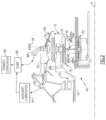
- Lubricant within the geared architecture 48 is directed into gear mesh interfaces 90 and then guided out by baffles 80. From the baffles 80 lubricant is directed to either the auxiliary lubrication system 64 or the back to the sump of the primary lubrication system.
- the baffles 80 provide a flow split of lubricant expelled from the gear system 48 to prevent overflow of lubricant flow to the auxiliary system 64 and thereby reduce some of the windage and churning losses that reduce gear efficiency.
- the baffles are further provided to direct exhaust lubrication flow through and away from the geared architecture with minimal windage and churning losses.
- the example geared architecture 48 includes a sun gear 72 that drives and is in meshed engagement with a plurality of intermediate gears 74.
- the intermediate gears 74 are often referred to as either star gears or planet gears. Star gears rotate about fixed axes, whereas planet gears are supported on axes that rotate about the sun gear 72.
- the intermediate gears 74 are referred to as planet gears 74 and are supported by a carrier assembly 76.
- the carrier assembly 76 and the planet gears 74 rotate about the axis A to drive a fan drive shaft 45.
- a ring gear 78 circumscribes the plurality of planet gears 74 and is in meshing engagement with each of the planet gears 74.
- the ring gear 78 is fixed to a portion of the engine static structure 36.
- a baffle 80 is disposed between each of the planet gears 74 proximate the meshing engagement 90 with the sun gear 72.
- the example sun gear 72 includes a circumferential cavity 92 between two gear portions 94.
- the baffle 80 includes a scoop 118 that extends into the circumferential cavity 92.
- the baffle 80 is secured to inner sides of the carrier 76 proximate the gear mesh interface 90 between the planet gears 74 and the sun gear 72.
- the gear portions 94 are opposing helical gears.
- other gear configurations are within the scope and contemplation of this disclosure.
- Rotation of the carrier 76 generates centrifugal forces that drive lubricant exiting the geared architecture 48 radially outward away from axis A.
- the centrifugal forces are utilized to drive a first portion of exhausted lubricant 70 through passages 88 to the sump 68.
- Lubricant in the sump 68 is recirculated back to the primary lubrication system 66.
- a second portion of exhausted lubricant 75 is directed into passages 86 to the auxiliary lubrication system 64.
- the baffle 80 directs the first portion of the exhausted lubricant flow 70 axially aft into an aft gutter 84 and the second portion of the exhausted lubricant flow 75 axially forward into a forward gutter 82.
- the forward gutter 82 captures the exhausted lubricant 75 and directs it into passages 86 to the auxiliary lubrication system 64.
- the aft gutter 84 captures exhausted lubricant 70 and directs the lubricant through passages 88 into the sump 68.
- the relative positions of the auxiliary lubrication system 64 and the sump 68 are an example embodiment and other relative positions of auxiliary lubrication system 64 and the sump could be utilized and are within the scope and contemplation of this disclosure.
- the forward gutter 82 may direct the exhausted lubricant axially forward to the sump 68
- the aft gutter 84 may direct the exhausted lubricant aft to the auxiliary lubrication system 64.
- axial, radial, forward and aft are utilized throughout this disclosure to denote relative positon of components.
- the term axial refers to a direction that is substantially parallel to the engine longitudinal axis A.
- the term radial refers to a direction that is substantially transverse to the engine longitudinal axis.
- the term forward generally is used to describe a position or direction that is toward the fan section 22 of the engine 20.
- the term aft is generally used to describe a position or direction that is toward the turbine section 28 of the engine 20.
- the second portion of the lubricant flow 75 directed to the auxiliary lubrication system 64 is more than the first portion of lubricant flow 70 directed toward the sump. Accordingly, the first portion of lubricant flow 70 is not equal to the second portion of lubricant flow 75.
- the baffle 80 controls the split of lubricant flow 70, 75 forward and aft of the geared architecture 48. Excess flow directed to the auxiliary lubrication system 64 can create windage and churning losses that can reduce overall gearbox operating efficiencies. Further, the shape and position of the baffle 80 can create windage and churning losses reducing gearbox efficiency.
- the baffle 80 includes features for proportioning exhaust lubricant flows 70, 75 to maintain a supply in the auxiliary lubrication system 64 without providing excess flow or generating windage or churning losses.
- approximately 80% of lubricant exhausted from the geared architecture 48 is routed to the auxiliary lubrication system 64 by the baffle 80.
- more than 50% of lubricant exhausted from the geared architecture 48 is routed to the auxiliary lubrication system 64 by the baffle 80.
- lubricant flow is split evenly between the auxiliary system 64 and the sump 68. Additionally, it is also within the contemplation of this disclosure to direct all lubricant flow either forward or aft to one of the auxiliary lubrication system 64 and the sump 68.
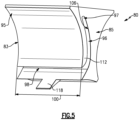
- the example baffle 80 includes a channel 96 defined between an outer wall 112 and a back wall 106.
- Figure 6 illustrates the example baffle 80 with the outer wall 112 removed to show the ramp portions 108 and 110 within channel 96.
- the channel 96 extends radially outward from an inlet 98 to a forward end 95 on a forward side 83 of the baffle 80 and to an aft end 97 on an aft side 85 of the baffle 80.
- the channel 96 includes a first ramp portion 108 that directs lubricant from the inlet 98 toward the forward end 95.
- a second ramp portion 110 directs lubricant flow toward the aft end 97.
- the first ramp portion 108 and the second ramp portion 110 meet at an apex 116 near the inlet 98.
- the apex 116 splits lubricant flow entering the inlet 98 such that it flows toward one of the forward end 95 and the aft end 97 of the channel 96.
- the baffle 80 includes a width 100 between a forward side 83 and an aft side 85.
- the scoop 118 is disposed at a midpoint 102 equally spaced between the sides 83, 85.
- the apex 116 is spaced apart from the midpoint 102 a distance 104 such that it is offset from the midpoint 102. In one disclosed embodiment, the distance 104 extends aft from the midpoint 102.
- the location of the apex 116 defines and proportions the amount of lubricant that is routed to each of the forward and aft ends 95, 97. In this disclosed embodiment, the location of the apex 116 offset toward the aft side 85 to provide more lubricant flow forward along the first ramp portion 108.
- the apex 116 location may be adjusted to tailor a desired split of exhausted lubricant forward and aft of the geared architecture.
- the first and second ramp portions 108, 110 extend across the entire channel 96 between the outer wall 112 and the back wall 106.
- the first ramp portion 108 and the second ramp portion 110 are disposed near the inlet to minimize directional changes in lubricant flow.
- Directional changes in lubricant flow impart work on the lubricant flow that can create windage and churning, and heat the lubricant.
- the outer wall 112 is curved to correspond with a curvature of the corresponding planet gear 74.
- the channel 96 includes a curvature that corresponds to the outer wall 112 and the planet gear 74. It should be appreciated, that other curvatures and shapes could be utilized to provide a desired lubricant flow and are within the scope and contemplation of this disclosure.
- the example baffle 80 is disclosed as a single integral part, but may be fabricated and formed in several different parts.
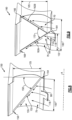
- FIG. 8 which falls outside the wording of the claims, another example baffle 150 is shown with the outer wall 112 removed to show another example ramp portion 152 within a channel 155.
- the channel 155 has a height 105 and a width 100.
- the ramp portion 152 begins at the inlet 98 and extends to the forward end 95 to direct all lubricant toward the forward end 95.
- the ramp portion 152 is a continuous surface that extends the full width 100 of the baffle 150 from an aft most point 154 at the inlet 98 to a forward most point 156 that is radially outward of the inlet 98.
- the aft most point 154 is also the apex of the ramp portion 152.
- An angle 158 of the ramp portion 152 from a line radial plane extending from the engine longitudinal axis A is dependent on the width 100 and the radial height 105 of the channel 155. In one example embodiment, the angle 158 is between about 30° and 60°. In another disclosed embodiment, the angle 158 is about 45 °.
- FIG. 9 another example baffle 160 is shown with the outer wall 112 removed to show example ramp portions 162A and 162B within a channel 165.
- the ramp portions 162A and 162B begin at an apex 164 at the inlet 98 and diverge to opposite sides of the baffle 160.
- the apex 164 is positioned at the midpoint 102 of the width 100 such that lubricant flow is directed evenly toward the forward point 168 and an aft point 166.
- An angle 170 between the ramp portions 162A and 162B is dependent on the width 100 baffle and the radial height 105 of the channel 165. In one disclosed embodiment, the angle 170 is between 45° and 75°. In another disclosed embodiment, the angle 170 is about 60°.
- the disclosed baffles provide for the distribution of exhaust lubricant flow between forward and aft sides of the geared architecture. Distribution of the exhaust lubricant flows are proportioned to efficiently allocate lubricant flow between the auxiliary lubrication system and the sump of the primary lubrication system.
Landscapes
- Engineering & Computer Science (AREA)
- General Engineering & Computer Science (AREA)
- Mechanical Engineering (AREA)
- Chemical & Material Sciences (AREA)
- Combustion & Propulsion (AREA)
- General Details Of Gearings (AREA)
- Retarders (AREA)
Description
- A gas turbine engine typically includes a fan section, a compressor section, a combustor section and a turbine section. Air entering the compressor section is compressed and delivered into the combustion section where it is mixed with fuel and ignited to generate a high-speed exhaust gas flow. The high-speed exhaust gas flow expands through the turbine section to drive the compressor and the fan section. The compressor section typically includes low and high pressure compressors, and the turbine section includes low and high pressure turbines.
- A speed reduction device such as an epicyclical gear assembly may be utilized to drive the fan section such that the fan section may rotate at a speed different than the turbine section to increase overall propulsive efficiency of the engine. Lubricant flow through an epicyclical gear assembly is gathered and directed to a sump and/or auxiliary lubrication system. Efficient direction of oil through the gear assembly increases operational efficiencies.
- Turbine engine manufacturers continue to seek further improvements to engine performance including improvements to thermal, transfer and propulsive efficiencies.
-
US 2015/065285 A1 discloses a prior art fan drive gear system according to the preamble of claim 1. - In one aspect, a fan drive gear system for a turbofan engine is provided according to claim 1.
- In an embodiment of the foregoing fan drive gear system, the system includes a carrier that supports the intermediate gears and a ring gear that circumscribes the intermediate gears. The baffle is attached to the carrier and the carrier rotates about the axis.
- In a further embodiment of any of the foregoing fan drive gear systems, the system includes a forward gutter forward of the carrier and an aft gutter aft of the carrier. The first ramp portion directs lubricant toward the forward gutter and the second ramp directs lubricant toward the aft gutter.
- In a further embodiment of any of the foregoing fan drive gear systems, the apex is disposed at a midpoint of an axial width of the channel to direct equal amounts of lubricant forward and aft.
- In a further embodiment of any of the foregoing fan drive gear systems, the apex is spaced apart from a midpoint of an axial width of the channel to direct unequal amounts of lubricant forward and aft.
- In a further embodiment of any of the foregoing fan drive gear systems, the apex is spaced aft of the midpoint of the axial width to direct more lubricant along the first ramp portion forward of the carrier than is directed along the second ramp portion aft of the carrier.
- In a further embodiment of any of the foregoing fan drive gear systems, the baffle includes a wedge that extends into a circumferential cavity between oppositely facing helical gear regions of the sun gear.
- In another aspect, a turbofan engine is provided according to claim 8.
- In an embodiment of the foregoing turbofan engine, the engine includes a forward gutter forward of the carrier and an aft gutter aft of the carrier. The first ramp portion directs lubricant toward the forward gutter and the second ramp directs lubricant toward the aft gutter and the forward gutter directs lubricant flow to the auxiliary lubrication system and the aft gutter directs lubricant flow to the sump.
- In a further embodiment of any of the foregoing turbofan engines, the baffle directs more lubricant flow to the forward gutter and the auxiliary lubrication system than lubricant flow directed to the aft gutter and the sump.
- In a further embodiment of any of the foregoing turbofan engines, the apex between the first ramp portion and the second ramp portion is disposed at a midpoint of an axial width to direct equal amounts of lubricant along the first ramp portion forward of the carrier and along the second ramp portion aft of the carrier.
- In a further embodiment of any of the foregoing turbofan engines, the apex between the first ramp portion and the second ramp portion is spaced aft of a midpoint of an axial width to direct more lubricant along the first ramp portion forward of the carrier than is directed along the second ramp portion aft of the carrier.
- Although the different examples have the specific components shown in the illustrations, embodiments of this invention are not limited to those particular combinations.
- These and other features disclosed herein can be best understood from the following specification and drawings, the following of which is a brief description.
-
-
Figure 1 is a schematic view of an example gas turbine engine. -
Figure 2 is a schematic view of an example fan drive gear system for a gas turbine engine. -
Figure 3 is a schematic view of an example geared architecture. -
Figure 4 is a schematic view of a portion of a geared architecture. -
Figure 5 is a perspective view of an example baffle. -
Figure 6 is a partial sectional view of the example baffle. -
Figure 7 is a side view of the example baffle. -
Figure 8 is a partial sectional view of another example baffle. -
Figure 9 is a partial sectional view of yet another example baffle. -
Figure 1 schematically illustrates agas turbine engine 20. Thegas turbine engine 20 is disclosed herein as a two-spool turbofan that generally incorporates afan section 22, acompressor section 24, acombustor section 26 and aturbine section 28. Thefan section 22 drives air along a bypass flow path B in a bypass duct defined within ahousing 18 such as a fan case or nacelle, and also drives air along a core flow path C for compression and communication into thecombustor section 26 then expansion through theturbine section 28. Although depicted as a two-spool turbofan gas turbine engine in the disclosed non-limiting embodiment, it should be understood that the concepts described herein are not limited to use with two-spool turbofans as the teachings may be applied to other types of turbine engines including three-spool architectures. - The
exemplary engine 20 generally includes alow speed spool 30 and ahigh speed spool 32 mounted for rotation about an engine central longitudinal axis A relative to an enginestatic structure 36 viaseveral bearing systems 38. It should be understood thatadditional bearing systems 38 may be provided, and that the location of thebearing systems 38 may be varied as appropriate to the application. - The
low speed spool 30 generally includes aninner shaft 40 that interconnects, a first (or low)pressure compressor 44 and a first (or low)pressure turbine 46. Theinner shaft 40 is connected to thefan section 22 through a speed change mechanism, which in exemplarygas turbine engine 20 is illustrated as a gearedarchitecture 48 to drive thefan section 22 at a lower speed than thelow speed spool 30. Thehigh speed spool 32 includes anouter shaft 50 that interconnects a second (or high)pressure compressor 52 and a second (or high)pressure turbine 54. Acombustor 56 is arranged inexemplary gas turbine 20 between thehigh pressure compressor 52 and thehigh pressure turbine 54. Amid-turbine frame 58 of the enginestatic structure 36 may be arranged generally between thehigh pressure turbine 54 and thelow pressure turbine 46. Themid-turbine frame 58 further supports bearingsystems 38 in theturbine section 28. Theinner shaft 40 and theouter shaft 50 are concentric and rotate viabearing systems 38 about the engine central longitudinal axis A which is collinear with their longitudinal axes. - The core airflow is compressed by the
low pressure compressor 44 then thehigh pressure compressor 52, mixed and burned with fuel in thecombustor 56, then expanded through thehigh pressure turbine 54 andlow pressure turbine 46. Themid-turbine frame 58 includesairfoils 60 which are in the core airflow path C. Theturbines low speed spool 30 andhigh speed spool 32 in response to the expansion. It will be appreciated that each of the positions of thefan section 22,compressor section 24,combustor section 26,turbine section 28, and gearedarchitecture 48 may be varied. For example, the gearedarchitecture 48 may be located aft of the low pressure compressor, or aft of thecombustor section 26 or even aft ofturbine section 28, andfan 42 may be positioned forward or aft of the location of gearedarchitecture 48. - The
engine 20 in one example is a high-bypass geared aircraft engine. In a further example, theengine 20 bypass ratio is greater than about six (6), with an example embodiment being greater than about ten (10), the gearedarchitecture 48 is an epicyclic gear train, such as a planetary gear system or other gear system, with a gear reduction ratio of greater than about 2.3 and thelow pressure turbine 46 has a pressure ratio that is greater than about five. In one disclosed embodiment, theengine 20 bypass ratio is greater than about ten (10:1), the fan diameter is significantly larger than that of thelow pressure compressor 44, and thelow pressure turbine 46 has a pressure ratio that is greater than about five 5:1.Low pressure turbine 46 pressure ratio is pressure measured prior to inlet oflow pressure turbine 46 as related to the pressure at the outlet of thelow pressure turbine 46 prior to an exhaust nozzle. The gearedarchitecture 48 may be an epicycle gear train, such as a planetary gear system or other gear system, with a gear reduction ratio of greater than about 2.3:1 and less than about 5:1. It should be understood, however, that the above parameters are only exemplary of one embodiment of a geared architecture engine and that the present invention is applicable to other gas turbine engines including direct drive turbofans. - A significant amount of thrust is provided by the bypass flow B due to the high bypass ratio. The
fan section 22 of theengine 20 is designed for a particular flight condition -- typically cruise at about 0.8 Mach and about 35,000 feet (10,668 meters). The flight condition of 0.8 Mach and 35,000 ft (10,668 meters), with the engine at its best fuel consumption - also known as "bucket cruise Thrust Specific Fuel Consumption ('TSFC')" - is the industry standard parameter of lbm of fuel being burned divided by lbf of thrust the engine produces at that minimum point. "Low fan pressure ratio" is the pressure ratio across the fan blade alone, without a Fan Exit Guide Vane ("FEGV") system. The low fan pressure ratio as disclosed herein according to one non-limiting embodiment is less than about 1.45. "Low corrected fan tip speed" is the actual fan tip speed in ft/sec divided by an industry standard temperature correction of [(Tram °R) / (518.7 °R)] 0.5. The "Low corrected fan tip speed" as disclosed herein according to one non-limiting embodiment is less than about 1150 ft / second (350.5 meters/second). - The example gas turbine engine includes the
fan section 22 that comprises in one non-limiting embodiment less than about 26fan blades 42. In another non-limiting embodiment, thefan section 22 includes less than about 20fan blades 42. Moreover, in one disclosed embodiment thelow pressure turbine 46 includes no more than about 6 turbine rotors schematically indicated at 34. In another non-limiting example embodiment, thelow pressure turbine 46 includes about 3 turbine rotors. A ratio between the number offan blades 42 and the number of low pressure turbine rotors is between about 3.3 and about 8.6. The examplelow pressure turbine 46 provides the driving power to rotate thefan section 22 and therefore the relationship between the number ofturbine rotors 34 in thelow pressure turbine 46 and the number ofblades 42 in thefan section 22 disclose an examplegas turbine engine 20 with increased power transfer efficiency. - The
engine 20 includes alubrication system 62 that provides lubricant to the gearedarchitecture 48, thevarious bearing systems 38 as well as any other components that require lubricant flow. Thelubrication system 62 includes aprimary lubrication system 66 that normally provides lubricant to the gearedarchitecture 48. Thelubrication system 62 further includes anauxiliary lubrication system 64 that provides lubricant flow during conditions where theprimary lubrication system 66 may not provide a desired amount of lubricant flow. Lubricant from theauxiliary lubrication system 64, the gearedarchitecture 48 and the bearingsystems 38 is eventually recovered in asump 68 for recirculation by theprimary lubrication system 66. - Referring to
Figure 2 ,3 and4 with continued reference toFigure 1 , the gearedarchitecture 48 is part of a fandrive gear system 55 that drives thefan 22. Lubricant within the gearedarchitecture 48 is directed into gear mesh interfaces 90 and then guided out bybaffles 80. From thebaffles 80 lubricant is directed to either theauxiliary lubrication system 64 or the back to the sump of the primary lubrication system. Thebaffles 80 provide a flow split of lubricant expelled from thegear system 48 to prevent overflow of lubricant flow to theauxiliary system 64 and thereby reduce some of the windage and churning losses that reduce gear efficiency. The baffles are further provided to direct exhaust lubrication flow through and away from the geared architecture with minimal windage and churning losses. - The example geared
architecture 48 includes asun gear 72 that drives and is in meshed engagement with a plurality ofintermediate gears 74. The intermediate gears 74 are often referred to as either star gears or planet gears. Star gears rotate about fixed axes, whereas planet gears are supported on axes that rotate about thesun gear 72. In this example, theintermediate gears 74 are referred to as planet gears 74 and are supported by acarrier assembly 76. Thecarrier assembly 76 and the planet gears 74 rotate about the axis A to drive afan drive shaft 45. Aring gear 78 circumscribes the plurality of planet gears 74 and is in meshing engagement with each of the planet gears 74. Thering gear 78 is fixed to a portion of the enginestatic structure 36. Abaffle 80 is disposed between each of the planet gears 74 proximate the meshingengagement 90 with thesun gear 72. - The
example sun gear 72 includes acircumferential cavity 92 between twogear portions 94. Thebaffle 80 includes ascoop 118 that extends into thecircumferential cavity 92. Thebaffle 80 is secured to inner sides of thecarrier 76 proximate thegear mesh interface 90 between the planet gears 74 and thesun gear 72. In one example embodiment, thegear portions 94 are opposing helical gears. However, other gear configurations are within the scope and contemplation of this disclosure. - Rotation of the
carrier 76 generates centrifugal forces that drive lubricant exiting the gearedarchitecture 48 radially outward away from axis A. The centrifugal forces are utilized to drive a first portion of exhaustedlubricant 70 throughpassages 88 to thesump 68. Lubricant in thesump 68 is recirculated back to theprimary lubrication system 66. - A second portion of exhausted
lubricant 75 is directed intopassages 86 to theauxiliary lubrication system 64. Thebaffle 80 directs the first portion of theexhausted lubricant flow 70 axially aft into an aft gutter 84 and the second portion of theexhausted lubricant flow 75 axially forward into aforward gutter 82. Theforward gutter 82 captures the exhaustedlubricant 75 and directs it intopassages 86 to theauxiliary lubrication system 64. The aft gutter 84 captures exhaustedlubricant 70 and directs the lubricant throughpassages 88 into thesump 68. The relative positions of theauxiliary lubrication system 64 and thesump 68 are an example embodiment and other relative positions ofauxiliary lubrication system 64 and the sump could be utilized and are within the scope and contemplation of this disclosure. For example, theforward gutter 82 may direct the exhausted lubricant axially forward to thesump 68, and the aft gutter 84 may direct the exhausted lubricant aft to theauxiliary lubrication system 64. - The terms axial, radial, forward and aft are utilized throughout this disclosure to denote relative positon of components. The term axial refers to a direction that is substantially parallel to the engine longitudinal axis A. The term radial refers to a direction that is substantially transverse to the engine longitudinal axis. The term forward generally is used to describe a position or direction that is toward the
fan section 22 of theengine 20. Similarly, the term aft is generally used to describe a position or direction that is toward theturbine section 28 of theengine 20. - In one disclosed embodiment, the second portion of the
lubricant flow 75 directed to theauxiliary lubrication system 64 is more than the first portion oflubricant flow 70 directed toward the sump. Accordingly, the first portion oflubricant flow 70 is not equal to the second portion oflubricant flow 75. Thebaffle 80 controls the split oflubricant flow architecture 48. Excess flow directed to theauxiliary lubrication system 64 can create windage and churning losses that can reduce overall gearbox operating efficiencies. Further, the shape and position of thebaffle 80 can create windage and churning losses reducing gearbox efficiency. - The
baffle 80 includes features for proportioning exhaust lubricant flows 70, 75 to maintain a supply in theauxiliary lubrication system 64 without providing excess flow or generating windage or churning losses. In one disclosed embodiment, approximately 80% of lubricant exhausted from the gearedarchitecture 48 is routed to theauxiliary lubrication system 64 by thebaffle 80. In another disclosed embodiment, more than 50% of lubricant exhausted from the gearedarchitecture 48 is routed to theauxiliary lubrication system 64 by thebaffle 80. In another disclosed embodiment, lubricant flow is split evenly between theauxiliary system 64 and thesump 68. Additionally, it is also within the contemplation of this disclosure to direct all lubricant flow either forward or aft to one of theauxiliary lubrication system 64 and thesump 68. - Referring to
Figures 5 ,6, and 7 with continued reference toFigure 2 , theexample baffle 80 includes achannel 96 defined between anouter wall 112 and aback wall 106.Figure 6 illustrates theexample baffle 80 with theouter wall 112 removed to show theramp portions channel 96. Thechannel 96 extends radially outward from aninlet 98 to aforward end 95 on aforward side 83 of thebaffle 80 and to anaft end 97 on anaft side 85 of thebaffle 80. Thechannel 96 includes afirst ramp portion 108 that directs lubricant from theinlet 98 toward theforward end 95. Asecond ramp portion 110 directs lubricant flow toward theaft end 97. Thefirst ramp portion 108 and thesecond ramp portion 110 meet at an apex 116 near theinlet 98. The apex 116 splits lubricant flow entering theinlet 98 such that it flows toward one of theforward end 95 and theaft end 97 of thechannel 96. - The
baffle 80 includes awidth 100 between aforward side 83 and anaft side 85. Thescoop 118 is disposed at amidpoint 102 equally spaced between thesides distance 104 such that it is offset from themidpoint 102. In one disclosed embodiment, thedistance 104 extends aft from themidpoint 102. The location of the apex 116 defines and proportions the amount of lubricant that is routed to each of the forward and aft ends 95, 97. In this disclosed embodiment, the location of the apex 116 offset toward theaft side 85 to provide more lubricant flow forward along thefirst ramp portion 108. As appreciated, the apex 116 location may be adjusted to tailor a desired split of exhausted lubricant forward and aft of the geared architecture. - The first and
second ramp portions entire channel 96 between theouter wall 112 and theback wall 106. Thefirst ramp portion 108 and thesecond ramp portion 110 are disposed near the inlet to minimize directional changes in lubricant flow. Directional changes in lubricant flow impart work on the lubricant flow that can create windage and churning, and heat the lubricant. - The
outer wall 112 is curved to correspond with a curvature of thecorresponding planet gear 74. Thechannel 96 includes a curvature that corresponds to theouter wall 112 and theplanet gear 74. It should be appreciated, that other curvatures and shapes could be utilized to provide a desired lubricant flow and are within the scope and contemplation of this disclosure. Theexample baffle 80 is disclosed as a single integral part, but may be fabricated and formed in several different parts. - Referring to
Figure 8 , which falls outside the wording of the claims, anotherexample baffle 150 is shown with theouter wall 112 removed to show anotherexample ramp portion 152 within achannel 155. Thechannel 155 has aheight 105 and awidth 100. Theramp portion 152 begins at theinlet 98 and extends to theforward end 95 to direct all lubricant toward theforward end 95. Theramp portion 152 is a continuous surface that extends thefull width 100 of thebaffle 150 from an aftmost point 154 at theinlet 98 to a forwardmost point 156 that is radially outward of theinlet 98. In this example, the aftmost point 154 is also the apex of theramp portion 152. Anangle 158 of theramp portion 152 from a line radial plane extending from the engine longitudinal axis A is dependent on thewidth 100 and theradial height 105 of thechannel 155. In one example embodiment, theangle 158 is between about 30° and 60°. In another disclosed embodiment, theangle 158 is about 45 °. - Referring to
Figure 9 , anotherexample baffle 160 is shown with theouter wall 112 removed to showexample ramp portions channel 165. Theramp portions inlet 98 and diverge to opposite sides of thebaffle 160. The apex 164 is positioned at themidpoint 102 of thewidth 100 such that lubricant flow is directed evenly toward theforward point 168 and anaft point 166. Anangle 170 between theramp portions width 100 baffle and theradial height 105 of thechannel 165. In one disclosed embodiment, theangle 170 is between 45° and 75°. In another disclosed embodiment, theangle 170 is about 60°. - The disclosed baffles provide for the distribution of exhaust lubricant flow between forward and aft sides of the geared architecture. Distribution of the exhaust lubricant flows are proportioned to efficiently allocate lubricant flow between the auxiliary lubrication system and the sump of the primary lubrication system.
- Although example embodiments have been described, a worker of ordinary skill in this art would recognize that certain modifications would come within the scope of this disclosure. For that reason, the following claims should be studied to determine the scope and content of this disclosure.
Claims (12)
- A fan drive gear system (55) for a turbofan engine (20) comprising:a sun gear (72) rotatable about an axis (A);a plurality of intermediate gears (74) driven by the sun gear (72); anda baffle (80; 160) disposed between at least two of the plurality of intermediate gears (74) for defining a lubricant flow path from an interface between the sun gear (72) and at least one of the plurality of intermediate gears (74), the baffle (80; 160) including a channel (96; 165) with a first ramp portion (108; 162A) directing lubricant forward and a second ramp portion (110; 162B) directing lubricant aft, wherein the baffle (80; 160) includes an apex (116; 164) between the first ramp portion (108; 162A) and the second ramp portion (110; 162B);characterised in that:
the apex (116; 164) is disposed at an inlet (98) opening to the channel (96; 165). - The fan drive gear system (55) as recited in claim 1, including a carrier (76) supporting the intermediate gears (74) and a ring gear (78) circumscribing the intermediate gears (74), wherein the baffle (80; 160) is attached to the carrier (76) and the carrier (76) rotates about the axis (A).
- The fan drive gear system (55) as recited in claim 2, including a forward gutter (82) forward of the carrier (76) and an aft gutter (84) aft of the carrier (76), wherein the first ramp portion (108; 162A) directs lubricant toward the forward gutter (82) and the second ramp portion (110; 162B) directs lubricant toward the aft gutter (84).
- The fan drive gear system (55) as recited in any of claims 1, 2 or 3, wherein the apex (164) is disposed at a midpoint (102) of an axial width (100) of the channel (96; 165) to direct equal amounts of lubricant forward and aft.
- The fan drive gear system (55) as recited in any of claims 1, 2 or 3, wherein the apex (116) is spaced apart from a midpoint (102) of an axial width (100) of the channel (96; 165) to direct unequal amounts of lubricant forward and aft.
- The fan drive gear system (55) as recited in claim 5, wherein the apex (116) is spaced aft of the midpoint (102) of the axial width (100) to direct more lubricant along the first ramp portion (108; 162A) forward of the carrier (76) than is directed along the second ramp portion (110; 162B) aft of the carrier (76).
- The fan drive gear system (55) as recited in any preceding claim, wherein the baffle (80; 160) includes a wedge extending into a circumferential cavity (92) between oppositely facing helical gear regions (94) of the sun gear (72).
- A turbofan engine (20) comprising:a fan section (22) rotatable about an axis (A);a core engine section disposed about the axis (A);a primary lubrication system (66) including a sump (68) for gathering lubricant;an auxiliary lubrication system (64) configured to supply a lubricant flow in the absence of lubricant flow from the primary lubricant system (66); andthe fan drive gear system (55) of any preceding claim driven by the core engine section for rotating the fan about the axis (A), the sun gear (72) including a circumferential cavity (92) disposed between a first gear region (94) and a second gear region (94), wherein the first ramp portion (108; 162A) directs lubricant to the auxiliary lubrication system (64) and the second ramp portion (110; 162B) directs lubricant toward the sump (68).
- The turbofan engine (20) as recited in claim 8, including a forward gutter (82) forward of the carrier (76) and an aft gutter (84) aft of the carrier (76), wherein the first ramp portion (108; 162A) directs lubricant toward the forward gutter (82) and the second ramp portion (110; 162B) directs lubricant toward the aft gutter (84) and the forward gutter (82) directs lubricant flow to the auxiliary lubrication system (64) and the aft gutter (84) directs lubricant flow to the sump (68).
- The turbofan engine (20) as recited in claim 9, wherein the baffle (80... 160) directs more lubricant flow to the forward gutter (82) and the auxiliary lubrication system (64) than lubricant flow directed to the aft gutter (84) and the sump (68).
- The turbofan engine (20) as recited in claim 8, 9 or 10, wherein the apex (116; 164) between the first ramp portion (108; 162A) and the second ramp portion (110; 162B) is disposed at a midpoint (102) of an axial width (100) to direct equal amounts of lubricant along the first ramp portion (162A) forward of the carrier (76) and along the second ramp portion (162B) aft of the carrier (76).
- The turbofan engine (20) as recited in claim 8, 9 or 10, wherein the apex (116; 164) between the first ramp portion (108; 162A) and the second ramp portion (110; 162B) is spaced aft of a midpoint (102) of an axial width (100) to direct more lubricant along the first ramp portion (108) forward of the carrier (76) than is directed along the second ramp portion (110) aft of the carrier (76).
Priority Applications (1)
| Application Number | Priority Date | Filing Date | Title |
|---|---|---|---|
| EP24193816.6A EP4435297A3 (en) | 2020-01-17 | 2021-01-18 | Geared architecture gas turbine engine with planetary gear oil scavenge |
Applications Claiming Priority (2)
| Application Number | Priority Date | Filing Date | Title |
|---|---|---|---|
| US202062962470P | 2020-01-17 | 2020-01-17 | |
| US16/785,915 US11448309B2 (en) | 2020-01-17 | 2020-02-10 | Geared architecture gas turbine engine with planetary gear oil scavenge |
Related Child Applications (1)
| Application Number | Title | Priority Date | Filing Date |
|---|---|---|---|
| EP24193816.6A Division EP4435297A3 (en) | 2020-01-17 | 2021-01-18 | Geared architecture gas turbine engine with planetary gear oil scavenge |
Publications (2)
| Publication Number | Publication Date |
|---|---|
| EP3851653A1 EP3851653A1 (en) | 2021-07-21 |
| EP3851653B1 true EP3851653B1 (en) | 2024-08-14 |
Family
ID=74187132
Family Applications (2)
| Application Number | Title | Priority Date | Filing Date |
|---|---|---|---|
| EP21152054.9A Active EP3851653B1 (en) | 2020-01-17 | 2021-01-18 | Geared architecture gas turbine engine with planetary gear oil scavenge |
| EP24193816.6A Pending EP4435297A3 (en) | 2020-01-17 | 2021-01-18 | Geared architecture gas turbine engine with planetary gear oil scavenge |
Family Applications After (1)
| Application Number | Title | Priority Date | Filing Date |
|---|---|---|---|
| EP24193816.6A Pending EP4435297A3 (en) | 2020-01-17 | 2021-01-18 | Geared architecture gas turbine engine with planetary gear oil scavenge |
Country Status (2)
| Country | Link |
|---|---|
| US (3) | US11448309B2 (en) |
| EP (2) | EP3851653B1 (en) |
Families Citing this family (13)
| Publication number | Priority date | Publication date | Assignee | Title |
|---|---|---|---|---|
| DE102021209552A1 (en) | 2021-08-31 | 2023-03-02 | Rolls-Royce Deutschland Ltd & Co Kg | planetary gear |
| FR3128752B1 (en) * | 2021-10-29 | 2024-01-05 | Safran Trans Systems | Improved oil deflector for mechanical gearbox of aircraft turbomachine |
| FR3130916A1 (en) * | 2021-12-16 | 2023-06-23 | Safran Transmission Systems | Oil collector for a mechanical turbomachine reducer |
| US11879541B2 (en) | 2022-04-01 | 2024-01-23 | General Electric Company | Oil scavenge system for a gearbox |
| US12421898B2 (en) | 2022-06-22 | 2025-09-23 | General Electric Company | Gearbox assembly with lubricant extraction volume ratio |
| US12320418B2 (en) * | 2022-06-22 | 2025-06-03 | General Electric Company | Gearbox assembly with lubricant extraction volume ratio |
| US12326115B2 (en) * | 2022-06-22 | 2025-06-10 | General Electric Company | Gearbox assembly with lubricant extraction volume ratio |
| US12523176B2 (en) | 2022-06-22 | 2026-01-13 | General Electric Company | Gearbox assembly with lubricant extraction volume ratio |
| US12345201B2 (en) | 2022-06-22 | 2025-07-01 | General Electric Company | Gearbox assembly with lubricant extraction volume ratio |
| US12160160B1 (en) * | 2023-06-21 | 2024-12-03 | Schaeffler Technologies AG & Co. KG | Passive oil pump arrangement for cooling an electric motor |
| US12188417B1 (en) * | 2023-09-20 | 2025-01-07 | Rtx Corporation | Rotating carrier oil manifold |
| US12270336B1 (en) * | 2023-09-20 | 2025-04-08 | Rtx Corporation | Fan drive gear system rotating oil baffle |
| US20250092832A1 (en) * | 2023-09-20 | 2025-03-20 | Rtx Corporation | Planetary fan drive gear system auxiliary oil capture system |
Family Cites Families (9)
| Publication number | Priority date | Publication date | Assignee | Title |
|---|---|---|---|---|
| US5472383A (en) | 1993-12-27 | 1995-12-05 | United Technologies Corporation | Lubrication system for a planetary gear train |
| US5851163A (en) | 1996-03-29 | 1998-12-22 | Ntn Corporation | Planetary roller type power transmission device |
| US20130125561A1 (en) * | 2007-11-30 | 2013-05-23 | Frederick M. Schwarz | Geared turbofan with distributed accessory gearboxes |
| GB201218310D0 (en) * | 2012-10-12 | 2012-11-28 | Rolls Royce Plc | Oil Scavenge arrangement |
| EP3859191B1 (en) | 2013-01-15 | 2024-05-01 | RTX Corporation | Fluid collection gutter for a geared turbine engine |
| EP2946131B1 (en) | 2013-01-15 | 2020-03-04 | United Technologies Corporation | Turbine engine |
| US9038779B2 (en) * | 2013-08-30 | 2015-05-26 | United Technologies Corporation | Geared architecture gas turbine engine with oil scavenge |
| IT201800003231A1 (en) | 2018-03-02 | 2019-09-02 | Ge Avio Srl | LUBRICANT RECOVERY SYSTEM FOR A GEAR GROUP |
| DE102018107494A1 (en) | 2018-03-28 | 2019-10-02 | Rolls-Royce Deutschland Ltd & Co Kg | A planetary gear device having an oil supply device, a gas turbine engine with a planetary gear device and a method for manufacturing a blade pump |
-
2020
- 2020-02-10 US US16/785,915 patent/US11448309B2/en active Active
-
2021
- 2021-01-18 EP EP21152054.9A patent/EP3851653B1/en active Active
- 2021-01-18 EP EP24193816.6A patent/EP4435297A3/en active Pending
-
2022
- 2022-08-25 US US17/895,301 patent/US11946540B2/en active Active
-
2024
- 2024-03-05 US US18/595,714 patent/US12422038B2/en active Active
Also Published As
| Publication number | Publication date |
|---|---|
| EP4435297A2 (en) | 2024-09-25 |
| US12422038B2 (en) | 2025-09-23 |
| US11946540B2 (en) | 2024-04-02 |
| US20210222767A1 (en) | 2021-07-22 |
| US11448309B2 (en) | 2022-09-20 |
| EP4435297A3 (en) | 2024-10-09 |
| US20230160466A1 (en) | 2023-05-25 |
| US20250116327A1 (en) | 2025-04-10 |
| EP3851653A1 (en) | 2021-07-21 |
Similar Documents
| Publication | Publication Date | Title |
|---|---|---|
| EP3851653B1 (en) | Geared architecture gas turbine engine with planetary gear oil scavenge | |
| US11067162B2 (en) | Geared architecture gas turbine engine with oil scavenge | |
| US11365648B2 (en) | Integral gutter and front center body | |
| EP3179056B1 (en) | Gear driven turbofan | |
| EP3808964B1 (en) | Geared turbofan with non-epicyclic gear reduction system | |
| EP3054139B1 (en) | Fan drive gear system | |
| EP3039265B1 (en) | Torque connector lubrication scuppers | |
| US9194255B2 (en) | Oil baffle for gas turbine fan drive gear system | |
| US10202902B2 (en) | Geared architecture gas turbine engine with oil scavenge | |
| EP2959129B1 (en) | Auxiliary lubricant supply pump stage integral with main lubricant pump stage | |
| EP3269965B1 (en) | Geared gas turbine engine | |
| EP4040020B1 (en) | Geared gas turbine engine with combined spray bar and scavenge component | |
| EP3008323B1 (en) | Turbofan engine front section | |
| EP3109452B1 (en) | Journal bearing for rotating gear carrier | |
| EP2954186B1 (en) | Oil baffles in carrier for a fan drive gear system | |
| WO2014137571A1 (en) | Fan drive gear system spline oil lubrication scheme | |
| EP3772571A1 (en) | Ducted oil scoop for gas turbine engine | |
| EP3036420B1 (en) | Load balanced journal bearing pin | |
| EP3825575B1 (en) | Geared architecture for gas turbine engine | |
| EP3406851B1 (en) | Component for a gas turbine engine and method of forming a core assembly | |
| EP3084142B1 (en) | Shortened support for compressor variable vane | |
| EP2904210A2 (en) | Gas turbine engine with forward moment arm |
Legal Events
| Date | Code | Title | Description |
|---|---|---|---|
| PUAI | Public reference made under article 153(3) epc to a published international application that has entered the european phase |
Free format text: ORIGINAL CODE: 0009012 |
|
| STAA | Information on the status of an ep patent application or granted ep patent |
Free format text: STATUS: THE APPLICATION HAS BEEN PUBLISHED |
|
| AK | Designated contracting states |
Kind code of ref document: A1 Designated state(s): AL AT BE BG CH CY CZ DE DK EE ES FI FR GB GR HR HU IE IS IT LI LT LU LV MC MK MT NL NO PL PT RO RS SE SI SK SM TR |
|
| STAA | Information on the status of an ep patent application or granted ep patent |
Free format text: STATUS: REQUEST FOR EXAMINATION WAS MADE |
|
| 17P | Request for examination filed |
Effective date: 20220121 |
|
| RBV | Designated contracting states (corrected) |
Designated state(s): AL AT BE BG CH CY CZ DE DK EE ES FI FR GB GR HR HU IE IS IT LI LT LU LV MC MK MT NL NO PL PT RO RS SE SI SK SM TR |
|
| GRAP | Despatch of communication of intention to grant a patent |
Free format text: ORIGINAL CODE: EPIDOSNIGR1 |
|
| STAA | Information on the status of an ep patent application or granted ep patent |
Free format text: STATUS: GRANT OF PATENT IS INTENDED |
|
| RAP3 | Party data changed (applicant data changed or rights of an application transferred) |
Owner name: RTX CORPORATION |
|
| INTG | Intention to grant announced |
Effective date: 20231012 |
|
| GRAJ | Information related to disapproval of communication of intention to grant by the applicant or resumption of examination proceedings by the epo deleted |
Free format text: ORIGINAL CODE: EPIDOSDIGR1 |
|
| STAA | Information on the status of an ep patent application or granted ep patent |
Free format text: STATUS: REQUEST FOR EXAMINATION WAS MADE |
|
| GRAP | Despatch of communication of intention to grant a patent |
Free format text: ORIGINAL CODE: EPIDOSNIGR1 |
|
| STAA | Information on the status of an ep patent application or granted ep patent |
Free format text: STATUS: GRANT OF PATENT IS INTENDED |
|
| INTG | Intention to grant announced |
Effective date: 20240307 |
|
| GRAS | Grant fee paid |
Free format text: ORIGINAL CODE: EPIDOSNIGR3 |
|
| GRAA | (expected) grant |
Free format text: ORIGINAL CODE: 0009210 |
|
| STAA | Information on the status of an ep patent application or granted ep patent |
Free format text: STATUS: THE PATENT HAS BEEN GRANTED |
|
| AK | Designated contracting states |
Kind code of ref document: B1 Designated state(s): AL AT BE BG CH CY CZ DE DK EE ES FI FR GB GR HR HU IE IS IT LI LT LU LV MC MK MT NL NO PL PT RO RS SE SI SK SM TR |
|
| REG | Reference to a national code |
Ref country code: GB Ref legal event code: FG4D |
|
| REG | Reference to a national code |
Ref country code: CH Ref legal event code: EP |
|
| REG | Reference to a national code |
Ref country code: DE Ref legal event code: R096 Ref document number: 602021017041 Country of ref document: DE |
|
| REG | Reference to a national code |
Ref country code: IE Ref legal event code: FG4D |
|
| REG | Reference to a national code |
Ref country code: LT Ref legal event code: MG9D |
|
| REG | Reference to a national code |
Ref country code: NL Ref legal event code: MP Effective date: 20240814 |
|
| PG25 | Lapsed in a contracting state [announced via postgrant information from national office to epo] |
Ref country code: NO Free format text: LAPSE BECAUSE OF FAILURE TO SUBMIT A TRANSLATION OF THE DESCRIPTION OR TO PAY THE FEE WITHIN THE PRESCRIBED TIME-LIMIT Effective date: 20241114 |
|
| REG | Reference to a national code |
Ref country code: AT Ref legal event code: MK05 Ref document number: 1713498 Country of ref document: AT Kind code of ref document: T Effective date: 20240814 |
|
| PG25 | Lapsed in a contracting state [announced via postgrant information from national office to epo] |
Ref country code: FI Free format text: LAPSE BECAUSE OF FAILURE TO SUBMIT A TRANSLATION OF THE DESCRIPTION OR TO PAY THE FEE WITHIN THE PRESCRIBED TIME-LIMIT Effective date: 20240814 Ref country code: NL Free format text: LAPSE BECAUSE OF FAILURE TO SUBMIT A TRANSLATION OF THE DESCRIPTION OR TO PAY THE FEE WITHIN THE PRESCRIBED TIME-LIMIT Effective date: 20240814 Ref country code: PT Free format text: LAPSE BECAUSE OF FAILURE TO SUBMIT A TRANSLATION OF THE DESCRIPTION OR TO PAY THE FEE WITHIN THE PRESCRIBED TIME-LIMIT Effective date: 20241216 Ref country code: GR Free format text: LAPSE BECAUSE OF FAILURE TO SUBMIT A TRANSLATION OF THE DESCRIPTION OR TO PAY THE FEE WITHIN THE PRESCRIBED TIME-LIMIT Effective date: 20241115 Ref country code: PL Free format text: LAPSE BECAUSE OF FAILURE TO SUBMIT A TRANSLATION OF THE DESCRIPTION OR TO PAY THE FEE WITHIN THE PRESCRIBED TIME-LIMIT Effective date: 20240814 |
|
| PG25 | Lapsed in a contracting state [announced via postgrant information from national office to epo] |
Ref country code: BG Free format text: LAPSE BECAUSE OF FAILURE TO SUBMIT A TRANSLATION OF THE DESCRIPTION OR TO PAY THE FEE WITHIN THE PRESCRIBED TIME-LIMIT Effective date: 20240814 |
|
| PG25 | Lapsed in a contracting state [announced via postgrant information from national office to epo] |
Ref country code: LV Free format text: LAPSE BECAUSE OF FAILURE TO SUBMIT A TRANSLATION OF THE DESCRIPTION OR TO PAY THE FEE WITHIN THE PRESCRIBED TIME-LIMIT Effective date: 20240814 |
|
| PG25 | Lapsed in a contracting state [announced via postgrant information from national office to epo] |
Ref country code: AT Free format text: LAPSE BECAUSE OF FAILURE TO SUBMIT A TRANSLATION OF THE DESCRIPTION OR TO PAY THE FEE WITHIN THE PRESCRIBED TIME-LIMIT Effective date: 20240814 Ref country code: IS Free format text: LAPSE BECAUSE OF FAILURE TO SUBMIT A TRANSLATION OF THE DESCRIPTION OR TO PAY THE FEE WITHIN THE PRESCRIBED TIME-LIMIT Effective date: 20241214 |
|
| PG25 | Lapsed in a contracting state [announced via postgrant information from national office to epo] |
Ref country code: HR Free format text: LAPSE BECAUSE OF FAILURE TO SUBMIT A TRANSLATION OF THE DESCRIPTION OR TO PAY THE FEE WITHIN THE PRESCRIBED TIME-LIMIT Effective date: 20240814 |
|
| PG25 | Lapsed in a contracting state [announced via postgrant information from national office to epo] |
Ref country code: RS Free format text: LAPSE BECAUSE OF FAILURE TO SUBMIT A TRANSLATION OF THE DESCRIPTION OR TO PAY THE FEE WITHIN THE PRESCRIBED TIME-LIMIT Effective date: 20241114 Ref country code: ES Free format text: LAPSE BECAUSE OF FAILURE TO SUBMIT A TRANSLATION OF THE DESCRIPTION OR TO PAY THE FEE WITHIN THE PRESCRIBED TIME-LIMIT Effective date: 20240814 |
|
| PG25 | Lapsed in a contracting state [announced via postgrant information from national office to epo] |
Ref country code: RS Free format text: LAPSE BECAUSE OF FAILURE TO SUBMIT A TRANSLATION OF THE DESCRIPTION OR TO PAY THE FEE WITHIN THE PRESCRIBED TIME-LIMIT Effective date: 20241114 Ref country code: PT Free format text: LAPSE BECAUSE OF FAILURE TO SUBMIT A TRANSLATION OF THE DESCRIPTION OR TO PAY THE FEE WITHIN THE PRESCRIBED TIME-LIMIT Effective date: 20241216 Ref country code: PL Free format text: LAPSE BECAUSE OF FAILURE TO SUBMIT A TRANSLATION OF THE DESCRIPTION OR TO PAY THE FEE WITHIN THE PRESCRIBED TIME-LIMIT Effective date: 20240814 Ref country code: NO Free format text: LAPSE BECAUSE OF FAILURE TO SUBMIT A TRANSLATION OF THE DESCRIPTION OR TO PAY THE FEE WITHIN THE PRESCRIBED TIME-LIMIT Effective date: 20241114 Ref country code: NL Free format text: LAPSE BECAUSE OF FAILURE TO SUBMIT A TRANSLATION OF THE DESCRIPTION OR TO PAY THE FEE WITHIN THE PRESCRIBED TIME-LIMIT Effective date: 20240814 Ref country code: LV Free format text: LAPSE BECAUSE OF FAILURE TO SUBMIT A TRANSLATION OF THE DESCRIPTION OR TO PAY THE FEE WITHIN THE PRESCRIBED TIME-LIMIT Effective date: 20240814 Ref country code: IS Free format text: LAPSE BECAUSE OF FAILURE TO SUBMIT A TRANSLATION OF THE DESCRIPTION OR TO PAY THE FEE WITHIN THE PRESCRIBED TIME-LIMIT Effective date: 20241214 Ref country code: HR Free format text: LAPSE BECAUSE OF FAILURE TO SUBMIT A TRANSLATION OF THE DESCRIPTION OR TO PAY THE FEE WITHIN THE PRESCRIBED TIME-LIMIT Effective date: 20240814 Ref country code: GR Free format text: LAPSE BECAUSE OF FAILURE TO SUBMIT A TRANSLATION OF THE DESCRIPTION OR TO PAY THE FEE WITHIN THE PRESCRIBED TIME-LIMIT Effective date: 20241115 Ref country code: FI Free format text: LAPSE BECAUSE OF FAILURE TO SUBMIT A TRANSLATION OF THE DESCRIPTION OR TO PAY THE FEE WITHIN THE PRESCRIBED TIME-LIMIT Effective date: 20240814 Ref country code: ES Free format text: LAPSE BECAUSE OF FAILURE TO SUBMIT A TRANSLATION OF THE DESCRIPTION OR TO PAY THE FEE WITHIN THE PRESCRIBED TIME-LIMIT Effective date: 20240814 Ref country code: BG Free format text: LAPSE BECAUSE OF FAILURE TO SUBMIT A TRANSLATION OF THE DESCRIPTION OR TO PAY THE FEE WITHIN THE PRESCRIBED TIME-LIMIT Effective date: 20240814 Ref country code: AT Free format text: LAPSE BECAUSE OF FAILURE TO SUBMIT A TRANSLATION OF THE DESCRIPTION OR TO PAY THE FEE WITHIN THE PRESCRIBED TIME-LIMIT Effective date: 20240814 |
|
| PG25 | Lapsed in a contracting state [announced via postgrant information from national office to epo] |
Ref country code: RO Free format text: LAPSE BECAUSE OF FAILURE TO SUBMIT A TRANSLATION OF THE DESCRIPTION OR TO PAY THE FEE WITHIN THE PRESCRIBED TIME-LIMIT Effective date: 20240814 Ref country code: SM Free format text: LAPSE BECAUSE OF FAILURE TO SUBMIT A TRANSLATION OF THE DESCRIPTION OR TO PAY THE FEE WITHIN THE PRESCRIBED TIME-LIMIT Effective date: 20240814 Ref country code: DK Free format text: LAPSE BECAUSE OF FAILURE TO SUBMIT A TRANSLATION OF THE DESCRIPTION OR TO PAY THE FEE WITHIN THE PRESCRIBED TIME-LIMIT Effective date: 20240814 |
|
| PG25 | Lapsed in a contracting state [announced via postgrant information from national office to epo] |
Ref country code: EE Free format text: LAPSE BECAUSE OF FAILURE TO SUBMIT A TRANSLATION OF THE DESCRIPTION OR TO PAY THE FEE WITHIN THE PRESCRIBED TIME-LIMIT Effective date: 20240814 |
|
| PG25 | Lapsed in a contracting state [announced via postgrant information from national office to epo] |
Ref country code: CZ Free format text: LAPSE BECAUSE OF FAILURE TO SUBMIT A TRANSLATION OF THE DESCRIPTION OR TO PAY THE FEE WITHIN THE PRESCRIBED TIME-LIMIT Effective date: 20240814 |
|
| PG25 | Lapsed in a contracting state [announced via postgrant information from national office to epo] |
Ref country code: IT Free format text: LAPSE BECAUSE OF FAILURE TO SUBMIT A TRANSLATION OF THE DESCRIPTION OR TO PAY THE FEE WITHIN THE PRESCRIBED TIME-LIMIT Effective date: 20240814 Ref country code: SK Free format text: LAPSE BECAUSE OF FAILURE TO SUBMIT A TRANSLATION OF THE DESCRIPTION OR TO PAY THE FEE WITHIN THE PRESCRIBED TIME-LIMIT Effective date: 20240814 |
|
| REG | Reference to a national code |
Ref country code: DE Ref legal event code: R097 Ref document number: 602021017041 Country of ref document: DE |
|
| PLBE | No opposition filed within time limit |
Free format text: ORIGINAL CODE: 0009261 |
|
| STAA | Information on the status of an ep patent application or granted ep patent |
Free format text: STATUS: NO OPPOSITION FILED WITHIN TIME LIMIT |
|
| 26N | No opposition filed |
Effective date: 20250515 |
|
| REG | Reference to a national code |
Ref country code: CH Ref legal event code: PL |
|
| PG25 | Lapsed in a contracting state [announced via postgrant information from national office to epo] |
Ref country code: SE Free format text: LAPSE BECAUSE OF FAILURE TO SUBMIT A TRANSLATION OF THE DESCRIPTION OR TO PAY THE FEE WITHIN THE PRESCRIBED TIME-LIMIT Effective date: 20240814 |
|
| PG25 | Lapsed in a contracting state [announced via postgrant information from national office to epo] |
Ref country code: MC Free format text: LAPSE BECAUSE OF FAILURE TO SUBMIT A TRANSLATION OF THE DESCRIPTION OR TO PAY THE FEE WITHIN THE PRESCRIBED TIME-LIMIT Effective date: 20240814 Ref country code: LU Free format text: LAPSE BECAUSE OF NON-PAYMENT OF DUE FEES Effective date: 20250118 |
|
| PG25 | Lapsed in a contracting state [announced via postgrant information from national office to epo] |
Ref country code: BE Free format text: LAPSE BECAUSE OF NON-PAYMENT OF DUE FEES Effective date: 20250131 |
|
| PG25 | Lapsed in a contracting state [announced via postgrant information from national office to epo] |
Ref country code: CH Free format text: LAPSE BECAUSE OF NON-PAYMENT OF DUE FEES Effective date: 20250131 |
|
| REG | Reference to a national code |
Ref country code: BE Ref legal event code: MM Effective date: 20250131 |
|
| PGFP | Annual fee paid to national office [announced via postgrant information from national office to epo] |
Ref country code: GB Payment date: 20251220 Year of fee payment: 6 |
|
| PGFP | Annual fee paid to national office [announced via postgrant information from national office to epo] |
Ref country code: FR Payment date: 20251217 Year of fee payment: 6 |
|
| PG25 | Lapsed in a contracting state [announced via postgrant information from national office to epo] |
Ref country code: IE Free format text: LAPSE BECAUSE OF NON-PAYMENT OF DUE FEES Effective date: 20250118 |
|
| PGFP | Annual fee paid to national office [announced via postgrant information from national office to epo] |
Ref country code: DE Payment date: 20251217 Year of fee payment: 6 |