EP3849997B1 - Cxcr4-targeted diagnostic and therapeutic agents with reduced species selectivity - Google Patents
Cxcr4-targeted diagnostic and therapeutic agents with reduced species selectivity Download PDFInfo
- Publication number
- EP3849997B1 EP3849997B1 EP19765488.2A EP19765488A EP3849997B1 EP 3849997 B1 EP3849997 B1 EP 3849997B1 EP 19765488 A EP19765488 A EP 19765488A EP 3849997 B1 EP3849997 B1 EP 3849997B1
- Authority
- EP
- European Patent Office
- Prior art keywords
- alkyl
- group
- alkanediyl
- moiety
- compound
- Prior art date
- Legal status (The legal status is an assumption and is not a legal conclusion. Google has not performed a legal analysis and makes no representation as to the accuracy of the status listed.)
- Active
Links
Images





Classifications
-
- A—HUMAN NECESSITIES
- A61—MEDICAL OR VETERINARY SCIENCE; HYGIENE
- A61K—PREPARATIONS FOR MEDICAL, DENTAL OR TOILETRY PURPOSES
- A61K51/00—Preparations containing radioactive substances for use in therapy or testing in vivo
- A61K51/02—Preparations containing radioactive substances for use in therapy or testing in vivo characterised by the carrier, i.e. characterised by the agent or material covalently linked or complexing the radioactive nucleus
- A61K51/04—Organic compounds
- A61K51/08—Peptides, e.g. proteins, carriers being peptides, polyamino acids, proteins
- A61K51/088—Peptides, e.g. proteins, carriers being peptides, polyamino acids, proteins conjugates with carriers being peptides, polyamino acids or proteins
-
- A—HUMAN NECESSITIES
- A61—MEDICAL OR VETERINARY SCIENCE; HYGIENE
- A61P—SPECIFIC THERAPEUTIC ACTIVITY OF CHEMICAL COMPOUNDS OR MEDICINAL PREPARATIONS
- A61P43/00—Drugs for specific purposes, not provided for in groups A61P1/00-A61P41/00
-
- A—HUMAN NECESSITIES
- A61—MEDICAL OR VETERINARY SCIENCE; HYGIENE
- A61K—PREPARATIONS FOR MEDICAL, DENTAL OR TOILETRY PURPOSES
- A61K51/00—Preparations containing radioactive substances for use in therapy or testing in vivo
- A61K51/02—Preparations containing radioactive substances for use in therapy or testing in vivo characterised by the carrier, i.e. characterised by the agent or material covalently linked or complexing the radioactive nucleus
- A61K51/04—Organic compounds
- A61K51/08—Peptides, e.g. proteins, carriers being peptides, polyamino acids, proteins
-
- A—HUMAN NECESSITIES
- A61—MEDICAL OR VETERINARY SCIENCE; HYGIENE
- A61P—SPECIFIC THERAPEUTIC ACTIVITY OF CHEMICAL COMPOUNDS OR MEDICINAL PREPARATIONS
- A61P35/00—Antineoplastic agents
-
- C—CHEMISTRY; METALLURGY
- C07—ORGANIC CHEMISTRY
- C07K—PEPTIDES
- C07K7/00—Peptides having 5 to 20 amino acids in a fully defined sequence; Derivatives thereof
- C07K7/64—Cyclic peptides containing only normal peptide links
Definitions
- the present disclosure relates to imaging and endoradiotherapy of diseases involving chemokine receptor 4 (CXCR4).
- CXCR4 chemokine receptor 4
- compounds which bind or inhibit CXCR4 and furthermore carry at least one moiety which is amenable to labeling are also medical uses of such compounds.
- CXCL12 chemokine receptor 4 [1]
- AKT protein kinase B
- MAPK mitogen-activated protein kinases
- the physiological functions of the CXCL12/CXCR4 axis include embryogenesis (regulation of embryonic stem cell migration and positioning), immune response (leucocyte trafficking to sites of inflammation), embryo implantation (positioning of blastocysts in maternal endometrium), hematopoiesis (homing and differentiation of hematopoietic stem/progenitor cells in the bone marrow), brain development and neo-angiogenesis [2-6]. Consequently, genetic defects displayed in CXCL12 and CXCR4 gene-deleted mice exhibit identical, lethal phenotypes with severely impaired hematopoiesis and CNS development [7].
- the CXCR4 receptor has been found to be involved in a variety of diseases. For example, it mediates HIV-1 entry into T-cells as a co-receptor where it was first identified [3]. Furthermore, in rheumatoid arthritis (RA) CXCR4 expressing CD4+ memory T cells accumulate in the inflamed synovium because of the high local CXCL12 concentration [8]. In the pathogenesis of atherosclerosis, chronic inflammation of the arterial wall characterized by chemokine-mediated influx of leukocytes plays a central role [9].
- the cytokine macrophage migration inhibitory factor (MIF) is a unique pro-inflammatory regulator of many acute and chronic inflammatory diseases that contribute to lesion progression and plaque inflammation.
- chemokine-like functions are mediated through interaction of MIF with the chemokine receptors CXCR2 and CXCR4, thus suggesting a central role of CXCR4 in atherosclerotic plaque development, vascular remodeling after injury, in atherosclerosis plaque destabilization and aneurysm formation [10].
- CXCR4 is involved in B-cell trafficking and tissue localization in chronic leukemia patients [11] as well as the regulation of organ specific metastasis in different breast cancer models [12]. Furthermore, pronounced CXCR4 overexpression has been detected in more than 20 human tumor types, including hematopoietic malignancies, brain neoplasm, gastrointestinal cancer and other cancer types [2, 13-14]. A method for the early assessment of the metastatic potential and metastatic spread of tumors therefore represents a valuable tool for therapy planning, monitoring and control, since cancer metastasis is one of the critical factors affecting the life expectancy of patients.
- CXCR4 as a diagnostic and therapeutic molecular target
- a multitude of CXCR4 targeted peptidic and non-peptidic antagonists have been developed during the last decade.
- the bicyclam AMD3100 (plerixafor/Mozobil) is the only compound that has been approved by the FDA (in 2008) for the mobilization of stem cells and for the treatment of hematological and other cancers [7, 15-17].
- antitumor therapies using either alternative small molecule CXCR4 antagonists such as AMD3465 [18-19] or MSX-122 [20], peptidic CXCL12 derivatives (CTCE-9908 [21], BKT-140 [22-24], POL-5551 [25-27]) or anti-CXCR4-antibodies [28-29] were shown to consistently lead to prolonged overall survival, primarily by effectively preventing distant organ metastasis [30].
- CXCR4 antagonists such as AMD3465 [18-19] or MSX-122 [20]
- peptidic CXCL12 derivatives CCE-9908 [21], BKT-140 [22-24], POL-5551 [25-27]
- anti-CXCR4-antibodies 28-29
- Another potent CXCR4 antagonist LY2510924 (cyclo[Phe-Tyr-Lys(iPr)-D-Arg-2-Nal-Gly-D-Glu]-Lys(iPr)-NH2) [31-32], exhibited high antitumor activities in solid tumor and breast cancer metastatic models and is currently evaluated in phase II clinical studies (NCT01391130 and NCT1439568). Lactam-cyclized heptapeptides were reported to be potent CXCR4 antagonists with high efficiency in the treatment of cancers, rheumatoid arthritis, pulmonary fibrosis, and HIV infection ( WO 2008150689 A1 ).
- disulfidebridged cyclic heptapeptide antagonists ( WO/2011/092575A1 ) were shown to exhibit high in vivo stability [33-34], to efficiently inhibit lung metastasis in a melanoma model [35] and to reduce the metastatic potential of HCC and osteosarcoma in a mouse model [36].
- a modified analog (R29, Ac-Arg-Ala-[D-Cys-Arg-Phe-His-Pen]-COOH) efficiently reverts the suppressive activity of T-regulatory cells in renal cancer [37].
- T-140 based peptides were the first compounds to be employed for molecular imaging of CXCR4-expression in vivo; different analogs, either radiolabeled with 18 F or 68 Ga or conjugated with fluorescent dyes as well as corresponding bimodal probes have been employed for the non-invasive detection and visualization of CXCR4-expressing tissues using positron emission tomography (PET), optical or SPECT imaging [38-45].
- PET positron emission tomography
- cyclic pentapeptides based on the N-terminal sequence of CXCL12 [46] or, more importantly, the downsized T-140 binding sequence cyclo(Gly-Nal-Arg-Arg-D-Tyr) (FC-131) [47] have been extensively evaluated.
- Detailed structure activity relationship (SAR) studies have highlighted the relevance of single amino acid residues and their stereochemistry as well as of amide bond methylation [48-53] for optimal CXCR4 affinity and antagonistic activity. Based on these findings and own SAR studies, our group has developed a first pentapeptide-based CXCR4-targeted molecular imaging agent, [ 68 Ga]pentixafor.
- radioiodinated CPCR4.3 is not well suited for imaging purposes beyond autoradiography studies; due to its lipophilicity, the peptide shows suboptimal pharmacokinetics characterized by significant hepatobiliary clearance, precluding its application for in vivo imaging studies.
- the implementation of alternative labelling strategies such as radiometallation via a DOTA chelator (as in pentixafor/pentixather), however, requires the identification of suitable attachment sites for further structural modification within the peptide sequence.
- the present invention describes the design of novel CPCR4.3 analogs functionalized at the guanidino-group of the 6-guanidino-hexyl-sidechain on D-Ala 2 , either via acylation or alkylation. It summarizes approaches for the identification of a suitable linker moiety between the peptide core and the radiolabel/signaling unit and describes the resulting design of novel CXCR4-targeted probes with high m/hCXCR4 affinity (reduced species selectivity) labelled with a broad palette of radionuclides and/or fluorescent dyes for molecular imaging and therapeutic applications.
- the present invention relates to a compound of the following formula (I) or a pharmaceutically acceptable salt thereof, wherein:
- amide nitrogen bearing R 6 is substituted in compounds of the invention. More specifically, it is substituted with an alkyl group which bears a substituent selected from amino and guanidinium groups, which amino and guanidinium groups may be further substituted in turn.
- R B include the moiety R B .
- Embodiments of R B include a chelating moiety as well as other labels or groups amenable to labeling.
- group R 1 is not the side chain of ornithin, but instead an alkyl group, preferably methyl.
- R 6 which is amenable to functionalization with a signaling unit such as a radiolabel or fluorescent dye.
- R 4 comprises R A .
- R 4 as an anchor point for modifications, said modifications including, in analogy to R B discussed above, the introduction of radioactive labels, moieties amenable to radioactive labeling or other signaling units suitable for molecular imaging.
- R 1 in formula (I) is alkyl, preferably linear alkyl. It is preferred that the alkyl group is a C1-C6 alkyl group, more preferably a C1 or C2 alkyl, and most preferably methyl.
- the alkyl is preferably a linear alkyl group. As regards the number of carbon atoms, it is preferred that the alkyl is C1-C6 alkyl, more preferably C2-C3 alkyl, and most preferably C3 alkyl.
- any 5 to 10-membered carbocycle referred to herein may be formed by a single ring having a number of ring members falling within the defined range, or by fused rings (e.g. two fused rings) having a total number of ring members falling withing the defined range.
- any 5 to 10-membered heterocycle referred to herein may be formed by a single ring having a number of ring members falling within the defined range, or by fused rings (e.g. two fused rings) having a total number of ring members falling withing the defined range.
- the alkyl is C1-C6 alkyl, more preferably C1-C2 alkyl, and most preferably methyl.
- R 3 is substituted with a 5 to 10-membered carbocycle, more preferably a phenyl or naphthyl group.
- Particularly preferred as a group R 3 is a methyl group substituted with one phenyl or one naphthyl group, and most preferred is a group -CH 2 -naphthyl, such as -CH 2 -(2-naphtyl),
- R 4 in formula (I) is alkyl, which alkyl is substituted with at least one -SR A .
- the alkyl is preferably C1-C6 alkyl more preferably C1-C2 alkyl, and most preferably methyl.
- R 5 in formula (I) is H or I, and is preferably H.
- the alkyl is preferably a linear alkyl group. As regards the number of carbon atoms, it is preferred that the alkyl is C1-C8 alkyl, more preferably C2-C6 alkyl, and most preferably C6 alkyl.
- Particularly preferred as a group R 6 is thus a linear C2-C6 alkyl, even more preferred a linear C6 alkyl, substituted at its terminal C-atom (i.e.
- R 14 and R 15 are independently C1-C10 alkyl, preferably C2-C6 alkyl.
- the alkyl group is preferably a linear alkyl group.
- R 7 to R 10 in formula (I) are each independently H or alkyl; preferably H or C1-C6 alkyl; and are more preferably H.
- the compound of formula (I) is represented by the following formula (IV): wherein R 1 , R 4 , R 5 and R 6 are defined as for formula (I), including their preferred meanings.
- R 4B is alkyl substituted with one substituent -SR A , wherein R A is as defined for formula (I), including its preferred meanings.
- the substituted alkyl is a C1-C6 alkyl, more preferably a C1 or C2 alkyl, and most preferred is methyl.
- R 4B is -CH 2 -SR A .
- the alkyl is preferably a linear alkyl group. In terms of the number of carbon atoms, it is preferably C1-C8 alkyl, more preferably C2-C6 alkyl, and most preferably C6 alkyl.
- R 14 and R 15 are as defined for formula (I), including their preferred meanings.
- the compound of formula (lb) is a compound of formula (Illb): wherein R 1 , R 4B , R 6B and R 5 are defined as for formula (I) or (Ib), respectively, including their preferred meanings. It is even further preferred that the compound of formula (lb) is a compound of formula (IVb): wherein R 1 , R 4B , R 6B and R 5 are defined as for formula (I) or (Ib), respectively, including their preferred meanings.
- R A is a group which comprises at least one selected from:
- R A comprises one of (i) to (v), i.e. it is not necessary that two or more of (i) to (v) are present in one compound in accordance with the invention.
- moieties (i) to (v) preference is given to (i) and (ii).
- R A comprises one of (i) and (ii).
- R A comprises at least one of the above (i) to (v) encompasses the case that R A comprises a further moiety or further moieties together with the at least one of (i) to (v).
- R A may comprise, in addition to the at least one moiety of the above (i) to (v), a linking group which attaches the at least one moiety of (i) to (v) to the remainder of the compound.
- the linking group may be a divalent linking group which attaches one of (i) to (v) to the remainder of the compound, or a branched linking group which allows two or more of (i) to (v) to be attached to the remainder of the compound.
- R A comprises a divalent linking group.
- R A is a group of the formula -L A1 -R A1 , wherein L A1 is a divalent linking group and R A1 is or comprises one group selected from: (i) a chelating moiety, (ii) a chelate formed by a chelating moiety (i) with a chelated radioactive or non-radioactive cation, (iii) a moiety carrying a covalently bound radioisotope, (iv) a phosphonate moiety, and (v) a fluorescent label, such as a quantum dot or fluorescent dye.
- a fluorescent label such as a quantum dot or fluorescent dye.
- (i) and (ii) are more preferred.
- R A1 is as defined above, including its preferred meanings. Among these, it is particularly preferred that -L A1
- the chelating moiety of (i) and (ii), both in the context of the definition of R A and R A1 , is suitable to form a chelate with a radioactive or non-radioactive cation.
- Suitable chelating moieties for diverse cations are well known in the art, and can be used in the context of the present invention.
- the chelating moiety comprises at least one of a macrocyclic ring structure with 8 to 20 ring atoms of which 2 or more, preferably 3 or more, are selected from oxygen atoms, sulfur atoms and nitrogen atoms; and an acyclic, open chain chelating structure with 8 to 20 main chain atoms of which 2 or more, preferably 3 or more are heteroatoms selected from oxygen atoms, sulfur atoms and nitrogen atoms.
- a preferred example for the chelating moiety is a residue of a chelating agent such as bis(carboxymethyl)-1,4,8,11-tetraazabicyclo[6.6.2]hexadecane (CBTE2a), cyclohexyl-1,2-diaminetetraacetic acid (CDTA), 4-(1,4,8,11-tetraazacyclotetradec-1-yl)-methylbenzoic acid (CPTA), N'-[5-[acetyl(hydroxy)amino]pentyl]-N-[5-[[4-[5-aminopentyl-(hydroxy)amino]-4-oxobutanoyl]amino]pentyl]-N-hydroxybutandiamide (DFO), 4,11-bis(carboxymethyl)-1,4,8,11-tetraazabicyclo[6.6.2]hexadecane (DO2A), 1,4,7,10-tetraazacyclododecane
- an amide bond can be conveniently formed directly from a carboxyl group contained in the above exemplary chelating agents and the nitrogen atom to which R A or R A1 , respectively, is attached in these formulae.
- the chelating moiety of (i) or (ii) in the context of the definition of R A or R A1 is a residue of a chelating agent selected from DOTA and DOTAGA, still more preferably a residue obtainable by forming an amide bond from a carboxyl group contained in DOTA and DOTAGA, and the nitrogen atom to which R A1 is attached in formulae (Va) and (Vb).
- radioactive cations that are optionally chelated by the chelating moiety in accordance with (ii), both in the context of the definition of R A and R A1 are selected from the cations of 44 Sc, 47 Sc, 51 Cr, 52m Mn, 58 Co, 52 Fe, 56 Ni, 57 Ni, 62 Cu, 64 Cu, 67 Cu, 66 Ga, 68 Ga, 67 Ga, 89 Zr, 90 Y, 89 Y, 94m Tc, 99m Tc, 97 Ru, 105 Rh, 109 Pd, 111 Ag, 110m In, 111 In, 113m In, 114m In, 117m Sn, 121 Sn, 127 Te, 142 Pr, 143 Pr, 149 Pm, 151 Pm, 149 Tb, 153 Sm, 157 Gd, 161 Tb, 166 Ho, 165 Dy, 169 Er, 169 Yb, 175 Yb, 172 Tm, 177 Lu, 186 Re, 188 Re
- Preferred chelated cations are selected from the cations of 44 Sc, 47 Sc, 64 Cu, 67 Cu, 68 Ga, 90 Y, 111 In, 161 Tb, 166 Ho, 177 Lu, 188 Re, 212 Pb, 212 Bi, 213 Bi, 225 Ac, and 227 Th, or a cationic molecule comprising 18 F. Even further preferred are cations of 68 Ga, 90 Y, 177 Lu, 212 Bi, and 213 Bi.
- Moieties (iii) carrying a covalently bound radioisotope preferably 18 F-fluoride as referred to in the definition of R A and R A1 can be used as known in the art.
- a precursor suitable to be labeled with such radioisotope reference can be made to a group of formula - N + (CH 3 ) 2 -CH 2 -BF 3 - and to a group of the formula -Ar-SiF(C(CH 3 ) 3 ) 2 , wherein Ar is a divalent aromatic group, preferably a phenylene group.
- such a group of the formula -Ar-SiF(C(CH 3 ) 3 ) 2 can be conveniently bound to the remainder of the compounds in accordance with the invention by a functional group which may be attached to Ar at the open valence as indicated in the formula, and which is suitable for covalent coupling of the group -Ar-SiF(C(CH 3 ) 3 ) 2 .
- a functional group which may be attached to Ar at the open valence as indicated in the formula, and which is suitable for covalent coupling of the group -Ar-SiF(C(CH 3 ) 3 ) 2 .
- a fluorescent label (v) as referred to in the definition of R A and R A1 a fluorescent dye, such as Cy5 or Cy7, or a quantum dot may be used.
- R B is a group which comprises at least one selected from:
- R B comprises at least one of the above (i) to (v) encompasses the case that R B comprises a further moiety or further moieties together with the at least one of (i) to (v).
- R B may comprise, in addition to the at least one moiety of the above (i) to (v), a linking group which attaches the at least one moiety of (i) to (v) to the remainder of the compound.
- the linking group may be a divalent linking group which attaches one of (i) to (v) to the remainder of the compound, or a branched linking group which allows two or more of (i) to (v) to be attached to the remainder of the compound.
- R B comprises a divalent linking group.
- R B is a group of the formula -L B1 -R B1 , wherein L B1 is a divalent linking group, and R B1 is or comprises one group selected from (i) a chelating moiety, (ii) a chelate formed by a chelating moiety (i) with a chelated radioactive or non-radioactive cation, (iii) a moiety carrying a covalently bound radioisotope, (iv) a phosphonate moiety, and (v) a fluorescent label, such as a quantum dot or fluorescent dye.
- R B1 may further comprise a group of formula (II) as defined above.
- the chelating moiety of (i) and (ii), both in the context of the definition of R B and R B1 , is suitable to form a chelate with a radioactive or non-radioactive cation.
- Suitable chelating moieties for diverse cations are well known in the art, and can be used in the context of the present invention.
- the chelating moiety comprises at least one of
- a preferred example for the chelating moiety is a residue of a chelating agent such as bis(carboxymethyl)-1,4,8,11-tetraazabicyclo[6.6.2]hexadecane (CBTE2a), cyclohexyl-1,2-diaminetetraacetic acid (CDTA), 4-(1,4,8,11-tetraazacyclotetradec-1-yl)-methylbenzoic acid (CPTA), N'-[5-[acetyl(hydroxy)amino]pentyl]-N-[5-[[4-[5-aminopentyl-(hydroxy)amino]-4-oxobutanoyl]amino]pentyl]-N-hydroxybutandiamide (DFO), 4,11-bis(carboxymethyl)-1,4,8,11-tetraazabicyclo[6.6.2]hexadecane (DO2A), 1,4,7,10-tetraazacyclododecane
- an amide bond can be conveniently formed directly from a carboxyl group contained in the above exemplary chelating agents and the nitrogen atom to which R B or R B1 , respectively, is attached in these formulae.
- the chelating moiety of (i) or (ii) in the context of the definition of R B or R B1 is a residue of a chelating agent selected from DOTA and DOTAGA, still more preferably a residue obtainable by forming an amide bond from a carboxyl group contained in DOTA and DOTAGA, and the nitrogen atom to which R B1 is attached in formulae (Vla) to (VIf).
- radioactive cations that are optionally chelated by the chelating moiety in accordance with (ii), both in the context of the definition of R B and R B1 are selected from the cations of 44 Sc, 47 Sc, 51 Cr, 52m Mn, 58 Co, 52 Fe, 56 Ni, 57 Ni, 62 Cu, 64 Cu, 67 Cu, 66 Ga, 68 Ga, 67 Ga, 89 Zr, 90 Y, 89 Y, 94m Tc, 99m Tc, 97 Ru, 105 Rh, 109 Pd, 111 Ag, 110m In, 111 In 113m In, 114m In, 117m Sn, 121 Sn, 127 Te, 142 Pr, 143 Pr, 149 Pm, 151 Pm, 149 Tb, 153 Sm, 157 Gd, 161 Tb, 166 Ho, 165 Dy, 169 Er, 169 Yb, 175 Yb, 172 Tm, 177 Lu, 186 Re, 188 Re,
- Preferred chelated cations are selected from the cations of 44 Sc, 47 Sc, 64 Cu, 67 Cu, 68 Ga, 90 Y, 111 In, 161 Tb, 166 Ho, 177 Lu, 188 Re, 212 Pb, 212 Bi, 213 Bi, 225 Ac, and 227 Th, or a cationic molecule comprising 18 F. Even further preferred are cations of 68 Ga, 90 Y, 177 Lu, 212 Bi, and 213 Bi.
- Moieties (iii) carrying a covalently bound radioisotope, preferably 18 F-fluoride as referred to in the definition of R B and R B1 can be used as known in the art.
- a precursor suitable to be labeled with such radioisotope reference can be made to a group of formula -N + (CH 3 ) 2 -CH 2 -BF 3 - and to a group of the formula -Ar-SiF(C(CH 3 ) 3 ) 2 , wherein Ar is a divalent aromatic group, preferably a phenylene group.
- such a group of the formula -Ar-SiF(C(CH 3 ) 3 ) 2 can be conveniently bound to the remainder of the compounds in accordance with the invention by a functional group which may be attached to Ar at the open valence as indicated in the formula, and which is suitable for covalent coupling of the group -Ar-SiF(C(CH 3 ) 3 ) 2 .
- a functional group which may be attached to Ar at the open valence as indicated in the formula, and which is suitable for covalent coupling of the group -Ar-SiF(C(CH 3 ) 3 ) 2 .
- a fluorescent label (v) as referred to in the definition of R B and R B1 a fluorescent dye, such as Cy5 or Cy7, or a quantum dot may be used.
- the invention provides a pharmaceutical composition comprising or consisting of a compound or salt of the first aspect.
- the invention provides a diagnostic composition comprising or consisting of a compound or salt of the first aspect.
- the pharmaceutical composition may further comprise pharmaceutically acceptable carriers, excipients and/or diluents.
- suitable pharmaceutical carriers, excipients and/or diluents are well known in the art and include phosphate buffered saline solutions, water, emulsions, such as oil/water emulsions, various types of wetting agents, sterile solutions etc.
- Compositions comprising such carriers can be formulated by wellknown conventional methods. These pharmaceutical compositions can be administered to the subject at a suitable dose. Administration of the suitable compositions may be effected by different ways, e.g., by intravenous, intraperitoneal, subcutaneous, intramuscular, topical, intradermal, intranasal or intrabronchial administration.
- said administration is carried out by injection and/or delivery, e.g., to a site in the pancreas or into a brain artery or directly into brain tissue.
- the compositions may also be administered directly to the target site, e.g., by biolistic delivery to an external or internal target site, like the pancreas or brain.
- the dosage regimen will be determined by the attending physician and clinical factors. As is well known in the medical arts, dosages for any one patient depends upon many factors, including the patient's size, body surface area, age, the particular compound to be administered, sex, time and route of administration, general health, and other drugs being administered concurrently. Pharmaceutically active matter may be present in amounts between 0,1 ng and 10 mg/kg body weight per dose; however, doses below or above this exemplary range are envisioned, especially considering the aforementioned factors.
- diagnostic composition and therapeutic composition comprises one or more compounds of the invention, it is preferred that no further pharmaceutically active compounds, diagnostically active compounds or therapeutically active compounds are present. In the alternative, further therapeutically active, diagnostically active or pharmaceutically active compounds may be present, for example, anticancer agents.
- the invention provides a compound or salt of the first aspect for use in medicine, preferably in nuclear medicine, for nuclear molecular imaging, optical imaging, and endoradiotherapy, preferably targeted endoradiotherapy.
- Also described herein is a compound or salt of the first aspect for use in a method of treating or preventing cancer, cardiovascular diseases, AIDS or inflammatory disorders.
- These medical uses arise from expression, tissue distribution and/or activity of CXCR4 as discussed in the introductory section herein above.
- Also described herein is a compound or salt of the first aspect for use in a method of diagnosing and/or staging cancer.
- each embodiment mentioned in a dependent claim is combined with each embodiment of each claim (independent or dependent) said dependent claim depends from.
- a dependent claim 2 reciting 3 alternatives D, E and F and a claim 3 depending from claims 1 and 2 and reciting 3 alternatives G, H and I
- the specification unambiguously discloses embodiments corresponding to combinations A, D, G; A, D, H; A, D, I; A, E, G; A, E, H; A, E, I; A, F, G; A, F, H; A, F, I; B, D, G; B, D, H; B, D, I; B, E, G; B, E, H; B, E, I; B, F, G; B, F, H; B, F, I; C, D, G; C, D, H; C, D, I; C,
- Solvents were purchased from Aldrich, Fluka, Merck and Prolabo, reagents from Aldrich, Fluka, Sigma, Merck, Acros and Lancaster in the quality "for synthesis", "per analysis” or “HPLC grade” and used without purification.
- Amino acids, derivatives for protecting groups as well as coupling reagents were purchased from Iris Biotech (Marktredwitz, Germany), Bachem (Bubendorf, Switzerland) or Carbolution (Saar Hampshire, Germany). All reaction sensitive to oxygen or water were carried out in an argon atmosphere.
- Solid phase peptide synthesis was carried out in plastic syringes ( VWR ) which were equipped with a filter. Reaction and wash solutions were sucked in the syringe, for mixing, the syringes were shaken manually or using an Intelli-Mixer syringe shaker (Neolab, Heidelberg, Germany). For loading of the first amino acid, the required equivalents (eq.) were calculated based on the theoretical loading capacity provided by the supplier.
- Preparative flash chromatogaphy was performed with 50- to 100-fold mass excess Silica 60 (particle size 0.040-0.063 mm, Merck) applying 1- 1.5 bar overpressure.
- the resin-bound Fmoc peptide was treated with 20% piperidine in NMP (v/v) for 10 minutes and a second time for 5 minutes. The resin was washed 5 times with NMP.
- the resin-bound Ns-peptides were stirred in a solution of inercaptoethanol (10 eq.) and DBU (5 eq.) in NMP (I mL/g resin) for 5 minutes. The deprotection procedure was repeated one more time and the resin was washed 5 times with NMP.
- the peptides were treated three times with a mixture of acetic acid/2,2,2-trifluoroethanol/DCM (3/I/6, v/v/v) at room temperature for half an hour and the solvents were evaporated under reduced pressure.
- Dde-protection was carried out using 2% hydrazine in DMF at room temperature. After 30 min, deprotected peptides were precipitated using water (Pbf/tBu/Boc-protected peptides) or diethyl ether (deprotected peptides) and dried in a desiccator before further functionalization.
- Cyclized peptides were stirred in a solution of TFA, water and TIPS (95:2.5:2.5; v:v:v) at room temperature for one hour or until no more protected peptide could be observed by ESI-MS and subsequently precipitated in diethyl ether, washed twice with diethyl ether and dried.
- the orthogonally deprotected peptide P0 is dissolved in DMF and the precursor ( A6-A11, B4-B7 ) (1.5 eq.) and DIPEA (5 eq.) is added subsequently.
- the solution is stirred at RT for 4 h or until no more starting material is detectable (monitoring by ESI-MS).
- the peptide is then precipitated in a sat. NaCl-solution (brine) and washed with water (2x).
- DdeOH (1.05 eq.) is added to a solution of the linear aminoalcohol (1.0 eq.) in DCM and stirred over night. The solution is washed with 1M aq. HCl (3x) and the combined organic layers dried over Na 2 SO 4 . After evaporation of the solvent in vacuo, the Dde-protected aminoalcohol is obtained as yellow solid.
- N , N' -Di-Boc-1 H -pyrazole-1-carboxamidine (1.0 g, 3.2 mmol, 1.0 eq.), PPh 3 (0.99 g, 3.8 mmol, 1.2 eq.) und the corresponding alcohol (1.2 eq.) are dissolved in 10 ml THF abs.
- DIAD (747 ⁇ l, 3.8 mmol, 1.2 eq.) is added dropwise to the vigorously stirred solution (at RT) afterwards stirred for 2 h at RT. After the evaporation of the solvent in vacuo, the crude product is purified by flash chromatography.
- DOTA (4 eq.), NHS (5 eq.) and EDCI (5 eq.) are dissolved in water, and DIPEA (8 eq.) are added. After 15 min, the respective peptide (1 eq.) is added in an equal volume of water. Progress of the coupling reaction is monitored using RP-HPLC. Upon completion of the reaction, the solvents are evaporated in vacuo. The residue is resuspended in methanol, the suspension is centrifuged, and the product dissolved in the methanolic supernatant is precipitated using diethyl ether, dried and purified using preparative RP-HPLC.
- nat Ga- and nat Cu- complexes For the preparation of the nat Ga- and nat Cu- complexes, equal volumes of a 2 mM solution of Ga(NO 3 ) 3 or Cu(NO 3 ) 2 in 1 M NaOAc buffer and a 2 mM aqueous solution of the respective peptide are mixed and heated to 95°C for 30 min.
- the corresponding nat Lu and nat Y complexes are prepared by adding a 2.5-molar excess of the respective metal chloride dissolved in water to the peptide. Upon heating to 95°C for 30 min, formation of the respective metal complexes is confirmed using RP-HPLC and ESI-MS.
- the thiol functionalized peptide Pc0 (1 eq) and the respective 2-chloroacetyl functionalized linker unit (C1-C4) or Boc-6-aminohexylbromide (3 eq), respectively, are dissolved in acetonitrile/water (9/1; v/v), and DIPEA (4 eq) is added.
- the resulting suspension is allowed to stir for 12-18 h at RT.
- the crude product is precipitated in water, washed and dried in vacuo.
- iodo-CPCR4.3 was carried out using N-iodosuccinimide (NIS) in acetonitrile/water 53 . Briefly, CPCR4.3 was dissolved in a 1:1 (v/v) mixture of acetonitrile and water to yield a 9 mM solution, and 0.6 eq NIS were added. Upon completion of the reaction (5-10 min at RT), iodo-CPCR4.3 was isolated using semipreparative RP-HPLC.
- NIS N-iodosuccinimide
- A1 (1.3 g, 5.8 mmol, 83 %) was prepared according to GP12 and obtained as yellow solid.
- A2 (1.5 g, 6.3 mmol, 90 %) was prepared according to GP12 and obtained as yellow solid.
- A3 (1.5 g, 5.9 mmol, 84 %) was prepared according to GP12 and obtained as yellow solid.
- A4 (1.7 g, 6.4 mmol, 91 %) was prepared according to GP12 and obtained as yellow solid.
- A5 (2.5 g, 8.9 mmol, 85 %) was prepared according to GP12 and obtained as yellow solid.
- TCP-resin is loaded with Fmoc-Gly-OH according to GP1 and the linear peptide H-d-AlaR(Pbf)-Nal-G is synthesized according to standard Fmoc-procedure ( GP2 and GP4, respectively).
- the peptide is subsequently alkylated with Dde-aminohexanol according to GP10 and Fmoc-d-Tyr(OtBu)-OH (GP4) is coupled to the N s-deprotected peptide.
- GP2 deprotection
- GP6 cleavage from the resin
- backbone cyclization GP7
- Acetylated alkylquanidine derivatives (P1-P6)
- nat Ga-DOTA- (P5c) and nat Lu-DOTA- (P5d) reference compounds were prepared according to GP15.
- the peptide Upon removal of acid labile side chain protecting groups of P0 according to GP9, the peptide was dissolved in DMF and coupled with Fmoc-NH-PEG 4 -COOH (1.5 eq) using HOBt (1.5 eq) and TBTU (1.5 eq) as coupling reagents and DIPEA (4.5 eq) as a base.
- the crude peptide was precipitated from diethyl ether and immediately redissolved in piperidine/DMF (20:80, v/v) to remove the Fmoc-protecting group. After 10 min at RT, the deprotected PEG 4 -conjugate was precipitated using diethyl ether and washed with ether. Coupling with Sulfo 2 -Cy5 (free acid) was performed according to GP16.
- the peptide Upon removal of acid labile side chain protecting groups of P0 according to GP9, the peptide was dissolved in DMF and coupled with Fmoc-NH-PEG 4 -COOH (1.5 eq) using HOBt (1.5 eq) and TBTU (1.5 eq) as coupling reagents and DIPEA (4.5 eq) as a base.
- the crude peptide was precipitated from diethyl ether and immediately redissolved in piperidine/DMF (20:80, v/v) to remove the Fmoc-protecting group. After 10 min at RT, the deprotected PEG 4 -conjugate was precipitated using diethyl ether and washed with ether. Coupling with Cellobiosyl-ethyl-Sulfo 2 -Cy5 (free acid) was performed according to GP16.
- the peptide Upon removal of acid labile side chain protecting groups of P0 according to GP9, the peptide was dissolved in DMF and coupled with Fmoc-D-Arg(Pbf)-OH (1.5 eq) using HOBt (1.5 eq) and TBTU (1.5 eq) as coupling reagents and DIPEA (4.5 eq) as a base.
- the crude peptide was precipitated from diethyl ether and immediately redissolved in piperidine/DMF (20:80, v/v) to remove the Fmoc-protecting group. After 10 min at RT, the deprotected arg-conjugate was precipitated using diethyl ether and washed with ether. Coupling with Cellobiosyl-ethyl-Sulfo 2 -Cy5 (free acid) was performed according to GP16.
- TCP resin was loaded with Fmoc-6-aminohexanoic acid (Fmoc-Ahx-OH) according to GP1.
- Fmoc-Ahx-OH Fmoc-6-aminohexanoic acid
- GP2 Fmoc-Ahx-OH
- D1 D1 was obtained as a white solid (110 mg, 196 pmol, 25 %).
- P0 (11.3 mg, 1.0 eq.) was coupled with D1 (5.9 mg, 1.3 eq.) using HOBt (1.5 eq) and TBTU (1.5 eq) as coupling reagents and DIPEA (4.5 eq) as a base.
- the fully protected peptide was purified by preparative RP-HPLC. The purified peptide was then deprotected according to GP9 and lyophilized to yield P5k as a while solid (3.7 mg, 37%).
- TCP resin was loaded with Fmoc-3,6-dioxooctanoic acid (Fmoc-O2Oc-OH) according to GP1.
- Fmoc-O2Oc-OH Fmoc-O2Oc-OH
- D1 D1 was obtained as a white solid (87 mg, 18 %).
- P0 (10.5 mg, 1.0 eq.) was coupled with D2 (6.1 mg, 1.3 eq.) using HOBt (1.5 eq) and TBTU (1.5 eq) as coupling reagents and DIPEA (4.5 eq) as a base.
- the fully protected peptide was purified by preparative RP-HPLC. The purified peptide was then deprotected according to GP9 and lyophilized to yield P5m as a while solid (2.4 mg, 24%).
- 6-aminohexanoic acid (2.0 g, 15.3 mmol, 1.0 eq.) is dissolved in 50 ml of DMF and 5.2 ml DIPEA (30.6 mmol, 2.0 eq.) are subsequently added and the solution cooled to 0°C. Afterwards, Ac 2 O (4.3 ml, 45.9 mmol, 3.0 eq.) is added dropwise and the solution stirred for at RT. After addition of 20 ml MeOH the mixture is stirred for 30 min and the solvent removed in vacuo. The crude product is taken up in 30 ml EtOAc and washed with an equal volumina of 1M HCl. The organic layer is dried over Na 2 SO 4 and the solvent removed in vacuo. B3 is obtained as white solid (2.1 g, 12.1 mmol, 79 %).
- B1 (250 mg, 1.3 mmol, 1.0 eq.) is dissolved in DMF and DIPEA (440 ⁇ l, 2.6 mmol, 2.0 eq.) is added to the stirred solution. Following a dropwise addition of Ac 2 O (245 ⁇ l, 5.2 mmol, 4.0 eq.) the mixture is stirred for 1 h at RT and taken up in MeOH (2 ml) and stirred for 15 min. The solvent is removed in vacuo and the crude product purified by flash chromatography (hexane/EtOAc 3:1). B4 is obtained as a white solid (241 mg, 1.05 mmol, 80 %).
- B1 (130 mg, 0.68 mmol, 1.0 eq.) is dissolved in 4 ml of DMF and a solution containing B2 (95 mg, 0.82 mmol, 1.2 eq.), HATU (312 mg, 0.82 mmol, 1.2 eq.) and DIPEA (230 ⁇ l, 1.36 mmol, 2.0 eq.) in 1 ml DMF was added and stirred for 1 h at RT. After evaporation of the solvent, the compound is purified by flash chromatography (EtOAc/MeOH 50:1). B5 (153 mg, 0.44 mmol, 78 %) is obtained as white solid.
- B1 (150 mg, 0.8 mmol, 1.0 eq.) is dissolved in 4 ml of DMF and a solution containing B3 (166 mg, 0.96 mmol, 1.2 eq.), HATU (365 mg, 0.96 mmol, 1.2 eq.) and DIPEA (270 ⁇ l, 1.6 mmol, 2.0 eq.) in 1 ml DMF was added and stirred for 1 h at RT. After evaporation of the solvent, the compound is purified by flash chromatography (EtOAc/MeOH 50:1). B6 (210 mg, 0.56 mmol, 76 %) is obtained as white solid.
- B1 (100 mg, 0.52 mmol, 1.0 eq.) is dissolved in 4 ml of DMF and a solution containing 4-pentinoic acid (61 mg, 0.62 mmol, 1.2 eq.), HATU (230 mg, 0.6 mmol, 1.2 eq.) and DIPEA (170 ⁇ l, 1.0 mmol, 2.0 eq.) in 1 ml DMF was added and stirred for 1 h at RT. After evaporation of the solvent, the compound is purified by flash chromatography (DCM/EtOAc 2:1). B7 (111 mg, 0.41 mmol, 79 %) is obtained as white solid.
- Cyclo(ya'(hexylguanidino)Rnalc) (Pc0) was prepared in analogy to the synthesis of peptide R as described previously 55 . After assembly of the pentapeptide on H-D-Cys-(2-Cl)Trt resin using solid phase peptide synthesis, including N-alkylation of the D-ala residue, the fully protected peptide was cleaved from the resin and cyclized using diphenylphosphoryl azide.
- solution phase guanidinylation was performed using 1-H-Pyrazol-1-carboxamidine (10 eq) in DMF and DIPEA (20 eq). Subsequently, the peptide was treated with trifluoroacetic acid, Triisopropylsilane (TIPS) and water (95, 2.5, 2.5; v/v/v) for 40 min and precipitated in diethyl ether to yield crude Pc0 as yellowish powder in sufficient purity for further functionalization.
- TIPS Triisopropylsilane
- 1,4-(Boc)-phenylene dimethanamine (460 mg, 1 eq) was dissolved in 2 mL of tetrahydrofurane (THF), and 5 mL 10% Na 2 CO 3 were added. The resulting suspension was added stepwise to a solution of Fmoc-CI (500 mg, 1 eq) in THF (2 mL) at 0°C. Upon completion of the reaction, the reaction mixture was diluted with water and THF. The organic solvent was then evaporated in vacuo, leading to the precipitation of the product, which was isolated via centrifugation, washed with water and dried in vacuo. For removal of the Boc protecting group, the dry product was redissolved in TFA/CH 2 Cl 2 .
- Fmoc-Lys-CO-NH 2 (125 mg, 1 eq) was dissolved in CH 2 Cl 2 , and DIPEA (2.5 eq) and 2-chloro acetylchloride (1 eq) were added. After 30 min at RT, the product precipitated from the reaction mixture. After filtration, the crude product was recrystallized from ethyl acetate and lyophilized.
- Fmoc-1,6-hexandiamine 200 mg, 1 eq
- DIPEA 2.5 eq
- 2-chloro acetylchloride 1.7 eq
- the nat Ga-complex of Pc5a was prepared according to GP15.
- the nat Lu-complex of Pc5a was prepared according to GP15.
- the nat Cu-complex of Pc5a was prepared according to GP15.
- All peptides were radioiodinated using the IodoGen ® method. Briefly, 100-200 ⁇ g of peptide were dissolved in 5-10 ⁇ L of DMSO. This solution was diluted with 0.5 mL TRIS iodination buffer (25 mM Tris ⁇ HCl, 0.4 M NaCl, pH 7.5) and transferred to an Eppendorf reaction tube coated with 150 ⁇ g of IodoGen ® .
- TRIS iodination buffer 25 mM Tris ⁇ HCl, 0.4 M NaCl, pH 7.5
- the respective product fraction was diluted with water and passed onto a SepPak Plus C-18 cartridge (Waters, Eschborn, Germany). The cartridge was washed with water, and the immobilized radiopeptide was then eluted using 1 ml of acetonitrile. The solvent was removed by bubbling an argon stream through the radioligand solution at 90°C for 20 min. The radioiodinated peptides were then reconstituted to an activity concentration of app. 1 MBq/100 ⁇ L using PBS and were used as such for the in vivo animal study.
- 68 Ga was obtained by elution of a 68 Ge/ 68 Ga generator with SnO 2 matrix (iTHEMBA LABS, South Africa) with 1 M HCl (5.5 mL) and immobilized on a strong cationic exchanger cartridge (SCX - Chromafix, size M, Macherey-Nagel, Düren, Germany).
- 68 Ga-pentixafor was prepared on a Gallelut + system in analogy to a previously published 68 Ga labeling procedure 56 (SCINTOMICS GmbH, Germany). Briefly, 68 Ga-generator eluate fractions (1.25 mL, 600-800 MBq, buffered to pH 3.3 with 900 ⁇ L of a solution of 14.4 g HEPES in 12 mL water) were reacted with 3.5 nmol of the respective DOTA-peptide ( P5b, Pc5a ) for 5 min. The radiochemical purity was always >99% as confirmed by thin layer chromatography (TLC) and high performance liquid chromatography (HPLC). Addition of 1 mL PBS and concentration in vacuo to 1 mL total volume yielded solvent-free formulations with specific activities ranging from 100-150 MBq/nmol.
- TLC thin layer chromatography
- HPLC high performance liquid chromatography
- the respective DOTA peptides ( P5b, Pc5a ) were dissolved in water to yield a 1 mM solution.
- the required volume was added to 177 LuCl 3 in 0.04 M HCl (itg Isotope Technologies Garching, Garching, Germany; activity concentration: 370 MBq/500 ⁇ l) to achieve a peptide-to- 177 Lu-activity ratio of 1 nmol peptide per 225 MBq 177 LuCl 3 .
- 1 M NH a OAc was added (caculated to be 10% of total reaction volume), and the mixture was heated to 95°C for 20 min. Upon cooling, the radiochemical purity was determined using thin layer chromatography (TLC) (usually >98%).
- TLC thin layer chromatography
- Jurkat human T lymphocyte cells were maintained in RPMI 1640 medium supplemented with 10% fetal calf serum (FCS).
- Daudi cells human Burkitt's B-cell lymphoma
- FCS fetal calf serum
- NAA non-essential amino acids
- Chem-1 cells stably transfected with hCXCR4 (HTS004C ChemiScreen TM cells, Merck Millipore, Darmstadt, Germany) were cultured in DMEM medium supplemented with 10% FCS, 1% NEA and 1% HEPES (1M).
- E ⁇ -Myc1080 mouse B-cell lymphoma cells 57 were grown in RPMI 1640 medium supplemented with 20 % FCS, 1% NEA, 1% 100 U/ml penicillin and 100 mg/ml streptomycin and 0.1% 2-Mercaptoethanol.
- C6 rat glioma cells (kindly supplied by Prof. Rolf Mentlein, Anatomical Institute, University Kiel, Germany) were grown in DMEM medium containing 10% FCS, 2 mM L-glutamine and 100 units/mL of penicillin/streptomycin.
- FCS bovine serum albumin
- hCXCR4-affinity For the determination of hCXCR4-affinity, competition binding experiments were performed using Jurkat cells and [ 125 I]FC131 or [ 125 I] R1 as radioligand. Affinity to mCXCR4 and rCXCR4 was determined using E ⁇ -Myc1080 mouse B-cell lyphoma cells 57 or C6 rat glioma cells, respectively, and [ 125 I] R1 as the radioligand.
- HBSS Hank's balanced salt solution
- BSA Bovine Serum Albumin
- the tubes were centrifuged (5 min, 450g, Megafuge 1.0, Heraeus Thermo Scientific) and the supernatant was carefully removed. After washing twice with 400 ⁇ L of cold HBSS, the amount of cell-bound radioligand was quantified using a ⁇ -counter.
- IC 50 values were calculated using PRISM 6 software (Graph Pad Software, San Diego, CA) using a three-parameter sigmoidal dose response curve fit.
- the incubation medium was removed, and cells were rinsed twice with 250 ⁇ L of HBSS.
- the wash medium was combined with the supernatant of the previous step. This fraction represents the amount of free radioligand.
- the internalized activity was released by incubation with 250 ⁇ L of 1 N NaOH, tranferred to vials and combined with 250 ⁇ L of PBS used for rinsing the wells. Quantification of the amount of free, acid-releasable and internalized activity was performed in a ⁇ -counter.
- Chem-1 cells (125.000/well) were seeded on glass cover slips in well plates 24 h prior to the experiments. Then, the culture medium was removed and the cells were washed with 250 ⁇ L of HBSS (1 % BSA) before being left to equilibrate in 200 ⁇ L of assay medium (DMEM/Ham's F12 + 5% BSA) at 4° or 37°C for a minimum of 15 min before the experiment.
- assay medium DMEM/Ham's F12 + 5% BSA
- the cells were either incubated with the respective fluorescent ligand alone or coincubated with fluorescent ligand (final ligand concentration is specified in the figure captions), 2 ⁇ g/ml Hoechst (1 mg/ml, 0.5 ⁇ l) and 2 ⁇ M Lysotracker Green (1 mM, 0.5 ⁇ l) for 1 h at 4°C, RT or 37°C, respectively.
- Non-specific binding was determined in the presence of 100 ⁇ M AMD3100. After incubation, cells were washed twice with ice cold PBS, and fluorescence microscopy images were taken immediately thereafter.
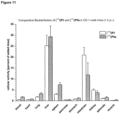
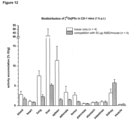
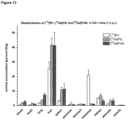
- mice were intravenously (i.v.) injected with the respective radioligands (0.4-3.7 MBq in 100 ⁇ L of PBS (pH 7.4)) under isoflurane anesthesia.
- the radioactivity was measured in weighted tissue samples using a ⁇ -counter. Data are expressed in %ID/g tissue (mean ⁇ SD).
- Table 2a Binding affinities (IC 50 in nM) of novel CXCR4 ligands to human CXCR4 (hCXCR4). Affinities were determined using Jurkat human T-cell leukemia cells (200.000 cells / sample) and [ 125 I]FC-131 as the radioligand. Each experiment was performed in triplicate, and results are means ⁇ SD from three separate experiments.
- Affinities were determined using Jurkat human T-cell leukemia (hCXCR4), E ⁇ -Myc1080 mouse B-cell lymphoma and C6 rat glioblastoma cells, respectively (200.000 cells / sample), and [ 125 I]R1 as the radioligand. Each experiment was performed in triplicate, and results are means ⁇ SD from three separate experiments.
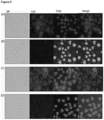
- Chem-1 cells stably transfected with hCXCR4 were incubated with the respective Sulfo-Cy5 conjugated peptides for 1 h at 4 °C or at 37 °C.
- the ligand concentrations used in the respective experiments are cited in the Figure captions.
- Non-specific ligand binding was determined in the presence of AMD3100 (100 ⁇ M).
- Cell nuclei were stained with Hoechst (2 ⁇ g/ml), and ligand internalization into endosomes and lysosomes was confirmed by co-staining using lysotracker green (2 ⁇ M). See Figures 2 to 8 .
Landscapes
- Health & Medical Sciences (AREA)
- Life Sciences & Earth Sciences (AREA)
- Chemical & Material Sciences (AREA)
- Proteomics, Peptides & Aminoacids (AREA)
- General Health & Medical Sciences (AREA)
- Medicinal Chemistry (AREA)
- Public Health (AREA)
- Animal Behavior & Ethology (AREA)
- Pharmacology & Pharmacy (AREA)
- Veterinary Medicine (AREA)
- Organic Chemistry (AREA)
- Physics & Mathematics (AREA)
- Optics & Photonics (AREA)
- Epidemiology (AREA)
- General Chemical & Material Sciences (AREA)
- Nuclear Medicine, Radiotherapy & Molecular Imaging (AREA)
- Chemical Kinetics & Catalysis (AREA)
- Engineering & Computer Science (AREA)
- Bioinformatics & Cheminformatics (AREA)
- Biochemistry (AREA)
- Biophysics (AREA)
- Genetics & Genomics (AREA)
- Molecular Biology (AREA)
- Medicines Containing Antibodies Or Antigens For Use As Internal Diagnostic Agents (AREA)
Description
- The present disclosure relates to imaging and endoradiotherapy of diseases involving chemokine receptor 4 (CXCR4). Provided are compounds which bind or inhibit CXCR4 and furthermore carry at least one moiety which is amenable to labeling. Provided are also medical uses of such compounds.
- Binding of the only endogenous ligand CXCL12 (formerly termed SDF-1α) to its cognate receptor, the chemokine receptor 4 (CXCR4) [1], activates the downstream protein kinase B (AKT)/mitogen-activated protein kinases (MAPK) signaling pathway, which leads to the alteration of gene expression, actin polymerization, cell skeleton rearrangement and cell migration. The physiological functions of the CXCL12/CXCR4 axis include embryogenesis (regulation of embryonic stem cell migration and positioning), immune response (leucocyte trafficking to sites of inflammation), embryo implantation (positioning of blastocysts in maternal endometrium), hematopoiesis (homing and differentiation of hematopoietic stem/progenitor cells in the bone marrow), brain development and neo-angiogenesis [2-6]. Consequently, genetic defects displayed in CXCL12 and CXCR4 gene-deleted mice exhibit identical, lethal phenotypes with severely impaired hematopoiesis and CNS development [7].
- The CXCR4 receptor has been found to be involved in a variety of diseases. For example, it mediates HIV-1 entry into T-cells as a co-receptor where it was first identified [3]. Furthermore, in rheumatoid arthritis (RA) CXCR4 expressing CD4+ memory T cells accumulate in the inflamed synovium because of the high local CXCL12 concentration [8]. In the pathogenesis of atherosclerosis, chronic inflammation of the arterial wall characterized by chemokine-mediated influx of leukocytes plays a central role [9]. The cytokine macrophage migration inhibitory factor (MIF) is a unique pro-inflammatory regulator of many acute and chronic inflammatory diseases that contribute to lesion progression and plaque inflammation. These chemokine-like functions are mediated through interaction of MIF with the chemokine receptors CXCR2 and CXCR4, thus suggesting a central role of CXCR4 in atherosclerotic plaque development, vascular remodeling after injury, in atherosclerosis plaque destabilization and aneurysm formation [10].
- In addition, CXCR4 is involved in B-cell trafficking and tissue localization in chronic leukemia patients [11] as well as the regulation of organ specific metastasis in different breast cancer models [12]. Furthermore, pronounced CXCR4 overexpression has been detected in more than 20 human tumor types, including hematopoietic malignancies, brain neoplasm, gastrointestinal cancer and other cancer types [2, 13-14]. A method for the early assessment of the metastatic potential and metastatic spread of tumors therefore represents a valuable tool for therapy planning, monitoring and control, since cancer metastasis is one of the critical factors affecting the life expectancy of patients.
- Given the undisputed relevance of CXCR4 as a diagnostic and therapeutic molecular target, a multitude of CXCR4 targeted peptidic and non-peptidic antagonists have been developed during the last decade. Amongst them, the bicyclam AMD3100 (plerixafor/Mozobil) is the only compound that has been approved by the FDA (in 2008) for the mobilization of stem cells and for the treatment of hematological and other cancers [7, 15-17]. In preclinical studies using mouse models of a variety of human hematological as well as solid cancers, antitumor therapies using either alternative small molecule CXCR4 antagonists such as AMD3465 [18-19] or MSX-122 [20], peptidic CXCL12 derivatives (CTCE-9908 [21], BKT-140 [22-24], POL-5551 [25-27]) or anti-CXCR4-antibodies [28-29] were shown to consistently lead to prolonged overall survival, primarily by effectively preventing distant organ metastasis [30]. Another potent CXCR4 antagonist, LY2510924 (cyclo[Phe-Tyr-Lys(iPr)-D-Arg-2-Nal-Gly-D-Glu]-Lys(iPr)-NH2) [31-32], exhibited high antitumor activities in solid tumor and breast cancer metastatic models and is currently evaluated in phase II clinical studies (NCT01391130 and NCT1439568). Lactam-cyclized heptapeptides were reported to be potent CXCR4 antagonists with high efficiency in the treatment of cancers, rheumatoid arthritis, pulmonary fibrosis, and HIV infection (
WO 2008150689 A1 ). Recently, disulfidebridged cyclic heptapeptide antagonists (WO/2011/092575A1 ) were shown to exhibit high in vivo stability [33-34], to efficiently inhibit lung metastasis in a melanoma model [35] and to reduce the metastatic potential of HCC and osteosarcoma in a mouse model [36]. A modified analog (R29, Ac-Arg-Ala-[D-Cys-Arg-Phe-His-Pen]-COOH) efficiently reverts the suppressive activity of T-regulatory cells in renal cancer [37]. - Amongst these CXCR4 targeted antagonists, T-140 based peptides were the first compounds to be employed for molecular imaging of CXCR4-expression in vivo; different analogs, either radiolabeled with 18F or 68Ga or conjugated with fluorescent dyes as well as corresponding bimodal probes have been employed for the non-invasive detection and visualization of CXCR4-expressing tissues using positron emission tomography (PET), optical or SPECT imaging [38-45].
- Furthermore, cyclic pentapeptides based on the N-terminal sequence of CXCL12 [46] or, more importantly, the downsized T-140 binding sequence cyclo(Gly-Nal-Arg-Arg-D-Tyr) (FC-131) [47] have been extensively evaluated. Detailed structure activity relationship (SAR) studies have highlighted the relevance of single amino acid residues and their stereochemistry as well as of amide bond methylation [48-53] for optimal CXCR4 affinity and antagonistic activity. Based on these findings and own SAR studies, our group has developed a first pentapeptide-based CXCR4-targeted molecular imaging agent, [68Ga]pentixafor. Substitution of Arg2 (in FC131) by D-Ornithine and N-methylation of D-Orn led to the CPCR4-scaffold (cyclo(D-Tyr1-D-[NMe]Orn2-Arg3-Nal4-Gly5)), which showed excellent binding affinity towards CXCR4 [54]. Further functionalization of the Orn2 sidechain with a suitable linker (4-aminomethylbenzoic acid, AMBS) and a DOTA (1,4,7,10-tetraazacyclododecane-1,4,7,10-tetraacetic acid) chelator led to pentixafor (cyclo(D-Tyr'-D-[NMe]Orn2(AMBS-DOTA)-Arg3-Nal4-Gly5), also termed CPCR4.2) [54-56];
WO2007/096662 ,WO 2009/027706 ,WO 2011/131735 ). Its 68Ga-labeled analog, [68Ga]pentixafor [57] shows high affinity and selectivity for human CXCR4, rapid renal excretion and very low non-specific background accumulation and thus allows sensitive and high-contrast imaging of CXCR4 expressing tissues in vivo using PET. Besides its successful application in patients with lymphoma [58], multiple myeloma [59-61], AML [62], SCLC [63], glioblastoma [64] or other solid tumors [65], [68Ga]pentixafor-PET has recently been shown to be a valuable tool for the in vivo detection of inflammatory processes e.g. after myocardial infarction [66-68] or stroke [69], in atherosclerosis [70-72] or other inflammatory diseases [73-74]. - An alternative peptide backbone (cyclo(D-3-iodo-Tyr1-D-[NMe]Orn2-Arg3-Nal4-Gly5)) was employed for the synthesis of a first CXCR4 targeted endoradiotherapeutic agent, namely pentixather (cyclo(D-3-iodo-Tyr1-D-[NMe]Orn2(AMBS-DOTA)-Arg3-Nal4-Gly5) [75-76] (
WO 2015/185162 ). First very promising results have been obtained using [177Lu]- and [90Y]pentixather for PRRT (peptide receptor targeted radionuclide therapy) in patients with multiple myeloma [77-78], and consequently a clinical trial further evaluating the [68Ga]pentixafor/[177Lu/90Y]pentixather based CXCR4 targeted theranostic concept has recently been initiated. Furthermore, ongoing preclinical studies are directed towards establishing the potential of alpha-therapy in disseminated micrometastatic hematological cancers using [213Bi/225Ac]pentixather. - While having undisputed clinical potential for CXCR4-targeted theranostics, however, both [68Ga]pentixafor and [177Lu/90Y]pentixather display pronounced selectivity for the human CXCR4 (hCXCR4) receptor and show virtually no affinity to the murine receptor (mCXCR4). To date, this precludes their use as preclinical tools for the investigation of CXCR4-related pathologies such as carcinogenesis or inflammatory diseases in mouse models. Recently, an alternative pentapeptide scaffold with a modified N-alkylation pattern compared to pentixafor/pentixather has been introduced [79], and peptides based on this backbone were shown to have hCXCR4 affinities in the low nanomolar to subnanomolar range. Recent studies have demonstrated that, surprisingly, the analog with the highest hCXCR4 affinity (cyclo(D-Tyr1-D-[N-hexyl-6-guanidino]D-Ala2-Arg3-Nal4-Gly5); CPCR4.3) also binds with equally high affinity to mCXCR4. Based on these results, radioiodinated CPCR4.3 has been very recently shown to sensitively detect CXCR4-expressing immune cells in a mouse model of esophageal cancer [80].
- Unfortunately, however, radioiodinated CPCR4.3 is not well suited for imaging purposes beyond autoradiography studies; due to its lipophilicity, the peptide shows suboptimal pharmacokinetics characterized by significant hepatobiliary clearance, precluding its application for in vivo imaging studies. The implementation of alternative labelling strategies such as radiometallation via a DOTA chelator (as in pentixafor/pentixather), however, requires the identification of suitable attachment sites for further structural modification within the peptide sequence.
- Based on this hypothesis, the present invention describes the design of novel CPCR4.3 analogs functionalized at the guanidino-group of the 6-guanidino-hexyl-sidechain on D-Ala2, either via acylation or alkylation. It summarizes approaches for the identification of a suitable linker moiety between the peptide core and the radiolabel/signaling unit and describes the resulting design of novel CXCR4-targeted probes with high m/hCXCR4 affinity (reduced species selectivity) labelled with a broad palette of radionuclides and/or fluorescent dyes for molecular imaging and therapeutic applications.
- The present invention is defined by the claims. Accordingly, in a first aspect, the present invention relates to a compound of the following formula (I)

- R1 is alkyl, preferably C1-C6 alkyl, more preferably methyl;
- R2 is H or alkyl, which alkyl may be unsubstituted or substituted with at least one substituent selected from -NH2, -NH-C(=NH)-NH2, -C(O)NH2, -C(O)OH, -OH, -SH, -SCH3 and a 5 to 10-membered carbocycle or 5 to 10-membered heterocycle containing oxygen, nitrogen or sulfur as heteroatom(s), wherein the alkyl is preferably C1-C6 alkyl;
- R3 is H or alkyl, which alkyl may be unsubstituted or substituted with at least one substituent selected from -NH2, -NH-C(=NH)-NH2, -C(O)NH2, -C(O)OH, -OH, -SH, -SCH3 and a 5 to 10-membered carbocycle or 5 to 10-membered heterocycle containing oxygen, nitrogen or sulfur as heteroatom(s), wherein the alkyl is preferably C1-C6 alkyl;
- R4 is alkyl, which alkyl is substituted with at least one -SRAI;
- R5 is H or I;
- R6 is alkyl substituted with at least one substituent selected from -NH2, -NH-C(=NH)-NH2, -NH-RB, -NH-C(=NH)-NH-RB, -NH-C(=NH)-NH-R14, and -NH-C(=NH)-NH-C(=O)-R15, wherein the alkyl is preferably C1-C8 alkyl,
- R7 to R10 are each independently H or alkyl; preferably H or C1-C6 alkyl; and more preferably H;
- R14 and R15 are independently C1-C10 alkyl, preferably C2-C6 alkyl, which alkyl may be substituted by at least one substituent selected from -NH-C(=O)-CH3 and -C=CH;
- RA is a group which comprises at least one selected from:
- (i) a chelating moiety,
- (ii) a chelate formed by a chelating moiety (i) with a chelated radioactive or non-radioactive cation,
- (iii) a moiety carrying a covalently bound radioisotope,
- (iv) a phosphonate moiety, and
- (v) a fluorescent label, such as a quantum dot or fluorescent dye; and
- RB is a group which comprises at least one selected from:
- (i) a chelating moiety,
- (ii) a chelate formed by a chelating moiety with a chelated radioactive or non-radioactive cation,
- (iii) a group carrying a covalently bound radioisotope,
- (iv) a phosphonate moiety, and
- (v) a fluorescent label, such as a quantum dot or fluorescent dye,
and RB may further comprise a group of formula (II) , wherein R1 to R5 and R7 to R10 are as defined above, and wherein R16 is an alkanediyl group, preferably a C1-C6 alkanediyl group, and R17 is selected from -NH- and -NH-C(=NH)-NH-.
- Compounds in accordance with the first aspect of the present invention deviate from CXCR4 binders known in the art with respect to at least one feature. To explain further, one of these features is that the amide nitrogen bearing R6 is substituted in compounds of the invention. More specifically, it is substituted with an alkyl group which bears a substituent selected from amino and guanidinium groups, which amino and guanidinium groups may be further substituted in turn. These further substituents include the moiety RB. Embodiments of RB include a chelating moiety as well as other labels or groups amenable to labeling. In other words, not only is the mentioned nitrogen atom bearing R6 substituted, but furthermore by such substituting an anchor point has been introduced in the molecule which anchor point provides for further options of the derivatization. Preferred derivatizations are further detailed below and include the introduction of moieties useful for diagnostic molecular imaging and endoradiotherapy. The present invention demonstrates that such derivatizations are possible without negatively interfering with target binding.
- A further difference from CXCR4 binders known in the art is that group R1 is not the side chain of ornithin, but instead an alkyl group, preferably methyl.
- The introduction of the above defined substituent R6 alongside with the altered alkylation pattern at R1, also referred to as an "alkyl shift", provides for distinct advantages, said advantages including - apart from the option of introducing the mentioned labels or moieties amenable to labeling at R6 -
- a significant increase of the affinity for the target human CXCR4 (hCXCR4), and
- a substantial reduction in the species selectivity of ligand binding, leading to almost equally high affinities of the peptides modified at R6 for the human (hCXCR4) and mouse (mCXCR4) receptor.
- As noted above, the present inventors aim at the provision of CXCR4 binding molecules for diagnostic molecular imaging and endoradiotherapy. Surprisingly, it has been discovered that there is one further site except R6 which is amenable to functionalization with a signaling unit such as a radiolabel or fluorescent dye. Such second site is provided by embodiments of R4, where R4 comprises RA. Here use is made of R4 as an anchor point for modifications, said modifications including, in analogy to RB discussed above, the introduction of radioactive labels, moieties amenable to radioactive labeling or other signaling units suitable for molecular imaging.
- R1 in formula (I) is alkyl, preferably linear alkyl. It is preferred that the alkyl group is a C1-C6 alkyl group, more preferably a C1 or C2 alkyl, and most preferably methyl.
- R2 in formula (I) is H or alkyl, which alkyl may be unsubstituted or substituted with at least one substituent selected from -NH2, -NH-C(=NH)-NH2, -C(O)NH2, -C(O)OH, -OH, -SH, -SCH3 and a 5 to 10-membered carbocycle or 5 to 10-membered heterocycle containing oxygen, nitrogen or sulfur as heteroatom(s). The alkyl is preferably a linear alkyl group. As regards the number of carbon atoms, it is preferred that the alkyl is C1-C6 alkyl, more preferably C2-C3 alkyl, and most preferably C3 alkyl. In terms of the substituent, it is preferred that R2 is substituted with at least one group selected from -NH2 and guandino (-NH-C(=NH)-NH2), Particularly preferred as a group R2 is a linear C3 alkyl group, substituted at its terminal C-atom (i.e. the C atom most remote from the point of attachment of R2 in formula (I)) with one of -NH2 and guandino (-NH-C(=NH)-NH2). Most preferred is -CH2-CH2-CH2-NH-C(=NH)-NH2.
- As will be understood by the skilled reader, any 5 to 10-membered carbocycle referred to herein may be formed by a single ring having a number of ring members falling within the defined range, or by fused rings (e.g. two fused rings) having a total number of ring members falling withing the defined range. Likewise, any 5 to 10-membered heterocycle referred to herein may be formed by a single ring having a number of ring members falling within the defined range, or by fused rings (e.g. two fused rings) having a total number of ring members falling withing the defined range.
- R3 in formula (I) is H or alkyl, which alkyl may be unsubstituted or substituted with at least one substituent selected from -NH2, -NH-C(=NH)-NH2, -C(O)NH2, -C(O)OH, -OH, -SH, -SCH3 and a 5 to 10-membered carbocycle or 5 to 10-membered heterocycle containing oxygen, nitrogen or sulfur as heteroatom(s). As regards the number of carbon atoms, it is preferred that the alkyl is C1-C6 alkyl, more preferably C1-C2 alkyl, and most preferably methyl. In terms of the substituent, it is preferred that R3 is substituted with a 5 to 10-membered carbocycle, more preferably a phenyl or naphthyl group. Particularly preferred as a group R3 is a methyl group substituted with one phenyl or one naphthyl group, and most preferred is a group -CH2-naphthyl, such as -CH2-(2-naphtyl),
- R4 in formula (I) is alkyl, which alkyl is substituted with at least one -SRA. The alkyl is preferably C1-C6 alkyl more preferably C1-C2 alkyl, and most preferably methyl.
- R5 in formula (I) is H or I, and is preferably H.
- R6 in formula (I) is alkyl substituted with at least one substituent selected from -NH2, -NH-C(=NH)-NH2, -NH-RB, -NH-C(=NH)-NH-RB, -NH-C(=NH)-NH-R14, and -NH-C(=NH)-NH-C(=O)-R15. The alkyl is preferably a linear alkyl group. As regards the number of carbon atoms, it is preferred that the alkyl is C1-C8 alkyl, more preferably C2-C6 alkyl, and most preferably C6 alkyl. In terms of the substituent, it is preferred that R6 is substituted with one group selected from -NH-C(=NH)-NH2, -NH-C(=NH)-NH-RB, -NH-C(=NH)-NH-R14, and -NH-C(=NH)-NH-C(=O)-R15. Particularly preferred as a group R6 is thus a linear C2-C6 alkyl, even more preferred a linear C6 alkyl, substituted at its terminal C-atom (i.e. the C atom most remote from the point of attachment of R6 in formula (I)) with one group selected from -NH-C(=NH)-NH2, -NH-C(=NH)-NH-RB, -NH-C(=NH)-NH-R14, and -NH-C(=NH)-NH-C(=O)-R15.
- R14 and R15 are independently C1-C10 alkyl, preferably C2-C6 alkyl. The alkyl group is preferably a linear alkyl group. The alkyl, preferably linear alkyl, may be substituted by at least one substituent selected from -NH-C(=O)-CH3 and -C=CH. Preferably, the alkyl group is a linear C1-C10 alkyl group, more preferably a linear C2-C6 alkyl group, which is unsubstituted or substituted at its terminal C-atom (i.e. the C atom most remote from the point of attachment of R14 and R15 in the above formulae) by one substituent selected from -NH-C(=O)-CH3 and -C≡CH.
- R7 to R10 in formula (I) are each independently H or alkyl; preferably H or C1-C6 alkyl; and are more preferably H.
- In line with the above, it will be understood that the compound of formula (I) is preferably represented by the following formula (III):

- More preferably, the compound of formula (I) is represented by the following formula (IV):

- Another preferred subgroup of the compounds in accordance with the invention has the formula (Ib):

- R4B is alkyl substituted with one substituent -SRA, wherein RA is as defined for formula (I), including its preferred meanings. Preferably, the substituted alkyl is a C1-C6 alkyl, more preferably a C1 or C2 alkyl, and most preferred is methyl. Thus, it is particularly preferred that R4B is -CH2-SRA.
- R6B is alkyl substituted with one substituent selected from -NH2, -NH-C(=NH)-NH2, -NH-C(=NH)-NH-R14, and -NH-C(=NH)-NH-C(=O)-R15, wherein R14 and R15 are defined as for formula (I), including their preferred embodiments. The alkyl is preferably a linear alkyl group. In terms of the number of carbon atoms, it is preferably C1-C8 alkyl, more preferably C2-C6 alkyl, and most preferably C6 alkyl. Particularly preferred as a group R6B is thus a linear C2-C6 alkyl, even more preferred a linear C6 alkyl, substituted at its terminal C-atom (i.e. the C atom most remote from the point of attachment of R6B in formula (lb)) with one group -NH-C(=NH)-NH2. Most preferred is that R6B is -(linear C6 alkyl)-NH-C(=NH)-NH2. R14 and R15 are as defined for formula (I), including their preferred meanings.
- It is preferred that the compound of formula (lb) is a compound of formula (Illb):


- In formula (I) and the preferred formulae (Ib), (III), (IIIb), (IV) and (IVb), RA is a group which comprises at least one selected from:
- (i) a chelating moiety,
- (ii) a chelate formed by a chelating moiety (i) with a chelated radioactive or non-radioactive cation,
- (iii) a moiety carrying a covalently bound radioisotope,
- (iv) a phosphonate moiety, and
- (v) a fluorescent label, such as a quantum dot or fluorescent dye.
- Typically, RA comprises one of (i) to (v), i.e. it is not necessary that two or more of (i) to (v) are present in one compound in accordance with the invention. Among the moieties (i) to (v), preference is given to (i) and (ii). Thus, it is particularly preferred that RA comprises one of (i) and (ii).
- As will be understood by the skilled reader, the above definition, according to which RA comprises at least one of the above (i) to (v) encompasses the case that RA comprises a further moiety or further moieties together with the at least one of (i) to (v). In accordance with a preferred example, RA may comprise, in addition to the at least one moiety of the above (i) to (v), a linking group which attaches the at least one moiety of (i) to (v) to the remainder of the compound. The linking group may be a divalent linking group which attaches one of (i) to (v) to the remainder of the compound, or a branched linking group which allows two or more of (i) to (v) to be attached to the remainder of the compound. Preferably, RA comprises a divalent linking group.
- Thus, it is further preferred that RA is a group of the formula -LA1-RA1, wherein LA1 is a divalent linking group and RA1 is or comprises one group selected from: (i) a chelating moiety, (ii) a chelate formed by a chelating moiety (i) with a chelated radioactive or non-radioactive cation, (iii) a moiety carrying a covalently bound radioisotope, (iv) a phosphonate moiety, and (v) a fluorescent label, such as a quantum dot or fluorescent dye. Among these, (i) and (ii) are more preferred.
- It is particularly preferred that -LA1-RA1 is selected from the groups of formulae (Va) and (Vb):
-(CH2)-C(=O)-NH-R24-NH-RA1 (Va),
-(CH2)-C(=O)-NH-(CH2)y-R25-(CH2)z-NH-RA1 (Vb),
wherein R24 is a C2-C10 alkanediyl group, preferably a C3-C6 alkanediyl group, which alkanediyl group is preferably linear and may be substituted by a group -C(=O)-NH2, R25 is a phenylene group, preferably a 1,3-phenylene group, and y and z are independently integers selected from 0, 1 or 2, and are preferably both 1. RA1 is as defined above, including its preferred meanings. Among these, it is particularly preferred that -LA1-RA1 is a group of formula (Vb). - The chelating moiety of (i) and (ii), both in the context of the definition of RA and RA1, is suitable to form a chelate with a radioactive or non-radioactive cation. Suitable chelating moieties for diverse cations are well known in the art, and can be used in the context of the present invention.
- Preferably, the chelating moiety comprises at least one of
a macrocyclic ring structure with 8 to 20 ring atoms of which 2 or more, preferably 3 or more, are selected from oxygen atoms, sulfur atoms and nitrogen atoms; and an acyclic, open chain chelating structure with 8 to 20 main chain atoms of which 2 or more, preferably 3 or more are heteroatoms selected from oxygen atoms, sulfur atoms and nitrogen atoms. - A preferred example for the chelating moiety is a residue of a chelating agent such as bis(carboxymethyl)-1,4,8,11-tetraazabicyclo[6.6.2]hexadecane (CBTE2a), cyclohexyl-1,2-diaminetetraacetic acid (CDTA), 4-(1,4,8,11-tetraazacyclotetradec-1-yl)-methylbenzoic acid (CPTA), N'-[5-[acetyl(hydroxy)amino]pentyl]-N-[5-[[4-[5-aminopentyl-(hydroxy)amino]-4-oxobutanoyl]amino]pentyl]-N-hydroxybutandiamide (DFO), 4,11-bis(carboxymethyl)-1,4,8,11-tetraazabicyclo[6.6.2]hexadecane (DO2A), 1,4,7,10-tetraazacyclododecane-N,N',N",N‴-tetraacetic acid (DOTA), α-(2-carboxyethyl)-1,4,7,10-tetraazacyclododecane-1,4,7,10-tetraacetic acid or 2-[1,4,7,10-tetraazacyclododecane-4,7,10-triacetic acid]-pentanedioic acid (DOTAGA), N,N'-dipyridoxylethylendiamine-N,N'-diacetate-5,5'-bis(phosphate) (DPDP), diethylenetriaminepentaacetic acid (DTPA), ethylenediamine-N,N'-tetraacetic acid (EDTA), ethyleneglycol-O,O-bis(2-aminoethyl)-N,N,N',N'-tetraacetic acid (EGTA), N,N-bis(hydroxybenzyl)-ethylenediamine-N,N'-diacetic acid (HBED), hydroxyethyldiaminetriacetic acid (HEDTA), 1-(p-nitrobenzyl)-1,4,7,10-tetraazacyclodecane-4,7,10-triacetate (HP-DOA3), 6-hydrazinyl-N-methylpyridine-3-carboxamide (HYNIC), 1,4,7-triazacyclononan-1-succinic acid-4,7-diacetic acid (NODASA), 1-(1-carboxy-3-carboxypropyl)-4,7-(carbooxy)-1,4,7-triazacyclononane (NODAGA), 1,4,7-triazacyclononanetriacetic acid (NOTA), 4,11-bis(carboxymethyl)-1,4,8,11-tetraazabicyclo[6.6.2]hexadecane (TE2A), 1,4,8,11-tetraazacyclododecane-1,4,8,11-tetraacetic acid (TETA), terpyridinbis(methyleneamintetraacetic acid (TMT), 1,4,7,10-tetraazacyclotridecan-N,N',N",N‴-tetraacetic acid (TRITA), triethylenetetraaminehexaacetic acid (TTHA), N,N'-bis[(6-carboxy-2-pyridyl)methyl]-4,13-diaza-18-crown-6 (H2macropa), and 4-amino-4-{2-[(3-hydroxy-1,6-dimethyl-4-oxo-1,4-dihydro-pyridin-2-ylmethyl)-carbamoyl]-ethyl} heptanedioic acid bis-[(3-hydroxy-1,6-dimethyl-4-oxo-1,4-dihydro-pyridin- 2-ylmethyl)-amide] (THP), which residue is obtainable by covalently binding a carboxyl group contained in the chelating agent to the remainder of the compound via an ester or an amide bond, preferably an amide bond. For example, in formulae (Va) and (Vb), an amide bond can be conveniently formed directly from a carboxyl group contained in the above exemplary chelating agents and the nitrogen atom to which RA or RA1, respectively, is attached in these formulae.
- In a more preferred example, the chelating moiety of (i) or (ii) in the context of the definition of RA or RA1 is a residue of a chelating agent selected from DOTA and DOTAGA, still more preferably a residue obtainable by forming an amide bond from a carboxyl group contained in DOTA and DOTAGA, and the nitrogen atom to which RA1 is attached in formulae (Va) and (Vb).
- Exemplary radioactive cations that are optionally chelated by the chelating moiety in accordance with (ii), both in the context of the definition of RA and RA1 are selected from the cations of 44Sc, 47Sc, 51Cr, 52mMn, 58Co, 52Fe, 56Ni, 57Ni, 62Cu, 64Cu, 67Cu, 66Ga, 68Ga, 67Ga, 89Zr, 90Y, 89Y, 94mTc, 99mTc, 97Ru, 105Rh, 109Pd, 111Ag,110mIn, 111In, 113mIn, 114mIn, 117mSn, 121Sn, 127Te, 142Pr, 143Pr, 149Pm, 151Pm, 149Tb, 153Sm, 157Gd, 161Tb, 166Ho, 165Dy, 169Er, 169Yb, 175Yb, 172Tm, 177Lu, 186Re, 188Re, 191Pt, 197Hg, 198Au, 199Au, 212Pb, 203Pb, 211At, 212Bi, 213Bi, 223Ra, 225Ac, and 227Th, or a cationic molecule comprising 18F, such as 18F-[AlF]2+.
- Preferred chelated cations are selected from the cations of 44Sc, 47Sc, 64Cu, 67Cu, 68Ga, 90Y, 111In, 161Tb, 166Ho, 177Lu, 188Re, 212Pb, 212Bi, 213Bi, 225Ac, and 227Th, or a cationic molecule comprising 18F. Even further preferred are cations of 68Ga, 90Y, 177Lu, 212Bi, and 213Bi.
- Moieties (iii) carrying a covalently bound radioisotope, preferably 18F-fluoride as referred to in the definition of RA and RA1 can be used as known in the art. As examples of a precursor suitable to be labeled with such radioisotope, reference can be made to a group of formula - N+(CH3)2-CH2-BF3 - and to a group of the formula -Ar-SiF(C(CH3)3)2, wherein Ar is a divalent aromatic group, preferably a phenylene group. As will be appreciated by the skilled reader, such a group of the formula -Ar-SiF(C(CH3)3)2 can be conveniently bound to the remainder of the compounds in accordance with the invention by a functional group which may be attached to Ar at the open valence as indicated in the formula, and which is suitable for covalent coupling of the group -Ar-SiF(C(CH3)3)2. For example, reference can be made to an amide bond or an ester bond which can be formed e.g. if the group -Ar-SiF(C(CH3)3)2 is provided as a part of a benzoic acid derivative of the formula -C(O)-C6H4-SiF(C(CH3)3)2.
- Phosphonate moieties (iv), i.e. moieties comprising the structure -P(=O)(OH)2 or salts thereof as referred to in the definition of RA and RA1 can also be used as known in the art.
- As a fluorescent label (v) as referred to in the definition of RA and RA1, a fluorescent dye, such as Cy5 or Cy7, or a quantum dot may be used.
- In formula (I) and the preferred formulae (Ib), (III), (IIIb), (IV) and (IVb), RB is a group which comprises at least one selected from:
- (i) a chelating moiety,
- (ii) a chelate formed by a chelating moiety with a chelated radioactive or non-radioactive cation,
- (iii) a group carrying a covalently bound radioisotope,
- (iv) a phosphonate moiety, and
- (v) a fluorescent label, such as a quantum dot or fluorescent dye,
- As will be understood by the skilled reader, the above definition, according to which RB comprises at least one of the above (i) to (v) encompasses the case that RB comprises a further moiety or further moieties together with the at least one of (i) to (v). In accordance with a preferred example, RB may comprise, in addition to the at least one moiety of the above (i) to (v), a linking group which attaches the at least one moiety of (i) to (v) to the remainder of the compound. The linking group may be a divalent linking group which attaches one of (i) to (v) to the remainder of the compound, or a branched linking group which allows two or more of (i) to (v) to be attached to the remainder of the compound. Preferably, RB comprises a divalent linking group.
- Thus, it is further preferred that RB is a group of the formula -LB1-RB1, wherein LB1 is a divalent linking group, and RB1 is or comprises one group selected from (i) a chelating moiety, (ii) a chelate formed by a chelating moiety (i) with a chelated radioactive or non-radioactive cation, (iii) a moiety carrying a covalently bound radioisotope, (iv) a phosphonate moiety, and (v) a fluorescent label, such as a quantum dot or fluorescent dye. Moreover, RB1 may further comprise a group of formula (II) as defined above.
- It is particularly preferred that LB1-RB1 is selected from the groups of formulae (VIa) to (Vlf):
-R18-NH-RB1 (VIa),
-R18-NH-(C(=O)-R19-NH)u-RB1 (VIb),
-R18-NH-(C(=O)-R20-NH)v-RB1 (VIc),
-C(=O)-R21-NH-RB1 (VId),
-C(=O)-R21-NH-(C(=O)-R22-NH)w-RB1 (VIe),
-C(=O)-R21-NH-(C(=O)-R23-NH)x-RB1 (VIf),
wherein: - R18 is C1-C10 alkanediyl, preferably linear alkanediyl, more preferably linear C2-C6 alkanediyl, and most preferably linear C6 alkanediyl,
- R19 is C1-C10 alkanediyl, preferably linear alkanediyl, more preferably linear C2-C6 alkanediyl, u is 1, 2 or 3, preferably 1 or 2,
- R20 is an oligoether moiety, preferably a linear oligoether moiety, more preferably a linear oligoether moiety having 5 to 10 carbon atoms and 2 or 3 oxygen atoms providing the ether bonds, v is 1, 2 or 3, preferably 1 or 2,
- R21 is C1-C10 alkanediyl, preferably linear alkanediyl, more preferably linear C2-C6 alkanediyl, and most preferably linear C6 alkanediyl,
- R22 is C1-C10 alkanediyl, preferably linear alkanediyl, more preferably linear C2-C6 alkanediyl, w is 1, 2 or 3, preferably 1 or 2,
- R23 is an oligoether moiety, preferably a linear oligoether moiety, more preferably a linear oligoether moiety having 5 to 10 carbon atoms and 2 or 3 oxygen atoms providing the ether bonds, x is 1, 2 or 3, preferably 1 or 2,
- and RB1 is as defined above.
- The chelating moiety of (i) and (ii), both in the context of the definition of RB and RB1, is suitable to form a chelate with a radioactive or non-radioactive cation. Suitable chelating moieties for diverse cations are well known in the art, and can be used in the context of the present invention.
- Preferably, the chelating moiety comprises at least one of
- a macrocyclic ring structure with 8 to 20 ring atoms of which 2 or more, preferably 3 or more, are selected from oxygen atoms, sulfur atoms and nitrogen atoms; and
- an acyclic, open chain chelating structure with 8 to 20 main chain atoms of which 2 or more, preferably 3 or more are heteroatoms selected from oxygen atoms, sulfur atoms and nitrogen atoms.
- A preferred example for the chelating moiety is a residue of a chelating agent such as bis(carboxymethyl)-1,4,8,11-tetraazabicyclo[6.6.2]hexadecane (CBTE2a), cyclohexyl-1,2-diaminetetraacetic acid (CDTA), 4-(1,4,8,11-tetraazacyclotetradec-1-yl)-methylbenzoic acid (CPTA), N'-[5-[acetyl(hydroxy)amino]pentyl]-N-[5-[[4-[5-aminopentyl-(hydroxy)amino]-4-oxobutanoyl]amino]pentyl]-N-hydroxybutandiamide (DFO), 4,11-bis(carboxymethyl)-1,4,8,11-tetraazabicyclo[6.6.2]hexadecane (DO2A), 1,4,7,10-tetraazacyclododecane-N,N',N",N‴-tetraacetic acid (DOTA), α-(2-carboxyethyl)-1,4,7,10-tetraazacyclododecane-1,4,7,10-tetraacetic acid or 2-[1,4,7,10-tetraazacyclododecane-4,7,10-triacetic acid]-pentanedioic acid (DOTAGA), N,N'-dipyridoxylethylendiamine-N,N'-diacetate-5,5'-bis(phosphate) (DPDP), diethylenetriaminepentaacetic acid (DTPA), ethylenediamine-N,N'-tetraacetic acid (EDTA), ethyleneglycol-O,O-bis(2-aminoethyl)-N,N,N',N'-tetraacetic acid (EGTA), N,N-bis(hydroxybenzyl)-ethylenediamine-N,N'-diacetic acid (HBED), hydroxyethyldiaminetriacetic acid (HEDTA), 1-(p-nitrobenzyl)-1,4,7,10-tetraazacyclodecane-4,7,10-triacetate (HP-DOA3), 6-hydrazinyl-N-methylpyridine-3-carboxamide (HYNIC), 1,4,7-triazacyclononan-1-succinic acid-4,7-diacetic acid (NODASA), 1-(1-carboxy-3-carboxypropyl)-4,7-(carbooxy)-1,4,7-triazacyclononane (NODAGA), 1,4,7-triazacyclononanetriacetic acid (NOTA), 4,11-bis(carboxymethyl)-1,4,8,11-tetraazabicyclo[6.6.2]hexadecane (TE2A), 1,4,8,11-tetraazacyclododecane-1,4,8,11-tetraacetic acid (TETA), terpyridinbis(methyleneamintetraacetic acid (TMT), 1,4,7,10-tetraazacyclotridecan-N,N',N",N‴-tetraacetic acid (TRITA), triethylenetetraaminehexaacetic acid (TTHA), N,N'-bis[(6-carboxy-2-pyridyl)methyl]-4,13-diaza-18-crown-6 (H2macropa), and 4-amino-4-{2-[(3-hydroxy-1,6-dimethyl-4-oxo-1,4-dihydro-pyridin-2-ylmethyl)-carbamoyl]-ethyl} heptanedioic acid bis-[(3-hydroxy-1,6-dimethyl-4-oxo-1,4-dihydro-pyridin- 2-ylmethyl)-amide] (THP), which residue is obtainable by covalently binding a carboxyl group contained in the chelating agent to the remainder of the compound via an ester or an amide bond, preferably an amide bond. For example, in formulae (Vla) to (Vlf), an amide bond can be conveniently formed directly from a carboxyl group contained in the above exemplary chelating agents and the nitrogen atom to which RB or RB1, respectively, is attached in these formulae.
- In a more preferred example, the chelating moiety of (i) or (ii) in the context of the definition of RB or RB1 is a residue of a chelating agent selected from DOTA and DOTAGA, still more preferably a residue obtainable by forming an amide bond from a carboxyl group contained in DOTA and DOTAGA, and the nitrogen atom to which RB1 is attached in formulae (Vla) to (VIf).
- Exemplary radioactive cations that are optionally chelated by the chelating moiety in accordance with (ii), both in the context of the definition of RB and RB1 are selected from the cations of 44Sc, 47Sc, 51Cr, 52mMn, 58Co, 52Fe, 56Ni, 57Ni, 62Cu, 64Cu, 67Cu, 66Ga, 68Ga, 67Ga, 89Zr, 90Y, 89Y, 94mTc, 99mTc, 97Ru, 105Rh, 109Pd, 111Ag,110mIn, 111In 113mIn, 114mIn, 117mSn, 121Sn, 127Te, 142Pr, 143Pr, 149Pm, 151Pm, 149Tb, 153Sm, 157Gd, 161Tb, 166Ho, 165Dy, 169Er, 169Yb, 175Yb, 172Tm, 177Lu, 186Re, 188Re, 191Pt, 197Hg, 198Au, 199Au, 212Pb, 203Pb, 211At, 212Bi, 213Bi, 223Ra, 225Ac, and 227Th, or a cationic molecule comprising 18F, such as 18F-[AlF]2+.
- Preferred chelated cations are selected from the cations of 44Sc, 47Sc, 64Cu, 67Cu, 68Ga, 90Y, 111In, 161Tb, 166Ho, 177Lu, 188Re, 212Pb, 212Bi, 213Bi, 225Ac, and 227Th, or a cationic molecule comprising 18F. Even further preferred are cations of 68Ga, 90Y, 177Lu, 212Bi, and 213Bi.
- Moieties (iii) carrying a covalently bound radioisotope, preferably 18F-fluoride as referred to in the definition of RB and RB1 can be used as known in the art.
- As examples of a precursor suitable to be labeled with such radioisotope, reference can be made to a group of formula -N+(CH3)2-CH2-BF3 - and to a group of the formula -Ar-SiF(C(CH3)3)2, wherein Ar is a divalent aromatic group, preferably a phenylene group. As will be appreciated by the skilled reader, such a group of the formula -Ar-SiF(C(CH3)3)2 can be conveniently bound to the remainder of the compounds in accordance with the invention by a functional group which may be attached to Ar at the open valence as indicated in the formula, and which is suitable for covalent coupling of the group -Ar-SiF(C(CH3)3)2. For example, reference can be made to an amide bond or an ester bond which can be formed e.g. if the group -Ar-SiF(C(CH3)3)2 is provided as a part of a benzoic acid derivative of the formula -C(O)-C6H4-SiF(C(CH3)3)2.
- Phosphonate moieties (iv), i.e. moieties comprising the structure -P(=O)(OH)2 or salts thereof as referred to in the definition of RB and RB1 can also be used as known in the art.
- As a fluorescent label (v) as referred to in the definition of RB and RB1, a fluorescent dye, such as Cy5 or Cy7, or a quantum dot may be used.
- Furthermore, RB and RB1, respectively, may further comprise a group of formula (II)
 ,wherein R1 to R5 and R7 to R10 are as defined for formula (I) including their preferred meanings, and wherein R16 is an alkanediyl group, preferably a C1-C6 alkanediyl group, and R17 is selected from -NH- and -NH-C(=NH)-NH-.
 - In a second aspect, the invention provides a pharmaceutical composition comprising or consisting of a compound or salt of the first aspect.
- In a third aspect, the invention provides a diagnostic composition comprising or consisting of a compound or salt of the first aspect.
- The pharmaceutical composition may further comprise pharmaceutically acceptable carriers, excipients and/or diluents. Examples of suitable pharmaceutical carriers, excipients and/or diluents are well known in the art and include phosphate buffered saline solutions, water, emulsions, such as oil/water emulsions, various types of wetting agents, sterile solutions etc. Compositions comprising such carriers can be formulated by wellknown conventional methods. These pharmaceutical compositions can be administered to the subject at a suitable dose. Administration of the suitable compositions may be effected by different ways, e.g., by intravenous, intraperitoneal, subcutaneous, intramuscular, topical, intradermal, intranasal or intrabronchial administration. It is particularly preferred that said administration is carried out by injection and/or delivery, e.g., to a site in the pancreas or into a brain artery or directly into brain tissue. The compositions may also be administered directly to the target site, e.g., by biolistic delivery to an external or internal target site, like the pancreas or brain. The dosage regimen will be determined by the attending physician and clinical factors. As is well known in the medical arts, dosages for any one patient depends upon many factors, including the patient's size, body surface area, age, the particular compound to be administered, sex, time and route of administration, general health, and other drugs being administered concurrently. Pharmaceutically active matter may be present in amounts between 0,1 ng and 10 mg/kg body weight per dose; however, doses below or above this exemplary range are envisioned, especially considering the aforementioned factors.
- The above applies mutatis mutandis also to diagnostic compositions.
- To the extent the above disclosed pharmaceutical composition, diagnostic composition and therapeutic composition comprises one or more compounds of the invention, it is preferred that no further pharmaceutically active compounds, diagnostically active compounds or therapeutically active compounds are present. In the alternative, further therapeutically active, diagnostically active or pharmaceutically active compounds may be present, for example, anticancer agents.
- In a fourth aspect, the invention provides a compound or salt of the first aspect for use in medicine, preferably in nuclear medicine, for nuclear molecular imaging, optical imaging, and endoradiotherapy, preferably targeted endoradiotherapy.
- Also described herein is a compound or salt of the first aspect for use in a method of treating or preventing cancer, cardiovascular diseases, AIDS or inflammatory disorders. These medical uses arise from expression, tissue distribution and/or activity of CXCR4 as discussed in the introductory section herein above.
- Also described herein is a compound or salt of the first aspect for use in a method of diagnosing and/or staging cancer.
- As regards the embodiments characterized in this specification, in particular in the claims, it is intended that each embodiment mentioned in a dependent claim is combined with each embodiment of each claim (independent or dependent) said dependent claim depends from. For example, in case of an
independent claim 1 reciting 3 alternatives A, B and C, adependent claim 2 reciting 3 alternatives D, E and F and aclaim 3 depending fromclaims - Similarly, and also in those cases where independent and/or dependent claims do not recite alternatives, it is understood that if dependent claims refer back to a plurality of preceding claims, any combination of subject-matter covered thereby is considered to be explicitly disclosed. For example, in case of an
independent claim 1, adependent claim 2 referring back toclaim 1, and adependent claim 3 referring back to bothclaims claims claims dependent claim 4 is present which refers to any one ofclaims 1 to 3, it follows that the combination of the subject-matter ofclaims claims claims claims - The figures show:
-
Figure 1 : Structures of cyclic CXCR4-binding molecules. -
Figure 2 : Fluorescence microscopy of P5h and P5f binding to CXCR4 expressing Chem-1 cells. (A) P5h, 100 nM, 4 °C. (B) P5h, 100 nM, 37 °C. (C) P5f, 100 nM, 4 °C. (D) P5f, 100 nM, 37 °C. Cells were also stained with Hoechst [2 µg/ml] (cell nuclei, blue) and Lysotracker Green [2 µM] (lysosomes, green) for visual aid. Cy5 images were taken with an excitation time of 8 s. Original magnification x20. -
Figure 3 : Fluorescence microscopy of P5g binding to CXCR4 expressing Chem-1 cells. (A) P5g, 500 nM, 4 °C. (B) P5g, 500 nM, 4 °C in the presence of 100 µM) AMD3100 (C) P5g, 500 nM, 37 °C. (D) P5g, 500 nM, 37 °C in the presence of 100 µM) AMD3100. Cells were also stained with Hoechst [2 µg/ml] (cell nuclei, blue) and Lysotracker Green [2 µM] (lysosomes, green) for visual aid. Cy5 images were taken with an excitation time of 8 s. Original magnification x20. -
Figure 4 : Fluorescence microscopy of P5h binding to CXCR4 expressing Chem-1 cells. (A) P5h, 500 nM, 4 °C. (B) P5h, 500 nM, 4 °C in the presence of 100 µM) AMD3100 (C) P5h, 500 nM, 37 °C. (D) P5h, 500 nM, 37 °C in the presence of 100 µM) AMD3100. Cells were also stained with Hoechst [2 µg/ml] (cell nuclei, blue) and Lysotracker Green [2 µM] (lysosomes, green) for visual aid. Cy5 images were taken with an excitation time of 8 s. Original magnification x20. -
Figure 5 : Fluorescence microscopy of P5i binding to CXCR4 expressing Chem-1 cells. (A) P5i, 500 nM, 4 °C. (B) P5i, 500 nM, 4 °C in the presence of 100 µM) AMD3100 (C) P5i, 500 nM, 37 °C. (D) P5i, 500 nM, 37 °C in the presence of 100 µM AMD3100. Cells were also stained with Hoechst [2 µg/ml] (cell nuclei, blue) and Lysotracker Green [2 µM] (lysosomes, green) for visual aid. Cy5 images were taken with an excitation time of 8 s. Original magnification x20. -
Figure 6 : Fluorescence microscopy of P5f binding to CXCR4 expressing Chem-1 cells. (A) P5f, 500 nM, 4 °C. (B) P5f, 500 nM, 4 °C in the presence of 100 µM AMD3100 (C) P5f, 500 nM, 37 °C. (D) P5f, 500 nM, 37 °C in the presence of 100 µM AMD3100. Cells were also stained with Hoechst [2 µg/ml] (cell nuclei, blue) and Lysotracker Green [2 µM] (lysosomes, green) for visual aid. Cy5 images were taken with an excitation time of 8 s. Original magnification x20. -
Figure 7 : Fluorescence microscopy of Pc5-QD binding to different CXCR4 expressing cell lines. Left: human Daudi lymphoma cells, 100 nM Pc5-QD, 1 h, RT; Middle: Eµ-Myc1080 mouse B-cell lymphoma cells, 25 nM Pc5-QD, 1 h, RT; Right: hCXCR4 expressing Chem-1 cells, 25 nM Pc5-QD, 1 h, RT. Original magnification x20. -
Figure 8 : Specificity of Pc5-QD binding to hCXCR4 expressing Chem-1 cells. Upper panel: uncoated QD's, 25 nM, 1 h, RT (negative control) and corresponding light microscopy image Lower panel: Pc5-QD, 25 nM, 1 h, RT, and corresponding light microscopy image. Original magnification x20. -
Figure 9 : Biodistribution of [125I]R1 in Black Six normal mice at 1 h p.i.. White bars: tracer only (n=5), grey bars: coinjection of 50 µg AMD3100 (2 mg/kg, n = 4). Data are represented as %iD/g and are means±SD. -
Figure 10 : Biodistribution of [125I]R1 in Black Six normal mice and CD-1 nude mice at 1 h p.i.. White bars: Black Six mice (n=5), grey bars: CD-1 nude mice. Data are represented as %iD/g and are means±SD. -
Figure 11 : Biodistribution of [125I]R1 and [125I]P5a in CD-1 nude mice at 1 h p.i.. White bars: [125I]R1, tracer only (n=5); grey bars: [125I]P5a, tracer only (n=5). Data are represented as %iD/g and are means±SD. -
Figure 12 : Biodistribution of [68Ga]P5c in CD-1 nude mice at 1 h p.i.. White bars: tracer only (n=4), grey bars: coinjection of 50 µg AMD3100 (2 mg/kg, n = 4). Data are represented as %iD/g and are means±SD. -
Figure 13 : Biodistribution of [125I]R1, [68Ga]P5c and [68Ga]Pc5b in CD-1 nude mice at 1 h p.i.. White bars: [125I]R1 (n=5), grey bars: [68Ga]P5c (n=4), dark grey bars: [68Ga]Pc5b (n=4). Data are represented as %iD/g and are means±SD. -
Figure 14 : Small animal [68Ga]P5c-PET (MIP) of Daudi lymphoma bearing CB-17 SCID mice at 1 h p.i.. Animals received app. 12 MBq of [68Ga]P5c. Left panel: tracer only (red arrow indicates the lymphoma xenograft); right panel: coinjection of 50 µg AMD3100. -
Figure 15 : Small animal [68Ga]Pc5b-PET (MIP) of healthy CB-17 SCID mice at 1 h p.i.. Animals received app. 13 MBq of [68Ga]Pc5b. A: tracer only, B: coinjection of 50 µg AMD3100. - The examples illustrate the invention:
- Solvents were purchased from Aldrich, Fluka, Merck and Prolabo, reagents from Aldrich, Fluka, Sigma, Merck, Acros and Lancaster in the quality "for synthesis", "per analysis" or "HPLC grade" and used without purification. Amino acids, derivatives for protecting groups as well as coupling reagents were purchased from Iris Biotech (Marktredwitz, Germany), Bachem (Bubendorf, Switzerland) or Carbolution (Saarbrücken, Germany). All reaction sensitive to oxygen or water were carried out in an argon atmosphere.
- Solid phase peptide synthesis was carried out in plastic syringes (VWR) which were equipped with a filter. Reaction and wash solutions were sucked in the syringe, for mixing, the syringes were shaken manually or using an Intelli-Mixer syringe shaker (Neolab, Heidelberg, Germany). For loading of the first amino acid, the required equivalents (eq.) were calculated based on the theoretical loading capacity provided by the supplier.
- Thin layer chromatography (TLC) for reaction control and the determination of Rf-values was done on aluminium foils coated with Silica 60, F254 (Merck). Peak detection was done under UV-light (254 nm) or after staining with Mostain-solution, respectively.
- Preparative flash chromatogaphy was performed with 50- to 100-fold mass excess Silica 60 (particle size 0.040-0.063 mm, Merck) applying 1- 1.5 bar overpressure.
- Analytical and semipreparative reversed phase high performance liquid chromatography (HPLC) was performed using the following devices:
- a) Amersham Pharmacia Biotech: Äkta Basic, 10F, Autosampler A 900, Pumping system P-900, Detector UV-900, Software Unicorn Vers. 3.00. Column: YMC-ODS-A C18 (120 Å, 5 µm, 250 mm×4.6 mm), analytical.
- b) Amersham Pharmacia Biotech: Äkta Basic, 100F, Pumping system P-900, Detector UV-900, Software Unicorn Vers. 3.00. Column: YMC-ODS-A C18 (120 Å, 10 µm, 250 mm×20 mm), semipreparative.
- c) Beckman: High
pressure pumping module 125, UV-Detector 166. Software System Gold; Column: YMC-ODS-A C18 (120 Å, 5 µm, 250 mm×20 mm), semi preparative. - d) Sykam: gradient HPLC System (Sykam GmbH, Eresing, Germany), 206 PHD UV-Vis detector (Linear™ Instruments Corporation, Reno, USA), Winnie 32 software. Columns: a) Nucleosil 100 C18 (5 µm, 125 × 4.0 mm) (CS Chromatographie Services GmbH, Langerwehe, Germany), analytical, and b) Multospher 100 RP 18 - 5 (250 × 20 mm) (CS), semipreparative. For radioactivity detection, the outlet of the UV-photometer was connected to a Nal(TI) well-type scintillation counter from EG&G Ortec (München, Germany).
- e) Shimadzu: Prominence Gradient HPLC System (Shimadzu, Duisburg, Germany).
- As eluents, mixtures of H2O (solvent A) and acetonitrile (solvent B) containing 0.1 vol-% TFA were used. Different, linear gradient profiles in 15-30 min (analytical) and 15-30 min (semipreparative) were applied. Flow rates were 1 mL/min (analytical) and 8-9 mL/min (semipreparative), respectively. UV-detection was carried out at 220 and 254 nm. Electrospray ionization mass spectrometry, ESI-MS was performed using
- a) a device from Finnigan (Typ LCQ in combination with the HPLC-system Hewlett Packard HP 1100). Columns: a) YMC Hydrosphere C18 (120 Å, 3 µm, 125 mm×2.1 mm), flow rate: 0.55 mL/min; b) YMC-UltraHT-Hydrosphere C18 (120 Å, 2 µm, 50 mm×2.0 mm), flow rate: 0.75 mL/min; c) YMC Octyl C8 (120 Å, 5 µm, 250 mm×2.1 mm), flow rate: 0.35 mL/min. As eluents, mixtures of H2O and acetonitrile containing 0.1 vol-% formic acid were used for different linear gradients (7 min, 15 min, 40 min).
- or b) a Varian 500-MS IT mass spectrometer (Agilent Technologies, Santa Clara, USA).
- Nuclear magnetic resonance (NMR) experiments were performed using the devices AV250, AV360 and DMX500 (Bruker) at 300 K. Chemical shifts (δ) are depicted in parts per million (ppm), as internal reference for 1H- and 13C-shifts, the residual signal of the solvent were used (CHCl6 for 1H (δ = 7.26 ppm) and CDCl3 for 13C (δ = 77.16 ppm); DMSO-ds for 1H (δ = 2.50 ppm) and DMSO-d6 for 13C (δ = 39.52 ppm). 13C-NMR-spectra were recorded with 1H-broadband decoupling. Datat was processed with the programs MestreC and MestreNova, respectively.
- Fluorescence Microscopy experiments were carried out using a BioRevo BZ9000 Fluorescence Microscope (Keyence, Osaka, Japan).
- Peptide synthesis was carried out using TCP-resin (0.9 mmol/g) following standard Fmocstrategy. Fmoc-Xaa-OH (1.2 eq.) were attached to the TCP resin with DIEA (2.5 eq.) in anhydrous DCM (0.8 mL/ g resin) at room temperature for I h. The remaining trityl chloride groups were capped by addition of 1 mL/g(resin) of a solution of MeOH, DIEA (5:I; vzv) for 15 min. The resin was filtered and washed 5 times with DCM and 3 times with MeOH. The loading capacity was determined by weight after drying the resin under vacuum and ranged from 0.4-0.9 mmol/g.
- The resin-bound Fmoc peptide was treated with 20% piperidine in NMP (v/v) for 10 minutes and a second time for 5 minutes. The resin was washed 5 times with NMP.
- A solution of triphenylphosphine (5eq.), DIAD (5eq.) and MeOH (10 eq.) in dry THF (I mL/g resin) was added to the resin bound Ns protected peptides and shaken at room temperature for 10 minutes. The resin was filtered off, and washed 3 times with dry THF and 3 times with NMP.
- A solution of Fmoc-Xaa-OH, HATU (2 eq.), HOAt (2 eq.), DIPEA (4 eq.) in NMP (1 mL/g resin) was added to the resin bound peptides and shaken for 3 hours at room temperature and w ashed 5 times with NMP.
- For Ns deprotection, the resin-bound Ns-peptides were stirred in a solution of inercaptoethanol (10 eq.) and DBU (5 eq.) in NMP (I mL/g resin) for 5 minutes. The deprotection procedure was repeated one more time and the resin was washed 5 times with NMP.
- For complete cleavage from the resin the peptides were treated three times with a mixture of acetic acid/2,2,2-trifluoroethanol/DCM (3/I/6, v/v/v) at room temperature for half an hour and the solvents were evaporated under reduced pressure.
- To a solution of peptide in DMF (I mM peptide concentration) and NaHCO3 (5 eq.), DPPA (3 eq.) was added at RT and stirred over night or until no linear peptide could be observed by ESI-MS. The solvent was evaporated to a small volume under reduced pressure and the peptides precipitated in saturated NaCl solution and washed two times in HPLC grade water.
- Dde-protection was carried out using 2% hydrazine in DMF at room temperature. After 30 min, deprotected peptides were precipitated using water (Pbf/tBu/Boc-protected peptides) or diethyl ether (deprotected peptides) and dried in a desiccator before further functionalization.
- Cyclized peptides were stirred in a solution of TFA, water and TIPS (95:2.5:2.5; v:v:v) at room temperature for one hour or until no more protected peptide could be observed by ESI-MS and subsequently precipitated in diethyl ether, washed twice with diethyl ether and dried.
- A solution in NMP containing 2-Nitrobenzenesulfonylchloride (o-Ns-Cl, 4 eq.) und sym-Collidine (10 eq.) is added to the resin-bound Peptide and stirred for 15 min. The resin is subsequently washed with NMP (3x) and THF abs. (3x). Afterwards, a solution in THF abs containing PPh3 (5 eq.) and Dde-6-aminohexanol is sucked in the syringe and a solution of DIAD (5 eq.) in a small amount of THF abs. is slowly added. After the resin is incubated for 30 min at RT with this solution, the mixture is removed and the reaction step repeated once again. and washed with THF (3x) und NMP (5x). The o-Ns-protecting group is removed by addition of a solution of Mercaptoethanol (10 eq.) and 1,8-diazabicyclo[5.4.0]undec-7-en (DBU, 5 eq.) in NMP for 5 min (2x). Finally, the resin is washed with NMP (5x).
- The orthogonally deprotected peptide P0 is dissolved in DMF and the precursor (A6-A11, B4-B7) (1.5 eq.) and DIPEA (5 eq.) is added subsequently. The solution is stirred at RT for 4 h or until no more starting material is detectable (monitoring by ESI-MS). The peptide is then precipitated in a sat. NaCl-solution (brine) and washed with water (2x).
- DdeOH (1.05 eq.) is added to a solution of the linear aminoalcohol (1.0 eq.) in DCM and stirred over night. The solution is washed with 1M aq. HCl (3x) and the combined organic layers dried over Na2SO4. After evaporation of the solvent in vacuo, the Dde-protected aminoalcohol is obtained as yellow solid.
- N,N'-Di-Boc-1H-pyrazole-1-carboxamidine (1.0 g, 3.2 mmol, 1.0 eq.), PPh3 (0.99 g, 3.8 mmol, 1.2 eq.) und the corresponding alcohol (1.2 eq.) are dissolved in 10 ml THF abs. DIAD (747 µl, 3.8 mmol, 1.2 eq.) is added dropwise to the vigorously stirred solution (at RT) afterwards stirred for 2 h at RT. After the evaporation of the solvent in vacuo, the crude product is purified by flash chromatography.
- DOTA (4 eq.), NHS (5 eq.) and EDCI (5 eq.) are dissolved in water, and DIPEA (8 eq.) are added. After 15 min, the respective peptide (1 eq.) is added in an equal volume of water. Progress of the coupling reaction is monitored using RP-HPLC. Upon completion of the reaction, the solvents are evaporated in vacuo. The residue is resuspended in methanol, the suspension is centrifuged, and the product dissolved in the methanolic supernatant is precipitated using diethyl ether, dried and purified using preparative RP-HPLC.
- For the preparation of the natGa- and natCu- complexes, equal volumes of a 2 mM solution of Ga(NO3)3 or Cu(NO3)2 in 1 M NaOAc buffer and a 2 mM aqueous solution of the respective peptide are mixed and heated to 95°C for 30 min. The corresponding natLu and natY complexes are prepared by adding a 2.5-molar excess of the respective metal chloride dissolved in water to the peptide. Upon heating to 95°C for 30 min, formation of the respective metal complexes is confirmed using RP-HPLC and ESI-MS.
- To a solution of amine functionalized peptide (1.1 eq) and the respective Cy5 dye analog (1 eq) in DMF, HATU (3 eq) and DIPEA (5 eq) are successively added. Progress of the coupling reaction is monitored using RP-HPLC. Upon completion of the reaction (usually within 30-60 min at RT), the crude product is immediately isolated from the reaction mixture using preparative RP-HPLC.
- The thiol functionalized peptide Pc0 (1 eq) and the respective 2-chloroacetyl functionalized linker unit (C1-C4) or Boc-6-aminohexylbromide (3 eq), respectively, are dissolved in acetonitrile/water (9/1; v/v), and DIPEA (4 eq) is added. The resulting suspension is allowed to stir for 12-18 h at RT. Upon completion of the alkylation reaction, the crude product is precipitated in water, washed and dried in vacuo.
- CPCR4.3 (c(y-(NHexGua)a-R-Nal-G), R) was prepared as described previously 52.
-

- HPLC (15-45% 15 min): t R = 8.94 min. MS (ESI): m/z = 899.9 [M+TFA+H]+, 786.6 [M+Na]+, 394.1 [M/2+H]+.
- Synthesis of the unlabeled reference compound iodo-CPCR4.3 was carried out using N-iodosuccinimide (NIS) in acetonitrile/water 53. Briefly, CPCR4.3 was dissolved in a 1:1 (v/v) mixture of acetonitrile and water to yield a 9 mM solution, and 0.6 eq NIS were added. Upon completion of the reaction (5-10 min at RT), iodo-CPCR4.3 was isolated using semipreparative RP-HPLC.
-
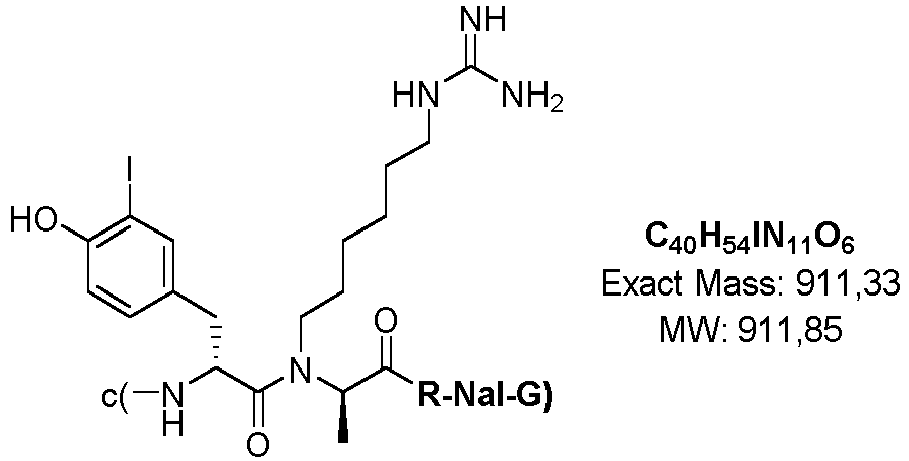
- HPLC (15-45% B in 15 min): tR = 11.03 min; MS (ESI) : 913.1 [M+H]+, 924.5[M+Na]+, 457.0[M+2H]2+
- A1 (1.3 g, 5.8 mmol, 83 %) was prepared according to GP12 and obtained as yellow solid.

- 1H-NMR (360 MHz, DMSO): δ = 13.26 (bs, 1H), 5.00 (bs, 1H), 3.58 (t, J = 5.2 Hz, 2H), 3.51 - 3.46 (m, 2H), 2.48 (s, 3H), 2.26 (s, 4H), 0.94 (s, 6H). 13C-NMR (90 MHz, DMSO): δ = 196.3, 172.9, 106.9, 59.1, 52.4, 45.4, 29.8, 27.9, 17.6. HPLC (10-90%, 15 min): t R = 4.40 min, MS (ESI): m/z = 226.1 [M+H]+.
- A2 (1.5 g, 6.3 mmol, 90 %) was prepared according to GP12 and obtained as yellow solid.

- 1H-NMR (360 MHz, DMSO): δ = 13.25 (bs, 1H), 4.30 (bs, 1H), 3.51 - 3.45 (m, 4H), 2.48 (s, 3H), 2.26 (s, 4H), 1.71 (q, J = 5.2 Hz, 2H), 0.94 (s, 6H). 13C-NMR (90 MHz, DMSO): δ = 196.4, 172.9, 106.9, 57.7, 52.3, 31.7, 29.7, 27.9, 17.3. HPLC (10-90%, 15 min): t R = 4.73 min, MS (ESI): m/z = 240.1 [M+H]+.
- A3 (1.5 g, 5.9 mmol, 84 %) was prepared according to GP12 and obtained as yellow solid.
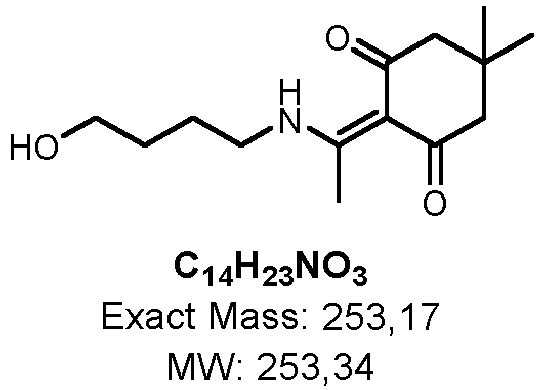
- 1H-NMR ((360 MHz, DMSO): δ = 13.27 (bs, 1H), 4.49 (t, J = 5.2 Hz, 1H), 3.46 - 3.40 (m, 4H), 2.48 (s, 3H), 2.27 (s, 4H), 1.63 - 1.45 (m, 4H), 0.94 (s, 6H). 13C-NMR (90 MHz, DMSO): δ = 196.4, 172.8, 106.9, 52.3, 42.6, 29.8, 29.6, 27.9, 25.3, 17.4. HPLC (10-90%, 15 min): t R =
5.01 min, MS (ESI): m/z = 254.1 [M+H]+. - A4 (1.7 g, 6.4 mmol, 91 %) was prepared according to GP12 and obtained as yellow solid.

- 1H-NMR ((360 MHz, DMSO): δ = 13.26 (bs, 1H), 3.44 - 3.37 (m, 4H), 2.48 (s, 3H), 2.27 (s, 4H), 1.58 (q, J = 5.2 Hz, 2H), 1.47 - 1.33 (m, 4H), 0.94 (s, 6H). 13C-NMR (90 MHz, DMSO): δ = 196.4, 172.8, 106.9, 60.5, 52.3, 42.7, 32.0, 29.8, 28.4, 27.9, 22.9, 17.4. HPLC (10-90%, 15 min): t R = 5.43 min, MS (ESI): m/z = 268.2 [M+H]+.
- A5 (2.5 g, 8.9 mmol, 85 %) was prepared according to GP12 and obtained as yellow solid.
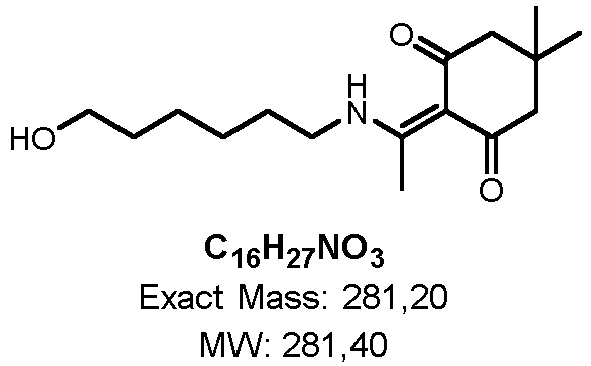
- 1H-NMR ((360 MHz, DMSO): δ = 13.26 (bs, 1H), 4.36 (bs, 1H), 3.44 - 3.36 (m, 4H), 2.47 (s, 3H), 2.26 (s, 4H), 1.57 (q, J = 6.2 Hz, 2H), 1.42 (t, J = 6.2 Hz, 2H), 1.35 - 1.29 (m, 4H), 0.94 (s, 6H). 13C-NMR (90 MHz, DMSO): δ = 196.4, 172.8, 106.9, 60.6, 52.3, 42.6, 32.4, 29.8, 28.5, 27.9, 26.2, 25.1, 17.4. HPLC (10-90%, 15 min): t R = 6.47 min, MS (ESI): m/z = 282.2 [M+H]+.
- Reaction of N,N'-Di-Boc-1H-pyrazole-1-carboxamidine and A1 according to GP13 and subsequent purification by flash chromatography (DCM/EtOAc 2:1) yielded A6 as yellow, viscous oil (0.75 g, 1.45 mmol, 45 %).

- 1H-NMR (360 MHz, DMSO): δ = 13.25 (bs, 1H), 8.15 (bs, 1H), 7.87 (d, J = 1.5 Hz, 1H), 6.59 (dd, J = 2.8 Hz, 1.5 Hz, 1H), 3.85 - 3.72 (m, 4H), 2.49 (s, 3H), 2.25 (s, 4H), 1.42 (s, 9H), 1.21 (s, 9H), 0.93 (s, 6H). Rf = 0.25 (DCM/EtOAc 2:1). HPLC (10-90%, 7 min): t R = 4.27 min, MS (ESI): m/z = 541.1 [M+Na]+, 518.0 [M+H]+, 418.0 [M-Boc+H]+, 318.1 [M-2Boc+H]+.
- Reaction of N,N'-Di-Boc-1H-pyrazole-1-carboxamidine and A2 according to GP13 and subsequent purification by flash chromatography (DCM/EtOAc 2:1) yielded A7 as yellow, viscous oil (0.87 g, 1.64 mmol, 51 %).

- 1H-NMR (360 MHz, DMSO): δ = 13.29 (bs, 1H), 8.22 (bs, 1H), 7.87 (d, J = 1.5 Hz, 1H), 6.60 (dd, J = 2.8 Hz, 1.5 Hz, 1H), 3.70 - 3.64 (m, 2H), 3.57 - 3.50 (m, 2H), 2.46 (s, 3H), 2.26 (s, 4H), 1.98 - 1.89 (m, 2H), 1.41 (s, 9H), 1.22 (s, 9H), 0.94 (s, 6H). 13C-NMR (90 MHz, DMSO): δ = 196.2, 173.8, 155.9, 151.8, 143.6, 130.5, 109.5, 106.8, 82.2, 81.7, 52.0, 42.4, 32.9, 29.7, 27.8, 27.8, 27.3, 17.2. Rf = 0.42 (DCM/EtOAc 2:1), HPLC (10-90%, 7 min): t R = 4.41 min, MS (ESI): m/z = 554.1 [M+Na]+, 532.1 [M+H]+, 432.0 [M-Boc+H]+, 332.0 [M-2Boc+H]+.
- Reaction of N,N'-Di-Boc-1H-pyrazole-1-carboxamidine and A3 according to GP13 and subsequent purification by flash chromatography (DCM/EtOAc 2:1) yielded A8 as yellow, viscous oil (1.29 g, 2.37 mmol, 74 %).

- 1H-NMR (360 MHz, DMSO): δ = 13.26 (bs, 1H), 8.18 (bs, 1H), 7.84 (d, J = 1.5 Hz, 1H), 6.59 (dd, J = 2.8 Hz, 1.5 Hz, 1H), 3.63 - 3.59 (m, 2H), 3.47 - 3.40 (m, 2H), 2.46 (s, 3H), 2.26 (s, 4H), 1.73 - 1.58 (m, 4H), 1.41 (s, 9H), 1.21 (s, 9H), 0.94 (s, 6H). 13C-NMR (90 MHz, DMSO): δ = 196.3, 172.8, 156.6, 155.9, 151.7, 143.6, 130.4, 109.6, 106.8, 81.9, 81.5, 52.1, 47.7, 42.1, 29.7, 27.8, 27.5, 27.3, 21.7, 17.2. Rf = 0.50 (DCM/EtOAc 2:1), HPLC (10-90%, 7 min): t R = 4.50 min, MS (ESI): m/z = 568.1 [M+Na]+, 546.1 [M+H]+, 445.9 [M-Boc+H]+.
- Reaction of N,N'-Di-Boc-1H-pyrazole-1-carboxamidine and A4 according to GP13 and subsequent purification by flash chromatography (DCM/EtOAc 2:1) yielded A9 as yellow, viscous oil (1.41 g, 2.52 mmol, 79 %).

- 1H-NMR (360 MHz, DMSO): δ = 13.27 (bs, 1H), 8.17 (bs, 1H), 7.84 (d, J = 1.5 Hz, 1H), 6.59 (dd, J = 2.8 Hz, 1.5 Hz, 1H), 3.60 - 3.55 (m, 2H), 3.43 - 3.37 (m, 2H), 2.46 (s, 3H), 2.26 (s, 4H), 1.68 - 1.54 (m, 4H), 1.42 (s, 9H), 1.42 - 1.35 (m, 2H), 1.20 (s, 9H), 0.94 (s, 6H). 13C-NMR (90 MHz, DMSO): δ = 196.3, 172.8, 156.6, 155.9, 151.7, 143.6, 130.4, 109.6, 106.8, 81.9, 81.5, 52.1, 47.7, 42.1, 29.7, 27.8, 27.5, 27.3, 21.7, 17.2. Rf = 0.53 (DCM/EtOAc 2:1), HPLC (10-90%, 7 min): t R = 4.61 min, MS (ESI): m/z = 582.1 [M+Na]+, 560.1 [M+H]+, 460.1 [M-Boc+H]+, 360.1 [M-2Boc+H]+.
- Reaction of N,N'-Di-Boc-1H-pyrazole-1-carboxamidine and A5 according to GP13 and subsequent purification by flash chromatography (DCM/EtOAc 2:1) yielded A10 as yellow, viscous oil (1.41 g, 2.46 mmol, 88 %).

- 1H-NMR (360 MHz, DMSO): δ = 13.26 (t, 1H), 8.18 (bs, 1H), 7.85 (d, 1H), 6.59 (dd, 1H), 3.56 (t, 2H), 3.39 (dt, 2H), 2.46 (s, 3H), 2.26 (s, 4H), 1.65 - 1.60 (m, 2H), 1.57 - 1.53 (m, 2H), 1.41 (s, 9H), 1.36 - 1.31 (m, 2H), 1.20 (s, 9H), 0.94 (s, 6H). 13C-NMR (90 MHz, DMSO): δ = 196.2, 172.6, 156.6, 151.9, 143.5, 130.3, 109.5, 106.8, 82.0, 81.6, 52.3, 48.1, 42.5, 29.7, 28.2, 27.8, 27.5, 27.3, 25.7, 25.5, 17.3. Rf = 0.66 (DCM/EtOAc 2:1), HPLC (10-90%, 15 min): t R = 10.36 min, MS (ESI): m/z = 574.1, [M+H]+, 474.1 [M-Boc+H]+, 374.2 [M-2Boc+H]+.
- Reaction of N,N'-Di-Boc-1H-pyrazole-1-carboxamidine and 5-Hexin-1-ol according to GP13 and subsequent purification by flash chromatography (DCM/EtOAc 2:1) yielded A11 as yellow, viscous oil (0.94 g, 2.40 mmol, 75 %).

- Rf = 0.53 (DCM/EtOAc 2:1), HPLC (10-90%, 7 min): t R = 4.73 min, MS (ESI): m/z = 413.1 [M+Na]+, 391.1 [M+H]+, 291.0 [M-Boc+H]+, 189.9 [M-2Boc+H]+.
- TCP-resin is loaded with Fmoc-Gly-OH according to GP1 and the linear peptide H-d-AlaR(Pbf)-Nal-G is synthesized according to standard Fmoc-procedure (GP2 and GP4, respectively). The peptide is subsequently alkylated with Dde-aminohexanol according to GP10 and Fmoc-d-Tyr(OtBu)-OH (GP4) is coupled to the Ns-deprotected peptide. After deprotection (GP2), cleavage from the resin (GP6) and backbone cyclization (GP7) are carried out. Removal of the Dde-protecting group (GP8) is followed by precipitation of the crude peptide in sat. aq. NaCl-solution and lyophilization from a ACN/H2O-solution. P0 (132 mg, 126 µM, 31%) is obtained as yellowish powder (purity > 90 %).
-

- HPLC (10-90% 15 min): t R = 7.09 min. MS (ESI): m/z = 1074.6 [M+Na]+, 1052.7 [M+H]+.
- Guanidinylation of P0 with the precursors A6-A10 was carried out according to GP11. After completion of the guanidinylation reaction, the compounds were treated in situ with hydrazine (
final concentration 2% v/v) for 5 min. Subsequently, an excess of Ac2O (20 eq.) was added and the mixture stirred for 30 min. Subsequently, the peptides were precipitated in sat. aq. NaCl-solution. Acid labile side chain protecting groups were removed according to GP9, and the crude peptides were purified by semipreparative HPLC to yield compounds P1-P5. P6 was obtained by reacting P0 and A11 according to GP11, precipitation of the crude peptide from water and subsequent side chain deprotection (GP9) and semipreparative purification by HPLC. -
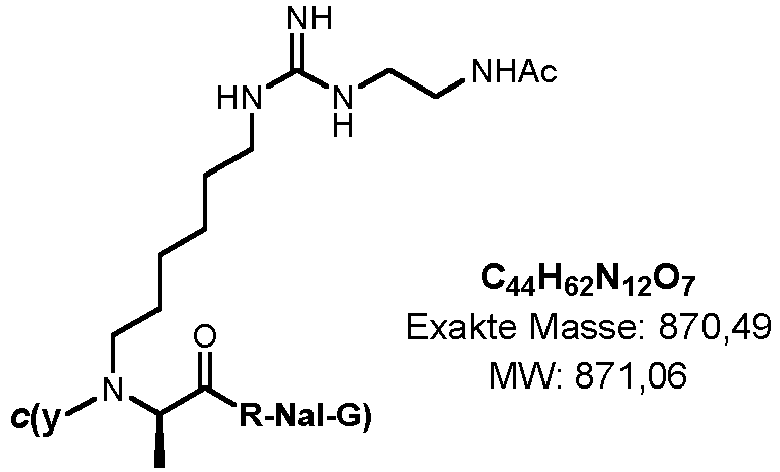
- HPLC (10-90% 15 min): t R = 5.67 min. MS (ESI): m/z = 893.6 [M+Na]+, 871.4 [M+H]+.
-
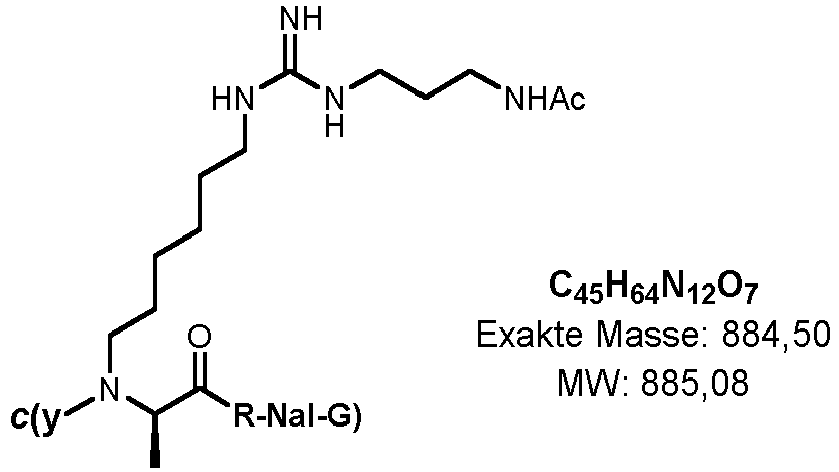
- HPLC (10-90% 15 min): t R = 5.89 min. MS (ESI): m/z = 885.6 [M+H]+, 443.3 [M/2+H]+.
-

- HPLC (10-90% 15 min): t R = 6.06 min. MS (ESI): m/z = 1013.5 [M+TFA+H]+, 899.5 [M+H]+.
-
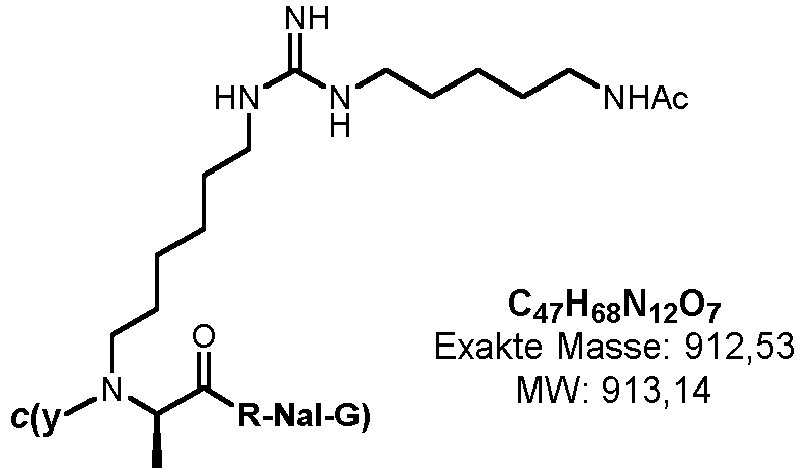
- HPLC (10-90% 15 min): t R = 6.30 min. MS (ESI): m/z = 913.6 [M+H]+, 457.3 [M+H]+.
-
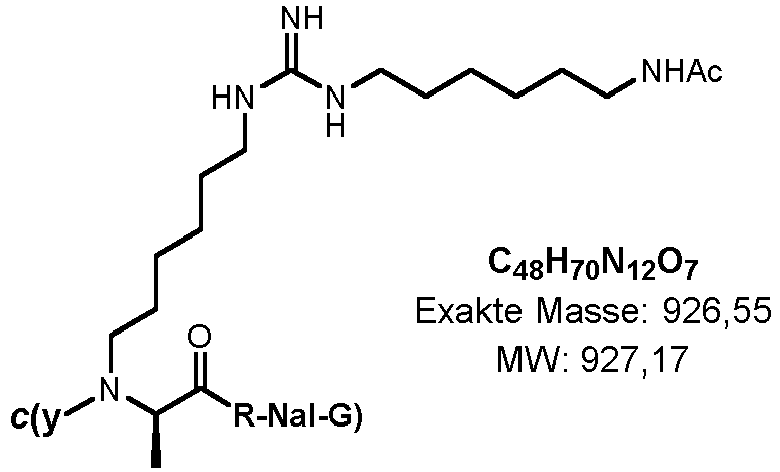
- HPLC (10-90% 15 min): t R = 6.69 min. MS (ESI): m/z = 1041.5 [M+TFA+H]+, 927.6 [M+H]+, 464.3 [M/2+H]+.
-
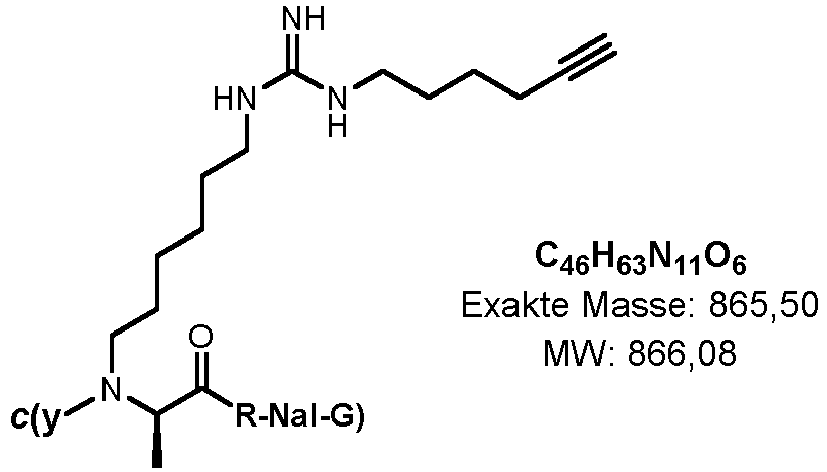
- HPLC (10-90% 15 min): t R = 7.08 min. MS (ESI): m/z = 866.4 [M+H]+, 433.8 [M/2+H]+.
- To a solution of H2N-Hex-CPCR4.3 (1 eq.) and Cel(7Ac)-merc-OPfp54 (1.5 eq) in DMF, DIPEA (3 eq.) were added, and the solution was stirred for 30 min at RT. The crude product was then precipitated using diethyl ether and redissolved in MeOH. For deacetylation, a catalytic amount of KCN was added, and the methanolic peptide solution was stirred overnight at RT. As soon as RP-HPLC-monitoring revealed complete removal of all acetyl protecting groups, the peptide was the precipitated using diethyl ether, washed, dried and purified via preparative RP-HPLC.

- HPLC (30-60% in 15 min): t R = 7.08 min. MS (ESI): m/z = 649.6 [M+2H]2+
- P0 was fully deprotected according to GP9, and solution phase coupling with DOTA was performed according to GP14.

- HPLC (15-45% in 15 min): t R = 9.3 min. MS (ESI): m/z = 1272.2 [M+H]+, 1294.1 [M+Na]+, 636.9 [M+2H]2+
- The respective natGa-DOTA- (P5c) and natLu-DOTA- (P5d) reference compounds were prepared according to GP15.
- natGa-P5b = P5c: MS (ESI): m/z = 1339.7 [M+H]+, 670.6 [M+2H]2+
- natLu-P5b = P5d: MS (ESI): m/z = 1443.8 [M+H]+, 722.7 [M+2H]2+
- P0 was fully deprotected according to GP9, and solution phase coupling with Sulfo2-Cy5 (free acid) was performed according to GP16.

- HPLC (15-45% in 15 min): t R = 13.2 min. MS (ESI): m/z = 1511.0 [M+ H]+, 756.3 [M+2H]2+.
- P0 was fully deprotected according to GP9, and solution phase coupling with Sulfo2-Cy5 (symmetric di-acid) was performed according to GP16 using 2.5 eq of P0 and 1 eq of Sulfo2-Cy5 (symmetric di-acid).

- HPLC (25-45% in 15 min): t R = 11.5 min. MS (ESI): m/z = 1239.3 [M+2H]2+, 826.9 [M+3H]3+.
- Upon removal of acid labile side chain protecting groups of P0 according to GP9, the peptide was dissolved in DMF and coupled with Fmoc-NH-PEG4-COOH (1.5 eq) using HOBt (1.5 eq) and TBTU (1.5 eq) as coupling reagents and DIPEA (4.5 eq) as a base. Upon completion of the coupling reaction, the crude peptide was precipitated from diethyl ether and immediately redissolved in piperidine/DMF (20:80, v/v) to remove the Fmoc-protecting group. After 10 min at RT, the deprotected PEG4-conjugate was precipitated using diethyl ether and washed with ether. Coupling with Sulfo2-Cy5 (free acid) was performed according to GP16.

- HPLC (20-70% in 15 min): t R = 7.15 min.
- MS (ESI): m/z = 1758.2 [M+H]+, 879.5 [M+2H]2+, 890.8 [M+H+Na]2+.
- Upon removal of acid labile side chain protecting groups of P0 according to GP9, the peptide was dissolved in DMF and coupled with Fmoc-NH-PEG4-COOH (1.5 eq) using HOBt (1.5 eq) and TBTU (1.5 eq) as coupling reagents and DIPEA (4.5 eq) as a base. Upon completion of the coupling reaction, the crude peptide was precipitated from diethyl ether and immediately redissolved in piperidine/DMF (20:80, v/v) to remove the Fmoc-protecting group. After 10 min at RT, the deprotected PEG4-conjugate was precipitated using diethyl ether and washed with ether. Coupling with Cellobiosyl-ethyl-Sulfo2-Cy5 (free acid) was performed according to GP16.

- HPLC (10-45% in 15 min): t R = 11.3 min. MS (ESI): m/z = 1057.0 [M+2H]2+.
- Upon removal of acid labile side chain protecting groups of P0 according to GP9, the peptide was dissolved in DMF and coupled with Fmoc-D-Arg(Pbf)-OH (1.5 eq) using HOBt (1.5 eq) and TBTU (1.5 eq) as coupling reagents and DIPEA (4.5 eq) as a base. Upon completion of the coupling reaction, the crude peptide was precipitated from diethyl ether and immediately redissolved in piperidine/DMF (20:80, v/v) to remove the Fmoc-protecting group. After 10 min at RT, the deprotected arg-conjugate was precipitated using diethyl ether and washed with ether. Coupling with Cellobiosyl-ethyl-Sulfo2-Cy5 (free acid) was performed according to GP16.

- HPLC (10-45% in 15 min): t R = 11.1 min. MS (ESI): m/z = 1011.8 [M+2H]2+.
- TCP resin was loaded with Fmoc-6-aminohexanoic acid (Fmoc-Ahx-OH) according to GP1. Successive Fmoc-deprotection, coupling with Fmoc-Ahx-OH, Fmoc-deprotection and coupling with Dibenzylphos-phonopropionic acid were carried out according to GP2 and GP4, respectively. After cleavage from the resin (GP6) and lyophilization, D1 was obtained as a white solid (110 mg, 196 pmol, 25 %).

- HPLC (10-90%, 15 min): t R = 6.83 min, MS (ESI): m/z = 1120.9 [2M+H]+, 561.2 [M+H]+
- P0 (11.3 mg, 1.0 eq.) was coupled with D1 (5.9 mg, 1.3 eq.) using HOBt (1.5 eq) and TBTU (1.5 eq) as coupling reagents and DIPEA (4.5 eq) as a base. The fully protected peptide was purified by preparative RP-HPLC. The purified peptide was then deprotected according to GP9 and lyophilized to yield P5k as a while solid (3.7 mg, 37%).

- HPLC (10-90% in 15 min): t R = 4.30 min, MS (ESI): m/z = 1247.7 [M+H]+, 624.7 [M+2H]2+.
- TCP resin was loaded with Fmoc-3,6-dioxooctanoic acid (Fmoc-O2Oc-OH) according to GP1. Successive Fmoc-deprotection, coupling with Fmoc-O2Oc-OH, Fmoc-deprotection and coupling with Dibenzylphos-phonopropionic acid were carried out according to GP2 and GP4, respectively. After cleavage from the resin (GP6) and lyophilization, D1 was obtained as a white solid (87 mg, 18 %).

- HPLC (10-90% in 15 min): t R = 6.26 min. MS (ESI): m/z = 625.2 [M+H]+.
- P0 (10.5 mg, 1.0 eq.) was coupled with D2 (6.1 mg, 1.3 eq.) using HOBt (1.5 eq) and TBTU (1.5 eq) as coupling reagents and DIPEA (4.5 eq) as a base. The fully protected peptide was purified by preparative RP-HPLC. The purified peptide was then deprotected according to GP9 and lyophilized to yield P5m as a while solid (2.4 mg, 24%).

- HPLC (10-90% in 15 min): t R = 5.05 min. MS (ESI): m/z = 1311.7 [M+H]+, 656.7 [M+2H]2+.
- P0 was deprotected according to GP9, dried and lyophilized. Carboxyl quantum dots (Life technologies, Qdot® 655 ITK™ Carboxyl Quantum Dots) (0.8 nmol in 100
µl 50 mM borate buffer (pH=8.3)) were diluted with 10 mM borate buffer (pH=7.4) to a total volume of 920 µl. Then, 1-Ethyl-3-(3-dimethylamino-propyl)carbodiimide (800 eq, 640 nmol) in 12.2 µl 10 mM borate buffer and deprotected P0 (40 eq, 32 nmol) dissolved in 64µl 10 mM borate buffer were added. Consumption of unreacted peptide from the reaction mixture was monitored via RP-HPLC. Upon completion of the coupling reaction (30-60 min at RT), excess coupling reagent was removed from the P5-QD suspension by repeated buffer exchanges using 50 mM borate buffer (pH=8.3) and Amicon Ultra-4 ultrafiltration units with 100 kDa cutoff (4 mL, Millipore). Final reconstitution with 50 mM borate buffer yielded the peptide coated quantum dots P5-QD as a 4 µM) suspension. According to the chosen stoichiometry, coating efficiency of the quantum dots was caclulated to be app. 40% of reactive carboxylates. - S-Methylisothiourea-hemisulfate (1.4 g, 10 mmol, 1.0 eq.) and bis-(tert-butyl)-dicarbonate (2.2 g, 10 mmol, 1.0 eq.) are dissolved in a vigorously stirred biphasic solution of DCM and sat. aq. NaHCO3 for 1 d at RT. After the separation of the two phases, the organic layer is collected and the water phase extracted with DCM (3x). The organic layers are combined and dried over Na2SO4 and the solvent removed in vacuo. After purification by flash chromatography (hexane/EtOAc 4:1) yields B1 (1.1g, 5.8 mmol, 58 %) as colorless, viscous solid.

- 1H-NMR (360 MHz, DMSO): δ = 2.30 (s, 3H), 1.39 (s, 9H).13C-NMR (90 MHz, DMSO): δ = 165.6, 154.1, 78.3, 28.4, 13.3. Rf = 0.30 (Hexan/EtOAc 3:1), HPLC (10-90%, 15 min): t R = 1.31 min, MS (ESI): m/z = 190.8 [M+H]+.
- Glycine (1.0 g, 13.3 mmol, 1.0 eq.) is dissolved in 30 ml of DMF and subsequently, 4.5 ml DIPEA (26.6 mmol, 2.0 eq.) are added and the solution cooled to 0°C. Afterwards, Ac2O (3.8 ml, 39.9 mmol, 3.0 eq.) is added dropwise and the solution stirred for 2 h at RT. After addition of 20 ml MeOH the mixture is stirred for 30 min and the solvent removed in vacuo. The crude product is taken up in 20 ml EtOAc and washed with an equal volumina of 1M HCl. The organic layer is dried over Na2SO4 and the solvent removed in vacuo. B2 is obtained as white solid (1.2 g, 10.3 mmol, 77 %).

- 1H-NMR (360 MHz, DMSO): δ = 12.48 (s, 3H), 8.14 (t, J = 5.9 Hz, 1H), 3.71 (d, J = 5.9, 2H), 1.84 (s, 3H). 13C-NMR (90 MHz, DMSO): δ = 171.61, 169.9, 40.8, 22.4. MS (ESI): m/z = 140.0 [M+Na]+, 117.9 [M+H]+.
- 6-aminohexanoic acid (2.0 g, 15.3 mmol, 1.0 eq.) is dissolved in 50 ml of DMF and 5.2 ml DIPEA (30.6 mmol, 2.0 eq.) are subsequently added and the solution cooled to 0°C. Afterwards, Ac2O (4.3 ml, 45.9 mmol, 3.0 eq.) is added dropwise and the solution stirred for at RT. After addition of 20 ml MeOH the mixture is stirred for 30 min and the solvent removed in vacuo. The crude product is taken up in 30 ml EtOAc and washed with an equal volumina of 1M HCl. The organic layer is dried over Na2SO4 and the solvent removed in vacuo. B3 is obtained as white solid (2.1 g, 12.1 mmol, 79 %).

- 1H-NMR (360 MHz, DMSO): δ = 11.93 (bs, 1H), 7.79 (bs, 1H), 3.0 (dt, J = 6.9 Hz, 5.5 Hz, 2H), 2.19 (t, J = 7.2 Hz, 2H), 1.78 (s, 3H), 1.54 - 1.42 (m, 2H), 1.40 - 1.33 (m, 2H), 1.29 - 1.22 (m, 2H). 13C-NMR (90 MHz, DMSO): δ = 174.4, 168.94, 38.4, 33.6, 28.9, 26.0, 24.3, 22.6. HPLC (10-90%, 7 min): t R = 0.70 min, MS (ESI): m/z = 196.0 [M+Na]+, 173.9 [M+H]+, 347.0 [2M+H]+, 369.0 [2M+Na]+, 385.1 [2M+K]+.
- B1 (250 mg, 1.3 mmol, 1.0 eq.) is dissolved in DMF and DIPEA (440 µl, 2.6 mmol, 2.0 eq.) is added to the stirred solution. Following a dropwise addition of Ac2O (245 µl, 5.2 mmol, 4.0 eq.) the mixture is stirred for 1 h at RT and taken up in MeOH (2 ml) and stirred for 15 min. The solvent is removed in vacuo and the crude product purified by flash chromatography (hexane/EtOAc 3:1). B4 is obtained as a white solid (241 mg, 1.05 mmol, 80 %).

- 1H-NMR (360 MHz, DMSO): δ = 2.27 (s, 3H), 2.05 (s, 3H), 1.42 (s, 9H). 13C-NMR (90 MHz, DMSO): δ = 168.44, 161.51, 157.84, 27.77, 23.72, 13.92. Rf = 0.62 (Hexane/EtOAc 3:1). HPLC (10-90%, 15 min): t R = 7.13 min, MS (ESI): m/z = 232.7 [M+H]+, 176.8 [M-tBu+H]+.
- B1 (130 mg, 0.68 mmol, 1.0 eq.) is dissolved in 4 ml of DMF and a solution containing B2 (95 mg, 0.82 mmol, 1.2 eq.), HATU (312 mg, 0.82 mmol, 1.2 eq.) and DIPEA (230 µl, 1.36 mmol, 2.0 eq.) in 1 ml DMF was added and stirred for 1 h at RT. After evaporation of the solvent, the compound is purified by flash chromatography (EtOAc/MeOH 50:1). B5 (153 mg, 0.44 mmol, 78 %) is obtained as white solid.
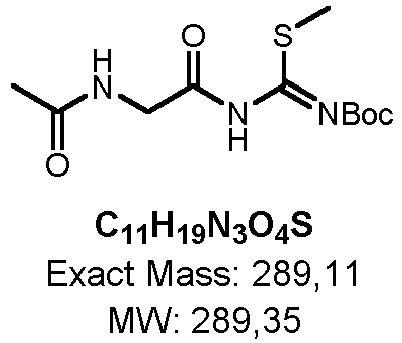
- Rf = 0.28 (EtOAc/MeOH 50:1). HPLC (10-90%, 15 min): t R = 5.84 min. MS (ESI): m/z = 289.8 [M+H]+, 233.8 [M-tBu+H]+, 189.9 [M-Boc+H]+.
- B1 (150 mg, 0.8 mmol, 1.0 eq.) is dissolved in 4 ml of DMF and a solution containing B3 (166 mg, 0.96 mmol, 1.2 eq.), HATU (365 mg, 0.96 mmol, 1.2 eq.) and DIPEA (270 µl, 1.6 mmol, 2.0 eq.) in 1 ml DMF was added and stirred for 1 h at RT. After evaporation of the solvent, the compound is purified by flash chromatography (EtOAc/MeOH 50:1). B6 (210 mg, 0.56 mmol, 76 %) is obtained as white solid.

- 1H-NMR (360 MHz, DMSO): δ = 7.77 (t, 1H), 2.99 (dt, 2H), 2.33 (t, 2H), 2.28 (s, 3H), 1.77 (s, 3H), 1.54 - 1.48 (m, 2H), 1.42 (s, 9H), 1.37 - 1.34 (m, 2H), 1.27 - 1.21 (m, 2H). 13C-NMR (90 MHz, DMSO): δ = 175.8, 169.4, 161.6, 157.7, 80.4, 38.5, 33.4, 28.9, 27.9, 24.8, 24.2, 22.7, 14.0. Rf = 0.40 (EtOAc/MeOH 50:1). HPLC (10-90%, 15 min): t R = 7.00 min, MS (ESI): m/z = 368.0 [M+Na]+, 346.0 [M+H]+, 246.1 [M-Boc+H]+.
- B1 (100 mg, 0.52 mmol, 1.0 eq.) is dissolved in 4 ml of DMF and a solution containing 4-pentinoic acid (61 mg, 0.62 mmol, 1.2 eq.), HATU (230 mg, 0.6 mmol, 1.2 eq.) and DIPEA (170 µl, 1.0 mmol, 2.0 eq.) in 1 ml DMF was added and stirred for 1 h at RT. After evaporation of the solvent, the compound is purified by flash chromatography (DCM/EtOAc 2:1). B7 (111 mg, 0.41 mmol, 79 %) is obtained as white solid.

- 1H-NMR (360 MHz, DMSO): δ = 11.17 (bs, 1H), 2.79 - 2.77 (m, 1H), 2.57 (t, J = 7.1 Hz, 2H), 2.41 - 2.35 (m, 2H), 2.28 (s, 3H), 1.43 (s, 9H). 13C-NMR (90 MHz, DMSO): δ = 170.0, 161.7, 158.3, 83.4, 80.6, 72.1, 35.3, 28.2, 14.4, 13.7. Rf = 0.87 (DCM/EtOAc 2:1). HPLC (10-90%, 15 min): t R = 9.24 min, MS (ESI): m/z = 271.1 [M+H]+, 171.0 [M-Boc+H]+.
- Guanidinylation of P0 with the acylated precursors (B4-B7, 1.3 eq.) was carried out according to GP11. Upon completion of the reaction the peptides were precipitated in sat. aq. NaCl-solution, treated with a solution containing 90% TFA, 5% DCM, 2.5% H2O and 2.5% TIPS to remove the remaining acid labile side chain protecting groups. Subsequent purification by semipreparative HPLC yielded compounds P7-P10.
-

- HPLC (5-50% 15 min): t R = 9.79 min. MS (ESI): m/z = 849.2 [M+Na]+, 414.3 [M+H]+.
-

- HPLC (10-90% 15 min): t R = 5.46 min. MS (ESI): m/z = 907.5 [M+Na]+, 885.6 [M+H]+, 443.3 [M/2+H]+.
-
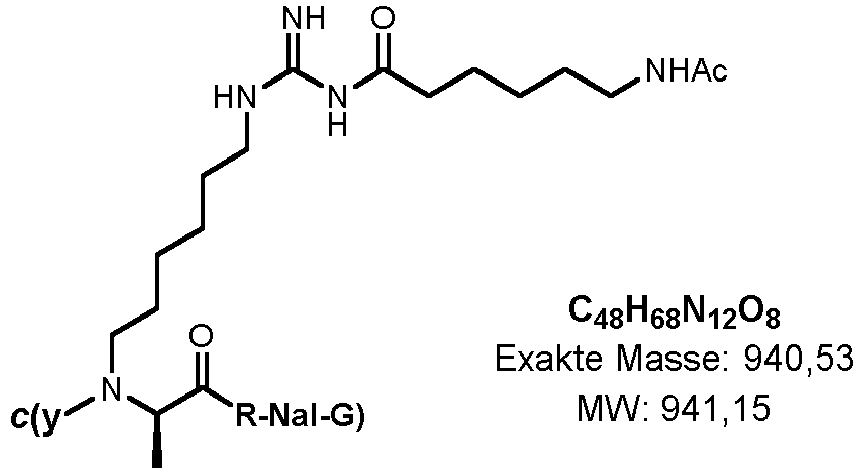
- HPLC (10-90% 15 min): t R = 5.73 min. MS (ESI): m/z = 963.5 [M+Na]+, 471.2 [M/2+H]+.
-

- HPLC (10-90% 15 min): t R = 3.96 min. MS (ESI): m/z = 866.3 [M+H]+, 434.0 [M/2+H]+.
- Cyclo(ya'(hexylguanidino)Rnalc) (Pc0) was prepared in analogy to the synthesis of peptide R as described previously 55. After assembly of the pentapeptide on H-D-Cys-(2-Cl)Trt resin using solid phase peptide synthesis, including N-alkylation of the D-ala residue, the fully protected peptide was cleaved from the resin and cyclized using diphenylphosphoryl azide. Upon selective removal of the Dde protecting group on the hexylamino sidechain according to GP8, solution phase guanidinylation was performed using 1-H-Pyrazol-1-carboxamidine (10 eq) in DMF and DIPEA (20 eq). Subsequently, the peptide was treated with trifluoroacetic acid, Triisopropylsilane (TIPS) and water (95, 2.5, 2.5; v/v/v) for 40 min and precipitated in diethyl ether to yield crude Pc0 as yellowish powder in sufficient purity for further functionalization.

- HPLC (10-90% B in 15 min): t R = 11 min. MS (ESI): m/z = 832.7 [M+H]+, 854.6 [M+Na]+, 416.9 [M+2H]2+
- 1,4-(Boc)-phenylene dimethanamine (460 mg, 1 eq) was dissolved in 2 mL of tetrahydrofurane (THF), and 5
mL 10% Na2CO3 were added. The resulting suspension was added stepwise to a solution of Fmoc-CI (500 mg, 1 eq) in THF (2 mL) at 0°C. Upon completion of the reaction, the reaction mixture was diluted with water and THF. The organic solvent was then evaporated in vacuo, leading to the precipitation of the product, which was isolated via centrifugation, washed with water and dried in vacuo. For removal of the Boc protecting group, the dry product was redissolved in TFA/CH2Cl2. After 10 min at RT, the solvents were evaporated in vacuo, affording 1-(Fmoc),4-phenylene dimethanamine as a yellow oil. The crude product was then dissolved in anhydrous CH2Cl2, and DIPEA (2.5 eq) and 2-chloro acetylchloride (1 eq) were added. After 30 min at RT, the solvent was evaporated in vacuo, and the product was recrystallized from ethyl acetate, yielding the product as a white solid.
- HPLC (40-100% in 15 min): t R = 12.26 min. MS (ESI): m/z = 457.1 [M+Na]+.
- The synthesis of C2 was essentially performed as described for C1. The purification of the final product, however, was carried out using SiO2 column chromatography and a 1:1 mixture (v/v) of ethyl acetate/petroleum ether as eluent.

- HPLC (40-100% in 15 min): t R = 12.42 min. MS (ESI): m/z = 457.1 [M+Na]+.
- Fmoc-Lys-CO-NH2 (125 mg, 1 eq) was dissolved in CH2Cl2, and DIPEA (2.5 eq) and 2-chloro acetylchloride (1 eq) were added. After 30 min at RT, the product precipitated from the reaction mixture. After filtration, the crude product was recrystallized from ethyl acetate and lyophilized.

- HPLC (40-100% in 15 min): t R = 9.68 min. MS (ESI): m/z = 443.9 [M+H]+, 466.1 [M+Na]+.
- Fmoc-1,6-hexandiamine (200 mg, 1 eq) was dissolved in acetonitrile/methanol, and DIPEA (2.5 eq) and 2-chloro acetylchloride (1.7 eq) were added. After 60 min at RT and cooling to - 20°C for several hours, the crude product precipitated from the reaction mixture. After filtration, the white crystals were dried and used as such without further purification.

- HPLC (40-100 in % 15 min): t R = 10.02 min. MS (ESI): m/z = 437.2 [M/2+H]+.
- Alkylation of Pc0 with C3 was carried out according to GP17. The crude product was then redissolved in piperidine/DMF (80/20, v/v) to remove the Fmoc protecting group on the linker unit. After 10 min at RT, the deprotected peptide was precipitated in water, washed and dried. Acetylation of the free amino function was achieved by dissolving the peptide in a solution of acetic anhydride, DIPEA and DMF (10:5:85; v/v/v) and stirring for 1 h at RT. After workup by precipitation in water, Pc1 was purified using preparative HPLC.

- HPLC (15-45% in 15 min): t R = 6.8 min. MS (ESI): m/z = 1059.8 [M+H]+, 1081.8 [M+Na]+, 1097.6 [M+K]+
- Alkylation of Pc0 with C4 was carried out according to GP17. Subsequent Fmoc-deprotection and N-acetylation were carried out as described for Pc1.

- HPLC (15-45% in 15 min): t R = 9 min. MS (ESI): m/z = 1030.7 [M+H]+, 1052.6 [M+Na]+.
- Alkylation of Pc0 with Boc-6-aminohexylbromide was carried out according to GP17. Subsequent Boc-deprotection was carried out according to GP9, and N-acetylation was carried out as described for Pc1.

- HPLC (15-45% in 15 min): t R = 10 min. MS (ESI): m/z = 973.6 [M+H]+, 995.5 [M+Na]+
- Alkylation of Pc0 with C1 was carried out according to GP17. Subsequent Fmoc-deprotection and N-acetylation were carried out as described for Pc1.

- HPLC (15-45% in 15 min): t R = 8.7 min. MS (ESI): m/z = 1050.6 [M+H]+, 1072.6 [M+Na]+, 525.8 [M+2H]2+.
- Alkylation of Pc0 with C2 was carried out according to GP17. Subsequent Fmoc-deprotection and N-acetylation were carried out as described for Pc1.

- HPLC (15-45% in 15 min): t R = 8.8 min. MS (ESI): m/z = 1050.8 [M+H]+, 1072.7 [M+Na]+, 525.9 [M+2H]2+.
- Alkylation of Pc0 with C2 was carried out according to GP17. The crude product was then redissolved in piperidine/DMF (80/20, v/v) to remove the Fmoc protecting group on the linker unit. After 10 min at RT, the deprotected peptide was precipitated in water, washed and dried. Coupling of DOTA to the free amino function was carried out according to GP14.

- HPLC (15-35% in 15 min): t R = 11.9 min. MS (ESI): m/z = 1396.1 [M+H]+, 698.4 [M+2H]2+.
- The natGa-complex of Pc5a was prepared according to GP15.
- HPLC (15-35% in 15 min): t R = 12.5 min. MS (ESI): m/z = 1463.0 [M+H]+, 732.1 [M+2H]2+.
- The natLu-complex of Pc5a was prepared according to GP15.
- HPLC (15-35% in 15 min): t R = 11.7 min. MS (ESI): m/z = 1567.0 [M+H]+, 784.5 [M+2H]2+.
- The natCu-complex of Pc5a was prepared according to GP15.
- HPLC (15-35% in 15 min): t R = 12.9 min. MS (ESI): m/z = 1456.1 [M+H]+, 729.1 [M+2H]2+.
- Alkylation of Pc0 with C2 was carried out according to GP17. The crude product was then redissolved in piperidine/DMF (80/20, v/v) to remove the Fmoc protecting group on the linker unit. After 10 min at RT, the deprotected peptide was precipitated in water, washed, dried and lyophilized. Carboxyl quantum dots (Life technologies, Qdot® 655 ITK™ Carboxyl Quantum Dots) (0.8 nmol in 100
µl 50 mM borate buffer (pH=8.3)) were diluted with 10 mM borate buffer (pH=7.4) to a total volume of 920 µl. Then, 1-Ethyl-3-(3-dimethylaminopropyl)carbodiimide (800 eq, 640 nmol) in 12.2 µl 10 mM borate buffer and deprotected peptide (40 eq, 32 nmol) dissolved in 64µl 10 mM borate buffer were added. Consumption of unreacted peptide from the reaction mixture was monitored via RP-HPLC. Upon completion of the coupling reaction (30-60 min at RT), excess coupling reagent was removed from the Pc5-QD suspension by repeated buffer exchanges using 50 mM borate buffer (pH=8.3) and Amicon Ultra-4 ultrafiltration units with 100 kDa cutoff (4 mL, Millipore). Final reconstitution with 50 mM borate buffer yielded the peptide coated quantum dots Pc5-QD as a 4 µM suspension. According to the chosen stoichiometry, coating efficiency of the quantum dots was caclulated to be app. 40% of reactive carboxylates. - All peptides were radioiodinated using the IodoGen® method. Briefly, 100-200 µg of peptide were dissolved in 5-10 µL of DMSO. This solution was diluted with 0.5 mL TRIS iodination buffer (25 mM Tris·HCl, 0.4 M NaCl, pH 7.5) and transferred to an Eppendorf reaction tube coated with 150 µg of IodoGen®. Upon addition of [125I]NaI (18-20 MBq, Hartmann Analytic, Braunschweig, Germany) or [123I]NaI (220 MBq, GE Healthcare, Braunschweig, Germany), the reaction vessel was briefly vortexed and the labeling reaction was allowed to proceed for 15 min at RT. The peptide solution was then removed from the insoluble oxidizing agent. Separation of the labeled products from unlabeled precursor was achieved using gradient RP-HPLC. For in vitro binding studies, the HPLC product fraction was used as such and diluted to the required concentration using the respective assay medium. For biodistribution experiments, the respective product fraction was diluted with water and passed onto a SepPak Plus C-18 cartridge (Waters, Eschborn, Germany). The cartridge was washed with water, and the immobilized radiopeptide was then eluted using 1 ml of acetonitrile. The solvent was removed by bubbling an argon stream through the radioligand solution at 90°C for 20 min. The radioiodinated peptides were then reconstituted to an activity concentration of app. 1 MBq/100 µL using PBS and were used as such for the in vivo animal study.
- 68Ga was obtained by elution of a 68Ge/68Ga generator with SnO2 matrix (iTHEMBA LABS, South Africa) with 1 M HCl (5.5 mL) and immobilized on a strong cationic exchanger cartridge (SCX - Chromafix, size M, Macherey-Nagel, Düren, Germany).
- For animal studies, 68Ga-pentixafor was prepared on a Gallelut+ system in analogy to a previously published 68Ga labeling procedure 56 (SCINTOMICS GmbH, Germany). Briefly, 68Ga-generator eluate fractions (1.25 mL, 600-800 MBq, buffered to pH 3.3 with 900 µL of a solution of 14.4 g HEPES in 12 mL water) were reacted with 3.5 nmol of the respective DOTA-peptide (P5b, Pc5a) for 5 min. The radiochemical purity was always >99% as confirmed by thin layer chromatography (TLC) and high performance liquid chromatography (HPLC). Addition of 1 mL PBS and concentration in vacuo to 1 mL total volume yielded solvent-free formulations with specific activities ranging from 100-150 MBq/nmol.
- For 177Lu-labeling, the respective DOTA peptides (P5b, Pc5a) were dissolved in water to yield a 1 mM solution. Of this solution, the required volume was added to 177LuCl3 in 0.04 M HCl (itg Isotope Technologies Garching, Garching, Germany; activity concentration: 370 MBq/500 µl) to achieve a peptide-to-177Lu-activity ratio of 1 nmol peptide per 225 MBq 177LuCl3. To this mixture, 1 M NHaOAc was added (caculated to be 10% of total reaction volume), and the mixture was heated to 95°C for 20 min. Upon cooling, the radiochemical purity was determined using thin layer chromatography (TLC) (usually >98%). For in vitro and in vivo studies, the reaction mixture was diluted with PBS to the desired activity concentration and used as such for the experiments.
- To a solution of app. 2 kBq of radiolabeled peptide in 500 µL of PBS (pH 7.4), 500 µL of octanol were added (n = 6). Vials were vortexed vigorously for 3 min. To achieve quantitative phase separation, the vials were centrifuged at 14,600 × g for 6 min in a Biofuge 15 (Heraeus Sepatech, Osterode, Germany). The activity concentrations in 100 µL-samples of both the aequous and the organic phase were measured in a γ-counter. Both the partition coefficient Pow, which is defined as the molar concentration ratio of a single species A between octanol and an aqueous phase at equilibrium, and log Pow, which is an important parameter used to characterize lipophilicity of a compound, were calculated.
- Jurkat human T lymphocyte cells were maintained in RPMI 1640 medium supplemented with 10% fetal calf serum (FCS). Daudi cells (human Burkitt's B-cell lymphoma) were grown in RPMI-1640 medium supplemented with 10% FCS, 2 mM L-glutamine, 1% non-essential amino acids (NEA), 50 µM β-mercaptoethanol and 100 units/mL of penicillin/streptomycin. Chem-1 cells stably transfected with hCXCR4 (HTS004C ChemiScreen™ cells, Merck Millipore, Darmstadt, Germany) were cultured in DMEM medium supplemented with 10% FCS, 1% NEA and 1% HEPES (1M). Eµ-Myc1080 mouse B-cell lymphoma cells 57 were grown in RPMI 1640 medium supplemented with 20 % FCS, 1% NEA, 1% 100 U/ml penicillin and 100 mg/ml streptomycin and 0.1% 2-Mercaptoethanol. C6 rat glioma cells (kindly supplied by Prof. Rolf Mentlein, Anatomical Institute, University Kiel, Germany) were grown in DMEM medium containing 10% FCS, 2 mM L-glutamine and 100 units/mL of penicillin/streptomycin.
- All cell lines were cultured at 37 °C in a humidified 5% CO2 atmosphere. Media and supplements were obtained from Biochrom (Berlin, Germany) or Gibco (life technologies, Darmstadt, Germany). In the assay medium used for internalization studies, FCS was replaced by 5% bovine serum albumin (BSA; Sigma, St.Louis, USA). For cell counting, a Countesse automated cell counter (Invitrogen, Carlsbad, USA) was used.
- For the determination of hCXCR4-affinity, competition binding experiments were performed using Jurkat cells and [125I]FC131 or [125I]R1 as radioligand. Affinity to mCXCR4 and rCXCR4 was determined using Eµ-Myc1080 mouse B-cell lyphoma cells 57 or C6 rat glioma cells, respectively, and [125I]R1 as the radioligand.
- For IC50 determination using Jurkat or Eµ-Myc1080 cells, samples containing 2×10⁵ cells (or 4×10⁵ cells; exact cell number used in the respective evaluations is given in the results section) in Hank's balanced salt solution (HBSS)/1% Bovine Serum Albumin (BSA) were incubated with 100.000 cpm of the respective radioligand (approx. 0.1 nM) in the presence of increasing concentrations (10-11 to 10-5 M) of the respective peptide of interest (n=3 per concentration). The total sample volume was 250 µL. After incubation at room temperature (RT) for 120 min with gentle agitation (200 mot/min), the tubes were centrifuged (5 min, 450g, Megafuge 1.0, Heraeus Thermo Scientific) and the supernatant was carefully removed. After washing twice with 400 µL of cold HBSS, the amount of cell-bound radioligand was quantified using a γ-counter.
- In the case of the adherent C6 glioma cells, cells were harvested using Trypsin/EDTA (0.05 % and 0.02%) in PBS one day prior to the experiment, centrifuged and resuspended with culture medium to a concentration of app. 150.000 cells/mL. The suspension was transferred into PLL-coated twenty-four-well plates (1 mL/well, Greiner, Solingen. Germany) and placed in the incubator overnight. On the day of the experiment, the culture medium was removed and the cells were washed with 250 µL of HBSS before being left to equilibrate in 200 µL of HBSS (1 % BSA) at 37°C for a minimum of 15 min before the experiment. Then, cells were incubated with 100.000 cpm of the respective radioligand (approx. 0.1 nM) in the presence of increasing concentrations (10-11 to 10-5 M) of the respective compound of interest (n=3 per concentration). The total sample volume was 250 µL. After incubation at room temperature (RT) for 120 min, the supernatant was removed and cells were washed twice with 200 µL of cold HBSS. Then, cells were lysed using 250 µL of 1 N NaOH, the lysate was transferred to vials and combined with 250 µL of HBSS used for rinsing the wells. Quantification of the amount of free and bound activity was performed in a γ-counter.
- IC50 values were calculated using PRISM 6 software (Graph Pad Software, San Diego, CA) using a three-parameter sigmoidal dose response curve fit.
- On the day of the experiment, the culture medium was removed, and the cells were washed with 250 µL of HBSS (1 % BSA) before being left to equilibrate in 200 µL of assay medium (RPMI + 5% BSA) at 37°C for a minimum of 15 min before the experiment. Then, 25 µL/well of either assay medium (Control) or of a 1 mM solution of AMD3100 in HBSS (determination of non-specific binding) were added (n=3, respectively, for each time point), followed by the addition of 25 µL of the radioligand of interest in assay medium. The final radioligand concentration was 0.2-1 nM in all internalization assays.
- Upon incubation at 37° for different time points up to 60 min, the incubation medium was removed, and cells were rinsed twice with 250 µL of HBSS. The wash medium was combined with the supernatant of the previous step. This fraction represents the amount of free radioligand. To remove surface bound (acid releasable) radioactivity, the cells were then incubated with 250 µL of ice cold acid wash buffer (0.02 M NaOAc buffered with AcOH to pH = 5). After removal of the acid wash buffer, the cells were thoroughly rinsed with another 250 µL of ice cold acid wash buffer. Both acid wash fractions were combined. The internalized activity was released by incubation with 250 µL of 1 N NaOH, tranferred to vials and combined with 250 µL of PBS used for rinsing the wells. Quantification of the amount of free, acid-releasable and internalized activity was performed in a γ-counter.
- Chem-1 cells (125.000/well) were seeded on glass cover slips in well plates 24 h prior to the experiments. Then, the culture medium was removed and the cells were washed with 250 µL of HBSS (1 % BSA) before being left to equilibrate in 200 µL of assay medium (DMEM/Ham's F12 + 5% BSA) at 4° or 37°C for a minimum of 15 min before the experiment. In the case of Daudi or Eµ-Myc 1080 cells, a suspension of the respective cells in assay medium (DMEM/Ham's F12 + 5% BSA, 100.000 cells/200 µl) was prepared. Then, the cells were either incubated with the respective fluorescent ligand alone or coincubated with fluorescent ligand (final ligand concentration is specified in the figure captions), 2 µg/ml Hoechst (1 mg/ml, 0.5 µl) and 2 µM Lysotracker Green (1 mM, 0.5 µl) for 1 h at 4°C, RT or 37°C, respectively. Non-specific binding was determined in the presence of 100 µM AMD3100. After incubation, cells were washed twice with ice cold PBS, and fluorescence microscopy images were taken immediately thereafter.
- To determine general tracer pharmacokinetics, in vivo biodistribution studies were alternatively performed in Black Six or CD-1 normal mice. For the most promising compounds, additional biodistribution studies were performed in Daudi (human B-cell lymphoma) xenograft bearing CB-17- SCID mice.
- Generally, mice were intravenously (i.v.) injected with the respective radioligands (0.4-3.7 MBq in 100 µL of PBS (pH 7.4)) under isoflurane anesthesia. The animals were sacrificed 60 min postinjection (p.i.) (n = 3-5), and the organs of interest were dissected. The radioactivity was measured in weighted tissue samples using a γ-counter. Data are expressed in %ID/g tissue (mean ± SD).
- To determine CXCR4-specificity of tracer accumulation, a competition study was performed in parallel. The species independent CXCR4 antagonist AMD-3100 (50 µg per mouse, dissolved in 10 µL PBS) was coinjected with the radioligand. The animals (n=3-4) were sacrificed 60 min p.i., and subsequent determination of the activity accumulation in the organs of interest was performed as described above.
-
Table 1: Lipophilicities (log P O/ PBS) of the novel radiolabeled CXCR4 ligands Peptide log PO/PBS [125I]R1 0.51 [125I]P5a -1.13 [68Ga]P5c -2.64 [111In]P5d -2.82 [68Ga]Pc5b -2.80 -
Table 2a: Binding affinities (IC50 in nM) of novel CXCR4 ligands to human CXCR4 (hCXCR4). Affinities were determined using Jurkat human T-cell leukemia cells (200.000 cells/sample) and [125I]FC-131 as the radioligand. Each experiment was performed in triplicate, and results are means ± SD from three separate experiments. c(y(NHex-R1 )aRNaIG) R1 = compound IC50 [nM] to hCXCR4 Alkylguanidino analogs 
R 0.8 ± 0.1 
P1 3.1 ± 1.7 
P2 1.7 ± 0.4 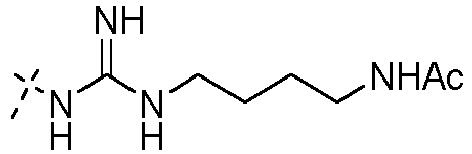
P3 2.1 ± 0.5 
P4 32.1 ± 15.5 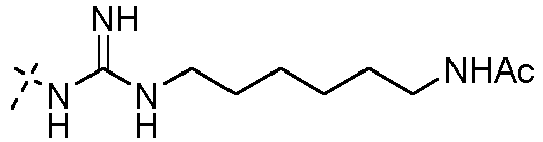
P5 9.8 ± 2.3 
P6 3.2 ± 1.6 Acylguanidino analogs 
P7 2.5 ± 0.4 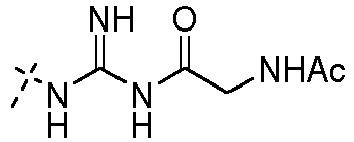
P8 13.2 ± 3.8 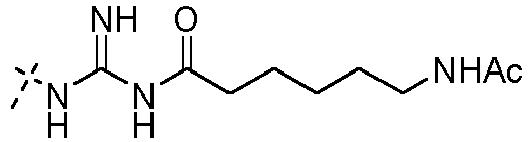
P9 78.7 ± 26.2 
P10 2.0 ± 0.2 Functionalized P5 analogs c(y(NHex-Gua-Hex-R2 )aRNaIG) R2 = 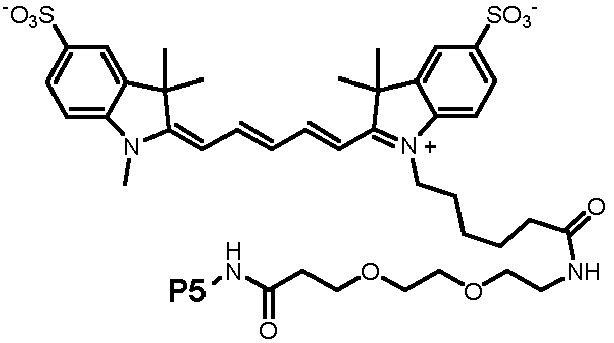
P5g 40 ± 5 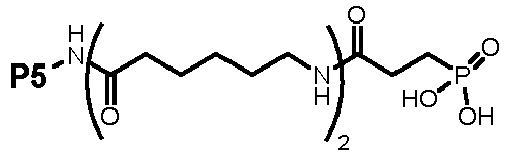
P5k 90 ± 29 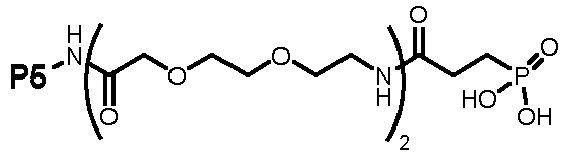
P5m 52 ± 20 P5-QD 7.7 ± 2.7 Table 2b: Binding affinities (ICso in nM) of novel CXCR4 ligands to human CXCR4 (hCXCR4). Affinities were determined using Jurkat human T-cell leukemia cells (400.000 cells/sample) and [125I]FC-131 as the radioligand. Each experiment was performed in triplicate, and results are means ± SD from three separate experiments. c(y-(N-hexylguanidino)a-R-NaI-c(R3 )) R3= compound IC50 [nM] to hCXCR4 HS --- Pc0 35 ± 2 
Pc1 61 ± 8 
Pc2 57 ± 14 
Pc3 > 400 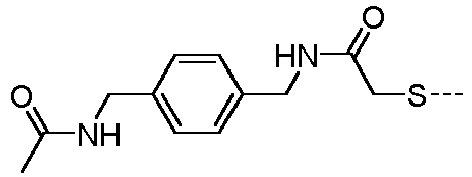
Pc4 53 ± 16 
Pc5 14 ± 2 functionalized Pc5 analogs 
Pc5a 78 ± 4 
Pc5b 31 ± 3 
Pc5c 51 ± 4 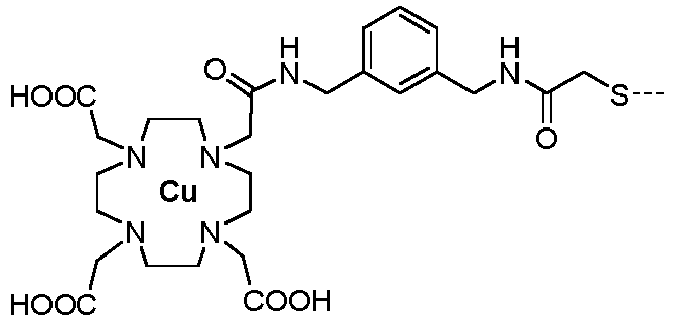
Pc5d 78 ± 5 Pc5-QD 6.1 ± 0.3 Table 3: Binding affinities (ICso in nM) of novel CXCR4 ligands to human, mouse and rat CXCR4 (hCXCR4, mCXCR4 and rCXCR4). Affinities were determined using Jurkat human T-cell leukemia (hCXCR4), Eµ-Myc1080 mouse B-cell lymphoma and C6 rat glioblastoma cells, respectively (200.000 cells/sample), and [125I]R1 as the radioligand. Each experiment was performed in triplicate, and results are means ± SD from three separate experiments. c(y(NHex-R1 )aRNaIG) R1 = compound IC50 [nM] to hCXCR4 IC50 [nM] to mCXCR4 IC50 [nM] to rCXCR4 Alkylguanidino analogs 
R 2.8 ± 1.1 0.8 ± 0.1 115 ± 24 c(3-iodo-y(NHex-R1 )aRNaIG) 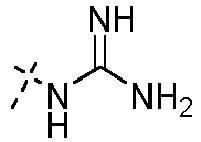
R1 5.4 ± 1.5 4.9 ± 1.7 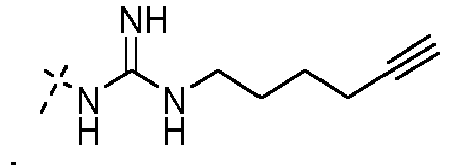
P6 6.2 ± 2.8 Acylquanidino analogs 
P7 1.6 (n=1) 
P10 5.5 ± 2.5 Functionalized P5 analogs c(y(NHex-Gua-Hex-R2 )aRNaIG) R2 = 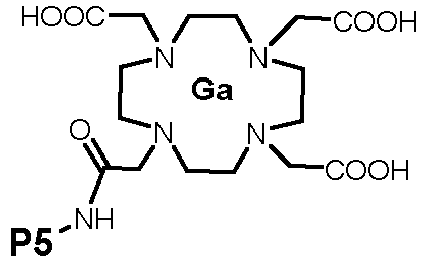
P5c 13.0 ± 2.0 12.7 ± 4.6 
P5d 12.9 ± 2.3 17.0 ± 3.3 
P5e 156 ± 11 156 ± 7 
P5f 115 ± 39 136 ± 26 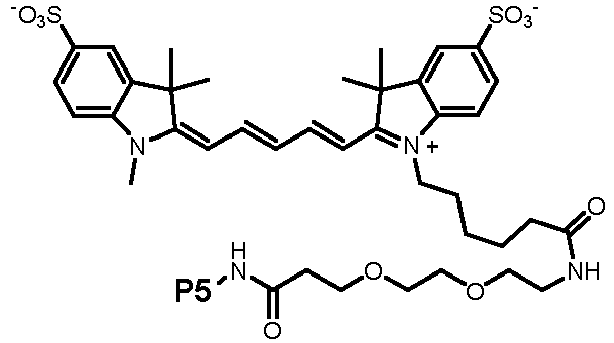
P5g 91 ± 49 63 ± 23 
P5h 129 ± 27 156 ± 37 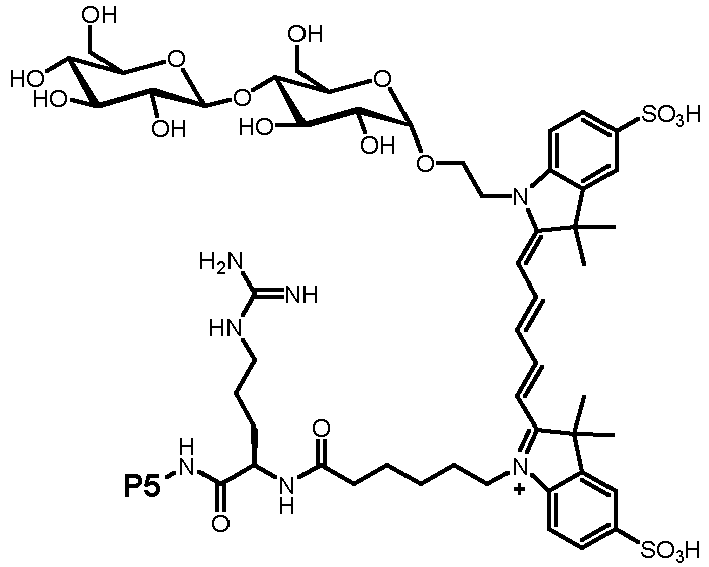
P5i 147 ± 73 92 ± 30 P5-QD 4.8 ± 2.2 4.9 ± 1.8 c(y-(N-hexylguanidino)a-R-NaI-c(m-aryl-R4 )) R4= 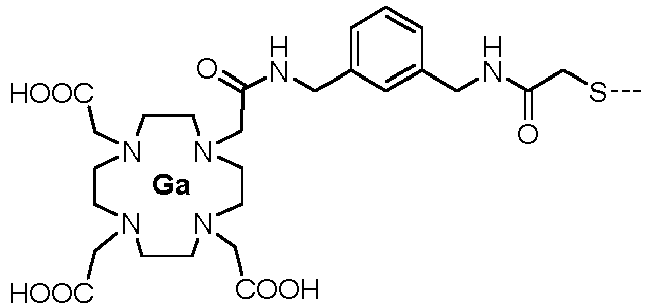
Pc5b 64 ± 29 63 ± 19 Pc5-QD 8.3 ± 4.3 3.3 ± 0.7 - Chem-1 cells stably transfected with hCXCR4 were incubated with the respective Sulfo-Cy5 conjugated peptides for 1 h at 4 °C or at 37 °C. The ligand concentrations used in the respective experiments are cited in the Figure captions. Non-specific ligand binding was determined in the presence of AMD3100 (100 µM). Cell nuclei were stained with Hoechst (2 µg/ml), and ligand internalization into endosomes and lysosomes was confirmed by co-staining using lysotracker green (2 µM). See
Figures 2 to 8 . -
- 1. Zlotnik A,Yoshie O. Chemokines: a new classification system and their role in immunity. Immunity 2000;12:121-127.
- 2. Domanska UM, Kruizinga RC, Nagengast WB, Timmer-Bosscha H, Huls G, de Vries EG, et al. A review on CXCR4/CXCL12 axis in oncology: no place to hide. European journal of cancer 2013;49:219-230.
- 3. Feng Y, Broder CC, Kennedy PE,Berger EA. HIV-1 entry cofactor: functional cDNA cloning of a seven-transmembrane, G protein-coupled receptor. Science 1996;272:872-877.
- 4. Nagasawa T, Hirota S, Tachibana K, Takakura N, Nishikawa S-i, Kitamura Y, et al. Defects of B-cell lymphopoiesis and bone-marrow myelopoiesis in mice lacking the CXC chemokine PBSF/SDF-1. Nature 1996;382:635-638.
- 5. Loetscher P, Moser B,Baggiolini M. Chemokines and their receptors in lymphocyte traffic and HIV infection. Advances in immunology 2000;74:127-180.
- 6. Aiuti A, Webb I, Bleul C, Springer T,Gutierrez-Ramos J. The chemokine SDF-1 is a chemoattractant for human CD34+ hematopoietic progenitor cells and provides a new mechanism to explain the mobilization of CD34+ progenitors to peripheral blood. The Journal of experimental medicine 1997;185:111-120.
- 7. Ma Q, Jones D, Borghesani PR, Segal RA, Nagasawa T, Kishimoto T, et al. Impaired B-lymphopoiesis, myelopoiesis, and derailed cerebellar neuron migration in CXCR4- and SDF-1-deficient mice. Proc Natl Acad Sci U S A 1998;95:9448-9453.
- 8. Nagafuchi Y, Shoda H, Sumitomo S, Nakachi S, Kato R, Tsuchida Y, et al. Immunophenotyping of rheumatoid arthritis reveals a linkage between HLA-DRB1 genotype, CXCR4 expression on memory CD4(+) T cells, and disease activity. Sci Rep 2016;6:29338.
- 9. Galkina E,Ley K. Immune and inflammatory mechanisms of atherosclerosis (*). Annu Rev Immunol 2009;27:165-197.
- 10. Schober A, Bernhagen J,Weber C. Chemokine-like functions of MIF in atherosclerosis. J Mol Med (Berl) 2008;86:761-770.
- 11. Burger JA, Burger M,Kipps TJ. Chronic lymphocytic leukemia B cells express functional CXCR4 chemokine receptors that mediate spontaneous migration beneath bone marrow stromal cells. Blood 1999;94:3658-3667.
- 12. Müller A, Homey B, Soto H, Ge N, Catron D, Buchanan ME, et al. Involvement of chemokine receptors in breast cancer metastasis. nature 2001;410:50-56.
- 13. Burger JA, Kipps TJ. CXCR4: a key receptor in the crosstalk between tumor cells and their microenvironment. Blood 2006;107:1761-1767.
- 14. Chatterjee S, Azad BB, Nimmagadda S. The intricate role of CXCR4 in cancer. Advances in cancer research 2014;124:31.
- 15. Brave M, Farrell A, Ching Lin S, Ocheltree T, Pope Miksinski S, Lee SL, et al. FDA review summary: Mozobil in combination with granulocyte colony-stimulating factor to mobilize hematopoietic stem cells to the peripheral blood for collection and subsequent autologous transplantation. Oncology 2010;78:282-288.
- 16. Liu T, Li X, You S, Bhuyan SS,Dong L. Effectiveness of AMD3100 in treatment of leukemia and solid tumors: from original discovery to use in current clinical practice. Exp Hematol Oncol 2015;5:19.
- 17. Taromi S, Kayser G, Catusse J, von Elverfeldt D, Reichardt W, Braun F, et al. CXCR4 antagonists suppress small cell lung cancer progression. Oncotarget 2016;7:85185-85195.
- 18. Bodart V, Anastassov V, Darkes MC, Idzan SR, Labrecque J, Lau G, et al. Pharmacology of AMD3465: a small molecule antagonist of the chemokine receptor CXCR4. Biochem Pharmacol 2009;78:993-1000.
- 19. Ling X, Spaeth E, Chen Y, Shi Y, Zhang W, Schober W, et al. The CXCR4 antagonist AMD3465 regulates oncogenic signaling and invasiveness in vitro and prevents breast cancer growth and metastasis in vivo. PLoS One 2013;8:e58426.
- 20. Liang Z, Zhan W, Zhu A, Yoon Y, Lin S, Sasaki M, et al. Development of a unique small molecule modulator of CXCR4. PLoS One 2012;7:e34038.
- 21. Wong D, Kandagatla P, Korz W,Chinni SR. Targeting CXCR4 with CTCE-9908 inhibits prostate tumor metastasis. BMC Urol 2014;14:12.
- 22. Beider K, Darash-Yahana M, Blaier O, Koren-Michowitz M, Abraham M, Wald H, et al. Combination of imatinib with CXCR4 antagonist BKT140 overcomes the protective effect of stroma and targets CML in vitro and in vivo. Mol Cancer Ther 2014;13:1155-1169.
- 23. Fahham D, Weiss ID, Abraham M, Beider K, Hanna W, Shlomai Z, et al. In vitro and in vivo therapeutic efficacy of CXCR4 antagonist BKT140 against human non-small cell lung cancer. J Thorac Cardiovasc Surg 2012;144:1167-1175 e1161.
- 24. Peled A, Abraham M, Avivi I, Rowe JM, Beider K, Wald H, et al. The high-affinity CXCR4 antagonist BKT140 is safe and induces a robust mobilization of human CD34+ cells in patients with multiple myeloma. Clin Cancer Res 2014;20:469-479.
- 25. Karpova D, Dauber K, Spohn G, Chudziak D, Wiercinska E, Schulz M, et al. The novel CXCR4 antagonist POL5551 mobilizes hematopoietic stem and progenitor cells with greater efficiency than Plerixafor. Leukemia 2013;27:2322-2331.
- 26. Sison EA, Magoon D, Li L, Annesley CE, Romagnoli B, Douglas GJ, et al. POL5551, a novel and potent CXCR4 antagonist, enhances sensitivity to chemotherapy in pediatric ALL. Oncotarget 2015;6:30902-30918.
- 27. Xiang J, Hurchla MA, Fontana F, Su X, Amend SR, Esser AK, et al. CXCR4 Protein Epitope Mimetic Antagonist POL5551 Disrupts Metastasis and Enhances Chemotherapy Effect in Triple-Negative Breast Cancer. Mol Cancer Ther 2015;14:2473-2485.
- 28. Azad BB, Chatterjee S, Lesniak WG, Lisok A, Pullambhatla M, Bhujwalla ZM, et al. A fully human CXCR4 antibody demonstrates diagnostic utility and therapeutic efficacy in solid tumor xenografts. Oncotarget 2016;7:12344-12358.
- 29. Peng S-B, Zhang X, Paul D, Kays LM, Ye M, Vaillancourt P, et al. Inhibition of CXCR4 by LY2624587, a Fully Humanized Anti-CXCR4 Antibody Induces Apoptosis of Hematologic Malignancies. PloS one 2016;11:e0150585.
- 30. Ramsey DM,McAlpine SR. Halting metastasis through CXCR4 inhibition. Bioorg Med Chem Lett 2013;23:20-25.
- 31. Cho BS, Zeng Z, Mu H, Wang Z, Konoplev S, McQueen T, et al. Antileukemia activity of the novel peptidic CXCR4 antagonist LY2510924 as monotherapy and in combination with chemotherapy. Blood 2015;126:222-232.
- 32. Peng SB, Zhang X, Paul D, Kays LM, Gough W, Stewart J, et al. Identification of LY2510924, a novel cyclic peptide CXCR4 antagonist that exhibits antitumor activities in solid tumor and breast cancer metastatic models. Mol Cancer Ther 2015;14:480-490.
- 33. Di Maro S, Di Leva FS, Trotta AM, Brancaccio D, Portella L, Aurilio M, et al. Structure-Activity Relationships and Biological Characterization of a Novel, Potent, and Serum Stable C-X-C Chemokine Receptor Type 4 (CXCR4) Antagonist. J Med Chem 2017;60:9641-9652.
- 34. Di Maro S, Trotta AM, Brancaccio D, Di Leva FS, La Pietra V, lerano C, et al. Exploring the N-Terminal Region of C-X-C Motif Chemokine 12 (CXCL12): Identification of Plasma-Stable Cyclic Peptides As Novel, Potent C-X-C Chemokine Receptor Type 4 (CXCR4) Antagonists. J Med Chem 2016;59:8369-8380.
- 35. lerano C, Portella L, Lusa S, Salzano G, D'Alterio C, Napolitano M, et al. CXCR4-antagonist Peptide R-liposomes for combined therapy against lung metastasis. Nanoscale 2016;8:7562-7571.
- 36. Fontanella R, Pelagalli A, Nardelli A, D'Alterio C, lerano C, Cerchia L, et al. A novel antagonist of CXCR4 prevents bone marrow-derived mesenchymal stem cell-mediated osteosarcoma and hepatocellular carcinoma cell migration and invasion. Cancer Lett 2016;370:100-107.
- 37. Santagata S, Napolitano M, D'Alterio C, Desicato S, Maro SD, Marinelli L, et al. Targeting CXCR4 reverts the suppressive activity of T-regulatory cells in renal cancer. Oncotarget 2017;8:77110-77120.
- 38. George GP, Stevens E, Åberg O, Nguyen Q-D, Pisaneschi F, Spivey AC, et al. Preclinical evaluation of a CXCR4-specific 68Ga-labelled TN14003 derivative for cancer PET imaging. Bioorganic & medicinal chemistry 2014;22:796-803.
- 39. Yan X, Niu G, Wang Z, Yang X, Kiesewetter DO, Jacobson O, et al. Al [18F] NOTA-T140 Peptide for Noninvasive Visualization of CXCR4 Expression. Molecular Imaging and Biology 2015:1-8.
- 40. Jacobson O, Weiss ID, Kiesewetter DO, Farber JM,Chen X. PET of tumor CXCR4 expression with 4-18F-T140. Journal of Nuclear Medicine 2010;51:1796-1804.
- 41. Wang Z, Zhang M, Wang L, Wang S, Kang F, Li G, et al. Prospective Study of 68Ga-NOTA-NFB: Radiation Dosimetry in Healthy Volunteers and First Application in Glioma Patients. Theranostics 2015;5:882-889.
- 42. Buckle T, van Berg NS, Kuil J, Bunschoten A, Oldenburg J, Borowsky AD, et al. Noninvasive longitudinal imaging of tumor progression using an (111)indium labeled CXCR4 peptide antagonist. Am J Nucl Med Mol Imaging 2012;2:99-109.
- 43. Kuil J, Buckle T, Oldenburg J, Yuan H, Borowsky AD, Josephson L, et al. Hybrid peptide dendrimers for imaging of chemokine receptor 4 (CXCR4) expression. Mol Pharm 2011;8:2444-2453.
- 44. Kuil J, Buckle T, Yuan H, van den Berg NS, Oishi S, Fujii N, et al. Synthesis and evaluation of a bimodal CXCR4 antagonistic peptide. Bioconjug Chem 2011;22:859-864.
- 45. Nishizawa K, Nishiyama H, Oishi S, Tanahara N, Kotani H, Mikami Y, et al. Fluorescent imaging of high-grade bladder cancer using a specific antagonist for chemokine receptor CXCR4. Int J Cancer 2010;127:1180-1187.
- 46. Portella L, Vitale R, De Luca S, D'Alterio C, lerano C, Napolitano M, et al. Preclinical development of a novel class of CXCR4 antagonist impairing solid tumors growth and metastases. PloS one 2013;8:e74548.
- 47. Fujii N, Oishi S, Hiramatsu K, Araki T, Ueda S, Tamamura H, et al. Molecular-size reduction of a potent CXCR4-chemokine antagonist using orthogonal combination of conformation- and sequence-based libraries. Angew Chem Int Ed Engl 2003;42:3251-3253.
- 48. Tamamura H, Araki T, Ueda S, Wang Z, Oishi S, Esaka A, et al. Identification of novel low molecular weight CXCR4 antagonists by structural tuning of cyclic tetrapeptide scaffolds. Journal of medicinal chemistry 2005;48:3280-3289.
- 49. Tamamura H, Esaka A, Ogawa T, Araki T, Ueda S, Wang Z, et al. Structure-activity relationship studies on CXCR4 antagonists having cyclic pentapeptide scaffolds. Org. Biomol. Chem. 2005;3:4392-4394.
- 50. Tanaka T, Nomura W, Narumi T, Esaka A, Oishi S, Ohashi N, et al. Structure-activity relationship study on artificial CXCR4 ligands possessing the cyclic pentapeptide scaffold: the exploration of amino acid residues of pentapeptides by substitutions of several aromatic amino acids. Organic & biomolecular chemistry 2009;7:3805-3809.
- 51. Inokuchi E, Oishi S, Kubo T, Ohno H, Shimura K, Matsuoka M, et al. Potent CXCR4 antagonists containing amidine type Peptide bond isosteres. ACS Med Chem Lett 2011;2:477-480.
- 52. Kobayashi K, Oishi S, Hayashi R, Tomita K, Kubo T, Tanahara N, et al. Structure-activity relationship study of a CXC .
- 53. Narumi T, Hayashi R, Tomita K, Kobayashi K, Tanahara N, Ohno H, et al. Synthesis and biological evaluation of selective CXCR4 antagonists containing alkene dipeptide isosteres. Organic & biomolecular chemistry 2010;8:616-621.
- 54. Demmer O, Dijkgraaf I, Schottelius M, Wester H-J,Kessler H. Introduction of functional groups into peptides via N-alkylation. Organic letters 2008;10:2015-2018.
- 55. Demmer O, Dijkgraaf I, Schumacher U, Marinelli L, Cosconati S, Gourni E, et al. Design, synthesis, and functionalization of dimeric peptides targeting chemokine receptor CXCR4. Journal of medicinal chemistry 2011;54:7648-7662.
- 56. Demmer O, Gourni E, Schumacher U, Kessler H,Wester HJ. PET imaging of CXCR4 receptors in cancer by a new optimized ligand. ChemMedChem 2011;6:1789-1791.
- 57. Gourni E, Demmer O, Schottelius M, D'Alessandria C, Schulz S, Dijkgraaf I, et al. PET of CXCR4 expression by a 68Ga-labeled highly specific targeted contrast agent. J. Nucl. Med. 2011;52:1803-1810.
- 58. Wester HJ, Keller U, Schottelius M, Beer A, Philipp-Abbrederis K, Hoffmann F, et al. Disclosing the CXCR4 expression in lymphoproliferative diseases by targeted molecular imaging. Theranostics 2015;5:618.
- 59. Philipp-Abbrederis K, Herrmann K, Knop S, Schottelius M, Eiber M, Luckerath K, et al. In vivo molecular imaging of chemokine receptor CXCR4 expression in patients with advanced multiple myeloma. EMBO Mol Med 2015;7:477-487.
- 60. Lapa C, Schreder M, Schirbel A, Samnick S, Kortum KM, Herrmann K, et al. [68Ga]Pentixafor-PET/CT for imaging of chemokine receptor CXCR4 expression in multiple myeloma - Comparison to [(18)F]FDG and laboratory values. Theranostics 2017;7:205-212.
- 61. Avanesov M, Karul M,Derlin T. [68Ga-pentixafor PET: clinical molecular imaging of chemokine receptor CXCR4 expression in multiple myeloma]. Radiologe 2015;55:829-831.
- 62. Herhaus P, Habringer S, Philipp-Abbrederis K, Vag T, Gerngross C, Schottelius M, et al. Targeted positron emission tomography imaging of CXCR4 expression in patients with acute myeloid leukemia. Haematologica 2016;101:932-940.
- 63. Lapa C, Luckerath K, Rudelius M, Schmid JS, Schoene A, Schirbel A, et al. [68Ga]Pentixafor-PET/CT for imaging of .
- 64. Lapa C, Luckerath K, Kleinlein I, Monoranu CM, Linsenmann T, Kessler AF, et al. 68Ga-Pentixafor-PET/CT for Imaging of .
- 65. Vag T, Gerngross C, Herhaus P, Eiber M, Philipp-Abbrederis K, Graner FP, et al. First Experience with Chemokine Receptor CXCR4-Targeted PET Imaging of Patients with Solid Cancers. J Nucl Med 2016;57:741-746.
- 66. Lapa C, Reiter T, Werner RA, Ertl G, Wester HJ, Buck AK, et al. [68Ga]Pentixafor-PET/CT for Imaging of .
- 67. Rischpler C, Nekolla SG, Kossmann H, Dirschinger RJ, Schottelius M, Hyafil F, et al. Upregulated myocardial CXCR4-expression after myocardial infarction assessed by simultaneous GA-68 pentixafor PET/MRI. J Nucl Cardiol 2016;23:131-133.
- 68. Thackeray JT, Derlin T, Haghikia A, Napp LC, Wang Y, Ross TL, et al. Molecular Imaging of the Chemokine Receptor CXCR4 After Acute Myocardial Infarction. JACC Cardiovasc Imaging 2015;8:1417-1426.
- 69. Schmid JS, Schirbel A, Buck AK, Kropf S, Wester HJ,Lapa C. [68Ga]Pentixafor-Positron Emission Tomography/Computed Tomography Detects Chemokine Receptor CXCR4 Expression After Ischemic Stroke. Circ Cardiovasc Imaging 2016;9:e005217.
- 70. Hyafil F, Pelisek J, Laitinen I, Schottelius M, Mohring M, Doring Y, et al. Imaging the Cytokine Receptor CXCR4 in Atherosclerotic Plaques with the Radiotracer 68Ga-Pentixafor for PET. J Nucl Med 2017;58:499-506.
- 71. Li X, Heber D, Leike T, Beitzke D, Lu X, Zhang X, et al. [68Ga]Pentixafor-PET/MRI for the detection of .
- 72. Weiberg D, Thackeray JT, Daum G, Sohns JM, Kropf S, Wester HJ, et al. Clinical Molecular Imaging of Chemokine Receptor CXCR4 Expression in Atherosclerotic Plaque using 68Ga-Pentixafor PET: Correlation with Cardiovascular Risk Factors and Calcified Plaque Burden. J Nucl Med 2017.
- 73. Bouter C, Meller B, Sahlmann CO, Staab W, Wester HJ, Kropf S, et al. Imaging chemokine receptor CXCR4 in chronic infection of the bone with 68Ga-Pentixafor-PET/CT - first insights. J Nucl Med 2017.
- 74. Derlin T, Gueler F, Brasen JH, Schmitz J, Hartung D, Herrmann TR, et al. Integrating MRI and Chemokine Receptor CXCR4-Targeted PET for Detection of Leukocyte Infiltration in Complicated Urinary Tract Infections After Kidney Transplantation. J Nucl Med 2017;58:1831-1837.
- 75. Schottelius M, Osl T, Poschenrieder A, Herrmann K, Lapa C, Hoffmann F, et al. [177Lu]pentixather: preclinical and first patient results with a highly promising CXCR4-directed endoradiotherapeutic agent. Journal of Nuclear Medicine 2015;56:339-339.
- 76. Habringer S, Lapa C, Herhaus P, Schottelius M, Istvanffy R, Steiger K, et al. Dual Targeting of Acute Leukemia and Supporting Niche by CXCR4-Directed Theranostics. Theranostics 2018;8:369-383.
- 77. Herrmann K, Schottelius M, Lapa C, Osl T, Poschenrieder A, Haenscheid H, et al. First-in-man experience of CXCR4-directed endoradiotherapy with 177Lu-and 90Y-labelled pentixather in advanced stage multiple myeloma with extensive intra-and extramedullary disease. Journal of Nuclear Medicine 2015:jnumed. 115.167361.
- 78. Lapa C, Herrmann K, Schirbel A, Hanscheid H, Luckerath K, Schottelius M, et al. CXCR4-directed endoradiotherapy induces high response rates in extramedullary relapsed Multiple Myeloma. Theranostics 2017;7:1589-1597.
- 79. Demmer O, Frank AO, Hagn F, Schottelius M, Marinelli L, Cosconati S, et al. A conformationally frozen peptoid boosts CXCR4 affinity and anti-HIV activity. Angew Chem Int Ed Engl 2012;51:8110-8113.
- 80. Fang HY, Munch NS, Schottelius M, Ingermann J, Liu H, Schauer M, et al. CXCR4 Is a Potential Target for Diagnostic PET/CT Imaging in Barrett's Dysplasia and Esophageal Adenocarcinoma. Clin Cancer Res 2018;24:1048-1061.


Typically, RB comprises one of (i) to (v), i.e. it is not necessary that two or more of (i) to (v) are present in one compound in accordance with the invention.
Claims (12)
- A compound of the following formula (I)
 R1 is alkyl, preferably C1-C6 alkyl, more preferably methyl;R2 is H or alkyl, which alkyl may be unsubstituted or substituted with at least one substituent selected from -NH2, -NH-C(=NH)-NH2, -C(O)NH2, -C(O)OH, -OH, -SH, -SCH3 and a 5 to 10-membered carbocycle or 5 to 10-membered heterocycle containing oxygen, nitrogen or sulfur as heteroatom(s);R3 is H or alkyl, which alkyl may be unsubstituted or substituted with at least one substituent selected from -NH2, -NH-C(=NH)-NH2, -C(O)NH2, -C(O)OH, -OH, -SH, -SCH3 and a 5 to 10-membered carbocycle or 5 to 10-membered heterocycle containing oxygen, nitrogen or sulfur as heteroatom(s);R4 is alkyl, which alkyl is substituted with at least one -S-RA,R5 is H or I;R6 is alkyl substituted with at least one substituent selected from -NH2,-NH-C(=NH)-NH2, -NH-RB, -NH-C(=NH)-NH-RB, -NH-C(=NH)-NH-R14, and-NH-C(=NH)-NH-C(=O)-R15,R7 to R10 are each independently H or alkyl;R14 and R15 are independently C1-C10 alkyl, which alkyl may be substituted by at least one substituent selected from -NH-C(=O)-CH3 and -C=CH;RA is a group which comprises at least one selected from:(i) a chelating moiety,(ii) a chelate formed by a chelating moiety (i) with a chelated radioactive or nonradioactive cation,(iii) a moiety carrying a covalently bound radioisotope,(iv) a phosphonate moiety, and(v) a fluorescent label;andRB is a group which comprises at least one selected from:(i) a chelating moiety,(ii) a chelate formed by a chelating moiety with a chelated radioactive or nonradioactive cation,(iii) a group carrying a covalently bound radioisotope,(iv) a phosphonate moiety, and(v) a fluorescent label,and RB may further comprise a group of formula (II)
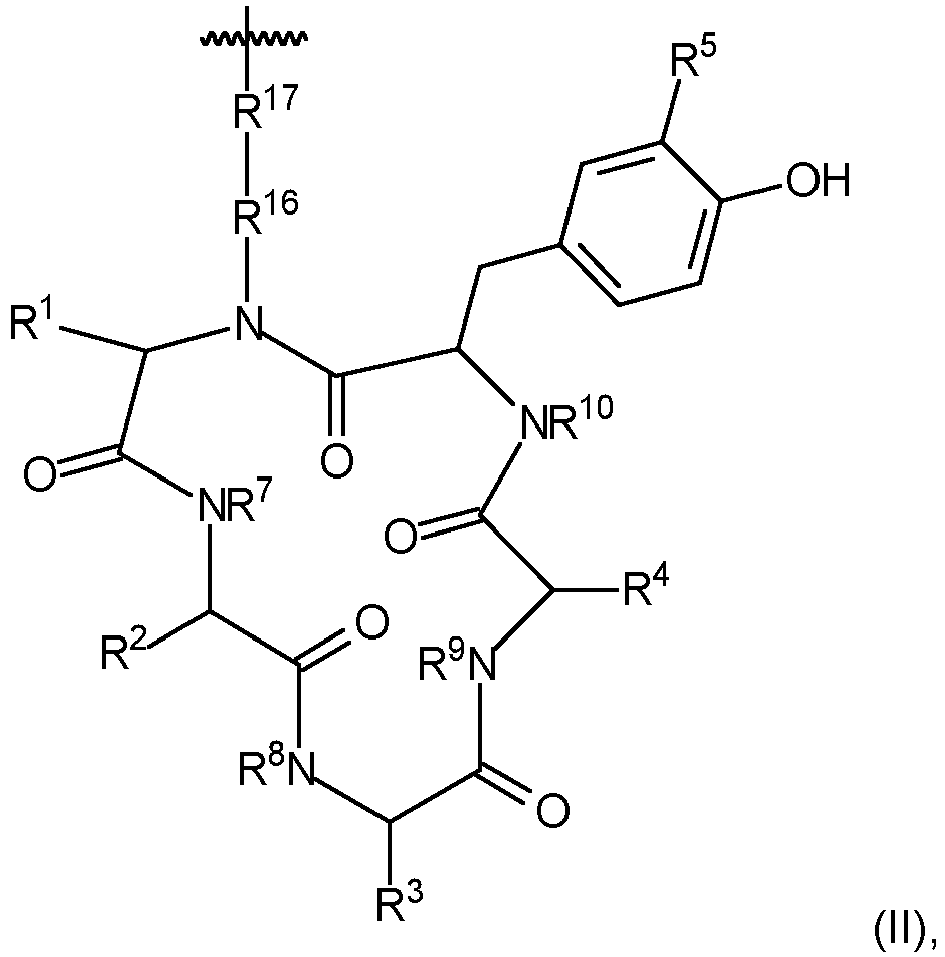 which is bound to the remainder of the compound with the bond marked with,
 wherein R1 to R5 and R7 to R10 are as defined above, and wherein R16 is an alkanediyl group, preferably a C1-C6 alkanediyl group, and R17 is selected from -NH- and -NH-C(=NH)-NH-.
 - The compound or salt of claim 1, wherein R1 is a C1-C6 alkyl group
- The compound of salt of claim 1 or 2, wherein R2 is C1-C6 alkyl, substituted with one group selected from -NH2 and-NH-C(=NH)-NH2.
- The compound or salt of any of claims 1 to 3, wherein R3 is methyl, substituted with a 5 to 10-membered carbocycle.
- The compound or salt of any of claims 1 to 4, wherein R7 to R10 are H.
- The compound of any of claims 1 to 5, which is a compound of formula (Ib):
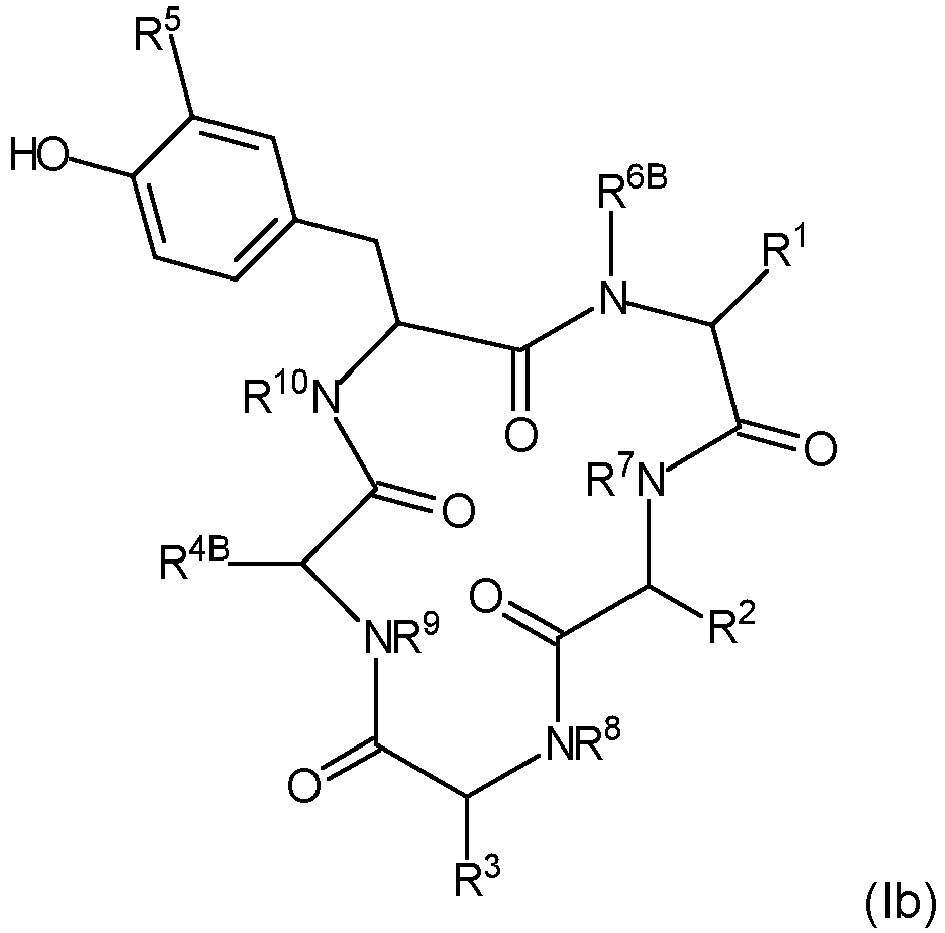 or a pharmaceutically acceptable salt thereof,whereinR1 to R3, R5 and R7 to R10 are defined as in claims 1 to 5,R4B is alkyl substituted with one substituent -SRA, wherein RA is as defined in claim 1, andR6B is alkyl substituted with one substituent selected from -NH2, -NH-C(=NH)-NH2, -NH-C(=NH)-NH-R14, and -NH-C(=NH)-NH-C(=O)-R15, wherein R14 and R15 are defined as in claim 1.
 - The compound or salt of claim 6, wherein R4B is C1-C6 alkyl substituted with one substituent -SRA.
- The compound or salt of claim 6 or 7, wherein R6B is -(linear C6 alkyl)-NH-C(=NH)-NH2.
- The compound or salt of any of claims 1 to 8, wherein RB is a group of the formula -LB1-RB1, which is selected from the groups of formulae (Vla) to (Vlf):
-R18-NH-RB1 (VIa),
-R18-NH-(C(=O)-R19-NH)u-RB1 (VIb),
-R18-NH-(C(=O)-R20-NH)v-RB1 (VIc),
-(C=O)-R21-NH-RB1 (VId),
-(C=O)-R21-NH-(C(=O)-R22-NH)w-RB1 (VIe),
-(C=O)-R21-NH-(C(=O)-R23-NH)x-RB1 (VIf),
wherein:R18 is C1-C10 alkanediyl, preferably linear alkanediyl, more preferably linear C2-C6 alkanediyl, and most preferably linear C6 alkanediyl,R19 is C1-C10 alkanediyl, preferably linear alkanediyl, more preferably linear C2-C6 alkanediyl, u is 1, 2 or 3, preferably 1 or 2,R20 is an oligoether moiety, preferably a linear oligoether moiety, more preferably a linear oligoether moiety having 5 to 10 carbon atoms and 2 or 3 oxygen atoms providing the ether bonds, v is 1, 2 or 3, preferably 1 or 2,R21 is C1-C10 alkanediyl, preferably linear alkanediyl, more preferably linear C2-C6 alkanediyl, and most preferably linear C6 alkanediyl,R22 is C1-C10 alkanediyl, preferably linear alkanediyl, more preferably linear C2-C6 alkanediyl, w is 1, 2 or 3, preferably 1 or 2,R23 is an oligoether moiety, preferably a linear oligoether moiety, more preferably a linear oligoether moiety having 5 to 10 carbon atoms and 2 or 3 oxygen atoms providing the ether bonds, x is 1, 2 or 3, preferably 1 or 2;
andRB1 is or comprises a group selected from(i) a chelating moiety,(ii) a chelate formed by a chelating moiety (i) with a chelated radioactive or nonradioactive cation,(iii) a moiety carrying a covalently bound radioisotope,(iv) a phosphonate moiety, and(v) a fluorescent label,and wherein RB1 may further comprise a group of formula (II) as defined in claim 1. - The compound or salt of any of claims 1 to 9, wherein RA is a group of the formula - LA1-RA1, which is selected from the groups of formulae (IVa) and (lVb):
-(CH2)-C(=O)-NH-R24-NH-RA1 (lVa),
-(CH2)-C(=O)-NH-(CH2)y-R25-(CH2)z-NH-RA1 (IVb),
wherein R24 is a C2-C10 alkanediyl group, preferably a C3-C6 alkanediyl group, which alkanediyl group is preferably linear and may be substituted by a group -C(=O)-NH2, R25 is a phenylene group, preferably a 1,3-phenylene group, and y and z are independently integers selected from 0, 1 or 2, and are preferably both 1,
andRA1 is or comprises a group selected from:(i) a chelating moiety,(ii) a chelate formed by a chelating moiety (i) with a chelated radioactive or nonradioactive cation,(iii) a moiety carrying a covalently bound radioisotope,(iv) a phosphonate moiety, and(v) a fluorescent label. - A pharmaceutical or diagnostic composition comprising or consisting of a compound or salt of any one of claims 1 to 10.
- A compound or salt of any one of claims 1 to 10 for use in medicine, preferably in nuclear medicine, for nuclear molecular imaging, or optical imaging, or targeted endoradiotherapy.
Applications Claiming Priority (2)
| Application Number | Priority Date | Filing Date | Title |
|---|---|---|---|
| EP18194124 | 2018-09-12 | ||
| PCT/EP2019/074196 WO2020053256A1 (en) | 2018-09-12 | 2019-09-11 | Cxcr4-targeted diagnostic and therapeutic agents with reduced species selectivity |
Publications (3)
| Publication Number | Publication Date |
|---|---|
| EP3849997A1 EP3849997A1 (en) | 2021-07-21 |
| EP3849997B1 true EP3849997B1 (en) | 2024-05-01 |
| EP3849997C0 EP3849997C0 (en) | 2024-05-01 |
Family
ID=63637660
Family Applications (1)
| Application Number | Title | Priority Date | Filing Date |
|---|---|---|---|
| EP19765488.2A Active EP3849997B1 (en) | 2018-09-12 | 2019-09-11 | Cxcr4-targeted diagnostic and therapeutic agents with reduced species selectivity |
Country Status (7)
| Country | Link |
|---|---|
| US (2) | US11944691B2 (en) |
| EP (1) | EP3849997B1 (en) |
| CN (2) | CN119661653A (en) |
| AU (1) | AU2019338221B2 (en) |
| CA (1) | CA3108450A1 (en) |
| ES (1) | ES2985919T3 (en) |
| WO (1) | WO2020053256A1 (en) |
Families Citing this family (3)
| Publication number | Priority date | Publication date | Assignee | Title |
|---|---|---|---|---|
| WO2020053256A1 (en) * | 2018-09-12 | 2020-03-19 | Technische Universität München | Cxcr4-targeted diagnostic and therapeutic agents with reduced species selectivity |
| CN113845439B (en) * | 2021-10-11 | 2024-02-09 | 杭州师范大学 | Bisbenzylamide CXCR4 antagonist and preparation and application thereof |
| CN120192362B (en) * | 2025-05-26 | 2025-10-21 | 原子高科股份有限公司 | A compound targeting chemokine receptor 4 and its application |
Family Cites Families (10)
| Publication number | Priority date | Publication date | Assignee | Title |
|---|---|---|---|---|
| US8628750B2 (en) | 2006-02-27 | 2014-01-14 | Technische Universitat Munchen | Cancer imaging and treatment |
| TWI412367B (en) | 2006-12-28 | 2013-10-21 | 梅達雷克斯有限責任公司 | Chemical linker and cleavable substrate and conjugate thereof |
| US7691813B2 (en) | 2007-05-30 | 2010-04-06 | Eli Lilly And Company | Cyclic peptide CXCR4 antagonists |
| GB0716897D0 (en) | 2007-08-30 | 2007-10-10 | Univ Muenchen Tech | Cancer imaging and treatment |
| IT1397901B1 (en) | 2010-01-26 | 2013-02-04 | Consiglio Nazionale Ricerche | CYCLIC PEPTIDES THAT BIND THE CXCR4 RECEPTOR AND THEIR USE IN MEDICAL AND DIAGNOSTIC FIELDS. |
| EP2380597A1 (en) * | 2010-04-20 | 2011-10-26 | Technische Universität München | Cyclopeptide derivatives and uses thereof |
| EP2380596A1 (en) | 2010-04-20 | 2011-10-26 | Technische Universität München | Cyclopentapeptide derivatives and uses thereof |
| WO2015185162A1 (en) * | 2014-06-06 | 2015-12-10 | Technische Universität München | Modified cyclopentapeptides and uses thereof |
| WO2020053255A1 (en) * | 2018-09-12 | 2020-03-19 | Technische Universität München | Therapeutic and diagnostic agents for cancer |
| WO2020053256A1 (en) * | 2018-09-12 | 2020-03-19 | Technische Universität München | Cxcr4-targeted diagnostic and therapeutic agents with reduced species selectivity |
-
2019
- 2019-09-11 WO PCT/EP2019/074196 patent/WO2020053256A1/en not_active Ceased
- 2019-09-11 AU AU2019338221A patent/AU2019338221B2/en active Active
- 2019-09-11 ES ES19765488T patent/ES2985919T3/en active Active
- 2019-09-11 CN CN202411857594.8A patent/CN119661653A/en active Pending
- 2019-09-11 CA CA3108450A patent/CA3108450A1/en active Pending
- 2019-09-11 US US17/275,880 patent/US11944691B2/en active Active
- 2019-09-11 CN CN201980059915.0A patent/CN112673015B/en active Active
- 2019-09-11 EP EP19765488.2A patent/EP3849997B1/en active Active
-
2024
- 2024-03-15 US US18/606,317 patent/US20240293587A1/en not_active Abandoned
Also Published As
| Publication number | Publication date |
|---|---|
| AU2019338221B2 (en) | 2024-04-04 |
| US20240293587A1 (en) | 2024-09-05 |
| US20220040339A1 (en) | 2022-02-10 |
| ES2985919T3 (en) | 2024-11-07 |
| CN112673015A (en) | 2021-04-16 |
| EP3849997C0 (en) | 2024-05-01 |
| CN112673015B (en) | 2025-01-07 |
| CA3108450A1 (en) | 2020-03-19 |
| EP3849997A1 (en) | 2021-07-21 |
| US11944691B2 (en) | 2024-04-02 |
| WO2020053256A1 (en) | 2020-03-19 |
| AU2019338221A1 (en) | 2021-03-11 |
| CN119661653A (en) | 2025-03-21 |
Similar Documents
| Publication | Publication Date | Title |
|---|---|---|
| JP5676673B2 (en) | Cancer imaging and treatment | |
| US20230114130A1 (en) | Trifunctional constructs with tunable pharmacokinetics useful in imaging and anti-tumor therapies | |
| US20240293587A1 (en) | Cxcr4-targeted diagnostic and therapeutic agents with reduced species selectivity | |
| CN111182927B (en) | PSMA Ligands for Imaging and Intracavitary Radiation Therapy | |
| US8614290B2 (en) | Cancer imaging and treatment | |
| EP3152226B1 (en) | Modified cyclopentapeptides and uses thereof | |
| US20230285603A1 (en) | Trifunctional constructs with tunable pharmacokinetics useful in imaging and anti-tumor therapies | |
| US11639373B2 (en) | Therapeutic and diagnostic agents for cancer | |
| EP4043041A1 (en) | Cxcr4-ligands for diagnostic and therapeutic use and precursors thereof | |
| WO2011131731A1 (en) | Cyclopeptide derivatives and uses thereof | |
| EA044558B1 (en) | AGENTS FOR CANCER THERAPY AND DIAGNOSIS | |
| RU2838403C1 (en) | DUAL TARGETING COMPOUND FOR FIBROBLAST ACTIVATION PROTEIN (FAP) AND INTEGRIN αvβ3, METHOD FOR PRODUCTION AND USE THEREOF | |
| WO2026027415A1 (en) | Cxcr4 ligand suitable for radiopharmaceutical applications and method for preparation thereof |
Legal Events
| Date | Code | Title | Description |
|---|---|---|---|
| STAA | Information on the status of an ep patent application or granted ep patent |
Free format text: STATUS: UNKNOWN |
|
| STAA | Information on the status of an ep patent application or granted ep patent |
Free format text: STATUS: THE INTERNATIONAL PUBLICATION HAS BEEN MADE |
|
| PUAI | Public reference made under article 153(3) epc to a published international application that has entered the european phase |
Free format text: ORIGINAL CODE: 0009012 |
|
| STAA | Information on the status of an ep patent application or granted ep patent |
Free format text: STATUS: REQUEST FOR EXAMINATION WAS MADE |
|
| 17P | Request for examination filed |
Effective date: 20210412 |
|
| AK | Designated contracting states |
Kind code of ref document: A1 Designated state(s): AL AT BE BG CH CY CZ DE DK EE ES FI FR GB GR HR HU IE IS IT LI LT LU LV MC MK MT NL NO PL PT RO RS SE SI SK SM TR |
|
| DAV | Request for validation of the european patent (deleted) | ||
| DAX | Request for extension of the european patent (deleted) | ||
| STAA | Information on the status of an ep patent application or granted ep patent |
Free format text: STATUS: EXAMINATION IS IN PROGRESS |
|
| 17Q | First examination report despatched |
Effective date: 20230208 |
|
| GRAP | Despatch of communication of intention to grant a patent |
Free format text: ORIGINAL CODE: EPIDOSNIGR1 |
|
| STAA | Information on the status of an ep patent application or granted ep patent |
Free format text: STATUS: GRANT OF PATENT IS INTENDED |
|
| INTG | Intention to grant announced |
Effective date: 20231218 |
|
| GRAS | Grant fee paid |
Free format text: ORIGINAL CODE: EPIDOSNIGR3 |
|
| GRAA | (expected) grant |
Free format text: ORIGINAL CODE: 0009210 |
|
| STAA | Information on the status of an ep patent application or granted ep patent |
Free format text: STATUS: THE PATENT HAS BEEN GRANTED |
|
| AK | Designated contracting states |
Kind code of ref document: B1 Designated state(s): AL AT BE BG CH CY CZ DE DK EE ES FI FR GB GR HR HU IE IS IT LI LT LU LV MC MK MT NL NO PL PT RO RS SE SI SK SM TR |
|
| REG | Reference to a national code |
Ref country code: GB Ref legal event code: FG4D |
|
| REG | Reference to a national code |
Ref country code: CH Ref legal event code: EP |
|
| REG | Reference to a national code |
Ref country code: IE Ref legal event code: FG4D |
|
| REG | Reference to a national code |
Ref country code: DE Ref legal event code: R096 Ref document number: 602019051438 Country of ref document: DE |
|
| U01 | Request for unitary effect filed |
Effective date: 20240522 |
|
| U07 | Unitary effect registered |
Designated state(s): AT BE BG DE DK EE FI FR IT LT LU LV MT NL PT SE SI Effective date: 20240531 |
|
| PG25 | Lapsed in a contracting state [announced via postgrant information from national office to epo] |
Ref country code: IS Free format text: LAPSE BECAUSE OF FAILURE TO SUBMIT A TRANSLATION OF THE DESCRIPTION OR TO PAY THE FEE WITHIN THE PRESCRIBED TIME-LIMIT Effective date: 20240901 |
|
| PG25 | Lapsed in a contracting state [announced via postgrant information from national office to epo] |
Ref country code: HR Free format text: LAPSE BECAUSE OF FAILURE TO SUBMIT A TRANSLATION OF THE DESCRIPTION OR TO PAY THE FEE WITHIN THE PRESCRIBED TIME-LIMIT Effective date: 20240501 |
|
| PG25 | Lapsed in a contracting state [announced via postgrant information from national office to epo] |
Ref country code: GR Free format text: LAPSE BECAUSE OF FAILURE TO SUBMIT A TRANSLATION OF THE DESCRIPTION OR TO PAY THE FEE WITHIN THE PRESCRIBED TIME-LIMIT Effective date: 20240802 |
|
| PG25 | Lapsed in a contracting state [announced via postgrant information from national office to epo] |
Ref country code: PL Free format text: LAPSE BECAUSE OF FAILURE TO SUBMIT A TRANSLATION OF THE DESCRIPTION OR TO PAY THE FEE WITHIN THE PRESCRIBED TIME-LIMIT Effective date: 20240501 |
|
| U20 | Renewal fee for the european patent with unitary effect paid |
Year of fee payment: 6 Effective date: 20240926 |
|
| PG25 | Lapsed in a contracting state [announced via postgrant information from national office to epo] |
Ref country code: PL Free format text: LAPSE BECAUSE OF FAILURE TO SUBMIT A TRANSLATION OF THE DESCRIPTION OR TO PAY THE FEE WITHIN THE PRESCRIBED TIME-LIMIT Effective date: 20240501 Ref country code: NO Free format text: LAPSE BECAUSE OF FAILURE TO SUBMIT A TRANSLATION OF THE DESCRIPTION OR TO PAY THE FEE WITHIN THE PRESCRIBED TIME-LIMIT Effective date: 20240801 Ref country code: IS Free format text: LAPSE BECAUSE OF FAILURE TO SUBMIT A TRANSLATION OF THE DESCRIPTION OR TO PAY THE FEE WITHIN THE PRESCRIBED TIME-LIMIT Effective date: 20240901 Ref country code: HR Free format text: LAPSE BECAUSE OF FAILURE TO SUBMIT A TRANSLATION OF THE DESCRIPTION OR TO PAY THE FEE WITHIN THE PRESCRIBED TIME-LIMIT Effective date: 20240501 Ref country code: GR Free format text: LAPSE BECAUSE OF FAILURE TO SUBMIT A TRANSLATION OF THE DESCRIPTION OR TO PAY THE FEE WITHIN THE PRESCRIBED TIME-LIMIT Effective date: 20240802 Ref country code: RS Free format text: LAPSE BECAUSE OF FAILURE TO SUBMIT A TRANSLATION OF THE DESCRIPTION OR TO PAY THE FEE WITHIN THE PRESCRIBED TIME-LIMIT Effective date: 20240801 |
|
| REG | Reference to a national code |
Ref country code: ES Ref legal event code: FG2A Ref document number: 2985919 Country of ref document: ES Kind code of ref document: T3 Effective date: 20241107 |
|
| PG25 | Lapsed in a contracting state [announced via postgrant information from national office to epo] |
Ref country code: CZ Free format text: LAPSE BECAUSE OF FAILURE TO SUBMIT A TRANSLATION OF THE DESCRIPTION OR TO PAY THE FEE WITHIN THE PRESCRIBED TIME-LIMIT Effective date: 20240501 |
|
| PG25 | Lapsed in a contracting state [announced via postgrant information from national office to epo] |
Ref country code: SK Free format text: LAPSE BECAUSE OF FAILURE TO SUBMIT A TRANSLATION OF THE DESCRIPTION OR TO PAY THE FEE WITHIN THE PRESCRIBED TIME-LIMIT Effective date: 20240501 Ref country code: RO Free format text: LAPSE BECAUSE OF FAILURE TO SUBMIT A TRANSLATION OF THE DESCRIPTION OR TO PAY THE FEE WITHIN THE PRESCRIBED TIME-LIMIT Effective date: 20240501 |
|
| PG25 | Lapsed in a contracting state [announced via postgrant information from national office to epo] |
Ref country code: SM Free format text: LAPSE BECAUSE OF FAILURE TO SUBMIT A TRANSLATION OF THE DESCRIPTION OR TO PAY THE FEE WITHIN THE PRESCRIBED TIME-LIMIT Effective date: 20240501 |
|
| PG25 | Lapsed in a contracting state [announced via postgrant information from national office to epo] |
Ref country code: SM Free format text: LAPSE BECAUSE OF FAILURE TO SUBMIT A TRANSLATION OF THE DESCRIPTION OR TO PAY THE FEE WITHIN THE PRESCRIBED TIME-LIMIT Effective date: 20240501 Ref country code: SK Free format text: LAPSE BECAUSE OF FAILURE TO SUBMIT A TRANSLATION OF THE DESCRIPTION OR TO PAY THE FEE WITHIN THE PRESCRIBED TIME-LIMIT Effective date: 20240501 Ref country code: RO Free format text: LAPSE BECAUSE OF FAILURE TO SUBMIT A TRANSLATION OF THE DESCRIPTION OR TO PAY THE FEE WITHIN THE PRESCRIBED TIME-LIMIT Effective date: 20240501 Ref country code: CZ Free format text: LAPSE BECAUSE OF FAILURE TO SUBMIT A TRANSLATION OF THE DESCRIPTION OR TO PAY THE FEE WITHIN THE PRESCRIBED TIME-LIMIT Effective date: 20240501 |
|
| REG | Reference to a national code |
Ref country code: DE Ref legal event code: R097 Ref document number: 602019051438 Country of ref document: DE |
|
| PLBE | No opposition filed within time limit |
Free format text: ORIGINAL CODE: 0009261 |
|
| STAA | Information on the status of an ep patent application or granted ep patent |
Free format text: STATUS: NO OPPOSITION FILED WITHIN TIME LIMIT |
|
| 26N | No opposition filed |
Effective date: 20250204 |
|
| PG25 | Lapsed in a contracting state [announced via postgrant information from national office to epo] |
Ref country code: MC Free format text: LAPSE BECAUSE OF FAILURE TO SUBMIT A TRANSLATION OF THE DESCRIPTION OR TO PAY THE FEE WITHIN THE PRESCRIBED TIME-LIMIT Effective date: 20240501 |
|
| U1N | Appointed representative for the unitary patent procedure changed after the registration of the unitary effect |
Representative=s name: HOFFMANN EITLE; DE |
|
| PG25 | Lapsed in a contracting state [announced via postgrant information from national office to epo] |
Ref country code: IE Free format text: LAPSE BECAUSE OF NON-PAYMENT OF DUE FEES Effective date: 20240911 |
|
| REG | Reference to a national code |
Ref country code: CH Ref legal event code: U11 Free format text: ST27 STATUS EVENT CODE: U-0-0-U10-U11 (AS PROVIDED BY THE NATIONAL OFFICE) Effective date: 20251001 |
|
| PGFP | Annual fee paid to national office [announced via postgrant information from national office to epo] |
Ref country code: TR Payment date: 20250908 Year of fee payment: 7 |
|
| PGFP | Annual fee paid to national office [announced via postgrant information from national office to epo] |
Ref country code: GB Payment date: 20250923 Year of fee payment: 7 |
|
| U20 | Renewal fee for the european patent with unitary effect paid |
Year of fee payment: 7 Effective date: 20250923 |
|
| PGFP | Annual fee paid to national office [announced via postgrant information from national office to epo] |
Ref country code: CH Payment date: 20251001 Year of fee payment: 7 |
|
| PG25 | Lapsed in a contracting state [announced via postgrant information from national office to epo] |
Ref country code: CY Free format text: LAPSE BECAUSE OF FAILURE TO SUBMIT A TRANSLATION OF THE DESCRIPTION OR TO PAY THE FEE WITHIN THE PRESCRIBED TIME-LIMIT; INVALID AB INITIO Effective date: 20190911 |
|
| PGFP | Annual fee paid to national office [announced via postgrant information from national office to epo] |
Ref country code: ES Payment date: 20251020 Year of fee payment: 7 |
|
| PG25 | Lapsed in a contracting state [announced via postgrant information from national office to epo] |
Ref country code: HU Free format text: LAPSE BECAUSE OF FAILURE TO SUBMIT A TRANSLATION OF THE DESCRIPTION OR TO PAY THE FEE WITHIN THE PRESCRIBED TIME-LIMIT; INVALID AB INITIO Effective date: 20190911 |