EP3849534B1 - Combination of dasatinib and adagrasib for use in the treatment of non-small cell lung cancer - Google Patents
Combination of dasatinib and adagrasib for use in the treatment of non-small cell lung cancer Download PDFInfo
- Publication number
- EP3849534B1 EP3849534B1 EP19858883.2A EP19858883A EP3849534B1 EP 3849534 B1 EP3849534 B1 EP 3849534B1 EP 19858883 A EP19858883 A EP 19858883A EP 3849534 B1 EP3849534 B1 EP 3849534B1
- Authority
- EP
- European Patent Office
- Prior art keywords
- kras
- inhibitor
- months
- src
- combination
- Prior art date
- Legal status (The legal status is an assumption and is not a legal conclusion. Google has not performed a legal analysis and makes no representation as to the accuracy of the status listed.)
- Active
Links
Classifications
-
- A—HUMAN NECESSITIES
- A61—MEDICAL OR VETERINARY SCIENCE; HYGIENE
- A61P—SPECIFIC THERAPEUTIC ACTIVITY OF CHEMICAL COMPOUNDS OR MEDICINAL PREPARATIONS
- A61P35/00—Antineoplastic agents
-
- A—HUMAN NECESSITIES
- A61—MEDICAL OR VETERINARY SCIENCE; HYGIENE
- A61K—PREPARATIONS FOR MEDICAL, DENTAL OR TOILETRY PURPOSES
- A61K31/00—Medicinal preparations containing organic active ingredients
- A61K31/33—Heterocyclic compounds
- A61K31/395—Heterocyclic compounds having nitrogen as a ring hetero atom, e.g. guanethidine or rifamycins
- A61K31/495—Heterocyclic compounds having nitrogen as a ring hetero atom, e.g. guanethidine or rifamycins having six-membered rings with two or more nitrogen atoms as the only ring heteroatoms, e.g. piperazine or tetrazines
- A61K31/50—Pyridazines; Hydrogenated pyridazines
- A61K31/5025—Pyridazines; Hydrogenated pyridazines ortho- or peri-condensed with heterocyclic ring systems
-
- A—HUMAN NECESSITIES
- A61—MEDICAL OR VETERINARY SCIENCE; HYGIENE
- A61K—PREPARATIONS FOR MEDICAL, DENTAL OR TOILETRY PURPOSES
- A61K31/00—Medicinal preparations containing organic active ingredients
- A61K31/33—Heterocyclic compounds
- A61K31/395—Heterocyclic compounds having nitrogen as a ring hetero atom, e.g. guanethidine or rifamycins
- A61K31/495—Heterocyclic compounds having nitrogen as a ring hetero atom, e.g. guanethidine or rifamycins having six-membered rings with two or more nitrogen atoms as the only ring heteroatoms, e.g. piperazine or tetrazines
- A61K31/505—Pyrimidines; Hydrogenated pyrimidines, e.g. trimethoprim
- A61K31/506—Pyrimidines; Hydrogenated pyrimidines, e.g. trimethoprim not condensed and containing further heterocyclic rings
-
- A—HUMAN NECESSITIES
- A61—MEDICAL OR VETERINARY SCIENCE; HYGIENE
- A61K—PREPARATIONS FOR MEDICAL, DENTAL OR TOILETRY PURPOSES
- A61K31/00—Medicinal preparations containing organic active ingredients
- A61K31/33—Heterocyclic compounds
- A61K31/395—Heterocyclic compounds having nitrogen as a ring hetero atom, e.g. guanethidine or rifamycins
- A61K31/495—Heterocyclic compounds having nitrogen as a ring hetero atom, e.g. guanethidine or rifamycins having six-membered rings with two or more nitrogen atoms as the only ring heteroatoms, e.g. piperazine or tetrazines
- A61K31/505—Pyrimidines; Hydrogenated pyrimidines, e.g. trimethoprim
- A61K31/517—Pyrimidines; Hydrogenated pyrimidines, e.g. trimethoprim ortho- or peri-condensed with carbocyclic ring systems, e.g. quinazoline, perimidine
-
- A—HUMAN NECESSITIES
- A61—MEDICAL OR VETERINARY SCIENCE; HYGIENE
- A61K—PREPARATIONS FOR MEDICAL, DENTAL OR TOILETRY PURPOSES
- A61K31/00—Medicinal preparations containing organic active ingredients
- A61K31/33—Heterocyclic compounds
- A61K31/395—Heterocyclic compounds having nitrogen as a ring hetero atom, e.g. guanethidine or rifamycins
- A61K31/495—Heterocyclic compounds having nitrogen as a ring hetero atom, e.g. guanethidine or rifamycins having six-membered rings with two or more nitrogen atoms as the only ring heteroatoms, e.g. piperazine or tetrazines
- A61K31/505—Pyrimidines; Hydrogenated pyrimidines, e.g. trimethoprim
- A61K31/519—Pyrimidines; Hydrogenated pyrimidines, e.g. trimethoprim ortho- or peri-condensed with heterocyclic rings
-
- A—HUMAN NECESSITIES
- A61—MEDICAL OR VETERINARY SCIENCE; HYGIENE
- A61K—PREPARATIONS FOR MEDICAL, DENTAL OR TOILETRY PURPOSES
- A61K31/00—Medicinal preparations containing organic active ingredients
- A61K31/33—Heterocyclic compounds
- A61K31/395—Heterocyclic compounds having nitrogen as a ring hetero atom, e.g. guanethidine or rifamycins
- A61K31/535—Heterocyclic compounds having nitrogen as a ring hetero atom, e.g. guanethidine or rifamycins having six-membered rings with at least one nitrogen and one oxygen as the ring hetero atoms, e.g. 1,2-oxazines
- A61K31/5375—1,4-Oxazines, e.g. morpholine
- A61K31/5377—1,4-Oxazines, e.g. morpholine not condensed and containing further heterocyclic rings, e.g. timolol
-
- A—HUMAN NECESSITIES
- A61—MEDICAL OR VETERINARY SCIENCE; HYGIENE
- A61K—PREPARATIONS FOR MEDICAL, DENTAL OR TOILETRY PURPOSES
- A61K31/00—Medicinal preparations containing organic active ingredients
- A61K31/33—Heterocyclic compounds
- A61K31/395—Heterocyclic compounds having nitrogen as a ring hetero atom, e.g. guanethidine or rifamycins
- A61K31/54—Heterocyclic compounds having nitrogen as a ring hetero atom, e.g. guanethidine or rifamycins having six-membered rings with at least one nitrogen and one sulfur as the ring hetero atoms, e.g. sulthiame
- A61K31/541—Non-condensed thiazines containing further heterocyclic rings
-
- A—HUMAN NECESSITIES
- A61—MEDICAL OR VETERINARY SCIENCE; HYGIENE
- A61K—PREPARATIONS FOR MEDICAL, DENTAL OR TOILETRY PURPOSES
- A61K31/00—Medicinal preparations containing organic active ingredients
- A61K31/33—Heterocyclic compounds
- A61K31/395—Heterocyclic compounds having nitrogen as a ring hetero atom, e.g. guanethidine or rifamycins
- A61K31/55—Heterocyclic compounds having nitrogen as a ring hetero atom, e.g. guanethidine or rifamycins having seven-membered rings, e.g. azelastine, pentylenetetrazole
- A61K31/553—Heterocyclic compounds having nitrogen as a ring hetero atom, e.g. guanethidine or rifamycins having seven-membered rings, e.g. azelastine, pentylenetetrazole having at least one nitrogen and one oxygen as ring hetero atoms, e.g. loxapine, staurosporine
-
- A—HUMAN NECESSITIES
- A61—MEDICAL OR VETERINARY SCIENCE; HYGIENE
- A61K—PREPARATIONS FOR MEDICAL, DENTAL OR TOILETRY PURPOSES
- A61K45/00—Medicinal preparations containing active ingredients not provided for in groups A61K31/00 - A61K41/00
- A61K45/06—Mixtures of active ingredients without chemical characterisation, e.g. antiphlogistics and cardiaca
-
- A—HUMAN NECESSITIES
- A61—MEDICAL OR VETERINARY SCIENCE; HYGIENE
- A61P—SPECIFIC THERAPEUTIC ACTIVITY OF CHEMICAL COMPOUNDS OR MEDICINAL PREPARATIONS
- A61P35/00—Antineoplastic agents
- A61P35/02—Antineoplastic agents specific for leukemia
Definitions
- the present invention relates to combination therapies useful for treating cancer.
- the present invention relates to therapeutically effective combinations of dasatinib and adagrasib for use in a method of treating non-small cell lung cancer, and pharmaceutical compositions comprising the inhibitors for use in treating non-small cell lung cancer.
- Kirsten Rat Sarcoma 2 Viral Oncogene Homolog (“KRas”) is a small GTPase and a member of the Ras family of oncogenes. KRas serves as a molecular switch cycling between inactive (GDP-bound) and active (GTP-bound) states to transduce upstream cellular signals received from multiple tyrosine kinases to downstream effectors regulating a wide variety of processes, including cellular proliferation (e.g., see Alamgeer et al., (2013) Current Opin Pharmcol. 13:394-401 ).
- KRas The role of activated KRas in malignancy was observed over thirty years ago (e.g., see Santos et al., (1984) Science 223:661-664 ).
- Aberrant expression of KRas accounts for up to 20% of all cancers and oncogenic KRas mutations that stabilize GTP binding and lead to constitutive activation of KRas and downstream signaling have been reported in 25 -30% of lung adenocarcinomas. (e.g., see Samatar and Poulikakos (2014) Nat Rev Drug Disc 13(12): 928-942 doi: 10.1038/nrd428 ).
- Single nucleotide substitutions that result in missense mutations at codons 12 and 13 of the KRas primary amino acid sequence comprise approximately 40% of these KRas driver mutations in lung adenocarcinoma, with a G12C transversion being the most common activating mutation (e.g., see Dogan et al., (2012) Clin Cancer Res. 18(22):6169-6177, published online 2012 Sep 26. doi: 10.1158/1078-0432.CCR-11-3265 ).
- KRas inhibitors have demonstrated sufficient safety and/or efficacy to obtain regulatory approval (e.g., see McCormick (2015) Clin Cancer Res. 21 (8):1797-1801 ).
- KRas G12C Compounds that inhibit KRas activity are highly desirable and under investigation, including those that disrupt effectors such as guanine nucleotide exchange factors (e.g., see Sun et al., (2012) Agnew Chem Int Ed Engl. 51(25):6140-6143 doi: 10.1002/anie201201358 ) as well as those that target KRas G12C (e.g., see Ostrem et al., (2013) Nature 503:548-551 ).
- guanine nucleotide exchange factors e.g., see Sun et al., (2012) Agnew Chem Int Ed Engl. 51(25):6140-6143 doi: 10.1002/anie201201358
- target KRas G12C e.g., see Ostrem et al., (2013) Nature 503:548-551 .
- US 2016/166571 relates to combination therapies for treatment of cancers associated with mutations in the KRAS gene.
- Compositions comprising therapeutic agents for treatment of cancers associated with mutations in the KRAS gene are also disclosed therein.
- US 2016/108019 relates to compounds of structure (I) as defined therein or a pharmaceutically acceptable salt, tautomer, stereoisomer or prodrug thereof, having activity as inhibitors of G12C mutant KRAS protein.
- Methods associated with preparation and use of such compounds, pharmaceutical compositions comprising such compounds and methods to modulate the activity of G12C mutant KRAS protein for treatment of disorders, such as cancer, are also provided.
- US 2018/072723 relates to compounds that inhibit KRas G12C.
- compounds that irreversibly inhibit the activity of KRas G12C pharmaceutical compositions comprising the compounds and methods of use therefor.
- Eur. J. Cancer 2018, 99, 37 relates to dasatinib and the sensitization of KRAS-mutant cancer cells to mitogen-activated protein kinase kinase inhibitor via inhibition of TAZ activity.
- WO 2018/140600 relates to compounds of structure (I) as defined therein, or a pharmaceutically acceptable salt, stereoisomer or prodrug thereof, having activity as inhibitors of G12C mutant KRAS protein.
- Methods associated with preparation and use of such compounds, pharmaceutical compositions comprising such compounds and methods to modulate the activity of G12C mutant KRAS protein for treatment of disorders, such as cancer, are also provided.
- EP 3 710 439 relates to compounds that inhibit KRas G12C.
- EP 3 710 439 relates to compounds that irreversibly inhibit the activity of KRas G12C, pharmaceutical compositions comprising the compounds and methods of use therefor.
- KRas G12C inhibitors disclosed herein are potent inhibitors of KRas G12C enzymatic activity and exhibit single agent activity inhibiting the in vitro proliferation of cell lines harboring a KRas G12C mutation
- the relative potency and/or observed maximal effect of any given KRas G12C inhibitor can vary between KRAS mutant cell lines.
- the reason or reasons for the range of potencies and observed maximal effect is not fully understood but certain cell lines appear to possess differing intrinsic resistance.
- the combination therapy of the present invention in one aspect, synergistically increases the potency of KRas G12C inhibitors resulting in improved efficacy and therapeutic index of KRas G12C inhibitors disclosed herein.
- the combination therapy of the present invention in another aspect, provides improved clinical benefit to patients compared to treatment with KRas G12C inhibitors disclosed herein as a single agent.
- a combination of a Src-family kinase inhibitor and a KRAS G12C inhibitor for use in a method of treating cancer in a subject in need thereof, comprising administering to the subject a therapeutically effective amount of the combination of a Src-family kinase inhibitor and a KRAS G12C inhibitor, wherein the Src-family kinase inhibitor is dasatinib, wherein the KRas G12C inhibitor is: or a pharmaceutically acceptable salt thereof, and wherein the cancer is non-small cell lung cancer.
- compositions for use in treating non-small cell lung cancer, comprising a therapeutically effective amount of a combination of a Src-family kinase inhibitor and a KRas G12C inhibitor according to the present invention, or a pharmaceutically acceptable salt thereof and a pharmaceutically acceptable excipient.
- KRas G12C inhibitor compounds and Src-family kinase inhibitors are the only active agents in the provided combinations and compositions for use in the treatment of non-small cell lung cancer.
- the patient before treatment with the compositions of the invention, was treated with one or more of a chemotherapy, a targeted anticancer agent, radiation therapy, and surgery, and optionally, the prior treatment was unsuccessful; and/or the patient has been administered surgery and optionally, the surgery was unsuccessful; and/or the patient has been treated with a platinum-based chemotherapeutic agent, and optionally, the patient has been previously determined to be non-responsive to treatment with the platinum-based chemotherapeutic agent; and/or the patient has been treated with a kinase inhibitor, and optionally, the prior treatment with the kinase inhibitor was unsuccessful; and/or the patient was treated with one or more other therapeutic agent(s).
- the present invention relates to combination therapies for treating KRas G12C cancers.
- the present invention relates to the combination of a Src-family kinase inhibitor and a KRAS G12C inhibitor for use in a method of treating cancer in a subject in need thereof, comprising administering to the subject a therapeutically effective amount of the combination of a Src-family kinase inhibitor or a pharmaceutically acceptable salt or pharmaceutical composition thereof and a KRAS G12C inhibitor, wherein the Src-family kinase inhibitor is dasatinib, wherein the KRas G12C inhibitor is: or a pharmaceutically acceptable salt thereof. and wherein the cancer is non-small cell lung cancer.
- the present invention further relates to a pharmaceutical composition comprising a therapeutically effective amount of the combination of inhibitors of the present invention and a pharmaceutically acceptable excipient for use in treating non-small cell lung cancer.
- Combinations of a Src-family kinase inhibitor with a KRas G12C inhibitor or pharmaceutically acceptable salt thereof for use according to the present invention synergistically increase the potency of the KRas G12C inhibitor or pharmaceutically acceptable salts thereof against cancer cells that express KRas G12C thereby increasing the efficacy of the KRas G12C inhibitor and pharmaceutically acceptable salts thereof.
- KRas G12C refers to a mutant form of a mammalian KRas protein that contains an amino acid substitution of a cysteine for a glycine at amino acid position 12.
- the assignment of amino acid codon and residue positions for human KRas is based on the amino acid sequence identified by UniProtKB/Swiss-Prot P01116: Variant p.Gly12Cys.
- KRas G12C inhibitor refers to: and pharmaceutically acceptable salts thereof as described herein. This compound is capable of negatively modulating or inhibiting all or a portion of the enzymatic activity of KRas G12C.
- the KRas G12C inhibitor useful for the present invention interacts with and irreversibly binds to KRas G12C by forming a covalent adduct with the sulfhydryl side chain of the cysteine residue at position 12 resulting in the inhibition of the enzymatic activity of KRas G12C.
- the KRas G12C inhibitor is compound No. 478, or a pharmaceutically acceptable salt thereof.
- KRas G12C-associated disease or disorder refers to diseases or disorders associated with or mediated by or having a KRas G12C mutation.
- An example of a KRas G12C-associated disease or disorder is a KRas G12C-associated cancer.
- a "Src-family kinase” refers to a member of a mammalian nonreceptor tyrosine kinase family including: Src, Yes, Fyn and Fgr (SrcA subfamily); Lck, Hck, Blk and Lyn (SrcB subfamily), and Frk subfamily.
- a "Src-family kinase inhibitor” refers to a compound that is capable of negatively modulating or inhibiting all or a portion of the enzymatic activity of one or more member of the Src-family kinases.
- the term "subject,” “individual,” or “patient,” used interchangeably, refers to any animal, including mammals such as mice, rats, other rodents, rabbits, dogs, cats, swine, cattle, sheep, horses, primates, and humans.
- the patient is a human.
- the subject has experienced and/or exhibited at least one symptom of the disease or disorder to be treated and/or prevented.
- the subject has been identified or diagnosed as having a cancer having a KRas G12C mutation (e.g., as determined using a regulatory agency-approved, e.g., FDA-approved, assay or kit).
- the subject has a tumor that is positive for a KRas G12C mutation (e.g., as determined using a regulatory agency-approved assay or kit).
- the subject can be a subject with a tumor(s) that is positive for a KRas G12C mutation (e.g., identified as positive using a regulatory agency-approved, e.g., FDA-approved, assay or kit).
- the subject can be a subject whose tumors have a KRas G12C mutation (e.g., where the tumor is identified as such using a regulatory agency-approved, e.g., FDA-approved, kit or assay).
- the subject is suspected of having a KRas G12C gene-associated cancer.
- the subject has a clinical record indicating that the subject has a tumor that has a KRas G12C mutation (and optionally the clinical record indicates that the subject should be treated with any of the compositions provided herein).
- the term "pediatric patient” as used herein refers to a patient under the age of 16 years at the time of diagnosis or treatment.
- the term “pediatric” can be further be divided into various subpopulations including: neonates (from birth through the first month of life); infants (1 month up to two years of age); children (two years of age up to 12 years of age); and adolescents (12 years of age through 21 years of age (up to, but not including, the twenty-second birthday)).
- Berhman RE Kliegman R, Arvin AM, Nelson WE. Nelson Textbook of Pediatrics, 15th Ed. Philadelphia: W.B. Saunders Company, 1996 ; Rudolph AM, et al. Rudolph's Pediatrics, 21st Ed. New York: McGraw-Hill, 2002 ; and Avery MD, First LR. Pediatric Medicine, 2nd Ed. Baltimore: Williams & Wilkins; 1994 .
- an assay is used to determine whether the patient has KRas G12C mutation using a sample (e.g., a biological sample or a biopsy sample such as a paraffin-embedded biopsy sample) from a patient (e.g., a patient suspected of having a KRas G12C-associated cancer, a patient having one or more symptoms of a KRas G12C-associated cancer, and/or a patient that has an increased risk of developing a KRas G12C-associated cancer) can include, for example, next generation sequencing, immunohistochemistry, fluorescence microscopy, break apart FISH analysis, Southern blotting, Western blotting, FACS analysis, Northern blotting, and PCR-based amplification (e.g., RT-PCR, quantitative real-time RT-PCR, allele-specific genotyping or ddPCR).
- the assays are typically performed, e.g., with at least
- regulatory agency is a country's agency for the approval of the medical use of pharmaceutical agents with the country.
- regulatory agency is the U.S. Food and Drug Administration (FDA).
- amino refers to -NH 2 ;
- acyl refers to -C(O)CH 3 .
- alkyl refers to straight and branched chain aliphatic groups having from 1 to 12 carbon atoms, 1-8 carbon atoms 1-6 carbon atoms, or 1-3 carbon atoms which is optionally substituted with one, two or three substituents.
- alkyl groups include, without limitation, methyl, ethyl, propyl, isopropyl, butyl, isobutyl, sec-butyl, tert-butyl, pentyl, and hexyl.
- haloalkyl refers to an alkyl chain in which one or more hydrogen has been replaced by a halogen. Examples of haloalkyls are trifluoromethyl, difluoromethyl and fluoromethyl.
- haloalkyloxy refers to -O-haloalkyl
- alkylene group is an alkyl group, as defined hereinabove, that is positioned between and serves to connect two other chemical groups.
- alkylene groups include, without limitation, methylene, ethylene, propylene, and butylene.
- alkoxy refers to -OC1 - C6 alkyl.
- cycloalkyl as employed herein includes saturated and partially unsaturated cyclic hydrocarbon groups having 3 to 12 carbons, for example 3 to 8 carbons, and as a further example 3 to 6 carbons, wherein the cycloalkyl group additionally is optionally substituted.
- cycloalkyl groups include, without limitation, cyclopropyl, cyclobutyl, cyclopentyl, cyclopentenyl, cyclohexyl, cyclohexenyl, cycloheptyl, and cyclooctyl.
- heteroalkyl refers to an alkyl group, as defined hereinabove, wherein one or more carbon atoms in the chain are replaced by a heteroatom selected from the group consisting of O, S, and N.
- hydroxyalkyl refers to -alkyl-OH.
- dihydroxyalkyl refers to an alkyl group as defined herein wherein two carbon atoms are each substituted with a hydroxyl group.
- alkylaminyl refers to -NR x -alkyl, wherein R ⁇ is hydrogen. In one embodiment, R ⁇ is hydrogen.
- dialkylaminyl refers to -N(R y ) 2 , wherein each R y is C1 - C3 alkyl.
- alkylaminylalkyl refers to -alkyl-NR ⁇ -alkyl, wherein R ⁇ is hydrogen. In one embodiment, R ⁇ is hydrogen.
- dialkylaminylalkyl refers to -alkyl-N(R y ) 2 , wherein each R y is C1 - C4 alkyl, wherein the alkyl of the--alkyl-N(R y ) 2 may be optionally substituted with hydroxy or hydroxyalkyl.
- aryl group is a C 6 -C 14 aromatic moiety comprising one to three aromatic rings, which is optionally substituted.
- the aryl group is a C 6 -C 10 aryl group.
- aryl groups include, without limitation, phenyl, naphthyl, anthracenyl, fluorenyl, and dihydrobenzofuranyl.
- an “aralkyl” or “arylalkyl” group comprises an aryl group covalently linked to an alkyl group, either of which may independently be optionally substituted or unsubstituted.
- An example of an aralkyl group is (C 1 - C 6 )alkyl(C 6 -C 10 )aryl, including, without limitation, benzyl, phenethyl, and naphthylmethyl.
- An example of a substituted aralkyl is wherein the alkyl group is substituted with hydroxyalkyl.
- a “heterocyclyl” or “heterocyclic” group is a ring structure having from about 3 to about 12 atoms, for example 4 to 8 atoms, wherein one or more atoms are selected from the group consisting of N, O, and S, the remainder of the ring atoms being carbon.
- the heterocyclyl may be a monocyclic, a bicyclic, a spirocyclic or a bridged ring system.
- the heterocyclic group is optionally substituted with R 7 on carbon or nitrogen at one or more positions, wherein R 7 is as defined for Formula I.
- the heterocyclic group is also independently optionally substituted on nitrogen with alkyl, aryl, aralkyl, alkylcarbonyl, alkylsulfonyl, arylcarbonyl, arylsulfonyl, alkoxycarbonyl, aralkoxycarbonyl, or on sulfur with oxo or lower alkyl.
- heterocyclic groups include, without limitation, epoxy, azetidinyl, aziridinyl, tetrahydrofuranyl, tetrahydropyranyl, pyrrolidinyl, pyrrolidinonyl, piperidinyl, piperazinyl, imidazolidinyl, thiazolidinyl, dithianyl, trithianyl, dioxolanyl, oxazolidinyl, oxazolidinonyl, decahydroquinolinyl, piperidonyl, 4-piperidinonyl, thiomorpholinyl, thiomorpholinyl 1,1 dioxide, morpholinyl, oxazepanyl, azabicyclohexanes, azabicycloheptanes and oxa azabiocycloheptanes. Specifically excluded from the scope of this term are compounds having adjacent annular O and/or S atoms.
- heterocyclylalkyl refers to a heterocyclyl group as defined herein linked to the remaining portion of the molecule via an alkyl linker, wherein the alkyl linker of the heterocyclylalkyl may be optionally substituted with hydroxy or hydroxyalkyl.
- heteroaryl refers to groups having 5 to 14 ring atoms, preferably 5, 6, 9, or 10 ring atoms; having 6, 10, or 14 ⁇ electrons shared in a cyclic array; and having, in addition to carbon atoms, from one to three heteroatoms per ring selected from the group consisting of N, O, and S.
- heteroaryl groups include acridinyl, azocinyl, benzimidazolyl, benzofuranyl, benzothiofuranyl, benzothiophenyl, benzoxazolyl, benzthiazolyl, benztriazolyl, benztetrazolyl, benzisoxazolyl, benzisothiazolyl, benzimidazolinyl, carbazolyl, 4aH-carbazolyl, carbolinyl, chromanyl, chromenyl, cinnolinyl, furanyl, furazanyl, imidazolinyl, imidazolyl, 1H-indazolyl, indolenyl, indolinyl, indolizinyl, indolyl, 3H-indolyl, isobenzofuranyl, isochromanyl, isoindazolyl, isoindolinyl, isoindolyl,
- heteroarylalkyl comprises a heteroaryl group covalently linked to an alkyl group, wherein the radical is on the alkyl group, either of which is independently optionally substituted or unsubstituted.
- heteroarylalkyl groups include a heteroaryl group having 5, 6, 9, or 10 ring atoms bonded to a C1-C6 alkyl group.
- heteroaralkyl groups include pyridylmethyl, pyridylethyl, pyrrolylmethyl, pyrrolylethyl, imidazolylmethyl, imidazolylethyl, thiazolylmethyl, thiazolylethyl, benzimidazolylmethyl, benzimidazolylethyl quinazolinylmethyl, quinolinylmethyl, quinolinylethyl, benzofuranylmethyl, indolinylethyl isoquinolinylmethyl, isoinodylmethyl, cinnolinylmethyl, and benzothiophenylethyl. Specifically excluded from the scope of this term are compounds having adjacent annular O and/or S atoms.
- an effective amount of a compound is an amount that is sufficient to negatively modulate or inhibit the activity of the desired target, i.e., a Src-family kinase or KRas G12C. Such amount may be administered as a single dosage or may be administered according to a regimen, whereby it is effective.
- a "therapeutically effective amount" of a compound is an amount that is sufficient to ameliorate, or in some manner reduce a symptom or stop or reverse progression of a condition, or negatively modulate or inhibit the activity of Src-family kinases or KRas G12C. Such amount may be administered as a single dosage or may be administered according to a regimen, whereby it is effective.
- a "therapeutically effective amount of a combination" of two compounds is an amount that together synergistically increases the activity of the combination in comparison to the therapeutically effective amount of each compound in the combination, i.e., more than merely additive.
- the therapeutically effective amount of the combination of a Src-family kinase inhibitor and a KRas G12C inhibitor compound of the present invention, or pharmaceutically acceptable salts or pharmaceutical compositions thereof results in an increased duration of overall survival ("OS") in subjects relative to treatment with only the KRas G12C inhibitor.
- OS overall survival
- the therapeutically effective amount of the combination of a Src-family kinase inhibitor and a KRas G12C inhibitor compound of the present invention, or a pharmaceutically acceptable salt or pharmaceutical composition thereof results in an increased duration of progression-free survival ("PFS") in subjects relative to treatment with only the KRas G12C inhibitor.
- PFS progression-free survival
- the therapeutically effective amount of the combination of a Src-family kinase inhibitor and a KRas G12C inhibitor compound of the present invention, or a pharmaceutically acceptable salt or pharmaceutical composition thereof results in increased tumor regression in subjects relative to treatment with only the KRas G12C inhibitor.
- the therapeutically effective amount of the combination of a Src-family kinase inhibitor and a KRas G12C inhibitor compound of the present invention, or a pharmaceutically acceptable salt or pharmaceutical composition thereof results in increased tumor growth inhibition in subjects relative to treatment with only the KRas G12C inhibitor. In one embodiment, the therapeutically effective amount of the combination of a Src-family kinase inhibitor and a KRas G12C inhibitor compound of the present invention, or a pharmaceutically acceptable salt or pharmaceutical composition thereof, results in an improvement in the duration of stable disease in subjects compared to treatment with only the KRas G12C inhibitor.
- each compound in the combination may be the same or different than the therapeutically effective amount of each compound when administered alone as a monotherapy as long as the combination is synergistic. Such amounts may be administered as a single dosage or may be administered according to a regimen, whereby it is effective.
- treatment means any manner in which the symptoms or pathology of a condition, disorder or disease are ameliorated or otherwise beneficially altered. Treatment also encompasses any pharmaceutical use of the compositions herein.
- amelioration of the symptoms of a particular disorder by administration of a particular pharmaceutical composition refers to any lessening, whether permanent or temporary, lasting or transient that can be attributed to or associated with administration of the composition.
- the term "about" when used to modify a numerically defined parameter means that the parameter may vary by as much as 10% below or above the stated numerical value for that parameter. For example, a dose of about 5 mg/kg may vary between 4.5 mg/kg and 5.5 mg/kg.
- “About” when used at the beginning of a listing of parameters is meant to modify each parameter. For example, about 0.5 mg, 0.75 mg or 1.0 mg means about 0.5 mg, about 0.75 mg or about 1.0 mg.
- about 5% or more, 10% or more, 15% or more, 20% or more, and 25% or more means about 5% or more, about 10% or more, about 15% or more, about 20% or more, and about 25% or more.
- a combination of a Src-family kinase inhibitor and a KRAS G12C inhibitor for use in a method of treating cancer in a subject in need thereof, comprising administering to the subject a therapeutically effective amount of the combination of a Src-family kinase inhibitor and a KRAS G12C inhibitor or a pharmaceutically acceptable salt thereof, wherein the Src-family kinase inhibitor is dasatinib, wherein the KRas G12C inhibitor is: or a pharmaceutically acceptable salt thereof, and wherein the cancer is non-small cell lung cancer.
- the Src-family of kinases is composed of nonreceptor tyrosine kinases with key roles in regulating signal transduction pathways that are involved in the regulation of cell proliferation and survival. All Src-family kinases share common functional domains including an N-terminal myristoylation sequence for membrane targeting, SH3 (Src homology domain 3), SH2, and SH1 (protein kinase) domains.
- the Src-family of kinases includes nine members: Src, Yes, Fyn and Fgr forming the SrcA subfamily; Lck, Hck, Blk and Lyn in the SrcB subfamily, and Frk in its own subfamily.
- Src-family kinases have been reported to be activated and/or overexpressed in various cancers ( Halpern et al., Proc Natl Acad Sd USA. 1996 93(2): 824-827 ) and, as such, have been a promising target for anti-cancer therapies.
- Several inhibitors having activity against Src-family kinases have been developed and a number have received marketing approval, particularly for hematological cancers.
- inhibitors of Src-family kinases include: Ponatinib (3-(imidazo[1,2-b]pyridazin-3-ylethynyl)-4-methyl-N-(4-((4-methylpiperazin-1-yl)methyl)-3-(trifluoromethyl)phenyl)benzamide); Vandetanib (N-(4-bromo-2-fluorophenyl)-6-methoxy-7-((1-methylpiperidin-4-yl)methoxy)quinazolin-4-amine); Bosutinib (4-((2,4-dichloro-5-methoxyphenyl)amino)-6-methoxy-7-(3-(4-methylpiperazin-1-yl)propoxy)quinoline-3-carbonitrile); Saracatinib (N-(5-chlorobenzo[d][1,3]dioxol-4-yl)-7-(2-(4-methylpiperazin-1
- Src-family kinase inhibitors are well known to those skilled in the art and Src-family kinase inhibitors may be obtained from a wide-variety of commercial suppliers, in forms suitable for both research or human use.
- Src-family kinase inhibitors and methods for preparing such inhibitors are disclosed in US Patent Application Publication Nos: US20160102054 ; US20150191467 ; US20150133389 ; US20140200239 ; US20110319436 ; US20100099710 ; US20090227608 ; US20060122199 ; US20050049246 ; US 20040014676 ; and US20030171389 .
- the KRas G12C inhibitor used in the present invention is: or a pharmaceutically acceptable salt thereof.
- KRas G12C inhibitor compounds have the following structures: and pharmaceutically acceptable salts thereof.
- the KRas G12C inhibitor is: and pharmaceutically acceptable salts thereof.
- the reference KRas G12C inhibitor is referred to herein as Reference Example No. 234.
- the reference KRas G12C inhibitor is referred to herein as Reference Example No. 359.
- the KRas G12C inhibitor used in the present invention is: (also referred to herein as Example No. 478) or a pharmaceutically acceptable salt thereof.
- the reference KRas G12C inhibitor is referred to herein as Reference Example No. 507.
- the KRas G12C inhibitor compound used in the present invention includes trifluoroacetic acid salts of the compound.
- the Src-family kinase inhibitors and the KRas G12C compounds of or pharmaceutically acceptable salts thereof of the present invention may be formulated into pharmaceutical compositions.
- the invention provides pharmaceutical compositions comprising a Src-family kinase inhibitor and KRas G12C inhibitor according to the invention and a pharmaceutically acceptable carrier, excipient, or diluent for use in treating non-small cell lung cancer.
- the Src-family kinase inhibitor and KRas G12C inhibitor may be independently formulated by any method well known in the art and may be prepared for administration by any route, including, without limitation, parenteral, oral, sublingual, transdermal, topical, intranasal, intratracheal, or intrarectal.
- Src-family kinase inhibitor and/or KRas G12C inhibitor are administered intravenously in a hospital setting. In one embodiment, administration may be by the oral route.
- compositions may contain, in addition to the inhibitor, diluents, fillers, salts, buffers, stabilizers, solubilizers, and other materials well known in the art.
- diluents fillers, salts, buffers, stabilizers, solubilizers, and other materials well known in the art.
- the preparation of pharmaceutically acceptable formulations is described in, e.g., Remington's Pharmaceutical Sciences, 18th Edition, ed. A. Gennaro, Mack Publishing Co., Easton, Pa., 1990 .
- the term pharmaceutically acceptable salt refers to salts that retain the desired biological activity of the above-identified compounds and exhibit minimal or no undesired toxicological effects.
- examples of such salts include acid addition salts formed with inorganic acids (for example, hydrochloric acid, hydrobromic acid, sulfuric acid, phosphoric acid, nitric acid), and salts formed with organic acids such as acetic acid, oxalic acid, tartaric acid, succinic acid, malic acid, ascorbic acid, benzoic acid, tannic acid, pamoic acid, alginic acid, polyglutamic acid, naphthalenesulfonic acid, naphthalenedisulfonic acid, and polygalacturonic acid.
- inorganic acids for example, hydrochloric acid, hydrobromic acid, sulfuric acid, phosphoric acid, nitric acid
- organic acids such as acetic acid, oxalic acid, tartaric acid, succinic acid, malic acid, ascorbic acid
- the compounds can also be administered as pharmaceutically acceptable quaternary salts known by those skilled in the art, which specifically include the quaternary ammonium salt of the formula --NR+Z-, wherein R is hydrogen, alkyl, or benzyl, and Z is a counterion, including chloride, bromide, iodide, -O-alkyl, toluenesulfonate, methylsulfonate, sulfonate, phosphate, or carboxylate (such as benzoate, succinate, acetate, glycolate, maleate, malate, citrate, tartrate, ascorbate, benzoate, cinnamoate, mandeloate, benzyloate, and diphenylacetate).
- R is hydrogen, alkyl, or benzyl
- Z is a counterion, including chloride, bromide, iodide, -O-alkyl, toluenesulfonate, methylsulfon
- the active compound is included in the pharmaceutically acceptable carrier or diluent in an amount sufficient to deliver to a patient a therapeutically effective amount without causing serious toxic effects in the patient treated.
- a dose of the active compound for all of the above-mentioned conditions is in the range from about 0.01 to 300 mg/kg, for example 0.1 to 100 mg/kg per day, and as a further example 0.5 to about 25 mg per kilogram body weight of the recipient per day.
- a typical topical dosage will range from 0.01-3% wt/wt in a suitable carrier.
- the effective dosage range of the pharmaceutically acceptable derivatives can be calculated based on the weight of the parent compound to be delivered. If the derivative exhibits activity in itself, the effective dosage can be estimated as above using the weight of the derivative, or by other means known to those skilled in the art.
- the Src-family kinase inhibitor and the KRas G12C inhibitor can be formulated into separate or individual dosage forms which can be co-administered one after the other. Another option is that if the route of administration is the same (e.g. oral) two active compounds can be formulated into a single form for co-administration, both methods of co-administration, however, being part of the same therapeutic treatment or regimen.
- compositions comprising a Src-family kinase inhibitor and/or a KRas G12C inhibitor for use in the methods may be for simultaneous, separate or sequential use.
- the Src-family kinase inhibitor is administered prior to administration of the KRas G12C inhibitor of the present invention.
- the Src-family kinase inhibitor is administered after administration of the KRas G12C inhibitor compound of the present invention.
- the Src-family kinase inhibitor is administered at about the same time as administration of the KRas G12C inhibitor compound of the present invention.
- each inhibitor at different times and by different routes, in some cases would be advantageous.
- the components in the combination i.e. the KRas G12C inhibitor or a pharmaceutically acceptable salt thereof and the Src-family kinase inhibitor, need not be necessarily administered at essentially the same time or in any order.
- Oncology drugs are typically administered at the maximum tolerated dose ("MTD"), which is the highest dose of drug that does not cause unacceptable side effects.
- MTD maximum tolerated dose
- the KRas G12C inhibitor and the Src-family kinase inhibitor are each dosed at their respective MTDs.
- the KRas G12C inhibitor is dosed at its MTD and the Src-family kinase inhibitor is dosed in an amount less than its MTD.
- the KRas G12C inhibitor is dosed at an amount less than its MTD and the Src-family kinase inhibitor is dosed at its MTD.
- the KRas G12C inhibitor and the Src-family kinase inhibitor are each dosed at less than their respective MTDs.
- the administration can be so timed that the peak pharmacokinetic effect of one compound coincides with the peak pharmacokinetic effect of the other.
- a single dose of KRas G12C inhibitor of the present invention or a pharmaceutically acceptable salt thereof is administered per day (i.e., in about 24 hour intervals) (i.e., QD).
- two doses of the KRas G12C inhibitor of the present invention or a pharmaceutically acceptable salt thereof are administered per day (i.e., BID).
- three doses of the KRas G12C inhibitor of the present invention are administered per day (i.e., TID).
- the Src-family kinase inhibitor is administered QD. In another embodiment, the Src-family kinase inhibitor is administered BID. In another embodiment, the Src-family kinase inhibitor of the invention is administered TID.
- a single dose of KRas G12C inhibitor of the present invention or a pharmaceutically acceptable salt thereof and Src-family kinase inhibitor are each administered once daily.
- the Src-family inhibitor used in the present invention is dasatinib (N-(2-chloro-6-methylphenyl)-2-((6-(4-(2-hydroxyethyl)piperazin-1-yl)-2-methylpyrimidin-4-yl)amino)thiazole-5-carboxamide).
- ponatinib (3-(imidazo[1,2-b]pyridazin-3-ylethynyl)-4-methyl-N-(4-((4-methylpiperazin-1-yl)methyl)-3-(trifluoromethyl)phenyl)benzamide); vandetanib (N-(4-bromo-2-fluorophenyl)-6-methoxy-7-((1-methylpiperidin-4-yl)methoxy)quinazolin-4-amine); bosutinib (4-((2,4-dichloro-5-methoxyphenyl)amino)-6-methoxy-7-(3-(4-methylpiperazin-1-yl)propoxy)quinoline-3-carbonitrile); saracatinib (N-(5-chlorobenzo[d][1,3]dioxol-4-yl)-7-(2-(4-methylpiperazin
- a combination of a Src-family kinase inhibitor and a KRAS G12C inhibitor for use in a method of treating cancer in a subject in need thereof, comprising administering to the subject a therapeutically effective amount of a combination of a Src-family kinase inhibitor and a KRAS G12C inhibitor of the present invention or a pharmaceutically acceptable salt thereof, wherein the cancer is non-small cell lung cancer.
- the disclosure also provides a combination of a Src-family kinase inhibitor and a KRAS G12C inhibitor for use in a method for increasing the sensitivity of a cancer cell to a KRas G12C inhibitor, comprising contacting the cancer cell with an effective amount of the combination of a KRas G12C inhibitor and a Src-family kinase inhibitor of the present invention, or pharmaceutically acceptable salts or pharmaceutical compositions thereof, wherein the Src-family kinase inhibitor synergistically increases the sensitivity of the cancer cell to the KRas G12C inhibitor.
- the contacting is in vitro. In one embodiment, the contacting is in vivo.
- the combination therapy comprises a combination of a compound having the formula or a pharmaceutically acceptable salt thereof, and a Src inhibitor.
- the Src inhibitor is dasatinib.
- contacting refers to the bringing together of indicated moieties in an in vitro system or an in vivo system.
- "contacting" a cancer cell includes the administration of a combination provided herein to an individual or subject, such as a human, having KRas G12C, as well as, for example, introducing a combination provided herein into a sample containing a cellular or purified preparation containing KRas G12C.
- the methods described herein are designed to inhibit undesired cellular proliferation resulting from enhanced KRas G12C activity within the cell.
- the degree of covalent modification of KRas G12C may be monitored in vitro using well known methods, including those described herein and in published international PCT application numbers WO2017201161 and WO2019099524 .
- the inhibitory activity of combination in cells may be monitored, for example, by measuring the inhibition of KRas G12C activity of the amount of phosphorylated ERK to assess the effectiveness of treatment and dosages may be adjusted accordingly by the attending medical practitioner.
- compositions are used for the treatment of a KRas G12C-associated cancer in a subject in need thereof, comprising administering to said subject a therapeutically effective amount of a combination of a Src-family kinase inhibitor and a KRas G12C inhibitor of the present invention, or pharmaceutically acceptable salts or pharmaceutical compositions thereof, wherein the Src-family kinase inhibitor synergistically increases the sensitivity of the KRas G12C-associated cancer to the KRas G12C inhibitor, wherein the cancer is non-small cell lung cancer.
- the therapeutically effective amount of the combination of a Src-family kinase inhibitor and a KRas G12C inhibitor of the present invention, or pharmaceutically acceptable salts or pharmaceutical compositions thereof results in an increased duration of overall survival ("OS") in subjects relative to treatment with only the KRas G12C inhibitor.
- the therapeutically effective amount of the combination of a Src-family kinase inhibitor and a KRas G12C inhibitor of the present invention, or pharmaceutically acceptable salts or pharmaceutical compositions thereof results in an increased duration of progression-free survival ("PFS”) in subjects relative to treatment with only the KRas G12C inhibitor.
- PFS progression-free survival
- the therapeutically effective amount of the combination of a Src-family kinase inhibitor and a KRas G12C inhibitor of the present invention, or pharmaceutically acceptable salts or pharmaceutical compositions thereof results in increased tumor regression in subjects relative to treatment with only the KRas G12C inhibitor. In one embodiment, the therapeutically effective amount of the combination of a Src-family kinase inhibitor and a KRas G12C inhibitor of the present invention, or pharmaceutically acceptable salts or pharmaceutical compositions thereof, results in increased tumor growth inhibition in subjects relative to treatment with only the KRas G12C inhibitor.
- the therapeutically effective amount of the combination of a Src-family kinase inhibitor and a KRas G12C inhibitor of the present invention, or pharmaceutically acceptable salts or pharmaceutical compositions thereof results in an improvement in the duration of stable disease in subjects compared to treatment with only the KRas G12C inhibitor.
- the KRas G12C inhibitor is a compound No. 478, or a pharmaceutically acceptable salt thereof.
- the Src inhibitor is dasatinib.
- the therapeutic combination comprises a therapeutically effective amount of Example No. 478 and dasatinib. The combination is for use in treating non-small cell lung cancer.
- the Src-family kinase inhibitor is administered in combination with the KRas G12C inhibitor once disease progression has been observed for KRas G12C monotherapy, in which the combination therapy results in enhanced clinical benefit for the patient by increasing OS, PFS, tumor regression, tumor growth inhibition or the duration of stable disease in the patient.
- the KRas G12C inhibitor is a compound No. 478, or a pharmaceutically acceptable salt thereof.
- the Src inhibitor is dasatinib.
- the therapeutic combination comprises a therapeutically effective amount of Example No. 478 and dasatinib. The combination is useful for treating non-small cell lung cancer.
- compositions provided herein are for use in the treatment of non-small cell lung cancer.
- the KRas G12C inhibitor is a compound No. 478, or a pharmaceutically acceptable salt thereof.
- the Src inhibitor is dasatinib.
- the therapeutic combination comprises a therapeutically effective amount of Example No. 478 and dasatinib. The combination is useful for treating non-small cell lung cancer.
- the KRas G12C inhibitor is administered as a capsule during the period of time.
- a tablet or capsule formulation of the KRas G12C inhibitor comprises about 10 mg to about 100 mg (e.g., about 10 mg to about 95 mg, about 10 mg to about 90 mg, about 10 mg to about 85 mg, about 10 mg to about 80 mg, about 10 mg to about 75 mg, about 10 mg to about 70 mg, about 10 mg to about 65 mg, about 10 mg to about 60 mg, about 10 mg to about 55 mg, about 10 mg to about 50 mg, about 10 mg to about 45 mg, about 10 mg to about 40 mg, about 10 mg to about 35 mg, about 10 mg to about 30 mg, about 10 mg to about 25 mg, about 10 mg to about 20 mg, about 10 mg to about 15 mg, about 15 mg to about 100 mg, about 15 mg to about 95 mg, about 15 mg to about 90 mg, about 15 mg to about 85 mg, about 15 mg to about 80 mg, about 15 mg to about 75 mg, about 15 mg to about 70 mg, about 15 mg to
- the KRas G12C inhibitor is orally administered once a day (QD) on a daily basis during a period of time. In one embodiment, the KRas G12C inhibitor is orally administered twice a day (BID) on a daily basis during a period of time.
- QD once a day
- BID twice a day
- the combination therapy comprises oral administration of the KRas G12C inhibitor once or twice a day on a daily basis (during a period of time), e.g., in an amount of about 10 mg to about 400 mg (e.g., about 10 mg to about 380 mg, about 10 mg to about 360 mg, about 10 mg to about 340 mg, about 10 mg to about 320 mg, about 10 mg to about 300 mg, about 10 mg to about 280 mg, about 10 mg to about 260 mg, about 10 mg to about 240 mg, about 10 mg to about 220 mg, about 10 mg to about 200 mg, about 10 mg to about 180 mg, about 10 mg to about 160 mg, about 10 mg to about 140 mg, about 10 mg to about 120 mg, about 10 mg to about 100 mg, about 10 mg to about 80 mg, about 10 mg to about 60 mg, about 10 mg to about 40 mg, about 10 mg to about 20 mg, about 20 mg to about 400 mg, about 20 mg to about 380 mg, about 20 mg to about 360 mg, about 20 mg to about 340 mg
- the mathematical models use data obtained from single agent values to determine the predicted additive effect of the combination which is compared to the observed effect for the combination. If the observed effect is greater than the predicted effect, the combination is deemed to be synergistic.
- the Bliss independence model compares the observed combination response ( Y O ) with the predicted combination response ( Y P ) , which was obtained based on the assumption that there is no effect from drug-drug interactions.
- the combination effect is declared synergistic if Y O is greater than Y P .
- "synergistic effect" as used herein refers to combination of a KRAS inhibitor or a pharmaceutically acceptable salt thereof, and a Src-family kinase inhibitor or a pharmaceutically acceptable salt thereof producing an effect, for example, any of the beneficial or desired results including clinical results or endpoints as described herein, which is greater than the sum of the effect observed when a KRas G12C inhibitor or a pharmaceutically acceptable salt thereof (e.g., a compound selected from compound Example Nos. 1-527, or a pharmaceutically acceptable salt thereof, e.g., Example No.
- the KRas G12C inhibitor is a compound No. 478 or a pharmaceutically acceptable salt thereof.
- the Src inhibitor is dasatinib.
- the therapeutic combination comprises a therapeutically effective amount of Example No. 478 and dasatinib.
- the methods provided herein can result in a 1% to 99% (e.g., 1% to 98%, 1% to 95%, 1% to 90%, 1 to 85%, 1 to 80%, 1% to 75%, 1% to 70%, 1% to 65%, 1% to 60%, 1% to 55%, 1% to 50%, 1% to 45%, 1% to 40%, 1% to 35%, 1% to 30%, 1% to 25%, 1% to 20%, 1% to 15%, 1% to 10%, 1% to 5%, 2% to 99%, 2% to 90%, 2% to 85%, 2% to 80%, 2% to 75%, 2% to 70%, 2% to 65%, 2% to 60%, 2% to 55%, 2% to 50%, 2% to 45%, 2% to 40%, 2% to 35%, 2% to 30%, 2% to 25%, 2% to 20%, 2% to 15%, 2% to 10%, 2% to 5%, 4% to 99%, 4% to 95%, 4% to 90%,
- any of the medical uses described herein can result in an increase (e.g., a 1% to 400%, 1% to 380%, 1% to 360%, 1% to 340%, 1% to 320%, 1% to 300%, 1% to 280%, 1% to 260%, 1% to 240%, 1% to 220%, 1% to 200%, 1% to 180%, 1% to 160%, 1% to 140%, 1% to 120%, 1% to 100%, 1% to 95%, 1% to 90%, 1% to 85%, 1% to 80%, 1% to 75%, 1% to 70%, 1% to 65%, 1% to 60%, 1% to 55%, 1% to 50%, 1% to 45%, 1% to 40%, 1% to 35%, 1% to 30%, 1% to 25%, 1% to 20%, 1% to 15%, 1% to 10%, 1% to 5%, 5% to 400%, 5% to 380%, 5% to 360%, 5% to 340%, 5% to 320%,
- the patient before treatment with the compositions for use according to the invention, the patient was treated with one or more of a chemotherapy, a targeted anticancer agent, radiation therapy, and surgery, and optionally, the prior treatment was unsuccessful; and/or the patient has been administered surgery and optionally, the surgery was unsuccessful; and/or the patient has been treated with a platinum-based chemotherapeutic agent, and optionally, the patient has been previously determined to be non-responsive to treatment with the platinum-based chemotherapeutic agent; and/or the patient has been treated with a kinase inhibitor, and optionally, the prior treatment with the kinase inhibitor was unsuccessful; and/or the patient was treated with one or more other therapeutic agent(s).
- the present disclosure also relates to a kit comprising a Src-family kinase inhibitor and a KRas G12C inhibitor combination of the present invention for use according to the present invention. Also provided is a kit comprising a Src-family kinase inhibitor or a pharmaceutically acceptable salt thereof, and a KRas G12C inhibitor of the present invention, or a pharmaceutical salt thereof (compound Example No. 478 or a pharmaceutically acceptable salt thereof) for use in treating non-small cell lung cancer.
- the disclosure provides a kit containing a dose of a Src-family kinase inhibitor and dose of a KRas G12C inhibitor combination of the present invention or a pharmaceutical salt thereof (compound Example No. 478 or a pharmaceutically acceptable salt thereof) in an amount effective to inhibit proliferation of cancer cells, particularly non-small cell lung cancer cells, in a subject.
- the kit in some cases includes an insert with instructions for administration of the a Src-family kinase inhibitor and a KRas G12C inhibitor of the present invention.
- the insert may provide a user with one set of instructions for using the a Src-family kinase inhibitor in combination with a KRas G12C inhibitor of the present invention.
- This Example illustrates that the combination of exemplary KRas G12C inhibitor compounds of the present invention and a Src-family kinase inhibitor synergistically inhibits the growth of tumor cell lines that express KRas G12C.
- a panel of 8 lung cancer and 1 colorectal cell lines harboring KRas G12C mutations was assembled to determine whether combining Src-family kinase inhibitors with exemplary KRas G12C inhibitors disclosed herein results in synergistic activity.
- the collection included NCI-H1373 (ATCC CRL-5866); NCI-H1792 (ATCC CRL-5895); NCI-H2030 (ATCC CRL-5985); NCI-H2122 (ATCC CRL-5985); HCC1171 (KCLB 71171); HCC44 (DSMZ ACC-534); LU99 (RCB1900); SW1573 (ATCC CRL-2170) and SW837 (ATCC CCL-235).
- Assays for determining the synergy score for the pairwise combinations for each cell line were performed in triplicate.
- Three 96-well plates plus an additional 4 wells of a separate 96-well control plate for determining baseline luminescence were seeded with 2000 cells/well of a particular cell line in a total volume of 90 ⁇ l of a suitable growth medium for that cell line, e.g., RPMI 1640 medium supplemented with 10% FBS and any cell line specific reagents need for growth.
- the plates were incubated overnight at 37°C in a 5% CO 2 atmosphere.
- CCG Cell-Titer Glo reagent
- a series of working stock 1000X drug dilutions in 100% DMSO was prepared that includes an 8 point single agent dilution of the exemplary KRas G12C inhibitor of Formula (I) and a 5-point single agent dilution of the Src-family kinase inhibitor.
- the dilutions used for the KRas G12C inhibitor and the Src-family kinase inhibitor varied for each individual compound but were in the range of 3- to 6-fold/serial dilution.
- Example Nos. 234, 359 and 507 are reference examples.
- a 10X intermediate dosing plate was prepared in serum free RPMI medium that contains arrayed single agent dilutions of exemplary KRas G12C inhibitor or the Src-family kinase inhibitor.
- a matrix of 40 dilution combinations of exemplary KRas G12C inhibitor and the Src-family kinase inhibitor was prepared as test samples.
- the raw data and metadata files were used as input files to calculate percent effect for each treatment condition and analyzed using four independent mathematical reference models designed to determine whether the two test compounds demonstrate synergy: Loewe additivity, Bliss independence, Highest Single Agent and ZIP.
- the output of the data from each mathematical model is the assignment of a relative synergy score.
- the data reported in Table 1 are the aggregate sum of the Loewe additivity, Bliss independence, Highest Single Agent and ZIP scores ("Composite Synergy Score").
- a composite score of greater than or equal to 27 was interpreted as a synergistic hit whereas a composite score between 17 and 26 indicates potential synergy.
- Immunocompromised nude/nude mice were inoculated in the right hind flank with cells or patient derived tumor samples harboring a KRas G12C mutation. When tumor volumes reached between 200 - 400 mm 3 in size, the mice were divided into four groups of 5-12 mice each. The first group was administered vehicle only. The second group was administered a single agent dose of the KRas G12C inhibitor at a concentration that yielded a maximal biological effect or a less than maximal biological effect, depending on the cell line and the single agent activity, that does not result in complete tumor regression.
- the third group was administered a single agent dose of the Src-family kinase inhibitor at a concentration that yielded a maximal biological effect or a less than maximal biological effect, depending on the cell line and the single agent activity, that also does not result in complete tumor regression.
- the fourth group was administered the single agent dose of the KRas G12C inhibitor in combination with the single agent dose of the Src-family kinase inhibitor.
- the treatment period varied from cell line to cell line but typically was between 21-35 days. Tumor volumes were measured using a caliper every two - three days and tumor volumes were calculated by the formula: 0.5 ⁇ (Length ⁇ Width) 2 .
- a greater degree of tumor growth inhibition for the combination in this model demonstrates that the combination therapy is likely to have a clinically meaningful benefit to treated subjects relative to treatment with only a KRas G12C inhibitor.
- mice were inoculated in the right hind limb with 5 ⁇ 10 6 H2122 cells.
- tumor volume reached ⁇ 300 mm 3 (Day 11)
- 5 mice in each of the four groups were administered p.o. daily for 21 days: vehicle only (10% Captisol), 100 mg/kg of the KRas G12C inhibitor Compound 478 (10% Captisol in 50 mM citrate buffer, pH 5.0), 50 mg/kg of the Src-family kinase inhibitor Dasatinib (0.5% methylcellulose/0.4% Tween-80), or 100 mg/kg of the KRas G12C inhibitor Compound 478 and 50 mg/kg of Dasatinib.
- vehicle only 10% Captisol
- 100 mg/kg of the KRas G12C inhibitor Compound 478 10% Captisol in 50 mM citrate buffer, pH 5.0
- 50 mg/kg of the Src-family kinase inhibitor Dasatinib (0.5% methylcellulose/
- Tumor volumes were measured at pre-specified days set forth below. Tumor volumes for the five mice per group were averaged and are reported in Table 2.
- Table 2 Average Tumor Volumes (mm 3 ) of Mice Treated with Single Agents and in Combination Days from Inoculation Vehicle Compound 478 Dasatinib Compound 478 + Dasatinib Combination 11 325 325 324 330 13 520 340 492 328 15 689 338 596 325 18 955 382 820 313 20 1127 462 938 327 22 1351 479 1086 299 25 1505 493 1216 336
Landscapes
- Health & Medical Sciences (AREA)
- Veterinary Medicine (AREA)
- Chemical & Material Sciences (AREA)
- Medicinal Chemistry (AREA)
- Pharmacology & Pharmacy (AREA)
- Life Sciences & Earth Sciences (AREA)
- Animal Behavior & Ethology (AREA)
- General Health & Medical Sciences (AREA)
- Public Health (AREA)
- Epidemiology (AREA)
- Chemical Kinetics & Catalysis (AREA)
- General Chemical & Material Sciences (AREA)
- Nuclear Medicine, Radiotherapy & Molecular Imaging (AREA)
- Organic Chemistry (AREA)
- Hematology (AREA)
- Oncology (AREA)
- Pharmaceuticals Containing Other Organic And Inorganic Compounds (AREA)
- Medicines That Contain Protein Lipid Enzymes And Other Medicines (AREA)
Description
- The present invention relates to combination therapies useful for treating cancer. In particular, the present invention relates to therapeutically effective combinations of dasatinib and adagrasib for use in a method of treating non-small cell lung cancer, and pharmaceutical compositions comprising the inhibitors for use in treating non-small cell lung cancer.
- Kirsten Rat Sarcoma 2 Viral Oncogene Homolog ("KRas") is a small GTPase and a member of the Ras family of oncogenes. KRas serves as a molecular switch cycling between inactive (GDP-bound) and active (GTP-bound) states to transduce upstream cellular signals received from multiple tyrosine kinases to downstream effectors regulating a wide variety of processes, including cellular proliferation (e.g., see Alamgeer et al., (2013) Current Opin Pharmcol. 13:394-401).
- The role of activated KRas in malignancy was observed over thirty years ago (e.g., see Santos et al., (1984) Science 223:661-664). Aberrant expression of KRas accounts for up to 20% of all cancers and oncogenic KRas mutations that stabilize GTP binding and lead to constitutive activation of KRas and downstream signaling have been reported in 25 -30% of lung adenocarcinomas. (e.g., see Samatar and Poulikakos (2014) Nat Rev Drug Disc 13(12): 928-942 doi: 10.1038/nrd428). Single nucleotide substitutions that result in missense mutations at codons 12 and 13 of the KRas primary amino acid sequence comprise approximately 40% of these KRas driver mutations in lung adenocarcinoma, with a G12C transversion being the most common activating mutation (e.g., see Dogan et al., (2012) Clin Cancer Res. 18(22):6169-6177, published online 2012 Sep 26. doi: 10.1158/1078-0432.CCR-11-3265).
- The well-known role of KRas in malignancy and the discovery of these frequent mutations in KRas in various tumor types made KRas a highly attractable target of the pharmaceutical industry for cancer therapy. Notwithstanding thirty years of large-scale discovery efforts to develop inhibitors of KRas for treating cancer, no KRas inhibitor to date has demonstrated sufficient safety and/or efficacy to obtain regulatory approval (e.g., see McCormick (2015) Clin Cancer Res. 21 (8):1797-1801).
- Compounds that inhibit KRas activity are highly desirable and under investigation, including those that disrupt effectors such as guanine nucleotide exchange factors (e.g., see Sun et al., (2012) Agnew Chem Int Ed Engl. 51(25):6140-6143 doi: 10.1002/anie201201358) as well as those that target KRas G12C (e.g., see Ostrem et al., (2013) Nature 503:548-551). Clearly there remains a continued interest and effort to develop inhibitors of KRas, particularly inhibitors of activating KRas mutants, including KRas G12C.
-
US 2016/166571 relates to combination therapies for treatment of cancers associated with mutations in the KRAS gene. Compositions comprising therapeutic agents for treatment of cancers associated with mutations in the KRAS gene are also disclosed therein. -
US 2016/108019 relates to compounds of structure (I) as defined therein or a pharmaceutically acceptable salt, tautomer, stereoisomer or prodrug thereof, having activity as inhibitors of G12C mutant KRAS protein. Methods associated with preparation and use of such compounds, pharmaceutical compositions comprising such compounds and methods to modulate the activity of G12C mutant KRAS protein for treatment of disorders, such as cancer, are also provided. -
US 2018/072723 relates to compounds that inhibit KRas G12C. In particular, compounds that irreversibly inhibit the activity of KRas G12C, pharmaceutical compositions comprising the compounds and methods of use therefor. - Eur. J. Cancer 2018, 99, 37 relates to dasatinib and the sensitization of KRAS-mutant cancer cells to mitogen-activated protein kinase kinase inhibitor via inhibition of TAZ activity.
-
WO 2018/140600 relates to compounds of structure (I) as defined therein, or a pharmaceutically acceptable salt, stereoisomer or prodrug thereof, having activity as inhibitors of G12C mutant KRAS protein. Methods associated with preparation and use of such compounds, pharmaceutical compositions comprising such compounds and methods to modulate the activity of G12C mutant KRAS protein for treatment of disorders, such as cancer, are also provided. -
EP 3 710 439 relates to compounds that inhibit KRas G12C. In particular,EP 3 710 439 relates to compounds that irreversibly inhibit the activity of KRas G12C, pharmaceutical compositions comprising the compounds and methods of use therefor. - While the KRas G12C inhibitors disclosed herein are potent inhibitors of KRas G12C enzymatic activity and exhibit single agent activity inhibiting the in vitro proliferation of cell lines harboring a KRas G12C mutation, the relative potency and/or observed maximal effect of any given KRas G12C inhibitor can vary between KRAS mutant cell lines. The reason or reasons for the range of potencies and observed maximal effect is not fully understood but certain cell lines appear to possess differing intrinsic resistance. Thus, there is a need to develop alternative approaches to maximize the potency, efficacy, therapeutic index and/or clinical benefit of KRas G12C inhibitors in vitro and in vivo.
- The combination therapy of the present invention, in one aspect, synergistically increases the potency of KRas G12C inhibitors resulting in improved efficacy and therapeutic index of KRas G12C inhibitors disclosed herein. The combination therapy of the present invention, in another aspect, provides improved clinical benefit to patients compared to treatment with KRas G12C inhibitors disclosed herein as a single agent.
- In one aspect of the invention, provided herein are a combination of a Src-family kinase inhibitor and a KRAS G12C inhibitor; for use in a method of treating cancer in a subject in need thereof, comprising administering to the subject a therapeutically effective amount of the combination of a Src-family kinase inhibitor and a KRAS G12C inhibitor, wherein the Src-family kinase inhibitor is dasatinib, wherein the KRas G12C inhibitor is:

- In another aspect of the invention, pharmaceutical compositions are provided for use in treating non-small cell lung cancer, comprising a therapeutically effective amount of a combination of a Src-family kinase inhibitor and a KRas G12C inhibitor according to the present invention, or a pharmaceutically acceptable salt thereof and a pharmaceutically acceptable excipient.
- In some aspects of the invention, KRas G12C inhibitor compounds and Src-family kinase inhibitors are the only active agents in the provided combinations and compositions for use in the treatment of non-small cell lung cancer.
- In some embodiments of any of the medical uses described herein, before treatment with the compositions of the invention, the patient was treated with one or more of a chemotherapy, a targeted anticancer agent, radiation therapy, and surgery, and optionally, the prior treatment was unsuccessful; and/or the patient has been administered surgery and optionally, the surgery was unsuccessful; and/or the patient has been treated with a platinum-based chemotherapeutic agent, and optionally, the patient has been previously determined to be non-responsive to treatment with the platinum-based chemotherapeutic agent; and/or the patient has been treated with a kinase inhibitor, and optionally, the prior treatment with the kinase inhibitor was unsuccessful; and/or the patient was treated with one or more other therapeutic agent(s).
- The invention is defined by the claims. The present invention relates to combination therapies for treating KRas G12C cancers. In particular, the present invention relates to the combination of a Src-family kinase inhibitor and a KRAS G12C inhibitor for use in a method of treating cancer in a subject in need thereof, comprising administering to the subject a therapeutically effective amount of the combination of a Src-family kinase inhibitor or a pharmaceutically acceptable salt or pharmaceutical composition thereof and a KRAS G12C inhibitor, wherein the Src-family kinase inhibitor is dasatinib, wherein the KRas G12C inhibitor is:

- Combinations of a Src-family kinase inhibitor with a KRas G12C inhibitor or pharmaceutically acceptable salt thereof for use according to the present invention synergistically increase the potency of the KRas G12C inhibitor or pharmaceutically acceptable salts thereof against cancer cells that express KRas G12C thereby increasing the efficacy of the KRas G12C inhibitor and pharmaceutically acceptable salts thereof.
- Unless defined otherwise, all technical and scientific terms used herein have the same meaning as is commonly understood by one of skill in the art to which this invention belongs.
- As used herein, "KRas G12C" refers to a mutant form of a mammalian KRas protein that contains an amino acid substitution of a cysteine for a glycine at amino acid position 12. The assignment of amino acid codon and residue positions for human KRas is based on the amino acid sequence identified by UniProtKB/Swiss-Prot P01116: Variant p.Gly12Cys.
- As used herein, a "KRas G12C inhibitor" refers to:

- A "KRas G12C-associated disease or disorder" as used herein refers to diseases or disorders associated with or mediated by or having a KRas G12C mutation. An example of a KRas G12C-associated disease or disorder is a KRas G12C-associated cancer.
- As used herein, a "Src-family kinase" refers to a member of a mammalian nonreceptor tyrosine kinase family including: Src, Yes, Fyn and Fgr (SrcA subfamily); Lck, Hck, Blk and Lyn (SrcB subfamily), and Frk subfamily.
- As used herein, a "Src-family kinase inhibitor" refers to a compound that is capable of negatively modulating or inhibiting all or a portion of the enzymatic activity of one or more member of the Src-family kinases.
- As used herein, the term "subject," "individual," or "patient," used interchangeably, refers to any animal, including mammals such as mice, rats, other rodents, rabbits, dogs, cats, swine, cattle, sheep, horses, primates, and humans. In some embodiments, the patient is a human. In some embodiments, the subject has experienced and/or exhibited at least one symptom of the disease or disorder to be treated and/or prevented. In some embodiments, the subject has been identified or diagnosed as having a cancer having a KRas G12C mutation (e.g., as determined using a regulatory agency-approved, e.g., FDA-approved, assay or kit). In some embodiments, the subject has a tumor that is positive for a KRas G12C mutation (e.g., as determined using a regulatory agency-approved assay or kit). The subject can be a subject with a tumor(s) that is positive for a KRas G12C mutation (e.g., identified as positive using a regulatory agency-approved, e.g., FDA-approved, assay or kit). The subject can be a subject whose tumors have a KRas G12C mutation (e.g., where the tumor is identified as such using a regulatory agency-approved, e.g., FDA-approved, kit or assay). In some embodiments, the subject is suspected of having a KRas G12C gene-associated cancer. In some embodiments, the subject has a clinical record indicating that the subject has a tumor that has a KRas G12C mutation (and optionally the clinical record indicates that the subject should be treated with any of the compositions provided herein).
- The term "pediatric patient" as used herein refers to a patient under the age of 16 years at the time of diagnosis or treatment. The term "pediatric" can be further be divided into various subpopulations including: neonates (from birth through the first month of life); infants (1 month up to two years of age); children (two years of age up to 12 years of age); and adolescents (12 years of age through 21 years of age (up to, but not including, the twenty-second birthday)). Berhman RE, Kliegman R, Arvin AM, Nelson WE. Nelson Textbook of Pediatrics, 15th Ed. Philadelphia: W.B. Saunders Company, 1996; Rudolph AM, et al. Rudolph's Pediatrics, 21st Ed. New York: McGraw-Hill, 2002; and Avery MD, First LR. Pediatric Medicine, 2nd Ed. Baltimore: Williams & Wilkins; 1994.
- In some embodiments of any of the uses described herein, an assay is used to determine whether the patient has KRas G12C mutation using a sample (e.g., a biological sample or a biopsy sample such as a paraffin-embedded biopsy sample) from a patient (e.g., a patient suspected of having a KRas G12C-associated cancer, a patient having one or more symptoms of a KRas G12C-associated cancer, and/or a patient that has an increased risk of developing a KRas G12C-associated cancer) can include, for example, next generation sequencing, immunohistochemistry, fluorescence microscopy, break apart FISH analysis, Southern blotting, Western blotting, FACS analysis, Northern blotting, and PCR-based amplification (e.g., RT-PCR, quantitative real-time RT-PCR, allele-specific genotyping or ddPCR). As is well-known in the art, the assays are typically performed, e.g., with at least one labelled nucleic acid probe or at least one labelled antibody or antigen-binding fragment thereof.
- The term "regulatory agency" is a country's agency for the approval of the medical use of pharmaceutical agents with the country. For example, a non-limiting example of a regulatory agency is the U.S. Food and Drug Administration (FDA).
- The term "amino" refers to -NH2;
- The term "acyl" refers to -C(O)CH3.
- The term "alkyl" as employed herein refers to straight and branched chain aliphatic groups having from 1 to 12 carbon atoms, 1-8 carbon atoms 1-6 carbon atoms, or 1-3 carbon atoms which is optionally substituted with one, two or three substituents. Examples of alkyl groups include, without limitation, methyl, ethyl, propyl, isopropyl, butyl, isobutyl, sec-butyl, tert-butyl, pentyl, and hexyl.
- The term "haloalkyl" refers to an alkyl chain in which one or more hydrogen has been replaced by a halogen. Examples of haloalkyls are trifluoromethyl, difluoromethyl and fluoromethyl.
- The term "haloalkyloxy" refers to -O-haloalkyl.
- An "alkylene," group is an alkyl group, as defined hereinabove, that is positioned between and serves to connect two other chemical groups. Exemplary alkylene groups include, without limitation, methylene, ethylene, propylene, and butylene.
- The term "alkoxy" refers to -OC1 - C6 alkyl.
- The term "cycloalkyl" as employed herein includes saturated and partially unsaturated cyclic hydrocarbon groups having 3 to 12 carbons, for example 3 to 8 carbons, and as a further example 3 to 6 carbons, wherein the cycloalkyl group additionally is optionally substituted. Examples of cycloalkyl groups include, without limitation, cyclopropyl, cyclobutyl, cyclopentyl, cyclopentenyl, cyclohexyl, cyclohexenyl, cycloheptyl, and cyclooctyl.
- The term "heteroalkyl" refers to an alkyl group, as defined hereinabove, wherein one or more carbon atoms in the chain are replaced by a heteroatom selected from the group consisting of O, S, and N.
- As used herein, the term "hydroxyalkyl" refers to -alkyl-OH.
- The term "dihydroxyalkyl" refers to an alkyl group as defined herein wherein two carbon atoms are each substituted with a hydroxyl group.
- The term "alkylaminyl" refers to -NRx-alkyl, wherein R× is hydrogen. In one embodiment, R× is hydrogen.
- The term "dialkylaminyl" refers to -N(Ry)2, wherein each Ry is C1 - C3 alkyl.
- The term "alkylaminylalkyl" refers to -alkyl-NR×-alkyl, wherein R× is hydrogen. In one embodiment, R× is hydrogen.
- The term "dialkylaminylalkyl" refers to -alkyl-N(Ry)2, wherein each Ry is C1 - C4 alkyl, wherein the alkyl of the--alkyl-N(Ry)2 may be optionally substituted with hydroxy or hydroxyalkyl.
- An "aryl" group is a C6-C14 aromatic moiety comprising one to three aromatic rings, which is optionally substituted. As one embodiment, the aryl group is a C6-C10 aryl group. Examples of aryl groups include, without limitation, phenyl, naphthyl, anthracenyl, fluorenyl, and dihydrobenzofuranyl.
- An "aralkyl" or "arylalkyl" group comprises an aryl group covalently linked to an alkyl group, either of which may independently be optionally substituted or unsubstituted. An example of an aralkyl group is (C1- C6)alkyl(C6-C10)aryl, including, without limitation, benzyl, phenethyl, and naphthylmethyl. An example of a substituted aralkyl is wherein the alkyl group is substituted with hydroxyalkyl.
- A "heterocyclyl" or "heterocyclic" group is a ring structure having from about 3 to about 12 atoms, for example 4 to 8 atoms, wherein one or more atoms are selected from the group consisting of N, O, and S, the remainder of the ring atoms being carbon. The heterocyclyl may be a monocyclic, a bicyclic, a spirocyclic or a bridged ring system. The heterocyclic group is optionally substituted with R7 on carbon or nitrogen at one or more positions, wherein R7 is as defined for Formula I. The heterocyclic group is also independently optionally substituted on nitrogen with alkyl, aryl, aralkyl, alkylcarbonyl, alkylsulfonyl, arylcarbonyl, arylsulfonyl, alkoxycarbonyl, aralkoxycarbonyl, or on sulfur with oxo or lower alkyl. Examples of heterocyclic groups include, without limitation, epoxy, azetidinyl, aziridinyl, tetrahydrofuranyl, tetrahydropyranyl, pyrrolidinyl, pyrrolidinonyl, piperidinyl, piperazinyl, imidazolidinyl, thiazolidinyl, dithianyl, trithianyl, dioxolanyl, oxazolidinyl, oxazolidinonyl, decahydroquinolinyl, piperidonyl, 4-piperidinonyl, thiomorpholinyl, thiomorpholinyl 1,1 dioxide, morpholinyl, oxazepanyl, azabicyclohexanes, azabicycloheptanes and oxa azabiocycloheptanes. Specifically excluded from the scope of this term are compounds having adjacent annular O and/or S atoms.
- The term "heterocyclylalkyl" refers to a heterocyclyl group as defined herein linked to the remaining portion of the molecule via an alkyl linker, wherein the alkyl linker of the heterocyclylalkyl may be optionally substituted with hydroxy or hydroxyalkyl.
- As used herein, the term "heteroaryl" refers to groups having 5 to 14 ring atoms, preferably 5, 6, 9, or 10 ring atoms; having 6, 10, or 14 π electrons shared in a cyclic array; and having, in addition to carbon atoms, from one to three heteroatoms per ring selected from the group consisting of N, O, and S. Examples of heteroaryl groups include acridinyl, azocinyl, benzimidazolyl, benzofuranyl, benzothiofuranyl, benzothiophenyl, benzoxazolyl, benzthiazolyl, benztriazolyl, benztetrazolyl, benzisoxazolyl, benzisothiazolyl, benzimidazolinyl, carbazolyl, 4aH-carbazolyl, carbolinyl, chromanyl, chromenyl, cinnolinyl, furanyl, furazanyl, imidazolinyl, imidazolyl, 1H-indazolyl, indolenyl, indolinyl, indolizinyl, indolyl, 3H-indolyl, isobenzofuranyl, isochromanyl, isoindazolyl, isoindolinyl, isoindolyl, isoquinolinyl, isothiazolyl, isoxazolyl, methylenedioxyphenyl, naphthyridinyl, octahydroisoquinolinyl, oxadiazolyl, 1,2,3-oxadiazolyl, 1,2,4-oxadiazolyl, 1,2,5-oxadiazolyl, 1,3,4-oxadiazolyl, oxazolidinyl, oxazolyl, oxazolidinyl, pyrimidinyl, phenanthridinyl, phenanthrolinyl, phenazinyl, phenothiazinyl, phenoxathiinyl, phenoxazinyl, phthalazinyl, piperonyl, pteridinyl, purinyl, pyranyl, pyrazinyl, pyrazolidinyl, pyrazolinyl, pyrazolyl, pyridazinyl, pyridooxazole, pyridoimidazole, pyridothiazole, pyridinyl, pyridyl, pyrimidinyl, pyrrolinyl, 2H-pyrrolyl, pyrrolyl, quinazolinyl, quinolinyl, 4H-quinolizinyl, quinoxalinyl, quinuclidinyl, tetrahydroisoquinolinyl, tetrahydroquinolinyl, tetrazolyl, 6H-1,2,5-thiadiazinyl, 1,2,3-thiadiazolyl, 1,2,4-thiadiazolyl, 1,2,5-thiadiazolyl, 1,3,4-thiadiazolyl, thianthrenyl, thiazolyl, thienyl, thienothiazolyl, thienooxazolyl, thienoimidazolyl, thiophenyl, triazinyl, 1,2,3-triazolyl, 1,2,4-triazolyl, 1,2,5-triazolyl, 1,3,4-triazolyl, and xanthenyl.
- A "heteroarylalkyl" group comprises a heteroaryl group covalently linked to an alkyl group, wherein the radical is on the alkyl group, either of which is independently optionally substituted or unsubstituted. Examples of heteroarylalkyl groups include a heteroaryl group having 5, 6, 9, or 10 ring atoms bonded to a C1-C6 alkyl group. Examples of heteroaralkyl groups include pyridylmethyl, pyridylethyl, pyrrolylmethyl, pyrrolylethyl, imidazolylmethyl, imidazolylethyl, thiazolylmethyl, thiazolylethyl, benzimidazolylmethyl, benzimidazolylethyl quinazolinylmethyl, quinolinylmethyl, quinolinylethyl, benzofuranylmethyl, indolinylethyl isoquinolinylmethyl, isoinodylmethyl, cinnolinylmethyl, and benzothiophenylethyl. Specifically excluded from the scope of this term are compounds having adjacent annular O and/or S atoms.
- As used herein, "an effective amount" of a compound is an amount that is sufficient to negatively modulate or inhibit the activity of the desired target, i.e., a Src-family kinase or KRas G12C. Such amount may be administered as a single dosage or may be administered according to a regimen, whereby it is effective.
- As used herein, a "therapeutically effective amount" of a compound is an amount that is sufficient to ameliorate, or in some manner reduce a symptom or stop or reverse progression of a condition, or negatively modulate or inhibit the activity of Src-family kinases or KRas G12C. Such amount may be administered as a single dosage or may be administered according to a regimen, whereby it is effective.
- As used herein, a "therapeutically effective amount of a combination" of two compounds is an amount that together synergistically increases the activity of the combination in comparison to the therapeutically effective amount of each compound in the combination, i.e., more than merely additive. Alternatively, in vivo, the therapeutically effective amount of the combination of a Src-family kinase inhibitor and a KRas G12C inhibitor compound of the present invention, or pharmaceutically acceptable salts or pharmaceutical compositions thereof, results in an increased duration of overall survival ("OS") in subjects relative to treatment with only the KRas G12C inhibitor. In one embodiment, the therapeutically effective amount of the combination of a Src-family kinase inhibitor and a KRas G12C inhibitor compound of the present invention, or a pharmaceutically acceptable salt or pharmaceutical composition thereof, results in an increased duration of progression-free survival ("PFS") in subjects relative to treatment with only the KRas G12C inhibitor. In one embodiment, the therapeutically effective amount of the combination of a Src-family kinase inhibitor and a KRas G12C inhibitor compound of the present invention, or a pharmaceutically acceptable salt or pharmaceutical composition thereof, results in increased tumor regression in subjects relative to treatment with only the KRas G12C inhibitor. In one embodiment, the therapeutically effective amount of the combination of a Src-family kinase inhibitor and a KRas G12C inhibitor compound of the present invention, or a pharmaceutically acceptable salt or pharmaceutical composition thereof, results in increased tumor growth inhibition in subjects relative to treatment with only the KRas G12C inhibitor. In one embodiment, the therapeutically effective amount of the combination of a Src-family kinase inhibitor and a KRas G12C inhibitor compound of the present invention, or a pharmaceutically acceptable salt or pharmaceutical composition thereof, results in an improvement in the duration of stable disease in subjects compared to treatment with only the KRas G12C inhibitor. The amount of each compound in the combination may be the same or different than the therapeutically effective amount of each compound when administered alone as a monotherapy as long as the combination is synergistic. Such amounts may be administered as a single dosage or may be administered according to a regimen, whereby it is effective.
- As used herein, treatment means any manner in which the symptoms or pathology of a condition, disorder or disease are ameliorated or otherwise beneficially altered. Treatment also encompasses any pharmaceutical use of the compositions herein.
- As used herein, amelioration of the symptoms of a particular disorder by administration of a particular pharmaceutical composition refers to any lessening, whether permanent or temporary, lasting or transient that can be attributed to or associated with administration of the composition.
- As used herein, the term "about" when used to modify a numerically defined parameter (e.g., the dose of a KRAS inhibitor or a Src inhibitor or a pharmaceutically acceptable salt thereof, or the length of treatment time with a combination therapy described herein) means that the parameter may vary by as much as 10% below or above the stated numerical value for that parameter. For example, a dose of about 5 mg/kg may vary between 4.5 mg/kg and 5.5 mg/kg. "About" when used at the beginning of a listing of parameters is meant to modify each parameter. For example, about 0.5 mg, 0.75 mg or 1.0 mg means about 0.5 mg, about 0.75 mg or about 1.0 mg. Likewise, about 5% or more, 10% or more, 15% or more, 20% or more, and 25% or more means about 5% or more, about 10% or more, about 15% or more, about 20% or more, and about 25% or more.
- In one aspect of the invention, provided herein are a combination of a Src-family kinase inhibitor and a KRAS G12C inhibitor for use in a method of treating cancer in a subject in need thereof, comprising administering to the subject a therapeutically effective amount of the combination of a Src-family kinase inhibitor and a KRAS G12C inhibitor or a pharmaceutically acceptable salt thereof, wherein the Src-family kinase inhibitor is dasatinib, wherein the KRas G12C inhibitor is:

- The Src-family of kinases is composed of nonreceptor tyrosine kinases with key roles in regulating signal transduction pathways that are involved in the regulation of cell proliferation and survival. All Src-family kinases share common functional domains including an N-terminal myristoylation sequence for membrane targeting, SH3 (Src homology domain 3), SH2, and SH1 (protein kinase) domains. The Src-family of kinases includes nine members: Src, Yes, Fyn and Fgr forming the SrcA subfamily; Lck, Hck, Blk and Lyn in the SrcB subfamily, and Frk in its own subfamily. Several Src-family kinases are ubiquitously expressed in all tissue types whereas others are expressed in only a subset of tissue types (e.g., Brown, M.T. and Cooper, J.A. (1996) Biochim. Biophys. Acta. 1287, 121-149).
- Src-family kinases have been reported to be activated and/or overexpressed in various cancers (Halpern et al., Proc Natl Acad Sd USA. 1996 93(2): 824-827) and, as such, have been a promising target for anti-cancer therapies. Several inhibitors having activity against Src-family kinases have been developed and a number have received marketing approval, particularly for hematological cancers.
- The Src-family kinase inhibitor used in the present invention is Dasatinib (N-(2-chloro-6-methylphenyl)-2-((6-(4-(2-hydroxyethyl)piperazin-1-yl)-2-methylpyrimidin-4-yl)amino)thiazole-5-carboxamide). Other reference examples of inhibitors of Src-family kinases include: Ponatinib (3-(imidazo[1,2-b]pyridazin-3-ylethynyl)-4-methyl-N-(4-((4-methylpiperazin-1-yl)methyl)-3-(trifluoromethyl)phenyl)benzamide); Vandetanib (N-(4-bromo-2-fluorophenyl)-6-methoxy-7-((1-methylpiperidin-4-yl)methoxy)quinazolin-4-amine); Bosutinib (4-((2,4-dichloro-5-methoxyphenyl)amino)-6-methoxy-7-(3-(4-methylpiperazin-1-yl)propoxy)quinoline-3-carbonitrile); Saracatinib (N-(5-chlorobenzo[d][1,3]dioxol-4-yl)-7-(2-(4-methylpiperazin-1-yl)ethoxy)-5-((tetrahydro-2H-pyran-4-yl)oxy)quinazolin-4-amine); KX2-391 (N-benzyl-2-(5-(4-(2-morpholinoethoxy)phenyl)pyridin-2-yl)acetamide); SU6656 ((Z)-N,N-dimethyl-2-oxo-3-((4,5,6,7-tetrahydro-1H-indol-2-yl)methylene)indoline-5-sulfonamide); PP1 (1-(tert-butyl)-3-(p-tolyl)-1H-pyrazolo[3,4-d]pyrimidin-4-amine); WH-4-023 (2,6-dimethylphenyl (2,4-dimethoxyphenyl)(2-((4-(4-methylpiperazin-1-yl)phenyl)amino)pyrimidin-4-yl)carbamate) and KX-01 (N-benzyl-2-(5-(4-(2-morpholinoethoxy)phenyl)pyridin-2-yl)acetamide). In the present invention, the Src inhibitor is dasatinib.
- Methods for manufacturing Src-family kinase inhibitors are well known to those skilled in the art and Src-family kinase inhibitors may be obtained from a wide-variety of commercial suppliers, in forms suitable for both research or human use. In addition, Src-family kinase inhibitors and methods for preparing such inhibitors are disclosed in US Patent Application Publication Nos:
US20160102054 ;US20150191467 ;US20150133389 ;US20140200239 ;US20110319436 ;US20100099710 ;US20090227608 ;US20060122199 ;US20050049246 ;US 20040014676 ; andUS20030171389 . - The KRas G12C inhibitor used in the present invention is:

- Other reference examples of KRas G12C inhibitor compounds have the following structures:


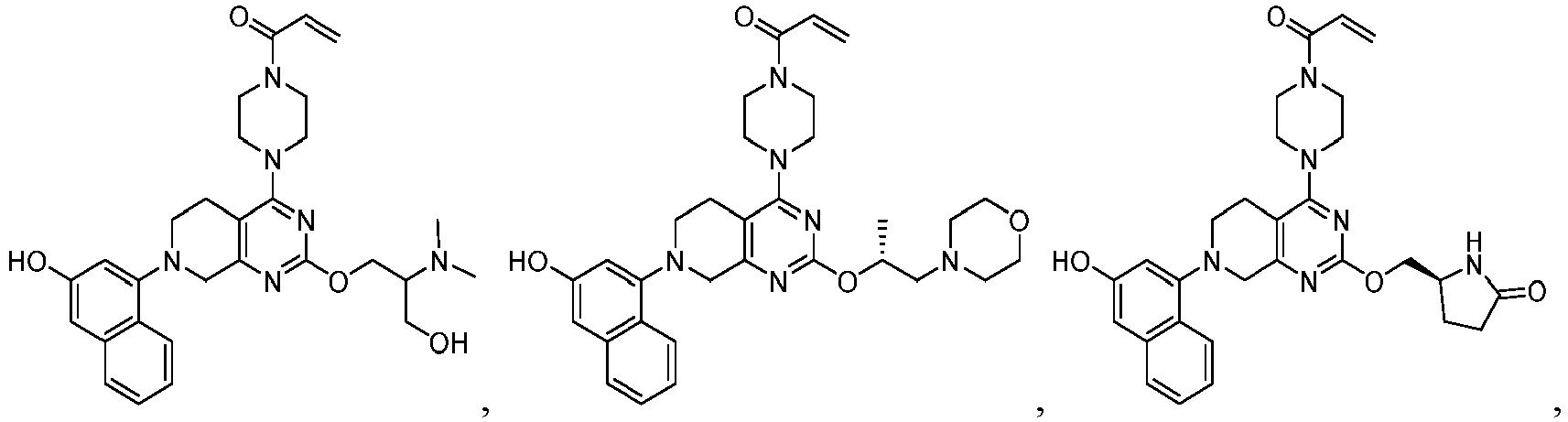


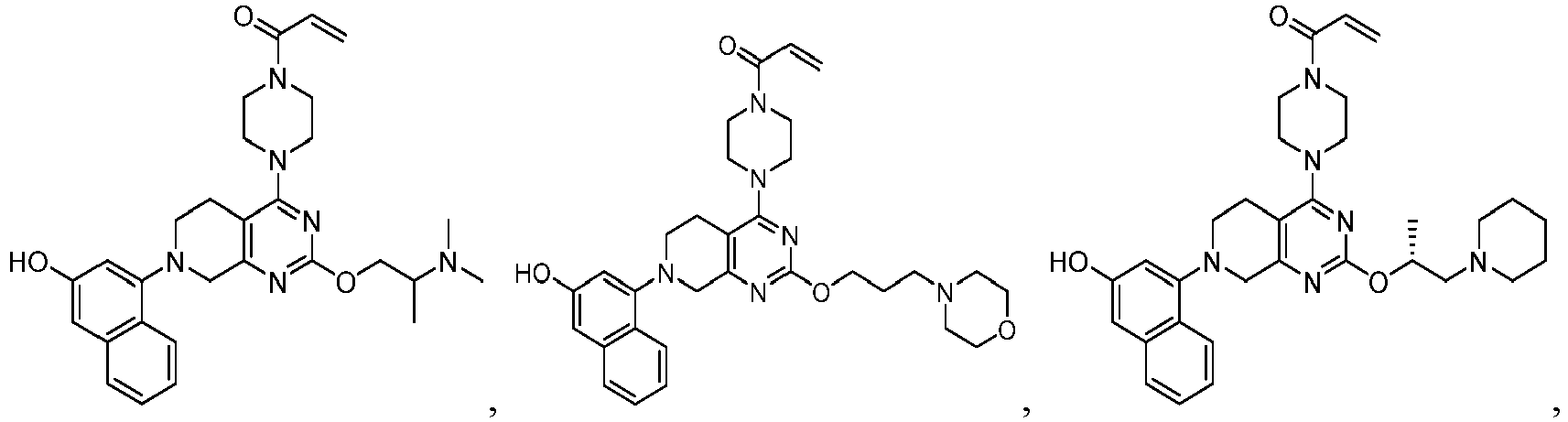


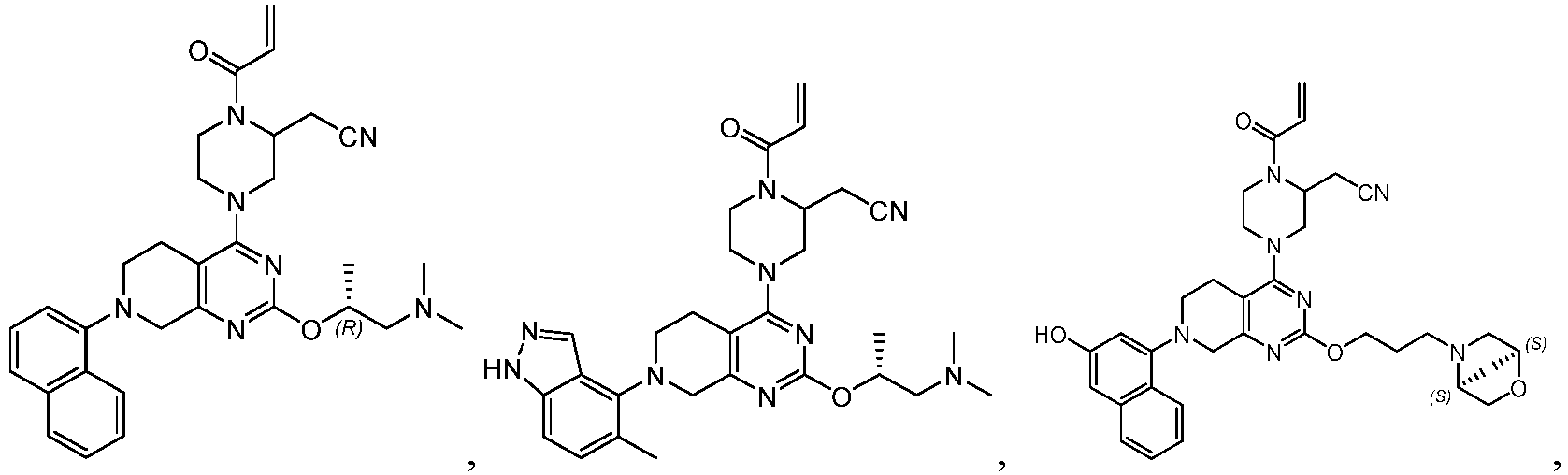
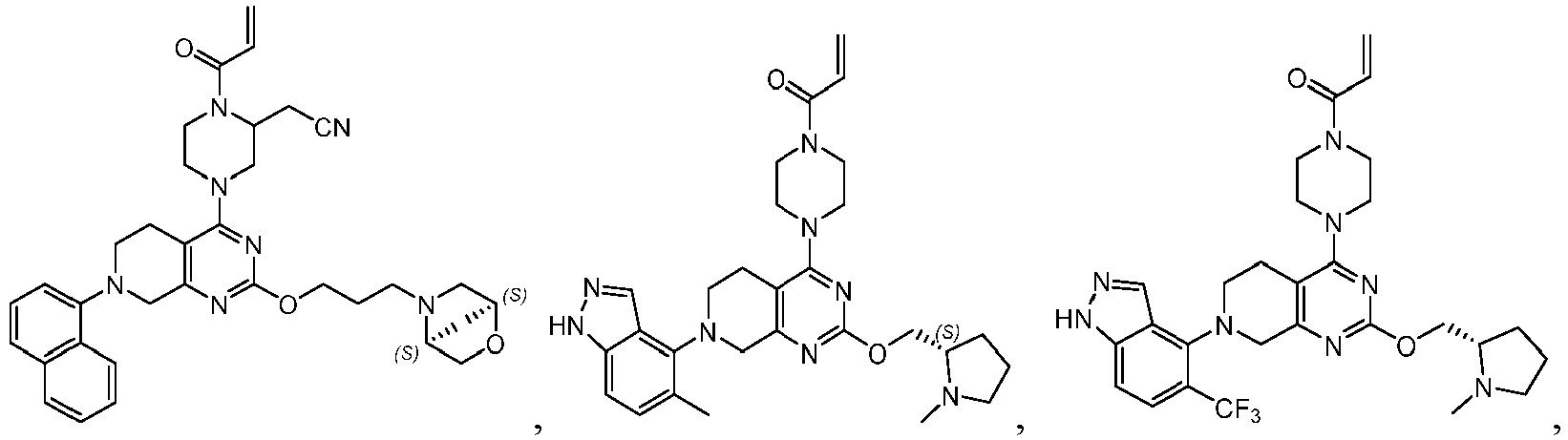
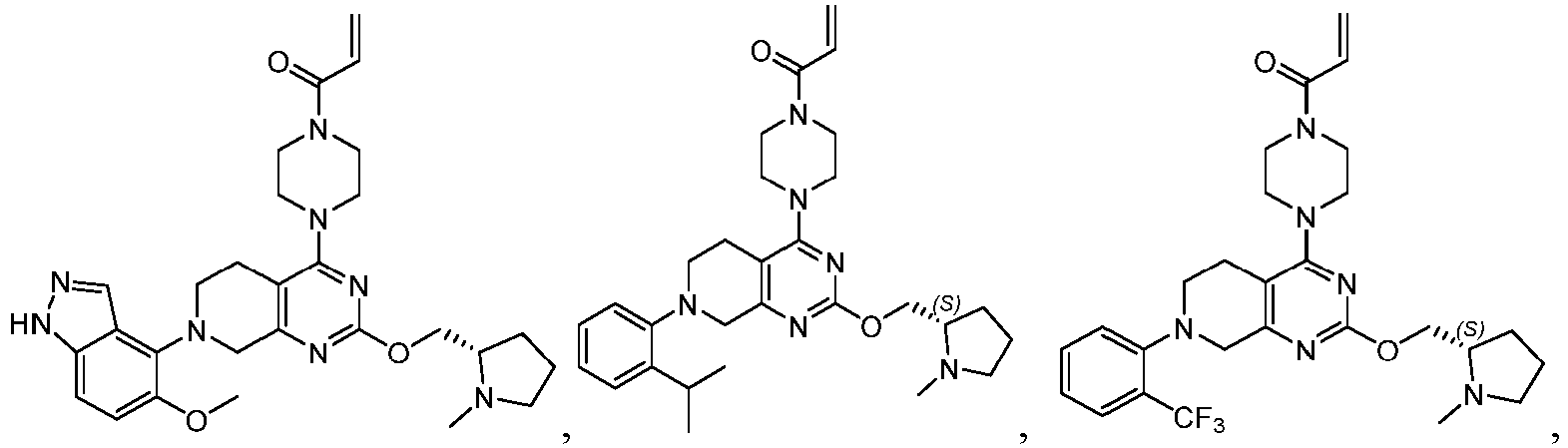


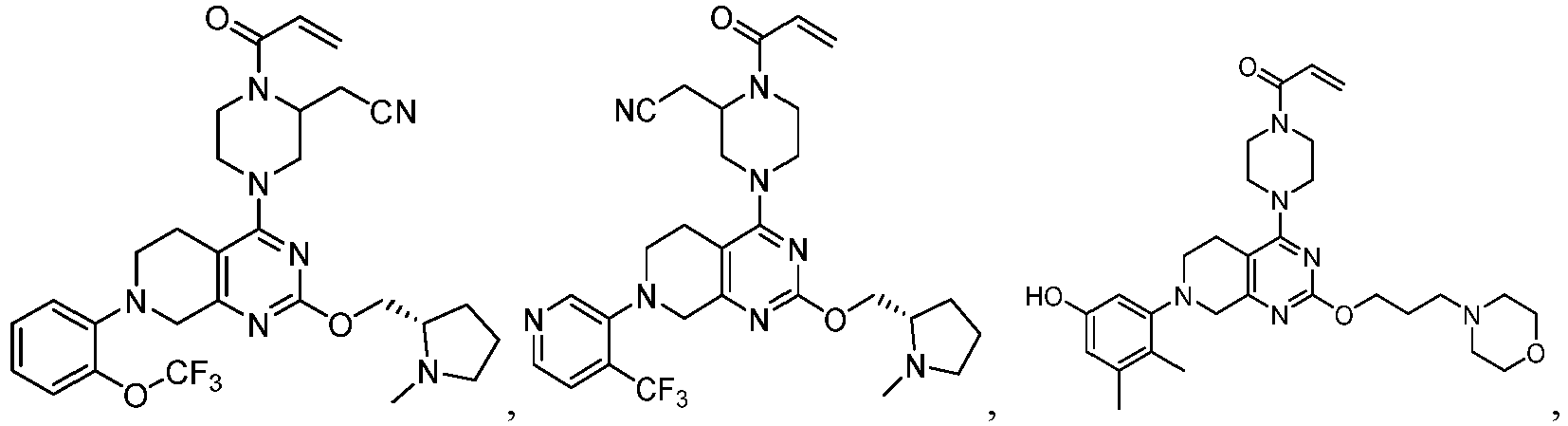
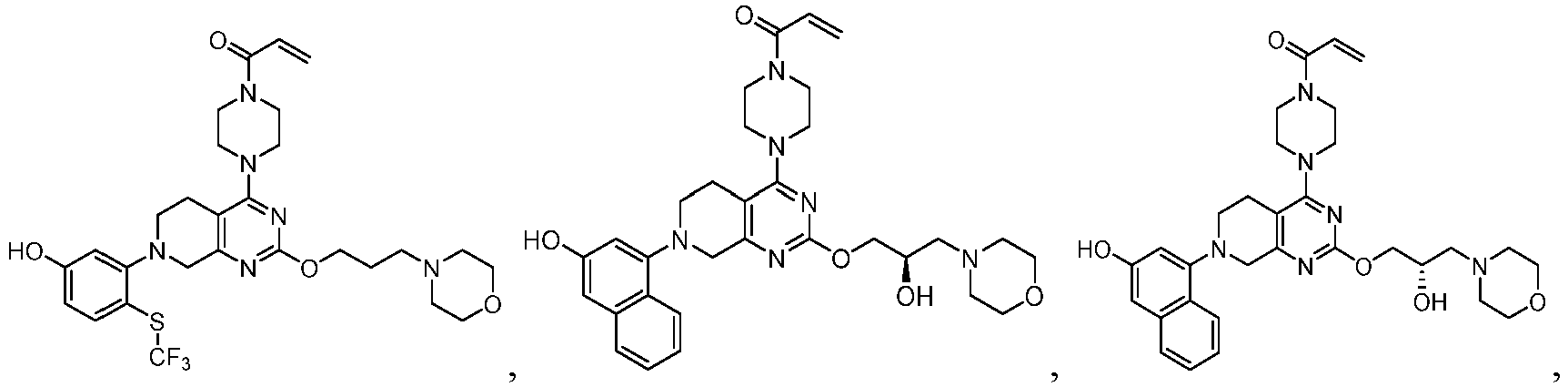


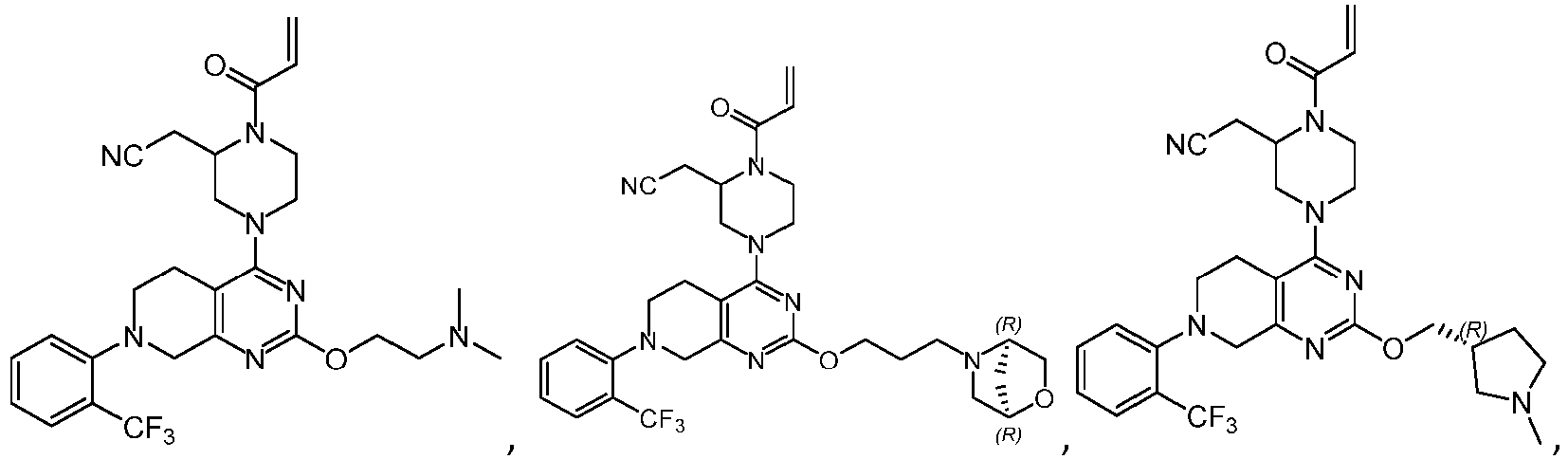


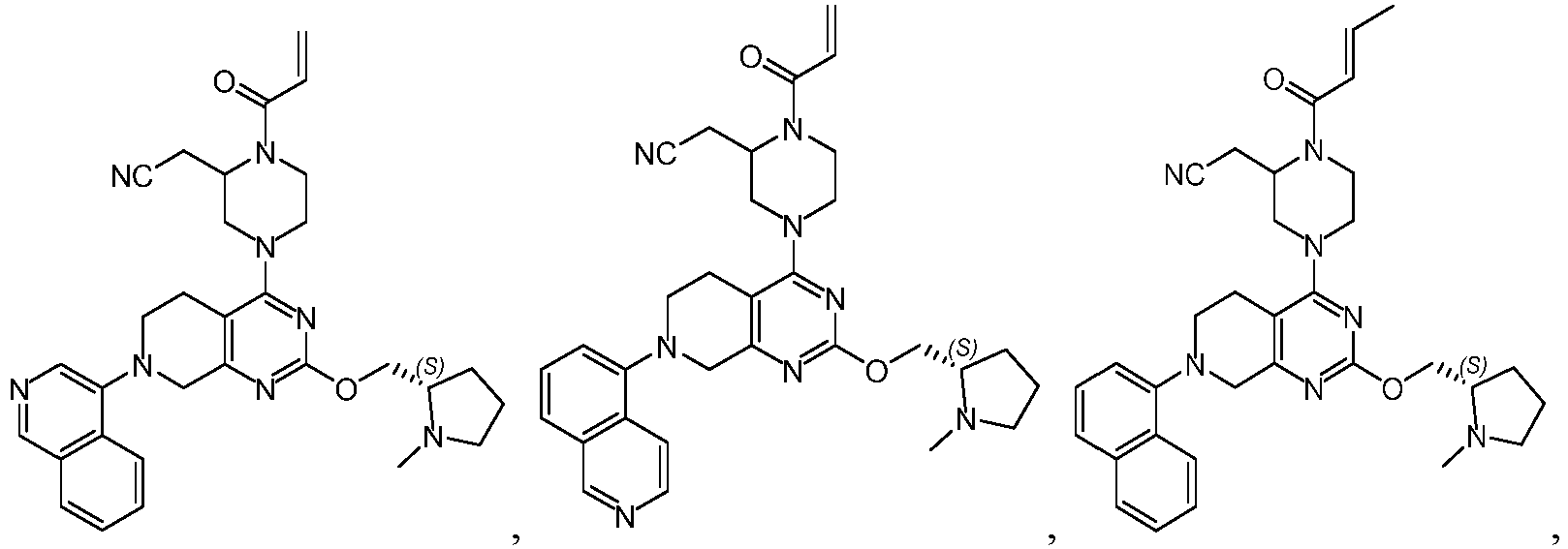


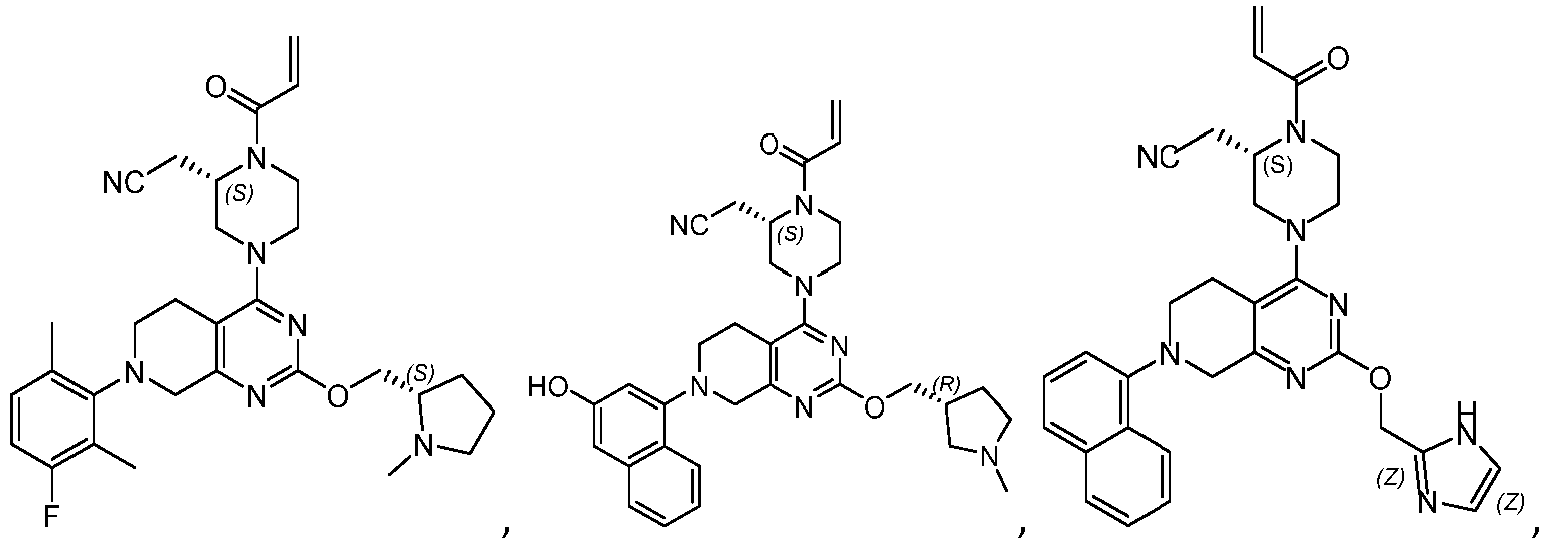


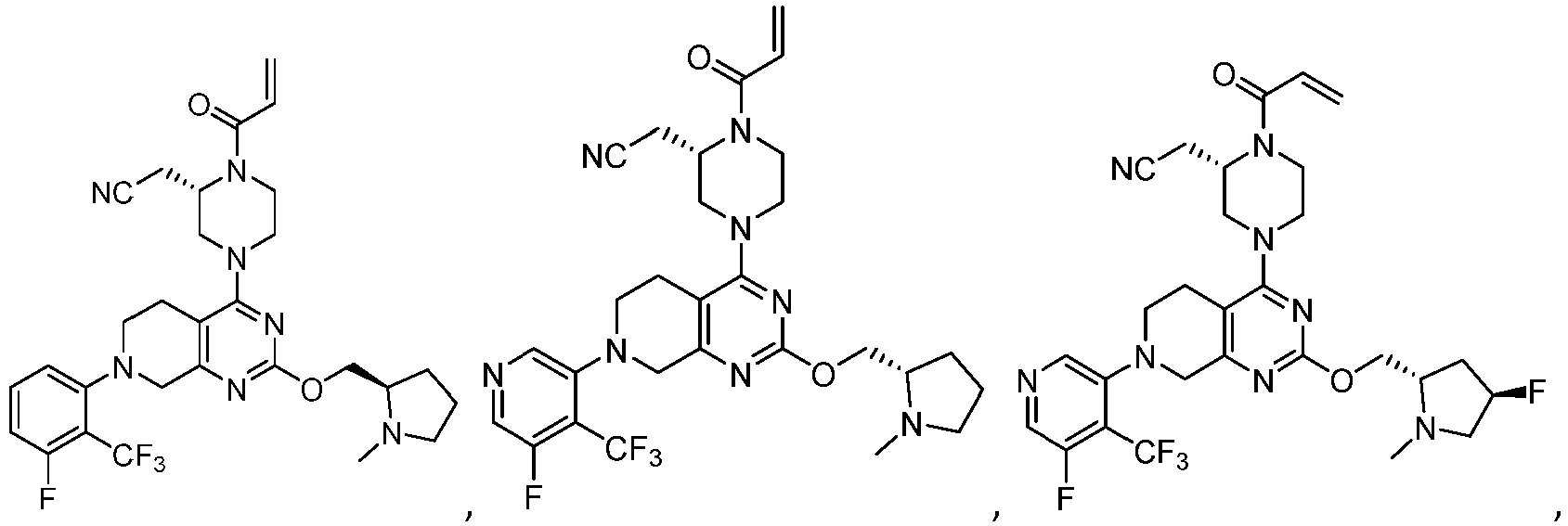


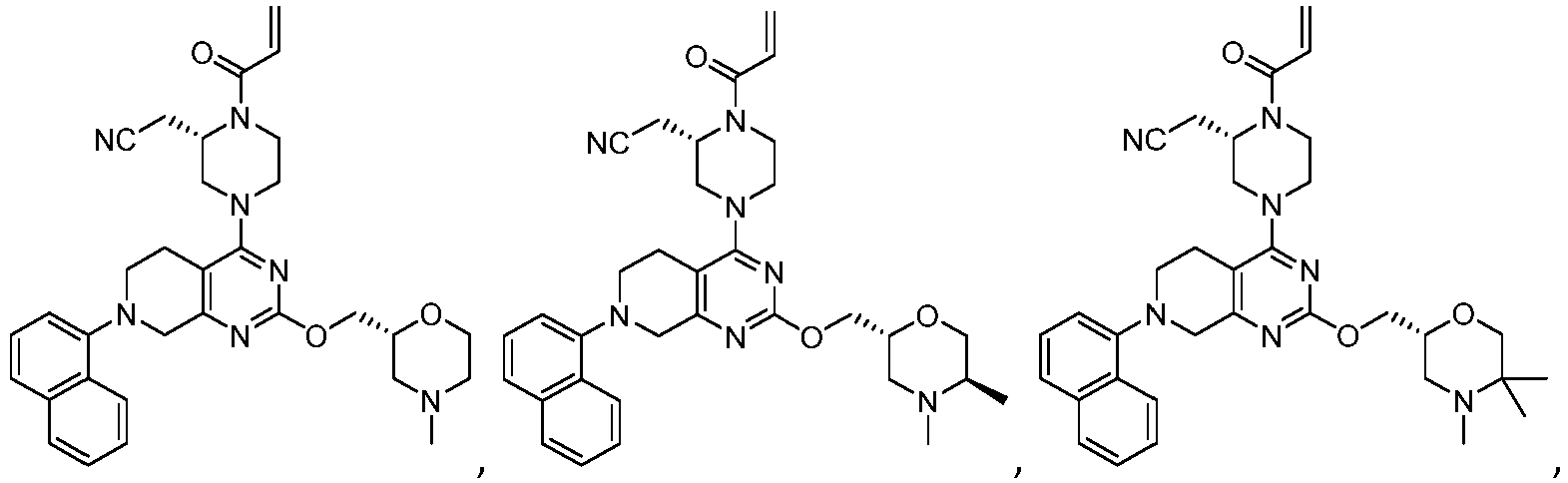


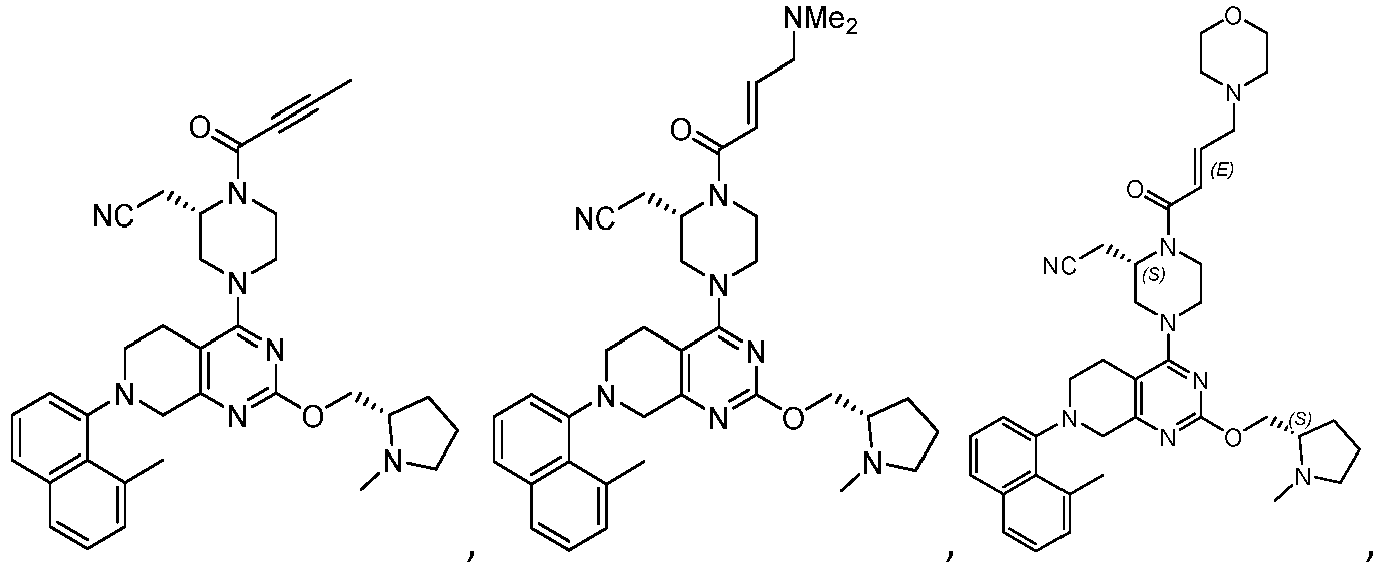

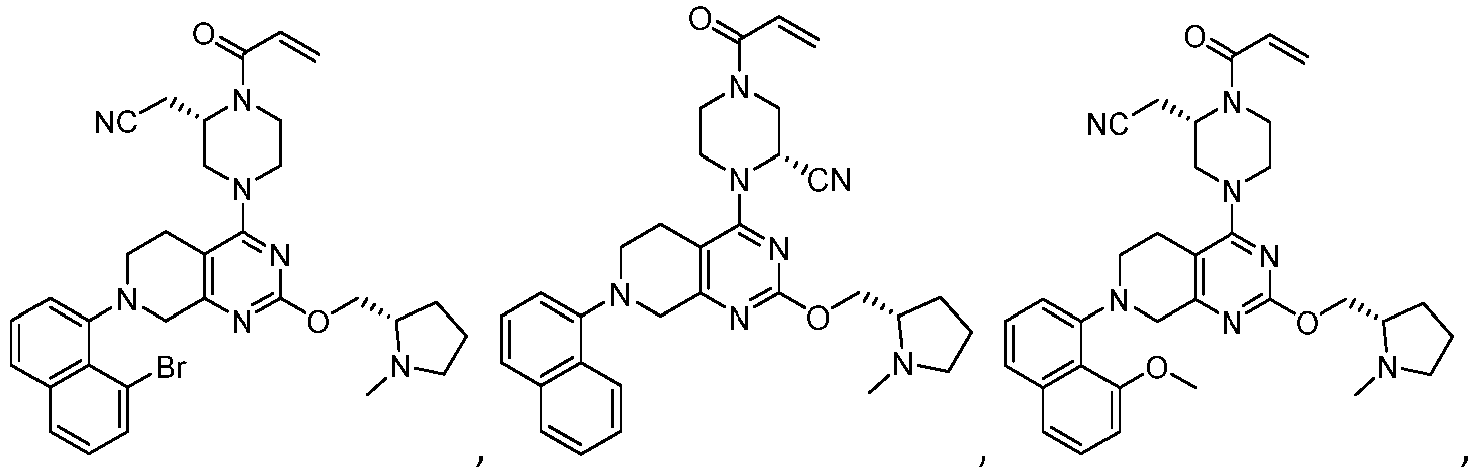


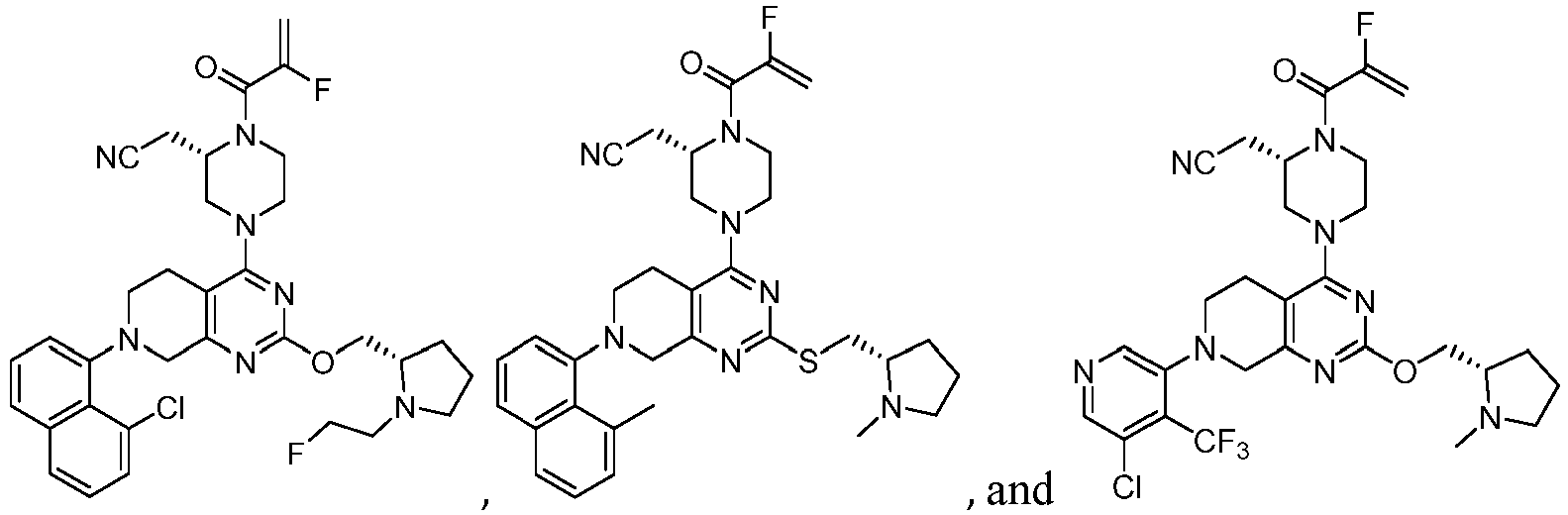
- In the present invention, the KRas G12C inhibitor is:

- The reference KRas G12C inhibitor:

- The reference KRas G12C inhibitor:

- The KRas G12C inhibitor used in the present invention is:

- The reference KRas G12C inhibitor:
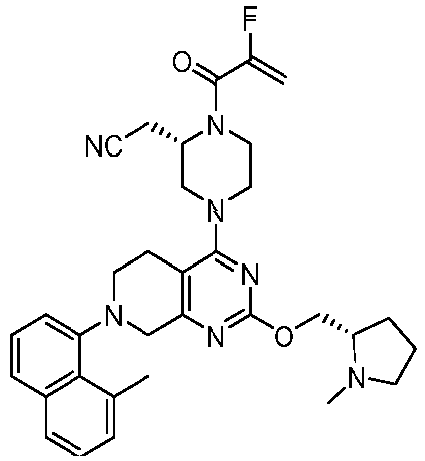
- In one embodiment, the KRas G12C inhibitor compound used in the present invention includes trifluoroacetic acid salts of the compound.
- Methods for manufacturing the KRas G12C inhibitors disclosed herein are known. For example, commonly owned published international
PCT application numbers WO2017201161 andWO2019099524 describe general reaction schemes for preparing KRas G12C inhibitors and also provide detailed synthetic routes for the preparation of each KRas G12C inhibitor disclosed herein. - The Src-family kinase inhibitors and the KRas G12C compounds of or pharmaceutically acceptable salts thereof of the present invention may be formulated into pharmaceutical compositions.
- In another aspect, the invention provides pharmaceutical compositions comprising a Src-family kinase inhibitor and KRas G12C inhibitor according to the invention and a pharmaceutically acceptable carrier, excipient, or diluent for use in treating non-small cell lung cancer. The Src-family kinase inhibitor and KRas G12C inhibitor may be independently formulated by any method well known in the art and may be prepared for administration by any route, including, without limitation, parenteral, oral, sublingual, transdermal, topical, intranasal, intratracheal, or intrarectal. In certain embodiments, Src-family kinase inhibitor and/or KRas G12C inhibitor are administered intravenously in a hospital setting. In one embodiment, administration may be by the oral route.
- The characteristics of the carrier will depend on the route of administration. As used herein, the term "pharmaceutically acceptable" means a non-toxic material that is compatible with a biological system such as a cell, cell culture, tissue, or organism, and that does not interfere with the effectiveness of the biological activity of the active ingredient(s). Thus, compositions may contain, in addition to the inhibitor, diluents, fillers, salts, buffers, stabilizers, solubilizers, and other materials well known in the art. The preparation of pharmaceutically acceptable formulations is described in, e.g., Remington's Pharmaceutical Sciences, 18th Edition, ed. A. Gennaro, Mack Publishing Co., Easton, Pa., 1990.
- As used herein, the term pharmaceutically acceptable salt refers to salts that retain the desired biological activity of the above-identified compounds and exhibit minimal or no undesired toxicological effects. Examples of such salts include acid addition salts formed with inorganic acids (for example, hydrochloric acid, hydrobromic acid, sulfuric acid, phosphoric acid, nitric acid), and salts formed with organic acids such as acetic acid, oxalic acid, tartaric acid, succinic acid, malic acid, ascorbic acid, benzoic acid, tannic acid, pamoic acid, alginic acid, polyglutamic acid, naphthalenesulfonic acid, naphthalenedisulfonic acid, and polygalacturonic acid. The compounds can also be administered as pharmaceutically acceptable quaternary salts known by those skilled in the art, which specifically include the quaternary ammonium salt of the formula --NR+Z-, wherein R is hydrogen, alkyl, or benzyl, and Z is a counterion, including chloride, bromide, iodide, -O-alkyl, toluenesulfonate, methylsulfonate, sulfonate, phosphate, or carboxylate (such as benzoate, succinate, acetate, glycolate, maleate, malate, citrate, tartrate, ascorbate, benzoate, cinnamoate, mandeloate, benzyloate, and diphenylacetate).
- The active compound is included in the pharmaceutically acceptable carrier or diluent in an amount sufficient to deliver to a patient a therapeutically effective amount without causing serious toxic effects in the patient treated. In one embodiment, a dose of the active compound for all of the above-mentioned conditions is in the range from about 0.01 to 300 mg/kg, for example 0.1 to 100 mg/kg per day, and as a further example 0.5 to about 25 mg per kilogram body weight of the recipient per day. A typical topical dosage will range from 0.01-3% wt/wt in a suitable carrier. The effective dosage range of the pharmaceutically acceptable derivatives can be calculated based on the weight of the parent compound to be delivered. If the derivative exhibits activity in itself, the effective dosage can be estimated as above using the weight of the derivative, or by other means known to those skilled in the art.
- The Src-family kinase inhibitor and the KRas G12C inhibitor can be formulated into separate or individual dosage forms which can be co-administered one after the other. Another option is that if the route of administration is the same (e.g. oral) two active compounds can be formulated into a single form for co-administration, both methods of co-administration, however, being part of the same therapeutic treatment or regimen.
- The pharmaceutical compositions comprising a Src-family kinase inhibitor and/or a KRas G12C inhibitor for use in the methods may be for simultaneous, separate or sequential use. In one embodiment, the Src-family kinase inhibitor is administered prior to administration of the KRas G12C inhibitor of the present invention. In another embodiment, the Src-family kinase inhibitor is administered after administration of the KRas G12C inhibitor compound of the present invention. In another embodiment, the Src-family kinase inhibitor is administered at about the same time as administration of the KRas G12C inhibitor compound of the present invention.
- Separate administration of each inhibitor, at different times and by different routes, in some cases would be advantageous. Thus, the components in the combination i.e. the KRas G12C inhibitor or a pharmaceutically acceptable salt thereof and the Src-family kinase inhibitor, need not be necessarily administered at essentially the same time or in any order.
- Oncology drugs are typically administered at the maximum tolerated dose ("MTD"), which is the highest dose of drug that does not cause unacceptable side effects. In one embodiment, the KRas G12C inhibitor and the Src-family kinase inhibitor are each dosed at their respective MTDs. In one embodiment, the KRas G12C inhibitor is dosed at its MTD and the Src-family kinase inhibitor is dosed in an amount less than its MTD. In one embodiment, the KRas G12C inhibitor is dosed at an amount less than its MTD and the Src-family kinase inhibitor is dosed at its MTD. In one embodiment, the KRas G12C inhibitor and the Src-family kinase inhibitor are each dosed at less than their respective MTDs. The administration can be so timed that the peak pharmacokinetic effect of one compound coincides with the peak pharmacokinetic effect of the other.
- In one embodiment, a single dose of KRas G12C inhibitor of the present invention or a pharmaceutically acceptable salt thereof is administered per day (i.e., in about 24 hour intervals) (i.e., QD). In another embodiment, two doses of the KRas G12C inhibitor of the present invention or a pharmaceutically acceptable salt thereof are administered per day (i.e., BID). In another embodiment, three doses of the KRas G12C inhibitor of the present invention are administered per day (i.e., TID).
- In one embodiment, the Src-family kinase inhibitor is administered QD. In another embodiment, the Src-family kinase inhibitor is administered BID. In another embodiment, the Src-family kinase inhibitor of the invention is administered TID.
- In one embodiment, a single dose of KRas G12C inhibitor of the present invention or a pharmaceutically acceptable salt thereof and Src-family kinase inhibitor are each administered once daily.
- The Src-family inhibitor used in the present invention is dasatinib (N-(2-chloro-6-methylphenyl)-2-((6-(4-(2-hydroxyethyl)piperazin-1-yl)-2-methylpyrimidin-4-yl)amino)thiazole-5-carboxamide). Other reference inhibitors of Src-family kinases include: ponatinib (3-(imidazo[1,2-b]pyridazin-3-ylethynyl)-4-methyl-N-(4-((4-methylpiperazin-1-yl)methyl)-3-(trifluoromethyl)phenyl)benzamide); vandetanib (N-(4-bromo-2-fluorophenyl)-6-methoxy-7-((1-methylpiperidin-4-yl)methoxy)quinazolin-4-amine); bosutinib (4-((2,4-dichloro-5-methoxyphenyl)amino)-6-methoxy-7-(3-(4-methylpiperazin-1-yl)propoxy)quinoline-3-carbonitrile); saracatinib (N-(5-chlorobenzo[d][1,3]dioxol-4-yl)-7-(2-(4-methylpiperazin-1-yl)ethoxy)-5-((tetrahydro-2H-pyran-4-yl)oxy)quinazolin-4-amine); KX2-391 (N-benzyl-2-(5-(4-(2-morpholinoethoxy)phenyl)pyridin-2-yl)acetamide); bafetinib (N-[3-(4,5'-bipyrimidin-2-ylamino)-4-methylphenyl]-4-[3(S)-(dimethylamino)pyrrolidin-1-ylmethyl]-3-(trifluoromethyl)benzamide; SU6656 ((Z)-N,N-dimethyl-2-oxo-3-((4,5,6,7-tetrahydro-1H-indol-2-yl)methylene)indoline-5-sulfonamide); PP1 (1-(tert-butyl)-3-(p-tolyl)-1H-pyrazolo[3,4-d]pyrimidin-4-amine); and WH-4-023 (2,6-dimethylphenyl (2,4-dimethoxyphenyl)(2-((4-(4-methylpiperazin-1-yl)phenyl)amino)pyrimidin-4-yl)carbamate); and KX-01(N-benzyl-2-[5-[4-[2-(4-morpholinyl)ethoxy]phenyl]pyridin-2-yl]acetamide).
- In one aspect of the invention, provided herein are a combination of a Src-family kinase inhibitor and a KRAS G12C inhibitor for use in a method of treating cancer in a subject in need thereof, comprising administering to the subject a therapeutically effective amount of a combination of a Src-family kinase inhibitor and a KRAS G12C inhibitor of the present invention or a pharmaceutically acceptable salt thereof, wherein the cancer is non-small cell lung cancer.
- The disclosure also provides a combination of a Src-family kinase inhibitor and a KRAS G12C inhibitor for use in a method for increasing the sensitivity of a cancer cell to a KRas G12C inhibitor, comprising contacting the cancer cell with an effective amount of the combination of a KRas G12C inhibitor and a Src-family kinase inhibitor of the present invention, or pharmaceutically acceptable salts or pharmaceutical compositions thereof, wherein the Src-family kinase inhibitor synergistically increases the sensitivity of the cancer cell to the KRas G12C inhibitor. In one embodiment, the contacting is in vitro. In one embodiment, the contacting is in vivo.
- The combination therapy comprises a combination of a compound having the formula

- As used herein, the term "contacting" refers to the bringing together of indicated moieties in an in vitro system or an in vivo system. For example, "contacting" a cancer cell includes the administration of a combination provided herein to an individual or subject, such as a human, having KRas G12C, as well as, for example, introducing a combination provided herein into a sample containing a cellular or purified preparation containing KRas G12C.
- By negatively modulating the activity of KRas G12C, the methods described herein are designed to inhibit undesired cellular proliferation resulting from enhanced KRas G12C activity within the cell. The degree of covalent modification of KRas G12C may be monitored in vitro using well known methods, including those described herein and in published international
PCT application numbers WO2017201161 andWO2019099524 . In addition, the inhibitory activity of combination in cells may be monitored, for example, by measuring the inhibition of KRas G12C activity of the amount of phosphorylated ERK to assess the effectiveness of treatment and dosages may be adjusted accordingly by the attending medical practitioner. - The compositions are used for the treatment of a KRas G12C-associated cancer in a subject in need thereof, comprising administering to said subject a therapeutically effective amount of a combination of a Src-family kinase inhibitor and a KRas G12C inhibitor of the present invention, or pharmaceutically acceptable salts or pharmaceutical compositions thereof, wherein the Src-family kinase inhibitor synergistically increases the sensitivity of the KRas G12C-associated cancer to the KRas G12C inhibitor, wherein the cancer is non-small cell lung cancer.
- In one embodiment, the therapeutically effective amount of the combination of a Src-family kinase inhibitor and a KRas G12C inhibitor of the present invention, or pharmaceutically acceptable salts or pharmaceutical compositions thereof, results in an increased duration of overall survival ("OS") in subjects relative to treatment with only the KRas G12C inhibitor. In one embodiment, the therapeutically effective amount of the combination of a Src-family kinase inhibitor and a KRas G12C inhibitor of the present invention, or pharmaceutically acceptable salts or pharmaceutical compositions thereof, results in an increased duration of progression-free survival ("PFS") in subjects relative to treatment with only the KRas G12C inhibitor. In one embodiment, the therapeutically effective amount of the combination of a Src-family kinase inhibitor and a KRas G12C inhibitor of the present invention, or pharmaceutically acceptable salts or pharmaceutical compositions thereof, results in increased tumor regression in subjects relative to treatment with only the KRas G12C inhibitor. In one embodiment, the therapeutically effective amount of the combination of a Src-family kinase inhibitor and a KRas G12C inhibitor of the present invention, or pharmaceutically acceptable salts or pharmaceutical compositions thereof, results in increased tumor growth inhibition in subjects relative to treatment with only the KRas G12C inhibitor. In one embodiment, the therapeutically effective amount of the combination of a Src-family kinase inhibitor and a KRas G12C inhibitor of the present invention, or pharmaceutically acceptable salts or pharmaceutical compositions thereof, results in an improvement in the duration of stable disease in subjects compared to treatment with only the KRas G12C inhibitor. The KRas G12C inhibitor is a compound No. 478, or a pharmaceutically acceptable salt thereof. The Src inhibitor is dasatinib. The therapeutic combination comprises a therapeutically effective amount of Example No. 478 and dasatinib. The combination is for use in treating non-small cell lung cancer.
- In another embodiment, the Src-family kinase inhibitor is administered in combination with the KRas G12C inhibitor once disease progression has been observed for KRas G12C monotherapy, in which the combination therapy results in enhanced clinical benefit for the patient by increasing OS, PFS, tumor regression, tumor growth inhibition or the duration of stable disease in the patient. The KRas G12C inhibitor is a compound No. 478, or a pharmaceutically acceptable salt thereof. The Src inhibitor is dasatinib. The therapeutic combination comprises a therapeutically effective amount of Example No. 478 and dasatinib. The combination is useful for treating non-small cell lung cancer.
- The compositions provided herein are for use in the treatment of non-small cell lung cancer.
- Also provided herein is a combination of a Src-family kinase inhibitor and a KRAS G12C inhibitor for use in a method for treating cancer in a subject in need thereof, the method comprising (a) determining that cancer is associated with a KRas G12C mutation (e.g., a KRas G12C-associated cancer) (e.g., as determined using a regulatory agency-approved, e.g., FDA-approved, assay or kit); and (b) administering to the patient a therapeutically effective amount of a combination of a Src-family inhibitor and a KRas G12C inhibitor of the present invention, or pharmaceutically acceptable salts or pharmaceutical compositions thereof, wherein the Src-family kinase inhibitor synergistically increases the sensitivity of the KRas G12C-associated cancer to the KRas G12C inhibitor, wherein the cancer is non-small cell lung cancer. The KRas G12C inhibitor is a compound No. 478, or a pharmaceutically acceptable salt thereof. The Src inhibitor is dasatinib. The therapeutic combination comprises a therapeutically effective amount of Example No. 478 and dasatinib. The combination is useful for treating non-small cell lung cancer.
- In one embodiment, the KRas G12C inhibitor is administered as a capsule during the period of time. In one embodiment, a tablet or capsule formulation of the KRas G12C inhibitor comprises about 10 mg to about 100 mg (e.g., about 10 mg to about 95 mg, about 10 mg to about 90 mg, about 10 mg to about 85 mg, about 10 mg to about 80 mg, about 10 mg to about 75 mg, about 10 mg to about 70 mg, about 10 mg to about 65 mg, about 10 mg to about 60 mg, about 10 mg to about 55 mg, about 10 mg to about 50 mg, about 10 mg to about 45 mg, about 10 mg to about 40 mg, about 10 mg to about 35 mg, about 10 mg to about 30 mg, about 10 mg to about 25 mg, about 10 mg to about 20 mg, about 10 mg to about 15 mg, about 15 mg to about 100 mg, about 15 mg to about 95 mg, about 15 mg to about 90 mg, about 15 mg to about 85 mg, about 15 mg to about 80 mg, about 15 mg to about 75 mg, about 15 mg to about 70 mg, about 15 mg to about 65 mg, about 15 mg to about 60 mg, about 15 mg to about 55 mg, about 15 mg to about 50 mg, about 15 mg to about 45 mg, about 15 mg to about 40 mg, about 15 mg to about 35 mg, about 15 mg to about 30 mg, about 15 mg to about 25 mg, about 15 mg to about 20 mg, about 20 mg to about 100 mg, about 20 mg to about 95 mg, about 20 mg to about 90 mg, about 20 mg to about 85 mg, about 20 mg to about 80 mg, about 20 mg to about 75 mg, about 20 mg to about 70 mg, about 20 mg to about 65 mg, about 20 mg to about 60 mg, about 20 mg to about 55 mg, about 20 mg to about 50 mg, about 20 mg to about 45 mg, about 20 mg to about 40 mg, about 20 mg to about 35 mg, about 20 mg to about 30 mg, about 20 mg to about 25 mg, about 25 mg to about 100 mg, about 25 mg to about 95 mg, about 25 mg to about 90 mg, about 25 mg to about 85 mg, about 25 mg to about 80 mg, about 25 mg to about 75 mg, about 25 mg to about 70 mg, about 25 mg to about 65 mg, about 25 mg to about 60 mg, about 25 mg to about 55 mg, about 25 mg to about 50 mg, about 25 mg to about 45 mg, about 25 mg to about 40 mg, about 25 mg to about 35 mg, about 25 mg to about 30 mg, about 30 mg to about 100 mg, about 30 mg to about 95 mg, about 30 mg to about 90 mg, about 30 mg to about 85 mg, about 30 mg to about 80 mg, about 30 mg to about 75 mg, about 30 mg to about 70 mg, about 30 mg to about 65 mg, about 30 mg to about 60 mg, about 30 mg to about 55 mg, about 30 mg to about 50 mg, about 30 mg to about 45 mg, about 30 mg to about 40 mg, about 30 mg to about 35 mg, about 35 mg to about 100 mg, about 35 mg to about 95 mg, about 35 mg to about 90 mg, about 35 mg to about 85 mg, about 35 mg to about 80 mg, about 35 mg to about 75 mg, about 35 mg to about 70 mg, about 35 mg to about 65 mg, about 35 mg to about 60 mg, about 35 mg to about 55 mg, about 35 mg to about 50 mg, about 35 mg to about 45 mg, about 35 mg to about 40 mg, about 40 mg to about 100 mg, about 40 mg to about 95 mg, about 40 mg to about 90 mg, about 40 mg to about 85 mg, about 40 mg to about 80 mg, about 40 mg to about 75 mg, about 40 mg to about 70 mg, about 40 mg to about 65 mg, about 40 mg to about 60 mg, about 40 mg to about 55 mg, about 40 mg to about 50 mg, about 40 mg to about 45 mg, about 45 mg to about 100 mg, about 45 mg to about 95 mg, about 45 mg to about 90 mg, about 45 mg to about 85 mg, about 45 mg to about 80 mg, about 45 mg to about 75 mg, about 45 mg to about 70 mg, about 45 mg to about 65 mg, about 45 mg to about 60 mg, about 45 mg to about 55 mg, about 45 mg to about 50 mg, about 50 mg to about 100 mg, about 50 mg to about 95 mg, about 50 mg to about 90 mg, about 50 mg to about 85 mg, about 50 mg to about 80 mg, about 50 mg to about 75 mg, about 50 mg to about 70 mg, about 50 mg to about 65 mg, about 50 mg to about 60 mg, about 50 mg to about 55 mg, about 55 mg to about 100 mg, about 55 mg to about 95 mg, about 55 mg to about 90 mg, about 55 mg to about 85 mg, about 55 mg to about 80 mg, about 55 mg to about 75 mg, about 55 mg to about 70 mg, about 55 mg to about 65 mg, about 55 mg to about 60 mg, about 60 mg to about 100 mg, about 60 mg to about 95 mg, about 60 mg to about 90 mg, about 60 mg to about 85 mg, about 60 mg to about 80 mg, about 60 mg to about 75 mg, about 60 mg to about 70 mg, about 60 mg to about 65 mg, about 65 mg to about 100 mg, about 65 mg to about 95 mg, about 65 mg to about 90 mg, about 65 mg to about 85 mg, about 65 mg to about 80 mg, about 65 mg to about 75 mg, about 65 mg to about 70 mg, about 70 mg to about 100 mg, about 70 mg to about 95 mg, about 70 mg to about 90 mg, about 70 mg to about 85 mg, about 70 mg to about 80 mg, about 70 mg to about 75 mg, about 75 mg to about 100 mg, about 75 mg to about 95 mg, about 75 mg to about 90 mg, about 75 mg to about 85 mg, about 75 mg to about 80 mg, about 80 mg to about 100 mg, about 80 mg to about 95 mg, about 80 mg to about 90 mg, about 80 mg to about 85 mg, about 85 mg to about 100 mg, about 85 mg to about 95 mg, about 85 mg to about 90 mg, about 90 mg to about 100 mg, about 90 mg to about 95 mg, about 95 mg to about 100 mg, about 10 mg, about 15 mg, about 20 mg, about 25 mg, about 30 mg, about 35 mg, about 40 mg, about 45 mg, about 50 mg, about 55 mg, about 60 mg, about 65 mg, about 70 mg, about 75 mg, about 80 mg, about 85 mg, about 90 mg, about 95 mg, or about 100 mg) of the KRas G12C inhibitor of the present invention (compound No. 478). In one embodiment, the KRas G12C inhibitor is orally administered once a day (QD) on a daily basis during a period of time. In one embodiment, the KRas G12C inhibitor is orally administered twice a day (BID) on a daily basis during a period of time. In one embodiment, the KRas G12C inhibitor is orally administered in the amount of about 20 mg to about 500 mg (e.g., about 20 mg to about 480 mg, about 20 mg to about 460 mg, about 20 mg to about 440 mg, about 20 mg to about 420 mg, about 20 mg to about 400 mg, about 20 mg to about 380 mg, about 20 mg to about 360 mg, about 20 mg to about 340 mg, about 20 mg to about 320 mg, about 20 mg to about 300 mg, about 20 mg to about 280 mg, about 20 mg to about 260 mg, about 20 mg to about 240 mg, about 20 mg to about 220 mg, about 20 mg to about 200 mg, about 20 mg to about 180 mg, about 20 mg to about 160 mg, about 20 mg to about 140 mg, about 20 mg to about 120 mg, about 20 mg to about 100 mg, about 20 mg to about 80 mg, about 20 mg to about 60 mg, about 20 mg to about 40 mg, about 40 mg to about 500 mg, about 40 mg to about 480 mg, about 40 mg to about 460 mg, about 40 mg to about 440 mg, about 40 mg to about 420 mg, about 40 mg to about 400 mg, about 40 mg to about 380 mg, about 40 mg to about 360 mg, about 40 mg to about 340 mg, about 40 mg to about 320 mg, about 40 mg to about 300 mg, about 40 mg to about 280 mg, about 40 mg to about 260 mg, about 40 mg to about 240 mg, about 40 mg to about 220 mg, about 40 mg to about 200 mg, about 40 mg to about 180 mg, about 40 mg to about 160 mg, about 40 mg to about 140 mg, about 40 mg to about 120 mg, about 40 mg to about 100 mg, about 40 mg to about 80 mg, about 40 mg to about 60 mg, about 60 mg to about 500 mg, about 60 mg to about 480 mg, about 60 mg to about 460 mg, about 60 mg to about 440 mg, about 60 mg to about 420 mg, about 60 mg to about 400 mg, about 60 mg to about 380 mg, about 60 mg to about 360 mg, about 60 mg to about 340 mg, about 60 mg to about 320 mg, about 60 mg to about 300 mg, about 60 mg to about 280 mg, about 60 mg to about 260 mg, about 60 mg to about 240 mg, about 60 mg to about 220 mg, about 60 mg to about 200 mg, about 60 mg to about 180 mg, about 60 mg to about 160 mg, about 60 mg to about 140 mg, about 60 mg to about 120 mg, about 60 mg to about 100 mg, about 60 mg to about 80 mg, about 80 mg to about 500 mg, about 80 mg to about 480 mg, about 80 mg to about 460 mg, about 80 mg to about 440 mg, about 80 mg to about 420 mg, about 80 mg to about 400 mg, about 80 mg to about 380 mg, about 80 mg to about 360 mg, about 80 mg to about 340 mg, about 80 mg to about 320 mg, about 80 mg to about 300 mg, about 80 mg to about 280 mg, about 80 mg to about 260 mg, about 80 mg to about 240 mg, about 80 mg to about 220 mg, about 80 mg to about 200 mg, about 80 mg to about 180 mg, about 80 mg to about 160 mg, about 80 mg to about 140 mg, about 80 mg to about 120 mg, about 80 mg to about 100 mg, about 100 mg to about 500 mg, about 100 mg to about 480 mg, about 100 mg to about 460 mg, about 100 mg to about 440 mg, about 100 mg to about 420 mg, about 100 mg to about 400 mg, about 100 mg to about 380 mg, about 100 mg to about 360 mg, about 100 mg to about 340 mg, about 100 mg to about 320 mg, about 100 mg to about 300 mg, about 100 mg to about 280 mg, about 100 mg to about 260 mg, about 100 mg to about 240 mg, about 100 mg to about 220 mg, about 100 mg to about 200 mg, about 100 mg to about 180 mg, about 100 mg to about 160 mg, about 100 mg to about 140 mg, about 100 mg to about 120 mg, about 120 mg to about 500 mg, about 120 mg to about 480 mg, about 120 mg to about 460 mg, about 120 mg to about 440 mg, about 120 mg to about 420 mg, about 120 mg to about 400 mg, about 120 mg to about 380 mg, about 120 mg to about 360 mg, about 120 mg to about 340 mg, about 120 mg to about 320 mg, about 120 mg to about 300 mg, about 120 mg to about 280 mg, about 120 mg to about 260 mg, about 120 mg to about 240 mg, about 120 mg to about 220 mg, about 120 mg to about 200 mg, about 120 mg to about 180 mg, about 120 mg to about 160 mg, about 120 mg to about 140 mg, about 140 mg to about 500 mg, about 140 mg to about 480 mg, about 140 mg to about 460 mg, about 140 mg to about 440 mg, about 140 mg to about 420 mg, about 140 mg to about 400 mg, about 140 mg to about 380 mg, about 140 mg to about 360 mg, about 140 mg to about 340 mg, about 140 mg to about 320 mg, about 140 mg to about 300 mg, about 140 mg to about 280 mg, about 140 mg to about 260 mg, about 140 mg to about 240 mg, about 140 mg to about 220 mg, about 140 mg to about 200 mg, about 140 mg to about 180 mg, about 140 mg to about 160 mg, about 160 mg to about 500 mg, about 160 mg to about 480 mg, about 160 mg to about 460 mg, about 160 mg to about 440 mg, about 160 mg to about 420 mg, about 160 mg to about 400 mg, about 160 mg to about 380 mg, about 160 mg to about 360 mg, about 160 mg to about 340 mg, about 160 mg to about 320 mg, about 160 mg to about 300 mg, about 160 mg to about 280 mg, about 160 mg to about 260 mg, about 160 mg to about 240 mg, about 160 mg to about 220 mg, about 160 mg to about 200 mg, about 160 mg to about 180 mg, about 180 mg to about 500 mg, about 180 mg to about 480 mg, about 180 mg to about 460 mg, about 180 mg to about 440 mg, about 180 mg to about 420 mg, about 180 mg to about 400 mg, about 180 mg to about 380 mg, about 180 mg to about 360 mg, about 180 mg to about 340 mg, about 180 mg to about 320 mg, about 180 mg to about 300 mg, about 180 mg to about 280 mg, about 180 mg to about 260 mg, about 180 mg to about 240 mg, about 180 mg to about 220 mg, about 180 mg to about 200 mg, about 200 mg to about 500 mg, about 200 mg to about 480 mg, about 200 mg to about 460 mg, about 200 mg to about 440 mg, about 200 mg to about 420 mg, about 200 mg to about 400 mg, about 200 mg to about 380 mg, about 200 mg to about 360 mg, about 200 mg to about 340 mg, about 200 mg to about 320 mg, about 200 mg to about 300 mg, about 200 mg to about 280 mg, about 200 mg to about 260 mg, about 200 mg to about 240 mg, about 200 mg to about 220 mg, about 220 mg to about 500 mg, about 220 mg to about 480 mg, about 220 mg to about 460 mg, about 220 mg to about 440 mg, about 220 mg to about 420 mg, about 220 mg to about 400 mg, about 220 mg to about 380 mg, about 220 mg to about 360 mg, about 220 mg to about 340 mg, about 220 mg to about 320 mg, about 220 mg to about 300 mg, about 220 mg to about 280 mg, about 220 mg to about 260 mg, about 220 mg to about 240 mg, about 240 mg to about 500 mg, about 240 mg to about 480 mg, about 240 mg to about 460 mg, about 240 mg to about 440 mg, about 240 mg to about 420 mg, about 240 mg to about 400 mg, about 240 mg to about 380 mg, about 240 mg to about 360 mg, about 240 mg to about 340 mg, about 240 mg to about 320 mg, about 240 mg to about 300 mg, about 240 mg to about 280 mg, about 240 mg to about 260 mg, about 260 mg to about 500 mg, about 260 mg to about 480 mg, about 260 mg to about 460 mg, about 260 mg to about 440 mg, about 260 mg to about 420 mg, about 260 mg to about 400 mg, about 260 mg to about 380 mg, about 260 mg to about 360 mg, about 260 mg to about 340 mg, about 260 mg to about 320 mg, about 260 mg to about 300 mg, about 260 mg to about 280 mg, about 280 mg to about 500 mg, about 280 mg to about 480 mg, about 280 mg to about 460 mg, about 280 mg to about 440 mg, about 280 mg to about 420 mg, about 280 mg to about 400 mg, about 280 mg to about 380 mg, about 280 mg to about 360 mg, about 280 mg to about 340 mg, about 280 mg to about 320 mg, about 280 mg to about 300 mg, about 300 mg to about 500 mg, about 300 mg to about 480 mg, about 300 mg to about 460 mg, about 300 mg to about 440 mg, about 300 mg to about 420 mg, about 300 mg to about 400 mg, about 300 mg to about 380 mg, about 300 mg to about 360 mg, about 300 mg to about 340 mg, about 300 mg to about 320 mg, about 320 mg to about 500 mg, about 320 mg to about 480 mg, about 320 mg to about 460 mg, about 320 mg to about 440 mg, about 320 mg to about 420 mg, about 320 mg to about 400 mg, about 320 mg to about 380 mg, about 320 mg to about 360 mg, about 320 mg to about 340 mg, about 340 mg to about 500 mg, about 340 mg to about 480 mg, about 340 mg to about 460 mg, about 340 mg to about 440 mg, about 340 mg to about 420 mg, about 340 mg to about 400 mg, about 340 mg to about 380 mg, about 340 mg to about 360 mg, about 360 mg to about 500 mg, about 360 mg to about 480 mg, about 360 mg to about 460 mg, about 360 mg to about 440 mg, about 360 mg to about 420 mg, about 360 mg to about 400 mg, about 360 mg to about 380 mg, about 380 mg to about 500 mg, about 380 mg to about 480 mg, about 380 mg to about 460 mg, about 380 mg to about 440 mg, about 380 mg to about 420 mg, about 380 mg to about 400 mg, about 400 mg to about 500 mg, about 400 mg to about 480 mg, about 400 mg to about 460 mg, about 400 mg to about 440 mg, about 400 mg to about 420 mg, about 420 mg to about 500 mg, about 420 mg to about 480 mg, about 420 mg to about 460 mg, about 420 mg to about 440 mg, about 440 mg to about 500 mg, about 440 mg to about 480 mg, about 440 mg to about 460 mg, about 460 mg to about 500 mg, about 460 mg to about 480 mg, about 480 mg to about 500 mg, about 25, about 50, about 75, about 100, about 150, about 200, about 250, about 300, about 350, about 400, about 450, or about 500 mg), during a period of time.
- In one embodiment, the combination therapy comprises oral administration of the KRas G12C inhibitor once or twice a day on a daily basis (during a period of time), e.g., in an amount of about 10 mg to about 400 mg (e.g., about 10 mg to about 380 mg, about 10 mg to about 360 mg, about 10 mg to about 340 mg, about 10 mg to about 320 mg, about 10 mg to about 300 mg, about 10 mg to about 280 mg, about 10 mg to about 260 mg, about 10 mg to about 240 mg, about 10 mg to about 220 mg, about 10 mg to about 200 mg, about 10 mg to about 180 mg, about 10 mg to about 160 mg, about 10 mg to about 140 mg, about 10 mg to about 120 mg, about 10 mg to about 100 mg, about 10 mg to about 80 mg, about 10 mg to about 60 mg, about 10 mg to about 40 mg, about 10 mg to about 20 mg, about 20 mg to about 400 mg, about 20 mg to about 380 mg, about 20 mg to about 360 mg, about 20 mg to about 340 mg, about 20 mg to about 320 mg, about 20 mg to about 300 mg, about 20 mg to about 280 mg, about 20 mg to about 260 mg, about 20 mg to about 240 mg, about 20 mg to about 220 mg, about 20 mg to about 200 mg, about 20 mg to about 180 mg, about 20 mg to about 160 mg, about 20 mg to about 140 mg, about 20 mg to about 120 mg, about 20 mg to about 100 mg, about 20 mg to about 80 mg, about 20 mg to about 60 mg, about 20 mg to about 40 mg, about 40 mg to about 400 mg, about 40 mg to about 380 mg, about 40 mg to about 360 mg, about 40 mg to about 340 mg, about 40 mg to about 320 mg, about 40 mg to about 300 mg, about 40 mg to about 280 mg, about 40 mg to about 260 mg, about 40 mg to about 240 mg, about 40 mg to about 220 mg, about 40 mg to about 200 mg, about 40 mg to about 180 mg, about 40 mg to about 160 mg, about 40 mg to about 140 mg, about 40 mg to about 120 mg, about 40 mg to about 100 mg, about 40 mg to about 80 mg, about 40 mg to about 60 mg, about 60 mg to about 400 mg, about 60 mg to about 380 mg, about 60 mg to about 360 mg, about 60 mg to about 340 mg, about 60 mg to about 320 mg, about 60 mg to about 300 mg, about 60 mg to about 280 mg, about 60 mg to about 260 mg, about 60 mg to about 240 mg, about 60 mg to about 220 mg, about 60 mg to about 200 mg, about 60 mg to about 180 mg, about 60 mg to about 160 mg, about 60 mg to about 140 mg, about 60 mg to about 120 mg, about 60 mg to about 100 mg, about 60 mg to about 80 mg, about 80 mg to about 400 mg, about 80 mg to about 380 mg, about 80 mg to about 360 mg, about 80 mg to about 340 mg, about 80 mg to about 320 mg, about 80 mg to about 300 mg, about 80 mg to about 280 mg, about 80 mg to about 260 mg, about 80 mg to about 240 mg, about 80 mg to about 220 mg, about 80 mg to about 200 mg, about 80 mg to about 180 mg, about 80 mg to about 160 mg, about 80 mg to about 140 mg, about 80 mg to about 120 mg, about 80 mg to about 100 mg, about 100 mg to about 400 mg, about 100 mg to about 380 mg, about 100 mg to about 360 mg, about 100 mg to about 340 mg, about 100 mg to about 320 mg, about 100 mg to about 300 mg, about 100 mg to about 280 mg, about 100 mg to about 260 mg, about 100 mg to about 240 mg, about 100 mg to about 220 mg, about 100 mg to about 200 mg, about 100 mg to about 180 mg, about 100 mg to about 160 mg, about 100 mg to about 140 mg, about 100 mg to about 120 mg, about 120 mg to about 400 mg, about 120 mg to about 380 mg, about 120 mg to about 360 mg, about 120 mg to about 340 mg, about 120 mg to about 320 mg, about 120 mg to about 300 mg, about 120 mg to about 280 mg, about 120 mg to about 260 mg, about 120 mg to about 240 mg, about 120 mg to about 220 mg, about 120 mg to about 200 mg, about 120 mg to about 180 mg, about 120 mg to about 160 mg, about 120 mg to about 140 mg, about 140 mg to about 400 mg, about 140 mg to about 380 mg, about 140 mg to about 360 mg, about 140 mg to about 340 mg, about 140 mg to about 320 mg, about 140 mg to about 300 mg, about 140 mg to about 280 mg, about 140 mg to about 260 mg, about 140 mg to about 240 mg, about 140 mg to about 220 mg, about 140 mg to about 200 mg, about 140 mg to about 180 mg, about 140 mg to about 160 mg, about 160 mg to about 400 mg, about 160 mg to about 380 mg, about 160 mg to about 360 mg, about 160 mg to about 360 mg, about 160 mg to about 340 mg, about 160 mg to about 320 mg, about 160 mg to about 300 mg, about 160 mg to about 280 mg, about 160 mg to about 260 mg, about 160 mg to about 240 mg, about 160 mg to about 220 mg, about 160 mg to about 200 mg, about 160 mg to about 180 mg, about 180 mg to about 400 mg, about 180 mg to about 380 mg, about 180 mg to about 360 mg, about 180 mg to about 340 mg, about 180 mg to about 320 mg, about 180 mg to about 300 mg, about 180 mg to about 280 mg, about 180 mg to about 260 mg, about 180 mg to about 240 mg, about 180 mg to about 220 mg, about 180 mg to about 200 mg, about 200 mg to about 400 mg, about 200 mg to about 380 mg, about 200 mg to about 360 mg, about 200 mg to about 340 mg, about 200 mg to about 320 mg, about 200 mg to about 300 mg, about 200 mg to about 280 mg, about 200 mg to about 260 mg, about 200 mg to about 240 mg, about 200 mg to about 220 mg, about 220 mg to about 400 mg, about 220 mg to about 380 mg, about 220 mg to about 360 mg, about 220 mg to about 340 mg, about 220 mg to about 320 mg, about 220 mg to about 300 mg, about 220 mg to about 280 mg, about 220 mg to about 260 mg, about 220 mg to about 240 mg, about 240 mg to about 400 mg, about 240 mg to about 380 mg, about 240 mg to about 360 mg, about 240 mg to about 340 mg, about 240 mg to about 320 mg, about 240 mg to about 300 mg, about 240 mg to about 280 mg, about 240 mg to about 260 mg, about 260 mg to about 400 mg, about 260 mg to about 380 mg, about 260 mg to about 360 mg, about 260 mg to about 340 mg, about 260 mg to about 320 mg, about 260 mg to about 300 mg, about 260 mg to about 280 mg, about 280 mg to about 400 mg, about 280 mg to about 380 mg, about 280 mg to about 360 mg, about 280 mg to about 340 mg, about 280 mg to about 320 mg, about 280 mg to about 300 mg, about 300 mg to about 400 mg, about 300 mg to about 380 mg, about 300 mg to about 360 mg, about 300 mg to about 340 mg, about 300 mg to about 320 mg, about 320 mg to about 400 mg, about 320 mg to about 380 mg, about 320 mg to about 360 mg, about 340 mg to about 360 mg, about 340 mg to about 400 mg, about 340 mg to about 380 mg, about 340 mg to about 360 mg, about 360 mg to about 400 mg, about 360 mg to about 380 mg, about 380 mg to about 400 mg, about 100 mg, about 200 mg, about 300 mg, or about 400 mg), and oral administration of a Src-family kinase inhibitor which is administered, for example once a day on a daily basis (during a period of time). In one embodiment, the KRAS inhibitor is orally administered once daily. In one embodiment, the KRAS inhibitor is orally administered twice daily.
- One skilled in the art will recognize that, both in vivo and in vitro trials using suitable, known and generally accepted cell and/or animal models are predictive of the ability of a test compound of the combination or the combination to treat or prevent a given disorder.
- One skilled in the art will further recognize that human clinical trials including first-inhuman, dose ranging and efficacy trials, in healthy patients and/or those suffering from a given disorder, may be completed according to methods well known in the clinical and medical arts.
- In one embodiment, the addition of a Src-family kinase inhibitor synergistically increases the activity of KRas G12C inhibitor of the present invenion or a pharmaceutically acceptable salt thereof against cancer or cancer cell lines expressing KRas G12C. Any method for determining whether two compounds exhibit synergy may be used for determining the synergistic effect of the combination.
- Several mathematical models have been developed to determine whether two compounds act synergistically, i.e., beyond a mere additive effect. For instance, Loewe Additivity (Loewe (1928) Physiol. 27: 47-187), Bliss Independence (Bliss (1939) Ann. Appl. Biol. 26: 585-615), Highest Single Agent, ZIP (Yadav et al (2015) Comput Struct Biotech J 13: 504-513) and other models (Chou & Talalay (1984) Adv Enzyme Regul 22: 27-55. #6382953; and Greco et al. (1995) Pharmacol Rev 47(2): 331-85. #7568331) are well known models in the pharmaceutical industry and may be used to calculate a "synergy score" that indicates whether synergy was detected and the magnitude of such synergy. Combining these synergy scores produces a composite synergy score which may be used to evaluate and characterize the KRas G12C inhibitor of the present invention or a pharmaceutically acceptable salt thereof in combination with a Src-family kinase inhibitor.
- In general, the mathematical models use data obtained from single agent values to determine the predicted additive effect of the combination which is compared to the observed effect for the combination. If the observed effect is greater than the predicted effect, the combination is deemed to be synergistic. For example, the Bliss independence model compares the observed combination response (YO ) with the predicted combination response (YP ), which was obtained based on the assumption that there is no effect from drug-drug interactions. Typically, the combination effect is declared synergistic if YO is greater than YP.
- In some embodiments, "synergistic effect" as used herein refers to combination of a KRAS inhibitor or a pharmaceutically acceptable salt thereof, and a Src-family kinase inhibitor or a pharmaceutically acceptable salt thereof producing an effect, for example, any of the beneficial or desired results including clinical results or endpoints as described herein, which is greater than the sum of the effect observed when a KRas G12C inhibitor or a pharmaceutically acceptable salt thereof (e.g., a compound selected from compound Example Nos. 1-527, or a pharmaceutically acceptable salt thereof, e.g., Example No. 234, 359, 478 or 507 or a pharmaceutically acceptable salt thereof) and a Src-family kinase inhibitor or a pharmaceutically acceptable salt thereof are administered alone. The KRas G12C inhibitor is a compound No. 478 or a pharmaceutically acceptable salt thereof. The Src inhibitor is dasatinib. The therapeutic combination comprises a therapeutically effective amount of Example No. 478 and dasatinib.
- In some embodiments, the methods provided herein can result in a 1% to 99% (e.g., 1% to 98%, 1% to 95%, 1% to 90%, 1 to 85%, 1 to 80%, 1% to 75%, 1% to 70%, 1% to 65%, 1% to 60%, 1% to 55%, 1% to 50%, 1% to 45%, 1% to 40%, 1% to 35%, 1% to 30%, 1% to 25%, 1% to 20%, 1% to 15%, 1% to 10%, 1% to 5%, 2% to 99%, 2% to 90%, 2% to 85%, 2% to 80%, 2% to 75%, 2% to 70%, 2% to 65%, 2% to 60%, 2% to 55%, 2% to 50%, 2% to 45%, 2% to 40%, 2% to 35%, 2% to 30%, 2% to 25%, 2% to 20%, 2% to 15%, 2% to 10%, 2% to 5%, 4% to 99%, 4% to 95%, 4% to 90%, 4% to 85%, 4% to 80%, 4% to 75%, 4% to 70%, 4% to 65%, 4% to 60%, 4% to 55%, 4% to 50%, 4% to 45%, 4% to 40%, 4% to 35%, 4% to 30%, 4% to 25%, 4% to 20%, 4% to 15%, 4% to 10%, 6% to 99%, 6% to 95%, 6% to 90%, 6% to 85%, 6% to 80%, 6% to 75%, 6% to 70%, 6% to 65%, 6% to 60%, 6% to 55%, 6% to 50%, 6% to 45%, 6% to 40%, 6% to 35%, 6% to 30%, 6% to 25%, 6% to 20%, 6% to 15%, 6% to 10%, 8% to 99%, 8% to 95%, 8% to 90%, 8% to 85%, 8% to 80%, 8% to 75%, 8% to 70%, 8% to 65%, 8% to 60%, 8% to 55%, 8% to 50%, 8% to 45%, 8% to 40%, 8% to 35%, 8% to 30%, 8% to 25%, 8% to 20%, 8% to 15%, 10% to 99%, 10% to 95%, 10% to 90%, 10% to 85%, 10% to 80%, 10% to 75%, 10% to 70%, 10% to 65%, 10% to 60%, 10% to 55%, 10% to 50%, 10% to 45%, 10% to 40%, 10% to 35%, 10% to 30%, 10% to 25%, 10% to 20%, 10% to 15%, 15% to 99%, 15% to 95%, 15% to 90%, 15% to 85%, 15% to 80%, 15% to 75%, 15% to 70%, 15% to 65%, 15% to 60%, 15% to 55%, 15% to 50%, 15% to 55%, 15% to 50%, 15% to 45%, 15% to 40%, 15% to 35%, 15% to 30%, 15% to 25%, 15% to 20%, 20% to 99%, 20% to 95%, 20% to 90%, 20% to 85%, 20% to 80%, 20% to 75%, 20% to 70%, 20% to 65%, 20% to 60%, 20% to 55%, 20% to 50%, 20% to 45%, 20% to 40%, 20% to 35%, 20% to 30%, 20% to 25%, 25% to 99%, 25% to 95%, 25% to 90%, 25% to 85%, 25% to 80%, 25% to 75%, 25% to 70%, 25% to 65%, 25% to 60%, 25% to 55%, 25% to 50%, 25% to 45%, 25% to 40%, 25% to 35%, 25% to 30%, 30% to 99%, 30% to 95%, 30% to 90%, 30% to 85%, 30% to 80%, 30% to 75%, 30% to 70%, 30% to 65%, 30% to 60%, 30% to 55%, 30% to 50%, 30% to 45%, 30% to 40%, 30% to 35%, 35% to 99%, 35% to 95%, 35% to 90%, 35% to 85%, 35% to 80%, 35% to 75%, 35% to 70%, 35% to 65%, 35% to 60%, 35% to 55%, 35% to 50%, 35% to 45%, 35% to 40%, 40% to 99%, 40% to 95%, 40% to 90%, 40% to 85%, 40% to 80%, 40% to 75%, 40% to 70%, 40% to 65%, 40% to 60%, 40% to 55%, 40% to 60%, 40% to 55%, 40% to 50%, 40% to 45%, 45% to 99%, 45% to 95%, 45% to 95%, 45% to 90%, 45% to 85%, 45% to 80%, 45% to 75%, 45% to 70%, 45% to 65%, 45% to 60%, 45% to 55%, 45% to 50%, 50% to 99%, 50% to 95%, 50% to 90%, 50% to 85%, 50% to 80%, 50% to 75%, 50% to 70%, 50% to 65%, 50% to 60%, 50% to 55%, 55% to 99%, 55% to 95%, 55% to 90%, 55% to 85%, 55% to 80%, 55% to 75%, 55% to 70%, 55% to 65%, 55% to 60%, 60% to 99%, 60% to 95%, 60% to 90%, 60% to 85%, 60% to 80%, 60% to 75%, 60% to 70%, 60% to 65%, 65% to 99%, 60% to 95%, 60% to 90%, 60% to 85%, 60% to 80%, 60% to 75%, 60% to 70%, 60% to 65%, 70% to 99%, 70% to 95%, 70% to 90%, 70% to 85%, 70% to 80%, 70% to 75%, 75% to 99%, 75% to 95%, 75% to 90%, 75% to 85%, 75% to 80%, 80% to 99%, 80% to 95%, 80% to 90%, 80% to 85%, 85% to 99%, 85% to 95%, 85% to 90%, 90% to 99%, 90% to 95%, or 95% to 100%) reduction in the volume of one or more solid tumors in a patient following treatment with the combination therapy for a period of time between 1 day and 2 years (e.g., between 1 day and 22 months, between 1 day and 20 months, between 1 day and 18 months, between 1 day and 16 months, between 1 day and 14 months, between 1 day and 12 months, between 1 day and 10 months, between 1 day and 9 months, between 1 day and 8 months, between 1 day and 7 months, between 1 day and 6 months, between 1 day and 5 months, between 1 day and 4 months, between 1 day and 3 months, between 1 day and 2 months, between 1 day and 1 month, between one week and 2 years, between 1 week and 22 months, between 1 week and 20 months, between 1 week and 18 months, between 1 week and 16 months, between 1 week and 14 months, between 1 week and 12 months, between 1 week and 10 months, between 1 week and 9 months, between 1 week and 8 months, between 1 week and 7 months, between 1 week and 6 months, between 1 week and 5 months, between 1 week and 4 months, between 1 week and 3 months, between 1 week and 2 months, between 1 week and 1 month, between 2 weeks and 2 years, between 2 weeks and 22 months, between 2 weeks and 20 months, between 2 weeks and 18 months, between 2 weeks and 16 months, between 2 weeks and 14 months, between 2 weeks and 12 months, between 2 weeks and 10 months, between 2 weeks and 9 months, between 2 weeks and 8 months, between 2 weeks and 7 months, between 2 weeks and 6 months, between 2 weeks and 5 months, between 2 weeks and 4 months, between 2 weeks and 3 months, between 2 weeks and 2 months, between 2 weeks and 1 month, between 1 month and 2 years, between 1 month and 22 months, between 1 month and 20 months, between 1 month and 18 months, between 1 month and 16 months, between 1 month and 14 months, between 1 month and 12 months, between 1 month and 10 months, between 1 month and 9 months, between 1 month and 8 months, between 1 month and 7 months, between 1 month and 6 months, between 1 month and 6 months, between 1 month and 5 months, between 1 month and 4 months, between 1 month and 3 months, between 1 month and 2 months, between 2 months and 2 years, between 2 months and 22 months, between 2 months and 20 months, between 2 months and 18 months, between 2 months and 16 months, between 2 months and 14 months, between 2 months and 12 months, between 2 months and 10 months, between 2 months and 9 months, between 2 months and 8 months, between 2 months and 7 months, between 2 months and 6 months, or between 2 months and 5 months, between 2 months and 4 months, between 3 months and 2 years, between 3 months and 22 months, between 3 months and 20 months, between 3 months and 18 months, between 3 months and 16 months, between 3 months and 14 months, between 3 months and 12 months, between 3 months and 10 months, between 3 months and 8 months, between 3 months and 6 months, between 4 months and 2 years, between 4 months and 22 months, between 4 months and 20 months, between 4 months and 18 months, between 4 months and 16 months, between 4 months and 14 months, between 4 months and 12 months, between 4 months and 10 months, between 4 months and 8 months, between 4 months and 6 months, between 6 months and 2 years, between 6 months and 22 months, between 6 months and 20 months, between 6 months and 18 months, between 6 months and 16 months, between 6 months and 14 months, between 6 months and 12 months, between 6 months and 10 months, or between 6 months and 8 months) (e.g., as compared to the size of the one or more solid tumors in the patient prior to treatment).
- The phrase "time of survival" means the length of time between the identification or diagnosis of cancer (e.g., any of the cancers described herein) in a mammal by a medical professional and the time of death of the mammal (caused by the cancer). Methods of increasing the time of survival in a mammal having a cancer are described herein.
- In some embodiments, any of the medical uses described herein can result in an increase (e.g., a 1% to 400%, 1% to 380%, 1% to 360%, 1% to 340%, 1% to 320%, 1% to 300%, 1% to 280%, 1% to 260%, 1% to 240%, 1% to 220%, 1% to 200%, 1% to 180%, 1% to 160%, 1% to 140%, 1% to 120%, 1% to 100%, 1% to 95%, 1% to 90%, 1% to 85%, 1% to 80%, 1% to 75%, 1% to 70%, 1% to 65%, 1% to 60%, 1% to 55%, 1% to 50%, 1% to 45%, 1% to 40%, 1% to 35%, 1% to 30%, 1% to 25%, 1% to 20%, 1% to 15%, 1% to 10%, 1% to 5%, 5% to 400%, 5% to 380%, 5% to 360%, 5% to 340%, 5% to 320%, 5% to 300%, 5% to 280%, 5% to 260%, 5% to 240%, 5% to 220%, 5% to 200%, 5% to 180%, 5% to 160%, 5% to 140%, 5% to 120%, 5% to 100%, 5% to 90%, 5% to 80%, 5% to 70%, 5% to 60%, 5% to 50%, 5% to 40%, 5% to 30%, 5% to 20%, 5% to 10%, 10% to 400%, 10% to 380%, 10% to 360%, 10% to 340%, 10% to 320%, 10% to 300%, 10% to 280%, 10% to 260%, 10% to 240%, 10% to 220%, 10% to 200%, 10% to 180%, 10% to 160%, 10% to 140%, 10% to 120%, 10% to 100%, 10% to 90%, 10% to 80%, 10% to 70%, 10% to 60%, 10% to 50%, 10% to 40%, 10% to 30%, 10% to 20%, 20% to 400%, 20% to 380%, 20% to 360%, 20% to 340%, 20% to 320%, 20% to 300%, 20% to 280%, 20% to 260%, 20% to 240%, 20% to 220%, 20% to 200%, 20% to 180%, 20% to 160%, 20% to 140%, 20% to 120%, 20% to 100%, 20% to 90%, 20% to 80%, 20% to 70%, 20% to 60%, 20% to 50%, 20% to 40%, 20% to 30%, 30% to 400%, 30% to 380%, 30% to 360%, 30% to 340%, 30% to 320%, 30% to 300%, 30% to 280%, 30% to 260%, 30% to 240%, 30% to 220%, 30% to 200%, 30% to 180%, 30% to 160%, 30% to 140%, 30% to 120%, 30% to 100%, 30% to 90%, 30% to 80%, 30% to 70%, 30% to 60%, 30% to 50%, 30% to 40%, 40% to 400%, 40% to 380%, 40% to 360%, 40% to 340%, 40% to 320%, 40% to 300%, 40% to 280%, 40% to 260%, 40% to 240%, 40% to 220%, 40% to 200%, 40% to 180%, 40% to 160%, 40% to 140%, 40% to 120%, 40% to 100%, 40% to 90%, 40% to 80%, 40% to 70%, 40% to 60%, 40% to 50%, 50% to 400%, 50% to 380%, 50% to 360%, 50% to 340%, 50% to 320%, 50% to 300%, 50% to 280%, 50% to 260%, 50% to 240%, 50% to 220%, 50% to 200%, 50% to 180%, 50% to 160%, 50% to 140%, 50% to 140%, 50% to 120%, 50% to 100%, 50% to 90%, 50% to 80%, 50% to 70%, 50% to 60%, 60% to 400%, 60% to 380%, 60% to 360%, 60% to 340%, 60% to 320%, 60% to 300%, 60% to 280%, 60% to 260%, 60% to 240%, 60% to 220%, 60% to 200%, 60% to 180%, 60% to 160%, 60% to 140%, 60% to 120%, 60% to 100%, 60% to 90%, 60% to 80%, 60% to 70%, 70% to 400%, 70% to 380%, 70% to 360%, 70% to 340%, 70% to 320%, 70% to 300%, 70% to 280%, 70% to 260%, 70% to 240%, 70% to 220%, 70% to 200%, 70% to 180%, 70% to 160%, 70% to 140%, 70% to 120%, to 100%, 70% to 90%, 70% to 80%, 80% to 400%, 80% to 380%, 80% to 360%, 80% to 340%, 80% to 320%, 80% to 300%, 80% to 280%, 80% to 260%, 80% to 240%, 80% to 220%, 80% to 200%, 80% to 180%, 80% to 160%, 80% to 140%, 80% to 120%, 80% to 100%, 80% to 90%, 90% to 400%, 90% to 380%, 90% to 360%, 90% to 340%, 90% to 320%, 90% to 300%, 90% to 280%, 90% to 260%, 90% to 240%, 90% to 220%, 90% to 200%, 90% to 180%, 90% to 160%, 90% to 140%, 90% to 120%, 90% to 100%, 100% to 400%, 100% to 380%, 100% to 360%, 100% to 340%, 100% to 320%, 100% to 300%, 100% to 280%, 100% to 260%, 100% to 240%, 100% to 220%, 100% to 200%, 100% to 180%, 100% to 160%, 100% to 140%, 100% to 120%, 120% to 400%, 120% to 380%, 120% to 360%, 120% to 340%, 120% to 320%, 120% to 300%, 120% to 280%, 120% to 260%, 120% to 240%, 120% to 220%, 120% to 200%, 120% to 180%, 120% to 160%, 120% to 140%, 140% to 400%, 140% to 380%, 140% to 360%, 140% to 340%, 140% to 320%, 140% to 300%, 140% to 280%, 140% to 260%, 140% to 240%, 140% to 220%, 140% to 200%, 140% to 180%, 140% to 160%, 160% to 400%, 160% to 380%, 160% to 360%, 160% to 340%, 160% to 320%, 160% to 300%, 160% to 280%, 160% to 260%, 160% to 240%, 160% to 220%, 160% to 200%, 160% to 180%, 180% to 400%, 180% to 380%, 180% to 360%, 180% to 340%, 180% to 320%, 180% to 300%, 180% to 280%, 180% to 260%, 180% to 240%, 180% to 220%, 180% to 200%, 200% to 400%, 200% to 380%, 200% to 360%, 200% to 340%, 200% to 320%, 200% to 300%, 200% to 280%, 200% to 260%, 200% to 240%, 200% to 220%, 220% to 400%, 220% to 380%, 220% to 360%, 220% to 340%, 220% to 320%, 220% to 300%, 220% to 280%, 220% to 260%, 220% to 240%, 240% to 400%, 240% to 380%, 240% to 360%, 240% to 340%, 240% to 320%, 240% to 300%, 240% to 280%, 240% to 260%, 260% to 400%, 260% to 380%, 260% to 360%, 260% to 340%, 260% to 320%, 260% to 300%, 260% to 280%, 280% to 400%, 280% to 380%, 280% to 360%, 280% to 340%, 280% to 320%, 280% to 300%, 300% to 400%, 300% to 380%, 300% to 360%, 300% to 340%, or 300% to 320%) in the time of survival of the patient (e.g., as compared to a patient having a similar cancer and administered a different treatment or not receiving a treatment).
- In some embodiments of any of the medical uses described herein, before treatment with the compositions for use according to the invention, the patient was treated with one or more of a chemotherapy, a targeted anticancer agent, radiation therapy, and surgery, and optionally, the prior treatment was unsuccessful; and/or the patient has been administered surgery and optionally, the surgery was unsuccessful; and/or the patient has been treated with a platinum-based chemotherapeutic agent, and optionally, the patient has been previously determined to be non-responsive to treatment with the platinum-based chemotherapeutic agent; and/or the patient has been treated with a kinase inhibitor, and optionally, the prior treatment with the kinase inhibitor was unsuccessful; and/or the patient was treated with one or more other therapeutic agent(s).
- The present disclosure also relates to a kit comprising a Src-family kinase inhibitor and a KRas G12C inhibitor combination of the present invention for use according to the present invention. Also provided is a kit comprising a Src-family kinase inhibitor or a pharmaceutically acceptable salt thereof, and a KRas G12C inhibitor of the present invention, or a pharmaceutical salt thereof (compound Example No. 478 or a pharmaceutically acceptable salt thereof) for use in treating non-small cell lung cancer.
- In a related aspect, the disclosure provides a kit containing a dose of a Src-family kinase inhibitor and dose of a KRas G12C inhibitor combination of the present invention or a pharmaceutical salt thereof (compound Example No. 478 or a pharmaceutically acceptable salt thereof) in an amount effective to inhibit proliferation of cancer cells, particularly non-small cell lung cancer cells, in a subject. The kit in some cases includes an insert with instructions for administration of the a Src-family kinase inhibitor and a KRas G12C inhibitor of the present invention. The insert may provide a user with one set of instructions for using the a Src-family kinase inhibitor in combination with a KRas G12C inhibitor of the present invention.
- This Example illustrates that the combination of exemplary KRas G12C inhibitor compounds of the present invention and a Src-family kinase inhibitor synergistically inhibits the growth of tumor cell lines that express KRas G12C.
- A panel of 8 lung cancer and 1 colorectal cell lines harboring KRas G12C mutations was assembled to determine whether combining Src-family kinase inhibitors with exemplary KRas G12C inhibitors disclosed herein results in synergistic activity. The collection included NCI-H1373 (ATCC CRL-5866); NCI-H1792 (ATCC CRL-5895); NCI-H2030 (ATCC CRL-5985); NCI-H2122 (ATCC CRL-5985); HCC1171 (KCLB 71171); HCC44 (DSMZ ACC-534); LU99 (RCB1900); SW1573 (ATCC CRL-2170) and SW837 (ATCC CCL-235).
- Assays for determining the synergy score for the pairwise combinations for each cell line were performed in triplicate. Three 96-well plates plus an additional 4 wells of a separate 96-well control plate for determining baseline luminescence were seeded with 2000 cells/well of a particular cell line in a total volume of 90µl of a suitable growth medium for that cell line, e.g., RPMI 1640 medium supplemented with 10% FBS and any cell line specific reagents need for growth. The plates were incubated overnight at 37°C in a 5% CO2 atmosphere.
- To each of the designated baseline wells, 30µl of Cell-Titer Glo reagent (CTG; Promega Corporation) was added to each well and the plates were incubated for 20 min with shaking at room temperature. Baseline luminescence was quantitated using a BMG ClarioStar multimode plate reader according to the manufacturer's instructions.
- A series of working stock 1000X drug dilutions in 100% DMSO was prepared that includes an 8 point single agent dilution of the exemplary KRas G12C inhibitor of Formula (I) and a 5-point single agent dilution of the Src-family kinase inhibitor. The dilutions used for the KRas G12C inhibitor and the Src-family kinase inhibitor varied for each individual compound but were in the range of 3- to 6-fold/serial dilution.
- KRas G12C inhibitors tested in this Example included:
Example No.* Structure 234 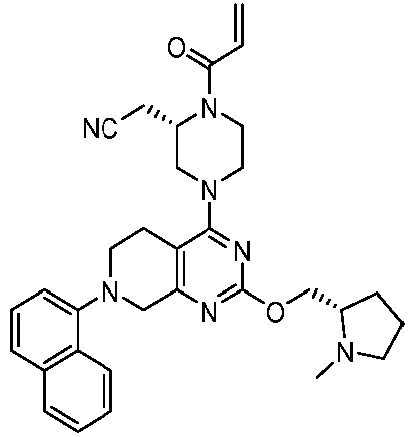
359 
478 
507 
*Example Number refers to the example number for each compound as disclosed in pending international PCT application WO 2019099524 . Example Nos. 234, 359 and 507 are reference examples. - A 10X intermediate dosing plate was prepared in serum free RPMI medium that contains arrayed single agent dilutions of exemplary KRas G12C inhibitor or the Src-family kinase inhibitor. In addition, a matrix of 40 dilution combinations of exemplary KRas G12C inhibitor and the Src-family kinase inhibitor was prepared as test samples.
- To each corresponding well of the three 96-well plates seeded with the appropriate cell line above, 10 µL of each 10X single agent and the 40 combinations of the dose matrix was added and the plates were incubated for 72 hours at 37 °C in 5% CO2 atmosphere. A 30 µL aliquot of Cell-Titer Glo reagent (CTG) was added to each test well, the plates were incubated for 20 min with shaking at room temperature, and luminescence was quantitated using a BMG ClarioStar multimode plate reader according to the manufacturer's instructions.
- The raw data and metadata files were used as input files to calculate percent effect for each treatment condition and analyzed using four independent mathematical reference models designed to determine whether the two test compounds demonstrate synergy: Loewe additivity, Bliss independence, Highest Single Agent and ZIP.
- The output of the data from each mathematical model is the assignment of a relative synergy score. The data reported in Table 1 are the aggregate sum of the Loewe additivity, Bliss independence, Highest Single Agent and ZIP scores ("Composite Synergy Score").
Table 1 Composite Synergy Scores for Src-family Kinase Inhibitors Combined with KRas G12C Inhibitors Against KRas G12C Cell Lines Src-family Inhibitor Dasatinib Dasatinib Dasatinib Dasatinib Vandetanib Vandetanib KX-01 Saracatinib Ponatinib KRas G12C Example # 234 507 359 478 359 478 507 507 234 Cell Line H1373 53.9 40.8 76.8 46.0 33.1 24.1 12.8 29.4 28.8 H1792 42.9 10.1 34.2 25.9 15.3 23.5 7.6 -6.5 32.4 H2030 59.0 48.9 49.4 38.9 31.5 12.3 14.4 21.1 17.7 H2122 73.4 28.9 58.3 44.4 33.9 26.9 14.4 20.1 24.5 HCC1171 51.9 33.0 32.2 29.4 51.9 60.1 19.8 60.4 11.9 HCC44 32.3 27.0 40.6 59.1 4.8 -8.8 12.4 -41.0 14.3 LU99 59.0 51.4 43.8 43.2 -1.9 15.4 11.0 11.7 21.7 SW1573 31.4 -10.3 12.7 -21.1 -16.0 -6.9 4.9 6.1 16.3 SW837 38.4 48.9 28.8 37.0 16.3 10.7 24.5 16.2 22.2 - A composite score of greater than or equal to 27 was interpreted as a synergistic hit whereas a composite score between 17 and 26 indicates potential synergy. These results demonstrate that a synergistic effect was observed for the combination of a variety of Src-family inhibitors with KRas G12C inhibitor of the present invention in a majority of cell lines harboring a KRas G12C mutation listed in Table 1 that are less sensitive to single agent KRas G12C inhibitor thereby increasing the sensitivity of the KRas G12C cell line to the KRas G12C inhibitor combination.
- Immunocompromised nude/nude mice were inoculated in the right hind flank with cells or patient derived tumor samples harboring a KRas G12C mutation. When tumor volumes reached between 200 - 400 mm3 in size, the mice were divided into four groups of 5-12 mice each. The first group was administered vehicle only. The second group was administered a single agent dose of the KRas G12C inhibitor at a concentration that yielded a maximal biological effect or a less than maximal biological effect, depending on the cell line and the single agent activity, that does not result in complete tumor regression. The third group was administered a single agent dose of the Src-family kinase inhibitor at a concentration that yielded a maximal biological effect or a less than maximal biological effect, depending on the cell line and the single agent activity, that also does not result in complete tumor regression. The fourth group was administered the single agent dose of the KRas G12C inhibitor in combination with the single agent dose of the Src-family kinase inhibitor. The treatment period varied from cell line to cell line but typically was between 21-35 days. Tumor volumes were measured using a caliper every two - three days and tumor volumes were calculated by the formula: 0.5 × (Length × Width)2. A greater degree of tumor growth inhibition for the combination in this model demonstrates that the combination therapy is likely to have a clinically meaningful benefit to treated subjects relative to treatment with only a KRas G12C inhibitor.
- For example, on Day 1, 20 nude/nude mice were inoculated in the right hind limb with 5 × 10⁶ H2122 cells. When tumor volume reached ~300 mm3 (Day 11), 5 mice in each of the four groups were administered p.o. daily for 21 days: vehicle only (10% Captisol), 100 mg/kg of the KRas G12C inhibitor Compound 478 (10% Captisol in 50 mM citrate buffer, pH 5.0), 50 mg/kg of the Src-family kinase inhibitor Dasatinib (0.5% methylcellulose/0.4% Tween-80), or 100 mg/kg of the KRas G12C inhibitor Compound 478 and 50 mg/kg of Dasatinib. Tumor volumes were measured at pre-specified days set forth below. Tumor volumes for the five mice per group were averaged and are reported in Table 2.
Table 2 Average Tumor Volumes (mm3) of Mice Treated with Single Agents and in Combination Days from Inoculation Vehicle Compound 478 Dasatinib Compound 478 + Dasatinib Combination 11 325 325 324 330 13 520 340 492 328 15 689 338 596 325 18 955 382 820 313 20 1127 462 938 327 22 1351 479 1086 299 25 1505 493 1216 336 - As shown in Table 2, the administration of Compound 478 or Dasatinib as a single agent exhibited 82.8% and 23.5% tumor growth inhibition at Day 20 (Treatment Day 9), respectively. The combination of the Src-family kinase inhibitor Dasatinib and Compound 478 resulted in 99.7% tumor growth inhibition at Day 20, an increase of 16.9% compared to administration of Compound 478 as a single agent. These results demonstrate that the combination therapy resulted in greater amount of tumor growth inhibition compared to either single agent alone, demonstrating enhanced in vivo anti-tumor efficacy of the combination against a KRas G12C expressing cancer.
Claims (3)
- A combination of a Src-family kinase inhibitor and a KRAS G12C inhibitor; for use in a method of treating cancer in a subject in need thereof, comprising administering to the subject a therapeutically effective amount of the combination of a Src-family kinase inhibitor and a KRAS G12C inhibitor,wherein the Src-family kinase inhibitor is dasatinib,wherein the KRas G12C inhibitor is:
 or a pharmaceutically acceptable salt thereof, andwherein the cancer is non-small cell lung cancer.
 - A pharmaceutical composition, comprising a therapeutically effective amount of a combination of a Src-family kinase inhibitor and a KRas G12C inhibitor according to claim 1, and a pharmaceutically acceptable excipient for use in treating non-small cell lung cancer.
- The combination of a Src-family kinase inhibitor and a KRAS G12C inhibitor for use according to claim 1, wherein the therapeutically effective amount of the KRas G12C inhibitor in the combination is between 0.01 to 100 mg/kg per day.
Priority Applications (4)
| Application Number | Priority Date | Filing Date | Title |
|---|---|---|---|
| RS20250386A RS66727B1 (en) | 2018-09-10 | 2019-09-09 | Combination of dasatinib and adagrasib for use in the treatment of non-small cell lung cancer |
| HRP20250480TT HRP20250480T1 (en) | 2018-09-10 | 2019-09-09 | COMBINATION OF DASATINIB AND ADAGRASIB FOR THE TREATMENT OF NON-SMALL CELL LUNG CANCER |
| EP25153820.3A EP4552631A3 (en) | 2018-09-10 | 2019-09-09 | Combination of dasatinib and adagrasib for use in the treatment of non-small cell lung cancer |
| SI201930915T SI3849534T1 (en) | 2018-09-10 | 2019-09-09 | Combination of dasatinib and adagrasib for use in the treatment of non-small cell lung cancer |
Applications Claiming Priority (2)
| Application Number | Priority Date | Filing Date | Title |
|---|---|---|---|
| US201862729169P | 2018-09-10 | 2018-09-10 | |
| PCT/US2019/050224 WO2020055755A1 (en) | 2018-09-10 | 2019-09-09 | Combination therapies |
Related Child Applications (2)
| Application Number | Title | Priority Date | Filing Date |
|---|---|---|---|
| EP25153820.3A Division-Into EP4552631A3 (en) | 2018-09-10 | 2019-09-09 | Combination of dasatinib and adagrasib for use in the treatment of non-small cell lung cancer |
| EP25153820.3A Division EP4552631A3 (en) | 2018-09-10 | 2019-09-09 | Combination of dasatinib and adagrasib for use in the treatment of non-small cell lung cancer |
Publications (3)
| Publication Number | Publication Date |
|---|---|
| EP3849534A1 EP3849534A1 (en) | 2021-07-21 |
| EP3849534A4 EP3849534A4 (en) | 2022-06-22 |
| EP3849534B1 true EP3849534B1 (en) | 2025-03-05 |
Family
ID=69776771
Family Applications (2)
| Application Number | Title | Priority Date | Filing Date |
|---|---|---|---|
| EP25153820.3A Pending EP4552631A3 (en) | 2018-09-10 | 2019-09-09 | Combination of dasatinib and adagrasib for use in the treatment of non-small cell lung cancer |
| EP19858883.2A Active EP3849534B1 (en) | 2018-09-10 | 2019-09-09 | Combination of dasatinib and adagrasib for use in the treatment of non-small cell lung cancer |
Family Applications Before (1)
| Application Number | Title | Priority Date | Filing Date |
|---|---|---|---|
| EP25153820.3A Pending EP4552631A3 (en) | 2018-09-10 | 2019-09-09 | Combination of dasatinib and adagrasib for use in the treatment of non-small cell lung cancer |
Country Status (14)
| Country | Link |
|---|---|
| US (2) | US20220040181A1 (en) |
| EP (2) | EP4552631A3 (en) |
| JP (2) | JP7546549B2 (en) |
| DK (1) | DK3849534T3 (en) |
| ES (1) | ES3017461T3 (en) |
| FI (1) | FI3849534T3 (en) |
| HR (1) | HRP20250480T1 (en) |
| HU (1) | HUE071715T2 (en) |
| LT (1) | LT3849534T (en) |
| PL (1) | PL3849534T3 (en) |
| PT (1) | PT3849534T (en) |
| RS (1) | RS66727B1 (en) |
| SI (1) | SI3849534T1 (en) |
| WO (1) | WO2020055755A1 (en) |
Families Citing this family (22)
| Publication number | Priority date | Publication date | Assignee | Title |
|---|---|---|---|---|
| JP2022500385A (en) * | 2018-09-10 | 2022-01-04 | ミラティ セラピューティクス, インコーポレイテッド | Combination therapy |
| KR102871791B1 (en) * | 2018-09-10 | 2025-10-15 | 미라티 테라퓨틱스, 인크. | combination therapy |
| CN114616232B (en) * | 2019-09-06 | 2026-05-05 | 正大天晴药业集团南京顺欣制药有限公司 | Azaheptanopyrimidine derivatives and their pharmaceutical uses |
| US12122787B2 (en) | 2019-09-20 | 2024-10-22 | Shanghai Jemincare Pharmaceuticals Co., Ltd | Fused pyridone compound, and preparation method therefor and use thereof |
| CN114728934B (en) | 2019-10-02 | 2024-08-27 | 托雷莫治疗股份公司 | Heterocyclic derivatives, pharmaceutical compositions and their use for treating or ameliorating cancer |
| US20230257374A1 (en) * | 2019-10-10 | 2023-08-17 | Innovent Biologics (Suzhou) Co., Ltd. | Novel kras g12c protein inhibitor, preparation method therefor, and use thereof |
| JP7670711B2 (en) * | 2019-11-27 | 2025-04-30 | ターニング・ポイント・セラピューティクス・インコーポレイテッド | Combination Therapies Containing Diaryl Macrocycles - Patent application |
| WO2021106230A1 (en) | 2019-11-29 | 2021-06-03 | 大鵬薬品工業株式会社 | Novel phenol compound or salt thereof |
| CN116194456B (en) * | 2020-04-30 | 2025-08-29 | 上海科州药物股份有限公司 | Preparation and application of heterocyclic compounds as KRAS inhibitors |
| WO2021231526A1 (en) * | 2020-05-13 | 2021-11-18 | Incyte Corporation | Fused pyrimidine compounds as kras inhibitors |
| CN113683616B (en) * | 2020-05-18 | 2025-12-30 | 广州百霆医药科技有限公司 | KRAS G12C mutant protein inhibitor |
| AU2021298154A1 (en) * | 2020-06-25 | 2023-02-23 | Tolremo Therapeutics Ag | Combination of a CBP/p300 bromodomain inhibitor and a KRAS inhibitor for the treatment of cancer |
| WO2022204112A1 (en) | 2021-03-22 | 2022-09-29 | Incyte Corporation | Imidazole and triazole kras inhibitors |
| KR20230167092A (en) | 2021-04-07 | 2023-12-07 | 톨레모 테라퓨틱스 아게 | Heterocyclic derivatives, pharmaceutical compositions, and their use in the treatment or amelioration of cancer |
| CN113429405A (en) * | 2021-06-10 | 2021-09-24 | 都创(上海)医药开发有限公司 | Crystal form of MRTX849 compound and preparation method and application thereof |
| AU2022306671A1 (en) | 2021-07-07 | 2024-01-25 | Incyte Corporation | Tricyclic compounds as inhibitors of kras |
| JP2024529347A (en) | 2021-07-14 | 2024-08-06 | インサイト・コーポレイション | Tricyclic Compounds as Inhibitors of KRAS |
| JP2024534187A (en) | 2021-08-31 | 2024-09-18 | インサイト・コーポレイション | Naphthyridine Compounds as Inhibitors of KRAS - Patent application |
| IL312381A (en) | 2021-11-05 | 2024-06-01 | Frontier Medicines Corp | Kras g12c inhibitors |
| WO2025085748A1 (en) | 2023-10-20 | 2025-04-24 | Merck Sharp & Dohme Llc | Small molecule inhibitors of kras proteins |
| WO2025145207A1 (en) | 2023-12-29 | 2025-07-03 | Bristol-Myers Squibb Company | Combination therapy of kras inhibitor and treg-depleting agent |
| CN119607214B (en) * | 2025-02-17 | 2025-06-20 | 四川大学华西医院 | Application of SRC inhibitor combined with KRAS-G12C inhibitor in the preparation of drugs for treating KRAS-G12C mutant lung cancer and pharmaceutical composition |
Family Cites Families (15)
| Publication number | Priority date | Publication date | Assignee | Title |
|---|---|---|---|---|
| US6689778B2 (en) | 2001-07-03 | 2004-02-10 | Vertex Pharmaceuticals Incorporated | Inhibitors of Src and Lck protein kinases |
| US20040014676A1 (en) | 2001-07-09 | 2004-01-22 | Ramalinga Dharanipragada | SRC kinase inhibitors useful for treating osteoporosis |
| CN1523991A (en) | 2001-08-10 | 2004-08-25 | ��˹��ŵ�� | Use of a c-Src inhibitor alone or in combination with STI571 for the treatment of leukemia |
| US7462623B2 (en) | 2002-11-04 | 2008-12-09 | Astrazeneca Ab | Quinazoline derivatives as Src tyrosine kinase inhibitors |
| CN103463621B (en) | 2006-10-31 | 2016-01-06 | 托莱多大学 | The Na+/K+-ATP enzyme spcificity inhibitor peptides/activator of Src and Src family kinase |
| CA2688670A1 (en) | 2007-04-19 | 2008-10-30 | Leo Pharma A/S | Src family kinase inhibitors |
| EP2340248B1 (en) | 2008-09-15 | 2017-05-31 | The Regents of The University of California | Methods and compositions for modulating ire1, src, and abl activity |
| RU2584986C2 (en) | 2011-08-03 | 2016-05-27 | Нэшнл Тайвань Юниверсити | Agonists of protein tyrosine phosphatase-1 containing homology-2 src domain, and methods of treating using said agonists |
| US9090617B1 (en) | 2011-08-03 | 2015-07-28 | National Taiwan University | Agonists of Src homology-2 containing protein tyrosine phosphatase-1 and treatment methods using the same |
| US9522881B2 (en) | 2013-04-26 | 2016-12-20 | Indiana University Research And Technology Corporation | Hydroxyindole carboxylic acid based inhibitors for oncogenic Src homology-2 domain containing protein tyrosine phosphatase-2 (SHP2) |
| JO3556B1 (en) * | 2014-09-18 | 2020-07-05 | Araxes Pharma Llc | Combination therapies for treatment of cancer |
| JP2017528498A (en) | 2014-09-25 | 2017-09-28 | アラクセス ファーマ エルエルシー | Inhibitors of KRAS G12C mutant protein |
| CN109843856B (en) | 2016-05-18 | 2023-05-02 | 米拉蒂治疗股份有限公司 | KRAS G12C inhibitors |
| CN110382482A (en) | 2017-01-26 | 2019-10-25 | 亚瑞克西斯制药公司 | Condensed miscellaneous-Heterobicyclic compounds and its application method |
| KR102861303B1 (en) | 2017-11-15 | 2025-09-17 | 미라티 테라퓨틱스, 인크. | KRAs G12C inhibitor |
-
2019
- 2019-09-09 RS RS20250386A patent/RS66727B1/en unknown
- 2019-09-09 US US17/275,175 patent/US20220040181A1/en not_active Abandoned
- 2019-09-09 EP EP25153820.3A patent/EP4552631A3/en active Pending
- 2019-09-09 PT PT198588832T patent/PT3849534T/en unknown
- 2019-09-09 FI FIEP19858883.2T patent/FI3849534T3/en active
- 2019-09-09 DK DK19858883.2T patent/DK3849534T3/en active
- 2019-09-09 PL PL19858883.2T patent/PL3849534T3/en unknown
- 2019-09-09 EP EP19858883.2A patent/EP3849534B1/en active Active
- 2019-09-09 HR HRP20250480TT patent/HRP20250480T1/en unknown
- 2019-09-09 JP JP2021513254A patent/JP7546549B2/en active Active
- 2019-09-09 SI SI201930915T patent/SI3849534T1/en unknown
- 2019-09-09 WO PCT/US2019/050224 patent/WO2020055755A1/en not_active Ceased
- 2019-09-09 HU HUE19858883A patent/HUE071715T2/en unknown
- 2019-09-09 ES ES19858883T patent/ES3017461T3/en active Active
- 2019-09-09 LT LTEPPCT/US2019/050224T patent/LT3849534T/en unknown
-
2024
- 2024-06-05 JP JP2024091743A patent/JP2024133475A/en active Pending
-
2025
- 2025-03-18 US US19/082,614 patent/US20250213579A1/en active Pending
Also Published As
| Publication number | Publication date |
|---|---|
| FI3849534T3 (en) | 2025-05-15 |
| DK3849534T3 (en) | 2025-05-19 |
| JP2022500381A (en) | 2022-01-04 |
| PL3849534T3 (en) | 2025-05-12 |
| EP4552631A2 (en) | 2025-05-14 |
| WO2020055755A1 (en) | 2020-03-19 |
| HRP20250480T1 (en) | 2025-06-20 |
| LT3849534T (en) | 2025-05-12 |
| EP3849534A1 (en) | 2021-07-21 |
| EP3849534A4 (en) | 2022-06-22 |
| RS66727B1 (en) | 2025-05-30 |
| JP2024133475A (en) | 2024-10-02 |
| PT3849534T (en) | 2025-04-01 |
| EP4552631A3 (en) | 2025-07-02 |
| US20220040181A1 (en) | 2022-02-10 |
| SI3849534T1 (en) | 2025-05-30 |
| HUE071715T2 (en) | 2025-09-28 |
| JP7546549B2 (en) | 2024-09-06 |
| US20250213579A1 (en) | 2025-07-03 |
| ES3017461T3 (en) | 2025-05-13 |
Similar Documents
| Publication | Publication Date | Title |
|---|---|---|
| ES3017461T3 (en) | Combination of dasatinib and adagrasib for use in the treatment of non-small cell lung cancer | |
| US12377101B2 (en) | Combination therapies | |
| US20250000863A1 (en) | Combination therapies of kras g12d inhibitors with sos1 inhibitors | |
| US12527795B2 (en) | Compositions of adagrasib and mTOR inhibitors and methods of treatment therewith | |
| US12208099B2 (en) | Combination therapies | |
| EP3849537B1 (en) | Combination therapies | |
| US20240423984A1 (en) | Combination therapies of kras g12d inhibitors with shp-2 inhibitors | |
| US20240408099A1 (en) | COMBINATION THERAPIES OF KRAS G12D INHIBITORS WITH Pan ErbB FAMILY INHIBITORS | |
| US20250177399A1 (en) | Combination therapies | |
| US20260102401A1 (en) | Combination Therapies | |
| HK40109896A (en) | Combination therapies of kras g12d inhibitors with shp-2 inhibitors | |
| HK40109895A (en) | Combination therapies of kras g12d inhibitors with sos1 inhibitors |
Legal Events
| Date | Code | Title | Description |
|---|---|---|---|
| REG | Reference to a national code |
Ref country code: HR Ref legal event code: TUEP Ref document number: P20250480T Country of ref document: HR |
|
| STAA | Information on the status of an ep patent application or granted ep patent |
Free format text: STATUS: THE INTERNATIONAL PUBLICATION HAS BEEN MADE |
|
| PUAI | Public reference made under article 153(3) epc to a published international application that has entered the european phase |
Free format text: ORIGINAL CODE: 0009012 |
|
| STAA | Information on the status of an ep patent application or granted ep patent |
Free format text: STATUS: REQUEST FOR EXAMINATION WAS MADE |
|
| 17P | Request for examination filed |
Effective date: 20210407 |
|
| AK | Designated contracting states |
Kind code of ref document: A1 Designated state(s): AL AT BE BG CH CY CZ DE DK EE ES FI FR GB GR HR HU IE IS IT LI LT LU LV MC MK MT NL NO PL PT RO RS SE SI SK SM TR |
|
| DAV | Request for validation of the european patent (deleted) | ||
| DAX | Request for extension of the european patent (deleted) | ||
| REG | Reference to a national code |
Ref country code: DE Ref legal event code: R079 Free format text: PREVIOUS MAIN CLASS: A61K0031180000 Ipc: A61K0031502500 Ref country code: DE Ref legal event code: R079 Ref document number: 602019067009 Country of ref document: DE Free format text: PREVIOUS MAIN CLASS: A61K0031180000 Ipc: A61K0031502500 |
|
| A4 | Supplementary search report drawn up and despatched |
Effective date: 20220520 |
|
| RIC1 | Information provided on ipc code assigned before grant |
Ipc: A61K 9/00 20060101ALI20220516BHEP Ipc: A61P 35/02 20060101ALI20220516BHEP Ipc: A61P 35/00 20060101ALI20220516BHEP Ipc: A61K 45/06 20060101ALI20220516BHEP Ipc: A61K 31/553 20060101ALI20220516BHEP Ipc: A61K 31/541 20060101ALI20220516BHEP Ipc: A61K 31/5377 20060101ALI20220516BHEP Ipc: A61K 31/519 20060101ALI20220516BHEP Ipc: A61K 31/517 20060101ALI20220516BHEP Ipc: A61K 31/506 20060101ALI20220516BHEP Ipc: A61K 31/5025 20060101AFI20220516BHEP |
|
| STAA | Information on the status of an ep patent application or granted ep patent |
Free format text: STATUS: EXAMINATION IS IN PROGRESS |
|
| 17Q | First examination report despatched |
Effective date: 20230913 |
|
| RAP3 | Party data changed (applicant data changed or rights of an application transferred) |
Owner name: MIRATI THERAPEUTICS, INC. |
|
| GRAP | Despatch of communication of intention to grant a patent |
Free format text: ORIGINAL CODE: EPIDOSNIGR1 |
|
| STAA | Information on the status of an ep patent application or granted ep patent |
Free format text: STATUS: GRANT OF PATENT IS INTENDED |
|
| INTG | Intention to grant announced |
Effective date: 20240927 |
|
| GRAS | Grant fee paid |
Free format text: ORIGINAL CODE: EPIDOSNIGR3 |
|
| GRAA | (expected) grant |
Free format text: ORIGINAL CODE: 0009210 |
|
| STAA | Information on the status of an ep patent application or granted ep patent |
Free format text: STATUS: THE PATENT HAS BEEN GRANTED |
|
| RAP3 | Party data changed (applicant data changed or rights of an application transferred) |
Owner name: MIRATI THERAPEUTICS, INC. |
|
| AK | Designated contracting states |
Kind code of ref document: B1 Designated state(s): AL AT BE BG CH CY CZ DE DK EE ES FI FR GB GR HR HU IE IS IT LI LT LU LV MC MK MT NL NO PL PT RO RS SE SI SK SM TR |
|
| REG | Reference to a national code |
Ref country code: GB Ref legal event code: FG4D |
|
| REG | Reference to a national code |
Ref country code: CH Ref legal event code: EP |
|
| REG | Reference to a national code |
Ref country code: DE Ref legal event code: R096 Ref document number: 602019067009 Country of ref document: DE |
|
| REG | Reference to a national code |
Ref country code: NL Ref legal event code: FP Ref country code: IE Ref legal event code: FG4D |
|
| REG | Reference to a national code |
Ref country code: PT Ref legal event code: SC4A Ref document number: 3849534 Country of ref document: PT Date of ref document: 20250401 Kind code of ref document: T Free format text: AVAILABILITY OF NATIONAL TRANSLATION Effective date: 20250326 |
|
| P01 | Opt-out of the competence of the unified patent court (upc) registered |
Free format text: CASE NUMBER: APP_10270/2025 Effective date: 20250228 |
|
| REG | Reference to a national code |
Ref country code: ES Ref legal event code: FG2A Ref document number: 3017461 Country of ref document: ES Kind code of ref document: T3 Effective date: 20250513 |
|
| REG | Reference to a national code |
Ref country code: FI Ref legal event code: FGE |
|
| REG | Reference to a national code |
Ref country code: DK Ref legal event code: T3 Effective date: 20250513 |
|
| REG | Reference to a national code |
Ref country code: SE Ref legal event code: TRGR |
|
| REG | Reference to a national code |
Ref country code: GR Ref legal event code: EP Ref document number: 20250400758 Country of ref document: GR Effective date: 20250514 |
|
| REG | Reference to a national code |
Ref country code: HR Ref legal event code: T1PR Ref document number: P20250480 Country of ref document: HR |
|
| REG | Reference to a national code |
Ref country code: SK Ref legal event code: T3 Ref document number: E 46326 Country of ref document: SK |
|
| PGFP | Annual fee paid to national office [announced via postgrant information from national office to epo] |
Ref country code: SM Payment date: 20250514 Year of fee payment: 7 |
|
| REG | Reference to a national code |
Ref country code: EE Ref legal event code: FG4A Ref document number: E025027 Country of ref document: EE Effective date: 20250411 |
|
| PGFP | Annual fee paid to national office [announced via postgrant information from national office to epo] |
Ref country code: LU Payment date: 20250829 Year of fee payment: 7 Ref country code: NL Payment date: 20250814 Year of fee payment: 7 |
|
| REG | Reference to a national code |
Ref country code: HR Ref legal event code: ODRP Ref document number: P20250480 Country of ref document: HR Payment date: 20250808 Year of fee payment: 7 |
|
| REG | Reference to a national code |
Ref country code: HU Ref legal event code: AG4A Ref document number: E071715 Country of ref document: HU |
|
| REG | Reference to a national code |
Ref country code: CH Ref legal event code: U11 Free format text: ST27 STATUS EVENT CODE: U-0-0-U10-U11 (AS PROVIDED BY THE NATIONAL OFFICE) Effective date: 20251001 |
|
| PGFP | Annual fee paid to national office [announced via postgrant information from national office to epo] |
Ref country code: FI Payment date: 20250912 Year of fee payment: 7 Ref country code: PT Payment date: 20250908 Year of fee payment: 7 |
|
| PGFP | Annual fee paid to national office [announced via postgrant information from national office to epo] |
Ref country code: DE Payment date: 20250730 Year of fee payment: 7 Ref country code: DK Payment date: 20250911 Year of fee payment: 7 Ref country code: LT Payment date: 20250804 Year of fee payment: 7 |
|
| PGFP | Annual fee paid to national office [announced via postgrant information from national office to epo] |
Ref country code: MC Payment date: 20250828 Year of fee payment: 7 Ref country code: NO Payment date: 20250909 Year of fee payment: 7 Ref country code: GR Payment date: 20250818 Year of fee payment: 7 |
|
| PGFP | Annual fee paid to national office [announced via postgrant information from national office to epo] |
Ref country code: PL Payment date: 20250806 Year of fee payment: 7 Ref country code: IT Payment date: 20250825 Year of fee payment: 7 Ref country code: TR Payment date: 20250905 Year of fee payment: 7 |
|
| PGFP | Annual fee paid to national office [announced via postgrant information from national office to epo] |
Ref country code: BG Payment date: 20250815 Year of fee payment: 7 Ref country code: HU Payment date: 20250828 Year of fee payment: 7 Ref country code: BE Payment date: 20250818 Year of fee payment: 7 Ref country code: GB Payment date: 20250731 Year of fee payment: 7 |
|
| PGFP | Annual fee paid to national office [announced via postgrant information from national office to epo] |
Ref country code: HR Payment date: 20250808 Year of fee payment: 7 |
|
| PGFP | Annual fee paid to national office [announced via postgrant information from national office to epo] |
Ref country code: AL Payment date: 20250904 Year of fee payment: 7 Ref country code: FR Payment date: 20250808 Year of fee payment: 7 Ref country code: AT Payment date: 20250827 Year of fee payment: 7 |
|
| PGFP | Annual fee paid to national office [announced via postgrant information from national office to epo] |
Ref country code: SE Payment date: 20250728 Year of fee payment: 7 Ref country code: MT Payment date: 20250917 Year of fee payment: 7 |
|
| PGFP | Annual fee paid to national office [announced via postgrant information from national office to epo] |
Ref country code: EE Payment date: 20250808 Year of fee payment: 7 Ref country code: CZ Payment date: 20250821 Year of fee payment: 7 Ref country code: IE Payment date: 20250812 Year of fee payment: 7 Ref country code: RS Payment date: 20250818 Year of fee payment: 7 |
|
| PGFP | Annual fee paid to national office [announced via postgrant information from national office to epo] |
Ref country code: RO Payment date: 20250828 Year of fee payment: 7 |
|
| PGFP | Annual fee paid to national office [announced via postgrant information from national office to epo] |
Ref country code: SK Payment date: 20250812 Year of fee payment: 7 |
|
| PGFP | Annual fee paid to national office [announced via postgrant information from national office to epo] |
Ref country code: IS Payment date: 20250909 Year of fee payment: 7 |
|
| PGFP | Annual fee paid to national office [announced via postgrant information from national office to epo] |
Ref country code: LV Payment date: 20250805 Year of fee payment: 7 |
|
| PGFP | Annual fee paid to national office [announced via postgrant information from national office to epo] |
Ref country code: SI Payment date: 20250813 Year of fee payment: 7 |
|
| PGFP | Annual fee paid to national office [announced via postgrant information from national office to epo] |
Ref country code: MK Payment date: 20250806 Year of fee payment: 7 |
|
| REG | Reference to a national code |
Ref country code: DE Ref legal event code: R097 Ref document number: 602019067009 Country of ref document: DE |
|
| PLBE | No opposition filed within time limit |
Free format text: ORIGINAL CODE: 0009261 |
|
| STAA | Information on the status of an ep patent application or granted ep patent |
Free format text: STATUS: NO OPPOSITION FILED WITHIN TIME LIMIT |
|
| REG | Reference to a national code |
Ref country code: CH Ref legal event code: L10 Free format text: ST27 STATUS EVENT CODE: U-0-0-L10-L00 (AS PROVIDED BY THE NATIONAL OFFICE) Effective date: 20260114 |
|
| PGFP | Annual fee paid to national office [announced via postgrant information from national office to epo] |
Ref country code: CH Payment date: 20251001 Year of fee payment: 7 |
|
| PGFP | Annual fee paid to national office [announced via postgrant information from national office to epo] |
Ref country code: CY Payment date: 20250819 Year of fee payment: 7 |
|
| PGFP | Annual fee paid to national office [announced via postgrant information from national office to epo] |
Ref country code: ES Payment date: 20251016 Year of fee payment: 7 |
|
| 26N | No opposition filed |
Effective date: 20251208 |