EP3849095B1 - System and modules for communication - Google Patents
System and modules for communication Download PDFInfo
- Publication number
- EP3849095B1 EP3849095B1 EP18936323.7A EP18936323A EP3849095B1 EP 3849095 B1 EP3849095 B1 EP 3849095B1 EP 18936323 A EP18936323 A EP 18936323A EP 3849095 B1 EP3849095 B1 EP 3849095B1
- Authority
- EP
- European Patent Office
- Prior art keywords
- function module
- field communication
- printed circuit
- circuit board
- extended function
- Prior art date
- Legal status (The legal status is an assumption and is not a legal conclusion. Google has not performed a legal analysis and makes no representation as to the accuracy of the status listed.)
- Active
Links
Images




Classifications
-
- H—ELECTRICITY
- H04—ELECTRIC COMMUNICATION TECHNIQUE
- H04B—TRANSMISSION
- H04B5/00—Near-field transmission systems, e.g. inductive or capacitive transmission systems
- H04B5/20—Near-field transmission systems, e.g. inductive or capacitive transmission systems characterised by the transmission technique; characterised by the transmission medium
- H04B5/24—Inductive coupling
- H04B5/26—Inductive coupling using coils
-
- H—ELECTRICITY
- H02—GENERATION; CONVERSION OR DISTRIBUTION OF ELECTRIC POWER
- H02J—ELECTRIC POWER NETWORKS; CIRCUIT ARRANGEMENTS OR SYSTEMS FOR SUPPLYING OR DISTRIBUTING ELECTRIC POWER; SYSTEMS FOR STORING ELECTRIC ENERGY
- H02J50/00—Circuit arrangements or systems for wireless supply or distribution of electric power
- H02J50/005—Mechanical details of housing or structure aiming to accommodate the power transfer means, e.g. mechanical integration of coils, antennas or transducers into emitting or receiving devices
-
- H—ELECTRICITY
- H02—GENERATION; CONVERSION OR DISTRIBUTION OF ELECTRIC POWER
- H02J—ELECTRIC POWER NETWORKS; CIRCUIT ARRANGEMENTS OR SYSTEMS FOR SUPPLYING OR DISTRIBUTING ELECTRIC POWER; SYSTEMS FOR STORING ELECTRIC ENERGY
- H02J50/00—Circuit arrangements or systems for wireless supply or distribution of electric power
- H02J50/50—Circuit arrangements or systems for wireless supply or distribution of electric power using additional energy repeaters between transmitting devices and receiving devices
-
- H—ELECTRICITY
- H04—ELECTRIC COMMUNICATION TECHNIQUE
- H04B—TRANSMISSION
- H04B5/00—Near-field transmission systems, e.g. inductive or capacitive transmission systems
- H04B5/20—Near-field transmission systems, e.g. inductive or capacitive transmission systems characterised by the transmission technique; characterised by the transmission medium
- H04B5/24—Inductive coupling
- H04B5/26—Inductive coupling using coils
- H04B5/263—Multiple coils at either side
-
- H—ELECTRICITY
- H04—ELECTRIC COMMUNICATION TECHNIQUE
- H04B—TRANSMISSION
- H04B5/00—Near-field transmission systems, e.g. inductive or capacitive transmission systems
- H04B5/40—Near-field transmission systems, e.g. inductive or capacitive transmission systems characterised by components specially adapted for near-field transmission
- H04B5/43—Antennas
-
- H—ELECTRICITY
- H04—ELECTRIC COMMUNICATION TECHNIQUE
- H04B—TRANSMISSION
- H04B5/00—Near-field transmission systems, e.g. inductive or capacitive transmission systems
- H04B5/70—Near-field transmission systems, e.g. inductive or capacitive transmission systems specially adapted for specific purposes
- H04B5/72—Near-field transmission systems, e.g. inductive or capacitive transmission systems specially adapted for specific purposes for local intradevice communication
Definitions
- the disclosure generally relates to the field of data communication, in particular to a system for communication.
- US 2012/217658 A1 describes a multi-stack semiconductor integrated circuit device where communication between semiconductor chips can be carried out by bypassing a number of chips.
- Each semiconductor chip that forms a multi-stack semiconductor integrated circuit device has a stack structure where semiconductor chips having the same shape are stacked on top of each other.
- a coil for transmission/reception for communication between chips over a short distance is suggested.
- EP 22844849 A1 describes an arrangement for wireless power supply and information communication between electronic circuit substrates in an electronic equipment. The goal of this arrangement is to reduce size of the device.
- EP 2733739 A2 describes an integrated circuit package with a lead frame.
- the lead frame may comprise a first conductor having a first conductive loop and a second conductor galvanically isolated from the first conductor.
- the second conductor includes a second conductive loop proximate to and magnetically coupled to the first conductive loop to provide a communication link between the first and second conductor.
- WO 2008/134889 A1 describes a configuration for transmitting an electric signal between electronic devices with a first coupling element electromagnetically coupled to, and immediately juxtaposed to, a second coupling element.
- SPI serial peripheral interface
- connectors for example, SPIs 130-1, 130-2, ..., 130-N
- SPIs 130-1, 130-2, ..., 130-N usually need to be used for physical connections between a basic function module 110 and an extended function module 120 and between two adjacent extended function modules (for example, between extended function modules 120-1 and 120-2, between extended function modules 120-2 and 120-3, ..., and between extended function modules 120-N-1 and 120-N), as shown in Fig. 1 .
- connection between a high-voltage module and a low-voltage module is forbidden for the sake of safety.
- types of extended function modules suitable for being connected for communication will be restricted. For example, when the basic function module is a high-voltage module, an extended function module must also be a high-voltage module, and when the basic function module is a low-voltage module, an extended function module must also be a low-voltage module.
- the disclosure provides a system and modules for communication.
- the system provided by the disclosure, installing near-field communication transceiver units respectively on the basic function module and extended function modules and using the antenna units realized by loop antennas on printed circuit boards to implement near-field communication, near-field communication between the basic function module and an extended function module and between extended function modules can be implemented, without any necessity of using connectors for wired communication.
- near-field communication transceiver units respectively on the basic function module and extended function modules and using the antenna units realized by loop antennas on printed circuit boards to implement near-field communication
- near-field communication between the basic function module and an extended function module and between extended function modules can be implemented, without any necessity of using connectors for wired communication.
- the distance between the near-field communication antenna units on two adjacent function modules can be kept within a set communication distance, and in addition interference caused by other function modules during communication between two adjacent extended function modules can be reduced.
- the communication effect between two adjacent function modules can be improved.
- the near-field communication effect between two adjacent function modules can effectively be improved.
- the first near-field communication antenna unit and the second near-field communication antenna unit along a line and arranging the distance between the near-field communication antenna units on two adjacent function modules within the set communication distance, near-field communication between two adjacent function modules can be implemented and the communication effect between two adjacent function modules can be improved.
- the near-field communication effect between two adjacent function modules can effectively be improved, and in addition interference caused by other function modules during communication between two adjacent extended function modules can be reduced.
- the near-field communication effect between two adjacent function modules can effectively be improved, and in addition interference caused by other function modules during communication between two adjacent extended function modules can be reduced.
- the term “comprise” and its variants are open terms and mean “include but are not limited to.
- the term “based on” means “at least partially based on.”
- the term “one embodiment” means “at least one embodiment.
- the term “another embodiment” means “at least one other embodiment.”
- the terms “first” and “second” may refer to different or identical objects. Other definitions, explicit or implicit, may be included below. Unless otherwise specified in the context, the definition of a term is consistent throughout the description.
- Fig. 2 is a schematic diagram of the system 200 for communication (referred to as communication system 200 hereinafter) according to a first embodiment of the disclosure.
- the communication system 200 comprises a basic function module 210 and at least one extended function module.
- Three extended function modules 220-1, 220-2 and 220-3 are shown in the example in Fig. 2 .
- the basic function module 210 is used to implement the basic functions of the communication system 200, and the basic function module is, according to the invention, the main control module of a programmable logic controller (PLC).
- Extended function modules are used to implement extended functions of the communication system 200.
- Extended function modules are, according the invention, extended input/output (I/O) modules of a PLC and the purpose of extended function modules is to extend I/O points of the basic function module.
- the communication system is used to transmit I/O data of a PLC.
- PLC programmable logic controller
- Communication between the basic function module and an extended function module mainly enables the basic function module to implement the setting of the output port of the extended function module and the collection of the state of the input port of the extended function module.
- Data sent from the basic function module may be addressed to a specific extended function module or addressing of the data may be implemented in shared data structure mode.
- data sent back from an extended function module may be data sent from a specific extended function module and containing the address of the extended function module, or may also be data returned to the basic function module after a specific position is filled in the shared data structure of the extended function modules.
- the basic function module 210 comprises a first near-field communication transceiver unit 230 and a first near-field communication antenna unit 250.
- the first near-field communication transceiver unit 230 is electrically connected with the first near-field communication antenna unit 250.
- the first near-field communication transceiver unit 230 and the first near-field communication antenna unit 250 can implement electrical communication in electrical connection mode through wiring on the printed circuit board.
- the first near-field communication transceiver unit 230 is used to process wireless communication signals received by the first near-field communication antenna unit 250 to convert them to signals that the basic function module 210 can identify and process, or to convert data to be sent in the basic function module 210 to wireless communication signals suitable for the first near-field communication antenna unit 250 to send and then send them out through the first near-field communication antenna unit 250.
- the first near-field communication transceiver unit 230 can be, for example, any suitable communication transceiver.
- the first near-field communication antenna unit 250 is used to send or receive wireless communication signals in near-field communication mode.
- the first near-field communication antenna unit 250 comprises a first loop antenna 252 printed on a printed circuit board.
- the printed circuit board may be the main printed circuit board of the basic function module 210, or may also be a printed circuit board other than the main printed circuit board of the basic function module 210.
- Each extended function module comprises at least one second near-field communication transceiver unit and at least one second near-field communication antenna unit.
- the at least one second near-field communication transceiver unit is electrically connected with the corresponding second near-field communication antenna unit.
- the second near-field communication transceiver unit and the second near-field communication antenna unit can implement electrical communication in electrical connection mode through wiring on the printed circuit board.
- each extended function module has a single second near-field communication antenna unit.
- the first extended function module 220-1 has a second near-field communication antenna unit 260-1
- the second extended function module 220-2 has a second near-field communication antenna unit 260-2
- the third extended function module 220-3 has a second near-field communication antenna unit 260-3.
- the second near-field communication antenna unit comprises a second loop antenna printed on a printed circuit board.
- the printed circuit board may be the main printed circuit board of an extended function module, or may also be a printed circuit board other than the main printed circuit board of an extended function module.
- Fig. 3 is a schematic diagram of one implementation example of the system for communication according to the first embodiment of the disclosure. Only the basic function module 210 and the first extended function module 220-1 are shown in the communication system in Fig. 3 .
- the first near-field communication antenna unit 250 is a single first loop antenna 252 formed on the main printed circuit board 280 of the basic function module 210.
- At least one second near-field communication antenna unit is a single second loop antenna formed on the main printed circuit board of a corresponding extended function module, for example, a single second loop antenna 262-1 formed on the main printed circuit board of the first extended function module 220-1.
- the basic function module 210 and the extended function modules are so arranged that the communication distance between two near-field communication antenna units on two adjacent function modules is within the set near-field communication distance, the main printed circuit boards on the basic function module 210 and the extended function modules are parallel to each other, and the height difference between the planes where the main printed circuit boards on two adjacent modules are located is less than a preset threshold.
- the preset threshold is determined based on the set near-field communication distance.
- the main printed circuit boards may be located on a plane, for example.
- each of the first loop antenna 252 and the second loop antenna 262 may be formed by performing loop wiring along two side edges of a corresponding printed circuit board to form a wiring loop, as shown in Figs. 3 and 4 .
- first loop antenna 252 and the second loop antenna 262 are configured to have the same/a similar loop shape.
- first loop antenna 252 and the second loop antenna 262 may be configured to be parallel to each other.
- Fig. 4 is a schematic diagram of an example of near-field communication antenna units formed on a function module according to the first embodiment of the disclosure.
- the size of the formed loop antennas is 35.5 cm ⁇ 20 cm. In other examples of the disclosure, the size of the loop antennas may also be other suitable sizes.
- the sizes and/or shapes of the first loop antenna 252 and the second loop antenna 262 may be determined according to the set near-field communication distance. In one example of the disclosure, the set near-field communication distance may be set to 1 cm to 2 cm.
- the first loop antenna 252 and the second loop antenna 262 may be formed by use of copper wiring on the printed circuit boards . In other examples of the disclosure, the first loop antenna 252 and the second loop antenna 262 may be formed by use of wiring of other conductive materials on the printed circuit boards.
- the communication system may comprise at least two extended function modules.
- the basic function module 210 may be cascaded with the extended function modules, and near-field communication mode is adopted between function modules to implement cascade communication, that is to say, the basic function module 210 communicates with the first extended function module 220-1, the first extended function module 220-1 communicates with the second extended function module 220-2, and the second extended function module 220-2 communicates with the third extended function module 220-3.
- data of the basic function module 210 can be sent to the first extended function module 220-1, the second extended function module 220-2 and the third extended function module 220-3 in turn in near-field communication mode.
- data of the third extended function module 220-3 may also be sent to the second extended function module 220-2, the first extended function module 220-1 and the basic function module 210 in turn in near-field communication mode.
- each of the at least two extended function modules comprises a communication destination determination unit for determining the destination function module of downstream communication according to the data source of data to be sent in the extended function module.
- the first extended function module 220-1 and the second extended function module 220-2 have the communication destination determination unit 270-1 and the communication destination determination unit 270-2, respectively.
- the communication destination determination unit 270-1 is used to determine the destination function module of downstream communication happening at the first extended function module 220-1 according to the data source of received data in the first extended function module 220-1.
- the destination function module of downstream communication happening at the first extended function module 220-1 is the second extended function module 220-2, that is to say, data received from the basic function module 210 is forwarded to the second extended function module 220-2.
- the destination function module of downstream communication happening at the first extended function module 220-1 is the basic function module 210, that is to say, data received from the second extended function module 220-2 is forwarded to the basic function module 210.
- the communication destination determination unit 270-2 is used to determine the destination function module of downstream communication happening at the second extended function module 220-2 according to the data source of received data in the second extended function module 220-2.
- the communication destination determination unit may be any mechanism having a corresponding capability, or any processor, field programmable gate array (FPGA), integrated circuit or single-chip microcomputer having a corresponding capability.
- FPGA field programmable gate array
- the data source of data to be sent may be identified by use of identification information, and in addition the identification information is sent together with the data to be sent to a corresponding extended function module.
- the communication destination determination unit may determine the data source of data to be sent according to the received identification information.
- the first near-field communication antenna unit 250 and the at least one second near-field communication antenna units 260-1, 260-2, and 260-3 may be configured to be arranged along a line, and the distance between the near-field communication antenna units on two adjacent function modules is within the set near-field communication distance.
- the set near-field communication distance may be set to 1 cm to 2 cm. In another example of the disclosure, the set communication distance may be set to other proper distances according to the specific situation.
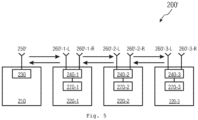
- Fig. 5 is a schematic diagram of the system for communication (referred to as communication system 200' hereinafter) according to a second embodiment of the disclosure.
- the embodiment shown in Fig. 5 is an improvement of the embodiment shown in Fig. 2 , and the difference is that the extended function modules in Fig. 5 each have two near-field communication antenna units, instead of a single near-field communication antenna unit.
- the other components shown in Fig. 5 are the same as the other components shown in Fig. 2 , and they will not be described here again.
- each extended function module has two near-field communication antenna units.
- the first extended function module 220-1 has two second near-field communication antenna units 260'-1-L and 260'-1-R
- the second extended function module 220-2 has two second near-field communication antenna units 260'-2-L and 260'-2-R
- the third extended function module 220-3 has two second near-field communication antenna units 260'-3-L and 260'-3-R.
- the two near-field communication antenna units on each extended function module are respectively located at the side edges, namely left edge and right edge, of the printed circuit board on the extended function module.
- the basic function module has one near-field communication antenna unit and the near-field communication antenna unit is located at one side edge of the printed circuit board on the basic function module.
- the near-field communication antenna unit on each side of an extended function module communicates with a corresponding near-field communication antenna unit on an adjacent function module.
- the first near-field communication antenna unit 250' on the basic function module 210 is located on the right side of the main printed circuit board on the basic function module 210.
- the first near-field communication antenna unit 250' on the basic function module 210 communicates with the second near-field communication antenna unit 260'-1-L on the left side of the first extended function module 220-1 and is used to send data from the basic function module 210 to the second near-field communication antenna unit 260'-1-L or receive data from the second near-field communication antenna unit 260'-1-L.
- the second near-field communication antenna unit 260'-1-R on the right side of the first extended function module 220-1 communicates with the second near-field communication antenna unit 260'-2-L on the left side of the second extended function module 220-2 and is used to send data from the first extended function module 220-1 to the second near-field communication antenna unit 260'-2-L or receive data from the second near-field communication antenna unit 260'-2-L.
- the near-field communication antenna units on the other extended function modules communicate with corresponding near-field communication antenna units in a similar way.
- the first near-field communication antenna unit 250' and the at least one second near-field communication antenna units 260'-1, 260'-2, and 260'-3 are configured to be arranged along a line, and the distance between the near-field communication antenna units on two adjacent function modules is within the set near-field communication distance.
- Fig. 6A is a schematic diagram of one implementation example of a first near-field communication antenna unit 250' in the communication system 200' according to the second embodiment of the disclosure.
- Fig. 6B is a schematic diagram of one implementation example of a second near-field communication antenna unit 260'-1 in the communication system according to the second embodiment of the disclosure.
- the first near-field communication antenna unit 250' may be formed by use of one mutual-inductance element 251'
- the second near-field communication antenna units 260' may be formed by use of two mutual-inductance elements 261'.
- the mutual-inductance element may be at least one of the following: inductor or inductance coil.
- Fig. 7A is a schematic diagram of another implementation example of the first near-field communication antenna unit 250' in the communication system 200' according to the second embodiment of the disclosure
- Fig. 7B is a schematic diagram of another implementation example of the second near-field communication antenna unit 260'-1 in the communication system 200' according to the second embodiment of the disclosure.
- the first near-field communication antenna unit 250' comprises a first printed circuit board 253' printed with a first loop antenna 252' thereon and the first printed circuit board 253' is vertically fixed at one side edge of the main printed circuit board on the basic function module 210.
- the second near-field communication antenna unit 260'-1 comprises two second printed circuit boards 263' printed with a second loop antenna 262' thereon and the two second printed circuit boards 263' are vertically fixed at two side edges of the main printed circuit board on the extended function module 220-1.
- the first near-field communication antenna unit 250' is electrically connected with the first near-field communication transceiver unit 230.
- an electrical communication interface electrically connected with the first near-field communication antenna unit 250' is provided at the edge of the first printed circuit board 253' and an electrical communication interface electrically connected with the first near-field communication transceiver unit 230 is also provided at the corresponding side edge of the main printed circuit board of the basic function module 210.
- the two electrical communication interfaces are coupled to implement electrical communication between two printed circuit boards.
- an electrical connection between the second near-field communication antenna unit and the second near-field communication transceiver unit is implemented in a similar way to implement electrical communication.
- each of the first loop antenna 252' and the second loop antenna 262' may be formed by performing loop wiring along two side edges of a corresponding printed circuit board to form a wiring loop.
- the first loop antenna 252' and the second loop antenna 262' may be configured to have the same/a similar loop shape.
- the first loop antenna and the second loop antenna may be configured to be parallel to each other.
- the size of the formed loop antenna may be 35.5 cm ⁇ 20 cm. In other examples of the disclosure, the size of the loop antennas may also be other suitable sizes.
- the sizes and/or shapes of the first loop antenna and the second loop antenna may be determined according to the set near-field communication distance.
- the first loop antenna and the second loop antenna may be formed by use of copper wiring on the printed circuit boards. In other examples of the disclosure, the first loop antenna and the second loop antenna may be formed by use of wiring of other conductive materials on the printed circuit boards.
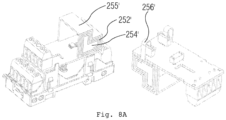
- Fig. 8A is a schematic diagram of a further implementation example of the first near-field communication antenna unit 250' in the communication system 200' according to the second embodiment of the disclosure
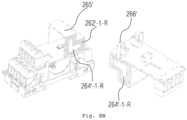
- Fig. 8B is a schematic diagram of a further implementation example of the second near-field communication antenna unit 260'-1 in the communication system 200' according to the second embodiment of the disclosure.
- the first near-field communication antenna unit 250' may comprise a first frame board 255' with a first flexible printed circuit board 254' attached on one side and two first connecting mechanisms 256', the first frame board 255' is vertically fixed by use of the two first connecting mechanisms 256' at two side edges of the main printed circuit board of the basic function module 210, and a first loop antenna 252' is printed on the first flexible printed circuit board 254'.
- the at least one second near-field communication antenna unit may comprise a second frame board 265' with a second flexible printed circuit board 264' respectively attached on two opposite side surfaces and two second connecting mechanisms 266', and the second frame board 265' is vertically fixed by use of the two second connecting mechanisms 266' at two side edges of the main printed circuit board of a corresponding extended function module.
- a second loop antenna 262' is printed on the second flexible printed circuit board 264'.
- an electrical connection and electrical communication between the first near-field communication antenna unit 250' and the first near-field communication transceiver unit 230 may be implemented in the way shown in Figs. 7A and 7B .
- an electrical connection and electrical communication between the second near-field communication antenna unit and the second near-field communication transceiver unit may also be implemented in the way shown in Figs. 7A and 7B .
- first frame board 255' and the second frame board 265' are configured to respectively match the shapes of the casings of the basic function module 210 and a corresponding extended function module 220, and are fixed on the casings.
- each of the first loop antenna 252' and the second loop antenna 262' may be formed by performing loop wiring along two side edges of a corresponding printed circuit board to form a wiring loop.
- the first loop antenna 252' and the second loop antenna 262' may be configured to have the same/a similar loop shape.
- the first loop antenna and the second loop antenna may be configured to be parallel to each other.
- the size of the formed loop antenna may be 35.5 cm ⁇ 20 cm. In other examples of the disclosure, the size of the loop antennas may also be other suitable sizes.
- the sizes and/or shapes of the first loop antenna 252' and the second loop antenna 262' may be determined according to the set near-field communication distance.
- the first loop antenna 252' and the second loop antenna 262' may be formed by use of copper wiring on the printed circuit boards. In other examples of the disclosure, the first loop antenna 252' and the second loop antenna 262' may be formed by use of wiring of other conductive materials on the printed circuit boards.
- the near-field communication transceiver unit may be configured to have two wiring interfaces, and each wiring interface is respectively electrically connected with a near-field communication antenna unit.
- a switch may be placed between the near-field communication transceiver unit and the two near-field communication antenna units, and thus an electrical connection and electrical communication between the near-field communication transceiver unit and a corresponding near-field communication antenna unit is implemented based on the determination result of the communication destination determination unit on the extended function module.
- each extended function module may have two near-field communication transceiver units and each near-field communication transceiver unit corresponds to a second near-field communication antenna unit.
Landscapes
- Engineering & Computer Science (AREA)
- Computer Networks & Wireless Communication (AREA)
- Signal Processing (AREA)
- Power Engineering (AREA)
- Near-Field Transmission Systems (AREA)
- Transceivers (AREA)
- Details Of Aerials (AREA)
Description
- The disclosure generally relates to the field of data communication, in particular to a system for communication.
-
US 2012/217658 A1 describes a multi-stack semiconductor integrated circuit device where communication between semiconductor chips can be carried out by bypassing a number of chips. Each semiconductor chip that forms a multi-stack semiconductor integrated circuit device has a stack structure where semiconductor chips having the same shape are stacked on top of each other. A coil for transmission/reception for communication between chips over a short distance is suggested. -
EP 22844849 A1 -
EP 2733739 A2 describes an integrated circuit package with a lead frame. The lead frame may comprise a first conductor having a first conductive loop and a second conductor galvanically isolated from the first conductor. The second conductor includes a second conductive loop proximate to and magnetically coupled to the first conductive loop to provide a communication link between the first and second conductor. -
WO 2008/134889 A1 describes a configuration for transmitting an electric signal between electronic devices with a first coupling element electromagnetically coupled to, and immediately juxtaposed to, a second coupling element. - Currently, communication between a basic function module and an extended function module in a communication system is implemented by using a standard serial peripheral interface (SPI). In the
communication system 100, connectors (for example, SPIs 130-1, 130-2, ..., 130-N) usually need to be used for physical connections between abasic function module 110 and anextended function module 120 and between two adjacent extended function modules (for example, between extended function modules 120-1 and 120-2, between extended function modules 120-2 and 120-3, ..., and between extended function modules 120-N-1 and 120-N), as shown inFig. 1 . In this case, it is inconvenient for the user to connect or disconnect the connectors. In addition, since the connections are wired connections, a connection between a high-voltage module and a low-voltage module is forbidden for the sake of safety. Thus, the types of extended function modules suitable for being connected for communication will be restricted. For example, when the basic function module is a high-voltage module, an extended function module must also be a high-voltage module, and when the basic function module is a low-voltage module, an extended function module must also be a low-voltage module. - In view of this, the disclosure provides a system and modules for communication. By using the system provided by the disclosure, installing near-field communication transceiver units respectively on the basic function module and extended function modules and using the antenna units realized by loop antennas on printed circuit boards to implement near-field communication, near-field communication between the basic function module and an extended function module and between extended function modules can be implemented, without any necessity of using connectors for wired communication.
- The invention is defined by the subject-matter of
independent claims 1 and 10. Preferred embodiments are defined in the dependent claims. - By using the system provided by the disclosure, installing near-field communication transceiver units respectively on the basic function module and extended function modules and using the antenna units realized by loop antennas on printed circuit boards to implement near-field communication, near-field communication between the basic function module and an extended function module and between extended function modules can be implemented, without any necessity of using connectors for wired communication.
- By using the system provided by the disclosure and configuring the first loop antenna and the second loop antenna into wiring loops formed by performing loop wiring along two side edges of corresponding printed circuit boards, the distance between the near-field communication antenna units on two adjacent function modules can be kept within a set communication distance, and in addition interference caused by other function modules during communication between two adjacent extended function modules can be reduced.
- By using the system provided by the disclosure and configuring the first loop antenna and the second loop antenna to have the same/a similar loop shape and/or to be parallel to each other, the communication effect between two adjacent function modules can be improved.
- By using the system provided by the disclosure and determining the sizes and/or shapes of the first loop antenna and the second loop antenna according to the set communication distance, the near-field communication effect between two adjacent function modules can effectively be improved.
- By using the system provided by the disclosure, arranging the first near-field communication antenna unit and the second near-field communication antenna unit along a line and arranging the distance between the near-field communication antenna units on two adjacent function modules within the set communication distance, near-field communication between two adjacent function modules can be implemented and the communication effect between two adjacent function modules can be improved.
- By using the system provided by the disclosure, forming a single first loop antenna on the printed circuit board on the basic function module as a first near-field communication antenna unit, forming a single second loop antenna on the printed circuit board on each extended function module as corresponding at least one second near-field communication antenna unit, and keeping the printed circuit boards on the basic function module and the extended function modules on a plane, the near-field communication effect between two adjacent function modules can effectively be improved, and in addition interference caused by other function modules during communication between two adjacent extended function modules can be reduced.
- By using the system provided by the disclosure, using a single near-field communication antenna unit formed on one side of the printed circuit board on the basic function module as a first near-field communication antenna unit, and using two near-field communication antenna units formed on two sides of the printed circuit board on the extended function module as at least one second near-field communication antenna unit, the near-field communication effect between two adjacent function modules can effectively be improved, and in addition interference caused by other function modules during communication between two adjacent extended function modules can be reduced.
- By using the system provided by the disclosure and installing a communication destination determination unit for determining the destination function module of downstream communication on each extended function module, cascades between the basic function module and at least one extended function module can be implemented for communication, direct mutual communication is allowed only between adjacent function modules of the cascaded function modules, and thus interference caused by other function modules during communication between two adjacent extended function modules can be reduced.
- The essence and advantages of the disclosure may be further understood by reference to the drawings. In the drawings, similar components or characteristics may have the same reference numerals.
-
Fig. 1 is a schematic diagram of communication between the basic function module and extended function modules in a prior communication system; -
Fig. 2 is a schematic diagram of the system for communication according to a first embodiment of the disclosure; -
Fig. 3 is a schematic diagram of one implementation example of the system for communication according to the first embodiment of the disclosure; -
Fig. 4 is a schematic diagram of an example of near-field communication antenna units formed on a function module according to the first embodiment of the disclosure; -
Fig. 5 is a schematic diagram of the system for communication according to a second embodiment of the disclosure; -
Fig. 6A is a schematic diagram of one implementation example of the first near-field communication antenna unit in the system for communication according to the second embodiment of the disclosure; -
Fig. 6B is a schematic diagram of one implementation example of a second near-field communication antenna unit in the system for communication according to the second embodiment of the disclosure; -
Fig. 7A is a schematic diagram of another implementation example of the first near-field communication antenna unit in the system for communication according to the second embodiment of the disclosure; -
Fig. 7B is a schematic diagram of another implementation example of a second near-field communication antenna unit in the system for communication according to the second embodiment of the disclosure; -
Fig. 8A is a schematic diagram of a further implementation example of a first near-field communication antenna unit in the system for communication according to the second embodiment of the disclosure; -
Fig. 8B is a schematic diagram of a further implementation example of a second near-field communication antenna unit in the system for communication according to the second embodiment of the disclosure. -
- 100: Communication system
- 110: Basic function module
- 120-1, 120-2, ......, 120-N: Extended function module
- 130-1, 130-2, ......, 130-N: SPI
- 200: Communication system
- 210: Basic function module
- 220-1, 220-2, 220-3: Extended function module
- 230: First near-field communication transceiver unit
- 240-1, 240-2, 240-3: Second near-field communication transceiver unit
- 250: First near-field communication antenna unit
- 260-1, 260-2, 260-3: Second near-field communication antenna unit
- 270-1, 270-2, 270-3: Communication destination determination unit
- 280: Main printed circuit board
- 200': Communication system
- 250': First near-field communication antenna unit
- 260'-1-L, 260'-2-L, 260'-3-L: Second near-field communication antenna unit on the left of the first extended function module to third extended function module
- 260'-1-R, 260'-2-R, 260'-3-R: Second near-field communication antenna unit on the right of the first extended function module to third extended function module
- 251', 261-1-L, 261-1-R: Mutual-inductance element
- 252, 252': First loop antenna
- 262, 262-1, 262'-1-R: Second loop antenna
- 253': First printed circuit board
- 263'-1-R: Second printed circuit board
- 254': First flexible printed circuit board
- 255': First frame board
- 256': First connecting mechanism
- 264'-1-R: Second flexible printed circuit board
- 265': Second frame board
- 266': Second connecting mechanism
- Now, the subject described in this document is discussed by reference to exemplary implementation modes. It should be understood that the discussions about these implementation modes are only intended to let those skilled in the art have a better understanding so as to realize the subject described in this document, but are not intended to restrict the scope of protection, applicability, or examples described in the claims. Changes can be made to the functions and arrangements of the discussed elements, without departing from the scope of protection of the disclosure. Various processes or components can be omitted, replaced, or added in different examples, as required. For example, the described method can be executed in a sequence different from what is described, and steps can be added, omitted or combined. In addition, the characteristics described in relation to some examples can also be combined in other examples.
- As used in this document, the term "comprise" and its variants are open terms and mean "include but are not limited to. " The term "based on" means "at least partially based on." The term "one embodiment" means "at least one embodiment. " The term "another embodiment" means "at least one other embodiment." The terms "first" and "second" may refer to different or identical objects. Other definitions, explicit or implicit, may be included below. Unless otherwise specified in the context, the definition of a term is consistent throughout the description.
-
Fig. 2 is a schematic diagram of thesystem 200 for communication (referred to ascommunication system 200 hereinafter) according to a first embodiment of the disclosure. - As shown in
Fig. 2 , thecommunication system 200 comprises abasic function module 210 and at least one extended function module. Three extended function modules 220-1, 220-2 and 220-3 are shown in the example inFig. 2 . Thebasic function module 210 is used to implement the basic functions of thecommunication system 200, and the basic function module is, according to the invention, the main control module of a programmable logic controller (PLC). Extended function modules are used to implement extended functions of thecommunication system 200. Extended function modules are, according the invention, extended input/output (I/O) modules of a PLC and the purpose of extended function modules is to extend I/O points of the basic function module. In the disclosure, the communication system is used to transmit I/O data of a PLC. PLC, according to the invention. Communication between the basic function module and an extended function module mainly enables the basic function module to implement the setting of the output port of the extended function module and the collection of the state of the input port of the extended function module. Data sent from the basic function module may be addressed to a specific extended function module or addressing of the data may be implemented in shared data structure mode. On the contrary, data sent back from an extended function module may be data sent from a specific extended function module and containing the address of the extended function module, or may also be data returned to the basic function module after a specific position is filled in the shared data structure of the extended function modules. - The
basic function module 210 comprises a first near-fieldcommunication transceiver unit 230 and a first near-fieldcommunication antenna unit 250. The first near-fieldcommunication transceiver unit 230 is electrically connected with the first near-fieldcommunication antenna unit 250. For example, the first near-fieldcommunication transceiver unit 230 and the first near-fieldcommunication antenna unit 250 can implement electrical communication in electrical connection mode through wiring on the printed circuit board. The first near-fieldcommunication transceiver unit 230 is used to process wireless communication signals received by the first near-fieldcommunication antenna unit 250 to convert them to signals that thebasic function module 210 can identify and process, or to convert data to be sent in thebasic function module 210 to wireless communication signals suitable for the first near-fieldcommunication antenna unit 250 to send and then send them out through the first near-fieldcommunication antenna unit 250. In the disclosure, the first near-fieldcommunication transceiver unit 230 can be, for example, any suitable communication transceiver. The first near-fieldcommunication antenna unit 250 is used to send or receive wireless communication signals in near-field communication mode. The first near-fieldcommunication antenna unit 250 comprises afirst loop antenna 252 printed on a printed circuit board. Here, the printed circuit board may be the main printed circuit board of thebasic function module 210, or may also be a printed circuit board other than the main printed circuit board of thebasic function module 210. - Each extended function module comprises at least one second near-field communication transceiver unit and at least one second near-field communication antenna unit. Similarly, the at least one second near-field communication transceiver unit is electrically connected with the corresponding second near-field communication antenna unit. For example, the second near-field communication transceiver unit and the second near-field communication antenna unit can implement electrical communication in electrical connection mode through wiring on the printed circuit board. In the example shown in
Fig. 2 , each extended function module has a single second near-field communication antenna unit. For example, the first extended function module 220-1 has a second near-field communication antenna unit 260-1, the second extended function module 220-2 has a second near-field communication antenna unit 260-2 and the third extended function module 220-3 has a second near-field communication antenna unit 260-3. The second near-field communication antenna unit comprises a second loop antenna printed on a printed circuit board. Here, the printed circuit board may be the main printed circuit board of an extended function module, or may also be a printed circuit board other than the main printed circuit board of an extended function module. -
Fig. 3 is a schematic diagram of one implementation example of the system for communication according to the first embodiment of the disclosure. Only thebasic function module 210 and the first extended function module 220-1 are shown in the communication system inFig. 3 . - In the communication system shown in
Fig. 3 , the first near-fieldcommunication antenna unit 250 is a singlefirst loop antenna 252 formed on the main printedcircuit board 280 of thebasic function module 210. At least one second near-field communication antenna unit is a single second loop antenna formed on the main printed circuit board of a corresponding extended function module, for example, a single second loop antenna 262-1 formed on the main printed circuit board of the first extended function module 220-1. In addition, thebasic function module 210 and the extended function modules are so arranged that the communication distance between two near-field communication antenna units on two adjacent function modules is within the set near-field communication distance, the main printed circuit boards on thebasic function module 210 and the extended function modules are parallel to each other, and the height difference between the planes where the main printed circuit boards on two adjacent modules are located is less than a preset threshold. In this document, the preset threshold is determined based on the set near-field communication distance. In one example of the disclosure, the main printed circuit boards may be located on a plane, for example. - In addition, alternatively, each of the
first loop antenna 252 and thesecond loop antenna 262 may be formed by performing loop wiring along two side edges of a corresponding printed circuit board to form a wiring loop, as shown inFigs. 3 and4 . - In addition, in an example of the embodiment, the
first loop antenna 252 and thesecond loop antenna 262 are configured to have the same/a similar loop shape. In addition, thefirst loop antenna 252 and thesecond loop antenna 262 may be configured to be parallel to each other. -
Fig. 4 is a schematic diagram of an example of near-field communication antenna units formed on a function module according to the first embodiment of the disclosure. As shown inFig. 4 , the size of the formed loop antennas is 35.5 cm × 20 cm. In other examples of the disclosure, the size of the loop antennas may also be other suitable sizes. The sizes and/or shapes of thefirst loop antenna 252 and thesecond loop antenna 262 may be determined according to the set near-field communication distance. In one example of the disclosure, the set near-field communication distance may be set to 1 cm to 2 cm. In one example of the disclosure, thefirst loop antenna 252 and thesecond loop antenna 262 may be formed by use of copper wiring on the printed circuit boards . In other examples of the disclosure, thefirst loop antenna 252 and thesecond loop antenna 262 may be formed by use of wiring of other conductive materials on the printed circuit boards. - In another example of the disclosure, the communication system may comprise at least two extended function modules. According to the embodiments of the disclosure, the
basic function module 210 may be cascaded with the extended function modules, and near-field communication mode is adopted between function modules to implement cascade communication, that is to say, thebasic function module 210 communicates with the first extended function module 220-1, the first extended function module 220-1 communicates with the second extended function module 220-2, and the second extended function module 220-2 communicates with the third extended function module 220-3. In this way, data of thebasic function module 210 can be sent to the first extended function module 220-1, the second extended function module 220-2 and the third extended function module 220-3 in turn in near-field communication mode. Similarly, data of the third extended function module 220-3 may also be sent to the second extended function module 220-2, the first extended function module 220-1 and thebasic function module 210 in turn in near-field communication mode. - Accordingly, each of the at least two extended function modules comprises a communication destination determination unit for determining the destination function module of downstream communication according to the data source of data to be sent in the extended function module. For example, the first extended function module 220-1 and the second extended function module 220-2 have the communication destination determination unit 270-1 and the communication destination determination unit 270-2, respectively. The communication destination determination unit 270-1 is used to determine the destination function module of downstream communication happening at the first extended function module 220-1 according to the data source of received data in the first extended function module 220-1. For example, when the received data on the first extended function module 220-1 comes from the
basic function module 210, the destination function module of downstream communication happening at the first extended function module 220-1 is the second extended function module 220-2, that is to say, data received from thebasic function module 210 is forwarded to the second extended function module 220-2. When the received data on the first extended function module 220-1 comes from the second extended function module 220-2, the destination function module of downstream communication happening at the first extended function module 220-1 is thebasic function module 210, that is to say, data received from the second extended function module 220-2 is forwarded to thebasic function module 210. Similarly, the communication destination determination unit 270-2 is used to determine the destination function module of downstream communication happening at the second extended function module 220-2 according to the data source of received data in the second extended function module 220-2. - In one example of the disclosure, the communication destination determination unit may be any mechanism having a corresponding capability, or any processor, field programmable gate array (FPGA), integrated circuit or single-chip microcomputer having a corresponding capability.
- In one example of the disclosure, the data source of data to be sent may be identified by use of identification information, and in addition the identification information is sent together with the data to be sent to a corresponding extended function module. Thus, the communication destination determination unit may determine the data source of data to be sent according to the received identification information.
- In one example of the disclosure, the first near-field
communication antenna unit 250 and the at least one second near-field communication antenna units 260-1, 260-2, and 260-3 may be configured to be arranged along a line, and the distance between the near-field communication antenna units on two adjacent function modules is within the set near-field communication distance. In one example of the disclosure, the set near-field communication distance may be set to 1 cm to 2 cm. In another example of the disclosure, the set communication distance may be set to other proper distances according to the specific situation. -
Fig. 5 is a schematic diagram of the system for communication (referred to as communication system 200' hereinafter) according to a second embodiment of the disclosure. The embodiment shown inFig. 5 is an improvement of the embodiment shown inFig. 2 , and the difference is that the extended function modules inFig. 5 each have two near-field communication antenna units, instead of a single near-field communication antenna unit. The other components shown inFig. 5 are the same as the other components shown inFig. 2 , and they will not be described here again. - In the example shown in
Fig. 5 , each extended function module has two near-field communication antenna units. For example, the first extended function module 220-1 has two second near-field communication antenna units 260'-1-L and 260'-1-R, the second extended function module 220-2 has two second near-field communication antenna units 260'-2-L and 260'-2-R, and the third extended function module 220-3 has two second near-field communication antenna units 260'-3-L and 260'-3-R. The two near-field communication antenna units on each extended function module are respectively located at the side edges, namely left edge and right edge, of the printed circuit board on the extended function module. In the embodiment, the basic function module has one near-field communication antenna unit and the near-field communication antenna unit is located at one side edge of the printed circuit board on the basic function module. - When the system works, the near-field communication antenna unit on each side of an extended function module communicates with a corresponding near-field communication antenna unit on an adjacent function module. For example, when the
basic function module 210 and extended function modules are placed in turn from left to right, the first near-field communication antenna unit 250' on thebasic function module 210 is located on the right side of the main printed circuit board on thebasic function module 210. The first near-field communication antenna unit 250' on thebasic function module 210 communicates with the second near-field communication antenna unit 260'-1-L on the left side of the first extended function module 220-1 and is used to send data from thebasic function module 210 to the second near-field communication antenna unit 260'-1-L or receive data from the second near-field communication antenna unit 260'-1-L. Accordingly, the second near-field communication antenna unit 260'-1-R on the right side of the first extended function module 220-1 communicates with the second near-field communication antenna unit 260'-2-L on the left side of the second extended function module 220-2 and is used to send data from the first extended function module 220-1 to the second near-field communication antenna unit 260'-2-L or receive data from the second near-field communication antenna unit 260'-2-L. Alike, the near-field communication antenna units on the other extended function modules communicate with corresponding near-field communication antenna units in a similar way. In the embodiment, alike, the first near-field communication antenna unit 250' and the at least one second near-field communication antenna units 260'-1, 260'-2, and 260'-3 are configured to be arranged along a line, and the distance between the near-field communication antenna units on two adjacent function modules is within the set near-field communication distance. -
Fig. 6A is a schematic diagram of one implementation example of a first near-field communication antenna unit 250' in the communication system 200' according to the second embodiment of the disclosure.Fig. 6B is a schematic diagram of one implementation example of a second near-field communication antenna unit 260'-1 in the communication system according to the second embodiment of the disclosure. As shown inFigs. 6A and6B , the first near-field communication antenna unit 250' may be formed by use of one mutual-inductance element 251', and the second near-field communication antenna units 260' may be formed by use of two mutual-inductance elements 261'. Alternatively, in one example, the mutual-inductance element may be at least one of the following: inductor or inductance coil. -
Fig. 7A is a schematic diagram of another implementation example of the first near-field communication antenna unit 250' in the communication system 200' according to the second embodiment of the disclosure, andFig. 7B is a schematic diagram of another implementation example of the second near-field communication antenna unit 260'-1 in the communication system 200' according to the second embodiment of the disclosure. - As shown in
Figs. 7A and7B , the first near-field communication antenna unit 250' comprises a first printed circuit board 253' printed with a first loop antenna 252' thereon and the first printed circuit board 253' is vertically fixed at one side edge of the main printed circuit board on thebasic function module 210. The second near-field communication antenna unit 260'-1 comprises two second printed circuit boards 263' printed with a second loop antenna 262' thereon and the two second printed circuit boards 263' are vertically fixed at two side edges of the main printed circuit board on the extended function module 220-1. In the example shown inFigs. 7A and7B , the first near-field communication antenna unit 250' is electrically connected with the first near-fieldcommunication transceiver unit 230. For example, an electrical communication interface electrically connected with the first near-field communication antenna unit 250' is provided at the edge of the first printed circuit board 253' and an electrical communication interface electrically connected with the first near-fieldcommunication transceiver unit 230 is also provided at the corresponding side edge of the main printed circuit board of thebasic function module 210. When the first printed circuit board 253' is vertically fixed at one side edge of the main printed circuit board of thebasic function module 210, the two electrical communication interfaces are coupled to implement electrical communication between two printed circuit boards. Alike, an electrical connection between the second near-field communication antenna unit and the second near-field communication transceiver unit is implemented in a similar way to implement electrical communication. - Alike, in the example shown in
Figs. 7A and7B , each of the first loop antenna 252' and the second loop antenna 262' may be formed by performing loop wiring along two side edges of a corresponding printed circuit board to form a wiring loop. In addition, the first loop antenna 252' and the second loop antenna 262' may be configured to have the same/a similar loop shape. In addition, the first loop antenna and the second loop antenna may be configured to be parallel to each other. The size of the formed loop antenna may be 35.5 cm × 20 cm. In other examples of the disclosure, the size of the loop antennas may also be other suitable sizes. The sizes and/or shapes of the first loop antenna and the second loop antenna may be determined according to the set near-field communication distance. In one example of the disclosure, the first loop antenna and the second loop antenna may be formed by use of copper wiring on the printed circuit boards. In other examples of the disclosure, the first loop antenna and the second loop antenna may be formed by use of wiring of other conductive materials on the printed circuit boards. -
Fig. 8A is a schematic diagram of a further implementation example of the first near-field communication antenna unit 250' in the communication system 200' according to the second embodiment of the disclosure, andFig. 8B is a schematic diagram of a further implementation example of the second near-field communication antenna unit 260'-1 in the communication system 200' according to the second embodiment of the disclosure. - As shown in
Figs. 8A and8B , the first near-field communication antenna unit 250' may comprise a first frame board 255' with a first flexible printed circuit board 254' attached on one side and two first connecting mechanisms 256', the first frame board 255' is vertically fixed by use of the two first connecting mechanisms 256' at two side edges of the main printed circuit board of thebasic function module 210, and a first loop antenna 252' is printed on the first flexible printed circuit board 254'. The at least one second near-field communication antenna unit may comprise a second frame board 265' with a second flexible printed circuit board 264' respectively attached on two opposite side surfaces and two second connecting mechanisms 266', and the second frame board 265' is vertically fixed by use of the two second connecting mechanisms 266' at two side edges of the main printed circuit board of a corresponding extended function module. Alike, a second loop antenna 262' is printed on the second flexible printed circuit board 264'. In the example shown inFigs. 8A and8B , an electrical connection and electrical communication between the first near-field communication antenna unit 250' and the first near-fieldcommunication transceiver unit 230 may be implemented in the way shown inFigs. 7A and7B . Alike, an electrical connection and electrical communication between the second near-field communication antenna unit and the second near-field communication transceiver unit may also be implemented in the way shown inFigs. 7A and7B . - In the example, the first frame board 255' and the second frame board 265' are configured to respectively match the shapes of the casings of the
basic function module 210 and a corresponding extended function module 220, and are fixed on the casings. - Alike, in the example shown in
Figs. 8A and8B , each of the first loop antenna 252' and the second loop antenna 262' may be formed by performing loop wiring along two side edges of a corresponding printed circuit board to form a wiring loop. In addition, the first loop antenna 252' and the second loop antenna 262' may be configured to have the same/a similar loop shape. In addition, the first loop antenna and the second loop antenna may be configured to be parallel to each other. The size of the formed loop antenna may be 35.5 cm × 20 cm. In other examples of the disclosure, the size of the loop antennas may also be other suitable sizes. The sizes and/or shapes of the first loop antenna 252' and the second loop antenna 262' may be determined according to the set near-field communication distance. In one example of the disclosure, the first loop antenna 252' and the second loop antenna 262' may be formed by use of copper wiring on the printed circuit boards. In other examples of the disclosure, the first loop antenna 252' and the second loop antenna 262' may be formed by use of wiring of other conductive materials on the printed circuit boards. - In addition, when two near-field communication antenna units and a single near-field communication transceiver unit exist on an extended function module, the near-field communication transceiver unit may be configured to have two wiring interfaces, and each wiring interface is respectively electrically connected with a near-field communication antenna unit. Or, a switch may be placed between the near-field communication transceiver unit and the two near-field communication antenna units, and thus an electrical connection and electrical communication between the near-field communication transceiver unit and a corresponding near-field communication antenna unit is implemented based on the determination result of the communication destination determination unit on the extended function module.
- In addition, other variations can be made to the embodiment shown in
Fig. 5 . For example, each extended function module may have two near-field communication transceiver units and each near-field communication transceiver unit corresponds to a second near-field communication antenna unit. - The embodiments described above in combination with the drawings are only exemplary embodiments, but do not represent all embodiments that can be realized or fall within the scope of protection of the claims. The term "exemplary" used in the whole description means "used as an example, instance or illustration", but does not mean "preferable" to or "advantageous" over other embodiments. For the purpose of providing an understanding of the described techniques, the embodiments cover specific details. However, these techniques may be carried out without these specific details. In some embodiments, well-known structures and devices are shown in the form of a block diagram to avoid the difficulty in understanding the concepts in the described embodiments. The invention is defined by the appended claims.
Claims (12)
- A system (200, 200') for near-field communication between a basic function module and at least one extended function module, comprising:the basic function module (210),the at least one extended function module (220-1, 220-2, 220-3),a first near-field communication transceiver unit (230) and a first near-field communication antenna unit (250, 250') located on the basic function module (210), andat least one second near-field communication transceiver unit (240-1, 240-2, 240-3) andat least one second near-field communication antenna unit (260-1, 260'-1, 260-2, 260'-2, 260-3, 260'-3) located on each extended function module of the at least one extended function module (220-1, 220-2, 220-3),characterized in thatthe first near-field communication antenna unit (250, 250') and the at least one second near-field communication antenna unit (260-1, 260'-1, 260-2, 260'-2, 260-3, 260'-3) respectively comprise a first loop antenna (252, 252') and a second loop antenna (262, 262') printed on a printed circuit board, andthe basic function module (210) is a main control module of a programmable logic controller, PLC, andthe at least one extended function module (220-1, 220-2, 220-3)is an extended input/output (I/O) module of the PLC that is configured to extend I/O points of the basic function module (210) to transmit I/O data of the PCL through near-field communication.
- The system (200, 200') as claimed in claim 1, characterized in that each of the first loop antenna (252, 252') and the second loop antenna (262, 262') is formed by performing loop wiring along two side edges of a corresponding printed circuit board to form a wiring loop.
- The system (200, 200') as claimed in claim 2, characterized in that the first loop antenna (252, 252') and the second loop antenna (262, 262') are configured to have the same/a similar loop shape and/or be parallel to each other, or in that the sizes and/or shapes of the first loop antenna (252, 252') and the second loop antenna (262, 262') are determined according to a set near-field communication distance.
- The system (200, 200') as claimed in claim 1, characterized in that the first near-field communication antenna unit (250, 250') and the at least one second near-field communication antenna unit are configured to be arranged along a line and the distance between the near-field communication antenna units on two adjacent function modules is within the set near-field communication distance.
- The system (200) as claimed in any of claims 1 to 4, characterized in that the first near-field communication antenna unit (250) comprises a single first loop antenna (252) formed on the main printed circuit board on the basic function module (210), the at least one second near-field communication antenna unit comprises a single second loop antenna (262) formed on the main printed circuit board on a corresponding extended function module, the planes where the main printed circuit boards on the basic function module (210) and the extended function modules are located are parallel to each other, the height difference between the planes where the main printed circuit boards on two adjacent modules are located is less than a preset threshold, and the preset threshold is determined based on the set near-field communication distance.
- The system (200') as claimed in any of claims 1 to 4, characterized in that the first near-field communication antenna unit (250') comprises a first printed circuit board (253') printed with a first loop antenna (252') thereon and the first printed circuit board (253') is vertically fixed at one side edge of the main printed circuit board on the basic function module (210), the at least one second near-field communication antenna unit comprises two second printed circuit boards printed with a corresponding second loop antenna (262') thereon and the two second printed circuit boards are respectively vertically fixed at two side edges of the main printed circuit board on a corresponding extended function module.
- The system (200') as claimed in any of claims 1 to 4, characterized in that the first near-field communication antenna unit (250') comprises a first frame board (255') with a first flexible printed circuit board (254') attached on one side and two first connecting mechanisms (256'), a first loop antenna (252') is printed on the first flexible printed circuit board (254'), the first frame board (255') is vertically fixed by use of the two first connecting mechanisms (256') at two side edges of the main printed circuit board of the basic function module (210), and
the at least one second near-field communication antenna unit comprises a second frame board (265') with a second flexible printed circuit board (264') respectively attached on two opposite side surfaces and two second connecting mechanisms (266'), a second loop antenna (262') is printed on the second flexible printed circuit board (264'), and the second frame board (265') is vertically fixed by use of the two second connecting mechanisms (266') at two side edges of the main printed circuit board of a corresponding extended function module. - The system (200, 200') as claimed in claim 1, characterized in that the system comprises at least two extended function modules, the basic function module (210) and the extended function modules are cascaded for communication, and each extended function module has a communication destination determination unit, configured to determine the destination function module of downstream communication according to a data source of the data to be sent in the extended function module,
wherein direct mutual communication is allowed only between adjacent function modules of the cascaded function modules. - The system (200, 200') as claimed in claim 1, characterized in that the basic function module (210) is a programmable logic controller module and the extended function modules are programmable logic controller modules.
- A basic function module (210) for near-field communication with at least one extended function module (220-1, 220-2, 220-3), wherein the at least one extended function module comprises a second near-field communication transceiver unit (240-1, 240-2, 240-3) and a second near-field communication antenna unit (260-1, 260'-1, 260-2, 260'-2, 260-3, 260'-3), wherein the second near-field communication antenna unit comprises a second loop antenna (262, 262) printed on a printed circuit board, the basic function module comprising:a first near-field communication transceiver unit (230), anda first near-field communication antenna unit (250, 250'),characterized in thatthe first near-field communication antenna unit (250, 250') comprises a first loop antenna (252, 252') printed on a printed circuit board, andthe basic function module (210) is a main control module of a programmable logic controller, (PLC), that is adapted to transmit input/output (I/O) data of the PCL to the at least one extended function module (220-1, 220-2, 220-3) so that I/O points of the basic function module (210) are extended by the at least one extended function module through near-field communication.
- The basic function module (210) as claimed in claim 10, characterized in that the first loop antenna (252, 252') is formed by performing loop wiring along two side edges of a corresponding printed circuit board to form a wiring loop.
- The basic function module (210) as claimed in claim 10 or 11, characterized in that the first near-field communication antenna unit (250) comprises a single first loop antenna (252) formed on the main printed circuit board on the basic function module (210), or in that the first near-field communication antenna unit (250') comprises a first printed circuit board (253') printed with a first loop antenna (252') thereon and the first printed circuit board (253') is vertically fixed at one side edge of the main printed circuit board on the basic function module (210), or in that the first near-field communication antenna unit (250') comprises a first frame board (255') with a first flexible printed circuit board (254') attached on one side and two first connecting mechanisms (256'), wherein a first loop antenna (252') is printed on the first flexible printed circuit board (254'), and the first frame board (255') is vertically fixed by use of the two first connecting mechanisms (256') at two side edges of the main printed circuit board of the basic function module (210), or in that the basic function module (210) is a programmable logic controller module.
Applications Claiming Priority (1)
| Application Number | Priority Date | Filing Date | Title |
|---|---|---|---|
| PCT/CN2018/109702 WO2020073247A1 (en) | 2018-10-10 | 2018-10-10 | System and modules for communication |
Publications (4)
| Publication Number | Publication Date |
|---|---|
| EP3849095A1 EP3849095A1 (en) | 2021-07-14 |
| EP3849095A4 EP3849095A4 (en) | 2022-05-11 |
| EP3849095C0 EP3849095C0 (en) | 2024-04-17 |
| EP3849095B1 true EP3849095B1 (en) | 2024-04-17 |
Family
ID=70165004
Family Applications (1)
| Application Number | Title | Priority Date | Filing Date |
|---|---|---|---|
| EP18936323.7A Active EP3849095B1 (en) | 2018-10-10 | 2018-10-10 | System and modules for communication |
Country Status (4)
| Country | Link |
|---|---|
| US (1) | US11689248B2 (en) |
| EP (1) | EP3849095B1 (en) |
| CN (1) | CN112805926A (en) |
| WO (1) | WO2020073247A1 (en) |
Family Cites Families (19)
| Publication number | Priority date | Publication date | Assignee | Title |
|---|---|---|---|---|
| GB2487019B (en) | 2007-05-08 | 2012-08-15 | Scanimetrics Inc | Ultra high speed signal transmission/reception |
| JP4698702B2 (en) | 2008-05-22 | 2011-06-08 | 三菱電機株式会社 | Electronics |
| JP5635759B2 (en) * | 2009-10-15 | 2014-12-03 | 学校法人慶應義塾 | Multilayer semiconductor integrated circuit device |
| CN201663491U (en) | 2010-02-08 | 2010-12-01 | 东莞宇龙通信科技有限公司 | Electronic terminal and NFC charging system |
| CN202135126U (en) * | 2011-06-29 | 2012-02-01 | 深圳市江波龙电子有限公司 | Wireless communication apparatus of close range and system |
| KR101806942B1 (en) * | 2011-09-28 | 2017-12-08 | 삼성전자주식회사 | Near field communication antenna device of a mobile terminal |
| US9083073B2 (en) * | 2012-06-28 | 2015-07-14 | Intel Corporation | Thin chassis near field communication (NFC) antenna integration |
| KR20140051679A (en) * | 2012-10-23 | 2014-05-02 | 삼성전자주식회사 | Antenna apparatus for near field communication and portable terminal using the same |
| US9035435B2 (en) * | 2012-11-14 | 2015-05-19 | Power Integrations, Inc. | Magnetically coupled galvanically isolated communication using lead frame |
| US9893715B2 (en) * | 2013-12-09 | 2018-02-13 | Shure Acquisition Holdings, Inc. | Adaptive self-tunable antenna system and method |
| KR102152694B1 (en) | 2014-04-29 | 2020-09-07 | 엘지이노텍 주식회사 | Case apparatus |
| CN105244555A (en) | 2014-07-11 | 2016-01-13 | 全亿大科技(佛山)有限公司 | Wireless rechargeable battery |
| DE102015115574A1 (en) * | 2014-11-13 | 2016-05-19 | Samsung Electronics Co., Ltd. | Near field communication chip embedded in a portable electronic device and portable electronic device |
| CN107844971B (en) | 2015-01-21 | 2019-04-19 | 三星电子株式会社 | Electronic device and transaction method using electronic device |
| US9729210B2 (en) * | 2015-04-27 | 2017-08-08 | Avago Technologies General Ip (Singapore) Pte. Ltd. | Chassis NFC antenna booster |
| CN104935839A (en) | 2015-06-10 | 2015-09-23 | 福州瑞芯微电子有限公司 | Extensible smart television |
| US9590699B1 (en) * | 2015-09-11 | 2017-03-07 | Texas Instuments Incorporated | Guided near field communication for short range data communication |
| FR3051578B1 (en) | 2016-05-19 | 2018-05-25 | Continental Automotive France | NEAR FIELD COMMUNICATION DEVICE HAVING TWO NFC ZONES |
| KR102531970B1 (en) * | 2016-08-26 | 2023-05-12 | 삼성전자 주식회사 | Electronic device having loop antenna |
-
2018
- 2018-10-10 WO PCT/CN2018/109702 patent/WO2020073247A1/en not_active Ceased
- 2018-10-10 CN CN201880098433.1A patent/CN112805926A/en active Pending
- 2018-10-10 EP EP18936323.7A patent/EP3849095B1/en active Active
- 2018-10-10 US US17/283,656 patent/US11689248B2/en active Active
Also Published As
| Publication number | Publication date |
|---|---|
| WO2020073247A1 (en) | 2020-04-16 |
| US11689248B2 (en) | 2023-06-27 |
| EP3849095C0 (en) | 2024-04-17 |
| CN112805926A (en) | 2021-05-14 |
| EP3849095A1 (en) | 2021-07-14 |
| US20210359723A1 (en) | 2021-11-18 |
| EP3849095A4 (en) | 2022-05-11 |
Similar Documents
| Publication | Publication Date | Title |
|---|---|---|
| JP5751384B2 (en) | Wireless communication device | |
| EP2056400A1 (en) | Wireless ic device and electronic device | |
| CN100401514C (en) | Communication method between chips | |
| CN208539942U (en) | electronic device | |
| US20240029942A1 (en) | Chip multi-layer transformer and inductor | |
| US12095711B2 (en) | Integrated circuit with radio frequency interconnect | |
| JP7259194B2 (en) | IC chip and circuit system using it | |
| CN110380198A (en) | A kind of antenna modules and electronic equipment | |
| CN103207384B (en) | Radar installations and assembly method thereof | |
| EP3849095B1 (en) | System and modules for communication | |
| WO2019045457A1 (en) | Housing of electronic device and electronic device | |
| CN106464291A (en) | Circuit board and circuit module | |
| WO2025189936A1 (en) | Wireless module, intelligent interactive display device, circuit mainboard and electronic device | |
| US20230170922A1 (en) | Communications device | |
| US8606178B2 (en) | Multi-directional wireless communication for a control module | |
| US10476135B2 (en) | Portable electronic device with embedded antenna | |
| EP4355023A1 (en) | Radio frequency transceiver, connection assembly for radio frequency transceivers, and radio frequency transceiver system | |
| RU2759021C2 (en) | Modular communication device | |
| US20040235515A1 (en) | Dual frequency wireless network access device | |
| CN115621245A (en) | Electronic device using CIP package structure and CIP package structure thereof | |
| JP2011118461A (en) | Information processing apparatus | |
| CN212178825U (en) | LED lamp and communication module used for same | |
| CN222215731U (en) | Radio frequency circuit and electronic equipment | |
| CN220823111U (en) | Multi-protocol devices and multi-protocol equipment | |
| US12580605B1 (en) | System for reducing interference between components of a wireless device |
Legal Events
| Date | Code | Title | Description |
|---|---|---|---|
| STAA | Information on the status of an ep patent application or granted ep patent |
Free format text: STATUS: THE INTERNATIONAL PUBLICATION HAS BEEN MADE |
|
| PUAI | Public reference made under article 153(3) epc to a published international application that has entered the european phase |
Free format text: ORIGINAL CODE: 0009012 |
|
| STAA | Information on the status of an ep patent application or granted ep patent |
Free format text: STATUS: REQUEST FOR EXAMINATION WAS MADE |
|
| 17P | Request for examination filed |
Effective date: 20210409 |
|
| AK | Designated contracting states |
Kind code of ref document: A1 Designated state(s): AL AT BE BG CH CY CZ DE DK EE ES FI FR GB GR HR HU IE IS IT LI LT LU LV MC MK MT NL NO PL PT RO RS SE SI SK SM TR |
|
| DAV | Request for validation of the european patent (deleted) | ||
| DAX | Request for extension of the european patent (deleted) | ||
| A4 | Supplementary search report drawn up and despatched |
Effective date: 20220412 |
|
| RIC1 | Information provided on ipc code assigned before grant |
Ipc: H02J 50/12 20160101ALI20220406BHEP Ipc: H02J 50/10 20160101ALI20220406BHEP Ipc: H04W 4/80 20180101ALI20220406BHEP Ipc: H02J 50/80 20160101ALI20220406BHEP Ipc: H04B 5/00 20060101AFI20220406BHEP |
|
| RIC1 | Information provided on ipc code assigned before grant |
Ipc: H02J 50/50 20160101ALI20230630BHEP Ipc: H02J 50/00 20160101ALI20230630BHEP Ipc: H04B 5/00 20060101AFI20230630BHEP |
|
| GRAP | Despatch of communication of intention to grant a patent |
Free format text: ORIGINAL CODE: EPIDOSNIGR1 |
|
| STAA | Information on the status of an ep patent application or granted ep patent |
Free format text: STATUS: GRANT OF PATENT IS INTENDED |
|
| INTG | Intention to grant announced |
Effective date: 20231130 |
|
| GRAS | Grant fee paid |
Free format text: ORIGINAL CODE: EPIDOSNIGR3 |
|
| GRAA | (expected) grant |
Free format text: ORIGINAL CODE: 0009210 |
|
| STAA | Information on the status of an ep patent application or granted ep patent |
Free format text: STATUS: THE PATENT HAS BEEN GRANTED |
|
| AK | Designated contracting states |
Kind code of ref document: B1 Designated state(s): AL AT BE BG CH CY CZ DE DK EE ES FI FR GB GR HR HU IE IS IT LI LT LU LV MC MK MT NL NO PL PT RO RS SE SI SK SM TR |
|
| REG | Reference to a national code |
Ref country code: GB Ref legal event code: FG4D |
|
| REG | Reference to a national code |
Ref country code: CH Ref legal event code: EP |
|
| REG | Reference to a national code |
Ref country code: DE Ref legal event code: R096 Ref document number: 602018068408 Country of ref document: DE |
|
| REG | Reference to a national code |
Ref country code: IE Ref legal event code: FG4D |
|
| U01 | Request for unitary effect filed |
Effective date: 20240424 |
|
| U07 | Unitary effect registered |
Designated state(s): AT BE BG DE DK EE FI FR IT LT LU LV MT NL PT SE SI Effective date: 20240507 |
|
| PG25 | Lapsed in a contracting state [announced via postgrant information from national office to epo] |
Ref country code: IS Free format text: LAPSE BECAUSE OF FAILURE TO SUBMIT A TRANSLATION OF THE DESCRIPTION OR TO PAY THE FEE WITHIN THE PRESCRIBED TIME-LIMIT Effective date: 20240817 |
|
| PG25 | Lapsed in a contracting state [announced via postgrant information from national office to epo] |
Ref country code: HR Free format text: LAPSE BECAUSE OF FAILURE TO SUBMIT A TRANSLATION OF THE DESCRIPTION OR TO PAY THE FEE WITHIN THE PRESCRIBED TIME-LIMIT Effective date: 20240417 |
|
| PG25 | Lapsed in a contracting state [announced via postgrant information from national office to epo] |
Ref country code: GR Free format text: LAPSE BECAUSE OF FAILURE TO SUBMIT A TRANSLATION OF THE DESCRIPTION OR TO PAY THE FEE WITHIN THE PRESCRIBED TIME-LIMIT Effective date: 20240718 |
|
| PG25 | Lapsed in a contracting state [announced via postgrant information from national office to epo] |
Ref country code: ES Free format text: LAPSE BECAUSE OF FAILURE TO SUBMIT A TRANSLATION OF THE DESCRIPTION OR TO PAY THE FEE WITHIN THE PRESCRIBED TIME-LIMIT Effective date: 20240417 |
|
| PG25 | Lapsed in a contracting state [announced via postgrant information from national office to epo] |
Ref country code: PL Free format text: LAPSE BECAUSE OF FAILURE TO SUBMIT A TRANSLATION OF THE DESCRIPTION OR TO PAY THE FEE WITHIN THE PRESCRIBED TIME-LIMIT Effective date: 20240417 |
|
| PG25 | Lapsed in a contracting state [announced via postgrant information from national office to epo] |
Ref country code: PL Free format text: LAPSE BECAUSE OF FAILURE TO SUBMIT A TRANSLATION OF THE DESCRIPTION OR TO PAY THE FEE WITHIN THE PRESCRIBED TIME-LIMIT Effective date: 20240417 Ref country code: NO Free format text: LAPSE BECAUSE OF FAILURE TO SUBMIT A TRANSLATION OF THE DESCRIPTION OR TO PAY THE FEE WITHIN THE PRESCRIBED TIME-LIMIT Effective date: 20240717 Ref country code: IS Free format text: LAPSE BECAUSE OF FAILURE TO SUBMIT A TRANSLATION OF THE DESCRIPTION OR TO PAY THE FEE WITHIN THE PRESCRIBED TIME-LIMIT Effective date: 20240817 Ref country code: HR Free format text: LAPSE BECAUSE OF FAILURE TO SUBMIT A TRANSLATION OF THE DESCRIPTION OR TO PAY THE FEE WITHIN THE PRESCRIBED TIME-LIMIT Effective date: 20240417 Ref country code: GR Free format text: LAPSE BECAUSE OF FAILURE TO SUBMIT A TRANSLATION OF THE DESCRIPTION OR TO PAY THE FEE WITHIN THE PRESCRIBED TIME-LIMIT Effective date: 20240718 Ref country code: ES Free format text: LAPSE BECAUSE OF FAILURE TO SUBMIT A TRANSLATION OF THE DESCRIPTION OR TO PAY THE FEE WITHIN THE PRESCRIBED TIME-LIMIT Effective date: 20240417 Ref country code: RS Free format text: LAPSE BECAUSE OF FAILURE TO SUBMIT A TRANSLATION OF THE DESCRIPTION OR TO PAY THE FEE WITHIN THE PRESCRIBED TIME-LIMIT Effective date: 20240717 |
|
| U20 | Renewal fee for the european patent with unitary effect paid |
Year of fee payment: 7 Effective date: 20241018 |
|
| REG | Reference to a national code |
Ref country code: DE Ref legal event code: R097 Ref document number: 602018068408 Country of ref document: DE |
|
| PG25 | Lapsed in a contracting state [announced via postgrant information from national office to epo] |
Ref country code: CZ Free format text: LAPSE BECAUSE OF FAILURE TO SUBMIT A TRANSLATION OF THE DESCRIPTION OR TO PAY THE FEE WITHIN THE PRESCRIBED TIME-LIMIT Effective date: 20240417 |
|
| PG25 | Lapsed in a contracting state [announced via postgrant information from national office to epo] |
Ref country code: SK Free format text: LAPSE BECAUSE OF FAILURE TO SUBMIT A TRANSLATION OF THE DESCRIPTION OR TO PAY THE FEE WITHIN THE PRESCRIBED TIME-LIMIT Effective date: 20240417 Ref country code: RO Free format text: LAPSE BECAUSE OF FAILURE TO SUBMIT A TRANSLATION OF THE DESCRIPTION OR TO PAY THE FEE WITHIN THE PRESCRIBED TIME-LIMIT Effective date: 20240417 |
|
| PG25 | Lapsed in a contracting state [announced via postgrant information from national office to epo] |
Ref country code: SM Free format text: LAPSE BECAUSE OF FAILURE TO SUBMIT A TRANSLATION OF THE DESCRIPTION OR TO PAY THE FEE WITHIN THE PRESCRIBED TIME-LIMIT Effective date: 20240417 |
|
| PG25 | Lapsed in a contracting state [announced via postgrant information from national office to epo] |
Ref country code: SM Free format text: LAPSE BECAUSE OF FAILURE TO SUBMIT A TRANSLATION OF THE DESCRIPTION OR TO PAY THE FEE WITHIN THE PRESCRIBED TIME-LIMIT Effective date: 20240417 Ref country code: SK Free format text: LAPSE BECAUSE OF FAILURE TO SUBMIT A TRANSLATION OF THE DESCRIPTION OR TO PAY THE FEE WITHIN THE PRESCRIBED TIME-LIMIT Effective date: 20240417 Ref country code: RO Free format text: LAPSE BECAUSE OF FAILURE TO SUBMIT A TRANSLATION OF THE DESCRIPTION OR TO PAY THE FEE WITHIN THE PRESCRIBED TIME-LIMIT Effective date: 20240417 Ref country code: CZ Free format text: LAPSE BECAUSE OF FAILURE TO SUBMIT A TRANSLATION OF THE DESCRIPTION OR TO PAY THE FEE WITHIN THE PRESCRIBED TIME-LIMIT Effective date: 20240417 |
|
| PLBE | No opposition filed within time limit |
Free format text: ORIGINAL CODE: 0009261 |
|
| STAA | Information on the status of an ep patent application or granted ep patent |
Free format text: STATUS: NO OPPOSITION FILED WITHIN TIME LIMIT |
|
| 26N | No opposition filed |
Effective date: 20250120 |
|
| REG | Reference to a national code |
Ref country code: CH Ref legal event code: PL |
|
| GBPC | Gb: european patent ceased through non-payment of renewal fee |
Effective date: 20241010 |
|
| PG25 | Lapsed in a contracting state [announced via postgrant information from national office to epo] |
Ref country code: MC Free format text: LAPSE BECAUSE OF FAILURE TO SUBMIT A TRANSLATION OF THE DESCRIPTION OR TO PAY THE FEE WITHIN THE PRESCRIBED TIME-LIMIT Effective date: 20240417 |
|
| PG25 | Lapsed in a contracting state [announced via postgrant information from national office to epo] |
Ref country code: GB Free format text: LAPSE BECAUSE OF NON-PAYMENT OF DUE FEES Effective date: 20241010 |
|
| PG25 | Lapsed in a contracting state [announced via postgrant information from national office to epo] |
Ref country code: CH Free format text: LAPSE BECAUSE OF NON-PAYMENT OF DUE FEES Effective date: 20241031 |
|
| PG25 | Lapsed in a contracting state [announced via postgrant information from national office to epo] |
Ref country code: IE Free format text: LAPSE BECAUSE OF NON-PAYMENT OF DUE FEES Effective date: 20241010 |
|
| U20 | Renewal fee for the european patent with unitary effect paid |
Year of fee payment: 8 Effective date: 20251020 |
|
| PG25 | Lapsed in a contracting state [announced via postgrant information from national office to epo] |
Ref country code: CY Free format text: LAPSE BECAUSE OF FAILURE TO SUBMIT A TRANSLATION OF THE DESCRIPTION OR TO PAY THE FEE WITHIN THE PRESCRIBED TIME-LIMIT; INVALID AB INITIO Effective date: 20181010 |
|
| PG25 | Lapsed in a contracting state [announced via postgrant information from national office to epo] |
Ref country code: HU Free format text: LAPSE BECAUSE OF FAILURE TO SUBMIT A TRANSLATION OF THE DESCRIPTION OR TO PAY THE FEE WITHIN THE PRESCRIBED TIME-LIMIT; INVALID AB INITIO Effective date: 20181010 |