EP3849050A1 - System and method for encrypted resonant inductive power transfer - Google Patents
System and method for encrypted resonant inductive power transfer Download PDFInfo
- Publication number
- EP3849050A1 EP3849050A1 EP21150798.3A EP21150798A EP3849050A1 EP 3849050 A1 EP3849050 A1 EP 3849050A1 EP 21150798 A EP21150798 A EP 21150798A EP 3849050 A1 EP3849050 A1 EP 3849050A1
- Authority
- EP
- European Patent Office
- Prior art keywords
- resonant
- inductive power
- switch
- frequency
- resonant inductive
- Prior art date
- Legal status (The legal status is an assumption and is not a legal conclusion. Google has not performed a legal analysis and makes no representation as to the accuracy of the status listed.)
- Pending
Links
Images






Classifications
-
- H—ELECTRICITY
- H02—GENERATION; CONVERSION OR DISTRIBUTION OF ELECTRIC POWER
- H02J—ELECTRIC POWER NETWORKS; CIRCUIT ARRANGEMENTS OR SYSTEMS FOR SUPPLYING OR DISTRIBUTING ELECTRIC POWER; SYSTEMS FOR STORING ELECTRIC ENERGY
- H02J50/00—Circuit arrangements or systems for wireless supply or distribution of electric power
- H02J50/10—Circuit arrangements or systems for wireless supply or distribution of electric power using inductive coupling
- H02J50/12—Circuit arrangements or systems for wireless supply or distribution of electric power using inductive coupling of the resonant type
-
- H—ELECTRICITY
- H01—ELECTRIC ELEMENTS
- H01F—MAGNETS; INDUCTANCES; TRANSFORMERS; SELECTION OF MATERIALS FOR THEIR MAGNETIC PROPERTIES
- H01F38/00—Adaptations of transformers or inductances for specific applications or functions
- H01F38/14—Inductive couplings
-
- H—ELECTRICITY
- H02—GENERATION; CONVERSION OR DISTRIBUTION OF ELECTRIC POWER
- H02J—ELECTRIC POWER NETWORKS; CIRCUIT ARRANGEMENTS OR SYSTEMS FOR SUPPLYING OR DISTRIBUTING ELECTRIC POWER; SYSTEMS FOR STORING ELECTRIC ENERGY
- H02J50/00—Circuit arrangements or systems for wireless supply or distribution of electric power
- H02J50/50—Circuit arrangements or systems for wireless supply or distribution of electric power using additional energy repeaters between transmitting devices and receiving devices
-
- H—ELECTRICITY
- H02—GENERATION; CONVERSION OR DISTRIBUTION OF ELECTRIC POWER
- H02J—ELECTRIC POWER NETWORKS; CIRCUIT ARRANGEMENTS OR SYSTEMS FOR SUPPLYING OR DISTRIBUTING ELECTRIC POWER; SYSTEMS FOR STORING ELECTRIC ENERGY
- H02J50/00—Circuit arrangements or systems for wireless supply or distribution of electric power
- H02J50/80—Circuit arrangements or systems for wireless supply or distribution of electric power involving the exchange of data, concerning supply or distribution of electric power, between transmitting devices and receiving devices
-
- H—ELECTRICITY
- H02—GENERATION; CONVERSION OR DISTRIBUTION OF ELECTRIC POWER
- H02J—ELECTRIC POWER NETWORKS; CIRCUIT ARRANGEMENTS OR SYSTEMS FOR SUPPLYING OR DISTRIBUTING ELECTRIC POWER; SYSTEMS FOR STORING ELECTRIC ENERGY
- H02J7/00—Circuit arrangements for charging or discharging batteries or for supplying loads from batteries
- H02J7/02—Circuit arrangements for charging or discharging batteries or for supplying loads from batteries for charging batteries from AC mains by converters
-
- H—ELECTRICITY
- H04—ELECTRIC COMMUNICATION TECHNIQUE
- H04W—WIRELESS COMMUNICATION NETWORKS
- H04W12/00—Security arrangements; Authentication; Protecting privacy or anonymity
- H04W12/03—Protecting confidentiality, e.g. by encryption
- H04W12/037—Protecting confidentiality, e.g. by encryption of the control plane, e.g. signalling traffic
Definitions
- This disclosure generally relates to systems and methods for wireless power transmission.
- this disclosure relates to wireless power transmission by means of resonant inductively coupled transmitters and receivers.
- Resonant inductive coupling is the near-field wireless transmission of electrical energy between two coils that are tuned to resonate at the same frequency. Resonant transfer works by making a primary coil ring with an oscillating current, which generates an oscillating magnetic field. A secondary coil in proximity to the primary coil can pick up energy from the oscillating magnetic field. If the primary and secondary coils are resonant at a common frequency, significant power can be transmitted from the primary coil to the secondary coil over a range of a few times the coil diameters at reasonable efficiency.
- the general problem is to wirelessly transmit power from a transmitter to a receiver.
- a common approach for short-range transmission is resonant inductive power transfer.
- the transmitter and receiver both have resonant circuits tuned to the same frequency.
- resonant inductive power transfer may be used for wireless recharging of batteries onboard aircraft such as unmanned aerial vehicles.
- Resonant inductive power transfer is also used for consumer electronics and for recharging electric automobiles.
- An improved system and method for preventing unauthorized receivers from receiving power while enabling efficient transmission to authorized receivers would be beneficial.
- the subject matter disclosed in some detail below is directed to systems and methods for ensuring that resonant inductive power transfer goes only to authorized users using encryption.
- Resonant inductive power transfer requires near-identical resonant frequencies in the transmitter and the receiver.
- the frequency of the power transfer signal changes on a schedule known only to the transmitter and receiver so a "power eavesdropper" cannot track the frequency well enough to efficiently receive power.
- a capacitive or inductive element is switched in or out of each circuit at moments of zero-crossing: zero charge on a capacitor or zero current in an inductor.
- switching an inductor on the transmit side is nearly simultaneous with switching a capacitor on the receive side, or switching a capacitor on the transmit side is nearly simultaneous with switching an inductor on the receive side.
- One aspect of the subject matter disclosed in detail below is a method for transferring power from a resonant inductive power transmitter to a resonant inductive power receiver, the method comprising: (a) placing the resonant inductive power receiver within an electromagnetic coupling range of the resonant inductive power transmitter; (b) using the resonant inductive power transmitter to generate a first oscillating electromagnetic field having a first frequency during a first time interval; (c) producing a first oscillating electromotive force in the resonant inductive power receiver having the first frequency during the first time interval by resonant electromagnetic induction; (d) using the resonant inductive power transmitter to generate a second oscillating electromagnetic field having a second frequency different than the first frequency during a second time interval subsequent to the first time interval; and (e) producing a second oscillating electromotive force in the resonant inductive power receiver having the second frequency during the second time interval by resonant electromagnetic induction.
- the method further comprises: (f) configuring the resonant inductive power transmitter to generate the first oscillating electromagnetic field by opening a first switch in the resonant inductive power transmitter prior to step (b); (g) configuring the resonant inductive power receiver to produce the first oscillating electromotive force by closing a second switch in the resonant inductive power receiver prior to step (c); (h) configuring the resonant inductive power transmitter to generate the second oscillating electromagnetic field by closing the first switch prior to step (d); and (i) configuring the resonant inductive power receiver to produce the second oscillating electromotive force by opening the second switch prior to step (e).
- the states of the first and second switches and the first and second time intervals are dictated by a frequency-change switching sequence.
- the method further comprises sending information in encrypted form from the resonant inductive power transmitter to the resonant inductive power receiver, which information includes the frequency-change switching sequence.
- a resonant inductive power transfer system comprising a resonant inductive power transmitter and a resonant inductive power receiver which have synchronous switching states for enabling resonant inductive power transfer in accordance with a frequency-change switching sequence.
- the resonant inductive power transmitter comprises: a voltage source; a first inductor and a first capacitor which are connected to form a first resonant circuit that is supplied with a voltage by the voltage source; a first switch and a second inductor which are connected in parallel with the first inductor when the first switch is closed; and a transmit switch controller configured to control a state of the first switch in accordance with a frequency-change switching sequence.
- the resonant inductive power receiver comprises: a third inductor and a second capacitor which are connected to form a second resonant circuit; a second switch and a second capacitor which are connected in parallel with the first capacitor when the second switch is closed; and a receive switch controller configured to control a state of the second switch in accordance with the frequency-change switching sequence.
- Respective resonant frequencies of the first and second resonant circuits equal a first resonant frequency when the first switch is closed and the second switch is open and equal a second resonant frequency different than the first resonant frequency when the first switch is open and the second switch is closed.
- a further aspect of the subject matter disclosed herein is a resonant inductive power transfer system wherein the resonant inductive power transmitter comprises: a voltage source; a first inductor and a first capacitor which are connected to form a first resonant circuit that is supplied with a voltage by the voltage source; a first switch and a second capacitor which are connected in parallel with the first capacitor when the first switch is closed; and a transmit switch controller configured to control a state of the first switch in accordance with a frequency-change switching sequence.
- the resonant inductive power receiver comprises: a second inductor and a third capacitor which are connected to form a second resonant circuit; a second switch and a third inductor which are connected in parallel with the second inductor when the second switch is closed; and a receive switch controller configured to control a state of the second switch in accordance with the frequency-change switching sequence.
- Resonant inductive coupling is the near-field wireless transmission of electrical energy between two coils that are tuned to resonate at the same frequency.
- Resonant transfer works by making a primary coil (referred to above and below as the "transmit coil") ring with an oscillating current, which generates an oscillating magnetic field.
- a secondary coil (referred to above and below as the “receive coil”) in proximity to the primary coil can pick up energy from the oscillating magnetic field. If the primary and secondary coils are resonant at a common frequency, significant power can be transmitted at reasonable efficiency from the primary coil to the secondary coil over a range of about one quarter wavelength, where wavelength is the speed of light divided by the frequency of the oscillating current.
- Resonant inductive coupling requires both a resonant frequency match and an orientation match between the transmitter and receiver (i.e., the transmitting and receiving resonant circuits) for significant power transmission to occur.
- the transmit coil and the receive coil are preferably oriented so that the magnetic dipole field passing through the receive coil from the transmit coil is oriented within about 45 degrees of parallel to the receive coil.
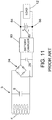
- FIG. 1 is a circuit diagram representing a transmitter 1 and a resonant inductive power receiver 3 that form a resonant system when separated by a distance within a resonant inductive coupling range.
- the transmitter 1 comprises a resonant circuit connected to an AC source 10 (hereinafter "AC source 10"). (As used herein, "connected” means electrically connected.)
- the AC source 10 outputs an alternating current having a voltage V 0 .
- the resonant circuit in the transmitter 1 comprises a transmit coil 2 and a capacitor 6 that tunes the transmit coil 2 to produce a magnetic field B (indicated by the circles in FIG. 1 ) that oscillates at the resonant frequency.
- the resonant inductive power receiver 3 comprises a resonant circuit connected to a load 12 (e.g., a battery charger).
- the resonant circuit in the resonant inductive power receiver 3 comprises a receive coil 4 and a capacitor 8 that tunes the receive coil 4 to the resonant frequency.
- FIG. 2 is a circuit diagram representing a transmitter 1 and a resonant inductive power receiver 3 in a resonant system with relay coils 14a and 14b.
- the relay coil 14a is resonantly inductively coupled to the transmit coil 2; the relay coil 14b is resonantly inductively coupled to the relay coil 14a; and the relay coil 14b is resonantly inductively coupled to the receive coil 4.
- each of the relay coils 14a and 14b is connected to a respective capacitor (not shown) to form respective resonant circuits.
- the relay coil 14a is preferably disposed parallel and proximal to the transmit coil 2, while the relay coil 14b is preferably disposed parallel and proximal to the receive coil 4.
- parallel in the context of coils means that the axes of the coils are mutually parallel.
- relay coils contributes to greater buildup of current in the circuits.
- the alternating current that is driven by voltage V 0 of the AC source 10 passes through the transmit coil 2 and feeds the capacitor 6.
- the capacitor 6 discharges, its current I c1 is added to the source current I s .
- This process is repeated continuously, building up the total current I total .
- the large current induces a similarly large current in the relay coil 14a, which is also connected to a capacitor (not shown in FIG. 2 ).
- the current passing through the relay coil 14a charges its associated capacitor. When this capacitor discharges, its current adds to the current being induced in the relay coil 14a.
- the current going through the relay coil 14a is now equal to the sum of I total plus the extra current from the capacitor to which the relay coil 14a is electrically coupled. This total current induces current in the capacitor that is connected to the relay coil 14b on the receiver side.
- the current going through the relay coil 14b on the receiver side is magnified by additional capacitor current from the capacitor (not shown in FIG. 2 ) to which relay coil 16 is electrically coupled.
- this current induces current on the receive coil 4 which also is magnified over time by the capacitor 8.
- the frequency changes on a schedule known only to the transmitter and receiver.
- a capacitive or inductive element is switched in or out of each circuit at moments of zero-crossing: zero charge on a capacitor or zero current in an inductor.
- switching an inductor on the transmit side is nearly simultaneous with switching a capacitor on the receive side, or switching a capacitor on the transmit side is nearly simultaneous with switching an inductor on the receive side.
- FIG. 3 is a circuit diagram representing some components of a transmitter (left-hand side) and a receiver (right-hand), including a transmit switch for switching an inductor and a receive switch for switching a capacitor to match resonant frequencies of the transmitter and receiver.
- the system includes a resonant inductive power transmitter 1 and a resonant inductive power receiver 3 which are configured to enable encrypted resonant inductive power transfer.
- resonant inductive power transmitter 1 and resonant inductive power receiver 3 include respective switches S1 and S2 for switching complementary elements to match resonant frequencies of the transmitter and receiver.
- the resonant inductive power transmitter 1 includes a transmit coil 2a having an inductance L 1 and a capacitor 6 having a capacitance C 1 which are connected to form a first resonant circuit.
- the resonant inductive power transmitter 1 further includes a coil 2b connected in parallel with the transmit coil 2a and a switch 18 (hereinafter "switch S1") to add or remove the coil 2b in parallel with the transmit coil 2a.
- the coil 2b has an inductance L 2 which may be equal to or different than inductance L 1 .
- the resonant inductive power transmitter 1 also includes circuits, such as an amplifier (not shown in FIG. 3 ), configured to make an oscillator based on the resonant frequency of the first resonant circuit.
- the resonant inductive power receiver 3 includes a receive coil 4 having an inductance L 3 and a first capacitor 8a having a capacitance C 2 which are connected to form a second resonant circuit.
- the resonant inductive power receiver 3 further includes a second capacitor 8b connected in parallel with the first capacitor 8a and a switch 20 (hereinafter "switch S2") to add or remove the second capacitor 8b in parallel with the first capacitor 8a.
- the second capacitor 8b has a capacitance C 3 which may be equal to or different than capacitance C 2 .
- the resonant inductive power receiver 3 also includes circuits, such as a rectifier (not shown in FIG.
- the inductor values and capacitor values of the resonant inductive power receiver 3 are chosen so that: (a) when the switch S2 is closed, the resonant inductive power receiver 3 has the same first resonant frequency as the resonant inductive power transmitter 1 has when the switch S1 is open; and (b) when the switch S2 is open, the resonant inductive power receiver 3 has the same second resonant frequency (different than the first resonant frequency) as the resonant inductive power transmitter 1 has when the switch S1 is closed.
- the resonant inductive power transmitter 1 and the resonant inductive power receiver 3 each have a respective switch controller (not shown in FIG. 3 ) which control the states of the switch S1 and the switch S2 respectively.
- Each switch controller is a processor configured (e.g., programmed) to execute a common switch control program in the form of a digital copy of an agreed-to frequency-change switching sequence stored in a non-transitory tangible computer-readable storage medium or to execute an algorithm from which the frequency-change switching sequence can be determined.
- the switch states (open or closed) determine the resonant frequency of the resonant inductive power transmitter 1 and resonant inductive power receiver 3.
- FIG. 3 shows one embodiment of an encrypted resonant inductive power transfer system in a simplified form.
- the oscillator circuitry (shown later in FIG. 9 ) and the switch controllers are not shown in FIG. 3 . Only the inductive and capacitive elements that determine the resonant frequency of the transmitter and receiver are shown. Closing the switch S1 reduces total inductance of the transmit circuit, which raises the resonant frequency. Opening the switch S2 reduces total capacitance of the receive circuit, which raises the resonant frequency.
- the system designer may make the lower and upper resonant frequencies of the resonant inductive power transmitter 1 match (be equal to) the lower and upper resonant frequencies respectively of the resonant inductive power receiver 3.
- the term "inductor” includes but is not limited to coils. Resonant power transfer works by electromagnetic induction (a.k.a. magnetic induction) from a transmit coil to a receive coil. Electromagnetic induction is the production of an electromotive force (i.e., voltage) across an electrical conductor in a changing magnetic field dB / dt, where B is the magnitude of the magnetic field.
- the transmit coil must produce an external magnetic field; the receive coil must be susceptible to external magnetic fields.
- Some inductors like a choke ring, produce no external field and do not respond to external fields. Those inductors are not suitable for use as inductances L 1 and L 3 .
- Inductance L 2 may also be in the form of a coil and contribute to power transfer; however, it is within scope of the disclosure that inductance L 2 be an inductor with no external field (i.e., not a coil), especially when inductance L 2 is small compared to inductance L 1 .
- the functionality of the circuitry depicted in FIG. 3 will now be described with reference to FIGS. 4-6 .
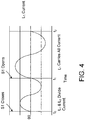
- FIG. 4 is a graph showing the current through the transmit coil 2a (seen in FIG. 3 ) over a time interval during which the state of the switch S1 of the resonant inductive power transmitter 1 changes from closed to open.
- FIG. 4 shows what happens to the current through transmit coil 2a having inductance L 1 as switch S1 transitions from a closed state to an open state.
- the switch S1 is closed, so current is divided between transmit coil 2a having inductance L 1 and coil 2b having inductance L 2 , which for simplicity are assumed herein (for the purpose of illustration only) to have equal inductance values.
- the current is zero; all the charge is stored as positive voltage in capacitor 6 (shown in FIG. 3 ).
- ⁇ LC ⁇ 1 / 2 , where L is the inductance and C is the capacitance, so the angular frequency of the oscillator decreases by a factor of ⁇ 2.
- FIG. 5 is a graph showing the induced electromotive force (EMF) produced by the receive coil 4 (see FIG. 3 ) of the resonant inductive power receiver 3 over the time interval from t 0 to t 1
- FIG. 5 shows the effect of opening of switch S1 on the EMF induced in the receive coil 4.
- the magnitude of the induced EMF is a function of the rate of change of the magnetic flux ⁇ B through the receive coil 4.
- the rate of change of ⁇ B is proportional to both the magnitude of the magnetic field and to the angular frequency ⁇ .
- the relevant magnetic flux is produced by current through the transmit coil 2a (again, assuming for simplicity that second inductor produces no external field).
- the rate of change is proportional to the derivative of the plot in FIG. 5 , so the phase of the EMF leads the current in transmit coil 2a by 90°.
- the frequency of the induced EMF drops by a factor of ⁇ 2. Since the magnitude of the magnetic field cycle increases by the same factor as the frequency decreases, the magnitude of d ⁇ B / dt and therefore of the EMF is unchanged. This is beneficial: the amount of power transferred from transmitter to receiver at any moment is proportional to the product of the EMF and the current in the receive coil 4. Because the EMF remains constant when switch S1 changes state, the power transfer rate remains constant. This minimizes electromagnetic interference and keeps cost low for the transmitter and receiver circuits.
- FIG. 6 is a graph showing the voltage across the capacitor 8a (see FIG. 3 ) in the resonant inductive power receiver 3 over the time interval during which the switch S1 is opened as depicted in FIG. 4 .
- the capacitor 8a is empty.
- the best time to open or close switch S2 is when the capacitors are uncharged, so switch S2 is opened at time t 0 . All the current through receive coil 4 flows into capacitor 8a, so capacitor 8a charges rapidly.
- the resonant inductive power transfer system is able to provide simultaneous changes of resonant frequency in the transmitter and in the receiver, and does so without energy-wasting switching of inductors with non-zero current or of capacitors with non-zero voltage.
- FIG. 7 is a flowchart identifying steps of a method 100 for encrypted resonant inductive power transfer in accordance with one embodiment.
- the process includes the following steps: (a) build the transmitter and receiver with switches and program the respective switch controllers such that switching an inductor on the transmit side is nearly simultaneous with switching a capacitor on the receive side, or switching a capacitor on the transmit side is nearly simultaneous with switching an inductor on the receive side (step 102); (b) exchange information to determine the frequency-change sequence, e.g., a cryptographic key (step 104); (c) power up the transmitter oscillator (step 106); (d) the transmit switch controller begins switching the transmitter frequency in accordance with the frequency-change sequence (step 108); (e) bring the receiver into range of the transmitter (step 110); (f) the receive switch controller detects the presence of the transmitter's oscillating magnetic field (in some embodiments, the receive switch controller looks specifically for the agreed-upon frequencies, with switching between them at times agreeing with the frequency-change sequence) (step
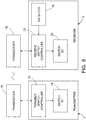
- FIG. 8 is a block diagram identifying some components of an encrypted resonant inductive power transfer system in accordance with one embodiment.
- the system includes a resonant inductive power transmitter 1 and a resonant inductive power receiver 3.
- the resonant inductive power transmitter 1 includes a switch S1 and a transmit switch controller 70 configured to control the state of switch S1.
- the resonant inductive power receiver 3 includes a switch S2 and a receive switch controller 72 configured to control the state of switch S2.
- the time intervals for commanding the switches to change state are determined by a secure method such as public key encryption or one-time pad encryption.
- the transmit switch controller 70 is further configured to send a cryptographic key to a transceiver 74, while the receive switch controller 72 is further configured to receive the cryptographic key from a transceiver 76 following successful transmission and reception of the cryptographic key by the transceivers 74 and 76 respectively.
- the resonant inductive power receiver 3 further includes a detector 78 which detects the presence of the transmitter's oscillating magnetic field.
- the receive switch controller 72 is further configured to receive a signal from the detector 78 indicating the presence of the transmitter's oscillating magnetic field, in response to which the receive switch controller 72 begins switching the receiver frequency in accordance with the frequency-change sequence.
- the systems and methods for encrypted resonant inductive power transfer disclosed herein provide at least the following benefits.
- a resonant circuit oscillates at an angular frequency given by Eq. (1).
- simple resonant circuits have been shown for clarity of explanation.
- a resonant circuit must be incorporated in a harmonic oscillator on the transmit side.
- a resonant circuit must be coupled to a load, such as a rectifier, battery charger or other load.
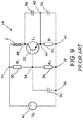
- FIG. 9 is a circuit diagram representing some components of a common-base Colpitts oscillator 28 (hereinafter “oscillator 28") that uses a combination of inductors and capacitors to produce an oscillation at a certain frequency.
- the distinguishing feature of the Colpitts oscillator is that the feedback for the active device is taken from a voltage divider made of two capacitors in series across the inductor.
- the oscillator 28 includes an NPN-type bipolar junction transistor 22 (hereinafter “bipolar junction transistor 22”) with its output connected to its input in a feedback loop containing a parallel resonant circuit (tuned circuit), which resonant circuit functions as a bandpass filter to set the frequency of oscillation.
- bipolar junction transistor 22 another active component such as a field-effect transistor, capable of producing gain at the desired frequency, may be used.
- An NPN transistor comprises two semiconductor junctions that share a thin p-doped region.
- the regions of a bipolar junction transistor are called emitter, base, and collector.
- the base of bipolar junction transistor 22 is connected to a junction 34
- the emitter of bipolar junction transistor 22 is connected to a junction 42
- the collector of bipolar junction transistor 22 is connected to a junction 46.
- the oscillator 28 further includes a resistor 52 having a resistance R 1 , a resistor 54 having a resistance R 2 , and a resistor 56 having a resistance R 3 .
- One terminus of resistor 52 is connected to the junction 44 and the other terminus of resistor 52 is connected to a junction 40.
- One terminus of resistor 54 is connected to the junction 34 and the other terminus of resistor 54 is connected to a junction 38 that is connected to junction 40.
- One terminus of resistor 56 is connected to the junction 34 and the other terminus of resistor 56 is connected to a junction 32..
- the oscillator 28 further includes capacitors 6a and 6b which are connected in series via a junction 42 that is connected to junction 44. One side of capacitor 6b is connected to junction 42 while the other side of capacitor 6b is connected to junction 40. One side of capacitor 6a is connected to junction 42 while the other side of capacitor 6a is connected to junction 46.
- the oscillator 28 further includes a capacitor 6c having one side connected to junction 34 and the other side connected to a junction 36 that is connected to junction 38.
- the oscillator 28 also includes a transmit coil 2 having an inductance L 1 .
- One terminus of transmit coil 2a is connected to the junction 46 and the other terminus of transmit coil 2a is connected to the junction 32.
- the oscillator 28 further includes a voltage source 48 that produces a voltage V s .
- One terminus of voltage source 48 is connected to junction 32; the other terminus of voltage source 48 is connected to junction 36.
- the capacitors 6a, 6b, and 6c have respective capacitances of 100 pF, 100 pF, and 100 nF;
- the oscillation frequency ⁇ is given by Eq. (1), where L is shown as L 1 (150 nH) and C is the series capacitance of capacitors 6a and 6b (50 pF).
- the connection from the junction 42 between capacitors 6a and 6b provides feedback to the amplifying bipolar junction transistor 22, but does not substantially affect the resonant frequency.
- capacitors 6a and 6b act in series, affecting the circuit as a single capacitor.
- the angular frequency ⁇ for this example is about 365 sec -1 and the cyclic frequency is about 58 MHz.
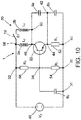
- FIG. 10 is a circuit diagram representing some components of a modified common-base Colpitts oscillator 30 (hereinafter "oscillator 30") in accordance with one proposed implementation.
- the oscillator 30 has been modified to include a coil 2b having one terminus connected to a junction 50.
- the junction 50 is connected to junction 46 and one side of capacitor 6a.
- the oscillator 30 includes a switch S1 that switchably couples the other terminus of coil 2b to the junction 58.
- the coil 2b has an inductance L 2 and is connected in parallel with a transmit coil 2a having an inductance L 1 .
- switch S1 In the closed state, switch S1 adds the coil 2b in parallel with the transmit coil 2a; in the open state, switch S1 disconnects coil 2b from junction 58, thereby removing coil 2b from being parallel with transmit coil 2a.
- switch S1 When switch S1 is open, the resonant frequency is the same as in the oscillator 28 shown in FIG. 9 , about 365 sec -1 .
- this disclosure treats the inductors as independent. In reality, both produce external fields reaching the receiver, so the inductors have some mutual inductance. Persons skilled in the art oscillator design know how to manage mutual inductance, choosing correct inductance values to give the desired frequency shift.
- FIG. 11 is a circuit diagram identifying some components of a battery charging system that includes a resonant inductive power receiver 3 and a rectifier 24 for producing direct current for recharging a battery 62 when an EMF is induced in the receive coil 4.
- This system was disclosed in U.S. Patent Publ. No. 2019/0237999 published on August 1, 2019 .
- This battery charging system may be mounted to a vehicle (such as an aircraft) for receiving power wirelessly from a resonant inductive power transmitter (not shown in FIG. 11 ).
- the battery charging system shown in FIG. 11 includes a receive coil 4 in which an alternating current is induced and a capacitor 8 that is connected to the receive coil 4 for tuning the receive coil 4 to a resonant frequency.
- the system further includes a rectifier 24 that is connected to the receive coil 4 and to the capacitor 8 for converting alternating current from the receive coil 4 and capacitor 8 into direct current.
- a smoothing capacitor 26 is connected to receive direct current from the rectifier 24.
- a battery charger 60 is connected to receive direct current from the rectifier 24.
- the battery 62 has a positive terminal 64 and a negative terminal 66 connected to the battery charger 60.
- the battery charger 60 is configured to charge the battery 62 using direct current produced from alternating current induced in the receive coil 4 and alternating current produced by the capacitor 8.
- the battery charger 60 may comprise a voltage regulator to avoid over-charging the battery 62, a current limiter to ensure that charging does not occur too rapidly, and temperature sensors which indicate to the battery charger 60 when charging should cease because the battery 62 is overheating. As depicted in FIG. 11 , once the battery 62 has been recharged, it can be used to provide direct current to a load 12.
- Switch controllers on the transmitter and on the receiver coordinate the frequency transitions.
- a mutually known string of ones and zeros signals high or low frequency, with transitions taking place at the end of each sinusoid cycle.
- a mutually-known string of ones and zeros signals whether a change takes place or not at the end of each sinusoid signal.
- the string of ones and zeros is generated by a mutually-known random number generator that is seeded with a time-based value, e.g., the GPS time signal expressed in IRIG-B format, which gives a new seed value each second.
- FIG. 3 showed parallel inductors on the transmitter side and parallel capacitors on the receiver side, it is also possible to add parallel capacitors on the transmitter side and parallel inductors on the receiver side, choosing appropriate types of oscillator and receiver.
- a Hartley oscillator can be used, substituting inductors for capacitors and vice versa.
- FIG. 13 is a circuit diagram representing some components of a transmitter (left-hand side) and a receiver (right-hand), including a transmit switch for switching a capacitor and a receive switch for switching an inductor to match resonant frequencies of the transmitter and receiver.
- the system includes a resonant inductive power transmitter 1 and a resonant inductive power receiver 3 which are configured to enable encrypted resonant inductive power transfer.
- resonant inductive power transmitter 1 and resonant inductive power receiver 3 include respective switches S1 and S2 for switching complementary elements to match resonant frequencies of the transmitter and receiver.
- the resonant inductive power transmitter 1 includes a transmit coil 2 having an inductance L 1 and a first capacitor 6a having a capacitance C 1 which are connected to form a first resonant circuit.
- the resonant inductive power transmitter 1 further includes a second capacitor 6b connected in parallel with the capacitor 6a and a switch 18 (hereinafter "switch S1") to add or remove the capacitor 6b in parallel with the capacitor 6a.
- the capacitor 6b has a capacitance C 2 which may be equal to or different than capacitance C 1 .
- the resonant inductive power transmitter 1 also includes circuits, such as an amplifier (not shown in FIG. 13 ), configured to make an oscillator based on the resonant frequency of the first resonant circuit.
- the resonant inductive power receiver 3 includes a receive coil 4a having an inductance L 2 and a capacitor 8 having a capacitance C 3 which are connected to form a second resonant circuit.
- the resonant inductive power receiver 3 further includes a coil 4b connected in parallel with the receive coil 4a and a switch 20 (hereinafter "switch S2") to add or remove the coil 4b in parallel with the receive coil 4a.
- the coil 4b has an inductance L 3 which may be equal to or different than inductance L 2 .
- the resonant inductive power receiver 3 also includes circuits, such as a rectifier (not shown in FIG.
- the inductor values and capacitor values of the resonant inductive power receiver 3 are chosen so that: (a) when the switch S2 is closed, the resonant inductive power receiver 3 has the same first resonant frequency as the resonant inductive power transmitter 1 has when the switch S1 is open; and (b) when the switch S2 is open, the resonant inductive power receiver 3 has the same second resonant frequency (different than the first resonant frequency) as the resonant inductive power transmitter 1 has when the switch S1 is closed.
- the resonant inductive power transmitter 1 and the resonant inductive power receiver 3 each have a respective switch controller (not shown in FIG. 13 ) which control the states of switches S1 and S2 respectively, as previously described with reference to FIG. 3 .
- FIG. 13 shows one embodiment of an encrypted resonant inductive power transfer system in a simplified form.
- the oscillator circuitry and the switch controllers are not shown in FIG. 13 . Only the inductive and capacitive elements that determine the resonant frequency of the transmitter and receiver are shown. Opening the switch S1 reduces total capacitance of the transmit circuit, which raises the resonant frequency. Closing the switch S2 reduces total inductance of the receive circuit, which raises the resonant frequency.
- the system designer may make the lower and upper resonant frequencies of the resonant inductive power transmitter 1 match (be equal to) the lower and upper resonant frequencies respectively of the resonant inductive power receiver 3.
- the encrypted resonant inductive power transfer system may be embodied many ways.
- the transmitter has an inductor and two capacitors, while the receiver has a capacitor and two inductors (see FIG. 13 ).
- the transmitter has a capacitor and two inductors, while the receiver has an inductor and two capacitors (see FIG. 3 ).
- the transmit and receive coils may be electromagnetically coupled via one or more relay coils (see FIG. 2 ).
- a relay coil includes an inductive coil and a capacitor tuned to resonate at the same frequency as the transmitter and the receiver. It has no direct electric connection to either; it is coupled to each by induction. Because it is electrically isolated, the relay coil may have a very high Q-value; therefore, its magnetic field can become very strong, which increases the power being transferred.
- the transmitter may have an inductor and three differently-sized capacitors, which, when switched in various combinations, creates four resonant frequencies.
- the corresponding receiver would have a capacitor and three differently-sized inductors.
- the encryption then specifies a pattern of hopping among the four frequencies.
- the resonant circuit of the resonant inductive power transmitter 1 may be configured as part of an oscillator, wherein the oscillator is selected from the group including Armstrong, Clapp, Colpitts, Hartley, Lampkin, Seiler, and Vacká ⁇ oscillators.
- the resonant circuit of the resonant inductive power receiver 3 is connected to the input of a rectifier, which is in turn to the input of a battery charger (see FIG. 12 ).
- the encrypted resonant inductive power transfer system disclosed herein uses a changing resonant frequency that changes in accordance with a pattern that is known to both the transmitter and the receiver, but is not easily deduced by anyone else.
- the technology disclosed herein (a) transfers power rather than data; (b) works in the electromagnetic near field rather than the far field; and (c) requires synchronous switching of an inductor on one side (e.g., the transmitter) and a capacitor on the other side (e.g., the receiver). This is necessary because the transmitter and receiver are in each other's near field, so energy in the inductor on one side is tightly phase-aligned to energy in the capacitor on the other side.
- Frequency-hopping schemes in radio technology take place in the far field, so tight phase alignment of switching times is not needed (or even possible).
- frequency changes at the receiver and at the transmitter can be independently accomplished by whatever means is convenient: switching an inductor, switching a capacitor, or switching to a different crystal oscillator.
- controller should be construed broadly to encompass a system having at least one computer or processor, and which may have multiple computers or processors.
- computer and “processor” both refer to devices having a processing unit (e.g., a central processing unit) and some form of memory (i.e., computer-readable medium) for storing a program which is readable by the processing unit.
- processing unit e.g., a central processing unit
- memory i.e., computer-readable medium
- controller includes, but is not limited to, a small computer on an integrated circuit containing a processor core, memory and programmable input/output peripherals.
- the disclosure comprises the following items:
Landscapes
- Engineering & Computer Science (AREA)
- Power Engineering (AREA)
- Computer Networks & Wireless Communication (AREA)
- Computer Security & Cryptography (AREA)
- Signal Processing (AREA)
- Near-Field Transmission Systems (AREA)
- Charge And Discharge Circuits For Batteries Or The Like (AREA)
Abstract
Description
- This disclosure generally relates to systems and methods for wireless power transmission. In particular, this disclosure relates to wireless power transmission by means of resonant inductively coupled transmitters and receivers.
- Resonant inductive coupling is the near-field wireless transmission of electrical energy between two coils that are tuned to resonate at the same frequency. Resonant transfer works by making a primary coil ring with an oscillating current, which generates an oscillating magnetic field. A secondary coil in proximity to the primary coil can pick up energy from the oscillating magnetic field. If the primary and secondary coils are resonant at a common frequency, significant power can be transmitted from the primary coil to the secondary coil over a range of a few times the coil diameters at reasonable efficiency.
- The general problem is to wirelessly transmit power from a transmitter to a receiver. A common approach for short-range transmission is resonant inductive power transfer. In this method, the transmitter and receiver both have resonant circuits tuned to the same frequency. For example, resonant inductive power transfer may be used for wireless recharging of batteries onboard aircraft such as unmanned aerial vehicles. Resonant inductive power transfer is also used for consumer electronics and for recharging electric automobiles.
- Ideally, all power sent from the transmitter follows a low-loss path to authorized receivers. This does not happen if unauthorized receivers detect the resonant frequency and tune their receiver to the same frequency. In that case, the unauthorized receivers steal power. This adds cost on the transmit side and reduces the power available to authorized receivers. One solution is to impose physical security so that unauthorized receivers cannot get close enough to the transmitter to receive power. The drawback is this adds inconvenience, delay, and cost to authorized receivers.
- An improved system and method for preventing unauthorized receivers from receiving power while enabling efficient transmission to authorized receivers would be beneficial.
- The subject matter disclosed in some detail below is directed to systems and methods for ensuring that resonant inductive power transfer goes only to authorized users using encryption. Resonant inductive power transfer requires near-identical resonant frequencies in the transmitter and the receiver. In accordance with the embodiments disclosed below, the frequency of the power transfer signal changes on a schedule known only to the transmitter and receiver so a "power eavesdropper" cannot track the frequency well enough to efficiently receive power. To make the frequency transitions energetically efficient, a capacitive or inductive element is switched in or out of each circuit at moments of zero-crossing: zero charge on a capacitor or zero current in an inductor. To maintain phase alignment, either switching an inductor on the transmit side is nearly simultaneous with switching a capacitor on the receive side, or switching a capacitor on the transmit side is nearly simultaneous with switching an inductor on the receive side.
- Although various embodiments of systems and methods for encrypted resonant inductive power transfer are described in some detail later herein, one or more of those embodiments may be characterized by one or more of the following aspects.
- One aspect of the subject matter disclosed in detail below is a method for transferring power from a resonant inductive power transmitter to a resonant inductive power receiver, the method comprising: (a) placing the resonant inductive power receiver within an electromagnetic coupling range of the resonant inductive power transmitter; (b) using the resonant inductive power transmitter to generate a first oscillating electromagnetic field having a first frequency during a first time interval; (c) producing a first oscillating electromotive force in the resonant inductive power receiver having the first frequency during the first time interval by resonant electromagnetic induction; (d) using the resonant inductive power transmitter to generate a second oscillating electromagnetic field having a second frequency different than the first frequency during a second time interval subsequent to the first time interval; and (e) producing a second oscillating electromotive force in the resonant inductive power receiver having the second frequency during the second time interval by resonant electromagnetic induction.
- In accordance with some embodiments of the method described in the immediately preceding paragraph, the method further comprises: (f) configuring the resonant inductive power transmitter to generate the first oscillating electromagnetic field by opening a first switch in the resonant inductive power transmitter prior to step (b); (g) configuring the resonant inductive power receiver to produce the first oscillating electromotive force by closing a second switch in the resonant inductive power receiver prior to step (c); (h) configuring the resonant inductive power transmitter to generate the second oscillating electromagnetic field by closing the first switch prior to step (d); and (i) configuring the resonant inductive power receiver to produce the second oscillating electromotive force by opening the second switch prior to step (e). The states of the first and second switches and the first and second time intervals are dictated by a frequency-change switching sequence. The method further comprises sending information in encrypted form from the resonant inductive power transmitter to the resonant inductive power receiver, which information includes the frequency-change switching sequence.
- Another aspect of the subject matter disclosed herein is a resonant inductive power transfer system comprising a resonant inductive power transmitter and a resonant inductive power receiver which have synchronous switching states for enabling resonant inductive power transfer in accordance with a frequency-change switching sequence. The resonant inductive power transmitter comprises: a voltage source; a first inductor and a first capacitor which are connected to form a first resonant circuit that is supplied with a voltage by the voltage source; a first switch and a second inductor which are connected in parallel with the first inductor when the first switch is closed; and a transmit switch controller configured to control a state of the first switch in accordance with a frequency-change switching sequence. The resonant inductive power receiver comprises: a third inductor and a second capacitor which are connected to form a second resonant circuit; a second switch and a second capacitor which are connected in parallel with the first capacitor when the second switch is closed; and a receive switch controller configured to control a state of the second switch in accordance with the frequency-change switching sequence. Respective resonant frequencies of the first and second resonant circuits equal a first resonant frequency when the first switch is closed and the second switch is open and equal a second resonant frequency different than the first resonant frequency when the first switch is open and the second switch is closed.
- A further aspect of the subject matter disclosed herein is a resonant inductive power transfer system wherein the resonant inductive power transmitter comprises: a voltage source; a first inductor and a first capacitor which are connected to form a first resonant circuit that is supplied with a voltage by the voltage source; a first switch and a second capacitor which are connected in parallel with the first capacitor when the first switch is closed; and a transmit switch controller configured to control a state of the first switch in accordance with a frequency-change switching sequence. Conversely, the resonant inductive power receiver comprises: a second inductor and a third capacitor which are connected to form a second resonant circuit; a second switch and a third inductor which are connected in parallel with the second inductor when the second switch is closed; and a receive switch controller configured to control a state of the second switch in accordance with the frequency-change switching sequence.
- Other aspects of systems and methods for encrypted resonant inductive power transfer are disclosed below.
- The features, functions and advantages discussed in the preceding section may be achieved independently in various embodiments or may be combined in yet other embodiments. Various embodiments will be hereinafter described with reference to drawings for the purpose of illustrating the above-described and other aspects. None of the diagrams briefly described in this section are drawn to scale.
-
FIG. 1 is a circuit diagram representing some components of a transmitter and a receiver in a resonant system. -
FIG. 2 is a circuit diagram representing some components of a transmitter and a receiver in a resonant system with relay coils. -
FIG. 3 is a circuit diagram representing some components of a transmitter (left-hand side) and a receiver (right-hand), including a transmit switch for switching an inductor and a receive switch for switching a capacitor to match resonant frequencies of the transmitter and receiver. -
FIG. 4 is a graph showing the current through the transmit coil (seen inFIG. 3 ) over a time interval during which the state of the switch S1 of the transmitter changes from closed to open. -
FIG. 5 is a graph showing the induced electromotive force (EMF) produced by the receive coil of the receiver over the time interval during which the state of the switch S1 changes from closed to open as depicted inFIG. 4 . -
FIG. 6 is a graph showing the voltage across the capacitor C2 in the receiver over the time interval during which the state of the switch S1 of the transmitter changes from closed to open as depicted inFIG. 4 . -
FIG. 7 is a flowchart identifying steps of amethod 100 for encrypted resonant inductive power transfer. -
FIG. 8 is a block diagram identifying some components of an encrypted resonant inductive power transfer system in accordance with one embodiment. -
FIG. 9 is a circuit diagram representing some components of a common-base Colpitts oscillator consisting of an NPN-type bipolar junction transistor with its output connected to its input in a feedback loop containing a parallel resonant circuit (tuned circuit), which functions as a bandpass filter to set the frequency of oscillation. -
FIG. 10 is a circuit diagram representing some components of a common-base Colpitts oscillator which has been modified to include a second inductor having an inductance L 2 connected in parallel with a first inductor having an inductance L 1 and a switch S1 to add or remove the second inductor in parallel with the first inductor in accordance with one embodiment. -
FIG. 11 is a circuit diagram identifying some components of a battery charging system that includes a resonant inductive power receiver and a rectifier for producing direct current for recharging a battery when an EMF is induced in the receive coil of resonant inductive power receiver. -
FIG. 12 is a circuit diagram identifying some components of a battery charging system which has been modified to include a second capacitor having a capacitance C 3 connected in parallel with a first capacitor having a capacitance C 2 and a switch S2 to add or remove the second capacitor in parallel with the first capacitor in accordance with one embodiment. -
FIG. 13 is a circuit diagram representing some components of a transmitter (left-hand side) and a receiver (right-hand), including a transmit switch for switching a capacitor and a receive switch for switching an inductor to match resonant frequencies of the transmitter and receiver. - Reference will hereinafter be made to the drawings in which similar elements in different drawings bear the same reference numerals.
- For the purpose of illustration, systems and methods for encrypted resonant inductive power transfer will now be described in detail. However, not all features of an actual implementation are described in this specification. A person skilled in the art will appreciate that in the development of any such embodiment, numerous implementation-specific decisions must be made to achieve the developer's specific goals, such as compliance with system-related and business-related constraints, which will vary from one implementation to another. Moreover, it will be appreciated that such a development effort might be complex and time-consuming, but would nevertheless be a routine undertaking for those of ordinary skill in the art having the benefit of this disclosure.
- Resonant inductive coupling is the near-field wireless transmission of electrical energy between two coils that are tuned to resonate at the same frequency. Resonant transfer works by making a primary coil (referred to above and below as the "transmit coil") ring with an oscillating current, which generates an oscillating magnetic field. A secondary coil (referred to above and below as the "receive coil") in proximity to the primary coil can pick up energy from the oscillating magnetic field. If the primary and secondary coils are resonant at a common frequency, significant power can be transmitted at reasonable efficiency from the primary coil to the secondary coil over a range of about one quarter wavelength, where wavelength is the speed of light divided by the frequency of the oscillating current. Resonant inductive coupling requires both a resonant frequency match and an orientation match between the transmitter and receiver (i.e., the transmitting and receiving resonant circuits) for significant power transmission to occur. Specifically, the transmit coil and the receive coil are preferably oriented so that the magnetic dipole field passing through the receive coil from the transmit coil is oriented within about 45 degrees of parallel to the receive coil.
-
FIG. 1 is a circuit diagram representing atransmitter 1 and a resonantinductive power receiver 3 that form a resonant system when separated by a distance within a resonant inductive coupling range. Thetransmitter 1 comprises a resonant circuit connected to an AC source 10 (hereinafter "AC source 10"). (As used herein, "connected" means electrically connected.) TheAC source 10 outputs an alternating current having a voltage V 0. The resonant circuit in thetransmitter 1 comprises a transmitcoil 2 and acapacitor 6 that tunes the transmitcoil 2 to produce a magnetic field B (indicated by the circles inFIG. 1 ) that oscillates at the resonant frequency. The transmitcoil 2 receives a current I total which is the sum of the current I s from theAC source 10 and the current I c1 from the capacitor 6 (i.e., I s + I c1 = I total). The resonantinductive power receiver 3 comprises a resonant circuit connected to a load 12 (e.g., a battery charger). The resonant circuit in the resonantinductive power receiver 3 comprises a receivecoil 4 and acapacitor 8 that tunes the receivecoil 4 to the resonant frequency. During resonant inductive coupling, theload 12 receives a current I load which is the sum of the current I total induced in the receivecoil 4 and the current I c2 from the capacitor 6 (i.e., I total + I c2 = I load). - In accordance with some of the embodiments disclosed herein, "relay" coils may be used with the receiving and transmit coils to amplify the amount of power transferred.
FIG. 2 is a circuit diagram representing atransmitter 1 and a resonantinductive power receiver 3 in a resonant system withrelay coils relay coil 14a is resonantly inductively coupled to the transmitcoil 2; therelay coil 14b is resonantly inductively coupled to therelay coil 14a; and therelay coil 14b is resonantly inductively coupled to the receivecoil 4. Although not shown inFIG. 2 ), each of the relay coils 14a and 14b is connected to a respective capacitor (not shown) to form respective resonant circuits. Therelay coil 14a is preferably disposed parallel and proximal to the transmitcoil 2, while therelay coil 14b is preferably disposed parallel and proximal to the receivecoil 4. (As used herein, the term "parallel" in the context of coils means that the axes of the coils are mutually parallel.) - The addition of relay coils contributes to greater buildup of current in the circuits. Specifically, the alternating current that is driven by voltage V 0 of the
AC source 10 passes through the transmitcoil 2 and feeds thecapacitor 6. When thecapacitor 6 discharges, its current I c1 is added to the source current I s. This process is repeated continuously, building up the total current I total. The large current induces a similarly large current in therelay coil 14a, which is also connected to a capacitor (not shown inFIG. 2 ). The current passing through therelay coil 14a charges its associated capacitor. When this capacitor discharges, its current adds to the current being induced in therelay coil 14a. The current going through therelay coil 14a is now equal to the sum of I total plus the extra current from the capacitor to which therelay coil 14a is electrically coupled. This total current induces current in the capacitor that is connected to therelay coil 14b on the receiver side. Through a similar process as previously described, the current going through therelay coil 14b on the receiver side is magnified by additional capacitor current from the capacitor (not shown inFIG. 2 ) to which relay coil 16 is electrically coupled. Finally, this current induces current on the receivecoil 4 which also is magnified over time by thecapacitor 8. Through the process described, the current induced in receivecoil 4 is much greater than when relay coils 14a and 14b are not used and thus total power transferred is also greater (P = IV). - Systems and methods for encrypted resonant inductive power transfer will now be described in some detail. In the embodiments disclosed below, the frequency changes on a schedule known only to the transmitter and receiver. To make the frequency transitions energetically efficient, a capacitive or inductive element is switched in or out of each circuit at moments of zero-crossing: zero charge on a capacitor or zero current in an inductor. To maintain phase alignment, either switching an inductor on the transmit side is nearly simultaneous with switching a capacitor on the receive side, or switching a capacitor on the transmit side is nearly simultaneous with switching an inductor on the receive side.
-
FIG. 3 is a circuit diagram representing some components of a transmitter (left-hand side) and a receiver (right-hand), including a transmit switch for switching an inductor and a receive switch for switching a capacitor to match resonant frequencies of the transmitter and receiver. The system includes a resonantinductive power transmitter 1 and a resonantinductive power receiver 3 which are configured to enable encrypted resonant inductive power transfer. In particular, resonantinductive power transmitter 1 and resonantinductive power receiver 3 include respective switches S1 and S2 for switching complementary elements to match resonant frequencies of the transmitter and receiver. - In accordance with the embodiment depicted in
FIG. 3 , the resonantinductive power transmitter 1 includes a transmitcoil 2a having an inductance L 1 and acapacitor 6 having a capacitance C 1 which are connected to form a first resonant circuit. The resonantinductive power transmitter 1 further includes acoil 2b connected in parallel with the transmitcoil 2a and a switch 18 (hereinafter "switch S1") to add or remove thecoil 2b in parallel with the transmitcoil 2a. Thecoil 2b has an inductance L 2 which may be equal to or different than inductance L 1. The resonantinductive power transmitter 1 also includes circuits, such as an amplifier (not shown inFIG. 3 ), configured to make an oscillator based on the resonant frequency of the first resonant circuit. - In accordance with the embodiment depicted in
FIG. 3 , the resonantinductive power receiver 3 includes a receivecoil 4 having an inductance L 3 and afirst capacitor 8a having a capacitance C 2 which are connected to form a second resonant circuit. The resonantinductive power receiver 3 further includes asecond capacitor 8b connected in parallel with thefirst capacitor 8a and a switch 20 (hereinafter "switch S2") to add or remove thesecond capacitor 8b in parallel with thefirst capacitor 8a. Thesecond capacitor 8b has a capacitance C 3 which may be equal to or different than capacitance C 2. The resonantinductive power receiver 3 also includes circuits, such as a rectifier (not shown inFIG. 3 ), configured to extract power from the resonantinductive power receiver 3 and deliver it to a useful load. The inductor values and capacitor values of the resonantinductive power receiver 3 are chosen so that: (a) when the switch S2 is closed, the resonantinductive power receiver 3 has the same first resonant frequency as the resonantinductive power transmitter 1 has when the switch S1 is open; and (b) when the switch S2 is open, the resonantinductive power receiver 3 has the same second resonant frequency (different than the first resonant frequency) as the resonantinductive power transmitter 1 has when the switch S1 is closed. The resonantinductive power transmitter 1 and the resonantinductive power receiver 3 each have a respective switch controller (not shown inFIG. 3 ) which control the states of the switch S1 and the switch S2 respectively. Each switch controller is a processor configured (e.g., programmed) to execute a common switch control program in the form of a digital copy of an agreed-to frequency-change switching sequence stored in a non-transitory tangible computer-readable storage medium or to execute an algorithm from which the frequency-change switching sequence can be determined. The switch states (open or closed) determine the resonant frequency of the resonantinductive power transmitter 1 and resonantinductive power receiver 3. As long as the switching sequence is known only to transmit and receive switch controllers of the resonantinductive power transmitter 1 and resonantinductive power receiver 3, unauthorized receivers cannot steal power from the system because unauthorized receivers cannot efficiently follow the changing (switched) resonant frequencies. -
FIG. 3 shows one embodiment of an encrypted resonant inductive power transfer system in a simplified form. The oscillator circuitry (shown later inFIG. 9 ) and the switch controllers are not shown inFIG. 3 . Only the inductive and capacitive elements that determine the resonant frequency of the transmitter and receiver are shown. Closing the switch S1 reduces total inductance of the transmit circuit, which raises the resonant frequency. Opening the switch S2 reduces total capacitance of the receive circuit, which raises the resonant frequency. By properly choosing the inductance and capacitance values, the system designer may make the lower and upper resonant frequencies of the resonantinductive power transmitter 1 match (be equal to) the lower and upper resonant frequencies respectively of the resonantinductive power receiver 3. - As used herein, the term "inductor" includes but is not limited to coils. Resonant power transfer works by electromagnetic induction (a.k.a. magnetic induction) from a transmit coil to a receive coil. Electromagnetic induction is the production of an electromotive force (i.e., voltage) across an electrical conductor in a changing magnetic field dB/dt, where B is the magnitude of the magnetic field. The transmit coil must produce an external magnetic field; the receive coil must be susceptible to external magnetic fields. Some inductors, like a choke ring, produce no external field and do not respond to external fields. Those inductors are not suitable for use as inductances L 1 and L 3. Inductance L 2 may also be in the form of a coil and contribute to power transfer; however, it is within scope of the disclosure that inductance L 2 be an inductor with no external field (i.e., not a coil), especially when inductance L 2 is small compared to inductance L 1. The functionality of the circuitry depicted in
FIG. 3 will now be described with reference toFIGS. 4-6 . -
FIG. 4 is a graph showing the current through the transmitcoil 2a (seen inFIG. 3 ) over a time interval during which the state of the switch S1 of the resonantinductive power transmitter 1 changes from closed to open.FIG. 4 shows what happens to the current through transmitcoil 2a having inductance L 1 as switch S1 transitions from a closed state to an open state. At time t 0, the switch S1 is closed, so current is divided between transmitcoil 2a having inductance L 1 andcoil 2b having inductance L 2, which for simplicity are assumed herein (for the purpose of illustration only) to have equal inductance values. At time t 0, the current is zero; all the charge is stored as positive voltage in capacitor 6 (shown inFIG. 3 ). In the first half cycle (the full cycle being from time t0 to time t 1), current flows from capacitor 6 (having capacitance C 1) through the transmitcoil 2a and coil untilcapacitor 6 is fully charged negative. In the second half cycle, the current reverses. Throughout the interval from time t 0 to time t 1, the resonantinductive power transmitter 1 has twice as much current (again assuming that L 1 = L 2) as shown in the plot ofFIG. 4 because the two inductors divide the current. Assuming for simplicity that the inductance L 2 produces no external magnetic field, the resonantinductive power transmitter 1 produces an external magnetic field proportional to the current shown. - At time t 1, the switch S1 is opened. Current flowing from capacitor 6 (see
FIG. 3 ) now goes only through the transmitcoil 2a. Since energy E in an inductor is given by the equation E = ½LI 2, where L is inductance and I is current. Since the energy in the transmit circuit at time t 1 is the same as the energy in the transmit circuit at time t 0 (assuming steady-state power transfer), the peak current through transmitcoil 2a (seeFIG. 3 ) is greater than in the first cycle by a factor of the square root of 2 (√2). Also, the circuit inductance is now twice as high. In addition, the angular frequency of an LC oscillator is given by the following equation:
-
FIG. 5 is a graph showing the induced electromotive force (EMF) produced by the receive coil 4 (seeFIG. 3 ) of the resonantinductive power receiver 3 over the time interval from t 0 to t 1FIG. 5 shows the effect of opening of switch S1 on the EMF induced in the receivecoil 4. The magnitude of the induced EMF is a function of the rate of change of the magnetic flux Φ B through the receivecoil 4. The rate of change of Φ B is proportional to both the magnitude of the magnetic field and to the angular frequency ω. The relevant magnetic flux is produced by current through the transmitcoil 2a (again, assuming for simplicity that second inductor produces no external field). The rate of change is proportional to the derivative of the plot inFIG. 5 , so the phase of the EMF leads the current in transmitcoil 2a by 90°. - After time t 1, the frequency of the induced EMF drops by a factor of √2. Since the magnitude of the magnetic field cycle increases by the same factor as the frequency decreases, the magnitude of dΦB /dt and therefore of the EMF is unchanged. This is beneficial: the amount of power transferred from transmitter to receiver at any moment is proportional to the product of the EMF and the current in the receive
coil 4. Because the EMF remains constant when switch S1 changes state, the power transfer rate remains constant. This minimizes electromagnetic interference and keeps cost low for the transmitter and receiver circuits. -
FIG. 6 is a graph showing the voltage across thecapacitor 8a (seeFIG. 3 ) in the resonantinductive power receiver 3 over the time interval during which the switch S1 is opened as depicted inFIG. 4 . At time t 0, thecapacitor 8a is empty. To avoid "stranding" energy in incapacitor 8b, the best time to open or close switch S2 is when the capacitors are uncharged, so switch S2 is opened at time t 0. All the current through receivecoil 4 flows intocapacitor 8a, socapacitor 8a charges rapidly. After one cycle, switch S2 is closed at time t 1, bringingcapacitor 8b into the circuit and reducing the resonant frequency by a factor of √2 (assuming for simplicity that the capacitances C 2 and C 3 ofcapacitors capacitor 8a in the second cycle is lower than the peak voltage in the first cycle by a factor of √2. - By switching inductors in the transmitter and capacitors in the receiver, the resonant inductive power transfer system is able to provide simultaneous changes of resonant frequency in the transmitter and in the receiver, and does so without energy-wasting switching of inductors with non-zero current or of capacitors with non-zero voltage.
-
FIG. 7 is a flowchart identifying steps of amethod 100 for encrypted resonant inductive power transfer in accordance with one embodiment. The process includes the following steps: (a) build the transmitter and receiver with switches and program the respective switch controllers such that switching an inductor on the transmit side is nearly simultaneous with switching a capacitor on the receive side, or switching a capacitor on the transmit side is nearly simultaneous with switching an inductor on the receive side (step 102); (b) exchange information to determine the frequency-change sequence, e.g., a cryptographic key (step 104); (c) power up the transmitter oscillator (step 106); (d) the transmit switch controller begins switching the transmitter frequency in accordance with the frequency-change sequence (step 108); (e) bring the receiver into range of the transmitter (step 110); (f) the receive switch controller detects the presence of the transmitter's oscillating magnetic field (in some embodiments, the receive switch controller looks specifically for the agreed-upon frequencies, with switching between them at times agreeing with the frequency-change sequence) (step 112); (g) the receive switch controller begins switching the receiver frequency in accordance with the frequency-change sequence (step 114); and (h) assuming there is an electrical load attached to the receiver, that load begins receiving power after a few cycles (step 116). -
FIG. 8 is a block diagram identifying some components of an encrypted resonant inductive power transfer system in accordance with one embodiment. The system includes a resonantinductive power transmitter 1 and a resonantinductive power receiver 3. The resonantinductive power transmitter 1 includes a switch S1 and a transmitswitch controller 70 configured to control the state of switch S1. The resonantinductive power receiver 3 includes a switch S2 and a receiveswitch controller 72 configured to control the state of switch S2. - The time intervals for commanding the switches to change state are determined by a secure method such as public key encryption or one-time pad encryption. The transmit
switch controller 70 is further configured to send a cryptographic key to atransceiver 74, while the receiveswitch controller 72 is further configured to receive the cryptographic key from atransceiver 76 following successful transmission and reception of the cryptographic key by thetransceivers inductive power receiver 3 further includes adetector 78 which detects the presence of the transmitter's oscillating magnetic field. The receiveswitch controller 72 is further configured to receive a signal from thedetector 78 indicating the presence of the transmitter's oscillating magnetic field, in response to which the receiveswitch controller 72 begins switching the receiver frequency in accordance with the frequency-change sequence. - The systems and methods for encrypted resonant inductive power transfer disclosed herein provide at least the following benefits. First, compared to transmitting openly, encrypted resonant inductive power transfer provides reliable protection against energy loss, which improves the economic effectiveness of resonant energy transfer. (The level of protection depends on the type of encryption chosen, just as for digital information.) Second, compared to physical security, such as human guards or cipher-locked doors, the systems and methods disclosed herein are far easier and cheaper to use, thereby improving economics of resonant power transfer.
- It is well known that a resonant circuit oscillates at an angular frequency given by Eq. (1). In the description provided above, simple resonant circuits have been shown for clarity of explanation. In actual use, a resonant circuit must be incorporated in a harmonic oscillator on the transmit side. On the receive side, a resonant circuit must be coupled to a load, such as a rectifier, battery charger or other load.
-
FIG. 9 is a circuit diagram representing some components of a common-base Colpitts oscillator 28 (hereinafter "oscillator 28") that uses a combination of inductors and capacitors to produce an oscillation at a certain frequency. The distinguishing feature of the Colpitts oscillator is that the feedback for the active device is taken from a voltage divider made of two capacitors in series across the inductor. Theoscillator 28 includes an NPN-type bipolar junction transistor 22 (hereinafter "bipolar junction transistor 22") with its output connected to its input in a feedback loop containing a parallel resonant circuit (tuned circuit), which resonant circuit functions as a bandpass filter to set the frequency of oscillation. Instead of a bipolar junction transistor, another active component such as a field-effect transistor, capable of producing gain at the desired frequency, may be used. - An NPN transistor comprises two semiconductor junctions that share a thin p-doped region. The regions of a bipolar junction transistor are called emitter, base, and collector. As seen in
FIG. 9 , the base ofbipolar junction transistor 22 is connected to ajunction 34, the emitter ofbipolar junction transistor 22 is connected to ajunction 42, and the collector ofbipolar junction transistor 22 is connected to ajunction 46. - The
oscillator 28 further includes aresistor 52 having a resistance R 1 , aresistor 54 having a resistance R 2, and aresistor 56 having a resistance R 3. One terminus ofresistor 52 is connected to thejunction 44 and the other terminus ofresistor 52 is connected to ajunction 40. One terminus ofresistor 54 is connected to thejunction 34 and the other terminus ofresistor 54 is connected to ajunction 38 that is connected tojunction 40. One terminus ofresistor 56 is connected to thejunction 34 and the other terminus ofresistor 56 is connected to ajunction 32.. - The
oscillator 28 further includescapacitors junction 42 that is connected tojunction 44. One side ofcapacitor 6b is connected tojunction 42 while the other side ofcapacitor 6b is connected tojunction 40. One side ofcapacitor 6a is connected tojunction 42 while the other side ofcapacitor 6a is connected tojunction 46. Theoscillator 28 further includes acapacitor 6c having one side connected tojunction 34 and the other side connected to ajunction 36 that is connected tojunction 38. - The
oscillator 28 also includes a transmitcoil 2 having an inductance L 1. One terminus of transmitcoil 2a is connected to thejunction 46 and the other terminus of transmitcoil 2a is connected to thejunction 32. - The
oscillator 28 further includes avoltage source 48 that produces a voltage V s. One terminus ofvoltage source 48 is connected tojunction 32; the other terminus ofvoltage source 48 is connected tojunction 36. - In accordance with one proposed implementation: (a) the
capacitors resistors coil 2 has an inductance L 1 = 150 nH; and (d)voltage source 48 produces a voltage V s = 6 V. Using these values, the oscillation frequency ω is given by Eq. (1), where L is shown as L 1 (150 nH) and C is the series capacitance ofcapacitors junction 42 betweencapacitors bipolar junction transistor 22, but does not substantially affect the resonant frequency. Thus,capacitors -
FIG. 10 is a circuit diagram representing some components of a modified common-base Colpitts oscillator 30 (hereinafter "oscillator 30") in accordance with one proposed implementation. In contrast to theoscillator 28 depicted inFIG. 9 , theoscillator 30 has been modified to include acoil 2b having one terminus connected to ajunction 50. Thejunction 50 is connected tojunction 46 and one side ofcapacitor 6a. In addition, theoscillator 30 includes a switch S1 that switchably couples the other terminus ofcoil 2b to thejunction 58. Thecoil 2b has an inductance L 2 and is connected in parallel with a transmitcoil 2a having an inductance L 1. In the closed state, switch S1 adds thecoil 2b in parallel with the transmitcoil 2a; in the open state, switch S1 disconnectscoil 2b fromjunction 58, thereby removingcoil 2b from being parallel with transmitcoil 2a. Assume that L 1 = L 2 = 150 nH. When switch S1 is open, the resonant frequency is the same as in theoscillator 28 shown inFIG. 9 , about 365 sec-1. When switch S1 is closed, total inductance drops by half to 75 nH, and the resonant angular frequency rises by a factor of √2 to ω = 516 sec-1. (For simplicity, this disclosure treats the inductors as independent. In reality, both produce external fields reaching the receiver, so the inductors have some mutual inductance. Persons skilled in the art oscillator design know how to manage mutual inductance, choosing correct inductance values to give the desired frequency shift.) - Given the example depicted in
FIG. 10 , persons skilled in the art should be able to implement a transmitter suitable for enabling encrypted resonant inductive power transfer using any of several types of LC oscillator: Hartley, Clapp, etc. One innovative aspect is providing an inductor or a capacitor in parallel to an existing inductor or capacitor, connected via a switch, so that the oscillator frequency changes between two known values when the switch changes state. -
FIG. 11 is a circuit diagram identifying some components of a battery charging system that includes a resonantinductive power receiver 3 and arectifier 24 for producing direct current for recharging abattery 62 when an EMF is induced in the receivecoil 4. This system was disclosed in U.S. Patent Publ. No.2019/0237999 published on August 1, 2019 . This battery charging system may be mounted to a vehicle (such as an aircraft) for receiving power wirelessly from a resonant inductive power transmitter (not shown inFIG. 11 ). The battery charging system shown inFIG. 11 includes a receivecoil 4 in which an alternating current is induced and acapacitor 8 that is connected to the receivecoil 4 for tuning the receivecoil 4 to a resonant frequency. The system further includes arectifier 24 that is connected to the receivecoil 4 and to thecapacitor 8 for converting alternating current from the receivecoil 4 andcapacitor 8 into direct current. A smoothingcapacitor 26 is connected to receive direct current from therectifier 24. Abattery charger 60 is connected to receive direct current from therectifier 24. Thebattery 62 has apositive terminal 64 and anegative terminal 66 connected to thebattery charger 60. Thebattery charger 60 is configured to charge thebattery 62 using direct current produced from alternating current induced in the receivecoil 4 and alternating current produced by thecapacitor 8. More specifically, thebattery charger 60 may comprise a voltage regulator to avoid over-charging thebattery 62, a current limiter to ensure that charging does not occur too rapidly, and temperature sensors which indicate to thebattery charger 60 when charging should cease because thebattery 62 is overheating. As depicted inFIG. 11 , once thebattery 62 has been recharged, it can be used to provide direct current to aload 12. -
FIG. 12 is a circuit diagram identifying some components of an encrypted battery charging system having a resonantinductive power receiver 3 which has been modified to include asecond capacitor 8b having a capacitance C 3 connected in parallel with afirst capacitor 8a having a capacitance C 2 (as seen inFIG. 3 ) and a switch S2 to add or remove thesecond capacitor 8b in parallel with thefirst capacitor 8a in accordance with one embodiment. More specifically, thesecond capacitor 8b is in parallel with thefirst capacitor 8a when switch S2 is closed. Assume that C 2 = C 3 = 100 pF. When switch S1 is open, the resonant frequency is the same as in the resonantinductive power receiver 3 shown inFIG. 11 . When the state of switch S2 changes from open to closed, total capacitance doubles and the resonant angular frequency drops by a factor of √2. - Combining a resonant
inductive power transmitter 1 in the form ofoscillator 30 depicted inFIG. 10 and the resonantinductive power receiver 3 depicted inFIG. 12 into a working system, whenever the transmit switch controller 70 (seeFIG. 8 ) closes switch S1 to raise the resonant frequency of the resonantinductive power transmitter 1, the receiveswitch controller 72 opens switch S2 to raise the resonant frequency of the resonantinductive power receiver 3. Conversely, whenever the transmitswitch controller 70 opens switch S1, the receiveswitch controller 72 closes switch S2. - Switch controllers on the transmitter and on the receiver coordinate the frequency transitions. In some embodiments, a mutually known string of ones and zeros signals high or low frequency, with transitions taking place at the end of each sinusoid cycle. In some embodiments, a mutually-known string of ones and zeros signals whether a change takes place or not at the end of each sinusoid signal. In some embodiments, the string of ones and zeros is generated by a mutually-known random number generator that is seeded with a time-based value, e.g., the GPS time signal expressed in IRIG-B format, which gives a new seed value each second.
- Although
FIG. 3 showed parallel inductors on the transmitter side and parallel capacitors on the receiver side, it is also possible to add parallel capacitors on the transmitter side and parallel inductors on the receiver side, choosing appropriate types of oscillator and receiver. For example, instead of the Colpitts oscillator used inFIG. 10 , a Hartley oscillator can be used, substituting inductors for capacitors and vice versa. These alternate embodiments are in scope of the disclosure, providing two frequencies that the transmitter can switch between and that the receiver can switch between, where the same pair of frequencies are used. -
FIG. 13 is a circuit diagram representing some components of a transmitter (left-hand side) and a receiver (right-hand), including a transmit switch for switching a capacitor and a receive switch for switching an inductor to match resonant frequencies of the transmitter and receiver. The system includes a resonantinductive power transmitter 1 and a resonantinductive power receiver 3 which are configured to enable encrypted resonant inductive power transfer. In particular, resonantinductive power transmitter 1 and resonantinductive power receiver 3 include respective switches S1 and S2 for switching complementary elements to match resonant frequencies of the transmitter and receiver. - In accordance with the embodiment depicted in
FIG. 13 , the resonantinductive power transmitter 1 includes a transmitcoil 2 having an inductance L 1 and afirst capacitor 6a having a capacitance C 1 which are connected to form a first resonant circuit. The resonantinductive power transmitter 1 further includes asecond capacitor 6b connected in parallel with thecapacitor 6a and a switch 18 (hereinafter "switch S1") to add or remove thecapacitor 6b in parallel with thecapacitor 6a. Thecapacitor 6b has a capacitance C 2 which may be equal to or different than capacitance C 1. The resonantinductive power transmitter 1 also includes circuits, such as an amplifier (not shown inFIG. 13 ), configured to make an oscillator based on the resonant frequency of the first resonant circuit. - In accordance with the embodiment depicted in
FIG. 13 , the resonantinductive power receiver 3 includes a receivecoil 4a having an inductance L 2 and acapacitor 8 having a capacitance C 3 which are connected to form a second resonant circuit. The resonantinductive power receiver 3 further includes acoil 4b connected in parallel with the receivecoil 4a and a switch 20 (hereinafter "switch S2") to add or remove thecoil 4b in parallel with the receivecoil 4a. Thecoil 4b has an inductance L 3 which may be equal to or different than inductance L 2. The resonantinductive power receiver 3 also includes circuits, such as a rectifier (not shown inFIG. 13 ), configured to extract power from the resonantinductive power receiver 3 and deliver it to a useful load. The inductor values and capacitor values of the resonantinductive power receiver 3 are chosen so that: (a) when the switch S2 is closed, the resonantinductive power receiver 3 has the same first resonant frequency as the resonantinductive power transmitter 1 has when the switch S1 is open; and (b) when the switch S2 is open, the resonantinductive power receiver 3 has the same second resonant frequency (different than the first resonant frequency) as the resonantinductive power transmitter 1 has when the switch S1 is closed. The resonantinductive power transmitter 1 and the resonantinductive power receiver 3 each have a respective switch controller (not shown inFIG. 13 ) which control the states of switches S1 and S2 respectively, as previously described with reference toFIG. 3 . -
FIG. 13 shows one embodiment of an encrypted resonant inductive power transfer system in a simplified form. The oscillator circuitry and the switch controllers are not shown inFIG. 13 . Only the inductive and capacitive elements that determine the resonant frequency of the transmitter and receiver are shown. Opening the switch S1 reduces total capacitance of the transmit circuit, which raises the resonant frequency. Closing the switch S2 reduces total inductance of the receive circuit, which raises the resonant frequency. By properly choosing the inductance and capacitance values, the system designer may make the lower and upper resonant frequencies of the resonantinductive power transmitter 1 match (be equal to) the lower and upper resonant frequencies respectively of the resonantinductive power receiver 3. - The encrypted resonant inductive power transfer system may be embodied many ways. In accordance with one embodiment, the transmitter has an inductor and two capacitors, while the receiver has a capacitor and two inductors (see
FIG. 13 ). In accordance with another embodiment, the transmitter has a capacitor and two inductors, while the receiver has an inductor and two capacitors (seeFIG. 3 ). - In accordance with other embodiments, the transmit and receive coils may be electromagnetically coupled via one or more relay coils (see
FIG. 2 ). A relay coil includes an inductive coil and a capacitor tuned to resonate at the same frequency as the transmitter and the receiver. It has no direct electric connection to either; it is coupled to each by induction. Because it is electrically isolated, the relay coil may have a very high Q-value; therefore, its magnetic field can become very strong, which increases the power being transferred.) - Alternative embodiments have more than two resonant frequencies. For example, the transmitter may have an inductor and three differently-sized capacitors, which, when switched in various combinations, creates four resonant frequencies. The corresponding receiver would have a capacitor and three differently-sized inductors. The encryption then specifies a pattern of hopping among the four frequencies.
- The resonant circuit of the resonant
inductive power transmitter 1 may be configured as part of an oscillator, wherein the oscillator is selected from the group including Armstrong, Clapp, Colpitts, Hartley, Lampkin, Seiler, and Vackář oscillators. The resonant circuit of the resonantinductive power receiver 3 is connected to the input of a rectifier, which is in turn to the input of a battery charger (seeFIG. 12 ). - The encrypted resonant inductive power transfer system disclosed herein uses a changing resonant frequency that changes in accordance with a pattern that is known to both the transmitter and the receiver, but is not easily deduced by anyone else. Compared to frequency-hopping radio technology, the technology disclosed herein: (a) transfers power rather than data; (b) works in the electromagnetic near field rather than the far field; and (c) requires synchronous switching of an inductor on one side (e.g., the transmitter) and a capacitor on the other side (e.g., the receiver). This is necessary because the transmitter and receiver are in each other's near field, so energy in the inductor on one side is tightly phase-aligned to energy in the capacitor on the other side. Frequency-hopping schemes in radio technology take place in the far field, so tight phase alignment of switching times is not needed (or even possible). In those schemes, frequency changes at the receiver and at the transmitter can be independently accomplished by whatever means is convenient: switching an inductor, switching a capacitor, or switching to a different crystal oscillator.
- While systems and methods for encrypted resonant inductive power transfer have been described with reference to various embodiments, it will be understood by those skilled in the art that various changes may be made and equivalents may be substituted for elements thereof without departing from the teachings herein. In addition, many modifications may be made to adapt the concepts and reductions to practice disclosed herein to a particular situation. Accordingly, it is intended that the subject matter covered by the claims not be limited to the disclosed embodiments.
- As used in the claims, the term "controller" should be construed broadly to encompass a system having at least one computer or processor, and which may have multiple computers or processors. As used in the preceding sentence, the terms "computer" and "processor" both refer to devices having a processing unit (e.g., a central processing unit) and some form of memory (i.e., computer-readable medium) for storing a program which is readable by the processing unit. For example, the term "controller" includes, but is not limited to, a small computer on an integrated circuit containing a processor core, memory and programmable input/output peripherals.
- The disclosure comprises the following items:
- 1. A resonant inductive power transfer system comprising a resonant inductive power transmitter, wherein the resonant inductive power transmitter comprises:
- a voltage source;
- a first inductor and a first capacitor which are connected to form a first resonant circuit that is supplied with a voltage by the voltage source;
- a first switch and a second capacitor which are connected in parallel with the first capacitor when the first switch is closed; and
- a transmit switch controller configured to control a state of the first switch in accordance with a frequency-change switching sequence.
- 2. The system as recited in
item 1, wherein the transmit switch controller commands the first switch to change state when voltage in the second capacitor crosses zero. - 3. The system as recited in any of items 1-2, comprising a resonant inductive power receiver, wherein the resonant inductive power receiver comprises:
- a second inductor and a third capacitor which are connected to form a second resonant circuit;
- a second switch and a third inductor which are connected in parallel with the second inductor when the second switch is closed; and
- a receive switch controller configured to control a state of the second switch in accordance with the frequency-change switching sequence.
- 4. The system as recited in any of items 1-3, wherein respective resonant frequencies of the first and second resonant circuits equal a first resonant frequency when the first switch is closed and the second switch is open and equal a second resonant frequency when the first switch is open and the second switch is closed, wherein the second resonant frequency is different than the first resonant frequency.
- 5. The system of any of Items 1-4, wherein the receive switch controller commands the second switch to change state when current in the third inductor crosses zero.
Claims (15)
- A resonant inductive power transfer system comprising a resonant inductive power transmitter (1), wherein the resonant inductive power transmitter comprises:a voltage source (10);a first inductor (2a) and a first capacitor (6) which are connected to form a first resonant circuit that is supplied with a voltage by the voltage source;a first switch (S1) and a second inductor (2b) which are connected in parallel with the first inductor when the first switch is closed; anda transmit switch controller (70) configured to control a state of the first switch in accordance with a frequency-change switching sequence.
- The system as recited in claim 1, wherein the first inductor is a transmit coil.
- The system as recited in any of claims 1-2, wherein the second inductor is a coil.
- The system as recited in any of claims 1-3, wherein the second inductor is of a type that does not produce an external electromagnetic field.
- The system as recited in any of claims 1-4, wherein the transmit switch controller commands the first switch to change state when current in the second inductor crosses zero.
- The system as recited in any of claims 1-5, comprising a resonant inductive power receiver (3), wherein the resonant inductive power receiver comprises:a third inductor (4) and a second capacitor (8a) which are connected to form a second resonant circuit;a second switch (S2) and a third capacitor (8b) which are connected in parallel with the first capacitor when the second switch is closed; anda receive switch controller (72) configured to control a state of the second switch in accordance with the frequency-change switching sequence.
- The system as recited in any of claims 1-6, wherein the third inductor is a receive coil.
- The system as recited in any of claims 1-7, wherein respective resonant frequencies of the first and second resonant circuits equal a first resonant frequency when the first switch is closed and the second switch is open and equal a second resonant frequency when the first switch is open and the second switch is closed, wherein the second resonant frequency is different than the first resonant frequency.
- The system of any of claims 1-8, wherein the receive switch controller commands the second switch to change state when voltage in the third capacitor crosses zero.
- The system as recited in any of claims 1-9, comprising:a first transceiver (74) communicatively coupled to the transmit switch controller; anda second transceiver (76) communicatively coupled to the transmit switch controller,wherein the transmit switch controller is configured to send the frequency-change switching sequence in encrypted form to the first transceiver, and the receive switch controller is configured to receive the frequency-change switching sequence in encrypted form from the second transceiver.
- A method for transferring power from a resonant inductive power transmitter (1) to a resonant inductive power receiver (3), the method comprising:(a) placing the resonant inductive power receiver within an electromagnetic coupling range of the resonant inductive power transmitter;(b) using the resonant inductive power transmitter to generate a first oscillating electromagnetic field having a first frequency during a first time interval;(c) producing a first oscillating electromotive force in the resonant inductive power receiver having the first frequency during the first time interval by resonant electromagnetic induction;(d) using the resonant inductive power transmitter to generate a second oscillating electromagnetic field having a second frequency different than the first frequency during a second time interval subsequent to the first time interval; and(e) producing a second oscillating electromotive force in the resonant inductive power receiver having the second frequency during the second time interval by resonant electromagnetic induction.
- The method as recited in claim 11, comprising:(f) configuring the resonant inductive power transmitter to generate the first oscillating electromagnetic field by opening a first switch (S1) in the resonant inductive power transmitter prior to step (b);(g) configuring the resonant inductive power receiver to produce the first oscillating electromotive force by closing a second switch (S2) in the resonant inductive power receiver prior to step (c);(h) configuring the resonant inductive power transmitter to generate the second oscillating electromagnetic field by closing the first switch prior to step (d); and(i) configuring the resonant inductive power receiver to produce the second oscillating electromotive force by opening the second switch prior to step (e).
- The method as recited in any of claims 11-12, wherein states of the first and second switches and the first and second time intervals are dictated by a frequency-change switching sequence, the method comprising sending information in encrypted form from the resonant inductive power transmitter to the resonant inductive power receiver, which information includes the frequency-change switching sequence.
- The method as recited in any of claims 11-13, comprising detecting presence of the first oscillating electromagnetic field within an electromagnetic coupling range of the resonant inductive power receiver, wherein the resonant inductive power receiver begins switching the second switch in accordance with the frequency-change switching sequence in response to detection of the presence of the first oscillating electromagnetic field within the electromagnetic coupling range.
- The method as recited in any of claims 11-14, wherein steps (f) to (h) are repeated in accordance with the frequency-change switching sequence.
Applications Claiming Priority (1)
| Application Number | Priority Date | Filing Date | Title |
|---|---|---|---|
| US16/739,160 US11005301B1 (en) | 2020-01-10 | 2020-01-10 | System and method for encrypted resonant inductive power transfer |
Publications (1)
| Publication Number | Publication Date |
|---|---|
| EP3849050A1 true EP3849050A1 (en) | 2021-07-14 |
Family
ID=74125128
Family Applications (1)
| Application Number | Title | Priority Date | Filing Date |
|---|---|---|---|
| EP21150798.3A Pending EP3849050A1 (en) | 2020-01-10 | 2021-01-08 | System and method for encrypted resonant inductive power transfer |
Country Status (9)
| Country | Link |
|---|---|
| US (1) | US11005301B1 (en) |
| EP (1) | EP3849050A1 (en) |
| JP (1) | JP7659990B2 (en) |
| KR (1) | KR102860622B1 (en) |
| CN (1) | CN113113975A (en) |
| AU (1) | AU2021200036B2 (en) |
| BR (1) | BR102021000012A2 (en) |
| CA (1) | CA3105100A1 (en) |
| TW (1) | TWI899132B (en) |
Families Citing this family (4)
| Publication number | Priority date | Publication date | Assignee | Title |
|---|---|---|---|---|
| CN115552764A (en) * | 2020-03-06 | 2022-12-30 | 索雷斯能源公司 | Wireless power transfer transmitter, system and method for wirelessly transferring power |
| US12352608B2 (en) * | 2020-08-22 | 2025-07-08 | The Regents Of The University Of California | Augmented telemetry using coupled magnetic resonances |
| CN114759685B (en) * | 2022-05-13 | 2025-04-25 | 国网江苏省电力有限公司超高压分公司 | A wireless power supply system and method based on induction coil angle power regulation |
| CN115001158B (en) * | 2022-06-16 | 2026-03-27 | 东南大学 | A wireless power encryption transmission method using inductor tuning |
Citations (5)
| Publication number | Priority date | Publication date | Assignee | Title |
|---|---|---|---|---|
| JP2012055144A (en) * | 2010-09-03 | 2012-03-15 | Advantest Corp | Power supply system and wireless power transmission device |
| US20140091637A1 (en) * | 2011-06-02 | 2014-04-03 | Advantest Corporation | Wireless power receiver |
| WO2015068994A1 (en) * | 2013-11-08 | 2015-05-14 | 주식회사 아모센스 | Wireless power transmitting device using variable resonance frequency and method for same |
| US20150364923A1 (en) * | 2014-06-13 | 2015-12-17 | Empire Technology Development Llc | Frequency changing encoded resonant power transfer |
| US20190237999A1 (en) | 2018-02-01 | 2019-08-01 | The Boeing Company | Wireless Power Transfer for Recharging Aircraft Batteries |
Family Cites Families (25)
| Publication number | Priority date | Publication date | Assignee | Title |
|---|---|---|---|---|
| US2653777A (en) | 1951-11-28 | 1953-09-29 | Mcdonnell Aircraft Corp | Parasite plane retrieving and towing mechanism |
| US4678141A (en) | 1981-03-16 | 1987-07-07 | Grumman Aerospace Corporation | Aircraft launcher and retriever |
| JPH087316A (en) * | 1994-06-21 | 1996-01-12 | Canon Inc | Optical information recording / reproducing device |
| US6786455B1 (en) | 2002-09-05 | 2004-09-07 | Asher Bartov | Method for engaging a probe and drogue for aerial refueling |
| US7219857B2 (en) | 2005-06-20 | 2007-05-22 | The Boeing Company | Controllable refueling drogues and associated systems and methods |
| US7489117B2 (en) * | 2005-10-31 | 2009-02-10 | Chil Semiconductor Corporation | Dynamic conversion circuit for a voltage regulator module |
| US7900866B2 (en) | 2007-10-18 | 2011-03-08 | The Boeing Company | System and methods for airborne launch and recovery of aircraft |
| US8074931B2 (en) | 2007-11-12 | 2011-12-13 | The Boeing Company | Drogue deploying/retrieval device, system, and method |
| US8191828B2 (en) | 2008-05-13 | 2012-06-05 | The Boeing Company | Methods and apparatus for aerial recovery of flying apparatus |
| US20110285369A1 (en) * | 2010-05-20 | 2011-11-24 | Cuks, Llc | Three-switch step-down converter |
| JP2012075249A (en) * | 2010-09-28 | 2012-04-12 | Sanyo Electric Co Ltd | Wireless power transmission apparatus and power reception apparatus |
| US8398028B1 (en) | 2010-11-16 | 2013-03-19 | The Boeing Company | Drogue with power generator |
| US8459593B2 (en) | 2011-05-27 | 2013-06-11 | The Boeing Company | Aerial refueling drogue deployment system |
| KR101844422B1 (en) * | 2012-04-19 | 2018-04-03 | 삼성전자주식회사 | Apparatus and method for wireless energy transmission and apparatus wireless energy reception |
| EP2664539B1 (en) | 2012-05-17 | 2018-07-18 | The Boeing Company | A method of and apparatus for extending the operation of an unmanned aerial vehicle |
| US9278761B2 (en) | 2013-09-26 | 2016-03-08 | The Boeing Company | System and method for indicating pressure in aerial refueling assembly |
| EP2858207B1 (en) | 2013-10-03 | 2018-07-11 | The Boeing Company | Recharging an aircraft battery |
| US9238414B2 (en) | 2014-01-02 | 2016-01-19 | The Boeing Company | Charging system for battery-powered unmanned aerial vehicles |
| US9806658B2 (en) | 2014-03-06 | 2017-10-31 | The Boeing Company | Wirelessly powered electric motor |
| US9412279B2 (en) | 2014-05-20 | 2016-08-09 | Verizon Patent And Licensing Inc. | Unmanned aerial vehicle network-based recharging |
| US10128789B2 (en) | 2014-10-10 | 2018-11-13 | The Boeing Company | Phantom electric motor system with parallel coils |
| US20160325834A1 (en) | 2015-05-07 | 2016-11-10 | Curtis Asa Foster | In-flight battery recharging system for an unmanned aerial vehicle |
| CN207801761U (en) * | 2015-05-29 | 2018-08-31 | 株式会社村田制作所 | DC-DC converters, switching ICs, and inductor devices |
| JP6493617B2 (en) * | 2016-02-16 | 2019-04-03 | 株式会社村田製作所 | Voltage detection device, power supply device, and power transmission device |
| US10277058B2 (en) * | 2016-05-16 | 2019-04-30 | Qualcomm Incorporated | Near field communication (NFC) coexistance |
-
2020
- 2020-01-10 US US16/739,160 patent/US11005301B1/en active Active
- 2020-12-29 TW TW109146699A patent/TWI899132B/en active
-
2021
- 2021-01-04 BR BR102021000012-0A patent/BR102021000012A2/en unknown
- 2021-01-05 AU AU2021200036A patent/AU2021200036B2/en active Active
- 2021-01-07 KR KR1020210002036A patent/KR102860622B1/en active Active
- 2021-01-07 CA CA3105100A patent/CA3105100A1/en active Pending
- 2021-01-08 CN CN202110023008.XA patent/CN113113975A/en active Pending
- 2021-01-08 EP EP21150798.3A patent/EP3849050A1/en active Pending
- 2021-01-08 JP JP2021001884A patent/JP7659990B2/en active Active
Patent Citations (5)
| Publication number | Priority date | Publication date | Assignee | Title |
|---|---|---|---|---|
| JP2012055144A (en) * | 2010-09-03 | 2012-03-15 | Advantest Corp | Power supply system and wireless power transmission device |
| US20140091637A1 (en) * | 2011-06-02 | 2014-04-03 | Advantest Corporation | Wireless power receiver |
| WO2015068994A1 (en) * | 2013-11-08 | 2015-05-14 | 주식회사 아모센스 | Wireless power transmitting device using variable resonance frequency and method for same |
| US20150364923A1 (en) * | 2014-06-13 | 2015-12-17 | Empire Technology Development Llc | Frequency changing encoded resonant power transfer |
| US20190237999A1 (en) | 2018-02-01 | 2019-08-01 | The Boeing Company | Wireless Power Transfer for Recharging Aircraft Batteries |
Non-Patent Citations (3)
| Title |
|---|
| LIU WEI ET AL: "Continuously Variable-Frequency Energy-Encrypted Wireless Power Transfer", ENERGIES, vol. 12, no. 7, 3 April 2019 (2019-04-03), pages 1286, XP055804512, DOI: 10.3390/en12071286 * |
| ZHANG ZHEN ET AL: "An efficient wireless power transfer system with security considerations for electric vehicle applications", JOURNAL OF APPLIED PHYSICS, AMERICAN INSTITUTE OF PHYSICS, US, vol. 115, no. 17, 7 May 2014 (2014-05-07), XP012182220, ISSN: 0021-8979, [retrieved on 19010101], DOI: 10.1063/1.4866238 * |
| ZHANG ZHEN ET AL: "Energy Encryption for Wireless Power Transfer", IEEE TRANSACTIONS ON POWER ELECTRONICS, INSTITUTE OF ELECTRICAL AND ELECTRONICS ENGINEERS, USA, vol. 30, no. 9, 1 September 2015 (2015-09-01), pages 5237 - 5246, XP011578624, ISSN: 0885-8993, [retrieved on 20150415], DOI: 10.1109/TPEL.2014.2363686 * |
Also Published As
| Publication number | Publication date |
|---|---|
| BR102021000012A2 (en) | 2021-07-13 |
| JP2021114896A (en) | 2021-08-05 |
| JP7659990B2 (en) | 2025-04-10 |
| KR102860622B1 (en) | 2025-09-15 |
| CN113113975A (en) | 2021-07-13 |
| AU2021200036B2 (en) | 2025-11-13 |
| TWI899132B (en) | 2025-10-01 |
| AU2021200036A1 (en) | 2021-07-29 |
| KR20210091051A (en) | 2021-07-21 |
| US11005301B1 (en) | 2021-05-11 |
| TW202147740A (en) | 2021-12-16 |
| CA3105100A1 (en) | 2021-07-10 |
Similar Documents
| Publication | Publication Date | Title |
|---|---|---|
| AU2021200036B2 (en) | System and method for encrypted resonant inductive power transfer | |
| US10511183B2 (en) | System, apparatus and method for optimizing wireless charging via load modulation | |
| US10541552B2 (en) | Near field communication (NFC) coexistence | |
| CN105765827B (en) | Wireless power transmission method, device and system | |
| US8947041B2 (en) | Bidirectional wireless power transmission | |
| KR20180004296A (en) | Wireless power utilization in a local computing environment | |
| KR20140093318A (en) | Apparatus for power and data transmission and data reception using mutual resonance, apparatus for power and data reception and data transmission using mutual resonance, method thereof | |
| CN105281441A (en) | Wireless power transmitter and wireless power transmission system | |
| WO2016019139A1 (en) | Multi-use wireless power and data system | |
| CN101587558B (en) | Recharge of an active transponder | |
| CN109690930A (en) | Variable condenser series tuning configuration | |
| Zheng et al. | Data transmission through energy coil of wireless power transfer system | |
| KR101659183B1 (en) | Wireless power transmitter and wireless power transmitting system | |
| Maulana et al. | Wireless power transfer characterization based on inductive coupling method | |
| WO2020124243A1 (en) | Wireless electric field power transfer system, transmitter and receiver | |
| US20190245384A1 (en) | Detuning for a resonant wireless power transfer system including cooperative power sharing | |
| KR102220864B1 (en) | Apparatus for transmmiting wireless power and apparatus for receiving wireless power and method for transmitting wireless power, method for receiving wireless power, method for transmitting information and method for receiving information | |
| Babikir et al. | Design and implementation of a multi-purpose wireless charger | |
| Zhou et al. | A Multi-relay Simultaneous Wireless Power and Data Transfer System With 100-kbps Communication Link | |
| US12401227B1 (en) | Inductive power transfer system with common mode channel communication | |
| US12088110B2 (en) | Variable wireless power transmitter including plural resonators and method of controlling the wireless power transmitter | |
| Raymond | Wireless Power and Data Transfer Using Inductively Resonant Coils | |
| KR102108502B1 (en) | Apparatus for transmmiting wireless power and apparatus for receiving wireless power and method for transmitting wireless power, method for receiving wireless power, method for transmitting information and method for receiving information | |
| WO2024166114A1 (en) | Self-oscillating system for wireless power transmission and method of implementing the same | |
| Guvercin et al. | In-vehicle qi-compliant inductive wireless charging solutions: A review |
Legal Events
| Date | Code | Title | Description |
|---|---|---|---|
| PUAI | Public reference made under article 153(3) epc to a published international application that has entered the european phase |
Free format text: ORIGINAL CODE: 0009012 |
|
| STAA | Information on the status of an ep patent application or granted ep patent |
Free format text: STATUS: THE APPLICATION HAS BEEN PUBLISHED |
|
| AK | Designated contracting states |
Kind code of ref document: A1 Designated state(s): AL AT BE BG CH CY CZ DE DK EE ES FI FR GB GR HR HU IE IS IT LI LT LU LV MC MK MT NL NO PL PT RO RS SE SI SK SM TR |
|
| STAA | Information on the status of an ep patent application or granted ep patent |
Free format text: STATUS: REQUEST FOR EXAMINATION WAS MADE |
|
| 17P | Request for examination filed |
Effective date: 20211223 |
|
| RBV | Designated contracting states (corrected) |
Designated state(s): AL AT BE BG CH CY CZ DE DK EE ES FI FR GB GR HR HU IE IS IT LI LT LU LV MC MK MT NL NO PL PT RO RS SE SI SK SM TR |
|
| RAP3 | Party data changed (applicant data changed or rights of an application transferred) |
Owner name: THE BOEING COMPANY |
|
| STAA | Information on the status of an ep patent application or granted ep patent |
Free format text: STATUS: EXAMINATION IS IN PROGRESS |
|
| 17Q | First examination report despatched |
Effective date: 20250212 |