EP3848905A1 - System and method for synthetic image generation with localized editing - Google Patents
System and method for synthetic image generation with localized editing Download PDFInfo
- Publication number
- EP3848905A1 EP3848905A1 EP20216757.3A EP20216757A EP3848905A1 EP 3848905 A1 EP3848905 A1 EP 3848905A1 EP 20216757 A EP20216757 A EP 20216757A EP 3848905 A1 EP3848905 A1 EP 3848905A1
- Authority
- EP
- European Patent Office
- Prior art keywords
- image
- source
- semantic element
- semantic
- images
- Prior art date
- Legal status (The legal status is an assumption and is not a legal conclusion. Google has not performed a legal analysis and makes no representation as to the accuracy of the status listed.)
- Withdrawn
Links
Images



Classifications
-
- G—PHYSICS
- G06—COMPUTING OR CALCULATING; COUNTING
- G06T—IMAGE DATA PROCESSING OR GENERATION, IN GENERAL
- G06T11/00—Two-dimensional [2D] image generation
- G06T11/10—Texturing; Colouring; Generation of textures or colours
-
- G—PHYSICS
- G06—COMPUTING OR CALCULATING; COUNTING
- G06F—ELECTRIC DIGITAL DATA PROCESSING
- G06F17/00—Digital computing or data processing equipment or methods, specially adapted for specific functions
- G06F17/10—Complex mathematical operations
- G06F17/16—Matrix or vector computation, e.g. matrix-matrix or matrix-vector multiplication, matrix factorization
-
- G—PHYSICS
- G06—COMPUTING OR CALCULATING; COUNTING
- G06F—ELECTRIC DIGITAL DATA PROCESSING
- G06F18/00—Pattern recognition
- G06F18/20—Analysing
- G06F18/23—Clustering techniques
- G06F18/232—Non-hierarchical techniques
- G06F18/2321—Non-hierarchical techniques using statistics or function optimisation, e.g. modelling of probability density functions
- G06F18/23213—Non-hierarchical techniques using statistics or function optimisation, e.g. modelling of probability density functions with fixed number of clusters, e.g. K-means clustering
-
- G—PHYSICS
- G06—COMPUTING OR CALCULATING; COUNTING
- G06N—COMPUTING ARRANGEMENTS BASED ON SPECIFIC COMPUTATIONAL MODELS
- G06N20/00—Machine learning
-
- G—PHYSICS
- G06—COMPUTING OR CALCULATING; COUNTING
- G06N—COMPUTING ARRANGEMENTS BASED ON SPECIFIC COMPUTATIONAL MODELS
- G06N3/00—Computing arrangements based on biological models
- G06N3/02—Neural networks
- G06N3/04—Architecture, e.g. interconnection topology
- G06N3/045—Combinations of networks
-
- G—PHYSICS
- G06—COMPUTING OR CALCULATING; COUNTING
- G06N—COMPUTING ARRANGEMENTS BASED ON SPECIFIC COMPUTATIONAL MODELS
- G06N3/00—Computing arrangements based on biological models
- G06N3/02—Neural networks
- G06N3/04—Architecture, e.g. interconnection topology
- G06N3/0464—Convolutional networks [CNN, ConvNet]
-
- G—PHYSICS
- G06—COMPUTING OR CALCULATING; COUNTING
- G06N—COMPUTING ARRANGEMENTS BASED ON SPECIFIC COMPUTATIONAL MODELS
- G06N3/00—Computing arrangements based on biological models
- G06N3/02—Neural networks
- G06N3/04—Architecture, e.g. interconnection topology
- G06N3/047—Probabilistic or stochastic networks
-
- G—PHYSICS
- G06—COMPUTING OR CALCULATING; COUNTING
- G06N—COMPUTING ARRANGEMENTS BASED ON SPECIFIC COMPUTATIONAL MODELS
- G06N3/00—Computing arrangements based on biological models
- G06N3/02—Neural networks
- G06N3/04—Architecture, e.g. interconnection topology
- G06N3/0475—Generative networks
-
- G—PHYSICS
- G06—COMPUTING OR CALCULATING; COUNTING
- G06N—COMPUTING ARRANGEMENTS BASED ON SPECIFIC COMPUTATIONAL MODELS
- G06N3/00—Computing arrangements based on biological models
- G06N3/02—Neural networks
- G06N3/08—Learning methods
-
- G—PHYSICS
- G06—COMPUTING OR CALCULATING; COUNTING
- G06N—COMPUTING ARRANGEMENTS BASED ON SPECIFIC COMPUTATIONAL MODELS
- G06N3/00—Computing arrangements based on biological models
- G06N3/02—Neural networks
- G06N3/08—Learning methods
- G06N3/094—Adversarial learning
-
- G—PHYSICS
- G06—COMPUTING OR CALCULATING; COUNTING
- G06T—IMAGE DATA PROCESSING OR GENERATION, IN GENERAL
- G06T11/00—Two-dimensional [2D] image generation
- G06T11/60—Creating or editing images; Combining images with text
-
- G—PHYSICS
- G06—COMPUTING OR CALCULATING; COUNTING
- G06V—IMAGE OR VIDEO RECOGNITION OR UNDERSTANDING
- G06V30/00—Character recognition; Recognising digital ink; Document-oriented image-based pattern recognition
- G06V30/10—Character recognition
- G06V30/26—Techniques for post-processing, e.g. correcting the recognition result
- G06V30/262—Techniques for post-processing, e.g. correcting the recognition result using context analysis, e.g. lexical, syntactic or semantic context
- G06V30/274—Syntactic or semantic context, e.g. balancing
Definitions
- This disclosure is generally related to the field of artificial intelligence (AI). More specifically, this disclosure is related to a system and method for generating synthetic images with localized customization using an enhanced generative adversarial network (GAN) that incorporates semantic information.
- GAN enhanced generative adversarial network
- GAN Generative adversarial networks
- a GAN typically includes a generator neural network (which is referred to as a generator) and a discriminator neural network (which is referred to as a discriminator).
- the generator may produce synthetic image samples as outputs.
- the generator can try to improve the quality of the synthetic image samples by "convincing" the discriminator that these images are real images.
- the discriminator is tasked with distinguishing real image samples from the generated synthetic image samples.
- the discriminator determines whether an image, as a whole, is real or not. As a result, through multiple iterations, the generator learns to generate a synthetic image that incorporates the statistical properties of a real image.
- a GAN can also be used for semantic image editing.
- a GAN may learn a manifold for natural images in a latent space facilitated by the GAN and performs semantic edits that traverse or lie close to this manifold.
- the GAN may use auto-encoders to disentangle the image into semantic subspaces and reconstruct the image and facilitate semantic edits along the individual subspaces. Disentanglement indicates that an attribute of interest, which can be considered as a semantically meaningful element of an image, can be manipulated independently of other attributes.
- Such a GAN can execute some edits that represent changes in color, lighting, pose, facial expression, age, hair appearance, eyewear, and headwear.
- Embodiments described herein provide a system for generating synthetic images with localized editing.
- the system obtains a source image and a target image for image synthesis and extracts respective feature representations from the source and target images.
- the system also selects a semantic element from the source image.
- the semantic element indicates a semantically meaningful part of an object depicted in the source image.
- the system determines the style information associated with the source and target images.
- the system generates a synthetic image by transferring the style of the semantic element from the source image to the target image based on the feature representations. In this way, the system can facilitate the localized editing of the target image.
- the system obtains a strength of the transfer of the style of the semantic element and transfers the style of the semantic element based on the strength.
- the synthetic image is generated by a generative adversarial network (GAN), such as a StyleGAN.
- GAN generative adversarial network
- the system obtains feature vectors as the feature representations associated with the source and target images.
- the system then generates a set of clusters based on the feature vectors.
- a respective cluster corresponds to a semantic element of the source image.
- the set of clusters are generated based on one or more of: K-means clustering, spherical K-means clustering, and non-negative matrix factorization.
- the source and target images are synthetic image generated by a StyleGAN.
- the feature vectors can then correspond to the embeddings of one or more hidden layers of the StyleGAN.
- the source and target images are natural images.
- the system then converts the source and target images to respective StyleGAN representations.
- transferring the semantic element also includes suppressing the transfer of styles outside of the semantic element from the source image.
- transferring the style of the semantic element also includes performing style interpolation between the source image and the target image based on a localizing condition matrix associated with the semantic element.
- the system presenting a user interface capable of obtaining a user input that selects the semantic element from the source image.
- the user interface can obtain the user input based on one or more of: a selection of the spatial location of the semantic element on the source image and a selection from a catalog of semantic elements.
- the system can perform the localized editing absent: (i) an explicit or external spatial localization operation, and (ii) an external form of supervision.
- the embodiments described herein solve the problem of generating a synthetic image with localized edits by (i) determining semantically meaningful segments of an image using feature clustering; and (ii) incorporating the feature information associated with a semantically meaningful segment into the image synthesis process.
- the system may use a generative adversarial network (GAN) to generate the synthetic image.
- GAN generative adversarial network
- enhanced image GANs such as Progressive Growing GAN (PG-GAN) and StyleGAN use progressive training to encourage each layer to model the variation exhibited at given image resolutions. Based on the progressive training, the models of these GAN variations often demonstrate disentangled representations of image features. Disentanglement may indicate that an attribute of interest, such as a semantic element of an image (e.g., an eye of a face, a window of a bedroom) can be manipulated independently of other attributes.
- PG-GAN Progressive Growing GAN
- StyleGAN use progressive training to encourage each layer to model the variation exhibited at given image resolutions.
- the models of these GAN variations often demonstrate disentangled representations of image features. Disentanglement may indicate that an attribute of interest, such as a semantic element of an image (e.g., an eye of a face, a window of a bedroom) can be manipulated independently of other attributes.
- enhanced image GANs usually do not utilize disentanglement to facilitate localized editing during image synthesis.
- inventions described herein provide an efficient synthetic image generation system that incorporates localized editing during image synthesis based on disentangled semantic information.
- the system can perform spatially-localized semantic editing on the outputs of GANs.
- the system can perform the editing by transferring information, specifically the style associated with a semantic element of a source image to a target image.
- One or both images of source and target images can be real images or synthetic images (e.g., an output of a GAN).
- the system uses feature vectors of an image (e.g., embeddings of a neural network layer).
- the system can utilize semantic representation learned by a GAN
- the system facilitates a specific form of semantic editing that transfers the style of a semantic element from a source image to a target image.
- a semantic element of an image can be an image segment that is semantically meaningful within the context of that image. For example, eyes, mouth, and nose can be semantic elements in facial images; and bed, pillow, and windows can be semantic elements in images depicting indoor living scenes.
- the system receives a pair of images as input parameters, instead of morphing an entire image, the system only transfers a semantic element from the source image to the target image while leaving the remainder of the target image unaltered. This transfer of the semantic element does not require explicit spatial processing, such as warping and compositing (e.g., as required in face-swapping applications).
- the system can perform localized editing using inherently disentangled structure without external supervision by pre-trained image segmentation models.
- the system can obtain feature information of a source image.
- the feature information can be represented by a feature vector.
- the system may obtain the feature vector by applying a generative AI model (e.g., a neural network) on a natural image.
- a generative AI model e.g., a neural network
- the system can obtain the embeddings associated with the hidden layer activations of the image synthesis process.
- the system can analyze the feature vectors (e.g., the activation tensors of generative models, such as PG-GAN and StyleGAN) and cluster the feature vectors by applying a clustering technique (e.g., spherical k-means clustering).
- the generated clusters can spatially span coherent semantic elements and sub-elements in images, such as eyes, nose, and mouth for face images, and bed, pillows, and windows for bedroom images.
- the system can present the source image in a user interface that allows the user to select the source and target images (e.g., by browsing the local computing system or from a pre-defined repository).
- the user can select (e.g., using a pointing device or a touch screen) a semantic element on the source image using the interface.
- the interface may also present a list of possible semantic elements to be selected (e.g., in a drop-down menu) from which the user may select the semantic element. Since the clusters represent corresponding semantic elements of the source image, the system can select a cluster corresponding to the selected semantic element of the source image.
- the system can use a GAN (e.g., StyleGAN) to synthesize an image by transferring the style of the selected semantic element from the source image to the target image based on the feature information in the cluster corresponding to the selected semantic element, thereby facilitating localized editing in image synthesis.
- GAN e.g., StyleGAN
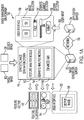
- FIG. 1A illustrates an exemplary synthetic image generation system that allows localized customization, in accordance with an embodiment of the present application.
- an image management environment 100 includes an application server 134, which can host one or more applications that use synthetic images. Such applications include, but are not limited to, visualization of new interior/industrial designs, new designs for apparel and accessories, and scenes in computer games and animations.
- An image generation server 132 of environment 100 can generate synthetic images and provide the synthetic images to application server 134.
- image generation server 132 communicates with application server 134 via a network 130, which can be a local or a wide area network.
- Image generation server 132 can use a GAN to generate synthetic images. With existing technologies, the exact model the GAN of server 132 learns while generating a synthetic image may not be apparent. To address this issue, server 132 can utilize enhanced image GANs, such as PG-GAN and StyleGAN, which use progressive training to encourage each layer to model the variation exhibited at given image resolutions. Based on the progressive training, the models of these GAN variations often demonstrate disentangled representation of image features. However, enhanced image GANs usually do not utilize disentanglement to facilitate localized editing during image synthesis. As a result, server 132 may not be capable of incorporating local and semantic features of a source image 104 with a target image 102.
- enhanced image GANs such as PG-GAN and StyleGAN, which use progressive training to encourage each layer to model the variation exhibited at given image resolutions. Based on the progressive training, the models of these GAN variations often demonstrate disentangled representation of image features. However, enhanced image GANs usually do not utilize disentanglement to facilitate local
- an efficient synthetic image generation system 110 can incorporate localized editing during image synthesis based on disentangled semantic information.
- System 110 can perform spatially-localized semantic editing on the outputs of GANs.
- System 110 can perform the editing by transferring information, especially the style associated with a semantic element of source image 104 to target image 102.
- images 102 and 104 can be real images or synthetic images (e.g., outputs of a GAN).
- system 110 uses feature vectors of source image 102. The feature vectors allow system 110 to utilize semantic representation in source image 104.
- system 110 facilitates a specific form of semantic editing that transfers the style of a semantic element from source image 104 to target image 102.
- a semantic element of source image 104 can be an image segment that is semantically meaningful within the context of source image 104. For example, if source image 104 is an image of a face, eyes, mouth, and nose can be semantic elements of source image. Similarly, if source image 104 depicts indoor living scenes, bed, pillow, and windows can be semantic elements in source image 104.
- system 110 receives a pair of images 102 and 104 as input parameters, instead of morphing image 102, system 110 only transfers a semantic element from source image 104 to target image 102 while leaving the remainder of target image 102 unaltered. This transfer of the semantic element does not require explicit spatial processing, such as warping and compositing.
- system 110 can perform localized editing using inherently disentangled structure without external supervision by pre-trained image segmentation models.
- System 110 can be equipped with a feature analysis module 112, a semantic analysis module 114, and an enhanced GAN 116.
- feature analysis module 112 can obtain feature information of source image 104.
- the feature information can be represented by a set of feature vectors 142.
- Feature analysis module 112 may obtain feature vectors 142 by applying a generative AI model (e.g., a neural network) on a natural image.
- a generative AI model e.g., a neural network
- Semantic analysis module 114 can analyze feature vectors 142 (e.g., the activation tensors of generative models, such as PG-GAN and StyleGAN) and cluster the feature information in feature vectors 142 to generate a set of feature clusters 144.
- semantic analysis module 114 can apply a clustering technique, such as spherical k-means clustering, on feature vectors 142.
- Generated feature clusters 144 can spatially span coherent semantic elements and sub-elements in source image 104.
- system 110 can present a user interface 150 equipped with an image selector 152, which allows a user to provide a user input 160.
- User input 160 can be obtained based on a clicking operation of a pointing device or a touching operation on a touch screen.
- User input 160 includes selecting source image 104 and target image 102.
- image selector 152 the user can select source image 104 and target image 102 from a local storage device, from a distributed storage device (e.g., from the cloud), or from a predefined repository of system 110.
- the user can select, as a part of user input 160, a semantic element on source image 104 using interface 150.
- the user may click on a particular element of source image 104 in user interface 150 to select the spatial location of the semantic element on the source image. Based on that click, system 110 can determine which semantic element of source image 104 the user wishes to transfer to target image 102.
- Interface 150 may also present a semantic element selector 154 (e.g., a drop-down menu) that may present a catalog of possible semantic elements to be selected from source image 104.
- System 110 may determine, based on the type of object depicted in source image 104, a set of semantic elements. In some embodiments, system 110 can generate the catalog by labeling each cluster of clusters 144 with a corresponding semantically meaningful label and combining the labels into the catalog. The user may select the semantic element from semantic element selector 154. For example, if source image 104 is an image of a face, the corresponding catalog can include eyes, nose, mouth, and hair as semantic elements of source image 104. Semantic element selector 154 can then list eyes, nose, mouth, and hair as possible elements to be selected from source image 104.
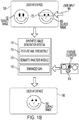
- FIG. 1B illustrates exemplary localized editing for a synthetic image generation process, in accordance with an embodiment of the present application.
- user input 160 selects a semantic element 172 from source image 104.
- semantic element 170 may correspond to the eyes of the face.
- clusters 144 represent corresponding semantic elements, such as eyes, nose, and mouth, of source image 104
- system 110 can select a cluster 174 corresponding to semantic element 172 of source image 104.
- System 110 can obtain the selection from interface 150 (e.g., either from the click or from a feature catalog) and determine the corresponding cluster 174 in clusters 144.
- GAN 116 can synthesize output image 106 by transferring the style of the selected semantic element 172 from source image 104 to target image 102 based on feature information in cluster 174 associated with selected semantic element.
- GAN 116 can be trained to synthesize an image by transferring styles from source image 104 to target image 102. For example, if GAN 116 is based on StyleGAN, the generator neural network of GAN 116 can learn representations that are spatially disentangled with respect to semantic elements of source image 104. In other words, GAN 116's latent representations spatially disentangle semantic elements in source image 104. Consequently, embeddings corresponding to different elements in source image 104 represent distinct and consistent feature spaces.
- System 110 can utilize the embeddings of the selected semantic element to dictate the style interpolation to target image 102.
- System 110 can localize the style transfer to selected semantic element 172 of source image 104 by providing the information represented cluster 174 (i.e., in the corresponding embedding). Consequently, the synthesis process of GAN 116 transfers styles represented primarily in the selected area indicated by semantic element 172 of source image 104 and generates corresponding synthetic output image 106.
- the locality of style transfer may depend on the extent to which semantic element 172 is disentangled from other elements in source image 104. Since GAN 116's latent representations can be significantly disentangled, system 110 can facilitate a seamless transition from unedited elements in target image 102 to the edited elements in output image 106.
- system 110 facilitates localized editing in image synthesis without any external supervision or complex spatial operations to define the edit region.
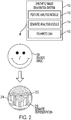
- FIG. 2 illustrates exemplary clusters representing semantically meaningful elements of an image, in accordance with an embodiment of the present application.
- Deep feature factorization indicates that the learnings of an AI model (e.g., a convolutional neural network (CNN)) can be represented by factorizing a matrix of hidden layer activations.
- the factorization can be represented in a set of saliency maps.
- Such factorization indicates that an AI model trained for image classification may learn features that act as a semantic element detector for the images.
- Semantic analysis module 112 can obtain the embeddings learned by GAN 116 during the image synthesis process to demonstrate similar features.
- Semantic analysis module 114 can cluster the activation vectors of the synthesis process of image 104 by applying a clustering technique (e.g., spherical k-means clustering) to the activation vectors. Semantic analysis module 114 then generates a semantic representation 210 that represents the clusters.
- the activation vectors are C-dimensional activation vectors that correspond to activation tensors at various layers of the generator networks of GAN 116.
- the resulting clusters spatially span coherent semantic objects, such as eyes, nose, mouth, and chin corresponding to the face depicted in source image 104.
- clusters 212 and 214 can correspond to the eyes and mouth.
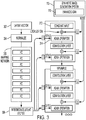
- S can be a learned affine transformation and the two sub-vectors [ y s , y b ] are used to perform the scale and shift operations, respectively.
- X ⁇ ⁇ R C ⁇ H ⁇ W is the feature maps produced by a convolution operation at some given layer.
- the styled feature map X c for a respective channel c can be produced from X" and y using an adaptive instance normalization (AdaIN) operation 314.
- AdaIN adaptive instance normalization
- Each channel 1 ⁇ c ⁇ C can be normalized over all its spatial positions to create X', which is then scaled and shifted based on style y.
- system 110 can transfer a selected semantic element from a source image to a target image.
- y ( s ) and y ( t ) are two styles of the same layer corresponding to two different seeds z ( s ) and z ( t ) that produce the source and target images, respectively.
- z ( s ) and z ( t ) that produce the source and target images, respectively.
- matrix Q is positive semi-definite and chosen such that the changes in y ( ⁇ ) are local in y ( t ) .
- matrix Q is chosen such that y ( ⁇ ) effects a local style transfer from y ( s ) to y ( t ) .
- Matrix Q can be a diagonal matrix whose elements form q ⁇ [0,1] c and can be referred to as a query matrix.
- local semantic editing is performed by interpolation between source and target styles on an element-specific (e.g., semantic element 172 representing the eyes of source image 104) query matrix.
- global interpolation transfers eyes, nose, and mouth from source image 104.
- system 110 manipulates y (or its upstream "ancestors" w or z ). Consequently, system 110 determines a q such that the dimensions of y are relevant to the selected semantic element and has relatively low relevance to the rest of the elements in a source image. Since the style y is applied globally (e.g., at all spatial positions), all spatial differentiation between the elements in the source image is encoded in the normalized feature map X'.
- x ⁇ ⁇ R C is an embedding representing a semantic element in a source image.
- x' may represent a sample drawn from an appropriate spatial position of X' where the query object (i.e., the selected semantic element).
- entries of x' indicate which entries in y s may affect the selected semantic element. Entries in x' with small absolute value can stay small even when scaled while entries with large absolute value are significantly affected by scaling. Consequently, system 110 may not change vector y s to ensure that the entries of q are proportional to
- system 110 can determine a respective q c of q as min 1 , ⁇ h c x ⁇ c 2 , where ⁇ is used as in standard interpolation to determine the strength of the transfer.
- degree selector 156 in FIG. 1A may correspond to parameter ⁇ .
- a lower value of ⁇ can facilitate the transfer of the selected element, and a higher value of ⁇ may indicate a more global transfer.
- the interpolation parameter ⁇ is set high enough such that the weight of each channel is 1, the result is a global transfer at that layer.
- FIG. 4A illustrates exemplary synthetic images generated based on localized editing, in accordance with an embodiment of the present application.
- different semantic elements are transferred from source images 402, 404, 406, and 408 to a target image 400.
- Rows 412, 414, and 416 correspond to the transfer of eyes, nose, and mouth, respectively, from 402, 404, 406, and 408 to target image 400.
- the respective semantic elements are seamlessly transferred without significant modification to the rest of target image 400. In this way, the local transfer of semantic elements can facilitate localized editing during image synthesis.
- FIG. 4B illustrates exemplary image differences, which is between target images and the corresponding output images, indicating localization of edits, in accordance with an embodiment of the present application.
- Image differences 452 and 454 show the average pixelwise image difference computed over 50 thousand pairs of edited and original target images. The edited images are generated based on localized editing.
- Image differences 452 and 454 depict the image differences of images that have been locally edited for eyes and mouth, respectively.
- Image differences 452 and 454 demonstrate that localized editing during image synthesis can be effective.
- the localized editing does not require an explicit spatial localization operation (e.g., spatial attention or a weight map) in the actual editing process. Furthermore, such localized editing does not rely on an external form of supervision (e.g., semantic part segmentation). Instead, the localization is accomplished by utilizing the inherent structure in the embeddings of the hidden layers of an enhanced GAN that naturally align with semantic elements of images.
- an explicit spatial localization operation e.g., spatial attention or a weight map
- semantic part segmentation e.g., semantic part segmentation
- FIG. 5A presents a flowchart 500 illustrating a method of a synthetic image generation system clustering image features for representing semantic elements in an image, in accordance with an embodiment of the present application.
- the system determines (i.e., receives) the source and target images (operation 502).
- the system obtains respective sets of feature vectors of source and target images (operation 504).
- the feature vectors are embeddings (e.g., the activations) of hidden layers of a GAN.
- the system then clusters the feature vectors using a clustering technique (operation 506). If the system uses k-means clustering, the system may generate k clusters (or centroids).
- the system determines a semantic definition associated with a respective cluster (operation 508). A user may label a respective cluster to facilitate the semantic definition of the cluster.
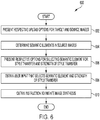
- FIG. 6 presents a flowchart 600 illustrating a method of a user interface of a synthetic image generation system facilitating synthetic image generation with localized edits, in accordance with an embodiment of the present application.
- the interface presents respective upload options for target and source images (operation 602).
- the interface determines the semantic elements in the source image (operation 604).
- the interface may use a pre-populated catalog of semantic elements for the image type of the source image.
- the interface presents respective options for selecting a semantic element for style transfer and a strength of the style transfer (operation 606).
- the interface obtains a user input that selects a semantic element and a strength of the style transfer (operation 608), and obtains an instruction (e.g., a submission) to initiate the image synthesis (operation 610).
- an instruction e.g., a submission
- FIG. 7 illustrates an exemplary computer system that facilitates synthetic image generation based on semantic information, in accordance with an embodiment of the present application.
- Computer system 700 includes a processor 702, a memory device 704, and a storage device 708.
- Memory device 704 can include a volatile memory device (e.g., a dual in-line memory module (DIMM)).
- DIMM dual in-line memory module
- computer system 700 can be coupled to a display device 710, a keyboard 712, and a pointing device 714.
- Storage device 708 can store an operating system 716, a synthetic image generation system 718, and data 736. Synthetic image generation system 718 can incorporate the operations of system 110.
- Synthetic image generation system 718 can include instructions, which when executed by computer system 700 can cause computer system 700 to perform methods and/or processes described in this disclosure.
- synthetic image generation system 718 can include instructions for providing a user interface that allows a user to select the source and target images, and a semantic element in the source image (user interface module 720).
- Synthetic image generation system 718 can also include instructions for determining feature vectors associated with the source and/or target images (feature analysis module 722).
- feature analysis module 722 includes instructions for clustering the feature vectors using a clustering technique and allocating semantic labels to a respective cluster.
- Synthetic image generation system 718 can also include instructions for generating a synthetic output image based on the source and target images with local editing associated with the selected semantic element (image generation module 726). Synthetic image generation system 718 may further include instructions for sending and receiving messages (communication module 728).
- Data 736 can include any data that can facilitate the operations of one or more of: feature analysis module 112, semantic analysis module 114, and enhanced GAN 116. Data 736 may include one or more of: image samples, feature vectors, clusters of feature vectors, an association between a cluster and the corresponding semantic element, query matrices, and synthetic output images.
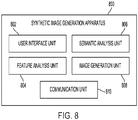
- FIG. 8 illustrates an exemplary apparatus that facilitates synthetic image generation based on semantic information, in accordance with an embodiment of the present application.
- Synthetic image generation apparatus 800 can comprise a plurality of units or apparatuses which may communicate with one another via a wired, wireless, quantum light, or electrical communication channel.
- Apparatus 800 may be realized using one or more integrated circuits, and may include fewer or more units or apparatuses than those shown in FIG. 8 .
- apparatus 800 may be integrated in a computer system, or realized as a separate device that is capable of communicating with other computer systems and/or devices.
- apparatus 800 can comprise units 802-810, which perform functions or operations similar to modules 720-728 of computer system 700 of FIG. 7 , including: a user interface unit 802; a feature analysis unit 804; a semantic analysis unit 806; an image generation unit 808; and a communication unit 810.
- the data structures and code described in this detailed description are typically stored on a computer-readable storage medium, which may be any device or medium that can store code and/or data for use by a computer system.
- the computer-readable storage medium includes, but is not limited to, volatile memory, non-volatile memory, magnetic and optical storage devices such as disks, magnetic tape, CDs (compact discs), DVDs (digital versatile discs or digital video discs), or other media capable of storing computer-readable media now known or later developed.
- the methods and processes described in the detailed description section can be embodied as code and/or data, which can be stored in a computer-readable storage medium as described above.
- a computer system reads and executes the code and/or data stored on the computer-readable storage medium, the computer system performs the methods and processes embodied as data structures and code and stored within the computer-readable storage medium.
- the methods and processes described above can be included in hardware modules.
- the hardware modules can include, but are not limited to, application-specific integrated circuit (ASIC) chips, field-programmable gate arrays (FPGAs), and other programmable-logic devices now known or later developed.
- ASIC application-specific integrated circuit
- FPGA field-programmable gate arrays
- the hardware modules When the hardware modules are activated, the hardware modules perform the methods and processes included within the hardware modules.
Landscapes
- Engineering & Computer Science (AREA)
- Physics & Mathematics (AREA)
- Theoretical Computer Science (AREA)
- General Physics & Mathematics (AREA)
- Data Mining & Analysis (AREA)
- Mathematical Physics (AREA)
- Software Systems (AREA)
- General Engineering & Computer Science (AREA)
- Computational Linguistics (AREA)
- Computing Systems (AREA)
- Artificial Intelligence (AREA)
- Evolutionary Computation (AREA)
- Life Sciences & Earth Sciences (AREA)
- Biophysics (AREA)
- General Health & Medical Sciences (AREA)
- Molecular Biology (AREA)
- Biomedical Technology (AREA)
- Health & Medical Sciences (AREA)
- Computer Vision & Pattern Recognition (AREA)
- Mathematical Analysis (AREA)
- Pure & Applied Mathematics (AREA)
- Mathematical Optimization (AREA)
- Computational Mathematics (AREA)
- Probability & Statistics with Applications (AREA)
- Databases & Information Systems (AREA)
- Algebra (AREA)
- Multimedia (AREA)
- Medical Informatics (AREA)
- Evolutionary Biology (AREA)
- Bioinformatics & Computational Biology (AREA)
- Bioinformatics & Cheminformatics (AREA)
- Processing Or Creating Images (AREA)
- Image Processing (AREA)
- Editing Of Facsimile Originals (AREA)
- Image Analysis (AREA)
Abstract
Description
- This disclosure is generally related to the field of artificial intelligence (AI). More specifically, this disclosure is related to a system and method for generating synthetic images with localized customization using an enhanced generative adversarial network (GAN) that incorporates semantic information.
- The exponential growth of AI-based techniques, such as neural networks, has made them a popular medium for generating synthetic data used in various applications. Generative adversarial networks (GANs) have become popular for generating synthetic data, such as synthetic but realistic images. To do so, a GAN typically includes a generator neural network (which is referred to as a generator) and a discriminator neural network (which is referred to as a discriminator).
- The generator may produce synthetic image samples as outputs. The generator can try to improve the quality of the synthetic image samples by "convincing" the discriminator that these images are real images. The discriminator is tasked with distinguishing real image samples from the generated synthetic image samples. The discriminator determines whether an image, as a whole, is real or not. As a result, through multiple iterations, the generator learns to generate a synthetic image that incorporates the statistical properties of a real image.
- A GAN can also be used for semantic image editing. For example, a GAN may learn a manifold for natural images in a latent space facilitated by the GAN and performs semantic edits that traverse or lie close to this manifold. The GAN may use auto-encoders to disentangle the image into semantic subspaces and reconstruct the image and facilitate semantic edits along the individual subspaces. Disentanglement indicates that an attribute of interest, which can be considered as a semantically meaningful element of an image, can be manipulated independently of other attributes. Such a GAN can execute some edits that represent changes in color, lighting, pose, facial expression, age, hair appearance, eyewear, and headwear.
- While GANs bring many desirable features to synthetic image generation, some issues remain unsolved in facilitating localized customization of a synthetic image generation process.
- Embodiments described herein provide a system for generating synthetic images with localized editing. During operation, the system obtains a source image and a target image for image synthesis and extracts respective feature representations from the source and target images. The system also selects a semantic element from the source image. The semantic element indicates a semantically meaningful part of an object depicted in the source image. The system then determines the style information associated with the source and target images. Subsequently, the system generates a synthetic image by transferring the style of the semantic element from the source image to the target image based on the feature representations. In this way, the system can facilitate the localized editing of the target image.
- In a variation on this embodiment, the system obtains a strength of the transfer of the style of the semantic element and transfers the style of the semantic element based on the strength.
- In a variation on this embodiment, the synthetic image is generated by a generative adversarial network (GAN), such as a StyleGAN.
- In a variation on this embodiment, the system obtains feature vectors as the feature representations associated with the source and target images. The system then generates a set of clusters based on the feature vectors. A respective cluster corresponds to a semantic element of the source image.
- In a further variation, the set of clusters are generated based on one or more of: K-means clustering, spherical K-means clustering, and non-negative matrix factorization.
- In a further variation, the source and target images are synthetic image generated by a StyleGAN. The feature vectors can then correspond to the embeddings of one or more hidden layers of the StyleGAN.
- In a variation on this embodiment, the source and target images are natural images. The system then converts the source and target images to respective StyleGAN representations.
- In a variation on this embodiment, transferring the semantic element also includes suppressing the transfer of styles outside of the semantic element from the source image.
- In a variation on this embodiment, transferring the style of the semantic element also includes performing style interpolation between the source image and the target image based on a localizing condition matrix associated with the semantic element.
- In a variation on this embodiment, the system presenting a user interface capable of obtaining a user input that selects the semantic element from the source image. The user interface can obtain the user input based on one or more of: a selection of the spatial location of the semantic element on the source image and a selection from a catalog of semantic elements.
- In a variation on this embodiment, the system can perform the localized editing absent: (i) an explicit or external spatial localization operation, and (ii) an external form of supervision.
-
-
FIG. 1A illustrates an exemplary synthetic image generation system that allows localized customization, in accordance with an embodiment of the present application. -
FIG. 1B illustrates exemplary localized editing for a synthetic image generation process, in accordance with an embodiment of the present application. -
FIG. 2 illustrates exemplary clusters representing semantically meaningful elements of an image, in accordance with an embodiment of the present application. -
FIG. 3 illustrates an exemplary enhanced GAN for generating a synthetic image with localized editing, in accordance with an embodiment of the present application. -
FIG. 4A illustrates exemplary synthetic images generated based on localized editing, in accordance with an embodiment of the present application. -
FIG. 4B illustrates exemplary image differences indicating localization of edits, in accordance with an embodiment of the present application. -
FIG. 5A presents a flowchart illustrating a method of a synthetic image generation system clustering image features for representing semantic elements in an image, in accordance with an embodiment of the present application. -
FIG. 5B presents a flowchart illustrating a method of a synthetic image generation system generating a synthetic image with localized edits, in accordance with an embodiment of the present application. -
FIG. 6 presents a flowchart illustrating a method of a user interface of a synthetic image generation system facilitating synthetic image generation with localized edits, in accordance with an embodiment of the present application. -
FIG. 7 illustrates an exemplary computer system that facilitates synthetic image generation with localized edits, in accordance with an embodiment of the present application. -
FIG. 8 illustrates an exemplary apparatus that facilitates synthetic image generation with localized edits, in accordance with an embodiment of the present application. - In the figures, like reference numerals refer to the same figure elements.
- The following description is presented to enable any person skilled in the art to make and use the embodiments, and is provided in the context of a particular application and its requirements. Various modifications to the disclosed embodiments will be readily apparent to those skilled in the art, and the general principles defined herein may be applied to other embodiments and applications without departing from the spirit and scope of the present disclosure. Thus, the embodiments described herein are not limited to the embodiments shown, but are to be accorded the widest scope consistent with the principles and features disclosed herein.
- The embodiments described herein solve the problem of generating a synthetic image with localized edits by (i) determining semantically meaningful segments of an image using feature clustering; and (ii) incorporating the feature information associated with a semantically meaningful segment into the image synthesis process. The system may use a generative adversarial network (GAN) to generate the synthetic image.
- With existing technologies, the exact model a GAN learns while generating a synthetic image may not be apparent. To address this issue, enhanced image GANs, such as Progressive Growing GAN (PG-GAN) and StyleGAN use progressive training to encourage each layer to model the variation exhibited at given image resolutions. Based on the progressive training, the models of these GAN variations often demonstrate disentangled representations of image features. Disentanglement may indicate that an attribute of interest, such as a semantic element of an image (e.g., an eye of a face, a window of a bedroom) can be manipulated independently of other attributes. However, enhanced image GANs usually do not utilize disentanglement to facilitate localized editing during image synthesis.
- To solve this problem, embodiments described herein provide an efficient synthetic image generation system that incorporates localized editing during image synthesis based on disentangled semantic information. The system can perform spatially-localized semantic editing on the outputs of GANs. The system can perform the editing by transferring information, specifically the style associated with a semantic element of a source image to a target image. One or both images of source and target images can be real images or synthetic images (e.g., an output of a GAN). Instead of relying on additional datasets and trained networks, or traditional image morphing methods requiring complex spatial operations, the system uses feature vectors of an image (e.g., embeddings of a neural network layer). As a result, the system can utilize semantic representation learned by a GAN
- Unlike existing solutions, the system facilitates a specific form of semantic editing that transfers the style of a semantic element from a source image to a target image. A semantic element of an image can be an image segment that is semantically meaningful within the context of that image. For example, eyes, mouth, and nose can be semantic elements in facial images; and bed, pillow, and windows can be semantic elements in images depicting indoor living scenes. Even though the system receives a pair of images as input parameters, instead of morphing an entire image, the system only transfers a semantic element from the source image to the target image while leaving the remainder of the target image unaltered. This transfer of the semantic element does not require explicit spatial processing, such as warping and compositing (e.g., as required in face-swapping applications). Furthermore, the system can perform localized editing using inherently disentangled structure without external supervision by pre-trained image segmentation models.
- During operation, the system can obtain feature information of a source image. The feature information can be represented by a feature vector. The system may obtain the feature vector by applying a generative AI model (e.g., a neural network) on a natural image. On the other hand, if the source image is a synthetic image, the system can obtain the embeddings associated with the hidden layer activations of the image synthesis process. The system can analyze the feature vectors (e.g., the activation tensors of generative models, such as PG-GAN and StyleGAN) and cluster the feature vectors by applying a clustering technique (e.g., spherical k-means clustering). The generated clusters can spatially span coherent semantic elements and sub-elements in images, such as eyes, nose, and mouth for face images, and bed, pillows, and windows for bedroom images.
- In some embodiments, the system can present the source image in a user interface that allows the user to select the source and target images (e.g., by browsing the local computing system or from a pre-defined repository). The user can select (e.g., using a pointing device or a touch screen) a semantic element on the source image using the interface. The interface may also present a list of possible semantic elements to be selected (e.g., in a drop-down menu) from which the user may select the semantic element. Since the clusters represent corresponding semantic elements of the source image, the system can select a cluster corresponding to the selected semantic element of the source image. The system can use a GAN (e.g., StyleGAN) to synthesize an image by transferring the style of the selected semantic element from the source image to the target image based on the feature information in the cluster corresponding to the selected semantic element, thereby facilitating localized editing in image synthesis.
-
FIG. 1A illustrates an exemplary synthetic image generation system that allows localized customization, in accordance with an embodiment of the present application. In this example, animage management environment 100 includes anapplication server 134, which can host one or more applications that use synthetic images. Such applications include, but are not limited to, visualization of new interior/industrial designs, new designs for apparel and accessories, and scenes in computer games and animations. Animage generation server 132 ofenvironment 100 can generate synthetic images and provide the synthetic images toapplication server 134. In some embodiments,image generation server 132 communicates withapplication server 134 via anetwork 130, which can be a local or a wide area network. -
Image generation server 132 can use a GAN to generate synthetic images. With existing technologies, the exact model the GAN ofserver 132 learns while generating a synthetic image may not be apparent. To address this issue,server 132 can utilize enhanced image GANs, such as PG-GAN and StyleGAN, which use progressive training to encourage each layer to model the variation exhibited at given image resolutions. Based on the progressive training, the models of these GAN variations often demonstrate disentangled representation of image features. However, enhanced image GANs usually do not utilize disentanglement to facilitate localized editing during image synthesis. As a result,server 132 may not be capable of incorporating local and semantic features of asource image 104 with atarget image 102. - To solve this problem, an efficient synthetic
image generation system 110 can incorporate localized editing during image synthesis based on disentangled semantic information.System 110 can perform spatially-localized semantic editing on the outputs of GANs.System 110 can perform the editing by transferring information, especially the style associated with a semantic element ofsource image 104 to targetimage 102. One or both ofimages system 110 uses feature vectors ofsource image 102. The feature vectors allowsystem 110 to utilize semantic representation insource image 104. - Unlike existing solutions,
system 110 facilitates a specific form of semantic editing that transfers the style of a semantic element fromsource image 104 to targetimage 102. A semantic element ofsource image 104 can be an image segment that is semantically meaningful within the context ofsource image 104. For example, ifsource image 104 is an image of a face, eyes, mouth, and nose can be semantic elements of source image. Similarly, ifsource image 104 depicts indoor living scenes, bed, pillow, and windows can be semantic elements insource image 104. Even thoughsystem 110 receives a pair ofimages image 102,system 110 only transfers a semantic element fromsource image 104 to targetimage 102 while leaving the remainder oftarget image 102 unaltered. This transfer of the semantic element does not require explicit spatial processing, such as warping and compositing. Furthermore,system 110 can perform localized editing using inherently disentangled structure without external supervision by pre-trained image segmentation models. -
System 110 can be equipped with afeature analysis module 112, asemantic analysis module 114, and anenhanced GAN 116. During operation,feature analysis module 112 can obtain feature information ofsource image 104. The feature information can be represented by a set offeature vectors 142.Feature analysis module 112 may obtainfeature vectors 142 by applying a generative AI model (e.g., a neural network) on a natural image. On the other hand, ifsource image 104 is a synthetic image,feature analysis module 112 can obtain the embeddings associated with the hidden layer activations of the image synthesis process asfeature vectors 142.Semantic analysis module 114 can analyze feature vectors 142 (e.g., the activation tensors of generative models, such as PG-GAN and StyleGAN) and cluster the feature information infeature vectors 142 to generate a set offeature clusters 144. In some embodiments,semantic analysis module 114 can apply a clustering technique, such as spherical k-means clustering, onfeature vectors 142. Generatedfeature clusters 144 can spatially span coherent semantic elements and sub-elements insource image 104. - In some embodiments,
system 110 can present auser interface 150 equipped with animage selector 152, which allows a user to provide auser input 160.User input 160 can be obtained based on a clicking operation of a pointing device or a touching operation on a touch screen.User input 160 includes selectingsource image 104 andtarget image 102. Usingimage selector 152, the user can selectsource image 104 andtarget image 102 from a local storage device, from a distributed storage device (e.g., from the cloud), or from a predefined repository ofsystem 110. Subsequently, the user can select, as a part ofuser input 160, a semantic element onsource image 104 usinginterface 150. The user may click on a particular element ofsource image 104 inuser interface 150 to select the spatial location of the semantic element on the source image. Based on that click,system 110 can determine which semantic element ofsource image 104 the user wishes to transfer to targetimage 102. -
Interface 150 may also present a semantic element selector 154 (e.g., a drop-down menu) that may present a catalog of possible semantic elements to be selected fromsource image 104.System 110 may determine, based on the type of object depicted insource image 104, a set of semantic elements. In some embodiments,system 110 can generate the catalog by labeling each cluster ofclusters 144 with a corresponding semantically meaningful label and combining the labels into the catalog. The user may select the semantic element fromsemantic element selector 154. For example, ifsource image 104 is an image of a face, the corresponding catalog can include eyes, nose, mouth, and hair as semantic elements ofsource image 104.Semantic element selector 154 can then list eyes, nose, mouth, and hair as possible elements to be selected fromsource image 104. -
Interface 150 can also include adegree selector 156, which can be a slide-bar, that indicates the degree or strength of transfer of the semantic element.Degree selector 156 may use a scale from 0 to 1, with 0 indicating no change and 1 indicating a strong transfer. Upon obtaining user input 160 (e.g., based on a user submission via interface 150),system 110 can select a cluster fromclusters 144 associated with the selected semantic element ofsource image 104.System 110 can use an enhanced GAN 116 (e.g., StyleGAN) to synthesize anoutput image 106 by transferring the style of the selected semantic element fromsource image 104 to targetimage 102 based on the feature information in the cluster corresponding to the selected semantic element. By localizing the style transfer,system 110 facilitates localized editing in image synthesis.System 110 can then displayoutput image 106 ininterface 150. -
FIG. 1B illustrates exemplary localized editing for a synthetic image generation process, in accordance with an embodiment of the present application. Suppose thatuser input 160 selects asemantic element 172 fromsource image 104. Ifsource image 104 depicts a face, semantic element 170 may correspond to the eyes of the face. Sinceclusters 144 represent corresponding semantic elements, such as eyes, nose, and mouth, ofsource image 104,system 110 can select acluster 174 corresponding tosemantic element 172 ofsource image 104.System 110 can obtain the selection from interface 150 (e.g., either from the click or from a feature catalog) and determine thecorresponding cluster 174 inclusters 144. -
GAN 116 can synthesizeoutput image 106 by transferring the style of the selectedsemantic element 172 fromsource image 104 to targetimage 102 based on feature information incluster 174 associated with selected semantic element.GAN 116 can be trained to synthesize an image by transferring styles fromsource image 104 to targetimage 102. For example, ifGAN 116 is based on StyleGAN, the generator neural network ofGAN 116 can learn representations that are spatially disentangled with respect to semantic elements ofsource image 104. In other words,GAN 116's latent representations spatially disentangle semantic elements insource image 104. Consequently, embeddings corresponding to different elements insource image 104 represent distinct and consistent feature spaces.System 110 can utilize the embeddings of the selected semantic element to dictate the style interpolation to targetimage 102. -
System 110 can localize the style transfer to selectedsemantic element 172 ofsource image 104 by providing the information represented cluster 174 (i.e., in the corresponding embedding). Consequently, the synthesis process ofGAN 116 transfers styles represented primarily in the selected area indicated bysemantic element 172 ofsource image 104 and generates correspondingsynthetic output image 106. The locality of style transfer may depend on the extent to whichsemantic element 172 is disentangled from other elements insource image 104. SinceGAN 116's latent representations can be significantly disentangled,system 110 can facilitate a seamless transition from unedited elements intarget image 102 to the edited elements inoutput image 106. In this example, the eyes of the face depicted insource image 104 can be seamlessly integrated with the face depicted intarget image 102. In this way, by incorporating the localized information during the synthesis process,system 110 facilitates localized editing in image synthesis without any external supervision or complex spatial operations to define the edit region. -
FIG. 2 illustrates exemplary clusters representing semantically meaningful elements of an image, in accordance with an embodiment of the present application. Deep feature factorization (DFF) indicates that the learnings of an AI model (e.g., a convolutional neural network (CNN)) can be represented by factorizing a matrix of hidden layer activations. The factorization can be represented in a set of saliency maps. Such factorization indicates that an AI model trained for image classification may learn features that act as a semantic element detector for the images. - Similarly, if
source image 104 is a synthetic image generated byGAN 116,feature analysis module 112 can obtain the embeddings learned byGAN 116 during the image synthesis process to demonstrate similar features.Semantic analysis module 114 can cluster the activation vectors of the synthesis process ofimage 104 by applying a clustering technique (e.g., spherical k-means clustering) to the activation vectors.Semantic analysis module 114 then generates asemantic representation 210 that represents the clusters. In some embodiments, the activation vectors are C-dimensional activation vectors that correspond to activation tensors at various layers of the generator networks ofGAN 116. As shown insemantic representation 210, the resulting clusters spatially span coherent semantic objects, such as eyes, nose, mouth, and chin corresponding to the face depicted insource image 104. For example,clusters -
Semantic representation 210 indicates that the generator network ofGAN 116 may learn representations that are spatially disentangled with respect to the semantic elements of the face depicted insource image 104. In other words, different semantic elements are embedded in a distinct and consistent feature space and can be transferred independently. As a result, if a user wishes to transfer the eyes of the face depicted insource image 104,system 110 can incorporate the information incluster 212 in the synthesis process ofGAN 116. Consequently, the eyes of the face depicted insource image 104 can be seamlessly integrated with a face depicted in a target image. -
FIG. 3 illustrates an exemplary enhanced GAN for generating a synthetic image with localized editing, in accordance with an embodiment of the present application. During operation, GAN 116 (e.g., StyleGAN) randomly samples alatent vector 302, which can be referred to as z, from a sampling space. Subsequently,
GAN 116 transforms z to an intermediatelatent vector 308, which can be referred to as w ∈W . GAN 116 can perform the transformation operation based on anormalization operation 304 and amapping network 306. The generator network ofGAN 116 can be a convolutional neural network that incorporates a constant input 312 (e.g., a learned constant image). - Vector w can access the generator network via a per-layer style, y = (ys, yb ) = S(w), where S can be a learned affine transformation and the two sub-vectors [ys, yb ] are used to perform the scale and shift operations, respectively. Suppose that

operation 314. Here,


- Using
GAN 116,system 110 can transfer a selected semantic element from a source image to a target image. Suppose that y (s) and y (t) are two styles of the same layer corresponding to two different seeds z (s) and z (t) that produce the source and target images, respectively. For image synthesis, they correspond to two different identities that may vary locally and/or globally.System 110 may gradually transfer the style from source image (denoted with an "S") to a target image (denoted with a "T") based on linear interpolation between the style vectors y (s) and y (t) by updating y (λ) = y (t) + λ(y (s)-y (t)) for an appropriate interpolation parameter λ. - However, such an update operation can result in transferring all style properties of y (s) onto y (λ). As a result, all corresponding style properties of y (t) become morphed. To enable selective local editing,
system 110 can control the style interpolation with a matrix transformation: y (λ) = y (t) + Q(y (s) - y (t)). Here, matrix Q is positive semi-definite and chosen such that the changes in y (λ) are local in y (t). In other words, matrix Q is chosen such that y (λ) effects a local style transfer from y (s) to y (t) . Matrix Q can be a diagonal matrix whose elements form q ∈ [0,1] c and can be referred to as a query matrix. In the example inFIG. 1B , local semantic editing is performed by interpolation between source and target styles on an element-specific (e.g.,semantic element 172 representing the eyes of source image 104) query matrix. In contrast, global interpolation transfers eyes, nose, and mouth fromsource image 104. - All variations in the output of the generator network are determined by changes to each layer's style. To edit
GAN 116's output,system 110 manipulates y (or its upstream "ancestors" w or z). Consequently,system 110 determines a q such that the dimensions of y are relevant to the selected semantic element and has relatively low relevance to the rest of the elements in a source image. Since the style y is applied globally (e.g., at all spatial positions), all spatial differentiation between the elements in the source image is encoded in the normalized feature map X'. Suppose that
- It should be noted that, with respect to scale vector ys , entries of x' indicate which entries in ys may affect the selected semantic element. Entries in x' with small absolute value can stay small even when scaled while entries with large absolute value are significantly affected by scaling. Consequently,
system 110 may not change vector ys to ensure that the entries of q are proportional to |x'|. Accordingly, ifsystem 110 determines Q as a diagonal matrix with entries proportional to the absolute value of x' and all zeros for the offset term ys , the resultant conditioned interpolation can affect only those entries in y (λ) that have a significant impact on the part represented by x. - In addition, to determine which entries in ys have unique attribution to the semantic element,
system 110 can assign a weight hc to the c-th dimension. In some embodiments,system 110 can determine hc based on Hoyer sparsity measured over the matrix
System 110 can compute hc with respect to the activations of a large batch of samples as
System 110 may normalize this measure such that hc is 1 when the corresponding activation affects one unique semantic element in the source image and hc is 0 when the corresponding activation affects all semantic elements. Hence,system 110 determines hc such that the dimensions associated with the selected semantic element exert a stronger influence in directing style interpolation. - Based on the element-specific vector x' and dimension selectivity weighting h,
system 110 can determine a respective qc of q as min
degree selector 156 inFIG. 1A may correspond to parameter λ. A lower value of λ can facilitate the transfer of the selected element, and a higher value of λ may indicate a more global transfer. When the interpolation parameter λ is set high enough such that the weight of each channel is 1, the result is a global transfer at that layer. By determining qc = min
system 110 utilizes the unique correspondence between feature activation and the corresponding semantic element to facilitate localized editing. This process does not rely on an explicit spatial function to dictate the localization of the editing process. -
FIG. 4A illustrates exemplary synthetic images generated based on localized editing, in accordance with an embodiment of the present application. In this example, different semantic elements are transferred fromsource images target image 400.Rows image 400. The respective semantic elements are seamlessly transferred without significant modification to the rest oftarget image 400. In this way, the local transfer of semantic elements can facilitate localized editing during image synthesis. -
FIG. 4B illustrates exemplary image differences, which is between target images and the corresponding output images, indicating localization of edits, in accordance with an embodiment of the present application.Image differences Image differences Image differences - The localized editing does not require an explicit spatial localization operation (e.g., spatial attention or a weight map) in the actual editing process. Furthermore, such localized editing does not rely on an external form of supervision (e.g., semantic part segmentation). Instead, the localization is accomplished by utilizing the inherent structure in the embeddings of the hidden layers of an enhanced GAN that naturally align with semantic elements of images.
-
FIG. 5A presents aflowchart 500 illustrating a method of a synthetic image generation system clustering image features for representing semantic elements in an image, in accordance with an embodiment of the present application. During operation, the system determines (i.e., receives) the source and target images (operation 502). The system then obtains respective sets of feature vectors of source and target images (operation 504). In some embodiments, the feature vectors are embeddings (e.g., the activations) of hidden layers of a GAN. The system then clusters the feature vectors using a clustering technique (operation 506). If the system uses k-means clustering, the system may generate k clusters (or centroids). The system then determines a semantic definition associated with a respective cluster (operation 508). A user may label a respective cluster to facilitate the semantic definition of the cluster. -
FIG. 5B presents aflowchart 550 illustrating a method of a synthetic image generation system generating a synthetic image with localized edits, in accordance with an embodiment of the present application. During operation, the system obtains source and target images (operation 552) and obtains a selection of a semantic element in the source image (operation 554). The system then determines the localized semantic space for style transfer corresponding to the selected semantic element (operation 556). Subsequently, the system determines style transfer information associated with the determined semantic space represented by the corresponding cluster (operation 558). The system then generates a synthetic output image from the source and target images with localized edits based on the style transfer information (operation 560). In the example inFIG. 3 , the style transfer information can be determined based on
-
FIG. 6 presents aflowchart 600 illustrating a method of a user interface of a synthetic image generation system facilitating synthetic image generation with localized edits, in accordance with an embodiment of the present application. During operation, the interface presents respective upload options for target and source images (operation 602). The interface then determines the semantic elements in the source image (operation 604). The interface may use a pre-populated catalog of semantic elements for the image type of the source image. The interface then presents respective options for selecting a semantic element for style transfer and a strength of the style transfer (operation 606). The interface then obtains a user input that selects a semantic element and a strength of the style transfer (operation 608), and obtains an instruction (e.g., a submission) to initiate the image synthesis (operation 610). -
FIG. 7 illustrates an exemplary computer system that facilitates synthetic image generation based on semantic information, in accordance with an embodiment of the present application.Computer system 700 includes aprocessor 702, amemory device 704, and astorage device 708.Memory device 704 can include a volatile memory device (e.g., a dual in-line memory module (DIMM)). Furthermore,computer system 700 can be coupled to adisplay device 710, akeyboard 712, and apointing device 714.Storage device 708 can store anoperating system 716, a syntheticimage generation system 718, anddata 736. Syntheticimage generation system 718 can incorporate the operations ofsystem 110. - Synthetic
image generation system 718 can include instructions, which when executed bycomputer system 700 can causecomputer system 700 to perform methods and/or processes described in this disclosure. Specifically, syntheticimage generation system 718 can include instructions for providing a user interface that allows a user to select the source and target images, and a semantic element in the source image (user interface module 720). Syntheticimage generation system 718 can also include instructions for determining feature vectors associated with the source and/or target images (feature analysis module 722). Furthermore, syntheticimage generation system 718 includes instructions for clustering the feature vectors using a clustering technique and allocating semantic labels to a respective cluster (semantic analysis module 724). - Synthetic
image generation system 718 can also include instructions for generating a synthetic output image based on the source and target images with local editing associated with the selected semantic element (image generation module 726). Syntheticimage generation system 718 may further include instructions for sending and receiving messages (communication module 728).Data 736 can include any data that can facilitate the operations of one or more of:feature analysis module 112,semantic analysis module 114, andenhanced GAN 116.Data 736 may include one or more of: image samples, feature vectors, clusters of feature vectors, an association between a cluster and the corresponding semantic element, query matrices, and synthetic output images. -
FIG. 8 illustrates an exemplary apparatus that facilitates synthetic image generation based on semantic information, in accordance with an embodiment of the present application. Syntheticimage generation apparatus 800 can comprise a plurality of units or apparatuses which may communicate with one another via a wired, wireless, quantum light, or electrical communication channel.Apparatus 800 may be realized using one or more integrated circuits, and may include fewer or more units or apparatuses than those shown inFIG. 8 . Further,apparatus 800 may be integrated in a computer system, or realized as a separate device that is capable of communicating with other computer systems and/or devices. Specifically,apparatus 800 can comprise units 802-810, which perform functions or operations similar to modules 720-728 ofcomputer system 700 ofFIG. 7 , including: auser interface unit 802; afeature analysis unit 804; asemantic analysis unit 806; animage generation unit 808; and acommunication unit 810. - The data structures and code described in this detailed description are typically stored on a computer-readable storage medium, which may be any device or medium that can store code and/or data for use by a computer system. The computer-readable storage medium includes, but is not limited to, volatile memory, non-volatile memory, magnetic and optical storage devices such as disks, magnetic tape, CDs (compact discs), DVDs (digital versatile discs or digital video discs), or other media capable of storing computer-readable media now known or later developed.
- The methods and processes described in the detailed description section can be embodied as code and/or data, which can be stored in a computer-readable storage medium as described above. When a computer system reads and executes the code and/or data stored on the computer-readable storage medium, the computer system performs the methods and processes embodied as data structures and code and stored within the computer-readable storage medium.
- Furthermore, the methods and processes described above can be included in hardware modules. For example, the hardware modules can include, but are not limited to, application-specific integrated circuit (ASIC) chips, field-programmable gate arrays (FPGAs), and other programmable-logic devices now known or later developed. When the hardware modules are activated, the hardware modules perform the methods and processes included within the hardware modules.
- The foregoing embodiments described herein have been presented for purposes of illustration and description only. They are not intended to be exhaustive or to limit the embodiments described herein to the forms disclosed. Accordingly, many modifications and variations will be apparent to practitioners skilled in the art. Additionally, the above disclosure is not intended to limit the embodiments described herein. The scope of the embodiments described herein is defined by the appended claims.
Claims (20)
- A method for generating synthetic images with localized editing, comprising:obtaining a source image and a target image for image synthesis;extracting respective feature representations from the source and target images;selecting a semantic element from the source image, wherein the semantic element indicates a semantically meaningful part of an object depicted in the source image;determining style information associated with the source and target images; andgenerating a synthetic image by transferring a style of the semantic element from the source image to the target image based on the feature representations, thereby facilitating the localized editing of the target image.
- The method of claim 1, further comprising:obtaining a strength of the transfer of the style of the semantic element; andtransferring the style of the semantic element based on the strength.
- The method of claim 1, wherein the synthetic image is generated by a generative adversarial network (GAN), and wherein the GAN includes a StyleGAN.
- The method of claim 1, further comprising:obtaining feature vectors as the feature representations associated with the source and target images; andgenerating a set of clusters based on the feature vectors, wherein a respective cluster corresponds to a semantic element of the source image.
- The method of claim 4, wherein the set of clusters are generated based on one or more of: K-means clustering, spherical K-means clustering, and non-negative matrix factorization.
- The method of claim 4, wherein the source and target images are synthetic images generated by a StyleGAN, and wherein the feature vectors correspond to the embeddings of one or more hidden layers of the StyleGAN.
- The method of claim 1, wherein the source and target images are natural images; and
wherein the method further comprises converting the source and target images to respective StyleGAN representations. - The method of claim 1, wherein transferring the semantic element further comprises suppressing transfer of styles outside of the semantic element from the source image.
- The method of claim 1, wherein transferring the style of the semantic element further comprises performing style interpolation between the source image and the target image based on a localizing condition matrix associated with the semantic element.
- The method of claim 1, further comprising presenting a user interface capable of obtaining a user input that selects the semantic element from the source image, wherein the user interface is configured to obtain the user input based on one or more of: a selection of spatial location of the semantic element on the source image and a selection from a catalog of semantic elements.
- A non-transitory computer-readable storage medium storing instructions that when executed by a computer cause the computer to perform a method for generating synthetic images with localized editing, the method comprising:obtaining a source image and a target image for image synthesis;extracting respective feature representations from the source and target images;selecting a semantic element from the source image, wherein the semantic element indicates a semantically meaningful part of an object depicted in the source image;determining style information associated with the source and target images; andgenerating a synthetic image by transferring a style of the semantic element from the source image to the target image based on the feature representations, thereby facilitating the localized editing of the target image.
- The computer-readable storage medium of claim 11, wherein the method further comprises:obtaining a strength of the transfer of the style of the semantic element; andtransferring the style of the semantic element based on the strength.
- The computer-readable storage medium of claim 11, wherein the synthetic image is generated by a generative adversarial network (GAN), and wherein the GAN includes a StyleGAN.
- The computer-readable storage medium of claim 11, wherein the method further comprises:obtaining feature vectors as the feature representations associated with the source and target images; andgenerating a set of clusters based on the feature vectors, wherein a respective cluster corresponds to a semantic element of the source image.
- The computer-readable storage medium of claim 14, wherein the set of clusters are generated based on one or more of: K-means clustering, spherical K-means clustering, and non-negative matrix factorization.
- The computer-readable storage medium of claim 14, wherein the source and target images are synthetic images generated by a StyleGAN, and wherein the feature vectors correspond to the embeddings of one or more hidden layers of the StyleGAN.
- The computer-readable storage medium of claim 14, wherein the source and target images are natural images; and
wherein the method further comprises converting the source and target images to respective StyleGAN representations. - The computer-readable storage medium of claim 11, wherein transferring the semantic element further comprises suppressing transfer of styles outside of the semantic element from the source image.
- The computer-readable storage medium of claim 11, wherein transferring the style of the semantic element further comprises performing style interpolation between the source image and the target image based on a localizing condition matrix associated with the semantic element.
- The computer-readable storage medium of claim 11, wherein the method further comprises presenting a user interface capable of obtaining a user input that selects the semantic element from the source image, wherein the user interface is configured to obtain the user input based on one or more of: a selection of spatial location of the semantic element on the source image and a selection from a catalog of semantic elements.
Applications Claiming Priority (1)
| Application Number | Priority Date | Filing Date | Title |
|---|---|---|---|
| US16/737,702 US11508169B2 (en) | 2020-01-08 | 2020-01-08 | System and method for synthetic image generation with localized editing |
Publications (1)
| Publication Number | Publication Date |
|---|---|
| EP3848905A1 true EP3848905A1 (en) | 2021-07-14 |
Family
ID=73856944
Family Applications (1)
| Application Number | Title | Priority Date | Filing Date |
|---|---|---|---|
| EP20216757.3A Withdrawn EP3848905A1 (en) | 2020-01-08 | 2020-12-22 | System and method for synthetic image generation with localized editing |
Country Status (3)
| Country | Link |
|---|---|
| US (1) | US11508169B2 (en) |
| EP (1) | EP3848905A1 (en) |
| JP (1) | JP7554657B2 (en) |
Families Citing this family (50)
| Publication number | Priority date | Publication date | Assignee | Title |
|---|---|---|---|---|
| US11790950B2 (en) * | 2020-01-14 | 2023-10-17 | Robert Salem Abraham | Film-making using style transfer |
| WO2021184195A1 (en) * | 2020-03-17 | 2021-09-23 | 中国科学院深圳先进技术研究院 | Medical image reconstruction method, and medical image reconstruction network training method and apparatus |
| KR102427484B1 (en) * | 2020-05-29 | 2022-08-05 | 네이버 주식회사 | Image generation system and image generation method using the system |
| US11586841B2 (en) * | 2020-07-01 | 2023-02-21 | Wipro Limited | Method and system for generating user driven adaptive object visualizations using generative adversarial network models |
| JP7472981B2 (en) * | 2020-07-06 | 2024-04-23 | 日本電気株式会社 | DATA EXTENSION DEVICE, LEARNING DEVICE, DATA EXTENSION METHOD, AND PROG |
| US11640684B2 (en) * | 2020-07-21 | 2023-05-02 | Adobe Inc. | Attribute conditioned image generation |
| US12327188B2 (en) | 2020-10-16 | 2025-06-10 | Adobe Inc. | Direct regression encoder architecture and training |
| US11631156B2 (en) * | 2020-11-03 | 2023-04-18 | Adobe Inc. | Image generation and editing with latent transformation detection |
| US11494959B2 (en) * | 2020-11-12 | 2022-11-08 | Samsung Electronics Co., Ltd. | Method and apparatus with generation of transformed image |
| CN116830157A (en) * | 2020-12-02 | 2023-09-29 | 美国安进公司 | Image enhancement technology for automated visual inspection |
| US11890544B2 (en) * | 2020-12-30 | 2024-02-06 | Blizzard Entertainment, Inc. | Prop placement with machine learning |
| US11893717B2 (en) * | 2021-02-26 | 2024-02-06 | Adobe Inc. | Initializing a learned latent vector for neural-network projections of diverse images |
| US20220335250A1 (en) * | 2021-04-19 | 2022-10-20 | Kwai Inc. | Methods and apparatuses for fine-grained style-based generative neural networks |
| US12363253B2 (en) * | 2021-05-18 | 2025-07-15 | Microsoft Technology Licensing, Llc | Realistic personalized style transfer in image processing |
| US11823490B2 (en) * | 2021-06-08 | 2023-11-21 | Adobe, Inc. | Non-linear latent to latent model for multi-attribute face editing |
| US12153783B2 (en) * | 2021-06-10 | 2024-11-26 | Nvidia Corporation | User interfaces and methods for generating a new artifact based on existing artifacts |
| US11435885B1 (en) * | 2021-06-10 | 2022-09-06 | Nvidia Corporation | User interfaces and methods for generating a new artifact based on existing artifacts |
| CN113408673B (en) * | 2021-08-19 | 2021-11-02 | 联想新视界(南昌)人工智能工研院有限公司 | Generative adversarial network subspace decoupling and generative editing method, system and computer |
| CN113421185B (en) * | 2021-08-23 | 2021-11-05 | 武汉轻度科技有限公司 | StyleGAN-based mobile terminal face age editing method |
| US11803950B2 (en) * | 2021-09-16 | 2023-10-31 | Adobe Inc. | Universal style transfer using multi-scale feature transform and user controls |
| US11989916B2 (en) * | 2021-10-11 | 2024-05-21 | Kyocera Document Solutions Inc. | Retro-to-modern grayscale image translation for preprocessing and data preparation of colorization |
| CN114004905B (en) * | 2021-10-25 | 2024-03-29 | 北京字节跳动网络技术有限公司 | Method, device, equipment and storage medium for generating character style pictogram |
| CN113989106B (en) * | 2021-11-01 | 2025-01-17 | 浙江大学 | Method, device, computer equipment and storage medium for transferring arbitrary aesthetic style of images |
| US11900519B2 (en) * | 2021-11-17 | 2024-02-13 | Adobe Inc. | Disentangling latent representations for image reenactment |
| US12450787B2 (en) | 2021-12-28 | 2025-10-21 | POSTECH Research and Business Development Foundation | Automatic caricature generating method and apparatus |
| CN114581341B (en) * | 2022-03-28 | 2025-06-03 | 杭州师范大学 | Image style transfer method and system based on deep learning |
| US12548205B2 (en) * | 2022-04-13 | 2026-02-10 | International Business Machines Corporation | What-if scenario based and generative adversarial network generated design adaptation |
| CN117173074A (en) * | 2022-05-24 | 2023-12-05 | 鸿海精密工业股份有限公司 | Defect detection methods, electronic equipment and storage media |
| CN115278106B (en) * | 2022-06-20 | 2024-11-01 | 中国科学院计算技术研究所 | Sketch-based deep face video editing method and system |
| CN119631082A (en) * | 2022-07-28 | 2025-03-14 | 巴黎欧莱雅 | Method and apparatus for determining and using controllable directions of GAN space |
| US12657928B2 (en) * | 2023-02-22 | 2026-06-16 | Gm Cruise Holdings Llc | Approximately-paired simulation-to-real image translation |
| US12314380B2 (en) | 2023-02-23 | 2025-05-27 | HiddenLayer, Inc. | Scanning and detecting threats in machine learning models |
| CN117112826A (en) * | 2023-08-24 | 2023-11-24 | 北京火山引擎科技有限公司 | Image generation method, device, computer equipment and storage medium |
| US12345520B2 (en) | 2023-10-17 | 2025-07-01 | Turnco LLC | Laser and synthetic profilometry of a positive displacement motor (PDM) and ML methods, systems, and computer medium storing instructions for predicting PDM attributes |
| US12554855B2 (en) | 2024-01-31 | 2026-02-17 | HiddenLayer, Inc. | Generative artificial intelligence model protection using prompt blocklist |
| US12694714B2 (en) * | 2024-01-31 | 2026-07-28 | Google Llc | Optimization of overall editing vector to achieve target expression photo editing effect |
| US11995180B1 (en) | 2024-01-31 | 2024-05-28 | HiddenLayer, Inc. | Generative artificial intelligence model protection using output blocklist |
| US12248883B1 (en) | 2024-03-14 | 2025-03-11 | HiddenLayer, Inc. | Generative artificial intelligence model prompt injection classifier |
| US12105844B1 (en) | 2024-03-29 | 2024-10-01 | HiddenLayer, Inc. | Selective redaction of personally identifiable information in generative artificial intelligence model outputs |
| US12130943B1 (en) | 2024-03-29 | 2024-10-29 | HiddenLayer, Inc. | Generative artificial intelligence model personally identifiable information detection and protection |
| US12107885B1 (en) | 2024-04-26 | 2024-10-01 | HiddenLayer, Inc. | Prompt injection classifier using intermediate results |
| US12549598B2 (en) | 2024-04-26 | 2026-02-10 | HiddenLayer, Inc. | Defense of multimodal machine learning models via activation analysis |
| WO2025240510A1 (en) * | 2024-05-13 | 2025-11-20 | 2NO, Inc. | Privacy-conscious content and advertisement targeting |
| US12572777B2 (en) | 2024-05-20 | 2026-03-10 | HiddenLayer, Inc. | Policy-based control of multimodal machine learning model via activation analysis |
| US12111926B1 (en) | 2024-05-20 | 2024-10-08 | HiddenLayer, Inc. | Generative artificial intelligence model output obfuscation |
| US12174954B1 (en) | 2024-05-23 | 2024-12-24 | HiddenLayer, Inc. | Generative AI model information leakage prevention |
| US12130917B1 (en) | 2024-05-28 | 2024-10-29 | HiddenLayer, Inc. | GenAI prompt injection classifier training using prompt attack structures |
| US12293277B1 (en) | 2024-08-01 | 2025-05-06 | HiddenLayer, Inc. | Multimodal generative AI model protection using sequential sidecars |
| US12229265B1 (en) | 2024-08-01 | 2025-02-18 | HiddenLayer, Inc. | Generative AI model protection using sidecars |
| US12328331B1 (en) | 2025-02-04 | 2025-06-10 | HiddenLayer, Inc. | Detection of privacy attacks on machine learning models |
Family Cites Families (12)
| Publication number | Priority date | Publication date | Assignee | Title |
|---|---|---|---|---|
| US8896622B2 (en) * | 2009-09-04 | 2014-11-25 | Adobe Systems Incorporated | Methods and apparatus for marker-based stylistic rendering |
| US9105117B2 (en) * | 2011-11-30 | 2015-08-11 | Adobe Systems Incorporated | Methods and apparatus for coherent manipulation and stylization of stereoscopic images |
| CN105303189B (en) * | 2014-07-29 | 2019-08-20 | 阿里巴巴集团控股有限公司 | It is a kind of for detecting the method and device of specific identifier image in presumptive area |
| US9552510B2 (en) * | 2015-03-18 | 2017-01-24 | Adobe Systems Incorporated | Facial expression capture for character animation |
| US9665930B1 (en) * | 2015-11-10 | 2017-05-30 | Adobe Systems Incorporated | Selective editing of images using editing tools with persistent tool settings |
| US9940551B1 (en) * | 2016-06-17 | 2018-04-10 | Google Llc | Image generation using neural networks |
| US10147459B2 (en) * | 2016-09-22 | 2018-12-04 | Apple Inc. | Artistic style transfer for videos |
| KR102622542B1 (en) * | 2017-02-21 | 2024-01-10 | 주식회사 고영테크놀러지 | Method and apparatus for processing histological images captured by a medical imaging device |
| WO2019118990A1 (en) | 2019-03-11 | 2019-06-20 | Preferred Networks, Inc. | Image generation method, image generation apparatus, image generation system and program |
| US11250245B2 (en) * | 2019-09-20 | 2022-02-15 | The Trustees Of Princeont University | Data-driven, photorealistic social face-trait encoding, prediction, and manipulation using deep neural networks |
| US12142365B2 (en) * | 2019-12-10 | 2024-11-12 | Siemens Healthineers Ag | Method for registration of image data and for provision of corresponding trained facilities, apparatus for doing so and corresponding computer program product |
| US11446575B2 (en) * | 2019-12-11 | 2022-09-20 | PlayerUnknown Productions, B.V. | Machine learned ground coverage for virtual gaming environment |
-
2020
- 2020-01-08 US US16/737,702 patent/US11508169B2/en active Active
- 2020-12-16 JP JP2020208781A patent/JP7554657B2/en active Active
- 2020-12-22 EP EP20216757.3A patent/EP3848905A1/en not_active Withdrawn
Non-Patent Citations (4)
| Title |
|---|
| COLLINS EDO ET AL: "Editing in Style: Uncovering the Local Semantics of GANs", 2020 IEEE/CVF CONFERENCE ON COMPUTER VISION AND PATTERN RECOGNITION (CVPR), IEEE, 13 June 2020 (2020-06-13), pages 5770 - 5779, XP033805408, DOI: 10.1109/CVPR42600.2020.00581 * |
| KARRAS TERO ET AL: "A Style-Based Generator Architecture for Generative Adversarial Networks", 2019 IEEE/CVF CONFERENCE ON COMPUTER VISION AND PATTERN RECOGNITION (CVPR), IEEE, 15 June 2019 (2019-06-15), pages 4396 - 4405, XP033686853, DOI: 10.1109/CVPR.2019.00453 * |
| LIN YU-JING ET AL: "RelGAN: Multi-Domain Image-to-Image Translation via Relative Attributes", 2019 IEEE/CVF INTERNATIONAL CONFERENCE ON COMPUTER VISION (ICCV), IEEE, 27 October 2019 (2019-10-27), pages 5913 - 5921, XP033723988, DOI: 10.1109/ICCV.2019.00601 * |
| WANG TING-CHUN ET AL: "High-Resolution Image Synthesis and Semantic Manipulation with Conditional GANs", 2018 IEEE/CVF CONFERENCE ON COMPUTER VISION AND PATTERN RECOGNITION, IEEE, 18 June 2018 (2018-06-18), pages 8798 - 8807, XP033473804, DOI: 10.1109/CVPR.2018.00917 * |
Also Published As
| Publication number | Publication date |
|---|---|
| JP7554657B2 (en) | 2024-09-20 |
| US20210209464A1 (en) | 2021-07-08 |
| US11508169B2 (en) | 2022-11-22 |
| JP2021111372A (en) | 2021-08-02 |
Similar Documents
| Publication | Publication Date | Title |
|---|---|---|
| US11508169B2 (en) | System and method for synthetic image generation with localized editing | |
| Anantrasirichai et al. | Artificial intelligence in the creative industries: a review | |
| AU2023204419B2 (en) | Multidimentional image editing from an input image | |
| Or-El et al. | Lifespan age transformation synthesis | |
| CN111754596B (en) | Editing model generation, face image editing method, device, equipment and media | |
| US11995703B2 (en) | Image-to-image translation using unpaired data for supervised learning | |
| US11887216B2 (en) | High resolution conditional face generation | |
| Chen et al. | Exploring gradient-based multi-directional controls in gans | |
| US20250005824A1 (en) | Mix and match human image generation | |
| CN112132106A (en) | Image augmentation processing method, device and equipment based on artificial intelligence and storage medium | |
| Li et al. | Data-driven affective filtering for images and videos | |
| US12437427B2 (en) | Generation using depth-conditioned autoencoder | |
| CN112132232A (en) | Method, system and server for classification and labeling of medical images | |
| KR20240172208A (en) | Segmenting objects within an image | |
| CN118015142B (en) | Face image processing method, device, computer equipment and storage medium | |
| Murray et al. | Toward automatic and flexible concept transfer | |
| US20250095259A1 (en) | Avatar animation with general pretrained facial movement encoding | |
| Aoshima et al. | Deep curvilinear editing: Commutative and nonlinear image manipulation for pretrained deep generative model | |
| CN115115979B (en) | Identification and replacement methods of video elements and video recommendation methods | |
| WO2022123619A1 (en) | Learning system, learning method, and program | |
| CN116863184A (en) | Image classification model training method, image classification method, device and equipment | |
| CN117972138B (en) | Training method and device for pre-training model and computer equipment | |
| Roy et al. | d-Sketch: Improving Visual Fidelity of Sketch-to-Image Translation with Pretrained Latent Diffusion Models without Retraining | |
| Zhai | Research and Implementation of Colour Optimal Matching Model for Art Design Based on Bayesian Decision‐Making | |
| Pallavi et al. | Suggestive GAN for supporting Dysgraphic drawing skills |
Legal Events
| Date | Code | Title | Description |
|---|---|---|---|
| PUAI | Public reference made under article 153(3) epc to a published international application that has entered the european phase |
Free format text: ORIGINAL CODE: 0009012 |
|
| STAA | Information on the status of an ep patent application or granted ep patent |
Free format text: STATUS: THE APPLICATION HAS BEEN PUBLISHED |
|
| AK | Designated contracting states |
Kind code of ref document: A1 Designated state(s): AL AT BE BG CH CY CZ DE DK EE ES FI FR GB GR HR HU IE IS IT LI LT LU LV MC MK MT NL NO PL PT RO RS SE SI SK SM TR |
|
| STAA | Information on the status of an ep patent application or granted ep patent |
Free format text: STATUS: REQUEST FOR EXAMINATION WAS MADE |
|
| 17P | Request for examination filed |
Effective date: 20220114 |
|
| RBV | Designated contracting states (corrected) |
Designated state(s): AL AT BE BG CH CY CZ DE DK EE ES FI FR GB GR HR HU IE IS IT LI LT LU LV MC MK MT NL NO PL PT RO RS SE SI SK SM TR |
|
| STAA | Information on the status of an ep patent application or granted ep patent |
Free format text: STATUS: EXAMINATION IS IN PROGRESS |
|
| 17Q | First examination report despatched |
Effective date: 20240516 |
|
| STAA | Information on the status of an ep patent application or granted ep patent |
Free format text: STATUS: THE APPLICATION IS DEEMED TO BE WITHDRAWN |
|
| 18D | Application deemed to be withdrawn |
Effective date: 20240917 |