EP3848817A1 - Multimedia resource classification method and apparatus, computer device, and storage medium - Google Patents
Multimedia resource classification method and apparatus, computer device, and storage medium Download PDFInfo
- Publication number
- EP3848817A1 EP3848817A1 EP19857869.2A EP19857869A EP3848817A1 EP 3848817 A1 EP3848817 A1 EP 3848817A1 EP 19857869 A EP19857869 A EP 19857869A EP 3848817 A1 EP3848817 A1 EP 3848817A1
- Authority
- EP
- European Patent Office
- Prior art keywords
- description information
- piece
- cluster
- information
- multimedia resource
- Prior art date
- Legal status (The legal status is an assumption and is not a legal conclusion. Google has not performed a legal analysis and makes no representation as to the accuracy of the status listed.)
- Granted
Links
Images


Classifications
-
- G—PHYSICS
- G06—COMPUTING OR CALCULATING; COUNTING
- G06V—IMAGE OR VIDEO RECOGNITION OR UNDERSTANDING
- G06V20/00—Scenes; Scene-specific elements
- G06V20/40—Scenes; Scene-specific elements in video content
- G06V20/41—Higher-level, semantic clustering, classification or understanding of video scenes, e.g. detection, labelling or Markovian modelling of sport events or news items
-
- G—PHYSICS
- G06—COMPUTING OR CALCULATING; COUNTING
- G06F—ELECTRIC DIGITAL DATA PROCESSING
- G06F16/00—Information retrieval; Database structures therefor; File system structures therefor
- G06F16/40—Information retrieval; Database structures therefor; File system structures therefor of multimedia data, e.g. slideshows comprising image and additional audio data
- G06F16/43—Querying
- G06F16/435—Filtering based on additional data, e.g. user or group profiles
-
- G—PHYSICS
- G06—COMPUTING OR CALCULATING; COUNTING
- G06F—ELECTRIC DIGITAL DATA PROCESSING
- G06F16/00—Information retrieval; Database structures therefor; File system structures therefor
- G06F16/40—Information retrieval; Database structures therefor; File system structures therefor of multimedia data, e.g. slideshows comprising image and additional audio data
- G06F16/45—Clustering; Classification
-
- G—PHYSICS
- G06—COMPUTING OR CALCULATING; COUNTING
- G06F—ELECTRIC DIGITAL DATA PROCESSING
- G06F16/00—Information retrieval; Database structures therefor; File system structures therefor
- G06F16/40—Information retrieval; Database structures therefor; File system structures therefor of multimedia data, e.g. slideshows comprising image and additional audio data
- G06F16/48—Retrieval characterised by using metadata, e.g. metadata not derived from the content or metadata generated manually
-
- G—PHYSICS
- G06—COMPUTING OR CALCULATING; COUNTING
- G06F—ELECTRIC DIGITAL DATA PROCESSING
- G06F18/00—Pattern recognition
- G06F18/20—Analysing
- G06F18/23—Clustering techniques
-
- G—PHYSICS
- G06—COMPUTING OR CALCULATING; COUNTING
- G06F—ELECTRIC DIGITAL DATA PROCESSING
- G06F18/00—Pattern recognition
- G06F18/20—Analysing
- G06F18/23—Clustering techniques
- G06F18/232—Non-hierarchical techniques
- G06F18/2321—Non-hierarchical techniques using statistics or function optimisation, e.g. modelling of probability density functions
-
- G—PHYSICS
- G06—COMPUTING OR CALCULATING; COUNTING
- G06V—IMAGE OR VIDEO RECOGNITION OR UNDERSTANDING
- G06V10/00—Arrangements for image or video recognition or understanding
- G06V10/70—Arrangements for image or video recognition or understanding using pattern recognition or machine learning
- G06V10/762—Arrangements for image or video recognition or understanding using pattern recognition or machine learning using clustering, e.g. of similar faces in social networks
- G06V10/763—Non-hierarchical techniques, e.g. based on statistics of modelling distributions
-
- G—PHYSICS
- G06—COMPUTING OR CALCULATING; COUNTING
- G06V—IMAGE OR VIDEO RECOGNITION OR UNDERSTANDING
- G06V10/00—Arrangements for image or video recognition or understanding
- G06V10/70—Arrangements for image or video recognition or understanding using pattern recognition or machine learning
- G06V10/764—Arrangements for image or video recognition or understanding using pattern recognition or machine learning using classification, e.g. of video objects
-
- G—PHYSICS
- G06—COMPUTING OR CALCULATING; COUNTING
- G06V—IMAGE OR VIDEO RECOGNITION OR UNDERSTANDING
- G06V10/00—Arrangements for image or video recognition or understanding
- G06V10/70—Arrangements for image or video recognition or understanding using pattern recognition or machine learning
- G06V10/77—Processing image or video features in feature spaces; using data integration or data reduction, e.g. principal component analysis [PCA] or independent component analysis [ICA] or self-organising maps [SOM]; Blind source separation
- G06V10/7715—Feature extraction, e.g. by transforming the feature space, e.g. multi-dimensional scaling [MDS]; Mappings, e.g. subspace methods
-
- G—PHYSICS
- G06—COMPUTING OR CALCULATING; COUNTING
- G06V—IMAGE OR VIDEO RECOGNITION OR UNDERSTANDING
- G06V10/00—Arrangements for image or video recognition or understanding
- G06V10/70—Arrangements for image or video recognition or understanding using pattern recognition or machine learning
- G06V10/82—Arrangements for image or video recognition or understanding using pattern recognition or machine learning using neural networks
Definitions
- This application relates to the field of computer technologies, and in particular, to a multimedia resource classification method and apparatus, a computer device, and a storage medium.
- the computer device may automatically classify a multimedia resource, determine a type of the multimedia resource, and provide a multimedia service to a user according to the type of the multimedia resource. For example, a multimedia resource of a type that the user is interested in may be recommended to the user, to implement personalized recommendation, or multimedia resources may be screened based on the type, to screen out a multimedia resource that does not meet a requirement.
- the multimedia resource may be classified based on a feature of the multimedia resource.
- the computer device classifies the multimedia resource based on the feature, different features belonging to the same multimedia resource may be classified into different types, and accuracy of multimedia resource classification is reduced.
- a multimedia resource classification method and apparatus a computer device, and a storage medium are provided.
- a multimedia resource classification method is provided, performed by a computer device, the method including:
- a multimedia resource classification apparatus including:
- a computer device including a memory and a processor, the memory storing a computer-readable instruction, the computer-readable instruction, when executed by the processor, causing the processor to perform the operations of the foregoing multimedia resource classification method.
- One or more non-volatile storage media storing a computer-readable instruction are provided, the computer-readable instruction, when executed by one or more processors, causing the one or more processors to perform the operations of the foregoing multimedia resource classification method.
- FIG. 1 is a diagram of an implementation environment according to an embodiment of this application.
- the implementation environment may include at least one computer device 101.
- the computer device 101 may implement a multimedia resource classification method provided in the embodiments of this application.
- the computer device 101 may classify a multimedia resource acquired by the computer device 101.
- the computer device 101 may also classify a stored multimedia resource.
- the computer device 101 may further be connected to a computer device 102 through a wireless or wired network, to provide a multimedia resource classification service for the computer device 102.
- the computer device 102 may acquire a multimedia resource, and when having a requirement for classifying the multimedia resource, the computer device 102 may send, as a service requester, the multimedia resource to the computer device 101.
- the database may be configured to store at least one of a to-be-classified multimedia resource or a classification result of a multimedia resource.
- the computer device 101 and the computer device 102 may both be terminals or servers. This is not limited in this embodiment of this application.
- a processing procedure of the method may include the following steps: 201: A computer device obtains a multimedia resource, and extracts a plurality of pieces of feature information of the multimedia resource.
- the multimedia resource may be one or a combination of a plurality of a text, a sound, or an image.
- the plurality means at least two.
- the multimedia resource may be a video resource or an audio resource.
- the computer device may classify an acquired multimedia resource in real time. Certainly, the computer device may also store the collected multimedia resource.
- the computer device When the computer device provides a multimedia resource classification service for another computer device, each time receiving a to-be-classified multimedia resource, the computer device may trigger a multimedia resource classification process. Certainly, the computer device may also store the received multimedia resource.
- the computer device may further periodically obtain the stored multimedia resource, and classify the obtained multimedia resource.
- the computer device may classify any to-be-classified multimedia resource, or classify a specified multimedia resource. How to trigger a multimedia resource classification process is not limited in this embodiment of this application.
- the computer device may invoke a preset feature extraction algorithm to perform feature extraction on the to-be-classified multimedia resource, to obtain a plurality of pieces of feature information.
- the feature information may be an eigenvector, an eigenmatrix, or the like.
- the feature extraction algorithm may be a local binary pattern (LBP) feature extraction algorithm, a histogram of oriented gradient (HOG) feature extraction algorithm, a convolutional neural network, a recursive neural network, or the like.
- LBP local binary pattern
- HOG histogram of oriented gradient
- convolutional neural network a convolutional neural network
- recursive neural network or the like.
- the specifically used feature extraction algorithm is not limited in this embodiment of this application.
- the computer device clusters the plurality of pieces of feature information to obtain at least one cluster set, and determines cluster description information of each cluster set.
- Similar feature information may be classified into a cluster set through clustering processing.
- the cluster set may include at least one piece of feature information. A similarity between any two pieces of feature information in the same cluster set is higher than a similarity between any two pieces of feature information in different cluster sets.
- the cluster description information may be used for indicating a feature of a cluster set. When a cluster set is described by using the cluster description information, information redundancy brought by similar feature information may be reduced.
- step 202 specifically includes the following steps: Step A: The computer device determines at least one cluster center in the plurality of pieces of feature information.
- the computer device may randomly select at least one piece of feature information as the cluster center, and then calculate a similarity between each piece of feature information and the cluster center.
- the similarity may be a distance between eigenvectors.
- the quantity of cluster sets may be preset according to a requirement.
- Step B The computer device determines at least one initial cluster set based on the at least one cluster center.
- Cluster sets may be in a one-to-one correspondence to cluster centers.
- the computer device may obtain a cluster center having a smallest similarity to the feature information, and then add the feature information to the cluster set of the cluster center. The foregoing processing is performed on each piece of feature information, to obtain the at least one initial cluster set.
- the computer device may calculate a feature information mean of each cluster set. For example, when the feature information is an eigenvector, an average value of norms of the eigenvectors in the cluster set may be calculated, and the average value is used as the feature information mean.
- Step C The computer device adjusts each initial cluster set, to obtain at least one cluster set after the adjustment.
- the computer device may obtain an eigenvector most approximate to the feature information mean of the cluster set, and set the eigenvector as the cluster center of the cluster set. The foregoing process is repeated, and the feature information in the cluster set is continuously adjusted until the cluster center does not change or another preset stop condition is met, to obtain a current cluster set.
- the computer device may also implement step A to step C based on another clustering algorithm.
- the clustering algorithm may be a k-means algorithm or a k-medoids algorithm.
- a specific clustering algorithm is not limited in this embodiment of this application.
- Step D The computer device describes the at least one cluster set, to obtain the cluster description information of each cluster set.
- the computer device may invoke a preset cluster description algorithm to calculate the cluster description information of each cluster set. After cluster description is performed on the cluster set, a processing amount may be reduced through dimension reduction, so that processing efficiency may be improved.
- the cluster description algorithm may be a vector of network locally aggregated descriptor (NetVLAD) method.
- V NetVLAD ( d , k ) is a candidate value in the d th row and the k th column in a D ⁇ K matrix V NetVLAD
- the matrix V NetVLAD is cluster description information of a cluster set.
- a value range of d is [1, D]
- a value range of k is [1, K].
- V NetVLAD ( d, k ) may represent a candidate value at any position in the matrix V NetVLAD .
- Input of formula (1) may be a plurality of eigenvectors and cluster centers of a multimedia resource.
- x n d is a value of the d th dimension of the vector x n .
- the quantity of the cluster sets is also K, and each cluster set includes one cluster center c k and at least one vector x n .
- Cluster description information of a cluster set may be represented as V NetVLAD ( k ), which is a D -dimensional vector.
- ⁇ x n ⁇ c k ⁇ 2 2 is a distance between x n and the cluster center c k
- e ⁇ x n ⁇ c k ⁇ 2 2 converts the distance into a Gaussian form, which is referred to as a Gaussian distance hereinafter.
- the Gaussian distance may avoid negative impact on a processing process in a case that the value is 0.
- ⁇ k ′ K e ⁇ x n ⁇ c k ′ ⁇ 2 2 is used for calculating a sum of Gaussian distances from x n to all cluster centers.
- a k ( x n ) represents a proportion of the Gaussian distance from x n to the cluster center c k in the sum of the Gaussian distances, that is, a k ( x n ) may be used for representing importance of the cluster center c k to x n .
- a candidate value of each dimension in the matrix V NetVLAD may be obtained by calculating a distance x n ( d ) - c k ( d ) between each eigenvector and a corresponding cluster center in the dimension and calculating a weighted sum of distances in the dimension. Therefore, the cluster description information V N et VLAD ( k ) of the cluster set may be used for representing a degree of attraction of the cluster center to each eigenvector in the cluster set.
- Specific processing of regularization is not limited in this embodiment of this application.
- the computer device obtains at least one piece of first sub-association information of first cluster description information.
- Each piece of first sub-association information may be used for representing an association between the first cluster description information and one piece of second cluster description information.
- the first cluster description information is any one piece of cluster description information
- the second cluster description information is any one piece of information other than the first cluster description information in the at least one piece of cluster description information.
- ⁇ ( v i ) T is a transposed form of ⁇ ( v i ).
- W ⁇ and W ⁇ are both linear mapping coefficients, and the coefficients may be preset values.
- the coefficient may also be a learnable parameter, to be adjusted in a training process, so that a feature description capability is improved and the obtained feature description information is more representative.
- the computer device obtains first association information of the first cluster description information according to the at least one piece of first sub-association information and at least one piece of second cluster description information.
- the first association information of the cluster description information may be used for representing an association between the first cluster description information and all the remaining second cluster description information.
- the computer device may obtain information about an association between any two pieces of cluster description information, that is, the foregoing first sub-association information. For one piece of cluster description information, the computer device may determine information about an association between the cluster description information and all the remaining cluster description information, that is, obtain first association information of the cluster description information, according to information about an association between the cluster description information and any one piece of cluster description information.
- cluster description information other than the cluster description information in the foregoing at least one piece of cluster description information is used as a whole, and the first association information may be used for representing an association between the cluster description information and the whole.
- W g is similar to W ⁇ .
- ⁇ j indicates that for all j, a variable j is removed by performing calculation on all j.
- ⁇ ⁇ j ⁇ v i v j g v j is used for calculating a weighted sum of all v j for v i , and a weight may be related to mapping of each v j on v i . Therefore, y i may be used for representing an association between v i and all v j , that is, first association information of v i is obtained.
- the computer device performs steps 203 and 204 on the at least one piece of cluster description information, to obtain first association information of each piece of cluster description information.
- the first association information may be calculated for each v i by using the foregoing formula (3).
- the computer device merges the first association information of the first cluster description information and the first cluster description information, and outputs one piece of target feature description information of the multimedia resource; and performs the foregoing merging step on the at least one piece of cluster description information, to obtain at least one piece of target feature description information of the multimedia resource.
- the target feature description information may be in a one-to-one correspondence to the cluster description information.
- the computer device may merge each piece of cluster description information and the first association information of the cluster description information, to obtain the target feature description information.
- the target feature description information may reserve information carried in the cluster description information and the first association information. That is, in addition to describing the feature of each cluster set in the multimedia resource, the target feature description information may further represent the association between each piece of cluster description information and the remaining cluster description information, so that the target feature description information is more representative.
- W is a weight coefficient of the first association information. Similar to the foregoing linear mapping coefficient, W may be a preset value or a learnable parameter.
- normalization processing may further be performed on the vectors in the foregoing process.
- normalization processing is performed on each y i and/or v ⁇ i .
- y i 1 Z v ⁇ ⁇ j ⁇ v i v j g v j .
- the vector on which normalization processing is performed and the specific normalization processing are not limited.
- the foregoing steps 203 to 206 are an implementation of determining target feature description information.
- the first association information of the cluster description information may be used for indicating an association between the cluster description information and the remaining cluster description information.
- the association may be represented as a distance relationship between the cluster description information and the remaining cluster description information, a relationship of mapping of the remaining cluster description information on the cluster description information, and the like. This is not limited in this embodiment of this application. Therefore, the determining target feature description information by the computer device may be: determining, by the computer device for each piece of cluster description information, first association information of the each piece of cluster description information; and determining at least one piece of target feature description information of the multimedia resource based on the first association information of each piece of cluster description information.
- the computer device may obtain information required for calculating the first association information, for example, a distance between the cluster description information and the remaining cluster description information, or mapping of the remaining cluster description information on the cluster description information, to calculate the first association information. Then, the computer device may further perform description by using the first association information, to obtain the at least one piece of target feature description information.
- the computer device may also describe an association between one piece of cluster description information and the remaining cluster description information based on another method. For example, the remaining cluster description information other than the cluster description information is summed, and then an outer product operation is performed on the cluster description information and a sum vector of the remaining cluster description information, to obtain target feature description information. That is, the target feature description information may be used for describing a normal vector of the cluster description information and the foregoing sum vector. Therefore, the determining target feature description information by the computer device may alternatively be: determining, by the computer device, at least one piece of target feature description information of the multimedia resource based on the cluster description information of each cluster set.
- Each piece of target feature description information may be used for representing an association between one piece of cluster description information and the remaining cluster description information.
- the target feature description information is not limited to describing a cluster set, that is, the target feature description information is not limited to describing a local feature. Therefore, in this embodiment of this application, the target feature description information may be referred to as a non-local feature descriptor, and the process of obtaining at least one piece of target feature description information based on a plurality of pieces of feature information may be referred to as non-local feature description.
- the target feature description information may be referred to as a non-local vector of network locally aggregated descriptor (NL-NetVLAD).
- the computer device may further describe the cluster description information through the association between each piece of cluster description information and the remaining cluster description information, to obtain the target feature description information of the multimedia resource.
- Information of the multimedia resource may further be reserved through the foregoing processing, so that the target feature description information is more representative.
- the computer device classifies the multimedia resource based on the at least one piece of target feature description information of the multimedia resource, to obtain a classification result of the multimedia resource.
- a multimedia resource classification model may be preset in the computer device.
- the multimedia resource classification model may output the classification result of the multimedia resource based on at least one piece of inputted target feature description information.
- the multimedia resource classification model may be a multi-layer nonlinear network classification model, a multi-layer nonlinear network hybrid expert classification model, or the like. This is not limited in this embodiment of this application.
- the computer device may perform multi-category classification on the multimedia resource, and specific processing of the foregoing step 204 may be as follows: the computer device obtains a classification probability of at least one type based on the at least one piece of target feature description information of the multimedia resource, and determines a type whose classification probability is greater than a preset threshold as the classification result of the multimedia resource.
- the at least one type may be preset. For example, three types may be preset, which are respectively a landscape type, a person type, and a food type.
- the computer device may invoke the multimedia resource classification model, input the at least one piece of target feature description information into the multimedia resource classification model, calculate the classification probability of each type, and then output a category of the multimedia resource according to the classification probability of each type, that is, obtain the classification result.
- the computer device may obtain a type whose classification probability is greater than a preset threshold.
- the preset threshold may be set according to a requirement, for example, the preset threshold may be 0.6.
- a type satisfying the condition is outputted as the classification result.
- the classification manner in which a plurality of types are outputted may be referred to as multi-category classification, and accuracy of multimedia resource classification can be improved in this implementation.
- classification probabilities of the foregoing three types may be [0.1, 0.9, 0.7], indicating that the probability of the multimedia resource being the landscape type is 0.1, the probability of the person type is 0.9, and the probability of the food type is 0.7.
- the preset threshold is 0.6, the person type and the food type may be outputted.
- the computer device may output a category having a highest classification probability, that is, obtain one classification result.
- the classification manner in which one category is outputted may be referred to as single-category classification. For example, when the classification probabilities of the foregoing three types are respectively [0.1, 0.3, 0.6], the food type is outputted.
- a range of the classification probability of each type may be [0, 1]. However, a sum of the classification probabilities of the types may be 1, or may be another value. This is not limited in this embodiment of this application.
- the computer device when classifying the multimedia resource, may cluster a plurality of pieces of feature information of the multimedia resource to obtain at least one cluster set, then describe each cluster set by using cluster description information, and further describe the cluster description information based on an association between the cluster description information, to obtain target feature description information.
- the target feature description information may further indicate an association between each piece of cluster description information and the remaining cluster description information. Therefore, the target feature description information is more representative for the multimedia resource.
- the computer device may obtain a classification result with higher accuracy, thereby improving performance of multimedia resource classification.
- the processing procedure of the method may include the following steps: 301: The computer device obtains an image resource and an audio resource that are included in the video resource.
- the video resource may include the image resource and the audio resource.
- the image resource may include at least one frame of image
- the audio resource may also include at least one frame of audio signal.
- a video resource whose duration is one second may include 25 frames of images and audio signals.
- the computer device separately extracts a plurality of image features of the image resource and a plurality of audio features of the audio resource.
- a method for extracting the image feature may be different from a method for extracting the audio feature.
- the computer device may extract the feature of the image resource by using an Inception-V4 deep convolutional neural network model.
- a model parameter of the Inception-V4 model may be pre-trained according to an ImageNet dataset.
- the image feature After being processed by a principal component analysis algorithm, the image feature may have 1028 dimensions, and T may be an integer.
- the computer device may extract the feature of the audio resource by using a VGGish deep convolutional neural network model.
- the VGGish model is an audio signal classification model based on a visual geometry group (VGG) convolutional neural network.
- step 302 may be as follows: sampling the multimedia resource to obtain at least one frame of the multimedia resource, and extracting a plurality of pieces of feature information of the at least one frame of the multimedia resource.
- the multimedia resource includes the image resource and the audio resource of the video resource, so that the image resource and the audio resource may both be sampled.
- a sampling frequency may be one frame per second.
- a sampling frequency of the image resource and a sampling frequency of the audio resource may be the same or may be different.
- a specific sampling frequency is not limited in this embodiment of this application.
- the computer device separately performs non-local feature description on the image feature and the audio feature, to obtain at least one piece of image feature description information and at least one piece of audio feature description information.
- Non-local feature description of the image feature and the audio feature is similar to the foregoing steps 202 and 203.
- a time sequence is not required for inputted feature information.
- reference may not be made to time information in the calculation process.
- the target feature description information obtained based on the non-local feature description is irrelevant to the frame in which an image or an audio signal is located. Therefore, the target feature description information may be used for describing a feature of the video resource rather than a feature of a frame. That is, the target feature description information may be a feature descriptor in a video level. As compared with obtaining target feature description information for each frame, a required data amount is less, thereby saving storage space.
- the computer device classifies the video resource based on the at least one piece of image feature description information and the at least one piece of audio feature description information, to obtain a classification result of the video resource.
- the computer device may use the image feature description information and the audio feature description information as input, and a classification process is similar to the foregoing step 204.
- the classification result of the video resource is determined based on the image feature description information and the audio feature description information together.
- the computer device may alternatively use any one of the image feature description information or the audio feature description information as input. This is not limited in this embodiment of this application.
- the computer device may separately perform feature extraction and non-local feature description on the image resource and the audio resource of the video resource, to obtain the target feature description information in the video level.
- obtaining the target feature description information for each frame may be further avoided, thereby reducing a data amount of the target feature description information of the video resource, saving storage space, and improving processing efficiency.
- the processing procedure of the method may include the following steps: 401: The computer device obtains an image resource, divides the multimedia resource into at least one image region based on a preset image segmentation rule, and extracts a plurality of pieces of feature information of the at least one image region.
- the computer device may segment the image resource and then perform feature extraction.
- the image segmentation rule may be average segmentation, pyramid segmentation, and the like.
- the image segmentation rule may also be a rule obtained by combining a plurality of segmentation manners. For example, a plurality of pyramid images is obtained by segmenting the image resource in the pyramid segmentation manner, and then average segmentation is performed on the pyramid images.
- a specific image segmentation rule is not limited in this embodiment of this application.
- the computer device performs non-local feature description on the plurality of pieces of feature information of the at least one image region, to obtain at least one piece of target feature description information.
- the target feature description information obtained based on the non-local feature description is irrelevant to the region in which an image is located. Therefore, the target feature description information may be used for describing a feature of the image resource rather than a feature of an image region. That is, the target feature description information may be a feature descriptor in an image level. As compared with obtaining target feature description information for each image region, a required data amount is less, thereby saving storage space.
- the computer device classifies the image resource based on the at least one piece of target feature description information, to obtain a classification result of the image resource.
- the computer device may obtain the target feature description information in the image level.
- obtaining the target feature description information for each image region may further be avoided, thereby reducing a data amount of the target feature description information of the image resource, saving storage space, and improving processing efficiency.
- FIG. 5 is a schematic diagram of a multimedia resource classification apparatus. As shown in FIG. 5 , the apparatus includes:
- the description module 530 is configured to:
- the description module 530 is configured to:
- the description module 530 is configured to: merge the first association information of the first cluster description information and the first cluster description information, and output the target feature description information of the multimedia resource.
- the multimedia resource is a video resource
- the obtaining module 510 is configured to: obtain an image resource and an audio resource that are included in the multimedia resource; and separately extract a plurality of image features of the image resource and a plurality of audio features of the audio resource.
- the multimedia resource is a video resource
- the obtaining module 510 is configured to: sample the multimedia resource to obtain at least one frame of the multimedia resource, and extract a plurality of pieces of feature information of the at least one frame of the multimedia resource.
- the multimedia resource is an image resource
- the obtaining module 510 is configured to: divide the multimedia resource into at least one image region based on a preset image segmentation rule, and extract a plurality of pieces of feature information of the at least one image region.
- the classification module 540 is configured to: calculate a classification probability of at least one type based on the at least one piece of target feature description information of the multimedia resource, and determine a type whose classification probability is greater than a preset threshold as the classification result of the multimedia resource.
- the computer device when classifying the multimedia resource, may cluster a plurality of pieces of feature information of the multimedia resource to obtain at least one cluster set, then describe each cluster set by using cluster description information, and further describe the cluster description information based on an association between the cluster description information, to obtain target feature description information.
- the target feature description information may further indicate an association between each piece of cluster description information and the remaining cluster description information. Therefore, the target feature description information is more representative for the multimedia resource.
- the computer device may obtain a classification result with higher accuracy, thereby improving performance of multimedia resource classification.
- Division of the foregoing functional modules is only described for exemplary purposes when the multimedia resource classification apparatus provided in the foregoing embodiment classifies a multimedia resource.
- the foregoing functions may be allocated, according to requirements, to be completed by different functional modules, that is, the internal structure of the computer device is divided into different functional modules, to complete all or some of the functions described above.
- the multimedia resource classification apparatus and multimedia resource classification method embodiments provided in the foregoing embodiments belong to one conception. For a specific implementation process, refer to the method embodiments.
- the computer device may be the terminal shown in FIG. 6 , or may be the server shown in FIG. 7 .
- FIG. 6 is a schematic structural diagram of a terminal according to an embodiment of this application.
- the terminal 600 may be a smartphone, a tablet computer, a moving picture experts group audio layer III (MP3) player, a moving picture experts group audio layer IV (MP4) player, a notebook computer, or a desktop computer.
- MP3 moving picture experts group audio layer III
- MP4 moving picture experts group audio layer IV
- the terminal 600 may also be referred to as user equipment, a portable terminal, a laptop terminal, a desktop terminal, or another name.
- the terminal 600 includes a processor 601 and a memory 602.
- the processor 601 may include one or more processing cores, for example, the processor 601 may be a 4-core processor or an 8-core processor.
- the processor 601 may be implemented in at least one hardware form of digital signal processing (DSP), a field-programmable gate array (FPGA), and a programmable logic array (PLA).
- the processor 601 may also include a main processor and a coprocessor.
- the main processor is a processor configured to process data in an awake state, and is also referred to as a central processing unit (CPU).
- the coprocessor is a low power consumption processor configured to process data in a standby state.
- the processor 601 may be integrated with a graphics processing unit (GPU).
- the GPU is configured to be responsible for rendering and drawing content to be displayed by a display screen.
- the processor 601 may further include an artificial intelligence (AI) processor.
- the AI processor is configured to process a calculation operation related to machine learning.
- the memory 602 may include one or more computer-readable storage media.
- the computer-readable storage medium may be non-transient.
- the memory 602 may further include a high-speed random access memory (RAM) and a non-volatile memory, for example, one or more magnetic disk storage devices or flash storage devices.
- RAM random access memory
- non-volatile memory for example, one or more magnetic disk storage devices or flash storage devices.
- the non-transitory computer-readable storage medium in the memory 602 is configured to store at least one instruction, the at least one instruction being executed by the processor 601 to implement the multimedia resource classification method provided in the method embodiments of this application.
- the terminal 600 further optionally includes a peripheral device interface 603 and at least one peripheral device.
- the processor 601, the memory 602, and the peripheral device interface 603 may be connected through a bus or a signal cable.
- Each peripheral device may be connected to the peripheral device interface 603 through a bus, a signal cable, or a circuit board.
- the peripheral device includes at least one of a radio frequency (RF) circuit 604, a touch display screen 605, a camera 606, an audio circuit 607, a positioning component 608, and a power supply 609.
- RF radio frequency
- the peripheral device interface 603 may be configured to connect at least one peripheral device related to input/output (I/O) to the processor 601 and the memory 602.
- the processor 601, the memory 602, and the peripheral device interface 603 are integrated into one chip or circuit board; in some other embodiments, any one or two of the processor 601, the memory 602, and the peripheral device interface 603 may be implemented on an independent chip or circuit board. This is not limited in this embodiment.
- the RF circuit 604 is configured to receive and transmit an RF signal, which is also referred to as an electromagnetic signal.
- the RF circuit 604 communicates with a communication network and another communication device by using the electromagnetic signal.
- the RF circuit 604 converts an electrical signal into an electromagnetic signal for transmission, or converts a received electromagnetic signal into an electrical signal.
- the RF circuit 604 includes at least one or more of an antenna system, an RF transceiver, one or more amplifiers, a tuner, an oscillator, a digital signal processor, a codec chipset, and a subscriber identity module card.
- the RF circuit 604 may communicate with another terminal through at least one wireless communication protocol.
- the wireless communication protocol includes, but is not limited to: a metropolitan area network, generations of mobile communication networks (2G, 3G, 4G, and 5G), a wireless local area network and/or a wireless fidelity (WiFi) network.
- the RF circuit 604 may also include a circuit related to near field communication (NFC). This is not limited in this application.
- the display screen 605 is configured to display a user interface (UI).
- the UI may include a graph, a text, an icon, a video, and any combination thereof.
- the display screen 605 is further capable of acquiring a touch signal on or above a surface of the display screen 605.
- the touch signal may be inputted, as a control signal, to the processor 601 for processing.
- the display screen 605 may be further configured to provide a virtual button and/or a virtual keyboard, which is also referred to as a soft button and/or a soft keyboard.
- the display screen 605 may be a flexible display screen, disposed on a curved surface or a folded surface of the terminal 600. Even, the display screen 605 may be further set to have a non-rectangular irregular graph, namely, a special-shaped screen.
- the display screen 605 may be made of a material such as a liquid crystal display (LCD) or an organic light-emitting diode (OLED).
- the camera component 606 is configured to acquire an image or a video.
- the camera component 606 includes a front-facing camera and a rear-facing camera.
- the front-facing camera is disposed on the front panel of the terminal
- the rear-facing camera is disposed on a back surface of the terminal.
- there are at least two rear-facing cameras which are respectively any one of a main camera, a depth of field camera, a wide-angle camera, and a telephoto camera, to implement a background blurring function by fusing the main camera and the depth of field camera, and panoramic shooting and virtual reality (VR) shooting functions or other fusing shooting functions by fusing the main camera and the wide-angle camera.
- VR virtual reality
- the camera component 606 may further include a flash.
- the flash may be a single color temperature flash, or may be a double color temperature flash.
- the double color temperature flash is a combination of a warm light flash and a cold light flash, and may be used for light compensation under different color temperatures.
- the audio circuit 607 may include a microphone and a speaker.
- the microphone is configured to: acquire sound waves of a user and an environment, and convert the sound waves into electrical signals and input the electrical signals into the processor 601 for processing, or input the electrical signals into the RF circuit 604 to implement speech communication.
- the microphone may be further an array microphone or an omnidirectional collection microphone.
- the speaker is configured to convert electrical signals from the processor 601 or the RF circuit 604 into sound waves.
- the speaker may be a conventional thin-film speaker, or may be a piezoelectric ceramic speaker.
- the audio circuit 607 may further include an earphone jack.
- the positioning component 608 is configured to position a current geographic location of the terminal 600, to implement a navigation or a location based service (LBS).
- the positioning component 608 may be a positioning component based on the global positioning system (GPS) of the United States, the COMPASS System of China, the GLONASS System of Russia, or the GALILEO System of the European Union.
- GPS global positioning system
- the power supply 609 is configured to supply power for various components in the terminal 600.
- the power supply 609 may be an alternating current, a direct current, a disposable battery, or a rechargeable battery.
- the rechargeable battery may be a wired rechargeable battery or a wireless rechargeable battery.
- the rechargeable battery may further be configured to support a quick charge technology.
- the terminal 600 further includes one or more sensors 610.
- the one or more sensors 610 include, but are not limited to: an acceleration sensor 611, a gyroscope sensor 612, a pressure sensor 613, a fingerprint sensor 614, an optical sensor 615, and a proximity sensor 616.
- the acceleration sensor 611 may detect accelerations on three coordinate axes of a coordinate system established by the terminal 600.
- the acceleration sensor 611 may be configured to detect components of gravity acceleration on the three coordinate axes.
- the processor 601 may control, according to a gravity acceleration signal collected by the acceleration sensor 611, the touch display screen 605 to display the UI in a transverse view or a longitudinal view.
- the acceleration sensor 611 may be further configured to collect motion data of a game or a user.
- the gyroscope sensor 612 may detect a body direction and a rotation angle of the terminal 600.
- the gyroscope sensor 612 may cooperate with the acceleration sensor 611 to collect a 3D action by the user on the terminal 600.
- the processor 601 may implement the following functions according to the data collected by the gyroscope sensor 612: motion sensing (such as changing the UI according to a tilt operation of the user), image stabilization during shooting, game control, and inertial navigation.
- the pressure sensor 613 may be disposed on a side frame of the terminal 600 and/or a lower layer of the touch display screen 605.
- a holding signal of the user to the terminal 600 may be detected, and left/right hand identification and a quick operation may be performed by the processor 601 according to the holding signal collected by the pressure sensor 613.
- the processor 601 controls an operable control on the UI interface according to a pressure operation of the user on the touch display screen 605.
- the operable control includes at least one of a button control, a scroll bar control, an icon control, and a menu control.
- the fingerprint sensor 614 is configured to collect a user's fingerprint, and the processor 601 identifies a user's identity according to the fingerprint collected by the fingerprint sensor 614, or the fingerprint sensor 614 identifies the user's identity according to the collected fingerprint. When identifying that the user's identity is a trusted identity, the processor 601 authorizes the user to perform related sensitive operations.
- the sensitive operations include: unlocking the screen, viewing encrypted information, downloading software, paying, changing a setting, and the like.
- the fingerprint sensor 614 may be disposed on a front surface, a back surface, or a side surface of the terminal 600. When a physical button or a vendor logo is disposed on the terminal 600, the fingerprint sensor 614 may be integrated with the physical button or the vendor logo.
- the optical sensor 615 is configured to collect ambient light intensity.
- the processor 601 may control display luminance of the touch display screen 605 according to the ambient light intensity collected by the optical sensor 615. Specifically, when the ambient light intensity is relatively high, the display luminance of the touch display screen 605 is increased. When the ambient light intensity is relatively low, the display luminance of the touch display screen 605 is reduced.
- the processor 601 may further dynamically adjust a camera parameter of the camera component 606 according to the ambient light intensity collected by the optical sensor 615.
- the proximity sensor 616 also referred to as a distance sensor, is generally disposed on the front panel of the terminal 600.
- the proximity sensor 616 is configured to collect a distance between a user and the front surface of the terminal 600.
- the proximity sensor 616 detects that the distance between the user and the front surface of the terminal 600 gradually decreases, the touch display screen 605 is controlled by the processor 601 to switch from a screen-on state to a screen-off state.
- the proximity sensor 616 detects that the distance between the user and the front surface of the terminal 600 gradually increases, the touch display screen 605 is controlled by the processor 601 to switch from the screen-off state to the screen-on state.
- FIG. 6 does not constitute a limitation on the terminal 600, and the terminal may include more or fewer components than those shown in the figure, or some components may be combined, or a different component deployment may be used.
- FIG. 7 is a schematic structural diagram of a server according to an embodiment of this application.
- the server 700 may vary greatly due to different configurations or performance, and may include one or more central processing units (CPUs) 701 and one or more memories 702.
- the memory 702 stores at least one instruction, the at least one instruction being loaded and executed by the processor 701 to implement the steps of the multimedia resource classification method, for example, to perform the following steps:
- the computer device when classifying the multimedia resource, may cluster a plurality of pieces of feature information of the multimedia resource to obtain at least one cluster set, then describe each cluster set by using cluster description information, and further describe the cluster description information based on an association between the cluster description information, to obtain target feature description information.
- the target feature description information may further indicate an association between each piece of cluster description information and the remaining cluster description information. Therefore, the target feature description information is more representative for the multimedia resource.
- the computer device may obtain a classification result with higher accuracy, thereby improving performance of multimedia resource classification.
- a computer-readable storage medium such as a memory including an instruction
- the instruction may be executed by the processor in the server to complete the multimedia resource classification method.
- the computer-readable storage medium may be a read-only memory (ROM), a random access memory (RAM), a CD-ROM, a magnetic tape, a floppy disk, or an optical data storage device.
- the program may be stored in a computer-readable storage medium.
- the storage medium may be a ROM, a magnetic disk, or an optical disc.
- steps in the embodiments of this application are not necessarily performed according to a sequence indicated by step numbers. Unless explicitly specified in this application, execution of the steps is not strictly limited, and the steps may be performed in another sequence. Moreover, at least some of the steps in the embodiments may include a plurality of sub-steps or a plurality of stages. The sub-steps or stages are not necessarily performed at the same moment, but may be performed at different moments. The sub-steps or stages are not necessarily sequentially performed, but may be performed in turn or alternately with other steps or at least some sub-steps or stages of other steps.
- the non-volatile memory may include a read-only memory (ROM), a programmable ROM (PROM), an electrically programmable ROM (EPROM), an electrically erasable programmable ROM (EEPROM), or a flash memory.
- ROM read-only memory
- PROM programmable ROM
- EPROM electrically programmable ROM
- EEPROM electrically erasable programmable ROM
- the volatile memory may include a random access memory (RAM) or an external cache.
- the RAM is available in a plurality of forms, such as a static RAM (SRAM), a dynamic RAM (DRAM), a synchronous DRAM (SDRAM), a double data rate SDRAM (DDRSDRAM), an enhanced SDRAM (ESDRAM), a synchronous link (Synchlink) DRAM (SLDRAM), a Rambus (Rambus) direct RAM (RDRAM), a direct Rambus dynamic RAM (DRDRAM), and a Rambus dynamic RAM (RDRAM).
- SRAM static RAM
- DRAM dynamic RAM
- SDRAM synchronous DRAM
- DDRSDRAM double data rate SDRAM
- ESDRAM enhanced SDRAM
- SLDRAM synchronous link
- Rambus Rambus
- RDRAM direct Rambus dynamic RAM
- RDRAM Rambus dynamic RAM
Landscapes
- Engineering & Computer Science (AREA)
- Theoretical Computer Science (AREA)
- Physics & Mathematics (AREA)
- General Physics & Mathematics (AREA)
- Multimedia (AREA)
- Software Systems (AREA)
- Computer Vision & Pattern Recognition (AREA)
- Evolutionary Computation (AREA)
- Databases & Information Systems (AREA)
- Artificial Intelligence (AREA)
- Data Mining & Analysis (AREA)
- Medical Informatics (AREA)
- Health & Medical Sciences (AREA)
- Computing Systems (AREA)
- General Health & Medical Sciences (AREA)
- General Engineering & Computer Science (AREA)
- Probability & Statistics with Applications (AREA)
- Computational Linguistics (AREA)
- Life Sciences & Earth Sciences (AREA)
- Bioinformatics & Cheminformatics (AREA)
- Bioinformatics & Computational Biology (AREA)
- Evolutionary Biology (AREA)
- Library & Information Science (AREA)
- Information Retrieval, Db Structures And Fs Structures Therefor (AREA)
Abstract
Description
- This application claims priority to
Chinese Patent Application No. 201811022608.9 - This application relates to the field of computer technologies, and in particular, to a multimedia resource classification method and apparatus, a computer device, and a storage medium.
- With the development of computer technologies, the computer device may automatically classify a multimedia resource, determine a type of the multimedia resource, and provide a multimedia service to a user according to the type of the multimedia resource. For example, a multimedia resource of a type that the user is interested in may be recommended to the user, to implement personalized recommendation, or multimedia resources may be screened based on the type, to screen out a multimedia resource that does not meet a requirement.
- Currently, the multimedia resource may be classified based on a feature of the multimedia resource. When the computer device classifies the multimedia resource based on the feature, different features belonging to the same multimedia resource may be classified into different types, and accuracy of multimedia resource classification is reduced.
- According to various embodiments provided in this application, a multimedia resource classification method and apparatus, a computer device, and a storage medium are provided.
- A multimedia resource classification method is provided, performed by a computer device, the method including:
- obtaining a multimedia resource, and extracting a plurality of pieces of feature information of the multimedia resource;
- clustering the plurality of pieces of feature information to obtain at least one cluster set, and determining cluster description information of each cluster set, the each cluster set including at least one piece of feature information, and each piece of cluster description information being used for indicating a feature of one cluster set;
- determining at least one piece of target feature description information of the multimedia resource based on the cluster description information of each cluster set, each piece of target feature description information being used for representing an association between one piece of cluster description information and the remaining cluster description information; and
- classifying the multimedia resource based on the at least one piece of target feature description information of the multimedia resource, to obtain a classification result of the multimedia resource.
- A multimedia resource classification apparatus is provided, including:
- an obtaining module, configured to obtain a multimedia resource, and extract a plurality of pieces of feature information of the multimedia resource;
- a clustering module, configured to cluster the plurality of pieces of feature information to obtain at least one cluster set, and determine cluster description information of each cluster set, the each cluster set including at least one piece of feature information, and each piece of cluster description information being used for indicating a feature of one cluster set;
- a description module, configured to determine at least one piece of target feature description information of the multimedia resource based on the cluster description information of each cluster set, each piece of target feature description information being used for representing an association between one piece of cluster description information and the remaining cluster description information; and
- a classification module, configured to classify the multimedia resource based on the at least one piece of target feature description information of the multimedia resource, to obtain a classification result of the multimedia resource.
- A computer device is provided, including a memory and a processor, the memory storing a computer-readable instruction, the computer-readable instruction, when executed by the processor, causing the processor to perform the operations of the foregoing multimedia resource classification method.
- One or more non-volatile storage media storing a computer-readable instruction are provided, the computer-readable instruction, when executed by one or more processors, causing the one or more processors to perform the operations of the foregoing multimedia resource classification method.
- Details of one or more embodiments of this application are provided in the accompanying drawings and descriptions below. Other features, objectives, and advantages of this application become more obvious with reference to the specification, the accompanying drawings, and the claims.
- To describe the technical solutions in the embodiments of this application more clearly, the following briefly describes the accompanying drawings required for describing the embodiments. Apparently, the accompanying drawings in the following description show only some embodiments of this application, and a person of ordinary skill in the art may still derive other accompanying drawings from the accompanying drawings without creative efforts.
-
FIG. 1 is a diagram of an implementation environment according to an embodiment of this application. -
FIG. 2 is a flowchart of a multimedia resource classification method according to an embodiment of this application. -
FIG. 3 is a flowchart of a multimedia resource classification method according to an embodiment of this application. -
FIG. 4 is a flowchart of a multimedia resource classification method according to an embodiment of this application. -
FIG. 5 is a schematic diagram of a multimedia resource classification apparatus according to an embodiment of this application. -
FIG. 6 is a schematic structural diagram of a terminal according to an embodiment of this application. -
FIG. 7 is a schematic structural diagram of a server according to an embodiment of this application. - To make the objectives, technical solutions, and advantages of this application clearer and more comprehensible, this application is further described in detail below with reference to the accompanying drawings and the embodiments. It is to be understood that the specific embodiments described herein are merely used for explaining this application, but are not intended to limit this application.
-
FIG. 1 is a diagram of an implementation environment according to an embodiment of this application. The implementation environment may include at least onecomputer device 101. Thecomputer device 101 may implement a multimedia resource classification method provided in the embodiments of this application. When thecomputer device 101 has a multimedia resource acquisition function, thecomputer device 101 may classify a multimedia resource acquired by thecomputer device 101. Certainly, thecomputer device 101 may also classify a stored multimedia resource. - Certainly, the
computer device 101 may further be connected to acomputer device 102 through a wireless or wired network, to provide a multimedia resource classification service for thecomputer device 102. Thecomputer device 102 may acquire a multimedia resource, and when having a requirement for classifying the multimedia resource, thecomputer device 102 may send, as a service requester, the multimedia resource to thecomputer device 101. - There may further be at least one database in the
computer device 101, and the database may be configured to store at least one of a to-be-classified multimedia resource or a classification result of a multimedia resource. - Specifically, the
computer device 101 and thecomputer device 102 may both be terminals or servers. This is not limited in this embodiment of this application. - Referring to the flowchart of the multimedia resource classification method shown in
FIG. 2 , a processing procedure of the method may include the following steps:
201: A computer device obtains a multimedia resource, and extracts a plurality of pieces of feature information of the multimedia resource. - The multimedia resource may be one or a combination of a plurality of a text, a sound, or an image. The plurality means at least two. For example, the multimedia resource may be a video resource or an audio resource. The computer device may classify an acquired multimedia resource in real time. Certainly, the computer device may also store the collected multimedia resource.
- When the computer device provides a multimedia resource classification service for another computer device, each time receiving a to-be-classified multimedia resource, the computer device may trigger a multimedia resource classification process. Certainly, the computer device may also store the received multimedia resource.
- In some embodiments, the computer device may further periodically obtain the stored multimedia resource, and classify the obtained multimedia resource. Alternatively, when receiving a multimedia resource classification instruction, the computer device may classify any to-be-classified multimedia resource, or classify a specified multimedia resource. How to trigger a multimedia resource classification process is not limited in this embodiment of this application.
- In some embodiments, when classifying the multimedia resource, the computer device may invoke a preset feature extraction algorithm to perform feature extraction on the to-be-classified multimedia resource, to obtain a plurality of pieces of feature information. The feature information may be an eigenvector, an eigenmatrix, or the like. In this embodiment of this application, an example is used in which the feature information is an eigenvector. For example, the feature extraction algorithm may be a local binary pattern (LBP) feature extraction algorithm, a histogram of oriented gradient (HOG) feature extraction algorithm, a convolutional neural network, a recursive neural network, or the like. The specifically used feature extraction algorithm is not limited in this embodiment of this application.
- 202: The computer device clusters the plurality of pieces of feature information to obtain at least one cluster set, and determines cluster description information of each cluster set.
- Similar feature information may be classified into a cluster set through clustering processing. The cluster set may include at least one piece of feature information. A similarity between any two pieces of feature information in the same cluster set is higher than a similarity between any two pieces of feature information in different cluster sets. The cluster description information may be used for indicating a feature of a cluster set. When a cluster set is described by using the cluster description information, information redundancy brought by similar feature information may be reduced.
- In some embodiments, step 202 specifically includes the following steps:
Step A: The computer device determines at least one cluster center in the plurality of pieces of feature information. - During cluster analysis, the computer device may randomly select at least one piece of feature information as the cluster center, and then calculate a similarity between each piece of feature information and the cluster center. For example, when the feature information is an eigenvector, the similarity may be a distance between eigenvectors. The quantity of cluster sets may be preset according to a requirement.
- Step B: The computer device determines at least one initial cluster set based on the at least one cluster center.
- Cluster sets may be in a one-to-one correspondence to cluster centers. For each piece of feature information, the computer device may obtain a cluster center having a smallest similarity to the feature information, and then add the feature information to the cluster set of the cluster center. The foregoing processing is performed on each piece of feature information, to obtain the at least one initial cluster set. After obtaining each initial cluster set, the computer device may calculate a feature information mean of each cluster set. For example, when the feature information is an eigenvector, an average value of norms of the eigenvectors in the cluster set may be calculated, and the average value is used as the feature information mean.
- Step C: The computer device adjusts each initial cluster set, to obtain at least one cluster set after the adjustment.
- For each initial cluster set, the computer device may obtain an eigenvector most approximate to the feature information mean of the cluster set, and set the eigenvector as the cluster center of the cluster set. The foregoing process is repeated, and the feature information in the cluster set is continuously adjusted until the cluster center does not change or another preset stop condition is met, to obtain a current cluster set.
- In some embodiments, the computer device may also implement step A to step C based on another clustering algorithm. For example, the clustering algorithm may be a k-means algorithm or a k-medoids algorithm. A specific clustering algorithm is not limited in this embodiment of this application.
- Step D: The computer device describes the at least one cluster set, to obtain the cluster description information of each cluster set.
- After obtaining the cluster set, the computer device may invoke a preset cluster description algorithm to calculate the cluster description information of each cluster set. After cluster description is performed on the cluster set, a processing amount may be reduced through dimension reduction, so that processing efficiency may be improved.
- For example, the cluster description algorithm may be a vector of network locally aggregated descriptor (NetVLAD) method.
- After obtaining the cluster set and the cluster center therein, the computer may calculate by using the following formula (1):

- VNetVLAD (d,k) is a candidate value in the d th row and the k th column in a D ∗ K matrix VNetVLAD , and the matrix VNetVLAD is cluster description information of a cluster set. A value range of d is [1, D], and a value range of k is [1, K]. When d and k are arbitrary values, VNetVLAD (d, k) may represent a candidate value at any position in the matrix VNetVLAD .
- Input of formula (1) may be a plurality of eigenvectors and cluster centers of a multimedia resource.
- The eigenvectors are N D-dimensional vectors

step 201. x n d is a value of the d th dimension of the vector x n . - The cluster centers are K D-dimensional vectors

-
a k x n is a weight of the vector x n , a value range of the weight is [0, 1], and


a k (x n ) represents a proportion of the Gaussian distance from x n to the cluster center c k in the sum of the Gaussian distances, that is,a k (x n ) may be used for representing importance of the cluster center c k to x n . - It can be learned from formula (1) that a candidate value of each dimension in the matrix V NetVLAD may be obtained by calculating a distance x n (d)- c k (d) between each eigenvector and a corresponding cluster center in the dimension and calculating a weighted sum of distances in the dimension. Therefore, the cluster description information V NetVLAD (k) of the cluster set may be used for representing a degree of attraction of the cluster center to each eigenvector in the cluster set.
- After the candidate value of each VNetVLAD (d,k) is determined, regularization processing may be performed on the matrix formed by VNetVLAD (d,k), to obtain the matrix V NetVLAD , that is, the cluster description information

- 203: The computer device obtains at least one piece of first sub-association information of first cluster description information.
- Each piece of first sub-association information may be used for representing an association between the first cluster description information and one piece of second cluster description information. The first cluster description information is any one piece of cluster description information, and the second cluster description information is any one piece of information other than the first cluster description information in the at least one piece of cluster description information.
- For example, the computer may input any two pieces of cluster description information into the following formula (2), to calculate the first sub-association information:

- The cluster description information


- θ(v i ) T is a transposed form of θ(v i ). θ(v i ) and φ(v j ) are both linear mapping functions, and are defined as θ(v i ) = Wθ v i and ϕ(v j ) = Wϕ v j . Wθ and Wϕ are both linear mapping coefficients, and the coefficients may be preset values. Certainly, when the non-local feature description method provided in this embodiment of this application is applied to a machine learning model, the coefficient may also be a learnable parameter, to be adjusted in a training process, so that a feature description capability is improved and the obtained feature description information is more representative.
- f(v i, v j ) may be referred to as a non-local relationship function. Since v i
T v j may represent mapping of v j on v i , the first sub-association information calculated by f(v i, v j ) may carry mapping information of v j on v i . Certainly, f(v i ,v j ) may also have a plurality of different forms, for example,
T v j in an inner product form. This is not limited in this embodiment of this application. - 204: The computer device obtains first association information of the first cluster description information according to the at least one piece of first sub-association information and at least one piece of second cluster description information.
- The first association information of the cluster description information may be used for representing an association between the first cluster description information and all the remaining second cluster description information.
- The computer device may obtain information about an association between any two pieces of cluster description information, that is, the foregoing first sub-association information. For one piece of cluster description information, the computer device may determine information about an association between the cluster description information and all the remaining cluster description information, that is, obtain first association information of the cluster description information, according to information about an association between the cluster description information and any one piece of cluster description information. In other words, cluster description information other than the cluster description information in the foregoing at least one piece of cluster description information is used as a whole, and the first association information may be used for representing an association between the cluster description information and the whole.
- For example, the computer device may input the obtained at least one piece of first sub-association information and at least one piece of second cluster description information into the following formula (3), to calculate the first association information of the cluster description information:

- g(v j ) is similar to θ(v i ), and is defined as g(v j ) = Wg v j . Wg is similar to Wϕ.
- ∀j indicates that for all j, a variable j is removed by performing calculation on all j.

- 205: The computer device performs
steps - For example, the first association information may be calculated for each v i by using the foregoing formula (3).
- 206: The computer device merges the first association information of the first cluster description information and the first cluster description information, and outputs one piece of target feature description information of the multimedia resource; and performs the foregoing merging step on the at least one piece of cluster description information, to obtain at least one piece of target feature description information of the multimedia resource.
- The target feature description information may be in a one-to-one correspondence to the cluster description information. When the first association information is calculated, original information may be lost for conversion of the cluster description information. Therefore, the computer device may merge each piece of cluster description information and the first association information of the cluster description information, to obtain the target feature description information. The target feature description information may reserve information carried in the cluster description information and the first association information. That is, in addition to describing the feature of each cluster set in the multimedia resource, the target feature description information may further represent the association between each piece of cluster description information and the remaining cluster description information, so that the target feature description information is more representative.
- For example, the computer device may input the obtained first association information of the first cluster description information and the first cluster description information into the following formula (4), to calculate the target feature description information:

- W is a weight coefficient of the first association information. Similar to the foregoing linear mapping coefficient, W may be a preset value or a learnable parameter.
- A non-local feature descriptor v̂ = [v̂ 1,...,v̂ i ,...,v̂ k ] of the multimedia resource may be obtained by calculating v̂ i for each v i , where v̂ may be a D ∗ K vector.
- Certainly, according to an actual requirement, normalization processing may further be performed on the vectors in the foregoing process. For example, normalization processing is performed on each y i and/or v̂ i . Using y i as an example, a normalization function may be Z(v), and is defined as


- The foregoing steps 203 to 206 are an implementation of determining target feature description information. The first association information of the cluster description information may be used for indicating an association between the cluster description information and the remaining cluster description information. The association may be represented as a distance relationship between the cluster description information and the remaining cluster description information, a relationship of mapping of the remaining cluster description information on the cluster description information, and the like. This is not limited in this embodiment of this application. Therefore, the determining target feature description information by the computer device may be: determining, by the computer device for each piece of cluster description information, first association information of the each piece of cluster description information; and determining at least one piece of target feature description information of the multimedia resource based on the first association information of each piece of cluster description information.
- When determining the first association information, the computer device may obtain information required for calculating the first association information, for example, a distance between the cluster description information and the remaining cluster description information, or mapping of the remaining cluster description information on the cluster description information, to calculate the first association information. Then, the computer device may further perform description by using the first association information, to obtain the at least one piece of target feature description information.
- Certainly, the computer device may also describe an association between one piece of cluster description information and the remaining cluster description information based on another method. For example, the remaining cluster description information other than the cluster description information is summed, and then an outer product operation is performed on the cluster description information and a sum vector of the remaining cluster description information, to obtain target feature description information. That is, the target feature description information may be used for describing a normal vector of the cluster description information and the foregoing sum vector. Therefore, the determining target feature description information by the computer device may alternatively be: determining, by the computer device, at least one piece of target feature description information of the multimedia resource based on the cluster description information of each cluster set.
- Each piece of target feature description information may be used for representing an association between one piece of cluster description information and the remaining cluster description information. The target feature description information is not limited to describing a cluster set, that is, the target feature description information is not limited to describing a local feature. Therefore, in this embodiment of this application, the target feature description information may be referred to as a non-local feature descriptor, and the process of obtaining at least one piece of target feature description information based on a plurality of pieces of feature information may be referred to as non-local feature description. For example, when the foregoing cluster description information is a NetVLAD, the target feature description information may be referred to as a non-local vector of network locally aggregated descriptor (NL-NetVLAD).
- After obtaining the cluster description information of each cluster set, the computer device may further describe the cluster description information through the association between each piece of cluster description information and the remaining cluster description information, to obtain the target feature description information of the multimedia resource. Information of the multimedia resource may further be reserved through the foregoing processing, so that the target feature description information is more representative.
- 207: The computer device classifies the multimedia resource based on the at least one piece of target feature description information of the multimedia resource, to obtain a classification result of the multimedia resource.
- A multimedia resource classification model may be preset in the computer device. The multimedia resource classification model may output the classification result of the multimedia resource based on at least one piece of inputted target feature description information. The multimedia resource classification model may be a multi-layer nonlinear network classification model, a multi-layer nonlinear network hybrid expert classification model, or the like. This is not limited in this embodiment of this application.
- In some embodiments, the computer device may perform multi-category classification on the multimedia resource, and specific processing of the foregoing
step 204 may be as follows: the computer device obtains a classification probability of at least one type based on the at least one piece of target feature description information of the multimedia resource, and determines a type whose classification probability is greater than a preset threshold as the classification result of the multimedia resource. The at least one type may be preset. For example, three types may be preset, which are respectively a landscape type, a person type, and a food type. - After obtaining the at least one piece of target feature description information of the multimedia resource, the computer device may invoke the multimedia resource classification model, input the at least one piece of target feature description information into the multimedia resource classification model, calculate the classification probability of each type, and then output a category of the multimedia resource according to the classification probability of each type, that is, obtain the classification result.
- In some embodiments, there may be the following two manners for outputting the category of the multimedia resource according to the classification probability of each type:
- In a first manner, the computer device may obtain a type whose classification probability is greater than a preset threshold. The preset threshold may be set according to a requirement, for example, the preset threshold may be 0.6. A type satisfying the condition is outputted as the classification result. There may be multimedia resources with rich content, so that there may be more than one type whose classification probability is greater than the preset threshold, and there is more than one correspondingly outputted classification result. The classification manner in which a plurality of types are outputted may be referred to as multi-category classification, and accuracy of multimedia resource classification can be improved in this implementation. For example, classification probabilities of the foregoing three types may be [0.1, 0.9, 0.7], indicating that the probability of the multimedia resource being the landscape type is 0.1, the probability of the person type is 0.9, and the probability of the food type is 0.7. When the preset threshold is 0.6, the person type and the food type may be outputted.
- In a second manner, the computer device may output a category having a highest classification probability, that is, obtain one classification result. The classification manner in which one category is outputted may be referred to as single-category classification. For example, when the classification probabilities of the foregoing three types are respectively [0.1, 0.3, 0.6], the food type is outputted.
- A range of the classification probability of each type may be [0, 1]. However, a sum of the classification probabilities of the types may be 1, or may be another value. This is not limited in this embodiment of this application.
- In this embodiment of this application, when classifying the multimedia resource, the computer device may cluster a plurality of pieces of feature information of the multimedia resource to obtain at least one cluster set, then describe each cluster set by using cluster description information, and further describe the cluster description information based on an association between the cluster description information, to obtain target feature description information. In addition to describing a feature of each cluster set in the multimedia resource, the target feature description information may further indicate an association between each piece of cluster description information and the remaining cluster description information. Therefore, the target feature description information is more representative for the multimedia resource. Further, when classifying the multimedia resource based on the target feature description information, the computer device may obtain a classification result with higher accuracy, thereby improving performance of multimedia resource classification.
- The following describes a process of a video resource classification method with reference to the flowchart of a multimedia resource classification method shown in
FIG. 3 by using an example in which the multimedia resource is a video resource. The processing procedure of the method may include the following steps:
301: The computer device obtains an image resource and an audio resource that are included in the video resource. - The video resource may include the image resource and the audio resource. The image resource may include at least one frame of image, and the audio resource may also include at least one frame of audio signal. For example, a video resource whose duration is one second may include 25 frames of images and audio signals. When the computer device triggers a process of classifying the video resource, the image resource and the audio resource in the video resource may be separately obtained.
- 302: The computer device separately extracts a plurality of image features of the image resource and a plurality of audio features of the audio resource.
- In some embodiments, a method for extracting the image feature may be different from a method for extracting the audio feature.
- For example, the computer device may extract the feature of the image resource by using an Inception-V4 deep convolutional neural network model. A model parameter of the Inception-V4 model may be pre-trained according to an ImageNet dataset. When extracting the image feature, the computer device may input T frames of images in the image resource into the Inception-V4 model, and calculate by using a parameter, a convolution, a nonlinear activation function, and the like in the network, to output an image feature
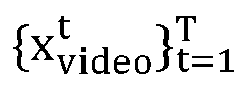
- The computer device may extract the feature of the audio resource by using a VGGish deep convolutional neural network model. A model parameter of the VGGish model may be pre-trained according to an AudioSet dataset. Similar to the image feature extraction, after feature extraction is performed on T frames of audio signals, an audio feature

- In some embodiments, there is a relatively small difference between image resources in adjacent frames of the video resource, and a feature similarity is relatively high. The audio resource is similar to the image resource. Therefore, the computer device performs the classification process based on the sampled video resource. Correspondingly, specific processing of
step 302 may be as follows: sampling the multimedia resource to obtain at least one frame of the multimedia resource, and extracting a plurality of pieces of feature information of the at least one frame of the multimedia resource. - The multimedia resource includes the image resource and the audio resource of the video resource, so that the image resource and the audio resource may both be sampled. For example, a sampling frequency may be one frame per second. A sampling frequency of the image resource and a sampling frequency of the audio resource may be the same or may be different. A specific sampling frequency is not limited in this embodiment of this application. By sampling the video resource, information redundancy can be reduced, processing efficiency can be improved, and processing resources can be saved.
- 303: The computer device separately performs non-local feature description on the image feature and the audio feature, to obtain at least one piece of image feature description information and at least one piece of audio feature description information.
- Non-local feature description of the image feature and the audio feature is similar to the foregoing
steps - 304: The computer device classifies the video resource based on the at least one piece of image feature description information and the at least one piece of audio feature description information, to obtain a classification result of the video resource.
- The computer device may use the image feature description information and the audio feature description information as input, and a classification process is similar to the foregoing
step 204. The classification result of the video resource is determined based on the image feature description information and the audio feature description information together. - In some embodiments, the computer device may alternatively use any one of the image feature description information or the audio feature description information as input. This is not limited in this embodiment of this application.
- In this embodiment of this application, the computer device may separately perform feature extraction and non-local feature description on the image resource and the audio resource of the video resource, to obtain the target feature description information in the video level. In addition to improving classification accuracy, obtaining the target feature description information for each frame may be further avoided, thereby reducing a data amount of the target feature description information of the video resource, saving storage space, and improving processing efficiency.
- The following describes a process of an image resource classification method with reference to the flowchart of a multimedia resource classification method shown in
FIG. 4 by using an example in which the multimedia resource is an image resource. The processing procedure of the method may include the following steps:
401: The computer device obtains an image resource, divides the multimedia resource into at least one image region based on a preset image segmentation rule, and extracts a plurality of pieces of feature information of the at least one image region. - In some embodiments, for an image resource of a relatively large pixel size, complexity of feature extraction is relatively high. Therefore, the computer device may segment the image resource and then perform feature extraction.
- The image segmentation rule may be average segmentation, pyramid segmentation, and the like. Certainly, the image segmentation rule may also be a rule obtained by combining a plurality of segmentation manners. For example, a plurality of pyramid images is obtained by segmenting the image resource in the pyramid segmentation manner, and then average segmentation is performed on the pyramid images. A specific image segmentation rule is not limited in this embodiment of this application.
- Similar to the foregoing feature extraction process for the image resource in the video resource, after feature extraction is performed on N image regions, feature information
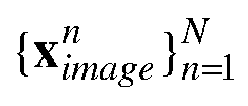
- 402: The computer device performs non-local feature description on the plurality of pieces of feature information of the at least one image region, to obtain at least one piece of target feature description information.
- Similar to the foregoing
step 303, in the non-local feature description process, a space sequence is not required for inputted feature information. In addition, reference may not be made to space information in the calculation process. The target feature description information obtained based on the non-local feature description is irrelevant to the region in which an image is located. Therefore, the target feature description information may be used for describing a feature of the image resource rather than a feature of an image region. That is, the target feature description information may be a feature descriptor in an image level. As compared with obtaining target feature description information for each image region, a required data amount is less, thereby saving storage space. - 403: The computer device classifies the image resource based on the at least one piece of target feature description information, to obtain a classification result of the image resource.
- In this embodiment of this application, after performing feature extraction and non-local feature description on the image resource, the computer device may obtain the target feature description information in the image level. In addition to improving classification accuracy, obtaining the target feature description information for each image region may further be avoided, thereby reducing a data amount of the target feature description information of the image resource, saving storage space, and improving processing efficiency.
- Based on the same technical concept, an embodiment of this application further provides a multimedia resource classification apparatus. The apparatus may be the computer device in the foregoing embodiment.
FIG. 5 is a schematic diagram of a multimedia resource classification apparatus. As shown inFIG. 5 , the apparatus includes: - an obtaining
module 510, configured to obtain a multimedia resource, and extract a plurality of pieces of feature information of the multimedia resource; - a
clustering module 520, configured to cluster the plurality of pieces of feature information to obtain at least one cluster set, and determine cluster description information of each cluster set, the each cluster set including at least one piece of feature information, and each piece of cluster description information being used for indicating a feature of one cluster set; - a
description module 530, configured to determine at least one piece of target feature description information of the multimedia resource based on the cluster description information of each cluster set, each piece of target feature description information being used for representing an association between one piece of cluster description information and the remaining cluster description information; and - a
classification module 540, configured to classify the multimedia resource based on the at least one piece of target feature description information of the multimedia resource, to obtain a classification result of the multimedia resource. - Optionally, the
description module 530 is configured to: - determine, for each piece of cluster description information, first association information of the each piece of cluster description information, each piece of first association information being used for representing an association between the each piece of cluster description information and the remaining cluster description information; and
- determine the at least one piece of target feature description information of the multimedia resource based on the first association information of each piece of cluster description information.
- Optionally, the
description module 530 is configured to: - obtain at least one piece of first sub-association information of first cluster description information, each piece of first sub-association information being used for representing an association between the first cluster description information and one piece of second cluster description information, the first cluster description information being any one piece of cluster description information, and the second cluster description information being any one piece of information other than the first cluster description information in the at least one piece of cluster description information; and
- obtain first association information of the first cluster description information according to the at least one piece of first sub-association information and at least one piece of second cluster description information.
- Optionally, the
description module 530 is configured to:
merge the first association information of the first cluster description information and the first cluster description information, and output the target feature description information of the multimedia resource. - Optionally, the multimedia resource is a video resource, and the obtaining
module 510 is configured to: obtain an image resource and an audio resource that are included in the multimedia resource; and separately extract a plurality of image features of the image resource and a plurality of audio features of the audio resource. - Optionally, the multimedia resource is a video resource, and the obtaining
module 510 is configured to: sample the multimedia resource to obtain at least one frame of the multimedia resource, and extract a plurality of pieces of feature information of the at least one frame of the multimedia resource. - Optionally, the multimedia resource is an image resource, and the obtaining
module 510 is configured to: divide the multimedia resource into at least one image region based on a preset image segmentation rule, and extract a plurality of pieces of feature information of the at least one image region. - Optionally, the
classification module 540 is configured to:
calculate a classification probability of at least one type based on the at least one piece of target feature description information of the multimedia resource, and determine a type whose classification probability is greater than a preset threshold as the classification result of the multimedia resource. - Specific manners of performing operations by the modules of the apparatus in the foregoing embodiment are already described in detail in the embodiments related to the method.
- In this embodiment of this application, when classifying the multimedia resource, the computer device may cluster a plurality of pieces of feature information of the multimedia resource to obtain at least one cluster set, then describe each cluster set by using cluster description information, and further describe the cluster description information based on an association between the cluster description information, to obtain target feature description information. In addition to describing a feature of each cluster set in the multimedia resource, the target feature description information may further indicate an association between each piece of cluster description information and the remaining cluster description information. Therefore, the target feature description information is more representative for the multimedia resource. Further, when classifying the multimedia resource based on the target feature description information, the computer device may obtain a classification result with higher accuracy, thereby improving performance of multimedia resource classification.
- Division of the foregoing functional modules is only described for exemplary purposes when the multimedia resource classification apparatus provided in the foregoing embodiment classifies a multimedia resource. During actual application, the foregoing functions may be allocated, according to requirements, to be completed by different functional modules, that is, the internal structure of the computer device is divided into different functional modules, to complete all or some of the functions described above. In addition, the multimedia resource classification apparatus and multimedia resource classification method embodiments provided in the foregoing embodiments belong to one conception. For a specific implementation process, refer to the method embodiments.
- The computer device may be the terminal shown in
FIG. 6 , or may be the server shown inFIG. 7 . -
FIG. 6 is a schematic structural diagram of a terminal according to an embodiment of this application. The terminal 600 may be a smartphone, a tablet computer, a moving picture experts group audio layer III (MP3) player, a moving picture experts group audio layer IV (MP4) player, a notebook computer, or a desktop computer. The terminal 600 may also be referred to as user equipment, a portable terminal, a laptop terminal, a desktop terminal, or another name. - Generally, the terminal 600 includes a
processor 601 and amemory 602. - The
processor 601 may include one or more processing cores, for example, theprocessor 601 may be a 4-core processor or an 8-core processor. Theprocessor 601 may be implemented in at least one hardware form of digital signal processing (DSP), a field-programmable gate array (FPGA), and a programmable logic array (PLA). Theprocessor 601 may also include a main processor and a coprocessor. The main processor is a processor configured to process data in an awake state, and is also referred to as a central processing unit (CPU). The coprocessor is a low power consumption processor configured to process data in a standby state. In some embodiments, theprocessor 601 may be integrated with a graphics processing unit (GPU). The GPU is configured to be responsible for rendering and drawing content to be displayed by a display screen. In some embodiments, theprocessor 601 may further include an artificial intelligence (AI) processor. The AI processor is configured to process a calculation operation related to machine learning. - The
memory 602 may include one or more computer-readable storage media. The computer-readable storage medium may be non-transient. Thememory 602 may further include a high-speed random access memory (RAM) and a non-volatile memory, for example, one or more magnetic disk storage devices or flash storage devices. In some embodiments, the non-transitory computer-readable storage medium in thememory 602 is configured to store at least one instruction, the at least one instruction being executed by theprocessor 601 to implement the multimedia resource classification method provided in the method embodiments of this application. - In some embodiments, the terminal 600 further optionally includes a
peripheral device interface 603 and at least one peripheral device. Theprocessor 601, thememory 602, and theperipheral device interface 603 may be connected through a bus or a signal cable. Each peripheral device may be connected to theperipheral device interface 603 through a bus, a signal cable, or a circuit board. Specifically, the peripheral device includes at least one of a radio frequency (RF)circuit 604, atouch display screen 605, acamera 606, anaudio circuit 607, apositioning component 608, and apower supply 609. - The
peripheral device interface 603 may be configured to connect at least one peripheral device related to input/output (I/O) to theprocessor 601 and thememory 602. In some embodiments, theprocessor 601, thememory 602, and theperipheral device interface 603 are integrated into one chip or circuit board; in some other embodiments, any one or two of theprocessor 601, thememory 602, and theperipheral device interface 603 may be implemented on an independent chip or circuit board. This is not limited in this embodiment. - The
RF circuit 604 is configured to receive and transmit an RF signal, which is also referred to as an electromagnetic signal. TheRF circuit 604 communicates with a communication network and another communication device by using the electromagnetic signal. TheRF circuit 604 converts an electrical signal into an electromagnetic signal for transmission, or converts a received electromagnetic signal into an electrical signal. Optionally, theRF circuit 604 includes at least one or more of an antenna system, an RF transceiver, one or more amplifiers, a tuner, an oscillator, a digital signal processor, a codec chipset, and a subscriber identity module card. TheRF circuit 604 may communicate with another terminal through at least one wireless communication protocol. The wireless communication protocol includes, but is not limited to: a metropolitan area network, generations of mobile communication networks (2G, 3G, 4G, and 5G), a wireless local area network and/or a wireless fidelity (WiFi) network. In some embodiments, theRF circuit 604 may also include a circuit related to near field communication (NFC). This is not limited in this application. - The
display screen 605 is configured to display a user interface (UI). The UI may include a graph, a text, an icon, a video, and any combination thereof. When thedisplay screen 605 is a touch display screen, thedisplay screen 605 is further capable of acquiring a touch signal on or above a surface of thedisplay screen 605. The touch signal may be inputted, as a control signal, to theprocessor 601 for processing. In this case, thedisplay screen 605 may be further configured to provide a virtual button and/or a virtual keyboard, which is also referred to as a soft button and/or a soft keyboard. In some embodiments, there may be onedisplay screen 605, disposed on a front panel of the terminal 600. In some other embodiments, there may be at least twodisplay screens 605, disposed on different surfaces of the terminal 600 respectively or in a folded design. In some more embodiments, thedisplay screen 605 may be a flexible display screen, disposed on a curved surface or a folded surface of the terminal 600. Even, thedisplay screen 605 may be further set to have a non-rectangular irregular graph, namely, a special-shaped screen. Thedisplay screen 605 may be made of a material such as a liquid crystal display (LCD) or an organic light-emitting diode (OLED). - The
camera component 606 is configured to acquire an image or a video. Optionally, thecamera component 606 includes a front-facing camera and a rear-facing camera. Generally, the front-facing camera is disposed on the front panel of the terminal, and the rear-facing camera is disposed on a back surface of the terminal. In some embodiments, there are at least two rear-facing cameras, which are respectively any one of a main camera, a depth of field camera, a wide-angle camera, and a telephoto camera, to implement a background blurring function by fusing the main camera and the depth of field camera, and panoramic shooting and virtual reality (VR) shooting functions or other fusing shooting functions by fusing the main camera and the wide-angle camera. In some embodiments, thecamera component 606 may further include a flash. The flash may be a single color temperature flash, or may be a double color temperature flash. The double color temperature flash is a combination of a warm light flash and a cold light flash, and may be used for light compensation under different color temperatures. - The
audio circuit 607 may include a microphone and a speaker. The microphone is configured to: acquire sound waves of a user and an environment, and convert the sound waves into electrical signals and input the electrical signals into theprocessor 601 for processing, or input the electrical signals into theRF circuit 604 to implement speech communication. For the purpose of stereo collection or noise reduction, there may be a plurality of microphones, disposed at different portions of the terminal 600 respectively. The microphone may be further an array microphone or an omnidirectional collection microphone. The speaker is configured to convert electrical signals from theprocessor 601 or theRF circuit 604 into sound waves. The speaker may be a conventional thin-film speaker, or may be a piezoelectric ceramic speaker. When the speaker is the piezoelectric ceramic speaker, electrical signals not only can be converted into sound waves that can be heard by human, but also can be converted into sound waves that cannot be heard by human for ranging and other uses. In some embodiments, theaudio circuit 607 may further include an earphone jack. - The
positioning component 608 is configured to position a current geographic location of the terminal 600, to implement a navigation or a location based service (LBS). Thepositioning component 608 may be a positioning component based on the global positioning system (GPS) of the United States, the COMPASS System of China, the GLONASS System of Russia, or the GALILEO System of the European Union. - The
power supply 609 is configured to supply power for various components in theterminal 600. Thepower supply 609 may be an alternating current, a direct current, a disposable battery, or a rechargeable battery. When thepower supply 609 includes the rechargeable battery, the rechargeable battery may be a wired rechargeable battery or a wireless rechargeable battery. The rechargeable battery may further be configured to support a quick charge technology. - In some embodiments, the terminal 600 further includes one or
more sensors 610. The one ormore sensors 610 include, but are not limited to: anacceleration sensor 611, agyroscope sensor 612, apressure sensor 613, afingerprint sensor 614, anoptical sensor 615, and aproximity sensor 616. - The
acceleration sensor 611 may detect accelerations on three coordinate axes of a coordinate system established by theterminal 600. For example, theacceleration sensor 611 may be configured to detect components of gravity acceleration on the three coordinate axes. Theprocessor 601 may control, according to a gravity acceleration signal collected by theacceleration sensor 611, thetouch display screen 605 to display the UI in a transverse view or a longitudinal view. Theacceleration sensor 611 may be further configured to collect motion data of a game or a user. - The
gyroscope sensor 612 may detect a body direction and a rotation angle of the terminal 600. Thegyroscope sensor 612 may cooperate with theacceleration sensor 611 to collect a 3D action by the user on theterminal 600. Theprocessor 601 may implement the following functions according to the data collected by the gyroscope sensor 612: motion sensing (such as changing the UI according to a tilt operation of the user), image stabilization during shooting, game control, and inertial navigation. - The
pressure sensor 613 may be disposed on a side frame of the terminal 600 and/or a lower layer of thetouch display screen 605. When thepressure sensor 613 is disposed on the side frame of the terminal 600, a holding signal of the user to the terminal 600 may be detected, and left/right hand identification and a quick operation may be performed by theprocessor 601 according to the holding signal collected by thepressure sensor 613. When thepressure sensor 613 is disposed on the lower layer of thetouch display screen 605, theprocessor 601 controls an operable control on the UI interface according to a pressure operation of the user on thetouch display screen 605. The operable control includes at least one of a button control, a scroll bar control, an icon control, and a menu control. - The
fingerprint sensor 614 is configured to collect a user's fingerprint, and theprocessor 601 identifies a user's identity according to the fingerprint collected by thefingerprint sensor 614, or thefingerprint sensor 614 identifies the user's identity according to the collected fingerprint. When identifying that the user's identity is a trusted identity, theprocessor 601 authorizes the user to perform related sensitive operations. The sensitive operations include: unlocking the screen, viewing encrypted information, downloading software, paying, changing a setting, and the like. Thefingerprint sensor 614 may be disposed on a front surface, a back surface, or a side surface of the terminal 600. When a physical button or a vendor logo is disposed on the terminal 600, thefingerprint sensor 614 may be integrated with the physical button or the vendor logo. - The
optical sensor 615 is configured to collect ambient light intensity. In an embodiment, theprocessor 601 may control display luminance of thetouch display screen 605 according to the ambient light intensity collected by theoptical sensor 615. Specifically, when the ambient light intensity is relatively high, the display luminance of thetouch display screen 605 is increased. When the ambient light intensity is relatively low, the display luminance of thetouch display screen 605 is reduced. In another embodiment, theprocessor 601 may further dynamically adjust a camera parameter of thecamera component 606 according to the ambient light intensity collected by theoptical sensor 615. - The
proximity sensor 616, also referred to as a distance sensor, is generally disposed on the front panel of the terminal 600. Theproximity sensor 616 is configured to collect a distance between a user and the front surface of the terminal 600. In an embodiment, when theproximity sensor 616 detects that the distance between the user and the front surface of the terminal 600 gradually decreases, thetouch display screen 605 is controlled by theprocessor 601 to switch from a screen-on state to a screen-off state. When theproximity sensor 616 detects that the distance between the user and the front surface of the terminal 600 gradually increases, thetouch display screen 605 is controlled by theprocessor 601 to switch from the screen-off state to the screen-on state. - A person skilled in the art may understand that the structure shown in
FIG. 6 does not constitute a limitation on the terminal 600, and the terminal may include more or fewer components than those shown in the figure, or some components may be combined, or a different component deployment may be used. -
FIG. 7 is a schematic structural diagram of a server according to an embodiment of this application. Theserver 700 may vary greatly due to different configurations or performance, and may include one or more central processing units (CPUs) 701 and one ormore memories 702. Thememory 702 stores at least one instruction, the at least one instruction being loaded and executed by theprocessor 701 to implement the steps of the multimedia resource classification method, for example, to perform the following steps: - obtaining a multimedia resource, and extracting a plurality of pieces of feature information of the multimedia resource;
- clustering the plurality of pieces of feature information to obtain at least one cluster set, and determining cluster description information of each cluster set, the each cluster set including at least one piece of feature information, and each piece of cluster description information being used for indicating a feature of one cluster set;
- determining at least one piece of target feature description information of the multimedia resource based on the cluster description information of each cluster set, each piece of target feature description information being used for representing an association between one piece of cluster description information and the remaining cluster description information; and
- classifying the multimedia resource based on the at least one piece of target feature description information of the multimedia resource, to obtain a classification result of the multimedia resource.
- In this embodiment of this application, when classifying the multimedia resource, the computer device may cluster a plurality of pieces of feature information of the multimedia resource to obtain at least one cluster set, then describe each cluster set by using cluster description information, and further describe the cluster description information based on an association between the cluster description information, to obtain target feature description information. In addition to describing a feature of each cluster set in the multimedia resource, the target feature description information may further indicate an association between each piece of cluster description information and the remaining cluster description information. Therefore, the target feature description information is more representative for the multimedia resource. Further, when classifying the multimedia resource based on the target feature description information, the computer device may obtain a classification result with higher accuracy, thereby improving performance of multimedia resource classification.
- In an exemplary embodiment, a computer-readable storage medium, such as a memory including an instruction, is further provided, and the instruction may be executed by the processor in the server to complete the multimedia resource classification method. For example, the computer-readable storage medium may be a read-only memory (ROM), a random access memory (RAM), a CD-ROM, a magnetic tape, a floppy disk, or an optical data storage device.
- A person of ordinary skill in the art may understand that all or some of the steps of the foregoing embodiments may be implemented by using hardware, or may be implemented by a program instructing relevant hardware. The program may be stored in a computer-readable storage medium. The storage medium may be a ROM, a magnetic disk, or an optical disc.
- It is to be understood that the steps in the embodiments of this application are not necessarily performed according to a sequence indicated by step numbers. Unless explicitly specified in this application, execution of the steps is not strictly limited, and the steps may be performed in another sequence. Moreover, at least some of the steps in the embodiments may include a plurality of sub-steps or a plurality of stages. The sub-steps or stages are not necessarily performed at the same moment, but may be performed at different moments. The sub-steps or stages are not necessarily sequentially performed, but may be performed in turn or alternately with other steps or at least some sub-steps or stages of other steps.
- A person of ordinary skill in the art may understand that all or some of the procedures of the method in the foregoing embodiments may be implemented by a computer program instructing relevant hardware. The program may be stored in a non-volatile computer-readable storage medium. When the program is executed, the procedures of the foregoing method embodiments may be implemented. Any reference to a memory, a storage, a database, or another medium used in the embodiments provided in this application may include a non-volatile and/or volatile memory. The non-volatile memory may include a read-only memory (ROM), a programmable ROM (PROM), an electrically programmable ROM (EPROM), an electrically erasable programmable ROM (EEPROM), or a flash memory. The volatile memory may include a random access memory (RAM) or an external cache. As an illustration instead of a limitation, the RAM is available in a plurality of forms, such as a static RAM (SRAM), a dynamic RAM (DRAM), a synchronous DRAM (SDRAM), a double data rate SDRAM (DDRSDRAM), an enhanced SDRAM (ESDRAM), a synchronous link (Synchlink) DRAM (SLDRAM), a Rambus (Rambus) direct RAM (RDRAM), a direct Rambus dynamic RAM (DRDRAM), and a Rambus dynamic RAM (RDRAM).
- The foregoing descriptions are merely exemplary embodiments of this application, but are not intended to limit this application. Any modification, equivalent replacement, or improvement made within the spirit and principle of this application shall fall within the protection scope of this application.
Claims (22)
- A multimedia resource classification method, performed by a computer device, the method comprising:obtaining a multimedia resource, and extracting a plurality of pieces of feature information of the multimedia resource;clustering the plurality of pieces of feature information to obtain at least one cluster set, and determining cluster description information of each cluster set, the each cluster set comprising at least one piece of feature information, and each piece of cluster description information being used for indicating a feature of one cluster set;determining at least one piece of target feature description information of the multimedia resource based on the cluster description information of each cluster set, each piece of target feature description information being used for representing an association between one piece of cluster description information and the remaining cluster description information; andclassifying the multimedia resource based on the at least one piece of target feature description information of the multimedia resource, to obtain a classification result of the multimedia resource.
- The method according to claim 1, wherein the determining at least one piece of target feature description information of the multimedia resource based on the cluster description information of each cluster set comprises:determining, for each piece of cluster description information, first association information of the each piece of cluster description information, each piece of first association information being used for representing an association between the each piece of cluster description information and the remaining cluster description information; anddetermining the at least one piece of target feature description information of the multimedia resource based on the first association information of each piece of cluster description information.
- The method according to claim 2, wherein the determining, for each piece of cluster description information, first association information of the each piece of cluster description information comprises:obtaining at least one piece of first sub-association information of first cluster description information, each piece of first sub-association information being used for representing an association between the first cluster description information and one piece of second cluster description information, the first cluster description information being any one piece of cluster description information, and the second cluster description information being any one piece of information other than the first cluster description information in the at least one piece of cluster description information; andobtaining first association information of the first cluster description information according to the at least one piece of first sub-association information and at least one piece of second cluster description information.
- The method according to claim 3, wherein the determining the at least one piece of target feature description information of the multimedia resource based on the first association information of each piece of cluster description information comprises: merging the first association information of the first cluster description information and the first cluster description information, and outputting the target feature description information of the multimedia resource.
- The method according to claim 1, wherein the multimedia resource is a video resource, and the extracting a plurality of pieces of feature information of the multimedia resource comprises:obtaining an image resource and an audio resource that are comprised in the multimedia resource;and separately extracting a plurality of image features of the image resource and a plurality of audio features of the audio resource.
- The method according to claim 1, wherein the multimedia resource is a video resource, and the extracting a plurality of pieces of feature information of the multimedia resource comprises:sampling the multimedia resource to obtain at least one frame of the multimedia resource, andextracting a plurality of pieces of feature information of the at least one frame of the multimedia resource.
- The method according to claim 1, wherein the multimedia resource is an image resource, and the extracting a plurality of pieces of feature information of the multimedia resource comprises:
dividing the multimedia resource into at least one image region based on a preset image segmentation rule, and extracting a plurality of pieces of feature information of the at least one image region. - The method according to claim 1, wherein the classifying the multimedia resource based on the at least one piece of target feature description information of the multimedia resource, to obtain a classification result of the multimedia resource comprises:
obtaining a classification probability of at least one type based on the at least one piece of target feature description information of the multimedia resource, and determining a type whose classification probability is greater than a preset threshold as the classification result of the multimedia resource. - A multimedia resource classification apparatus, comprising:an obtaining module, configured to obtain a multimedia resource, and extract a plurality of pieces of feature information of the multimedia resource;a clustering module, configured to cluster the plurality of pieces of feature information to obtain at least one cluster set, and determine cluster description information of each cluster set, the each cluster set comprising at least one piece of feature information, and each piece of cluster description information being used for indicating a feature of one cluster set;a description module, configured to determine at least one piece of target feature description information of the multimedia resource based on the cluster description information of each cluster set, each piece of target feature description information being used for representing an association between one piece of cluster description information and the remaining cluster description information; anda classification module, configured to classify the multimedia resource based on the at least one piece of target feature description information of the multimedia resource, to obtain a classification result of the multimedia resource.
- The apparatus according to claim 9, wherein the description module is configured to:determine, for each piece of cluster description information, first association information of the each piece of cluster description information, each piece of first association information being used for representing an association between the each piece of cluster description information and the remaining cluster description information; anddetermine the at least one piece of target feature description information of the multimedia resource based on the first association information of each piece of cluster description information.
- The apparatus according to claim 10, wherein the description module is configured to:obtain at least one piece of first sub-association information of first cluster description information, each piece of first sub-association information being used for representing an association between the first cluster description information and one piece of second cluster description information, the first cluster description information being any one piece of cluster description information, and the second cluster description information being any one piece of information other than the first cluster description information in the at least one piece of cluster description information; andobtain first association information of the first cluster description information according to the at least one piece of first sub-association information and at least one piece of second cluster description information.
- The apparatus according to claim 11, wherein the description module is configured to:
merge the first association information of the first cluster description information and the first cluster description information, and output the target feature description information of the multimedia resource. - The apparatus according to claim 9, wherein the multimedia resource is a video resource, and the obtaining module is configured to: obtain an image resource and an audio resource that are comprised in the multimedia resource; and separately extract a plurality of image features of the image resource and a plurality of audio features of the audio resource.
- A computer device, comprising a memory and a processor, the memory storing a computer-readable instruction, the computer-readable instruction, when executed by the processor, causing the processor to perform the following operations:obtaining a multimedia resource, and extracting a plurality of pieces of feature information of the multimedia resource;clustering the plurality of pieces of feature information to obtain at least one cluster set, and determining cluster description information of each cluster set, the each cluster set comprising at least one piece of feature information, and each piece of cluster description information being used for indicating a feature of one cluster set;determining at least one piece of target feature description information of the multimedia resource based on the cluster description information of each cluster set, each piece of target feature description information being used for representing an association between one piece of cluster description information and the remaining cluster description information; andclassifying the multimedia resource based on the at least one piece of target feature description information of the multimedia resource, to obtain a classification result of the multimedia resource.
- The computer device according to claim 14, wherein the determining at least one piece of target feature description information of the multimedia resource based on the cluster description information of each cluster set comprises:determining, for each piece of cluster description information, first association information of the each piece of cluster description information, each piece of first association information being used for representing an association between the each piece of cluster description information and the remaining cluster description information; anddetermining the at least one piece of target feature description information of the multimedia resource based on the first association information of each piece of cluster description information.
- The computer device according to claim 15, wherein the determining, for each piece of cluster description information, first association information of the each piece of cluster description information comprises:obtaining at least one piece of first sub-association information of first cluster description information, each piece of first sub-association information being used for representing an association between the first cluster description information and one piece of second cluster description information, the first cluster description information being any one piece of cluster description information, and the second cluster description information being any one piece of information other than the first cluster description information in the at least one piece of cluster description information; andobtaining first association information of the first cluster description information according to the at least one piece of first sub-association information and at least one piece of second cluster description information.
- The computer device according to claim 16, wherein the determining the at least one piece of target feature description information of the multimedia resource based on the first association information of each piece of cluster description information comprises: merging the first association information of the first cluster description information and the first cluster description information, and outputting the target feature description information of the multimedia resource.
- The computer device according to claim 14, wherein the multimedia resource is a video resource, and the extracting a plurality of pieces of feature information of the multimedia resource comprises: obtaining an image resource and an audio resource that are comprised in the multimedia resource; and separately extracting a plurality of image features of the image resource and a plurality of audio features of the audio resource.
- The computer device according to claim 14, wherein the multimedia resource is a video resource, and the extracting a plurality of pieces of feature information of the multimedia resource comprises: sampling the multimedia resource to obtain at least one frame of the multimedia resource, and extracting a plurality of pieces of feature information of the at least one frame of the multimedia resource.
- The computer device according to claim 14, wherein the multimedia resource is an image resource, and the extracting a plurality of pieces of feature information of the multimedia resource comprises: dividing the multimedia resource into at least one image region based on a preset image segmentation rule, and extracting a plurality of pieces of feature information of the at least one image region.
- The computer device according to claim 14, wherein the classifying the multimedia resource based on the at least one piece of target feature description information of the multimedia resource, to obtain a classification result of the multimedia resource comprises: obtaining a classification probability of at least one type based on the at least one piece of target feature description information of the multimedia resource, and determining a type whose classification probability is greater than a preset threshold as the classification result of the multimedia resource.
- One or more non-volatile storage media storing a computer-readable instruction, the computer-readable instruction, when executed by one or more processors, causing the one or more processors to perform the operations of the multimedia resource classification method according to any one of claims 1 to 8.
Applications Claiming Priority (2)
| Application Number | Priority Date | Filing Date | Title |
|---|---|---|---|
| CN201811022608.9A CN109299315B (en) | 2018-09-03 | 2018-09-03 | Multimedia resource classification method and device, computer equipment and storage medium |
| PCT/CN2019/101298 WO2020048308A1 (en) | 2018-09-03 | 2019-08-19 | Multimedia resource classification method and apparatus, computer device, and storage medium |
Publications (3)
| Publication Number | Publication Date |
|---|---|
| EP3848817A1 true EP3848817A1 (en) | 2021-07-14 |
| EP3848817A4 EP3848817A4 (en) | 2021-10-06 |
| EP3848817B1 EP3848817B1 (en) | 2026-02-11 |
Family
ID=65166255
Family Applications (1)
| Application Number | Title | Priority Date | Filing Date |
|---|---|---|---|
| EP19857869.2A Active EP3848817B1 (en) | 2018-09-03 | 2019-08-19 | Multimedia resource classification method and apparatus, computer device, and storage medium |
Country Status (4)
| Country | Link |
|---|---|
| US (1) | US11798278B2 (en) |
| EP (1) | EP3848817B1 (en) |
| CN (1) | CN109299315B (en) |
| WO (1) | WO2020048308A1 (en) |
Families Citing this family (35)
| Publication number | Priority date | Publication date | Assignee | Title |
|---|---|---|---|---|
| CN109299315B (en) * | 2018-09-03 | 2023-03-28 | 腾讯科技(深圳)有限公司 | Multimedia resource classification method and device, computer equipment and storage medium |
| CN110046279B (en) * | 2019-04-18 | 2022-02-25 | 网易传媒科技(北京)有限公司 | Video file feature prediction method, medium, device and computing equipment |
| CN110096605B (en) * | 2019-04-26 | 2021-06-04 | 北京迈格威科技有限公司 | Image processing method and device, electronic device and storage medium |
| CN111984738B (en) * | 2019-05-23 | 2024-06-14 | 杭州海康威视数字技术股份有限公司 | Data association method, device, equipment and storage medium |
| CN110909184B (en) * | 2019-11-19 | 2024-07-02 | 北京达佳互联信息技术有限公司 | Method, device, equipment and medium for displaying multimedia resources |
| CN111324754B (en) * | 2020-03-11 | 2023-12-15 | 北京奇艺世纪科技有限公司 | A method and device for determining timeline information |
| CN111625682B (en) * | 2020-04-30 | 2023-10-20 | 腾讯音乐娱乐科技(深圳)有限公司 | Video generation method, device, computer equipment and storage medium |
| CN114247661B (en) * | 2020-09-24 | 2023-04-28 | 长鑫存储技术有限公司 | Semiconductor product grading method and grading system |
| CN112732867B (en) * | 2020-12-29 | 2024-03-15 | 广州视源电子科技股份有限公司 | Document processing methods and devices |
| CN113269218B (en) * | 2020-12-30 | 2023-06-09 | 威创集团股份有限公司 | Video classification method based on improved VLAD algorithm |
| CN113076286B (en) * | 2021-03-09 | 2024-03-15 | 北京梧桐车联科技有限责任公司 | Method, device, equipment and readable storage medium for acquiring multimedia file |
| CN112949538B (en) * | 2021-03-16 | 2023-08-04 | 杭州海康威视数字技术股份有限公司 | Target association method, device, electronic equipment and machine-readable storage medium |
| CN113204660B (en) * | 2021-03-31 | 2024-05-17 | 北京达佳互联信息技术有限公司 | Multimedia data processing method, tag identification device and electronic equipment |
| CN113031877B (en) * | 2021-04-12 | 2024-03-08 | 中国移动通信集团陕西有限公司 | Data storage methods, devices, equipment and media |
| CN113239215B (en) * | 2021-05-07 | 2024-05-14 | 北京百度网讯科技有限公司 | Classification method and device for multimedia resources, electronic equipment and storage medium |
| CN113139613A (en) * | 2021-05-08 | 2021-07-20 | 清华大学 | Feature extraction method and device, electronic equipment and storage medium |
| CN113139082A (en) * | 2021-05-14 | 2021-07-20 | 北京字节跳动网络技术有限公司 | Multimedia content processing method, apparatus, device and medium |
| CN113326385B (en) * | 2021-08-04 | 2021-12-07 | 北京达佳互联信息技术有限公司 | Target multimedia resource acquisition method and device, electronic equipment and storage medium |
| CN113779395B (en) * | 2021-09-10 | 2025-04-18 | 粒子文化科技集团(杭州)股份有限公司 | Media resource recommendation method, device, system, electronic device and storage medium |
| CN114118132B (en) * | 2021-09-29 | 2025-08-15 | 浙江大华技术股份有限公司 | Camera optimization method, device, equipment and storage medium based on gear dropping rate |
| CN114170551A (en) * | 2021-12-09 | 2022-03-11 | 上海德衡数据科技有限公司 | Data center monitoring method and system |
| CN114547373A (en) * | 2022-02-21 | 2022-05-27 | 山东浪潮超高清视频产业有限公司 | Method for intelligently identifying and searching programs based on audio |
| CN114564602B (en) * | 2022-03-17 | 2025-12-12 | 北京达佳互联信息技术有限公司 | Methods, apparatus, electronic devices and storage media for constructing tags for multimedia resources |
| CN114595346B (en) * | 2022-03-17 | 2025-08-26 | 北京有竹居网络技术有限公司 | Content detection model training method, content detection method and device |
| CN114398501B (en) * | 2022-03-25 | 2022-06-28 | 腾讯科技(深圳)有限公司 | Multimedia resource grouping method, device, equipment and storage medium |
| CN114691940B (en) * | 2022-04-18 | 2026-03-06 | 上海徐毓智能科技有限公司 | Index building methods, devices, vector search methods, and retrieval systems |
| CN114817583B (en) * | 2022-05-10 | 2025-08-29 | 腾讯科技(深圳)有限公司 | Method, device, equipment and storage medium for determining grouping results |
| CN115618026B (en) * | 2022-09-15 | 2026-05-26 | 北京达佳互联信息技术有限公司 | Account feature generation method and device, electronic equipment and storage medium |
| CN117009640A (en) * | 2022-09-30 | 2023-11-07 | 腾讯科技(深圳)有限公司 | Multimedia information processing method and device, storage medium, and program product |
| CN115691821B (en) * | 2022-10-31 | 2026-08-04 | 沈阳东软智能医疗科技研究院有限公司 | Sample matching method, device, equipment and storage medium |
| CN116467601B (en) * | 2023-04-24 | 2026-02-03 | 北京达佳互联信息技术有限公司 | Feature extraction model training method and device, electronic equipment and storage medium |
| CN117725276B (en) * | 2023-09-26 | 2024-10-22 | 书行科技(北京)有限公司 | Resource recommendation method and device, electronic equipment, medium and product |
| CN117658208B (en) * | 2023-12-20 | 2024-06-04 | 潮州市丰业新材料有限公司 | A kind of high purity zirconium oxide powder and preparation method thereof |
| CN119558804B (en) * | 2024-11-14 | 2025-09-26 | 广州市时代物业管理有限公司 | Human resource information sharing system and method based on Internet |
| CN122111542A (en) * | 2024-11-29 | 2026-05-29 | 华为技术有限公司 | Display method and electronic equipment |
Family Cites Families (12)
| Publication number | Priority date | Publication date | Assignee | Title |
|---|---|---|---|---|
| CN101894170B (en) * | 2010-08-13 | 2011-12-28 | 武汉大学 | Semantic relationship network-based cross-mode information retrieval method |
| US10694106B2 (en) * | 2013-06-14 | 2020-06-23 | Qualcomm Incorporated | Computer vision application processing |
| CN104679902B (en) * | 2015-03-20 | 2017-11-28 | 湘潭大学 | A kind of informative abstract extracting method of combination across Media Convergence |
| CN104951432B (en) * | 2015-05-21 | 2019-01-11 | 腾讯科技(深圳)有限公司 | The method and device that a kind of pair of information is handled |
| CN105468781A (en) * | 2015-12-21 | 2016-04-06 | 小米科技有限责任公司 | Video query method and device |
| EP3427488A4 (en) * | 2016-03-08 | 2019-08-21 | Your Trainer Inc. | Systems and methods of dynamically creating a personalized workout video |
| CN107230187B (en) * | 2016-03-25 | 2022-05-24 | 北京三星通信技术研究有限公司 | Method and device for processing multimedia information |
| CN109843176A (en) * | 2016-07-29 | 2019-06-04 | 诺瓦达克技术有限公司 | Methods and systems for utilizing machine learning to characterize a subject's organization |
| CN106446950B (en) * | 2016-09-27 | 2020-04-10 | 腾讯科技(深圳)有限公司 | Image processing method and device |
| CN106779073B (en) | 2016-12-27 | 2019-05-31 | 西安石油大学 | Method and device for media information classification based on deep neural network |
| CN108009228B (en) * | 2017-11-27 | 2020-10-09 | 咪咕互动娱乐有限公司 | Method, device and storage medium for setting content label |
| CN109299315B (en) * | 2018-09-03 | 2023-03-28 | 腾讯科技(深圳)有限公司 | Multimedia resource classification method and device, computer equipment and storage medium |
-
2018
- 2018-09-03 CN CN201811022608.9A patent/CN109299315B/en active Active
-
2019
- 2019-08-19 WO PCT/CN2019/101298 patent/WO2020048308A1/en not_active Ceased
- 2019-08-19 EP EP19857869.2A patent/EP3848817B1/en active Active
-
2020
- 2020-09-28 US US17/034,090 patent/US11798278B2/en active Active
Also Published As
| Publication number | Publication date |
|---|---|
| CN109299315A (en) | 2019-02-01 |
| EP3848817B1 (en) | 2026-02-11 |
| US20210011942A1 (en) | 2021-01-14 |
| EP3848817A4 (en) | 2021-10-06 |
| US11798278B2 (en) | 2023-10-24 |
| CN109299315B (en) | 2023-03-28 |
| WO2020048308A1 (en) | 2020-03-12 |
Similar Documents
| Publication | Publication Date | Title |
|---|---|---|
| US11798278B2 (en) | Method, apparatus, and storage medium for classifying multimedia resource | |
| US11244170B2 (en) | Scene segmentation method and device, and storage medium | |
| US11488293B1 (en) | Method for processing images and electronic device | |
| US12210569B2 (en) | Video clip positioning method and apparatus, computer device, and storage medium | |
| US11403763B2 (en) | Image segmentation method and apparatus, computer device, and storage medium | |
| US11151360B2 (en) | Facial attribute recognition method, electronic device, and storage medium | |
| EP3968223B1 (en) | Method and apparatus for acquiring positions of target, and computer device and storage medium | |
| CN111325726B (en) | Model training methods, image processing methods, devices, equipment and storage media | |
| US20210166395A1 (en) | Image segmentation method and apparatus, computer device, and storage medium | |
| CN110083791B (en) | Target group detection method and device, computer equipment and storage medium | |
| CN109189950B (en) | Multimedia resource classification method and device, computer equipment and storage medium | |
| EP4109330B1 (en) | Video data processing method and apparatus, and computer device and storage medium | |
| CN111192262A (en) | Product defect classification method, device, equipment and medium based on artificial intelligence | |
| CN110555839A (en) | Defect detection and identification method and device, computer equipment and storage medium | |
| CN113705302B (en) | Image generation model training method, device, computer equipment and storage medium | |
| CN111738914A (en) | Image processing method, device, computer equipment and storage medium | |
| CN111104980A (en) | Method, device, device and storage medium for determining classification result | |
| CN111428551B (en) | Density detection method, density detection model training method and device | |
| CN110675412A (en) | Image segmentation method, image segmentation model training method, device and equipment | |
| CN114462580A (en) | Text recognition model training method, text recognition method, device and device | |
| CN110647881A (en) | Method, device, device and storage medium for determining card type corresponding to image | |
| US12327358B2 (en) | Method for reconstructing dendritic tissue in image, device and storage medium | |
| CN113705292A (en) | Time sequence action detection method and device, computer equipment and storage medium | |
| EP4621721A1 (en) | Face image generation method and apparatus, device, and storage medium | |
| CN114462540A (en) | Clustering model training method, clustering device, clustering equipment and storage medium |
Legal Events
| Date | Code | Title | Description |
|---|---|---|---|
| STAA | Information on the status of an ep patent application or granted ep patent |
Free format text: STATUS: THE INTERNATIONAL PUBLICATION HAS BEEN MADE |
|
| PUAI | Public reference made under article 153(3) epc to a published international application that has entered the european phase |
Free format text: ORIGINAL CODE: 0009012 |
|
| STAA | Information on the status of an ep patent application or granted ep patent |
Free format text: STATUS: REQUEST FOR EXAMINATION WAS MADE |
|
| 17P | Request for examination filed |
Effective date: 20201015 |
|
| AK | Designated contracting states |
Kind code of ref document: A1 Designated state(s): AL AT BE BG CH CY CZ DE DK EE ES FI FR GB GR HR HU IE IS IT LI LT LU LV MC MK MT NL NO PL PT RO RS SE SI SK SM TR |
|
| A4 | Supplementary search report drawn up and despatched |
Effective date: 20210908 |
|
| RIC1 | Information provided on ipc code assigned before grant |
Ipc: G06K 9/00 20060101ALI20210902BHEP Ipc: G06K 9/62 20060101ALI20210902BHEP Ipc: G06F 16/635 20190101AFI20210902BHEP |
|
| DAV | Request for validation of the european patent (deleted) | ||
| DAX | Request for extension of the european patent (deleted) | ||
| RAP3 | Party data changed (applicant data changed or rights of an application transferred) |
Owner name: TENCENT TECHNOLOGY (SHENZHEN) COMPANY LIMITED |
|
| STAA | Information on the status of an ep patent application or granted ep patent |
Free format text: STATUS: EXAMINATION IS IN PROGRESS |
|
| 17Q | First examination report despatched |
Effective date: 20230719 |
|
| GRAP | Despatch of communication of intention to grant a patent |
Free format text: ORIGINAL CODE: EPIDOSNIGR1 |
|
| STAA | Information on the status of an ep patent application or granted ep patent |
Free format text: STATUS: GRANT OF PATENT IS INTENDED |
|
| RIC1 | Information provided on ipc code assigned before grant |
Ipc: G06F 16/635 20190101AFI20250820BHEP Ipc: G06V 20/40 20220101ALI20250820BHEP Ipc: G06V 10/82 20220101ALI20250820BHEP Ipc: G06V 10/77 20220101ALI20250820BHEP Ipc: G06V 10/764 20220101ALI20250820BHEP Ipc: G06F 18/2321 20230101ALI20250820BHEP Ipc: G06V 10/762 20220101ALI20250820BHEP |
|
| INTG | Intention to grant announced |
Effective date: 20250828 |
|
| GRAS | Grant fee paid |
Free format text: ORIGINAL CODE: EPIDOSNIGR3 |
|
| GRAA | (expected) grant |
Free format text: ORIGINAL CODE: 0009210 |
|
| STAA | Information on the status of an ep patent application or granted ep patent |
Free format text: STATUS: THE PATENT HAS BEEN GRANTED |
|
| AK | Designated contracting states |
Kind code of ref document: B1 Designated state(s): AL AT BE BG CH CY CZ DE DK EE ES FI FR GB GR HR HU IE IS IT LI LT LU LV MC MK MT NL NO PL PT RO RS SE SI SK SM TR |
|
| REG | Reference to a national code |
Ref country code: CH Ref legal event code: F10 Free format text: ST27 STATUS EVENT CODE: U-0-0-F10-F00 (AS PROVIDED BY THE NATIONAL OFFICE) Effective date: 20260211 Ref country code: GB Ref legal event code: FG4D |
|
| REG | Reference to a national code |
Ref country code: DE Ref legal event code: R096 Ref document number: 602019081300 Country of ref document: DE |
|
| REG | Reference to a national code |
Ref country code: IE Ref legal event code: FG4D |
|
| REG | Reference to a national code |
Ref country code: NL Ref legal event code: MP Effective date: 20260211 |
|
| PG25 | Lapsed in a contracting state [announced via postgrant information from national office to epo] |
Ref country code: RS Free format text: LAPSE BECAUSE OF FAILURE TO SUBMIT A TRANSLATION OF THE DESCRIPTION OR TO PAY THE FEE WITHIN THE PRESCRIBED TIME-LIMIT Effective date: 20260511 |
|
| PG25 | Lapsed in a contracting state [announced via postgrant information from national office to epo] |
Ref country code: ES Free format text: LAPSE BECAUSE OF FAILURE TO SUBMIT A TRANSLATION OF THE DESCRIPTION OR TO PAY THE FEE WITHIN THE PRESCRIBED TIME-LIMIT Effective date: 20260211 |
|
| PG25 | Lapsed in a contracting state [announced via postgrant information from national office to epo] |
Ref country code: PL Free format text: LAPSE BECAUSE OF FAILURE TO SUBMIT A TRANSLATION OF THE DESCRIPTION OR TO PAY THE FEE WITHIN THE PRESCRIBED TIME-LIMIT Effective date: 20260211 |
|
| PG25 | Lapsed in a contracting state [announced via postgrant information from national office to epo] |
Ref country code: GR Free format text: LAPSE BECAUSE OF FAILURE TO SUBMIT A TRANSLATION OF THE DESCRIPTION OR TO PAY THE FEE WITHIN THE PRESCRIBED TIME-LIMIT Effective date: 20260512 |
|
| REG | Reference to a national code |
Ref country code: LT Ref legal event code: MG9D |
|
| PG25 | Lapsed in a contracting state [announced via postgrant information from national office to epo] |
Ref country code: LT Free format text: LAPSE BECAUSE OF FAILURE TO SUBMIT A TRANSLATION OF THE DESCRIPTION OR TO PAY THE FEE WITHIN THE PRESCRIBED TIME-LIMIT Effective date: 20260211 |
|
| PG25 | Lapsed in a contracting state [announced via postgrant information from national office to epo] |
Ref country code: NO Free format text: LAPSE BECAUSE OF FAILURE TO SUBMIT A TRANSLATION OF THE DESCRIPTION OR TO PAY THE FEE WITHIN THE PRESCRIBED TIME-LIMIT Effective date: 20260511 |
|
| PG25 | Lapsed in a contracting state [announced via postgrant information from national office to epo] |
Ref country code: FI Free format text: LAPSE BECAUSE OF FAILURE TO SUBMIT A TRANSLATION OF THE DESCRIPTION OR TO PAY THE FEE WITHIN THE PRESCRIBED TIME-LIMIT Effective date: 20260211 Ref country code: AT Free format text: LAPSE BECAUSE OF FAILURE TO SUBMIT A TRANSLATION OF THE DESCRIPTION OR TO PAY THE FEE WITHIN THE PRESCRIBED TIME-LIMIT Effective date: 20260211 Ref country code: SE Free format text: LAPSE BECAUSE OF FAILURE TO SUBMIT A TRANSLATION OF THE DESCRIPTION OR TO PAY THE FEE WITHIN THE PRESCRIBED TIME-LIMIT Effective date: 20260211 |
|
| REG | Reference to a national code |
Ref country code: AT Ref legal event code: MK05 Ref document number: 1886284 Country of ref document: AT Kind code of ref document: T Effective date: 20260211 |
|
| PG25 | Lapsed in a contracting state [announced via postgrant information from national office to epo] |
Ref country code: HR Free format text: LAPSE BECAUSE OF FAILURE TO SUBMIT A TRANSLATION OF THE DESCRIPTION OR TO PAY THE FEE WITHIN THE PRESCRIBED TIME-LIMIT Effective date: 20260211 |
|
| PG25 | Lapsed in a contracting state [announced via postgrant information from national office to epo] |
Ref country code: PT Free format text: LAPSE BECAUSE OF FAILURE TO SUBMIT A TRANSLATION OF THE DESCRIPTION OR TO PAY THE FEE WITHIN THE PRESCRIBED TIME-LIMIT Effective date: 20260611 Ref country code: IS Free format text: LAPSE BECAUSE OF FAILURE TO SUBMIT A TRANSLATION OF THE DESCRIPTION OR TO PAY THE FEE WITHIN THE PRESCRIBED TIME-LIMIT Effective date: 20260611 |
|
| PG25 | Lapsed in a contracting state [announced via postgrant information from national office to epo] |
Ref country code: NL Free format text: LAPSE BECAUSE OF FAILURE TO SUBMIT A TRANSLATION OF THE DESCRIPTION OR TO PAY THE FEE WITHIN THE PRESCRIBED TIME-LIMIT Effective date: 20260211 |
|
| PG25 | Lapsed in a contracting state [announced via postgrant information from national office to epo] |
Ref country code: LV Free format text: LAPSE BECAUSE OF FAILURE TO SUBMIT A TRANSLATION OF THE DESCRIPTION OR TO PAY THE FEE WITHIN THE PRESCRIBED TIME-LIMIT Effective date: 20260211 |
|
| PG25 | Lapsed in a contracting state [announced via postgrant information from national office to epo] |
Ref country code: BG Free format text: LAPSE BECAUSE OF FAILURE TO SUBMIT A TRANSLATION OF THE DESCRIPTION OR TO PAY THE FEE WITHIN THE PRESCRIBED TIME-LIMIT Effective date: 20260211 |