EP3848348A1 - Method for manufacturing cyclopropane compound - Google Patents
Method for manufacturing cyclopropane compound Download PDFInfo
- Publication number
- EP3848348A1 EP3848348A1 EP19857085.5A EP19857085A EP3848348A1 EP 3848348 A1 EP3848348 A1 EP 3848348A1 EP 19857085 A EP19857085 A EP 19857085A EP 3848348 A1 EP3848348 A1 EP 3848348A1
- Authority
- EP
- European Patent Office
- Prior art keywords
- formula
- compound represented
- optically active
- active compound
- compound
- Prior art date
- Legal status (The legal status is an assumption and is not a legal conclusion. Google has not performed a legal analysis and makes no representation as to the accuracy of the status listed.)
- Granted
Links
- 0 C**(C(C1)[C@]1(C*)C(C1)C(C)=CC[C@@]1F)O Chemical compound C**(C(C1)[C@]1(C*)C(C1)C(C)=CC[C@@]1F)O 0.000 description 3
- GFIMUBHHJOMLLS-UMDRPBGHSA-N C[C@@H](CC(O)OC1)C1C(C=CC1)=C[C@@H]1F Chemical compound C[C@@H](CC(O)OC1)C1C(C=CC1)=C[C@@H]1F GFIMUBHHJOMLLS-UMDRPBGHSA-N 0.000 description 2
- BIMWHODPLNEKCL-VIFPVBQESA-N C[C@@H](CCCCC(C)(C)CO)N Chemical compound C[C@@H](CCCCC(C)(C)CO)N BIMWHODPLNEKCL-VIFPVBQESA-N 0.000 description 1
- WKQBSCPYQRBENA-XJKSGUPXSA-N OC[C@@](C1)([C@@H]1C(Nc(cc1)ncc1F)=O)c1cc(F)ccc1 Chemical compound OC[C@@](C1)([C@@H]1C(Nc(cc1)ncc1F)=O)c1cc(F)ccc1 WKQBSCPYQRBENA-XJKSGUPXSA-N 0.000 description 1
Classifications
-
- C—CHEMISTRY; METALLURGY
- C07—ORGANIC CHEMISTRY
- C07C—ACYCLIC OR CARBOCYCLIC COMPOUNDS
- C07C309/00—Sulfonic acids; Halides, esters, or anhydrides thereof
- C07C309/63—Esters of sulfonic acids
- C07C309/72—Esters of sulfonic acids having sulfur atoms of esterified sulfo groups bound to carbon atoms of six-membered aromatic rings of a carbon skeleton
-
- A—HUMAN NECESSITIES
- A61—MEDICAL OR VETERINARY SCIENCE; HYGIENE
- A61K—PREPARATIONS FOR MEDICAL, DENTAL OR TOILETRY PURPOSES
- A61K31/00—Medicinal preparations containing organic active ingredients
- A61K31/33—Heterocyclic compounds
- A61K31/395—Heterocyclic compounds having nitrogen as a ring hetero atom, e.g. guanethidine or rifamycins
- A61K31/495—Heterocyclic compounds having nitrogen as a ring hetero atom, e.g. guanethidine or rifamycins having six-membered rings with two or more nitrogen atoms as the only ring heteroatoms, e.g. piperazine or tetrazines
- A61K31/505—Pyrimidines; Hydrogenated pyrimidines, e.g. trimethoprim
- A61K31/506—Pyrimidines; Hydrogenated pyrimidines, e.g. trimethoprim not condensed and containing further heterocyclic rings
-
- B—PERFORMING OPERATIONS; TRANSPORTING
- B01—PHYSICAL OR CHEMICAL PROCESSES OR APPARATUS IN GENERAL
- B01J—CHEMICAL OR PHYSICAL PROCESSES, e.g. CATALYSIS OR COLLOID CHEMISTRY; THEIR RELEVANT APPARATUS
- B01J31/00—Catalysts comprising hydrides, coordination complexes or organic compounds
- B01J31/02—Catalysts comprising hydrides, coordination complexes or organic compounds containing organic compounds or metal hydrides
-
- B—PERFORMING OPERATIONS; TRANSPORTING
- B01—PHYSICAL OR CHEMICAL PROCESSES OR APPARATUS IN GENERAL
- B01J—CHEMICAL OR PHYSICAL PROCESSES, e.g. CATALYSIS OR COLLOID CHEMISTRY; THEIR RELEVANT APPARATUS
- B01J31/00—Catalysts comprising hydrides, coordination complexes or organic compounds
- B01J31/02—Catalysts comprising hydrides, coordination complexes or organic compounds containing organic compounds or metal hydrides
- B01J31/12—Catalysts comprising hydrides, coordination complexes or organic compounds containing organic compounds or metal hydrides containing organo-metallic compounds or metal hydrides
- B01J31/14—Catalysts comprising hydrides, coordination complexes or organic compounds containing organic compounds or metal hydrides containing organo-metallic compounds or metal hydrides of aluminium or boron
-
- B—PERFORMING OPERATIONS; TRANSPORTING
- B01—PHYSICAL OR CHEMICAL PROCESSES OR APPARATUS IN GENERAL
- B01J—CHEMICAL OR PHYSICAL PROCESSES, e.g. CATALYSIS OR COLLOID CHEMISTRY; THEIR RELEVANT APPARATUS
- B01J31/00—Catalysts comprising hydrides, coordination complexes or organic compounds
- B01J31/16—Catalysts comprising hydrides, coordination complexes or organic compounds containing coordination complexes
- B01J31/22—Organic complexes
-
- C—CHEMISTRY; METALLURGY
- C07—ORGANIC CHEMISTRY
- C07B—GENERAL METHODS OF ORGANIC CHEMISTRY; APPARATUS THEREFOR
- C07B53/00—Asymmetric syntheses
-
- C—CHEMISTRY; METALLURGY
- C07—ORGANIC CHEMISTRY
- C07B—GENERAL METHODS OF ORGANIC CHEMISTRY; APPARATUS THEREFOR
- C07B61/00—Other general methods
-
- C—CHEMISTRY; METALLURGY
- C07—ORGANIC CHEMISTRY
- C07C—ACYCLIC OR CARBOCYCLIC COMPOUNDS
- C07C303/00—Preparation of esters or amides of sulfuric acids; Preparation of sulfonic acids or of their esters, halides, anhydrides or amides
- C07C303/26—Preparation of esters or amides of sulfuric acids; Preparation of sulfonic acids or of their esters, halides, anhydrides or amides of esters of sulfonic acids
-
- C—CHEMISTRY; METALLURGY
- C07—ORGANIC CHEMISTRY
- C07C—ACYCLIC OR CARBOCYCLIC COMPOUNDS
- C07C309/00—Sulfonic acids; Halides, esters, or anhydrides thereof
- C07C309/63—Esters of sulfonic acids
- C07C309/64—Esters of sulfonic acids having sulfur atoms of esterified sulfo groups bound to acyclic carbon atoms
- C07C309/65—Esters of sulfonic acids having sulfur atoms of esterified sulfo groups bound to acyclic carbon atoms of a saturated carbon skeleton
- C07C309/66—Methanesulfonates
-
- C—CHEMISTRY; METALLURGY
- C07—ORGANIC CHEMISTRY
- C07C—ACYCLIC OR CARBOCYCLIC COMPOUNDS
- C07C309/00—Sulfonic acids; Halides, esters, or anhydrides thereof
- C07C309/63—Esters of sulfonic acids
- C07C309/72—Esters of sulfonic acids having sulfur atoms of esterified sulfo groups bound to carbon atoms of six-membered aromatic rings of a carbon skeleton
- C07C309/73—Esters of sulfonic acids having sulfur atoms of esterified sulfo groups bound to carbon atoms of six-membered aromatic rings of a carbon skeleton to carbon atoms of non-condensed six-membered aromatic rings
-
- C—CHEMISTRY; METALLURGY
- C07—ORGANIC CHEMISTRY
- C07C—ACYCLIC OR CARBOCYCLIC COMPOUNDS
- C07C51/00—Preparation of carboxylic acids or their salts, halides or anhydrides
- C07C51/02—Preparation of carboxylic acids or their salts, halides or anhydrides from salts of carboxylic acids
-
- C—CHEMISTRY; METALLURGY
- C07—ORGANIC CHEMISTRY
- C07C—ACYCLIC OR CARBOCYCLIC COMPOUNDS
- C07C51/00—Preparation of carboxylic acids or their salts, halides or anhydrides
- C07C51/09—Preparation of carboxylic acids or their salts, halides or anhydrides from carboxylic acid esters or lactones
-
- C—CHEMISTRY; METALLURGY
- C07—ORGANIC CHEMISTRY
- C07C—ACYCLIC OR CARBOCYCLIC COMPOUNDS
- C07C51/00—Preparation of carboxylic acids or their salts, halides or anhydrides
- C07C51/41—Preparation of salts of carboxylic acids
- C07C51/412—Preparation of salts of carboxylic acids by conversion of the acids, their salts, esters or anhydrides with the same carboxylic acid part
-
- C—CHEMISTRY; METALLURGY
- C07—ORGANIC CHEMISTRY
- C07C—ACYCLIC OR CARBOCYCLIC COMPOUNDS
- C07C59/00—Compounds having carboxyl groups bound to acyclic carbon atoms and containing any of the groups OH, O—metal, —CHO, keto, ether, groups, groups, or groups
- C07C59/40—Unsaturated compounds
- C07C59/42—Unsaturated compounds containing hydroxy or O-metal groups
- C07C59/56—Unsaturated compounds containing hydroxy or O-metal groups containing halogen
-
- C—CHEMISTRY; METALLURGY
- C07—ORGANIC CHEMISTRY
- C07C—ACYCLIC OR CARBOCYCLIC COMPOUNDS
- C07C61/00—Compounds having carboxyl groups bound to carbon atoms of rings other than six-membered aromatic rings
- C07C61/16—Unsaturated compounds
- C07C61/40—Unsaturated compounds containing halogen
-
- C—CHEMISTRY; METALLURGY
- C07—ORGANIC CHEMISTRY
- C07C—ACYCLIC OR CARBOCYCLIC COMPOUNDS
- C07C62/00—Compounds having carboxyl groups bound to carbon atoms of rings other than six—membered aromatic rings and containing any of the groups OH, O—metal, —CHO, keto, ether, groups, groups, or groups
- C07C62/30—Unsaturated compounds
- C07C62/32—Unsaturated compounds containing hydroxy or O-metal groups
-
- C—CHEMISTRY; METALLURGY
- C07—ORGANIC CHEMISTRY
- C07C—ACYCLIC OR CARBOCYCLIC COMPOUNDS
- C07C67/00—Preparation of carboxylic acid esters
- C07C67/035—Preparation of carboxylic acid esters by reacting carboxylic acids or symmetrical anhydrides with saturated hydrocarbons
-
- C—CHEMISTRY; METALLURGY
- C07—ORGANIC CHEMISTRY
- C07C—ACYCLIC OR CARBOCYCLIC COMPOUNDS
- C07C67/00—Preparation of carboxylic acid esters
- C07C67/30—Preparation of carboxylic acid esters by modifying the acid moiety of the ester, such modification not being an introduction of an ester group
- C07C67/307—Preparation of carboxylic acid esters by modifying the acid moiety of the ester, such modification not being an introduction of an ester group by introduction of halogen; by substitution of halogen atoms by other halogen atoms
-
- C—CHEMISTRY; METALLURGY
- C07—ORGANIC CHEMISTRY
- C07C—ACYCLIC OR CARBOCYCLIC COMPOUNDS
- C07C67/00—Preparation of carboxylic acid esters
- C07C67/30—Preparation of carboxylic acid esters by modifying the acid moiety of the ester, such modification not being an introduction of an ester group
- C07C67/333—Preparation of carboxylic acid esters by modifying the acid moiety of the ester, such modification not being an introduction of an ester group by isomerisation; by change of size of the carbon skeleton
- C07C67/343—Preparation of carboxylic acid esters by modifying the acid moiety of the ester, such modification not being an introduction of an ester group by isomerisation; by change of size of the carbon skeleton by increase in the number of carbon atoms
- C07C67/347—Preparation of carboxylic acid esters by modifying the acid moiety of the ester, such modification not being an introduction of an ester group by isomerisation; by change of size of the carbon skeleton by increase in the number of carbon atoms by addition to unsaturated carbon-to-carbon bonds
-
- C—CHEMISTRY; METALLURGY
- C07—ORGANIC CHEMISTRY
- C07C—ACYCLIC OR CARBOCYCLIC COMPOUNDS
- C07C69/00—Esters of carboxylic acids; Esters of carbonic or haloformic acids
- C07C69/74—Esters of carboxylic acids having an esterified carboxyl group bound to a carbon atom of a ring other than a six-membered aromatic ring
- C07C69/753—Esters of carboxylic acids having an esterified carboxyl group bound to a carbon atom of a ring other than a six-membered aromatic ring of polycyclic acids
-
- C—CHEMISTRY; METALLURGY
- C07—ORGANIC CHEMISTRY
- C07C—ACYCLIC OR CARBOCYCLIC COMPOUNDS
- C07C69/00—Esters of carboxylic acids; Esters of carbonic or haloformic acids
- C07C69/74—Esters of carboxylic acids having an esterified carboxyl group bound to a carbon atom of a ring other than a six-membered aromatic ring
- C07C69/757—Esters of carboxylic acids having an esterified carboxyl group bound to a carbon atom of a ring other than a six-membered aromatic ring having any of the groups OH, O—metal, —CHO, keto, ether, acyloxy, groups, groups, or in the acid moiety
-
- C—CHEMISTRY; METALLURGY
- C07—ORGANIC CHEMISTRY
- C07D—HETEROCYCLIC COMPOUNDS
- C07D213/00—Heterocyclic compounds containing six-membered rings, not condensed with other rings, with one nitrogen atom as the only ring hetero atom and three or more double bonds between ring members or between ring members and non-ring members
- C07D213/02—Heterocyclic compounds containing six-membered rings, not condensed with other rings, with one nitrogen atom as the only ring hetero atom and three or more double bonds between ring members or between ring members and non-ring members having three double bonds between ring members or between ring members and non-ring members
- C07D213/04—Heterocyclic compounds containing six-membered rings, not condensed with other rings, with one nitrogen atom as the only ring hetero atom and three or more double bonds between ring members or between ring members and non-ring members having three double bonds between ring members or between ring members and non-ring members having no bond between the ring nitrogen atom and a non-ring member or having only hydrogen or carbon atoms directly attached to the ring nitrogen atom
- C07D213/60—Heterocyclic compounds containing six-membered rings, not condensed with other rings, with one nitrogen atom as the only ring hetero atom and three or more double bonds between ring members or between ring members and non-ring members having three double bonds between ring members or between ring members and non-ring members having no bond between the ring nitrogen atom and a non-ring member or having only hydrogen or carbon atoms directly attached to the ring nitrogen atom with hetero atoms or with carbon atoms having three bonds to hetero atoms with at the most one bond to halogen, e.g. ester or nitrile radicals, directly attached to ring carbon atoms
- C07D213/72—Nitrogen atoms
- C07D213/75—Amino or imino radicals, acylated by carboxylic or carbonic acids, or by sulfur or nitrogen analogues thereof, e.g. carbamates
-
- C—CHEMISTRY; METALLURGY
- C07—ORGANIC CHEMISTRY
- C07D—HETEROCYCLIC COMPOUNDS
- C07D263/00—Heterocyclic compounds containing 1,3-oxazole or hydrogenated 1,3-oxazole rings
- C07D263/02—Heterocyclic compounds containing 1,3-oxazole or hydrogenated 1,3-oxazole rings not condensed with other rings
- C07D263/30—Heterocyclic compounds containing 1,3-oxazole or hydrogenated 1,3-oxazole rings not condensed with other rings having two or three double bonds between ring members or between ring members and non-ring members
- C07D263/32—Heterocyclic compounds containing 1,3-oxazole or hydrogenated 1,3-oxazole rings not condensed with other rings having two or three double bonds between ring members or between ring members and non-ring members with only hydrogen atoms, hydrocarbon or substituted hydrocarbon radicals, directly attached to ring carbon atoms
-
- C—CHEMISTRY; METALLURGY
- C07—ORGANIC CHEMISTRY
- C07D—HETEROCYCLIC COMPOUNDS
- C07D307/00—Heterocyclic compounds containing five-membered rings having one oxygen atom as the only ring hetero atom
- C07D307/77—Heterocyclic compounds containing five-membered rings having one oxygen atom as the only ring hetero atom ortho- or peri-condensed with carbocyclic rings or ring systems
- C07D307/93—Heterocyclic compounds containing five-membered rings having one oxygen atom as the only ring hetero atom ortho- or peri-condensed with carbocyclic rings or ring systems condensed with a ring other than six-membered
-
- C—CHEMISTRY; METALLURGY
- C07—ORGANIC CHEMISTRY
- C07D—HETEROCYCLIC COMPOUNDS
- C07D401/00—Heterocyclic compounds containing two or more hetero rings, having nitrogen atoms as the only ring hetero atoms, at least one ring being a six-membered ring with only one nitrogen atom
- C07D401/02—Heterocyclic compounds containing two or more hetero rings, having nitrogen atoms as the only ring hetero atoms, at least one ring being a six-membered ring with only one nitrogen atom containing two hetero rings
- C07D401/12—Heterocyclic compounds containing two or more hetero rings, having nitrogen atoms as the only ring hetero atoms, at least one ring being a six-membered ring with only one nitrogen atom containing two hetero rings linked by a chain containing hetero atoms as chain links
-
- C—CHEMISTRY; METALLURGY
- C07—ORGANIC CHEMISTRY
- C07B—GENERAL METHODS OF ORGANIC CHEMISTRY; APPARATUS THEREFOR
- C07B2200/00—Indexing scheme relating to specific properties of organic compounds
- C07B2200/07—Optical isomers
-
- C—CHEMISTRY; METALLURGY
- C07—ORGANIC CHEMISTRY
- C07C—ACYCLIC OR CARBOCYCLIC COMPOUNDS
- C07C2601/00—Systems containing only non-condensed rings
- C07C2601/02—Systems containing only non-condensed rings with a three-membered ring
Definitions
- the present invention relates to a production method of cyclopropane compounds.
- Patent Document 1 discloses that the above compound is produced in 10 steps from 3-fluorophenylacetonitrile and an expensive optical isomer (R)-epichlorohydrin, as starting materials.
- Patent Document 1 JP 6147279 B2
- the present invention aims to provide an industrially advantageous production method of (1R,2S)-2- ⁇ [((2,4-dimethylpyrimidin-5-yl)oxy ⁇ methyl]-2-(3-fluorophenyl)-N-(5-fluoropyridin-2-yl)cyclopropane-1-carboxamide.
- the present inventors have conducted intensive studies in an attempt to solve the above-mentioned problem, and have found that the objective (1R,2S)-2- ⁇ [((2,4-dimethylpyrimidin-5-yl)oxy ⁇ methyl]-2-(3-fluorophenyl)-N-(5-fluoropyridin-2-yl)cyclopropane-1-carboxamide can be produced in a shorter process using inexpensive raw materials, and resulted in the completion of the present invention. Accordingly, the present invention provides the following.
- the objective (1R,2S)-2- ⁇ [((2,4-dimethylpyrimidin-5-yl)oxy ⁇ methyl]-2-(3-fluorophenyl)-N-(5-fluoropyridin-2-yl)cyclopropane-1-carboxamide (compound [A]) can be produced by an industrially advantageous method, i.e., using inexpensive compound [1] as a raw material, in a shorter process via a novel compound.
- Compound [4] can be produced according to the following Step 1 to Step 3. wherein R 1 is an alkylcarbonyl group, R 2 is an alkyl group, X is an alkali metal, and t Bu is a tert-butyl group.
- alkylcarbonyl group represented by R 1
- examples of the "alkylcarbonyl group” represented by R 1 include acetyl, propanoyl and the like.
- alkyl group represented by R 2 examples include methyl, ethyl and the like.
- alkali metal represented by X include sodium, potassium, lithium and the like.
- compound [1] is reacted with an alkyl diazoacetate in the presence of copper trifluoromethanesulfonate and compound [5] or compound [6], in an organic solvent to selectively give compound [2].
- Compound [1] can be easily produced from the compound described in JP H9-235242 or Chem. Commun., 2006, 3591-3593 , according to a known method.
- alkyl diazoacetate ethyl diazoacetate is commercially available.
- alkyl group include C1-4 alkyl group, and preferred is a C1-2 alkyl group such as methyl group and ethyl group.
- the alkyl diazoacetate is prepared from the corresponding glycine alkyl ester by a known diazotization reaction.
- the amount of the alkyl diazoacetate to be used is generally 0.5 to 2 mol, industrially preferably 0.8 to 1.5 mol, per 1 mol of compound [1], in terms of yield and economy.
- the copper trifluoromethanesulfonate and compound [5] or compound [6] form a complex in the reaction system, and the complex acts as an asymmetric catalyst in the reaction of compound [1] with an alkyl diazoacetate (formation of 2S-cyclopropane ring).
- the copper trifluoromethanesulfonate is commercially available. For example, it is commercially available as copper(I) trifluoromethanesulfonate 1/2 toluene complex.
- the amount of the copper trifluoromethanesulfonate to be used is generally 0.00001 to 0.5 mol, industrially preferably 0.0001 to 0.05 mol, per 1 mol of compound [1], in terms of reactivity, yield (chemical yield, optical yield) and economy.
- the amount of compound [5] or compound [6] to be used is generally 0.8 to 5 mol, industrially preferably 0.9 to 2 mol, per 1 mol of copper trifluoromethanesulfonate, in terms of reactivity, yield (chemical yield, optical yield) and economy.
- the reaction is preferably carried out in the presence of copper trifluoromethanesulfonate and compound [5], in terms of optical yield.
- organic solvent examples include ester solvents (e.g., ethyl acetate, butyl acetate); aromatic hydrocarbon solvents (e.g., toluene, benzene, xylene); halogenated hydrocarbon solvents (e.g., chloroform, dichloromethane, carbon tetrachloride); ether solvents (e.g., diethyl ether, tetrahydrofuran, 1,4-dioxane); aprotic polar solvents (e.g., dimethylformamide, dimethylacetamide); mixed solvents thereof, and the like.
- the amount of the organic solvent to be used is generally 2 to 30 parts by weight, industrially preferably 4 to 20 parts by weight, per 1 parts by weight of compound [1], in terms of yield and economy.
- the reaction is carried out by a method of adding (preferably adding dropwise) a mixture of an alkyl diazoacetate and an organic solvent to a mixture of compound [1], copper trifluoromethanesulfonate, compound [5] or compound [6] and an organic solvent, and the like.
- the reaction is carried out generally within the range of -50 to 100°C, preferably within the range of -20 to 80°C, although it depends on the kind of the organic solvent and the like.
- the reaction time is generally 10 min to 72 hr, preferably 2 hr to 24 hr, although it depends on the kind of the organic solvent, the reaction temperature and the like.
- reaction can be confirmed by analysis means such as thin layer chromatography, gas chromatography, high-performance liquid chromatography and the like.
- analysis means such as thin layer chromatography, gas chromatography, high-performance liquid chromatography and the like.
- conventional post-treatments such as liquid separation operation, solvent evaporation and the like are carried out.
- the unreacted compound [1] used as a raw material may remain in the obtained mixture, and the mixture may be directly subjected to Step 2, or compound [2] after isolation and purification may be subjected to Step 2.
- the asymmetric reaction proceeds to form a 2S-cyclopropane ring.
- the mixture obtained in this step contains the trans-form compound [2a] in addition to the cis-form compound [2].
- compound [2] is not isolated in this step, and the mixture is directly subjected to Step 2. wherein each symbol is as defined above.
- compound [2] obtained in Step 1 is subjected to alkaline hydrolysis to give compound [3].
- the mixture containing compound [2] and compound [2a] obtained in Step 1 without isolation of compound [2] is subjected to alkaline hydrolysis.
- alkali to be used in the alkaline hydrolysis examples include sodium hydroxide, potassium hydroxide and the like, and sodium hydroxide is industrially preferably used.
- the alkali is generally used as an aqueous solution, preferably used as a 5 to 40% aqueous solution.
- the alkaline hydrolysis is carried out by mixing compound [2] (preferably the mixture containing compound [2] and compound [2a]) with an alkali aqueous solution.
- the reaction is carried out generally within the range of 0 to 100°C, preferably within the range of 20 to 80°C.
- the reaction time is generally 10 min to 48 hr, preferably 1 hr to 12 hr, although it depends on the reaction temperature and the like.
- the progress of the reaction can be confirmed by analysis means such as thin layer chromatography, gas chromatography, high-performance liquid chromatography and the like.
- the unreacted compound [1] remaining in the mixture obtained in Step 1 is also present in the mixture after completion of the reaction in this step, and it is preferably removed in this stage.
- the removal is carried out by washing the mixture containing compound [3] after completion of the reaction with an aromatic hydrocarbon solvent.
- Examples of the aromatic hydrocarbon solvent to be used in the washing include toluene, benzene and xylene, and toluene is industrially preferable.
- the mixture obtained in this step is an aqueous solution containing compound [3]. Since Step 3 can be carried out in an aqueous system, the mixture can be directly subjected to Step 3.
- Compound [2] is converted into compound [3] by hydrolysis.
- compound [2a] contained in the mixture obtained in Step 1 is also converted into compound [3a] by hydrolysis, and therefore, the mixture obtained in this step contains compound [3a] in addition to compound [3].
- compound [3] is not isolated in this step, and the mixture is directly subjected to Step 3. wherein each symbol is as defined above.
- Step 3a compound [3] obtained in Step 2 is subjected to a cyclization reaction to give compound [4].
- the mixture containing compound [3] and compound [3a] obtained in Step 2 without isolation of compound [3] is preferably subjected to a cyclization reaction (Step 3a).
- the cyclization reaction is carried out by adjusting the reaction system to pH 7.0 or below, preferably pH 5 or below, with an acid.
- Examples of the acid to be used in the acid treatment include hydrogen chloride, sulfuric acid, nitric acid and the like, and hydrogen chloride is industrially preferable.
- the hydrogen chloride used is generally hydrochloric acid, preferably 5 to 35% hydrochloric acid.
- the cyclization reaction is carried out by addition (preferably dropwise addition) of an acid to the reaction system containing compound [3] (preferably the mixture containing compound [3] and compound [3a]).
- the reaction is carried out generally within the range of 0 to 100°C, preferably within the range of 20 to 80°C.
- the reaction time is generally 10 min to 48 hr, preferably 2 hr to 12 hr, although it depends on the reaction temperature and the like.
- the progress of the reaction can be confirmed by analysis means such as thin layer chromatography, gas chromatography, high-performance liquid chromatography and the like.
- Compound [3a] contained in the mixture obtained in Step 2 is only converted into compound [3b] in this step, and does not undergo the cyclization reaction.
- Compound [3b] can be removed by an extraction operation and a liquid separation operation (Step 3b). wherein each symbol is as defined above.
- the mixture after completion of the reaction is adjusted to preferably pH 5 to 8, more preferably pH 6.0 to 8.0, and then extracted with an organic solvent to transfer compound [4] to the organic layer. Then, compound [3b] is converted into compound [3a] and transferred to the aqueous layer.
- organic solvent to be used in the extraction examples include aromatic hydrocarbon solvents (e.g., toluene, benzene, xylene); ester solvents (e.g., ethyl acetate, butyl acetate); halogenated hydrocarbon solvents (e.g., chloroform, dichloromethane, carbon tetrachloride); ether solvents (e.g., diethyl ether) and the like, and preferred are aromatic hydrocarbon solvents, and particularly preferred is toluene, in terms of extraction efficiency.
- aromatic hydrocarbon solvents e.g., toluene, benzene, xylene
- ester solvents e.g., ethyl acetate, butyl acetate
- halogenated hydrocarbon solvents e.g., chloroform, dichloromethane, carbon tetrachloride
- ether solvents e.g., diethyl ether
- the organic layer and the aqueous layer are separated by a liquid separation operation. Where necessary, the extraction operation of the aqueous layer and the liquid separation operation may be repeated.
- Compound [4] can be isolated by concentrating the obtained organic layer. Where necessary, compound [4] may be purified by methods such as silica gel column chromatography, distillation and the like.
- Compound [4] thus obtained can be converted into the objective compound [A] ((1R,2S)-2- ⁇ [((2,4-dimethylpyrimidin-5-yl)oxy ⁇ methyl]-2-(3-fluorophenyl)-N-(5-fluoropyridin-2-yl)cyclopropane-1-carboxamide) by the following steps.
- compound [4] is reacted with compound [7] in the presence of an organic aluminium compound or a base, in an organic solvent to give compound [8].
- Compound [7] is commercially available product.
- the amount of compound [7] to be used is generally 0.8 to 5 mol, industrially preferably 0.9 to 2 mol, per 1 mol of compound [4], in terms of yield and economy.
- Example of the organic aluminium compound include diisobutylaluminium hydride, trimethylaluminium and the like.
- Examples of the base include alkali metal alcoholates such as sodium methoxide and the like, and butyllithium.
- the amount of the organic aluminium compound or base to be used is generally 0.8 to 5 mol, industrially preferably 0.9 to 2 mol, per 1 mol of compound [4], in terms of yield and economy.
- organic solvent examples include ether solvents (e.g., diethyl ether, tetrahydrofuran, 1,4-dioxane); aromatic hydrocarbon solvents (e.g., toluene, benzene, xylene); halogenated hydrocarbon solvents (e.g., chloroform, dichloromethane, carbon tetrachloride); mixed solvents thereof, and the like.
- ether solvents e.g., diethyl ether, tetrahydrofuran, 1,4-dioxane
- aromatic hydrocarbon solvents e.g., toluene, benzene, xylene
- halogenated hydrocarbon solvents e.g., chloroform, dichloromethane, carbon tetrachloride
- the reaction is carried out by a method of adding (preferably adding dropwise) a mixture of compound [4] and an organic solvent to a mixture of either an organic aluminium compound or a base, and compound [7] and an organic solvent, and the like.
- the reaction is carried out generally within the range of -80 to 100°C, preferably within the range of -40 to 80°C, although it depends on the kind of the organic solvent and the like.
- the reaction time is generally 10 min to 48 hr, preferably 1 hr to 24 hr, although it depends on the kind of the organic solvent, the reaction temperature and the like.
- reaction can be confirmed by analysis means such as thin layer chromatography, gas chromatography, high-performance liquid chromatography and the like.
- analysis means such as thin layer chromatography, gas chromatography, high-performance liquid chromatography and the like.
- compound [8] can be isolated by conventional post-treatments such as solvent extraction, liquid separation operation, solvent evaporation and the like.
- compound [8] may be purified by methods such as silica gel column chromatography, recrystallization and the like.
- compound [8] is subjected to the Mitsunobu reaction with compound [9] to give compound [A].
- the Mitsunobu reaction is carried out by reacting compound [8] with compound [9] in the presence of an azodicarboxylic acid diester and triphenylphosphine in an organic solvent.
- azodicarboxylic acid diester examples include ditert-butyl azodicarboxylate, diethyl azodicarboxylate and the like.
- the amount of the azodicarboxylic acid diester to be used is generally 0.8 to 5 mol, industrially preferably 0.9 to 2 mol, per 1 mol of compound [8], in terms of yield and economy.
- the amount of the triphenylphosphine to be used is generally 0.2 to 5 mol, industrially preferably 0.5 to 2 mol, per 1 mol of azodicarboxylic acid diester, in terms of yield and economy.
- the amount of compound [9] to be used is generally 0.8 to 5 mol, industrially preferably 0.9 to 2 mol, per 1 mol of compound [8], in terms of yield and economy.
- organic solvent examples include ether solvents (e.g., diethyl ether, tetrahydrofuran, 1,4-dioxane); ester solvents (e.g., ethyl acetate, butyl acetate); aromatic hydrocarbon solvents (e.g., toluene, benzene, xylene); halogenated hydrocarbon solvents (e.g., chloroform, dichloromethane, carbon tetrachloride); mixed solvents thereof, and the like.
- the amount of the organic solvent to be used is generally 2 to 100 parts by weight, industrially preferably 4 to 30 parts by weight, per 1 parts by weight of compound [8], in terms of yield and economy.
- the reaction is carried out by a method of adding (preferably adding dropwise) triphenylphosphine and a mixture of an azodicarboxylic acid diester and an organic solvent to a mixture of compound [8], compound [9] and an organic solvent, and the like.
- the reaction is carried out generally within the range of -50 to 100°C, preferably within the range of -20 to 80°C, although it depends on the kind of the organic solvent and the like.
- the reaction time is generally 10 min to 48 hr, preferably 1 hr to 24 hr, although it depends on the kind of the organic solvent, the reaction temperature and the like.
- compound [A] can be isolated by conventional post-treatments such as solvent extraction, liquid separation operation, solvent evaporation and the like. Where necessary, compound [A] may be purified by methods such as silica gel column chromatography, recrystallization and the like.
- compound [4] can also be converted into the objective compound [A] (1R,2S)-2- ⁇ [((2,4-dimethylpyrimidin-5-yl)oxy ⁇ methyl]-2-(3-fluorophenyl)-N-(5-fluoropyridin-2-yl)cyclopropane-1-carboxamide by the following steps.
- Ts is a tosyl group
- R 3 is an alkyl group.
- alkyl group represented by R 3 examples include methyl, ethyl and the like.
- compound [4] is subjected to bromination to give compound [10].
- the bromination is carried out by reacting compound [4] with a brominating agent in an organic solvent.
- brominating agent examples include hydrogen bromide/acetic acid solution and the like.
- the amount of the brominating agent to be used is generally 1 to 100 mol, industrially preferably 2 to 50 mol, per 1 mol of compound [4], in terms of yield and economy.
- organic solvent examples include organic acids (e.g., acetic acid); ether solvents (e.g., diethyl ether, tetrahydrofuran, 1,4-dioxane); aromatic hydrocarbon solvents (e.g., toluene, benzene, xylene); halogenated hydrocarbon solvents (e.g., chloroform, dichloromethane, carbon tetrachloride); mixed solvents thereof, and the like.
- organic acids e.g., acetic acid
- ether solvents e.g., diethyl ether, tetrahydrofuran, 1,4-dioxane
- aromatic hydrocarbon solvents e.g., toluene, benzene, xylene
- halogenated hydrocarbon solvents e.g., chloroform, dichloromethane, carbon tetrachloride
- the reaction is carried out by a method of mixing compound [4], a brominating agent and an organic solvent, and the like.
- the reaction is carried out generally within the range of -20 to 150°C, preferably within the range of 0 to 100°C, although it depends on the kind of the organic solvent and the like.
- the reaction time is generally 30 min to 72 hr, preferably 4 hr to 48 hr, although it depends on the kind of the organic solvent, the reaction temperature and the like.
- reaction can be confirmed by analysis means such as thin layer chromatography, high-performance liquid chromatography and the like.
- compound [10] can be isolated by conventional post-treatments such as solvent extraction, liquid separation operation, solvent evaporation and the like.
- compound [10] may be purified by methods such as silica gel column chromatography, recrystallization and the like.
- compound [10] is subjected to alkyl esterification to give compound [11].
- the alkyl esterification is carried out by reacting compound [10] with an alkyl alcohol such as ethanol, methanol and the like, in the presence of an acid catalyst.
- an alkyl alcohol such as ethanol, methanol and the like
- the acid catalyst examples include p-toluenesulfonic acid, sulfuric acid, methanesulfonic acid and the like.
- the amount of the acid catalyst to be used is a catalytic amount, it is generally 0.001 to 1 mol, industrially preferably 0.005 to 0.5 mol, per 1 mol of compound [10], in terms of yield and economy.
- the amount of the ethanol to be used is a solvent amount, it is generally 2 to 500 mol, industrially preferably 10 to 200 mol, per 1 mol of compound [10], in terms of yield and economy.
- the reaction is carried out by a method of mixing compound [10], an alkyl alcohol and an acid catalyst, and the like.
- the reaction is carried out generally within the range of 0 to 100°C, preferably within the range of 25 to 90°C.
- the reaction time is generally 30 min to 72 hr, preferably 2 hr to 48 hr, although it depends on the kind of the organic solvent, the reaction temperature and the like.
- compound [11] can be isolated by conventional post-treatments such as solvent extraction, liquid separation operation, solvent evaporation and the like. Where necessary, compound [11] may be purified by methods such as silica gel column chromatography, recrystallization and the like.
- compound [11] is subjecting to tosylation to give compound [12].
- the tosylation is carried out by reacting compound [11] with a tosylating agent in an organic solvent.
- tosylating agent examples include silver p-toluenesulfonate.
- the amount of the tosylating agent to be used is generally 0.8 to 5 mol, industrially preferably 0.9 to 2 mol, per 1 mol of compound [11], in terms of yield and economy.
- organic solvent examples include nitrile solvents (e.g., acetonitrile); ether solvents (e.g., diethyl ether, tetrahydrofuran, 1,4-dioxane); ester solvents (e.g., ethyl acetate, butyl acetate); aromatic hydrocarbon solvents (e.g., toluene, benzene, xylene); halogenated hydrocarbon solvents (e.g., chloroform, dichloromethane, carbon tetrachloride); mixed solvents thereof, and the like.
- acetonitrile is preferably used in terms of reactivity and yield.
- the amount of the organic solvent to be used is generally 2 to 100 parts by weight, industrially preferably 4 to 20 parts by weight, per 1 parts by weight of compound [11], in terms of yield and economy.
- the reaction is carried out by a method of mixing compound [11], a tosylating agent and an organic solvent, and the like.
- the reaction is carried out generally within the range of -20 to 100°C, preferably within the range of 20 to 80°C.
- the reaction time is generally 10 min to 48 hr, preferably 1 hr to 24 hr, although it depends on the kind of the organic solvent, the reaction temperature and the like.
- compound [12] can be isolated by conventional post-treatments such as solvent extraction, liquid separation operation, solvent evaporation and the like. Where necessary, compound [12] may be purified by methods such as silica gel column chromatography, recrysallization and the like.
- compound [12] is reacted with compound [9] in the presence of a base, in an organic solvent, followed by alkaline hydrolysis to give compound [13].
- Examples of the base include cesium carbonate, potassium carbonate, sodium carbonate and the like.
- the amount of the base to be used is generally 0.01 to 10 mol, industrially preferably 0.5 to 5 mol, per 1 mol of compound [12], in terms of yield and economy.
- the amount of compound [9] to be used is generally 0.8 to 5 mol, industrially preferably 0.9 to 2 mol, per 1 mol of compound [12], in terms of yield and economy.
- organic solvent examples include nitrile solvents (e.g., acetonitrile); ether solvents (e.g., diethyl ether, tetrahydrofuran, 1,4-dioxane); ester solvents (e.g., ethyl acetate, butyl acetate); aromatic hydrocarbon solvents (e.g., toluene, benzene, xylene); halogenated hydrocarbon solvents (e.g., chloroform, dichloromethane, carbon tetrachloride); mixed solvents thereof, and the like.
- acetonitrile is preferably used in terms of reactivity and yield.
- the amount of the organic solvent to be used is generally 2 to 100 parts by weight, industrially preferably 4 to 20 parts by weight, per 1 parts by weight of compound [12], in terms of yield and economy.
- the reaction is carried out by a method of adding a base to a mixture of compound [12], compound [9] and an organic solvent, and the like.
- the reaction is carried out generally within the range of -20 to 100°C, preferably within the range of 20 to 80°C.
- the reaction time is generally 10 min to 48 hr, preferably 1 hr to 24 hr, although it depends on the kind of the organic solvent, the reaction temperature and the like.
- the progress of the reaction can be confirmed by analysis means such as thin layer chromatography, high-performance liquid chromatography and the like.
- analysis means such as thin layer chromatography, high-performance liquid chromatography and the like.
- conventional post-treatments such as solvent extraction, liquid separation operation, solvent evaporation and the like are carried out.
- alkali to be used in the alkaline hydrolysis examples include sodium hydroxide, potassium hydroxide and the like, and sodium hydroxide is industrially preferably used.
- the alkali is generally used as an aqueous solution, preferably 1 to 40% aqueous solution.
- the alkaline hydrolysis is carried out by mixing the mixture after the post-treatment with an alkali aqueous solution.
- the reaction is carried out generally within the range of 0 to 100°C, preferably within the range of 10 to 80°C.
- the reaction time is generally 30 min to 72 hr, preferably 1 hr to 24 hr, although it depends on the reaction temperature and the like.
- reaction can be confirmed by analysis means such as thin layer chromatography, gas chromatography, high-performance liquid chromatography and the like.
- analysis means such as thin layer chromatography, gas chromatography, high-performance liquid chromatography and the like.
- compound [13] can be isolated by conventional post-treatments such as solvent extraction, liquid separation operation, solvent evaporation and the like. Where necessary, compound [13] may be purified by methods such as silica gel column chromatography, recrystallization and the like.
- step [13] is reacted with compound [7] in the presence of a base, in an organic solvent to give the objective compound [A].
- the step can be carried out according to the method described in Patent Document 1.
- compound [1A] (7.52 g, 38.72 mmol) and ethyl acetate (65 mL) were charged, and a solution prepared by dissolving compound [5] (113.23 mg, 0.39 mmol) and copper(I) trifluoromethanesulfonate 1/2 toluene complex (100.17 mg, 0.39 mmol) in ethyl acetate (10 ml) were added thereto, and mixed.
- reaction solution was cooled to -5°C, a solution prepared by mixing compound [4] (0.50 g, 2.6 mmol) with dehydrated THF (1.75 g) was added dropwise thereto, and then the mixture was warmed to room temperature, and stirred for 5 hr.
- Water (2.25 g) and 4N hydrochloric acid (1.95 ml) were ice-cooled, the reaction mixture was added dropwise thereto, and the mixture was warmed to room temperature, and stirred for 30 min.
- 2-methyltetrahydrofuran 2.5 g was added thereto, and the mixture was stirred at room temperature for 30 min.
- reaction solution was cooled to -5°C or below, a solution prepared by mixing compound [4] (11.70 g, purity 85.5%, 52.0 mmol) with dehydrated THF (35.0 g) was added dropwise thereto, and the mixture was warmed to 25°C, and stirred for 16 hr.
- Water (45.0 g) and 4N hydrochloric acid (39 ml) were cooled to 3°C, the reaction mixture was added dropwise thereto while keeping the temperature 10°C or below, and the mixture was warmed to 25°C, and stirred for 30 min.
- MTBE (50.0 g) was added thereto, and the mixture was stirred at room temperature for 30 min.
- the objective (1R,2S)-2- ⁇ [((2,4-dimethylpyrimidin-5-yl)oxy ⁇ methyl]-2-(3-fluorophenyl)-N-(5-fluoropyridin-2-yl)cyclopropane-1-carboxamide (compound [A]) can be produced by an industrially advantageous method, i.e., using inexpensive compound [1] as a raw material, in a shorter process via a novel compound.
Landscapes
- Chemical & Material Sciences (AREA)
- Organic Chemistry (AREA)
- Engineering & Computer Science (AREA)
- Oil, Petroleum & Natural Gas (AREA)
- Health & Medical Sciences (AREA)
- Materials Engineering (AREA)
- Chemical Kinetics & Catalysis (AREA)
- Epidemiology (AREA)
- Public Health (AREA)
- Pharmacology & Pharmacy (AREA)
- Inorganic Chemistry (AREA)
- Life Sciences & Earth Sciences (AREA)
- Animal Behavior & Ethology (AREA)
- General Health & Medical Sciences (AREA)
- Medicinal Chemistry (AREA)
- Veterinary Medicine (AREA)
- Organic Low-Molecular-Weight Compounds And Preparation Thereof (AREA)
- Plural Heterocyclic Compounds (AREA)
- Pharmaceuticals Containing Other Organic And Inorganic Compounds (AREA)
- Catalysts (AREA)
- Low-Molecular Organic Synthesis Reactions Using Catalysts (AREA)
- Furan Compounds (AREA)
- Pyridine Compounds (AREA)
Abstract
Description
- The present invention relates to a production method of cyclopropane compounds.
- As a therapeutic agent for sleep disorders such as insomnia, the following (1R,2S)-2-{[((2,4-dimethylpyrimidin-5-yl)oxy}methyl]-2-(3-fluorophenyl)-N-(5-fluoropyridin-2-yl)cyclopropane-1-carboxamide is known (Patent Document 1).

- Moreover, Patent Document 1 discloses that the above compound is produced in 10 steps from 3-fluorophenylacetonitrile and an expensive optical isomer (R)-epichlorohydrin, as starting materials.
- Patent Document 1:
JP 6147279 B2 - The present invention aims to provide an industrially advantageous production method of (1R,2S)-2-{[((2,4-dimethylpyrimidin-5-yl)oxy}methyl]-2-(3-fluorophenyl)-N-(5-fluoropyridin-2-yl)cyclopropane-1-carboxamide.
- The present inventors have conducted intensive studies in an attempt to solve the above-mentioned problem, and have found that the objective (1R,2S)-2-{[((2,4-dimethylpyrimidin-5-yl)oxy}methyl]-2-(3-fluorophenyl)-N-(5-fluoropyridin-2-yl)cyclopropane-1-carboxamide can be produced in a shorter process using inexpensive raw materials, and resulted in the completion of the present invention. Accordingly, the present invention provides the following.
- <1> A method of selectively producing an optically active compound represented by the formula [2]

which comprises
Step 1: a step of reacting a compound represented by the formula [1]
with an alkyl diazoacetate in the presence of copper trifluoromethanesulfonate and an optically active compound represented by the formula [5] or formula [6]
- <2> A method of producing an optically active compound represented by the formula [4]

which comprises- Step 1: a step of reacting compound [1] with an alkyl diazoacetate in the presence of copper trifluoromethanesulfonate and compound [5] or compound [6], in an organic solvent to give compound [2],
- Step 2: a step of subjecting compound [2] obtained in Step 1 to alkaline hydrolysis to give an optically active compound represented by the formula [3]

- Step 3: a step of subjecting compound [3] obtained in Step 2 to a cyclization reaction to give compound [4].
- <3> A method of producing compound [4],
which comprises- Step 1: a step of reacting compound [1] with an alkyl diazoacetate in the presence of copper trifluoromethanesulfonate and compound [5] or compound [6], in an organic solvent to give a mixture comprising compound [2] and an optically active compound represented by the formula [2a]

- Step 2: a step of subjecting the mixture obtained in Step 1 to alkaline hydrolysis to give a mixture comprising compound [3] and an optically active compound represented by the formula [3a]

- Step 3a: a step of subjecting compound [3] to cyclization by adjusting the mixture obtained in Step 2 to pH 7.0 or below with an acid to give a mixture comprising compound [4] and an optically active compound represented by the formula [3b]

- Step 1: a step of reacting compound [1] with an alkyl diazoacetate in the presence of copper trifluoromethanesulfonate and compound [5] or compound [6], in an organic solvent to give a mixture comprising compound [2] and an optically active compound represented by the formula [2a]
- <4> The method according to any of the above-mentioned [1] to [3], wherein Step 1 is carried out in the presence of copper trifluoromethanesulfonate and compound [5].
- <5> The method according to the above-mentioned [3], which further comprises a step of washing the mixture obtained in Step 2 with an aromatic hydrocarbon solvent, and then removing the organic layer.
- <6> The method according to any of the above-mentioned [3] to [5], wherein the mixture obtained in Step 3a is adjusted to pH 6.0 to 8.0, before the extraction operation with an aromatic hydrocarbon solvent and the liquid separation operation.
- <7> Compound [2].
- <8> Compound [3].
- <9> Compound [4].
- <10> A method of producing an optically active compound represented by the formula [8]

which comprises
Step 4: a step of reacting compound [4] with a compound represented by the formula [7]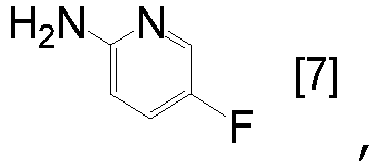
- <11> A method of producing an optically active compound represented by the formula [A]

which comprises- Step 4: a step of reacting compound [4] with compound [7] in the presence of an organic aluminium compound or a base, in an organic solvent to give compound [8], and
- Step 5: a step of subjecting compound [8] obtained in Step 4 to the Mitsunobu reaction with a compound represented by the formula [9]

to give compound [A]. - <12> A method of producing compound [A], which comprises
- Step 1: a step of reacting compound [1] with an alkyl diazoacetate in the presence of copper trifluoromethanesulfonate and compound [5] or compound [6], in an organic solvent to give compound [2],
- Step 2: a step of subjecting compound [2] obtained in Step 1 to alkaline hydrolysis to give compound [3],
- Step 3: a step of subjecting compound [3] obtained in Step 2 to a cyclization reaction to give compound [4],
- Step 4: a step of reacting compound [4] obtained in Step 3 with compound [7] in the presence of an organic aluminium compound or a base, in an organic solvent to give compound [8], and Step 5: a step of subjecting compound [8] obtained in Step 4 to the Mitsunobu reaction with compound [9] to give compound [A].
- <13> Compound [8].
- <14> A method of producing compound [A], which comprises Step 6: a step of subjecting compound [4] to bromination to give an optically active compound represented by the formula [10]

- Step 7: a step of subjecting compound [10] obtained in Step 6 to alkyl esterification to give an optically active compound represented by the formula [11]

- Step 8: a step of subjecting compound [11] obtained in Step 7 to tosylation to give an optically active compound represented by the formula [12]

- Step 9: a step of reacting compound [12] obtained in Step 8 with compound [9] in the presence of a base, in an organic solvent, and then subjecting the resulting compound to alkaline hydrolysis to give an optically active compound represented by the formula [13]

- Step 10: a step of reacting compound [13] obtained in Step 9 with compound [7] in the presence of a base, in an organic solvent to give compound [A].
- Step 7: a step of subjecting compound [10] obtained in Step 6 to alkyl esterification to give an optically active compound represented by the formula [11]
- <15> A method of producing compound [A], which comprises
- Step 1: a step of reacting compound [1] with an alkyl diazoacetate in the presence of copper trifluoromethanesulfonate and compound [5] or compound [6], in an organic solvent to give compound [2],
- Step 2: a step of subjecting compound [2] obtained in Step 1 to alkaline hydrolysis to give compound [3],
- Step 3: a step of subjecting compound [3] obtained in Step 2 to a cyclization reaction to give compound [4],
- Step 6: a step of subjecting compound [4] obtained in Step 3 to bromination to give compound [10],
- Step 7: a step of subjecting compound [10] obtained in Step 6 to alkyl esterification to give compound [11],
- Step 8: a step of subjecting compound [11] obtained in Step 7 to tosylation to give compound [12],
- Step 9: a step of reacting compound [12] obtained in Step 8 with compound [9] in the presence of a base, in an organic solvent, and then subjecting the resulting compound to alkaline hydrolysis to give compound [13], and
- Step 10: a step of reacting compound [13] obtained in Step 9 with compound [7] in the presence of a base, in an organic solvent to give compound [A].
- <16> Compound [10].
- <17> Compound [11].
- <18> Compound [12].
- According to the present invention, the objective (1R,2S)-2-{[((2,4-dimethylpyrimidin-5-yl)oxy}methyl]-2-(3-fluorophenyl)-N-(5-fluoropyridin-2-yl)cyclopropane-1-carboxamide (compound [A]) can be produced by an industrially advantageous method, i.e., using inexpensive compound [1] as a raw material, in a shorter process via a novel compound.
- The present invention is explained in detail below.
- Compound [4] can be produced according to the following Step 1 to Step 3.

- Examples of the "alkylcarbonyl group" represented by R1 include acetyl, propanoyl and the like.
- Examples of the "alkyl group" represented by R2 include methyl, ethyl and the like.
- Examples of the "alkali metal" represented by X include sodium, potassium, lithium and the like.
- In this step, compound [1] is reacted with an alkyl diazoacetate in the presence of copper trifluoromethanesulfonate and compound [5] or compound [6], in an organic solvent to selectively give compound [2].
- Compound [1] can be easily produced from the compound described in
JP H9-235242 - As the alkyl diazoacetate, ethyl diazoacetate is commercially available. Examples of the alkyl group include C1-4 alkyl group, and preferred is a C1-2 alkyl group such as methyl group and ethyl group. The alkyl diazoacetate is prepared from the corresponding glycine alkyl ester by a known diazotization reaction. The amount of the alkyl diazoacetate to be used is generally 0.5 to 2 mol, industrially preferably 0.8 to 1.5 mol, per 1 mol of compound [1], in terms of yield and economy.
- The copper trifluoromethanesulfonate and compound [5] or compound [6] form a complex in the reaction system, and the complex acts as an asymmetric catalyst in the reaction of compound [1] with an alkyl diazoacetate (formation of 2S-cyclopropane ring).
- The copper trifluoromethanesulfonate is commercially available. For example, it is commercially available as copper(I) trifluoromethanesulfonate 1/2 toluene complex. The amount of the copper trifluoromethanesulfonate to be used is generally 0.00001 to 0.5 mol, industrially preferably 0.0001 to 0.05 mol, per 1 mol of compound [1], in terms of reactivity, yield (chemical yield, optical yield) and economy.
- Compound [5] (1,1-bis[2-((4S)-(1,1-dimethylethyl)-1,3-oxazolinyl)]cyclopropane) and compound [6] (2,2-bis[2-((4S)-(1,1-dimethylethyl)-1,3-oxazolinyl)]propane) can be produced according to a known method, for example, the method described in Journal of Organic Chemistry, 2000, 65, 5875-5878. The amount of compound [5] or compound [6] to be used is generally 0.8 to 5 mol, industrially preferably 0.9 to 2 mol, per 1 mol of copper trifluoromethanesulfonate, in terms of reactivity, yield (chemical yield, optical yield) and economy.
- The reaction is preferably carried out in the presence of copper trifluoromethanesulfonate and compound [5], in terms of optical yield.
- Examples of the organic solvent include ester solvents (e.g., ethyl acetate, butyl acetate); aromatic hydrocarbon solvents (e.g., toluene, benzene, xylene); halogenated hydrocarbon solvents (e.g., chloroform, dichloromethane, carbon tetrachloride); ether solvents (e.g., diethyl ether, tetrahydrofuran, 1,4-dioxane); aprotic polar solvents (e.g., dimethylformamide, dimethylacetamide); mixed solvents thereof, and the like. The amount of the organic solvent to be used is generally 2 to 30 parts by weight, industrially preferably 4 to 20 parts by weight, per 1 parts by weight of compound [1], in terms of yield and economy.
- The reaction is carried out by a method of adding (preferably adding dropwise) a mixture of an alkyl diazoacetate and an organic solvent to a mixture of compound [1], copper trifluoromethanesulfonate, compound [5] or compound [6] and an organic solvent, and the like.
- The reaction is carried out generally within the range of -50 to 100°C, preferably within the range of -20 to 80°C, although it depends on the kind of the organic solvent and the like. The reaction time is generally 10 min to 72 hr, preferably 2 hr to 24 hr, although it depends on the kind of the organic solvent, the reaction temperature and the like.
- The progress of the reaction can be confirmed by analysis means such as thin layer chromatography, gas chromatography, high-performance liquid chromatography and the like. After completion of the reaction, conventional post-treatments such as liquid separation operation, solvent evaporation and the like are carried out. Although the unreacted compound [1] used as a raw material may remain in the obtained mixture, and the mixture may be directly subjected to Step 2, or compound [2] after isolation and purification may be subjected to Step 2.
- By using compound [5] or compound [6], the asymmetric reaction proceeds to form a 2S-cyclopropane ring. As shown below, the mixture obtained in this step contains the trans-form compound [2a] in addition to the cis-form compound [2]. Preferably, compound [2] is not isolated in this step, and the mixture is directly subjected to Step 2.

- In this step, compound [2] obtained in Step 1 is subjected to alkaline hydrolysis to give compound [3]. Preferably, the mixture containing compound [2] and compound [2a] obtained in Step 1 without isolation of compound [2] is subjected to alkaline hydrolysis.
- Examples of the alkali to be used in the alkaline hydrolysis include sodium hydroxide, potassium hydroxide and the like, and sodium hydroxide is industrially preferably used. The alkali is generally used as an aqueous solution, preferably used as a 5 to 40% aqueous solution.
- The alkaline hydrolysis is carried out by mixing compound [2] (preferably the mixture containing compound [2] and compound [2a]) with an alkali aqueous solution.
- The reaction is carried out generally within the range of 0 to 100°C, preferably within the range of 20 to 80°C. The reaction time is generally 10 min to 48 hr, preferably 1 hr to 12 hr, although it depends on the reaction temperature and the like.
- The progress of the reaction can be confirmed by analysis means such as thin layer chromatography, gas chromatography, high-performance liquid chromatography and the like.
- The unreacted compound [1] remaining in the mixture obtained in Step 1 is also present in the mixture after completion of the reaction in this step, and it is preferably removed in this stage. The removal is carried out by washing the mixture containing compound [3] after completion of the reaction with an aromatic hydrocarbon solvent.
- Examples of the aromatic hydrocarbon solvent to be used in the washing include toluene, benzene and xylene, and toluene is industrially preferable.
- The mixture obtained in this step is an aqueous solution containing compound [3]. Since Step 3 can be carried out in an aqueous system, the mixture can be directly subjected to Step 3.
- Compound [2] is converted into compound [3] by hydrolysis. As shown below, compound [2a] contained in the mixture obtained in Step 1 is also converted into compound [3a] by hydrolysis, and therefore, the mixture obtained in this step contains compound [3a] in addition to compound [3]. Preferably, compound [3] is not isolated in this step, and the mixture is directly subjected to Step 3.

- In this step, compound [3] obtained in Step 2 is subjected to a cyclization reaction to give compound [4]. The mixture containing compound [3] and compound [3a] obtained in Step 2 without isolation of compound [3] is preferably subjected to a cyclization reaction (Step 3a).
- The cyclization reaction is carried out by adjusting the reaction system to pH 7.0 or below, preferably pH 5 or below, with an acid.
- Examples of the acid to be used in the acid treatment include hydrogen chloride, sulfuric acid, nitric acid and the like, and hydrogen chloride is industrially preferable. The hydrogen chloride used is generally hydrochloric acid, preferably 5 to 35% hydrochloric acid.
- The cyclization reaction is carried out by addition (preferably dropwise addition) of an acid to the reaction system containing compound [3] (preferably the mixture containing compound [3] and compound [3a]).
- The reaction is carried out generally within the range of 0 to 100°C, preferably within the range of 20 to 80°C. The reaction time is generally 10 min to 48 hr, preferably 2 hr to 12 hr, although it depends on the reaction temperature and the like.
- The progress of the reaction can be confirmed by analysis means such as thin layer chromatography, gas chromatography, high-performance liquid chromatography and the like.
- Compound [3a] contained in the mixture obtained in Step 2 is only converted into compound [3b] in this step, and does not undergo the cyclization reaction. Compound [3b] can be removed by an extraction operation and a liquid separation operation (Step 3b).

- Specifically, the mixture after completion of the reaction is adjusted to preferably pH 5 to 8, more preferably pH 6.0 to 8.0, and then extracted with an organic solvent to transfer compound [4] to the organic layer. Then, compound [3b] is converted into compound [3a] and transferred to the aqueous layer.
- Examples of the organic solvent to be used in the extraction include aromatic hydrocarbon solvents (e.g., toluene, benzene, xylene); ester solvents (e.g., ethyl acetate, butyl acetate); halogenated hydrocarbon solvents (e.g., chloroform, dichloromethane, carbon tetrachloride); ether solvents (e.g., diethyl ether) and the like, and preferred are aromatic hydrocarbon solvents, and particularly preferred is toluene, in terms of extraction efficiency.
- After extraction, the organic layer and the aqueous layer are separated by a liquid separation operation. Where necessary, the extraction operation of the aqueous layer and the liquid separation operation may be repeated.
- Compound [4] can be isolated by concentrating the obtained organic layer. Where necessary, compound [4] may be purified by methods such as silica gel column chromatography, distillation and the like.
- Compound [4] thus obtained can be converted into the objective compound [A] ((1R,2S)-2-{[((2,4-dimethylpyrimidin-5-yl)oxy}methyl]-2-(3-fluorophenyl)-N-(5-fluoropyridin-2-yl)cyclopropane-1-carboxamide) by the following steps.

- In this step, compound [4] is reacted with compound [7] in the presence of an organic aluminium compound or a base, in an organic solvent to give compound [8].
- Compound [7] is commercially available product. The amount of compound [7] to be used is generally 0.8 to 5 mol, industrially preferably 0.9 to 2 mol, per 1 mol of compound [4], in terms of yield and economy.
- Example of the organic aluminium compound include diisobutylaluminium hydride, trimethylaluminium and the like. Examples of the base include alkali metal alcoholates such as sodium methoxide and the like, and butyllithium.
- The amount of the organic aluminium compound or base to be used is generally 0.8 to 5 mol, industrially preferably 0.9 to 2 mol, per 1 mol of compound [4], in terms of yield and economy.
- Examples of the organic solvent include ether solvents (e.g., diethyl ether, tetrahydrofuran, 1,4-dioxane); aromatic hydrocarbon solvents (e.g., toluene, benzene, xylene); halogenated hydrocarbon solvents (e.g., chloroform, dichloromethane, carbon tetrachloride); mixed solvents thereof, and the like. The amount of the organic solvent to be used is generally 2 to 100 parts by weight, industrially preferably 5 to 20 parts by weight, per 1 parts by weight of compound [4], in terms of yield and economy.
- The reaction is carried out by a method of adding (preferably adding dropwise) a mixture of compound [4] and an organic solvent to a mixture of either an organic aluminium compound or a base, and compound [7] and an organic solvent, and the like.
- The reaction is carried out generally within the range of -80 to 100°C, preferably within the range of -40 to 80°C, although it depends on the kind of the organic solvent and the like. The reaction time is generally 10 min to 48 hr, preferably 1 hr to 24 hr, although it depends on the kind of the organic solvent, the reaction temperature and the like.
- The progress of the reaction can be confirmed by analysis means such as thin layer chromatography, gas chromatography, high-performance liquid chromatography and the like. After completion of the reaction, compound [8] can be isolated by conventional post-treatments such as solvent extraction, liquid separation operation, solvent evaporation and the like. Where necessary, compound [8] may be purified by methods such as silica gel column chromatography, recrystallization and the like.
- In this step, compound [8] is subjected to the Mitsunobu reaction with compound [9] to give compound [A]. The Mitsunobu reaction is carried out by reacting compound [8] with compound [9] in the presence of an azodicarboxylic acid diester and triphenylphosphine in an organic solvent.
- Examples of the azodicarboxylic acid diester include ditert-butyl azodicarboxylate, diethyl azodicarboxylate and the like. The amount of the azodicarboxylic acid diester to be used is generally 0.8 to 5 mol, industrially preferably 0.9 to 2 mol, per 1 mol of compound [8], in terms of yield and economy.
- The amount of the triphenylphosphine to be used is generally 0.2 to 5 mol, industrially preferably 0.5 to 2 mol, per 1 mol of azodicarboxylic acid diester, in terms of yield and economy.
- The amount of compound [9] to be used is generally 0.8 to 5 mol, industrially preferably 0.9 to 2 mol, per 1 mol of compound [8], in terms of yield and economy.
- Examples of the organic solvent include ether solvents (e.g., diethyl ether, tetrahydrofuran, 1,4-dioxane); ester solvents (e.g., ethyl acetate, butyl acetate); aromatic hydrocarbon solvents (e.g., toluene, benzene, xylene); halogenated hydrocarbon solvents (e.g., chloroform, dichloromethane, carbon tetrachloride); mixed solvents thereof, and the like. The amount of the organic solvent to be used is generally 2 to 100 parts by weight, industrially preferably 4 to 30 parts by weight, per 1 parts by weight of compound [8], in terms of yield and economy.
- The reaction is carried out by a method of adding (preferably adding dropwise) triphenylphosphine and a mixture of an azodicarboxylic acid diester and an organic solvent to a mixture of compound [8], compound [9] and an organic solvent, and the like.
- The reaction is carried out generally within the range of -50 to 100°C, preferably within the range of -20 to 80°C, although it depends on the kind of the organic solvent and the like. The reaction time is generally 10 min to 48 hr, preferably 1 hr to 24 hr, although it depends on the kind of the organic solvent, the reaction temperature and the like.
- The progress of the reaction can be confirmed by analysis means such as thin layer chromatography, high-performance liquid chromatography and the like. After completion of the reaction, compound [A] can be isolated by conventional post-treatments such as solvent extraction, liquid separation operation, solvent evaporation and the like. Where necessary, compound [A] may be purified by methods such as silica gel column chromatography, recrystallization and the like.
- Alternatively, compound [4] can also be converted into the objective compound [A] (1R,2S)-2-{[((2,4-dimethylpyrimidin-5-yl)oxy}methyl]-2-(3-fluorophenyl)-N-(5-fluoropyridin-2-yl)cyclopropane-1-carboxamide by the following steps.

- Examples of the "alkyl group" represented by R3 include methyl, ethyl and the like.
- In this step, compound [4] is subjected to bromination to give compound [10].
- The bromination is carried out by reacting compound [4] with a brominating agent in an organic solvent.
- Examples of the brominating agent include hydrogen bromide/acetic acid solution and the like. The amount of the brominating agent to be used is generally 1 to 100 mol, industrially preferably 2 to 50 mol, per 1 mol of compound [4], in terms of yield and economy.
- Examples of the organic solvent include organic acids (e.g., acetic acid); ether solvents (e.g., diethyl ether, tetrahydrofuran, 1,4-dioxane); aromatic hydrocarbon solvents (e.g., toluene, benzene, xylene); halogenated hydrocarbon solvents (e.g., chloroform, dichloromethane, carbon tetrachloride); mixed solvents thereof, and the like. When hydrogen bromide/acetic acid solution is used as a brominating agent, then acetic acid also serves as a solvent.
- The reaction is carried out by a method of mixing compound [4], a brominating agent and an organic solvent, and the like.
- The reaction is carried out generally within the range of -20 to 150°C, preferably within the range of 0 to 100°C, although it depends on the kind of the organic solvent and the like. The reaction time is generally 30 min to 72 hr, preferably 4 hr to 48 hr, although it depends on the kind of the organic solvent, the reaction temperature and the like.
- The progress of the reaction can be confirmed by analysis means such as thin layer chromatography, high-performance liquid chromatography and the like. After completion of the reaction, compound [10] can be isolated by conventional post-treatments such as solvent extraction, liquid separation operation, solvent evaporation and the like. Where necessary, compound [10] may be purified by methods such as silica gel column chromatography, recrystallization and the like.
- In this step, compound [10] is subjected to alkyl esterification to give compound [11].
- The alkyl esterification is carried out by reacting compound [10] with an alkyl alcohol such as ethanol, methanol and the like, in the presence of an acid catalyst.
- Examples of the acid catalyst include p-toluenesulfonic acid, sulfuric acid, methanesulfonic acid and the like. Although the amount of the acid catalyst to be used is a catalytic amount, it is generally 0.001 to 1 mol, industrially preferably 0.005 to 0.5 mol, per 1 mol of compound [10], in terms of yield and economy. Although the amount of the ethanol to be used is a solvent amount, it is generally 2 to 500 mol, industrially preferably 10 to 200 mol, per 1 mol of compound [10], in terms of yield and economy.
- The reaction is carried out by a method of mixing compound [10], an alkyl alcohol and an acid catalyst, and the like.
- The reaction is carried out generally within the range of 0 to 100°C, preferably within the range of 25 to 90°C. The reaction time is generally 30 min to 72 hr, preferably 2 hr to 48 hr, although it depends on the kind of the organic solvent, the reaction temperature and the like.
- The progress of the reaction can be confirmed by analysis means such as thin layer chromatography, high-performance liquid chromatography and the like. After completion of the reaction, compound [11] can be isolated by conventional post-treatments such as solvent extraction, liquid separation operation, solvent evaporation and the like. Where necessary, compound [11] may be purified by methods such as silica gel column chromatography, recrystallization and the like.
- In this step, compound [11] is subjecting to tosylation to give compound [12].
- The tosylation is carried out by reacting compound [11] with a tosylating agent in an organic solvent.
- Examples of the tosylating agent include silver p-toluenesulfonate. The amount of the tosylating agent to be used is generally 0.8 to 5 mol, industrially preferably 0.9 to 2 mol, per 1 mol of compound [11], in terms of yield and economy.
- Examples of the organic solvent include nitrile solvents (e.g., acetonitrile); ether solvents (e.g., diethyl ether, tetrahydrofuran, 1,4-dioxane); ester solvents (e.g., ethyl acetate, butyl acetate); aromatic hydrocarbon solvents (e.g., toluene, benzene, xylene); halogenated hydrocarbon solvents (e.g., chloroform, dichloromethane, carbon tetrachloride); mixed solvents thereof, and the like. Among them, acetonitrile is preferably used in terms of reactivity and yield. The amount of the organic solvent to be used is generally 2 to 100 parts by weight, industrially preferably 4 to 20 parts by weight, per 1 parts by weight of compound [11], in terms of yield and economy.
- The reaction is carried out by a method of mixing compound [11], a tosylating agent and an organic solvent, and the like.
- The reaction is carried out generally within the range of -20 to 100°C, preferably within the range of 20 to 80°C. The reaction time is generally 10 min to 48 hr, preferably 1 hr to 24 hr, although it depends on the kind of the organic solvent, the reaction temperature and the like.
- The progress of the reaction can be confirmed by analysis means such as thin layer chromatography, high-performance liquid chromatography and the like. After completion of the reaction, compound [12] can be isolated by conventional post-treatments such as solvent extraction, liquid separation operation, solvent evaporation and the like. Where necessary, compound [12] may be purified by methods such as silica gel column chromatography, recrysallization and the like.
- In this step, compound [12] is reacted with compound [9] in the presence of a base, in an organic solvent, followed by alkaline hydrolysis to give compound [13].
- Examples of the base include cesium carbonate, potassium carbonate, sodium carbonate and the like. The amount of the base to be used is generally 0.01 to 10 mol, industrially preferably 0.5 to 5 mol, per 1 mol of compound [12], in terms of yield and economy.
- The amount of compound [9] to be used is generally 0.8 to 5 mol, industrially preferably 0.9 to 2 mol, per 1 mol of compound [12], in terms of yield and economy.
- Examples of the organic solvent include nitrile solvents (e.g., acetonitrile); ether solvents (e.g., diethyl ether, tetrahydrofuran, 1,4-dioxane); ester solvents (e.g., ethyl acetate, butyl acetate); aromatic hydrocarbon solvents (e.g., toluene, benzene, xylene); halogenated hydrocarbon solvents (e.g., chloroform, dichloromethane, carbon tetrachloride); mixed solvents thereof, and the like. Among the, acetonitrile is preferably used in terms of reactivity and yield. The amount of the organic solvent to be used is generally 2 to 100 parts by weight, industrially preferably 4 to 20 parts by weight, per 1 parts by weight of compound [12], in terms of yield and economy.
- The reaction is carried out by a method of adding a base to a mixture of compound [12], compound [9] and an organic solvent, and the like.
- The reaction is carried out generally within the range of -20 to 100°C, preferably within the range of 20 to 80°C. The reaction time is generally 10 min to 48 hr, preferably 1 hr to 24 hr, although it depends on the kind of the organic solvent, the reaction temperature and the like.
- The progress of the reaction can be confirmed by analysis means such as thin layer chromatography, high-performance liquid chromatography and the like. After completion of the reaction, conventional post-treatments such as solvent extraction, liquid separation operation, solvent evaporation and the like are carried out.
- Subsequently, alkaline hydrolysis is carried out.
- Examples of the alkali to be used in the alkaline hydrolysis include sodium hydroxide, potassium hydroxide and the like, and sodium hydroxide is industrially preferably used. The alkali is generally used as an aqueous solution, preferably 1 to 40% aqueous solution.
- The alkaline hydrolysis is carried out by mixing the mixture after the post-treatment with an alkali aqueous solution.
- The reaction is carried out generally within the range of 0 to 100°C, preferably within the range of 10 to 80°C. The reaction time is generally 30 min to 72 hr, preferably 1 hr to 24 hr, although it depends on the reaction temperature and the like.
- The progress of the reaction can be confirmed by analysis means such as thin layer chromatography, gas chromatography, high-performance liquid chromatography and the like. After completion of the reaction, compound [13] can be isolated by conventional post-treatments such as solvent extraction, liquid separation operation, solvent evaporation and the like. Where necessary, compound [13] may be purified by methods such as silica gel column chromatography, recrystallization and the like.
- In this step, compound [13] is reacted with compound [7] in the presence of a base, in an organic solvent to give the objective compound [A]. The step can be carried out according to the method described in Patent Document 1.
- Hereinafter, the present invention is explained in more detail with reference to Examples, but the present invention is not limited thereto. The conditions of the HPLC analysis performed in the following examples are shown below.
-
- column: Waters SunFire C18 (3×150mm, 3.5µm)
- temperature: 40°C
- flow rate: 0.5 ml/min
- mobile phase A: water/trifluoroacetic acid = 1000/1
- mobile phase B: acetonitrile/trifluoroacetic acid = 1000/1 gradient:
- detector: UV 210nm
-
- column: CHIRALPAK IB (4.6×150mm, 5µm)
- temperature: 25°C
- flow rate: 1.0 ml/min
- mobile phase: water/methanol = 40/60
- detector: UV 254 nm
- injection: 10 µl
-

- At room temperature, in a 200 ml separable flask, compound [1A] (3.50 g, 18.02 mmol), compound [5] (52.70 mg, 0.18 mmol), copper(I) trifluoromethanesulfonate 1/2 toluene complex (46.26 mg, 0.18 mmol) and ethyl acetate (35 ml) were charged and mixed. Then, a 15% toluene solution of ethyl diazoacetate (20.56 g, 27.03 mmol) was added dropwise thereto over 4 hr, and the mixture was stirred for 2 hr as it was. After standing, the mixture was concentrated under reduced pressure to give a concentrated residue (6.48 g). HPLC purity (HPLC analysis condition 1): peak area normalization of 47.3% in LC chromatogram of the cis-form (compound [2A]), 11.70% of the unreacted compound [1A], the cis-form ([2A])/the trans-form ([2aA])=76.7:23.3, optical purity of the cis-form (HPLC analysis condition 2): 98.02% e.e.
- At room temperature, in a 200 ml separable flask, compound [1A] (3.00 g, 15.45 mmol), compound [5] (45.20 mg, 0.15 mmol), copper(I) trifluoromethanesulfonate 1/2 toluene complex (39.90 mg, 0.15 mmol) and ethyl acetate (30 ml) were charged and mixed. Then, a 15% toluene solution of ethyl diazoacetate (14.21 g, 18.68 mmol) was added dropwise thereto over 4 hr, and the mixture was stirred for 1 hr as it was. After standing, the mixture was concentrated under reduced pressure to give a concentrated residue (4.88 g). HPLC purity (HPLC analysis condition 1): peak area normalization of 42.5% in LC chromatogram of the cis-form (compound [2A]), 24.3% of the unreacted compound [1A], the cis-form ([2A])/the trans-form ([2aA])=76.5:23.5, optical purity of the cis-form (HPLC analysis condition 2): 96.54 e.e.
- The concentrated residue was purified by silica gel column chromatography to give compound [2A] (0.91 g).
LC-MS (ESI) [M+H]+ 281
HPLC purity (HPLC analysis condition 1): 87.9%, the cis-form ([2A])/the trans-form ([2aA])=97.8:2.2.
1HNMR (400MHz, CDCl3) δ7.12-7.08(m,1H), 6.97-6.78(m,3H), 4.41(d,J=11.6Hz,1H), 4.18(d,J=11.6Hz,1H), 4.09-4.01(m,2H), 1.94(dd,J=5.7,8.0Hz,1H), 1.80(s,3H), 1.50-1.48(m,1H), 1.30-1.26(m,1H), 1.16-1.12(m,3H) -

- At room temperature, in a 200 ml separable flask, compound [1A] (7.52 g, 38.72 mmol) and ethyl acetate (65 mL) were charged, and a solution prepared by dissolving compound [5] (113.23 mg, 0.39 mmol) and copper(I) trifluoromethanesulfonate 1/2 toluene complex (100.17 mg, 0.39 mmol) in ethyl acetate (10 ml) were added thereto, and mixed. Then, the temperature was adjusted to 25°C, a 15% toluene solution of ethyl diazoacetate (44.18 g, 58.08 mmol) was added dropwise thereto over 4 hr, and the mixture was stirred for 1 hr as it was. After standing, the mixture was concentrated under reduced pressure to give a concentrated residue (14.1 g). HPLC purity (HPLC analysis condition 1): peak area normalization of 43.4% in LC chromatogram of the cis-form (compound [2A]), 15.29% of the unreacted compound [1A], the cis-form ([2A])/the trans-form ([2aA])=76.9:23.1, optical purity of the cis-form (HPLC analysis condition 2): 96.13% e.e.
-

- At room temperature, compound [1A] (350 mg, 1.8 mmol), compound [6] (5.31 mg, 0.018 mmol), copper(I) trifluoromethanesulfonate 1/2 toluene complex (4.66 mg, 0.018 mmol) and ethyl acetate (3.5 ml) were charged and mixed. Then, a 15% toluene solution of ethyl diazoacetate (2.06 g, 2.7 mmol) was added dropwise thereto over 4 hr, and the mixture was stirred for 1 hr as it was. The mixture was washed with water (3.5 ml). After standing, the mixture was subjected to liquid separation, and the organic layer was separated. The organic layer was concentrated under reduced pressure. HPLC purity (HPLC analysis condition 1): peak area normalization of 26.0% in LC chromatogram of the cis-form (compound [2A]), 46.10% of the unreacted compound [1A], yield of the cis-form 26.0%, the cis-form ([2A])/the trans-form ([2aA])=73.2:26.8, optical purity of the cis-form (HPLC analysis condition 2): 98.2% e.e.
-

- At room temperature, in a 100 ml four neck flask, the mixture of compound [2A] and [2aA] synthesized in Example 2 (7.00 g, pure content of the cis-form 10.88 mmol) and 20% aqueous sodium hydroxide solution (27.47 g, 137.3 mmol) were charged and mixed. Then, the mixture was warmed to 50°C, and stirred for 2 hr. Then, the mixture was cooled to room temperature, toluene (24.25 g) and water (3.50 g) were added thereto, and the mixture was stirred for 30 min as it was. After standing, the mixture was subjected to liquid separation, and the aqueous layer was separated. To the aqueous layer was added 35% hydrochloric acid (15.61 g, 149.8 mmol) over 30 min at room temperature, and the mixture was stirred for 2 hr as it was. Then, 10% aqueous sodium hydroxide solution (20.36 g, 50.9 mmol) was added thereto, and the mixture was stirred at room temperature for 1 hr to adjust the pH to about 6.4. After standing, the mixture was subjected to liquid separation, and the organic layer and the aqueous layer were separated. To the aqueous layer were added toluene (28.01 g) and water (2.00 g), and the mixture was stirred for 30 min as it was. After standing, the mixture was subjected to liquid separation, and the organic layer was separated. This organic layer and the first separated organic layer were combined, and concentrated under reduced pressure to give compound [4] (2.10 g, crude yield 97.3%) (HPLC purity (HPLC analysis condition 1): 96.89%).
1HNMR (400MHz, CDCl3) δ7.29-7.24 (m, 1H), 6.98-6.87 (m,3H), 4.44-4.36(m,2H), 2.28-2.25 (m,1H), 1.64-1.60(m,1H),
1.32 (dd, J=4.8, 3.6Hz, 1H)
LC-MS(APCI)[M+H]+ 193 - At room temperature, compound [7] (0.29 g, 2.6 mmol) and dehydrated THF (2.0 g) were charged, and the mixture was cooled to -23°C. 17% Diisobutylaluminium hydride/toluene solution (2.50 g, 3.0 mmol) and dehydrated THF (0.5 g) were added dropwise thereto, and the mixture was stirred at -20 to -23°C for 20 min, and then at 25°C to 34°C for 3 hr. The reaction solution was cooled to -5°C, a solution prepared by mixing compound [4] (0.50 g, 2.6 mmol) with dehydrated THF (1.75 g) was added dropwise thereto, and then the mixture was warmed to room temperature, and stirred for 5 hr. Water (2.25 g) and 4N hydrochloric acid (1.95 ml) were ice-cooled, the reaction mixture was added dropwise thereto, and the mixture was warmed to room temperature, and stirred for 30 min. Next, 2-methyltetrahydrofuran (2.5 g) was added thereto, and the mixture was stirred at room temperature for 30 min. After standing, the mixture was subjected to liquid separation, 2-methyltetrahydrofuran (2.5 g) was added to the aqueous layer, and the mixture was stirred for 30 min. After standing, the mixture was subjected to liquid separation, and the obtained organic layer and the first separated organic layer were combined. 1N Hydrochloric acid (2.6 ml) was added thereto, and the mixture was stirred for 30 min. After standing, the mixture was subjected to liquid separation, and to the obtained organic layer was added sodium sulfate (1.00 g), and the mixture was stirred at room temperature for 30 min. The sodium sulfate was removed by filtration, and washed with 2-methyltetrahydrofuran, the filtrate and the washing were concentrated under reduced pressure to give a concentrated residue (0.76 g, crude yield 96%) as a pale-yellow solid.
(HPLC purity (HPLC analysis condition 1): 80.5%).
LC-MS(APCI) [M+H]+ 305
1HNMR (400MHz, DMSO-d6) δ11.01 (s, 1H), 8.33 (d, J=2.8Hz, 1H), 8.19-8.16 (m, 1H), 7.76-7.71 (m, 1H), 7.36-7.27(m,2H),
7.05 (d, J=2.8Hz, 1H), 4.56 (t, J=5.0Hz, 1H),
3.86 (dd, J=11.2,4.4Hz, 1H), 3.75 (dd, J=11.2, 5.2Hz, 1H), 2.40 (dd, J=8.0, 6.4Hz, 1H), 1.50-1.48(m, 1H),
1.29 (dd, J=7.6, 4.4Hz, 1H) - At room temperature, compound [8] (0.10 g, 0.33 mmol), compound [9] (0.073 g, 0.59 mmol) and dehydrated THF (3 ml) were charged, triphenylphosphine (0.14 g, 0.53 mmol) and 20% di-t-butyl azodicarboxylate/toluene solution (0.49 g, 0.43 mmol) were added thereto, and the mixture was stirred at room temperature for 4 hr. The reaction mixture was added dropwise to water (5.0 g), and the mixture was stirred at room temperature for 30 min. After standing, the mixture was subjected to liquid separation, MTBE (1.0 g) was added to the aqueous layer, and the mixture was stirred for 30 min. The operations were repeated twice. The organic layers were combined, sodium sulfate (1.0 g) was added thereto, and the mixture was stirred at room temperature for 13 hr. The sodium sulfate was removed by filtration, and washed with MTBE, and the filtrate and the washing were concentrated under reduced pressure to give a concentrated residue (0.52 g). The residue was purified by silica gel column chromatography to give a white powder (0.06 g, yield 44%).
(HPLC purity (HPLC analysis condition 1): 99.7%).
LC-MS(APCI) [M+H]+ 411
1HNMR (400MHz, DMSO-d6) δ11.22 (s,1H), 8.33 (d, J=2.8Hz, 1H), 8.13 (s, 1H), 7.91-7.89(m, 1H), 7.67-7.62(m, 1H), 7.46-7.40(m,3H), 7.14-7.09(m,1H), 4.68 (d, J=10.4Hz, 1H), 4.29 (d, J=10.4Hz, 1H), 2.63 (t, J=7.0Hz, 1H), 2.38(s,3H), 2.04(s,3H), 1.72-1.69 (m, 1H), 1.52-1.49 (m, 1H) - At room temperature, compound [4] (0.50 g, 2.6 mmol) and 25% hydrogen bromide/acetic acid solution (10.10 g, 31.2 mmol) were charged, and the mixture was warmed to 80°C. The mixture was stirred at 80°C for 11.5 hr, 25% hydrogen bromide/acetic acid solution (2.40 g, 7.4 mmol) was added thereto, and the mixture was stirred at 80°C for additional 10 hr. The reaction solution was added dropwise to a solution prepared by mixing water (50.0 g) and toluene (50.0 g), and the mixture was stirred at room temperature for 30 min. After standing, the mixture was subjected to liquid separation, sodium sulfate (5.00 g) and activated carbon (0.50 g) were added to the organic layer, and the mixture was stirred at room temperature for 1 hr. The sodium sulfate and activated carbon were removed by filtration, and washed with toluene (10 g), and the filtrate and the washing were concentrated under reduced pressure to give a concentrated residue (0.75 g, crude yield 106%).
(HPLC purity (HPLC analysis condition 1): 88.6%). -

- At room temperature, compound [10] (0.60 g, 2.2 mmol), p-toluenesulfonic acid monohydrate (0.08 g, 0.42 mmol) and ethanol (12.0 g) were charged, and the mixture was warmed to 80°C, and stirred for 20 hr. The reaction mixture was concentrated under reduced pressure, water (6.0 g) and toluene (6.0 g) were added thereto, and the mixture was stirred at room temperature for 30 min. After standing, the mixture was subjected to liquid separation, water (6.0 g) was added to the organic layer, and the mixture was stirred at room temperature for 30 min. After standing, the mixture was subjected to liquid separation, and the organic layer was concentrated under reduced pressure to give a concentrated residue (0.65 g, crude yield 98%).
(HPLC purity (HPLC analysis condition 1): 80.0%). -

- At room temperature, compound [11A] (0.56 g, 1.9 mmol), silver p-toluenesulfonate (0.057 g, 2.0 mmol) and acetonitrile (5.6 g) were charged, and the mixture was warmed to 80°C, and stirred for 10 hr. The reaction mixture was cooled to room temperature, 2-methyltetrahydrofuran (11.2 g) and water (11.2 g) were added thereto, and the mixture was stirred at room temperature for 30 min. After standing, the mixture was subjected to liquid separation, 2-methyltetrahydrofuran (5.6 g) was added to the aqueous layer, and the mixture was stirred at room temperature for 30 min. After standing, the mixture was subjected to liquid separation. The obtained organic layer and the first separated organic layer were combined, water (5.6 g) was added thereto, and the mixture was stirred for 30 min. After standing, the mixture was subjected to liquid separation, the insoluble substance in the organic layer was removed by filtration, and washed with 2-methyltetrahydrofuran (5.6 g). The filtrate and the washing were concentrated under reduced pressure. Addition of 2-methyltetrahydrofuran and concentration under reduced pressure were repeated twice. Addition of acetonitrile and concentration under reduced pressure were repeated twice to give a concentrated residue (0.64 g, crude yield 88%).
(HPLC purity (HPLC analysis condition 1): 69.0%). - At room temperature, compound [12A] (0.64 g, 1.6 mmol), compound [9] (0.21 g, 1.7 mmol) and acetonitrile (6.4 g) were charged, cesium carbonate (0.38 g, 1.2 mmol) was added thereto, and the mixture was warmed to 68°C, and stirred for 8 hr. The reaction mixture was cooled to room temperature, acetonitrile (6.4 g) was added thereto, and the mixture was concentrated under reduced pressure. To the concentrated residue were added toluene (12.8 g) and water (6.4 g), and the mixture was stirred at room temperature for 30 min. After standing, the mixture was subjected to liquid separation, tetrahydrofuran (6.4 g) and 3.8% aqueous sodium hydroxide solution (4.4 g, 4.2 mmol) were added to the organic layer, and the mixture was stirred for 19 hr. The reaction mixture was concentrated under reduced pressure, toluene (12.8 g) and water (6.4 g) were added thereto, and the mixture was stirred at room temperature for 30 min. After standing, the mixture was subjected to liquid separation, and the aqueous layer was adjusted to the pH to 1 to 2 with 3.5% hydrochloric acid (4.64 g). Toluene (12,8g) was added thereto, and the mixture was stirred at room temperature for 30 min. After standing, the mixture was subjected to liquid separation, the organic layer was concentrated under reduced pressure to give a concentrated residue (0.44 g, yield 85%) .
(HPLC purity (HPLC analysis condition 1): 75.6%).
LC-MS(APCI) [M+H]+ 317
1HNMR (400MHz, DMSO-d6) δ12.52 (s, br, 1H), 8.18 (s, 1H), 7.40 (dd, J=14.4, 8.0Hz, 1H), 7.29-7.23(m,2H), 7.13-7.08 (m, 1H), 4.64 (d, J=10.0Hz, 1H), 4.28 (d, J=10.4Hz, 1H), 2.46 (s, 1H), 2.26 (s, 1H), 2.14-2.11 (m, 1H), 1.61-1.57(m,2H) - At room temperature, compound [7] (6.42 g, 57.3 mmol) and dehydrated THF (50 ml) were charged, and the mixture was cooled to -10°C or below. 17% Diisobutylaluminium hydride/toluene solution (47.88 g, 57.2 mmol) and dehydrated THF (5 ml) were added dropwise thereto while keeping the temperature -5°C or below, and the mixture was warmed to about 30°C, and stirred at 30°C for 3 hr. The reaction solution was cooled to -5°C or below, a solution prepared by mixing compound [4] (11.70 g, purity 85.5%, 52.0 mmol) with dehydrated THF (35.0 g) was added dropwise thereto, and the mixture was warmed to 25°C, and stirred for 16 hr. Water (45.0 g) and 4N hydrochloric acid (39 ml) were cooled to 3°C, the reaction mixture was added dropwise thereto while keeping the temperature 10°C or below, and the mixture was warmed to 25°C, and stirred for 30 min. Then, MTBE (50.0 g) was added thereto, and the mixture was stirred at room temperature for 30 min. After standing, the mixture was subjected to liquid separation, MTBE (50.0 g) was added to the aqueous layer, and the mixture was stirred for 30 min. After standing, the mixture was subjected to liquid separation, the obtained organic layer and the first separated organic layer were combined, sodium sulfate (20.0 g) was added thereto, and the mixture was stirred at room temperature for 2 hr. The sodium sulfate was removed by filtration, and washed with MTBE, and the filtrate and the washing were concentrated under reduced pressure to give a concentrated residue (19.40 g) as a pale-yellow solid (HPLC purity (HPLC analysis condition 1): 73.5%, crude yield 90%).
- To the concentrated residue was added ethyl acetate (25.5 g), and the mixture was warmed to 65°C to dissolve the solid, and cooled to 58°C. The seed crystals of compound [8] (0.05 g) were added thereto, and the mixture was stirred for 30 min. Heptane (35.6 g) was added dropwise thereto while keeping the temperature 56 to 57°C, and the mixture was stirred for 30 min, and then cooled to 0°C over 5 hr. The mixture was stirred at 0°C for 13.5 hr, and the precipitated crystals were collected by filtration, and washed with heptane (20.0 g).
- The obtained crystals were dried under reduced pressure to give compound [8] as pale-yellow crystals. The HPLC purity (HPLC analysis condition 1) was 99.95%, and the yield was 83.6%.
- At room temperature, compound [8] (4.50 g, 14.8 mmol), compound [9] (3.30 g, 26.6 mmol) and dehydrated THF (45 ml) were charged, and the mixture was cooled to 5°C or below. Triphenylphosphine (6.13 g, 23.3 mmol) and 20% di-t-butyl azodicarboxylate/toluene solution (22.13 g, 19.2 mmol) were added thereto, and the mixture was stirred at 0 to 5°C for 4 hr, warmed to 20°C, and stirred for 2 hr. To this solution were added triphenylphosphine (3.41 g, 13.0 mmol) and 20% di-t-butyl azodicarboxylate/toluene solution (17.03 g, 14.8 mmol), and the mixture was stirred at 20°C for additional 16 hr. The reaction mixture was added dropwise to water (45.0 g), and the mixture was stirred at 25°C for 30 min. After standing, the mixture was subjected to liquid separation, MTBE (22.5 g) was added to the aqueous layer, and the mixture was stirred for 30 min. The operations were repeated twice. The organic layers were combined, sodium sulfate (22.5 g) was added thereto, and the mixture was stirred at room temperature for 2 hr. The sodium sulfate was removed by filtration, and washed with MTBE, and the filtrate and the washing were concentrated under reduced pressure to give a concentrated residue (27.78 g). Compound [A] was contained at a content of 17.1% in this concentrated residue, and the yield was 78.4%. The residue was purified by silica gel column chromatography to give compound [A] as a white powder (4.62 g) (HPLC purity (HPLC analysis condition 1): 81.5%). The yield after column chromatography was 76.1%.
- According to the present invention, the objective (1R,2S)-2-{[((2,4-dimethylpyrimidin-5-yl)oxy}methyl]-2-(3-fluorophenyl)-N-(5-fluoropyridin-2-yl)cyclopropane-1-carboxamide (compound [A]) can be produced by an industrially advantageous method, i.e., using inexpensive compound [1] as a raw material, in a shorter process via a novel compound.
| Time (min) | mobile phase A (%) | mobile phase B (%) |
| 0 | 95 | 5 |
| 3 | 30 | 70 |
| 30 | 30 | 70 |
| 40 | 10 | 90 |
| 50 | 10 | 90 |
| 50.1 | 95 | 5 |
| 60 | 95 | 5 |
Claims (18)
- A method of selectively producing an optically active compound represented by the formula [2]

Step 1: a step of reacting a compound represented by the formula [1]
with an alkyl diazoacetate in the presence of copper trifluoromethanesulfonate and an optically active compound represented by the formula [5] or formula [6]
in an organic solvent. - A method of producing an optically active compound represented by the formula [4]
 Step 1: a step of reacting a compound represented by the formula [1]
with an alkyl diazoacetate in the presence of copper trifluoromethanesulfonate and an optically active compound represented by the formula [5] or formula [6]
in an organic solvent to give an optically active compound represented by the formula [2] Step 2: a step of subjecting the optically active compound represented by the formula [2] obtained in Step 1 to alkaline hydrolysis to give an optically active compound represented by the formula [3]
 Step 3: a step of subjecting the optically active compound represented by the formula [3] obtained in Step 2 to a cyclization reaction to give the optically active compound represented by the formula [4].
 - A method of producing an optically active compound represented by the formula [4]
 Step 1: a step of reacting a compound represented by the formula [1]
with an alkyl diazoacetate in the presence of copper trifluoromethanesulfonate and an optically active compound represented by the formula [5] or formula [6]
in an organic solvent to give a mixture comprising an optically active compound represented by the formula [2]
and an optically active compound represented by the formula [2a] Step 2: a step of subjecting the mixture obtained in Step 1 to alkaline hydrolysis to give a mixture comprising an optically active compound represented by the formula [3]
and an optically active compound represented by the formula [3a] Step 3a: a step of subjecting the optically active compound represented by the formula [3] to cyclization by adjusting the mixture obtained in Step 2 to pH 7.0 or below with an acid to give a mixture comprising the optically active compound represented by the formula [4] and an optically active compound represented by the formula [3b]
 Step 3b: a step of subjecting the mixture obtained in Step 3a to an extraction operation with an aromatic hydrocarbon solvent and a liquid separation operation to remove the optically active compound represented by the formula [3b] from the mixture.
 - The method according to any of claim 1 to claim 3, wherein Step 1 is carried out in the presence of copper trifluoromethanesulfonate and an optically active compound represented by the formula [5].
- The method according to claim 3, which further comprises a step of washing the mixture obtained in Step 2 with an aromatic hydrocarbon solvent, and then removing the organic layer.
- The method according to any of claim 3 to claim 5, wherein the mixture obtained in Step 3a is adjusted to pH 6.0 to 8.0, before the extraction operation with an aromatic hydrocarbon solvent and the liquid separation operation.
- An optically active compound represented by the formula [2]
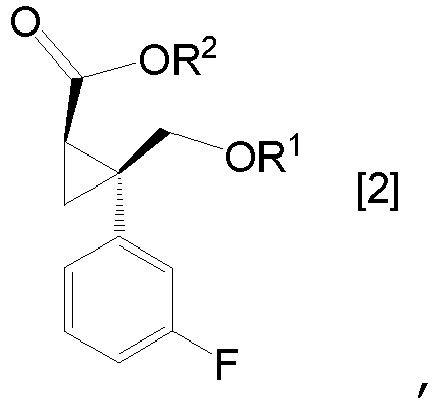
- An optically active compound represented by the formula [3]

- An optically active compound represented by the formula [4]

- A method of producing an optically active compound represented by the formula [8]

Step 4: a step of reacting an optically active compound represented by the formula [4]

- A method of producing an optically active compound represented by the formula [A]
 Step 4: a step of reacting an optically active compound represented by the formula [4]

 Step 5: a step of subjecting the optically active compound represented by the formula [8] obtained in Step 4 to the Mitsunobu reaction with a compound represented by the formula [9]
- A method of producing an optically active compound represented by the formula [A]
 Step 1: a step of reacting a compound represented by the formula [1]
with an alkyl diazoacetate in the presence of copper trifluoromethanesulfonate and an optically active compound represented by the formula [5] or formula [6]
in an organic solvent to give an optically active compound represented by the formula [2] Step 2: a step of subjecting the optically active compound represented by the formula [2] obtained in Step 1 to alkaline hydrolysis to give an optically active compound represented by the formula [3]
 Step 3: a step of subjecting the optically active compound represented by the formula [3] obtained in Step 2 to a cyclization reaction to give an optically active compound represented by the formula [4]
 Step 4: a step of reacting the optically active compound represented by the formula [4] obtained in Step 3 with a compound represented by the formula [7]
 Step 5: a step of subjecting the optically active compound represented by the formula [8] obtained in Step 4 to the Mitsunobu reaction with a compound represented by the formula [9]
- An optically active compound represented by the formula [8]

- A method of producing an optically active compound represented by the formula [A]
 Step 6: a step of subjecting an optically active compound represented by the formula [4]
 Step 7: a step of subjecting the optically active compound represented by the formula [10] obtained in Step 6 to alkyl esterification to give an optically active compound represented by the formula [11]
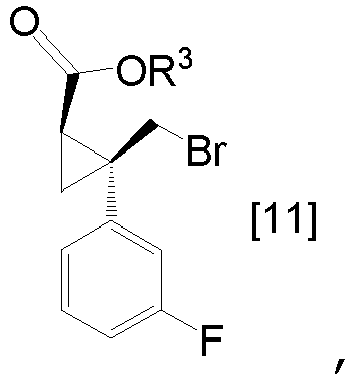 Step 8: a step of subjecting the optically active compound represented by the formula [11] obtained in Step 7 to tosylation to give an optically active compound represented by the formula [12]
 Step 9: a step of reacting the optically active compound represented by the formula [12] obtained in Step 8 with a compound represented by the formula [9]
 Step 10: a step of reacting the optically active compound represented by the formula [13] obtained in Step 9 with a compound represented by the formula [7]
- A method of producing an optically active compound represented by the formula [A]
 Step 1: a step of reacting a compound represented by the formula [1]
with an alkyl diazoacetate in the presence of copper trifluoromethanesulfonate and an optically active compound represented by the formula [5] or formula [6]
in an organic solvent to give an optically active compound represented by the formula [2] Step 2: a step of subjecting the optically active compound represented by the formula [2] obtained in Step 1 to alkaline hydrolysis to give an optically active compound represented by the formula [3]
 Step 3: a step of subjecting the optically active compound represented by the formula [3] obtained in Step 2 to a cyclization reaction to give an optically active compound represented by the formula [4]
 Step 6: a step of subjecting the optically active compound represented by the formula [4] obtained in Step 3 to bromination to give an optically active compound represented by the formula [10]
 Step 7: a step of subjecting the optically active compound represented by the formula [10] obtained in Step 6 to alkyl esterification to give an optically active compound represented by the formula [11]
 Step 8: a step of subjecting the optically active compound represented by the formula [11] obtained in Step 7 to tosylation to give an optically active compound represented by the formula [12]
 Step 9: a step of reacting the optically active compound represented by the formula [12] obtained in Step 8 with a compound represented by the formula [9]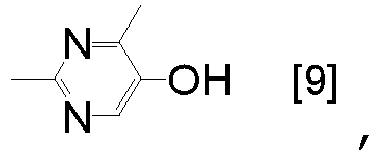
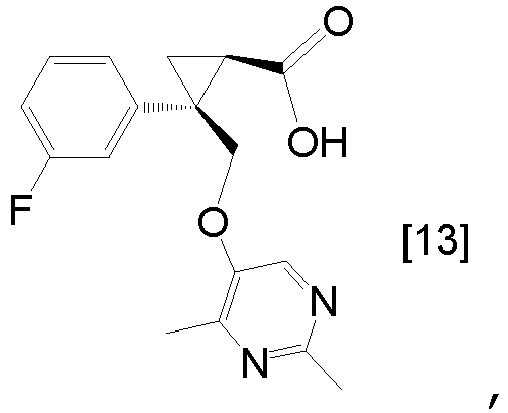 Step 10: a step of reacting the optically active compound represented by the formula [13] obtained in Step 9 with a compound represented by the formula [7]
- An optically active compound represented by the formula [10]

- An optically active compound represented by the formula [11]
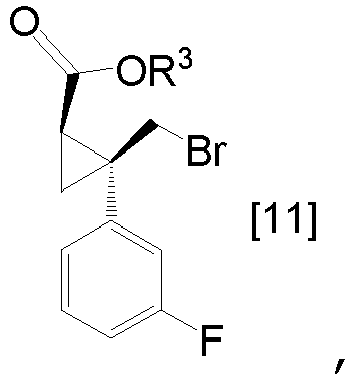
- An optically active compound represented by the formula [12]
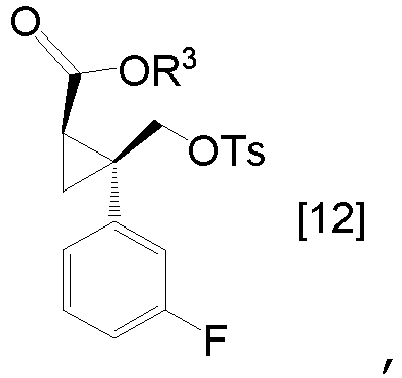
Applications Claiming Priority (2)
| Application Number | Priority Date | Filing Date | Title |
|---|---|---|---|
| JP2018167925 | 2018-09-07 | ||
| PCT/JP2019/034882 WO2020050339A1 (en) | 2018-09-07 | 2019-09-05 | Method for manufacturing cyclopropane compound |
Publications (3)
| Publication Number | Publication Date |
|---|---|
| EP3848348A1 true EP3848348A1 (en) | 2021-07-14 |
| EP3848348A4 EP3848348A4 (en) | 2022-09-14 |
| EP3848348B1 EP3848348B1 (en) | 2025-08-20 |
Family
ID=69722620
Family Applications (1)
| Application Number | Title | Priority Date | Filing Date |
|---|---|---|---|
| EP19857085.5A Active EP3848348B1 (en) | 2018-09-07 | 2019-09-05 | Method for manufacturing cyclopropane compound |
Country Status (8)
| Country | Link |
|---|---|
| US (1) | US12098137B2 (en) |
| EP (1) | EP3848348B1 (en) |
| JP (1) | JP7384810B2 (en) |
| CN (1) | CN112672992B (en) |
| ES (1) | ES3045538T3 (en) |
| IL (1) | IL280904B2 (en) |
| SG (1) | SG11202101818XA (en) |
| WO (1) | WO2020050339A1 (en) |
Cited By (1)
| Publication number | Priority date | Publication date | Assignee | Title |
|---|---|---|---|---|
| US12479819B2 (en) | 2019-05-15 | 2025-11-25 | Eisai R&D Management Co., Ltd. | Method and compound useful in preparation of orexin-2 receptor antagonist, and lemborexant having few impurities |
Families Citing this family (1)
| Publication number | Priority date | Publication date | Assignee | Title |
|---|---|---|---|---|
| CN118871427A (en) * | 2022-03-25 | 2024-10-29 | 浙江华海药业股份有限公司 | A preparation method of lebroxan and its intermediates |
Family Cites Families (8)
| Publication number | Priority date | Publication date | Assignee | Title |
|---|---|---|---|---|
| JPS5789098A (en) | 1980-11-19 | 1982-06-03 | Toyo Denki Tsuushin Kogyo Kk | Earth discharging method and apparatus |
| JPH09235242A (en) | 1995-12-26 | 1997-09-09 | Mitsubishi Chem Corp | Method for producing 2-phenyl-1-propenes |
| KR101605061B1 (en) * | 2009-05-29 | 2016-03-21 | 라퀄리아 파마 인코포레이티드 | Aryl substituted carboxamide derivatives as calcium or sodium channel blockers |
| US20120165339A1 (en) * | 2010-12-22 | 2012-06-28 | Eisai R&D Management Co., Ltd. | Cyclopropane derivatives |
| US9416109B2 (en) * | 2012-02-17 | 2016-08-16 | Eisai R&D Management Co., Ltd. | Methods and compounds useful in the synthesis of orexin-2 receptor antagonists |
| JP2015534464A (en) | 2012-10-09 | 2015-12-03 | カリフォルニア インスティチュート オブ テクノロジー | In vivo and in vitro olefin cyclopropanation catalyzed by heme enzymes |
| US20160032330A1 (en) * | 2014-06-05 | 2016-02-04 | California Institute Of Technology | P-450-catalyzed enantioselective cyclopropanation of electron-deficient olefins |
| WO2017197046A1 (en) | 2016-05-10 | 2017-11-16 | C4 Therapeutics, Inc. | C3-carbon linked glutarimide degronimers for target protein degradation |
-
2019
- 2019-09-05 SG SG11202101818XA patent/SG11202101818XA/en unknown
- 2019-09-05 IL IL280904A patent/IL280904B2/en unknown
- 2019-09-05 US US17/274,059 patent/US12098137B2/en active Active
- 2019-09-05 EP EP19857085.5A patent/EP3848348B1/en active Active
- 2019-09-05 CN CN201980057912.3A patent/CN112672992B/en active Active
- 2019-09-05 ES ES19857085T patent/ES3045538T3/en active Active
- 2019-09-05 JP JP2020541284A patent/JP7384810B2/en active Active
- 2019-09-05 WO PCT/JP2019/034882 patent/WO2020050339A1/en not_active Ceased
Cited By (1)
| Publication number | Priority date | Publication date | Assignee | Title |
|---|---|---|---|---|
| US12479819B2 (en) | 2019-05-15 | 2025-11-25 | Eisai R&D Management Co., Ltd. | Method and compound useful in preparation of orexin-2 receptor antagonist, and lemborexant having few impurities |
Also Published As
| Publication number | Publication date |
|---|---|
| CN112672992B (en) | 2024-02-09 |
| JP7384810B2 (en) | 2023-11-21 |
| SG11202101818XA (en) | 2021-03-30 |
| CN112672992A (en) | 2021-04-16 |
| IL280904B2 (en) | 2025-01-01 |
| EP3848348B1 (en) | 2025-08-20 |
| EP3848348A4 (en) | 2022-09-14 |
| JPWO2020050339A1 (en) | 2021-09-16 |
| IL280904B1 (en) | 2024-09-01 |
| IL280904A (en) | 2021-04-29 |
| WO2020050339A1 (en) | 2020-03-12 |
| ES3045538T3 (en) | 2025-11-28 |
| US12098137B2 (en) | 2024-09-24 |
| US20210347759A1 (en) | 2021-11-11 |
Similar Documents
| Publication | Publication Date | Title |
|---|---|---|
| US11542245B2 (en) | Preparative process | |
| US11352327B2 (en) | Process for the preparation of a PDE4 inhibitor | |
| TWI530488B (en) | Process for the preparation of pan-cdk inhibitors, and intermediates of the preparation | |
| Marco et al. | Development of methods for the synthesis of chiral, highly functionalized 2-amino-4-aryl-4H-pyrans | |
| EP3848348B1 (en) | Method for manufacturing cyclopropane compound | |
| US10428012B2 (en) | Method of preparation of 4-isopropylamino-1-butanol | |
| WO2012167413A1 (en) | Method for preparing optically pure (-)-clausenamide compound | |
| US20100145099A1 (en) | Novel polymorphic forms of milnacipran hydrochloride | |
| CN101107228B (en) | Process for producing (Z)-1-phenyl-1-(N,N-diethylaminocarbonyl)-2-phthalimidomethylcyclopropane | |
| HUE028730T2 (en) | A process for the preparation of etoricoxib | |
| US7102026B2 (en) | Process for preparing and isolating rac-bicalutamide and its intermediates | |
| US20220119397A1 (en) | Method for Synthesizing Diaza-Bridged Compound and a Diaza-Bridged Compound | |
| CN117510337A (en) | Preparation method of intermediates of beraprost and its salts | |
| EP2661423B1 (en) | New processs for the synthesis of agomelatine | |
| CN120247659A (en) | A method for preparing 4-(2-bromopropyl)benzene-1,2-diol | |
| WO2018051042A1 (en) | Novel method for the synthesis of agomelatine | |
| WO2011034014A1 (en) | METHOD FOR REFINING 3-AMINO-1-tert-BUTOXYCARBONYLPIPERIDINE | |
| CZ9400242A3 (en) | N-substituted derivatives of N-methyl-3-(p-trifluoromethylphenoxy)-3-phenylpropylamine and process for preparing thereof | |
| JP4499847B2 (en) | Process for producing 13-ester derivatives of milbemycins |
Legal Events
| Date | Code | Title | Description |
|---|---|---|---|
| STAA | Information on the status of an ep patent application or granted ep patent |
Free format text: STATUS: THE INTERNATIONAL PUBLICATION HAS BEEN MADE |
|
| PUAI | Public reference made under article 153(3) epc to a published international application that has entered the european phase |
Free format text: ORIGINAL CODE: 0009012 |
|
| STAA | Information on the status of an ep patent application or granted ep patent |
Free format text: STATUS: REQUEST FOR EXAMINATION WAS MADE |
|
| 17P | Request for examination filed |
Effective date: 20210406 |
|
| AK | Designated contracting states |
Kind code of ref document: A1 Designated state(s): AL AT BE BG CH CY CZ DE DK EE ES FI FR GB GR HR HU IE IS IT LI LT LU LV MC MK MT NL NO PL PT RO RS SE SI SK SM TR |
|
| DAV | Request for validation of the european patent (deleted) | ||
| DAX | Request for extension of the european patent (deleted) | ||
| RIC1 | Information provided on ipc code assigned before grant |
Ipc: C07C 62/32 20060101ALI20220504BHEP Ipc: C07B 61/00 20060101ALI20220504BHEP Ipc: C07B 53/00 20060101ALI20220504BHEP Ipc: A61K 31/506 20060101ALI20220504BHEP Ipc: C07D 401/12 20060101ALI20220504BHEP Ipc: C07D 307/93 20060101ALI20220504BHEP Ipc: C07D 213/75 20060101ALI20220504BHEP Ipc: C07C 309/73 20060101ALI20220504BHEP Ipc: C07C 69/757 20060101ALI20220504BHEP Ipc: C07C 69/753 20060101ALI20220504BHEP Ipc: C07C 61/40 20060101ALI20220504BHEP Ipc: C07C 59/56 20060101ALI20220504BHEP Ipc: B01J 31/22 20060101ALI20220504BHEP Ipc: B01J 31/14 20060101ALI20220504BHEP Ipc: B01J 31/02 20060101ALI20220504BHEP Ipc: C07C 67/347 20060101AFI20220504BHEP |
|
| A4 | Supplementary search report drawn up and despatched |
Effective date: 20220812 |
|
| RIC1 | Information provided on ipc code assigned before grant |
Ipc: C07C 62/32 20060101ALI20220808BHEP Ipc: C07B 61/00 20060101ALI20220808BHEP Ipc: C07B 53/00 20060101ALI20220808BHEP Ipc: A61K 31/506 20060101ALI20220808BHEP Ipc: C07D 401/12 20060101ALI20220808BHEP Ipc: C07D 307/93 20060101ALI20220808BHEP Ipc: C07D 213/75 20060101ALI20220808BHEP Ipc: C07C 309/73 20060101ALI20220808BHEP Ipc: C07C 69/757 20060101ALI20220808BHEP Ipc: C07C 69/753 20060101ALI20220808BHEP Ipc: C07C 61/40 20060101ALI20220808BHEP Ipc: C07C 59/56 20060101ALI20220808BHEP Ipc: B01J 31/22 20060101ALI20220808BHEP Ipc: B01J 31/14 20060101ALI20220808BHEP Ipc: B01J 31/02 20060101ALI20220808BHEP Ipc: C07C 67/347 20060101AFI20220808BHEP |
|
| STAA | Information on the status of an ep patent application or granted ep patent |
Free format text: STATUS: EXAMINATION IS IN PROGRESS |
|
| 17Q | First examination report despatched |
Effective date: 20240816 |
|
| GRAP | Despatch of communication of intention to grant a patent |
Free format text: ORIGINAL CODE: EPIDOSNIGR1 |
|
| STAA | Information on the status of an ep patent application or granted ep patent |
Free format text: STATUS: GRANT OF PATENT IS INTENDED |
|
| INTG | Intention to grant announced |
Effective date: 20250321 |
|
| GRAS | Grant fee paid |
Free format text: ORIGINAL CODE: EPIDOSNIGR3 |
|
| P01 | Opt-out of the competence of the unified patent court (upc) registered |
Free format text: CASE NUMBER: APP_27487/2025 Effective date: 20250610 |
|
| GRAA | (expected) grant |
Free format text: ORIGINAL CODE: 0009210 |
|
| STAA | Information on the status of an ep patent application or granted ep patent |
Free format text: STATUS: THE PATENT HAS BEEN GRANTED |
|
| AK | Designated contracting states |
Kind code of ref document: B1 Designated state(s): AL AT BE BG CH CY CZ DE DK EE ES FI FR GB GR HR HU IE IS IT LI LT LU LV MC MK MT NL NO PL PT RO RS SE SI SK SM TR |
|
| RAP3 | Party data changed (applicant data changed or rights of an application transferred) |
Owner name: SUMITOMO CHEMICAL COMPANY, LIMITED |
|
| REG | Reference to a national code |
Ref country code: GB Ref legal event code: FG4D |
|
| REG | Reference to a national code |
Ref country code: CH Ref legal event code: EP |
|
| REG | Reference to a national code |
Ref country code: IE Ref legal event code: FG4D |
|
| REG | Reference to a national code |
Ref country code: DE Ref legal event code: R096 Ref document number: 602019074517 Country of ref document: DE |
|
| REG | Reference to a national code |
Ref country code: CH Ref legal event code: U11 Free format text: ST27 STATUS EVENT CODE: U-0-0-U10-U11 (AS PROVIDED BY THE NATIONAL OFFICE) Effective date: 20251001 |
|
| REG | Reference to a national code |
Ref country code: CH Ref legal event code: R17 Free format text: ST27 STATUS EVENT CODE: U-0-0-R10-R17 (AS PROVIDED BY THE NATIONAL OFFICE) Effective date: 20251009 |
|
| PGFP | Annual fee paid to national office [announced via postgrant information from national office to epo] |
Ref country code: NL Payment date: 20250923 Year of fee payment: 7 |
|
| REG | Reference to a national code |
Ref country code: NL Ref legal event code: FP |
|
| REG | Reference to a national code |
Ref country code: ES Ref legal event code: FG2A Ref document number: 3045538 Country of ref document: ES Kind code of ref document: T3 Effective date: 20251128 |
|
| PG25 | Lapsed in a contracting state [announced via postgrant information from national office to epo] |
Ref country code: IS Free format text: LAPSE BECAUSE OF FAILURE TO SUBMIT A TRANSLATION OF THE DESCRIPTION OR TO PAY THE FEE WITHIN THE PRESCRIBED TIME-LIMIT Effective date: 20251220 |
|
| PG25 | Lapsed in a contracting state [announced via postgrant information from national office to epo] |
Ref country code: NO Free format text: LAPSE BECAUSE OF FAILURE TO SUBMIT A TRANSLATION OF THE DESCRIPTION OR TO PAY THE FEE WITHIN THE PRESCRIBED TIME-LIMIT Effective date: 20251120 |
|
| REG | Reference to a national code |
Ref country code: LT Ref legal event code: MG9D |
|
| PG25 | Lapsed in a contracting state [announced via postgrant information from national office to epo] |
Ref country code: PT Free format text: LAPSE BECAUSE OF FAILURE TO SUBMIT A TRANSLATION OF THE DESCRIPTION OR TO PAY THE FEE WITHIN THE PRESCRIBED TIME-LIMIT Effective date: 20251222 |
|
| PG25 | Lapsed in a contracting state [announced via postgrant information from national office to epo] |
Ref country code: FI Free format text: LAPSE BECAUSE OF FAILURE TO SUBMIT A TRANSLATION OF THE DESCRIPTION OR TO PAY THE FEE WITHIN THE PRESCRIBED TIME-LIMIT Effective date: 20250820 |
|
| PGFP | Annual fee paid to national office [announced via postgrant information from national office to epo] |
Ref country code: IT Payment date: 20251022 Year of fee payment: 7 |
|
| PG25 | Lapsed in a contracting state [announced via postgrant information from national office to epo] |
Ref country code: HR Free format text: LAPSE BECAUSE OF FAILURE TO SUBMIT A TRANSLATION OF THE DESCRIPTION OR TO PAY THE FEE WITHIN THE PRESCRIBED TIME-LIMIT Effective date: 20250820 |
|
| PG25 | Lapsed in a contracting state [announced via postgrant information from national office to epo] |
Ref country code: GR Free format text: LAPSE BECAUSE OF FAILURE TO SUBMIT A TRANSLATION OF THE DESCRIPTION OR TO PAY THE FEE WITHIN THE PRESCRIBED TIME-LIMIT Effective date: 20251121 |
|
| PGFP | Annual fee paid to national office [announced via postgrant information from national office to epo] |
Ref country code: CH Payment date: 20251001 Year of fee payment: 7 |
|
| PG25 | Lapsed in a contracting state [announced via postgrant information from national office to epo] |
Ref country code: SE Free format text: LAPSE BECAUSE OF FAILURE TO SUBMIT A TRANSLATION OF THE DESCRIPTION OR TO PAY THE FEE WITHIN THE PRESCRIBED TIME-LIMIT Effective date: 20250820 |
|
| PG25 | Lapsed in a contracting state [announced via postgrant information from national office to epo] |
Ref country code: LV Free format text: LAPSE BECAUSE OF FAILURE TO SUBMIT A TRANSLATION OF THE DESCRIPTION OR TO PAY THE FEE WITHIN THE PRESCRIBED TIME-LIMIT Effective date: 20250820 |
|
| PG25 | Lapsed in a contracting state [announced via postgrant information from national office to epo] |
Ref country code: PL Free format text: LAPSE BECAUSE OF FAILURE TO SUBMIT A TRANSLATION OF THE DESCRIPTION OR TO PAY THE FEE WITHIN THE PRESCRIBED TIME-LIMIT Effective date: 20250820 Ref country code: BG Free format text: LAPSE BECAUSE OF FAILURE TO SUBMIT A TRANSLATION OF THE DESCRIPTION OR TO PAY THE FEE WITHIN THE PRESCRIBED TIME-LIMIT Effective date: 20250820 |
|
| PG25 | Lapsed in a contracting state [announced via postgrant information from national office to epo] |
Ref country code: RS Free format text: LAPSE BECAUSE OF FAILURE TO SUBMIT A TRANSLATION OF THE DESCRIPTION OR TO PAY THE FEE WITHIN THE PRESCRIBED TIME-LIMIT Effective date: 20251120 |
|
| PGFP | Annual fee paid to national office [announced via postgrant information from national office to epo] |
Ref country code: ES Payment date: 20251013 Year of fee payment: 7 |
|
| REG | Reference to a national code |
Ref country code: AT Ref legal event code: MK05 Ref document number: 1827183 Country of ref document: AT Kind code of ref document: T Effective date: 20250820 |
|
| PG25 | Lapsed in a contracting state [announced via postgrant information from national office to epo] |
Ref country code: RO Free format text: LAPSE BECAUSE OF FAILURE TO SUBMIT A TRANSLATION OF THE DESCRIPTION OR TO PAY THE FEE WITHIN THE PRESCRIBED TIME-LIMIT Effective date: 20250820 |
|
| REG | Reference to a national code |
Ref country code: DE Ref legal event code: R119 Ref document number: 602019074517 Country of ref document: DE |
|
| PG25 | Lapsed in a contracting state [announced via postgrant information from national office to epo] |
Ref country code: SM Free format text: LAPSE BECAUSE OF FAILURE TO SUBMIT A TRANSLATION OF THE DESCRIPTION OR TO PAY THE FEE WITHIN THE PRESCRIBED TIME-LIMIT Effective date: 20250820 |
|
| PG25 | Lapsed in a contracting state [announced via postgrant information from national office to epo] |
Ref country code: DK Free format text: LAPSE BECAUSE OF FAILURE TO SUBMIT A TRANSLATION OF THE DESCRIPTION OR TO PAY THE FEE WITHIN THE PRESCRIBED TIME-LIMIT Effective date: 20250820 |
|
| PG25 | Lapsed in a contracting state [announced via postgrant information from national office to epo] |
Ref country code: AT Free format text: LAPSE BECAUSE OF FAILURE TO SUBMIT A TRANSLATION OF THE DESCRIPTION OR TO PAY THE FEE WITHIN THE PRESCRIBED TIME-LIMIT Effective date: 20250820 |
|
| PG25 | Lapsed in a contracting state [announced via postgrant information from national office to epo] |
Ref country code: CZ Free format text: LAPSE BECAUSE OF FAILURE TO SUBMIT A TRANSLATION OF THE DESCRIPTION OR TO PAY THE FEE WITHIN THE PRESCRIBED TIME-LIMIT Effective date: 20250820 |
|
| PG25 | Lapsed in a contracting state [announced via postgrant information from national office to epo] |
Ref country code: EE Free format text: LAPSE BECAUSE OF FAILURE TO SUBMIT A TRANSLATION OF THE DESCRIPTION OR TO PAY THE FEE WITHIN THE PRESCRIBED TIME-LIMIT Effective date: 20250820 Ref country code: SK Free format text: LAPSE BECAUSE OF FAILURE TO SUBMIT A TRANSLATION OF THE DESCRIPTION OR TO PAY THE FEE WITHIN THE PRESCRIBED TIME-LIMIT Effective date: 20250820 |
|
| PG25 | Lapsed in a contracting state [announced via postgrant information from national office to epo] |
Ref country code: LU Free format text: LAPSE BECAUSE OF NON-PAYMENT OF DUE FEES Effective date: 20250905 |
|
| REG | Reference to a national code |
Ref country code: BE Ref legal event code: MM Effective date: 20250930 |
|
| PLBE | No opposition filed within time limit |
Free format text: ORIGINAL CODE: 0009261 |
|
| STAA | Information on the status of an ep patent application or granted ep patent |
Free format text: STATUS: NO OPPOSITION FILED WITHIN TIME LIMIT |
|
| PG25 | Lapsed in a contracting state [announced via postgrant information from national office to epo] |
Ref country code: LT Free format text: LAPSE BECAUSE OF FAILURE TO SUBMIT A TRANSLATION OF THE DESCRIPTION OR TO PAY THE FEE WITHIN THE PRESCRIBED TIME-LIMIT Effective date: 20250820 Ref country code: MC Free format text: LAPSE BECAUSE OF FAILURE TO SUBMIT A TRANSLATION OF THE DESCRIPTION OR TO PAY THE FEE WITHIN THE PRESCRIBED TIME-LIMIT Effective date: 20250820 |
|
| REG | Reference to a national code |
Ref country code: CH Ref legal event code: L10 Free format text: ST27 STATUS EVENT CODE: U-0-0-L10-L00 (AS PROVIDED BY THE NATIONAL OFFICE) Effective date: 20260701 |
|
| PG25 | Lapsed in a contracting state [announced via postgrant information from national office to epo] |
Ref country code: DE Free format text: LAPSE BECAUSE OF NON-PAYMENT OF DUE FEES Effective date: 20260401 |
|
| PG25 | Lapsed in a contracting state [announced via postgrant information from national office to epo] |
Ref country code: IE Free format text: LAPSE BECAUSE OF NON-PAYMENT OF DUE FEES Effective date: 20250905 Ref country code: BE Free format text: LAPSE BECAUSE OF NON-PAYMENT OF DUE FEES Effective date: 20250930 |
|
| PG25 | Lapsed in a contracting state [announced via postgrant information from national office to epo] |
Ref country code: FR Free format text: LAPSE BECAUSE OF NON-PAYMENT OF DUE FEES Effective date: 20251020 |
|
| 26N | No opposition filed |
Effective date: 20260521 |