EP3848122B1 - Visible light catalytic material and preparation method and application thereof - Google Patents
Visible light catalytic material and preparation method and application thereof Download PDFInfo
- Publication number
- EP3848122B1 EP3848122B1 EP20191677.2A EP20191677A EP3848122B1 EP 3848122 B1 EP3848122 B1 EP 3848122B1 EP 20191677 A EP20191677 A EP 20191677A EP 3848122 B1 EP3848122 B1 EP 3848122B1
- Authority
- EP
- European Patent Office
- Prior art keywords
- visible light
- present
- catalytic material
- light catalytic
- mixing
- Prior art date
- Legal status (The legal status is an assumption and is not a legal conclusion. Google has not performed a legal analysis and makes no representation as to the accuracy of the status listed.)
- Active
Links
Images

Classifications
-
- B—PERFORMING OPERATIONS; TRANSPORTING
- B01—PHYSICAL OR CHEMICAL PROCESSES OR APPARATUS IN GENERAL
- B01J—CHEMICAL OR PHYSICAL PROCESSES, e.g. CATALYSIS OR COLLOID CHEMISTRY; THEIR RELEVANT APPARATUS
- B01J35/00—Catalysts, in general, characterised by their form or physical properties
- B01J35/19—Catalysts containing parts with different compositions
-
- B—PERFORMING OPERATIONS; TRANSPORTING
- B01—PHYSICAL OR CHEMICAL PROCESSES OR APPARATUS IN GENERAL
- B01J—CHEMICAL OR PHYSICAL PROCESSES, e.g. CATALYSIS OR COLLOID CHEMISTRY; THEIR RELEVANT APPARATUS
- B01J23/00—Catalysts comprising metals or metal oxides or hydroxides, not provided for in group B01J21/00
- B01J23/16—Catalysts comprising metals or metal oxides or hydroxides, not provided for in group B01J21/00 of arsenic, antimony, bismuth, vanadium, niobium, tantalum, polonium, chromium, molybdenum, tungsten, manganese, technetium or rhenium
- B01J23/18—Arsenic, antimony or bismuth
-
- B—PERFORMING OPERATIONS; TRANSPORTING
- B01—PHYSICAL OR CHEMICAL PROCESSES OR APPARATUS IN GENERAL
- B01J—CHEMICAL OR PHYSICAL PROCESSES, e.g. CATALYSIS OR COLLOID CHEMISTRY; THEIR RELEVANT APPARATUS
- B01J23/00—Catalysts comprising metals or metal oxides or hydroxides, not provided for in group B01J21/00
- B01J23/16—Catalysts comprising metals or metal oxides or hydroxides, not provided for in group B01J21/00 of arsenic, antimony, bismuth, vanadium, niobium, tantalum, polonium, chromium, molybdenum, tungsten, manganese, technetium or rhenium
- B01J23/20—Vanadium, niobium or tantalum
- B01J23/22—Vanadium
-
- B—PERFORMING OPERATIONS; TRANSPORTING
- B01—PHYSICAL OR CHEMICAL PROCESSES OR APPARATUS IN GENERAL
- B01J—CHEMICAL OR PHYSICAL PROCESSES, e.g. CATALYSIS OR COLLOID CHEMISTRY; THEIR RELEVANT APPARATUS
- B01J27/00—Catalysts comprising the elements or compounds of halogens, sulfur, selenium, tellurium, phosphorus or nitrogen; Catalysts comprising carbon compounds
- B01J27/24—Nitrogen compounds
-
- B—PERFORMING OPERATIONS; TRANSPORTING
- B01—PHYSICAL OR CHEMICAL PROCESSES OR APPARATUS IN GENERAL
- B01J—CHEMICAL OR PHYSICAL PROCESSES, e.g. CATALYSIS OR COLLOID CHEMISTRY; THEIR RELEVANT APPARATUS
- B01J35/00—Catalysts, in general, characterised by their form or physical properties
- B01J35/30—Catalysts, in general, characterised by their form or physical properties characterised by their physical properties
- B01J35/33—Electric or magnetic properties
-
- B—PERFORMING OPERATIONS; TRANSPORTING
- B01—PHYSICAL OR CHEMICAL PROCESSES OR APPARATUS IN GENERAL
- B01J—CHEMICAL OR PHYSICAL PROCESSES, e.g. CATALYSIS OR COLLOID CHEMISTRY; THEIR RELEVANT APPARATUS
- B01J35/00—Catalysts, in general, characterised by their form or physical properties
- B01J35/30—Catalysts, in general, characterised by their form or physical properties characterised by their physical properties
- B01J35/39—Photocatalytic properties
-
- B—PERFORMING OPERATIONS; TRANSPORTING
- B01—PHYSICAL OR CHEMICAL PROCESSES OR APPARATUS IN GENERAL
- B01J—CHEMICAL OR PHYSICAL PROCESSES, e.g. CATALYSIS OR COLLOID CHEMISTRY; THEIR RELEVANT APPARATUS
- B01J37/00—Processes, in general, for preparing catalysts; Processes, in general, for activation of catalysts
- B01J37/02—Impregnation, coating or precipitation
- B01J37/0215—Coating
-
- B—PERFORMING OPERATIONS; TRANSPORTING
- B01—PHYSICAL OR CHEMICAL PROCESSES OR APPARATUS IN GENERAL
- B01J—CHEMICAL OR PHYSICAL PROCESSES, e.g. CATALYSIS OR COLLOID CHEMISTRY; THEIR RELEVANT APPARATUS
- B01J37/00—Processes, in general, for preparing catalysts; Processes, in general, for activation of catalysts
- B01J37/04—Mixing
-
- B—PERFORMING OPERATIONS; TRANSPORTING
- B01—PHYSICAL OR CHEMICAL PROCESSES OR APPARATUS IN GENERAL
- B01J—CHEMICAL OR PHYSICAL PROCESSES, e.g. CATALYSIS OR COLLOID CHEMISTRY; THEIR RELEVANT APPARATUS
- B01J37/00—Processes, in general, for preparing catalysts; Processes, in general, for activation of catalysts
- B01J37/06—Washing
-
- B—PERFORMING OPERATIONS; TRANSPORTING
- B01—PHYSICAL OR CHEMICAL PROCESSES OR APPARATUS IN GENERAL
- B01J—CHEMICAL OR PHYSICAL PROCESSES, e.g. CATALYSIS OR COLLOID CHEMISTRY; THEIR RELEVANT APPARATUS
- B01J37/00—Processes, in general, for preparing catalysts; Processes, in general, for activation of catalysts
- B01J37/08—Heat treatment
-
- C—CHEMISTRY; METALLURGY
- C01—INORGANIC CHEMISTRY
- C01B—NON-METALLIC ELEMENTS; COMPOUNDS THEREOF; METALLOIDS OR COMPOUNDS THEREOF NOT COVERED BY SUBCLASS C01C
- C01B21/00—Nitrogen; Compounds thereof
- C01B21/06—Binary compounds of nitrogen with metals, with silicon, or with boron, or with carbon, i.e. nitrides; Compounds of nitrogen with more than one metal, silicon or boron
- C01B21/0605—Binary compounds of nitrogen with carbon
-
- C—CHEMISTRY; METALLURGY
- C01—INORGANIC CHEMISTRY
- C01B—NON-METALLIC ELEMENTS; COMPOUNDS THEREOF; METALLOIDS OR COMPOUNDS THEREOF NOT COVERED BY SUBCLASS C01C
- C01B32/00—Carbon; Compounds thereof
- C01B32/15—Nano-sized carbon materials
- C01B32/182—Graphene
- C01B32/198—Graphene oxide
-
- C—CHEMISTRY; METALLURGY
- C02—TREATMENT OF WATER, WASTE WATER, SEWAGE, OR SLUDGE
- C02F—TREATMENT OF WATER, WASTE WATER, SEWAGE, OR SLUDGE
- C02F1/00—Treatment of water, waste water, or sewage
- C02F1/30—Treatment of water, waste water, or sewage by irradiation
-
- C—CHEMISTRY; METALLURGY
- C02—TREATMENT OF WATER, WASTE WATER, SEWAGE, OR SLUDGE
- C02F—TREATMENT OF WATER, WASTE WATER, SEWAGE, OR SLUDGE
- C02F1/00—Treatment of water, waste water, or sewage
- C02F1/72—Treatment of water, waste water, or sewage by oxidation
- C02F1/725—Treatment of water, waste water, or sewage by oxidation by catalytic oxidation
-
- C—CHEMISTRY; METALLURGY
- C02—TREATMENT OF WATER, WASTE WATER, SEWAGE, OR SLUDGE
- C02F—TREATMENT OF WATER, WASTE WATER, SEWAGE, OR SLUDGE
- C02F2101/00—Nature of the contaminant
- C02F2101/30—Organic compounds
-
- C—CHEMISTRY; METALLURGY
- C02—TREATMENT OF WATER, WASTE WATER, SEWAGE, OR SLUDGE
- C02F—TREATMENT OF WATER, WASTE WATER, SEWAGE, OR SLUDGE
- C02F2101/00—Nature of the contaminant
- C02F2101/30—Organic compounds
- C02F2101/34—Organic compounds containing oxygen
-
- C—CHEMISTRY; METALLURGY
- C02—TREATMENT OF WATER, WASTE WATER, SEWAGE, OR SLUDGE
- C02F—TREATMENT OF WATER, WASTE WATER, SEWAGE, OR SLUDGE
- C02F2101/00—Nature of the contaminant
- C02F2101/30—Organic compounds
- C02F2101/36—Organic compounds containing halogen
-
- C—CHEMISTRY; METALLURGY
- C02—TREATMENT OF WATER, WASTE WATER, SEWAGE, OR SLUDGE
- C02F—TREATMENT OF WATER, WASTE WATER, SEWAGE, OR SLUDGE
- C02F2101/00—Nature of the contaminant
- C02F2101/30—Organic compounds
- C02F2101/38—Organic compounds containing nitrogen
-
- C—CHEMISTRY; METALLURGY
- C02—TREATMENT OF WATER, WASTE WATER, SEWAGE, OR SLUDGE
- C02F—TREATMENT OF WATER, WASTE WATER, SEWAGE, OR SLUDGE
- C02F2305/00—Use of specific compounds during water treatment
- C02F2305/10—Photocatalysts
Definitions
- the present invention relates to the technical field of catalysts, and in particular to a visible light catalytic material and a preparation method and application thereof.
- Photocatalysis technology can directly and effectively use solar energy to degrade pollutants in the environment, showing great application potential in solving environmental pollution and energy shortage.
- g-C 3 N 4 as a new non-metallic photocatalytic material, it is easy to prepare, has excellent physical and chemical stability and good photoelectric performance.
- the absorption spectrum range of g-C 3 N 4 is wider, and it can play a photocatalytic role only under ordinary visible light.
- the single g-C 3 N 4 photocatalyst has the problems of low utilization rate of visible light, low separation efficiency of photogenerated electrons and high recombination rate, resulting in low photocatalytic efficiency.
- the methods for improving the g-C 3 N 4 photocatalyst mainly include morphology and structure control, non-metallic doping, metal doping, precious metal deposition, and compounding with other semiconductor materials.
- CN107233906 discloses the formation of a Z-type heterojunction material comprising g-C 3 N 4 and BIV O 4 -
- the existing improvement methods for g-C 3 N 4 photocatalysts still generally have the problems of high recombination rate of photogenerated electrons and holes and low light utilization rate, which lead to low photocatalytic efficiency of the photocatalyst.
- the object of the present invention is to provide a visible light catalytic material and a preparation method and application thereof.
- the visible light catalytic material provided by the present invention has excellent visible light catalytic performance and high recovery rate.
- the present invention provides a visible light catalytic material, including a carrier and an active component supported on the surface of the carrier; the carrier is a conductive ceramic; the active component is P-C 3 N 4 , reduced graphene oxide and bismuth vanadate; raw materials for preparing the conductive ceramics include graphene, aluminum oxide and zinc oxide.
- the mass ratio of the P-C 3 N 4 , reduced graphene oxide and bismuth vanadate is 1 (0.005-0.006): (2.5-3.5).
- the mass ratio of the graphene, aluminum oxide and zinc oxide is 1: (8-9): (1-2).
- the method for preparing the conductive ceramic includes mixing graphene, aluminum oxide and zinc oxide, sequentially subjecting to crushing, tableting molding and sintering to obtain a conductive ceramic.
- the sintering temperature is 1350-1360°C, and the time is 0.9-1.1h.
- the present invention provides a method for preparing a visible light catalytic material according to the above technical solution, including the following steps:
- the temperature of the modification treatment is 5-40°C, and the time is 9-13h.
- the temperature of the recombination reaction is 135-145°C, and the time is 11-13h.
- the ratio of the mass of the mixed liquid to the area of the conductive ceramic is (1-2.5) mg: 1cm 2 .
- the invention also provides an application of the visible light catalytic material according to the above technical solution or the visible light catalytic material prepared by the preparation method according to the above technical solution in sewage treatment.
- the present invention provides a visible light catalytic material, including a carrier and an active component supported on the surface of the carrier; the carrier is a conductive ceramic; the active component is P-C 3 N 4 , reduced graphene oxide and bismuth vanadate; raw materials for preparing the conductive ceramics include graphene, aluminum oxide and zinc oxide.
- the visible light catalytic material provided by the present invention is a Z-type heterojunction photocatalyst, and its electron transfer path is similar to the English letter Z. Both P-C 3 N 4 and BiVO 4 can be excited by visible light to generate photogenerated electrons and holes.
- the VB potential of the semiconductor P-C 3 N 4 is more positive than that of BiVO 4
- the CB potential of the semiconductor BiVO 4 is more negative than that of P-C 3 N 4
- the electrons in the conduction band of BiVO 4 will be transferred to the valence band of P-C 3 N 4 and recombined with its holes; at this time, the holes at the VB potential of the semiconductor P-C 3 N 4 are more capable of oxidizing, the electrons at the CB potential of the semiconductor BiVO 4 are more capable of reducing;
- the reduced graphene oxide (RGO) can be used as an electron transfer medium to enhance the above process;
- the conductive ceramic plays a supporting role, and the conductive ceramic has conductive properties and will also play a role of transferring electrons, which can improve the photocatalytic efficiency and recovery efficiency of visible light catalytic materials. Therefore, the visible light catalytic material prepared by the present invention has excellent visible light catalysis efficiency and recovery efficiency.
- the present invention provides a visible light catalytic material, including a carrier and an active component supported on the surface of the carrier; the carrier is a conductive ceramic; the active component is P-C 3 N 4 , graphene oxide and bismuth vanadate; raw materials for preparing the conductive ceramics include graphene, aluminum oxide and zinc oxide.
- the mass ratio of the P-C 3 N 4 , graphene oxide and bismuth vanadate is preferably 1:(0.005-0.006) :(2.5-3.5), more preferably 1:(0.005-0.006) :(3-3.5).
- the bismuth vanadate is preferably monoclinic scheelite bismuth vanadate.
- the mass ratio of the graphene, aluminum oxide and zinc oxide is preferably 1: (8-9): (1-2), more preferably 1: (8.5-9): (1.5-2), most preferably 1:9:2.
- the present invention uses a conductive ceramic of a specific composition as the carrier, which mainly plays a supporting role.
- the preparation method of the conductive ceramic includes the following steps: mixing graphene, aluminum oxide and zinc oxide, sequentially subjecting to crushing, tableting molding and sintering to obtain a conductive ceramic.
- the crushing is preferably ball milling, more preferably wet milling; the solvent used in the wet milling is preferably ethanol; and the ball-to-material ratio is preferably 2:1.
- the usage ratio of the graphene, aluminum oxide, and zinc oxide is preferably 1g: (8-9) g: (1-2) g: (500-600) mL, and more preferably 1g: (8.5-9) g: (1.5-2) g: (500-550) mL, most preferably 1g:9g:2g:500mL.
- the wet milling time is preferably 3-5 hours, and more preferably 4 hours.
- the present invention preferably further includes drying the obtained powder; the drying temperature is preferably 110-130°C, more preferably 120°C; the drying time is preferably 10-12h, more preferably 12h.
- the pressure for the tableting molding is preferably 10-14MPa, more preferably 12MPa; the pressing time is preferably 3-4min.
- the size of the ceramic green body obtained by the tableting molding is preferably (2.5-3.5) cm ⁇ (1.5-2.5) cm ⁇ (0.9-1.1) mm, and more preferably 3cm ⁇ 2cm ⁇ 1mm.
- the atmosphere of the sintering is preferably nitrogen; the rate of temperature increase of the sintering is preferably 3-7°C/min, more preferably 4-6°C/min; the temperature of the sintering is preferably 1350 -1360°C, more preferably 1360°C; the sintering time is preferably 0.9-1.1h, more preferably 1h, and the sintering time is preferably measured when the temperature rises to the temperature required for sintering.
- the powder particles having larger specific surface and higher surface energy in the ceramic green body change in the direction of reducing the surface energy, and the material migration continues, the grain boundaries move accordingly, and the pores are gradually eliminated, causing shrinkage, so that the resulting conductive ceramic has a certain strength and density.
- the present invention preferably cools the obtained ceramic to room temperature and then sequentially performs washing and drying to obtain a conductive ceramic.
- the washing is preferably performed under ultrasonic conditions, followed by ethanol and water, respectively, and the washing time is independently preferably 20 minutes.
- the volume ratio of the ceramic to ethanol is preferably 1g: (10-30) mL.
- the drying is preferably performed in an oven; the drying temperature is preferably 70-90°C, more preferably 75-85°C, and most preferably 80°C; and the drying time is preferably 4-6h, more preferably 4.5-5.5h.
- the visible light catalytic material provided by the present invention is a Z-type heterojunction photocatalyst, and its electron transfer path is similar to English letter Z.
- the catalytic mechanism is shown in FIG. 1 , from FIG. 1 , it can be seen that due to both P-C 3 N 4 and BiVO 4 can be excited by visible light to generate photogenerated electrons and holes, and at the same time, the VB potential of the semiconductor P-C 3 N 4 is more positive than that of BiVO 4 , and the CB potential of the semiconductor BiVO 4 is more negative than that of P-C 3 N 4 , the electrons in the conduction band of BiVO 4 will be transferred to the valence band of P-C 3 N 4 and recombined with its holes; and the holes at the VB potential of the semiconductor P-C 3 N 4 are more capable of oxidizing, and the electrons at the CB potential of the semiconductor BiVO 4 are more capable of reducing; at the same time, RGO is used as an electron transfer medium to enhance the above process;
- the present invention provides a method for preparing a visible light catalytic material according to the above technical solution, characterized in that includes the following steps:
- P-C 3 N 4 , graphene oxide and water are mixed and modified to obtain P-C 3 N 4 / GO.
- the preparation method of P-C 3 N 4 includes the following steps: mixing melamine, ammonium dihydrogen phosphate and water, sequentially performing polymerization reaction, drying and calcining to obtain P-C 3 N 4 .
- the mass ratio of the melamine, ammonium dihydrogen phosphate and water is preferably 1g: (0.1-0.12) g: (5-8) mL, more preferably 1g: (0.1-0.12) g: (5-8) mL, most preferably 3g:0.35g:20mL.
- the method of mixing the melamine, ammonium dihydrogen phosphate, and water is preferably to disperse melamine in water, add ammonium dihydrogen phosphate to the resulting suspension and perform ultrasonic mixing.
- the water is not particularly limited, and water well known in the art may be used, such as distilled water, deionized water, or ultrapure water.
- the dispersion methods and conditions are not particularly limited. The dispersion methods and conditions well known in the art can be used to ensure that the melamine and water form a uniform suspension.
- the temperature of the ultrasonic mixing is preferably 5-40°C, more preferably 20-25°C; the time of the ultrasonic mixing is preferably 20-35 min, more preferably 28-32 min, and most preferably 30 min.
- the temperature of the polymerization reaction is preferably 5-40°C, more preferably 20-25°C; the time of the polymerization reaction is preferably 11-13h, more preferably 11.5-12.5h, most preferably 12h.
- the obtained solid material is dried.
- the solid-liquid separation method is not particularly limited, and a solid-liquid separation method well known in the art may be used, such as filtration, suction filtration, and centrifugation.
- the drying is preferably performed in an oven; the drying temperature is preferably 90-110°C, more preferably 95-105°C, and most preferably 100°C; and the drying time is preferably 6-8h, more preferably 6-7h, and most preferably 6h.
- the calcination is preferably performed by placing the dried material in a crucible with a lid in a muffle furnace.
- the temperature increase rate of the muffle furnace is preferably 2-3°C/ min, and more preferably 2.3-2.6°C/ min.
- the calcination temperature is preferably 500-550°C, more preferably 520-550°C, and most preferably 550°C;
- the calcination time is preferably 3-5 hours, and more preferably 3.5-4.5 hours, most preferably 4h; the time for the calcination is preferably measured when the temperature rises to the temperature required for the calcination.
- the phosphorus-doped carbon nitride is converted to phosphorus-doped graphite phase carbon nitride (P-C 3 N 4 ).
- the present invention preferably further includes cooling the resulting calcined product to room temperature to obtain P-C 3 N 4 .
- the present invention mixes the P-C 3 N 4 , graphene oxide and water, and performs modification treatment to obtain P-C 3 N 4 / GO.
- the mass ratio of P-C 3 N 4 and graphene oxide is preferably 1: (0.006-0.007), and more preferably 1: (0.0065-0.007).
- the usage ratio of the graphene oxide and water is preferably 1mg: (3-6) mL, and more preferably 1mg: 4mL.
- the method of mixing the P-C 3 N 4 , graphene oxide and water is preferably to perform the first ultrasonic mixing of graphene oxide and water and add P-C 3 N 4 to the resulting mixture to perform the second ultrasonic mixing.
- the temperature of the first ultrasonic mixing is preferably 5-40°C, more preferably 20-25°C; the time of the first ultrasonic mixing is preferably 1-2h, more preferably 1h.
- the temperature of the second ultrasonic mixing is preferably 5-40°C, more preferably 20-25°C; the time of the second ultrasonic mixing is preferably 0.5-1h, more preferably 0.5h.
- the temperature of the modification treatment is preferably 5-40°C, more preferably 20-25°C; the time of the modification treatment is preferably 10-12h, more preferably 12h.
- the present invention preferably further includes drying the obtained compound.
- the drying is preferably performed in an oven; the drying temperature is preferably 90-110°C, more preferably 95-105°C, and most preferably 100°C; and the drying time is preferably 6-8h, more preferably 6-7h, and most preferably 6h.
- the present invention mixes the P-C 3 N 4 /GO, ammonium metavanadate, water and acetic acid solution of bismuth nitrate to perform a recombination reaction, to obtain P-C 3 N 4 / RGO/ BiVO 4 .
- the concentration of bismuth nitrate in the acetic acid solution of bismuth nitrate is preferably 2-3mol/L, and more preferably 2.5mol/L.
- the usage ratio of the ammonium metavanadate and water is preferably 1mmol: (10-15) mL, and more preferably 1mmol:15mL.
- the usage ratio of the P-C 3 N 4 /GO, ammonium metavanadate and bismuth nitrate is preferably 1g: (8-12) mmol: (8-12) mmol, more preferably 1g: (9-11) mmol: (9-11) mmol, most preferably 1g:10mmol:10mmol.
- the present invention can promote the better formation of the composite by controlling the proportion of each raw material, without the interference of the raw materials and the waste of the raw materials, thereby improving the photocatalytic efficiency and recovery efficiency of the photocatalytic material.
- the method of mixing the P-C 3 N 4 / GO, ammonium metavanadate, water and the acetic acid solution of bismuth nitrate is preferably to perform the ultrasonic mixing of P-C 3 N 4 /GO, ammonium metavanadate and water to obtain a suspension, and dropwise add the acetic acid solution of bismuth nitrate to the suspension under stirring and mixing.
- the temperature of the ultrasonic mixing is preferably 5-40°C, more preferably 20-25°C; the time is preferably 25-35 min, and more preferably 30min.
- the rotation speed of the stirring and mixing is not particularly limited, and a rotation speed well known in the art may be used.
- the dropping speed is preferably 25-35g/min, more preferably 27-32g/min, and most preferably 30g/min.
- the recombination reaction is preferably carried out in an autoclave, the temperature of the recombination reaction is preferably 135-145°C, more preferably 140°C; the time of the recombination reaction is preferably 11-13h, more preferably 12h.
- the present invention adopts the above reaction conditions to perform a recombination reaction, which can reduce graphene oxide (GO) to reduced graphene oxide (RGO), and at the same time is beneficial to the formation of a stable composite of three types of materials of P-C 3 N 4 , RGO and BiVO 4 , thereby improving the catalytic performance of the photocatalytic material.
- the present invention preferably further includes after solid-liquid separation of the obtained reaction system, and then washing and drying the obtained solid material.
- the solid-liquid separation method is not particularly limited, and a solid-liquid separation method well known in the art may be used, such as filtration, suction filtration, and centrifugation.
- the washing is preferably performed sequentially in ethanol and water, and the number of times of washing is independently preferably 2-4 times.
- the washing method is not particularly limited, and a washing method well known to those skilled in the art may be used.
- the drying is preferably performed in an oven; the drying temperature is preferably 60-80°C, more preferably 65-75°C, and most preferably 100°C; and the drying time is preferably 8-10h, more preferably 8.5-9.5h, most preferably 9h.
- the present invention mixes the P-C 3 N 4 /RGO/BiVO 4 , a binder and a solvent, and coats the obtained mixed liquid on the surface of the conductive ceramic to obtain a visible light catalytic material.
- the binder preferably includes a Nafion solution (perfluorosulfonic acid type polymer solution).
- the solvent is preferably ethanol.
- the usage ratio of the P-C 3 N 4 /RGO/BiVO 4 , the binder and the solvent is preferably 10mg: (45-55) ⁇ L: (0.8-1.2) mL, more preferably 10mg: 50 ⁇ L: 1mL.
- the solvent can make the binder and P-C 3 N 4 /RGO/BiVO 4 evenly dispersed, while the binder is firmly combined with P-C 3 N 4 /RGO/BiVO 4 by the conductive ceramic.
- the coating method is preferably a dip coating method.
- the operation of the dip coating method is not particularly limited, and the coating operation of the dip coating method well known in the art may be used.
- the ratio of the mass of the mixed liquid to the area of the conductive ceramic is preferably (1-2.5) mg: 1cm 2 , more preferably (1.5-2.5) mg: 1cm 2 , and most preferably (1.5-2) mg: 1cm 2 .
- the present invention preferably dries the obtained wet film; the drying temperature is preferably 70-90°C, more preferably 80°C; the drying time is preferably 10-18h, more preferably 12-14 hours.
- the visible light catalytic material provided by the present invention is a Z-type heterojunction photocatalyst, and its electron transfer path is similar to English letter Z.
- Both P-C 3 N 4 and BiVO 4 can be excited by visible light to generate photogenerated electrons and holes, and the VB potential of the semiconductor P-C 3 N 4 is more positive than that of BiVO 4 , and the CB potential of the semiconductor BiVO 4 is more negative than that of P-C 3 N 4 , the electrons in the conduction band of BiVO 4 will be transferred to the valence band of P-C 3 N 4 and recombined with its holes; at the moment, the holes at the VB potential of the semiconductor P-C 3 N 4 are more capable of oxidizing, and the electrons at the CB potential of the semiconductor BiVO 4 are more capable of reducing; at the same time, RGO can be used as an electron transfer medium to enhance the above process; the conductive ceramic mainly acts as the carrier and plays a supporting role, the active components are loaded on the surface of the
- the present invention provides the use of the visible light catalytic material according to the above technical solution or the visible light catalytic material prepared by the preparation method according to the above technical solution in sewage treatment, and more preferably in treating organic pollutants contained in sewage.
- the usage ratio of the active component in the visible light catalytic material and the sewage is preferably 1mg: (1-2) mL.
- photocatalysts used in sewage treatment process are dispersed in water in the form of powder.
- the photocatalysts are usually recovered by filtration.
- filtration cannot completely filter the photocatalyst, and the post-treatment is complicated, the recovery rate is low, and reuse is difficult.
- the photocatalytic material provided by the present invention loads the active component on the surface of the conductive ceramic.
- the active component in the catalytic material will not be dispersed into the water, and no filtration treatment is required during recovery, which is convenient for recovery and has a high recovery rate; at the same time, the conductive ceramics have electrical conductivity, can transfer electrons, and have high photocatalytic efficiency.
- the visible light catalytic material was prepared according to the method of Example 1, which is different from Example 1 in that commercially available g-C 3 N 4 was used instead of P-C 3 N 4 to obtain the visible light catalytic material with g-C 3 N 4 /RGO/BiVO 4 as the active component.
- the visible light catalytic material was prepared according to the method of Example 1, which is different from Example 1 in that during the preparation of P-C 3 N 4 , urea was used instead of melamine, and diammonium hydrogen phosphate was used instead of ammonium dihydrogen phosphate.
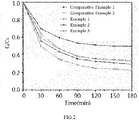
- Examples 1 to 3 (10 mg ceramic sheet with active component of P-C 3 N 4 /RGO/BiVO 4 , thickness ⁇ length ⁇ width of 3cm ⁇ 2cm ⁇ 1cm), Comparative Example 1 ( 10mg ceramic tablets with active component of g-C 3 N 4 /RGO/BiVO 4 , thickness ⁇ length ⁇ width of 3cm ⁇ 2cm ⁇ 1cm), Comparative Example 2 (10mg ceramic tablets with active component of P-C 3 N 4 /RGO/BiVO 4 , thickness ⁇ length ⁇ width of 3cm ⁇ 2cm ⁇ 1cm) were respectively placed in the sewage containing norfloxacin, irradiated using a 300W xenon lamp at a distance of 5cm, sampled 1mL every 30min and measured the concentration of norfloxacin at 273nm with an ultraviolet-visible spectrophotometer; Wherein, the initial concentration of norfloxacin was 20mg/L.
- the test results are shown in FIG. 2 , wherein the abscissa is time (min) and the ordinate is C/Co (ie, real-time concentration of norfloxacin/initial concentration of norfloxacin). It can be seen from FIG. 2 that after treating the sewage containing norfloxacin with the visible light catalytic materials prepared in Examples 1-3 and Comparative Examples 1-2 of the present invention for 2 hours, the removal rates of norfloxacin are 77.72% and 70.92%, 66.92%, 50.33% and 67.33%, respectively, indicating that the visible light catalytic materials provided by the present invention have excellent removal effect of norfloxacin.
- the invention provides a visible light catalytic material and a preparation method and application thereof, which belongs to the technical field of catalysts.
- the visible light catalytic material provided by the present invention includes a carrier and an active component supported on the surface of the carrier; the carrier is a conductive ceramic; the active component is P-C 3 N 4 , graphene oxide and bismuth vanadate; raw materials for preparing the conductive ceramics include graphene, aluminum oxide and zinc oxide.
- both P-C 3 N 4 and BiVO 4 can be excited by visible light to generate photogenerated electrons and holes, and the reducing electrons on BiVO 4 are transferred to P-C 3 N 4 , and recombined with its oxidizing holes, RGO can be used as an electron transport medium to enhance the above process.
- the present invention uses active components of specific composition and carrier to cooperate to provide the visible light catalytic material with excellent visible light catalysis efficiency and recovery efficiency.
Landscapes
- Chemical & Material Sciences (AREA)
- Organic Chemistry (AREA)
- Engineering & Computer Science (AREA)
- Materials Engineering (AREA)
- Chemical Kinetics & Catalysis (AREA)
- Hydrology & Water Resources (AREA)
- Environmental & Geological Engineering (AREA)
- Water Supply & Treatment (AREA)
- Life Sciences & Earth Sciences (AREA)
- Inorganic Chemistry (AREA)
- Nanotechnology (AREA)
- Physics & Mathematics (AREA)
- Thermal Sciences (AREA)
- Health & Medical Sciences (AREA)
- Toxicology (AREA)
- Catalysts (AREA)
Description
- The present invention relates to the technical field of catalysts, and in particular to a visible light catalytic material and a preparation method and application thereof.
- Photocatalysis technology can directly and effectively use solar energy to degrade pollutants in the environment, showing great application potential in solving environmental pollution and energy shortage. However, since about 45% of sunlight is visible light, and the proportion of ultraviolet light is less than 5%, in order to use sunlight more efficiently, the development of photocatalysts with visible light catalytic activity is essential for the development and application of photocatalytic technology. g-C3N4 as a new non-metallic photocatalytic material, it is easy to prepare, has excellent physical and chemical stability and good photoelectric performance. Compared with traditional TiO2 photocatalyst, the absorption spectrum range of g-C3N4 is wider, and it can play a photocatalytic role only under ordinary visible light. However, the single g-C3N4 photocatalyst has the problems of low utilization rate of visible light, low separation efficiency of photogenerated electrons and high recombination rate, resulting in low photocatalytic efficiency.
- By improving the g-C3N4 photocatalyst, its catalytic performance can be improved. At present, the methods for improving the g-C3N4 photocatalyst mainly include morphology and structure control, non-metallic doping, metal doping, precious metal deposition, and compounding with other semiconductor materials. For example,
CN107233906 discloses the formation of a Z-type heterojunction material comprising g-C3N4 and BIVO 4- However, the existing improvement methods for g-C3N4 photocatalysts still generally have the problems of high recombination rate of photogenerated electrons and holes and low light utilization rate, which lead to low photocatalytic efficiency of the photocatalyst. - The object of the present invention is to provide a visible light catalytic material and a preparation method and application thereof. The visible light catalytic material provided by the present invention has excellent visible light catalytic performance and high recovery rate.
- In order to achieve the above object of the invention, the present invention provides the following technical solutions:
The present invention provides a visible light catalytic material, including a carrier and an active component supported on the surface of the carrier; the carrier is a conductive ceramic; the active component is P-C3N4, reduced graphene oxide and bismuth vanadate; raw materials for preparing the conductive ceramics include graphene, aluminum oxide and zinc oxide. - Preferably, the mass ratio of the P-C3N4, reduced graphene oxide and bismuth vanadate is 1 (0.005-0.006): (2.5-3.5). The mass ratio of the graphene, aluminum oxide and zinc oxide is 1: (8-9): (1-2).
- The method for preparing the conductive ceramic includes mixing graphene, aluminum oxide and zinc oxide, sequentially subjecting to crushing, tableting molding and sintering to obtain a conductive ceramic.
- Preferably, the sintering temperature is 1350-1360°C, and the time is 0.9-1.1h.
- The present invention provides a method for preparing a visible light catalytic material according to the above technical solution, including the following steps:
- Mixing P-C3N4, graphene oxide and water and performing modification treatment to obtain P-C3N4/ GO;
- Mixing the P-C3N4/GO, ammonium metavanadate, water and an acetic acid solution of bismuth nitrate to perform a recombination reaction to obtain P-C3N4/ RGO/BiVO4;
- Mixing the P-C3N4/RGO/BiVO4, a binder and a solvent, and coating the resulting mixed liquid on the surface of the conductive ceramic to obtain a visible light catalytic material.
- Preferably, the temperature of the modification treatment is 5-40°C, and the time is 9-13h.
- Preferably, the temperature of the recombination reaction is 135-145°C, and the time is 11-13h.
- Preferably, the ratio of the mass of the mixed liquid to the area of the conductive ceramic is (1-2.5) mg: 1cm2.
- The invention also provides an application of the visible light catalytic material according to the above technical solution or the visible light catalytic material prepared by the preparation method according to the above technical solution in sewage treatment.
- The present invention provides a visible light catalytic material, including a carrier and an active component supported on the surface of the carrier; the carrier is a conductive ceramic; the active component is P-C3N4, reduced graphene oxide and bismuth vanadate; raw materials for preparing the conductive ceramics include graphene, aluminum oxide and zinc oxide. The visible light catalytic material provided by the present invention is a Z-type heterojunction photocatalyst, and its electron transfer path is similar to the English letter Z. Both P-C3N4 and BiVO4 can be excited by visible light to generate photogenerated electrons and holes. The VB potential of the semiconductor P-C3N4 is more positive than that of BiVO4, and the CB potential of the semiconductor BiVO4 is more negative than that of P-C3N4, the electrons in the conduction band of BiVO4 will be transferred to the valence band of P-C3N4 and recombined with its holes; at this time, the holes at the VB potential of the semiconductor P-C3N4 are more capable of oxidizing, the electrons at the CB potential of the semiconductor BiVO4 are more capable of reducing; at the same time, the reduced graphene oxide (RGO) can be used as an electron transfer medium to enhance the above process; the conductive ceramic plays a supporting role, and the conductive ceramic has conductive properties and will also play a role of transferring electrons, which can improve the photocatalytic efficiency and recovery efficiency of visible light catalytic materials. Therefore, the visible light catalytic material prepared by the present invention has excellent visible light catalysis efficiency and recovery efficiency.
-
-
FIG. 1 is a diagram of the catalytic mechanism of a visible light catalytic material; -
FIG. 2 is a graph showing the removal effect of norfloxacin by the visible light catalytic materials prepared in Examples 1-3 and Comparative Examples 1-2. - The present invention provides a visible light catalytic material, including a carrier and an active component supported on the surface of the carrier; the carrier is a conductive ceramic; the active component is P-C3N4, graphene oxide and bismuth vanadate; raw materials for preparing the conductive ceramics include graphene, aluminum oxide and zinc oxide.
- In the present invention, unless otherwise specified, all raw material components are commercially available products well known to those skilled in the art.
- In the present invention, the mass ratio of the P-C3N4, graphene oxide and bismuth vanadate is preferably 1:(0.005-0.006) :(2.5-3.5), more preferably 1:(0.005-0.006) :(3-3.5). In the present invention, the bismuth vanadate is preferably monoclinic scheelite bismuth vanadate.
- In the present invention, the mass ratio of the graphene, aluminum oxide and zinc oxide is preferably 1: (8-9): (1-2), more preferably 1: (8.5-9): (1.5-2), most preferably 1:9:2. The present invention uses a conductive ceramic of a specific composition as the carrier, which mainly plays a supporting role.
- In the present invention, the preparation method of the conductive ceramic includes the following steps: mixing graphene, aluminum oxide and zinc oxide, sequentially subjecting to crushing, tableting molding and sintering to obtain a conductive ceramic.
- In the present invention, the crushing is preferably ball milling, more preferably wet milling; the solvent used in the wet milling is preferably ethanol; and the ball-to-material ratio is preferably 2:1. In the present invention, the usage ratio of the graphene, aluminum oxide, and zinc oxide is preferably 1g: (8-9) g: (1-2) g: (500-600) mL, and more preferably 1g: (8.5-9) g: (1.5-2) g: (500-550) mL, most preferably 1g:9g:2g:500mL. In the present invention, the wet milling time is preferably 3-5 hours, and more preferably 4 hours.
- After the completion of crushing, the present invention preferably further includes drying the obtained powder; the drying temperature is preferably 110-130°C, more preferably 120°C; the drying time is preferably 10-12h, more preferably 12h.
- In the present invention, the pressure for the tableting molding is preferably 10-14MPa, more preferably 12MPa; the pressing time is preferably 3-4min. In the present invention, the size of the ceramic green body obtained by the tableting molding is preferably (2.5-3.5) cm × (1.5-2.5) cm × (0.9-1.1) mm, and more preferably 3cm × 2cm × 1mm.
- In the present invention, the atmosphere of the sintering is preferably nitrogen; the rate of temperature increase of the sintering is preferably 3-7°C/min, more preferably 4-6°C/min; the temperature of the sintering is preferably 1350 -1360°C, more preferably 1360°C; the sintering time is preferably 0.9-1.1h, more preferably 1h, and the sintering time is preferably measured when the temperature rises to the temperature required for sintering. In the present invention, as the temperature increases, the powder particles having larger specific surface and higher surface energy in the ceramic green body, change in the direction of reducing the surface energy, and the material migration continues, the grain boundaries move accordingly, and the pores are gradually eliminated, causing shrinkage, so that the resulting conductive ceramic has a certain strength and density.
- After the completion of sintering, the present invention preferably cools the obtained ceramic to room temperature and then sequentially performs washing and drying to obtain a conductive ceramic. In the present invention, the washing is preferably performed under ultrasonic conditions, followed by ethanol and water, respectively, and the washing time is independently preferably 20 minutes. In the present invention, the volume ratio of the ceramic to ethanol is preferably 1g: (10-30) mL. In the present invention, the drying is preferably performed in an oven; the drying temperature is preferably 70-90°C, more preferably 75-85°C, and most preferably 80°C; and the drying time is preferably 4-6h, more preferably 4.5-5.5h.
- The visible light catalytic material provided by the present invention is a Z-type heterojunction photocatalyst, and its electron transfer path is similar to English letter Z. The catalytic mechanism is shown in
FIG. 1 , fromFIG. 1 , it can be seen that due to both P-C3N4 and BiVO4 can be excited by visible light to generate photogenerated electrons and holes, and at the same time, the VB potential of the semiconductor P-C3N4 is more positive than that of BiVO4, and the CB potential of the semiconductor BiVO4 is more negative than that of P-C3N4, the electrons in the conduction band of BiVO4 will be transferred to the valence band of P-C3N4 and recombined with its holes; and the holes at the VB potential of the semiconductor P-C3N4 are more capable of oxidizing, and the electrons at the CB potential of the semiconductor BiVO4 are more capable of reducing; at the same time, RGO is used as an electron transfer medium to enhance the above process; the conductive ceramic mainly acts as the carrier and plays a supporting role, the active components are loaded on the surface of the conductive ceramics, the active components in the catalytic material will not be dispersed into the water during use, and no filtration treatment is required during recovery, it is convenient for recovery and has a high recovery rate; at the same time, the conducting ceramic has conductive properties, and can transfer electrons, thereby improving the photocatalytic efficiency of the photocatalytic material. Therefore, the visible light catalytic material prepared by the present invention has excellent visible light catalysis efficiency and recovery efficiency. - The present invention provides a method for preparing a visible light catalytic material according to the above technical solution, characterized in that includes the following steps:
- Mixing P-C3N4, graphene oxide and water and performing modification treatment to obtain P-C3N4/ GO;
- Mixing the P-C3N4/GO, ammonium metavanadate, water and an acetic acid solution of bismuth nitrate to perform a recombination reaction to obtain P-C3N4/ RGO/BiVO4;
- Mixing the P-C3N4/RGO/BiVO4, a binder and a solvent, and coating the resulting mixed liquid on the surface of the conductive ceramic to obtain a visible light catalytic material.
- In the present invention, P-C3N4, graphene oxide and water are mixed and modified to obtain P-C3N4/ GO.
- In the present invention, the preparation method of P-C3N4 includes the following steps: mixing melamine, ammonium dihydrogen phosphate and water, sequentially performing polymerization reaction, drying and calcining to obtain P-C3N4. In the present invention, the mass ratio of the melamine, ammonium dihydrogen phosphate and water is preferably 1g: (0.1-0.12) g: (5-8) mL, more preferably 1g: (0.1-0.12) g: (5-8) mL, most preferably 3g:0.35g:20mL.
- In the present invention, the method of mixing the melamine, ammonium dihydrogen phosphate, and water is preferably to disperse melamine in water, add ammonium dihydrogen phosphate to the resulting suspension and perform ultrasonic mixing. In the present invention, the water is not particularly limited, and water well known in the art may be used, such as distilled water, deionized water, or ultrapure water. In the present invention, the dispersion methods and conditions are not particularly limited. The dispersion methods and conditions well known in the art can be used to ensure that the melamine and water form a uniform suspension. In the present invention, the temperature of the ultrasonic mixing is preferably 5-40°C, more preferably 20-25°C; the time of the ultrasonic mixing is preferably 20-35 min, more preferably 28-32 min, and most preferably 30 min.
- In the present invention, the temperature of the polymerization reaction is preferably 5-40°C, more preferably 20-25°C; the time of the polymerization reaction is preferably 11-13h, more preferably 11.5-12.5h, most preferably 12h.
- In the present invention, preferably after the solid-liquid separation of the reaction system obtained by the polymerization reaction is performed, the obtained solid material is dried. In the present invention, the solid-liquid separation method is not particularly limited, and a solid-liquid separation method well known in the art may be used, such as filtration, suction filtration, and centrifugation. In the present invention, the drying is preferably performed in an oven; the drying temperature is preferably 90-110°C, more preferably 95-105°C, and most preferably 100°C; and the drying time is preferably 6-8h, more preferably 6-7h, and most preferably 6h.
- In the present invention, the calcination is preferably performed by placing the dried material in a crucible with a lid in a muffle furnace. In the present invention, the temperature increase rate of the muffle furnace is preferably 2-3°C/ min, and more preferably 2.3-2.6°C/ min. In the present invention, the calcination temperature is preferably 500-550°C, more preferably 520-550°C, and most preferably 550°C; the calcination time is preferably 3-5 hours, and more preferably 3.5-4.5 hours, most preferably 4h; the time for the calcination is preferably measured when the temperature rises to the temperature required for the calcination. In the present invention, during the calcination process, the phosphorus-doped carbon nitride is converted to phosphorus-doped graphite phase carbon nitride (P-C3N4).
- After the completion of the calcination, the present invention preferably further includes cooling the resulting calcined product to room temperature to obtain P-C3N4.
- After obtaining P-C3N4, the present invention mixes the P-C3N4, graphene oxide and water, and performs modification treatment to obtain P-C3N4/ GO.
- In the present invention, the mass ratio of P-C3N4 and graphene oxide is preferably 1:
(0.006-0.007), and more preferably 1: (0.0065-0.007). In the present invention, the usage ratio of the graphene oxide and water is preferably 1mg: (3-6) mL, and more preferably 1mg: 4mL. - In the present invention, the method of mixing the P-C3N4, graphene oxide and water is preferably to perform the first ultrasonic mixing of graphene oxide and water and add P-C3N4 to the resulting mixture to perform the second ultrasonic mixing. In the present invention, the temperature of the first ultrasonic mixing is preferably 5-40°C, more preferably 20-25°C; the time of the first ultrasonic mixing is preferably 1-2h, more preferably 1h. In the present invention, the temperature of the second ultrasonic mixing is preferably 5-40°C, more preferably 20-25°C; the time of the second ultrasonic mixing is preferably 0.5-1h, more preferably 0.5h.
- In the present invention, the temperature of the modification treatment is preferably 5-40°C, more preferably 20-25°C; the time of the modification treatment is preferably 10-12h, more preferably 12h.
- After the completion of the modification treatment, the present invention preferably further includes drying the obtained compound. In the present invention, the drying is preferably performed in an oven; the drying temperature is preferably 90-110°C, more preferably 95-105°C, and most preferably 100°C; and the drying time is preferably 6-8h, more preferably 6-7h, and most preferably 6h.
- After obtaining P-C3N4/ GO, the present invention mixes the P-C3N4/GO, ammonium metavanadate, water and acetic acid solution of bismuth nitrate to perform a recombination reaction, to obtain P-C3N4/ RGO/ BiVO4.
- In the present invention, the concentration of bismuth nitrate in the acetic acid solution of bismuth nitrate is preferably 2-3mol/L, and more preferably 2.5mol/L. In the present invention, the usage ratio of the ammonium metavanadate and water is preferably 1mmol: (10-15) mL, and more preferably 1mmol:15mL. In the present invention, the usage ratio of the P-C3N4/GO, ammonium metavanadate and bismuth nitrate is preferably 1g: (8-12) mmol: (8-12) mmol, more preferably 1g: (9-11) mmol: (9-11) mmol, most preferably 1g:10mmol:10mmol. The present invention can promote the better formation of the composite by controlling the proportion of each raw material, without the interference of the raw materials and the waste of the raw materials, thereby improving the photocatalytic efficiency and recovery efficiency of the photocatalytic material.
- In the present invention, the method of mixing the P-C3N4/ GO, ammonium metavanadate, water and the acetic acid solution of bismuth nitrate is preferably to perform the ultrasonic mixing of P-C3N4/GO, ammonium metavanadate and water to obtain a suspension, and dropwise add the acetic acid solution of bismuth nitrate to the suspension under stirring and mixing. In the present invention, the temperature of the ultrasonic mixing is preferably 5-40°C, more preferably 20-25°C; the time is preferably 25-35 min, and more preferably 30min. In the present invention, the rotation speed of the stirring and mixing is not particularly limited, and a rotation speed well known in the art may be used. In the present invention, the dropping speed is preferably 25-35g/min, more preferably 27-32g/min, and most preferably 30g/min.
- In the present invention, the recombination reaction is preferably carried out in an autoclave, the temperature of the recombination reaction is preferably 135-145°C, more preferably 140°C; the time of the recombination reaction is preferably 11-13h, more preferably 12h. The present invention adopts the above reaction conditions to perform a recombination reaction, which can reduce graphene oxide (GO) to reduced graphene oxide (RGO), and at the same time is beneficial to the formation of a stable composite of three types of materials of P-C3N4, RGO and BiVO4, thereby improving the catalytic performance of the photocatalytic material.
- After the completion of the recombination reaction, the present invention preferably further includes after solid-liquid separation of the obtained reaction system, and then washing and drying the obtained solid material. In the present invention, the solid-liquid separation method is not particularly limited, and a solid-liquid separation method well known in the art may be used, such as filtration, suction filtration, and centrifugation. In the present invention, the washing is preferably performed sequentially in ethanol and water, and the number of times of washing is independently preferably 2-4 times. In the present invention, the washing method is not particularly limited, and a washing method well known to those skilled in the art may be used. In the present invention, the drying is preferably performed in an oven; the drying temperature is preferably 60-80°C, more preferably 65-75°C, and most preferably 100°C; and the drying time is preferably 8-10h, more preferably 8.5-9.5h, most preferably 9h.
- After obtaining P-C3N4/RGO/BiVO4, the present invention mixes the P-C3N4/RGO/BiVO4, a binder and a solvent, and coats the obtained mixed liquid on the surface of the conductive ceramic to obtain a visible light catalytic material.
- In the present invention, the binder preferably includes a Nafion solution (perfluorosulfonic acid type polymer solution). In the present invention, the solvent is preferably ethanol. In the present invention, the usage ratio of the P-C3N4/RGO/BiVO4, the binder and the solvent is preferably 10mg: (45-55) µL: (0.8-1.2) mL, more preferably 10mg: 50µL: 1mL. In the present invention, the solvent can make the binder and P-C3N4/RGO/BiVO4 evenly dispersed, while the binder is firmly combined with P-C3N4/RGO/BiVO4 by the conductive ceramic.
- In the present invention, the coating method is preferably a dip coating method. In the present invention, the operation of the dip coating method is not particularly limited, and the coating operation of the dip coating method well known in the art may be used. In the present invention, the ratio of the mass of the mixed liquid to the area of the conductive ceramic is preferably (1-2.5) mg: 1cm2, more preferably (1.5-2.5) mg: 1cm2, and most preferably (1.5-2) mg: 1cm2.
- After the completion of the coating, the present invention preferably dries the obtained wet film; the drying temperature is preferably 70-90°C, more preferably 80°C; the drying time is preferably 10-18h, more preferably 12-14 hours.
- The visible light catalytic material provided by the present invention is a Z-type heterojunction photocatalyst, and its electron transfer path is similar to English letter Z. Both P-C3N4 and BiVO4 can be excited by visible light to generate photogenerated electrons and holes, and the VB potential of the semiconductor P-C3N4 is more positive than that of BiVO4, and the CB potential of the semiconductor BiVO4 is more negative than that of P-C3N4, the electrons in the conduction band of BiVO4 will be transferred to the valence band of P-C3N4 and recombined with its holes; at the moment, the holes at the VB potential of the semiconductor P-C3N4 are more capable of oxidizing, and the electrons at the CB potential of the semiconductor BiVO4 are more capable of reducing; at the same time, RGO can be used as an electron transfer medium to enhance the above process; the conductive ceramic mainly acts as the carrier and plays a supporting role, the active components are loaded on the surface of the conductive ceramics, the active components in the catalytic material will not be dispersed into the water during use, and no filtration treatment is required during recovery, it is convenient for recovery and has a high recovery rate; while the conducting ceramic has conductive properties, can transfer electrons, thereby improving the photocatalytic efficiency of the photocatalytic material. Therefore, the visible light catalytic material prepared by the present invention has excellent visible light catalysis efficiency and recovery efficiency.
- The present invention provides the use of the visible light catalytic material according to the above technical solution or the visible light catalytic material prepared by the preparation method according to the above technical solution in sewage treatment, and more preferably in treating organic pollutants contained in sewage.
- In the present invention, the usage ratio of the active component in the visible light catalytic material and the sewage is preferably 1mg: (1-2) mL.
- Conventional photocatalysts used in sewage treatment process are dispersed in water in the form of powder. The photocatalysts are usually recovered by filtration. However, filtration cannot completely filter the photocatalyst, and the post-treatment is complicated, the recovery rate is low, and reuse is difficult. The photocatalytic material provided by the present invention loads the active component on the surface of the conductive ceramic. During the application process, the active component in the catalytic material will not be dispersed into the water, and no filtration treatment is required during recovery, which is convenient for recovery and has a high recovery rate; at the same time, the conductive ceramics have electrical conductivity, can transfer electrons, and have high photocatalytic efficiency.
- The technical solutions in the present invention will be described clearly and completely in combination with the examples in the present invention. Obviously, the described examples are only a part of the examples of the present invention, but not all the examples. Based on the examples of the present invention, all other examples obtained by a person of ordinary skill in the art without making creative efforts fall within the protection scope of the present invention.
-
- Dispersed melamine (3g) in deionized water (20mL), added ammonium dihydrogen phosphate (0.35g) to the resulting suspension and ultrasonically mixed for 30min, then stirred at room temperature (25°C) for 12h, then placed it in an oven to dry at 100°C for 6h, placed it in a crucible with a lid, raised the temperature to 550 °C at a rate of 2.5 °C/min, then calcined for 4h, and cooled to room temperature to obtain P-C3N4; Graphene oxide (5mg) and deionized water (20mL) were ultrasonically mixed for 1h, added P-C3N4 (0.75g) and ultrasonically mixed for 0.5h, stirred at room temperature for 12h, and then placed in an oven at 100 °C to dry for 6h to obtain P-C3N4/GO;
- Bismuth nitrate (Bi(NO3)3·5H2O, 2mmol) was dissolved in glacial acetic acid (5mL) to obtain an acetic acid solution of bismuth nitrate, P-C3N4/GO (0.2g), ammonium metavanadate (NH4VO4, 2mmol) and 30mL deionized water were ultrasonically mixed for 30min, to obtain a suspension, the acetic acid solution of the bismuth nitrate was added dropwise to the suspension at a uniform rate of 30g/min under the stirring rate of 100r/min, the resulting mixture was transferred to an autoclave, and reacted at 140 °C for 12h, then the resulting reaction system was filtered, and the resulting precipitate was respectively washed with ethanol and deionized water repeatedly 4 times to obtain P-C3N4/RGO/BiVO4;
- Put aluminum oxide (0.9g), zinc oxide (0.2g) and graphene (0.1g) into a ball mill jar, added ethanol (50mL) and zirconia ball (2.4g), after ball milling for 4h, dried at 120°C for 12 hours, pressed the resulting powder into a ceramic sheet with a thickness × length × width of 3cm × 2cm × 1cm, heated it to 1360°C at a rate of 2.5°C/min in a nitrogen atmosphere, hold it for 1h, and then cooled to room temperature. The obtained ceramics were ultrasonically washed in deionized water and ethanol for 20 minutes, and dried to constant weight at 80°C to obtain conductive ceramics; P-C3N4/RGO/BiVO4 (10mg), Nafion solution (50µL) and ethanol (1mL) were mixed evenly, and the resulting mixture was coated on the surface of the conductive ceramic, wherein the ratio of the mass of the mixed solution to the area of the conductive ceramic was (1-2.5) mg: 1cm2, and then dried at 80°C for 12 hours to obtain a visible light catalytic material.
-
- Dispersed melamine (3g) in deionized water (20mL), added ammonium dihydrogen phosphate (0.35g) to the resulting suspension and ultrasonically mixed for 30min, then stirred at room temperature (25°C) for 12h, then placed it in an oven to dry at 100°C for 6h, placed it in a crucible with a lid, raised the temperature to 550 °C at a rate of 2.5 °C/min, then calcined for 4h, and cooled to room temperature to obtain P-C3N4; Graphene oxide (5mg) and deionized water (20mL) were ultrasonically mixed for 1h, added P-C3N4 (0.75g) and ultrasonically mixed for 0.5h, stirred at room temperature for 12h, and then placed in an oven at 100 °C to dry for 6h to obtain P-C3N4/GO;
- Bismuth nitrate (Bi(NO3)3·5H2O, 2mmol) was dissolved in glacial acetic acid (5mL) to obtain an acetic acid solution of bismuth nitrate, P-C3N4/GO (0.2g), ammonium metavanadate (NH4VO4, 2mmol) and 30mL deionized water were ultrasonically mixed for 30min, to obtain a suspension, the acetic acid solution of the bismuth nitrate was added dropwise to the suspension at a uniform rate of 30g/min under the stirring rate of 100r/min, the resulting mixture was transferred to an autoclave, and reacted at 140°C for 12h, then the resulting reaction system was filtered, and the resulting precipitate was respectively washed with ethanol and deionized water repeatedly 4 times to obtain P-C3N4/RGO/BiVO4;
- Put aluminum oxide (0.9g), zinc oxide (0.2g) and graphene (0.1g) into a ball mill jar, added ethanol (50mL) and zirconia ball (2.4g), after ball milling for 4h, dried at 120°C for 12 hours, pressed the resulting powder into a ceramic sheet with a thickness × length × width of 3cm × 2cm × 1cm, heated it to 1360°C at a rate of 2.5°C/min in a nitrogen atmosphere, hold it for 1h, and then cooled to room temperature. The obtained ceramics were ultrasonically washed in deionized water and ethanol for 20 minutes, and dried to constant weight at 80°C to obtain conductive ceramics; P-C3N4/RGO/BiVO4 (10mg), Nafion solution (50µL) and ethanol (1mL) were mixed evenly, and the resulting mixture was coated on the surface of the conductive ceramic, wherein the ratio of the mass of the mixed solution to the area of the conductive ceramic was (1-2.5) mg: 1cm2, and then dried at 80°C for 12 hours to obtain a visible light catalytic material.
-
- Dispersed melamine (3g) in deionized water (20mL), added ammonium dihydrogen phosphate (0.35g) to the resulting suspension and ultrasonically mixed for 30min, then stirred at room temperature (25°C) for 12h, then placed it in an oven to dry at 100°C for 6h, placed it in a crucible with a lid, raised the temperature to 550 °C at a rate of 2.5 °C/min, then calcined for 4h, and cooled to room temperature to obtain P-C3N4; Graphene oxide (5mg) and deionized water (20mL) were ultrasonically mixed for 1h, added P-C3N4 (0.75g) and ultrasonically mixed for 0.5h, stirred at room temperature for 12h, and then placed in an oven at 100 °C to dry for 6h to obtain P-C3N4/GO;
- Bismuth nitrate (Bi(NO3)3·5H2O, 2.5mmol) was dissolved in glacial acetic acid (5mL) to obtain an acetic acid solution of bismuth nitrate, P-C3N4/GO (0.2g), ammonium metavanadate (NH4VO4, 2.5mmol) and 30mL deionized water were ultrasonically mixed for 30min, to obtain a suspension, the acetic acid solution of the bismuth nitrate was added dropwise to the suspension at a uniform rate of 30g/min under the stirring rate of 100r/min, the resulting mixture was transferred to an autoclave, and reacted at 140 °C for 12h, then the resulting reaction system was filtered, and the resulting precipitate was respectively washed with ethanol and deionized water repeatedly 4 times to obtain P-C3N4/RGO/BiVO4;
- Put aluminum oxide (0.9g), zinc oxide (0.2g) and graphene (0.1g) into a ball mill jar, added ethanol (50mL) and zirconia ball (2.4g), after ball milling for 4h, dried at 120°C for 12 hours, pressed the resulting powder into a ceramic sheet with a thickness × length × width of 3cm × 2cm × 1cm, heated it to 1360°C at a rate of 2.5°C/min in a nitrogen atmosphere, hold it for 1h, and then cooled to room temperature. The obtained ceramics were ultrasonically washed in deionized water and ethanol for 20 minutes, and dried to constant weight at 80°C to obtain conductive ceramics; P-C3N4/RGO/BiVO4 (10mg), Nafion solution (50µL) and ethanol (1mL) were mixed evenly, and the resulting mixture was coated on the surface of the conductive ceramic, and then dried at 80°C for 12 hours to obtain a visible light catalytic material.
- The visible light catalytic material was prepared according to the method of Example 1, which is different from Example 1 in that commercially available g-C3N4 was used instead of P-C3N4 to obtain the visible light catalytic material with g-C3N4/RGO/BiVO4 as the active component.
- The visible light catalytic material was prepared according to the method of Example 1, which is different from Example 1 in that during the preparation of P-C3N4, urea was used instead of melamine, and diammonium hydrogen phosphate was used instead of ammonium dihydrogen phosphate.
- Examples 1 to 3 (10 mg ceramic sheet with active component of P-C3N4/RGO/BiVO4, thickness × length × width of 3cm × 2cm × 1cm), Comparative Example 1 ( 10mg ceramic tablets with active component of g-C3N4/RGO/BiVO4, thickness × length × width of 3cm × 2cm × 1cm), Comparative Example 2 (10mg ceramic tablets with active component of P-C3N4/RGO/BiVO4, thickness × length × width of 3cm × 2cm × 1cm) were respectively placed in the sewage containing norfloxacin, irradiated using a 300W xenon lamp at a distance of 5cm, sampled 1mL every 30min and measured the concentration of norfloxacin at 273nm with an ultraviolet-visible spectrophotometer; Wherein, the initial concentration of norfloxacin was 20mg/L.
- The test results are shown in
FIG. 2 , wherein the abscissa is time (min) and the ordinate is C/Co (ie, real-time concentration of norfloxacin/initial concentration of norfloxacin). It can be seen fromFIG. 2 that after treating the sewage containing norfloxacin with the visible light catalytic materials prepared in Examples 1-3 and Comparative Examples 1-2 of the present invention for 2 hours, the removal rates of norfloxacin are 77.72% and 70.92%, 66.92%, 50.33% and 67.33%, respectively, indicating that the visible light catalytic materials provided by the present invention have excellent removal effect of norfloxacin. - The above is only a preferred embodiment of the present invention, it should be noted that for those of ordinary skilled in the art, without departing from the principles of the present invention, can also make several improvements and retouches, these improvements and retouches should also be regarded as the protection scope of the present invention.
- The invention provides a visible light catalytic material and a preparation method and application thereof, which belongs to the technical field of catalysts. The visible light catalytic material provided by the present invention includes a carrier and an active component supported on the surface of the carrier; the carrier is a conductive ceramic; the active component is P-C3N4, graphene oxide and bismuth vanadate; raw materials for preparing the conductive ceramics include graphene, aluminum oxide and zinc oxide. In the visible light catalytic material provided by the present invention, both P-C3N4 and BiVO4 can be excited by visible light to generate photogenerated electrons and holes, and the reducing electrons on BiVO4 are transferred to P-C3N4, and recombined with its oxidizing holes, RGO can be used as an electron transport medium to enhance the above process. The present invention uses active components of specific composition and carrier to cooperate to provide the visible light catalytic material with excellent visible light catalysis efficiency and recovery efficiency.
Claims (8)
- A visible light catalytic material, characterized in that it comprises a carrier and an active component supported on a surface of the carrier, whereinthe carrier is a conductive ceramic;the active component is P-C3N4/reduced graphene oxide/BiVO4;the conductive ceramic is prepared by a process comprising mixing graphene, aluminum oxide and zinc oxide, sequentially crushing the resulting mixture, tableting molding and sintering to obtain conductivity ceramics, wherein a mass ratio of the graphene, aluminum oxide and zinc oxide is 1: (8-9): (1-2);the active component is prepared by a process comprising mixing P-C3N4, graphene oxide and water and performing modification treatment to obtain P-C3N4/GO; mixing the P-C3N4/GO, ammonium metavanadate, water and an acetic acid solution of bismuth nitrate to perform a recombination reaction to obtain P-C3N4/ RGO/BiVO4, wherein the P-C3N4 is prepared by a process comprising mixing melamine, ammonium dihydrogen phosphate and water, sequentially performing polymerization reaction, drying and calcining to obtain the P-C3N4.
- The visible light catalytic material according to claim 1, characterized in that a mass ratio of the P-C3N4, graphene oxide, and bismuth vanadate is 1: (0.005-0.006): (2.5-3.5).
- The visible light catalytic material according to claim 1, characterized in that the sintering temperature is 1350-1360 °C and the time is 0.9-1.1h.
- A method for preparing a visible light catalytic material according to any one of claims 1 to 3, characterized in that it comprises the following steps:mixing P-C3N4, graphene oxide and water and performing modification treatment to obtain P-C3N4/GO;mixing the P-C3N4/GO, ammonium metavanadate, water and an acetic acid solution of bismuth nitrate to perform a recombination reaction to obtain P-C3N4/reduced graphene oxide/BiVO4; andmixing the P-C3N4/reduced graphene oxide/BiVO4, a binder and a solvent, and coating the resulting mixed liquid on the surface of the conductive ceramic to obtain a visible light catalytic material;wherein, the P-C3N4 is prepared by a process comprising mixing melamine, ammonium dihydrogen phosphate and water, sequentially performing polymerization reaction, drying and calcining to obtain the P-C3N4.
- The method according to claim 4, characterized in that the temperature of the modification treatment is 5-40°C and the time is 9-13h.
- The method according to claim 4, characterized in that the temperature of the recombination reaction is 135-145°C and the time is 11-13h.
- The method according to claim 4, characterized in that a ratio of the mass of the mixed liquid to the area of the conductive ceramic is (1-2.5) mg: 1cm2.
- Use of the visible light catalytic material according to any one of claims 1-3 or the visible light catalytic material prepared by the preparation method according to any one of claims 4-7 in sewage treatment.
Applications Claiming Priority (1)
| Application Number | Priority Date | Filing Date | Title |
|---|---|---|---|
| CN202010020942.1A CN111167496B (en) | 2020-01-09 | 2020-01-09 | Visible light catalytic material and preparation method and application thereof |
Publications (2)
| Publication Number | Publication Date |
|---|---|
| EP3848122A1 EP3848122A1 (en) | 2021-07-14 |
| EP3848122B1 true EP3848122B1 (en) | 2022-08-10 |
Family
ID=70654647
Family Applications (1)
| Application Number | Title | Priority Date | Filing Date |
|---|---|---|---|
| EP20191677.2A Active EP3848122B1 (en) | 2020-01-09 | 2020-08-19 | Visible light catalytic material and preparation method and application thereof |
Country Status (2)
| Country | Link |
|---|---|
| EP (1) | EP3848122B1 (en) |
| CN (1) | CN111167496B (en) |
Families Citing this family (19)
| Publication number | Priority date | Publication date | Assignee | Title |
|---|---|---|---|---|
| CN111729682A (en) * | 2020-07-03 | 2020-10-02 | 合肥工业大学 | A kind of photocatalyst g-C3N4/RGO/Bi2O3 and preparation method thereof |
| CN112536069A (en) * | 2020-12-16 | 2021-03-23 | 广东工业大学 | LED excitation supported photocatalyst and preparation method and application thereof |
| CN112973757B (en) * | 2021-03-08 | 2022-11-08 | 合肥工业大学 | Bismuth vanadate quantum dot/RGO/graphite phase carbon nitride ternary composite photocatalyst and preparation method thereof |
| CN114100655A (en) * | 2021-10-27 | 2022-03-01 | 石家庄学院 | Preparation method of surface-modified functional ceramic-based Bi-based composite photocatalytic material |
| CN114272930A (en) * | 2021-11-24 | 2022-04-05 | 东莞理工学院 | A kind of heterojunction photocatalyst and its preparation method and application |
| CN114011452A (en) * | 2021-12-07 | 2022-02-08 | 广东石油化工学院 | Phosphorus-doped graphitic carbon nitride/bismuth vanadate heterojunction and its applications |
| CN114130415A (en) * | 2021-12-07 | 2022-03-04 | 广东石油化工学院 | Preparation method of high photocatalytic phosphorus-doped graphite-phase carbon nitride/bismuth tungstate heterojunction |
| CN114082436A (en) * | 2021-12-07 | 2022-02-25 | 广东石油化工学院 | A kind of preparation method of phosphorus-doped graphitic carbon nitride/bismuth molybdate heterojunction |
| CN114733506B (en) * | 2022-04-15 | 2023-11-21 | 南通大学 | Recoverable g-C 3 N 4 Preparation method and application of/rGO/cotton composite photocatalyst |
| CN114849690B (en) * | 2022-06-09 | 2023-06-16 | 武汉理工大学 | S-shaped SbVO 4 /g-C 3 N 4 Composite photocatalyst, preparation method and application thereof |
| CN114904560A (en) * | 2022-06-21 | 2022-08-16 | 武汉大学 | Preparation method and application of bismuth-supported carbon-defective carbon nitride capable of photocatalytic degradation of dyes |
| CN115025805B (en) * | 2022-07-08 | 2023-07-25 | 成都大学 | A kind of BiVO4/g-C3N4/AgBr ternary composite photocatalyst and its preparation method |
| CN115069292B (en) * | 2022-08-08 | 2024-06-14 | 中交七鲤古镇(赣州)文化旅游有限公司 | Preparation method and application of graphite carbon nitride/nitrogen-doped graphene/bismuth vanadate Z-type photocatalyst |
| CN115445641A (en) * | 2022-08-18 | 2022-12-09 | 电子科技大学长三角研究院(湖州) | Lead-free perovskite-supported graphene-like carbon nitride visible light catalyst and preparation method |
| CN116037191A (en) * | 2023-02-17 | 2023-05-02 | 安徽工业大学 | A Fe-doped g-C3N4/BiVO4 heterojunction photocatalyst, preparation method and application |
| CN117205956B (en) * | 2023-10-08 | 2024-09-20 | 江西省科学院能源研究所 | Simple preparation method and application of modified carbon nitride |
| CN119114123B (en) * | 2024-09-11 | 2026-02-06 | 陕西科技大学 | BNVO/VC MXene/RGO photo-thermal compression electrocatalytic material and preparation method and application thereof |
| CN119873947B (en) * | 2024-10-12 | 2026-04-17 | 扬州工业职业技术学院 | Doped modified bismuth ferrite heterojunction and application thereof in photocatalytic degradation of organic wastewater |
| CN119524904A (en) * | 2024-11-27 | 2025-02-28 | 大连民族大学 | Preparation method and product of type II heterojunction photocatalyst and its application in photocatalytic degradation of levofloxacin |
Family Cites Families (21)
| Publication number | Priority date | Publication date | Assignee | Title |
|---|---|---|---|---|
| CN100428545C (en) * | 2006-08-17 | 2008-10-22 | 武汉理工大学 | Fuel cell catalyst modified by proton conductor and supported by conductive ceramics and its preparation |
| US8946111B2 (en) * | 2007-08-17 | 2015-02-03 | Juzer Jangbarwala | Fibrous composite catalytic structure having at least three solid phases |
| TWI359698B (en) * | 2008-04-22 | 2012-03-11 | Iner Aec Executive Yuan | Method for producing catalyst for wastewater treat |
| WO2013003846A2 (en) * | 2011-06-30 | 2013-01-03 | The Regents Of The University Of California | Surface insulated porous current collectors as dendrite free electrodeposition electrodes |
| CN102306665B (en) * | 2011-08-25 | 2013-08-07 | 重庆大学 | Semiconductor film raw material slurry prepared by natural pyrite |
| GB2505025B (en) * | 2012-03-30 | 2019-07-17 | Atg R&D Ltd | Method for making assembly for photocatalytic treatment of water |
| CN103769213B (en) * | 2014-01-07 | 2016-06-01 | 河北科技大学 | The preparation method of a kind of phosphorus doping graphite phase carbon nitride visible light catalyst |
| CN105664991A (en) * | 2016-02-22 | 2016-06-15 | 南开大学 | Method for preparing efficient bactericide silver/graphite phase carbon nitride composite material |
| CN106881140B (en) * | 2017-03-22 | 2019-08-06 | 陕西科技大学 | A carbon nitride/graphene/(040) bismuth vanadate heterojunction and its preparation method and application |
| CN107233906B (en) * | 2017-06-08 | 2020-02-21 | 江苏大学 | A kind of preparation method and use of reduced graphene oxide/bismuth vanadate/carbon nitride composite material |
| CN107475745B (en) * | 2017-08-23 | 2018-12-25 | 黄河科技学院 | A kind of phosphorus doping nitridation carbon composite modified titanic oxide optoelectronic pole, preparation method and the application of gold modification |
| CN107540045B (en) * | 2017-10-16 | 2021-04-16 | 中国科学院过程工程研究所 | Method for using silicon carbide material, ozone photocatalyst and reactor containing the same |
| CN108404962B (en) * | 2018-03-29 | 2019-10-15 | 南通职业大学 | A kind of preparation method of p-doped graphite phase carbon nitride/zinc titanate composite photo-catalyst |
| WO2019195916A1 (en) * | 2018-04-13 | 2019-10-17 | Nanophyll Inc. | Self-cleaning and anti-fouling graphene oxide/tio2 photoactive coating and large scale bonding-to- surface process thereof |
| CN109037719A (en) * | 2018-08-23 | 2018-12-18 | 成都新柯力化工科技有限公司 | A kind of stable type ceramic base load fuel-cell catalyst and preparation method |
| CN109395764B (en) * | 2018-12-18 | 2021-09-21 | 上海纳米技术及应用国家工程研究中心有限公司 | Preparation method of phosphorus-doped carbon nitride, product and application thereof |
| CN109748575A (en) * | 2019-03-13 | 2019-05-14 | 南开大学 | A kind of graphene ceramic material and preparation method thereof |
| CN109876845B (en) * | 2019-03-22 | 2021-03-19 | 北京交通大学 | M-g-C3N4Preparation method and application of/rGOA composite adsorption visible light catalytic material |
| CN110304907A (en) * | 2019-06-12 | 2019-10-08 | 魏炎梅 | A kind of preparation method of Zinc oxide-base composite conductive ceramic |
| CN111389450B (en) * | 2020-05-13 | 2023-03-14 | 中国农业科学院烟草研究所 | Phosphorus-doped carbon nitride material and preparation method and application thereof |
| CN111762880B (en) * | 2020-07-22 | 2021-12-10 | 南京理工大学 | Method for biologically and intensively treating refractory organic pollutants based on light-excited holes as electron acceptors |
-
2020
- 2020-01-09 CN CN202010020942.1A patent/CN111167496B/en active Active
- 2020-08-19 EP EP20191677.2A patent/EP3848122B1/en active Active
Also Published As
| Publication number | Publication date |
|---|---|
| CN111167496A (en) | 2020-05-19 |
| CN111167496B (en) | 2020-12-25 |
| EP3848122A1 (en) | 2021-07-14 |
Similar Documents
| Publication | Publication Date | Title |
|---|---|---|
| EP3848122A1 (en) | Visible light catalytic material and preparation method and application thereof | |
| CN114367299B (en) | Graphite phase carbon nitride photocatalyst for photocatalytic hydrogen production and preparation method thereof | |
| Xu et al. | NH2-MIL-125 (Ti)/graphitic carbon nitride heterostructure decorated with NiPd co-catalysts for efficient photocatalytic hydrogen production | |
| CN107233906B (en) | A kind of preparation method and use of reduced graphene oxide/bismuth vanadate/carbon nitride composite material | |
| CN107376968B (en) | Tungstic acid/double Z shaped photochemical catalyst of carbonitride/bismuth oxide and its preparation method and application | |
| CN108380233B (en) | Phosphorus-doped carbon nitride/carbon nitride homotype heterojunction photocatalyst and preparation method and application thereof | |
| CN105817255A (en) | Manganese oxide-graphite phase carbon nitride composite photocatalytic material and preparation method thereof | |
| CN110270364B (en) | Supported graphite phase carbon nitride composite material, preparation method and application thereof | |
| CN106824250A (en) | A kind of carbonitride visible light catalyst for the zinc that adulterates and its production and use | |
| CN105498820A (en) | Preparation method of Au/g-C3N4 supported photocatalytic material for high visible photoelectron transfer | |
| CN112774715B (en) | A kind of bismuth vanadate high crystalline carbon nitride heterojunction photocatalyst and its preparation method and application | |
| US12420269B1 (en) | Simple preparation method and use of support of catalyst for hydrogenation | |
| CN113070084B (en) | Ternary composite material based on graphitic carbon nitride and preparation method and application thereof | |
| CN110342477A (en) | A kind of oxygen-doped porous carbon nitride nanosheet and its preparation method | |
| CN107321373A (en) | Doped carbon carrying transition metal boride multifunctional nano catalyst and preparation method | |
| CN114632513B (en) | Preparation method and application of single-atom Au-supported strontium titanate/titanium dioxide composite photocatalyst | |
| CN112076777A (en) | For CO2Reduced photocatalyst and preparation method thereof | |
| CN110841686A (en) | Carbon-coated titanium suboxide composite carbon nitride composite material and preparation method and application thereof | |
| CN111389409A (en) | Preparation method and application of bismuth vanadate photocatalyst with surface modified by cobalt-copper oxide | |
| CN108636420A (en) | A kind of pucherite-franklinite composite photo-catalyst, preparation method and applications | |
| CN109289887B (en) | Preparation method and application of nitrogen and vanadium co-doped titanium dioxide/bismuth tantalate Z-type heterojunction photocatalyst | |
| CN105289598A (en) | Simple method for preparing AgxBiOy visible-light responsive catalyst | |
| CN102451680A (en) | Composite oxide modified wet oxidation catalyst and preparation method thereof | |
| CN110354882B (en) | BiVO4@ZnIn2S4/g-C3N4Visible light response photocatalyst and preparation method thereof | |
| CN108543536A (en) | A kind of pucherite-calcium ferrite composite photo-catalyst, preparation method and applications |
Legal Events
| Date | Code | Title | Description |
|---|---|---|---|
| PUAI | Public reference made under article 153(3) epc to a published international application that has entered the european phase |
Free format text: ORIGINAL CODE: 0009012 |
|
| STAA | Information on the status of an ep patent application or granted ep patent |
Free format text: STATUS: REQUEST FOR EXAMINATION WAS MADE |
|
| 17P | Request for examination filed |
Effective date: 20200819 |
|
| AK | Designated contracting states |
Kind code of ref document: A1 Designated state(s): AL AT BE BG CH CY CZ DE DK EE ES FI FR GB GR HR HU IE IS IT LI LT LU LV MC MK MT NL NO PL PT RO RS SE SI SK SM TR |
|
| GRAP | Despatch of communication of intention to grant a patent |
Free format text: ORIGINAL CODE: EPIDOSNIGR1 |
|
| STAA | Information on the status of an ep patent application or granted ep patent |
Free format text: STATUS: GRANT OF PATENT IS INTENDED |
|
| INTG | Intention to grant announced |
Effective date: 20220405 |
|
| GRAS | Grant fee paid |
Free format text: ORIGINAL CODE: EPIDOSNIGR3 |
|
| GRAA | (expected) grant |
Free format text: ORIGINAL CODE: 0009210 |
|
| STAA | Information on the status of an ep patent application or granted ep patent |
Free format text: STATUS: THE PATENT HAS BEEN GRANTED |
|
| AK | Designated contracting states |
Kind code of ref document: B1 Designated state(s): AL AT BE BG CH CY CZ DE DK EE ES FI FR GB GR HR HU IE IS IT LI LT LU LV MC MK MT NL NO PL PT RO RS SE SI SK SM TR |
|
| REG | Reference to a national code |
Ref country code: AT Ref legal event code: REF Ref document number: 1510084 Country of ref document: AT Kind code of ref document: T Effective date: 20220815 Ref country code: CH Ref legal event code: EP |
|
| REG | Reference to a national code |
Ref country code: DE Ref legal event code: R096 Ref document number: 602020004431 Country of ref document: DE |
|
| REG | Reference to a national code |
Ref country code: IE Ref legal event code: FG4D |
|
| REG | Reference to a national code |
Ref country code: SE Ref legal event code: TRGR |
|
| REG | Reference to a national code |
Ref country code: NL Ref legal event code: MP Effective date: 20220810 |
|
| REG | Reference to a national code |
Ref country code: LT Ref legal event code: MG9D |
|
| PG25 | Lapsed in a contracting state [announced via postgrant information from national office to epo] |
Ref country code: RS Free format text: LAPSE BECAUSE OF FAILURE TO SUBMIT A TRANSLATION OF THE DESCRIPTION OR TO PAY THE FEE WITHIN THE PRESCRIBED TIME-LIMIT Effective date: 20220810 Ref country code: PT Free format text: LAPSE BECAUSE OF FAILURE TO SUBMIT A TRANSLATION OF THE DESCRIPTION OR TO PAY THE FEE WITHIN THE PRESCRIBED TIME-LIMIT Effective date: 20221212 Ref country code: NO Free format text: LAPSE BECAUSE OF FAILURE TO SUBMIT A TRANSLATION OF THE DESCRIPTION OR TO PAY THE FEE WITHIN THE PRESCRIBED TIME-LIMIT Effective date: 20221110 Ref country code: NL Free format text: LAPSE BECAUSE OF FAILURE TO SUBMIT A TRANSLATION OF THE DESCRIPTION OR TO PAY THE FEE WITHIN THE PRESCRIBED TIME-LIMIT Effective date: 20220810 Ref country code: LV Free format text: LAPSE BECAUSE OF FAILURE TO SUBMIT A TRANSLATION OF THE DESCRIPTION OR TO PAY THE FEE WITHIN THE PRESCRIBED TIME-LIMIT Effective date: 20220810 Ref country code: LT Free format text: LAPSE BECAUSE OF FAILURE TO SUBMIT A TRANSLATION OF THE DESCRIPTION OR TO PAY THE FEE WITHIN THE PRESCRIBED TIME-LIMIT Effective date: 20220810 Ref country code: FI Free format text: LAPSE BECAUSE OF FAILURE TO SUBMIT A TRANSLATION OF THE DESCRIPTION OR TO PAY THE FEE WITHIN THE PRESCRIBED TIME-LIMIT Effective date: 20220810 |
|
| REG | Reference to a national code |
Ref country code: AT Ref legal event code: MK05 Ref document number: 1510084 Country of ref document: AT Kind code of ref document: T Effective date: 20220810 |
|
| PG25 | Lapsed in a contracting state [announced via postgrant information from national office to epo] |
Ref country code: PL Free format text: LAPSE BECAUSE OF FAILURE TO SUBMIT A TRANSLATION OF THE DESCRIPTION OR TO PAY THE FEE WITHIN THE PRESCRIBED TIME-LIMIT Effective date: 20220810 Ref country code: IS Free format text: LAPSE BECAUSE OF FAILURE TO SUBMIT A TRANSLATION OF THE DESCRIPTION OR TO PAY THE FEE WITHIN THE PRESCRIBED TIME-LIMIT Effective date: 20221210 Ref country code: HR Free format text: LAPSE BECAUSE OF FAILURE TO SUBMIT A TRANSLATION OF THE DESCRIPTION OR TO PAY THE FEE WITHIN THE PRESCRIBED TIME-LIMIT Effective date: 20220810 Ref country code: GR Free format text: LAPSE BECAUSE OF FAILURE TO SUBMIT A TRANSLATION OF THE DESCRIPTION OR TO PAY THE FEE WITHIN THE PRESCRIBED TIME-LIMIT Effective date: 20221111 |
|
| REG | Reference to a national code |
Ref country code: DE Ref legal event code: R119 Ref document number: 602020004431 Country of ref document: DE |
|
| PG25 | Lapsed in a contracting state [announced via postgrant information from national office to epo] |
Ref country code: SM Free format text: LAPSE BECAUSE OF FAILURE TO SUBMIT A TRANSLATION OF THE DESCRIPTION OR TO PAY THE FEE WITHIN THE PRESCRIBED TIME-LIMIT Effective date: 20220810 Ref country code: RO Free format text: LAPSE BECAUSE OF FAILURE TO SUBMIT A TRANSLATION OF THE DESCRIPTION OR TO PAY THE FEE WITHIN THE PRESCRIBED TIME-LIMIT Effective date: 20220810 Ref country code: LU Free format text: LAPSE BECAUSE OF NON-PAYMENT OF DUE FEES Effective date: 20220819 Ref country code: ES Free format text: LAPSE BECAUSE OF FAILURE TO SUBMIT A TRANSLATION OF THE DESCRIPTION OR TO PAY THE FEE WITHIN THE PRESCRIBED TIME-LIMIT Effective date: 20220810 Ref country code: DK Free format text: LAPSE BECAUSE OF FAILURE TO SUBMIT A TRANSLATION OF THE DESCRIPTION OR TO PAY THE FEE WITHIN THE PRESCRIBED TIME-LIMIT Effective date: 20220810 Ref country code: CZ Free format text: LAPSE BECAUSE OF FAILURE TO SUBMIT A TRANSLATION OF THE DESCRIPTION OR TO PAY THE FEE WITHIN THE PRESCRIBED TIME-LIMIT Effective date: 20220810 Ref country code: AT Free format text: LAPSE BECAUSE OF FAILURE TO SUBMIT A TRANSLATION OF THE DESCRIPTION OR TO PAY THE FEE WITHIN THE PRESCRIBED TIME-LIMIT Effective date: 20220810 |
|
| REG | Reference to a national code |
Ref country code: BE Ref legal event code: MM Effective date: 20220831 |
|
| PG25 | Lapsed in a contracting state [announced via postgrant information from national office to epo] |
Ref country code: SK Free format text: LAPSE BECAUSE OF FAILURE TO SUBMIT A TRANSLATION OF THE DESCRIPTION OR TO PAY THE FEE WITHIN THE PRESCRIBED TIME-LIMIT Effective date: 20220810 Ref country code: MC Free format text: LAPSE BECAUSE OF FAILURE TO SUBMIT A TRANSLATION OF THE DESCRIPTION OR TO PAY THE FEE WITHIN THE PRESCRIBED TIME-LIMIT Effective date: 20220810 Ref country code: EE Free format text: LAPSE BECAUSE OF FAILURE TO SUBMIT A TRANSLATION OF THE DESCRIPTION OR TO PAY THE FEE WITHIN THE PRESCRIBED TIME-LIMIT Effective date: 20220810 |
|
| PLBE | No opposition filed within time limit |
Free format text: ORIGINAL CODE: 0009261 |
|
| STAA | Information on the status of an ep patent application or granted ep patent |
Free format text: STATUS: NO OPPOSITION FILED WITHIN TIME LIMIT |
|
| PG25 | Lapsed in a contracting state [announced via postgrant information from national office to epo] |
Ref country code: AL Free format text: LAPSE BECAUSE OF FAILURE TO SUBMIT A TRANSLATION OF THE DESCRIPTION OR TO PAY THE FEE WITHIN THE PRESCRIBED TIME-LIMIT Effective date: 20220810 |
|
| 26N | No opposition filed |
Effective date: 20230511 |
|
| PG25 | Lapsed in a contracting state [announced via postgrant information from national office to epo] |
Ref country code: IE Free format text: LAPSE BECAUSE OF NON-PAYMENT OF DUE FEES Effective date: 20220819 Ref country code: FR Free format text: LAPSE BECAUSE OF NON-PAYMENT OF DUE FEES Effective date: 20221010 Ref country code: DE Free format text: LAPSE BECAUSE OF NON-PAYMENT OF DUE FEES Effective date: 20230301 |
|
| PG25 | Lapsed in a contracting state [announced via postgrant information from national office to epo] |
Ref country code: SI Free format text: LAPSE BECAUSE OF FAILURE TO SUBMIT A TRANSLATION OF THE DESCRIPTION OR TO PAY THE FEE WITHIN THE PRESCRIBED TIME-LIMIT Effective date: 20220810 |
|
| PG25 | Lapsed in a contracting state [announced via postgrant information from national office to epo] |
Ref country code: BE Free format text: LAPSE BECAUSE OF NON-PAYMENT OF DUE FEES Effective date: 20220831 |
|
| REG | Reference to a national code |
Ref country code: CH Ref legal event code: PL |
|
| PG25 | Lapsed in a contracting state [announced via postgrant information from national office to epo] |
Ref country code: CY Free format text: LAPSE BECAUSE OF FAILURE TO SUBMIT A TRANSLATION OF THE DESCRIPTION OR TO PAY THE FEE WITHIN THE PRESCRIBED TIME-LIMIT Effective date: 20220810 Ref country code: CH Free format text: LAPSE BECAUSE OF NON-PAYMENT OF DUE FEES Effective date: 20230831 |
|
| PG25 | Lapsed in a contracting state [announced via postgrant information from national office to epo] |
Ref country code: MK Free format text: LAPSE BECAUSE OF FAILURE TO SUBMIT A TRANSLATION OF THE DESCRIPTION OR TO PAY THE FEE WITHIN THE PRESCRIBED TIME-LIMIT Effective date: 20220810 Ref country code: IT Free format text: LAPSE BECAUSE OF FAILURE TO SUBMIT A TRANSLATION OF THE DESCRIPTION OR TO PAY THE FEE WITHIN THE PRESCRIBED TIME-LIMIT Effective date: 20220810 Ref country code: HU Free format text: LAPSE BECAUSE OF FAILURE TO SUBMIT A TRANSLATION OF THE DESCRIPTION OR TO PAY THE FEE WITHIN THE PRESCRIBED TIME-LIMIT; INVALID AB INITIO Effective date: 20200819 |
|
| PG25 | Lapsed in a contracting state [announced via postgrant information from national office to epo] |
Ref country code: TR Free format text: LAPSE BECAUSE OF FAILURE TO SUBMIT A TRANSLATION OF THE DESCRIPTION OR TO PAY THE FEE WITHIN THE PRESCRIBED TIME-LIMIT Effective date: 20220810 |
|
| PG25 | Lapsed in a contracting state [announced via postgrant information from national office to epo] |
Ref country code: BG Free format text: LAPSE BECAUSE OF FAILURE TO SUBMIT A TRANSLATION OF THE DESCRIPTION OR TO PAY THE FEE WITHIN THE PRESCRIBED TIME-LIMIT Effective date: 20220810 |
|
| PG25 | Lapsed in a contracting state [announced via postgrant information from national office to epo] |
Ref country code: MT Free format text: LAPSE BECAUSE OF FAILURE TO SUBMIT A TRANSLATION OF THE DESCRIPTION OR TO PAY THE FEE WITHIN THE PRESCRIBED TIME-LIMIT Effective date: 20220810 |
|
| GBPC | Gb: european patent ceased through non-payment of renewal fee |
Effective date: 20240819 |
|
| PG25 | Lapsed in a contracting state [announced via postgrant information from national office to epo] |
Ref country code: GB Free format text: LAPSE BECAUSE OF NON-PAYMENT OF DUE FEES Effective date: 20240819 |
|
| PGFP | Annual fee paid to national office [announced via postgrant information from national office to epo] |
Ref country code: SE Payment date: 20250826 Year of fee payment: 6 |